Title: The man who found Christmas
Author: Walter Prichard Eaton
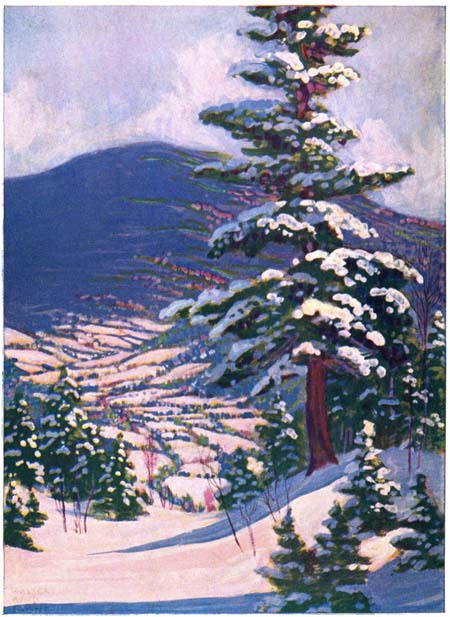
Illustrator: Walter King Stone
Release date: January 31, 2026 [eBook #77821]
Language: English
Original publication: Boston: W. A. Wilde Company, 1927
Credits: Tim Lindell, David E. Brown, Andrew Butchers, Sue Clark, and the Online Distributed Proofreading Team at https://www.pgdp.net (This book was produced from images made available by the HathiTrust Digital Library.)
Books By
Walter Prichard Eaton
“The Idyl of Twin Fires”
“In Berkshire Fields”
“Green Fields and Upland Pastures”
“Skyline Camps”
“Penguin Persons and Peppermints”
Copyrighted, 1927
W. A. WILDE COMPANY
All rights reserved
The Man Who Found Christmas
MADE IN THE UNITED STATES OF AMERICA
The Man Who Found
Christmas
By
Walter Prichard Eaton
Frontispiece by
Walter King Stone
W. A. Wilde Company
Boston :: Massachusetts
[1]

A NEW GENERATION has come into the world since what is here recorded took place. There has been a mighty war, when “peace on earth” seemed very far away. The automobile has conspired mightily to change our ways of life, possibly our ways of thinking and even feeling. You will find in this story, dear Reader, mention of forgotten things—sleighbells! We today, and especially our young people, are supposed to be more sceptical of sentiment than we were of old; so therefore we are presumably more sceptical of Christmas, which is the feast and holiday of sentiment. But unless this story grievously errs—and how can that be, since it took place as set forth just about twenty years ago?—young people have been sceptical of sentiment before; and if Christmas could prove them wrong then, perhaps it can again. If you and I can learn to drive a motor car, surely St. Nicholas can. Maybe the old world doesn’t change so much as we little, self-important mortals, proud each in our generation, fondly suppose. We may, as we elegantly phrase it, have “debunked” a lot of things since good Victoria went to her rest and Henry [2]Ford and the Kaiser conspired against ours. But here is one bet still laid on Christmas!
Life, of course, may not have been so lively twenty years ago. The life of a young bachelor in New York twenty years ago, at any rate, was humdrum and conventional. It was not popularly supposed to be, but it was. (It certainly isn’t popularly supposed to be today, but probably it is.) Wallace Miller was a young bachelor in New York, the New York when taxi cabs were a novelty and motion pictures cost a nickel, and the only unconventional thing in his life was the To-Hell-with-the-Merry-Yule-Tide Association, which met every Christmas Eve, and dined. And, alas, even that dinner was conventional,—Delmonico’s and dress coats! His profane association numbered six members. There was Mercer, who had organized it and supplied the original profanity; he was city editor of a daily paper, and had to work on Christmas day, so perhaps may be forgiven. There was Jack Gleason, formerly one of Mercer’s reporters but now a playwright, who supplied most of the good spirits, which Mercer said was no wonder, since he had an income of $20,000 a year. There was Gilsey, a short, dark, thick-set, scowling man with an astonishing vocabulary of invective and all the instincts of a born iconoclast, who by day was sub-editor of a mild religious weekly. There were Smith and Stedman, brokers and club mates of Miller’s, who resembled closely their kind, even to the angle at which they pushed back their hats when sitting in the club before dinner. Finally there was [3]Wallace Miller himself, who had begun his New York career after leaving college as a reporter under Mercer, like Gleason, but, being blessed—if it was a blessing—with a small inherited income, had abandoned journalism for “letters,” and sought to create literature in a littered apartment down a side street not too far from his club and the magazine offices.
When Mercer had broached to him the idea of the To-Hell-with-the-Merry-Yule-Tide Association, he had fallen in eagerly with the scheme.
“Fine!” he cried. “I loathe Christmas. The club is always so desolate on that day, and the service so bad! Every year you have to subscribe to an employees’ Christmas fund, and then when the day arrives half the employees are missing and the rest act as if they wish they were. There’s nobody to dine with. You have to sit at the general table, with men you don’t know, and every last one of ’em eats as if his food choked him. It’s worse than Sundays in August. Besides, I’ve got an aunt in Somerville, Mass., who always sends me a present! You bet I’m for the association!”
The other four members had been carefully selected from a host of possible candidates, each one on the basis of his genuine contempt for this particular holiday. Gilsey had declared that he, personally, would support Christmas as soon as anybody he knew really gave Christianity a trial, but under the circumstances felt safe in taking out a life membership. So the new association was assembled, and held its first dinner on Christmas Eve, whereat plans [4]for the next summer’s vacation were discussed. The dinner was followed the ensuing year by a second, and again by a third, for there had been no defections from the ranks. They seemed, indeed, matrimonially and Christmas-spiritually impregnable. December of the fourth year had come, and with it a snowstorm. Wallace Miller still lived in his littered apartment, down a side street, a little more prosperous than of old, but even more wedded to his habits.
He was digging in the bottom drawer of an old secretary one afternoon, hunting for a long-buried manuscript (after the fashion of authors), when he came upon a bundle of ancient souvenirs, dusty and forgotten. Dropping all other tasks, as one will when suddenly confronted by visible tokens of one’s past, he untied the parcel and began going through it. It was a motley collection—the program of his preparatory school Class Day exercises; the class prophecy he had read on that occasion, full of names many of which he could not now connect with the forgotten faces; a dance card, equally full of disembodied initials; a photograph of the old, square house amid its apple trees where he had lived as a boy, and which he tenderly laid aside; another photograph of a face between parted strands of heavy hair, a face once loved with the chivalric passion of seventeen. Wallace looked at this picture a long time, as the memories crowded back upon him, and laid it back with a wistful smile. Then he resumed his inspection of the package. Next came a blank book full of quotations copied in a boyish hand—and mostly sentimental—and [5]another blank book labeled “story plots.” He remembered that one; it was compiled when he was “trying for” the preparatory school literary monthly. The plots were amusingly melodramatic. Below these books came souvenirs of still earlier years, which must have been saved by his mother—childish compositions, a letter he had written home when he went on his first visit without his parents, and finally a big Christmas card.
As he turned this card to the light, to see it better, a sudden wave of memories swept in over the threshold of his consciousness and he sat quite still while they had their way with him. The card, in color, depicted a small boy in a long nightie standing before a big fireplace with his hands stretched to the blaze. The warm red glow of the fire illumined his face and nightie. From the mantle hung a stocking. Behind him was a window, with small leaded panes, and through this window you saw a church roof, white with snow, and a cold moon riding high. Below the picture, in Old English type, were the words
Merry Christmas
Long, long ago, in the forgotten, dim years of childhood, he had loved that card. Once, he recalled, he had taken it to bed with him. The cold moonlight in contrast to the warm red fire had fascinated him, and the great, wallowing flames, and the jolly stocking. Dimly there came back to him the awareness of white roofs visible from his own window in the moonlight, of his own stocking hung up, of wallowing [6]flames and his father’s big, hearty voice, and a Christmas tree in the morning, with a red sled under the branches and a star on the top.
He sat on the floor with the card in his lap, still and silent. Outside the snow was falling steadily. It was growing dim in the room. The steam pounded suddenly in the radiator. Wallace looked up angrily. The place was certainly gloomy, lonely, oppressive. He put the card hastily back into the package, slammed the drawer shut, and set off for his club, without lighting the lamps. Outside, the streets were already sloppy with the snow, and horses were falling down. Wallace vaguely recalled his boyhood delight in the first snow fall, his dash out into the drifts, upturning his face to meet the soft sting of the descending flakes. He turned his face up now, and snow went down his collar. He looked down again, and saw that the bottoms of his newly pressed trousers were getting draggled. Stepping off the curb into an apparently firm drift, he sank ankle deep in gutter slosh. He swore crossly to himself, as he stamped and shook the snow from his feet and garments and entered his club.
It was that hour preceding dinner when the club was full. Young men like himself were sitting in groups in the grill room, their hats tipped back on their heads, canes across their laps, highball glasses before them. He could hear confused scraps of their conversation—“... took a tumble today, all right. If it goes much lower it’ll wipe out my margins”; “—you bet, it’s some show, and that girl on ...”; “—no, [7]you should have made it no trumps.” In corners men were absorbed in the asinine game of dominos. Wallace suddenly reflected that the amount of domino playing which goes on in New York clubs is a good argument for woman’s suffrage. Several men hailed him with the usual “What’s yours?” but he passed them by and went up to the squash courts. There, at least, men were getting exercise, he thought. The courts were full, so that he could not play. They smelled sweaty and stale. He went back downstairs, and found Smith and Stedman, just up from downtown, joining them in the inevitable cocktail.
“About time we began to plan our To-Hell-with-the-Merry-Yule-Tide feast, isn’t it?” Stedman asked. “I noticed today that all the shops were crowded, and a poor gink in our office showed me a ring he’s had to buy for his wife. The silly season is upon us.”
“I suppose it is,” said Wallace, suddenly reminded of their association. “Hope I sha’n’t be out of town for Christmas.”
“What’s that?” cried the others.
Wallace was rather surprised himself at his words, for he hadn’t the slightest intention till that moment of being out of town. But the card had made him unconsciously long for Christmas, for a real Christmas such as his childhood knew.
“I might be taking a trip soon,” he replied. “I’m a bit stale on the town.”
“Nonsense,” said Smith. “You’re the most confirmed New Yorker of the bunch. You’ll be here. Where on earth could you go?”
[8]Wallace made no reply. He didn’t know where he could go, to find a welcome, and the thought somehow hurt him. They went out to the dining room and consumed the usual dinner, every item of which could be predicted. After dinner they went to the theatre, to a new musical comedy every song and dance and joke of which could be predicted with equal certainty. Then Wallace went home to his apartment, after the usual half hour at the club for a nightcap. It was cold and dismal in the apartment. “Also as usual,” he suddenly reflected. The next morning it was still dismal. Rather than work, he went out into the streets, through Madison Square which showed some traces of yesterday’s snow, and up the Avenue. The shops were gay. A toy store window attracted him. He saw many children going inside, with radiant faces of expectancy. One of them smiled at him.
“I’d like to give somebody something,” he suddenly thought. “It would seem rather nice.” He walked on. The pavements and walks were sloppy, but all faces were cheerful. Christmas seemed to be in the air. Wallace felt curiously aloof from the life about him, isolated, lonely. Why had he hated Christmas? Was it not, perhaps, just because he was lonely, isolated? Was not the fault with him rather than Christmas? This was a disconcerting reflection. He put it away from him, and went to the club for lunch. Gilsey was there, holding forth “agin the government,” as the old phrase had it.
“Christmas!” he was saying. “Christmas is now degenerated into a season when most people have to [9]study out how they can afford to give useless presents to all the people who have given useless presents to them. They can’t afford it, but they do it. Getting generous by calendar is almost as spontaneous as kissing your wife—if you’re so unfortunate as to have one—by the clock. It’s ...”
“It’s something rather nice, as I remember it,” Wallace interrupted.
“What?” roared Gilsey. “Et tu? You’d better consult a doctor!”
“Gilsey,” the other answered, “did you ever try the band wagon instead of the scorner’s seat on the brownstone steps?”
Gilsey looked at his friend with a comical expression of quite genuine grief. “I—I don’t know what you mean, Wallie,” he said.
“Never mind,” said the other, contritely, “doubtless I don’t mean anything. I’ve been a bit upset by a memoir of my dead life, that’s all.”
But after lunch he returned to his apartment and took the memoir from the drawer again, looking tenderly at the little chap in the fire-lit nightie. “My dead life—yes,” he reflected, sentimentally touched by the memories. “That Christmas spirit of those days, can it not be found again? Is one foolishly seeking a lost Eden to search for it? Moonlight on a white world, a Christmas tree, the merry screams of children—of children—”
His reflections trailed off into incoherence, and chiefly he was aware of an oppressive sense of loneliness. The thought of his club bored him. Gilsey, [10]with his eternal knocking, bored him, the To-Hell-with-the-Merry-Yule-Tide Association struck him as rather a farce, not to say a pose. He wanted Christmas, that was the size of it. He wanted something he did not possess and in his present surroundings could not possess. He was living outside of Christmas.
“I’m a sort of a man without a country,” he suddenly thought. “Gilsey, Smith, Gleason—we all are. We are single men in New York. I’m going to find Christmas! I’m going to find moonlight on white roofs! I’m going to find that kid in the white nightie!”
He rose abruptly, and began to pack his bag and steamer trunk. He had no idea where he was going, but he was very cheerful. He felt like whistling, and found himself whistling a long-forgotten tune which his father had sung to him twenty years before. It was the ancient carol of Good King Wenceslaus.
That evening he did not go to the club to dine. The next morning, early, he was at the Grand Central Station, where he selected various time tables and hotel guides, and retired with them to the waiting room. He might have gone to the town of his birth and childhood, but for many reasons he did not care to. A trolley, he knew, ran past the big house where he had lived. Perhaps the house no longer stood there! The spawn of the city had by now reached the village; it would be no longer country, but suburb. He did not want a suburb. Neither did he desire to hazard enjoying Christmas in the shouts of children [11]whose mother’s picture now reposed in his dusty drawer amid the souvenirs of his buried youth. So he ran through lists of stations till his eye chanced upon North Topsville, Massachusetts. The name pleased him. There was a South Topsville also, though Topsville itself did not exist so far as the railroad was concerned. South anything, he reflected, is usually the part of the community which has the mills and motion picture theatre—just why nobody has satisfactorily explained; so he cast his lot with North Topsville, and purchased a ticket for that place. An hour later he was sitting in a Pullman car and leaving New Rochelle behind.
By the time the train was well up into the New England hills, it had begun to snow again. Wallace looked out of the car window fascinated by the panorama of reddish gray hillsides seen through the white storm. As station after station was passed, each taking its quota of passengers from the train, each passenger met on the platform by welcoming friends or relatives, the Pullman began to be almost empty. Wallace felt lonely. There would be nobody to welcome him at North Topsville. He felt rather sorry he had come when he reflected on this. After all, his search was probably hopeless. He ate luncheon, and became more cheerful, for the train was passing out of the storm into a glittering, white world of broad valleys and lovely hills and snug farmhouses on the roads between tidy New England villages where beautiful naked elms arched the streets. At South Topsville, sure enough, there was a big mill, and down [12]the street from the station a motion picture theatre. Wallace grinned at the correctness of his intuition (“Almost feminine!” he thought), and began to put on his coat. The train ran into snowy meadows, into a strip of woodland and swamp, and then emerged into a gentle intervale where graceful vase elms fringed a stream, and came to a stop at the North Topsville station. Wallace alighted—the only passenger to do so—and the train moved on. He stood with his grip beside him and looked about. The station was a small one. Beyond it a road stretched across the meadow to the village street, where he saw a white steeple. On the other side of the tracks lay a snowy field, then a road with two or three farmhouses upon it, then the steep wall of a mountain. The station agent was up the platform examining his trunk. Beside the platform stood a pung of ancient vintage, and in it was seated a young man swinging his arms against his chest for warmth.
Wallace took a step toward him, and the youth nodded. “Be you goin’ ter the hotel?” he said.
“I am if there is one, and you are,” Wallace answered.
“I be ef you be,” the youth replied, “and there is. Hev ter come back agin fer the trunk,” he added. “Most folks as come here in winter is drummers, an’ they travel light—sample case an’ tooth brush an’ a copy of the Saturday Evenin’ Post. What’s your line?”
“Christmas,” Wallace answered with a laugh, as [13]the pung moved across the meadows in the cold, crisp country air.
“Wall, I reckon now’s the time ter sell that,” the young man answered imperturbably. “Quite a brisk demand fer it these days. My little gel, she’s writ a letter ter Santa Claus thet’s goin’ ter nigh bust him, I reckon, him bein’ me.”
“Have you a little girl?” Wallace asked in surprise.
“Gol, I got two of ’em, but t’other’s only six months, and ain’t very good at spellin’ yet,” the driver replied. “Why not? I bin married more ’n five years. I’m twenty-six.”
Wallace made no reply. He was thirty himself, and felt curiously ashamed.
At the door of the Mansion House he gave the driver a dollar. “Keep the change—for the little girl,” he said. The other looked rather surprised, but finally put back his little bag of change into his pocket.
“Wall, seein’ yer put it thet way, I will,” he said. “But I don’t jest like it.”
“I am a long way from New York!” thought Wallace, as he entered the hotel.
The Mansion House of North Topsville was a relic of past generations. Large Doric pillars in front gave it an air of dignified antiquity; but the interior was surprisingly neat and clean, though darkened by the protecting portico. That it should remain open during the winter months surprised Wallace at first, but he learned later that most of the business visitors [14]to the South Topsville mills stayed here, attracted by the superior accommodations and a rather famous kitchen, while a certain number of health seekers could always be relied on. He signed the register, and was escorted to his room, a large, old-fashioned chamber with a broken pediment, like a highboy top, over the door, and an open fireplace. He ordered a fire laid at once, and began to unpack his bag. Outside, on the village street, he could hear sleighbells jingling, and presently the shouts of children going home from school. As soon as his trunk had come, he put on a woollen cap which pulled down over the ears (purchased the day before in New York), and hastened out of doors.
The village street was packed hard by the sleigh runners. There were half a dozen old-fashioned stores here in the town centre, a white church, a small stone library, a bank, a town hall. The town hall was built of brick, a simple rectangular block with white stone trimmings, and looked very cheerful over the snow. Out of the town centre, in either direction, the main street led beneath graceful arches of bare elm boughs into the white country. Wallace turned west, following a crowd of children with sleds and toboggans. For a quarter of a mile the street was lined with substantial old houses, several of them of considerable architectural beauty, and nearly all, apparently, surrounded in summer by lawns and gardens. North Topsville was evidently still a good specimen of a too rapidly disappearing type of aristocratic New England village. It seemed to the man [15]as he walked along behind the children that he was less a stranger here than in New York. He felt as if he were coming back home. He walked with memories of his own childhood in such a town, and the intervening years faded from his consciousness. He half expected to meet somebody whom he should recognize, and once, indeed, seeing a girl’s figure coming down the path from a Doric porch behind guarding evergreens, his heart gave a startled bound, for it appeared to his excited imagination the figure of her whose picture he had so recently unearthed. Most people, probably, know that curious sensation of false recognition. If we have been thinking much of a person, we will often see him a score of times in a single day, ahead of us in the crowd, perhaps, or sitting across the theatre. At any rate, the shock of this sensation accounted for Wallace Miller’s pronounced stare at the girl’s face, when they met at her gate. Her eyes returned his gaze for a second, as if she, too, were appraising him, and then she passed quickly by, leaving behind on the keen winter air the faintest of perfumes, not the perfume which comes in bottles, but which comes from garments kept in lavender, from soap and health. The man drew a long breath, rather astonished at the acuteness of his nasal sense, long unused to subtler perfumes, and pleasurably warmed by the encounter. He looked sharply at the house from which the girl had come, to fix it in his memory. There were plants at several of the square, small-paned windows, and the tracks of a sled and toboggan all over the lawn. [16]Behind it he could hear children screaming and laughing. He walked on more briskly.
The road soon passed into more open country, and to the right was a long, smooth field, ending in a hill slope. Field and slope were alive with sleds and children, their shouts making a shrill, ceaseless chorus, almost like spring frogs. The man climbed through the fence and ascended the slope, attracting a few curious glances from the coasters, and stood at the top watching the sport. He felt ridiculously shy. He wanted to coast, he wanted to join in the sport, but he did not know how to begin. Nobody spoke to him. There was a group of red-cheeked high school girls there, but his coming caused no flutter nor whispering among them, as he knew it would had he been younger. This made him feel uncomfortably and unreasonably old. The smaller boys were paying no attention to anybody except themselves. The smaller girls were timidly coasting on a gentler incline of their own, and doing a great deal of the screaming. Two busy small boys were industriously hauling up a big toboggan, and bumping down on it over the runner tracks, hard put to keep it from swerving and upsetting them. Presently two other toboggans appeared, and had the same difficulty on the smooth, uncharted hillside.
The man finally plucked up his courage, smiling to himself at his own embarrassment, and asked the evident owner of the first toboggan why he didn’t build a slide.
[17]“Dunno,” said that young person. “What’s a slide?”
“You don’t know what a slide is?” exclaimed Wallace, glad to see that his scorn made an evident impression. “The only real way to get speed and distance out of a toboggan is to have a slide. You use up half your speed now by the friction of steering. All you’ve got to do is to make two banks of snow a couple of feet apart, and keep the sleds out. Then the chute between the banks will get almost glare ice, you won’t have to bother to steer, and you can go a mile a minute clear to the other end of the pasture.”
“Gee, let’s build one, Joe,” exclaimed the second small boy.
“Ain’t got no shovel,” said the first.
“If you’ll bring shovels tomorrow afternoon, I’ll help you,” said Wallace.
“Tomorrow’s Saturday,” the boy replied, with some scorn.
“So it is, I forgot,” Wallace laughed. “Well, how about nine o’clock tomorrow morning, then?”
“You’re on, Judge,” said Joe, easily, as he kicked the toboggan around to face down the slope. “Want to try a ride?”
Wallace sat down on the cushionless toboggan, between the two boys, and with a yell of warning they started off. The additional weight in the centre made the task of steering too much for the helmsman. Two-thirds of the way down the toboggan began to [18]pivot, skidded madly to the left, upset, and rolled all three riders over and over in the snow. They picked themselves up, laughing, while other coasters shouted and jeered. The man’s wrists and neck were full of snow. His nose was scratched by a piece of crust. His eyes were weeping. But he laughed as he rose. “That won’t happen when we get the slide,” he said.
“Ho, that’s fun,” the owner of the toboggan answered. “Want to try it again?”
“I think I’ll wait till morning,” said Wallace. “Good-bye till tomorrow.”
“So long,” said the boys, turning from him at once, as if he no longer existed.
He went back to the road, digging snow out of his neck and sleeves, and feeling rather sore and wrenched. In front of the house with the Doric porch he now observed a toboggan standing. The girl was nowhere visible, but the toboggan was a hopeful possibility! He went back to the hotel and unpacked his trunk while the early twilight came on and his wood fire sparkled cheerfully. He felt cheerful again himself now, and sleepy with the unaccustomed country air, and pleasantly tired and hungry. Supper was announced by a big bell clanged in the lower hall, and it was an excellent meal, with real maple syrup to pour on piping hot griddle cakes. Still sleepier and more contented, Wallace went back to his room to read, nodded over the pages in front of his fire, and finally decided to go to bed at the unheard-of hour of nine. After he had undressed and turned out the [19]light, he suddenly became aware of moonlight outside. Going to the window, he saw it gleaming palely on the white roof of the church. The village street was still and almost deserted. The stores were closed. Save for a distant sleighbell, there was hardly a sound. He opened the window and sent his breath steaming out into the night, and then sucked back a great lungful of the sweet, stinging cold air. With a final glance at the white roof sleeping in the moonlight, he tumbled into bed, as the clock solemnly boomed nine, and almost before the last reverberation had died away into silence, he was asleep.
He was awakened in the morning by the clangor of the breakfast bell, breaking strangely in upon his dreams, and for several moments he lay in bed enjoying the odd sensation of sunshine in his chamber and comparative quiet in the outside world. He heard sleighbells in the village street, and the voice of somebody saying “good mornin’” to somebody else, with the old Yankee nasal inflection, which was like forgotten music to his ear. At 8.30 he was through his breakfast, and set forth to find a snow shovel and a toboggan. There were plenty of shovels, but only one toboggan in the store.
“Thet’s the last one,” said the storekeeper. “Kinder thought I warn’t goin’ ter sell it, seein’ it’s six dollars. The rest wuz three an’ four. Would you like the cushion, too? Kinder absorbs the shocks!”
Wallace took the cushion, too, and set out down the main street dragging his new purchase and feeling rather sheepish. Nobody, however, paid much [20]attention to him. He looked for the girl at the house behind the evergreens, but she was not visible. The toboggan was still standing beside the Doric porch. He passed on, vaguely disappointed, and was soon at the hillside. His two friends of yesterday were already there, and with them six other small boys, with a total of four snow shovels. Evidently the word had gone forth that untoward events were on! Wallace was secretly pleased and rather flattered. He felt so shy with these boys that their response seemed to him a compliment.
“Good morning!” he cried. “Well, you are ahead of time. I’ll bet you don’t get to school so early.”
The boys grinned at this, looking at each other. Wallace felt more at ease.
“Well,” he said, “let’s get busy right away. Let’s build the slide somewhere so it won’t interfere with the sleds. Over here a little to the left, eh?”
The boys followed him to the left side of the slope, and under his direction they began to work.
It did not take them long to raise banks nearly two feet high halfway down the hill, but before this much was completed a score of other coasters had arrived, and come over to watch the work. One large boy, with a sled, got into the incompleted slide and came whizzing down.
“Hi, get out of that!” yelled the workers. “This is for toboggans.”
“Aw, chase yourself, I’m goin’ down it again,” said the coaster, as he came back up the hill.
[21]“No, you’re not, is he, sir?” cried the workers.
Thus appealed to, everybody looked at Wallace, including the large boy.
That individual spoke up quickly. “I guess this hill’s as much mine as it is yours,” said he, with the characteristic aggressiveness of his type, “an’ I’ll coast where I please.”
Wallace looked at him sharply. “You are considerable of a bully, aren’t you?” he said. “Well, I’m something of a bully myself. We’ve left all of this hill to sleds except just this narrow strip, which is going to be for toboggans. Everybody who’s decent will keep out of it with sleds. Anybody who isn’t decent, who’s just mean and nasty and selfish and not thoughtful for other people, will have me and all these eight boys to reckon with. Now, young man, go ahead and try to coast here, if you care to!”
Wallace’s voice didn’t rise above a conversational key, but he looked the bully square in the eyes, and that individual slunk off to the other side of the hill. The smaller boys looked at the man with evident admiration, and began to talk excitedly.
“Gee,” whispered Joe to Wallace, “Jim never got a lacin’ down like that before! I’ll bet he comes and spoils the slide tonight, though.”
“When we get it done,” said the man, “we’ll offer to take him down it on a toboggan. That’s the way to pull his teeth. He’ll be ashamed then, maybe.”
No sooner had he spoken, than something made him turn. Standing close behind him was the girl of yesterday. In the excitement, she had come up the [22]hill without his seeing her. She was dressed in a white angora wool cap, a white angora sweater, and a short, heavy skirt, with heavy knee boots below it. She held a toboggan rope in her hand, and beside her stood a yellow-haired youngster of six, with cheeks like two ripe apples. She was looking at Wallace. He unconsciously smiled and half nodded as his gaze met hers. She spoke, rather to all the boys than to him.
“That’s right,” she said, “you scorch Jim’s head with coals of fire and maybe it will do him good. Some of these boys are in my Sunday School class,” she added more directly to Wallace, “so I’ll just get a day ahead with the lesson!”
The boys all laughed at this and Wallace said, “That’s right. Carpe diem, in a new sense!”
Then he reluctantly turned back to the slide. Presently he saw the girl and her small charge tobogganing down the hills. He sent two of his own “gang,” as he called them, down the slide to see how it worked, and set the rest to completing the bottom part. It was soon done, and with a shout all the eight boys piled up to the top, crowded aboard the toboggans, and one after another went yelling down. After a few trips the bottom was packed smooth, and the coasters scooted clean across the pasture at the bottom to the very road.
“Gee, this is great!” cried one of them.
“You bet, best we ever had!” shouted another.
Wallace looked along the hilltop and saw the girl. “Run and tell your teacher, Joe, that the slide is for [23]everybody who has a toboggan,” he said. “Is that her son with her?”
“Ho, she’s Miss Woodford. That’s her sister’s kid,” said Joe, scampering off, while Wallace felt a secret relief and a glow of pleasure.
Joe returned with the girl and two other younger girls as well, who had a toboggan.
“We built the slide for everybody,” said Wallace to Miss Woodford. “It’s for the toboggans, so they won’t have to be steered. The sides make it perfectly safe even for children. Try it.”
“It’s very nice of you,” the girl smiled. “Our boys need a man to direct their play.”
“I fear I’m a poor hand, and a very inexperienced one,” Wallace answered. “But I’m having a good time.”
“Doubtless that is why the boys are,” she replied, as she tucked her skirts around her trim boot-legs, told her little nephew to hang on tight, and Wallace pushed them over the brim.
The slide grew more and more slippery, and the fun more and more furious. Half the coasters came over to watch, or to beg for rides. Even Jim, the bully, cast envious eyes toward the slide. “Now’s a good time,” said Wallace, to a couple of boys. “Go over and offer Jim a ride.”
“You do it, Joe,” said one of the boys.
“No, you do it,” said Joe.
“What’s the matter, are you afraid?” said the man. “You just show him once you’re not afraid of him, and he’ll come down off his high horse.”
[24]“Ho, I ain’t afraid!” cried Joe, going at once toward the bully.
“Come on and try the slide on my toboggan, Jim,” the rest heard him saying.
Jim scowled and hung back for a moment, but his curiosity got the better of him, and he came.
“Take my toboggan, Joe,” said Wallace; “it’s bigger than yours.”
Joe took it, Jim the bully and another boy and two girls piled on, and went screaming down the slide. The man smiled, and turned to meet the smile of Miss Woodford.
“Won’t you try mine?” she said.
He put her on the front, and held the small nephew between them. That young person was very solemn. Wallace could feel the muscles of his little arms tighten as he gripped the toboggan rails. His little face was set, his lips parted, his yellow hair blown about his temples from under his cap. He was deliciously frightened by the speed. As they came to rest at the bottom, however, he automatically relaxed, and let out a bottled-up yell.
“Having a good time, son?” asked Wallace, as a small hand grasped the rope beside his arm.
“My-name’s-Albert-Andrew-Goodwin,” the young person replied, all in one gasping breath. “I-think-this-slide’s-the-bestest-fun-I-ever-had.”
Wallace laughed, and so did the girl.
“My name is Wallace Miller and I quite agree with you,” he answered.
“My name is Nora Woodford, and I’m not inclined to present a minority report,” the girl smiled.
[25]“What’s that, Auntie Nora, that thing you just said?” demanded Albert Andrew Goodwin.
“It’s my way of saying the slide is lots of fun,” she replied.
“Why don’t you just say it, then?” the boy asked.
Again the grown-ups laughed, and Wallace felt a curious thrill through his glove as the little hand beside his on the toboggan rope pressed close against his fingers.
At the top the small fellow took actual hold of his hand, with a most engaging smile, and demanded that he steer them down again. This time Albert sat at the front, and Wallace grasped the rails at either side of the girl, to hold her on, while she put protecting hands about her nephew. The slide was already like glass, and it was developing a few spots where the banks were not quite true and the toboggans were thrown from one side to the other. Two-thirds of the way down little Albert was whipped so sharply to the left that he let go of the rail. His aunt, with a scream, grabbed him hard, and the shift in her weight was more than Wallace could counteract at the speed they were traveling. The toboggan rode madly up the bank at an oblique angle and shot over on the other side, burying its nose in a drift and sending all three riders overboard in a complete header. Wallace was on his feet in a second, and had his arm about the girl, lifting her, for he saw that the child must be underneath.
“Are you hurt?” he cried.
“No, but Albert, quick!” she gasped.
Nothing of Albert was visible save his legs. His [26]head and body had completely disappeared. The legs were quite still, and something inside of Wallace went down to his boots with the sickening lurch of a badly run elevator. He put his hands through the snow, grasped the body, and lifted it up. It came up looking like a small snowman, wabbled in his grasp, straightened itself, and suddenly emitted a wail.
“Oh, where are you hurt?” cried the girl, kneeling beside the child and dabbing the snow from his face and eyes.
Albert blinked the water from his vision, meditatively lifted first one foot and then the other, stopped crying, and said, “Why, I ain’t!”
The change was so comically sudden that both man and girl laughed in nervous relief.
“Are you sure?” she urged.
“Sure,” he replied stoutly. “Ho, that wa’n’t nothing!”
Again Wallace helped the girl to her feet. “And you, are you sure?” he asked solicitously.
“I’m all right,” she said. “I had Albert to land on. You’re a fine cushion, Albert.”
“And I had both of you,” Wallace laughed. “It was a case of the women and children first, with a vengeance! Let me brush you.”
As he stooped to do so, all three were suddenly aware of how snow-bepowdered they were, and laughed again, while the others on the hill, who had gathered about, laughed with them.
“Thank heaven we can laugh!” Wallace whispered. [27]“When I saw those two little leggings so still in the snow I seemed to grow ten years older.”
The girl looked into his face, and shuddered, without speaking. It was as though they had touched hands across a sudden gulf. He brushed the snow from her clothes as best he could, and then he spanked it off Albert, and on an impulse strange to him put his arms about the little fellow and gave him a hug. His eyes looked up to meet those of the girl, which were regarding him oddly.
“I didn’t know before that I liked kids,” he said, as if in apology.
“You do. I’m sure,” she smiled.
Before any more toboggans were allowed on the slide, Wallace and his gang made the banks higher and straighter at the dangerous points, and thus corrected the chute held like a vise. The coasters were soon whizzing down again.
But before they could start back, the town clock struck twelve.
“Oh, gee, dinner time!” cried Joe. “I’d rather slide.”
“The slide will be here this afternoon,” Wallace laughed. “You go home to dinner before your mother gets after you, Joe!”
The rest grinned at Joe, and followed Wallace and Miss Woodford out of the field. It was a considerable procession which marched up the road. Little Albert refused his aunt’s hand, proudly insisting on tugging his own toboggan, and chattering of his adventure. Half a dozen small boys disputed for the [28]right to drag Wallace’s. Another boy carried his snow shovel. Even the bully was in the group.
The girl looked back, laughing. “I believe you are the Pied Piper,” she said.
“If I should confess to you,” he answered, “that this morning I was afraid of these boys, as timid as a child before them, maybe you wouldn’t believe me. But I’m not used to kids.”
She again darted an odd look of curiosity at him. “Are you visiting in town?” she asked.
He shook his head. “I don’t know a soul here. I’m at the Mansion House. I just came—saw the name North Topsville on the time table and liked it. I’m hunting for Christmas.”
Once more she looked at him. “That shouldn’t be hard to find. Christmas is nearly everywhere, isn’t it?”
Wallace shook his head. “I’ve not met Christmas personally in a decade, at least,” he answered.
The girl paused in front of the house amid the evergreens. “I think we can introduce it to you here,” she said, with a bright smile. “We keep quite a supply on hand in Topsville.”
Then she nodded to him, and to the children, and turned up the path. The bully touched his cap.
“Boys,” said Wallace, “don’t you know what to do when a lady meets you, or leaves you? What is it, Joe?”
Joe turned red. “Touch yer cap,” he said.
“Exactly,” said Wallace, “and Jim, here, was the only boy who did it. Good for you, Jim!”
[29]It was Jim’s turn to color—with pleasure as well as embarrassment. The other boys looked at him. The villain of the early morning had now become the hero! They scattered their several ways in some perplexity, while Wallace walked on to his dinner, every nerve tingling with the excitement of the morning, the unusual contact with small boys, the thrill of little Albert’s touch, his warm baby arms and hand, the sudden surge of horror at the thought of injury to him, the feeling of intimacy which followed the accident, the perfume of the girl’s hair, her bright, friendly smile, the whole atmosphere of naïve enjoyment. It wasn’t much like his mornings in New York, he reflected. And what an appetite he had!
But he discovered after dinner that he was tired, that the muscles of his legs ached from climbing the hill, that his hands were chapped and his face smarted. Indolence stole over him, and he curled up before the fire in his room and read a book, until the light began to fail. Then he went out once more, into the cold twilight, and his feet led him up the street to the house with the Doric porch. He told himself that he must inquire if Albert were really unhurt. Almost at the gate he met Miss Woodford, Albert, and several of the boys, which answered his unspoken question.
“Hi, where were you this after’?” called Joe. “Gee, the slide’s so slippery now it’s most ice!”
“Yes, an’ I mos’ fell off again twice!” cried little Albert Andrew Goodwin, running up to him and thrusting a tiny hand into his.
[30]“Did you?” cried Wallace. “Well, now you see why you’ve got to hang on tight, all right.”
The other boys moved on, and Joe led them in touching his cap to the girl.
(“That’s right, Joe,” whispered Wallace, as the boy passed him.)
Miss Woodford acknowledged the salute with a bright smile and a “Good night.” The little chap kept fast hold of Wallace’s hand.
“I gotta snow man in the back yard. You come ’n see it,” he pleaded, tugging at his new friend’s fingers.
Wallace laughed, a little embarrassed. “I guess not today, Albert,” he said. “It’s bedtime for little boys and snow men.”
“Ho, snow men don’t go to bed at all, an’ I don’t go till seven!” cried Albert. “Please tell him to come, Auntie Nora.”
“You’ve asked him, dear,” said Auntie Nora, with a smile. “I’m sure he’ll come for you if anybody.”
Wallace looked at her, and her eyes met his for a second and did not tell him to refuse, so with Albert’s hand still tugging at his, he was taken up the path between the evergreens, around the big, square house, into a large garden space, where a snow man stood, with lumps of coal for eyes.
“Why, how do you do, Mr. I. C. Snow!” cried Wallace, pretending to shake hands. “I am glad to see you looking so well. I trust you don’t find this weather too cold for you?”
Albert shouted with glee. “Say it again!” he cried.
[31]Wallace put his ear to the snow man’s mouth, and shook his head gravely. “Oh, that’s very sad!” he said. “Very sad!”
“What does he say?” Albert asked, crowding close.
“He says he’s got such a cold from not wearing a hat that he’s lost his voice,” Wallace answered.
The boy looked solemnly puzzled for a second, and then burst into shouts of laughter.
“Ain’t he funny, Auntie Nora?” he demanded. “The snow man don’t really talk.”
“What?” cried Wallace. “Well, I guess you never listened very close!”
“I like you,” said Albert suddenly, grabbing his hand again. “Come in an’ see my blocks.”
“Do,” added the girl, noting Wallace’s hesitancy; “we will have some tea.”
“You are very kind,” Wallace answered, “but I’m afraid our little friend is forcing your hospitality.”
“We always have tea at this time,” she smiled. Her eyes were friendly. In her white cap and sweater, her cheeks red with a day in the open, her hair curling out rebelliously about her temples, she was a temptation hard to resist. The warm little hand was tugging at his fingers. But Wallace managed to say, “Another time, sonny,” and made his way to the street.
The next morning he debated the propriety of going to church. He had not gone to church for so many years that the idea was invested with novelty. Yet he knew that he was going in reality to see the [32]girl again, and it seemed hardly an appropriate motive. However, he went!
A farmer sat directly in front of him, with a sunburned neck like wrinkled leather, rising above a rubber collar. Wallace thought of his own grandfather, who had been a Yankee farmer, too. The whole congregation, and the bare meeting house with its gallery on three sides and its lofty pulpit reached by a winding stair, reminded him of his childhood. He saw Miss Woodford in the choir. She wore black furs, which became her as much as white. Presently she sang a solo, and her voice was sweet and quite evidently trained. Wallace found himself suddenly thrilled by it, as he used to be years ago by the voices of those he loved, and long after the congregation had rustled to silence and the minister had begun to preach, he sat with his eyes on the choir, in a delicious revery.
When the sermon was over, and the congregation had sung the closing hymn and bowed for the benediction, there was an immediate outpouring from the pews and the hum of greetings. This was the social hour of the week. The minister came down from the pulpit, exchanging salutations. Children came running in on their way to Sunday School in the vestry. Neighbors chatted in groups. Before Wallace had fairly left his pew, a farmer in starched best was grasping him by the hand, and hoping he would come again. The minister came up and greeted him. A moment later he saw Miss Woodford drawing near. She put out her hand. “Good morning,” she said. Then, [33]turning to the minister, she added, “Mr. Miller taught some of my boys in one day to do what I’ve not been able to teach them in a year—to touch their hats. I really think you ought to give him a Sunday School class.”
“Good gracious!” gasped Wallace, with such evidently genuine amaze that the others laughed.
“I should be delighted to get a man into the Sunday School,” said the minister. “Who knows, we might start up some Boy Scout work!”
“Mr. Miller is just the man,” said the girl, with a twinkle.
“I don’t think this is fair of you, Miss Woodford,” Wallace put in. “For all you know, I’m a heathen—maybe the Pied Piper, as you suggested.”
“The Pied Piper would have made an excellent scout master,” the minister smiled. “Well, Mr. Miller, if you stay in North Topsville long, we shall hope to catch you yet.”
He moved on, leaving the two young people together. A second woman, in black, drew near, a few years older than Miss Woodford. “May I introduce the mother of your friend Albert—my sister, Mrs. Goodwin,” said the girl.
“I am always delighted to meet Albert’s friends,” the second smiled. “He tells me you wouldn’t come to see his blocks. I really think you will have to come if only to keep him quiet. For tea tomorrow, perhaps?”
Wallace bowed, as Albert’s mother passed on. The girl turned toward the vestry. “Now to my [34]class,” she said. “I do wish you would take it, instead.” Her eyes met his for a second, half twinkling, half earnest.
He shook his head. “Really, I’m unfit. You don’t know.” He spoke seriously.
Their eyes were together a second longer, unspoken questions passing between them, and then she left him. As he went down the path from the church he heard behind him the shrill piping of the Sunday School, singing the opening hymn, and he smiled at the sound, for it touched forgotten stops in his memory. Gilsey, he reflected, was just about getting up at this moment, after his Sunday morning loaf in bed, and was probably swearing at the hot water tap as he shaved himself. Smith and Stedman, maybe, were finishing breakfast at the club, and solemnly debating the tremendous question of how they would kill the remainder of the day. Mercer was getting ready the Sunday afternoon assignment book in a newspaper office stale with the tobacco smoke of the night before, and doubtless planning to get away early for a bridge game—his Sunday afternoon recreation. How they would all sneer at Wallace if they knew he was coming from church, and listening with wistful delight to the drone of Sunday School behind him!
The following afternoon, when school was out, Wallace dragged his toboggan to the hill, and joined once more in the sport. The slide was still intact. The bully’s fangs had evidently been drawn. Miss Woodford was there, with Albert. For an hour [35]Wallace’s toboggan was packed with shouting small boys, who treated him now like one of them, an unconscious flattery which he found very pleasant. Then, as the sun began to sink through a green sky into the tops of the hemlocks far across the snowy fields, Wallace left his toboggan behind, for Joe to take proud charge of, and walked home with the girl and Albert. The shouts died away behind them. It was almost twilight in the village street. As they came to Miss Woodford’s gate, Wallace saw a red lamp in the window, glowing between the evergreens. He paused abruptly.
“I can’t tell you what a curious sensation that lighted window square gives me, gleaming behind the trees over the snow,” he said. “But in some strange way it takes me back to the days when I was no older than Albert, and Christmas was a reality. Ever since I came to North Topsville I’ve had a curious sensation of familiarity, though I was never here before in my life. Just now, if my mother should be waiting at the door, I’d not be surprised.”
“Your mother is dead?” the girl asked.
“And my father. I left New England many years ago, and I guess I’ve been a man without a country ever since. Now I’m coming back home.”
It may be he spoke wistfully, for the girl did not reply for a moment, and little Albert ran ahead with the toboggan.
“We New Englanders never quite forget, do we?” she finally said. “We are like the Irish in that. I—I [36]trust you will continue to feel at home in North Topsville. We are surely New England here, especially in our ratio of the sexes! I’m one of sixty-seven old maids in this small village.”
Wallace looked at her, with her firm body in its white sweater, her full-colored cheeks, her keen, dancing eyes, and suddenly laughed. “Then that’s proof positive of Mr. Shaw’s ‘Man and Superman’ theory,” he said, “and—well, some of you are merely indifferent.”
The girl darted a look at him. “No woman ever tells what she really thinks of Mr. Shaw’s theory,” she replied, leading the way up the path.
Presently Wallace was trying to drink tea and reproduce the Woolworth Tower in blocks at the same time, in a square, mahogany-furnished room which appeared to have been lived in for a century and yet to be freshly and cheerfully of today. He saw Miss Woodford for the first time without hat or wraps. She had run upstairs and returned with slippers on instead of high boots, and he noticed that her stockings were of heavy wool. Somehow he was pleased at this common-sense concession to the climate. Her hair was copious and rebellious. Inside of the house, she looked riotously healthy, in odd contrast to the women of New York. Her sister, evidently a recent widow, was more subdued, though she, too, had a twinkle in her eyes, a palpable inheritance from the white-haired woman who sat upright and energetic at the tea table and astounded Wallace by saying, “Since my daughter spoke of you I have read one of [37]your stories in a magazine, and I don’t like it very much.”
“Which one was it?” asked Wallace, looking up from the pile of blocks in front of him on the rug. His eyes met the old lady’s, and she seemed pleased at the challenge.
“It was about a man and a woman—all magazine stories are—who have all kinds of emotions at a violin recital. It seemed rather turgid to me. I call that form of affection a sublimated species of Dutch courage.”
Wallace joined in the laugh. “I guess you are right,” he said, “but you must try to excuse me as a New Yorker. You see, we live in such a restricted round of artificial pursuits and pleasures that we have to substitute art for nature as a stimulant.”
“Speaking of stimulants, have some more tea,” said the old lady. “Albert, pass the gentleman’s cup.”
“He ain’t got the tower did yet,” said the boy.
“Albert!”
Albert brought the cup.
Presently Albert’s mother took him off, protesting, to his supper, and Wallace and the girl sat before the fire while the mother chatted on an amazing variety of topics, evidently pleased at the chance of a new listener, and asked innumerable questions about affairs of the hour, which the man answered as best he could.
The girl came with him to the outer door.
“I like your mother,” he said.
[38]“Most people do, who aren’t afraid of her,” she smiled.
As he drew on his gloves, she stood in the doorway not minding the cold, and the last glimpse he had was of her face, rosy and smiling, in the slit of golden light, her eyes alone telling him good night, while the face of Albert was suddenly squeezed through between her skirts and the door frame and his small voice piped, “I got a steam train you ain’t saw!”
“You haven’t seen,” Wallace heard faintly, as the door closed.
Even the little shops in North Topsville were gay for Christmas. Nearly all had small evergreens before the doors, and attempted window displays. As Wallace walked back for supper, it occurred to him that he ought to buy Albert a present. But there seemed to be nothing quite satisfactory in the local market. It would be a good joke to write and ask one of the To-Hell-with-the-Merry-Yule-Tide Association to select it for him in New York. He smiled as he thought of Mercer’s remarks when the request came. What was the name of that Fifth Avenue toy shop, anyhow? Wallace searched his memory till the name came to him, and wrote at once for a toy aeroplane such as he had seen in the windows, the propeller operated by rubber bands. But he didn’t write to Mercer. He wanted to be sure of the toy.
The next day it snowed, a soft, steady, dry fall, and after working all the morning before his cheerful fire, the ideas coming with unaccustomed fertility, Wallace set out for a tramp. He wondered if he [39]dared ask the girl to go with him, and was still debating the point when he found himself on her porch. Yes, she would go; she loved to tramp in the snow. In three minutes she reappeared, wrapped in white woollens, and strode beside him down the path, while the wails of Albert were heard at being left behind.
“Poor chap,” said Wallace, “it’s a great tragedy not to be allowed to do what the big folks are doing. Perhaps I can make him a snow lady to cheer him up when we get back. Where shall we walk?”
“How would you like to take a tramp to Christmas?” the girl asked.
“Have we time?” he smiled.
She didn’t answer, but set off up the road at a swinging pace.
“You see, the honor of the town is rather at stake,” she said presently. “We can’t let you get away still a heathen. We’ve got to show you Christmas.”
“Will we meet Santa Claus?” he asked.
“Oh, no, not in the daytime, silly. But we may see the prints of his reindeers’ hoofs.”
They turned up a side road after half a mile of brisk walking, passed one or two farmhouses, and began to climb a hill. The snow, which had been stinging their faces, was now abating. The wind had broken into the northwest, and in that quarter a rift of blue sky appeared.
“Look,” cried the girl, “it is clearing! Oh, I’m going to show you something beautiful!”
They now turned up a wood road, and began to make their way with difficulty through unbroken [40]snow, four inches of feathery new fall on top, and beneath that the half-crusted old snow through which their feet broke. Wallace found it hard work, and looked at his companion solicitously. “Isn’t this too hard walking for you?” he asked.
“Are you getting tired?” she smiled. “We really should have brought snowshoes, but you’ll have to go a considerable distance to fag me. I’m used to it.”
“You are quite different from some women I’ve known in recent years, that’s a fact,” said he. “You are so wonderfully healthy!”
“I’m disgustingly so,” she laughed. “Look! One of Santa’s reindeer!”
She was on her knees in the snow, examining a hoof print. “And there are more!” she added. “See, he’s tramped around that sumach bush, and nibbled off all the buds!”
“Are we getting near Christmas?” asked Wallace.
She rose, shook her skirt, and started on. “We are,” she cried, “and here’s the sun to decorate the trees!”
Sure enough, as she spoke the sun came out, and instantly the woods around them—a grove of young chestnuts and maples—became radiant with frostwork on every twig, arching into groins of tracery overhead. Wallace fairly gasped with delight, and the girl smiled into his face.
“Have you anything as nice as that in New York?” she said. “This is all mine, too. I own this wood lot all myself.”
[41]She hurried him on through the sunlit, elfin aisles of the frost cathedral till suddenly the hard timber ended, and a grove of young spruce and hemlock confronted them, with now and then a patriarchal old pine lifting far above the lesser trees and holding out the dazzling snow on its branches against the blue sky.
“Come in, come in,” the girl whispered, “Christmas is in here!”
Close behind her, he followed in among the evergreens. The branches shook snow down upon them as they passed through till they were powdered white. A few chickadees hopped, half invisible, among the thick foliage. A moment later they stood in an open glade, where a few dead goldenrod stalks stood up in lovely Japanese simplicity above the white carpet, and all about them was a ring of perfect Christmas trees, each loaded with snow on its lateral branches, dazzling snow against the green in the afternoon sun. Above was the blue winter sky. Only the chickadees’ song broke the perfect silence.
“This is where the Christmas trees live,” said the girl, softly. “Now, do you believe?”
“I believe,” he answered. “And there is a present for me on every branch.”
“What is that?”
He looked into her face. “Perhaps I can’t tell you now,” he answered. “I shall have to take it home and open it. I’m not used to presents, and I can’t guess from the feel of the bundle.”
“I hope it’s something nice,” she smiled.
[42]“I’m sure of that,” said he, his eyes still on hers.
So they stood for an instant, their eyes meeting, and then her gaze dropped.
They spoke more seriously as they tramped homeward.
“Your mother’s criticism of my story, it was just—I see that now,” he said. “After all, to anyone who lives near woods like these, who has children to care for, and neighbors’ troubles to adjust, and the welfare of a community on his conscience, the life of some of us in New York, between theatres and concerts and clubs and teas, must seem rather—well, rather useless. I’ve thought sometimes—most of the time, I fear—that life outside of New York was a pretty dull and deadening thing, that I couldn’t be happy anywhere else. That’s the typical New York view. Yet all the while these woods were here, these elfin aisles of frost and twig—and—and you walking down them.”
“I know the New York view very well,” she answered, after the briefest pause, in which his last personality seemed to hover between them till she put it from her, not angrily, still less coquettishly, but rather as an interruption to graver thought. “But if you lived here in North Topsville long you would learn that there is something to be said for New York, too. I should hate to live in New York all my days. I think I should rise up like Samson and push over the walls if I were cooped up in a flat. But you noticed how Mother just ate you up conversationally? Well, that was because you came from [43]New York, I mean because you had touched all the currents of thought and activity just by being there amid so many active people. We have to go down to New York once in a while to restock our brains as well as our wardrobes. And you’ve no idea how good the old street looks when we come back!”
“But here,” Wallace said, “you have neighbors, you have a community life, you are of use to other people. I suppose one could be in town, too, if he were big enough to realize the opportunities—to go out for them. But the average man in a city isn’t big enough.”
“Of use to other people, yes,” she answered, eagerly. “That more than anything else is at the bottom of what silly little philosophy of life I, as a woman, am permitted to have. My friends in New York ask me, as they are rushing me off to a concert or a theatre or a tea, what I find to do with myself in the country all winter. I don’t tell them—what’s the use? But there’s so much to do! So much I’m not fitted to do, though I try. You know Joe, who helped you build the slide—the merry, red-haired little chap? You must like Joe! Joe’s father drinks. How are we going to keep Joe from drinking? We mustn’t let him go the same way, must we? That’s just one of a hundred problems—all too hard for me. Sometimes I come out here to these woods and just ask and ask for help!”
Wallace looked into her flushed, eager face, lovely in its transfiguration of earnestness, and something in his own soul rose up and choked him. He saw [44]his life as utter selfishness, and he was ashamed, ashamed as he had never been before.
“I—I—came here looking for Christmas,” he said slowly, “but I guess it’s something different from what I thought. I guess I was just a sentimental searcher after my lost childhood. Christmas is—is service, isn’t it?”
The girl looked at him, and suddenly put out her hand. He took it in his. “Yes, oh yes!” she answered. “It is service and the joy of service. It is just being glad of the chance! Oh, please always believe that!”
She gave his hand an eager pressure, while her face glowed to his.
“I promise,” he answered.
Then her fingers slipped away, and they tramped on in silence, deep in their thoughts. The woods seemed more than ever to him a frost cathedral.
Out on the open road, in the freedom of clear walking, they swung along at a faster pace, and laughter returned. They entered her house for tea, and once more Wallace saw her rebellious hair about her face, and once more the little hands of Albert grasped his, dragging him to see his toys, and sent a thrill to his heart, and once more he sat opposite to the girl in the firelight and talked, with the mother leading the conversation. He felt as if he were once more almost a part of a real family, as he had not been for many, many years. It was with a pang that he rose to go. The girl shook hands with him in the door. He could only say “Thank [45]you,” awkwardly, and went to his hotel in a daze, like a man walking in new worlds not yet realized.
The next morning he wrote to New York for a Boy Scout manual, and for more of his clothes and possessions. At dinner a message came from the girl asking him to join in a trip to the woods after a Christmas tree, and of course he went. At the Woodford house he found a big lumber sledge waiting, with Albert already dancing up and down beside the driver, and Joe, with three other boys, dangling their legs behind. The girl soon joined them, and they went jingling up the street, the youngsters chattering, and yelling at their companions on the walk.
When they reached the grove of spruce and hemlock, everybody sprang from the sledge and began to prospect for trees.
“Don’t let them cut any from the Christmas ring,” whispered Wallace. “I—I shouldn’t want that ring altered. Please!”
The girl looked at him, and colored a little, nodding an affirmation. “You haven’t told me what the present was,” she whispered.
“I will—some day,” he answered. “I can’t quite make it out myself yet.”
For the next five minutes there was much scampering about and excitement and shouting. But presently each boy selected a tree, and Wallace, leading Albert by the hand, up to his tiny knees in snow, found a tree which just suited that young person, and then the ax went the round, and the sledge was loaded with the fragrant evergreens.
[46]On the homeward trip, Wallace was aware of the old Christmas tingle in his veins, for beside him the boys chattered of their holiday hopes, of sleds and books and tools and toys long desired; behind him was the pile of fragrant spruce; all about him was the white world and the cold air and the jingle of sleighbells. But he was aware of something else—strange and new, of which his memory had no record. He felt an odd, new tenderness toward these children; their chatter was music to him, yes, to him who lived between his club and his apartment and never saw a child from one month to the next! He put an arm about Albert to hold him on the sledge, and longed suddenly to press the little body hard against his side. He was aware, too, of the girl—above all of the girl; but not, somehow, apart from these other little lives and this new tenderness for childhood, but rather as the crown and completion of his mood. He thought of it first as his mood, and then mentally altered the word. No, it was not a mood. It was a new, spiritual attitude, surely. It was his present on the Christmas trees, the present she had given him. He longed to tell her of it. He looked at her, over the laughing, eager faces of the boys, and her eyes smiled back. He was too happy to speak. Perhaps she knew that, for she did not speak, either. When he took her hand to help her alight, it seemed to him as if they were older friends than when the ride began. An hour later, in the twilight dimness of her hall, she said to him:
“Tomorrow is Christmas Eve. Mother wants you [47]to dine with us—early, because of Albert—and maybe you’ll help us set up the tree and decorate it. We’ll try to be as Christmasy as we can for you.”
“Tomorrow I’ll—I’ll tell you what the present was,” he answered. “Ah, you’ve shown me Christmas already. I can’t explain—perhaps I shouldn’t say anything—but somehow I have felt today as if I had known you a long time, as if I had known you always, but something had separated us.” He laughed a little, embarrassed how to continue, for she was silent, her face averted. “I—guess that’s a pretty common way for a man to feel when he meets somebody who comes into his life with a big, glad, upsetting rush,” he went on. Then he finished lamely, “Rosetti has a poem about it, I recall.”
There was a long silence. In the house behind Wallace could hear Albert’s voice, chattering excitedly to his mother as he ate his supper. In the sitting room he could hear the old lady poking the fire energetically—she did everything energetically. A big grandfather’s clock on the stair landing ticked in time to his heart throbs—a curious, irrelevant fact which his mind laid hold of as the mind will in such tense moments. Finally the girl spoke, her voice low, but her eyes looking frankly up into his.
“What you have just said seems to connect me, a little more personally than I’m afraid I deserve, with Christmas,” she answered. “Isn’t it really little Albert you’ve known so long, not I?”
“It is you—Auntie Nora,” he whispered back. [48]“Oh, I can’t tell you now, but I will—I will! Why were all the intervening years?”
“We are taught there is a reason for everything,” she smiled, her eyes veiled as a woman can veil her eyes when she chooses. But her color was high, nor did she move away from him. In the half dusk of the hall they were close together to see each other’s faces, and to hear each other’s low-spoken words. Her presence thrilled him. “Good night,” he suddenly whispered, taking her hand and holding it hard in his. “I shall find Christmas tomorrow!”
“I—I hope so,” she whispered back.
Her smile had gone, and the veil from her eyes. They seemed suddenly the eyes of all good women he was looking into. They gazed into his and told him in some mysterious way that a bond existed between him and her, that she desired his happiness, that she desired it to be the happiness which comes from the highest living. Her hand was warm in his. She did not withdraw it, but held his fingers firmly, while her eyes were lifted telling him these things the tongue cannot utter. His own eyes filled with strange tears, of happiness and humbleness, and he left her in silence.
At his hotel room he found the big parcel containing Albert’s aeroplane, and also, in his mail, a final threat from the other members of the To-Hell-with-the-Merry-Yule-Tide Association. With a smile, he put the letter in his pocket, and, unpacking the aeroplane, consumed the half hour before dinner putting it together. When it was assembled, he [49]placed it on his bed, contemplated it in the light of Albert’s emotions—and found it good.
It was there on the bed when he came up from dinner—a child’s toy in his room, a warming reminder, a symbol. He drew a picture and wrote a poem to go with it, and then, seeing the moonlight on the village roofs, he went out into the street, his shoes squeaking on the packed snow in the zero weather, and swung up the road. In the house behind the evergreens the sitting-room window squares glowed warmly. Inside, by the fire or the lamp, she was sitting. Wallace two weeks before would have laughed down the suggestion that he could be such a banal idiot as to haunt the roadway before a woman’s house, thrilled by the thought that she was inside. Yet here he was, in the moonlight, gazing at the red window squares beyond the snowy evergreens, all his conscious being flooded with the memory of the girl within and the sense of home and hearth and loved ones.
Home and hearth—those words began to chime in his brain. Losing them, one lost Christmas. Christmas was service, and the joy and celebration of service, she had said. But were not they, the home and hearth, at the beginning and the end of service? What was all the industrial struggle of the world for at the bottom but to gain them? What was liberty but the opportunity to enjoy them? What generous or holy impulse but owed its birth to them, where even the race is born? The light went out behind the evergreens, and a moment later reappeared in [50]the second story. He saw a figure come to the window, look for a second, and then draw down the shade. It was she! That was her chamber! Foolishly, happily, tenderly, Wallace lifted his face toward it and shaped his lips into a kiss.
As he went back to the hotel his life seemed as clear before him as the shadows of the tree trunks cast by the moonlight on the snow.
Late the next afternoon, when he arrived at the house behind the evergreens, a large, mysterious parcel under his arm, Albert greeted him in the hall with shouts of delight, demanding to know if the parcel was for him.
“For you? What an idea!” said Wallace. “I met Santa Claus just now flying over the church, and he dropped this down to me, telling me to give it to the best boy in North Topsville. You don’t get it unless you can prove you’re the best boy. My! I had a hard time catching it, for Santa was up nearly as high as the top of the steeple when he dropped it. Lucky I’m a ball player!”
“I’m the bestest boy,” said Albert. “My mother said so yesterday to Mrs. Perkins, ’cause I heard her.”
“What does Auntie Nora say? The law requires two witnesses, you know.”
“Auntie Nora says it will depend on how Albert behaves tonight,” said a voice on the landing.
Wallace looked up. The girl he had seen only in rough short skirt and outing woollens, with rebellious hair, was descending toward him in silks, a jeweled [51]pendant at her bare throat, her shoulders gleaming. She was very beautiful, and the hand she extended toward him might, he thought, have been the hand of a princess which he should stoop and kiss.
“Hi, Auntie Nora’s all dressed up!” cried Albert. “Why’d you all dress up, Auntie?”
The princess blushed and laughed, and said, “Now Auntie Nora thinks you’re not the best boy in town, because good boys don’t make personal remarks.”
“But I think you’re very beautiful,” said Albert, suddenly throwing his arms about her. “Isn’t she, Mr. Miller?”
“She is, indeed, Albert, she is the loveliest lady in the world!” Wallace answered, his voice intense, his eyes looking over Albert, fascinated.
The girl hid her face on Albert’s shoulder, while that young person added the further comment, “Why, your cheek’s orful hot, Auntie.”
“Now you’re the worst boy in town,” she said, “and you won’t get Santa’s box, for certain!”
“I’m not so sure,” said the man, as Albert freed himself from his aunt and rushed off with the box to the sitting room.
The girl had scarce lifted her rosy face to Wallace, their eyes meeting in silence, when her mother and sister descended the stairs, and the cord was snapped. But it was at the girl’s side that Wallace entered the sitting room, and as they passed through the door together their hands brushed, and he knew that she, too, felt the spark.
In the middle of the sitting room lay Albert’s tree, [52]mingling its odor with the odor of burning apple wood. Albert was hovering about it. “How’s it going to stand up?” he demanded.
“Maybe we’ll bore a hole in the floor,” Wallace suggested.
Albert regarded him gravely. “No, I don’t think Grandmother would approve,” said he, lapsing as he sometimes did into a quaint adult vocabulary.
“When I was little, we used a tub of furnace coal,” Wallace laughed.
“Come on!” cried Albert. “I know where the tub is!”
His mother grabbed his flying coat tails, and diverted him to the dining room. The excitement of dining with the family, of candles and turkey, of a big tinsel star suspended over the centre of the table, made him quite forget what he was about, and he was talking rapidly as he pulled up his chair.
“Albert!” said his grandmother.
The three women bowed their heads, and Wallace bowed his.
Albert drew in his breath, expelled it in a grace, had just enough left for the “Amen,” and instantly resumed his interrupted chatter. The elders exchanged smiles, but Wallace was thinking how at that moment five members of the To-Hell-with-the-Merry-Yule-Tide Association were on their way toward Delmonico’s, and of what a contrast to this little act of old-fashioned devotion the preliminaries of that feast would be. He grinned to himself at the irony of it.
[53]Wallace’s attention during dinner was divided between the girl at his side and the boy opposite, between efforts to talk sense and nonsense, for Albert loved his nonsense, and demanded minute details of Santa Claus’s appearance as he drove over the church steeple, which he accepted with the paradoxically trustful unbelief of small boyhood. Wallace finally got into a considerable argument with the old lady regarding the number of reindeer in Santa’s team, she insisting that in her day, at any rate, there used to be twelve. In the excitement of the debate, the plum pudding was forgotten, and suddenly it appeared, burning merrily, and then everybody stopped talking to cheer.
After dinner, Albert was permitted to stay up long enough to see the tree mounted. He went for a tub, while his aunt took Wallace to the cellar for a big hod of furnace coal. One must make all the preparations one’s self on Christmas Eve! She held her skirts high as they went laughing over the dusty, uncemented floor, and her silk-clad ankles shone in the dim light. In the far corners of the cellar dark shadows seemed to crouch and stir. She gave a mocking little shiver.
“I used to be so terrified down here when I was a child!” she said. “I don’t remember whether it was rats or ghosts.”
Wallace filled the hod, and on the way back from the bin stopped in front of the furnace.
“I want to look into a furnace,” he said. “I haven’t been down in a cellar and looked into a [54]furnace since I was a boy and had to do it every night and morning. It is so homey!”
He opened the door, and the warm red glow came out and fell full on the girl’s face and bare shoulders, as she stood close beside him, peering in. He turned from the fire to look at her.
“You are so beautiful!” he whispered.
“Sh—, you mustn’t,” she answered. But her color rose and her eyes softened.
“I must, I must!” he exclaimed. “I cannot help it any longer! You are so beautiful, and so good! If I’d stayed in New York I should be at the dinner of the To-Hell-with-the-Merry-Yule-Tide Association. Now I’m gazing into Heaven with the most wonderful woman in the world!”
“It doesn’t look exactly like Heaven,” she twinkled, pointing to the wallowing little spits of flame above the bed of coals, and moving a little from his side. “Come, we must go back!”
He followed her reluctantly up the stairs, into the rear hallway. There, for a brief second, she faced him soberly.
“I’m—I’m glad you are not at that horrid association you spoke of,” she whispered, and ran ahead swiftly into the sitting room.
It was not long before the tree stood erect in the centre of the room, its top just bent against the ceiling; and poor Albert was ordered off to bed, refusing, however, to go unless Wallace carried him up on his shoulder and his aunt undressed him.
“Auntie Nora lets me kick my shoes,” he explained.
[55]Wallace swung him up and marched up the stairs with him, Auntie Nora following behind. There was an open fire in the little chap’s nursery, and his stocking hung from the mantle. There were toys on the floor. When, a few moments later, he came dashing out from the bathroom in a long flannel nightie, followed by the girl, he ran to the fireplace and pinched the toe of the stocking. Then, instinctively, he held his hands out toward the blaze, and Wallace saw his Christmas card—saw the warm red firelight reflected on the little figure, the dangling stocking, the cold moonlight on a whitened world through the window beyond. He almost held his breath, whispering to the girl what it was that held him so in the picture.
They stood side by side a moment, watching Albert, who was gazing in silence into the fire, his chatter suddenly stilled.
“What are you thinking about, son?” said Wallace, presently.
“I was thinking maybe Santa’d get his feet burnt if the fire didn’t go out,” Albert replied.
“Well, you say good night to Mr. Miller now, and go to bed,” his aunt laughed, “and we’ll put it out.”
The boy ran over and flung his arms about Wallace’s neck, giving him a soft, dabby kiss on the cheek. “Good night!” he cried. Then he dashed into his chamber.
When the girl came back, she found Wallace standing in front of the fire, looking into the coals. She came over and stood beside him.
[56]“Come,” she said softly, “we must go down and decorate the tree.”
He put out his hand and took hers, drawing her closer to his side.
“That present,” he said, “I have not told you what it was. It was the gift of Christmas, it was the gift of a new spirit, it was the gift of my lost childhood—it was the gift of love.”
She did not speak, but her hand lay warm in his, and her fingers closed a little tighter about his own.
“When I suddenly saw my Christmas card right here in flesh and blood tonight,” he went on, “I was not surprised. It is but a symbol. Once I was the little boy on that card. Now I am my own father and mother looking at him. Last night I stood out there a long while before your windows, realizing that hearth and home are the altars of Christmas, alike its foundation and the flower of its spirit. I realized that, because love had entered my heart, because you had entered my heart. I have been so selfish these many years! I have not helped others, I have not liked children, I have been far away from all the deep, natural instincts. But you have brought me back. You have given me the present of a new spirit, the Christmas spirit.”
“You were not really so selfish as you thought,” she whispered, “and you always loved children, only you didn’t have a chance to find it out. I knew that as soon as I saw you.”
He put his arm about her waist and felt the [57]perfume of her hair beneath his face, as her head rested on his shoulder.
“It is so short a time,” he said, “and I am so unworthy. Why should you care for me?”
“It has been a very long time,” she answered softly. “I am not a child. I have known the man whom I should love, and only waited for him till he came, and till he, too, knew. That is what those intervening years were for—that we might learn.”
She lifted her face, then, and he bent down his head and kissed her, while his eyes closed with the wonder of it.
“Auntie Nora, I want a drink of water,” came the voice of Albert suddenly. “What are you whispering about in there?”
“Maybe we were talking to Santa,” she answered, as she slipped from her lover’s arms and ran to get the water.
Hand in hand, they moved down the stairway, and her eyes flashed back at him like two pools of happiness as she went ahead through the sitting-room door.
The three women and Wallace spent a gay and busy hour hanging the tree with tinsel and candles and stars and presents. When it was nearly finished, Nora disappeared. Presently she came back with a parcel.
“This is for you, from Mother and Albert,” she said to the man. “You ask Santa to put it in your stocking tonight.”
“Yes, and come tomorrow morning and let me see what I’ve given you!” chuckled the old lady.
[58]Both Albert’s mother and grandmother had bidden him a Merry Christmas and gone upstairs to tie up the presents hidden away from the prying eyes of the youngster, when Wallace rose to leave. The girl stood in front of him, between the glittering tree and the fireplace. The red glow threw her beautiful body into high relief. She put her hand into the bodice of her gown and drew out a tiny parcel.
“This is something for your stocking, too,” she said, “not from Albert nor Mother.”
He took it tenderly. “And I have nothing for you,” he answered, “for you who have given me everything—who have given me life anew!”
“I have given you nothing which I haven’t received back again,” she whispered, suddenly coming into his arms.
Her lips were close to his ear in the doorway. “Merry Christmas, dear,” they said.
He kissed her hair. “Those words mean more than I can utter now,” he answered. “I—I’m not used to saying them so. Oh, may the Author of Christmas guard and keep you!”
He went down the path between the evergreens, and the moonlight poured a soft, golden glory on the white world, which had never seemed to him so beautiful.
He hung up his stocking when he reached the hotel, and put his two presents into it. When morning came, he sprang out of bed, shut the window, turned on the steam, grabbed his stocking, and climbed back under the covers. He opened the parcel from Albert [59]and the old lady first, and drew forth a large barley sugar elephant, which he gave a slow, contemplative lick with his tongue, reviving memories of his childhood. Then he opened the other present, with fingers that bungled in their eagerness. It was a quaint and valuable old scarf pin, a ruby set in seed pearls, and wrapped around it was a tiny note.
“This was my father’s. I have been keeping it for you, Dearest, on our first Christmas.”
Wallace smoothed out the bit of paper and read it again and again, foolishly happy. Then he rose, beaming on the world in general, pinned an extravagant present for the chambermaid on his pillow, in an envelope labeled “Merry Christmas,” and went down to breakfast. As soon as the meal was over, he hastened out to the telegraph office, chuckling to himself, and sent five telegrams to the five members of the To-Hell-with-the-Merry-Yule-Tide Association. He wished that he had thought to send them the night before, to the dinner. But it was not too late even now. The five telegrams were alike. They all read—
Merry Christmas!
“You can have eight more words for your money,” said the operator.
“I don’t need ’em,” he answered. “Those two will do the trick.” Then he hastened, almost running, up the street.
Albert was already out in the front yard, pursuing his aeroplane over the snow, while the three women [60]stood in the windows, watching him. He rushed at Wallace to give him a hug and a “Merry Christmas,” and then dashed back to wind up the propeller again. The door opened as Wallace stepped upon the porch, and in the hall he felt, like a man in a dream, two arms about his neck, and another “Merry Christmas” whispered in his ear.
In the sitting room the old lady came forward to greet him, regarding his face sharply. She took his hand in one of hers, and put the other on his shoulder.
“If my daughter hasn’t said it, I will say it for her,” she remarked—“this is so sudden! But I am too old a woman to be surprised at anything young folks will do. I believe you are a good man, for I have known many of both sorts and have never been fooled yet. Are you?”
“Only negatively,” he answered, “till you showed me Christmas.”
“Well, Christmas is a very good time to begin,” said the old lady. “Here is a present for you.”
She brought him a token from the tree, while the younger women stood near him, the widow with her arm about Nora’s waist. He opened the package, and found within a beautiful old-fashioned watch fob, and a card, “From your new mother.” He knew instinctively that it had been her husband’s, and that its gift to him was a sacrifice not lightly made. In his eyes it linked him with the past, in hers it bound him with the future. He held this link of amethyst and gold in his hand, touched to silence, and then [61]walked over and kissed the old lady on the cheek, while she patted his hair with a little laugh that was suddenly half a sob, and the two younger women watched the scene tenderly, the one with soft, happy laughter, the other in silence and with a furtive glance through the window toward her son.
He felt a great, heart-warming, new instinct to protect and guard them all, to keep inviolate the gentle atmosphere of this old room, to watch over the little chap who was playing and shouting out there in the snow. The mother presently went to the rear of the house to attend to her housekeeping, and as Wallace and Nora sat talking softly before the fire, he was aware of the elder sister looking wistfully at them from her seat at the window, where she could also keep an eye on Albert.
“This is only her second Christmas without John,” the girl whispered. “Poor Marion! I feel almost selfish today in my new happiness.”
Wallace watched the other woman steal softly from the room, and he saw that she was clenching her handkerchief in her hand, and biting her under lip. When she had gone, Nora slipped to a footstool, her hands crossed over her knees. He laid his hand gently on her hair.
“All the deep mysteries of love and death and sorrow seem opening to me on this Christmas morning,” he said. “I don’t quite know whether to laugh or to cry.”
The girl raised her face to his, and her own eyes were misty now.
[62]“Poor, poor Marion!” she said. “Oh, now I know what she has lost!”
Her hands suddenly clasped him hard, as if he were about to slip away.
Just then the front door opened, and Albert dashed into the room. The girl did not rise. He came over to them as if there were nothing unusual in their attitude, crying that his aeroplane had stuck in a tree out of his reach.
“We’ll get it in a minute,” said Wallace, drawing the boy to him. As he held the little body close against his side, he looked down again at the girl.
“And now I know, also, what she has found,” he whispered.
The girl’s eyes looked into his for a reply, and Albert, awed by the silence, gazed from one to the other without speaking a word.
THE END
TRANSCRIBER’S NOTES:
Perceived typographical errors have been corrected.
Inconsistencies in hyphenation have been standardized.
Archaic or variant spelling has been retained.