The Project Gutenberg eBook of Courses of study in library science
This ebook is for the use of anyone anywhere in the United States and
most other parts of the world at no cost and with almost no restrictions
whatsoever. You may copy it, give it away or re-use it under the terms
of the Project Gutenberg License included with this ebook or online
at www.gutenberg.org. If you are not located in the United States,
you will have to check the laws of the country where you are located
before using this eBook.
Title: Courses of study in library science
being the assistants' guide to librarianship
Author: Reginald Gordon Williams
Release date: January 3, 2026 [eBook #77611]
Language: English
Original publication: Bolton: The Central Press, 1926
Credits: WebRover, Adrian Mastronardi, Eleni Christofaki and the Online Distributed Proofreading Team at https://www.pgdp.net (This file was produced from images generously made available by The Internet Archive)
*** START OF THE PROJECT GUTENBERG EBOOK COURSES OF STUDY IN LIBRARY SCIENCE ***
Transcriber’s note
Variable spelling and hyphenation have been retained. Minor punctuation
inconsistencies have been silently repaired. A list of the changes made
can be found at the end of the book.
COURSES OF STUDY
IN LIBRARY SCIENCE
BEING THE
ASSISTANTS’ GUIDE
TO LIBRARIANSHIP.
BY
REGINALD G. WILLIAMS, F.L.A.,
Deputy Librarian, Bolton Public Libraries.
Author of “The Great Civil War: a Graded Course
of Reading;” “Writers of the Nineteenth Century;”
“The French Revolution, 1789-1795; a Graded
Course of Reading;” “A Manual of Book
Selection for the Librarian and
Book-Lover,” Etc., Joint
Author, “The Librarians’
Guide,” Etc.
SECOND REVISED AND ENLARGED EDITION.
COPYRIGHT.
THE CENTRAL PRESS
(Hopkins & Sons)
BOLTON
Sole English Agents:
Sole American Agents:
Messrs. Grafton & Co.,
Messrs. R. R. Bowker Co.,
Coptic House,
51, Great Russell Street,
62, West 45th Street,
London, W.C.
New York.
1926.
WE ARE
Library & University Agents,
Export Booksellers
? ARE YOU REQUIRING ANY
BOOKS
MAGAZINES
DAILY OR WEEKLY PAPERS
or
ANY OTHER PUBLICATIONS?
IF SO, SEND TO US.
Personal attention given to all Orders, however
small.
Shipments made.
1st Editions obtained on publication and sent
to order.
Continuation Orders. Further Volumes or Parts
(of Books already supplied) sent on publication.
C. D. Cazenove & Son,
12-13, Henrietta Street,
Covent Garden, LONDON, W.C.2.,
To the
MEMORY
of
THE AUTHOR
who died at
Bolton,
March 11th, 1926.
[Pg ix]
PREFACE
THESE courses of study have been compiled mainly for
the use of Library Assistants all over the world who
wish to make themselves more efficient in the technical
side of their profession, and to aid them in securing the
professional certificates awarded by the examining bodies for
proficiency in Library Science. They make no pretence to
satisfy the needs of the specialist in any of the selected subjects,
but the author assures students that each course covers
sufficient ground to enable them to pass the examinations
if they will work diligently and well throughout the course.
The first edition of this work was out of print within
eighteen months of publication. This is sufficient testimony
that the work has been well received, and has proved very
popular with the student members of the profession. This
edition has been completely revised and brought up to date.
The amount of time to be devoted to each lesson will
depend on the individual, but it is essential that the
prescribed reading lists should be read carefully before
attempting any answers. These lists could easily be amplified,
but the difficulty has been to keep them within reasonable
length and at the same time representative. A large number
of American journals are included at the special request of
American and Colonial students.
Correspondence Tuition
for
LIBRARY ASSOCIATION
EXAMINATIONS
by Experienced Librarians.
Fees moderate.
The Courses will cover the whole of the syllabus
of the Examination. Studies can be started at any
time and spread over the period until the date of
the examination.
A special discount is allowed to members of
N.A.L.G.O. Fees can be paid by instalments if
desired—a small extra percentage is charged for
this method of payment.
For further particulars and enrolment
form send stamped addressed envelope to
the General Secretary, N.C.I., Caxton Hall,
Westminster, S.W.1.
[Pg xi]
Most students will find the practice of taking notes, and
representing in their own words a summary of what has been
read, to be most helpful. These notes should be compared with
the text to ensure that essential points have not been missed.
The questions and tests should be answered without the aid
of text books or notes.
I gladly avail myself of the opportunity to express my
gratitude to my wife for her help and valuable suggestions,
my indebtedness to Mr. James Cranshaw, for his contribution
on English Literary History; to the large number
of Librarians and Assistants who have written appreciative
letters to me, and to Mr. H. Hamer, F.L.A., for looking over
the manuscript and proof, but responsibility for any mistakes
is mine.
REGINALD G. WILLIAMS.
Astley Bridge,
Bolton.
23rd January, 1926.
Grafton Books for Librarians
SUPPLEMENTARY TO THE GENERAL CATALOGUE.
A Manual of Classification
A Handbook of the Rules and methods of applying
classification to Books, Shelves, Files and other matters,
by W. C. Berwick Sayers. Demy 8vo. Cloth.
Illustrated
Price £1 10s. 0d. net.
The Theory of Book Selection for Public
Libraries
By Lionel R. McColvin. Cr. 8vo. Cloth, pp. 190.
Price 7s. 6d. net.
The Public Library
By Ernest A. Baker, D.Litt. Demy 8vo. Cloth.
Illustrated, pp. 246.
Price 10s. 6d. net.
County Library Service
By Harriet Catherine Long. Demy 8vo. Cloth.
Illustrated, pp. 206. Chicago: American Library
Association. London: Grafton & Co.
Price 10s. 0d. net.
The Library and the Community
Increased Book Service through Library Publicity
based on Community Studies. By Joseph L. Wheeler.
Illustrated. Demy 8vo. Cloth. pp. 418. Chicago:
American Library Association. London: Grafton &
Co.
Price 17s. 6d. net.
Library Buildings
Notes and Plans. By Chalmers Hadley. Demy 8vo.
Cloth. pp. 154. Chicago: AmericanLibrary Association.
London: Grafton & Co.
Price 17s. 6d. net.
Wynkyn de Worde and his contemporaries
From the death of Caxton to 1535. A chapter in
English Printing. By Henry R. Plomer. Cr. 4to.
Buckram, Gilt Top. pp. 250. Illustrated. Limited
to 1,000 copies.
Price £1 1s. 0d. net.
GRAFTON & CO.
Coptic House, 51 Gt. Russell Street
LONDON, W.C. 1.
[Pg 1]
COURSES OF STUDY IN
LIBRARY SCIENCE
GENERAL TEXT AND REFERENCE BOOKS
American Library Association—Manual of library economy.
Preprints Nos. 1-32. A.L.A., also Grafton & Co., 1s. 6d.
each.
Brown (J. D.)—Manual of library economy, revised edition,
1907. O.P.
or The third edition revised by W. C. B. Sayers. Grafton,
1919. 30s.
Cannons (H. G. T.)—Bibliography of library economy, 1876-1909.
Russell & Co., 1910. O.P.
A revised edition is in preparation, and will be published
by the American Library Association at an early date.
Encyclopædia Britannica; or, any other good encyclopædia.
Articles on Books, Libraries, Printing, etc.
Friedel (J. H.)—Training for librarianship: library work as
a career. Lippincott’s Training Series. Lippincott:
Philadelphia, 1921. 7s. 6d.
Library Association—Syllabus of information on facilities for
training in librarianship and the professional examinations.
Various issues from 1894, 1904, 1907 and then
periodically. Library Association. 2s. 6d.
[Pg 2]
PERIODICALS.
Librarian and Book World, 1910 to date. Monthly. Gravesend.
The Library, 1889-1919 (continued as “The Transactions of
the Bibliographical Society: The Library”). Quarterly.
London.
Library Assistant, 1898 to date. Monthly. London.
Library Association Record, 1899 to date. Quarterly. London.
Library Journal, 1876 to date. Monthly. New York.
Library World, 1898 to date. Monthly. London.
Ontario Library Review, 1916 to date. Quarterly. Toronto.
Public Libraries, 1896 to date. Monthly. Chicago.
Note: Cannons’s “Bibliography of library economy” indexes
the above periodicals from 1876-1909.
Abbreviations.
A.L.A.
American Library Association.
L.
Library.
L.A.
Library Assistant.
L. & B.W.
Librarian and Book World.
L.A.R.
Library Association Record.
L.J.
Library Journal.
L.W.
Library World.
Ont. Lib. Rev.
Ontario Library Review.
P.L.
Public Libraries.
Trans. Bib. Soc.
Transactions of the Bibliographical Society.
[Pg 3]
COURSE ONE—PRACTICAL BIBLIOGRAPHY.
This course covers the collation and description of books
which includes the irregularities found in the make-up of
early books. The collation by quires, by the aid of water-marks,
signatures, catchwords, blank pages, etc. Parts of a
modern book. Difficulties in ascertaining when books are
perfect. What constitutes a new issue, a new edition, a reprint.
Forms of bibliographical descriptions and the essentials
of standard descriptions of various classes of books. Then we
pass on to the requisites of standard book production. Typography.
Presswork. Inks. The constituents and essentials
of good book paper. Objects of book illustration, including
the advantages and disadvantages of the various methods in
use. Library bookbinding. Materials and methods in use,
and finally the compilation of bibliographies in which the
student is expected to know the principles of arrangement of
Author, Subject and Classified bibliographies, and the practical
methods of compiling various bibliographies.
Text Books Required.
Brown (J. D.)—Manual of practical bibliography. The
English Library. Routledge, 1906. Also Grafton. 3s.
Brown (J. D.)—The small library. The English Library.
Routledge, 1907. Also Grafton. 3s.
Davenport (Cyril)—The book: its history and development.
Westminster Series. Constable, 1907. 6s.
Fay (L. E.) and Eaton (A. T.)—Instruction in the use of books
and libraries. 2nd edition, revised. Faxon & Co.:
Boston, 1919. Also Grafton. 22s. 6d.
Hitchcock (F. H.), editor.—The building of a book: a series
of practical articles written by experts in the various
departments of book making and distributing. T. W.
Laurie. O.P.
Jacobi (C. T.)—Printing: a practical treatise on the art of
typography as applied more particularly to the printing
of books. 6th edition, reprinted. Bell & Sons, 1925.
10s. 6d.
[Pg 4]
Jacobi (C. T.)—Some notes on books and printing. 4th
edition. Whittingham, 1912. 6s.
Library Association—Interim Report of the Book Production
Committee. Library Association. 1s.
Mudge (I.G.)—Bibliography. (Preprint of Manual of library
economy. Chapter 24). A.L.A. Pub. Board: Chicago,
1915, may be obtained also from Grafton & Co.
Note.—Other text books pertaining to specific subjects will
be mentioned in the Lesson dealing with that subject.
Take particular note of the factors and notes to be found
at the end of each Course.
This lesson is intended to make clear to the student the
derivation and meaning of the words bibliography and bibliographer,
in their original and present use. The aims of bibliography.
What is the ideal in bibliographical work? The
different kinds of bibliographies in print. The standards of
bibliographical work. The value and uses of bibliography
in the library profession. Bibliographical terms. An index of
the Latin names of towns in which printing was established
during the fifteenth century, with their vernacular equivalents
will be found on pp. 43-50 of Peddie’s “Fifteenth-century
books” and on pp. 163-172 of Brown’s “Manual of practical
bibliography.”
Note.—Such subjects as the histories of printing, paper-making,
bookbinding, authorship, etc., do not come within the
province of modern practical bibliography.
Reading List.
Brown—Manual of practical bibliography. pp. 1-20; 157-162.
Brown—Practical bibliography. L. (New Series). Vol. 4,
1903, pp. 144-151. Reply by A. W. Pollard, pp. 151-162.
[Pg 5]
Campbell—The bibliography of the future. 1895.
Campbell—Theory of national and international bibliography.
Library Bureau. 1896. 10s. 6d.
Duff—Early printed books. Books about Books. K. Paul.
1893, pp. 201-205.
Clarke—Some points in practical bibliography. L.A.R. Vol.
6. 1904, pp. 192-205.
Fay and Eaton—Instruction in the use of books and libraries.
Chap. 10, pp. 125-134.
Feipel—Elements of bibliography. Chicago, 1916. Passim.
Ferguson—Some aspects of bibliography. Johnstone: Edinburgh,
1900, pp. 1-52 (Should be read after Mudge’s book).
Greg—What is bibliography? Trans. Bib. Soc. Vol. 12, 1911-13,
pp. 39-53.
Guppy—Science of bibliography and what it embraces. L.A.R.
Vol 2, 1900, pp. 171-175.
Horne—An introduction to the study of bibliography. 2 vols.
Cadell and Davies, 1814. Early chapters.
Keogh—Practical bibliographies. A.L.A. Bulletin. Vol. 1,
1907, pp. 35-39.
Jacobi—Some notes on books and printing. pp. 83-96.
Moth—Technical terms used in bibliographies, and by the
book and printing trades. Boston Book Co.: Boston,
1915. 10s.
Mudge—Bibliography. (Preprint of Manual of library economy,
Chapter 24.) This is a splendid introduction to modern
practical bibliography, bringing in the derivation, present
meaning, kinds of bibliography, etc.
Murray—Bibliography: its scope and methods. Maclehose,
1917. pp. 1-20; 51-58.
Parsons—Introduction to elementary bibliography. London,
1913. Also in L. & B. W. Vol 3, 1912, pp. 43-47.
[Pg 6]
Peddie—The bases of bibliographical research. L.W. Vol.
25, 1922-23, pp. 329-331.
Spofford—A book for all readers. Putnam: New York,
1905. Chap. 27, pp. 459-500.
Questions.
1. What is bibliography? Compare the original meaning
of the term with that of to-day.
2. There are certain standards by which the reference
value of bibliographies is judged: What do these
standards relate to?
3. Define the following terms:—bibliographer; codex;
colophon; edition de luxe; format; grangerizing;
index expurgatorius; incunabula; recto; signatures;
octavo; cliché; bowdlerize.
4. Give an account of the value of bibliography to the
library profession.
5. Printed bibliographies fall naturally into recognised
classes. Name four of these classes.
6. Discuss the field of bibliographical work for local
bibliographical societies.
Lesson 2.
Irregularities in the make up of books. Collation.
Parts of a modern book. Bibliographical description.
The student should note carefully the various meanings of
the word “collation,” especially in relation to bibliography
as distinct from cataloguing. Why early printed books
often resembled manuscripts. Early books had no title pages.
Irregularities to be found in the make up of early printed books.
Bibliographical information usually found in the colophon.
Title pages appeared about 1480. For printers’ marks or
devices, the student is advised to consult McKerrow’s
“Printers’ and publishers’ devices in England and Scotland,
1485-1640”; Plomer’s “English printers’ ornaments,” or
“Printers’ marks,” 1893, by W. Roberts. Note the importance
of the value of date and place of publication. Why
[Pg 7]early printed books were not paged. How they should be
collated by the aid of watermarks, catchwords, signatures,
etc. Numbered pages began about 1470. Parts of a modern
book: half-title, title page, dedication, preface, table of
contents, list of plates or illustrations, errata, text, notes,
appendices, index, and printer’s colophon. Sometimes a
frontispiece may be found between the half and full title
page. Difficulties in ascertaining if a book is perfect. Note
the difference between a new issue, a reprint, and a new edition.
Why prefatory pages, or introductory matter are separately
numbered in Roman numerals. Catchwords were introduced
in 1469 as a guide to the binder. Signatures also used as a
guide to the binder. How the sizes of books are determined
by the number of folds into which certain sheets of paper are
divided. It is very important for the student to understand
the different forms of bibliographical description and to distinguish
the early forms from that applied to present day work.
For this reason the entries in the standard bibliographies
should be noted and compared.
Reading List.
Aldis—The printed book. Cambridge Univ. Press, 1916, pp. 1-27.
Blades—On signatures in old books. L. Vol. 1, 1889, pp.
121-131.
Brown—Manual of practical bibliography. pp. 21-58; 87-97.
Clarke—The modern book. L.A. Vol. 7, 1910, pp. 266-270.
Coupland—Irregularities in the make-up of early printed
books. L.W. Vol. 16, 1913-14, pp. 118-119.
Davenport—The book: its history and development. pp.
30-33; 64-76.
Duff—Early printed books. pp. 206-212.
Edmond—Suggestions for the description of books printed
between 1501-1640. L.A.R. Vol. 3, 1901, pp. 133-142.
Pollard—Objects and methods of bibliographical collations
and descriptions. L. (New Series). Vol. 8, 1907, pp.
209-217.
Pollard—An essay on colophons. 1905.
Pollard—Last words on the history of the title page, with
notes on some colophons and 27 facsimiles of title pages.
1891.
Pollard and Greg—Some points in bibliographical descriptions.
Trans. Bib. Soc. Vol. 9. 1906-08, pp. 31-52.
Powell—Publishers and publishing. L.A.R. Vol. 4, 1902,
pp. 590-601.
Proctor—Notes on signatures. L. Vol. 3, 1891, pp. 177-180;
267-269.
Rawlings—The story of books. Hodder & Stoughton. Chap.
15, pp. 159-164.
[Pg 9]
Roberts—Printers’ marks. 1893.
Sharp—Practical bibliography. L.W. Vol. 13, 1910-11, pp.
298-302.
Questions.
1. The early printers were responsible for many inconsistencies
and irregularities in the make-up of their books.
Explain, giving examples.
2. Why are blank pages often found in the middle of the
text in early printed books?
3. Sketch the relative positions of watermarks or wire-lines
in books of different sizes, and state how a watermark
may be used in book collation.
4. Make out an entry of a modern book (which may be
imaginary) comprising every bibliographical detail
necessary to describe it completely, and give reasons
for the particular order adopted.
5. Give an account of the evolution of the title page.
Lesson 3.
Essentials of Good Book Production.
Printing. Typography. Presswork.
The essentials of good printing include a good, firm, clean
and sharp impression with a really good black ink. The
student must be able to recognise the difference between
good and bad type. The two most important factors of modern
book production are the selection of suitable type and the
precise format of the page when the size of the volume is
given. Note the various founts of type. Classes of
type, sizes, and the point system, methods of composition,
type-casting and type-setting machines, e.g., monotype,
linotype, and others. Stereotype work. Methods of mounting
plates for printing. Different kinds of stereotype and electrotype
plates. Hand-press work. Kinds of presses used. The
student should endeavour to examine Stanley Morison’s
“Modern fine printing: an exhibit of printing issued in
England, the United States of America, France, Germany,
Italy, Switzerland, Czecho-Slovakia, Holland and Sweden
[Pg 10]during the twentieth century and with few exceptions since
the outbreak of the war.” Benn, 1925. £13 2s. 6d. and his
“Four centuries of fine printing: upwards of six hundred
examples of the work of presses established during the years
1500-1914.” Benn, 1924. £11 0s. 6d. These two books
are beautiful examples of fine printing, and will probably be
found in most of our large Public Libraries.
Reading List.
Aldis—The printed book. Chaps. 6 and 7, pp. 57-91.
British Museum Guide to the exhibition of printed books.
Davenport—The book: its history and development.
Chap. 4, pp. 85-101.
Hitchcock, editor.—The building of a book. pp. 25-76;
99-138.
Hodges—The printing press: its place in librarianship.
L.A. Vol. 17, 1924, pp. 68-71; 97-102.
Jacobi—Printing. Passim, with special attention devoted
to Chaps. 1, 16 and 21.
Jacobi—Some notes on books and printing. Chap. 3, pp.
27-39.
Legros and Grant—Typographical printing surfaces: the
technology and mechanism of their production. Longmans
Green, 1916. 42s.Passim.
Meynell—Typography. The written word and the printed
word. Some tests for types. Concerning printers’
flowers. The pioneer work of the Pelican Press. The
points of a well-made book. A glossary of printers’
terms. Type specimens. A display of borders and
initials. The Pelican Press, 1923. 7s 6d.Passim.
Morison—On type faces: examples of the use of type for the
printing of books. The Medici Society, 1923. 30s.Passim.
Plomer—The history of printing, 1476-1898. The English
Bookman’s Library. K. Paul, 1900.Passim.
[Pg 11]
Report of the Committee appointed to select the best faces
of type and modes of display for Government printing,
1922. H.M.S.O. 4s. also Note on the legibility of
printed matter, prepared by M. A. Legros. 1922.
H.M.S.O. 1s. 6d.
Sharp—Practical bibliography. L.W. Vol. 13, 1910-11, pp.
327-330.
Times Printing Number (The)—Reprinted from the 40,000
issue of The Times, Tuesday, September 10th, 1912.
Times Office, 1913. 6s. Articles Stereotyping; Composition;
Typography.
Questions.
1. Name three methods of moulding plates for printing
purposes.
2. Give six essential features of good type.
3. What is the best style of type face for book work?
State your reasons for your preference.
4. Give an account of the use of the matrix in type-founding.
5. Define the following terms:—stereotyping; ligature;
sans serif; forme; quoins; shorts; point system;
italics; large paper; black letter.
Lesson 4.
Paper.
The student should know how to distinguish the difference
between papyrus, parchment, vellum and paper. The article
“paper” in the Encyclopædia Britannica will be quite sufficient
for the history of its use and introduction into Europe.
English paper-making dates from the fifteenth century. The
manufacture of paper must be closely followed, first, the
materials, then, their reduction to the pulp, the conversion
of the pulp into paper, and finally the finishing. How to tell
the difference between hand-made and machine made paper,
by wire marks, deckle edge, colour, tear and rougher side.
[Pg 12]The effect of the “dandy roll” on “wove” and “laid”
paper. Chain lines. Essentials of first class manufacture.
The merits and defects of different kinds of paper. Antique,
India, art, imitation art, Japanese vellum, super-calendar,
etc.
Reading List.
Blades—Paper and paper marks. L. Vol. 1, 1889, pp.
217-223.
Chivers—Paper and binding of lending library books. L.J.
Vol. 34, 1909, pp. 350-354.
Chivers—The paper of lending library books, with some
remarks on their bindings. Illus. Chivers, 1910.Passim.
Coutts and Stephen—Library bookbinding. Grafton, 1911.
7s. 6d. Chaps. 5 and 6, pp. 62-82.
Davenport—The book: its history and development.
Chap. 3, pp. 62-84.
Encyclopædia Britannica—Article Paper.
Hitchcock, editor.—The building of a book. pp. 89-98.
Jenkins—Paper making in England (1495-1714). L.A.R.
Vol. 2, 1900, pp. 479-488; 577-588. Vol. 3, 1901, pp.
239-251.
Jacobi—Printing. Chap. 32, pp. 328-339, and samples of
paper found at the end of the book.
Jacobi—Some notes on books and printing. Chap. 5, pp.
56-61 and samples of paper found at the end of the book.
Library Association Book Production Committee—Interim
Report, 1913.
Madan—Books in manuscript, their study and use. K.
Paul, 1893. 6s. pp. 6-12.
Maddox—Paper: its history, sources and manufacture.
Pitman, 1916.Passim.
Sindall—Manufacture of paper. Westminster Series. Constable,
1908.Passim.
[Pg 13]
Sindall—Physical qualities of paper. L.A.R. Vol. 10.
1908, pp. 24-35; 60-62.
Sindall—Manufacture of wood pulp for paper making.
L.A.R. Vol. 10, 1908, pp. 336-341.
Times Printing Number (The)—Articles Hand-made paper;
Modern printing papers; Wood pulp.
Williams—In Manual of book selection, Appendix 2. Notes
on paper making, pp. 93-103.
Questions.
1. Give the essential and outstanding requirements of a
modern book paper.
2. The strength of a paper is determined by the constitution
and structure of the fibrous elements of which
it is composed. Explain.
3. What substances are now principally used in paper-making?
State the qualities of the different papers.
4. What should be the requirements in the paper for a
book of reference of over 1,000 pages?
5. What is a featherweight paper?
Lesson 5.
Ink.
The process of making printing ink consists of grinding a
pigment, black, white, or coloured, into a suitable varnish.
Pigment is responsible for making the impression visible.
Varnish responsible for the holding together of the pigment
during its distribution on the press to the type. The different
kinds of ink. The ingredients of good printing inks. Its
stages of manufacture. Ink used for book work must be of
the best quality. Hand-press requires different kind of ink to
that used in machine presses. “Jobbing ink.” “Cut ink.”
Reading List.
Andes—Oil colours and printers’ inks. Scott Greenwood,
1918.Passim.
Encylopædia Britannica—Article Ink.
[Pg 14]
Hitchcock, editor—The building of a book. pp. 139-143.
Jacobi—Printing. Chap. 19, pp. 214-217.
Mitchell—Ink. Pitman.Passim.
Seymour—Modern printing inks: a practical handbook for
printing-ink manufacturers. Scott Greenwood, 1910.Passim.
Questions.
1. Define the difference between printing inks and writing
inks.
2. Give the ingredients of a good printing ink to be used
for book work.
3. Explain the following terms:—coloured inks; cut
ink; copying inks; sympathetic inks; printers’
inks.
4. How is the impression conditioned by the flow of the ink?
Lesson 6.
Book Illustration.
The illustration of books began before the invention of
printing, and the purpose of illustration is to carry the spirit
of action rather than to serve as a basis for deft expression of
technical skill. Illustrations are pictorial matter (plates,
diagrams, etc.) generally used for the purpose of elucidating
the text, the object being to enable the reader to obtain a
better grasp and a more realistic view of the subject which the
author would seek to present whether in connection with
science, travel, or fiction. Illustrations make clearer to the
imagination their stories and their songs by reflecting manners
of life, interests and pursuits in a way that brightens what
would otherwise often be commonplace.
The student will be expected to know the purpose of book
illustration. The merits and defects of different methods of
illustrations now in use. The hand processes include;—in
relief, intaglio, flat surface. Photographic processes:—in
relief, intaglio, and flat surface. The colour processes. The
[Pg 15]need for really good blocks. Students are recommended to
purchase the booklet issued by the British Museum at 6d.
and entitled “A guide to the processes and schools of engraving.”
2nd edition, 1923.
Reading List.
Aldis—The printed book. Chap. 8, pp. 92-113.
Coupland—Methods of book illustration. L.W. Vol. 15,
1912-13, pp. 356-362.
Davenport—The book: its history and development.
Chap. 5, pp. 102-140.
Crane—Of the decorative illustrations of books. 2nd
edition. Bell, 1901. 6s.Passim.
Encyclopædia Britannica—Articles Illustration; Process
and under the various methods.
Fay and Eaton—The use of books and libraries. Chap.
11, pp. 156-162.
Hitchcock, editor—The building of a book. pp. 154-215.
Pennell—Modern illustration. Ex Libris Series. Bell &
Sons, 1895. 10s. 6d.Passim.
Pennell—The illustration of books. T. F. Unwin, 1896.
3s. 6d.Passim.
Pollard—Early illustrated books. Books about Books.
K. Paul, 1893.Passim.
Sharp—Practical bibliography. L.W. Vol 13, 1910-11,
pp. 333-336.
Sketchley—English book illustration of to-day. K. Paul,
1903. 10s. 6d.Passim.
[Pg 16]
Questions.
1. Define the objects of book illustration.
2. What in your opinion is the best method of book illustration?
3. Name the different methods of book illustration in use
at the present day, and draw special attention to their
respective merits and defects.
4. What has been the effect upon book-papers of the
introduction of the “half-tone” method of illustration?
5. Give a brief account of the technical development of
modern book illustration.
Lesson 7.
Bookbinding.
It is not necessary for the student to devote much time to
the historical side of the subject if he intends taking the
Library Association Examination. It is to the practical side
that most attention must be given. It is essential to possess
an elementary knowledge of binding, with special attention
given to library bookbinding. The processes, hand and machine
bookbinding and their relation to library bookbinding must
be noticed. The principal qualities for a library binding are:
flexibility, strength and durability, solidity, good materials,
neatness, lightness, cheapness, and suitability of style. These
qualities should be carefully followed, and the materials
must be considered. How the quality of paper affects the
binding. The pro and con of home binderies, and finally
tenders and specifications.
Reading List.
Aldis—The printed book. Chap. 9, pp. 114-135.
American Library Association—Binding for small libraries:
suggestions prepared by the A.L.A. Committee on
Bookbinding. 1915. 25c.
Bailey—Library bookbinding. H. W. Wilson Co.: New
York. 1916.Passim.
[Pg 17]
Bliss—Better bookbinding for libraries. L.J. Vol. 30,
1905, pp. 849-857. Also in P.L. Vol. 11, 1906, pp.
294-9.
Chivers—Relative value of leathers and other binding
materials. Illus. Chivers, 1911.Passim.Also in L.A.R. Vol. 13, 1911, pp. 415-430.
Cochrane—Costing data in bookbinding. L.W. Vol. 25,
1922-23, pp. 345-347.
Cockerell—Bookbinding, and the care of books. 4th edition.
Pitman, 1923. 10s. 6d. First published 1901.Passim.
Coutts and Stephen—Manual of library bookbinding.
Passim.The best book on the subject for the library
assistant.
Dana—Lettering the backs of books when rebound for
libraries. P.L. Vol. 12, 1907, pp. 306-307.
Dana—Notes on bookbinding for libraries. Latest edition.Passim.
Davenport—The book: its history and development.
Chaps. 2, 7, 8 and 9, pp. 26-61, 169-180, 181-204, 205-243.
Encyclopædia Britannica—Article Bookbinding.
Hitchcock, editor—The building of a book. pp. 216-256.
Jacobi—Some notes on books and printing. Chap. 7, pp.
66-69.
Library Association—Interim report on book production.
Library Association. Sound Leather Committee.—Leather
for libraries, by E. W. Hulme and others. Library
Supply Co., 1905.Passim.
Society of Arts.—Report of the Committee on leather for
bookbinding. G. Bell & Sons, 1905. First published
1901.Passim.
Spofford—A book for all readers. Chap. 3, pp. 50-87.
Stephen—Edition binding. L.A. Vol. 6, 1904, pp. 326-330.
[Pg 18]
Stephen—Machine book sewing, with remarks on publishers’
binding. Library Association, 1908. 6d. Also
in L.A.R. Vol. 10, 1908; pp. 261-280.
Stephen—Notes on materials for library bookbinding.
L.A. Vol. 5, 1905-07, pp. 143-146; 162-164.
Stephen—Publishers’ bindings. L.A.R. Vol. 12, 1910.
pp. 9-13.
1. Discuss the values and uses of the following binding
materials:—pigskin, rexine, cloth, buckram, morocco,
calf.
2. Discuss the merits or demerits of three leathers suitable
for library bookbinding. State which you consider
the best.
3. Can you name any library which has a binding establishment
of its own? Give some idea of the initial cost
and upkeep of such an establishment.
4. Describe the essential features which you consider
necessary for the binding of a book for the public
lending library.
5. Define the following terms:—re-inforced; tipping;
head-band; kettle-stitch; bleed; blind-tooling;
marbling; plough; hollow-back; forwarding.
Lesson 8.
Compilation of Bibliographies.
Principles of arrangement, will differ with each type of
bibliography. Six methods of arrangement. An author
bibliography best arranged chronologically by dates of publication,
supplemented with subject and title indexes. For a
subject bibliography the best arrangement may be classified,
with an alphabetical index to authors and subjects. The best
[Pg 19]bibliography is arranged and indexed so that its contents
may be found from the point of view of author, title, subject,
place, or personal names. The student should examine as
many bibliographies as possible, and note their arrangements.
He should also possess a thorough knowledge of the practical
methods of compiling bibliographies.
Reading List.
American Library Association and Library Association—Code
of cataloguing rules. Passim.
Brown—Manual of practical bibliography. Chaps. 5 and 6,
pp. 45-86; 99-111.
Cole—Compiling a bibliography: practical hints; with
illustrative examples. New York, 1902. 20 pp. Also in
L.J. Vol. 26, 1901 pp. 791-795; 859-863.
Coupland—Arrangement and compilation of bibliographies.
L.W. Vol. 15, 1912-13, pp. 180-185.
Guppy—Wigan and county bibliographies. L.A.R. Vol 3,
1925 (New series), pp. 94-102.
Greg—What is bibliography? In Trans. Bib. Soc. Vol.
12, 1911-13, pp. 39-53.
Hysett—County bibliography. In Trans. Bib. Soc. Vol.
3, 1895-6, pp. 27-40; 167-170. Parts 1 and 2.
Madan—Method in bibliography. In Trans. Bib. Soc.
Vol. 1, 1892-3, pp. 91-103.
Murray—Bibliography: its scope and methods. pp. 78-97.
Parsons—Introduction to elementary bibliography. L. &
B. W. Vol. 3, 1912, pp. 84-88.
Peddie—The bases of bibliographical research. L.W. Vol.
25, 1922-23, pp. 348-350.
Peplow—Some tentative proposals for the compilation of a
catalogue of best books. L.A.R. Vol. II, 1909, pp.
222-228. Discussion pp. 245-249.
Pollard—Arrangement of bibliographies. L. (New series.)
Vol. 10, 1909, pp. 168-187.
[Pg 20]
Sharp—Practical bibliography. L.W. Vol. 13, 1910-11,
pp. 377-380.
Sparke—Town bibliographies. L.A.R. Vol. 15, 1913,
pp. 366-371.
Stephen—Norfolk bibliography. L.A.R. Vol. 22, 1920,
pp. 352-364.
Wheatley—The present condition of English bibliography.
In Trans. Bib. Soc. Vol. 1, 1892-3, pp. 61-102. (Model
author bibliography is appended).
Questions.
1. What principles would you consider before setting to
work on the compilation of a bibliography?
2. State briefly the different methods of compiling bibliographies.
3. Arrange the form headings you would use in compiling
a bibliography of Shakespeare.
4. Discuss the value and method of the preparation of a
county bibliography.
5. Give three examples (which may be imaginary) of the
ideal bibliographical entries for a subject bibliography.
6. Describe generally the plan, contents, and aim of the
two following books:—
Sparke (Archibald)—Bibliographia Boltoniensis: being a
bibliography, with biographical details, of Bolton
authors, and the books written by them from 1550-1912;
books about Bolton; and those printed and
published in the town from 1785 to date. Bolton,
1913.
and
Hawkes (A. J.)—Lancashire printed books: a bibliography
of all the books printed in Lancashire down to the year
1800. Wigan, 1925.
[Pg 21]
TEST EXAMINATION.
Questions to be answered without the aid of text-books, notes, etc.
1. Bibliography is now considered from two standpoints:
the practical and utilitarian; or, the historical and
dilettante. Explain.
2. By what means would you check a quarto book printed
before 1750 to ascertain if it is complete?
3. The Kelmscott Press publications, though beautiful
specimens of artistic design applied to typography are
at fault from the utility point of view. Explain.
4. State the essentials of good press-work.
5. What are the chief properties of modern book paper?
6. Why is the fibrous direction of paper important to book-work?
7. Explain the difference between “edition” and
“library” binding.
8. What details should be specified in a full bibliographical
description of an early printed book?
9. What principles should be observed in the annotation of
bibliographies?
10. How would you proceed in compiling “a bibliography
of guides to book selection since 1900?”
FACTORS AND NOTES RELATING TO PRACTICAL
BIBLIOGRAPHY.
(1) What is the meaning of the word Bibliography?
Bibliography derives its name from two Greek words,
which translated literally mean “the writing of books.”
This meaning was originally adopted in the English language,
the first recorded use of which in English is found in Blount’s
“Dictionary” (1656), but with the growth of literature and
consequent output of books, the connotation of the term
increased rapidly, and rendered the original definition obsolete.
The number of sciences included in the term “bibliography”
probably reached its zenith with Gabriel Peignot, a noted
[Pg 22]French bibliographer of the last century. In his enthusiasm
for the subject he arrogated to bibliography a knowledge of
such subjects as philosophy, logic, philology, history, mathematics,
geography, etc., in addition to typography, the
composition of books, material and literary, and all that
appertains to the books themselves. In short, bibliography
was to him the scientia scientiarum.
Peignot’s English contemporary, Thomas Hartwell Horne,
1780-1862 gives a more concise definition in his “Study of
bibliography” (1814) but he errs in the same manner, though
in a lesser degree by claiming for bibliography an encyclopædic
knowledge of the history, values and contents of books.
The modern tendency for specialisation renders such
erroneous conceptions of the subject impossible, for palæography,
typography, history, etc., rank as distinct topics,
though, of course, they will always be correlated.
Many attempts have been made in recent times to give a
concise definition of what is understood by the term “bibliography,”
but there is little uniformity of opinion, and much
confusion. The confusion is undoubtedly caused by the application
of one term to what should remain distinct studies.
The subject now resolves itself into two standpoints—the
historical-and-dilettante; or, the practical-and-utilitarian.
Historical bibliography to the general public is yet very
vague in its limits, it includes the history of printing, book-collecting,
study of the rare and curious in books, etc.; but
among experts it is slowly and surely being limited to the
history of printing, and in the future the historical side of
bibliography will be known as the “history of printing.”
When this understanding comes to pass “bibliography”
can be applied to what is now known as “practical bibliography,”
which is defined by the late J. D. Brown in his
“Manual of bibliography” (1906) as “the science which treats
of the description, cataloguing, and preservation of books.”
The word “bibliography” is also applied to the literature
of a subject, but in this sense there is little likelihood of
confusion as it is generally used in conjunction with another
topic, as, “A Bibliography of Cotton Spinning.”
[Pg 23]
(2) Kinds of bibliography.
There are six recognised classes of bibliographies:—
1. General Bibliographies—Books not limited to those of
any period, locality, author, or subject, e.g. Brunet’s
“Manual du Libraire.”
2. National Bibliographies—Books printed in a given
country or about a given country, e.g. “The English
Catalogue of Books.”
3. Trade Bibliographies—Books in print or on sale by publishers,
with full particulars as to size, price, pages,
etc., e.g. Whitaker’s “Reference Catalogue of Current
Literature.”
4. Author Bibliographies—Books or articles by, or by and
about, a particular author, e.g., “Bibliography of the
works of Shakespeare,” by W. Jaggard.
5. Subject Bibliographies—Books and articles about a
special subject, e.g., Woodbury’s “Bibliography of
Cotton Manufacture.”
6. Bio-Bibliographies—a compilation giving the biographies
of writers and lists of their writings, e.g., Allibone’s
“Dictionary of Authors.”
(3) Why prefatory pages are sometimes numbered in
roman figures.
Prefatory pages are numbered in Roman figures because
they are usually printed after the body of the book has been
“set up.” In many cases the printer has no estimate of prefatory
matter and to overcome the difficulty he numbers the
text in Arabic and the preliminary pages in Roman figures.
(4) “Natural history” bibliography.
Panzer has been spoken of as “the one true naturalist
among general bibliographers,” and since his day two distinct
methods of bibliography have grown up.
One method treats specimens of early printing simply as
curiosities, and their value only depending according to their
rarity or intrinsic worth, or again to some peculiar characteristic
found in them. This method is generally associated
with the name of Dibden.
[Pg 24]
The other method, which is called by Henry Bradshaw the
“natural history method of bibliography” is associated with
the name of Panzer, who was the first practical exponent.
By this method each press must be looked upon as a genus,
and each book as a species, and the more or less close connection
of the different members of the family must be traced
by the characters which they present to our observation. Bradshaw’s
own work is the best example of this method, and the
beginner can follow no better model than the papers he wrote
on early printing.
(5) Typography. “point system.”
A unit of measurement has been accepted as a standard
for the purpose of enabling the products of different manufacturers
to be used together. The unit of measurement adopted
in this country and America is the Pica which is approximately
one-sixth of an inch in width.
TYPE BODY SIZES.
Pts.
Eng & Amer.
Didot.
English (Old).
5
.0692
.074
.066
Pearl.
5½
.0761
—
.0725
Ruby.
6
.083
.0888
.0835
Nonpareil
7
.0969
.1036
.0987
Minion.
8
.1107
.1184
.1083
Brevier.
9
.1245
.1332
.118
Bourgeois.
10
.1384
.148
.135
Long Primer.
11
.1522
.1628
.145
Small Pica
12
.166
.1776
.1667
Pica
14
.1937
.2072
.188
English
16
.2214
.2368
—
2-line Brevier.
18
.2490
.2664
.235
Great Primer.
20
.2767
.296
.2626
Paragon.
22
.3044
.3256
.289
Double Pica.
24
.332
.3552
.3362
2-line Pica
28
.3874
.4144
.375
2-line English
30
.4151
.444
—
—
32
.4428
.4736
.469
2-line Gt. Primer
36
.498
.5328
.498
3-line Pica.
[Pg 25]
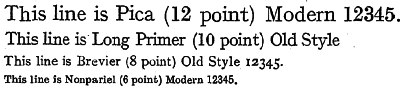
(6) PRINCIPAL SIZES OF TYPE NOW USED IN BOOKS.
This line is Pica (12 point) Modern 12345.
This line is Long Primer (10 point) Old Style
This line is Brevier (8 point) Old Style 12345.
This line is Nonpariel (6 point) Modern 12345.
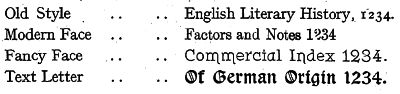
Type faces.
Old Style
English Literary History, 1234.
Modern Face
Factors and Notes 1234.
Fancy Face
Commercial Index 1234.
Text Letter
Of German Origin 1234.
(7) SIZES OF BOOKS.
Royal folio
20
×
12½
ins.
Demy folio
17¾
×
11¼
”
Crown folio
15
×
10
”
Foolscap folio
13½
×
8½
”
Royal Quarto
12½
×
10
”
Demy Quarto
11¼
×
8⅞
”
Crown Quarto
10
×
7½
”
Foolscap Quarto
8½
×
6¾
”
Royal Octavo
10
×
6¼
”
Demy Octavo
8⅞
×
5⅝
”
Crown Octavo
7½
×
5
”
Foolscap Octavo
6¾
×
4¼
”
Royal 12mo
8¼
×
5
”
Demy 12mo
7½
×
4⅜
”
Demy 16mo
5⅜
×
4½
”
Demy 18mo
6⅛
×
3⅞
”
Demy 24mo
5½
×
3⅛
”
Demy 32mo
5⅞
×
3⅛
”
(8) Books containing excellent bibliographies.
Aflalo—Natural history of the British Isles (Vertebrates).
1898. 18 pp.
Amherst—History of gardening in England. 1910. 50 pp.
Baldwin—Dictionary of philosophy and psychology. Vol. 3.
Berg—Vitamins. Allen & Unwin, 1923. (List of 1556 Books).
Freeman—A portrait of George Moore. 1922. 53 pp.
Handschin—Methods of teaching modern languages. Harrop,
1923, 65 pp.
Hazen—Europe since 1815. 1910. 36 pp.
Hind—A history of engraving and etching. Constable, 1923.
26 pp. and 68 pp.
Nicoll—A history of Restoration drama. 1923. 28 pp.
[Pg 26]
Rees—Libraries for children. Grafton, 1924. 55 pp.
Schelling—English literature during the life-time of Shakespeare.
1910. 30 pp.
Simpson—The rise of Louis Napoleon. 1909. 18 pp.
Singer & Strang—Etching and other methods of printing
pictures. 1897. (List of 441 Books).
Sindall—The manufacture of paper. 1908. 20 pp.
Webb—History of trades unionism. 1894. 44 pp.
Note particularly the very full lists of books and articles
appended to the “Cambridge Modern History,” the “Cambridge
Medieval History,” and the “Cambridge History of
British Foreign Policy” and the “Cambridge History of
English and American Literature.”
(9) Some interesting books.
In the research work entailed in compiling this course a
great number of very beautiful books came under my notice.
I made a careful examination of them, and it was with a pang
of regret I had to omit them from the Reading Lists. However,
I received so much joy in looking through them—the beauty
not always being from the physical side—that I decided to
make a select list and advise students to be on the qui vive
for any of them. All the books mentioned should be in the
possession of our large public reference libraries, and students
wishing for a little more than the examination side of their
studies would do well to avail themselves of any opportunity
they may have of examining the books for themselves. If they
are anything like true book-lovers they will be delighted with
all they see and read.
Briquet (Ch. M.)—Les filigranes: dictionnaire historique des
marques du papier dès leur apparition, vers 1282 jusqu’
en 1600. 4 vols. Leipzig, 1923.
This is the standard work on watermarks and first
appeared in 1907. There are 39 illustrations in the
text, and 16,112 facsimilies of water-marks on 1,500
plates.
[Pg 27]
The Fleuron—A journal of typography; edited by Oliver
Simon. Issued annually since 1923. Contains many
interesting and valuable articles such as, in No. 1 “A
treatise on the development of the title-page,” by the
editor. In No. 2, S. Morison’s article supplies a detailed
and documented study of the relation of capitals
to lower case letters. In No. 3, an article on “The
development of the book,” by P. Angoulvent. In No.
4, “Script types,” by S. Morison, and so on.
Fournier—Manuel typographique, utile aux gens de lettres,
et à ceux qui exercent les differentes parties de l’imprimerie.
2 vols. Paris, 1764-66. £14 14s. 0d.
A work which every student of French typography should
consult. Contains specimens of type.
Fry (Joseph) and Sons—A specimen of printing types, by
Joseph Fry and Sons, letter-founders, Worship Street,
Moorfields, London, 1785.
Includes specimens of Roman and Italic types. Vignettes
of King’s Arms, ships, etc.
Guigard—Nouvel armorial du bibliophile; guide de l’amateur
des livres armoriés. With numerous armorial illustrations.
2 vols, Paris, 1890.
One of the best works on armorial bindings.
Grolier Club—Catalogue of an exhibition of illuminated and
painted manuscripts, together with a few early printed
books with illuminations; also some examples of Persian
manuscripts, with plates in facsimile and an introductory
essay. New York, privately printed, the Grolier
Club, 1892.
Humphreys—The illuminated books of the Middle Ages.
An account of the development and progress of the art of
illumination as a distinct branch of pictorial ornamentation
from the 4th to the 17th centuries. London,
1849.
A standard work on the illuminated books of the Middle
Ages.
[Pg 28]
Martin—La miniature Française du 13th au 15th siècle. Paris
and Brussels, 1923.
A standard work on French illuminated manuscripts.
Periods of Typography—A series of handbooks to historic
style in printing. Under the general editorship of Stanley
Morison. The first volumes are now issued and others will
follow from time to time. Each volume will contain an
essay which will introduce the reader to the principal
formative influences and to outstanding examples of the
respective periods. The introductions are written from
the standpoint of the amateur interested in the part
played by the printed book in the society and culture of
its period, each by experts.
The subject of printers’ ornaments can be clearly defined
in its stricter meaning as the decoration of books apart
from book illustration. Printers’ ornaments include
head and tail pieces, initial letters, borders to title pages
or text, and decorative blocks such as those which were
used freely by the 16th century printer, Henry Bynneman,
and others.
Pollard (A. W.)—Fine books. Illus. 1912.
Silvestre (L. C.)—Marques typographiques on recueil des
monogrammes, chiffres, enseignes, emblèmes, devises,
rébus et fleurons des libraires et imprimeurs qui ont
exercé en France, depuis l’introduction de l’Imprimerie,
en 1470, jusqu’à la fin du seizième siècle; a ces marques
sont jointes celles des Libraires et Imprimeurs qui
pendant la meme période ont publié, hors de France,
des livres en langue française. 2 vols. Paris, 1853-67.
This work contains over thirteen hundred reproductions
of printers’ marks and is looked upon as the standard
work on printers’ marks.
Sotheby (S. Leigh)—The typography of the Fifteenth Century:
being specimens of the productions of the early Continental
[Pg 29]printers, exemplified in a collection of facsimilies
from 100 works, together with their water-marks.
London, 1845.
Contains 26 plates of water-marks.
Steele (Robert)—The revival of printing. A bibliographical
catalogue of works issued by the chief modern
English presses, with an introduction by Robert Steele.
London, 1912.
Imprinted in the Riccardi Press Fount, by Charles T.
Jacobi, with facsimiles of the type employed by other
presses.
Updike (D. B.)—Printing types, their history, forms, and use,
a study in survivals. With 367 specimens of various
famous presses, from the invention of printing until the
present day. 2 vols. Cambridge: U.S.A., 1923.
Wardle (B. L.)—Music title pages, 1500-1925. A selection of
examples, with an introduction. London, 1926.
This work is announced to be ready in the Spring of 1926
and should be looked for by all students interested in
decorative typography. The special nature of fine
music production has called for the most lavish use of
decoration and illustration, and a selection of the outstanding
examples among these titles is therefore of real
value to the designer and student of typography.
COURSE 2: BOOK SELECTION.
Text Books Required.
Brown (J. D.)—Manual of practical bibliography. The
English Library. Routledge, 1906. 3s.
Fay (L. E.) and Eaton (A. T.)—Instruction in the use of books
and libraries: a text book for normal schools and colleges.
2nd edition, revised. Faxon & Co., Boston, 1919. 22s. 6d.
Hopkins (F. M.)—Reference guides that should be known,
and how to use them. Willard: Michigan, 1916. $1.50
[Pg 30]
Mudge (I. G.)—New guide to reference books: based on the
third edition of “Guide to the study and use of reference
books,” by Alice B. Kroeger, as revised by I. G. Mudge.
A.L.A. Pub. Board: Chicago, 1923; Grafton. 15s.
Miss Mudge’s great work is a text-book for the student
who is beginning a systematic study of reference books,
and is our best guide for the research worker requiring a
guide to the reference tools available for some particular
investigation. Complete with detailed index of authors,
titles, subjects, and analytical references.
or Kroeger (A. B.)—Guide to the study and use of reference
books. 2nd edition, with supplement, 1908; or, 3rd
edition, with supplement. A.L.A. Pub. Board:
Chicago, 1917.
Stewart (J. D.) and Clarke (O. E.)—Book selection. Grafton,
1909. 1s. Also published in the Library World, May-June,
1909.
Williams (Reginald G.)—A manual of book selection for the
librarian and book-lover. Grafton, 1920. 10s. 6d.
Note.—Other text-books will be introduced as required.
Take particular note of the factors and notes to be found
at the end of each course.
Lesson 1.
Knowledge of Books of Reference.
(a) Different kinds of bibliographies: universal, national,
trade and subject.
The student is advised to read “Bibliography,” by Isadore
Gilbert Mudge; preprint of “Manual of library economy,”
chapter 24, published by the A.L.A. Publishing Board,
Chicago, 1915. For the derivation and present meaning of
the word “bibliography,” and a description of the value of
reference books, this chapter forms a splendid introduction.
For the various kinds of bibliographies see Mudge’s “New
guide to reference books” (or Kroeger’s “Guide to study
[Pg 31]and use of reference books”), Stewart and Clarke’s
“Book selection,” “List of bibliographical works in the
Reading Room of the British Museum,” Brown’s “Manual of
practical bibliography,” and Gross’s “List of books and
articles chiefly bibliographical, designed to serve as an introduction
to the bibliography and methods of English literary
history.” The Universal bibliographies by Brunet, British
Museum, Burger, Ebert, Graesse, Hain, Maittaire, Panzer,
Peddie, Pellechet, Proctor, Watt, etc.
For a comprehensive list of National bibliographies of 49
countries see Peddie’s “National bibliographies: a descriptive
catalogue of the works which register the books published
in each country.” London, Grafton, 1912.Add the
United States Catalog: books in print to January, 1912;
edited by M. E. Potter and others, and the Cumulative book
index. White Plains, New York, Wilson, 1898-1922. Vols.
1-24. (These two are not included in Peddie’s work;) also the
New York State Library. Selected National bibliographies.
3rd edition. Albany. University of the State of New York,
1915. (Library School Bulletin, No. 38). 10c.
The following trade bibliographies should be noted:—American
catalogue of books, Book auction records, Publishers’
trade list annual, United States Catalogue, Livingstone
(America). Arber, Book prices current, British Science Guild,
English catalogue of books, Growoll, Whitaker, etc. (English);
Catalogue Annuel. Lorenz, etc. (France); Heinrich, Heinsius,
Kayser, etc. (Germany); For general bibliographies the
most important are Sonnenschein’s “Best books,” Nelson’s
“Standard books,” Gray’s “Books that count,” Robertson’s
“Courses of study”; and for American books, the A.L.A.
book list, 1905 to date.
A mere acquaintance with the titles of the bibliographies
etc., will be of little service. Students must know the general
scope, method of arrangement, standpoint, and comparative
usefulness of each. It must be remembered also that
many of our best bibliographies and guides appear in the
Latin, French, and German languages.
[Pg 32]
Reading List.
Brown—Manual of practical bibliography. Chap. 8, pp.
113-135.
Clarke—English publishing trade bibliographies. L.W. Vol.
13. 1910-11, pp. 197-201.
Courtney—A register of national bibliography. 3 vols.,
1905-1912. Passim.
Fay and Eaton—Instruction in the use of books and libraries.
Part I. Chaps. 4, 5 and 10, pp. 40-83; 125-137.
Ferguson—Some aspects of bibliography. Johnston: Edinburgh,
1900. Passim. A splendid introduction.
Mudge—New guide to reference books. 1923, pp. 207-223.
or Kroeger—Guide to study and use of reference books.
1908 edition, pp. 99-111. Supplement, pp. 16, 20 and
21.
Peddie—National bibliographies. Grafton, London, 1912.
5s. Passim. Also published in the Library World,
Vols. 12, 13, 24 and 26.
Stewart and Clarke—Book selection. Passim.
Also in Library World, Vol II. 1908-1909, pp. 409-417;
445-450.
Williams—Manual of book selection. pp. 8-12; 67-71.
Questions:—
1. Name four universal bibliographies, and state the method
of arrangement of two of them.
2. Describe the plan and contents, and give an estimate of
their value as aids to book selection, of any three of the
following works:—
Nelson—Standard books.
Sonnenschein—Best books.
Graesse—Tresor de livres rares et précieux.
Mudge—New guide to reference books.
English Catalogue of books, 1801-1925.
Brunet—Manuel du libraire.
[Pg 33]3. Name two author, two subject, and two classified bibliographies.
State their approximate prices.
4. Name three trade bibliographies, pointing out any differences
in their method of arrangement and scope.
5. Name the various kinds of bibliographies known to you,
giving the special features of each.
Lesson 2.
Knowledge of books of reference—continued.
(b) Catalogues of libraries.
(c) Bibliographies of bibliography.
(d) Special bibliographies, and
(e) Books containing bibliographies.
Every effort should be made to examine and
compare the catalogues of the following libraries:—British
Museum; Cambridge University; Chemical Society
of London; Dr. Williams’ Library; Glasgow University;
John Rylands Library; London Library; Pharmaceutical
Society of London; Royal College of Surgeons; Royal
Geographical Society; Royal Institute of Great Britain;
Royal Medical and Chirurgical Society; St. Bride Foundation
Library; Society of Writers to H.M. Signet; University of
Gottingen, and University of London.
Bibliographies of bibliography by the following authors
must be carefully noted:—British Museum; Courtney;
Langlois; Peignot; Petzholdt; Stein; Vallée, etc.
For bibliographies of special subjects see Mudge’s “New
guide to reference books”; Brown’s “Manual of practical
bibliography”; “List of bibliographical works in the Reading
Room of the British Museum,” etc.
For short list of books containing bibliographies see pages 25-26,
and make a note of any important bibliography you come
across during your studies.
Reading List.
Brown—Manual of practical bibliography. Chap. 8, pp.
128-142.
[Pg 34]
Courtney—A register of national bibliography. 3 vols.
Passim.
Ferguson—Some aspects of bibliography. Passim.
Josephson—Bibliographies of bibliography chronologically
arranged with occasional notes and index. 2nd edition.
Bib. Soc. of America: Chicago, 1913.
Mudge—New guide to reference books. pp. 229-230;
223-224.
or Kroeger—Guide to reference books, 1908 edition.
pp. 7-9; 108-110; 116-117.
Stewart and Clarke—Book selection. Passim.
Williams—Manual of book selection. Note the select bibliographies
at the end of each chapter.
Questions.
1. Describe briefly six catalogues of libraries specially
serviceable as aids to book selection.
2. Give a brief account of four bibliographies of bibliography
stating the method and arrangement of two
of them.
3. Give a suggestive list of twelve reference books valuable
as aids to book selection.
4. Name ten modern books containing valuable bibliographies.
5. Name six special bibliographies giving their plan of
arrangement.
Lesson 3.
Principles of selection.
Book knowledge of the ideal selector should be both
professional and technical, connoting familiarity with bibliographical
aids, ability to compile bibliographical lists, and a
thorough understanding of good bookmaking. A knowledge
of printing and an acquaintance with the book trade, and a
sense of personal intimacy with the books themselves is also
[Pg 35]necessary. Book selection is the most important part of a
librarian’s work.
To be efficient the student must make a study of the many
important aids to book selection and bibliographical guides.
His general education should include a wide knowledge of
literary and general history, with a smattering of the arts and
sciences, followed by a close study of the textual characteristics
of books in comparison with editions and reprints, in analysis
of the many and various translations of standard books and
classics. General principles and theory of selection. Remember
that public libraries cater for all readers, those who seek
instruction, and others seeking recreation. Attempt made to
satisfy all classes of readers. Principles governed by the
student’s estimation, of the field of choice; the kind of library
to be catered for; size of the library; amount of money available
for book purchase. Even large libraries can only make a
selection; the smaller the library the smaller the selection
within a selection. Selection for public libraries differs from
that necessary for private libraries, the former selects, the
latter collects. Geographical position of the library to other
libraries. Social conditions of the population. Proportional
representation. Methods of selection. Choice between
editions. Withdrawals and replacements. Unfinished publications.
Donations. Duplication. Classification as an aid
to selection. Second-hand books. Reader’s suggestions.
Revision of stock.
Reading List.
Adams—The problem of the small public library. L.J.
Vol. 29, 1904, pp. 365-367.
Bacon—Principles of book selection. N.Y. Libraries.
Vol. I. 1907, pp. 3-6.
Baker—Book selection for public libraries. In The Librarian’s
Guide, 1923. pp. 13-17.
Baker—Book selection: fundamental principles and some
application. L.A.R. Vol. 13, 1911, pp. 17-29.
Baker—Wanted a guide to books. L.A.R. Vol. 2, 1900,
pp. 89-97.
[Pg 36]
Barrett—On the selection of books for branch libraries.
L.A.R. Vol. 6, 1904, pp. 179-191.
Bascom—Book selection. (A.L.A. Manual of library
economy. Chap. 16). Published separately, 1922.
Bostwick—The American public library. 3rd edition.
Appleton: New York, 1923. Chaps. 10 and 11, pp.
132-161.
Bostwick—How to raise the standard of book selection.
P.L., Vol. 14, 1909, pp. 163-67.
Brown—Manual of library economy. 1907 edition. Chap.
II. Paras. 170-196, pp. 141-160.
or Revised edition by W. C. B. Sayers. Chap. 13. Paras.
174-206, pp. 167-188.
Brown—The small library. The English Library. Chap. 9,
pp. 109-138.
Brown—Plea for a select list of books. L. Vol. 7, 1895,
pp. 363-366.
Brown—Book selection. L.W. Vol. 26, 1923-24, pp. 98-104.
Burgoyne—On the choice of books for small libraries.
L.A.R. Vol. 3, 1901, pp. 189-197.
Burgoyne—Selection and purchase of books. L.A.R. Vol.
I., 1899, pp. 136-157, also in L.W., Vol. I., 1898, pp.
157-159.
Cutler-Fairchild—Principles of selection of books. L.J.,
Vol. 20, 1895, pp. 339-341.
Cutter—Should libraries buy only the best books or the
best books that people will read? L.J., Vol. 26, 1901,
pp. 70-72.
Dana—Library primer. pp. 39-45.
Fay and Eaton—Instruction in the use of books and
libraries. Part 2. Chaps. 13 and 25, pp. 181-192; 392-396.
Foster—Where ought the emphasis to be placed in library
purchases? L.J., Vol. 29, 1904, pp. 229-237.
Harrison—On the choice of books. Macmillan, 1903. 5s.
[Pg 37]
Lindsay—Some general principles of book selection. P.L.
Vol. 10, 1905, pp. 267-271.
McColvin—The theory of book selection for public libraries.
Grafton, 1925. 7s. 6d. Passim.
Mudge—New Guide to reference books. 1923. Introduction.
or Kroeger—Guide to ... reference books. Introduction.
Public Library’s aim in bookbuying. L. Vol. 6, 1906.
Also in L.J., Vol. 31, 1906, pp. 119-123.
Savage—Book selection. L.A. Vol. 4., 1901, pp. 190.
Savage—A plea for the analytical study of the reading
habit. L.A.R., (New Series), Vol. 2, 1924, pp. 210-225.
Spofford—A book for all readers. Putnams Sons: New
York. Chap. I., pp. 3-32.
Stewart and Clarke—Book selection. pp. 1-7.
Walker—Practical book selection methods. L.A.R. (New
series). Vol. 2, 1924, pp. 157-164. Also published
separately.
Willcock—Proportional representation. L.A.R., Vol. 6,
1904, pp. 336-344.
Williams—Manual of book selection for the librarian and
book lover. Chap. I., pp. 1-6.
Williams—Some principles of book selection. L.A., Vol.
13, 1916, pp. 133-136; 140-144.
Questions.
1. You are asked to select books for a public library in a
town of 200,000 inhabitants. State what number of
volumes you would allocate to the lending and reference
departments respectively, and add a table showing
the proportional representation of the different main
classes in each department.
2. State what guides to selection you would consult in
selecting an initial stock of 25,000 volumes.
3. Do you consider it advisable to draw up a series of
principles to be followed in book selection? If so
state these principles briefly.
[Pg 38]
4. In forming a collection of 10,000 volumes for a small
public library, how would you ensure that no great
author or important subject had been missed?
5. In forming the initial stock for a public library what
class of books would you endeavour to purchase
second-hand?
6. A public library has an income of £15,000 per annum.
State how much should be spent on (1) Lending department;
new books; old books; replacements,
and (2) Reference library books?
Lesson 4.
Aids and guides to book selection.
The number of guides to book selection is very large and
the student will find the best selections in Mudge’s “New
guide to reference books,” pp. 224-226; Kroeger’s “Guide
... to reference books”; pp. 111-112; Williams’s
“Manual of book selection”; and Stewart and Clarke’s
“Book selection.” The numerous guides named in these
books should be carefully noted. If possible try to examine
the books themselves and note their scope, standpoint, arrangement,
and special features (if any).
Reading List.
Baker—Book reviews. L.A.R. Vol. 4, 1902, pp. 28-36.
Bostwick—Librarian as censor. L.J. Vol. 33, 1908, pp.
237-244; 257-264.
Brown—Manual of practical bibliography. Chap. 7, pp.
115-142.
Fay and Eaton—Instruction in the use of books and libraries.
Part I. Chaps. 4-7, pp. 40-109.
Hulme—Librarian’s aids. L.A.R. Vol. 5, 1903, pp. 119-132.
Mudge—New guide to reference books. pp. 224-226.
or Kroeger—Guide to ... reference books, pp. 111-117.
[Pg 39]
Peplow—Some tentative proposals for the compilation of a
catalogue of best books. L.A.R. Vol. II., 1909,
pp. 222-228. Discussion, pp. 245-249.
Stewart—How to use a library. pp. 24-31.
Stewart and Clarke—Book selection. Chap. 2, pp. 7-16.
Value of reviews: discussion. L.J. Vol. 33, 1908, pp. 101.
Williams—Manual of book selection. Chap. 2, pp. 7-16.
Williams—Book selection. L. & B.W. Vol. 7, 1917,
pp. 164-166; 182-5; 202-5.
Questions.
1. Name six guides to book selection in general, and add
notes describing the scope and plan of compilation
of three of them.
2. State how you would ascertain what later editions are
available of books mentioned in the standard guides.
3. Mention two standard works on each of the following
subjects you would select for a lending library:—wireless
telegraphy; French Revolution; English
literature; modern history; and political economy.
4. State what you consider to be the six most important
contributions to bibliographical literature during the
last ten years.
5. What are the principal aids to book selection in the
following subjects:—education; music; science;
juvenile literature, and philosophy.
Lesson 5.
Prose Fiction. Young People’s Literature. Reference
Section.
(a) Prose Fiction:—
The selection of prose fiction is not an easy task. Selection
should be made on principles as given in Lesson 3. Consideration
must be given to the percentage of fiction in relation
to other classes, also the class of fiction in demand. Principal
[Pg 40]authors of all countries should be represented. Foreign masterpieces
should be obtainable in the original. Exclusion of
immoral works essential. The librarian or selector will soon
realise that he has the most difficult class of reader to satisfy.
Selection of novelists will differ with each selector, as in most
cases it will be found possible to make only a selection from a
selection. About 50 new novels are published weekly, and only
the largest libraries are able to purchase most of the suitable
fiction. The question of duplication must be carefully considered.
The replacement of worn-out and withdrawn books.
The second-hand book market. A knowledge of the many
guides to fiction necessary, supplemented by periodical
literature. Note the literary histories of the various countries,
especially the “Cambridge history of English literature” as
useful guides to selection. For lists of bibliographies consult
Williams’s “Manual of book selection,” pp. 45-47, and Mudge’s
“New guide to reference books,” pp. 141-143.
Reading List.
Bacon—What makes a novel immoral? L.A. Vol. 13,
1910-13, pp. 129. Also in Wisconsin Library Bulletin,
Vol. 6, 1910, pp. 83-95.
Baker—French fiction in public libraries. L.W. Vol. 2,
1899-1900, pp. 68-81.
Baker—Standard of fiction in public libraries. L.A.R.
Vol. 9, 1907, pp. 70-80; 98-103.
Bascom—Selection of fiction. Wisconsin Lib. Bul. Vol.
9, 1913, pp. 34-40.
Brown—In defence of Emma Jane. L.W. Vol. II.,
1908-09, pp. 161-6.
Brown—Manual of library economy. 1907 edition. Chap.
11, para. 177, pp. 145-6.
or Revised edition by W. C. B. Sayers. Sect. 181.
Crunden—New novel problem. L. (New Series). Vol. I.,
1899-1900, pp. 92-100.
Guppy—French fiction and French juvenile literature for
the public library. L.A.R. Vol. 2, 1900, pp., 357-371.
[Pg 41]
Herdman—Place and treatment of fiction in public libraries.
L.A. Vol. 6, 1909, pp. 357-380. Discussion, pp. 381-2.
McIntosh—Fiction selection. P.L. Vol. 19, 1914, pp.
389-392.
Sawyer—Questionable books. L.J. Vol. 40, 1915, pp.
691-699.
Shuman—How to judge a novel. P.L. Vol. 14, 1909, pp.
259-260.
Sinclair—In defence of the novel. L.A. Vol. 18, 1925,
pp. 35-47; 56-57.
Walsh—What our libraries should supply. L.J. Vol. 40,
1915, pp. 297-298.
Questions.
1. You are called upon to form a collection of 10,000
volumes of prose fiction. State what works you would
consult to aid you in your selection?
2. Compare the following bibliographies, as aids to the
selection of prose fiction:—
Baker—A guide to the best fiction in English.
Bowen—Descriptive catalogue of historical novels
and tales.
Nield—-Guide to the best historical novels and
tales.
3. Give your opinion on how far foreign fiction should be
represented in a public library. State whether you
are in favour of the original works or of translations.
(b) Young people’s literature:—
Great care should be taken in the selection of books for the
Young People’s department. The tastes of the children must
be the chief guide, and this will depend to a considerable
extent upon the locality in which the child lives. The facts
of child psychology are always subject to local conditions.
The selection of books for young people who reside in a
residential town will differ, even if very slight, to the
selection that should be made for children living in a busy
industrial or manufacturing centre. Classical literature must
not be forced upon young people, but it should be well represented
[Pg 42]in beautifully illustrated editions, to encourage the
young people to read “the best.” The physical form of books
selected must receive special consideration. Good paper, clear
type and beautiful illustrations appeal to all readers. Cheap
editions should be avoided. The aim of a juvenile collection
is to create a reading adult with the ability to discriminate
what he ought to read, for this reason educational editions
are not recommended for purchase. Sensational literature is
undesirable. Collections should be composed of works of
romance and adventure, school stories, fairy tales, stories
of home and domestic life. Books of a more serious nature
however, must not be overlooked, and a choice selection made
treating with the lives of the great men and women of all ages,
botany, electricity, conduct of life, engineering, geology,
history, sports and pastimes, aviation, wireless telegraphy,
gardening, painting, art, natural history, etc.
Reading List.
Bostwick—The making of an American’s library. Boston,
1915, pp. 91-123.
Brown—The small library. Chaps. 2 and 4, pp. 11-27; 55-70.
Brown—Books for very young children. L.W. Vol. 9,
1906-07, pp. 282-9.
Cannons—Selection of books and editions for children.
L.A.R. Vol. 20, 1918, pp. 68-76.
Fay and Eaton—Instruction in the use of books and
libraries. Part 2. Chaps. 14-23, pp. 193-381.
Field—Finger posts to children’s reading. 6th edition.
Chicago, 1911.
Forbes and Derthick—Children’s books and what constitutes
a good edition. P.L. Vol. 17, 1912, pp. 118-20.
Hazeltine, editor—Library work with children. Classics of
American Librarianship. H. W. Wilson Co.: New
York, 1917; also Grafton, 7s. 6d. Special attention to
pp. 23-45; 363-366.
[Pg 43]
Hulst—The organisation of the course in literature in
secondary schools. English Journal. Vol. I., 1912,
pp. 72-83.
Hunt—Selection of children’s books. In her Library work
with children. A.L.A. Manual of library economy.
Jackson—The older girl and her reading. Ont. Lib. Rev.
Vol. 9, 1915, pp. 54-56.
Kelly—Selection of juvenile books for a small library.
P.L. Vol.14, 1909, pp. 308-9; 367-372.
Lawrence—How shall children be led to love good books?
P.L. Vol. 11, 1906, pp. 179-183.
Olcott—-Childrens’ reading. Boston, 1912.
Pearson—The children’s librarian versus Huckleberry Finn.
L.J. Vol. 32, 1907, pp. 312-314.
Powell—The Children’s library: a dynamic factor in
education. H. W. Wilson Co., New York, 1917; also
Grafton, 10s. 6d. Chap. II. pp. 287-319. The bibliography
on book selection on pp. 437-452 is most valuable
and should be carefully read.
Sayers—The children’s library. Chaps. 1, 15, 16, pp. 1-14;
156-203.
Smith—Some story book children of England. Ont. Lib.
Rev. Vol. 9, 1925, pp. 51-54.
Terman and Lima—Children’s reading: a guide for parents
and teachers. Appleton: New York, 1926. $2.
Thompson—On the selection of books for children. L.J.
Vol. 32, 1907, pp. 427-233.
Williams—Manual of book selection. pp. 47-51.
In addition to the above consult the “Children’s Catalogue,”
3rd edition, revised and enlarged, compiled by Minnie
Earl Sears based on “Children’s Catalog of thirty-five hundred
books,” compiled by Corinne Bacon, containing 4,100
titles with 863 books analyzed, 640 pages. H. W. Wilson Co,
1925, $12. The Glasgow Corporation Public Libraries
“Guide for young readers,” the “Descriptive handbook to
juvenile literature in the Finsbury Public Libraries,” the
“Requisition list of books for school lending libraries, by the
[Pg 44]London County Council,” “The Pittsburgh Carnegie Library
graded juvenile catalogues,” and the bibliographical lists
given in Sayers’s “Children’s Library.”
Questions.
1. Name six modern guides to juvenile selection, and
describe any three of them.
2. Prepare a list of 20 books which you consider the best
works of reference for the shelves of a Young People’s
Room, to enable the children to improve their scholastic
studies.
3. In selecting books for the Young People’s section how
far would you be governed by the physical form of
the book?
(c) Reference books:—
Select collection of reference books is the foundation of a
good reference library. Its utility reckoned by extent and
quick service its selection will furnish when demands are made.
Large reference libraries should satisfy all demands. Small
library collection from a selection, with “quick reference”
books its strongest section. How to judge whether a book
is more suitable for the reference than the lending department.
Place books in the department where they will be
most useful. Such works as encyclopedias, directories,
dictionaries, atlases, maps, etc., state and parliamentary
papers are obviously reference books; antiquarian works and
exceptionally large books are also reference books. Allocation
of rare, art, and large books. Cost of a book should not be
a consideration in deciding lending versus reference books.
How far should duplication be carried? Great number of
reference works may be obtained second hand. Latest
editions, excepting art, essential. Occasional text-books
necessary. Local industries well represented. How a
reference library is supplemented when in the same building
as the lending library. If lending library books are available
in the reference library decision of allocation becomes easier.
Special facilities available for the loan of reference books.
Periodical literature is a valuable asset to a reference library.
Many good articles never appear in book-form.
[Pg 45]
Reading List.
Ballinger—Municipal library and its public. L. (.N.S.).
Vol 9, 1909, p. 309.
Barrett—Selection of books for a reference library. L.
Vol. 8, 1896, pp. 473-481.
Borrajo—Books for the reference library. L.A.R. Vol.
1, 1899, pp. 770-780.
Brown—Manual of library economy. 1907 edition. Chap.
11, para. 185, pp. 152-3.
or Revised edition by W. C. B. Sayers. Sects. 188; 411;
pp. 176-177; 382-386.
British Museum.—Department of printed books. List of
books forming the reference library in the reading room.
2 vols., 1910.
Dent—Notes on the formation of a small reference library.
L. Vol. 8, 1896, pp. 531-535.
Moore—Municipal reference libraries. In Public Libraries,
1917, pp. 70-85.
Mudge—New guide to reference books. A.L.A. Chicago,
1923. Introduction.
Reference work and reference works. Ont. Lib. Rev. Vol.
4, 1920, pp. 98-131. Every effort should be made to read
this valuable article.
Richardson—Reference books. L.J. Vol. 18, 1892, pp.
245-247.
Williams—Manual of book selection. pp. 66-71.
Williams—Reference book selection. L. & B. W. Vol.
8, 1917, pp. 4-6; 23-25.
Wood—Selection of books for a reference library. L. Vol.
8, 1896, pp. 522-530.
Questions.
1. In forming a reference collection of 10,000 volumes,
how would you ensure that no important author or
subject had been missed?
[Pg 46]
2. What principles would guide you in deciding whether a
book is more suitable for the reference than the
lending department?
3. Give a list of 25 books (excluding local directories)
which you think indispensable for “quick reference”
in a reference library.
4. What bibliographical guides would you provide in a
reference library?
Lesson 6.
Commercial Libraries. Local Collections. Other
Special Collections.
(a) Commercial Libraries:—
Originally organised to meet trade conditions after the
European War. Should be the centre where business men may
obtain reliable commercial information immediately on demand,
and should contain Commercial and Industrial data (reports of
Boards of Trade and Agriculture and Fisheries, Consular
and Colonial reports, Parliamentary publications relating to
commerce, trade periodicals and catalogues, reports of
Chambers of Commerce, statistical publications). Geographical
information (atlases, maps, gazetteers, directories,
books of travel written from the standpoint of commercial
development). Transport and communication (shipping,
railway and postal guides, telephone directories, telegraphic
codes). Financial information (tariffs, foreign exchanges,
banking, company reports). Commercial and industrial law.
Business organisation (office methods, advertising, salesmanship,
works management, accountancy, costing, etc.). Working
collection of special and general reference books. Journals
of commerce, industry and finance.
The following bibliographical aids should be examined:—
Cannons (H. G. T.)—Bibliography of industrial efficiency
and factory management. 1920. Greenwood (E.)—Classified
guide to technical and commercial books;
a subject list of the principal British and American
[Pg 47]works in print. 1904. Morley (L. H.) and Knight
(A. C.)—2,400 business books and guide to business
literature; [compiled] under the direction of J. C.
Dana. 1920. Grafton, 30s.
Reading List.
Brown—Manual of library economy. Revised edition by
W. C. B. Sayers. Sects. 450-459, pp. 418-423.
Jast—The commercial library. L.A.R. Vol. 19, 1917,
pp. 118-124.
Pitt—Memoranda on commercial libraries. L.A.R. Vol.
19, 1917, pp. 175-178.
Pitt and others—Commercial libraries. In Public Libraries,
1917, pp. 47-64; 117-120.
Savage—Technical and commercial libraries. L.A.R., Vol.
20, 1918, pp. 159-162.
Sparke—How the public library can help the business man.
Bolton Public Libraries. 1s. Passim.
Whitton—Proposed library of municipal affairs. L.J. Vol.
33, 1908, pp. 224.
Refer also to Handbooks on commercial libraries issued by
the Glasgow, Manchester, Bolton, Birmingham and other
important libraries.
Questions.
1. What bibliographies would you place in a commercial
library? Give reasons for your choice.
2. Give a list of 25 books essential to the man of business.
3. Discuss the value of consular and colonial reports in a
commercial library.
4. From what sources may the commercial librarian
supply up-to-date information on any trade or industry?
(b) Local Collections:—
Every public library should have its local collection, and
the book selector should keep a careful look out for (1) all
[Pg 48]literature referring to the locality; (2) maps, plans, prints,
drawings, photographs, etc., of the locality; (3) writings
of local authors; (4) newspapers and periodicals issued
locally; (5) literature printed locally; (6) local records,
such as parish registers, rate books, and other MSS., printed
transactions of the local authorities, local Acts of Parliament,
etc., and (7) specimens of the work of local binders, if of any
eminence. Many local works may be selected from the
second-hand booksellers’ catalogues. County bibliographies
are useful in guiding selection, and the columns of the “Publishers’
Circular” must not be overlooked.
Reading List.
Anderton—On planning a printed catalogue of local literature.
L.A.R. Vol. 15, 1913, pp. 542-552.
Baker—Our local collections and local documents. L.A.R.
Vol. 11, 1909, pp. 96-98.
Brown—Manual of library economy. 1907 edition, Chap.
11, para 186, pp. 153-4.
or Revised edition by W. C. B. Sayers. Chap. 28, paras.
422-444.
Collier—Local records in public libraries. L.A.R. Vol.
13, 1911, pp. 268-275.
Minto—Bibliography of local literature. L.A.R. Vol.
4, 1902, pp. 37-44.
Reese—What is a local author? L.J. Vol. 44, 1919,
p. 43.
Ross—Book selection; local collections. L.W. Vol.
10, 1907. pp. 71-76.
Sparke—Local collections in public libraries. L.W. Vol.
2, 1899-1900, pp. 185-187.
Webb—Function of the public library in respect to the
political sciences. L.A.R., Vol. 7, 1905.
Williams—In Manual of book selection. pp. 61-62.
[Pg 49]
Wright—Local collections: what should be collected and
how to obtain material. L.A.R. Vol. 7, 1905, pp.
1-11.
Questions.
1. State briefly what class of books you would select in
forming a local collection.
2. What principles would you follow in compiling a
bibliography or catalogue of local books?
3. What examples of local bibliographies are known to
you? Describe any three.
4. Describe generally the plan, contents and aim of the
two following books:—
Sparke (A)—Bibliographia Boltoniensis: being a bibliography
of Bolton authors, and
Hawkes (A. J.)—Lancashire printed books: a bibliography
of all the books printed in Lancashire down
to the year 1800. 1925.
(c) Other Special Collections:—
Technical Libraries.—Technical libraries are now essential
both to technical education and to manufacture. They
should consist of all modern text-books, encyclopædias,
directories, etc. Polyglot and technological dictionaries.
Current digests and indexes to periodical literature and state
publications.
Reading List.
Hulme—Technical libraries. L.A.R. Vol. 19, 1917, pp.
484-497.
Hulme and others—Technical libraries. In Public Libraries,
1917, pp. 65-77; 114-117.
Matthews—The technical library. L.A.R. Vol. 22, 1920,
pp. 141-157.
Reynolds—The technical library in its relation to the educational
and industrial development. L.A.R. Vol.
19, 1917, pp. 250-261.
[Pg 50]
Savage—Technical libraries. L.A.R. Vol. 21, 1919, pp.
264-270.
Savage—Technical and commercial libraries. L.A.R. Vol.
20, 1918, pp. 159-162.
Simmett—Technical libraries and intelligence. L.A.R.
Vol. 22, 1920, pp. 124-140.
Questions.
1. What critical and specialised aids has the librarian
to help him in his selection of technical books?
2. How far is a library justified in forming special technical
collections?
Foreign Collections:—
Reading List.
American Library Association—Foreign book lists. Nos.
1-7. Boston and Chicago. A.L.A. Publishing Board,
1907-16. Contents—1.—German. 2.—Hungarian. 3.—French.
4.—Norwegian and Danish. 5.—Swedish.
6.—Polish. 7.—Russian.
Williams—In Manual of book selection. pp. 72-75.
Williams—Selection of foreign literature. L. &. B.W.
Vol. 8, 1917, pp. 25-26; 44-46.
Questions.
1. What bibliographical or other guides would you consult
in forming a representative collection of standard
French and German literature?
2. What classes of modern foreign literature would you
purchase for a lending library catering for a population
of 200,000.
Books for the Blind.
Reading List.
Neisser—Report of the A.L.A. Committee on library work
with the blind. A.L.A. Bulletin. Vol. 2, 1908, pp.
216-221.
[Pg 51]
Roebuck—Literature for the blind, and the public library
movement in connection therewith. L.A. Vol. 3,
1902, pp. 253-260.
Lesson 7.
Selection of Special Classes of Literature—continued.
Philosophy and Religion.—Should the selection of
philosophical and religious works be made without principles
the result will be unsatisfactory. Consecutive reading must
always be borne in mind. One-sided selection avoided.
Nelson’s “Standard Books, Vols. 1 and 2, Sonnenschein’s
“Best Books, Part 1,” and Robertson’s “Courses of study,”
should be carefully consulted when selection is being made.
Sectarian and “crank” literature should be avoided in
selecting religious works. Jastrow’s “Study of religion” is
recommended for careful reading as an introduction to
religion. Hurst’s “Biblioteca theologia” and his “Literature
of theology,” Frazer’s “Golden Bough,” Vol. 12 (for bibliography)
and Rands’ “Bibliography,” in Baldwin’s “Dictionary
of philosophy and psychology,” Vol. 3 are useful in selection.
In both these classes modern thought must be well represented.
Reading List.
Ayres—Theological literature in libraries. L.J. Vol. 28,
1903, pp. 601-603.
Bisseker—A student’s library. Kelly, 1911, pp. 46-122;
184-208; 243-265; 271-280.
Bowerman—Principles governing the choice of religious
and theological books for public libraries. L.J. Vol.
30, 1905, pp. 137-140.
Deane—A library of religion. Mowbray, 1918.
Jastrow—Study of religion. Cont. Science Series. Scott,
1901. Take particular note of the Bibliography on pp.
399-415.
Williams—In Manual of book selection. pp. 20-24.
[Pg 52]
Questions.
1. What guide books would you consult in selecting a
nucleus stock of books in philosophy and religion?
2. How would you be guided in the discarding of obsolete
books in this section?
3. What are the principal periodical guides to new books
of religion and philosophy?
Sociology.
—Always a popular class of literature with the
reading public. Frequent revision of stock is essential to
retain a “live” class. Subjects like political science and
statistics must be represented by the latest editions. The
following are the chief guides to selection:—Nelson’s “Standard
books,” Vol. 1; Bisseker’s “Student’s library,” pp.
209-239; 281-297; Bliss’s “Handbook of socialism”;
Bowker and Isle’s “Readers guide to economic, social, and
political science”; Fabian Society’s “What to read on
social and economic subjects”; Robertson’s “Courses of
study”; Sonnenschein’s “Best books,” Vol. 2; Stammhammer’s
“Bibliographie der sozialismus und kommunismus”;
“Bibliographie der sozialwissenschaften,” 1905 to date;
Bulkeley’s “Bibliographical survey of contemporary sources
for the economic and social history of the War”; Zimand’s
“Modern social movements”; and in Williams’s “Manual of
book selection,” pp. 24-26.
Questions.
1. How would you find out what later editions are available
of books given in the standard guides?
2. Give a brief account of Gross’s “Bibliography of
British municipal history,” and its value in the
selection of books on sociology.
3. Draw up a graded reading course of not more than
twelve books on political economy.
Science and Technology:—
The two most important sections in a public library, as
the subjects in both classes continually change and develop.
[Pg 53]In no other classes do works so soon become obsolete. Before
making selection for an initial stock it is advisable to read
through as many brief histories of the sciences as possible as
they will enumerate the writers whose influence in the various
sciences have been greatest. The standard bibliographies
must be consulted in selecting initial stock, but when formed,
it must be kept alive by a careful reading of the periodical
literature, where the latest information will be obtained.
As new editions of works in stock are published, they must be
purchased if they contain additional or revised material,
and take the place of the old edition on the shelf. The
British Science Guild’s “Catalogue of British scientific
and technical books,” first published in 1921, new and
revised edition, 1925, complete with author and subject
indexes, together with the numerous guides mentioned in
Mudge’s “New guide to reference books,” pp. 23 (technical
lists); 97-104 and 104-114 will render ample assistance to the
selector, who will also find the British Museum Subject Index
most useful for the titles of books in these classes published
in England.
Reading List.
Bisseker—A student’s library. pp. 156-183; 266-270.
Clarke—Scientific text books and the disposal of books
out-of-date. L. Vol. 6, 1894, pp. 164-167.
Craver—The library in relation to special classes of readers.
L.J. Vol. 31, 1906, pp. 72.
Hulme and others—Technical libraries. In Public Libraries:
their development and future organisation,
1917, pp. 65-77; 114-117.
Jast—Technical libraries. L.A.R. Vol. 5, 1903, pp.
467-472.
Morris—Popular science for the public library. Ont. Lib.
Rev. Vol. 7, 1922, pp. 27-50.
Savage—Some difficulties in the selection of scientific and
technological books. L.A.R. Vol. 10, 1908, pp. 162-174.
[Pg 54]
Savage—Science and technology in public libraries. L.
Vol. 12, 1909, pp. 1-4; 46-48.
Sohon (J. A.) and Schaaf (W. L.)—A reference list of bibliographies,
chemistry, chemical technology and chemical
engineering published since 1900. Wilson: New York,
1924.$2.50.
Williams—In Manual of book selection. pp. 17-19;
28-30.
Questions.
1. “This section requires constant revision and weeding
out if it is to be a live section.” Discuss this statement.
2. Name a bibliography on each of the following subjects:
astronomy; physics; botany; wireless telegraphy;
chemical technology.
3. Describe six general guides to book selection in this
section.
Literature:—
Very little material has been published on what is best to
select in pure literature. Probably the article “Literature”
in the Encyclopædia “Britannica” is the best introduction,
followed by W. H. Hudson’s “An introduction to the study
of literature”, H. B. Charlton’s “Art of literary study: an
approach to literature for the plain man,” and Bisseker’s “A
student’s library,” pp. 11-45, for general literature. For
English the “Cambridge history of English literature,” 14 vols.,
Knowlson’s “How to study English literature,” Manly and
Rickert’s “Contemporary British literature,” and Williams’s
“Craft of literature,” may be profitably read and Cant’s
“Bibliography of English drama from 1890-1920, giving
separate titles and short annotations.” L.A.R. Vol. 24,
1922, pp. 41-57 and Brown’s “The realm of poetry,” 1921
should be consulted. Pancoast’s “American literature,”
and “History of American literature,” being supplementary
volumes to the “Cambridge history of English literature,”
should be followed for American literature. The bibliographies
and many guides mentioned on pp. 120-150 in Mudge’s “New
[Pg 55]guide to reference books,” should be carefully looked through.
“A register of bibliographies of the English language and
literature, by C. S. Northup and others.” Milford, 1925, should
also be consulted. The general principles of book selection
must now be applied, and care taken to be certain that the
principal dramatists, poets, essayists, etc., are well represented.
Text books dealing with the literary histories of all countries
should be available, as well as all guides to literary forms.
Questions
1. What are the principal aids to book selection in the
following subjects:—drama; American literature;
English poetry; and Spanish literature?
2. Name six dictionaries of quotations, and two of similes.
3. Where several translations of a standard foreign work
are available, how would you be guided in making
your choice of one?
Language:—
Systematic selection essential if the stock is to prove
valuable and useful. The standard modern works on all
languages should be represented and attention paid to the
historical side. Naturally, works on our own language will
have preference over all others, followed by a good selection of
works on the French, German, Italian, Spanish and Russian
languages. Other nationalities should be represented according
to the demands made by the public. Students should read
the article “Language” in the Encyclopædia Britannica,
and as aids to selection consult the following works:—Nelson’s
“Standard books,” Vol. 3; Sonnenschein’s “Best
books,” Vol. 3; Breule’s “Handy bibliographical guide to
the study of German language and literature”; Braunholtz’s
“Books of reference and teachers of French”;
Robertson’s “Courses of study”; and Williams’s “Manual
of book selection,” pp 26-27.
Questions.
1. Give your opinion as to the best dictionary of the
English language when the purchase is limited to one.
2. Name dictionaries for the following subjects:—
synonyms; slang; rhymes.
[Pg 56]
3. Name the best dictionaries for the following languages:
Anglo-Saxon; French; German; Italian and
Spanish.
Lesson 8.
Fine and Recreative Arts. History. Biography.
Geography. Travel.
Fine and Recreative Arts.—Another class where
principles must be carefully followed, otherwise a lot of money
may be wasted. The general histories, text-books and outlines
should present no difficulty. It is when we come to books
where the illustrations form the predominating feature that
difficulties arise. Many splendid guides are available, including
Nelson’s “Standard books,” compiled by the staff
of the National Art Library, South Kensington; Sturgis
and Krehbiel’s “Annotated bibliography of Fine Art,”
compiled by experts; and the British Museum Subject Index.
For reference:—the “Universal catalogue of books on art,”
1870-77; and Macfall’s “History of painting” are also useful.
Bibliographical articles in the encyclopædias should not be
overlooked. Note the bibliographies and guides mentioned
in Mudge’s “Reference books,” pp. 114-120. Guides to special
subjects are too numerous to mention here, and the student
is referred to the lists published by the South Kensington
Museum.
Reading List.
Batsford—Some suggestions on the formation of a small
library of reference books on ornament and the decorative
arts. L. Vol. 9, 1897, pp. 251-269.
Books valuable in the study of art. P.L. Vol. 13, 1908, pp.
253-4.
Hitchcock—Books on fine and decorative arts suggested for
small public libraries. P.L. Vol. 7, 1902, pp. 25-27.
McColvin—Music in public libraries. Grafton, 1924. 7s. 6d.
Passim.
Mathews—Libraries and music. L. Vol. 5, 1893, pp. 190-2.
[Pg 57]
Musical libraries: discussion. P.L. Vol. 3, pp. 53-4.
Weale—Two notes for art libraries. L. (N.S.), Vol. 1,
1899-1900, pp. 365-7.
Williams—Manual of book selection. pp. 30-32.
Questions.
1. What principles would you be guided by in deciding
what edition of a book should be purchased out of a
number of editions?
2. Mention the principal aids to book selection in any two
of the following subjects:—Christian art; ceramics;
decorative art; painting; freehand drawing;
Italian art; schools of painting; music.
3. Make a selection of periodicals useful as aids to book
selection of fine and recreative arts.
4. Discuss the advisability of co-operation by neighbouring
libraries in the purchase of the larger and more expensive
art books.
5. State what books you would use to find the market
price of the older art books.
6. Name four booksellers who specialise in fine art books.
History, Biography, Geography and Travel:—Consecutive
selection necessary. All epochs should be represented and
British history well covered. The chief guides to selection
are Sonnenschein’s “Best books,” Vol. 3; Nelson’s “Standard
books”; Robertson’s “Courses of study”; Langlois’s
“Manuel de bibliographie historique,” part 1 (1907); Adams’s
“Manual of historical literature” (3rd revised edition, 1903);
Annual bulletin and select lists of the Historical Association.
Gross’s “Sources and literature of English history” and his
“Bibliography of British municipal history” are excellent
for British history. Sir P. Protheroe’s “Select analytical
list of books concerning the Great (European) War” is the
best guide to the literature of the European War.
[Pg 58]
Bibliographies found in Mudge’s “Reference books,”
pp. 183-196, the Cambridge Histories and the “Story of
the Nations” series are valuable aids.
Guides to biography are scarce but Chambers’s “Biographical
dictionary,” Chambers’s “Encyclopædia,” and
the “Dictionary of National biography” supplemented by
Mudge, pp. 150-168, will answer most calls made upon them.
Voyages and travels always command a good reading
public but care should be taken to exclude ephemeral “globe-trotting”
variety.
For geography and travel Mill’s “Guide to geographical
books and appliances,” revised by A. J. Herbertson and N. E.
MacMunn will be found indispensable. It includes geographical
novels, general reference works, lists of text-books,
in fact nearly a bibliography of geography. The bibliographies
found at the end of each chapter of Mill’s “International
geography” will also be found useful. In the selection of the
older books Anderson’s “Book of British topography” although
now a little out of date is still valuable, and Mudge, pp. 172-183
should also be consulted.
Reading List.
Adams—Manual of historical literature. Harper: New
York, 1903.
Bibliographies in the “Story of the Nations” series.
Bisseker—A student’s library. pp. 123-155.
Gross—Bibliography of British municipal history. Longmans:
New York, 1897.
Gross—Sources and literature of English history from the
earliest times to about 1485. Longmans, 1915.
Hall—Methods of teaching history. Harrap, 1913.
Larned—Literature of American history. A.L.A. Pub.
Board, Boston.
Langlois—Manuel de bibliographie historique. 2 vols.Hachette, Paris, 1901-04.
Robertson—Courses of study. pp. 139-328; 366-370.
[Pg 59]
Sykes—Biography for a small library. Ont. Lib. Rev.
Vol. 2, 1918, pp. 116-119.
Williams—Manual of book selection. pp. 52-55.
Questions.
1. Mention two books on each of the following subjects
which you would recommend to a reader:—Joan of
Arc; French Revolution; Oliver Cromwell; European
War; London; Gunpowder Plot.
2. Draw up an annotated reading course of not less than
ten books on British history.
3. Name six periodicals valuable as aids to book selection
in this section.
Lesson 9.
Selection of Periodicals.
Primary object in the selection of periodicals should be to
supplement the stock of books in the library by up-to-date
literature not available in book form. The second consideration
should be to aim at supplying magazines for recreation as well
as instruction. On the same principle that crank and sectarian
works are prohibited from the best book stocks so should
periodicals of this nature be excluded. Trade, scientific,
technical, and special periodicals should receive first consideration,
and special attention given to the papers that
cover the chief industries of the town to be served. A good
selection of periodicals dealing with literature, art, science,
etc., will add attractiveness to the room. Newspapers selected
should represent the political parties impartially. The various
press guides, lists published by large libraries, such as the
Mitchell Library and Cannons’s “Classified guide to 1,700
annuals, directories and year books,” Grafton. 1923, 5s., will
be found useful in the selection of this class of literature.
Reading List.
Briscoe—Selection of periodicals. L.W. Vol. 12, 1909-10,
pp. 215-216.
[Pg 60]
Brown—Manual of library economy. 1907 edition.Chap. 11.
para. 200, pp. 163-165.
or Revised edition by W. C. B. Sayers. Chap. 13, paras.
203-204.
Brown—Selection of current periodicals. L.A.R. Vol. 6,
pp. 591-597.
Dana—Periodicals for a small library. P.L. Vol. 11,
1906, p. 367.
Mudge—New guide to reference books. pp. 5-23.
Kroeger—Guide to ... reference books. pp. 1-31.
Steele—A selected list of periodicals which review books.
Ont. Lib. Rev., Vol. 8, 1923, pp. 12-13.
Walter—Periodicals for a small library. 1919 edition.
A.L.A. Pub. Board, Chicago. 1919. 15c.
Questions.
1. Make an annotated list of the monthly and quarterly
periodicals you would consider necessary in a reading
room serving a population of 100,000.
2. Briefly describe how you would deal with periodicals
offered gratis.
3. Make a selection of newspapers and periodicals on:—economics,
education, engineering, not more than
six on each, indicating their valuable features and
giving published prices.
4. Describe the general contents and special features of
any three of the following periodicals, and any two of
the annuals:—
English Review
Connoisseur
Whitaker’s Almanack
Ueber Land und Meer
Revue des deux mondes
British Trade Year Book
The Reader
Librarians’ Guide
Annual Register
Decimal Educator
5. Make an annotated list of ten periodicals you would
select for a Young People’s Reading Room.
[Pg 61]
Test Examination.
Questions to be answered without the aid of text-books, notes, etc.
1. Write a short essay on the principles of book selection
as applied to public libraries.
2. Name the various kinds of bibliographies available as
aids to book selection, and give an account of two in
each section.
3. State briefly what you know of the following catalogues,
giving the method of arrangement of each:—British
Museum; London Library; John Rylands Library,
and Cambridge University.
4. What do you consider to be the twelve best guides to
book selection?
5. Discuss the value of “The Annual Register” as an aid
to book selection.
6. What books of reference would you consult for anonymous
and pseudonymous works in (1) English, (2)
French and (3) German?
7. What authors would you recommend to a reader desirous
of being acquainted with Napoleon I.; psychoanalysis;
parliament; philately; Marie Antoinette;
Spanish literature; League of Nations, and wireless
telegraphy.
8. Give reasons for and against the desirability of not
purchasing fiction until a year after publication.
9. Describe briefly not more than six catalogues of libraries
specially serviceable as aids to book selection.
10. State briefly on what principles you would be guided in
accepting or declining donations of books.
11. Give an annotated list of twelve periodicals you would
consider necessary in a Ladies’ Reading Room.
12. Name twelve periodicals that should be permanently
stored in a public reference library.
[Pg 62]
FACTORS AND NOTES RELATING TO BOOK
SELECTION.
(1) Select List of Universal Bibliographies.
Note.—An universal bibliography has not yet been compiled
but the following are recognised as units towards such a
work.
1. Bibliographical Society of America.—Census of fifteenth
century books owned in America; compiled by a
Committee of the Bibliographical Society of America.
New York, 1919.
2. British Museum Library.—Catalogue of books printed
in the 15th century now in the British Museum.
London, 1912-1916. Parts 1-4.
3. Brunet (Jacques Charles)—Manuel du libraire et de
l’amateur de livres. 5 éd. originalt entiérement
refinde et augm d’un tiers. Paris, Didot, 1860-65.
6 Vols.
——Supplément, par P. Deschamps et G. Brunet. Paris,
Didot, 1878-80. 2 Vols.
4. Ebert (Friedrich Adolf)—General bibliographical dictionary,
from the German of F. A. Ebert. Oxford
University Press, 1837. 4 Vols.
5. Georgi (Gottlieb)—Allgemeines europaisches bucherlexicon
in wilchem die allermeisten autores zu finden,
welche noch vor dem anfange des XVI. seculi bis
1739, in vire theile abgetheilet. Leipzig, Gorgi, 1742.
4 parts in one.
——Fünffter theil. In welchem die franzosischen
auctores und bücher von allen disciplinen, in alphabetischer
ordung zu finden. Leipzig, 1753.
6. Græsse (Johann Georg Theodor)—Trésor de livres rares
et précieux. Dresden, 1859-1869. 7 vols.
[Pg 63]
7. Hain (Ludwig Friedrich Theodor)—Repertorium bibliographicum
ad annum M.D. Stuttgart, Cottæ, 1826-38.
2 vols, in 4.
——Supplement to Hain’s “Repertorium bibliographicum”;
or, collection towards a new edition
of that work, par W. A. Copinger. London, Sotheran,
1895-1902. 2 vols. in 3.
——Appendices ad Hainii-Copingeri “Repertorium
bibliographicum”; additiones et emendationes editit
Dietericus Reichling. Monachii, Rosenthal, 1905-11.
7 vols.
——Supplementum cum indice urbium et typographorum.
Accedit index auctorum generalis totius operis. Monasterii
Guestphalorum, Theissingianis, 1914.
——Supplement zu Hain und Panzer. Beiträge zur
inkunabel bibliographie. Nummern—concordanz von
Panzer’s lateinischen und deutschen Annalen und
Ludwig Hain’s “Repertorium bibliographicum” par
Konrad Burger. Leipzig, Hiersemann, 1908.
——Ludwig Hain’s “Repertorium bibliographicum
Register.” Die drucker des XV. jahrhunderts. Leipzig.
Harrassowitz, 1891.
8. Maittaire (Michael)—Annales typographici ab artis
inventae origine ad annum 1664. Hagae-Comitum,
1719-41. 5 Vols.
——Supplementum adornavit M. Denis. Viennae,
1789, 2 vols.
9. Panzer (Georg Wolfgang Franz)—Annales typographici ab
artis inventae origine ad annum 1536. Norimbergae,
1793-1803. 11 vols.
10. Peddie (Robert Alexander)—Conspectus incunabulorum:
an index catalogue of fifteenth century books, with
references to Hain’s “Repertorium,” Copinger’s
“Supplement,” Proctor’s “Index,” Pellechet’s “Catalogue,”
Campbell’s “Annales” and other bibliographies.
London, 1910-1914. 2 vols.
[Pg 64]
11. Pellechet (Marie Léontine Catherine)—Catalogue général
des incunables des bibliothèques publiques de France.
Paris, Picard, 1897-1909. Vols. 1-3.
12. Proctor (Robert)—Index to the early printed books in
the British Museum from the invention of printing
to the year 1500, with notes of those in the Bodleian
Library. London, Paul, 1898-99. 4 vols.
—— Part 2, 1501-20. Section 1, Germany. London,
Paul, 1903.
13. Prussian Board of Education—Gesamtkatalog der Wiegendrucke.
Herausgegeben von der Kommission fur
den Gesamtkatalog der Wiegendrucke. Band 1.
Abano-Alexius, Leipzig, 1925, Verlag von Karl W.
Hiersemann. Quaritch, 1925. £3 7s. 6d. To be
completed in 12 volumes. The most complete catalogue
of Incunabula.
14. Quaritch (Barnard)—General catalogue of books offered
to the public at the affixed prices. London, 1887-97.
7 vols. and Supp.
15. Watt (Robert)—Bibliotheca Britannica; or, A general
index to British and Foreign literature. 2 parts.
Edinburgh, Constable, 1824. 4 vols.
(2) Select List of Trade Bibliographies.
American:—
Roorbach (Orville Augustus)—Bibliotheca Americana 1820-61.
New York, Roorbach, 1852-61. 4 vols.
A catalogue of American publications arranged alphabetically
by authors and titles. Publisher, date, size
and price also given.
Kelly (James)—American catalogue of books published in the
United States from January, 1861 to January, 1871.
New York, Wiley, 1866-71. 2 vols.
Alphabetical arrangement under authors, titles and
subjects. Gives full particulars of publishers and prices.
Well annotated. A continuation of Roorbach’s work.
[Pg 65]American catalogue of books 1876-1910. New York, Publisher’s
Weekly, 1881-1911 9 vols.
The standard American list for the period covered (Mudge).
United States catalog: books in print January, 1912; edited
by Marion E. Potter and others. 3rd edition. White
Plains, New York, Wilson, 1912.
—— Supplement, 1912-17. New York, Wilson, 1918.
—— Supplement, January, 1918—June, 1921. New York,
Wilson, 1921.
Indispensable to the American book selector.
Annual:—
Annual American Catalogue, 1886-1910. New York, Publisher’s
Weekly, 1887-1911. No more published.
United States catalog. Annual. New York, Wilson.
An annual dictionary catalogue.
Monthly:—
Cumulative book index. White Plains, New York, Wilson,
1898-1922. Vols. 1-24.
English:—
Arber (Edward)—Term catalogues, 1668-1709A.D. with a
number for Easter term, 1711A.D.; a contemporary
bibliography of English literature in the reigns of Charles
II., James II., William and Mary, and Anne; edited
from the very rare quarterly lists of new books issued by
booksellers of London. 3 vols. London, Arber, 1903-06.
—— Transcript of the registers of the Company of Stationers
of London, 1554-1640. London, 1875-77. 4 vols. Index.
1894.
A record of all books deposited at Stationers’ Hall during
the period covered.
English catalogue of books published 1801-1920. London,
Low, 1864-1901. Publisher’s Circular, 1912-21. 11 vols.
—— Index to the English catalogue of books. London, Low,
1858-93. 4 vols.
[Pg 66]
An annual catalogue, with five yearly cumulations.
Comprising an alphabetical list under authors, titles
and subjects of the books issued in the United Kingdom.
Full imprint, particulars of price, month of publication,
publisher, etc. Contains also lists of publications of
societies and a full directory of publishers.
Reference catalogue of current literature, containing the full
titles of books now in print and on sale, with the prices
at which they may be obtained of all booksellers, and an
index containing nearly one hundred and eighty-five
thousand references. 3 vols. London, Whitaker.
The most important English trade bibliography. Issued
every few years. Consists of the catalogues of the principal
English publishers arranged alphabetically by name
of publisher.
Book auction records (formerly known as “Sale records,”)
a priced and annotated record of London, Dublin, Edinburgh,
Glasgow and Amercian book auctions. June,
1902 to date. London, Stevens.
Each number is arranged alphabetically by authors,
with an index in each volume.
Book-prices current. December, 1886 to date. London,
Stock.
Index to the first ten volumes. 1887-1896. London,
Stock, 1901.
Index for the second decade. 1897-1906. London, Stock,
1909.
Index for the third decade. 1907-1916. London, Stock,
1920.
French:—
Catalogue général de la librairie française, 1840-1918. Paris,
Jordell, 1867-1921. 28 vols.
The standard French trade bibliography, and a most
valuable modern national bibliography.
[Pg 67]
Annual:—
Catalogue mensuel de la librairie francaise.
Monthly numbers bound together forming the annual
volume. Contains indexes of authors, titles and subjects.
Monthly:—
Catalogue mensuel de la librairie française. 1876-1921. Paris.
Hinrichs (J. C.) Publishers—Funfjahrs-katalog der im deutschen
buchhandel erschienenen bucher, zeitschriften,
landkarten, etc., titel verzeichnis und sachregister,
1851-1912. Leipzig, Hinrichs, 1857-1913. 13 vols.
Deutsches bucherverzeichnis der jahre 1911-20. 4 vols.
A continuation of Heinsius, Kayser, and Hinrichs,
Funfjahrs-katalog.
Monthly:—
Allgemeine bibliographie. Leipzig, Brockhaus, 1856 to date.
(3) Select List of General Bibliographies.
American Library Association—A.L.A. Catalog. 8,000 volumes
for a popular library; with notes, 1904 ...
edited by Melvil Dewey. Government Printing Office:
Washington, 1904. $1.
The chief aim of this selection is to assist in the formation
of a public library stock, and is specially adopted for the
use of smaller libraries.
A.L.A. Catalog, 1904-1911. Class List, 3,000 titles for a
popular library; edited by Elva L. Bascom. Chicago:
A.L.A. Pub. Board, 1912. 350 pp. 26 cm. $1.50.
Supplement to the A.L.A. Catalog 1904.
[Pg 68]
Nelson, Thomas and Sons, Publishers.—Standard Books:
an annotated and classified guide to the best books in all
departments of literature; with copious index of
subjects and biographical notes of authors. 4 vols.
1910-14.
Contents:—Vol. 1—General Works. History. Geography.
Biography and Travel. Sociology. Philosophy.
Sport. Law and Administration. Education.
Vol. 2.—Religion. Science. Useful Arts.
Vol. 3.—Fine and Recreative Arts. Philology. Literature.
Children’s Books.
Vol. 4.—Author Index. General Subject Index. Index of
Publishers.
Each subject is edited by a specialist in collaboration
with one or more librarians. Annotations are very full
and publishers and prices are given.
Sonnenschein, William Swan—The Best Books: a reader’s
guide to the best available books (about 100,000) ...;
with the dates of the first and last editions, and
the price, size, and publisher’s name (both American
and English) of each book. 3rd edition, entirely re-written.
George Routledge & Sons, Ltd., London. Putnam,
New York. 3 parts. In Progress. 1910. £2 2s. net.Contents:—Part 1.—Theology. Mythology and folk-lore.
Philosophy.
Part 2.—Society. Geography. Travel and Topography.
Education. Ethnology.
Part 3.—History, Biography. Science. Arts. Philology.
Literature. Complete Indexes.
A very useful classified bibliography.
(4) Bibliographies of Bibliography.
Courtney (William Prideaux)—Register of national bibliography;
with, a selection of the chief bibliographical
books and articles printed in other countries. London,
Constable, 1905-12. 3 vols.[Pg 69]
Arranged alphabetically by the subjects of the bibliographies
listed.
Josephson (Aksel Gustav Salomon)—Bibliographies of bibliography
chronologically arranged, with occasional notes
and an index. Bibliographical Society of Chicago,
Chicago, 1901. Second edition, 1913.
A careful and accurate bibliography. Classified, with
an author index and full annotations.
Stein (Henri)—Manuel de bibliographie générale: bibliotheca
bibliographica nova. Paris, Picard, 1897.
Contents.—Universal bibliographies. National and
regional bibliographies. Subject bibliographies, and
appendices. A classified bibliography with critical and
descriptive annotations, and a subject index.
Vallée (Léon)—Bibliographie des bibliographies. Paris,
Terquem, 1883.
Supplement. Paris, Terquem, 1887.
An alphabetical author list with a subject index. A
useful work if used as an author index to Stein’s “Manuel
de bibliographie générale.”
Bibliographical Works:—
British Museum—List of bibliographical works in the Reading
Room of the British Museum. 2nd edition, revised.
1889. Much out of date, but useful for older books.
(5) Annual Output of Books in the United Kingdom.
Books in 1925.
According to the “Publishers’ Circular” more books were
published during 1925 than in any previous year in the history
of British book production. A total of 13,202 is recorded as
having been published in the United Kingdom. This is an
increase of 496 over the total for 1924. This increase has
[Pg 70]taken place in the “new books” as distinguished from “new
editions,” etc., and is shown in detail in the following figures
for this year and last year:—
1924
1925
New books
8024
8520
Translations
321
307
Pamphlets
1168
1150
Total new books
9513
9977
New editions
3193
3225
Total
12,706
13202
The following details show how the totals for the various
classes of books vary from those of the previous year. Increases
are shown in Juvenile Literature (108), Law (88),
Military and Naval (74), Philology (60), Biography (55),
Agriculture and Gardening (46) and Science (32). The decreases
are General Works (49), Fine Arts (44), Fiction (32), Philosophy
(29), and Poetry and Drama (16).
The following totals for the years since 1913 (the pre-war
record year) are of considerable interest:—
Year.
New Books.
New Editions.
Total
1913
9541
2838
12379
1914
8863
2674
11537
1915
8499
2166
10665
1916
7537
1612
9149
1917
6606
1525
8131
1918
6750
966
7716
1919
7327
1295
8622
1920
8738
2266
11004
1921
8757
2269
11026
1922
8754
2088
10842
1923
9246
3028
12274
1924
9513
3193
12706
1925
9977
3225
13202
The above tables show that during the years 1913-1925
no fewer than 139,253 books were published in the United
[Pg 71]Kingdom. It is when we realise such a fact as this that we
should appreciate the great importance of book selection to the
librarian.
(6) Initial Stock for a Public Library.
In selecting the initial stock for a Public Library the following
principles should be considered: (a) size of the locality;
(b) the sum of money available for books; (c) the geographical
position of the library in relation to other libraries.
Before any books are actually purchased, the tables of the
classification to be adopted should be taken and each section
checked with the corresponding section of proposed purchases.
This will immediately show any important omissions.
(7) Proportional Representation of Classes.
The proportion of books to be purchased in each class of
literature will depend largely upon the social conditions of the
locality and the prominence of local industries.
The following table is merely suggestive:—
General Works
3%
Philosophy
3%
Religion
6%
Sociology
6%
Philology
2%
Natural Science
8%
Useful Arts
9%
Fine and Recreative Arts
7%
Literature
35%
History, Travel and Biography
21%
(8) Reference and Lending Library Stocks.
The average proportions of Lending and Reference Library
stocks are: Lending, 62%; Reference, 38%.
(9) Proportion of Income for Books After Organisation.
18% of income should be spent on books, including old
books and replacements.
[Pg 72]
(10) Twenty-five “quick-reference” Books for The
Open Shelves in a Reference Library.
(Arranged according to the Dewey Classification as a mnemonic
aid).
Encyclopædia Britannica.
Baldwin—Dictionary of psychology and philosophy.
Hastings—Dictionary of religion and ethics.
Hastings—Dictionary of the Bible.
Cruden—Concordance.
Palgrave—Dictionary of political economy.
Mulhall—Dictionary of statistics.
Every Man’s Own Lawyer.
Webster—English dictionary.
Murray—New English dictionary.
Clifton and Grimaux—English-French and French-English dictionary.
Grimm—Deutsches Worterbuch.
Lewis and Short—Latin dictionary.
Liddell and Scott—Greek Lexicon.
Watts—Dictionary of chemistry.
Quain—Medical dictionary.
Knight—Business cyclopædia and legal adviser.
Thorpe—Dictionary of applied chemistry.
Bryan—Dictionary of painters and engravers.
Grove—Dictionary of music and musicians.
Cambridge History of English literature.
Haydn—Dictionary of dates.
Dictionary of national biography.
Chambers’s Biographical dictionary.
Low and Pulling—Dictionary of English history.
(11) Fourteen Author Concordances.
Burns. Reid—Complete word and phrase concordance to
the poems and songs of Robert Burns.
Cowper. Neve—Concordance to the poetical works of
William Cowper.
[Pg 73]
Dante Alighieri. Fay—Concordance of the Divina Commedia.
Sheldon and White—Concordanz a delle opere italiane in
prosae del Canzoniere di Dante Alighieri.
Gray. Cook—A concordance to the English poems of Thomas
Gray.
Homer. Dunbar—Complete concordance to the Odyssy and
Hymns of Homer.
Milton. Lockwood—Lexicon to the English poetical works
of John Milton.
Pope. Abbott—Concordance to the works of Alexander Pope.
Scott. Redfern—The wisdom of Sir Walter.
Shakespeare. Bartlett—New and complete concordance of
William Shakespeare.
Clarke—Complete concordance to Shakespeare.
Shelley. Ellis—Lexical concordance to the poetical works
of P. B. Shelley.
Tennyson. Baker—Concordance to the poetical and
dramatic works of Alfred Lord Tennyson.
Brightwell—Concordance to the entire works of Alfred
Tennyson.
(12) Forty Useful Books for the Young People’s Room.
Bailey (M. E.)—Boys’ and girls’ ask at home questions. Illus.
1917. Explains many things in nature and life which
puzzle children.
Baker (E. A.)—Cassell’s New English Dictionary; with an
appendix. 1919. Includes a supplement of War words.
Bartlett (J.), editor.—Familiar quotations. 1917. From
ancient and modern literature.
Brewer (E. C.)—The reader’s handbook. 1919. Famous
names in fiction, allusions, references, proverbs, plots,
stories and poems.
[Pg 74]
Chambers’s Biographical Dictionary; edited by D. Patrick and
F. H. Groome. 1908. Brief lives of “the great of all
times and nations.”
Chambers’s Twentieth Century Dictionary of the English
Language; edited by T. Davidson. Illus. 1916.
Champlin (J. D.) Junior.—The young folks cyclopædia of
common things. 2nd edition, enlarged. Illus. 1896.
An attempt to bring encyclopædic knowledge within
the range of a child’s intellect. Articles very brief and
simply told. Index.
Champlin (J. D.) Junior.—The young folks’ cyclopædia of
natural history; with editorial co-operation and an
introduction by F. A. Lucas. Illus. 1905. The cyclopædia
covers the entire animal kingdom in an elementary
manner.
Crawford (W. R.)—Common words commonly mispronounced.
1894. A dictionary of correct pronunciation.
Dalgleish (W. S.)—The great authors of English literature.
Illus. 1917. Contains their lives, and selections from
their writings.
Dana (Mrs. W. S.)—How to know the wild flowers. The
flowers are arranged according to colour.
Dickinson (A. D.)—One thousand best books. 1924. Compiled
from over fifty published lists of best books made
by the librarian and scholars of the University of Pennsylvania.
Everyman’s Encyclopædia; edited by Boyle. 12 vols.
Illus.
Fallows (S.)—A complete dictionary of synonyms and antonyms.
1898. A dictionary of words with the same
and opposite meanings.
Gibson (C. R.)—The great ball on which we live. 1915. Description
of the earth and the forces of nature.
Gibson (C. R.)—Great inventions and how they were invented.
1924. Descriptions of wonderful machines and appliances.
[Pg 75]
Hall (Cyril)—Conquests of engineering. Illus. 1926. Describes
the construction of bridges, tunnels, canals, docks
and harbours.
Hawks (E.)—The boys’ book of astronomy. 1914.
Haydn—Dictionary of dates. A record of the chief events
in the world’s history.
Holden (E. S.)—The sciences. Illus. 1903. On astronomy,
physics, chemistry, meteorology, etc., and their application
to the arts and to daily life.
Kernahan (C.)—The reading girl. 1925. Chats on the choice
of books and methods of reading.
Kirkby (M.) and Kirkby (E.)—The world at home. Illus.
1912. Describes the life of the people, and the animals,
birds, plants, and insects of foreign countries.
Lyttelton (Mary), editor.—A girl’s book of verse. 1925.
Maule (H. E.)—The boys’ book of inventions. 2 vols. Illus.
1921. Describes the new inventions. The aeroplane.
Wireless telegraphy. Tesla turbine. Submarines, etc.
Marshall (H. E.)—English literature for boys and girls. 1924.
Mee (Arthur)—The children’s Bible. 1923. Beautifully
illustrated from the Art Galleries of the world.
Mee (Arthur)—The children’s encyclopædia. 8 vols. Col.
Illus. Articles very brief and simply told.
Mee (Arthur)—One thousand beautiful things. 1925. Chosen
from the life and literature of the World.
Morison (R. C. H.), editor.—Chambers’s Recitations for
children. Specially selected for the young.
Olcott (W. T.)—Book of the stars for young people.
O’Neill (Elizabeth)—The world’s story: a simple history for
boys and girls. 1923.
Patrick (D.) and Geddie (W.), editors.—Chambers’s Concise
gazetteer of the world. 1919.
Philip (George), editor.—Senior School Atlas. 1921.
Philip (A. M.), editor.—A boy’s book of verse. 1925.
[Pg 76]
Pritchard (A. M.) and Hobbs (E. W.)—Wireless construction.
1925.
Roget (P. M.)—Thesaurus of English words and phrases.
1918. An aid to English composition.
Synge (M. B.)—The story of the world. 2 vols. Maps.
Illus. Vol. 1—Abraham to A.D. 1745. Vol. 2—1745-1903.
Things all scouts should know. Illus. 1919. Information
about the navy, army, ships, railways, things seen in
town and country, etc.
Turley (Charles)—The voyages of Captain Scott. 1914.
Shows the heroism of the men who gave their lives in the
search for the South Pole.
Williams (Archibald)—The boys’ guide. Illus. 1921. Indoor
and outdoor games, sports, and recreations, photography,
model making, use of tools, motor cycles, pets, stamp
collecting, reading, etc.
COURSE 3: THEORY OF CLASSIFICATION.
Text Books Required.
Brown (J. D.)—Library classification and cataloguing. Grafton,
1912. 10s. 6d.
Jevons (W. S.)—Elementary lessons in logic. Macmillan,
1909. 3s. 6d.
Richardson (S. C.)—Classification, theoretical and practical;
together with an appendix, containing an essay towards
a bibliographical history of systems of classification.
Scribner, 1912. Also Grafton, 6s. 3d.
Sayers (W. C. B.)—Canons of classification applied to “The
Subject,” “The Expansive,” “The Decimal,” and
“Library of Congress” classifications: a study in
bibliographical classification method. Grafton, 1915.
3s. 6d.
Sayers (W. C. B.)—An introduction to library classification,
theoretical, historical and practical; and, A short
course in practical classification; with readings, questions
and examination papers. Grafton, 1922. 10s. 6d.
[Pg 77]
Lesson 1.
Introduction. Meaning, Purpose, and Utility.
Terminology. Logical Bases.
In classification, more than in any other branch of library
science, practical application is dependent on a sound knowledge
of theoretical principles, and students are warned that
a thorough grasp of the logical bases is an absolutely essential
preliminary to successful practical work.
Importance of classification in our daily life is not fully
appreciated, classification being the sole foundation of all
order. It would be impossible for the mental faculties to
function efficiently without classification, the simplest thought
or reason requiring its use.
Note the purpose of classification and the mutual dependence
of classification and cataloguing.
It is essential to know the exact logical meaning of terms
used in classification.
Understand the Five Predicables. After mastering their
definition, study Tree of Porphyry for their application. A
close study of the latter will amply repay students. It admirably
illustrates meaning of Extension and Intension, and
demonstrates how in the framing of the scheme the hierarchy
must proceed gradually from terms of great Extension and
little Intension to terms of little Extension but of great Intension.
The student is strongly advised not to pass Jevons until
he has thoroughly mastered the chapters set out below.
Reading List.
Brown—Library classification. Chap. 6.
Encyclopædia Britannica—Article Classification.
Jast—Classification and discovery. L.W. Vol. 13, 1910-11,
pp. 353-355.
Jast—Library classification. In Greenwood’s Library Year
Book, 1900-01, pp. 21-36.
[Pg 78]
Jevons—Logic. (Give special attention to Chaps. 5, 12 and
32).
Jevons—Principles of science. Chapter on classification.
Mill—Logic. Chapter on classification.
Richardson—Classification. Introduction and Chap. 1.
Sayers—Classification in modern life. L.A. Vol. 17, 1924,
pp. 8-16; 35-40.
Sayers—Introduction. Chaps. 1-2.
Questions.
1. Give an example where classification resulted in the
discovery of new facts.
2. State what you consider to be the purpose of classification.
3. Define the following terms:—characteristic; denotation;
correlation of property; extension; genus;
connotation; difference; intension.
4. Describe the Tree of Porphyry and its relation to
classification.
5. The functions of classification and those of cataloguing
are often confused. Explain.
Lesson 2.
Principles. Kinds of Classification. Schedules.
The survey of the logical bases in Lesson 1 leads to a more
definite consideration of the main principles of classification
and schedule formation. A close study of natural and artificial
classification must be made at this stage. An investigation
of the difference between them will stress the importance
of the choice of characteristic. It will be emphasised
during this lesson that the characteristic selected must be
essential to the purpose for which the classification is intended.
Botany and zoology have provided notable instances of
natural and artificial classification. In studying these schemes
notice particularly the process of division, the gradual modulation
[Pg 79]from Class to Division, Sub-Division, and Section, the
Extension of the terms becoming smaller and the Intension
greater as the process of division is continued.
One fault which can create endless confusion is Cross-Division.
To avoid this the terms used in the schedule must be
mutually exclusive.
The classification of books cannot reach the perfection of
a classification of knowledge. The latter is limited only by the
limitation of knowledge, but the former by the physical form
of books. All bibliographical schemes, however, should be
based on the classification of knowledge.
Realise clearly the necessity for and the functions of the
topic and form classes which form part of every bibliographical
scheme. Throughout this lesson it will be seen that classification
is governed by the principles laid down in the Five
Predicables.
If attention has been duly paid to the ground covered in
Lessons 1 and 2 no difficulty will in future be experienced with
regard to the theory, bases, or principles of classification,
but if, on the other hand, any difficulty is felt in answering
questions bearing upon these principles, students have devoted
insufficient time to their study, and are strongly advised to
make good the deficiency before proceeding further.
Reading List.
Brown—Library classification. Chaps. 1 and 2.
Coulson—An outline on the theory of classification.
L.W. Vol. 14, 1911-12, pp. 37-42; 67-70.
Johns—Flowers of the field. Study introduction.
Richardson—Classification. Lecture 2.
Savage—Form and alphabetic book classification. L.A.R.
Vol. 9, 1907, pp. 375-383.
Sayers—Canons. Chaps. 1 and 2.
Sayers—Grammar of classification. L.A.A. Series, 1912.
Principles 1-20.
Sayers—Introduction. Chaps. 3-5.
[Pg 80]
Questions.
1. What is meant by “cross-division”?
2. What are essential and accidental characteristics in
classification?
3. The process of division is governed by “difference.”
Explain.
4. Name the difference between philosophical classification
and bibliographical classification.
5. What is the difference between a rigid and a flexible
classification?
6. What is meant by “form” as compared with “subject”
in classification?
Lesson 3.
History. Principal Schemes. Comparisons. Special
Classes.
A glance at the list of schemes which have been devised
is sufficient to convince us of the formidable task it would be
to acquire detailed knowledge of each one. This, however, is
not essential. Apart from the principal epoch-making schemes,
only sufficient attention need be paid to them to trace the
development of classification. Bacon’s scheme has had a great
influence and must receive full consideration. Sayers’s Introduction
contains the most satisfactory outline of this. In the
same work brief outlines of the principal schemes are given,
and good accounts are available in Brown’s Library Classification.
These two books cover sufficient ground for the
general student, but those who wish to make a more exhaustive
survey of the various schemes will find further details in
Edwards’s Memoirs of libraries, Vol. 2.
Of the schemes in use at the present time the Decimal,
Subject, Expansive, and Library of Congress are selected as
the most important, and while a good knowledge of the two
latter is required, students are urged to concentrate their
main study upon and confine their practical exercises to the
Decimal and Subject schemes, chiefly because they are almost
[Pg 81]in exclusive use so far as British libraries are concerned, but
also on account of the fact that candidates for the Library
Association certificate are required to pass a practical test in
these two.
Pay particular attention to the Introductions.
The popular method of systematically comparing the two
class by class is the best. It will be found most convenient to
take the classes in the order appearing in the Decimal, and
compare with the corresponding portions of the Subject.
Make full use of Sayers’s Canons here. Valuable for analysis
of the four main schemes. The Indexes should also be included
in the comparison.
Study carefully the criteria of a practical book classification
as given in Richardson’s Classification, page 42, and consider
to what extent these requirements are met.
Special consideration must be given to those classes which
at various times have been severely criticised, and the student
should be completely au fait with the arguments for and against
the treatment of the forms and subjects upon which opinions
vary, e.g., Biography.
Hulme’s Principles of book classification, in L.A.R., Vol.
13, 1911, pp. 354-358; 389-394; 444-449. Vol. 14, 1912,
pp. 39-46; 174-181; 216-221 (summarised in Sayers’s Introduction,
Appendix 1) takes a view of classification not entirely
supported by the reading matter set in this course. For this
reason the student is advised to reserve his study of these
articles until having covered the reading prescribed, so that
he may read them more critically and make a clearer comparison
of the points of view.
Reading List.
Aldred—The expansive classification. L.A.R. Vol. 7,
1905, pp. 207-219; 196-201.
Brown—Library classification. Chaps. 3 and 4.
Brown—Manual of library economy. 3rd edition. Chap. 16.
Brown—Subject classification. Introduction.
[Pg 82]
Dewey—Decimal classification. Introduction.
Dickie—Critical examination of the arrangement of History
and Geography in the Decimal and Subject classifications.
L.W. Vol. 25, 1922-23, pp. 401-407.
Hale—The decimal classification as applied to small libraries.
L.W. Vol. 16, 1913-14, pp. 263-268; 311-316.
Mash—Classification of technology. L.W. Vol. 15, 1912-13,
pp. 1-5; 50-55.
Mould—Wanted, a classification. L.A.R. Vol. 8, 1906, pp.
127-147; 208-211.
Pepper—Classification of biography. L.A.R. Vol. 15,
1913, pp. 328-334.
Richardson—Classification. Appendix.
Sayers—Canons. Chaps. 3-6.
Sayers—The Dewey decimal classification after thirty
years. L.A.R. Vol. 12, 1910, pp. 314-334.
Sayers—Introduction. Chaps. 7-10.
Smith—Library classifications: a comparison by classes.
Supp. to. L.W. Vol. 21, 1918-19.
Smither—Library of Congress classification. L.W. Vol.
16, 1913-14, pp. 130-136.
South Kensington Museum; Board of Education. Classification
for works on pure and applied science in the
Science Library, the Science Museum. 2nd edition.
Stationery Office, 1921.
This classification affords a clear and accurate view
of the anatomy of the literature of the pure and
applied sciences in the twentieth century.
Walker—Suggested re-arrangement of the Dewey classes of
100 and 200. L.W. Vol. 16, 1913-14, pp. 163-165.
Wright—Technological classification. L.W. Vol. 18, 1915-16,
pp. 312-316; 344-347. Vol. 19, 1916-17, pp. 9-10.
Brown’s Subject Classification was published in 1906 and
reviews and criticisms of the work can be read in the following
[Pg 83]professional periodicals:—Savage (E. A.) in L.W. Vol. 9,
1906-07, pp. 48-55. Lyster (T. W.) in L.A.R. Vol. 8, 1906,
pp. 384-386. Coutts (A. T.) in L.A. Vol. 6, 1909, pp. 304-318.
Brown’s Revisions, etc., in L.W. Vol. 12, 1909-10,
pp. 41-45; 81-86; 121-124; 153-160.
Questions.
1. Write a brief essay on the history of classification.
2. Outline Bacon’s Scheme and its influence on classification.
3. Give a brief account of any natural scheme of classification.
4. State in which class or classes it is preferable to adopt an
alphabetical arrangement, and why.
5. The Divisions 140 Philosophic Systems, 180 Ancient
Philosophers, and 190 Modern Philosophers in the
Decimal Classification are not satisfactory to the
classifier. Explain.
6. What means are provided in the Decimal, Subject and
Expansive Classifications for obtaining alphabetical
and chronological arrangements of a particular subject?
Notation affects in a very large degree the usefulness and
even the librarian’s choice of a scheme.
A notation must be simple, brief, and flexible. Consider
the extent to which the principal schemes meet these requirements,
and weigh the advantages and disadvantages of a
“pure” notation, as in the Decimal, or a “mixed” notation,
as in the Subject scheme. The most notable expansion of the
Decimal notation is the “Brussels,” which should be carefully
surveyed.
[Pg 84]
Note the mnemonic features of the various notations, as
these assist in the rapid interpretation of the symbols, and
enable one’s mind to more readily grasp the linking-up of the
whole scheme. Notation is of itself insufficient for practical
arrangement on the shelves, as the necessity arises for some
method of regulating the order of the books within each Division,
Section, etc., hence the use of Author Marks. Several
tables have been compiled, but the most detailed and best
known is Cutter’s, although the other tables must receive due
attention as the Cutter Author Marks are not in exclusive
use.
The arrangement of the books on the shelves is most important,
and it is essential to reach the best solutions of the
problems regarding “broken sequence,” “oversize books,”
etc.
It must be remembered that the Library is intended for the
use of people who do not want to study the intricate details of a
notation in order to find what they want, and it should be made
possible for readers not merely to find the subjects they
require, but also to find their way about the various classes
intelligently, but unaided. To achieve this a most carefully
devised method of guiding will be necessary, and all methods
and contrivances should be studied, as faulty or insufficient
guiding will minimise the benefits of exact classification.
Reading List.
Brown—Library classification. Chap. 5.
Brown—Manual of library economy. 3rd edition.Chap. 17.
Coutts—Classification and shelf-guiding. In Brown and
others. Open Access Libraries. Grafton, 1915.
Jast—A new book number. L.W. Vol. 3, 1900-01, pp.
120-123; 150-152.
Purnell—Development of notation in classification. L.A.
Vol. 8, 1911, pp. 25-33; 44-50. (Also published
separately in L.A.A. Series, but now o.p.)
[Pg 85]
Savage—Classification guides and indexes. L.W. Vol. 8,
1905-6, pp. 261-266.
Sayers—Canons. Chap. 7.
Sayers—Elements of notation. L.W. Vol. 15, 1912-13,
pp. 226-231.
Sayers—Grammar. Principles 21-23.
Sayers—Introduction. Chaps. 6 and 13.
Stephen—Application of exact classification to shelf arrangement.
L.W. Vol. 11, 1909, pp. 251-255; 325-331.
Stewart—Guiding an open-access lending library. L.W.
Vol. 7, 1904-05, pp. 113-118.
Stewart—Oversize books. L.W. Vol. 9, 1906-07, pp.
208-211.
Questions.
1. What are the essentials of a good notation?
2. How would you mark book-stacks, shelves, etc., in a
large open-access library in order to guide readers to
specific subjects?
3. Compare the notations of the Decimal and Subject
Schemes.
4. After the classification number has been applied it is
still necessary to individualise the books within the
limits of a subject. Describe what you consider to be
the best method, with alternatives.
5. Illustrate by examples from the Decimal Scheme the
advantages derived from its mnemonic features.
6. Give the chief marks, with explanations, used in the
Brussels extension of the Decimal classification.
Lesson 5.
Practical.
As a preliminary to actual classification it is essential to
obtain a thorough grasp of certain rules which, in a general
sense, govern the placing of books.
[Pg 86]
With this aim in view students should first read Chapter 12
of Sayers’s “Introduction,” and again read Jast’s “Library
classification” in Greenwood’s Library Year Book, 1900-1901,
and the Introductions to the Decimal and Subject Schemes.
Students may afterwards pass on to Sayers’s “Introduction,”
part 3—A short course in practical classification,
with special reference to the Decimal and Subject schemes.
This provides a thorough test of ability in classification, bringing
forward examples requiring a decision on the points which
present most difficulty in practice.
It is important that students should guard against misuse
of the index. In placing a book reference must be made direct
to the schedules, and the index used only as an aid to, not a
means of classification.
TEST EXAMINATION.
Questions to be answered without the aid of text-books, notes, etc.
1. It is impossible to think or to reason aright unless we
classify. Explain.
2. In what way may the physical form of a book affect the
classifying of it?
3. The Decimal Classification contains instances of “cross-division.”
Name as many as you can.
4. What are the respective advantages of a relative and a
specific index?
5. Explain the geographical divisions in the Decimal,
Subject, and Expansive Schemes.
6. In a classified library the shelf arrangement is affected
by the size of the books. What arrangement would
you adopt, and in what way would this affect the
guiding?
7. What does Brown mean by “locality” versus “subject”?
Give examples.
8. Explain the difference between history as a “topic” and
as a “form.”
[Pg 87]9. Detail the respective advantages and disadvantages of
a “pure” and a “mixed” notation.
10. State briefly the arguments for and against separating
a complete set of an author’s works.
A practical test is not included, as this, in its best form, is
easily accessible in the papers set at past Library Association
examinations, which are obtainable from the office of the
Association.
The student must bear in mind that it is far better to
classify from the actual book, but where this entails any
inconvenience the articles appearing in the “Nineteenth
Century and After” and the books reviewed in the “Times
Literary Supplement” may be classified.
Further, I would urge the student to be ever on the qui vive
for books which seem to present most difficulty, as herein lies
the best practice.
FACTORS AND NOTES.
Brief chronological list of the principal schemes of
classification.
250B.C. Callimachus
1548 Conrad Gesner
1623 Francis Bacon
1678 Jean Garnier
1679 Ismael Bouillaud
1773 Cels
1806 Barbier
1810 Schrettinger
1836-38 British Museum
1842 Brunet
1857 Royal Institution (Vincent)
1859 Edward Edwards
1870 W. T. Harris
1873 Cutter. Published 1876
1876 Melvil Dewey
1879 Schwarz
1887 Sonnenschein
1888 Hartwig
1890 Bonazzi
1894 Quinn-Brown
1898 Brown’s Adjustable
Brussels Expansion of Dewey
1902 Library of Congress
1906 Brown’s Subject
[Pg 88]
Classification Systems Used in British Municipal
Libraries.
In looking over the statistics of nearly 600 British Municipal
Libraries I find the systems of classification adopted stated as
“Main Classes,” “Brown,” “Sectional,” “Adjustable,”
“Fixed Location,” “Various,” etc., and to compile a list
under the various heads would serve no useful purpose. I find,
however, that the Dewey Decimal System, sometimes modified,
is in use in over 300 libraries, Brown’s “Subject” and
Brown’s “Adjustable” in over 100 libraries, Cutter’s “Expansive”
in about 10, and the remainder various.
A.L.A. & L.A.—Cataloguing Rules. Author and title entries,
compiled by Committees of the American Library
Association and of the Library Association. Library
Association, 1908. 5s.
Bishop (W. W.)—Practical handbook of modern library
cataloguing. 2nd edition. Williams & Wilkins: Baltimore,
1924., Also Grafton, 8s. 6d.
British Museum—Rules for compiling catalogues in the Department
of Printed Books. British Museum, 1920.
2s. 6d.
Brown (J. D.)—Library classification and cataloguing.
Grafton, 1912. 10s. 6d.
Cutter (C. A.)—Rules for a dictionary catalogue. Government
Printing Office: Washington, 1904. Also Grafton, 3s.
Fellows (D.)—Cataloguing rules with explanation and introduction.
Grafton, 1922. 20s.
[Pg 89]
Hitchler (Theresa)—Cataloguing for small libraries. A.L.A.,
1915. Also Grafton, 12s.
Weller (E.)—Lexicon pseudonymorum worterbuch der
pseudonymen aller zeiten und volker. 2 vols. Regensburg,
1886.
Who’s Who in Literature, 1925—Fictitious and pseudonymous
names compiled by Reginald G. Williams and
Mark Meredith. pp. 502-533.
Places, Names, etc.
Ballhorn (Freid)—Grammatography: a manual of reference
to the alphabets of ancient and modern languages. 1861.
Chambers’s Biographical Dictionary; edited by D. Patrick
and F. H. Groome, 1902. Contains an index of pseudonyms.
Cousin (John W.)—Short biographical dictionary of English
literature. Dent, 1918.
Peddie (R. A.)—Fifteenth century books; a guide to their
identification. Grafton, 1913. 5s.
Phillips (L. B.)—Dictionary of biographical reference. 1889.
Smith (B. E.), editor.—The Century cyclopædia of names.
1903.
Smith (Sir William)—Classical dictionary of Greek and
Roman biography and mythology. 3 vols. 1880.
Vapereau (L. G.)—Dictionnaire universel des contemporains.
1893.
Who’s Who.
Who Was Who.
Who’s Who in America.
[Pg 91]
The list could be considerably extended, but for more
detailed information on cataloguer’s reference tools the following
will answer most enquiries:—
Austin—Reports on aids and guides: a summary of bibliographical
aids to cataloguers. L.J. Vol. 19, 1894, pp.
77-80.
Blanchard—Some cataloguer’s reference books of recent
years. A.L.A. Bulletin, Vol 11, 1917, pp. 203-207.
New York State Library—Cataloguer’s reference books.
Bulletin 84, 1904.
New York State Library—Selection of reference books for
the use of cataloguers in finding full names. Bulletin 5.
1898.
Lesson 1.
Scope and Purpose. Qualifications of a Cataloguer.
History. Definitions.
It should be realised at the beginning of this course that the
sole purpose of cataloguing is to construct a tool (not merely
for the staff but primarily for the public) the use of which
will render available the full resources of the library. In your
practical work remember always that the best criterion is the
extent to which a reader is led to the information sought for.
The difficulty of the task and the amount of care required
are reflected in the qualifications deemed necessary. Read
thoughtfully Bishop, pp. 60-63, and Quinn, pp. 2-3.
Although the earlier examples of catalogues provide little
guide to present-day practice, much can be learnt by tracing
the development of cataloguing and the history of the various
codes.
Where possible examine the outstanding catalogues, British
Museum, Bibliothèque Nationale, Boston Athenæum, London
Library Catalogue and Subject Index, and the two parts of the
1923 edition of the American Library Association catalogue.
Good examples of classified catalogues are those issued by the
Bolton, Brighton, Finsbury and Glasgow Public Libraries.
[Pg 92]
Develop a critical habit, and in handling as many catalogues
as possible, pay special attention to their style and
peculiarities, applying to them the tests of efficiency outlined
in the various readings of this course.
Learn thoroughly the exact meaning of bibliographical
and cataloguing terms. An imperfect knowledge of these not
merely retards progress, but prevents one acquiring uninterruptedly
the full significance of the matter under consideration.
Reading List.
Anglo-American Code—Definitions. pp. IX.-XII.
Bishop—Library cataloguing. Chaps. 1, 2, and 4.
Bolton—The Anglo-American joint code of cataloguing
rules, 1908. L.W. Vol. 12, 1909-10, pp. 382-390.
Brown—Manual of practical bibliography. The English
Library. Routledge. Appendix 1, Definitions. pp. 157-162.
Cutter—Rules. Definitions, pp. 13-24.
Edwards—Memoirs of libraries. Part 2, book 3, Chaps.
on catalogues.
Guppy—Lectures on cataloguing. L.A.R. Vol. 22, 1920,
pp. 19-21.
3. State, in the form of a brief essay, what you know of
the Anglo-American Cataloguing Code.
4. Outline the history of the British Museum catalogue.
Lesson 2.
Style of entry. Order of information. Collation.
Punctuation. Abbreviations. Numerals. Size.
Cataloguing practice varies in most libraries, but the
reasons for the various modifications in use do not enter into
consideration here, the purpose being to show what are
generally accepted as the best style and method.
If care is taken during the present lesson to adopt a correct
form of entry this will become more familiar to the student
while covering the practice outlined in succeeding lessons,
and the exactness and careful attention to detail which are so
essential will thus be automatically acquired.
Note the exact order in which the information should be
given (see example on page 114). Follow this in all practice,
giving fullest information required by the particular form of
entry being made out.
The clearness and uniformity of entries are largely affected
by punctuation and the extent to which items of the collation
are abbreviated. The latter is too often overdone. Note the
various abbreviations used and the considerations as to whether
the gain of space is commensurate with the loss of clearness
to the reader.
Obtain a complete understanding of the respective uses of
Arabic and Roman numerals, and the methods of giving the
sizes of books.
[Pg 94]
Guppy—Lectures on cataloguing. L.A.R. Vol. 23, 1921,
pp. 274-278.
Hitchler—Cataloguing. Chap. 2.
Quinn—Library cataloguing. Chap. 4; Appendix B.
Questions.
1. Give an entry, which may be imaginary, containing full
collation and imprint, demonstrating the use of capitals
and punctuation signs, and showing how you would
treat numerals.
2. Give some of the common abbreviations you would use
in cataloguing. To what extent would you carry
abbreviation?
3. Show the exact order in which you would give the
information for a full author entry.
4. In what ways are the sizes of books shown? Which
method do you prefer, and why?
Lesson 3.
Main Entry. Author Entry. Analytical Entries.
Rules governing Main and Author entries take up the
major portion of most codes of rules, but as they are better
studied as a complete series they are all included in this lesson.
It will be found that the various codes disagree in the form
of entry for certain names, etc. Study the reasons for each
variation, and after making comparison, attempt an independent
decision as to the best form.
Many of the rules are quite simple and easily remembered,
but in those cases where the procedure does not appear to be
straightforward the student is advised to trace a book which
meets the description of the rule under consideration. In
most instances the actual handling and examination of an
example will assist one to grasp much more readily the
instructions and the reason for the ruling.
[Pg 95]
The best method of working is to study primarily the
Anglo-American Code, comparing rule by rule with the
corresponding portion of other codes, noting differences as they
occur.
Necessity often arises for dealing separately with the contents
of a book. Consider the extent to which analytical
treatment should be carried out, and the form of the entries
necessary.
Bolton—Anglo-American joint code of cataloguing rules,
1908. L.W. Vol. 12, 1909-10, pp. 382-390.
Cutter—Rules 1-119; 193-196; 352-369.
Fellows—Cataloguing rules. pp. 16-37; 58-86; 97-130;
144-257.
Guppy—Cataloguing of anonymous literature. L.A.R.
Vol. 3, 1901, pp. 298-313.
Hitchler—Cataloguing. Chap. 3; pp. 7-16; 19-22.
Quinn—Library cataloguing. Chaps. 4-13.
Questions.
1. Under what name or form of name would you enter:—(a)
authors with compound surnames; (b) noblemen;
(c) trials; (d) monarchs; (e) authors who have changed
their names.
2. Show by examples how you would catalogue books by
a married woman who has written under maiden and
married names.
3. Give the ruling of the various codes with reference to
the treatment of anonymous books.
4. What is the Anglo-American Code rule governing (a)
a book showing initials instead of an author’s name
upon the title page; (b) government reports? Give
examples.
[Pg 96]5. Define “analytical entry,” and say what works compel
the use of this entry.
6. How would you catalogue (a) a commentary; (b) an
anthology; (c) a dissertation; (d) transactions of a
society.
7. Give a full entry, with the necessary references, for a
work written pseudonymously.
Lesson 4.
Subject Entry. References. Form Entry.
Here we face the most difficult and vital part of cataloguing,
requiring the maximum amount of care, ability, and discretion,
so essential is the choice of correct headings to the success of a
catalogue.
There are no fixed rules as in the case of author entries, and
few cataloguers, even of long experience, feel completely
satisfied with their work in this direction. As a warning to the
unwary, it has truly been said that in the choice of subject
headings and cross references more absurdities can be perpetrated
than in any other branch of library work.
The appended reading matter is amply suggestive of the
best practice, and illustrative of the errors to be avoided, and
should be read with studious attention. Note the insistent
emphasis on uniformity and consistency, attainment of which
requires a definite adherence to a decision once taken; the
choice of popular, rather than scientific or technical names;
use of terms of permanent character; avoidance of foreign
terms where there are English equivalents; choice of most
specific subject; constant aim at ease of consultation, best
obtained by placing oneself in the position of a reader; constant
guard against the occurrence of synonymous headings
and the useless multiplication of headings; care not to misuse
national adjectives and geographical sub-divisions; inclusion
of the necessary references, etc.
Do not overlook the utility of a card list of the subject
headings in use.
[Pg 97]
The A.L.A. list of subject headings for a dictionary catalogue;
Library of Congress list of subject headings; A.L.A.
Catalogue, with supplements; Mann’s Subject headings for
juvenile catalogues; Sears’s List of subject headings for small
libraries; and good encyclopædias, are extremely useful
guides and should be closely studied.
Students should make a special point of reading those
portions of the preface to the London Library Catalogue which
deal with our subject, and examine the separately published
Subject Index.
The inclusion of form entries is often carried too far. Weigh
carefully the value of such entries, and in examining catalogues
give special consideration to the question as to whether the
advantage of their inclusion is commensurate with the space
required.
Reading List.
Bishop—Library cataloguing. Chap. 7.
Cutter—Rules 161-192.
Fellows—Cataloguing rules. pp. 38-51; Appendix 1.
Fry—Subject analytical cataloguing. L.W. Vol. 18,
1915-16, pp. 36-41.
Guppy—Lectures on cataloguing. L.A.R. Vol. 23, 1921,
pp. 410-413; Vol. 24, 1922, pp. 5-11.
Hasse—Subject headings for state documents. L.J. Vol.
31, 1906, pp. 123-126.
Hitchler—Cataloguing. Chaps. 5-6.
Hulme—Construction of the subject catalogue. L.A.R.
Vol. 3, 1901, pp. 507-513.
Hulme—Principles of dictionary subject cataloguing. L.A.R.
Vol. 2, 1900, pp. 571-576.
Quinn—Library cataloguing. Chap. 14.
Tyler—Modification of subject entries for card catalogues.
L.J. Vol. 28, 1903, pp. 21-22.
[Pg 98]
Questions.
1. What do you consider to be the general principles
governing the choice of subject headings?
2. Synonymous subject headings are sometimes found in
a dictionary catalogue. How would you guard against
this?
3. How would you choose between subject and country?
Catalogue the following to illustrate your decision:—“Flowers
and fruit of Spain.”
4. In cataloguing books on the following subjects, state
under what headings you would place them, and
what references would be required:—acoustics,
anthropology, aves, economics, entomology, eschatology,
natural philosophy, oology, pisces, psychology.
5. Name six form headings which you would bring into
use in a dictionary catalogue.
Lesson 5.
Title and Series Entries.
Catalogues are often uselessly encumbered with superfluous
title entries. Realise the legitimate function of a title
entry, and note the works for which this is necessary, e.g.,
works published anonymously, plays, fiction, books with
catchy titles, some music, etc.
In studying best form of entry, note the necessary transposition
of some titles, and the use of title-subject entry. See
recommendations re books published under different titles,
and the selection of correct title when binder’s title, translator’s
title, etc., do not agree with the title page.
A careful decision must be made as to which series require
entry, as this is not necessary in all cases. Study examples
of various methods of arranging items under a series heading,
the necessary entries or references for the editor of a series,
and the correct practice in cases where the editor of a series
has written one or several of the books in that series.
[Pg 99]
Reading List.
Anglo-American Code—Rules 112-129.
Cutter—Rules 120-160.
Fellows—Cataloguing rules. pp. 55-57; 87-96; 131-143.
Guppy—Lectures on cataloguing. L.A.R. Vol. 24, 1922,
pp. 5-11.
Hitchler—Cataloguing. Chaps. 4, 17, 18.
Quinn—Library cataloguing. Chap. 14.
Stewart—Rules for an author and title sheaf catalogue.
L.W. Vol. 10, 1908, pp. 364-7.
Questions.
1. How, and for what purpose, are title and subject entries
combined? Give example.
2. State which classes of books usually require title entries.
3. Books have been published at different times under
changed titles. How would you catalogue such works?
4. What is a “series” entry? Give example. What
method of arranging the entries under a series heading
would you adopt, and why?
5. Give four examples of title entries for works other than
fiction. State the reason why title entries are
necessary.
Lesson 6.
Annotation.
Unless annotation is done very well, and the information
given is very accurate, it is better not attempted. Study the
object of annotation, and when it is necessary. Remember
that the need of the readers is the chief guiding principle.
Each class of literature has its own special requirements
in annotation, and after noting the general principles, the
student will find it profitable to study the classes individually.
[Pg 100]
The subject is treated fully in Savage’s Manual, and the
shorter articles in the following list deal specially with selected
points or add emphasis to some particular aspect of the
subject.
Reading List.
Baker—Co-operative annotation and guides. L.A.R. Vol.
7, 1905, pp. 272-283.
Bostwick—Book annotation. P.L. Vol. 24, 1919, pp. 87-90.
Brown—Manual of practical bibliography. Chap. 6, pp.
92-94.
Eastwood—Principles of book annotation. N.Y. State
Library School, Bulletin 34, 1913. pp. 73-76.
Peplow—Evaluative annotation. L.A. Vol. 5, 1907, pp.
211-213.
Savage—Manual of descriptive annotation. Grafton. 1906. 6s.
Savers—The children’s library. pp. 45-51. Routledge. 1911.
O.P.
Sayers and Stewart—Annotation. L.W. Vol. 8, 1905,
pp. 36-39; 91-94.
Questions.
1. When are annotations necessary, and what are the
general principles to be observed in framing them?
2. What is the essential difference between evaluative and
descriptive annotation?
3. State the kind of books for which you would give annotations
dealing with (a) standpoint; (b) period;
(c) qualifications of author.
4. In framing annotations for (a) a historical work; (b)
a scientific work; (c) a biography; (d) a work on
some controversial topic, what information would
you give?
[Pg 101]
Lesson 7.
Varieties of catalogues. Co-operative cataloguing.
Central Cataloguing Bureau; Union catalogues.
Cataloguing for special purposes:—children’s catalogues,
bulletins, lists, etc.
Study definition of each style of catalogue, author, subject,
dictionary, classified, alphabetical-classed, etc. The dictionary
and classified forms are mostly in use, and opinion is
divided as to which is the more suitable style for a public
library, each claiming merits not possessed by the other. In
order to decide which style most adequately serves the needs
of the particular public using the library, consider what
questions are likely to be asked of a catalogue which it may
be reasonably expected to answer, and see to what extent
these are met by the respective styles of catalogues.
The policy of establishing a Central Cataloguing Bureau
in England is under constant reference. Study the advantages
claimed for, and difficulties to be surmounted by, such a department.
To what extent does the Library of Congress card
scheme satisfy requirements in this direction?
Many suggestions have been made with a view to co-operation
in cataloguing. Consider what it is claimed possible
to accomplish in this direction, and note what has been
attempted towards this end.
The Manchester and Glasgow union catalogues are notable
examples of co-operation in order to give fullest information
on a particular subject available in the locality.
Carefully consider the utility of these attempts at co-operation,
and the possibilities underlying the various
suggestions which have been made.
Note the extent to which the usual cataloguing practice
is modified when compiling children’s catalogues, lists,
bulletins, etc.
[Pg 102]
Reading List.
Varieties of catalogues:—
Barrett—Alphabetical and classified forms of catalogues
compared. International Library Conference, 1897.
Transactions, pp. 67-71.
Bishop—Library cataloguing. Chap. 3.
Bond—Classified versus dictionary: a comparison of printed
catalogues. L.A.R. Vol. 2, 1900, pp. 313-318.
Brown—Manual of library economy. 3rd edition. Chap. 18.
Doubleday—Dictionary versus classified catalogues for
lending libraries. The dictionary catalogue. L.A.R.
Vol. 3, 1901, pp. 521-531.
Funnell—Sketch of the history of the classified catalogue
in the British Isles. L.W. Vol. 14, 1911-12, pp.
197-200.
Guppy—Lectures on cataloguing. L.A.R. Vol. 22, 1920,
pp. 19-21.
Kroeger—Dictionary catalogues versus bibliographies. L.J.
Vol. 27, 1902, pp. 180-186.
Lillie—Merits of the classified and dictionary catalogues.
L.W. Vol. 17, 1914-15, pp. 97-102.
Quinn—Library cataloguing. Chap. 3.
Sayers—Introduction to library classification. Chap. 11.
The classified catalogue.
Co-operative cataloguing; Central cataloguing dept.;
Union catalogues.
Blease—Co-operative cataloguing. L.A.R. Vol. 16, 1914,
pp. 513-525.
Hastings—Library of Congress printed cards: how to order
and use them. 2nd edition, 1914. Government Printing
Office, Washington.
Library of Congress—Handbook of card distribution. 3rd
edition, 1914. Government Printing Office, Washington.
[Pg 103]
Mattern—National and international co-operation in the
field of analytical cataloguing. L.J. Vol. 37, 1912,
pp. 370-376.
Richardson—Cumulative printed catalogue for large
libraries. L.J. Vol. 41, 1916, pp. 28-31.
Wright—Co-operative cataloguing. L.W. Vol. 25, 1922-3,
pp. 417-421; Vol. 26, 1923-4, pp. 10-16.
Cataloguing for special purposes:—Children’s
Catalogues, Bulletins, Lists, etc.
Collar—Classification and cataloguing of children’s books.
L.J. Vol. 28, 1903, pp. 57-68.
Mann—Subject headings for juvenile catalogues. A.L.A.,
1916.
Savage—Reading lists. L.W. Vol. 2, 1899-1900, pp.
259-262.
Sayers—The children’s library. Chap. 3, Cataloguing, pp.
25-51.
Sayers and Stewart—Catalogues for children. L.A.R.
Vol. 7, 1905, pp. 379-391.
Sayers and Stewart—Library magazines. L.W. Vols.
7-8, 1905-6.
Questions.
1. What are the criteria of a good catalogue?
2. In which special objects or in which direction will
better results be achieved by co-operation in cataloguing?
3. Make a brief evaluative comparison between a dictionary
and a classified catalogue.
4. Outline briefly the special purposes of a (a) bibliography;
(b) catalogue; (c) bulletin; (d) reading list.
[Pg 104]
5. What would be your main considerations in compiling
a children’s catalogue, and in what way would the usual
cataloguing practice be modified?
6. Describe briefly the various kinds of catalogues. State
which you prefer in an open-access library, giving
reasons for your choice.
Lesson 8.
Forms of Catalogues:—Card, Sheaf, Printed, Placard,
etc. Methods of display.
The librarian’s choice of catalogue does not end with the
decision on a dictionary or a classified variety. The form
of the catalogue has also to be considered. Of the three main
forms—card, sheaf, and printed, the number of each kind in
use at the present time testifies to the varying opinions held as
to their suitability.
Study the considerations affecting the choice of any one of
these, and the advantages claimed for each.
In order to ensure the fullest use being made of the catalogues
by the public, no effort should be spared in making
them most conveniently accessible. Although the devices
invented to achieve this end are so numerous, many of them are
mere variations of the same principle, and although opportunity
must be taken to see as many different kinds as possible,
an examination of a device illustrating each principle will
enable the student to grasp the underlying idea of all.
Reading List.
Brown—Library classification and cataloguing. Chaps. 8
and 9.
Brown—Manual of library economy. 3rd edition, 1919.
Chaps. 18 and 19.
Brown—Tyranny of the catalogue. L.W. Vol. 11, 1908,
pp. 1-6.
Jast—The sheaf and card catalogues: a comparison. L.W.
Vol. 5, 1902, pp. 129-131.
[Pg 105]
Sayers and Stewart—The card catalogue. Grafton, 1915. 5s.
Stewart—The sheaf catalogue. Grafton, 1908. 5s.
Willcock—Is the printed catalogue doomed? L.A.R.
Vol. 9, 1907, pp. 384-389; 400-406.
Questions.
1. Enumerate the advantages claimed for (a) a card catalogue;
(b) a printed catalogue; (c) a sheaf catalogue;
(d) a placard catalogue.
2. Outline the points which would influence your decision
in choosing between a card and a sheaf catalogue.
3. How would you guide a card catalogue? Illustrate by
a rough sketch.
4. Describe the principal methods of displaying catalogues.
Which method do you prefer, and why?
Lesson 9.
Preparation of the printed catalogue.
Note the various decisions required in planning a catalogue—edition,
size, type, paper, binding.
Draw up a sample specification. Study the practice in
obtaining tenders, and considerations necessary in deciding
upon the most suitable.
Careful preparation and marking of the copy will save
troublesome corrections at a later stage. It must be clearly
marked to show the printer the various changes of type.
Learn the correction marks used in checking proof. Attention
must be given to the necessary captions, etc., when
checking page proof.
Considerations regarding type will be simplified by a
knowledge of the Point System of type measurement (see
paragraph on page 24).
[Pg 106]
Reading List.
Philip—-Production of the printed catalogue.
Quinn—Library cataloguing. Chapter 15; Appendix A.
Ward—Publicity for public libraries. N. Y.: Wilson, 1924.
Also Grafton. Chap. 16, pp. 271-298. Library printing.
Wheeler—The library, and the community. A.L.A., 1924.
Also Grafton, 15s. Chap. 21, pp. 222-242. Lay-out
and typography of printed matter.
Questions.
1. Prepare a specification for the printing of a catalogue
of 20,000 volumes.
2. State what kinds of type you would bring into use in a
classified catalogue of 10,000 volumes, and how you
would mark the copy for the printer’s guidance.
3. Give as many proof correction marks, with explanations,
as you can.
Lesson 10.
Indexing. Arrangement. Alphabetising.
Efficient indexing is an absolute necessity if the information
contained in the Library or in the catalogue, if in classified form,
is to be made fully and readily available.
Lack of experience in this direction accounts in many
cases for the impression that indexing requires no great amount
of discretion or ability, and students are warned that this
erroneous estimate is invariably a preliminary to unsatisfactory
work.
Compare the manner in which relative and specific indexes
respectively achieve their object.
A decision will be required upon several points in compiling
an index to a catalogue, e.g., use of page or location
number for reference, form of entry, etc. Some entries are
short almost to the point of being cryptic, others apparently
contain matter superfluous in an index.
[Pg 107]
Even in the matter of arranging the entries custom varies.
Study the rules laid down by Cutter. Make a special point of
consistency in alphabetising.
Reading List.
Clarke—Manual of practical indexing.
Cutter—Rules 298-350.
Hawkes—Alphabetization of catalogues. L.W. Vol. 15,
1912-13, pp. 262-266.
Hitchler—Cataloguing. Chap. 23.
Neesham—Amplified indexing. L.W. Vol. 24, 1922, pp.
67-70.
Prideaux—Some thoughts on indexing. L.A.R. (N.S.),
Vol. 3, 1925, pp. 160-169.
Quinn—Library cataloguing. pp. 70-79.
Wheatley—How to catalogue a library. Chap. 6.
Questions.
1. Describe the subject index you would provide for a
classified catalogue on cards.
2. Give the main points to be observed in alphabetising.
3. Show the order in which you would arrange the following
entries for a dictionary catalogue:—Stone and
gravel—Title. Stone (E. M.)—Person. Stone—Subject.
Stonecroft—Place.
4. Explain what is meant by “something follows nothing.”
TEST EXAMINATION.
Questions to be answered without the aid of text books, notes, etc.
1. Give the Anglo-American Code rules relating to (a)
Oriental names; (b) Acts of Parliament; (c) trials;
(d) names with prefixes; (e) married women; (f)
indexes.
2. Give a list of twelve books of reference useful to a
cataloguer.
[Pg 108]3. In a classified catalogue what typographical distinction
would you advise for (a) the various headings, classes,
divisions, sections (b) text; (c) annotations? What
steps would you take to show the printer your requirements?
4. State in the form of a short essay what you know of the
history of the classified catalogue or the British Museum
catalogue.
5. Illustrate by examples of entries how you would catalogue
a collection of maps.
6. How can co-operation be applied locally? State what
you know of any such effort.
7. Give three entries, with necessary references and index
entries, for dictionary and classified catalogues.
8. State what variety and form of catalogue you would
choose for a lending library of 30,000 volumes, adding
2,000 volumes annually. Say which points would
mainly affect your decision, and give reasons for your
choice.
9. What relation has the Institut International de Bibliographie
to cataloguing?
10. State how you would catalogue a book where the title-page
is missing.
As in Course 3, Classification, the best practical test lies
in the papers set at past Library Association examinations.
These may be had at a trifling cost on application to the Offices
of the Association.
NOTES ON CATALOGUING FRENCH AND LATIN
BOOKS.
In cataloguing French books the following codes must be
thoroughly studied: Quinn—Manual of Library Cataloguing,
1913 edition, pp. 114, 125, 127. Cutter’s Rules for a Dictionary
Catalogue. Section 29, pp. 34-35, and A.L.A. & L.A. Cataloguing
Rules.
[Pg 109]
The difficulty of cataloguing French books is mainly found
with names containing the prefix Le, La, L’, Du, Des, De la,
D’, De.
The student should note the method of treatment in the
above codes and supplement this by consulting the indexes of
standard text-books of French literature, noting what names
the authors are entered under, and see how far they agree with
the codes. Such works as Faguet’s “A literary history of
France,” The Library of Literary History Series; Dowden’s
“A history of French literature,” Short Histories of the Literatures
of the World; Saintsbury’s “A short history of French
literature”; and Wright’s “A history of French literature”
will well repay careful perusal.
An early mistake in cataloguing French books is to enter
the letter M as an initial of the author. If the letter is
hyphenated to another letter, e.g., M-A—then the M. stands for
one of the author’s initials, but should it have a full stop, as
M.A.—then the letter M would stand as an abbreviation for
Monsieur.
The general rule is to enter under the prefix when it contains
an article, le, la, l’, du, des, but not under the preposition
de, d’, e.g.,
Le Sage, Alen René
La Fontaine, Jean de
Du Boisgobey, Fortune
Chenier, André Marie de
Aubigne, Agrippa d’
Exceptions do occur, but very seldom, and then only in
the case of very early writers, when the full name is best given,
e.g.,
Jean de la Bierre.
When prefixes are embodied as part of a surname, it must
be catalogued as one name, e.g.,
Delarne-Mardrus, Lucie.
[Pg 110]
In cataloguing Latin books the following codes must be
studied: Quinn—Manual of Library Cataloguing, pp. 128-130;
Cutter—Rules for a Dictionary Catalogue, Section 30,
and A.L.A. & L.A. Cataloguing Rules.
It is now the general practice to enter Latin authors under
the English name, as adopted in our standard biographical
dictionaries, such as Smith’s “Dictionary of Greek and Roman
Biography,” and Harper’s “Dictionary of classical literature
and antiquities.” In a great number of cases, however, these
dictionaries enter under the Latin or vernacular form and the
beginner in cataloguing Latin books is soon in difficulties, and
still greater confusion results where an author has three names,
as Titus Lucretius Carus, or Caius Suetonius Tranquillus, he
does not know which is the best name. The nominative case is
the best for the heading in practically every case. In order to
become familiar with the names of Latin authors the beginner
should know the case endings of the various declensions, especially
the nominative and genitive plural, also the indexes to
the following books may be profitably perused: Crutwell’s
“A history of Roman literature,” also Appendix at pp. 483-489;
Dimsdale’s “A history of Latin literature”; Duff’s
“A literary history of Rome”; Wilkins’s “Roman literature.”
A careful observation of the various names should enable
the cataloguer to recognise them when a Latin book comes
along, for instance in
P. Ovidi Nasonis Tristium. Libri V. Recensuit.
Catulli, Veronensis liber: iterum recognovit.
P. Terenti, Comoediæ.
T. Macci Plavti Rudens.
The student should be able to select the names Ovidi,
Catulli, Terenti and Plavti and from these we get the Anglicised
names Ovid, Catullus, Terence and Plautus.
The Printed Catalogue.
The printed catalogue is rapidly disappearing due chiefly
to the high cost of printing and the almost universal adoption
of the open-access system. A card or sheaf catalogue, supplemented
[Pg 111]by bulletins or occasional lists, is in use in most libraries,
but the following still find it advisable to issue Class Lists:
Bolton, Brighton, Burnley, Finsbury and Glasgow. In each
case the Dewey Decimal Scheme is the plan of arrangement.
The following libraries issue printed bulletins or reader’s
guides:—Coventry, Croydon, Ipswich, Norwich, Nottingham
and Warrington.
Specification for Printing a Catalogue.
The best way to have a catalogue printed is first of all
have a specimen page “set up,” with entries that will bring
in all the types to be employed. This, together with a copy
of the specification may be sent to six different firms inviting
them to tender for so much per page.
Specification for printing a Public Library Catalogue.
BOROUGH OF MONTANA.
The Committee of the Public Library invite tenders for
printing a catalogue of their Lending Library upon
the following conditions:—
Edition and Size.—The edition to consist of 750 copies,
demy octavo in size (not less than 8⅞″ by 5⅝″ when
bound).
Note.—The number of the edition depends entirely upon
local circumstances and whether Sectional Class Lists
or a complete catalogue is being printed.
Type and Setting.—8-point Old Style, with occasional
small capitals, italics, and Clarendon or Antique; with
6-point for subjects, notes, and contents, and the
proper accented letters in foreign languages. To be
set solid, fifty-five lines (all types) to the page (apart
from page-heading, which is to contain a title and
catch-word syllables). Turnover lines to be indented
one em, the repeat dash to be one em, the class-letter
and number to stand clear four ems, the 6-point
indent to be two ems. Spaces between the end of the
book entry and the class-letter to be filled with leaders.
[Pg 112]The type must be free from wrong founts, and must
not be worn or broken. For the punctuation and use
of capitals the “copy” must be closely followed.
Specimen Page.—The specimen page enclosed shows the
size of the printed page, the manner of setting out, and
the proportions of type founts may be accepted as a
fair specimen of the whole.
Paper.—To be demy, at least 30-lbs. to the ream, of good
finish, white, and uniform in tint throughout.
Machining.—The sheets to be well “made ready” in perfect
register, with good ink and uniform impression,
afterwards rolled or pressed.
Time.—From the first receipt of copy, the work to be proceeded
with at not less than two sheets of sixteen
pages each per week until completed, or in default
thereof the printer to pay a sum of five shillings per
day as damages.
Proofs.—Two copies of proof in galley form and two copies
of a revise in page form to be furnished for reading
and correction. The Librarian to have the right to
demand a revise in galley and such revises in page as
he shall deem necessary. No sheet to be sent to press
until ordered by the endorsement of the Librarian
thereon.
Additions and Corrections.—-The Librarian to have the right
to insert additional matter in galley but not in page.
No charge to be allowed for author’s corrections unless
pointed out and priced at the time they are made.
Number of pages.—The number of pages is estimated to be
250 more or less, but the number is not guaranteed
and no allowance will be made for any miscalculation
in this respect.
Covers.—750 covers to be printed upon coloured paper, of
an approved tint, not less than 30-lbs to the ream
(demy). The front of this cover to be printed with the
title of the catalogue.
[Pg 113]Binding.—The whole edition to be bound in good straw-boards
of suitable thickness, strongly sewn with thread,
with cloth strip backs of good quality, the covers being
pasted on the front and back and the whole cut flush.
Fourteen days will be allowed for binding after the
last sheet has been returned for the press.
Delivery.—When completed the catalogues are to be
securely tied up in brown-paper parcels of fifty each
and delivered to the Librarian at the Public Library.
Tender.—The tender is to state the price per page for
8-point and for 6-point respectively, this price to be
inclusive of all charges for press corrections, covers,
binding, and delivery as aforesaid. When completed
work to be measured up, and, according to the
quantity of each of the above types used, charges will
be allowed. Payment will be made within three months
afterwards.
Other conditions.—The work is to be carried out to the
entire satisfaction of the Librarian, and if he is dissatisfied
with its execution he is authorised to stop
the work and refer the matter to the Library Committee
for their decision, which shall be final and
binding.
Contract.—The firm whose tender is accepted may be required
by the Committee to enter into a contract with
the Borough Council to carry out the work in accordance
with this specification and its conditions, and to
give an undertaking that the rate of wages paid and the
hours of labour observed are those that are generally
accepted as fair by the printing trades.
The Committee do not bind themselves to accept the lowest
or any tender. Tenders with samples of the paper
proposed to be used, to be sent in sealed envelopes,
and endorsed “Catalogue” to reach the undersigned
on or before January 1st, 1927.
GEORGE PRESTON, Borough Librarian.
Public Library,
Montana.
[Pg 114]
Order of Bibliographical particulars for Cataloguing.
1. Author’s surname.
2. Author’s forenames.
3. Author’s distinctions.
4. Title of book.
5. Additions to title if any.
6. Name of editor or translator.
7. Edition if stated.
8. Series if any (A.L.A. and L.A. bring this after No. 13).
9. Place of publication.
10. Name of publisher.
11. Date of publication.
12. Number of volumes.
13. Size.
14. Number of pages.
15. Illustrations.
16. Portraits.
17. Maps.
18. Plans.
19. Facsimiles.
20. Diagrams.
21. Tables.
22. Charts.
23. Music in text.
24. Memoir.
25. Glossary.
26. Bibliography.
27. Contents.
28. Annotation.
COURSE 5: ENGLISH LITERARY HISTORY
By James Cranshaw.
GENERAL BIBLIOGRAPHY.
Any of the following text-books will be found sufficiently
full to answer all questions in the general paper up to 1745.
After that date, a wider acquaintance with English literature
is desirable. Students who wish for a merit or honours certificate
must show a more intimate knowledge than is to be
gained from mere text-books. In this case he must read the
authors themselves, write out his own opinion, and check it
with the opinion of recognised critics. Only in this way will
English literature live and be of service to him after the
examination is passed.
[Pg 115]1.Text Books.
Albert (E.)—History of English literature. 1923. Harrap.
Buchan (John) Ed. A history of English literature. 1923.
Nelson.
Long (W. J.)—English literature: its history and significance
for the life of the English-speaking world. 1909.
Ginn & Co.
Saintsbury (George)—Short history of English literature.
1911.
Brooke (Stopford A.)—English literature, A.D. 670-1832.
1897.
Strong (A. T.)—Short history of English literature. 1921.
Bates (K. L.)—American literature. 1898.
Trent (W. P.)—History of American literature. 1903.
2.Reference Books.
Brewer (E. C.)—The Reader’s handbook. 1925.
Cousin (J. W.)—A biographical dictionary of English
literature. Everyman’s Library. J. M. Dent.
Cambridge History of American literature. 3 vols. in 4.
1918-21.
Cambridge History of English literature. 14 vols. 1907-1916.
Chambers’s Cyclopedia of English literature. 3 vols. 1903.
Garnett (R.) and Gosse (E.)—English literature: an illustrated
record. 4 vols. 1903.
Green (J. R.)—A short history of the English people. 1916.
Jusserand (J. A. A. J.)—A literary history of the English
people. 3 vols.
Keller (H. R.)—Reader’s digest of books. 1923.
Seccombe (T.) and Nicoll (Sir W. R.)—“The Bookman”
illustrated history of English literature. 2 vols. 1906.
[Pg 116]
3.Useful Anthologies.
Broadus (E. K.) and Gordon (R. K.)—English prose from
Bacon to Hardy. 1918.
Hadow (G. E.) and (W. H.)—Oxford treasury of English
literature. 3 vols. 1907.
Hudson (W. H.)—Representative passages from English
literature. 1914.
Methuen (A.)—Shakespeare to Hardy. 1922.
Newbolt (Sir H.)—An English anthology of prose and
poetry. 1921.
Palgrave (F. T.)—The golden treasury. 2 vols. 1904.
Quiller-Couch (Sir A. T.)—The Oxford book of English
prose. 1925.
Quiller-Couch (Sir A. T.) Oxford book of English verse,
1250-1900. 1907.
Ward (T. H.)—The English poets: selections with critical
introductions. 5 vols. 1903-1918.
Warren (K. M.)—A treasury of English literature ... to the
18th century. 1906.
There are of course several good anthologies dealing with
special periods or special forms. The student is warned,
however, against forming any definite opinions from mere
selections, as these may reflect editorial idiosyncrasy or be
restricted to one side of an author’s work.
BIBLIOGRAPHY: SPECIAL PERIODS.
Part I.—c. 500-1500.
1.Reading.
Albert (E.)—English literature. Chaps. 1-4.
Buchan (J.)—English literature. Section 1 and Appendix.
Manly (J. M.) and Rickert (E.)—Contemporary American
literature: bibliographies and study outlines. 1923.
Manly (J. M.) and Rickert (E.)—Contemporary British
literature: bibliographies and study outlines. 1923.
Williams (Harold)—Modern English writers, 1890-1914.
LITERARY HISTORY.
Lesson 1 (c. 500-1500).
Part I.—Old English Period (c. 500 to 1066).
Forces at Work.—The Anglo-Saxon invasion and gradual
conquest and settlement. The coming of Christianity and its
struggle with the pagan view of life. The inroads of the Danes
and the growth of national feeling under Alfred. The subsequent
Danish rule and the Gallicising of the court. The
Norman Conquest.
Literary Features.—Early literature pagan. The late
development of Christian prose and poetry. The preponderance
of anonymous works. The lack of originality shown in the large
number of translations and imitations. Pagan literature
almost wholly descriptive and narrative; the meditative
element. Christian literature chiefly religious and didactic.
Note the chief surviving texts and their peculiarities; also
the characteristics of Anglo-Saxon prosody.
1.Pagan Poetry.—(a) Descriptive and Narrative:—“Beowulf.”
“Widsith.” “Waldhere.” “Finnsburgh.”
“Brunanburgh.” “Maldon.” (b) Meditative:—“The
Wanderer.” “The Seafarer.” “Deor’s Lament.” “The
Wife’s Complaint.” “The Husband’s Message.”
[Pg 121]2.Christian Poetry. (a) Caedmon and his school. (b)
Cynewulf and his followers. (c) Minor works:—“The
Riming Poem,” Proverbs, etc.
3.Anglo-Saxon Prose.—Alfred. Aelfric. Wulfstan. The
Homilists. “The Chronicle.” (Note the character of
the works translated, and the influence of Latin).
4.Latin Prose.—Bede. Aldhelm. Alcuin.
Part II.—Middle English Period (1066-1350).
Forces at Work.—Effects of the Norman Conquest. Growth
of feudalism. The struggle between the king and barons, and
between ecclesiastical and civil power. The spread of monastic
orders; the development of Parliament and constitution.
The wars with Scotland, France and Wales; the growth of
towns and industries. The foundation of universities and the
growth of scholarship. The beginnings of chivalry and the
spirit of romance.
Literary Features.—The disappearance of Anglo-Saxon as
a literary language. The predominance of Latin and French
works until the 13th century. The gradual merging of Norman
and Anglo-Saxon into English; the clash of dialects and the
final triumph of the West Midland speech; the subsequent
struggle between Latin, French, and native models in poetry
and prose. Note the decrease in anonymous works (but lack
of detail regarding most authors), and the absence of any
great literary figure. Poetry predominates and attains new
forms in the metrical romance and the lyric. The revival of
alliteration at the end of the period. The growth of rhymed
models.
1.Anglo-Latin Literature.—Note influence of Paris and
Oxford. (a) Chroniclers: William of Malmesbury. Henry
of Huntingdon. Geoffrey of Monmouth. William of
Newburgh. Jocelin of Brakelond. Giraldus Cambrensis.
Walter Map. Matthew Paris, (b) Scholars and Philosophers:
Anselm. John of Salisbury. Alex. Neckham.
Robert Grosseteste. Roger Bacon. Richard de Bury.
Duns Scotus. William of Occam.
[Pg 122]2.Anglo-French Literature.—Gaimer and Wace, and
their influence on the rhyming chroniclers. Religious
and didactic works and their English counterparts.
The Norman romantic spirit and its influence on popular
literature.
3.Middle English Prose.—“The Ancren Riwle.” “Ayenbit
of Inwit.”
4.Poetry of the Transition.—(a) The Rhyming Chronicles:
Layamon. Robert of Gloucester. Mannynge of Brunne.
Laurence Minot. (b) Religious and Didactic: (i) The
“Ormulum.” “Owl and the Nightingale.” “Proverbs
of Alfred.” “Poema Morale.” (ii) “Proverbs of Hendyng.”
“Cursor Mundi.” “Pricke of Conscience.”
“Handlynge Synne.” (c) Metrical Romances: The
Carlovingian, Arthurian, Roman, and other romance
“cycles.” (d) Tales in Verse: Fabliaux, moral tales,
beast stories, and satirical pieces. Story collections
like the “Gesta Romanorum” and the “Seven Sages of
Rome.” (e) Lyric and Miscellaneous: Songs of love and
religion. Political Songs. (f) The Alliterative Revival:
“Pearl,” “Cleanness,” “Patience,” “Sir Gawayne and
the Green Knight.”
5.Origins of the Drama.—Mummery, miracle plays, and
mysteries.
6.Outlines of Welsh and Irish Literature.
Part III.—The Early Renaissance (1350-1500).
Forces at Work.—The growing social unrest following the
Plague. The growth of town life and industries. The
strengthening of Parliament under the Lancastrians. The
decay of the religious orders and growth of Lollardy. The
introduction of printing leading to a wider interest in literature.
Literary Features.—The renewal of continental influences
under Chaucer. The standardisation of English. The growth
of the critical spirit leading in religion to polemic and in poetry
to a nearer approach to realism. The development of miracle
[Pg 123]and morality plays in connection with industries and town
life. The decline of anonymity and the appearance of the first
great literary figures. The growing importance of prose, and
the formation of a definite style. The development of a new
prosody, and the growth of allegory, ballad literature, and
political songs. The rapid development in Scotch poetry.
1.Poetry.—(a) The Leaders: Chaucer. Langland. Gower.
(b) English Chaucerians: Lydgate, Occleve, Hawes, and
the minors. (c) Early Scots Poetry: Barbour. Blind
Harry. Andrew of Wyntoun. The Chroniclers. (d)
Scottish Chaucerians: James I. Henryson. Dunbar.
Douglas. Kennedy. (e) Folk Poetry: Songs, ballads,
political and religious verse.
2.The Drama.—Development of miracle plays and moralities.
The chief cycles: York, Wakefield, Chester, Coventry
Newcastle, Norwich. Chief Moralities: “Castle of
Perseverance,” “Mary Magdalen,” “Everyman.”
3.Prose.—Wyclif and Trevisa, Mandeville, Pecock, Fortescue,
and Capgrave. Malory, Caxton, and Berners.
The “Paston Letters.”
TEST PAPER—(c. 500 to 1500).
1. The Christian poetry of the Anglo-Saxon period is generally
divided into two schools. Name these, and arrange
under each the chief works and writers where known.
2. What are the chief characteristics of Old English prose?
3. What effect had the Norman Conquest on English
literature?
4. Name the chief poems which mark the transition stage
between Old English and Modern English.
5. In what form did the romantic spirit find its outlet in
Middle English literature?
6. Contrast the literary spirit of Chaucer’s age with that of
the previous age.
[Pg 124]7. Who were the chief followers of Chaucer in England and
Scotland? Briefly contrast any two of them.
8. What was Caxton’s special service to English literature?
9. Write brief notes on any three of the following: “Widsith,”
“Pricke of Conscience,” “Sir Gawayne,” “Gesta
Romanorum,” the “Prologue to the Canterbury Tales,”
“Ancren Riwle,” “Mandeville’s Travels,”.
10. Name the source and approximate date of any five of the
following:
“Sumer is icumen in.”
“He was a very parfit gentil knight.”
“In a somer seson, when softe was the sonne.”
“He knew the taverns well in every toun.”
“A freedom is a nobil thing.”
“His study was but litel in the Bible.”
“For he that is trewe of his tongue, and of his two handes
and doth the werken therewith, and willeth no man ille;
He is a god by the gospel.”
Lesson 2 (1500-1630)
Part I.—Renaissance and Reformation (1500-1579).
Forces at Work.—The accession of the Tudors making for
peace and social development. The introduction and spread
of the new learning by Erasmus and others. The Reformation.
Henry’s struggle with the Papacy, and the resulting reconstitution
of the English church and dissolution of the monasteries.
The religious persecutions under Mary and Elizabeth,
and the beginnings of Puritanism.
Literary Features.—A period of transition and for the most
part poor in material. Changes in the language, such as the
dropping of the final e, are causing new metrical experiments
and forms. Barclay introduces the ecologue, and Wyatt and
Surrey the sonnet. A striking feature is the decay of Scottish
poetry, which does not revive until the 18th century. The
drama gradually supersedes the old metrical romance. The
miracle and morality play give way to the interlude, and
[Pg 125]later to tragedy and comedy proper. Prose is chiefly concerned
with religious and historical topics. There is a marked
decay in the influence of Latin models, and some tentative
attempts to develop native qualities. The bases of all our
four prose styles are laid in this period.
1.Poetry.—(a) The Scottish Rearguard: Lyndsay. Maitland.
Alex. Scott. Alex. Montgomerie. (b) The Spenserian
Vanguard: Hawes. Barclay. Skelton. (c) Satirical
and Social Literature: Mock testaments. Satires on
women. Jest books. Vagabond literature, (d) The New
English Poetry: Wyatt and Surrey. Gascoigne. Sackville.
The poetical miscellanies. (e) Verse Translations
from the Classics: Their influence as source books for
dramatic plots, etc. Jasper Heywood. Turberville.
Phaer and Golding.
2.The Drama.—The Interlude: John Heywood and John
Rastel. Bale and the “mystery play.” The new classical
models at court and school. The first comedies: “Ralph
Roister Doister,” “Gammer Gurton’s Needle,” etc.
Dutch, Spanish, and Italian influences. Gascoigne.
Edwards and the anonymous “Humanists,” and their
tragi-comedy. Romantic comedy: “Promos and Cassandra,”
Senecan Tragedy: “Gorboduc,” Gascoigne.
Kyd. Daniel.
3.Critical Prose.—Elyot and Ascham. Cheke. Wilson.
4.The Renaissance Scholars.—Erasmus. Linacre.
Grocyn. Colet. Lyly. Fisher. More. Elyot.
5.Reformation Literature.—Erasmus. “The Book of
Common Prayer.” Tyndale, Coverdale, and other
workers on the English Bible. Cranmer, Latimer, and the
sermon writers. Sternhold and Hopkins and the Hymnal.
Foxe’s “Book of Martyrs.” The Reformation in Scotland:
P. Hamilton. J. Knox. R. Lindesay.
6.History and Travel.—Berners. Bale. Hall. Leland.
Harrison. Hollinshed.
[Pg 126]
Part II.—The Elizabethans (1579-1630).
Forces at Work.—An age of expansion, geographically and
mentally. England becomes a power of the first rank, and her
new position in the world of affairs is emphasised by the
glorious victory of 1588, and the achievements of her explorers,
adventures, and business men. The influx of new ideas from
the east, and the material wealth from the west, overshadow
the old religious quarrels, and the union of Scotland and
England helped to settle dynastic problems for a time. The
new commercial developments, however, raised the position
of the middle classes, and the reign of James I. is mainly a
struggle for economic power on their part and the “divine
right of kings” idea on the part of the crown.
Literary Features.—The age is characterised by its revolt
against tradition. Despite the new interest in the classics,
translations and imitations are rendered in a remarkably free
spirit. All borrowings are remoulded and re-fashioned, and
given a character native to themselves. The language, in spite
of the introduction of a host of foreign words, emerges tempered
and polished, and there is a remarkable output in all
forms of literature. The age is a quest for romance and adventure,
and nowhere does this spirit show itself so well as in
literature. The drama makes a wonderful leap into maturity;
poetry blossoms forth in great and original beauty. Prose
attains a first-rate position, steadily developing through the
“conceits” of Euphuism to the splendid models of Bacon and
Hooker. The novel only remains in its infancy, as blank verse
and metrical facility still overshadow the glorious prose weapon
in the course of development.
The chief poetic forms in use (stated in the order of their
popularity) were the lyric and the sonnet, the descriptive and
narrative poem, from pure description to allegory and pastoral;
the religious, satirical and didactic poem. The drama reaches
its summation between 1595 and 1615, and begins to decline
with Jonson. After Shakespeare the pre-eminence of tragedy
is challenged by light comedy, while the masque has a brief
but glorious run from Jonson to Milton. In prose we have the
[Pg 127]remarkable vogue of the “character sketch,” developing into
the regular essay with Bacon, while the prose romance, a host
of miscellaneous pamphlets, theological writings, sermons
translations, travels, and the remarkable “Anatomy of
Melancholy” all serve to form the foundation of many important
groups of the future.
1.Poetry.—(a) Spenser and his successors: Drummond.
Wither. Wm. Browne. Greville. Sir John Davis. Giles
and Phineas Fletcher, (b) The Sonneteers: Spenser.
Sidney. Daniel. Constable. Lodge. Barnes. G. Fletcher.
Drayton. Shakespeare. (c) Lyrists: The lyric in the
drama. Greene. Breton. Lodge. Munday. John
Wotton. Barnefield. The miscellanies. Campion.
Jonson. Shakespeare. (d) Political and Patriotic Verse:
Warner. Daniel. Drayton. (e) Religious and Philosophical
Verse: Giles and Phineas Fletcher. Sir John
Davies. Southwell. Wither. Donne. Drummond. (f)
Verse Satire: Drayton. Donne. Joseph Hall. Marston.
2.The Drama.—(a) Shakespeare’s predecessors: The “university
wits”: Lyly. Nash. Peele. Lodge. Greene.
Kyd. Marlowe. (Note chiefly: historical plays are of a
tragical cast; Lyly the only romantic comedy writer
till Shakespeare). (b) Shakespeare, his contemporaries
and successors: Jonson. Beaumont and Fletcher.
Chapman. Marston. Dekker. Middleton. Heywood.
Tourneur. Webster. (c) The Masque: Spenser. Jonson.
Campion. Chapman. Beaumont. (d) Pastoral Drama:
The “university wits.” Daniel. Fletcher. Jonson.
(e) Dramatic Criticism: The Puritan attack on the
stage. Gosson versus Lodge. Stubbs versus Heywood,
etc.
3.Prose.—(a) The Novel: Its origins in romance of chivalry
and pastoral romance. The idylls of Lyly, Sidney, Greene,
Lodge. The realistic attempts of Nash and Deloney.
The collections of tales from foreign sources by Brooke,
Painter, Fenton, and Pettie. (b) The “Character
Sketch” and Essay: Hall. Breton. Overbury. Earle.
[Pg 128]Bacon. (c) The critics: Sidney. Harvey. Puttenham.
Webbe. Harington. T. Heywood. Jonson. Campion
versus Daniel. War of diction, form, and style. (See also
Dramatic Criticism), (d) The Satirists: Audelay.
Harman. Dekker. Nash (See also verse satire). (e) The
Translators: The Bible (A.V.) North. Florio. Holland.
Fairfax. Verse translations—Chapman. Stanyhurst.
Harington. (f) Historians and Antiquaries: Bacon.
Raleigh. Knolles. Camden. Stow. (g) Travel and Geography:
Gilbert. Hawkins. Davies. Best. Hakluyt.
Purchas. Coryat. The poetry of discovery. (h) Religious
Controversialists and Theologians: Hooker. Andrewes.
Ussher. Hall. Donne. The Marprelate Controversy.
(i) Philosophical and Miscellaneous Prose: Burton.
Bacon. Jonson. Selden.
TEST PAPER—1500-1630.
1. Briefly outline the developments of the drama from 1500-1630.
2. Name the chief representatives of the English “humanists”
and Reformation writers. Describe the work of any one
of them.
3. The Elizabethans have been described as “adventurers
all.” Justify this in reference to their literary output.
4. What were the chief foreign influences at work during the
period 1500-1630?
5. Who were the chief prose writers of the period 1550-1630?
Contrast any two of them.
6. Write a brief critical account of any one of the following:
Marlowe, Jonson, Bacon, or Spenser.
7. Discuss the origin and development of the novel in
reference to this period.
8. Shakespeare’s dramatic career is usually classified into
periods. Describe these, and name three plays belonging
to each.
[Pg 129]
9. What were the chief poetical forms in use in Shakespeare’s
day? Name four users of any one of them.
10. Name the author of four of the following quotations, and
the works in which they appear:—
“Drink to me only with thine eyes.”
“Dost thou think because thou art virtuous
There shall be no more cakes and ale.”
“There is a garden in her face
Where roses and white lilies blow.”
“Into the breast which gave the rose
Shall I with shuddering fall.”
“We mark when we hit but rarely when we miss.”
“Since there’s no help, come let us kiss and part.”
“Was this the face that launched a thousand ships.”
“He that plots to be the only figure among ciphers
Is in danger of becoming the decay of a whole age.”
Lesson 3 (1630-1746).
Part I.—Age of Milton (1630-1660).
Forces at Work.—The national unity of the Elizabethan age
changes to one of internal strife and dissension. The struggle
between the doctrine of the “divine right of kings” and civil
liberty becomes most acute, and after the failure of the Long
Parliament the country is involved in civil war. The defeat of
the Royalists and the rise of the Puritans changes the conflict
to one of civil and religious liberty, in which the latter gains a
temporary triumph. The pendulum of feeling sweeps violently
back again soon after Cromwell’s death.
Literary Features.—The clash of parties is deeply reflected
in the literature of the times. The unsettled state of affairs
results in a smaller output of poetry, and prose assumes a fierce
and disputatious character. Milton dominates the period,
and with this exception, the fashion is towards shorter poems
with more fancy and less fervour, as witness the metaphysical
lyric and its frequent leaps into remote fancy and absurdity.
[Pg 130]The Elizabethan adventurous spirit has gone; a pensive and
often melancholy attitude takes its place. The religious lyric
is the only form showing signs of real exaltation: the love
lyric, the ode, the narrative and descriptive poem all tend
towards artificiality. The classic emphasis on form steadily
develops. The heroic couplet begins its long reign, and except
in Milton, blank verse is extremely slipshod. Prose shows
a fairly continuous development. The tendency is toward the
ornate, but both middle and plain styles are well represented.
Narrative prose is small, but the age is famous for its sermons,
philosophical, historical, and miscellaneous types. A special
development is the journalistic essay. The drama has practically
collapsed, the only men of note up to the closing of the
theatres in 1642, being Ford, Massinger, Shirley, Suckling,
Davenant.
1.Poetry.—(a) The Caroline Lyrists: Decline of the sonnet.
The classical lyric. The Caroline lyric. Jonson’s influence.
Herrick. Carew. Suckling. Lovelace. Chamberlayne.
Kynaston. John Hall. (b) The Metaphysical School:
Herbert. Crashaw. Vaughan. Treherne. Quarles.
(c) The Couplet: Decline of blank verse. Sir John Beaumont.
Sandys. Waller. Denham. Cowley. Davenant.
Marvell. (d) Milton and his poetry: The epic. The ode.
The pastoral. The sonnet. The masque.
2.The Drama and its decline. The Elizabethan tradition:
Massinger. Ford. Shirley. Randolph. Brome. Suckling.
The masque: Jonson to Milton. Davenant and the new
heroic play.
3.The Novel. Bunyan.
4.Essayists and Critics.—Milton. Hobbes. Davenant.
Cowley. Growth of literary characterisation and appreciation.
Beginnings of journalism.
5.The Satire.—Marvell. Denham.
6.Study and Research.—(a) Theology: Baker. Treherne.
Baxter. Fuller. Taylor, (b) Philosophy: Hobbes and his
critics. Harington. Glanvill. (c) History and Antiquities:
Herbert. Clarendon. Digby. Browne. Fuller. Walton.
Urquhart.
[Pg 131]
Part II.—Age of Dryden (1660-1700).
Forces at Work.—The rigour of the Puritans did not long
survive the death of Cromwell. In 1660, the Stuarts were
restored and the pendulum swung from restriction to license.
The political power of England declined, and the old Stuart
tyranny in religion and politics served to keep alive religious
and political factions. In 1688, James II. fled, to be succeeded
by William and Mary. A new era of constitutional monarchy,
of civil and religious freedom, of decency in social life resulted,
and England’s position in European affairs rose once more.
These conditions were strikingly reflected in the literature of
the times. After 1688, literature emphasises the political rather
than the religious side of affairs.
Literary Features.—The Elizabethan romantic spirit is
completely spent. The new spirit is all for restraint and convention.
Note the imitation of Latin models in poetry, and
French models in comedy; the combination of French and
classical models in producing the new “heroic play,” and the
growth of the “correct school.” As in the previous age one
figure towers over all the rest. Outside the work of Dryden the
age is poor in ode, lyric, and narrative poetry, but satirical
verse shows great development. The use of the heroic couplet
spreads throughout poetry and drama; blank verse is very
rare and very slipshod; while the lyric still follows the artificial
Caroline tradition. Drama has a new lease of life; French
example is developing the new play of “Manners” of a very
licentious character. Prose is not very great in bulk, but it
shows a tendency towards a plain and forcible style. The new
“Royal Society,” with its demand for clearness of expression
had much to do with the new prose. The ornate style of the
previous age has but one great exponent: Burnet.
1.Poetry.—(a) The Lyrists: Dryden. Marvell. The court
poets: Rochester, Sedley, etc. (b) Narrative: Dryden.
Butler. (c) Satirical and Didactic: Dryden. Butler.
Oldham. Shadwell. (d) Criticism in Verse: Mulgrave and
Roscommon.
[Pg 132]2.The Drama.—Spanish and French influences: Molière,
Corneille. Racine, etc. (a) The Heroic Play: Dryden.
Orrery. Killigrew. Settle. Lee. (b) Comedy: Dryden.
Etheredge. Shadwell. Wycherley. Congreve. Vanbrugh.
Farquhar. Behn. Cibber. Centlivre. (c) Tragedy:
Otway. Lee. Crowne. Southerne. Rowe.
3.The Novel.—Bunyan. Aphra Behn.
4.The Essay.—The beginnings of modern English prose.
Science and the demand for clarity and simplicity.
Pulpit plainness. French influences. Dryden. Cowley.
Osborne. Temple. Halifax.
5.Memoirs, Letters and Diaries.—Evelyn. Pepys.
Hamilton. Whitelocke.
6.Political Writers.—Locke. Sidney. The pamphleteers
and the news letter.
7.Study and Research.—(a) Economists: Locke. Petty.
(b) Science: Digby. Newton. Harvey. Boyle. Glanvil.
(c) Religion: Barrow. Pearson. Wilkins. Stillingfleet.
Tillotson. South. Bunyan. Fox. Penn. Barclay, (d)
Philosophy: Locke. Whichcote and the Cambridge
Platonists. More. Cudworth. Culverwell. Cumberland.
Glanvil. (e) History, Travel and Antiquities: Burnet.
Ludlow. Temple. Coke. à Wood. Dugdale. Ashmole.
Knox. Dampier. Molesworth.
Part III.—Age of Pope (1700-1740).
Forces at Work.—Under Anne the chief influences which
left their mark on literature were the War of the Spanish
succession, the rise of political parties, the Act of Settlement
and the new study of social and industrial conditions. Under
George I. history is largely Whig politics and the development
of English trade. Political life was corrupt and cynical and
social outlook materialistic. The year 1714, was the culminating
point of the strife between Whigs and Tories. The
accession of the House of Hanover was a triumph for the Low
Church and the middle classes generally.
[Pg 133]
Literary Features.—The age is chiefly one of development
in prose style. The tendency in poetry is all towards convention
and polish rather than fervour and freedom. Under Pope and
his school the heroic couplet reaches its climax as a weapon
of criticism and satire, and is often no more than rhymed
prose. The political strife influenced literature in several ways:
(a) it unloosed an avalanche of pamphlets and developed a
virulent prose style, (b) assisted in the formation of those
clubs and coffee houses which were to have so great an influence
on the essay, (c) produced a swarm of party periodicals
and literary journals, (d) helped to create an increased reading
public and led to the development of the new publishing
houses and the race of hack writers of “Grub Street.”
1.Poetry.—(a) The Lyrists: Prior. Gay. (b) Critical and
Satirical Verse: Pope. Swift. Prior. Garth. Parnell.
Winchilsea. Savage. Young. (c) Pastoral: Pope. Gay.
Ambrose Philips. (d) The Ode: Pope. Winchilsea. (e)
Narrative: Pope’s Homer. Addison. Blackmore. (f)
The Scottish Revival: The long blight and the kirk.
Survival of popular songs. Allan Ramsay. Robt. Fergusson.
2.The Drama.—The effect of the new staging and general
decline. Addison. Ambrose Philips. Steele. Gay.
Ramsay. The musical play.
3.The Novel.—Defoe. Swift.
4.Essayists and Critics.—Defoe. Addison. Steele. Swift.
Rymer. Gildon. Dennis. Cibber. Rise of the newspaper.
5.Memoirs, etc.—Lady M. W. Montagu. Lady Cowper.
Lady Suffolk, etc.
7.Study and Research.—(a) Economists: Bolingbroke.
(b) Scholars and Antiquaries: Bentley. Middleton and
the classics. (c) History and Travel: Burnet. Strype.
Collier. Neal, etc. (d) Burlesques and Translations:
Cotton. John Philips. L’Estrange.
[Pg 134]8.Beginnings of American Literature.—The colonial
period, 1607-1764. (a) Poetry: Bradstreet. Wigglesworth.
“The Bay Psalm Book.” (a) Prose (i) John Smith
Bradford. Winthrop and the early annalists. (ii) The
Mather family and other New England divines.
TEST PAPER (1630-1745).
1. In what ways did the struggle between Parliament and
the Crown affect literature in the period 1630-1660?
2. Who were the Caroline lyrists; compare their work with
that of the Elizabethan lyrists.
3. Compare Milton with Dryden, or Defoe with Bunyan, or
Evelyn with Pepys.
4. Outline the qualities of Restoration drama. Name the
chief writers in each form of play.
5. Trace the development of English prose style from Bacon
to Addison.
6. What effects had political life on literature in the age of
Pope?
7. Name three philosophers, three scientific writers and three
religious authors of the period 1660-1748. Comment
on the work of any one of them.
8. Name the author and approximate date of any four of the
following: “Night Thoughts,” “The Gentle Shepherd,”
“Moll Flanders,” “Tale of a Tub,” “Venice
Preserved,” “All for love,” “Grace Abounding.”
9. Compare Pope and Swift as satirists, or Addison and Steele
as essayists.
10. Name the source of five of the following:—
“Words are wise men’s counters.”
“Stone walls do not a prison make.”
“Her feet beneath her petticoat
Like little mice stole in and out.”
“A little learning is a dangerous thing.”
[Pg 135]
“Still amorous and fond and billing
Like Philip and Mary on a shilling.”
“The proper study of mankind is man.”
“Tis not in mortals to command success,
But well do more, Sempronius, we’ll deserve it.”
“Man is a noble animal, splendid in ashes and pompous
in the grave.”
Lesson 4 (1745-1832).
Part I.—Age of Johnson (1745-1798).
Forces at Work.—The age is one of rapid and vigorous
growth in science and speculation. Note particularly the
influence of the “encyclopedists” and the French “salons.”
In politics, England is developing a strong imperialistic tendency,
and her wealth and possessions are growing apace.
Whig and Tory still carry on the party feud, but with less
animosity until the loss of the American colonies and the
outbreak of the French Revolution. Philosophy is largely
sceptical and official religion latitudinarian, but there is a
growing feeling towards evangelism. Note the rise of Wesleyanism,
the growing moral sense, the struggle for the freedom
of the press, the movement towards prison reform and
abolition of the slave trade, and also the beginnings of industrialism.
Note above all the tendency towards naturalism,
the new interest in man and his place in nature, and the
growing feeling for the lower classes long before the French
Revolution took place.
Literary Features.—In literature the tendencies are conflicting.
The rapid growth of science and speculative thought
is in favour of critical prose, but it also serves poetry by challenging
the received ideas. Classicism is still a power with
Johnson and his school, but there is a growing movement
towards naturalism. The new spirit gradually led to the
following changes. In poetry, a return to natural scenes in
preference to the artificial pastoral pictures; a revolt against
formal measures and a renewed interest in old Ballads and in
the Middle Ages. In philosophy, to a great deal of theorising
[Pg 136]as to man’s place in the world around, and in history to a new
critical school. In the novel we have realism side by side with
sentimentalism, and in the latter years weird romance cheek by
jowl with the philosophical novel and the didactic tale of
manners. The drama is in a transition stage; the metrical
play is giving way to the prose drama; tragedy is practically
non-existent and comedy is only rescued from oblivion by two
great names. In miscellaneous prose, letter-writing has become
popular, and the periodical essay is becoming more literary
and less political.
(a) American Literature.
1.Poetry.—Barlow and the “Hartford Wits.” Trumbull
and Dwight’s epics. Frenau’s satires and lyrics. Ralph
and the Philadelphians.
2.Drama.—Beginnings. Tyler. Dunlap. Hillhouse.
3.The Novel.—Mrs. Foster. Mrs. Rowson and the domestic
novel.
4.Politicians and Orators.—Franklin. Jefferson. Paine.
Dickinson. Quincy. Otis. Adams. Henry.
5.Diarists.—Sewall. Woolman. Franklin.
6.Study and Research.—(a) Philosophy and Religion:
Chauncey. Franklin. Woolman. Johnson. (b) History
and Travel: Prince. Irving. Carver. Bartram. Lewis
and Clark.
(b) English Literature
1.Poetry.—(a) The Classical Tradition: Cibber. Whitehead.
Pye. Johnson. Goldsmith. Dyer. Blair. Shenstone.
Akenside. Glover. E. Darwin. (See also Satire).
(b) Poets of Transition: Thomson. Collins. Gray. The
Wartons. Russell. Smart. Cowper. Blake. Crabbe.
(c) Influence of the Middle Ages: Macpherson. Percy’s
“Reliques.” Ritson. Chatterton and Spenser. The
Wartons. Tyrrwhitt and Chaucer. (d) The Scottish
Revival: The Hamiltons. Jean Elliott. Beattie. Ross.
Mickle. Logan. Bruce. Fergusson. Burns.
[Pg 137]
2.Drama.—The predominance of repertoire until 1770.
Translations from the French, and the influence of
Voltaire. (a) Tragedy: Johnson. Lillo. Moore. Home.
(b) Panto and Ballad Opera: Rich. Gay. Centlivre.
Young. Hughes. Thomson. (c) Burlesque and Farce:
Fielding. Foote. (d) Comedy: Colman. Murphy.
Towneley. Garrick. Goldsmith. Sheridan. O’Keefe.
Macklin. Holcroft. (e) Sentimental Drama: Kelly.
Cumberland.
3.Novel.—The perfecting of the novel proper. (a) The
Picaresque Romance: Fielding. Smollett. Sterne. (b)
The Novel of Manners and Sentiment: Richardson.
Sterne. Mackenzie. Burney. Brooks. (c) The Romance
of Terror: Amory. Walpole. Beckford. Radcliffe.
Reeve. Lewis. (d) The Revolutionary Romance: Godwin.
Holcroft. Bage. Inchbald. (e) The Didactic Tale:
Johnson. Goldsmith. H. More.
4.Essayists and Critics.—Johnson. Goldsmith. The
Wartons. Gray. The periodical press. Mrs. Thrale.
Mrs. Trench. Twining.
5.Oratory.—Burke. Fox. Pitt. Sheridan.
6.Diarists, Letter-Writers and Memoirs.—Boswell.
Burdy. Holcroft. Walpole. Wolfe Tone. Chesterfield.
Burney. Hannah More. The Warwickshire coterie:
Somervile. Shenstone. Jago. Graves. Cowper. Mrs.
Montagu.
7.Satire.—Churchill. Wolcot. Anstey. “The Rolliad.”
“The Anti-Jacobin,” “The Baviad,” etc. “Junius.”
Gifford. Canning. Frere. Burns, etc.
8.Political Literature.—Whig and Tory pamphleteers.
Smollett. Wilkes. Burke. Paine. Godwin. Mary Wollstonecroft.
Cobbett.
9.Study and Research.—(a) Philosophy: Hume. Adam.
Smith. Hartley. Reid and the “commonsense” school.
Bentham. Mill and Utilitarianism. Malthus. Young.
E. Darwin. Stewart. (b) Religion: Dislike of enthusiasm
and general tolerance. The divines: Wake. Sherlock.
[Pg 138]
The Apologists: Paley. Horsley. Watson. Lowth.
Warburton. The Sceptics: Priestley, Middleton, Paine
and the deists. The evangelists: Whitefield, Fletcher,
and the Wesleys. (c) Classical Scholars, etc.: Parr.
Horne Tooke. Wakefield. Porson. Toup. (d) Science and
Discovery: Black. Cavendish. Priestley. Hutton.
Dalton. White. Pennant. Pinkerton. Bruce. A. Young.
(e) Historians: Gibbon. Hume. Robertson. Smollett.
Goldsmith. Watson. Walpole. Mitford. Middleton.
Whitaker. Ferguson. Strutt.
Forces at Work.—Note the influence of German thought,
the effects of the French Revolution and of the War between
England and France, 1793-1815. Also the attitude of the
English liberals to the French Republic and the difference
between the older revolutionary poets such as Wordsworth and
the younger such as Shelley. Equally important are the effects
of the industrial revolution, the congregation of people in towns
and the growing demand for political and social measures
ending in the Reform Bill. Note also the War of 1812, and
the emergence of American literature proper.
Literary Features.—Literature is marked by a remarkable
activity and success in all forms except the drama. Here
nothing better could be done than low comedy, and the unsuccessful
poetic tragedy of Byron and others. Poetry is
exceedingly fertile. The return to Nature heralded in the
previous age, and the new interest in the Middle Ages, comes
to full fruition, while the growing philosophical spirit demands
more than a mere metrical facility and sympathetic observation.
All nature is the field, and the meaning thereof the
quest. No new metrical forms are in vogue, but the new verse
is marked by a wider range of subject, a freshness of treatment,
and a simplicity of style. In the novel we have the full development
of the historical and domestic types, and the introduction
[Pg 139]of the hybrid “society” novel. A tremendous advance takes
place in the critical and miscellaneous essay. The vogue of
these and of the political essay is seen in the number of new
magazines and newspapers. Prose tends towards the middle
style, but all kinds are represented from plain Cobbett to
fervid De Quincey. Letter writers, literary biography and
satire hold minor positions, but by no means negligible ones,
while history and other forms of research are well represented.
4.The Essay.—Channing. Dennie. Wirt. Paulding. Dana,
Snr.
5.Humor.—Irving and the beginnings of short humorous
sketch.
6.Politicians and Orators.—Calhoun. Randolph. Clay.
Webster.
7.Philosophy and Religion.—Hopkins. T. Dwight. A.
Norton.
8.History and Biography.—Irving.
(b) English Literature.
1.Poetry.—(a) Wordsworth Group—Poetry of Man and
Nature: Wordsworth. Coleridge. Bowles. Crabbe.
Bloomfield. Clare. Elliott, (b) Scott Group—Ballad
and Song: Scott. Leyden. Hogg. Cunningham. Tannahill.
Motherwell. Campbell. Moore. Rogers. Southey.
Hemans. (c) Religious Poets: Montgomery. Heber.
Milman. K. White, (d) Shelley and the younger Revolutionaries:
Shelley. Byron. Keats. Tennant. Horace
Smith. Beddoes. Wells. Wade. Darley. Proctor.
Landor.
[Pg 140]
2.The Drama.—The one region in which romanticism
failed. Note prevalence of farce and “commercial”
comedy, the vogue of Kotzebue and the German drama,
and of melodrama, and the failure of romantic poetic
drama. Comedy: O’Keefe. Colman, Junr. Inchbald.
Holcroft, Tobin. Reynolds and Morton. Melodrama:
Lewis. Maturin. Poetic Drama: Wordsworth. Coleridge.
Baillie. Knowles. Shelley. Beddoes. Byron.
3.Fiction.—(a) Novel of Manners: Edgworth. Lady
Morgan. Austen. Mitford. Scotch—Galt. Ferrier. Moir.
Picken. Wilson. Irish—The Banims. Griffin. Croker.
Carleton. (b) The Picaresque Romance: T. Hope.
Morier. The New Fashionable Novel—Bulwer. Disraeli.
Lister. Satire—Peacock. (c) The Romance of Terror:
Lewis. Maturin. M. W. Shelley. (d) The Revolutionary
Romance: Godwin. Mrs. Opie. Hannah More. (e) Historical
Novel: The Porters. Miss Lees. M. W. Shelley.
Scott.
4.Essayists and Critics.—(a) The Johnsonian Tradition:
Jeffrey. S. Smith. Gifford. Lockhart. (b) The Romantic
School.: Lamb. De Quincey. Wilson, Hazlitt. Hunt.
Coleridge. Wordsworth. Carlyle.
5.Letter Writers.—Keats. Byron. Lamb.
6.Satire.—Frere. Gifford. Canning and light parody.
Byron. Peacock. Shelley. More. J. and H. Smith.
7.Study and Research.—(a) Science and Philosophy:
The Herschels. Brewster. Davy. W. Smith. Bell.
Stewart and Brown, and the “commonsense” school.
The “association” school. (b) Politics and Sociology:
Godwin, Cobbett, and the “democratic reformers.”
Mill, Ricardo, and the “philosophical radicals.” Malthus.
Mackintosh. Coleridge. (c) Theology: (i) The Liberals
and Evangelicals—Hall. Chalmers. Coleridge. Erskine.
Irving. (ii) The Conservatives—Whately. Thirlwall.
(d) Historians: (i) Hume’s Followers—Mitford. Coxe.
Roscoe. (ii) Gibbon’s Followers—Sharon Turner. Lingard.
Hallam. (iii) Military History—Southey. Napier.
[Pg 141](e) Explorers and Travellers: Malcolm. Park. Burckhardt.
Parry. Hall. (f) Biography: Southey. Moore.
Lockhart.
8.Children’s Writers.—Edgeworth. Lamb. J. Porter.
Mrs. Sherwood. The Taylors. Mrs. Pilkington.
TEST PAPER. (1745-1832).
1. Describe briefly the successive phases of the novel from
Richardson to Scott.
2. What were the characteristics of the new romantic poetry
from 1740-1780; who were the chief writers?
3. What reasons can you offer for the poor position of the
drama during the period 1740-1830?
4. Trace the development of literary criticism from Johnson
to Hazlitt.
5. “During this period the writing of history was greatly
advanced.” Discuss this statement.
6. Write a brief essay on any one of the following: Austen,
Burns, Johnson, Crabbe, Blake.
7. Contrast Shelley with Byron, or Keats with Wordsworth.
8. Who wrote the following and when:—“Rasselas,” “Political
Justice,” “Tam-o’-Shanter,” “The Task,”
“Lyrical Ballads,” “Mrs. Battle on Whist,” “A
Vision of Judgment”?
9. Trace the development of satirical writing from 1745-1830.
10. Name the source of any five of the following quotations:
“O Sleep it is a gentle thing.”
“How wonderful is Death,
Death and his brother, Sleep.”
“Where’er we tread, t’is haunted holy ground.”
“The world is a comedy to those that think,
A tragedy to those who feel.”
“The man recovered of the bite,
The dog it was that died.”
[Pg 142]
“Knowledge is of two kinds. We know a subject
ourselves, or we know where we can find information
on it.”
“The child is father to the man.”
“I stood tip-toe on a little hill.”
“Here’s to the maiden of bashful fifteen,
Here’s to the widow of fifty.”
“Nobody is on my side.... Nobody feels for my poor
nerves.”
Lesson 5 (1832-1920).
Part I.—The Age of Tennyson (1832-1870).
Forces at Work.—This was an age of rapid change, and many
events call for remark. Note especially the transcendental
movement and its effects in England and America, the spread
of democratic government, the raise of nationalism in Europe
and its results on English poetry, the deep feeling for the
working classes expressed in the Chartists and Christian
Socialist movements, the Oxford Movement, the growth of
commercial enterprise, the conventional outlook of the middle
classes and the succeeding Pre-Raphaelite revolt, the beginnings
of popular education and its effect on the reading public,
especially in the development of magazines and newspapers,
and also the cumulative effect of the new science on poetry,
philosophy, history, and general outlook.
Literary Features.—As in the last age literature is abundant,
the only weak section being the drama. In poetry and speculation
the tendency is away from the hopeful expectations
of the revolutionaries. Doubt and often despair is the note
commonly struck. The old foundations are being undermined
and man is seen to be not the easily perfectible animal he was
thought to be. In work of a less philosophical character, the
increased material prosperity of the middle classes tends towards
conventionality, and the renewed interest in the past
to imitative forms. The beginnings of the revolt occur in the
fifties but it does not fully realise itself until the next period.
In addition to the meditative element, narrative and lyric
poetry are well represented. The most important event is the
[Pg 143]rise of the novel to the first place among literary forms. One
must also notice the beginnings of the short story, the development
of the literary lecture, and the popularity of the long
essay, the new literary criticism and critical biography, and
the rise of the scientific treatise to real literary rank. History
is still chiefly “literary,” but there are tentative attempts at a
philosophy of history and the beginnings of an application of
scientific method to history.
1.Poetry.—(a) The Intellectual Movement: Browning.
Tennyson. Arnold. Clough. Fitzgerald. Bailey. Horne.
(b) The Pre-Raphaelites: The Rossettis. De Tabley.
Morris. Patmore. (c) The Spasmodics: Dobell. Alex.
Smith. (d) Religious Verse: Keble. Newman. Hawker.
Faber. Williams. Neale. C. Rossetti. (e) Ballad Writers:
Tennyson. Browning. Macaulay. Aytoun. Barham.
Hawker. Ingelow. Massey. F. H. Doyle. A. L. Gordon.
(f) Vers de Socitete: Praed. Milnes. Locker-Lampson.
(g) Political Poetry: Cooper. Loft. (h) Wit and Humour:
Barham. Hood. Blanchard. Calderley. J. K. Stephen.
Aytoun. Lear. (i) The Celts: Mangan. De Vere. Darley.
(j) The Ladies: Browning. Rossetti. E. Bronte. Ingelow.
Proctor. L.E.L. (k) Dialect Writers: Motherwell.
Barnes.
2.The Drama.—(a) Poetic Drama: Browning. Beddoes.
Knowles. Planché. De Vere. Sir H. Taylor. Lytton.
Horne. (b) Melodrama: Boucicault. Tom Taylor. Wills.
Jerrold. Poole. (c) Farce and Comedy: Brooks. H. J.
Byron. Reade. Robertson. Gilbert.
3.The Novel.—(a) Historical Romance: Ainsworth. James.
Lytton. Grant. Thackeray. Kingsley. Reade. (b)
Domestic Romance: Warren. Wood. Craik. Yonge.
Reade. (c) Society Romance: Lytton. Disraeli. (d)
The Novel of Manners: (i) English—Dickens. Thackeray.
The Brontës. Gaskell. Kingsley. Eliot. Meredith.
Trollope. (ii) Scotch—Oliphant. Macdonald. (iii) Irish—Carleton.
Maginn. Mahony. Lover. Lever. (e) Romance
of Adventure, etc.: Marryat. Whyte-Melville. Borrow.
Collins. (f) Children’s Writers: M. Scott. Hughes.
Kingsley. Carroll. Gatty. Rands. H. Martineau.
[Pg 144]
4.Essayists and Critics.—(a) Literary Biography: Carlyle.
Lockhart. Stanley. Lewes. Forster. (b) Johnsonian
Tradition: Jeffrey. Wilson. Lockhart. (c) Romantic
School: Carlyle. Hunt. De Quincey. Macaulay. Wilson.
Froude. (d) The New Victorian School: Ruskin.
Thackeray. Rossetti. Arnold. Swinburne. (e) The
Miscellaneous Essay: John Brown. The Hares. Landor.
Helps. Rands. (f) The New Literary Lecture: Carlyle.
Thackeray. Dickens.
6.Satire and Humour.—Dickens. Thackeray. Jerrold.
See also Poetry, Sec. (h).
7.Study and Research.—(a) Theology: (i) The Tractarians—Newman.
Keble. Pusey. (ii) Liberals—Whately.
T. Arnold. Maurice. Thirlwall. Stanley. Church. (b)
Philosophy: (i) Carlyle and transcendentalism. (ii)
Hamilton, Mansel, and the “commonsense” school
(iii) J. S. Mill and the utilitarians, (iv) H. Martineau,
Lewes, and the Comtists. (v) Spencer, James Martineau.
Buckle. Bagehot. (c) Science: Lyell. Miller. Chambers.
Spencer. Darwin. Huxley. Wallace. Scientific Travel—Wallace.
Bates. Borrow. Livingstone. Speke. Burton.
(d) Historians: (i) Students of Origins—Kemble. Palgrave.
Trench. Muller. (ii) Ancient History—Lewis.
T. Arnold. Thirlwall. Grote. Finlay. Milman. (iii)
Literary Historians—Carlyle. Macaulay. Hallam. Froude.
Burton. (iv) Scientific and Philosophical—Buckle.
Maine. (v) Military history—Napier. Kinglake. Kaye.
(e) Biographers: Carlyle. See also Essayists, Sec. (a).
American Literature (1830-1865).
1.Poetry.—(a) The New Englanders: Longfellow. Whittier.
Lowell. Holmes. Emerson. Willis. (b) The Southerners:
Poe. Lanier. Timrod. (c) The Middle States: Halleck.
Drake. B. Taylor. Holland. Boker. Whitman.
2.The Drama.—Bird. Smith. Conrad. Boker.
[Pg 145]
3.The Novel.—(a) The Romancers: Hawthorne. Poe.
Kennedy. Simms. Melville. (b) Novel of Manners:
Stowe. Winthrop. O’Brien. “Ik Marvel.” (c) The
Short Story: Hawthorne. Poe. Cooke.
4.The Humorists.—(a) Seba Smith. Haliburton. “Josh
Billings.” “Artemus Ward.” D. R. Locke, (b) Saxe.
Leland. Whittier. Lowell. Holmes.
5.Essayists and Critics.—Emerson. Ticknor. Poe. Lowell.
Hudson. Willis. Tuckerman. Grant White. Whipple.
Curtis. Natural History Essay: Thoreau. Burroughs.
6.Political Writings and Oratory.—Webster. Clay.
Choate. Phillips.
8.Children’s Writers.—Sedgwick. Child. Warner. Finley.
Whitney. Goodrich. Abbott. Dana.
Later Victorian and Georgian Age (1870-1920).
Forces at Work.—Amidst ever increasing complexity one
may briefly note (a) The influence of British imperialism and
commercialism, the development of dominion literature,
and the Celtic Revival partly due to the frustration of Irish
nationalism; (b) the rapid development of industry and the
resulting increase in production and population; (c) the
growth of trade unionism, the widening rift between classes
and masses, and the resulting emphasis in literature on
political and social abuses; (d) realisation of a national Education
Act, its further development, and the subsequent
growth of popular literature and of journalism; (e) the spread
of the scientific spirit and its effects in heightening a critical
and analytical attitude; (f) the influences from France,
Russia, and Scandinavia with their trend towards crude or
impressionistic realism and psychological analysis.
[Pg 146]
Literary Features.—The complexity of the age favoured
many attitudes besides realism and analysis. In poetry one
may range from romantic lyric or narrative to “satires of
circumstance” or “stage-door flashlights,” while the feeling
towards new models is shown not only in choice and treatment
of subject but in the wide experimentation in new forms of
verse. The drama in its first stage is limited to romantic
comedy, but after Ibsen it becomes realistic and often satirical.
The novel rises to be the chief instrument of public expression,
and amidst the vast output, one may note the steady stream
of romantic, realistic, and propaganda novels, while the short
story achieves a triumph in itself. Miscellaneous prose writers
are prolific; the growth of journalism tends to shorten the
literary and critical essay, but the lengthy literary biography
has still many adherents. A prominent class is the historical,
philosophical and scientific treatise, and with the rise of popular
education children’s literature achieves a special place. In
poetry, style ranges from florid Swinburne and ornate Thompson
to the delicate silver of Bridges, while in prose there
are masters in every style.
Later Victorian and Georgian Age (1870-1920).
1.Poetry.—(a) The Victorian Tradition: Tennyson. Browning.
Austin. Bridges. Blunt. Gosse. Lang. “Owen
Meredith.” Phillips. Watts-Dunton. Beeching. Benson.
Gale. Quiller-Couch. Carpenter. Hewlett. Flecker.
(b) The Pre-Raphaelites: Rossetti. Patmore. Morris.
Swinburne. De Tabley. (c) The Impressionists: A.
Symons. Dowson. Wilde. Le Gallienne. (d) Political
and Muscular School: Henley. Watson. Kipling. Newbolt.
Binyon. (e) The Catholic Poets: L. Johnson. F.
Thompson. Meynell. L. Housman. Chesterton. (f)
Philosophic and Realistic: E. Arnold. Meredith. Hardy.
Watson. J. Thomson. Marston. Davidson. A. E.
Housman. Gibson. Masefield. Abercrombie. Drinkwater.
Brooke. Thomas. (g) The New Nature Poets:
Davies. De la Mare. Hodgson. (h) The Celts: (i) L.
Morris. O’Shaughnessy. De Vere. Buchanan. Shairp.
[Pg 147](ii) Yeats. “A.E.” Jas. Stephens. Colum. Hyde.
(j) The Ladies: (i) Webster. Woods. Meynell. Field.
R. M. Watson. (ii) Barlow. O’Neill. Hopper. Tynan.
Shorter. Gore-Booth. (k) Adlington, Flint, and the
“Imagists.”
2.The Drama.—(a) Poetic Drama: Tennyson. Swinburne.
Phillips. Davidson. (b) Prose Drama: (i) Wilde. (ii)
The Romantics—Pinero. Jones. Grundy. Chambers.
Carton. (iii) The Realists—Shaw. Barker. Galsworthy.
Hankin. Cannan. Houghton. Zangwill. (iv) The Middle
School—Barrie. Sutro. Bennett. Milne. Maugham.
Davies. Drinkwater. (v) The Irish Literary Theatre—Yeats.
“A.E.” Geo. Moore. Synge. Gregory. Ervine.
Mayne.
3.The Novel.—(a) The Realists and the Novel of Manners:
Eliot. Trollope. Reade. Meredith. Gissing. Hardy.
Crackanthorpe. Harland. Moore. Wilde. Kipling.
Phillpotts. Conrad. Zangwill. Wells. Bennett. Galsworthy.
Walpole. Beresford. Lawrence. Mackenzie.
(b) Philosophical Novel: Butler. Morris. Shorthouse.
Shaw. Davidson. Watts-Dunton. “Mark Rutherford.”
(c) The Scotch Novel: Macdonald. McCleod. Black.
Munro. “Ian Maclaren.” Crockett. Stevenson. “Geo.
Douglas.” (d) The Romance: W. Morris. Collins. Stevenson.
Besant and Rice. Blackmore. Hudson. Haggard.
Baring-Gould. Doyle. Kipling. Parker. G. Allen.
Merriman. D. C. Murray. Hall Caine. Wells. “A. Hope.”
Locke. (e) The Ladies: (i) Eliot. Mrs. Oliphant. Lady
Ritchie. Mrs. Wood. Mrs. Craik. C. M. Yonge. “J. S.
Winter.” M. E. Braddon. (ii) Mrs. H. Ward. “O.
Schreiner.” Sarah Grand. “George Egerton.” B.
Harraden. “Lucas Malet.” “Ouida.” “J. O. Hobbes.”
“E. Robins.” May Sinclair. Kaye-Smith. (f) Humorous
sketch: Anstey. Jerome. Jacobs. Pain. Pett Ridge.
Lyons. Milne. Birmingham. Somerville and Ross.
(g) The Short Story: Hardy. Kipling. Doyle. Bennett.
Wells. Zangwill.
[Pg 148]
4.Essay and Criticism.—(a) Literary Criticism: M. Arnold.
J. Brown. L. Stephen. W. E. Henley. J. A. Symonds.
A. Lang. E. V. Lucas. G. K. Chesterton. G. B. Shaw.
Garnett. Gosse. “Q.” Archer. Clutton-Brock. Nevinson.
Harrison. (b) Art Criticism: Ruskin. Pater.
Wilde. Wedmore (c) Literary Essay: Stevenson.
Jefferies. Pater. Carpenter. Bain. Paget. A. C. Benson.
Squire. (d) Literary Biography: Forster. Masson.
Smiles. Oliphant. L. Stephen. Pattison. Morley.
(e) Letters and diaries: Swinburne. Stevenson. Brooke.
Cory. “Barbellion.”
5.Study and Research.—(a) Religion and Philosophy:
(i) Lewes. Eliot. H. Martineau. Congreve and the
positivists. (ii) Spencer. Darwin, Huxley, and the evolutionists
(iii) Jowett, T. H. Green, Caird and the Neo-Hegelians.
(iv) Newman, Church, Martineau, and the
theologians. (b) The Scientists: Darwin. Wallace.
Huxley. (c) Travel: A. B. Edwardes. Stanley. Stevenson.
Burnaby. Isabella Bird. M. Kingsley. (d) The
Historians: (i) Buckle. Maine. Bagehot. Pearson.
Seeley. Acton. Lecky. Maitland. and the philosophical
school. (ii) Froude. Freeman. Stubbs. J. R. Green.
Creighton. Gardiner, and the Oxford school. (iii) Kinglake.
Henderson, and the military historians.
7.American Literature.—(a) Poetry: T. B. Aldrich.
J. Miller. R. W. Gilder. J. W. Ryley. E. C. Stedman.
R. H. Stoddard. R. Hovey. (b) The Drama: Howells.
Daly. Fitch. Howard. The Mackayes. (c) The Novel:
H. James. W. D. Howells. G. W. Cable. J. L. Allen.
E. P. Roe. F. M. Crawford. L. Wallace. J. London.
F. Norris. E. Wharton. (d) The Essayists: C. E. Norton.
[Pg 149]T. W. Higginson. M. W. Conway. E. C. Stedman. H.
James. G. W. Curtis. H. W. Mabie. E. More. (e) The
Humorous Sketch and Story: “Mark Twain.” “Bret
Harte.” Ambrose Bierce. “Max Adeler.” “Bill Nye.”
H. Ade. F. P. Dunne. C. G. Leland. “O. Henry.”
(f) Religion and Philosophy: Gladden. Brooks. Fiske.
Pierce. Schaff. MacCosh. Royce. W. James. Dewey.
Baldwin. G. Santanyana. (g) Historians: Lea. Bancroft.
Mahan.
TEST PAPER (1832-1920)
1. Who were the Pre-Raphaelites? What was their literary
attitude?
2. Outline the history of the drama from Robertson to Barker.
3. In what respects do Hardy and Meredith agree and differ
as poets and as novelists?
4. Compare Whitman with Swinburne, or Tennyson with
Browning.
5. Write a brief essay on the cult of the short story from
Irving to O. Henry.
6. Show the development of realism either in poetry or prose
fiction from 1870.
7. Name three American and three English humorists. Compare
the work of any two of them.
8. Write brief notes on any three of the following: Macaulay,
Jas. Thomson, Sir W. Watson, O. W. Holmes, E. Fitzgerald.
W. B. Yeats, J. Conrad, H. G. Wells.
9. What do you know of the following: “Eothen,” “Erewhon,”
“The Hound of Heaven,” “Vailima Letters,”
“A Shropshire Lad.”
10. Compare Dickens and Thackeray as satirists.
[Pg 150]
COURSE SIX: LIBRARY AND MUSEUM LEGISLATION,
ORGANISATION AND EQUIPMENT.
Text Books Required.
American Library Association—Manual of library economy.
Reprints. Chaps. 1-32, A.L.A.; also Grafton, 1s. 6d.
each.
Bostwick (A. E.)—The American Public Library. 3rd edition
revised and enlarged. Appleton, 1923. 12s. 6d.
Brown (J. D.)—Manual of library economy. Library Supply,
1907 edition; 3rd and memorial edition by W. C. B.
Sayers. Grafton, 1919. 30s.
Brown (J. D.) and others. Open-access libraries. Grafton,
1915. 10s. 6d.
Fovargue (H. W.)—Summary of the law relating to public
libraries in England and Wales, Scotland and Ireland.
Grafton, 1922. 2s. 6d.
Roebuck (G. E.) and Thorne (W. B.)—A primer of library
practice. Grafton, 1914. 5s.
The first part of this section must be carefully studied and
I advise all students to thoroughly understand Sanderson’s
“Library Law.” It is essential to possess a detailed knowledge
of the English, Scottish and Irish Acts of Parliament relating
to Public Libraries and Museums. The Public Libraries Act,
1919, the Public Libraries (Scotland) Act, 1920, The Public
Libraries (Ireland) Act, 1920, The Public Libraries (Northern
Ireland) Act, 1924 and the Irish Free State Local Government
Act, 1925 must be carefully read, and students should keep to
British legislation until able to say exactly what may be done
under the Acts and able to give dates and title of the Acts for
[Pg 151]particular powers. Note particularly Irish legislation (Sanderson,
pp. 40-41). In conjunction with Sanderson’s work
read the reports issued by the Carnegie United Kingdom
Trustees. They include the Annual Reports from 1914 to date.
Library provision and policy, by W. G. S. Adams, 1915. Proceedings
of the Carnegie Rural Library Conference, 1920.
Stirling Conference Report: Extension to Burgh and Parish
Library areas, 1923. The Public Library System of Great
Britain and Ireland (1921-1923), 1924, and the County Library
Conference, 1924.
Having obtained a thorough grounding from the above
authorities the Reading List may now be commenced. For
criticism on the 1919 Act consult the L.A. Vol. 15, 1920-21,
pp. 5-7; 118-124; 135-137. L.A.R. Vol. 21, 1919, pp.
333-338 (Scotland), and L.W. Vol. 22, 1919-1926, pp.
330-333.
For county rural libraries Gray’s County library systems,
and Macleod’s County rural libraries covers all the ground
necessary to the student.
Reading List.
Baker—Public libraries under the new Act (1919). Fortnightly
Review. February, 1921, pp. 321-333.
Boose—Constitution of Colonial public libraries. L. Vol.
6, 1894, pp. 391-401.
Drury—The library and its organization. Classics of
American Librarianship. Wilson: New York, 1924,
pp. 131-155; 263-339. County Libraries, pp. 343-377.
Fovargue—Summary of law relating to public libraries in
England and Wales, Scotland and Ireland. Revised
edition, 1922.
Gray—County library systems: their history, organisation
and administration. The Coptic Series. Grafton, 1922,
pp. 11-125.
[Pg 152]
Johnston—The Education (Scotland) Act, 1918 and public
library development. L.A.R. Vol. 22, 1920, pp. 92-97.
Macleod—County rural libraries: their policy and organisation.
Grafton, 1923, 10s. 6d., pp. 31-76; 88-109.
Macleod—County library law. L.A.R. Vol. 24, 1922, pp.
309-321.
Minto—Exemption of libraries from rates and taxes. L.
(N.S.). Vol. 3, 1902, pp. 256-260.
Minto—Public libraries and museums. L.A.R. Vol. 5,
1903, pp. 261-269.
Roebuck and Thorne—Primer of library practice. Grafton,
1914, pp. 11-28; 149-182.
Sanderson—Library law: a text book for the professional
examinations in library organisation. Bumpus, 1925.
6s., pp 15-67, 125-147.
Sparke—Nationalisation of public libraries. In Librarians’
Guide, 1923, pp. 9-13.
Statutes relating to public libraries and museums, 1798-1898.
L.A. Year Book, 1899-1907.
Stearns—How to organise State Library Commissions.
L.J. Vol. 24, 1899. Conference Number, Chaps. 16-18,
also in Drury’s Library and its organisation; pp. 287-292.
Superannuation. L.A.R. Vol. 21, 1919, pp. 339-342.
Superannuation, by S. Lord. N.A.L.G.O. Offices, 1922,
14 page pamphlet.
Third Interim Report of the Adult Education Committee
... on Libraries and Museums.
Questions:
1. Mention current acts of legislation, other than Library
Acts, which have direct bearing on libraries, museums
and art galleries.
2. Name the places where there is no fixed limit to the
rate that may be levied for library purposes, and show
the effect of this absence of limitation.
[Pg 153]
3. Compare the library legislation of South Africa with
that of Australia.
4. What Act authorises the library authority to make
bye-laws, and for what purpose?
5. What are the main provisions of the State Library Laws
of the United States?
6. Write a brief essay (500 words) on County Rural Library
Law.
Lesson 2.
Committee, Finance, Staff.
Possessing a good knowledge of the powers conferred by
the Acts the student must now pay special attention to the
powers and duties of Library Committees; committee routine,
accounts, and the provisions for loans and rates. Take particular
care that the permissive and compulsory powers are
thoroughly understood. Audit, annual budgets and financial
factors affecting the buildings, books, salaries, etc., of the
library services should be carefully considered and definite
decisions and figures memorised. The qualifications and duties
of librarians and assistants, and a knowledge of the facilities
available for the training of assistants, both in England and
America is also necessary. The statistics of our large
public libraries relating to finance, etc., as given in the
Librarian’s Guide and the Carnegie United Kingdom Trustee
reports should be compared and studied.
Reading List.
Ballinger—Constitution of public library committees. L.
Vol. 7, 1895, pp. 1-9.
Bostwick—The American Public Library. 3rd edition,
revised and enlarged, 1923, pp. 201-214.
Fegan—Some thoughts on professional training. L.A.R.
Vol. 13, 1911, pp. 237-242.
[Pg 154]
Hetherington—Library statistics. L.A.R. Vol. 19, 1917,
pp. 1-16; 280-284.
Guppy—The librarian’s equipment. L.A. Vol. 6, 1903,
pp. 66-71.
Law—Committee work. L.W. Vol. 12, 1909-10, pp.
127-129.
Lucas—On the delegation of powers to library committees.
L.A.R., 1904, pp. 388-393.
McCall.—Library finance. L.A. Vol. 16, 1922, pp. 24-28;
38-40.
Minto—Education and training for librarianship. L.A.
Vol. 17, 1924, pp. 236-242.
Neesham—Cash receipts and petty cash. L.W. Vol. 10,
1907-8, pp. 248-251.
Neesham—Committee work. L.W. Vol. 10, 1907-8, pp.
351-353.
Pacy—Borrowing and rating powers under the Public
Libraries Acts. L. Vol. 1, 1899, pp. 132-136.
Piper—Technical training in librarianship in England and
abroad. L.A.R. Vol. 14, 1912, pp. 332-351.
Prideaux—Professional registration and education. L.A.R.
Vol. 8, 1906, pp. 1-6.
Robinson—Public finance. Camb. Univ. Press. 5s.
Roebuck and Thorne—Primer of library practice, pp. 29-45;
139-148.
Ross—Technical training in librarianship in England and
abroad. L.A.R. Vol. 12, 1910, pp, 99-117.
Sanderson—Summary of library law. pp. 68-117.
Sayers—Past and present professional training. L.A.R.
Vol. 15, 1913, pp. 585-596.
Sayers—Library finance. L.A.R. Vol. 19, 1917, pp. 17-29.
Sparke—Library assistants and the future. L.A. Vol. 14,
1918, pp. 184-8.
Wright—Some principles of rural library economy. L.W.
Vol. 23, 1920-21, pp. 537-540.
[Pg 155]
Questions.
1. What records should a librarian keep so as to be able
to show the receipts and expenditure under the chief
heads? Give suggested rulings.
2. Discuss the advantages to be gained by having co-opted
members on the Libraries Committee.
3. What advantages would be likely to follow if all County
Councils carried out the duties of library authorities?
4. Write an imaginary agenda for a public library committee
meeting.
5. Compare the British system of training for librarianship
with that of the United States.
6. A public library service has an income of £20,000.
Tabulate the percentage you would devote under the
various heads.
Lesson 3.
Buildings and Fittings.
This lesson is intended to enable the student to obtain a
thorough grasp of the theory and principles of library architecture.
The class of library required, its scope and size, the
amount of money available, the environment, experience of
the librarian and the method of administration intended are
all factors that require careful consideration when planning
a new library building. Great care must also be taken in
selecting or accepting a site. Full factors in the planning of the
various departments, together with the correct type of fittings
and furniture, should be known to all students. I advise
students to visit as many libraries as possible that are organised
and administered on the most modern method of
library science and to compare them. The factors on population
in relation to buildings, spacing and cubical contents required
for planning, and the miscellaneous percentages pertaining
to the organisation of a library service found on pages 165-8
should be practised and memorised. The Builder should be
looked through for specifications and competitions and these
[Pg 156]should be compared with those suggested by Champneys,
Soule, Marks and others. The influence of the “open
access” method of administration on planning, fittings and
furniture must never be overlooked.
Reading List.
Adams—Public libraries: their buildings and equipment.
L.A.R. Vol. 7, 1905, pp. 161-177 and 220-236.
Bostwick—The American Public Library. 3rd edition
revised and enlarged, 1923, pp. 282-311.
Brown—Manual of library economy. 1907 edition. Sect.
104-169; pp. 481-2; 485-8. 1919 edition. Sect. 107-173.
Brown and others—Open-access libraries. Grafton, 1915,
pp. 11-104.
Burgoyne—Library construction, architecture and fittings,
and furniture. The Library Series. Allen, 1906. O.P.
Passim.
Burgoyne—Some points in library planning. Greenwood’s
L.Y.B., 1900-01, pp. 12-20.
Champneys—Public libraries: a treatise on their design,
construction and fittings. Batsford, 1907, 12s. 6d.,
pp. 1-60; 61-151.
Coulson—Situation of branch libraries. L.W. Vol. 12,
1909-10, pp. 201-4.
Greenhough—Ventilation, heating and lighting. L. Vol. 2,
1890, pp. 421-433.
Hare—Some suggestions on the planning of public libraries.
L.A.R. Vol. 8, 1906, pp. 148-154.
Hart—Heating, lighting and ventilation. Greenwoods Y.B.,
1897, p. 38.
Lowe—The public library building plan. 1924.
MacLeod—County rural libraries, pp. 120-130.
[Pg 157]
Marks—The principles of planning. Chap. Library planning.
Philip—Lighting, heating and ventilation of libraries.
L.A.R. Vol. 9, 1907, pp. 225-230.
Sayers—The children’s library. The English Library,
pp. 78-116 and Appendix 1.
Soule—How to plan a library building for library work.
Boston, 1912.
Stansbury—Library buildings from a librarian’s standpoint.
P.L. November, 1906, p. 495.
Tilton—Scientific library planning. L.J. September, 1912,
p. 497.
Walter—Interior decoration of libraries. L.A.R. Vol. 10,
1908, pp. 649-659.
Questions.
1. Plan a combined children’s open-access lending library
and reading room to accommodate 120 children at
a time, with 2 assistants on duty.
2. Tabulate the features or essentials you would look for
in selecting a site for a public library.
3. Give a specification of the principal items of furniture
required for a library estimated to cost £20,000.
4. Describe three different varieties of adjustable shelving;
state which you would like the best and why.
5. Name the principal conditions which should govern an
architectural competition for a Central library building
to cost £50,000.
6. Write a brief essay on the organisation and equipment
of a combined reference library and reading room for
business men.
Lesson 4.
Book-buying and Accession Methods.
A knowledge of book purchase and accession methods
is necessary in organising and administering a library
service. The sources of supply, and the names of the different
[Pg 158]classes of publishers and booksellers should be known to all
students. The steps to be taken in purchasing, say, 10,000
volumes, and what classes of books to buy second-hand should
be carefully considered. Get acquainted with the methods of
treating donations, and the principles governing the replacement
of withdrawals should be known. Constant revision of
stock is necessary in all libraries and advantage should be
taken of the special opportunity which is presented whenever
a new catalogue is contemplated. Note the difference between
“reprints” and “new editions.” The recognised rules and
principles on what to withdraw or discard should be carefully
read.
Reading List.
Aldred—Book selection and rejection. L.A.R. Vol. 3,
1901, pp. 143-156.
Baker—Book selection. L.A.R. Vol. 13, 1911, pp. 17-29.
Baker—Gift horses. L.A.R. Vol 11, 1909, pp. 422-423.
Bostwick—American Public Library. 3rd edition, pp.
148-161.
Brown—Book selection. L.W. Vol. 26, 1923-24, pp. 98-104.
Clarke—Scientific text-books, and the disposal of editions
out-of-date. L. Vol. 6, 1894, pp. 164-169.
Doubleday—Weeding out. L.A.R. Vol. 6, 1904, pp. 327-335.
Duncan—Standardization in accession methods. L.W.
Vol. 9, 1906-07, pp. 83-87.
Formby—Donations. L. Vol. 1, 1889, pp. 197-202.
Hooper—Order and accession department. Preprint of
A.L.A. Manual of Lib. Economy. Chap. 17, Passim.
Lord—Notes on book-buying for libraries. L.J. 1907, pp.
3, 56.
[Pg 159]
Neesham—Accession methods. L.W. Vol. 8, 1906, pp.
317-320.
Palmer—Relationships of publishers, booksellers and
librarians. L.J., 1901. Conference Number, p. 31.
Pitt—Practical accession work. L.A.R. Vol. 7, 1905, pp.
68-71.
Roebuck and Thorne—Primer of library practice. pp. 40-50.
Willcock—Recording, replacing and disposal of worn-out
books. L.W. Vol. 4. 1901-02, pp. 91-93.
Questions.
1. Name twenty-five “quick-reference” books.
2. Describe how you would keep up-to-date with new
editions in the scientific and technical sections.
3. Is a stock register best kept on cards or in book form?
Give your views on this matter.
4. What books are periodically discarded in a lending
department? What steps would you take in purchasing
at one time books to the value of £2,000?
Lesson 5.
Rules and Regulations.
The popularity of a public library used to be conditioned
by its rules and regulations, but during recent years
utility has taken the place of hard and fast rules. The student
should read the rules of early libraries, understand their principles
and compare them with present day rules. The legal
aspect of all sides of the library service must also be known and
what powers are available for enforcement of penalties, etc.
The number of hours the different departments are open to
the public, holiday opening, duration of vacation for the staffs,
age limits to Juvenile and Senior departments, periods of loans,
etc., should be known to all assistants who wish to become
qualified and efficient in their work.
[Pg 160]
Reading List.
Barnett—Sunday labour in public libraries. Greenwood’s
Year Book, 1897, pp. 102-106.
Brown—The small library. The English Library, pp. 139-148.
Brown and others—Open-access libraries, pp. 179-198.
Clark—Care of books. 2nd edition. Camb. Univ. Press,
1902. 24s. Useful for early rules.
Dana—Library primer. pp. 122-139.
Edwards—Memoirs of libraries. 2 vols. Early rules.
Fry—Fines and other penalties. L.W. Vol. 17, 1914-15,
pp. 1-8.
Farrow—Rules and regulations for lending libraries. L.W.
Vol. 13, 1910-11, pp. 36-41.
Greenwood—Sunday opening of public libraries. In his
Year Book, 1894, pp. 458-470.
Johnston—The replacement of “infected” books. L.W.
Vol. 4, 1901-02, pp. 6-9.
Local Government Board—Draft rules. L.A.R. Vol. 5,
1903, pp. 28-30.
Mathews—Public library bye-laws and regulations. L.A.R.
Vol. 6, 1904, pp. 279-289.
Sanderson—Library law, pp. 117-122.
Sayers—The children’s library, pp. 78-100.
Shaw and others—Sunday opening of libraries. L.A.R.
Vol. 7, 1905, pp. 580-584. Vol. 8, 1906, pp. 79-88.
Willcock—Notification of infectious disease and the public
library. L.W. Vol. 2, 1899-1900, pp. 89-91.
Questions.
1. What rule or rules would you include in your bye-laws,
if you wish to obtain exemption from the payment of
rates?
[Pg 161]
2. Make a comparison of the early rules in libraries with
those of to-day.
3. State what steps you would take to obtain the return
of a book long overdue, and what power you have for
the enforcement of payment of the fines?
4. Discuss the pros and cons of Sunday opening of reading
rooms.
5. If you saw a person cutting an advertisement from a
newspaper in the reading room, what action would
you take?
6. Give the dimensions of tables, chairs and newspaper
stands or wall stands for a general reading room.
TEST EXAMINATION.
1. Give a brief account of the Public Libraries Act of 1919.
What amendments or additions would you suggest in
order to improve the Municipal Library System of
England?
2. Outline the legislation of the United States and state
how it differs from English legislation.
3. Assume that a library is free from debt and that the
income from the rates and other sources amounts to
£20,000, state under the usual main headings how
you would allocate the expenditure.
4. A library authority wishes to raise a loan of £50,000 for
the building of a library. State the Act or Acts it must
work under, the period for the repayment of the loan,
and the general procedure in connection with obtaining
loans.
5. Draw a plan of a library, on one floor, to serve a population
of 100,000 showing what departments you consider
essential, and giving the area you would
allocate to each.
[Pg 162]
6. State what size you would have the book-cases; what
gangway space between each stack, and your method
of dealing with oversize books in a large open access
library.
7. Name the ten best guides to book selection.
8. State how you would proceed to select the nucleus stock
for a library.
9. Draft a set of rules for a lending library.
10. Draft twelve rules for the juvenile lending library.
11. If a person wished to become a borrower, but worked
and lived outside the library district, under what
conditions could you accept his application?
FACTORS AND NOTES RELATING TO LIBRARY AND
MUSEUM LEGISLATION, ORGANISATION AND
EQUIPMENT.
Principal Acts of Parliament affecting Public
Libraries.
1843—Scientific Societies Exemption Act.
1855—Public Libraries (Ireland) Act.
1861—Malicious Injuries to Property Consolidation and
Amendment (England and Ireland) Act.
1899—Local Government Act (Metropolitan Boroughs).
1901—Public Libraries Museums and Gymnasiums Amendment
Act.
1902—Public Libraries Amendment (Ireland) Act.
1911—Public Libraries (Ireland) Act.
1918—Education Act.
1919—Public Libraries Act.
1920—Public Libraries (Scotland) Act.
1920—Public Libraries (Ireland) Act.
1920—Blind Persons Act.
1924—Public Libraries Act (Northern Ireland).
1925—Irish Free State Local Government Act.
First Towns in Great Britain and Ireland to Adopt
the Public Libraries Act.
1848—Warrington.
1849—Salford.
1850—Brighton, Norwich.
1851—Winchester.
1852—Bolton, Liverpool, Manchester, Oxford.
1853—Airdrie, Cambridge, Ipswich, Sheffield.
1855—Hertford, Maidstone.
1856—Birkenhead, Dundalk, Westminster.
1857—Leamington, Walsall.
1858—Canterbury.
Committees.
Most of the Committees are composed partly of the members
of the local Council and partly of co-opted members who are
not on the Council, the Council generally being represented
by 66%, with the exception of Scotland, where Committees
are, by law, half and half. The average constitution of a
committee is 16 but some range from 6 to 40.
[Pg 164]
Loans.
The Ministry of Health determine the period for which
sums of money for particular purposes may be borrowed.
The periods usually are: —
For sites or lands 65 or 50 years.
For buildings (with fixtures), 30 years.
For books, 10 years.
For furniture (movable only), 10 years.
Estimate of Annual Expenditure for British Municipal
Libraries, with and without Loans.
With Loans.
Without Loans.
Salaries and Wages
40
45
Books
14
18
New
10
12
Old
2
3
Replacements
2
3
Periodicals and Newspapers
6
6
Binding
4
5
Buildings
12
14
Heating
4
4
Lighting
4
4
Fittings and Repairs
2
3
Cleaning
1
2
Insurance
1
1
Establishment
6
9
Stationery and Printing
2
5
Postages
1
1
Rates
3
3
National Insurance
1
1
Loans
15
—
Miscellaneous
2
2
100
100
[Pg 165]
Staff.
The number of librarians and assistants employed in
British Municipal Libraries is considerably over 4,000. The
percentage of males is 55%. Our largest staffs are in Liverpool
and Glasgow libraries (over 200 each) followed by Manchester
and Birmingham with over 150 and 100 respectively. Bradford,
Bristol, Cardiff, Leeds, have each over 50 staff, and Bolton,
Brighton, Edinburgh, Newcastle-on-Tyne and Sheffield have
staffs ranging from 30 to 50.
Staff Hours.
The average number of hours worked by the staffs in our
larger libraries is 42 weekly.
Miscellaneous Percentages pertaining to the
Organization of a Library Service.
When a town has adopted the Public Libraries Acts it is
possible, by taking the population as a basis, to form an idea of
the requirements necessary to meet the demands that will
probably be made upon the service.
A careful survey of the statistics of over 500 British
Municipal Libraries results in the following figures. The total
percentage of inhabitants who will make use of the Lending
Department is 8%; the Reference Department, ¼%; and the
Reading Room, 1¼%.
As an example of the working of these percentages for a
town of 100,000 inhabitants the following results are
obtained:—
The Lending Department must cater for 8% (8,000) of the
population. We can assume that each borrower will read
28 books per annum. Thus we would have an annual issue
of 224,000. If we assume that the Department is open 307
days in the year we would have a daily average of 730. The
Library would be open 11 to 12 hours daily giving us an
hourly average of from 60 to 66. Experience has proved that
[Pg 166]more borrowers are present at one time in the evenings and if
we allow 40% extra to the hourly average attendance we get
the number present of from 84 to 92. By allowing 25 square
feet for each reader, the total floor space required would be
from 2,100 to 2,300 square feet; or, an area 55 feet by 40 feet
would admirably meet these requirements.
Reference Library.
¼% (250) of the population will use the Reference Department
daily. Using the above factors we would have an hourly
average attendance of 20, and allowing for crowded periods
and 25 square feet for each reader we would require an area of
700 square feet; or, a room 28 feet by 25 feet.
Reading Room.
1¼% (1,250) of the population will make use of the
Reading Room daily. Using the given factors we would have
to provide accommodation for 144 readers present at one time.
Allow 18 square feet for each reader, and we require an area
of 2,592 square feet; or a room about 60 feet by 44 feet.
Juvenile Department.
About 500 square feet will be ample accommodation for
this Department in a town of this size.
Lecture Rooms.
Attendances vary so much here that it is impossible to
secure reliable figures. For a popular lecture room in a town of
100,000 inhabitants upwards of 400 would have to be accommodated,
and allowing 7 square feet for each person including
platform, gangway, etc., we would require an area of 2,800
square feet; or, a room 40 feet by 70 feet.
Furniture and Fittings.
The greater part of the fittings and furniture of public
libraries are made of wood. Oak is the kind most used, but
walnut and mahogany are very satisfactory for book-cases,
tables and card cabinets.
[Pg 167]
Book Cases.
The chief requirements of book-shelving are accessibility
and adjustability. The best material for book-stacks is undoubtedly
fumed oak. An oak book-stack 10 feet 10 inches in
length, 1 foot 4 inches in breadth and 6 feet 10 inches in height
containing shelves 3 feet 6 inches in length, 7 inches in width
and 1 inch in depth is an ideal stack for an open-access Lending
Library. This stack fitted with Tonks’ fittings, the metal
studs being about ¾ inch apart, contains 7 shelves to the tier.
For Lending Library purposes we can estimate that nine books
will take one foot of shelf space, and each of the shelves will
carry thirty books, therefore 7 shelves or one tier will accommodate
210 books, 3 tiers, or one bay will take 630 books and
the complete stack will hold 1,260 volumes. If we take 1,250
as an average for each stack we can work out any problem
arising if we know the number of books. For Reference
Libraries 8 books to the foot is the usual run. The shelves are
9 inches apart and the top shelf 6 feet from the floor and the
bottom shelf 1 foot from the floor.
Iron and steel book-stacks, standard size, for “closed”
libraries or for books accessible only to the staff are generally
7 feet 6 inches by 3 feet 2 inches, by 15 inches, which may
be joined (generally in bays of three) together. Standard
reference book-stacks are 7 feet 6 inches, by 3 feet 2 inches,
by 18 inches. Special cases must be provided for large books.
For detailed particulars of shelving see Brown’s “Manual of
library economy,” 1907 edition, Sections 139-150, and 1919
edition, Sections 143-158; Champney’s “Public Libraries,”
pp. 30-39; Brown and others—“Open-access Libraries.”
Reading Tables.
Reading-room Tables should be made of oak, and for
adults they should be 2 feet 6 inches high, and the breadth,
where both sides are used by readers should not be less than
3 feet. Each reader should be allowed 2 feet 6 inches. Tables
should never be longer than 7 feet 6 inches. Where there is
sufficient space tables 5 feet long and 3 feet in breadth are the
best. If a sloping top is required a fillet should be placed at the
bottom to prevent papers slipping off. No more than 4 to 6
readers should be accommodated at each table.
[Pg 168]
Newspaper Reading Slopes.
A projecting brass rail, upon which readers may rest their
arms, should always be fixed at the bottom of the slope. About
4 feet run should be allowed for each paper when possible, but
3 feet 6 inches will do if space is limited. The usual height of
wall slopes is 3 feet, from the floor to the bottom of the slope,
and 5 feet from the floor to the title plate, which should take the
form of movable boards fitted into brass brackets and placed
at the top of the slope in the centre of the newspaper. The
bottom of the slope should be 1 foot 3 inches from the wall.
There are several kinds of brass screw clips for fastening the
newspapers to the stands, but revolving holders should be used
for illustrated papers.
Reading Room Chairs.
Arm-chairs are to be preferred to any others. The height
of the seat should be 1 foot 4 inches except for juvenile readers
(when the height will range from 12 inches for children 5-9
years of age, with an additional inch for every four years up
to 21 years of age).
“Open-access” Enclosure.
The lending library counter in an open-access library
should be 3 feet high and 2 feet wide and the minimum area
for the enclosure should be 8 feet by 8 feet for the smaller
libraries and a minimum of 10 feet by 10 feet for libraries
registering a daily issue of over 1,000 volumes. For detailed
kinds of barriers, latches, etc., see Brown’s “Manual of library
economy,” 1907 edition, Sections 128-129; 1919 edition,
Sections 131-136; and Brown and others “Open-access
libraries.”
Miscellaneous.
Gangways between double reading tables, with movable
chairs should be at least 6 feet. Gangways down the sides of
centre of a room should be 7 feet. Space between each book,
stack in a closed library should be a minimum of 4 feet and in
an open-access library a minimum of 6 feet.
In planning buildings 18 to 24 inches should be allowed for
external walls, and 6 to 9 inches for internal walls.
[Pg 169]
COURSE 7: LIBRARY ADMINISTRATION.
Text Books Required.
American Library Association—Manual of library economy.
Preprints Nos. 1-32. A.L.A. Also Grafton. 1s. 6d. each.
Baker (E. A.)—The public library. O’Connor, 1922. 12s. 6d.
Bostwick (A. E.)—The American public library. 3rd edition.
Appleton, 1923. 12s. 6d.
Brown (J. D.)—Manual of library economy. 3rd edition,
revised by W. C. B. Sayers. Grafton, 1919, 30s.
Brown (J. D.) and others—Open access libraries. Grafton
1915. 10s. 6d.
Dana (J. C.)—Library primer. 1910. Library Bureau. 6s.
Library Economics. Grafton, 1909. 2s. 6d.
Rae (W. S. C.)—Public library administration. Routledge,
1913. Also Grafton. 3s. 6d.
Roebuck (G. E.) and Thorne (W. B.)—A primer of library
practice. Grafton, 1914. 5s.
Lesson 1.
General Policy, Administration and Arrangement of
Chief Departments.
In conjunction with the study of matters appertaining to
the administration of libraries, the student will find that a
policy of visiting as many libraries as possible will prove to
be of material assistance in demonstrating the comparative
value of the various details of arrangement, equipment, service,
etc.
Note carefully the points taken into consideration in
planning the interior arrangement of the various departments,
paying special attention to the essential requirements with
regard to accommodation. (Read carefully the factors on
pages 165-168).
[Pg 170]
Several matters are to be taken into consideration in
deciding the best means of providing library facilities, and the
functions and methods of administering branch libraries,
delivery stations, and travelling libraries require studious
attention.
The provision of newsrooms is sometimes criticised as
unnecessary. Go fully into the question, considering their
purpose, cost, value, etc. Their planning and arrangement,
as also of magazine rooms, govern in a large measure their
success, and should be studied.
The passing of the “1919 Act” has resulted in the rapid
establishment of County Libraries, and introduced new
problems in library policy. These will become more acute and
consequently require increasing attention during coming years
as the County Library systems develop. The loss of efficiency
due to lack of co-operation will become more accentuated
until means for the latter are provided. Various suggestions
have already been made and these should receive careful
consideration when making the necessary survey of the whole
question.
Many libraries have adopted a policy of centralising certain
branches of administrative work, such as cataloguing, classification,
etc. Give full attention to this and consider in what
circumstances and to what extent this practice can be advantageously
adopted.
Reading List.
General.
Aldred—Matters connected with the organisation of
libraries. L.A.R. Vol. 18, 1916, pp. 1-20.
Bond—Some features of recent library practice in Great
Britain. L.A.R. Vol. 17, 1915, pp. 227-243.
Bostwick—Administration. Chap. 12. A.L.A. Manual
of library economy.
Bostwick—The American Public Library. Chap. 21, pp.
282-311.
[Pg 171]
Brown—Manual of library economy. 1919 edition. Chaps.
8-12, pp. 106-166.
Brown and others—Open access libraries. Chaps. 2-4, pp.
16-104.
Rae—Public library administration. pp. 3-40.
Roebuck and Thorne—Primer of library practice. pp. 29-66.
Sandbach—Inter-library lending. L.A.R. New Series.
Vol. 3, 1925, pp. 230-241.
Sharp—Adult education and the public library. L.A.
Vol. 18, 1925, pp. 124-127; 159-164.
Savage—Possible means of co-operation between burgh and
rural libraries. L.A. Vol 16, 1923, pp. 375-385.
Wright—Some principles of rural library economy. L.W.
Vol. 23, 1920-21, pp. 537-540.
Newsrooms. Magazine Rooms.
Baker—The Public Library. pp. 55-63.
Bolton—The newsroom as a department of the public
library. L.A.R. Vol. 12, 1910, pp. 335-343.
Brown—Manual of library economy. 1919 edition. Chap.
31, pp. 424-438.
Ellison—Newspapers and periodicals: methods of display,
etc. L.W. Vol. 17, 1914-15, pp. 129-137.
Evans—Reading room methods. L.W. Vol. 12, 1909-10.
pp. 373-378.
Jones—The newsroom. L.A.R. Vol. 14, 1912, pp. 182-190.
Library economics. pp. 7, 38, 97-101, 103.
Rae—Public library administration. pp. 19-33.
Roebuck and Thorne—Primer of library practice. pp. 73-82.
Questions.
1. State what you know of the rural library movement in
England. Can you give the administrative arrangements
of any particular system?
2. What consideration would govern your choice between
delivery stations and branch libraries?
3. Describe the principal methods of arranging newspapers
and periodicals in a reading room. Give titles
of 10 daily, 10 weekly, and 10 monthly newspapers
and periodicals which would be your first choice.
4. In a library system with a central department and four
branches would you place any administrative work
under central control? Give full reasons for your
decision.
[Pg 173]
5. What do you consider to be the chief services a newsroom
renders to the public? State what you consider to be
the main objections to the establishment of newsrooms.
Lesson 2.
Special Departments.
The several departments of which an up-to-date library is
composed each have their own peculiar problems, all of which
are incapable of satisfactory solution without special consideration.
Library work with children is growing in extent and importance,
and librarians of the immediate future may find this
branch of their many-sided activities requiring their first
attention. Note the special provision of lectures, story-hours,
exhibitions, etc., and the special points to be borne in mind
during the planning, equipment and arrangement of children’s
rooms.
The section dealing with children’s libraries in the appended
reading list will require more time than many students are able
to spare. In such cases Sayers’s “Children’s Library” should
be read first, supplemented by the shorter articles.
Consider also the best methods of co-operation between
libraries and schools.
The adolescent question is one of the constantly recurring
problems which have exercised the minds of librarians for a
number of years. With regard to the fact that the adolescent
reader requires special attention, opinions may be said to be
just as unanimous as they are divided in deciding the form
in which that special attention is to be given, hence the necessity
for fully considering the suggestions which have been made
towards a solution.
A special effort should be made to make the local collection
as complete as possible. Ascertain the best methods of storing
and making its contents available, and note what should be
included in it.
[Pg 174]
Increased activity is being shown in meeting business and
commercial requirements. These vary according to locality,
but every effort should be made to ascertain what has been
accomplished in the large centres—Bolton, Bristol, Glasgow,
Liverpool, Manchester, etc., where a special feature has been
made of this work. Obtain if possible, the handbooks issued
by these towns describing their commercial libraries.
In connection with the provision of music in libraries some
rather novel suggestions have been put forward, e.g., the use
of gramophones, wireless, etc. These proposals should receive
consideration, and the replies and views expressed while they
have been under discussion should be noted.
Study the pros and cons of the policy of providing separate
Ladies’ Room and Students’ Rooms, and their respective
requirements in equipment, arrangement, supervision, etc.
Attention must be given to the necessary procedure in
obtaining literature for blind readers, noting specially the
sources of supply.
Reading List.
Lending Departments (General).
Baker—The Public Library. pp. 33-43.
Parker—Procedure in changing from a closed to an open-access
library. L.A. Vol. 9, 1912, pp. 63-70.
Rae—Public library administration. pp 13-18.
Thorne—Problem of the adolescent. L.A. Vol. 16, 1923,
pp. 206-210.
Commercial and Technical Libraries (see also pp. 46-47.)
Baker—The Public Library. pp. 74-91.
Brown—Manual of library economy. 1919 edition. Chap.
30, pp. 418-423.
Jast—The commercial library. L.A.R. Vol. 19, 1917,
pp. 118-124.
Jast—Organisation of British trade: the commercial
library. Manchester: Sherratt & Hughes. 2d.
Pitt—Memoranda on commercial libraries. L.A.R. Vol.
19, 1917, pp. 175-178.
Reynolds—The technical library in its relation to the
educational and industrial development. L.A.R. Vol.
19, 1917, pp. 250-261.
[Pg 177]
Savage—Technical libraries. L.A.R. Vol. 21, 1919, pp.
264-270.
The technical library. L.A.R. Vol. 22, 1920, pp. 121-157.
Music Department.
Bostwick—-The American Public Library. Chap. 24, pp.
336-338.
Bostwick—Popularising music through the library. In
his Library Essays.Wilson: New York, 1920, pp.
325-340.
McColvin—Music in public libraries. Grafton, 1924. 7s. 6d.
Riddle—Music in public libraries. L.A.R. Vol. 16, 1914,
pp. 1-10.
Smith—Music and gramophones in public libraries. L.A.
Vol. 18, 1925, pp. 60-65.
Ladies’ Rooms. Students’ Rooms.
Brown—Manual of library economy. 1919 edition. Section
479, pp. 437-438.
Library Economics. pp. 27-28.
Rae—Public library administration. pp. 34-40.
Roebuck and Thorne—Primer of library practice. pp. 82-83.
Willcock—Ladies’ reading rooms. L.A.R. Vol. 15, 1913,
pp. 80-84.
Books for the Blind.
Austin—National Library for the Blind. L.A.R. Vol. 12,
1910, pp. 304-312.
Austin—Present ... possibilities of the public library
service to the blind. L.A.R. Vol. 13, 1911, pp. 450-460.
Baker—The Public Library. pp. 91-95.
Bostwick—The American Public Library. Chap. 33, pp.
324-335.
Brown—Manual of library economy. 1919 edition. Section
197, pp. 181.
[Pg 178]
Chamberlain—Library work with the blind. Chap. 30,
A.L.A. Manual of Library Economy.
Neisser—Report of the A.L.A. Committee on library work
with the blind. A.L.A. Bulletin. Vol. 2, 1908, pp.
216-221.
Smith—Books for the blind. L.A.R. Vol. 22, 1920, pp.
257-259.
Questions.
1. Draw a rough plan of a children’s lending library and
reading room, 30 feet by 25 feet, showing arrangement
of bookcases, tables, and other necessary furniture.
2. Outline what you consider to be the ideal arrangement
for dealing with adolescent readers.
3. What are the respective purposes of a commercial and
a technical library? Indicate briefly the nature of the
essential stock.
4. What subjects would you choose in giving eight short
talks to children? Give the main points you would
include in a talk on “How to use the library.”
5. What do you consider to be the best method of working
school libraries? Give the main points you would
include in instructions to school librarians.
6. State exactly what you would include in a local collection,
and your procedure in the formation of one.
Lesson 3.
Aids To Readers.
If there is any dividing line in the duties of a librarian, it
surely falls just when a suitable building has been erected and
an adequate stock, carefully classified and catalogued, has
been provided. From this point there is a good deal of what,
perhaps, may be termed propaganda work to be undertaken.
The ideal library should be the centre of all literary activity
[Pg 179]within the locality, but before this stage is reached advantage
must be taken of every possible opportunity to reach and enrol
those lukewarm citizens who are to be found in every locality.
After the necessary attention has been paid to the ground
covered in this lesson, the student will find enjoyable, and
certainly beneficial, the task of compiling a list of all methods
of popularising and increasing the use of a library. If succeeding
in contributing some new and practicable suggestion,
something solid will have been contributed to library science.
A thoroughly efficient Reference Department cannot fail
to render first-class service to any community, but it must be
remembered that the very nature of reference work renders
compulsory a high state of efficiency. A comparison of the
duties of reference and lending staffs will assist one to visualise
the special requirements of the department more clearly. In
surveying the various reference duties, consider the advisability
of allowing certain books to be taken out on loan, the extent
to which you would allow access to the stock, the disposition
of the various classes, and make a special note of the books
which are essential for the quick-reference section (see page
72). Note also the means (indexing, etc.) necessary to render
all information immediately accessible.
Useful work is done in many places by Information
Bureaux. Note the information these are expected to supply,
the preparation necessary to equip them for the purpose they
serve, and their possible development.
The success of a series of lectures depends chiefly on their
proper organization. See what arrangements are essential to
their success, and the best methods of ensuring that the
interest created results in increased use being made of the
library. University Extension and other movements, by wise
co-operation, can serve the library in this respect.
Study the various points in connection with the formation
of Reading Circles, and the efforts required in order to guarantee
their retention as a live factor contributing to the success of
the library.
[Pg 180]
The Central Library for Students renders assistance to
libraries. Study the nature of this, the conditions and the
potentiality of the Library as the centre of a more ambitious
scheme of a national reservoir library for the distribution of
certain classes of books.
Consider the utility of the Bulletin, the information it should
contain, the policy of including advertisements to defray cost,
and the various points in connection with its production.
Several libraries issue bulletins (see page 111). If possible,
obtain copies of these.
Up to the present the usual publicity methods have not
been called to the service of the library to the same extent in
England as in America. View the question from all aspects,
note what is at present being done by various libraries, and
consider the numerous suggestions which have been made for
the expansion of this form of activity.
Note the importance of good shelf and stack guiding as aids
to readers. (See pages 84-5 and read the articles given under the
names of Coutts, Savage and Stewart.)
Reading List.
General.
Fay and Eaton—Instruction in the use of books and libraries.
2nd edition, revised. Faxon & Co.: Boston, 1919. Also
Grafton. 22s. 6d.
Fearnside—Co-operation between a town library and local
societies and bodies. L.A.R. Vol. 20, 1918, pp. 140-149.
Jones—Some aids to readers. L.W. Vol. 13, 1910-11, pp.
225-233.
Roebuck and Thorne—Primer of library practice. pp. 87-90.
Spofford—Book for all readers. 3rd edition. Putnam, 1905.
O.P. Chap. 10, pp. 190-214.
Stewart—How to use a library. Elliot Stock, 1910.
[Pg 181]
Reference Work.
A.L.A.—Manual of library economy. Chap. 22.
Baker—The Public Library. pp. 44-55.
Ballinger—The reference library. L. Vol. 9, 1908, pp.
353-369.
Bostwick—The American Public Library. Chap. 5, pp.
63-80.
Brown—Manual of library economy. 1919 edition. Chap.
27, pp. 375-398.
Library Economics. pp. 12-15; 52-55.
Pitt—Possible co-operation in reference library work.
L.A.R. Vol. 15, 1913, pp. 408-412.
Powell—The reference library. L.A.R. (N.S.). Vol. 2,
1924, pp. 77-86.
Rae—Public library administration. pp. 4-12.
Roebuck and Thorne—Primer of library practice, pp. 64-66.
Information Bureaux.
Brown—Manual of library economy. 1919 edition. Section
421, pp. 396-7.
Information Bureaux and special libraries. Report of
Proceedings of the First Conference, 1924. Library
Association, 1925. 3s. 6d.
Krauss—Information bureaux in public libraries. L.A.R.
Vol. 12, 1910, pp. 14-22.
Rae—Public library administration. pp. 57-62.
Ridley—Special libraries and information bureaux. L.A.R.
(N.S.) Vol. 3, 1925, pp. 242-255.
Smither—Information bureaux in public libraries. L.W.
Vol. 13, 1910-1911, pp. 99-106.
Lectures.
Baker—The Public Library. pp. 100-114.
Ballinger—Lectures and extensions. L. Vol. 10, 1909,
pp. 188-200.
[Pg 182]
Brown—Manual of library economy. 1919 edition. Sections
526-536, pp. 467-475.
Curran—The public lecture in relation to public library
work. L.A.R. Vol. 13, 1911, pp. 313-321.
Gordon—Library lectures. L.A.R. Vol. 16, 1914, pp.
316-323.
Haxby—History, organisation, and educational value of
municipal library lectures. L.A.R. Vol. 13, 1911, pp.
123-132.
Jast—A note on library readings. L.A.R. Vol. 18, 1916,
pp. 53-62.
Newcombe—Raison d’etre of library lectures. L.A.R.
Vol. 9, 1907, pp. 231-243; 261-266.
Rae—Public library administration. pp. 89-95.
Reading Circles.
Harris—Organization and conduct of reading circles. L.W.
Vol. 17, 1914-15, pp. 69-72.
Pomfret—Reading circles. L.W. Vol. 13, 1910-11, pp.
289-294.
Rae—Public library administration. pp. 96-102.
Exhibitions.
Brown—Manual of library economy. 1919 edition. Sections
537-8, pp. 475-6.
Library Economics. pp. 32-33.
Piper—Library exhibitions. L.W. Vol. 12, 1909-10, pp.
275-280.
Rae—Public library administration. pp. 128-130.
Ward—Publicity for public libraries. Wilson, New York:
1924. Also Grafton. (Chap. 12, pp. 155-202, Displays
and exhibits).
Warner—Holiday literature and picture exhibitions. L.W.
Vol. 12, 1909-10, pp. 49-54.
[Pg 183]
Wheeler—The library and the community. A.L.A., 1924.
Also Grafton. (Chap. 26, pp. 291-307, Exhibits and
displays).
Central Library for Students.
Central Library for Students, by A. W. Pollard. L.A.R.
Vol. 19, 1917, pp. 372-378.
Library Magazines, Book Lists, etc.
Brown—Manual of library economy. 1919 edition. Section
264, pp. 251-254.
Rae—Public library administration. pp. 117-120.
Sayers and Stewart—Library magazines. L.W. Vols. 7
and 8, 1904-6.
Ward—Publicity for public libraries. Chap. 9, pp. 91-110.
Wheeler—The library and the community. Chaps. 22 and
23, pp. 243-267.
Piper—Library advertising methods. L.A.R. Vol. 15,
1913, pp. 71-79.
Ward—Publicity for public libraries. Wilson, New York:
1924. Also Grafton.
Wheeler—The library and the community. A.L.A., 1924.
Also Grafton. 15s.
Questions.
1. What steps would you take to ensure that the library
obtained full publicity and benefit from co-operation
in a course of University Extension lectures?
2. Give a brief account of the National Home Reading
Union, and state how you would conduct a reading
circle.
[Pg 184]
3. In what way can the Central Library for Students assist
the public library?
4. What is an information bureau?
5. By what principal means would you advertise a library?
6. What steps would you take to keep readers fully acquainted
with new additions?
Lesson 4.
Bookbinding. Stationery. Printing.
Note.—Bookbinding is dealt with in Course I, Lesson 7 on
pp. 16-18, which should be treated as part of the present
lesson.
All assistants should be thoroughly familiar, not merely
with the various forms used in their own library, but with the
several variations which are used in others. Study methods of
storing stationery, recording supplies, and note the means of
checking supplies in stock in order to avoid the irritating
experience of finding some particular item out of stock when
most urgently required.
The necessary procedure, agreements, and arrangements
in dealing with the printer, and the checking of proof, should
be noted.
Reading List.
Printing.
Brown—Manual of library economy. 1919 edition. Sections
265-266, pp. 254-257.
Proof reading marks and signs. L.W. Vol. 13, 1910-11,
pp. 308-09.
Walter—Library printing. Chap. 32, A.L.A. Manual of
library economy.
Ward—Publicity for public libraries. Chap. 16, pp. 271-298.
Library printing and printing economies.
Wheeler—The library and the community. Chap. 21, pp.
223-242. Layout and typography of printed matter.
[Pg 185]
Stationery.
Brown—Manual of library economy. 1919 edition. Sections
322-327, pp. 296-301.
Jast—Classification of office papers. (Originally published
in Brown’s Subject Classification).
Madeley—Classification of office papers. L.A.R. Vol. 6,
1904, pp. 367-387.
Questions.
1. Outline in full the method you would adopt in dealing
with stationery supplies, giving ruling of any record
you would use.
2. Give as many proof correction marks, with explanations,
as you can.
Lesson 5.
Routine and Correspondence Details.
Assistants are reminded that no matter how wisely the
general policy and administration of a library may be directed,
no small measure of its ultimate success is dependent on a
scrupulous regard for accuracy in the discharge of the many
and varied details which make up the daily routine. The various
library duties are so co-ordinated that it is almost impossible
to make mistakes singly, and the slightest inaccuracy or inattention
to minor details will reduce the efficiency of a library’s
service.
Everything appertaining to staff routine, accession methods,
replacements, revision of stock, discarding, registration of
borrowers, checks on work and readers, charging and filing
methods, accounting, statistics, etc., can be done in different
ways, but only work based on a careful study and comparison
of the various methods can achieve real success.
Reading List.
Accession Methods.
Brown—Manual of library economy. 1919 edition. Chap.
14, pp. 189-205.
[Pg 186]
Collier—A rational accession method. L. & B.W. Vol. 9,
1908, pp. 1-8.
Hopper—Order and accession department. Chap. 17,
A.L.A. Manual of library economy.
Jast—Accessions: the checking processes. L. Vol. 1,
1899, pp. 152-163.
Library Economics. pp. 8-10.
Roebuck and Thorne—Primer of library practice. pp. 46-50.
Checks on Work. Time Sheets.
Brown—Manual of library economy. 1919 edition. Sections
89-90, pp. 90-92.
Library Economics. pp. 80-83.
McGill—A form of work-sheet. L.W. Vol. 13, 1910-11,
pp. 204-206.
Registration of Borrowers.
Brown—Manual of library economy. 1919 edition. Chap.
24, pp. 341-349.
Library Economics. pp. 87-89.
Neesham—Registration of borrowers. L.W. Vol. 12,
1909-10, pp. 341-343.
Rae—Public library administration. pp. 78-88.
Roebuck and Thorne—Primer of library practice. pp. 50-53.
Issue Methods.
Brown—Manual of library economy. 1919 edition. Chap.
25, pp. 350-365.
Brown and others—Open access libraries. Chap. 7, pp. 155-178.
Library Economics. pp. 1-5; 57-63; 10-12.
Pollitt—Principles of book charging. L.W. Vol. 15, 1912-13,
pp. 340-343.
[Pg 187]
Rae—Public library administration. pp. 63-77.
Roebuck and Thorne—Primer of library practice. pp. 54-58;
65-66.
Storing. Maps. Prints. Pamphlets. Photographic
Surveys, Etc.
A.L.A.—Manual of library economy. Chap. 25.
Brown—Manual of library economy. 1919 edition. Sects.
300-313., pp. 414-5; 429-442.
Goss—Methods of ... preserving prints. L.A.R. Vol.
17, 1915, pp. 349-362.
Jast—The treatment of pamphlets. L.W. Vol. 4, 1901-2,
pp. 60-63.
Sparke—Newspaper rack for bound volumes. L.W. Vol.
3, 1900-01, pp. 127-128.
Spofford—Book for all readers. Chap. 7, pp. 145-156.
Warner—Photographic surveys in connection with public
libraries. L.A. Vol. 6, 1909, pp. 240-245.
Woodbine—Modern methods of book storage. L.A.R. Vol.
12, 1910, pp. 446-454.
Statistics.Annual Report.
Bostwick—The American Public Library. Chap. 20, pp.
266-281.
Brown—Manual of library economy. Chap. 4, pp. 60-70.
Hetherington—Library statistics. L.A.R. Vol. 19, 1917,
pp. 1-16.
Minto—Public library statistics. L. New Series. Vol. 2,
1900, p. 164.
Willcock—What should an annual report contain? L.A.R.
Vol. 8, 1906, pp. 363-371; 392-397.
Miscellaneous Administrative Details.
Coutts—Overdue books and the treatment of defaulters.
L.W. Vol. 14, 1911-12, pp. 241-246.
[Pg 188]
Dixon—the bespoken file. L.W. Vol. 15, 1912-13, pp.
316-7.
Fry—Fines and other penalties. L.W. Vol. 17, 1914-15,
pp. 1-8.
Hatcher—Stocktaking methods. L.A. Vol. 5, 1904, pp.
43-46.
Library Economics. Reserved Books, p. 92.
QUESTIONS.
1. Draw up a weekly time and work sheet for a library
containing lending, reference, and juvenile departments,
open 9-30 a.m. to 8-0 p.m. each week day.
The staff consists of five senior and ten junior assistants,
working forty-two hours per week.
2. State what information you would include in an annual
report.
3. Give the ruling of (a) accession book (b) overdue book
(c) cash receipt book (d) donation book.
4. Mention the various methods of indicating ownership
of books, stating which you prefer for reference and
lending library books, newspapers, and periodicals.
5. Give in their correct order the various processes through
which a book has passed from entering the library to
the time it is issued to a reader.
6. By what means would you ascertain the number of books
consulted in (a) an open access and (b) a closed reference
department?
TEST EXAMINATION.
1. Describe what you consider to be the best means of
advertising a library.
2. Assume that legal proceedings are about to be taken
for the recovery of a book. By what steps has the
case reached this stage? Give wording of the necessary
correspondence in connection with the case.
[Pg 189]
3. Show, by a rough plan, how you would arrange the
bookcases, barriers, and necessary furniture and fittings
for an open-access library 50 feet by 40 feet, not top-lighted.
4. Discuss the policy of providing special reading rooms
for ladies.
5. State how the public library can most usefully collaborate
with the Education Committee in relation to continuation
schools.
6. Describe what aids you would provide in a closely
classified lending library to indicate the exact location
of a book, and give what you consider to be the best
method of dealing with “oversize” books.
7. Give the approximate initial cost of establishing a home
bindery, stating what requisites you would provide.
What advantages would be gained by having such a
department?
8. Discuss the policy of allowing children free access to
the whole of the stock in their department.
9. Name twenty works which you consider essential to the
success of a quick-reference section.
10. Outline the duties of an assistant in a (a) children’s
library (b) lending library (c) information desk.
11. Give a list of ten newspapers and six general, six trade,
six political, and six ladies’ periodicals you would
recommend for a general reading room. State what
you consider to be the best means of displaying them,
and outline fully the instructions you would give with
regard to filing the periodicals you select.
12. Discuss the value of statistics in estimating the work
done by a public library.
[Pg 190]
COURSE 8: HISTORY OF LIBRARIES.
There are not wanting those who claim as the first and
greatest of all libraries that vast and glorious “stone book
of nature.” It was by observing the ability of hard substances
to leave their impress on those of a softer nature—the
means by which this great stone-book was written—that
man acquired the art of writing, of recording his opinions and
the various incidents of his life and the lives of those around
him. In the earliest stages of his progress in this art this was
done on the walls of his rough habitations, but later man
adopted a more permanent and convenient form on bark,
leaves, skin, tablets of clay and like substances.
It was for the preservation of these that “houses of the
records” came to be established throughout the countries of
the ancient peoples, sometimes as parts of their temples and
sometimes as distinct buildings, and it is from these that our
modern libraries have evolved.
As a study, the history of libraries only appeals to a small
portion of the library profession, therefore, I am not giving
special reading lists, but simply a brief outline of the requirements
necessary, a select bibliography of the more important
works, and the questions one would expect a student to be able
to answer should he present himself for examination. For a
general idea of primitive libraries Edward Clodd’s “Story of
the alphabet” Library of Useful Stories, Richardson’s “Beginnings
of libraries,” 1914, and Rawlings’ “Story of books,”
1912 should be read as an introduction to the subject.
Requirements.
Origin, varieties and history of libraries in general. The
ancient libraries of Assyria, Babylonia, Chaldea, Egypt,
Persia, Greece and Rome. Mediæval libraries and their modern
successors—Monastic, Royal and University libraries. Private
libraries should also be known, and students must become
familiar with the lives of eminent book-collectors from the
[Pg 191]earliest times to the present day. Such names as the following
should be noted: Benedict; Richard de Bury; Nicholas V.;
the Medici Family; Jean Grolier; Sir Thomas Bodley;
Gabriel Naudé; Jules Mazarin; Robert Harley; Sir Hans
Sloane; J. A. Zaluski; Duke of Roxburghe; Lord Spencer;
Lord Crawford; P. Morgan; H. E. Widener.
The principal British libraries are:—
British Museum, London (including the departments at
South Kensington); Bodleian Library, Oxford; University
Library, Cambridge; John Rylands Library, Manchester;
Chetham Library, Manchester; London Library;
Guildhall Library, London; Sion College, London;
Lambeth Palace, London; Trinity College, Dublin;
National Library of Ireland; National Library of Scotland,
formerly The Advocate’s Library, Edinburgh; University
Libraries of Aberdeen, St. Andrews, Edinburgh
and Glasgow; Signet Library, Edinburgh; National
Library of Wales, Aberystwyth.
The principal American libraries are:—
Boston Public Library; Chicago Public Library; Harvard
University; John Crerar Library, Chicago; Newberry
Library, Chicago; Yale University Library, New
Haven; New York Public Library; Columbia University,
New York; New York State Library, Albany; Public
Library, Pittsburg, Philadelphia University; Library
of Congress, Washington; University Library, Chicago;
Cornell University, Ithaca.
The principal European libraries are:—
Austria.—Royal Library, Vienna; University Library, Vienna.
Belgium.—Royal Library, Brussels; University Library,
Ghent.
Denmark.—Royal Library, Copenhagen.
France.—Arsenal Library, Paris; Bibliotheque Nationale,
Paris; St. Geneviéve, Paris; University Library (Sorbonne),
Paris; Mazarin Library, Paris.
[Pg 192]
Germany.—Royal Library, Berlin; Ducal Library, Darmstadt;
Royal Library, Dresden; University Library,
Gottingen; University Library, Heidelberg; University
Library, Leipzig; Royal Library, Munich; University
Library, Munich; University Library, Strassburg;
Royal Library, Stuttgart; City Library, Hamburg.
Greece.—University Libraries, Athens.
Holland.—Royal Library, Hague; University Libraries,
Leyden and Utrecht; Municipal University, Amsterdam.
Hungary.—Hungarian National Museum, Buda-Pest.
Italy.—National Library, Florence; Mediceo-Laurenzian
Library, Florence; Vatican Library, Rome; Victor
Emmanuel Library, Rome; Marcian Library, Venice;
Ambrosian Library, Milan; National Library, Naples;
University Library, Bologna; National Library, Turin.
Norway.—University Library, Oslo.
Portugal.—National Library, Lisbon.
Russia.—Imperial Library, Leningrad; University Library,
Moscow.
Spain.—Royal Library, Escorial; National Library, Madrid.
Sweden.—Royal Library, Stockholm; University Library,
Upsala.
Switzerland.—Cantonal and State Library, Zurich.
SELECT BIBLIOGRAPHY.
Americana—Article Libraries.
Axon—Ancient and modern libraries. In British Almanac
Companion, 1876, pp. 103-122.
Blades—On chained libraries. L. Vol. 1, 1889, pp. 411-416.
Boyd—Public libraries and literary culture in ancient Rome.
1915.
Clark—The care of books: an essay on the development of
libraries and their fittings, from the earliest times to the
end of the eighteenth century. C.U.P., 1901.
[Pg 193]
Clark—Libraries in the Mediæval and Renaissance Periods.
1894.
Clarke—Repertorium bibliographicum; or some account of
the most celebrated British libraries. 2 vols. Clarke.
Cowper—Notices of ancient libraries. Notes and Queries,
1855. Vol. 2, pp. 258, 337, 361, 493, 512.
Dechelette—Manuel d’archéologie prehistorique Celtique et
Galto-Romaine. Vol. 1. Paris, 1908.
Edwards—Memoirs of libraries: including a handbook of
library economy. 2 vols. Trubner, 1859.
Contents:—Vol. 1, Book 1.—Libraries of the Ancients,
p. 3-82. Book 2.—Libraries of the Middle Ages, pp.
83-415. Book 3.—Modern libraries of Great Britain
and Ireland, pp. 416-820. Vol. 2, Book 3 (cont.)—Modern
libraries of Great Britain and Ireland, pp.
3-162. Book 4.—Libraries of the United States of
America, pp. 163-242. Book 5.—Modern libraries of
Continental Europe, pp. 243-568.
Encyclopædia Britannica, last two editions.—Articles Libraries.
Fay and Eaton—Instruction in the use of books and libraries.
Chap. 12, pp. 163-178.
Graesel—Handbuch der Bibliothekslehre. Weber: Leipzic,
1902.
Greenwood—Free public libraries: their organisation, uses and
management. 1886.
Greenwood—Public libraries: a history of the movement and
a manual for the organisation and management of rate-supported
libraries. 4th edition, 1894.
Horne—Introduction to the study of bibliography. 2 vols.
Cadell and Davies, 1814.
Vol. 1.—Memoir of the public libraries of the ancients,
pp. 1-25 and part 1, pp. 30-143.
Kirkwood—Proposals made in 1699 to found public libraries
in Scotland. 1889.
[Pg 194]
Koch—Portfolio of Carnegie Libraries.
Libraries, Public—Return showing the names of all places in
England, in Scotland, and in Ireland, in which the
Public Libraries Acts have been adopted prior to the end
of the last financial year, etc. 1912.
Morgan—Monastic libraries. L.A.R. Vol. 6, 1904, pp. 290-297.
New International Encyclopedia—Article Libraries.
Ogle—The free library: its history and present condition.
The Library Series, 1897.
Phillips—The monastic libraries of Wales. 1913.
Prideaux—Library economy in the 16th century. L.A.R.
Vol. 10, 1909, pp. 152-174.
Rau—Did Omar destroy the library of Alexandria. Nineteenth
Century, 1894, pp. 555-571.
Rawlings—Story of books. Useful Knowledge Series. Hodder
& Stoughton, 1912, pp. 9-70.
Richardson—The beginnings of libraries. 1914.
Richardson—Biblical libraries: a sketch of library history
from B.C.3400 to A.D.150. Princeton Univ. Press.
Milford, 1915. 5s. 6d.
Rye—The libraries of London: a guide for students. 1908.
Sandys—A history of classical scholarship, from the 6th
century B.C. to the end of the Middle Ages. 3 vols.,
1906-08.
Savage—Old English Libraries, the making, collection and use
of books during the Middle Ages. The Antiquary’s
Library. Methuen, 1911.
Savage—The story of libraries and book-collectors. The
English Library. Routledge, 1908.
Smith—Babylonian and Assyrian libraries. North British
Review, 1870, pp. 305-324.
Spofford—The history of libraries. In his “A book for all
readers.” Putnam, 1905, Chap. 15, pp. 287-320.
[Pg 195]
Teggart—Contribution towards a bibliography of ancient
libraries, 1899. Also in L.J. Vol. 24, p. 5.
Williams and Meredith, editors.—The Librarians’ Guide.
Annually from 1923.
Wynkoop—Commissions, state aid and state agencies. (A.L.A.
Manual of library economy. Chap. 27).
Book Collectors:—
Elton—Great book collectors. 1893.
Edwards—Free town libraries. Book-collectors, pp. 224 to
end.
Fletcher—-English book collectors. 1902.
Savage—The story of libraries and book collectors. 1909,
pp. 211-220.
Stephen—One hundred book collectors. L.W. Vol. 10,
1907, pp. 194. Also in Library Economics; pp. 63-80.
SPECIAL LIBRARIES.
Note.—Cannons’ “Bibliography of library economy” [1876-1923];
the “Story of the Nations” and “Countries
and Peoples” series, should be consulted for each country.
Great Britain and Ireland.
Bodleian Library, Oxford.
Bodleian Library Tercentenary. L.W. Vol. 5, 1902, pp.
113-119.
Bolton—History of the Bodleian library. L.W. Vol. 12,
1909-10, pp. 241-246.
Clark—A Bodleian guide for visitors. 1906.
Cowley—Recent history of the Bodleian library. L.A.R.
Vol. 23, 1921, pp. 316-325.
Machray—Annals of the Bodleian library, 1598-1867.
1868.
[Pg 196]
British Museum, London.
Cowtan—Memories of the British Museum. 1872.
Edwards—Lives of the founders of the British Museum:
with notices of its chief augmentors and other benefactors,
1570-1870. 2 Vols. 1870.
Greenwood—Public libraries, 1894, pp. 493-501.
Rawlings—British Museum Library. 1916.
Shelley—The British Museum: its history and treasures.
Pitman, 1911.
Cambridge University Library.
Aldis—Organization and methods of the Cambridge University
Library. L.A.R. Vol. 7, 1905, pp. 625-636.
Huck—University Library, Cambridge. L.W. Vol. 13,
1910-11, pp. 257-266.
Protheroe—A memoir of Henry Bradshaw. 1888.
Chetham Library, Manchester.
Nicholson—The Chetham Hospital and Library. 1910.
John Rylands Library, Manchester.
John Rylands Library, Manchester: a brief historical
description of the library and its contents, illustrated
with thirty-seven views and facsimiles. 1914. John
Rylands Library, 6d.
John Rylands Library. L.A.R. Vol. 1, 1899. pp. 564-571;
679-688.
Lyell—John Rylands Library. L.W. Vol. 19, 1916-17,
pp. 312-314.
London Library.
Purnell—The London Library. L.A.R. Vol. 23, 1921, pp.
102-112.
[Pg 197]
London University Library.
Baker—The library of the University of London. L.A.R.
Vol. 16, 1904, pp. 28-38.
Chambers—Library of the University College of London.
L.A.R. Vol 11, 1909, pp. 350-358; 361-363.
Marsh’s Library, Dublin.
White—An account of Marsh’s library. L.A.R. Vol. 1,
1899, pp. 132-145.
National Library of Ireland.
Vine—National Library of Ireland. L.A.R. Vol 4, 1902,
pp. 95-109.
National Library of Wales.
The National Library of Wales. L.W. Vol 14, 1911-12,
pp. 79-82.
The National Library of Wales. L.A.R. Vol. 13, 1911, pp.
211-215; 276-284.
Sion College Library, London.
Pearce—Sion College and Library. 1913.
France.
Mortet—The public libraries of France, national, communal
and university. L.A.R. Vol 3, (N.S.), 1925, pp. 145-159.
Turnbull—The libraries of France. L.W. Vol 12, 1909-10,
pp. 125-127.
Bibliotheque Nationale.
The National Library of France. L. Vol 4, 1892 pp.
277-287.
Italy.Vatican Library.
Sayle—The Vatican Library. L. Vol 6, 1894, pp. 327-343.
[Pg 198]
Spain.Escorial Library.
Lyell—The Escorial and its library. L.W. Vol. 24, 1921-22,
pp. 81-84.
United States.
Bolton—American library history. A.L.A. Manual of
library economy. Chap. 1.
Bolton—Proprietary libraries. A.L.A. Manual of library
economy. Chap. 5.
Fletcher—Public libraries in America. English Bookman’s
Library, 1902.
Flint—Statistics of public libraries in the United States,
1893.
Green—The public library movement in the United States,
1853-1893; from 1876, reminiscences of the writer.
Useful Reference Series, No. 8.
Library of Congress.
Bishop—Library of Congress. A.L.A. Manual of library
economy. Chap. 2.
Johnston—History of the Library of Congress. 1904.
Vol. I. 1800-1864.
Library of Congress and its work. 21 pp. Library of
Congress.
Questions.
1. Write a brief account of the origin of the British Museum,
and describe three of the notable collections of books
or manuscripts which it contains.
2. Where were public libraries usually situated in ancient
Rome, and what was the nature of the books kept in
them?
3. Give an account of the library of the Abbey of Monte
Cassino and of the rule of St. Benedict so far as it
relates to the use of books.
[Pg 199]
4. Describe the various forms and kinds of books preserved
in the ancient libraries before the invention of printing.
5. What do you know of the method of chaining books in
libraries? State where chained books may still be seen.
6. Give a short account of the lives of two of the following:
Andrew Carnegie; Edward Edwards; Henry Bradshaw;
James Duff Brown; H. E. Widener.
7. Describe the physical properties of early forms of books,
and their method of storage.
8. Name some monastic libraries that existed in England,
and briefly describe four of them.
9. Give a brief historical sketch of four of the following
libraries:—British Museum; Library of Congress;
Bibliotheque Nationale, Paris; Vatican Library;
Escorial Library; Royal Library, Copenhagen;
John Rylands Library; National Library of Wales;
National Library of Scotland; Trinity College, Dublin.
10. State briefly what you know of the following:—Richard
de Bury; T. F. Dibdin; Henry Bradshaw;
Matthias Corvinus; Petrarch; Assurbanipal; Sixtus
IV.; Dr. Bray; Henry Huth; J. A. Zaluski; Lord
Amhurst of Hackney; C. A. Cutter.
[Pg 200]
Corrections
The first line indicates the original, the second the correction.
The word “libaries” was converted to “libraries” throughout the book.
*** END OF THE PROJECT GUTENBERG EBOOK COURSES OF STUDY IN LIBRARY SCIENCE ***
Updated editions will replace the previous one—the old editions will
be renamed.
Creating the works from print editions not protected by U.S. copyright
law means that no one owns a United States copyright in these works,
so the Foundation (and you!) can copy and distribute it in the United
States without permission and without paying copyright
royalties. Special rules, set forth in the General Terms of Use part
of this license, apply to copying and distributing Project
Gutenberg™ electronic works to protect the PROJECT GUTENBERG™
concept and trademark. Project Gutenberg is a registered trademark,
and may not be used if you charge for an eBook, except by following
the terms of the trademark license, including paying royalties for use
of the Project Gutenberg trademark. If you do not charge anything for
copies of this eBook, complying with the trademark license is very
easy. You may use this eBook for nearly any purpose such as creation
of derivative works, reports, performances and research. Project
Gutenberg eBooks may be modified and printed and given away—you may
do practically ANYTHING in the United States with eBooks not protected
by U.S. copyright law. Redistribution is subject to the trademark
license, especially commercial redistribution.
START: FULL LICENSE
THE FULL PROJECT GUTENBERG LICENSE
PLEASE READ THIS BEFORE YOU DISTRIBUTE OR USE THIS WORK
To protect the Project Gutenberg™ mission of promoting the free
distribution of electronic works, by using or distributing this work
(or any other work associated in any way with the phrase “Project
Gutenberg”), you agree to comply with all the terms of the Full
Project Gutenberg™ License available with this file or online at
www.gutenberg.org/license.
Section 1. General Terms of Use and Redistributing Project Gutenberg™
electronic works
1.A. By reading or using any part of this Project Gutenberg™
electronic work, you indicate that you have read, understand, agree to
and accept all the terms of this license and intellectual property
(trademark/copyright) agreement. If you do not agree to abide by all
the terms of this agreement, you must cease using and return or
destroy all copies of Project Gutenberg™ electronic works in your
possession. If you paid a fee for obtaining a copy of or access to a
Project Gutenberg™ electronic work and you do not agree to be bound
by the terms of this agreement, you may obtain a refund from the person
or entity to whom you paid the fee as set forth in paragraph 1.E.8.
1.B. “Project Gutenberg” is a registered trademark. It may only be
used on or associated in any way with an electronic work by people who
agree to be bound by the terms of this agreement. There are a few
things that you can do with most Project Gutenberg™ electronic works
even without complying with the full terms of this agreement. See
paragraph 1.C below. There are a lot of things you can do with Project
Gutenberg™ electronic works if you follow the terms of this
agreement and help preserve free future access to Project Gutenberg™
electronic works. See paragraph 1.E below.
1.C. The Project Gutenberg Literary Archive Foundation (“the
Foundation” or PGLAF), owns a compilation copyright in the collection
of Project Gutenberg™ electronic works. Nearly all the individual
works in the collection are in the public domain in the United
States. If an individual work is unprotected by copyright law in the
United States and you are located in the United States, we do not
claim a right to prevent you from copying, distributing, performing,
displaying or creating derivative works based on the work as long as
all references to Project Gutenberg are removed. Of course, we hope
that you will support the Project Gutenberg™ mission of promoting
free access to electronic works by freely sharing Project Gutenberg™
works in compliance with the terms of this agreement for keeping the
Project Gutenberg™ name associated with the work. You can easily
comply with the terms of this agreement by keeping this work in the
same format with its attached full Project Gutenberg™ License when
you share it without charge with others.
1.D. The copyright laws of the place where you are located also govern
what you can do with this work. Copyright laws in most countries are
in a constant state of change. If you are outside the United States,
check the laws of your country in addition to the terms of this
agreement before downloading, copying, displaying, performing,
distributing or creating derivative works based on this work or any
other Project Gutenberg™ work. The Foundation makes no
representations concerning the copyright status of any work in any
country other than the United States.
1.E. Unless you have removed all references to Project Gutenberg:
1.E.1. The following sentence, with active links to, or other
immediate access to, the full Project Gutenberg™ License must appear
prominently whenever any copy of a Project Gutenberg™ work (any work
on which the phrase “Project Gutenberg” appears, or with which the
phrase “Project Gutenberg” is associated) is accessed, displayed,
performed, viewed, copied or distributed:
This eBook is for the use of anyone anywhere in the United States and most
other parts of the world at no cost and with almost no restrictions
whatsoever. You may copy it, give it away or re-use it under the terms
of the Project Gutenberg License included with this eBook or online
at www.gutenberg.org. If you
are not located in the United States, you will have to check the laws
of the country where you are located before using this eBook.
1.E.2. If an individual Project Gutenberg™ electronic work is
derived from texts not protected by U.S. copyright law (does not
contain a notice indicating that it is posted with permission of the
copyright holder), the work can be copied and distributed to anyone in
the United States without paying any fees or charges. If you are
redistributing or providing access to a work with the phrase “Project
Gutenberg” associated with or appearing on the work, you must comply
either with the requirements of paragraphs 1.E.1 through 1.E.7 or
obtain permission for the use of the work and the Project Gutenberg™
trademark as set forth in paragraphs 1.E.8 or 1.E.9.
1.E.3. If an individual Project Gutenberg™ electronic work is posted
with the permission of the copyright holder, your use and distribution
must comply with both paragraphs 1.E.1 through 1.E.7 and any
additional terms imposed by the copyright holder. Additional terms
will be linked to the Project Gutenberg™ License for all works
posted with the permission of the copyright holder found at the
beginning of this work.
1.E.4. Do not unlink or detach or remove the full Project Gutenberg™
License terms from this work, or any files containing a part of this
work or any other work associated with Project Gutenberg™.
1.E.5. Do not copy, display, perform, distribute or redistribute this
electronic work, or any part of this electronic work, without
prominently displaying the sentence set forth in paragraph 1.E.1 with
active links or immediate access to the full terms of the Project
Gutenberg™ License.
1.E.6. You may convert to and distribute this work in any binary,
compressed, marked up, nonproprietary or proprietary form, including
any word processing or hypertext form. However, if you provide access
to or distribute copies of a Project Gutenberg™ work in a format
other than “Plain Vanilla ASCII” or other format used in the official
version posted on the official Project Gutenberg™ website
(www.gutenberg.org), you must, at no additional cost, fee or expense
to the user, provide a copy, a means of exporting a copy, or a means
of obtaining a copy upon request, of the work in its original “Plain
Vanilla ASCII” or other form. Any alternate format must include the
full Project Gutenberg™ License as specified in paragraph 1.E.1.
1.E.7. Do not charge a fee for access to, viewing, displaying,
performing, copying or distributing any Project Gutenberg™ works
unless you comply with paragraph 1.E.8 or 1.E.9.
1.E.8. You may charge a reasonable fee for copies of or providing
access to or distributing Project Gutenberg™ electronic works
provided that:
• You pay a royalty fee of 20% of the gross profits you derive from
the use of Project Gutenberg™ works calculated using the method
you already use to calculate your applicable taxes. The fee is owed
to the owner of the Project Gutenberg™ trademark, but he has
agreed to donate royalties under this paragraph to the Project
Gutenberg Literary Archive Foundation. Royalty payments must be paid
within 60 days following each date on which you prepare (or are
legally required to prepare) your periodic tax returns. Royalty
payments should be clearly marked as such and sent to the Project
Gutenberg Literary Archive Foundation at the address specified in
Section 4, “Information about donations to the Project Gutenberg
Literary Archive Foundation.”
• You provide a full refund of any money paid by a user who notifies
you in writing (or by e-mail) within 30 days of receipt that s/he
does not agree to the terms of the full Project Gutenberg™
License. You must require such a user to return or destroy all
copies of the works possessed in a physical medium and discontinue
all use of and all access to other copies of Project Gutenberg™
works.
• You provide, in accordance with paragraph 1.F.3, a full refund of
any money paid for a work or a replacement copy, if a defect in the
electronic work is discovered and reported to you within 90 days of
receipt of the work.
• You comply with all other terms of this agreement for free
distribution of Project Gutenberg™ works.
1.E.9. If you wish to charge a fee or distribute a Project
Gutenberg™ electronic work or group of works on different terms than
are set forth in this agreement, you must obtain permission in writing
from the Project Gutenberg Literary Archive Foundation, the manager of
the Project Gutenberg™ trademark. Contact the Foundation as set
forth in Section 3 below.
1.F.
1.F.1. Project Gutenberg volunteers and employees expend considerable
effort to identify, do copyright research on, transcribe and proofread
works not protected by U.S. copyright law in creating the Project
Gutenberg™ collection. Despite these efforts, Project Gutenberg™
electronic works, and the medium on which they may be stored, may
contain “Defects,” such as, but not limited to, incomplete, inaccurate
or corrupt data, transcription errors, a copyright or other
intellectual property infringement, a defective or damaged disk or
other medium, a computer virus, or computer codes that damage or
cannot be read by your equipment.
1.F.2. LIMITED WARRANTY, DISCLAIMER OF DAMAGES - Except for the “Right
of Replacement or Refund” described in paragraph 1.F.3, the Project
Gutenberg Literary Archive Foundation, the owner of the Project
Gutenberg™ trademark, and any other party distributing a Project
Gutenberg™ electronic work under this agreement, disclaim all
liability to you for damages, costs and expenses, including legal
fees. YOU AGREE THAT YOU HAVE NO REMEDIES FOR NEGLIGENCE, STRICT
LIABILITY, BREACH OF WARRANTY OR BREACH OF CONTRACT EXCEPT THOSE
PROVIDED IN PARAGRAPH 1.F.3. YOU AGREE THAT THE FOUNDATION, THE
TRADEMARK OWNER, AND ANY DISTRIBUTOR UNDER THIS AGREEMENT WILL NOT BE
LIABLE TO YOU FOR ACTUAL, DIRECT, INDIRECT, CONSEQUENTIAL, PUNITIVE OR
INCIDENTAL DAMAGES EVEN IF YOU GIVE NOTICE OF THE POSSIBILITY OF SUCH
DAMAGE.
1.F.3. LIMITED RIGHT OF REPLACEMENT OR REFUND - If you discover a
defect in this electronic work within 90 days of receiving it, you can
receive a refund of the money (if any) you paid for it by sending a
written explanation to the person you received the work from. If you
received the work on a physical medium, you must return the medium
with your written explanation. The person or entity that provided you
with the defective work may elect to provide a replacement copy in
lieu of a refund. If you received the work electronically, the person
or entity providing it to you may choose to give you a second
opportunity to receive the work electronically in lieu of a refund. If
the second copy is also defective, you may demand a refund in writing
without further opportunities to fix the problem.
1.F.4. Except for the limited right of replacement or refund set forth
in paragraph 1.F.3, this work is provided to you ‘AS-IS’, WITH NO
OTHER WARRANTIES OF ANY KIND, EXPRESS OR IMPLIED, INCLUDING BUT NOT
LIMITED TO WARRANTIES OF MERCHANTABILITY OR FITNESS FOR ANY PURPOSE.
1.F.5. Some states do not allow disclaimers of certain implied
warranties or the exclusion or limitation of certain types of
damages. If any disclaimer or limitation set forth in this agreement
violates the law of the state applicable to this agreement, the
agreement shall be interpreted to make the maximum disclaimer or
limitation permitted by the applicable state law. The invalidity or
unenforceability of any provision of this agreement shall not void the
remaining provisions.
1.F.6. INDEMNITY - You agree to indemnify and hold the Foundation, the
trademark owner, any agent or employee of the Foundation, anyone
providing copies of Project Gutenberg™ electronic works in
accordance with this agreement, and any volunteers associated with the
production, promotion and distribution of Project Gutenberg™
electronic works, harmless from all liability, costs and expenses,
including legal fees, that arise directly or indirectly from any of
the following which you do or cause to occur: (a) distribution of this
or any Project Gutenberg™ work, (b) alteration, modification, or
additions or deletions to any Project Gutenberg™ work, and (c) any
Defect you cause.
Section 2. Information about the Mission of Project Gutenberg™
Project Gutenberg™ is synonymous with the free distribution of
electronic works in formats readable by the widest variety of
computers including obsolete, old, middle-aged and new computers. It
exists because of the efforts of hundreds of volunteers and donations
from people in all walks of life.
Volunteers and financial support to provide volunteers with the
assistance they need are critical to reaching Project Gutenberg™’s
goals and ensuring that the Project Gutenberg™ collection will
remain freely available for generations to come. In 2001, the Project
Gutenberg Literary Archive Foundation was created to provide a secure
and permanent future for Project Gutenberg™ and future
generations. To learn more about the Project Gutenberg Literary
Archive Foundation and how your efforts and donations can help, see
Sections 3 and 4 and the Foundation information page at www.gutenberg.org.
Section 3. Information about the Project Gutenberg Literary Archive Foundation
The Project Gutenberg Literary Archive Foundation is a non-profit
501(c)(3) educational corporation organized under the laws of the
state of Mississippi and granted tax exempt status by the Internal
Revenue Service. The Foundation’s EIN or federal tax identification
number is 64-6221541. Contributions to the Project Gutenberg Literary
Archive Foundation are tax deductible to the full extent permitted by
U.S. federal laws and your state’s laws.
The Foundation’s business office is located at 809 North 1500 West,
Salt Lake City, UT 84116, (801) 596-1887. Email contact links and up
to date contact information can be found at the Foundation’s website
and official page at www.gutenberg.org/contact
Section 4. Information about Donations to the Project Gutenberg
Literary Archive Foundation
Project Gutenberg™ depends upon and cannot survive without widespread
public support and donations to carry out its mission of
increasing the number of public domain and licensed works that can be
freely distributed in machine-readable form accessible by the widest
array of equipment including outdated equipment. Many small donations
($1 to $5,000) are particularly important to maintaining tax exempt
status with the IRS.
The Foundation is committed to complying with the laws regulating
charities and charitable donations in all 50 states of the United
States. Compliance requirements are not uniform and it takes a
considerable effort, much paperwork and many fees to meet and keep up
with these requirements. We do not solicit donations in locations
where we have not received written confirmation of compliance. To SEND
DONATIONS or determine the status of compliance for any particular state
visit www.gutenberg.org/donate.
While we cannot and do not solicit contributions from states where we
have not met the solicitation requirements, we know of no prohibition
against accepting unsolicited donations from donors in such states who
approach us with offers to donate.
International donations are gratefully accepted, but we cannot make
any statements concerning tax treatment of donations received from
outside the United States. U.S. laws alone swamp our small staff.
Please check the Project Gutenberg web pages for current donation
methods and addresses. Donations are accepted in a number of other
ways including checks, online payments and credit card donations. To
donate, please visit: www.gutenberg.org/donate.
Section 5. General Information About Project Gutenberg™ electronic works
Professor Michael S. Hart was the originator of the Project
Gutenberg™ concept of a library of electronic works that could be
freely shared with anyone. For forty years, he produced and
distributed Project Gutenberg™ eBooks with only a loose network of
volunteer support.
Project Gutenberg™ eBooks are often created from several printed
editions, all of which are confirmed as not protected by copyright in
the U.S. unless a copyright notice is included. Thus, we do not
necessarily keep eBooks in compliance with any particular paper
edition.
Most people start at our website which has the main PG search
facility: www.gutenberg.org.
This website includes information about Project Gutenberg™,
including how to make donations to the Project Gutenberg Literary
Archive Foundation, how to help produce our new eBooks, and how to
subscribe to our email newsletter to hear about new eBooks.