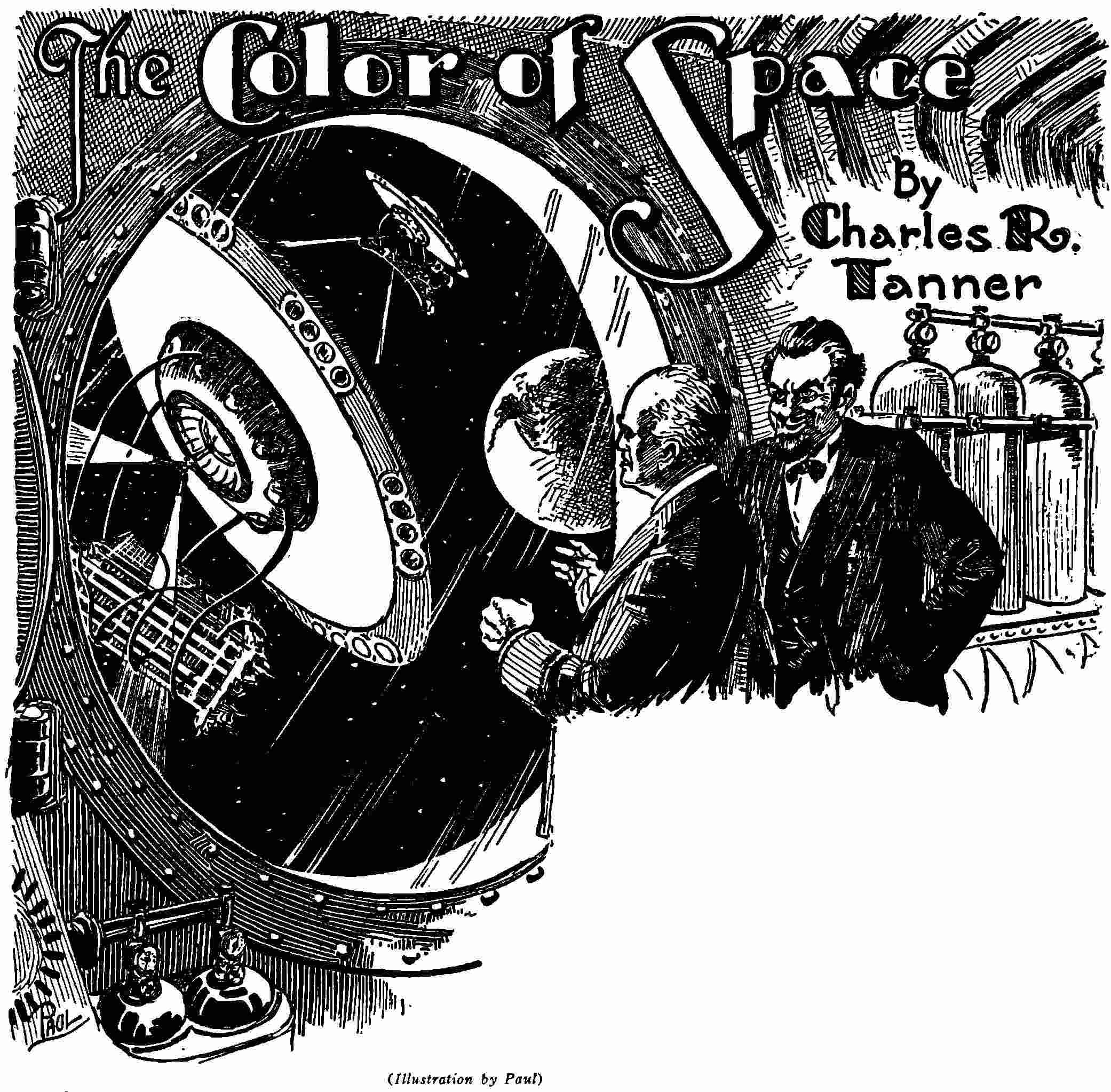
THE COLOR OF SPACE
By Charles R. Tanner
Illustrated by Frank R. Paul
Title: The color of space
Author: Charles R. Tanner
Illustrator: Frank R. Paul
Release date: January 3, 2026 [eBook #77610]
Language: English
Original publication: New York, NY: Stellar Publishing Corporation, 1930
Credits: Prepared by volunteers at BookCove (bookcove.net)
FIRST PRIZE $150.00 Awarded toTHE COLOR OF SPACEIn awarding Mr. Tanner the first prize of $150.00 in our very interesting cover contest, we were impressed, in the first place, with the excellent way in which he developed his story. It is a pity that too few science fiction authors consider the story or fiction element of their work to be important enough to demand a great deal of careful thought and preparation.
We want emphatically to encourage these writers, who have the knack of developing an interesting story, one that carries you breathlessly through its incidents and comes to a natural climax.
Mr. Tanner further was not content to take the cover at its face value, but he tried to analyze its meaning and penetrate its possible significance. This he does in a very convincing manner and we think our readers will agree that the startling conclusion to his story was foreshadowed by what went on before.
Mr. Tanner is, we believe, a newcomer to science fiction; yet by the exercise of his splendid powers of observation and facility for developing incidents, he can become a writer of no mean excellence.
Dr. Henshaw faced his captor wrathfully.
“Have you kept me here, doped for a week?” he began. The Russian interrupted him with a quieting gesture.
“Wait, Doctor,” he said, “there is much that must be explained before you indict me. Have you no curiosity regarding your kidnapping or this room in which you find yourself?” His eloquent gesture took in the strange metal walls, the two doors and the immense, shuttered, circular window that covered almost all of one wall.
“I think I understand clearly why I was kidnapped,” growled Henshaw. “It’s that secret process of mine. Russia and France have both been making frantic efforts to persuade me to sell. But I won’t.”
“Really, Doctor. After my explanation I do think you will agree to sell it to Russia. Much has happened in the week that you have been unconscious.” And seating himself in the room’s only chair, Godonoff went on:
“The day after I—er—kidnapped you, a series of events were started, resulting in a war in which Russia faces the rest of Europe. Troops have massed on the Polish border, and the Powers expected to invade Russia immediately. Then suddenly news came from Paris that the Eiffel Tower had disappeared! Was this the work of Russia? Hard upon this news came the reports of the disappearance of the Nelson monument from Trafalgar Square, in London, and of the Woolworth Building torn from its foundations in New York. That turned the tide. Panic attacked the Powers. I’m afraid the morale of your Western nations is crumbling now, Dr. Henshaw.”
“What’s the explanation?” asked Henshaw, dazedly.
“Just this, Doctor,” the Russian answered: “Our scientists have succeeded in overcoming gravitation! Eight years ago, two of our scientists, while attempting to disprove the Langmuir theory of the construction of the atom, managed, by the use of terrific pressure, to combine helium and fluorine. As you know, helium has never before been combined with any element. The result was a dark green solid that was absolutely weightless. And further investigation showed that an electric current passed through it caused an absolute negation of gravity.
“Armed with this great weapon, our government began the construction of three great ships, designed to fly through the atmosphere or, if necessary, beyond it. The first was one hundred meters in diameter, and was such a success that the others were made four times as large! It is these vast machines that have stolen those great buildings! What do you think will be the effect, Doctor, when Russia tells the Powers tomorrow to search for their lost buildings on Venus? Do you think they will feel like going to war with a nation that can accomplish such miracles?”
“Do you expect me to believe you?” asked Henshaw cynically.
Godonoff rose and moved over to the huge circular window. He began to turn a wheel that opened the window’s metal shutters.
“Due to certain work which I had accomplished in America,” he said, “the government honored me by placing me in command of the smallest of the machines. In order to secure your secret, Doctor, I took the liberty of bringing you along when the machines left for Venus. You are now 170,000 miles from the earth, and traveling fast. I offer you your return in exchange for the secret.”
Still smiling, Godonoff released the wheel and turned to Henshaw.
“And, Doctor, if you care for proof....” and he gestured toward the now uncovered window.
Henshaw approached the window, his incredulity seemingly vanishing as he gazed at the stupendous scene without. Stars—millions of stars—covered the entire view. Above, below, everywhere, stars swung in a mighty sweep around him from left to right as though the entire heaven were spinning like a stupendous top.
And as he gazed, earth and moon swept into view. The latter was almost hidden behind one of two disc-like machines that hung between the earth and Henshaw’s viewpoint. The doctor caught a glimpse of a great brassy reflecting surface, a central apparatus resembling a solar engine, and tremendous tentacles that held a huge building in their grasp. Then machines, earth and moon had swept past the window and only the stars appeared.
When he turned, he found the Russian beside him, looking over his shoulder.
“Are we—rotating?” Henshaw asked, his disbelief turned to awe.
“Yes,” Godonoff nodded, “the centrifugal force of our rotation is what gives the effect of gravity in the car.”
As Godonoff spoke, earth, moon and the great machines again swept into view and this time, Henshaw was able to secure a better view of them. He saw that the building in the grasp of the foremost machine was really the Woolworth, and that the farther one held the Eiffel Tower in its arms.
The machines swept out of view, but in a few minutes appeared again. Godonoff began proudly to explain them.
“That brass surface reflects the greater part of the sun’s rays. Although space is intensely cold, when the rays strike directly on anything, they heat it up to a remarkable degree. As you see, we reflect most of the heat from the machine’s surface; what we need is absorbed by the solar engine in the center. Note the curved mirrors which reflect the heat to the central cylindrical steam boiler. The steam generated runs the turbines that generate electricity to heat and operate the whole machine.
“See that green globe in the middle of the machine?” he continued as the machines swung past again, “that’s the helium fluoride. An electric current is passed through it, when we first leave the earth, but, after a good speed is secured, our inertia carries us on.”
“What are those two searchlight beams?” asked Henshaw.
“They are not light beams, Doctor. They are hollow cones of gas, lit up by the sun. The helium fluoride is not a stable substance; it slowly decomposes into its elements. The resulting gases are forced through pipes and through the boiler of the solar engine, where the heat expands them and drives them at high pressure through the nozzles you see. The recoil of the resulting jets is used for steering the disc.”
Henshaw turned back into the room, his eyes dazed by the view of the rapidly revolving heavens.
“That door,” he said, pointing, “it leads to outer space?” The Russian eyed him narrowly and then nodded.
“I suppose you’ve bolted it,” Henshaw went on smilingly, “so that I can’t leap out into space and take my secret with me?”
“Oh, no,” Godonoff answered. “It was locked when we left the earth, and I’ve just left it that way. I’ll unlock it, but don’t think it can be opened. With fifteen pounds of air pressure on this side and a vacuum on the other, wild horses couldn’t open it.”
As he spoke, he unbolted the door and stepped back, smiling. Like a flash, Henshaw flung himself at the door, and jerking it open, fled through. Darting down the long hall in which he found himself, he tore open another door, and before Godonoff could gather his startled wits, he hurled it open and was out! ... Finding himself in a well-lighted, well-populated street, Dr. Henshaw walked calmly away.
The next day, an admiring group of reporters listened in amazement to Henshaw’s story of the kidnapping.
“Godonoff’s story, the metal room, and all the rest were just staged to put me in the proper mind to divulge my secret,” he said as he finished. “The scene that I witnessed through the window was probably a cleverly designed motion picture. You know how uncannily natural these orthochromatic stereopictures are.”
“But, Doctor,” interrupted one of the men: “It took nerve to open that door. How did you know that you wouldn’t find yourself in interplanetary space?”
Henshaw’s eyes twinkled.
“I was quite positive before I opened the door that I wasn’t in interplanetary space. In the first place, as the Russian said, if we were in free space, I couldn’t open it. Then, when the Russian designed his little show, he made two rather inexcusable mistakes. In the first place, the disc nearest me, when lighted by the sun, would have made a reflection of such an intense brilliance that I would have been unable, even, to look at it. Then again, he pictured the sky as it appears to us on earth—deep blue, and sprinkled with stars. As we know, the bluish tinge of our midnight sky is caused only by the diffusion of the faint starlight by our atmosphere. In space, the sky would appear a black of the deepest jet. Furthermore, there would be seen ten times as many stars as were perceptible from the space ship. Therefore, with these fundamental mistakes in the little drama, I was quite sure I would find a city street beyond that door.”
Transcriber's note: This story appeared in the March 1930 issue of Science Wonder Stories magazine.