Title: A dictionary of the art of printing
Author: William Savage
Release date: December 6, 2025 [eBook #77410]
Language: English
Original publication: London: Longman, Brown, Green, and Longmans, 1841
Credits: Louise Hope, John Campbell, Chris Curnow, Joseph Cooper and the Online Distributed Proofreading Team at https://www.pgdp.net (This book was produced from scanned images of public domain material from the Google Books project.)
TRANSCRIBER’S NOTE
Basic fractions are displayed as ½ ⅓ ¼ etc; other fractions are shown in the form a-b/c, for example 5/2 or 8-3/7.
Breves and macrons are accurately represented (ă ĕ ā ē etc). Many other unusual characters are displayed using Unicode combining diacriticals.
The old long s character ſ is used exactly as in the original text.
The latin ligatures ff fi fl ffi ffl are displayed as one Unicode character. However older ligatures are displayed as separate characters; these include ct, st, ſt, ſh, ſi, ſl, ſb, ſk, ſſ, fſ, ſſi.
Footnotes are indicated by * † ‡ or § as in the original text, and have not been moved from their position in the printed text. Thirteen other footnote anchors are denoted by [number], as in the original text, and those footnotes have also been left in place at the end of their table or text section.
The ALPHABET and BLACK LETTER sections will display the Gothic characters if any of these fonts are installed: Blackletter, Fraktur, Textur, "Olde English Mt", "Olde English", Diploma, England, Gothic. The DANISH, GERMAN and SWEDISH sections also have these Gothic characters.
The IRISH section will display the Irish characters (insular script) if any of these fonts are installed: KellsFLF, Ring of Kerry, MeathFLF.
The Rabbinical Hebrew characters, used extensively on p315-317, can be displayed if the Rashi font "Noto Rashi Hebrew" or "Noto Rashi Hebrew Regular" is installed. Otherwise regular Hebrew characters will be displayed.
This book uses characters from many different alphabets. Unicode
codepoints are used whenever possible, but some printed characters
have no codepoint. These are represented in this etext by [#] for a
single character or dipthong and by [###] for a word or phrase.
The Etruscan, Maeso-Gothic and Swash alphabets are displayed as an image only
since no codepoints exist for their characters at this time.
Some characters with valid codepoints may not display properly on some handheld devices. Without proper rendering support, you may see question marks, boxes, or other symbols.
All the Alphabet tables are displayed as an Illustration in browsers and ereaders, as well as a text table.
Case diagrams, showing the Upper case and Lower case layout used by compositors for a particular font, are displayed only with an Illustration.
Tables on p104 to p161 show the count of letters on a sheet. The first page of 6 tables is shown in an Illustration. Only the table header and the first row of its data are displayed. The printed book had over three hundred of these tables on fifty-eight pages.
Tables on p273 to p292. The first JOBS table is displayed in full. Only the table header and the first row of data is displayed in all subsequent tables. The printed book had twenty pages of these tables.
Tables of Imposition on p335 to p400. The first three pages are displayed as searchable tables, the remaining sixty-three pages are displayed as small Illustrations. Many of the numerical signatures on a page were printed upside down in the original book. This is indicated in this etext (on those first three pages of tables) by putting the number in brackets, for example [14] or [B2].
Tables on p598 to p643. Only the table header and the first row of its data are displayed. The first page of 5 tables is shown in an Illustration. The printed book had over one hundred of these tables on forty-six pages.
Tables of signatures on p761 to p773. These tables are displayed in full.
The citation M. refers to Joseph Moxon, a 17th-century English printer.
New original cover art included with this eBook is granted to the public domain.
Some other minor text changes are noted at the end of the book.
London:
Printed by A. Spottiswoode,
New-Street-Square.
A
DICTIONARY
OF
THE ART OF PRINTING.
BY WILLIAM SAVAGE,
AUTHOR OF
“PRACTICAL HINTS ON DECORATIVE PRINTING,”
AND OF A TREATISE
“ON THE PREPARATION OF PRINTING INK, BOTH BLACK AND COLOURED.”
LONDON:
LONGMAN, BROWN, GREEN, AND LONGMANS.
1841.
Books of this class, themselves series of explanations, require fewer prefatory remarks than those of any other; yet I cannot allow the present work to go before the public without availing myself of this privilege of authors. It affords me an opportunity of acknowledging, which I do most gratefully, the kind and valuable assistance I have received during my protracted labours, and of saying a few words on the History of Printing, the limits of the book, the style of writing adopted, and on the introduction of subjects that at a first glance may appear to have but little or no connexion with the art.
I am indebted to Mr. Fehon, of Mr. Bentley’s establishment, Bangor House, Shoe Lane, for the valuable article on Records, who is, perhaps, more competent than any other printer in the kingdom for such an undertaking; and also for his judicious opinions during the progress of the work. Mr. Murray kindly prepared the specimens of electrotype by his improved method, for which method he received a premium from the Society of Arts. To Mr. Knight I am obliged for permission to copy the list of botanical terms from his Encyclopædia. From the letter founderies of Mr. Caslon, of Messrs. Figgins, and of Messrs. Thorowgood and Besley, I have obtained the various alphabets, &c., and am happy to acknowledge the courteous manner in which these and other kindnesses were granted. To other friends who feel an interest in the work, and have rendered me their services, I beg to tender my sincere thanks. The books quoted are each mentioned with every quotation, therefore there will be no necessity to recapitulate them here; I may, however, state, that they are the works of standard authors, as it has been my endeavour to refer to the opinions of men whose talents and learning are generally acknowledged, rather than to opinions perhaps more pertinent in works but little known.
The origin of the art is involved in obscurity, there being no clue by which it can be traced, yet it is doubtless of very early date: some authors maintain that printing was practised during the building of Babylon. It is not my intention, however, to enter upon this inquiry here, as it is probable, if my health continue, that I shall embody the facts and information I have been so long collecting on this subject in another work. The dates given of the introduction of the practice into Europe by previous writers are unquestionably erroneous, as we have conclusive evidence of its being followed as a profession for nearly a century before the earliest date they give. There has, in reality, hitherto been but little said on the History or Practice of Printing, the numerous[vi] books on the subject being chiefly copies from one or two of the earliest writers. The object in the present undertaking was that of making a purely practical work: one that might meet every exigence of the printer whilst in the exercise of his art, and one that would serve as a book of reference to the author, the librarian, and, in fact, to every one interested in books or their production.
It will be observed that Moxon’s book has been frequently referred to, and in many instances quoted from. This I was induced to do in consequence of the quantity of useful matter it contains, and more especially in order to point out and contrast the then method of printing with the present. (Where the letter M is used it refers to this author.) The intermediate stages, where improvements or alterations have occurred, are also noticed; so that the practical history of the art is complete from the year 1683, when Moxon published, to the present time.
The Statutes at Large I have carefully gone through from their commencement; all the acts of parliament that in any way refer to printing, and unrepealed, I have introduced: so that the Printer has here all the Statute Law in existence for his guidance in conducting his business.
The List of Abbreviations will be found extensive, and, I trust, valuable, as until now there has been no printed list of many of them. The interpretations have been obtained by comparing the writings of contemporary authors, and by consulting those of my friends who have made the early writers their study.
All the alphabets are taken from the best grammars in each language, in preference to the more easy, but less correct method, of copying the letters from any indifferent book printed in the characters of the respective languages. I have confined myself to those languages of which the characters are in the British founderies.
Whether my views are right or wrong respecting the orthography, punctuation, and the capital letters of the Bible, rests with the public to determine. I cannot consent to give an opinion in favour of the changes that fashion, prejudice, or even the rules of grammar have introduced, which are now adopted in general writing, until we have another authorized version of the Bible, but think the more literally we copy the present the better, otherwise the discrepancies will soon be notorious.
The article on Imposing is of considerable length; yet I could not, in justice to the work, curtail it: the tables might even have been still more numerous, and yet serviceable, had the limits of the book permitted; as it is, they are much more extensive than any tables hitherto published. Men from the country having been but little used to book-work, find themselves at a loss on entering a town-house in this part of their business.
In printing topographical works, copies of early acts of parliament, state papers of the middle ages, or books published soon after the introduction of printing, when there were no general rules for either writing or spelling, the list of characters and abbreviations under the head of[vii] Records will be found invaluable. My kind friend Mr. Fehon has spent many years of his life in investigating this subject, and has here condensed most of what will be valuable to the Printer.
Electrotype, although quite in its infancy, promises to be of great utility in the arts, and not the least so in that of printing. I have therefore thought it right to give some account of it, together with specimens, amongst which will be found an electrotype copy of a page of types: it is imperfect, but I believe it is the first that has been published.
No detailed account of the process of producing fine presswork has before appeared. This circumstance I cannot otherwise explain than by supposing it to arise from the jealous feeling that exists in the bosoms of many of those who are masters of the practice. On speaking to them of the value a detailed statement would be, I have been told that there were already a sufficiency of men who knew it, and that there was no necessity to deprive them of their advantages. Having paid particular attention to this department, and having produced works of this character that have been highly applauded, I have given a detailed account of all the minutiæ of so valuable a branch of the business.
Printing from engravings on wood is also a subject that has particularly interested me, the practice of which I have given at length: the result of my experience confirms the opinion that the press is infinitely superior to the machine for this description of work.
Having prepared the bulk of the matter prior to going to press, I thought it might be safely stated that the whole would be comprised in fourteen numbers. Yet, on revising, I found that some important articles had not been touched upon, and that others perfectly new (electrotype, &c.) had sprung up during the progress of printing; so that either the book must have been left incomplete (had the first arrangement been adhered to), or three more numbers must be added, and thus every branch that pertained to the practice be embraced. I trust none will regret that the latter plan has been adopted. With regard to the style of writing—I am now an old man, and perhaps may be, in some degree, wedded to the writings as well as the customs of my youth; therefore the quaintness of expression, which my friends have noticed, may possibly be more marked than I am aware of; yet the manner is not wholly unintentional. To some persons simple language may not have the attractions that are presented by the writings of many authors of the present day, whose chief study is elegance of expression; but do we not, by adopting this flowery style, lose in clearness, in strength, in conciseness? Yes, and, I think, even in beauty; and when it is considered that it was the intention to make the book one of practical instruction, and that it was written with the hope that it might be placed in the hands of each printer’s boy on entering the business, I trust this sin of inelegance may be pardoned. No one but the compiler of a dictionary can conceive the unwearied labour that is requisite for its completion. Having possessed greater opportunities than most men for the present undertaking, yet have I been upwards of half a century in collecting the materials; not, perhaps, having entertained the idea of publishing[viii] during the whole of this period, still never neglecting to amass every species of information that might be made available. On going over such an extent of ground much has been culled that would either never have been known to me, or, if known, would have been forgotten, had the book been more hastily got up; and all those subjects, a knowledge of which, at first, may appear irrelevant or useless, will in practice be found highly necessary, there having been no dictionary or book of reference kept in the printing offices to which the workmen could apply. Should the work prove less useful than I could wish it, the fault is in myself, and not in the subject; but if on its perusal the young be instructed, the knowledge of the more mature workman be refreshed and confirmed, and the general reader find its utility as a book of reference, then have I nothing to regret, but much to be grateful for. Lord Bacon says, “Every man is a debtor to his profession, from the which, as men do of course seek to receive countenance and profit, so ought they of duty to endeavour themselves by way of amends to be a help thereunto.”
DICTIONARY
OF THE
ART OF PRINTING.
“ABBREVIATIONS
are characters, or else marks on letters, to signify either a word or syllable. & is the character for and, ye is the abbreviated, yt is that abbreviated; and several other such. Straight strokes over any of the vowels abbreviate m or n. They have been much used by printers in old times, to shorten or get in matter; but now are wholly left off as obsolete.”—Moxon. In reprints of old books, where the original is closely followed, we occasionally meet with ɋ as an abbreviation of que: this mark of contraction for ue was attached to the q, and was originally used solely for that purpose; for the convenience of using the q without it, the abbreviation was afterwards cast separate, and by degrees it was adopted as a point or stop to divide a sentence, becoming the semicolon, the next in order to the comma.
Some few authors yet retain the ; after a q, for the termination ue, which appears to be the proper mark.
Abbreviations “occur very frequently, and are often the occasion of perplexity to readers less familiarly acquainted with them, in the early-printed books. These also originated from the idea which the first Printers entertained of making their books as much as possible resemble manuscripts. That they should perpetually occur in manuscripts is natural enough; for the librarii, or writers of manuscripts, necessarily had recourse to them to shorten their labours. These abbreviations, in the infancy of Printing, were perhaps to be excused; but it seems they multiplied to so preposterous an extent that it was found necessary to publish a book, both in the Gothic and Roman character, to explain their meaning.”—Beloe’s Anecdotes of Literature, &c. See Domesday Book. Records. Sigla.
A.—Aulus.
A. B.—Artium Baccalaureus. Bachelor of Arts.
Abp.—Archbishop.
A. C.—Ante Christum. Before the Birth of Christ.
A. C.—Arch-Chancellor.
A. D.—Anno Domini. In the Year of our Lord.
A. D.—Ante Diem.
A. D.—Arch-Duke.
Adm.—Admiralty.
Adm. Co.—Admiralty Court.
A. H.—The Year of the Hegira.
A. M.—Artium Magister. Master of Arts.
A. M.—Anno Mundi. In the Year of the World.
A. M.—Ante Meridiem. Before Noon.
An. A. C.—Anno ante Christum. In the Year before Christ.
Ana.—Of each a like Quantity.
Anon.—Anonymous.
A. P. G.—Professor of Astronomy in Gresham College.
A. R.—Anno Regni. In the Year of the Reign.
A. R. R.—Anno Regni Regis. In the Year of the Reign of the King.
Ast. P. G.—Astronomy Professor in Gresham College.
A. T.—Arch-Treasurer.
A. U. C.—Ab Urbe condita. From the building of the City.
Aug.—Augustus.
B. et L. D.—Duke of Brunswick and Lüneburg.
B. A.—Artium Baccalaureus. Bachelor of Arts.
Bart.—Baronet.
B. C.—Before Christ.
B. C. L.—Bachelor of Civil Law.
B. D.—Baccalaureus Divinitatis. Bachelor of Divinity.
B. M.—Baccalaureus Medicinæ. Bachelor of Medicine.
Bp.—Bishop.
B. R.—Banco Regis. The King’s Bench.
Brit. Mus.—British Museum.
Bt.—Baronet.
B. V.—Blessed Virgin.
B. V.—Bene Vale. Farewell.
C.—Caius.
c.—Caput. Chapter.
Cæs. Aug.—Cæsar Augustus.
Cal.—Calendis. The first Day of the Month.
Cal. Rot. Pat.—Calendarium Rotulorum Patentium. Calendar of the Patent Rolls.
Cap.—Capitulum. Chapter.
C. B.—Companion of the Bath.
C. C.—Caius College.
C. C. C.—Corpus Christi College.
ca. sa.—Capias ad satisfaciendum.
cf.—Confer. Compare.
Chart. Max.—Large Paper.
Cic.—Cicero.
Civ.—Civitas.
C. J. C.—Caius Julius Cæsar.
Cl.—Clarus. The celebrated.
Cl.—Claudius.
Cl. Dom. Com.—Clerk of the House of Commons.
Clk.—Clerk, a Clergyman.
Cn.—Cneius.
Coh.—Cohors.
Col.—Collega, Collegium.
C. O. S. S.—Consulibus. To the Consuls, or, From the Consuls, or, By the Consuls, Being Consuls, or, During the Consulate.
C. P.—Common Pleas.
C. P. S.—Custos Privati Sigilli. Keeper of the Privy Seal.
C. R.—Custos Rotulorum. Keeper of the Rolls.
C. R.—Civis Romanus.
Cr.—Creditor.
C. S.—Custos Sigilli. Keeper of the Seal.
D.—Decimus.
D. B.; Domesd. B.—Domesday Book.
D. C.—Dean of Christ Church.
10ber.—December.
D. C. L.—Doctor of Civil Law.
D. D.—Divinitatis Doctor. Doctor in Divinity.
D. D.—Dono dedit. Gave as a Present.
D. D. D.—Dat, Dicat, Dedicat. He gives, he devotes, he makes sure, or, consecrates.
D. F.—Dean of Faculty (Scotland).
D. G.—Deo gratias. Thanks to God.
D. G.—Dei gratiâ. By the Grace of God.
Dict.—Dictator.
D. M. S.—Diis Manibus Sacrum. Sacred to the Gods of the dead.
Dn.—Dominus.
Do.—Ditto. The same.
D. O. M.—Deo Optimo Maximo. To God the best, the greatest.
Dr.—Doctor.
Dr.—Debtor.
E.—East.
Eccl.—Ecclesiastes.
Ecclus.—Ecclesiasticus.
e. g.—Exempli gratiâ. As for example.
e. g.—Ex grege. Among the rest (literally from the Flock).
Ep.—Epistola.
Eps.—Episcopus.
Erg.—Ergo.
Esq.—Esquire.
Et.—Etiam.
Eur.—Europa.
Exch.—Exchequer.
Exon. D.—Exeter Domesday Book.
Exor.—Executor.
Ex S. C.—Ex Senatûs consulto.
Ex V.—Ex Voto.
F. D.—Fidei Defensor. Defender of the Faith.
F. E. S.—Fellow of the Entomological Society.
F. G. S.—Fellow of the Geological Society.
F. H. S.—Fellow of the Horticultural Society.
Fi. B.—Fide bonâ.
Fid.—Fides.
fi. fa.—Fieri facias.
Fil.—Filius.
F. L. S.—Fraternitatis Linneanæ Socius. Fellow of the Linnean Society.
Fœd. N. E.—Rymer’s Fœdera, New Edition.
F. R. S.—Fraternitatis Regiæ Socius. Fellow of the Royal Society.
F. R. S. E.—Fellow of the Royal Society, Edinburgh.
F. R. S. L.—Fellow of the Royal Society of Literature.
F. S. A. E.—Fellow of the Society of Antiquaries, Edinburgh.
G. C. B.—Grand Cross of the Bath.
G. C. H.—Grand Cross of the Royal Hanoverian Guelphic Order.
G. R.—Georgius Rex. George the King.
h. e.—Hoc est. That is, or, this is.
Heb.—Hebrews.
Hel.—Helvetia.
Hhd.—Hogshead.
Hier.—Hierusalem. Jerusalem.
H. J. S.—Hic jacet sepultus. Here lies buried.
H. M.—His or Her Majesty.
H. M. P.—Hoc Monumentum posuit. Erected this Monument.
H. M. S.—His or Her Majesty’s Ship.
H. R. I. P.—Hîc requiescit in Pace. Here rests in Peace.
H. S.—Sestertius. Two-pence.
Id.—Idem. The same.
Id. E.—Idem est.
i. e.—Id est. That is.
Ig.—Igitur.
I. H. S.—Jesus Hominum Salvator. Jesus the Saviour of Man.
Imp.—Imperator. Emperor.
Impp.—Imperatores, viz. de duobus.
Imppp.—Imperatores, viz. de tribus.
Incog.—Incognito. Unknown.
Inq. p. m.—Inquisitio post Mortem.
I. N. R. I.—Jesus Nazarenus, Rex Judæorum. Jesus of Nazareth, King of the Jews.
Ins.—Instant. Of this Month.
J. C.—Juris consultus.
J. C.—Julius Cæsar.
J. D.—Jurum Doctor. Doctor of Laws.
Jul.—Julius.
Jun.—Junius.
J. V. D.—Juris utriusque Doctor. Doctor of Canon and Civil Law.
K. Aug.—Kalendæ Augusti.
K. A. N.—Knight of Alexander Newski, Russia.
K. B.—Knight of the Bath.
K. B.—King’s Bench.
K. B. E.—Knight of the Black Eagle of Prussia.
K. C.—Knight of the Crescent of Turkey.
K. C.—King’s Counsel.
K. C. B.—Knight Commander of the Bath.
K. C. H.—Knight Commander of the Royal Hanoverian Guelphic Order.
K. C. S.—Knight of Charles III. of Spain.
K. G.—Knight of the Garter.
K. G. F.—Knight of the Golden Fleece, of Spain, or of Austria.
K. G. H.—Knight of Guelph of Hanover.
K. G. V.—Knight of Gustavus Vasa of Sweden.
K. H.—Knight of the Royal Hanoverian Guelphic Order.
K. L. A.—Knight of Leopold of Austria.
K. L. H.—Knight of the Legion of Honour.
K. M.—Knight of Malta.
K. Mess.—King’s Messenger.
K. M. T.—Knight of Maria Theresa of Austria.
K. N. S.—Knight of the Royal North Star of Sweden.
Knt.—Knight.
K. P.—Knight of Saint Patrick.
K. R. E.—Knight of the Red Eagle of Prussia.
K. S.—Knight of the Sword of Sweden.
K. S. A.—Knight of St. Anne of Russia.
K. S. E.—Knight of St. Esprit (or Holy Ghost) of France.
K. S. F.—Knight of St. Fernando of Spain.
K. S. F. M.—Knight of St. Ferdinand and Merit of Naples.
K. S. G.—Knight of St. George of Russia.
K. S. H.—Knight of St. Hubert of Bavaria.
K. S. J.—Knight of St. Januarius of Naples.
K. S. L.—Knight of the Sun and Lion of Persia.
K. S. M. & S. G.—Knight of St. Michael and St. George of the Ionian Islands.
K. S. P.—Knight of St. Stanislaus of Poland.
K. S. S.—Knight of the Southern Star of the Brazils.
K. S. W.—Knight of St. Wladimir of Russia.
K. T.—Knight of the Thistle.
K. T. S.—Knight of the Tower and Sword of Portugal.
K. W.—Knight of William of the Netherlands.
L.—Lucius.
lb.—Libra. A Pound.
Ldp.—Lordship.
Leg.—Legatus. Lieutenant-General.
Leg.—Legio. Legion.
Lev.—Leviticus.
Lib.—Liber. Book.
Lieut.—Lieutenant.
LL. B.—Legum Baccalaureus. Bachelor of Laws.
LL. D.—Legum Doctor. Doctor of the Canon and Civil Law.
LL. S.—Sestertius. Two-pence.
L. N. E. S.—Ladies Negro Education Society.
L. P.—Large Paper.
Lp.—Lordship.
Lre.—[French] Lettre. Letter.
L. S.—Loco Sigilli. Place of the Seal.
L. s. d.—[French] Livres, Sous, Deniers. Pounds, Shillings, Pence.
M.—Manipulus. An Handful.
M.—Marcus.
M.—Monsieur.
M. A.—Master of Arts.
M. B.—Medicinæ Baccalaureus. Bachelor in Medicine.
M. B.—Musicæ Baccalaureus. Bachelor of Music.
M. D.—Medicinæ Doctor. Doctor of Medicine.
Mens.—Mensis. Month.
Messrs.—Messieurs. [French, the plural of Monsieur.] Gentlemen; Sirs.
Mil.—Miles. A Soldier.
Mil.—Mille. A Thousand.
M. M. S.—Moravian Missionary Society.
Monsr.—Monsieur.
M. P.—Member of Parliament.
Mr.—Mister.
M. R. A. S.—Member of the Royal Asiatic Society.
M. R. I.—Member of the Royal Institution of Great Britain.
M. R. I. A.—Member of the Royal Irish Academy.
Mrs.—Mistress.
M. R. S. L.—Member of the Royal Society of Literature.
MS.—Manuscript.
M. S.—Memoriæ Sacrum. Sacred to the Memory.
MSS.—Manuscripts.
Mus. D.—Doctor of Music.
M. W. S.—Member of the Wernerian Society.
N.—North.
n.—Note.
N. B.—Nota bene. Mark well.
Nem. Con.—Nemine Contradicente. No Person opposing or disagreeing.
Nem. Diss.—Nemine Dissentiente. No Person opposing or disagreeing.
Nep.—Nepos.
n. l.—Non liquet. It appears not.
N. L.—North Latitude.
Nr.—Noster. Our; our own.
N. S.—New Style.
N. T.—New Testament.
Ob.—Obiit. He or she died.
Ob.—Obolus. Three Half-pence.
Oct.—October.
8vo.—Octavo.
O. S.—Old Style.
O. T.—Old Testament.
oz.—Ounce.
P.—Publius.
p.—Page.
p.—Pugil. What may be taken up, in compounding Medicine, between the two Fingers and Thumb.
Pag.—Pagina. A Page of a Book.
P. C.—Patres Conscripti. Conscript Fathers; Senators.
Pent.—Pentecost.
Per Cent.—Per Centum. By the Hundred.
Philom.—Philomathes. A Lover of Learning.
Philomath.—Philomathematicus. A Lover of the Mathematics.
P. M.—Post Meridiem. Afternoon.
P. M. G.—Professor of Music at Gresham College.
Pon. M.—Pontifex Maximus.
P. P.—Pater Patriæ. The Father of his Country.
P. P. C.—[French] Pour prendre congé. To take Leave.
P. R.—Populus Romanus. The Roman People.
Prof.—Professor.
P. R. S.—President of the Royal Society.
P. S.—Postscript. After written.
P. S.—Privy Seal.
P. Th. G.—Professor of Divinity at Gresham College.
Pub.—Publicus.
Q.—Quintus.
Q.—Quadrans. A Farthing.
q.—Quasi. As it were; almost.
q.—Quære. Inquire.
Q. C.—Queen’s College.
Q. C.—Queen’s Counsel.
q. d.—Quasi dicat. As if he should say.
Q. E.—Quod est. Which is.
Q. E. D.—Quod erat demonstrandum. Which was the Thing to be demonstrated.
q. l.—Quantum libet. As much as you please.
Qm.—Quomodo. How, by what means.
q. s.—Quantum sufficit. A sufficient quantity.
Quæs.—Quæstor.
q. v.—Quantum vis. As much as you will.
q. v.—Quod vide. Which see.
4to.—Quarto.
Qv.—Query.
R.—Rex. King.
R. A.—Royal Academician.
R. A.—Royal Artillery.
R. E.—Royal Engineers.
Reg.—Regi.
Resp.—Respublica. Republic.
Rev.—Reverend.
R. M.—Royal Marines.
R. M.—Resident Magistrate.
R. N.—Royal Navy.
R. N. O.—Riddare af Nordstjerne. Knight of the Order of the Polar Star.
Ro.—Right-hand Page.
R. P.—Respublica. Republic.
R. S. S. commonly F. R. S.—Regiæ Societatis Socius. Fellow of the Royal Society.
R. S. V. P.—[French] Réponse s’il vous plaît. Answer if you please.
Rt. Hon.—Right Honourable.
R. W. O.—Riddare af Wasa Orden. Knight of the Order of Wasa.
S.—Sacrum; Sepulcrum; Senatus.
S.—South.
S.—Uncia. An Ounce.
Sax. Chron.—Saxon Chronicle.
S. C.—Senatûs Consultum. The Decree of the Senate.
Scil.—Scilicet. To wit.
Scip.—Scipio.
S. D.—Salutem dicit. Sends Health.
S. L.—South Latitude.
S. L.—Solicitor at Law (in Scotland).
S. P.—Salutem Precatur. He prays for his Prosperity.
S. P.—Sine prole. Without issue.
S. P. D.—Salutem plurimam dicet. He wishes much Health.
S. P. G.—Society for the Propagation of the Gospel.
S. P. Q. R.—Senatus Populusque Romanus. The Senate and People of Rome.
ss.—Semissis. Half a Pound (six Ounces). The half of any Thing.
S. S. C.—Solicitor before the Supreme Courts (Scotland).
St.—Saint.
S. T. D.—Sacræ Theologiæ Doctor.
S. T. P.—Sacrosanctæ Theologiæ Professor. Professor of Divinity.
S. V. B. E. E. Q. V.—Si vales, bene est; ego quoque valeo. If you are in good Health, it is well; I also am in good Health.
T.—Titus.
Tab.—Tabularius.
Testa de N.—Testa de Nevill.
T. L.—Testamento legavit. Bequeathed by Will.
Tr. Br. Mus.—Trustee of the British Museum.
T. R. E.—Tempore Regis Edwardi. Time of King Edward.
T. R. M.—Tribunus militum. A military Tribune.
U. E. I. C.—United East India Company.
U. J. D.—Utriusque Juris Doctor. Doctor of both Laws.
ult.—Ultimus. The last.
U. S.—United States of America.
v.—Vide. See.
v.—Verse.
v.—Versus. Against.
v.—(Sub) voce.
V. C.—Vir clarissimus. A celebrated Man.
v. g.—Verbi gratiâ. As for Example.
Vic.—Victores; Victor; Victoria.
viz.—Videlicet. That is to say.
Vl.—Videlicet. That is to say.
W.—West.
W. M. S.—Wesleyan Missionary Society.
W. S.—Writer to His Majesty’s Signet.
Xmas.—Christmas.
Xn.—Christian.
Xpofer.—Christopher.
Xps.—Christus.
Xt.—Christ.
Xtian.—Christian.
See Botanical Authorities. Law Authorities. Organic Remains. Sigla.
ACCENTED LETTERS.
“In English, the accentual marks are chiefly used in spelling-books and dictionaries, to mark the syllables which require a particular stress of the voice in pronunciation.
“The stress is laid on long and short syllables indiscriminately. In order to distinguish the one from the other, some writers of dictionaries[6] have placed the grave on the former, and the acute on the latter, in this manner: ‘Mìnor, míneral, lìvely, líved, rìval, ríver.’
“The proper mark to distinguish a long syllable is this ̄: as, ‘Rōsy:’ and a short one thus ̆: as ‘Fŏlly.’ This last mark is called a breve.
“A diæresis, thus marked ¨, consists of two points placed over one of the two vowels that would otherwise make a diphthong, and parts them into two syllables: as, ‘Creätor, coädjutor, aërial.’
“A circumflex, thus marked ^, when placed over some vowel of a word, denotes a long syllable: as, ‘Euphrâtes.’”—Murray.
The c à la queue, or the c with a tail, is a French sort, and sounds like ss, when it stands before a o u, as in ça, garçon. To make a tail to a capital C, a small figure of 5 with the top dash cut away, thus ⦢, and justified close to the bottom of the letter, answers the purpose, when it is required; for the letter-founders do not cast this letter with a tail, neither in the capitals nor small capitals. Ç.
The ñ is used in the Spanish language, and is pronounced like a double n, or rather like ni; but short and quick, as in España. It is a sort which is used in the middle of words, but rarely at the beginning.
In the Welsh language, ŵ and ŷ, as well as the other circumflex letters, are used either to direct the pronunciation, as in yngŵydd, in presence; ynghŷd, together; or else for distinction sake; as, mwg, a mug; mŵg, smoke; hyd, to, until; hŷd, length.
Accents. See Accented Letters.
ACTS OF PARLIAMENT.
There are various Acts of Parliament which affect printers, and inflict penalties for the neglect or violation of their provisions. Many printers frequently subject themselves to penalties, which are in many instances very heavy, through ignorance of those laws. To enable them to avoid these penalties, and also to show the legal restrictions on the business, I have taken great pains to examine the whole of the Statutes at Large, and to extract from them all such clauses as are in force, that affect the trade.—See the respective subjects.
Admiration, Note of. See Punctuation.
ADVERTISEMENTS.
By the Act 3 & 4 Will. 4. c. 23. s. 1., intituled
“An Act to reduce the Stamp Duties on Advertisements and on certain Sea Insurances; to repeal the Stamp Duties on Pamphlets, and on Receipts for Sums under Five Pounds; and to exempt Insurances on Farming Stock from Stamp Duties;” the Act 55 Geo. 3. c. 184.; the Act 55 Geo. 3. c. 185.; and the Act 56 Geo. 3. c. 56., for the Duties granted and payable in Ireland, are repealed; “save and except so much and such Part and Parts of the said Duties respectively as shall have accrued or been incurred before or upon the said Fifth Day of July One thousand eight hundred and thirty-three, and shall then or at any Time afterwards be or become due or payable and remain in arrear and unpaid; all which said Duties so remaining in arrear and unpaid as aforesaid shall be recoverable by the same Ways and Means, and with such and the same Penalties, as if this Act had not been made.
s. 2. “And be it enacted, That from and after the Fifth Day of July One thousand eight hundred and thirty-three, in lieu and stead of the said several Duties upon Advertisements and Sea Insurances by this Act repealed, there shall be granted, raised, levied, collected, and paid, in Great Britain and Ireland respectively, unto and for the Use of His Majesty, His Heirs and Successors, for and in respect of the several Articles, Matters, and Things mentioned and described in the Schedule to this Act annexed, the several Duties or Sums of Money set down in Figures against the same respectively, or otherwise specified and set forth in the said Schedule; and that the said Schedule, and the several Provisions, Regulations, and Directions therein contained, with respect to the said Duties, and the Articles, Matters, and Things charged therewith, shall be deemed and taken to be Part of this Act; and that the said Duties shall be denominated and deemed to be Stamp Duties, and shall be under the Care and Management of the Commissioners of Stamps for the Time being for the United Kingdom of Great Britain and Ireland.
s. 3. “And in order to provide for the Collection of the Duty by this Act granted on[7] Advertisements contained in or published with any Pamphlet, Literary Work, or Periodical Paper, be it enacted, That one printed Copy of every Pamphlet or Literary Work or Periodical Paper (not being a Newspaper), containing or having published therewith any Advertisements or Advertisement liable to Stamp Duty, which shall be published within the Cities of London, Edinburgh, or Dublin respectively, or within Twenty Miles thereof respectively, shall, within the Space of Six Days next after the Publication thereof, be brought, together with all Advertisements printed therein, or published or intended to be published therewith, to the Head Office for Stamps in Westminster, Edinburgh, or Dublin nearest to which such Pamphlet, Literary Work, or Periodical Paper shall have been published, and the Title thereof, and the Christian Name and Surname of the Printer and Publisher thereof, with the Number of Advertisements contained therein or published therewith; and any Stamp Duty by Law payable in respect of such Advertisements shall be registered in a Book to be kept at such Office, and the Duty on such Advertisements shall be there paid to the Receiver General of Stamp Duties for the Time being, or his Deputy or Clerk, or the proper authorized Officer, who shall thereupon forthwith give a Receipt for the same; and one printed Copy of every such Pamphlet, Literary Work, or Paper as aforesaid, which shall be published in any Place in the United Kingdom, not being within the Cities of London, Edinburgh, or Dublin, or within Twenty Miles thereof respectively, shall, within the Space of Ten Days next after the Publication thereof, be brought, together with all such Advertisements as aforesaid, to the Head Distributor of Stamps for the Time being within the District in which such Pamphlet, Literary Work, or Paper shall be published; and such Distributor is hereby required forthwith to register the same in manner aforesaid in a Book to be by him kept for that Purpose; and the Duty payable in respect of such Advertisements shall be thereupon paid to such Distributor, who shall give a Receipt for the same; and if the Duty which shall be by Law payable in respect of any such Advertisements as aforesaid shall not be duly paid within the respective Times and in the Manner herein-before limited and appointed for that Purpose, the Printer and Publisher of such Pamphlet, Literary Work, or Paper, and the Publisher of any such Advertisements, shall respectively forfeit and pay the Sum of Twenty Pounds for every such Offence; and in any Action, Information, or other Proceeding for the Recovery of such Penalty, or for the Recovery of the Duty on any such Advertisements, Proof of the Payment of the said Duty shall lie upon the Defendant.
s. 4. “And be it enacted, That all the Powers, Provisions, Clauses, Regulations, and Directions, Fines, Forfeitures, Pains, and Penalties, contained in or imposed by the several Acts of Parliament relating to the Duties on Advertisements and Sea Insurances respectively, and the several Acts of Parliament relating to any prior Duties of the same Kind or Description, in Great Britain and Ireland respectively, shall be of full Force and Effect with respect to the Duties by this Act granted, and to the Vellum, Parchment, Paper, Articles, Matters, and Things charged or chargeable therewith, and to the Persons liable to the Payment of the said Duties, so far as the same are or shall be applicable in all Cases not hereby expressly provided for, and shall be observed, applied, enforced, and put in execution for the raising, levying, collecting, and securing of the said Duties hereby granted, and otherwise relating thereto, so far as the same shall not be superseded by and shall be consistent with the express Provisions of this Act, as fully and effectually to all Intents and Purposes as if the same had been herein repeated and especially enacted with reference to the said Duties by this Act granted.”
THE SCHEDULE.
Advertisements:—
| Duty. | |
| For and in respect of every Advertisement contained in or published with any Gazette or other Newspaper, or contained in or published with any other Periodical Paper, or in or with any Pamphlet or Literary Work, | £ s. d. |
| Where the same shall be printed and published in Great Britain | 0 1 6 |
| And where the same shall be printed and published in Ireland | 0 1 0 |
[So much of this Act repealed by 6 & 7 Will. 4. c. 76. s. 32. “as provides the Mode of collecting the Duty on Advertisements contained in or published with any Pamphlet, Periodical Paper, or Literary Work.”]
Albion Press. See Cope’s Press.
ALGEBRAIC CHARACTERS.
+ is the sign of addition; as c + d denotes that d is to be added to c.
- is the sign of subtraction; thus, c - d implies that d is to be subtracted from c.
× is the sign of multiplication; as c × d means the product of c and d.
÷ is the sign of division; as c ÷ d signifies the quotient of c and d.
= is the sign of equality; thus c + d = e means the sum of c and d equals e.
√ is the sign of the square root; thus √x denotes the square root of x.
∛ is the sign of the cube root, and generally any root of a quantity may be denoted by this sign, with the index of the root placed over it; thus ∛x signifies the cube root, ∜x the biquadrate root, &c.; but they may likewise be represented by the reciprocals of these indices; as x½, x⅓, implying the square and cube roots of x.
A vinculum is a line drawn over several quantities, and means that they are taken together, as √ax + b signifies the square root of ax and b.—Phillips’s Compendium of Algebra. 12mo. 1824.
Almanack. See Nautical Almanack.
ALPHABET.
A perfect alphabet of the English language, and, indeed, of every other language, would contain a number of letters, precisely equal to the number of simple articulate sounds belonging to the language. Every simple sound would have its distinct character; and that character be the representative of no other sound. But this is far from being the state of the English alphabet. It has more original sounds than distinct significant letters; and, consequently, some of these letters are made to represent, not one sound alone, but several sounds. This will appear by reflecting, that the sounds signified by the united letters th, sh, ng, are elementary, and have no single appropriate characters, in our alphabet; and the letters a and u represent the different sounds heard in hat, hate, hall; and but, bull, mute.
The letters of the English language, called the English Alphabet, are twenty-six in number.—Murray.
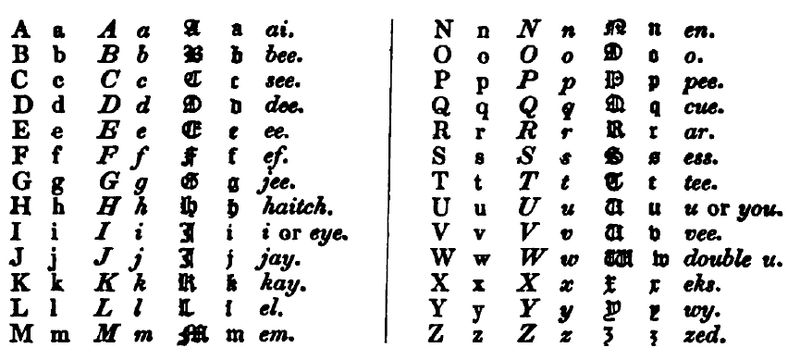
The following is a list of the Roman, Italic, and Old English Characters, being those used at the present day in England. The Roman and Italic are also used by most of the European nations.
| A a | A a | A a | ai. |
| B b | B b | B b | bee. |
| C c | C c | C c | see. |
| D d | D d | D d | dee. |
| E e | E e | E e | ee. |
| F f | F f | F f | ef. |
| G g | G g | G g | jee. |
| H h | H h | H h | haitch. |
| I i | I i | I i | i or eye. |
| J j | J j | J j | jay. |
| K k | K k | K k | kay. |
| L l | L l | L l | el. |
| M m | M m | M m | em. |
| N n | N n | N n | en. |
| O o | O o | O o | o. |
| P p | P p | P p | pee. |
| Q q | Q q | Q q | cue. |
| R r | R r | R r | ar. |
| S s | S s | S s | ess. |
| T t | T t | T t | tee. |
| U u | U u | U u | u or you. |
| V v | V v | V v | vee. |
| W w | W w | W w | double u. |
| X x | X x | X x | eks. |
| Y y | Y y | Y y | wy. |
| Z z | Z z | Z z | zed. |
For the characters of the different languages, see their respective names, Arabic, &c.
Tacquet, an able mathematician, in his Arithmeticiæ Theor., Amst. 1704, states, that the various combinations of the twenty-four letters (without any repetition) will amount to
620,448,401,733,239,439,360,000.
Thus it is evident, that twenty-four letters will admit of an infinity of[9] combinations and arrangements, sufficient to represent not only all the conceptions of the mind, but all words in all languages whatever.
Clavius the Jesuit, who also computes these combinations, makes them to be only 5,852,616,738,497,664,000.
As there are more sounds in some languages than in others, it follows of course that the number of elementary characters, or letters, must vary in the alphabets of different languages. The Hebrew, Samaritan, and Syriac alphabets, have twenty-two letters; the Arabic, twenty-eight; the Persic, and Egyptian or Coptic, thirty-two; the present Russian, forty-one; the Shanscrit, fifty; the Cashmirian and Malabaric are still more numerous.—Astle.
ALTERATION OF MARGIN.
In works that are published in different sizes, this is the changing of the margin from the small paper to the large paper edition, when at press.
After the margin for the small paper copies is finally made, the additional width of the gutters, the backs, and the heads, is ascertained in the same manner, by folding a sheet of the large paper, that it was in the first instance. The additional pieces for the change should, if possible, be in one piece for each part. See Margin.
Folios, quartos, and octavos, are the sizes most usually printed with an alteration of margin; duodecimos are sometimes, but rarely; of smaller sizes I never knew an instance.
The alteration of margin requires care, for it occasionally happens that the sheet is imposed with the wrong furniture; and where it happens to be in one form only, and that form is first laid on, it sometimes passes undiscovered till a revise of the second form is pulled, when the error is detected, but too late to rectify it; the consequence must be, to cancel a part of the sheet, or to print the reiteration with the margin also wrong; nay, sometimes both forms are worked off with the furniture wrong, without being perceived till the compositor comes to distribute, particularly when they are printed at different presses. Such errors destroy the uniformity of the book, and spoil its appearance.
These mistakes can only be avoided by care and attention on the part of the compositor, the reader, and the pressman; but I would recommend that the furniture for the alteration should be cut of different lengths from the furniture of the small paper: in octavos the gutters and backs should be the exact length of the page, and be always imposed within the sidestick; and the head should be the width of the two pages and the gutter, and be imposed within the footstick. This method of cutting the furniture of precise lengths for the alteration, and locking it up within the side and foot sticks, will not only distinguish it from the rest of the furniture, and from the pieces that may be put in for the convenience of quoining the form, but will also preserve it from being injured by the mallet and shooting stick, in locking up, and by the indention of the quoins.
The same principle, of cutting the alteration to precise lengths, and locking it up within the side and foot sticks, will hold good in all other sizes, where it is required: in quartos, the pieces must be cut to the length and width of the page; and in folios to the length of the page only, as the margin of the head is regulated at the press.
ANCIENT CUSTOMS.
The following Customs used in Printing Offices in former times are extracted from Moxon’s Mechanick Exercises, published in 1683, the first practical work that appeared on the Art of Printing. I insert them because I think it interesting to trace the old Customs, that were established by printers to preserve Order among[10] themselves; and to show the changes that have taken place since that period. The insertion of them in this place will also tend to preserve them, as the original work is now very scarce, and this department of it has been superseded by subsequent publications, which however, with the exception of Mr. Hansard’s work, have not copied these Customs.
“Ancient Customs used in a Printing-house.
“Every Printing-house is by the Custom of Time out of mind, called a Chappel; and all the Workmen that belong to it are Members of the Chappel: and the Oldest Freeman is Father of the Chappel. I suppose the stile was originally conferred upon it by the courtesie of some great Churchman, or men, (doubtless when Chappels were in more veneration than of late years they have been here in England) who for the Books of Divinity that proceeded from a Printing-house, gave it the Reverend Title of Chappel.
“There have been formerly Customs and By-Laws made and intended for the well and good Government of the Chappel, and for the more Civil and orderly deportment of all its Members while in the Chappel; and the Penalty for the breach of any of these Laws and Customs is in Printers Language called a Solace.
“And the Judges of these Solaces, and other Controversies relating to the Chappel or any of its Members, was plurality of Votes in the Chappel. It being asserted as a Maxim, That the Chappel cannot Err. But when any Controversie is thus decided, it always ends in the Good of the Chappel.
“1. Swearing in the Chappel, a Solace.
“2. Fighting in the Chappel, a Solace.
“3. Abusive Language, or giving the Ly in the Chappel, a Solace.
“4. To be Drunk in the Chappel, a Solace.
“5. For any of the Workmen to leave his Candle burning at Night, a Solace.
“6. If the Compositer let fall his Composing-stick, and another take it up, a Solace.
“7. Three Letters and a Space to lye under the Compositers Case, a Solace.
“8. If a Press-man let fall his Ball or Balls, and another take it up, a Solace.
“9. If a Press-man leave his Blankets in the Tympan at Noon or Night, a Solace.
“These Solaces were to be bought off, for the good of the Chappel: Nor were the price of these Solaces alike: For some were 12d. 6d. 4d. 2d. 1d. ob. according to the nature and quality of the Solace.
“But if the Delinquent prov’d Obstinate or Refractory, and would not pay his Solace at the Price of the Chappel, they Solac’d him.
“The manner of Solacing, thus.
“The Workmen take him by force, and lay him on his Belly athwart the Correcting-stone, and held him there while another of the Work-men with a Paper-board, gave him 10l. and a Purse, viz. Eleven blows on his Buttocks; which he laid on according to his own mercy. For Tradition tells us, that about 50 years ago one was Solaced with so much violence, that he presently P——d Blood; and shortly after dyed of it.
“These nine Solaces were all the Solaces usually and generally accepted: yet in some particular Chappels the Work-men did by consent make other Solaces, viz.
“That it should be a Solace for any of the Workmen to mention Joyning their Penny or more apiece to send for Drink.
“To mention spending Chappel-money till Saturday night, or any other before agreed time.
“To Play at Quadrats, or excite any of the Chappel to Play at Quadrats; either for Money or Drink.
“This Solace is generally purchas’d by the Master-Printer; as well because it hinders the Workmens work, as because it Batters and spoils the Quadrats: For the manner how they Play with them is Thus: They take five or seven more m Quadrats (generally of the English Body) and holding their Hand below the Surface of the Correcting Stone, shake them in their Hand, and toss them upon the Stone, and then count how many Nicks upwards each man throws in three times, or any other number of times agreed on: And he that throws most Wins the Bett of all the rest, and stands out free, till the rest have try’d who throws fewest Nicks upwards in so many throws; for all the rest are free: and he pays the Bett.
“For any to Take up a Sheet, if he receiv’d Copy-money; Or if he receiv’d no Copy-money, and did Take up a Sheet, and carryed that Sheet or Sheets off the Printing-House till the whole Book was Printed off and Publisht.
“Any of the Workmen may purchase a Solace for any trivial matter, if the rest of the Chappel consent to it. As if any of the Workmen Sing in the Chappel; he that is[11] offended at it may, with the Chappels Consent purchase a penny or two penny Solace for any Workmans singing after the Solace is made; Or if a Workman or a Stranger salute a Woman in the Chappel, after the making of the Solace, it is a Solace of such a Value as is agreed on.
“The price of all Solaces to be purchased is wholly Arbitrary in the Chappel. And a Penny Solace may perhaps cost the Purchaser Six Pence, Twelve Pence, or more for the Good of the Chappel.
“Yet sometimes Solaces may cost double the Purchase or more. As if some Compositer have (to affront a Press-man) put a Wisp of Hay in the Press-man’s Ball-Racks; If the Press-man cannot well brook this affront, he will lay six Pence down on the Correcting Stone to purchase a Solace of twelve pence upon him that did it; and the Chappel cannot in Justice refuse to grant it: because it tends to the Good of the Chappel: And being granted, it becomes every Members duty to make what discovery he can: because it tends to the farther Good of the Chappel: And by this means it seldom happens but the Agressor is found out.
“Nor did Solaces reach only the Members of the Chappel, but also Strangers that came into the Chappel, and offered affronts or indignities to the Chappel, or any of its Members; the Chappel would determine it a Solace. Example,
“It was a Solace for any to come to the King’s Printing-house and ask for a Ballad.
“For any to come and enquire of a Compositer, whether he had News of such a Galley at Sea.
“For any to bring a Wisp of Hay, directed to any of the Press-men.
“And such Strangers were commonly sent by some who knew the Customs of the Chappel, and had a mind to put a Trick upon the Stranger.
“Other Customs were used in the Chappel, which were not Solaces, viz. Every new Workman to pay half a Crown; which is called his Benvenue: This Benvenue being so constant a Custome is still lookt upon by all Workmen as the undoubted Right of the Chappel, and therefore never disputed; yet he who has not paid his Benvenue is no Member of the Chappel nor enjoys any benefit of Chappel-Money.
“If a Journey-man Wrought formerly upon the same Printing House, and comes again to Work on it, pays but half a Benvenue.
“If a Journey-man Smout more or less on another Printing-House and any of the Chappel can prove it, he pays half a Benvenue.
“I told you before that abusive Language or giving the Lye was a Solace: But if in discourse, when any of the Workmen affirm any thing that is not believed, the Compositer knocks with the back corner of his Composing-stick against the lower Ledge of his Lower Case, and the Press-man knocks the handles of his Ball-stocks together: Thereby signifying the discredit they give to his Story.
“It is now customary that Journey-men are paid for all Church Holy days that fall not on a Sunday, Whether they Work or no: And they are by Contract with the Master Printer paid proportionably for what they undertake to Earn every Working day, be it half a Crown, two Shillings, three Shillings, four Shillings, &c.
“It is also customary for all the Journey-men to make every Year new Paper Windows, whether the old will serve again or no; Because that day they make them, the Master Printer gives them a Way-goose; that is, he makes them a good Feast, and not only entertains them at his own House, but besides, gives them Money to spend at the Ale-house or Tavern at Night; And to this Feast they invite the Correcter, Founder, Smith, Joyner, and Inck-maker, who all of them severally (except the Correcter in his own Civility) open their Purse-strings and add their Benevolence (which Workmen account their duty, because they generally chuse these Workmen) to the Master Printers: But from the Correcter they expect nothing, because the Master Printer chusing him, the Workmen can do him no kindness.
“These Way-gooses, are always kept about Bartholemew-tide. And till the Master-Printer have given this Way-goose, the journey-men do not use to work by Candle Light.
“If a Journey-man marry, he pays half a Crown to the Chappel.
“When his Wife comes to the Chappel, she pays six Pence: and then all the Journey-men joyn their two Pence apiece to Welcome her.
“If a Journeyman have a Son born, he pays one Shilling.
“If a Daughter born, six Pence.
“The Father of the Chappel drinks first of Chapel Drink, except some other Journey-man have a Token; viz. Some agreed piece of Coin or Mettle markt by consent of the Chappel: for then producing that Token, he Drinks first. This Token is always given to him who in the Round should have Drank, had the last Chappel-drink held out. Therefore when Chappel-drink comes in, they generally say, Who has the Token?
“Though these Customs are no Solaces; yet the Chappel Excommunicates the Delinquent; and he shall have no benefit of Chappel-money till he have paid.
“It is also customary in some Printing-houses that if the Compositer or Press-man make either the other stand still through the neglect of their contracted Task, that then he who neglected, shall pay him that stands still as much as if he had Wrought.
“The Compositers are Jocosely called Galley Slaves: Because allusively they are as it were bound to their Gallies.
“And the Press-men are Jocosely called Horses: Because of the hard Labour they go through all day long.
“An Apprentice when he is Bound pays half a Crown to the Chappel, and when he is made Free, another half Crown to the Chappel; but is yet no Member of the Chappel; And if he continue to Work Journey-work in the same House, he pays another half Crown, and is then a Member of the Chappel.
“The Printers of London, Masters and Journey-men, have every Year a general Feast, which since the re-building of Stationers Hall is commonly kept there. This Feast is made by four Stewards, viz. two Masters and two Journey-men; which Stewards, with the Collection of half a Crown apiece of every Guest, defray the Charges of the whole Feast; And as they collect the Half-Crowns, they deliver every Guest a Ticket, wherein is specified the Time and Place they are to meet at, and the Church they are to go to: To which Ticket is affixed the Names and Seals of each Steward.
“It is commonly kept on or about May-day: When, about ten a Clock in the Morning they meet at Stationers Hall, and from thence go to some Church thereabouts; Four Whifflers (as Servitures) by two and two walking before with White Staves in their Hands, and Red and Blew Ribbons hung Belt-wise upon their left Shoulders. Those go before to make way for the Company. Then walks the Beadle of the Company of Stationers, with the Company’s Staff in his Hand, and Ribbons as the Whifflers, and after him the Divine (whom the Stewards before ingag’d to Preach them a Sermon) and his Reader. Then the Stewards walk by two and two, with long White Wands in their Hands, and all the rest of the Company follows, till they enter the Church.
“Then Divine Service begins, Anthems are Sung, and a Sermon Preached to suit the Solemnity: Which ended, they in the same order walk back again to Stationers Hall; where they are immediately entertain’d with the City Weights and other Musick: And as every Guest enters, he delivers his Ticket (which gives him Admittance) to a Person appointed by the Stewards to receive it.
“The Master, Wardens and other Grandees of the Company (although perhaps no Printers) are yet commonly invited, and take their Seats at the upper Table, and the rest of the Company where it pleases them best. The Tables being furnish’d with variety of Dishes of the best Cheer: And to make the entertainment more splendid is usher’d in with Loud Musick. And after Grace is said (commonly by the Minister that Preach’d the Sermon) every one Feasts himself with what he likes Best; whiles the Whifflers and other Officers Wait with Napkins, Plates, Beer, Ale, and Wine, of all sorts, to accommodate each Guest according to his desire. And to make their Cheer go cheerfuller down, are entertained with Musick and Songs all Dinner time.
“Dinner being near ended, the Kings and the Dukes Healths is begun, by the several Stewards at the several Tables, and goes orderly round to all the Guests.
“And whiles these Healths are Drinking, each Steward sets a Plate on each Table, beginning at the upper end, and conveying it downwards, to Collect the Benevolence of Charitable minds towards the relief of Printers Poor Widows. And at the same time each Steward distributes a Catalogue of such Printers as have held Stewards ever since the Feast was first kept, viz. from the Year of Christ 1621.
“After Dinner, and Grace said, the Ceremony of Electing new Stewards for the next Year begins: Therefore the present Stewards withdraw into another Room: And put Garlands of Green Lawrel, or of Box on their Heads, and White-wands in their Hands, and are again Usher’d out of the withdrawing Room by the Beadle of the Company, with the Companys Staff in his Hand, and with Musick sounding before them: Then follows one of the Whifflers with a great Bowl of White-wine and Sugar in his Right Hand, and his Whifflers Staff in his Left: Then follows the Eldest Steward, and then another Whiffler, as the first, with a Bowl of White-wine and Sugar before the second Steward, and in like manner another Whiffler before the Third, and another before the Fourth. And thus they walk with Musick sounding before them three times round the Hall: And in a fourth round the first Steward takes the Bowl of his Whiffler and Drinks to one (whom before he resolved on) by the Title of Mr. Steward Elect: And taking the Garland off his own Head puts it upon the Steward Elects Head. At which Ceremony the Spectators clap their Hands, and such as stand on the Tables or Benches, so Drum with their Feet that the whole Hall is filled with Noise, as applauding the Choice. Then the present Steward takes out the Steward Elect, giving[13] him the Right Hand, and walks with him Hand in Hand, behind the three present Stewards another Round about the Hall: And in the next Round, as aforesaid, the second Steward Drinks to another with the same Ceremony as the first did; and so the Third Steward, and so the Fourth, and then all walk one Round more Hand in Hand about the Hall, that the Company may take notice of the Stewards Elect. And so ends the Ceremony of the Day.
“This Ceremony being over, such as will go their ways; but others that stay, are Diverted with Musick, Songs, Dancing, Farcing, &c. till at last they all find it time to depart.”
Ancient Names of Cities and Towns. See Names.
Anglo-Saxon. See Saxon.
ANTEPENULTIMATE.
The last syllable but two of a word.
APOSTROPHE.
An apostrophe, marked thus ’, is used to abbreviate or shorten a word: as, ’tis for it is; tho’ for though; e’en for even; judg’d for judged. Its chief use is to show the genitive case of nouns: as, “A man’s property; a woman’s ornament.”—Murray.
Authors frequently, in the hurry of writing, abbreviate their words and use the apostrophe; but a compositor, however his copy may be written, should never abbreviate any word in prose works, except he be particularly ordered so to do.
The apostrophe is also used in printing to close an extract, or to show where it finishes; and in dialogues, frequently, to close each person’s speech; in both cases it is usually put close to the end of the word, without any space before it, except where the word finishes with a kerned letter, and then a hair space, or one just sufficient for their preservation is used; when it comes after an ascending letter, a hair space should also be put between them. See Quotation.
The apostrophe is not used for abbreviation in the Holy Scriptures, nor in Forms of Prayers; but every thing there is set full and at length. To this even the Latin law language had regard, and did not shorten the word Dominus, when it had reference to God; whereas Dom. Reg. is put where our Lord the King is understood.
Applegath, Augustus. See Machines.
ARABIC.
Arabic is read from right to left. The method of composing it is upside down, and after the points are placed at the top of the letters it is turned in the composing stick.
Mr. Astle says, “The old Arabic characters are said to be of very high antiquity; for Ebn Hashem relates, that an inscription in it was found in Yaman, as old as the time of Joseph. These traditions may have given occasion to some authors to suppose the Arabians to have been the inventors of letters; and Sir Isaac Newton supposes, that Moses learned the alphabet from the Midianites, who were Arabians.
“The Arabian alphabet consists of twenty-eight letters, which are somewhat similar to the ancient Kufic, in which characters the first copies of the Alcoran were written.
“The present Arabic characters were formed by Ebn Moklah, a learned Arabian, who lived about 300 years after Mahomet. We learn from the Arabian writers themselves, that their alphabet is not ancient.”
Seven different styles of writing are used by the Arabs in the present day. Herbin has given descriptions and specimens of them in an Essay on Oriental Caligraphy at the end of his “Développemens des Principes de la Langue Arabe Moderne.”
The alphabets are copied, and the following observations are translated, from Baron De Sacy’s Arabic Grammar, 2 vol. 8vo. Paris, 1831.
7. It was long thought that the written character which the Arabs most generally use at the present day, and which is called neskhi, was invented[14] only about the commencement of the 4th century of the Hegira; and, indeed, it appears that the Arabs, before this epoch, used another character which we call Cufic, or Coufic, from the town of Coufa, where, doubtlessly, it first was brought into use. This character has so great a resemblance to the ancient Syriac character called Estranghelo, that it is extremely probable that the Arabs borrowed it from the people of Syria. Nevertheless, even the name of Coufic, given to this character, proves that it is not that which the Arabs of the Hedjaz made use of in the time of Mohammed, the town from which it takes its name having been founded only in A. H. 17. Some papyri lately discovered in Egypt have apprised us that the character which the Arabs of the Hedjaz made use of in the 1st century of the Hegira, differed little from that which is called neskhi. Moreover, in the time of Mohammed, writing was, among these Arabs, if we may believe their historic traditions, an invention very recent, and its use was very circumscribed. But it was otherwise, according to all appearances, among the Arabs, whether nomadic or settled, of Yemen, of Irak, and perhaps of Central Arabia; for, although we do not know the characters which the Arabs made use of in very ancient times, and the few traditions which Mussulman writers have handed down to us on this subject throw but very little light on this point of antiquity, it is scarcely possible to imagine that all the people of Arabia should have remained without a written character until the 6th century of the Christian era. The Jewish and the Christian religions were widely diffused in Arabia; the Ethiopians, who professed the latter faith, had even conquered Yemen, and retained its possession for a long while: another part of Arabia had frequent political relations with Persia, and it is found at many times in a state of dependence, more or less immediate, on the kings of the Sassanian dynasty. Under these circumstances, can it be reasonably supposed that the Arabs were ignorant of the use of writing? Is it not more likely that what history tells us of their ignorance in this respect is true only of some tribes, of those, for example, who were settled at Mecca or in the neighbourhood of that town; and that the character which these received from Mesopotamia, a short time previous to Mohammed, having been employed to write the Kurán, soon spread over all Arabia with the Mohammedan religion, and caused the other more ancient sorts of writing to fall into desuetude? It is true, no vestige of these characters remains, but if one may be permitted to hazard a conjecture, they did not materially differ from that ancient alphabet, common to a great many nations of the East, and of which the Phœnician and Palmyrenian monuments, as well as the ruins of Nakschia-Roustam and of Kirmanschah, and the coins of the Sassanides, have perpetuated the knowledge even to our own days. Perhaps another sort of writing, peculiar to Southern Arabia, was only a variety of the Ethiopic.
8. The Arabs of Africa have a character differing slightly from that made use of by the Arabs of Asia. I do not comprehend, among the Africans, the inhabitants of Egypt, for they use the same character as the Asiatics. For the sake of comparison I have shown the manner in which the Jews and Syrians employ their peculiar character when they are writing in the Arabic language.
I do not speak here of the character called talik تعلیق or nestalik نستعليق, because it is peculiar to the Persians. I may say as much of the different kinds of writing proper to the Turks or to the people of India, among whom the Mussulmans of Persia have introduced their characters with their language and religion.
Arabic Alphabet.—The Neskhi Character.

Key to Column Headers—
OL - Order of the letters.
NL - Names of the Letters.
U - Unconnected.
JP - Joined to the preceding Letter only.
J - Joined to the preceding and following Letter.
JF - Joined to the following Letter only.
PL - Powers of the Letters.
NV - Numerical Value.
| OL | NL | Figures of the Letters. | PL | NV. | |||
| U | JP | J | JF | ||||
| 1. | Elif | ا | ـا | .... | .... | A. | 1. |
| 2. | Ba | ب | ـب | ـبـ | بـ | B. | 2. |
| 3. | Ta | ت | ـت | ـتـ | تـ | T. | 400. |
| 4. | Tsa | ث | ـث | ـثـ | ثـ | Ts. | 500. |
| 5. | Djim | ج | ـج | ـجـ | جـ | Dj. | 3. |
| 6. | Ha | ح | ـح | ـحـ | حـ | H. | 8. |
| 7. | Kha | خ | ـخ | ـخـ | خـ | Kh. | 600. |
| 8. | Dal | د | ـد | .... | .... | D. | 4. |
| 9. | Dzal | ذ | ـذ | .... | .... | Dz. | 700. |
| 10. | Ra | ر | ـر | .... | .... | R. | 200. |
| 11. | Za | ز | ـز | .... | .... | Z. | 7. |
| 12. | Sin | س | ـس | ـسـ | سـ | S, Ç. | 60. |
| 13. | Schin | ش | ـش | ـشـ | شـ | Sch. | 300. |
| 14. | Sad | ص | ـص | ـصـ | صـ | S, Ç. | 90. |
| 15. | Dhad | ض | ـض | ـضـ | ضـ | Dh. | 800. |
| 16. | Tha | ط | ـط | ـطـ | طـ | Th. | 9. |
| 17. | Dha | ظ | ـظ | ـظـ | ظـ | Dh. | 900. |
| 18. | Aïn | ع | ـع | ـعـ | عـ | ’A | 70. |
| 19. | Ghaïn | غ | ـغ | ـغـ | غـ | Gh. | 1,000. |
| 20. | Fa | ف | ـف | ـفـ | فـ | F. | 80. |
| 21. | Kaf | ق | ـق | ـقـ | قـ | K. | 100. |
| 22. | Caf | ك | ـك | ـكـ | كـ | C. | 20. |
| 23. | Lam | ل | ـل | ـلـ | لـ | L. | 30. |
| 24. | Mim | م | ـم | ـمـ | مـ | M. | 40. |
| 25. | Noun | ن | ـن | ـنـ | نـ | N. | 50. |
| 26. | Hé | ه | ـه | ـهـ | هـ | Hé. | 5. |
| 27. | Waw | و | ـو | .... | .... | W. | 6. |
| 28. | Ya | ي | ـي | ـيـ | يـ | Y. | 10. |
| Lam-élif | لا [#] | ـلا | .... | .... | La. | ||
Harmonical Alphabet, Arabic, Hebrew, and Syriac.

| Arabic. | Hebrew. | Syriac. | |
| Elif | ـا | א | ܐ |
| Ba | بـ | ב | ܒ |
| Ta | تـ | ת | ܛ |
| Tsa | ثـ | תֿ | ܛ |
| Djim | جـ | ג̱ | ܓ |
| Ha | حـ | ה | ܗ |
| Kha | خـ | ךֿ כֿ | ܟ |
| Dal | ـد | ד | ܕ |
| Dzal | ـذ | דֿ | ܕ |
| Ra | ـر | ר | ܪ |
| Za | ـز | ז | ܙ |
| Sin | سـ | ס | ܣ |
| Schin | شـ | ש | ܫ |
| Sad | صـ | ץ צ | ܨ |
| Dhad | ضـ | ץֿ צֿ | ܨ |
| Tha | طـ | ט | ܬ |
| Dha | ظـ | טֿ | ܬ |
| Aïn | عـ | ע | ܥ |
| Ghaïn | غـ | גֿ | ܓ |
| Fa | فـ | ף פ | ܦ |
| Kaf | قـ | ק | ܩ |
| Caf | كـ | ך כ | ܩ |
| Lam | لـ | ל | ܠ |
| Mim | مـ | ם מ | ܡ |
| Noun | نـ | ן נ | ܢ |
| Hé | هـ | ח | ܗ |
| Waw | ـو | ו | ܘ |
| Ya | يـ | י | ܝ |
Observations on the Alphabet.
9. The letters of the Arabic alphabet have not always been arranged in the order in which they are at the present day. The Arabs themselves have preserved the remembrance of a more ancient order, and the value which they give to the letters when they are employed as figures, confirms the existence of this order, which they term aboudjed, in like manner as we call the alphabet a be ce.
The twenty-two first letters of the Arabic alphabet, thus arranged, are the same, and follow the same order, as those of the Hebrews and Syrians. It is very probable that the Arabs, as well as the others, had only these twenty-two letters originally, and that the other six were added afterwards, though it is not possible to determine precisely the time at which this addition took place.
10. The lam-elif لا is not a character per se, but only a junction of the lam ل to the élif ا.
12. The alphabet is divided into eight columns: the first contains the numbers which indicate the order of the letters; the second, the names of the letters; the third, fourth, fifth, and sixth show the different forms of which each letter is susceptible when it is, first, entirely isolated; second, joined only to that which precedes it; third, joined to that which precedes and also to that which follows it; and, fourth, joined only to that which follows it. There are several letters which are never joined to those which follow them: this causes the blanks in the fifth and sixth columns. It is as well, however, to observe, that when the د, the ذ,[17] the ر, the ز, and the و, are found followed by ه, at the end of a word, they may be joined together.
13. Many letters differ from each other only by the absence or addition of one or more points. These points are called by the Arabs نُقْطَةٌ; we call them diacritical points, a term derived from the Greek, signifying distinctive.
30. The elif ا, when marked with the hamza ء, is not a vowel. The sound may then be compared to the h not aspirated in the French words habit, histoire, homme, Hubert.
The elif, without the hamza, has no pronunciation of its own; it serves only to prolong the vowel a which precedes it; sometimes this vowel and the elif which follows, take a strong sound approaching to the French i.
31. The ب answers to B, and the ت to T. In Africa the pronunciation of ث is often given to the letter ت.
32. The ث answers to the English th, as in the word thing; and it cannot be rendered in French better than by the two letters TS. The greater part of the Arabs make no distinction between the pronunciation of this letter and that of ت; some indeed regard as vicious the pronunciation here indicated. The Persians and the Turks pronounce the ث as the French ç; I render it ordinarily by TH.
33. The ج represents a sound similar to that of the Italian g, when followed by an i, as in giardino, and may be expressed by the letters DJ. This pronunciation, which is most used, is that of the people of Arabia and Syria; but in Egypt, at Muscat, and perhaps in some other provinces, the ج is pronounced as g hard followed by an a or o, as in garrison, agony.
34. The ح indicates an aspiration stronger than that of the French h in the words heurter, héros, and similar to the manner in which the Florentines pronounce the c before a and o. At the end of words, this aspiration is still more difficult to imitate. For example, the word لُوح is pronounced as louèh.
35. The خ answers to the ch of the Germans when it is preceded by an a or an o, as in the words nacht, noch.
36. The د answers exactly to D.
37. The ذ represents a sound which is to that of د very nearly as the ث is to that of ت. It is expressed in French by the two letters DZ or DH. Most nations who speak the Arabic language make no difference between this letter and the preceding; they pronounce both as our D. Some others, as the Arabs of Muscat, pronounce the ذ as the French Z, and such is the usage of the Persians and Turks.
38. The ر answers exactly to R; and the ز to Z.
39. The س answers to the sound of s, when it is at the beginning of words. When this letter is found, in Arabic words, between two vowels, it may be rendered by ç, that its pronunciation may not be confounded[18] with that of z, which takes the sound of s, in similar cases, in French words.
40. The sound of ش is exactly rendered by the French CH, (sj Dutch, sch German, sh English). Many French writers render it by the three letters SCH, in order that foreigners may not confound its pronunciation with that of خ, which is the custom I generally follow.
From the manner in which the Arabs of Spain transcribed Spanish in Arabic characters, there is reason to believe that they pronounced the ش as an s strongly articulated, and the س as the ç or z.
41. The ص answers to our S, but it ought to be pronounced a little more strongly than the س, or with a sort of emphasis. It appears that the pronunciation of the two letters has often been confounded, as may be seen in the marginal notes of some copies of the Kurán, in the books of the Druses, and in modern Egyptian manuscripts.
42. The ض answers to D pronounced more strongly than the French d, or with a sort of emphasis. The Persians and Turks pronounce it as the French z, other nations, as DS. In rendering Arabic names into French, in order to express the ض, the two letters DH ought to be used.
43. The ط answers to the T articulated strongly and emphatically. If a person should wish, in writing in French, to distinguish it from ت, it may be rendered by TH.
44. The ظ differs in no respect, in pronunciation, from ض, and they may be rendered in the same manner. These two letters are very often confounded in manuscripts. It ought to be observed, however, that in Egypt the ظ is often pronounced as a Z, emphatically.
45. The peculiar pronunciation of ع cannot be expressed by any of the letters used among the nations of Europe.
The manner in which the Piedmontese pronounce the ñ appears to me to approach something to the sound ع. Examples: cañ chien, boñ bon, boña bonne.
46. The غ represents a sound which partakes of both r and g. Some writers have rendered this letter by rh, others by rg, and others by gh; but as the sound of the r ought to be almost imperceptible, I have thought it better to employ, in rendering the غ, the G alone or the two letters GH.
47. The ف answers exactly to F.
48. The ق indicates a sound very nearly like that of the French K, but it ought to be formed in the throat, and it is very difficult to imitate it well. Many Arabs, those of Muscat, for example, confound the pronunciation of this letter with that of غ, and this pronunciation is common in the states of Marocco. In a great part of Egypt, the ق is only a strong and quick aspiration, and it appears that this sound, very difficult to imitate, was the distinctive characteristic of the Arabs descended from Modhar.
49. The ك also answers to K, but it is not pronounced from the throat as the preceding letter. The Turks and many of the Arabs give[19] it a softened pronunciation, analogous to that of q in the French words queue, qui; and it may be rendered by putting an i after k. Some Arabs pronounce the ك and the ق as an Italian c before i, as in the word cio, a sound expressed in French by the letters tch.
50. The ل is perfectly rendered by L, and the م by M.
51. The ن is susceptible, according to the Arab grammarians, of many pronunciations. When it is followed by a vowel, it is pronounced always as N in the French word navire, but when it is followed immediately by another consonant the pronunciation varies.
52. The و is pronounced as OU in French, in the words oui, ouate. It can also be rendered by W pronounced in the manner of the English. The Turks and Persians pronounce it as the French V.
53. The ه represents only a very light and often insensible aspiration, as the h in the French words la Hollande, la Hongrie, or it indicates only a simple hiatus.
54. The ى ought to be pronounced as a Y consonant, as in the English word yacht. The Germans render it by j, as in the words bejahen, jagd.
55. The لا finds a place in the alphabet only because the two letters ل and ا, of which it is composed, take, in their junction, a form which sometimes renders them unrecognizable.
The Vowels.
64. The Arabs have only three signs to indicate all the sounds. The first, named fatha, is formed like an acute accent, and is placed above the consonant with which it forms an articulate sound, as, كَتَبَ cataba. The sound expressed by the fatha answers sometimes to the French a more or less open, sometimes to è or ai, as in the words succès, faire.
The second is called kesra. It is formed similar to the preceding, but is placed beneath the consonant with which it forms an articulate sound, as in the word نِمْرِ nimri. The sound of the kesra answers sometimes to the French i, sometimes to é.
The third, called dhamma, has very nearly the form of our figure 9, sometimes it resembles our (,), and is always placed above the consonant with which it forms an articulate sound, as, كُلُّ coullou. The sound of dhamma answers sometimes to the French o, sometimes to ou or eu.
68. The letters و, ا, and ى often serve only to prolong the sound of the vowel which precedes them.
74. Besides the three vowel signs before spoken of, the Arabs have three other signs to which they give the name of tenwin, which indicates that the vowel ought to be followed with the articulation of a ن. Our grammarians call them nunnations; I shall call them nasal vowels. These nasal vowels are only placed at the end of words, and they serve to form some grammatical inflexions. Their signs are nothing but the figure of the analogous vowel redoubled; as, for example, بَابٌ bâbon, بَابٍ bâbin بَابً bâban.[20] These examples show at the same time the form of the three nasal vowels and their pronunciation. The nasal vowel an ought always to be followed by an ا, as يَوْمًا yauman, except when it is found over a ة, as in حِكْمَةً hicmètan, or followed by a ي mute, as هُدًي, or placed over a hamza, as شَيْئً: in the last case the elif is often preserved after the tenwin, and it is written شَيْأً. The ن contained in these nasal vowels, in pronunciation, is subject to the same variations as the ن consonant, and these variations are indicated in the same manner.
77. In a great number of Coufic manuscripts the three vowels are indicated by a very large point, painted ordinarily in red. Placed above the letter it indicates the fatha; placed below, it indicates the kesra, and placed in the body of the letter or at the end, or in a line with the writing, it indicates the dhamma. In order to indicate the nasal vowels, this point is doubled.
78. In African manuscripts the fatha and the kesra, instead of being inclined as our acute accent, are placed horizontally above or below the consonant to which they belong.
Of Orthographical Signs.
89. The djesma is so called, because it separates the artificial syllable at the end of which it is found, from the syllable succeeding. Its name signifies separation. It is placed above the letter, and is formed thus ( ْ ), as in the word أُقْعُدْ ok-od.
The djesma may be considered as the sign of a very short vowel; it answers to the quiescent sheva of Hebrew grammarians, and also to their other short vowels, such as hatèf-patah, hatèf-ségol, &c., and to the sixth vowel of the Ethiopic alphabet.
107. When a consonant ought to be doubled in pronunciation, without the interposition of a written vowel, the Arabs do not double the figure of the letter, but they employ a sign named teschdid, formed thus ( ّ ). This mark is placed above the letter which ought to be doubled. Among the Arabs of Africa it is generally formed thus ([#]), or thus ([#]), and is placed above or below the letter, as the vowel which accompanies it. The figure of the teschdid is a little ش, abbreviated from the word شَدِيدٌ strong, or of the word شِدّةٌ strength, which is the name that the Africans give it.
124. Every ا which is moved by a vowel, or which is moveable by nature, although it may become djesmaed by certain grammatical rules, is marked by a sign named hamza. This sign is formed thus (ء). The hamza or elif hamzaed is a real articulation, of which the value has been indicated already, and differs essentially from the elif not hamzaed, which is never moved by any vowel, and only enters into words as a letter of prolongation or as a mute letter. If the elif is moved by a[21] kesra, the hamza is placed below the letter, and the kesra below the hamza, as, إِضْرَبْ.
130. A word which commences by a أ hamzaed ought often to be joined to the word which precedes it; and this union is indicated by a sign named wesla, that is, junction; it is formed thus (ٱ), and is placed above the elif. When this union takes place, the elif is always followed by a letter djesmaed, and then it is pronounced as a compound syllable, with the last one of the preceding word.
144. When the elif of prolongation is followed immediately by an ا mute, instead of the last of these two ا, the hamza only is written with its corresponding vowel, and over the ا of prolongation is placed a sign which is formed thus ( ۤ), and which is called medda or matta, that is, prolongation.
146. The same sign is placed also over the letters, when they are employed as figures, or as abbreviations instead of entire words.
Of Punctuation and Abbreviations.
168. The Arabs generally do not employ any mark to indicate the pauses, whether at the end of a period, or in the course of the sentence. They only indicate the end of a subject, either by a red point, or by one of these marks ۬, ؞, ۞, or by writing in red the word which commences a new article, or by prolonging one of the letters of the first word, as وَفِيـــــها. These different methods of indicating the commencement of a new article answer to our fresh paragraphs (alinéa).
169. If, in common manuscripts, no mark of punctuation is made use of, these signs, on the contrary, are multiplied in manuscripts of the Kurán. The end of each verse is there indicated by the figure ؞; after each tenth verse, another sign is employed, which resembles the ن isolated, but entirely closed. These two signs mark rather the division of verses, founded in general upon the rhyme, than serve to distinguish the places where the reader ought to pause, in order to render more intelligible the sense of his discourse. The true signs of punctuation are the little letters written in red ink in the superior interlineation. The م indicates a pause, necessary to avoid ambiguity: it is abridged from the word لاَزِمٌ necessary. The ط, contracted from the word مُطْلَقٌ, that is, universal, shows a pause universally received by the readers of the Kurán. The ج, contracted from the word جَآئِزٌ permitted, shows a pause left to the will of the reader. The ز, contracted from the word مُجَوَّزٌ, allowed, indicates a pause permitted, but not becoming. The ص, contracted from the word مُرَخَّصٌ admissible, marks a slight pause granted only from necessity, in order that the reader may draw breath. When the sense requires that there should be no pause at the end of a verse, it is indicated by the word لا not, written above the last word of the verse,[22] and of which the meaning is لاَوَقْفَ there is no pause here. The ق, contracted from the word قِيلَ they say, marks a contested pause. Lastly the letters قفه, which represent the words وَقْفَةٌ يَسِرَةٌ, are the sign of an extremely slight pause.
Among the great number of marks of punctuation peculiar to the Kurán, the most necessary and the most used are the ط, the ج and the word لا.
171. Abbreviations are sometimes indicated by a figure similar to a medda, and often they are marked by no particular sign.
Of Figures or Signs of Numeration.
The eighth column of the alphabet shows the value which the Arabs attach to their letters when they are employed as signs of numeration. Of these letters, which are twenty-eight in number, nine indicate the units, nine the tens, nine the hundreds, and one the number 1000. The order according to which these letters are placed, when considered as numerical signs, is that of the aboudjed. The last six letters being, as there is every reason to believe, of a much later invention than the rest of the alphabet, it is probable that the Arabs, before they made use of these letters, indicated the hundreds from 400 to 900 inclusive, in the same manner as the Hebrews, whose alphabet consists only of twenty-two letters. If they wished to express, for example, the number 600, they would join together the ت, which is equivalent to 400, and the ر, which is equivalent to 200. In order to express 900, they would join two ت, equal together to 800, to ق = 100.
The letters employed as figures follow the same direction as the writing, from right to left, as, قلب 132, غنج 1053.
174. It is unnecessary to observe that in this system of numeration there is no figure which answers to our cipher (0); it is absolutely useless, as the value of each figure does not depend on its position in relation to those which precede or follow it.
175. The aboudjed of the Africans differing in some degree from that of the Asiatics, there is also some difference in the value which they attach to certain letters as signs of numeration. This difference consists in that among them the ص is equal to 60, the ض 90, the س 300, the ظ 800, the غ 900, and the ش 1000.
176. The Arabs have also another mode of numeration, from which is derived those figures which we call Arabic; they call it the Indian cipher رَقَمٌ هِنْدِيٌّ. It is composed of the ten figures following:
١ ٢ ٣ ٤ ٥ ٦ ٧ ٨ ٩ ٠
1 2 3 4 5 6 7 8 9 0
The 5 is often formed thus [#], and the 0 like our own. When the Arabs make use of this cipher, they follow a direction quite contrary to that of[23] their writing, and proceed from left to right. This singularity is sufficient to prove that this cipher is not originally Arabic.
Arabic in the British Foundries.
Great Primer. Thorowgood and Besley. Walton’s Polyglot, 1657. This letter was in Grover’s foundry, and afterwards in James’s.
Thorowgood and Besley. Another Great Primer, cut from drawings made by Dr. Wilkins.
English. Caslon. These were the first punches cut by William Caslon for types. They were cut in 1720 for the Society for Promoting Christian Knowledge.
Thorowgood and Besley. This character was cut by the late Dr. Fry, under the directions of Dr. Wilkins, librarian to the East India Company, and is considered the most perfect fount at present in Europe.
Thorowgood and Besley. Another English from the punches cut for the Society for Promoting Christian Knowledge.
Oxford University.
Watts. Cut under the immediate directions of Professor Lee.
ARMENIAN.
“The Armenians had no characters peculiar to themselves until the fourth century, but they used indifferently those of the Syrians, of the Persians, of the Arabians, and of the Greeks. The present Armenian Alphabet contains thirty-eight letters, which they say were invented by one Mesrop or Miesrob, minister of state, and secretary to Warasdates, and Arsaces IV. kings of Armenia. Some authors affirm, that this Mesrop afterwards became a hermit, and corresponded with St. Chrysostom, who lived in the fourth century; though Angelus Roccha, in his discourse on the books in the Vatican library, George, patriarch of Alexandria, and Sixtus Senensis, assert, that St. Chrysostom was the inventor of the Armenian characters, in whose time the Bible was translated into the Armenian language, from the Greek Septuagint, by some of their doctors who had learned the Greek language, and amongst others by one Moses the grammarian, and David the philosopher. Although the Armenian characters are generally supposed to have been derived from the Greek, their forms are very different, and their number exceeds those in the Greek alphabet, by more than one third. The powers of the Armenian letters are peculiarly adapted to the notation of that language, which is very unpolished, and consequently very unlike the Greek. This alphabet contains several letters or marks for sounds which frequently occur in the Hebrew, Syriac, Arabic, and Armenian languages, but are not found in the Greek.
“The Armenians have four kinds of writing: The first is called Zakghachir, or flourished, used for the titles of books, and for the beginning of chapters.
“The second is called Erghathachir, writing with iron, or with a Stylus, which has long been disused.
“The third is called Poloverchir, or round, which is found in their fairest MSS.
“The fourth is called Notrchir, or running hand, which is used for the ordinary affairs of life. The names and powers of the Armenian letters are as follow:
“The Armenians say that Haik, who lived before the destruction of Babel, was the first who spoke the Haikanian or Armenian language.”—Astle.
Armenian Alphabet.

Key to Column Headers—
NL - Names of the Letters.
FL - Figures of the Letters.
PL - Powers of the Letters.
NV - Numerical Value.
| NL | FL | PL | NV |
| Aip | ա | A. | 1. |
| Pien | բ | P. | 2. |
| Chiem | գ | Ch. | 3. |
| Ta | դ | T. | 4. |
| Jeg | ե | Je. | 5. |
| Ssa | զ | Ss. | 6. |
| E | է | E. | 7. |
| Jet | ը | Je. | 8. |
| Tho | թ | Th. | 9. |
| Sgie | ժ | Sg. | 10. |
| Ini | ի | I. | 20. |
| Liun | լ | L. | 30. |
| Hhe | խ | Hh. | 40. |
| Za | ծ | Z. | 50. |
| Ghien | կ | Gh. | 60. |
| Ho | հ | H. | 70. |
| Zza | ձ | Zz. | 80. |
| Kat | ղ | K. | 90. |
| Ge | ճ | G. | 100. |
| Mien | մ | M. | 200. |
| I | յ | I. | 300. |
| Nu | ն | N. | 400. |
| Scia | շ | Sc. | 500. |
| Vua | ո | V. | 600. |
| Ccia | չ | Cc. | 700. |
| Be | պ | B. | 800. |
| Gge | ջ | Gg. | 900. |
| Rra | ռ | Rr. | 1000. |
| Se | ս | S. | 2000. |
| Vieu | վ | V. | 3000. |
| Diun | տ | D. | 4000. |
| Ere | ր | R. | 5000. |
| Zzo | ց | Zz. | 6000. |
| Hinu | ւ | V. | 7000. |
| Ppiur | փ | Pp. | 8000. |
| Che | ք | Ch. | 9000. |
| Ieu | օ | Eu. | |
| Fe | ֆ | F. | 10,000. |
LETTERS WHICH BEAR AN AFFINITY TO EACH OTHER.
| ա | a | ......... | տ | d. |
| գ | ch | ......... | դ | t. |
| ե | je | ......... | է | e. |
| զ | ss | ......... | ղ | k. |
| ը | je | ......... | ր | r. |
| ժ | sg | ......... | ծ | z. |
| ի | i | ......... | խ | hh. |
| լ | l | շ sc | չ | cc. |
| ձ | zz | ......... | ն | n. |
| ռ | rr | ս s | ո | u. |
Armenian in the British Foundries.
English. Oxford University.
Pica. Caslon.
ASCENDING LETTERS.
This term includes all the capitals and the following small letters, b, d, f, h, k, l.
ASS.
Sometimes by way of joke, and sometimes by way of irritation, compositors are called Asses by the pressmen. In Moxon’s time they were called Galley Slaves. See Ancient Customs.
Assistants. See Newspapers.
ASTERISK,
or little star *, directs the reader to some note in the margin, or at the bottom of the page. Two or three asterisks generally[25] denote the omission of some letters in a word, or of some bold or indelicate expression, or some defect in the manuscript.—Murray.
When there are more than one note in a page, the asterisk is the first reference used.
ASTRONOMICAL CHARACTERS.
The Twelve Zodiacal Constellations.
♈︎ Aries.
♉︎ Taurus.
♊︎ Gemini.
♋︎ Cancer.
♌︎ Leo.
♍︎ Virgo.
♎︎ Libra.
♏︎ Scorpio.
♐︎ Sagittarius.
♑︎ Capricorn.
♒︎ Aquarius.
♓︎ Pisces.
Names and Characters of the Planets, with Dragon’s Head and Dragon’s Tail.
⊙ The Sun.
♄ Saturn.
♃ Jupiter.
♂ Mars.
♁ Earth.
♀ Venus.
☿ Mercury.
☽ The Moon.
☊ Dragon’s Head.
☋ Dragon’s Tail.
Planets discovered since 1780.
♅ Uranus.
⚳ Ceres.
⚴ Pallas.
⚵ Juno.
⚶ Vesta.
The Character of the Aspects.
☌ Conjunction.
⚹ Sextile.
☍ Opposition.
△ Trine.
□ Quartile.
The Moon and its changes are thus designated:—
⚫ Denotes a New Moon.
☽ First Quarter of the Moon.
⚪ The Full Moon.
☾ Last Quarter of the Moon.
Authors’ Names. See Botanical Authorities. Law Authorities. Organic Remains.
AUTHOR’S PROOF.
After the errors of workmanship have been put to rights, a clean proof is printed and sent to the author or editor, who makes on it such alterations and amendments as he may think proper. This is called an Author’s Proof; and the compositor is paid for the time occupied in making these alterations in the types.
BACK BOXES.
In cases for Italic where there are no small capitals, also in Old English, and similar founts, the boxes in the upper case, that are appropriated to small capitals in Roman letter, are styled Back Boxes, and serve to lay two-line Capitals in, and other irregular sorts.
BACK OF A COMPOSING STICK.
That part on which the bottom of the types rests.—M.
BACKS.
In a form of bookwork, the backs are those pieces of furniture placed between the sides of the pages and the cross of the chase, in quartos, octavos, and duodecimos; and, when a sheet is folded, form, except in quartos, the margin of part of the fore edge of a book. See Imposing. Margin.
BACKSIDE OF THE FORM,
is the under side that touches upon the correcting stone or press stone.—M.
BACK STAY.
A piece of girth or leather fastened to the lower hind rail at one end and to the top rim of the coffin at the other, in wooden[26] presses, to check the running out of the carriage beyond the point which will allow the tympan to rise clear of the front of the platen.
BAD COPY.
Such copy as is ill written, or has much Italick, Latin, or Greek, or marginal notes, or few breaks, &c.—M. The term is now used only of manuscript that is badly written, and the words or the sense difficult to make out, with many interlineations. When this is the case, it is usual to pay something extra per sheet. For Greek, and marginal notes, an extra sum is always given, as may be seen in the Scale of Prices.
Bad Register. See Out of Register.
BAD WORK.
Any fault at the case or press, is in workmen’s language called Bad Work.—M. We now call it Bad Workmanship; and by the term Bad Work is understood solid matter; that is, not leaded; with long paragraphs; no white lines nor branching out; no short pages; nor any white pages; such work is also called A Solid Dig; any other work is also called Bad Work, that is tedious in the execution, or difficult to perform, and does not fetch the workman a remunerating price.
BAKE.
When the compositor lays up a form to clear it away, after a work is finished, if he does not rinse the letter as well as if it were rinsed for present use, or rather better, the ink that is dissolved among the lye would, with long standing by, harden between the letter, and make the letter stick so fast together that when it comes afterwards to be distributed, the compositor cannot without great difficulty and trouble get them asunder. This sticking together of the letter is called Baking of the Letter. And compositors in this case say The Letter is Baked.—M. This is the case particularly with new letter, if it be not distributed almost as soon as worked off; for if it be afterwards allowed to remain some time locked up in the chase, it is very difficult to separate and distribute, and causes great loss of time, and injury to the letter.
The usual remedy for this inconvenience is to pour boiling water on the pages repeatedly, which tends to make the letters separate more readily; but still the compositor has to press them against the edge of his case, which makes the ends of his fingers sore, and when he cannot accomplish it in this way, he not unfrequently must have recourse to his teeth. Soaking the new letter in soap and water before it is used, is said to be the best remedy.
Baldwin, Elizabeth. See Donations.
BALL KNIFE.
An old blunt-edged knife, that pressmen lay by, to scrape their balls with.—M. It is generally an old table knife; but a sharp-edged one is better than a blunt one, if it be carefully used. The use of the Ball Knife is now nearly superseded by the adoption of composition rollers.
BALL LEATHERS.
The exterior coverings of the balls, made either of pelts, of tanned sheep’s skins.—M. Ball Leathers, dressed with oil, were introduced within the author’s recollection; but, although more durable, and sweeter in use than pelts, they were not adapted to produce fine work, and were therefore soon discontinued.
BALL LININGS.
When balls are made of pelts, the wool in the first instance is covered with the pelt of an old ball, previously soaked in the pelt pot and well scraped; this is again covered with a new pelt, and nailed to the ball stock, which makes the ball complete. The old pelt is called the Ball Lining, and makes it firmer in the neck, and also wear longer.
BALL NAILS.
The nails that ball leathers are tacked to the ball stocks with.—M.
BALL NECK.
That part of the ball which is immediately between the stock and the body of the wool, just below the nails, is named the Ball Neck, or the Neck of the Ball.
BALL RACK.

Two round tapering wooden pins fastened into a feather-edged piece of elm, and nailed to the near cheek of the press, in which to place the balls when they are not in use, nearly on a level with the ink block. There is frequently an additional one, for two balls, nailed higher up to the same cheek, under the cap, for a pair of spare balls, or to keep them separate when necessary; pelt balls injure each other when kept together for any length of time; and composition balls should never be left one upon the other, for they adhere to each other, and the surface is frequently torn in separating them.
Moveable ball racks are sometimes used for convenience, with the rack fastened to an upright piece of wood, fixed into a cross piece to serve it for standing upon.
BALLS.
Two circular pieces of pelt, leather, or canvass covered with composition, stuffed with wool and nailed to the ball stocks, used to cover the surface of the article to be printed with ink, in order to obtain an impression from it. Moxon says they were occasionally stuffed with hair; and that if the ball stocks were six inches in diameter the ball leathers were cut about nine inches and a half diameter. They are made larger, according to the work they are required for; those used for Newspapers were the largest.
Pelt Balls are superseded in London by composition Balls and composition rollers, and nearly so in the country; but when I recollect that the most splendidly printed English books were executed with pelt Balls, and that a printer may be so situated in the country, or in some foreign place, as not to be able to procure composition Balls or rollers, I think it useful to give directions how to make and manage Balls of pelts, so that wherever a printer may be situated, he may sustain no great inconvenience, provided he has a skin at his command: and I shall in the first place give an old Pressman’s directions for this purpose, who was well and practically experienced in every variety of presswork, and who wrote them expressly for this work.
“The pelt being well soaked, the pressman scrapes with the ball knife a little of the wet and filth off—twists it—puts it on the currying-iron, holding an end in each hand, and curries it, by pulling it strongly backwards and forwards, till it becomes warm and pliable, and the grease adheres to his hands, so that the pelt is in danger of slipping out of them while currying: without treading he cuts the pelt into two equal parts, across, and scrapes both sides of them; he then lays one of them on a press stone, or on any other stone that is large enough, and stretches it and spreads it well with the grain side downwards: the pelt of an old ball being well soaked, he cleans it, scraping it partially, so that some of the moisture may remain in it, and spreads it on the new pelt, as a lining, but does not stretch it nearly so much as the new one, and then nails an edge of them to the ball stock: the wool, being previously carded or combed, he lays in single locks one upon another, crossways, till he has enough for the size of the Ball which he is making. If it be for a newspaper it must be very large; if for bookwork, to be used with common ink, it must be smaller in proportion; but in both cases he brings the ends of the locks of wool into one hand, forming it into the shape of a ball very slightly, and puts these ends into the bowl of the stock; then bringing the opposite edge of the pelt to that already nailed, he also nails that to the ball stock; then he nails two other parts of the pelt opposite to each other, between those parts before nailed; then he plaits the pelt, nailing it regularly on the ball stocks; and cuts off the superfluous[28] edges of the skin. The linings ought to be large enough to be nailed to the ball stock equal with the skin. Then he makes another ball, exactly the same as the first; and if both have a full even face, with no hillocks or dales, he has got a pair of good Balls.
“After having knocked up his Balls, he washes both them and the stocks well, and lets them lie out of the water a quarter of an hour; then placing one edge of the face upon the edge of the bank, the coffin of the press, or upon any other convenient place, and the end of the ball stock against his breast, he takes the handle of a sharp table knife in one hand and the end of the blade in the other, and scrapes it regularly and rather strongly from the plaits to the face of the Ball, at every scrape turning round the Ball, which brings out such a quantity of grease and moisture, as obliges him at the first to wipe his knife at every scrape; he thus proceeds, till he can scarcely bring any more out of the skin. He then places a sheet or sheets of paper on the face of the Ball, and rubs it well with his hands, till the Ball is thoroughly dry, his companion doing the same to the other Ball: they then begin to work the form.
“If a pressman has to execute fine work with strong ink, he stuffs the Balls harder with wool than he does for weak ink; because strong ink lugs or stretches the skin very fast, and soon slackens the Balls, if not hard stuffed.
“I was several years employed on fine work and strong ink, in an office where it was not allowed to tread a skin; this circumstance caused me to try the above-mentioned plan, and experience has taught me that it is by far the most preferable method.
“I also know by experience that a greasy skin is the best for strong ink, if treated in this manner; because it always keeps mellow until the balls are worn out, and there is less trouble in capping them.
“Making Balls is a nasty job: there is an old proverb in the trade, that ‘The devil would have been a pressman, if there were no Balls to make;’ that is, the printer’s devil.” See Pelts.
Tanned sheep’s skins, dressed with oil, have been used, to avoid smell, and for durability: they were more durable than pelts; but they were not calculated for producing fine impressions, not being soft; and, in consequence, not retaining dirt or other extraneous matter on their surface; this occasioned picks, and rendered them unsuitable for printing small letter or fine engravings with neatness.
When the pressmen leave work at night, the pelt balls are capped; that is, they are wrapped up, each in a blanket steeped in urine; and this is always done when they are not in use: it keeps them soft, and in working condition; but they are to be scraped, and dried with paper, to get rid of the moisture, each time they are wanted. There have been many attempts to supersede the use of urine, on account of its disagreeableness and smell; but no substitute, to my knowledge, has answered the purpose so well with pelts.
Composition Balls and composition rollers have, as I previously observed, superseded the use of pelt balls in the metropolis, and nearly so in the country. This has arisen from their superior cleanliness and sweetness, and being equal to pelts in producing good work. They can also be procured, generally, at the moment they are wanted, in the best working state; since their introduction the manufacture of them has become a new business, and they are supplied at so moderate a rate, (either per week or quarter,) and may be renewed as often as required, that scarcely a printing office in London at the present day troubles itself to make Balls; and hence no pressman need ever complain of having bad Balls as an excuse for bad workmanship.
These Balls will be found peculiarly convenient in small offices, where even one press is not in constant employment; for they may be kept for any length of time without injury to them; and if they be preserved in a proper temperament, will be always ready for use at the moment required. If they should become a little too dry, they may be restored to a proper state for working in a very short time by sponging them over with water, and distributing them; or, if there be time, by placing them in a damp situation, in order that they may imbibe moisture.
They may be easily made in an office at a distance from town, where it may be both inconvenient and expensive to have them removed backwards and forwards, by having a shallow dish formed of tin, &c. pouring the melted composition in it, and before it is cold attaching a piece of canvass to it sufficiently large to form a Ball of the size wanted. The facing will be thus thicker in the middle and taper off to the edge, which will be quite thin; and the edge of the composition should be continued well over the rounding of the Ball, to prevent it ever touching the form in beating, and thus avoiding any ill effects from portions of ink or dirt that would lodge at the extremity of the composition, and come in contact with the types or engraving. See Composition.
BALL STOCKS.
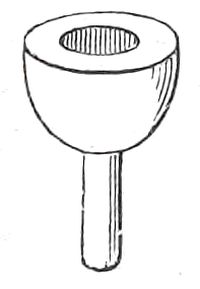
Turned of Alder or Maple. They are about seven inches in diameter, and have their under side turned hollow, to contain the greater quantity of wool or hair, to keep the ball leathers plump the longer.—M. They are now made of Elm, and the handles are Beech: but an improvement has been made in this article of late years, although it has not been generally adopted, viz. turning the bowl and handle in one piece, instead of having the handle fitted into the bowl, which frequently came loose, and was troublesome to the Pressman, often catching the skin of his hand, and pinching it. The usual size of the bowl for bookwork, is five inches and a quarter in diameter.
BANK.
A deal table, on which the Pressmen have the paper when printing. It was called a Horse in Moxon’s time. See Horse. It is useful to have a small drawer in the front of it, in which the Pressmen may put their thin paper for overlays, their paste points, and many other articles that would otherwise be lying upon the shelf or platen.
BANK NOTES.
On the 13th of January, 1819, Mr. James Fergusson, of Newman Street, Oxford Street, printer, sent to the Commissioners for inquiring into the Prevention of Forgery of Bank Notes, his plan for that purpose, of which the following is his published description.
“My plan is reared upon the solid foundation of putting it in the power of every individual to be certain whether a Bank-note is genuine or spurious by inspection. I propose, in order to form the ground-work of Bank-notes, to cast a fount, or several founts, of types, formed of such a peculiar shape, that, when printed from, the impression would appear, at first sight, like a line engraving; while, at the same time, when examined more closely, every part of it might be easily read. Although it is not in my power, without going to considerable expence, to produce a specimen of such types as ought to be made for this purpose, yet no one will deny that they may be obtained by means of punch-cutters and letter-founders. This being granted, let me suppose that I have got such types; I should then proceed to compose a page with them of the size of a Bank-note, consisting of such subject-matter as may be deemed advisable,—probably, an explanation of the way by which forgery could be detected. From this page of moveable types, I should make a stereotype plate; and I should then, by stamping or engraving upon the stereotype plate, put the promissory words of the Bank-note, with the addition of whatever[30] ornamental lines might be thought proper. This stereotype plate, so formed, would give, by one pull at the letter-press, a completed Bank-note, unless it might be deemed requisite to add the numbering; and a signature or signatures, in writing. Having got one stereotype plate in the way I describe, I should use it for no other purpose than to obtain others; and from them I could easily make plates to any amount that may be necessary, all which would yield impressions obviously alike. As the promissory and ornamental parts of the note, in white, will purposely be made to intersect the words printed in black all over the surface of the note, the intersections will prove an infallible guide to distinguish a spurious note from a genuine one. This contrivance of intersections being the leading feature in my plan, I have denominated it The Intersection Plan.
“Individuals, when familiarized to notes issued upon this principle, would naturally select some portion to which they might easily refer, to ascertain the genuineness of a note. And, for further security, if necessary, the Bank might print what I may call Standards, for the use of the public, to be sold for a trifle, merely to insure their preservation. The Standards to be printed from the same plates as the notes themselves, but on paper quite of another texture and colour from the note paper, for the purpose of proving the correctness of the intersections.” See Forgery.
BANKRUPTS,
Scotland. 2 & 3 Vict. c. 41. “An Act for regulating the Sequestration of the Estates of Bankrupts in Scotland.
s. 143. “And be it enacted, That from and after the Commencement of this Act the Keeper of the Edinburgh Gazette shall on each Day of Publication furnish a Copy thereof to the Keeper of Edictal Citations and to the Bill Chamber Clerks, who shall keep the same regularly filed, and make the said Gazettes on all Occasions patent to the Lieges at Office Hours, on Payment of a Fee of Sixpence and no more.
s. 144. “And be it enacted, That no Advertisement inserted in the London Gazette or in the Edinburgh Gazette by virtue of this Act, or the said recited Act of the Fifty-fourth Year of the Reign of His Majesty King George the Third, intituled An Act for rendering the Payment of Creditors more equal and expeditious in Scotland, or an Act of the Sixth and Seventh Year of His late Majesty, intituled An Act for regulating the Process of Cessio bonorum in the Court of Session, and for extending the Jurisdiction of Sheriffs in Scotland to such Cases, shall be charged by the Keepers of the said Gazettes for Publication therein at a higher Price, nor shall a higher Price be paid for such Publication, than the Sums specified in the Schedule (L.) hereunto annexed.
s. 145. “And be it enacted, That from and after the Commencement of this Act all Conveyances, Assignations, Instruments, Discharges, Writings, or Deeds relating solely to the Estate belonging to any Bankrupt against whom Sequestration has been or may be awarded either under this or any former Act, and which Estate, after the Execution of such Conveyances, Assignations, Instruments, Discharges, Writings, or Deeds, shall be and remain the Property of such Bankrupt for the Benefit of his Creditors, or the Trustee appointed or chosen under or by virtue of such Sequestration, and all Discharges to the said Bankrupt, and all Deeds, Assignations, Instruments, or Writings for reinvesting the said Bankrupt in the Estate, and all Powers of Attorney, Commissions, Factories, Oaths, Affidavits, Articles of Roup or Sale, Submissions, Decrees Arbitral, and all other Instruments and Writings whatsoever relating solely to the Estate of any Bankrupt sequestrated as aforesaid, and all other Deeds or Writings forming a Part of the Proceedings ordered under such Sequestration, and all Notices or Advertisements inserted in the London and Edinburgh Gazettes relative thereto, shall be exempt from all Stamp Duties or other Government Duty.”
SCHEDULE (L.)
“Table of Prices payable for Advertisements in the London or Edinburgh Gazettes.
| £ s. d. | |
| For Six Lines and under | 0 6 0 |
| For more than Six Lines and not exceeding Ten Lines | 0 7 6 |
| For more than Ten Lines and not exceeding Fifteen Lines | 0 10 6 |
| For more than Fifteen Lines and not exceeding Twenty Lines | 0 14 6 |
| For more than Twenty Lines and not exceeding Twenty-five Lines | 0 17 6 |
| For more than Twenty-five Lines and not more than Thirty Lines | 1 0 6” |
Bar. See Press Bar.
BASKET.
In printing offices where there are large founts of letter, and the fount cases of any particular fount are not sufficient to hold the superfluous sorts, the surplus is put in coffins, and deposited in round baskets, till wanted.
BATTER.
When the face of any letters gets injured in a form, it is termed a Batter.
This accident frequently occurs:—in the course of working at press a letter or letters will draw out in beating, and occasionally be left on the form without being perceived; this, when the next impression is pulled, injures the page on which it was left;—a pin, needle, or bodkin, used as pickers, will sometimes be laid on a page and forgot—and other small articles, which produce the same injury. It also happens with forms reared up at the ends of frames, where the faces of the letter in the forms are put to each other, with a quoin, or a piece of furniture, to prevent them touching, which being accidentally displaced, the letter gets injured. The only thing to be done when these accidents occur, is to replace the letters; this however is too frequently done without showing a revise to the Reader or Overseer; and thus errors creep into a work, which no care on the part of a Reader can prevent. To steady careful men these accidents seldom happen; and they ought to be guarded against, in as much as they cause loss of time to the workmen, and expense of materials to the master printer; and when letters or words must be replaced, the work should never be proceeded with at press, previously to its being examined.
When a fine engraving on wood is at press, the workman should be most particularly careful, as an accident might thus spoil an expensive work of art, which it might be impossible to replace.
When a Batter unfortunately happens at press in working stereotype plates, it is too frequently overlooked by the pressmen, and the work proceeds in a deteriorated state; while, generally speaking, if the same accident had happened to a form of moveable types it would have been set right. The reason is, that while in the latter case the accident could be remedied in a few minutes, the stereotype plate on the other hand would have to be taken out of the form and sent to the founders, and would not be repaired in less than five or six hours, during which time the pressmen would be unemployed, to their loss. This is one cause that operates against the more general use of stereotype plates.
BEARD OF A LETTER,
is the outer angle of the square shoulder of the shank, which reaches almost up to the bottom of the face of the letter; and is commonly scraped off by the Founder.—M.
BEARER.
A piece of reglet pasted on the frisket to ease any particular part in a form that has too much pressure on it from the platen of the press.—M.
Double Pica reglet is used for this purpose, as its thickness is equal to the difference between the height of the types and the furniture; and this application of it makes this sized reglet in general a scarce article in a printing office.
Where any parts of the impression of a form come off hard, which from various causes occasionally happens, particularly at the edges of the pages, and at the foot of a short page, a bearer is applied to ease that part; but some care however is required in its application—it must not bear upon any printed matter at the back of it, for if it does, it will smear and deface that part, nor is it necessary to place it close to the part, but it may be put at some distance, and if convenient near the[32] outer edge of the paper, and made to rest on the flat part of the furniture.
After selecting a piece of reglet of the proper length, paste one side of it, and place it with the pasted side uppermost upon the furniture where it is required, then turn down the tympans and frisket and rub that part with the hand to make it adhere to the frisket; or, as is usually done, after the form is beat, when the next pull will make it adhere; if it be not quite sufficient, a thickness or two of a wrapper pasted on it will ease the pull sufficiently on that part.
High Bearers, are pieces of furniture made barely letter height; they are used where separate wood cuts are printed, or very small forms; they are placed on the press stone, usually pasted down, but at such a distance from the printed matter that neither the balls nor the rollers touch them in inking the form; they lighten the pressure on the extremities, and tend to equalize the pull if the carriage be not run in exactly to its place, by the platen bearing upon them. If they be not sufficiently high, they may be added to by overlays pasted upon them.
BEAT.
To cover the surface of the types with ink by means of the balls.—M. See Fine Presswork.
BEAT FAT.
If a Pressman takes too much ink with his balls, he beats fat. The black English faced letter is generally beaten fat.—M. At the present day we understand by Fat Beating, that a pressman beating carefully, goes gradually two or three times over the form, so that every part of the surface of the type is touched six or seven times by the face of the balls; and is thus uniformly covered with a proper quantity of ink.
BEAT LEAN.
Is to take but little ink, and often: all small letter must be beaten lean.—M. This and the preceding term Beat Fat, have changed their meaning since the days of Moxon; to beat lean now, is to beat lightly, and quickly make a riddance of work, without much regard to its quality.
BED.
To bed or lay the press stone in the coffin, so that it shall lie firm and solid in all parts.—M. There are different ways of bedding a press stone: some bed it in bran; some in plaster; but the general way is with paper. To effect this the paper ought not to have any large knots in it, and should be cut to the size of the coffin, and if there be any inequalities in the bottom of the stone, there must be additional pieces of paper placed under it to fill them up. When it is supposed there is sufficient paper in the coffin to raise the stone high enough, it is slung in on two pieces of cord, and a trial made of its firmness; if it rocks, it is lifted out again, and additional paper placed in those parts where the stone did not rest firmly. When it is properly bedded, the ends of the cords are tucked in at the sides of the stone so as to be easily picked out again with a bodkin. When the stone has got to lie solid with working, the upper side should be about a Brevier higher than the coffin.
Although I have mentioned cord, as being generally used for slinging the stone into the coffin, and lifting it out again, yet strong flat tape is decidedly superior; the stone lies more solid with it than with cord, and is not so liable to break.
Benefactions. See Donations.
BENGALESE.
The following article is extracted from Nathaniel Brassey Halhed’s Grammar of the Bengal Language.
“Exclusive of the Shanscrit, there are three different dialects applied (tho’ not with equal currency) in the kingdom of Bengal: Viz. the Persian, the Hindostanic and the proper Bengalese; each of which has[33] its own peculiar department in the business of the country, and consequently neither of them can be universally adopted to the exclusion of the others.
“What the pure Hindostanic is to upper India, the language which I have here endeavoured to explain is to Bengal, intimately related to the Shanscrit both in expressions, construction and character. It is the sole channel of personal and epistolary communication among the Hindoos of every occupation and tribe. All their business is transacted, and all their accounts are kept in it; and as their system of education is in general very confined, there are few among them who can write or read any other idiom: the uneducated, or eight parts in ten of the whole nation, are necessarily confined to the usage of their mother tongue.
“The Shanscrit, or sacred language of Hindostan, from whence the dialect of Bengal immediately proceeds, is supposed by its professors to be the most antient and most excellent in the world. They assert that it exceeds every other language in the number of its letters, and esteem this excess as an incontrovertible argument of its antiquity and superiority.

“The Bengal Alphabet, like that of the Shanscrit, consists of FIFTY letters, in the following order.
“First Series.
| অ o | আ aa | ই ee | ঈ ee |
| উ oo | ঊ oo | ঋ ree | ৠ ree |
| ঌ lee | ৡ lree | এ a | ঐ i |
| ও o | ঔ ou | অং ung | অঃ oh |
“Second Series.
| ক ko | খ k,ho | গ go | ঘ g,ho | ঙ ngoo-o |
| চ cho | ছ ch,ho | জ jo | ঝ j,ho | ঞ gnee-o |
| ট to | ঠ t,ho | ড do | ঢ d,ho | ণ aano |
| ত to | থ t,ho | দ do | ধ d,ho | ন no |
| প po | ফ p,ho | ব bo | ভ b,ho | ম mo |
| য jo | র ro | ল lo | ব wo | — |
| ষ sho | ষ sho | স so | হ ho | ক্ষ khy-o |
“It is to be observed, that in the Bengal alphabet, all the names of the consonants commence with the respective consonants which they denote; as ko, go, jo, &c. whereas in English, seven of them are preceded by a vowel: ef, el, em, en, ar, ess, & ex. It follows from hence, that the short vowel of the Bengalese is invariably subjoined to the consonant with which it is uttered, and never precedes: as ক and গ always stand for ko, and go, and in no case for ok, or og.
“The vowels, as used in composition, when joined with consonants, have a very different figure from those which are in the first series of[34] the alphabet. I shall here insert a table of the forms of vowels in composition, corresponding to those which are initial or single.
“A Table of the corresponding Vowels.
| অ o | ক ko | (the included vowel.) | |
| আ aa | কা kaa | এ a | কে ka |
| ই ee | কি kee | ঐ i | কৈ ki or ko-i |
| ঈ ee | কী kee | ও o | কো ko |
| উ oo | কু koo | ঔ ou | কৌ kou |
| ঊ oo | কূ koo | অং ung | কং kung |
| অঃ oh | কঃ koh |
“By the original structure of this language every consonant inherently possesses the short vowel on which its utterance depends; it is plain therefore on this principle, that no two consonants could have been joined together, and successively pronounced in the same syllable, but that a vowel must necessarily have intervened. As an expedient to remedy this inconvenience, a set of distinct characters were invented, called ফলা P,holaa, or adjuncts. They are certain subordinate and subsidiary figures, that may be attached to each of the consonants in the alphabet respectively, to provide against the too frequent recurrence of the internal vowel.
“These P,holaa, are presented in a distinct series or alphabet, consisting of eleven subservient marks or signs, for different letters; which are here joined to ক ko, the first of the single consonants, and which may, in the same manner, be applied to all the other letters.
“The twelfth word of the series, (which seems to be added by the Bengalese merely to fill up the rhythm) relates to another subject, which will be explained in a subsequent remark.
“The reader must remember, that the letter র ro, in its proper character, is never joined to any other letter or adjunct; but its figure is entirely changed by a connection with other consonants, as will be seen in the following series.
“The twelve P,holas.
“The compound letters may be formed by three methods: either by placing one letter immediately under another, or by blending two letters together, so as to make one character from their union; or by making the first of the two consonants much smaller than the other letters. This last mode seems to be the most common.
“সিদ্ধি sheedd,hee, called the twelfth P,holaa, is a word always prefixed to the class of vowels contained in the first Series of the alphabet. Sheedd,hee is part of a Shanscrit sentence, which means be it properly performed; and as these words are usually prefixed to the class of vowels, that Series has obtained the name of sheedd,hee.
“The Series Sheed,hee.
| সি | দ্ধি | র | স্তু |
| shee | dd,hee | ro | stoo |
| অ | আ | ই | ঈ |
| o | aa | ee | ee |
| উ | ঊ | ঋ | ৠ |
| oo | oo | ree | ree |
| ঌ | ৡ | এ | ঐ |
| lee | lee | a | i |
| ও | ঔ | অং | অঃ |
| o | ou | ung | oh |
অ o, is always an initial letter.
আ aa, is also initial.
“I shall set down a few of the most common contractions of letters which are constantly used by all the Bengalese, as being more expeditious, as well as more elegant than a simple junction of the single letters, whose office they perform.
ক্র kro, stands for ক্র the kirro Pholaa.
[#] okto, is ও to blended with ক ko; its regular form is [#].
কু koo, stands for ক ko with hroswookaar.
[#] ungo, is compounded of ঙ ngoo-o with গ go subjoined.
[#] oggyo, is another figure for the Pholaa [#].
[#] moo, is ম mo and ব wo compounded. The simple form is [#].
[#] oshno, for [#] i. e. ণ aano subjoined to ষ sho.
[#] shoo, initial and medial, [#] shoo, final; two figures for [#].
[#] This figure stands for both [#] otto and [#] too.
[#] goo, is used for [#].
[#] hoo, stands for [#].
[#] ohro, is kro Pholaa subjoined to হ ho.
[#] tro, stands for [#].
[#] roo, is used instead of [#].
[#] ohlo, is ল lo subjoined to হ ho.
[#] ondo, compounded of ণ aano and ড do.
[#] ohjo, is হ ho and জ jo blended together.
[#] ohmo, a compound of হ ho and ম mo.
[#] ostoo, is স so and ট to, with hroswookaar subjoined.
[#] ostro, is the letter স so compounded with ট to, and the kro Pholaa.
[#] joo, stands for [#].
[#] ogd,ho, [#] odd,ho, [#] ond,ho, represent ধ d,ho severally subjoined to গ go, দ do, and ন no.
[#] this figure is called ordd,ho-to, i. e. semi-to; for ordd,ho signifies half. It is used for the letter ত to without its internal vowel; and in the middle of a word is generally represented by ২ the numerical figure of two.
[#] otyo, is the preceding [#] blended with the kyo pholaa.
“I shall now proceed to a few marks of reference commonly used by the Bengalese.
“[#] This figure is always put at the top of every writing, and is meant as an invocation to Gonash, the Deity of Knowledge and Arts; it is called Gonashar aakoree, or the crook of Gonash. So the Mahometans always begin with the letter [#] aleph, as a token of the unity of God.
“[#] Chaandboondaa, is a mark put over certain letters to give them a very forcible nasal expression.
“৺ Eeshwor, is properly one of the deities of the Hindoo Trinity. The name of God was supposed too holy to be inserted among the general class of words, and was therefore written at the top of the page, and wherever this name should occur in a sentence, the mark here specified was put as a reference to it. The form still remains, but the usage is degraded into a mere compliment: for in all petitions, or letters[37] from inferiors to their superiors, the name of the person addressed is now put at the top, and this sign of reference occupies the place in the body of the letter, where the name should regularly have been inserted.
“[#] Sree properly signifies prosperity, and is prefixed to every name which they mean to mention with respect; as sree sree Raam, sree sree Gonash.
“One or more of these titles of Hindoo deities is first written on every piece of paper, as an amulet or charm, before any letter, petition or other writing whatever, is committed to it. In the same manner the Mahometans universally apply their Bismillah (or, In the name of God.) as we formerly wrote Emanuel at the top of letters, and still continue to commence a ledger with Laus Deo.
“The denominations of the cardinal numbers are so irregular in Bengalese, that I find it will be necessary to exhibit them as far as one hundred. And it must be observed as a particularity, that the ninth numeral of every series of ten, is not specified by the term of nine in the common order of progression, but takes its appellation from the series immediately above; as for instance the number twenty nine is not expressed by nobeesh, which should seem the proper denomination, but is called oonteesh, or one less than thirty. So thirty nine is oonchaa-leesh, or one less than forty.
| ১ | 1 | ২১ | 21 | ৪১ | 41 | ৬১ | 61 | ৮১ | 81 |
| ২ | 2 | ২২ | 22 | ৪২ | 42 | ৬২ | 62 | ৮২ | 82 |
| ৩ | 3 | ২৩ | 23 | ৪৩ | 43 | ৬৩ | 63 | ৮৩ | 83 |
| ৪ | 4 | ২৪ | 24 | ৪৪ | 44 | ৬৪ | 64 | ৮৪ | 84 |
| ৫ | 5 | ২৫ | 25 | ৪৫ | 45 | ৬৫ | 65 | ৮৫ | 85 |
| ৬ | 6 | ২৬ | 26 | ৪৬ | 46 | ৬৬ | 66 | ৮৬ | 86 |
| ৭ | 7 | ২৭ | 27 | ৪৭ | 47 | ৬৭ | 67 | ৮৭ | 87 |
| ৮ | 8 | ২৮ | 28 | ৪৮ | 48 | ৬৮ | 68 | ৮৮ | 88 |
| ৯ | 9 | ২৯ | 29 | ৪৯ | 49 | ৬৯ | 69 | ৮৯ | 89 |
| ১০ | 10 | ৩০ | 30 | ৫০ | 50 | ৭০ | 70 | ৯০ | 90 |
| ১১ | 11 | ৩১ | 31 | ৫১ | 51 | ৭১ | 71 | ৯১ | 91 |
| ১২ | 12 | ৩২ | 32 | ৫২ | 52 | ৭২ | 72 | ৯২ | 92 |
| ১৩ | 13 | ৩৩ | 33 | ৫৩ | 53 | ৭৩ | 73 | ৯৩ | 93 |
| ১৪ | 14 | ৩৪ | 34 | ৫৪ | 54 | ৭৪ | 74 | ৯৪ | 94 |
| ১৫ | 15 | ৩৫ | 35 | ৫৫ | 55 | ৭৫ | 75 | ৯৫ | 95 |
| ১৬ | 16 | ৩৬ | 36 | ৫৬ | 56 | ৭৬ | 76 | ৯৬ | 96 |
| ১৭ | 17 | ৩৭ | 37 | ৫৭ | 57 | ৭৭ | 77 | ৯৭ | 97 |
| ১৮ | 18 | ৩৮ | 38 | ৫৮ | 58 | ৭৮ | 78 | ৯৮ | 98 |
| ১৯ | 19 | ৩৯ | 39 | ৫৯ | 59 | ৭৯ | 79 | ৯৯ | 99 |
| ২০ | 20 | ৪০ | 40 | ৬০ | 60 | ৮০ | 80 | ১০০ | 100” |
In respect to the Bengalese types with which Halhed’s grammar is printed, he thus observes, “The public curiosity must be strongly excited by the beautiful characters which are displayed in the following work: and although my attempt may be deemed incompleat or unworthy of notice, the book itself will always bear an intrinsic value, from its containing as extraordinary an instance of mechanic abilities as has perhaps ever appeared. That the Bengal letter is very difficult to be imitated in steel will readily be allowed by every person who shall examine the intricacies of the strokes, the unequal length and size of the characters, and the variety of their positions and combinations. It was no easy task to procure a writer accurate enough to prepare an alphabet of a similar and proportionate body throughout, and with that symmetrical exactness which is necessary to the regularity and neatness of a fount. Mr. Bolts (who is supposed to be well versed in this language) attempted to fabricate a set of types for it, with the assistance of the ablest artists in London. But as he egregiously failed in executing even the easiest part, or primary alphabet, of which he has published a specimen, there is no reason to suppose that his project, when compleated, would have advanced beyond the usual state of imperfection to which new inventions are constantly exposed.
“The advice and even sollicitation of the Governor General prevailed upon Mr. Wilkins, a gentleman who has been some years in the India Company’s civil service in Bengal, to undertake a set of Bengal types. He did, and his success has exceeded every expectation. In a country so remote from all connexion with European artists, he has been obliged to charge himself with all the various occupations of the Metallurgist, the Engraver, the Founder, and the Printer. To the merit of invention he was compelled to add the application of personal labour. With a rapidity unknown in Europe, he surmounted all the obstacles which necessarily clog the first rudiments of a difficult art, as well as the disadvantages of solitary experiment; and has thus singly on the first effort exhibited his work in a state of perfection which in every part of the world has appeared to require the united improvements of different projectors, and the gradual polish of successive ages.”
The gentleman here spoken of was Charles Wilkins, Esq., a descendant of the learned Bishop Wilkins, and one of the founders of the Asiatic Society. He was afterwards created Doctor of Laws, and appointed Librarian to the East-India Company at their establishment in Leadenhall Street. He was reputed to be the best Shanscrit scholar in Europe.
BENVENUE.
Half a crown paid by a new workman to the Chapel when he commences, which is always spent. If a journeyman wrought formerly in the same printing house, and comes again to work in it, he pays but half a benvenue. If a journeyman smout more or less on another printing house, he pays half a benvenue.—M. See Ancient Customs.
This custom is still retained in printing offices, and the amount generally paid is the same as it was in the seventeenth century, though the value of half a crown then was considerably more than it is now. Under particular circumstances the Chapel sometimes takes less; and the workmen always add something each, so as to be able to provide bread and cheese and a draught of porter to welcome the new comer. The word is now pronounced Bevénue; it is evidently a corruption of the Fr. bien venu or welcome.
BIBLE ORTHOGRAPHY.
Many religious works are printed with numerous extracts from the Holy Scriptures without any reference to the Book, Chapter, or Verse, and as they are frequently made from memory, they are generally inaccurate. I am clearly of opinion that wherever a quotation is made, it should be given literally as it appears in the work from which it is taken, otherwise it is worse than useless,—for it misleads. With regard to extracts from the Bible, I hold it indispensable that they should be given without the slightest variation from the original; but as many words in the Bible vary in their orthography from Johnson’s Dictionary, which is the book of reference generally in use, and as the authorized editions of the Scriptures differ in this respect from each other in many instances, I have collated the King’s Printers, the Oxford, the Cambridge, and the Edinburgh editions with Johnson’s Dictionary and with each other, for the purpose of enabling the printer to preserve uniformity in orthography with little trouble to himself in reprints of the Bible, and in extracts occurring in religious works, according as the author may prefer any of these editions.
These variations from each other do not extend to words but are confined to the orthography, and to the difference of the same expression being given in one word, in two words, or in being made a compound word; thus in the Cambridge and the Edinburgh Bibles there are a great number of compound words, while in the King’s Printers and Oxford Bibles the same words are given either joined together as one word or made into two words; and we find very few compound words, except proper names. I have also given the Bible orthography where Johnson gives two ways of spelling a word. The result will be seen in the following Table; which also shows the variations, to a certain degree, that have taken place in the language during the last two hundred years.
The late Mr. Thomas Bensley, who was printer to the University of Oxford, told me, about the year 1805, that they had a sealed copy there, as a standard to read from; if this be the case, it is difficult to account for their copies of late years having numerous variations from the earlier editions. I think it very desirable that there should be a standard edition that we could refer to, as a pure text; and it would also be desirable to know on what authority these variations are made in the holy Scriptures, for every word, every point, nay every capital letter, I believe, was carefully considered before it was adopted in the first edition of the authorized version in 1611, and this too by a considerable number of the most learned men of the kingdom, who had the direction of the work.
With regard to the words in the Bible printed in Italic characters, Dr. Myles Smyth, one of the two appointed Revisers of the authorized version, in the Preface to the first edition, published in 1611, gives the following reason for their use:—
“Moreouer, whereas the necessitie of the sentence required any thing to be added (for such is the grace and proprietie of the Ebrewe and Greeke tongues that it cannot, but either by circumlocution, or by adding the verbe or some word, be vnderstood of them that are not well practised therein), wee haue put it in the text with an other kinde of letter, that it may easily bee discerned from the common letter.”
The Preface was written and affixed by the King’s command. The first Edition of the Bible was printed in Black Letter, and the “other kinde of letter” was roman; when the Black Letter was disused, and the Roman character substituted, the “other kinde of letter” was changed to Italic. Dr. Smyth was afterwards Bishop of Gloucester.
| King’s Printers. | Oxford. | Cambridge. | Edinburgh. | Reference. |
| Adoram | Hadoram | Hadoram | Hadoram | Gen. x. 27. |
| Agar } | Agar | Agar | Agar | Gal. iv. 24. |
| Hagar} | Hagar | Hagar | Hagar | Gen. xvi. 1. |
| alabaster box | alabaster box | alabaster-box | alabaster-box | Matt. xxvi. 7. |
| algum trees | algum trees | algum-trees | algum-trees | 2 Chr. ii. 8. |
| alledgeth | alledgeth | alledgeth | alledgeth | Job viii. Head. |
| alledging | alledging | alledging | alledging | Acts xvii. 3. |
| Alleluia | Alleluia | Alleluia | Alleluia | Rev. xix. 1. |
| almond tree | almond tree | almond-tree | almond-tree | Eccl. xii. 5. |
| almug trees | almug trees | almug-trees | almug-trees | 1 Kings x. 11. |
| Alpheus | Alphæus | Alpheus | Alpheus | Acts i. 13. |
| ambassage | ambassage | ambassage | ambassage | Luke xiv. 32. |
| ancle | ancle | ancle | ancle | Acts iii. 7. |
| any wise | any wise | any wise | any wise | Mark xiv. 31. |
| apple tree | apple tree | apple-tree | apple-tree | Joel i. 12. |
| Arimathea | Arimathæa | Arimathea | Arimathea | Mark xv. 43. |
| armourbearer | armourbearer | armour-bearer | armour-bearer | 1 Sam. xiv. 7. |
| Aser } | Aser | Aser | Aser | Rev. vii. 6. |
| Asher} | Asher | Asher | Asher | Gen. xxx. 13. |
| ass colts | ass colts | ass colts | ass-colts | Judg. x. 4. |
| asswaged | asswaged | asswaged | asswaged | Gen. viii. 1. |
| aul | aul | awl | awl | Exod. xxi. 6. |
| ax | ax | axe | axe | 1 Sam. xiii. 20. |
| axe | axe | axe | axe | Luke iii. 9. |
| axletrees | axletrees | axle-trees | axle-trees | 1 Kings vii. 32. |
| bakemeats | bakemeats | bake-meats | bake-meats | Gen. xl. 17. |
| Balac } | Balac | Balac | Balac | Rev. ii. 14. |
| Balak } | Balak | Balak | Balak | Num. xxii. 2. |
| banqueting house | banquetting house | banquetting-house | banqueting-house | So. of Sol. ii. 4. |
| barley bread | barley bread | barley-bread | barley-bread | Judg. vii. 13. |
| barley cakes | barley cakes | barley-cakes | barley cakes | Ezek. iv. 12. |
| barley harvest | barley harvest | barley-harvest | barley-harvest | Ruth ii. 23. |
| barley loaves | barley loaves | barley-loaves | barley-loaves | John vi. 9. |
| barley meal | barley meal | barley-meal | barley meal | Num. v. 15. |
| barley seed | barley seed | barley-seed | barley-seed | Lev. xxvii. 16. |
| Bartimeus | Bartimæus | Bartimeus | Bartimeus | Mark x. 46. |
| bason | bason | bason | bason | Exod. xii. 22. |
| battle ax | battle ax | battle-axe | battle-axe | Jer. li. 20. |
| battle bow | battle bow | battle-bow | battle-bow | Zech. x. 4. |
| beastiality | beastiality | beastiality | beastiality | Exod. xxii. Head. |
| Beautiful gate | Beautiful gate | Beautiful gate | Beautiful gate | Acts iii. 10. |
| bedchamber | bedchamber | bed-chamber | bed-chamber | 2 Sam. iv. 7. |
| befall | befall | befal | befall | Deut. xxxi. 17. |
| befel | befell | befell | befell | Mark v. 16. |
| beforetime | beforetime | before-time | beforetime | Jos. xx. 5. |
| Beor } | Beor | Beor | Beor | Num. xxii. 5. |
| Bosor} | Bosor | Bosor | Bosor | 2 Pet. ii. 15. |
| beryl stone | beryl stone | beryl-stone | beryl stone | Ezek. x. 9. |
| birthday | birthday | birth-day | birth-day | Gen. xl. 20. |
| birthright | birthright | birth-right | birthright | Gen. xxv. 31. |
| Bloodguiltiness | bloodguiltiness | blood-guiltiness | blood-guiltiness | Ps. li. 14. |
| bloodthirsty | bloodthirsty | blood-thirsty | blood-thirsty | Prov. xxix. 10. |
| bondmaid | bondmaid | bond-maid | bond maid | Gal. iv. 22. |
| bondman | bondman | bond-man | bond man | Rev. vi. 15. |
| bondservant | bondservant | bond-servant | bond-servant | Lev. xxv. 39. |
| bondservice | bondservice | bond-service | bond-service | 1 Kings ix. 21. |
| bondwoman | bondwoman | bond-woman | bond-woman | Gen. xxi. 10. |
| Bosor} | Bosor | Bosor | Bosor | 2 Pet. ii. 15. |
| Beor } | Beor | Beor | Beor | Num. xxii. 5. |
| bowshot | bowshot | bowshot | bow-shot | Gen. xxi. 16. |
| box tree | box tree | box-tree | box-tree | Isa. xli. 19. |
| bramble bush | bramble bush | bramble-bush | bramble-bush | cLuke vi. 44. |
| brasen | brasen | brasen | brasen | Exod. xxxviii. 4. |
| bread corn | bread corn | bread-corn | bread-corn | Isa. xxviii. 28. |
| breastplate | breastplate | breast-plate | breastplate | Exod. xxv. 7. |
| briars | briers | briers | briers | Heb. vi. 8. |
| briers | briers | briers | briers | Isa. xxvii. 4. |
| brickkiln | brickkiln | brick-kiln | brick-kiln | 2 Sam. xii. 31. |
| bridechamber | bridechamber | bride-chamber | bride-chamber | Matt. ix. 15. |
| brokenfooted | brokenfooted | broken-footed | broken-footed | Lev. xxi. 19. |
| brokenhanded | brokenbanded | broken-handed | broken-handed | Lev. xxi. 19. |
| brokenhearted | brokenhearted | broken-hearted | broken-hearted | Luke iv. 18. |
| burdens | burdens | burdens | burdens | Exod. v. 4. |
| burnt offerings | burnt offerings | burnt-offerings | burnt-offerings | Gen. viii. 20. |
| burnt sacrifice | burnt sacrifice | burnt-sacrifice | burnt-sacrifice | Exod. xxx. 9. |
| buryingplace | buryingplace | burying-place | burying-place | cGen. xxiii. 4. |
| busybody | busybody | busy-body | busy-body | 1 Pet. iv. 15. |
| byword | byword | by-word | by-word | Deut. xxviii. 37. |
| daughter in law | daughter in law | daughter-in-law | daughter-in-law | Gen. xi. 31. |
| daysman | daysman | days-man | day’s-man | Job ix. 33. |
| dayspring | dayspring | day-spring | day-spring | Luke i. 78. |
| day star | day star | day-star | day-star | 2 Pet. i. 19. |
| day time | day time | day-time | day-time | Num. xiv. 14. |
| daytime | daytime | day-time | day-time | Job v. 14. |
| desert | desert | desert | desert | Isa. xliii. 20. |
| destroying weapon | destroying weapon | destroying-weapon | destroying weapon | Ezek. ix. 1. |
| diddest | diddest | diddest | diddest | Acts vii. 28. |
| dispatch | dispatch | dispatch | dispatch | Ezek. xxiii. 47. |
| door post | door post | door-post | door-post | Exod. xxi. 6. |
| double minded | double minded | double-minded | double-minded | Jam. i. 8. |
| doubletongued | doubletongued | double-tongued | double-tongued | 1 Tim. iii. 8. |
| downsitting | downsitting | down-sitting | down-sitting | Ps. cxxxix. 2. |
| dragon well | dragon well | dragon-well | dragon-well | Neb. ii. 13. |
| draught | draught | draught | draught | Matt. xv. 17. |
| drawnet | drawnet | drawnet | drawnet | Matt. xiii. Head. |
| drink offering | drink offering | drink-offering | drink-offering | Gen. xxxv. 14. |
| dung gate | dung gate | dung-gate | dung-gate | Neh. iii. 14. |
| dunghil | dunghill | dunghill | dunghill | 1 Sam ii. 8. |
| dunghill | dunghill | dunghill | dunghill | Dan. iii. 29. |
| dung port | dung port | dung-port | dung-port | Neh. II. 13. |
| dureth | dureth | dureth | dureth | Matt. xiii. 21. |
| dwelling house | dwelling house | dwelling-house | dwelling-house | Lev. xxv. 29. |
| dwelling place | dwelling place | dwelling-place | dwelling-place | 1 Kings viii. 30. |
| dwellingplaces | dwellingplaces | dwelling-places | dwelling-places | Ezek. vi. 6. |
| dyed | dyed | dyed | dyed | Exod. xxxix. 34. |
| fainthearted | fainthearted | faint-hearted | faint-hearted | Isa. vii. 4. |
| fallow deer | fallow deer | fallow-deer | fallow-deer | Deut. xiv. 5. |
| farewel | farewell | farewell | farewell | Acts xviii. 21. |
| farther | farther | farther | farther | Eccles. viii. 17. |
| fatfleshed | fatfleshed | fat-fleshed | fat-fleshed | Gen. xii. 18. |
| father in law | father in law | father-in-law | father-in-law | Gen. xxxviii. 13. |
| fats | fats | fats | fats | Joel iii. 13. |
| feast days | feast days | feast-days | feast-days | Hos. ii. 11. |
| feedingplace | feedingplace | feeding-place | feeding-place | Nah. ii. 11. |
| felloes | felloes | felloes | felloes | 1 Kings vii. 33. |
| fellowcitizens | fellowcitizens | fellow-citizens | fellow-citizens | Eph. ii. 19. |
| fellowdisciples | fellowdisciples | fellow disciples | fellow-disciples | John xi. 16. |
| fellowheirs | fellowheirs | fellow-heirs | fellow-heirs | Eph. iii. 6. |
| fellowhelper | fellowhelper | fellow-helper | fellow-helper | 2 Cor. viii. 23. |
| fellowlabourers | fellowlabourers | fellow-labourers | fellow-labourers | Philip. iv. 3. |
| fellowprisoner | fellowprisoner | fellow-prisoner | fellow-prisoner | Col. iv. 10. |
| fellowservant | fellowservant | fellow-servant | fellow-servant | Matt. xviii. 29. |
| fellow servants | fellowservants | fellow-servants | fellow-servants | Matt. xviii. 31. |
| fellowsoldier | fellowsoldier | fellow-soldier | fellow-soldier | Philip. ii. 25. |
| fellowworkers | fellowworkers | fellow-workers | fellow-workers | Col. iv. 11. |
| ferry boat | ferry boat | ferry-boat | ferry-boat | 2 Sam. xix. 18. |
| fetcht | fetcht | fetcht | fetched | Gen. xviii. 7. |
| fiery flying | fiery flying | fiery-flying | fiery flying | Isa. xxx. 6. |
| fig leaves | fig leaves | fig-leaves | fig-leaves | Gen. iii. 7. |
| fig tree | fig tree | fig-tree | fig-tree | 1 Kings iv. 25. |
| fir trees | fir trees | fir-trees | fir-trees | 1 Kings v. 10. |
| fir wood | fir wood | fir-wood | fir-wood | 2 Sam. vi. 6. |
| firebrands | firebrands | fire-brands | firebrands | Judg. xv. 4. |
| firepans | firepans | fire-pans | fire-pans | Exod. xxvii. 3. |
| first begotten | first begotten | first-begotten | first-begotten | Rev. i. 5. |
| firstborn | firstborn | first-born | first-born | Gen. x. 15. |
| firstfruits | firstfruits | first-fruits | first-fruits | Exod. xxiii. 16. |
| firstripe | firstripe | first ripe | first-ripe | Num. xiii. 20. |
| firstripe figs | firstripe-figs | first-ripe-figs | first ripe figs | Nah. iii. 12. |
| fish gate | fish gate | fish-gate | fish-gate | 2 Chr. xxxiii. 14. |
| fishhooks | fishhooks | fish-hooks | fish-hooks | Amos iv. 2. |
| fishpools | fishpools | fish-pools | fish-pools | So. of Sol. vii. 4. |
| fish spears | fish spears | fish-spears | fish spears | Job xli. 7. |
| fitches | fitches | fitches | fitches | Isa. xxviii. 25. |
| five and twentieth | five and twentieth | five-and-twentieth | five and twentieth | Jer. iii. 31. |
| fleshhooks | fleshhooks | flesh-hooks | flesh-hooks | Exod. xxvii. 3. |
| flesh pots | flesh pots | flesh-pots | flesh-pots | Exod. xvi. 3. |
| fleshy | fleshly | fleshly | fleshly | 2 Cor. iii. 3. |
| flotes | flotes | floats | floats | 2 Chr. ii. 16. |
| foal | foal | foal | foal | Matt. xxi. 5. |
| foles | foles | foals | foals | Gen. xxxii. 15. |
| foolish talking | foolish talking | foolish talking | foolish talking | Eph. v. 4. |
| forefront | forefront | fore-front | fore-front | Exod. xxviii. 37. |
| forepart | forepart | fore-part | fore-part | 1 Kings vi. 20. |
| foreprophesied | foreprophesied | fore-prophesied | fore-prophesied | 2 Kings xxiii. Head. |
| foretel | foretell | foretel | foretell | 2 Cor. xiii. 2. |
| forty five | forty five | forty-five | forty-five | 1 Kings vii. 3. |
| fountain gate | fountain gate | fountain-gate | fountain-gate | Neb. xii. 37. |
| fourfooted | fourfooted | four-footed | four-footed | Acts xl. 6. |
| freeman | free man | free-man | free man | Rev. vi. 15. |
| free offerings | free offerings | free-offerings | free-offerings | Exod. xxxvi. 3. |
| freewill offering | freewill offering | freewill-offering | free-will-offering | Num. xv. 3. |
| freewill offerings | freewill offerings | free-will-offerings | free-will-offerings | Lev. xxii. 18. |
| freewoman | freewoman | free-woman | free woman | Gal. iv. 22. |
| fruit tree | fruit tree | fruit-tree | fruit-tree | Gen. i. 11. |
| fryingpan | fryingpan | frying-pan | frying-pan | Lev. vii. 9. |
| Adoram | Hadoram | Hadoram | Hadoram | Gen. x. 27. |
| Hagar} | Hagar | Hagar | Hagar | Gen. xvi. 1. |
| Agar } | Agar | Agar | Agar | Gal. iv. 24. |
| hail stones | hail stones | hail-stones | hail-stones | Ps. xviii. 12. |
| hair breadth | hair breadth | hair-breadth | hair-breadth | Judges xx. 16. |
| hand breadth | hand breadth | hand-breadth | handbreadth | Exod. xxxvii. 12. |
| handful | handful | handful | handful | Lev. ii. 2. |
| handmaid | handmaid | hand-maid | handmaid | Gen. xvi. 1. |
| handstaves | handstaves | hand-staves | hand-staves | Ezek. xxxix. 9. |
| handwriting | handwriting | hand-writing | hand-writing | Col. ii. 14. |
| handywork | handywork | handywork | handywork | Ps. xix. 1. |
| hardhearted | hardhearted | hard-hearted | hard-hearted | Ezek. iii. 7. |
| harvestman | harvestman | harvest-man | harvest-man | Isa. xvii. 5. |
| hasel | hazel | hazel | hazel | Gen. xxx. 37. |
| headbands | headbands | head-bands | head-bands | Isa. iii. 20. |
| heave offering | heave offering | heave-offering | heave-offering | Exod. xxix. 27. |
| heave shoulder | heave shoulder | heave-shoulder | heave-shoulder | Lev. x. 14. |
| he goats | he goats | he-goats | he-goats | Gen. xxxii. 14. |
| he lambs | he lambs | he-lambs | he-lambs | Lev. xiv. 10. |
| help meet | help meet | help meet | help meet | Gen. ii. 18. |
| hiding place | hiding place | hiding-place | hiding-place | Ps. xxxii. 7. |
| highminded | highminded | high-minded | high-minded | Rom. xi. 20. |
| high way | high way | high-way | high-way | Num. xx. 19. |
| hill country | hill country | hill-country | hill-country | Luke i. 39. |
| hill top | hill top | hill-top | hill-top | Num. xiv. 44. |
| Hiram } | Hiram | Hiram | Hiram | 1 Kings v. 1. |
| Huram } | Huram | Huram | Huram | 2 Chr. ii. 3. |
| hoar frost | hoarfrost | hoar-frost | hoar-frost | Ps. cxlvii. 16. |
| hoised | hoised | hoised | hoised | Acts xxvii. 40. |
| holyday | holyday | holy-day | holy-day | Ps. xiii. 4. |
| honeycomb | honeycomb | honey-comb | honey-comb | Prov. xxiv. 13. |
| honour | honour | honour | honour | Num. xxii. 17. |
| horse bridles | horse bridles | horse-bridles | horse bridles | Rev. xiv. 20. |
| horse gate | horse gate | horse-gate | horse-gate | Neh. iii. 28. |
| horsehoofs | horsehoofs | horse-hoofs | horse-hoofs | Judges v. 22. |
| horseleach | horseleach | horse-leach | horse-leach | Prov. xxx. 15. |
| Hosea} | Hosea | Hosea | Hosea | Hosea i. 1. |
| Osee } | Osee | Osee | Osee | Rom. ix. 25. |
| houshold | houshold | household | household | Gen. xiv. 11. |
| house top | house top | house-top | house top | Ps. cii. 7. |
| housetop | housetop | house-top | house-top | Prov. xxi. 9. |
| hundredfold | hundredfold | hundred-fold | hundred-fold | Gen. xxvi. 12. |
| hungerbitten | hungerbitten | hunger-bitten | hunger-bitten | Job. xviii. 12. |
| hungered | hungered | hungered | hungered | Matt. xxi. 18. |
| hungred | hungred | hungred | hungered | Matt. xxv. 35. |
| hungred | hungred | hungred | hungered | Mark ii. 25. |
| Hymeneus | Hymenæus | Hymeneus | Hymeneus | 1 Tim. i. 20. |
| jailor | jailor | jailor | jailer | Acts xvi. 23. |
| jasper stone | jasper stone | jasper-stone | jasper-stone | Rev. xxi. 11. |
| jawbone | jawbone | jaw-bone | jaw-bone | Judges xv. 15. |
| jaw teeth | jaw teeth | jaw-teeth | jaw-teeth | Prov. xxx. 14. |
| jealousy offering | jealousy offering | jealousy-offering | jealousy-offering | Num. v. 18. |
| Jephthae } | Jephthae | Jephthae | Jephthae | Heb. xi. 32. |
| Jephthah } | Jephthah | Jephthah | Jephthah | Judges xi. 1. |
| Jeremiah} | Jeremiah | Jeremiah | Jeremiah | Jer. i. 1. |
| Jeremias} | Jeremias | Jeremias | Jeremias | Matt. xvi. 14. |
| Jeremy } | Jeremy | Jeremy | Jeremy | Matt. xxvii. 9. |
| Jeshua} | Jeshua | Jeshua | Jeshua | Neh. viii. 17. |
| Joshua} | Joshua | Joshua | Joshua | Josh. i. 1. |
| jointheirs | joint-heirs | joint-heirs | joint-heirs | Rom. viii. 17. |
| Jonah } | Jonah | Jonah | Jonah | Jonah i. 1. |
| Jonas } | Jonas | Jonas | Jonas | Matt. xii. 39. |
| jubile | jubile | jubile | jubilee | Lev. xxv. 9. |
| jubilee | jubile | jubile | jubilee | Lev. xxv. 28. |
| Juda } | Juda | Juda | Judah | Heb. vii. 14. |
| Judah} | Judah | Judah | Judah | Gen. xxix. 35. |
| Judea | Judæa | Judea | Judea | Matt. ii. 1. |
| judgment hall | judgement hall | judgement-hall | judgment hall | Acts xxiii. 35. |
| judgments | judgments | judgements | judgments | Exod. xxi. 1. |
| judgment seat | judgment seat | judgement-seat | judgment-seat | Matt. xxvii. 19. |
| juniper roots | juniper roots | juniper-roots | juniper-roots | Job xxx. 4. |
| juniper tree | juniper tree | juniper-tree | juniper-tree | 1 Kings xix. 4. |
| justle | justle | justle | justle | Nah. ii. 4. |
| Kish } | Kish | Kish | Kish | 1 Sam. ix. 1. |
| Cis } | Cis | Cis | Cis | Acts xiii. 21. |
| kneading troughs | kneadingtroughs | kneading-troughs | kneading-troughs | Exod. xii. 34. |
| kneadingtroughs | kneadingtroughs | kneading-troughs | kneading-troughs | Exod. viii. 3. |
| laded | laded | laded | laded | Acts xxviii. 10. |
| landmarks | landmarks | land-marks | land-marks | Job xxiv. 2. |
| launched | launched | launched | launched | Luke viii. 22. |
| lawgiver | lawgiver | law-giver | lawgiver | Num. xxi. 18. |
| leanfleshed | leanfleshed | lean-fleshed | lean-fleshed | Gen. xii. 3. |
| lefthanded | lefthanded | left-handed | left-handed | Judg. xx. 16. |
| lentiles | lentiles | lentiles | lentiles | Gen. xxv. 34. |
| lest | lest | lest | lest | 2 Sam. xv. 14. |
| life time | life time | life-time | life-time | Lev. xviii. 18. |
| lign aloes | lign aloes | lign aloes | lign-aloes | Num. xxiv. 6. |
| likeminded | likeminded | like-minded | like-minded | Rom. xv. 5. |
| like wise | like wise | likewise | like wise | Matt. xxi. 24. |
| lily work | lily work | lily-work | lily-work | 1 Kings vii. 19. |
| lion like | lionlike | lion-like | lion-like | 2 Sam. xxiii. 20. |
| longsuffering | longsuffering | long-suffering | long-suffering | Exod. xxxiv. 6. |
| long winged | longwinged | long-winged | long-winged | Ezek. xvii. 3. |
| looking glass | looking glass | looking-glass | looking-glass | Job xxxvii. 18. |
| lookingglasses | lookingglasses | looking-glasses | looking-glasses | Exod. xxxviii. 8. |
| lothe | lothe | loathe | loathe | Ezek. xx. 43. |
| lovingkindness | lovingkindness | loving-kindness | loving-kindness | Jer. ix. 24. |
| lowring | lowring | lowring | lowring | Matt. xvi. 3. |
| lunatick | lunatick | lunatic | lunatick | Matt. iv. 24. |
| lurking places | lurking places | lurking-places | lurking-places | 1 Sam. xxiii. 23. |
| Naphtali } | Naphtali | Naphtali | Naphtali | Gen. xxx. 8. |
| Nepthalim} | Nepthalim | Nephthalim | Nephthalim | Rev. vii. 6. |
| needlework | needlework | needle-work | needle-work | Exod. xxvi. 36. |
| network | network | net-work | net-work | Exod. xxxviii. 4. |
| newborn | newborn | new-born | new-born | 1 Pet. ii. 2. |
| night hawk | night hawk | night-hawk | night hawk | Lev. xi. 16. |
| night season | night season | night-season | night-season | Job xxx. 17. |
| night visions | night visions | night-visions | night-visions | Dan. vii. 13. |
| night watches | night watches | night-watches | night-watches | Ps. cxix. 148. |
| Nineve } | Nineve | Nineve | Nineveh | Luke xi. 32. |
| Nineveh} | Nineveh | Nineveh | Nineveh | Jonah i. 2. |
| Noah} | Noah | Noah | Noah | Gen. v. 29. |
| Noe } | Noe | Noe | Noe | Matt. xxiv. 37. |
| noonday | noonday | noon-day | noon-day | Ps. xxxvii. 6. |
| nose jewels | nose jewels | nose-jewels | nose-jewels | Isa. iii. 21. |
| nought | nought | nought | nought | Gen. xxix. 15. |
| nursing mothers | nursing mothers | nursing-mothers | nursing-mothers | Isa. xlix. 23. |
| oil olive | oil olive | oil-olive | oil-olive | Exod. xxx. 24. |
| oil tree | oil tree | oil-tree | oil-tree | Isa. xli. 19. |
| oil vessels | oil vessels | oil-vessels | oil-vessels | Num. iv. 9. |
| olive berries | olive berries | olive-berries | olive-berries | James iii. 12. |
| olive branches | olive branches | olive-branches | olive-branches | Neh. viii. 15. |
| olive plants | olive plants | olive-plants | olive plants | Ps. cxxviii. 3. |
| olive trees | olive trees | olive-trees | olive-trees | Deut. vi. 11. |
| oliveyards | oliveyards | olive-yards | oliveyards | Jos. xxiv. 13. |
| only begotten | only begotten | only-begotten | only-begotten | John i. 14. |
| only begotten | only begotten | only begotten | only begotten | John i. 18. |
| onyx stone | onyx stone | onyx-stone | onyx-stone | Gen. ii. 12. |
| Osee } | Osee | Osee | Osee | Rom. ix. 25. |
| Hosea} | Hosea | Hosea | Hosea | Hos. i. 1. |
| ought | ought | ought | ought | Matt. v. 23. |
| outgoings | outgoings | out-goings | outgoings | Ps. lxv. 8. |
| outer | outer | outer | outer | Matt. xxv. 30. |
| outstretched | outstretched | out-stretched | outstretched | Deut. xxvi. 8. |
| overrunning | overrunning | over-running | over-running | Nah. i. 8. |
| Rachel} | Rachel | Rachel | Rachel | Matt. ii. 18. |
| Rahel } | Rahel | Rahel | Rachel | Jer. xxxi. 15. |
| rasor | razor | razor | razor | Num. vi. 5. |
| recompence, n.s. | recompense | recompence | recompence | Deut. xxxii. 35. |
| recompense, v.a. | recompense | recompense | recompense | Hosea xii. 2. |
| Red sea | Red sea | Red Sea | Red sea | Exod. x. 19. |
| repayed | repayed | repaid | repaid | Prov. xiii. 21. |
| rereward | rereward | rereward | rere-ward | Jos. vi. 9. |
| restingplace | restingplace | resting-place | resting-place | Jer. l. 6. |
| resting place | resting place | resting-place | resting-place | Prov. xxiv. 15. |
| ribband | ribband | ribband | ribband | Num. xv. 38. |
| rie | rie | rye | rye | Exod. ix. 32. |
| right hand | right hand | right hand | right hand | Exod. xiv. 22. |
| ringstraked | ringstraked | ring-straked | ring-straked | Gen. xxx. 35. |
| rudder bands | rudder bands | rudder-bands | rudder-bands | Acts xxvii. 40. |
| tabering | tabering | tabering | tabering | Nah. ii. 7. |
| tabernacle door | tabernacle door | tabernacle-door | tabernacle-door | Exod. xxxiii. 10. |
| talebearer | talebearer | tale-bearer | tale-bearer | Lev. xix. 16. |
| taskmasters | taskmasters | task-masters | taskmasters | Exod. iii. 7. |
| teil tree | teil tree | teil-tree | teil-tree | Isa. vi. 13. |
| tender eyed | tender eyed | tender-eyed | tender-eyed | Gen. xxix. 17. |
| tenderhearted | tenderhearted | tender-hearted | tender-hearted | 2 Chr. xiii. 7. |
| tent door | tent door | tent-door | tent-door | Gen. xviii. 1. |
| tenth deal | tenth deal | tenth-deal | tenth-deal | Exod. xxix. 40. |
| thank offerings | thank offerings | thank-offerings | thank-offerings | 2 Chr. xxix. 31. |
| thankworthy | thankworthy | thank-worthy | thank-worthy | 1 Pet. ii. 19. |
| thee-ward | thee-ward | thee-ward | thee-ward | 1 Sam. xix. 4. |
| thirtyfold | thirtyfold | thirty-fold | thirty-fold | Matt. xiii. 8. |
| thirtyfold | thirtyfold | thirty-fold | thirty-fold | Mark iv. 20. |
| thirty two | thirty two | thirty-two | thirty-two | 1 Kings xx. 15. |
| thoroughly | thoroughly | thoroughly | thoroughly | 2 Kings xi. 18. |
| threefold | threefold | three-fold | threefold | Eccl. iv. 12. |
| threshing | threshing | threshing | thrashing | Lev. xxvi. 5. |
| threshingfloor | threshingfloor | threshing-floor | thrashing-floor | Num. xviii. 27. |
| throughly | throughly | throughly | throughly | Gen. xi. 3. |
| Timeus | Timæus | Timeus | Timeus | Mark x. 46. |
| to day | to day | to-day | to-day | Exod. ii. 18. |
| to morrow | to morrow | to-morrow | to-morrow | Exod. ix. 5. |
| to night | to night | to-night | to-night | Jos. ii. 2. |
| town clerk | townclerk | town-clerk | town-clerk | Acts xix. 35. |
| traffick | traffick | traffick | traffick | Gen. xlii. 34. |
| treasure cities | treasure cities | treasure-cities | treasure-cities | Exod. i. 11. |
| treasure house | treasure house | treasure-house | treasure-house | Ezra v. 17. |
| trespass money | trespass money | trespass-money | trespass-money | 2 Kings xii. 16. |
| trespass offering | trespass offering | trespass-offering | trespass-offering | Lev. v. 6. |
| tribute money | tribute money | tribute-money | tribute-money | Matt. xvii. 24. |
| trucebreakers | trucebreakers | trucebreakers | truce-breakers | 2 Tim. iii. 3. |
| turtledove | turtledove | turtle-dove | turtle-dove | Gen. xv. 9. |
| twoedged | twoedged | two-edged | two-edged | Heb. iv. 12. |
| two edged | twoedged | two-edged | two-edged | Rev. i. 16. |
| twofold | twofold | two-fold | two-fold | Matt. xxiii. 15. |
| two leaved | two leaved | two-leaved | two-leaved | Isa. xlv. 1. |
| unblameable | unblameable | unblameable | unblameable | Col. i. 22. |
| unblameably | unblameably | unblameably | unblameably | 1 Thes. ii. 10. |
| unmoveable | unmoveable | unmoveable | unmoveable | 1 Cor. xv. 58. |
| unrebukeable | unrebukeable | unrebukeable | unrebukeable | 1 Tim. vi. 14. |
| unreproveable | unreproveable | unreproveable | unreproveable | Col. i. 22. |
| unsatiableness | unsatiableness | unsatiableness | unsatiableness | Hab. ii. Head. |
| uprising | uprising | up-rising | up-rising | Ps. cxxxix. 2. |
| us-ward | us-ward | us-ward | us-ward | Ps. xl. 5. |
| utter | utter | utter | outer | Ezek. xl. 31. |
| wagons | wagons | waggons | waggons | Gen. xlv. 19. |
| ware | ware | ware | ware | 2 Tim. iv. 15. |
| washpot | washpot | wash-pot | wash-pot | Ps. lx. 8. |
| washpot | washpot | washpot | wash-pot | Ps. cviii. 9. |
| watchtower | watchtower | watch-tower | watch-tower | Isa. xxi. 8. |
| watch tower | watch tower | watch-tower | watch-tower | 2 Chr. xx. 24. |
| water brooks | water brooks | water-brooks | water-brooks | Ps. xlii. 1. |
| watercourse | watercourse | water-course | watercourse | Job xxxviii. 25. |
| waterflood | waterflood | water-flood | water-flood | Ps. lxix. 15. |
| water gate | water gate | water-gate | water-gate | Neh. iii. 26. |
| watering troughs | watering troughs | watering-trouoghs | watering-troughs | Gen. xxx. 38. |
| waterpot | waterpot | water-pot | water-pot | John iv. 28. |
| waterspouts | waterspouts | water-spouts | water-spouts | Ps. xlii. 7. |
| watersprings | watersprings | water-springs | water-springs | Ps. cvii. 35. |
| wave breast | wave breast | wave-breast | wave-breast | Lev. vii. 34. |
| wave loaves | wave loaves | wave-loaves | wave-loaves | Lev. xxiii. 17. |
| wave offering | wave offering | wave-offering | wave-offering | Exod. xxix. 24. |
| wayfaring | wayfaring | way-faring | way-faring | Judg. xix. 17. |
| waymarks | waymarks | way-marks | way-marks | Jer. xxxi. 21. |
| wayside | way side | way-side | way-side | Luke viii. 5. |
| way side | wayside | way-side | way-side | 1 Sam. iv. 13. |
| weak handed | weak handed | weak-handed | weak-handed | 2 Sam. xvii. 2. |
| wedding garment | wedding garment | wedding-garment | wedding-garment | Matt. xxii. 12. |
| well advised | well advised | well-advised | well-advised | Prov. xiii. 10. |
| well beloved | wellbeloved | well-beloved | well-beloved | Mark xii. 6. |
| well favoured | well favoured | well-favoured | well-favoured | Gen. xii. 18. |
| well nigh | well nigh | well-nigh | well nigh | Ps. lxxiii. 2. |
| wellpleasing | well pleasing | well-pleasing | well-pleasing | Heb. xiii. 21. |
| well set | well set | well-set | well-set | Isa. iii. 24. |
| wellspring | wellspring | well-spring | well-spring | Prov. xvi. 22. |
| wheat harvest | wheat harvest | wheat-harvest | wheat harvest | Judg. xv. 1. |
| willing hearted | willing hearted | willing-hearted | willing-hearted | Exod. xxxv. 22. |
| winebibber | winebibber | wine-bibber | wine-bibber | Matt. xi. 19. |
| wine cellars | wine cellars | wine-cellars | wine-cellars | 1 Chr. xxvii. 27. |
| winefat | winefat | wine-fat | wine fat | Mark xii. 1. |
| wine offerings | wine offerings | wine-offerings | wine-offerings | Hos. ix. 4. |
| winepresses | winepresses | wine-presses | wine-presses | Jer. xlviii. 33. |
| winter house | winter house | winter-house | winter-house | Amos iii. 15. |
| winterhouse | winterhouse | winter-house | winter-house | Jer. xxxvi. 22. |
| wise hearted | wise hearted | wise-hearted | wise-hearted | Exod. xxxv. 10. |
| Woe | Woe | Woe | Woe | Num. xxi. 29. |
| womenservants | womenservants | women-servants | women-servants | Gen. xx. 14. |
| women singers | women singers | women-singers | women-singers | Eccl. ii. 8. |
| wonderously | wonderously | wonderously | wondrously | Judges xiii. 19. |
| wondrous | wondrous | wondrous | wondrous | Ps. lxxii. 18. |
| wood offering | wood offering | wood-offering | wood-offering | Neh. x. 34. |
| workfellow | workfellow | work-fellow | work-fellow | Rom. xvi. 21. |
| you-ward | you-ward | you-ward | you-ward | 2 Cor. xiii. 3. |
| Zabulon } | Zabulon | Zabulon | Zabulon | Rev. vii. 8. |
| Zebulun } | Zebulun | Zebulun | Zebulun | Gen. xxx. 20. |
| Zacharias } | Zacharias | Zacharias | Zacharias | Luke i. 5. |
| Zecharias } | Zacharias | Zacharias | Zacharias | Luke xi. 51. |
| Zion } | Zion | Zion | Zion | Ps. lxix. 35. |
| Sion } | Sion | Sion | Sion | Ps. lxv. 1. |
“The Hebrew word, which is in our English Bible rendered ‘The Lord,’ is in the Hebrew the High and Holy name of God himself, the most solemn of all words—Jehovah. It is a general rule throughout the Old Testament, that, wheresoever the word ‘Lord’ is printed in capital letters, it will be found on looking into the Hebrew Bible, that the word there written was Jehovah. And for this difference, between the translation and the original work, the following reason is given. The later Jews have a fancy that this name of Jehovah is so sacred and aweful, that it could never be spoken, excepting by the High Priest once in a year, without the sin of taking God’s name in vain. And accordingly when, at this day, they read the Scriptures in their Synagogues, whenever the word Jehovah is used, they say Adonai, or Lord, in its place. But the learned men, by whom our English Bible was translated, had[49] been instructed in Hebrew by the Jews; and were so far moved by their example, as to feel the same anxiety, with their teachers, to prevent this name from being commonly spoken. Instead, therefore, of writing ‘Jehovah,’ they have written for the most part ‘The Lord:’ but they have written it in capital letters that the Lord of Heaven and Earth might be distinguished from all His creatures.”—Bishop Heber’s Sermons, vol. ii.
England is the only Protestant country in Europe where the printing of Bibles is a monopoly.
For the allowance of the duty on paper used in the printing of Bibles, see Paper.
BILL,
with letter founders, a specific proportionate number of types, the datum from which the proportion is estimated being 3,000 lower case ems. A bill of Pica weighs 800 pounds, including italic, which is in the proportion of one tenth of the roman. The term “bill” is not used among printers, although it is by the letter founders; this would be styled by printers, a fount of Pica of eight hundred weight.
Smith is, as far as I am aware, the first writer who published the number of each sort that the founders cast to 3,000 ems; and he also made some alterations in the numbers previously cast by the letter founders, “by enlarging the numbers of some sorts, and by lessening the quantity of others,” “to try whether a fount of letter would turn out more perfect than it sometimes does.”
Later writers have copied Smith’s numerical list of sorts, as well as his altered numbers, and by copying his words without mentioning his name each of them appears to the public as having suggested an improvement, while, in fact, the founders pay no regard to these proportions, but cast from a scale of their own.
The late Earl Stanhope gave another scale of numbers, produced by counting the letters and points to a certain extent in Enfield’s Speaker; but as he discarded the ligatures, and added what he called “Logotypes,” his numbers are not followed.
I do not know on what datum the number of each letter was originally obtained, as cast by the founders; but it is well known in practice that a great number of imperfections are always wanted in a printing office; and from the construction of language it appears there always will be a great number of particular sorts deficient, whatever the proportions may be at first. In proof of this it may be stated, that a new fount of letter shall be cast for the purpose of printing a work; in composing this letter it shall be found that there is a great deficiency of some letters, and a superabundance of others: to bring the whole fount into use, for the purpose of composing as many pages as possible, the deficient sorts are cast, till the proportions answer to each other. When this work is finished, another author’s work is to be printed with the same letter: the disproportion is again felt; those which at the first were deficient are now superabundant, and those which were abundant will be deficient; so that the master printer, to keep the whole of his letter in use is obliged to be continually casting those deficiencies and thus enlarging his founts.
The disuse of the long ſ, which took place some years ago, and also of ct, has varied the proportions considerably of the letters composing their combinations, b, h, i, k, l, and t.
The following Table shows the old numbers, also Smith’s and Earl Stanhope’s; those at present cast by the letter founders, I give on the authority of Messrs. Caslon and Livermore.
A Bill of Pica, containing 3,000 lower case ems. Weight 800 Pounds. Italic One Tenth of Roman.
In Lists of Names, Indexes, and similar matter, the number of capitals specified in this Bill would be greatly deficient; as would also be the case with the accented letters for works in the Latin and French languages. The figures and the em and en quadrats would be found very inadequate for table work: in fact, in all these cases it would be imperative to cast additional numbers.
Earl Stanhope introduced the following sorts, each in one piece, of which he gives the following numbers to be cast for a fount of the preceding weight:—an, 1,620—in, 1,731—of, 1,035—on, 897—re, 1,509—se, 1,152—th, 3,024—to, 1,095.—See Logotype.
His Lordship, in fact, attempted to introduce too many alterations in printing. I had the honour of knowing him for some years, and he frequently described to me his intended improvements: one was, to make the bottom of the boxes in the cases concave, so that the types should always be convenient for the compositor to pick up; another was, to lay four different sized types in the same pair of cases; another, to alter the curve at the top of the f, and discard its ligatures; another, to cast certain Logotypes. Some of these were not improvements in practice; and the others, except they had been generally adopted, would have destroyed uniformity in works that were printed in different houses, in addition to the great expense and inconvenience both to letter founders and printers. In attempting too much, none of his plans were adopted, so far as related to composing.
Discarding the long ſ has also abolished ſb, ſh, ſi, ſk, ſl, ſſ, ſſi, ſt, and has consequently increased the number of the round s, and the connected letters.
Canon 20 em Bill, for Job-work.
| a | 40 | q | 8 | æ | 3 | ( | 6 | E | 14 | U | 8 |
| b | 14 | r | 30 | œ | 2 | [ | 4 | F | 10 | V | 8 |
| c | 20 | s | 40 | , | 30 | 1 | 12 | G | 10 | W | 10 |
| d | 24 | t | 40 | ; | 16 | 2 | 10 | H | 10 | X | 6 |
| e | 60 | u | 20 | : | 14 | 3 | 10 | I | 14 | Y | 8 |
| f | 20 | v | 12 | . | 24 | 4 | 10 | J | 8 | Z | 4 |
| g | 16 | w | 14 | - | 16 | 5 | 10 | K | 8 | Æ | 3 |
| h | 30 | x | 8 | ? | 6 | 6 | 10 | L | 10 | Π| 2 |
| i | 40 | y | 14 | ! | 6 | 7 | 10 | M | 10 | Spaces. | |
| j | 10 | z | 4 | ’ | 16 | 8 | 10 | N | 10 | ||
| k | 10 | & | 4 | * | 3 | 9 | 10 | O | 10 | Thick | 120 |
| l | 24 | fi | 6 | † | 3 | 0 | 12 | P | 10 | Middle | 80 |
| m | 20 | ff | 6 | ‡ | 3 | A | 14 | Q | 6 | Thin | 60 |
| n | 40 | fl | 4 | § | 3 | B | 10 | R | 10 | Hair | 30 |
| o | 40 | ffi | 4 | ‖ | 3 | C | 10 | S | 12 | m qds. | 20 |
| p | 15 | ffl | 3 | ¶ | — | D | 10 | T | 14 | n qds. | 40 |
Bill of Exchange. See Forgery.
BINDING.
In locking-up a form, if the head-stick be longer than the width of the page and the thickness of the back-stick; or the side or foot stick extend beyond the page and the other be a little too long; or any part of the furniture double over some other part, so as to prevent the quoins wedging the matter tight, it is termed Binding: the head-stick binds; the side-sticks bind, &c.—M.
BITE.
If the frisket is not sufficiently cut aw4`ay, but covers some part of the form, so that it prints on the frisket, it is called a Bite.—M. It interposes between the form and the paper to be printed on, and prevents the latter receiving the inked impression intended to be transferred to it. A pressman looks carefully over his first sheet to see that all is right, and if there be a bite he cuts it out of the frisket with his scissors; if one should at first escape his eye, it is cut out as soon as it is perceived.
BLACK LETTER
is the name now applied to the Old English or
Modern Gothic character, which was introduced into England about the
middle of the fourteenth century, and became the character generally used
in manuscript works before the art of printing was publicly practised in
Europe. On the application of that art to the multiplying of books, about
the middle of the fifteenth century, the Block Books, and, subsequently,
those printed with moveable types, were in this letter, to imitate writing,
and were disposed off as manuscripts. When the first William Caslon
commenced the business of type founding he made great improvements in
their shape, and his Gothic or black letter remains unequalled, viewing it
as an imitation of ancient writing, the purest shape for the character
originally intended for a counterfeit manuscript. I am sorry to see our
present founders giving way to a barbarous caprice of fancy, by introducing
arbitrary shapes, which were unknown to our ancestors when this
character was in general use; for it appears inconsistent to call the
following Letters Old English, or Gothic, 
The Alphabet.

A B C D E F G H I J K L M N O P Q R S T U V W X Y Z
a b c d e f g h i j k l m n o p q r s t u v w x y z
Astle, in his Origin and Progress of Writing, says, “The Modern Gothic, which spread itself all over Europe in the twelfth and thirteenth[53] centuries, is improperly so called, because it does not derive its origin from the writing anciently used by the Goths and Visigoths, in Italy and Spain, but this Modern Gothic is the most barbarous or worst kind of writing; it took its rise in the decline of the arts, among the lazy schoolmen, who had the worst taste; it is nothing more than the Latin writing degenerated. This writing began in the twelfth century, and was in general use (especially among monks and schoolmen) in all parts of Europe, till the restoration of the arts, in the fifteenth century, and longer in Germany and the northern nations: Our statute books are still printed in Gothic letters.” Astle’s work was published in 1784.
Blacks in the British Founderies.
Ten Line Pica.—Caslon.
Five Line Pica.—Caslon.
Four Line Pica.—Caslon.
Two Line Double Pica.—Caslon.
Two Line Great Primer.—Caslon. Wilson.
Two Line English.—Caslon.
Double Pica.—Caslon. Figgins. Wilson.
Great Primer.—Caslon. Figgins. Wilson.
English.—Caslon. Thorowgood & Besley, formerly Wolf’s. Figgins. Wilson.
Pica.—Caslon. Thorowgood & Besley. Caxton. Figgins. Wilson.
Small Pica.—Caslon.
Long Primer.—Caslon. Thorowgood & Besley. Figgins. Wilson.
Bourgeois.—Caslon.
Brevier.—Caslon. Wilson.
Nonpareil.—Caslon. Wilson.
Blackwell, Beale. See Donations.
BLANKETS.
Flannel steeped in urine, in which pelt balls are wrapped up at nights, and when they are not in use, to keep them soft.
Woollen cloth, or white baize, to lay between the tympans.—M. The blankets used for fine work are either superfine woollen cloth or fine kerseymere; for the finest work, paper alone is used. See Presswork.
BLANK PAGES.
When blank pages occur in a work, particularly in duodecimos and smaller sizes, the compositor will find it an advantage to set them up the exact size of the pages of the work, and made up to his gauge, so that he will have his register good without the trouble that attends filling the blank up with pieces of Furniture by guess work, which causes extra trouble to the pressman.
BLASPHEMY.
9 & 10 Will. 3. c. 32., intituled, “An Act for the more effectual suppressing of Blasphemy and Profaneness.”
“Whereas many persons have of late years openly avowed and published many blasphemous and impious Opinions, contrary to the Doctrines and Principles of the Christian Religion, greatly tending to the Dishonour of Almighty God, and may prove destructive to the Peace and Welfare of this Kingdom: Wherefore for the more effectual suppressing of the said detestable Crimes, be it enacted by the King’s most excellent Majesty, by and with the Advice and Consent of the Lords Spiritual and Temporal, and the Commons, in this present Parliament assembled, and by the Authority of the same, That if any Person or Persons, having been educated in, or at any Time having made Profession of the Christian Religion within this Realm, shall by Writing, Printing, Teaching, or advised Speaking, deny any one of the Persons in the Holy Trinity to be God, or shall assert or maintain there are more Gods than one, or shall deny the Christian Religion to be true, or the Holy Scriptures of the Old and New Testament to be of Divine Authority, and shall upon Indictment or Information in any of his Majesty’s Courts at Westminster, or at the Assizes, be thereof lawfully convicted by the Oath of two or more credible Witnesses; such Person or Persons for the first Offence shall be adjudged incapable and disabled in Law, to all Intents and Purposes whatsoever, to have or enjoy any Office or Offices, Employment[54] or Employments, Ecclesiastical, Civil, or Military, or any Part in them, or any Profit or Advantage appertaining to them, or any of them: And if any Person or Persons so convicted as aforesaid, shall at the Time of his or their Conviction, enjoy or possess any Office, Place, or Employment, such Office, Place, or Employment shall be void, and is hereby declared void: And if such Person or Persons shall be a second Time lawfully convicted as aforesaid, of all or any the aforesaid Crime or Crimes, that then he or they shall from thenceforth be disabled to sue, prosecute, plead or use any Action or Information in any Court of Law or Equity, or to be Guardian of any Child, or Executor or Administrator of any Person, or capable of any Legacy or Deed of Gift, or to bear any Office, Civil or Military, or Benefice Ecclesiastical for ever within this Realm, and shall also suffer Imprisonment for the Space of Three Years, without Bail or Mainprize, from the Time of such Conviction.
s. 2. “Provided always, and be it enacted by the Authority aforesaid, That no Person shall be prosecuted by virtue of this Act, for any Words spoken, unless the Information of such Words shall be given upon Oath before one or more Justice or Justices of the Peace, within four Days after such Words spoken, and the Prosecution of such Offence be within three Months after such Information.
s. 3. “Provided also, and be it enacted by the Authority aforesaid, That any Person or Persons convicted of all or any of the aforesaid Crime or Crimes, in Manner aforesaid, shall for the first Offence (upon his, her, or their Acknowledgment and Renunciation of such Offence or erroneous Opinions, in the same Court where such Person or Persons was or were convicted, as aforesaid, within the Space of four Months after his, her, or their Conviction) be discharged from all Penalties and Disabilities incurred by such Conviction; any thing in this Act contained to the contrary thereof in anywise notwithstanding.”
Repealed as to denying the Trinity, by 53 Geo. 3. c. 160. s. 2. which is extended to Ireland by 57 Geo. 3. c. 70. See Libels.
53 Geo. 3. c. 160., intituled, “An Act to relieve Persons who impugn the Doctrine of the Holy Trinity from certain Penalties.”
s. 2. “And be it further enacted, That the Provisions of another Act passed in the Ninth and Tenth Years of the Reign of King William, intituled An Act for the more effectual suppressing Blasphemy and Profaneness, so far as the same relate to Persons denying as therein mentioned, respecting the Holy Trinity, be and the same are hereby repealed.
s. 3. “And whereas it is expedient to repeal an Act, passed in the Parliament of Scotland in the First Parliament of King Charles the Second, intituled, An Act against the Crime of Blasphemy; and another Act, passed in the Parliament of Scotland in the First Parliament of King William, intituled Act against Blasphemy; which Acts respectively ordain the Punishment of Death; be it therefore enacted, That the said Acts and each of them shall be, and the same are and is hereby repealed.
s. 4. “And be it further enacted, That this Act shall be deemed and taken to be a Public Act, and shall be judicially taken Notice of as such by all Judges, Justices, and others, without being specially pleaded.”
60 Geo. 3. c. 8. “An Act for the more effectual Prevention and Punishment of blasphemous and seditious Libels.”
“Whereas it is expedient to make more effectual Provision for the Punishment of blasphemous and seditious Libels; be it enacted by the King’s most excellent Majesty, by and with the Advice and Consent of the Lords Spiritual and Temporal, and Commons, in this present Parliament assembled, and by the Authority of the same, That from and after the passing of this Act, in every Case in which any Verdict or Judgment by Default shall be had against any Person for composing, printing, or publishing any blasphemous Libel, or any seditious Libel, tending to bring into Hatred or Contempt the Person of His Majesty, His Heirs or Successors, or the Regent, or the Government and Constitution of the United Kingdom as by Law established, or either House of Parliament, or to excite His Majesty’s Subjects to attempt the Alteration of any Matter in Church or State as by Law established, otherwise than by lawful Means, it shall be lawful for the Judge, or the Court before whom or in which such Verdict shall have been given, or the Court in which such Judgment by Default shall be had, to make an Order for the Seizure and carrying away, and detaining in safe Custody, in such Manner as shall be directed in such Order, all Copies of the Libel which shall be in the Possession of the Person against whom such Verdict or Judgment shall have been had, or in the Possession of any other Person named in the Order for his Use; Evidence upon Oath having been previously given to the Satisfaction of such Court or Judge, that a Copy or Copies of the said Libel is or are in the Possession of such other Person for the Use of the Person against whom such Verdict or Judgment shall have been had as aforesaid; and in every such Case it shall be lawful for any Justice of the Peace, or for any Constable or other Peace Officer acting under any[55] such Order, or for any Person or Persons acting with or in Aid of any such Justice of the Peace, Constable, or other Peace Officer, to search for any Copies of such Libel in any House, Building, or other Place whatsoever belonging to the Person against whom any such Verdict or Judgment shall have been had, or to any other Person so named, in whose Possession any Copies of any such Libel, belonging to the Person against whom any such Verdict or Judgment shall have been had, shall be; and in case Admission shall be refused or not obtained within a reasonable Time after it shall have been first demanded, to enter by Force by Day into any such House, Building, or Place whatsoever, and to carry away all Copies of the Libel there found, and to detain the same in safe Custody until the same shall be restored under the Provisions of this Act, or disposed of according to any further Order made in relation thereto.
s. 2. “And be it further enacted, That if in any such Case as aforesaid Judgment shall be arrested, or if, after Judgment shall have been entered, the same shall be reversed upon any Writ of Error, all Copies so seized shall be forthwith returned to the Person or Persons from whom the same shall have been so taken as aforesaid, free of all Charge and Expence, and without the Payment of any Fees whatever; and in every Case in which final Judgment shall be entered upon the Verdict so found against the Person or Persons charged with having composed, printed, or published such Libel, then all Copies so seized shall be disposed of as the Court in which such Judgment shall be given shall order and direct.
s. 3. “Provided always, and be it enacted, That in Scotland, in every Case in which any Person or Persons shall be found guilty before the Court of Justiciary, of composing, printing, or publishing any blasphemous or seditious Libel, or where Sentence of Fugitation shall have been pronounced against any Person or Persons, in consequence of their failing to appear to answer to any Indictment charging them with having composed, printed, or published any such Libel, then and in either of such Cases, it shall and may be lawful for the said Court to make an Order for the Seizure, carrying away, and detaining in safe Custody, all Copies of the Libel in the Possession of any such Person or Persons named in such Order, for his or their Use, Evidence upon Oath having been previously given to the Satisfaction of such Court or Judge, that a Copy or Copies of the said Libel is or are in the Possession of such other Person for the Use of the Person against whom such Verdict or Judgment shall have been had as aforesaid; and every such Order so made shall and may be carried into effect, in such and the same Manner as any Order made by the Court of Justiciary, or any Circuit Court of Justiciary, may be carried into Effect according to the Law and Practice of Scotland: Provided always, that in the Event of any Person or Persons being reponed against any such Sentence of Fugitation, and being thereafter acquitted, all Copies so seized shall be forthwith returned to the Person or Persons from whom the same shall have been so taken as aforesaid; and in all other Cases, the Copies so seized shall be disposed of in such Manner as the said Court may direct.
s. 4. “And be it further enacted, That if any Person shall, after the passing of this Act, be legally convicted of having, after the passing of this Act, composed, printed, or published any blasphemous Libel or any such seditious Libel as aforesaid, and shall, after being so convicted, offend a Second Time, and be thereof legally convicted before any Commission of Oyer and Terminer or Gaol Delivery, or in His Majesty’s Court of King’s Bench, such Person may, on such Second Conviction, be adjudged, at the Discretion of the Court, either to suffer such Punishment as may now by Law be inflicted in Cases of high Misdemeanors, or to be banished from the United Kingdom, and all other Parts of His Majesty’s Dominions, for such Term of Years as the Court in which such Conviction shall take place shall order.
s. 5. “And be it further enacted, That in case any Person so sentenced and ordered to be banished as aforesaid, shall not depart from this United Kingdom within Thirty Days after the pronouncing of such Sentence and Order as aforesaid, for the Purpose of going into such Banishment as aforesaid, it shall and may be lawful to and for His Majesty to convey such Person to such Parts out of the Dominions of His said Majesty, as His Majesty by and with the Advice of His Privy Council shall direct.
s. 6. “And be it further enacted, That if any Offender who shall be so ordered by any such Court as aforesaid to be banished in Manner aforesaid, shall after the End of Forty Days from the Time such Sentence and Order hath been pronounced, be at large within any Part of the United Kingdom, or any other Part of His Majesty’s Dominions, without some lawful Cause, before the Expiration of the Term for which such Offender shall have been so ordered to be banished as aforesaid, every such Offender being so at large as aforesaid, being thereof lawfully convicted, shall be transported to such Place as shall be appointed by His Majesty for any Term not exceeding Fourteen Years.
s. 7. “And be it further enacted, That the Clerk of Assize, Clerk of the Peace, or other Clerk or Officer of the Court having the Custody of the Records where any[56] Offender shall have been convicted of having composed, printed, or published any blasphemous or seditious Libel, shall, upon Request of the Prosecutor on His Majesty’s Behalf, make out and give a Certificate in Writing, signed by him, containing the Effect and Substance only (omitting the formal Part) of every Indictment and Conviction of such Offender to the Justices of Assize, Oyer and Terminer, Great Sessions, or Gaol Delivery, where such Offender or Offenders shall be indicted for any Second Offence of composing, printing, or publishing any blasphemous or seditious Libel, for which Certificate Six Shillings and Eight-pence and no more shall be paid, and which Certificate shall be sufficient Proof of the Conviction of such Offender.
s. 8. “And be it further enacted, That any Action and Suit which shall be brought or commenced against any Justice or Justices of the Peace, Constable, Peace Officer, or other Person or Persons, within that Part of Great Britain called England, or in Ireland, for any thing done or acted in pursuance of this Act, shall be commenced within Six Calendar Months next after the Fact committed, and not afterwards; and the Venue in every such Action or Suit shall be laid in the proper County where the Fact was committed, and not elsewhere; and the Defendant or Defendants in every such Action or Suit may plead the General Issue, and give this Act and the special Matter in Evidence at any Trial to be had thereupon; and if such Action or Suit shall be brought or commenced after the Time limited for bringing the same, or the Venue shall be laid in any other Place than as aforesaid, then the Jury shall find a Verdict for the Defendant or Defendants; and in such Case, or if the Jury shall find a Verdict for the Defendant or Defendants upon the Merits, or if the Plaintiff or Plaintiffs shall become Nonsuit, or discontinue his, her, or their Actions after Appearance, or if, upon Demurrer, Judgment shall be given against the Plaintiff or Plaintiffs, the Defendant or Defendants shall have Double Costs, which he or they shall and may recover in such and the same Manner as any Defendant can by Law in other Cases.
s. 9. “And be it further enacted, That every Action and Suit which shall be brought or commenced against any Person or Persons in Scotland, for any thing done or acted in pursuance of this Act, shall in like Manner be commenced within Six Calendar Months after the Fact committed, and not afterwards, and shall be brought in the Court of Session in Scotland; and the Defender or Defenders may plead that the Matter complained of was done in pursuance of this Act, and may give this Act and the special Matter in Evidence; and if such Action or Suit shall be brought or commenced after the Time limited for bringing the same, then the same shall be dismissed; and in such Case, or if the Defender or Defenders shall be assoilzied, or the Pursuer or Pursuers shall suffer the Action or Suit to fall asleep, or a Decision shall be pronounced against the Pursuer or Pursuers upon the Relevancy, the Defender or Defenders shall have Double Costs, which he or they shall and may receive in such and the same Manner as any Defender can by Law recover Costs or Expences in other Cases.
s. 10. “Provided always, and be it further enacted, That nothing in this Act contained shall be held or considered as in any respect altering the Law or Practice of Scotland regarding the Punishment of Persons convicted of composing, printing, publishing, or circulating any blasphemous or seditious Libel.”—See Libels.
BLOCKED-UP.
Letter is said to be blocked-up, when in the progress of a work it is all composed, and from any cause none of the forms can be worked to disengage part of it, in order to proceed. This may arise—from the Author not returning the proofs regularly—from the Reader not reading them for press—from a flush of presswork in other works—from the non-attendance or negligence of the pressmen—or from compositors, in a companionship, keeping each too much copy in his hands, whereby all the letter is composed before they join their matter. From whatever cause it arises it is a great detriment, and unhinges the regular train of work, and ought always to be avoided as much as possible.
The term is also applied when the Pressmen use too much ink in working a form; and when a form has been neglected to be washed, and the ink left to dry on the face—It is blocked-up with ink.
Blocks, for stereotype printing, see Risers.
BOARD RACK.
A case made of strong deal boards, with broad ledges nailed on the inside of the two sides, to slide letter boards in: they are for the purpose of putting boards in with pages and jobs on; as the matter is safer and less likely to be broken, and more out of the way than[57] when scattered about on bulks, and also takes up less room. The sizes are usually such as will admit demy and royal boards; but in houses where works on large paper are printed, they have board racks that will admit suitably larger boards.
BODKIN.
A piece of steel wire filed tapering to a point; the thick end being fixed in a short wooden handle. Its use is to pick wrong letters out of a page in correcting, in order to their being replaced by right ones. A fine hackle tooth makes the best bodkin, and the finer the point the better.
BODY.
The size of the shank of any type from the back of it to the front, or the square of the m quadrat: thus English Body, Pica Body, &c.—M. See Types. Typographical Points.
BODY OF THE WORK.
The subject matter of a work is usually so termed, to distinguish it from the notes, the preface, introduction, contents, and index.
BOLSTER.
A piece of stout leather strap nailed to the near long rib of a wooden press, at the fore end, and padded under so as to raise it sufficiently high; its use is to check the running out of the carriage, by friction, at the proper place to permit the tympan to rise clear of the platen, when the pressmen are in a train of work, a similar piece being nailed under the carriage. In iron presses a bar projects between the ribs on which is secured an inclined plane of wood, and in some iron presses a spring is screwed on the near long rib for the purpose. It prevents the sudden jerk upon the back stay, and also upon the carriage when it is run out.
BOLTS.
The pieces of furniture that are placed between the head lines of the pages in a form of twelves, to form the margin at the head of the pages, are called Bolts.
The bolts are cut to the width of the page, so that the gutters go a little way between them, and secure the sides of the pages the whole length: I would recommend to the compositor to cut his bolts square at the ends, and of such a length that they shall go into the measure of his composing stick easily; he will thus prevent the folios or any letters at the extremities of the head lines falling down, as well as the bolts binding against the gutters.
BOOK HOUSE.
A printing office in which the printing of books is the chief business carried on: in many houses in London the materials for this purpose are most abundant; but at the same time they very rarely keep any great assortment of large type for jobs. See Job House.
BOOK PRESS.
The Book Press, in the warehouse department, used for pressing books previously to their delivery, is the common screw press with a perpendicular screw, screwed down by means of an iron bar; it is also used for pressing paper when wetted, for the purpose of improving its condition previously to the process of printing, and also in cylindrical or machine printing to cause the paper, and particularly large sheets, to lie flat, which are otherwise apt to wrinkle in being carried round the cylinders upon a flat surface. In large establishments Bramah’s hydrostatic press is generally used for these purposes, as being much more powerful and expeditious both in its use and in its effect. See Hydrostatic Press.
BOOKS.
25 Hen. 8. c 15. intituled, “An Act for Printers and Binders of Books.”
“‘Whereas by the Provision of a Statute made in the first Year of the Reign of King Richard the Third, it was provided in the same Act, That all Strangers repairing into this Realm, might lawfully bring into the said Realm printed and written Books, to sell at their Liberty and Pleasure; (2) by Force of which Provision there[58] hath come to this Realm sithen the making of the same, a marvellous Number at printed Books, and daily doth; and the Cause of the making of the same Provision seemeth to be, for that there were but few Books, and few Printers within this Realm at that Time, which could well exercise and occupy the said Science and Craft of Printing; nevertheless, sithen the making of the said Provision, many of this Realm, being the King’s natural Subjects, have given them so diligently to learn and exercise the said Craft of Printing, that at this Day there be within this Realm a great Number cunning and expert in the said Science or Craft of Printing, as able to exercise the said Craft in all Points, as any Stranger in any other Realm or Country: (3) And furthermore, where there be a great Number of the King’s Subjects within this Realm, which live by the Craft and Mystery of Binding of Books, and that there be a great Multitude well expert in the same, yet all this notwithstanding, there are divers Persons that bring from beyond the Sea great Plenty of printed Books, not only in the Latin Tongue, but also in our maternal English Tongue, some bound in Boards, some in Leather, and some in Parchment, and them sell by retail, whereby many of the King’s Subjects, being Binders of Books, and having no other Faculty wherewith to get their Living, be destitute of Work, and like to be undone, except some Reformation herein be had:’ Be it therefore enacted by the King our Sovereign Lord, the Lords Spiritual and Temporal, and the Commons, in this present Parliament assembled, and by Authority of the same, That the said Proviso, made in the first Year of the said King Richard the Third, from the Feast of the Nativity of our Lord God next coming, shall be void and of none Effect.
s. 4. “Provided alway, and be it enacted by the Authority aforesaid, That if any of the said Printers or Sellers of printed Books, inhabited within this Realm, at any Time hereafter happen in such wise to inhance or increase the Prices of any such printed Books, in Sale or Binding, at too high and unreasonable Prices, in such wise as Complaint be made thereof unto the King’s Highness, or unto the Lord Chancellor, Lord Treasurer, or any of the Chief Justices of the one Bench or of the other; that then the same Lord Chancellor, Lord Treasurer, and two Chief Justices, or two of any of them, shall have Power and Authority to enquire thereof, as well by the Oaths of twelve honest and discreet Persons, as otherwise by due Examination by their Discretions. (2) And after the same inhancing and increasing of the said Prices of the said Books and Binding shall be so found by the said twelve Men, or otherwise by Examination of the said Lord Chancellor, Lord Treasurer and Justices, or two of them; that then the same Lord Chancellor, Lord Treasurer and Justices, or two of them at the least, from Time to Time shall have Power and Authority to reform and redress such inhancing of the Prices of printed Books from Time to Time by their Discretions, and to limit Prices as well of the Books as for the Binding of them; (3) and over that the Offender or Offenders thereof being convict by the Examination of the same Lord Chancellor, Lord Treasurer and two Justices, or two of them, or otherwise, shall lose and forfeit for every Book by them sold, whereof the Price shall be inhanced for the Book or Binding thereof, three Shillings four Pence; the one Half thereof shall be to the King’s Highness, and the other Half to the Parties grieved that will complain upon the same in Manner and Form before rehearsed.”
(Sections 2. & 3. Repealed by 3 Geo. 4. c. 41. s. 2.)
By the Act 3 & 4 Will. 4. c. 52. s. 58. Books are absolutely prohibited to be imported for Sale, being “first composed or written or printed in the United Kingdom, and printed or reprinted in any other Country, except Books not reprinted in the United Kingdom within Twenty Years; or being Parts of Collections the greater parts of which had been composed or written abroad.”
By the “Table of New Duties, 1834,” in 4 & 5 Will. 4. c. 89., the Customs Duties Inwards are for “Books in the Foreign living Languages, being of Editions printed in or since the Year One thousand eight hundred and one, bound or unbound, the cwt. 2l. 10s.”
2 & 3 Vict. c. 23. s. 1. Drawbacks on Excise Duty. “For every Pound Weight Avoirdupois of printed Books in perfect and complete Sets, or, if periodical Publications, in perfect Parts or Numbers, and of blank, plain, or ruled Account Books, whether bound or unbound, made of or printed or ruled on Paper made and charged with Duty in the United Kingdom, and which shall be exported as Merchandise, a Drawback of One Penny Halfpenny.” See Paper.
Books. (Ireland.)
4 Geo. 4. c 72. “An Act to repeal the several Duties and Drawbacks of Customs, chargeable and allowable in Ireland, on the Importation and Exportation of certain Foreign and Colonial Goods, Wares, and Merchandize, and to grant other Duties and Drawbacks in lieu thereof, equal to the Duties and Drawbacks chargeable and allowable thereon in Great Britain.”
Duties of Customs on Goods, &c. imported into Ireland.
| Duty. | |||
| Books, printed, or Manuscripts, viz. | £ | s. | d. |
| —— half-bound, or in any way bound, the Cwt. | 6 | 10 | 0 |
| —— unbound, the Cwt. | 5 | 0 | 0 |
| No Drawback. | |||
| The same Duties from the East Indies. | |||
BOOKING.
The act of putting the different gatherings of a work together, in the warehouse, so as to make complete books. This is done by laying the gatherings in order upon a table, and, commencing with the first, taking them up in order; by adopting this method they are gathered under hand, as it may be termed, the succession being placed at the bottom as the person proceeds. The reverse of this method, is, however, to be preferred; to commence at the end of the work, and as the gathering is held in the hand, and rests on the arm, to lay the others upon it as they are taken up, so that in this way the commencement of the book will be the last to be gathered.
BOTANICAL AUTHORITIES,
with the Abbreviations by which they are generally referred to.
A. & S.—Albertini and Schweinitz, Writers upon Fungi.
Ab. China.—Abel (C.). A Voyage to China. 4to.
Ab. Ins.—Abbott’s Natural History of the Insects of Carolina. fol.
Ac. Boh.—Abhandlungen einer Gesellschaft in Bœhmen, zur Aufnahme der Mathematik, der Vaterlændischen Geschichte und der Naturgeschichte. 8vo. Pragæ, 1775-1789.
Ac. Bon.—De Bononiense Scientiarum et Artium Instituto, Commentarii. 4to. Bononiæ. 7 vols. 1748—1791.
Ach.—Acharius. A Swedish professor, and writer upon Lichens.
Ac. Got.—Commentarii Societatis Regiæ Scientiarum Gœttingensis. 4to. 1751. 1754. 1769. 1816.
Ac. Haf.—Acta Literaria Universitatis Hafniensis. 1 vol. 4to. Hafniæ, 1778.
Ac. Hel.—Acta Helvetica Physico-mathematico-botanico-medica. 8 vols. 4to. Basileæ, 1757-1777.
Ac. Hol.—Kongl. Svenska Vetenskaps Academiens Handlingar. 8vo. Stockholm, 1739-1816.
Ac. Par.—Actes de la Société d’Histoire Naturelle de Paris. fol. Paris, 1792.
Ac. Pet.—Commentarii Academiæ Scientiarum Imperialis Petropolitanæ. 14 vols. 4to. Petropoli, 1728-1751.
Ac. St.—Kongl. Vetenskaps Academiens Handlingar. 8vo. Stockholm, 1739.
Ac. Tou.—Histoire et Mémoires de l’Académie Royale des Sciences, &c., de Toulouse. 3 vols. 4to. Toulouse, 1782. 1784. 1788.
Ac. Up.—Acta Literaria et Scientiarum Upsaliæ publicata. 8vo. 1720-1816.
Adams.—F. Adams. A Russian botanist, who travelled through Arctic and Eastern Siberia.
Adan.—Adanson. A French systematic botanist.
Afz.—Afzelius. A Swedish professor.
A. G.—And. Ger.—Andrews (Henry). Coloured Engravings of Geraniums. fol. Lond.
Ag.—Agardh. A Swedish professor, and writer upon Algæ, &c.
Ag. Sven. Bot.—Aghardt, in Svensk Botanik. 9 vols. 8vo. 1804 to the present time.
A. H.—And. Hea.—Andrews (Henry). Coloured Engravings of Heaths, with botanical descriptions. 3 vols. fol. London, 1802-1809.
Ait.—Aiton. The superintendent of the King’s garden at Kew.
Ait. Kew.—Ait. Hort. Kew.—Aiton’s (William) Hortus Kewensis; or a Catalogue of the Plants in the Royal Botanic Garden at Kew. 5 vols.
Al. Au.—Allioni (Carolus). Auctuarium ad Floram Pedemontanam. 1 fasc. 8vo. Taurini, 1789.
Alb.—Albertini. A writer on Fungi.
Alb. & Schw.—Albertini (J. B. de) and Schweinitz (L. D. de). Conspectus Fungorum in Lusatiæ Superioris Agro Niskiensi crescentium. 8vo. Lipsiæ, 1805.
All.—Allioni. An Italian botanist.
Al. Ped.—Allioni (Carolus). Flora Pedemontana. 3 vols. fol. Taurini, 1785.
Al. Tau.—Allioni (Carolus). Miscellanea Philosophico-mathematica Societatis privatæ Taurinensis.
Alp. Æg.—Alpinus (Prosper). De Plantis Ægypti liber. 4to. Venetiis, 1592.
Alp. Ex.—Alpinus (Prosper). De Plantis Exoticis libri duo. 4to. Venetiis, 1629.
Am. Ac.—Linnæi Amœnitates Academicæ, seu Dissertationes antehac seorsim editæ. 10 vols. 8vo. Holmiæ et Lipsiæ, 1749, et seq.
Am. Rut.—Ammann (Johan.). Stirpium rariorum in Imperio Rutheno sponte provenientium Icones et Descriptiones. 4to. Petrop., 1739.
Amans S.—Amans. Obs. in Recueil des Travaux de la Société d’Agriculture d’Agens. 1 vol.
Amm.—Ammann. An old Russian botanist.
An. Bot.—Annals of Botany, by C. König and J. Sims. 2 vols. 8vo. London, 1805 and 1806.
An. Mu.—Annales du Muséum d’Histoire Naturelle. 24 vols. 4to. Paris, 1802 to the present time.
An. Wett.—Annalen der Wetteranischen Gesellschaft für die gesammte Naturkunde.
And. Ger.—Andrews (Henry). Coloured Engravings of Geraniums. fol. London.
And. Heaths.—Andrews (Henry). Coloured Engravings of Heaths, with botanical descriptions. 3 vols. fol. London, 1802-1809.
And. Rep.—Andrews (Henry). The Botanist’s Repository for new and rare Plants. 10 vols. 4to. London, 1797, et seq.
Ander.—Anderson. A London merchant; published a paper on Pæonies.
Andr.—Andrews. A famous botanical draughtsman.
Andrz.—Andrzejowski. A Russian botanist.
Ard.—Arduini. An Italian botanist.
Ard. M.—Arduini (Pietro). Memoria di Osservazioni e di Sperienze sopra la Coltura e gli Usi di varie Piante. 4to. Padova, 1766.
Ard. Sag.—Arduini (Pietro), in Saggi dell’ Accad. de Padova. 2 vols.
Ard. Sp.—Arduini (Pietro). Animadversionum Botanicarum Specimen. 4to. Patavii, 1759.
As. Res.—Asiatic Researches, or the Transactions of the Society instituted in Bengal. 4to. Calcutta, 1788, &c.
Asso.—Asso. A Spanish botanist.
Asso Ar.—De Asso (Ignatius). Synopsis Stirpium indigenarum Arragoniæ. 4to. Marsilliæ, 1779.
Aub.—Aublet. A French traveller in Guiana.
Aub. Gui.—Aublet (Fusée). Histoire des Plantes de la Guiane Française. 4 vols. 4to. London, 1773.
Aud.—Audibert. A French cultivator.
B. C.—Botanical Cabinet. By Loddiges and Sons.
B. M.—Botanical Magazine. By Curtis, Sims, &c.
B. & W.—Bartling, M. D. and Wendland, of Göttingen, botanists.
B. R.—Botanical Register. By Ker and Lindley.
Bac.—Bacle. A German botanist?
B. Rep.—Botanical Repository. By Andrews and others.
Bal. Mis.—Balbis (Joh. Baptist.). Miscellanea Botanica. 4to. 1804.
Bal. St.—Balbis (Joh. Baptist.). Horti Academici Taurinensis Stirpium minus cognitarum aut forte novarum Icones et Descriptiones. Taurini, 1810.
Bal. Tic.—Balbis (Joh. Baptist.). Flora Ticinensis. 2 vols. 8vo. Ticin., 1816-1821.
Balb.—Balbis. A French professor of botany.
Baldw.—Baldwin, M. D. of Savannah in Georgia. A botanist.
Banks.—Banks. A great traveller and patron of science.
Banks K.—Banks (Josephus). Icones selectæ Plantarum quas in Japonia collegit et delineavit E. Kæmpfer. fol. London, 1791.
Bar. Fl.—Barton (W. P. C.). Flora of North America. 4to.
Bar. Ic.—Barrelier (Jacobus). Plantæ per Galliam, Hispaniam, et Italiam observatæ. fol. Parisiis, 1714.
Barrl.—Barrelier. A French botanist.
Bart.—Barton, M. D. Formerly a professor at Philadelphia.
Bartr.—Bartram. Formerly a nurseryman at Philadelphia.
Bartr. It.—Bartram (Will.). Travels through South and North Carolina. 8vo. Philadelphia, 1791.
Bast.—Bastard or Bâtard. A writer upon the Flora of France.
Bast. J.—Bastard (T.), in Schrader’s Journal für die Botanik?
Batarra.—Batarra (John Ant.). Fungorum Agri Ariminensis Historia. 4to. Faventiæ, 1759.
Batsch.—Batsch. A writer upon Fungi.
Batsch Fun.—Batsch (Aug. Joh. Georg Carl). Elenchus Fungorum. 4to. Halæ, 1783-1789.
Batt.—Battarra. Published a History of Fungi, 1789.
Bau. His.—Bauhin (Johannes). Historia Plantarum universalis. fol. 1651.
Bau. Pin.—Bauhin (Caspar). Pinax Theatri Botanici. 4to. Basileæ, 1623.
Bau. Pr.—Bauhin (Caspar). Prodromus Theatri Botanici, in quo plantæ supra 600 proponuntur. 4to. Franc. Mœn., 1620.
Bauer N. H.—Bauer (Ferdin.). Illustrationes Floræ Novæ Hollandiæ. fol. 1813.
Baug.—J. C. Baumgarten, M. D. of Schasburgh, in Transylvania. A botanist.
Bauh.—Bauhin, brothers; professors of medicine, published 1620, 1650.
Baum.—J. C. Baumgarten, M. D. of Schasburgh, in Transylvania. A botanist.
Beau. Ow.—Allioni. Palisot de Beauvois. Flore des Royaumes d’Oware et de Benin. 2 vols. fol. Paris, 1805.
Beaup.—Beaupret. A French botanist, mentioned in Dec. Systems.
Beauv.—Palisot de Beauvois. A French traveller and botanist.
Beauv. Gr.—Allioni. Palisot de Beauvois. Essai d’une nouvelle Agrostograpbie. 8vo. Paris, 1812.
Beauv. In. Ac. Am.—Allioni. Palisot de Beauvois. Transactions of the American Philosophical Society. 4to. 3 vols. Philadelphia, 1774-1793.
Bedf.—Duke of Bedford. A great promoter of botany.
Bel.—Bellardi. An Italian botanist.
Bel. Tau.—Bellardi (Ludovico). Mémoires de l’Académie Royale des Sciences de Turin. 4to. 1782.
Benth.—Bentham. An English botanist, secretary to the Horticultural Society, London.
Berg.—Bergius. A Swedish writer upon Cape plants.
Berg. C.—Bergius (Peter Jonas). Descriptiones Plantarum ex Capite Bonæ Spei. 8vo. Stockholm, 1767.
Berg. Ho.—Bergius (Peter Jonas), in Kongl. Vetenskaps Academiens Handlingar. 8vo. Stockholm, 1739.
Berger.—J. Bergeret, M. D. A French botanist.
Berg. Ph.—Bergeret. Phytonomatotechnie universelle. 3 vols. fol. Paris.
Ber. Mag.—Martini (Fried. Henr. Wilh.). Berlinisches Magazin, oder gesammelte Schriften. 4 bänd. 8vo. Berlin, 1765-1767.
Ber. Ph. Tr.—Bergius (P. J.), in Philosophical Transactions, vol. for 1772. London.
Bernh.—Bernhardi. A German botanist.
Bert.—Bertolini. A writer upon the Flora of Italy.
Bes.—Besser. A Russian professor, resident in the Crimea.
Bes. Eys.—Besler (Basilius). Hortus Eystettensis. 2 vols. fol. Nuremberg, 1612.
Bib. It.—Memorie di Matematica e Fisica della Societa Italiana. 4to. Verona, 1782 and 1816.
Bieb.—Bieberstein. A Russian botanist of great note.
Bieb. Cen.—Bieberstein (Marschall von). Centuriæ Plantarum rariorum Rossiæ Meridionalis. Charkoviæ. fol.
Biv.—Bivona. A Sicilian botanist.
Biv. Cen.—Bivona Bernardi (Antonin.). Sicularum Plantarum Centuria prima. 8vo. Panormi, 1806.
Biv. Sic.—Bivona Bernardi (Antonin.). Stirpium rariorum minusque cognitarum in Sicilia provenientium Descriptiones. 4to. 1813.
Black.—Blackwell (Eliz.). A curious Herbal, containing 600 cuts of the useful plants. 2 vols. fol. London, 1737.
Blume.—Blume, M. D. A Dutch botanist.
Boc. Mu.—Boccone (Paolo). Museo di Piante rare della Sicilia, Malta, Corsica, Italia, Piemonte, e Germania. 4to. Venetia, 1697.
Boc. Sic.—Boccone (Paolo). Icones et Descriptiones rariorum Plantarum Siciliæ, Melitæ, Galliæ, et Italiæ. 4to. Londini, 1674.
Boer.—Boerhaave. An old Dutch botanist.
Böhm.—Böhmer. A German botanical writer.
Bois.—Boissieu la Martinière, who accompanied La Peyrouse.
Boj.—Bojer. A professor of botany in the Isle of France.
Bol.—Bolton. An English writer on Fungi.
Bolt. Fil.—Bolton (James). Filices Britanniæ. 4to. London, 1785-1790.
Bolt. Pil.—Bolton (James). Geschichte der merkwürdigsten Pilze. Berlin, 1795.
Bon. Mon.—Bonpland (Aimé). Monographie des Melastomes et Rhexes et autres Plantes de cet Ordre. fol. Paris, 1809.
Bon. Nav.—Bonpland (Aimé). Description des Plantes rares cultivés à Malmaison et à Navarre. fol. 1813.
Bon. Rhex.—Bonpland (Aimé). Monographie des Melastomes et Rhexes et autres Plantes de cet Ordre. fol. Paris, 1809.
Bonp.—Bonpland. A French traveller in South America, and botanist.
Borc.—Borckhausen. A writer upon the Flora of Hesse Darmstadt.
Bonam.—Bonamy (Franc.). Floræ Nannetensis Prodromus. 12mo. Nantes, 1782.
Bory.—Bory de St. Vincent. A French traveller and botanist.
Bosc.—Bosc. A French botanist, and traveller in North America.
Bot. Cab.—The Botanical Cabinet. By Conrad Loddiges and Sons. 14 vols. 12mo. and 4to, published monthly.
Bot. Mag.—The Botanical Magazine. 8vo. 55 vols. London, 1787-1830.
Bot. Mis.—Hooker (Will. Jackson). Botanical Miscellany. 2 parts, 8vo. London, 1830.
Bot. Reg.—The Botanical Register. 8vo. 14 vols. London, 1815-1830.
Bot. Rep.—The Botanist’s Repository for new and rare plants. 10 vols. 4to. London, 1797, et seqq.
Bouch.—Boucher. A writer upon the French Flora.
Bouché.—F. A. G. Boucher. A French botanist.
Bow.—J. Bowie. A collector of plants for Kew Gardens.
Br.—Patrick Browne, M. D. Author of Civil and Natural History of Jamaica. An Irish botanist.
Br. J.—Browne (Patrick). The Civil and Natural History of Jamaica. fol. London, 1756.
Br. Rem.—Brown (Robert). General Remarks, Geographical and Systematical, on the Botany of Terra Australia. 4to. 1814.
Bra. Sal.—De Braune (Franz Ant.). Salzburgische Flora. 8vo. 1791.
Braam.—Braam’s Icones Chinenses. Not published.
Brad.—Bradley. An old English writer upon succulent plants.
Brad. Suc.—Bradley (Richard). Historia Plantarum Succulentarum. 4to. London, 1716-1727.
Bred.—Bredemeyer. A German.
Brew. Jour.—Brewster’s Philosophical Journal. Edinburgh, published every three months.
Brey. C.—Breynius (Jacobus). Exoticarum Plantarum Centuria. fol. Gedani, 1678.
Brey. Pr.—Breynius (Jacobus). Prodromus Fasciculi rariorum Plantarum in Hortis Hollandiæ observatarum. 2 vols. 4to. Gedani, 1680-1689.
Brid.—Bridel. A German writer upon Mosses.
Brid. Mus.—Bridel (Samuel Elias). Muscologia. 4to. Gothæ et Parisiis, 1797-1803.
Brig.—J. Brignoli. Professor at Verona.
Brm.—Burmann. A Dutch editor of other people’s works.
Broeg.—Broegelmann. A German botanist.
Brong.—A. Brongniart. A French botanist.
Brot.—Brotero. A Portuguese botanist.
Brot. Lus.—Brotero (Felix Avellar). Flora Lusitanica. 2 vols. 8vo. Olyssip. 1801.
Brot. Ph.—Brotero (Felix Avellar). Phytographia Lusitaniæ selectior. fol. Olyssip. 1801.
Brou.—Broussonet. A French botanist, and traveller in Barbary.
Bruce Tr.—Bruce (James). Travels to discover the Source of the Nile. 5 vols. 4to. Edinburgh, 1790.
Bry. Hist.—Bryant (Charles). Flora Dietetica, or History of Esculent Plants. 8vo. London, 1783.
Buc.—Buchanan. An English physician, and traveller in Nepal.
Buch.—Buchoz (Pierre Joseph). Collection des Fleurs. fol. Paris.
Bul.—Bulliard. A French writer upon Fungi.
Bul. Her.—Bulliard. Herbier de la France. fol. 1780, &c.
Bul. Ph.—Bulletin des Sciences, par la Société Philomathique de Paris. 1791-1816.
Bur. Af.—Burmann (Johannes). Rariorum Africanarum Plantarum Decades 10. 4to. Amstelodami, 1738-1739.
Bur. Am.—Burmann (Johannes). Plantæ Americanæ à C. Plumier detectæ et à J. Burmanno editæ. fol. Amstelod. 1755.
Bur. In.—Burmann (Johannes). Flora Indica. 4to. Lugd. Bat. 1768.
Bur. Zey.—Burmann (Johannes). Thesaurus Zeylanicus. 4to. Amst. 1737.
Burc.—Burchell. An English botanist, and traveller at the Cape of Good Hope.
Burg.—Burgsdorf. A German botanist.
Bux.—Buxbaum, M. D. A Russian botanist; travelled through Armenia.
Bux. C.—Buxbaum (Joh. Christ.). Plantarum minus cognitarum Centuriæ quinque. 4to. 1728.
C. Bauh.—Caspar Bauhin. A celebrated botanist of the seventeenth century.
C. & R.—Castagne and Robillard. French botanists?
C. G.—Commentarii Societatis Regiæ Scientiarum Göttingensis. 4to. 1751-1816.
Cæs.—Cæsalpinus. A famous old Italian botanist.
Cam.—Campana. An Italian cultivator.
Cam. Ep.—Camerarius (Joachim). De Plantis Epitome utilissima. 4to. Francof. Mœn. 1586.
Cam. H.—Camerarius (Joachim). Hortus Medicus et Philosophicus. 4to. Franc. Mœn. 1588.
Campd.—Campdera. A Spanish botanist.
Carey.—W. Carey, D. D., of Serampore.
Carm.—Capt. D. Carmichael. A Scotch botanist.
Cass.—H. Cassini. A French botanist.
Castag.—L. Castagne. A French botanist?
Cat.—M. Catesby. A botanist, and traveller in North America.
Cat. Car.—Catesby (Marsh). The Natural History of Carolina, Florida, &c. 2 vols. fol. London, 1741-1743.
Cav.—Cavanilles. A Spanish professor and botanist.
Cav. Dis.—Cavanilles (Ant. Jos.). Monadelphiæ Classis Dissertationes. 10 vols. 4to. Paris, 1785-1789. Madriti, 1790.
Cav. Ic.—Cavanilles (Ant. Jos.). Icones et Descriptiones Plantarum quæ aut sponte in Hispania crescunt aut in Hortis hospitantur. 6 vols. fol. Madrit., 1791-1800.
Cer.—Vicente Cervantez. A Spanish botanist and professor.
Chaix.—A French botanist and ecclesiastic.
Chalm. Ic.—Figures of Bulbs, by Miss Chalmers.
Cham.—Chamisso. A German traveller round the world.
Chan. Cam.—Chandler’s Camellias. London.
Choi.—Choisy. A Swiss botanist.
Chois. Hyp.—Choisy (J. D.). Prodromus d’une Monographie de la Famille des Hypericinées. 4to. 1821.
Cl. H.—Clusius (Carolus). Rariorum Plantarum Historia. fol. Antwerp, 1601.
Cl. Pan.—Clusius (Carolus). Rariorum aliquot Stirpium per Pannoniam observ. Historia. 8vo. 1583 (Hall.), 1584 (Ris.).
Clair.—Clairville. A French botanist.
Clar.—J. Clarion. A French botanist.
Clem.—S. Clemente. A Spanish agriculturist.
Clus.—Clusius. An old French botanist and traveller.
Co. C.—Colville’s Catalogue. Plants cultivated in Colville’s nursery, Chelsea.
Col. Cas.—Colladon (Fréderic). Histoire Naturelle et Médicale des Casses. 4to. Montpelier, 1816.
Col. Ec.—Columna (Fabius). Minus cognitarum Stirpium Ecphrasis. 4to. Romæ, 1616.
Col. H. Rip.—Colla. Hortus Ripulensis. 4to. Turin, 1822-1827.
Col. Ph.—Columna (Fabius). Phytobasanos. 4to. 1592.
Colb.—Colebrooke. A celebrated English writer upon Indian plants.
Coll.—J. F. Colladon. A Genevese botanist.
Com.—Commelin. A Dutch garden botanist.
Com. H.—Commelyn (Caspar). Horti Medici Amstelodamensis rariorum Plantarum Descriptio et Icones. 2 vols. fol. Amst. 1703.
Com. Pet.—Commentarii Academiæ Scientiarum Petropolitanæ. 14 vols. 4to. Petrop. 1728-1751.
Com. Pr.—Commelyn (Caspar). Præludia Botanica ad publicas Plantarum Demonstrationes. 4to. L. Bat. 1703.
Com. R.—Commelyn (Caspar). Horti Medici Amstelodamensis Plantæ rariores et exoticæ. 4to. L. Bat. 1706.
Cook.—Cook (James). Voyage round the World (2d). 2 vols. 4to. 1777.
Cor. Ca.—Cornuti (Jacob.). Canadensium Plantarum aliarumque nondum editarum Historia. 4to. Paris, 1635.
Corr.—Corréa de Serra. A Portuguese botanist and diplomatist.
Cr.—Crantz. An Austrian botanist.
Cr. Au.—Crantz (Henr. Joh. Nepom.). Stirpes Austriacæ. 8vo. 1762.
Crypt. Brit.—Greville (Charles Kaye). The British Cryptogamic Flora. 5 vols. 8vo.
Cun.—A. Cunningham. A collector of plants for Kew Gardens.
Cup. Pa.—Cupani (Franciscus). Pamphytum Siculum, seu Historia Plantarum Siciliæ. fol.
Cup. Sic.—Cupani (Franciscus). Catalogus Plantarum Sicularum noviter detectarum. Panormi, 1652.
Cur.—Curtis. An English writer upon plants.
Cur. Lon.—Curtis (William). Flora Londinensis. fol. London, 1777, continued.
Curt. Bot. Mag.—Curtis’s Botanical Magazine.
Cus.—Cusson. A Swiss writer upon Umbelliferæ, whose wife burnt his herbarium.
Cyr.—Cyrilli. An Italian botanist.
Cyr. Ne.—Cyrillo (Domenico). Plantarum rariorum Regni Neapolitani Specimen. fol. Neapol. 1788-1792.
Dalech.—Dalechamps (Jacques). Historia generalis Plantarum. 2 vols. fol. Lugd. 1586-1587.
Dan.—Danthoine. A French botanist.
Dav.—H. Davies, D.D. A Welsh botanist.
Deb.—Debry. A botanist of Frankfort.
Dec.—Decandolle. A celebrated French systematic botanist.
Dec. As.—Decandolle (Augustus Pyramus). Astragalogia. 4to. et fol. 1802.
Dec. Bis.—Decandolle (Augustus Pyramus). Monographie des Biscutelles, in Annales du Museum. vol. 13. 1811. 4to.
Dec. Cac.—Decandolle (Augustus Pyramus). Dissertation on Cacti, in Mémoires du Museum. vol. 17.
Dec. Diss.—Decandolle (Augustus Pyramus). Dissertations différens sur la Botanique. Various fascicles. 4to.
Dec. Gen.—Decandolle (Augustus Pyramus). Plantes rares du Jardin de Genève. Fasc. 1, 2. fol. Geneva, 1825.
Dec. Ic.—Decandolle (Augustus Pyramus). Icones Plantarum Galliæ rariorum. 4to. Paris, 1808.
Dec. Leg.—Decandolle (Augustus Pyramus). Mémoires sur les Legumineuses. 4to.
Dec. Mon.—Decandolle (Augustus Pyramus). Catalogus Plantarum Horti Monspeliensis, addito observationum circa Species novas aut non satis cognitas Fasciculo. 8vo. 1813.
Dec. Mu.—Decandolle (Augustus Pyramus). Annales du Museum d’Histoire Naturelle. 4to. 1802.
Dec. Pl.—Decandolle (Augustus Pyramus). Plantarum Historia succulentarum. fol. and 4to. Paris, 1799-1830.
Del.—Delile. A French professor, and traveller in Egypt.
Del. Æg.—Delile (Alire Rafeneau). Mémoires Botaniques extraits de la Description de l’Egypte. fol. Paris, 1813.—Et Flora Ægyptiaca illustrata. fol. Paris, 1813.
Del. Eryn.—De la Roche (François). Eryngiorum necnon Generis novi Alepideæ Historia. fol. Paris, 1808.
Delan.—Delany. An English artist.
Deless.—Delessert. A French botanist.
Deless. Ic.—Delessert (Benj.). Icones selectæ Plantarum in System. univers. descriptarum. 4to. 1820.
Den. Br.—Watson (P. W.). Dendrologia Britannica. 1 vol. 1825.
Desf.—Desfontaines. A French botanist, and traveller in Barbary.
Des. Eg.—Description de l’Egypte, ou Recueil des Observations et des Recherches faites pendant l’Expédition de l’Armée Française. 4to. et fol. 1810.
Desf. Mem.—Desfontaines (Réné Louiche). Mémoires de l’Académie Royale des Sciences. 4to. 1666.
Desf. At.—Desfontaines (Réné Louiche). Flora Atlantica. 2 vols. 4to. Paris, 1798, 1799.
Desf. Ch.—Desfontaines (Réné Louiche). Choix des Plantes du Corollaire des Instituts de Tournefort. 4to. Paris, 1808.
Desf. Pic.—Desfontaines (Réné Louiche). Icones pictæ Hort. Par. A Series of Drawings of Plants grown in the Jardin des Plantes, Paris. Not published.
Desp.—Desportes. A French botanist.
Desr.—Desrousseaux. A French botanist.
Desv.—Desvaux. A French professor of botany.
Deth.—Detharding. A botanist of Rostoch.
Deutschl. Fl.—Sturm (Jacob). Deutschlands Flora. 2 vols. 4to. Nürnberg, 1798, &c.
Dick.—Dickson. An English cryptogamic botanist.
Dick. Cr.—Dickson (James). Plantarum Cryptogamicarum Britanniæ Fasciculi. 3. vols. 4to. London, 1785-1793.
Die.—Dietrich. A German gardener.
Dil.—Dillwyn. An English writer upon Confervæ.
Di. El.—Dillenius (John Jac.). Hortus Elthamensis. 2 vols. fol. Londini, 1732.
Di. Musc.—Dillenius (John Jac.). Historia Muscorum. 4to. Oxonii, 1741.
Dit.—Ditmar. A Dutch botanist.
Dod. M.—Dodart (Denys). Mémoires pour servir à l’Histoire des Plantes. fol. Paris, 1676.
Dod. Pe.—Dodonæus or Dodoens (Rambrot). Stirpium Historiæ Pemptades vi. fol. Antwerp, 1583.
Domb.—Dombey. A French traveller in South America.
D. Don.—David Don. Librarian to the Linnean Society.
G. Don.—George Don.
Dor.—Dorthes. A French botanist
Dou.—Douglas. A collector of plants.
Dow.—Downe.
Dry.—Dryander. A Swedish botanist.
Dub.—Dubois. A French botanist.
Duch.—Duchesne. A French botanist or horticulturist.
Dufr.—Dufresne. A French writer upon Valerians.
Dufr. Val.—Dufresne (Pierre). Histoire Naturelle et Médicale de la Famille des Valerianées. 4to. 1811.
Duh.—Duhamel. A celebrated French physiological botanist.
Duh. Ar.—Duhamel du Monceau (Henri Louis). Traité des Arbres et Arbustes qui se cultivent en France en pleine terre. 2 vols. 4to. Paris, 1755.
Duh. Fr.—Duhamel du Monceau (Henri Louis). Traité des Arbres fruitiers. 2 vols. 4to. Paris, 1768; 3 vols. 8vo. Paris, 1782; fol. Paris, 1808, et seq.
Duh. No.—See Duh. Ar. A new edition, by Michel. 5 vols. folio. Paris, 1801-1816.
Dum.—Dumont Courset. A writer upon French garden plants.
Dun. Mon.—Dunal (Michel Felix). Monographie des Anonacées. 4to.
Dun. So.—Dunal (Michel Felix). Histoire Naturelle, Médicale, et Economique, des Solanum et des Genres qui ont été confondus avec eux. 4to. Montpelier, 1813.
Dunal.—Dunal. A French botanist.
Durand.—Durand. A French botanist.
Durb.—Durborough.
Duroi.—Du Roi. A German writer upon plants.
Duroi. Ha.—Du Roi (Joh. Phil.). Die Harbkische wilde Baumzucht. 2 vols. 8vo. Braunschweig, 1771-1772.
Dut.—Dutour. A Belgic botanist.
Duval.—Duval. A French botanist.
Dw. Con.—Dillwyn (Lewis Weston). Synopsis of the British Confervæ. 4to. 1802-1814.
| E. B. | } | —English Botany, by Sir James Edward Smith, and Mr. James Sowerby. 36 vols. 8vo. |
| Eng. Bot. | } |
E. F.—English Flora. By Sir J. E. Smith.
| Ed. Jour. | } | —The Edinburgh Philosophical Journal. 8vo. Edinburgh. Published quarterly. |
| Ed. Ph. Jour. | } |
Eddy.—Eddy. An English gardener.
Ehr. Pl.—Ehret (George Dion.). Plantæ et Papiliones rariores. fol. London, 1748-1759.
Ehren.—Ehrenberg. A German traveller in Arabia, &c.
Ehrh.—Ehrhart. A German botanist.
El.—Ellis. A London merchant and botanist.
Ell.—Elliot. An American botanist.
Ency. Pl.—Loudon (J. C. L.). Encyclopædia of Plants. 8vo. London, 1830.
Esp.—Esper. A German writer on Fungi.
Esper Fuci.—Esper (Eug. Joh. Christ.). Icones Fucorum. Abbildungen der Tange. 4to. Nürnberg, 1797-1799.
Et.—Ettlinger. A German writer on Salvia.
Ex. Bot.—Exotic Botany, by Sir J. E. Smith. 2 vols. 4to. London, 1804-1808.
Ex. Fl.—See Hook. Ex. Fl.
Fau.—Faucoult. A French botanist.
Fer. Hes.—Ferrari (Joh. Baptist). Hesperides, sive De malorum aureorum culturâ et usu. fol. Romæ, 1646.
Feu.—Feuillée. A Chilian botanist.
Feu. Ob.—Feuillée (Louis). Journal des Observations Physiques, Mathématiques, et Botaniques, faites dans l’Amérique Méridionale, &c. 4to. Paris, 1714-1725.
Fi. N. H.—Field (Baron). Geographical Memoirs of New South Wales. 8vo. London, 1825.
Fis.—Fischer. A Russian botanist.
Fisch. Ic. In.—Collection of Drawings sent by Fischer to Decandolle. Not published.
Fl. Ant.—De Tussac (F. R.). Flora Antillarum. fol. Paris, 1808, et seq.
Fl. Bad.—Gmelin (Carol. Christ.). Flora Badensis-Alsatica. 8vo. 1808.
Fl. Bo.—Schmidt (Franc. Wilib.). Flora Bohemica. 2 vols. fol. Pragæ, 1793, 1794.
Fl. Br.—Flora Britannica. By Sir James Edward Smith.
Fl. Con.—Morris (Richard). Flora Conspicua. 8vo. London, 1826.
Fl. Dan.—Flora Danica, sive Icones Plantarum sponte nascentium in Regnis Daniæ et Norvegiæ, &c. 9 vols. fol. Hafniæ, 1761-1829. By Vahl, Hornemann, and Müller.
Fl. Gr.—Sibthorp (Joh.). Flora Græca, ed. J. E. Smith. 6 vols. fol. London, 1806-1829.
Fl. Lap.—Linnæus (Carolus). Flora Lapponica. 8vo. Amstelodami, 1757.
Fl. Lon.—Curtis (William). Flora Londinensis. fol. London, 1777, continued.
Fl. Mex. Ic. In.—Sesse and Mocino. Flora Mexicana Icon. ined. Iconibus ab ipso Sesse et Cervantesio curatis nondum editis usus est Candolleus.
Fl. Mon.—Magroff (W.). Flora Monacensis.
Fl. Nap.—Tenore (Michel). Flora Neapolitana. 4 vols. fol. Neap. 1811, &c.
Fl. Norv.—Gunnerus (Joh. Enn.). Flora Norvegica. 2 vols. fol. Nidrosiæ, 1766; Hafniæ, 1772.
Fl. Per.—Ruiz (Hippol.) et Pavon (Jos.). Flora Peruviana et Chilensis. 5 vols. fol. Madriti, 1798-1799.
Fl. Por.—Hoffmansegg and Link. Flore Portugaise. Fol. Rostock and Berlin, 1806, &c.
Fl. Pyr.—Picot de la Peyrouse (Philippe). Figures de la Flore des Pyrenées. fol. Paris, 1795-1801.
Fl. Scot.—Lightfoot (John). Flora Scotica. 2 vols. 8vo. London, 1776.
Fl. Ver.—Pollini (Cyrus). Flora Veronensis. 3 vols. 8vo. Verona, 1822-1824.
Flu.—Flügg. A German writer upon Grasses.
For. Æg.—Forskahl (Petrus). Flora Ægyptiaco-Arabica. 4to. 1775. Or, Icones Rerum Nat. 4to. Hafniæ, 1776.
Forsk.—Forskahl. A Danish naturalist and traveller in Arabia.
Forst.—Forster. A traveller in the South Seas with Captain Cook.
For. Co. Goet.—Commentarii Societatis Regiæ Scientiarum Göttingensis. 4to. Göttingen, 1751, to the present time.
Forst.—Forster (George). Characteres generum Plantarum quas in Itinere ad Insulas Maris Australia, &c. 4to. 1776.
Fra.—Frazer. A gardener, and collector of plants in North America.
Fras. Mon.—Fraser (John). A short History of the Agrostis Cornucopiæ. fol. London, 1789.
Fries.—Fries. A Swedish botanist, and writer upon Fungi.
Fries. Obs.—Fries (Elias). Observationes Mycologicæ. 12mo. 2 vols. Hafniæ, 1815-1818.
Frö.—Frölich. A German writer upon Gentiana.
Funk.—Funk. A German cryptogamic botanist.
Fuchs.—Fuchs (Leonhard). De Historia Stirpium Commentarii insignes. fol. Basiliæ, 1542-1545.
G. & A.—Greville and Arnott. British botanists.
Gae.—Gaertner. A celebrated German carpologist.
Gae. Fr.—Gaertner (Josephus). De Fructibus et Seminibus Plantarum. 2 vols. 4to. Lipsiæ, 1788-1791.
Gar. Aix.—Garidel (Pierre Joseph). Histoire des Plantes qui naissent aux Environs d’Aix. 2 vols. fol. Aix, 1715.
Gard. Mag.—Loudon (J. C. L.). Gardener’s Magazine. London, 1826, continued.
Gau.—Gaudin. A Swiss botanist.
Gay.—Gay. A French botanist.
Gay. Dis.—Gay (John). Fragment d’une Monographie des Buttneriacées. 4to. Paris, 1823.
Ger.—Gerard. An old French botanist.
Ger. Em.—Gerard (John). The Herbal, or General History of Plants. fol. London, 1597. Enlarged by Johnson. fol. 1638.
Ger. Gal.—Gerard (Ludovic). Flora Gallo-provincialis. 8vo. Paris, 1761.
Gil. Eu.—Gilibert (Joh. Em.). Histoire des Plantes de l’Europe, ou Elémens de Botanique Pratique. 2 vols. 8vo. Lyons, 1798; 3 vols. 8vo. Lyons, 1806.
Gilib.—Gilibert. A Lithuanian botanist.
Gill.—Gillies’s MSS. Dr. Gillies, a Scotch botanist.
Gin.—Gingins. A French botanist.
Gled.—Gleditsch. A German botanist.
Glox.—Gloxin. A botanist of Strasburgh.
Gm.—Gmelin. A Russian botanist, and traveller in Siberia.
Gm. It.—Gmelin (J. G.). Reise durch Sibirien. 4 vols. 8vo. Götting. 1751-1753.
Gm. Si.—Gmelin (J. G.). Flora Sibirica. 4 vols. 4to. Petropol. 1747-1769.
Goch.—Gochnat. A German botanist.
Gold.—Goldie. A nurseryman at Ayr, in Scotland.
Goldb.—Goldbach. A Russian botanist.
Good.—Goodenough. Bishop of Carlisle. An English botanist.
Gou.—Gouan. A French botanist.
Gou. Il.—Gouan (Antoine). Illustrationes Botanicæ. fol. Tiguri, 1773.
Gou. M.—Gouan (Antoine). Hortus Regius Monspeliensis. 8vo. Lugduni, 1762.
Gr. Wo.—Sinclair (George). Hortus Gramineus Woburnensis. 8vo. 1825.
Grah.—Graham, M.D. Regius professor of botany at Edinburgh. An assiduous botanist.
Grev.—Greville. An English botanist, and writer upon cryptogamic plants.
Grev. Cryp.—Greville (Robert Kaye). The Scottish Cryptogamic Flora. 4 vols. 8vo.
Gro.—Gronovius. A botanist of Leyden.
Guer.—Guersent. A French botanist.
Gül.—Güldenstaedt. A Russian botanist.
Günt.—Günther. A Silesian botanist.
H. An.—Hortus Anglicus.
H. & B.—Humboldt and Bonpland. Famous travellers and botanists.
H. & B. N.—Humboldt, Bonpland, and Kunth. Nova Plantarum Genera et Species. 7 vols. 4to. Paris, 1815 to 1825.
H. Ben.—Roxburgh (Will.). Hortus Bengalensis. 8vo. Calcutta, 1814.
H. Ber.—Willdenow (Car. Lud.). Hortus Berolinensis. fol. Berlin, 1806-1810.
H. C.—Chelsea botanic garden.
H. Cels.—Catalogue of the plants cultivated in the garden of M. Cels.
H. Cl.—Linnæus (Carolus). Hortus Cliffortianus. fol. Amst. 1737.
H. Er.—Hortus Erfurtsiensis. Catalogue of the plants cultivated in the botanical garden of Erfurt.
H. Er. Wo.—Hortus Ericeus Woburnensis. 4to. London, 1824.
H. Flor.—Passæus (Crispinus). Hortus Floridus. fol. Arnheim, 1614.
H. & G. Ic.—Hooker (W. J.) and Greville (R. K.). Icones Filicum. fol. London, 1827.
H. & G.—Hooker, LL.D., and Greville, LL.D. English botanists resident in Scotland.
H. Göt.—Hortus Göttingensis. 2 fasc. fol. Gottingæ, 1809-1813.
Hal. H.—Haller (Albert). Historia Stirpium indigenarum Helvetiæ. 3 vols. fol. Berne, 1768.
H. Has.—Moench (Conrad). Enumeratio Plantarum indigenarum Hassieæ. 8vo. Cassel. 1777.
H. Kew.—Aiton (William). Hortus Kewensis. Ed. 1. 3 vol. 8vo. London, 1789.
H. L.—Liverpool botanic garden.
H. Madr.—Lagasco (Mariano). Catalogus Plantarum quæ in Horto Regio Madritensi colebantur anno 1815. 8vo. Madriti, 1816.
H. Mon.—Decandolle (Aug. Pyr.). Catalogus Horti Monspeliensis. 8vo. Monspelii, 1813; 8vo. Göttingen, 1777.
H. N. H.—Hotton (Petrus). Rei herbariæ Historiæ et fatto sermo Acad. 4to. Lugd. 1695.
H. Par.—Of the Paris garden.
H. Pfl.—Houttuyn (Martin). Des Ritters von Linné Pflanzensystem nach der Anleitung des Houttuynschen Werks. 14 vols. 8vo. Nürnberg, 1777-1788.
H. & T.—Hooker and Taylor. English botanists.
H. T.—Hortus Taurinensis. Catalogue of the plants cultivated in the botanical garden at Turin.
H. Tr.—Transactions of the London Horticultural Society.
Habl.—Hablizl. A Russian botanist.
Hac. Ca.—Hacquet (Balthazar). Plantæ Alpinæ Carniolicæ. 4to. Vienna, 1782.
Hæ.—Hænke. A German botanical writer.
Hag. Lich.—Hagen (C. G.). Tentamen Historiæ Lichenum præsertim Prussicorum. 8vo. Regiomonti, 1782.
Hal.—Haller. A Swiss botanist.
Hal. F.—Haller the younger.
Ham.—Hamilton. A Scotch botanist, and traveller in the East Indies.
Har.—Hartig. A writer on the culture of forest trees.
Haw.—Haworth. An English writer upon succulent plants.
Hay.—Hayne. A German botanist.
Hay. Ter.—Hayne (Frid. Gottlieb). Termini Botanici Iconibus illustrati. 4to. Berlin, 1799.
Hay. Us.—Hayne (Frid. Gottlieb) in Usteri’s Annalen der Botanik. 6 vols. 8vo. Zurich, 1791-1793.
Hed. Cryp.—Hedwig (Johannes). Theoria Generationis et Fructificationis Plantarum Cryptogamicarum. 4to. Petropoli, 1784.
Hed. Mus.—Hedwig (Johannes). Species Muscorum Frondosorum. 4to. Lipsiæ, 1801.
Hedw.—Hedwig. A German cryptogamic botanist.
Hei.—Heister. A German botanist.
Her. Am.—Courset (Dumont de), or Delaune. Herbier de l’Amateur. Paris.
Herb.—Herbert. An English divine and botanist.
Herb. Ar.—Herbert (William). A Botanical Arrangement of Bulbous Roots. 8vo. 1821.
Her. Ger.—L’Heritier (Charles Louis). Geraniologia. fol. Paris, 1787, 1788.
Her. Lug.—Hermann (Paulus). Horti Lugduni Batavi Catalogus. 8vo. Lugd. Bat. 1687.
Her. Par.—Hermann (Paulus). Paradisus Batavus. 4to. Lugd. Bat. 1798.
Her. Ser.—L’Heritier (Charles Louis). Sertum Anglicum, sive Plantæ rariores. fol. Paris, 1788.
Her. St.—L’Heritier (Charles Louis). Stirpes novæ aut minus cognitæ. fol. Paris, 1784, 1785.
Herit.—L’Heritier. A French botanist.
Herm.—Hermann. Professor of botany at Leyden.
Heyne.—Heyne. A writer on East Indian Plants.
Hil.—Auguste St. Hilaire. A French botanist, and traveller in Brazil.
Hill.—Hill. An English compiler of botanical matters.
Hof. Cryp.—Hoffmann (Georg Franz). Vegetabilia Cryptogamica. 4to. Lipsiæ, 1787-1790.
Hof. Ger.—Hoffmann (Georg Franz). Flora Germanica. 2 vols. 4to.
Hof. Göt.—Hoffmann (Georg Franz). Programma Horti Göttingensis. fol. 1793.
Hof. Ph.—Hoffmann (Georg Franz). Phytographische Blätter. 8vo. Göttingen.
Hof. Sa.—Hoffmann (Georg Franz). Historia Salicum Iconibus illustrata. fol. Lipsiæ, 1785.
Hof. Um.—Hoffmann (Georg Franz). Umbelliferarum Genera. 8vo. 1816.
Hofg.—Hoffmannsegg. A botanist of Dresden.
Hofm.—Hoffmann. A German writer upon Umbelliferæ, &c.
Hogg.—Hogg. A nurseryman at New York.
Hök.—Hökert. A Swedish botanist.
Hol.—Holwell. An English botanist.
Holm.—Holmskiold. A Danish botanist.
Hook.—Hooker. An English botanist, and professor at Glasgow.
Hook. Ex. Fl.—Hooker (W. J.). The Exotic Flora. 3 vols. 8vo. Edinb. 1825-1827.
Hook. Jung.—Hooker (W. J.). Monograph of the British Jungermanniæ. 4to. London, 1812-1816.
Hoppe.—Hoppe. A German botanist, and collector of plants.
Hor. Ph.—Horæ Physicæ Berolinenses. fol. Berlin.
Horn.—Hornemann. A Danish botanist and professor.
Horns.—Hornschurch. A German botanist and professor.
Hort.—Of the gardens.
Hort. Tr.—Transactions of the Horticultural Society of London. 7 vols. 4to. Continued.
Host.—Host. An Austrian writer upon grapes and European plants.
| Host. Gr. | } | —Host (Nicol. Thom.). Icones et Descriptiones Graminum Austriacorum. 3 vols. fol. Vindob. 1801-1803. |
| H. G. | } |
Hout.—Houttuyn. A botanist of Amsterdam.
Hrtm.—Hartmann. A botanist of Stockholm.
Hud.—Hudson. An English writer upon British plants.
Hum.—Humboldt. A celebrated Prussian traveller and philosopher.
Hunter.—An English botanist.
Ic. H. K.—Bauer (Francis). Delineations of Exotic Plants cultivated in the Royal Garden at Kew, published by W. J. Aiton. fol. London, 1796.
Is. Ac. Pa.—Isnard. See Ac. Par.
Ives.—Ives. An American botanist.
J.—Jussieu. A celebrated French systematic botanist.
Jac.—Jacquin. An Austrian traveller in South America, and botanist.
Jac. Am.—Von Jacquin (Nicolas Jos.). Stirpium Americanarum Historia. fol. 1763.
Jac. Am. Pic.—The same work with coloured plates, no date.
Jac. Au.—Von Jacquin (Nicolas Jos.). Floræ Austriacæ Icones. 5 vols. fol. Vindob. 1773-1778.
Jac. C.—Von Jacquin (Nicolas Jos.). Collectanea ad Botanicam, &c. spectantia. 5 vols. 4to. Vindob. 1786-1796.
Jac. Ec.—Von Jacquin (Nicolas Jos.). Eclogæ Botanicæ. fol. 1811-1816.
Jac. Fr.—Von Jacquin (Nicolas Jos.). Fragmenta Botanica. fol. 1800-1809.
Jac. Gram.—Von Jacquin (Nicolas Jos.). Eclogæ Botanicæ. fol. 1811-1816.
Jac. H. Vin.—Von Jacquin (Nicolas Jos.). Hortus Botanicus Vindobonensis. 3 vols. fol. Vindob. 1764-1776.
Jac. Ic.—Von Jacquin (Nicolas Jos.). Icones Plantarum rariorum. 3 vols. fol. Vindob. 1781-1793.
Jac. M.—Von Jacquin (Nicolas Jos.). Miscellanea Austriaca ad Botanicam, &c. spectantia. 2 vols. 4to. Vindob. 1778-1781.
Jac. Ob.—Von Jacquin (Nicolas Jos.). Observationes Botanicæ. fol. Vindob. 1764-1771.
Jac. Ox.—Von Jacquin (Nicolas Jos.). Oxalidis Monographia Iconibus illustrata. 4to. Vindob. 1792.
Jac. Sc.—Von Jacquin (Nicolas Jos.). Plantarum rariorum Horti Cæsarei Schœnbrunensis. 4 vols. fol. Vindobonen. 1797-1804.
Jac. St.—Von Jacquin (Nicolas Jos.). Stapeliæ cultæ. fol. Vindob. 1806-1815.
Jack.—Jackson. An English botanist.
Jnghans.—Junghans. A botanist of Halle.
Jo. H. N.—Journal d’Histoire Naturelle. 2 vols. 4to. Paris, 1792.
Jo. Sc.—Journal of Science, edited at the Royal Institution. 8vo. Published quarterly.
Jon.—Jones. An accomplished writer upon Indian matters.
Jun. Ic.—Junghans (Phil. Carp.). Icones Plantarum ad Vitam impressæ. fol. Halæ, 1787.
Juss. Sci.—Jussieu, in Mémoires de l’Académie Royale des Sciences. 4to. Paris, 1740.
Kæm.—Kæmpfer. A traveller in Japan.
Kæm. Am.—Kæmpfer (Engelbert). Amœnitates Exoticæ. 4to. Lemgoviæ, 1712.
Kæm. Ic.—Kæmpfer (Engelbert). Icones selectæ Plantarum. fol. London, 1791.
Kern. Abr.—Kerner (John Sim.). Abbildungen und Beschreibungen der Bäume welche in Würtemberg wild wachsen. 4 heft. 4to. Stuttgard, 1783-1786.
Ker. Rec.—Ker (John Bellenden). Recensio Plantarum hucusque in Repositorio Botanicorum depictarum. 4to. London, 1801.
Kion.—Not known.
Kit.—Kitaibel. A Hungarian botanist.
Kn. Pr.—Knight’s Proteàceæ.
Kno. Del.—Knorr (Georg. Wolfgang). Deliciæ Naturæ selectæ. 2 vols. fol. Nürnberg, 1766, 1767.
Kno. Th.—Knorr (Georg. Wolfgang). Thesaurus Rei Herbariæ Hortensisque universalis. 2 vols. fol. 1770-1772.
Koch.—Koch. A professor at Erlang.
Koel.—Koeler. A writer on German and French grasses.
Kölle.—Kölle. A botanist of Erlang.
Kön.—König. Several German naturalists of this name.
Kr. Sil.—Krocker (Ant. Joh.). Flora Silesiaca renovata. 2 vols. 8vo. Vratislaviæ, 1787-1790.
Kth.—Kunth. A Prussian botanist.
Kth. Mim.—Kunth (Car. Sigism.). Mimoses et autres Plantes Legumineuses du Nouveau Continent. fol. Paris, 1819, &c.
Kun. Nov. G.—Kunth (Car. Sigism.). Nova Genera et Species Plantarum. 7 vols. 4to. Paris, 1825.
Kunze.—Kunze. A German cryptogamic botanist.
L.—Linnæus. The celebrated Swedish reformer of natural history.
L. D. Fr.—Loiseleur’s Duhamel, &c. A new edition by Loiseleur Deslongchamps. See Duh. Fr.
L. Fil.—Linnæus the younger. The son of the great Linnæus.
L. F. Dec.—Linnæus (Carolus, filius). Plantarum rariorum Horti Upsaliensis Decas. fol. Stock. 1762, 1763.
L. F. Fa.—Linnæus (Carolus, filius). Plantarum rariorum Horti Upsaliensis fasciculus 1. fol. Lips. 1767.
| L. & O. Ab. | } | —Link (Henr. Frid.) und Otto (Frid.). Abbildungen und Beschreibungen seltener Pflanzen im Berlin. Garten. 4to. Berlin, 1821, and following years. |
| L. & O. A. B. G. | } |
L. & O. Dis.—Link (Henr. Frid.) und Otto (Frid.). Ueber die Gattungen Melocactus und Echinocactus in Hort. Soc. Trans. Berlin, vol. 2. 4to.
L. & O. H. Ber.—Link (Henr. Frid.) et Otto (Frid.). Horæ Physicæ Berolinenses. fol.
L. Tr.—Linnæan Society’s Transactions.
Lab.—Labillardière. A French botanist.
Lab. N. H.—Labillardière (Jac. Jul). Novæ Hollandiæ Plantarum Specimen. 2 vols. fol. Paris, 1804-1806.
Lab. Syr.—Labillardière (Jac. Jul.). Icones Plantarum Syriæ rariorum. fol. Paris, 1791-1812.
Lab. Vo.—Labillardière (Jac. Jul.). Relation du Voyage à la Recherche de La Peyrouse. 2 vols. 8vo. Paris, 1798.
Lag.—Lagasca. A Spanish botanist and professor.
Lal.—La Lave. A Mexican botanist.
Lam.—Lamarck. A French botanist.
Lam. Ic. In.—Lamarck (Jean Baptiste Monet de). Icones Plantarum ined.
Lam. Il.—Lamarck (Jean Baptiste Monet de). Illustrations des Genres. 4to. Paris, 1791, &c.
Lamb.—A. B. Lambert, V. P. L. S. An English botanist.
Lamb. Ci.—Lambert (Aylmer Bourke). Description of the Genus Cinchona. London, 1797.
Lamb. Pin.—Lambert (Aylmer Bourke). A Description of the Genus Pinus. fol. London, 1803. New edit. 1829.
Lamour. Dis.—Lamouroux (Justin). Dissertations sur plusieurs Espèces de Fucus. 4to. Agen, 1805.
Lan.—Langsdorff. A Russian botanist.
Lap.—La Peyrouse. A French writer upon the plants of the Pyrenees.
Lap. Sax.—La Peyrouse (Philip Picot). Monographia Saxifragarum cujus partem facit, &c. Toulouse.
Lar.—Laroche. A French botanist.
Lar. Dis.—De La Roche (Daniel). Specimen Botanicum inaugurale sistens Descriptiones Plantarum aliquot novarum. 4to. 1766.
Law.—Lawrence (Miss). An English flower-painter.
Lawr. Pass.—Lawrence (Miss). Six numbers of coloured figures of Passion Flowers. fol. London.
Lawr. Ros.—Lawrence (Miss). A Collection of Roses from Nature. fol. London, 1799.
Lax.—Laxmann. A German writer on Siberian plants.
Lec.—Leconte. An American botanist.
Lec. Pas.—Leconte’s Pastures.
Lech.—Lechenault. A French botanist.
Led.—Ledebour. A botanist, and traveller in Siberia.
Lee.—Lee. A nurseryman at Hammersmith.
| Lee. Gr. | } | —Leers (Joh. Dan.). Flora Herbornensis. 8vo. Colon. Allobr. 1789. |
| Leers Her. | } |
Leers.—Leers. A German botanist.
Leh.—Lehmann. A German botanist, and professor at Hamburgh.
Leh. As.—Lehmann (J. C. G.). Plantæ Asperifoliæ Nucif. 2 vols. 4to. Berlin, 1818.
Leh. B.—Lehmann (J. C. G.) in Berlinisches Magazin, &c.
Leh. M.—Lehmann (J. C. G.). Monographia Generis Primularum. 4to. Lipsiæ, 1817.
Leh. Nic.—Lehmann (J. C. G.). Generis Nicotianarum Historia. 4to. 1818.
Leh. Pot.—Lehmann (J. C. G.). Monographia Generis Potentillarum. 4to. Hamburgh, 1820.
Lej.—Lejeune. A French botanist.
Lem.—Leman. A botanist mentioned in Dec. Fl. Franc.
Lep.—Lepechin. A Russian botanist.
Lepel.—Lepelletier. A French botanist.
Lewis.—Lewis. An American traveller.
Leys.—Leysser. A botanist of Halle.
Lich.—Lichtenstein. A German botanist and professor.
Light.—Lightfoot. A writer upon the Scottish Flora.
Liljeb.—Liljeblad. A professor at Upsal.
Lind.—Lindern. A French botanist.
Lind. Col.—Lindley (John). Collectanea Botanica. fol. London, 1821.
Lind. Dig.—Lindley (John). Digitalium Monographia. fol. London, 1821.
Lind. Ros.—Lindley (John). Rosarum Monographia. 8vo. London, 1821.
Lindl.—Lindley. An English botanist, and professor in London.
Lin. Er.—Linnæus’s Ericæ.
Lin. Tr.—Transactions of the Linnean Society of London. 4to. London, 1791, &c.
Liv.—Livinston. A Scotch botanist.
Lk.—Link. A Prussian botanist.
Lk. & O.—Link and Otto. Prussian botanists.
Lk. Obs.—Link (Henr. Frid.). Observationes in Ordines Plantarum Naturales (Fungos tantum), diss. 1. et 2. in Magazin der Gesellschaft Naturforschender Freunde.
Lo. C.—Loddiges’ Catalogue. Catalogue of the plants cultivated in Loddiges’ Nursery at Hackney.
Lo. S.—Loddiges’ Supplement.
Lob.—Lobel. An old writer upon plants.
Lob. Ic.—De Lobel or Lobelius (Mathias). Stirpium Icones. 4to. Antwerp, 1591.
Lob. Ob.—De Lobel or Lobelius (Mathias). Observationes Botanicæ.
Lock.—Lockhart. Superintendent of the Trinidad Botanical Garden.
Lod.—Loddiges. English nurserymen and botanists.
Loe.—Loeffling. A Swedish botanist and traveller.
Lœf. It.—Lœfling (Peter). Iter Hispanicum. 8vo. Stockholm, 1758.
Loe. Pr.—Loeselius (John). Flora Prussica. 4to. Regiomonti, 1793.
Loi.—Loiseleur Deslongchamps. A French botanist.
Loi. Gal.—Loiseleur Deslongchamps (J. L. A.). Flora Gallica. 2 vols. 12mo. Paris, 1806, 1807.
Loi. No.—Loiseleur Deslongchamps (J. L. A.). Notices sur les Plantes à ajouter à la Flore de France. 8vo. Paris, 1810.
Loi. Sup.—Loiseleur Deslongchamps (J. L. A.). Supplement to Flora Gallica. 8vo. Paris, 1807.
Lon.—Londes. A botanist of Göttingen.
Lou.—Loureiro. A Portuguese traveller in Cochin China.
Loud. Enc. Pl.—Loudon (J. C. L.). Encyclopædia of Plants. 8vo. London, 1830.
Loud. G. M.—Loudon (J. C. L.). Gardener’s Magazine. 8vo. London, 1826, &c. Continued.
Loud. M. N. H.—Loudon (J. C. L.). Magazine of Natural History. 8vo. London, 1828, &c. Continued.
Loudon.—J. C. Loudon. Author of various agricultural, horticultural, and botanical works.
Lum.—Lumnitzer. A German botanist.
Lunan.—Lunan. A writer on Jamaica plants.
Lyell.—Lyell. A Scotch botanist.
Lyng.—Lyngbye. A Danish writer upon cryptogamic matters.
Lyng. Hyd.—Lyngbye (H. C.). Hydrophytologia Danica. 4to. Copenhagen.
Lyon.—Lyon. A collector of American plants.
M. Fl. Vi.—Moretti (Gius.). Notizia sopra diverse Piante da aggungiarsi alla Flora Vicentina. 4to. 1813.
M. H.—Morison (Robert). Plantarum Historico Universalis Oxoniensis. 2 vols. fol. Oxon. 1680.
M. In.—Mémoires de l’Institut National des Sciences et des Arts. 4to. Paris, 1796, et seq.
M. Msq.—Usher, in Memoirs of Natural History of Moscow. See Mém. Mosc.
M. & S.—Mocino and Sessé. Mexican botanists.
M. Um.—Morison (Robert). Plantarum Umbelliferarum Distributio nova. fol. Oxon. 1672.
Mag. Ber.—Martini (Henr.). Berlinisches Magazin oder Gesammlete Schriften. 8vo. Berlin, 1765-1767.
Mag. H.—Magnol (Petrus). Hortus Regius Monspeliensis. 8vo. Monsp. 1697.
Mag. Mo.—Magnol (Petrus). Botanicon Monspeliense. 12mo. Monsp. 1686.
Mag. Nat. Hist.—Loudon (J. C. L.). Magazine of Natural History. 8vo. London, 1828, &c. Continued.
Ma. C.—Mackay’s Catalogue. Catalogue of the plants cultivated in Mackay’s nursery at Clapton.
Marcg. Bra.—Marcgravius (Georg). Historia Rerum Naturalium Brasiliæ. fol. L. Bat. 1648.
Marg.—Marcgraav. A traveller in Brazil.
Marsh.—Marshall. A writer on American trees.
Mart.—Martius. A Bavarian botanist, and traveller in Brazil.
Mart. Br.—Martius (C. F. P.). Nova Genera et Species Plantarum quas in Itinere per Brasiliam ann. 1817-1820, &c. 4to.
Mart. Cen.—Martyn (John). Historia Plantarum rariorum. Cent. 1. dec. 1-5. fol. London, 1728.
Mart. Med.—Von Martius (Carl F. P.). Specimen Materiæ Medicæ Brasiliensis. Monach. 1824. fol.
Mart. Palm. Ic.—Von Martius (Carl F. P.). Genera et Species Palmarum quas in Itinere per Brasiliam collegit. Monach. 1824. fol.
Mas.—Masson. A collector of plants at the Cape, and elsewhere.
Mass. St.—Masson (Francis). Stapeliæ novæ. fol. London, 1798.
Mat. Com.—Mathiolus (P. Andr.). Commentarii in Libros Dioscoridis de Medica Materia.
Mat. Op.—Mathiolus (P. Andr.). Opera Omnia. fol. Francof. 1598; Basiliæ, 1674.
Mayer.—Several German botanists of this name.
Med.—Medicus. A German botanist of the eighteenth century.
Mee. Ic.—Meerburg (Nicol). Plantarum selectarum Icones pictæ. fol. L. Bat. 1798.
Mém. M.—Mémoires du Museum d’Histoire Naturelle. 4to. Paris, 1815-1829.
Mém. Mosc.—Mémoires de la Société Impériale des Naturalistes de Moscow. 6 vols. 4to. Moscow, 1811, &c.
Men. Pu.—Mentzel (Christ.). Pugillus Plantarum rariorum. fol. 1682.
Menz.—Menzies. A Scotch botanist, and traveller round the world with Vancouver.
Mer. Sur.—Merian (Maria Sybilla). De Metamorphosibus Insectorum Surinamensium. fol. Hagæ, 1726.
Merat.—Merat. A French botanist.
Mert.—Mertens. A French botanist.
Mey.—Meyer. A German botanist.
Mic. Am.—Michaux (André). Flora Boreali-Americana. 2 vols. 8vo. Paris, 1803.
Mic. Ar.—Michaux (André Franc. fils). Histoire des Arbres forestiers de l’Amérique Septentrionale. 3 vols. 4to. Paris, 1810-1813.
Mic. Gen.—Micheli (Peter Ant.). Nova Plantarum Genera. fol. Florence, 1729.
Mic. Quer.—Michaux (André). Histoire des Chènes de l’Amérique Septentrionale. fol. Paris, 1801.
Mich.—Micheli. A Florentine botanist.
Miers.—Miers. A South American collector.
Mik.—Mikan. A German writer on Brazilian plants.
Mil.—Miller. An English gardener and botanist.
Mil. D. Ed.—Miller (Philip). Gardener’s Dictionary. Second edition. 2 vols. fol. London, 1760.
Mil. Ic.—Miller (Philip). Figures of plants described in the Gardener’s Dictionary. 2 vols. fol. London, 1760.
Mir.—Mirbel. A French physiological botanist.
Mo. Gr.—Monti (Josephus). Catalogi Stirpium Agri Bononiensis Prodromus Gramina et Affinia complectens. 4to. Bononiæ, 1719.
Moc.—Mocino. A Mexican botanist.
Moen.—Moench. A German botanist.
Moen. Wei.—Moench (Conrad). Verzeichniss ausländischer Bäume des Lustschlosses Weissenstein. 8vo. Frankf. 1785.
Mohr.—Mohr. A German cryptogamic writer.
Mol.—Molina. An Italian writer upon the natural history of Chile.
Mon.—Montin. A Swedish botanist.
Mor.—Morison. An old writer on plants.
Mord.—Mordant de Launy. A French botanist.
Moret.—Moretti. An Italian botanist.
Moug.—Mougeot. A German cryptogamic botanist.
Muhl.—Muhlenberg. A North American botanist.
Muhl. Dan.—Müller (Ott Frid.). Flora Danica. vols. 4 and 5. The rest by Vahl and Hornemann. 5 vols. fol. Havniæ, 1766-1782.
Munt. Ph.—Munting (Abrah.). Phytographia curiosa. fol. 1702. 1713. 1727.
Mur.—Murray. A German botanist.
Mur. Pr.—Murray (Joh. Andr.). Prodromus Designationis Stirpium Göttingensium. 8vo. Götting. 1770.
Mus.—Mussin-Puschkin. A Russian botanist, and traveller in Caucasus.
Musc. Brit.—Hooker and Taylor. Muscologia Britannica. 8vo. London, 1818.
Musc. Hib.—Turner (Dawson). Muscologiæ Hibernicæ Specimen. 12mo. London, 1804.
Mutis.—Mutis. A Spanish botanist, resident in New Grenada.
Mx.—Michaux. A French botanist, and traveller in North America.
N. A. P.—Nova Acta Academiæ Scientiarum Imperialis Petropolitanæ.
N. C. G.—Novi Commentarii Societatis Regiæ Scientiarum Göttingensis. 4to. 1751, to the present time.
N. C. P.—Novi Commentarii Academiæ Imperialis Petropolitanæ.
N. Cur.—Nova Acta Physico-medica Academiæ Cæsareæ Leopoldino-Carolinæ Naturæ Curiosorum. 4to. Continued.
N. H.—Acta Literaria Universitatis Hafniensis. 4to. Hafniæ, 1778, &c.
N. & M.—Nees and Martius. German botanists.
N. M. R.—Nees and Martius, in Nova Acta Physico-medica Academiæ Cæsareæ Leopoldino-Carolinæ Naturae Curiosorum Bonnæ. 4to. 1757, to present time.
Nat. Ber.—Willdenow (Lud.). Der Gesellschaft Naturforschender Freunde zu Berlin neue Schriften. 4to. Berlin, 1795, &c.
Neck.—Necker. A German writer upon botanical affairs.
Nees.—Nees von Esenbeck. A German botanist.
Nees H. B.—Nees von Esenbeck (C. G.). Horæ Physicæ Berolinenses collectæ ex Symbolis Virorum doctorum Link, Rudolphi, &c. fol. 1820.
Nees Pilze.—Nees von Esenbeck (C. G.). Das System der Pilze und Schwämme. 4to. Würzburg, 1817.
Nees. R. G.—Nees von Esenbeck (C. G.). Assisted by Aug. Weihe. Rubis Germanicis edendis, &c. 4to. Rome, 1823.
Nes. Pot.—Nestler (C. G.). Monographia de Potentilla. 4to. Parisiis et Argentorati, 1816.
Nest.—Nestler. A botanist of Strasburgh.
Niv.—Niven. A collector of plants at the Cape.
Noc.—Nocca. A professor of Pavia.
Nocca Tr.—Nocca (Dominicus). Ticinensis Horti Plantæ selectæ. 1 fasc. fol. Papiæ, 1814.
Noi. Jar.—Noisette (Louis). Le Jardin Fruitier. 4to. Paris, 1813.
Nois.—Noisette. A French nurseryman.
Nor.—Noronha. A Spanish botanist who visited Madagascar.
Nov. Com. Got.—See N. C. G.
Nut.—Nuttall. A North American botanist.
Oed.—Oeder. A Danish botanist.
Oliv.—Olivier. A French botanist, and traveller in Persia.
Or.—Ortega. A Spanish botanist.
Or. D.—De Ortega (Cas. Gomez). Novarum aut rariorum Plantarum Hort. R. Madritensis Decades. 4to. Madrid, 1797, 1798.
Osb. It.—Osbeck (Peter). A Voyage to China, &c. 8vo. London, 1771.
Otth.—Otth. A French writer in Decandolle’s Prodromus.
Otto.—A Prussian gardener.
Pa. It. Ger.—Pallas (Peter Simon). Reise durch verschiedene Provinzen des Russischen Reichs. 3 vols. 4to. Petrop. 1771-1776.
Pal. As.—Pallas (Peter Simon). Species Astragalorum descriptæ et Iconibus illustratæ. fol. Lips. 1800.
Pal. Ill.—Pallas (Peter Simon). Illustrationes Plantarum minus cognitarum. fol. Lipsiæ, 1803.
Pal. It.—Pallas (Peter Simon). Voyages dans l’Empire Russe. 8 vols. 8vo.
Pal. P.—Pallas (Peter Simon). In the Petersburgh Transactions. See Ac. Pet.
Pal. Ros.—Pallas (Peter Simon). Flora Rossica. fol. Petrop. 1784-1788.
Pall.—Pallas. A Russian traveller and naturalist.
Par. Lon.—Salisbury (Rich. Ant.). Paradisus Londinensis. 2 vols. 4to. London, 1805-1808.
Par. P.—Parkinson (John). A Paradise of Pleasant Flowers. fol. London, 1629.
Par. Th.—Parkinson (John). Theatrum Botanicum. fol. London, 1640.
Parm.—Parmentier. A French nurseryman.
Parry’s App. Ic.—Parry (William). A Voyage to discover the North West Passage. 4to. London. Appendix.
Pat.—Patrin. A Russian traveller.
Patters.—Patterson (William). A Narrative of Four Journeys into the Country of the Hottentots. 4to. London, 1789.
Perp.—Perpenti. A female Italian botanist.
Pers.—Persoon. A French botanist.
Pers. Disp.—Persoon (Christ. Henr.). Tentamen Dispositionis methodicæ Fungorum. 8vo. Lips. 1797.
Pers. Ic. Pict.—Persoon (Christ. Henr.). Icones pictæ Specierum rariorum Fungorum. 4to. Paris and Strasb. 1803.
Pers. Syn.—Persoon (Christ. Henr.). Synopsis Plantarum, seu Enchiridion Botanicum. 2 vols. 12mo. Paris, 1805-1807.
Pet.—Petagna. A Neapolitan botanist.
Pet. Brit.—Petiver (James). Herbarii Britannici Catalogus. fol. London, 1702-1704.
Pet. Fil.—Petiver (James). Pterigraphia Americana. fol. London.
Pet. G.—Petiver (James). Gazophylacium Naturæ et Artis. fol. London, 1702-1704.
Pet. M.—Petiver (James). Musæi Petiveriani Centuriæ 10. 8vo. London, 1695.
Ph.—Pursh. A Prussian botanist, and traveller in North America.
Ph. Am.—Pursh (Frederick). Flora Americanæ Septentrionalis. 2 vols. 8vo. London, 1814.
Ph. Tr.—Transactions of the Royal Society of London. 4to. 1665 to the present time.
Pic. H. P.—Picciuoli (Giuseppe). Hortus Panciaticus. 4to. Firenze, 1783.
Pis. Br.—Piso (Gulielm.). Historia Naturalis Brasiliæ. fol. Amsterdam, 1648.
Pis. Lib.—Piso (Gulielm.). De Indiæ utriusque Re naturali et medica libri 14. fol. 1658.
Pl. Am.—Plumier (Charles). Description des Plantes de l’Amérique. fol. 1693-1712.
Pl. Dec.—Decandolle (Aug. Pyr.). Plantarum Historia succulentarum. fol. and 4to. Paris, 1799-1803.
Pl. Ed. B.—Plumier (Charles). Plantæ Americanæ à C. Plumier detectæ et à J. Burmanno editæ. fol. Amst. 1755.
Pl. Fil.—Plumier (Charles). Traité des Fougères de l’Amérique. fol. Paris, 1705.
Pl. Gen.—Plumier (Charles). Nova Plantarum Americanarum Genera. 4to. Paris, 1703.
Pl. Ic.—Plumier (Charles). Plantarum Americanarum fasc. 10, continentes Plantas quas olim C. Plumierius detexit et depinxit. Edidit Johannes Burmannus. fol. Amst. 1755.
Plan. H. B.—Plantæ Selectæ Horti Berolinensis. See L. & O. Ab.
Plk. Ic.—Plenck (Jos. Jac.). Icones Plantarum medicinalium. Fasc. fol. 1803, et seq.
Plu.—Plumier. A French botanist, and traveller in the West Indies.
Pluk. Al.—Plukenett (Leonard). Almagestum Botanicum, sive Phyt. Onomasticon. 4to. 1796.
Pluk. Am.—Plukenett (Leonard). Amaltheum Botanicum. 4to. 1705.
Pluk. M.—Plukenett (Leonard). Almagesti botanici Mantissa. 4to. 1700.
Pluk. Ph.—Plukenett (Leonard). Phytographia, seu Stirpium illustriorum, &c. 4 vols. 4to. London, 1691-1706.
Poc. Crat.—Pococke. Cratægi.
Pohl.—Pohl. A German botanist.
Pohl Fl. Bo.—Pohl (Imman.). Versuch einer Flora Böhmens. 2 vols. 8vo. Prague, 1810-1814.
Poir.—Poiret. A French botanical compiler.
Poit.—Poiteau. A French botanist and draughtsman.
Pol.—Pollini. A professor at Verona.
Poll.—Pollich. A German writer on the plants of the Palatinate.
Pop.—Poppig. A German botanist.
Pou.—Pourret. A French botanist.
Presl.—Presl. A Bohemian botanist.
Pt. et T. Fl.—Poiteau et Turpin. Flore Parisienne. fol. Paris, 1808, &c.
Purt. Fl.—Purton (Th.). Midland Flora. 2 vols. 8vo. Stratford upon Avon, 1817.
Qu. His.—Quer (Martinez). Flora Española. 4 vols. 4to. Madrid, 1762-1764.
R. Br.—Robert Brown. An English botanist, and traveller in New Holland.
R. Hou.—Reliquiae Houstonianæ. 4to. London, 1781.
R. L.—Redouté’s Liliacées.
R. Mal.—Van Rheede (Henricus). Hortus Indicus Malabaricus. 12 vols. fol. 1678-1703.
R. & P.—Ruiz and Pavon. Spanish botanists, and travellers in Peru and Chile.
R. & S.—Römer and Schultes. German editors of Linnæus’s Species Plantarum.
Rad.—Raddi. An Italian cryptogamic botanist, and traveller in Brazil.
Rad. Dis.—Radius (Justus). De Pyrola et Chimaphila Specimen. 4to. Lipsiæ, 1821.
Raddi. M.—Raddi (Joseph). Memoir Flor. Brasil. Observationes in Atti di Siena. vol. 9. and in Memorie di Modena. vols. 18. and 19.
Raeu.—Raeuschel. A German botanist.
Rafi.—Rafinesque Schmalz. A modern writer upon botanical matters.
Ram.—Ramond. A French botanist.
Rau.—Rau. A German botanist.
| Rauw. Hod. | } | —Rauwolf (Leonh.). Aigentliche Beschreibung der Raiss in den Morganlander. 4to. Laugangen, 1582-1583. |
| Rauw. It. | } |
Ray. Sy.—Ray (Joh.). Synopsis Stirpium Britannicarum. 8vo.
Rchb.—Reichenbach. A German botanist.
Rchb. Ac.—Reichenbach (Lodov.). Monographia Generis Aconiti et Delphinii. fol. Lipsiæ, 1820.
Rchb. Bot.—Reichenbach (Ludov.). Hortus Botanicus. 4to. Lipsiæ, 1824.
Reb. Neo.—Rebentisch (Joh. Frider.). Prodromus Floræ Neomarchicæ. 8vo. Berolini, 1804.
Red.—Redouté. A French botanical draughtsman.
Red. Lil.—Redouté (P. J.). Les Liliacées. 8 vols. fol. Paris, 1802-1816.
Red. Ros.—Redouté (P. J.). Les Roses. fol. Paris.
Redow.—Redowski. A Russian botanical collector.
Reich.—Reichard. A botanist of Frankfort.
Reinw.—Reinwardt. A professor at Leyden.
Rel.—Relham. A writer upon the Flora of Cambridgeshire.
Ren. Spec.—Reneaulme (Paul). Specimen Historiæ Plantarum. 4to. Paris, 1611.
Req.—Requien. A French botanist.
Retz.—Retzius. A German botanist.
Retz. Ob.—Retzius (And. Joh.). Observationes Botanicæ. 4to. London, 1774-1791.
Reyn.—Reynier. A botanist of Lausanne.
Rh.—Rheede. Author of Hortus Malabaricus.
Rich.—Richard. A French botanist.
Risso.—Risso. An Italian writer upon Oranges.
Riv.—Rivinus. A German botanist.
Riv. Mon.—Rivinus (Aug. Quirinus). Ordo Plantarum Flore irregulari Monopetalo. fol. Lips. 1690.
Riv. Tet.—Rivinus (Aug. Quirinus). Ordo Plantarum Flore irregulari Tetrapetalo. fol. Lips. 1699.
Rob. Ic.—Robert (Nicolas). Icones Plantarum. fol. Paris, 1701.
Robs.—Robson. An English botanist.
Roch.—Rochel. Superintendent of the garden at Pest.
Rœ. Ar.—Rœmer (Jac. Joh.). Archiv für die Botanik. 3 vols. 4to. 1796-1799.
Rœ. Sc.—Rœmer (Jac. Joh.). Scriptores de Plantis Hispanicis, Lusitanicis, et Brasiliensibus. 8vo. 1796.
Roem.—Roemer. A German botanist.
Rohde.—Rohde. A botanist of Bremen.
Rol.—Rolander. A Swedish botanist.
Roll.—Rollinson. A nurseryman near London.
Rosc.—Roscoe. An English botanist, and writer upon Scitamineæ.
Rosc. Scit.—Roscoe (W.). Figures of the Order of Scitamineæ or Monandrous Plants. fol. Liverpool.
Rost. J.—Rostkow (Fr. Gul. Th.). Monographia Generis Junci. 8vo. Berolini, 1801.
Roth.—Roth. A German botanical writer.
Roth. Abh.—Roth (Alb. Wilh.). Botanische Abhandlungen und Beobachtungen. 4to. Nuremberg, 1787.
Rox.—Roxburgh. An Indian botanist.
Rox. Cor.—Roxburgh (William). Plants of the Coast of Coromandel. 2 vols. fol. London, 1795-1798.
Rtb.—Rottboll. A Danish botanist.
Rtb. Gr.—Rottboll (Christ. Friis.). Descriptiones et Icones Plantarum rariorum. fol. Hafniæ, 1773.
Rtl.—Rottler. A German missionary.
Ru. Am.—Rumphius (George Everh.). Herbarium Amboinense. 6 vols. fol. Amst. 1750.
Rud.—Rudge. An English writer upon botanical subjects.
Rud. Gui.—Rudge (Edward). Plantarum Guianæ rariorum Icones et Descr. fol. London, 1805.
Rudol.—Rudolph. A German botanist.
Rum.—Rumphius. Author of Herbarium Amboinense.
Rus.—Russel. A botanist of Aleppo.
Rus. Al.—Russel (Alex.). Natural History of Aleppo. 4to. 1756. Ed. 2. 1794.
S. & W.—Schrader and Wendland. German botanists.
Sab.—Sabine. An English amateur of botany.
Sab. Rom.—Sabbati (Liberatus). Hortus Romanus. 7 vols. fol. Romæ, 1772-1784.
Sal.—Salisbury. An English botanist.
Sal. St.—Salisbury (Richard Anthony). Icones Stirpium rariorum. fol. London, 1791.
Salm.—The Prince of Salm Dyck. A noble German amateur.
San. Vi.—Santi (George). Viaggi al Mont Amiata e per la Toscana. 3 vols. 8vo. Pisa, 1795-1806.
Santi.—Santi. An Italian botanist.
Savi.—Savi. An Italian botanist.
Savi D.—Savi (Gajetanus). Dissertatio Phaseoli.
Savi Med.—Savi (Gajetanus). Materia Medica vegetabile Toscana. fol. Firenze, 1805.
Savi Ph.—Savi (Gajetanus). Memoir on Phaseolus.
Savi Pis.—Savi (Gajetanus). Flora Pisana. 2 vols. 8vo. Pisæ, 1798.
Savig.—Savigny. A French botanist.
Sc. B. J.—Schrader (H. A.). Journal für die Botanik. 10 fasc. 8vo. Göttingæ, 1799-1803.
Sc. Dansk.—Schrader (H. A.). Det Kongelige Danske Landhuus holdings-selkabs Schrifter. 4 vols. 8vo. Kiobbenhavn, 1776-1794.
Sc. Gen. Nov.—Schrader (H. A.). Nova Plantarum Genera. 1 fasc. fol. 1797.
Sc. Ger.—Schrader (H. A.). Flora Germanica. 8vo. Göttingæ, 1806.
Sc. Hal.—Schrader (H. A.). De Halophytis Pallasii. 4to. Götting. 1810.
Sc. Han.—Schrader (H. A.). Sertum Hanoverianum. fol. Götting. 1795, 1796.
Sc. Phil.—Schrader (H. A.). Dissertation on the Genus Philadelphus. Not published.
Sc. Sam.—Schrader (H. A.). Systematische Sammlung Kryptogamischer Gewächse. 6 fasc. 8vo. Göttingen, 1796, 1797.
Sc. V.—Schrader (H. A.). Commentatio de Veronicis spicatis. 8vo. Gottingæ, 1803.
Sc. Verb.—Schrader (H. A.). Monographia Generis Verbasci. 4to. Gottingæ, 1803.
Sch. Ag.—Scheuchzer (Johan.). Agrostographia, sive Graminum, Juncorum, Cyperorum, iisque Affinium Historia. 4to. Tigari, 1775.
Sch. Bs.—Schwencke (Mart. W.). Beschryving der Gewassen. Gravhage, 1766.
Sch. Ce.—Schreber (John Christ.). Beschreibung der Græsser. fol. Leipsic, 1769 and 1810. 3 fasc.
Schæff.—Schæffer. A German writer upon Fungi.
Schæff. F.—Schæffer (Jac. Christ.). Fungorum Bavariæ et Palatinatus Icones. 4 vols. 4to. Ratisbonæ, 1702-1770.
Schk.—Schkuhr. A German writer upon Grasses and Ferns.
Schk. Ca.—Schkuhr (Christ.). Histoire des Carex ou Laiches. 8vo. Leipsic, 1802.
Schk. Cryp.—Schkuhr (Christ.). Vier und zwanzigste Klasse des Linné’schen Pflanzensystems. 4to. Wittenberg, 1809.
Schk. Fil.—Schkuhr (Christ). Abbildungen des Farrnkrautes.
Schk. Han.—Schkuhr (Christ.). Botanisches Handbuch. 3 vols. 8vo. Wittenberg, 1791-1803.
Schk. Us.—Schkuhr (Christ.) in Usteri’s (Paul) Annalen der Botanik. 6 vols. Zurich, from 1791 to 1793.
Schl.—Schleicher. A Swiss plant collector.
Schl. Ran.—Schlechtendahl (A.). Animadversiones in Ranunculeas Candollii. 4to. Berlin, 1819, 1820. In 2 fasciculi.
Schlec.—Schlechtendahl. A German botanist.
Schm. Ar.—Schmidt (Franz). Œsterreichs allgemeine Baumzucht. 2 vols. fol. Vienna, 1792-1794.
Schm. Ic.—Schmiedel (Cas. Christ.). Icones Plantarum. fol. Norimb. 1762.
Schmidt.—Schmidt. A Bohemian botanist.
Schn. Ic.—Schneevooght (G. Voorhelm). Icones Plantarum rariorum. 2 vols. fol. Haarlem, 1793.
Schott.—Schott. A traveller in Brazil.
Schou. M.—Schousboe (P. K. A.). Iagttagelser over væxtriget i Marocco. 4to. Kioberh. 1800.
Schous.—Schousboe. A writer upon the Flora of Morocco.
Sch. Mo.—Schranck (Fr. von Paula). Plantæ rariores Horti Monacensis. fol. Munich, 1817-1819.
Schr.—Schrader. A German botanist.
Schrank.—Schrank. A Bavarian botanist.
Schreb.—Schreber. A German botanist.
Schreb. Dec.—Von Schreber (Joh. Christ. Dan.). Icones Plantarum minus cognitarum. Decas I. fol. Halæ, 1766.
Schreb. Gr.—Von Schreber (Joh. Christ. Dan.). Beschreibung der Græser. 2 vols. fol. Lips. 1769-1779.
Schu.—Schubler. A professor at Tubingen.
Schult.—Schultes. A Bavarian botanist.
Schulz.—Schultz. A German botanist.
Schum.—Schumacher. A Danish botanist.
Schw.—Schweigger. A German botanist, author of Flora Erlangensis.
Schwæ.—Schwægrichen. A German cryptogamic botanist.
Schwæg. Sup.—Schwægrichen (Frid.). Species Muscorum Hedwig Supplementum. 4to. Lips. 1811.
Schwein.—An American botanist.
Sco.—Scopoli. An Italian botanist.
Scop. Car.—Scopoli (Joh. Ant.). Flora Carniolica. 8vo. Viennæ, 1760.
Scop. D.—Scopoli (Joh. Ant.). Deliciæ Floræ Insubricæ. 3 vols. fol. Ticini, 1786-1788.
Seb.—Sebastiani. An Italian botanist.
Seba.—Seba (Alb.). Locupletissimi Rerum Naturalium Thesauri Descriptio. fol. Amst. 1734-1765.
Seba. Rom.—Sebastiani (Ant.). Romanarum Plantarum, &c. 2 vols. 4to. Romæ, 1813-1815.
Seg. Ver.—Seguier (Joh. Franc.). Plantæ Veronenses. 3 vols. 8vo. Veronæ, 1745.
Ser. Hel.—Seringe (N. C.). Musée Helvétique d’Histoire Naturelle. 4to. 1818-1820.
Sessé.—Sessé. A Mexican botanist.
Shaw Bar.—Shaw (Thomas). Travels in Barbary and the Levant. fol. 1738. Supplement, 1746.
Sib.—Sibthorp. An English botanist, and traveller in Greece.
Sieb.—Sieber. A botanical collector.
Sims.—Sims. An English garden botanist.
Sin.—Sinclair. Nurseryman at New Cross.
Sl. Jam.—Sloane (Hans). A Voyage to Madeira, Barbadoes, Nevis, St. Christopher’s, and Jamaica. 2 vols. fol. London, 1707.
Sm.—Sir J. E. Smith. An English botanist, and purchaser of the Linnæan herbarium.
Sm. Ex. Bot.—Smith (J. Edward). Exotic Botany. 1804-1808.
Sm. Ic. In.—Smith (J. Edward). Plantarum Icones hactenus ineditæ. fasc. 1-3. 1789-1791. fol.
Sm. Ic. Pic.—Smith (J. Edward). Icones pictæ Plantarum rariorum. fol. London, 1790-1793.
Sm. N. H.—Smith (J. Edward). A Specimen of the Botany of New Holland. 4to. London, 1793.
Sm. Spic.—Smith (J. Edward). Spicilegium Botanicum. fol. London, 1791-1792.
Sm. Tr.—Tracts relating to Natural History. 8vo. 1798.
Soc. Mos.—See Mém. Mosc.
Sol.—Solander. A Swedish botanist, and companion of Sir Joseph Banks in Cook’s voyage round the world.
Sol. Min.—Sole (William). Menthæ Britannicæ. fol. Bath, 1798.
Sole.—Sole. A writer on Mints.
Son.—Sonnerat. A French botanist and traveller.
Son. It.—Sonnerat (P.). Voyage à la Nouvelle Guinée. 4to. Paris, 1776.
Sow.—Sowerby. An English botanical draughtsman.
Sow. F.—Sowerby (James). Coloured figures of English Fungi. fol. London, 1796-1815, &c.
Spar.—Sparmann. A Swedish travelling botanist.
Spar. H.—Sparmann (Andr.). Kongl. Svenska Vetenscaps Academiens Handlingar. 8vo. Stockholm, from 1739 to 1816.
Spin.—De Spin. A botanist of Turin.
Spr.—Sprengel. A German botanist.
Spr. B. M.—Sprengel (Curt.), in Berlinisches Magazin.
Spr. Cryp.—Sprengel (Curt.). Introduction to the Study of Cryptogamous Plants, translated from the German.
Spr. End.—Sprengel (Curt.). Neue Entdeckungen im ganzen Umfang der Pflanzenkunde. 8vo. Lipsiæ, 1820.
Spr. Hal.—Sprengel (Curt.). Floræ Halensis Tentamen novum. 8vo. Halæ Sax. 1806.
Spr. Um.—Sprengel (Curt.). Plantarum Umbelliferarum Prodromus. 4to. Halæ, 1813.
Stack.—Stackhouse. An English botanist.
Stack. Fuci.—Stackhouse (John). Nereis Britannica. fol. Bath, 1795-1797.
Stech.—Stechmann. A writer on Artemisia.
Step.—Stephan. A Russian botanist.
Ster.—Sternberg. A noble German botanist.
Ster. Sax.—Sternberg (Graf Casp.). Revisio Saxifragarum Iconibus illustrata. fol. 1810.
Steu.—Steudel. A German botanist.
Stev.—Steven. A Russian botanist.
Stœr. Stra.—Stœrck (Ant.). Libellus de Stramonio, Hyosciamo, Aconito. 8vo. 1763.
| Stur. Deu. | } | —Sturm (Jacob). Deutschland’s Flora. 4to. Many volumes. Nuremberg, 1798-1829. |
| Stur. Ger. | } |
Sturm.—Sturm. A German botanical draughtsman.
Suter.—Suter. A Swiss botanist.
Sw. Au. Ic. In.—Sweet (R.). Flora Australasia. 8vo. London, 1827, 1828.
Sw. Cis.—Sweet (R.). Cistineæ. The Natural Order of Cistus, or Rock-Rose. 8vo. London, 1830.
Swert.—Swertius. An old writer on plants.
Swert. Fl.—Swertius (Eman.). Florilegium tractans de variis Floribus. fol. 1612.
Sw. Fl. Gar.—Sweet (R.). The British Flower Garden. 8vo. London, published in monthly numbers.
Sw. Fl. Gar. Ic. In.—Sweet (R.). British Flower Garden. 1823 to the present time, 3 vols. of the old series; and a part of a volume of the new series, 1830.
Sw. Ger.—Sweet (R.). Geraniaceæ. 8vo. Published in monthly numbers.
Swt.—Sweet. An English botanist.
Swz.—Swartz. A Swedish botanist, and traveller in the West Indies.
Swz. B. M.—Swartz (Olof), in Berlinisches Magazin.
Swz. Fil.—Swartz (Olof). Synopsis Filicum, earum Genera et Species complectens. 8vo. Kiliæ, 1806.
Swz. Fl.—Swartz (Olof). Floræ Indiæ Occidentalis. 3 vols. 8vo. Erlangæ, 1797. 1800. 1806.
Swz. Ic.—Swartz (Olof). Icones Plantarum Indiæ Occidentalis. 1 fasc. fol. 1794.
Swz. Ob.—Swartz (Olof). Observationes Botanicæ. 8vo. Erlangæ, 1791.
Swz. Pr.—Swartz (Olof). Prodromus Descriptionum Vegetab. Indiæ Occidentalis. 8vo. Holmiæ, 1788.
Symes.—Symes. A writer on English plants.
Tab. Ic.—Tabernæmontanus (Jac. Theod.). Eicones Plantarum, cur. N. Bassæo. 4to. Frankf. 1590.
Tab. Kr.—Tabernæmontanus (Jac Theod.). Kræuterbuch. fol. 1588.
Tau. H. C.—Tausch (Ign. Fred.). Hortus Canalius. fol. part 1. Prague, 1823.
Ten.—Tenore. A Neapolitan botanist.
Th. Act. Haf.—Thunberg (Car. Petr.), in Acta Literaria Universitatis Hafniensis. 4to. Hafniæ, 1770.
Th. Gar.—Thunberg (Car. Petr.). Dissertatio de Gardenia. 4to. Upsal, 1780.
Th. H.—Thunberg (Car. Petr.), in Kongl. Svenska Vetenskaps Academiens Handlingar. 8vo. Stockholm, 1739-1816.
Thib.—Thibaud de Chanvalon. A French botanist.
Thomas.—Thomas. A Swiss collector of plants.
Thore.—Thore. A French botanist.
Thore, J.—Thore (Jean). Observations in Journal de Botanique.
Thory.—Thory. A French botanist.
Thou.—Du Petit Thouars. A French botanist, and traveller in Madagascar.
Thou. Af.—Du Petit Thouars (Aubert). Histoire des Végétaux recueillies dans les Iles Australes d’Afrique. 4to. Paris, 1806.
Thou. Or.—Du Petit Thouars (Aubert). Histoire des Plantes Orchidées recueillies sur les trois Isles Australes d’Afrique. 8vo. Paris, 1822.
Th. P.—Thunberg (Car. Petr.), in Novi Commentarii Academiæ Imperialis Petropolitanæ. 20 vols. 4to. 1720-1726.
Thouin.—Thouin. A French botanist.
Thuil.—Thuillier. A French botanist.
Thun.—Thunberg. A Swedish botanical traveller.
Thun. Dra.—Thunberg (Car. Petr.). Diss. Dracæna. 2 vols. 4to. Upsal, 1780.
Thun. Er.—Thunberg (Car. Petr.). Dissert. de Erica. 4to. Upsal, 1785.
Thun. Fic.—Thunberg (Car. Petr.). Diss. Ficus Genus. Upsal, 1786.
Thun. Ir.—Thunberg (Car. Petr.). Dissertatio de Iris. 4to. 1782.
Thun. Jap.—Thunberg (Car. Petr.). Flora Japonica. 8vo. Lips. 1784.
Thun. Pr.—Thunberg (Car. Petr.). Dissertatio de Protea. 1781.
Thun. Up.—Thunberg (Car. Petr.), in Acta Literaria et Scientiarum Upsaliæ aut ab Academia Upsaliensi publicata. 1720-1816.
Thun. V.—Thunberg (Car. Petr.). Voyage au Japon, &c. 8vo. 1796.
Til. Pis.—Tilli (Mich. Aug.). Catalogus Horti Pisani. fol. Florence, 1723.
Timm.—Timm. A German botanist.
Tineo.—Tineo. A professor at Palermo.
To. It.—Tournefort (Pitton de). Relation d’un Voyage au Levant. 2 vols. 4to. Paris, 1717.
Tode.—Tode. A German writer on Fungi.
Tode Fun.—Tode (Henr. Jul.). Fungi Mecklenburgenses selecti. 4to. Luneburg, 1790.
Torrey.—Torrey. An American botanist.
Tou.—Tournefort. An old French botanist, and traveller in Greece and Asia Minor.
Tou. Ins.—Tournefort (Pitton de). Institutiones Rei Herbariæ. 3 vols. 4to. 1717. 1719.
Tourn. Vo.—Tournefort (Pitton de). Relation d’un Voyage au Levant. 2 vols. 4to. Paris, 1717.
Trat.—Trattinik. A botanist of Vienna.
Trat. Ar.—Trattinnick (Leop.). Archiv der Gewächskunde. 4to. Vienn. 1811, 1812.
Trat. Au.—Trattinnick (Leop.). Flora Austriaca sicca. fol. 1792.
Trat. Tab.—Trattinnick (Leop.). Observationes Botanicæ Tabularium Rei Herbariæ illustrantes. 4to. 1811.
Trat. Th.—Trattinnick (Leop.). Thesaurus Botanicus. fol. Vien. 1819.
Tr. Ehr.—Trew (Christ. Jac.). Plantæ selectæ ab Ehret pictæ. fol. 1750-1773.
Trent.—Trentepohl. A German botanist.
Trev.—Treviranus. A German botanist.
Trev. B.—Treviranus (Lud. Christ.), in Berlinisches Magazin.
Trev. Del.—Treviranus (Lud. Christ.). De Delphinio et Aquilegia Observationes. 4to. 1817.
Tri. Ob.—Triumfetti (Joh. Bapt.). Observationes de Ortu et Vegetatione Plantarum. 4to. Romæ, 1685.
Tr. Pl.—Trew (Christ. Jac.). Plantæ rariores. Ed. J. C. Keller. fol. 1763.
Trin.—Trinius. A writer on Grasses.
Turn.—Dawson Turner. An English writer on Sea Weeds.
Turn. Fuci.—Turner (Dawson). Historia Fucorum. 3 vols. fol. London, 1802, &c.
Turp.—Turp. A French botanist and draughtsman.
Turra.—Turra. An Italian botanist.
Tus.—Tussac. A French writer on the Flora of the Antilles.
Uc.—Ucria. A botanist of Palermo.
Urv.—D’Urville. A captain in the French navy.
Us. An.—Usteri (Paul). Neue Annalen der Botanik. 8vo. 1794.
Vahl Ec.—Vahl (Martinus). Eclogæ Americanæ. fol. 1796.
Vahl Ic.—Vahl (Martinus). Icones Plantarum in Eclogis descriptarum. fol. 1798.
Vahl Sy.—Vahl (Martinus). Symbolæ Botanicæ. fol. Hafn. 1790-1794.
Vail.—Vaillant. A French botanist and traveller.
Vail. It.—Vaillant (Sebastien). Botanicon Parisiense. fol. Leid. 1727.
Vail. Pa.—Vaillant (Sebastien). Botanicon Parisiense, Operis majoris Prodromus. 8vo. L. Bat. 1723.
Van.—Vandelli. A Portuguese botanist.
Vau. Con.—Vaucher (Jean Pierre). Histoire des Conferves d’Eau douce. 4to. Genève, 1803.
Ven.—Ventenat. A French botanist.
Ven. Cels.—Ventenat (Etienne Pierre). Description des Plantes nouvelles ou peu connues du Jardin de J. M. Cels. fol. Paris, 1800.
Ven. Ch.—Ventenat (Etienne Pierre). Choix des Plantes. fol. Paris, 1803-1808.
Ven. Mal.—Ventenat (Etienne Pierre). Jardin de la Malmaison. fol. 1803-1805.
Ven. Til.—Ventenat (Etienne Pierre). Monographie du Genre Tilleul. 4to. Paris, 1802.
Vest.—Vest. A Styrian botanist.
Vib. Ce.—Viborg on the Cerealia.
Vig.—Viguier. A writer upon Poppies.
Vig. His.—Viguier (L. G. A.). Histoire Naturelle des Pavots et des Argemones. 4to. Montpelier, 1814.
Vil.—Villars. A French botanist.
Vil. Del.—Villars (D.). Histoire des Plantes du Dauphiné. 3 vols. 8vo. Grenoble, 1786-1788.
Vil. S. J.—Villars (D.), in Schrader’s Journal für die Botanik. 5 vols. 8vo. Göttingen, 1803-1810.
Vil. Stras.—Villars (D.). Catalogue méthodique du Jardin du Strasbourg. 8vo. 1807.
Vit.—Vitmann. A German botanist.
Viv.—Viviani. An Italian botanist.
Viv. An.—Viviani (Dom.). Annali di Botanica. 2 vols. 8vo. Genoa, 1802, 1803.
Viv. Fr.—Viviani (Dom.). Floræ Italicæ Fragmenta. 4to. Genoa, 1808.
Viv. Lib.—Viviani (Dom.). Floræ Libycæ Specimen. fol. Genoa, 1824.
Vol. Nor.—Volckamer (Joh. Georg.). Flora Noribergensis. 4to. Noribergæ, 1700.
W.—Willdenow. A German botanist.
W. Ach.—Willdenow (Car. Lud.). Tractatus de Achilleis et Tanaceto. 8vo. Halæ Magd. 1789.
W. Ar.—Willdenow (Car. Lud.). Historia Amaranthorum. fol. Turici, 1790.
W. En.—Willdenow’s Enumeration of the Plants in the Berlin Garden.
W. B. M.—Willdenow (Car. Lud.), in Berlinisches Magazin oder Gesammlete Schriften, &c. 4to. 1765-1767.
W. Erf.—Willdenow (Car. Lud.), in Acta Academiæ Electoralis Moguntinæ Scientiarum utilium quæ Erfordiæ. 2 vols. 8vo. Erford et Gothæ, 1757-1761; the rest in 4to. 1775 and 1776.
W. H. B.—Willdenow (Car. Lud.). Hortus Berolinensis. fol. Berlin, 1806-1810.
W. & K.—Waldstein and Kitaibel. Authors of Flora of Hungary.
W. & K. Hun.—Waldstein (Franc.) et Kitaibel (Paul). Descriptiones et Icones Plantarum rariorum Hungariæ. 3 vols. fol. Vienn. 1802-1812.
W. & M.—Weber and Mohr. German botanists.
W. N. Ber.—Willdenow (Car. Lud.), in Neuen Schriften der Berlinischen Gesellschaft Naturforschender Freunde. 6 vols. 8vo. Berlin, 1780-1785.
W. Ph.—Willdenow (Car. Lud.). Phytographia. fol. Erlangæ, 1797.
Wa. Fl. Hel.—Wahlenberg (Georg). De Vegetatione Helvetica. 8vo. Furic. 1813.
Wa. Lap.—Wahlenberg (Georg). Flora Lapponica. 8vo. Berlin, 1812.
Wahl.—Wahlenberg. A Swedish botanist.
Wal.—Wallich. Superintendent of the botanical garden at Calcutta.
Wal. Pl. As. Ra. Ic.—Wallich (Nath.). Plantæ rariores Asiaticæ. 2 parts, fol. London, 1830.
Wal. Res.—Wallich (Nath.). Asiatic Researches, or Transactions of the Society instituted in Bengal. 4to. 1788.
Wald.—Waldstein. A noble German patron of botany.
Wallr.—Wallroth. A German botanist.
Walt.—Walter. A writer on the Flora of Carolina.
Walt. Ca.—Walter (Thom.). Flora Caroliniana. 8vo. London, 1788.
Walt. H.—Walther (Aug. Frid.). Designatio Plantarum Horti ejus. 8vo. Lips. 1735.
Wan.—Wangenheim. A German botanist.
Wang. Am.—Von Wangenheim (Fried. Ad. Jul.). Anpflanzung Nord Amerikanischer Holzarten. fol. Göttingæ, 1787.
Wat.—Watson. An English writer upon trees and shrubs.
Web.—Weber. A German cryptogamist.
Weig. Obs.—Weigel (Christ. Ehrenb.). Observationes Botanicæ. 4to. Gryphiæ, 1772.
Weigel.—Weigel. A German botanist.
Weihe.—Weighe. A German writer on Rubi.
Wein.—Weinmann. A German gardener, superintendent of one of the royal gardens in Russia.
Wein. Ic.—Weinmann (J. Gul.). Phytanthoza Iconographica. 4 vols. fol. Regemb. 1737-1745.
Weis.—Weis. A German botanist.
Wen. C.—Wendland (Joh. Christ.). Collectio Plantarum tam exoticarum quam indigenarum. 4to. Hanoveræ, 1805, &c.
Wen. Er.—Wendland (Joh. Christ.). Ericarum Icones et Descriptiones. 4to. 1798, &c.
Wen. Han.—Wendland (Joh. Christ.). Sertum Hanoveranum. 4 fasc. fol.
Wen. Her.—Wendland (Joh. Christ.). Hortus Herrenhusanus. fol. 1798, &c.
Wen. Ob.—Wendland (Joh. Christ.). Botanische Beobachtungen. 4to. Hanover, 1798.
Wern. Tr.—Transactions or Memoirs of the Wernerian Society. 8vo. Edinburgh, 1809. Continued.
West.—West. An English botanist.
Wibel.—Wibel. A German botanist.
Wig.—Wiggers. A German botanist.
Wik.—Wikstrom. A Swedish botanist.
With.—Withering. An English botanist.
Wnl.—Wendland. A German garden botanist.
Wood.—Woodville (William). Medical Botany. 3 vols. 4to. 1790.
Woods.—Woods. An English writer on Roses.
Woodw.—Woodward. An English botanist.
Worm.—Wormskiold. A Norwegian botanist.
Wre.—Wredow. A German divine and botanist.
Wrede.—Wrede. A German botanist.
Wul.—Wulfen. A German botanist.
Y.—Young. A writer in the Linnean Transactions.
Za.—Zanon (Antonio). Istoria Botanica. fol. Bologna, 1675.
Zea.—Zea. A Spanish botanist.
Zey.—Zeyer. A German gardener.
Zo. Ic.—Zorn (Barthol.). Icones Plantarum Medicinalium. 8vo. Nuremb. 1779-1784.
Zuc.—Zuccagni. Superintendent of the botanical garden at Florence.
BOTANY.
The following is a list of the Technical Terms most commonly employed in Botany:—
Abnormal, contrary to general rules.
Accumbent, lying against anything, in distinction to lying upon; as the cotyledons of some cruciferous plants.
Acerose, stiff and slender and sharp-pointed, as the leaves of a pine-tree.
Achenium, a small, hard, one-seeded fruit, resembling a seed.
Aciculate, needle-shaped.
Acinaciform, scymitar-shaped.
Acinus, a bunch of succulent berries, as of grapes.
Acrogen, a plant which grows at its end only, without increasing in diameter, as ferns, and all flowerless plants.
Aculeate, covered with prickles.
Aculeus, a prickle.
Acuminate, tapering to the point, but flat.
Adnate, growing to any thing by the whole length.
Adventitious, appearing accidentally.
Æstivation, the arrangement of the parts of the flower before they expand.
Alabastrus, a flower-bud.
Albumen, a substance interposed in some seeds between the embryo and the seed coats.
Alburnum, the young wood; sap-wood.
Amentum, a catkin; the male inflorescence of the hazel, &c.
Amplexicaul, clasping a stem.
Anastomosing, the growing together of two parts which meet from different directions.
-androus, a Greek termination expressive of the male sex.
Anfractuous, doubled abruptly in several different directions.
Angiocarpous, having seeds enclosed in a pericarp.
Annotinous, a year old.
Anther, the case containing pollen.
Apetalous, having no petals.
Apiculate, abruptly pointed.
Apocarpous, where the carpels are distinct from each other.
Apophysis, the enlarged base of the theca of some mosses.
Apothecium, the shield, or mass of reproductive matter of a lichen.
Appendiculate, having some kind of appendages.
Arachnoid, resembling a spider’s web.
Areolate, divided into little spaces.
Aril, a peculiar wrapper of some seeds, as the mace of the nutmeg.
Arista, the beard or awn of grasses.
Asci, the cases in which the spores of lichens are enclosed.
Ascidium, a hollow leaf looking like a water vessel; as the pitcher of Nepenthes.
Attenuated, gradually tapering to a point without becoming flat.
Auriculate, having two lobes (like ears) at the base.
Awn, see Arista.
Axil, the acute angle formed by the junction of the leaf, &c. to its axis.
Axillary, growing in an axil.
Axis, the root and stem either taken together or separately.
Baccate, fruit covered with soft flesh.
Barbate, covered with long hairs resembling a beard.
Beard, a tuft of long hairs.
Biconjugate, in two pairs, placed side by side.
Bidentate, having two teeth.
Bifarious, arranged in two rows.
Bifid, divided into two shallow lobes.
Bifoliate, having two leaflets.
Bifurcate, twice forked.
Bijugous, in two pairs, placed end to end.
Binate, growing in pairs.
Bipartite, divided into two deep lobes.
Bipinnate, twice pinnate.
Biserrate, twice serrate.
Brachiate, when branches stand nearly at right angles to the stem from which they proceed.
Bract, the leaf or leaflet from the axil of which a flower grows.
Bulb, a scaly, underground bud.
Bulbotuber, a short, roundish, underground stem resembling a bulb.
Caducous, falling off sooner or later.
Cæsious, of a bluish grey colour.
Cæspitose, growing in tufts.
Calcar, a spur or horn; as in the Nasturtium.
Calcarate, having a spur or horn.
Calyculate, having a whorl of bracts on the outside of a calyx, or of an involucre.
Calyptra, the hood of a moss.
Calyx, the external envelope of a flower.
Cambium, a viscid secretion formed in the spring between the bark and wood of Exogens.
Campanulate, bell-shaped.
Canaliculate, channelled.
Cancellate, a leaf which has veins without connecting parenchyma.
Capitate, growing in a head.
Capitulum, a collection of flowers in a head.
Capsule, any dry many-seeded fruit.
Carinate, having a kind of keel.
Carnose, fleshy.
Carpel, one of the parts of a compound pistil; a single leaf rolled up into one of the integers of a pistil.
Carunculate, a seed having fungous excrescences growing near its hilum.
Caryopsis, a dry one-seeded fruit resembling a seed, but with no distinction[83] between the seed coat and pericarp.
Caudate, prolonged into a sort of tail.
Cauline, of or belonging to the stem.
Cernuous, drooping.
Chalaza, a spot on a seed indicating the place where the nucleus is united to the seminal integuments.
Ciliated, fringed with hairs like an eyelash.
Cinereous, ash-coloured.
Circinate, rolled inwards from the point to the base.
Circumscissile, dividing into two parts by a spontaneous transverse separation.
Cirrhous, terminating in a tendril.
Clavate, club-shaped.
Claw, the stalk of a petal.
Clypeate, resembling a round buckler.
Cochleate, resembling the bowl of a spoon.
Collum, the point where the stem and root are combined.
Columella, a central part of the fruit of a moss, round which the spores are deposited.
Column, the combination of stamens and style in Orchideous and other plants.
Comose, having hairs at one or both ends, if speaking of seeds; being terminated by coloured empty bracts, if applied to inflorescences.
Conduplicate, doubled together.
Confluent, growing together so that the line of junction is lost to the sight.
Conjugate, growing in pairs.
Connate, growing together so that the line of junction remains perceptible.
Connective, the fleshy part that combines the two lobes of an anther.
Connivent, converging, as the anther of a potato blossom.
Conoidal, approaching a conical form.
Continuous, proceeding from something else without apparent interruption.
Contorted, twisted in such a way that all the parts have a similar direction, as the segments of the flower of an Oleander.
Convolute, rolled together.
Corculum, the rudimentary axis which connects the cotyledons of the embryo.
Cordate, heart-shaped.
Coriaceous, of a leathery texture.
Cormus, a solid, roundish, underground stem, as in Crocus.
Corneous, of a horny texture.
Corniculate, shaped like a slender horn.
Corolla, the second of the two envelopes that surround the stamens and pistil.
Corona, a combination of fertile and barren stamens into a disk, as in Stapelia.
Corymbose, when the branches surrounding a common axis are shortest at the top and longest at the bottom, so as to form a level-topped whole.
Costa, the midrib of a leaf.
Cotyledons, the leaves of the embryo.
Crateriform, shaped like a goblet.
Crenelled or Crenated, having rounded notches at the edges.
Crested, having some unusual and striking appendage arising from the middle.
Cruciate, when four parts are so arranged as to resemble the arms of a Maltese cross.
Cucullate, hooded, rolled inwards so as to conceal any thing lying within.
Culm, the straw of grasses.
Cuneate, wedge-shaped.
Cupule, the cup of the acorn, the husk of the filbert, chestnut, &c.; a peculiar combination of bracts.
Cuspidate, abruptly rounded off with a projecting point in the middle.
Cuticle, the external skin.
Cyathiform, cup-shaped, more contracted at the orifice than crateriform.
Cymbiform, having the form of a boat.
Cyme, an inflorescence having a corymbose form, but consisting of repeatedly-branched divisions.
Cymose, resembling a cyme in appearance.
Decandrous, having ten stamens.
Deciduous, falling off.
Declinate, curved downwards.
Decumbent, lying prostrate, but rising again.
Decurrent, produced downwards, as the base of a leaf down the stem.
Decussate, crossing at right angles.
Dehiscence, the act of opening of anther or fruit.
Deltoid, having the form of a triangle or Greek Δ.
Dendroidal, resembling a small tree.
Dentate, with sharp-pointed notches and intermediate curves instead of re-entering angles.
Depauperated, imperfectly developed; looking as if ill-formed from want of sufficient nutriment.
Depressed, flattened from point to base.
Diadelphous, having the stamens in two parcels.
Diandrous, having two stamens.
Dichotomous, repeatedly divided into two branches.
Dicotyledonous, having two cotyledons.
Didymous, growing in pairs, or twins; only applied to solids and not to flat surfaces.
Didynamous, having two pairs of stamens of unequal length.
Digitate, fingered, diverging from a common centre, as the fingers from the palm.
Dimidiate, half-formed, or halved, or split into two halves.
Diœcious, having stamens on one plant and pistils on another.
Dipterous, having two wings.
Discoidal, with the central part of a flat body differently coloured or marked from the margin.
Disk, a fleshy circle interposed between the stamens and pistils.
Dissepiments, the vertical partitions of a compound fruit.
Distichous, arranged in two rows.
Divaricating, diverging at an obtuse angle.
Dodecandrous, having 12 stamens.
Dolabriform, hatchet-shaped.
Drupe, such a fruit as the peach, consisting of a stem surrounded by flesh or fibrous matter.
Ducts, spiral vessels that will not unroll.
Dumose, having a compact bushy form.
Duramen, the heart-wood of timber.
Echinate, covered with hard sharp points.
Elaters, little spirally-twisted hygrometrical threads that disperse the spores of Jungermannias.
Elementary organs, the minute parts of which the texture of plants is composed.
Emarginate, having a notch at the point.
Embryo, the rudimentary plant before germination commences.
Endocarp, the hard lining of some pericarps.
Endogen, a plant which increases in diameter by addition to its centre, as a palm-tree.
Enneandrous, having 9 stamens.
Ensiform, having the form of a straight and narrow sword blade.
Epicarp, the external layer of the pericarp.
Epidermis, the skin of a plant, in the language of some writers; the cortical integument according to others.
Epigynous, growing upon the top of the ovary, or seeming to do so.
Equitant, when leaves are so arranged that the base of each is enclosed within the opposite base of that which is next below it; as in Iris.
Estivation, see Æstivation.
Exogen, a plant which increases in diameter by the addition of new wood to the outside of the old wood; as an oak-tree.
Farinaceous, mealy.
Fasciated, banded.
Fasciculated, collected in clusters.
Fastigiate, when the branches of any plant are pressed close to the main stem, as in the Lombardy poplar.
Filament, the stalk of the anther.
Filiform, slender and round like a thread.
Fistular, tubular but closed at each end; as the leaf of an onion.
Flabelliform, fan-shaped.
Flagelliform, resembling the thong of a whip.
Flexuose, wavy.
Floccose, covered with little irregular patches of woolliness.
Floret, a little flower.
Floscule, ditto.
Foliaceous, having the colour and texture of a common green leaf.
Foliation, the arrangement of young leaves within the leaf-bud.
Follicle, a simple fruit opening by its ventral suture only.
Foramen, the passage through the integuments of an ovule by which impregnating matter is introduced into the nucleus.
Fovilla, the fertilizing principle of pollen.
Frond, the leaf of a fern or of a palm.
Fruit, the full-grown ripened pistil.
Fugacious, lasting but a short time.
Fungoid, resembling a fungus; that is, irregular in form and fleshy in texture.
Funiculus, the stalk by which some seeds are attached to the placenta.
Fusiform, spindle-shaped, thickest in the middle, and tapering to each end.
Galbulus, a small cone whose scales are all consolidated into a fleshy ball, as in Juniper.
Galea, the upper lip of a labiate flower.
Geniculate, knee-jointed, when a stem bends suddenly in its middle.
Gibbous, prominent, projecting.
Glabrous, having no hairs.
Gladiate, the same as ensiform, but broader and shorter.
Gland, 1. the fruit of the oak, the hazel, &c.; 2. an elevation of the cuticle which usually secretes either acrid or resinous matter.
Glandular, covered with glands of the second kind.
Glaucous, covered with bloom like a plum.
Glochidate, covered with hairs which are rigid and hooked at their point.
Glume, one of the bracts of grasses.
Gymnospermous, having seeds which ripen without being enclosed in a pericarp.
Gynobase, an elevated part of the growing point of a flower-bud, rising between the carpels and throwing them into an oblique position.
Gyrate, see Circinate. Also, surrounded by an elastic ring, as the theca of ferns.
Hastate, having the form of a halbert-head; that is, with a lance-shaped centre crossed at the base by two lobes of a similar form standing at right angles with the centre.
Helmet, the hooded upper lip of some flowers.
Heptandrous, having 7 stamens.
Hexandrous, having 6 stamens.
Hilum, the scar left upon a seed when it is separated from the placenta.
Hirsute, covered with harsh long hairs.
Hymenium, the gills of a mushroom; that part in Fungi where the spores are placed.
Hypocrateriform, salver-shaped; having a[85] cylindrical tube and a flat border spreading away from it.
Hypogynous, arising from immediately below the pistil.
Icosandrous, having 20 or more perigynous stamens.
Imbricated, overlapping, as tiles overlie each other on the roof of a house.
Incumbent, lying upon any thing.
Indehiscent, not opening when ripe.
Induplicate, doubled inwards.
Indusium, the membrane that overlies the sori of ferns.
Inferior, is said of a calyx when it does not adhere to the ovary; is said of an ovary when it does adhere to the calyx.
Inflorescence, the collection of flowers upon a plant.
Infundibuliform, shaped like a funnel.
Innate, growing upon any thing by one end.
Innovations, the young shoots of mosses.
Intercellular, that which lies between the cells or elementary bladders of plants.
Internode, the space between two nodes.
Interrupted, when variations in continuity, size, or development alternately occur in parts which are sometimes uniform; as when pinnated leaves have the alternate leaflets much the smallest, and when dense spikes are here and there broken by the extension of internodes.
Involucre, a collection of bracts placed in a whorl on the outside a calyx or flower-head.
Involute, rolled inwards.
Labellum, one segment of a corolla, which is lower than the others, and often pendulous.
Labiate, divided into an upper and a lower lip, as the corolla of dead nettle.
Lacunose, having numerous large deep depressions or excavations on its surface.
Lamina, the blade of a leaf.
Lanceolate, shaped like a lance-head; that is, oval, tapering to both extremities.
Lateral, originating from the side of any thing.
Latex, the vital fluid of vegetation.
Lax, not compact or dense.
Leaflet, a division of a compound leaf.
Legume, a kind of fruit like the pod of a pea.
Lenticular, small, depressed, and doubly convex.
Lepidote, covered with a sort of scurfiness.
Leprous, the same.
Liber, the newly-formed inner bark of Exogens.
Ligula, a membranous expansion from the top of the petiole in grasses.
Limb, the blade or expanded part of a petal.
Linea, very narrow, with the two sides nearly parallel.
Lip, see Labellum.
Loculicidal, when the carpels of a compound fruit dehisce in such a way that the cells are broken through at their back.
Locusta, the spikelet, or collection of florets of a grass.
Lomentum, a legume which is interrupted between the seeds, so as to separate into numerous transverse portions.
Lunate, formed like a crescent.
Manicate, when hairs are interwoven into a mass that can be easily separated from the surface.
Marginal, of or belonging to the edge of any thing.
Medullary, of or belonging to the pith.
Micropyle, a small passage through the seed, called the foramen when speaking of the ovule. See Foramen.
Mitriform, conical, hollow, open at the base, and either entire there or irregularly cut.
Monadelphous, with the stamens united into one parcel.
Monandrous, with one stamen only.
Moniliform, shaped like a necklace.
Monopetalous, with several petals united into one body by their edges.
Mucronate, tipped by a hard point.
Multifid, divided into many shallow lobes.
Multipartite, divided into many deep lobes.
Muricated, covered with short, broad, sharp-pointed tubercles.
Muriform, resembling the bricks in the wall of a house.
Navicular, shaped like a very small boat.
Nectary, any organ that secretes honey.
Nerves, the stronger veins of a leaf.
Node, the part of a stem from which a normal leaf-bud arises.
Normal, according to general rules.
Nucleus, the central part of an ovule, or a seed.
Nucule, a small hard seed-like pericarp.
Oblique, larger on one side than on the other.
Ochrea, two stipules united round the stem into a kind of sheath.
Octandrous, having eight stamens.
Operculum, the lid of the theca of a moss.
Ovary, the hollow part of a pistil containing the ovules.
Ovate, having the figure of an egg.
Ovule, a rudimentary seed.
Palate, the lower surface of the throat of a labiate corolla.
Palea, either the inner bracts of the inflorescence of a grass, or the bracts upon the receptacle of the flower-head of a Composita.
Paleaceous, covered with paleæ.
Palmate, the same as digitate, only the divisions more shallow and broader.
Panduriform, oblong, narrowing towards the base, and contracted below the middle.
Panicle, a compound raceme; a loose kind of inflorescence.
Papilionaceous, a flower consisting of standard, wings, and keel, like that of a pea.
Pappus, the calyx of a Composita, as of dandelion.
Parenchyma, the pulp that connects the veins of leaves.
Parietal, growing from the lining of any thing.
Pectinate, divided into long, close, narrow teeth like a comb.
Pedate, palmate, with the lateral segments lengthened and lobed.
Pedicel, one of a great many peduncles.
Peduncle, a flower-stalk.
Peltate, attached within the margin.
Pentandrous, having five stamens.
Perfoliate, surrounding a stem by the base, which grows together where the margins touch.
Perianth, a collection of floral envelopes, among which the calyx cannot be distinguished from the corolla, though both are present.
Pericarp, the shell of a fruit of any kind.
Perichætium, the leaves at the base of the stalk of the fruit of a moss.
Perigone, same as Perianth.
Perigynous, growing from the sides of a calyx.
Perisperm, same as Albumen.
Peristome, a curious set of processes surrounding the orifice of the theca of a moss.
Peronate, laid thickly over with a woolly substance ending in a sort of meal.
Personate, labiate, with the palate of the lower lip pressing against the upper lip.
Petal, one of the parts of a corolla.
Petaloid, resembling a petal in colour and texture.
Petiole, the stalk of a leaf.
Petiolar, of or belonging to the petiole.
Phyllodium, a petiole transformed into a flat leaf-like body.
Pileus, the cap of a mushroom.
Pilose, covered with short fine hairs.
Pinnate, divided into a number of pairs of leaflets; bipinnate, each leaflet is also pinnate; tripinnate, each secondary leaflet pinnated also.
Pinnatifid, divided in a pinnated manner nearly down to the midrib.
Pistil, the combination of ovary, style, and stigma.
Pith, the central column of cellular tissue in an Exogen.
Placenta, the part of the ovary to which the ovules are attached.
Plane, quite flat.
Plumule, the rudiment of a stem in the embryo.
Pollen, the powder contained in an anther.
Pollen-tubes, the membranous tubes emitted by pollen after they fall on the stigma.
Polyadelphous, when the stamens are combined into more than two parcels.
Polyandrous, when there are more than 20 hypogynous stamens.
Polypetalous, when the petals are all distinct.
Pome, a fruit like that of the apple, pear, &c.
Præfloration, same as Æstivation.
Prickle, same as Aculeus.
Primine, the external integument of the ovule.
Pseudobulb, the solid above-ground tuber of some Orchideæ.
Pubescent, covered with very fine soft down.
Pulverulent, covered with a powdery appearance.
Putamen, same as Endocarp.
Pyriform, shaped like a pear.
Quartine, the innermost integument but one of the ovule.
Quinate, combined in fives.
Quintine, the innermost integument of the ovule.
Raceme, an inflorescence like that of the currant.
Rachis, the axis of inflorescence.
Radical, arising from the root.
Radicle, the rudimentary root in the embryo.
Ramenta, soft, ragged, chaff-like hairs growing upon the petiole of ferns.
Raphe, the line of communication between the hilum and chalaza.
Raphides, acicular or other crystals scattered among vegetable tissue.
Reniform, kidney-shaped.
Resupinate, inverted, so that the part which is naturally lowermost becomes uppermost.
Reticulated, traversed by veins having the appearance of network.
Retuse, blunt, and turned inwards more than obtuse.
Rhizoma, a creeping stem like that of Iris.
Ringent, same as Personate.
Root-stock, same as Rhizoma.
Rostrate, furnished with a sort of beak.
Rosulate, having the leaves arranged in little rose-like clusters.
Ruminated, pierced by numerous perforations full of chaffy matter like a nutmeg.
Runner, the prostrate stem of such plants as the strawberry.
Sagittate, resembling the head of an ancient arrow.
Samara, a kind of one-seeded indehiscent pericarp, with a wing at one end.
Sapwood, the newly-formed wood, which has not been hardened by the deposit of secreted matter.
Sarcocarp, the intermediate fleshy layer between the epicarp and endocarp.
Scale, an abortive leaf.
Scape, the flowering-stem of a plant.
Scarious, dry, thin, and shrivelled.
Scrobiculate, irregularly pitted.
Scutellum, the fructifying space upon the thallus of a lichen.
Secund, arranged or turned to one side.
Secundine, the second integument of the ovule.
Sepals, the leaves of the calyx.
Septa, same as Dissepiment.
Septicidal, when the dissepiments of a fruit are divided into two plates at the period of dehiscence.
Septifragal, when the dissepiments of a fruit are broken through their middle by the separation of the back of the carpels from the centre.
Sericeous, silky.
Serrate, toothed like the edge of a saw.
Sessile, seated close upon any thing, without a stalk.
Setose, covered with setæ or bristles.
Shield, the fructification of lichens.
Sigmoid, bent like the letter S.
Silicle, a short two-valved pod, such as is found in garden cress.
Silique, the same but longer, as in the cabbage.
Sinuate, turning in and out in an irregular manner.
Sori, the fructification of ferns.
Spadiceous, resembling a spadix, or bearing that kind of inflorescence.
Spadix, the inflorescence of an arum; an axis closely covered with sessile flowers, and enclosed in a spathe.
Spathaceous, enclosed within a spathe, or bearing that kind of bract.
Spathe, a large coloured bract which encloses a spadix.
Spatulate, shaped like a druggist’s spatula; that is, long, narrow, and broadest at the point.
Spike, an inflorescence in which the flowers are sessile upon their axis.
Spikelet, one of a great many small spikes collected in a mass, as in grasses.
Spine, a stiff, sharp-pointed, leafless branch.
Spongiole, or Spongelet, the tender, growing tip of the root.
Spore, or Sporule, the reproductive body of flowerless plants, analogous to the seed of flowering plants.
Squarrose, composed of parts which diverge at right angles, and are irregular in size and direction.
Stamen, the fertilizing organ of a flower, consisting of filament and anther.
Standard, the upper single petal of a papilionaceous flower.
Stellate, arranged in the form of a star.
Stigma, the upper end of the style, on which the pollen falls.
Stipe, the stalk that bears the head of a mushroom; also the stalk of the leaf of a fern; also the stalk of any thing, except of a leaf or a flower.
Stipulate, furnished with stipules; exstipulate, having no stipules.
Stipule, the scale at the base of some leaf-stalks.
Stomate, a minute hole in a leaf, through which respiration is supposed to be carried on; a breathing pore.
Strigose, covered with stiff unequal hairs.
Strophiolate, having little fungous excrescences surrounding the hilum.
Stupose, having a tuft of hairs in the middle or at the end.
Style, the stalk of the stigma.
Subulate, awl-shaped.
Syncarpous, having the carpels consolidated.
Terete, taper.
Ternate, united in threes.
Testa, the skin of the seed.
Tetradynamous, having six stamens in four parcels; two of which consist of two stamens, and two of one each.
Tetrandrous, having four stamens.
Thallus, the leafy part of a lichen; the union of stem and leaf in those and some other tribes of imperfect plants.
Theca, the case which contains the sporules of flowerless plants.
Tomentose, covered with short close down.
Toothed, the same as Dentate.
Torulose, alternately contracted and distended.
Torus, the growing point of a flower, on which the carpels are placed.
Triandrous, having three stamens.
Trifarious, arranged in three rows.
Trifid, divided into three lobes.
Trifoliolate, having three leaflets.
Tripartite, divided into three deep divisions.
Tripinnate, when each leaflet of a pinnated leaf is pinnate; and the leaflets of the latter are pinnate also.
Triternate, when each leaflet of a ternate leaf is ternate, and the leaflets of the latter are ternate also.
Truncate, abruptly cut off.
Tube, the part of a flower where the bases of the sepals, petals, or stamens are united.
Tuber, a deformed, fleshy kind of underground stem.
Turbinate, shaped like a spinning top.
Umbel, an inflorescence whose branches all radiate from one common point.
Umbilicate, having a depression in the middle.
Umbonate, having a boss or elevated point in the middle.
Undulated, wavy.
Unguiculate, furnished with a claw, or short stalk.
Urceolate, shaped like a pitcher.
Utricle, a small bladder.
Vagina, the sheath formed by the convolution of a flat petiole round a stem.
Valve, one of the parts into which any dehiscent body divides.
Vascular, containing vessels; that is, spiral vessels or ducts.
Ventricose, inflated.
Vernation, the manner in which the young leaves are arranged in their leaf-bud.
Verrucose, covered with warts.
Versatile, swinging lightly upon a sort of pivot.
Verticellate, arranged in a whorl.
Vexillum, same as Standard.
Villous, covered with long, soft, shaggy hair.
Virgate, having long, slender rodlike shoots.
Vitellus, a fleshy bag, interposed between the embryo and albumen in some seeds.
Vittate, striped, as distinguished from fasciate or banded.
Whorl, an arrangement of more leaves than two around a common centre upon the same plane.
BOTCH.
A piece of bad workmanship; or where improper materials are used and do not answer well.
BOTTLE ARSED.
An epithet applied to letter, when, either through a fault in casting, or dressing, it is wider at the bottom of the shank than it is at the top.
This is an old term, and as such I have inserted it; but, owing to the superior skill, or the greater care, of the present letter founders, such a thing now never occurs.
BOTTOM LINE.
The last line in the page, except that in which the signature, or the catch word or direction word, is inserted.
BOTTOM NOTES.
The notes at the bottom or foot of a page. They are usually composed in a type two sizes smaller than that used for the body of the work: thus, if the work be printed with a Pica type, the notes will be composed in Long Primer; if with English, the notes will be Small Pica. They are also termed Foot Notes.
BOURGEOIS.
The name of a type, a size larger than Brevier, and smaller than Long Primer. It is not enumerated in Moxon’s list of the sizes of types. See Types.
BOWL.
A small wooden bowl, which it is usual to have in composing rooms, in which to carry water to different parts for the purpose of wetting matter.
BOWL OF THE BALL STOCK.
The hollow part of the ball stock, in the crown of which the handle is inserted; it is filled with wool, and the pelt, or canvass, is nailed to it. An old one is generally used for a paste bowl in the press-room.
BOW THE LETTER.
When compositors pick a bad letter out of a form in correcting, it is usual to rub the face of it on the stone and to bend the shank, if it be not a thick letter; this is done to prevent such letters being distributed and used again; in Moxon’s time it was styled bowing a letter. After the form is locked-up and the stone cleared, these bowed (or bent) letters are thrown into the shoe.
BOWYER.
Extract from the Will of Mr. William Bowyer, Printer, who died on the 18th of November, 1777, when he had nearly completed his 78th year.
“And now I hope I may be allowed to leave somewhat for the benefit of printing. To this end, I give to the master and keepers, or wardens and commonalty, of the mistery or art of a Stationer of the city of London, such a sum of money as will purchase Two Thousand Pounds, three per cent. Reduced Bank Annuities, upon trust, to pay the dividends and yearly produce thereof, to be divided for ever equally amongst three printers, compositors or pressmen, to be elected from time to time by the master, wardens, and assistants, of the said company, and who at the time of such election shall be sixty-three years old or upwards, for their respective lives, to be paid half yearly;[89] hoping that such as shall be most deserving will be preferred. And whereas I have herein before given to my son the sum of Three Thousand Pounds four per cent. Consolidated Annuities, in case he marries with the consent of my executors: now, I do hereby give and bequeath the dividends and interest of that sum, till such marriage takes place, to the said Company of Stationers, to be divided equally between six other printers, compositors or pressmen, as aforesaid, in manner as aforesaid; and, if my said son shall die unmarried, or married without such consent as aforesaid, then I give and bequeath the said capital sum of Three Thousand Pounds to the said Company of Stationers, the dividends and yearly produce thereof to be divided for ever equally amongst six other such old printers, compositors or pressmen, for their respective lives, to be qualified, chosen, and paid, in manner as aforesaid.—It has long been to me matter of concern, that such numbers are put apprentices, as compositors, without any share of school-learning, who ought to have the greatest: in hopes of remedying this, I give and bequeath to the said Company of Stationers such a sum of money as will purchase One Thousand Pounds three per cent. Reduced Bank Annuities, for the use of one journeyman compositor, such as shall hereafter be described, with this special trust, that the master, wardens, and assistants, shall pay the dividends and produce thereof half-yearly to such compositor: the said master, wardens, and assistants, of the said company, shall nominate for this purpose a compositor who is a man of good life and conversation, who shall usually frequent some place of public worship every Sunday, unless prevented by sickness, and shall not have worked on a newspaper or magazine for four years at least before such nomination, nor shall ever afterwards whilst he holds this annuity, which may be for life if he continues a journeyman: he shall be able to read and construe Latin, and at least to read Greek fluently with accents; of which he shall bring a testimonial from the rector of St. Martin’s, Ludgate, for the time being: I could wish that he shall have been brought up piously and virtuously, if it be possible, at Merchant Taylor’s, or some other public school, from seven years of age till he is full seventeen, and then to serve seven years faithfully as a compositor, and work seven years more as a journeyman, as I would not have this annuity bestowed on any one under thirty-one years of age: if, after he is chosen, he should behave ill, let him be turned out, and another be chosen in his stead. And whereas it may be many years before a compositor may be found that shall exactly answer the above description, and it may at some time happen that such a one cannot be found; I would have the dividends in the meantime applied to such person as the master, wardens, and assistants, shall think approaches nearest to what I have described. And whereas the above trusts will occasion some trouble; I give to the said Company, in case they think proper to accept the trusts, two hundred and fifty pounds.”—Extracted from Anecdotes, Literary and Biographical, of Mr. Bowyer, by J. N. [John Nichols?] in Gent. Mag. Dec. 1778, p. 570.
6,000l. stock was immediately transferred by the executors of Mr. Bowyer, and now stands in the name of the Company; the yearly dividend is 180l.—Hansard’s Typographia, p. 280. Note.
BOX.
The divisions of a case, in which the letters lie, are termed Boxes; as the a box, the e box, the i box, &c.
Box. The female screw in the head of a press, in which the spindle works. It is made of brass, and is usually cast on the screw of the spindle, round on the outside with a projecting part of about half an inch on the whole length of each opposite side, to keep it firm in the head, and prevent it turning round. It is fitted tightly into the head, and kept in its place by two bolts, driven into the under side, with return heads which project over the bottom of the box. It is also called the Nut of the Spindle.
BOXWOOD.
The best boxwood used in engraving is of a good yellow colour, of a fine close grain, that has been of a slow growth, clear of knots and any imperfections, such as cracks or flaws; the finest lines may be engraved on this wood, as it is both hard and tough, and, with care in printing, the number of impressions that may be taken from an engraving on it would appear incredible. Papillon, in his History of Engraving on Wood, gives a specimen, from which, he states, there had been upwards of three hundred and seventy thousand impressions previously printed; and if the block had been carefully cleaned, and well printed, it would still have produced respectable impressions. Boxwood of a dull bad yellow colour, and of an open coarse grain, is not fit for engraving on, neither[90] is wood that is of a blackish colour at the heart; for, in these cases, it has begun to decay, is brittle and tender, and if engraved on, the lines would not stand, but would fail in printing. Our principal supply of boxwood comes from the Levant, and is called Turkey box.
BRACE.
A character cast in metal thus marked ⏞. The compositor is to have these cast of several breadths, viz. to several number of lines of a designed body (most commonly of Pica body) that they may hook in or brace so many lines as his copy may show him.—M.
It is used in poetry at the end of a triplet, or three lines which have the same rhyme.
Braces are also used to connect a number of words with one common term, and are introduced to prevent a repetition in writing or printing.—Murray.
Braces are cast to different bodies as high as English; and braces on Long Primer are now cast from three to eight ems in length, which look much neater than the old fashion of middles and corners, filled up with metal rules.
The founders in casting long Braces always make the swell in the face of them proportionably thick to their length, so that in using them with small letter they look heavy and clumsy; I would recommend that long Braces should be cast to a small body, not larger than Brevier, and the faces of all the lengths uniform, so that when there happens to be a range of them of different lengths in a page they might harmonize, and not make such an incongruous appearance as they now do. When Braces are wanted longer than those already cast, I would not use middles and corners, but make them of Brass Rule in one continued piece, which has a better appearance than when they are joined, and which may be made with a file in a neat manner by any clever compositor.
Bracket. See Crotchet.
Bramah’s Press. See Hydrostatic Press.
BRANCHING-OUT.
Opening or extending the matter in title-pages, heads of pages, or other parts, and also in jobs, with quadrats, leads, reglet, or other proper materials.
BRASS RULES.
Pieces of brass of different thicknesses made letter high, to print with.—M. They are made in lengths of fourteen inches, but of late years lengths half as long again have been made; one of the edges is bevilled so as to print a fine line, and when a thicker line is required the bottom edge is placed uppermost, which is the full thickness of the brass; by this means lines of different thicknesses are obtained, and also double lines, a thick one and a fine one when required. They are used for column lines in table work; to separate matter that requires to be distinct; and to be placed round pages.
I have found in practice that the best way of forming a good joining at the corners with brass rule, is to cut the rules a little longer than the precise length wanted, and to let one piece project a little at each corner; to push the other piece close up, and, when the form is locked up, then to file the projecting parts away, which makes the corners equal, as shown below.
Wherever two rules join, the end of that which abuts on the other should be cut with a little bevil, so that the upper side should project a[91] little to form a junction with the face of the other; this also prevents the rule binding at bottom.
An ingenious compositor will make many things out of brass rules, such as neat long braces, instead of using middles, corners, and metal rules, which rarely join well, swell rules of different varieties, and many fancy rules, as occasion may require.
In cases where diagrams are required, and there is no engraver within reach, they may be formed by a clever workman, with brass rule. There have been of late years many ingenious and elaborate performances with this article in imitation of architectural drawings of buildings, with pillars, &c.; and I believe no one has displayed more ingenuity and skill in the production of such works than Mr. Ebenezer Parkes, of Fetter Lane.
BRAYER.

A round wooden rubber with an upright handle, almost of the fashion of a ball stock, but solid and flat at the bottom, and not above three inches in diameter. It is used on the ink block, to bray or rub out ink with so as to spread it out in such a manner that a small quantity may be taken up when the ball is pressed upon the block, tolerably diffused upon the surface, and not in a mass, which causes the ink to be more expeditiously distributed, with less risk of making monks and friars.
BREAD, SALE OF, Ireland.
1 & 2 Vict. c. 28. “An Act to repeal the several Acts now in force relating to Bread to be sold in Ireland, and to provide other Regulations for the making and Sale of Bread, and for preventing the Adulteration of Meal, Flour, and Bread, in that Part of the United Kingdom called Ireland.”
s. 7. “And be it enacted, That no Baker or other Person who shall make Bread for Sale in Ireland, nor any Journeyman or other Servant of any such Baker or other Person, shall, at any Time or Times, in the making of Bread for sale in Ireland, use any Mixture or Ingredient whatever in the making of such Bread other than and except as herein-before mentioned, on any Account or under any Colour or Pretence whatsoever in the making of such Bread, upon pain that every such Person, whether Master or Journeyman, Servant or other Person, who shall offend in the Premises, and shall be convicted of any such Offence by the Oath, or in case of a Quaker by Affirmation, of One or more credible Witness or Witnesses, or by his, her, or their own Confession, shall for every such Offence forfeit and pay any Sum not exceeding Five Pounds nor less than Fifty Shillings, or in default thereof shall, by Warrant under the Hands and Seals of the Magistrate or Magistrates, Justice or Justices before whom such Offender shall be convicted, be apprehended and committed to the House of Correction, or some Prison of the City, County, Borough, or Place where the Offence shall have been committed, or the Offender or Offenders apprehended, there to remain for any Time not exceeding Three Calendar Months, with or without hard Labour, from the Time of such Commitment, unless the Penalty shall be sooner paid, as any such Magistrate or Magistrates, Justice or Justices shall think fit to order; and it shall be lawful for the Magistrate or Magistrates, Justice or Justices before whom any such Offender or Offenders shall be convicted to cause the Offender’s Name, Place of Abode, and Offence to be published in some Newspaper or Newspapers which shall be printed or published in or near the City, County, Borough, or Place where the Offence shall have been committed; and the Proprietor and Proprietors, Printer and Printers, and every other Person or Persons concerned therein, are hereby authorized to print and publish the same when he, she, or they is or are required so to do by or by the Order of such Magistrate or Magistrates, Justice or Justices; and he, she, or they is and are hereby indemnified from any Prosecution or Prosecutions for printing and publishing the same or causing the same to be printed and published in such Newspaper or Newspapers by or from any Person or Persons whomsoever, any Law, Statute, or Usage to the contrary thereof in anywise notwithstanding; and the Costs and Charges of such printing and publishing shall be paid out of such last-mentioned Penalty or Forfeiture, in case any shall be so forfeited, paid, or recovered.”
s. 11. “And be it enacted, That every Miller, Mealman, Flour Factor, or Baker in Ireland, in whose House, Mill, Shop, Stall, Bakehouse, Bolting-house, Pastry Warehouse, Outhouse, Ground or Possession any Ingredient or Mixture shall be found which shall, after due Examination, be adjudged by any Magistrate or Magistrates, Justice or Justices of the Peace to have been deposited there for the Purpose of being[92] used in adulterating Meal, Flour, Dough, or Bread, shall, upon being convicted of any such Offence, either by his, her, or their Confession, or by the Oath, or in case of a Quaker by Affirmation, of One or more credible Witness or Witnesses, forfeit and pay on every such Conviction any Sum not exceeding Ten Pounds nor less than Forty Shillings for the First Offence, Five Pounds for the Second Offence, and Ten Pounds for every subsequent Offence, or in default of Payment thereof shall, by Warrant under the Hand and Seal or Hands and Seals of the Magistrate or Magistrates, Justice or Justices before whom such Offender shall be convicted, be apprehended and committed to the House of Correction or some Prison of the City, County, or Place where the Offence shall have been committed, or the Offender or Offenders shall be, there to remain for any Time not exceeding Three Calendar Months, with or without hard Labour, from the Time of such Commitment, (unless the Penalty be sooner paid,) as any such Magistrate or Magistrates, Justice or Justices shall think fit and order; and it shall be lawful for the Magistrate or Magistrates, Justice or Justices before whom any such Offender shall be convicted to cause the Offender’s Name, Place of Abode, and Offence to be published in some Newspaper or Newspapers which shall be printed or published in or near the City, County, Borough, or Place where the Offence shall have been committed; and the Proprietor or Proprietors, Printer or Printers, and every other Person and Persons concerned therein, are hereby authorized to print and publish the same when he, she, or they is or are required so to do by or by the Order of such Magistrate or Magistrates, Justice or Justices; and he, she, or they is and are hereby indemnified from any Prosecution or Prosecutions for printing and publishing the same or causing the same to be printed and published in such Newspaper or Newspapers by or from any Person or Persons whomsoever, any Law, Statute, or Usage to the contrary notwithstanding; and the Costs and Charges of such printing and publishing shall be paid out of such last-mentioned Penalty or Forfeiture, if any such shall be so forfeited and paid or recovered.”
BREAK.
A piece of a line.—M. The last line of a paragraph.
Breve. See Accented Letters.
BREVIER.
The name of a type, a size smaller than Bourgeois, and larger than Minion. In Moxon’s time 112 Brevier bodies measured a foot. See Types.
BRING-UP.
To bring-up a form of types is to place overlays over those parts on which the pressure is deficient in order to increase it and to equalize it over the whole surface of the form.
With wood-cuts, in which an equal pressure over the whole surface is not wanted, it is to place underlays on the bottom of the block, under those parts which require to come stronger than the rest, these are the dark parts and the foreground, and to cut away the tympan sheet over the light parts and the distances when requisite, and to overlay those parts which require to be firm, with smooth thin paper. I have always found India paper the best, but the minute hard particles and all the extraneous substances, should be taken out by scraping it carefully with a knife, so as to render it quite smooth and even, otherwise the engraving will be injured.
In order to produce the finest impression possible, it is necessary that it should be the impression of the surface of the types and the engraving, and the surface only; therefore it is requisite to have very little blanket in the tympans, and that of the finest kerseymere or woollen cloth, or paper alone, so that it shall not be pressed in between the lines, which, when the pressman neglects this precaution, produces rough coarse lines; of course the overlays should be as few as possible and of very thin paper. See Fine Presswork, Making Ready, Overlay, Underlay.
BROAD.
The technical name of a piece of furniture equal in width to a broad quotation.
BROADSIDE.
A form of one full page, printed on one side of a whole sheet of paper, whatever size the paper may be of: thus, we have demy broadsides—royal broadsides—double crown broadsides, &c.
BROKEN LETTER.
By broken letter is not meant the breaking of[93] the shanks of any of the letters, but the breaking of the orderly succession in which the letters stood in a line, page, or form, &c. and mingling the letters together, these mingled letters being called pie.—M. Instead of Broken Letter it is now styled Broken Matter.
BROKEN MATTER.
The deranging the order of types after they are composed, so as to make it pie. Moxon styles it Broken Letter, which see.
BROKEN NECK.
A ball is said to be broken-necked, when the wool in the bowl of the ball stock separates from the body of wool in the ball; so that when the ball is held in a horizontal position by the handle it hangs down in a flabby manner.
BULK.
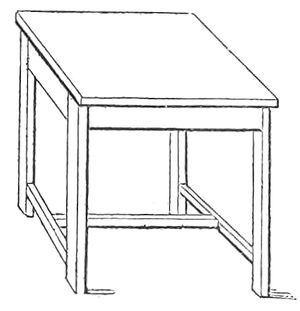
A platform fixed to the end of a frame on which to put a letter board with letter; there is another sort sometimes adopted, called a Loose Bulk, which is a small table made of deal, for the same purpose, but moveable to any part where it is most convenient to use it.
BULLET.
When a workman, at case or press, either for neglect, want of punctuality, or for gross misconduct, is discharged instanter, and the usual notice of “a fortnight” is not given, it is said, He has got the Bullet.
BUNDLE.
A bundle of paper consists of two reams. See Paper, Ream.
Bur. See Rag.
BUTTON OF THE TYMPAN.
An iron button with a female screw, screwed on a square shanked bolt, that goes through the bottom frame of the outer tympan, in wooden presses, and turns on the upper side of the inner tympan, to assist in keeping it tight in its place.
In very fine work also, when the paper is stout and heavy and large sheets, and it is not customary to fly the frisket, but to turn it down upon the paper before the tympan is turned down upon the form, a button is placed upon the lower frame of the outer tympan, which clasps the extreme end of the frisket, and confines the sheet of paper in its place on the tympan, and prevents it slipping down.
CANCEL.
At the conclusion of a work, if there be any leaves cancelled, it is useful to place a mark in the white line of the odd page of the reprinted leaf, to prevent a mistake on the part of the bookbinder; a *, †, ‡, ‖, or §, either upright or laid flat. This is too frequently neglected, and when the warehouseman omits tearing or cutting the cancelled leaf, the wrong one occasionally is bound in the book. To save press work and paper, cancel leaves are always imposed with the fragments, if possible.
Before the book is gathered, the warehouseman should either tear the cancelled leaf or run his knife up it, so as to prevent it being overlooked by the bookbinder; running the knife up it is the most expeditious method, and, to prevent mistakes, he ought to do this himself, and not to entrust it to boys, as cutting a wrong leaf would cause another leaf to be reprinted, and he might be held responsible for the expense, and also incur censure on account of delay.
CANON.
The name of a type, a size larger than Trafalgar, and the largest with a specific name. The body is four Picas, the next size being four line Pica, and so upwards, reckoning by lines of Pica. See Types.
CAP.
The top part of a wooden press; it has two mortises at each end to receive the tenons at the upper end of each cheek, by which it keeps the cheeks at a proper distance at the top; and the head is suspended from it by two iron bolts, with screws and nuts at the upper end, by which the pull also is regulated.
CAPITALS.
The following directions respecting the use of capital letters, are extracted from Lindley Murray’s English Grammar.
‘It was formerly the custom to begin every noun with a capital: but as this practice was troublesome, and gave the writing or printing a crowded and confused appearance, it has been discontinued. It is, however, very proper to begin with a capital,
‘1. The first word of every book, chapter, letter, note, or any other piece of writing.
‘2. The first word after a period; and, if the two sentences are totally independent, after a note of interrogation or exclamation.
‘But if a number of interrogative or exclamatory sentences are thrown into one general group, or if the construction of the latter sentences depends on the former, all of them, except the first, may begin with a small letter: as, “How long, ye simple ones, will ye love simplicity? and the scorners delight in their scorning? and fools hate knowledge?” “Alas! how different! yet how like the same!”
‘3. The appellations of the Deity: as, “God, Jehovah, the Almighty, the Supreme Being, the Lord, Providence, the Messiah, the Holy Spirit.”
‘4. Proper names of persons, places, streets, mountains, rivers, ships: as, “George, York, the Strand, the Alps, the Thames, the Seahorse.”
‘5. Adjectives derived from the proper names of places: as, “Grecian, Roman, English, French, and Italian.”
‘6. The first word of a quotation, introduced after a colon, or when it is in a direct form: as, “Always remember this ancient maxim: ‘Know thyself.’” “Our great Lawgiver says, ‘Take up thy cross daily, and follow me.’” But when a quotation is brought in obliquely after a comma, a capital is unnecessary: as, “Solomon observes, ‘that pride goes before destruction.’”
‘The first word of an example may also very properly begin with a capital: as, “Temptation proves our virtue.”
‘7. Every substantive and principal word in the titles of books: as, “Johnson’s Dictionary of the English Language;” “Thomson’s Seasons;” “Rollin’s Ancient History.”
‘8. The first word of every line in poetry.
‘9. The pronoun I, and the interjection O, are written in capitals: as, “I write:” “Hear, O earth!”
‘Other words, besides the preceding, may begin with capitals, when they are remarkably emphatical, or the principal subject of the composition.’
CAPPING BALLS.
Wrapping up pelt balls in blankets soaked in urine at night, and when they are not in use, to keep them soft. They are generally left on the floor of the sink.
CAPPING A MAN.
Wrapping one of the blankets with which the pelt balls are capped about a man’s head, and tying it round his neck. This most filthy and disgusting punishment is very rarely inflicted in a press room; yet I have read an account of a trial at the Old Bailey for an assault, in which this act was the ground of offence.
CARD.
When several bodies of letter are set in a page, compositors to justify that page to an exact length, put a card to some white line, or other break, and lengthen out the page the thickness of a card.[95] Pressmen also use a card for an underlay.—M. Cards are rarely used now for these purposes; in making up pages, leads and scaleboards are used, and, where great nicety is required, a careful compositor will cut slips of smooth even paper, and use them where a lead or a scaleboard would be too much. At press, underlays are not used for types; and where an engraving on wood is much too low, the pressman will underlay it with thick wrapper paper. In fact, cards are an article that neither composing rooms nor press rooms are supplied with.
CARDS.
About a quire of paper, which pressmen use to pull down the spring or rising of a form, which it is many times subject to by hard locking up.—M.
The term is also applied to pieces of scaleboard, old felted hat, or pasteboard, for they are all called cards, cut to the size of the mortises in the cheeks of a wooden press, and laid in them, under the tenons of the winter, and above those of the head, to cause a spring in both these parts, for the purpose of softening the pull. I would never place any cards under the winter, for the reasons assigned under that article. See Winter.
CARD WOOL.
The act of carding wool to stuff the balls with, to take out the knots, dirt, &c., for the purpose of making the balls softer, more elastic, and to have a more even surface than would be the case if the wool were not carded. This operation is repeated every time a pair of balls is knocked up. Formerly it was teazed, and not carded.
CARET.
A caret, marked thus , is placed where some word happens to be left out in writing, and which is inserted over the line. This mark is also called a circumflex, when placed over some vowel of a word, to denote a long syllable: as, “Euphrâtes.”—Murray.
CARRIAGE,
is that part of the press that runs in under the platen, including the plank, coffin, &c. I am aware that many printers call the long wooden ribs and frame the carriage; but I am also satisfied that they misname that part of the press: for who ever heard of running in the long ribs? yet to run in the carriage is a common expression; and the name implies that the article moves or travels. This word bore the signification which I assign to it in the seventeenth century, for Moxon uses it in this sense. See Run in the Carriage.
CASE,
in which the letters are laid to compose with.—M.
Cases are always spoken of as pairs; viz. upper case and lower case; when placed upon a frame to compose out of, the front of the upper case rests against the back of the lower case, lying in different inclinations, the back of the upper case being raised to bring the top boxes nearer the hand.
They are generally made of beech; the outer rim and the middle bar stout, to give strength, and to nail the bottoms to, which are lined with paper, to prevent letters falling through cracks, or joints that might open; this lining used to be cartridge paper, which strengthened the bottom, but the joiner now lines them with cheap and thin demy paper; the bottom is made of thin fir deal. The dimensions are—two feet eight inches and a half, sometimes two feet nine inches long; one foot two inches and a half wide, and one inch and a quarter deep; the front being about half an inch broader than the depth, which forms a ledge for galleys to rest against, and also serves as a guard to stop letters, &c. falling over.
It is interesting to trace the changes that take place in any art; hence I have given the arrangement of the letters in cases at different periods, commencing with the first English writer, Moxon, who published his[96] work in the year 1683; then Smith, who published in 1755; the cases before the long ſ was discarded, in my own time; the arrangement now generally used; and a variation, subdividing the boxes in the upper case, and changing the arrangement, both in that and the lower case, to afford room for a greater number of sorts, and to make the access to them more convenient; I have also added the late Earl Stanhope’s plan.
In Moxon’s cases it will be perceived there are no ç, ſb, ſk, Œ, ‡, ‖, ¶, [, (, |, nor any small capitals.
Smith, in his Printer’s Grammar, gives “Schemes for Three Pair of Cases, shewing the Difference in the Disposition of their Sorts.” I have given his No. I. and No. III.; No. II. is the same as the one before the long ſ was discarded, with the exception of the q being in the comma box, and the comma in the q box.
This arrangement of the letters before the long ſ was discarded, continued down to our own time, except the transposition of the q and the comma; and the “schemes” Smith gives as No. I. and No. III. became obsolete.
When the long ſ was discarded, and we confined ourselves to one shape of the same letter, the ligature ct was also disused; we thus lost the ct, ſb, ſh, ſi, ſk, ſl, ſſ, ſſi, ſſl, and ſt, which gave ten additional boxes for other sorts; these have afforded convenience for metal rules and braces, which before were wanted, and also for the £ and [#] that are now frequently sent with a fount, particularly the £.
The discarding of the long ſ originated with the late John Bell, who printed and published an edition of Shakspeare, the British Theatre, and the Poets: the change was not generally adopted for some years, and many retained one ſ when two came together, as ‘Eſsay;’ but the s prevailed, and no other is now used.
In the present arrangement, the figures are brought lower down to be nearer the hand, and the vowels with the diæresis moved higher up; for the same reason the acute accented vowels have changed places with those of the grave accent.
Mr. Johnson, in his Typographia, has given a variation in the arrangement that he has adopted. I do not see any improvement in the lower case to induce master printers to change the general mode, which would only tend to create confusion and put the boxes into pie. A subdivision of the boxes in the upper case, would be useful in two or three pairs in large founts, that had superiors and fractions cast to them; but as few founts have them, these subdivisions would not only be useless, but inconvenient, if applied to all the cases, as they would not leave sufficient room for metal rules, braces, &c., neither do they afford convenience for all the fractions that are cast in a piece; besides, vowels with the long and short accents are so rarely used in the general routine of business, that it is not necessary to cramp the boxes to make provision for them; and there is always room in the back boxes of the Italic cases in which to put sorts that are seldom wanted; to this we may add the additional expense of making these cases, which in an extensive business would be considerable.
Among the various arrangements of the types in cases at different periods and by different persons, I am gratified at being enabled to give that of the late Earl Stanhope, from a stereotype plate of his Lordship’s casting; this plan of the cases, the logotypes, the alteration of the letter f, and the shape of the boxes, were never adopted in the trade.
MOXON’S CASES. 1683.

SMITH’S CASES. No. I. 1755.

SMITH’S CASES. No. III. 1755.
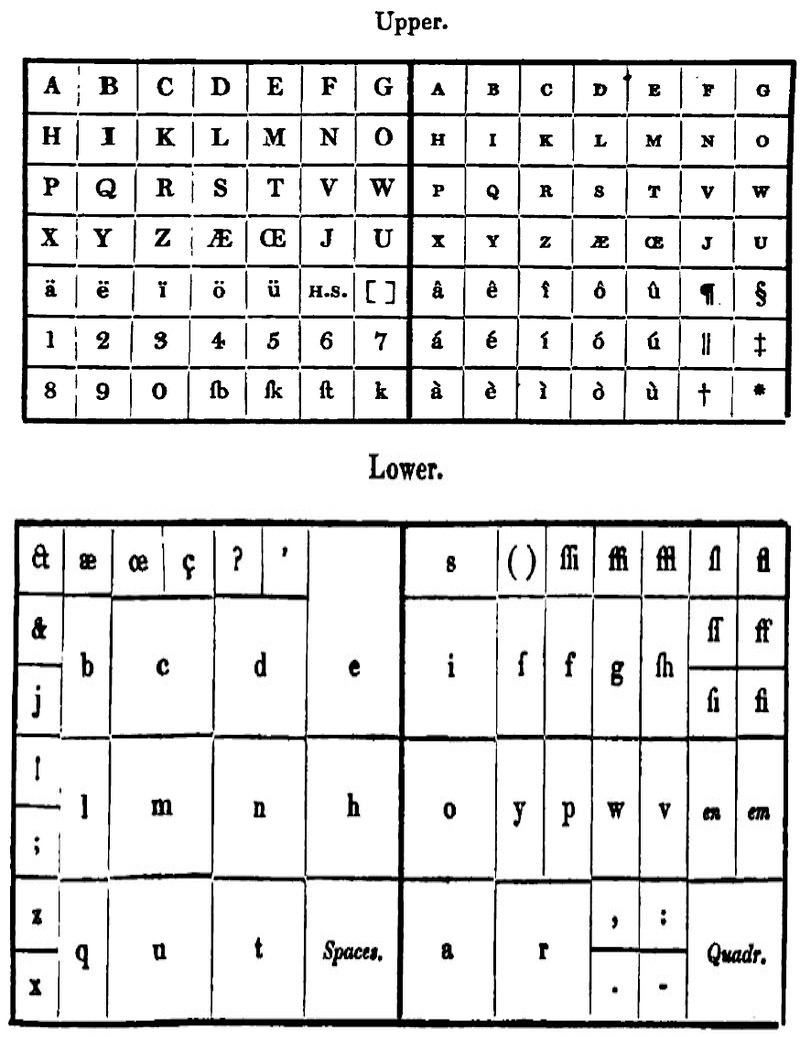
CASES BEFORE THE LONG ſ WAS DISCARDED.
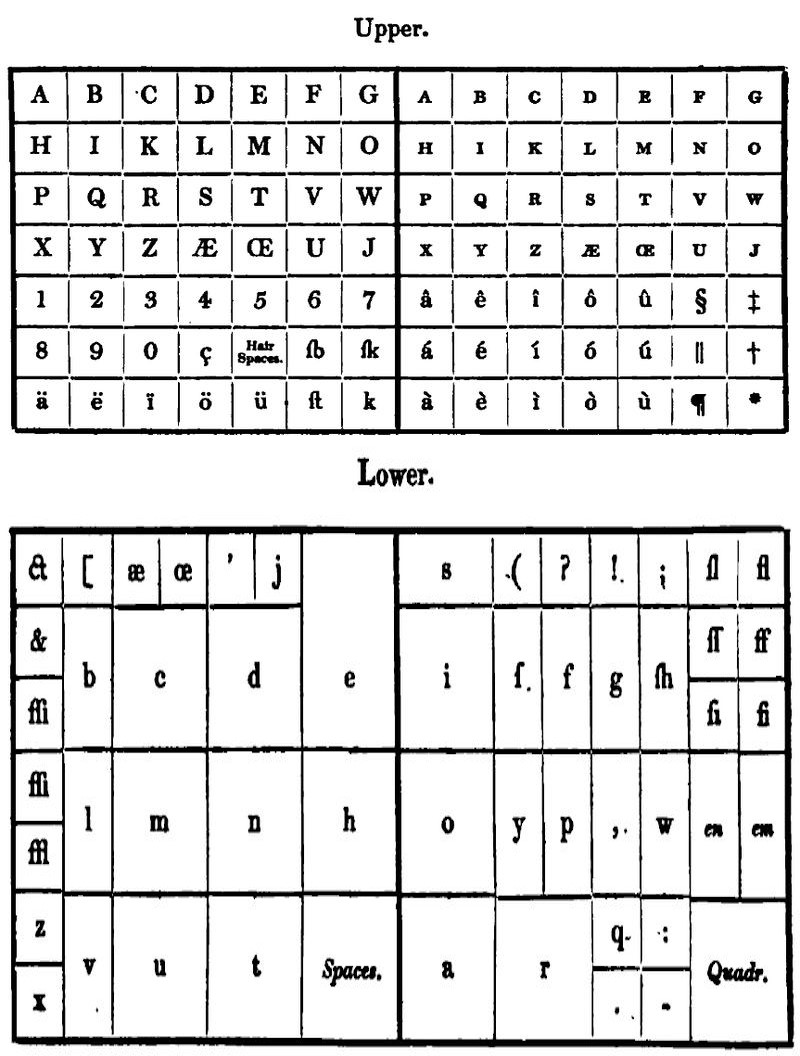
PRESENT ARRANGEMENT OF THE TYPES.

STANHOPE COMPOSING CASES.
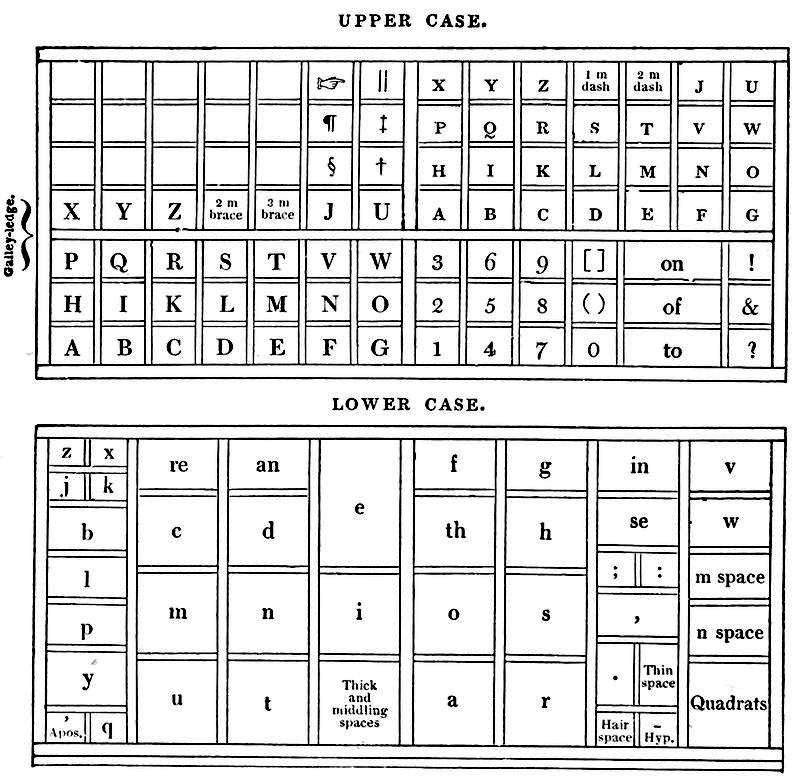
PECULIARITIES AND ADVANTAGES OF THESE CASES.
First. The nine logotypes now in use are omitted. They are proposed to be printed with separate types, thus: ff, fi, fl, ffi, ffl, &c. instead of ff, fi, fl, ffi, ffl, &c. And the Italic thus: ff, fi, fl, &c. instead of ff, fi, fl, &c. In 20 pages of Enfield’s Speaker, (namely, from page 71 to 90, both inclusive,) those logotypes occur only 95 times, viz.
present logotypes.
| ff | fi | fl | ffi | ffl | Æ | Œ | æ | œ | } | Total, |
| 28 | 51 | 10 | 4 | 2 | 0 | 0 | 0 | 0 | } | 95. |
Secondly. Eight new logotypes are introduced. Their regular and frequent occurrence expedite the process of composition in a very considerable degree; for, in those same 20 pages, the new logotypes would save to the compositor no less than 3073 lifts, viz.
stanhope logotypes.
| th | in | an | re | se | to | of | on | } | Total, |
| 771 | 441 | 413 | 385 | 291 | 279 | 264 | 229 | } | 3073. |
Thirdly. The introduction of the new logotypes, and the great imperfection of the various existing arrangements of composing cases, have caused the above new and very superior arrangement to be adopted.
Fourthly. The front side of each box of the lower case is made sloping, instead of upright: which shape is convenient both to the view and to the hand of the compositor, and it enables him to lift the types with the same rapidity and ease when the boxes are nearly empty as when they are full. The types are much better preserved from wear, by means of this shape. It also allows the lower case to be made deeper than usual; so that, two of them contain as much as three lower cases on the old construction. At the bottom of each box of the upper case, the internal front arras is filled up.
The saving of time is of immense importance, especially in all cases where dispatch is particularly required. The new cases are, by experience, found to save full one day out of six to the compositor.
Fifteen boxes on the left-hand side of the upper case are represented empty. They are intended for the sorts which are sometimes used for particular works; such as, accented letters, mathematical marks, &c.
As the asterisk, or star, [*] is very liable to be filled with ink at press, it is intentionally excluded from among the reference-marks.
Stereotyped and Printed by EARL STANHOPE, Chevening House, Kent.
CASE IS FULL.
A case full of letters, wanting no sorts.—M.
CASE IS LOW.
When a case grows empty, compositors say, The Case is Low.—M.
CASE RACK.
A frame made of strong deal boards, with ledges nailed on the inside of the sides, in which to slide cases that are not in use, to keep them safe. They are usually made to contain fourteen pairs of cases; they are two feet nine inches wide in the clear, and seven feet high.
Where full cases of letter are kept for the purpose of expediting any new work that requires great despatch, some houses have a bar of iron from top to bottom, and lock the cases up to preserve the letter.
CASE RUNS OVER.
When a compositor distributes so much letter into a case as to fill the boxes till the letters mingle with those in the adjoining boxes, he says, his Case runs over, or it overflows. This frequently causes additional errors in the proof, and of course is not an advisable practice.
CASE STANDS STILL.
When the compositor is not at work at his case, it is said, The Case stands still.—M. Obsolete.
CASSIE PAPER.
The two outside quires of a ream. They are also called Cassie Quires, because they serve for cases to the ream.—M. See Outside Quires.
CASTING. See Electrotype.
CASTING UP.
Calculating the number of thousands of letters in a sheet of any work, or in a job, in order to fix the price for composing it.
To facilitate the ascertainment of the number of thousands of letters in a sheet of bookwork, and also of jobs, I have given a set of tables, which I believe includes, generally speaking, the sizes of the pages that usually occur in practice. These tables will be found useful to those compositors who are not expert at figures, while those who are so may save time by referring to them, and they may also serve as a check to their own casting up. The figures at the top designate the number of lines the page is long; and the figures in the column specify the number of thousands of letters in a sheet, according to the size named in the head. To ascertain the number of thousands of letters, the established rule is, to take the number of lines the page is long, including the head line and the direction line, and the number of en quadrats in the width of the page, the en quadrat being estimated as the average thickness of the letters, and on multiplying the one by the other the product will give the number of letters in a page; and this product multiplied by the number of pages in a sheet, gives the number of letters in a sheet; where there is a fraction of a thousand, and that fraction amounts to 500 or upwards, it is reckoned and charged as 1,000; when it is less than 500 it is dropped, and not included in the calculation. There are some exceptions to this general rule of taking the dimensions when the type exceeds a certain size, for which see Scale of Prices.
TABLE OF THE NUMBER OF THOUSANDS IN A SHEET.

| NUMBER OF THOUSANDS IN A SHEET. | ||||||||||||||
| The figures at the top designate the number of lines the page is long. | ||||||||||||||
| 15 | 16 | 17 | ||||||||||||
| Ens wide. |
4to. | 8vo. | 12mo. | 18mo. | Ens wide. |
4to. | 8vo. | 12mo. | 18mo. | Ens wide. |
4to. | 8vo. | 12mo. | 18mo. |
| 12 | 1 | 3 | 4 | 6 | 12 | 2 | 3 | 5 | 7 | 13 | 2 | 4 | 5 | 8 |
| 18 | 19 | 20 | ||||||||||||
| 13 | 2 | 4 | 6 | 8 | 13 | 2 | 4 | 6 | 9 | 14 | 2 | 4 | 7 | 10 |
| NUMBER OF THOUSANDS IN A SHEET. | ||||||||||||||
| The figures at the top designate the number of lines the page is long. | ||||||||||||||
| 21 | 22 | 23 | ||||||||||||
| Ens wide. |
4to. | 8vo. | 12mo. | 18mo. | Ens wide. |
4to. | 8vo. | 12mo. | 18mo. | Ens wide. |
4to. | 8vo. | 12mo. | 18mo. |
| 14 | 2 | 5 | 7 | 11 | 14 | 2 | 5 | 7 | 11 | 16 | 3 | 6 | 9 | 13 |
| 24 | 25 | 26 | ||||||||||||
| 16 | 3 | 6 | 9 | 14 | 17 | 3 | 7 | 10 | 15 | 17 | 4 | 7 | 11 | 16 |
| NUMBER OF THOUSANDS IN A SHEET. | ||||||||||||||
| The figures at the top designate the number of lines the page is long. | ||||||||||||||
| 27 | 28 | 29 | ||||||||||||
| Ens wide. |
4to. | 8vo. | 12mo. | 18mo. | Ens wide. |
4to. | 8vo. | 12mo. | 18mo. | Ens wide. |
4to. | 8vo. | 12mo. | 18mo. |
| 18 | 4 | 8 | 12 | 17 | 18 | 4 | 8 | 12 | 18 | 19 | 4 | 9 | 13 | 20 |
| 30 | 31 | 32 | ||||||||||||
| 20 | 5 | 10 | 14 | 22 | 21 | 5 | 10 | 16 | 23 | 22 | 6 | 11 | 17 | 25 |
| NUMBER OF THOUSANDS IN A SHEET. | ||||||||||||||
| The figures at the top designate the number of lines the page is long. | ||||||||||||||
| 33 | 34 | 35 | ||||||||||||
| Ens wide. |
4to. | 8vo. | 12mo. | 18mo. | Ens wide. |
4to. | 8vo. | 12mo. | 18mo. | Ens wide. |
4to. | 8vo. | 12mo. | 18mo. |
| 23 | 6 | 12 | 18 | 27 | 24 | 7 | 13 | 20 | 29 | 25 | 7 | 14 | 21 | 32 |
| 36 | 37 | 38 | ||||||||||||
| 26 | 7 | 15 | 22 | 34 | 27 | 8 | 16 | 24 | 36 | 28 | 9 | 17 | 26 | 38 |
| NUMBER OF THOUSANDS IN A SHEET. | ||||||||||||||
| The figures at the top designate the number of lines the page is long. | ||||||||||||||
| 39 | 40 | 41 | ||||||||||||
| Ens wide. |
4to. | 8vo. | 12mo. | 18mo. | Ens wide. |
4to. | 8vo. | 12mo. | 18mo. | Ens wide. |
4to. | 8vo. | 12mo. | 18mo. |
| 29 | 9 | 18 | 27 | 41 | 30 | 10 | 19 | 29 | 43 | 31 | 10 | 20 | 31 | 46 |
| NUMBER OF THOUSANDS IN A SHEET. | ||||||||||||||
| The figures at the top designate the number of lines the page is long. | ||||||||||||||
| 42 | 43 | 44 | ||||||||||||
| Ens wide. |
4to. | 8vo. | 12mo. | 18mo. | Ens wide. |
4to. | 8vo. | 12mo. | 18mo. | Ens wide. |
4to. | 8vo. | 12mo. | 18mo. |
| 32 | 11 | 22 | 32 | 48 | 33 | 11 | 23 | 34 | 51 | 34 | 12 | 24 | 36 | 54 |
| NUMBER OF THOUSANDS IN A SHEET. | |||||||||||||||
| The figures at the top designate the number of lines the page is long. | |||||||||||||||
| 45 | 46 | 47 | |||||||||||||
| Ens wide. |
4to. | 8vo. | 12mo. | 18mo. | Ens wide. |
4to. | 8vo. | 12mo. | 18mo. | Ens wide. |
Folio | 4to. | 8vo. | 12mo. | 18mo. |
| 35 | 13 | 25 | 38 | 57 | 36 | 13 | 26 | 40 | 60 | 37 | 7 | 14 | 28 | 42 | 63 |
| NUMBER OF THOUSANDS IN A SHEET. | |||||||||||||||||
| The figures at the top designate the number of lines the page is long. | |||||||||||||||||
| 48 | 49 | 50 | |||||||||||||||
| Ens wide. |
Folio | 4to. | 8vo. | 12mo. | 18mo. | Ens wide. |
Folio | 4to. | 8vo. | 12mo. | 18mo. | Ens wide. |
Folio | 4to. | 8vo. | 12mo. | 18mo. |
| 38 | 7 | 15 | 29 | 44 | 66 | 39 | 8 | 15 | 31 | 46 | 69 | 40 | 8 | 16 | 32 | 48 | 72 |
| NUMBER OF THOUSANDS IN A SHEET. | |||||||||||||||||
| The figures at the top designate the number of lines the page is long. | |||||||||||||||||
| 51 | 52 | 53 | |||||||||||||||
| Ens wide. |
Folio | 4to. | 8vo. | 12mo. | 18mo. | Ens wide. |
Folio | 4to. | 8vo. | 12mo. | 18mo. | Ens wide. |
Folio | 4to. | 8vo. | 12mo. | 18mo. |
| 41 | 8 | 17 | 33 | 50 | 75 | 42 | 9 | 17 | 35 | 52 | 79 | 43 | 9 | 18 | 36 | 55 | 82 |
| NUMBER OF THOUSANDS IN A SHEET. | |||||||||||||||||
| The figures at the top designate the number of lines the page is long. | |||||||||||||||||
| 54 | 55 | 56 | |||||||||||||||
| Ens wide. |
Folio | 4to. | 8vo. | 12mo. | 18mo. | Ens wide. |
Folio | 4to. | 8vo. | 12mo. | 18mo. | Ens wide. |
Folio | 4to. | 8vo. | 12mo. | 18mo. |
| 44 | 10 | 19 | 38 | 57 | 86 | 45 | 10 | 20 | 40 | 59 | 89 | 46 | 10 | 21 | 41 | 62 | 93 |
| NUMBER OF THOUSANDS IN A SHEET. | |||||||||||||||||
| The figures at the top designate the number of lines the page is long. | |||||||||||||||||
| 57 | 58 | 59 | |||||||||||||||
| Ens wide. |
Folio | 4to. | 8vo. | 12mo. | 18mo. | Ens wide. |
Folio | 4to. | 8vo. | 12mo. | 18mo. | Ens wide. |
Folio | 4to. | 8vo. | 12mo. | 18mo. |
| 47 | 11 | 21 | 43 | 64 | 96 | 48 | 11 | 22 | 45 | 67 | 100 | 49 | 12 | 23 | 46 | 69 | 104 |
| NUMBER OF THOUSANDS IN A SHEET. | |||||||||||||||||
| The figures at the top designate the number of lines the page is long. | |||||||||||||||||
| 60 | 61 | 62 | |||||||||||||||
| Ens wide. |
Folio | 4to. | 8vo. | 12mo. | 18mo. | Ens wide. |
Folio | 4to. | 8vo. | 12mo. | 18mo. | Ens wide. |
Folio | 4to. | 8vo. | 12mo. | 18mo. |
| 50 | 12 | 24 | 48 | 72 | 108 | 51 | 12 | 25 | 50 | 75 | 112 | 52 | 13 | 26 | 52 | 77 | 116 |
| NUMBER OF THOUSANDS IN A SHEET. | |||||||||||||||||
| The figures at the top designate the number of lines the page is long. | |||||||||||||||||
| 63 | 64 | 65 | |||||||||||||||
| Ens wide. |
Folio | 4to. | 8vo. | 12mo. | 18mo. | Ens wide. |
Folio | 4to. | 8vo. | 12mo. | 18mo. | Ens wide. |
Folio | 4to. | 8vo. | 12mo. | 18mo. |
| 53 | 13 | 27 | 53 | 80 | 120 | 54 | 14 | 28 | 55 | 83 | 124 | 55 | 14 | 29 | 57 | 86 | 129 |
| NUMBER OF THOUSANDS IN A SHEET. | |||||||||||||||||
| The figures at the top designate the number of lines the page is long. | |||||||||||||||||
| 66 | 67 | 68 | |||||||||||||||
| Ens wide. |
Folio | 4to. | 8vo. | 12mo. | 18mo. | Ens wide. |
Folio | 4to. | 8vo. | 12mo. | 18mo. | Ens wide. |
Folio | 4to. | 8vo. | 12mo. | 18mo. |
| 56 | 15 | 30 | 59 | 89 | 133 | 57 | 15 | 31 | 61 | 92 | 137 | 58 | 16 | 31 | 63 | 95 | 142 |
| NUMBER OF THOUSANDS IN A SHEET. | |||||||||||||||||
| The figures at the top designate the number of lines the page is long. | |||||||||||||||||
| 69 | 70 | 71 | |||||||||||||||
| Ens wide. |
Folio | 4to. | 8vo. | 12mo. | 18mo. | Ens wide. |
Folio | 4to. | 8vo. | 12mo. | 18mo. | Ens wide. |
Folio | 4to. | 8vo. | 12mo. | 18mo. |
| 59 | 16 | 33 | 65 | 98 | 147 | 60 | 17 | 34 | 67 | 101 | 151 | 61 | 17 | 35 | 69 | 104 | 156 |
| NUMBER OF THOUSANDS IN A SHEET. | |||||||||||||||||
| The figures at the top designate the number of lines the page is long. | |||||||||||||||||
| 72 | 73 | 74 | |||||||||||||||
| Ens wide. |
Folio | 4to. | 8vo. | 12mo. | 18mo. | Ens wide. |
Folio | 4to. | 8vo. | 12mo. | 18mo. | Ens wide. |
Folio | 4to. | 8vo. | 12mo. | 18mo. |
| 62 | 18 | 36 | 71 | 107 | 161 | 63 | 18 | 37 | 74 | 110 | 166 | 64 | 19 | 38 | 76 | 114 | 170 |
| NUMBER OF THOUSANDS IN A SHEET. | ||||||||||||||
| The figures at the top designate the number of lines the page is long. | ||||||||||||||
| 75 | 76 | 77 | ||||||||||||
| Ens wide. |
Folio | 4to. | 8vo. | 12mo. | Ens wide. |
Folio | 4to. | 8vo. | 12mo. | Ens wide. |
Folio | 4to. | 8vo. | 12mo. |
| 65 | 20 | 39 | 78 | 117 | 66 | 20 | 40 | 80 | 120 | 67 | 21 | 41 | 83 | 124 |
| NUMBER OF THOUSANDS IN A SHEET. | ||||||||||||||
| The figures at the top designate the number of lines the page is long. | ||||||||||||||
| 78 | 79 | 80 | ||||||||||||
| Ens wide. |
Folio | 4to. | 8vo. | 12mo. | Ens wide. |
Folio | 4to. | 8vo. | 12mo. | Ens wide. |
Folio | 4to. | 8vo. | 12mo. |
| 68 | 21 | 42 | 85 | 127 | 69 | 22 | 44 | 87 | 131 | 70 | 22 | 45 | 90 | 134 |
| NUMBER OF THOUSANDS IN A SHEET. | |||||||||||||
| The figures at the top designate the number of lines the page is long. | |||||||||||||
| 81 | 82 | 83 | |||||||||||
| Ens wide. |
Folio | 4to. | 8vo. | 12mo. | Ens wide. |
Folio | 4to. | 8vo. | 12mo. | Ens wide. |
Folio | 4to. | 8vo. |
| 71 | 23 | 46 | 92 | 138 | 72 | 24 | 47 | 94 | 142 | 73 | 24 | 48 | 97 |
| NUMBER OF THOUSANDS IN A SHEET. | |||||||||||||||
| The figures at the top designate the number of lines the page is long. | |||||||||||||||
| 84 | 85 | 86 | 87 | ||||||||||||
| Ens wide. |
Folio | 4to. | 8vo. | Ens wide. |
Folio | 4to. | 8vo. | Ens wide. |
Folio | 4to. | 8vo. | Ens wide. |
Folio | 4to. | 8vo. |
| 74 | 25 | 50 | 99 | 75 | 26 | 51 | 102 | 76 | 26 | 52 | 105 | 77 | 27 | 54 | 107 |
| NUMBER OF THOUSANDS IN A SHEET. | |||||||||||||||
| The figures at the top designate the number of lines the page is long. | |||||||||||||||
| 88 | 89 | 90 | 91 | ||||||||||||
| Ens wide. |
Folio | 4to. | 8vo. | Ens wide. |
Folio | 4to. | 8vo. | Ens wide. |
Folio | 4to. | 8vo. | Ens wide. |
Folio | 4to. | 8vo. |
| 78 | 27 | 55 | 110 | 79 | 28 | 56 | 112 | 80 | 29 | 58 | 115 | 81 | 29 | 59 | 118 |
| NUMBER OF THOUSANDS IN A SHEET. | |||||||||||||||
| The figures at the top designate the number of lines the page is long. | |||||||||||||||
| 92 | 93 | 94 | 95 | 96 | |||||||||||
| Ens wide. |
Folio | 4to. | 8vo. | Ens wide. |
Folio | 4to. | Ens wide. |
Folio | 4to. | Ens wide. |
Folio | 4to. | Ens wide. |
Folio | 4to. |
| 82 | 30 | 60 | 121 | 83 | 31 | 62 | 84 | 32 | 63 | 85 | 32 | 65 | 86 | 33 | 66 |
| NUMBER OF THOUSANDS IN A SHEET. | ||||||||||||||
| The figures at the top designate the number of lines the page is long. | ||||||||||||||
| 97 | 98 | 99 | 100 | 101 | ||||||||||
| Ens wide. |
Folio | 4to. | Ens wide. |
Folio | 4to. | Ens wide. |
Folio | 4to. | Ens wide. |
Folio | 4to. | Ens wide. |
Folio | 4to. |
| 87 | 34 | 68 | 88 | 34 | 69 | 89 | 35 | 70 | 90 | 36 | 72 | 91 | 37 | 74 |
| NUMBER OF THOUSANDS IN A SHEET. | ||||||||||||||
| The figures at the top designate the number of lines the page is long. | ||||||||||||||
| 102 | 103 | 104 | 105 | 106 | ||||||||||
| Ens wide. |
Folio | 4to. | Ens wide. |
Folio | 4to. | Ens wide. |
Folio | 4to. | Ens wide. |
Folio | 4to. | Ens wide. |
Folio | 4to. |
| 92 | 38 | 75 | 93 | 38 | 77 | 94 | 39 | 78 | 95 | 40 | 80 | 96 | 41 | 81 |
| NUMBER OF THOUSANDS IN A SHEET. | |||||||||||||||
| The figures at the top designate the number of lines the page is long. | |||||||||||||||
| 107 | 108 | 109 | 110 | 111 | 112 | 113 | 114 | ||||||||
| Ens wide. |
Folio | Ens wide. |
Folio | Ens wide. |
Folio | Ens wide. |
Folio | Ens wide. |
Folio | Ens wide. |
Folio | Ens wide. |
Folio | Ens wide. |
Folio |
| 97 | 42 | 98 | 42 | 99 | 43 | 100 | 44 | 101 | 45 | 102 | 46 | 103 | 47 | 104 | 47 |
| NUMBER OF THOUSANDS IN A SHEET. | |||||||||||||||
| The figures at the top designate the number of lines the page is long. | |||||||||||||||
| 115 | 116 | 117 | 118 | 119 | 120 | 121 | 122 | ||||||||
| Ens wide. |
Folio | Ens wide. |
Folio | Ens wide. |
Folio | Ens wide. |
Folio | Ens wide. |
Folio | Ens wide. |
Folio | Ens wide. |
Folio | Ens wide. |
Folio |
| 105 | 48 | 106 | 49 | 107 | 50 | 108 | 51 | 109 | 52 | 110 | 53 | 111 | 54 | 112 | 55 |
| NUMBER OF THOUSANDS IN A SHEET. | |||||||||||||||
| The figures at the top designate the number of lines the page is long. | |||||||||||||||
| 123 | 124 | 125 | 126 | 127 | 128 | 129 | 130 | ||||||||
| Ens wide. |
Folio | Ens wide. |
Folio | Ens wide. |
Folio | Ens wide. |
Folio | Ens wide. |
Folio | Ens wide. |
Folio | Ens wide. |
Folio | Ens wide. |
Folio |
| 113 | 56 | 114 | 57 | 115 | 58 | 116 | 58 | 117 | 59 | 118 | 60 | 119 | 61 | 120 | 62 |
| NUMBER OF THOUSANDS IN A SHEET. | |||||||||||||||
| The figures at the top designate the number of lines the page is long. | |||||||||||||||
| 131 | 132 | 133 | 134 | 135 | 136 | 137 | 138 | ||||||||
| Ens wide. |
Folio | Ens wide. |
Folio | Ens wide. |
Folio | Ens wide. |
Folio | Ens wide. |
Folio | Ens wide. |
Folio | Ens wide. |
Folio | Ens wide. |
Folio |
| 121 | 63 | 122 | 64 | 123 | 65 | 124 | 66 | 125 | 68 | 126 | 69 | 127 | 70 | 128 | 71 |
| NUMBER OF THOUSANDS IN A SHEET. | |||||||||||||||
| The figures at the top designate the number of lines the page is long. | |||||||||||||||
| 139 | 140 | 141 | 142 | 143 | 144 | 145 | 146 | ||||||||
| Ens wide. |
Folio | Ens wide. |
Folio | Ens wide. |
Folio | Ens wide. |
Folio | Ens wide. |
Folio | Ens wide. |
Folio | Ens wide. |
Folio | Ens wide. |
Folio |
| 129 | 72 | 130 | 73 | 131 | 74 | 132 | 75 | 133 | 76 | 134 | 77 | 135 | 78 | 136 | 79 |
| NUMBER OF THOUSANDS IN JOBS. | |||||||||||||||||
| The figures at the top designate the number of ens in the width. | |||||||||||||||||
| 50 | 51 | 52 | 53 | 54 | 55 | 56 | 57 | 58 | 59 | 60 | 61 | 62 | 63 | 64 | |||
| Lines long. |
Thou- sands. |
Thou- sands. |
Thou- sands. |
Thou- sands. |
Thou- sands. |
Lines long. |
Thou- sands. |
Thou- sands. |
Thou- sands. |
Thou- sands. |
Thou- sands. |
Lines long. |
Thou- sands. |
Thou- sands. |
Thou- sands. |
Thou- sands. |
Thou- sands. |
| 20 | 1 | 1 | 1 | 1 | 1 | 21 | 1 | 1 | 1 | 1 | 1 | 22 | 1 | 1 | 1 | 1 | 1 |
| NUMBER OF THOUSANDS IN JOBS. | |||||||||||||
| The figures at the top designate the number of ens in the width. | |||||||||||||
| 65 | 66 | 67 | 68 | 69 | 70 | 71 | |||||||
| Lines long. |
Thou- sands. |
Lines long. |
Thou- sands. |
Lines long. |
Thou- sands. |
Lines long. |
Thou- sands. |
Lines long. |
Thou- sands. |
Lines long. |
Thou- sands. |
Lines long. |
Thou- sands. |
| 23 | 1 | 24 | 2 | 25 | 2 | 26 | 2 | 27 | 2 | 28 | 2 | 29 | 2 |
| NUMBER OF THOUSANDS IN JOBS. | |||||||||||||
| The figures at the top designate the number of ens in the width. | |||||||||||||
| 72 | 73 | 74 | 75 | 76 | 77 | 78 | |||||||
| Lines long. |
Thou- sands. |
Lines long. |
Thou- sands. |
Lines long. |
Thou- sands. |
Lines long. |
Thou- sands. |
Lines long. |
Thou- sands. |
Lines long. |
Thou- sands. |
Lines long. |
Thou- sands. |
| 30 | 2 | 31 | 2 | 32 | 2 | 33 | 2 | 34 | 3 | 35 | 3 | 36 | 3 |
| NUMBER OF THOUSANDS IN JOBS. | |||||||||||||
| The figures at the top designate the number of ens in the width. | |||||||||||||
| 79 | 80 | 81 | 82 | 83 | 84 | 85 | |||||||
| Lines long. |
Thou- sands. |
Lines long. |
Thou- sands. |
Lines long. |
Thou- sands. |
Lines long. |
Thou- sands. |
Lines long. |
Thou- sands. |
Lines long. |
Thou- sands. |
Lines long. |
Thou- sands. |
| 37 | 3 | 38 | 3 | 39 | 3 | 40 | 3 | 41 | 3 | 42 | 4 | 43 | 4 |
| NUMBER OF THOUSANDS IN JOBS. | |||||||||||||
| The figures at the top designate the number of ens in the width. | |||||||||||||
| 86 | 87 | 88 | 89 | 90 | 91 | 92 | |||||||
| Lines long. |
Thou- sands. |
Lines long. |
Thou- sands. |
Lines long. |
Thou- sands. |
Lines long. |
Thou- sands. |
Lines long. |
Thou- sands. |
Lines long. |
Thou- sands. |
Lines long. |
Thou- sands. |
| 44 | 4 | 45 | 4 | 46 | 4 | 47 | 4 | 48 | 4 | 49 | 4 | 50 | 5 |
| NUMBER OF THOUSANDS IN JOBS. | |||||||||||||
| The figures at the top designate the number of ens in the width. | |||||||||||||
| 93 | 94 | 95 | 96 | 97 | 98 | 99 | |||||||
| Lines long. |
Thou- sands. |
Lines long. |
Thou- sands. |
Lines long. |
Thou- sands. |
Lines long. |
Thou- sands. |
Lines long. |
Thou- sands. |
Lines long. |
Thou- sands. |
Lines long. |
Thou- sands. |
| 51 | 5 | 52 | 5 | 53 | 5 | 54 | 5 | 55 | 5 | 56 | 5 | 57 | 6 |
| NUMBER OF THOUSANDS IN JOBS. | |||||||||||||
| The figures at the top designate the number of ens in the width. | |||||||||||||
| 100 | 101 | 102 | 103 | 104 | 105 | 106 | 107 | 108 | |||||
| Lines long. |
Thou- sands. |
Lines long. |
Thou- sands. |
Thou- sands. |
Lines long. |
Thou- sands. |
Thou- sands. |
Lines long. |
Thou- sands. |
Thou- sands. |
Lines long. |
Thou- sands. |
Thou- sands. |
| 58 | 6 | 59 | 6 | 6 | 60 | 6 | 6 | 61 | 6 | 6 | 62 | 7 | 7 |
| NUMBER OF THOUSANDS IN JOBS. | |||||||||||||
| The figures at the top designate the number of ens in the width. | |||||||||||||
| 109 | 110 | 111 | 112 | 113 | 114 | 115 | 116 | ||||||
| Lines long. |
Thou- sands. |
Thou- sands. |
Lines long. |
Thou- sands. |
Thou- sands. |
Lines long. |
Thou- sands. |
Lines long. |
Thou- sands. |
Lines long. |
Thou- sands. |
Lines long. |
Thou- sands. |
| 63 | 7 | 7 | 64 | 7 | 7 | 65 | 7 | 66 | 8 | 67 | 8 | 68 | 8 |
| NUMBER OF THOUSANDS IN JOBS. | |||||||||||||
| The figures at the top designate the number of ens in the width. | |||||||||||||
| 117 | 118 | 119 | 120 | 121 | 122 | 123 | |||||||
| Lines long. |
Thou- sands. |
Lines long. |
Thou- sands. |
Lines long. |
Thou- sands. |
Lines long. |
Thou- sands. |
Lines long. |
Thou- sands. |
Lines long. |
Thou- sands. |
Lines long. |
Thou- sands. |
| 69 | 8 | 70 | 8 | 71 | 8 | 72 | 9 | 73 | 9 | 74 | 9 | 75 | 9 |
| NUMBER OF THOUSANDS IN JOBS. | |||||||||||||||
| The figures at the top designate the number of ens in the width. | |||||||||||||||
| 124 | 125 | 126 | 127 | 128 | 129 | 130 | 131 | ||||||||
| Lines long. |
Thou- sands. |
Lines long. |
Thou- sands. |
Lines long. |
Thou- sands. |
Lines long. |
Thou- sands. |
Lines long. |
Thou- sands. |
Lines long. |
Thou- sands. |
Lines long. |
Thou- sands. |
Lines long. |
Thou- sands. |
| 76 | 9 | 77 | 10 | 78 | 10 | 79 | 10 | 80 | 10 | 81 | 10 | 82 | 11 | 83 | 11 |
| NUMBER OF THOUSANDS IN JOBS. | |||||||||||||||
| The figures at the top designate the number of ens in the width. | |||||||||||||||
| 132 | 133 | 134 | 135 | 136 | 137 | 138 | 139 | ||||||||
| Lines long. |
Thou- sands. |
Lines long. |
Thou- sands. |
Lines long. |
Thou- sands. |
Lines long. |
Thou- sands. |
Lines long. |
Thou- sands. |
Lines long. |
Thou- sands. |
Lines long. |
Thou- sands. |
Lines long. |
Thou- sands. |
| 84 | 11 | 85 | 11 | 86 | 12 | 87 | 12 | 88 | 12 | 89 | 12 | 90 | 12 | 91 | 13 |
| NUMBER OF THOUSANDS IN JOBS. | ||||||||||||||
| The figures at the top designate the number of ens in the width. | ||||||||||||||
| 140 | 141 | 142 | 143 | 144 | 145 | 146 | 147 | 148 | 149 | |||||
| Lines long. |
Thou- sands. |
Thou- sands. |
Lines long. |
Thou- sands. |
Thou- sands. |
Lines long. |
Thou- sands. |
Thou- sands. |
Lines long. |
Thou- sands. |
Thou- sands. |
Lines long. |
Thou- sands. |
Thou- sands. |
| 92 | 13 | 13 | 93 | 13 | 13 | 94 | 14 | 14 | 95 | 14 | 14 | 96 | 14 | 14 |
| NUMBER OF THOUSANDS IN JOBS. | ||||||||||||||
| The figures at the top designate the number of ens in the width. | ||||||||||||||
| 150 | 151 | 152 | 153 | 154 | 155 | 156 | 157 | 158 | 159 | |||||
| Lines long. |
Thou- sands. |
Thou- sands. |
Lines long. |
Thou- sands. |
Thou- sands. |
Lines long. |
Thou- sands. |
Thou- sands. |
Lines long. |
Thou- sands. |
Thou- sands. |
Lines long. |
Thou- sands. |
Thou- sands. |
| 97 | 15 | 15 | 98 | 15 | 15 | 99 | 15 | 15 | 100 | 16 | 16 | 101 | 16 | 16 |
| NUMBER OF THOUSANDS IN JOBS. | ||||||||||||||
| The figures at the top designate the number of ens in the width. | ||||||||||||||
| 160 | 161 | 162 | 163 | 164 | 165 | 166 | 167 | 168 | 169 | |||||
| Lines long. |
Thou- sands. |
Thou- sands. |
Lines long. |
Thou- sands. |
Thou- sands. |
Lines long. |
Thou- sands. |
Thou- sands. |
Lines long. |
Thou- sands. |
Thou- sands. |
Lines long. |
Thou- sands. |
Thou- sands. |
| 102 | 16 | 16 | 103 | 17 | 17 | 104 | 17 | 17 | 105 | 17 | 18 | 106 | 18 | 18 |
| NUMBER OF THOUSANDS IN JOBS. | ||||||||||||||
| The figures at the top designate the number of ens in the width. | ||||||||||||||
| 170 | 171 | 172 | 173 | 174 | 175 | 176 | 177 | 178 | 179 | |||||
| Lines long. |
Thou- sands. |
Thou- sands. |
Lines long. |
Thou- sands. |
Thou- sands. |
Lines long. |
Thou- sands. |
Thou- sands. |
Lines long. |
Thou- sands. |
Thou- sands. |
Lines long. |
Thou- sands. |
Thou- sands. |
| 107 | 18 | 18 | 108 | 19 | 19 | 109 | 19 | 19 | 110 | 19 | 19 | 111 | 20 | 20 |
| NUMBER OF THOUSANDS IN JOBS. | ||||||||||||||
| The figures at the top designate the number of ens in the width. | ||||||||||||||
| 180 | 181 | 182 | 183 | 184 | 185 | 186 | 187 | 188 | 189 | |||||
| Lines long. |
Thou- sands. |
Thou- sands. |
Lines long. |
Thou- sands. |
Thou- sands. |
Lines long. |
Thou- sands. |
Thou- sands. |
Lines long. |
Thou- sands. |
Thou- sands. |
Lines long. |
Thou- sands. |
Thou- sands. |
| 112 | 20 | 20 | 113 | 21 | 21 | 114 | 21 | 21 | 115 | 21 | 22 | 116 | 22 | 22 |
| NUMBER OF THOUSANDS IN JOBS. | ||||||||||||||
| The figures at the top designate the number of ens in the width. | ||||||||||||||
| 190 | 191 | 192 | 193 | 194 | 195 | 196 | 197 | 198 | 199 | |||||
| Lines long. |
Thou- sands. |
Thou- sands. |
Lines long. |
Thou- sands. |
Thou- sands. |
Lines long. |
Thou- sands. |
Thou- sands. |
Lines long. |
Thou- sands. |
Thou- sands. |
Lines long. |
Thou- sands. |
Thou- sands. |
| 117 | 22 | 22 | 118 | 23 | 23 | 119 | 23 | 23 | 120 | 24 | 24 | 121 | 24 | 24 |
| NUMBER OF THOUSANDS IN JOBS. | ||||||||||||||
| The figures at the top designate the number of ens in the width. | ||||||||||||||
| 200 | 201 | 202 | 203 | 204 | 205 | 206 | 207 | 208 | 209 | |||||
| Lines long. |
Thou- sands. |
Thou- sands. |
Lines long. |
Thou- sands. |
Thou- sands. |
Lines long. |
Thou- sands. |
Thou- sands. |
Lines long. |
Thou- sands. |
Thou- sands. |
Lines long. |
Thou- sands. |
Thou- sands. |
| 122 | 24 | 25 | 123 | 25 | 25 | 124 | 25 | 25 | 125 | 26 | 26 | 126 | 26 | 26 |
| NUMBER OF THOUSANDS IN JOBS. | ||||||||||||||
| The figures at the top designate the number of ens in the width. | ||||||||||||||
| 210 | 211 | 212 | 213 | 214 | 215 | 216 | 217 | 218 | 219 | |||||
| Lines long. |
Thou- sands. |
Thou- sands. |
Lines long. |
Thou- sands. |
Thou- sands. |
Lines long. |
Thou- sands. |
Thou- sands. |
Lines long. |
Thou- sands. |
Thou- sands. |
Lines long. |
Thou- sands. |
Thou- sands. |
| 127 | 27 | 27 | 128 | 27 | 27 | 129 | 28 | 28 | 130 | 28 | 28 | 131 | 29 | 29 |
| NUMBER OF THOUSANDS IN JOBS. | ||||||||||||||
| The figures at the top designate the number of ens in the width. | ||||||||||||||
| 220 | 221 | 222 | 223 | 224 | 225 | 226 | 227 | 228 | 229 | |||||
| Lines long. |
Thou- sands. |
Thou- sands. |
Lines long. |
Thou- sands. |
Thou- sands. |
Lines long. |
Thou- sands. |
Thou- sands. |
Lines long. |
Thou- sands. |
Thou- sands. |
Lines long. |
Thou- sands. |
Thou- sands. |
| 132 | 29 | 29 | 133 | 30 | 30 | 134 | 30 | 30 | 135 | 31 | 31 | 136 | 31 | 31 |
| NUMBER OF THOUSANDS IN JOBS. | ||||||||||||||
| The figures at the top designate the number of ens in the width. | ||||||||||||||
| 230 | 231 | 232 | 233 | 234 | 235 | 236 | 237 | 238 | 239 | |||||
| Lines long. |
Thou- sands. |
Thou- sands. |
Lines long. |
Thou- sands. |
Thou- sands. |
Lines long. |
Thou- sands. |
Thou- sands. |
Lines long. |
Thou- sands. |
Thou- sands. |
Lines long. |
Thou- sands. |
Thou- sands. |
| 137 | 32 | 32 | 138 | 32 | 32 | 139 | 33 | 33 | 140 | 33 | 33 | 141 | 34 | 34 |
| NUMBER OF THOUSANDS IN JOBS. | ||||||||||||||
| The figures at the top designate the number of ens in the width. | ||||||||||||||
| 240 | 241 | 242 | 243 | 244 | 245 | 246 | 247 | 248 | 249 | |||||
| Lines long. |
Thou- sands. |
Thou- sands. |
Lines long. |
Thou- sands. |
Thou- sands. |
Lines long. |
Thou- sands. |
Thou- sands. |
Lines long. |
Thou- sands. |
Thou- sands. |
Lines long. |
Thou- sands. |
Thou- sands. |
| 142 | 34 | 34 | 143 | 34 | 34 | 144 | 35 | 35 | 145 | 36 | 36 | 146 | 36 | 36 |
| NUMBER OF THOUSANDS IN JOBS. | ||||||||||||||
| The figures at the top designate the number of ens in the width. | ||||||||||||||
| 250 | 251 | 252 | 253 | 254 | 255 | 256 | 257 | 258 | 259 | |||||
| Lines long. |
Thou- sands. |
Thou- sands. |
Lines long. |
Thou- sands. |
Thou- sands. |
Lines long. |
Thou- sands. |
Thou- sands. |
Lines long. |
Thou- sands. |
Thou- sands. |
Lines long. |
Thou- sands. |
Thou- sands. |
| 147 | 37 | 37 | 148 | 37 | 37 | 149 | 38 | 38 | 150 | 38 | 39 | 151 | 39 | 39 |
| NUMBER OF THOUSANDS IN JOBS. | ||||||||||||||
| The figures at the top designate the number of ens in the width. | ||||||||||||||
| 260 | 261 | 262 | 263 | 264 | 265 | 266 | 267 | 268 | 269 | |||||
| Lines long. |
Thou- sands. |
Thou- sands. |
Lines long. |
Thou- sands. |
Thou- sands. |
Lines long. |
Thou- sands. |
Thou- sands. |
Lines long. |
Thou- sands. |
Thou- sands. |
Lines long. |
Thou- sands. |
Thou- sands. |
| 152 | 40 | 40 | 153 | 40 | 40 | 154 | 41 | 41 | 155 | 41 | 41 | 156 | 42 | 42 |
| NUMBER OF THOUSANDS IN JOBS. | ||||||||||||||
| The figures at the top designate the number of ens in the width. | ||||||||||||||
| 270 | 271 | 272 | 273 | 274 | 275 | 276 | 277 | 278 | 279 | |||||
| Lines long. |
Thou- sands. |
Thou- sands. |
Lines long. |
Thou- sands. |
Thou- sands. |
Lines long. |
Thou- sands. |
Thou- sands. |
Lines long. |
Thou- sands. |
Thou- sands. |
Lines long. |
Thou- sands. |
Thou- sands. |
| 157 | 42 | 43 | 158 | 43 | 43 | 159 | 44 | 44 | 160 | 44 | 44 | 161 | 45 | 45 |
| NUMBER OF THOUSANDS IN JOBS. | ||||||||||||||
| The figures at the top designate the number of ens in the width. | ||||||||||||||
| 280 | 281 | 282 | 283 | 284 | 285 | 286 | 287 | 288 | 289 | |||||
| Lines long. |
Thou- sands. |
Thou- sands. |
Lines long. |
Thou- sands. |
Thou- sands. |
Lines long. |
Thou- sands. |
Thou- sands. |
Lines long. |
Thou- sands. |
Thou- sands. |
Lines long. |
Thou- sands. |
Thou- sands. |
| 162 | 45 | 46 | 163 | 46 | 46 | 164 | 47 | 47 | 165 | 47 | 47 | 166 | 48 | 48 |
| NUMBER OF THOUSANDS IN JOBS. | ||||||||||||||
| The figures at the top designate the number of ens in the width. | ||||||||||||||
| 290 | 291 | 292 | 293 | 294 | 295 | 296 | 297 | 298 | 299 | |||||
| Lines long. |
Thou- sands. |
Thou- sands. |
Lines long. |
Thou- sands. |
Thou- sands. |
Lines long. |
Thou- sands. |
Thou- sands. |
Lines long. |
Thou- sands. |
Thou- sands. |
Lines long. |
Thou- sands. |
Thou- sands. |
| 167 | 48 | 49 | 168 | 49 | 50 | 169 | 50 | 50 | 170 | 50 | 50 | 171 | 51 | 51 |
| NUMBER OF THOUSANDS IN JOBS. | ||||||||||||||
| The figures at the top designate the number of ens in the width. | ||||||||||||||
| 300 | 301 | 302 | 303 | 304 | 305 | 306 | 307 | 308 | 309 | |||||
| Lines long. |
Thou- sands. |
Thou- sands. |
Lines long. |
Thou- sands. |
Thou- sands. |
Lines long. |
Thou- sands. |
Thou- sands. |
Lines long. |
Thou- sands. |
Thou- sands. |
Lines long. |
Thou- sands. |
Thou- sands. |
| 172 | 52 | 52 | 173 | 52 | 52 | 174 | 53 | 53 | 175 | 54 | 54 | 176 | 54 | 54 |
| NUMBER OF THOUSANDS IN JOBS. | ||||||||||||||
| The figures at the top designate the number of ens in the width. | ||||||||||||||
| 310 | 311 | 312 | 313 | 314 | 315 | 316 | 317 | 318 | 319 | |||||
| Lines long. |
Thou- sands. |
Thou- sands. |
Lines long. |
Thou- sands. |
Thou- sands. |
Lines long. |
Thou- sands. |
Thou- sands. |
Lines long. |
Thou- sands. |
Thou- sands. |
Lines long. |
Thou- sands. |
Thou- sands. |
| 177 | 55 | 55 | 178 | 56 | 56 | 179 | 56 | 56 | 180 | 57 | 57 | 181 | 58 | 58 |
Cast Leads. See Space Lines.
CAST OFF COPY.
Counting or Casting off Copy (for both phrases are indifferently used) is to examine and find how much either of printed copy will come in into any intended number of sheets of a different body or measure from the copy; or how much written copy will make an intended number of sheets of any assigned body and measure.—M. It is also used to ascertain how many sheets of a given sized page and letter any quantity of prepared copy will make.
This is generally done by composing a line or two of the copy, if it be manuscript, selected from the part that appears about the average mode of writing, and ascertaining how many lines of the printed or manuscript copy will make even lines in the proposed size; thus, if 10 lines of copy make 7 lines, or 7 lines of copy make 10 lines, the quantity is easily calculated. Allowance must of course be made for chapter heads, short pages, and any whites that may occur.
CATCH OF THE BAR
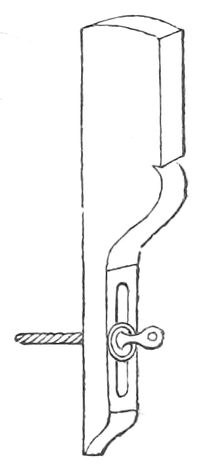
is a piece of wood two inches thick, four inches broad, and ten inches long, with a groove in the lower part of it by which it is screwed to the front of the off cheek, and may be heightened or lowered at pleasure; the top of it is a little bevilled or sloped off, that the bar may by its spring fly up the bevil till it stick.—M.
This catch is in my opinion superior to the one now used, which is a piece of wood nailed to the far side of the off cheek, with an opening in it, through which a sloping piece projects beyond the front of the cheek, for the bar to slide up. The old one appears much easier to justify, by means of the screw, without having any nails to draw.
In very fine press work, where uniformity of pressure is to be preserved, I would always cheek the bar, or bring it home, every pull, and rest a short time upon it. In large forms, however, this is too much exertion for a man to continue; and to obviate this objection I had a catch made for some wooden presses, which, dropping over the bar, held it close to the cheek, and enabled the pressman to rest upon his pull sufficiently long without the continued strain to his arm. It was screwed to the near cheek, and disengaged from the press bar, by pulling a piece of string attached to its other end through the small hole.

CATCH LINE.
The same as Direction Line. See Catch Word.
CATCH WORD.
The first word of the following page set at the right hand end of the line of quadrats at the foot of each page; in which line is also placed the signature in those pages where it is requisite. It is likewise called the Direction Word. Catch words are now seldom used, except in reprints, to preserve uniformity in the different editions of the same work.
CATECHISMS.
For the allowance of the duty on paper used in the printing of the Larger or Shorter Catechism of the Church of Scotland, see Paper.
CATER CORNER.
Paper, the sides of which are not at right angles with each other, is termed cater cornered. It is disadvantageous for book work, as it cannot be folded even, nor the outside margin made equal; of course the size of the book must be reduced in the binding to make the fore edge and foot of it smooth.
Cater, Theophilus. See Donations.
CERIPH.
The fine lines, and the cross strokes at the tops and bottoms of letters, are termed by the letter founders ceriphs.
CERTIFICATE.
By the act of the 39th Geo. 3. cap. 79., intituled “An Act for the more effectual Suppression of Societies established for Seditious and Treasonable Purposes; and for better preventing Treasonable and Seditious Practices,” it is enacted—
a. 23. “And whereas many Societies, established of late Years for treasonable and seditious Purposes, and especially the said Societies of United Englishmen, United Scotsmen, United Irishmen, and United Britons, and the said Society called The London Corresponding Society, and other Corresponding Societies, have at various Times caused to be published, in great Quantities, divers printed Papers of an irreligious, treasonable, and seditious Nature, tending to revile our holy Religion, and to bring the Profession and Worship thereof into Contempt among the Ignorant, and also to excite Hatred and Contempt of his Majesty’s Royal Person, Government, and Laws, and of the happy Constitution of these Realms, as by Law established, and utterly to eradicate all Principles of Religion and Morality; and such Societies have dispersed such printed Papers among the lower Classes of the Community, either gratis, or at very low Prices, and with an Activity and Profusion beyond all former Example: And whereas all Persons printing or publishing any Papers or Writings are by Law answerable for the Contents thereof, but such Responsibility hath of late been in a great Degree eluded by the secret Printing and Publication of such seditious, immoral, and irreligious Papers or Writings as aforesaid, and it is therefore highly important to the Publick Peace that it should in future be known by whom any such Papers shall be printed; be it enacted, That, from and after the Expiration of forty Days from the Day of passing this Act, every Person having any Printing Press, or Types for Printing, shall cause a Notice thereof, signed in the Presence of, and attested by one Witness, to be delivered to the Clerk of the Peace acting for the County, Stewartry, Riding, Division, City, Borough, Town, or Place, where the same shall be intended to be used, or his Deputy, according to the Form prescribed in the Schedule hereunto annexed; and such Clerk of the Peace, or Deputy respectively, shall, and he is hereby authorized and required to grant a Certificate in the Form prescribed in the Schedule hereunto annexed, for which such Clerk of the Peace, or Deputy, shall receive the Fee of one Shilling, and no more, and such Clerk of the Peace, or his Deputy, shall file such Notice, and transmit an attested Copy thereof to one of his Majesty’s Principal Secretaries of State; and every Person who, not having delivered such Notice, and obtained such Certificate as aforesaid, shall, from and after the Expiration of forty Days next after the passing of this Act, keep or use any Printing Press or Types for Printing, or having delivered such Notice, and obtained such Certificate as aforesaid, shall use any Printing Press or Types for Printing in any other Place than the Place expressed in such Notice, shall forfeit and lose the Sum of twenty Pounds.
s. 24. “Provided also, That nothing herein contained shall extend to his Majesty’s Printers for England and Scotland, or to the Publick Presses belonging to the Universities of Oxford and Cambridge respectively.”
s. 33. “And be it further enacted, That if any Justice of the Peace, acting for any County, Stewartry, Riding, Division, City, Borough, Town, or Place, shall, from Information upon Oath, have reason to suspect that any Printing Press or Types for Printing is or are used, or kept for Use without Notice given and Certificate obtained as required by this Act, or in any Place not included in such Notice and Certificate, it shall be lawful for such Justice, by Warrant under his Hand and Seal, to direct, authorize, and empower any Constable, Petty Constable, Borsholder, Headborough, or other Peace Officer, in the Day Time, with such Person or Persons as shall be called to his Assistance, to enter into any such House, Room, and Place, and search for any Press or Types for Printing; and it shall be lawful for every such Peace Officer, with such[164] Assistance as aforesaid, to enter into such House, Room, or Place, in the Day Time accordingly, and to seize, take, and carry away, every Printing Press found therein, together with all the Types and other Articles thereto belonging, and used in Printing, and all printed Papers found in such House, Room, or Place.”
FORMS.
“IV. FORM of Notice to the Clerk of the Peace, that any Person keeps any Printing Press or Types for Printing.
“To the Clerk of the Peace for ______ [here insert the County, Stewartry, Riding, Division, City, Borough, Town, or Place,] or his Deputy.
“I A. B. of ______ do hereby declare, That I have a Printing Press and Types for Printing, which I propose to use for Printing, within ______ [as the Case may require], and which I require to be entered for that Purpose, in pursuance of an Act, passed in the thirty-ninth Year of the Reign of His Majesty King George the Third, [set forth the Title of the Act.]
“Witness my Hand, this ______ Day of ______ .”
Signed in the Presence }
of _________________}
“V. FORM of Certificate that Notice has been given of a Printing Press, or Types for Printing.
“I ______ Clerk [or Deputy Clerk] of the Peace for ______ do hereby certify, That A. B. of ______ hath delivered to me a Notice in Writing, appearing to be signed by him, and attested by C. D. as a Witness to his signing the same, that he the said A. B. hath a Printing Press and Types for Printing, which he proposes to use for Printing, within ______ and which he has required to be entered pursuant to an Act, passed in the thirty-ninth Year of His Majesty’s Reign, [set forth the Title of the Act.]
“Witness my Hand, this ______ Day of ______ .”
CHALDEE.
The Chaldee letters, vowel points, and accents, correspond in every respect with those of the Hebrew in figure and power.—Bythner’s Lyre of David, translated by the Rev. Thomas Dee, A.B. Dublin, 1836. 8vo.
CHAPEL.
Every printing office is called a chapel. The term is supposed to have had its origin from the first introduction of printing into England by Caxton, who executed his works in a chapel adjoining Westminster Abbey. Moxon however gives a different account, for which see Ancient Customs.
A chapel, in the technical sense of the word, is when the workmen agree to certain rules for the good order of the printing office.
All the compositors in a composing room, and all the pressmen in a press room, who are journeymen, form the chapel in each department, (for they seldom unite,) in which one of the number is elected, during pleasure, as president, or The Father, as he is styled. In their assembled body they enjoin regulations, and enforce their due observance; they also take cognizance of any disputes, and any grievance that may be complained of, that arise within the chapel, when called upon for that purpose; and there is no appeal from their decision.
The chapel is in general sanctioned by the master printer, on account of some of the rules tending to the preservation of his property;—such as the infliction of a fine on any one connected with the house leaving the premises without putting out his candle or leaving it in charge, or for throwing types, quadrats, or furniture, at another; and for the regular despatch of business, so far as regards the forwarding of work in general—but in addition the workmen make particular regulations for themselves, with regard to their own mode of working in companionship, &c. The chapel will also, if appealed to, enforce these bye laws, if I may so term them.
The fine for leaving a candle burning, is, I believe, never remitted; it is generally sixpence for a workman, double for the overseer, and half a crown for the master of the house.
The person who first sees the candle extinguishes it and delivers the candlestick to the Father, who keeps it till the fine is either paid, or promised to be paid; for Monday is the regular pay day in a printing office.
There are frequently a number of devices resorted to to induce a workman to go out after the candles are lighted, for the sake of the fine—the open air being the boundary—such as saying, a person is below who wants to speak to Mr. ——; this is usually avoided by the party giving his candle in charge; that is, saying to some one, Mr. ——, take charge of my candle. This person then becomes responsible for the charge as well as for his own candle, and has to pay for both should he leave the house without putting them out, or giving them in charge to some other person.
I have previously said that the office of Father is during pleasure, although I am aware that Mr. Hansard, in his Typographia, has stated it to be otherwise; but I have known instances of the Father being deposed, after having held the office for many years, and a successor appointed and deposed within a fortnight, merely for the sake of the initiatory fine, which is usually a gallon of porter. These instances have occurred when a flush of business caused an additional number of men to be employed in a printing office; some of whom being of a thoughtless disposition, and thinking they could outvote the sedate and the sober part of the workmen, call a chapel for the most trivial purposes, which thus becomes a hinderance to business, as it takes the whole of the men from their work.
But this evil produces its own remedy, when it is carried to too great an extent. Workmen get tired of being called from their employment, and losing time continually, on trifling objects in which they feel no interest: and they check the evil by fining those who call the chapel, when it is evident that liquor is the motive for calling it.
I remember an instance when calling chapels had become a grievance from their frequency, in which the party was so completely checked, that he never ventured to call another. It occurred during a flush of work, when there were temporary hands employed, some of whom were partial to liquor, and eager to fine any one in order to obtain it. After deposing the Father two or three times, and calling chapels many times unnecessarily, a person left his candle burning one evening, and another passing his frame observed, Here’s a candle left; whose is it? The reply was, Mr.——’s.—If I had known that, I would have put it out. This was sufficient to bring the individual before the chapel, as it was held to be an attempt to defraud it of its due, of which the chapel is very jealous. Well, a chapel was called to take cognizance of the charge, without a doubt that they should levy a good fine for what they looked on as a great offence: but the established workmen of the house, and some of the additional men, had got tired of these repeated calls from their employment; and it being proved in the defence, that a party in the house had been for some time expressing a desire to fine this individual, who was of a warm temper, and had brought a charge against him for a thoughtless expression that was not acted on, the chapel decided that it was a conspiracy against him, acquitted him, and laid a heavy fine upon the accuser.
No person but the Father can call a chapel, which is generally held at the imposing stone: and when any one wishes to appeal to it, he[166] notifies the same to the Father, stating the objects generally, and accompanying the notification with a penny. The Father will sometimes decline to call the chapel, where the object appears trivial; but if the notification be accompanied with the value of a gallon of porter, it is imperative on him to call it, under the penalty of being deposed.
The chapel never assembles without the fee of a gallon of porter, in addition to the fine it may impose; and this fee is always paid, even when it assembles to settle any disputed matter between workmen, when no fine is levied.
If any workman refuses to attend when a chapel is summoned, after being called on by the Father for that purpose, the first business is to proceed to judgment on him for contumacy, which is always punished by a fine;—the chapel then proceeds to the business for which it was called, and when the members cannot agree in their decision, or when the matter becomes personal, they decide by chalking. For this purpose, a large galley is placed on a frame, in that part of the room which is most private and cannot be overlooked, and a line drawn down the middle of it, and at the top over each column is written for and against, or yes and no; one of the members then makes a mark, usually on the lenient side, which saves him from ill will, as it must be known on which side he gives his decision; the second generally marks the contrary side, so that the following persons cannot discover how any have voted. The Father, when all have chalked, examines the number on each side, and declares the judgment of the chapel.
It is an invariable rule that the chapel can do no wrong; and it is a crime to find fault with its decisions, which it would certainly punish with a fine if called on for that purpose, and the case was proved. All wagers of half a gallon of porter, or more, go to the chapel, so that they are never evaded, as the liquor is sent for by the chapel, which adjudges who shall pay for it: the consequence is, that when the object is to obtain drink, and perhaps a young man from the country to act on, who is ignorant of the London customs, the cases are often of the most preposterous kind; for instance, an experienced hand has been known to assert in such a case that a mallet was a planer, and to call it by that name, and then offer a wager, in support of his assertion, to the young man, who has accepted it. The chapel decided that it was a planer, and the stranger had to pay for summoning the chapel, and also the amount of the wager, by way of initiation.
The chapel also decides all disputes that may arise in the house, as well private, if it be appealed to, as those which may arise when two or more are employed on the same piece of work, and frequently fixes the price which shall be paid for it; for in doubtful cases a workman will prefer taking the collective opinion of his fellows, to acting on his own judgment, as it may affect them all. In this case the person who is on the work must not take less than the chapel fixes, without permission; and if the employer will not pay it, he, of course, must quit his situation. If, after the chapel has fixed a price for a piece of work, a man should venture to do it for a reduced price, he becomes a “Rat.”
In a press room there is sometimes a fine for men throwing water at each other, which dirties and spoils the paper;—and in hot summer weather, when a man has been desirous of a draught of porter, an instance has been known of his falling down in a pretended fit, and when another in kindness has procured some cold water and sprinkled his face with it, the other has jumped up and accused him of throwing water at him, on which he has had to pay the fine.
If any member of the chapel should be hardy enough to oppose its decisions, there are a number of ways practised to bring him, and even the most obstinate, to submission. Every chapel is haunted by an imaginary spirit, named Ralph; and when any person refuses to obey its mandates, this spirit begins to walk, as it is termed. The first act is, in general, to hide the offender’s composing stick; if this does not answer, his galleys are secreted; then the page cords, which secure his work, are cut, and his labour rendered more than useless, because he has to distribute his pie as well as to recompose his matter; if he still remains contumacious, the whole of the types in his cases are transposed, so that he cannot proceed in his business; and if he should still set the chapel at defiance, he is smoked, all the members of the chapel surrounding his frame, each with a lighted match of brimstone, and singing a doleful ditty; after this he is sent to Coventry, and every man becomes amenable to the chapel, if he assists him, gives him any information, or speaks to him; so that he must either submit to the penalties inflicted, or leave the house. When he submits, his apparatus is restored, and the types properly arranged again in his cases.
Apprentices never belong to the chapel; neither is the master of the house, nor the overseer, ever allowed to be present when one is held.
Many master printers are decidedly against chapels, as tending to encourage drinking, and the neglect of business; where this has been the case within my knowledge, the grievance has remedied itself, for the sober and industrious prevent the evil going to an extreme; and where there are a number of men employed, the majority will be found opposed to being called from their work repeatedly to decide on fractious or quibbling questions, in which they feel no interest; and by fining a busy meddling person, they put a stop to the frequent calling of chapels, which, as I have said before, are, generally speaking, promoted by temporary workmen, who seldom stop long in a house, and on whose departure the business is carried on in the regular manner, while, if one or two continue to work in the house, they soon fall into the old customs of the permanent men; for among the established workmen of a house chapels are seldom called.
It has also been objected to them that they tend to excite an opposition to the employer on the question of wages. This may have happened; but wherever I have seen a question respecting prices brought before a chapel, I have always seen it discussed in a fair manner, and the value estimated impartially,—the scale being kept in view for any thing nearly similar;—for among a number of workmen there will always be found men of principle, who would not sanction an unreasonable demand for the temporary advantage of a few shillings a week; and these men have always great influence in the decision.
Upon the whole, when I take into account the decreased risk from fire, owing to the fine for candles—the prevention of waste of materials, by throwing them about—the appeal for wrongs done in companionships, or for neglect, or throwing impediments in the way of business, and remedying them—I am of opinion that the advantages attending chapels outweigh their disadvantages, and that the business is carried on with more regularity and promptitude with them than without them, particularly when it is taken into account that the rules and regulations laid down by the employer for the governing of his house, are adopted by the workmen and become chapel laws.
As many of the customs of chapels are passing away, I have been rather more diffuse in this article than the mere definition of the term[168] might seem to require; but as I am not aware that any preceding writer has explained a chapel, I have been led to do so, that the knowledge of old customs might not be entirely lost. See Rules.
CHAPEL LAWS.
The regulations adopted by the men in chapel assembled, for preserving good order in the office, are called chapel laws.
CHARGE,
{ paper with great pages.
is to fill { a page with long and many lines.
{ a line with many letters.—M.
This term is not in general use: we are more in the custom of saying a full sheet, a full page, a full line.
Charitable Donations. See Donations.
CHASE.
An iron frame to fasten types in to print with.—M.
A great revolution has taken place with respect to chases. They were formerly made thin and narrow, but are now made thicker, which gives more safety to a form in quoining; and they are made much broader, both in the rim and the crosses, which adds to their strength and durability.
It is customary to dovetail the crosses into the rim of wrought iron chases, and to have mortises for duodecimos and eighteens, so as to move the crosses according to the size of the work for which the chase is wanted. This plan is convenient in many instances, but it is in many others inconvenient and wasteful.
It is necessary to have chases in an office with the crosses loose, to a limited extent, as they could not well be dispensed with on many occasions; but I would have as few as possible; for the mortises in the rim cut the quoins to pieces, and the loose crosses are frequently used for pokers, and for tightening quoins in forms when they get slack. By these means they are bent and destroyed, and the chases to which they belong are rendered nearly useless. The loose crosses have also another disadvantage: they frequently get mislaid or lost when taken out for folios, or broadsides, and when the chase is wanted for any other size, the cross cannot be found, and the compositor, or person who has the care of the furniture, is obliged to take such a cross as he can meet with, and which he can drive into the mortises with a mallet; this cross is sometimes of a different thickness from the right one, and affects the register of the pages in working, particularly if the furniture and the chase be transposed, as too frequently occurs through carelessness.
There is less waste and destruction when the crosses are rivetted into the rim; for the chases are then always ready for use—the crosses can never be mislaid nor destroyed—and the whole implement is much more durable than when the parts are separate.
Cast iron chases are now coming greatly into use, and answer the purpose very well. The crosses are fast, the whole chase being cast in one piece, so that there must be chases for each size, viz. folios, quartos, and duodecimos; the crosses fixed for these sizes will answer every other, except broadsides. They are cast from a card chase to the largest size; and stand locking up and the usual wear, without breaking. These chases are much cheaper than those made of wrought iron.
There are some chases now made with the inside of the rim bevelled off from the cross to the angle, to answer the purpose of sidesticks and footsticks; a piece of broad, or narrow, being used at the sides and feet of the pages. This plan appears to be economical with regard to furniture.
The usual practice in cutting chases for 18mo. is to place the long cross about one third of the width from one of the sides of the chase, and two thirds from the other, for the purpose of making it fall in one[169] of the backs; by this mode one of the quarters in the offcut has only two pages in it, so as hardly to admit of quoin room, the other has four; and the remainder of the form is also divided unequally, one side of the long cross having four pages, and the other eight pages. This method of imposing an 18mo. is inconvenient, and the large quarter is in danger of falling out. The plan appears to have been adopted merely to cause the long cross to fall in one of the backs, which is of no consequence whatever. I have always imposed eighteens in chases cut for 12mo. which I prefer; for the quarters being more equal, make the locking up more secure, and the only difference in the imposition is, that the long cross falls in a gutter, instead of a back.
Mr. T. C. Hansard took out a patent for “Improvements on, and Additions to, Printing Presses, and various Processes relative to Printing.” Among the different articles are chases, which Mr. Hansard thus describes:—“The Demi- (or half) -Chases are made so as to contain the pages imposed within a less measure of square than usual. One side of the rim is made particularly straight, and rather less in breadth than the other three sides: this narrow side forms the part to lie in the middle of the Table of the Press: by turning a pair of chases so made on contrary faces, the two narrow sides will join and form as one chase. The pages are not in these chases, as in others for all sizes above Folios, locked-up by having side sticks and quoins on all four sides, but only on one side, and at each end. The inner Forme being locked up on the right side only, and at each end, and the outer Forme on the left side only, and at each end; and the margin being made when the two demi-chases are laid together on the Imposing Stone, as if the same were one large chase of double dimensions, the pages will require no more margin in the centre of the double sheet, than a fair equal proportion for the division of margin. The chases must be made in proportion to the size of the work intended to be executed.”
CHEEKS.
The upright sides of a printing press.—M.
CHEEK THE BAR.
Pulling the bar of the press till it touches the near cheek. In good work I would always have the pull so justified that when the bar was pulled home, or cheeked, it should occasion the proper degree of pressure of the platen upon the form; this would in some degree assist in procuring equal impressions through all the copies printed; but in heavy or large forms it would be too great an exertion for the pressman to continue doing without some assistance, as such work requires to rest on the pull. I adopted a catch for the bar when cheeked, in some presses, which completely answered the purpose, and enabled the pressman to rest on his pull as long as was necessary, without overstraining his arms. See Catch of the Bar.
Chemistry. See Elementary Substances. Formulæ, Chemical.
CHOKE.
If a form be not washed in due time, the ink will get into the hollows of the face of the letter: and that getting in of the ink is called Choking of the Letter, or Choking of the Form—M. It is also said, the letter is choked with ink, or the form is choked with ink, when too much is used.
Cimbric. See Runic.
Circumflex. See Accented Letters. Caret.
Cities and Towns, Ancient Names of. See Names.
CLAW
of a sheep’s foot. The end to draw the ball nails out of the ball stocks.—M.
Claws, for Stereotype Risers. See Risers.
CLEAN PROOF.
When a proof has but few faults in it, it is called[170] a Clean Proof.—M. It is also called a clean proof when it is printed after being corrected, to be sent out, or to be read for press—that is, the pressmen take more care in printing it, and keep the margins clean.
CLEAN SHEETS.
Authors and publishers have generally one copy of each sheet of a work sent to them as it is printed, for the purpose of reference, and to see the progress of the work; these copies are called clean sheets. See Tops.
CLEARING AWAY.
When a work is completed, clearing away is the distributing of headlines, chapters, lines of small capitals, and other useful sorts, taking the lines of quadrats away, and tying up the remainder of the matter in moderate sized pieces with old page cord, so as to be ready to be papered up; and tying the furniture, reglets, and leads up, and delivering them to the proper person, who takes charge of them.
The compositor, after laying up the form to be cleared away and washing it well—and matter ought never to be cleared away without undergoing this process—takes a page into a galley—an old one generally—and picks out the leads, if it be leaded matter; he will then push the matter up from the foot and put another page on his galley, and take the leads out of it also; he will then take the headlines away, and put them on another galley; then take the lines of quadrats and reglets out, and put them on a paper under his frame, then the chapters, contents of chapters, any lines with words of Greek, or other useful sorts, and, after pushing the matter close up together, he will tie it firmly up, in pieces rather longer than a full sized octavo page, and if a short line happens to fall at the bottom, put it in some other situation, so that the top and the bottom shall be full lines. He will thus proceed, till his sheet or other quantity be all tied up, taking care to make his pieces of equal lengths, for the convenience of piling them up in the letter closet.
If the work should be in very small pages, so that two in width would not be wider than a large octavo page, he will put two together, side by side, to prevent papering the matter up in long narrow slips.
Having tied all the matter up for papering, he will either place it on a board in a rack, or put it in some other place where cleared away matter is usually deposited till papered up; he will then distribute his headlines, chapters, contents, and other useful sorts into their proper places; and if there be not room in the cases for the quadrats, he will put them into the proper drawers in which the surplus quadrats are kept.
If the work be in folio or quarto, he will tie it up in proportionally sized pieces.
He will then tie up his leads; and if there be any of different thicknesses, he will, of course, assort them, and tie them up separately: he takes a moderate quantity, if they be octavo leads, rather more than the length of a page of matter, and places a piece of reglet at each end of it, to guard the outside leads from injury by the tightening of the cord, and making a slip knot at one end of a piece of old page cord, he places the leads in the noose, and draws it as tight as the cord will bear, then turns the leads over upon the spare cord and draws it tight; he thus proceeds turning the leads over upon the spare cord, and drawing it tight, till he has got turns sufficient round the leads to secure them, and tucks in the end of the cord under the turns two or three times, drawing it tight; he knocks up the ends of the leads upon the imposing stone, gently, not to injure them, and when he has thus tied them all up, he puts them along with his matter.
He ties his reglets up in the same manner, and puts them with the leads.
He puts the quoins into the quoin drawer.
He inquires of the proper person whether the furniture is to be tied up, or put into the drawers; if the latter, he assorts it—side and foot sticks, gutters, broads, narrows, reglets, and scaleboards, and puts each into its separate drawer; if it be to be tied up, he puts the scaleboard into its proper drawer, and arranges the others neatly and ties them firmly together with old page cord, and delivers them and the chases to the proper person, who may be either the overseer, or some person appointed to take care of the materials.
CLEARING PIE.
To separate from each other in the confused mass, and assort the different kinds and sizes of types, and to distribute them into their respective cases; if there be a large quantity of any particular fount, or founts, it is usual to compose them into pages, and, if the letter be not wanted, to paper it up; when that fount is brought into use, a proportionate quantity of pie is given to each compositor to distribute.
This is generally the work of the apprentices during any slackness of business. A quantity of pie is placed on the imposing stone, or, if that cannot be spared for the purpose, on a letter board upon a bulk, and each fount is separated from the other; they are then composed into lines, and either distributed or papered up: although it may appear a roundabout way to compose it, it in reality saves time, as the composed matter is distributed with greater facility. In large establishments the reading boys assort pie at their leisure time.
CLEARING STONE.
It is a general rule that every person shall, under a penalty, after imposing or correcting, leave a clear stone; that is, the mallet, shooting-stick, furniture, quoins, saw, sawblock, and shears, are to be put in their proper places; any good letters that may be scattered about, distributed; and the bad letters put into the shoe, so that there shall be no impediment to the next person using it. Any of the articles used, or two letters, left on it will render him liable to the fine.
CLICKER.
The compositor who, in a companionship, receives the copy from the overseer or other person, gives it out to compose, receives the matter back when composed, keeps an account of what each person does, sets the head and direction lines, and the notes if any, makes up the pages, lays them down on the imposing stone, and makes out the account, apportioning to each his proper share; his own share of the bill being always equal with the highest: this refers to working on lines. In other companionships he receives the copy from the overseer, distributes it to his companions, and receives instructions how the work is to be done.
CLOSE MATTER.
Matter with few breaks or whites—M. The term is now understood of works that are not leaded. See Bad Work.
CLOSE SPACING.
This term is used when only a middling space is put between words, and sometimes a thin space; for some authors will not allow words to have much space between them, but only just enough to separate them from each other, in which case a thick space is never exceeded.
Close Work. See Close Matter.
CLYMER’S PRESS.
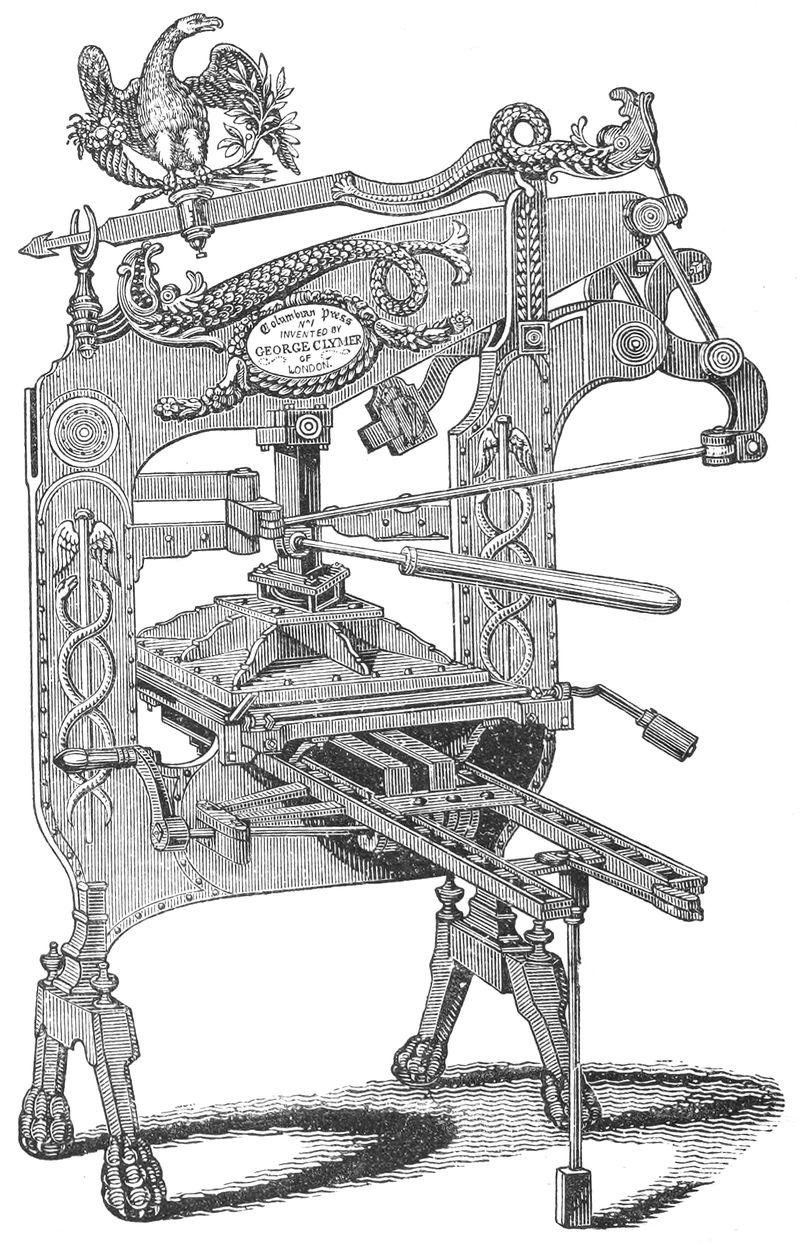
Mr. George Clymer, of Philadelphia, first began to turn his attention to the improvement of the printing press in the year 1797. Having completed his object, he came to England in 1817, and introduced his improved press under the name of the Columbian Press: he established a manufactory in London, and the first press he constructed here was completed in 1818, and I believe went to Russia. It is an iron press; there is no screw; the head is a large and powerful lever, which is[172] acted on by other levers to which the bar is attached, and produces the pressure; the platen is attached to the head by a square bar of iron, and the descent is preserved steadily and regularly by two projecting guides, one from each cheek; the platen is raised from the form by a lever with a weight at one end, attached to and above the head, which acts when the pull is eased and the bar flies back. The power of this press is very great, and I have not heard of any failing or breaking, which is an important fact in its favour. It ranks in the opinion of practical men, generally, as the next in estimation to the Stanhope press. The only objection I have[173] heard to this press, was the length that the pressmen had to reach, and the disadvantage in the pull, by the bar being attached to the off cheek; but Mr. Clymer remedied this by attaching it to the near cheek, which not only facilitates the pull, but also enables the pressman to exert his strength more advantageously and with more ease. Mr. Clymer died in 1834, but the manufactory is still continued in Finsbury Street under the firm of Clymer and Dixon. I believe the representative of Mr. Clymer is Mr. A. R. Shaw, who married one of his daughters.
COCK-UP LETTER.
It is not unusual to begin a work, and the divisions of it, as Parts, or Books, with the first word set in capitals, and the first letter a larger capital, justified to range at the foot with the others, and bearing about the same proportion to them that capitals bear to their own small capitals; whatever proportion there may be between the first letter and the other part of the word, if it be justified to range at the foot, it is styled a Cock-up Letter.
COFFIN.
That part of a wooden press, in which the stone is bedded.
Type Founders usually send small quantities of sorts in brown paper made into a cone, and twisted at the small end, similar in shape to what grocers use for small articles; where there are no fount cases, or where they are full, compositors do the same with superfluous sorts; these conical papers are called Coffins.
The frame and bottom of a slice galley, into which the slice slides, is also called the coffin. See Galley.
COGGER’S PRESS.
The cheeks of this press are of wrought iron, the head is of cast iron, very strong, and secured in its place by screws and nuts, and appears sufficient to bear the greatest power that can be applied in the ordinary process of printing, without injury. The pressure is obtained by a spindle with a screw working in the head, and at the bottom of it is a collar in which are fixed two studs of case-hardened iron with convex faces, which act upon two inclined planes of unequal degree of inclination; so that, when the platen first begins to descend, the descent is quick, but as the platen reaches the point of pressure, the velocity is diminished and the power proportionably increased, till arriving at a part of the plane nearly horizontal, and the levers taking the most advantageous positions, the highest degree of pressure is obtained. The inclined planes are of hard steel, dovetailed in the bottom of a circular brass box resting on the centre of the top of the platen; it contains oil, so that the studs dip into it every pull. The power is obtained by the bar being attached to a multiplied cross arm lever. Should the inclined planes break, or be injured, they can easily be taken out and replaced with new ones.
COLLATE.
To examine the signatures in each gathering, to see that they are right and perfect. Moxon styles it Collation Books.
The person who has to collate, (generally the Warehouseman, as he is answerable for the correctness of the delivery of books,) takes a heap of a gathering and places the first or signature page uppermost, towards his right hand, and with the point of a sharp bodkin, or a penknife, picks up the corner of each sheet, in order to see that each signature is right, passing his thumb under them as they rise, to keep what he examines separate from the heap, and thus proceeds till he has examined one gathering; he then slips this gathering a little back on the heap, and proceeds with another, till he has gone through eight or ten, which he turns over to his left hand upon the table, where they are ready to fold; and he thus proceeds till he has collated a sufficient number for his delivery, or the whole number of the work, as the case may require.
In the course of his progress he will find some sheets laid the wrong way, these he puts right; in some cases the boys will have taken two sheets of the same signature up, he takes one of these out; in other cases, there may be duplicate signatures, and the right one in order wanting; he calls out to the gathering boys to give him the right sheet, and draws out the duplicate as before, and sometimes a signature is wanting, which he also calls for. In these cases the wrong sheets that are taken out of the gathering are called Drawn Sheets, and are laid down on their respective heaps, to be re-gathered.
Although not customary, I have known a warehouseman use neither a bodkin nor a penknife, but slip up the corner of the sheet with the end of his forefinger, in order to examine the signatures: any one who adopts this practice should be particularly careful to have clean fingers, or he will soil the corners of many sheets, and disfigure his work.
Colon. See Punctuation.
COLOURS.
In Hayter’s “Introduction to Perspective Drawing and Painting,” is a diagram of the three primitive colours, with their combinations, which show the best contrasts. He says, this is highly useful for a painter to understand: and I think it is highly useful for a printer also to understand; for it will enable him to make the best disposition of colours in printing so as always to produce a superior effect to what could be done without the guidance of a correct principle. I shall give the passage.
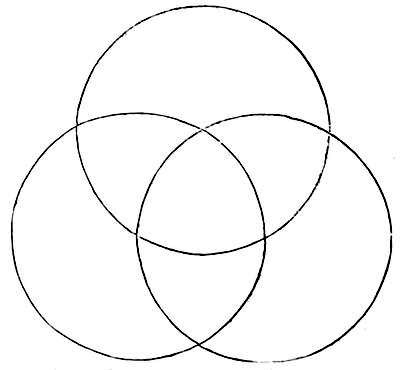
“You may try another experiment in proof of the primitive superiority of red, yellow, and blue, over all other colours. First draw a circle; then, with the same opening of the compasses, set one foot on the circumferent line, and draw a second circle; and again, with one foot of the compasses on the point where the two circles bisect, draw a third; cover one whole circle with yellow, another with red, and another with blue (letting each dry before you lay the next); the colours intermixing by the equilateral intersection of the three circles, will produce green, orange, and purple; and the central portion, taking all the three colours, will be neutral of the black class, and nearly black, according to the strength of the three separate lays of the primitive colours. By this diagram you will have a certain proof of the colours which are most adapted to oppose each other, from which the knowledge of their harmonizing properties may be derived. You will find a primitive colour always opposite to a compound one; as, blue will be opposite orange, red opposite green, and yellow opposite purple; which must determine them to be the natural opposites: this is highly useful for a painter to understand.”
Columbian Press. See Clymer’s Press.
COMB WOOL.
The same as Card Wool, which see.
COME DOWN.
The toe of the spindle is said to come down by pulling the bar: so is the bar when it is pulled near the hither cheek: also, the Pressman is said to come down the form with his balls.—M.
COME DOWN THE FORM.
Beating from the off side to the near side of the form is termed Coming down the form.
COMES OFF.
A form that receives a good impression, Comes off well, if a bad impression, it Comes off ill, or it Comes not well off. Also a phrase used in gathering of books; for a heap that is gathered off is said to come off.—M.
Comma. See Punctuation.
COMMON PRAYER.
For the allowance of the duty on paper used in the printing of Books of Common Prayer, see Paper.
Commons, House of. See Privilege.
COMPANION.
Two pressmen working at the same press call one another Companions.—M. Two or more compositors employed on the same piece of work also call each other Companions. Both parties frequently abbreviate the word, and call each other Comp.
COMPANIONSHIP.
When more than one compositor is employed upon any work it is styled a companionship.
There are different ways of working in companionships: one is, for each to work on his own account, to write his own bill, charging what he has done, and correct his own matter. At other times all the individuals work is charged and received in gross in the name of the companionship, and the division into the respective earning of each is made by the clicker.
In this case, to prevent unfairness, arising from any of the companions taking an undue advantage over the others, the copy should be strictly kept from their inspection, and a stated quantity invariably given out for each when any of them are out of copy, and not before; by this means each of them will have an equal chance for any fat that may occur. I have found in practice this method to be the fairest for all the individuals.
Another method is working on time or in pocket, where each individual exerts himself to further the work in any way that appears to the clicker the best, either composing or correcting, as the case requires. In this form of companionship the whole of what is done is written in one bill, and equally divided among the companions, provided they have been punctual in their attendance, and have not taken more than the prescribed time for their meals, &c.; otherwise they are subject to fines for infraction of the rules agreed to for their guidance.
As it often happens that a work is required to be printed with the greatest possible despatch, the plan of working upon Lines is frequently adopted, which is found in practice to be the most expeditious method of facilitating the work at case.
As soon as a work that requires despatch is put in hand, the overseer selects such men as are able to complete a great quantity of work in a given time, and appoints one of them who thoroughly understands his business, and is in other respects qualified, to undertake the management of the work, and to do every thing which would interfere with the regular business of distributing, composing and correcting. This person is styled the clicker.
While the companionship proceeds to the distribution of letter, the clicker applies to the overseer for the copy, receives instructions respecting it, and procures leads and every other necessary sort. He then draws out a table in the following form, or something similar.
In the first column he sets down the name of each compositor when he takes copy; and in the second the folio of the copy, that he may be able to ascertain instantly in whose hands it lies. In the third column he notes down the number of lines each man has composed opposite to his name, as fast as the galleys are brought to him. In the fourth he[176] sets down such remarks respecting the copy, &c. as may be necessary, and also any circumstance that may occur in the companionship.
| Compositors Names. | Folios of Copy. |
Lines composed. |
Memoranda. |
When the members of the companionship are ready for their first taking of copy, they are to receive it from the clicker in small quantities, taking care that the two first have shorter takings than any of the others, to prevent as much as possible any delay in the making up. During the time the first taking is in hand, the clicker sets the head, the head lines, white lines, signature lines, together with side notes, and other extraneous matter.
As soon as the first person brings him his matter, he counts the number of lines, and inserts it in the table; he then gives him another taking of copy, and proceeds with the making up. The same plan is observed with the rest of the companionship.
When the first sheet is made up, he lays the pages on the stone, and informs the overseer of it, who will then immediately provide chases and furniture.
The work will now proceed rapidly, provided there be no hinderance with respect to letter, &c. If the clicker find that he cannot make up the matter as fast as it is composed, he should call the companion who is last in copy to his assistance. In this case the clicker counts the lines he has composed, sets them down in the table, and takes notice of the time he is off, which is to be made up to him by a deduction from the share of each person.
The proofs should be read immediately after they are pulled, and given to the clicker to be corrected. As soon as this is done, he gives the proof to the compositor whose matter stands first, who should immediately lay up the forms and correct his matter, then forward it to the next, and so on, till the sheet be corrected; the compositor whose matter is last in the sheet then locks it up, and carries the forms to the proof press.
As soon as one of the companionship is out of copy, and there is no more to be given out, the lines of the whole must be counted off, and set down in the table, and then every one does as much as he can for the general benefit. If there be not work enough to employ the whole, those who are not wanted may go to their regular work, and the time of their absence, till the rest of the companionship return to theirs, will be deducted from their respective shares.
In the outset the value of the lines is calculated, so that each of the companionship shall be paid, in the first instance, for what he composes:[177] the head and direction lines, the white lines, the branching out, the short pages, and the white pages, are termed fat; these the clicker sets, they are included in the general account, and the amount divided among the companionship. By this means each compositor will receive a share of the whole, according to the number of lines he composes, and an equal share of the fat, and the clicker’s share of the bill must be equal to that of the person who has set the greatest number of lines.
If leads, or any other materials, run short, a clever and active clicker will not wait for a supply from the overseer, who may be prevented attending to him at the moment, but will immediately forage for them himself, well knowing that expediting the work is for his own advantage as well as for that of the companionship.
Those companions who do not compose half as many lines as the compositor who has the greatest number, receive only a share of the fat equal to one half of what those do who have worked regularly; and those who do not compose more than one quarter, only receive equal to one quarter of a regular share.
Comparative Size of Types. See Types.
COMPOSING.
The term composing includes the practical knowledge of picking up letters, spacing, justifying lines, and emptying the composing stick when full.
Although expedition is a most desirable qualification in a compositor, yet alone it is far from constituting a good workman: and the man who possesses no other claims to the title will be found competent to little more than setting reprints, in which no judgment is required, and where he has only to arrange letter for letter, point for point, and line for line; on which employment he may whistle, sing, talk, or laugh, without inconvenience to himself; for the process being merely mechanical, and the mind not being occupied in the smallest degree, if he make a mistake of a word, it will be detected at the end of the line; or, if there be a double, or an out, of lines, either will be detected when the page is finished.
How different is the case with the man who is anxious to deserve the title of a good workman, and to maintain it: in his youth he has been equally desirous with the other to acquire expedition; and, having attained it, he has felt that other requisites were necessary;—he has read, to obtain information—he has examined the best workmanship, as specimens for his guidance—he endeavours to compose accurately—he is careful and uniform in his spacing—he justifies his lines to an equal tightness—he divides his words, when necessary to divide them, correctly, and with a regard to appearance—and when occasional bits of rule work occur, they are marked by a degree of neatness in being cut to precise lengths, and in the corners fitting with precision—in all the work that passes through his hands there appear the marks of attention and skill.
When a master printer undertakes a work which requires more than ordinary care, and is difficult to execute, the superiority of the man who has endeavoured to improve himself is evident: he is selected to perform it; and he then feels the advantage of his perseverance. At work upon a difficult subject, with an ill written manuscript, his first proofs show him equal to the task—his arrangements of the matter are judicious—his punctuation is correct—when particular sorts are to be justified, they are done with accuracy—when an accented letter is required that cannot be procured in a single type, he makes it with neatness—and when his proof returns from the reader, he will frequently correct it in as little time, as a slovenly compositor will require to correct a proof of a similar size, that is a reprint.
The results to the slovenly and the good compositor are very different. The first is only employed during a flush of work; when that ceases, he has to seek fresh employment; perhaps does not meet with any for some weeks; again obtains a temporary engagement; and thus continues, till old age approaches, and he is rendered incapable of working. The good workman, on the contrary, is prized by his employer, especially if the latter be a workman himself, and a man of judgment. He is looked up to by his fellow-workmen; his situation is permanent, if he choose; his abilities qualify him to be a reader, and if his mind lead him that way, he may obtain such a situation. His knowledge and his merit fit him to become the overseer of a large house; where he has many advantages, and where he continues with credit to himself: unless, perhaps, he chooses to commence business on his own account, which is frequently done, when he invariably obtains the countenance and support of those who have witnessed his skill, his knowledge, his attention, and his industry.
There is another class of compositors who neither possess much skill; nor are very expeditious: I mean such as are of a sober, steady habit. These are useful men in an office where there is a number of reprints; they go on from year to year in a regular routine, and never step out of it: the employer can always depend on them for a regular amount of work, if they have sufficient employment.
There are too many, both good and bad workmen, who lose their time in drinking, gaming, and other vicious and idle pursuits: such persons pay doubly for their dissipation, for they squander the fruits of their earnings, and cut off the source of supply, by neglecting their employment. These men will never be employed in any respectable printing office, where they are known, except on a temporary engagement in a case of emergency. They introduce strife and discord wherever they are, and frequently lead astray the inexperienced youth: they disregard equally instruction and advice, and are not awakened to a sense of their condition, till the most severe lessons in this world are unitedly experienced—old age, poverty, and contempt.
The mere art of picking up letters, and arranging them in the composing stick, is looked upon by many compositors as constituting the whole of their business; who in consequence think that if they can succeed in picking letters up with facility, they become first-rate workmen; and the terms “Swifts,” and “Fire Eaters,” by which expeditious compositors are designated in a printing office, gratify their vanity.
It is not necessary to give specific rules, and a minute description, of the manner of picking up each letter, because it is impossible for them to hold good, the letters lying in every possible direction. A few general rules may suffice—to take up the letter at that end where the face is—if the nick be not upwards, to turn it upwards in its progress to the composing stick—to convey it to the line in the composing stick with as few motions as possible—to aim at no flourishes with the hand, which only lose time.
I would advise an inexperienced youth, when he comes to work among a number of men, to observe the manner of one of the best and quickest compositors: he will, perhaps, at first conclude that he is looking at a very slow workman, for the first appearance is fallacious; but when he examines more closely he will find his mistake, for what he at first took for slowness is the true principle of expedition; he will perceive no false motion, which invariably delays progress; the fingers go to one particular letter, take it up, convey it to the line direct, while the eye is directed to another letter which the fingers convey in the same manner to the line; thus letter after letter accumulate to words, lines, and pages,[179] with a quickness that looks like magic, while to the spectator it seems to be only the pace of the tortoise. Let him look at another; there appears all bustle, all expedition; the body and head in continual motion; the hand so quick in its evolutions, that he gazes with astonishment on the apparent rapidity of arranging the letters: let him look again with more attention, and he will find that the man whom he supposed so slow makes no mistake, loses no time, but continues steadily and uniformly making progress: while the other frequently misses taking hold of his letter; then makes two or three flourishes with his hand and his head before he takes hold of another; and then his hand continues dancing and see-sawing, and after three or four of such motions, made with great rapidity, the letter is finally deposited in the line. This manner of lifting the letters is in reality the pace of the tortoise, although it has the appearance of the speed of the hare.
Regularity of spacing, and a due proportion of distance between words, contribute in a material degree to improve the appearance of a book.
When the lines are very short, or the type very large in proportion to their length, all general rules, both of dividing and spacing, must give way to necessity; for in such cases it is impossible at all times to space regularly, or to divide the words correctly.
There is a great diversity of opinion with respect to spacing; some authors and printers choosing to have the words wide apart, and others, on the contrary, preferring to have them nearly close together; the one, requiring an en quadrat, or two thick spaces, and the other, a thin space only, between the words. Both of these, in my opinion, go to an extreme: I prefer using a thick space generally, and justifying with thinner and hair spaces; so that there will rarely be a necessity for any violent inequality in the distance of the words from each other.
When a work is double leaded, or has reglet between the lines, it requires to be wider spaced than when it is solid: in the two first cases, two middling spaces, or a thick and a thin space, will not be too much; in the latter, a thick space will be quite sufficient. And it is necessary to attend to these circumstances; for printing that is open does not harmonize when close spaced, any more than solid matter does when wide spaced, which makes it look full of pigeon holes; for the distance between the words should bear some proportion to the distance between the lines.
When one or two letters require to be got in, or to be driven out, the difference between a thick space and a middling one is not perceptible to the eye, particularly if the compositor is careful to place the latter before or after a v or w, after a comma that comes before a v or w, or after a y; and, in like manner, an additional hair space will not be perceptible if it come after an f, or before a j; or if it come between db, dh, dk, dl, lb, lh, lk, or ll.
The most expeditious mode of regular spacing, perhaps, is to take the spaces as they rise; for there being in the box only three sorts, the thin and the hair spaces being in separate boxes, there will not be any violent disproportion if the line should be full at the first; and the slight disproportion may be easily remedied by changing the situation of two or three: if the line should not be quite full, then the introduction of a few thin spaces will equalise the distances; or the substitution of a few thick spaces for middling ones will have the same effect.
In setting a line of capitals, a careful workman will pay attention to the bearing off of different letters, for many of them when they fall together stand as if there were a space between them, and produce a bad effect: to remedy this inequality, hair spaces, or bits of paper, are required[180] between those letters that stand close. The inequality is still greater in many instances in a line of Italic capitals, and of course requires the same remedy.
It would be desirable, and would tend to facilitate regular spacing, if there were a greater number of hair spaces cast to a fount than is now the case.
In poetry, the size of the type and the measure are usually so arranged as to admit the longest line to come into the measure, without having occasion to turn it: an opportunity is thus allowed for regular spacing, which is generally done with thick spaces. When a work in poetry is commenced, it is usual for the compositor to divide his space box up the middle with a piece of reglet, or with a piece of thin wood, made to fit tight, and to assort his thick spaces on one side, and the thinner on the other, to save time and trouble in picking them out
As the measure for poetry is sometimes made as narrow as will conveniently allow the regular lines to come in, both to save quadrats, and also to lessen the price of composing, it not unfrequently happens that a line containing long syllables will not admit of thick spaces; in this case, the usual practice is to space close, and get in the line if possible, even with hair spaces, for turning it is attended with inconveniences; the page must be made up short, or long, to preserve the couplets, and it affects the next page, in preventing the stanzas backing each other.
A compositor will always find it advantageous to justify his lines to an equal tightness; and of this he must be sensible when he has to lock up his form: if he have been careless in this instance he will experience a loss of time and find a difficulty in getting his form to lift; and when it does lift, by means of sticking his bodkin into quadrats and spaces to tighten those lines that are slack, it will never be safe; for it is more than probable that many letters will draw out at press, and cause errors in that sheet, (for pressmen are generally careless how they replace a letter that has drawn, and, when it is discovered, they are satisfied if they put it into the right word,) the pressmen scold the compositor, who also, if he be working in a companionship, and should not be the last in the sheet, gets scolded by the compositor who has to lock up the forms, for his carelessness, and for the additional trouble which it causes.
I would avoid having a lower case f at the end of a line; for, being a kerned letter, the dot at the end of the curve is almost sure to be broken off while the sheet is being worked at press.
It is not possible to give particular rules for justifying all the sorts that occur in many works, and that are not in a printing office:—for a Ç, it will be necessary to cut away the shank to the bottom of the face of the letter, and justify a figure of 5 with the top back dash cut off; a long m̄, n̄, or any other letter, must be cut away to the upper part of the letter, and a small lower case l, with the fine lines cut away, fixed flat above; a short y̆ may be made by taking the bottom of an o; m̃ and ñ by cutting the front of a small a away, and laying it lengthways; ŵ and ŷ by inverting a lower case v, after cutting away the cross lines, and making the thick line equal to the fine one with a sharp knife.
Cutting away the shank allows the additional part to stand close to the face of the letter, which improves the appearance. In some instances it will be necessary to cut part of a lead away above the letter, and justify the addition in the vacancy. The compositor should, by all means, be careful to justify every sort that is added so tight as to prevent it from drawing out at press; but not so tight, as to force the words above and below out of line; in fact, they ought to be so managed as, when[181] justified to the letter, to form unitedly its regular body in depth when it is practicable.
The compositor should also be careful to proportion the size of the accent or mark to be justified to the size of the letter, that there may be no disproportion between them.
I would recommend to every compositor when he goes to a fresh house, where it is likely he may work some time, to ascertain what founts are in the house, with the two line letters, blacks, flowers, &c.: this knowledge will give him facilities, and enable him to compose a title, or a job, with less sacrifice of time, than if he were not acquainted with the materials contained in the office.
COMPOSING RULE.
A piece of brass rule cut to the length of the measure, with a small ear or beak projecting at one end, by which to take it out. This rule is laid in the composing stick, and the letters arranged upon it; when the line is full, the rule is taken out by the projecting part, and laid upon the line composed, and this process is continued till the stick is full, when the rule is laid upon the last line as before, the whole of the matter in the stick is then grasped tight with both hands, (the rule preventing it from bursting,) taken out of the stick, and deposited in a galley.
COMPOSING STICK.
The instrument in which the letters are arranged into words and lines. It is generally made of iron, sometimes of gun metal, and long ones for large jobs occasionally of wood.
When made of iron it is formed of a piece of sheet iron, one side turned up nearly half an inch, at a right angle, which forms the back, and when that is turned to the workman at the right hand extremity an end is fitted to it, by screws, rivets, or dovetailing: this end is iron, considerably thicker than the bottom and back, and is soldered in its place to give it strength and stability.

There is a slide by which the length of the lines is regularly justified, which is fixed to the back by a nut and screw passing through a groove in it, and secured in its place by the screw passing through one of the holes in the back, by which means the length of the line can be arranged according to the size of the page. The end of the stick, and also of the slide, must form a right angle with the back, and be parallel to each other, otherwise the lines will be of unequal lengths, and cause much trouble. The English composing sticks generally hold from nine to eleven lines of pica. The French printers use much narrower ones, frequently not holding more than three lines.
Composition. See Rollers.
COMPOSITOR.
He that composes or sets the letters.—M. See Composing.
COMPOSITOR’S BOOK.
To prevent mistakes, confused bills, and disputes in companionships, and with the employer, it is essentially necessary that a compositor should keep an account of the work that he does, and it is still better that he should be able to ascertain on the instant how much he has composed of any work that he is employed upon; the quantity in each signature; the number of pages charged, and in what signatures; and the forms he has imposed, and the signatures. The following form, it is presumed, will accomplish this object in a simple and easy manner.
| Title of the Work. | |||||||||
| Sig. | Set. | Charged. | Imposed. | Sig. | Set. | Charged. | Imposed. | ||
| A | Set in all. | A | |||||||
| B | Sheets. | Pages. | B | ||||||
| C | C | ||||||||
| D | D | ||||||||
| E | E | ||||||||
| F | F | ||||||||
| G | G | ||||||||
| H | Charged in all. | H | |||||||
| I | Sheets. | Pages. | I | ||||||
| K | K | ||||||||
| L | L | ||||||||
| M | M | ||||||||
| N | N | ||||||||
| O | O | ||||||||
| P | Imposed. | P | |||||||
| Q | Forms. | Q | |||||||
| R | R | ||||||||
| S | S | ||||||||
| T | T | ||||||||
| U | U | ||||||||
| X | X | ||||||||
| Y | Y | ||||||||
| Z | Z | ||||||||
Compositors’ Prices. See Scale of Prices.
CONDITION.
Balls are said to be in condition, or good condition, when they lug, and the ink is distributed easily and uniformly on their surface; that is, when they are neither too hard nor too soft: when they are either the one or the other, they are said to be in bad condition. See Balls. This also applies to rollers.
Paper is said to be in good condition when it has received a proper degree of moisture, been laid a day or two between the boards or in a heap, with weights upon the top board, then turned, which changes the parts is contact, and replaced under the weights for another day, so that the moisture shall be uniformly diffused and equal through the whole quantity of paper to be printed.
CONFESSION OF FAITH.
For the allowance of the duty on paper used in the printing of the book known by the name “The Confession of Faith,” see Paper.
CONTRACTIONS
used in Domesday Book and ancient Records. See Domesday Book. Records.
COPE’S PRESS.
The Albion. This is the production of Richard Whittaker Cope, and is an iron press. The power is produced entirely by levers, which, by means of two strong iron links attached to the head, and working at the bottom on what is called the lugs, communicate the power to the platen, and thus produce the impression: on the return of the bar the platen is lifted from the face of the types by means of a spiral spring fixed on the head of the press. I have repeatedly broken the links, when they were guaranteed to withstand any force in working the press that could be applied to it. On the death of Mr. Cope, the business was continued by trustees for the benefit of the family, and is under the immediate management of Mr. John Hopkinson, who has very much improved this press by taking away the links, and remodelling it: the principle, on the present construction, is the same as that of Sherwin and Cope’s Imperial press, with some variation in the application of the cap or knuckle, and also in the adjusting wedges, the screw of which to regulate the pull is at the near side of the piston.
COPTIC.
The Copts are undoubtedly descendants of the ancient Egyptians; but not an unmixed race, their ancestors in the earlier ages of Christianity having intermarried with Greeks, Nubians, Abyssinians, and other foreigners. Their name is correctly pronounced either Ckoobt or Ckibt; but more commonly Goobt or Gibt, and (in Cairo and its neighbourhood, and in some other parts of Egypt,) ’Oobt or ’Ibt: in the singular, it is pronounced Ckoob´tee, Ckib´tee, Goob´tee, Gib´tee, ’Oob´tee, or ’Ib´tee. All of these sounds bear a great resemblance to the ancient Greek name of Egypt (Αἰγυπτος): but it is generally believed that the name of “Ckoobt” is derived from Coptos, (once a great city, in Upper Egypt,) now called Ckooft, or, more commonly, Gooft; to which vast numbers of the Christian Egyptians retired during the persecution with which their sect was visited under several of the Roman emperors. The Copts have not altogether lost their ancient language, their liturgy and several of their religious books being written in it; but the Coptic has become a dead language, understood by very few persons; and the Arabic has been adopted in its stead.
The Coptic language gradually fell into disuse after the conquest of Egypt by the Arabs. For two centuries after that event, it appears to have been the only language that the generality of the Copts understood; but before the tenth century of our era, most of the inhabitants of Lower Egypt had ceased to speak and understand it, [this has been shown by[184] Quatremère, in his Researches on the Language and Literature of Egypt,] though, in the Sa’ee´d (or Upper Egypt), El-Muckree´zee tells, the women and children of the Copts, in his time, (that is, about the close of the fourteenth century of our era, or the early part of the fifteenth,) scarcely spoke any other language than the Sa’ee´dee Coptic, and had a complete knowledge of the Greek. Soon after this period, the Coptic language fell into disuse in Upper Egypt, as it had done so long before in the Lower Provinces, and the Arabic was adopted in its stead. All the Copts who have been instructed at a school still pray, both in the church and in private, in Coptic; and the Scriptures are still always read in the churches in that language; but they are explained, from books, in Arabic. Many books for the use of priests and other persons are written in the Coptic language expressed in Arabic characters.—Lane’s Modern Egyptians, vol. ii. 1836.
Gibbon states, that Cavio affords a shelter for the indigent patriarch of the Copts, and a remnant of ten bishops: forty monasteries have survived the inroads of the Arabs; and the progress of servitude and apostasy has reduced the Coptic nation to the despicable number of twenty-five or thirty thousand families.
We know very little of the ancient language of Egypt. Nearly all the remains of it we now possess, have been transmitted to us through the Coptic, Sahidic and Bashmuric Dialects. The Coptic Dialect was spoken in Lower Egypt, of which Memphis was the capital: hence it has been called, with great propriety, the Memphitic Dialect. The Sahidic, from the Arabic word Sahad, or Al Sahad, the Upper, or Superior, was the dialect of Upper Egypt, of which Thebes was the capital; it has, therefore, been called the Thebaïc. It is impossible to say which of these two dialects was the more ancient. Georgi, Valperga, Munter, and others, have decided in favour of the Coptic; and Macriny, Renandot, Lacroze, and Jablonsky, with as much show of reason, have contended for the Sahidic. Still, however, the question must be left to conjecture, as we have not sufficient evidence to enable us to decide upon it. Besides these two dialects, which have long been known, there was a third, which was spoken in Baschmour, a province of the Delta.
The existence of three dialects in Egypt has been so satisfactorily proved by Quatremère, Englebreth, and other writers; and so fully confirmed by the Bashmuric fragments which have been discovered and published, that little more need be added. If, however, any doubt remain, the following quotation from a manuscript work of Athanasius, a prelate of the Coptic church, who was Bishop of Kous, will entirely remove it. “The Coptic language,” says he, “is divided into three dialects; the Coptic dialect of Miser, the Bahiric, and the Bashmuric: these different dialects are derived from the same language.”
The introduction of Greek words into the Egyptian language commenced, no doubt, from the time of the Macedonian conquest, which the introduction of Christianity tended to confirm and extend. The Christian religion contained so many new ideas, that new terms were necessary to express them. These terms the language of Greece would readily supply; which, probably, were adopted by the Egyptians, from the Greek writings of the apostles.
Egyptian literature has recently attracted particular attention. All that has come down to us of the language and literature of ancient Egypt is contained in the Coptic, Sahidic, and Bashmuric dialects; and in the Enchorial, Hieratic, and Hieroglyphic inscriptions and manuscripts.
The Coptic, or, as it has been called, the Bahiric, but more properly the Memphitic, was the dialect of Lower Egypt; the Mizur of the Scriptures. This dialect is more regular and systematic in its grammatical construction, and more pure, than the others.
Manuscripts exist, in Coptic, of nearly the whole of the Sacred Scriptures, and of the Services of the Coptic church. The works of some of the early Fathers, and the Acts of the Council of Nice, and also the Lives of a considerable number of Saints and Martyrs, are found in the Coptic dialect.
Dr. Murray says, the Coptic is an original tongue, for it derives all its indeclinable words and particles from radicals pertaining to itself. Its verbs are derived from its own resources. There is no mixture of any foreign language in its composition, except Greek.
The remains which we possess of the Egyptian language, when separated from the Greek, with which it is in some measure mixed up, has no near resemblance to any of the ancient or modern languages.
The importance of the Ancient Egyptian to the antiquary will at once appear, when we consider that a knowledge of it is necessary before the inscriptions on the monuments of Egypt can be properly understood, and the Enchorial and Hieratic manuscripts can be fully deciphered.
The terms Coptic and Sahidic have been adopted instead of Memphitic and Thebaic, lest confusion should be created; as the former are used in those Egyptian publications which have issued from the Oxford University Press.
The Coptic alphabet contains Thirty-two Letters. It will be seen, from a comparison of the alphabets, that the Egyptians adopted the Greek alphabet, with the addition of seven letters.
The Gamma never occurs in Coptic words, except in one or two instances. It is used instead of the Kappa in words derived from the Greek.
The Xi is seldom found in Egyptian words, but principally occurs in words derived from other languages. It is sometimes used instead of ks.
The stops used, are one or two points, · : but two points are most commonly used.
The mark used to divide the verses is +.
When the point or short line (`) occurs over consonants, it generally expresses the vowel e short.
It appears, from some words derived from the Greek, that the point (`) has been used to express the vowels a and o short.
When the point (`) occurs above a vowel, it expresses the soft or sharp breathing of the Greeks. When it is found above e long, it denotes the sharp accent; but when placed above the other vowels, it either expresses the soft accent, or it denotes that the letter should be pronounced separately, and agrees with the diæresis of the Greeks.
When the point (`) is put over a vowel in the beginning of words derived from the Greek, and which has the aspirate in that language, it indicates a sharp breathing.
Some Coptic words are abbreviated by a line or lines above them.—Tattam’s Grammar of the Egyptian Language. 8vo. 1830.
Coptic in the British Foundries.
English. Oxford.
Pica. Caslon and Livermore. Dr. Wilkins’s edition of the Pentateuch.
The Coptic Alphabet.

| Names of Letters. |
Coptic Alphabet. |
Greek Alphabet. |
Corresponding English sounds. |
Number. | |||
| Alpha | Ⲁ | ⲁ | Α | α | a | 1. | |
| Beta | Ⲃ | ⲃ | Β | β | b | { as v between | 2. |
| { two vowels. | |||||||
| Gamma | Ⲅ | ⲅ | Γ | γ | g | 3. | |
| Delta | Ⲇ | ⲇ | Δ | δ | d | 4. | |
| Ei | Ⲉ | ⲉ | Ε | ε | e short. | 5. | |
| So | Ⲋ | ⲋ | ς | ç | 6. | ||
| Zeta | Ⲍ | ⲍ | Ζ | ζ | z | 7. | |
| Heta | Ⲏ | ⲏ | Η | η | e long. | 8. | |
| Theta | Ⲑ | ⲑ | Θ | θ | th | 9. | |
| Iota | Ⲓ | ⲓ | Ι | ι | i | 10. | |
| Kappa | Ⲕ | ⲕ | Κ | κ | k | 20. | |
| Lauda | Ⲗ | ⲗ | Λ | λ | l | 30. | |
| Mi | Ⲙ | ⲙ | Μ | μ | m | 40. | |
| Ni | Ⲛ | ⲛ | Ν | ν | n | 50. | |
| Xi | Ⲝ | ⲝ | Ξ | ξ | x | 60. | |
| Ou | Ⲟ | ⲟ | Ο | ο | o short. | 70. | |
| Pi | Ⲡ | ⲡ | Π | π | p | 80. | |
| Ro | Ⲣ | ⲣ | Ρ | ρ | r | 100. | |
| Sima | Ⲥ | ⲥ | Σ | σ ς | s | 200. | |
| Tau | Ⲧ | ⲧ | Τ | τ | t | 300. | |
| Hu | Ⲩ | ⲩ | Υ | υ | u | 400. | |
| Phi | Ⲫ | ⲫ | Φ | φ | ph | 500. | |
| Chi | Ⲭ | ⲭ | Χ | χ | ch | 600. | |
| Psi | Ⲯ | ⲯ | Ψ | ψ | ps | 700. | |
| Ou | Ⲱ | ⲱ | Ω | ω | o long. | 800. | |
| Shei | Ϣ | ϣ | sh | 900. | |||
| Fei | Ϥ | ϥ | f | 90. | |||
| Hei | Ϧ | ϧ | kh | ||||
| Hori | Ϩ | ϩ | h | ||||
| Gangia | Ϫ | ϫ | g | { and j before | |||
| { a vowel. | |||||||
| Sima | Ϭ | ϭ | sh | ||||
| Tei | Ϯ | ϯ | ti, di, or th | ||||
COPY.
The manuscript that is to be printed, or a book that is to be reprinted; in short, any subject that is to be printed, is termed Copy.
Where it is possible, copy should always be kept locked up in a fire-proof closet. As it is rare for an author to have a duplicate, the loss of the manuscript would in many instances be irretrievable; it is also necessary to be very careful of the copy of new editions, in which the author or editor has made alterations; of all posthumous MS. works; and of unique copies, which sometimes are entrusted to the printer, the loss or destruction of which would be an unpardonable offence, unless it could be shown that all human precautions had been taken for their preservation.
I cannot omit noticing the careless manner in which many compositors keep their copy, leaving it loose on their frames and in their windows, and frequently neglecting to shut them when they quit work in summer, by which means the copy is sometimes blown away and lost, and at other times portions of it are destroyed as waste paper. The best method of preserving it is to have a paper case, or an old book cover, to put it in, and to keep it in the well of the frame, or the drawer when there is one.
Copy is generally given out to the compositor in regular portions: if it be printed, a sheet at a time; if in manuscript, a chapter, or section, as it may be; for the compositor has never the whole volume in his hands at once, excepting it be bound, and not allowed to be cut up, or taken to pieces. If the author supply it in small quantities at a time, it is usually handed to the compositor as it is received.
Many gentlemen who write for the press fall into an error, that appears inconsistent even with common reasoning; viz. that the worse the manuscript is written, the more likely the work is to be correctly printed: for, say they, the more difficulty the printer meets with in reading it, the more pains he is obliged to take to understand the subject; and of course he will print it more accurately than if he could pass it over in a slovenly manner.
In refutation of this prevalent error, I would ask those gentlemen, if they have never received letters from their friends, so hastily and carelessly written that their utmost efforts to decipher every word have been baffled, although they might arrive at the general meaning of the whole; I have myself seen letters which set at defiance all attempts to read them: I would ask those gentlemen, whether in examining ancient MSS. they have not often been perplexed in making out the subject, and after all their endeavours have at last risen from the task in many instances rather guessing at the meaning than being certain of it. Even so, and worse, is the case of the printer with ill-written manuscript, who frequently is ignorant of the subject on which he is engaged; how then is it probable that he should produce a proof as correct as if the manuscript were written in a fair legible hand?—it is neither probable nor possible. I have known more than one author, when appealed to for information on his own writing, unable to read it, and of course unable to explain to the workman the difficulty he was labouring under; and I have heard one of these very persons, among others, maintain, that the worse a manuscript was written, the more probability there was of its being correctly printed.
By the Act of the 39 G. 3. c. 79. s. 29. it is enacted, “That every Person who, from and after the Expiration of forty Days after the passing of this Act, shall print any Paper for Hire, Reward, Gain, or Profit, shall carefully preserve and keep one Copy (at least) of every Paper so printed by him or her, on which he or she shall write, or[188] cause to be written or printed, in fair and legible Characters, the Name and Place of Abode of the Person or Persons by whom he or she shall be employed to print the same; and every Person printing any Paper for Hire, Reward, Gain, or Profit, who shall omit or neglect to write, or cause to be written or printed as aforesaid, the Name and Place of his or her Employer on one of such printed Papers, or to keep or preserve the same for the Space of six Calendar Months next after the Printing thereof, or to produce and shew the same to any Justice of the Peace, who, within the said Space of six Calendar Months, shall require to see the same, shall, for every such Omission, Neglect, or Refusal, forfeit and lose the Sum of twenty Pounds.”
COPY MONEY.
It appears from Moxon’s work, that in his time each compositor received a copy of the work on which he was employed, or, in lieu of it, a sum of money, which was called Copy Money. This custom is abolished, and no remains of it exist. See Ancient Customs and Take up a Sheet.
Copyright. See Literary Property.
CORDING QUIRES.
The outside quires of a ream of paper.—M. They are now called Outsides, or Outside Quires. See Cassie Paper.
CORNER IRONS.
Irons screwed on the coffin of a wooden press at the extremity of each corner: these irons form a right angle at the outside, and an obtuse angle on the inside, being thicker at the angle than at the extreme ends, so as to allow the quoins to wedge up the form on the press stone. They are quadrat high.
CORRECT.
When the corrector reads the proof, or the compositor mends the faults he marked in the proof, they are both said to correct; the corrector the proof, the compositor the form.—M. In the first case, it is now styled reading the proof; in the next, the compositor has to put right the errors and mistakes he has made in the workmanship, previously to the sheet being sent to the author or editor; this he does by picking out the wrong letters or words by means of a sharp bodkin, and replacing them with the right ones; but if he have left an out or made a double, he then takes the matter into the composing stick, and over-runs it till he comes to the end of a paragraph; or the error may make one or more even lines, when the trouble is much lessened; still the length of the page must be had in view and kept right, either by branching out where it will admit of it, or by driving a line or two out, or getting a line or two in in the adjoining pages, according to circumstances, but never to make even lines too suddenly so as to cause the spacing to be unsightly, by being too close, or too wide, for the sake of saving a little trouble in over-running a few lines.
For the regularity and despatch of business a compositor should never delay correcting after he has received the proof: it causes disappointment to the author or proprietors of the work, and injures his employer in his business, by obtaining for him the character of want of regularity and punctuality; it injures the pressmen, by delaying the forms going to press; and it ultimately injures himself, by causing him to stand still for want of letter. It is a general rule in printing offices, that a compositor should always impose as soon as the sheet on which he is at work is out and made up, and that he also should correct his proof without loss of time. See Author’s Proof. First Proof.
CORRECTING
is the rectifying of such errors in the types as the compositor may have made, and any defects in the workmanship; it also includes making such alterations as the author, on examining the proof sheets, may think necessary.
The German printers have an implement, made of wood, similar to the back and bottom of a composing stick, in which they gather the corrections, and place it with them in it on the form, without risk of[189] injuring the types, leaving their hands free from incumbrance. This appears to be an improvement on our practice, which is, when the corrections are numerous, to gather them in a composing stick, and place it on the face of the form, for convenience of having them close at hand; this should be avoided, and neither metal, nor any other article that is likely to injure the types or an engraving, should ever be laid on the face of the letter.

The French and the Italians employ a pair of tweezers for picking the wrong letters out of the form, by which they avoid injuring the letter with the bodkin; but there is a bodkin attached to the other end, to use when necessary. They say this is superior to our method of taking out the wrong letter with a bodkin, and executed more readily. In fact, with us there is frequent injury done by the inexperienced or careless workman in using the bodkin: the letter is often injured that is drawn out; if the bodkin is not very sharp, it occasionally slips and spoils the face of six or seven adjoining letters; and, by its injudicious use, the next letter, under the blade of the bodkin, is often rendered useless.

The specimen in p. 191. shows the manner of marking the corrections in a proof. The following is an explanation of the marks therein used, which will enable a gentleman who has to superintend a work through the press to correct the proof sheets in a way that will be clearly understood by the printer, and will tend to promote correctness, by preventing those mistakes that occasionally occur owing to his not comprehending all the marks on the proof.
Where a word is to be changed from small letters to capitals draw three lines under it, and write caps. in the margin.
1. The substitution of a capital for a small letter.
2. The marks for turned commas, which designate extracts or quotations.
3. The insertion of a hyphen.
4. The substitution of a small letter for a capital.
5. To change one word for another.
6. To take away a superfluous letter or word, the pen is struck through it and a round topped d made opposite, being the contraction of the word dele, do thou expunge.
7. A letter turned upside down.
8. The insertion of a word or letter.
9. The substitution of a comma for another point, or for a letter put in by mistake.
10. The substitution of a ; for another point.
11. When words are to be transposed, two ways of marking them are shown; but they are not usually numbered, unless more than three words have their order changed.
12. When a paragraph commences where it is not intended, connect the matter by a line, and write in the margin opposite run on.
13. To draw the letters of a word close together that stand apart.
14. The marks for a new paragraph.
15. The substitution of a period or a colon for any other point. It is customary to encircle these two points with a line.
16. Where a space or a quadrat stands up and appears, draw a line under it, and make a strong perpendicular line in the margin.
17. Where there is a wrong letter, draw the pen through that letter, and make the right one opposite in the margin.
18. The transposition of letters in a word.
19. The mark for a space where it has been omitted between two words.
20. The manner of marking an omission, or an insertion, when it is too long to be written in the side margin. When this occurs it may be done either at the top or the bottom of the page.
21. When one or more words have been struck out, and it is subsequently decided that they should remain, make dots under them, and write the word stet in the margin.
22. When a letter of a different size from that used, or of a different face, appears in a word, draw a line either through it or under it, and write opposite w. f., for wrong fount.
23. Marks when the letters in a word do not stand even.
24. Marks when lines do not appear straight.
25. The mark for the insertion of an apostrophe.
Where a word has to be changed from Roman to Italic draw a line under it, and write Ital. in the margin; and where a word has to be changed from Italic to Roman, write Rom. opposite.
To change a word from small letters to small capitals, make two lines under the word, and write sm. caps. opposite. To change a word from small capitals to small letters make one line under the word, and write in the margin lo. ca. for lower case.
Where the compositor has left an out, which is too long to be copied in the margin of the proof, make a caret at the place, and write opposite, Out, see copy.
The specimen when corrected would be as follows.
It is sublimely declared in the Christian Scriptures, that “God is Love.” In truth, to figure to ourselves under any other character a Being of infinite wisdom to conceive, and power to execute his designs, would appal the imagination of his dependent creatures. Neither can we find, in reasoning à priori, and from the nature of things, any foundation for believing that the misery rather than the happiness of those dependent creatures can be desired or devised by a Being who cannot possibly be actuated by any of the motives from which we know that injustice proceeds, as ignorance, selfishness, or partiality; and who can have entertained, so far as we are able to discover, no other object in creating man, except the intention of finally communicating a larger proportion of happiness than misery. These are the principles from which is deduced the necessity of justice and benevolence in the Creator.
Arguments of this nature will have more or less effect, according to the constitution of the mind to which they are presented. At the same time it must be conceded, that the works of God, generally considered, form the best criterion of his intentions; and that, however indisputable the eternal truths may be which render goodness inseparable from power and wisdom, there still remains a reasonable inquiry, how far the actual appearance of the world justifies this conclusion.
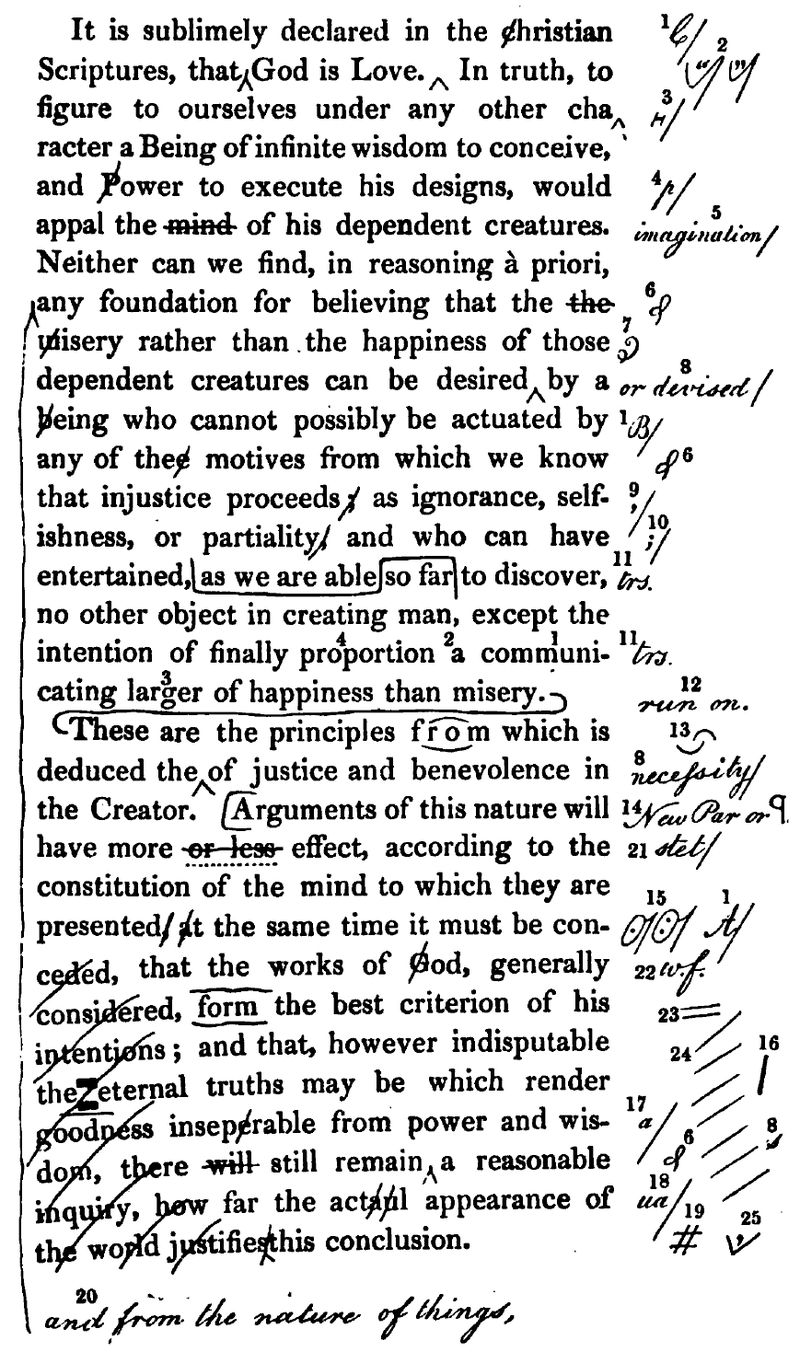
CORRECTING STONE.
The stone on which the compositor imposes and corrects his forms.—M. It is now called Imposing Stone, which see.
CORRECTIONS.
The letters marked in a proof are called Corrections.—M. At the present time, the right words or letters that are to replace the wrong ones are understood by the word; thus a compositor, when he collects the right letters for the purpose of correcting a form, is said to Gather the Corrections.
CORRECTOR.
Moxon uses this word to designate the person whom we now call a Reader. The word is not now used. See Reader.
Counting off Copy. See Casting off Copy.
Cowper, Edward. See Machines.
CRAMPED.
In composing, when it is necessary to get in a given quantity of matter into a certain number of pages, which are hardly sufficient to contain it, whites are used sparingly, short pages are avoided, and the matter is spaced closer than common; it is then said to be cramped. A compositor is also said to cramp his matter when he does not put whites proportionate to the openness of the work, or to the size of the letter when there is no restriction.
CRAMP IRONS.
Short pieces of iron, polished on their face, fastened to the under side of the plank, to run the carriage in and out upon the long ribs. They are frequently called the Short Ribs. The two at each end are turned again at the outer ends, to guide the carriage, and prevent any lateral motion, and are called Guide Cramps. I have seen them made of bell metal, as having less friction than iron running upon iron.
CROSS.
Long Cross and Short Cross; two bars of iron crossing each other at right angles and dovetailed into the rim of the chase, dividing it into four quarters. The short cross is the broadest, and has a groove for the points to fall in, for the purpose of making holes in the sheet to work the reiteration in register.
CROTCHETS
or Brackets [ ] serve to enclose a word or sentence, which is to be explained in a note, or the explanation itself, or a word or a sentence which is intended to supply some deficiency, or to rectify some mistake.—Murray.
Cufic. See Koofee.
CULL PAPER.
To examine the cording quires, and select the best sheets out from those that are so much damaged as to be unfit for use.—M.

CURRYING IRON.
A square bar of iron, bent so as to make the middle part of it project from the post or upright to which the ends are fastened; the ends are flatted out, turned again at right angles, with screw holes, and the middle of the projecting part is twisted. Its use is to curry pelts.
CURRYING THE PELT.
Putting it half round the currying iron, or a post, and taking hold of both ends, drawing it backwards and forwards to make it more supple, and to take part of the moisture out. See Balls.
CURVILINEAR PRINTING.
In the year 1805, a Mr. Zach. Allnutt published proposals for “a New Mode of Universal Linear Printing, named by me Curvilinear Printing, being a neat, expeditious, and cheap Method of printing Plans of Rivers, Canals, Roads, Estates, Encampments, Mathematical Figures, and all other Sketches required to illustrate any Subject.”
“The Time required in executing such Plans, and on which a Calculation of their Expence may be easily made, would be,
“For an Octavo Plan of Demy or Foolscap paper not very much crouded, Time one person one day.
“For a Quarto Demy or Foolscap paper not much crouded, or for an Octavo much crouded, Time two days.
“For a Folio Foolscap not much crouded, or Quarto much crouded, Time three days.”
He then proceeds to say, that he had published a small pamphlet, in which he had inserted some specimens of Maps of Rivers and Canals, and a Plan of a Building; and executed various Plans of Estates; and of Military Positions (but not with Soldier or Tent Types purposely cast), and a Sketch of a Machine, &c.; and that these specimens were composed with common printing types (except the Trees, Houses, Churches, and Compass, which were cast so as to be moveable,) and printed with a common letter-press.
He proposed to “discover and explain” “the precise Method of such Curvilinear Printing, with a full and particular Description,” “if a sufficient Number of Persons, to answer his Expectations, engage as Subscribers of Ten Guineas each.” “But if there should not be a sufficient Number of Subscribers hereto according to the Inventor’s Expectations, He will be ready to treat with any Person, or Persons collectively, for the sole Use of this New Method or Invention.”
I never knew of any person subscribing, or of any printer practising this particular manner of printing; and I believe that Mr. Allnutt’s discovery would have sunk into utter oblivion, but for a few of his Proposals, one of which is now lying before me.
CUT-IN NOTES.
Side notes that are not arranged in the front margin down the side of the page, but are inserted in the text, the lines of which are shortened to admit the note, as if a piece of the text were cut out, and the note inserted in the vacancy.
CUTTING THE FRISKET.
Cutting those parts of the paper away so as to allow the types to print on its own paper, and to keep the margin clean.—M.
Cylindrical Printing. See Machines.
Dagger. See Obelisk.
Dances. See Form Dances.
DANISH.
The Danish alphabet consists of twenty-seven letters.
Remarks on the Alphabet.
Q, q, (Ku, pronounced coo) is here omitted, being not merely superfluous and useless, but even prejudicial to a faithful representation of the language, by observing the origin and affinity of words, for instance, Kvinde, woman, is derived from Kone, wife; bekvem, convenient, from komme, to come (Fr. venir); Kvartér, a quarter of an hour, is also called Kortér; Kvast, tuft, is originally the same word as Kóst, broom; and kvæle, suffocate, the same as the English kill. The Q is therefore justly rejected by the celebrated grammarian P. Syv, as also by the learned Prof. S. N. J. Bloch in his Danske Sproglære, Odense 1817. It is however still used by some, but always followed by v, never by u in any Danish book, as, Qvinde, beqvem, Qvarter, &c.
The Alphabet.

| Figure. | Name. | Power. | |
| A a | A a | A | a in father, part. |
| B b | B b | Bé | b. |
| C c | C c | Cé | s and k as in English. |
| D d | D d | Dé | d hard, and th flat. |
| E e | E e | E | French é fermé, and è ouvert. |
| F f | F f | Ef (eff) | f. |
| G g | G g | Gé (ghe) | g in go, give. |
| H h | H h | Hå (hô) | h aspirated. |
| I i | I i | I (ee) | ee in bee, i in bill. |
| J j | J j | Jé (jod) | y consonant. |
| K k | K k | Kå (ko) | k. |
| L l | L l | El | l. |
| M m | M m | Em | m. |
| N n | N n | En | n. |
| O o | O o | O | o in more, for. |
| P p | P p | Pé | p. |
| R r | R r | Er | r. |
| S s | S s | Es | s hard. |
| T t | T t | Té | t. |
| U u | U u | U (oo) | oo in fool, u in full. |
| V v | V v | Vé | v in vein, w in howl. |
| X x | X x | Ex (eks) | x hard. |
| Y y | Y y | Y | French u in pure, nul. |
| Å å | [#] [#] | Å (ô) | a in warm, oa in broad. |
| Æ æ | [#] [#] | Æ (ai) | a in sale, ai in said. |
| Ø ø | [#] [#] | Ø | French eu fermé in peu. |
| Ö ö | [#] [#] | Ö | French eu ouvert in veuve, œu in cœur, œuf. |
| ([#] [#]) | |||
| ([#] [#]) | |||
| ([#] [#]) | |||
| ([#] [#]) | |||
| ([#] [#]) | |||
| ([#]) | |||
Z, z, (Zet, pronounced sett) has crept from the German orthography into a few words, which should be written by s, according to the true pronunciation; as, Zobel, sable; Zire, to adorn; better Sobel, sire.
Å has been, till the beginning of this century, commonly represented by aa, according to the old Low German orthography, but å is found in ancient Danish and Norwegian manuscripts: its reintroduction, proposed by the celebrated Danish grammarian Höjsgård 1743, later by Schlegel, Baden, Nyerup, Schrejber, Thonboe, &c. has, in the last decennium, been realized in about thirty separate books or pamphlets by Prof. A. Gamborg, Mr. H.J. Hansen, Mr. N.M. Petersen, and also by E. Rask, and several anonymous writers. At all events the sound is simple, and continually interchanging with other simple vowels (a, æ, o,) in the inflection and derivation of words, for instance, tæller, to count, in the past tense talde or tålde, counted; gå, to go, Gang, gait, gængse, current, common; from Får, sheep, is derived Færøerne, the Farroe islands. Thus even in kindred dialects; as, Vingård, vineyard; Tåre, tear, German Zähre; Måned, month, German Monath; åben, open, &c. Whereas aa is sometimes long a, sometimes even to be read in two syllables as: Haarlem, Aaron, Kanaan, Knud Danaast, the name of a Danish prince. The learner however will find aa for å in most printed books hitherto published.
Æ, like Å, represents a simple vowel sound, and must never be separated or resolved into ae, which make distinct syllables, for instance, bejae (be-ya-e), affirm.
Ø and Ö are commonly confounded, so that Ø is used for both sounds in books printed in the Gothic type, Ö in those in the Roman character.
There are no diphthongs in Danish, but aj, ej, oj, uj, öj, even though written by some ai, ei, oi, ui, öi, are pronounced with the open sound of the vowels and a distinct y consonant following, never like ai, ei, French oi, ui or the like, for instance, ej, not, sounds like English eye or I; Konvoj, a convoy, like the verb to convoy, &c.
In like manner av, ev, iv, ov, æv, øv are pronounced as clear vowels followed by a distinct v consonant or rather w, for the v also is softer after the vowels than at the beginning, for instance, tav, was silent; Brev, letter; stiv, stiff; Tòv, cable; Ræv, fox; døv, deaf. The sound of w is particularly observable, when another consonant follows, for instance, tavs, silent; Evropa, Europe; stivne, to stiffen; hovne, to swell; Hævn, revenge; søvnig, sleepy, drowsy.
As to the division of words into syllables, j is always referred to the preceding vowel, which is in these cases constantly pronounced short and sharp, for instance, Vej-e, ways, not Ve-je. The other consonants are usually referred to the vowel following, when single; or divided between the preceding and succeeding vowel, when more than one, no care being taken to distinguish the radical parts from the accessories, but in compound words, for instance, Da-ge, days, from Dag, day, but for-ud-si-ge, foretell, from for-ud, beforehand, and sige, tell, say.
It is a great advantage in the Danish orthography, that every noun substantive is written with a capital letter at the beginning, as numbers of words, else perfectly alike, are thereby easily distinguished at the first view. Ex.
On the other hand, adjectives of national names are usually written with small initials, contrary to the English usage, as, dansk, Danish; norsk, Norwegian; svensk, Swedish; hollandsk, Dutch; engelsk, English; angelsaksisk, Anglosaxon.
Though the Roman character is daily gaining ground, being introduced into the Transactions of the Royal Academy of Copenhagen, and of most other learned societies in Denmark and Norway, as also used in many excellent works of private authors, yet the monkish or Gothic form of the letters is still preferred by many.
In this character the capital J is also usually applied for the I, for instance, Jsrael and Jesus; the long ſ is constantly applied in the beginning of syllables, even in the combinations: ſk, ſl, ſp, ſt.
For å, has been proposed another figure, viz. [#], which has been adopted by the celebrated Capt. Abrahamson in his first edition of Langes Dänische Gramm. für Deutsche, as also by Rask, in the first edition of his Icel. Grammar; that he has afterwards preferred the å, is not only from patriotic motives; this figure being found in old Danish MSS. down to 1555, but also because it is introduced into several other languages, as Swedish and Laplandic, and has even been used in the upper German dialects; also in the Bornholm dialect by Mr. Skougaard, in the Farroic by the Revd. Mr. Lyngbye, and in the Acra (on the coast of Guinea) by Capt. Schönning, whereas [#] is used nowhere else in the world.—From Rask’s Danish Grammar, Copenhagen, 1830.
Dash. See Punctuation.
DELE,
Lat. The second person singular, imperative mood, of the active verb deleo, to blot out, to expunge. This is a word that is much used in a printing office; and its initial, with a round top, [#] or [#], is the regular mark in proofs to expunge a letter, word, or words that are redundant. See Correcting.
DELIVERING BOOKS.
It is the general practice with publishers to leave a work when finished, in the warehouse of the printer, and to send written orders for the delivery of a part, as occasion or convenience suits; the warehouseman should always be prepared to deliver copies to these orders at the moment, otherwise complaint will be made against him, and he will incur blame; but he ought not on any account to deliver copies without a written order, for should there happen a mistake, or an omission in the publishers making an entry, credit will not be given for them, and he will become responsible. He ought invariably to enter them instanter, and take the person’s signature to the entry, and file the order. He will then be enabled, when an account of the delivery is called for, to prove its correctness.
DEVIL.
The pressman sometimes has a week boy to take sheets, as they are printed, off the tympan: these boys do in a printing house commonly black and daub themselves; whence the workmen do jocosely call them Devils; and sometimes Spirits, and sometimes Flies.—M. The boys that make the fires, sweep the rooms, assist in the warehouse, and go on errands, are now called Devils, or Printers Devils; but in the trade they are generally styled Errand Boys and Warehouse Boys. See Fly.
Diæresis. See Accented Letters.
DIAMOND.
The name of a type one size smaller than Pearl, and the smallest that is cast in the British founderies. It originated in casting a type with a pearl face upon a smaller body, for the purpose of getting in, in printing pocket Bibles; the founders subsequently cut it with a smaller face, and made it completely a distinct size. It is not enumerated in Moxon’s list. See Types.
Dilly, Charles. See Donations.
DIPLE.
A mark in the margin of a book to show where a fault is to be corrected.—Bailey’s Dict. This word is not used in the profession.
DIRECTION.
The word that stands alone on the right hand in the bottom line of a page.—M. It is the first word of the following page. See Catch Word.
DIRECTION LINE.
The line the direction stands in.—M. See Catch Word.
To DISTRIBUTE.
To replace the types in their respective boxes in the cases after printing therewith, in order to their being used again. This is done in a very expeditious manner by the compositor, who, placing his composing rule against the head of a page, with his thumbs against it, pressing the sides of both his third fingers against the sides of the matter, and his forefingers against the bottom line of the quantity which he means to lift, takes up what is termed a handful, and keeping the face of the letter towards him, rests one end of the composing rule against the ball of the thumb of his left hand, and pressing the other end of the rule with the third finger, steadies the matter with his forefinger, and thus has his right hand at liberty, with which he takes a word or part of a word from the uppermost line as he holds it in his hand, and drops the several letters into their particular boxes. Matter is always wetted when distributed, to render it slightly cohesive, as the operation is thus performed with more facility than when dry. When the form has not been well rinsed in laying-up, and the types have been much used, the ends of the fingers are apt to get smooth, so as to lose the command, in some measure, of dropping the types into their places with quickness and certainty; in this case compositors frequently keep a piece of alum in some part of the case, and occasionally touch it with their thumb and two fingers, which gives them a little roughness, and restores their command of the types.
If a compositor is desirous of producing his first proofs free from literal errors, he should be particular in distributing clean, that is, depositing each letter in its proper box.
When new letter remains in chase, locked up for any considerable time, it becomes what is termed, baked. See Bake.
Distributing Stick.—M. See Composing Stick.
DIVIDING.
There are practical rules in printing for dividing words where the whole of a word cannot be comprised within the line; and there are also grammatical rules for the same object. Every printing office has some peculiarity on this subject.
The most general practical method of dividing words is to preserve the primitive word at the end of a line, and carry the termination to the next line; but this cannot always be done, as the following few instances will show. In these and similar cases it will be better to avoid dividing the word, and either drive the whole out, or get the termination in, as the spacing of the line will best allow.
Words whose plurals are formed by the addition of s, which adds another syllable to them, by making the last into two, ought not to have these two syllables divided; such as—
| accom-plices | conse-quences | frontis-pieces | prefer-ences |
| acquaint-ances | differ-ences | hinder-ances | privi-leges |
| advan-tages | discord-ances | observ-ances | quintes-sences |
| allow-ances | disturb-ances | occur-rences | recom-pences |
| appear-ances | embas-sages | over-charges | redun-dances |
| arti-fices | enter-prises | perform-ances | reli-ances |
| bene-fices | equi-pages | petu-lances | resem-blances |
| cogni-zances | evi-dences | post-offices | resi-dences |
| conni-vances | exer-cises | preci-pices | sen-tences. |
The terminations of words, chion, cial, cient, cion, cious, shion, sian, sion, tial, tion, and tious, ought never, in my opinion, to be divided, as they each form one sound, although Murray and Walker say they form two syllables.
When the primitive word cannot be retained at the end of a line, I would prefer the prefixes ab, ac, ad, al, anti, be, bi, co, com, con, de, di, dia, dis, en, in, per, pre, pro, re, sub, super, un, when words in which they occur require to be divided; provided it does not cause any great violence in the spacing.
When it is necessary to divide a word at the end of a line, it is also necessary to study the appearance of the termination of that line, as well as of the commencement of the succeeding line, for they are equally affected. An improper division of a word will sometimes look better than a proper one, but it ought always to be avoided, if possible.
It frequently happens that the last syllable, when it is short, has a meagre appearance at the beginning of a line; when this is the case, it is preferable to drive out another syllable, provided the appearance and the correctness of the first part of the word are not compromised.
It is not usual, and is looked on as bad workmanship, to divide a word with a single letter at the end of a line, for it may be driven out, or, if the line be wide spaced, the next syllable may be got in; but should the second syllable of the word be a long one, or the last syllable a very short one, it will then be advisable to overrun a preceding line or two, to get rid of the objectionable division.
Neither is it usual to carry over the last syllable of a word if it consist of two thin letters only; for the hyphen is more than equal to one of them, and changing two or three spaces will make room for the other, without affecting the appearance.
Some persons object to the dividing of words at all in printing, as being unnecessary and displeasing to the eye; but then they must sacrifice all regularity of spacing, which is still worse, and has the appearance of bad workmanship. I would recommend that a compositor should make each give way a little to the other, always preserving such an uniformity in spacing that there should be no glaring disproportion in different lines.
Avoid dividing words in lines following each other, so as not to have hyphens at the ends of two adjoining lines, but never have three or more divided words at the ends of consecutive lines; although five or six may occasionally be seen, yet in book work it is held to be bad workmanship, and should never be allowed to pass. Neither is it desirable to divide proper names, nor the last word in a page so as to have part of a word to begin the succeeding page, particularly when it is an even one; sums of money and series of figures are never divided.
It is not possible in every instance to divide words correctly, particularly when the page is of a narrow measure, and the type large; when this happens, the compositor is obliged frequently to sacrifice correctness to necessity; but when the page is of a width proportionate to the size of the type, he may in the usual way of workmanship preserve his regular spacing, and also his correct dividing.
The preceding observations may be looked on as practical ones for printing. Lindley Murray gives the following grammatical directions for dividing words.
“1. A single consonant between two vowels must be joined to the latter syllable: as, de-light, bri-dal, re-source: except the letter x; as, ex-ist, ex-amine: and except likewise words compounded; as, up-on, un-even, dis-ease.
“2. Two consonants proper to begin a word, must not be separated; as, fa-ble, sti-fle. But when they come between two vowels, and are such as cannot begin a word, they must be divided; as, ut-most, un-der, in-sect, er-ror, cof-fin.
“If the preceding syllable is short, the consonants must be separated: as, cus-tard, pub-lic, gos-ling.
“3. When three consonants meet in the middle of a word, if they can begin a word, and the preceding vowel be pronounced long, they are not to be separated; as, de-throne, de-stroy. But when the vowel of the preceding syllable is pronounced short, one of the consonants always belongs to that syllable; as, dis-tract, dis-prove, dis-train.
“4. When three or four consonants, which are not proper to begin a word, meet between two vowels, the first consonant is always kept with the first syllable in the division: as, ab-stain, com-plete, em-broil, dan-dler, dap-ple, con-strain.
“5. Two vowels, not being a diphthong, must be divided into separate syllables; as, cru-el, deni-al, soci-ety.
“A diphthong immediately preceding a vowel, is to be separated from it: as, roy-al, pow-er, jew-el.
“6. Compounded words must be traced into the simple words of which they are composed; as, ice-house, glow-worm, over-power, never-the-less.
“7. Grammatical, and other particular terminations, are generally separated: as, teach-est, teach-eth, teach-ing, teach-er, contend-est, great-er, wretch-ed, good-ness, free-dom, false-hood.
“Two consonants which form but one sound, are never separated: as, e-cho, fa-ther, pro-phet, an-chor, bi-shop. They are to be considered as a single letter.
“8. In derivative words, the additional syllables are separated: as, sweet-er, sweet-est, sweet-ly; learn-ed, learn-eth, learn-ing; dis-like, mis-lead, un-even; call-ed, roll-er, dress-ing; gold-en, bolt-ed, believ-er, pleas-ing.
“Exceptions. When the derivative word doubles the single letter of[200] the primitive, one of those letters is joined to the termination: as, beg, beg-gar; fat, fat-ter; bid, bid-ding.
“When the additional syllable is preceded by c or g soft, the c or g is added to that syllable: as, of-fen-ces, cotta-ges, pro-noun-cer, in-dul-ging; ra-cer, fa-cing, spi-ced; wa-ger, ra-ging, pla-ced, ran-ger, chan-ging, chan-ged.
“When the preceding single vowel is long, the consonant, if single, is joined to the termination: as, ba-ker, ba-king; ho-ping, bro-ken; po-ker, bo-ny; wri-ter, sla-vish; mu-sed, sa-ved.
“The termination y is not to be placed alone: as, san-dy, gras-sy; dir-ty, dus-ty; mos-sy, fros-ty; hea-dy, woo-dy; except, dough-y, snow-y, string-y, and a few other words. But even in these exceptions, it would be proper to avoid beginning a line with the termination y.
“Some of the preceding rules may be liable to considerable exceptions; and therefore it is said by Dr. Lowth and others, that the best and easiest directions for dividing the syllables in spelling, is to divide them as they are naturally separated in a right pronunciation, without regard to the derivation of words, or the possible combination of consonants at the beginning of a syllable.”
Before quitting this subject, it should be stated that there is yet a mode of dividing, which is peculiar to the philologist. To him it appears but natural that a compounded word should be divided at the point where its elements were originally conjoined. With respect to a purely English compound we find this to be one of Murray’s rules; but in an adopted word, however much from its recurrence it may seem to have become our own, the scholar’s eye is offended, if, where a division has become requisite, it be made in violation of etymological principles. This remark must be understood as having reference only to the division which would occur in the neighbourhood of the point of junction: in other respects he does not impugn the validity of the rules which are in general laid down. To apply with precision this principle, which, when judiciously practised, is frequently very highly approved, it is evident that an acquaintance with the language from which the imported word has been derived, is necessary: yet, as a person not thus qualified may occasionally be required to make his divisions in conformity with this system, it has been thought desirable to subjoin a brief list of words in which an uninitiated person would be most likely to err. A few of the following divisions will appear a little startling, and they are in consequence generally evaded; but it has been thought proper in this place to conceal nothing from the general eye which may appear to militate against the full adoption of the system. The words selected are but a few of the very large class of compounds; but the rest have been omitted, as their analytical and their syllabical divisions will in general be found to coincide.
* This word has had the singular fortune of having been all but universally mis-spelt; having in its present form the appearance of being what is inadmissible—the compound of a Latin and an English word. A few years ago an ingenious critic, in a work which he published, corrected this spelling by writing the word “frontispice.” As the word comes immediately from frontispicium, the emendation appears to have been judiciously made. (Compare auspice, from auspicium = avispicium.) It may not be unnecessary also to observe, that the amended form is that in which it appears in the French language. The division of the corrected word would be fronti-spice.
DIVISORIUM.
Commonly called Visorum.—Smith. See Visorum.
DOMESDAY BOOK.
The register of the lands of England, framed by order of William the Conqueror. It was sometimes termed Rotulus Wintoniæ, and was the book from which judgment was to be given upon the value, tenures, and services of the lands therein described.
In 1767, in consequence of an address of the House of Lords, His Majesty George III. gave directions for the publication of this Survey. It was not, however, till after 1770 that the work was actually commenced. Its publication was entrusted to Mr. Abraham Farley, a gentleman of learning as well as of great experience in records, who had almost daily recourse to the book for more than forty years. It was completed early in 1783, having been ten years in passing through the press, and thus became generally accessible to the antiquary and topographer. It was printed in facsimile, as far as regular types, assisted by the representation of original contractions, could imitate the original.
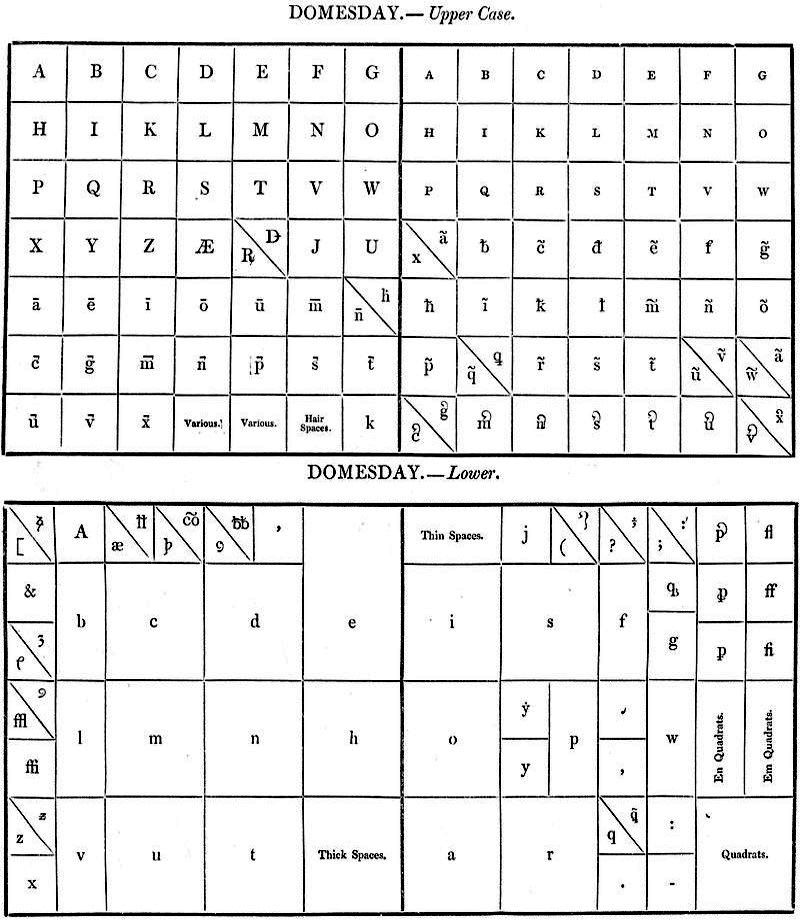
The type with which the Domesday Book was printed, was destroyed in the dreadful fire which consumed the printing office of Messrs. Nichols in Red Lion Passage, Fleet Street, London, February 8, 1808.
Abbreviations in Domesday Book, from Hutchins’s Domesday Book for the County of Dorset.

Superior Letters, which are of frequent occurrence in contracted Records, are generally laid in the small capital boxes.
The character & is displaced to make room for [#] and [#] on works using those characters exclusively.
There are various characters, such as [#], [#], [#], [#], [#], [#], and others, that do not frequently occur, which may be kept in the two boxes in the upper case marked “various;” a general box is necessary in every Domesday case.
The characters c̚, g̚, m̚, &c., placed in the figure boxes, are a variation only of c̉ , g̉ , m̉ , &c., and the two sorts are never used together in the same work. See Records.
DONATIONS.
Abstract of the Charitable Donations at the Disposal of the Court of Assistants of the Worshipful Company of Stationers. I have selected those Donations only which relate, directly or indirectly, to Printers.
William Norton, a printer of great note, lived in St. Paul’s Churchyard, who died in 1593. He gave six pounds thirteen shillings and four pence, yearly to his company, to be lent to young men, free of the same Company. The Company in their Abstract of Charitable Donations say “to the Poor of the said Company.”
Mr. Christopher Meredith, in 1655, gave 10l. a year, to be paid in quarterly pensions to the poor of the Company.
Thomas Guy, Esq., M.P., an eminent bookseller, and the munificent founder of the hospital which bears his name, gave to the Company, in 1717, 1,000l. “to enable them to add 50l. a year, by quarterly payments, to the poor members and widows, in augmentation of the quarterly charity.”
Mr. Theophilus Cater, in 1718, gave 1,000l. to the Company, on condition of their paying him an annuity of 50l. for his own life.—After his death, 40l. to be thus disposed of: to the minister of St. Martin’s, Ludgate, for a sermon, 1l. 10s.; to the reader, 5s.; to the clerk and sexton, 2s. 6d. each, 5s.; to fourteen poor freemen of the Company, 14l.; to ten poor men of St. Martin’s, 10l.; to ten poor men of Christchurch, 1l. each. The remainder, (being 4l.) towards a dinner for the master, wardens, and assistants.
Mrs. Beata Wilkins, in 1773, gave the picture of Doctor Hoadly, lord bishop of Winchester, now in the Stock-room; and the interest and produce of all the money arising from her forty-pounds share stock (computed at 320l.) to be distributed, annually, amongst six poor men and six poor widows, not pensioners to the Company, in the month of December, before Christmas.—Note. The produce of the share was laid out in the purchase of 358l. 11s. 4d. five per cent. Navy annuities. The yearly dividend is 17l. 18s. 6d. To which the Court add 1s. 6d. to make the dividend to each annuitant 1l. 10s.
William Bowyer. See Bowyer.
William Strahan, Esq., M. P., in 1784, gave 1,000l., one half of the annual interest to be divided in equal shares or proportions to five poor journeymen printers, natives of England or Wales, freemen of the Company; the other half in equal shares or proportions to five poor journeymen printers, natives of Scotland, without regard to their being freemen or being non-freemen of the Company.—Note. The yearly dividend of this bequest is 39l. 14s. 10d.—to which 5s. 2d. (part of a subsequent donation by Andrew Strahan, Esq.) has since been added, to make the dividend to each annuitant 4l.
Thomas Wright, Esq., late alderman of London, in 1794, gave 2,000l. four per cent. Bank annuities, the dividends to be distributed as follows; upon the first day of January 50l. 8s. amongst twenty-four poor freemen of the said Company, not receiving any other pension from the Company, 2l. 2s. each. To the clerk of the Company 3l. 3s. for his trouble upon this occasion. And 26l. 9s. residue of such dividends, for providing a dinner for the master, wardens, and assistants, of the Company, upon the day of distribution.
Mr. Richard Johnson, in 1795, gave all the remainder of his property whatsoever, to the Company, upon the following conditions: that they allow his sister, Mary Johnson, 50l. per annum, and 10l. per annum to his uncle Lockington Johnson, or to his wife, Elizabeth Johnson, during their natural lives. After the deaths of his sister and uncle, and his wife, the whole property to be divided half-yearly, “among five very poor widows, who have seen better days, above the age of sixty, whose husbands were liverymen, and in a good way of business; were either stationers, printers, booksellers, or binders.”
Charles Dilly, Esq., in November, 1803, (being then a member of the Court of Assistants,) transferred 700l. three per cent. annuities to the Company, the dividends to be “paid equally to two widows of liverymen of the Company, who have lived in better circumstances, and met unexpected misfortunes, but who, through their conduct and manners in life, are deserving of superior help. And if there should be candidates of sixty years of age, or upwards, I should wish them to have the preference.”
Mrs. Elizabeth Baldwin, widow of Mr. Richard Baldwin a liveryman, gave 250l. stock in the three per cents, the dividends to be laid out and expended in the purchase of five great coats, to be annually given to five poor liverymen or freemen of the said Company in the first week of the month of December for ever.—Note. Mrs. Baldwin died 19th August, 1809.
Andrew Strahan, Esq., M. P., (first benefaction,) in January 1815, transferred 1,225l. four per cent. annuities to the Company, the interest, viz. 49l., to be applied as follows, viz.,
“Eight pounds per annum to each of the six pensioners amongst my father’s annuitants who shall have been earliest elected into that list, in lieu of the 4l. which they at present enjoy. And whenever any of the pensions of 8l. each shall become vacant, the pensioner who shall stand first on the list of my father’s annuitants of 4l. to succeed to such vacancy, without troubling the court to make a new election, except for the vacancy occasioned thereby in the annuitants of 4l. And as 5s. 2d. is added by the court to make up the pensions of my late father 4l. to each annuitant, I would have the sum of 5s. 2d. (part of the surplus of 1l.) applied to that purpose. The remaining 14s. 10d. I would have given to the beadle of the Company, who has some trouble in receiving the petitions.
“The pensions above given it is my wish should be paid twice in the year; the one half at the same period as the pensions given by my late father, and the other half at midsummer.
“I observe that my father’s pensioners are to be elected annually, which, I believe, may not always have been strictly complied with; but, by being so bequeathed, it enables the court to displace any individual who may at any time after his being elected appear to the court not to be deserving; and it is my wish that the court should have the same power of displacing any of the pensioners of eight pounds who shall appear to them undeserving.”
John Nichols, Esq., transferred to the Company, in June, 1817, 500l. four per cent. annuities, “as an addition of a small supplement to the works of my late friend and partner, Mr. William Bowyer,” [See Bowyer.] “to pay the dividends to the persons mentioned in the following list; one of whom has worked for me more than fifty years, another much more than forty, and the others nearly thirty years.
“15l. a year to Thomas Bennett, in addition to the annuity he now enjoys.
“5l. a year to William Morlis, in addition to what he now enjoys, or may hereafter enjoy.
“On the death of Bennett, his 15l. to be divided into three annuities, for James Rousseau, John Meeson, and James Robinson, if then living, otherwise to any other compositor or pressman of good character, not less than forty-five years of age, and who shall have been at least twenty-one years free of the Stationers’ Company.
“On the death of Morlis his five pounds to be added to the person who then stands first on the list; so that eventually there will only be one annuitant of ten pounds, and two of five pounds each.
“The annuitants to be paid at the same times as those of Mr. Bowyer.” J. N.
Andrew Strahan, Esq., M. P., (second benefaction,) transferred in March, 1818, the further sum of 1,000l. four per cent. annuities, “to pay the dividends half-yearly in portions of ten pounds to four distressed old printers. No person to be eligible till he be sixty-five years of age: he may be freeman or non-freeman, compositor or pressman, or have been for many years employed regularly as corrector or reader in a printing-office within the Bills of Mortality, and not necessarily one of my late father’s annuitants or of mine.”
Luke Hansard, Esq., (first benefaction,) on the 11th of July, 1818, transferred to the Company 1,000l. four per cent. annuities, the interest to be given, in two annuities of 10l. a year each, to such objects above sixty-five years of age, free of the Company, and letterpress printers, (compositors or pressmen,) as the court shall judge proper.
The other 20l. to be given yearly to four freemen of this Company, printers, booksellers, stationers, warehousemen, or bookbinders, above sixty years of age, at 5l. a year each, as the court shall think proper objects of this donation.
Luke Hansard, Esq., (second benefaction,) in September, 1818, transferred to the Company 1,500l. three per cent. annuities; in trust to give to every youth bound at[207] their hall, a neatly bound Church of England Prayer-book, as printed by his majesty’s printer in London, bound up with the New Version of Psalms.
The number of Prayer-books thus to be disposed of, are taken at 200, which at a presumed price of 2s. 7d. each, will cost yearly 25l. 16s. 8d.
Then to give yearly to two of his warehousemen (named) 6l. 6s. each.
Also to “such warehouseman, or binder, or stationer, or other person in the class to whom the court has been accustomed to give such annuities, above sixty years of age,” 6l. 6s.
The residue of 5s. 4d., and whatever residue may be left from the 200 Prayer-books not being wanted, or from the cost being less, to be applicable for such purposes as the court shall think proper.
Beale Blackwell, Esq., gave, July, 1817, so much Bank stock as at the time of his death would produce the annual sum of 100l., to be every year distributed equally amongst twenty deserving journeymen letterpress printers; the first distribution of which took place in October, 1821.
A more detailed account of these charitable donations and benefactions will be found in a pamphlet of 32 pages, printed by order of the court in 1819, and given to each liveryman.
This account is copied from Hansard’s Typographia.
DOTTED QUADRATS,
or dotted leaders. Quadrats with dots on them, similar to full points, at regular distances. They are cast from an en, with one point, to four ems.
In tables of contents, indices, and other similar matter, dotted quadrats are preferred to metal rules, or hyphens, being thought to have a neater appearance.
DOUBLE.
A sheet that is twice pulled and lifted never so little off the form after it was first pulled, does most commonly (through the play of the joints of the tympan) take a double impression: this sheet is said to double. Or if the pressman run in so, as the foreside of the platen print with the first pull into part of the second pull, or the hind edge of the platen print with his second pull into part of his first pull; either of these twice printing is called Doubling. Doubling also happens through the loose hanging of the platen, and through too much play the tenons of the head may have in the mortises of the cheeks; and indeed through many wearings and crazinesses that often happen in several parts of the press.—M. Moxon’s account of doubling and its causes refer to the two pull wooden presses, but some of them apply equally to iron presses.
In composing, the term is applied when a word, a line, a sentence, or any part of the copy is composed twice; that is, if the compositor’s eye catch a part that he has already composed, and he repeats it.
DOUBLE DAGGER.
This is the technical name of a mark used as a reference, ‡; it is generally placed the third in order,—after the obelisk or dagger.
DOUBLE LETTERS.
Æ, œ, ſt, ſh, and several others cast on one shank, are called double letters: ſ and f have several ascending letters joined to them, because their beaks hanging over their stems would (were they not cast on one shank) ride upon the tops of the stems of the adjoining ascending letters.—M.
By discarding the ſ, we have lessened the number of our double letters, which are now reduced to the diphthongs æ and œ, and to ff, fi, fl, ffi, and ffl, which are so termed by printers.
DOUBLE NARROW.
A piece of furniture equal in breadth to two narrow quotations. There are different sizes used in making margin, and in imposing, viz., double broad, double broad and narrow, broad and narrow, broad and double narrow.
DOUBLE PICA.
The name of a type, one size larger than Paragon, and one smaller than Two-Line Pica. It is equal in depth to two Small Pica bodies. See Types.
DRAW.
When a form is working at press, and any of the letters are loosely justified, or from any other cause are not tight in the form, and the adhesion of the ink and balls or rollers pulls them out, they are said to draw. This accident too frequently occurs; and as it is not always perceived, errors arise which neither the care nor the skill of the reader can prevent; when it is perceived, after an impression or two have been pulled, the pressmen often put the letters into the wrong place, and thus cause an error. They are occasionally left by the ball on the form, and produce a batter, which is a waste of materials, and of time in repairing it. A good compositor guards against this evil by care in justifying his lines, and also in locking up.
DRAWN SHEETS.
In collating books in the warehouse, after they have been gathered, duplicate sheets, and sheets of wrong signatures, are occasionally found; arising, in the one instance, from the carelessness of the gathering boys, in taking up more than one sheet of the same signature; and, in the other, from a lift of another sheet being occasionally taken down and mixed in the heap: in these cases the sheets are drawn out of the book, and laid on one side, and, after some accumulation, are replaced upon their respective heaps, to be gathered again right. These sheets are called Drawn Sheets.
DRESS A CHASE,
or, Dress a Form, is to fit the pages and the chase with furniture and quoins. See Margin.
DRESSING BLOCK.
Made of pear tree, because a soft wood, and therefore less subject to injure the face of the letter; it is commonly about three inches square, and an inch high.—M. Used the same as our planer. See Planer.
DRIPPING PAN.
Literally so, made of tinned iron, extending the whole length of the press, fixed under the long ribs, to preserve the floor from the droppings of oil.
They are useful articles; for presses to be kept in good working order require to be frequently oiled; and for want of a dripping pan, I have known the oil run through the joints of the floor upon a pile of paper in a room underneath, and spoil a considerable quantity.
DRIVE OUT.
When a compositor sets wide, he is said to drive out or run out. In founding, if letter be cast too thick in the shank, it drives out.—M. If copy make more than was calculated on, they say, it drives out; if less, and it is intended that it shall make the precise quantity decided on, they say, you must drive out; that is, it must be branched out in proportion, and not cramped.
DROPPING OUT.
After a form is locked up, and, when it is being lifted from the stone, or being laid upon the imposing stone, or the press, any letters, spaces, or quadrats fall out, it is said something drops out, or something has dropped out; this may arise from some of the lines being badly justified—some of the leads riding—or some of the furniture binding—or similar causes—and frequently produces errors at press by other letters drawing out. See Form Dances.
In this case, before the form is put to press, it should be examined to ascertain the cause, and any impediment to its safety should be removed.
Drum. See Wheel.
DUBLIN.
Plan of a Lower Case as used at Dublin. The Upper Case is the same as used in London.

DUCK’S BILL.

A tongue cut in a piece of stout paper, which is pasted on the tympan at the bottom of the tympan sheet, to support the white paper when working, instead of pins; the paper to be printed rests in the slit behind the tongue, and takes a good bearing.
It is seldom used except in the best work, where the paper printed is fine, stout, large, and expensive, when extra precautions are taken to prevent waste.
DUODECIMO.
The size of a book, generally for shortness written 12mo, and hence frequently incorrectly so pronounced. It is formed by folding a sheet of paper into twelve portions or leaves, making twenty-four pages. See Imposing.
EAR OF THE FRISKET.
A projecting piece of iron on the near side of the frisket, by taking hold of which the pressman turns down the frisket, and at the same time the tympan; and as it projects a little beyond the tympan, he also raises the sheet off the form by grasping it and the tympan, and by a quick motion quits hold of the tympan, and turns up the frisket by means of the ear. It is sometimes called the Thumb Piece.
EASY PULL.
When the form feels the force of the spindle by degrees, till the bar comes almost to the hither cheek of the press, it is called a Long, or a Soaking, or Easy Pull, and is also called a Soft Pull; because it comes soft and soakingly and easily down.—M.
EASY WORK.
With compositors, printed copy, or a fair written hand, and full of breaks, pleases well, and is called good copy, light, easy work: with pressmen, great letter and a small form is called easy work.—M.
The term is not now generally used: what Moxon describes as relating to compositors would now be termed good copy; and with respect to pressmen it would be called light work, or a light form.
EDINBURGH.
Plan of a pair of Cases as used at Edinburgh.
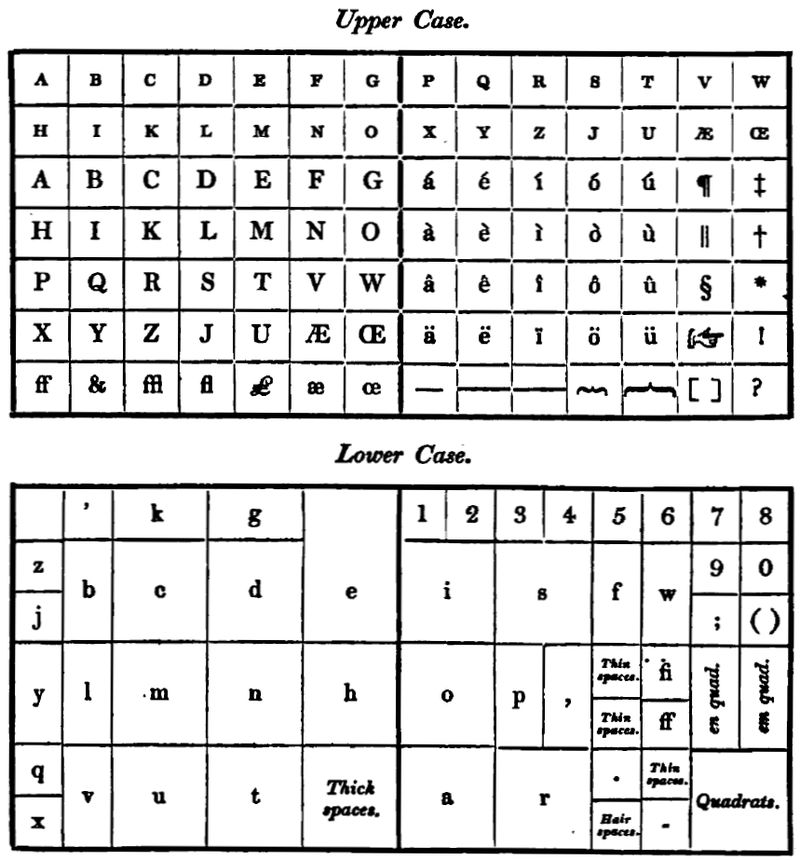
EIGHTEENMO.
Octodecimo, a sheet of paper folded into eighteen leaves; it is usually termed eighteens.
Electrotype. See Galvanism.
EMERALD.
The name of a type one size larger than Nonpareil, and one smaller than Minion. It is a size lately introduced.
EMPTY CASE.
When a compositor cannot compose any more out of a case, from many of the sorts being exhausted, it is termed an empty case, or he says, my Case is Empty, although there may be a great number of types in it of other sorts.
EMPTY PRESS.
A press that stands by, which no workman works at: most commonly every printing house has one of them for a proof press; viz. to make proofs on.—M. The term is now applied to those presses only that are unemployed; the press set apart to pull proofs at is called the Proof Press. See Proof Press.
ENGLISH.
The name of a type, one size larger than Pica, and one smaller than Great Primer. See Alphabet. Types.
ENGRAVINGS ON WOOD.
As the method of printing engravings on wood, here described, applies to what is termed fine printing, it may be as well in the outset to define what is meant by this expression, in its application to this subject.
Fine printing, in this point of view, is the art of obtaining impressions from an engraving on wood, of the surface and the surface only, so as to produce the effect which the artist intended, in the highest state of perfection.
There is a material difference between an engraving on wood and one on copper: the first is engraved in relief, that is, the lines are left standing, and the part which in the impression is to appear white is cut away or, technically, blocked out; the lines of the engraving on copper, on the contrary, are cut in the metal, and the part that is to be white in the impression is left untouched in the metal by the engraver.
There is also a material difference in the manner of obtaining impressions: those from an engraving on wood are produced by coating the surface of the lines with ink by beating it with balls or passing a roller over it, and then, with a piece of paper upon it, submitting it to pressure between two parallel plane surfaces, or by a cylinder rolling over it. An engraving on copper is smeared over the whole face with ink, which is worked into the lines; the surplus ink is then wiped off the surface of the plate, on which a piece of paper is laid to receive the impression, and these are passed between two cylinders, which press the paper into the engraved lines by a violent squeeze.
It will easily be perceived by this slight description that the two processes are completely distinct from each other, although the effect produced is nearly the same.
I will now proceed to describe the process of producing impressions from engravings on wood in a superior manner.
After putting a block on the press, the workman ought to be very gentle in the pull for the first impression, to prevent an accident, which has frequently occurred from thoughtlessness in this particular, by making the pull too hard, and crushing some of the lines; by avoiding this he will be safe, and can proportion his pull to the subject. He should also examine, previous to pulling, that there be nothing on the block—no pins that he may have for his tympan sheet, nor any needle with which he may have been taking out a pick.—Such accidents have happened, and caused great trouble to the engraver, as well as loss of time and disappointment; besides entailing a character of carelessness on the printer.
In imposing a single block, where the press is large at which it is to be worked, it will be in danger of springing out of the chase while beating, from the quantity of furniture about it: it is a good remedy to impose it in a job chase, and to impose this chase again in a larger one; this will cause it to lie flatter on the press, and firmer in the beating, as the small chase can be locked up tight in the large one, without having too much furniture, and the large one can be secured firmly on the press by quoins and the corner irons.
Neither the pressure nor the impression in an engraving on wood should be uniformly equal: if they be, the effect that is intended to be produced by the artist will fail; and instead of light, middle tint, and shade, an impression will be produced that possesses none of them in perfection; some parts will be too hard and black, and other parts have neither pressure nor colour enough, with obscurity and roughness, and without any of the mildness of the middle tint, which ought to pervade great part of an engraving, and on which the eye reposes after viewing the strong lights and the deep shades.
To produce the desired effect, great nicety and patience are required in the pressman; a single thickness of thin India paper, which is the[212] paper I would always recommend to be used as overlays for engravings, is frequently required over very small parts, with the edges of it scraped down, for it is advisable that the overlay should never be cut at the edges, but, even where great delicacy of shape is not required, that it should be torn into the form wanted, which reduces the thickness of the edges, and causes the additional pressure to blend with the surrounding parts.
Particular parts of the impression will frequently come up much too strong, and other parts too weak, it will then be necessary to take out from between the tympans a thickness of paper, and add an additional tympan sheet, cutting away those parts that come off too hard, and scraping down the edges; scraping away half the thickness of a tympan sheet in small parts that require to be a little lightened will improve the impression.
The light parts require little pressure, but the depths should be brought up so as to produce a full and firm impression.
If a block be hollow on the surface, underlaying the hollow part will bring it up better than overlaying it, at least so much that it shall only require a thickness or two of paper as overlays. If a block be too low, it is advisable to underlay it, for the purpose of raising it to the proper height, in preference to making use of overlays, for they act in some measure as blankets, being pressed into the interstices, and rendering the lines thicker than in the engraving.
It will be necessary sometimes, when the surface of the block is very uneven, to tear away parts of the paper in the tympan, to equalise the impression where it is too hard.
The pressman will find it convenient to pull a few impressions while he is making ready, on soiled or damaged India paper, for out of these he can cut overlays to the precise shape and size that is wanted, as he will constantly find it necessary to do so in instances where great accuracy is required in overlaying particular portions; and in these instances he cannot well do without a sharp penknife and a pair of good small scissars. A fine sharp bodkin and a needle or two, to take out picks, are also needful; but he should be particularly careful in so using them as that he do no injury. The best way to avoid this is to draw the bodkin or needle point cautiously in the direction of the lines.
Engravings that are in the vignette form require great attention to keep the edges light and clear, and in general it is necessary to scrape away one or two thicknesses of paper, in order to lighten the impression and keep it clean; for the edges being irregular, and parts, such as small branches of trees, leaves, &c. straggling, for the purpose of giving freedom to the design, they are subject to come off too hard, and are liable to picks, which give great trouble, and are difficult to be kept clear of. Bearers letter-high placed round the block, if they can be applied without the balls touching them, will be found advantageous; if they cannot, pieces of reglet, pasted on the frisket in the usual way, and taking a bearing on the furniture, must be substituted, but the high bearer is to be preferred where it can be adopted; these bearers equalise the pressure on the surface of the engraving, and protect the edges from the severity of the pull, which is always injurious to the delicacy of the external lines. They also render the subject more manageable, by enabling the pressman to add to, or diminish, the pressure on particular parts, so as to produce the desired effect.
When great delicacy of impression is demanded in a vignette, it will be found beneficial, after the engraving is beat with ink, to take a small[213] ball without ink, and beat the extremities: this will not only take away any superfluity of ink, but will be a means of preventing picks, and give to the edges lightness and softness, particularly where distances are represented.
If the extremities are engraved much lighter than the central parts, underlays should be pasted on the middle of the block, which will give a firmer impression to those central parts of the subject: it would save trouble to cause the block to be a little rounded on the face, as it would give facility in obtaining a good impression.
When highly finished engravings on wood are worked separately, woollen cloth, however fine, should never be used for blankets, as it causes too much impression; two thicknesses of stoutish hard smooth paper, in lieu of it, between the tympans is better: sometimes even a piece of glazed pasteboard is used inside the outer tympan. The parchments ought to be in good condition, stretched tight, of a smooth surface, thin, and of regular thickness, so as to enable the pressman to obtain an impression as nearly as possible from the surface only of the engraved lines.
It is indispensably necessary that the balls should be in the best order, the same as for the finest work; and the pressman should be very particular in taking ink, distributing his balls, and beating the block well, otherwise he will not obtain clear, uniform, good impressions. If the block be small, and it is worked by itself, he will find that he can take ink more uniformly in small quantities, by first taking ink with a pair of regular sized balls, and distributing, and then taking ink from them to work his cut with; and this more particularly if he be using a pair of small balls. For this work he ought always to have the best ink that can be procured.
A large wood cut left on the press stone all night is very apt to warp; when this happens, a good method to restore it to its original flatness is to lay it on its face upon the imposing stone, with a few thicknesses of damp paper underneath it, and to place the flat side of a planer upon it, and four or five octavo pages of tied up letter; in the course of a few hours the block will be restored to its original flatness. This method is preferable to steeping the block in water, which has been frequently practised; for the steeping swells the lines of the engraving, and consequently affects the impression to a much greater extent than this operation. For retaining the original effect, as it came from the hands of the artist, I would carefully prevent the block ever being wet with water, and, when it had been worked in a form with types, would take it out before the form was washed.
To prevent this warping during the dinner hour or the night, turn the tympan down upon the form, run the carriage in, and pulling the bar handle home, fasten it to the near cheek by the catch, where there is one, or else by a chain or rope, or by a stay to the bar from the offcheek; in iron presses this way is efficacious.
However long a time boxwood may be kept in the log, it will always twist and warp when cut into slices for engraving, on account of fresh surfaces being exposed to the air: large blocks may be restored to their flatness by laying them on a plane surface, with the hollow side downward, without any weight on them, in the course of a night.
When only a few proofs are wanted from an engraving, good impressions may be obtained with little trouble on dry India paper, with about six thicknesses of the same sort of paper laid over it, and pulled without the tympan. This observation applies to small cuts, and those[214] of a moderate size; if proofs are wanted from large ones, it will be found advantageous to put the India paper for a few minutes into a heap of damp paper.
A fine engraving on wood should never be brushed over with lye: the best method that I have found in practice, is to wipe the ink off with a piece of fine woollen cloth damped with spirits of turpentine; and if it should get foul in working, to clean it with a softish brush and spirits of turpentine. It will be found in practice that spirits of turpentine take off the ink quicker, and affect the wood less, than any other article used; and the facility with which the block is again brought into a working state, more than compensates for the trifling additional expense incurred, as nothing more is required than to wipe the surface dry, and to pull two or three impressions on dry waste paper.
The engravers always show an impression when the block is taken home to their employer; and this impression is taken in a manner, where the subject is not of a large size, such as to produce a superior effect to what a printer can with a press, when he has a number to do, which are generally worked in a form with types, and his price so low for printing, as not to enable him to do justice to the subjects. This causes great dissatisfaction to his employer, and he is unable to remedy the grievance; for the engraver’s proof is obtained by means of a burnisher, with one thickness of paper in addition to that printed on, so that he can examine each part to bring it up where it is required, and leave the others as delicate as he pleases: he thus obtains an impression from the surface only, perfect in all its parts, with the best ink that can be procured; while the printer gives dissatisfaction, because he cannot, in the way of trade, perform impossibilities.
Papillon, in his work on Engraving on Wood, published in 1766, complains of a plan nearly similar being adopted by the French engravers, with which he finds great fault. The following is a translation of the passage:—
“Some engravers on wood have the knack of fabricating the proofs of their engravings far more delicately, and in a more flattering manner than they really ought to be; and this is the means they make use of—they first take off two or three, in order to adjust one of them to their fancy, and which they think will favour their imposition; having selected it, they only beat anew the parts of the block charged with shades and the deeper strokes, in such a manner, that the lighter ones, distances, &c. being only lightly covered with ink, in as far as not being touched in the new beating, they retain no more than what was left by the preceding impression; the result is, that the new proof comes off extremely delicate in those places, and appears pleasing to the eye; but when this block is printed in conjunction with letterpress, the impressions then appear in their natural state, and totally different from that which they presented on delivery of the work. The strokes are of one equal tint, hard, and devoid of softness, and the distances are often less delicate than the foregrounds. I shall risk little by saying that all the three Le Sueurs have made use of this trick.”
The pressman will find it an advantage, if it be necessary to do full justice to an engraving, to have a good impression from the engraver, and place it before him as a pattern, and then arrange the overlays, &c., till he produces a facsimile in effect; but the most valuable lesson will be when he can obtain the assistance of the artist at the press side, to direct him in making ready the cut, and I would advise him by no means to be impatient at the tediousness of the operation, as he will[215] obtain more information how to produce a fine impression by this than by any other means. It will also instruct him how to meet the wishes of the draftsman and the engraver, with regard to effect, in a way superior to any other; and will, with care and attention, ultimately lead him to excellence in printing engravings on wood.
An assertion is now generally promulgated, that machine printing is superior to that of the press, even for engravings on wood, and thus misleading publishers and the public. When I come to speak of machines, and of presses, I will endeavour to show that it is incompatible with the principle of a machine that it can equal a press in producing fine work.
Errand Boy. See Devil.
ERRATA.
A list of errors that have escaped both the author and the printer. It is generally printed in a small type at the end of the work. It should always be kept down, and never brought out in a prominent manner. Some authors seem partial to extend the errata, by noticing the most trifling mistakes, such for instance as a turned letter, and adding corrections of the writing and of misstatements of facts, as well as new facts which may have arisen; and all under the name errata, as if they were entirely the errors of the printer; in this case they ought to be styled Corrections and Additions. In my opinion, there is no occasion to insert in the errata any thing that does not affect the sense. Mr. Beloe, in his Anecdotes of Literature, states that “the book which is distinguished by the greatest number of errata on record, is that containing the works of Pica Mirandula, printed at Strasburgh in 1507, by a printer of the name of Knoblouch. The errata of this volume occupy no less than fifteen folio pages.”
ETHIOPIC.
The Ethiopic language is descended from the Hebrew, yet approaching nearer to the Arabic than to any other of the Semitic languages. It observes the order of reading and writing from left to right, in common with the other languages of the same origin. It has twenty-six characters peculiar to itself, of which the order, figure, name, and power are as follow:—

| 1. | ሀ: | Hoi. | h, | ה | 14. | ከ: | Caph. | c, | כ |
| 2. | ለ: | Lawi. | l, | ל | 15. | ወ: | Wawe. | w, | ו |
| 3. | ሐ: | Haut. | h, | ח | 16. | ዐ: | Ain. | a, | ע |
| 4. | መ: | Mai. | m, | מ | 17. | ዘ: | Zai. | Fr. z | ז |
| 5. | ሠ: | Saut. | ss, | ס | 18. | የ: | Jaman. | j, | י |
| 6. | ረ: | Rees. | r, | ר | 19. | ደ: | Dent. | d, | ד |
| 7. | ሰ: | Saat. | ss, | ש | 20. | ገ: | Geml. | g, | ג |
| 8. | ቀ: | ’Kaph. | ’k, | ק | 21. | ጠ: | ’Tait. | ’t, | ט |
| 9. | በ: | Beth. | b, | ב | 22. | ጰ: | ’Pait | ’p, | פ |
| 10. | ተ: | Tawi. | t, | ת | 23. | ጸ: | ’Zadai. | ’z, | צ |
| 11. | ኀ: | Harm. | h, | ח | 24. | ፀ: | ’Zappa. | ’z, | צ |
| 12. | ነ: | Nahas. | n, | נ | 25. | ፈ: | Aph. | f, | פ |
| 13. | አ: | Alph. | a, | א | 26. | ፐ: | Psa. | p, | פ |
Of these ጰ: and ፐ: are used only in words of Greek and Latin origin.[216] In expressing Arabic these seven, ሰ: ተ: ነ: ከ: ዘ: ደ: ጠ:, and in Portuguese and Italian these three, መ: በ: and ለ:, are made use of with the addition of certain horns.
Moreover, none of the above letters are connected, except ገ:, which, in the name of God, sometimes coalesces with ዘ:, in this manner ዘ:, as ለዘለበሐረ:
The power of the letters approaches nearest to those which have been added, whence it appears that ሀ: ሐ: and ኀ:, also ሠ: and ሰ:, also አ: and ዐ:, and lastly ጸ: and ፀ:, are generally pronounced in the same manner, which causes no small confusion in writing, as one cognate letter is often put for another, so that it should always be borne in mind in looking for a word in the lexicon, that if it is not to be found under one letter, we should continue our researches under the cognate.
These four ቀ:, ጠ:, ጰ:, and ጸ: or ፀ:, have a sound altogether at variance with European custom, and the correct pronunciation can only be learnt by hearing. But one destitute of a preceptor may approach nearer to their genuine sounds, by first prefixing to each the power of the vowel i, thus, ik, it, ip, iz, and afterwards, having substituted in its place an apostrophe, he may add the vowels, in this manner ’k-a, ’k-e, ’k-i, &c., and similarly with ’t-a, ’p-a, ’z-a, &c.
In Ethiopic the numbers are not represented by the letters, but by certain peculiar figures formed apparently from the Greek letters, and which are included within two small lines, in the following manner:—

| 1. | ፩: | α’ | 50. | ፶: | ν’ |
| 2. | ፪: | β’ | 60. | ፷: | ξ’ |
| 3. | ፫: | γ’ | 70. | ፸: | ο’ |
| 4. | ፬: | δ’ | 80. | ፹: | π’ |
| 5. | ፭: | ε’ | 90. | ፺: | ϟ’ |
| 6. | ϛ’ | 100. | ፻: | ρ’ | |
| 7. | ፯: | ζ’ | 200. | ፪፻: | σ’ |
| 8. | ፰: | η’ | 300. | ፫፻: | τ’ |
| 9. | ፱: | θ’ | 400. | ፬፻: | υ’, &c. |
| 10. | ፲: | ι’ | 1000. | ፲፻: | because in writing |
| 20. | ፳: | κ’ | and speaking they | ||
| 30. | ፴: | λ’ | say ዐሠረፑ: ምላት: | ||
| 40. | ፵: | μ’ | _ten hundreds_. | ||
| [Where blanks occur in the Ethiopic, the characters are not in the British founderies.] | |||||
The other numbers are compounded from these, the greater being always placed first, as as ፲፩: 11. ፲፪: 12. &c. ፳፩: 21. ፳፪: 22. &c. ፻፩: 101. ፻፪:102.
In Ethiopic the vowels are not expressed by particular letters, as in the European, or by separate points, as in the Oriental languages, but by certain small lines or circles annexed to the top, middle, or bottom of the letters themselves, or by the shortening or lengthening of one of the strokes, which changes are in number seven; whence arise so many orders of letters, or rather of syllables, of which the first is considered as the simple figure, and the remainder as compound, and are read—the first by a short, the second by u, the third by i, the fourth by a long, the fifth by e long, the sixth by e or y short, and the seventh by o; in this manner:
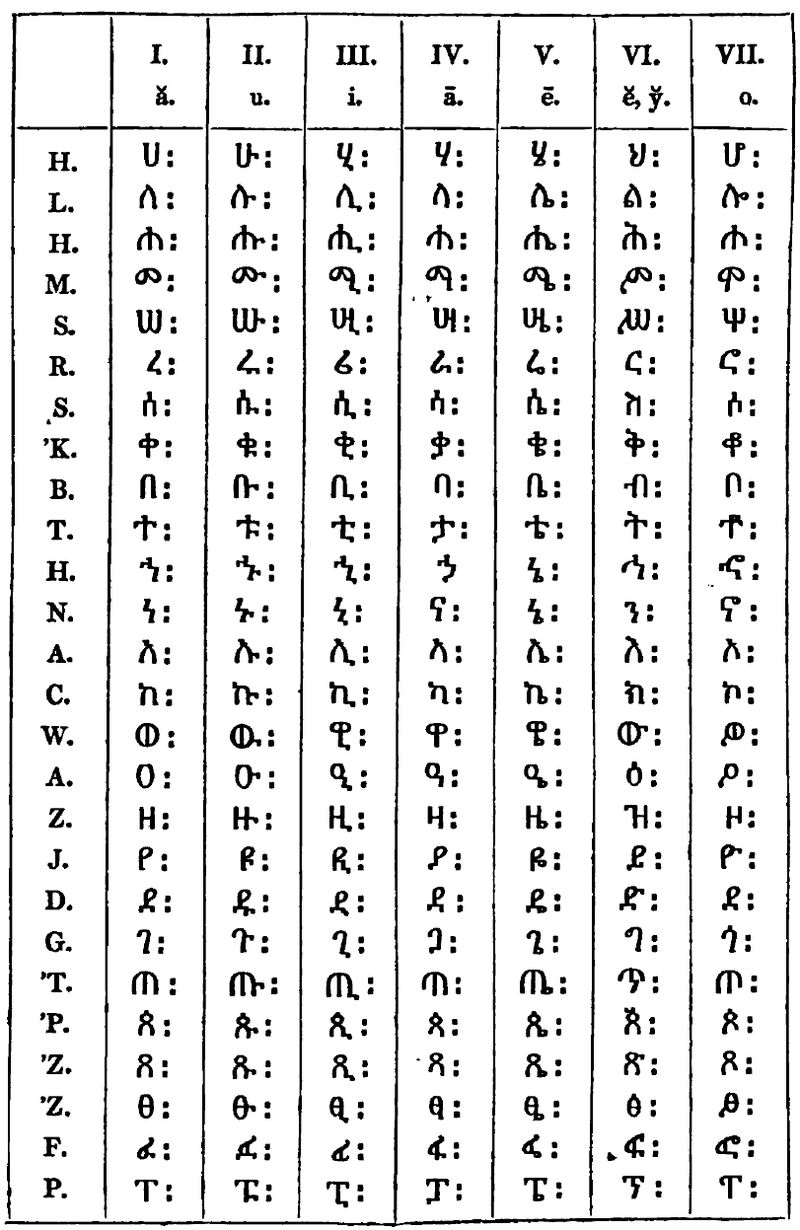
| I. | II. | III. | IV. | V. | VI. | VII. | |
| ã. | u. | i. | ā. | ē. | ĕ, y̆. | o. | |
| H. | ሀ: | ሁ: | ሂ: | ሃ: | ሄ: | ህ: | ሆ: |
| L. | ለ: | ሉ: | ሊ: | ላ: | ሌ: | ል: | ሎ: |
| H. | ሐ: | ሑ: | ሒ: | ሓ: | ሔ: | ሕ: | ሖ: |
| M. | መ: | ሙ: | ሚ: | ማ: | ሜ: | ም: | ሞ: |
| S. | ሠ: | ሡ: | ሢ: | ሣ: | ሤ: | ሥ: | ሦ: |
| R. | ረ: | ሩ: | ሪ: | ራ: | ሬ: | ር: | ሮ: |
| S. | ሰ: | ሱ: | ሲ: | ሳ: | ሴ: | ስ: | ሶ: |
| ’K. | ቀ: | ቁ: | ቂ: | ቃ: | ቄ: | ቅ: | ቆ: |
| B. | በ: | ቡ: | ቢ: | ባ: | ቤ: | ብ: | ቦ: |
| T. | ተ: | ቱ: | ቲ: | ታ: | ቴ: | ት: | ቶ: |
| H. | ኀ: | ኁ: | ኂ: | ኃ: | ኄ: | ኅ: | ኆ: |
| N. | ነ: | ኑ: | ኒ: | ና: | ኔ: | ን: | ኖ: |
| A. | አ: | ኡ: | ኢ: | ኣ: | ኤ: | እ: | ኦ: |
| C. | ከ: | ኩ: | ኪ: | ካ: | ኬ: | ክ: | ኮ: |
| W. | ወ: | ዉ: | ዊ: | ዋ: | ዌ: | ው: | ዎ: |
| A. | ዐ: | ዑ: | ዒ: | ዓ: | ዔ: | ዕ: | ዖ: |
| Z. | ዘ: | ዙ: | ዚ: | ዛ: | ዜ: | ዝ: | ዞ: |
| J. | የ: | ዩ: | ዪ: | ያ: | ዬ: | ይ: | ዮ: |
| D. | ደ: | ዱ: | ዲ: | ዳ: | ዴ: | ድ: | ዶ: |
| G. | ገ: | ጉ: | ጊ: | ጋ: | ጌ: | ግ: | ጎ: |
| ’T. | ጠ: | ጡ: | ጢ: | ጣ: | ጤ: | ጥ: | ጦ: |
| ’P. | ጰ: | ጱ: | ጲ: | ጳ: | ጴ: | ጵ: | ጶ: |
| ’Z. | ጸ: | ጹ: | ጺ: | ጻ: | ጼ: | ጽ: | ጾ: |
| ’Z. | ፀ: | ፁ: | ፂ: | ፃ: | ፄ: | ፅ: | ፆ: |
| F. | ፈ: | ፉ: | ፊ: | ፋ: | ፌ: | ፍ: | ፎ: |
| P. | ፐ: | ፑ: | ፒ: | ፓ: | ፔ: | ፕ: | ፖ: |
The diphthongs are formed not only by the letters ው: and ይ:, mutes of the sixth order, after a letter of the first or fourth order, as, for instance, አውራኀ: months, ተሠይመ it is appointed; but also the four letters ቀ: ኀ: ከ: and ገ: with the addition of certain peculiar points, are generally considered to form diphthongs in the first, third, fourth, fifth, and sixth orders, in this manner:

| I. | III. | IV. | V. | VI. | |
| uă. | ui. | uā | ue. | uy. | |
| ’K. | ቈ: | ቊ: | ቋ: | ቌ: | |
| H. | ኊ: | ኋ: | ኌ: | ||
| Q. | ኰ: | ኲ: | |||
| G. | ጓ: | ጔ: | ጕ: | ||
In Ethiopic each separate word is distinguished by two thick points, and the periods by four or more; there are no marks of accentuation.
The preceding observations are extracted from a small treatise on the elements of Ethiopic grammar by George Otho, professor of the Greek and Oriental languages at Marburg in Hesse Cassel, with an acknowledgment of being indebted for his information to Ludolph; and bound in connexion with the “Fundamenta Punctationis Linguæ Sanctæ” of Jacob Alting, printed at Frankfort on the Main, in 2 vols., 1717.
Ethiopic Types in the British Founderies.
English.—Oxford University. Thorowgood & Besley. Formerly Bynneman’s.
Pica.—Caslon & Livermore. Thorowgood & Besley. Walton’s Polyglot; through Andrews’s and James’s founderies to Fry.
ETRUSCAN.
The confines of ancient Etruria bordered closely upon the city of Rome, being separated from it only by the Tyber to the south-east and south. There is proof, indeed, that almost all Italy was at one time under the power of Etruria.
Although the Etrurians seem to have arrived at the highest point of civilization, and even of luxury, at an early period, whilst Rome had as yet no existence, and to have been distinguished in a variety of respects far beyond the people of surrounding nations, we are almost wholly ignorant of their history, and even their origin is involved in the greatest doubt.
The people of Etruria, called by the Romans Etrusci or Tusci, are styled Tyrrheni or Tyrseni by the Greek historians.
The difficulties of the Etruscan question are increased by a difference of statement and of opinion in the accounts recorded on the subject, by Herodotus and Dionysius, two of the greatest antiquaries and historians of ancient times.
Herodotus, who, says Athenæus (lib. xii.), obtained his account from Lydians, gives to the Tyrrheni a Lydian origin, and states that they emigrated under the command of Tyrrhenus, one of the sons of Atys: while Dionysius, partly because Xanthus, an historian of Lydia, is silent respecting this emigration, will not allow the tradition to be true, but imagines them to have come from the north. It is not improbable that[219] both are in part correct: the earlier portion of the Etrurians might have come from the north, while the later colony (who must have been advanced in civilization to have effected the voyage) might have been Lydians; and in all probability these subsequent settlers constituted the dominant portion of the invaders of Etruria.—Sir William Gell’s Topography of Rome, 8vo. 1834.
The Etruscan language must have been the same, or nearly so, with the Hebrew and Phœnician. For, whether we consider them as descended from Ashur, Peleg, the Egyptians, Phœnicians, or even Celtes, and from some of these they undoubtedly descended, their language must have been either the same with the Hebrew and Phœnician, or nearly related to them. The first Pelasgic settlements in Etruria could not have been many centuries after the deluge, and very few after the dispersion; and at that time the languages, or rather dialects, of the Egyptians, Assyrians, Babylonians, Celtes, Syrians, Arabs, &c., must have approached extremely near to the Hebrews and Phœnicians, which the learned allow to have been almost the same. With regard to the Canaanites or Phœnicians migrating into Etruria, after the first colonies of the Pelasgi or Tyrsenians settled there, it cannot be denied, that their language had received but little alteration from the primitive Hebrew. So that both sacred and profane history concur to evince the Hebrew, Phœnician, and Etruscan tongues to have been, in the earlier ages, nearly the same.
This likewise farther appears from the letters and manner of writing anciently used in Etruria. The letters are almost the same with those of the earliest Greeks, brought by Cadmus out of Phœnicia. The manner of writing is purely Oriental, the letters being drawn from the right hand to the left, consonant to the practice of the Eastern nations. The former point is rendered indisputably clear by the Eugubian tables, in conjunction with the Sigean inscription, and the latter by a bare perusal of the generality of the Etruscan inscriptions. Nay, the very remote antiquity of the first colonies that settled in Etruria, as well as of the Etruscan language and alphabet, may be easily inferred from those inscriptions. For as the Pelasgic alphabet, that prevailed in Greece before the age of Deucalion, consisted of sixteen letters, the Etruscan or Pelasgic alphabet, first brought into Italy, composed of only thirteen letters, must have preceded the reign of that prince. The high, not to say almost incredible, antiquity of the Etruscan language and alphabet, has been clearly evinced in two dissertations, by Mr. J. Swinton, printed at Oxford in the year 1746.—Univ. Hist. 8vo. vol. xvi. 1748.
The author of a “Tour to the Sepulchres of Etruria, in 1839,” in a visit to General Galassi’s museum at Rome, says, “If we had been surprised at Campanari’s exhibition, we were petrified at the general’s. Here we saw an immense breastplate of gold, which had been fastened on each shoulder by a most delicately wrought gold fibula, with chains like those now made at Trichinopoly. The breastplate was stamped with a variety of arabesques and small patterns, as usual in the Egyptian style. The head had been crowned with fillets and circular ornaments of pure gold, and a rich mantle had covered the body, flowered with the same material. In this grave also had been found a quantity of arms, round bronze shields with a boss in the centre which was stamped, spears, lances, and arrows; a bier of bronze, as perfect as if made a year ago; a tripod, with a vessel containing some strange looking lumps of a resinous substance, and which on being burnt proved to be perfumes[220] so intensely strong, that those who tried them were obliged to leave the room. There were many small images, perhaps of lares, or of ancestors, in terra cotta that had been ranged in double lines close to the bier; also some large common vessels for wine and oil, and some finely painted vases and tazze, with black figures upon a red ground, which had been consecrated to the dead. There were wheels of a car upon which the bier had been brought into the sepulchre, and many other things which I do not remember; but the wonder of all these treasures was a sort of inkstand of terra cotta, which had served as a schoolmaster’s A. B. C. On it were the Etruscan letters, first in alphabet, and then in syllables, and both the letters and the syllables are the same as the oldest form of the Greek. It was deciphered by Dr. Lepsius, and is the key to all we at present know, and will be the basis of all we are ever likely to know, of the Etruscan tongue.”——“This humble article is likely to prove to Europe, what the stones of Alexandria and Rosetta have been before it, the dictionary of a lost language, and the interpreter of an extinct race.”
“I noted that upon this inkstand were four alphabets engraved, and after each the syllables,—thus, ba, be, bi, &c., ma, me, mi, and so forth; that one of these is in the oldest or archaic form of the Greek alphabetic letters, and that hence connexion is likely to be traced and demonstrated between the Egyptian, Etruscan, and Pelasgic.”
The Primitive Etruscan Alphabet.

To these letters may be added the four following complex characters [#], [#], [#], and [#].
Etruscan in the British Founderies.
Pica.—Caslon and Livermore. Cut by Caslon for the celebrated linguist, the Rev. John Swinton, Oxford, about 1733.
EVEN LINES.
When a piece of printing has to be executed in great haste, a number of compositors are employed on it, and the copy is cut into small pieces for each, to facilitate the making-up, imposing, and the general furthering of the work; if the copy should be in long paragraphs, the compositors have each to begin a line and to make their copy end a line, frequently with great irregularity of spacing; this is termed making even lines. In daily newspapers it is of constant occurrence.
EVEN PAGE.
The second, fourth, sixth, or any other even numbered page is called an even page.
Exclamation, Note of. See Punctuation.
EXERCISING THE PELT.
Frequently currying a pelt, to get it into condition, is termed Exercising the Pelt, or Giving the Pelt Exercise.
FAC.
Before the introduction of printing into Europe, and its application to the production of books, the Librarii or writers of books, in Rome, were a regular company who had several immunities: their business was a trade, and they were regulated by certain laws. Besides these writers of books, there were artists whose profession was to ornament and paint manuscripts, who were called Illuminators; the writers of books first finished their part, and the illuminators embellished them with ornamented letters and paintings. We frequently find blanks left in manuscripts for the illuminators which were never filled up. Some of the ancient manuscripts are gilt and burnished in a style superior to later times. Their colours were excellent, and their skill in preparing them was very great.
This practice, of introducing ornaments, drawings, emblematical figures, and even portraits into manuscripts, is of great antiquity. Varro wrote the lives of seven hundred illustrious Romans, which he enriched with their portraits, as Pliny attests in his Natural History. Pomponius Atticus, the friend of Cicero, was the author of a work on the actions of the great men amongst the Romans, which he ornamented with their portraits, as appears in his life by Cornelius Nepos; but these have not been transmitted to posterity. However there are many precious documents remaining, which exhibit the advancement and decline of the arts in different ages and countries. These inestimable paintings and illuminations, display the manners, customs, habits, ecclesiastical, civil, and military, weapons and instruments of war, utensils and architecture of the ancients; they are of the greatest use in illustrating many important facts, relating to the history of the times in which they were executed. In these treasures of antiquity are preserved a great number of specimens of Grecian and Roman art, which were executed before the arts and sciences fell into neglect and contempt. The manuscripts containing these specimens, form a valuable part of the riches preserved in the principal libraries of Europe. The Royal, Cottonian, and Harleian libraries, as also those in the two Universities in England, the Vatican at Rome, the Imperial at Vienna, the Royal at Paris, St. Mark’s at Venice, and many others.
When the art of printing was first applied in Europe to the production of books, they were in imitation of, and sold as, manuscripts; and blanks were left at the commencement of the respective divisions of the work, for the illuminator to fill in with the proper letters, and ornaments, as was usual in manuscripts, and so close was the imitation that, even in our own time, it has required the assistance of a chemical test to ascertain which was manuscript and which was printed. When the secret of printing was divulged, and the deception could not be continued, ornamental letters of a large size were introduced, and printed with two colours, generally red and blue, the letter being of one colour, and flourishes, extending the whole length of the page, in the other, so as to have the appearance of being done with a pen; then succeeded various grotesque figures, in attitudes to resemble letters; afterwards small Roman Capital Letters, with ornaments round them forming a square design; subsequently the block was pierced so that any letter could be introduced, and the ornamented part could be used for any initial; the next descent was for the letter founders to cast the ornament in type metal, and pierce it for general use, and these cast ornaments for letters were[222] called Facs, as an abbreviation, I believe, for Facsimile. The last descent was to the extreme, to put a plain Roman Capital Letter, frequently extending four or five lines in depth; and this is the substitute for a beautiful coloured drawing.
FACE OF A LETTER.
The surface of that extremity of the type which bears the letter.
FACE OF A PAGE,
or Form. The superficies of a page or form, where the faces of every letter lie in the same plain.—M.
FALLING OUT.
The same as Dropping out, which see. But this term is more generally applied to a page, a quarter, or a whole form, when any one of them falls out of a chase from the shrinking of the quoins and furniture.
In summer time particularly, forms in chase require to be frequently examined, and the quoins tightened, to prevent this accident, and more especially when they have been imposed in wet furniture. Compositors should neither be negligent, nor forgetful of this, as in the progress of a work the forms are in their charge, and if the whole of a form, or part of it, falls out, they not only have to distribute the pie, but to recompose the matter gratuitously.
FANNING.
This is a term used in the Warehouse, in counting paper. It consists of taking hold of the right hand lower corner of a portion of the paper between the flat side of the fore finger and the end of the thumb, and pinching it tolerably tight; then with a twist of the wrist turning the right hand edge of the paper up, and running the left hand over the surface of the paper, it separates the sheets at the top corner, so as to have somewhat the appearance of a fan, and enables the person to count it with facility.
FAT.
With compositors, short pages, blank pages, and light open matter: with pressmen, light forms, forms that only require one pull at wooded presses; and very small numbers, such as five, ten, fifteen, or twenty copies each, are termed Fat.
Fat. See Beat Fat.—M.
FAT FACE,
or Fat Letter, is a letter with a broad stem. For observations on them and specimens, see Type.
Fat Form. See Fat.
Fat Work. See Fat.
FEET OF A PRESS.
The frame of a wooden press that lies horizontally on the floor, into which the cheeks and hind posts are inserted by means of mortises and tenons.
FELT.
Pieces of felted hats. This is the best substitute for scaleboard, when there is a deficiency of that article, to use as cards in the head of a press; and even when there is no scarcity of scaleboard, a few pieces put in improve the pull. See Cards.
FINE PRESSWORK.
This is the technical term for presswork of superior quality; it is in some measure indefinite, for, as presswork is paid a certain price for a given number, and the price advances according to the time and care bestowed on it, that for which the lowest price is paid is termed common work, and after the price has advanced about one half in addition, it is styled fine work; although it may advance gradually to six times the lowest price, or more, it is still called fine work.
In aiming at excellence in printing, it will be found that Presswork deserves particular consideration, as a part on which the beauty of a book so much depends.
It will be necessary, in the first instance, to endeavour to define more[223] particularly what is meant by the term Fine Presswork, for except this be understood, we shall come to no satisfactory conclusion, as workmen vary in their opinions respecting it, and frequently produce sheets of different shades of colour in the same volume, when it is done at different presses, and all under the name of the finest work; and when the same person either actually prints the whole, or superintends it, the work will be executed according to his criterion, without any fixed rule whereby to decide; thus one man shall produce the finest work, according to his opinion, of a pale grey colour, while another will produce it so black and surcharged with colour, that if the ink be not of a very good quality, it will not only smear, but the paper at the edges of the letters, nay, even the whole page, will be tinged with the oil which separates from the colouring matter of the ink, to the entire destruction of all beauty of workmanship.
Fine Presswork is the art of printing perfect impressions from the surface of engravings in relief.
By obtaining perfect impressions, I would be understood that the subject transferred to paper should be an impression from the surface and the surface only of the engraved lines, of such a tone as to produce all the effect of which the subject is capable, without either superfluity or deficiency of colour.
Having thus defined my meaning of the term Fine Presswork, I shall speak of the means by which it is to be produced, which may be of use to those who have not had opportunities of printing splendid books.
The press ought to be in the best condition, otherwise there will be no certainty of the impression being equal, except with great trouble and loss of time. The joints of the tympan should not have any play; if they have, it will affect the register, which being out disfigures the appearance of the book; it also causes a great risk of producing slurs and doubles: the most certain way of having them without play is to construct them on centres, so that if they should work a little loose, they can at any time, with the greatest ease, be tightened by means of the screws on which the centres are formed.
The parchments on the tympans should be thin, and of a uniform thickness, and stretched on the tympans so as not to be flaccid. It is said that the French printers in their finest works used silk on the tympans, on account of its thinness, its smoothness, and uniformity.
The face of the platen ought to be a true plane, and parallel to the press stone, or table. It will be found in practice that an iron platen is superior to a wooden one for producing a sharp clear impression, where fine work is wanted; for, by discarding woollen blankets, the pressure must be increased to obtain this effect, which indents wood, and then requires so many overlays to make a uniform impression, that they produce nearly the same effect as blankets, and it becomes necessary to new face the surface frequently, which is inconvenient and expensive: the iron platen is not subject to this inconvenience; but it is more liable to injure the types, as it will not yield; and should there be any inequality on the surface of the form, owing to it not being well planed down, or to any extraneous matter being upon it or under it, the types must give way, and be destroyed. Generally speaking, the iron platen wears the types more than a wooden one.
The head of the press should be so justified as to produce what is termed a soaking pull; that is, the form should begin to feel the pressure of the platen when about two thirds down; then, when the bar is pulled home, or what is technically called cheeked, which I would always recommend[224] to be done in good work, as it keeps the pull regular and uniform, the power slowly increases, and the paper has time to be pressed gradually on the types, which causes it to receive the ink on all its parts, and produces a clear impression.
This justifying the head relates to wooden presses, where the head and the winter are allowed some play, which is filled up with pieces of scaleboard, called cards, cut to the size of the mortises in the cheeks, and inserted in them upon the tenons of the head, and under the tenons of the winter, allowing the pull to have some elasticity. For my own part, I would have the winter lie solid, and the spring be confined to the head. See Winter.
In the iron presses constructed on the late Earl Stanhope’s principle, where increased power is produced by means of a compound lever applied to the screw, and where there is no elasticity in the pull, this effect is produced in a greater degree than in a press of the common construction; for, as the platen descends on the form, the power increases considerably, but the motion is slower; thus the effect of the soaking pull is preserved, with a considerable addition of power, owing to the combined action of the screw and the compound lever.
In Ruthven’s press, where the platen is suspended from the head, and brought over the form by means of small wheels with grooves in their edges running on the ribs, the pull is regulated by screws on the locking pieces, and also through the springs by which it rests on the ribs, that bring it nearer to, or remove it from the form.
In Clymer’s Columbian press, where the power is obtained by a compound lever, the pull is regulated by a screw that connects the bar with the lever, and additionally by thin plates of iron placed upon the top of the platen under the bottom of the spindle. It is also regulated in the same way, in the Albion press, as originally constructed by R. W. Cope.
In Sherwin and Cope’s Imperial press the pull is justified by a wedge above the head of the spindle or bolt in the front, which has a screw attached to it with a projecting head, by which the pull is adjusted to the greatest nicety, with ease and facility. Mr. Hopkinson has adopted the same plan in the Albion press since it came under his management on the death of Mr. Cope.
The advantage of having a good press will be unavailing for the production of fine work, if the types are much worn; for it will be found impossible to produce a sharp clear impression if the perfect shape of the letter and the fine lines are rounded and worn away by much use, as, in consequence of this roundness of the letter from wear, it will be necessary to use much blanket in the tympan to bring up the shape of the whole letter, which will produce a gross and indelicate impression of more than the surface.
I have been told that Didot, of Paris, in his most splendid works, never printed more than three sheets from the same fount of letter, when it was sent to the melting pot, and replaced by a new fount.
The colour of the ink must depend on the taste or fancy of the master printer;—but no, I am mistaken, for, unless he prepares his own ink, he is obliged to use that only which is manufactured for general use; and there is little if any choice in purchasing this article, when it is wanted of a superior quality. Leaving the particular shade or tone out of the question, I will state my opinion as to what the qualities of black printing ink ought to be for fine work.
Intenseness of colour.
Impalpability.
Covering the surface perfectly of the type or engraving.
Quitting the surface of the type or engraving, when the paper is pressed on it, and adhering to the paper.
Not smearing after it is printed.
Retaining its first appearance without any change.
Ink ought to be reduced to an impalpable smoothness, either in a mill or on a stone with a mullar; and this is essentially necessary, as the process gives it the next quality—of completely covering the surface of the type, or the lines of the engraving, and that with the smallest quantity; and, with proper care in printing, presents to the eye an impression, in which the edges of the lines are smooth and perfect, and the surface of the impression on the paper is completely covered with ink, without any superfluity; which constitute the perfection of presswork with types.
Another property required in ink is, that it shall not only cover the surface of the lines on the paper printed, but that it shall also quit the face of the type or engraving, and leave it quite clean when the paper is impressed on it, and attach itself to the paper, so as to give a perfect impression of the subject represented, without the colour of the paper appearing through the ink; and that this property, of quitting the type or engraving, and becoming attached to the paper, shall continue the same through any number of impressions, without any accumulation of ink on the surface printed from.
After having obtained these results, and when the printing is as perfect as it can be made by workmanship, still something more is requisite, viz. that the ink shall not smear on being slightly rubbed; and that it shall retain its colour and appearance, without the oil in the ink spreading at the edges, or tinging the paper—in short, that it shall continue unchanged for any length of time, thus preserving and continuing the beauty of the work.
The balls should be in good condition, otherwise the pressman may exert his skill in vain, with a great loss of time and waste of paper, without the intended effect. They are made smaller and stuffed tighter with wool than those used for common work, which enables the pressman to distribute the strong ink that is used with more facility; they also cover the surface with ink better than if they were softer, and are easier for the workman; for large soft balls, used with ink made very strong with varnish and colour, would be almost unmanageable.
The quality of the paper is of great consequence in fine printing, but it is frequently overlooked by the printer’s employers, who are too apt to pay more attention to a showy appearance and a low price, than to quality.
The best paper for receiving an impression, as I have observed in the article Engravings on Wood, is India paper; but as that which comes to England is thin, it is not used for bookwork, neither would it be durable, as it wants toughness to enable it to sustain much wear.
The next best paper for printing is French plate paper, which is superior to English plate paper, as the latter has a good deal of gypsum in its composition, which causes it to be very uncertain in the wetting; for having given it a sufficient quantity of water, judging from appearances and by comparison, and expecting to have it in good condition, the pressman shall find it, when wanted for use, nearly dry, and harsh, and the water unequally diffused; it has then to be wetted again, and particular attention must be paid to the turning and pressing of it, before it is in a proper state for printing on. I attribute this effect to the gypsum, which has had its water of crystallization driven off by fire in preparing it, and the[226] water which it takes up in wetting crystallizes to supply its place. I do not say that all English plate paper is affected in this manner by water, but I have repeatedly experienced it in practice; and in the second wetting, if great care be not taken, the gypsum being already saturated, it will imbibe too much water, which will squeeze out in printing, and prevent the paper from taking the ink uniformly, so as to spoil the impression.
The best English paper for printing on is that which is made of fine linen rags, and moderately sized, without the use of acids in bleaching, and without being adulterated with cotton rags: this paper takes water kindly, is easily got into good condition, receives a good impression, is durable, preserves its colour, and does not act upon the ink.
Messrs. J. Dickinson and Co. have made great improvements in the quality of paper, and manufacture one kind which is admirably adapted for printing, being made by a peculiar process which gives it a particular affinity for the ink. They have also introduced improvements in the manufacture which have superseded the use of French paper with us, and have also nearly done so with the Chinese or India paper.
Having thus spoken of what I mean by fine presswork, and of the materials by which it is to be produced, I shall now proceed to describe the process; for when a printing office is provided with materials of the best quality, and the master of it is desirous of producing superior workmanship, there is something more required—he must resolve to lay in a fund of patience, as well as to submit to a great and continued expense of materials, or else he will never excel.
A good pressman will, as a matter of course, be well acquainted with the whole of the usual routine of presswork; in addition to which, to form his judgment, he should make himself acquainted with the most splendid books, and study them as patterns of workmanship.
In making ready it must be evident, that when a clear sharp impression is wanted, the pressure should be on the surface only, without penetrating into the interstices; of course the tympan ought not to be very soft, neither should any woollen blanket be used: the most perfect impression will be obtained when fine thick paper alone is used in the tympans, and even of this article I would not recommend many thicknesses.
After an impression is printed, the pressman examines if it be uniform throughout; if it be, which is very rarely the case, he goes on with the work; if not, he proceeds to overlay, in order to produce regularity of pressure, and of colour, over the whole form.
To effect this object, he takes thin smooth paper, and wherever the impression is weak he pastes a bit of it, of the size and shape of the imperfect part, on the tympan sheet, and proceeds in the same manner with every part that is imperfect; he then pulls another impression to examine the effect of his overlays, and continues to add to them where wanted, till the pressure of the platen is the same in every part, and the impression is uniformly of one shade of colour.
If the impression come off too strong in parts, or at the edges or corners of the pages, or on the head lines, it will be necessary to cut away the tympan sheet in those parts, and, if that does not ease the pressure sufficiently, to cut away the same parts from one or more of the sheets that are within the tympans.
It is generally preferable to overlay on a sheet of stout smooth paper inside the tympan, and particularly where the same press does the whole or great part of a work: this sheet is cut to fit the interior of the tympan, so as not to slip about, and has overlays pasted on it where wanted, to bring up the impression till it is very nearly equal; in all succeeding[227] sheets it saves the pressman a great deal of time, as he will be certain that when he pulls a sheet of another form of the same work it will be nearly right, and he will only have to place thin overlays on occasional parts to make the impression perfect, with very little trouble. On the same principle, where this method is not adopted, preserving and using the same tympan sheet with its overlays, will be more expeditious than having to repeat the operation with every form.
Where short pages occur in a form, the bottoms of them and the edges of the adjoining pages will print too hard, and not prove a clear impression; it will therefore be necessary to have bearers to protect them, which are generally of double pica reglet pasted on the frisket, so as to bear on some part of the furniture or chase; but high bearers, made to the height of the types, are better, when they can be placed so that the balls do not touch them during the process of beating: in such a case they are liable to tear the frisket, from their closely adhering to it by their inky surface and the pressure. They may be placed where the regular foot of the page would have been had it been a full one, to prevent those hard edges which would otherwise be produced. This principle will hold good in all cases of short pages, blank pages, and the edges of wood cuts; but where it happens that some of the edges, or a particular page of a full form, come off too hard, and where there is not room to place a high bearer, then a piece of double pica reglet pasted on the frisket in the usual way will answer the purpose.
It is not necessary that these bearers should be placed close to the part requiring to be eased; they will produce the same effect if placed at a distance, keeping the direction, so that they take a good bearing on the platen, avoiding the frame of the frisket and the points; in using reglet as low bearers, I would recommend that the flat side of the furniture should be turned uppermost to receive the pressure of the bearers, provided they do not bear upon the chase.
When a high bearer does not ease the pull sufficiently on particular parts, its effect may be increased by pasting slips of stout paper on it, as overlays or underlays, and a bearer of reglet may be amended in a similar manner.
It happens occasionally that the tympan causes the paper to touch the form partially on being turned down, and occasions slurs, and this may occur from the parchment being slack or the paper being thin and soft. To prevent this inconvenience it is customary to roll up a piece of paper, similar to bookbinders headbands, and paste it on the frisket adjoining the part; this roll of paper takes a slight bearing on the furniture, and is a remedy. Many pressmen prefer pieces of cork cut to about the thickness of double pica, and pasted on the frisket.
It is neither customary nor advisable to fly the frisket in the best work, and more particularly when large heavy paper is used; it is a convenience in such cases to have a button screwed on the off side of the frame of the tympan, to confine the frisket flat to the tympan; it keeps the paper in its place, assists it in rising from the face of the form, to which it adheres owing to the strength of the ink; it helps to prevent slurring, and the paper from slipping, which occasions waste when it happens: altogether the button is of consequence in preventing accidents in the impression.
In working the white paper, instead of pins stuck into the tympan, to prevent the paper slipping, a duck’s bill is frequently used: it is pasted to the tympan at the bottom of the tympan sheet, and the tongue projects in front of it, indeed the tympan sheet appears to rest in it. The bottom of[228] each sheet is placed behind this tongue, which supports it while turning down the tympan. See Duck’s Bill.
In proceeding with the work the balls should be well cleaned, that no dirt or extraneous matter may be on their surface. They should not be too moist, which would prevent the ink distributing equally on them, and would also prevent it lying equally on the surface of the types or engraving; nor should they be too dry, as in that case they will not dispose of the ink so smoothly as to produce a fine impression; neither will they retain particles of dirt on their surface, but part with them to the form, which will cause picks. The moisture ought to be just so much as to make the pelt or composition soft, when the ink will distribute kindly and equally, which will be perceived by their lugging; they will also part with it to the form equally where they touch, so that the impression will be sharp and clear.
The ink ought to be rubbed out thin and regular on the ink block, so that in taking ink it shall at the very first be diffused tolerably smooth on the surface of the balls, which causes a greater probability of producing good impressions. It is likewise advisable to keep rubbing the ink out on the block with the brayer, as also to be almost constantly distributing the balls; the consequent friction produces a small degree of warmth, which is of advantage, particularly in cold weather.
As uniformity of colour is requisite for beauty in printing, I would recommend that the pressman should take ink for every impression where the form is large; this I am aware will be thought too troublesome, but I am decidedly of opinion that it is advantageous in producing regularity of colour: it is unpleasant to the eye to see in a splendid book two pages that face each other, the one of a full black, rather surcharged with ink, the other rather deficient in quantity and of a grey colour; yet this must happen when, as is frequently the case, three or four sheets are printed with one taking of ink.
Beating for fine work should not by any means be slighted. The form ought to be gone over two or three times, not with heavy thumps, but slowly and regularly with a firm hand, just raising the balls each time completely clear of the types, and advancing but a little way, so that in fact each part will be beat five or six times over, or more; the face of the type will then be completely covered with ink: but the pressman should be careful not to beat too far over the edges of the pages, nor, if the margin be wide, to let the balls scrape against the edges of another page, as in both cases ink or extraneous matter will be scraped from the balls, and accumulate about the types at the extremities, and thus cause picks and rough lines.
In splendid books, and particularly where the paper is large and heavy and the type large, set-off sheets are used to interleave the whole impression while working, and are continued in it till the printed paper is taken down from the poles, when they are removed by the warehouseman. These set-off sheets are put in when the white paper is working, and moved from one heap to the other during the working of the reiteration. They prevent the ink from setting off from one sheet to another while they are newly printed, which it would otherwise do from the weight of the paper, and also from fine printing being usually worked of a full colour.
For the uniformity of impression I would advise that the pull should be adjusted in the first instance so as to cause a proper degree of pressure on the form to produce a good impression when the bar is pulled home, and then invariably to cheek the bar, and allow it to rest in that position[229] during a short pause; this is easily done in the Stanhope, the Ruthven, the Columbian, and Sherwin and Cope’s presses, as the increased power is obtained by a compound lever, which is generally so adjusted as that the lever shall come a small portion beyond the centre of the circle it partially describes when the bar is pulled home, and as it has then reached a point beyond its maximum power, it is easily retained in this position to rest on the pull: the same observation applies to all other presses having, what is usually termed, the increased power, which is the application of a compound lever to a press on the common construction; but in a one pull wooden press, instead of this application, which I must acknowledge I never knew to answer well when applied to these presses, I would recommend when fine work is doing a simple contrivance that I adopted in two presses, which answered the purpose uncommonly well, and enabled the pressmen to rest on the pull uniformly, without too much effort to keep the bar to the cheek, which with a heavy form and a large platen becomes very fatiguing to continue through a number of impressions, if not impossible, with the unaided exertion of the arm. See Catch of the Bar.
It will thus be perceived, that to produce presswork of a highly superior character, great expense and much time are required; and that it is requisite to have a good press, and that press to be in good condition; to have new types, or types the faces of which are not rounded by wear; to have good balls, and those balls in good condition; the ink should be strong, of a full black colour, the oil well boiled, to prevent it separating from the colouring matter and tinging the paper, and it should be ground so fine as to be impalpable; the paper should be of the best quality, made of linen rags, and not bleached by means of an acid which has a tendency to decompose the ink; the beating should be carefully and well done, not in a hurried manner, the face of the type should be completely covered with ink, without any superfluity, so as to produce a full colour; and the pull should be so regulated as to have a slow and great pressure, and to pause at its maximum in order to fix the ink firmly upon the paper; these particulars observed, with paper only in the tympans, perfect impressions of the face of the type only will be obtained in the most superior manner, and a splendid book will thus be produced in the best style of printing.
FIRE EATER.
Compositors who are expeditious workmen are styled Fire Eaters, and also Swifts.
FIRST.
The pressman who has wrought the longest at that press, except an apprentice, for he must allow any journeyman, though new come, that style, is distinguished by the name of First, the other his Second, these call one another companions: generally the master printer reposes the greatest trust upon the care and curiosity for good work of the First; although both are equally liable to perform it. All the privilege that the First has above the Second is, that the First takes his choice to pull or beat the agreed stint first: and that the Second knocks up the balls, washes the forms, teazes wool, and does the other more servile work, while the First is employed about making register, ordering the tympan, frisket, and points, &c., or otherwise making ready the form, &c.—M.
At the present day there is no such distinction; both the pressmen are equal, are equally responsible for the work, and take all the respective parts without any distinction; unless one of them be an acknowledged superior workman, and then he will, as a matter of course, take the lead in making ready, but in nothing else.
FIRST FORM.
The form the white paper is printed on, which[230] generally by rule ought to have the first page of the sheet in it.—M. This is the reverse of the present custom, which is invariably to lay on the inner form first, viz. the one that has the second page in it; except it is directed to the contrary, for some particular reason. See Lay on.
FIRST PAGE.
First page of the sheet, which is always placed to the left hand in the first or outer form on the stone, when imposing.—M. In Hebrew works it is placed to the right hand, as in books printed in that language the order of the pages is reversed.
FIRST PROOF.
The first impression of any matter after it is composed, for the purpose of comparing it with the copy; it is usually printed on a cheap hard sized paper, that will bear writing ink well, to mark the literal errors, and any variations from the copy that may have occurred, in order to assist their correction in the metal.
FIRST PULL.
In a two pull press of the common construction, the platen only covers half a full form, and to obtain an impression of the whole, the carriage is run in at twice; the first pull prints one half, and the second pull the other half.
FLARING BALLS.
When pelt balls are too soft, from having imbibed too much moisture, and are wanted for immediate use, they are flared; that is, the pressman will take a sheet of waste paper, and having rolled it up slightly, will light it, and holding the face of one of the balls downwards, will pass it backwards and forwards over the flame, and then treat the other ball in a similar manner: this not only evaporates the moisture, but also communicates a small degree of warmth to the balls, which causes them both to take ink and to distribute it better than before the operation.
Composition balls are liable to crack, both in distributing, and also when separating them after they have been left in the rack upon each other, particularly when they are new and soft; to remedy this, they are flared, which, when it is judiciously done, melts the surface of the composition and fills up the cracks. They are also flared when the face begins to fail, which melts the composition, and forms a new and smooth surface.
FLARING A FORM.
In working by candle light, when imposing, correcting, or laying a form on the press, it sometimes happens that melted tallow will be spilt on the pages and choke up the letter. To get rid of this tallow, and clean the form again, the compositor lights a piece of paper and puts it on the grease, to melt it; he then brushes it with the letter brush, and, if necessary, repeats the operation.
FLOWERS.
Types with ornaments cast on their face instead of letters. They are used for borders round jobs, cards, pages, and wrappers of books; and for other embellishments.
Luckombe, in his work on printing, gave many specimens of borders, head pieces, &c. composed of flowers by Mr. Hazard, of Bath; and lately, Mr. Johnson and Mr. Nichols have produced some large and elaborate pieces with this material, by combining an immense number of pieces of different patterns and sizes, to represent pillars and arches; but after all the ingenuity they have displayed, and the patience they have exerted, their productions are inferior to the effect of an engraving; and only tend to prove, in my opinion, that ingenuity and patience are misapplied.
Flowers are cast on bodies from a Pearl up to a Four Line Pica, and of a great variety of patterns. Of late years our letter founders have greatly improved their specimens by the addition of many new designs.
The practice formerly was to cut the pattern perfect on each piece,[231] and many patterns had a line at the foot of each, so that when a border was formed, there was a continual line round the inside. I pointed out to the late Mr. Catherwood, of the firm of Caslon and Catherwood, the inconvenience of both these modes of cutting flowers: in the first case, when the pattern had a solid ground, the flowers joined in that solid part, and, after being used a few times, the angle became rounded, and always showed a separation between each piece; I recommended that the junction should be in the most open part of the design, so that a little rounding of the angle would not be so perceptible: and in the second case, the same cause produced the same effect; for after being used a few times, the angles became rounded, and instead of a continued line, it became a series of short lines, separated from each other by intervals: to remedy this, I suggested to him to discard the line, and that a piece of brass rule should be substituted by the printer, which, being in one piece, would form a continued line, and not be liable to injury from the same cause. He adopted both these plans, and the junction of the flowers that have been subsequently cut has been much improved; but the abolishing of the line has not produced the neat effect I anticipated, for it rarely happens that the printer will take the trouble of placing a rule within the flowers; in consequence, many of the designs present, when printed, a meagre and unfinished appearance.
FLY.
See Devil.—M. A boy who takes the printed sheets off the tympan as soon as the pressman turns it up, for the sake of despatch: it was most frequently done with newspapers, as they are always pressed for time, and are obliged to work with the greatest expedition. These boys are not now called devils, as in the time of Moxon, but Flies, or Fly Boys.
FLYING FRISKET.
In working at press, the act of turning down the frisket and the tympan upon the form by the same motion, for despatch; it is always done in the regular way of working, but not in very superior work where the paper is heavy.
FOLDING.
In the warehouse. As the person who collates the books turns them, the gatherings lie ready to be folded, and as they are pushed a little over each other they are readily taken up separately; they are knocked up at the ends and sides, and evenly folded in the back, which is rubbed down with a folder; after this, from a dozen to twenty-five gatherings in thickness are knocked up together and put into the press, which is thus filled and screwed down. After lying a sufficient time in the press, they are taken out and are ready for booking.
Books are never folded across a page; of course some require to be folded the shortest way of the paper, and some the longest way.
FOLIO.
The running number of the pages of a work. When there is no running title, the folios are placed in the middle of the head-line, in Arabic figures, sometimes enclosed in brackets, sometimes in parentheses, but more frequently now without either; when there is a running title, the folios are placed at the outside corners of the pages. The prefatory matter has the folios generally set in Roman lower case numerals, and sometimes the folios of an appendix are done in a similar manner.
A sheet of paper folded in two leaves, is also termed folio; as folio post, folio demy, &c.; but when the size of a book is spoken of, it is styled a post folio, demy folio, &c.
FOLLOW.
See if it follows, is a term used as well by the corrector, as by the compositor and pressman. It is used by the corrector and[232] compositor when they examine how the beginning matter of a succeeding page agrees with the ending matter of a precedent page: and how the folios of those pages properly and numerically follow and succeed one another, lest the pages should be transposed. But the pressman only examines that the folio and beginning word of the second page, and signature of the first and third page (when the reiteration is on the press) follow the folio and direction of the first page, and the signature of the third page follows the signature of the first page, orderly according to the volume, lest the form should be laid wrong on the press.—M.
Foot Notes. See Bottom Notes.
FOOT OF THE LETTER.
The break end of the shank of a letter.—M.
FOOT OF A PAGE.
The bottom or end of a page.—M.
FOOTSTEP,
is a board nailed upon a piece of timber seven or eight inches high, and is bevelled away on its upper side, as is also the board on its under side at its hither end, that the board may stand aslope on the floor. It is placed fast on the floor under the carriage of the press.—M. It is made of elm; and gives the pressman great advantage in pulling when he has a heavy form on the press.
FOOTSTICK.
Footsticks are placed against the foot or bottom of the page: the outer sides of these footsticks are bevelled or sloped from the further to the hither end, which allows the quoins to wedge up the pages within the chase.—M. They, as well as sidesticks, which are precisely the same, and used indiscriminately for each other where the length suits, are made of oak; their width is in proportion to their length; for a form of demy octavo the broad end will be about an inch wide, and the narrow end about half an inch; but where a chase is small in proportion to the size of the pages, they are made narrower to allow of quoin room. Their height is the same as that of the other furniture; the outer angle at each end is bevelled off. A careful compositor, when he is making up furniture from the drawer, will cut off the bruised broad end from the old side and footsticks that will suit as to length, and thus economise the furniture, which for jobs and pamphlets will answer every purpose of new.
FORE EDGE.
The fore edge, in making margin, is that edge of a sheet of paper, which, when folded to the proper size of the book, forms its outer edge.
Foreign Bills or Notes. See Forgery.
FORESTAY.
An upright support to the fore end of the frame and long ribs on which the carriage runs. It is fastened to the floor, and screwed to the frame.
FORGERY.
1 Geo. 4. c. 92. “An Act for the further Prevention of forging and counterfeiting of Bank Notes.”
“Whereas the Forgery of Bank Notes hath of late very much increased in this Kingdom; and as well for the Prevention thereof, as to facilitate the Detection of the same, the Governor and Company of the Bank of England have, after great Consideration, Labour and Expence, formed a new Plan for printing Bank Notes, in which the Groundwork of each Bank Note will be Black or Coloured, or Black and Coloured Line Work, and the Words “Bank of England” will be placed at the Top of each Bank Note, in White Letters upon a Black, Sable, or Dark Ground, such Ground containing White Lines intersecting each other, and the numerical Amount or Sum of each Bank Note in the Body of the Note, will be printed in Black and Red Register Work, and the Back of each Note will distinctly show the whole Contents thereof, except the Number and Date in a reversed Impression: Therefore, for the better Prevention of the Forgery of Bank Notes, and for the Security of the Public; be it enacted by the King’s most Excellent Majesty, by and with the Advice and Consent of the Lords Spiritual and Temporal, and Commons, in[233] this present Parliament assembled, and by the Authority of the same, That from and after the passing of this Act, if any Person or Persons (other than the Officers, Workmen, Servants, and Agents for the Time being of the said Governor and Company, to be authorized and appointed for that Purpose by the said Governor and Company, and for the Use of the said Governor and Company only,) shall engrave, cut, etch, scrape, or by any other Art, Means, or Device make, or shall cause or procure to be engraved, cut, etched, scraped, or by any other Art, Means, or Device made, or shall knowingly aid or assist in the engraving, cutting, etching, scraping, or by any other Art, Means, or Device, making, in or upon any Plate of Copper, Brass, Steel, Iron, Pewter, or of any other Metal or Mixtures of Metal, or upon Wood or other Materials, or any Plate whatsoever, for the Purpose of producing a Print or Impression of all or any Part or Parts of a Bank Note, or of a Blank Bank Note, of the said Governor and Company, of the Description aforesaid, without an Authority in Writing from the said Governor and Company, or shall use any such Plate so engraved, cut, etched, scraped, or by any other Art, Means, or Device made, or shall use any other Instrument or Contrivance for the making or printing any such Bank Note or Blank Bank Note, or Part of a Bank Note of the Description aforesaid; or if any Person or Persons shall, from and after the passing of this Act, without such Authority as aforesaid, knowingly and without lawful Excuse, have in his, her, or their Custody any such Plate or Instrument, or without such Authority as aforesaid, shall knowingly or wilfully utter, publish, dispose of, or put away any such Blank Bank Note, or Part of such Bank Note, of the Description aforesaid, every Person so offending in any of the Cases aforesaid, and being thereof convicted according to Law, shall be adjudged a Felon, and shall be transported for the Term of Fourteen Years.
s. 2. “And whereas divers Frauds have been practised by making and publishing Papers with certain Words and Characters so nearly resembling the Notes of the Governor and Company of the Bank of England, as to appear, to ignorant and unwary Persons, to be the Notes of the said Governor and Company; and it is necessary for the Security of the Public, that such Practices, as applied to the Notes of the said Governor and Company of the Description aforesaid, should be prevented; be it therefore further enacted, That if any Person or Persons, from and after the passing of this Act, shall engrave, cut, etch, scrape, or by any other Art, Means, or Device make, or shall cause or procure to be engraved, cut, etched, scraped, or by any other Art, Means, or Contrivance made, or shall knowingly aid or assist in the engraving, cutting, etching, scraping, or by any other Art, Means, or Contrivance making, in or upon any Plate of Copper, Brass, Steel, Iron, Pewter, or of any other Metal or Mixture of Metals, or upon Wood, or any other Materials, or upon any Plate whatsoever, any Line Work, as or for the Ground Work of a Promissory Note, or Bill of Exchange, the Impression taken from which Line Work shall be intended to resemble the Ground Work of a Bank Note of the said Governor and Company of the Description aforesaid, or any Device, the Impression taken from which shall contain the Words “Bank of England,” in White Letters upon a Black, Sable, or Dark Ground, either with or without White or other Lines therein, or shall contain in any Part thereof the numerical Sum or Amount of any Promissory Note or Bill of Exchange in Black and Red Register Work, or shall show the reversed Contents of a Promissory Note or Bill of Exchange, or of any Part of a Promissory Note or Bill of Exchange, or contain any Word or Words, Figure or Figures, Character or Characters, Pattern or Patterns, which shall be intended to resemble the Whole or any Part of the Matter or Ornaments of any Bank Note of the Description aforesaid, or shall contain any Word, Number, Figure, or Character, in White on a Black, Sable, or Dark Ground, either with or without White or other Lines therein, which shall be intended to resemble the numerical Sum or Amount in the Margin, or any other Part of any Bank Note of the said Governor and Company, without an Authority in Writing for that Purpose from the said Governor and Company, to be produced and proved by the Party accused; or if any Person or Persons shall, from and after the passing of this Act, (without such Authority as aforesaid), use any such Plate, Wood, or other Material so engraved, cut, etched, scraped, or by any other Art, Means, or Contrivance made, or shall use any other Instrument or Contrivance for the making or printing upon any Paper or other Material, any Word or Words, Figure or Figures, Character or Characters, Pattern or Patterns, which shall be intended to resemble the Whole or any Part of the Matter or Ornaments of any such Note of the said Governor and Company, of the Description aforesaid, or any Word, Figure, or Character, in White on a Black, Sable, or Dark Ground, either with or without White or other Lines therein, which shall be apparently intended to resemble the numerical Sum or Amount in the Margin, or any other Part of any Bank Note of the said Governor and Company; or if any Person or Persons shall, from and after the passing of this Act, without such Authority[234] as aforesaid, knowingly have in his, her, or their Custody or Possession, any such Plate or Instrument, or shall knowingly and wilfully utter, publish, or dispose of, or put away any Paper, or other Material containing any such Word or Words, Figure or Figures, Character or Characters, Pattern or Patterns, as aforesaid, or shall knowingly or willingly have in his, her or their Custody or Possession, any Paper or other Material containing any such Word or Words, Figure or Figures, Character or Characters, Pattern or Patterns as aforesaid, (without lawful Excuse, the Proof whereof shall lie upon the Person accused,) every Person so offending in any of the Cases aforesaid, and being convicted thereof according to Law, shall be adjudged a Felon, and shall be transported for the Term of Fourteen Years.”
11 Geo. 4. & 1 Will. 4. c. 66. “An Act for reducing into One Act all such Forgeries as shall henceforth be punished with Death, and for otherwise amending the Laws relative to Forgery.”
s. 13. “And be it enacted, That if any Person shall, without the Authority of the Governor and Company of the Bank of England, to be proved by the Party accused, make or use, or shall without lawful Excuse, to be proved by the Party accused, knowingly have in his Custody or Possession any Frame, Mould, or Instrument for the making of Paper, with the words “Bank of England” visible in the Substance of the Paper, or for the making of Paper with curved or waving Bar Lines, or with the Laying Wire Lines thereof in a waving or curved shape, or with any Number, Sum, or Amount, expressed in a Word or Words in Roman Letters, visible in the Substance of the Paper; or if any Person shall, without such Authority, to be proved as aforesaid, manufacture, use, sell, expose to sale, utter or dispose of, or shall, without lawful Excuse, to be proved as aforesaid, knowingly have in his Custody or Possession any Paper whatsoever with the Words “Bank of England” visible in the Substance of the Paper, or any Paper with curved or waving Bar Lines, or with the Laying Wire Lines thereof in a waving or curved Shape, or with any Number, Sum, or Amount, expressed in a Word or Words in Roman Letters, appearing visible in the Substance of the Paper; or if any Person, without such Authority, to be proved as aforesaid, shall by any Art or Contrivance, cause the Words “Bank of England” to appear visible in the Substance of any Paper, or cause the numerical Sum or Amount of any Bank Note, Bank Bill of Exchange, or Bank Post Bill, Blank Bank Note, Blank Bank Bill of Exchange, or Blank Bank Post Bill, in a Word or Words in Roman Letters, to appear visible in the Substance of the Paper whereon the same shall be written or printed; every such Offender shall be guilty of Felony, and, being convicted thereof, shall be transported beyond the Seas for the Term of Fourteen Years.
s. 14. “Provided always, and be it enacted, That nothing herein contained shall prevent any Person from issuing any Bill of Exchange or Promissory Note having the Amount thereof expressed in Guineas, or in a numerical Figure or Figures denoting the Amount thereof in Pounds Sterling, appearing visible in the Substance of the Paper upon which the same shall be written or printed, nor shall prevent any Person from making, using, or selling any Paper having waving or curved Lines, or any other Devices in the Nature of Watermarks, visible in the Substance of the Paper, not being Bar Lines, or Laying Wire Lines, provided the same are not so contrived as to form the Ground Work or Texture of the Paper, or to resemble the waving or curved Laying Wire Lines, or Bar Lines, or the Watermarks of the Paper used by the Governor and Company of the Bank of England.
s. 15. “And be it enacted, That if any Person shall engrave, or in anywise make upon any Plate whatever, or upon any Wood, Stone, or other Material, any Promissory Note or Bill of Exchange, or Blank Promissory Note, or Blank Bill of Exchange, or Part of a Promissory Note or Bill of Exchange, purporting to be a Bank Note, Bank Bill of Exchange, or Bank Post Bill, or Blank Bank Note, Blank Bank Bill of Exchange, or Blank Bank Post Bill, or Part of a Bank Note, Bank Bill of Exchange, or Bank Post Bill, without the Authority of the Governor and Company of the Bank of England, to be proved by the Party accused; or if any Person shall use such Plate, Wood, Stone, or other Material, or any other Instrument or Device, for the making or printing any Bank Note, Bank Bill of Exchange, or Bank Post Bill, or Blank Bank Note, Blank Bank Bill of Exchange, or Blank Bank Post Bill, or Part of a Bank Note, Bank Bill of Exchange, or Bank Post Bill, without such Authority, to be proved as aforesaid; or if any Person shall, without lawful Excuse, the Proof whereof shall lie on the Party accused, knowingly have in his Custody or Possession any such Plate, Wood, Stone, or other Material, or any such Instrument or Device; or if any Person shall, without such Authority to be proved as aforesaid, knowingly offer, utter, dispose of, or put off any Paper upon which any Blank Bank Note, Blank Bank Bill of Exchange, or Blank Bank Post Bill, or Part of a Bank Note, Bank Bill[235] of Exchange, or Bank Post Bill, shall be made or printed; or if any Person shall, without lawful Excuse, to be proved as aforesaid, knowingly have in his Custody or Possession any such Paper; every such Offender shall be guilty of Felony, and, being convicted thereof, shall be transported beyond the Seas for the Term of Fourteen Years.
s. 16. “And be it enacted, That if any Person shall engrave or in anywise make upon any Plate whatever, or upon any Wood, Stone, or other Material, any Word, Number, Figure, Character, or Ornament, the Impression taken from which shall resemble, or apparently be intended to resemble, any Part of a Bank Note, Bank Bill of Exchange, or Bank Post Bill, without the Authority of the Governor and Company of the Bank of England, to be proved by the Party accused; or if any Person shall use any such Plate, Wood, Stone, or other Material, or any other Instrument or Device, for the making upon any Paper or other Material the Impression of any Word, Number, Figure, Character, or Ornament which shall resemble, or apparently be intended to resemble, any Part of a Bank Note, Bank Bill of Exchange, or Bank Post Bill, without such Authority, to be proved as aforesaid; or if any Person shall without lawful Excuse, the Proof whereof shall lie on the Party accused, knowingly have in his Custody or Possession any such Plate, Wood, Stone, or other Material, or any such Instrument or Device; or if any Person shall, without such Authority, to be proved as aforesaid, knowingly offer, utter, dispose of, or put off any Paper or other Material upon which there shall be an Impression of any such Matter as aforesaid; or if any Person shall, without lawful Excuse, to be proved as aforesaid, knowingly have in his Custody or Possession any Paper or other Material upon which there shall be an Impression of any such Matter as aforesaid; every such Offender shall be guilty of Felony, and, being convicted thereof, shall be transported beyond the Seas for the Term of Fourteen Years.
s. 17. “And be it enacted, That if any Person shall make or use any Frame, Mould or Instrument for the Manufacture of Paper, with the Name or Firm of any Person or Persons, Body Corporate, or Company carrying on the Business of Bankers (other than and except the Bank of England) appearing visible in the Substance of the Paper, without the Authority of such Person or Persons, Body Corporate or Company, the Proof of which Authority shall lie on the Party accused; or if any Person shall, without lawful Excuse, the Proof whereof shall lie on the Party accused, knowingly have in his Custody or Possession any such Frame, Mould, or Instrument; or if any Person shall, without such Authority, to be proved as aforesaid, manufacture, use, sell, expose to Sale, utter, or dispose of, or shall, without lawful Excuse, to be proved as aforesaid, knowingly have in his Custody or Possession any Paper in the Substance of which the Name or Firm of any such Person or Persons, Body Corporate, or Company carrying on the Business of Bankers shall appear visible; or if any Person shall, without such Authority, to be proved as aforesaid, cause the Name or Firm of any such Person or Persons, Body Corporate, or Company carrying on the Business of Bankers to appear visible in the Substance of the Paper upon which the same shall be written or printed; every such Offender shall be guilty of Felony, and, being convicted thereof, shall be liable, at the Discretion of the Court, to be transported beyond the Seas for any Term not exceeding Fourteen Years nor less than Seven Years, or to be imprisoned for any Term not exceeding Three Years nor less than One Year.
s. 18. “And be it enacted, That if any Person shall engrave or in anywise make upon any Plate whatever, or upon any Wood, Stone, or other Material, any Bill of Exchange or Promissory Note for the Payment of Money, or any Part of any Bill of Exchange or Promissory Note for the Payment of Money, purporting to be the Bill or Note, or Part of the Bill or Note, of any Person or Persons, Body Corporate, or Company carrying on the Business of Bankers (other than and except the Bank of England), without the Authority of such Person or Persons, Body Corporate, or Company, the Proof of which Authority shall lie on the Party accused; or if any Person shall engrave or make upon any Plate whatever, or upon any Wood, Stone, or other Material, any Word or Words, resembling, or apparently intended to resemble, any Subscription subjoined to any Bill of Exchange or Promissory Note for the Payment of Money issued by any such Person or Persons, Body Corporate, or Company carrying on the Business of Bankers, without such Authority, to be proved as aforesaid; or if any Person shall, without such Authority, to be proved as aforesaid, use, or shall, without lawful Excuse, to be proved by the Party accused, knowingly have in his Custody or Possession, any Plate, Wood, Stone, or other Material upon which any such Bill or Note, or Part thereof, or any Word or Words resembling or apparently intended to resemble such Subscription shall be engraved or made; or if any Person shall, without such Authority, to be proved as aforesaid, knowingly offer, utter, dispose of, or put off, or shall, without lawful Excuse, to be proved as aforesaid, knowingly have in his Custody or Possession, any Paper upon which any Part of such Bill or Note, or any Word or Words resembling[236] or apparently intended to resemble any such Subscription, shall be made or printed; every such Offender shall be guilty of Felony, and being convicted thereof, shall be liable, at the Discretion of the Court, to be transported beyond the Seas for any Term not exceeding Fourteen Years nor less than Seven Years, or to be imprisoned for any Term not exceeding Three Years nor less than One Year.
s. 19. “And be it enacted, That if any Person shall engrave or in anywise make upon any Plate whatever, or upon any Wood, Stone, or other Material, any Bill of Exchange, Promissory Note, Undertaking, or Order for Payment of Money, or any Part of any Bill of Exchange, Promissory Note, Undertaking, or Order for Payment of Money, in whatever Language or Languages the same may be expressed, and whether the same shall or shall not be or be intended to be under Seal, purporting to be the Bill, Note, Undertaking, or Order, or Part of the Bill, Note, Undertaking, or Order, of any Foreign Prince or State, or of any Minister or Officer in the Service of any Foreign Prince or State, or of any Body Corporate, or Body of the like Nature, constituted or recognized by any Foreign Prince or State, or of any Person or Company of Persons resident in any Country, not under the Dominion of His Majesty, without the Authority of such Foreign Prince or State, Minister or Officer, Body Corporate, or Body of the like Nature, Person or Company of Persons, the Proof of which Authority shall lie on the Party accused; or if any Person shall, without such Authority, to be proved as aforesaid, use, or shall without lawful Excuse, to be proved by the Party accused, knowingly have in his Custody or Possession, any Plate, Stone, Wood, or other Material upon which any such Foreign Bill, Note, Undertaking, or Order, or any Part thereof, shall be engraved or made; or if any Person shall, without such Authority, to be proved as aforesaid, knowingly utter, dispose of, or put off, or shall, without lawful Excuse, to be proved as aforesaid, knowingly have in his Custody or Possession any Paper upon which any Part of such Foreign Bill, Note, Undertaking, or Order shall be made or printed; every such Offender shall be guilty of Felony, and, being convicted thereof, shall be liable, at the Discretion of the Court, to be transported beyond the Seas for any Term not exceeding Fourteen Years, nor less than Seven Years, or to be imprisoned for any Term not exceeding Three Years nor less than One Year.”
FORM.
The pages when they are imposed and locked up in a chase are called a Form; and this term is applied whether it be one page only or any number that are imposed in one chase.
FORM DANCES.
When the lines have not been well justified, or if any thing at the ends prevents them being tight when locked up, so that when the compositor tries if the form will lift, and finds that quadrats, letters, and spaces, or any of them drop down and will not rise, it is said, the Form dances.—M.
This term is more properly applied to a form when, in being lifted from the stone, letters, spaces, or quadrats, will drop lower down than their proper situation, without entirely disengaging themselves from the form; this frequently happens.
FORM LIFTS.
After a form is locked up, and when, on being raised a little from the stone, neither letters, spaces, nor any thing else drops out, it is said, the Form lifts.
FORM IN THE SINK.
After a form is laid up, it is frequently left in the sink for a short time to allow the water to drain from it; if another compositor wants to lay up a form before this be removed, he calls out, Form in the Sink! that the person to whom it belongs may take it away.
Form Rises. See Form Lifts.
Form Springs. See Spring of a Form.
FORMULÆ, CHEMICAL,
are symbols representing the different substances, simple and compound.
For the convenience of those who have occasion to refer to a compound substance containing two atoms of base, (as, for instance, antimonious acid in respect to its carbon,) the weight of two atoms of the base is given after the weight of the single atom.
Berzelius’s Symbols of all the Elementary Substances.
| Elements. | Symb. | Elements. | Symb. |
| Aluminum | Al | Mercury (Hydrargyrum) | Hg |
| Antimony (Stibium) | Sb | Molybdenum | Mo |
| Arsenic | As | Nickel | Ni |
| Barium | Ba | Nitrogen | N |
| Bismuth | Bi | Osmium | Os |
| Boron | B | Oxygen | O |
| Bromine | Br | Palladium | Pd |
| Cadmium | Cd | Phosphorus | P |
| Calcium | Ca | Platinum | Pl |
| Carbon | C | Potassium (Kalium) | K |
| Cerium | Ce | Rhodium | R |
| Chlorine | Cl | Selenium | Se |
| Chromium | Cr | Silicium | Si |
| Cobalt | Co | Silver (Argentum) | Ag |
| Columbium (Tantalum) | Ta | Sodium (Natrium) | Na |
| Copper (Cuprum) | Cu | Strontium | Sr |
| Fluorine | F | Sulphur | S |
| Glucinium | G | Tellurium | Te |
| Gold (Aurum) | Au | Thorium | Th |
| Hydrogen | H | Tin (Stannum) | Sn |
| Iodine | I | Titanium | Ti |
| Iridium | Ir | Tungsten (Wolfram) | W |
| Iron (Ferrum) | Fe | Vanadium | V |
| Lead (Plumbum) | Pb | Uranium | U |
| Lithium | L | Yttrium | Y |
| Magnesium | Mg | Zinc | Zn |
| Manganese | Mn | Zirconium | Zr |
Degrees of Oxidation are indicated by Dots placed over the Symbol.
| :.: | |||
| Nitric Acid | N | Muriatic Acid | HCI |
| ... | ... | ||
| Sulphuric do. | S | Boracic do. | B |
| :.: | |||
| Fluoric do. | HF | Arsenic do. | As_ |
| .. | . | ||
| Carbonic do. | C | Water | H |
| :.: | |||
| Phosphoric do. | P_ |
Table of the principal Groups of the Isomorphous Substances at present observed by Chemists.
| . | |||||
| 1. | Silver | Ag | 9. | Salts of Baryta | Ba |
| . | |||||
| Gold | Au | Strontia | Sr | ||
| ... | . | ||||
| 2. | Arsenious Acid (usual form) | A͟ | Lime(in Arragonite) | Ca | |
| ... | . | ||||
| Sesquioxide of Antimony | Sb͟ | Protoxide of Lead | Pb | ||
| ... | . | ||||
| 3. | Alumina | Al_ | 10. | Salts of Lime | Ca |
| ... | . | ||||
| Peroxide of Iron | Fe_ | Magnesia | Mg | ||
| :.: | . | ||||
| 4. | Salts of Phosphoric Acid | P_ | Protoxide of Iron | Fe | |
| :.: | . | ||||
| Arsenic do. | A_ | Manganese | Mn | ||
| ... | . | ||||
| 5. | Salts of Sulphuric Acid | S | Zinc | Zn | |
| ... | . | ||||
| Selenic do. | Se | Nickel | Ni | ||
| ... | . | ||||
| Chromic do. | Cr | Cobalt | Co | ||
| ... | . | ||||
| Manganic do. | Mn | Copper | Cu | ||
| :.:. | . | ||||
| 6. | Salts of Perchloric do. | Cl | Lead (in Plumbo | Pb | |
| Calcitie) | |||||
| :.:. | ... | ||||
| Permanganic do. | Mn_ | 11. | Salts of Alumina | Al͟ | |
| . | ... | ||||
| 7. | Salts of Potassa | K | Peroxide of Iron | Fe | |
| Amonia with . | ... | ||||
| 1 eq. of Water H3N + H | Oxide of Chromium | Cr | |||
| . | ... | ||||
| 8. | Salts of Soda | Na | Sesquioxide of Manganese | Mn | |
| . | |||||
| Oxide of Silver | Ag |
Professor Whewell in an Essay on the Employment of Notation in Chemistry, observes, “I have no hesitation in saying, that in mineralogy it is utterly impossible to express clearly, or to reason upon, the chemical constitution of our substances, without the employment of some notation or other. Every one who makes the trial will find that, without a notation, his attempts to compare the composition of different minerals will be confused and fruitless, and that, by employing symbols, his reasonings may easily be made brief, clear, and systematic.”
After criticising the foreign notation as being grossly anomalous and defective, he adds the following list, which he hopes he has shown to be mathematically consistent and chemically useful. He has used the atomic composition adopted by Dr. Turner in his Chemistry.
Berzelius represents water (aqua) by Aq; for the sake of simplicity Whewell says he has used q. He also observes, “In the notation of Berzelius, the atoms of oxygen are indicated by dots placed over the symbol of the base. Thus, [..]fe, [...]fe are the protoxide and peroxide of iron, which he considers as having two and three atoms of oxygen respectively. This notation is compact and simple, but it is not consistent with algebraical rule, so far as the oxygen is concerned; and I conceive that, if this element be explicitly expressed, it ought to be done in the manner I have recommended, fe + 2 o, fe + 3 o, &c.”—Journals of Royal Institution.
I have omitted Professor Whewell’s reasons, which he gives to show the superiority of his notation over those of foreign nations and that of Berzelius, as they are not of practical utility in printing; but I have given his list, which will be useful in printing mineralogical works in cases where the copy may be bad.
FORTY-EIGHTMO.
A sheet of paper folded into forty-eight leaves, or ninety-six pages.
FORTYMO.
A sheet of paper folded into forty leaves, or eighty pages.
FOUL PROOF.
When a proof has many faults marked in it.—M. Pressmen are also in the habit of calling the first proof a Foul Proof; and frequently they pull it so as to justify the epithet.
FOUL STONE.
After imposing or correcting, if a compositor leave any thing upon the imposing stone, except the mallet, shooting stick, and planer, it is termed a foul stone; which in many houses subjects him to a fine.
FOUNT,
is the whole number of letters that are cast of the same body and face at one time.—M. Moxon says this word is properly Fund.
FOUNT CASES.
Cases of larger proportions than those used to compose from, which are kept to contain the surplus sorts of a fount until they are required for use. In these cases they are more accessible than when put into coffins and baskets according to the old plan, and are not so likely to be mislaid.
FRACTIONS.
A fraction is part of a unit, and is written with two figures, one above the other, with a line between them: thus, ¼, ⅚, ⅜. The upper figure is called the numerator, and the lower figure the denominator. The denominator shows how many parts the unit is divided into; and the numerator, how many of those parts the fraction represents. A proper fraction is when the numerator is less than the denominator. An improper fraction is when the numerator is equal to, or greater than the denominator.
A compound fraction is the fraction of a fraction, and is known by the word, of, between the parts; as, ½ of ⅔ of 7/9 of 8/17. A mixed number is composed of a whole number and fraction; as, 83/7, 17½. A mixed fraction is when the numerator or denominator has a fractional part; thus, 7⅔/4, 4/7⅔; or, when both of them have fractional parts; as 5⅓/7⅕.
The fractions cast in one piece to a fount are ⅛, ¼, ⅜, ½, ⅝, ¾, ⅞.
Fractions are also cast in two pieces, from Brevier to English; when wanted larger, they may be formed of figures of small proportionate size, with a rule between the numerator and denominator.
This rule in separate fractions is now generally cast on the piece containing the denominator, above the figure, thus, 1 2 3 4 5 6 7 8 9 0; but in improper fractions, where the numerator contains more figures than the denominator, as 3848 21 , this rule will not cover the whole of the numerator, therefore it would be necessary, to be able to compose fractions in a perfect manner, to have the rule also cast under the numerator, according to the old plan, so as to meet both cases, otherwise either the proper fraction or the improper fraction must be deficient 21 3848 .
FRAGMENTS.
After the body of a work, and the index are composed, the title, preface, contents, &c. are proceeded with. If there be any pages beyond the concluding sheet, they are now imposed together to save presswork, and also warehouse work; and these pages are called Fragments.
FRAME.
Made of deal wood, on which the cases are placed to be composed from.
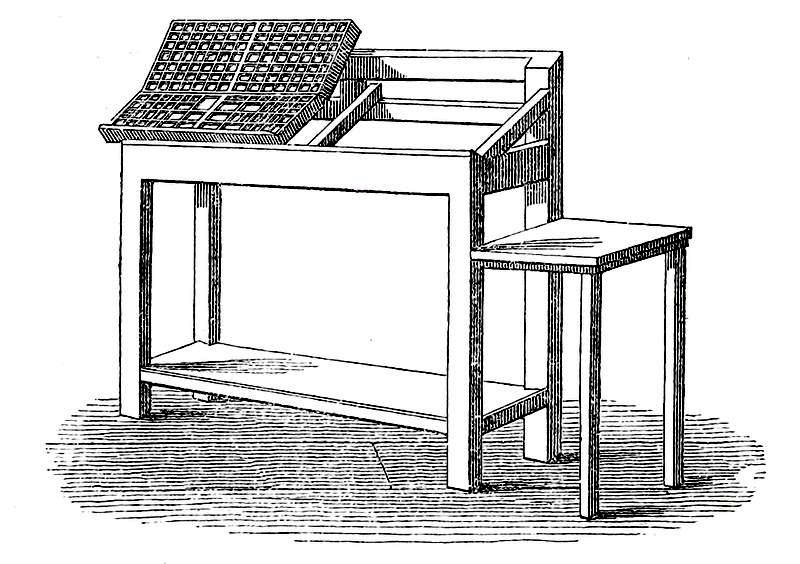
By the annexed engraving it will be perceived, that the upper and lower cases are placed upon the frame, not in a horizontal, but sloping position, as two inclined planes, the upper case being at a greater angle than the lower, which brings the more distant boxes nearer to the compositor and[246] thus expedites the work: this arrangement occupies less room, and allows a greater number of frames to stand in a given length.
The cases rest on a rail at each end, and in the middle there are generally two rails, six or seven inches apart, for the inside end of each case to rest on. There is frequently a piece of board nailed to the bottom of these rails, which thus forms a depository for page cords, copy that is not in use, and other small matters: this is called a Well.
Frames are always placed with one end next the window, so that the compositor when at work may stand with his left hand to the light; thus he enjoys the full benefit of the light in picking up the letters with his right hand. They are usually made to contain two cases in length, which are generally a pair of Roman and a pair of Italic cases, so that the compositor has not to go out of his frame when he wants to compose a few words in Italic.
There is a rather strong nail driven into each end rail and each middle rail for the bottom of the upper cases to rest upon, leaving sufficient room for the lower cases to be lifted out when necessary.
The dimensions of a frame are—height of back, 4 feet 6 inches; height of front, 3 feet 6 inches; width, 1 foot 10 inches; length, 4 feet 10 inches.
In a composing room, where there was plenty of room, I have seen the frames made to contain three cases in length; this is a convenience, as it allows the compositor to have up an additional pair of cases for his notes.
FRENCH RULES.
Pieces of Brass, letter high, of different lengths and thicknesses, on which are filed various dashes, swelling in the middle. They are used to separate parts of a discourse; or are placed after certain lines of capitals in titles and jobs, &c. They are also called Swell Rules.
French Words and Phrases. See Phrases.
FRIAR.
When some parts of a ball or roller do not take the ink, so that it does not adhere to the surface, the parts of the form that come in contact with them will be deficient of ink, and the paper when printed will, in those places, be either white or of a pale colour: these white or pale patches are called Friars, as the black patches, from too great a quantity of ink on particular places, are called Monks.
FRISKET.
A thin iron frame, covered with paper, and connected temporarily with the tympan, by means of joints attached to it and the headband of the tympan, having iron pins to slip into them. The parts that are to be printed are cut out of the paper covering; it turns down upon the paper to be printed, which is laid upon the tympan, keeps it flat to its place, preserves the margin clean, and raises it from the form after it is printed. See Frisket Button.
Each press in a printing office should have five or six friskets attached to it, of at least three sizes—Demy, as the standard size of paper; a size smaller; and a size sufficient for the largest form the press will print, for it is very inconvenient, and a loss of time, when the pressmen have to cover a frisket and cut it out for every form they lay on: and more particularly when regular work is in the house, and the same frisket will answer for many succeeding forms. It is adviseable, where it is practicable, to have the frisket joints at all the presses of one pattern, so that every frisket may be available at any of the presses.
A pressman should never pull an impression from a form, without being certain that the frisket is large enough, and that it does not rest on the edges of the types, which would be destructive to them.
FRISKET BUTTON.
A button screwed on the offside of the tympan near the bottom, to turn over the frisket and keep it close to the tympan in turning down.
This button is only used when superior work is printing: it prevents the sheet from touching the form partially, and also from slipping, by confining it flat to the tympan, and thus tends to make better work, and prevent waste; but it cannot be used where despatch is required.
FRISKET JOINTS.
Two joints of the simplest construction, by which the frisket is attached to the tympan by means of two pins, made with a head to each, so that they can easily be taken out with the fingers; they are inserted between the joints, and thus the heads face each other.
It is customary to place these joints on the flat part of the headband of the tympan, which, when a large form is on the press, and the rim of the chase is broad, rest upon, and prevent the form receiving the effect of the pull. I have known great inconvenience arise from this cause, in very superior work, where the chase filled the press, and could not be moved to get rid of this grievance. The joints should be taken off, and fixed to the extreme edge of the headband, by which means they will extend beyond the chase, and the evil be completely remedied. Where the frisket is fixed on centres this inconvenience does not exist.
FRISKET PINS.
Two iron pins that pass through the frisket joints and connect it with the tympan. They are made to slip in and out of the joints easily with the fingers, and are put in from the inside of the joints, so that the heads are opposite to each other. It is a common practice with pressmen, when they have occasion to take off the frisket, to lay the pins on the form. This ought never to be done; for I have known an impression pulled under these circumstances, at a good wooden press, without the frisket, and where the pins were forgot. The consequence was, the destruction of types, and the bedding in of the pins into the platen:—there was loss of types—loss of time in replacing them—the platen to be taken off and planed, with the expense of doing it, in addition to which it was reduced in thickness full a quarter of an inch, and the further loss of time while it was doing and hanging again, and justifying the head. They may always be safely laid within the chase between the quoins, where they can do no harm, and cannot roll off.
FRISKET STAY.
A slight piece of wood, generally fastened to the ceiling of the press room, and hanging down to the fore end of each press, for the frisket to rest against when it is turned up.
FROZE OUT.
In winter when the paper is froze, and the letter froze, so as the workmen cannot work, they say, they are froze out.—M. In consequence of greater care in warming printing offices in winter than in the time of Moxon, the workmen are not now “froze out;” for there would be no excuse admitted for the non-execution of parliamentary work, newspapers, reviews, magazines, and other periodical works.
FRY, EDMUND.
A celebrated type founder, whose foundery was rich in Oriental and other types for foreign languages, the forms of the characters of which varied from the Roman character. Dr. Fry sold the whole of his foundery to Messrs. Thorowgood and Besley, and which is now incorporated with their previously extensive variety of types.
FUDGE.
To execute work without the proper materials, and where the workman is obliged to substitute one article for another, and by contrivance make his work passable: when such cases occur, they show the skill and ingenuity of the compositor or pressman, in making his production look well.
FULL CASE.
A case full of letters, wanting no sorts.
FULL FACED LETTER.
Types, in which the capitals, and the ascending letters of the lower case, fill the whole square of the shank, so[248] that the descending letters project beyond the bottom of the shank. A full faced letter is considerably larger in proportion than a letter of the regular face upon the same body: they are convenient in jobs, as they produce the effect of larger types, and take up less space.
FULL FORM,
or Page. A form or page with few or no breaks or white lines.—M. In a full form there are no short pages, nor blank pages.
FULL PAGE.
A page containing its full complement of lines.
FULL PRESS.
When two men work at the press, it is called a Full Press.—M.
FURNITURE.
The term furniture includes all those pieces of wood that are used in branching out pages, or jobs; in making margin for the folding of books; and in locking up forms when they are imposed: it is generally classed as reglet, furniture, side sticks, foot sticks, and quoins. The height of it is five eighths of an inch, and ought to be the same as that of quadrats; but the letter founders and the joiners vary them both.
What is usually called furniture is in lengths of a yard each, and commences with narrow, which is equal to a narrow quotation; broad, which is equal to a broad quotation; double narrow; broad and narrow; double broad; broad and double narrow; and narrow and double broad. These are used for gutters, heads, and backs; to branch out large jobs; to fill up with when a chase is too large, and to put round a job when imposing, to keep the letter from the iron of the chase. The bottom and two sides are flat, and the top has a groove planed in it lengthways, the arc of a circle; this groove is said to be designed for carrying the water off when the form is washed, but I cannot see the utility of the groove for this purpose; its more obvious use is to lower that part, so that the balls or rollers shall not touch it in inking the form, which prevents the frisket tearing from its pressure upon the inky furniture and from being continually lifted up.
GAELIC.
The Gaelic alphabet consists of eighteen letters: a, b, c, d, e, f, g, h, i, l, m, n, o, p, r, s, t, u. Of these, five are vowels, a, e, i, o, u; the rest consonants.—Stewart’s Gaelic Grammar. 8vo. 2d. edit. 1812.
“It may be explanatory to mention, that the syllable Kil is supposed to mark the residence (the Cella), in ancient times of an ecclesiastical recluse; and that Kin, Ken (Cean) means head. Ken-loch-Spelvie, &c. the Head of Loch Spelvie, &c. The letter C is always pronounced K in Welsh and Gaelic”—Sixth Report of Commissioners for Building Churches in the Highlands of Scotland. Appendix, 1831. Note.
GALLEY.
Pieces of thin boards of different sizes, with ledges about three fifth parts of the height of the letter on one end and one side, for the types to rest against; others are made with a slice to slide out, and keep a large page on without disturbing it, the coffin having several slices fitted to it.—M. The use of the galley is to receive the matter as it is composed, and to afford a level on which to make up the pages.
Galleys are made of different sizes to suit the different works on which a compositor may be employed; if it be a reprint, page for page, he avoids encumbering his cases with large galleys, but takes one that will hold a page comfortably, completes his page, ties it up, and slips it upon a page paper, and thus proceeds; but if the work be not a mere[249] reprint, and is done in a companionship, then, as each compositor must be setting at random, the work will require different sorts of galleys, which must contain more matter; in the latter case he will take one of the proper width for the page, but that will contain two pages or more, in length, or one double that width with a ledge down the middle, so as to hold two pages in width.
For works in quarto or folio he must have galleys of a greater width, so as to enable him to have a quantity of matter at random till he gets the making up; in doing this, where the page is in folio and large, it is safer to make up on a slice galley, when he draws the slice out with the page on it and places it under his frame, and thus proceeds till he has made up a sheet, when he slides his pages off the slice upon the stone to impose them; he must in this case have four slices at least. The following is a representation of a slice galley:
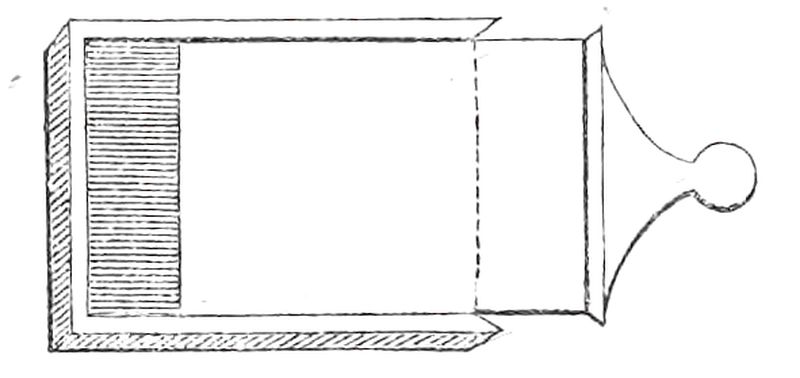
For newspaper work brass galleys are employed, the bottoms thin, and the ledges of brass which are on both sides and one end, while the other end has a moveable ledge which fits into mortises in the sides; by this means the compositor is enabled, when a galley full is composed, to put a sidestick and footstick to it and quoin it, and pull a proof in the galley.
Galleys are generally made of mahogany: those made of the old panels of coaches are held to be the best, as the wood, being well seasoned, is less apt to split or bend, and keeping their flat level surface is requisite.
Galley Slave. See Ancient Customs.
GALLOWS.
In wooden presses, a frame made of two pieces of wood and a transverse piece, placed behind the tympans, to support them at a proper angle when they are turned up. The transverse piece is nearly as long as the tympans are wide, so that the frame can rest upon it: they are inclined towards the tympans and form an abutment, and are placed in sockets so as to be easily taken out when necessary.
GALLOWS SOCKETS.
Two pieces of wood with square mortises in them, to receive the ends of the gallows; they are nailed or screwed upon the plank behind the tympans. The mortises are inclined towards the tympans.
GALVANISM.
Another great discovery has been published, in addition to those important ones of Sir Humphry Davy, which he made at the Royal Institution, of the decomposing powers of galvanism, the brilliant effects of which, I well remember, excited wonder and astonishment in the crowded audiences that assembled in the lecture room of that establishment.
The one that is the subject of the present article, promises to be of great utility in the arts, by giving the means of obtaining facsimiles of engraved copper plates, of engravings on wood, of coins, medals, embossings, in short, of any engraved article, whether in cameo or intaglio. The productions by this process have been named Electrotype.
This is effected by placing the object to be copied in a solution of any metal, when the galvanic action precipitates the metal from the liquid[250] that held it in solution, upon the engraving that is to be copied. This precipitation or deposition assumes the form of a cake of pure metal, with every line, however delicate, and every inequality, however minute, on its surface, so as to form a matrix or mould in the highest state of perfection.
When the matrix is thus formed, the engraving is withdrawn from the solution of metal, and the matrix substituted; the galvanic action is again renewed; a deposition of the metal upon the matrix now takes place; and the result is, a perfect facsimile of the original.
This is a short sketch of the principle of this discovery. It belongs to chemistry rather than to printing, to explain why the metal is precipitated in a solid mass and not in a fine powder; but such is the fact. The discovery has been applied to the production of facsimiles of engraved copper plates with the most complete success; and as it is now in a state of progress to produce copies of engravings on wood, and pages of types, so as to be applicable to letterpress printing, I will endeavour to give the present state of knowledge with respect to this application of the discovery, the process, and also specimens.
It is said that the discovery of this application of galvanism originated in perceiving a thin deposition of copper at the bottom of a galvanic battery, which, on being removed, displayed on its under surface a perfect cast of the bottom of the cell, and suggested an extended application. Be this as it may, the fact was noticed by Mr. Warren De la Rue, of Bunhill Row, in a communication to the Philosophical Magazine of September, 15, 1836, (vol. 9. p. 484,) where he says, “The zinc plate is always partially covered with a coating of copper, which, however, is not detrimental to the power of the battery: the copper plate is also covered with a coating of metallic copper, which is continually being deposited; and so perfect is the sheet of copper thus formed, that on being stripped off, it has the polish and even a counterpart of every scratch of the plate on which it is deposited.” The discovery of the application is claimed by two persons, M. Jacobi, a Russian, and Mr. Thomas Spencer of Liverpool. The latter presented a pamphlet containing the results of his discovery, and an account of his experiments, to the British Association in 1839, at which time M. Jacobi’s specimens were present and exhibited at the same meeting. Mr. Spencer has since prosecuted his experiments, and liberally given the details and the results to the public, in different publications; so that it is in fact to this latter gentleman that we are indebted for our information on the subject; but as it is now in the hands of a number of persons of ingenuity and ability, who are prosecuting experiments on it, there is little doubt but that it will soon be brought to a state approaching nearly to perfection.
As copper is usually employed for engravings, and is equally applicable to letterpress printing as to that of the rolling press; as it is easily obtained in solution, and is not an expensive article for this purpose, the process as here described is with that metal; other metals have been used for experiments, and it has been stated that articles in silver or gold may be produced with equal facility where facsimiles of them may be required, but the production of them in gold is doubtful.
In the process there are various things to be considered. Among which may be particularly mentioned the fact, that the solidity of the deposited metal entirely depends on the weakness or intensity of the electric action. This action may be regulated by increasing or decreasing the thickness of the plaster of Paris which separates the two metals, and[251] by the coarseness or fineness of the material. Mr. Cooper states, “I made three similar experiments, altering the texture and thickness of the plaster each time, by which I ascertained that if the plaster partitions were thin and coarse, the metallic deposition proceeded with great rapidity, but the crystals were friable and easily separated; on the other hand, if I made the partition thicker, and of a little finer material, the action was much slower, and the metallic deposition was as solid and ductile as copper formed by the usual methods; indeed the action was exceedingly slow. I have made a metallic deposition apparently much harder than common sheet copper; but more brittle.”
A friend of mine used a common garden pot, with a cork in the perforation through the bottom, which answered very well, the copper deposited being fine and tough. I think a wine cooler would be a good vessel for that purpose, being porous; and either may be at hand, when there is not a suitable glass, or any plaster of Paris.
Mr. Crosse has stated, in the account of his experiments on the crystallization of metals, that he succeeded best when the solutions were kept at a boiling temperature; and Mr. Spencer informs us, that by keeping the solutions he employed at a temperature of from one hundred and twenty to one hundred and eighty degrees of Fahrenheit, he was able to abridge the time otherwise required, three or four fold.
In all scientific experiments, care and attention are requisite for a successful result: in this instance, let an uninterrupted circuit be maintained for the electricity, and let the wire have a perfect metallic contact with the plates which it connects; when it is an engraving on wood, bore a hole in the side of the block, and insert the wire in it. The zinc may be with advantage occasionally taken out of the saline solution during the operation, and cleaned in water. In the choice and application of the plates, it is better that they should be, as nearly as possible, of the same size, and it is of importance that the zinc should be as thick as the required deposition of copper, but it is easy when necessary to renew the zinc again and again. That the solution of the sulphate of copper may be continued in the necessary state, crystals of that substance should be occasionally added. When the process is long continued, the solution should be changed, for the sulphuric acid, which is set free by the deposition of the metallic copper, prevents the further action.
This was the first method; the plan now practised, to prevent any stoppage of the galvanic action by an excess of sulphuric acid occasioned by the decomposition of the sulphate of copper and the deposition of its copper in a metallic state, is to put into the acid a piece of copper in connexion with the positive pole, and thus, as the acid is set free by the galvanic action, it forms a new combination with the copper, and continues the supply of the sulphate without the necessity of changing the contents of the vessel.
In obtaining casts by this process, it must be borne in mind, that no metallic deposition can be made by voltaic electricity without the presence of a metallic surface or nucleus upon which to deposit: but this metallic surface should be given only to the part which is to be copied; the sides and bottom of the block may be covered with a varnish composed of shell lac dissolved in spirit of wine, which will prevent any metallic deposition from taking place upon those parts, as also the moisture from penetrating into the wood, and the deposition will in consequence be confined to the engraved surface.
In the management of the simple apparatus which is employed in electrotype, it is necessary to have the binding-screws, wires, and all[252] the metallic surfaces, quite clean and bright, as also to avoid touching with the fingers that part on which the metal is to be deposited.
With regard to the first application of galvanism to the production of facsimiles of engravings on wood, Mr. Spencer states, after the publication of his pamphlet, “The wood engraving being given, take a piece of lead the required size; let its superfice be about one-eighth of an inch larger all round than that of the wood block. The lead must now be planed, just as a piece of soft wood; (the tool termed by a joiner a try plane does best;) a clear bright surface is thus obtained, such as I have been unable to get by any other means. The engraved surface of the wood must now be laid on the planed surface of the lead, and both put carefully in a press; should the engraving have more than two inches of superfices, a copying press is not powerful enough. Whatever press is used, the subject to be copied must be cautiously laid in the centre of the pressure, as a very slight lateral force will in some degree injure the process; the pressure to be applied regularly, and not with a jerk. When the pressure is deemed complete, they may be taken out, and if, on examination, the lead is not found to be completely up, the wood engraving may be neatly relaid on the lead, and again submitted to the press, using the same precaution as before. When the lead is taken out, a wire should be soldered to it immediately, and it should then be put into the apparatus without loss of time, as the less it is subjected to the action of the atmosphere the better: care should also be taken not to touch the surface with the fingers.”
Mr. Spencer also states that plumbers, who have handled lead for the greater portion of their lives, are astonished to find it so susceptible of pressure. On the contrary, wood engravers did not, until now, imagine that their blocks would stand the pressure of a screw press on a lead surface without injury; but such is the fact in both instances. In the manner in which box wood is used for wood engravings, being in horizontal sections, it will sustain a pressure of 8,000 lbs. without injury, provided the pressure is perfectly perpendicular.
Mr. Spencer has omitted to mention the size of the engraving; if it were one inch square, it would have a pressure of 8,000 lbs. on that inch; if it were nine inches square, it would only have a pressure of 100 lbs. on the square inch: with my experience of printing engravings on wood, I would not venture to submit one to a pressure of 8,000 lbs. to the inch for fear of crushing the lines. I mention this as a caution; it may prevent an accident.
This appears to have been the first method tried to produce a facsimile of an engraving on wood by means of galvanism, with a metallic mould obtained by impressing the engraved block upon a piece of lead. This not appearing to be perfectly satisfactory, other persons were induced to endeavour to make the discovery available for letterpress printing without the risk of injury to the engraving, to which this plan seemed liable; and the next advance towards the perfection of the process was an important one, being the introduction of the real object intended to be copied in the stead of the substituted mould, and obtaining a matrix from it at once by means of the galvanic process without resorting to any intermediate measures. This improvement was made by Mr. Robert Murray, who proposed “in January last to cover the surface of the wood with plumbago [black lead], so as to render it a conductor; and then to proceed in the usual manner for obtaining an electrotype copy,” as he informed me in a communication of the 21st of July, 1840. It is but fair to state, that this use of black lead has been[253] objected to by some engravers on wood, as having a tendency to fill up the lines of a delicate engraving, and so to deteriorate the impressions taken from it; but I am now furnishing the public with the means of deciding on this question, by presenting an impression from an electrotype copy, executed by Mr. Murray according to his own ingenious plan, by the side of one from the original wood engraving, and I leave it to bear witness for itself. I cannot perceive any deterioration in the copy, nor any difference between the two impressions: in fact they appear as if they were duplicate impressions from the same engraving.
The following letter, addressed to the editor of the Athenæum, by Mr. Spencer, which appeared in that publication on the 4th of July, 1840, details another method of obtaining a metallic surface for an engraving on wood, &c. for the purpose of inducing the galvanic deposition of copper upon it and obtaining a copper mould, which appears to be free from the objections that have been raised to gilding, bronzing, and to black lead.
“In my pamphlet, printed last September, I there stated I considered the process comparatively incomplete, unless we were able to apply it to the multiplication of models in clay or wood, castings in plaster, wood engravings, &c., as the fact, that galvanic deposition always requires a metallic surface to act on, seemed to set bounds to those branches of its application. I then resorted to various expedients to surmount the difficulty; among others, that of gilding and bronzing the surfaces of such materials to a limited extent: this was successful, but still troublesome and expensive, and, more than all, the sharpness and beauty of the original was necessarily injured. I have since attempted to metallize surfaces by the use of plumbago (suggested to me many months ago by Mr. Parry of Manchester).
“Should I be desirous of obtaining a copper mould or cast from a piece of wood, plaster, or clay, or, indeed, any non-metallic material, I proceed as follows:—Suppose it is an engraved wooden block, and I am desirous of metallizing it, in order that I may be able to deposit copper on its surface (this example will hold good for any other material), the first operation is to take strong alcohol in a corked glass vessel, and add to it a piece of phosphorus (a common phial corked will answer the purpose); the vessel must now be placed in hot water for a few minutes, and occasionally shaken. By this means the alcohol will take up about a 300th of its bulk of phosphorus, and we thus obtain what I would term an alcoholic solution of phosphorus. The next operation is to procure a weak solution of nitrate of silver; place it in a flat dish or a saucer; the engraved face of the block must now be dipped in this solution, and let remain for a few seconds, to allow capillary action to draw it into the wood.
“This operation being performed, a small portion of the alcoholic solution of phosphorus must now be poured in a capsule or watch-glass, and this placed on a sand-bath, that it may be suffered to evaporate. The block must now be held with its surface over the vapour, and an immediate change takes place; the nitrate of silver becomes deoxidized and gives place to a metallic phosphoret of silver, which allows the voltaic deposit to go on with as much rapidity and certainty as the purest silver or copper.
“The whole process may be performed in a few minutes, and with absolute certainty of success. The interior or exterior surface of a plaster or clay mould of a statue, no matter what size, may be thus metallized with equal facility. For the process of vaporizing, and should[254] the material to be acted on not be very large, I prefer fastening it to the top of a bell glass receiver with a bit of pitch or cement, and thus placing it over the capsule on the sand-bath; the phosphoric vapour is by this means equally diffused and not dissipated. An ethereal solution of phosphorus also answers; and a solution of either of the chlorides of gold or platinum may be used. I am inclined to think this process, independent of its uses in galvanic precipitation, may be applicable to other branches of art. I would recommend those curious of testing its effects, to try a small and sharp plaster of Paris medallion: dip its surface in a weak solution of nitrate of silver and take it out immediately; fasten it to the bottom of a glass tumbler, and at the same time have a little hot sand ready in a dish; lay the watch glass containing a few drops of the phosphoric solution on it; now place the mouth of the tumbler over all, and the medallion will be observed almost instantly to change colour. The operation is now completed. A piece of pottery ware in the state of biscuit may be acted on in a similar manner.
“Liverpool, June 27.
Thomas Spencer.”
Apparatus and process.—The annexed figure and explanation will afford an example of the action of a voltaic apparatus, and will be sufficient to render the subsequent details intelligible. a is a vessel filled with a solution of common salt, which is a compound of chlorine and sodium; b is a tube immersed therein, closed at the lower end with a piece of bladder stretched over it and firmly tied; this tube is filled with a solution of blue vitriol, that is, a compound of sulphuric acid and oxide of copper. A plate of copper c, and one of zinc z, connected by means of the wire w, are immersed in those fluids. The zinc decomposes the salt, with the chlorine of which it unites, forming chloride of zinc, while the sodium of the salt is repelled, and passing through the bladder, enters the solution of sulphate of copper, which it decomposes, uniting with the sulphuric acid and oxygen to form sulphate of soda, and setting free pure copper in the form of beautiful crystals, which are deposited on the plate c. The connecting wire w serves to convey electricity from c to z, and thus the action is maintained so long as any common salt and sulphate of copper remain undecomposed.

Mr. Spencer’s first attempt was made with a piece of thin copper plate, which he covered with a cement of beeswax, resin, and Indian or Calcutta red. The plate received its coating while hot, and on becoming cool, the experimenter scratched the initials of his name upon the plate, being careful to clear away all the cement from the scratches, so as to expose the copper below. A piece of zinc was attached to this plate by a copper wire, and the voltaic current was set in action by means of the simple apparatus shown in the adjoining figure.
a may be supposed to represent a glass vessel of convenient form. b a gas glass stopped at the lower end p, by a piece of plaster of Paris, to the depth of three quarters of an inch, z a plate of zinc, and c a similar piece of copper, a coin or any other metallic substance to be acted upon; and these two are connected by a copper wire, w. The inner vessel may be kept in its place by a cork, or any other means that may happen to be more convenient. A solution of sulphate of soda is poured into the gas glass, and the wire connecting the zinc and copper plates[255] being bent, as shown in the figure, the zinc plate is immersed into the solution of sulphate of soda, and the copper plate into the solution of sulphate of copper.
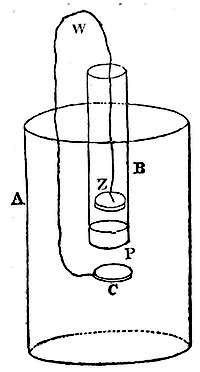
In a few hours Mr. Spencer, in his experiments, found that the portion of the copper rendered bare by the scratches was coated with the pure bright deposited metal, while those portions which were still covered with cement were not acted on. It now became an important inquiry whether the deposition would retain its hold on the plate, and whether it would be of sufficient solidity to bear working from; that is, supposing an etching or engraving to be made, and the lines to be afterwards filled up with copper by the voltaic process, whether such lines could be printed from.
In order to answer this last question, Mr. Spencer coated with cement a piece of copper, and with a steel point endeavoured to draw lines in the form of network, so as to penetrate the cement and expose the copper. After this plate had been exposed to voltaic action, and then heated, so as to get off the covering of cement, the copper network came off with it. This happened many times; but by an accident it occurred to the experimenter to employ nitric acid to the plate, after it had been cemented and engraved on as before. It was then subjected to the voltaic process for forty-eight hours, when the lines were found to be entirely filled with copper. On applying heat, and then turpentine to get off the cement, it was found that the voltaic copper had completely combined with the plate on which it was deposited.
A plate was then coated with cement, and lines worked upon it by an engraver; but these lines were of a wedge-shaped form, leaving only a hair line of the copper exposed at the bottom, and a broad space near the surface; and where the turn of the letters took place, the top edges of the lines were galled and rendered rugged by the action of the graver. All this was objectionable; but another plate, similarly prepared, and engraved on with a sharp point, had the copper deposited on the lines; and this was printed from successfully.
This was an attempt to deposit lines upon a plate of copper by the galvanic action, and thus form an engraving in relief, which I have doubts of being successfully practised with finished subjects.
The application of heat separates the two metals, in consequence of their different expansibility when subjected to its influence.
Mr. Spencer gives the form of another apparatus on a more extended scale, which he recommends, as it may be employed in large works.

a is an earthenware vessel to receive the copper plate and the solution of sulphate of copper, in which it is to be exposed. b is another vessel of earthenware or wood, of such a size that it may fit into the outer one, as shown in the drawing; the bottom of this vessel being formed of plaster of Paris, or some other porous substance, which while it retains the solution of common salt may permit the voltaic action to go on without impediment. c is the copper plate to be acted on by the electricity upon which copper is to be deposited. z is the zinc plate, and the two are united by the wire w, which may either be done in the manner exhibited in the second engraving, or by the use of a binding screw s.
I have been anxious to give specimens of this discovery in its application to letterpress printing, with some account of the process by which copies are obtained from engravings on wood. I am gratified in being enabled to do this, and to give two subjects, by different processes in producing the matrices or moulds.
No. 1. is an impression from an engraving on wood by the late Mr. Branston, which I give for the purpose of comparing the copy with the original. From this engraving Mr. Murray, having metallized the surface with plumbago, according to his method, to induce a deposition of the copper upon it, obtained a copper mould by galvanic action; from this mould No. 2. was produced by the same process, and is an impression from the electrotype copy of No. 1.
No. 3. is an impression from an engraving on wood, from which a matrix was prepared in type metal by the process called polytype; this matrix was submitted to the galvanic action by Mr. Murray, and the deposition of copper produced the electrotype copy from which the impression No. 4. is printed.
No. 5. is a polytype copy in type metal from the same matrix as No. 4. These impressions are placed in juxtaposition, for the purpose of giving an opportunity of comparing them, and forming a true estimate of their respective merits.
There have been many attempts in London to obtain an electrotype copy of a page of types, but hitherto, I believe, without success; the difficulty arising from the deposition of copper getting under the projecting parts of the kerned letters, and also penetrating into the interstices between the letters and the words, and thus preventing the mould from being disengaged from the types, without using force and destroying a great number of letters. The following, No. 6., is an imperfect specimen of a page of diamond types, by Mr. Robert Branston, an engraver of eminence in wood, and Mr. Warren De la Rue. There are many difficulties yet to be overcome in the process of obtaining electrotype copies of types; but it will show what has already been accomplished, and I have not the least doubt that the combined skill and perseverance of Mr. Branston and Mr. De la Rue will in a short time overcome those difficulties, and produce perfect copies with ease and certainty.
The method adopted to procure this was as follows:—A mould in plaster of Paris was first obtained, and a stereotype plate was cast in it; high spaces and quadrats were used, to prevent as much as possible the inconvenience before spoken of; a mould was then obtained from the stereotype plate by the polytype process, in type metal, and from that mould, by the galvanic action, the electrotype copy from which the specimen No. 6. was printed.
In the first instance, the plan recommended by Mr. Spencer in the Athenæum of the 4th of July, 1840, of preparing the surface of the mould with silver, was adopted, but the sulphuric acid acted on the plaster of Paris of which it was formed, and rendered it useless.
Since the preceding was written and in print, I have been informed that Mr. Spencer has been more successful than the London experimenters, for, in a letter to me, dated Glasgow, September 17th, 1840, he says, “Had I been at home I should have sent you a copy of the first pamphlet, where you would have seen an octavo page of stereotyping by the Voltaic process.”
In the present early state of electrotyping we find that, as it is formed by the solution in water of a salt composed of sulphuric acid and copper, it is of course thinner and the copper more attenuated than type metal is when in a state of fusion; it will necessarily penetrate into all the delicately engraved parts of a subject more completely than melted metal, and must therefore produce a more perfect facsimile than a casting; I believe this is undeniable, for copies of copper plate engravings of great fineness have been produced in the highest state of perfection as facsimiles. Another point is, that copper is tougher than type metal, and not so liable to have the letters break off and fail in the process of printing, and of consequence will be more durable. But it appears to me that one of its most valuable applications will be to the printing of Bibles, for by obtaining copper matrices of the pages by this process new editions may be multiplied to any extent, and when the plates are much worn they may be renewed at any future time, without incurring the expense of recomposing the book; which is not the case with stereotype plates. But the applicability of the discovery is as yet in its infancy, as these specimens are, I believe, the first that have been published of impressions of letterpress electrotype plates, and the ingenuity of man is at work to extend and improve the discovery.
In giving the foregoing account of experiments that have been made on this discovery of the application of galvanism to the production of copies of the works of art, and more particularly with respect to engravings on wood, as connected with letterpress printing, to which this work is confined, it is evident that the persons making these experiments are not availing themselves of the information which may easily be procured, that is, of ascertaining what are the requisites to enable a printer to make use of these copies in the regular way of business; excepting this be done, the discovery will not be available for general purposes, and will be viewed only as a curiosity: one point, to which I would particularly draw their attention, is the difficulty experienced in separating the matrix from the original, and again of separating the copy from the matrix; in both these cases they have the deposition of copper too thin, and in the act of separation both the matrix and the copy are twisted and distorted; they are then filled in at the back with some soft metal, which is planed in a rough manner, and delivered in this condition, unfit for the press, at which it is almost impossible to obtain a good impression. I would suggest that the deposition of copper should be continued for a longer time, so as to have the metal thicker, both in the matrix and the copy; if any irregularity in the surface then take place in the act of separation, it ought to be reduced before it is filled in with metal at the back; when that is done it should be turned in a lathe, as stereotype plates now are; it would thus be of an equal thickness throughout without any unevenness on the surface or back, and when mounted type-high might be printed without more trouble than wood cuts or stereotype plates are; thus enabling the printer to produce impressions without difficulty that would show the merits of the discovery in a fair manner, which at present cannot be done without great trouble and loss of time.

No. 1. An Impression from an Engraving on Wood.
No. 2. An Impression from an Electrotype Copy of No. 1.
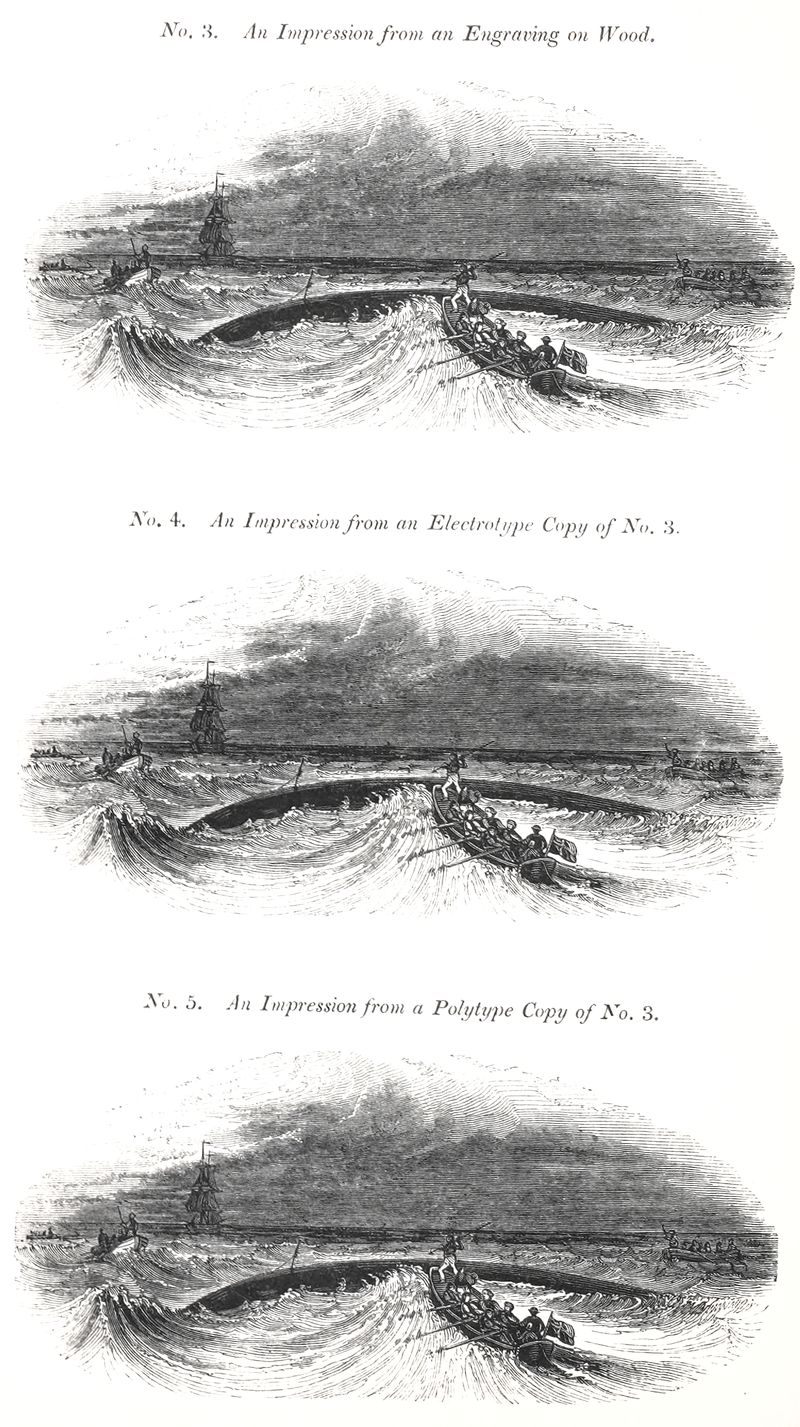

No. 6. An Impression from an Electrotype Copy of a Page of Diamond Types.
GARTER.
In wooden presses, two flat pieces of iron with a semicircle cut in one end of each, and a projecting part at the other ends; in the projecting parts there is a hole at each end, those in the front piece for a screw to go through, and those in the back piece are tapped to receive a screw.
The hose has a horizontal mortise through it, exactly at the groove in the spindle; this mortise is to receive the garter, which, when driven close up from back and front, clasps the spindle in the groove by means of its semicircular ends, which are made to fit into this groove; and the two parts are kept firmly together by the screws that pass through the projecting ends on two sides of the hose.
Its use is to lift up the platen on the return of the bar, to admit the carriage to be run in and out.
GATHER BOOKS.
Gathering of books is to take one sheet off every heap, beginning at the last sheet first, viz. at the left hand end of the range.—M. We now reverse the heaps, and place the first signature where they used to place the last; they then gathered, placing each sheet upon the other: we now gather under each sheet, which is a much quicker way. See Gathering.
Gather Corrections. See Corrections.
GATHERING.
In making the printed sheets of a work up into copies in the warehouse for delivery, a number of them in orderly succession are folded together, which is called a gathering; a volume may be complete in one gathering, or it may consist of two, three, four, or more.
When there are more than one gathering in a volume, the warehouseman endeavours to have the number of sheets in each nearly equal; and he very rarely puts less than ten, or more than fifteen, in one gathering.
He lays down upon the gathering table a heap of each signature, commencing with B, or whatever signature the body of the work may begin with, following each other in regular order, according to the letters of the alphabet, and as many as he intends to include in the first gathering, with the first page of each to the front of the table. If it be a long number, he seldom lays down more than a bundle of each signature at once, that the top sheets may not be higher than the boys can conveniently reach.
The first signature is placed at the extreme end of the table to the left hand, that if there be any space more than is actually wanted upon the table, it may be at the end where the gathering concludes, to allow the boys to knock up the sheets without crowding each other.
In commencing gathering it is necessary that the boys should have clean hands, otherwise they will dirty many sheets with the end of the right thumb.
A boy wets the end of his right thumb with the tip of his tongue, and pushes up with it the right hand corner of the first sheet, the fingers of his left hand being laid upon the sheet to prevent its slipping away, and he catches it up with the thumb of his left hand underneath it, and draws it upon the next heap; he does the same by this, and so continues drawing the accumulating sheets in his left hand over the successive heaps, and taking one from each, till he gets to the end; he then knocks this gathering up even at the ends and sides, and lays it down at the end of the table, which being what is styled a horse-shoe table, he has only to turn himself round, when he is again facing the first signature, to recommence the operation, always knocking up his gathering, and laying it evenly upon the other, till it accumulates to a pile.
In the regular routine of business, where despatch is necessary, three[263] or four boys are generally put to one gathering table, who follow each other regularly, knocking up their gatherings, and piling them up on the end of the table. Among them there is frequently an inexperienced boy; to prevent delay, this boy is ordered to lay his gathering down at the end, and the next boy knocks it up with his own: if the boy has quickness and spirit, he exerts himself to become expert, and to equal the others.
If the collation of the book is going on at the same time, it prevents the pile of gatherings from accumulating too much; if it be not, the pile must be removed occasionally, to prevent it getting too high for the boys to deposit their gatherings.
They thus proceed till one, or more, of the heaps is exhausted, when the remnant of the others is folded in the middle, each signature by itself, and tied up in a bundle, enclosed in wrappers; but if the book be collating, the drawn sheets are previously laid down, which enables them generally to gather off a few more copies.
In the course of gathering, if a boy perceives that the sheets in any of the heaps are turned the wrong way, he should immediately announce it, that they may be placed right; he should be likewise very particular to take one sheet from each heap, as also to avoid taking two: any of these errors causes a great deal of extra trouble in collating, and of course a consequent loss of time, in addition to making the work unpleasant.
After the gatherings are collated, they are knocked up carefully at the ends and sides, and folded evenly in the middle; folios, quartos, and octavos, in the regular fold of the paper, and twelves the long way in the back; for a gathering is never folded in a page, neither lengthways nor crossways. They are then put into a press, a moderate quantity being placed between each two boards, and the press wrung well down; after having lain in the press a sufficient time, they are taken out, and piled away till the work is completed, and they are wanted for Booking.
If copies of a work are required to be delivered as soon as the last sheet is put to press, which at the present day is commonly the case, the warehouseman should be prepared to meet the wishes of his employer’s customers, by having the book gathered close up to the last gathering; having them all pressed and booked; and as fast as the last sheet is worked off, keep hanging it up very thin in the most favourable part of his poling for drying, and even dry a few by the fire to commence with. He will thus have the last gathering only to put together, and in some cases he may have part of that done; so that if he put his boys to gather, himself to collate, another to fold the gatherings and put them into the press, he may in less than two hours, in a case of emergency, deliver fifty or a hundred copies of a work without difficulty, and obtain credit to the house and to himself for despatch and attention, both of which cannot but be gratifying to him. See Booking. Collating. Lay Down.
GATHERING TABLE.
A table in the warehouse on which the printed sheets are arranged in the order of their signatures, in order to their being gathered into books. It is usually a horse-shoe table, and the boys gather on the inside, so that when they have completed one gathering they have only to turn round and commence again. Where there is space enough in the warehouse it ought to be sufficiently large to hold at least fifteen sheets, with room at the end for the heap and for the knocking up of each gathering.
GAUGE.
A Gauge, to regulate the margin, is used both by compositors and pressmen, in their respective departments.
When a compositor commences a work, or joins a companionship, it is[264] necessary that he cut a gauge to the length of a regular page of his work; to do this he should take a page without any chapter head lines, of the regular number of lines, and cut his gauge to the exact length, including the head and the direction line; a piece of great primer reglet is a convenient thickness, and marking the name of the work on it may prevent errors. Many compositors mark the length of the page upon a piece of furniture, and make it answer for two, three, or four works; but I have known mistakes occur in making-up, from adopting this method, that have caused a great deal of trouble in remaking up the succeeding pages.
In works that are printed with large letter, and have many head lines in the pages, and much white between the lines, I would advise a gauge to be cut on which the situation of each line should be marked; this will enable the compositor to make up his pages, so that, when the sheet is worked off, line shall fall upon line, which will add a beauty to his work, and save a great deal of trouble, by rendering unnecessary any alteration of the whites.
After the first sheet of a work has been imposed, and the margin made right by the person who has the superintendence of this department, a gauge should be cut to the exact width of the back, and another to that of the head; a piece of thin reglet being used for each, marked with the name of the work, and with the words, “back,” and “head;” a hole may be made in each piece that they may be tied together, so as to hang them upon a nail driven into some part of the frame; and a fresh sheet should never be imposed without trying the margin before it is locked-up. I am aware this is being more particular than is the general custom; but, if a compositor adopt the method, he will find that it will not take more than a minute of additional time, and will eventually be a saving by preventing mistakes, and he will thus send each sheet to press in a workmanlike manner.
The pressmen require a gauge in all folio works, in order to keep the head lines of the pages of each sheet precisely at the same distance from the edge of the paper. This head margin is determined by the overseer, or master printer, when the first sheet goes to press; the pressman should then cut his gauge, mark it with the name of the work, and keep it in some secure place, to lay the succeeding sheets on by, so that the work may have a uniform head margin, which, as the bookbinder always makes the head lines range, will prevent the book being reduced in size by cutting, an object of serious consideration in a library.
GEOMETRICAL CHARACTERS.
+ plus, or more, the sign of addition; signifying that the numbers or quantities between which it is placed are to be added together.
- minus, or less, the sign of subtraction; signifying that the latter of the two quantities between which it is placed is to be taken from the former.
~ denotes the difference of two quantities when it is not known which is the greater.
× into, the sign of multiplication; signifying that the quantities between which it is placed are to be multiplied together.
÷ by, the sign of division; signifying that the former of the two quantities between which it is placed is to be divided by the latter.
: as, or to, :: so is, the sign of an equality of ratios; signifying that the quantities between which they are placed are proportional to each other.
= equal to, the sign of equality; signifying that the quantities between which it is placed are equal to each other.
√ the radical sign; signifying that the quantity before which it is placed is to have some root of it extracted.--Bonnycastle’s Geometry. 12mo. 1823.
[#] Formerly used to denote equal to, but is become obsolete.
△ Triangle; as △ABC = △ADC.
∠ An angle.
⟂ Perpendicular.
▭ Rectangled parallelogram.
⊏ or >, greater than.
⊐ or <, lesser than.
∹ The differences, or excess.
GERMAN.
“It is generally admitted, that the ancient Germans had not the use of letters, before their intercourse with the Romans; the testimony of Tacitus is decisive on this subject. ‘Literarum secreta viri pariter ac fœminæ ignorant.’ Hence we conclude, that the Teutons, who[266] anciently inhabited the neighbouring coast, and islands of the Baltic Sea, had no letters, till their descendants, who settled in Belgic Gaul, obtained them from the Romans. The Teutonic alphabet is evidently deduced from the Roman, and is nothing more than the Roman varied by the Germans, which, having been much deformed, was improved by Charlemagne in the ninth century, and continued till the twelfth, when this kind of writing was succeeded by the modern Gothic, which prevails in Germany, and in several of the northern countries of Europe at this time.”—Astle.
German Alphabet.

| Character. | Signification. | Name. |
| A a | A a | Au |
| B b | B b | Bey |
| C c | C c | Tsey |
| D d | D d | Dey |
| E e | E e | Ey |
| F f | F f | Ef |
| G g | G g | Gey, or Gay |
| H h | H h | Hau |
| I i | I i | E |
| J j | J j | Yot |
| K k | K k | Kau |
| L l | L l | El |
| M m | M m | Em |
| N n | N n | En |
| O o | O o | O |
| P p | P p | Pey |
| Q q | Q q | Koo |
| R r | R r | Err |
| S ſ s | S ſ s | Ess |
| T t | T t | Tey |
| U u | U u | Oo |
| V v | V v | Fou |
| W w | W w | Vey |
| X x | X x | Iks |
| Y y | Y y | Ypsilon |
| Z z | Z z | Tset |
In addition to the characters of the preceding alphabet, the Germans make use of three, which are vowels: Ae, ä or á, expressed by the Roman character ä, and having the sound of e in where. Oe, ö or ó, and in the Roman character ö, which has the sound of eu in the French heure. Ue, ü or ú, having its representative in the Roman ü, and its expression in the thin u of the French in vertu.
The Germans also make use of the following double letters in printing:

| ch ch | ffl ffl | si si | st st |
| ck ck | fl fl | ss ss | sz sz |
| ff ff | ll ll | ssi ssi | tz tz |
| fi fi |
“In the printed alphabet some letters are apt to be mistaken and confounded one with another. To facilitate the discrimination the difference is here pointed out.
“B and V. The latter is open in the middle, the former joined across.
“C and E. C has a little horizontal stroke in the middle, projecting to the right, which E has not.
“G and S. These letters, being both of a round form, are sometimes taken for one another, particularly the G for the S. But S has an opening above, G is closed, and has besides a perpendicular stroke within.
“K, N, R. K is rounded at the top, N is open in the middle, R is united about the middle.
“M and W. M is open at the bottom, W is closed.
“b and h. b is perfectly closed below, h is somewhat open, and ends at the bottom, on one side, with a hair stroke.
“f and ſ. f has a horizontal line above.
“m and w. m is entirely open at the bottom, w is partly closed.
“r and x. x has a little hair stroke below on the left.
“v and y. v is closed, y is somewhat open below, and ends with a hair stroke.”—Noehden’s German Grammar, 2d edit. 12mo. Lond. 1807.
German Types in the British Founderies.
Two-line English.—Thorowgood and Besley.
Great Primer.—Thorowgood and Besley.
Pica.—Caslon and Livermore.
Long Primer.—Caslon and Livermore. Thorowgood and Besley.
Brevier.—Caslon and Livermore. Thorowgood and Besley.
Brevier on Minion body.—Thorowgood and Besley.
Nonpareil.—Thorowgood and Besley.
German Text, ornamented.—V. and J. Figgins.
Great Primer, Brevier on Minion body, and Nonpareil. These matrices are from the foundery of Brestkopff and Hartel, of Leipsig.
German Upper and Lower Case, Roman Character. They are made in one Case.

GET IN.
Matter is got in in a line, page, sheet, or book, if letter be thinner cast than the printed copy the compositor sets by. Or matter is got in if the compositor sets closer: or if he widens his measure; or puts more lines in a page.—M. Also if copy makes less than it was calculated to do, they say, it gets in. See Drive Out.
GIRTHS.
Are thongs of leather, cut out of the back of an horse hide, or a bull’s hide, sometimes an hog’s hide. They are about an inch and an half, or an inch and three quarters broad. Two of them are used to carry the carriage out and in.—M. They are sometimes made of Girthweb.
Mr. T. C. Hansard, in his patent for the improvement of presses, &c., enumerates “Girths,” of which he says,—“The girths I form of lines made of any close-formed strong material or substance, but round or narrow, and I particularly prefer cat-gut of about one inch in circumference. Such lines I arrange in pairs, one pair to run the table in, the other pair to run it out; applying them to the wheel after the manner of leather or web girths; except that such lines I place with a small degree of obliquity from either end of the table to the wheel, so that in winding round no one coil shall touch or interfere with the other, but take a spiral direction, one pair giving place by being wound off the wheel as the table is run in or out, to the other pair, which by being then wound round the wheel, causes the table to traverse in the given direction. By these means the rounce or handle will be, in every position or turn of the wheel, equally tight, and no friction or adhesion of the lines can ever take place.”
Girth Wheel, or Drum. See Wheel.
Giving a Pelt Exercise. See Exercising the Pelt.
GIVING OUT PAPER.
When the warehouseman delivers paper to the pressmen, or to the person appointed to wet it, for printing on, it is said, he has given out paper for such a job, or such a sheet of a work.
Paper, for printing on, is received in three different ways from the stationer.
The first and most general way is what is termed Perfect Paper; that is, each ream consists of twenty-one quires and a half, making 516 sheets, which enables the printer to deliver full count, and allows for spoiling sheets, which unavoidably happens in wetting, in printing-off, and in the warehouse department.
The second is Imperfect Paper; that is, each ream consists of twenty good quires, (termed inside quires,) making 480 sheets; but it is given out to wet for bookwork as perfect paper.
The third is News Paper, which consists of twenty quires of twenty-five sheets each to the ream, making 500 sheets.
Newspaper stamps are always received, given out to wet, and delivered, by the net number, and require great care on the part of the warehouseman and pressmen to prevent waste, as the master printer is responsible for the deficiency.
Paper with outside quires is very rarely sent in to the printer; when it does happen, the warehouseman should look over the outside quires, take out the torn and damaged sheets, and give out as perfect paper: but, perhaps, the best way is to put aside these quires, and return them to the employer, as every sheet is more or less damaged.
The following Tables will be found useful, as they will enable the warehouseman to give out paper with facility and correctness for bookwork, and for jobs, where the numbers are irregular and the sizes vary; and more particularly so, as they include both perfect and imperfect paper.
Those for bookwork are arranged for the regular quantity of perfect paper, commencing with so low a number as 12, and proceeding up to 10,000.
Those for jobs include the same numbers, and are so arranged as to specify the quantity of paper to a sheet for each number, as I did not think it necessary to calculate them to the fractional part of a sheet: thus some of them are exact, and others have a surplus, which in some instances is large where there are many on a sheet; but as jobs are generally delivered without any surplus, I have thought it best to give the quantity of paper that will make the nearest specific number, so that it shall not be less, and leave the surplus to the discretion of the warehouseman, or to the custom of the house.
Where the numbers are small in bookwork, the quantity of paper given out is greater in proportion than when the numbers are larger; of course a ream will not hold out in printing five sheets of one hundred copies each, and still less in smaller numbers; for each sheet at press will require a tympan sheet; and it is more than probable that one or two more will be spoiled in making ready; and in the warehouse department a file copy must always be preserved. I notice this to remind the warehouseman to make a proper allowance in his paper account, otherwise it will appear deficient, when in reality it is not.
TABLES—Showing the proper Quantity of Paper to be given out for any Number from 12 to 10,000, both Perfect and Imperfect.
| BOOKWORK.—SHEETS. | |||||||
| Perfect Paper. 21½ Quires to the Ream; equal 516 Sheets. |
No. | Imperfect Paper. 20 Quires to the Ream; equal 480 Sheets. |
Total Number the Paper will make. |
||||
| Rms. | Qu. | Sh. | Rms. | Qu. | Sh. | ||
| 0 | 0 | 15 | 12 | 0 | 0 | 15 | 15 |
| 0 | 1 | 4 | 25 | 0 | 1 | 4 | 28 |
| 0 | 2 | 6 | 50 | 0 | 2 | 6 | 54 |
| 0 | 3 | 7 | 75 | 0 | 3 | 7 | 79 |
| 0 | 4 | 8 | 100 | 0 | 4 | 8 | 104 |
| 0 | 5 | 9 | 125 | 0 | 5 | 9 | 129 |
| 0 | 6 | 12 | 150 | 0 | 6 | 12 | 156 |
| 0 | 7 | 13 | 175 | 0 | 7 | 13 | 181 |
| 0 | 8 | 14 | 200 | 0 | 8 | 14 | 206 |
| 0 | 10 | 18 | 250 | 0 | 10 | 18 | 258 |
| 0 | 12 | 22 | 300 | 0 | 12 | 22 | 310 |
| 0 | 15 | 0 | 350 | 0 | 15 | 0 | 360 |
| 0 | 16 | 3 | 375 | 0 | 16 | 3 | 387 |
| 0 | 17 | 4 | 400 | 0 | 17 | 4 | 412 |
| 0 | 19 | 6 | 450 | 0 | 19 | 6 | 462 |
| 1 | 0 | 0 | 500 | 1 | 1 | 12 | 516 |
| 1 | 4 | 6 | 600 | 1 | 5 | 18 | 618 |
| 1 | 8 | 14 | 700 | 1 | 10 | 2 | 722 |
| 1 | 10 | 18 | 750 | 1 | 12 | 6 | 774 |
| 1 | 13 | 0 | 800 | 1 | 14 | 10 | 826 |
| 1 | 17 | 4 | 900 | 1 | 18 | 17 | 928 |
| 2 | 0 | 0 | 1000 | 2 | 3 | 0 | 1032 |
| 2 | 10 | 18 | 1250 | 2 | 13 | 18 | 1290 |
| 3 | 0 | 0 | 1500 | 3 | 4 | 12 | 1548 |
| 3 | 10 | 18 | 1750 | 3 | 15 | 6 | 1806 |
| 4 | 0 | 0 | 2000 | 4 | 6 | 0 | 2064 |
| 6 | 0 | 0 | 3000 | 6 | 9 | 0 | 3096 |
| 8 | 0 | 0 | 4000 | 8 | 12 | 0 | 4128 |
| 10 | 0 | 0 | 5000 | 10 | 15 | 0 | 5160 |
| 12 | 0 | 0 | 6000 | 12 | 18 | 0 | 6192 |
| 14 | 0 | 0 | 7000 | 15 | 1 | 0 | 7224 |
| 16 | 0 | 0 | 8000 | 17 | 4 | 0 | 8256 |
| 18 | 0 | 0 | 9000 | 19 | 7 | 0 | 9288 |
| 20 | 0 | 0 | 10000 | 21 | 10 | 0 | 10320 |
| BOOKWORK.—HALF-SHEETS. | |||||||
| Perfect Paper. 21½ Quires to the Ream; equal 516 Sheets. |
No. | Imperfect Paper. 20 Quires to the Ream; equal 480 Sheets. |
Total Number the Paper will make. |
||||
| Rms. | Qu. | Sh. | Rms. | Qu. | Sh. | ||
| 0 | 0 | 8 | 12 | 0 | 0 | 8 | 16 |
| 0 | 0 | 15 | 25 | 0 | 0 | 15 | 30 |
| 0 | 1 | 4 | 50 | 0 | 1 | 4 | 56 |
| 0 | 1 | 16 | 75 | 0 | 1 | 16 | 80 |
| 0 | 2 | 4 | 100 | 0 | 2 | 4 | 104 |
| 0 | 2 | 17 | 125 | 0 | 2 | 17 | 130 |
| 0 | 3 | 7 | 150 | 0 | 3 | 7 | 158 |
| 0 | 3 | 19 | 175 | 0 | 3 | 19 | 182 |
| 0 | 4 | 7 | 200 | 0 | 4 | 7 | 206 |
| 0 | 5 | 9 | 250 | 0 | 5 | 9 | 258 |
| 0 | 6 | 11 | 300 | 0 | 6 | 11 | 310 |
| 0 | 7 | 12 | 350 | 0 | 7 | 12 | 360 |
| 0 | 8 | 1 | 375 | 0 | 8 | 1 | 386 |
| 0 | 8 | 14 | 400 | 0 | 8 | 14 | 412 |
| 0 | 9 | 15 | 450 | 0 | 9 | 15 | 462 |
| 0 | 10 | 18 | 500 | 0 | 10 | 18 | 516 |
| 0 | 12 | 21 | 600 | 0 | 12 | 21 | 618 |
| 0 | 15 | 1 | 700 | 0 | 15 | 1 | 722 |
| 0 | 16 | 3 | 750 | 0 | 16 | 3 | 774 |
| 0 | 17 | 4 | 800 | 0 | 17 | 4 | 824 |
| 0 | 19 | 8 | 900 | 0 | 19 | 8 | 928 |
| 1 | 0 | 0 | 1000 | 1 | 1 | 12 | 1032 |
| 1 | 5 | 9 | 1250 | 1 | 6 | 21 | 1290 |
| 1 | 10 | 18 | 1500 | 1 | 12 | 6 | 1548 |
| 1 | 16 | 3 | 1750 | 1 | 17 | 15 | 1806 |
| 2 | 0 | 0 | 2000 | 2 | 3 | 0 | 2064 |
| 3 | 0 | 0 | 3000 | 3 | 4 | 12 | 3096 |
| 4 | 0 | 0 | 4000 | 4 | 6 | 0 | 4128 |
| 5 | 0 | 0 | 5000 | 5 | 7 | 12 | 5160 |
| 6 | 0 | 0 | 6000 | 6 | 9 | 0 | 6192 |
| 7 | 0 | 0 | 7000 | 7 | 10 | 12 | 7224 |
| 8 | 0 | 0 | 8000 | 8 | 12 | 0 | 8256 |
| 9 | 0 | 0 | 9000 | 9 | 13 | 12 | 9288 |
| 10 | 0 | 0 | 10000 | 10 | 15 | 0 | 10320 |
| BOOKWORK.—QUARTER SHEETS. | |||||||
| Perfect Paper. 21½ Quires to the Ream; equal 516 Sheets. |
No. | Imperfect Paper. 20 Quires to the Ream; equal 480 Sheets. |
Total Number the Paper will make. |
||||
| Rms. | Qu. | Sh. | Rms. | Qu. | Sh. | ||
| 0 | 0 | 4 | 12 | 0 | 0 | 4 | 16 |
| 0 | 0 | 8 | 25 | 0 | 0 | 8 | 32 |
| 0 | 0 | 14 | 50 | 0 | 0 | 14 | 56 |
| 0 | 0 | 20 | 75 | 0 | 0 | 20 | 80 |
| 0 | 1 | 3 | 100 | 0 | 1 | 3 | 108 |
| 0 | 1 | 9 | 125 | 0 | 1 | 9 | 132 |
| 0 | 1 | 16 | 150 | 0 | 1 | 16 | 160 |
| 0 | 1 | 22 | 175 | 0 | 1 | 22 | 184 |
| 0 | 2 | 4 | 200 | 0 | 2 | 4 | 208 |
| 0 | 2 | 17 | 250 | 0 | 2 | 17 | 260 |
| 0 | 3 | 6 | 300 | 0 | 3 | 6 | 312 |
| 0 | 3 | 18 | 350 | 0 | 3 | 18 | 360 |
| 0 | 4 | 1 | 375 | 0 | 4 | 1 | 388 |
| 0 | 4 | 7 | 400 | 0 | 4 | 7 | 412 |
| 0 | 4 | 20 | 450 | 0 | 4 | 20 | 464 |
| 0 | 5 | 9 | 500 | 0 | 5 | 9 | 516 |
| 0 | 6 | 11 | 600 | 0 | 6 | 11 | 620 |
| 0 | 7 | 13 | 700 | 0 | 7 | 13 | 724 |
| 0 | 8 | 2 | 750 | 0 | 8 | 2 | 776 |
| 0 | 8 | 14 | 800 | 0 | 8 | 14 | 824 |
| 0 | 9 | 16 | 900 | 0 | 9 | 16 | 928 |
| 0 | 10 | 18 | 1000 | 0 | 10 | 18 | 1032 |
| 0 | 13 | 11 | 1250 | 0 | 13 | 11 | 1292 |
| 0 | 16 | 3 | 1500 | 0 | 16 | 3 | 1548 |
| 0 | 18 | 20 | 1750 | 0 | 18 | 20 | 1808 |
| 1 | 0 | 0 | 2000 | 1 | 1 | 12 | 2064 |
| 1 | 10 | 18 | 3000 | 1 | 12 | 6 | 3096 |
| 2 | 0 | 0 | 4000 | 2 | 3 | 0 | 4128 |
| 2 | 10 | 18 | 5000 | 2 | 13 | 18 | 5160 |
| 3 | 0 | 0 | 6000 | 3 | 4 | 12 | 6192 |
| 3 | 10 | 18 | 7000 | 3 | 15 | 6 | 7224 |
| 4 | 0 | 0 | 8000 | 4 | 6 | 0 | 8256 |
| 4 | 10 | 18 | 9000 | 4 | 16 | 18 | 9288 |
| 5 | 0 | 0 | 10000 | 5 | 7 | 12 | 10320 |
| BOOKWORK.—ONE THIRD OF A SHEET. | |||||||
| Perfect Paper. 21½ Quires to the Ream; equal 516 Sheets. |
No. | Imperfect Paper. 20 Quires to the Ream; equal 480 Sheets. |
Total Number the Paper will make. |
||||
| Rms. | Qu. | Sh. | Rms. | Qu. | Sh. | ||
| 0 | 0 | 5 | 12 | 0 | 0 | 5 | 15 |
| 0 | 0 | 10 | 25 | 0 | 0 | 10 | 30 |
| 0 | 0 | 19 | 50 | 0 | 0 | 19 | 57 |
| 0 | 1 | 3 | 75 | 0 | 1 | 3 | 81 |
| 0 | 1 | 11 | 100 | 0 | 1 | 11 | 105 |
| 0 | 1 | 19 | 125 | 0 | 1 | 19 | 129 |
| 0 | 2 | 4 | 150 | 0 | 2 | 4 | 156 |
| 0 | 2 | 12 | 175 | 0 | 2 | 12 | 180 |
| 0 | 2 | 21 | 200 | 0 | 2 | 21 | 207 |
| 0 | 3 | 14 | 250 | 0 | 3 | 14 | 258 |
| 0 | 4 | 8 | 300 | 0 | 4 | 8 | 312 |
| 0 | 5 | 0 | 350 | 0 | 5 | 0 | 360 |
| 0 | 5 | 9 | 375 | 0 | 5 | 9 | 387 |
| 0 | 5 | 18 | 400 | 0 | 5 | 18 | 414 |
| 0 | 6 | 10 | 450 | 0 | 6 | 10 | 462 |
| 0 | 7 | 4 | 500 | 0 | 7 | 4 | 516 |
| 0 | 8 | 14 | 600 | 0 | 8 | 14 | 618 |
| 0 | 10 | 1 | 700 | 0 | 10 | 1 | 723 |
| 0 | 10 | 18 | 750 | 0 | 10 | 18 | 774 |
| 0 | 11 | 11 | 800 | 0 | 11 | 11 | 825 |
| 0 | 12 | 21 | 900 | 0 | 12 | 21 | 927 |
| 0 | 14 | 8 | 1000 | 0 | 14 | 8 | 1032 |
| 0 | 17 | 22 | 1250 | 0 | 17 | 22 | 1290 |
| 1 | 0 | 0 | 1500 | 1 | 1 | 12 | 1548 |
| 1 | 3 | 14 | 1750 | 1 | 5 | 2 | 1806 |
| 1 | 7 | 4 | 2000 | 1 | 8 | 16 | 2064 |
| 2 | 0 | 0 | 3000 | 2 | 3 | 0 | 3096 |
| 2 | 14 | 8 | 4000 | 2 | 17 | 8 | 4128 |
| 3 | 7 | 4 | 5000 | 3 | 11 | 16 | 5160 |
| 4 | 0 | 0 | 6000 | 4 | 6 | 0 | 6192 |
| 4 | 14 | 8 | 7000 | 5 | 0 | 8 | 7224 |
| 5 | 7 | 4 | 8000 | 5 | 14 | 16 | 8256 |
| 6 | 0 | 0 | 9000 | 6 | 9 | 0 | 9288 |
| 6 | 14 | 8 | 10000 | 7 | 3 | 8 | 10320 |
| JOBS.—SHEETS. | |||||||
| Perfect Paper. 21½ Quires to the Ream; equal 516 Sheets. |
No. | Imperfect Paper. 20 Quires to the Ream; equal 480 Sheets. |
Total Number the Paper will make. |
||||
| Rms. | Qu. | Sh. | Rms. | Qu. | Sh. | ||
| 0 | 0 | 12 | 12 | 0 | 0 | 12 | 12 |
| 0 | 1 | 1 | 25 | 0 | 1 | 1 | 25 |
| 0 | 2 | 2 | 50 | 0 | 2 | 2 | 50 |
| 0 | 3 | 3 | 75 | 0 | 3 | 3 | 75 |
| 0 | 4 | 4 | 100 | 0 | 4 | 4 | 100 |
| 0 | 5 | 5 | 125 | 0 | 5 | 5 | 125 |
| 0 | 6 | 6 | 150 | 0 | 6 | 6 | 150 |
| 0 | 7 | 7 | 175 | 0 | 7 | 7 | 175 |
| 0 | 8 | 8 | 200 | 0 | 8 | 8 | 200 |
| 0 | 10 | 10 | 250 | 0 | 10 | 10 | 250 |
| 0 | 12 | 12 | 300 | 0 | 12 | 12 | 300 |
| 0 | 14 | 14 | 350 | 0 | 14 | 14 | 350 |
| 0 | 15 | 15 | 375 | 0 | 15 | 15 | 375 |
| 0 | 16 | 16 | 400 | 0 | 16 | 16 | 400 |
| 0 | 18 | 18 | 450 | 0 | 18 | 18 | 450 |
| 0 | 20 | 20 | 500 | 1 | 0 | 20 | 500 |
| 1 | 3 | 12 | 600 | 1 | 5 | 0 | 600 |
| 1 | 7 | 16 | 700 | 1 | 9 | 4 | 700 |
| 1 | 9 | 18 | 750 | 1 | 11 | 6 | 750 |
| 1 | 11 | 20 | 800 | 1 | 13 | 8 | 800 |
| 1 | 16 | 0 | 900 | 1 | 17 | 12 | 900 |
| 1 | 20 | 4 | 1000 | 2 | 1 | 16 | 1000 |
| 2 | 9 | 2 | 1250 | 2 | 12 | 2 | 1250 |
| 2 | 19 | 12 | 1500 | 3 | 2 | 12 | 1500 |
| 3 | 8 | 10 | 1750 | 3 | 12 | 22 | 1750 |
| 3 | 18 | 20 | 2000 | 4 | 3 | 8 | 2000 |
| 5 | 17 | 12 | 3000 | 6 | 5 | 0 | 3000 |
| 7 | 16 | 4 | 4000 | 8 | 6 | 16 | 4000 |
| 9 | 14 | 20 | 5000 | 10 | 8 | 8 | 5000 |
| 11 | 13 | 12 | 6000 | 12 | 10 | 0 | 6000 |
| 13 | 12 | 4 | 7000 | 14 | 11 | 16 | 7000 |
| 15 | 10 | 20 | 8000 | 16 | 13 | 8 | 8000 |
| 17 | 9 | 12 | 9000 | 18 | 15 | 0 | 9000 |
| 19 | 8 | 4 | 10000 | 20 | 16 | 16 | 10000 |
| JOBS.—HALF SHEETS. | |||||||
| Perfect Paper. 21½ Quires to the Ream; equal 516 Sheets. |
No. | Imperfect Paper. 20 Quires to the Ream; equal 480 Sheets. |
Total Number the Paper will make. |
||||
| Rms. | Qu. | Sh. | Rms. | Qu. | Sh. | ||
| 0 | 0 | 6 | 12 | 0 | 0 | 6 | 12 |
| JOBS.—THREE ON A SHEET. | |||||||
| Perfect Paper. 21½ Quires to the Ream; equal 516 Sheets. |
No. | Imperfect Paper. 20 Quires to the Ream; equal 480 Sheets. |
Total Number the Paper will make. |
||||
| Rms. | Qu. | Sh. | Rms. | Qu. | Sh. | ||
| 0 | 0 | 4 | 12 | 0 | 0 | 4 | 12 |
| JOBS.—FOUR ON A SHEET. | |||||||
| Perfect Paper. 21½ Quires to the Ream; equal 516 Sheets. |
No. | Imperfect Paper. 20 Quires to the Ream; equal 480 Sheets. |
Total Number the Paper will make. |
||||
| Rms. | Qu. | Sh. | Rms. | Qu. | Sh. | ||
| 0 | 0 | 3 | 12 | 0 | 0 | 3 | 12 |
| JOBS.—FIVE ON A SHEET. | |||||||
| Perfect Paper. 21½ Quires to the Ream; equal 516 Sheets. |
No. | Imperfect Paper. 20 Quires to the Ream; equal 480 Sheets. |
Total Number the Paper will make. |
||||
| Rms. | Qu. | Sh. | Rms. | Qu. | Sh. | ||
| 0 | 0 | 3 | 12 | 0 | 0 | 3 | 15 |
| JOBS.—SIX ON A SHEET. | |||||||
| Perfect Paper. 21½ Quires to the Ream; equal 516 Sheets. |
No. | Imperfect Paper. 20 Quires to the Ream; equal 480 Sheets. |
Total Number the Paper will make. |
||||
| Rms. | Qu. | Sh. | Rms. | Qu. | Sh. | ||
| 0 | 0 | 2 | 12 | 0 | 0 | 2 | 12 |
| JOBS.—EIGHT ON A SHEET. | |||||||
| Perfect Paper. 21½ Quires to the Ream; equal 516 Sheets. |
No. | Imperfect Paper. 20 Quires to the Ream; equal 480 Sheets. |
Total Number the Paper will make. |
||||
| Rms. | Qu. | Sh. | Rms. | Qu. | Sh. | ||
| 0 | 0 | 2 | 12 | 0 | 0 | 2 | 16 |
| JOBS.—NINE ON A SHEET. | |||||||
| Perfect Paper. 21½ Quires to the Ream; equal 516 Sheets. |
No. | Imperfect Paper. 20 Quires to the Ream; equal 480 Sheets. |
Total Number the Paper will make. |
||||
| Rms. | Qu. | Sh. | Rms. | Qu. | Sh. | ||
| 0 | 0 | 2 | 12 | 0 | 0 | 2 | 18 |
| JOBS.—TWELVE ON A SHEET. | |||||||
| Perfect Paper. 21½ Quires to the Ream; equal 516 Sheets. |
No. | Imperfect Paper. 20 Quires to the Ream; equal 480 Sheets. |
Total Number the Paper will make. |
||||
| Rms. | Qu. | Sh. | Rms. | Qu. | Sh. | ||
| 0 | 0 | 1 | 12 | 0 | 0 | 1 | 12 |
| JOBS.—SIXTEEN ON A SHEET. | |||||||
| Perfect Paper. 21½ Quires to the Ream; equal 516 Sheets. |
No. | Imperfect Paper. 20 Quires to the Ream; equal 480 Sheets. |
Total Number the Paper will make. |
||||
| Rms. | Qu. | Sh. | Rms. | Qu. | Sh. | ||
| 0 | 0 | 1 | 12 | 0 | 0 | 1 | 16 |
| JOBS.—EIGHTEEN ON A SHEET. | |||||||
| Perfect Paper. 21½ Quires to the Ream; equal 516 Sheets. |
No. | Imperfect Paper. 20 Quires to the Ream; equal 480 Sheets. |
Total Number the Paper will make. |
||||
| Rms. | Qu. | Sh. | Rms. | Qu. | Sh. | ||
| 0 | 0 | 1 | 12 | 0 | 0 | 1 | 18 |
| JOBS.—TWENTY ON A SHEET. | |||||||
| Perfect Paper. 21½ Quires to the Ream; equal 516 Sheets. |
No. | Imperfect Paper. 20 Quires to the Ream; equal 480 Sheets. |
Total Number the Paper will make. |
||||
| Rms. | Qu. | Sh. | Rms. | Qu. | Sh. | ||
| 0 | 0 | 1 | 12 | 0 | 0 | 1 | 20 |
| JOBS.—TWENTY-FOUR ON A SHEET. | |||||||
| Perfect Paper. 21½ Quires to the Ream; equal 516 Sheets. |
No. | Imperfect Paper. 20 Quires to the Ream; equal 480 Sheets. |
Total Number the Paper will make. |
||||
| Rms. | Qu. | Sh. | Rms. | Qu. | Sh. | ||
| 0 | 0 | 1 | 12 | 0 | 0 | 1 | 24 |
| JOBS.—THIRTY-TWO ON A SHEET. | |||||||
| Perfect Paper. 21½ Quires to the Ream; equal 516 Sheets. |
No. | Imperfect Paper. 20 Quires to the Ream; equal 480 Sheets. |
Total Number the Paper will make. |
||||
| Rms. | Qu. | Sh. | Rms. | Qu. | Sh. | ||
| 0 | 0 | 1 | 12 | 0 | 0 | 1 | 32 |
| JOBS.—THIRTY-SIX ON A SHEET. | |||||||
| Perfect Paper. 21½ Quires to the Ream; equal 516 Sheets. |
No. | Imperfect Paper. 20 Quires to the Ream; equal 480 Sheets. |
Total Number the Paper will make. |
||||
| Rms. | Qu. | Sh. | Rms. | Qu. | Sh. | ||
| 0 | 0 | 1 | 12 | 0 | 0 | 1 | 36 |
| JOBS.—FORTY ON A SHEET. | |||||||
| Perfect Paper. 21½ Quires to the Ream; equal 516 Sheets. |
No. | Imperfect Paper. 20 Quires to the Ream; equal 480 Sheets. |
Total Number the Paper will make. |
||||
| Rms. | Qu. | Sh. | Rms. | Qu. | Sh. | ||
| 0 | 0 | 1 | 12 | 0 | 0 | 1 | 40 |
| JOBS.—FORTY-EIGHT ON A SHEET. | |||||||
| Perfect Paper. 21½ Quires to the Ream; equal 516 Sheets. |
No. | Imperfect Paper. 20 Quires to the Ream; equal 480 Sheets. |
Total Number the Paper will make. |
||||
| Rms. | Qu. | Sh. | Rms. | Qu. | Sh. | ||
| 0 | 0 | 1 | 12 | 0 | 0 | 1 | 48 |
| JOBS.—SIXTY-FOUR ON A SHEET. | |||||||
| Perfect Paper. 21½ Quires to the Ream; equal 516 Sheets. |
No. | Imperfect Paper. 20 Quires to the Ream; equal 480 Sheets. |
Total Number the Paper will make. |
||||
| Rms. | Qu. | Sh. | Rms. | Qu. | Sh. | ||
| 0 | 0 | 1 | 12 | 0 | 0 | 1 | 64 |
| JOBS.—SEVENTY-TWO ON A SHEET. | |||||||
| Perfect Paper. 21½ Quires to the Ream; equal 516 Sheets. |
No. | Imperfect Paper. 20 Quires to the Ream; equal 480 Sheets. |
Total Number the Paper will make. |
||||
| Rms. | Qu. | Sh. | Rms. | Qu. | Sh. | ||
| 0 | 0 | 1 | 12 | 0 | 0 | 1 | 72 |
| JOBS.—NINETY-SIX ON A SHEET. | |||||||
| Perfect Paper. 21½ Quires to the Ream; equal 516 Sheets. |
No. | Imperfect Paper. 20 Quires to the Ream; equal 480 Sheets. |
Total Number the Paper will make. |
||||
| Rms. | Qu. | Sh. | Rms. | Qu. | Sh. | ||
| 0 | 0 | 1 | 12 | 0 | 0 | 1 | 96 |
| JOBS.—ONE HUNDRED AND TWENTY-EIGHT ON A SHEET. | |||||||
| Perfect Paper. 21½ Quires to the Ream; equal 516 Sheets. |
No. | Imperfect Paper. 20 Quires to the Ream; equal 480 Sheets. |
Total Number the Paper will make. |
||||
| Rms. | Qu. | Sh. | Rms. | Qu. | Sh. | ||
| 0 | 0 | 1 | 12 | 0 | 0 | 1 | 128 |
FRACTIONAL PARTS
| Of a Bundle, Perfect, 1032 Sheets. | Of a Bundle, Imperfect, 960 Sheets. | ||
| ⅞ | 903 | ⅞ | 840 |
| ⅘ | — | ⅘ | 768 |
| ¾ | 774 | ¾ | 720 |
| ⅔ | 688 | ⅔ | 640 |
| ⅝ | 645 | ⅝ | 600 |
| ⅗ | — | ⅗ | 576 |
| ½ | 516 | ½ | 480 |
| ⅖ | — | ⅖ | 384 |
| ⅜ | 387 | ⅜ | 360 |
| ⅓ | 344 | ⅓ | 320 |
| ¼ | 258 | ¼ | 240 |
| ⅕ | — | ⅕ | 192 |
| ⅙ | 172 | ⅙ | 160 |
| ⅛ | 129 | ⅛ | 120 |
| 1/10 | — | 1/10 | 96 |
| 1/12 | 86 | 1/12 | 80 |
| Of a Ream, Perfect, 516. | Of a Ream, Imperfect, 480. | ||
| ⅞ | — | ⅞ | 420 |
| ⅘ | — | ⅘ | 384 |
| ¾ | 387 | ¾ | 360 |
| ⅔ | 344 | ⅔ | 320 |
| ⅝ | — | ⅝ | 300 |
| ⅗ | — | ⅗ | 288 |
| ½ | 258 | ½ | 240 |
| ⅖ | — | ⅖ | 192 |
| ⅜ | — | ⅜ | 180 |
| ⅓ | 172 | ⅓ | 160 |
| ¼ | 129 | ¼ | 120 |
| ⅕ | — | ⅕ | 96 |
| ⅙ | 86 | ⅙ | 80 |
| ⅛ | — | ⅛ | 60 |
| 1/10 | — | 1/10 | 48 |
| 1/12 | 43 | 1/12 | 40 |
| Number of Sheets in any given Number of Quires, from one to twenty-one, inclusive. | |||||
| Quires. | Sheets. | Quires. | Sheets. | Quires. | Sheets. |
| 1 | 24 | 8 | 192 | 15 | 360 |
| 2 | 48 | 9 | 216 | 16 | 384 |
| 3 | 72 | 10 | 240 | 17 | 408 |
| 4 | 96 | 11 | 264 | 18 | 432 |
| 5 | 120 | 12 | 288 | 19 | 456 |
| 6 | 144 | 13 | 312 | 20 | 480 |
| 7 | 168 | 14 | 336 | 21 | 504 |
GOOD COLOUR.
Sheet printed neither too black nor too white—M.
GOOD COPY.
Printed copy, or manuscript that is written in a clear and legible hand.
GOOD OF THE CHAPEL.
Forfeitures and other chapel dues are collected for the good of the chapel, viz. to be spent as the chapel approves.—M.
GOOD WORK,
is called so in a twofold sense: the master printer calls it good work when the compositors and pressmen have done their duty; and the workmen call it good work, if it be light easy work, and they have a good price for it—M.
GOTHIC, ANCIENT.
The Scythian or Gothic tribes, descended from Magog, were the second source of European population. They entered into Europe from Asia, like the Kelts, about 680 years B. C. In the time of Herodotus they were on the Danube, and extended towards the south. In Cæsar’s time they were called Germans; and had established themselves so far to the westward as to have obliged the Kelts to withdraw from the eastern banks of the Rhine. They became known to us in later ages by the name of Goths.
From this Scythian or Gothic stock sprung the Saxons, who occupied the north-west part of Germany. We may here observe, the terms Kimmerians and Scythian are not to be considered merely as local, but as generic appellations; each of their tribes having a peculiar denomination.
As a distinctive denomination, they prefixed to Goths the name of the country they inhabited or subdued; as, the Mœso-Gothi, Scando-Gothi, Norreno-Gothi, &c. Their chief seat is reported to have been in Gothland, now a part of the Swedish dominions. The Mœso-Goths, as their name imports, were those Goths that inhabited Mœsia, on the frontiers of Thrace. The language of these Goths is not only called Mœso-Gothic, but Ulphilo-Gothic, from Ulphilas, the first bishop of the Mœso-Goths. He lived about A.D. 370, and is said to have invented the Gothic alphabet, and to have translated the whole Bible from Greek into Gothic. These Gothic characters were in use in the greater part of Europe after the destruction of the western empire. The French first adopted the Latin characters. The Spaniards, by a decree of a synod at Lyons, abolished the use of Gothic letters A.D. 1091.—Bosworth.
The ancient Goths were converted to Christianity by the Greek priests, and they probably introduced their letters with their religion, about the reign of Galienus. Towards the middle of the third century, Ascholius, Bishop of Thessalonica, and a Greek priest named Audius, spread Christianity among the Goths; the former of these is much extolled by Basil the Great, and the latter by Epiphanius. The ancient Gothic alphabet consisted of sixteen letters; they are so similar to the Greek, that their derivation cannot be doubted.
Those writers are certainly mistaken, who attribute the invention of the Gothic letters to Ulphilas, Bishop of Mœsia, who lived in the fourth century. The gospels translated by him into the Gothic language, and written in ancient Gothic characters about the year 370, were formerly kept in the library of the monastery of Werden; but this MS. is now preserved in the library of Upsal, and is known among the learned, by the title of the Silver Book of Ulphilas, because it is bound in massy silver. Several editions of this MS. have been printed. See a specimen of it in Hickes’s Thesaurus, vol. i. pref. p. 8. Dr. Hickes positively disallows this translation to be Ulphil’s, but says it was made by some Teuton or German, either as old, or perhaps older than Ulphil; but[296] whether this was so or not, the characters are apparently of Greek original.—Astle.
The Mœso-Gothic Alphabet.
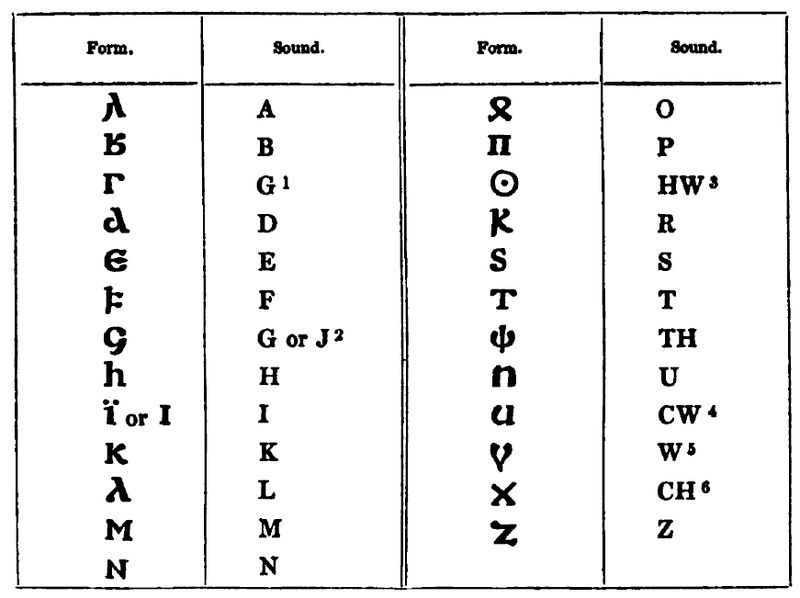
[1] And as n before another g.
[2] As j in jour, or y in your.
[3] Hw in Saxon, or wh in English. The proper sound of these letters can hardly be ascertained; but that which is given appears the most probable. Astle gives this character as Q.
[4] And in middle of words sometimes c.
[5] W in the beginning, and u in the middle of a word.
[6] Astle says ch or x.
Gothic in the British Founderies.
Pica. Caslon and Livermore. University of Oxford.
GO UP THE FORM.
Beating from the hither towards the farther side, is in pressmen’s phrase called, “Going up the Form.”—M.
GOVERNOR.
The master printer is generally styled Governor, when spoken of by the workmen in the house; as, The Governor said thus. The Governor ordered that.
GREAT NUMBERS.
Above 2000 printed on one sheet are accounted great numbers.—M. We now more commonly say long numbers. See Lay On, and Small Numbers.
GREAT PRIMER.
The name of a type, one size larger than English, and one smaller than Paragon. See Types.
GREEK.
The Greek alphabet consists of twenty-four letters, as under.
The Greek Alphabet.
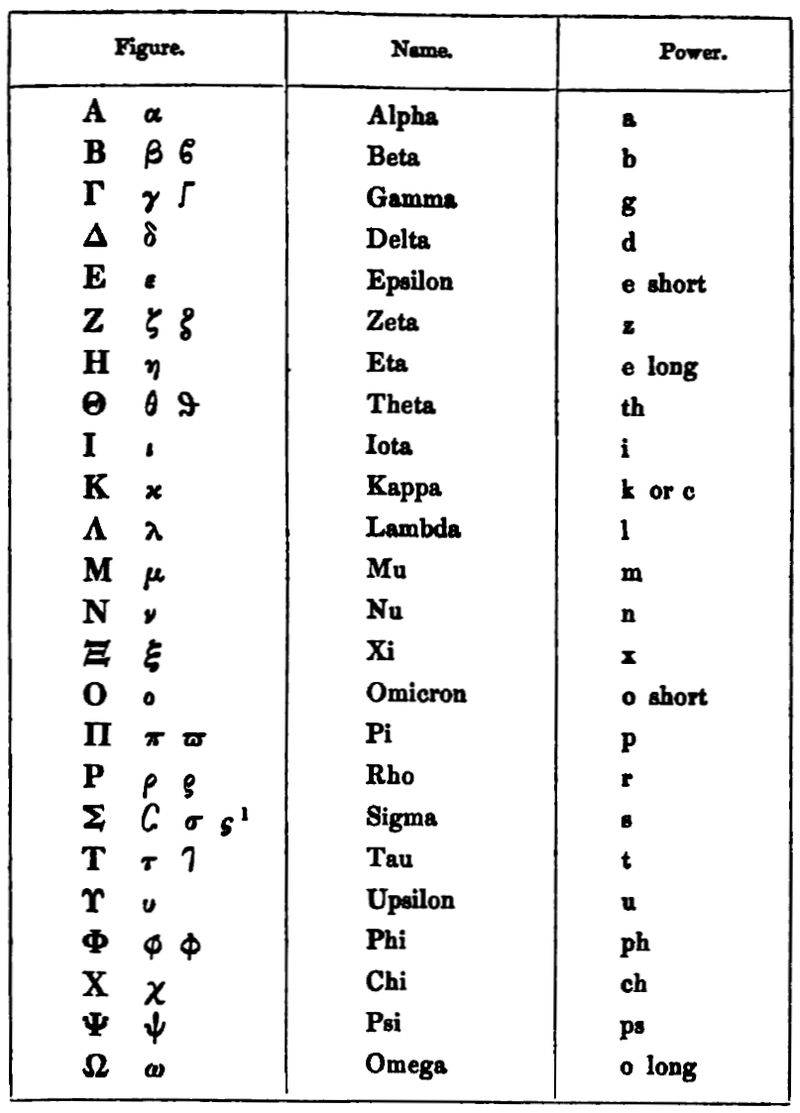
| Figure. | Name. | Power. |
| Α α | Alpha | a |
| Β β ϐ | Beta | b |
| Γ γ [#] | Gamma | g |
| Δ δ | Delta | d |
| Ε ε | Epsilon | e short |
| Ζ ζ [#] | Zeta | z |
| Η η | Eta | e long |
| Θ θ ϑ | Theta | th |
| Ι ι | Iota | i |
| Κ κ | Kappa | k or c |
| Λ λ | Lambda | l |
| Μ μ | Mu | m |
| Ν ν | Nu | n |
| Ξ ξ | Xi | x |
| Ο ο | Omicron | o short |
| Π π ϖ | Pi | p |
| Ρ ρ ϱ | Rho | r |
| Σ Ϲ σ ς[1] | Sigma | s |
| Τ τ [#] | Tau | t |
| Υ υ | Upsilon | u |
| Φ φ ϕ | Phi | ph |
| Χ χ | Chi | ch |
| Ψ ψ | Psi | ps |
| Ω ω | Omega | o long |
[1] Ϲ, initial; σ, middle; ς, final.
There are twelve diphthongs or compound vowels, viz.
Six proper—αι, αυ, ει, ευ, οι, ου; and
Six improper—ᾳ, ῃ, ῳ, ηυ, υι, ωυ. The dot below signifies that ι is subscribed.
Accents.—Accents are nothing more than small marks, which have been introduced into the language, to ascertain the pronunciation of it, and facilitate it to strangers. Wherefore the ancient Greeks, to whom it was natural, never used them, as is demonstrated from Aristotle, old inscriptions, and ancient medals. It is not an easy matter to tell, what time the practice of writing these accents first prevailed, though it is probable not till after the Romans began to be more curious of learning the Greek tongue, and to send their children to study at Athens, that is, about or a little before the time of Cicero.
Accents, by the Greeks called τόνοι, tones, are the rising or falling of the voice in pronouncing: which may be considered either separately in distinct syllables, or conjunctively in the same syllable.
Wherefore there are two sorts of accents; two simple, viz. the acute, οζὺς, figured thus (´), which denotes the elevation of the voice; and the grave, βαρὺς, shaped thus (`), to signify the falling or depression of the voice; and the circumflex, περισπώμενος, which was formed first of these two lines or points joined together thus (^), and afterwards was changed into a round sort of a figure like an inverted Upsilon, thus (⁀), but at length came to be figured like an s drawn crossway (~).—Bell’s Greek Grammar.
The acute accent raises the voice, and affects one or more of the three last syllables of a word, if it has so many.
The circumflex lengthens the sound, and affects either the last syllable of a word, or the last but one.
The grave depresses the voice, and affects the last syllable only.
There are two spirits, or breathings: the asper (῾), which the Greeks use instead of the letter Η; and the lenis (᾿) which denotes the absence of the asper.
The apostrophe (’), marked at the head of a letter in the end of a word denotes that the vowels α, ε, ι, or ο, and sometimes the diphthongs αι or οι are cut off, the next word beginning with a vowel.
Accents and Aspirates.
| ᾿ Lenis. | ῎ Lenis acute. | ~ Circumflex. | ¨ Diæresis. |
| ῾ Asper. | ῍ Lenis grave. | ῏ Circumflex lenis. | ΅ Diæresis acute. |
| ´ Acute. | ῞ Asper acute. | ῟ Circumflex asper. | ῭ Diæresis grave. |
| ` Grave. | ῝ Asper grave. |
Points.—A colon in Greek is a point at the head of a letter; as (·)
An interrogation is a Latin semicolon; as (;)
All other points in Greek are the same as in Latin.
The Greeks express their Numbers by Letters, thus:
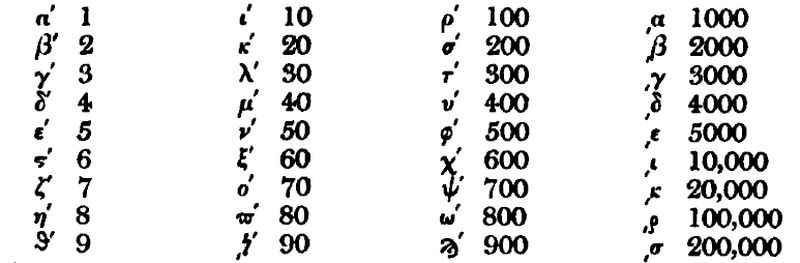
| α’ 1 | ι’ 10 | ρ’ 100 | ‚α 1000 |
| β’ 2 | κ’ 20 | σ’ 200 | ‚β 2000 |
| γ’ 3 | λ’ 30 | τ’ 300 | ‚γ 3000 |
| δ’ 4 | μ’ 40 | υ’ 400 | ‚δ 4000 |
| ε’ 5 | ν’ 50 | φ’ 500 | ‚ε 5000 |
| ϛ’ 6 | ξ’ 60 | χ’ 600 | ‚ι 10,000 |
| ζ’ 7 | ο’ 70 | ψ’ 700 | ‚κ 20,000 |
| η’ 8 | ϖ’ 80 | ω’ 800 | ‚ρ 100,000 |
| θ’ 9 | ϟ’ 90 | ϡ’ 900 | ‚σ 200,000 |
The first of the above ranks is units, and consists of the eight first[299] letters with the character ϛ’, called στίγμα, which signifies 6, and is therefore ranged in the sixth place.
The second rank consists of tens, and is formed of the eight following letters with this character ϟ’, κὄππά, which signifies 90.
The third rank consists of hundreds, and contains eight letters with this character ϡ’, σάνπι, which signifies 900.
The accent under each letter in the fourth rank signifies a thousand, and the letter itself expresses the number of thousands signified.
The letters of the three first ranks are marked with a dash on the top to distinguish them from the letters marked with an accent below.
By compounding the above letters any number may be expressed; thus, ι’α’ makes 11; κ’β’, 22; λ’γ’, 33; ρ’δ’, 104; ‚αε’, 1005; ‚αψ’ο’ϛ’, 1776, &c.
Also the Greeks sometimes use these capitals instead of the numbers, of which they are the initial letters, viz. Ι for one, because ΙΑ signifies one (being formerly used instead of μ’ια), Π for five, Δ for ten, Η for a hundred, Χ for a thousand, and Μ for ten thousand. And these letters may be all four times reduplicated (except Π), thus ΙΙ, 2; ΙΙΙ, 3; ΙΙΙΙ, 4; ΔΔ, 20; ΔΔΔ, 30; ΔΔΔΔ, 40, &c. So ΔΙ, 11; ΔΔΙΙ, 22; ΠΙ, 6; ΔΠ, 15, &c.
Sometimes the above initials are enclosed in a great ∏, and then the number is five times repeated, thus |Δ̅| is five times ten or 50; and |Χ̅| is 5000: but Ι is never enclosed.
Fournier, in his Manuel Typographique, gives a great number of Greek ligatures: these I have copied, with additional ones from Fertel, and others from Jones’s Greek Grammar; together they make a more complete list than any that I have met with. Fournier, speaking of the article Greek, says, We see by the multiplicity of the sorts, that the Greek character is the most extensive and complicated of all characters. The founders may not always be able to give the Greek founts thus complete in sorts; but I give the representation, because, as I have before said, the engravers who have worked upon the characters have followed the ligatures which they found in the manuscripts which they imitated. There were never any but the Greek characters engraved by Garamond for Francis the First, which have been complete in all sorts of ligatures. It is this which has obliged me to give in different lines the figures which compose this fount, in which there are still some wanting, which I have been obliged to suppress in order not to multiply them without necessity.
For the classical works in Greek the ligatures or double letters are considerably diminished. I have adopted this usage in the little fount, which contains but the figures most in use.—Fournier.
I have been induced to give this extended list of Greek ligatures, because the present taste in printing Greek is to discard them entirely, and to use a distinct character for each letter of the alphabet. Under these circumstances, should an old edition of a Greek work be put in hand as copy to be reprinted, it would be mortifying not to be able to decypher the ligatures, nor have any thing to refer to for explanation. I have myself been placed in this situation in a large house, with no person in it who could give me the necessary information, although there were some there that professed themselves good Greek scholars; neither could the editor of the work himself give me any assistance.
Greek Ligatures.

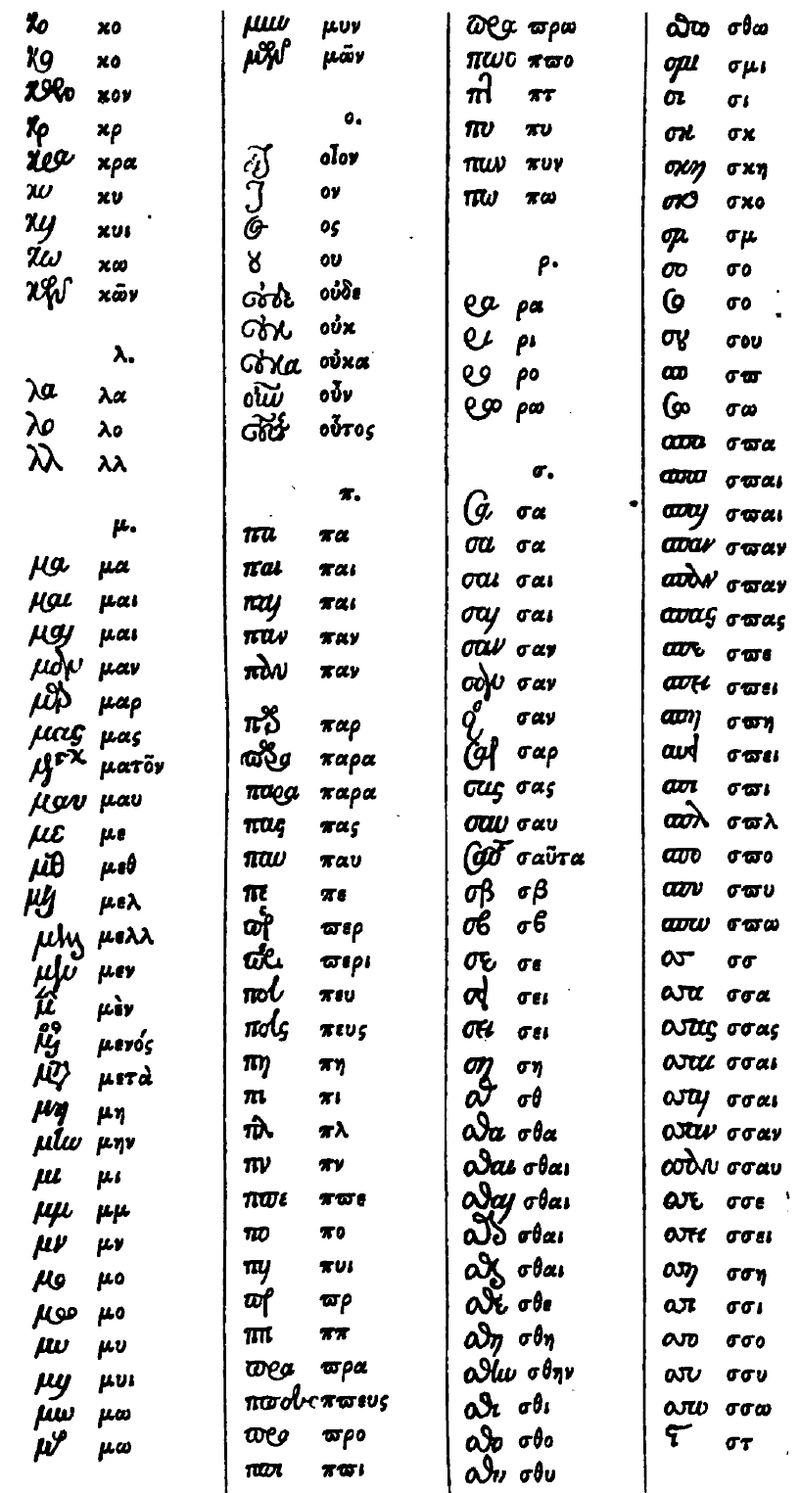

Plan of the Old Greek Upper Case, as used in Mr. Spottiswoode’s Offices.
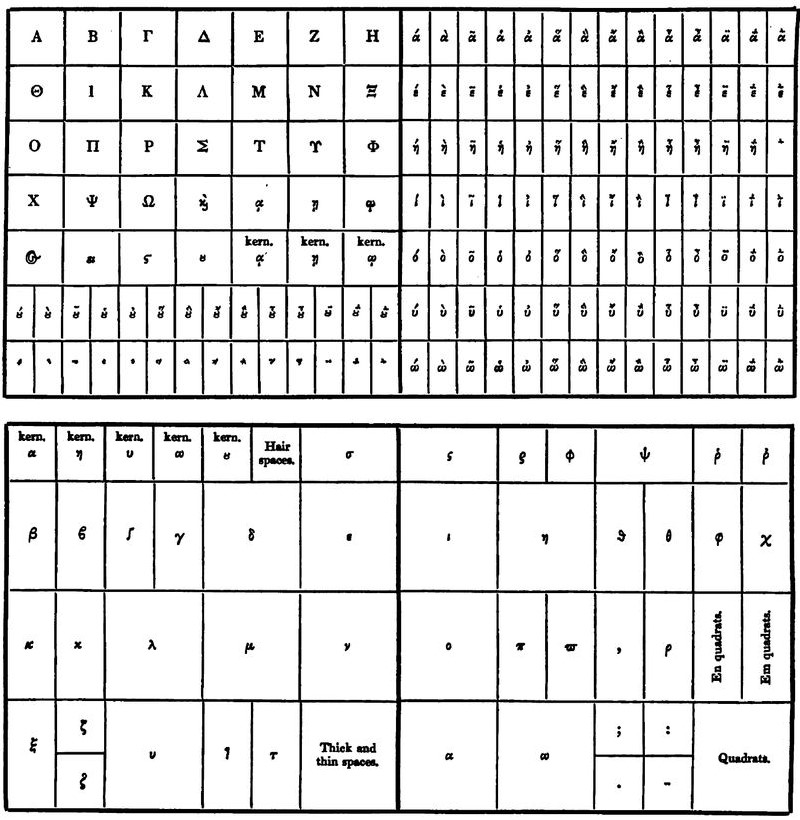
Plan of the Old Greek Lower Case, as used in Mr. Spottiswoode’s Offices.
Plan of the New Greek Upper Case, as used in Mr. Spottiswoode’s Offices.

Plan of the New Greek Lower Case, as used in Mr. Spottiswoode’s Offices.
Greek in the British Founderies.
Double Pica.—Caslon and Livermore; cut by Martin. V. and J. Figgins. Thorowgood and Besley. University of Oxford. Wilson; Glasgow Homer.
Great Primer.—Caslon and Livermore; cut by Martin. V. and J. Figgins. Thorowgood and Besley; formerly Byddells. University of Oxford. Wilson.
English.—Caslon and Livermore. V. and J. Figgins. Thorowgood and Besley. University of Oxford. Wilson.
Pica.—Caslon and Livermore. V. and J. Figgins. Thorowgood and Besley (2). University of Oxford. Wilson.
Small Pica.—Caslon and Livermore. V. and J. Figgins. Thorowgood and Besley. Wilson.
Long Primer.—Caslon and Livermore. V. and J. Figgins. Thorowgood and Besley, late Fry’s; one fount cut from the MS. of the late Professor Porson. University of Oxford. Wilson; matrices from type cast in which the Elzevirs printed some of their editions.
Bourgeois.—Caslon and Livermore. V. and J. Figgins. Thorowgood and Besley.
Brevier.—Caslon and Livermore. V. and J. Figgins. Thorowgood and Besley. University of Oxford. Wilson.
Nonpareil.—Caslon and Livermore. V. and J. Figgins. Thorowgood and Besley.
Pearl.—Caslon and Livermore. Thorowgood and Besley; formerly Bynneman’s.
Diamond.—Caslon and Livermore. V. and J. Figgins.
Alexandrian Greek, Pica.—Thorowgood and Besley, late Fry’s; cut by Jackson, for Dr. Woide’s facsimile edition of the New Testament of the Codex Alexandrinus.
For the allowance of the duty on paper used in the printing of books in the Greek language within the Universities of Oxford and Cambridge, the Universities of Scotland, and the University of Trinity College, Dublin, see Paper.
GROOVES.
There is always a groove on the upper surface of the short cross of a chase, at each end, six or seven inches long. Their use is to receive the spur, when working with points, and to allow it to make a hole in the paper, without injury to itself. The grooves in wrought iron chases are of a good form, being cut with a tool tapering to the bottom like a wedge, which enables the spur to make a clean hole in the paper; those in cast iron chases are generally flat at the bottom and too wide, which causes the holes to gull. See Gull.
Guide Cramps. See Cramp Irons.
GULL.
When the points tear the point holes at press, they say, they are Gulled, or the Holes Gull. This may arise from two or three causes—if the point of the spur be turned again, it will cause it—in cast iron chases the groove to receive the spur is generally too wide, this may also cause it—and if the spur does not fall fairly into the groove, this may be another cause: the remedy is not difficult, unless the paper be very tender. In the first case, the spur ought to be filed to a smooth tapering point—in the second, it is usual to wedge a bit of reglet into the groove, to cut it down to the surface of the cross, and to make a hole in it with a bodkin for the reception of the spur—in the last, it is necessary that the spur fall fairly into the groove. If the fault arises from the bluntness and thickness of the spurs, they must be filed smaller and to a point.
GUTTER.
Gutter Sticks are used to set between pages on either[308] side the crosses; they are made of an equal thickness their whole length; but they have a groove, or gutter, laid on the upper side of them, as well that the water may drain away when the form is washed or rinsed, as that they should not print, when, through the tenderness of the tympan, the platen presses it and the paper lower than ordinary.—M. We now mean by the term Gutter, the piece of furniture that separates two adjoining pages in a chase, as in an octavo that between pages 1 and 16, in a duodecimo that between pages 1 and 24, and so on. The pieces that are put at the sides of the pages next the cross, are called Backs; and those at the tops of the pages next the cross, are called Heads. I would recommend that the gutters should be cut a little longer than the page, the heads for each quarter being in two pieces, so that the gutter may be between them; one head will thus project a little over the sidestick, and will form an abutment for it, while the other will project a little over the back; by this method there will be no danger of any of them binding, and the gutters will answer for pages of different lengths.
Guy, Thomas. See Donations.
GYPSUM.
Earl Stanhope says, “The best burnt gypsum mixes up most conveniently, for stereotyping, in the proportion of seven parts of water to nine parts of gypsum.”
HALF A PRESS.
When but one man works at a press, it is called Half a Press.—M. It is still termed a Half Press. A man is said to be working Half Press.
HALF WORK.
He that works but three days in the week, does but Half work.—M.
Hangs. See Letter Hangs.—M.
HANG UP PAPER.
To hang the sheets upon the poles to dry after they have been printed.
For this purpose the warehouseman takes the peel in his hand, and lays it flat upon the heap that is to be hung up, so as to let the paper project beyond the left side of it; he turns over upon it from six to twelve or fourteen sheets of paper, with the wrapper, and then moves the peel two or three inches to the left, and goes on repeating the process, till he has got as many lifts on it as it will conveniently support; he then raises them above the pole on which they are to be placed, and holding the handle slanting the sheets open at the under side, so that when the peel is withdrawn the lifts are left suspended on the pole; he then inserts the end of the peel between the first and second lifts, which are undermost, where he shifted his peel in taking them up, lifts them a little, and moves them farther from each other on the pole, still letting the one overhang a little the other he leaves in its first place, and thus he proceeds till one by one he has separated all he had upon his peel; he then takes another peelful, repeating this process, and so he goes on till the whole heap is hung up.
He is guided by circumstances as to the number of sheets he should take in a lift: if the work is in a great hurry, or his vacant poles are not in a favourable situation for drying, or the weather be rainy and the atmosphere charged with moisture, he will hang the paper up thin; but if he is short of pole-room, and the work is not in a great hurry, if the situation is favourable for drying, and the weather dry and warm, he will make his lifts thicker; but I would caution him not to go to an[309] extreme, as in that case the paper may mildew upon the poles, particularly in the fold.
Houses of extensive business have drying rooms fitted up with pipes, and heated either with steam or hot water, so that they can dry their printed paper expeditiously, without hinderance or drawback.
HANG THE PLATEN.
To tie the platen to the hose hooks, in a wooden press.
To perform this it is usual to lay on the press stone a form of solid type, and to turn the tympans down upon it, to place the platen in its place, square with the press, to pull the bar home, and to keep it in this situation by a letter board placed so as to take a bearing against the shoulder of the bar close to the handle, and also against the off cheek; but I prefer a piece of wide furniture with a notch cut in one end for the bar, and the other end against the off cheek, as it is more secure and less liable to be displaced; then to make a noose on a piece of laid cord, place this on one of the front hose hooks, and take a turn round the corresponding platen hooks, and continue these turns till a sufficient quantity of cord is wound round the hooks; take a hitch round one of the hooks to prevent the cord slipping, then begin to wind the cord round these layers, every two or three turns drawing it tight by taking a turn round a short piece of broad or narrow furniture, by means of which it may be drawn more forcibly, so as to bring the parts together, which makes it so firm that there is no danger of its giving way; the end may then be fastened to one of the hooks. The same process is repeated at the opposite angle, behind the press; then at the two other angles; the platen is then firmly hung, and is ready for work.
The same process is observed in iron presses, with the exception that the platen is not tied with cord; it is attached to the press by means of screws.
Hansard, Luke. See Donations.
HARD IMPRESSION.
When there is too much pull in working at press, particularly with engravings, and the lines come off strong which ought to be light and delicate, it is said the impression is hard.
HARD INK.
Ink very well boiled.—M. It is now called strong ink.
HARD JUSTIFYING.
If a compositor fills his stick very stiff with letters or spaces, they say it is hard justified.—M.
HARD PULL.
In justifying the head of a press for a short pull, which is done by putting solid blocks of wood into the mortises of the cheeks, it is called an Hard Pull.—M. This relates to wooden presses; but, instead of the blocks of wood, scaleboard is now used, additional pieces of which are put into the mortises, by lowering the head, which is again tightly screwed up: in the Stanhope Press, and in Clymer’s, it is accomplished by shortening the coupling bar, by means of a screw; in Cogger’s press, by a screw through the head; and in Cope’s press, by putting pieces of plate iron upon the crown of the platen. In Sherwin and Cope’s Imperial press, by turning a screw attached to a wedge placed in the front, above the spindle; Mr. Hopkinson has adopted the same method in Cope’s press, placed on the near side.
HARD WORK.
With compositors, ill written copy, much Italick, Latin or Greek, or marginal notes, or few breaks, &c. is called Bad, Heavy, Hard Work: with pressmen, small letter and a large form is called Hard Work.—M. See Bad Work.
There has been an alteration in the mode of paying for work since Moxon’s time, which is to the advantage of the workman: foreign languages, Greek, and marginal notes are now extra charges; and the[310] Pressman has an additional price for his work, as the type decreases in size and the size of the page increases. See Prices.
HEAD.
That part of a wooden press in which the nut of the spindle is fixed; it has a tenon at each end which fit into long mortises in the cheeks, not tightly, but sufficiently so to prevent lateral motion; and it is suspended from the cap by two long iron bolts, which go through the head and the cap, above which are iron washers and screws by which to lower the head, or screw it up tighter. The head is usually made of elm. The whole of the pressure in the process of printing is between the head and the winter.
HEAD BAND.
A thin bar of iron that connects the two sides of the tympans at the top: it is made thin, to allow it to run under the platen without impediment. The half of the frisket joints are riveted to the head band. See Frisket Joints.
HEAD BOLTS.
Two long bolts that pass through the head and the cap, in wooden presses, with a screw at the upper end: the head of the press is supported upon the heads of the bolts, and their screw ends pass through the cap, upon which they are secured by washers and female screws that can be tightened by the fingers; these screws are for the purpose of screwing up the head, to justify the pull.
HEAD LINE.
The top line of a page in which is the running title and the folio, but sometimes only a folio: the divisions and subdivisions of a work, when they are set in lines, and chapters, are also called Head Lines.
HEAD OF A PAGE.
The top or beginning of a page.—M.
HEAD PAGE.
The first page of a work, and each page on which a new division of the subject commences, such as parts and chapters, provided they begin the page.
HEAD PIECES.
The same changes have taken place with regard to head pieces that I have described under the article Fac; from the beautiful drawings with which manuscripts and some of the first productions of the press were illuminated, they gradually descended to engravings on wood, which was the first step, then to cast metal ornaments, and then to the types called flowers, which were displayed in every variety of form that they were capable of, or that the ingenuity of the printer could devise; these gave place to a piece of double brass rule, that is now out of fashion; and head pieces at the present day are only spoken of as things that once existed. See Fac.
HEAD STICK.
Pieces of furniture put at the head of pages when a form is imposed, to make the margin at the head of the page; they are called reglets, if they exceed not an English thick.—M. See Bolts.
HEAP.
So many reams or quires as are set out by the warehouse-keeper for the pressman to wet, is called a Heap; but then it is called a dry heap, till the pressman have wet it, and then it is indeed called a Heap.—M.
When paper is given out for a work, and wetted, it is called a heap, and retains that name till it is made up into books.
In gathering the printed sheets in the warehouse, all the sheets of each signature are placed upon the gathering table, arranged in their regular order, except it be a long number, and then about a bundle of each; each signature in this situation is called a heap.
HEAP HOLDS OUT.
When it hath its full intended number of sheets.—M. At the present time, when accidents and other causes have not reduced the surplus so much as to prevent the warehouseman from delivering the proper number.
Heavy Work. See Bad Work and Hard Work.
HEBREW.
The Chaldaic letters are derived from the ancient Hebrew or Samaritan, which are the same, or nearly so, with the old Phenicien. The prophet Ezra, is supposed to have exchanged the old Hebrew characters, for the more beautiful and commodious Chaldee, which are still in use.
Hebrew has no capitals; and therefore letters of the same shape, but of a large body, are used at the beginning of chapters and other parts of Hebrew work.
The Hebrew Alphabet.
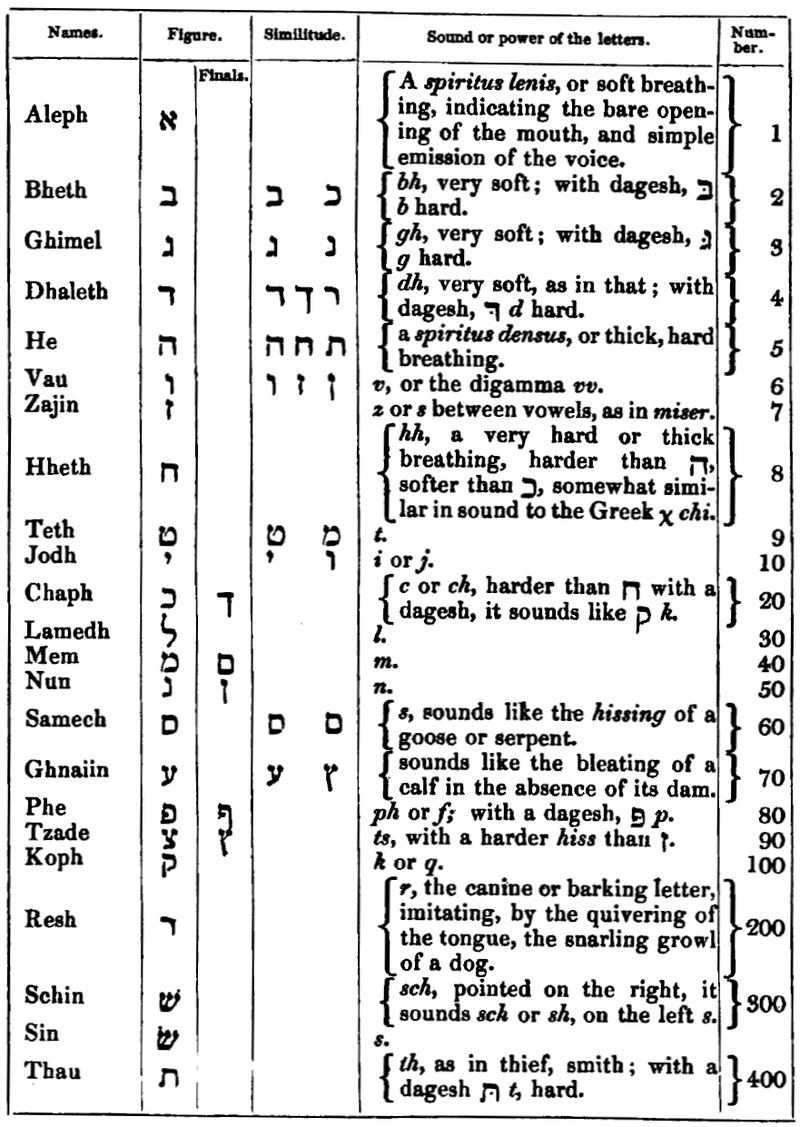
| Names. | Figure. | Similitude. | Sound or power of the letters. | Number. | |
| Finals. | |||||
| Aleph | א | A spiritus lenis, or soft breathing, indicating the bare opening of the mouth, and simple emission of the voice. | 1 | ||
| Bheth | ב | כ ב | bh, very soft; with dagesh, בּ b hard. | 2 | |
| Ghimel | ג | נ ג | gh, very soft; with dagesh, גּ g hard. | 3 | |
| Dhaleth | ד | ר ך ד | dh, very soft, as in that; with dagesh, דּ d hard. | 4 | |
| He | ה | ת ח ה | a spiritus densus, or thick, hard breathing. | 5 | |
| Vau | ו | ן ז ו | v, or the digamma vv. | 6 | |
| Zajin | ז | z or s between vowels, as in miser. | 7 | ||
| Hheth | ח | hh, a very hard or thick breathing, harder than ה, softer than כ, somewhat similar in sound to the Greek χ chi. | 8 | ||
| Teth | ט | מ ט | t. | 9 | |
| Jodh | י | ו י | i or j. | 10 | |
| Chaph | כ | ך | c or ch, harder than ח with a dagesh, it sounds like ק k. | 20 | |
| Lamedh | ל | l. | 30 | ||
| Mem | מ | ם | m. | 40 | |
| Nun | נ | ן | n. | 50 | |
| Samech | ס | ם ס | s, sounds like the hissing of a goose or serpent. | 60 | |
| Ghnaiin | ע | ץ ע | sounds like the bleating of a calf in the absence of its dam. | 70 | |
| Phe | פ | ף | ph or f; with a dagesh, פ p. | 80 | |
| Tzade | צ | ץ | ts, with a harder hiss than ז. | 90 | |
| Koph | ק | k or q. | 100 | ||
| Resh | ר | r, the canine or barking letter, imitating, by the quivering of the tongue, the snarling growl of a dog. | 200 | ||
| Schin | שׁ | sch, pointed on the right, it sounds sch or sh, on the left s. | 300 | ||
| Sin | שׂ | s. | |||
| Thau | ת | th, as in thief, smith; with a dagesh תּ t, hard. | 400 | ||
Particular attention should be paid to the letters in the column “Similitude” in the Table of the Alphabet, which are liable to be mistaken, one for the other, on account of their great resemblance one to another.
The vowels properly so called are ten in number, viz.:
| Long. | Short. | ||||||
| Kamets | בָ | ā | Patach | בַ | ă | ||
| Tseri | בֵ | ē | Segol | בֶ | ĕ | ||
| Great | Chirek | בִי | ēī | Little | Chirek | בִ | ĭ |
| Hholem or Cholem | וֹ | ō | Kamets | Catuph, or short (בֳ) | בָ | ŏ | |
| Shurek | וּ | ū, or ōō | Kybbutz | בֻ | ŭ | ||
Sheva (בְ) is sounded like very short e. 1. At the beginning of a word. 2. In the middle after a long vowel, or instead of a long vowel. 3. After a companion, i. e. another (וְ). 4. Under dagesh, also under dagesh understood.
Dagesh, from the Chaldaic, he punctured, is a point in the body of a letter, and is either lene or forte.
Dagesh lene removes the aspiration from the six letters בְּגַדכְּפַת, and strengthens their pronunciation in some degree.
Dagesh forte doubles the letters in which it occurs. Regularly it follows a short vowel, and only a long one when accented.
Mappik is a point in הּ final only, but vanishes on an increase of the word.
Accents.
Hebrew accents are either mere points, or lines, or circles.
Those which are mere points or dots, consist of one, or two, or three such points, and are always placed above the middle of the accented letter, thus
That consisting of
One, called rebia, ב֗, i. e. sitting over.
Two, called royal zakeph katon, ב֔, or, the little elevator, from its figure which is composed of upright points.
Three, called royal segolta, ב֒, an inverted (∵).
The lines are either upright, inclined, or transverse.
The upright is either solitary or with points or dots.
The solitary is either
between two words ב׀ב, termed pesick, or musical pause, and terminating a song.
or under a word
Metheg בֽ, or bridle, an euphonic accent at the beginning of a word.
Royal silluk, בֽ, end, which is placed before (׃) sophpasuk, i. e. towards the end.
With points, namely
two, above the letter, royal zakeph gadhol ב֕, the great elevator, strains the sound.
one, below the letter, royal tebhir, ב֛, broken sound, from its figure and tone.
Inclined lines hang either above or below.
Above, towards the right
Leader pashta, ב֙, extension, extends the voice or sound, and is placed above the last letter of the word. Subservient kadma, ב֨, antecedent, to the leader geresh; and is placed above the penult or antepenult letter.
Above, towards the left
Leader geresh, ב֝, expulsion, is sung with an impelled voice.
Gereshajim, ב֞, two expellers, from the figure being doubled.
Below, towards the right—Leader tiphcha, ב֖, fatigue, from the song, or note.
Below, towards the left
Of subservient Merca, ב֥, lengthening out, from its lengthening out the song or note.
Merca kephula, ב֦, a double lengthening out from its music and figure.
The transverse line is either right or curved, thus: ֮־ .
The right line is placed between two words, connecting them together, thus, ב־ב, and is called maccaph, i. e. connexion.
The curved, or waved line, ב֮, is called leader, zarka, or, the disperser, from its modulation and figure.
Circles are either entire or semi.
The entire circle is placed always above, and has a small inclined line attached to it.
Either, on the left, when it is placed at the head of the word, ב֠, and is called leader telisha the greater, or, the great evulsion.
Or, on the right, when it is placed at the end, ב֩, and is called subservient telisha the less.
On both together, ב֟, called leader karne para, the horns of the heifer, from its modulation and figure.
The semicircle is either solitary or pointed.
The solitary is either angular or reflected.
The angular is on the right
Subservient hillui, ב֬, elevated, from the elevation of the voice.
Munach, ב֣, placed below, from its position.
The angular is on the left
Leader jethith, ב֚, drawing back, from its figure.
Subservient mahpach, ב֤, inverted, also from its figure.
The reflected is
either single subservient darga, ב֧, a degree.
or double, leader, shalsheleth, ב֓, a chain, from its figure and modulation.
When joined with other points, it is either above or below the letter.
When above the letter it has a small line attached to it on the left, ב֡, leader paser, the dispersor, from the diffusion of the note.
When below the letter, it is pointed either downwards, ב֑, called royal athnach, respiration, as the voice must rest on it, and respire; or upwards, ב֪, subservient, jerah-ben-jomo, the moon of its own day, from its figure.—Bythner’s Lyre of David, translated by the Rev. Thomas Dee, A.B. 8vo. Dublin, 1836.
The following observations are from Buxtorf’s Hebrew Grammar:
The finals are commonly called Camnephatz. But they are excepted in four places, namely, Isaiah ix. 6. where the final Mem is in the middle of a word; Nehemiah ii. 13. where the open Mem is at the end; and Job xxxviii. 1. and xl. 6. where נ is at the end.
These seven letters ﬡ ﬢ ﬣ ﬥ ﬦ ﬧ ﬨ are sometimes lengthened, either for the sake of elegance, or for filling out the line, which is never to be finished with a divided word.
The units are compounded with the tens and hundreds, as יא 11,
קא 101, and so on: but for יה 15 is טו 9 and 6, lest the sacred name
יָהּ Jah should be profaned.—Buxtorf.
Hebrew is read from the right to the left. In composing it, the general method is to place the nick of the letter downwards, and when the points are put to the top, to turn the line and arrange those points that come under the letter, taking care to place them in the following order; if the letter has but one leg, the point must be placed immediately under that leg, but otherwise the point must be placed under the centre.
Smith, in his Printer’s Grammar, has the following observations on Hebrew; I have not been able to ascertain upon what authority his reasoning is founded, but I have ascertained the fact of the variation in the types, that he speaks of, by an examination of a Hebrew Bible.
“But we must not pronounce it a fault, if we happen to meet in some Bibles with words that begin with a letter of a much larger Body than the mean Text; nor need we be astonish’d to see words with letters in them of a much less Body than the mean Text; or wonder to see final letters used in the middle of words; for such Notes shew that they contain some particular and mystical meaning. Thus in 2 Chron. I. 1. the word Adam begins with a letter of a larger size than the rest, thereby to intimate, that Adam is the father of all Mankind. Again, in Genes. I. 1. the great Beth in the word Bereschith stands for a Monitor of the great and incomprehensible work of Creation. Contrary to the first, in Prov. XXVIII. 17. the Daleth in the word Adam is considerably less than the Letter of the main text, to signify, that whoever oppresses another openly or clandestinely, tho’ of a mean condition; or who sheds innocent blood, is not worthy to be called Man.
“Sometimes the open or common Mem stands in the room of a final one; as in Nehem. II. 13. where the word hem has an open Mem at the end, in allusion to the torn and open walls of Jerusalem, of which there is mention made; and in Es. VII. 14. where the Prophet speaks of the Conception of the Virgin Mary, the Mem in the word haalma, or Virgin, is a close or final letter, to intimate the virginity of the mother of our Saviour. Such are the peculiarities of some Jewish Rabbis in Bibles of their publication; of which we have instanced the above, to caution compositors not to take them for faults, if such mystical writings should come under their hands.”—Smith.
The following is the date to an Hebrew and Spanish folio Bible, printed by Proops of Amsterdam in 5522 (i. e. 1762), showing the date as usual in a sentence, the letters by which the date is computed being larger.

בשנת וׅׄיקראו בספרׅׄ תוׅׄרת אלהיׅׄם מפורשׅׄ לפ׳ק
Ao. 5522.
Rabbinical.—The language or dialect of the Rabbins is divided into two branches; one approaching nearer to the Hebrew, and the other to the Chaldee, yet each agrees with the other in many points, and both are generally used in conjunction in writing.
The letters agree with the Hebrew and Chaldee in regard to their number and power, but they differ as to the form; for although in the Talmudic text of the Holy Scriptures the Hebrew square character is used, yet in commentaries and elsewhere a rounder letter is adopted, better suited to promote facility in writing. Their points of agreement or difference are shown in the subjoined table:—
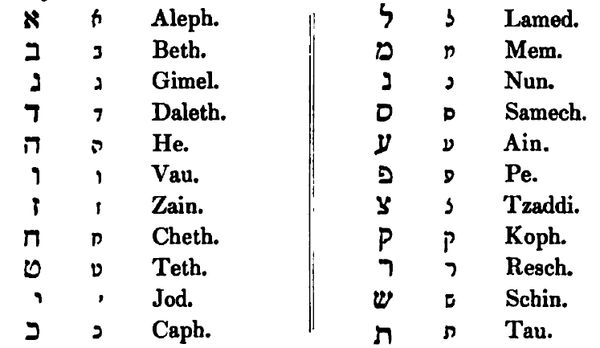
| א | א | Aleph. | ל | ל | Lamed. |
| ב | ב | Beth. | מ | מ | Mem. |
| ג | ג | Gimel. | נ | נ | Nun. |
| ד | ד | Daleth. | ס | ס | Samech. |
| ה | ה | He. | ע | ע | Ain. |
| ו | ו | Vau. | פ | פ | Pe. |
| ז | ז | Zain. | צ | צ | Tzaddi. |
| ח | ח | Cheth. | ק | ק | Koph. |
| ט | ט | Teth. | ר | ר | Resch. |
| י | י | Jod. | ש | ש | Schin. |
| כ | כ | Caph. | ת | ת | Tau. |
The finals are the same as in Hebrew, the forms of which they also imitate, in this manner, ך ך, ם ם, ן ן, ף ף, ץ ץ.
There are no lengthened letters in printed books.
The two letters א and ל are often connected by the Rabbins in this manner, ﭏ; as, הﭏ for אֶלָּא Deus, ﭏא for אֶלָּא sed.
It is also to be remarked that they write the name of GOD in different ways; namely, the Tetragrammaton, or יְיָ with the Targumists, or יי, or האם and abbreviated ה׳, nomen illud, i.e. the most excellent; but in expressing the word אלהים, they change the letter ה into ד or ק, thus, אלדים or אלקים, which agrees with a general superstition of the Jews.
The vowel points are the same as in the Hebrew, but they are rarely expressed, except in books written for the use of students. When they are wanting, they must be gathered from analogy, in which much assistance may be gained from the frequent use and study of the Hebrew; but where conjecture may be difficult, the three letters י ו א, which are called the mothers of reading, are used in order to assist the reader. Thus (1.) א denotes Kamets in גנשי turpitudo, וודאי confessum, פדאם redemit eos, &c; (2.) Vau denotes Cholem, Kybbutz, and Kametscatuph; as, לקרוא vocare, פוקד visitans; כולם for כֻלָּם omnes illi, כהוכה for כְהֻכָּה sacerdotium, לפותרו for לְפָתְּרוֹ ad explicandum illud, &c; (3.) Jod denotes Chirek, Tseri, Segol, and occasionally in the Talmud both simple and compound Sheva; as, תפילה precatio,[316] בישר annunciavit, איבר perdidit; also פירוש for פֵרוּש explicatio, אילי for אֵלַי ad me, שיני for שֵׁנִי secundus, ביה for בֵּהּ in eo, בריה for בְרֵהּ filius ejus, and so continually to mark the feminine affix בְּרָהּ.
The rules for the vowels, and for the Sheva, both simple and compound, and also for the diphthongs, are the same as in the Hebrew and Chaldee.
א is often absorbed by crasis, as, מצינא for מָצֵי אֲנָא possum, as if it were potens ego, ידענא scio, also of the feminine by an enallage frequent in this contraction, thus in לית and ליכא for לא אית and לא אינא non est. In the same manner ה is omitted by the Jews in תילם for תהילים psalmi. But many others are accustomed to be contracted in this manner by the Jews of Jerusalem, viz., א in נילו for כאילו quasi, ות for ואת et tu, דתfor דאת quod tu, דנא for דאנא quod ego, והיידינו for והיידא דין הוא quodnam est illud; ה in לון for להון illis; ח in תותי for תחותי sub; ד in קם, קום, or קותי, for קודם ante.
Apocope is frequent among the Talmudists, as, בי for בית domus, or בין inter. So in the pronouns both separate and suffixed, אתו for אתון vos, נו for נון vos, vester, הי for הון illis, suis; also in the feminine, ני for נין, הי for הין; and in the verbs, as, גרסי for גרסית docui, שקלתו sustulistis, קאיו stans, &c.
Aphæresis also occurs, though seldom, in חד for אחד unus, נא for אנא ego, נן for אנן nos, מר for אמר dixit.
They leave the Dagesh, both lene and forte, to be collected from analogy, but where it may be difficult to guess at, as in the preterite Pihel, the letter י indicates the little Chirek as well as the Dagesh forte, as, כיסה for כִסָּה texit; and in defectives the letter which had been thrown aside is sometimes restored, as, ינקם for יִקֹם ulciscetur, from נקם ulcisci.
A point at the end of a letter generally denotes a number, as, א׳ unum, ב׳ duo, ג׳ tria, &c; but at the end of two or more letters it signifies a word cut off by a certain abbreviation, as, את׳ for dixit, לות׳ for לותר dicere, ה׳ ית׳ for הַשֵׁ יִתְבָרֵךְ Deus benedictus, וגו׳ for וִגוֹמַר et cætera, in an abrupt passage of Scripture, וכו׳ for וְכֻלּוֹ et totum illud, in sacred or profane use. Also פי׳ for פֵרוּשׁ interpretatio, or פֵרֵשׁ interpretatus est, ר׳ for רבי Rabbi, Magister, שנ׳ for שֶׁנִּאֱמַר quia dictum est, &c.
A double point affixed to a letter indicates either compound numbers, as, י״ד 14, ט״ו 15, תמ״ד 444; or letters taken materially, as, א״לף Aleph, ב״ית Beth, גי״מל Gimel, &c.; or lastly abbreviations by initial letters alone, denoting entire words, which is called ראשי תיבות; the number of these is very great, as אי״ה, that is, (יעזור) אם ירצה השם si voluerit (or juverit) Deus, א״כ אִם כֵן si sic, si verum est, אע״פיש for אַף עַל פִי שֶׁ אף על פי ש etsi, quanquam, ה״בה or הק״בה for הברוך הוא or הקדוש ברוך הוא Deus benedictus, Deus sanctus benedictus; ה״שו for השם ימברך Deus benedictus, ז״ל for זכרונו לברכה memoria ejus sit in benedictione, or in the plural number זכרונם לברכה memoria eorum sit in benedictione; מ״ו for מס ושלום parce et pax sit, that is, absit; ״א for יש אמרים sunt qui dicunt; ״מ for מפרשים יש sunt qui interpretentur; י״ל for יַשׁ לוֹמַר est dicere, respondendum est; יצר׳ for[317] ישמרהו צורו וגואלו custodiat eum petra ejus, et redemptor ejus; כ״א for כִּי אִם sed, nisi; כ״כ for כָל־כַךְ tantopere; נ״פ for כָל־פָנִים omnibus modis; כ״ש for כָל־שֶׁכֵּן quantò magis, quantò minus; ל״ש for לְשֵׁם שָׁמַֽיִם in honorem Dei; מ״מ for מִכָּל־מָקוֹם nihilominus, tamen; ע״ד for עַל דֶרֶךְ more, in modum; ע״ה for השלום super quo pax, ע״ז for עבודה זרה cultus alienus, idololatria; ע״פ for על פי ad formam, modum; ע״צ for עַל צַד ad latus, juxta; פ״א for פירוש אקר expositio alia; ר״ל for רוצה לומר vult dicere. Also ר״אבע Rabbi Aben-Ezra, ר״דק Rabbi David Kimchi, רל״בג Rabbi Levi Ben Gerson, רמ״בם Rabbi Moses Ben Maiemon, ר״שי Rabbi Salomon Iarchi, or Isaac, &c., which are also read abbreviated, and, as it were, figuratively, Raba, Radak, Ralbag, Rambam, Raschi, &c.
Accents are omitted in Rabbinical books; but in pronouncing words the Hebrew accent is transposed from the last syllable to the penultimate, thus, they read בראשית ברא אלהים Beréschith bóro Elóhim, עולם הבא aúlom hábbo; for Vau Cholem is generally pronounced as the diphthong au, and the vowel Kamets as an o.
There are also certain marks of distinction, by which the perfect sense of a sentence is shown; for an imperfect sentence is not pointed off, and often not even a perfect one. But for this purpose there is used, either two perpendicular points, like the Soph-pasuk in Hebrew, but which appears rarely, and indeed not at all in some books; or a single point at the top of the letter similar to the Greek colon; or lastly, a down stroke, either straight, or oblique like the Greek acute accent, which, although the most frequently used, is yet often neglected.
The purer Rabbins commonly use Hebrew words, but they have also some words peculiar to themselves, which are either borrowed from other languages, as, for example, from the Chaldee, אִילָן arbor, גַדָּא fortuna, חָזַר rediit, &c.; from the Greek, אויר, ἀὴρ, aër, זימן, σημεῖον, signum, דורון, δῶρον, donum, הדיוע, ἰδώτης, idiota, פרהסייא, παῤῥησία, בפרהסייא apertè, palàm, &c.; from the Latin, אושפיזא hospes and hospitium, פלעיו and פלעוריו palatium, &c.; and even from the Hebrew, but in a Syro-Chaldaic signification, as, פרע rependit, ultus est, שקל sustulit, פרח volavit, סמר destruxit, &c., or taken evidently in a new sense, as, חין hæreticus, טען argumentando objecit. Also these three, שמים cœlum, המקום locus, and גבורה fortitudo, are often put for Deus, God.
קָ, from the full particle קָא, prefixed to words expletively, and without any increase of signification, seems to be numbered with the serviles by the Talmudists, and which the more vulgar Rabbins, as Rabbi Lipman and the like, who are careless of a correct style, also imitate, as, דקאמר qui dixit, מאי קעביד משה quid fecit Moses? לא הווקא מעייליו ליה non introduxerunt eum, &c.
The preceding observations are translated from a small treatise intituled “Synopsis Institutionum Rabbinicarum,” by George Otho, Professor of the Greek and Oriental languages at the University of Marburg in Hesse, and who acknowledges to having derived his information from Cellarius, Buxtorf, and Hackspan; and bound in connexion with the “Fundamenta Punctationis Linguæ Sanctæ,” of Jacob Alting, printed at Frankfort-on-the-Maine, 2 vols. 1717.
Plan of a Pair of Hebrew Cases, as used in the Queen’s Printing Office.
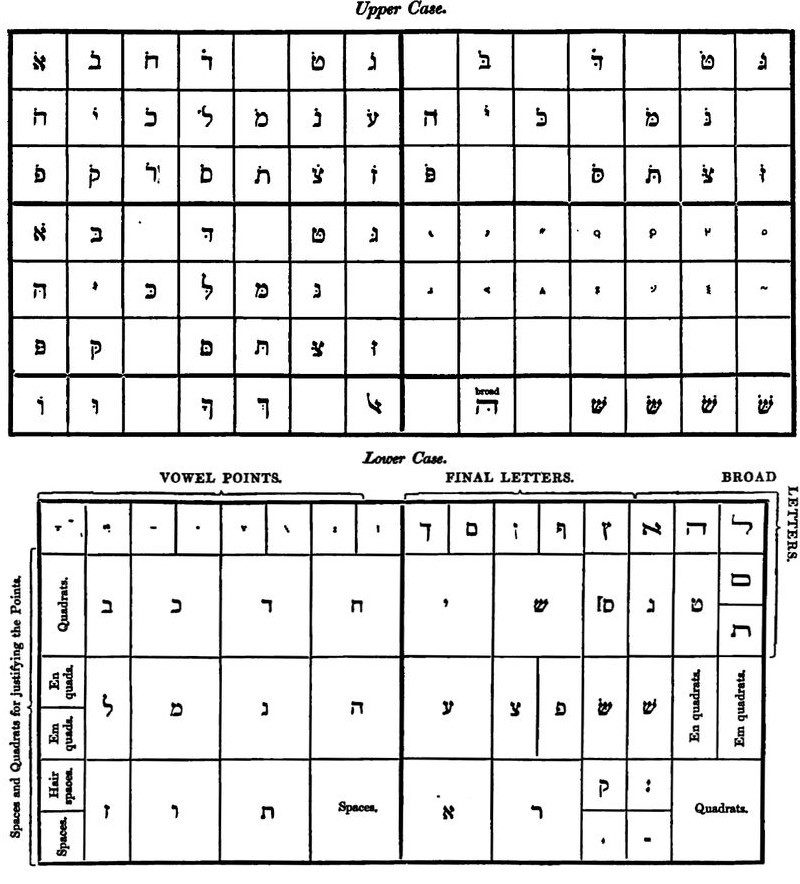
In the above plans the Hebrew Cases nearly resemble those of the English now in use. The alphabets have been classified and arranged so as to facilitate the composing of it; that is, the three different dotted alphabets in the upper case are quite distinct from each other, being separated by a thicker partition, to lead the eye of the compositor to it with greater certainty. The alphabet, with the dot over the letter, appears first in order, or left hand side of the case; the second alphabet, with the dot in the middle of the letter, under that of the first; and the third alphabet, with the dot over and in the middle of the letter, in the small capital, or right hand side of the case; and underneath, the points and accents required in composing Hebrew with points.
The lower case letters are also arranged as near to the English plan as is possible: the א (a) in the a box; the ב (b) in the b box, &c. so that the compositor can go from a pair of English cases to the Hebrew ones with very little perplexity, and a great saving of time, instead of looking over a wide surface of three cases, as is now the case, without any classification or arrangement whatever.
In composing Hebrew without points the lower case only is required, as the final letters and broad letters are brought into it, and quite under the hand of the compositor, which is desirable.
Hebrew in the British Founderies.
Two Line Great Primer. Caslon and Livermore. Thorowgood and Besley. Oxford.
Two Line Great Primer, with Points. Thorowgood and Besley.
Two Line English. Caslon and Livermore. Thorowgood and Besley. Wilson.
Two Line English, with Points. Thorowgood and Besley.
Double Pica. Caslon and Livermore. Thorowgood and Besley. Wilson.
Double Pica, with Points. Thorowgood and Besley.
Great Primer. Caslon and Livermore. Wilson.
Great Primer, with Points. Caslon and Livermore.
English. Caslon and Livermore. Thorowgood and Besley, formerly Bynneman’s. Oxford. Wilson.
English, with Points. Caslon and Livermore. Thorowgood and Besley. V. and J. Figgins. Wilson; this was cut after the classical and elegant type of Attias, for Mr. John Wertheimer of Leman Street, and is employed in printing the prayers of the Sphardim, edited by the Rev. D. A. De Sola. It may be cast on any body from English to Bourgeois.
Pica. Caslon and Livermore. Thorowgood and Besley. V. and J. Figgins. Wilson.
Pica, with Points. Caslon and Livermore.
Small Pica. Caslon and Livermore. Thorowgood and Besley, formerly Bynneman’s. V. and J. Figgins. Wilson.
Small Pica, with Points. V. and J. Figgins. This fount of Hebrew was cut for Bagster’s Polyglot Bible.
Long Primer. Caslon and Livermore. Thorowgood and Besley, formerly Bynneman’s. V. and J. Figgins. Oxford. Wilson.
Bourgeois. Caslon and Livermore. Thorowgood and Besley.
Brevier. Caslon and Livermore. Thorowgood and Besley, formerly Bynneman’s. Wilson.
Minion. Wilson.
Nonpareil. Caslon and Livermore; with points it is equal to a Long Primer body. V. and J. Figgins. Wilson.
Small Pica, Rabbinical. Thorowgood and Besley, formerly Bynneman’s.
Brevier, Rabbinical. Thorowgood and Besley, formerly Bynneman’s.
Nonpareil, Rabbinical. Thorowgood and Besley, formerly Bynneman’s.
HERALDRY.
The colours of the escutcheon, or of its ordinaries and charges, are:—
| Yellow (the heraldic name of which is) | Or. |
| White | Argent. |
| Red | Gules. |
| Blue | Azure. |
| Black | Sable. |
| Green | Vert. |
| Purple | Purpure. |
| Orange | Tenne. |
| Dark Blood-red, inclining to purple | Sanguine or Murrey, from mulberry. |
The two first being ordinarily represented by gold and silver, are called metals, and named by heralds after the French.
The two last are rarely seen in English coats of arms. The heraldic colours are usually estimated as five,—red, blue, black, green, purple.
High Bearer. See Bearer.
HIND POSTS AND RAILS.
Two upright posts mortised and tenoned into the feet at the back of the wooden press; two rails connect these posts behind; and two rails on the off side and two on the near side connect them with the cheeks, by mortises and tenons; on the top rails a thin deal covering is laid loose, that it may be lifted off, to allow access to the long ribs, and to hang the platen when necessary; it prevents dirt and other matter from falling on the ribs, and serves for a temporary shelf. The ink block is attached to the near rails.
Hither Cheek. Same as Near Cheek, which see.
Holdfasts, for Stereotype Risers. See Risers.
HOLDS OUT, or Holds Not Out.
These terms are applicable to the quires of white paper, to wrought-off heaps, to gathered books, and to sorts of letter, &c. If quires of white paper have twenty-five sheets apiece in them, they say, the paper holds out five and twenties. Of wrought-off heaps, the heap that comes off first in gathering is said not to hold out. Of gathered books, if the intended number of perfect books are gathered, they say the impression holds out: but if the intended number of perfect books cannot be gathered off the heaps, they say the impression holds not out. And so for sorts of letter, either when it is in the founding house, or in the printing house.—M. There is no paper at the present day with twenty-five sheets in a quire, except that used for newspapers, on account of the stamps.
HOLE.
By a Hole, in printers dialect, is meant and understood a place where private printing is used, viz. the printing of unlicensed books, or printing of other men’s copies. Many printers for lucre of gain have gone into Holes, and then their chief care is to get a Hole private, and workmen trusty and cunning to conceal the Hole, and themselves.—M.
Holy-days. See Ancient Customs.
HOME.
This is a term used at Press, and means that the bar of the press is pulled over till it touches the near cheek; it is then said the bar is home, or it is cheeked. See Cheek the Bar.
HOOK-IN.
In poetry it occasionally happens that a line will not come into the measure, in which case, when it is not allowed to turn a line,[322] if it be possible to avoid it, a syllable, or a word, is taken to the end of the preceding line, or, if that be full, to the end of the following one, and enclosed in a bracket; this is termed Hooking-in.
Hooks of Tympan. See Tympan Hooks.
Hopkinson, Mr. John. The Albion Press. See Cope’s Press.
HORSE.
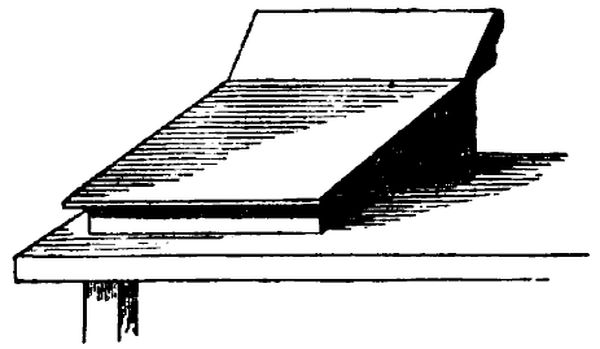
Form or bench pressmen set the heaps of paper on. See also Ancient Customs.—M. In Moxon’s time it appears the pressmen used what was then called a Horse, only, for the paper when working, which we now call a Bank; we have in addition what is termed a horse, set upon the bank; this horse is made sloping down to the fore edge, and the white paper is placed on it; the pressman is thus enabled to draw the sheets down with the nail of his thumb, or a piece of wood, bone, or ivory, with more facility than if it were laid horizontal, and it is more convenient to remove to the tympan, as the horse is raised near to it, and inclines in the same direction.
HORSE FLESH.
If any journeyman set down in his bill on Saturday night more work than he has done, that surplusage is called Horse-flesh; and he abates it in his next bill.—M. This surplusage of charge, as Moxon terms it, is now called Horse, and it is not always deducted in the next bill.
HORSE RACES.
By the Act of the 13th of George 2. cap. 19.
s. 2. it is enacted, “That from and after the said twenty-fourth Day of June one thousand seven hundred and forty, no Plate, Prize, Sum of Money, or other Thing, shall be run for by any Horse, Mare or Gelding, or advertised, published or proclaimed to be run for by any Horse, Mare or Gelding, unless such Plate, Prize or Sum of Money shall be of the full, real and intrinsick Value of fifty Pounds, or upwards; and in case any Person or Persons shall from and after the twenty-fourth Day of June one thousand seven hundred and forty enter, start or run any Horse, Mare or Gelding, for any Plate, Prize, Sum of Money, or other Thing of less Value than fifty Pounds, or shall make, print, advertise, publish or proclaim any Advertisement or Notice of any Plate, Prize, Sum of Money, or other Thing of less Value than fifty Pounds as aforesaid, to be run for by any Horse, Mare or Gelding; every such Person or Persons so entering, starting or running such Horse, Mare or Gelding for such Plate, Prize, Sum of Money, or other Thing of less Value than fifty Pounds as aforesaid, shall forfeit and lose the Sum of two hundred Pounds, to be sued for, recovered and disposed of in such Manner as is herein after prescribed and directed; and every Person or Persons who shall make, print, publish, advertise or proclaim any Advertisement or Notice of any Plate, Prize, Sum of Money, or other Thing of less Value than fifty Pounds aforesaid, to be run for by any Horse, Mare or Gelding, shall forfeit and lose the Sum of one hundred Pounds.”
So much of the act of 13 Geo. 2. c. 19. “as relates to the Subject of Horse Racing,” was repealed by 3 Vict. c. 5. s. 1.
HOSE.
Two upright bars of iron that connected the garter and the hose hooks, and went through the till. There were screws at each end, by which they could tighten the platen cords, if they became slack.—M.
The hose in wooden presses is now quite different: it is a wooden case for the spindle to work in, made hollow in the inside to fit it, and to which it is connected by the garter; it is square on the outside, and passes through an opening in the till, which it should fit accurately; and is tied to the platen by means of four iron hooks, one at each bottom corner. Its uses are, to guide the platen down to the form in a horizontal position, by its passing through the till; and also to lift the platen from[323] off the form, which it does by the return of the press bar, and its connexion with the spindle by means of the garter.
HOSE HOOKS.
Four iron hooks at the bottom corners of the hose, to which the platen is tied. They are projections from an iron belt that embraces the bottom of the hose, and stand facing the platen hooks.
HOURS.
Pressmen reckon their works by hours, accounting every token to an hours work: and though it be the same effectually with tokens, yet they make their prices of different work by the hour; and it passes current for a token. If two men work at the press, ten quires is an hour; if one man, five quires is an hour.—M. The quires of paper at this time always contain twenty-four sheets, at least the inside quires do, which alone are used for bookwork; and a token is ten quires eighteen sheets, which is still called an Hour, whatever the price may be: thus, if two men at a press print twelve tokens of paper in a day, they say, they have done twelve hours; and if it be fine work, at which, through the care bestowed on it, they can only print three tokens, or four tokens, they say, they do three hours, or four hours, in a day; although it takes the same time in performing that the twelve tokens did.
HYDRAULIC PRESS.
This press was invented and introduced to the public by Mr. Joseph Bramah, of Piccadilly, Engineer. Mr. W. Nicholson, in his Journal of Natural Philosophy, Chemistry, and the Arts, vol. 1. April, 1797, gave an account of it, with engravings, from which the following observations are extracted, which will give a brief description of this powerful machine, that is superseding the common book press with a screw in all extensive establishments.
“Its action is as follows: when the lever or pump handle is raised, it brings up the piston, which would leave a vacuum beneath if the pressure of the atmosphere did not force the water in through a side valve. The lever is then to be pressed down, which causes the side valve to shut, and forces the water through a valve at the bottom, whence it passes through a pipe into the cavity of the great cylinder, and raises the piston or pressing rammer. A repetition of the same process forces more water in, and the pressure may in this manner be carried to a great extent.
“There is no difficulty in computing the force of this instrument. If the diameter of the pump barrel be one quarter of an inch, and that of the cylinder one inch, that is to say, four quarters of an inch; one pound lodged upon the piston rod of the pump will be in equilibrio with sixteen pounds lodged upon the table of the press; the weights of the parts of the engine attached to, and moving with each piston, being respectively included. And if the length of the pump lever be fifteen inches, and the distance between the centres of motion and of action be two inches, one pound at the end of the lever will gain an advantage of 7½ times when compared with that at the piston rod. Instead, therefore, of sixteen pounds upon the table being equal in effect to counterpoise this last action, there will be required upwards of 120 pounds. But a man in this action of pumping by a downward pressure, can without difficulty apply his whole weight, and with great ease one third or one fourth of his weight, suppose 50 pounds. In this case the pressure will be equivalent to fifty times 120 pounds, or 6000 pounds, that is to say, nearly three tons.
“To compare this engine with a screw, in theory, we must enquire what fineness of thread and length of lever would afford a purchase of 120 to one. Let us suppose the thread of a screw, substituted in the place of the cylinder, to be one tenth of an inch thick; the distance from[324] the top of one thread to the top of the next will in this case be one fifth of an inch. This is the space through which the weight must rise in one revolution. The power must therefore move through 120 times that space, namely twenty-five inches; but a lever or radius four inches long will describe a circle somewhat larger than this, and consequently such an engine would in theory be equal in power to the hydraulic engine we have been contemplating.
“But when the subject is viewed practically, the difference between the two engines appears to be very remarkable. All practical men know how very large a part of the force operating by means of engines is employed in overcoming frictions. Every one is aware of the extreme friction between solids, and the very slight friction which takes place between the parts of fluids. This is seen in the common expedient of oiling the pivots of wheels, and in the very gradual decay of motion in fluid bodies; while solids moving on each other stop at once, as soon as the force is diminished to a certain degree. The screw is an organ peculiarly liable to friction, and this friction is always much greater than the whole of the reacting force; for there are few instances where a screw will return from extreme pressure, when the agency upon the lever is withdrawn. It is also to be considered, that the whole force of the weight or resistance acts directly upon the face of the screw, at which the motion is required to take place. It has not been appreciated in what degree this resistance or friction increases with the weight. In lighter actions the simple ratio has been inferred; but under more severe pressures the two metallic faces extrude the greater part of the half-fluid matter between them, and appear, by the magnitude of their resistance, to be attached to each other by a process of the nature of cohesive attraction. For these and other reasons, it appears nearly impracticable to form any comparison between two engines so different in principle, but such as shall be deduced from immediate experiment of their effects. I am not in possession of numerical data to indicate the actual power of screw-engines or presses; which are perhaps the less necessary, because those who are the most interested in the success of an improvement like the present, are for the most part able to come at these without difficulty.
“In an engine of this kind, the diameter of the great piston was four inches, and of the smaller three-eighths of an inch; and the advantage given by the lever or handle was twelve to one. Above the piston of the great cylinder was applied a long lever, at one end of which was an axis, and at the other end a large scale to hold weights; it contained twenty hundred weight. The distance between the axis of motion of this lever and the part where it acted on the piston was six inches; and the distance from the same axis to the extremity where the scale was hung was 126 inches. Every hundred weight in the scale consequently pressed upon the piston with a force equal to twenty-one hundred weight; whence the whole pressure was twenty-one tons. It was easy to work the lever briskly with one hand, and each stroke raised the scale near one-third of an inch. Forty-seven pounds hung at the end of the lever, carried it down with a moderate swiftness of working; but a weight of only forty-three pounds remained in equilibrio, and did not descend. Now, as the true weight in theory was thirty-two pounds, it follows that less than one-third of the actual power was employed to give velocity and overcome all friction.
“It may be remarked, that the principal frictions in these machines must be at the circumference of the pistons, and that these do not increase in the simple, but in less than the subduplicate, ratio of the[325] power. For if the diameter of the great cylinder were double, every thing else remaining unchanged, the surface of its piston, and consequently the power, would be quadrupled. But the friction would be only doubled, and that merely at the leathering of the greater piston.
“As the pressure in the experiment last mentioned amounted to 47·040 pounds upon the great piston of four inches in diameter, or sixteen circular inches surface, it amounted to 2940 pounds upon each round inch. But the medium pressure of the atmosphere on a round inch is near twelve pounds, consequently the action was equal to 245 atmospheres: and as each of these corresponds with a column of 34 feet of fresh water at a medium, the water in the cylinder was pressed in the same manner as if the whole column had been 8330 feet, or 1⅔ mile, long.
“Large presses of this construction are made with two pumps of 1¼ inch bore, and a cylinder of seven inches. These have been used in pressing hay and cotton for package; and, as I am informed, are effective in producing a greater condensation on the material with a much less application of moving power and consumption of time.”
The following description and figures are taken from Dr. Ure’s Dictionary of Arts, Manufactures and Mines, 8vo. 1839.
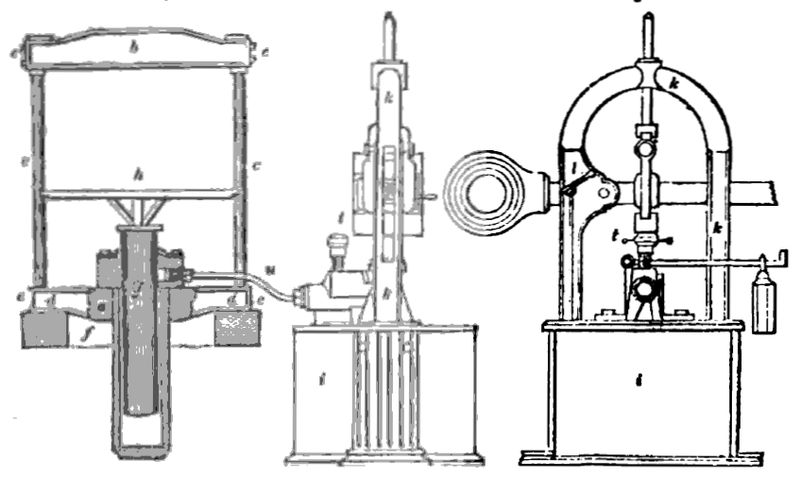
Fig. 1. Fig. 2.
“The framing consists of two stout cast-iron plates a, b, which are strengthened by projecting ribs, not seen in the section, fig. 1. The top or crown plate b, and the base plate a, are bound most firmly together by four cylinders of the best wrought iron, c, c, which pass up through holes near the ends of the said plates, and are fast wedged in them. The flat pieces e, e, are screwed to the ends of the crown and base plates, so as to bind the columns laterally. f is the hollow cylinder of the press, which, as well as the ram g, is made of cast iron. The upper part of the cavity of the cylinder is cast narrow, but is truly and smoothly rounded at the boring-mill, so as to fit pretty closely round a well-turned ram or piston; the under part of it is left somewhat wider in the casting. A stout cup of leather, perforated in the middle, is put upon the ram, and serves as a valve to render the neck of the cylinder perfectly water-tight, by filling up the space between it and the ram; and since the mouth of the cup is turned downwards, the greater the pressure of water upwards, the more forcibly are the edges of the leather[326] valve pressed against the inside of the cylinder, and the tighter does the joint become. This was Bramah’s beautiful invention.
“Upon the top of the ram, the press-plate or table h, strengthened with projecting ridges, rests, which is commonly called the follower, because it follows the ram closely in its descent. This plate has a half-round hole at each of its four corners, corresponding to the shape of the four iron columns along which it glides in its up-and-down motions of compression and relaxation.
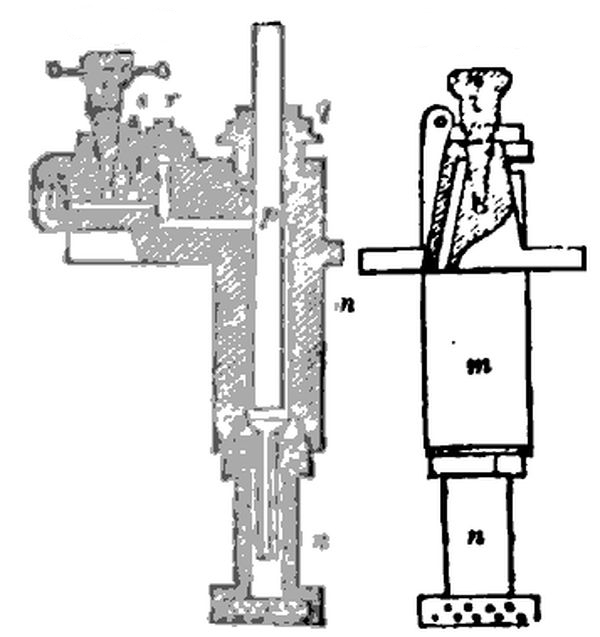
Fig. 3. Fig. 4.
“k, k, figs. 1. and 2., is the framing of a force pump with a narrow barrel; i is the well for containing water to supply the pump. To spare room in the engraving, the pump is set close to the press, but it may be removed to any convenient distance by lengthening the water-pipe u, which connects the discharge of the force pump with the inside of the cylinder of the press. Fig. 3. is a section of the pump and its valves. The pump m, is of bronze; the suction-pipe n, has a conical valve with a long tail; the solid piston or plunger p, is smaller than the barrel in which it plays, and passes at its top through a stuffing-box q; r is the pressure-valve, s is the safety-valve, which, in fig. 2., is seen to be loaded with a weighted lever; t is the discharge-valve, for letting the water escape, from the cylinder beneath the ram, back into the well. See the winding passages in fig. 4. u is the tube which conveys the water from the pump into the press-cylinder. In fig. 2. two centres of motion for the pump-lever are shown. By shifting the bolt into the centre nearest the pump-rod, the mechanical advantage of the workman may be doubled. Two pumps are generally mounted in one frame for one hydraulic press; the larger to give a rapid motion to the ram at the beginning, when the resistance is small; the smaller to give a slower but more powerful impulsion, when the resistance is much increased. A pressure of 500 tons may be obtained from a well-made hydraulic press with a ten-inch ram, and a two and a one inch set of pumps.”
In a Report addressed to the Commissioners of Her Majesty’s Woods, Forests, &c., in July 1839, as the result of an inquiry with reference to the selection of stone for building the new Houses of Parliament, it is stated the experiments relating to the cohesive strength of the stones, or their resistance to pressure, were made at the manufactory of Messrs. Bramah and Robinson, with a six-inch hydraulic press, the pump of which was one inch in diameter. According to trials previously made by Messrs. Bramah and Robinson, one pound weight at the end of the pump lever produced a pressure on the face of the cube [two inches square] equal to 2·53 cwt., or to 71·06 lbs. on the square inch; from this datum it may be estimated how immense the pressure is that can be obtained by this press, when the strength of a man is exerted at the pump. I have used the common book press with an iron screw to press printed paper, and I have also used a Hydraulic press of an estimated power of eighty tons: besides the greater expedition in pumping this press up than screwing the other down, I can state from my own observation, that the hydraulic press produced as great an effect upon the paper in three hours as the screw press did in a night, or at least fourteen hours. This may show the great superiority of this press[327] over that which has been in general use in printing offices. The hydraulic press has fully accomplished in practice all that was expected from it, and has established for itself a high character, which it richly deserves.
HYPHEN.
A hyphen, marked thus (-), is employed in connecting compounded words; as, “Lap-dog, tea-pot, pre-existence, self-love, to-morrow, mother-in-law.”
It is also used when a word is divided, and the former part is written or printed at the end of one line, and the latter part at the beginning of another. In this case, it is placed at the end of the first line, not at the beginning of the second.—Murray.
IDENTIGRAPHY.
The Dutch papers in 1825 mentioned a new discovery in printing, to which the inventor gave the name of Identigraphy. It consists in a new application of the art of lithography, by which a reprint of common letterpress is obtained in a very short time; the inventor undertaking to reprint the foreign journals within two hours after their arrival by the mail.
Illuminator. See Fac.
IMPERFECTIONS.
Books.—In gathering books, when one sheet is off, the surplus of the other sheets is called Imperfections.—M.
We now call this surplus the Waste: and after the work is delivered, or is in a state of delivery, and the bookbinder, or any person in whose possession the book may be, discovers that a sheet, or part of a sheet, or a plate, or any part whatever, is wanting, to make the book complete, he applies for them; or he may apply to change a sheet that is either dirty or torn. These deficiencies, or defects, are now termed Imperfections. See Waste.
Letters.—When the founder has not cast a proportionable number of each sort of letter, the wanting letters are called Imperfections, as making the rest of the fount imperfect. See Sorts.—M.
IMPERFECT PAPER.
Paper sent into a printing office to print upon, without the extra quantity which partly constitutes perfect paper; thus a ream of imperfect paper consists of twenty quires of twenty-four sheets each, which makes a ream containing 480 sheets; in this state it is termed inside quires: sometimes, but rarely, it is sent in with the outside quires, in which case there are not so many sheets in a ream. See Paper; also Perfect Paper.
Imperial Press. See Sherwin and Cope’s Press.
IMPOSING,
is the arrangement of the pages of a sheet, or of a form, in their proper order on the stone, and the wedging of them up in a chase, with a view to their being printed.
The knowledge of thus laying down pages, so that the sheets may fold correctly when printed, is of essential consequence to every compositor engaged on book work.
A workman would be held inexcusable who did not know how to lay down with accuracy all the common sizes; viz. quartos, octavos, and duodecimos: but even with this knowledge he is frequently at a loss when at work upon sizes that do not frequently occur; and more particularly so at the close of a volume where there are fragments, which are required to be imposed together, for the purpose of saving presswork and warehouse work.
A youth, who has just gone to the business, feels a natural pride in showing that he is making progress; and he wishes to improve himself without having continually to appeal to his instructor; but he does not possess the means.
The young man from the country, who has been educated in a house where there has not been much book work done, which is generally the case, and who, of course, is not very expert at his profession, when he comes to work in an extensive book house in town, feels his deficiency, and more particularly if he has to lay down his pages in a large companionship; he does not like to acknowledge his ignorance, nor to ask for information: he has consequently to work his way at a great disadvantage.
Under these circumstances it frequently happens that the pages are laid down wrong, which causes a great deal of trouble and loss of time in their rectification; and this trouble is considerably increased if the work be on a small type and solid. In this case, if the cords have been taken off, it is not advisable to transpose the pages without wetting them, for fear of breaking the matter, or at least squabbling it; the form has then to be dried, before the pressman can pull another proof.
All the works on Printing hitherto published, are deficient in giving a sufficient variety of tables for imposing, as a reference for the workman, as well as for the reader and the master printer. This deficiency of reference occasionally causes the compositor to re-impose his forms, as I just now observed, and also in many instances to cut up new furniture.
To remedy this inconvenience I have considerably exceeded the number of what has been given in any other work, by adding such tables as are likely to occur in practice, and to which there has hitherto been no reference.
I have given all the Tables of Imposition that are in Luckombe and in Stower, except a half-sheet of sixty-fours, although I disapprove of the arrangement of the pages in many of them, from their not cutting up or folding in the most convenient manner; yet, as they have been acted on in a great number of instances, I would not reject them, it being advisable in reprints to preserve uniformity, which may enable the proprietor to make up a few more copies from the waste of both editions. I have added several, in which I think there is an improvement in these particulars.
I have also endeavoured to make each size complete, by giving a sheet, a half sheet, a quarter of a sheet, and the usual fragments that occur; varying the arrangement of the pages in a great number of instances, to suit the different ways of folding the paper.
The whole of the signatures in each form are given, that they may serve as a guide in laying down the pages, particularly where there are a great number in a sheet; they might then all be taken out, if thought proper, except the first, and the first in the offcut, which are the only ones I would retain, and all that are necessary, the others causing the bottoms of the pages to look unsightly; for the person who folds the sheets has only to keep the signature at the outside, and the pages must be folded right.
When works are in half sheets, it is advantageous to work two together, as it enables the bookseller to deliver a single copy in sheets without cutting up the back; and also at the conclusion of a work that is in sheets where there are two half sheets, as it saves time and trouble in the warehouse; it not being necessary to divide the sheet and insert a[329] half in each volume, but the whole sheet may be gathered in the volume to which either of the signatures belongs; by which means there will be fewer mistakes, and fewer imperfections required.
When we arrive at a great number of pages in a sheet, they resolve themselves into the same order as quartos, octavos, and duodecimos; and in these cases I have repeated the imposition rather than refer to another size, which is not always very clearly understood when two, three, or more sheets are combined. Upon this principle I have repeated the half sheets, quarter sheets, and fragments, so as to make each size complete in itself.
It is usual when a fragment at the end of a volume makes six pages to impose it as eight: in this case there are two blank pages. Sometimes the author fills these up, by adding to the text; at other times the bookseller occupies them with advertisements of other publications in which he is interested.
When a compositor lays down his pages, it might prevent mistakes if he looked over them to see that they were right before he untied the page cords; and it is a good check to examine the folios of every two adjoining pages in a quarter, to see that their sum makes one more than the number of pages in the sheet, or half sheet: thus, in a sheet of folio, 1 and 4, equal to 5, are imposed together; in a quarto, 1 and 8; in an octavo, 1 and 16; in a duodecimo, 1 and 24; in sixteens, 1 and 32; in eighteens, 1 and 36; and so in every other size: and this combination continues through all the other adjoining pages, according to the order in which they lie on the stone, calling the first page in the sheet 1, the second 2, and so on in succession.
The short cross is always better in the middle of the chase, if the margin will allow it; as it divides the matter more equally, and the form is safer when it is locked up.
If it be the first sheet of a work that is to be imposed, or it be found necessary to increase the number of sheets in chase, the compositor applies to the overseer, or to the person who has the care of the materials, for a pair of chases.
The pages being laid upon the stone in their proper order, and as near the required distance from each other as can be determined by the eye, the compositor then places his chases; he takes one with both hands and lays the off side or end, as it may be, on the stone at the outer side of his pages, and lowers the near side gradually, till it lies flat on the stone, taking care that the inner edges of the chase and the cross bars do not rest on the face of the pages to injure them, and that the grooves in the short cross are upwards.
The furniture has now to be cut for the sheet; but previous to doing this it is necessary to ascertain what kinds of it will be wanted, by trying the margin with a sheet of paper of the work, otherwise a great risk is run of cutting an expensive article to waste, and of incurring also a loss of time, both of which should be avoided if possible. The manner of making margin will be explained under its proper head. See Margin.
I would recommend that the headsticks in octavos should be in two pieces, each of them a little longer than the page is wide; this will allow the gutters to be a little longer than the page, so that they will come close to the footsticks at the bottom, and at the other end will go between the headsticks, thus securing the inside of the two pages, without any risk of the gutters binding when locked up, which they are apt to do when cut to the precise length of the page, as is the custom when the headsticks for each quarter are in one piece. The gutters thus being[330] equal to about three picas more in length than the page, will answer for other works where the page is of the same width, but different in length.
The headsticks and gutters being arranged, the compositor will cut his backs a little longer than the page, and these abutting against the headsticks that project beyond the page towards the cross, will secure that side. The sidesticks should be of the full length of the page, and abut against the headsticks on the outside of the form. The footsticks may be a trifle shorter than the width of two pages and the gutter; for as there should always be a line of quadrats, or a reglet cut to measure, at the foot of each page, the footstick may be a pica shorter without danger, on this account, of any thing falling out, when the form is lifted, and it thus prevents the side and foot sticks from binding when locked up.
By cutting the furniture in this manner, the compositor will at once perceive that all his pages will be secure, and that the furniture cannot bind in any place when locked up. The gutter is pushed down to the footstick, and extends beyond the top of the pages; the two headsticks abut against the gutter, and project a little beyond the sides of their pages; the back is pushed up to the headstick, and extends a little below the bottom of the page; the footstick abuts against the back, and by being about a pica short prevents the sidestick from binding against it; and the sidestick abuts against the head, and extends the full length of the page: neither is there any impediment to driving the quoins.
I would never cut the heads and the backs of such a length as to project beyond the side and foot sticks; for when they do, they are in the way of the shooting stick, if a quoin has been driven close up, when the form has to be unlocked. Neither should the headstick project so much as the thickness of the back; nor the extra length of the gutter be so much as the headstick; otherwise they will bind and prevent the form from rising.
When the sidestick or footstick is so long as to project one beyond the other, it prevents the quoin from passing, and in unlocking causes a great deal of trouble to get it out; I have, in such cases, frequently seen the sidestick broken or spoiled in the attempt, and a page squabbled or broken. This arises from carelessness or idleness, both which generally cause more trouble ultimately than if the work were properly performed in the first instance. If it be thought unnecessary or wasteful to cut down side or foot sticks for a job, or a pamphlet, when there are none of a proper length in the house, a piece of furniture taken out of the drawer of the proper length and width, and placed inside next the page, will remedy the inconvenience, and cause the quoin to be driven with ease.
When placing the furniture about the pages leave the ends of the page cords out, so that they may be easily taken off, without the necessity of disturbing the pages to find the end, which will be the case if they be tucked in.
The furniture being now round the pages, I would recommend to the compositor to put some quoins round the form, not with any particular care that they fit, but merely to secure the pages, and by their means to push them up close to the heads, backs, and gutters.
After having taken a page cord from a page push up that page close to the furniture at the back and head, by means of the side and foot stick, to prevent the letters at the ends of the lines from falling down, and also tighten the quoins gently with your fingers.
All the page cords being taken off, and the pages pushed up close at the sides and heads, it will next be necessary to examine particularly that the margin be right; as also to put one or two scaleboards in all the backs[331] and the heads between the furniture and the crosses. These scaleboards enable the pressmen to make register if there be any inequality in the furniture or the crosses, by changing their situations, or taking some of them away; they also enable the compositor to make the distance between the pages in the backs and heads uniform, which should always be the case; and no form of book work that has to be printed on both sides of the paper should ever be imposed without them. But scaleboard is never used in the gutters.
The form has now to be quoined, which many compositors are in the habit of doing very carelessly, thinking that if the form lifts it is quite sufficient. This is an erroneous opinion, and frequently causes errors from the slovenly manner in which the quoining is done, letters and even lines dropping out when the form is laid on the press, or taken off, which do not always get replaced correctly; and the pages are more likely to fall out if they stand a few days at the end of a bulk. As I have previously described the imposing of an octavo, I shall continue my observations with respect to that size, but the principle is the same whatever the size may be. I would have two quoins for each sidestick, not put in indiscriminately, but the furthest quoin when driven tight, to be about three quarters of an inch from the broad end of the sidestick, which will allow room for the shooting stick in unlocking, as also for the form being tightened if the furniture shrinks; and the other quoin when driven tight to be its whole length fairly within the sidestick, because this end of the stick being thin, will be liable to spring from the page if the quoin be driven far in, and thus leave the letters behind insecure, and in danger of falling out: I would have two for the footstick in the same situations, and a third in the middle to cover the end of the gutter. Each quarter, of a form of octavo, thus quoined, will be perfectly secure when the quoins are driven tight, provided the pages be made up to the same length, and the lines properly justified; should this not be the case, the compositor will be obliged to vary the quoining, to meet the evil of bad workmanship.
Before he tightens his quoins he examines whether the pages in the same quarter be of equal length, which he does by pressing against the footstick with his thumbs, and raising it a little from the stone; if it lifts up with it equally the ends of both the pages against which it presses, he is satisfied they are right, and tries the other quarters in the same manner; if he finds any of the pages short, he examines them to find out where the deficiency is and supplies it; sometimes a lead is wanting, sometimes a line. This will arise occasionally from the carelessness of some compositors who will not take the trouble of cutting a gauge by which to make up their pages, but do it by counting the lines; they sometimes omit a line, sometimes have a line too much, and sometimes are equally incorrect with their leads: in other cases I have known gauges cut carelessly of an improper length, which causes the same evil; and it also occasionally arises from having the gauges of three or four different works cut on the same piece of reglet, and mistaking one for the other. See Gauge.
I should now push the quoins up all round with my fingers, to confine the pages slightly, and then plane the form down gently by striking the planer with the fist; if any letters stand up they are easily pressed down by this mode of proceeding, without injuring their face; after this is done, it is necessary to examine the sides of the pages, to see that no letters have slipped out of their places at the ends of the lines, which is frequently the case when pages which have been tied up have lain under the frame[332] some time; it may also happen in taking the page cords off, particularly if they be knotted. Having examined the pages, and rectified any thing that was found amiss, which is easily done in this state of the form, I should gently tighten the quoins all round the form in an equal manner with the mallet and shooting stick, and then plane down, but not violently; if any letters stand up, from some substance being underneath, as a space, or a letter, or a bit of the page paper, which will sometimes get torn off and remain, it will be better to omit planing that part down for the present, as it would only injure the type and answer no good purpose: the quoins should then be driven as tight as is necessary, still doing it regularly and equally all round the form, when the form should be planed down again, which may be done with firmer blows than before, still omitting the part where the letters stand up.
The form may now be lifted from the stone at the front edge, just sufficient to allow the compositor to see whether it will rise or not, but not so high as that a letter would drop out; if it dances, it must be dropped down again upon the stone, and the lines tightened by thrusting the point of a bodkin between some of the words, and tightening the quoins; thus bad workmanship causes fudges, and in this case is never safe, for the letters are always in danger of being drawn out at press. But it may arise from a letter having slipped down at the end of a line: in this case the remedy is easy, to unlock the quarter and put the letter in its proper place; when this is done, and the form will rise, take the substance that was under it completely away, lay the form down again, loosen the quoins in that quarter, then plane it down, and lock it up as before directed.
The forms should now be brushed over with the letter brush, and taken to the proof press, and the pressman should be told to pull them,—In some houses the proof press is in the press room, in that case the compositor either calls out “Proof,” or asks, “Who’s in Proofs?” and then tells the party how it is to be pulled, First Proof, or Clean; sometimes the proof press is in the composing room, and the compositor either calls out “Proof” to them, or rings a bell, different houses having different customs in this respect.
I would always put the flat side of the furniture upwards, as it is more convenient for the pressmen, when it is necessary to place bearers on the frisket; since they operate better on this surface than on the hollow side, and can be placed on any part of it.
In my opinion it is preferable to have each part of the furniture in one piece, where it is practicable; as, for instance, the gutters, the backs, and the heads; which prevents the pieces from being transposed, and the margin from getting wrong: but sometimes pieces will be wanted of a width that is not equal to any regular size, and then two must be used.
To prevent as much as possible one piece of furniture from being mistaken for another in the hurry of business, I would cut all the gutters of one sheet of a precise length; so also would I do with the backs, as also with the heads; but each sort should be of a different length from that of the others;—thus, though all the gutters would be exactly of a length, yet would they be of a different length from that of the heads and backs, and so of the others; and thus they would be easily distinguished from each other, and mistakes would be prevented.
The sheet being now imposed, the stone must be cleared; the saw and saw block put in their places—the shears—the mallet, planer, and shooting stick—the surplus furniture—the scaleboard—the quoins—and[333] every other article; for in most houses there is a fine for leaving a foul stone. The compositor will tie up his page cords, and if he has any companions will return to them their proportion.
In imposing a sheet from the furniture of one that has been worked off, in the regular process of business, there are certain circumstances to be attended to, which are frequently omitted:—The chase and furniture of one form should always be used for a similar form; that is, the chase and furniture of the outer form should be again used for an outer form, and the chase and furniture of the inner form should be again used for an inner form; they should also be put round the pages in the same order in which they were put about those of the preceding forms. For want of care or thought in these apparently trifling circumstances a great deal of trouble, inconvenience, and loss of time, are frequently incurred; for the register will be almost sure to be wrong when this is neglected, and then the forms must be unlocked, and the scaleboards changed, some of them having to be taken out, or fresh ones to be inserted, and this accompanied by a great deal of dissatisfaction.
I have found it to be a saving of time to be a little methodical in imposing; I take out my quoins and lay them on the adjoining pages in their regular order, then, after the chase has been put over the pages, and the furniture about them, there is no loss of time in replacing the quoins, or in finding the proper situation for each of them: the page cords are then taken off; the quoins tightened; the form planed down, &c., as detailed in the preceding paragraphs for imposing the first sheet of a work.
It should always be borne in mind that the quoins ought to be tightened regularly and uniformly round the form; for if one quarter be locked up at once before the quoins are tightened in the other quarters, the whole will be distorted, and the pressmen will have great difficulty in making register.
After the furniture has been taken from a form for the purpose of imposing another, it will be the means of preventing the matter for distribution from going into pie if the compositor tie a cord about each page; at least it may prevent an accident, and save him some trouble.
The chases for a sheet ought always to be in pairs; for if they be of different sizes, or the rims of different thickness, it causes the pressmen to lose time in making register, when both forms are worked at the same press, and often occasions the spoiling of two or three sheets of paper before that object is accomplished.
Before the compositor locks up his form, but after the pages are pushed up close to the backs and the heads, he should cut a gauge to fit exactly the intervals between the backs and the heads; and a sheet should never be carried into the press room for press, without the margin having been tried by this gauge to see that it is right, and to correct it, if it should be wrong: for as the pressmen have frequently occasion to alter the scaleboards in working the reiteration, this alteration will necessarily affect the furniture of the succeeding sheet. I have always used two small pieces of clean reglet, brevier or longprimer, and have cut them to the precise length; I wrote on both in ink the name of the work to prevent mistakes, as also the words ‘Back’ and ‘Head’ on each respectively; made a hole through them with my bodkin, tied them together with a piece of page cord, and hung them on a nail within my frame, so that they were always ready for use.
I shall now enumerate the tables of imposition in the following pages, and add observations where it may appear necessary, to make them as clear as it is in my power to do, not only to facilitate the operation, but[334] in many instances to give information that may be of service; and in some cases to accommodate the bookbinder, who is seldom thought of in a printing office, but who, in my opinion, ought to be constantly considered: for I hold that the binding of a book should be always kept in view, as we are all anxious to see how our work looks when it is splendidly dressed by his skill; and it would consequently not be just if we did not do all in our power to accommodate him: stating this opinion will also show my reason for making some of the observations, as it is a point that has hitherto been neglected in all practical works on printing.
I shall also notice the errors, where they occur, of my predecessors, not for the sake of finding fault, or of depreciating their labours, but to save trouble to the workman; for, by some unaccountable cause, wherever Luckombe has made a mistake, or committed an error, it has been copied by subsequent writers, who do not appear to have examined his arrangement of the pages, but to have taken it for granted they were right, and have thus continued his errors.
The writers since Smith have not, I think, reasoned correctly on this part of a practical work; they seem to have made a merit of not adding to this department, by attending too strictly to an observation of his, saying that there may be many more fanciful ways of folding a sheet of paper. So there may, with which it may not be necessary to encumber a book; but why reject those that are useful and of frequent occurrence? why omit giving the mode of imposing fragments that continually occur at the end of a work? and that generally cause loss of time in arranging them, which might easily have been avoided; which omission I have endeavoured to supply: for this is the part of a work on printing that may be equally useful as a reference to the experienced workman as to the novice, and which I have frequently seen much wanted.
Smith’s words are, after enumerating the different Tables of Imposition which he has given—“More Irregular Sizes we have not thought fit to introduce; else we might have drawn out Schemes for Imposing Six’s, 10’s, 14’s, 20’s, 28’s, 30’s, 40’s, 42’s, 50’s, 56’s, 60’s, 80’s, 100’s, and 112’s; these, and several more being Sizes that have been found out not so much for use as out of fancy, to show the possibility of folding a piece of paper into so many various forms.”—p. 257. Upon this passage have all subsequent writers formed their excuse for leaving the different methods of imposing pages in an imperfect and erroneous state: the errors commenced with Luckombe.
As it may facilitate reference, I have given in the following enumeration the initials of the different authors in whose works the same forms will be found.—M. refers to Moxon; Sm. to Smith; L. to Luckombe; St. to Stower; J. to Johnson; H. to Hansard; Ma. to Magrath; and Mas. to Mason. Where there are no initials, the arrangement has not, to my knowledge, been given before in any English book, and is only to be found in this work.
TABLES OF IMPOSITION.
When imposing the first sheet of a new work, it may be serviceable to refer to the preceding observations, for a choice of the best method; and also for directions how to transpose the pages in working the reiteration, when a transposition is required.
The running Number corresponds with that in the Enumeration.
1. ABSTRACT OF TITLE DEEDS.

| 2. SHEET OF FOLIO. | |||||||
| Outer Form. | Inner Form. | ||||||
| 1 | 4 | 3 | 2 | ||||
| A | |||||||
| 3. SHEET OF FOLIO. HEBREW. | |||||||
| Inner Form. | Outer Form. | ||||||
| 2 | 3 | 4 | 1 | ||||
| A | |||||||
| 4. TWO SHEETS OF FOLIO, QUIRED. | |||||||
| Outer Form of the Outer Sheet. |
Inner Form of the Outer Sheet. |
||||||
| 1 | 8 | 7 | 2 | ||||
| A | |||||||
| Outer Form of the Inner Sheet. |
Inner Form of the Inner Sheet. |
||||||
| 3 | 6 | 5 | 4 | ||||
| A2 | |||||||
| 5. THREE SHEETS OF FOLIO, QUIRED. | |||||||
| Outer Form of the Outer Sheet. |
Inner Form of the Outer Sheet. |
||||||
| 1 | 12 | 11 | 2 | ||||
| B | |||||||
| Outer Form of the Second Sheet. |
Inner Form of the Second Sheet. |
||||||
| 3 | 10 | 9 | 4 | ||||
| B2 | |||||||
| Outer Form of the Third Sheet. |
Inner Form of the Third Sheet. |
||||||
| 5 | 8 | 7 | 6 | ||||
| B3 | |||||||
| 6. HALF A SHEET OF FOLIO. | |||
| 1 | 2 | ||
| 7. SHEET OF QUARTO. | |||||||
| Outer Form. | Inner Form. | ||||||
| [B2] | |||||||
| [4] | [5] | [6] | [3] | ||||
| 1 | 8 | 7 | 2 | ||||
| B | |||||||
| 8. SHEET OF QUARTO. HEBREW. | |||||||
| Inner Form. | Outer Form. | ||||||
| [B2] | |||||||
| [3] | [6] | [5] | [4] | ||||
| 2 | 7 | 8 | 1 | ||||
| B | |||||||
| 9. TWO HALF SHEETS OF QUARTO, WORKED TOGETHER. |
|||||||
| Outer Form. | Inner Form. | ||||||
| [B*] | |||||||
| [2*] | [3*] | [4*] | [1*] | ||||
| 1 | 4 | 3 | 2 | ||||
| B | |||||||
| 10. HALF A SHEET OF QUARTO. |
11. HALF A SHEET OF QUARTO. HEBREW. |
||||||
| [2] | [3] | [3] | [2] | ||||
| 1 | 4 | 4 | 1 | ||||
| B | B | ||||||
| 12. TWO SHEETS OF QUARTO, QUIRED. | |||||||
| Outer Form of the Outer Sheet. |
Inner Form of the Outer Sheet. |
||||||
| [B2] | |||||||
| [4] | [13] | [14] | [3] | ||||
| 1 | 16 | 15 | 2 | ||||
| B | |||||||
 click here for larger image.
| 13. SHEET OF BROAD QUARTO. | 17. HALF SHEET OF OCTAVO. | 23. SHEET OF TWELVES. No. 1. |
| 14. SHEET OF OCTAVO. | 18. HALF SHEET OF OCTAVO. HEBREW. | 24. SHEET OF TWELVES. No. 2. |
| 15. SHEET OF OCTAVO. HEBREW. | 19. TWO HALF SHEETS OF OCTAVO, WORKED TOGETHER. | 25. SHEET OF TWELVES, TO FOLD WITHOUT CUTTING. |
| 16. SHEET OF BROAD OCTAVO. | 20. SHEET OF OCTAVO WITH TWO SIGNATURES. TWELVE PAGES, AND FOUR PAGES. | |
| 21. TWO QUARTERS OF A SHEET OF OCTAVO. | ||
| 22. TWO QUARTERS OF A SHEET OF OCTAVO. HEBREW. | ||
| 26. SHEET OF TWELVES. HEBREW. | 29. HALF SHEET OF TWELVES. | 33. SHEET OF TWELVES, WITH TWO SIGNATURES. SIXTEEN PAGES AND EIGHT PAGES. |
| 27. TWO HALF SHEETS OF TWELVES, WORKED TOGETHER. No. 1. | 30. HALF SHEET OF TWELVES, WITHOUT CUTTING. | 34. SHEET OF TWELVES, WITH THREE SIGNATURES. TWELVE, EIGHT, AND FOUR PAGES. |
| 28. TWO HALF SHEETS OF TWELVES, WORKED TOGETHER. No. 2. | 31. HALF SHEET OF TWELVES. HEBREW | 35. SHEET OF TWELVES, WITH THREE SIGNATURES, THRICE EIGHT PAGES. |
| 32. SHEET OF TWELVES, WITH TWO SIGNATURES. TWENTY PAGES AND FOUR PAGES. | ||
 click here for larger image.
| 36. HALF SHEET OF TWELVES, WITH TWO SIGNATURES. EIGHT PAGES AND FOUR PAGES. | 39. SHEET OF LONG TWELVES. MUSIC WAY. No. 2. | 41. HALF SHEET OF LONG TWELVES. MUSIC WAY. |
| 37. EIGHT PAGES OF A SHEET OF TWELVES. | 40. SHEET OF LONG TWELVES. MUSIC WAY. WITH TWO SIGNATURES. SIXTEEN PAGES AND EIGHT PAGES. | 42. SHEET OF LONG TWELVES. No. 1. |
| 38. SHEET OF LONG TWELVES. MUSIC WAY. No. 1. | ||
| 43. SHEET OF LONG TWELVES. No. 2. | 45. SHEET OF LONG TWELVES, WITH TWO SIGNATURES. SIXTEEN PAGES AND EIGHT PAGES. No. 2. | 47. SHEET OF SQUARE TWELVES. |
| 44. SHEET OF LONG TWELVES, WITH TWO SIGNATURES. SIXTEEN PAGES AND EIGHT PAGES. No. 1. | 46. HALF SHEET OF LONG TWELVES. | 48. TWO HALF SHEETS OF LONG TWELVES, WORKED TOGETHER. |
| 49. SHEET OF SIXTEENS. | ||
 click here for larger image.
| 50. SHEET OF SIXTEENS. HEBREW. | 53. HALF SHEET OF SIXTEENS. | 57. TWO HALF SHEETS OF LONG SIXTEENS, WORKED TOGETHER. |
| 51. TWO HALF SHEETS OF SIXTEENS, WORKED TOGETHER. | 54. HALF SHEET OF SIXTEENS, HEBREW. | 58. HALF SHEET OF LONG SIXTEENS. |
| 52. SHEET OF SIXTEENS WITH TWO SIGNATURES. TWENTY-FOUR PAGES AND EIGHT PAGES. | 55. TWO QUARTER SHEETS OF SIXTEENS. | 59. TWO QUARTER SHEETS OF LONG SIXTEENS. |
| 56. SHEET OF LONG SIXTEENS. | ||
| 60. SHEET OF EIGHTEENS, WITH ONE SIGNATURE. | 62. SHEET OF EIGHTEENS, WITH THREE SIGNATURES, AS THREE HALF SHEETS OF TWELVES. No. 2. | 64. SHEET OF EIGHTEENS, TO FOLD WITHOUT CUTTING. |
| 61. SHEET OF EIGHTEENS, WITH THREE SIGNATURES. No. 1. | 63. SHEET OF EIGHTEENS, WITH THREE SIGNATURES. HEBREW. | 65. SHEET OF EIGHTEENS, WITH TWO SIGNATURES. No. 1. TWENTY-FOUR PAGES AND TWELVE PAGES. |
 click here for larger image.
| 66. SHEET OF EIGHTEENS, WITH TWO SIGNATURES. No. 2. TWENTY-FOUR PAGES AND TWELVE PAGES. | 69. HALF SHEET OF EIGHTEENS, WITHOUT TRANSPOSING THE PAGES. | 73. HALF SHEET OF EIGHTEENS. 12 AND 6 PAGES. |
| 67. HALF SHEET OF EIGHTEENS. | 70. SIXTEEN PAGES OF EIGHTEENS. | 74. HALF SHEET OF EIGHTEENS. 10 AND 8 PAGES. |
| 68. HALF SHEET OF EIGHTEENS. HEBREW. | 71. HALF SHEET OF EIGHTEENS. 16 AND 2 PAGES. | 75. HALF SHEET OF EIGHTEENS. TWICE 8 PAGES. |
| 72. HALF SHEET OF EIGHTEENS. 14 AND 4 PAGES. | 76. HALF SHEET OF EIGHTEENS. 10, 4, AND 4 PAGES. | |
| 77. HALF SHEET OF EIGHTEENS. 8, 8, AND 2 PAGES. | 80. SHEET OF TWENTIES. No. 2. | 82. SHEET OF TWENTIES. THIRTY-TWO AND EIGHT PAGES. |
| 78. HALF SHEET OF EIGHTEENS. FOUR TIMES 4 PAGES. | 81. SHEET OF TWENTIES. No. 3. | 83. SHEET OF TWENTIES. TWENTY-FOUR AND SIXTEEN PAGES. |
| 79. SHEET OF TWENTIES. No. 1. | ||
 click here for larger image.
| 84. TWO HALF SHEETS OF TWENTIES, WORKED TOGETHER. | 87. HALF A SHEET OF TWENTIES. 12 AND 8 PAGES. | 89. HALF A SHEET OF TWENTY-FOURS. No. 1. |
| 85. HALF A SHEET OF TWENTIES. | 88. TWO HALF SHEETS OF TWENTY-FOURS, WORKED TOGETHER. | 90. HALF A SHEET OF TWENTY-FOURS. No. 2. |
| 86. HALF A SHEET OF TWENTIES. 16 AND 4 PAGES. | ||
| 91. HALF A SHEET OF TWENTY-FOURS, WITHOUT CUTTING. | 93. HALF A SHEET OF TWENTY-FOURS, WITH TWO SIGNATURES. SIXTEEN PAGES AND EIGHT PAGES. | 96. TWO HALF SHEETS OF TWENTY-FOURS, WORKED TOGETHER. HEBREW. |
| 92. HALF A SHEET OF TWENTY-FOURS, WITH TWO SIGNATURES. TWENTY PAGES AND FOUR PAGES. | 94. HALF A SHEET OF TWENTY-FOURS, WITH THREE SIGNATURES. EIGHT PAGES EACH. | |
| 95. QUARTER OF A SHEET OF TWENTY-FOURS. | ||
 click here for larger image.
| 97. HALF A SHEET OF TWENTY-FOURS. HEBREW. No. 1. | 99. TWO HALF SHEETS OF LONG TWENTY-FOURS, WORKED TOGETHER. | 101. HALF A SHEET OF LONG TWENTY-FOURS. No. 2. |
| 98. HALF A SHEET OF TWENTY-FOURS. HEBREW. No. 2. | 100. HALF A SHEET OF LONG TWENTY-FOURS. No. 1. | 102. HALF A SHEET OF LONG TWENTY-FOURS, WITHOUT CUTTING. |
| 103. HALF A SHEET OF LONG TWENTY-FOURS. TWO SIGNATURES. TWENTY PAGES AND FOUR PAGES. | ||
| 104. HALF A SHEET OF LONG TWENTY-FOURS. TWO SIGNATURES. SIXTEEN PAGES AND EIGHT PAGES. | 106. HALF A SHEET OF LONG TWENTY-FOURS. HEBREW. No. 1. | 109. HALF A SHEET OF LONG TWENTY-FOURS. TWO SIGNATURES. SIXTEEN PAGES AND EIGHT PAGES. HEBREW. |
| 105. TWO HALF SHEETS OF LONG TWENTY-FOURS, WORKED TOGETHER. HEBREW. | 107. HALF A SHEET OF LONG TWENTY-FOURS. HEBREW. No. 2. | 110. TWO HALF SHEETS OF SQUARE TWENTY-FOURS, WORKED TOGETHER. |
| 108. HALF A SHEET OF LONG TWENTY-FOURS. TWO SIGNATURES. TWENTY PAGES AND FOUR PAGES. HEBREW. | ||
 click here for larger image.
| 111. HALF A SHEET OF SQUARE TWENTY-FOURS. | 113. SHEET OF THIRTY-TWOS. No. 2. | 114. TWO HALF SHEETS OF THIRTY-TWOS, WORKED TOGETHER. |
| 112. SHEET OF THIRTY-TWOS. No. 1. | ||
| 115. SHEET OF THIRTY-TWOS, WITH TWO SIGNATURES. FORTY-EIGHT PAGES AND SIXTEEN PAGES. | 116. SHEET OF THIRTY-TWOS, WITH TWO SIGNATURES. FORTY PAGES AND TWENTY-FOUR PAGES. | 117. SHEET OF THIRTY-TWOS, WITH FOUR SIGNATURES. SIXTEEN PAGES IN EACH. |
 click here for larger image.
| 118. HALF A SHEET OF THIRTY-TWOS. | 121. HALF A SHEET OF THIRTY-TWOS. SIXTEEN PAGES, EIGHT PAGES, FOUR PAGES, AND FOUR PAGES. | 123. A SHEET OF THIRTY-SIXES, WITH THREE SIGNATURES. |
| 119. HALF A SHEET OF THIRTY-TWOS, WITH TWO SIGNATURES. TWENTY-FOUR PAGES AND EIGHT PAGES. | 122. TWO QUARTER SHEETS OF THIRTY-TWOS, WORKED TOGETHER. | |
| 120. HALF A SHEET OF THIRTY-TWOS, WITH TWO SIGNATURES. TWENTY PAGES, AND TWELVE PAGES. | ||
| 124. A SHEET OF THIRTY-SIXES, WITH SIX SIGNATURES. | 125. A SHEET OF THIRTY-SIXES, WITH TWO SIGNATURES. SIXTY PAGES AND TWELVE PAGES. | 126. TWO HALF SHEETS OF THIRTY-SIXES, WORKED TOGETHER. |
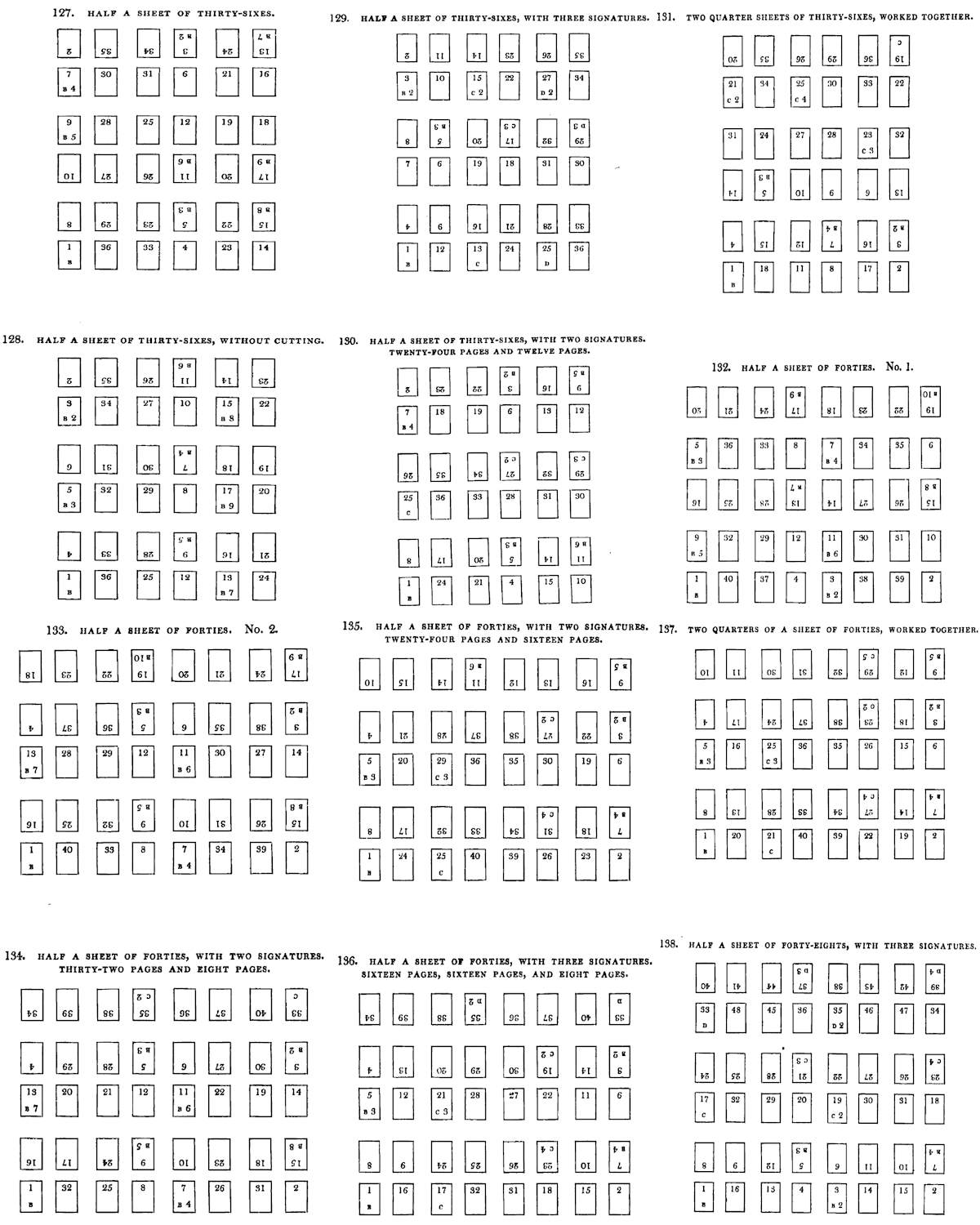 click here for larger image.
| 127. HALF A SHEET OF THIRTY-SIXES. | 129. HALF A SHEET OF THIRTY-SIXES, WITH THREE SIGNATURES. | 131. TWO QUARTER SHEETS OF THIRTY-SIXES, WORKED TOGETHER. |
| 128. HALF A SHEET OF THIRTY-SIXES, WITHOUT CUTTING. | 130. HALF A SHEET OF THIRTY-SIXES, WITH TWO SIGNATURES. TWENTY-FOUR PAGES AND TWELVE PAGES. | 132. HALF A SHEET OF FORTIES. No. 1. |
| 133. HALF A SHEET OF FORTIES. No. 2. | 135. HALF A SHEET OF FORTIES, WITH TWO SIGNATURES. TWENTY-FOUR PAGES AND SIXTEEN PAGES. | 137. TWO QUARTERS OF A SHEET OF FORTIES, WORKED TOGETHER. |
| 134. HALF A SHEET OF FORTIES, WITH TWO SIGNATURES. THIRTY-TWO PAGES AND EIGHT PAGES. | 136. HALF A SHEET OF FORTIES, WITH THREE SIGNATURES. SIXTEEN PAGES, SIXTEEN PAGES, AND EIGHT PAGES. | 138. HALF A SHEET OF FORTY-EIGHTS, WITH THREE SIGNATURES. |
 click here for larger image.
| 139. QUARTER OF A SHEET OF FORTY-EIGHTS. | 142. TWO QUARTER SHEETS OF FORTY-EIGHTS, WORKED TOGETHER. No. 2. | 144. HALF A SHEET OF SIXTY-FOURS. |
| 140. QUARTER SHEET OF FORTY-EIGHTS, TO FOLD WITHOUT CUTTING. | 143. QUARTER SHEET OF FORTY-EIGHTS, WITH TWO SIGNATURES. SIXTEEN PAGES AND EIGHT PAGES. | 145. TWO QUARTER SHEETS OF SIXTY-FOURS, WORKED TOGETHER. |
| 141. TWO QUARTER SHEETS OF FORTY-EIGHTS, WORKED TOGETHER. No. 1. | ||
| 146. QUARTER OF A SHEET OF SIXTY-FOURS. | 149. HALF A SHEET OF SEVENTY-TWOS, WITH THREE SIGNATURES. | 150. HALF A SHEET OF SEVENTY-TWOS, WITH SIX SIGNATURES. |
| 147. QUARTER OF A SHEET OF SIXTY-FOURS, WITH TWO SIGNATURES. | ||
| 148. QUARTER OF A SHEET OF SIXTY-FOURS, WITH TWO SIGNATURES. TWENTY-FOUR PAGES AND EIGHT PAGES. | ||
 click here for larger image.
| 151. HALF A SHEET OF NINETY-SIXES, WITH FOUR SIGNATURES. | 152. HALF A SHEET OF NINETY-SIXES, WITH SIX SIGNATURES. | 153. HALF A SHEET OF ONE HUNDRED AND TWENTY-EIGHTS. |
Enumeration of the TABLES OF IMPOSITION in the preceding pages, with Observations, and reference to the page in which each will be found.
1. Abstract of Title Deeds. J.—H.
Page 335
Abstracts of Title Deeds of Estates are in single leaves, and all the margin is on the left side of the paper; they are usually imposed two pages together, to save expense in press-work. They are stitched together at the corner.
2. Sheet of Folio. M.—Sm.—L.—St.—J.—H.—Mas.
3. Sheet of Folio. Hebrew
4. Two sheets of Folio, Quired. Sm.—L.—St.—J.—H.
5. Three sheets of Folio, Quired
Imposing in Quires was formerly much used, when books were more commonly printed in folio than they now are. It may be carried to any extent, by taking care that the folios of the two pages in each form of the first Signature make one more than the whole number quired: thus, if the quire consists of 24 pages, the Imposition of each form will be consecutively 1 and 24—23 and 2—3 and 22—21 and 4—5 and 20—19 and 6—7 and 18—17 and 8—9 and 16—15 and 10—11 and 14—13 and 12; and so for the succeeding forms, taking this order of the pages.
6. Half a Sheet of Folio. M.
7. Sheet of Quarto M.—Sm.—L.—St.—J.—H.—Mas.
8. Sheet of Quarto. Hebrew
9. Two Half Sheets of Quarto, worked together. Sm.—L.—St.—J.—H.
10. Half Sheet of Quarto. M.—Sm.—St.—J.—H.
Half Sheet of Broad Quarto. Sm.—J.—As the pages are laid down as in No. 10, I have not repeated the arrangement.
11. Half Sheet of Quarto. Hebrew
12. Two Sheets of Quarto, Quired
This Imposition may be useful where a pamphlet makes but two Sheets.
13. Sheet of Broad Quarto. Sm.—L.—St.—J.—H.
14. Sheet of Octavo. M.—Sm.—L.—St.—J.—H.—Mas.
15. Sheet of Octavo. Hebrew. Sm.—St.—J.—H.
16. Sheet of Broad Octavo. Sm.—L.—St.—J.—H.
17. Half Sheet of Octavo. M.—Sm.—L.—St.—J.—H.
18. Half Sheet of Octavo. Hebrew.
19. Two Half Sheets of Octavo, worked together. Sm.—L.—St.—J.—H.—Mas.
I prefer this method of imposing two half sheets of Octavo, which cut up in the regular fold of the paper, to having the signatures in slips on each side of the long cross.
20. Sheet of Octavo with two Signatures, 12 pages and 4. St.—J.—H.—Mas.
The four pages are here imposed to cut out of the middle of the Sheet: being in the order of the 7th, 8th, 9th, and 10th. They might also be imposed as the 1st, 2d, 15th, and 16th; both these methods are convenient to the bookbinder.
21. Two Quarter Sheets of Octavo, worked together. Sm.—L.—St.—J.—H.—Mas
22. Two Quarter Sheets of Octavo. Hebrew. Worked together
[402] 23. Sheet of Twelves, No. 1. M.—Sm.—L.—St.—J.—H.—Mas.
The pages of this sheet are arranged in the customary manner, the first page of the offcut being in the outer form.
24. Sheet of Twelves, No. 2.
By imposing a sheet of twelves in this manner, the first signature of the offcut being in the inner form, it rises more conveniently for the bookbinder when folding; as it saves him the trouble of turning the offcut over every sheet, and it is no inconvenience to the printer.
25. Sheet of Twelves, to fold without cutting. L.—St.—J.—H.
26. Sheet of Twelves. Hebrew
27. Two Half Sheets of Twelves, worked together, No. 1. H.
The signatures of these two half sheets when quired, will rise regularly when collated, so as to be easily perceived both by the warehouseman and the bookbinder, and be less liable to be overlooked than the following. I give the preference to this arrangement.
28. Two Half Sheets of Twelves, worked together, No. 2. Sm.—St.—J.—H.—Mas.
I give this arrangement of the pages of two half sheets of Twelves to be worked together, because it is generally adopted; but the second signature is hid in the sheet, and may easily be overlooked, so as to cause a mistake, both by the warehouseman and the bookbinder. I prefer the preceding arrangement.
29. Half Sheet of Twelves. M.—Sm.—L.—St.—J.—H.
30. Half Sheet of Twelves, to fold without cutting. L.—St.—J.—H.
31. Half Sheet of Twelves. Hebrew
32. Sheet of Twelves, with two Signatures. 20 pages and 4
33. Sheet of Twelves, with two Signatures. 16 pages and 8. Sm.—St.—J.—H.—Mas.
34. Sheet of Twelves, with three Signatures. 12, 8, and 4 pages
35. Sheet of Twelves, with three Signatures. Thrice 8 pages
The offcut forms one of the portions of eight pages; the other two are imposed as two half sheets of octavo.
36. Half Sheet of Twelves, with two Signatures. 8 pages and 4. Sm.—St.—J.—H.—Mas.
37. Eight pages of Twelves. St.—J.—H.—Mas.
38. Sheet of Long Twelves. Music way, No. 1
This sheet cuts into three portions of eight pages each, which are inserted into each other.
39. Sheet of Long Twelves. Music way, No. 2
There is an offcut of eight pages in this sheet, which forms the inset.
40. Sheet of Long Twelves. Music way. With two Signatures. 16 pages and 8. S.
Stower terms this ‘A Sheet of Long Twelves,’ although it is a sheet with two signatures, composed of sixteen pages and eight pages.
41. Half Sheet of Long Twelves. Music way
This half sheet perfects as an octavo, and the four middle pages cut out and form the inset.
42. Sheet of Long Twelves, No. 1.
The first page of the offcut in this and the following sheet is imposed in the inner form, for the reason given in No. 24.
43. Sheet of Long Twelves, No. 2.
In this and the preceding sheet the paper of the sixteen pages folds differently; the first fold of No. 1. is in the back, as an octavo; the first fold of No. 2. is in the head as a quarto.
44. Sheet of Long Twelves, with two signatures. 16 pages and 8. No. 1. L.—St.—J.—H.
Luckombe and the subsequent writers term this a ‘Sheet of Long Twelves;’ it is in fact two fragments, one of sixteen pages, and one of eight pages.
45. Sheet of Long Twelves, with two Signatures. 16 pages and 8. No. 2
The sixteen pages of this sheet and the preceding, fold as No. 43. and No. 42.
46. Half Sheet of Long Twelves
47. Sheet of Square Twelves
A sheet of square twelves is imposed the same as a sheet of common twelves; but I have inserted it, because the chase is laid over the form differently: the short cross should be the same as for octavos, and the long cross should be for the offcut.
Half sheets and fragments are laid down the same as common twelves.
48. Two Half Sheets of Long Twelves, worked together
This sheet is perfected as an octavo, and the four middle pages form the inset.
49. Sheet of Sixteens. Sm.—L.—St.—J.—H.
50. Sheet of Sixteens. Hebrew
This and the preceding sheet fold without cutting.
51. Two Half Sheets of Sixteens worked together
52. Sheet of Sixteens, with two Signatures. 24 pages and 8
53. Half Sheet of Sixteens. Sm.—St.—J.—H.
54. Half Sheet of Sixteens. Hebrew
55. Two Quarter Sheets of Sixteens
56. Sheet of Long Sixteens
57. Two Half Sheets of Long Sixteens, worked together
58. Half Sheet of Long Sixteens
59. Two Quarter Sheets of Long Sixteens
60. Sheet of Eighteens, with one Signature. Sm.—L.—St.—J.—H.
Luckombe calls this ‘A common Sheet of Eighteens.’ I suppose at that time it was the customary way of imposing a sheet of eighteens; in my opinion it is inferior to No. 62. There are four insets in it—3 of four pages each, and 1 of eight pages.
61. Sheet of Eighteens with three Signatures. No. 1. Sm.—St.—H.
This imposition cuts into three slips the longest way of the sheet of paper; and the heads of the pages on one of them are the raw edge of the paper, which will cause additional trouble to the pressman and to the bookbinder, without being attended with any advantage:—If the compositor have not made his pages up to a precise length, the pressman will have to unlock the forms and rectify them, to make register;[404] and the bookbinder will have to trim each of them with a pair of scissars. It may be avoided by turning the pages of this slip round, and placing the heads against the heads of the other signature, if a sheet should be imposed according to this arrangement. It is certainly inferior to No. 62.
62. Sheet of Eighteens, with three Signatures, as three Half Sheets of Twelves. J.—Mas. No. 2
This is now the usual method of imposing a sheet of eighteens; it cuts up equal to three half sheets of twelves, and is the most convenient mode both to the pressman and bookbinder, as it is in the regular way of their business.
63. Sheet of Eighteens, with three Signatures. Hebrew
64. Sheet of Eighteens, to fold without cutting. L.—St.—J.—H.
Luckombe has reversed every page of this sheet in his work, so that the first page would be at the last end of the sheet, the same as Hebrew. Smith has a sheet of eighteens under this title, but it has three Signatures in it.
65. Sheet of Eighteens, with two Signatures. 24 pages and 12. No. 1. Sm.—St.—J.—H.
66. Sheet of Eighteens, with two Signatures. 24 pages and 12, as a Sheet of Twelves and Half Sheet of Twelves. No. 2
These two last sheets will only be useful when a volume of eighteens is worked in sheets with one Signature in each, which is not often done; I should give the preference to No. 2.
67. Half Sheet of Eighteens. Sm.—St.—J.—H.—Mas.
When the white paper is worked off, transpose the four pages 11, 8 and 7, 12—put 11 and 8 in the place of 7 and 12; and 7 and 12 in the place of 11 and 8.
68. Half Sheet of Eighteens. Hebrew
When the white paper is worked off, transpose the four pages, 8, 11 and 12, 7, in the same manner as was directed in No. 67.
69. Half Sheet of Eighteens, without transposing the pages. St.—J.—H.
Mr. Stower, in his Printer’s Grammar, says, “We have also given a plan for imposing a half sheet of eighteens, without transposing the pages.”
I acknowledge that much time will be saved in the warehouse work, and that it will be more convenient for the printer to do it in this manner; but the saving of trouble, and the convenience of doing work in a particular way, are not always to be attended to. How will the sheet look when cut up?—There will be three signatures; the first will have twelve pages, the same as half a sheet of twelves; the second will consist of two single leaves; and the third of one leaf, thus having three separate leaves in a half sheet; that is, six single leaves in a sheet, which are charged in binding the same as plates. A collection of plays published separately in eighteens, which is not uncommon, will when completed contain many half sheets, and, if printed in this manner, will be a considerable additional expense in binding a number of complete sets. This will cause dissatisfaction in the master printer’s employers, as it is a principle that ought always to be acted on, not to increase the expenditure, when it can be avoided.
70. Sixteen pages of Eighteens. Sm.—St.—J.—H.
When the white paper is worked off, transpose the four pages, 7, 10 and 9, 8; put 7 and 10 in the place of 9 and 8; and 9 and 8 in the place of 7 and 10.
In working sixteen pages, or eight pages, of eighteens, there will be two blank pages in each half of the sheet, except it be filled up with advertisements, catalogue, or other matter.
71. Half a Sheet of Eighteens, with two Signatures. 16 pages and 2
When the white paper is worked off, transpose the four pages, 7, 10 and 9, 8, as in No. 70.
72. Half Sheet of Eighteens, with two Signatures. 14 pages and 4
After the white paper is printed off, transpose the four pages, 37, 40 and 39, 38, as directed in No. 70.
73. Half Sheet of Eighteens, with two Signatures. 12 pages and 6
When the white paper is worked off, transpose the four pages, 13, 18 and 17, 14, as directed in No. 70.
74. Half Sheet of Eighteens, with two Signatures. 10 pages and 8
When the white paper is worked off, transpose the four pages, 73, 80 and 79, 74, as directed in No. 70.
75. Half Sheet of Eighteens, with two Signatures. 8 pages and 8
When the white paper is worked off, transpose the four pages, 37, 44 and 43, 38, as directed in No. 70.
76. Half Sheet of Eighteens, with three Signatures. 10 pages, 4, and 4
When the white paper is worked off, transpose the four pages, 73, 76 and 75, 74, as directed in No. 70.
77. Half Sheet of Eighteens, with three Signatures. 8 pages, 8, and 2
When the white paper is worked off, transpose the four pages, 37, 44 and 43, 38, as directed in No. 70.
78. Half Sheet of Eighteens, with four Signatures. Four times 4 pages
After the white paper is worked off, transpose the four pages, 85, 88 and 87, 86, as directed in No. 70.
In printing collections of plays in eighteens, where each play has separate folios, fragments in every variety arise. When one of four pages occurs, it will perhaps be adviseable, if the number be large, and the presswork not in a forward state, to make a full form of them, by setting the matter up five times: when the white paper is worked off, transpose the four pages, as directed in No. 70.; also take out the first and fourth pages of one of the portions of four pages which occupy the place of the two blanks in No. 78, and put the third and the second in their place.
79. Sheet of Twenties. No. 1. L.—St.—J.—H.
I do not approve of this arrangement; for the sheet cuts into five slips, four of which are insets—otherwise they must have five different signatures.
80. Sheet of Twenties. No. 2
After the offcut is separated, the first and second folds of the remainder are the same as a duodecimo.
81. Sheet of Twenties. No. 3
After the offcut is separated, the first and second folds of the remainder are the same as a Quarto. I have placed the first[406] signature of the offcut in the inner form, for the reason assigned in No. 23.
This and the preceding arrangement are preferable to No. 1, as there is only one offcut in each, which is inserted in the middle when folded; the other pages are imposed as a sheet of sixteens.
82. Sheet of Twenties, with two Signatures. 32 pages and 8
83. Sheet of Twenties, with two Signatures. 24 pages and 16
84. Two Half Sheets of Twenties, worked together
85. Half a Sheet of Twenties
86. Half a Sheet of Twenties, with two Signatures. 16 pages and 4 J.
87. Half a Sheet of Twenties, with two Signatures. 12 pages and 8
88. Two Half Sheets of Twenty-fours, worked together
What Stower calls Twenty-fours are longer and narrower than what he calls Long Twenty-fours: I have reversed the terms, and called his Twenty-fours, Long Twenty-fours, and vice versâ.
89. Half a Sheet of Twenty-fours. No. 1
90. Half a Sheet of Twenty-fours. No. 2. Sm.—St.—J.—H.
These four writers term this arrangement of the pages, ‘the Sixteen-way.’
The difference between No. 1. and No. 2. is, that, when the inset is taken off, the first fold of No. 1. is in the head; and that of No. 2. is in the back, as a sheet of octavo.
91. Half a Sheet of Twenty-fours, to fold without cutting. L.—S.
92. Half a Sheet of Twenty-fours, with two Signatures. 20 pages and 4
93. Half a Sheet of Twenty-fours, with two Signatures. 16 pages and 8. L.—St.—J.—H.
94. Half a Sheet of Twenty-fours, with three Signatures. 8 pages each
95. Quarter of a Sheet of Twenty-fours. H.
When the white paper is worked off, transpose the four middle pages; put 5 in the place of 7,—6 in the place of 8,—7 in the place of 5,—and 8 in the place of 6.
96. Two Half Sheets of Twenty-fours, worked together. Hebrew
97. Half a Sheet of Twenty-fours. Hebrew. No. 1
98. Half a Sheet of Twenty-fours. Hebrew. No. 2
99. Two Half Sheets of Long Twenty-fours, worked together. Sm.—L.—St.—J.—H.
Luckombe has transposed the pages of this table in his work. I have put the first page of the second signature in the inner form, which causes it to rise better in collating and folding: Stower has it in the outer.
100. Half a Sheet of Long Twenty-fours. No. 1
101. Half a Sheet of Long Twenty-fours. No. 2. L.—St.—J.—H.
102. Half a Sheet of Long Twenty-fours, to fold without cutting. L.—St.—J.—H.
103. Half a Sheet of Long Twenty-fours, with two Signatures. 20 pages and 4
104. Half a Sheet of Long Twenty-fours, with two Signatures. 16 pages and 8. Sm.—L.—St.—J.—H.
Luckombe has placed the foot of each page where the head should be, in the range commencing with page 1.
105. Two Half Sheets of Long Twenty-fours, worked together. Hebrew
106. Half a Sheet of Long Twenty-fours. Hebrew. No. 1
107. Half a Sheet of Long Twenty-fours. Hebrew. No. 2
108. Half a Sheet of Long Twenty-fours, with two Signatures. 20 pages and 4. Hebrew
109. Half a Sheet of Long Twenty-fours, with two Signatures. 16 pages and 8. Hebrew
110. Two Half Sheets of Square Twenty-fours, worked together
111. Half a Sheet of Square Twenty-fours. L.—St.—J.
112. Sheet of Thirty-twos. No. 1
113. Sheet of Thirty-twos. No. 2. L.—St.—J.—H.
In my opinion No. 1. is a more preferable method of imposing a sheet of 32mo. than No. 2.; as the sheet in the first instance folds into the regular folio, then into quarto, octavo, square sixteens, and thirty-twos; whereas No. 2. folds into long folio, quarto, long octavo, &c.
Both of them would be inconvenient, except for children’s books, tracts, and other temporary articles; as sixty-four pages in one signature would be too many to fold neatly for book work, for such purpose I should prefer four signatures in the sheet, each of which would be equal to a sheet of octavo.
114. Two Half Sheets of Thirty-twos, worked together
115. Sheet of Thirty-twos, with two Signatures. 48 pages and 16
The sheet in the first instance cuts up in the regular fold; the half sheet with signature B in it, folds into quarto, octavo, square sixteens, and thirty-twos; the other half sheet cuts up lengthways into two equal parts, containing sixteen pages each, one of which is an inset for signature B, the other forms signature C.
116. Sheet of Thirty-twos, with two Signatures. 40 pages and 24
The sheet cuts up in the regular fold, and the half sheet folds as No. 115.; the other half sheet cuts in two lengthways, one of which contains sixteen pages of signature C; the other sixteen pages cut in two, eight pages of which are an inset for signature B, the other eight are an inset for signature C.
117. Sheet of Thirty-twos, with four Signatures. 16 pages in each. Sm.—St.—J.—H.
I have arranged the signatures of this sheet differently from the preceding writers. They have the two first signatures on different half sheets: I have placed them on the same half sheet, and the third and fourth signatures on the other half sheet, so as to cause them to rise in a regular way.
This sheet is equal to four sheets of octavo; two of which are imposed on each side of the long crosses in a pair of chases: eight pages of the first signature, the same as the outer form of a sheet of octavo, are laid down in the left hand quarter of a chase, the other eight pages, similar to the inner form of a sheet of octavo, are laid down in the right hand quarter of the other chase; the fourth signature is imposed in the two other quarters, which will lie together as the chases are upon the imposing stone; the second and third signatures are imposed in a similar manner on the other sides of the long crosses.
118. Half a sheet of Thirty-twos. L.—St.—J.—H.
119. Half a Sheet of Thirty-twos, with two Signatures. 24 pages and 8
120. Half a Sheet of Thirty-twos, with two Signatures. 20 pages and 12
121. Half a Sheet of Thirty-twos, with four Signatures. 16 pages, 8 pages, 4 pages, and 4 pages. J.—H.
122. Two Quarter Sheets of Thirty-twos, worked together. Sm.—L.—St.—J.—H.
123. Sheet of Thirty-sixes, with three Signatures
This sheet perfects the same as a twelves. It cuts into three equal parts across the sheet, each portion of which contains all the pages in the signature.
124. Sheet of Thirty-sixes, with six Signatures
This sheet cuts up into portions of eight pages and four pages each, the four pages forming an inset; so as to make each signature equal to a half sheet of twelves.
125. Sheet of Thirty-sixes, with two Signatures. 60 pages and 12
126. Two Half Sheets of Thirty-sixes, worked together
127. Half a Sheet of Thirty-sixes. L.—St.—J.—H.
128. Half a sheet of Thirty-sixes, to fold without cutting. L.—St.—J.—H.
129. Half a Sheet of Thirty-sixes, with three Signatures
This form perfects as an octavo. It folds as three half sheets of twelves.
130. Half a Sheet of Thirty-sixes, with two Signatures. 24 pages and 12. Sm.—St.—J.—H.
This form perfects as an octavo. The three last writers, in their works on printing, have made the middle twelve pages perfect foot to foot, so that they will be cut out at the head, and fold at the foot; I have reversed them, to cause them to be cut out at the foot, and fold at the head.
131. Two Quarter Sheets of Thirty-sixes, worked together
When the white paper is worked off, transpose the four pages, 11, 8, and 7, 12, in signature B, and 29, 26, and 25, 30, in signature C, in the manner directed in No. 67. (half sheet of eighteens), for each of these quarter sheets is similar in arrangement to that form.
132. Half a Sheet of Forties. No. 1. L.—St.—J.—H.
The sheet cuts up into five slips of one page in depth, four of which are insets; it appears to me an inconvenient method, which I have endeavoured to improve in the next article. It perfects as an octavo.
133. Half a Sheet of Forties. No. 2
In this arrangement the paper folds in the regular way, first into folio, then into quarto, octavo, sixteens, and thirty-twos, with one inset of eight pages. In my opinion it is preferable to the preceding method. It perfects as an octavo.
134. Half a Sheet of Forties, with two Signatures. 32 pages and 8
The arrangement of the 32 pages is the same as for half a sheet of thirty-twos, in No. 118. The 8 pages of signature C form the offcut.
135. Half a Sheet of Forties, with two Signatures. 24 pages and 16
136. Half a sheet of Forties, with three Signatures. 16 pages, 16 pages, and 8
137. Two Quarter Sheets of Forties, worked together
138. Half a Sheet of Forty-eights, with three Signatures. Sm.—St.—J.—H.
These writers have placed the first signatures on the different half sheets; I have placed them on the same half sheet. It is similar in the arrangement of the pages to three sheets of octavo, and perfects the same as a form of twelves.
139. Quarter of a Sheet of Forty-eights. L.—St.—J.—H.
The same arrangement of the pages as a sheet of twelves, and perfects as such.
140. Quarter of a Sheet of Forty-eights, to fold without cutting. L.—St.—J.—H.
It is the same as a sheet of twelves without cutting.
141. Two Quarter Sheets of Forty-eights, worked together. No. 1
These are equal to two sheets of twelves, and are arranged on each side of the short cross, and perfect as a twelves.
142. Two Quarter Sheets of Forty-eights, worked together. No. 2. L.—St.—J.—H.
These two quarter sheets are arranged on each side of the long cross, and perfect as an octavo.
143. Quarter of a Sheet of Forty-eights, with two Signatures. 16 pages and 8. L.—St.—J.—H.
Stower imposes this form in three slips, and makes one of them an inset; and the slip with the first signature, has the heads of the pages to the raw edge of the paper: I have arranged the 16 pages as a sheet of octavo, and the 8 pages of signature C form the offcut.
144. Half a Sheet of Sixty-fours
However much I disapprove of the arrangement of the pages in many of the Tables of Imposition in Luckombe’s and Stower’s works, on account of the uncustomary and inconvenient manner of the paper folding, yet I have given all that are in their books thus far, for the reason I stated in page 328; but when we come to sixty-fours, a size that is seldom printed, I think it is unnecessary to give more than one mode, and I omit the one that has been usually given, and insert in its place what I conceive to be an improvement. The old plan folded into folio, long quarto, octavo, long sixteens, &c.; the plan here inserted folds into folio, quarto, octavo, sixteens, &c. in the customary way. If any printer choose to adopt the other plan, he will find it in Luckombe, Stower, Johnson, and Hansard.
145. Two Quarter Sheets of Sixty-fours, worked together
146. Quarter of a Sheet of Sixty-fours. L.—St.—J.—H.
The pages of this form are laid down in the same order as half a sheet of thirty-twos, No. 118.
147. Quarter of a Sheet of Sixty-fours, with two Signatures. 16 pages in each. L.—St.—J.—H.
The pages of this form are laid down in the same order as two quarter sheets of thirty-twos, worked together, No. 122.
148. Quarter of a Sheet of Sixty-fours, with two Signatures. 24 pages and 8
The pages of this form are laid down in the same order as half a sheet of thirty-twos, with two signatures. 24 pages and 8, No. 119.
149. Half a Sheet of Seventy-twos, with three Signatures. Sm.—L.—St.—J.—H.
I have varied from the old plan of imposing half a sheet of seventy-twos, nor did I think it of consequence to crowd the book unnecessarily with giving what I consider inferior modes of imposing in sizes that rarely occur. This form has been usually given to cut up into three slips the longest way of the paper; I have given it in the manner, that when perfected, it will cut up into six portions, with the pages of each the same as a sheet of twelves. It perfects as a twelves.
150. Half a Sheet of Seventy-twos, with six Signatures
This sheet when perfected cuts up into twelve portions, each of which is similar in the arrangement of the pages to half a sheet of twelves.
The fragments of No. 149. will be imposed in the same order as those of a sheet of twelves; and those of 150, in the same order as those of half a sheet of twelves.
151. Half a Sheet of Ninety-sixes, with four Signatures
When perfected it cuts up into eight portions, each of which is similar to a sheet of twelves. It perfects as a twelves.
152. Half a Sheet of Ninety-sixes, with six Signatures. Sm.—L.—St.—J.—H.
I have placed the first signatures on the same half sheet; the preceding writers scattered them on both. It is laid down as six sheets of octavo, and perfects as an octavo.
153. Half a Sheet of One Hundred and Twenty-eights. Sm.—L.—St.—J.—H.
It is laid down as eight sheets of octavo, and perfects as an octavo.
IMPOSING STONE.
The stone on which the compositor imposes and corrects his forms. It was formerly called the Correcting Stone.
Imposing stones are of different sizes to suit the business and the situation in which they are placed, as they require a good light. Some are made to hold two demy forms, others to hold three royals. The stone should be of a firm texture, and its upper surface smooth, so as not to wear the bottom of the types. Imposing stones are sometimes saturated with oil, to lessen the friction. Their height is about three feet, and the length of one calculated to contain two demy forms is five feet, and its width two feet two inches.
The frame on which the stone rests, is fitted up with drawers for furniture—one of these is for quoins, always the uppermost, one for side sticks and foot sticks, one for broad and narrow, and one for wider pieces;—these drawers are sometimes made of the whole width of the frame, so as to draw out on either side, and sometimes there are two within this width, one on each side.
Of late years, in some offices, cast iron has been substituted for stone, the upper surface of which has been turned flat and smooth in a lathe; and when a large size is wanted, two are attached together.
Impression holds out. See Holds out.—M.
IMPRESSION SHEET.
A sheet of stout even paper, that fits exactly, without any play, the inside of the outer tympan: this sheet is used in fine work to place the overlays upon next to the parchment, and when a sheet of any work is thus made ready at a press, the succeeding sheets of the same work, at the same press, are made ready much more[411] expeditiously, than if all the overlays have to be placed for each sheet on the tympan sheet.—See Making ready.
IMPRINT.
The name and place of residence of the printer, put to all printed articles, under the Act of Parliament of 39 George 3. c. 79., with certain exemptions.
By the Act of the 39th George 3. c. 79., intituled An Act for the more effectual Suppression of Societies established for seditious and treasonable Purposes, and for the better preventing treasonable and seditious Practices, s. 27. it is enacted, “That, from and after the Expiration of forty Days after the passing of this Act, every Person who shall print any Paper or Book whatsoever, which shall be meant or intended to be published or dispersed, whether the same shall be sold or given away, shall print upon the Front of every such Paper, if the same shall be printed on one Side only, and upon the first and last Leaves of every Paper or Book which shall consist of more than one Leaf, in legible Characters, his, or her Name, and the Name of the City, Town, Parish, or Place, and also the Name (if any) of the Square, Street, Lane, Court, or Place, in which his or her Dwelling House or usual Place of Abode shall be; and every Person who shall omit so to print his Name and Place of Abode on every such Paper or Book printed by him, and also every Person who shall publish or disperse, or assist in publishing or dispersing, either gratis or for Money, any printed Paper or Book, which shall have been printed after the Expiration of forty Days from the passing of this Act, and on which the Name and Place of Abode of the Person printing the same shall not be printed as aforesaid, shall, for every Copy of such Paper so published or dispersed by him, forfeit and pay the Sum of twenty Pounds.
s. 28. “And be it further enacted, That nothing in this Act contained shall extend, or be construed to extend, to any Papers printed by the Authority and for the Use of either House of Parliament.”
s. 31. “Provided always, That nothing herein contained shall extend to the Impression of any Engraving, or to the printing by Letter Press, of the Name, or the Name and Address, or Business or Profession, of any Person, and the Articles in which he deals, or to any Papers for the Sale of Estates or Goods by Auction, or otherwise.”
s. 34. “Provided always, That no Person shall be prosecuted or sued for any Penalty imposed by this Act, unless such Prosecution shall be commenced, or such Action shall be brought, within three Calendar Months next after such Penalty shall have been incurred.”
39 & 40 George 3. c. 95. “An Act to indemnify all Persons who have printed, published, or dispersed, or who shall publish or disperse, any Papers printed under the Authority of the Commissioners or Head Officers of any Publick Boards, from all Penalties incurred by reason of the Name and Place of Abode of the Printer of such Papers not being printed thereon.”
Persons who have printed any Papers under the Authority of Commissioners of Publick Boards, or who have published them, or shall hereafter publish any Paper so printed before the passing of this Act, shall be indemnified from any Penalties incurred by reason of any Offence against the Act of the 39th of George 3. c. 79., intituled, An Act for the more effectual Suppression of Societies established for seditious and treasonable Purposes, and for the better preventing treasonable and seditious Practices.
The Act of the 41st George 3. c. 80., is, “An Act to indemnify all Persons who have printed, published, or dispersed, or who shall publish or disperse, any Papers printed under the Authority of any Head Officer of State, or of Publick Boards, or other Publick Authorities, from all Penalties incurred by reason of the Name and Place of Abode of the Printer of such Papers not being printed thereon.”
Persons who have printed any Papers under the Authority of the Head Officers of any of the principal Offices of State, or of any Board of Revenue, &c., or who have published them, or shall hereafter disperse any Paper so printed before the passing of this Act, shall be indemnified from any Penalties incurred by reason of any Offence against the recited Act; viz. the 39th of George 3. c. 79.
42 George 3. c. 23.—Annual Indemnity Act, s. 9. “And whereas, in an Act passed in the Thirty-ninth Year of the Reign of His present Majesty, intituled An Act for the more effectual Suppression of Societies established for seditious and treasonable Purposes; and for better preventing treasonable and seditious Practices, certain Provisions are contained to restrain the printing or publishing of any Papers or Books whatsoever, which should be meant or intended to be published or dispersed, without the Name and Place of Abode of the Printer thereof being printed thereon, with a certain Penalty on the Person printing, publishing, or dispersing, or assisting in publishing or dispersing the same contrary to the said Act: And whereas divers Papers being, or purporting to be Pleadings, Rules, Orders, Process, or other Proceedings in Courts of Law or Equity,[412] or to be Parts of such Pleadings, Rules, Orders, Process, or other Proceedings, or to be Copies of the same, or of Parts thereof respectively, have, through Inadvertency and Mistake, and on the Supposition that such Papers were not within the Provisions of the said Act, been printed without the Name and Place of Abode of the Person printing the same being printed thereon as required by the said Act; be it further enacted, That every Person who shall, before the passing of this Act, have printed any Paper being, or purporting to be, any Pleading, Rule, Order, or any Process, or other Proceeding of or in any Court of Law or Equity, or to be any Part of such Pleading, Rule, Order, Process, or other Proceeding, or to be a Copy of the same, or of any Part thereof respectively, or shall have published or dispersed, or shall have assisted in publishing or dispersing, or shall hereafter publish or disperse, or assist in publishing or dispersing any such Paper as aforesaid, which shall have been printed before the passing of this Act, shall be, and is hereby declared to be freed and discharged of and from all Suits, Informations, Prosecutions, Judgements, Fines, Imprisonments, Pains, and Penalties whatsoever, commenced, prosecuted, adjudged, or incurred, or which may be commenced, prosecuted, adjudged, or incurred, for or by reason of any Offence alledged to have been committed against the said recited Act, by occasion of such printing, publishing, or dispersing, or assisting in publishing or dispersing any such Paper as aforesaid, as fully, freely, and effectually, as if the same had been printed according to the Provisions of the said Act.”
49 George 3. c. 69., intituled “An Act to indemnify Persons who have inadvertently printed, published, or dispersed Papers or Books without a full Description of the Place of Abode of the Printers thereof, from Penalties incurred under an Act of the Thirty-ninth Year of His Majesty’s Reign.”
s. 1. All Persons having printed Papers or Books with the Name of the Street of their Abode (omitting the Name of the Town or City) indemnified against Penalties under recited Act.
s. 2. Not to affect Convictions or Judgments had before the passing of this Act.
51 George 3. c. 65., intituled “An Act to explain and amend an Act, passed in the Thirty-ninth Year of His Majesty’s Reign, intituled An Act for the more effectual Suppression of Societies established for seditious and treasonable Purposes, and for better preventing treasonable and seditious Practices; so far as respects certain Penalties on Printers and Publishers.”
s. 1. “Whereas an Act was passed in the Thirty-ninth Year of His present Majesty’s Reign, intituled An Act for the more effectual Suppression of Societies established for seditious and treasonable Purposes, and for better preventing treasonable and seditious Practices: And whereas, in and by the Twenty-seventh and Thirty-fifth Sections of the said Act, certain Provisions were made, that every Person who should print any Paper or Book, or publish or disperse, or assist in publishing or dispersing, any printed Paper or Book, without the Name and Place of Abode of the Printer being printed on such Paper or Book, in such Manner as by the said Act is specified, should forfeit and pay the Sum of Twenty Pounds for every Copy of such Paper so published or dispersed by him; to be recovered before any Justice or Justices of the Peace for the County, Stewartry, Riding, City, Town, or Place in which such Penalty should be incurred: Add whereas there is not in the said Act any Provision authorising such Justice or Justices to mitigate the Penalties thereby incurred, or enabling the Party to appeal from any Conviction by or Judgement of such Justice or Justices: And whereas divers Books and Papers have since been printed by several Persons, who, through Inadvertency or Mistake, have neglected to comply with the Provisions of the said Act, and such Persons have thereby become liable to be sued and prosecuted for Penalties to a vast Amount, although such Books and Papers were not of an evil or seditious Tendency: And whereas it is expedient to limit the Amount of Penalties imposed by the said Act; and to enable Magistrates to mitigate the Penalties in such Cases as shall appear to them expedient; and also to give the Party, who may be aggrieved by a Conviction under such Act, a Power of appealing from the same; be it therefore enacted by the King’s most Excellent Majesty, by and with the Advice and Consent of the Lords Spiritual and Temporal, and Commons, in this present Parliament assembled, and by the Authority of the same, That nothing in the Twenty-seventh Section of the said Act contained shall extend to make any Person or Persons offending against the same, liable to more than Twenty-five Forfeitures or Penalties for printing or publishing or dispersing, or assisting in publishing or dispersing, any Number of Copies of one and the same Paper or Book, contrary to the said Section of the said Act.
s. 2. “And be it further enacted, That if any Justice or other Magistrate before whom any Person shall be convicted of any Offence or Offences against the Provisions of the before-mentioned Act shall see Cause to mitigate such Penalty or Penalties, it[413] shall be lawful for such Justice or other Magistrate to mitigate or lessen the same to any Sum not less than Five Pounds, over and above all reasonable Costs and Charges expended or incurred in the Prosecution.
s. 3. “And whereas Doubts have arisen whether the Provisions contained in the said Act may not be considered as extending to Notes and Post Bills of the Governor and Company of the Bank of England, and to Bills of Exchange, Promissory Notes, Bonds, and other Securities for Payment of Money, Bills of Lading, Policies of Insurance, Letters of Attorney, Transfers or Assignments of Public Stocks, Funds, and other Securities, and to Dividend Warrants, Receipts for Money or Goods, Deeds or other Instruments, Proceedings in the Courts of Law and Equity, and other Inferior Courts, Warrants, Orders, and other Papers, printed by the Authority of any Public Board or Public Officer in the Execution of the Duties of their respective Offices, many of which Securities, Instruments, Proceedings and other Matters aforesaid, are usually wholly or in Part printed; be it therefore hereby declared and enacted, That nothing in the said recited Act or in this Act contained shall extend or be construed to extend to require the Name and Residence of the Printer to be printed upon any such Bank Note, Bank Post Bill, Bill of Exchange, or Promissory Note, or upon any Bond or other Security for Payment of Money, or upon any Bill of Lading, Policy of Insurance, Letter of Attorney, Deed or Agreement, or upon any Transfer or Assignment of any Public Stocks, Funds, or other Securities, or upon any Transfer or Assignment of the Stocks of any Public Corporation or Company, authorized or sanctioned by Act of Parliament, or upon any Dividend Warrant of or for any such Public or other Stocks, Funds, or Securities, or upon any Receipt for Money or Goods, or upon any Proceeding in any Court of Law or Equity, or in any Inferior Court, Warrant, Order, or other Papers printed by the Authority of any Public Board or Public Officer in the Execution of the Duties of their respective Offices, notwithstanding the Whole or any Part of the said several Securities, Instruments, Proceedings, Matters, and Things aforesaid, shall have been or shall be printed, any Thing herein or in the said recited Act contained to the contrary thereof in anywise notwithstanding.
s. 4. “And be it further enacted, That if any Person or Persons shall think himself, herself, or themselves aggrieved by any Conviction, Judgement, or Determination, of any Justice or Justices, relating to any Matter or Thing in the before-mentioned Act contained; then and in that Case he, she, or they may appeal to the Justices of the Peace at the General Quarter Sessions to be holden in and for the County, City, or Place, where such Conviction, Judgement, or Determination shall have been made, next after the Expiration of Twenty Days from the making thereof, first giving Six Days Notice of such Appeal to the Person or Persons prosecuting for such Penalty or Penalties; and the said Justices shall hear and determine the said Appeal at such General Quarter Sessions, or, if they think proper, adjourn the Hearing thereof until the next General Quarter Sessions to be holden for such County, Town, or Place; and the said Justices may, in like Manner, if they see cause, mitigate any Penalty or Penalties, and may order any Money to be returned which shall have been paid or levied under any Conviction as aforesaid, and may also order and award such Costs to be paid by either Party to the other, as they shall think and judge reasonable.
s. 5. “And be it further enacted, that this Act shall take Effect from the First Day of March One thousand eight hundred and eleven.”
2 Vict. c. 12. “An Act to amend an Act of the Thirty-ninth Year of King George the Third, for the more effectual Suppression of Societies established for seditious and treasonable Purposes, and for preventing treasonable and seditious Practices, and to put an End to certain Proceedings now pending under the said Act.
s. 1. “Whereas in an Act passed in the Thirty-ninth Year of the Reign of King George the Third, intituled An Act for the more effectual Suppression of Societies established for seditious and treasonable Purposes, and for the better preventing treasonable and seditious Practices, certain Provisions are contained to restrain the printing or publishing of any Papers or Books whatsoever which should be meant or intended to be published or dispersed without the Name and Place of Abode of the Printer thereof being printed thereon in the Manner in the said Act specified: And whereas the said Provisions have given Occasion to many vexatious Proceedings at the Instance of common Informers, and it is expedient to discourage the same: Be it therefore enacted by the Queen’s most Excellent Majesty, by and with the Advice and Consent of the Lords Spiritual and Temporal, and Commons, in this present Parliament assembled, and by the Authority of the same, That so much of the said Act as enacts that every Person who, after the Expiration of Forty Days after the passing of the said Act, shall print any Paper or Book whatsoever which shall be meant or intended to be published or dispersed, whether the same shall be sold or given away, shall print upon the Front of every such Paper, if the same shall be printed on one Side only, and upon the first[414] and last leaves of every Paper or Book which shall consist of more than One Leaf, in legible Characters, his or her Name, and the Name of the City, Town, Parish, or Place, and also the Name (if any) of the Square, Street, Lane, Court, or Place, in which his or her Dwelling House, or usual Place of Abode shall be, and that every Person who shall omit so to print his Name and Place of Abode on every such Paper or Book printed by him, and also every Person who shall publish or disperse, or assist in publishing or dispersing, either gratis or for Money, any printed Paper or Book which shall have been printed after the Expiration of Forty Days from the passing of the said Act, and on which the Name and Place of Abode of the Person printing the same shall not be printed as aforesaid, shall for every Copy of such Paper so published or dispersed by him, forfeit and pay the Sum of Twenty Pounds, shall be and the same is hereby repealed.
s. 2. “And be it enacted, That every Person who after the passing of this Act shall print any Paper or Book whatsoever, which shall be meant to be published or dispersed, and who shall not print upon the Front of every such Paper, if the same shall be printed on One Side only, or upon the first or last Leaf of every Paper or Book which shall consist of more than One Leaf, in legible Characters, his or her Name and usual Place of Abode or Business, and every Person who shall publish or disperse, or assist in publishing or dispersing, any printed Paper or Book on which the Name and Place of Abode of the Person printing the same shall not be printed as aforesaid, shall for every Copy of such Paper so printed by him or her forfeit a Sum not more than Five Pounds: Provided always, that nothing herein contained shall be construed to impose any Penalty upon any Person for printing any Paper excepted out of the Operation of the said Act, either in the said Act or by any Act made for the Amendment thereof.
s. 3. “And be it enacted, That in the Case of Books or Papers printed at the University Press of Oxford, or the Pitt Press of Cambridge, the Printer, instead of printing his Name thereon, shall print the following Words: ‘Printed at the University Press, Oxford,’ or ‘The Pitt Press, Cambridge,’ as the Case may be.
s. 4. “Provided always, and be it enacted, That it shall not be lawful for any Person or Persons whatsoever to commence, prosecute, enter, or file, or cause or procure to be commenced, prosecuted, entered, or filed, any Action, Bill, Plaint, or Information in any of Her Majesty’s Courts, or before any Justice or Justices of the Peace, against any Person or Persons, for the Recovery of any Fine, Penalty, or Forfeiture made or incurred, or which may hereafter be incurred under the Provisions of this Act, unless the same be commenced, prosecuted, entered, or filed in the Name of Her Majesty’s Attorney General or Solicitor General in that Part of Great Britain called England, or Her Majesty’s Advocate for Scotland (as the Case may be respectively); and if any Action, Bill, Plaint, or Information shall be commenced, prosecuted, entered, or filed in the Name or Names of any other Person or Persons than is or are in that Behalf before mentioned, the same, and every Proceeding thereupon had, are hereby declared and the same shall be null and void to all Intents and Purposes.
s. 5. “And be it enacted, That immediately after the passing of this Act it shall be lawful for any Person against whom any original Writ, Suit, Action, Bill, Plaint, or Information shall have been sued out, commenced, or prosecuted, on or before the Day of the passing of this Act, for the Recovery of any pecuniary Penalty or Penalties incurred under the said recited Act, to apply to the Court in which such original Writ, Suit, Action, Bill, Plaint, or Information shall have been sued out, commenced, or prosecuted, if such Court shall be sitting, or, if such Court shall not be sitting, to any Judge of either of the superior Courts at Westminster, or to any Justice of the Peace before whom any such Plaint or Information shall be pending, or any Conviction shall have been had or obtained, or to any other Justice of the Peace acting for the same County, Riding, Division, City, Borough, or Place, as the Justice of the Peace before whom such Plaint or Information shall be pending or such Conviction shall have been had or obtained, for an Order that such Writ, Suit, Action, Bill, Plaint, or Information shall be discontinued, or such Conviction be quashed, upon Payment of the Costs thereof out of Pocket incurred to the Time of such Application being made, such Costs to be taxed according to the Practice of such Court, or in case of any Proceeding before a Justice, to be taxed and ascertained by such Justice; and every such Court or Judge, or Justice of the Peace, as the Case may be, is hereby authorized and required, upon such Application, and Proof that sufficient Notice has been given to the Plaintiff or Informer, or to his Attorney, of the Application, to make such Order as aforesaid; and upon the making such Order, and Payment or Tender of such Costs as aforesaid, such Writ, Suit, Action, Bill, Plaint, or Information shall be forthwith discontinued, or such Conviction shall be quashed, as the Case may be: Provided always, that in all Cases in which any such Writ, Suit, Action, Bill, Plaint, or Information shall have been sued out or commenced subsequently to the Sixteenth Day of April One thousand eight[415] hundred and thirty-nine, it shall be lawful for such Court, Judge, or Justice as aforesaid to make such Order for discontinuing the same, or quashing any Conviction had thereon, without Payment of any Costs, and in every such Case, on the making of such Order, such Writ, Suit, Action, Bill, Plaint, or Information shall be forthwith discontinued, or such Conviction shall be forthwith quashed, as the Case may be: Provided always, that nothing herein contained shall be deemed or taken to enable any Person to recover back any Money paid before the passing of this Act, in pursuance of any Judgment or Conviction duly obtained under the Provisions of the said recited Act.
s. 6. “And be it enacted, That the said Act, and all Acts made for the Amendment thereof, except so far as herein repealed or altered, shall be construed as One Act together with this Act.
s. 7. “And be it enacted, That this Act may be amended or repealed by any Act to be passed in this present Session of Parliament.”
Exemptions.—Articles exempted from penalty for not having the Printer’s Name and Address.
By 39 Geo. 3. c. 79. s. 28.
Any Papers printed by the Authority and for the Use of either House of Parliament.
s. 31. The Impressions of any Engraving.
The printing by Letter Press of the Name, or the Name and Address, or Business or Profession of any Person, and the Articles in which he deals.
Any Papers for the Sale of Estates or Goods by Auction, or otherwise.
39 & 40 Geo. 3. c. 95.—Act of Indemnity.
Any Papers printed under the Authority of Commissioners of Public Boards, and printed before the passing of this Act.
41 Geo. 3. c. 80.—Act of Indemnity.
Any Papers printed under the Authority of the Head Officers of any of the principal Offices of State, or of any Board of Revenue, &c. and printed before the passing of this Act.
42 Geo. 3. c. 23.—Annual Act of Indemnity.
Any Paper being, or purporting to be, any Pleading, Rule, Order, or any Process, or other Proceeding of or in any Court of Law or Equity, or to be any Part of such Pleading, &c., or to be a Copy of the same, or of any Part thereof, which shall have been printed before the passing of this Act.
49 Geo. 3. c. 69.—Act of Indemnity.
51 Geo. 3. c. 65. s. 3.
Any Bank Note, Bank Post Bill, Bill of Exchange, or Promissory Note;
Bond or other Security for Payment of Money;
Bill of Lading;
Policy of Insurance;
Letter of Attorney;
Deed or Agreement;
Transfer or Assignment of any Public Stocks, Funds, or other Securities;
Transfer or Assignment of the Stocks of any Public Corporation or Company, authorized or sanctioned by Act of Parliament;
Dividend Warrants of or for any such Public or other Stocks, Funds, or Securities;
Receipt for Money or Goods;
Proceeding in any Court of Law or Equity, or in any Inferior Court;
Warrant, Order, or other Papers printed by the Authority of any Public Board or Public Officer in the Execution of the Duties of their respective Offices;
2 Vict. c. 12. s. 4. All Informations and Actions for Penalties, &c. to be filed, &c. in the Name of Her Majesty’s Attorney or Solicitor General.
Imprisonment for Debt. See Debt.
INDENTURES.
5 Geo. 3. c. 46. s. 19. “And be it further declared and enacted by the Authority aforesaid, That all printed Indentures, Covenants, Articles, or Contracts, for binding Clerks or Apprentices in Great Britain, after the said fifth Day of July, one thousand seven hundred and sixty-five, shall have the following Notice or Memorandum printed under the same; videlicet,
“‘The Indenture, Covenant, Article, or Contract, must bear Date the Day it is executed; and what Money or other Thing is given or contracted for with the Clerk or Apprentice, must be inserted in Words at length; and the Duty paid to the Stamp Office, if in London, or within the Weekly Bills of Mortality, within one Month after the Execution, and if in the Country, and out of the said Bills of Mortality, within two Months, to a Distributor of the Stamps, or his Substitute; otherwise the Indenture will be void, the Master or Mistress forfeit fifty Pounds, and another Penalty, and the Apprentice be disabled to follow his Trade, or be made free.’
“And if any Printer, Stationer, or other Person or Persons, shall sell, or cause to be sold, any such Indenture, Covenant, Article, or Contract, without such Notice or Memorandum being printed under the same; then, and in every such Case, such Printer, Stationer, or other Person or Persons, shall, for every such Offence, forfeit the Sum of ten Pounds.”
INDEX,
or Hand ☞ points out a remarkable passage, or something that requires particular attention.—Murray.
INDIA PAPER.
This paper, which comes to us from China, is decidedly superior to any other paper for obtaining fine impressions from engravings. That which is used as the linings of tea chests is equal in quality to any, although some of it is coarse, and many persons object to the colour; a thicker and whiter sort comes over as wrappers for silk; both these sorts are injured by having been used as packages, but out of them good pieces may be selected, sufficiently large for octavo pages, and frequently for quarto. A perfect paper of a large size is imported in chests of two thousand sheets each. A sheet measures four feet three inches and one tenth in length, and two feet one inch and one tenth in width. This paper varies very much in quality, so that circumspection should be used in making a purchase.
All India paper contains particles of hard matter, like minute portions of stone, small pieces of the hard stalks of some vegetable, and lumps of the material from which it is made. Previously to its being printed on, the whole of it ought to be carefully examined, and these extraneous matters removed with a sharp knife, otherwise they will injure the surface of the engraving.
There is a smooth side and a rough side in white India paper, called by printers the right side and the wrong side: this India paper has the appearance of having been formed on a smooth surface of metal or stone, by being laid on with a brush, the rough side having the semblance of paint applied by an unskilful hand, exhibiting all the marks of the brush in irregular directions; the other side being flat and smooth. The smooth side is always used for the impression.
In all cases the best way of damping India paper is to put it, in separate pieces, into a heap of paper that is in a proper condition for printing, where after lying a few minutes it will be sufficiently damp for use. See Paper.
INK.
Printing Ink is a composition formed of two articles, namely, varnish and colouring matter.
The Rev. William Beloe, treating of early printed books in his Anecdotes of Literature, &c., says,—“It must have been immediately obvious that common writing ink, from its want of substance and viscosity, could by no means answer the[417] purpose. But it must excite surprise, and indeed admiration, to perceive how soon the greatest perfection was attained in this particular. So very soon indeed, and so effectually, that very nearly at the same period books were printed at Mentz, at Rome, and at Venice, which may almost defy the competition of succeeding artists.—The Psalter of Fust and Guttenburg, at Mentz, the Lactantius of Sweynheym and Pannartz, at the Subiaco Monastery, and the Pliny of Jenson, at Venice, may be adduced as specimens of extraordinary beauty, with regard to the quality of the ink; not perhaps surpassed, or, if at all, in a very small degree, by the productions of Bodoni at Parma, or the most perfect examples of the London Presses. It is observable that this excellence of the ink is particularly apparent in all the early books printed upon vellum, and in Germany.”
This is strictly true, for the ink has, after a lapse of four hundred years, preserved its beautiful blackness, as I have myself witnessed, particularly in the large Bible printed by Faust and Schœffer, and generally known as the Mentz Bible without Date; but in the seventeenth century the quality had materially retrograded, and it was not till the latter part of the eighteenth century that it began to recover its character, when two or three of our most celebrated printers set about improving the ink of commerce for some very expensive splendid works, but the ingredients which they used they kept a profound secret.
As I believe that I am the only person who has written a practical work on the subject, I will give an extract from the preface of my work on Printing Ink, which will show the state in which this article was at that time.
“The process of making printing ink has never yet been treated of fully by any practical man, either printer or manufacturer, so that this work will come before the public on a subject as new as it is important.
“This assertion may perhaps appear to require some modification, as the following pages will present to the reader many receipts for making printing ink, by preceding authors; but when it is known that this subject is only treated of incidentally by some, and that others of them were not professionally printers, and therefore could scarcely be expected to know what was the desideratum, much less to attain it, we shall have little cause to wonder that all have failed. That they have failed, admits of no question: a long experience in the art of printing in all its branches enables and obliges me to say, that ink made from any one of these receipts could not be used in any printing office in the metropolis.
“Moxon, who wrote the first practical work on printing, gives a detailed method of preparing printing ink after the Dutch manner, which he highly praises; yet this ink would be deemed worthless at present, and although as good as the succeeding ones, he is never quoted on this subject; yet when types are treated of, his name appears in every subsequent work on printing. I believe few printers know his book, the title of which is, “Mechanick Exercises: or, the Doctrine of Handy-works. Applied to the Art of Printing. By Joseph Moxon, Member of the Royal Society, and Hydrographer to the King’s Most Excellent Majesty.” 2 vols. 4to. 1677, and which has served as the foundation of subsequent works on printing.
“M. le Breton, printer to the King of France, is the next author on this subject. He wrote the article on Printing in the French Encyclopédie, of which the method of making printing ink forms a part. He is continually quoted by succeeding writers, yet his ink would not rank higher than Moxon’s in a printing office.
“J. B. Papillon, a celebrated French engraver on wood, published a treatise on that subject, in which he gave a detailed account of making printing ink, which would not be in greater estimation than Moxon’s and Breton’s.
“Lewis, in his Philosophical Commerce of Arts, relates the results of many experiments on boiling oil, which are of little practical use, and gives the process of making ink from Breton.
“Nicholson, in his Dictionary of Chemistry, gives some passages which purport nothing, and then proceeds to a loose description of the process from Lewis.
“The Messrs. Aikin, in their Dictionary of Chemistry, give a short vague article on the subject, quoting Lewis as their authority.
“Rees’s Cyclopædia contains an article on the subject from Lewis.
“The Printer’s Manual, a French work, published in 1817, gives an account of the process, founded on Breton’s formula.
“The Encyclopædia Britannica is the only work to my knowledge which has broken through the trammels of obsolete authorities, and given a receipt by which a printing ink might be made that could be used; but the editor candidly acknowledges that the article produced would be of an inferior quality.—It is, however, the only real approximation to the knowledge of making an ink that could be worked with; and yet it is deficient in specifying the qualities of the different materials, and also of their due proportions, so that it would not produce a clean working ink, nor an ink of a good colour.
“The information given in the book is not theoretical, but deduced from my own practice; and there is not an article mentioned in the whole treatise but what I have repeatedly employed, nor a receipt given but what has undergone the strictest ordeal—that of being used in the regular way of business. The fine black ink has been pronounced by some of our first printers unrivalled; and the ink for general purposes has been allowed, by the most competent judges, to be fully equal to the high priced inks of the principal manufacturers.
“I have used them myself, and also superintended their use by others to the extent of thousands of impressions printed consecutively, without having found occasion to wash or clean the form or engraving, and this in producing fine work. I am, through this experience, enabled to assert, that I do not think it possible that inks could be produced that would work cleaner or more freely, produce finer impressions, and retain their freshness of colour without imparting stain to the paper, than the inks, both black and coloured, the receipts of which I have published in this work.
“The Society for the Encouragement of Arts showed their sense of my success in this pursuit, by awarding to me their large medal, and a sum of money, for my imitation of drawings printed from engravings on wood with inks of my own preparing; and by an invitation to furnish them with a paper on the preparation of printing ink.
“Knowledge of such a subject as this on which I am treating, must, to possess any value, be practical, not theoretical: without being so, there would not exist a possibility of accurately knowing the imperfections existing in the inks, of estimating the errors and deficiencies, and, least of all, of providing a remedy. Thirty-six years practice in the metropolis, with some previous ones in the country, spent in executing the most common as well as the most splendid works, may perhaps entitle me to feel competency to my undertaking, and encourage the belief of it in others.
“To printers generally, I feel that this work will be of great service, judging from the absolute want of information on the subject, a want that I have experienced in a very high degree during my practice. It will enable every printer to prepare a good ink himself, and to have it always of an uniform quality;—it will enable him to prepare the finest ink without any risk or danger;—it will enable him to prepare coloured ink of any hue at half an hour’s notice, that will work as clean as black ink, when any fancy work is required;—it will enable him to print bankers’ cheques, &c. with a changeable ink, to prevent fraudulent alterations:—it is in fact opening a door to the extension of the powers of the printing press which has hitherto been closed and sealed.”
This was written in 1832, and contains as faithful an account of the state of knowledge as could be acquired at that time on this subject; for the few manufacturers of the article then existing most scrupulously guarded the secret of its preparation, and no really fine ink could be purchased. The publication of my work on Decorative Printing, and of this work on Printing Ink, has effected a great revolution in the art; for previously it was impossible, even in the metropolis, to have any thing printed in a superior way except with black ink, whereas now, there is hardly a printer who would not feel ashamed to avow that he could not execute work in any colour whatever in the same style of workmanship as with black ink. For the method of preparing the different inks, both black and of every colour, with the ingredients and their proportions, I must refer the reader to the book itself.
For the qualities requisite in the best printing ink, see Engravings on Wood, and also Fine Presswork.
By the Act 6 G. 4. c. 111., the Customs Duty on the importation of ink for printers is 1l. 1s. the cwt.
INK BLOCK.
The block on which the ink is spread to supply the balls; in wooden presses, it is nailed to the upper near hind rail, and is supported at the bottom by a stay fastened to the lower rail.
It was generally made of a piece of elm wood, between two and three inches thick, with a ledge of fir wood at the back, at one end, and also at part of the front. A quantity of ink was kept in the farther corner, which was rubbed out on the bottom with the brayer, from which it was taken with a ball, and then distributed.
In fine printing that required strong ink, it being found very difficult, in cold weather, to distribute the ink properly, some offices adopted a small table having an iron plate for the top, with a shelf under it for a lamp, which warmed the ink and caused it to work more freely.
The introduction of rollers has superseded the use of the ink block, for which has been substituted an inking apparatus, which see.
INKING APPARATUS.
The substitution of rollers for balls required a different apparatus for the taking of ink.
Mr. Edward Cowper, of the late firm of Applegath and Cowper, claims the invention of the first apparatus, for which the firm took out a patent. Mr. Cowper kindly favoured me with drawings, and the following description, in the year 1818.
“The apparatus consists of an inking roller, a distributing table, and an ink trough.
“The inking roller is made of wood covered with the elastic composition, [treacle and glue,] it is about three inches diameter and eighteen or twenty inches long, according to the length of the form; it is furnished with two handles which are fixed to the spindle on which the roller turns; the spindle passes through the roller so that when one handle is moved the other is moved also; the handles stand over the[420] roller at right angles to it, this position being from practice found most convenient; a small leg projects from one of the handles, which prevents them from falling on the table and becoming soiled.
“The distributing table is of wood covered with a sheet of lead as level as possible; and the frame on which it stands is of cast iron.
“The ink trough is fixed at one edge of the table, and is composed of a metal roller, turned true, and a thin plate of steel, the edge of the plate presses against the metal roller by means of levers and weights, the ink is placed between the steel plate and the metal roller.
“When the metal roller is turned round it becomes covered with a film of ink, the inking roller is then dabbed against it, and rolled backwards and forwards on the distributing table in different directions; it is then passed two or three times over the form.
“The advantages of this mode of inking are considerable; it is much easier to use than the balls, produces better work, and saves in balls and ink not less than five shillings per week. Its peculiar recommendation is the great regularity of colour which may be obtained, and the delicate manner in which the letter is touched, advantages which render it applicable to the finest specimens of typography.”

The following account is extracted from Hansard’s “Typographia.”
“A more simple and cheap apparatus for this purpose was immediately got up by Mr. Foster, the inventor of the composition balls. It is a stand having its two legs and feet of cast-iron; and its top, upon which the ink is distributed, instead of lead, as in the former apparatus just described, is mahogany. Behind this, elevated about two inches, is the stage for taking the ink on to the roller. At either end of the stage is a recess for receiving the contrivance which contains the ink. This is similar in shape to the brayer formerly used; but turned hollow, with the handle and top to screw on; at the bottom are holes, and when the ink is wanted on the stage, the workman, taking hold of this bottle-brayer, moves it from one recess to the other, drawing it slowly along the stage. In this movement the ink, by its own gravity, will issue out from the holes at the bottom, and leave a portion on the stage, more or less, according to the rapidity or frequency of its transit. [See figure, p. 421.]
“Mr. Arding soon improved upon Foster’s apparatus, by making the ink-stage of cast-iron, with circular recesses; and the whole table more of a solid form; both makers now adopt the same pattern: but the bottle-brayer has not been found to answer, as the ink soon clogs up the holes, and the wood is liable to be split by the screw at the top; and an old servant of the press-room, the common brayer, has again been found the most effective for this purpose.
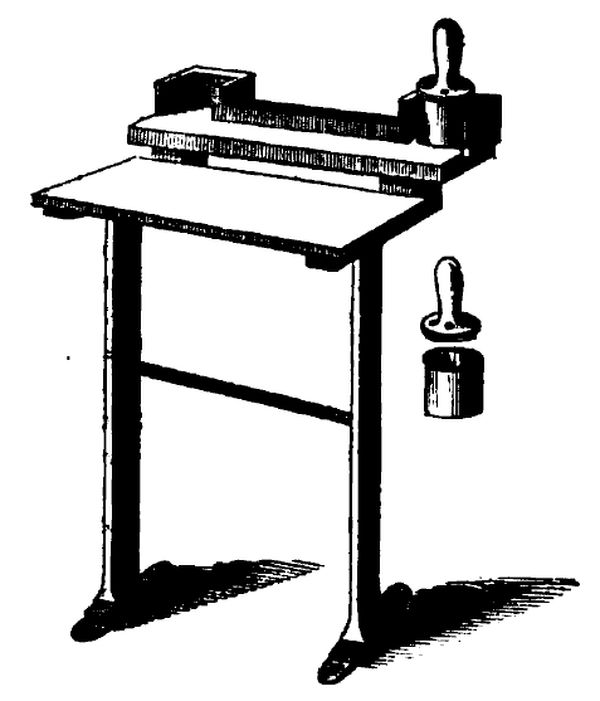
“I have had several of these inking tables at work, and find a decided preference due to the last described. The mahogany surface seems more congenial to the temperament of the ink and roller, than either the lead or iron. The ink is taken better, and distributes better. A line of colour is taken as perfectly from the stage as from a cylinder, since the roller, being cylindrical, can only touch the ink in a line, and it is only giving the roller a portion of a revolution on the stage to make it take a greater quantity of colour if necessary. More of the flue and dirt, inseparable from the working of paper, is held by the wood than by the lead; and consequently, the roller keeps cleaner, and the forme works better. The table is easily washed by the lye-brush, and no further waste of ink is occasioned.
“This apparatus has been further improved by substituting a box and cylinder for the stage and brayer. The advantage of which will be, that the quantity of ink on the cylinder to come in contact with the roller, is regulated by a pressure at the top, out of the body of the ink, instead of at the bottom against which the ink must rest.

“The cylinder is of mahogany, and, as here shown, moves in a box or trough which contains the ink; and which has a lid moving on hinges coming nearly over the top of the cylinder. To the under edge of this top is nailed a slip of thick butt or sole leather. This, by its naturally elastic quality, will always press upon the cylinder according as the lid is more or less tightly screwed down by thumb-screws. This leather will also intercept in its way any filth which may arise from the depôt of ink before it can reach the cylinder: and which, when accumulated, may, by unscrewing the lid and throwing it open, as in the figure, be instantly scraped away with one stroke of the knife; and no further waste of the ink incurred. No part of the ink in this apparatus[422] is exposed when the lid is down: and only a very small portion of the cylinder at the time of working.”
A wooden table after the pattern of Foster’s apparatus is now generally used, the top is covered with lead on which the ink is distributed on the rollers; the stage on which the ink is taken is not raised more than about a quarter of an inch, and at the two back corners are two recesses, one for the supply of ink, and the other for the brayer, when not in use. See Rollers.
INNER FORM.
The form that has the second page in it; it is always worked before the outer form, except there be some particular reason to the contrary. See Lay on.
INNER TYMPAN.
A frame covered with parchment, which fits into the outer tympan; two flat points slip under the head-band of the outer tympan, which secure that end in its place; and the sides are kept down by two hooks on each side of the outer tympan which turn into eyes screwed into the sides of the inner tympan; in iron presses the hooks turn round studs, under the heads.
In page. See Out page.
INSERTION.
If the compositor have left out words or lines, the corrector inserts it, and makes this mark ‸ where it is left out, which is called the mark for insertion.—M. This is now called an “Out;” an insertion is when the author makes any addition in the proof sent to him.
INSET.
The same as offcut: with printers it is called an offcut; when the work comes into the hands of the bookbinder, and the sheets are folded, it then becomes an inset, being inserted in the middle of the sheet, to complete the regular succession of pages.
INSIDE QUIRES.
The regular and perfect quires of paper, of twenty-four good sheets each; they are thus designated to distinguish them from the outside or corded quires.
Interrogation. See Punctuation.
INSOLVENT DEBTORS.
1 & 2 Vict. c. 110. “An Act for abolishing Arrest on Mesne Process in Civil Actions, except in certain Cases; for extending any Remedies of Creditors against the Property of Debtors; and for amending the Laws for the Relief of Insolvent Debtors in England.”
s. 115. “And be it enacted, That the Sum of Three Shillings, and no more, shall be paid to any Printer or Proprietor of any Newspaper for the Insertion of any Advertisement by this Act directed to be inserted in any Newspaper; and all Printers and Proprietors of Newspapers are hereby required to insert the same, on Payment of the said Sum of Three Shillings for the Insertion thereof, in such Form as the said Court or any Commissioner thereof shall from Time to Time direct.
s. 116. “And be it enacted, That no Letter of Attorney, Affidavit, Certificate, or other Proceeding, Instrument, or Writing whatsoever, before or under any Order of any Commissioner thereof, or before any Justice or Justices of the Peace acting in the Execution of this Act, nor any Copy thereof, nor any Advertisement inserted in any Newspaper by the Direction of the said Court, relating to Matters within the Jurisdiction of the said Court, shall be liable to or chargeable or charged with the Payment of any Stamp or other Duty whatsoever; and that no Sale of any Real or Personal Estate of any such Prisoner as aforesaid for the Benefit of his or her Creditors, under this Act, shall be liable to any Auction Duty.”
Upon a representation made in the House of Commons, that s. 115. bore hard on the proprietors of newspapers, it was modified by the Act of 2 & 3 Vict. c. 39. intituled, “An Act to amend an Act passed in the last Session of Parliament, for abolishing Arrest on Mesne Process in Civil Actions except in certain Cases, for extending the Remedies of Creditors against the Property of Debtors, and for amending the Laws for the Relief of Insolvent Debtors in England.
s. 1. “Whereas by an Act passed in the last Session of Parliament, intituled, ‘An Act for abolishing Arrest on Mesne Process in Civil Actions except in certain Cases, for extending the Remedies of Creditors against the Property of Debtors, and for amending the Laws for the Relief of Insolvent Debtors in England,’ it was amongst other things enacted, that the Sum of Three Shilling and no more shall be paid to any[423] Printer or Proprietor of a Newspaper for the Insertion of any Advertisement by that Act directed to be inserted in any Newspaper, and all Printers and Proprietors of Newspapers were thereby required to insert the same, on Payment of the said Sum of Three Shillings for the Insertion thereof, in such Form as the Court for the Relief of Insolvent Debtors, or any Commissioner thereof, should from Time to Time direct: And whereas it is just and expedient that the said Act should be altered and amended as herein-after mentioned: Be it therefore enacted by the Queen’s most Excellent Majesty, by and with the Advice and Consent of the Lords Spiritual and Temporal, and Commons, in this present Parliament assembled, and by the Authority of the same, That so much of the said Act as is herein-before recited shall be and the same is hereby repealed; and that from and after the passing of this Act, all Printers and Proprietors of Newspapers shall and are hereby required to insert any Advertisement or Advertisements by the said recited Act directed to be inserted in any Newspaper, on Payment of a reasonable Compensation for the Insertion thereof, in such Form as the said Court, or any Commissioner thereof, shall from Time to Time direct.”
Insolvent Debtors, Ireland. 3 & 4 Vict. c. 107. “An Act to continue and amend the Laws for the Relief of Insolvent Debtors in Ireland.
s. 101. “And be it enacted, That all Printers and Proprietors of Newspapers shall and they are hereby required to insert any Advertisement or Advertisements by this Act directed to be inserted in any Newspaper, on Payment of such reasonable Compensation for the Insertion thereof, and in such Form, as the said Court, or any Commissioner thereof, shall from Time to Time direct.
s. 102. “And be it enacted, That no Letter of Attorney, Affidavit, Certificate, or other Proceeding, Instrument, or Writing whatsoever, before or under any Order of the said Court, or before or under any Order of any Commissioner thereof, nor any Copy thereof, nor an Advertisement inserted in any Newspaper by the Direction of the said Court or a Commissioner thereof, or the Chief Clerk of the said Court, relating to Matters within the Jurisdiction of the said Court, shall be liable to or chargeable or charged with the Payment of any Stamp or other Duty whatsoever; and that no Sale of any Real or Personal Estate of any such Prisoner as aforesaid for the Benefit of his or her Creditors, under this Act, shall be liable to any Auction Duty.”
IRISH.
“Mr. Innes, in his Essay on the Antiquities of Scotland and Ireland, delivers it as his opinion, that the Beth Louis Nion, or alphabet of the Irish, was nothing but an invention of the Irish Seanachies, who, since they received the use of Letters, put the Latin alphabet into a new arbitrary order, and assigned to each letter a name of some Tree; and that this was not a genuine alphabet of the Irish in ancient times, or peculiar to them; but was a bare inversion of the Latin alphabet.
“Colonel Vallancey, (in his Irish Grammar,) gives three different alphabets of the Irish language, which vary from each other in name, order, and number; the first consists of twenty-five letters, the second of twenty-six, and the last of seventeen. As for the Irish letters being different in power from those of other nations, it must be observed, that the powers of letters differ in every language, and the mode of pronouncing the same letters is various in different countries: the Irish characters are said to be of Asiatic original—granted.—But they appear to have been transmitted to the inhabitants of that country from those who had adopted the Roman letters.
“It is singular, but it is no less true, that the Norman characters were generally used in England from the coming of William the First, and that the Saxon characters were intirely disused in the very beginning of the twelfth century; but the Irish and Scots preserved the ancient forms of their characters till the end of the sixteenth century.”—Astle.
The most ancient grammar of the Irish language now extant, is the Uraiceact na Neigeas, or Primer of the Bards, written by Forchern some few years before our vulgar æra, transcribed and illustrated by Ceannfaolidh na foghlama, or Kinfaolidh the learned, an author of the seventh century. The alphabet, according to this author, was originally named bobel, loth, &c. from the names of certain masters who assisted in composing the Japhetan language soon after the confusion of tongues.
As the Grecians gave the name of alphabet to the table of their letters[424] from the two initial letters, Alpha, Beta; and the Latins called their table Abcdarium from their three first letters, A, B, C. So the Irish gave the name of Bobel, Loth, to their ancient elements, from the two first letters B, L; and to their more modern alphabet, that of Bethluisnon, from B, L, N, which proves that N did formerly possess the third place; whereas in the present alphabet it takes up the fifth. The last and most modern name of the Irish alphabet, in conformity to the Abcdarium of the Romans, is Abgiter.
The Number, Order, and Names of the Letters, according to Forchern’s Uraiceact.
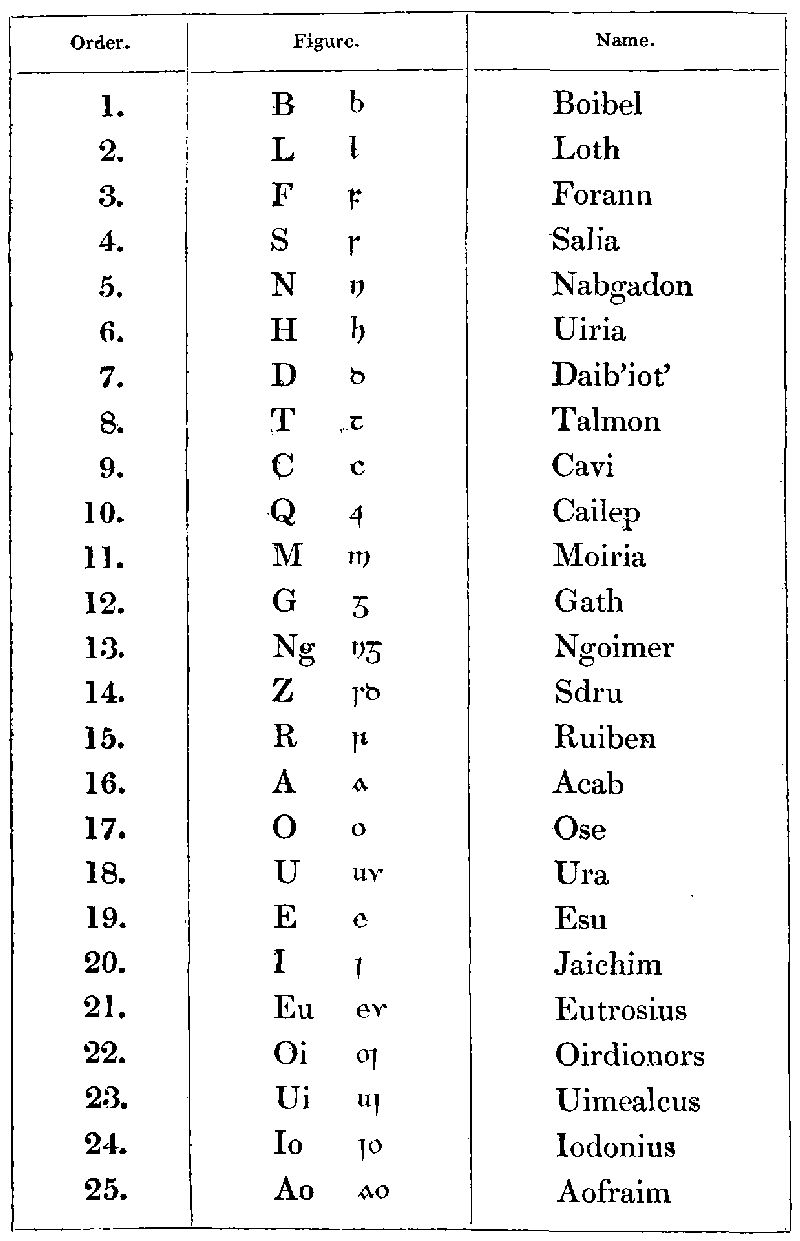
| Order. | Figure. | Name. | |
| 1. | B | b | Boibel |
| 2. | L | l | Loth |
| 3. | F | f | Forann |
| 4. | S | s | Salia |
| 5. | N | n | Nabgadon |
| 6. | H | h | Uiria |
| 7. | D | d | Daib’iot’ |
| 8. | T | t | Talmon |
| 9. | C | c | Cavi |
| 10. | Q | q | Cailep |
| 11. | M | m | Moiria |
| 12. | G | g | Gath |
| 13. | Ng | ng | Ngoimer |
| 14. | Z | z | Sdru |
| 15. | R | r | Ruiben |
| 16. | A | a | Acab |
| 17. | O | o | Ose |
| 18. | U | u | Ura |
| 19. | E | e | Esu |
| 20. | I | i | Jaichim |
| 21. | Eu | eu | Eutrosius |
| 22. | Oi | oi | Oirdionors |
| 23. | Ui | ui | Uimealcus |
| 24. | Io | io | Iodonius |
| 25. | Ao | ao | Aofraim |
It is remarkable in all the Irish alphabets, (except the modern one, the order of which is copied from the Roman, and introduced since Christianity,) that the vowels follow each other; an instance not known in any other language, yet the labials, dentals and linguals, are intermixed without order.
The Number, Order, and Names of the Letters, according to O’Flaherty, from the Book of Lecane.
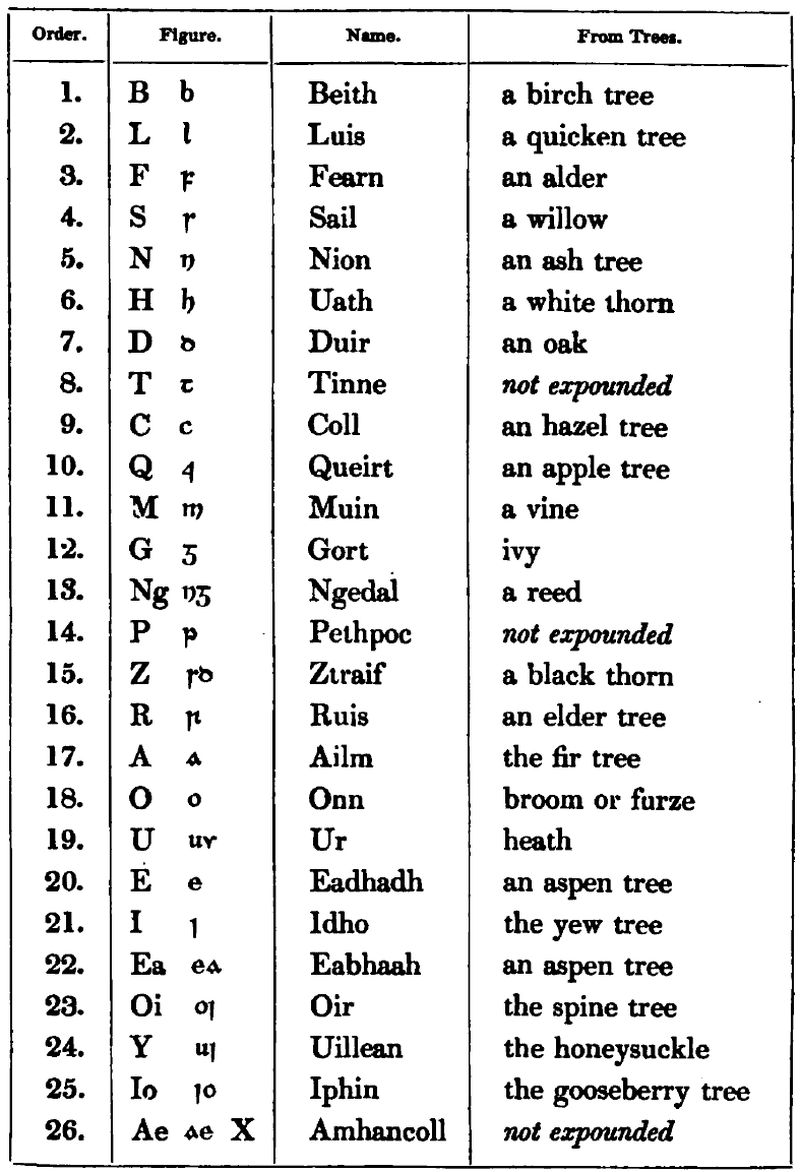
| Order. | Figure. | Name. | From Trees. |
| 1. | B b | Beith | a birch tree |
| 2. | L l | Luis | a quicken tree |
| 3. | F f | Fearn | an alder |
| 4. | S s | Sail | a willow |
| 5. | N n | Nion | an ash tree |
| 6. | H h | Uath | a white thorn |
| 7. | D d | Duir | an oak |
| 8. | T t | Tinne | not expounded |
| 9. | C c | Coll | an hazel tree |
| 10. | Q q | Queirt | an apple tree |
| 11. | M m | Muin | a vine |
| 12. | G g | Gort | ivy |
| 13. | Ng ng | Ngedal | a reed |
| 14. | P p | Pethpoc | not expounded |
| 15. | Z z | Ztraif | a black thorn |
| 16. | R r | Ruis | an elder tree |
| 17. | A a | Ailm | the fir tree |
| 18. | O o | Onn | broom or furze |
| 19. | U u | Ur | heath |
| 20. | E e | Eadhadh | an aspen tree |
| 21. | I i | Idho | the yew tree |
| 22. | Ea ea | Eabhaah | an aspen tree |
| 23. | Oi oi | Oir | the spine tree |
| 24. | Y y | Uillean | the honeysuckle |
| 25. | Io io | Iphin | the gooseberry tree |
| 26. | Ae ae X | Amhancoll | not expounded |
Of these letters, the five last are diphthongs. Q, Ng, Z, are reckoned superfluous consonants, and are thrown out of the modern alphabet, so that the remaining letters are only 17, which compose the abgitur or alphabet now in use, and are placed in order as the Latin abcdarium.
The ancient grammarians called the alphabet Faoidh, or Faodh, i.e. a a voice, a sound or language; because such letters are expressive of the voice and language. The moderns, to support their hypothesis, have corrupted this word to Feadh, a wood; and from hence have denominated the letters after certain trees, three of which they are at a loss to expound. According to Neuman, the Hebrew letters do each separately signify the idea either of motion, space, or matter; hence each Hebrew[426] word is at once a name, and a definition of the subject, and all objects in the natural and moral world must be known as soon as their names are known, and their separate letters considered. The proper names of men being borrowed from such ideas as Adam, i.e. red earth, it is more rational to suppose our learned ancestors named their letters according to Forchern, from men, rather than from trees.—A Grammar of the Iberno-Celtic, or Irish Language. By Major Charles Vallancey. 4to. Dublin, 1773.
The Modern Alphabet.

| Figure. | Name. | Pronunciation. | ||
| A a | A a | Ailm | aw | the fir-tree |
| B b | B b | Beit | beh | the birch-tree |
| C c | C c | Coll | k | the hazel-tree |
| D d | D d | Duir | deh | the oak-tree |
| E e | E e | Eada | e French | the aspen-tree |
| F f | F f | Fearn | f | the alder-tree |
| G g | G g | Gort | γ gamma, Gr. | the ivy-plant |
| I i | I i | Ioga | i French | the yew-tree |
| L l | L l | Luir | l | the quickset-tree |
| M m | M m | Muin | m | the vine-plant |
| N n | N n | Nuin | n | the ash-tree |
| O o | O o | Oir | o | the broom-tree |
| P p | P p | Peit | peh | the dwarf-elder |
| R r | R r | Ruis | r | the elder-tree |
| S s | S s | Suil | sh | the willow-tree |
| T t | T t | Teine | teh | the furze-shrub |
| U u | U u | Ur | oo English | the heath-shrub |
| H h | H h | Uat | h | the white-thorn |
In addition to the above eighteen letters, the ancients used the following in their alphabet:—

| q | ceirt | the apple-tree | |
| z | Zz | straif | the black-thorn |
| ng | Ng | ngiadal | the reed-stalk |
| ea | Ea | eabad | the aspen-tree |
| io | Io | iphin | the gooseberry-tree |
| oi | Oi | oir | the spindle-tree |
| y | Y | uillean | the honeysuckle |
| ao | Ao | amancoll | from amhuinn, a river, |
| and coll, the hazel-tree, of which were made hurdles for crossing brooks and rivers (the letter x). | |||
Table of Mutable Consonants and of Eclipses.

[Irish-English Guide to the Irish Language. By Thaddæus Connellan, 12mo. Lond. 1824.]
The vowels are five in number, a, o, u, e, i, whereof the three first, a, o, u, are broad, and the two last, e, i, are narrow.
In words of two or more syllables, regard must be had to the correspondence of the vowels, for when the last vowel of the former syllable is a broad vowel, the first vowel of the following syllable must be broad also; and when in some latter syllable the vowel is small, the last of the immediately preceding must be small also. Example, du-ne, a man, is false orthography, because the last syllable ending in a small vowel, the first must end in a small one also, as dui-ne.
No vowel is ever to be doubled as ee, oo, &c. in the same syllable.
The diphthongs, or union of two vowels, are thirteen.
| Example. | |
| {ao as y or i in bird | saor |
| {æ or ae | gaeth |
| {ai | cail |
| {ea | fear |
| {ei | ceir |
| {eo | ceol |
| {eu | seud |
| ia | cliar |
| io | cior |
| oi | coir |
| ua | fuar |
| ui | fuil |
The triphthongs are five,
| aoi | caoin |
| eoi | feoil |
| iai | liaigh |
| iui | sttiuir |
| uai | cuaird |
| — Vallancey. |
Vallancey, by omitting the letter R, reduces the modern alphabet to seventeen letters; Connellan, by admitting this letter, increases it to eighteen.
Hibernian or Irish Types in the British Founderies.
Pica.—Thorowgood and Besley; this was cut by Fry from drawings made by, and under the superintendence of Mr. Thaddæus Connellan.
Small Pica.—Thorowgood and Besley; this was also cut by Fry from[428] drawings by Mr. Connellan, and under the same circumstances as the Pica. V. and J. Figgins; this was copied from the engravings in Vallancey’s Irish Grammar. I have given the modern alphabet in this character.
Long Primer.—Thorowgood and Besley; this was cut for Bagster’s edition of the New Testament in Irish, printed for the British and Foreign Bible Society.
ITS OWN PAPER.
When one, two, three, or more copies of a sheet of a work, or a job, are printed on the paper that the whole is intended to be worked on, it is said to be Pulled on its own Paper. This is frequently done at the commencement of a work, when a proof of the first sheet is sent to the author, or bookseller, or both; that they may see the effect produced before it is proceeded with.
Jeff. See Throw.
JOB.
Any thing which printed does not exceed a sheet, is termed a Job, and is paid for extra to the compositor, because there is no return of furniture or of letter: he has generally to put up fresh cases, and has some additional trouble in getting the right letter, and in making up the furniture. See Scale of Prices.
JOB HOUSE.
A printing office, the general run of business in which is the printing of Jobs; namely, cards, shop bills, bills for articles stolen, or lost, play bills, lottery bills, large posting bills, and all other things of a similar description. These houses seldom execute book work to any extent, as their materials, particularly with respect to types, are not calculated for it; and few houses undertake both kinds of work to any great degree. The principal job houses in London have a variety of types, both as to size and shape, such as few or no book houses ever think of laying in; consequently they are enabled to execute such work in a style superior to that in which a book house could, with regard to producing effect, and, in general, more expeditiously. Jobbing is an extensive business in London. See Book House.
Johnson, Richard. See Donations.
JOIN.
When two or more compositors are employed on the same piece of work, and one of them composes all his copy, so that there is no intervening matter between his copy and that in the hands of another of the companions who has followed him, he says, he has joined, or, he has set up close. Also, if a compositor be on a piece of work without a companion, and from any cause he be obliged to suspend composing one part of his copy, and to proceed with a succeeding part; then, when he has been enabled to compose this intervening part, and has got it completed, he says, he has joined, or, he has joined his matter.
JOINTS.
Tympan joints, and frisket joints.—M.
Justifiers. See Quotation Quadrats.
JUSTIFYING.
Spacing a line out so that it fits with a proper degree of tightness in the measure of the composing stick;—placing a wood cut in a page, and filling up the vacancies with leads, scaleboards, quadrats, quotations, or furniture, so that when the form is locked up, the wood cut shall be fast, and the lines above and below it even;—fixing any other matter in a similar way in a page.—With pressmen, putting cards into the head of a wooden press, and screwing it up until the pull be proper, is termed Justifying the Head, or Justifying the Pull. See Hard Pull.
Justifying the Head. This amounts to the same thing as justifying the pull, which see.
Justifying Links. See Composing.
JUSTIFY THE PULL.
Putting additional cards into the mortises of the cheeks of a press, or taking some out, as the case may require, in order to regulate the pull: for a small light form, the pressure requires to be comparatively slight; but for a large, solid form of small letters, it requires a heavy soaking pull to do justice to the work; in this case, additional cards are put into the mortises of the head. This refers only to the wooden press; for justifying the pull of iron presses, see under the respective articles.
JUSTIFY A STICK;
viz. a composing stick. Screwing the slides of his composing stick to the measure wanted—M.
KEEP IN,
is a caution either given to, or resolved on, by the compositor, when there may be doubt of driving out his matter beyond his counting off: wherefore he sets close, to Keep in.—M.
KEEP OUT,
is a caution either given to, or resolved on, by the compositor, when there may be doubt of getting in his matter too fast for his counting off: wherefore he sets wide, to drive or keep out.—M. This term is not now used; we say Drive out, which see.
KERN.
Kerned letters are such as have part of their face hanging over one side or both sides of their shanks.—M.
KEY.
A flat square hook, with a handle to put the fingers through in a transverse direction to the hook. Its use is to lift the forms out of the lye trough, after having brushed off the ink from the types, the furniture, and the chase.
KNOCK UP.
In the warehouse, is to place the sheets of each signature of a work uniformly even at the edges upon each other, after they are taken down from the poles, and previously to their being piled away.
The person who has this to do, takes a quantity of about two quires, (if it be a stout hard paper he may take a little more,) and holding it loosely at the edges with both hands, he bends the ends a little towards him, so that the paper shall form a curve; he then lifts it up a little from the table, and lets it drop upon its edge through his hands,—the curve giving the edge a little firmness, many of the sheets drop down into their places; he repeats this two or three times, and will then, in letting it drop upon the table, bring the lower part nearer to him, so that the outside of the curve may strike first, and throw the sheets gradually up higher at the back; this he will also do two or three times; he then lets the further side rest upon the table, and shuffles the upper sheets gradually away from him, lifting the whole up, and letting the edges drop upon the table, three or four times; repeating these operations soon brings all the edges even, both at the ends and sides; he then lays this taking on one side, and repeats the operation with other takings, laying them on each other, till he has completed the whole.
A soft flimsy paper takes more time in knocking up than a hard paper, as the sheets have not strength enough separately to be driven into their places by striking on the edges.
KNOCK UP BALLS.
To knock up balls is the term used for making balls: it is to cut the pelts to a proper size; to fill them with a[430] proper quantity of wool; to nail them to the ball stocks; to trim them; and to put them into a working condition. See Balls.
KNOCK UP A LETTER.
It sometimes happens with old letter, that a letter may be worn so low that it will not print well in a page; the workman then takes that letter out of the form, and holds the shank of it upon the side of the chase, and with the head of the shooting stick beats lightly upon the foot of the shank, till he have battered metal enough out of the shank, to raise it higher against paper; if it prove too high against paper, he rubs the bottom of the shank upon the side of the chase, to rub it down. This operation seldom happens, unless another of the same sort of letter is wanting, and hard to come by: for else the compositor will bow the letter, and pop it into a waste box in his case, where he puts all naughty letters, that he may not be troubled with them another time.—M. See Bow the Letter.
KOOFEE,
Kufic, Cufic, Cuphic, or Oriental. Ancient Arabic; it was called Cuphic, from the town of Couphah, built on the Euphrates. See Arabic.
LATIN.
The Latin alphabet is the same as the English, with the exception of the W, which “is a letter unknown, as to form and place, in the alphabets of the ancient Hebrews, Greeks, Romans, and Goths. This letter is peculiar to the northern languages and people, and particularly to the nations who are of Teutonic and Sclavonic original.”—Astle.
For the allowance of the duty on paper used in the printing of books in the Latin language within the universities of Oxford and Cambridge, the universities of Scotland, and the university of Trinity College, Dublin, see Paper.
LAW AUTHORITIES,
with the abbreviations by which they are cited.
A. (a.) B. (b.).—A. front, B. back of a leaf.
A.; An.; Anon.—Anonymous.
A. B.—Anonymous, at the end of Bendloe’s Reports. 1661. (Cited as ‘New Bendloe.’)
Ab. Sh.—Abbot on Shipping.
Abr. Ca. Eq.—Abridgment of Cases in Equity.
Acc. or Ag. or Agr.—Accords or agrees.
Act.—Acton’s Reports.
Act. Reg.—Acta Regia.
Ad. Eject.—Adams on Ejectments.
Ad. & Ellis.—Adolphus and Ellis’s King’s Bench Reports.
Add. Eccl. Rep.—Addams’s Reports. Ecclesiastical Courts.
Al.—Aleyn’s Reports.
Alln. Part.—Allnatt on Partition.
Amb.—Ambler’s Reports in Chancery.
And. 1. 2.—Anderson’s Reports, 2 parts.
Andr.—Andrews’s Reports.
Ann.—Cases in K. B. temp. Hardwicke.
Annaly.—Reports temp. Hardwicke.
Anon.—Anonymous.
Anst.—Anstruther’s Reports.
Arch. C. P.—Archbold’s Civil Pleadings.
Arch. Cr. P.—Archbold’s Criminal Pleadings.
Arch. Crim. Pl. & Ev.—Archbold’s Criminal Pleadings and Evidence.
Arch. K. B.—Archbold’s K. B. Practice.
Arch. P. C.—Archbold’s Pleas of the Crown.
Ash. Ch., or Ov.—Ashdowne’s Church-warden and Overseer.
Ass., or Lib. Ass.—Liber Assisarum, or Pleas of the Crown.
Ast. Ent.—Aston’s Entries.
Atk.—Atkyns’s Reports in Chancery.
Ath. P. T.—Atkyns’s Parliamentary Tracts.
Ayl.—Ayliffe’s Parergon.
B., or C. B.—Common Bench.
B. & A.; B. & Ald.—Barnewall and Alderson’s Reports. King’s Bench.
B. & Ad.; Barn. & Adol.—Barnewall and Adolphus’s Reports. King’s Bench.
B. & C.; B. & Cr. (K. B.); Barn. & C.; Barn. & Cres.—Barnewall and Cresswell’s Reports. King’s Bench.
B. C. C.; Br. Ch. Rep.; Bro. C. C.—Brown’s Chancery Cases.
B. Eccl. L.; Burn’s Eccl. L.—Burn’s Ecclesiastical Law.
B. Just.—Burn’s Justice.
B. M.—Montagu’s Digest of the New Decisions in Bankruptcy.
B. N. C.—Brooke’s New Cases.
B. & P., or Boss. & Pull.—Bosanquet and Puller’s Reports.
B. R.—Banco Regis. King’s Bench.
B. Tr.—Bishop’s Trial.
Ba. & Be.; Ball & B.—Ball and Beatty’s Reports in Chancery in Ireland.
Bac. Abr.—Bacon’s Abridgment.
Banc. Sup.—Upper Bench.
Barl.—Barlow’s Justice.
Barn. K. B.—Barnardiston’s K. B. Reports.
Barn. C.—Barnardiston’s Chancery Reports.
Barnes.—Barnes’s Notes of Practice.
Barringt.—Barrington’s Observations on the Statutes.
Bart. El.—Barton’s Elements.
Bart. Prec.—Barton’s Precedents.
Bayl.—Bayley on Bills.
Bea. Co.—Beames’s Costs in Equity.
Bea. Pl. Eq.—Beames’s Pleas in Equity.
Benl.; Bendl.—Benloe, or Bendloe’s Reports.
Bing.—Bingham’s Reports. Common Pleas.
Bing. N. S.—Bingham’s New Reports in the Common Pleas.
Bingh. P.—P. Bingham’s Law and Practice of Judgment and Execution.
Black.—Blackerby’s Justice.
Bla. Com.—Blackstone’s Commentaries.
Black. (H.)—Henry Blackstone’s Reports.
W. Black.; Black. Rep.—Sir W. Blackstone’s Reports.
Bl.—Blount.
Bli.—Bligh’s Reports.
Bo. R. Act.—Booth’s Real Actions.
Bos. & Pul.—Bosanquet and Puller’s Reports. Common Pleas.
Bosc.—Boscawen on Convictions.
Bott.—Bott’s Poor Laws.
Bott. cont.—Bott’s Poor Laws continued to Hil. T. 1814.
Br.; Bro.—Brooke, Brown, Brownlow.
Br. Ab.—Brooke’s Abridgment.
Br. Brev. Jud. & Ent.—Brownlow’s Brevia Judicial, &c.
Br. Ch. Rep.—Brown’s Reports in Chancery.
Bra.—Brady or Bracton.
Bradby.—Bradby on Distresses.
Bridg.—Bridgman’s Reports on Conveyancing.
Bridg. (Sir O. R.)—Bridgman’s Reports, by Bannister.
Brod. & Bing.—Broderip and Bingham’s Reports. C. P.
Bro.—Brown’s Chancery Cases.
Bro., Brow. Ent.—Brown’s Entries.
Bro. A. C. L.—Browne’s Admiralty Civil Law.
Bro. P. C.—Brown’s Parliamentary Cases.
Bro. V. M.—Brown’s Vade Mecum.
Brown C. C.—Brown’s Chancery Reports.
Brownl. 1. 2.—Brownlow and Goldesborough’s Reports, 2 parts.
Brownl. Rediv. or Ent.—Brownlow’s Redivivus.
Buck.—Buck’s Reports in Bankruptcy.
Bul. N. P.—Buller’s Nisi Prius.
Bulst.—Bulstrode’s Reports. K. B.
Bunb.—Bunbury’s Reports. Exchequer.
Burr.—Burrow’s Reports.
Bur. S. C.—Burrow’s Settlement Cases.
Byth. Prec.—Bythewood’s Precedents.
C., or Cod., or Cod. Jur.—Codex (Juris Civilis) Gibson’s.
Ca.—Case or Placita.
Ca. P. or Parl.—Cases in Parliament.
C. B., or C. P.—Common Pleas.
C. C.; Ch. Ca.—Chancery Cases.
C. C. R.—Russell and Ryan’s Crown Cases reserved.
C. & P.; Car. & P. Rep.; Car. & P.—Carrington’s and Payne’s Reports at Nisi Prius.
C. P.—Common Pleas.
C. R.—Court of Review.
Ca. T. K.—Select Cases tempore King.
Ca. temp. H.; Cas. temp. Hardw.—Cases tempore Hardwicke, in King’s Bench.
Cal.—Callis, Calthorpe.
Cald. R.—Caldecott’s Reports of Settlement Cases.
Cald. S. C.—Caldecott’s Settlement Cases.
Caldw. Arbit.—Caldwell on Arbitration.
Caldw. P. L.—Caldwell’s Poor Laws.
Calth.—Calthorpe’s Reports.
Camp.—Campbell’s Reports. Nisi Prius.
Can.—Canons of the Church, made in 1603.
Car. & P. Rep.; Carr. & P.—Carrington and Payne’s Reports. Nisi Prius.
Cart.—Carter’s Reports.
Carth.—Carthew’s Reports, K. B.
Cary.—Cary’s Reports.
Cas. B. R.—Cases tempore W. III.
Cas. L. Eq.—Cases in Law and Equity.
Cas. Pra. C. P.—Cases of Practice Common Pleas.
Cas. temp. Talb.—Cases tempore Lord Chancellor Talbot.
Cawl.—Cawley.
Ch. Ca.—Chancery Cases.
Ch. Pre.—Precedents in Chancery.
Ch. R.—Reports in Chancery.
Chamb. Est.—Chambers’s Estates and Tenures.
Chamb. Lea.—Chambers on Leases.
Chamb. T. L.—Chambers’s Tenant Law.
Chitt. Com. L.—Chitty’s Commercial Law.
Chitt. Crim. L.—Chitty’s Criminal Law.
Chitty’s G. L.—Chitty on the Game Laws, &c.
Chitt. Pre.—Chitty’s Prerogative.
Chitty’s R. M.—Chitty on the Rights of Manors.
Chitt. Rep.—Chitty’s Reports.
Chris. B. L.—Christian’s Bankrupt Laws.
Christian’s G. L.—Christian on the Game Laws.
Cl. & Fin.—Clarke and Finnelly.
Clap. Sess. L.—Clapham’s Points of Sessions Law. 1818.
Clay.—Clayton’s Reports.
Cl. Ass.—Clerk’s Assistant.
Clift.—Clift’s Entries.
Co.—Coke’s Reports.
Co. B. L.—Cooke’s Bankrupt Laws. Cole on the English Bankrupt Laws.
Co. Cop.—Coke’s Copyholder.
Co. Ent.—Coke’s Entries.
Co. Lit.—Coke on Littleton (1st Institute).
Co. M. C.—Coke’s Magna Charta (2d Institute).
Co. P. C.—Coke’s Pleas of the Crown (3d Institute).
Co. on Courts.—Coke’s (4th Institute).
Code Nap.—Code Napoleon.
Coke’s Inst.—Coke, 2d, 3d, and 4th Parts of the Institutes of the Laws of England.
Com.—Comyn’s Reports.
Com. T. L.—Comyn’s Tenant Law.
Com. Con.—Comyn on Contracts.
Com. Dig.—Comyn’s Digest.
Com. Par. Off.—Complete Parish Officer.
Comb.—Comberbach’s Reports.
Cont.—Contra.
Coo. Eq. P.—Cooper’s Equity Pleading.
Coo. Mort.—Coote on Mortgages.
Coo. Rep.; Cooper.—Cooper’s Reports.
Coo. T. L.—Coote’s Tenant Law.
Cooke’s B. L.—Cooke’s Bankrupt Laws.
Con. Rep.—Consistory Reports, by Haggard.
Cot.—Cotton.
Cot. Ab. R.—Cotton’s Abridgment of Records.
Cov. Rec.—Coventry on Recoveries.
Cowp.—Cowper’s Reports.
Cox.—Cox’s Cases in Equity.
Cr. & Jer.; Cromp. & Jerv.—Crompton and Jervis’s Exchequer Reports.
Cro.—Keilwey’s Reports, by Croke.
Cro. Cir. C.—Crown Circuit Companion.
Cro. Mee. & R.; Cromp. Mees. & Rosc.—Crompton, Meeson, and Roscoe’s Exchequer Reports.
Cro. Car.—Croke’s Reports temp. Chas.
Cro. 1, 2, 3.—Croke’s Reports. (Eliz. Jam. Cha.)
Cro. Eliz.—Croke’s Reports temp. Elizabeth.
Cro. Jac.—Croke’s Reports temp. James.
Cromp. J. C.—Crompton’s Jurisdictions of Courts.
Cromp.—Crompton’s Justice of the Peace.
Cromp. & Mees.—Crompton and Meeson’s Exchequer Reports.
Cun.—Cunningham’s Reports.
Cro. sometimes refers to Keilwey’s Reports, published by Serjt. Croke.
Curt.—Curteis’s Ecclesiastical Reports.
D.—Dictum, Digest (Juris Civilis).
D. & C.—Deacon and Chitty’s Reports in Cases of Bankruptcy.
D. & R.; Dowl. & R.—Dowling and Ryland’s Reports. K. B.
D. & St.—Doctor and Student.
Dal.—Dalison’s Reports.
Dalt. Just.—Dalton’s Justice.
Dalt. Sh.—Dalton’s Sheriff.
Dan.—Daniel’s Reports.
D’Anv.—D’Anvers’s Abridgment.
Dav.—Davis’s Reports, respecting Patents, &c.
Dea. & Ch.—Deacon and Chitty.
Deg.—Degge’s Parson’s Counsellor.
Deh.—Dehany’s Turnpike Acts.
D’Ew.—D’Ewe’s Journal.
Di.; Dy.; Dyer.—Dyer’s Reports.
Dial. de Scacc.—Dialogus de Scaccario.
Dick.—Dickin’s Reports.
Dick. Just.; Dickenson.—Dickenson’s Justice.
Dig.—Digest of Writs.
Dob. Sty.—Dobie’s Styles.
Dod. Rep.—Dodson’s Admiralty Reports.
Dom. Proc.—Domini Proctor; Cases House of Lords.
Doug.—Douglas’s Reports. K. B.
Dow.—Dow’s Reports. House of Lords.
Dowl. Pr. Ca.—Dowling’s Practice Cases.
Dub.—Dubitatur.
Dugd. Orig.; Dugd., D. J., or Jud.—Dugdale’s Origines Juridicales.
Dug. S.; Dugd. Sum.—Dugdale’s Summonses.
Duke.—Duke’s Charitable Uses.
Durnf.—Durnford and East, or Term Reports. K. B.
E.—Easter Term, or Eden.
E. T.—Easter Term.
E. of Cov.—Earl of Coventry’s Case.
East.—East’s Reports. K. B.
East. P. C.—East’s Pleas of the Crown.
Eden.—Eden’s Reports of Northington’s Cases.
Edw. Ad. R.—Edwards’s Admiralty Reports.
Eq. Ca.; Eq. Ab.; Eq. Ca. Abr.—Equity Cases Abridged.
Ersk. Inst.—Erskine’s Institute of the Law of Scotland.
Esp.—Espinasse.
Esp. Ac. Stats.—Espinasse’s Action on the Statutes.
Esp. Ev.—Espinasse’s Evidence.
Esp. N. P.—Espinasse’s Digest.
Esp. P. Stats.—Espinasse’s Penal Statutes.
Esp. Rep.; Esp. N. P. Rep.—Espinasse’s Reports at Nisi Prius.
Ev. Col. Stat.—Evans’s Collection of Statutes.
Ex.; Exp.—Expired.
F., or Fitz.—Fitzherbert’s Abridgment.—Fitzherbert’s Abridgment is commonly referred to by the older law writers by the title and number of the placita only, e. g. Coron. 30.
F. N. B.; Fitz. N. B.—Fitzherbert’s Natura Brevium.
Far.—Farresly (7 Mod. Rep.).
Fell, Mer. G.—Fell on Mercantile Guarantees.
Ff.—Pandectæ (Juris Civilis).—This reference, which frequently occurs in Blackstone and other writers, applied to the Pandects or Digests of the civil law, is a corruption of the Greek letter π Vide Calvini Lexicon Jurid. voc. Digestorum.
Field. Pen. Stat.—Fielding’s Penal Laws. 1769.
Fin.; Finch’s Rep.—Finch’s Reports. Chancery.
Finch.—Finch’s Law.
Fitz.; Fitz. G.—Fitz-Gibbon’s Reports.
Fl.—Fleta.
Flat. Dig.—Flather’s Digest.
Fol.—Foley’s Poor Laws.
Fonbl. Eq.—Fonblanque on Equity.
For.—Forrest’s Reports.
For. Pla.—Brown’s Formulæ bene placitandi.
Forrester.—Cases tempore Talbot.
Forst.; Fost.—Foster’s Crown Law.
Forts.; Fort.; Fortesc.—Fortescue’s Reports.
Fra.; Fra. M.—Francis’s Maxims.
Freem.—Freeman’s Reports.
G. & J.; Gl. & J.; Gl. and Jam.; Glyn & J.; Glyn & Jam.—Glyn and Jameson’s Reports, Cases in Bankruptcy.
Gib. Cod.; Gibs. Codex.—Gibson’s Codex Juris Civilis.
Gilb.—Gilbert’s Cases in Law and Equity.
Gilb. C. P.—Gilbert’s Common Pleas.
Gilb. Dis.—Gilbert on Distresses.
Gilb. Eq., or Rep. Eq.—Gilbert’s Reports in Equity.
Gilb. Ev.—Gilbert’s Law of Evidence.
Gilb. Ex.—Gilbert’s Executions.
Gilb. Exch.—Gilbert’s Treatise on the Exchequer.
Gilb. K. B.—Gilbert’s King’s Bench.
Gilb. Rem.—Gilbert’s Remainders.
Gilb. Us.—Gilbert’s Uses.
Godb.—Godbolt’s Reports.
Godol.; Godolph.—Godolphin.
Gods. Pat.—Godson on Patents.
Golds.—Goldsborough’s Reports.
Gow.—Gow’s Reports. Nisi Prius.
Greenw.—Greenwood on Courts.
Gro. de J. B.—Grotius de Jure Belli.
Gwill.—Gwillim’s Tithe Cases.
H.—Hilary Term.
H. Bl.—H. Black.
H. H. P. C.—Hales’s Hist Plac. Cor.
H. P. C.—Hales’s Pleas of the Crown.
Hagg. Adm. R.—Haggard’s Admiralty Reports.
Hagg.; Hagg. Con. Rep.—Haggard’s Reports of Cases in the Consistory Court of London.
Hagg. Eccl. Rep.—Haggard’s Ecclesiastical Reports.
Hale P. C.—Hale’s Pleas of the Crown.
Hale’s Sum.—Hale’s Summary of Pleas of the Crown.
Hans.—Hansard’s Entries.
Hans. Parl. Deb.—Hansard’s Parliamentary Debates.
Hard.—Hardres’s Reports. Exchequer.
Hardw.—Cases tempore Hardwicke.
Haw.; Hawk. P. C.—Hawkins’s Pleas of the Crown.
Her.—Herne.
Het.—Hetley’s Reports.
H. T.; Hi.; Hil.—Hilary Term.
Highm. Lun.—Highmore on Lunacy.
Highm.—Highmore on Mortmain.
Hob.—Hobart’s Reports.
Holt.—Reports temp. Holt.
Holt Lib.—Holt on Libel.
Holt’s N. P. Rep.—Holt’s Nisi Prius Reports.
Holt’s Rep.—Holt’s Reports.
Holt Sh.—Holt on Shipping.
How. St. Tr.; Howell’s St. Tri.—Howell’s Collection of State Trials.
Hugh.; Hugh. Ent.—Hughes’s Entries.
Humph. R. P.—Humphrey on the English Law of Real Property.
Hut.—Hutton’s Reports.
Imp. C. P.—Impey’s Practice, Common Pleas.
Imp. K. B.—Impey’s Practice, King’s Bench.
Imp. Sh.—Impey’s Sheriff.
Imp. Pl.—Impey’s Pleader.
Infra, and Supra.—(Below, and Above.) References to the same division or subdivision.
Inst.—Lord Coke’s Institutes.
Inst. 2d & 3d.—Coke’s 2d, 3d, &c., Institutes.
Inst. 1, 2, 3.—Justinian’s Institutes, lib. 1. tit. 2. sec. 3.
J. & W.; Jac. & W.; Jac. & Walk.—Jacob and Walker’s Reports.
Jan. Angl.—Jani Anglorum.
Jenk.—Jenkins’s Reports. Exchequer.
1 Jon.—Sir William Jones’s Reports.
2 Jon.—Sir Thomas Jones’s Reports.
Jud.—Judgments.
K. B.—King’s Bench.
K. C. R.—Reports tempore King C.
Keb.—Keble’s Reports. K. B.
Keilw.—Keilwey’s Reports.
Kel.; Kely.—Sir John Kelynge’s Reports.
Kely. 1, 2.—William Kelynge’s Reports, 2 parts.
Ken.—Kennet.
Keny.—Kenyon’s Reports.
Kit.—Kitchin on Courts.
L. C.—Lord Chancellor.
La.—Lane’s Reports.
Lamb.—Lambard’s Eirenarcha.
Lat.—Latch’s Reports.
Ld. H.—Lord Hardwicke.
Ld. Raym.—Lord Raymond.
Le.—Ley’s Reports.
Leach; Lea. C. L.—Leach’s Crown Cases.
Leon.—Leonard’s Reports.
Lev.—Levinz’s Reports. C. P.
Lev. Ent.—Levinz’s Entries.
Lewin, C. C.—Lewin’s Crown Cases on Northern Circuit.
Lex Man.—Lex Maneriorum.
Lex Mercat. Red.—Lex Mercatoria Rediviva, by Beawes.
Ley.—Ley’s Reports.
Lib. Ass.—Liber Assisarum, or Pleas of the Crown.
Lib. Feud.—Liber Feudorum.
Lib. Int.—Liber Intrationum. Old Book of Entries.
Lib. Pl.—Liber Placitandi.
Lib. Reg.—Register Book.
Lib. Rub.—Red Book.
Lil.; Lill.—Lilly’s Report of Assize.
Lil. Abr.—Lilly’s Practical Register. Abridgment.
Lill. Ent.—Lilly’s Entries.
Lind.—Lindwood’s Provinciale.
Lit.; Litt. R.—Littleton’s Reports.
Lit. with S.—Littleton, S. for section.
Lofft.—Lofft’s Reports.
Long Quinto.—Year Book, pt. 10.
Lub. Pl.—Lubé on Pleading.
Lut. Ent.—Lutwyche’s Entries.
Lutw.—Lutwyche’s Reports.
M. T.; Mich.—Michaelmas Term.
M. & A.; Mont. & Ayr.—Montagu and Ayrton. Cases in Bankruptcy.
M. & B.—Montagu and Bligh.
M. & K.—Mylne and Keene.
M. & P.; Moo. & Pay.—Moore and Payne’s Reports. C. P.
M. & R.—Manning and Ryland’s King’s Bench Reports.
MS.—Manuscript.
M. & S.—Maule and Selwyn’s Reports. K. B.
MS. C. C. R.—Manuscript Crown Cases reserved.
M. & Scott; Moore & S.—Moore and Scott. Reports of Cases argued in Common Pleas and Exchequer.
MS. (D.)—Manuscript of Mr. Durnford.
Mad.; Madd. Rep.—Maddock’s Reports in Vice Chancellor’s Court.
Mad. Chanc.—Maddock’s Chancery Practice.
Mad. Exch.—Madox’s History of the Exchequer.
Mad. Form.—Madox’s Formulare Anglicanum.
Mal.—Malyne’s Lex Mercatoria.
Man. & Gran.—Manning and Granger’s Exchequer Reports.
Manw.—Manwood’s Forest Laws.
Mar.—March’s Reports.
Mar. Ins.—Marshall’s Insurance.
Marsh.—Marshall’s Reports. Common Pleas.
Mee. & Ros.—Meeson and Roscoe.
Mer. R.; Mer. Ch. Rep.—Merivale’s Reports in Chancery.
Mir.—Horne’s Mirror of Justices.
Mireh.—Mirehouse on Tithes.
Mireh. Adv.—Mirehouse on Advowsons.
Mitf.—Mitford’s Pleading.
Mo.—Moore’s Reports.
Mo.; Moore (J. B.) Rept.—Moore’s Reports. C. P.
Mod.; Modern.—Modern Reports, in Law and Equity.
Mod. C.—Modern Cases.
Mod. C. L. & Eq.—Modern Cases in Law and Equity (8 and 9 Mod. Rep.)
Mod. Int.—Modus Intrandi.
Mod.; Mod. Rep.; Modern.—Modern Reports.
Moll.; Moll. de Jur. Mar.—Molloy de Jure Maritimo.
Mont. B. L.; Bt. Laws.—Montagu’s Bankrupt Laws.
Mont. & Bli.—Montague and Bligh.
Mon. Eq. Pl.—Montagu’s Equity Pleading.
Mon. Part.—Montagu on Partnership.
Mont.—Montagu’s New Decisions in Bankruptcy.
Mont. & Gregg. Dig.—Montagu and Gregg’s Digest of Bankrupt Laws.
M. & M., Mont. & Maca.—Montagu and Mac Arthur.
M., or Mood. C. C. R.—Moody’s Crown Cases reserved.
Moo. & Malk.; Moody & M.—Moody and Malkins’s Nisi Prius Reports.
Mood. & Rob.—Moody and Robinson’s Nisi Prius Reports.
Mos.—Moseley’s Reports.
M. P. Ex.—Modern Practice Exchequer.
MS. Sum.—Lord Hale’s Summary of Pleas of the Crown, with Manuscript Notes and Additions.
My. & Cr.—Mylne and Craig’s Chancery Reports.
Myl. & Kee.—Mylne and Keene.
N. Benl.—New Bendloe.
N. L.—Nelson’s Lutwyche.
N. & M.; N. & Man.; Nev. & Man.—Neville and Manning’s King’s Bench Reports.
N. Nov.—Novellæ (Juris Civilis).
N. R.; New Rep.—Bosanquet and Puller’s New Reports.
Nar. Con.—Nares on Convictions.
Nel. C. R.—Nelson’s Reports in Chancery.
Nels.—Nelson’s Justice.
No. N.—Novæ Narrationes.
Nol.; Nol. P. L.—Nolan’s Poor Laws.
Nol. Rep.—Nolan’s Reports.
Nol. Sett.—Nolan’s Settlement Cases.
North.—Northington’s Reports.
Noy.—Noy’s Reports.
O. Benl.—Old Bendloe.
Off. Br.—Officina Brevium.
Off. Ex.—Office of Executors.
Oldn. P.—Oldnall’s Welsh Practice.
Ord. Ch.—Orders in Chancery.
Ord. Cla.—Orders, Lord Clarendon’s.
Ow.—Owen’s Reports.
P.; Pas. (Pascha.)—Easter Term.
P. C.—Pleas of the Crown.
P. p.; Pla. Par.—Placita Parliamentaria.
Paley P. A.—Paley’s Law of Principal and Agent.
Pal. Con.—Paley on Conviction.
Pal.—Palmer’s Reports. King’s Bench.
Park.—Parker’s Reports. Exchequer.
Park. Ins.—Park on Insurance.
Par. L.—Shaw’s Parish Law.
Pat. Mort.—Patch on Mortgages.
Pea.; Peake’s Rep.—Peake’s Reports.
Peak. Ca.—Peake’s Cases at Nisi Prius.
Peak. Ev.—Peake’s Evidence.
Peckw.—Peckwell’s Election Cases.
Perk.—Perkins’s Conveyances.
Petersd. Ba.—Petersdorff on Bail.
Phill. Ev.—Phillips’ Law of Evidence.
Phillim.; Phil. Rep.—Phillimore’s Reports.
Pig.—Pigot’s Recoveries.
Pl.; Pla.—Placita.
Pl. Com.—Plowden’s Commentaries or Reports.
Plow.; Plowd.—Plowden’s Treatise on Tithes.
Pol.; Pollexf.—Pollexfen’s Reports.
Poph.—Popham’s Reports.
2 Poph.—Cases at the end of Popham’s Reports.
Post, & Ante. (After, and Before.)—References to divisions of same title.
Pow. Mort.—Powell on Mortgages.
Pow. Mort. by Cov.—Powell on Mortgages, by Coventry.
Poynt. Mar.—Poynter on Marriages.
PR.—Private.
P. R. C. P.—Pract. Register in Common Pleas.
Pract. Chan.—Practice in Chancery. 1672.
Pract. Reg.—Practical Register of Common Pleas.
Pr. Reg. Ch.—Practical Register in Chancery.
Pre. Ch.—Precedents in Chancery.
Pre. Es.—Preston on Estates.
Prest. Abs.—Preston on Abstracts.
Prest. Con.—Preston on Conveyancing.
Pr.; Pri.—Price’s Reports. Exchequer.
Priv. Lond.—Privilegia Londini.
Pr. St.—Private Statute.
Pult.—Pulton de Pace Regis et Regni. 1609.
P. W.; P. Wms.—Peere Williams’s Reports.
Quinti Quinto.—Year Book, 5 Hen. V.
Q. War.—Quo Warranto.
R.—Resolved, Repealed.
R. S. L.—Readings upon the Statutes. 1723
Rast.—Rastall’s Entries and Statutes.
Raym.—Raymond.
T. Raym.—Sir Thomas Raymond’s Reports.
Ld. Raym.—Lord Raymond’s Reports.
Raym. Ent.—Lord Raymond’s Entries.
Ree. E. L.—Reeve’s English Law.
Reg. Brev.—Register of Writs.
Reg. Jud.—Registrum Judiciale.
Reg. Pl.—Regula Placitandi.
Rep. (1, 2, &c.)—1, 2, &c. Coke’s Reports.
Rep. Eq.—Gilbert’s Reports in Equity.
Rep. Jur.—Repertorium Juridicum.
Rep. Q. A.—Reports tempore Q. Anne.
Rep. temp. Finch.—Finch’s Reports.
Ridg.—Ridgway’s Reports.
Rigge on Registr.—Rigge on Registering Deeds.
Ritson.—Ritson’s Office of Constable.
Ro. Abr.—Rolle’s Abridgment.
Ro. Rep.—Rolle’s Reports.
Rob.—Robinson’s Entries.
Rob. Adm.—Robinson’s Admiralty Reports.
Rob. App.—Robertson’s Appeal Cases.
Roll.—Roll of the Term.
Roll. & Roll. Abr.—Rolle, Rep. and Abridgment.
Rop. B. F.—Roper on Husband and Wife.
Rot. B. Rep.—Rose’s Bankruptcy Reports.
Rosc. Ev.—Roscoe on Evidence.
Rosc. Crim. Ev.—Roscoe on Criminal Evidence.
Run. Ejec.—Runnington’s Ejectment.
Russ.—Russell.
Russ. Cr.—Russell on Crimes and Misdemeanours.
Russ. & M.—Russell and Mylne’s Chancery Reports.
Russ. & Ry. C. C. R.—Russell and Ryan’s Crown Cases reserved.
Rushw.—Rushworth’s Collections.
Ry. F.—Rymer’s Fœdera.
Ry. & Mo.—Ryan and Moody’s Reports.
S.; Sect.;§.—Section.
S. B.—Upper Bench.
S. C.—Same Case.
S. & D.—Shaw and Dunlop’s Cases in Court of Session.
S. & L.; Sch. & Lef.—Schoales and Lefroy’s Reports. Chancery, in Ireland.
S. & St.; Sim. & St.—Simon’s and Stuart’s Reports. V. C. Court.
Salk.—Salkeld’s Reports.
Sand. U. T.—Sanders on Uses and Trusts.
Saund.—Saunders’s Reports.
Sav.—Savile’s Reports.
Say.—Sayer’s Reports.
Sel. Ca. Ch.—Select Cases in Chancery.
Seld.—Selden.
Seld. Tit. of Hon.—Selden’s Titles of Honour.
Sel. Pr.—Sellon’s Practice.
Selw. N. P.—Selwyn’s Law of Nisi Prius.
Sem.—Semble, seems.
Sess. Ca.—Sessions Cases.
Sess. Pap.—The Old Baily Sessions Papers.
Sett. & Rem.—Cases in K. B. concerning Settlements and Removals.
Shaw.—Shaw’s Justice.
Shaw P. L.—Shaw’s Parish Law.
Shep. Touchst.—Sheppard’s Touchstone.
Show.—Shower’s Reports.
Show. P. C.—Shower’s Cases in Parliament.
Sid.—Siderfin’s Reports.
Sim.—Simons’s Reports of Cases in Chancery.
Sim. & Stu.—Simons’s and Stuart’s Reports in the Vice Chancellor’s Court.
Simeon.—Simeon on Elections.
Skin.—Skinner’s Reports.
Smith.—Smith’s Reports.
Som.—Somers, Somner.
Spel.—Spelman.
S. C. C.—Select Chancery Cases.
S. P.—Same Point.
St. Ca.—Stillingfleet’s Cases.
St. T.—State Trials.
Sta.—Starkie.
Stark. C. L.—Starkie’s Criminal Law.
Stark. C. P.—Starkie’s Criminal Pleading.
Stark. Ev.—Starkie on Evidence.
Stark. N. P.—Starkie’s Nisi Prius Reports.
Staunf. P. C. & Pr.—Staunford’s Pleas of the Crown and Prerogative.
Stat. W., or W.—Statutes Westminster.
Steph. Plead.—Stephen on Pleading.
Str.; Stra.—Strange’s Reports in Law and Equity.
Sty.—Style’s Reports.
Sug. Pow.—Sugden on Powers.
Sug. Ven.; Sugden’s Vend. & Purch.—Sugden’s Law of Vendors and Purchasers.
Sw.; Swanst.—Swanston’s Reports in Chancery.
Swin.—Swinburne on Wills.
T. R.—Term. Rep., Teste Rege.
T. R. E., or T. E. R.—Tempore Regis Edwardi.
Talb.—Cases tempore Lord Talbot.
Taun.—Taunton’s Reports. C. P.
Terms of the L.—Terms of the Law.
Th. Dig.—Theloall’s Digest.
Th. Br.—Thesaurus Brevium.
Tidd. App.—Tidd’s Appendix.
Tidd. Co.—Tidd’s Costs.
Tidd’s Pr.—Tidd’s Practice.
Tol. Ex.—Toller’s Executors.
Tom. Dict.—Tomlin’s Law Dictionary.
Too. M. M.—Toone’s Magistrates’ Manual.
Too. Ov. G.—Toone’s Overseers’ Guide.
Toth.—Tothill’s Reports.
Town’s Jud.—Townsend’s Judgments.
Tr. Eq.—Treatise of Equity.
Trem.—Tremaine’s Pleas of the Crown.
Tri. per Pais.—Trials per Pais.
Trin.—Trinity Term.
Trye.—Trye’s Jus. Filazarii.
Turn.—Turner’s (Ch.) Reports.
Tyr. & Tynd. Dig.—Tyrwhitt and Tyndale’s Digest of Statutes.
Tyrr. Sugg.—Tyrrell’s Suggestions.
Tyrw.—Tyrwhitt’s Exchequer Reports.
Tyrw. & Gran.—Tyrwhitt and Granger’s Exchequer Reports.
V. & B.; Ves. & B.; Ves. & Beam.—Vesey and Beame’s Reports in Chancery.
V. C.—Vice Chancellor.
Vaugh.—Vaughan’s Reports.
Vent.—Ventris’s Reports.
Vern.—Vernon’s Reports in Chancery.
Ves. sen.—Vesey’s (sen.) Reports in Chancery.
Ves.; Ves. jun.—Vesey’s (jun.) Reports in Chancery.
Vet. Ent.—Old B. Entries.
Vet. N. B.—Old Nat. Brevium.
Vez.—Vezey’s Reports.
Vid.—Vidian’s Entries.
Vin.—Viner.
Vin. Abr.—Viner’s Abridgment.
Vin. Inst.—Viner’s Institutes.
W. 1. W. 2.—Statutes Westminster, 1, 2.
W. & S.—Wilson and Shaw.
Wat. Cop.—Watkins’s Copyholds.
Wats.—Watson on Awards; or, Watson’s Sheriff.
Wats. Cl.—Watson’s Clergyman’s Law.
Wats. P.—Watson’s Partnership.
Went. E.; Went. Off.; Went. Off. Ex.—Wentworth’s Office, and Duty of Executors.
Wight.—Wightwick’s Reports.
Wil.; Wils.—Wilson’s Reports in Chancery.
Will. R.—Willes’s Reports.
Wils. & Sh.—Wilson and Shaw’s Reports of Cases in House of Lords.
Win.—Winch’s Reports. Common Pleas. 1757.
Wi. Ent.—Winch’s Entries.
Wms. Just.—Williams’s Justice.
Wms. Prec.—Williams’s Precedents.
Wms.—Williams’s Rep., or Peere Williams.
Wood’s Inst.—Wood’s Institutes.
Woodf.—Woodfall’s Law of Landlord and Tenant.
Wr. Ten.—Wright’s Tenures.
Wy. Pr. R.—Wyatt’s Practical Register.
Y. B.; Yr. B.—Year Books. The Year Books are quoted by the Year of each King’s Reign, the folio, page and number of the Plea in the page, except par. 5, Liber Assisarum, for which see “Ass.” or “Lib. Ass.” ante.
Y. C. P.—Precedents of Proceedings on the Yeomanry Cavalry Act, published July 1822.
Yelv.—Yelverton’s Reports.
Younge & J.—Younge and Jervis’s Exchequer Reports.
“The modes of quoting the Civil and Canon Laws.—The Institutions are contained in four Books: each Book is divided into Titles; and each Title into paragraphs; of which the first, described by the Letters pr. or princip. is not numbered. The Digests or Pandects are in fifty Books: each Book is distributed into Titles; each Title into Laws; and, very frequently, Laws into Paragraphs, of which the first is not numbered. The Code is comprised in twelve Books: each of which is divided, like the Digests, into Titles and Laws; and, sometimes, Laws into Paragraphs. The Novels are distinguished by their Number, Chapter, and Paragraph.
“The old way of quoting was much more troublesome, by only mentioning the Number, or initial Words, of the Paragraph or Law, without expressing the number either of Book or Title. Thus, § si adversus, 12 Inst, de Nuptiis, means the 12th Paragraph of the Title in the Institutions de Nuptiis, which Paragraph begins with the Words si adversus; and which a modern Civilian would cite thus, I. 1. 10. 12. So l. 30 D. de R. J. signifies the 30th Law of the Title in the Digests de Regulis Juris: according to the modern way thus, D. 50. 17. 30. Again, l. 5. § 3. ff. de Jurejur. means the 3d Paragraph of the 5th Law of the Title in the Digests de Jurejurando: better thus, D. 12. 2. 5. 3. And here note, that the Digests are sometimes referred to, as in the last instance, by a double f; and at other times by the Greek Π or π.
“The method of quoting the Roman Canon Law is as follows. The Decree, as said above, consists of three Parts; of which the first contains 101 Distinctions, each Distinction being subdivided into Canons: thus, 1 dist. c. 3. Lex (or 1 d. Lex) is the first Distinction, and 3d Canon, beginning with the word Lex. The second part of the Decree contains 36 Causes; each Cause comprehending several Questions, and each Question several Canons: thus 3. qu. 9. c. 2. Caveant is Cause the 3d, Question the 9th, and Canon the 2d, beginning with Caveant. The third part of the Decree contains 5 Distinctions, and is quoted as the first part, with the addition of the words de Consecratione; thus, de Consecr. dist. 2. can. Quia corpus (or, can. Quia corpus 35. dist. 2. d. Consecr.) means the 2d Distinction, and the 35th Canon of the Treatise de Consecratione, which Canon begins with Quia corpus.
“The Decretals are in three Parts; of which the first contains Gregory’s Decretals in 5 Books; each Book being divided into Titles, and each Title into Chapters: and these are cited by the name of the title, and the number of the chapter, with the addition of the word Extra, or the capital letter X: thus, c. 3. Extra de Usuris; is the 3d Chapter of the Title in Gregory’s Decretals, which is inscribed de Usuris; which[438] Title, by looking into the Index, is found to be the 19th of the 5th Book. Thus also, c. cum contingat. 36 X. de Offic. & Pot. Jud. Del. is the 36th Chapter, beginning with Cum contingat of the Title, in Gregory’s Decretals, which is inscribed de Officio et Potestate Judicis Delegati; and which, by consulting the Index, we find is the 29th Title of the 1st Book. The Sixth Decretal, and the Clementine Constitutions, each consisting of 5 Books, are quoted in the same manner as Gregory’s Decretals; only, instead of Extra or X, there is subjoined in sexto or in 6, and in Clementinis or in Clem. according as either part is referred to: thus, c. Si gratiose 5 de Rescrip. in 6, is the 5th Chapter, beginning with Si gratiose, of the Title de Rescriptis, in the 6th Decretal; the Title so inscribed being the 3d of the 1st Book: and Clem. 1. de Sent. et Re Judic. (or, de Sent. et R. J. ut calumniis, in Clem.) (or, c. ut calumniis 1. de Sent. et R. J. in Clem.) is the first Chapter of the Clementine Constitutions, under the Title de Sententiâ et Re Judicatâ; which Chapter begins with Ut calumniis, and belongs to the xith Title of the 2d Book.
“The Extravagants of John the 22d are contained in one Book, divided into 14 Titles: thus, Extravag. Ad Conditorem, Joh. 22. de V. S. means the Chapter, beginning with Ad Conditorem, of the Extravagants of John 22d; Title, de Verborum Significationibus. Lastly, the Extravagants of later Popes are called Communes, being distributed into 5 Books, and these again into Titles and Chapters: thus Extravag. Commun. c. Salvator. de Præbend. is the Chapter beginning with Salvator, among the Extravagantes Communes; Title, de Præbendis.”—Bibliotheca Legum. See Dr. Hallifax’s Analysis of the Roman Civil Law, and Butler’s Horæ Juridicæ Subsecivæ.
LAY DOWN.
To arrange the pages of a sheet, or of a half sheet upon the imposing stone in their proper order, and to take the page papers from under them. See Imposing.
In the warehouse this term is used to denote the placing of the printed sheets of a work upon the gathering table in their proper order, for the purpose of gathering them together into complete books.
When a long number has been printed, the warehouseman generally lays down a bundle only of each signature, that the heaps may not be too high for the boys to reach the top sheet in gathering.
The first sheet in the gathering is laid down at the extreme end of the table at the left hand, and the succeeding sheets follow to the right in regular order, with the signature to the front of the table. The person who lays them down should run the signature page over in each heap to see that they all lie the same way, and have not been turned in knocking up, or piling away, which, when it happens, and passes undiscovered, causes a great deal of trouble in collating. See Gathering.
LAY LETTER.
The Laying of Letter, or, To lay Letter, is the putting of new types into cases, in their proper situations.
When a new fount of types has to be laid, the first consideration is, are there new cases for it, or are there any spare cases in the house, or are there any that can be appropriated to it; and, how many pairs are to be occupied with it? If it be for a work to be done by a companionship, each compositor takes his proportionate share, and lays the letter for his own use: or, it may be an addition to a fount already in work; in which case also each takes his share, as it is looked on as more advantageous to lay letter than to distribute, particularly if it be of a small size. After having put the letter into the cases, and set it up as close as possible, there will be found many superabundant sorts; these are put into a pair of fount cases, and the compositors generally make their cases even, that[439] is, take out their superfluous sorts. If the fount cases will not contain all the sorts, the remainder are put into coffins, and placed in a basket or a letter box; if there should not be any fount cases, then all the spare sorts are put into coffins. The overseer should then be informed of the state of the fount, so that the house may cast up to the surplus sorts, if thought necessary.
I would not advise the laying of many pairs of cases with a moderate sized fount, as an additional pair or two can be easily made at any time.
Where the letter founder has tied up in one piece more than one sort, I would recommend the compositor to put the piece upon a galley, or he will mix the sorts, and give himself and the house unnecessary trouble in his proof; using a composing rule will save him trouble.
LAY ON.
A phrase used for the number of books to be printed. Thus they say, There is 1000, 2000, 3000, &c. Laid on.—M. We also use the phrase, but without any regard to number; as, such a press is going to lay a form on—such a press has laid a form on—What form shall we lay on?
It is usual, when a work is printed in sheets, to take the inner form first; the only motive, to my knowledge, for this custom is, that, where there are many presses at work, it prevents the pressmen taking advantage of each other, by those who are first off choosing the form that has the least difficulty in working. An old reason assigned for this practice is, that it is advantageous to the bookbinders in beating the book, preparatory to binding it; as the indentions of the types face each other, and are more easily made smooth; but the indentions would face each other equally if the usual order of working the forms were reversed. When there are wood cuts in one form, and none in the other, then the form without cuts should be worked first; as working the cuts last prevents the indention of the types appearing on the engraving, which would otherwise necessarily take place to its prejudice.
The term is also used in printing at machines, where a boy lays a sheet on a board, or on a travelling web, in order to its being conveyed round the cylinders to be printed.
LAY IN SHEETS.
When the pressman lays sheets on the tympan, it is stiled Laying in Sheets.—M. The term is now obsolete.
LAY OUT SHEETS.
When the pressman takes sheets off the tympan, and lays them on the heap, it is stiled Laying out Sheets.—M. Obsolete.
LAY-UP.
Before the letter of a worked-off form is distributed, or before it is cleared away, if the work be finished it is unlocked upon a board laid in the trough, and well rinsed with water, while the compositor keeps working the pages backward and forward with his hands, and continues pouring water on them till the lye and ink are washed away, and the water runs off clear: this is termed laying-up.
The board should always be washed clean on its upper side before the form is laid upon it.
LEADERS.
Between the ends of the lines and the figures of reference, in indexes, contents, in many tables, and accounts, are placed, sometimes full points, sometimes hyphens, metal rules, or dotted quadrats; all these, without distinction, are termed Leaders. Full points with a sufficient space between them, or dotted quadrats, are now generally used, being looked upon as neater than hyphens or metal rules.
LEADS.
These articles are called leads by printers, and space lines by type founders. See Space Lines.
Lean. See Beat Lean.—M.
LEAN FACE.
A letter whose stems and other strokes have not their full width.—M. As now understood, a letter of slender proportions compared to its height.—See Types.
LECTURES.
5 & 6 W. 4. c. 65. “An act for preventing the Publication of Lectures without Consent.
s. 1. “Whereas Printers, Publishers, and other Persons have frequently taken the Liberty of printing and publishing Lectures delivered upon divers Subjects, without the Consent of the Authors of such Lectures, or the Persons delivering the same in public, to the great Detriment of such Authors and Lecturers: Be it enacted by the King’s most Excellent Majesty, by and with the Advice and Consent of the Lords Spiritual and Temporal, and Commons, in this present Parliament assembled, and by the Authority of the same, That from and after the First Day of September One thousand eight hundred and thirty-five the Author of any Lecture or Lectures, or the Person to whom he hath sold or otherwise conveyed the Copy thereof, in order to deliver the same in any School, Seminary, Institution, or other Place, or for any other purpose, shall have the sole Right and Liberty of printing and publishing such Lecture or Lectures; and that if any Person shall, by taking down the same in Short Hand or otherwise in Writing, or in any other Way obtain or make a Copy of such Lecture or Lectures, and shall print or lithograph or otherwise copy and publish the same, or cause the same to be printed, lithographed, or otherwise copied and published, without Leave of the Author thereof, or of the Persons to whom the Author thereof hath sold or otherwise conveyed the same, and every Person who, knowing the same to have been printed or copied and published without such Consent, shall sell, publish, or expose to sale, or cause to be sold, published, or exposed to sale, any such Lecture or Lectures, shall forfeit such printed or otherwise copied Lecture or Lectures, or Parts thereof, together with One Penny for every Sheet thereof which shall be found in his Custody, either printed, lithographed, or copied, or printing, lithographing, or copying, published or exposed to sale, contrary to the true Intent and Meaning of this Act, the one Moiety thereof to His Majesty, His Heirs or Successors, and the other Moiety thereof to any Person who shall sue for the same, to be recovered in any of His Majesty’s Courts of Record in Westminster, by Action of Debt, Bill, Plaint, or Information, in which no Wager of Law, Essoign, Privilege, or Protection, or more than One Imparlance, shall be allowed.
s. 2. “And be it further enacted, That any Printer or Publisher of any Newspaper who shall, without such Leave as aforesaid, print and publish in such Newspaper any Lecture or Lectures, shall be deemed and taken to be a Person printing and publishing without Leave within the Provisions of this Act, and liable to the aforesaid Forfeitures and Penalties in respect of such printing and publishing.
s. 3. “And be it further enacted, That no Person allowed for certain Fee or Reward, or otherwise, to attend and be present at any Lecture delivered in any Place, shall be deemed and taken to be licensed or to have Leave to print, copy, and publish such Lectures, only because of having Leave to attend such Lecture or Lectures.
s. 4. “Provided always, That nothing in this Act shall extend to prohibit any Person from printing, copying, and publishing any Lecture or Lectures which have or shall have been printed and published with Leave of the Authors thereof or their Assignees, and whereof the Time hath or shall have expired within which the sole Right to print and publish the same is given by an Act passed in the Eighth Year of the Reign of Queen Anne [c. 19.], intituled An Act for the Encouragement of Learning, by vesting the Copies of printed Books in the Authors or Purchasers of such Copies during the Times therein mentioned, and by another Act passed in the Fifty-fourth Year of the Reign of King George the Third [c. 156.], intituled An Act to amend the several Acts for the Encouragement of Learning, by securing the Copies and Copyright of printed Books to the Authors of such Books, or their Assigns, or to any Lectures which have been printed or published before the passing of this Act.
s. 5. “Provided further, That nothing in this Act shall extend to any Lecture or Lectures, or the printing, copying, or publishing any Lecture or Lectures, or Parts thereof, of the delivering of which Notice in Writing shall not have been given to Two Justices living within Five Miles from the Place where such Lecture or Lectures shall be delivered Two Days at the least before delivering the same, or to any Lecture or Lectures delivered in any University or public School or College, or on any public Foundation, or by any Individual in virtue of or according to any Gift, Endowment, or Foundation; and that the Law relating thereto shall remain the same as if this Act had not been passed.”
LETTER BOARD.
In Moxon’s time both the letter board and the paper board were made alike, similar to the present paper board; and[441] he strongly recommended to have the board made of one piece, without a joint: they are now different from each other. The letter board is made of two deals, about an inch thick, and the smallest size allows a demy chase to lie upon it without hanging over the edges; the deals are joined together on the under side by two dovetailed tapering tongues inserted into dovetailed tapering grooves, the contrary way to each other; and these tongues project below the bottom, so as to serve as feet for the board, to a depth rather more than equal to the height of letter, and allow the board to be placed upon a bulk, or upon another letter board, upon which pages or small jobs are placed, without the bottom of the board touching the face of the type. If the boards shrink, or the joint opens, the aperture can be immediately closed up again, by striking the edges with a mallet, and driving the tongues up tight.
The usual sizes of letter boards in a printing office are Demy and Royal; but when works on larger paper are printed, it is necessary to have boards of a corresponding size. The Demy boards are 26 inches by 22; the Royal 30 inches by 26.
LETTER BRUSH.
A brush used in composing rooms, something like a polishing brush for shoes, but not quite so large; with which to brush dust off forms before they are taken to the proof press to have a proof pulled, and before they are taken into the press room to be worked. Every press ought also to have one, that if any dust, or particles of dirt, get upon the face of the letter, they may be brushed off.
LETTER FOUNDERS.
By the Act of the 39th of George 3. cap. 79. s. 25. it is enacted, “That from and after the Expiration of Forty Days after the passing of this Act, every Person carrying on the Business of a Letter Founder, or Maker or Seller of Types for Printing, or of Printing Presses, shall cause Notice of his or her Intention to carry on such Business to be delivered to the Clerk of the Peace of the County, Stewartry, Riding, Division, City, Borough, Town, or Place, where such Person shall propose to carry on such Business, or his Deputy, in the Form prescribed in the Schedule to this Act annexed; and such Clerk of the Peace, or his Deputy, shall, and he is hereby authorized and required thereupon to grant a Certificate in the Form also prescribed in the said Schedule, for which such Clerk of the Peace, or his Deputy, shall receive a Fee of One Shilling, and no more, and shall file such Notice, and transmit an attested Copy thereof to one of his Majesty’s Principal Secretaries of State; and every Person who shall, after the Expiration of the said Forty Days, carry on such Business, or make or sell any Type for Printing, or Printing Press, without having given such Notice, and obtained such Certificate, shall forfeit and lose the Sum of Twenty Pounds.”
s. 26. “And be it further enacted, That every Person who shall sell Types for Printing, or Printing Presses, as aforesaid, shall keep a fair Account in Writing of all Persons to whom any such Types or Presses shall be sold, and shall produce such Accounts to any Justice of the Peace who shall require the same; and if such Person shall neglect to keep such Account, or shall refuse to produce the same to any such Justice, on Demand in Writing to inspect the same, such Person shall forfeit and lose, for such Offence, the Sum of Twenty Pounds.” See Certificate.
Forms.
“VI. FORM of Notice to the Clerk of the Peace, that any Person carries on the Business of a Letter Founder, or Maker or Seller of Types for Printing, or of Printing Presses.
To the Clerk of the Peace for [as the Case may be], or his Deputy.
I A. B. of ______ do hereby declare, That I intend to carry on the Business of a Letter Founder or Maker or Seller of Types for Printing, or of Printing Presses [as the Case may be], at ______ and I hereby require this Notice to be entered in pursuance of an Act, passed in the Thirty-ninth Year of the Reign of his Majesty King George the Third, [set forth the Title of the Act].
Signed in the Presence }
of _________________ }
“VII. FORM of Certificate that the above Notice has been given.
I G. H. Clerk [or Deputy Clerk] of the Peace for [as the Case may be], do hereby certify, That A. B. of ______ hath delivered to me a Notice in Writing,[442] appearing to be signed by him, and attested by E. F. as a Witness to his signing the same, that he intends to carry on the Business of a Letter Founder, or Maker or Seller of Types for Printing, or of Printing Presses, at ______ and which Notice he has required to be entered in pursuance of an Act of the Thirty-ninth Year of his Majesty King George the Third, [set forth the Title of the Act].
Witness my Hand, this ______ Day of ______.”
LETTER HANGS.
If the compositor has been careless in emptying his composing stick, so as to set the letter loosely down in the galley, and they stand not perfectly square and upright, the Letter Hangs: or if after overrunning on the correcting stone he has not set his letter in a square position again, before he locks up (for we may suppose when the pages are opened the letter stands loose, and more or less out of square), so then, the matter standing thus out of square, is said to Hang.—M.
LIBELS,
blasphemous and seditious. Act 60 Geo. 3. cap. 8.—For the more effectual Prevention and Punishment of Blasphemous and Seditious Libels.
Commences by declaring that it is expedient to make more effectual provision for the punishment of blasphemous and seditious libels; and then proceeds to enact, “That from and after the passing of the Act, in every Case in which any Verdict or Judgment by default shall be had against any Person for composing, printing, or publishing any blasphemous Libel, or any seditious Libel, tending to bring into hatred or contempt the Person of His Majesty, his Heirs or Successors, or the Regent, or the Government and Constitution of the United Kingdom as by Law established, or either House of Parliament, or to excite His Majesty’s Subjects to attempt the Alteration of any Matter in Church or State as by Law established, otherwise than by lawful Means, it shall be lawful for the Judge, or the Court before whom or in which such Verdict shall have been given, or the Court in which such Judgment by default shall be had, to make an Order for the Seizure and carrying away and detaining in safe Custody, in such Manner as shall be directed in such Order, all Copies of the Libel which shall be in the Possession of the Person against whom such Verdict or Judgment shall have been had, or in the Possession of any other Person named in the Order for his Use; Evidence upon Oath having been previously given to the Satisfaction of such Court or Judge, that a Copy or Copies of the said Libel is or are in the Possession of such other Person for the Use of the Person against whom such Verdict or Judgment shall have been had as aforesaid; and in every such Case it shall be lawful for any Justice of the Peace, or for any Constable or other Peace-officer acting under any such Order, or for any Person or Persons acting with or in aid of any such Justice of the Peace, Constable, or other Peace-officer, to search for any Copies of such Libel in any House, Building, or other Place whatsoever belonging to the Person against whom any such Verdict or Judgment shall have been had, or to any other Person so named, in whose Possession any Copies of any such Libel, belonging to the Person against whom any such Verdict or Judgment shall have been had, shall be; and in case Admission shall be refused or not obtained within a reasonable Time after it shall have been first demanded, to enter by force by Day into any such House, Building, or Place whatsoever, and to carry away all Copies of the Libel there found, and to detain the same in safe Custody until the same shall be restored under the Provisions of this Act, or disposed of according to any further Order made in relation thereto.
s. 2. “That if in any such Case as aforesaid Judgment shall be arrested, or if, after Judgment shall have been entered, the same shall be reversed upon any Writ of Error, all Copies so seized shall be forthwith returned to the Person or Persons from whom the same shall have been so taken as aforesaid, free of all Charge and Expence, and without the Payment of any Fees whatever; and in every Case in which final Judgment shall be entered upon the Verdict so found against the Person or Persons charged with having composed, printed, or published such Libel, then all Copies so seized shall be disposed of as the Court in which such Judgment shall be given shall order and direct.
s. 3. “Provided that in Scotland, in every Case in which any Person or Persons shall be found Guilty before the Court of Justiciary, of composing, printing, or publishing any blasphemous or seditious Libel, or where Sentence of Fugitation shall have been pronounced against any Person or Persons, in consequence of their failing to appear to answer to any Indictment charging them with having composed, printed, or published any such Libel, then and in either of such Cases, it shall and may be lawful for the said Court to make an Order for the Seizure, carrying away, and detaining in safe Custody, all Copies of the Libel in the Possession of any such Person or Persons, or in the Possession of any other Person or Persons named in such Order, for his or their Use,[443] Evidence upon Oath having been previously given to the Satisfaction of such Court or Judge, that a Copy or Copies of the said Libel is or are in the Possession of such other Person for the Use of the Person against whom such Verdict or Judgment shall have been had as aforesaid; and every such Order so made shall and may be carried into effect, in such and the same Manner as any Order made by the Court of Justiciary, or any Circuit Court of Justiciary, may be carried into effect according to the Law and Practice of Scotland: Provided always, that in the Event of any Person or Persons being reponed against any such Sentence of Fugitation, and being thereafter acquitted, all Copies so seized shall be forthwith returned to the Person or Persons from whom the same shall have been so taken as aforesaid; and in all other Cases, the Copies so seized shall be disposed of in such Manner as the said Court may direct.
s. 4. “That if any Person shall be legally convicted of having, after the passing of this Act, composed, printed, or published any blasphemous Libel, or any such seditious Libel as aforesaid, and shall, after being so convicted, offend a second Time, and be thereof legally convicted before any Commission of Oyer and Terminer or Gaol Delivery, or in His Majesty’s Court of King’s-bench, such Person may, on such second Conviction, be adjudged, at the Discretion of the Court, either to suffer such Punishment as may now by Law be inflicted in Cases of high Misdemeanors, or to be banished from the United Kingdom, and all other Parts of His Majesty’s Dominions, for such Term of Years as the Court in which such Conviction shall take place shall order.
s. 5. “That in case any Person so sentenced and ordered to be banished as aforesaid, shall not depart from this United Kingdom within Thirty Days after the pronouncing of such Sentence and Order as aforesaid, for the Purpose of going into such Banishment as aforesaid, it shall and may be lawful to and for His Majesty to convey such Person to such Parts out of the Dominions of His said Majesty, as His Majesty by and with the Advice of his Privy Council shall direct.
s. 6. “That if any Offender, who shall be so ordered by any such Court as aforesaid to be banished in manner aforesaid shall, after the End of Forty Days from the Time such Sentence and Order hath been pronounced, be at large within any Part of the United Kingdom, or any other Part of His Majesty’s Dominions, without some lawful Cause, before the Expiration of the Term for which such Offender shall have been so ordered to be banished as aforesaid, every such Offender being so at large as aforesaid, being thereof lawfully convicted, shall be transported to such Place as shall be appointed by His Majesty for any Term not exceeding Fourteen Years; and such Offender may be tried, either before any Justices of Assize, Oyer and Terminer, Great Sessions, or Gaol Delivery, for the County, City, Liberty, Borough, or Place where such Offender shall be apprehended and taken, or where he or she was sentenced to Banishment; and the Clerk of Assize, Clerk of the Peace, or other Clerk or Officer of the Court having the Custody of the Records where such Order of Banishment shall have been made, shall, when thereunto required on His Majesty’s Behalf, make out and give a Certificate in Writing, signed by him, containing the Effect and Substance only (omitting the formal Part) of every Indictment and Conviction of such Offender, and of the Order for his or her Banishment, to the Justices of Assize, Oyer and Terminer, Great Sessions, or Gaol Delivery, where such Offender shall be indicted, for which Certificate Six Shillings and Eight Pence, and no more, shall be paid, and which Certificate shall be sufficient Proof of the Conviction and Order for Banishment of any such Offender.”
The remaining clauses relate to the mode of proceeding in case of former conviction, limitation of actions, &c.
11 G. 4. & 1 W. 4. c. 73. “An act to repeal so much of an Act of the Sixtieth Year of His late Majesty King George the Third, for the more effectual Prevention and Punishment of blasphemous and seditious Libels, as relates to the Sentence of Banishment for the Second Offence; and to provide some further Remedy against the Abuse of publishing Libels.
“Whereas by an Act passed in the Sixtieth Year of the Reign of His late Majesty King George the Third, intituled An Act for the more effectual Prevention and Punishment of blasphemous and seditious Libels, it was amongst other things enacted, that if any Person should, after the passing of that Act, be legally convicted of having composed, printed, or published any blasphemous Libel or any such seditious Libel as in the said Act is before mentioned, and should after being so convicted offend a second Time, and be thereof legally convicted before any Commission of Oyer and Terminer, or Gaol Delivery, or in His Majesty’s Court of King’s Bench, such Person might on such second Conviction be adjudged, at the Discretion of the Court, either to suffer such Punishment as might by Law be inflicted in Cases of high Misdemeanour, or to be banished from the United Kingdom and all other Parts of His Majesty’s Dominions for such Term of Years as the Court in which such Conviction should take place should order: And whereas it is expedient to repeal so much of the said Act as relates to the[444] Sentence of Banishment for the Second Offence; Be it therefore enacted by the King’s most Excellent Majesty, by and with the Advice and Consent of the Lords Spiritual and Temporal, and Commons, in this present Parliament assembled, and by the Authority of the same, That so much and such Parts of the said Act as relate to the Sentence of Banishment for the Second Offence be and the same is hereby wholly repealed.”
It hath been ruled that the finding a libel on a bookseller’s shelf is a publication of it by the bookseller; and that it is no excuse to say that the servant took it into the shop without the master’s knowledge; for the law presumes the master to be acquainted with what the servant does. Rex v. Dodd, 1 Sess. Cas. 33.—Burn’s Justice of the Peace, vol. 3, p. 292, Art. Libel. See Publications, Periodical.
Licence. See Printing.
LIFT.
When a work is nearly completed, and perfect copies are required before the whole number can be worked off at press, it is customary when all the matter has been composed, and there is not convenience to lay every form on at a different press, to print short numbers of each, in order to make perfect books as soon as possible; thus, if there be 3000 copies of a work printing, 250 of each of the few last sheets may be worked, and when the pressmen have printed this number of one form and taken it off the press for the purpose of laying on another form, it is said they lift, or, they have lifted. This frequently takes place in periodical works, such as magazines, reviews, &c.; and also occasionally when a superior proof is wanted, or two or three copies of any thing particular are required, that will not admit of waiting till a press is off with its regular number: in these latter instances, the pressmen endeavour to pull them without the tympans, with a few sheets of proof paper over the form, that they may not disturb their overlays and making ready; and they mark the quoins which secured their form on the press, that they may replace it exactly in its situation with as little waste of time and paper as possible.
In the warehouse, each separate portion of printed paper, whether it consists of five or six sheets or more, that is placed upon the poles to dry, is termed a lift.
LIGATURES.
Two or more letters joined together, and cast on the same shank, are in a printing office called Ligatures.
The ligatures now used are few in number, having been reduced to æ, ff, ffi, ffl, fi, fl, and œ; within the last thirty years we had, in addition, ct, as also ſb, ſh, ſi, ſk, ſl, ſſ, and ſt, which are now discarded, in consequence of our confining ourselves entirely to the s. In the leaf of an old book, De vita & gestis Scanderbegi, now lying before me, there are the following additional ones,—as, at, cta, et, es, ius, is, ij, iu, ll, ns, st, ſs, ſp, ta, and us.
I do not think it was an improvement to change the shape of the &, which, till the alteration, was really a ligature, being e and t joined together; the modern character has no meaning in it, neither the Roman & nor the Italic &.
Earl Stanhope proposed to abolish the present ligatures, by making the f more upright without being kerned, so as to admit an i, an l, or another f after it, and to introduce other ligatures, or, as he termed them, ‘logotypes,’ that more frequently occur, viz. th, in, an, re, se, to, of, and on.
Smith, in his Printer’s Grammar, says that Mr. Caslon introduced the ſb and the ſk.—See Bill, Logotype.
Light Work. See Easy Work.—M. Also Good Work.
Lines. See Companionship.
LITERAL ERRORS.
By literal errors in printing, are understood the mistakes of the compositors in single letters only, viz. the taking up a wrong letter, or inverting a right letter; the term is never applied to either outs or doubles.
LITERARY PROPERTY.
The Libraries which are entitled to claim copies of new publications under the act of 6 & 7 W. 4. c. 110. are—
1. The King’s Library, since transferred to the British Museum.
2. The Library of the University of Oxford, commonly called the Bodleian.
3. The Library of the University of Cambridge.
4. The Library of the Faculty of Advocates at Edinburgh.
5. The Library of the College of the Holy Trinity in Dublin.
The two English Universities have the following privileges:—
1. The copyright in all works bequeathed to, or acquired by them, is vested in them in perpetuity, so long as the works are printed at their own presses.
2. They have (in common with the King’s Printers in England, Scotland, and Ireland,) the exclusive privilege of printing Bibles and Prayer Books; and an exemption from the duty on paper used for them.
[The Bibles and Prayer Books printed in Scotland and Ireland, are not allowed to be sold in England.]
3. They have the same privilege (in common with the King’s Printer in England) of printing the Statutes of the Realm.
4. They have an exemption from the duty on paper used in books for the purposes of classical instruction, and in all works in the learned languages, printed at their presses.
5. They have 500l. per annum paid to each of them by the nation, for the purpose of enabling them to assist poor scholars and fellows in printing their works.
The four Universities of Scotland, and Trinity College, Dublin, have the same advantage with respect to the perpetuity of their copyrights as the English Universities have.—(The printing of Bibles and Prayer Books, in both these countries, appears to be exclusively the right of the King’s Printer.) They have also an exemption from the duty on paper used in all works of classical instruction, and in the learned languages, printed at their presses.—The Scotch Universities do not appear to have ever made use of this privilege in the manner that Oxford and Cambridge have done; but by naming some individual as Printer to the University, have communicated to him the advantage derived from it.
LOCKING UP.
The tightening of the quoins round a form with the mallet and shooting stick, to enable the compositor to lift it from the imposing stone, and that it may be moved about without the types or the furniture being displaced by such moving; as also that the form may be secure when working at press, so that the types do not draw out with beating. See Imposing.
LOGOTYPE.
Two, or more, letters cast in one piece. There have been several attempts to introduce such short words, terminations, and prefixes, as are of frequent occurrence, cast in one piece, but they have never succeeded. See Ligatures.
LONG CROSS.
The cross that divides the chase the longest way; it is also the narrowest.
LONG PRIMER.
The name of a type, one size larger than Bourgeois, and one smaller than Small Pica. See Types.
Long Pull. See Easy Pull.—M.
LOOSE JUSTIFYING.—M.
To space a line or lines in a composing stick so that they shall not be tight; also to place wood cuts, or any other matter, in a page, so that they shall not be fast when locked up.
Lord’s Day, Public Meeting on the. See Public Meetings.
Lost Property. See Stolen Property.
LOTTERIES.
6 & 7 Will. 4. c. 66. “An Act to prevent the advertising of Foreign and other illegal Lotteries.
“Whereas the Laws in force are insufficient to prevent the advertising of Foreign and other illegal Lotteries in this Kingdom, and it is expedient to make further Provision for that Purpose: Be it therefore enacted by the King’s most Excellent Majesty, by and with the Advice and Consent of the Lords Spiritual and Temporal, and Commons, in this present Parliament assembled, and by the Authority of the same, That from and after the passing of this Act, if any Person shall print or publish, or cause to be printed or published, any Advertisement or other Notice of or relating to the drawing or intended drawing of any Foreign Lottery, or of any Lottery or Lotteries not authorized by some Act or Acts of Parliament, or if any Person shall print or publish, or cause to be printed or published, any Advertisement or other Notice of or for the Sale of any Ticket or Tickets, Chance or Chances, or of any Share or Shares of any Ticket or Tickets, Chance or Chances of or in any such Lottery or Lotteries as aforesaid, or any Advertisement or Notice concerning or in any Manner relating to any such Lottery or Lotteries, or any Ticket, Chance, or Share, Tickets, Chances, or Shares thereof or therein, every Person so offending shall for every such Offence forfeit the Sum of Fifty Pounds, to be recovered, with full Costs of Suit, by Action of Debt, Bill, Plaint, or Information in any of His Majesty’s Courts of Record in Westminster or Dublin respectively, or in the Court of Session in Scotland; one Moiety thereof to the use of His Majesty, His Heirs and Successors, and the other Moiety thereof to the Use of the Person who shall inform or sue for the same.”
LOW CASE.
When the compositor has composed almost all his letters out of his case, he says his Case is Low.—M.
LOWER CASE.
The case in which the small letters of an alphabet, the spaces, and quadrats are laid; it is placed upon the frame immediately below the fore edge of the upper case. See Case.
LUG.
When balls stick together in distributing they are said to lug; they then diffuse the ink more equally and thinly on the surface, and make better work: they also retain on their surface particles of dust, or other small substances, and do not part with them to the letter in the form, which is a great advantage. Composition Balls, when too soft, will lug so much in distributing as to tear the composition and spoil the ball; when this is the case, they require to be placed in a dry situation for a short time, and exposed to a draught of air, which evaporates the superfluous moisture, and brings them into good condition; when time cannot be allowed for this mode of cure, sponging the surface with spirits of turpentine will promote the evaporation, and be of great service. See Flaring Balls.
LYE.
The lye used for the purpose of cleaning a form is a solution of alkali in water; it ought to be made of the best pearl ash. The usual proportion is one pound of pearl ash to a gallon of soft water; it should be stirred up with a stick till the alkali dissolves, which soon takes place. It is generally kept in a large jar, with a cover to it, which some master printers lock; but more frequently the cover is loose for the pressmen to have free access to it; the cover should however be kept on, to prevent dust and dirt getting into the jar.
If hard water be used, it will require a greater quantity of pearl ash; as the acid in the water will combine with some of the alkali to neutralise it, which of course will have the effect of making the lye weaker than if soft water, with which there is no such combination, had been used.
An intelligent pressman once informed me, that in the country he had[447] frequently made lye, by boiling together a peck of wood ashes and nearly a quarter of a peck of quicklime, in a pailful and a half of soft water, and afterwards straining the decoction for use.
This is, in fact, soap lye, which is made caustic by the quicklime: lye from the soap boilers has indeed of late years been used by many master printers in the metropolis; but it requires to be kept constantly covered in order to exclude the air, which, when the lye is exposed, combines with it and renders it mild, thus destroying its power. I have always found that this lye affects the hands and makes them sore, as if chapped, when washed in it to take off ink.
In the choice of pearl ash the following table, from Vauquelin, may be found useful, which shows all the substances contained in six kinds of potash.
| Real Potash | Sulphate of Potash |
Muriate of Potash |
Insoluble Residuum |
Carbonic Acid and Water |
|
| 1152 of Russian Potash | 772 | 65 | 5 | 56 | 254=1152 |
| 1152 of American Potash | 857 | 154 | 20 | 2 | 119=1152 |
| 1152 of Pearl Ash | 754 | 80 | 4 | 6 | 308=1152 |
| 1152 of Treves Potash | 720 | 165 | 44 | 24 | 199=1152 |
| 1152 of Dantzic Potash | 603 | 152 | 14 | 79 | 304=1152 |
| 1152 of Vosges Potash | 444 | 148 | 510 | 34 | 304=1152 |
There is evidently an error in this statement as to the component parts of the last article, the Vosges potash, which appears to be with respect to the quantity of the muriate of potash; but the table shows that the American potash is by far the best, and the Dantzic potash the worst of the six analysed.
The following observations from Kirwan on Manures, may also be serviceable, particularly to printers who are so situated as to find it necessary to make their lye from the ashes of vegetables.
“Alkaline salts are of great importance in several arts, the proportion of ashes afforded by different vegetables, and that of alkali by the ashes of each sort of vegetable, has been accurately attended to: the following are the best authenticated results of the experiments made with this view.
“One thousand pounds of the following vegetables, perfectly dry, and burned in a clean chimney and open fire, afforded the quantity of ashes, and saline matter, exhibited in the annexed tables.
| One thousand Pounds. | Pounds of Ashes. | Pounds of Salt. | |
| Stalks of Turkey Wheat or Maize | 86·6 | 17·5 | |
| Ditto of Sunflower | 57·2 | 20· | |
| Vine branches. | 34· | 5·5 | |
| Box | 29· | 2·26 | |
| Sallow | 28· | 2·85 | |
| Elm | 23·5 | 3·9 | |
| Oak | 13·5 | 1·5 | |
| Aspin. | 12·2 | 0·74 | |
| Beech. | 5·8 | 1·27 | |
| Fir | 3·4 | 0·45 | |
| Fern cut in August | 36·46 | 4·25 | Home. |
| Wormwood | 97·44 | 73· | Wiegleb. |
| Fumitory | 219· | 79· | Id. |
Table of the Saline Products from one thousand Pounds of the Ashes of the following Vegetables.
| Saline Products. | |
| Stalks of Turkey Wheat or Maize | 198 lbs. |
| Ditto of Sunflower | 349 |
| Vine branches | 162·6 |
| Elm | 166 |
| Box | 78 |
| Sallow | 102 |
| Oak | 111 |
| Aspin. | 61 |
| Beech. | 219 |
| Fir | 132 |
| Fern cut in August | 116, or 125 according to Wildenheim. |
| Wormwood | 748 |
| Fumitory | 360 |
| Heath. | 115 Wildenheim. |
Thus though fumitory gives the greatest weight of saline product from a given weight of the dry vegetable, yet from a given weight of ashes wormwood produces above double the weight of saline matter.
In Yorkshire the women use the ashes of the ash tree to make a lye to scour their pewter dishes and plates, in preference to the ashes of any other wood; as this is the result of experience, I should be led to suppose that they contain a great proportional quantity of pearl ash.
LYE BRUSH.
The brush used with lye to remove the ink that adheres to the types, the furniture, and the chase, after a form has been worked off, as also after proofs have been pulled. It is about nine or ten inches long by three inches broad, and the hairs are nearly two inches long.
LYE TROUGH.
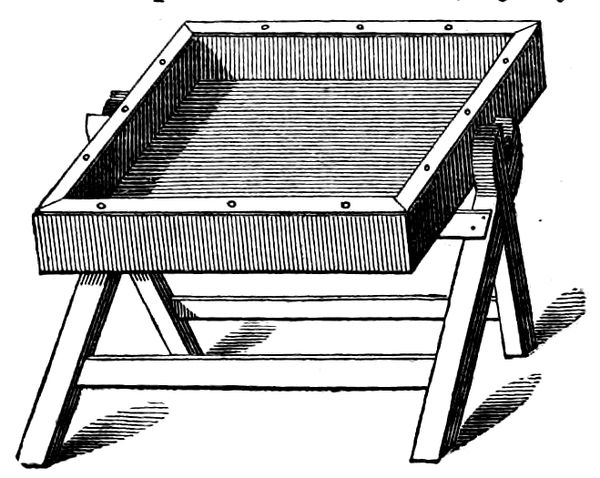
The lye trough is square and shallow, lined with lead, and its upper edge is bound with iron to preserve it from injury, which would otherwise arise from concussion when a form is lifted into it; there is also a loose board laid in it for the protection of the bottom. It is suspended on a frame by two centres, as here represented.
There is always some lye kept in this trough; and when a form has been worked off, it is laid in it, and the ink is brushed from the face of the letter, the furniture, and chase with the lye, previous to rinsing it with water. It is usually made capable of containing a royal chase.
MACHINES.
Cylindrical printing, or, as it is generally termed, Machine printing, is a new mode of obtaining impressions from types, the introduction of which took place in the year 1814. It has caused a great revolution in the art, from the facilities which it affords for printing sheets of paper of a size of which no press worked by manual labour is capable, nor, were it capable, is the strength of one man equal[449] to the exertion requisite for the pressure necessary to produce a respectable impression. In addition to this advantage of printing sheets of such larger dimensions, it possesses the power of multiplying impressions so rapidly as to appear like the work of magic. This may seem hyperbolical; but the average rate of working at a press for common work, that is the general run of book work, with two men, one to ink the types, and the other to work the press, is but 250 copies an hour, while a machine will produce 1,250 copies in the same time; and considerably more might be obtained, were not its powers restrained by the limited human means of feeding it with paper, it being found by experience that the number stated is the extent to which one person could supply it, he having regard to laying on the sheets evenly, so as to preserve a regular margin: but this speed was not deemed sufficient to meet the wants that were felt, and the Times newspaper is now printed at a machine where the paper is laid on at four places, one form of which, consisting of four pages, is printed at the astonishing rate of 4,320 an hour at its ordinary rate of working, a fact which I have seen and ascertained myself, by counting its motions with a seconds watch in my hand. Mr. Richard Taylor has also a similar Machine at which the Weekly Dispatch is printed. Considering what has been done, I cannot see a reason why the paper should not be supplied at six or eight places, if found necessary, so as to increase the number printed to 6,000 or 8,000 in an hour; as the wonder ceases when we remember that steam is the moving power. Of the comparative merits of the Machine and the Press I shall speak subsequently.
As the details of the invention are not generally known, I will give some account of them, letting the parties speak for themselves, so far as I have been able to procure their own statements. The first is the Specification of the Patent granted to Mr. William Nicholson; the next, Observations on the Art of Printing Books, &c., written by him, and published in his own Journal, which clearly describe the present machines and inking apparatus. This specification, and the other details, with the engravings, will render it unnecessary for me to enter into a lengthened description of these machines, or do more than merely state that the form is imposed in the usual manner, laid upon a horizontal table, which travels under a cylinder covered with woollen cloth, adjusted so as to have a proper bearing upon the types in order to produce an impression, and that the inking apparatus is at one end, consisting of small rollers, which take and distribute ink upon another table, for each impression, when the form in travelling passes under one of them to receive its coating of ink.
“Specification of the Patent granted to Mr. William Nicholson, of New North-Street, Red Lion-Square; for a Machine or Instrument for printing on Paper, Linen, Cotton, Woollen, and other Articles, in a more neat, cheap, and accurate Manner, than is effected by the Machines now in use. Dated April 29, 1790.
“To all to whom these presents shall come, &c. Now know ye that, in compliance with the said proviso, I the said William Nicholson do hereby declare, that my said invention is described in the plan hereunto annexed, and the description thereof hereunder written, and in manner following; that is to say, my invention consists in three parts or particulars; namely, first, the manner or method of making, preparing, or placing, the original model, models, casts, types, engravings, carvings, or sculptures from which the impression is to be made. Secondly, in applying the ink, or colouring-matter, to such models, casts, types, engravings, carvings, or sculptures. And, thirdly, in taking off the impression, or transferring the ink, or colouring-matter, from such models, casts, types, engravings, carvings, or sculptures, to the paper, cloth, or other material upon which it is intended it should remain.
“I. In the first place then, I not only avail myself of all the methods of making, preparing, and placing, the original models, casts, types, engravings, carvings, or sculptures which have hitherto been known or used in printing, and do myself make use of them in conjunction with my newly-invented method of applying the ink, or colouring-matter, to such original models, casts, types, engravings, carvings, or sculptures, and also with my newly-invented method of taking off the impressions, but I do likewise make, put together, and arrange them in a new manner, as occasion may require; that is to say,
“II. I make my moulds, punches, and matrices, for casting letters, in the same manner, and with the same materials, as other letter-founders do, excepting that, instead of leaving a space in the mould for the stem of one letter only, I leave spaces for two, three, or more letters, to be cast at one pouring of the metal; and at the lower extremity of each of those spaces (which communicate by a common groove at top) I place a matrix, or piece of copper with the letter punched upon its face in the usual way. And moreover, I bring the stem of my letters to a due form and finish, not only by rubbing it on a stone, and scraping it when arranged in the finishing-stick, but likewise by scraping it on one or more sides, in a finishing-stick whose hollowed part is less deep at the inner than the outer side. I call that side of the groove which is nearest the face of the disposed letter, the outer side; and the purpose accomplished by this method of scraping is, that of rendering the tail of the letter gradually smaller the more remote it is, or farther from the face. Such letter may be firmly imposed upon a cylindrical surface, in the same manner as common letter is imposed upon a flat stone. I specify and affirm that the above described methods of casting two or more letters at once, and of chamfering or sloping their tails, are parts of my new invention.
“III. I impose or dispose my letter for printing in the common manner, to be used in conjunction with my newly-invented improvements. And I likewise impose it in frames or chases adapted to the surface of a cylinder of wood, or metal, and fasten it to the said surface by screws, or wedges, or in grooves, or by other methods well known to workmen; and this imposing letter upon a cylinder I state and affirm to be part of my new invention.
“IV. I cut, carve, engrave, chase, cast, model or make, (in the usual manner of performing those operations,) blocks, forms, plates, types, or originals, to be used for printing, either of wood, metal, or other materials; and these I use in conjunction with my other newly-invented improvements. I likewise, for other kinds of work, do fasten with glue, cement, screws, wedges, or by other known methods, such blocks, forms, plates, types, or originals, as aforesaid, to the surface of a cylinder. I likewise, for other kinds of work, do cut, carve, engrave, chase, cast, model or make, blocks, forms, plates, types, or originals, as aforesaid, of a cylindrical form, of wood, metal, or other materials. And I state and affirm that this disposition of blocks, forms, plates, types, or originals, upon a cylinder, and also that the cutting, carving, engraving, chasing and casting, modelling or making, blocks, plates, types, or originals, of a cylindrical form, as aforesaid, are parts of my new invention.
“V. In the second place, I distribute or apply the ink, or colouring-matter, upon the surface, or in the interstices, of the blocks, forms, plates, types, or originals aforesaid, by causing the surface of a cylinder, smeared or wetted with the colouring-matter, to roll over, or successively apply itself to, the surfaces of the said blocks, forms, plates, types, or originals, of whatever figure or construction such blocks, forms, plates, types, or originals, may be. Or else I cause the said blocks, forms, plates, types, or originals, successively to apply themselves to the said cylinder. I call the said smeared or wetted cylinder, the colouring-cylinder. Its surface is covered with leather, or the dressed skins which printers call pelts, or else it is covered with woollen, or linen, or cotton cloth. When the colour to be used is thin, as in calico-printing, and in almost every case, the covering is supported by a firm elastic stuffing, consisting of hair, or wool, or woollen cloth wrapped one or more folds round the cylinder. When the covering consists of woollen cloth, the stuffing must be defended by leather, or oilskin, to prevent its imbibing too much colour, and by that means losing its elasticity. It is absolutely necessary that the colouring-matter be evenly distributed over the surface of the cylinder; for this purpose, when the colour is thick and stiff, as in letter-press printing, I apply two, three, or more small cylinders, called distributing-rollers, longitudinally against the colouring-cylinders, so that they may be turned by the motion of the latter; and the effect of this application is, that every lump or mass of colour which may be redundant, or irregularly placed upon the face of the colouring-cylinder, will be pressed, spread, and partly taken up, and carried by the small rollers to the other parts of the colouring-cylinder; so that this last will very speedily acquire and preserve an even face of colour. But if the colouring-matter be thinner, I do not apply more than one or two of these distributing rollers; and, if it be very thin, I apply an even blunt[451] edge of metal, or wood, or other material, or a straight brush, or both of these last, against the colouring-cylinder, for the purpose of rendering its colour uniform.
“VI. When I apply colour to an engraved plate, or cylinder, or apply the colour through the interstices of a perforated pattern, or cylinder, as in the manufacturing of some kinds of paper-hangings and floor-cloths, I use a cylinder entirely covered with hair or bristles, in the manner of a brush.
“VII. The whole of the manipulations or practices described in the two preceding paragraphs (numbers V. and VI.) are parts of my invention.
“VIII. In the third place, I perform all my impressions by the action of a cylinder or cylindrical surface; that is to say, I cause the paper, or cloth, or other material intended to be printed upon, (and previously damped if necessary,) to pass between two cylinders, or segments of cylinders, in equal motion; one of which has the block, form, plate, assemblage of types, or originals, attached to, or forming part of, its surface, and the other is faced with cloth or leather, and serves to press the paper, cloth, or other material, as aforesaid, so as to take off an impression of the colour previously applied. Or otherwise, I cause the block, form, plate, assemblage of types, or originals, previously coloured, to pass in close and successive pressure or contact with the paper, or cloth, or other material, wrapped round a cylinder with woollen. Or otherwise, I cause the last mentioned cylinder, with the paper, or cloth, or other material wrapped round it, to roll along the face of the block, form, plate, assemblage of types, or originals, previously coloured. Or otherwise, I cause a cylinder having the block, form, plate, assemblage of types, or originals, attached to, or forming part of, its surface, to roll along the surface of the paper, cloth, or other material intended to be printed, and previously spread out upon an even plane covered with cloth or leather; the said cylinder being supplied with colour by means of a colouring-cylinder herein before described, and herein after more particularly to be noticed.
“IX. The foregoing description shews the nature of my invention; which may be applied to a great variety of uses, and constructed or put together in a great variety of forms. Its uses consist in the printing of books in general, the printing of paper-hangings, floor-cloths, cottons, linens, woollens, silks, ribands, laces, leather, skin, and every other flexible material whatever. And its form or construction, being no essential part of the invention, may without difficulty be obtained and carried into effect, by any workman possessed of common skill and ability. Nevertheless, as there may be some artists of such a moderate capacity as to find the foregoing instructions not sufficient to enable them to construct my machines, I shall proceed to exhibit drawings, and describe several methods of constructing them. But, at the same time, I think it pertinent to take notice, that as the following constructions cannot be exclusively claimed by me by virtue of his Majesty’s letters patent granted unto me, excepting so far as the same include or contain my new improvements and inventions, so, on the other hand, I do not exhibit the same as the only practical methods of carrying my invention into effect, but I claim the general and universal application of the principles discovered and brought into practice by me, as before described; and do here proceed to exhibit and describe certain specific applications of those principles, chiefly from a conviction that it is my duty to render this present specification clear and intelligible by every means in my power. And moreover, since in the following applications or particular methods there are, and may be found, several contrivances resulting from a considerable degree of deliberation, labour, and expence, and tending to facilitate the practice of my said inventions, I do not by any means hereby exclude the following descriptions and drawings from my present specification; for I do not consider them as being merely illustrative of the general principles herein before described and explained, but do hereby assert and maintain, that all and every parts and part of the machines herein after described, which have not hitherto been used as parts of some other machine, or in combination directed to the accomplishment of the like purpose of printing, are stated and claimed by me as parts of my said invention; for the exclusive enjoyment of which, as well as of every other part of the said invention hereby specified by me, I claim all protection and every advantage which, by his Majesty’s letters patent, I may lawfully be entitled to.
“Explanation or the annexed Drawings.
“Fig. 1. represents a printing-press, more especially applicable to the printing of sheets of paper, or books. A. and E. represent two cylinders running or turning in a strong frame of wood, of metal, or both. The cylinder A. is faced with woollen cloth, and is capable of being pressed with more or less force upon HI, by means of the lever M. HI is a long table, which is capable of moving endways, backwards and forwards, upon the rollers E and K. The roller A acts upon this table by means of a cog-wheel, or by straps, so as to draw it backwards and forwards by the motion of its handle L.[452] The table is kept in the same line by grooves on its sides, which contain the cylinder A. D is a chase, containing letter set up and imposed. B is a box, containing a colouring-roller, with its distributing-rollers CC; it is supported by the arm N. O is a cylinder faced with leather, and lying across an ink-block; this cylinder is fixed by the middle to a bended lever movable on the joint Q.

Fig. 1.
“The action. When D, or the letter, is drawn beneath the cylinder B, it receives ink; and when it has passed into the position R, a workman places or turns down a tympan with paper upon it; (this tympan differs in no respect from the usual one, except that its hinge opens sideways;) it then proceeds to pass under the cylinder A, which presses it successively through its whole surface. On the other side, at S, the workman takes off the paper, and leaves the tympan up. This motion causes the cylinder B to revolve continually, and consequently renders its inked surface very uniform, by the action of its distributing-rollers CC; and, when the table has passed to its extreme distance in the direction now spoken of, the arm G touches the lever P, and raises the cylinder O off the ink-block, by which means it dabs against one of the distributing-rollers, and gives it a small quantity of ink. The returning motion of the table carries the letter again under the roller B, which again inks it, and the process of printing another sheet goes on as before. N.B. The table in this drawing is not quite long enough in its dimensions, compared with the inking-roller.

Fig. 2.
“Fig. 2. is another printing-press: in this, B is the inking-roller; A is a cylinder, having the letter imposed upon its surface; and E is a cylinder, having its uniform surface covered with woollen cloth: these three cylinders are connected, either by cogs or straps at the edges of each. The machine is uniformly turned in one direction by the handle L. The workman applies a sheet of paper to the surface of E, where it is retained, either by points in the usual manner, or by the apparatus to be described in treating of Fig. 4. The paper passes between E and A, and receives an impression; after which the workman takes it off, and applies another sheet; and in the mean time[453] the letter on the surface of A passes round against the surface of B, and receives ink during the rotation of B. The distributing-rollers CC do their office as in the machine Fig. 1.; and once in every revolution the tail F, affixed to B, raises the inking-piece G, so as to cause it to touch one of the distributing-rollers, and supply it with ink. In this way therefore the repeated printing of sheet after sheet goes on.
“Fig. 3. is a printing-press, more particularly adapted to print cottons, silks, paper-hangings, or other articles which run of a considerable length.
“Fig. 4. is a printing-press, chiefly of use for books and papers. 1 2 3 4 represents a long table, with ledges on each side; so that the two cylinders A and B can run backwards and forwards without any side shake. In one of these ledges is placed a strip or plate of metal cut into teeth which lock into correspondent teeth in each cylinder; by which means the two cylinders roll along, without the possibility of changing the relative positions of their surfaces at any determinate part of the table. This may also be effected by straps, and may indeed be accomplished, with tolerable accuracy, by the mere rolling of the cylinders on the smooth or flat ledges without any provision. A is the printing-cylinder, covered with woollen cloth, and B is the inking-cylinder, with its distributing-rollers. The table may be divided into four compartments, marked with a thicker bounding-line than the rest, and numbered 1 2 3 4. At 1 is placed a sheet of paper; at 2 is the form or chase, containing letter set and imposed; at 3 is an apparatus for receiving the printed sheet; and 4 is employed in no other use than as a place of standing for the carriage E, after it has passed through one operation, and when it takes ink at F. Its action is as follows: the carriage is thrust forward by the workman, and as the roller A passes over the space numbered 1, it takes up the sheet of paper previously laid there, while the roller B runs over the form and inks the letter. The sheet of paper, being wrapped round the cylinder A, is pressed against the form as that cylinder proceeds, and consequently it receives an impression. When A arrives at the space numbered 3, it lets go the sheet of paper, while the prominent part of the carriage, G, strikes the lever P, and raises the inking-piece, which applies itself against one of the distributing-rollers. In this manner therefore the cylinder A returns empty, and the cylinder B inked, and in the mean time the workman places another sheet of paper ready in the space numbered 1. Thus it is that the operation proceeds in the printing of one sheet after another.
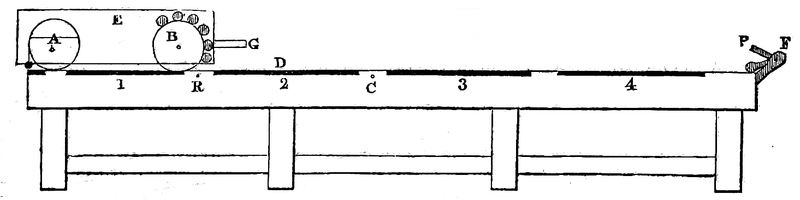
Fig. 4.
“The preceding description is not incumbered with an account of the apparatus by which the paper is taken up and laid down. This may be done in several ways: Figs. 9 and 10 represent one of the methods. D E is a lever, moving on the centre pin C, and having its end D pressed upwards by the action of the spring G. The shoulder which contains the pin C is fixed in another piece F, which is inserted in a groove in the surface of the cylinder A; (Fig. 4;) so that it is capable of moving in and out, in a direction parallel to the axis of that cylinder. As that cylinder proceeds, it meets a pin in the table; which, (letter P, Fig. 9,) acting on the inclined plane at the other end of the lever, throws the whole inwards, in the position represented in Fig. 10; in which case the extremity D shoots inwards, and applies itself against the side of the cylinder.

Fig. 9. Fig. 10.
“In Fig. 11 is a representation of part of the table; the dotted square represents a sheet of paper, and the four small shaded squares denote holes in the board, with pins standing beside them. When the lever DE (Fig. 10) shoots forward, it is situated in one of these holes, and advances under the edge of the paper, which consequently it presses and retains against the cylinder with its extremity D. Nothing more remains to be said respecting the taking up, but that the cylinder is provided with two pair of these clasps or levers, which are so fixed as to correspond with the four holes represented in Fig. 11. It will be easy to understand how the paper is deposited in the compartment No. 3. (Fig. 4.) A pin P, (Fig. 10,) rising out of the platform or table, acts against a pin E, projecting sideways out of the lever, and must of course draw the slider and its lever to the original position; the paper consequently will be let go, and its disengagement is rendered certain by an apparatus fixed in the compartment numbered 3, (Fig. 4,) of exactly the same kind as that upon the cylinder, and which by the action of a pin duly placed in the surface of the cylinder A, takes the paper from the cylinder in precisely the same manner as that cylinder originally took it up in the compartment numbered 1. (Fig. 4.)
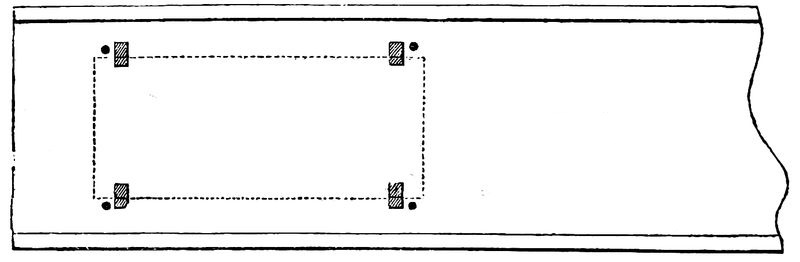
Fig. 11.
“Figs. 5, 6, and 7, represent a simpler apparatus for accomplishing the same purpose. If Aa Bb (Fig. 7) be supposed to represent a thick plate of metal of a circular form, with two pins A and B proceeding sideways or perpendicularly out of its plane, and diametrically opposite to each other, and G another pin proceeding in the direction of that plane, then it is obvious that any force applied to the pin A, so as to press it into the position a, (by turning the plate on its axis or centre X,) will at the same time cause the pin G to acquire the position g; and, on the other hand, when B is at b, or the dotted representation of the side-pin, if any pressure be applied to restore its original position at B, the pin g will return back to G. Now the figures 5 and 6 exhibit an apparatus of this kind, applied to the cylinder A; and that cylinder, by rolling over the pins P and p, properly fixed in the table to re-act upon the apparatus, will cause its prominent part G, either to apply to the cylinder and clasp the paper, or to rise up and let it go. The compartment numbered 3 (Fig. 4) must of course have an apparatus of the same kind, to be acted upon by pins from A, in order that it may take the paper from that cylinder.

Fig. 5. Fig. 6. Fig. 7.
“There is one other circumstance belonging to this machine which remains to be explained. When the carriage E (Fig. 4) goes out in the direction of the numbers 1 2 3 4, both rollers, A and B, press the form of letter in their passage; but in their[455] return back again the roller A, having no paper upon it, would itself become soiled, by taking a faint impression from the letter, if it were not prevented from touching it: the manner of effecting this may be understood from Fig. 12. The apparatus there represented is fixed upon the outside of the carriage E, near the lower corner, in the vicinity of the roller A; the whole of this projects sideways beyond the ledge of the table, except the small truck or wheel B. The irregularly triangular piece, which is shaded by the stroke of the pen, carries this wheel, and also a catch movable on the axis or pin E. The whole piece is movable on the pin A, which connects it to the carriage. C D, or the part which is shaded by dotting, is a detent which serves to hold the piece down in a certain position. It may be observed, that both the detent and the triangular piece are furnished each with a claw, which holds in one direction, but trips or yields in the other, like the jacks of a harpsicord, or resembling certain pieces used in clock and watch making, as is clearly represented in the drawing. These claws over-hang the side of the table, and their effect is as follows. There is a pin C (Fig. 4) between the compartments of the table numbered 2 and 3, but which is marked F in Fig. 12, where G H represents the table. In the outward run of the carriage these claws strike that pin, but with no other effect than that they yield for an instant, and as instantly resume their original position by the action of their respective slender back-springs. When the carriage returns, the claw of the detent indeed strikes the pin, but with as little effect as before, because its derangement is instantly removed by the action of the back-spring of the detent itself; but, when the claw of the triangular piece takes the pin, the whole piece is made to revolve on its axis or pin A, the wheel B is forced down, so as to lift that end of the carriage, and the detent, catching on the piece at C, prevents the former position from being recovered. The consequence of this is, that the carriage runs upon the truck B, (and its correspondent truck on the opposite side,) instead of the cylinder A, which is too much raised to take the letter, and soil itself; but, as soon as the end of the carriage has passed clear of the letter, another pin R (Fig. 4) takes the claw of the detent, and draws it off the triangular piece; at which instant the cylinder A subsides to its usual place, and performs its functions as before. This last pin R does not affect the claw of the triangular piece, because it is placed too low; and the claw of the detent is made the longest, on purpose that it may strike this pin.

Fig. 12.
“Fig. 8 represents an instrument for printing floor-cloths, paper-hangings, and the like, with stiff paint and a brush.”
“Lastly, I must take notice, that in these and every other of my machines, as well as in every machine whatever, the power may be wind, water, steam, animal strength, or any other natural change capable of producing motion; and that the mechanism by which such powers may be applied to produce a regular unceasing, or an intermitting, motion, as circumstances may require, may be used with these machines, though I have held it totally unnecessary either to specify or annex those methods. The materials, the adjustments, the fittings, and that degree of accuracy necessary to the perfection of every machine, have likewise made no part of my specification, because every workman must know that no mechanism can be completed without a due attention to these well-known particulars. In witness whereof, &c.”—Repertory of Arts, &c. vol. v. 1796.
“Observations on the Art of Printing Books and Piece Goods by the Action of Cylinders.”
——Experto credite.
“We may conceive three ways of delineating figures, or writing. The first and most ancient consists in making the traces successively by a brush, a pen, or other instrument. This is design, painting, or writing. In the latter methods, either the whole or the greater part of the figures are made by the action or pressure of an original pattern against the material intended to be written or painted upon. It is the art of printing. The colouring is either deposited from the face of prominent parts of the original form, which is usually called a block or type; or else it is pressed from cavities cut in the face of the original, which in this case is called an engraved plate. Most books are printed from original patterns, in relief; and most of the imitations of paintings are performed by means of engravings. These arts are most frequently distinguished by the names of letter-press and copper-plate printing.
“It can scarcely be matter of new information to those who are but moderately acquainted with the state of the Arts, to be told that letter-press or book-printing is performed by an assemblage of single metallic letters, called types, made of lead hardened by an addition of antimony in the metallic state; that these letters are composed in the form of book pages, and wedged together in iron frames called chases; that the ink is a composition of linseed oil and lamp black, of so singular a nature, that it will adhere to a ball covered with a pelt or sheep’s skin soaked in water, and kneaded to extreme softness under the feet, but quits this skin with great readiness to apply to the face of the[456] letter when dabbed with the ball; and still more, that it almost totally quits the letter to adhere to paper rendered semitransparent by soaking in water; or lastly, that the paper is applied and pressed against the form of composed letter by means of a flat piece of wood urged downwards by a screw. These and numerous early discovered principles of this most useful art are generally known, and require no more than mere recapitulation in this place.
“The genius of the Chinese language not permitting that people to analyse its sounds into an alphabet, as has been done by most other nations, has induced them to retain those signs of things, and of their correspondent words, which probably constituted the first picture or hieroglyphic writings of every rude society. Changed and complicated as these may have become by the rapidity of transcription, the corruption of ignorance, or whatever other causes may have operated through a long succession of ages, they still for the most part use words that properly denote things, and not sounds. Such words cannot, therefore, be subdivided; and it has accordingly been found most convenient, by these first possessors of the art, to print from entire blocks, as was also done by the first printers in Europe. But our artists soon discovered that a few of the simplest characters, namely, the letters of the alphabet, would be in many respects more useful, as the elements for composing blocks for printers, than a number of blocks originally cut for every page of every individual book.
“Book-printing, therefore, though in fact of the same nature as block-printing, has been carried into effect by very different machinery from that made use of in the arts which still retain the latter method. In book-printing, the heavy metallic form lies on a kind of table, and the colour and the paper are successively applied to its face: but in block-printing, the block is carried and applied to the colour, and afterwards to the work intended to be printed. Thus, for example, in the printing of paper-hangings, the colour is spread with a brush upon a woollen cloth stretched over a surface of parchment or skin evenly supported by a half fluid mass of water and mashed paper. To this the block is carefully applied by a slight perpendicular stroke or two; after which it is applied to the dry paper on a table, and pressed against it either by one or more blows with a mallet, or by the regular action of a lever. The mechanical part of callico-printing is effected nearly in the same manner; but with smaller blocks, because of the greater difficulty of making the successive fittings on so flexible a material. And in both these arts, as well as in book-printing, in red and black, the variety of colours are produced by repeated applications of forms or blocks, of which the prominent parts are made to fit each other according to the nature of the design.
“In the art of printing from copper-plates, a colour somewhat more fluid than for book-printing is made use of. It is pressed into the cavities of the plate by smearing it over the surface; and by subsequent careful wiping the redundant colour is cleared away. In this state, if soaked paper, for which purpose the most spongy texture is the best, be strongly pressed against the plate, by passing both together between two cylinders of metal or hard wood, properly defended by woollen cloth, the greatest part of the colour adheres to the paper, and forms what is called a print.
“In all these processes, it is easily seen, that in the successive applications of colour, the accurate filling of the form or original with the material intended to receive the impression, and in various other parts of the manipulation, there is much room for the display of skill, or for injury from the want of it. It may moreover be collected, that the motions attendant on the various steps of manufacture, are in many instances difficult to be performed with rapidity and ease, until by long continued habit the workman himself is converted as it were into a machine. A very slight degree of attention to this subject must also shew that, if the originals were of a cylindric form, with a contrivance for regularly applying the colour and performing the subsequent operations, it would be easy to print books and piece goods with a degree of rapidity and uniformity, of which the usual method of successive applications seems scarcely capable without uncommon care and skill. This obvious conclusion has no doubt led to numerous experiments; none of which, so far as I can gather, whatever may have been their particular utility, have given much promise to supersede the ordinary methods. But as the increased demand for the manufacture of printed goods has rendered such an improvement an interesting object to manufacturers, as well as to those indefatigable artists who have directed their efforts towards improvements; and as the latter generally take up a new object under a strong persuasion that it has not before been pursued by others, it will certainly be of advantage to these deserving classes of men, to relate a few of the difficulties of this new art.
“The difficulties attendant on any improvement in the arts may be considered either as moral or physical. Under the moral, I would class every thing that relates to the prejudices of men in favour of the old methods, and their fears of risk, together with the œconomical and commercial inconveniencies attending the new processes. The[457] physical difficulties are such as attend the actual performance of any project after the same has been carefully arranged in the mind of the inventor. It happens unfortunately here also that the inventor is seldom aware of the moral impediments; but almost always concludes, that if he can succeed in accomplishing the purpose that he has in view, his cares and labour will then be at an end; and that the manufacturer, in particular, instead of pointing out new impediments discernible only from long continued experience, will more readily embrace and approve of the new processes, in consequence of his superior knowledge of their intrinsic value.
“Every good invention appears simple in the prospect, but it scarcely ever happens in the execution that the most direct road is taken; and in every case there will infallibly be many things unknown or unforeseen, which practice only can point out as necessary to be done for the complete accomplishment of the object in view. Hence, and likewise because few men possessed of independent fortune are likely to engage or persevere in a labour of this kind, it almost invariably happens that the expences exceed the ability of the inventor himself. For these and other reasons, new undertakings are generally brought forward by the inventor, a man strongly prejudiced in favour of his leading pursuit, together with a moneyed friend, who hopes speedily to increase his capital from the abilities of the other. It is not necessary in this place to describe the usual consequences of a partnership, where the minds, the views, and the circumstances of both individuals are so very different, and which may be modified still more essentially if either of the parties be deficient in the common principles required to bind men to each other. It is certainly of the highest importance to both, that the circumstances of such connections should be very maturely weighed before they are entered into.
“The commercial difficulties or facilities attending any invention, are also of great consequence. Every inventor ought to enquire not only what has been done before, but likewise into the present state of the manufacture he means to improve. In this way it is ascertained how small a part the mere press-work constitutes in the price of a book. He will find that twelve yards of paper-hangings are printed for one penny, in a single colour, by hand, which afterwards, by the accumulation of price, in paper, colour, duty, and ordinary profit, are sold for three shillings; none of which the inventor can pretend to diminish; and if he could annihilate the whole labour, his advantage would therefore be less than three per cent. without reckoning the cost and operation of his machinery. In the callico-printing, with a more expensive material, dyeing and field-processes, duty and profits of manufacture and vender, the price of laying the block will turn out to be an object still less considerable. Again: it will be seen that small flat blocks cost but little money in comparison with cylinders of sufficient diameter to retain their figure, and long enough to apply to the whole breadth of the cloth.
“Under these and other similar points of view, the inventor, who may consider the subject in a superficial manner, would be ready to abandon his undertaking. But this again ought not to be rashly done. It is true, that where the great force of capital is employed on objects not comprehended within his project, the saving, however large in its absolute amount, or desirable to a manufacturer, will scarcely come within the reach of the inventor by any bargain he can make short of an actual partnership. But it may be possible to separate the respective departments of a manufactory. A spinner is not necessarily a weaver; nor a printer a linen-draper or a dealer in paper-hangings. The several departments of manufacture and commerce are, generally speaking, in the hands of acute men, who seldom reason ill with regard to the advancement of their peculiar interests; and these departments are continually fluctuating in their arrangement, as convenience, profit, or the accumulation of capital may lead. Experiments are for ever on foot, from day-work to piece-work, and from piece-work to the employ of master-workmen with others under them, all supported by the capital of the large manufacturer, who himself in many instances is the mere instrument maintained by the advances or acceptances of the warehouseman, the factor, or the merchant. An inventor, who has not capital, may seek for employ on the goods or the capital of others; and if he has skill to maintain his ground against the numerous enterprises which the activity of opposite interests will raise against him, he will find that the old order of things will readily alter, as soon as an evident interest in favour of the new is shewn by actual and continued proofs in the market.
“Most of the physical difficulties attendant on any new process are such as experience only can shew. Thus, in the forging of iron by the pressure of rollers instead of hammers, a scheme upon which many thousands of pounds have been expended in this country, it was apprehended that the more impure parts, which are also the most fluid, might be pressed out by the action of cylinders, with equal or perhaps more advantage than by that of hammers; at the same time that the determinate figure[458] of bars of any required size might be given without skill in the operator. Experience nevertheless has shewn, that the more fluid part is driven out much more effectually by the sudden action of a blow, than by the slower compression of a cylinder, which allows time for much of the fluid matter to extend itself within the mass. Various similar effects present themselves when cylinders for printing are substituted instead of planes. Instead of the action of dabbing, the colour is usually applied by simple and gradual contact, to much less effect; and the impression, though not essentially different from that of the block, is performed by a gradual action, which affords time for the cloth or paper to fold itself in a minute degree into the cavities of the sculpture. Hence it is found that the length of paper or cloth printed from a cylinder by a definite number of revolutions, will be greater or less than another piece manufactured precisely in the same way, but with a less or greater degree of pressure. In a block this defect is much less, not only from the considerable hold it takes upon the surface of the material, but also because the error is rectified at every successive application. One of the chief difficulties of cylinder printing consists, therefore, in the difficulty of laying one colour after another; and this would continue to be so even if the materials were not susceptible of change, the contrary to which is the fact. There are two projects for obviating this. The one consists in confining the whole piece to a long table, or to the circumference of a large cylinder; and causing the printing cylinder to move, not by the successive apposition of its carved surface, but of a bearing face regulated by a toothed wheel. The other method consists in the use of a frame to confine two or more cylinders, each provided with its own toothed wheel, and revolving against a large clothed cylinder provided with a suitable wheel to drive the others. The piece is caused to pass between the large cylinder and the others, in order to receive the impression. With regard to the first of these methods, it does not appear easy to confine paper, and still less cloth, in such a manner that its parts may continue without shift or wrinkle during the action of a cylinder, which not being allowed to roll without the check of a wheel, must draw the surface either the one way or the other. The difficulty of confinement will be very much increased by the indispensable requisite that the paper should be afterwards hung up to dry, and the callico be carried to the dye-house and the bleach-field, between the successive impressions, by which means the dimensions of both will be greatly altered. In the second method, it is observable that no colours can be printed but such as fall clear of each other. In this way, moreover, the gathering action of the cylinders may prove very mischievous. For, if we suppose the paper or cloth to pass between the great cylinder and the first printing roller by an action of the latter which tends to make it slip forward on the face of the great cylinder, and that when it arrives at the second printing roller it there experiences an action of a contrary nature, the consequence will be, that the material will become slack between the two rollers, and the fittings will be false. Not to dwell on that experience which brings forward this obstacle among others, its great probability may be deduced from the allowable supposition, that the circumference of the first printing cylinder should be one thousandth part of an inch too large, and that of the second the same quantity too small. For, in this case, the material will be shifted one-twentieth of an inch in fifty turns by the first cylinder, and the same quantity in the contrary direction by the second; a quantity upon the whole quite sufficient to destroy the effect of the colours in the progress of one single piece. Such minute differences can hardly be avoided in the first instance; in addition to which, we may place the varying dimensions of the printing cylinder, if not made of metal; and of the great clothed cylinder, which in effect has a larger or smaller diameter in proportion to the pressure which operates to render its elastic covering either thicker or thinner. The only method of diminishing these evils seems to be, that all the printing cylinders should, by dimension or pressure, or both, be made to draw the same way, the outer cylinder most, and the others gradually less and less, so that the material should have a tendency to apply itself more tightly during its passage through the apparatus.
“The application of the colour to the surface of a cylinder block, is attended with some difficulty. An ingenious mechanic may contrive various means to produce the action of dabbing, if required. When a stuffed cylinder covered with cloth is made to revolve in the colour, and thence, after passing a scraper, to apply itself to the block cylinder, it is found to be no inconsiderable difficulty that its dimensions change, and its covering becomes wrinkled by the action of the scraper as well as that of the block. A better method, therefore, consists in a revolving web of woollen cloth, like a jack towel, stretched over three horizontal cylinders parallel to each other, two of which support the elastic surface of the web, which in its revolution accompanies the block cylinder; and the other serves to guide the same web to the colour, or a cylinder revolving in it. This method would be very easy and pleasant in its operation, if it were not for a property common to all straps which revolve on the surface of two or[459] more wheels. These are observed always to seek the highest place; so that if a cutler’s wheel were made with a groove to carry a strap, instead of a round edge, the strap would infallibly mount the ledge, instead of remaining in the groove. On this principle, the web would very speedily shift itself to one end of the cylinders, if it were not confined sideways, or the lower roller were not made considerably thickest in the middle, and gradually tapering towards its extremities. This last simple expedient is not without its difficulties; but, as I have not actually tried it, I shall defer entering into any discussion on that head.
“The running of the paper or piece-goods towards one end of the leading cylinder is also one of the greatest difficulties attending this method of printing. It is not perfectly removed by tapering the leading cylinders.
“The nature of the trade of paper-staining in this country, which requires a large sum to be immediately vested in the payment of the excise duty, and consequently prevents any considerable stock from being manufactured until orders are actually received, and the varying fashions in printed callicoes, which render the expence of cutting the block by for the heaviest part of the disbursement for printing, are probably the chief reasons why manufacturers in this country have been less solicitous for the construction of machines calculated to afford profit only in the case of very numerous impressions. The physical difficulties of this art have likewise conspired, in no small degree, to prevent its having been applied in the large way to any but a few simple designs of the sort called running patterns in one colour.”—Nicholson’s Journal, vol. i. 1797.
The following is the statement respecting König’s machine, which was the first that was made; it appeared in the Literary Gazette, with an engraving; and as that Gazette was at the time printed by Mr. Benjamin Bensley, at a machine, as well as from other circumstances, I am led to believe that the information contained in it was supplied by Mr. Bensley himself, and that, as far as it goes, it may be relied upon.
“The cylindrical mode of printing, which, in contradistinction to the old process by the press, is called Machine Printing, was invented by the late Mr. Nicholson, well known in the scientific and literary world, who took out a patent in the year 1790, though it does not appear that his plans and experiments ended in any actually practical result. Whether M. König, who at a later period more successfully attempted to print by machinery, was indebted to Mr. Nicholson for his elementary principles, or whether almost the same ideas spontaneously occurred to each individual, is a question that can only be satisfactorily solved by the former. Thus much is certain, that M. König’s labours were the first which produced any fruit:—and surely more is due to him who, after years of persevering toil, succeeds in the application of hitherto unapplied principles, than to one of whom we can only say that he was simply the first to suggest ideas—since no evidence is offered of their ever having been acted upon.
“M. König, by birth a Saxon, and by occupation a printer, many years ago conceived it possible to print by Steam, though he then expected no more than to be able to give accelerated speed to the common press, to which end his first efforts were bent. As from the nature of such an undertaking, considering the state of scientific pursuits in his native land, he could calculate on little success unaided by others, and failing in his application for encouragement and support at the hands of the most eminent printers in several of the continental capitals, he turned his eyes towards England. Arriving in London about 1804, he submitted his scheme to several printers of repute, who, not being disposed to incur the risk of property which a series of experiments was sure to entail, and perhaps placing little confidence in a successful issue, received his overtures very coolly: and it is probable his applications in this country would have shared the fate of similar attempts abroad, had he not finally been introduced to Mr. Bensley senior, who, attracted by M. K.’s plans, speedily entered into an arrangement with him. After a short course of experiments on the fabrication of a press which should have accelerated motion, and at the same time render the work of the man who inks the type unnecessary, the above gentlemen were joined by Mr. G. Woodfall and Mr. R. Taylor, the former of whom however soon retired; the remaining three, in nowise discouraged by the tediousness and expense which all who are conversant with the progress of any invention in machinery well know to be unavoidable, persevered amidst unforeseen perplexities, which were doubtless not diminished by the parties’ deficiency in practical mechanical knowledge. It was at length discovered that the intended improvement of the common press could not be brought to bear—and that much labour and prodigious expence would be thrown away, unless more radical alterations were invented. Cylindrical printing was now thought of—and[460] after some two or three years of renewed exertion, a small machine was brought forth, the characteristic of which was, that instead of the printing being produced by a flat impression (similar to the press) the sheet passed between a large roller and the types still flat; and in lieu of the old fashioned balls, used by hand to beat over the types and so to communicate the ink to their surface, skins were strained round smaller rollers, on which it was contrived to spread the ink, and under which the Form, i. e. the frame in which the types are fixed, passed in its way to the printing cylinder. Considerable promise of success attended this production; and after continued experiments, it was deemed practicable to extend the general principles to a more powerful machine. To print a newspaper was considered highly desirable—and on exhibiting to Mr. Walters, proprietor of the Times Newspaper, the Machine already erected, and shewing what further improvements were contemplated, an agreement was entered into with that gentleman for the erection of two large machines for printing his Journal. So secret had been the operations of the patentees, that the first public intimation of their invention was given to the reader of The Times on Monday the 28th of November, 1814, who was told that he then held in his hand one of many thousand impressions thrown off by steam. At this time but few persons knew of any attempt going on for the attainment of the above object; whilst among those connected with printing, it had often been talked of, but treated as chimerical.
“The machines at the Times Office, cumbrous and complicated as subsequent improvements have made them appear, are yet in many respects admirably adapted to the purpose for which they were erected, and it is believed will outlast many contrivances for printing which have been since brought out.
“The next advance in improvement was the manufacture of a machine for Messrs. Bensley, distinguished from those before mentioned by the mode of perfecting (or printing on both sides)—so that the sheet of white paper is placed in the feeder, and delivered from the machine printed on both sides! In addition to the essential difference between this machine and those previously made, it came forth with many obvious improvements, though still unquestionably complex:—and for the first attempt at effecting register (causing the pages to fall precisely on the back of one another) a greater degree of success than might have been expected was attained, subsequent experience shewing the many difficulties to be surmounted in the accomplishment of this object. Deficiencies were now detected in the inking: the strained skins were found uneven in their surface; and attempts were made to clothe the rollers with an elastic preparation of glue, treacle, &c. which has at length attained perfection.
“By this time the invention had attracted the attention of various individuals, who thought the manufacture of printing machines an easier task than they afterwards found it to be; and far the greater number of attempts, we believe, failed almost as soon as undertaken. A machine, however, similar in its capacities to that last mentioned, but much more simple in its construction, has been brought out—under the direction of some eminent engineers. It was not long before these gentlemen were requested to apply their inking apparatus to Messrs. Bensley’s machine; and at one stroke, as it were, forty wheels were removed—so great was the simplification: and at the same time the defects of the former system, of communicating the ink to the types, were most effectually remedied. Massive and complicated as it was, yet as an immense expense had been incurred in its erection, Messrs. Bensley went on using their machine until the destruction of their establishment by fire in 1819. And even after the rebuilding of the premises, the machinery, which had been only partially damaged, was reinstated, and worked for some time:—it has now, however, given place to two large and admirable machines built on the improved plan, which when inspected by a judicious eye can only create wonder at the heretofore circuitous manner adopted to attain ends so apparently within easy reach. The writer has no hesitation in stating that the original machine contained upwards of one hundred wheels; whereas the new machine, with about ten wheels, accomplishes, in point of quantity, exactly the same object, and with a marked advantage in regard to the quality of the printing. Another important point respecting the new machine is, that it occupies scarcely half the space of the original one.
“The printing machine in its present state appears susceptible of little improvement. It produces excellent work, and its movements are attended with certainty and despatch—the double, or perfecting, machine throwing off 800 to 1000 sheets, printed on both sides, within the hour,—and the single machine delivering 1500 or 1600 done on one side: which, in cases where one form of the types (as in newspapers) is ready to be worked off while the last side is preparing, is attended with the greatest advantage, since the rate of delivery thereby becomes doubled. The first is that by which our Gazette is printed, and the last described is that with which Mr. B. Bensley is now (and has for a considerable time been) printing the Morning Chronicle newspaper.
“Other leading daily newspapers are also wrought off by steam; as well as several[461] publications of extensive circulation. Like almost every ingenious invention, this has had no small portion of prejudice to encounter, and perhaps has been longer in forcing its way than many other schemes of real utility. The various advantages, however, which it holds forth have attracted the attention of several proprietors of the more extensive printing concerns, who have introduced it with benefit to the public—to whom, by means of this great reduction of labour, the productions of the press may be furnished at a reduced rate of charge.”—Literary Gazette, October 26, 1822.
It may, perhaps, be allowable to make a few observations on this statement, more particularly as Mr. Nicholson is seldom spoken of in connexion with printing machines, and when he is, it is in such a manner as to convey the impression that he was a visionary man, who had some imaginary scheme in his head which he was incompetent to carry into effect. To rebut this opinion I have given the specification of his patent, with his own observations on his invention, which certainly do not discover any symptoms of a weak or a speculative man. I knew Mr. Nicholson personally, and I have no doubt that, had he lived, he would have carried his invention into effect; but he had a number of other pursuits which occupied his time. He published a work on navigation, which I have seen quoted as authority for its opinions; he was the author of a Dictionary of Chemistry, in two quarto volumes; he edited and published monthly Nicholson’s Journal of Science, &c. which was in high repute; he wrote the Prospectus for the Royal Institution, on its establishment in 1799; and he likewise kept a large school in Soho Square, the leading feature of which was, a scientific education. I was, for ten years, in the habit of hearing in an undisguised manner the opinions of the most eminent scientific men in England,—as I held the office of Assistant Secretary to the Board of Managers of the Royal Institution, (the Secretary being an honorary officer,) also that of Secretary to the Patrons of the Library, and Secretary to the Committee of Chemistry, as well as Superintendant of their Printing Office,—and in all that time I never heard his name mentioned but with respect among these gentlemen, nor did I once hear him spoken of as a visionary who would project schemes that he was unable to execute. In addition to his multifarious pursuits, he was agent to the late Lord Camelford, whose sudden death left Mr. Nicholson involved in difficulties, from which he could never extricate himself.
Could this man, then, who planned the printing machine, and the manner of printing calico, &c. in an improved and expeditious manner, who moreover published the details of his process, with drawings of the requisite machines, be deemed, with justice, nothing more than “one of whom we can only say that he was simply the first to suggest ideas,” this being all the merit that is allowed him by the Literary Gazette? Now it appears to me that the term “suggesting ideas” refers with rather more truth to Mr. König, who, coming to England with the idea of applying steam as the moving power to presses, and being supported by English capital, spent some years in unavailing efforts to reduce his ideas to practice, and when he could not succeed, gave up the attempt as one completely foiled, and turning round upon Mr. Nicholson’s plan, produced a cylindrical printing machine.
Dr. Olinthus Gregory, in a lecture delivered by him before the Mechanics Institution at Deptford, in 1826, among other topics illustrative of the patronage afforded to the arts and sciences by the intelligence and enterprise of this country, directed the attention of his audience to “the case of Mr. König, a truly ingenious foreigner, and his invention of an improved printing press, in which, by duly blending the alternating and rotatory principles of motion, the apparatus is capable of working off 1100 sheets an hour, with the superintendance of two boys. Tracing[462] the history of his invention, of his difficulties, and of his want of encouragement, through the greater part of the continent of Europe, Mr. König says, ‘I need hardly add, that scarcely ever was an invention brought to maturity under such circumstances. The well known fact, that almost every invention seeks, as it were, refuge in England, and is there brought to perfection, seems to indicate that the Continent has yet to learn from her the best manner of encouraging the mechanical arts. I had my full share in the ordinary disappointments of continental projectors; and, after having spent in Germany and Russia upwards of two years in fruitless applications, I proceeded to England.’
“What could not be accomplished by the encouragement of princes on the Continent,” proceeds Dr. Gregory, “was effected by the aid of private individuals in London. A few enterprising printers,—and their names cannot be mentioned but with honour on such an occasion; Mr. Thomas Bensley, Mr. George Woodfall, and Mr. Richard Taylor,—liberally assisted this ingenious foreigner in bringing his invention to maturity. The machine was set to work in April 1811, and 3000 copies of sheet H of the “New Annual Register for 1810,” was printed by means of it. This was, doubtless, the first part of a book ever printed solely by a machine. Messrs. Bacon and Donkin were, it is true, simultaneously at work upon analogous contrivances, and, since then, other ingenious artists, especially Applegath and Cowper, have contributed greatly to the simplification of this class of machinery.”
In 1818, Messrs. Donkin and Bacon obtained a patent for a most ingenious but complex machine, which claims the merit of having been the first to print with a circular movement of the types. It is said that the invention of this machine was simultaneous with that of König. A great point was gained in it, for the composition inking rollers were first introduced in this machine, Mr. König’s having rollers covered with leather, which were not found to answer the purpose so well.
In this machine the patent specified the fastening of the pages of type to the surface of a prismatic cylinder having any number of planes from four to eight; to these types the ink was immediately supplied by a large elastic roller placed over the type cylinder, and made to rise and fall in accordance with the irregular motion of the surfaces of the latter; two other and smaller rollers conveying the ink from a receptacle to the larger roller. The sheet of paper to be printed was applied to another revolving prism, composed of segments of cylinders exactly adapted to meet the irregularities of the type roller. To insure the niceties and regularities of motion and of contact required in printing, toothed wheels, corresponding in shape to the prisms, were placed upon the axis; and however strange, at first sight, may appear to non-mechanical persons the working together of metal wheels of such angular shapes, yet by providing for a free vertical motion of the gudgeons of each roller, the operation of the whole machine was steady and uniform. The annexed diagram, representing a section of the principal parts, will enable the reader to form a more correct idea of this curious machine.
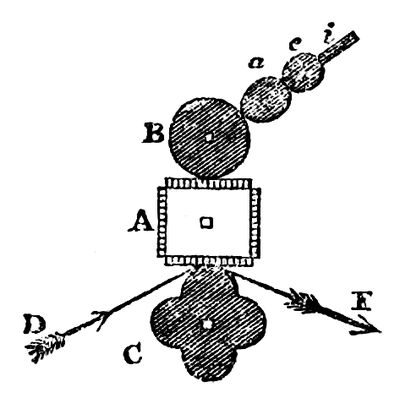
A, the quadrangular prismatic roller, with its surfaces of stereotype plates.
B, the roller for distributing the ink, which it receives from the two smaller rollers a e, in contact with the box i.
C, the pressing cylinder, covered with cloth or felt.
D E, the track of the paper in the direction of the arrows.
The Norwich Mercury, a paper published by Mr. Bacon, contains a prospectus of his newly invented machine, to which is added a notice respecting its merit as compared with that of Mr. König, erected at the Times printing office, from which statement the following is an extract:—
“In Messrs. Bacon and Donkin’s machine, there is no reciprocating motion. The types are placed on a prism of as many sides as the nature of the form requires. This prism occupies the centre of an upright frame, like the roller in a copperplate press; below this is a kind of compound-faced roller, suited to the form of the prism; through between these the sheets to be printed (attached to the face of a piece of cloth) are passed in succession, and in the meantime the revolution in the type prism brings its different portions in succession under a system of inking rollers placed over it, by which it receives successive charges of ink, to be delivered to the sheets as they pass in succession between the lower rollers.”
Mr. Hansard, in his “Typographia,” says, that “one machine would not answer for all kinds of work.” And “the only one of these machines that was, I believe, ever made, rests in peace as not being found useful.”
On the erection of the machines for printing the Times newspaper, Mr. Bensley being apprehensive that there would be impediments thrown in the way of their general introduction by the workmen, who had already shown symptoms of opposition, was desirous that I should see them at work, that he might have my opinion on the subject. I accordingly went with Mr. Joseph Bensley, his eldest son, to look at them, and view their manner of working, and on my return, Mr. Bensley was anxious to see me, that he might have my report. I told him that truly they surpassed any thing I had imagined, and did the work so well, and so expeditiously, that I did not believe any opposition on the part of the workmen could prevent their coming into use. This opinion was gratifying to him: but I also told him that I foresaw another thing that might probably take place, which would have an equally injurious effect with respect to him. With considerable anxiety he asked to what I alluded; I told him that I thought some man of abilities would step in and simplify them, for they appeared to me complex in their construction. He treated this suggestion with indifference, as a thing that could never happen, and expressed himself perfectly satisfied that no person would ever make the attempt. My prognostication, however, was fulfilled; for immediately after, Mr. Edward Cowper, of the firm of Applegath and Cowper, printers, proved not only its possibility, but its practicability, by sweeping away at once wheels, &c. which had cost, as I was credibly informed at the time, at least 1500l. in the course of their experiments; and thus made the machine more simple, and less liable to be out of order, while he at the same time improved it greatly in its facility of working, and in the quality of the work it produced. Mr. Cowper took out a patent for his improvement; and, as I was told, in consideration of the expense that Mr. Bensley had been at in the pursuit, which amounted to at least 16,000l., offered him, as an act of justice, a share of the patent, which was accepted. The machine erected for “The Times” cost the proprietor of that newspaper 3,000l.
Messrs. Applegath and Cowper then commenced manufacturing these machines, which met with general approval; they also much improved the inking apparatus. After the dissolution of their partnership, Mr. Cowper established a manufactory for them at Manchester, in conjunction with his brother, he himself continuing to reside in London.

COWPER’S MACHINE FOR PRINTING BOOKS.
In the year 1824 a new mode of machine printing was introduced, that of printing with two colours simultaneously in the same impression. This arose out of the Commission appointed by Government to inquire into the best means of preventing the Forgery of Bank Notes. A pamphlet was[465] published by Sir William Congreve, describing the process as inimitable, except by their machine, for which they had a patent, so that no one else could possibly produce a facsimile. A design was made, generally composed of a great number of lines in a flourishing style, and, when engraved on two pieces of metal, these lines were printed with two colours, one part sinking below the other after each impression, and, there being two sets of inking rollers, each part was inked at the same time, when the lower part rose again to a level with the other, so that one part of these complicated lines should be black, and the continuation of them should be blue or red, or any other colour that might be thought proper, and any device that might be included in the design should also be in two colours, such, for instance, as the King’s arms, and the register should be exact, so that each line should uniformly be perfectly continuous, notwithstanding the change of colour. Government adopted the plan for printing a new stamp on the backs of country bank notes, and also for the Excise Stamps for paper. So far, however, from being inimitable, I have no hesitation in saying, that there never was a plan suggested that was more easy of imitation, even with the common press, and by the customary workmen. The machines were made by Messrs. Donkin and Co.
A single machine, that is, a machine which prints one side of the paper only, may be estimated to produce upon the average one thousand impressions in an hour; and were I to attempt to describe the one by which the Times newspaper is now printed, I should state that it is the mechanism of four single machines combined in one frame, all being worked simultaneously by steam as the motive power: thus there are four places at which to feed it with paper, four printing cylinders, and four places at which the sheets are delivered when printed, so that the actual speed of each part of the machine is rather more than one thousand an hour. This ingenious and skilful combination is the production of Mr. Augustus Applegath.
I have seen it stated by the proprietor of a machine, that it would print at the rate of two thousand impressions in an hour: I have known another assert that his perfecting machine would print one thousand five hundred in the same time. This is a fallacy, which produces disappointment and dissatisfaction. I have had occasion in the course of business to satisfy myself as to their real capability, by attending and carefully observing them at work, and have thus ascertained that a single machine cannot be depended on for more than one thousand in the hour, nor a perfecting machine for more than seven hundred and fifty. I am well aware that both may be driven with greater speed for a short time, but in the case of newspapers and periodical publications, where punctuality is indispensably requisite, I would never calculate upon greater expedition.
With respect to the comparative merits of the cylindrical method of printing and those of the press, the manufacturers of machines as well as most master printers, not content with the real superiority of properties which the machine does certainly possess, attribute to it properties which it does not possess, and which are incompatible with it, namely, those of producing the finest work, and printing the finest impressions from highly finished engravings on wood at the rate of eight hundred or one thousand per hour; even an engraver on wood has fallen into this error, and has produced a work with numerous beautiful illustrations, in which the writer of the book has boldly defended this erroneous opinion, but the engraver himself has cautiously avoided the risk of, and shrunk[466] from, the comparison, and has had the book printed at the press. The Penny Magazine has trumpeted the same fallacy; and yet the spirited Publisher has all his splendid works, with their beautiful illustrations, printed also at the press: thus tacitly acknowledging its superiority, and denying the opinions which he is the means of publishing to the world.
In producing the finest workmanship in printing, it is essentially requisite to use the best ink: this is ink made with strong varnish, which binds the colouring matter, and, when dry, prevents its smearing on being handled or setting-off in the process of binding; the colouring matters are selected with care from among those of the best quality; the whole is ground to a state of impalpability; the strength of the varnish causes the ink to require a great deal of distributing on the balls, which I prefer to rollers for the best work,—See Balls,—in order to diffuse it equally on their surface; the form should be well and carefully beat, so as to coat the face of the types, &c. completely and uniformly with ink, without any superfluity; the pressure should be slow and gradual, what is termed a soaking pull, not quick and abrupt, and when the bar of the press is brought home, the workman should rest there a short time, in order to transfer the ink completely from the types, &c. to the paper, and fix it firmly on its surface. These precautions and care are necessary to produce the finest work in printing; and in every instance, in whatever art or manufacture the article may be, good workmanship and high finish will be found to require more time for their production than in an inferior article.
From the rapidity with which impressions are produced by the cylindrical method of printing, it must be apparent that it is not capable of executing work of a superior kind, as the ink must be weak to enable the light rollers to distribute it as expeditiously as it is required; the ink too must be prepared with a soft varnish to enable it to do so, which deprives it of the valuable property of drying, as well as of binding the colouring matter so as not to smear; this weak ink also incurs the risk of allowing the oil in the varnish to separate from the colouring matter, and thus spread in the paper and discolour it. Another imperfection is, that there is not time to ink the face of the type, &c. properly, which is thus obliged to be done in an imperfect manner with an inferior ink; and in taking the impression, again for lack of time, there is not pressure sufficient to fix the ink firmly to the paper.
As overlays cannot be used in cylindrical printing, the engravers on wood, when producing a subject which is to be printed at a machine, hollow out on the surface of the block the parts that are to appear light, as well as round off the edges that are to be printed lightly, and engrave on those lowered parts, so that the surface is not a perfect plane; and this is to answer the purpose of overlays, thus in practice allowing that of which they deny the necessity and which they ridicule in theory—unequal pressure to produce the desired effect; but the object is not gained by this method, for, to obtain an impression from those lowered parts, thick woollen cloth, called a blanket, is used, which, owing to its elasticity, is pressed into the hollows as well as between the lines of the depths; so that an impression is produced, in which the lights are composed of crude lines, and the depths are muddy, and which show more than the engraved line, and thus the wood-cut does not possess that delicacy in the light parts, nor that firmness in the dark, which are produced by good workmen at the press, and which give to the whole a brilliant effect.
The hollowing of the block on its surface requires great care and[467] judgment, not only in ascertaining the precise situation and bounds, but also the precise depth to which it ought to be lowered; for if a thick blanket be used, the light parts will be produced stronger and heavier than is required, and if a thin one be used, they will either not appear, or, if they do, will be rotten, or else chalky; and some small parts in the depths will always require to be of a full firm colour, which a thick blanket and weak inferior ink will never produce. See Engravings on Wood. Fine Presswork.
The advantages that cylindrical printing possesses are of great importance in the art, and not less so with respect to the public. Its power of printing larger sheets of paper than was ever before contemplated, has enabled the proprietors of newspapers to enlarge them to a previously unparalleled extent. The rapidity with which impressions are multiplied is also an advantage of great consequence, as in the case of morning newspapers, instead of going to press on the evening preceding the publication, they can now wait until five o’clock in the morning, and even later, when if a despatch or an express arrives with any important news, it is in the hands of the public at the usual hour of publication; neither is this rapidity of less advantage to periodical publications, more particularly to those of which a large number is printed, for example, the Evangelical Magazine, and the Methodists Magazine, of each of which there were printed about 24,000 copies. When these were done at press, it was necessary to put the last sheets to press ten days before the publication, whereas now they can delay them till the third day, and yet be punctual in publishing at the regular time. They thus avail themselves of any later intelligence that may arrive, and give it publicity a month earlier than before the invention of cylindrical printing.
Another advantage in machine printing is, the regularity and uniformity of colour through any number of impressions, as it can be regulated with the greatest nicety to any shade; in this instance it is superior to the press for the production of common work, in the uniformity of colour, but only superior to common work in its rivalry with the press.
MACULE.
If the joints of the tympan, or the head, or the nut of the spindle, be loose, or any accident happen in pulling, so that the impression be somewhat doubled, and not clear, it is said to be maculed. Cards under the winter, to produce a spring, have often been the cause of maculing: the sides of the tympan or the ear of the frisket touching the cheeks will also produce the same effect. See Double. Slurring.
Magazines. See Newspaper Postage.
MAKE.
In casting off copy, they say it will make so much; as, it will make a sheet, two sheets, &c.
Make a Measure. See Justify a Stick.
MAKING READY.
This term implies the process of laying the form on the press—fixing it in its place—placing the tympan sheet on the tympan—placing the points to make register, when both sides of the paper are to be printed—making register—preparing the frisket—and producing an equal impression from all the pages, and from every part of each page.
When an engraving on wood is printed, it also denotes the overlaying it, so as to produce an impression, which shall possess all the effect that the subject may require.
In common work, where despatch is required, thick blankets are used in the tympans; and when the types are much worn they are also necessary, to bring up the rounded face of the letter. It is too common in[468] good work to put an excess of blanket into the tympans, to lessen the pull for the purpose of easing the pressmen’s arms, and to enable them to be more expeditious: the consequence is, that the impression will show more than the surface of the types or engraving; and thus what is gained in ease and expedition, is more than counterbalanced by the imperfect and rough impression that is produced. See Fine Presswork, and Engravings on Wood.
An old pressman, who was a good workman, gave me the following directions for making ready a form:—
“In making ready, I will only speak of a form of fine work; if a pressman can do that, he surely can make common work ready.
“Lay the form on the stone, centrically under the platen; quoin it all round; fold the tympan sheet according to the form laid on the press; lay it even on the form, and stretch it as much as it will bear; pull it, for the purpose of attaching it to the tympan; paste it all round to the tympan, at the same time keep stretching it; screw on the points; make them fall in the channel of the short cross; make good register with white paper, whether the form be whole or half sheet work.
“This is one of the good old customs, and the best that I know of; because the pressman is sure to have the points centrical; he perceives whether all the furniture be put in right or wrong, even to a single scale-board: in leaded matter, which should be line upon line, he ascertains whether the form be locked up evenly or not, and whether the leads be all put in right; also, whether the pages that begin chapters, or other divisions of the work, have the proper whites; he can likewise discover if any of the pages be made up too long, or too short: any of these errors, that may have occurred, must be amended in the white paper form, otherwise the reiteration will have the same faults, in order to make register. On fine work, I make ready the white paper form of a sheet in the same manner as I do a half sheet, on purpose to discover those errors, by which process I gain more time in making ready the reiteration than I lost in the white paper form.
“For fine work, use the finest cloth that can be procured, and not thick flannel blanket: if the form be light, one thin cloth blanket will be sufficient; and if it be very light, that is to say open leaded matter, sheets of paper are preferable to either flannel or cloth in the tympans. Be sure to have one sheet of stout paper, which will cover all the parchment, in the inside of the outer tympan. Pull a dry even sheet of paper; look carefully on the back of the impression; if it be not equally even, the light parts must be overlaid with tissue paper, or India paper; if some parts be very heavy, cut or tear out the heavy parts. The overlays should be pasted only slightly on the impression sheet, in case any of them should have to be taken off; paste the four corners of this sheet upon the thick sheet; let the overlays be uppermost, that you may see them; then pull another impression sheet, with the first in the tympans, and if the impression still be not even, overlay the first impression sheet again; and continue pulling impression sheets, and overlaying the first impression sheet, until you have an even and regular impression on all parts.
“As you go on with the form, if any of the overlays require to be taken off, do so; if bits are required to be taken out, or rubbed off, the tympan sheet, it must be done. In some works the outer tympan cannot be too dry, but the pressman must be the judge of this, according to the work he has to do.
“Having a good black ink well brayed on the surface of the ink block,[469] he takes a small quantity on the balls, and distributes it well; he takes time to beat the form well and carefully, and then pulls a sheet of the right paper, dwells on the pull, or keeps down the bar a short time by means of a catch or hook, in order to make the paper take the ink clean off the types, and look a clear black upon the paper. The impression must not be too deep, as nothing must appear but the shape of the face of good types. If the impression be too deep, or too much ink on the form, more than the real shape will appear, and the work will not be fine; but if the work be fine, he goes on gently and regularly until the white paper be off. He then lays on the reiteration form; and having the overlays ready that he made before, he has very little trouble in making it ready: he makes such good register, that line falls upon line. After the reiteration is off, if he does not go on with the same work, or work of a similar size and imposition, he carefully puts by the tympan blankets, cloths, or tympan paper, and overlays, till they are again wanted for the same work. All other works must have their own overlays made purposely for them.
“After the first overlays are made for their respective works, there is not so much trouble in making ready the future sheets of the same work as they are put to press; indeed, if the pressman carefully preserves his overlays, tympan paper, or cloths, he seldom has occasion to do more than alter a few of the overlays, as the paper sometimes varies in thickness, which may want a few overlays on the tympan sheet. India paper is the best for this, as it is of a soft and pliable nature, and as it lies on the tympan sheet the pressman can easily perceive if one part of it has a deeper impression than another.
“It is to be observed, that fine work cannot be made upon bad paper, or with old worn types.
“Fine work must not be hurried, as some do when they are paid for it as piecework, and spoil it, in order to make a large bill. How a master stares at this, when the same men could not earn nearly so much on scale work. These are the very men who have despised the establishment, because they could earn more money by attending fewer hours, but not on scale work. How miserable and discontented I have seen them when on scale work, although at the same time they had as much work as they could do. This has been the cause of masters reducing the price of works not paid by the scale. A few shillings per week additional ought to satisfy a man for his extra abilities on fine work.”
MAKING REGISTER.
The act of making the pages and lines fall exactly on the back of each other at press, when any work is perfected. See Register.
MAKE UP.
After a compositor has been setting at random, and commences arranging his matter into pages, it is termed making up. In large pages and letter, in a work where good register is required, I would recommend the compositor to mark on a gauge accurately every line of the page, so that he may regulate his whites in such a manner that line may fall upon line without causing much trouble to the pressman, or to himself; for if it be much out, and the pressmen are on piecework, he will be called on to rectify the errors, and this is better avoided in the making up, as it is attended with but little trouble then, and his work will appear to more advantage in the first instance.
To give the making-up. When a compositor in a companionship has composed his copy to within the quantity of a page of the work, he gives the overplus of the copy, after having completed his own last page, to him who is composing the copy that follows his matter; and he ought[470] to mark on it with a pencil where he has himself concluded, as well as the folio that should follow that of his own last page. This is called giving the making-up.
Malabaric. See Tamoulic.
MALAY.
The Malay is the principal vernacular tongue used by the people who inhabit that vast region and chain of islands comprehended between ninety-three and one hundred and thirty-five degrees of East longitude, a space of about two thousand two hundred and twenty miles; and extending from fourteen degrees North to eleven degrees of South latitude, comprehending twenty-five degrees, about one thousand seven hundred and forty miles. This vast extent of country over which the language is spoken includes the peninsula of Malacca, the islands of Sumatra, Java, Borneo, Maccasser, Balee, Cumbava, Sallayer, Bootoon, Booro, Ceram, Pulo Pinang, the Moluccas, and innumerable others.
The Malays have not any proper national character, except that which has been introduced by the Mohammedan priests, who have from time to time settled in the peninsula of Malacca and the adjacent islands; therefore it resembles the Arabic Nishki alphabet, excepting some slight alteration to express a sound which the Arabians had no character to delineate. In conformity then with the principal of the Eastern nations, Arabians, Turks, Persians, &c. they read from the right hand to the left.
The acute accent (´) is always used to mark a very long sound of the vowel over which it is placed; but when inserted after a consonant, it shows that the syllable ends with it.
The Malay Alphabet.
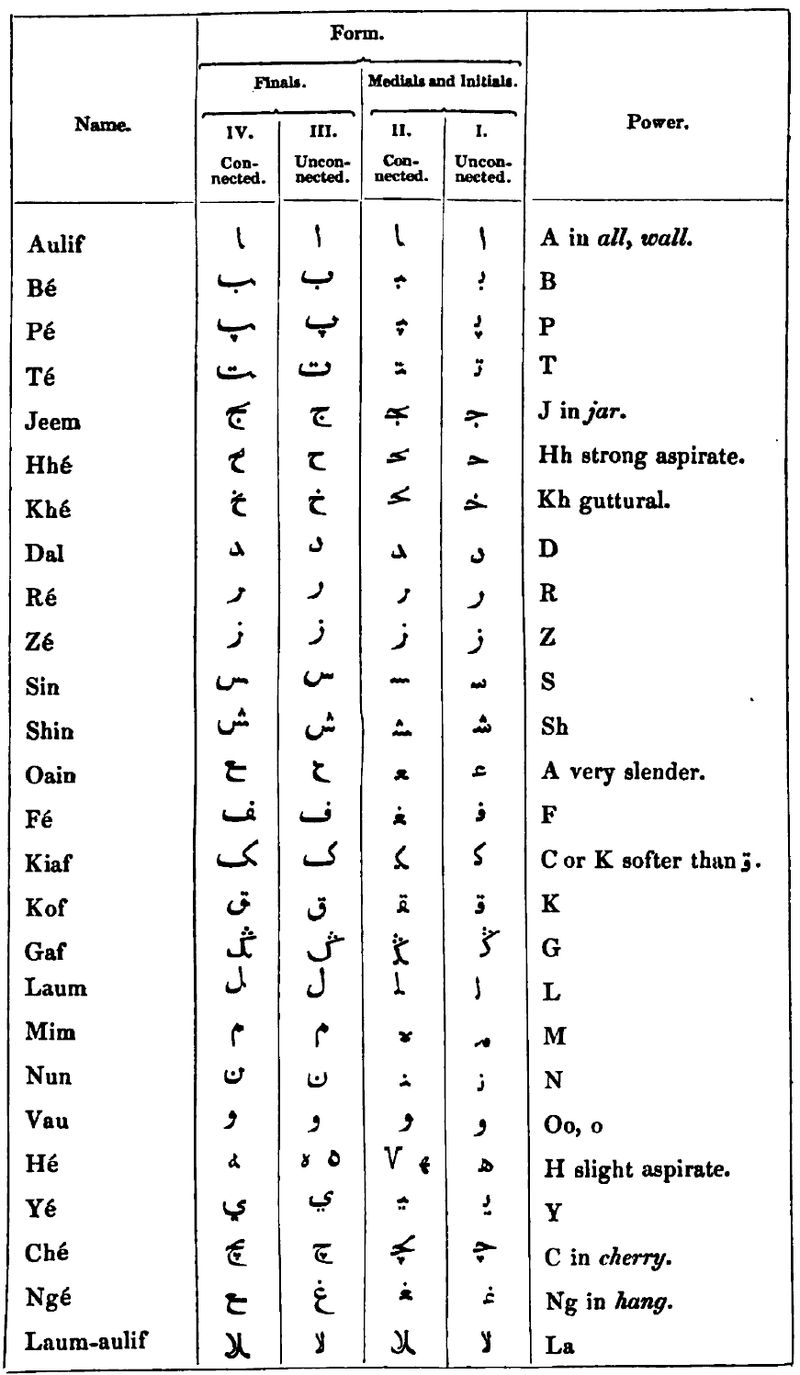
| Name. | Form. | Power. | |||
| Finals. | Medials and Initials. | ||||
| IV. | III. | II. | I. | ||
| Con- nected. |
Uncon- nected. |
Con- nected. |
Uncon- nected. |
||
| Aulif | ـا | ا | ـا | ا | A in all, wall. |
| Bé | ـب | ب | ـبـ | بـ | B |
| Pé | ـپ | ﭖ | ـﭙـ | ﭘـ | P |
| Té | ـت | ت | ـتـ | تـ | T |
| Jeem | ـج | ج | ـجـ | جـ | J in jar. |
| Hhé | ـح | ح | ـحـ | حـ | Hh strong aspirate. |
| Khé | ـخ | خ | ـخـ | خـ | Kh guttural. |
| Dal | ـد | د | ـد | د | D |
| Ré | ـر | ر | ـر | ر | R |
| Zé | ـز | ز | ـز | ز | Z |
| Sin | ـس | س | ـسـ | سـ | S |
| Shin | ـش | ش | ـشـ | شـ | Sh |
| Oain | ـع | ع | ـعـ | عـ | A very slender. |
| Fé | ـف | ف | ـفـ | فـ | F |
| Kiaf | ـک | ک | ـكـ | كـ | C or K softer than ق. |
| Kof | ـق | ق | ـقـ | قـ | K |
| Gaf | ـڭ | ڭ | ـڭـ | ڭـ | G |
| Laum | ـل | ل | ـلـ | لـ | L |
| Mim | ـم | م | ـمـ | مـ | M |
| Nun | ـن | ن | ـنـ | نـ | N |
| Vau | ـو | و | ـو | و | Oo, o |
| Hé | ـه | [#] ه | [#] ـهـ | هـ | H slight aspirate. |
| Yé | ـي | ي | ـيـ | يـ | Y |
| Ché | ـچ | چ | ـچـ | چـ | C in cherry. |
| Ngé | ـغ | غ | ـغـ | غـ | Ng in hang. |
| Laum-aulif | ـلا | لا | ـلا | لا | La |
In the above alphabetical arrangement, the second and fourth columns from the right hand are used only when they are connected with a preceding letter; as, banyak بنيق, many. Every letter should be connected with that which follows it, except these five: ا aulif, د dal, ر ré, ز zé, and و vau; neither of which can possibly be joined to the following letter.
MALLET.
A wooden hammer, with which to drive the quoins in locking up and unlocking forms, to plane down forms, and for other similar purposes. The general size of the head is 5 inches by 4¼, and 3 inches thick: the hole in the head for the reception of the handle should be bevelled each way from the centre on two sides, so that the handle fitting into the lower part, and being tightly wedged at the upper end, the head can neither fly off, nor can the handle be driven up, when a quoin is struck down with it, or when the planer is struck with the end of it, both which ways of using the mallet are frequent. It is commonly made of beech; but mallets are more durable when the head is made of a piece of tough ash. The head was formerly made round.
MARGIN.
Making margin is the apportioning of the proper distances between the pages of a sheet or form.
This is a most material object in book work; for, if it be not properly done, the appearance of the book, when bound, will be injured; as the binder will be obliged either to reduce the size of the book, in order to make the edges smooth, or else he will have to leave many raw edges of paper.
The spaces between the pages should be such, that, when the book is bound and cut, the page of printing should be very nearly in the middle of the page of paper.
Convenience and custom have familiarised us to the printed page being a little higher than the middle of the leaf, and to its having a little more margin at the fore edge than in the back.
The first of these circumstances may be accounted for, by the head, in all sizes except folio, being at the fold of the paper, which admits of the bookbinder cutting it smooth by taking off a very narrow shaving, so as to reduce the size but a mere trifle; while the bottom of the page lying towards the raw edge of the paper, which is irregular, and which often varies considerably from being cater-cornered—machine-made paper also varies greatly in the size of the sheets, being cut up irregularly; and paper made at different times, and by different makers, which is often used in the same volume, and which likewise varies in size—all combined, render it necessary to allow a little more margin at the foot of the page and at the fore edge than at the head and in the back; for these variations in the paper equally affect the fore edge and the foot: but the head, the back, and the gutter, being folded, remain uniformly the same, however much the paper may vary.
It is always presumed that the backing of the book in binding, takes up as much of the margin as is cut off the fore edge, so as to make them both equal.
Having premised these explanatory observations, I shall proceed to describe, in as clear and distinct a manner as I am able, the manner of ascertaining the proper spaces between the pages, for the different sizes of books, in the simplest way that is known, and as it is now generally practised; for the division of the margin by compasses is obsolete.
To facilitate the operation, it will be necessary to keep in mind the observation I made in the article Imposing, that, “when we arrive at a great number of pages in a sheet, they resolve themselves into the same order as quartos, octavos, and duodecimos,” as a recollection of this will tend to simplify the process, and, if the person who has to perform it be not well experienced, it may prevent him from getting confused, by keeping him to a small part of the form, instead of leaving him to attempt doing all at once.
After the pages have been laid upon the imposing stone, and the chases put over them, the first thing to be done is to get a sheet of the proper paper of the work, wet, and to fold it as exactly as possible to the size in which the work is intended to be printed.
If the paper for the work has not been sent in, then a sheet of the same size may be taken from the paper of some other work that is in progress, which will be found to be sufficiently near, inasmuch as a scaleboard or two in the backs and heads, more or less, will make it right; or the first sheet may be imposed temporarily with furniture out of the drawer.
I must here caution the compositor, or the person who has this business to perform, never to cut his furniture till he is certain of the proper distance required between the pages.
To ascertain this distance, take short pieces of furniture out of the drawer, or quotations, or both, and quadrats or reglets to fill up the interspace, between two pages; then push the pages close up to them, and when you have got the right distance between the pages, you can ascertain what furniture will be of the exact width, by trying the ends of different pieces, always measuring from the edges of the types themselves, and not within the page cords.
We will now proceed with making margin, commencing with folio, and proceeding through the various sizes, at least through so many as may be necessary to elucidate the subject.
Folio.—Having folded a sheet of the intended paper exactly in the middle, place the edge of the paper even upon the outer edge of the first page, and move the adjoining page to it till the fold in the paper will lie about half an inch upon it, when the folded sheet is laid upon the face of the first page; the space between the pages on either side of the cross is then to be filled up with furniture, using one piece only on each side where it is practicable, and where there is no reason to the contrary, in order to prevent mistakes in re-imposing. This space, with the addition of one or two scaleboards on each side of the cross, which are to assist in making register at press, will be sufficiently near for a demy folio, where the page is of a fair dimension; but if the page be very large, or if it be a smaller sized paper than demy, I would not allow the back fold of the paper to lie quite so much over the adjoining page, but would lessen it in proportion to the size of the page or paper; if it be very large paper and a corresponding margin, I would allow a little more proportionably; for it is to be observed, that the more the fold of the paper lies over the edge of the adjoining page, the more fore edge is given at the margin than in the back.
The margin for the head of a folio is arranged at press.
After the scaleboards have been put in, the page cords taken off, and the pages pushed up close to the furniture, you should try it again, to see that it is correct. It is a good plan to take a slip of paper, and cut it to a length equal to the width of the back, then to fold it even in the middle so as to make a distinct crease, to open it again and lay it[474] in the back, so that the crease shall be exactly in the middle of the back; then to open out the sheet of paper, and lay it upon the form, with the crease in its middle upon the crease in the slip of paper; the margin in the back may then be compared with the margin in the fore edge as well as if the sheet were printed, and it may be altered if thought necessary by a scaleboard more or less.
If two jobs, that are to be cut up, are worked together, it is usual to impose them so that the margin shall be equal on both sides; to effect this, fold the paper exactly in the middle, and laying it folded upon the left hand page with the edge of the paper even with the edge of the page of types, bring the other page to it till the left hand side fairly touches the fold of the paper; this is termed being out and out; and when the paper is cut evenly in two, after having been printed, the side margins will be found to be equal.
Quarto.—Fold a sheet of paper exactly into quarto; then lay it, thus folded, upon the first page, the fore edge of the paper being even with the left hand edge of the types; bring the adjoining page towards the first page till the fold in the paper lies upon the left hand side of it about as much as a Double Pica body; this will make the back about right: then place the lower edge of the paper even with the foot of the page, and bring the heads of the pages which adjoin at that part towards each other till the fold in the paper covers the head line, and barely the first line of matter; this will make the head right. Then fit the furniture into the spaces; add a scaleboard or two, as the case will admit; and, after cutting and folding slips of paper and laying them in the back and head, open out the sheet of paper, laying the folds in the paper exactly over the folds in the slips, and it will be perceived how the margin is to be for all the pages.
Before I proceed to octavo, it will be necessary to observe, that in all sizes except folio and quarto, if there be not enough in the backs, the raw edge of the paper in the front margin will project beyond the folded margin, and this in proportion to the deficiency in the back; the same will take place in the length in duodecimo, and in smaller sizes where there are offcuts, if there be not enough at the foot of the pages whence the offcut is taken: the effect produced by these deficiencies is, that the binder is obliged to reduce the size of the book both in length and width, when cutting, in order to make the edges smooth.
The French allow the raw edge of the paper in the front to extend considerably beyond the folded edge; and also at the foot in duodecimos: in England we endeavour to give the book the fullest size that the paper will permit, and suffer the raw edge of the front margin to project but a very little beyond the folded edge, to allow for any discrepancy in the size or shape of the paper.
Octavo.—Fold a sheet of paper into octavo, and lay it, thus folded, upon the first page, the fore edge of the paper even with the outer edge of the types: then bring the adjoining page towards it till the other side of the octavo paper lies over the left hand side of this page about a Pica; this will give the width of the gutter: then open the paper out a fold, into quarto, and laying it upon the two pages, bring the third page on the right hand sufficiently near for the right hand side of the paper to lie upon the left hand side of the page about a Long Primer body; this will give the width of the back: then fold the paper up again, and laying it upon the first page, with the foot of the paper even with the direction line, bring the head of the page above it so near that the top of the octavo paper will cover the head line and barely also the first line of[475] matter; this will give the space at the head: then put into all the spaces on one side of the long cross, and into the head, small pieces of furniture from the drawer, or quotations, which are generally used where they will fit, or quadrats, making both the gutters alike, and push the pages up close; cut the slips of paper as before, and fold them; lay them in the gutters, head and back, and open the sheet of paper to its full size; lay it with the crease of the middle fold exactly upon the crease of the slip of paper in the back, and if the margin be right the creases between the other pages will fall exactly upon the creases in the slips of paper laid in the gutters; if they do not, the space in the back must be increased or diminished till they do, when the margin will be right; the furniture may then be cut, and a scaleboard inserted next the crosses at the backs and heads in all the quarters.
Duodecimo.—After folding a sheet of paper exactly into 12mo., proceed as in octavo for the gutter, but let the fold lie rather less over the edge of the adjoining page than a Pica; proceed in the same manner for the back, but that the paper lie on the third page barely a Long Primer body will be sufficient; the fold in the head will just cover the top line of matter in the adjoining page above it, as in octavo, but the pieces of furniture put in there are called bolts. The offcut is now to be considered—this is always imposed on the outside of the short cross, and the back and gutters are the same as those in the other part of the sheet; for the head of the offcut, the space between the running title, or, where there is no running title, the headline, and the middle of the groove in the short cross, must be exactly half the width of the bolts; for as register is made at this part, and the points fall into the groove and there make point holes, the binder folds to these holes, and takes off the offcut in accordance: thus when the sheet is folded, the offcut inserted, and knocked-up, the head lines of the offcut ought to range with the head lines of the other pages, and this should always be kept in view by the printer; the space between the bottom of the other pages and the middle of the groove in the short cross, should be within a Pica of the outer margin at the feet of the pages, which will allow for any little variation in the size of the paper, and not affect the size of the book in cutting the edges: when these distances are thus arranged, put short bits of furniture, quotations, &c., as before directed, between the pages, in the gutters and back in one row, and in the head and both sides of the short cross in another row lengthways, and push the pages of both these rows close up: cut the slips of paper and fold them for the gutters and the back, as also for the bolts: then open out the sheet of paper, and lay the middle crease in it exactly upon the crease in the slip of paper laid in the back; and if the side margin is right, the creases in the sheet of paper between the other pages will fall upon the creases in the slips of paper laid in the gutters; if they do not, the space in the back must be altered till they do: then try it the other way, by laying the crease in the sheet of paper upon the crease in the slip laid in the bolt, and if the crease of the offcut falls exactly in the middle of the groove in the short cross, it is right; if it does not, the space at the feet of the pages next the cross must be altered till it does: it being presumed that the gutters and bolts are right, the only places at which to alter are the back, and the space at the feet of the pages adjoining the offcut; a scaleboard or two, as may be required, must be put into all the quarters next the crosses.
In Duodecimo Music way, the pages are reversed in shape, being so wide as for two of them to occupy the width of the sheet, and so short as to have six in the depth; in this case there are no backs, technically[476] so called, but only gutters; but as the long cross comes between the pages, they must be treated as backs, in the same manner as in folio, and the fold of the paper must be allowed to lie more over the side of the adjoining page, as was described in making margin for folio; if the page be very wide, less than half an inch; if it be narrow, and a large margin, it may be a little more; the head margins or bolts are three in depth, and may be ascertained in the same manner precisely as for octavos or common twelves, which, being done, the foot margins must be ascertained; these, being two, may have a Pica body each less than the outer foot margins, to allow for any inequality in the size of the paper, or in laying on the white paper at press; this will be done by folding the sheet of paper exactly in three portions across it, and extending the pages till one of these portions covers the two outer pages with the gutter, and lies over the third about a Pica body; when this has been performed at one end, repeat the same process at the other end of the form. The margin may then be tried in the manner before described, and any necessary alteration must be made in the space at the feet of the pages, care being taken that both spaces are equal.
In Long Duodecimo, the pages are the same in size as in the preceding, only that they exchange the length for width, and the width for length; the manner of making margin is the same for this size as for the last; the only difference between them being one of words—that which was the gutter in the other being the head in this; and what was the head or bolt, and the foot margin, now becoming the gutter and the back; the spaces between the pages, for heads, for gutters, and for backs, are ascertained in the manner before described.
As the number of pages multiply in a sheet, so the utility of placing slips of paper, folded in the middle, in the gutters, backs, &c., becomes greater, by enabling the person, whose office it is, to know readily the middle of each space when he tries the whole margin with the sheet opened out; to some this may appear unnecessarily minute, but I hold that whatever method tends to facilitate an operation, and enables a person to perform it more correctly, is useful.
Sixteens.—After having described so fully the manner of folding the paper, and ascertaining the spaces between the pages for the gutters, the heads, and the backs, which are required for quartos, octavos, and duodecimos, it appears unnecessary to extend this article by repeating the same thing in every size. For sixteens, fold a quarter of a sheet of paper exactly in four; pursue the foregoing direction for ascertaining the width of the gutter, the back, and the head, in one quarter of the form, and having made these right, arrange the remainder of the form in the same manner, always trying all the pages by the whole sheet opened out, and rectifying any thing wrong by adding or diminishing in the backs, and similarly at the feet of the pages next the short cross.
The greater the number of pages in a sheet, the smaller in proportion does the margin become: it must therefore be evident, that the folded paper should lie proportionably less over the edge of the adjoining page, both for gutter and for back, as the number of pages increases; for as a folio may require the page to be half an inch nearer the back than the fore edge, an eighteens may not require it to be more than a Long Primer; and so in proportion with respect to the size of the page and of the margin.
Eighteens.—A sheet of eighteens is the same as three half sheets of twelves imposed together: there are two backs and three gutters in each form: the other way of the chase it is three pages in depth, having[477] bolts and an offcut the same as twelves; and the process is the same as when making margin for twelves, only ascertaining the first gutter and back by one third of the sheet of paper the long way, instead of one half of it the narrow way: having made the six pages on the left hand of the form right, make the remaining twelve pages like them, and then try the whole with the sheet of paper opened out; the creases in the folds should fall exactly in the middle of the gutters and backs; but as the offcut is not imposed on the side of the short cross with the groove in it, the crease for the offcut should be exactly half the width of the bolt from the running title or headline, or it should fall in the middle of the long cross.
I wish here to impress upon the mind of the person who is making margin, never to attempt doing so with the whole form at once; for if he does, it is more than probable that he will get wrong, cause himself additional trouble, and frequently waste furniture; but let him get one portion right, then make a range of pages through the form one way the same, and then another the contrary way, and afterwards try them with the sheet of paper opened out, when any little variation that may occur will be easily remedied before he cuts the furniture.
Twenties.—A form of this size has four pages in width, and five in length; in width the margin will be made in the same manner as for twelves; in the length there are two heads or bolts, which will be also ascertained as for twelves; the space between the feet of the pages must be out and out, except about a Pica body; and the offcut must be treated the same as for a form of twelves or eighteens.
Twenty-fours.—The side margin will be ascertained just as for eighteens, there being the same number of pages in width; and the head and foot margin as for sixteens; the difference in the size of the pages not affecting the principle of making margin.
Long Twenty-fours.—A form of this size is similar to a sheet of twelves imposed in one chase, the width of the pages being the longest way of the paper: the method of making margin for it will be similar to that for twelves or eighteens.
Square Twenty-fours.—The difference between this size and twenty-fours is, that the width of the pages occupy the sheet the longest way; the margin will be made in the same manner.
Thirty-twos.—One quarter of a form of thirty-twos is similar to a form of octavo; and the margin may be made by folding a quarter of a sheet of paper, and arranging the pages of a quarter of the form only in the first instance: then place the others at the same relative distances, and try the whole with the sheet of paper opened out, before cutting the furniture.
There is no variation in any principle of making margin as to the remaining sizes; and if I were to go into detail for each, it would be but a repetition of the method of ascertaining the width of the gutters, backs, heads or bolts, and of the spaces at the feet of the pages where they either cut up, or fold, at that part, which I think unnecessary; for when a person is competent to make margin correctly for an octavo, a twelves, and an eighteens, he will find no difficulty with respect to the other sizes.
Wherever a half sheet is imposed, or two half sheets to work together, the middle margin, where the sheet is cut in two, should always be made out and out, that both the fore edges may be equal.
When the margin to the first sheet of a work has been made, and the quoins tightened with the fingers, a gauge should be cut for the back and[478] head, for the succeeding sheets. See Alteration of Margin.—Gauge.—Imposing.
MARGINAL NOTES,
generally called side notes by printers, are notes at the fore edge of the page, running from top to bottom, or placed opposite the matter to which they refer, when they are short. They are generally of the width of a broad quotation; in historical works, where there is only a date at the top of each page, a narrow quotation is run down the side. They are always used in acts of parliament, and in law books, and contain a short abstract of the clause to which they are affixed, and should be justified to range with the line to which they refer.
It is usual, where marginal notes are not heavy, to economise the metal quotations by using furniture; in this case I would advise the compositor to select pieces of precisely the same width, but of different short lengths, and to cut their ends square; some should extend the length of the page; and when he uses short pieces, that he always put a metal quotation or a justifier next to the note, which will cause the lines to stand more even; he will then not lose so much time in seeking quotations and justifiers, nor will he be blamed for monopolising them, as they are seldom so plentiful in an office as to allow of being lavishly used.
Marks. See Points, and References.
MATHEMATICAL COMBINATIONS.
This is the name given by Messrs. Thorowgood and Besley to a number of ornamental designs for letter-press printing, which they were, in the first instance, the means of introducing into England from Paris, these being the invention and execution of Mons. Derriey, a French artist. In England, they come under the denomination of what are called Flowers; but Messrs. V. & J. Figgins style them Changeable Borders.
The flowers in the English founderies have received little improvement or addition during the last hundred years, and are not remarkable either for their beauty or taste: the consequence is, that they are seldom used, hardly ever indeed in fine works. It is difficult to account for this apathy of our letter founders and artists, for the few improvements that have been introduced, have generally been copied from French patterns.
The borders in question are a great improvement, and will, by exciting emulation, most probably lead to others still greater. They are of various patterns, formed of straight lines, as well as of diversified curves; the corners are also formed of angles and curves, so that they may be combined into an almost innumerable variety of forms; in addition, there are many detached tasteful pieces, which, when judiciously used, will add greatly to the effect; but unless the workman possess judgment with some taste, it is doubtful whether he will be able to produce a border, or any other subject, that will be gratifying to the eye.
That the reader may himself form an opinion of these borders, I have given two pages in which several of these pieces are arranged so as to show their effect. Those who are desirous of seeing all the varieties, may find them in the type founders specimen books, where there are a number of borders of different forms and patterns, which are combined in such a manner as to convince the beholder of the superiority of these ornaments over our old class of flowers.
As the French and German type founders, when they produce any new devices, sell matrices of them as articles of trade, the ornaments that are now introduced into England, have consequently all been manufactured from the same punches.
Matrix Plates. For stereotype printing, see Risers.
MATTER.
The series of the discourse of the compositor’s copy.—M. It now also means pages of types composed for any work; thus we have Set Matter, and Matter for Distribution, which see.
Matter for Distribution. Types that, having been composed for a work and printed off, are ready for use in another work, are, collectively, called Matter for Distribution.
MEASURE.
The width of a page. See Composing Stick.—M. See also Justify a Stick.
MEDHURST’S PRESS.
A few years ago, a new press was constructed by Mr. Medhurst, of London, the great recommendation of which was its simplicity, and consequent cheapness. In its general form it much resembled the iron presses in common use, the principal difference being in the manner in which the pressure was produced. This was accomplished by means of an ingenious arrangement of levers, differing so much from every thing previously employed in machinery, that the inventor described his contrivance as one which exhibited a new power in mechanics.
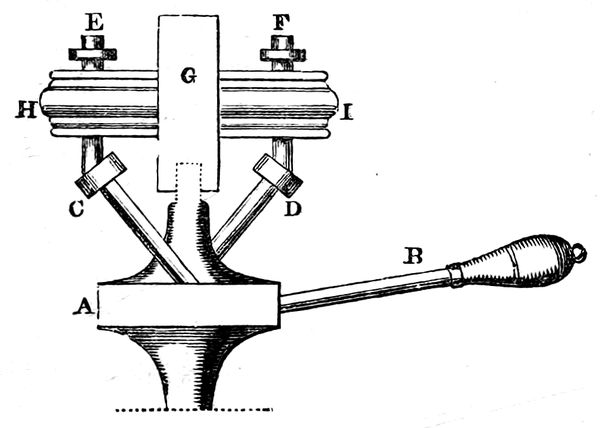
The principle upon which this press acts will be understood from the annexed sketch of the parts by means of which the impression is given. Instead of a screw, a plain spindle is employed: on the lower part of this spindle there is a swell or collar, A, into which the handle, or working bar of the press, B, is fastened. The upper part of this collar has cups or steps for the reception of two short iron props or pins, C, D, which extend up to the head of the press, and are there supported by the points of two screws, E, F, entering sockets cut out in the heads of the pins, which are made of steel. When the platen is up, these pins stand in an inclined position, as represented in the annexed figure: but when the lever handle is pulled towards the spectator, so as to turn the spindle, the two screws remain stationary, while the props come into a vertical position, thus forcing the spindle and attached platen to descend, as if a screw were employed. It may be observed that, in the figure, G is merely a section of the head of the press, which is supposed to be looked at sidewise, to present the back and front projections, H, I, through which the screws pass.—Lardner’s Cabinet Cyclopædia, 1833.
MEDICAL CONTRACTIONS
used in prescriptions, &c., with the words at length, and a translation. From Gray’s Supplement to the Pharmacopœia. 5th edit. 8vo. London, 1831.
A. Aa.—Ana, of each ingredient.
Abdom.—Abdomen, the belly; abdominis, of the belly; abdomini, to the belly.
Abs. febr.—Absente febre, in the absence of the fever.
Ad 2 vic.—Ad duas vices, at twice taking.
Ad gr. acid.—Ad gratam aciditatem, to an agreeable sourness.
Ad libit.—Ad libitum, at pleasure.
Add.—Adde, or addantur, add; addendus, to be added; addendo, by adding.
Admov.—Admoveatur, or admoveantur, apply.
Adst. febr.—Adstante febre, when the fever is on.
Aggred. febre.—Aggrediente febre, while the fever is coming on.
Altern. horis.—Alternis horis, every other hour.
Alvo adst.—Alvo adstricta, when the belly is bound.
Aq. bull.—Aqua bulliens, boiling water.
Aq. ferv.—Aqua fervens, boiling water.
Bis ind.—Bis indies, twice a day.
BB. Bbds.—Barbadensis, Barbadoes.
B. M.—Balneum maris, a sea-water bath.
Bull.—Bulliat, it should boil; bulliant, they should boil.
B. V.—Balneum vaporis, a steam heat.
Cap.—Capiat, take.
C. m.—Cras mane, to-morrow morning.
Coch. ampl.—Cochleare amplum, a large spoon.
Coch. infant.—Cochleare infantis, a child’s spoon.
Coch. magn.—Cochleare magnum, a large spoon.
Coch. mod.—Cochleare modicum, a dessert spoon.
Coch. parv.—Cochleare parvum, a small spoon.
Cœrul.—Cœruleus, blue.
Col.—Colatus, strained.
Colat.—Coletur, it should be strained; colaturæ, of or to the strained liquor.
Colent.—Colentur, they should be strained.
Comp.—Compositus, compounded.
Cont. rem.—Continuentur remedia, the medicines should be continued.
Contr.—Contritus, ground to a fine powder.
Coq.—Coque, boil; coquantur, they should be boiled.
C. P.—Codex of Paris.
Crast.—Crastinus, to-morrow.
Cuj.—Cujus, of which.
Cujusl.—Cujuslibet, of any.
Cyath. theæ.—Cyatho theæ, in a cup of tea.
Deaur. pil.—Deaurentur pilulæ, the pills should be gilt.
Deb. spiss.—Debita spissitudo, a proper consistence.
Decub.—Decubitus, of lying down.
De d. in d.—De die in diem, from day to day.
Dej. alvi.—Dejectiones alvi, stools.
Det.—Detur, it should be given.
Dieb. alt.—Diebus alternis, every other day.
Dieb. tert.—Diebus tertiis, every third day.
Dim.—Dimidius, one half.
Dir. prop.—Directione propria, with a proper direction.
Donec alv. bis dej.—Donec alvus bis dejiciat, until two stools have been obtained.
Donec alv. sol. fuer.—Donec alvus soluta fuerit, until a stool has been obtained.
Ejusd.—Ejusdem, of the same.
Enem.—Enema (en-e-ma), a clyster; enemeta, clysters.
Ext. sup. alut.—Extende super alutam, spread upon leather.
F. pil. xij.—Fac pilulas duodecim, make 12 pills.
Feb. dur.—Febre durante, during the fever.
Fem. intern.—Femoribus internis, to the inner part of the thighs.
F. venæs.—Fiat venæsectio, bleed.
Fist. arm.—Fistula armata, a clyster pipe and bladder fitted for use.
Fl.—Fluidus, liquid; also by measure.
Gel. quav.—Gelatinâ quâvis, in any kind of jelly.
G. G. G.—Gummi guttæ gambiæ, gamboge.
Gr.—Granum, a grain; grana, grains.
Gtt.—Gutta, a drop; guttæ, drops.
Gutt. quibusd.—Guttis quibusdam, with a few drops.
Har. pil. sum. iij.—Harum pilularum sumantur tres, three of these pills should be taken.
Hor. decub.—Hora decubitus, at going to bed.
Hor. som.—Hora somni, just before going to sleep; or on retiring to rest.
Hor. un. spatio.—Horæ unius spatio, at the expiration of an hour.
Hor. interm.—Horis intermediis, at the intermediate hours between what has been ordered at stated times.
Ind.—Indies, from day to day, or daily.
In pulm.—In pulmento, in gruel.
Inj. enem.—Injiciatur enema, a clyster should be given.
Lat. dol.—Lateri dolenti, to the side that is affected.
Lb.—Libra, a pound; or libra, weight, or a wine pint; when preceded by Arabic figures, Avoirdupois weight is generally meant; but when succeeded by Roman numerals, Troy weight, or pint measures.
M.—Misce, mix; mensura, by measure; manipulus, a handful.
Mane pr.—Mane primo, very early in the morning.
Min.—Minimum, the 60th part of a drachm measure.
Mtt.—Mitte, send; mittatur, or mittantur, there should be sent.
Mitt. sang. ad [ounce]xij. saltem.—Mittatur sanguis ad uncias duodecim saltem, blood should be taken away to 12 ounces at least.
Mod. præsc.—Modo præscripto, in the manner directed.
Mor. sol.—More solito, in the usual manner.
Ne tr. s. num.—Ne tradas sine nummo, you should not deliver it without the money: as a caution to the shopman, when the presence of the customer prevents the master giving a verbal direction.
N. M.—Nux moschata, a nutmeg.
O.—Octarius, a wine pint, being 1-8th of a gallon.
Ol. lini s. i.—Oleum lini sine igne, cold drawn linseed oil.
Omn. hor.—Omni hora, every hour.
Omn. bid.—Omni biduo, every two days.
Omn. bih.—Omni bihorio, every two hours.
Omn. man.—Omni mane, every morning.
Omn. noct.—Omni nocte, every night.
Omn. quadr. hor.—Omni quadrante horæ, every quarter of an hour.
O. O. O.—Oleum olivæ optimum, best olive oil.
Oz.—The ounce Avoirdupois, or common weight, as distinguished from that prescribed by physicians in their orders.
P.—Pondere, by weight.
P. Bat.—Pharmacopœia Batava.
P. Belg.—Pharmacopœia Belgica.
P. D.—Pharmacopœia Dublinensis.
P. E.—Pharmacopœia Edinensis.
P. L.—Pharmacopœia Londinensis.
P. L. V.—Pharmacopœia Londinensis [Vetus?] before 1745.
P. U. S.—Pharmacopœia of the United States.
Part. vic.—Partitis vicibus, to be given in divided doses, instead of all at once.
Per. op. emet.—Peracta operatione emetici, when the operation of the emetic is finished.
Post sing. sed. liq.—Post singulas sedes liquidas, after every loose stool.
P. r. n.—Pro re nata, according as circumstances occur.
P. rat. æt.—Pro ratione ætatis, according to the age of the patient.
Pug.—Pugillus, a gripe between the finger and thumb.
Q. p.—Quantum placet, as much as you please.
Q. s.—Quantum sufficit, as much as may suffice.
Quor.—Quorum, of which.
R.—Recipe, take; but for this the old authors, and the French to this day, use this sign ♃, being the old heathen invocation to Jupiter, seeking his blessing upon the formula, equivalent to the usual invocation of the poets and of Mahomedan authors, or the Laus Deo with which book-keepers and merchants clerks formerly began their books of account and invoices, a practice not yet quite extinct
Red. in pulv.—Redactus in pulverem, powdered.
Redig. in pulv.—Redigatur in pulverem, it should be reduced to powder.
Reg. umbil.—Regio umbilici, the parts near the navel.
Repet.—Repetatur, it should be continued; repetantur, they should be continued.
S. A.—Secundum artem, according to art.
Semidr.—Semidrachma, half a dram.
Semih.—Semihora, half an hour.
Sesunc.—Sesuncia, an ounce and a half
Sesquih.—Sesquihora, an hour and a half.
Si n. val.—Si non valeat, if it does not answer.
Si op. sit.—Si opus sit, if need shall be.
Si vir. perm.—Si vires permittant, if the strength will allow.
Sign. n. pr.—Signetur nomine proprio, write upon it the usual name, not the trade name.
Sing.—Singulorum, singularum, of each.
S. S. S.—Stratum super stratum, layer upon layer.
Ss.—Semi, a half.
St.—Stet, it should stand; stent, they should stand.
Sub fin. coct.—Sub finem coctionis, when the boiling is nearly finished.
Sum. tal.—Sumat talem, the patient should take one like this.
S. V.—Spiritus vinosus, ardent spirits of any strength.
S. V. R.—Spiritus vinosus rectificatus, spirit of wine.
S. V. T.—Spiritus vinosus tenuis, proof spirit, or half and half spirit of wine and water.
Temp. dext.—Tempori dextro, to the right temple.
T. O.—Tinctura opii, tincture of opium; generally confounded with laudanum, which is properly the wine of opium.
T. O. C.—Tinctura opii camphorata, paregoric elixir.
Trit.—Tritus, ground to powder.
Ult. præscr.—Ultimo præscriptus, the last ordered.
V. O. S.—Vitello ovi solutus, dissolved in the yelk of an egg.
Vom. urg.—Vomitione urgente, when the vomiting begins.
Z.—A mark in writing that a word is contracted, as in oz. for ounce.
Zz.—Zingiber, ginger.
℈.—Scrupulum, a scruple, equal to 20 grains Troy.
ʒ.—Drachma, a drachm, equal to 3 scruples; or, in liquids, the 8th part of an ounce measure.
℥.—Uncia, an ounce Troy; or, in liquids, the 16th part of a wine pint.
Meredith, Christopher. See Donations.
METAL.
The technical name of a mixture of metals properly so called, with which types and stereotype plates are cast.
In speaking of type metal, I shall first give Moxon’s description of making it, which is curious; and then some interesting observations on the same subject by M. Sage, from the Journal de Physique.
Moxon says—“What the metal founders make printing letters of, is lead hardened with iron: thus, they choose stub nails for the best iron to melt, as well because they are assured stub nails are made of good, soft, and tough iron, as because they (being in small pieces of iron) will melt the sooner.
“To make the iron run, they mingle an equal weight of antimony (beaten in an iron mortar into small pieces) and stub nails together. And preparing so many earthen forty or fifty pounds melting pots (made for that purpose to endure the fire) as they intend to use: they charge these pots with the mingled iron and antimony as full as they will hold.
“Every time they melt metal, they build a new furnace to melt it in: this furnace is called an open furnace; because the air blows in through all its sides to fan the fire: they make it of bricks in a broad open place, as well because the air may have free access to all its sides, as that the vapours of the antimony (which are obnoxious) may the less offend those that officiate at the making of the metal: and also because the violent fire made in the furnace should not endanger the firing any adjacent houses.
“They consider, before they make the furnace, how many pots of metal they intend to melt, and make the furnace sizeable to that number: we will suppose five pots. Therefore they first make a circle on the ground capable to hold these five pots, and wider yet by three or four inches round about: then within this circle they lay a course of bricks close to one another to fill the plain of that platform, with their broad or flat sides downwards, and their ends all one way, and on this course of bricks they lay another course of bricks as before, only the lengths of this course of bricks lies athwart the breadths of the other course of bricks; then they lay a third course of bricks with their lengths cross the breadth of the second course of bricks.
“Having thus raised a platform, they place these five pots in the middle of it close to one another, and then on the foundation or platform raise the furnace round about by laying the bricks of the first lay end to end and flat, close to one another: on the second lay, they place the middle of a brick over a joint (as the bricklayers call it) that is, where the ends of two bricks join together, and so again lay bricks end to end till they trim round the platform. Then they lay a third lay of bricks, covering the joints of the second lay of bricks as before: so is the foundation finished.
“Then they raise the walls to the furnace on this foundation; but do not lay the ends of their bricks close together, but lay the ends of each brick about three inches off each other, to serve for wind holes till they trim round about: then they lay another lay of bricks, leaving other such wind holes over the middle of the last lay of bricks, and so trim as they work round, either with half bricks or bats, that the wind holes of the last lay may be covered: and in this manner and order they lay so many lays, till the walls of the furnace be raised about three bricks higher than the mouths of the melting pots, still observing to leave such wind holes over the middle of every brick that lies under each lay.
“Then they fill the sides of the furnace round about the melting pots, and over them, with charcoal, and fire it at several wind holes in the bottom, till it burn up and all over the furnace, which a moderate wind in about an hour’s time will do: and about half an hour’s time after, they lay their ears near the ground and listen to hear a bubbling in the pots; and this they do so often till they do hear it. When they hear this bubbling, they conclude the iron is melted: but yet they will let it stand, perhaps half an hour longer or more, according as they guess the fire to be hotter or cooler, that they may be the more assured it is all thoroughly melted. And when it is melted, the melting pot will not be a quarter full.
“And in or against that time, they make another small furnace close to the first, (to set an iron pot in, in which they melt lead,) on that side from whence the wind blows; because the person that lades the lead out of the iron pot (as shall be shewed by and by) may be the less annoyed with the fumes of the metal, in both furnaces. This furnace is made of three or four course of bricks open to the windward, and wide[485] enough to contain the designed iron pot, with room between it and the sides to hold a convenient quantity of charcoal under it, and about it.
“Into this iron pot they put for every three pound of iron, about five and twenty pounds of lead. And, setting fire to the coals in this little furnace, they melt and heat this lead red hot.
“Hitherto a man (nay, a boy) might officiate at all this work; but now comes labour would make Hercules sweat. Now they fall to pulling down so much of the side of the open furnace as stands above the mouth of that melting pot next the iron pot, and having a thick strong iron ladle, whose handle is about two yards long, and the ladle big enough to hold about ten pounds of lead, and this ladle red hot that it chill not the metal; they now, I say, with this ladle, fall to clearing this first melting pot of all the coals or filth that lie on the top of the melted metal; while another man at the same time stands provided with a long, strong, round iron stirring poot, the handle of which stirring poot is also about two yards long or more, and the poot itself almost twice the length of the depth of the melting pot: this poot is nothing but a piece of the same iron turned to a square with the handle: and this poot is also in a readiness heated red hot.
“Now one man with the ladle lades the lead out of the iron pot into the melting pot, while the other man with the poot stirs and labours the lead and metal in the melting pot together, till they think the lead and metal in the melting pot be well incorporated: and thus they continue lading and stirring till they have near filled the melting pot.
“Then they go to another next melting pot, and successively to all, and lade and stir lead into them as they did into the first. Which done, the metal is made: and they pull down the walls of the open furnace, and take away the fire that the metal may cool in the pots.
“Now (according to custom) is half a pint of sack mingled with sallad oil, provided for each workman to drink; intended for an antidote against the poisonous fumes of the antimony, and to restore the spirits that so violent a fire and hard labour may have exhausted.”—Moxon.
Smith, who published his Printer’s Grammar about seventy years after the appearance of Moxon’s work, says, “In Germany they use more than three ingredients to their metal, which is there made of steel, iron, copper, brass, tin, and lead; all which they incorporate with each other by means of antimony. This metal, if duly prepared, does not bend, but breaks like glass; it is harder than tin and lead, something softer than copper, and melts sooner than lead. This account I have of Mr. Struke, a printer at Lubec.”
“Observations on the Metallic Mixture made use of for casting Letters, or Characters, for Printing. By M. Sage. From the Journal de Physique.
“Lead and regulus of antimony, melted together in various proportions, form the metal used by letter founders, for casting their different types or characters. When I say that these metals are used in various proportions, I mean, that more or less of the regulus of antimony is mixed with the lead, according to the degree of hardness the types are required to possess. In general, eighty pounds of lead are added to twenty pounds of regulus of antimony, already melted: but, for the small characters, in which a greater degree of hardness is required, seventy-five pounds of lead are used to twenty-five pounds of regulus of antimony; and, for large ones, eighty-five pounds of lead, and fifteen pounds of regulus of antimony.
“These two substances, though of very different specific gravities [Lead, 11·35—Antimony 6·70.—W. S.], remain perfectly combined, and do not separate from each other by fusion, unless the fire made use of is so strong as to burn and volatilize them; in that case, the antimony begins to exhale.
“Letter founders should take care to employ only the purest regulus of antimony, or that which is the most free from sulphur; for, when it contains any of that substance, it acts upon the lead, in the course of time, and forms with it a kind of galena, which acquires a black colour. The letters cast with a mixed metal of that kind, instead of preserving their shining and polished appearance, become dull, and as it were cracked, forming also a sort of efflorescence. When this spontaneous decomposition takes place, the letters become brittle, and lose their form. Of this I have been convinced, by having analysed a mixture of this kind, with which M. Anisson had cast some Arabic characters.
“Having exposed some of the letters, made with this bad metal, to a violent fire, the[486] sulphur it contained burnt, and exhaled, in the form of vitriolic acid. Having then poured the metal remaining in the crucible into an ingot, it acquired a white brilliant colour like silver; which colour did not become sensibly changed, by being left, for the space of six months, in a damp place.
“Regulus of antimony is prepared, in the large way, by melting calcined antimony, in a reverberatory furnace, with dried wine lees; from this is obtained the regulus, which is sold in the form of round cakes, on the surface of which are seen figures like the leaves of fern, &c. which figures are produced from the elements of octoëdral crystals. If the regulus, thus prepared, appears more grey in colour than when it is prepared according to Stahl’s process, it is because it still retains a portion of sulphur.
“At present, there is not found a sufficient quantity of regulus of antimony in commerce to supply the letter founders. It appears to me that, in the place of regulus of antimony prepared as above, we might substitute that which may be prepared with iron. One-fifth part of iron is sufficient to absorb all the sulphur with which antimony is mineralized. When this mixture is melted, it must be poured into a cone: the sulphuretted iron remains upon the surface of the regulus, and is very easily separated from it.
“This process is less expensive, and produces more regulus, than the process made use of by those who work the mines of antimony.
“Regulus of antimony, as we have seen, gives hardness to lead; but a much greater degree of hardness is produced by adding tin to the mixture. I have analysed some nails which were proposed to be used in shipbuilding, and found them to contain three parts of tin, two parts of lead, and one part of regulus of antimony. These nails were sufficiently hard to penetrate oak wood, without being blunted; and this metallic mixture is not acted upon by sea water, which very quickly decomposes iron.”
These observations of M. Sage show the utility of iron in the making of type metal by our predecessors, from its combining with the sulphur contained in the antimony.
Stereotype founders vary considerably the proportions of lead and regulus of antimony in making their metal. The hardest metal made, is in the proportion of ten pounds of regulus of antimony to forty pounds of tea lead; but the general proportions are ten pounds of regulus of antimony to sixty pounds of lead, which are said to make a mixture of a good quality.
METAL RULES.
Straight lines cast on pieces of metal similar to quadrats, but higher; they are rarely cast to founts larger than English. They are used as leaders; to cut off sums of money from the line which contains the sum total; for transverse lines in columns; sometimes for column rules, but very seldom; and for blanks, where the names of persons, &c., are omitted; em metal rules are sometimes used for divisions in a paragraph instead of a point. They are generally of one em, two ems, three ems, and four ems, but in English founts their size does not exceed three ems; sometimes there are en metal rules cast. Metal rules ought to be cast exactly on the middle of the body, and be continued precisely to the sides, so as to join each other at the ends, even if they are placed alternately with the sides reversed; should this not be the case, the continuity of the line must be broken, and it will necessarily have a disagreeable appearance.
Milled Lead. See Space Lines.
MINION.
The name of a type one size larger than Nonpareil, and one smaller than Brevier. Moxon does not enumerate this size in his list.
Modern Gothic. See Black Letter.
MONK.
When the pressman has not distributed his balls, some splotches of ink may lie on one or both of them, which in beating he delivers upon the form, so that the sheet printed on has a black blotch on it, which blotch is called a Monk—M. The same effect will take place also with rollers, if care be not taken to roll them backwards and forwards, as well as crossways on the inking table.
Mould for making Paper.—See Forgery.
MUSIC.
It is not necessary in this work to define what music is, nor enter at all into any disquisition on the subject, as the object is the printing of it only; and all that I shall attempt is to give the plan of a pair of Music Cases, with the characters, and a specimen.
The English musical types have never to my knowledge undergone any improvement, till within a few years, when Mr. Hughes cut two new founts, which are looked upon as the best we have, and the largest of which I have used for this article.
Mr. E. Cowper devised a plan for printing music, in which one page was the lines only, and the other page was the notes, &c. only, and the chase was prepared to turn upon a centre fixed in the table of a press: thus the first impression was that of the lines without the notes, &c. on one page, and the notes, &c. without the lines on the other; the form was then turned half round, and the second impression was, the lines on the notes on one page, and the notes on the lines on the other. There is an objection to this plan for good work, which is, that the page of notes requires a different making ready to the page of lines, and when the two are completed they will be unequal in the effect, for either the lines will be too strong, or the notes have too little impression.
Mr. R. Branston struck out a different mode: he produced his music by the usual process for printing it with the rolling press, only the punches were struck deeper in the plate, and he then took a stereotype plate from it in type metal, and after the white parts were blocked out the music was sufficiently in relief to be printed at the type press. Both these plans were adopted to preserve the continuity of the lines, which in types got rounded off by wear where they joined, and spoiled the appearance.
In distributing music, the compositor should be careful not to injure the corners of the lines.
Music of the Presses. When a house has sufficient business to employ all the presses within it, and a master printer walks through his press room when they are all at work, and hears the creaking of the heads, the thumping of the balls, the noise of the running in and out of the carriage, and all the other miscellaneous, and, to unaccustomed ears, discordant noises, he styles them the music of the presses, which he declares to be the finest music in the world, as it brings grist to his mill.
The Music of the Presses, before the introduction of cylindrical machines worked by steam engines, was a standing toast after dinner at all parties among printers; and I hope it will never be neglected.
C. HANCOCK’S PLAN OF CASES FOR HUGHES’ MUSIC TYPE.
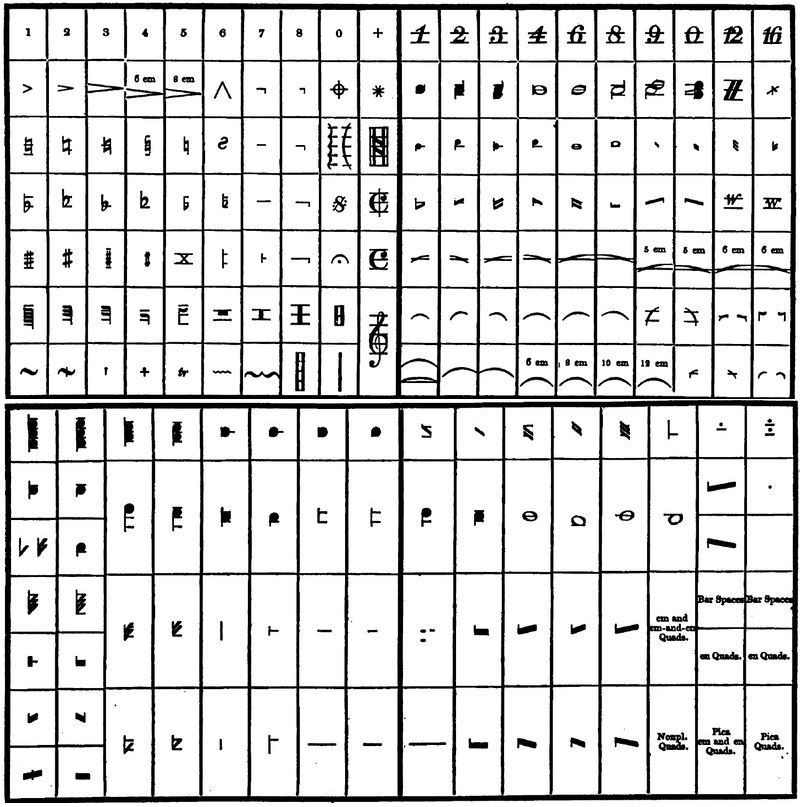
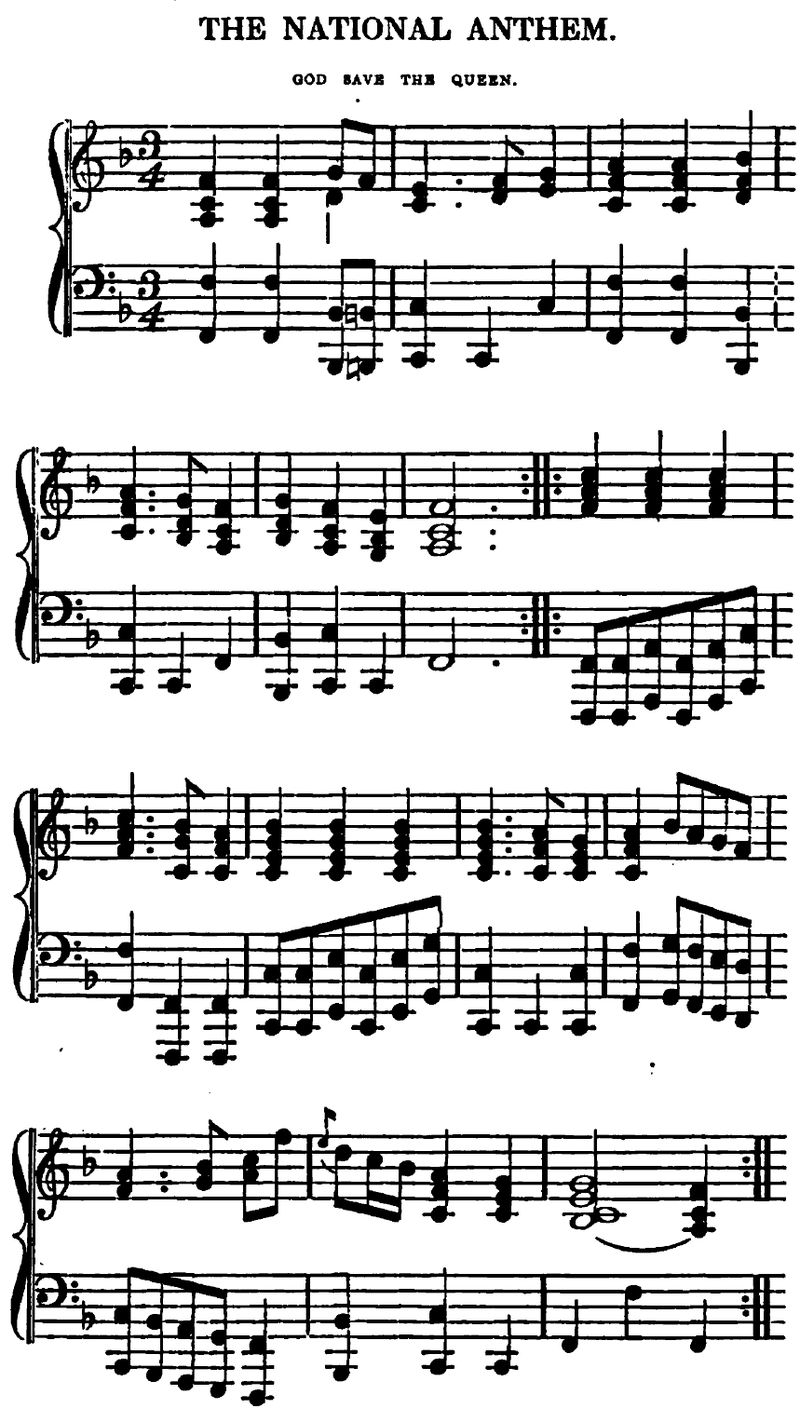
GOD SAVE THE QUEEN.
NAKED Form, or Page,
is when the furniture is taken away from all sides of the form or page. See Strip a Form.
NAMES, Ancient, of Cities and Towns.
The names distinguished by an asterisk * and an obelisk † were taken from Dr. Adam Clarke’s Bibliographical Miscellany, where they form two lists. The additional names were collected by myself.
In the towns marked * printing was carried on in the fifteenth century; and Dr. A. Clarke says—“In this List, great care has been taken not to omit one place where printing was carried on prior to the year 1500.”—“In this list, because the name refers to the work executed there, the genitive case has been retained. Panzer in his list has followed the same plan. This will be of some use to the mere English scholar, as he will at once see the same form of the word in its alphabetical order in this list, which he finds in the title of his book.”
In the towns marked † printing has been established and carried on since the fifteenth century, and Dr. A. Clarke observes—“This part might have been much enlarged, but it was not judged indispensably necessary. As the most difficult names are here explained, which usually occur in the titles of books, the residue it is hoped will occasion little embarrassment to any scholar.”—“It may be necessary to observe, for the information of the less experienced reader, that in this Supplement, as the Latin name stands in reference to no printed work, the nominative case has been always used.”
| * | Babenberge and Bambergæ | Bamberg, Bohemia. |
| Bada | Baden, Switzerland. | |
| Badiza | Bath, Somersetshire. | |
| Bajocæ, Bajocassina | Baieux, Normandy. | |
| Baiona | Bayonne, Gascony. | |
| * | Bambergæ and Babenberge | Bamberg, Bohemia. |
| * | Barchinone and Barcilone | Barcelona, Spain. |
| * | Barci | Barco, in the province of Breschia. |
| * | Barcilone and Barchinone | Barcelona, Spain. |
| * | Basilæ—Bas: Basil | Basil or Bâle, Switzerland. |
| Bathonia | Bath, Somersetshire. | |
| Bennopolis | Hildesheim, Westphalia. | |
| * | Bergomi | Bergamo, Italy. |
| † | Berolininum—Berol: | Berlin, Prussia. |
| * | Beronæ, and Beronis Villæ | Beraun or Beraum, Bohemia. |
| Biponti | Zweybrucken. | |
| † | Bipontium | Deux Ponts, Germany. |
| * | Bisuntii | Besançon, France. |
| † | Biterræ | Beziers, France. |
| † | Biturgiæ | Bourges, France. |
| Bononiæ—Bonon: | Bologna, Italy. | |
| Brangonia | Worcester. | |
| † | Bravum Burgi | Burgos, Spain. |
| Briganti | York. | |
| * | Brixiæ | Bresse or Breschia, Italy. |
| Brixiæ | Brussels, Flanders. | |
| * | Brugis | Bruges, Flanders. |
| Brundunum | Braunaw. | |
| * | Brunnæ | Brinn or Brunn, Moravia. |
| † | Brunopolis | Brunswick, Lower Saxony. |
| Brunsvicum | Brunswick, Germany. | |
| Brunsvigæ | Brunswick. | |
| * | Bruxellis | Bruxells or Brussels, France. |
| [Now belonging to Belgium.] | ||
| * | Budæ | Buda, or Offen, Lower Hungary. |
| † | Burdigala | Bourdeaux, France. |
| * | Burgdorffii | Burgdorf, Switzerland, also a town of Lower Saxony. |
| * | Burgis (Bravum Burgi) | Burgos, Spain. |
| * | Buscoducis | Bois-le-Duc, Brabant |
| Dantisci | Dantzick. | |
| * | Daventriæ | Deventer, capital of Overyssel. |
| * | Delphis | Delft, Holland. |
| † | Derpatum, or Torpatum | Derp, Russia. |
| † | Dertosa | Tortosa, Spain. |
| Deunana | Doncaster, Yorkshire. | |
| † | Dillingia | Dillengen, Swabia. |
| Divione | Dijon, France. | |
| Divisæ | Devizes, Wiltshire. | |
| † | Divona Cadurci | Cahors, France. |
| † | Dola apud Sequanos | Dole, France. |
| * | Dolæ | Dole, France. |
| * | Domus fratrum Communis Vitæ | Vallis Sanctæ Mariæ. A society of monks in the diocese of Rheingau, near Mentz, Germany. |
| Dorcestria | Dorchester, Oxfordshire. | |
| Dorobernia | Canterbury, Kent. | |
| Dorsetia | Dorchester, Oxfordshire. | |
| Dresa | Dresden, Saxony. | |
| † | Duacum | Douay, France. |
| † | Dublinum | Dublin, Ireland. |
| † | Duisburgum, or Teutoburgum | Duisburg, Westphalia. |
| Dumnoriorum | Exeter, Devonshire. | |
| Dunelmum | Durham. | |
| Dunum | Down, Ireland. | |
| Durnium | Dorchester, Oxfordshire. | |
| Durobrovæ | Rochester, Kent. | |
| Durobrus | Rochester, Kent. | |
| Durocornovium | Cirencester, Gloucestershire. | |
| † | Durocorturum | Reims, or Rheims, France. |
| Falmutum | Falmouth, Cornwall. | |
| † | Faventia | Faenza, or Fayence, Italy. |
| * | Ferrariæ | Ferrara, Italy. |
| Fiorenza—Fior: | Florence, Italy. | |
| † | Firmium, or Firmum Picenum | Ferma, Italy. |
| * | Fivizani | A town in Italy. |
| Flavisbriga | Bilboa, Spain. | |
| * | Florentiæ—Florent: | Florence, Italy. |
| † | Fontanetum Comitis | Fontenai-le-Comte, France. |
| * | Forilivii. The ancient Forum Livii | Forli, Italy. |
| † | Forum Cornelii | Imola, Italy. |
| † | Franco-Furtum-ad-Mœnum | Franckfort on the Maine, Germany. |
| † | Franco-Furtum-ad-Oderam | Franckfort on the Oder, Germany. |
| † | Franequera | Franeker, Friesland. |
| † | Fransiscopolis | Havre-de-Grace, France. |
| * | Friburgi | Friburg, Swabia. |
| * | Frisingæ | Freysingen, Bavaria. |
| * | Friuli. Anciently Forojulium and Forojuliensis Civitas | Capital of the Frioul. |
| * | Fulginei | Foligni, Italy. |
| Gabani. See Aureliani. | ||
| Gades | Cadiz, Spain. | |
| * | Gaiettæ | Gaeta, Naples. |
| Galliva | Galway, Ireland. | |
| * | Gandavi | Gand or Ghent, Flanders. |
| † | Gandia | A sea-port, Valentia, Spain. |
| Gaunodurum | Constantia, Switzerland. | |
| Gavanodurum | Saltzburg, Germany. | |
| Gedani | Dantzick. | |
| Genabus | Orleans, France. | |
| * | Genennæ and Genevæ | Geneva. |
| * | Genuæ | Genoa, Italy. |
| † | Gerunda | Gironna, Spain. |
| * | Giennii | Gien, France. |
| † | Giessa | Giesen, Germany. |
| Glasconia | Glastonbury, Somersetshire. | |
| † | Glascua | Glasgow, Scotland. |
| Glasguæ—Glasg: | Glasgow, Scotland. | |
| * | Gondæ, or Goudæ | Turgow, Holland. |
| † | Gotha | A town of Upper Saxony. |
| † | Gottinga and Tullifurdum | Gottingen, Lower Saxony. |
| Gottingue | Gottenburgh, Sweden. | |
| Gracchopolis | Cracow, Poland. | |
| * | Grudisca | A town in the county of Goritz, Germany. |
| † | Graiacum | Gratz, Germany. |
| * | Granatæ | Granada, Spain. |
| Gratiæ portus | Havre-de-Grace, France. | |
| * | Gratianopolis | Grenoble, France. |
| † | Gravionarium | Bamberg, Bohemia. |
| Grenovicus | Greenwich, Kent. | |
| † | Gripswaldia | Gripswald, Swedish Pomerania. |
| † | Groninga | Groningen, United Provinces. |
| Ichborough | Thetford, Norfolk. | |
| Iciani | Thetford, Norfolk. | |
| * | Ilardæ | Lerida, Catalonia, Spain. |
| * | Ingolstadii | Ingolstadt, Bavaria. |
| * | Inspruc | A town of Germany, in the Tyrol. |
| Insulæ | Lisle, Flanders. | |
| † | Isca Damnoniorum | Exeter, Devonshire. |
| Ischalis | Ilchester. Somersetshire. | |
| Isurium | Aldborough, Yorkshire, or Boroughbridge, Yorkshire. |
| * | Januæ. See Genuæ. | |
| † | Jena | A strong town of Upper Saxony, in Thuringia. |
| Kilchennia | Kilkenny, Ireland. | |
| Kiobenhaffn | Copenhagen, Denmark. | |
| * | Koburgi. See Coburgi. | |
| * | Kuttenbergæ | Kuttenberg, Bohemia. |
| † | Macerata | A town in the marquisate of Ancona, Italy. |
| Machlinia | Meckelen, Dutch Brabant. Malines, French Brabant. |
|
| * | Madriti | Madrid. |
| Madus | Maidstone, Kent. | |
| * | Magdeburgi | Magdeburg, Germany. |
| Magontia | Mentz, or Mayence, Germany. | |
| Magontiacum | ||
| Mancunium | Manchester, Lancashire. | |
| † | Manhemium | Manheim, palatinate of the Rhine, Germany. |
| † | Mantua Carpetanorum | Madrid. See Madriti. |
| * | Mantuæ | Mantua, Italy. |
| Marchenium | Roxburgh, Scotland. | |
| Marionis | Lunenburg, Germany. | |
| Marionis | Lubeck, Pomerland. | |
| † | Marpurgum | Marpurg, Hesse-Cassel, Germany. |
| * | Marsipoli | Merseburg, Saxony. |
| Martinopolis | Tours, France. | |
| † | Massilia | Marseilles, France. |
| * | Mediolani—Mediol: | Milan, Italy. |
| * | Memmingæ | Meminingen, Swabia. |
| * | Messanæ | Messina, Sicily. |
| † | Metæ | Metz, France. |
| Metelli castrum | Middleburg, Zealand. | |
| Metelloburgus | Middleburg, Zealand. | |
| * | Moguntiæ—Mogunt: | Mayence or Mentz, Germany. |
| * | Monachii | Munich, Bavaria. |
| Monacum | Munich, Bavaria. | |
| * | Monasterii | Munster, Westphalia. |
| * | Monast. Montis Serrati | Mount Serrat. A very high mountain in Spain, on which is an ancient monastery, dedicated to the Virgin Mary. |
| † | Mons Albanus | Montauban, France. |
| Mons Badonicus | Bath, Somersetshire. | |
| Mons Dolorosus | Stirling, Scotland. | |
| † | Mons-Monachorum | A place near Bamberg, Bohemia. |
| † | Mons-Pessulanus | Montpellier, France. |
| † | Mons Regalis | Mont Real or Mont Royal, Sicily. |
| † | Mons-Regius, or Regiomons | Königsberg, Prussia. |
| Mons Rosarum | Montross, Scotland. | |
| Mons Solis | Bath, Somersetshire. | |
| Monstrolium | Montreuil, France. | |
| † | Moscua | Moscow, Russia. |
| * | Monteregali | Mondovi, Piedmont. |
| Montes | Mons, Low Countries. | |
| * | Murciæ | Murcia, Spain. |
| † | Mussipontum | Pont-à-Mousson, France. |
| * | Mutinæ | Modena, Italy. |
| Oenipons | Inspruck, Tyrol. | |
| * | Offenburgi | Offenburg, Swabia. |
| * | Olomuci | Olmutz, Moravia. |
| † | Olysippo, or Ulisippo | Lisbon. See Ulyssipone. |
| † | Onate, or Ognatæ | In Spain. |
| * | Oppenheimii | Oppenheim, Palatinate of the Rhine, Germany. |
| * | Ortonnæ | Ortona del Mare, Sicily. |
| † | Ovietum | Oviedo, Spain. |
| * | Oxonii—Oxon: | Oxford. |
| Quercetum | Quesnoy, Low Countries. | |
| Quintinopolis | S. Quintin, Picardy. | |
| † | Quitoa | Quito, Peru, South America. |
| * | Ratisbonæ | Ratisbon, Bavaria. |
| † | Redones, or Condate | Rennes, France. |
| * | Reenen | Reinen, Venetian territory. |
| * | Regii | Reggio, Italy. |
| † | Regiomons. See Mons Regius. | |
| † | Regium Lepidi. See Regii. | |
| † | Remi | Reims, or Rheims, France. |
| * | Reutlingæ | Reutlingen, Swabia, Wirtemberg. |
| * | Rhedonibus | Rennes, France. |
| Rhodopolis | Rostock, Lower Saxony. | |
| * | Romæ | Rome. |
| Rosarum urbs | Rostock, Lower Saxony. | |
| * | Rostochii | Rostock, Mecklenberg, Lower Saxony. |
| † | Roterodamum | Rotterdam, Holland. |
| * | Rothomagi | Rouen, France. |
| † | Rubens Mons | A Priory of the order of Clugny. |
| † | Rupella | Rochelle, France. |
| † | Rutheni | Rodez, France. |
| † | Taraco | Tarragona, Catalonia, Spain. |
| Taradunum | Friburg, Germany. | |
| * | Tarrazonæ | Tarazona, Arragon, Spain. |
| * | Tarvisii | Treviso, Italy. |
| * | Taurini | Turin, Sardinia. |
| Tava | Tinmouth, Devonshire. | |
| † | Telo Martius | Toulon, France. |
| Tergestum | Trieste, Istria. | |
| Theoci curia | Tewksbury, Gloucestershire. | |
| Theonis villa | Thionville, Luxemburg. | |
| Theodorodunum and Theorodunum | Wells, Somersetshire. | |
| * | Thessalonicæ | Salonichi, the ancient Thessalonica, Macedonia. |
| † | Ticinum. See Papiæ. | |
| † | Tigernum | Thiers, France. |
| † | Tigurum and Tigurinus Pagus | Zuric, Switzerland. |
| Tileburgum | Tilbury, on the Thames. | |
| * | Toleti | Toledo, New Castile, Spain. |
| † | Tolosa-Palladia-Tectosagum | Toulouse, France. It was not at this town, but a small town of Biscaye, that the editions printed in the fifteenth century with the imprint Tolosæ were executed. |
| Tornatum | Tournay, Netherlands. | |
| * | Trajecti. See Ultrajecti. | |
| Trajecti ad Oderam | Frankfort upon the Oder. | |
| Trajecti ad Rhenum—Traj: ad Rhen: | Utrecht, Holland. | |
| Trajecti Batavorum—Traj: Bat: | Utrecht, Holland. | |
| † | Trajectum ad Mosam | Maestricht, Netherlands. |
| * | Trecis | Troyes, France. |
| † | Tranquebaria | Tranquebar, coast of Coromandel, Hindostan. |
| Trento | Trent. | |
| Treveri | Treves, Germany. | |
| † | Trevi apud Ancones. See Trevii. | |
| * | Trevii | Trevi, Umbria, Italy. |
| * | Tridenti | Trent, Germany. |
| Tripontium | Towcester, Northamptonshire. | |
| Tuberum | Rotenberg, Germany. | |
| * | Tubingæ | Tubingen, Swabia, Wirtemberg. |
| Tuesis | Berwick-upon-Tweed. | |
| Tulifurgium | Brunswick, Germany. | |
| * | Turonis | Tours, France. |
| * | Tusculani Lacus Benaci | Tusculanum, Lombardy. [? Tusculum, now Frescati.] |
| Tybur. Tyburis | Tivoli, Italy. | |
| * | Tzennæ. See Zinnæ. |
| Warovie. Warsavia | Warsaw, Poland. | |
| Warwicus | Warwick. | |
| Wellæ | Wells, Somersetshire. | |
| * | Westmonasterii—Westmonast: | Westminster. |
| Wigornia | Worcester. | |
| Windesora | Windsor, Berkshire. | |
| Winterbergæ | Winterberg, Bohemia. | |
| Wintonia—Winton: | Winchester, Hampshire. | |
| Wittenbergæ | Wittenberg, Saxony. | |
| Wormacia | Worms, Germany. | |
| * | Xericæ | “Yerica.Oppid. nobili in regno Valentino. Panzer. (Serigo?) I know nothing more of this place.”—Dr. A. Clarke. |
| * | Zamoræ | Zamora, Leon, Spain. |
| † | Zamoscium | Zamoski, a strong town of Poland, in Red Russia, now the Austrian kingdom of Lodomeria. |
| * | Zinnæ or Tzennæ | A monastery belonging to the order of Cistercian monks in Saxony. |
| † | Zuvolla. See Zwollis. | |
| * | Zwollis | Zwoll, Overyssel, United Provinces. |
NARROW.
The technical name of a piece of furniture equal in width to a narrow quotation.
NATURAL HISTORY.
Explanation of some Terms used in Natural History.
NAUTICAL ALMANACK.
9 Geo. 4. c. 66. s. 2. “And whereas the Publication of the Nautical Almanack, constructed by proper Persons for the finding of the Longitude at Sea, is of great Importance to the Safety of Ships and Persons, and highly conducive to the general Interests of Commerce and Navigation; be it therefore enacted, That it shall and may be lawful to and for the Lord High Admiral, or the Commissioners for executing the Office of Lord High Admiral, of the United Kingdom of Great Britain and Ireland, for the Time being, to cause such Nautical Almanacks, or other useful Table or Tables, which he or they shall from Time to Time judge necessary and useful in order to facilitate the Method of discovering the Longitude at Sea, to be constructed, printed, published, and vended, free of all Stamp Duty whatever, in the same Manner as the Commissioners under the said Act of the Fifty-eighth Year of His late Majesty’s Reign might or could do; and that every Person who, without the special Licence and Authority of the Lord High Admiral or Commissioners for executing the Office of Lord High Admiral aforesaid for the Time being, to be signified under the Hand of the Secretary of the Admiralty for the Time being, shall print, publish, or vend, or cause to be printed, published, or vended, any such Almanack or Almanacks, or other Table or Tables, shall, for every Copy of such Almanack or Table so printed, published, or vended, forfeit and pay the Sum of Twenty Pounds, to be recovered with Costs of Suit, by any Person to be authorised for that Purpose by the Lord High Admiral or Commissioners for executing the Office of Lord High Admiral aforesaid, (such Authority to be signified under the Hand of the Secretary of the Admiralty as aforesaid,) by Action of Debt, Bill, Plaint, or Information, in any of His Majesty’s Courts of Record at Westminster; and that the Proceeds of the said Penalty, when recovered, shall be paid and applied to the Use of the Royal Hospital for Seamen at Greenwich.”
NEAR CHEEK.
That cheek of the press which is on the side at which the pressmen stand to beat and pull.
NECK of a Letter.
So much of the punch as is sunk into the matrice is called the neck; and when that letter is cast of metal, it is so much as comes above the square of the shank, viz. above the beard.—M.
Nest Frames.—M. The same as our Case Racks, which see.
NEWS HOUSE.
A printing office in which newspapers only are printed; a term used to distinguish them from book houses and job houses.
NEWSPAPERS.
The following report on the regular mode of working on Newspapers, contains much interesting information respecting this branch of the printing business.
I feel gratified in being able to give a copy of it, as it is little known beyond the circle of the newspaper department, and I am satisfied it will prove serviceable to the trade at large, for newspapers are now frequently printed in book houses, where the regulations connected with them are not generally known: and I also think I am acting in accordance with the motives of the Committee that drew it up, in giving it more publicity; for they say, a Committee was appointed “to draw up, and circulate, for the information of the trade, a statement of the regular mode of working on newspapers—‘to guide the ignorant, to guard the unwary;’ to assist them in their labours, and to maintain that harmony which should ever subsist between two branches in one profession.” And, “your Committee have extracted from, or inserted[504] at length, every document relating to regulations or prices since 1785, which they trust will not be considered uninteresting, and, handed down as records, may yet be useful.”
“REPORT
“Of a Committee appointed to draw up a Statement of the regular Mode of working on Newspapers, for the Information of the Trade; to examine Documents, and to report the same.—Read July 29, 1820.
“The object which your Committee were directed to accomplish (that of giving a fair scale of work, mode, time, and price, on all Newspapers, wherever published) has been entered into with zeal on their parts, and they trust will be found to your satisfaction. They have examined the bases of all official agreements, and all acknowledged and understood rules; and have particularly adhered to their instructions, by keeping in view, ‘that it was to guide the ignorant, to prevent the evil intentions of the unprincipled, and, if possible, to form a closer bond of union among yourselves.’
“Laws are rendered more sacred, more valid, by age; and in performance of the task assigned them, the Committee commenced their labours by tracing the Regulations for News Work back to a certain period, in order to support them in their declaration, that they had been introduced on fair principles, that they had been cordially agreed to by the Masters, had been acted upon by the employed for so great a length of time, and that any innovation made on those regulations by an employer, or set of men acting for themselves, without the concurrence of the general body of News Compositors, should be opposed, and those concerned in such an attempt treated as enemies to their fellow-workmen, and marked as acting inimically to the interests of their profession.
“It was necessary for your Committee, for the maintenance of the superstructure, to examine its foundation; with this view they have, from oral testimony, been enabled to collect the size and price of various Newspapers from 1770. They consisted of 16 small columns, some 18, some 19, and others 20 ems Long Primer wide. The galley was 130 or 132 lines, and 50 after-lines, Long Primer; Brevier galley 96, after-lines 38. (The only exception was the old Daily Advertiser, which contained 12 columns of 25 ems Long Primer wide, the galley in proportion.) The prices were, full hands 27s.; supernumeraries 13s.; galley 2s. 2d.; 5d. per thousand; and over hours 6d. Supernumeraries (a term which explains itself) were not known ten years prior to this date. Most of the papers were small folios; and as they were nearly all connected with, or done in Book-houses, the eldest apprentice, upon a press of matter, was usually called in to assist. Upon the subdivision of the labour into galleys, and the size of the papers extending, a man was employed if any deficiency arose in the quantity required. Advertisements increased; the use of small type was extended, and the Supernumerary became a fixture.
“Prior to 1776, controversial essays, domestic news, and extracts from the official communications in the London Gazette, appear to have filled the small columns of the Journals; but the American war commencing this year, they assumed a new consequence, by first venturing to give daily Reports of the Debates in Parliament.
“In 1777 there were seven Morning Papers, eight of three times, one twice a week, and two weekly. The first Sunday Paper came out in 1778; in a few weeks it was followed by a second: and a third was brought out in the succeeding year. The weekly Journals paid 24s. In 1780 a new Daily Journal arose, with a different appearance from the others, which seems to have induced a further alteration. The prices remained the same, but the employment of more hands was rendered necessary. The hour of beginning varied, some commencing business at eleven, others at two, and some so late as three o’clock.
“In 1784, the first year after the peace, another Journal started for public favour, in which Minion was introduced. The old method of display was discarded, a new taste appeared in the arrangement of the matter in the inner form, and the former advertisement style was completely exploded. Rivalry commenced, and the other Newspapers soon made a correspondent change. Your Committee have thus reached the period when they meet with the first printed document relating to the composing part of the printing business. It is a request, in the form of a Circular, by the body of Compositors, for an advance of one halfpenny (Book-work being then paid 4d. per 1000), dated April 6, 1785, and consisting of eight propositions; which were not finally determined upon by the Employers till the 25th of November following. The proposition and answer relating to News-work were as follow:
“‘Prop. 4. That the Compositors employed on Daily Newspapers, now paid at the rate of 27s. per week, be in future paid 1l. 11s. 6d. per week, and over hours paid as at present—Answ. This cannot be a matter of general regulation, as the trouble of every paper differs from that of another.’
“Your Committee have no other document of this date: it will be observed that the prices were low, and that the over hours were paid for; but it was considered impossible to make the request ‘a matter of general regulation,’ as every Journal differed in its trouble from another. The Book-men, however, received an advance of one-eighth, or 2s. 6d. in the pound, and the establishments in Book-houses varied from 1l. 1s. to 1l. 7s.
“1786.—The advance on Book-work commenced on the 1st of January, and in the month of March following the Newsmen, on Daily Papers only, received a rise of 4s. 6d., which made the price for full hands 1l. 11s. 6d., and for Supernumeraries 15s.; the galley 2s. 6d. A few Journals only of the other class rose to 27s. At this time there were eight Morning Papers, eight of three times a week, two Weekly, and three Sunday Journals. In 1788 the first Daily Evening Paper made its appearance, and the men received the same price as the Morning Papers; a second came out in 1791, and was paid in like manner.
“1793.—For a number of years the Compositors employed on Book-work had been labouring under an intolerable grievance, and although they did not demand a rise per thousand, requested, as a new regulation, that the head and direction lines of pages, and the en and em quadrats at the sides, should be paid for. Their Circular was dated the 14th January, and on the 11th March following, the masters agreed to the proposition of paying the head and direction lines, but not the ens and ems.
“The News department appears to have been in full employment at this period. By a strong competition for public favour (which commenced, as already observed, prior to the termination of the American war, and from the year 1785 to 1793), the Journals underwent a most material alteration. It was a remarkable epoch, including the most eventful seven years of the last century. The disarrangements, both civil and political, concomitant to a return to peace after a long war—the wars in India—the troubles in Germany, in Flanders, Brabant, Holland—the French Revolution—and the commencement of a war with France—all occurring within the dates just mentioned, caused a strong political feeling in the public mind; of course, information from all quarters was eagerly sought, and as readily given by the Editors of the Daily Journals, among whom, as with their readers, party spirit rose to its utmost height, and no expence was spared to gratify it. In this period nineteen new journals put forth their claims for public support—the majority, however, were ‘born but to die!’—two of the older Papers also expired; but their places were occupied by seven juniors. The number now amounted to eleven Morning and two Evening Papers; seven of three times a week, one Weekly, and five Sunday papers. An alteration in the method of display, and a new mode in the arrangement of the matter, became now very general. One Journal went beyond the rest, by its introduction of French rules, the small capitals for particular paragraphs, and discarding nearly all the double letters, and the long s. Your Committee are also enabled to state, by comparing the modes of work prior to 1785, with the necessary alterations at the period they have now mentioned, that a complete revolution was also effected in the nature of News-work. It became necessary, therefore, that the price should keep pace with the labour, and an advance was solicited. The first printed document, solely from Newsmen, is dated April 4, 1793, signed by 145 Newsmen, and their request was supported by the signatures of 281 Bookmen. It contains four propositions:—the first for an advance of 4s. 6d. per week on Morning and Evening papers; the second related to the hours of working and the charge for over-hours, which then was but 6d. per hour; the third, to Papers published three times a week; and the fourth, to supernumeraries, but it did not state their price. All these propositions were modified ten years afterwards.
“The address which accompanied these propositions, and the requests made in it, being so applicable to the present mode of work, your Committee are satisfied with defending every iota requited by their predecessors. Although twenty-seven years have elapsed since they were submitted to the employers, yet, if required at the present moment, the same arguments might be used in their support. In fact, they must be considered the foundation-stones of the edifice. Your Committee will introduce the document.
“London, April 4, 1793.
“‘Sir,
“‘The Compositors employed on Newspapers, impressed with the opinion of your candour in hearing and redressing any real grievances they may complain of, presume to submit to your consideration the following statement:
“‘Previous to the year 1786, the weekly salary of Daily Newspaper Compositors was 1l. 7s., a sum which, considering the regularity and moderation of the hours of attendance, was thought fully adequate to their trouble. Owing, however, to a competition for Public favour among the various newspapers, by giving a long detail of Parliamentary Debates, entering at large into the politics of Europe, and the irregularity[506] and uncertainty of the arrival of mails, the hours of attendance were necessarily increased, which, together with the enhanced price of Provisions, made an advance of salary necessary, and which was at that time cheerfully acquiesced in by the Proprietors of Daily Newspapers, as perfectly reasonable; but no advance was then given to Evening Papers.
“‘The Compositors on both Daily and Evening Papers, upon a comparative view of the trouble and attendance requisite at that period and at the present time, and the still increased price of the necessaries of life, humbly propose and request an addition to their Salary, which they trust the Gentlemen Proprietors of Newspapers will not think unreasonable, when the following circumstances are taken into consideration:
“‘That at the rate of twelve hours’ Composition, and at least two hours’ Distribution, the present Salary of Compositors employed on Daily Papers amounts to no more than Fourpence Halfpenny an hour, which, considering the irregular hours of attendance, working by night, and on Sundays, and of being constantly at command, the Compositors humbly think, and trust, the Gentlemen Proprietors of Newspapers will agree with them in opinion is by no means adequate to their labour.
“‘That as Compositors on Evening Papers obtained no advance in the year 1786, and that as their labour has been gradually increasing ever since that time, it is hoped their joining in the present application will not be thought unreasonable.
“‘It is humbly proposed, for the above reasons, that an increase should take place upon the Salaries of Compositors on Newspapers, in the following proportion, viz.
“‘I. That an advance of 4s. 6d. per week take place on the present Salary of every Compositor fully employed on Daily Papers.
“‘II. That if, owing to the length of Proceedings in Parliament, or other late Matter, the Compositors employed on Daily Papers should be detained above twelve hours on Saturday, to be reckoned from the time of beginning to compose on Friday, they be paid Sixpence per hour extra for the same, or an equal proportion of time allowed on Sunday, in the same manner as is usual on other Days of the Week.
“‘III. That 3s. be added to the present Weekly Salary of Compositors fully employed on Evening Papers published three times a week.
“‘IV. That the Salary of Supernumeraries employed on either of the above be increased in proportion.
“‘These, Sir, are the propositions submitted to you, to be laid before the Gentlemen Proprietors, not doubting but that the reasonableness of the Compositors’ demands will be evident to you, and that it will meet with your approbation and concurrence, especially when it is considered that the advance they require is so nearly proportionate to that lately obtained on Book-work.’
“It will be necessary to state that the terms Evening Papers used in this document, allude only to the desire expressed in the third proposition. The words Daily Newspapers, repeated in the second and fourth paragraphs of the Address, and in the first proposition, sufficiently show that no distinction was intended to be made between Daily Morning and Daily Evening Papers. But this request of the Newsmen did not seem to be answered with cordiality by the Masters, for your Committee have a copy of the Report of the News Committee, dated April 20, 1793, which, after mentioning the names of 15 Delegates present, at two in the afternoon, previous to the general meeting to be held at seven in the evening, states
“‘That, pursuant to a printed circular Letter, signed ‘JOHN BELL,’ the Committee adjourn to Anderton’s Coffee-house, to hold a conference as requested, on some Propositions laid before the Printers and Proprietors of Newspapers, by the Journeymen employed by them.—Adjourned accordingly.
“‘Six o’Clock, P.M.
“‘The Delegates having returned to the Hole-in-the-Wall, report to the General Meeting.
“‘That they met with the Representatives from the following Newspapers, viz.
| Ledger, | Oracle, | Times |
| Herald, | True Briton, | and |
| World, | Sun, | |
| Morning Chronicle, | Star, | Diary. |
“‘That these Gentlemen did not chuse to hold any conference on the Subject to which your Delegates were invited.
“‘That the professional Printers present, though personally requested, declined entering upon the Subject, the Discussion of which your Delegates were required to attend.
“‘That the above-mentioned John Bell, instead of attending to the Business to which they were expressly called, endeavoured to persuade them to accede to the following Resolutions, as particularly advantageous to the Employers and Employed, viz.
“‘April 20, 1793.
“‘At an Adjourned Meeting of the Proprietors and Representatives of the Daily Newspapers, held this Day at Anderton’s Coffee-house, to consider the Propositions of the Daily Newspaper Compositors,
“‘Present,—The Representatives of the Ledger,—Herald,—World,—Morning Chronicle,—Oracle,—True Briton.
“‘Considering the Requisitions and Pretensions of the Newspaper Compositors in the most extensive and liberal Points of View, so far as they are connected with the fair Interests of their Employers, it was resolved, to recommend the Prices and Regulations in future for Newspaper work to be fixed on the following Plan:
“‘That each regular Compositor be paid One Pound Fourteen Shillings per Week.
“‘That the Hours of regular Attendance for composing, be from Three o’Clock in the Afternoon until the Paper goes to Press.
“‘That whenever the Time of going to Press shall exceed Three o’Clock in the Morning, the Times of Attendance on the same Day shall be in the following Manner, viz.
“‘When the Paper goes to Press at—
| 3 | to begin at | 3 | 8 | to begin at | 5 |
| 4 | 3 | 9 | 6 | ||
| 5 | 3 | 10 | 7 | ||
| 6 | 4 | 11 | 8 | ||
| 7 | 4 | 12 | 9 |
“‘That the Supernumerary Compositors shall be allowed one Shilling per Week over and above their present Pay, supposing that such Supernumerary shall compose one Column per Day, and so in Proportion.
“‘That your Delegates felt the Indignity offered to them, but bore it with the Patience which the Justice of the cause in which they were engaged only could warrant.
“‘That your Delegates, with a becoming Dignity, rejected the Resolutions of the said John Bell.
“‘That your Delegates, from the Consideration of the Labour required, find their first Proposition unanswered, unopposed, and therefore just.’
“‘Ten o’Clock, P.M.
“‘The General Meeting unanimously approve of the Conduct of the Delegation; and further resolve,
“‘That the Original Propositions standing uncontroverted, the same be strictly adhered to.’
“The Resolution in the last paragraph of this Report was most rigidly adhered to; and your Committee cannot but lament, that the first attempt of your brethren to introduce Laws and Regulations for the reciprocal benefit of the employer and employed, was met by such proposition on the part of one Proprietor, that, in order to carry their point, they were obliged to enter into a Resolution that a general notice of quitting their situations, according to the custom of the trade, should be given. Before the expiration of the fortnight, however, an accommodation was proposed by the Employers individually; but upon the principle that a material difference existed, both in labour and comfort, between an Evening and a Morning Paper, the Newsmen agreed to a distinction being made in the price. Morning Papers received the sum required of 4s. 6d., but Evening Papers only 2s. 6d. The wages of the former were 1l. 16s.; Supernumeraries 17s.; the galley 2s. 10d.: the Evening Papers were 34s.; Supernumeraries 16s.; the galley 2s. 8d. Within this period the term Assistants was first recognized. Your Committee are not enabled to state whether any satisfactory agreement was entered into with respect to the second Proposition of the Journeymen relating to the commencing work on Sundays. It would appear that they only requested that day’s indulgence, for they already possessed it on the others. Some of the Journals at this time paid but 6d. per hour, while others, more liberal, paid on those of the Morning 7½d. and on the Evening 7d. for over-hours or Assistants.
“In the month of October, 1793, the same year of the rise, your Committee find that the Journeymen had occasion, from the accumulation of labour on Daily Newspapers, to object to the employment of Apprentices, as a strong desire was evinced, at this period, of returning to the system, by employing run-aways, or turn-overs, as they were denominated. The Employers conceiving they had been forced to accede to the rise in the month of April preceding, appeared determined to take advantage of the men, by paying themselves for their defeat by the difference of price between Apprentices and Journeymen. Suspicion had been long awake that some innovation was intended, and the scheme soon developed itself; the Newsmen assembled, and entered into certain Resolutions, which, with a statement of their case, were sent round the Trade for the concurrence or disapproval of the Bookmen. They were readily adopted[508] by the latter, and your Committee present an Extract from the Journeymen’s Address, and their Resolutions.
“‘October 1, 1793.
“‘Can any reasonable Advocate be found for the Introduction of Apprentices on Newspapers? We do not believe there can.—A Companionship on a Newspaper, distinct and different in its Nature from Book-work, requires equal Attention, equal Exertion, and equal Interest. And can this be expected (we ask) from an Apprentice? Companionships find it their mutual interest to be watchful over each other, and see that each does an equal share; which, if not done, is easily remedied among themselves. But who is it that will say this can be done with an Apprentice? A Journeyman must be attentive, or, from the Representations of his Companions, he loses his situation. But how is this to take place in regard to Apprentices? If complaints are made to the Printer, how can he rectify them? It is evident to us that he cannot. Your time of employment is not to be forced on an Apprentice; he can refuse to work either by Night or on Sunday, and be justified in his refusal; and Magistrates must sanction him. Indeed, experience has proved that it is generally impossible to keep an Apprentice to the Business on a Newspaper with regularity; they have no interest to bind them; they have no obligation to compel them. Need there be a further Argument used in support of our opinion? We trust not. Under these circumstances, then, there is only one thing remaining for us to recommend—to unite in a firm Phalanx, and to be unanimous.’
“‘RESOLUTIONS.
“‘I. That Newspaper printing, being necessarily conducted by Companionships, requires in each Companion corresponding abilities, corresponding modes of reasoning, and corresponding interests.
“‘II. That an Apprentice, not being at liberty to act for himself, cannot be supposed to possess an equal and independent mode of reasoning, and therefore has not a corresponding interest.
“‘III. That the introduction of an Apprentice upon a Newspaper will occasion a clashing of interests, which may, in the end, prove highly detrimental, not only to the Companionship, but to the Property on which they are engaged, and likewise to the whole body of Compositors, by enlarging the field for the employment of Apprentices.
“‘IV. That therefore the Compositors on Newspapers are firmly and decidedly of opinion, that an Apprentice is by no means an adequate Companion.
“‘V. And therefore they will resist, to the utmost of their power, any attempt (if any such attempt should happen) to obtrude an Apprentice upon them.’
“The system, however, commenced in the month of October, upon one Journal, which lasted about five years—and upon another which continued nearly eleven years; but in the end you were successful; and men were again engaged upon these Journals on a fair principle. The fate of some who had worked with the boys should have served as a warning—they were neglected, despised, and ultimately driven from the profession. Your Committee cannot refrain from congratulating the Journeymen of that period on their unanimity and perseverance; and at this moment, upon a due consideration of the present state of our business, rejoice in their patriotism, and return thanks to every individual now in being concerned in the opposition given to the attempt.
“1801.]—Your Committee have thus led you to the conclusion of the second period of seven years, through the whole of which the country was engaged in a war with nearly all the European quarter of the globe, and, as has been stated for 1793, your labour increased with the demand for news by the public, and by the struggles of the Journals for pre-eminence, which, added to the alarming price of provisions and all other family requisites, made it again necessary to solicit an advance of wages. In the month of November, 1800, the Book-men requested a rise, and certain regulations applicable to their department. It was granted to the amount of 1-6th, and took place on the 1st of January, 1801. Shortly after, almost gratuitously, the News department received an advance of 1-9th (or 4s.) on Morning, and 1-11th (or 3s.) on Evening Papers. The former were now 2l.; Supernumeraries 19s.; per galley 3s. 2d.; Assistants 9½d. per hour; the Evening, 1l. 17s.; Supernumeraries 17s.; per galley 2s. 10d.; Assistants 8½d. per hour.
“Thus terminated the third rise from 1785. In this period several disputes occurred; but your Committee will only repeat those relating to the general interest. From the extensive sale of some of the Evening Papers, the work was obliged to be performed in a manner that, from its evil tendency, required some modification; the hours for composition were not so well defined as hereafter they appear to have been, and the following[509] Resolution, as applicable to Evening Papers, was agreed to among the Newsmen; ‘That all composition cease when the day’s publication goes to press—all work afterwards to be paid for as extra, or deducted from the first work of the next publication.’ This did not apply to the second or third editions of the day’s paper; that being completed, those additions could have no claim on the following publication. The quantity and quality of the matter were also better defined within this period. Brevier was the smallest type till 1784, when Minion was introduced; and the adequate number of lines, by their proportion to Long Primer and width of column, were regulated by the Companionships and their Printers. This continued till 1793, when the different proportions were generally understood, and a printed graduated Scale for Long Primer, Brevier, and Minion, according to width, was found in each News-house. This appears to have been requisite, as your Committee learn, that, from 1789, it was the custom on some Journals to widen their columns, during the sitting of Parliament, one or two ems, and reducing them in the recess. At this date a misunderstanding still existed relative to the hour of beginning on Sundays. Certain regulations were adopted respecting the twelve hours’ work (including refreshment time, galley and ‘lines,’ and correcting), and the time of commencing on that day.—Your Committee must observe, that the Compositors employed on Morning Papers at this period were not uniform in their hours of beginning on Sundays, and disputes frequently occurred on that point. This might have arisen from the different temper and politics of the Journals on which they were engaged; some entering at length on the Friday night’s Debates in Parliament, Foreign News, &c., while others were content with giving the Public a moderate portion of both. Competition, however, soon made the labour on the Journals equal, and, in 1803, the hour of commencing on the Sunday, regulated by the Saturday’s finish, became general.
“Your Committee also state that they have endeavoured to trace the origin of what are termed the ‘after-lines’ of the first work; tradition has vaguely assisted them in their research. They learn that they were general in 1777, but differing in amount. The term is not mentioned in the Propositions of 1793, but is acknowledged in the Regulations before mentioned; your Committee are therefore led to conclude that they arose with the subdivision of labour on the smaller Papers, prior to 1770, and suppose that custom, arising from local convenience, sanctioned their adoption by your predecessors.
“1809.]—In pursuing their plan, your Committee observe nothing of material consequence occurring in the News department till the year 1809, when the still-increasing price of provisions rendered it necessary for the Compositors to solicit a rise of prices, and on the 19th of May the Newsmen issued a Circular, addressed ‘To the Proprietors of Newspapers,’ requesting an advance of 1-5th on their wages,—i. e. 8s. per week on Morning, and 6s. per week on Evening Papers.
“In the two former Circulars, certain propositions were submitted, to be accepted, modified, or rejected; but the present one was accompanied by the first and regular Scale for News Work, and signed by 198 Newsmen. Your Committee will introduce an extract from the introductory paragraphs and the Scale itself, which completed the edifice you had long laboured to rear.
“After stating the necessity the Newsmen were under of soliciting the assistance of the Employers to enable them, by their industry, to make their existence comfortable, they point out the moderation of their request, by giving a comparative statement of the prices for family necessaries, between 1793 and 1809, by which it appeared, that in sixteen years they were nearly doubled. They further add, that
“‘It has been observed by the Duke of Portland, in his letter to the Lord Lieutenant of Oxford, that ‘there is no reason why the labour of the Handicraftsman, the Mechanic, and the Artizan, should not keep pace with the advance on the articles of the Farmer, Grazier,’ &c. Upon this principle, the justice of which is too evident to need the smallest comment, might we not calculate, as Morning Papers, in 1793, were paid 36s., and Evening Papers 34s. that we should now receive nearly 3l. 12s. on the Morning Papers, instead of 2l.; and nearly 3l. 8s. instead of 1l. 17s. on the Evening?
“‘There is another consideration to which we must beg to call your attention; at the time of the last advance a ratio of one-sixth was obtained on all works in Book-houses, which proportion was not received by those employed on Newspapers; four shillings only being granted on Morning Papers, which before that time were 36s., and three shillings on Evening Papers, which previously were 34s., being only one-ninth on the former, and scarcely an eleventh on the latter. These circumstances, together with the great increase of labour on Papers of late years, arising from the introduction of so large a portion of small letter, are considerations which, we hope, will not be passed over without that deliberation they deserve.
“‘From an impartial view of the comparative statements and the proposed advance,[510] it will be seen that we have kept perfectly within the limits prescribed by justice. We have pursued this line of conduct from a solicitude to avoid the introduction of any thing which might prevent your ready compliance with our request.
“‘PROPOSED SCALE.
| Daily Morning Papers to be paid | £2 8 0 |
| Per Galley on ditto | 0 3 9½ |
| Daily Evening Papers | 2 3 0 |
| Per Galley on Ditto | 0 3 7 |
“‘That Ten Hours Composition be the specific time for Daily Evening Papers.
“‘That Assistance be paid at per Hour in proportion to the sum per Galley, considering the Galley as Four Hours Composition.
“‘Papers Three Times a-Week, and Weekly Papers, to take an advance in proportion to that on Evening Papers.
“‘☞ That the above advance do take place from Saturday the 3d of June, 1809.’
“This request was verbally and negatively answered in the different News Houses, and the 3d of June passed over as if no solicitation for a rise of prices had been made. The Journeymen felt the necessity of perseverance, and the following Circular was sent to the Employers, dated June 13, signed by the same number of men:
“‘Gentlemen,—We cannot help expressing our surprise at the manner in which our request has been passed over; nearly a month has elapsed, and no answer has been communicated. Had we in our Scale gone further than the urgency of the times renders necessary, or had we neglected to shew that respect which your situations in life require, we might have anticipated such indifference; but feeling our conduct not liable to such objection, we are entirely at a loss to assign any motive for the want of attention to our present circumstances; and we feel ourselves under the necessity of requesting an answer by Saturday next; a noncompliance with which will be considered as a refusal of our propositions.’
“This second Circular received no answer, and on the 20th of June, the regular notice of quitting was given to the different Printers; but before the fortnight had elapsed, each Journeyman received a copy of a Report of a Committee of Masters, dated June 30, accompanied by a string of Resolutions, but not meeting the request of the men.
“Your Committee regret that the document is too voluminous for insertion, but they will make a few extracts in furtherance of their present object. It commences with stating, that ‘A General Meeting of the Proprietors of London Morning and Evening Papers was held this day (June 30, 1809), Mr. Stuart in the Chair, to take into consideration the Report of the Committee appointed to enquire into, and report their opinion upon the Circular Letter of the Compositors, respecting certain alleged grievances, and demanding an advance of Wages; present five Daily Morning, and five Daily Evening Papers,’ and that the said Report was read.—To answer the above-mentioned ‘Circular Letter,’ eleven paragraphs are given, and a comparative Table of the Prices of Necessaries, from 1793 to 1809, in contradiction to that given in by the Journeymen.
“The first paragraph condemns the strong spirit evinced by the men in demanding so large a rise as 20 per cent. on their labour; and protests against the ‘Scale proposed,’ as containing ‘Rules and Restrictions new to the Trade, and embarrassing to the Proprietors, while no reciprocal benefit or advantage is held out.’
“The second attempts to controvert the assertion of the Newsmen, that they ‘experienced difficulties in procuring the necessaries of life,’ by declaring it ‘a matter of surprise and regret, that any thing so unfounded should be advanced on so serious an occasion by a body of men, generally speaking, so intelligent and respectable;’ and after comparing your prices and situation with your Brethren on Book-work and other mechanics, conclude with stating, that
“‘Their claims to high wages do not rest on the difficulties in obtaining the necessaries of life, but on the disagreeable hours of labour. They make more money than falls to the lot of 39-40ths of the men in Britain, and they can procure not only all the necessaries of life, but even more of its comforts, than 99 out of every 100 men in Europe. It is lamentable to see men so insensible to the blessings of their situation!’
“Your Committee cannot congratulate you on the comforts or blessings of your situation; they leave to your own feelings the fallacy of assertions so hackneyed, and proceed to the third paragraph, which calls the quotation from the ‘Duke of Portland’s Letter,’ a ‘misrepresentation, and a pretended extract,’ and concludes with finding a meaning not intended by his Grace of Portland—‘that the arbitrary fixing of wages was a most alarming evil.’
“The fourth respects the statement of the prices of necessaries, and will not admit the[511] propriety of introducing the year 1793 in comparison with 1809, because the Compositors ‘then received all they asked, and a new compact was formed with them on their own terms.’ A difference appears in the Compositors statement and that of your Employers, for the year 1793, of 2½d.!
“The fifth acknowledges the calculation for 1809 to be correct—10s. 4½d.; and as the prices for 1800 were 8s. 9½d., there only remained a difference of 1s. 6¾d. to 1809; a loss they conceived you might well bear ‘without incurring the penalties of starvation.’
“Your Committee feel it necessary to quote the sixth at length;—it needs no comment.
“‘The reference the Compositors make to the increased labour on Newspapers, in consequence of the introduction of small letter, is unjust, is absurd, and we cannot understand how they could allow so unfounded a complaint to escape them. The proprietors have always paid, and paid smartly too, for this introduction. The Compositors have limited hours of employment, limited quantities of work, and they compose only one number of letters, whether small or large, agreeably to the universal rule of the business.’
“The seventh mentions Apprentices, which your Committee will not repeat, considering that question set at rest.
“The eighth recommends that ‘the false assertions, groundless complaints, and extravagant pretensions of the Compositors should be met by a firm and determined resistance;’ and for fear that you should be intoxicated by success to demand ‘double wages,’ state, that they ‘have therefore considered a plan of establishing a society of Compositors under an Act of Parliament, connecting with it a benefit society, which, they are confident, will enable the trade to go on, and which they may hereafter submit to you;’ but without stating who were to be the honoured Members of such society.
“The ninth paragraph, after expressing the indignance of the Masters at the extravagant demands of the men, recommends that the wages should be put upon a footing with Book-work in 1800; acknowledging that the rise on the latter was 1-6th, while that on News-work was but 1-9th on Morning, and 1-11th on Evening Papers, and propose that 2s. per week should be added to the Morning Papers, but that only 1s. should be given to the Evening Papers, ‘the difference in the labour and hours of work being much more than 4s. per week.’
“The tenth recommends that no alteration in the hours of composition on Evening Papers be permitted.
“The eleventh expresses the anxiety of the Committee to give the Compositors a detailed answer, in order that the latter might clearly understand and appreciate their own interests; and the whole concludes with the following
“‘RESOLUTIONS.
“‘Resolved,—That the Report of the Committee now read be agreed to.
“‘Resolved,—That the Newspaper Compositors have not made out a case entitling them to a rise of wages; but that as they complain their rise in 1800 was not equal to the rise in Book Houses, a Regulation do now take place, putting them both on a footing.
“‘Resolved,—That as the labour on Morning is considerably heavier than on Evening Papers, the latter are not entitled to the same indulgence on this occasion as the former.
“‘Resolved,—That from Saturday the 15th of July, 1809, the wages of Compositors on Daily Morning Papers shall be two Guineas per week, and on daily Evening Papers Thirty-eight Shillings; and that the Galley on the former shall be Three Shillings and Four-pence, on the latter Three Shillings and Two-pence.
“‘Resolved,—That the Circular Letter of the Journeymen Compositors, together with the Report of the Committee of Masters and these Resolutions, signed by the Chairman, be printed in the form of a letter, and that some one Proprietor of each Newspaper shall personally deliver to each Compositor, while at work in his house, a Copy of the said printed Letter.
(Signed) “‘D. STUART, Chairman.
“‘Turk’s Head Coffee House, Strand,
June 30, 1809.’
“After some discussion, the Newsmen agreed to accept the offer made by the Proprietors in the Resolution above stated; but as the sums given were declared to be on the principle only of putting you on an equality with the Bookmen, in their advance in 1801, it was determined to continue united to support the original Propositions when an opportunity offered. This regulation gave the Morning Papers 2l. 2s.;[512] Supernumeraries 1l.; per galley 3s. 4d.; 10d. per hour; and Evening Papers 1l. 18s.; Supernumeraries 19s.; per galley 3s. 2d.; 9d. per hour.
“At this period the Book Compositors were soliciting a rise of 1-7th on their prices. The Newsmen were not long behind their brethren in claiming the same advance on their labour, and the long Report of the Masters, before mentioned, was answered, paragraph by paragraph, in a manner which must have convinced them, that if they would not allow the talent, they must acknowledge that all the justice in the dispute lay on your side. This answer is dated January 18, 1810. Your Committee cannot, in consequence of its length, insert it here, but, to suit their present purpose, will extract the answers to the second and fifth paragraphs.
“‘The profession of a man should be always equal to the support of himself and his family in a decent way. They should be supplied with not merely what will preserve animation, but what custom has rendered necessary for our comfort; and every man of family must feel the truth of the assertion—that at the present time he experiences difficulty in procuring such necessaries. With respect to the difference between the wages of Book and News Compositors, it will be observed, that the expences of a News Compositor are necessarily more than that of a Book Compositor, arising from the unseasonable hours of labour.—We believe the latter part of their paragraph will be found very deficient of truth; for there are but few mechanics with the same constant and regular exertion, but would equal, and exceed by far our incomes.’
“As the two dates given by the Journeymen for the prices of provisions were to be contradicted, they introduced three tables, and made a calculation by the rule of Subtraction. But the men were not to be deceived by this new system of Arithmetic, and combated by the old mode as follows:
“‘It would seem as if the sum of 1s. 6¾d. was considered as the loss we sustained in the course of a week; but it is the proportion it bears to 8s. 9½d.; and we find that it makes a difference in our weekly incomes of 7s. 1d., a sum which must be felt particularly by those having families.’
“The assertions made in the other paragraphs were most ably controverted, and your cause made doubly sure by the truths which accompanied its defence. The Employers never made a reply to it, because it was unanswerable; and your Committee cannot refrain from expressing their gratitude to all concerned in its production.
“1810.]—To proceed. The Book Masters acquiesced in the request of their Compositors for an advance, which was to take place on the 1st of May, and the Newsmen taking advantage of the acknowledgment made in the ninth paragraph before mentioned, demanded the rise of 1-7th to place them on an equality with their brethren in the Book department. Their request was not noticed. They still persevered, and to assist their cause the Bookmen came to a Resolution, that no man should apply for a situation on a Newspaper during the dispute.—Highly to their credit, and honourable to their character, not one application was made.
“The Newsmen still continued their exertions, and, on the 14th of May, the following proposition in MS. was presented to each Companionship:—
“‘The Proprietors of the Daily Newspapers, having taken the request of their Compositors for an advance of wages into consideration, and on referring to the whole series of rises from 1783{5}, when Bookwork was 4d. per thousand, and Morning Papers were 1l. 7s. per week, find that 2l. 0s. 6d. on Morning Papers would be equal to 6d. per thousand, the present advanced price on Book-work.
“‘But the Proprietors unwilling wholly to disappoint the expectations of their Compositors, consent to give them an advance of 4s. on Morning Papers, and 3s. on Evening Papers, per week, making the wages on Morning Papers 2l. 6s. per man per week, and on Daily Evening Papers 2l. 1s.; to take place from Monday, May 21, 1810.’
“This was answered by the following Resolutions:
“‘At a General Meeting of the Compositors employed on Newspapers, held May 19, 1810, the following declarative Resolutions were agreed to unanimously:—
“‘Res. I. That in tracing our advances of wages from the year 1783{5} up to 1800, there not being extant any clear and certain records, and a perfect collection of documents containing all the circumstances, many important facts and transactions may be forgotten and lost.
“‘Res. II. That from the above consideration, it is evident, that to refer further back than 1800, in order to determine what ought to be the advance of wages on Newspapers, is unfair and improper; and it is contrary to right, according to the declared opinions of the Newspaper Proprietors themselves, as expressed (in a Report of their Committee, dated June 30, 1809, and generally circulated) in the following words of their own: ‘The Compositors have no right to refer further back than the year 1800, as they then received all they asked, and a new compact was made with them on their own terms.’
“‘Res. III. That the Newspaper Proprietors ought to give their Compositors an[513] advance of wages fully equal to the advance on Bookwork since 1800, conformably to the principle admitted by themselves in the above-mentioned document: where, after stating the allegation of the Newspaper Compositors that their advance in 1800 was not equal to the advance on Bookwork, and admitting the fact, they allow it to be (using their own words) a reasonable ground of complaint in your Compositors Circular.
“‘Res. IV. That, in the Scale of 1805, a considerable advance was granted to the Compositors on Bookwork in respect to Sunday-work, Night-work, and Morning-work, which required a correspondent advance on Newspapers, to which it is particularly applicable.
“‘Res. V. That, even if we had not the above indisputable grounds, we have in justice sufficient grounds in the exigencies of the times, as, according to the News Proprietors own statement of the comparative prices of the necessaries of life between 1800 and 1809, there was a rise of 1s. 6¾d. on 8s. 9½d., which makes a difference in our weekly incomes (taking the medium of Morning and Evening Papers) of upwards of 7s.
“‘Res. VI. That the Compositors on Bookwork have received less from their Employers than their exigencies required, and only what circumstances allowed. Those unfavourable circumstances were alleged to arise principally from the war, and, consequently, far from being applicable to the Newspaper branch of the Business, which derives its prosperity from the war. Therefore, there could be no reason why Compositors employed on Newspapers should not have an advance fully adequate to their exigencies.’
“A fortnight’s notice to quit was then given upon the Daily Papers, and on the day of its expiration the News Compositors were given to understand from the individual Printers, that the demand was acquiesced in, and your Scale, as it now stands, was acknowledged—Morning Papers 2l. 8s.; Supernumeraries 1l. 3s.; galley 3s. 10d.; 9d. per thousand; and Assistants 11½d. per hour.—Evening Papers 2l. 3s. 6d.; Supernumeraries 1l. 1s. 6d.; galley 3s. 7d.; 8½d. per thousand; and Assistants 10½d. per hour.
“Thus terminated your last struggle. It will be found that in the space of twenty-four years, your prices and modes of work have equally changed with the appearance of the Journals. From the former rise to the present nothing appears worthy notice, excepting the alteration of measure during the sitting of Parliament; but from the great pressure of matter, and an alteration in the size of paper used, most of the Journals retained the same measure during the recess.
“Your Committee feel that some apology may be necessary for giving so minute a detail of what perhaps has occurred within your own memory; but the task imposed upon them embracing so wide a field, must plead their excuse; and having introduced the latter document to your notice, considering it the precursor of an understood and established ‘Scale of Prices,’ they trust its utility will compensate for the trespass.
“Having now advanced to the period (May, 1810) when your endeavours, after twelve months’ struggle, were crowned with success, your Committee, trusting to your own feelings, must beg to pause on the events of that time.”
[Then follow some observations which are not relevant to the present work, nor to the tracing of the history of prices, nor to the management of Newspapers in the metropolis.]
“In the year 1811, a dispute occurred on an Evening Paper, respecting the introduction of Apprentices, which lasted but six weeks.
“About the year 1813, Morning Papers of 20 columns became almost general. Papers of the present size have not rendered the use of small type less necessary than when they consisted but of sixteen columns; and the remarks made in the extracts from the documents before your Committee, of the years 1793-1810, are equally applicable as the same causes exist.
“In the commencement of the year 1816, the Trade was thrown into confusion by the introduction of Nonpareil, a type not recognised in former agreements respecting the price of Newspapers. The Companionship were required to compose it at Minion price and quantity; they refused, and in consequence left their situations; but others, in direct opposition to the interests of the profession, submitted to the demand. Ignorance could not be pleaded by them; for your Committee are well aware, that few men can be found incapable of casting up the galley on a Newspaper, or be unacquainted with the difference in price of Nonpareil and other types used in Book-houses. The bad example set by these men, with the desire of gain, may have induced others to follow their steps; but they cannot, unless you lose your unanimity, sap the foundation of your rights. It is therefore incumbent on your Committee to protest against any men taking upon themselves the right of deviating from your regulations, or of[514] settling either the price or quantity of the galley of smaller type than Minion, without a general understanding with their brethren of the profession. It has caused both trouble and expense, and been the means of removing good men to gratify the meanness or greediness of those, who have in the end been necessitated to throw themselves upon the mercy of their fellow-workmen, for permission to gain a subsistence among those they had, by their previous conduct, deprived of bread. Your Committee beg to state, that adding the difference in price given on Nonpareil or Pearl in Book-work to the price per thousand in News-work, will be found the equitable charge for those sizes; that is, 1d. per thousand extra on Nonpareil, and 2d. on Pearl. Thus the fair charge for Nonpareil on Morning Papers would be 10d. per thousand, Evening Papers 9½, Pearl, 11d. per thousand on Morning and 10½ on Evening Papers—or a reduction, in proportion to value, on the galley quantity.
“In the latter end of the same year a misunderstanding arose in consequence of a Morning and Evening Paper being done in the same place. It might have been considered a local dispute; but as certain Resolutions were passed at a delegated Meeting held on the 3d of January, 1817, your Committee cannot refrain from noticing it:
“‘At a delegated Meeting of News Compositors, held at the Coach and Horses, Water-lane, Fleet Street, Jan. 3, 1817, the following Resolutions were passed unanimously:
“‘Resolved, I. That it is the opinion of this Meeting, that there are but three classes of Workmen on Morning Papers that can be acknowledged by the Profession, viz., Full hands 2l. 8s. per week; Supernumeraries at 1l. 3s. per week; and Assistants at 11½d. per hour.
“‘Resolved, II. That we consider the situation of Finishers on a Morning Paper, (where no person is employed to do the preceding part of the work,) as an innovation that would tend to disorganize the system hitherto acted upon.
“‘Resolved, III. That under this consideration we recommend to our fellow-workmen to refuse any such situation should it be offered them.
“‘Resolved unanimously.—That with respect to the —— (having no precedent to act upon) and there not being a regular Companionship, we recommend to the persons employed thereon to regulate the trifling difference between them and their employer as amicably as possible, keeping in view that the interests of the profession are not invaded thereby.’
“This matter was amicably adjusted; but your Committee regret to state, that at the commencement of the following year, a dispute arose on another Journal, by a demand being made for eleven hours’ work (time and quantity)—or two measured galleys and a finish, sometimes extending to three hours. This mode was declared inadmissible by the trade; it was resisted; and you again triumphed by the sacrifice of situation only of those who refused their acquiescence.
“Nothing appears worthy of notice after the above date till the month of May in the present year, and while your interests impose upon your Committee the necessity of laying before you the circumstances that then arose, they will trespass upon your patience only so long as the subject demands.—After the introduction of Nonpareil on the Journal mentioned in the year 1816, the Trade were ignorant of the men and their modes of work; you had no interest in the enquiry, for they never could be respected who had deserted your standard, nor pitied when labouring under difficulties they had brought upon themselves. From an accidental occurrence, not necessary here to repeat, a request was made, that a statement of the situation of that Journal might be laid before you. Policy dictated the propriety of receiving it; if those employed acted up to the spirit of your laws, you would have nothing to condemn; but if, on the contrary, they had violated your system, you would have the opportunity of declaring against it, and of preventing the evil example from spreading further. Custom, it is said, will in time become law; so would your silence have permitted the unprincipled to gratify themselves by the sacrifice of your rights and interests, and to undermine your whole system before you were aware of the danger.
“By this statement it was discovered there were two modes of work on that Journal, both in direct opposition to the rules and prices agreed upon in 1810. From the pressure of advertisements, two companionships were formed, one for the outer, and another for the inner form; those engaged on the former were offered, and accepted an Evening Paper price per galley for Nonpareil, Minion quantity; while those on the latter were employed according to the custom of the trade. It is unnecessary to comment on the introduction of two companionships on a Daily Paper, much less to point out the absurdity of consenting to receive an Evening Paper price on a Morning Journal, upon the plea of its being performed by day-light; by the same parity of reasoning, you might demand a Morning Paper price for an Evening Journal, because, for a great part of the year, a portion of the work is done by candle-light. But an alteration on the inner-form system was shortly proposed, which was that rejected by yourselves in the year 1818—viz. two galleys and remaining till the paper went to[515] press. This was refused by the employed, and seven out of twelve deserted this ‘flag of blackest hue.’
“This circumstance, from the consequences that might probably follow, led to the appointment of a Committee to draw up, and circulate, for the information of the trade, a statement of the regular mode of working on Newspapers—‘to guide the ignorant, to guard the unwary.’ To assist them in their labours, and to maintain that harmony which should ever subsist between two branches in one profession, your Committee requested at a delegated Meeting of Book-men, the appointment of a gentleman from their body to assist them in the task assigned, which was most cheerfully met and cordially assented to.
“After the appointment of your Committee, another circumstance arose which necessarily occupied a portion of their time. The Proprietor of an obscure Evening Journal, out of which a Sunday Paper is formed, made a demand on the employed to complete the Weekly Journal, not merely with a reduction of wages, but absolutely for nothing!—as a kind of make-weight for the salary they received upon the other. This not being found in any article of your scale, was, of course, refused by the companionship, and the loss of situation followed: their places have been filled by some distinguished characters, now out of the pale, but whose memories will be cherished.
“Your Committee will, by recapitulating the events related under each date, bring the various Regulations into one point of view, which, attached to your Scale of 1810, will, it is trusted, fully accomplish the purpose for which your Committee received their appointment. In 1786 a rise of 1-6th (or 4s. 6d.) was obtained on Newspapers, but no Regulations were generally adopted; each Paper having its own mode, its internal management was regulated by existing circumstances; but in the year 1793, the nature of News-work, in a progress of seven years, was completely changed, and the price of necessaries increasing with the labour imposed, rendered it incumbent on your predecessors not only to solicit an advance of wages, but that the time and quantity should also be defined. This request was made by the Newsmen, and though sanctioned by the signatures of their brethren in the Book department, your Committee consider it as the first division of the Compositors into two branches of one profession. Their wishes were granted so far as related to a rise of ⅐th (or 4s. 6d.) on Morning Papers; but nothing relating to the hours of work or time of commencing on Sundays was determined upon. It was acknowledged that the Supernumeraries should receive a proportionate advance, but your Committee cannot pass over the distinction then made between Morning and Evening Papers without expressing their regret at the circumstance. The latter only received a rise of 1-13th, or 2s. 6d. In the same year the Resolutions were passed against the employment of Apprentices on Papers. Some years prior to this date they were to be found on many of the Journals, and particularly on those called Weekly, arising from the connection of both classes with Book-houses; but, from the circumstances already mentioned (1793), when Daily Papers required separate establishments, and were conducted by non-professional men, your brethren took the opportunity of objecting to their re-admission on the latter class. The Resolutions of that day now stand as Laws; you struggled—you conquered; and your Committee can only add that five attempts against them failed of success. A rise was gained 1801 of 4s. on Morning and 3s. on Evening Papers, making a still greater difference between the two classes of Journals. It was given and accepted without any reference to further regulations in the spirit of the proposition before quoted. The nature of the work and increase of labour on the Evening Journals from 1793 to 1800, required the adoption of the Resolution mentioned under the latter date:—‘That all Composition cease when the day’s publication goes to press—all work afterwards to be paid for as extra, or deducted from the first work of the next day’s publication.’ This regulation (with one exception) was generally accepted; the Printer had the choice of paying or deducting. A Scale of quantity, and a regulation for the twelve hours’ work, was also adopted. In the year 1809 it became necessary to solicit another rise. Twenty-four years had passed away; the system of News-work had ripened into perfection, and it merely required registering for the mutual convenience of the parties interested. With the request for an advance a Scale was introduced, which specifically defined the sum to be paid for labour. You accepted the offer of the Employers, which was a rise of 2s. on Morning, and 1s. on Evening Papers; but nothing was answered respecting the Scale, the sole object of your wishes. The following year you succeeded; and your Committee merely notice a fractional difference in the sums proposed and those now paid. The galley on a Morning Paper is stated at 3s. 9½d., now 3s. 10d.; and the Evening Journals at 2l. 3s., instead 2l. 3s. 6d. per week. With this difference the Scale stands complete; and for its support, with a clear definition, have the labours of your Committee been wholly directed. ‘To guide the ignorant, to frustrate the machinations of the unprincipled, and, if possible, to form a closer bond of union among yourselves,’ has[516] been their pleasing task. By a reference to the first Resolution of the Newsmen of May 19, 1810, it will be observed, that they lament the want of a perfect collection of documents by which they might correctly trace the advances of wages from 1785 to 1800—indeed they assert that no records were extant. Your Committee congratulate themselves upon being more fortunate, and have extracted from, or inserted at length, every document relating to Regulations or Prices since 1785, which they trust will not be considered uninteresting, and, handed down as records, may yet be useful. To prove the strength of your foundation, the Committee have embraced a period of fifty years, in which is included fifteen years prior to the date of the first document, and subsequently, through a space of thirty-five years, to the present time. In pursuing their duty, your Committee have not deviated from their path to obtrude upon your notice at this day all the misunderstandings which have arisen among the Journeymen, nor have they paused to revive the memory of local disputes with the employers; they have sought not ‘to rake the ashes of the dead’—they have endeavoured to avoid any reflection that might cause a blush in the living. The labours of your Committee will close with an Abstract of the Scale, and the Laws and necessary Regulations attached, which they trust will satisfactorily answer the purpose of their collection. You require nothing of the employers—they demand nothing from you; and shall it be said that your privileges must be forfeited by your own negligence, be scattered into air by the unprincipled, or sacrificed to the interest of a designing few?—Forbid it, spirit! while the recollection of the struggles of our predecessors lives amongst us. Your Committee conclude with soliciting your indulgence for any deficiency on their parts; but as your interest has been their sole object, your approbation their reward, they confidently trust the purity of their motives will be a sufficient apology for their unintentional errors.
“P. CHALK, W. YOCKNEY,
H. WARREN, T. PATERSON,
E. M. DAVIS, J. B. SPENCE.
| “ABSTRACT OF THE SCALE. | |||
| Per Week. | Per Galley. | Per Hour. | |
| Morning Papers | £ 2 8s. 0d. | 3s. 10d. | 11½d. |
| Evening Papers | £ 2 3s. 6d. | 3s. 7d. | 10½d. |
“Assistants on other Journals are paid the same as Evening Papers; the Sunday Papers, having their galleys of various lengths, are paid at the rate of 8½d. per thousand, or 10d. per hour.
“Long Primer and Minion galleys, cast as nigh 5000 letters as possible (at present varying from that number to 5,200, partly arising from a variation in the founders’ standards), are, per thousand, on
| Morning. | Evening. | |
| Long Primer and Minion | 9d. | 8½d. |
| Nonpareil | 10d. | 9½d. |
| Pearl | 11d. | 10½d. |
or a reduction, in proportion to value, on the galley quantity.
“The galley on Morning Papers consists of 120 lines Long Primer, and 40 after lines—Minion 88, and 30 after lines—on Papers 22 ems Long Primer wide; other widths in proportion; and a finish of five hours. Another mode is, one galley and a finish of six hours. Twelve hours on and twelve off (including refreshment time) was the original agreement.
“The time of beginning to be the same uniformly as agreed upon by the Printer and Companionship—i. e. either a two, three, or four o’clock Paper—and at whatever hour the Journal goes to press one morning regulates the hour of commencing work for the next day’s publication, provided it should be over the hour originally agreed upon—if under, the time is in the Compositors’ favour. The hour of commencing work on Sunday is regulated by the time of finishing on Saturday morning.
“Ten hours’ Composition is the specified time for Evening Papers.—All Composition to cease when the day’s Publication goes to Press; any work required afterwards to be paid for extra, or deducted from the first work of the next publication.—This does not apply to Second Editions; they being connected solely with the antecedent Paper, must be paid for extra.
“Newspapers in a foreign language take, of course, the same advance as is allowed on Book-work.
“A system termed Finishing having been formerly introduced, it is necessary to state, that no mode of working can be considered fair (except as before stated) otherwise than by the galley or hour.
“No Apprentices to be employed on Daily Papers.”
[Signed by 193 Newspaper Compositors.]
Acts of Parliament relating to Newspapers.—The Act of the 39th of G. 3. c. 79., for the more effectual suppression of Societies established for Seditious and Treasonable Purposes, &c., which requires the entry of all Presses and Types with the Clerk of the Peace, and the affixing of the name and address of the Printer to his productions, with other regulations, does not extend, alter, or vary the then existing Acts of Parliament in force respecting the printing, &c. of Newspapers; for the 32d Section says—
“Provided also, That nothing herein contained shall extend, or be construed to extend, to alter or vary any Rule, Regulation, or Provision contained in any Act of Parliament now in force respecting the printing, publishing, or distributing any printed Newspaper, or other printed Paper.”
53 G. 3. c. 108. s. 19., “and that from and after the passing of this Act the several other Instruments herein-after specified, shall also be exempted from all Stamp Duty; (that is to say,) All Bonds to His Majesty, His Heirs and Successors, which shall be entered into by Cardmakers, for securing the Payment of the Stamp Duties on Playing Cards; and by the Proprietors, Printers, or Publishers of Newspapers, for securing the Payment of the Duties upon the Advertisements therein contained; and by Stationers or others, who sell Paper stamped for the Purpose of being used for printing Newspapers, for the due Performance and Observance of the Matters and Things required of them by the Act passed in the Thirty-eighth Year of His Majesty’s Reign for regulating the printing and Publication of Newspapers; and also all Warrants to sue and defend in the Courts Baron of any Honors or Manors which hold Pleas in Actions or Suits for any Debt or Damages not exceeding Five Pounds, as well as all Plaints, Summonses, Executions, Writs, and other Proceedings, in or issuing out of such Courts.”
6 & 7 W. 4. c. 76., “An Act to reduce the Duties on Newspapers, and to amend the Laws relating to the Duties on Newspapers and Advertisements.
“Whereas it is expedient to reduce the Stamp Duties now payable on Newspapers in Great Britain and Ireland respectively, and to consolidate and amend the Laws relating thereto, and also to the Duties on Advertisements: Be it therefore enacted by the King’s most Excellent Majesty, by and with the Advice and Consent of the Lords Spiritual and Temporal, and Commons, in this present Parliament assembled, and by the Authority of the same, That in lieu of the Stamp Duties on Newspapers by this Act repealed as herein-after mentioned, there shall be granted, raised, levied, and paid unto and for the Use of His Majesty, His Heirs and Successors, in and throughout the United Kingdom of Great Britain and Ireland, the several Duties or Sums of Money set down in Figures, or otherwise specified and set forth, in the Schedule marked (A.) to this Act annexed; which said Schedule, and every Clause, Regulation, Matter, and Thing therein contained, shall be deemed and taken to be Part of this Act; and the said Duties hereby granted shall commence and take effect on the Fifteenth Day of September One thousand eight hundred and thirty-six, and shall be denominated and deemed to be Stamp Duties, and shall be under the Care and Management of the Commissioners of Stamps and Taxes, who are hereby empowered and required to provide and use proper and sufficient Dies for expressing and denoting the said Duties; and all the Powers, Provisions, Clauses, Regulations, and Directions, Fines, Forfeitures, Pains, and Penalties, contained in and imposed by the several Acts of Parliament in force relating to the Stamp Duties, and not repealed by this Act, shall be of full Force and Effect with respect to the Duties hereby granted, as far as the same are or shall be applicable, in all Cases not hereby expressly provided for, and shall be observed, applied, enforced, and put in execution for the raising, levying, collecting, and securing of the said Duties hereby granted and otherwise relating thereto, so far as the same shall not be superseded by and shall be consistent with the express Provisions of this Act, as fully and effectually to all Intents and Purposes as if the same had been herein repeated and specially enacted with reference to the said Duties hereby granted.
s. 2. “And be it enacted, That a Discount after the Rate of Twenty-five Pounds per Centum on the prompt Payment of any Sum amounting to Ten Pounds or upwards, for the Duties on Newspapers granted by this Act, shall be allowed to all Proprietors of Newspapers in Ireland on the Purchase of Stamps for the printing of Newspapers in Ireland, which Discount shall be denoted on the Face of every Stamp in respect of which the same shall be allowed: Provided always, that if any Newspaper shall be printed in Great Britain upon Paper stamped with a Stamp denoting the Allowance of any such Discount, such Stamp shall be of no Avail, and such Newspaper shall be deemed to be not duly stamped as required by this Act.
s. 3. “And be it enacted, That from and after the Thirty-first Day of December next after the passing of this Act, in the Stamp to be impressed on each and every Newspaper under the Provisions of this Act, the Title of such Newspaper, or some Part thereof, shall be expressed in such convenient Manner and Form as to the said Commissioners[518] of Stamps and Taxes shall seem expedient; and the said Commissioners shall cause a proper Die for stamping each such Newspaper to be prepared under their Directions, and a new or other Die to be from Time to Time prepared, in like Manner as they shall think necessary; and the reasonable Costs and Expences of preparing such Stamps or Dies shall be from Time to Time defrayed by the Proprietor of each such Newspaper, and paid when and as required by the said Commissioners to such Person as the said Commissioners shall appoint to receive the same, before any Paper shall be stamped under the Directions of such Commissioners for each such Newspaper; and that from and after the Thirty-first Day of December next after the passing of this Act no Newspaper liable to Duty under this Act shall be printed upon Paper not stamped with such Die, containing the Title of such Newspaper, or some Part thereof as aforesaid; and if any Newspaper shall be printed on Paper stamped otherwise than as aforesaid the Stamp thereon shall be of no Avail, and such Newspaper shall be deemed to be not duly stamped as required by this Act.
s. 4. “And be it enacted, That every Paper declared by the Schedule (A.) to this Act annexed to be chargeable with the Duties by this Act granted on Newspapers shall be deemed and taken to be a Newspaper within the Meaning of this Act and of every Act relating to the printing or publishing of Newspapers, and shall be subject and liable to all the Regulations by this Act imposed; and wheresoever in this Act or in any other Act or Acts relating to the printing or publishing of Newspapers the Word ‘Newspaper’ is or may be used, it shall be deemed and taken to mean and include any and every such Paper as aforesaid; and in all Proceedings at Law or otherwise, and upon all Occasions whatsoever, it shall be sufficient to describe by the Word ‘Newspaper’ any Paper by this Act declared to be a Newspaper, without further or otherwise designating or describing the same.
s. 5. “And be it enacted, That every Sheet or Piece of Paper which shall be published as a Supplement to any Newspaper, except the London Gazette and Dublin Gazette respectively, shall be printed with the same Title and Date as the Newspaper to which it shall be or shall purport to be a Supplement, with the Addition of the Words ‘Supplement to’ prefixed to such Title: and upon every such Newspaper, except as aforesaid, there shall be printed in conspicuous Characters some Words clearly indicating that a Supplement is published therewith; and if any Sheet or Piece of Paper shall be published as a Supplement to any Newspaper, such Supplement and the Newspaper to which the same shall relate, not having printed thereon respectively the several Particulars by this Act required to be printed thereon respectively, and in the Manner and Form by this Act directed, the Publisher of such Newspaper shall for every such Sheet or Piece of Paper so published as a Supplement, and for every Copy thereof, forfeit the Sum of Twenty Pounds; and if any Person shall sell, deliver out, or in any other Manner publish any Sheet or Piece of Paper which shall be or shall purport to be a Supplement to any Newspaper, without at the same Time selling or otherwise publishing and delivering therewith the Newspaper to which the same shall be or purport to be a Supplement, every such Person so offending shall for every such Offence forfeit the Sum of Twenty Pounds.
s. 6. “And be it enacted, That no Person shall print or publish, or shall cause to be printed or published, any Newspaper before there shall be delivered to the Commissioners of Stamps and Taxes, or to the proper authorized Officer at the Head Office for Stamps in Westminster, Edinburgh, or Dublin respectively, or to the Distributor of Stamps or other proper Officer appointed by the said Commissioners for the Purpose in or for the District within which such Newspaper shall be intended to be printed and published, a Declaration in Writing containing the several Matters and Things hereinafter for that Purpose specified; that is to say, every such Declaration shall set forth the correct Title of the Newspaper to which the same shall relate, and the true Description of the House or Building wherein such Newspaper is intended to be printed, and also of the House or Building wherein such Newspaper is intended to be published, by or for or on behalf of the Proprietor thereof, and shall also set forth the true Name, Addition, and Place of Abode of every Person who is intended to be the Printer or to conduct the actual printing of such Newspaper, and of every Person who is intended to be the Publisher thereof, and of every Person who shall be a Proprietor of such Newspaper who shall be resident out of the United Kingdom, and also of every Person resident in the United Kingdom who shall be a Proprietor of the same, if the Number of such last-mentioned Persons (exclusive of the Printer and Publisher) shall not exceed Two, and in case such Number shall exceed Two, then of such Two Persons, being such Proprietors resident in the United Kingdom, the Amount of whose respective proportional Shares in the Property or in the Profit or Loss of such Newspaper shall not be less than the proportional Share of any other Proprietor thereof resident in the United Kingdom, exclusive of the Printer and Publisher, and also where the[519] Number of such Proprietors resident in the United Kingdom shall exceed Two, the Amount of the proportional Shares or Interests of such several Proprietors whose Names shall be specified in such Declaration; and every such Declaration shall be made and signed by every Person named therein as Printer or Publisher of the Newspaper to which such Declaration shall relate, and by such of the said Persons named therein as Proprietors as shall be resident within the United Kingdom; and a Declaration of the like Import shall be made, signed, and delivered in like Manner whenever and so often as any Share, Interest, or Property soever in any Newspaper named in any such Declaration shall be assigned, transferred, divided, or changed by Act of the Parties or by Operation of Law, so that the respective proportional Shares or Interests of the Persons named in any such Declaration as Proprietors of such Newspaper, or either of them, shall respectively become less than the proportional Share or Interest of any other Proprietor thereof, exclusive of the Printer and Publisher, and also whenever and so often as any Printer, Publisher, or Proprietor named in any such Declaration, or the Person conducting the actual printing of the Newspaper named in any such Declaration shall be changed, or shall change his Place of Abode, and also whenever and so often as the Title of any such Newspaper or the Printing Office or the Place of Publication thereof shall be changed, and also whenever in any Case, or on any Occasion, or for any Purpose, the said Commissioners, or any Officer of Stamp Duties authorized in that Behalf, shall require such Declaration to be made, signed, and delivered, and shall cause Notice in Writing for that Purpose to be served upon any Person, or to be left or posted at any Place mentioned in the last preceding Declaration delivered as aforesaid, as being a Printer, Publisher, or Proprietor of such Newspaper, or as being the Place of printing or publishing any such Newspaper respectively; and every such Declaration shall be made before any One or more of the said Commissioners, or before any Officer of Stamp Duties or other Person appointed by the said Commissioners, either generally or specially in that Behalf; and such Commissioners or any One of them, and such Officer or other Person, are and is hereby severally and respectively authorized to take and receive such Declaration as aforesaid; and if any Person shall knowingly and wilfully sign and make any such Declaration in which shall be inserted or set forth the Name, Addition, or Place of Abode of any Person as a Proprietor, Publisher, Printer, or Conductor of the actual printing of any Newspaper to which such Declaration shall relate, who shall not be a Proprietor, Printer, or Publisher thereof, or from which shall be omitted the Name, Addition, or Place of Abode of any Proprietor, Publisher, Printer, or Conductor of the actual printing of such Newspaper, contrary to the true Meaning of this Act, or in which any Matter or Thing by this Act required to be set forth shall be set forth otherwise than according to the Truth, or from which any Matter or Thing required by this Act to be truly set forth shall be entirely omitted, every such Offender, being convicted thereof, shall be deemed guilty of a Misdemeanor.
s. 7. “And be it enacted, That if any Person shall knowingly and wilfully print or publish, or shall cause to be printed or published, or either as a Proprietor or otherwise sell or deliver out any Newspaper relating to which such Declaration as aforesaid, containing such Matters and Things as are required by this Act to be therein contained, shall not have been duly signed and made and delivered when and so often as by this Act is required, or any other Matter or Thing required by this Act to be done or performed shall not have been accordingly done or performed, every Person in any such Case offending shall forfeit for every such Act done the Sum of Fifty Pounds for every Day on which any such Newspaper shall be printed or published, sold or delivered out, before or until such Declaration shall be signed and made and delivered, or before or until such other Matter or Thing shall be done or performed as by this Act is directed; and every such Person shall be disabled from receiving any stamped Paper for printing such Newspaper until such Declaration shall be signed and made and delivered, or until such other Matter or Thing shall be done and performed.
s. 8. “And be it enacted, That all such Declarations as aforesaid shall be filed and kept in such Manner as the Commissioners of Stamps and Taxes shall direct for the safe Custody thereof; and Copies thereof, certified to be true Copies as by this Act is directed, shall respectively be admitted in all Proceedings, Civil and Criminal, and upon every Occasion whatsoever, touching any Newspaper mentioned in any such Declaration, or touching any Publication, Matter, or Thing contained in any such Newspaper, as conclusive Evidence of the Truth of all such Matters set forth in such Declaration as are hereby required to be therein set forth, and of their Continuance respectively in the same Condition down to the Time in question, against every Person who shall have signed such Declaration, unless it shall be proved that previous to such Time such Person became lunatic, or that previous to the Publication in question on such Trial such Person did duly sign and make a Declaration that such Person had[520] ceased to be a Printer, Publisher, or Proprietor of such Newspaper, and did duly deliver the same to the said Commissioners or to such Officer as aforesaid, or unless it shall be proved that previous to such Occasion as aforesaid a new Declaration of the same or a similar Nature respectively, or such as may be required by Law, was duly signed and made and delivered as aforesaid respecting the same Newspaper, in which the Person sought to be affected on such Trial did not join; and the said Commissioners, or the proper authorized Officer by whom any such Declaration shall be kept according to the Directions of this Act, shall, upon Application in Writing made to them or him respectively by any Person requiring a Copy certified according to this Act of any such Declaration as aforesaid, in order that the same may be produced in any Civil or Criminal Proceeding, deliver such certified Copy or cause the same to be delivered to the Person applying for the same upon Payment of the Sum of One Shilling, and no more; and in all Proceedings, and upon all Occasions whatsoever, a Copy of any such Declaration, certified to be a true Copy under the Hand of One of the said Commissioners or of any Officer in whose Possession the same shall be, upon Proof made that such Certificate hath been signed with the Handwriting of a Person described in or by such Certificate as such Commissioner or Officer, and whom it shall not be necessary to prove to be a Commissioner or Officer, shall be received in Evidence against any and every Person named in such Declaration as a Person making or signing the same as sufficient Proof of such Declaration, and that the same was duly signed and made according to this Act, and of the Contents thereof; and every such Copy so produced and certified shall have the same Effect for the Purposes of Evidence against any and every such Person named therein as aforesaid, to all Intents whatsoever, as if the original Declaration of which the Copy so produced and certified shall purport to be a Copy had been produced in Evidence, and been proved to have been duly signed and made by the Person appearing by such Copy to have signed and made the same as aforesaid; and whenever a certified Copy of any such Declaration shall have been produced in Evidence as aforesaid against any Person having signed and made such Declaration, and a Newspaper shall afterwards be produced in Evidence intituled in the same Manner as the Newspaper mentioned in such Declaration is intituled, and wherein the Name of the Printer and Publisher and the Place of printing shall be the same as the Name of the Printer and Publisher and the Place of printing mentioned in such Declaration, or shall purport to be the same, whether such Title, Name, and Place printed upon such Newspaper shall be set forth in the same Form of Words as is contained in the said Declaration, or in any Form of Words varying therefrom, it shall not be necessary for the Plaintiff, Informant, or Prosecutor in any Action, Prosecution, or other Proceeding, to prove that the Newspaper to which such Action, Prosecution, or other Proceeding may relate was purchased of the Defendant, or at any House, Shop, or Office belonging to or occupied by the Defendant, or by his Servants or Workmen, or where he may usually carry on the Business of printing or publishing such Newspaper, or where the same may be usually sold; and if any Person, not being one of the said Commissioners or the proper authorized Officer, shall give any Certificate purporting to be such Certificate as aforesaid, or shall presume to certify any of the Matters or Things by this Act directed to be certified by such Commissioner or Officer, or which such Commissioner or Officer is hereby empowered or intrusted to certify; or if any such Commissioner or Officer shall knowingly and wilfully falsely certify under his Hand that any such Declaration as is required to be made by this Act was duly signed and made before him, the same not having been so signed and made, or shall knowingly and wilfully falsely certify that any Copy of any Declaration is a true Copy of the Declaration of which the same is certified to be such Copy, the same not being such true Copy, every Person so offending shall forfeit the Sum of One hundred Pounds.
s. 9. “And be it enacted, That in any Suit, Prosecution, or Proceeding, Civil or Criminal, against any Printer, Publisher, or Proprietor of any Newspaper, Service at the House or Place mentioned in any such Declaration as aforesaid as the House or Place at which such Newspaper is printed or published, or intended so to be, of any Notice or other Matter required or directed by this Act to be given or left, or of any Summons, Subpœna, Rule, Order, Writ, or Process of what Nature soever, either to enforce an Appearance, or for any other Purpose whatsoever, shall be taken to be good and sufficient Service thereof respectively upon and against every Person named in such Declaration as the Printer, Publisher, or Proprietor of the Newspaper mentioned in such Declaration.
s. 10. “And be it enacted, That the Commissioners of Stamps and Taxes shall cause to be entered in a Book to be kept at the Head Office for Stamps in Westminster, Edinburgh, and Dublin respectively, the Title of every Newspaper registered at the said respective Offices, and also the Names of the Printers and Publishers thereof as the same appear in the Declarations required by this Act to be made relating to such[521] Newspapers respectively, and all Persons shall have free Liberty to search and inspect the said Book from Time to Time, during the Hours of Business at the said Offices, without Payment of any Fee or Reward.
s. 11. “And be it enacted, That no Person shall print or publish, or shall cause to be printed or published, any Newspaper, nor shall any Officer of Stamp Duties or any Vendor of Stamps for Newspapers sell or deliver any stamped Paper for Newspapers to any Printer or Publisher of any Newspaper, or to any Person on his Account, before or until such Printer and Publisher, together with the Proprietor of such Newspaper, or such One or more of the Proprietors thereof, as in the Judgment of the Commissioners of Stamps and Taxes or of the proper authorized Officer may be sufficient for the Purpose, together also with Two sufficient Sureties, to be approved of by the said Commissioners or such Officer as aforesaid, shall have entered into Security by Bond to His Majesty in such Sum as the said Commissioners or Officer shall think reasonable and sufficient for Payment of the Duties which shall or may from Time to Time be payable for the Advertisements which shall be printed or inserted in such Newspaper; and every such Bond, when duly executed, shall be delivered to and deposited with the proper authorized Officer at the respective Head Offices for Stamps in Westminster, Edinburgh, or Dublin, according as such Newspaper shall be printed in England, Scotland, or Ireland; and such Bond shall be renewed from Time to Time, with Sureties to be approved as aforesaid, whenever any One or more of the Parties thereto shall die, or become bankrupt or insolvent, or reside in Parts beyond the Sea, and also whenever and so often as the said Commissioners or any Officer of Stamp Duties authorized in that Behalf shall require the same to be renewed, and shall give Notice to the Printer, Publisher, or any Proprietor of such Newspaper for that Purpose; and every Person who shall print or publish, or shall cause to be printed or published, any Newspaper before such Bond shall have been entered into and delivered as aforesaid, or who shall neglect or refuse to renew such Bond in manner aforesaid whenever the same is or shall be required to be renewed by or in pursuance of this Act, shall forfeit the Sum of One hundred Pounds for every Day on which such Newspaper shall be so printed and published before such Bond shall have been entered into and delivered as aforesaid.
s. 12. “Provided always, and be it enacted, That no Person being a Printer or Publisher or Proprietor of any Newspaper at the Time of the Commencement of this Act, and who in pursuance of any Act in force immediately before the Commencement of this Act shall have signed and sworn and delivered any Affidavit, or shall have given or entered into any Bond or Security of the same Nature and for the like Purposes as any Declaration or Bond required by this Act, shall by reason of the passing of this Act be required or bound to deliver or make any new Declaration, or to give or enter into any new Bond or Security, touching any Newspaper mentioned in such former Affidavit or Bond or Security, but every such Affidavit and every such Bond or Security so made and delivered before the Commencement of this Act as to the Newspaper therein mentioned, whether the same shall be published before or after the Commencement of this Act, shall be deemed and taken to be a Compliance with this Act; and a Copy of every such Affidavit, certified as aforesaid, shall in all Proceedings and upon all Occasions whatsoever, be received as conclusive Evidence against any and every Person named in such Affidavit as a Person making, signing, or swearing the same, of all the Matters therein contained, in the same Manner as is herein-before provided with respect to any Declaration which may be made in pursuance of this Act, and shall be of the same Force and Effect to all Intents and Purposes as if the same had been made subsequent to the Commencement of this Act, and in conformity with the Provisions hereof: Provided nevertheless, that in case the Commissioners of Stamps and Taxes, or any authorized Officer of Stamp Duties, shall, by Notice in Writing to be given in the Manner herein-before directed, require a Declaration to be made and delivered, or any new Bond or Security to be given or entered into, in conformity with the Provisions of this Act, by any such Printer, Publisher, or Proprietor of any such Newspaper, or in case any Transfer, Change, or Alteration shall take place in the Share, Interest, or Property of any Person named in such Affidavit relating to any such Newspaper, or in the Place of Abode of the Printer or Publisher thereof, or of any Proprietor named in such Affidavit, or the Place of printing the same, or in the Person by whom the printing of such Newspaper shall be conducted, or in the Title of any such Newspaper, then and in every such case a Declaration shall be made and delivered, and a new Bond shall be entered into and given, according to the Provisions of this Act; and every Printer, Publisher, or Proprietor of any such Newspaper who shall knowingly and wilfully continue to print or publish any such Newspaper, after the happening of any of the Events aforesaid, before or until a Declaration containing all the Particulars required by this Act shall be made and delivered, and a new Bond shall be entered into and given, according to the Directions of this Act, shall be[522] subject to all such Penalties and Disabilities as such Printer, Publisher, or Proprietor would have been subject or liable to under this Act if no Declaration relating to such Newspaper had ever been made, nor any such Bond entered into: And provided also, that nothing contained in this Act shall extend to require the Printer, Publisher, or Proprietor of the London Gazette or Dublin Gazette to make any Declaration required by this Act; but the Printers and Publishers of the said respective Gazettes shall enter into the Bonds by this Act required, together with the Sureties herein-before mentioned for securing the Payment of the Duties upon all Advertisements which shall be printed in the said Gazettes respectively, and shall renew the same from Time to Time in like Manner as the Printers and Publishers of other Newspapers are or may be required to renew their respective Bonds by or under this Act.
s. 13. “And be it enacted, That the Printer or Publisher of every Newspaper printed or published in the City of London, Edinburgh, or Dublin, or within Twenty Miles of any of the said Cities respectively, shall, upon every Day on which such Newspaper shall be published, or on the Day next following which shall not be a Holiday, between the Hours of Ten and Three on each Day, deliver or cause to be delivered to the Commissioners of Stamps and Taxes, or to the proper authorized Officer, at the Head Office for Stamps in one of the said Cities respectively in or nearest to which such Newspaper shall be printed or published, One Copy of every such Newspaper, and of every second or other varied Edition or Impression thereof so printed or published, with the Name and Place of Abode of the Printer or Publisher thereof, signed and written thereon after the same shall be printed by his proper Hand and in his accustomed Manner of signing, or by some Person appointed and authorized by him for that Purpose, and of whose Appointment and Authority Notice in Writing, signed by such Printer or Publisher in the Presence of and attested by an Officer of Stamp Duties, shall be given to the said Commissioners, or to the Officer to whom such Copies are to be delivered; and the Printer or Publisher of every Newspaper printed or published in any other Place in the United Kingdom shall, upon every Day on which such Newspaper shall be published, or within Three Days next following, in like Manner between the Hours of Ten and Three, deliver or cause to be delivered to the Distributor of Stamps, or other authorized Officer in whose District such Newspaper shall be printed or published, Two Copies of every such Newspaper, and of every second or other varied Edition or Impression thereof so printed or published, with the Name and Place of Abode of the Printer or Publisher thereof signed and written thereon in manner aforesaid after the same shall be printed, and the same Copies shall be carefully kept by the said Commissioners, or by such Distributor or Officer as aforesaid, in such Manner as the said Commissioners shall direct; and such Printer or Publisher shall be entitled to demand and receive from the Commissioners, or such Distributor or Officer, once in every Week, the Amount of the ordinary Price of the Newspapers so delivered; and every Printer and Publisher of such Newspaper who shall neglect to deliver or cause to be delivered in manner herein-before directed, such Copy or Copies signed as aforesaid, shall for every such Neglect respectively forfeit the Sum of Twenty Pounds; and in case any Person shall make Application in Writing to the said Commissioners, or to such Distributor or Officer as aforesaid, in order that any Newspaper so signed as aforesaid may be produced in Evidence in any Proceeding, Civil or Criminal, the said Commissioners, or Distributor or Officer, shall, at the Expence of the Party applying, at any Time within Two Years from the Publication thereof, either cause such Newspaper to be produced in the Court in which and at the Time when the same is required to be produced, or shall deliver the same to the Party applying for the same, taking, according to their Discretion, reasonable Security, at the Expence of such Party, for returning the same to the said Commissioners, or such Distributor or Officer, within a certain period to be fixed by them respectively; and in case, by reason that such Newspaper shall have been previously applied for in manner aforesaid by any other Person, the same cannot be produced or cannot be delivered according to any subsequent Application, in such Case the said Commissioners, or such Distributor or Officer as aforesaid, shall cause the same to be produced, or shall deliver the same as soon as they are enabled so to do; and all Copies so delivered as aforesaid shall be Evidence against every Printer, Publisher, and Proprietor of every such Newspaper respectively in all Proceedings, Civil or Criminal, to be commenced and carried on, as well touching such Newspaper as any Matter or Thing therein contained, and touching any other Newspaper and any Matter or Thing therein contained which shall be of the same Title, Purport, or Effect with such Copy so delivered as aforesaid, although such Copy may vary in some Instances or Particulars, either as to Title, Purport, or Effect; and every Printer, Publisher, and Proprietor of any Copy so delivered as aforesaid, shall to all Intents and Purposes be deemed to be the Printer, Publisher, and Proprietor respectively of all Newspapers which shall be of the same[523] Title, Purport, or Effect with such Copies or Impressions so delivered as aforesaid, notwithstanding such Variance as aforesaid, unless such Printer, Publisher, or Proprietor respectively shall prove that such Newspapers were not printed or published by him, nor by nor with his Knowledge or Privity: Provided always, that if any Printer or Publisher of any Newspaper which shall not be printed and published in the Cities of London, Edinburgh, or Dublin, or within Twenty Miles of the said Cities respectively, shall find it more convenient to cause such Copies of such Newspaper to be delivered to any other Distributor of Stamps than the Distributor in whose District such Newspaper shall be published, and such Printer and Publisher shall state such Matter by Petition to the Commissioners of Stamps and Taxes, and pray that he may have Liberty to cause such Copies to be delivered to such other Distributor as he shall so name at the Office of such Distributor, it shall be lawful for the said Commissioners to order the same accordingly, and from and after the Date of such Order the Place of Publication of such Newspaper shall for that Purpose only be deemed and taken to be within the District of such other Distributor until the same shall be otherwise ordered by the said Commissioners.
s. 14. “And be it enacted, That at the end of every Newspaper, and of any and every Supplement Sheet or Piece of Paper, shall be printed the Christian Name and Surname, Addition, and Place of Abode, of the Printer and Publisher of the same, and also a true Description of the House or Building wherein the same is actually printed and published respectively, and the Day of the Week, Month, and Year on which the same is published; and if any Person shall knowingly and wilfully print or publish, or cause to be printed or published, any Newspaper or Supplement thereto whereon the several Particulars aforesaid shall not be printed, or whereon there shall be printed any false Name, Addition, Place, or Day, or whereon there shall be printed any Description of the Place of printing or publishing such Newspaper which shall be different in any respect from the Description of the House or Building mentioned in the Declaration required by this Act to be made relating to such Newspaper as the House or Building wherein such Newspaper is intended to be printed or published, every such Person shall for any and every such Offence forfeit the Sum of Twenty Pounds.
s. 15. “And be it enacted, That it shall not be lawful for any Person other than a Commissioner of Stamps and Taxes, or Officer of Stamp Duties, to sell, supply, or part with any Paper stamped for the purpose of being used for printing Newspapers thereon, unless nor until such Person shall be duly licensed and authorized by the said Commissioners to vend Newspaper Stamps, and shall have given Security by Bond to His Majesty, with sufficient Sureties, to be approved of by the said Commissioners, in such Sum as the said Commissioners shall think reasonable, and the several Conditions of such Bond shall be as follow; (that is to say,) that such Vendor of Newspaper Stamps shall and will deliver or cause to be delivered to the said Commissioners, within Four Days after the End of every Six Weeks, a true and accurate Account of the Quantities and Kinds of all Paper stamped as aforesaid by him sold, supplied, or delivered during such Six Weeks immediately preceding, and to what Persons, naming them; and that such Vendor will not sell, supply, or part with any such Paper to or on account of any Person other than a Printer, Publisher, or Proprietor of a Newspaper; and that such Vendor will not sell, supply, or part with such Paper to or on account of any such Printer, Publisher, or Proprietor, until the Person applying for the same shall have delivered to such Vendor a Certificate signed by One or more of the said Commissioners, or by the proper authorized Officer of Stamp Duties, purporting that such Security as is required by Law hath been given by the Printer, Publisher, and Proprietor respectively of the Newspaper for the printing of which such stamped Paper is to be sold, supplied, or parted with, and that such Declaration hath been made and delivered respecting the same as is by this Act required; and that such Vendor will not sell, supply, or part with any such Paper to or on account of any Printer, Proprietor, or Publisher of any Newspaper, with respect to whom Notice shall be given to such Vendor by the said Commissioners or any such Officer that such Security has not been duly given, or has not been renewed, pursuant to this Act, or is not remaining in Force, or that the Parties or any of them who have given the same are or is dead, or gone Abroad, or are or is not to be found, or that such Parties or any of them have or hath given Notice that they or he are or is no longer concerned as Printers, Publishers, or Proprietors, or as a Printer, Publisher, or Proprietor of such Newspaper, or that no such Declaration respecting the same, as required by this Act, hath been made and delivered, or that any such Printer, Publisher, or Proprietor hath become disabled or disqualified under this Act to be the Printer, Publisher, or Proprietor of any such Newspaper or to receive stamped Paper for the Purpose of printing the same; and if any Person as aforesaid shall sell, supply, or part with any such stamped Paper for the Purpose aforesaid without having given such Security as[524] aforesaid, or if any Person who shall obtain or receive any stamped Paper for the printing of any Newspaper of which he is or shall be the Printer, Publisher, or Proprietor, shall furnish or supply any other Person with any such stamped Paper, or if any Person shall use for the printing of any Newspaper any stamped Paper which he shall receive or be furnished with by or from any Person other than the said Commissioners or their Officers, or some Person duly authorised to sell or distribute such stamped Paper, every Person so offending shall for every such Offence forfeit the Sum of Fifty Pounds; and in any Proceeding for Recovery of such Penalty in the last-mentioned Case, it shall lie on the Person sought to be charged with such Offence to prove that the stamped Paper used by such Person in the printing of any Newspaper was obtained by such Person from the said Commissioners or their Officers, or from some Person duly authorized to sell or distribute such stamped Paper; any Law or Usage to the contrary notwithstanding.
s. 16. “And be it enacted, That every Person printing or publishing, or being concerned either as Proprietor or otherwise in printing or publishing, any Newspaper upon Paper not duly stamped, shall be deemed and taken to owe to his Majesty such Sums of Money as would have accrued to his Majesty in case the same had been printed upon Paper duly stamped; and whenever any Information or Bill shall be filed, or other Proceeding shall be had on His Majesty’s Behalf, for Discovery of the Matters aforesaid, and for an Account and Payment of such Sums, it shall not be lawful for the Defendant to plead or demur to such Information, Bill, or Proceeding, but he shall be compellable to make such Discovery as shall be thereby required to be made: Provided always, that such Discovery shall not be made use of as Evidence or otherwise in any Proceeding against any such Defendant except only in that Proceeding in which the Discovery is made.
s. 17. “And be it enacted, That if any Person shall knowingly and wilfully print or publish, or cause to be printed or published, any Newspaper on Paper not duly stamped according to Law, or if any Person shall knowingly and wilfully sell, utter, or expose to Sale, or shall dispose of or distribute, any Newspaper not duly stamped as aforesaid, or if any Person shall knowingly and wilfully have in his Possession any Newspaper not duly stamped as aforesaid, every Person so offending in any of the Cases aforesaid shall for every such Newspaper, and for every Copy thereof not duly stamped, forfeit the Sum of Twenty Pounds; and moreover it shall be lawful for any Officer of Stamp Duties, or for any Person appointed or authorized by the Commissioners of Stamps and Taxes in that Behalf, to seize and apprehend any such Offender as aforesaid, and to take him or cause him to be taken before any Justice of the Peace having Jurisdiction where the Offence shall be committed, who shall hear and determine the Matter in a summary Way; and if upon Conviction such Offender shall not immediately pay the Penalty or Penalties in which he shall be convicted, such Justice shall forthwith commit him to Prison for any Time not exceeding Three Calendar Months, nor less than One Calendar Month, unless such Penalty or Penalties shall be sooner paid: Provided always, that if any such Offender as aforesaid shall not be apprehended and proceeded against in the Manner herein-before directed, then the said Penalty or Penalties incurred by any such Offence as aforesaid shall be recoverable by any other of the Ways and Means provided for the Recovery of Penalties incurred under this Act.
s. 18. “And be it enacted, That if any Person shall knowingly and wilfully directly or indirectly send or carry, or endeavour to send or carry, or cause or procure to be sent or carried, or do or cause to be done any Act whatever for or towards the sending or carrying, or for or towards the causing or procuring to be sent or carried, or with Intent that the same should be sent or carried, out of any Part of the United Kingdom, any Newspaper, the same not being duly stamped according to Law, such Person shall forfeit for every such Offence the Sum of Fifty Pounds; and it shall be lawful for any Officer of Stamp Duties, or for any Person appointed or authorized by the Commissioners of Stamps and Taxes in that Behalf, without any other Warrant than this Act, to seize and take away all Newspapers not duly stamped wheresoever the same shall be found, unless the same shall be in the Possession of some Person having the Custody thereof by lawful Authority; and all Newspapers not duly stamped which shall be seized or taken under any of the Provisions of this Act shall be destroyed or otherwise disposed of as the Commissioners of Stamps and Taxes may direct.
s. 19. “And be it enacted, That if any Person shall file any Bill in any Court for the Discovery of the Name of any Person concerned as Printer, Publisher, or Proprietor of any Newspaper, or of any Matters relative to the printing or publishing of any Newspaper, in order the more effectually to bring or carry on any Suit or Action for Damages alleged to have been sustained by reason of any slanderous or libellous Matter contained in any such Newspaper respecting such Person, it shall not be lawful for the[525] Defendant to plead or demur to such Bill, but such Defendant shall be compellable to make the Discovery required: Provided always, that such Discovery shall not be made use of as Evidence or otherwise in any Proceeding against the Defendant, save only in that Proceeding for which the Discovery is made.
s. 20. “And be it enacted, That the Printer, Publisher, or Proprietor of every Newspaper shall, within Twenty-eight Days after the last Day of every Calendar Month, pay or cause to be paid the Duty chargeable on all and every Advertisement and Advertisements contained in or published with such Newspaper during the said Calendar Month to the Receiver General of Stamps and Taxes, or to the proper Officer appointed to receive the same, at the Head Office for Stamps in the Cities of Westminster, Edinburgh, or Dublin respectively, if such Newspaper shall be printed or published within any of the said Cities, or within Twenty Miles thereof respectively, and if the same shall be printed or published in any other Part of the United Kingdom, then to the Distributor of Stamps in whose District such Newspaper shall be printed or published; and if any Printer, Publisher, or Proprietor of any Newspaper shall neglect to pay within Ten Days next after Notice given to him by any Officer of Stamp Duties, after the Expiration of the said Term of Twenty-eight Days, the Duty on any such Advertisement, it shall be lawful for the Commissioners of Stamps and Taxes and their Officers, and they are hereby required, to refuse to sell or deliver, and also to give Notice to and to require any Vendor of such stamped Paper to refuse to sell or deliver, to or for the Use of such Printer, Publisher, or Proprietor, any such stamped Paper for printing such Newspaper thereon until all Arrears of Advertisement Duty, to the Payment of which such Printer, Publisher, or Proprietor may be subject, shall be duly paid and discharged up to and for the last Day of the Month next preceding the Month in which such Payment shall be made.
s. 21. “And be it enacted, That One printed Copy of every periodical literary Work or Paper (not being a Newspaper), containing or having published therewith any Advertisements or Advertisement liable to Stamp Duty, which shall be published within the Cities of London, Edinburgh, or Dublin respectively, or within Twenty Miles thereof respectively, shall, within the Space of Six Days next after the Publication thereof, be brought, together with all Advertisements printed therein, or published or intended to be published therewith, to the Head Office for Stamps in Westminster, Edinburgh, or Dublin, nearest to which such literary Work or Paper shall have been published, and the Title thereof, and the Christian Name and Surname of the Printer and Publisher thereof, with the Number of Advertisements contained therein or published therewith, and any Stamp Duty by Law payable in respect of such Advertisements shall be registered in a Book to be kept at such Office, and the Duty on such Advertisements shall be there paid to the Receiver General of Stamps and Taxes for the Time being, or his Deputy or Clerk, or the proper authorized Officer; and One printed Copy of every such literary Work or Paper as aforesaid which shall be published in any Place in the United Kingdom not being within the Cities of London, Edinburgh, or Dublin, or within Twenty Miles thereof respectively, shall, within the Space of Ten Days next after the Publication thereof, be brought, together with all such Advertisements as aforesaid, to the Head Distributor of Stamps for the Time being within the District in which such literary Work or Paper shall be published, and such Distributor is hereby required forthwith to register the same in manner aforesaid in a Book to be by him kept for that Purpose, and the Duty payable in respect of such Advertisements shall be thereupon paid to such Distributor; and if the Duty which shall be by Law payable in respect of any such Advertisements as aforesaid shall not be duly paid within the respective Times and in the Manner herein-before limited and appointed for that Purpose, the Printer and Publisher of such literary Work or Paper, and every other Person concerned in the printing or publishing thereof, and the Publisher of any such Advertisements, shall respectively forfeit the Sum of Twenty Pounds for every such Offence; and in any Action, Information, or other Proceeding for the Recovery of such Penalty, or for the Recovery of the Duty on any such Advertisements, Proof of the Payment of the said Duty shall lie upon the Defendant.
s. 22. “And be it enacted, That upon Information given before any Justice of the Peace upon the Oath of One or more credible Person or Persons (which Oath such Justice is hereby empowered and required to administer) that there is reasonable and probable Cause to suspect any Person of being or having been, at any Time within One Calendar Month last preceding, in any Way knowingly and wilfully engaged or concerned in printing, publishing, vending, or otherwise distributing any Newspaper not duly stamped as required by Law, or of being unlawfully possessed of any Newspapers not duly stamped as aforesaid, or that any Printing Press, Engine, Machine, Types, or other Implements or Utensils for printing is or are or have been by any Person knowingly and wilfully used within the Time last aforesaid for the Purpose of composing or[526] printing any Newspaper not duly stamped as aforesaid, or that any such Newspapers are sold or distributed, or kept for Sale or Distribution, or are unlawfully deposited in any Place, then and in every such Case it shall be lawful for such Justice and he is hereby required, upon the Application of any Officer of Stamp Duties, to grant a Warrant under his Hand, directed to any Constable or other Peace Officer, or any Officer of Stamp Duties, or other Person or Persons named in such Warrant, authorizing and empowering him or them, with such other Person or Persons as he or they shall call to his or their Assistance, to enter and search in the Daytime, any House, Room, Shop, Warehouse, Outhouse, Building, or other Place belonging to such suspected Person, or where such Person shall be suspected of being engaged or concerned or of having been engaged or concerned in the Commission of any such illegal Act as aforesaid, or where any such Printing Press, Engine, Machine, Types, Implements, or Utensils suspected to be or to have been used for any such illegal Purpose as aforesaid shall be or be suspected to be, or where any such Newspapers as aforesaid are suspected to be sold or distributed, or kept or deposited as aforesaid; and if upon any such Search as aforesaid any Newspapers not duly stamped as aforesaid, or any Printing Press, Engine, Machine, Types, Implements, or Utensils which shall have been used in printing or publishing any such Newspaper as aforesaid within the Time last aforesaid, shall be found, it shall be lawful for the Person or Persons named in such Warrant, and his or their Assistant or Assistants, to seize and take away the same, together with all other Presses, Engines, Machines, Types, Implements, Utensils, and Materials for printing belonging to the same Person, or which shall be found in the same House, Room, Shop, Warehouse, Outhouse, Building, or Place; and all such Presses, Engines, Machines, Types, Implements, Utensils, and Materials shall be forfeited to the Use of His Majesty, and shall be proceeded against to Condemnation in His Majesty’s Court of Exchequer in England, Scotland, or Ireland respectively, in like Manner as in the Case of any Goods seized as forfeited for any Breach of the Laws relating to His Majesty’s Revenues of Customs or Excise.
s. 23. “And be it enacted, That upon the Execution of any Warrant granted under this Act, authorizing any Search to be made in any House, Room, Shop, Warehouse, Outhouse, Building, or other Place, if on Demand of Admittance and Notice of any such Warrant the Door of any such House, Room, Shop, Warehouse, Outhouse, Building, or other Place shall not be forthwith opened, it shall be lawful for the Constable or other Peace Officer having the Execution of such Warrant, or for any other Person or Persons to whom such Warrant shall be directed, in the Presence of any Constable or other Peace Officer, in the Daytime, to break open such Door and to enter thereat for the Purpose of making such Search as aforesaid; and if any Person shall refuse to permit any Constable, Peace Officer, or Officer of Stamp Duties, or any other Person duly authorized in that Behalf, to enter into any House, Room, Shop, Warehouse, Outhouse, Building, or other Place for the Purpose of making any Search by or under this Act directed or authorized to be made, or shall resist, obstruct, molest, prevent, or hinder any such Constable, Officer, or Person as aforesaid in the making of any such Search, or in the Execution of any Warrant issued under or in pursuance of this Act, or in the seizing or taking away of any Goods, Chattels, Articles, Matters, or Things which may be lawfully seized or taken, or in the apprehending or detaining of any Offender or other Person who may lawfully be apprehended or detained, or otherwise in the Execution of any of the Duties, Powers, or Authorities given to or vested in any such Constable, Officer, or other Person as aforesaid by or under any of the Provisions of this Act, every Person so offending in any of the several Cases aforesaid shall forfeit for every such Offence the Sum of Twenty Pounds; and all Constables and other Peace Officers shall be and they are hereby required to be aiding and assisting in the Execution of all Warrants issued under this Act; and if any Constable or other Peace Officer shall neglect or refuse to do or perform any Service or Duty by this Act required or directed to be done or performed by him, or shall neglect or refuse to aid and assist in the Execution of any such Warrant as aforesaid, or of any of the Provisions of this Act, upon proper Application or Notice made or given to him in that Behalf, or shall neglect or refuse to execute or serve any Warrant or Summons granted or issued pursuant to any of the Provisions of this Act, every such Constable or Peace Officer shall forfeit Ten Pounds for every such Neglect or Refusal.
s. 24. “And be it enacted, That it shall be lawful for every Person having in his Possession any Printing Press, or any Engine or Machine for printing, if he shall think fit, to deliver or cause to be delivered in the Manner herein-after mentioned a Notice thereof signed with his own Hand in the Presence of and attested by an Officer of Stamp Duties, which Notice shall specify the Christian Name and Surname and Place of Abode of the Person possessed of any such Printing Press, Engine, or Machine, and a true Description of the House or Building and Place in which the same shall be[527] kept and used for printing; and every such Person who shall give any such Notice as aforesaid shall also at the same Time, if he shall think fit, deliver or cause to be delivered in like Manner a List of all or any of the periodical Papers for the printing of which any such Press, Engine, or Machine is used or intended to be used, and every such Person as aforesaid shall afterwards from Time to Time quarterly, that is to say, within Seven Days after the First Day of March, the First Day of June, the First Day of September, and the First Day of December in every Year, deliver or cause to be delivered in like Manner a similar List of all or any of such periodical Papers as aforesaid; and in the meantime and from Time to Time as often as such Person shall undertake or permit the printing with any such Press, Engine, or Machine as aforesaid of any periodical Paper not specified in the last quarterly List delivered by such Person, he shall, if he shall think fit, before the Commencement of the printing of such last-mentioned Paper, or within Three Days next after any Part or Number thereof shall be first printed with any such Press, Engine, or Machine as aforesaid, give Notice of the printing thereof in manner herein-after mentioned; and every such List and Notice of Papers for the printing of which any such Press, Engine, or Machine is used or intended to be used shall be signed by the Person possessed of such Printing Press, Engine, or Machine with his own Hand, or by some Person appointed and authorised by him for that Purpose, and of whose Appointment and Authority Notice in Writing signed by the Person possessed of such Press, Engine, or Machine as aforesaid, in the Presence of and attested by an Officer of Stamp Duties, shall be given to the said Commissioners, or to the Officer to whom such Lists as aforesaid are to be delivered; and every such List and Notice of Papers printed or to be printed as aforesaid shall specify and set forth the correct Title of every such Paper, and the Name and Place of Abode of the Printer thereof as the same shall appear in the Imprint, and also the Name and Place of Abode of the Person who shall employ the Person possessed of such Press, Engine, or Machine to print or work off such Paper, or who shall engage or use any such Press, Engine, or Machine for that Purpose; and every such Notice as aforesaid relating to the Possession of any Printing Press, Engine, or Machine, and also every List or Notice of the Papers printed or to be printed therewith, shall respectively be delivered to the Commissioners of Stamps and Taxes, or to some Officer appointed by them to receive the same respectively, at the Head Office for Stamps in Westminster, Edinburgh, or Dublin, according as the Person giving any such Notice or List shall reside in England, Scotland, or Ireland, or to the Distributor of Stamps for the District in which such Person shall reside.
s. 25. “And be it enacted. That no Person who shall have duly given such Notice as aforesaid of being possessed of any Press, Engine, or Machine for printing, and shall, within the respective Periods and in the Manner herein-before limited and directed for that Purpose, have delivered Lists and Notices of all or any of the periodical Papers for the printing of which any such Press, Engine, or Machine shall be used, shall be liable to any Penalty or Forfeiture under this Act in respect of any Paper, the same not being a registered Newspaper, truly specified in the last quarterly List delivered by such Person, or in any Notice duly given by him since the Delivery of the said List, by reason of such Paper having been printed with any such Press, Engine, or Machine of the Possession of which such Notice as aforesaid shall have been given, although such Paper may be liable to Stamp Duty, and may have been printed on Paper not duly stamped, unless the same shall be a registered Newspaper, or unless the same shall have been so printed as aforesaid after Notice given by the Commissioners of Stamps and Taxes, or some Officer of Stamp Duties, in the Manner herein-after mentioned; (that is to say,) provided always, that if a Notice signed by any One or more of the Commissioners of Stamps and Taxes, or by any Officer of Stamp Duties, shall be delivered to any Person possessed of any such Printing Press, Engine, or Machine, or shall be left for him at the Place mentioned in any Notice given by him as aforesaid as the Place of his Abode, or the Place where such Printing Press, Engine, or Machine is used for printing, informing him that any Paper is chargeable with Stamp Duty as a Newspaper under this Act, then if the same shall be so chargeable, and such Person shall after such Notice as aforesaid continue to print such Paper, or any subsequent Part or Number thereof, or any Paper of the like Nature, whether under the same or any different Form or Title, or if after such Notice as aforesaid such Person shall permit or suffer any Press, Engine, or Machine belonging to him or in his Possession to be used for the printing of any such Paper, Part, or Number as aforesaid, such Person shall be liable to all the Penalties and Forfeitures imposed by this Act for any Offence committed against any of the Provisions thereof, after such Notice as aforesaid, without any further or other Notice or Caution: Provided also, that every Person who shall neglect or omit to give any such Notice or to deliver any such List as aforesaid in the Manner and Form and within the Time herein-before directed and limited in[528] that Behalf, shall be liable to and chargeable with all Penalties and Forfeitures imposed by this Act for any Offence committed against the Provisions thereof, without any previous Notice or Caution whatsoever.
s. 26. “And be it enacted, That all Actions and Prosecutions which shall be brought or commenced against any Person for any thing done in pursuance or under the Authority of this Act shall be commenced and prosecuted within Three Calendar Months next after the Fact committed, and not afterwards, and shall in England or Ireland be brought and tried in the County or Place where the Cause of Action shall arise, and not elsewhere, and shall in Scotland be brought in the Court of Exchequer; and Notice in Writing of such Action, and of the Cause thereof, shall be given to the Defendant One Calendar Month at least before the Commencement of the Action; and the Defendant in such Action may plead the General Issue, and give this Act and any other Matter or Thing in Evidence at any Trial to be had thereupon; and if the Cause of Action shall appear to arise from any Matter or Thing done in pursuance and by the Authority of this Act, or if any such Action shall be brought after the Expiration of such Three Calendar Months, or shall be brought in any other County or Place than as aforesaid, or if Notice of such Action shall not have been given in manner aforesaid, or if Tender of sufficient Amends shall have been made before such Action commenced, or if a sufficient Sum of Money shall have been paid into Court after such Action commenced by or on behalf of the Defendant, the Jury shall find a Verdict for the Defendant; and if a Verdict shall pass for the Defendant, or if the Plaintiff shall become Nonsuit, or shall discontinue any such Action, or if, on Demurrer or otherwise, Judgment shall be given against the Plaintiff, the Defendant shall recover his full Costs of Suit as between Attorney and Client, and shall have the like Remedy for the same as any Defendant may have for Costs of Suit in other Cases at Law.
s. 27. “And be it enacted, That all pecuniary Penalties under this Act may be sued or prosecuted for and recovered for the Use of His Majesty in the Name of His Majesty’s Attorney General or Solicitor General in England or Ireland, or of His Majesty’s Advocate General or Solicitor General in Scotland, or of the Solicitor of Stamps and Taxes in England or Scotland, or of the Solicitor of Stamps in Ireland, or of any Person authorized to sue or prosecute for the same, by Writing under the Hands of the Commissioners of Stamps and Taxes, or in the Name of any Officer of Stamp Duties, by Action of Debt, Bill, Plaint, or Information in the Court of Exchequer at Westminster in respect of any Penalty incurred in England, and in the Court of Exchequer in Scotland in respect of any Penalty incurred in Scotland, and in the Court of Exchequer in Dublin or by Civil Bill in the Court of the Recorder, Chairman, or Assistant Barrister within whose local Jurisdiction any Offence shall have been committed, in respect of any Penalty incurred in Ireland, or in respect of any Penalty not exceeding Twenty Pounds by Information or Complaint before One or more Justice or Justices of the Peace in any Part of the United Kingdom, in manner by this Act provided; and it shall not be lawful for any Person other than as aforesaid to inform, sue, or prosecute for any such Penalty as aforesaid, except where, in the Case of apprehending an Offender by any Person appointed or authorised by the Commissioners of Stamps and Taxes in that Behalf, it is by this Act otherwise expressly provided and allowed; and it shall be lawful in all Cases for the Commissioners of Stamps and Taxes, either before or after any Proceedings commenced for Recovery of any such Penalty, to mitigate or compound any such Penalty as the said Commissioners shall think fit, and to stay any such Proceedings after the same shall have been commenced, and whether Judgment may have been obtained for such Penalty or not, on Payment of Part only of any such Penalty, with or without Costs, or on Payment only of the Costs incurred in such Proceeding, or of any Part thereof, or on such other Terms as such Commissioners shall judge reasonable: Provided always, that in no such Proceeding as aforesaid shall any Essoign, Protection, Wager of Law, nor more than One Imparlance be allowed; and all pecuniary Penalties imposed by or incurred under this Act, by whom or in whose Name soever the same shall be sued or prosecuted for or recovered, shall go and be applied to the Use of His Majesty, and shall be deemed to be and shall be accounted for as Part of His Majesty’s Revenue arising from Stamp Duties, any thing in any Act contained, or any Law or Usage, to the contrary in anywise notwithstanding: Provided always, that it shall be lawful for the Commissioners of Stamps and Taxes, at their Discretion, to give all or any Part of such Penalties as Rewards to any Person or Persons who shall have detected the Offenders, or given Information which may have led to their Prosecution and Conviction.
s. 28. “And be it enacted, That it shall be lawful for any Justice of the Peace within whose Jurisdiction any Offence the Penalty for which shall not exceed Twenty Pounds shall be committed against this Act, and such Justice is hereby required, upon any Information exhibited or Complaint made by any Person duly authorized in that[529] Behalf, to summon the Party accused and also the Witnesses on either Side to be and appear before the said Justice or before any other Justice of the Peace at a Time and Place to be appointed for that Purpose, and whether the Party accused shall appear or not it shall be lawful for the said Justice or any other Justice present at the Time and Place appointed for such Appearance to proceed to examine into the Fact, and upon due Proof made thereof to the Satisfaction of any such Justice, either by Confession of the Party accused or by the Oath of One or more credible Witness or Witnesses, to convict such Offender, and to give Judgment for the Penalty and Costs to be assessed by any such Justice, and to issue his Warrant for levying such Penalty and Costs, and also the reasonable Costs and Charges attending the Distress, on the Goods of such Offender, and to cause Sale to be made thereof in case the same shall not be redeemed within Five Days, rendering to the Party the Overplus, if any; and where Goods sufficient cannot be found to answer such Penalty and Costs, such Justice, or any other Justice of the District or Place in which such Conviction shall take place, shall commit such Offender to the Common Gaol or House of Correction, there to remain for any Time not exceeding Three Calendar Months nor less than One Calendar Month, unless such Penalty, Costs, and Charges shall be sooner paid and satisfied; and if any Person shall find himself aggrieved by the Judgment of any such Justice, it shall be lawful for such Person to appeal against the same to the Justices at the next General or Quarter Sessions of the Peace for the District or Place where the Offence shall have been committed, which shall be held next after the Expiration of Ten Days from the Day on which such Conviction shall have been made, of which Appeal Notice in Writing shall be given to the Prosecutor or Informer Seven clear Days previous to the first Day of such Sessions; and it shall be lawful for such Justices at such Sessions to examine Witnesses on Oath, and finally to hear and determine such Appeal; and in case any Conviction of such Justice shall be affirmed, it shall be lawful for the Justices at such Sessions to award and order the Person convicted to pay such Costs occasioned by such Appeal as to them shall seem meet: Provided always, that no Person convicted before any such Justice shall be entitled or permitted to appeal against such Conviction in manner aforesaid unless within Three Days after such Conviction made he shall enter into a Recognizance, with Two sufficient Sureties, before such Justice, to enter and prosecute such Appeal, and to pay the Amount of the Penalty and Costs in which he shall have been convicted, and also such further Costs as shall be awarded in case such Conviction shall be affirmed on such Appeal; provided also, that no such Proceedings so to be taken as aforesaid shall be quashed or vacated for Want of Form, or shall be removed by Certiorari, Suspension, Advocation, or Reduction, or by any other Writ or Process whatsoever into any Superior or other Court or Jurisdiction in any Part of the United Kingdom, any Law, Statute, or Usage to the contrary notwithstanding; and provided also, that it shall be lawful for any Justice of the Peace before whom any Person shall be convicted of any Offence against this Act to mitigate as he shall see fit any pecuniary Penalty by this Act imposed in Cases where such Justice shall see cause so to do; provided that all reasonable Costs and Charges incurred as well in discovering as in prosecuting for such Offence shall be always allowed, over and above the Sum to which such Penalty shall be mitigated, and provided that such Mitigation do not reduce the Penalty to less than One Fourth of the Penalty incurred, exclusive of such Costs and Charges, any thing herein contained to the contrary notwithstanding.
s. 29. “And be it enacted, That the Justice before whom any Person shall be convicted of any Offence under this Act shall cause the Conviction to be made out in the Manner and Form following, or in any other Form of Words to the like Effect, mutatis mutandis; (that is to say,)
‘County of ______ to wit.
‘Be it remembered, that on the ______ Day of ______ in the Year of our Lord ______ at ______ A. B. of ______ was duly convicted before me, C. D. Esquire, one of His Majesty’s Justices of the Peace for the County of ______ in pursuance of an Act passed in the Seventh Year of the Reign of King William the Fourth, intituled [Title of this Act], for that the said A. B. [here state the Offence], contrary to the Form of the Statute in that Case made and provided, for which Offence I do adjudge that the said A. B. hath forfeited the Sum of ______ and [if the Justice mitigate the Penalty] which Sum of ______ I do hereby mitigate to the Sum of ______ over and above the Sum of ______ which I do allow to E. F. for his reasonable Costs and Expences in prosecuting this Conviction. Given under my Hand and Seal this ______ Day of ______.’
s. 30. “And be it enacted, That it shall be lawful for any Justice of the Peace to summon any Person to appear before such Justice or before any other Justice of the Peace to give Evidence touching any Offence against the Provisions of this Act; and if any Person who shall be so summoned shall neglect or refuse to appear, according to[530] the Exigency of such Summons, at the Time and Place therein for that Purpose named, without reasonable Matter of Excuse to be stated upon Oath and proved to the Satisfaction of such Justice before whom any Information or Complaint shall be depending or shall have been made touching any such Offence as aforesaid, or if such Person having appeared shall refuse to give Evidence respecting any such Offence or other Matter as aforesaid, then every Person so offending shall forfeit Ten Pounds.
s. 31. “And be it enacted, That in any Proceeding either in any Court, or before any Justice of the Peace, or otherwise, under this Act, or for summoning any Party, Witness, or other Person in or for the Purpose of any such Proceeding, it shall not be necessary that the original or any other Process or Summons, or any Notice, Demand, or Order whatsoever, should be personally served on the Defendant or Person to be summoned, but it shall be sufficient that such Process, Summons, Notice, Demand, or Order, or a Copy thereof respectively, be left at the last known Place of Abode of such Defendant or Person to be summoned.
s. 32. “And be it enacted, That the several Acts and Parts of Acts herein-after mentioned, or so much and such Part and Parts thereof as are now in force, and the Stamp Duties thereby granted, or such of them as are now payable upon or in respect of Newspapers, shall respectively remain and continue in force and be payable until and upon the Fourteenth Day of September One thousand eight hundred and thirty-six, and shall from thenceforth cease, determine, and be repealed, (that is to say,) the several Acts and Parts of Acts passed in the Parliaments of Great Britain herein-after specified; namely,
“So much of an Act of the Tenth Year of the Reign of Queen Anne, [c. 19.] passed for the Purpose (amongst other Things) of laying Duties upon several Kinds of stamped Vellum, Parchment, and Paper, and upon certain printed Papers, Pamphlets, and Advertisements, as relates in any Manner to the Stamp Duties on Newspapers or the Duties on Advertisements, or as imposes any Penalty with relation to the said Duties or either of them:
“And so much of an Act of the Eleventh Year of the Reign of King George the First, [c. 8.] passed for the Purpose (amongst other Things) of explaining the said last-mentioned Act in relation to the Stamp Duties on Newspapers, as in any Manner relates to the Stamp Duties on Newspapers:
“And so much of an Act of the Sixteenth Year of the Reign of King George the Second, [c. 26.] passed for the Purpose (amongst other Things) of punishing the Vendors of unstamped Newspapers, as in any Manner relates to such Purpose:
“And so much of an Act passed in the Fifth Year of the Reign of King George the Third, [c. 46.] intituled An Act for altering the Stamp Duties upon Admissions into Corporations or Companies, and for further securing and improving the Stamp Duties in Great Britain, as requires Security to be given to His Majesty for Payment of the Duties on Advertisements:
“And the whole of an Act passed in the Thirteenth Year of the Reign of the said King George the Third, [c. 65.] intituled An Act for explaining Two Acts made in the Eleventh Fear of the Reign of King George the First and the Thirtieth Year of the Reign of His late Majesty in relation to the Stamp Duties upon Newspapers:
“And so much of an Act of the Sixteenth Year of the Reign of the said King George the Third, [c. 34.] passed for the Purpose (amongst other Things) of granting several Rates and Duties upon Indentures, Leases, Bonds, and other Deeds, and upon Cards, Dice, and Newspapers, as in any Manner relates to Newspapers or to the Stamp Duties thereon:
“And so much of an Act of the Twentieth Year of the Reign of the said King George the Third, [c. 28.] passed for the Purpose (amongst other Things) of granting additional Duties on Advertisements, as relates to such Duties:
“And so much of an Act passed in the Twenty-ninth Year of the Reign of the said King George the Third, [c. 50.] for granting additional Stamp Duties on Newspapers, Advertisements, Cards, and Dice, as in any Manner relates to Newspapers or Advertisements, or to the Duties thereon respectively:
“And the whole of an Act passed in the Thirty-fourth Year of the Reign of the said King George the Third, [c. 72.] intituled An Act to enable the Commissioners of His Majesty’s Stamp Duties to stamp the Paper used for printing Newspapers thereon in Sheets of Single Demy Paper instead of Sheets of Double Demy Paper:
“And so much of an Act of the Thirty-seventh Year of the said King George the Third, [c. 90.] passed for the Purpose (amongst other Things) of granting certain Stamp Duties on the several Matters therein mentioned, as in any Manner relates to Newspapers or to the Duties thereon, or to any Discount or Allowance in respect of the said Duties:
“And the whole of an Act passed in the Thirty-eighth Year of the Reign of the[531] said King George the Third, [c. 78.] intituled An Act for preventing the Mischiefs arising from the printing and publishing Newspapers and Papers of a like Nature by Persons not known, and for regulating the Printing and Publication of such Papers in other respects:
And the whole of Two several Acts passed in the Parliaments of Ireland herein-after specified; (that is to say,)
“An Act passed in the Twenty-third and Twenty-fourth Years of the Reign of the said King George the Third, [c. 28.] intituled An Act to secure the Liberty of the Press by preventing the Abuses arising from the Publication of traitorous, seditious, false, and slanderous Libels by Persons unknown:
“And an Act passed in the Thirty-eighth Year of the Reign of the said King George the Third, [c. 7.] for amending the said last-mentioned Act:
And the several Acts and Parts of Acts passed in the Parliaments of the United Kingdom of Great Britain and Ireland herein-after specified; (that is to say,)
“So much of an Act passed in the Fortieth Year of the Reign of the said King George the Third, intituled An Act to revive, amend, continue, or make perpetual certain temporary Statutes, as makes perpetual or otherwise relates to the said Act passed in the Parliament of Ireland in the Thirty-eighth Year of the Reign of the said King:
“And so much of an Act passed in the Forty-first Year of the Reign of the said King George the Third, [c. 10.] for granting certain additional Stamp Duties, as in any Manner relates to the Stamp Duties on Newspapers, or to any Discount or Allowance in respect of the said last-mentioned Stamp Duties:
“And so much of an Act passed in the Forty-fourth Year of the Reign of the said King George the Third, [c. 98.] intituled An Act to repeal the several Duties under the Commissioners for managing the Duties upon stamped Vellum, Parchment, and Paper in Great Britain, and to grant new and additional Duties in lieu thereof, as in any Manner relates to Newspapers or to the Duties thereon, or to any Discount or Allowance in respect of the said Duties:
“And the whole of an Act passed in the Forty-ninth Year of the Reign of the said King George the Third, [c. 50.] intituled An Act to amend so much of an Act made in the Thirty-seventh year of His present Majesty, for granting to His Majesty certain Stamp Duties, as relates to the Limitation according to which the Discount on Newspapers is regulated:
“And the whole of an Act passed in the Fifty-fifth Year of the Reign of the said King George the Third, [c. 80.] intituled An Act to provide for the Collection and Management of Stamp Duties on Pamphlets, Almanacks, and Newspapers in Ireland:
“And so much of another Act passed in the said Fifty-fifth Year of the Reign of the said King George the Third, [c. 185.] intituled An Act for repealing the Stamp Office Duties on Advertisements, Almanacks, Newspapers, Gold and Silver Plate, Stage Coaches and Licences for keeping Stage Coaches, now payable in Great Britain, and for granting new Duties in lieu thereof, as in any Manner relates to Newspapers or the Duties thereon, or to any Discount or Allowance in respect of the said Duties:
“And so much of an Act passed in the Fifty-sixth Year of the Reign of the said King George the Third, [c. 56.] intituled An Act to repeal the several Stamp Duties in Ireland, and also several Acts for the Collection and Management of the said Duties, and to grant new Stamp Duties in lieu thereof, and to make more effectual Regulations for collecting and managing the said Duties, as in any Manner relates to Newspapers or to the Duties thereon, or to any Discount or Allowance in respect of the said Duties:
“And so much of an Act passed in the Sixtieth Year of the Reign of the said King George the Third, [c. 9.] intituled An Act to subject certain Publications to the Duties of Stamps upon Newspapers, and to make other Regulations for restraining the Abuses arising from the Publication of blasphemous and seditious Libels, as subjects any Newspaper or other Paper or Pamphlet to any Stamp Duty:
“And the whole of an Act passed in the Sixth Year of the Reign of His late Majesty King George the Fourth, [c. 119.] intituled An Act to allow Newspapers to be printed upon Paper of a larger Size than is now allowed, and to reduce the Stamp Duties now payable upon Supplements to Newspapers and other Papers in Great Britain:
“And so much of an Act passed in the Third and Fourth Years of the Reign of His present Majesty, [c. 23.] intituled An Act to reduce the Stamp Duties on Advertisements and on certain Sea Insurances, to repeal the Stamp Duties on Pamphlets and on Receipts for Sums under Five Pounds, and to exempt Insurances on Farming Stock from Stamp Duties, as provides the Mode of collecting the Duty on Advertisements contained in or published with any Pamphlet, periodical Paper, or literary Work:
“And the whole of an Act passed in the Fifth Year of the Reign of His present[532] Majesty, [c. 2.] intituled An Act to amend an Act of the Thirty-eighth Year of King George the Third, for preventing the Mischiefs arising from the printing and publishing Newspapers and Papers of a like Nature by Persons not known, and for regulating the Printing and Publication of such Papers in other respects, and to discontinue certain Actions commenced under the Provisions of the said Act:
And the said several Acts and Parts of Acts herein-before specified shall be and the same are hereby repealed accordingly, save and except only so far as is herein in that Behalf provided.
s. 33. “Provided always, and be it enacted, That nothing in this Act contained shall extend or be construed to extend to repeal any of the herein-before mentioned Acts or Parts of Acts with respect to any Duty or Arrears of any Duty whatsoever which before or upon the said Fourteenth Day of September One thousand eight hundred and thirty-six shall have accrued and been incurred under or by virtue of the said Acts or Parts of Acts, or any of them respectively, and which shall then or at any Time afterwards be or become due or payable and remain in arrear and unpaid, or with respect to any Fine, Penalty, or Forfeiture or Punishment incurred and not recovered or suffered for or in respect of any Offence or Crime committed or to be committed against the said several Acts or Parts of Acts respectively, or any of them, upon or before the said Fourteenth Day of September One thousand eight hundred and thirty-six, or with respect to any Proceedings, Civil or Criminal, commenced or to be commenced against any Person for the Recovery of any such Arrears of Duty, or of any such Fine, Penalty, or Forfeiture, or for the Infliction of any such Punishment as aforesaid, but that all such Arrears of Duty, Fines, Penalties, Forfeitures, and Punishments shall and may respectively be sued or prosecuted for, recovered, obtained, and inflicted, by the same Ways and Means and in such and the same Manner as if this Act had not been passed: And provided also, that nothing in this Act contained shall extend or be construed to extend to repeal any of the said herein-before mentioned Acts or Parts of Acts so far as the same or any of them repeal the Whole or any Part of any other Act or Acts; and that no Matter or Thing whatever in this Act contained shall revive or be construed to revive, for any Period or Purpose whatsoever, any Act or Acts, or any Part of any Act or Acts, which before the passing of this Act shall have expired, or which by any Act or Acts passed before the passing of this Act shall have been repealed, and that the Repeal of any Act or Acts herein-before mentioned, or any other Matter or Thing in this Act contained, shall not extend or be construed to extend to repeal or annul or in any way to affect any Indemnity granted under or by virtue of any Act or Acts so repealed.
s. 34. “And be it enacted, That it shall be lawful for any Person having in his Possession any Paper stamped with any of the Duties hereby repealed, and not made use of, or who may at any Time hereafter have in his Possession any Paper stamped for denoting the Duties by this Act granted, and which may be rendered useless by reason of any Change of Dies or by the Operation of any of the Provisions of this Act, to bring the same to the Head Office for Stamps in London, Edinburgh, or Dublin respectively at any Time within Six Calendar Months next after the said Fifteenth Day of September One thousand eight hundred and thirty-six, or within Six Calendar Months next after the same shall be so rendered useless, in order that the Stamps thereon may be cancelled and allowed; and it shall be lawful for the Commissioners of Stamps and Taxes or their proper Officers to cancel and allow such Stamps accordingly, and to stamp such Paper or any Portion thereof, and any other Paper which shall be brought for that Purpose, with Stamps denoting the Duty by this Act granted to the Amount or Value of the Stamps so to be cancelled and allowed as aforesaid, after deducting the Amount of any Discount allowed thereon.
s. 35. “And in order to avoid the frequent Use of divers Terms and Expressions in this Act, and to prevent any Misconstruction of the Terms and Expressions used therein, be it enacted, That wherever in this Act, with reference to any Person, Matter, or Thing, any Word or Words is or are used importing the singular Number or the Masculine Gender only, yet such Word or Words shall be understood and construed to include several Persons as well as one Person, Females as well as Males, Bodies Politic or Corporate as well as Individuals, and several Matters or Things as well as one Matter or Thing, unless it be otherwise specially provided, or there be something in the Subject or Context repugnant to such Construction.
s. 36. “And be it enacted, That this Act may be amended, altered, or repealed by any Act or Acts to be passed in this present Session of Parliament.”
“SCHEDULE referred to in this Act.
“SCHEDULE (A.)
“Containing the Duties imposed by this Act on Newspapers; (that is to say,)
“For every Sheet or other Piece of Paper whereon any Newspaper shall be printed
0 0 1
“And where such Sheet or Piece of Paper shall contain on One Side thereof a Superficies, exclusive of the Margin of the Letter-press, exceeding One thousand five hundred and thirty Inches, and not exceeding Two thousand two hundred and ninety-five Inches, the additional Duty of
0 0 0½
“And where the same shall contain on One Side thereof a Superficies, exclusive of the Margin of the Letter-press, exceeding Two thousand two hundred and ninety-five Inches, the additional Duty of
0 0 1
“Provided always, that any Sheet or Piece of Paper containing on One Side thereof a Superficies, exclusive of the Margin of the Letter-press, not exceeding Seven hundred and sixty-five Inches, which shall be published with and as a Supplement to any Newspaper chargeable with any of the Duties aforesaid, shall be chargeable only with the Duty of
0 0 0½
“And the following shall be deemed and taken to be Newspapers chargeable with the said Duties; viz.
“Any Paper containing public News, Intelligence, or Occurrences printed in any Part of the United Kingdom to be dispersed and made public:
“Also any Paper printed in any Part of the United Kingdom, weekly or oftener, or at Intervals not exceeding Twenty-six Days, containing only or principally Advertisements:
“And also any Paper containing any public News, Intelligence, or Occurrences, or any Remarks or Observations thereon, printed in any Part of the United Kingdom for Sale, and published periodically or in Parts or Numbers at Intervals not exceeding Twenty-six Days between the Publication of any Two such Papers, Parts, or Numbers, where any of the said Papers, Parts, or Numbers respectively shall not exceed Two Sheets of the Dimensions herein-after specified, (exclusive of any Cover or Blank Leaf, or any other Leaf upon which any Advertisement or other Notice shall be printed,) or shall be published for Sale for a less Sum than Sixpence, exclusive of the Duty by this Act imposed thereon: Provided always, that no Quantity of Paper less than a Quantity equal to Twenty-one Inches in Length and Seventeen Inches in Breadth, in whatever Way or Form the same may be made or may be divided into Leaves, or in whatever Way the same may be printed, shall, with reference to any such Paper, Part, or Number as aforesaid, be deemed or taken to be a Sheet of Paper:
“And provided also, that any of the several Papers herein-before described shall be liable to the Duties by this Act imposed thereon, in whatever Way or Form the same may be printed or folded, or divided into Leaves or stitched, and whether the same shall be folded, divided, or stitched, or not.
“Exemptions.
“Any Paper called ‘Police Gazette, or Hue and Cry,’ published in Great Britain by Authority of the Secretary of State, or in Ireland by the Authority of the Lord Lieutenant.
“Daily Accounts or Bills of Goods imported and exported, or Warrants or Certificates for the Delivery of Goods, and the Weekly Bills of Mortality, and also Papers containing any Lists of Prices Current, or of the State of the Markets, or any Account of the Arrival, Sailing, or other Circumstances relating to Merchant Ships or Vessels, or any other Matter wholly of a Commercial Nature; provided such Bills, Lists, or Accounts do not contain any other Matter than what hath been usually comprised therein.”
The printing of daily newspapers in the metropolis is a distinct branch from that of printing books and jobs, and is governed by different rules and regulations, so as to require a separate account of the process. The routine of business is uniform and regular, without that variety which occurs in a book house: the qualifications requisite for a compositor on a newspaper are, punctuality, quickness in composing, and clean proofs, so that no delay may take place from the deficiency of any one individual.
As the Times newspaper is one of the largest daily papers in Europe, and as it is printed in a smaller type, and contains more matter than any other, it consequently requires and employs more people to prepare it for publication; and as it is generally acknowledged to be one of the best conducted papers for the arrangement of its matter, and the punctuality of its publication, I have selected it to give as a specimen of the manner of printing a daily morning newspaper in London.
The compositors employed to compose this great mass of intelligence day by day, and every day throughout the year, Saturday excepted, there being no publication on Sundays, are seventy-five, who are divided into two classes; viz., the night or news hands, and the advertisement hands. The first class consists of 39, who are divided into full hands, 14; supernumeraries, 10; assistants, 15; to these may be added 10 “outsiders,” who fill the frames of absentees in cases of sickness, or from other causes: they are not considered as belonging to the establishment, inasmuch as they hold no situation, and are consequently dependent upon the workmen. The advertisement department consists of 36 hands.
As it is desirable not to have to distribute letter after copy is taken, the compositors usually put their letter in after all the composing is completed, or take the opportunity when waiting for copy, to be ready for the evening, or else they attend sooner in the afternoon than the usual hour, for that purpose.
The full hands take copy at six o’clock in the evening, precisely, and go on without regard to the old rule of first work and finish, and the day’s work is considered to be completed at the expiration of eleven hours, five o’clock in the morning; if engaged after that time all hands are paid by the hour, the printer never availing himself of the choice of beginning an hour later on account of the lateness of the preceding morning. The full hands are expected to compose two galleys each per night, and all over lines are paid for extra, even though they are composed within the time prescribed by the rules laid down for the guidance of compositors.
The supernumeraries are expected to compose one galley each per night, and all over lines are paid for extra, the same as with the full hands.
The full hands have each three pairs of cases—Nonpareil, Minion, and Bourgeois; and as the most advantageous matter is generally set up in the smaller type, they claim the benefit of it as an equivalent for the labour of putting the forms to the machine.
The supernumeraries and assistants take copy at seven o’clock in the evening, and continue to work till all is composed, and should there be any standing still for want of copy, they are allowed at the rate of a quarter of a galley per hour for all the time they may have lost during the night. The assistants have no stated salary, but are paid by the galley, and share the same advantages as the supernumeraries, no distinction being made in the giving out of the copy.
The compositors in the news department have the privilege of composing a considerable quantity of extra or “back” matter to enable the printer to have at all times a resource in case of accident. This extra copy is given out and divided into half galley shares, and taken in rotation, thus preventing monopoly or favouritism.
As there is an immense quantity of letter in use, the division of which for distribution would occasion loss of time, and frequent disputes, the companionship pay a man to lay up the forms, mark the letter off for[535] each individual, and distribute the useless heads. He is also answerable for the clearance of the boards.
Each compositor has a number attached to his frame, and when he takes copy, his number is placed on the back of the copy, so that each man’s matter is immediately identified, and in case of a foul proof, or an out that will occasion much trouble, it is immediately handed to him who composed it without further inquiry, which prevents exposure and annoyance to the individual. The copy is also marked with progressive numbers, which prevents confusion by enabling the compositor to know with certainty, whom he follows in his composing, and to empty his stick in the proper galley so as to join the preceding matter.
As the matter is composed it is taken, a galley at a time, by the printer, and made up into columns; a proof of the column is then pulled upon the galley by one of the compositors, who all take it in turn; it is then given to the reader; after being attentively read and corrected, it is returned to the compositors to make the corrections, who take it in turn, two and two; the column is divided into four, the first compositor takes the first and third parts, and the second takes the second and fourth parts, and he who is the last in making his corrections, pulls a second proof, which is carefully revised, and when the revise is corrected the matter is ready for the paper. It thus goes on column after column, till the whole paper is composed, when it often occurs that the arrival of foreign intelligence increases the quantity considerably; matter of less immediate interest is, in this instance, taken away, and kept as back matter for a future day, to make room for the latest intelligence.
If the first compositor has six or more lines to compose of copy that he has in hand, he must give it up, and begin to correct immediately; but if he has less than six lines of copy in hand, he finishes it before he commences correcting: this regulation is adopted to prevent any interruption or delay in the progress of getting the paper out.
The full hands take it in turn to correct the revises, lock up the forms, and take them to the machines to be worked off.
The advertisement department is not regulated after the same manner as the news department, there being no distinction of grades, nor any fixed salaries, nor is there any precise time of commencing work, the uncertainty as to the time of advertisements being received at the office rendering it an impossibility to appoint any regular hour for beginning. The compositors are paid by the galley, not according to the scale of prices fixed for morning papers, but more after the scale of evening papers. The method adopted in this part of the establishment in taking copy is the same as in other offices, the first out of copy taking first, and so on, and as the compositors come out of copy their numbers are placed on a slate, which prevents disputes or confusion. The compositor marks his copy by putting his initials at the back of it; so that if any gross error be committed, and remain uncorrected, a wrong number in a reference, for instance, it can immediately be ascertained who composed it, and either the reader or the compositor is held responsible for the advertisement duty, the proof deciding which is to pay the fine for negligence.
The salary of a full hand is 2l. 8s. per week, but the average earnings are 3l. 12s. 6d.; the salary of a supernumerary is 1l. 3s. per week, and the average earnings are 3l.; it often happens that much higher bills are written, but the above may be taken as a fair average.
The whole establishment of the Times newspaper, including editors, reporters, compositors, readers, engineer, overseers of the machines,[536] persons to lay on, and to take off, clerks, &c. consists of one hundred and thirty-seven persons.
The following is the number of Stamps issued to four of the principal London morning newspapers in 1838 and 1839, and also the amount of advertisement duty paid by the said papers in each of the years 1837, 1838, and 1839, from official returns.
| Number of Stamps issued. | ||
| 1838. | 1839. | |
| The Times | 3,355,000 | 3,650,000 |
| Morning Herald | 2,078,000 | 1,925,000 |
| Morning Chronicle | 2,200,000 | 2,075,000 |
| Morning Post | 797,000 | 875,500 |
| Amount of Money paid by each Newspaper for Advertisement Duty. | |||
| 1837. | 1838. | 1839. | |
| £ s. d. | £ s. d. | £ s. d. | |
| The Times | 8,817 16 6 | 9,600 12 0 | 11,238 3 0 |
| Morning Herald | 5,217 12 0 | 4,263 0 0 | 4,796 9 6 |
| Morning Chronicle | 4,047 3 0 | 4,079 11 0 | 4,619 0 6 |
| Morning Post | 2,980 19 0 | 2,713 11 6 | 3,191 9 6 |
Number of Newspapers published in the United Kingdom. November, 1840.
ENGLAND.
London.—Daily, 6 morning, 5 evening; twice a week, 3, including London Gazette; three times a week, 4; weekly, Monday, 2; Tuesday, 3; Wednesday, 4; Thursday, 2; Friday, 1; Saturday, 8; Sunday, 27; tenth of every month, 1; first and fifteenth of every month, 1. Total, 67.
Country.—Bedfordshire, 1; Berkshire, 4; Buckinghamshire, 3; Cambridgeshire, 3; Cheshire, 6; Cornwall, 5; Cumberland, 4; Derbyshire, 4; Devonshire, 12; Dorsetshire, 3; Durham, 5; Essex, 5; Gloucestershire, 8; Hampshire, 4; Herefordshire, 2; Hertfordshire, 2; Kent, 13; Lancashire, 26; Leicestershire, 4; Lincolnshire, 5; Monmouthshire, 2; Norfolk, 2; Northamptonshire, 2; Northumberland, 6; Nottinghamshire, 3; Oxfordshire, 4; Shropshire, 6; Somersetshire, 14; Staffordshire, 5; Suffolk, 5; Surrey, there are no papers printed in this county, but there are 3 circulated by agents; Sussex, 6; Warwickshire, 9; Westmoreland, 2; Wiltshire, 5; Worcestershire, 5; Yorkshire, 28; Berwick-on-Tweed, 2. Total, 228.
Wales.—9.
SCOTLAND.
Edinburgh.—Twice a week, 6; three times a week, 2; weekly, 6. Total, 14.
Aberdeen, 4; Ayr, 3; Dumfries, 3; Dundee, 3; Elgin, 1; Fife, 2; Glasgow, 11; Greenock, 2; Inverness, 3; John O’Groat’s Journal, 1; Kelso, 2; Kilmarnock, 1; Montrose, 1; Paisley, 1; Perth, 4; Stirling, 2. Total, 44.
IRELAND.
Dublin.—Daily, 3; twice a week, 2; three times a week, 6; weekly, 8. Total, 19.
Athlone, 1; Ballyshannon, 1; Belfast, 6; Carlow, 1; Clare, 1; Clonmel, 1; Connaught, 1; Cork, 3; Downpatrick, 1; Drogheda, 2; Enniskillen, 2; Fermanagh, 1; Galway, 1; Kerry, 2; Kilkenny, 2; Leinster, 2; Limerick, 3; Londonderry, 3; Mayo, 2; Munster, 1; Nenagh, 1; Newry, 2; Roscommon, 2; Sligo, 2; Tipperary, 2; Tuam, 1; Ulster, 1; Waterford, 4; Westmeath, 1; Wexford, 2. Total, 55.
BRITISH ISLANDS.
Guernsey, 3; Jersey, 7; Isle of Man, 4. Total, 14.
ABSTRACT.
| England:— | ||
| London | 67 | |
| Country | 228 | |
| Wales | 9 | |
| --- | 304 | |
| Scotland:— | ||
| Edinburgh | 14 | |
| Other parts of Scotland | 44 | |
| --- | 58 | |
| Ireland:— | ||
| Dublin | 19 | |
| Other parts of Ireland | 55 | |
| --- | 74 | |
| British Islands | 14 | |
| --- | ||
| Total | 450 |
Newspaper Postage.—3 & 4 Vict. c. 96. “An Act for the Regulation of the Duties of Postage.”
s. 1. “Be it therefore enacted by the Queen’s most Excellent Majesty, by and with the Advice and Consent of the Lords Spiritual and Temporal, and Commons, in this present Parliament assembled, and by the Authority of the same, That all Letters and Newspapers and other printed Papers, which shall be posted in any Town or Place within the United Kingdom, or shall be brought from Parts beyond the Seas to any Port or Place within the United Kingdom, or shall be sent by the Post between the United Kingdom and Places beyond the Seas, or between any of the other Places herein-after mentioned, or shall pass through the United Kingdom, shall be subject to the several Regulations and Rates herein-after contained.”
s. 12. “And be it enacted, That all Letters posted in any Town or Place within the United Kingdom shall, if written on stamped Paper or enclosed in stamped Covers, or having a Stamp or Stamps affixed thereto, and all printed Votes and Proceedings of the Imperial Parliament, and all Newspapers which shall be liable to Postage under this Act, shall, if posted in any Town or Place within the United Kingdom and enclosed in stamped Covers, or having a Stamp or Stamps affixed thereto, (the Stamp or Stamps in every such Case being affixed or appearing on the Outside, and of the Value or Amount herein-after expressed and specially provided under the Authority of this Act or of the said recited Act, [2 & 3 Vict. c. 52.] and if the Stamp shall not have been used before,) pass by the Post free of Postage, as herein-after mentioned.”
“And on all such printed Votes and Proceedings of Parliament and Newspapers the Stamp or Stamps shall be equal in Value or Amount to the Rates of Postage to which such Votes or Proceedings or Newspapers would have been liable under this Act:
“And that in all Cases in which the same shall be necessary, in order to place on any such Letters, printed Votes or Proceedings of Parliament, and Newspapers, the full Amount of Stamps hereby required as aforesaid, there shall be affixed thereto such a Number of Adhesive Stamps as alone or in Combination with[538] the Stamp on such Letters or Packets, or on the Envelope or Cover thereof, will be equal in Amount to the Rate of Postage to which such Letters, printed Votes or Proceedings of Parliament, and Newspapers would be liable under this Act.
s. 13. “And be it enacted, That in all Cases in which Letters posted in and addressed to Places within the United Kingdom shall be posted without any Stamp thereon, and without the Postage being pre-paid, there shall be charged on such Letters a Postage of Double the Amount to which such Letters would otherwise be liable under this Act; and in all Cases in which printed Votes or Proceedings of Parliament, or Newspapers liable to Postage under this Act, shall be posted without any Stamp thereon, there shall be charged on such Votes and Proceedings or Newspapers the Postage to which the same would be liable under this Act.”
s. 16. “And be it enacted, That in all Cases in which any Votes or Proceedings of Parliament, Newspapers, addressed to Places within the United Kingdom, shall be posted, having thereon or affixed thereto any Stamp or Stamps the Value or Amount of which shall be less than the Rate of Postage to which such Votes or Proceedings or Newspapers would be liable under this Act, there shall be charged on such Votes or Proceedings or Newspapers a Postage equal to the Amount of the Difference between the Value of such Stamp or Stamps and the Postage to which such Votes or Proceedings or Newspapers would be liable as aforesaid.
s. 17. “Provided always, and be it enacted, That it shall in all Cases be optional with the Parties sending any Letters, printed Votes or Proceedings of Parliament, or Newspapers, by the Post, to forward the same free of Postage by means of a proper Stamp or Stamps thereon or affixed thereto in manner herein-before provided, or to forward the same in like Manner as the same might otherwise have been forwarded under this Act; but nevertheless, in case any Letters, printed Votes or Proceedings of Parliament, or Newspapers, addressed to Places out of the United Kingdom, shall have thereon or affixed thereto any Stamp or Stamps being less in Amount or Value than the Rates of Postage to which such Letters, or such Votes or Proceedings, or Newspapers, would be liable under this Act, such Letters, printed Votes or Proceedings of Parliament, or Newspapers, if the Postage thereon be required by the Postmaster General under the Provisions of this Act to be paid when posted, shall not in any Case be forwarded by the Post, but shall, so far as may be practicable, be returned to the Senders thereof through the Dead Letter Office; and if the Postage on such Letters, printed Votes or Proceedings, or Newspapers, be not so required to be paid when posted, the same may be forwarded charged with such Postage as if no Stamp had been thereon or affixed thereto.”
s. 32. “And be it enacted, That the Foreign Postage marked on any Letter or Newspaper, or other printed Paper brought into the United Kingdom, shall in all Courts of Justice and other Places be received as conclusive Evidence of the Amount of Foreign Postage payable in respect of such Letter, Newspaper, or other printed Paper, in addition to the British Postage; and such Foreign Postage shall be recoverable within the United Kingdom and other Her Majesty’s Dominions as Postage due to Her Majesty.”
s. 36. “And for encouraging Masters of Vessels, not being Post Office Packets, to undertake the Conveyance of Letters; be it enacted, That the Postmaster General may allow to Masters of Vessels, on Letters and Newspapers conveyed by them for or on behalf of the Post Office between Places within the United Kingdom, a Sum not exceeding Two Shillings and Sixpence for each and every Number of One hundred of such Letters and Newspapers, and for any less Number in the like Proportion, and may allow to the Masters of Vessels bound from the United Kingdom to the East Indies a Sum not exceeding One Penny for each Letter and One Halfpenny for each Newspaper conveyed by them for or on behalf of the Post Office, and may allow to the Masters of all other Vessels a Sum not exceeding Two-pence for each Letter conveyed by them for or on behalf of the Post Office from the United Kingdom to Places beyond Sea, and may allow to the Masters of all Vessels not exceeding Two-pence for each Letter brought into the United Kingdom, which they shall deliver at the Post Office at the first Port at which they touch or arrive, or with which they communicate, (all which Gratuities may be paid at such Times and Places, and under all such Regulations and Restrictions, as the Postmaster General shall in his Discretion think fit); and every Master of a Vessel outward-bound shall receive on board his Vessel every Post Letter Bag tendered to him for Conveyance, and having received the same shall deliver it, on his Arrival at the Port or Place of his Destination, without Delay; and every Master of a Vessel inward-bound shall cause all Letters on board his Vessel (except those belonging to the Owners of the Vessel, or of the Goods on board, which do not exceed the prescribed Weights,) to be collected and enclosed in some Bag or[539] other Envelope, and to be sealed with his Seal, and to be addressed to any of Her Majesty’s Deputy Postmasters, that they may be in readiness to send on shore by his own Boat, or by the Pilot Boat, or by any other safe or convenient Means, in order that the same may be delivered at the first regular Post Office which can be communicated with, and at the regular Port or Place where the Vessel shall report, shall sign a Declaration in the Presence of the Person authorized by the Postmaster General at such Port or Place, who shall also sign the same.”
s. 42. “And be it enacted, That printed Newspapers may be sent free of Postage, or liable to Postage according to the Regulations and Rates herein-after set forth; (that is to say,)
Printed British Newspapers,
By the Post, from one Town or Place to another, within the United Kingdom (except by private Ships), free:
By the Post of a Post Town, within the United Kingdom, addressed to a Person within the Limits of that Place or its Suburbs, One Penny each:
Between Places within the United Kingdom by private Ships, One Penny each:
Between the United Kingdom and Her Majesty’s Colonies, as follows:
By Packet Boats to any of Her Majesty’s Colonies and Possessions beyond the Seas, (including the East Indies, by Packet Boats from the United Kingdom, viâ Syria or Egypt,) free:
By private Ships, One Penny each.
Printed Colonial Newspapers,
Brought from the Colonies to the United Kingdom by Packet Boats, (including Newspapers from the East Indies, by Her Majesty’s Mediterranean Packet Boats,) whether directed to a Place within the United Kingdom or to any of Her Majesty’s Colonies beyond the Seas, to be forwarded from the United Kingdom by Packet Boats, free:
Brought from the Colonies to the United Kingdom by private Ships, addressed to Places within the United Kingdom, and delivered by the Master at the Post Office, One Penny each:
Sent by Packet Boat through the United Kingdom to a Foreign State, (subject to the Consent of the Lords of the Treasury,) free:
Newspapers between Foreign Countries and the United Kingdom, as follows:
Printed British Newspapers,
Sent from the United Kingdom to any Foreign Port, either by Packet Boats or private Ships, Two-pence each:
When British Newspapers are allowed to pass by Post in a Foreign Country free, then British Newspapers addressed to such Foreign Country may be transmitted to any Foreign Port by Packet Boats, free:
If transmitted by private Ships, One Penny each.
Printed Foreign Newspapers,
Brought into the United Kingdom by Packet Boats or Private Ships, Two-pence each:
If British Newspapers are allowed to pass by Post free in a Foreign Country, Newspapers printed in that Country brought by Packet Boat to the United Kingdom, free:
If brought by private Vessels, One Penny each:
Foreign Newspapers sent by Packet Boat through the United Kingdom to the Colonies (subject to the Consent of the Commissioners of Her Majesty’s Treasury), free.
s. 43. “And be it enacted, That although Newspapers may be sent by the Post, and thereupon subject to the Rate of Postage set forth in the above Table, it shall not be compulsory to send them by Post.
s. 44. “And be it enacted, That no printed Paper, whether Newspaper or Votes and Proceedings in Parliament, or of the Colonial Legislature, shall be sent by the Post, either free or at the aforesaid Rates of Postage, unless the following Conditions shall be observed:
First, It shall be sent without a Cover, or in a Cover open at the Sides.
Second, There shall be no Word or Communication printed on the Paper after its Publication, or upon the Cover thereof, nor any Writing or Marks upon it or upon the Cover of it, except the Name and Address of the Person to whom sent.
Third, There shall be no Paper or Thing enclosed in or with any such Paper.
Fourth, The said printed Papers shall be put into the Post Office at such Hours in the Day, and under all such Regulations, as the Postmaster General may appoint, including therein the Payment of Postage on such as are going out of the United Kingdom when put into the Post Office, if the Postmaster General shall so require.
Fifth, All Foreign Newspapers brought into the United Kingdom under this Act are to be printed in the Language of the Country from which they shall have been forwarded, unless the Commissioners of Her Majesty’s Treasury shall in any Case direct that any Foreign Newspapers shall be exempted from the Restriction hereby imposed.
s. 45. “And be it enacted, That the Postmaster General may examine any printed Paper or any Packet which shall be sent by the Post, without a Cover or in a Cover open at the Sides, in order to discover whether it is contrary in any respect to the Conditions hereby required to be observed, or to any Regulations which the Postmaster General, with the Consent of the Commissioners of Her Majesty’s Treasury, may from Time to Time make in respect of any Paper or Packet of such a Description, and also, in the Case of Newspapers, to ascertain in what Language the Newspapers brought into the United Kingdom from any Foreign Country shall be printed and published; and also in order to discover whether the Newspapers printed and published in the United Kingdom (excepting those printed in Guernsey, Jersey, Alderney, Sark, or Man, which, for the Purposes of this Act, are to be considered as Part of the United Kingdom) are duly stamped; and in case any one of the required Conditions has not been fulfilled, the whole of every such Paper or Packet shall be charged with Treble the Duty of Postage to which it would have been liable as a Letter, except as to Foreign Newspapers not printed in the Language of the Country from which they shall have been forwarded, which shall be charged with full Postage as Letters; and as to every such printed Paper going out of the United Kingdom, the Postmaster General may either detain the Paper or forward the same by the Post, charged with Treble the Duty of Postage to which it would have been liable as a Letter; and in case a Newspaper printed in the United Kingdom (except as aforesaid), and transmitted by the Post under this Act, shall appear not to have been duly stamped, the same shall be stopped and sent to the Commissioners of Stamps and Taxes.
s. 46. “And be it enacted, That in all Cases in which a Question shall arise whether a printed Paper is entitled to the Privilege of a Newspaper or other printed Paper hereby privileged, so far as respects the Transmission thereof by the Post under the Post Office Acts, the Question shall be referred to the Determination of the Postmaster General, whose Decision, with the Concurrence of the Lords of the Treasury, shall be final.
s. 47. “And for providing for the Transmission of Newspapers between the United Kingdom and Foreign Countries free of Postage, when satisfactory Proof shall be laid before the Postmaster General that British Newspapers addressed either to a Person or to a Place within a Foreign Country, and also that Newspapers addressed to a Person or a Place in the United Kingdom from such Foreign Country, are respectively allowed to pass by the Post within that Country free of Postage; be it enacted, That the Postmaster General may, with the Consent of the Commissioners of Her Majesty’s Treasury, transmit by the Post British Newspapers addressed to a Person or to a Place in such Foreign Country from the United Kingdom, to any Port out of the United Kingdom, other than Her Majesty’s Colonies and Possessions, free from Postage; and he may, with the like Consent, receive from such Foreign Country Foreign Newspapers free from Postage, or he may, with the like Consent, charge for every Newspaper transmitted to or received from a Foreign Country a Rate of Postage which he may consider equivalent to the Rates of Postage payable in that Country on Newspapers either transmitted from or received in that Country, but in all Cases, whether the Newspaper be transmitted free or otherwise, subject to a Sea Postage of One Penny, payable on the Newspaper being put into the Post Office, for every Newspaper delivered at the Post Office to be conveyed by Vessels not being Post Office Packets, and also to a like Postage for every Newspaper received by Vessels not Post Office Packets addressed to a Person or to a Place within the United Kingdom.
s. 48. “And whereas by reason of the Postage which may be charged on Newspapers in Foreign Countries, or from other Circumstances, it may be expedient again to impose the Rates of Two-pence on Newspapers; be it enacted, That the Postmaster General, with the Consent of the Lords of the Treasury, may again charge and demand the said respective Rates of Two-pence on Newspapers received from and sent to any Foreign Country.
s. 49. “And be it enacted, That the Postmaster General, with the Consent of the Commissioners of Her Majesty’s Treasury, may allow Colonial Newspapers to pass by[541] the Post between Places within any of Her Majesty’s Colonies, or by Packet Boat or private Ship, from one Colony to another Colony, whether through the United Kingdom or not; and also allow Foreign Newspapers to pass through the United Kingdom either to Her Majesty’s Colonies or from one Foreign Country to another Foreign Country, by Packet Boat or private Ship; and also allow British Newspapers to be sent to the Colonies through a Foreign Country, and Colonial Newspapers to be sent through a Foreign Country to the United Kingdom, or through the United Kingdom to a Foreign Country, free of Postage, or subject to such Rates of Postage and under all such Regulations and Restrictions as the Postmaster General, with such Consent as aforesaid, may think fit.
s. 50. “And be it enacted, That every British Newspaper sent by the Post to Places out of the United Kingdom shall in all Cases be put into a Post Office or Receiving Office in the United Kingdom within Seven Days next after the Day on which the same shall be published, the Day of Publication to be ascertained by the Date of such Paper; and in case a Paper shall be put into a Post Office after the Expiration of such Seven Days, the Postmaster General may either detain the Paper, or forward it by Post charged with full Postage as a Letter.
s. 51. “And be it enacted, That in case any Person to whom a printed Newspaper brought into the United Kingdom shall be directed shall have removed from the Place to which it shall be directed, before the Delivery thereof at that Place, it may (provided it shall not have been opened) be re-directed and forwarded by Post to such Person at any other Place within the United Kingdom free of Charge for such extra Conveyance; but if the Newspaper shall have been opened, it shall be charged with the same Rate as if it were a Letter from the Place of Re-direction to the Place at which it shall be ultimately delivered.
s. 52. “And be it enacted, That the Postmaster General may allow the Masters of Vessels, other than Packet Boats, a Sum not exceeding One Penny on every printed Newspaper, Foreign or Colonial, brought into the United Kingdom from a Port or Place out of the United Kingdom, and delivered by them at the Post Office of the Post Town at which they shall touch or arrive, and a Sum not exceeding One Penny on every printed Newspaper conveyed by them for or on behalf of the Post Office from the United Kingdom to any Port or Place out of the same, in respect of which no Gratuity is herein-before authorized to be allowed.”
s. 57. “And be it enacted, That the Postmaster General may at any Time hereafter charge, for the Use of Her Majesty, on all Letters, Newspapers, and other printed Papers sent by the Post, on which the Postage shall not be pre-paid, and which shall not be duly and properly stamped, and also on all Letters sent by the Post without being duly and properly stamped, although the Postage thereon shall be wholly or in part pre-paid, such higher Rates of Postage than would otherwise by Law be payable on such Letters, Newspapers, or other printed Papers as the Commissioners of Her Majesty’s Treasury by Warrant under their Hands shall from Time to Time deem expedient, and may also remit any of the Rates of British Postage or Inland Postage for the Time being payable by Law on the Transmission of Post Letters, Newspapers, or other printed Papers, to such Extent as the Lords of the Treasury shall from Time to Time direct.
s. 58. “And whereas Communications may from Time to Time be opened with Foreign Post Offices, which may render an Alteration in the Rates of Postage expedient; be it enacted, That it shall be lawful for the Commissioners of Her Majesty’s Treasury from Time to Time, and at any Time after the passing of this Act, by Warrant under their Hands, to alter and fix any of the Rates of British Postage or Inland Postage payable by Law on the Transmission by the Post of Foreign or Colonial Letters or Newspapers, or of any other printed Papers, and to subject the same to Rates of Postage according to the Weight thereof, and a Scale of Weight to be contained in such Warrant, and from Time to Time, by Warrant as aforesaid, to alter or repeal any such altered Rates, and make and establish any new or other Rates in lieu thereof, and from Time to Time, by Warrant as aforesaid, to appoint at what Time the Rates which may be payable are to be paid, and the Power hereby given to alter and fix Rates of Postage shall extend to any Increase or Reduction, or Remission of Postage.
s. 59. “And be it enacted, That the Rates of Postage from Time to Time to become payable under or by virtue of any Warrant of the Commissioners of Her Majesty’s Treasury, under this Act, shall be charged by and be paid to Her Majesty’s Postmaster General, for the Use of Her Majesty, on all Post Letters, Newspapers, or other printed Papers to which such Warrant shall extend; and that in all Cases in which any Rates of Postage shall be made payable under any such Warrant, every such Warrant shall be published in the London Gazette, and shall, within Fourteen Days after making the[542] same, be laid before both Houses of Parliament (if then sitting), or otherwise within Fourteen Days after Parliament shall re-assemble; provided that any Rates made payable by any such Warrant may be demanded and taken immediately after they shall have been so published in the London Gazette, although the same shall not then have been laid before Parliament.
s. 60. “And be it enacted, That in all Cases in which the Postage of any unstamped Letter shall not have been paid by the Sender, it shall be paid by the Person to whom the Letter is addressed on the Delivery thereof to him; but if the Letter be refused, or the Party to whom it is addressed shall be dead, or cannot be found, the Writer or Sender shall pay the Postage; and this Enactment shall apply to every Packet, Newspaper and Thing whatsoever chargeable with Postage which shall be transmitted by the Post.
s. 61. “And be it enacted, That it shall be lawful for the Commissioners of Her Majesty’s Treasury to make any Reduction or Increase or Alteration they may consider expedient in the Gratuities allowed by this Act to Masters of Vessels for Letters and Newspapers conveyed by them for or on behalf of the Post Office, or delivered by them to the Post Office, and to allow and authorize such Gratuities for the Conveyance of Letters and Newspapers to Masters of Vessels passing to or from or between any of Her Majesty’s Colonies or Possessions beyond the Seas, as they shall think fit, and also to allow and authorize any Gratuities to be paid to Pilots, Seamen, or others on the Letters and Newspapers they may bring to any Post Office from any Vessels.”
s. 71. “And be it enacted, That the following Terms and Expressions, whenever used in this or any other Post Office Act, shall have the several Interpretations herein-after respectively set forth, unless such Interpretations are repugnant to the Subject or inconsistent with the Context of the Provisions in which they may be found; (that is to say,) the Term “British Newspapers” shall mean Newspapers printed and published in the United Kingdom liable to the Stamp Duties and duly stamped, and also Newspapers printed in the Islands of Guernsey, Jersey, Alderney, Sark, or Man, although not liable to Stamp Duties; and the Term “inward-bound” shall be held to include Vessels bound as well to any Port in the United Kingdom as to any Port in any of her Majesty’s Colonies; and the Term “outward-bound” shall be held to include Vessels bound as well from any Port in the United Kingdom as from any Port in Her Majesty’s Colonies; and that the Term “United Kingdom” shall mean the United Kingdom of Great Britain and Ireland, and the Islands of Man, Jersey, Guernsey, Sark, and Alderney; and that the Term “Her Majesty’s Colonies” shall include every Port and Place within the Territorial Acquisitions now vested in the East India Company in Trust for Her Majesty, the Cape of Good Hope, the Island of Saint Helena, the Ionian Islands, and Honduras, as well as Her Majesty’s other Colonies and Possessions beyond the Seas (the Islands of Man, Guernsey, Jersey, Alderney and Sark only excepted); and that the Term “by the Post” shall extend to and include the Transmission of Post Letters as well by any General or Twopenny or Penny or Convention Post as by Packet Boat; and the Term “Post Town” shall include every City, Town, and Place where a Post Office is or shall be established; and that the several other Terms and Expressions used in this Act shall be construed according to the respective Interpretations of the Terms and Expressions contained in the said Act passed in the First Year of the Reign of Her present Majesty, intituled An Act for consolidating the Laws relative to Offences against the Post Office of the United Kingdom, and for regulating the Judicial Administration of the Post Office Laws, and for explaining certain Terms and Expressions employed in those Laws, so far as those Interpretations are not repugnant to the Subject or inconsistent with the Context of such Terms and Expressions.”
Newspapers, Ireland.—4 & 5 Will. 4. c. 71. “Whereas by an Act passed in the Parliament of Ireland in the Thirty-eighth Year of the Reign of King George the Third, intituled An Act to amend an Act passed in the Twenty-third and Twenty-fourth Years of the Reign of His present Majesty, intituled ‘An Act to secure the Liberty of the Press by preventing the Abuses arising from the Publication of traitorous, seditious, false, and slanderous Libels by Persons unknown,’ it is amongst other things enacted, that if any Printer, Publisher, or Proprietor, or Printers, Publishers, or Proprietors of any Newspaper, Intelligencer, or Occurrences, or any Paper serving the Purposes of a Newspaper, Intelligencer, or Occurrences, shall have become and be found a Lunatic or non compos mentis, or shall become and be found bankrupt, or shall be outlawed for any Crime, or shall be found guilty and receive Judgment for printing or publishing any traitorous, scandalous, false, or seditious Libel, or shall be charged by Indictment or Information with having published a traitorous, scandalous, false, or seditious Libel, and shall not within Six Days after a Copy of such Indictment or Information shall be served upon such Printer, Publisher, or Proprietor, or at the House or Place of printing or publishing the Paper in which the Newspaper containing such Libel shall[543] be printed, surrender himself, herself, or themselves to take his, her, or their Trial at the then next Commission of Oyer and Terminer, Quarter Sessions of the Peace, or Assizes for the City or County where he, she, or they shall be indicted as aforesaid, or where such Information as aforesaid is to be tried, every Printer and Publisher so neglecting, shall from thenceforth be disabled to be the Printer, Publisher, or Proprietor of any Newspaper, Intelligencer, or Occurrences, and the Commissioners of Stamp Duties are thereby required to refuse to deliver to such Person or Persons stamped Paper for the Purpose of printing a Newspaper; and by an Act passed in the Parliament of the United Kingdom of Great Britain and Ireland in the Fifty-fifth Year of the Reign of His said Majesty King George the Third [55 Geo. 3. c. 80.], intituled An Act to provide for the Collection and Management of Stamp Duties on Pamphlets, Almanacks, and Newspapers in Ireland, it is also amongst other things enacted, that if any Printer, Publisher, or Proprietor of any Newspaper in Ireland, shall be by due Course of Law outlawed for any Criminal Offence, or receive Judgment for printing or publishing a traitorous or seditious Libel, the said Commissioners of Stamps in Ireland and their Officers respectively are thereby prohibited to sell or deliver to or for the Use of any such Printer, Publisher, or Proprietor so outlawed, or who shall have so received Judgment for such Libel, any stamped Paper for printing any Newspaper; and it is also further enacted, that if any Printer, Publisher, or Proprietor of any Newspaper which shall be at any Time published in Ireland shall have become a Bankrupt or non compos mentis, or shall be outlawed for any Crime, or shall receive Judgment for printing or publishing any traitorous or seditious Libel, then and in every such Case such Printer or Printers, Publisher or Publishers, Proprietor or Proprietors respectively, shall no longer be entitled to print or publish such Newspaper, but shall as to any such Right be considered from thenceforth as if he, she, or they never had made such Affidavit as in the said last-recited Act is mentioned: And whereas it is expedient to repeal the said recited Enactments; be it therefore enacted by the King’s most Excellent Majesty, by and with the Advice and Consent of the Lords Spiritual and Temporal, and Commons, in this present Parliament assembled, and by the Authority of the same, That from and after the passing of this Act so much of the said respective Acts as is herein-before recited shall be and the same is hereby repealed.”
Nichols, John. See Donations.
NICK.
A nick is a hollow cast crossways in the shanks of types, to make a distinction readily between different sorts and sizes; and to enable the compositor to perceive quickly the bottom of the letter as it lies in the case, when composing; as nicks are always cast on that side of the shank on which the bottom of the face of the letter is placed.
A great deal of inconvenience frequently arises, owing to the founders casting different founts of types with a similar nick in each. Although this may, at the first sight, appear of little moment, yet it is attended with much trouble: and works are frequently disfigured by it, notwithstanding all the care of the compositor and the reader, as will appear from the following statement.
A printer has cast a fount, we will suppose of Pica, in addition to another he had in the house, and this new Pica is of a different face from his old one; but not having given any particular directions, the founder casts it with a nick precisely the same as the other. The consequence is, when a compositor is distributing head lines, lines of italic, small capitals, or small jobs—in the hurry of business—through inadvertency—or carelessness—he frequently distributes them into the wrong cases, when it is almost impossible for another compositor who has occasion to use these cases next, to detect the error till he sees the proof; unless he is in the habit of reading his lines in the stick, which many are not. He has then a great deal of trouble to change the letters; and, with all the attention that the reader can bestow, a letter of the wrong fount will frequently escape his eye, and disfigure the page.
Even in founts that are next in size to each other; for instance,—Bourgeois and Long Primer, Long Primer and Small Pica, Small Pica and Pica, and Pica and English, head lines, &c., are not unfrequently distributed into wrong cases, where the nick is the same; and always[544] occasion loss of time in correcting the mistakes, and sometimes pass undiscovered.
I would recommend, in furnishing a new office with types, that every fount, commencing with the smallest, should have a different nick from that of the next size: thus Brevier, supposing it to be the smallest, might have three wide nicks, Bourgeois two closer ones, and Long Primer one; Small Pica the same as Brevier, Pica as Bourgeois, English as Long Primer; and here it might stop, for there is difference enough in the sizes above English for the eye to distinguish them readily, without varying the nick.
By going as far as three nicks, which is now generally done, a sufficient variety may be obtained to distinguish one fount from another without hesitation; but I would strongly advise that the nicks should be deep, as it allows the compositor to see quickly how the letters lie in the box, and enables him to pick them up with greater facility, particularly by candlelight.
A single nick may be—low on the shank, in the middle, or nearer the top; two nicks may be close together—at the bottom, in the middle, or at the top, or they may be wide apart; three nicks may be—two at bottom and one at top, two at top and one at bottom, or the three close together, at the bottom, the middle, or the top, or wide apart. Where there are a great number of founts, it would add to the distinguishing mark, if consisting of more than one nick, that one of them should be cast shallow: but where there is only one nick it ought always to be cast deep.
Niskhi. See Persian.
NONPAREIL.
The name of a type, one size larger than Pearl and one smaller than Minion. Moxon spelt the name Nomparel, and the French to this day spell it Nompareille.
NORTHERN LANGUAGES.
For the allowance of the duty on paper used in the printing of books in the Northern languages within the universities of Oxford and Cambridge, the universities of Scotland, and the university of Trinity College, Dublin, see Paper.
A great deal of information respecting the Northern languages will be found in Recherches sur les Langues Tartares, par M. Abel Remusat.
Norton, William. See Donations.
Notation, Chemical. See Formulæ.
NOTES.
Quotations down the side of a page are called Notes.—M. At the present day we term these Marginal Notes; and usually mean, when we speak of notes, those at the bottom of a page, although they are sometimes termed Bottom Notes, or Foot Notes, which see.
Notice for entering printing press, types, &c., with Clerk of the Peace, see Certificate.
Number Laid On. See Lay On.—M.
NUMERALS.
The names of numerals are very different, not only in several parts of Asia, but in both North and South America.
“Small stones were used amongst uncivilized nations: hence the words calculate and calculation appear to have been derived from calculus, the Latin for a pebble-stone. Alphabetic letters had also a certain numerical value assigned them, and several Greek characters were employed to express particular numbers.
“The combination of Greek numerical characters was not well known to the Latins before the thirteenth century, although Greek numerical characters were frequently used in France and Germany, in episcopal letters, and continued to the eleventh century. But of all the Greek[545] ciphers the Episema ϐαῦ was most in use with the Latins: it gradually assumed the form of G with a tail, for so it appears in a Latin inscription of the year 296. It is found to have been used in the fifth century in Latin MSS. It was reckoned for 6, and this value has been evinced by such a number of monumental proofs, that there is no room to give it any other. Some of the learned, with even Mabillon, have been mistaken in estimating it as 5, but in a posthumous work he acknowledges his error.
“Those authors were led into this error by the medals of the Emperor Justinian having the episema for 5; but it is a certain fact that the coiners had been mistaken and confounded it with the tailed U, for the episema was still in use in the fourth century, and among the Latins was estimated as six, but under a form somewhat different. Whenever it appears in other monuments of the western nations of Europe of that very century, and the following, it is rarely used to express any number except 5.
“The Etruscans also used their letters for indicating numbers by writing them from right to left, and the ancient Danes copied the example in the application of their letters.
“The Romans, when they borrowed arts and sciences from the Greeks, learned also their method of using alphabetical numeration. This custom however was not very ancient among them. Before writing was yet current with them they made use of nails for reckoning years, and the method of driving those nails became in process of time a ceremony of their religion. The first eight Roman numerals were composed of the I and the V. The Roman ten was composed of the V proper, and the V inverted (Ʌ), which characters served to reckon as far as forty, but when writing became more general, I, V, X, L, C, D, and M, were the only characters appropriated to the indication of numbers. The above seven letters, in their most extensive combination, produce six hundred and sixty-six thousand ranged thus, DCLXVIM. Some however pretend that the Romans were strangers to any higher number than 100,000. The want of ciphers obliged them to double, treble, and multiply their numerical characters four-fold; according as they had occasion to make them express units, tens, hundreds, &c. &c. For the sake of brevity they had recourse to another expedient; by drawing a small line over any of their numeral characters they made them stand for as many thousands as they contained units. Thus a small line over Ī made it 1000, and over X̄ expressed 10,000, &c.
“When the Romans wrote several units following, the first and last were longer than the rest IiiiiI: thus vir after those six units, signified sex-vir. D stood for 500, and the perpendicular line of this letter was sometimes separated from the body thus (IƆ,) without lessening its value. M, whether capital or uncial, expressed 1000. In the uncial form it sometimes assumed that of one of those figures, CIƆ, CD, ∞, ო. The cumbent X was also used to signify a similar number.
“As often as a figure of less value appears before a higher number, it denotes that so much must be deducted from the greater number: thus, I before V makes but four, I before X gives only nine, X preceding C produces only 90, and even two XX before C reckons for no more than 80. Such was the general practice with the ancient Romans with respect to their numerical letters, which is still continued in recording accounts in our Exchequer.
“In ancient MSS. 4 is written IIII and not IV, 9 thus VIIII, and not[546] IX, &c. Instead of V five units IIIII were sometimes used in the eighth century. Half was expressed by an S at the end of the figures, CIIS was put 102 and a half. This S sometimes appeared in the form of our 5.
“In some old MSS. those numerical figures LXL are used to express 90. The Roman numeral letters were generally used both in England, France, Italy, and Germany, from the earliest times to the middle of the fifteenth century.
“The ancient people of Spain made use of the same Roman ciphers as we do. The X with the top of the right hand stroke in form of a semi-circle reckoned for 40; it merits the more particular notice as it has misled many of the learned. The Roman ciphers however were continued in use with the Spaniards until the fifteenth century. The Germans used the Roman ciphers for a long time, nearly in the same manner as the French.”
“The points after the Roman ciphers were exceedingly various, and never rightly fixed. It is not known when the ancient custom was first introduced of placing an O at top immediately after the Roman characters, as Ao Mo Lo VIo &c.”—Astle.
If the lesser number is placed before the greater, the lesser is to be deducted from the greater; thus IV signifies one less than five, i. e. four; IX, nine; XC, ninety.
If the lesser number be placed after the greater, the lesser is to be added to the greater; thus VI signifies one more than five, i. e. six; XI, eleven; CX, one hundred and ten.
An horizontal stroke over a numeral denotes a thousand: thus V̄ signifies five thousand; L̄, fifty thousand: M̄, a thousand times a thousand, or a million.
I, signifies one, because it is the smallest letter.
V, five, because it is sometimes used for U, the fifth vowel.
X, ten, because it represents two Vs.
L, fifty, from its resemblance to the lower half of C.
C, a hundred, centum.
IƆ or D, five hundred, the half of CIƆ.
M or CIƆ, a thousand, from mille. The latter figures joined at the top ო formed the ancient M.—Latin Vocabulary, 18mo. Lond. Valpy, 1823.
Nustaleek. See Persian.
NUT BOLTS.
Two bolts that pass through the head: they have square return heads, which clasp the under side of the nut of the spindle to keep it firm in its place.
Nut of the Spindle. It is also called the Box, which see.
OBELISK,
marked thus †, is used as a reference to notes in the margin, or at the bottom of the page.
In printing it is technically called a dagger; and is the second reference used, when more than one occurs in a page.
OCTAVO.
A sheet of paper folded into eight leaves or sixteen pages is termed an octavo or 8vo.
ODD PAGE.
The first, third, fifth, seventh, and all uneven numbered pages, are Odd Pages.—M.
OFF.
A pressman usually says, I am off, meaning he has wrought off his token, his heap, his form.—M. It is used also for part of the whole number that is to be worked; as, when a ream, or two reams are worked of a large number, he says, A ream’s off, Two reams off.
OFF CHEEK.
That cheek of the press which is on the opposite side to that at which the pressmen stand to beat and pull; the catch of the bar is fixed to the off cheek.
OFFCUT.
That part of a sheet which, when printed, cuts off, and when folded is inserted in the middle of the other part, which together form a regular and orderly succession of all the pages in the signature.
OIL.
The best oil for presses is neats foot oil, which does not candy nor become glutinous, as almost all other oils do. On this account it is used in the machinery employed in cotton manufactories, where it is necessary to have as little friction as possible.
Old English. See Black Letter.
Opening of the Quoins.—M. See Unlock the Form.
OPEN MATTER.
Full of breaks and whites.—M.
OPEN THE FORM.
In laying-up a form to wash it, the compositor, after unlocking the quoins, opens the matter with his fingers so as to suffer the water to penetrate among the letters and wash away the lye and ink.—M.
OPISTHOGRAPHIC.
The first productions of the press were printed on one side of the paper only; as the art improved among the early printers they impressed both sides: and those early productions, when they are printed on both sides of the paper, are styled Opisthographic.
ORGANIC REMAINS.
Abbreviations of Authors’ Names on Organic Remains.
| Bast. | Basterot. | Goldf. | Goldfuss. |
| Beaum. | Elie de Beaumont. | Jäg. | Jäger. |
| Blain. | Blainville. | Lam. | Lamarck. |
| Blum. | Blumenbach. | Lamx. | Lamouroux. |
| Bobl. | Boblaye. | Linn. | Linnæus. |
| Broc. | Brocchi. | Lons. | Lonsdale. |
| Al. Brong. | Alex. Brongniart | Mant. | Mantell. |
| Ad. Brong. | Adolphe Brongniart. | Munst. | Munster. |
| Brug. | Bruguière. | Murch. | Murchison. |
| Buckl. | Buckland. | M. de S. | Marcel de Serres. |
| Conyb. | Conybeare. | Nils. | Nilsson. |
| Cuv. | Cuvier. | Park. | Parkinson. |
| De C., or De Cau. | De Caumont. | Phil. | Phillips. |
| Defr. | Defrance. | Raf. | Rafinesque. |
| De la B. | De la Beche. | Rein. | Reinecke. |
| Desh. | Deshayes. | Schlot. | Schlotheim. |
| Des M. | Des Moulins. | Sedg. | Sedgwick. |
| Desm. | Desmarest. | Sow. | Sowerby. |
| Desn. | Desnoyers. | Sternb. | Sternberg. |
| Dufr. | Dufrénoy. | Thir. | Thirria. |
| Dum. | Dumont. | Y. & B. | Young and Bird. |
| Fauj. de St F. | Faujas de St Fond. | Wahl. | Wahlenberg. |
| Flem. | Fleming. | Weav. | Weaver. |
| De la Beche’s Geological Manual. 2d. edit. 12mo. 1832. | |||
ORIENTAL LANGUAGES.
For the allowance of the duty on paper used in the printing of books in the Oriental languages within the universities of Oxford and Cambridge, the universities of Scotland, and the university of Trinity College, Dublin, see Paper.
ORTHOGRAPHY.
The orthography of the English Language is[549] attended with much uncertainty and perplexity. But a considerable part of this inconvenience may be remedied, by attending to the general laws of formation; and, for this end, the reader is presented with a view of such general maxims in spelling primitive and derivative words, as have been almost universally received.
Rule I.—Monosyllables ending with f, l, or s, preceded by a single vowel, double the final consonant; as staff, mill, pass, &c. The only exceptions are, of, if, as, is, has, was, yes, his, this, us, and thus.
Rule II.—Monosyllables ending with any consonant but f, l, or s, and preceded by a single vowel, never double the final consonant; excepting only, add, ebb, butt, egg, odd, err, inn, bunn, purr, and buzz.
Rule III.—Words ending with y, preceded by a consonant, form the plural of nouns, the persons of verbs, verbal nouns, past participles, comparatives, and superlatives, by changing y into i; as, spy, spies; I carry, thou carriest; he carrieth or carries; carrier, carried; happy, happier, happiest.
The present participle in ing, retains the y, that i may not be doubled; as, carry, carrying; bury, burying, &c.
But y, preceded by a vowel, in such instances as the above, is not changed; as, boy, boys; I cloy, he cloys, cloyed, &c; except in lay, pay, and say; from which are formed, laid, paid, and said; and their compounds, unlaid, unpaid, unsaid, &c.
Rule IV.—Words ending with y, preceded by a consonant, upon assuming an additional syllable beginning with a consonant, commonly change y into i; as, happy, happily, happiness. But when y is preceded by a vowel, it is very rarely changed in the additional syllable; as, coy, coyly; boy, boyish, boyhood; annoy, annoyed, annoyance; joy, joyless, joyful, &c.
Rule V.—Monosyllables, and words accented on the last syllable, ending with a single consonant preceded by a single vowel, double that consonant, when they take another syllable beginning with a vowel: as, wit, witty; thin, thinnish; to abet, an abettor; to begin, a beginner.
But if a diphthong precedes, or the accent is on the preceding syllable, the consonant remains single: as, to toil, toiling; to offer, an offering; maid, maiden, &c.
Rule VI.—Words ending with any double letter but l, and taking ness, less, ly, or ful, after them, preserve the letter double: as, harmlessness, carelessness, carelessly, stiffly, successful, distressful, &c. But those words which end with double l, and take ness, less, ly, or ful, after them, generally omit one l, as, fulness, skilless, fully, skilful, &c.
Rule VII.—Ness, less, ly, and ful, added to words ending with silent e, do not cut it off: as, paleness, guileless, closely, peaceful; except in a few words: as, duly, truly, awful.
Rule VIII.—Ment, added to words ending with silent e, generally preserves the e from elision: as, abatement, chastisement, incitement, &c. The words judgment, abridgment, acknowledgment, are deviations from the rule.
Like other terminations it changes y into i, when preceded by a consonant: as, accompany, accompaniment; merry, merriment.
Rule IX.—Able and ible, when incorporated into words ending with silent e, almost always cut it off: as, blame, blamable; cure, curable; sense, sensible, &c.; but if c or g soft comes before e in the original word, the e is then preserved in words compounded with able: as, change, changeable; peace, peaceable, &c.
Rule X.—When ing or ish is added to words ending with silent e,[550] the e is almost universally omitted: as, place, placing; lodge, lodging; slave, slavish; prude, prudish.
Rule XI.—Words taken into composition, often drop those letters which were superfluous in their simples; as, handful, dunghil, withal; also, chilblain, foretel.
The orthography of a great number of English words, is far from being uniform, even amongst writers of distinction. Thus, honour and honor, inquire and enquire, negotiate and negociate, control and controul, expense and expence, allege and alledge, surprise and surprize, abridgment and abridgement, and many other orthographical variations, are to be met with in the best modern publications. Some authority for deciding differences of this nature appears to be necessary; and where can we find one of equal pretensions with Dr. Johnson’s Dictionary? though a few of his decisions do not appear to be warranted by the principles of etymology and analogy, the stable foundations of his improvements.—“As the weight of truth and reason,” (says Nares in his ‘Elements of Orthoepy,’) “is irresistible, Dr. Johnson’s Dictionary has nearly fixed the external form of our language. Indeed, so convenient is it to have one acknowledged standard to recur to; so much preferable, in matters of this nature, is a trifling degree of irregularity, to a continual change, and fruitless pursuit of unattainable perfection; that it is earnestly to be hoped, that no author will henceforth, on light grounds, be tempted to innovate.”
The plural number of nouns is generally formed by adding s to the singular: as, dove, doves; face, faces; thought, thoughts. But when the substantive singular ends in x, ch soft, sh, ss, or s, we add es in the plural: as, box, boxes; church, churches; lash, lashes; kiss, kisses; rebus, rebusses. If the singular ends in ch hard, the plural is formed by adding s; as, monarch, monarchs; distich, distichs.
Nouns which end in o, have sometimes es added to the plural; as, cargo, echo, hero, negro, manifesto, potato, volcano, wo: and sometimes only s; as, folio, grotto, junto, nuncio, portico, punctilio, tyro.
Nouns ending in f, or fe, are rendered plural by the change of those terminations into ves: as, loaf, loaves; half, halves; wife, wives; except grief, relief, reproof, and several others, which form the plural by the addition of s. Those which end in ff, have the regular plural: as, ruff, ruffs; except, staff, staves.
Nouns which have y in the singular, with no other vowel in the same syllable, change it into ies in the plural: as, beauty, beauties; fly, flies. But the y is not changed, when there is another vowel in the syllable: as, key, keys; delay, delays; attorney, attorneys.
Some nouns become plural by changing the a of the singular into e: as, man, men; woman, women; alderman, aldermen. The words, ox and child, form oxen and children: brother, makes either brothers, or brethren. Sometimes the diphthong oo is changed into ee in the plural: as, foot, feet; goose, geese; tooth, teeth. Louse and mouse make lice and mice. Penny makes pence, or pennies, when the coin is meant; die, dice (for play); die, dies (for coining).
The following words, which have been adopted from the Hebrew, Greek, and Latin languages, are thus distinguished with respect to number.
* Genii, when denoting aërial spirits: Geniuses, when signifying persons of genius.
† Indexes, when it signifies pointers, or Tables of contents: Indices, when referring to algebraic quantities.—Murray.
The following observations relate to English and Scotch orthography, temp. Hen. VIII.:—
A is frequently used in Scottish orthography for o; as, aith for oath, ane for one, twa for two, hame for home, quha for who.
Qu is in Scottish commonly substituted for w, as, quha for who, quhair for where, quhilk for which.
U is in Scottish usually substituted for the English oo, as, guid or gude for good, stude for stood.
V and W, at the commencement of words and syllables, are used indiscriminately, and sometimes also at their termination, as, foryew for foryeve; w is in Scottish also substituted for u in the middle of syllables, as, swt for suit.
Y is in Scottish almost always used for th (being corrupted from the Anglo-Saxon þ), and its place supplied by z.
Z is in Scottish constantly used for y, being corrupted from the Anglo-Saxon ȝ.
Verbs.—The following are some of the most commonly used irregular verbs, having a preterite and participle varying from those in use at the present time:—
To Be—in the second person singular Bes; in the third person Beis, Beth, or Beeth; in the third person plural Arn, Be, Ben, Been, Bene, Byn, or Er; in the third person plural of the preterite Werne.
To Bid—in the preterite Bode; in the participle Bode, Boden.
To Bind—in the preterite Bonde; in the participle Band, Bond, Bounde, Bounden.
To Bite—in the preterite Bote.
To Con or Can, to be able—in the third person singular Conith.—Michel can, to be powerful.
To Climb—in the preterite Clomb, Clame, Clambe, Clombe, Clomben.
To Cling—in the preterite Clong.
To Ferme (Sc.) to establish—in the participle Fermen.
To Fet, to fetch—in the preterite Fetten; in the participle Fette.—Ferfett, farfetched.
To Flete (Sc.) to float—in the preterite Flet.
To Forbede or Forbid—in the preterite Forbod; in the participle Forboden, Forbode, Forbodden.
To Gar or Ger (Sc.) to cause—in the preterite and participle Gart, Gert.
To Geve, Gif, or Gyf, to give—in the preterite Gaf; in the participle Giffin, Goue, Gouun, or Gyffen.
To Glide—in the preterite Glode.
To Kithe (Sc.) to prove—in the preterite Kidde.
Man, Mone, or Moten (Sc.)—must.
To Mow, Moue, or May, to be able—in the preterite Mot, Mought, Moght, or Mowght; in the future Shall mow or may; subjunctive May mow; To mow in the infinitive.
To Owe—preterite Ought; as “He oweth to pay,” “They owe to come,”—“D. ought him thirty shillings,” “He ought suit,” “Kindness ought to us.”
To Preif or Pryve (Sc.) to prove—in the preterite and participle Prewit or Pryved.
To Recet or Receipt (Sc.) to harbour a criminal—in the participle Reset, Resettit, or Receipted.
To Rede, to advise—in the preterite Radde.
To Reve, Reffe, or Riffe (Sc.) to rob—in the preterite Reft; in the participle Reft, Reved, or Revin.
To Tyne, Tyin, Tyn, or Tynte (Sc.) to lose—in the participle Tint, Tynt.
To Vys or Wis, to know—in the preterite Vyst or Wist.
To Wete, Wite, or Wit, to know—in the preterite Wote; in the imperative Wateth, Witeth, know thou.
To Will—in the preterite Willed, Woled, Wold, or Wolde; preterpluperfect Had wold; future Shall will.
To Yeve, Yew, or Yeove, to give—in the preterite Yaf, Yave; future Shall or will Yeve; active participle Yeving; passive participle Yeven, frequently, and sometimes Yewin, Yoven, Yeoven, Yevin, and Yevyn.
Yede, Yode, went, preterite of A. S. gán to go.
To Yield—in the preterite Yald, Yalt, or Yold; in the participle Yelde, Yold, Yolde, Yolden.
His, or sometimes Is, is used after a masculine substantive as the sign of the genitive case, and occasionally united with the substantive, as, Kinghis. It occurs sometimes, though rarely, after a feminine substantive, as, “The Queen his affairs,” “The Queen is favour;” but her is more commonly used in that case, as, “Elizabeth Holland her house.”
OUT.
A compositor usually says, I am out, meaning he has set out his page, form, or copy.—M.
When a compositor has omitted a word or words, a line, a sentence, a paragraph, a page or a leaf of copy, which sometimes does happen, each of these omissions is called an Out: thus we say, An out of a word—of two words—of a line, &c.
OUTER FORM.
The form that has the first page of the sheet in it. It is usual to work this form the last. See Lay on.
OUT OF COPY.
A compositor is said to be out of copy when he has composed all that is in his possession, and there is no supply for him to go on with. It is also termed standing still for copy.
OUT OF LETTER.
When a compositor has no letter in his cases, and none to distribute, he is said to be out of letter.
OUT OF REGISTER.
Bad Register.—M. When the pages on both sides of a sheet do not print exactly upon each other; or when line[553] does not fall upon line, where they are intended to do so; or folios are not justified in the middle of the line; or when any thing on one side of a sheet does not print exactly on the back of a similar thing on the opposite side, which it is meant to do, it is said to be Out of Register, or Out, or It does not Register, or It is not in Register.
OUT-PAGE.
In octavos, twelves, sixteens, every outside page in a sheet is called an Out-Page; the rest are called In-Pages.—M.
OUTSIDE QUIRES.
The two quires on the outside of every ream of paper delivered from the maker; they have never more than twenty sheets in each, all of which are either damaged or torn, more or less. These quires are also called Cassie Quires, and Cording Quires. It is now uncommon to send any outside quires to letter-press printers; the paper sent to them for use being what is termed Perfect.
Outsiders. See Newspapers.
Overflowing Case. See Case Runs Over.
OVERLAYS.
Pieces of paper pasted on the tympan sheet, or on a sheet between the tympans, to increase the pressure on particular parts of a form, to make the impression more regular, or more perfect. See Engravings on Wood. Fine Presswork. Making Ready.
Overplus. See Waste.
OVERRUN.
If in a proof any matter is marked to be taken out, or to be inserted, in a page, or pages, it will be necessary to take matter from one page to another, to preserve them of a proper length, this is termed overrunning: it may be a few words only in a paragraph, and not extending beyond it; in this case it is termed overrunning a paragraph.
The best method of overrunning matter is to take the lines into a composing stick; the spacing and the justifying of the lines are better preserved by this means, than by spacing out upon the stone in the form, and feeling the ends of the lines with the fingers.
OVERSEER.
The manager or superintendent of a printing office. The duties of an overseer vary according to the size of the establishment, and the part that his principal takes in its management; but, generally speaking, he has the sole conducting of the practical department, receiving his general directions from the principal, and seeing that they are carried into execution in a proper manner. It is requisite, as a matter of course, that he should be intimately and practically acquainted with the business in all its details. It is of importance to the concern where he has the management, that he should blend urbanity with firmness; and show judgment and impartiality in giving out work, so that the business should proceed with regularity, and with satisfaction to all parties.
PAGE CORD.
Small twine with which the pages are tied round, to secure them temporarily till they are imposed. Small net twine is the best, as being stronger and more uniform in thickness than any other cord that I have seen used for the purpose.
PAGE PAPER.
Stout paper cut up to the proper size, on which to place pages, till they are wanted to be imposed.
The wrappers that come round bundles of paper are generally used, for which the compositor applies to the warehouseman, who when he has no wrappers, gives some of the stoutest waste paper that he has; when it is not strong enough single the compositor uses it double. Page[554] papers are cut longer than a page of the work they are for, and should be about an inch and a half broader than the width of the page and turned up to the sides of it, so that when the compositor has occasion to move his pages, he takes hold of both sides with one hand including the sides of the page paper which supports the bottom of the page.
Except the page papers be very stout, it would be running a risk to place large quarto pages on them: in this case it will be better to keep them on slices.
PALE COLOUR.
If there be not Blacking enough in the ink, or the form be beaten with too lean balls, the work will be said to have a Pale Colour.—M. The term is now applied only when there is a deficiency of ink, so that the surface of the paper is not completely covered on the impression of the types.
PAMPHLET.
Any work that does not exceed five sheets in octavo is termed a pamphlet, and is paid something extra for at case, as a compensation to the compositor for making up the letter and furniture without having any return of either; the whole being generally put in chase. See Scale of Prices.
PAMPHLETS.
Act 60 Geo. 3. c. 9.—To subject certain Publications to the Duties of Stamps upon Newspapers, and to make other Regulations for restraining the Abuses arising from the Publication of Blasphemous and Seditious Libels.
First recites, that Pamphlets and printed Papers containing Observations upon Public Events and Occurrences, tending to excite Hatred and Contempt of the Government and Constitution of these Realms as by Law established, and also vilifying our Holy Religion, have lately been published in great Numbers, and at very small Prices; and it is expedient that the same should be restrained, and enacts;
s. 1. That all Pamphlets and Papers containing any Public News, Intelligence, or Occurrences, or any Remarks or Observations thereon, or upon any Matter in Church or State, printed in any Part of the United Kingdom for Sale, and published periodically, or in Parts or Numbers, at Intervals not exceeding Twenty-six Days between the Publication of any Two such Pamphlets or Papers, Parts or Numbers, where any of the said Pamphlets or Papers, Parts or Numbers respectively, shall not exceed Two Sheets, or shall be published for Sale for a less Sum than Sixpence, exclusive of the Duty by this Act imposed thereon, shall be deemed and taken to be Newspapers within the true Intent and Meaning of several other Acts of Parliament now in force relating to Newspapers; and be subject to such and the same Duties of Stamps, with such and the same Allowances and Discounts, as Newspapers printed in Great Britain and Ireland respectively now are subject unto under and by virtue of the said recited Acts of Parliament, and shall be printed, published, and distributed under and subject to all such and the like Rules, Regulations, Restrictions, Provisions, Penalties, and Forfeitures, as are contained in the said recited Acts, or either of them.
s. 2. That no Quantity of Paper less than a Quantity equal to Twenty-one Inches in Length and Seventeen Inches in Breadth, in whatever Way or Form the same may be made, or may be divided into Leaves, or in whatever Way the same may be printed, shall be deemed or taken to be a Sheet of Paper within the Meaning and for the Purposes of this Act.
s. 3. That no Cover or Blank Leaf, or any other Leaf upon which any Advertisement or other Notice shall be printed, shall, for the Purposes of this Act, be deemed or taken to be a Part of any such Pamphlet, Paper, Part, or Number aforesaid.
s. 4. That all Pamphlets and Papers containing any Public News, Intelligence, or Occurrences, or any such Remarks or Observations as aforesaid, printed for Sale, and published periodically, or in Parts or Numbers, at Intervals exceeding Twenty-six Days between any Two such Pamphlets or Papers, Parts or Numbers, and which said Pamphlets, Papers, Parts or Numbers respectively, shall not exceed Two Sheets, or which shall be published for Sale at a less Price than Sixpence, shall be first published on the First Day of every Calendar Month, or within Two Days before or after that Day, and at no other Time; and that if any Person or Persons shall first publish or cause to be published any such Pamphlet, Paper, Part, or Number aforesaid, on any other Day or Time, he or they shall forfeit for every such Offence the Sum of Twenty Pounds.
s. 5. That upon every Pamphlet or Paper containing any Public News, Intelligence, or Occurrences, or any Remarks or Observations thereon, or upon any Matter in Church or State, printed in any Part of the United Kingdom for Sale, and published[555] periodically, or in Parts or Numbers, at Intervals not exceeding Twenty-six Days between the Publication of any Two such Pamphlets or Papers, Parts, or Numbers, and upon every Part or Number thereof shall be printed the full Price at which every such Pamphlet, Paper, Part, or Number shall be published for Sale, and also the Day on which the same is first published; and if any Person shall publish any such Pamphlet, Paper, Part or Number, without the said Price and Day being printed thereon, or if any Person shall at any Time within Two Months after the Day of Publication printed thereon as aforesaid sell or expose to sale any such Pamphlet, Paper, Part, or Number, or any Portion or Part of such Pamphlet, Paper, Part, or Number, upon which the Price so printed as aforesaid shall be Sixpence, or above that Sum, for a less Price than the Sum of Sixpence, every such Person shall for every such Offence forfeit and pay the Sum of Twenty Pounds.
s. 6. Provided always, That nothing in this Act shall extend or be construed to extend to subject any Person publishing any Pamphlet or Paper to any Penalty for any Allowance in Price made by the Person for whom and on whose Behalf, and for whose Profit, Benefit, or Advantage, the same shall have been first published, to any Bookseller, or Distributor, or other Person to whom the same shall be sold for the Purpose of retailing the same.
s. 7. That all Pamphlets and Papers which are by this Act declared to be subject to the Stamp Duties upon Newspapers, shall be freed and discharged from all the Stamp Duties and Regulations contained in any Act of Parliament relating to Pamphlets.
s. 8. That no Person, from and after Thirty Days after the passing of this Act, shall print or publish for Sale, any Newspaper, or any Pamphlet or other Paper containing any Public News, Intelligence, or Occurrences, or any Remarks or Observations thereon, or upon any Matter in Church or State, which shall not exceed Two Sheets, or which shall be published for Sale at a less Price than Sixpence, until he or she shall have entered into a Recognizance, in the Sum of Three hundred Pounds, if such Newspaper, Pamphlet, or Paper shall be printed in London or within Twenty Miles thereof, and in the Sum of Two hundred Pounds, if such Newspaper, &c. shall be printed elsewhere in the United Kingdom, and his or her Sureties in a like Sum in the Whole, conditioned that such Printer or Publisher shall pay to his Majesty, his Heirs and Successors, every such Fine or Penalty as may at any Time be imposed upon or adjudged against him or her, by reason of any Conviction for printing or publishing any blasphemous or seditious Libel, at any Time after the entering into such Recognizance or executing such Bond; and that every Person who shall print or first publish any such Newspaper, Pamphlet, or other Paper, without having entered into such Recognizance, or executed and delivered such Bond with such Sureties as aforesaid, shall, for every such Offence, forfeit the Sum of Twenty Pounds.
s. 9. If Sureties pay any Part of the Money for which they are bound, or become Bankrupt, new Recognizance or Bond with Sureties must be given.
s. 10. Provided Sureties may withdraw from Recognizance upon giving Notice, and new Recognizance to be entered into.
s. 11. Bonds not to be subject to Stamp Duty.
s. 12. Lists of Recognizances and Bonds taken, to be transmitted to Commissioners of Stamps in England, Scotland, and Ireland, respectively.
s. 13. And whereas the Printer or Publisher of any Newspaper, and of any Pamphlet and Paper hereby enacted to be deemed and taken to be a Newspaper, will, after the passing of this Act, be bound under and by virtue of the Provisions contained in the said Acts made and passed in the Thirty-eighth and Fifty-fifth Years of his Majesty’s Reign respectively, to deliver to the Commissioners of Stamps in Great Britain and Ireland respectively, or some Distributor of Stamps or other Officer, on the Day on which the same is published, or within a certain Time afterwards, One of the Newspapers, Pamphlets, or Papers so published, signed as in the said Acts is respectively directed: And whereas it is expedient that the same or similar Provisions and Regulations should extend and be applied to all Pamphlets and Papers, whether published periodically or not, and which shall contain any Public News, Intelligence, or Occurrence, or any Remarks or Observations thereon, or upon any Matter in Church or State, and which shall not exceed Two Sheets as aforesaid, or which shall be published for Sale at a less Price than Sixpence; be it therefore enacted, That from and after Ten Days after the passing of this Act, the Printer or Publisher of any Pamphlet or other Paper for Sale, containing any Public News, Intelligence, or Occurrences, or any Remarks or Observations thereon, or on any Matter in Church or State, shall, upon every Day upon which the same shall be published, or within Six Days after, deliver to the Commissioners of Stamps for Great Britain and Ireland respectively, at their Head Offices, or to some Distributor or Officer to be appointed by them to receive the same, and whom they are hereby required to appoint for that Purpose, one of the[556] Pamphlets or Papers so published upon each such Day, signed by the Printer or Publisher thereof, in his Hand-writing, with his Name and Place of Abode; and the same shall be carefully kept by the said Commissioners, or such Distributor or Officer as aforesaid, in such Manner as the said Commissioners shall direct; and such Printer or Publisher shall be entitled to demand and receive from the Commissioners, or such Distributor or Officer, the Amount of the Retail Price of such Pamphlet or Paper so delivered; and in every Case in which the Printer and Publisher of such Pamphlet or Paper shall neglect to deliver One such Pamphlet or Paper in the Manner herein-before directed, such Printer and Publisher shall, for every such Neglect respectively, forfeit and lose the Sum of One hundred Pounds.
s. 14. Provided always, That in case the said Commissioners, or such Distributor or Officer aforesaid, shall refuse to receive or pay for any Copy of such Pamphlet or Paper offered to be delivered to them or him as aforesaid, for or on account of the same not being within the true Intent and Meaning of this Act, such Commissioners, Distributor, or Officer shall, if required so to do, give and deliver to such Printer or Publisher a Certificate in Writing, that a Copy of such Pamphlet or Paper had been by him duly offered to be delivered; and such Printer or Publisher shall thereupon be freed and discharged from any Penalty for not having delivered such Copy as aforesaid.
s. 15. That if any Person shall sell or expose to sale any Pamphlet or other Paper not being duly stamped, if required to be stamped, such Person shall, for every such Offence, forfeit the Sum of Twenty Pounds.
s. 16. That it shall be lawful for any of his Majesty’s Courts of Record at Westminster or Dublin or of Great Session in Wales, or any Judge thereof respectively, or for any Court of Quarter or General Sessions of the Peace, or for any Justice of the Peace before whom any Person charged with having printed or published any blasphemous, seditious, or malicious Libel, shall be brought for the Purpose of giving Bail upon such Charge, to make it a Part of the Condition of the Recognizance to be entered into by such Person and his or her Bail, that the Person so charged shall be of good Behaviour during the Continuance of such Recognizance.
s. 17. Recovery of Penalties. Provided always, that no larger Amount in the Whole than One hundred Pounds shall be recoverable or recovered before any Justices of the Peace, for any such Penalties incurred in any One Day; any Thing in this Act or any other Acts of Parliament contained to the contrary notwithstanding.
s. 18. Two or more Justices to determine Offences, and may mitigate Penalties.
s. 19. Penalty on Persons summoned as Witnesses not appearing, &c.
ss. 20. to 25. Relate to the Forms of Conviction, commencing Actions for Penalties, Management of the Duties, Allowance of Discounts, &c.
s. 26. That nothing in this Act shall extend to Acts of Parliament, Proclamations, Orders of Council, Forms of Prayer and Thanksgiving, and Acts of State, ordered to be printed by his Majesty, his Heirs or Successors, or his or their sufficient and authorised Officer; or to any printed Votes or other Matters by Order of either House of Parliament; or to Books commonly used in the Schools of Great Britain or Ireland, or Books or Papers containing only Matters of Devotion, Piety, or Charity; or Daily Accounts; or Bills of Goods imported and exported; or Warrants or Certificates for the Delivery of Goods; and the Weekly Bills of Mortality; or to Papers containing any Lists of Prices current, or of the State of the Markets, or any Account of the Arrival, Sailing, or other Circumstances relating to Merchant Ships or Vessels; or of any other Matter wholly of a Commercial Nature; provided such Bills, Lists, or Accounts do not contain any other Matter than what hath been usually comprised therein; or to the Printers or Publishers of the foregoing Matters, or any or either of them.
s. 27. That nothing in this Act contained shall extend or be construed to extend to charge with Stamp Duties any Work re-printed and re-published in Parts or Numbers, whether such Work shall be wholly re-printed or shall be re-published in an abridged Form; provided that the Work so re-printed and re-published shall have been first printed and published Two Years at the least previous to such Re-printing and Re-publication, and provided the said Work was not first published in Parts or Numbers.
This act was repealed by 6 & 7 Will. 4. c. 76. as far as relates to newspapers, advertisements, and stamps. See Blasphemous Libels. Newspaper Postage. Publications, Periodical.
Pamphlets. (Ireland.) 43 Geo. 3. c. 21. s. 45. “And, for the better collecting and securing the Duties hereby charged on Pamphlets, be it further enacted, That One printed Copy of every Pamphlet which shall be printed or published within the City of Dublin, shall, within the Space of six Days after the printing thereof, be brought to the said Head Office in Dublin, and the Title thereof, with the Number of Sheets contained therein, and the Duty hereby charged thereon, shall be registered or entered[557] in a Book, to be there kept for that Purpose; which Duty shall be thereupon paid to the proper Officer or Officers appointed to receive the same, or his or their Deputy or Clerk, who shall thereupon give a Receipt for the same on such printed Copy, to denote the Payment of the Duty hereby charged on such Pamphlet; and that One printed Copy of every such Pamphlet that shall be printed or published in any Place in Ireland, not being within the City of Dublin, shall, within the Space of fourteen Days after the printing thereof, be brought to some Head Distributor or Collector of the Stamp Duties, who is hereby required forthwith to enter the Title thereof, with the Number of Sheets contained therein, and the Duty hereby charged thereon, in a Book to be by him kept for that Purpose, which Duty shall be thereupon paid to such Distributor or Collector, who shall give a Receipt for the same on such printed Copy.
s. 46. “And be it further enacted, That if any such Pamphlet shall be printed or published as aforesaid, and the Duty hereby charged thereon shall not be duly paid as aforesaid within the respective Times aforesaid, then the Printer or Publisher, and all and every other Person or Persons concerned in and about the printing or publishing of such Pamphlet, shall, for every such Offence, forfeit the Sum of One hundred Pounds; and the Author, Printer, and Publisher of such Pamphlet, shall forfeit and lose all Copy Right therein.
s. 47. “And be it further enacted, That on the Trials of Actions, Informations, or Suits, for Recovery of the aforesaid Penalty for Nonpayment of the aforesaid Duty, within the respective Times aforesaid, the Proof of the Payment of the said Duty shall lie upon the Printer or Publisher of such Pamphlet.”
SCHEDULE (D).
“For every Pamphlet or Paper, not exceeding Six Sheets in Octavo, or in a lesser Page, and not exceeding Twelve Sheets in Quarto, or Twenty Sheets in Folio, a Duty after the Rate of Two Shillings for every Sheet of any Kind of Paper contained in one printed Copy or Impression thereof.”
55 Geo. 3. c. 80., which re-enacts these sections, was repealed by 6 & 7 Will. 4. c. 76. as far as relates to Newspapers, Advertisements, and Stamps.
47 Geo. 3. c 50. sess. 1.
SCHEDULE (B).
“For every Pamphlet or Paper not exceeding Six Sheets in Octavo, or in a lesser Page, and not exceeding Twelve Sheets in Quarto, or Twenty Sheets in Folio, for every Sheet of any Kind of Paper contained in One printed Copy or Impression thereof, a Duty of 2s.
“The foregoing Duty on Advertisements and Pamphlets does not extend to Advertisements respecting Hospitals, Forms of Prayer and Thanksgiving, printed Votes and Proceedings in Parliament, School Books, or Books of Devotion or Piety.”
56 Geo. 3. c. 56., which re-enacts this Duty, was repealed by 6 & 7 Will. 4. c. 76. as far as relates to Newspapers, Advertisements, and Stamps.
PAPER.
The quality of paper is of great consequence in printing; but it is too frequently overlooked by all parties.
Every pressman of common attention perceives a material difference in the process of bringing off a sharp impression, according to the quality of the paper that he uses. When he meets with a hard-sized harsh paper, bleached with acid, it requires more than common care to make his work look well—to make it good, it frequently defies his utmost abilities—to preserve its first appearance is impossible, as the acid in the paper decomposes the ink.
It is to be regretted, that there is hardly any paper made at the present time but what is more or less bleached with acid, to the deterioration of its quality. The study of the paper maker is to produce stout and viewly paper at a low price; and this he does by using inferior rags bleached by acid; by adding a great proportion of gypsum, in some instances one seventh of its weight, in others one eighth; and frequently of whiting made from lime: he will thus produce a paper weighing sixteen or seventeen pounds a ream, that will feel as stout and look as viewly as an honest-made paper from good rags that will weigh about twenty-two pounds. To the publishers of cheap books, and of ephemeral productions, the price of paper is an important object; but no work of value ought to be printed on such an article, as it cannot be durable,[558] nor will it bear much use, becoming tender with age, and breaking by turning over the leaves.
The origin of this viewly, inferior, perishable paper, was in consequence of the alteration of the duty on paper paid by the maker, from size to weight.
These evils are, however, in a fair way of being rectified. The paper makers of the present day are exerting their abilities to manufacture an article which, with all the beauty and fineness that are held so requisite, should be free from the evils which have of late years accompanied these qualities. Great improvements have already resulted from their endeavours; and one of the foremost in this praiseworthy competition is the house of Messrs. John Dickinson and Co., who have succeeded in manufacturing a paper of great fineness and beauty, and free from the imperfections of which we have had to complain.
The Rev. William Beloe, in his Anecdotes of Literature, &c. speaking of the paper on which books in the infancy of printing were executed, observes,—
“This presents a very fertile subject of discussion. Here, as in ink, two very distinct kinds occur, writing-paper and printing-paper, or rather did then; for the invention of paper made from rags did not precede that of printing more than half a century; and perhaps the first experiments were made on the paper in common use. But here it is worthy of remark, that in this particular fabrick of paper, the Italians far excelled the Germans; for it will appear that the paper used by Sweynheym and Pannartz in the Lactantius, printed at Subiaco, is greatly superior to that of the first printers at Mentz. But it is also a matter of surprise, in how very short a period, and to what a degree of excellence, the manufacture of paper was improved; never, perhaps, for the purposes of printing, to be excelled. Many of the Editiones Principes exhibit specimens of beauty and splendour never surpassed in all the productions of modern times. The earliest specimens of printing, however, were upon vellum; for which there were two reasons. The first was, that it was the object of the first printers to make their books as much as possible to resemble manuscripts; and the anecdote of Fust, and his disposing of his Bibles at Paris, which were considered as manuscripts, has before been related. The next motive of preferring vellum was, that the books were more durable; but from this circumstance, it sometimes happens that early books on paper are more difficult of attainment than on vellum. Yet the Mazarine Bible, which is now usually allowed to be the edition brought to Paris by Fust, is usually on paper. The Durandus, however, is never found but on vellum. It is observable, that the first printed books are distinguished by very ample margins. This, though considered by collectors in modern times as a distinguishing feature of beauty and excellence, was, in the infancy of the art, merely intended for the convenience of writing notes and making observations. Another very copious subject of animadversion is involved in the marks of the paper used in the infancy of printing. As the first printers often omitted to put their names to their works, many have supposed that a careful examination of the paper and paper-marks would ascertain to what printer such books might be ascribed. But this is very delusive.”
The following are the regular sizes of paper, of all descriptions, as they were fixed when the duty was paid to government according to the size. After the alteration in the mode of laying the duty, and it was imposed upon the weight and not upon the size, the makers began to vary the dimensions, so that in fact there is no regularity in them: yet[559] the list will be useful in ascertaining those variations—in knowing what the size of each sort ought to be—and the comparative dimensions when folded into quarto, octavo, duodecimo, &c. for printing; and I have given all the list, although only a small part of it contains what are termed printing papers; yet the whole may be useful as a matter of reference.
| FIRST TABLE. | Inches | THIRD TABLE continued. | Inches | ||
| Imperial Writing | 22 | 30¼ | Double Crown | 20 | 30 |
| Super Royal Do. | 19¼ | 27½ | Single Crown | 15 | 20 |
| Royal Do. | 19¼ | 24 | Demy Tissue | 17½ | 22 |
| Medium Do. | 17½ | 22½ | Crown Tissue | 15 | 20 |
| Demy Do. | 15½ | 20 | Double Pott | 17 | 25½ |
| Thick and Thin Post | 15¼ | 19½ | FOURTH TABLE. | ||
| Small Post | 13½ | 16½ | Cartridge | 21 | 26 |
| Foolscap | 13½ | 16¾ | Cartridge, Square | 24½ | 25½ |
| Pott | 12½ | 15½ | Cartridge | 19¼ | 24 |
| Extra Large Post | 16½ | 21 | Elephant, Common | 23 | 28 |
| SECOND TABLE. | Sugar Blue | 21½ | 33 | ||
| Double Atlas | 55 | 31½ | Sugar Blue, Small Size | 18¾ | 27 |
| Demy | 15½ | 20 | Do. Demy Size | 17½ | 22 |
| Copy or Bastard | 16 | 20¼ | Do. Crown Size | 15 | 20 |
| Foolscap | 13½ | 16¾ | Purple, Royal | 19½ | 24¼ |
| Littriss Foolscap | 13½ | 17½ | Blue Elephant | 23 | 28 |
| Pott | 12½ | 15 | Blue Royal | 19½ | 24¼ |
| Grand Eagle, or } | 26¾ | 40 | Blue Demy | 17 | 22 |
| Double Elephant } | Blue Crown | 15 | 20 | ||
| Columbier | 23½ | 34½ | FIFTH TABLE. | ||
| Atlas | 26¼ | 34 | Royal Hand, Thick | 24 | 19¼ |
| Atlas, Small | 25 | 31 | Royal Hand | 24 | 19¼ |
| Imperial | 22 | 30¼ | Lumber Hand | 23 | 18 |
| Super Royal | 19¼ | 27½ | Double Two Pound | 24 | 16 |
| Long Royal | 27½ | 18 | Single Two Pound | 16 | 11 |
| Royal | 19¼ | 24 | Middle Hand, Double | 33 | 21 |
| Demy | 17 | 22 | Middle Hand | 22 | 16 |
| Short Demy | 14 | 20¼ | Small Hand, Double | 32 | 20 |
| Crown | 15 | 20 | Small Hand | 19¾ | 16 |
| Large Fan | 23½ | 20½ | Couples, Pound | 12 | 10 |
| Small Fan | 22¼ | 13¼ | Couples, Half Pound | 9 | 7½ |
| Elephant | 23 | 28 | Imperial Cap | 29 | 22 |
| THIRD TABLE. | Havon Cap | 24 | 20 | ||
| Double Demy | 26 | 38½ | Bag Cap | 23½ | 19 |
| Royal Do. | {19½ | 24¼ | Kentish Cap | 21 | 18 |
| {20 | 26 | Four Pounds | 20 | 16 | |
| Inferior Royal | 19½ | 24¼ | Small Cap | 20 | 15 |
| Medium | 18 | 23 | Double Four Pounds | 33 | 20 |
| Demy, Single | 17½ | 22 | Single Two Pounds | 16 | 12 |
| Do. Do. | 19¼ | 21¼ | Couples, Pound | 12 | 10 |
| Couples, Half Pound | 9 | 7½ | |||
The subjoined table shows the dimensions of the leaves of each sort of paper when folded into the various sizes. It will be serviceable to the printer, by enabling him to ascertain easily what kind of paper will cut up to the most advantage for jobs, labels, &c.; and it will be equally serviceable to the bookseller, by enabling him to ascertain what sized paper will be the most economical to print a work on, when the size of the page is fixed, as he will perceive, on referring to it, that a foolscap octavo is 6¾ inches high, and 4⅛ inches broad; and that a royal eighteens is 6⅝ inches high, and 4¼ inches broad; that a post octavo is 7⅝ inches[560] high, and 4⅞ inches broad; and a medium duodecimo is 7⅝ inches high, and 4½ inches broad;—so as to give him the option of saving both in presswork and the price of paper, without the trouble of having to fold various specimens of paper. It will also serve to ascertain the paper on which any book or job is printed.
I have not carried the calculation to a smaller fraction than the eighth of an inch, as that is near enough for all practical purposes, considering the variations in the size of paper; and when the division came to less, I adopted the next number; so that in some cases the parts of a sheet will be a little larger than the dimensions.
D. signifies drawing paper; P. printing paper; and W. writing paper.
| Size of Sheet. |
Folio. | Long Folio. | Quarto. | |||||
| Inches. | Long. | Br. | Long. | Br. | Long. | Br. | ||
| Double Atlas. D. | 55 | 31½ | 31½ | 22½ | 55 | 15¾ | 22½ | 15¾ |
| Grand Eagle, or } | 40 | 26¾ | 26¾ | 20 | 40 | 13⅜ | 20 | 13⅜ |
| Double Elephant. D. } | ||||||||
| Double Demy. P. | 38½ | 26 | 26 | 19¼ | 38½ | 13 | 19¼ | 13 |
| Columbier. D. | 34½ | 23½ | 23½ | 17¼ | 34½ | 11¾ | 17¼ | 11¾ |
| Atlas. D. | 34 | 26½ | 26½ | 17 | 34 | 13¼ | 17 | 13¼ |
| Atlas, Small. D. | 31 | 25 | 25 | 15½ | 31 | 12½ | 15½ | 12½ |
| Imperial. D. | 30½ | 22 | 22 | 15¼ | 30½ | 11 | 15¼ | 11 |
| Imperial. W. | 30¼ | 22 | 22 | 15⅛ | 30¼ | 11 | 15⅛ | 11 |
| Double Crown. P. | 30 | 20 | 20 | 15 | 30 | 10 | 15 | 10 |
| Elephant. D. | 28 | 23 | 23 | 14 | 28 | 11½ | 14 | 11½ |
| Super Royal. D. | 27½ | 19¼ | 19¼ | 13¾ | 27½ | 9⅝ | 13¾ | 9⅝ |
| Super Royal. W. | 27½ | 19¼ | 19¼ | 13¾ | 27½ | 9⅝ | 13¾ | 9⅝ |
| Royal, Long. D. | 27½ | 18 | 18 | 13¾ | 27½ | 9 | 13¾ | 9 |
| Royal. P. | 26 | 20 | 20 | 13 | 26 | 10 | 13 | 10 |
| Double Pott. P. | 25½ | 17 | 17 | 12¾ | 25½ | 8½ | 12¾ | 8½ |
| Royal. P. | 24¼ | 19½ | 19½ | 12⅛ | 24¼ | 9¾ | 12⅛ | 9¾ |
| Royal, Inferior. P. | 24¼ | 19½ | 19½ | 12⅛ | 24¼ | 9¾ | 12⅛ | 9¾ |
| Royal. D. | 24 | 19¼ | 19¼ | 12 | 24 | 9⅝ | 12 | 9⅝ |
| Royal. W. | 24 | 19¼ | 19¼ | 12 | 24 | 9⅝ | 12 | 9⅝ |
| Medium. P. | 23 | 18 | 18 | 11½ | 23 | 9 | 11½ | 9 |
| Medium. W. | 22½ | 17½ | 17½ | 11¼ | 22½ | 8¾ | 11¼ | 8¾ |
| Demy. P. | 22 | 17½ | 17½ | 11 | 22 | 8¾ | 11 | 8¾ |
| Demy. D. | 22 | 17 | 17 | 11 | 22 | 8½ | 11 | 8½ |
| Demy. P. | 21¼ | 19¼ | 19¼ | 10⅝ | 21¼ | 9⅝ | 10⅝ | 9⅝ |
| Extra Large Post. W. | 21 | 16½ | 16½ | 10½ | 21 | 8¼ | 10½ | 8¼ |
| Copy, or Bastard. W. | 20¼ | 16 | 16 | 10⅛ | 20¼ | 8 | 10⅛ | 8 |
| Demy, Short. D. | 20¼ | 14 | 14 | 10⅛ | 20¼ | 7 | 10⅛ | 7 |
| Demy. W. | 20 | 15½ | 15½ | 10 | 20 | 7¾ | 10 | 7¾ |
| Crown. D. | 20 | 15 | 15 | 10 | 20 | 7½ | 10 | 7½ |
| Single Crown. P. | 20 | 15 | 15 | 10 | 20 | 7½ | 10 | 7½ |
| Thick and Thin Post. W. | 19½ | 15¼ | 15¼ | 9¾ | 19½ | 7⅝ | 9¾ | 7⅝ |
| Littriss Foolscap. | 17½ | 13½ | 13½ | 8¾ | 17½ | 6¾ | 8¾ | 6¾ |
| Foolscap. W. | 16¾ | 13½ | 13½ | 8⅜ | 16¾ | 6¾ | 8⅜ | 6¾ |
| Foolscap. D. | 16¾ | 13¼ | 13¼ | 8⅜ | 16¾ | 6⅝ | 8⅜ | 6⅝ |
| Small Post. W. | 16½ | 13½ | 13½ | 8¼ | 16½ | 6¾ | 8¼ | 6¾ |
| Pott. W. | 15½ | 12½ | 12½ | 7¾ | 15½ | 6¼ | 7¾ | 6¼ |
| Long 4to. | 6mo. | Octavo. | Long 8vo. | |||||
| Long. | Br. | Long. | Br. | Long. | Br. | Long. | Br. | |
| Double Atlas. D. | 31½ | 13¾ | 18¼ | 15¾ | 15¾ | 13¾ | 22½ | 7⅞ |
| Grand Eagle, or } | 26¾ | 10 | 13¼ | 13⅜ | 13⅜ | 10 | 20 | 6⅝ |
| Double Elephant. D. } | ||||||||
| Double Demy. P. | 26 | 9⅝ | 12¾ | 13 | 13 | 9⅝ | 19¼ | 6½ |
| Columbier. D. | 23½ | 8⅝ | 11½ | 11¾ | 11¾ | 8⅝ | 17¼ | 5⅞ |
| Atlas. D. | 26½ | 8½ | 11¼ | 13¼ | 13¼ | 8½ | 17 | 6⅝ |
| Atlas, Small. D. | 25 | 7¾ | 10¼ | 12½ | 12½ | 7¾ | 15½ | 6¼ |
| Imperial. D. | 22 | 7⅝ | 10⅛ | 11 | 11 | 7⅝ | 15¼ | 5½ |
| Imperial. W. | 22 | 7½ | 10 | 11 | 11 | 7½ | 15⅛ | 5½ |
| Double Crown. P. | 20 | 7½ | 10 | 10 | 10 | 7½ | 15 | 5 |
| Elephant. D. | 23 | 7 | 9¼ | 11½ | 11½ | 7 | 14 | 5¾ |
| Super Royal. D. | 19¼ | 6⅞ | 9⅛ | 9⅝ | 9⅝ | 6⅞ | 13¾ | 4¾ |
| Super Royal. W. | 19¼ | 6⅞ | 9⅛ | 9⅝ | 9⅝ | 6⅞ | 13¾ | 4¾ |
| Royal, Long. D. | 18 | 6⅞ | 9⅛ | 9 | 9 | 6⅞ | 13¾ | 4½ |
| Royal. P. | 20 | 6½ | 8⅝ | 10 | 10 | 6½ | 13 | 5 |
| Double Pott. P. | 17 | 6⅜ | 8½ | 8½ | 8½ | 6⅜ | 12¾ | 4¼ |
| Royal. P. | 19½ | 6 | 8 | 9¾ | 9¾ | 6 | 12⅛ | 4⅞ |
| Royal, Inferior. P. | 19½ | 6 | 8 | 9¾ | 9¾ | 6 | 12⅛ | 4⅞ |
| Royal. D. | 19¼ | 6 | 8 | 9⅝ | 9⅝ | 6 | 12 | 4¾ |
| Royal. W. | 19¼ | 6 | 8 | 9⅝ | 9⅝ | 6 | 12 | 4¾ |
| Medium. P. | 18 | 5¾ | 7⅝ | 9 | 9 | 5¾ | 11½ | 4½ |
| Medium. W. | 17½ | 5⅝ | 7½ | 8¾ | 8¾ | 5⅝ | 11¼ | 4⅜ |
| Demy. P. | 17½ | 5½ | 7¼ | 8¾ | 8¾ | 5½ | 11 | 4⅜ |
| Demy. D. | 17 | 5½ | 7½ | 8½ | 8½ | 5½ | 11 | 4¼ |
| Demy. P. | 19¼ | 5¼ | 7 | 9⅝ | 9⅝ | 5¼ | 10⅝ | 4⅛ |
| Extra Large Post. W. | 16½ | 5¼ | 7 | 8¼ | 8¼ | 5¼ | 10½ | 4⅛ |
| Copy, or Bastard. W. | 16 | 5 | 6¾ | 8 | 8 | 5 | 10⅛ | 4 |
| Demy, Short. D. | 14 | 5 | 6¾ | 7 | 7 | 5 | 10⅛ | 3½ |
| Demy. W. | 15½ | 5 | 6⅝ | 7¾ | 7¾ | 5 | 10 | 3⅞ |
| Crown. D. | 15 | 5 | 6⅝ | 7½ | 7½ | 5 | 10 | 3¾ |
| Single Crown. P. | 15 | 5 | 6⅝ | 7½ | 7½ | 5 | 10 | 3¾ |
| Thick and Thin Post. W. | 15¼ | 4⅞ | 6½ | 7⅝ | 7⅝ | 4⅞ | 9¾ | 3¾ |
| Littriss Foolscap. | 13½ | 4⅜ | 5¾ | 6¾ | 6¾ | 4⅜ | 8¾ | 3⅜ |
| Foolscap. W. | 13½ | 4⅛ | 5½ | 6¾ | 6¾ | 4⅛ | 8¾ | 3⅜ |
| Foolscap. D. | 13¼ | 4⅛ | 5½ | 6⅝ | 6⅝ | 4⅛ | 8⅜ | 3¼ |
| Small Post. W. | 13½ | 4⅛ | 5½ | 6¾ | 6¾ | 4⅛ | 8¼ | 3⅜ |
| Pott. W. | 12½ | 3⅞ | 5⅛ | 6¼ | 6¼ | 3⅞ | 7¾ | 3⅛ |
| Nines. | 12mo. | Long l2mo. | Squ. l2mo. | |||||
| Long. | Br. | Long. | Br. | Long. | Br. | Long. | Br. | |
| Double Atlas. D. | 18¼ | 10½ | 18¼ | 7⅞ | 15¾ | 9⅛ | 13¾ | 10½ |
| Grand Eagle, or } | 13¼ | 8⅞ | 13¼ | 6⅝ | 13⅜ | 6⅝ | 10 | 8⅞ |
| Double Elephant. D. } | ||||||||
| Double Demy. P. | 12¾ | 8⅝ | 12¾ | 6½ | 13 | 6⅜ | 9⅝ | 8⅝ |
| Columbier. D. | 11½ | 7¾ | 11½ | 5⅞ | 11¾ | 5¾ | 8⅝ | 7¾ |
| Atlas. D. | 11¼ | 8¾ | 11¼ | 6⅝ | 13¼ | 5⅝ | 8½ | 8¾ |
| Atlas, Small. D. | 10¼ | 8¼ | 10¼ | 6¼ | 12½ | 5⅛ | 7¾ | 8¼ |
| Imperial. D. | 10⅛ | 7¼ | 10⅛ | 5½ | 11 | 5 | 7⅝ | 7¼ |
| Imperial. W. | 10 | 7¼ | 10 | 5½ | 11 | 5 | 7½ | 7¼ |
| Double Crown. P. | 10 | 6⅝ | 10 | 5 | 10 | 5 | 7½ | 6⅝ |
| Elephant. D. | 9¼ | 7⅝ | 9¼ | 5¾ | 11½ | 4⅝ | 7 | 7⅝ |
| Super Royal. D. | 9⅛ | 6⅜ | 9⅛ | 4¾ | 9⅝ | 4¼ | 6⅞ | 6⅜ |
| Super Royal. W. | 9⅛ | 6⅜ | 9⅛ | 4¾ | 9⅝ | 4½ | 6⅞ | 6⅜ |
| Royal, Long. D. | 9⅛ | 6 | 9⅛ | 4½ | 9 | 4½ | 6⅞ | 6 |
| Royal. P. | 8⅝ | 6⅝ | 8⅝ | 5 | 10 | 4¼ | 6½ | 6⅝ |
| Double Pott. P. | 8½ | 5⅝ | 8½ | 4¼ | 8½ | 4¼ | 6⅜ | 5⅝ |
| Royal. P. | 8 | 6½ | 8 | 4⅞ | 9¾ | 4 | 6 | 6½ |
| Royal, Inferior. P. | 8 | 6½ | 8 | 4⅞ | 9¾ | 4 | 6 | 6½ |
| Royal. D. | 8 | 6⅜ | 8 | 4¾ | 9⅝ | 4 | 6 | 6⅜ |
| Royal. W. | 8 | 6⅜ | 8 | 4¾ | 9⅝ | 4 | 6 | 6⅜ |
| Medium. P. | 7⅝ | 6 | 7⅝ | 4½ | 9 | 3¾ | 5¾ | 6 |
| Medium. W. | 7½ | 5¾ | 7½ | 4⅜ | 8¾ | 3¾ | 5⅝ | 5¾ |
| Demy. P. | 7¼ | 5¾ | 7¼ | 4⅜ | 8¾ | 3⅝ | 5½ | 5¾ |
| Demy. D. | 7½ | 5⅝ | 7½ | 4¼ | 8½ | 3⅝ | 5½ | 5⅝ |
| Demy. P. | 7 | 6⅜ | 7 | 4⅞ | 9⅝ | 3½ | 5¼ | 6⅜ |
| Extra Large Post. W. | 7 | 5½ | 7 | 4⅛ | 8¼ | 3½ | 5¼ | 5½ |
| Copy or Bastard. W. | 6¾ | 5¼ | 6¾ | 4 | 8 | 3⅜ | 5 | 5¼ |
| Demy, Short. D. | 6¾ | 4⅝ | 6¾ | 3½ | 7 | 3⅜ | 5 | 4⅝ |
| Demy. W. | 6⅝ | 5⅛ | 6⅝ | 3⅞ | 7¾ | 3¼ | 5 | 5⅛ |
| Crown. D. | 6⅝ | 5 | 6⅝ | 3¾ | 7½ | 3¼ | 5 | 5 |
| Single Crown. P. | 6⅝ | 5 | 6⅝ | 3¾ | 7½ | 3¼ | 5 | 5 |
| Thick and Thin Post. W. | 6½ | 5 | 6½ | 3¾ | 7⅝ | 3¼ | 4⅞ | 5 |
| Littriss Foolscap. | 5¾ | 4½ | 5¾ | 3⅝ | 6¾ | 2⅞ | 4⅜ | 4½ |
| Foolscap. W. | 5½ | 4½ | 5½ | 3⅜ | 6¾ | 2¾ | 4⅛ | 4½ |
| Foolscap. D. | 5½ | 4⅜ | 5½ | 3¼ | 6⅝ | 2¾ | 4⅛ | 4⅜ |
| Small Post. W. | 5½ | 4½ | 5½ | 3⅜ | 6¾ | 2¾ | 4⅛ | 4½ |
| Pott. W. | 5⅛ | 4⅛ | 5⅛ | 3⅛ | 6¼ | 2½ | 3⅞ | 4⅛ |
| 16mo. | 18mo. | 20mo. | 24mo. | |||||
| Long. | Br. | Long. | Br. | Long. | Br. | Long. | Br. | |
| Double Atlas. D. | 13¾ | 7⅞ | 10½ | 9⅛ | 11 | 7⅞ | 10½ | 6⅞ |
| Grand Eagle, or } | 10 | 6⅝ | 8⅞ | 6⅝ | 8 | 6⅝ | 8⅞ | 5 |
| Double Elephant. D. } | ||||||||
| Double Demy. P. | 9⅝ | 6½ | 8⅝ | 6⅜ | 7⅝ | 6½ | 8⅝ | 4¾ |
| Columbier. D. | 8⅝ | 5⅞ | 7¾ | 5¾ | 6⅞ | 5⅞ | 7¾ | 4¼ |
| Atlas. D. | 8½ | 6⅝ | 8¾ | 5⅝ | 6¾ | 6⅝ | 8¾ | 4¼ |
| Atlas, Small. D. | 7¾ | 6¼ | 8¼ | 5⅛ | 6⅛ | 6¼ | 8¼ | 3⅞ |
| Imperial. D. | 7⅝ | 5½ | 7¼ | 5 | 6 | 5½ | 7¼ | 3¾ |
| Imperial. W. | 7½ | 5½ | 7¼ | 5 | 6 | 5½ | 7¼ | 3¾ |
| Double Crown. P. | 7½ | 5 | 6⅝ | 5 | 6 | 5 | 6⅝ | 3¾ |
| Elephant. D. | 7 | 5¾ | 7⅝ | 4⅝ | 5½ | 5¾ | 7⅝ | 3½ |
| Super Royal. D. | 6⅞ | 4¾ | 6⅜ | 4¼ | 5½ | 4¾ | 6⅜ | 3⅜ |
| Super Royal. W. | 6⅞ | 4¾ | 6⅜ | 4¼ | 5½ | 4¾ | 6⅜ | 3⅜ |
| Royal, Long. D. | 6⅞ | 4½ | 6 | 4½ | 5½ | 4½ | 6 | 3⅜ |
| Royal. P. | 6½ | 5 | 6⅝ | 4¼ | 5⅛ | 5 | 6⅝ | 3¼ |
| Double Pott. P. | 6⅜ | 4¼ | 5⅝ | 4¼ | 5 | 4¼ | 5⅝ | 3⅛ |
| Royal. P. | 6 | 4⅞ | 6½ | 4 | 4¾ | 4⅞ | 6½ | 3 |
| Royal, Inferior. P. | 6 | 4⅞ | 6½ | 4 | 4¾ | 4⅞ | 6½ | 3 |
| Royal. D. | 6 | 4¾ | 6⅜ | 4 | 4¾ | 4¾ | 6⅜ | 3 |
| Royal. W. | 6 | 4¾ | 6⅜ | 4 | 4¾ | 4¾ | 6⅜ | 3 |
| Medium. P. | 5¾ | 4½ | 6 | 3¾ | 4½ | 4½ | 6 | 2⅞ |
| Medium. W. | 5⅝ | 4⅜ | 5¾ | 3¾ | 4½ | 4⅜ | 5¾ | 2¾ |
| Demy. P. | 5½ | 4⅜ | 5¾ | 3⅝ | 4⅜ | 4⅜ | 5¾ | 2¾ |
| Demy. D. | 5½ | 4¼ | 5⅝ | 3⅝ | 4⅜ | 4¼ | 5⅝ | 2¾ |
| Demy. P. | 5¼ | 4⅞ | 6⅜ | 3½ | 4¼ | 4⅞ | 6⅜ | 2⅝ |
| Extra Large Post. W. | 5¼ | 4⅛ | 5½ | 3½ | 4⅛ | 4⅛ | 5½ | 2⅝ |
| Copy, or Bastard. W. | 5 | 4 | 5¼ | 3⅜ | 4 | 4 | 5¼ | 2½ |
| Demy, Short. D. | 5 | 3½ | 4⅝ | 3⅜ | 4 | 3½ | 4⅝ | 2½ |
| Demy. W. | 5 | 3⅞ | 5⅛ | 3¼ | 4 | 3⅞ | 5⅛ | 2½ |
| Crown. D. | 5 | 3¾ | 5 | 3¼ | 4 | 3¾ | 5 | 2½ |
| Single Crown. P. | 5 | 3¾ | 5 | 3¼ | 4 | 3¾ | 5 | 2½ |
| Thick and Thin Post. W. | 4⅞ | 3¾ | 5 | 3¼ | 3⅞ | 3¾ | 5 | 2⅜ |
| Littriss Foolscap. | 4⅜ | 3⅜ | 4½ | 2⅞ | 3½ | 3⅜ | 4½ | 2⅛ |
| Foolscap. W. | 4⅛ | 3⅜ | 4½ | 2¾ | 3¼ | 3⅜ | 4½ | 2 |
| Foolscap. D. | 4⅛ | 3¼ | 4⅜ | 2¾ | 3¼ | 3¼ | 4⅜ | 2 |
| Small Post. W. | 4⅛ | 3⅜ | 4½ | 2¾ | 3¼ | 3⅜ | 4½ | 2 |
| Pott. W. | 3⅞ | 3⅛ | 4⅛ | 2½ | 3 | 3⅛ | 4⅛ | 1⅞ |
| Long 24. | Squ. 24. | 32mo. | 36mo. | |||||
| Long. | Br. | Long. | Br. | Long. | Br. | Long. | Br. | |
| Double Atlas. D. | 13¾ | 5¼ | 9⅛ | 7⅞ | 7⅞ | 6⅞ | 9⅛ | 5¼ |
| Grand Eagle, or } | 10 | 4⅜ | 6⅝ | 6⅝ | 6⅝ | 5 | 6⅝ | 4⅜ |
| Double Elephant. D. } | ||||||||
| Double Demy. P. | 9⅝ | 4¼ | 6⅜ | 6½ | 6½ | 4¾ | 6¾ | 4¼ |
| Columbier. D. | 8⅝ | 3⅞ | 5¾ | 5⅞ | 5⅞ | 4¼ | 5¾ | 3⅞ |
| Atlas. D. | 8½ | 4⅜ | 5⅝ | 6⅝ | 6⅝ | 4¼ | 5⅝ | 4⅜ |
| Atlas, Small. D. | 7¾ | 4⅛ | 5⅛ | 6¼ | 6¼ | 3⅞ | 5⅛ | 4⅛ |
| Imperial. D. | 7⅝ | 3⅝ | 5 | 5½ | 5½ | 3¾ | 5 | 3⅝ |
| Imperial. W. | 7½ | 3⅝ | 5 | 5½ | 5½ | 3¾ | 5 | 3⅝ |
| Double Crown. P. | 7½ | 3¼ | 5 | 5 | 5 | 3¾ | 5 | 3¼ |
| Elephant. D. | 7 | 3¾ | 4⅝ | 5¾ | 5¾ | 3½ | 4⅝ | 3¾ |
| Super Royal. D. | 6⅞ | 3⅛ | 4¼ | 4¾ | 4¾ | 3⅜ | 4¼ | 3⅛ |
| Super Royal. W. | 6⅞ | 3⅛ | 4¼ | 4¾ | 4¾ | 3⅜ | 4¼ | 3⅛ |
| Royal, Long. D. | 6⅞ | 3 | 4½ | 4½ | 4½ | 3⅜ | 4½ | 3 |
| Royal. P. | 6½ | 3¼ | 4¼ | 5 | 5 | 3¼ | 4¼ | 3¼ |
| Double Pott. P. | 6⅜ | 2¾ | 4¼ | 4¼ | 4¼ | 3⅛ | 4¼ | 2¾ |
| Royal. P. | 6 | 3¼ | 4 | 4⅞ | 4⅞ | 3 | 4 | 3¼ |
| Royal, Inferior. P. | 6 | 3¼ | 4 | 4⅞ | 4⅞ | 3 | 4 | 3¼ |
| Royal. D. | 6 | 3⅛ | 4 | 4¾ | 4¾ | 3 | 4 | 3⅛ |
| Royal. W. | 6 | 3⅛ | 4 | 4¾ | 4¾ | 3 | 4 | 3⅛ |
| Medium. P. | 5¾ | 3 | 3¾ | 4½ | 4½ | 2⅞ | 3¾ | 3 |
| Medium. W. | 5⅝ | 2⅞ | 3¾ | 4⅜ | 4⅜ | 2¾ | 3¾ | 2⅞ |
| Demy. P. | 5½ | 2⅞ | 3⅝ | 4⅜ | 4⅜ | 2¾ | 3⅝ | 2⅞ |
| Demy. D. | 5½ | 2¾ | 3⅝ | 4¼ | 4¼ | 2¾ | 3⅝ | 2¾ |
| Demy. P. | 5¼ | 3⅛ | 3½ | 4⅞ | 4⅞ | 2⅝ | 3½ | 3⅛ |
| Extra Large Post. W. | 5¼ | 2¾ | 3½ | 4⅛ | 4⅛ | 2⅝ | 3½ | 2¾ |
| Copy, or Bastard. W. | 5 | 2⅝ | 3⅜ | 4 | 4 | 2½ | 3⅜ | 2⅝ |
| Demy, Short. D. | 5 | 2¼ | 3⅜ | 3½ | 3½ | 2½ | 3⅜ | 2¼ |
| Demy. W. | 5 | 2½ | 3¼ | 3⅞ | 3⅞ | 2½ | 3¼ | 2½ |
| Crown. D. | 5 | 2½ | 3¼ | 3¾ | 3¾ | 2½ | 3¼ | 2½ |
| Single Crown. P. | 5 | 2½ | 3¼ | 3¾ | 3¾ | 2½ | 3¼ | 2½ |
| Thick and Thin Post. W. | 4⅞ | 2½ | 3¼ | 3¾ | 3¾ | 2⅜ | 3¼ | 2½ |
| Littriss Foolscap. | 4¾ | 2¼ | 2⅞ | 3⅜ | 3⅜ | 2⅛ | 2⅞ | 2¼ |
| Foolscap. W. | 4⅛ | 2¼ | 2¾ | 3⅜ | 3⅜ | 2 | 2¾ | 2¼ |
| Foolscap. D. | 4⅛ | 2⅛ | 2⅜ | 3¼ | 3¼ | 2 | 2¾ | 2⅛ |
| Small Post. W. | 4⅛ | 2¼ | 2¾ | 3⅜ | 3⅜ | 2 | 2¾ | 2¼ |
| Pott. W. | 3⅞ | 2 | 2½ | 3⅛ | 3⅛ | 1⅞ | 2½ | 2 |
| 40mo. | 48mo. | 64mo. | ||||
| Long. | Br. | Long. | Br. | Long. | Br. | |
| Double Atlas. D. | 6⅞ | 6¼ | 9⅛ | 3⅞ | 6⅞ | 3⅞ |
| Grand Eagle, or } | 5 | 5¼ | 6⅝ | 3¼ | 5 | 3¼ |
| Double Elephant. D. } | ||||||
| Double Demy. P. | 4¾ | 5⅛ | 6⅜ | 3¼ | 4¾ | 3¼ |
| Columbier. D. | 4¼ | 4⅝ | 5¾ | 2⅞ | 4¼ | 2⅞ |
| Atlas. D. | 4¼ | 5¼ | 5⅝ | 3¼ | 4¼ | 3¼ |
| Atlas, Small. D. | 3⅞ | 5 | 5⅛ | 3⅛ | 3⅞ | 3⅛ |
| Imperial. D. | 3¾ | 4⅜ | 5 | 2¾ | 3¾ | 2¾ |
| Imperial. W. | 3¾ | 4⅜ | 5 | 2¾ | 3¾ | 2¾ |
| Double Crown. P. | 3¾ | 4 | 5 | 2½ | 3¾ | 2½ |
| Elephant. D. | 3½ | 4½ | 4⅝ | 2⅞ | 3½ | 2⅞ |
| Super Royal. D. | 3⅜ | 3¾ | 4¼ | 2⅜ | 3⅜ | 2⅜ |
| Super Royal. W. | 3⅜ | 3¾ | 4¼ | 2⅜ | 3⅜ | 2⅜ |
| Royal, Long. D. | 3⅜ | 3½ | 4½ | 2¼ | 3⅜ | 2¼ |
| Royal. P. | 3¼ | 4 | 4¼ | 2½ | 3¼ | 2½ |
| Double Pott. P. | 3⅛ | 3⅜ | 4¼ | 2⅛ | 3⅛ | 2⅛ |
| Royal. P. | 3 | 3⅞ | 4 | 2⅜ | 3 | 2⅜ |
| Royal, Inferior. P. | 3 | 3⅞ | 4 | 2⅜ | 3 | 2⅜ |
| Royal. D. | 3 | 3¾ | 4 | 2⅜ | 3 | 2⅜ |
| Royal. W. | 3 | 3¾ | 4 | 2⅜ | 3 | 2⅜ |
| Medium. P. | 2⅞ | 3½ | 3¾ | 2¼ | 2⅞ | 2¼ |
| Medium. W. | 2¾ | 3½ | 3¾ | 2⅛ | 2¾ | 2⅛ |
| Demy. P. | 2¾ | 3½ | 3⅝ | 2⅛ | 2¾ | 2⅛ |
| Demy. D. | 2¾ | 3⅜ | 3⅝ | 2⅛ | 2¾ | 2⅛ |
| Demy. P. | 2⅝ | 3¾ | 3½ | 2⅜ | 2⅝ | 2⅜ |
| Extra Large Post. W. | 2⅝ | 3¼ | 3½ | 2 | 2⅝ | 2 |
| Copy, or Bastard. W. | 2½ | 3⅛ | 3⅜ | 2 | 2½ | 2 |
| Demy, Short. D. | 2½ | 2¾ | 3⅜ | 1¾ | 2½ | 1¾ |
| Demy. W. | 2½ | 3 | 3¼ | 1⅞ | 2½ | 1⅞ |
| Crown. D. | 2½ | 3 | 3¼ | 1⅞ | 2½ | 1⅞ |
| Single Crown. P. | 2½ | 3 | 3¼ | 1⅞ | 2½ | 1⅞ |
| Thick and Thin Post. W. | 2⅜ | 3 | 3¼ | 1⅞ | 2⅜ | 1⅞ |
| Littriss Foolscap. | 2⅛ | 2⅝ | 2⅞ | 1⅝ | 2⅛ | 1⅝ |
| Foolscap. W. | 2 | 2⅝ | 2¾ | 1⅝ | 2 | 1⅝ |
| Foolscap. D. | 2 | 2⅝ | 2¾ | 1⅝ | 2 | 1⅝ |
| Small Post. W. | 2 | 2⅝ | 2¾ | 1⅝ | 2 | 1⅝ |
| Pott. W. | 1⅞ | 2½ | 2½ | 1½ | 1⅞ | 1½ |
| 72mo. | 96mo. | 128mo. | ||||
| Long. | Br. | Long. | Br. | Long. | Br. | |
| Double Atlas. D. | 5¼ | 4½ | 5¼ | 3⅜ | 3⅞ | 3⅜ |
| Grand Eagle, or } | 4⅜ | 3¼ | 4⅜ | 2½ | 3¼ | 2½ |
| Double Elephant. D. } | ||||||
| Double Demy. P. | 4¼ | 3⅛ | 4¼ | 2⅜ | 3¼ | 2⅜ |
| Columbier. D. | 3⅞ | 2⅞ | 3⅞ | 2⅛ | 2⅞ | 2⅛ |
| Atlas. D. | 4⅜ | 2¾ | 4⅜ | 2⅛ | 3¼ | 2⅛ |
| Atlas, Small. D. | 4⅛ | 2½ | 4⅛ | 1⅞ | 3⅛ | 1⅞ |
| Imperial. D. | 3⅝ | 2½ | 3⅝ | 1⅞ | 2¾ | 1⅞ |
| Imperial. W. | 3⅝ | 2½ | 3⅝ | 1⅞ | 2¾ | 1⅞ |
| Double Crown. P. | 3¼ | 2½ | 3¼ | 1⅞ | 2½ | 1⅞ |
| Elephant. D. | 3¾ | 2¼ | 3¾ | 1¾ | 2⅞ | 1¾ |
| Super Royal. D. | 3⅛ | 2¼ | 3⅛ | 1⅝ | 2⅜ | 1⅝ |
| Super Royal. W. | 3⅛ | 2¼ | 3⅛ | 1⅝ | 2⅜ | 1⅝ |
| Royal, Long. D. | 3 | 2¼ | 3 | 1⅝ | 2¼ | 1⅝ |
| Royal. P. | 3¼ | 2⅛ | 3¼ | 1⅝ | 2½ | 1⅝ |
| Double Pott. P. | 2¾ | 2⅛ | 2¾ | 1½ | 2⅛ | 1½ |
| Royal. P. | 3¼ | 2 | 3¼ | 1½ | 2⅜ | 1½ |
| Royal, Inferior. P. | 3¼ | 2 | 3¼ | 1½ | 2⅜ | 1½ |
| Royal. D. | 3⅛ | 2 | 3⅛ | 1½ | 2⅜ | 1½ |
| Royal. W. | 3⅛ | 2 | 3⅛ | 1½ | 2⅜ | 1½ |
| Medium. P. | 3 | 1⅞ | 3 | 1⅜ | 2¼ | 1⅜ |
| Medium. W. | 2⅞ | 1⅞ | 2⅞ | 1⅜ | 2⅛ | 1⅜ |
| Demy. P. | 2⅞ | 1¾ | 2⅞ | 1⅜ | 2⅛ | 1⅜ |
| Demy. D. | 2¾ | 1¾ | 2¾ | 1⅜ | 2⅛ | 1⅜ |
| Demy. P. | 3⅛ | 1¾ | 3⅛ | 1¼ | 2⅜ | 1¼ |
| Extra Large Post. W. | 2¾ | 1¾ | 2¾ | 1¼ | 2 | 1¼ |
| Copy, or Bastard. W. | 2⅝ | 1⅝ | 2⅝ | 1¼ | 2 | 1¼ |
| Demy, Short. D. | 2¼ | 1⅝ | 2¼ | 1¼ | 1¾ | 1¼ |
| Demy. W. | 2½ | 1⅝ | 2½ | 1¼ | 1⅞ | 1¼ |
| Crown. D. | 2½ | 1⅝ | 2½ | 1¼ | 1⅞ | 1¼ |
| Single Crown. P. | 2½ | 1⅝ | 2½ | 1¼ | 1⅞ | 1¼ |
| Thick and Thin Post. W. | 2½ | 1⅝ | 2½ | 1⅛ | 1⅞ | 1⅛ |
| Littriss Foolscap. | 2¼ | 1⅜ | 2¼ | 1 | 1⅝ | 1 |
| Foolscap. W. | 2¼ | 1⅜ | 2¼ | 1 | 1⅝ | 1 |
| Foolscap. D. | 2⅛ | 1⅜ | 2⅛ | 1 | 1⅝ | 1 |
| Small Post. W. | 2¼ | 1⅜ | 2¼ | 1 | 1⅝ | 1 |
| Pott. W. | 2 | 1¼ | 2 | ⅞ | 1½ | ⅞ |
See Forgery. India Paper. Plate Paper.
10 Geo. 2. c. 27. s. 4. Drawbacks.—“And whereas the Drawbacks allowed upon the Exportation of foreign Paper tend to the great Discouragement of the Manufacture of Paper within the Kingdom of Great Britain; Be it therefore enacted, by the Authority aforesaid, That from and after the twenty-fourth Day of June One thousand seven hundred and thirty-seven, there shall not be allowed or made on the Re-exportation of any foreign Paper any Drawback or Repayment of any of the Customs or Duties charged and paid on the Importation thereof into this Kingdom, by any Act or Acts of Parliament; any Law, Custom, or Usage to the contrary thereof in anywise notwithstanding.”
2 & 3 Vict. c. 23. “An Act to consolidate and amend the Laws for collecting and securing the Duties of Excise on Paper made in the United Kingdom.
“Whereas the Laws for collecting and securing the Duties of Excise on Paper, Button-board, Mill-board, Paste-board, and Scale-board, have become numerous and complicated, and it is expedient to consolidate and amend the same; Be it therefore enacted, by the Queen’s most Excellent Majesty, by and with the Advice and Consent of the Lords Spiritual and Temporal, and Commons, in this present Parliament assembled, and by the Authority of the same, That there shall be raised, levied, and collected, allowed, granted, and paid, the Duties, Allowances, and Drawbacks of Excise following; (that is to say,)
Duties.—“On every Pound Weight Avoirdupois of all Paper, Glazed Paper, Sheathing Paper, Button Paper, or by whatsoever Name any Paper may be known, and on all Button-board, Mill-board, Paste-board, and Scale-board made in the United Kingdom, a Duty of One Penny Halfpenny:
Allowances.—“For all such Glazed or other Press Papers, made and charged with Duty in the United Kingdom, for Clothiers and Hotpressers, as shall be actually and bonâ fide used, employed, and consumed in the pressing Woollen Cloths and Stuffs in the United Kingdom, an Allowance of One Penny Halfpenny the Pound Avoirdupois:
“For all Paper made and charged with Duty in the United Kingdom which shall be used in the printing of any Books in the Latin, Greek, Oriental, or Northern Languages within the Universities of Oxford and Cambridge, or within the Universities of Scotland, or the College of the Holy and Undivided Trinity of Queen Elizabeth, Dublin, by Permission of the Vice Chancellors, Rectors, or Principals or Provost of the said Universities respectively, or which shall be used in the printing of Bibles, Testaments, Psalm Books, Books of Common Prayer of the Church of England, the Book commonly called or known in Scotland by the Name of ‘The Confession of Faith,’ or the Larger or Shorter Catechism of the Church of Scotland, within the Universities of Oxford and Cambridge, and Trinity College, Dublin, by Permission of the Vice Chancellors or Provost of the same, or by the Queen’s Printers in England, Scotland, and Ireland respectively, an Allowance of One Penny Halfpenny the Pound Avoirdupois:
“For every Pound Weight Avoirdupois of all Paper, Sheathing Paper, Button Paper, Button-board, Mill-board, Paste-board, and Scale-board made and charged with Duty in the United Kingdom, and which shall be duly exported as Merchandize, a Drawback of One Penny Halfpenny:
“For every Pound Weight Avoirdupois of printed Books in perfect and complete Sets, or, if periodical Publications, in perfect Parts or Numbers, and of blank, plain, or ruled Account Books, whether bound or unbound, made of or printed or ruled on Paper made and charged with Duty in the United Kingdom, and which shall be exported as Merchandize, a Drawback of One Penny Halfpenny:
“For every Dozen Square Yards of Paper made and charged with Duty, and printed, painted, or stained, in the United Kingdom, and exported as Merchandize, a Drawback of Two-pence.”
Stamps.—s. 8. “And be it enacted, That the Commissioners of Excise shall and they are hereby required to provide or cause to be provided proper Stamps, with such Marks and Devices thereon as they shall see fit for marking or stamping all Paper, Button-board, Mill-board, Paste-board, and Scale-board, to denote the Duty being charged thereon, when made and tied up in the Manner herein-after directed, and shall cause such Stamps to be delivered to the Officers of Excise for that Purpose; and it shall be lawful for the said Commissioners of Excise to cause the said Stamps, or the Marks and Devices thereon, to be altered or varied as they shall from Time to Time see fit.
Labels.—s. 9. “And be it enacted, That the Commissioners of Excise shall and they are hereby required to provide, and from Time to Time to cause to be issued to every Supervisor of Excise in whose District any Paper Mill shall be situated, or in which any Maker of Paper, Button-board, Mill-board, Paste-board, or Scale-board shall[568] carry on his Manufacture, a sufficient Number of Labels, of such Form and Construction and with such Devices thereon as the said Commissioners shall deem fit and proper, to be used in the tying up of Paper, Button-board, Mill-board, Paste-board, and Scale-board, as herein-after by this Act directed; and every such Paper Maker shall, on his Request in Writing given to the proper Officer of Excise, specifying therein the Number of Labels which such Maker may require, be within Four Days after the Receipt of such Request supplied by such Officer with the Number of Labels required, each Label being signed by the Supervisor of the District for the Time being, and marked by such Supervisor with the Number or Letter or Number and Letter by which the Mill of such Paper Maker is then distinguished in the Books of the Excise; and every such Paper Maker, or his chief Workman or Servant, shall, at the Time of the Delivery of such Labels, give on the Back of the Request Note requiring the same a Receipt in Writing, signed by him, for the said Number of Labels delivered to him by the Officer of Excise; and all such Labels shall at all Times, when demanded by any Supervisor of Excise, or other Officer of Excise of equal or superior Rank, be delivered to the Supervisor or other such Officer demanding the same; and every Paper Maker who shall, by himself or his chief Workman or Servant, refuse to give such Receipt as aforesaid for the Labels delivered to him, or who shall destroy, cancel, or obliterate any such Label, or shall sell or dispose of or use any such Label for any other Purpose than in tying up Paper, Button-board, Mill-board, Paste-board, or Scale-board as herein-after directed, or shall suffer the same to be done, or who shall refuse to produce or deliver to any Supervisor or other such Officer as aforesaid demanding the same any such Label or Labels, or shall not satisfactorily account for any Label which shall be at any Time missing, shall forfeit for every Label so delivered to him, and for which a Receipt shall not be given, or which shall be cancelled, obliterated, or destroyed, sold or disposed of, or improperly used or not produced or accounted for, Ten Pounds.
s. 10. “And be it enacted, That every Paper Maker shall cause all Paper, Button-board, Mill-board, Paste-board, and Scale-board made by him to be made up into Reams or Half Reams or Parcels, and shall also cause every such Ream, Half Ream, or Parcel to be enclosed in a Wrapper or Wrappers, on or to which Wrappers, or One of them if Two are made use of, One of the Labels herein-before directed to be provided and delivered to Paper Makers shall have been previously firmly and permanently fixed and united with Paste or Glue or other binding Cement, and pressed and dried thereon, and which Label, when such Ream, Half Ream, or Parcel is tied up, shall be on the Top thereof, or on such other Part of the Ream, Half Ream, or Parcel as the Commissioners of Excise shall direct; and every such Ream, Half Ream, or Parcel shall, as soon as made up and enclosed in the Wrapper or Wrappers, be immediately firmly and securely tied up with strong Thread or String; and when and so soon as any Ream or Half Ream or Parcel of Paper, Button-board, Mill-board, Paste-board, or Scale-board, shall be tied up in manner aforesaid, the Maker thereof shall write or print, in large and legible Letters, with durable Ink, on the Label affixed on the Top thereof as aforesaid, the Description or Denomination and the Contents of such Ream, Half Ream, or Parcel, whether Paper, Glazed-paper, Sheathing-paper, or Button-paper, or Button-board, Mill-board, Paste-board, or Scale-board; and every Paper Maker who shall neglect or refuse to enclose and tie up any Ream, Half Ream, or Parcel of Paper, Button-board, Mill-board, Paste-board, or Scale-board, in a Wrapper or Wrappers, to which, or to One of which Wrappers, One of such Labels shall have been affixed according to the Directions herein-before given, or immediately to write or print in manner aforesaid the Particulars required to be written or printed on the Label affixed on each Ream, Half Ream, or Parcel, shall forfeit Ten Pounds for every Ream, Half Ream, or Parcel not enclosed and tied up according to the Directions aforesaid, or not having written or printed in manner aforesaid on the Label affixed to the Wrapper the Particulars herein-before required to be written or printed thereon, and every such Ream, Half Ream, or Parcel shall also be forfeited.
s. 11. “And be it enacted, That a Ream of Paper, other than Glazed-paper, Sheathing or Button Paper, shall consist of Twenty Quires, each Quire containing Twenty-four Sheets, or Forty Half Quires, each Half Quire being Twelve Sheets; and a Half Ream of Paper shall consist of Ten Quires, or Twenty Half Quires, save and except the Ream or Half Ream of Paper for printing, which may consist of any Number of Sheets not exceeding Five hundred and sixteen Sheets the Ream, or Two hundred and fifty-eight Sheets the Half Ream, and save and except the outside Quires of any Ream of Paper, which may consist of any Number of Sheets not less than Twenty nor more than Twenty-four; and a Parcel of Glazed-paper, Sheathing-paper, Button-paper, Button-board, Mill-board, Paste-board, or Scale-board shall consist of even Dozens of Sheets of one and the same Denomination or Description, and of equal Dimensions, and not less than Twenty-four nor more than Seventy-two such Sheets in each Parcel; and[569] all Paper, Glazed-paper, Sheathing-paper, Button-paper, Button-board, Mill-board, Paste-board, or Scale-board which shall be made up or tied up in any other Quantities than as aforesaid shall be forfeited.
s. 12. “Provided always, and be it enacted, That if from the Size of the Sheets, or from any other Cause, it shall be necessary for any Paper Maker to make and tie up any Paper, other than Glazed-paper, Sheathing-paper, or Button-paper, in any less Quantities than a Ream or Half Ream, it shall be lawful for such Paper Maker to make and tie up such Paper in Parcels containing a less Number of Sheets than a Ream or Half Ream, provided that he write and specify on the Label attached to the Wrapper of such Parcel the true Number of Sheets of Paper contained therein: Provided always, that no Paper shall be made up into any such Parcel or into any Half Ream weighing less than Twenty Pounds.
s. 13. “And be it enacted, That it shall be lawful for any Paper Maker, before tying up any Paper, Button-board, Mill-board, Paste-board, or Scale-board into Reams, Half Reams, or Parcels, to cut the Edges thereof, and also for any Paper Maker to make his Paper into Quires without folding the same, such Quires, when made up into Reams or Half Reams, being separated by a Slip of coloured Paper.
s. 14. “And be it enacted, That every Paper Maker shall, at the Time when any Ream, Half Ream, or Parcel of Paper, Button-board, Mill-board, Paste-board, or Scale-board is tied up as herein-before directed, or at or before the Time when the same is or shall be produced to be weighed and charged with Duty by the Officer of Excise, write on the Label on every such Ream, Half Ream, and Parcel respectively the Weight thereof in large and legible Letters, and in Words at Length, joining to the Words expressing the Weight the Letters “lbs.,” or the Word “Pounds,” on pain of forfeiting for every Omission or Neglect the Sum of Ten Pounds, and the Ream, Half Ream, or Parcel of Paper, Button-board, Mill-board, Paste-board, or Scale-board.”
s. 17. “And whereas it is expedient to make Provision for Paper being tied up and charged with Duty, and sent out in single Sheets on the Rollers on which the same may be rolled or received from the Machine, without cutting or making the same up into Reams; be it enacted, That every Paper Maker who shall intend so to send out any Paper shall, before using any Roller or Rollers, mark the true Weight of every such Roller in legible Letters or Numbers on the End thereof, and shall continue the same so marked, and shall upon each Occasion of using the same produce every such Roller so marked to the Officer of Excise surveying his Mill, who shall ascertain that such Weight is correctly marked, and shall sign his Name or Initials under such Mark; and every such Paper Maker shall cause all such Paper, as soon as received from the Machine, to be tied up, as herein-before directed, in a Wrapper or Wrappers, on or to which, or One of them, a Label has been firmly and permanently fixed and united, but in such Manner that the End of the Roller having the Weight thereof marked thereon shall be open and visible to the Officer of Excise, and shall write upon such Label all the Particulars herein-before required to be written by the Paper Maker on the Label; and it shall be lawful for the Officer of Excise weighing and charging with Duty any such Paper, and he is hereby empowered and required, to deduct and allow from the Weight thereof the even Pounds (Fractions of a Pound being disregarded) marked on the End of the Roller on which each Parcel of such Paper shall be rolled, and the Remainder shall be taken as the Weight of the Paper on which the Duty shall be charged: Provided always, that no such Deduction or Allowance shall be made in the Case of any Paper which shall be produced to the Officer of Excise in any Parcel not having the End of the Roller open and visible to the Officer of Excise, or rolled on any Roller which shall not have the true Weight legibly and clearly marked on the End thereof as herein-before directed.”
s. 24. “And be enacted, That every Paper Maker who, after any Ream, Half Ream, or Parcel of Paper, Button-board, Mill-board, Paste-board, or Scale-board shall have been so made and tied up, and the Particulars herein-before required written or printed on the Label on the Wrapper thereof, shall, either before or after such Paper, Button-board, Mill-board, Paste-board, or Scale-board shall have been weighed and charged with Duty by the Officer of Excise, make any false Entry on the Label affixed on the Cover or Wrapper of any Paper, Button-board, Mill-board, Paste-board, or Scale-board, or deface, obliterate, extract, or fraudulently alter any of the Particulars written or printed by such Paper Maker, or by the Officer of Excise, or shall take off, remove, or detach, or cause or permit or suffer to be taken off or removed or detached, any such Label from the Cover or Wrapper of any Ream, Half Ream, or Parcel of Paper, Button-board, Mill-board, Paste-board, or Scale-board, made and tied up under the Directions of this Act, or who shall use any Label, or any Wrapper to which any Label is affixed, to cover or tie up any other Paper, Button-board, Mill-board, Paste-board, or Scale-board than that contained in such Wrapper, with such Label when first tied up,[570] or who shall, after any Paper, Button-board, Mill-board, Paste-board, or Scale-board shall have been weighed and charged with Duty, open any Ream, Half Ream, or Parcel, and remove any Paper, Button-board, Mill-board, Paste-board, or Scale-board out of the Wrapper or Wrappers in which the same shall have been so weighed and charged, or who shall add any other Paper, Button-board, Mill-board, Paste-board, or Scale-board thereto, or shall in any respect make any Alteration in any such Ream, Half Ream, or Parcel, shall for every such Label, Wrapper, Ream, Half Ream, and Parcel respectively in respect of which any such Offence shall be committed forfeit Twenty Pounds, and every such Label and Wrapper, Ream, Half Ream, and Parcel, with the Paper, Button-board, Mill-board, Paste-board, or Scale-board contained therein, shall also be forfeited.”
s. 26. “And be it enacted, That every Paper Maker who shall sell, send out, deliver, or remove any Ream, Half Ream, or Parcel of Paper, Button-board, Mill-board, Paste-board, or Scale-board without the same being tied up in a Wrapper or Wrappers on which, or on the uppermost of which, One of such Labels as is by this Act required shall have been permanently affixed, or not having written or printed on the Label affixed to the Wrapper all the Particulars by this Act required to be written and printed on such Label, shall, in respect of every such Ream, Half Ream, or Parcel so sold, sent out, delivered, or removed, forfeit Twenty Pounds, and every such Ream, Half Ream, or Parcel which shall be found in the Possession of any Person not having such Label, with the Particulars aforesaid thereon, shall also be forfeited.
s. 27. “And be it enacted, That if any Ream, Half Ream, or Parcel of Paper, Button-board, Mill-board, Paste-board, or Scale-board shall at any Time, on being weighed by any Officer of Excise, either at the Mill where manufactured or elsewhere, be found to weigh under or over the Weight marked, written, or printed on such Ream, Half Ream, or Parcel by the Maker thereof as herein-before required, in the Proportion of Five per Centum if the Weight marked on such Ream, Half Ream, or Parcel exceed Twenty Pounds, or Ten per Centum if such Weight be Twenty Pounds or less, the same shall be forfeited.”
s. 37. “And be it enacted, That no Stationer or Printer or Paper Stainer, or Maker of Paste-board not a Maker of Paper, shall receive into his Custody or Possession, nor shall any other Person remove or receive from any Mill, any Paper, Button-board, Mill-board, Paste-board, or Scale-board which shall not be an entire Ream or Half Ream or Parcel, enclosed in a Wrapper or Wrappers having a Label thereon, with such Particulars as are herein-before required written thereon, together with the Impressions of the Officer’s Stamp denoting the Charge of Duty, on pain of forfeiting One hundred Pounds; and all Paper, Button-board, Mill-board, Paste-board, and Scale-board so received, and all Paper, Button-board, Mill-board, Paste-board, and Scale-board which shall be found in the Custody or Possession of any Stationer or Printer or Paper Stainer, or Maker of Paste-board not a Maker of Paper, (not being broken Reams, or Parcels for immediate Sale, Use, or Consumption,) without being enclosed in a Wrapper so labelled, and with such Impressions of the Duty Stamp thereon as aforesaid, shall be forfeited, and the Stationer or Printer or Paper Stainer or Maker of Paste-board in whose Possession the same shall be found shall forfeit Fifty Pounds: Provided always, that nothing herein contained shall extend to subject any Stationer to the said first-mentioned Penalty for or by reason of his obtaining or receiving from any other Stationer any Paper, Button-board, Mill-board, Paste-board, or Scale-board in less Quantity than a Ream, Half Ream, or Parcel for immediate Use.
s. 38. “And be it enacted, That every Person shall, on opening any Ream, Half Ream, or Parcel of Paper, Button-board, Mill-board, Paste-board, or Scale-board received into their Possession, immediately write in large Letters in Ink upon the Label attached to the Wrapper the Word “Opened,” or shall across such Label with Ink or otherwise permanently cancel, obliterate, and deface the same, so as to prevent the said Label from being again made use of by any Paper Maker; and every Person who shall not, on opening any such Ream, Half Ream, or Parcel as aforesaid, immediately so write on or cross or otherwise cancel, obliterate, or deface such Label, or in whose Possession any such Label, whether attached or not to any Wrapper which shall have been opened, shall be found not so written upon, crossed, or otherwise cancelled, shall forfeit for each such Label Ten Pounds, and every such Label, with any Wrapper to which the same may be attached, shall also be forfeited.
s. 39. “And be it enacted, That every Person who shall restore, return, send, or deliver, or cause or procure, permit or suffer, to be restored, returned, sent, or delivered, to any Paper Maker, or to any Mill, Warehouse, Room, or Place, belonging to any Paper Maker, or to any other Place for the Use of any Paper Maker, any Wrapper or Label which has been before used as a Wrapper or Label in tying up any Paper, Button-board, Mill-board, Paste-board, or Scale-board, or which shall be marked and[571] stamped with the Marks, Stamps, or Impressions directed by this Act to be marked and stamped on the Labels attached to and the Wrappers enclosing any Paper, Button-board, Mill-board, Paste-board, and Scale-board, and every Paper Maker who shall receive, or shall cause, procure, permit, or suffer to be returned, sent, or delivered to him, or to be kept or deposited at any Mill, Warehouse, Room, or Place belonging to him, or at any other Place for his Use, or who shall have in his Custody or Possession, any Wrapper or Label which has been before used as a Wrapper or Label to any Ream, Half Ream, or Parcel of Paper, Button-board, Mill-board, Paste-board, or Scale-board, or in or with which any Paper, Button-board, Mill-board, Paste-board, or Scale-board has been removed, carried, or sent out by any Paper Maker, shall forfeit Two hundred Pounds; and every Workman and Servant of any Paper Maker in whose Custody or Possession any such Wrapper or Label shall be found shall also forfeit Fifty Pounds, over and above any Penalty to which the Paper Maker may thereby become subject.
s. 40. “Provided always, and be it enacted, That nothing herein-before contained shall extend or be deemed or construed to extend to render liable to the said Penalty of Two hundred Pounds any Person for or by reason of such Person returning or sending back to any Paper Maker any Wrapper, with the Label thereon, which shall have been opened, containing therein the same identical Paper, Button-board, Mill-board, Paste-board, or Scale-board received by such Person, and by him returned on account of the same being disliked or refused, nor to render liable to the said Penalty any Paper Maker for receiving back the said Label and Wrapper containing such Paper, Button-board, Mill-board, Paste-board, or Scale-board.
s. 41. “And be it enacted, That every Stationer or other Person who shall have bought, received, or agreed for any Paper, Button-board, Mill-board, Paste-board, or Scale-board respectively which may be forfeited or liable to Seizure under this or any other Act relating to the Revenue of Excise, and who shall discover to and inform any Officer of Excise thereof, so as to cause the Seizure of the same, shall, on the Condemnation of the Paper, Button-board, Mill-board, Paste-board, or Scale-board so seized by the Officer, be paid, by Order of the Commissioners of Excise, the Value of all such Paper, Button-board, Mill-board, Paste-board, or Scale-board which shall be so seized and condemned, and for which such Stationer or other Person shall have actually paid or be liable to pay and shall pay, and such Payment shall be deemed a Part of the Expences attending the Seizure.
s. 42. “And be it enacted, That every Paper Maker and other Person who shall counterfeit, forge, or imitate, or cause or procure to be counterfeited, forged, or imitated, any Stamp, Die, Device, or Label, or any Figure, Letter, or Part of any Stamp, Die, Device, or Label, directed to be provided and used in pursuance of this Act, or which shall have been provided in pursuance of any other Act in force for securing the Duties on Paper at the passing of this Act; or shall have in his Custody or Possession any such counterfeit, forged, or false Stamp, Die, Device, or Label, or any counterfeit, forged, or false Figure, Letter, or Part of any such Stamp, Die, Device, or Label, knowing the same to be counterfeit, forged, or false; or who shall, upon any Wrapper used or to be used for tying up any Quantity of Paper, Button-board, Mill-board, Paste-board, or Scale-board, or upon any such Label as aforesaid, counterfeit, forge, or imitate, or cause or procure to be counterfeited, forged, or imitated, the Mark or Impression of any such Stamp, Die, or Device, or of any Figure, Letter, Character, or Part of such Stamp, Die, or Device, or shall knowingly have the same in his Custody or Possession; or who shall have in his Custody or Possession, or utter, vend, or sell, any Paper, Button-board, Mill-board, Paste-board, or Scale-board with a counterfeited, forged, false, or imitated Mark or Impression of any such Stamp, Die, or Device, or any Figure, Letter, Character, or Part thereof, on the Wrapper of such Paper, Button-board, Mill-board, Paste-board, or Scale-board, or on the Label affixed thereto or thereon, or with any false, counterfeit, or forged Label aforesaid, or any false, counterfeit, or forged Figure, Letter, Character, or Part of such Label as aforesaid, or with any false, counterfeited, or forged Printing or Writing on any such Label, knowing the same or any Part thereof to be counterfeited or forged; or who shall upon any Quantity of Paper, Button-board, Mill-board, Paste-board, or Scale-board put or place any Wrapper or Part of any Wrapper, or any Label or Part of any Label, having thereon or therein any false, counterfeit, or forged Writing, Printing, Letter, Figure, Character, Mark, or Impression, knowing the same to be false, counterfeited, and forged; or who shall, upon any Ream, Half Ream, or Parcel of Paper, Button-board, Mill-board, Paste-board, or Scale-board not taken account of and charged with Duty by the proper Officer of Excise put or place any of the Stamps or Impressions directed by or provided or used in pursuance of this Act or any such other Acts as aforesaid; shall for every such false, counterfeit, or forged Stamp, Die, Device, or Label, or Figure, Letter, Character, or Part of such Stamp, Die, Device, or Label, forfeit and lose the Sum of One thousand Pounds,[572] and for every such Wrapper, Ream, Half Ream, or Parcel respectively the Sum of Five hundred Pounds; and every such false, counterfeited, and forged Stamp, Die, Device, and Label, Figure, Letter, Character, and Part of such Stamp, Die, Device, or Label, and every such false, counterfeit, and forged Impression, and every such Wrapper, Ream, Half Ream, and Parcel respectively, shall be forfeited.
s. 43. “And be it enacted, That every Paper Maker, Stationer, or other Person who shall alter the distinguishing Letter or Number of any Mill on the Label attached to the Wrapper of any Ream, Half Ream, or Parcel of Paper, Button-board, Mill-board, Paste-board, or Scale-board, save and except in the Case of Paper sent from one Mill to another, or returned to any Mill, under the Provisions herein-before contained, or who shall alter the Weight inserted on any such Label, shall forfeit Twenty Pounds, together with the Ream, Half Ream, or Parcel to which such Label shall be attached.
s. 44. “And be it enacted, That the Allowance of the Duty on Paper used in the printing of Books in the Latin, Greek, Oriental, or Northern Languages within the Universities of Oxford and Cambridge, the Universities of Scotland, and the University of Trinity College, Dublin, shall be made and allowed in manner following; (that is to say,) the chief Manager of the Press in the said Universities respectively shall, Forty-eight Hours before any such Paper shall be begun to be printed, give to the proper Officer of Excise a Notice in Writing of the Intention to print such Paper, specifying the Number of Reams of Paper and the Title of the Book intended to be printed, and of how many Copies the Edition is to consist; and upon the Attendance of the Officer of Excise all such Paper shall be produced to him enclosed in the original Wrappers in which the same was charged with Duty, with the respective Labels thereon, and the several Matters herein-before prescribed to be marked, written, or printed and stamped on such Labels and Wrappers remaining thereon; and such chief Manager of the Press shall provide sufficient Scales and Weights, and shall permit and assist such Officer to use the same, and to ascertain the Weight of such Paper; and within One Month after the whole of such Edition shall have been printed off such chief Manager shall give to the proper Officer of Excise Forty-eight Hours Notice in Writing, specifying a Day and Hour when such Edition will be ready to be produced to him, and thereupon such Officer shall attend and examine and weigh the whole of such Edition unbound and in Sheets, and thereupon give to such chief Manager a Certificate of his having so done, specifying the Name of the Book, the Size thereof, the Number of Copies of which the Edition consists, and the Weight of the Paper on which it is printed; but if such Weight shall exceed the Weight of the Paper taken account of by the Officer previous to the Printing, such last-mentioned Weight shall be inserted in the Certificate, and the Allowance shall be made for no more.
s. 45. “And be it enacted, That the Chief Manager of the Press in the said Universities respectively shall make and subscribe at the Foot or on the Back of such Certificate as aforesaid, before the Vice Chancellor, Principal, or Rector or Provost of the University respectively, a Declaration in Writing setting forth that the whole of the Edition of the Book so printed was and is printed for the University for which the same expresses to be printed, and that no Bookseller or other Person had or hath any Share or Interest therein, or in the Allowance payable in respect of the Paper on which the same was or is printed.
s. 46. “And be it enacted, That the Allowance of the Duty on Paper used in the Universities of Oxford and Cambridge, and in the University of Trinity College, Dublin, or used by the Queen’s Printers in England, Scotland, or Ireland respectively, in the printing of Bibles, Testaments, Psalm Books, Books of Common Prayer of the Church of England, the Book commonly known in Scotland by the Name of ‘The Confession of Faith,’ or the Larger or Shorter Catechism of the Church of Scotland, shall be made and allowed in manner following; (that is to say,) the chief Manager of the Press of such Universities respectively, or such Queen’s Printers respectively, shall, Forty-eight Hours before any such Paper is begun to be prepared for printing, give to the proper Officer of Excise a Notice in Writing of the Intention to print such Paper, specifying in such Notice the Number of Reams of Paper so intended to be printed, and whether the same is to be printed for Bibles, Testaments, Psalm Books, Common Prayer Books, Books of Confession of Faith, or the Larger or Shorter Catechism, of what Size the intended Impression or Edition of such Book is to be, and of how many Copies the same is to consist; and all the Paper intended to be used shall, on the Attendance of the Officer of Excise, be produced to him enclosed in the original Wrappers in which the same was charged with Duty, with the respective Labels thereon, and the several Matters herein-before prescribed to be marked, written, or printed and stamped on such Labels and Wrappers remaining thereon; and such chief Managers and Queen’s Printers respectively shall provide good and sufficient Scales and Weights, and shall permit and assist the Officer of Excise to use the same, and to ascertain and take an Account of the[573] true Quantity and Weight of such Paper; and such chief Managers of the Press and such Queen’s Printers respectively shall, within One Month after the whole of such Impression or Edition shall have been printed off and finished, give to the proper Officer of Excise Forty-eight Hours Notice thereof in Writing, specifying a Day and Hour when such Impression or Edition will be ready to be produced to him, and thereupon such Officer of Excise shall attend, and inspect, examine, and weigh the whole of such Edition unbound and in Sheets, and shall thereupon give and deliver to such chief Manager of the Press or Queen’s Printer, as the Case may be, a Certificate in Writing of his having so done, specifying therein the Name of the Book, together with the Size thereof, and the Number of Copies of which such Impression or Edition consists, and the Weight of the Paper on which the same is printed; but if such Weight shall exceed the Weight of the Paper actually produced to and taken account of by the Officer of Excise previous to the printing thereof as aforesaid, then and in such Case such last mentioned Weight shall be inserted in such Certificate, and the Allowance shall be made for no greater Weight than the Weight specified in such Certificate.
s. 47. “And be it enacted, That the chief Manager of the Press in the said Universities respectively shall make and subscribe, at the Foot or on the Back of such Certificate, before the Vice Chancellor or Provost of the University, a Declaration in Writing setting forth that no Drawback or Allowance has been before granted or paid on such Paper, and that the whole of the Edition of such Book so printed is printed for the University for which the same expresses to be printed, and that no Bookseller or other Person had or hath any Share or Interest therein, or in the Allowance payable in respect of the Paper on which the same is printed; and the Queen’s Printers in England, Scotland, and Ireland respectively, or the acting Patentee in such Office, shall make and subscribe, at the Foot or on the Back of such Certificate, before the Commissioners of Excise, or such Person as the Commissioners of Excise shall direct and appoint to receive the same, a Declaration in Writing setting forth that no Drawback or Allowance has been before claimed or paid for or in respect of the Paper mentioned in such Certificate, or any Part thereof, and that the whole of such Impression or Edition of such Bible, Testament, Psalm Book, Book of Common Prayer, Confession of Faith, or Larger or Shorter Catechism, has been printed by him or them at his or their usual and ordinary Printing House, on his or their own Account, under and by virtue of the exclusive Patent or Privilege belonging to him or them as such Queen’s Printer, and for his or their sole and entire Benefit, Profit, Emolument, and Advantage.
s. 48. “And be it enacted, That on the said Certificates respectively, with such Declaration as aforesaid made and subscribed thereon, being produced to the Commissioners of Excise, the said Commissioners shall and they are hereby required, on being satisfied of the Correctness thereof, to cause Payment of the Amount of the Allowance appearing by such Certificate to be due to be made to the chief Manager of the Press of the said Universities respectively, or to such Person as the Vice Chancellor, Principal, or Rector or Provost of the said Universities respectively shall appoint to receive the same, or to such Queen’s Printer by whom or on whose Behalf such Certificate shall be produced, as the Case may be.
s. 49. “And be it enacted, That no such Allowance shall be granted or paid on any Book in the Latin, Greek, or Oriental or Northern Languages, unless such Book shall be wholly printed in the Latin, Greek, Oriental or Northern Languages, as the Case may be: Provided always, that it shall be lawful for the Commissioners of Her Majesty’s Treasury, if they shall see fit, to direct such Allowance to be made and granted on any Book partly in the Latin, Greek, or Oriental or Northern Languages, and partly in the English or any other Language.
s. 50. “And be it enacted, That every House, Office, or Place heretofore approved of or which may hereafter be approved of by the Commissioners of Her Majesty’s Treasury, in which the Queen’s Printers in England, Scotland, and Ireland respectively shall have printed or may hereafter print, by themselves or their own bonâ fide Agents, and not by others, and for their own sole and undivided Interest, the whole of any Impression or Edition of any Bible, Testament, Psalm Book, Book of Common Prayer, Confession of Faith, or Larger or Shorter Catechism, shall be deemed and taken to be an ordinary and usual Printing House of such Queen’s Printer within the Meaning of this Act for entitling such Queen’s Printer to the Allowances aforesaid.”
s. 52. “And be it enacted, That every Person intending to export any Paper, or any Button-board, Mill-board, Paste-board, or Scale-board, or any Books, as Merchandize, and to obtain the Drawback thereon, shall give Twelve Hours Notice of his Intention to the Officer of Excise who shall be appointed by the Commissioners of Excise for that Purpose, specifying in such Notice the Time and Place when and where and the Person on whose Account such Paper, Button-board, Mill-board, Paste-board, or Scale-board, or Books, is or are intended to be packed; and such Notice having been given,[574] an Officer of Excise shall attend at the Time and Place specified, and all the Paper, Button-board, Mill-board, Paste-board, or Scale-board, or Books, intended to be exported, shall be produced to him, and in the Case of Paper (except Paper printed, painted, or stained, or out and gilded, as herein-after mentioned), Button-board, Mill-board, Paste-board, or Scale-board, the same shall be produced in the original Wrappers in which the same was charged with Duty, with the Labels, having printed or written, marked and stamped thereon, the several Particulars required by this Act; and such Officer shall examine the same, and shall cancel, obliterate, or destroy every such Label, and the Impressions of the Duty Stamp on each Ream, Half Beam, or Parcel; and such Officer shall weigh and take an Account of all such Paper, Button-board, Mill-board, Paste-board, or Scale-board, or Books, as shall be produced to him, or, in the Case of Paper printed, painted, or stained, shall measure and take an Account of the Number of Square Yards thereof; and all such Paper, Button-board, Mill-board, Paste-board, or Scale-board, or Books, shall be packed in the Presence of the Officer of Excise, and the Packages containing the same shall be marked with the true Weight thereof in the Presence of such Officer, and shall be secured with such Fastenings, and sealed with such Seals or Marks, by such Officer, as the Commissioners of Excise shall direct; and every such Officer shall make out an Account of the Quantities and Kinds and Weight, or, in the Case of Paper printed, painted, or stained, of the Number of Square Yards, of all such Paper, Button-board, Mill-board, Paste-board, or Scale-board, or Books, as shall be produced to him and be packed in his Presence, and shall make a Return thereof to the Export Officer of Excise, or Officer acting as Export Officer, at the Port of Exportation: Provided always, that if the Person giving such Packing Notice shall not begin and proceed to pack up all such Paper, Button-board, Mill-board, Paste-board, or Scale-board, or Books, at the Time mentioned therein, such Notice shall be null and void, and a like fresh Notice shall be required before the packing up the same or any Part thereof.
s. 53. “And be it enacted, That if any Person shall put or place any heavy Substance, or other Matter than Paper, Button-board, Mill-board, Paste-board, or Scale-board, or Books, except the Materials necessarily used in packing the same, in any Cask, Box, Chest, or Package containing Paper, Button-board, Mill-board, Paste-board, or Scale-board, or Books, packing or packed for Exportation, or shall pack in any Cask, Box, Chest, or Package any other Paper, Button-board, Mill-board, Paste-board, or Scale-board, or Books, or other Substance or Article, (except as aforesaid,) than the Paper, Button-board, Mill-board, Paste-board, or Scale-board, or Books, produced to the Officer as to be packed and exported, or shall, by any Art, Contrivance, or Device, prevent, hinder, or deceive any Officer of Excise from or in taking a true Account of the Kind or Weight (or, in the Case of Paper printed, painted, or stained, the Measure) of the Paper, Button-board, Mill-board, Paste-board, or Scale-board, or Books, packed or produced to be packed, such Person shall forfeit Two hundred Pounds, and every such Cask, Box, Chest, or Package, with the Contents thereof, shall be forfeited.
s. 54. “And be it enacted, That every Person who shall open any Cask, Box, Chest, or Package containing Paper, Button-board, Mill-board, Paste-board, or Scale-board, or Books, which shall have been packed for Exportation, or shall wilfully destroy or deface any Seal or Mark of the Officer placed thereon, or damage any of the Fastenings thereof, and every Person who shall cut out, erase, obliterate, alter, or damage any Figure, Letter, or Mark cut, written, painted, branded, or made on any Cask, Box, Chest, or Package containing Paper, Button-board, Mill-board, Paste-board, or Scale-board, or any Books, for Exportation, expressing or denoting the Weight of such Cask, Box, Chest, or Package, or the Weight of the Paper, Button-board, Mill-board, Paste-board, or Scale-board, or Books, therein, or the Number thereof, shall forfeit One hundred Pounds, and every such Cask, Box, Chest, or Package, with the Contents thereof, shall be forfeited, and may be seized by any Officer of Excise or Customs.
s. 55. “And be it enacted, That every Person intending to export any Paper, Button-board, Mill-board, Paste-board, or Scale-board, or any Books, on Drawback, shall, by himself or his Agent, give to the Export Officer of Excise, or Officer acting as such, at the Port of Exportation, a Notice in Writing of his Intention to ship such Paper, Button-board, Mill-board, Paste-board, or Scale-board, or Books, Six Hours at least before such Shipment shall be made, in which Notice shall be specified the Number of Packages to be shipped, with the respective Marks and Numbers thereon, and the Quantity, Weight, and Kinds of Paper, Button-board, Mill-board, Paste-board, or Scale-board, or Books, in each Package, with the Amount of the Drawback claimed thereon, and the Value of the same for Home Consumption, and shall also specify the Quay or Place where the Packages are then lying, and from which the same are to be shipped, and the Time of Shipment, with the Name of the Ship and the Master thereof,[575] and the Place or Port to which such Paper, Button-board, Mill-board, Paste-board, or Scale-board, or Books, is or are to be exported; and the Person so intending to export such Paper, Button-board, Mill-board, Paste-board, or Scale-board, or Books, shall also, by himself or his Agent, make a Declaration before the Export Officer of Excise, or Officer acting as such as aforesaid, that such Packages, and the Paper, Button-board, Mill-board, Paste-board, or Scale-board, or Books, contained therein, are the same described and set forth in the Account or Certificate of the Packing Officer, and that to the best of his Knowledge and Belief the full Duties of Excise have been charged and secured on such Paper, Button-board, Mill-board, Paste-board, or Scale-board, or on the Paper on which such Books shall have been printed or ruled, and shall also give Bond, with One or more sufficient Surety or Sureties, to be approved of by the Officer appointed by the Commissioners of Excise to take such Bond, in Double the Value of the Drawback, conditioned that such Packages, with the Paper, Button-board, Mill-board, Paste-board, or Scale-board, or Books therein, shall with all convenient Speed be shipped and exported, and shall not be unpacked in any Port or Harbour of the United Kingdom, nor unloaded, unshipped, or relanded, or put on board any other Ship or Vessel, in any Part of the United Kingdom, Shipwreck or other unavoidable Accident excepted; and such Notice having been given and such Declaration made as aforesaid, and such Security entered into, the Officer of Excise receiving the same shall write his Name upon the said Shipping Notice as a Certificate of the Requisites aforesaid having been complied with, and shall forward and transmit the said Notice, with his Name thereon, to the proper Officer of Customs at the Port whose Duty it may be to attend the shipping of such Goods.
s. 56. “And be it enacted, That all the said Packages, with the Paper, Button-board, Mill-board, Paste-board, or Scale-board, or Books therein, shall, at the Time specified in the Notice for shipping the same, be produced to the proper Officer of Customs, who shall inspect and examine the same, and, being satisfied that they are the Packages specified in the Shipping Notice, shall see them shipped in his Presence, and certify such Shipment on the Shipping Notice, and return the same to the Export Officer of Excise, or Officer acting as such, and such Export Officer, having received back the said Notice, with the Certificate of Shipment thereon, shall deliver to the Exporter or his Agent a Debenture, in such Form and with such Particulars thereon as the Commissioners of Excise shall direct, for Payment of the Amount of Drawback at the Expiration of Six Weeks from the Time of Shipment.
s. 57. “Provided always, and be it enacted, That no Debenture shall be made out for the Payment of Drawback on any Paper, Button-board, Mill-board, Paste-board, or Scale-board, or Books, exported to Guernsey, Jersey, Alderney, or the Isle of Man, until a Certificate shall be produced of the due landing thereof under the Hand of the Chief Officer of Customs of the said Islands respectively.
s. 58. “And be it enacted, That in every Case where any such Notice for shipping any Paper, Button-board, Mill-board, Paste-board, or Scale-board, or any Books, on Drawback, shall be given, it shall be lawful for the Officer of Customs to whom the Package or Packages containing such Paper, Button-board, Mill-board, Paste-board, or Scale-board, or Books, shall be produced for Shipment, and for any other Officer of Customs or of Excise, to open all or any of the Packages mentioned in such Notice, and to unpack and examine the Contents thereof; and if the same shall be found correct such Officer shall, at his own Expence, to be allowed him by the Commissioners of Customs or of Excise, as the Case may be, cause the same to be carefully repacked, and the respective Packages again secured and sealed; but if on such Examination any Package, or the Contents thereof, shall be found to vary in any Particular from the Description contained in the Shipping Notice, so that a higher or greater Sum than of right due shall have been claimed, or in case such Discovery had not been made would have, on the Exportation of such Paper, Button-board, Mill-board, Paste-board, or Scale-board, or Books, been deemed payable as Drawback, or Her Majesty in any respect defrauded therein, such Packages, and the Contents thereof, shall be forfeited, and may be seized by any Officer of Excise or Customs, and the Exporter thereof shall forfeit Treble the Value of the Drawback sought to be obtained, or Two hundred Pounds, at the Election of the Commissioners of Excise.
s. 59. “And be it enacted, That no Drawback shall be allowed for or in respect of the Paper of any Books in the Latin, Greek, Oriental, or Northern Languages printed within the Universities of Oxford and Cambridge, or the Universities of Scotland, or Trinity College, Dublin, by Permission of the Vice Chancellors or Principals or Provost of the same respectively, nor for or in respect of any Bibles, Testaments, Psalm Books, or Books of Common Prayer, Confession of Faith, or Larger or Shorter Catechism, printed in the Universities of Oxford or Cambridge, or Trinity College, Dublin, or by the Queen’s Printers in England, Scotland, or Ireland respectively, nor for or in respect[576] of any other printed Books exported by any Person not being a Printer or Bookseller or Stationer, or which have ever been before sold to any Person not using or exercising the Trade or Business of a Printer or Bookseller or Stationer.”
s. 62. “And be it enacted, That every Person who shall produce to any Officer of Excise or Customs to be packed or shipped for Exportation on Drawback any Paper, Button-board, Mill-board, Paste-board, or Scale-board, or any Books, not entitled to Drawback under the Provisions of this Act, or who shall pack or ship for Exportation on Drawback any such Paper, Button-board, Mill-board, Paste-board, or Scale-board, or Books, or any Articles, Matters, or Goods, other than the Paper, Button-board, Mill-board, Paste-board, or Scale-board, or Books, produced to the Officer of Excise to be packed, or who shall fraudulently remove, deposit, or conceal any Paper, Button-board, Mill-board, Paste-board, or Scale-board, or Books, with Intent unduly to obtain any Drawback, or any higher Amount of Drawback than he would otherwise be entitled to, shall, over and above all other Penalties which he may thereby incur, forfeit Treble the Amount of the Drawback sought to be obtained, or Two hundred Pounds, at the Election of the Commissioners of Excise, and all such Paper, Button-board, Mill-board, Paste-board, and Scale-board, or Books, or other Articles, Matters, or Goods, shall be forfeited, and may be seized by any Officer of Excise or Customs.
s. 63. “And be it enacted, That if any Paper, Button-board, Mill-board, Paste-board, or Scale-board shall, by Fire or by the sinking, casting away of, or by any inevitable Accident happening to any Vessel or Barge in which such Paper, Button-board, Mill-board, Paste-board, or Scale-board shall be transporting or have been transported from any Part of the United Kingdom to any other Part thereof, or on board of which such Paper, Button-board, Mill-board, Paste-board, or Scale-board shall have been put for that Purpose, be wholly lost or destroyed, or so far damaged as to be worthless and only fit to be wholly destroyed, and no longer capable of Use as Paper, Button-board, Mill-board, Paste-board, or Scale-board unless re-manufactured and re-charged with Duty, it shall be lawful for the Maker of such Paper, Button-board, Mill-board, Paste-board, or Scale-board, being at the Time of such Loss or Damage the Proprietor or Owner thereof, to make Proof of such Loss or Damage, and of the Cause thereof, on the Oath or Oaths of One or more credible Witness or Witnesses, and of the Duty on such Paper, Button-board, Mill-board, Paste-board, or Scale-board having been duly charged on and paid by such Maker, and that he was at the Time of such Loss or Damage the Proprietor or Owner thereof, before the Justices of the Peace at the Quarter Sessions for the County, Shire, Division, City, Town, or Place where such Paper, Button-board, Mill-board, Paste-board, or Scale-board shall have been made and charged with Duty, or at or next adjoining to the Place where such Accident shall have taken place, or shall have been first discovered or made known to such Maker, or before the Commissioners of Excise, or any Three of them, if such Paper, Button-board, Mill-board, Paste-board, or Scale-board shall have been made or charged with Duty, or such Accident shall have happened or been first discovered or made known to such Maker, within the Limits of the Chief Office of Excise; and such Justices at Quarter Sessions and Commissioners of Excise respectively shall and they are hereby required to examine any Witness or Witnesses thereupon upon Oath (which Oath they are hereby authorized to administer), and upon satisfactory Proof being made before them respectively that such Paper, Button-board, Mill-board, Paste-board, or Scale-board had been so wholly lost and destroyed, or so far damaged as aforesaid, by any of the Causes respectively aforesaid, and that the Duties thereon had been duly charged and paid, and that such Maker was the Proprietor or Owner thereof at the Time of such Loss or Damage, to grant a Certificate thereof, and of the Amount of such Duties, under their respective Hands; and upon the Production of such Certificate to the Collector of Excise or other Officer acting as Collector of Excise of the Collection in which such Paper, Button-board, Mill-board, Paste-board, or Scale-board shall have been charged with Duty, such Collector or other Officer shall and he is hereby authorised and required to pay or allow to such Maker, out of any Monies arising from the Duties of Excise in his Hands, so much Money as the Sum specified in such Certificate for such Duties as aforesaid shall amount to.”
s. 65. “And be it enacted, That the Term ‘Paper’ in this Act shall include and be deemed to include, except where otherwise expressed, Glazed Paper, Sheathing Paper, Button Paper, and every Kind of Paper whatsoever, by whatever Denomination known or called, save and except that nothing in this Act contained shall extend or be deemed to extend to authorize the Allowance or Payment of any Drawback on the Exportation of Glazed Paper; and that the Term ‘Paper Maker’ shall, except where otherwise particularly expressed, include and be deemed and taken to include every Maker of Paper, Button-board, Mill-board, Paste-board, and Scale-board, and several in Partnership as well as one Person, and Females as well as Males; and the Term[577] ‘Paper Mill’ shall, except where otherwise particularly expressed, include and be deemed and taken to include every Mill, House, Premises, Room, or Manufactory in which any Paper, Button-board, Mill-board, Paste-board, or Scale-board shall be made or manufactured.
s. 66. “And be it enacted, That all Paper, Button-board, Mill-board, Paste-board, and Scale-board, of whatever Materials made, and by whatever Denomination known or called, and however manufactured, whether made by the Materials being reduced to Pulp and moulded or finished by Machinery, or by being pressed or intermixed in a dry State, and made to adhere by Pressure or otherwise, shall be deemed and taken to be Paper, Button-board, Mill-board, Paste-board, and Scale-board within the Meaning of this Act, and shall be charged with Duty accordingly; and the Makers thereof shall be and are hereby declared to be subject and liable to all the Enactments, Rules, Regulations, Fines, Penalties, and Forfeitures of this Act, and of the general Laws for securing the Duties of Excise.
s. 67. “And be it enacted, That from and after the Commencement of this Act the several Acts and Parts of Acts following shall be and the same are hereby repealed; (that is to say,) so much of the Acts 10 Ann. c. 19.; 21 Geo. 3. c. 24.; 24 Geo. 3. sess. 2. c 18.; 34 Geo. 3. c. 20.; 41 Geo. 3. c. 8.; 42 Geo. 3. c. 94.; 54 Geo. 3. c. 106.; 54 Geo. 3. c. 153.; 56 Geo. 3. c. 103.; 56 Geo. 3. c. 78.; 1 Geo. 4. c. 58.; 5 Geo. 4. c. 55.; and 6 & 7 Will 4. c. 52.; as relates to the Duties on Paper, Button-board, Mill-board, Paste-board, and Scale-board, and the collecting and securing the same; save and except so far as any of the said recited Acts repeal any former Acts or Parts of Acts, and also save as to any Duties or Arrears of Duties, or any Drawbacks or Allowances, due or owing or payable, or any Penalties, Fines, or Forfeitures incurred, under the said recited Acts or Parts of Acts, or any of them, before the Commencement of this Act, all which said Duties, Drawbacks, and Allowances, Penalties, Fines, and Forfeitures, may be demanded, recovered, and paid, sued for, enforced, and recovered, and condemned, as if this Act had not been passed.
s. 68. “And be it enacted, That this Act shall commence and take effect on the Eleventh Day of October One thousand eight hundred and thirty-nine.”
Paper (Ireland).—4 Geo. 4. c. 72. imposes a Customs Duty on the Importation of Paper into Ireland, not being the Manufacture of Great Britain, viz.
Duty.
£ s. d.
“Brown Paper made of old Rope or Cordage only, without separating or extracting the Pitch or Tar therefrom, and without any Mixture of other Materials therewith, the lb.
0 0 10
“Paper printed, painted, or stained Paper, or Paper Hangings, or Flock Paper, the Yard square
0 1 7
“Waste Paper, or Paper of any other Sort, not particularly enumerated or described, nor otherwise charged with Duty, the lb.
0 1 7
“The same Duties from the East Indies.
“No Drawback.”
Paper Bench.—M. See Bank, also Horse.
PAPER BOARD.
Boards made of deal plank, on which to place paper when wetted for printing. They have two slips of deal nailed to the bottom of each to strengthen them, and to prevent the joining from giving way; these slips are broader and not so thick as those inserted in letter boards. The general sizes are, demy boards, twenty-six inches by twenty-two; royal, thirty inches by twenty-six.
PAPER THE CASE.
Lining the bottom of the boxes in the cases with paper.—M. This was formerly done by the compositor; it is now done by the printer’s joiner before the bottom is nailed on.
PAPER UP LETTER.
To wrap the pages up in paper after a work is finished.—M.
In all book houses, there are bulks appropriated for the letter that is cleared away; so that when it is dry it may be papered up. In small houses this is generally done by the overseer; but in houses with large establishments, there is a person appointed to take care of the letter, furniture, chases, &c. which he keeps locked up, and delivers out as wanted: he also papers up the letter; that is, he wraps up each piece in the waste of some work, which he procures from the warehouse, and[578] on which he writes the name of the type; it also tends to save trouble if he add whether it be open matter, Italic, or figures, as the case may be, as it prevents the necessity of opening the pieces out, when particular kinds only are wanted for distribution.
PAPER STOOL.
A stool with a large square top, on which to lay printed paper after it has been worked off, while the warehouseman is hanging it up to dry. There is a notch cut in the top to admit the fingers, for the greater convenience of moving it about.
Paper Windows. See Ancient Customs.
PARAGON.
The name of a type, one size larger than Great Primer, and one smaller than Double Pica. Moxon does not enumerate this size in his list. It is equal to two Long Primers. See Types.
PARAGRAPH.
A paragraph ¶ denotes the beginning of a new subject, or a sentence not connected with the foregoing. This character is chiefly used in the Old and in the New Testament.—Murray.
It is also used as a reference to notes, in printing.
PARAGRAPHS.
As a compositor is sometimes allowed to divide a paragraph in his manuscript copy, for the convenience of workmanship, the following observations on the subject, by Lindley Murray, may be serviceable:—
“Different subjects, unless they are very short, or very numerous in small compass, should be separated into paragraphs.
“When one subject is continued to a considerable length, the larger divisions of it should be put into paragraphs. And it will have a good effect to form the breaks, when it can properly be done, at sentiments of the most weight, or that call for peculiar attention.
“The facts, premises, and conclusions, of a subject, sometimes naturally point out the separations into paragraphs: and each of these, when of great length, will again require subdivisions at their most distinctive parts.
“In cases which require a connected subject to be formed into several paragraphs, a suitable turn of expression, exhibiting the connexion of the broken parts, will give beauty and force to the division.”
PARALLEL.
Marked thus ‖, is used as a reference to notes in the margin, or at the bottom of the page.
PARCHMENT.
Parchment is used for covering the tympans, both inner and outer: care should be used in selecting it, that the skins are free from any imperfections or cuts, and that they are of an uniform thickness, as nearly as possible. The parchment for the inner tympan may be a little thinner than that for the outer. Dealers in printing materials generally keep a stock of old deeds, leases, &c. which are cheaper than new parchment, and are frequently used for common work.
Parenthesis. See Punctuation.
PARLIAMENTARY PAPERS.
3 Vict. c. 9. “An Act to give summary Protection to Persons employed in the Publication of Parliamentary Papers.
“Whereas it is essential to the due and effectual Exercise and Discharge of the Functions and Duties of Parliament, and to the Promotion of wise Legislation, that no Obstructions or Impediments should exist to the Publication of such of the Reports, Papers, Votes, or Proceedings of either House of Parliament as such House of Parliament may deem fit or necessary to be published: And whereas Obstructions or Impediments to such Publication have arisen, and hereafter may arise, by means of Civil or Criminal Proceedings being taken against Persons employed by or acting under the Authority of the Houses of Parliament, or One of them, in the Publication of such Reports, Papers, Votes, or Proceedings; by reason and for Remedy whereof it is expedient that more speedy Protection should be afforded to all Persons acting under the Authority aforesaid, and that all such Civil or Criminal Proceedings should be summarily put an end to and determined in manner herein-after mentioned: Be it therefore enacted by the[579] Queen’s most Excellent Majesty, by and with the Advice and Consent of the Lords Spiritual and Temporal, and Commons, in this present Parliament assembled, and by the Authority of the same, That it shall and may be lawful for any Person or Persons who now is or are, or hereafter shall be, a Defendant or Defendants in any Civil or Criminal Proceeding commenced or prosecuted in any Manner soever, for or on account or in respect of the Publication of any such Report, Paper, Votes, or Proceedings by such Person or Persons, or by his, her, or their Servant or Servants, by or under the Authority of either House of Parliament, to bring before the Court in which such Proceeding shall have been or shall be so commenced or prosecuted, or before any Judge of the same (if One of the Superior Courts at Westminster), first giving Twenty-four Hours Notice of his Intention so to do to the Prosecutor or Plaintiff in such Proceeding, a Certificate under the Hand of the Lord High Chancellor of Great Britain, or the Lord Keeper of the Great Seal, or of the Speaker of the House of Lords, for the Time being, or of the Clerk of the Parliaments, or of the Speaker of the House of Commons, or of the Clerk of the same House, stating that the Report, Paper, Votes, or Proceedings, as the Case may be, in respect whereof such Civil or Criminal Proceeding shall have been commenced or prosecuted, was published by such Person or Persons, or by his, her, or their Servant or Servants, by Order or under the Authority of the House of Lords or of the House of Commons, as the Case may be, together with an Affidavit verifying such Certificate; and such Court or Judge shall thereupon immediately stay such Civil or Criminal Proceeding, and the same, and every Writ or Process issued therein, shall be and shall be deemed and taken to be finally put an end to, determined, and superseded by virtue of this Act.
s. 2. “And be it enacted, That in case of any Civil or Criminal Proceeding hereafter to be commenced or prosecuted for or on account or in respect of the Publication of any Copy of such Report, Paper, Votes, or Proceedings, it shall be lawful for the Defendant or Defendants at any Stage of the Proceedings to lay before the Court or Judge such Report, Paper, Votes, or Proceedings, and such Copy, with an Affidavit verifying such Report, Paper, Votes, or Proceedings, and the Correctness of such Copy, and the Court or Judge shall immediately stay such Civil or Criminal Proceeding, and the same, and every Writ or Process issued therein, shall be and shall be deemed and taken to be finally put an end to, determined, and superseded by virtue of this Act.
s. 3. “And be it enacted, That it shall be lawful in any Civil or Criminal Proceeding to be commenced or prosecuted for printing any Extract from or Abstract of such Report, Paper, Votes, or Proceedings, to give in Evidence under the General Issue such Report, Paper, Votes, or Proceedings, and to show that such Extract or Abstract was published bonâ fide and without Malice; and if such shall be the Opinion of the Jury a Verdict of Not guilty shall be entered for the Defendant or Defendants.
s. 4. “Provided always, and it is hereby expressly declared and enacted, That nothing herein contained shall be deemed or taken, or held or construed, directly or indirectly, by Implication or otherwise, to affect the Privileges of Parliament in any Manner whatsoever.”
Parliamentary Proceedings. See Newspaper Postage.
PASTE BOWL.
A small wooden bowl to hold paste for the use of the press room; it is usually the bowl of an old ball stock.
PEARL.
The name of a type, one size larger than Diamond, and one smaller than Ruby. It is the smallest size that Moxon mentions.—See Types.
PEEL.

An article to hang up the wet paper, upon the poles, to dry. The head is made of thin wainscot, and the upper edge is the thinnest,[580] and rounded; the handle is of ash, with a groove cut in the upper end, to receive the head, which is secured to it by wooden pins going through the whole; and that part of the handle which receives the head is planed down, so that at the upper end of it, it is rendered quite thin, that there may be no shoulder to derange the paper. In large offices they have them with handles of different lengths, to suit the heights of the rooms in which paper is hung up to dry.
PELT POT.
Generally a large jar, in which urine is kept, to steep the pelts in previous to making the balls; as also to steep the blankets in, in which the balls are wrapped up at night. This only refers to pelt balls, for where composition balls are used, this offensive article is discarded.
PELTS.
Sheep skins untanned used for ball leathers.—M. The pelts that were used previous to the introduction of composition, were sheep skins, with the wool taken off, dressed with lime, and dried. They are nearly superseded by composition balls and rollers.
When they are wanted for use, they are steeped in urine to soften them, then rubbed through a twisted iron to supple them, and to take out part of the moisture, which is termed currying; and afterwards trodden under foot at the press side, by the pressman who is beating, to expel the superfluous moisture; they are then scraped, to clean the surface, and made up into balls, stuffed with carded wool, having a lining made of a pelt taken from an old ball. This lining keeps the outer skin moist, and makes the ball firmer on the stock.
The softer a pelt is, so long as it is not surcharged with moisture, the better it will cover the surface of the type or engraving with ink: and it will also retain on its surface particles of dust, wool, or other extraneous matter, without parting with them to the letter or engraving; so that the work will be better and clearer of picks, than when the pelt is drier and harder.
In knocking-up balls, it is not necessary to tread the pelts, as is usually done, and which is inconvenient when a man is working at half press: it will answer equally well if the pelts be well curried, and, after the balls are made, well scraped; which may be done by placing the ball on the knees, with its handle against the stomach, to hold it firm; then taking a sharp table knife, the handle of which is held with one hand and the point with the other, and scraping from the stock over the edge of the ball to the centre; by which operation the superfluous moisture will be got rid of, and the ball will work equally well as those that have been trod by the pressman.
It is customary for pressmen to throw aside pelts that are greasy, and not to use them, till the last, in consequence of an opinion general among them, that they will not take ink: but, from repeated experiments that I have made, I could not perceive the least difference between the most greasy pelts and those that were free from grease; the one taking ink and retaining it on its surface, equally as well as the other. Since then I have frequently mentioned the subject to some of the most experienced pressmen, who all allow that a greasy pelt is more durable than one clear of grease.
A greasy pelt requires more currying than one that is not greasy; and it is better to let it remain longer in the pelt pot, currying it occasionally, which act the pressmen term giving it exercise. It is an advantage also to curry, occasionally, any pelts that are in the pelt pot; as it improves their condition, and prevents their spoiling, so soon as they would otherwise do, by being in soak, when not immediately wanted.
In the country I have found it more convenient to get sheep’s skins from the skinners, without any other preparation than having the wool taken off; and these were more durable, and made softer and better balls, than when dressed and dried in the usual way. See Currying.
PENULTIMATE.
The last syllable but one of a word.
PERFECTING.
Printing the second form of a sheet; called also working the reiteration.
PERFECT PAPER.
Paper sent in to print on, in which there is an extra quantity, to allow for waste, &c.; thus a bundle consists of 43 quires, or 1032 sheets; and a ream of 21½ quires, or 516 sheets; without any outside quires, and the whole consists of perfect sheets.
Period. See Punctuation.
Periodical Publications. See Newspaper Postage. Publications.
PERMITS (Excise.)
2 W. 4. c. 16. s. 2. “And be it further enacted, That the Commissioners of Excise shall cause to be provided Moulds or Frames for the making of Paper to be used in Great Britain and Ireland for Permits, which Paper shall have the Words “Excise Office,” with any other Letters, Figures, Marks, or Devices which the said Commissioners shall direct, visible in the Substance of such Paper, and shall also cause to be provided Plates engraved with such Marks, Stamps, and Devices as to them shall seem meet, and from Time to Time may alter or vary any such Plates, and may also cause to be provided Types cast in any particular Form for the printing, stamping, and marking the said Paper; and all Permits given by the respective Officers of Excise in the United Kingdom for the Removal or Conveyance of any Commodity for the Removal of which a Permit is by Law required shall be printed, stamped, and marked by the said Plate or Plates or Types on Paper so made as aforesaid; which said Paper shall be made and the said Plates engraven and Types cast by such Person or Persons as shall be for that Purpose from Time to Time authorized and appointed by the Commissioners of Excise under their Hands and Seals; and as well the said Paper as the said Plates so engraven and Types so cast shall be kept by such Officer or Officers or other Person as shall from Time to Time be appointed by the said Commissioners for keeping the same; and no Permit shall be printed, stamped, marked, or written, nor shall any Permit be granted, in any Part of the United Kingdom, by any Officer of Excise, but on Paper so provided as aforesaid.
s. 3. “And be it further enacted, That every Person who shall make, or cause or procure to be made, or shall aid or assist in the making, or shall knowingly have in his, her, or their Custody or Possession, not being authorized by the said Commissioners, and without lawful Excuse, the Proof whereof shall lie on the Person accused, any Mould or Frame or other Instrument having therein the Words “Excise Office,” or any other Words, Figures, Marks, or Devices peculiar to and appearing in the Substance of the Paper used by the said Commissioners for Permits, or with any or Part of such Words, Figures, Marks, or Devices, or any of them, intended to imitate or pass for the same; and every Person, except as before excepted, who shall make, or cause or procure to be made, or aid or assist in the making, any Paper in the Substance of which the Words “Excise Office,” or any other Words, Figures, Marks, or Devices peculiar to or appearing in the Substance of the Paper used by the Commissioners of Excise for Permits, or any Part of such Words, Figures, Marks or Devices, or any of them, intended to imitate and pass for the same, shall be visible; and every Person, except as before excepted, who shall knowingly have in his, her, or their Custody or Possession, without lawful Excuse, (the Proof whereof shall lie on the Person accused,) any Paper whatever in the Substance of which the Words “Excise Office,” or any other Words, Figures, Marks, or Devices peculiar to and appearing in the Substance of Paper used by the Commissioners of Excise for Permits, or any Part of such Words, Figures, Marks, or Devices, or any of them, intended to imitate and pass for the same, shall be visible; and every Person, except as before excepted, who shall, by any Art, Mystery, or Contrivance, cause or procure, or aid or assist in causing or procuring, the Words “Excise Office,” or any other Words, Figures, Marks, or Devices peculiar to and appearing in the Substance of the Paper used by the Commissioners of Excise for Permits, or any or Part of such Words, Figures, Marks, or Devices, or any of them, intended to imitate and pass for the same, to appear visible in the Substance of any Paper whatever; and every Person, not authorized or appointed as aforesaid, who shall engrave, cast, cut, or make, or cause or procure to be engraved, cast, cut, or made, or aid or assist in engraving, casting, cutting, or making, any Plate, Type, or other Thing in[582] Imitation of or to resemble any Plate or Type made or used by the Direction of the Commissioners of Excise for the Purpose of marking or printing the Paper to be used for Permits; and every Person, except as before excepted, who shall knowingly have in his or her Custody or Possession, without lawful Excuse, Proof whereof shall lie on the Person accused, any such Plate or Type, shall for every such Offence be adjudged a Felon, and shall be transported for the Term of Seven Years, or shall be imprisoned, at the Discretion of the Court before whom such Person shall be tried, for any Period not less than Two Years.
s. 4. “And be it further enacted, That every Person who shall counterfeit or forge, or cause or procure to be counterfeited or forged, or assist in counterfeiting or forging, any Permit or any Part of any Permit, or shall counterfeit any Impression, Stamp or Mark, Figure or Device, provided or appointed or to be provided or appointed by the Commissioners of Excise to be put on such Permit, or shall utter, give, or make use of any counterfeited or forged Permit, knowing the same or any Part thereof to be counterfeited or forged, or shall utter, give, or make use of any Permit with any such counterfeited Impression, Stamp or Mark, Figure or Device, knowing the same to be counterfeited; or if any Person or Persons shall knowingly or willingly accept or receive any counterfeited or forged Permit, or any Permit with any such counterfeited Impression, Stamp or Mark, Figure or Device thereon, knowing the same to be counterfeited, shall, for every such Offence, be adjudged guilty of a Misdemeanor, and shall be transported for the Term of Seven Years, or fined and imprisoned, at the Discretion of the Court.”
PERSIAN.
The Persians write their characters from the right hand to the left. There are thirty-two Persian letters. The alphabet and following observations are in the Tâleek character.

The second and fourth columns of these letters from the right hand are used only when they are connected with a preceding letter. Every letter should be connected with that which follows it, except these seven;[584] ا alif, د dal, ذ zal, ر ra, ز za, ژ zha, and و vau, which are never joined to the following letter.
The short vowels are expressed by small marks, two of which are placed above the letter, and one below it, as بَ ba or be, بِ be or bi, بُ bo or bu.
The mark ﹾ placed above a consonant shows that the syllable ends with it. The short vowels are very seldom written in the Persian books; and the other orthographical marks are likewise usually suppressed, except Mudda ۤ , Humzaٴ , and Tushdeed ﹼ; the two first of which are most common.
The most usual combination of letters are formed with خ ج چ ح, which have the singular property of causing all the preceding letters to rise above the line, as بخارا bokhára, نحچير nakhcheer, تصحيح tas-héeh. The letters that precede م m are also sometimes raised. Lam-alif لا is compounded of ل l and ا a.
The Arabic characters, like those of the Europeans, are written in a variety of different hands; but the most common of them are the Nuskhee, the Tâleek , or hanging, and the Shekesteh, or broken. Our books have hitherto been printed in the Nuskhee hand, and all Arabic manuscripts, as well as most Persian and Turkish histories, are written in it; but the Persians write their poetical works in the Tâleek, which answers to the most elegant of our Italic hands. As to the Shekesteh, it is very irregular and inelegant, and is chiefly used by the idle Indians, who will not take time to form their letters perfectly, or even to insert the diacritical points; but this hand, however difficult and barbarous, must be learned by all men of business in India, as the letters from the princes of the country are seldom written in any other manner.
Numbers.—The following are the most common of the Persian numbers:—

Niskhi.—This is the form of writing used by the Arabians, who invented the characters: as every Persian student should acquire a knowledge of the Arabic, it ought therefore to be learned. This hand is frequently employed by the Persians, and the history of Nader Shah was written in it. The Niskhi is the parent of the Tâleek, and of all the other hands in which the Arabic and Persian languages are now written.
Tâleek.—The Tâleek is the most beautiful hand writing used by the Persians. In the manuscripts written in the Tâleek hand, the strokes of the reed are extremely fine, and the initial letters ﺑ ﺗ ز are scarcely perceptible. As the Persians always write their lines of an equal length, they are obliged to place their words in a very irregular manner; if the line be too short, they lengthen it by a fine stroke of the reed; if too long, they write the words one above another. In the Persian poems the transcribers place both members of a couplet on the same line, and not the first above the second, as we do: a Persian would write the following verses in this order:
| With ravish’d ears, | The monarch hears, |
| Assumes the god, | Affects to nod. |
It must be confessed, that this irregularity in writing, joined to the confusion of the diacritical points, which are often placed at random, and[586] sometimes omitted, makes it very difficult to read the Persian MSS., till the language becomes familiar to us; but this difficulty, like all others in the world, will be insensibly surmounted by the habit of industry and perseverance, without which no great design was ever accomplished.
Nustaleek.—The character called Nustaleek is compounded of the Niskhi and Tâleek. It differs, however, considerably from the graceful turns and beautiful flourishes of several of the manuscripts. The Nustaleek character may be as easily read by Europeans as the Niskhi.
Shekesteh.—In this inelegant hand all order and analogy are neglected;
the points which distinguish ف from ق, خ from ج, and ب from
ت, ث and پ, &c., are for the most part omitted, and these seven
letters ادذرزژو are connected with those that follow them in a most
irregular manner. This is, certainly, a considerable difficulty, which
must be surmounted before the learner can translate an Indian letter.
The preceding remarks on the Persian characters are extracted from Sir William Jones’s Grammar of the Persian Language, 4to. 5th edition. London, 1801.
Persian in the British Founderies.
Paragon. V. and J. Figgins; cut under the direction of Sir William Ousley.
English. Caslon and Livermore.
PHRASES.
Latin and French Words and Phrases, with their explanation in English.
Ab initio.—From the beginning.
Ab urbe condita.—From the building of the city; abridged A. U. C.
Ad arbitrium.—At pleasure.
Ad captandum.—To attract.
Ad captandum vulgus.—To ensnare the vulgar.
Ad eundem.—To the same.
Ad infinitum.—To infinity.
Ad interim.—In the meantime.
Ad libitum.—At pleasure.
Ad litem.—For the action (at law).
Ad referendum.—For consideration.
Ad valorem.—According to value.
Affaire de cœur.—A love affair; an amour.
A fin.—To the end.
À fortiori.—With stronger reason.
Aide-de-camp.—Assistant to a general.
A la bonne heure.—At an early hour; in the nick of time.
A-la-mode.—In the fashion.
Alias.—Otherwise.
Alibi.—Elsewhere; or, proof of having been elsewhere.
Alma mater (kind mother).—University.
A mensa et thoro.—From bed and board.
Amor patriæ.—The love of our country.
Anglicè.—In English.
Anno Domini.—In the year of our Lord; abr. A. D.
Anno mundi.—In the year of the world; abr. A. M.
À posteriori.—From a later reason, or from behind.
À priori.—From a prior reason.
À propos.—To the purpose; seasonably; or by-the-by.
Arcana.—Secrets.
Arcana imperii.—State secrets.
Arcanum.—Secret.
Argumentum ad fidem.—An appeal to our faith.
Argumentum ad hominem.—Personal argument.
Argumentum ad judicium.—An appeal to the common sense of mankind.
Argumentum ad passiones.—An appeal to the passions.
Argumentum ad populum.—An appeal to the people.
Argumentum baculinum.—Argument of blows.
Audi alteram partem.—Hear both sides.
Au fond.—To the bottom; or, main point.
Auri sacra fames.—The accursed thirst of gold.
Aut Cæsar aut nullus.—He will be Cæsar or nobody.
Auto-da-fé (Act of faith).—Burning of hereticks.
Bagatelle.—Trifle.
Beau monde (Gay world).—People of fashion.
Beaux esprits.—Men of wit.
Belles lettres.—Polite literature.
Billet doux.—Love letter.
Bon gré.—With a good grace.
Bon jour.—Good day.
Bon mot (A good word).—A witty saying.
Bon ton.—Fashion; high fashion.
Bonâ fide.—In good faith.
Boudoir.—A small private apartment.
Cacoethes carpendi.—A rage for collecting.
Cacoethes loquendi.—A rage for speaking.
Cacoethes scribendi.—Passion for writing.
Cæteris paribus.—Other circumstances being equal.
Caput mortuum (The dead head).—The worthless remains.
Carte blanche (A blank paper).—Unconditional terms; q. d. “There is a sheet of paper: write your own terms.”
Cessio bonorum.—Yielding up of goods.
Château.—Country seat.
Chef-d’œuvre.—Master piece.
Ci-devant.—Formerly.
Comme il faut.—As it should be.
Commune bonum.—A common good.
Communibus annis.—One year with another.
Compos mentis.—Of a sound and composed mind.
Con amore.—Gladly; with love.
Congé d’élire.—Permission to choose, or elect.
Contra.—Against.
Contra bonos mores.—Against good manners or morals.
Coup de grace.—Finishing stroke (Literally the blow of favour; because the bones having been broken separately on the rack, the last blow, which killed the man, was an act of grace to him).
Coup de main.—Sudden enterprize.
Coup d’œil.—View or glance.
Credat Judæus.—A Jew may believe it (but I will not).
Cui bono?—To what good will it tend?
Cui malo?—To what evil will it tend?
Cum multis aliis.—With many others.
Cum privilegio.—With privilege.
Curia advisari vult.—Court wishes to be advised; abr. cur. adv. vult.
Currente calamo.—With a running quill.
Custos rotulorum.—Keeper of the rolls.
Datum.—Point granted.
Debut.—Beginning.
De die in diem.—From day to day.
Dedimus potestatem.—We have given power.
De facto.—In fact.
Dei gratia.—By the grace, or favour, of God.
De jure.—By right.
De mortuis nil nisi bonum.—Of the dead let nothing be said but what is favourable.
De novo.—Anew.
Dénouement (Unravelling).—Finishing, or winding up.
Deo volente.—God willing.
Dépôt.—Store, or magazine.
Dernier ressort.—Last resort or resource.
Desideratum.—A thing desired.
Desunt cætera.—The other things are wanting.
Dieu et mon droit.—God and my right.
Domine dirige nos.—O Lord direct us.
Double entendre.—Double meaning.
Douceur.—Present, or bribe.
Dramatis personæ.—Characters of the drama.
Durante bene placito.—During pleasure.
Durante vita.—During life.
Ecce homo.—Behold the man.
Eclaircissement.—Explanation; clearing up.
Eclat.—Splendour.
Elève.—Pupil.
Embonpoint.—Jolly; in good case.
En flute.—Carrying guns on the upper deck only.
En masse.—In a mass; in a body.
En passant.—By the way; in passing.
Ennui.—Tiresomeness.
Entrée.—Entrance.
Ergo.—Therefore.
Errata.—Errors.
Esto perpetua.—May it last for ever.
Et cætera.—And the rest.
Ex.—Late; as the ex-minister means the late minister.
Ex cathedra (From the chair). Instructions given from a chair of authority.
Ex nihilo nihil fit.—“Nothing can come of nothing.”—King Lear.
Ex officio.—Officially, or by virtue of an office.
Ex parte.—On the part of, or one side.
Excerpta.—Extracts.
Exempli gratia.—As for example; abr. ex. gr., e. g.
Experto crede.—Believe one who has experience to justify his opinion.
Extempore.—Out of hand; without premeditation.
Fac simile.—Exact copy or resemblance.
Fata obstant.—The fates oppose it.
Faux pas.—Fault, or misconduct.
Felo de se (The felon of himself).—Self murderer.
Festina lente.—Hasten slowly. “Wisely and slow: they stumble that run fast.”—Friar in Romeo and Juliet.
Fête.—A feast or entertainment.
Fiat.—Let it be done, or made.
Finis.—End.
Finis coronat opus.—The end crowns the work.
Flagrante bello.—Whilst the war is raging.
Furor loquendi.—An eagerness for speaking.
Furor scribendi.—An eagerness for writing.
Genus irritabile.—The irritable tribe of poets.
Gratis.—For nothing.
Hauteur.—Haughtiness.
Hic et ubique.—Here and there and every where.
Honi soit qui mal y pense.—May evil happen to him who evil thinks of it.
Hora fugit.—The hour, or time, flies.
Humanum est errare.—It is the lot of humanity to err.
Ibidem.—In the same place; abr. ibid., ib.
Ich dien.—I serve.
Id est.—That is; abr. i. e.
Idem.—The same.
Imperium in imperio.—A government existing in another government.
Imprimatur.—Let it be printed.
Imprimis.—In the first place.
Impromptu.—In readiness.
In cœlo quies.—There is rest in heaven.
In commendam.—For a time; in trust.
In duplo.—Twice as much.
In forma pauperis.—As a pauper, or poor person.
In loco.—In the place.
In petto (in the bosom).—Hid, or in reserve.
In propria persona.—In his own person.
In statu quo.—In the same state or condition in which it was.
In terrorem (In terror).—As a warning.
In terrorem populi.—In terror to the people.
In toto.—Altogether.
In transitu.—On the passage.
In vino veritas.—There is truth in wine.
Incognito.—Disguised, or unknown.
Inter nos.—Between ourselves.
Innuendo.—By signifying.
Ipse dixit (Himself said it).—Mere assertion.
Ipso facto.—By the mere fact.
Ipso jure.—By the law itself.
Item.—Also, or article.
Je ne sais quoi.—I know not what.
Jeu de mots.—Play upon words.
Jeu d’esprit.—Play of wit; a witticism.
Jure divino.—By divine right.
Jure humano.—By human law.
Jus gentium.—The law of nations.
Labor omnia vincit.—Labour overcomes every thing.
L’argent.—Money, or silver.
Lex magna est, et prævalebit.—The law is great, and will prevail.
Lex talionis.—The law of retaliation.
Licentia vatum.—A poetical license.
Linguæ lapsus.—A slip of the tongue.
Locum tenens.—One who supplies the place of another; a substitute; a deputy.
Magna charta.—The great charter of England.
Magna est veritas et prævalebit.—The truth is most powerful; and will ultimately prevail.
Mal à propos.—Unseasonable, or unseasonably.
Malâ fide.—In bad faith.
Malgré.—With an ill grace.
Manu forti.—With a strong hand.
Mauvaise honte.—Unbecoming bashfulness.
Meditatione fugæ.—In contemplation of flight.
Memento mori.—Remember that thou must die.
Memorabilia.—Things to be remembered; matters deserving of record.
Meum et tuum.—Mine and thine.
Minutiæ.—Trifles.
Mirabile dictu.—Wonderful to tell.
Multum in parvo.—Much in a small space.
Mutatis mutandis.—After making the necessary changes.
Ne plus ultra.—No farther, or greatest extent.
Ne quid nimis.—Too much of one thing is good for nothing.
Necessitas non habet legem.—Necessity has no law.
Nemine contradicente.—Unanimously, no one disagreeing; abr. nem. con.
Nemine dissentiente.—Unanimously, or without a dissenting voice; abr. nem. dis.
Nemo me impune lacesset.—Nobody shall provoke me with impunity.
Nisi Dominus frustra.—Unless the Lord be with us, all efforts are in vain.
Nolens volens.—Willing or unwilling.
Nom de guerre.—Assumed name.
Non compos, or Non compos mentis.— Out of one’s senses.
Non est inventus.—Not found.
Nonchalance.—Indifference.
Nota bene.—Mark well.
Nunc pro tunc.—Now for then.
O tempora, O mores.—O the times, O the manners.
Omnes.—All.
Onus.—Burden.
Onus probandi.—Burden of proof.
Ore tenus.—From the mouth; by word of mouth.
Outré.—Preposterous.
Pari passu.—With an equal pace.
Passim.—Everywhere.
Pax in bello.—Peace in war.
Peccavi.—I have sinned.
Pendente lite.—While the action (at law) is pending, or while it is going on.
Per curiam.—By the court.
Per se.—Alone, or by itself.
Perdue.—Concealed.
Petit maître (Little master).—Fop.
Posse comitatus.—The power of the county.
Pour autre vie.—For the life of another.
Prima facie.—On the first face; at first view; at first sight.
Primum mobile.—The prime mover.
Principiis obsta.—Resist the first innovations.
Pro aris et focîs.—For our altars and our hearths.
Pro bono publico.—For the public good.
Pro et con.—For and against.
Pro forma.—For form’s sake.
Pro hac vice.—For this time.
Pro loco et tempore.—For the place and time.
Pro rege, lege, et grege.—For the king, the constitution, and the people.
Pro re natâ.—For the occasion.
Pro tanto.—For so much.
Pro tempore.—For the time, or for a time.
Protégé.—A person patronised and protected.
Quamdiu se bene gesserit.—As long as he shall have behaved well.
Quantum.—The due proportion.
Quantum meruit.—As much as he deserves.
Quare impedit (Why he hinders).—A law term, and means the writ which a person disturbed.
Quasi dicas.—As though thou shouldst say; abr. q. d.
Quid pro quo.—A mutual consideration.
Quid nunc?—What now?
Quis separabit.—Who shall separate us?
Quo animo.—The intention with which.
Quoad.—As to; as far as.
Quo jure?—By what right?
Quondam.—Formerly.
Re infectâ.—The business not being done.
Regina.—Queen.
Requiescat in pace.—May he (or she) rest in peace.
Res publica.—The common weal.
Resurgam.—I shall rise again.
Rex.—King.
Rouge.—Red, or red paint.
Rus in urbe.—The country in town.
Sang froid (Cold blood).—Coolness.
Sans.—Without.
Savant.—A learned man.
Scandalum Magnatum.—Scandal, or scandalous expressions, against the nobility; abr. scand. mag.
Semper eadem.—Always the same.
Senatus consultum.—A decree of the senate.
Seriatim.—In regular order.
Simplex munditiis.—Simply elegant; free from gaudy ornament.
Sine die.—Without mentioning any particular day.
Sine qua non (Without which, not).—Indispensable requisite, or condition.
Soi-disant (Self-styling).—Pretended.
Spectas et tu spectabere.—You see and you will be seen.
Status quo.—The state in which it was.
Sub pœna.—Under a penalty.
Sui generis.—Singular; unparalleled; of its own kind.
Summum bonum.—Greatest good.
Supra.—Above.
Suum cuique.—Let each man have his own.
Tapis.—Carpet.
Tête-à-tête.—Face to face, or private conversation of two persons.
Toties quoties.—As often as.
Trait.—Feature.
Tria juncta in uno.—Three joined in one.
Ultimus.—The last.
Un bel esprit.—A wit; a virtuoso.
Una voce.—Unanimously.
Unique.—Singular.
Uti possedetis.—As ye possess, or present possession.
Utile dulci.—Utility with pleasure.
Vade mecum (Go with me).—Constant companion.
Vale.—Farewell.
Valet-de-chambre.—A servant who assists his master in dressing.
Veluti in speculum.—As in a looking-glass.
Verbatim.—Word for word.
Versus.—Against.
Veto.—I forbid.
Vi et armis.—By force and arms.
Via.—By the way of.
Vice.—In the room of.
Vice versa.—The terms being exchanged; the reverse.
Vide.—See.
Vide ut supra.—See as above.
Vis poetica.—Poetic genius.
Viva voce.—By the living voice.
Vivant rex et regina.—Long live the king and queen.
Vive la bagatelle.—Success to trifles.
Vive le roi.—Long live the king.
Vox et præterea nihil.—A voice and nothing more.
Vox populi.—The voice of the people.
Vulgo.—Commonly.
PICA.
The name of a type, one size larger than Small Pica, and one smaller than English. In Moxon’s time seventy-five Pica bodies measured a foot. All the sizes of types larger than Canon, are named from the number of Pica bodies contained in their depth, as Four Line Pica, Five Line Pica, and so on indefinitely. Leads or space lines are also cast to proportionate parts of Pica, as four to Pica, six to Pica, &c.
PICK BRUSH.
A hard brush with rather fine hairs; it is used to brush picks or dirt out of a form, when working, and each press is generally supplied with one.
PICKER.
A fine pointed bodkin, or a needle, with which to take picks out of a form.
PICKS.
When either pieces of the skin or film that grows on ink with standing by, or any dirt, get into the hollows of the face of the letter, that film or dirt will fill or choke up the face of the letter, and print black; and is called a pick, because the pressman with the point of a needle picks it out.—M.
PIE.
When a page is broken, those broken letters are called pie. See Broken Letters.—M. We now call it Pie when the letters are all mixed indiscriminately together.
It is equally the interest of the employer and the workman to prevent the accumulation of pie in a printing office, for it swallows up useful sorts, to the delay, loss, and disappointment of both parties; and if a strict method be not enforced to prevent its increase, a master may be continually casting sorts; and at last it becomes an Herculean task to clear it away. No receptacle for it should ever be accessible to the workmen; and no types should ever be put into the waste metal box but by the person who has the care of the materials, that he may be enabled to prevent any abuse of this kind; for it is too common a practice, both for boys and men, when an accident happens, to throw a great part of the pie into the waste metal box, to save themselves the trouble of distributing it.
PIG.
Pressmen are called pigs by compositors, sometimes by way of sport, and sometimes by way of irritation; in the same way the press room is called a pigstye. When the compositors wish to teaze them, they will grunt when a pressman goes into the composing room; but they rarely venture to do this in the press room. In Moxon’s time they were called Horses. See Ancient Customs.
PIGEON HOLES.
Wide whites between words, are by compositors (in way of scandal) called pigeon-holes, and are by none accounted good workmanship, unless in cases of necessity.—M. Cases of necessity do not make them good workmanship; and the only instances in which they are tolerated are when a page is small, and the type is large in proportion to it, and in columns of table work. In marginal notes they are avoided, by not of necessity spacing every line full out.
PILE OF BOOKS.
When a work is finished at the press, it is gathered, collated, folded, and put into books, pressed, and then piled up in some convenient part of the warehouse, in readiness for delivery.
The piles are erected as a stone mason would build, in layers of four, five, six, or more books to each layer, according to the number printed, and the convenience in the warehouse; the books forming these layers are turned back and fore edge alternately, so that a single copy can be readily got, and in removing them they are less liable to get confused; the upper layer should always be laid in a different order from that below it, so that the book should invariably cross a joining of that under it;[591] and when the pile is high, I would recommend some wrappers to be placed occasionally between the layers, they prevent the sides bulging out, and make the pile firm. It is necessary to wrap up each parcel of the bottom layer in brown paper or wrappers, to preserve the edges and backs of the books clean. For the protection of this bottom layer, the pile should be erected on a stage, or, in default of that, some wrappers and waste paper should be spread on the floor upon which to place it; for the pile should never be raised without something interposed between the books and the floor.
PILE OF PAPER
is made similar to a pile of books; but, as the paper always comes in to a printing office cased in wrappers, the precautions used in keeping a pile of books clean are not necessary. The number of bundles in the foundation will be determined by the quantity received. The warehouseman should invariably mark the wrapper of each bundle with the name of the work it is intended for, before it is piled away.
PILE OF PRINTED PAPER.
During the progress of printing a work, the sheets are, after being dried, placed in piles, generally resting against a wall of the building.
When the sheets are taken down dry from the poles, they are knocked up even, and piled against a wall generally, upon a stage to keep the bottom of the pile out of the way of harm, or, in want of a stage, upon some wrappers and waste paper to keep the bottom sheets from the floor, one wrapper always placed so as to project and turn over about a ream of paper, and turned into the heap, to preserve the edges clean, the first signature being always at the bottom, and the following ones piled in consecutive order upon it; between each signature a label is inserted in front, with the name of the work and the signature. What are called tops are placed on the pile, and some waste paper, to preserve the top sheets from dust and other matters that might soil them. It is usual to place the bottom a few inches from, and to gradually incline it to, the wall, so that the upper part may rest against it: this causes the pile to stand firmer than it would do if piled perpendicularly.
MR. PITT’S MARK.
The printer’s name and residence affixed to printed books or other articles, by the enactment of the act of parliament of 39 Geo. 3. c. 79., was technically so called.
PLANE DOWN.
To make the face of all the types in a form even, by passing the face of the planer over them, and striking the back of it with a mallet.
When the quoins are pushed up with the fingers, previous to locking the form up, I would plane it down gently, striking the back of the planer with the side of my doubled hand, lifting the planer a little up each time it is advanced; after the quoins are tightened round the form, I would plane it down again gently with the mallet; and finally with firmer blows after it is locked up; always lifting the planer clear of the form at every advance that is made with it; if any thing be under the form, it will be perceived when you plane down with the hand; that part should be omitted being struck upon; and when the form is locked up it ought to be lifted, the substance that is under it taken away, the form then laid down again, the quoins of that quarter slackened, and planed down: but types that stand up from any cause should never be planed down while tightly locked up, as it is almost a certainty that they will be destroyed.
PLANER.
A piece of beech wood, planed smooth and even on the face, to plane the types in a form down with, by striking it on the top[592] with a mallet, to prevent any of them from standing up. It is usually made 9 inches long, 4¼ broad, out of 2 inch stuff, a little thicker in the crown, and the edges hollowed the long way, to facilitate the lifting of it about.
PLANETS.
The names of seven planets are used in some instances for the seven days of the week, in the following manner:—
The Sun, Dies Solis, is Sunday.
The Moon, Dies Lunæ, is Monday.
Mars, Dies Martis, is Tuesday.
Mercury, Dies Mercurii, is Wednesday.
Jupiter, Dies Jovis, is Thursday.
Venus, Dies Veneris, is Friday.
Saturn, Dies Saturni, is Saturday.
In the Journals of the House of Lords, they use the term Dies Sabbati for Saturday, that day being the original Sabbath. See Astronomical Characters.
PLANK.
That part of a wooden press which forms the bottom of the coffin; it projects beyond the coffin where the tympan joints are placed, upon which part the gallows sockets are fixed; on the bottom the cramp irons; and to each end the girths, wherewith to run the carriage in and out.
PLATEN.
The platen is commonly made of beechen plank, two inches and an half thick, its length about fourteen inches, and its breadth about nine inches.—M. This is the description of a platen for a two pull press of the old construction: they are now always made of well seasoned hard mahogany for wooden presses, thicker, and sometimes faced with iron.
The platen is that part of the machine which comes down upon the form, and, being acted upon by the spindle, produces the impression. Iron presses have nearly superseded wooden presses, and have of course iron platens; they are all one pull presses, and the platen ought to be made large enough to cover the types of as large a form as the press will contain. Whether they be of wood or of iron, the face of the platen, that is, the under side, which produces the impression, ought to be a true plane, as the least inequality in it produces an unequal impression, which causes a great deal of trouble at press to rectify it, more particularly in fine work.
PLATEN HOOKS.
Four iron hooks screwed into the corners of the platen.—M. To tie it up by to the hose hooks. This is in wooden presses.
PLATEN PAN.
A square pan on the top of the platen, in which the toe of the spindle works.—M. At present it is made round, of bell metal, with a stud of hardened steel in it, for the toe of the spindle to work on, and it fits into the platen plate with a square stem.
PLATEN PLATE.
A square plate of iron inlaid on the top of the platen in wooden presses, in which is placed the platen pan.
PLATE PAPER.
This paper takes a good impression; but, without great care at press, owing to its thickness and softness, it is by the process pressed into the interstices between the lines, which produces an impression of more than the surface, and, of course, of more than is wanted to appear, particularly in engravings on wood: the skill of the artist is thus rendered of little avail; and the delicacy and tone of the engraving are destroyed.
To control this evil, when thick plate paper is used, I would advise that it should be very slightly wetted; when a few impressions only are[593] wanted, putting the pieces into a heap of damp paper for a short time will be sufficient; and to have only one thickness of stout paper in the tympans. See Paper. Wetting Paper.
Play with Quadrats. See Ancient Customs.—M. Also Jeff, and Throw.
PLURAL.
For the plural number of nouns, See Orthography.
POINTS.
Two thin pieces of iron, with points or spurs at one end, fixed to the tympan with screws, to make register with. See Register Spur.
Points. See Typographical Points.
POINT HOLES.
The two holes the points prick in a sheet of paper.—M. These holes are made by the point spurs when the white paper is working, and are for the purpose of making register with when the reiteration is worked by fitting these holes on the spurs, on the opposite side of the sheet of paper.
POINTING.
When the Pressmen are working the reiteration, and have to place the point holes, made when the white paper was worked, on the points, in order to make both sides of the sheet in register, it is frequently termed Pointing.
POINTS.
, ; : . - ? ! ( ’ ) [ * § † and other marks, are all by Printers and Founders called Points.—M. We have now in addition the ‡ ‖ ¶ ☞: but when we speak of points at the present day, it is generally understood to mean those only which are used in punctuation, from the comma to the apostrophe; the parenthesis and crotchet are spoken of by their names; and the others are usually styled marks, or references. For the uses of them, See Punctuation; and each point or reference under its own name.
POINT SCREWS.
Two square headed and square shanked bolts with a screw at the end, that go through the grooves in the tympan, with a nut on the upper side, by which the points are firmly affixed to the tympan.
POLES.
To hang paper on to dry. They are about two inches and a half wide, made of inch white deal, and are placed across the room, about fourteen inches from the ceiling and nine or ten inches apart, resting at each end on a long piece of wood fastened to the walls of the room, in notches to retain them in their situations. They should always be kept clean, and, if they have not had paper hung on them for some time, the warehouseman should see that the dust be brushed off them before any more is hung up. See Hang up Paper. Peel.
POLLING BACKWARD.
There are instances when a piece of work has been in the hands of a companionship, and one of them has obtained a knowledge of the following copy having some fat in it, a short page or a blank page for instance, that he has delayed his own work in order to obtain this fat; and thus lose perhaps two shillings, which he might have earned in the time, to obtain an advantage to the amount of but one shilling. This is termed polling backwards.
POLONAISE.
The Polish alphabet consists of twenty-four letters, viz.:—
| Figure. | Power. | |
| A | a | ah, as in father, art. |
| B | b | b, as in bay. |
| C | c | ts, or the German z. |
| D | d | d, as in day. |
| E | e | French e mute. |
| F | f | f, as in deaf, fine. |
| G | g | always a hard sound, as in game, gift. |
| H | h | is always aspirated. |
| I | i | i in field, ee in bee. |
| J | j | y consonant. |
| K | k | k, as in king, kick. |
| L | l | l, as in ell. |
| M | m | m, as in gem. |
| N | n | n, as in pen. |
| O | o | o, as in more. |
| P | p | p, as in pay. |
| R | r | r, as in err. |
| S | s | ss. |
| T | t | t, as in task. |
| U | u | as oo in cook, book, look. |
| W | w | initial, as v; medial and final as f. |
| X | x | x, as in six. |
| Y | y | a more obscure sound than i, which is always very clear. |
| Z | z | s initial; as zegar (to show) pr. segar. |
In addition the following letters are accented, viz., consonants, b́ ć, ł, ḿ, ń, ṕ, ś, ẃ, ż, ź; vowels, á, é, ó, ą, ę.
When b́, ḿ, ń, ṕ, are accented, it is necessary to soften them a little by adding a very soft i, as drab́ (drabi).
When ć is accented, it takes the sound of ch French.
Ł, ł, has a peculiar pronunciation of its own, nothing equivalent to it in English.
When ś is accented, it takes the sound of a very feeble French ck.
When ẃ is accented, it takes the sound of f, with a very feeble i added.
When ź is accented, it takes the sound of ś.
ż (pointed) is pronounced as s in pleasure, or French j in jamais.
á is distinguished very little in pronunciation, but it serves to show certain forms in the declensions.
ó is pronounced as oo, or French ou.
é approaches the sound of the mute e in que, je, le.
ą is pronounced as the French nasal on.
ę is pronounced as the French nasal in.
k is used in all those foreign words which have originally a c before the vowels a, o, u.
ẃ is used only at the end of words.
Q and V are used only in foreign proper names, &c. and are not strictly to be considered as Polish letters.Grammaire Abrégée de la Langue Polonaise, par Jean Séverin Vater. Halle et Strasbourg, 1807.
Some Polish grammarians assert that the q is preferable to the q̦, as[595] being more consistent with the general sound of the letter, and some books have been printed in which the q is substituted, but still q, is by far the most generally used.
POOR LAWS AMENDMENT.
4 & 5 Will. 4. c 76. s. 86. “And be it further enacted, That no Advertisement inserted by or under the Direction of the said Commissioners in the London Gazette or any Newspaper, for the Purpose of carrying into effect any Provisions of this Act, nor any Mortgage, Bond, Instrument, or any Assignment thereof, given by way of Security, in pursuance of the Rules, Orders, or Regulations of the said Commissioners, and conformable thereto, nor any Contract or Agreement, or Appointment of any Officer, made or entered into in pursuance of such Rules, Orders, or Regulations, and conformable thereto, nor any other Instrument made in pursuance of this Act, nor the Appointment of any paid Officer engaged in the Administration of the Laws for the Relief of the Poor, or in the Management or Collection of the Poor Rate, shall be charged or chargeable with any Stamp Duty whatever.”
Poor, Relief of, Ireland. 1 & 2 Vict. c. 56. “An Act for the more effectual Relief of the destitute Poor in Ireland.
s. 96. “And be it enacted, that no Advertisement inserted by or under the Direction of the Commissioners in the London or Dublin Gazette, or any Newspaper, for the Purpose of carrying into effect any Provisions of this Act, nor any Charge, Mortgage, Bond, or Instrument given by way of Security in pursuance of the Orders of the Commissioners, and conformable thereto, nor any Transfer thereof, nor any Contract or Agreement made or entered into in pursuance of such orders, and conformable thereto, nor any Conveyance, Demise, or Assignment respectively, to or by the Commissioners, nor any Receipt for Rate, nor any other Instrument made in pursuance of this Act, nor the Appointment of any paid Officer engaged in the Administration of the Laws for the Relief of the Poor, or in the Management or Collection of the Poor Rate, shall be charged or chargeable with any Stamp Duty whatever.”
PORTUGUESE.
The Portuguese alphabet contains twenty-four letters, being the same as the English, with the exception of K and W, which are not in their alphabet.
The tittle, or little dash, which the Portuguese call til, is set by them over some letters instead of m; as bẽ instead of bem; convẽ instead of convém; hũa instead of huma.
They also set their til ~ over the vowels ao, aa, in the end of words, thus aõ aã.
It may be observed that the curved mark ~ is the most perfect, though it is found necessary, in English types, frequently to substitute the plain ‾ instead of the curved.—Vieyra’s Portuguese Grammar, 9th edit.
POST HORSES.
Penalty for forging Turnpike Tickets. By the Act 4 Geo. 4. c. 62. s. 41. it is enacted, “That if any Person shall falsely make, forge, or counterfeit, or cause or procure to be falsely made, forged, or counterfeited, or wilfully aid or assist in the false making, forging, or counterfeiting, any Ticket or Certificate by this Act authorized or directed to be used, with an Intent to defraud His Majesty, His Heirs and Successors, or any Person or Persons, of any of the said Duties, or shall utter or publish as true any false, forged, or counterfeited Ticket or Certificate, with an Intent to defraud His Majesty, His Heirs and Successors, or any Person or Persons, of any of the said Duties, every Person so offending in any or either of the Cases aforesaid shall forfeit and pay the Sum of Fifty Pounds.”
PRE-ANTEPENULTIMATE.
The last syllable but three of a word.
PRESS.
The machine by means of which a printed impression of types and engravings in relief is obtained.
It is a curious circumstance, that from the first introduction of the art of printing in Europe, about 1440, till Earl Stanhope made a great improvement, the principle of the press remained the same, and even the construction of it underwent little alteration. The principle is simple; a level surface attached to the end of a screw, by which it is pressed upon the types with a sheet of paper interposed to receive the impression. The improvements that Lord Stanhope introduced were an increased power, by means of a compound lever attached to the screw: this increased[596] power was the means of producing larger presses, which enabled the printers to print larger sheets of paper than before, with one pull, even to the extent of a double royal; and these new presses, being made of iron, produced better workmanship than wooden ones, with less trouble, the wooden platen being subject to be indented, which occasioned the impression to be irregular; this required much time and trouble to equalize it, particularly in fine work. This iron platen wears out types sooner than the wooden platen. Many of our most splendid books were printed with wooden presses. For some account of the most approved iron presses, see under their respective names.
Although there are but few wooden printing presses now made, iron presses having superseded them, yet, as there are many still in being, it may be useful to retain the knowledge of fixing them in a proper manner, on which account I shall give an old pressman’s directions for this purpose.
“To erect a Press.—The feet must be horizontal, and the cheeks perpendicular; then put the cap on the cheeks, and fix the stays as firmly as possible between the cap and a solid wall, or a strong beam: while the joiner is doing this, the pressman rubs well with black lead the tenons of the head and winter, the mortises in the cheeks, and all other parts where friction occurs. Place the winter horizontally, and on it put the carriage which contains the ribs; the joiner shortens or lengthens the fore stay under the carriage till the ribs become horizontal; lay the coffin on the ribs; bed the stone, which is a very particular point, as it must be perfectly horizontal, and ought to be of equal thickness, and as smooth on the under side as on the upper surface, so that if the face should be at any time so indented as not to be fit for work, the same stone will do by turning it over, and occasion very little trouble in bedding it, and will not be so liable to break in working down as a new one. Cartridge paper is the safest bedding, and stout tape laid even under the stone is preferable to cords, as I know it is a preventive to the stone breaking; and after it is bedded, the ends of the tape are easier put between the coffin and the stone than cord.
“The head being put in, and the box with the spindle in it, fix the shelves; then fix the platen; this must be done so exact as to touch the face of all the type at one and the same time: the way to know this, is by cutting four narrow slips of paper about six inches long, and, taking care that there is no dirt on the stone nor on the bottom of the form, plane it well down, place the four slips of paper, one on each of the four corner pages; bring down the platen so gently, that the corners of it may barely touch the slips of paper, with very little pressure; if they all bind alike at one instant, the platen hangs right; if not, alter the fixing till they equally bind.
“The rounce being set, and the upper and under bolsters made, the pressman lays on a heavy form without blank pages, if he can get one; and if it be a new press, he brings down the bar to the near cheek regularly, until the press be properly wrought down. As he goes on, the new scaleboards work close, and cause the press to lose power; the pressman must continue adding more, until there be a sufficient quantity in the head. If it be really necessary, put some scaleboards under the winter, but the fewer the better. Pieces of felt hat are preferable to scaleboards for loading the head of a press.
“I have always found the least slurring in presses that have solid fixed winters, and have often abolished slurring and mackling in old presses, by taking out all the scaleboard from beneath the winter, and substituting solid blocks of wood. The mortises which contain the[597] tenons of the head ought always to be made long enough to contain all the spring that is necessary for a good press.
“Attention being required, and much time lost in working down a new press, two guineas are paid for doing justice to it.”
PRESS BAR.
A curved bar of iron, one end of which goes through an opening in the spindle, and is secured by a screw in general, but sometimes by a square iron bolt which goes through an opening in the end of the bar, and as there is a shoulder that abuts against the square part of the spindle, both these methods draw it tight up, and attach it firmly to the spindle; at the other end there is a long, thick, tapering, wooden handle, through which the bar goes, and it is either secured by a screw, or the bar rivetted at the end with a collar round it. The bar to screw the book press down with is also called a Press Bar.
PRESS BOARDS.
Boards made of deal, beech, elm, or mahogany, to place between paper in the book press. They are made smooth on both sides, and it is preferable to have them without a joint when it is practicable.
PRESS GOES.
When the pressmen are at work, the press is said to go.—M.
Press goes Easy, Light. See Easy Pull.
Press goes Hard, Heavy. See Hard Pull.—M.
PRESSMAN.
The man who executes printing at the press, and produces impressions from types and engravings in relief.
Pressmen’s Prices. See Scale.
PRESS PIN.
A small iron bar, wherewith to screw the book press down in the warehouse, till there is some pressure on the paper, when it is wrung down with the press bar.
PRESS PROOF.
A good impression of a sheet of a work, or of a job, to read it carefully by, and to mark the errors, previous to its being put to press.
PRESS STANDS STILL.
When the pressmen are not at work, or have nothing to do, the press is said to stand still.
PRESS STONE.
A stone fitted into the coffin, on which the form is placed to be printed. See Press.
PRESSWORK.
Under the articles Engravings on Wood and Fine Presswork I have gone into detail respecting the manner of producing superior workmanship; it will not therefore be necessary to dwell at any great length upon presswork generally. As the finest presswork is the impression from the face of the types, and the face only, and there being little elastic substance between the platen and the types, those which are new, or not much worn, can only be used for this purpose. But as the greater number of books, and other articles, are printed at a much lower rate, the printer finds it necessary to use types that are often much worn, with the angles rounded off by use; the pressman is then obliged to have more blanket in the tympans, that their elasticity may penetrate between the types, and produce an impression from the rounded parts; he is obliged also to use a weaker ink, which distributes easily and readily; it also requires less beating and rolling; he is thus enabled to make greater despatch. The process of making ready is the same in both, but in this instance is not carried out to so much nicety, for the additional blankets preclude the necessity; still the impression must be pretty equal; the making of register is the same in both cases—page must fall exactly upon page; neither does it require so great a pull; yet it is requisite that the pressman should preserve the work of a proper colour, and that that colour should be uniform.

| TABLE OF THE PRICE OF PAGES. 4to. and ½ Sheet of 8vo. | |||||||||||||||
| No. of Pages. |
6s. | 6s. 6d. | 7s. | 7s. 6d. | 8s. | ||||||||||
| 1 | 0 | 0 | 9 | 0 | 0 | 9¾ | 0 | 0 | 10½ | 0 | 0 | 11¼ | 0 | 1 | 0 |
| 2 | 0 | 1 | 6 | 0 | 1 | 7½ | 0 | 1 | 9 | 0 | 1 | 10½ | 0 | 2 | 0 |
| 3 | 0 | 2 | 3 | 0 | 2 | 5¼ | 0 | 2 | 7½ | 0 | 2 | 9¾ | 0 | 3 | 0 |
| 4 | 0 | 3 | 0 | 0 | 3 | 3 | 0 | 3 | 6 | 0 | 3 | 9 | 0 | 4 | 0 |
| 5 | 0 | 3 | 9 | 0 | 4 | 0¾ | 0 | 4 | 4½ | 0 | 4 | 8¼ | 0 | 5 | 0 |
| 6 | 0 | 4 | 6 | 0 | 4 | 10½ | 0 | 5 | 3 | 0 | 5 | 7½ | 0 | 6 | 0 |
| 7 | 0 | 5 | 3 | 0 | 5 | 8¼ | 0 | 6 | 1½ | 0 | 6 | 6¾ | 0 | 7 | 0 |
| 8 | 0 | 6 | 0 | 0 | 6 | 6 | 0 | 7 | 0 | 0 | 7 | 6 | 0 | 8 | 0 |
| 8s. 6d. | 9s. | 9s. 6d. | 10s. | 10s. 6d. | |||||||||||
| 1 | 0 | 1 | 0¾ | 0 | 1 | 1½ | 0 | 1 | 2¼ | 0 | 1 | 3 | 0 | 1 | 3¾ |
| 11s. | 11s. 6d. | 12s. | 12s. 6d. | 13s. | |||||||||||
| 1 | 0 | 1 | 4½ | 0 | 1 | 5¼ | 0 | 1 | 6 | 0 | 1 | 6¾ | 0 | 1 | 7½ |
| 13s. 6d. | 14s. | 14s. 6d. | 15s. | 15s. 6d. | |||||||||||
| 1 | 0 | 1 | 8¼ | 0 | 1 | 9 | 0 | 1 | 9¾ | 0 | 1 | 10½ | 1 | 1 | 11¼ |
| 16s. | 16s. 6d. | 17s. | 17s. 6d. | 18s. | |||||||||||
| 1 | 0 | 2 | 0 | 0 | 2 | 0¾ | 0 | 2 | 1½ | 0 | 2 | 2¼ | 0 | 2 | 3 |
| TABLE OF THE PRICE OF PAGES. 4to. and ½ Sheet of 8vo.—continued | |||||||||||||||
| No. of Pages. |
18s. 6d. | 19s. | 19s. 6d. | 20s. | 20s. 6d. | ||||||||||
| 1 | 0 | 2 | 3¾ | 0 | 2 | 4½ | 0 | 2 | 5¼ | 0 | 2 | 6 | 0 | 2 | 6¾ |
| 21s. | 21s. 6d. | 22s. | 22s. 6d. | 23s. | |||||||||||
| 1 | 0 | 2 | 7½ | 0 | 2 | 8¼ | 0 | 2 | 9 | 0 | 2 | 9¾ | 0 | 2 | 10½ |
| 23s. 6d. | 24s. | 24s. 6d. | 25s. | 25s. 6d. | |||||||||||
| 1 | 0 | 2 | 11¼ | 0 | 3 | 0 | 0 | 3 | 0¾ | 0 | 3 | 1½ | 0 | 3 | 2¼ |
| 26s. | 26s. 6d. | 27s. | 27s. 6d. | 28s. | |||||||||||
| 1 | 0 | 3 | 3 | 0 | 3 | 3¾ | 0 | 3 | 4½ | 0 | 3 | 5¼ | 0 | 3 | 6 |
| 28s. 6d. | 29s. | 29s. 6d. | 30s. | 30s. 6d. | |||||||||||
| 1 | 0 | 3 | 6¾ | 0 | 3 | 7½ | 0 | 3 | 8¼ | 0 | 3 | 9 | 0 | 3 | 9¾ |
| TABLE OF THE PRICE OF PAGES. 4to. and ½ Sheet of 8vo.—continued | |||||||||||||||
| No. of Pages. |
31s. | 31s. 6d. | 32s. | 32s. 6d. | 33s. | ||||||||||
| 1 | 0 | 3 | 10½ | 0 | 3 | 11¼ | 0 | 4 | 0 | 0 | 4 | 0¾ | 0 | 4 | 1½ |
| 33s. 6d. | 34s. | 34s. 6d. | 35s. | 35s. 6d. | |||||||||||
| 1 | 0 | 4 | 2¼ | 0 | 4 | 3 | 0 | 4 | 3¾ | 0 | 4 | 4½ | 0 | 4 | 5¼ |
| 36s. | 36s. 6d. | 37s. | 37s. 6d. | 38s. | |||||||||||
| 1 | 0 | 4 | 6 | 0 | 4 | 6¾ | 0 | 4 | 7½ | 0 | 4 | 8¼ | 0 | 4 | 9 |
| 38s. 6d. | 39s. | 39s. 6d. | 40s. | 40s. 6d. | |||||||||||
| 1 | 0 | 4 | 9¾ | 0 | 4 | 10½ | 0 | 4 | 11¼ | 0 | 5 | 0 | 0 | 5 | 0¾ |
| 41s. | 41s. 6d. | 42s. | 42s. 6d. | 43s. | |||||||||||
| 1 | 0 | 5 | 1½ | 0 | 5 | 2¼ | 0 | 5 | 3 | 0 | 5 | 3¾ | 0 | 5 | 4½ |
| TABLE OF THE PRICE OF PAGES. 4to. and ½ Sheet of 8vo.—continued | |||||||||||||||
| No. of Pages. |
43s. 6d. | 44s. | 44s. 6d. | 45s. | 45s. 6d. | ||||||||||
| 1 | 0 | 5 | 5¼ | 0 | 5 | 6 | 0 | 5 | 6¾ | 0 | 5 | 7½ | 0 | 5 | 8¼ |
| 46s. | 46s. 6d. | 47s. | 47s. 6d. | 48s. | |||||||||||
| 1 | 0 | 5 | 9 | 0 | 5 | 9¾ | 0 | 5 | 10½ | 0 | 5 | 11¼ | 0 | 6 | 0 |
| 48s. 6d. | 49s. | 49s. 6d. | 50s. | 50s. 6d. | |||||||||||
| 1 | 0 | 6 | 0¾ | 0 | 6 | 1½ | 0 | 6 | 2¼ | 0 | 6 | 3 | 0 | 6 | 3¾ |
| 51s. | 51s. 6d. | 52s. | 52s. 6d. | 53s. | |||||||||||
| 1 | 0 | 6 | 4½ | 0 | 6 | 5¼ | 0 | 6 | 6 | 0 | 6 | 6¾ | 0 | 6 | 7½ |
| 53s. 6d. | 54s. | 54s. 6d. | 55s. | 55s. 6d. | |||||||||||
| 1 | 0 | 6 | 8¼ | 0 | 6 | 9 | 0 | 6 | 9¾ | 0 | 6 | 10½ | 0 | 6 | 11¼ |
| TABLE OF THE PRICE OF PAGES. 4to. and ½ Sheet of 8vo.—continued | |||||||||||||||
| No. of Pages. |
56s. | 56s. 6d. | 57s. | 57s. 6d. | 58s. | ||||||||||
| 1 | 0 | 7 | 0 | 0 | 7 | 0¾ | 0 | 7 | 1½ | 0 | 7 | 2¼ | 0 | 7 | 3 |
| 58s. 6d. | 59s. | 59s. 6d. | 60s. | 60s. 6d. | |||||||||||
| 1 | 0 | 7 | 3¾ | 0 | 7 | 4½ | 0 | 7 | 5¼ | 0 | 7 | 6 | 0 | 7 | 6¾ |
| 61s. | 61s. 6d. | 62s. | 62s. 6d. | 63s. | |||||||||||
| 1 | 0 | 7 | 7½ | 0 | 7 | 8¼ | 0 | 7 | 9 | 0 | 7 | 9¾ | 0 | 7 | 10½ |
| 63s. 6d. | 64s. | 64s. 6d. | 65s. | 65s. 6d. | |||||||||||
| 1 | 0 | 7 | 11¼ | 0 | 8 | 0 | 0 | 8 | 0¾ | 0 | 8 | 1½ | 0 | 8 | 2¼ |
| 66s. | 66s. 6d. | 67s. | 67s. 6d. | 68s. | |||||||||||
| 1 | 0 | 8 | 3 | 0 | 8 | 3¾ | 0 | 8 | 4½ | 0 | 8 | 5¼ | 0 | 8 | 6 |
| TABLE OF THE PRICE OF PAGES. 4to. and ½ Sheet of 8vo.—continued | |||||||||||||||
| No. of Pages. |
68s. 6d. | 69s. | 69s. 6d. | 70s. | 70s. 6d. | ||||||||||
| 1 | 0 | 8 | 6¾ | 0 | 8 | 7½ | 0 | 8 | 8¼ | 0 | 8 | 9 | 0 | 8 | 9¾ |
| 71s. | 71s. 6d. | 72s. | 72s. 6d. | 73s. | |||||||||||
| 1 | 0 | 8 | 10½ | 0 | 8 | 11¼ | 0 | 9 | 0 | 0 | 9 | 0¾ | 0 | 9 | 1½ |
| 73s. 6d. | 74s. | 74s. 6d. | 75s. | 75s. 6d. | |||||||||||
| 1 | 0 | 9 | 2¼ | 0 | 9 | 3 | 0 | 9 | 3¾ | 0 | 9 | 4½ | 0 | 9 | 5¼ |
| 76s. | 76s. 6d. | 77s. | 77s. 6d. | 78s. | |||||||||||
| 1 | 0 | 9 | 6 | 0 | 9 | 6¾ | 0 | 9 | 7½ | 0 | 9 | 8¼ | 0 | 9 | 9 |
| 78s. 6d. | 79s. | 79s. 6d. | 80s. | 80s. 6d. | |||||||||||
| 1 | 0 | 9 | 9¾ | 0 | 9 | 10½ | 0 | 9 | 11¼ | 0 | 10 | 0 | 0 | 10 | 0¾ |
| TABLE OF THE PRICE OF PAGES. 4to. and ½ Sheet of 8vo.—continued | |||||||||||||||
| No. of Pages. |
81s. | 81s. 6d. | 82s. | 82s. 6d. | 83s. | ||||||||||
| 1 | 0 | 10 | 1½ | 0 | 10 | 2¼ | 0 | 10 | 3 | 0 | 10 | 3¾ | 0 | 10 | 4½ |
| 83s. 6d. | 84s. | 84s. 6d. | 85s. | 85s. 6d. | |||||||||||
| 1 | 0 | 10 | 5¼ | 0 | 10 | 6 | 0 | 10 | 6¾ | 0 | 10 | 7½ | 0 | 10 | 8¼ |
| 86s. | 86s. 6d. | 87s. | 87s. 6d. | 88s. | |||||||||||
| 1 | 0 | 10 | 9 | 0 | 10 | 9¾ | 0 | 10 | 10½ | 0 | 10 | 11¼ | 0 | 11 | 0 |
| 88s. 6d. | 89s. | 89s. 6d. | 90s. | 90s. 6d. | |||||||||||
| 1 | 0 | 11 | 0¾ | 0 | 11 | 1½ | 0 | 11 | 2¼ | 0 | 11 | 3 | 0 | 11 | 3¾ |
| 91s. | 91s. 6d. | 92s. | 92s. 6d. | 93s. | |||||||||||
| 1 | 0 | 11 | 4½ | 0 | 11 | 5¼ | 0 | 11 | 6 | 0 | 11 | 6¾ | 0 | 11 | 7½ |
| TABLE OF THE PRICE OF PAGES. 8vo.—continued. | |||||||||||||||
| No. of Pages. |
96s. | 96s. 6d. | 97s. | 97s. 6d. | 98s. | ||||||||||
| 1 | 0 | 6 | 0 | 0 | 6 | 0½ | 0 | 6 | 0¾ | 0 | 6 | 1¼ | 0 | 6 | 1½ |
| 98s. 6d. | 99s. | 99s. 6d. | 100s. | 100s. 6d. | |||||||||||
| 1 | 0 | 6 | 2 | 0 | 6 | 2¼ | 0 | 6 | 2¾ | 0 | 6 | 3 | 0 | 6 | 3½ |
| 101s. | 101s. 6d. | 102s. | 102s. 6d. | 103s. | |||||||||||
| 1 | 0 | 6 | 3¾ | 0 | 6 | 4¼ | 0 | 6 | 4½ | 0 | 6 | 5 | 0 | 6 | 5¼ |
Prices Current. See Newspaper Postage.
PRINTING
is the art of producing impressions from the surface of engravings in relief, whether those engravings are letters, diagrams, or pictorial engravings.
This explanation applies to letterpress printing, to which this work is confined, in contradistinction to copperplate printing. The details of the practice are diffused through the whole book, and may be referred to under their respective names.
The art of printing is the most important invention that was ever introduced to the world, in its effects on the human mind, and of consequence on all civilized society;—it preserves and disseminates all discoveries and improvements in the arts and sciences; it commemorates all other inventions; it hands down to posterity every important event; it immortalizes the actions of the great and good; and, above all, it extends and diffuses the word of God to all mankind;—and yet this very art has left its own origin enveloped in mystery and obscurity.
31 Hen. 8. c. 14. intituled, “An Act for abolishing of diuersitie of opinions in certaine Articles concerning christian religion.”
s. 4.——“It is therefore ordeined and enacted by the King our Souereigne Lord, the Lords spirituall and temporal, and the Commons in this present parliament assembled, and by authority of the same, That if any person or persons within this Realme of England, or any other the king’s dominions, after the xii. day of July next coming, by word, writing, imprinting, ciphering, or in any otherwise, doe publish, preach, teach, say, affirme, declare, dispute, argue, or hold any opinion, that in the blessed Sacrament of the Altar, vnder the forme of bread and wine (after the Consecration thereof) there is not present really, the naturall body and blood of our Sauiour Jesu Christ, conceiued of the Virgin Mary, or that after the said consecration there remaineth any substance of bread or wine, or any other substance but the substance of Christ, God and man: or after the time aboue said, publish, preach, teach, say, affirme, declare, dispute, argue, or hold opinion, that in the flesh, vnder forme of bread is not the very blood of Christ: or that with the blood vnder the forme of wine, is not the very flesh of Christ, aswel apart as though they were both together: or by any the means abouesaid, or otherwise, preach, teach, declare, or affirme the said Sacrament to be of other substance than is abouesayd, or by any meanes contemne, depraue, or despise the said blessed Sacrament: that then every such person and persons so offending, their aiders, comforters, counsellers, consentors, and abettors therein, being thereof convicted in forme vnderwritten by the authority abouesaid, shall be deemed and adjudged heretikes. And that euery such offence shall be iudged manifest heresie: and that euery such offender and offenders shall therefore haue and suffer iudgement, execution, paine and paines of death, by way of burning without any abiuration, Clergie or Sanctuary, to be therfore permitted, had, allowed, admitted or suffered: and also shall therefore forfeit and lose to the Kings highnes, his heires and successors, all his or their honors, manors, castles, lands, tenements, rents, reuersions, seruices, possessions, and all other his or their hereditaments, goods, and chattels, farmes and freeholds, whatsoeuer they be, which any such offender or offenders shall haue at the time of any such offence or offences committed or done, or at any time after, as in cases of high treason.”
s. 6. “Also bee it enacted by the authoritie aforesaid, That if any person or persons after the said twelfth day of July, by word, writing, printing, ciphering, or otherwise then as aboue rehearsed, publish, declare, or hold opinion, that the said communion of the blessed Sacrament in both kinds aforesaid, is necessary for the health of mans soule to bee given or ministered in both kindes, and so ought or should bee given and ministred to any person, or ought or should bee so in both kindes receiued or taken by any person, other than by Priests being at Masse, and so consecrating the same as is aforesaid: or that any man after the order of Priesthood receiued as is aforesaid, may marrie or may make contract of matrimonie: or that any man or woman which aduisedly hath made or shall make avow to God of chastitie or widowhood, may marrie, or make contract of matrimony: or that priuate Masses be not lawfull or not laudable, or should not be celebrated, had, or vsed, nor be agreeable to the lawes of God: or that auricular confession is not expedient and necessary to be reteined and continued, vsed and frequented in the Church of God, euery person being for any such offence duely conuicted or attainted by the lawes vnderwritten, shall forfeit and lose to the[645] King our Souereigne Lord all his goods and chattels for euer, and also the profits of all his lands, tenements, annuities, fees, and offices during his life, and all his benefices and Spiritual promotions shall bee vtterly voyd, and also shall suffer imprisonment of his body at the will and pleasure of our said Souereign Lord the King. And if any such person or persons being once conuict of any the offences mentioned in this Article as is abouesaid, doe afterward eftsoones offend in any of the same, and be thereof accused, indicted or presented, and conuict againe by authority of the lawes underwritten, that then euery such person and persons so being twice conuict and attainted of the said offences, or any of them, shall be adjudged a felon and felons, and shall suffer iudgement, execution, and paines of death, losse and forfeiture of lands and goods, as in cases of felonie, without any priviledge of Clergie, or Sanctuary to be in any wise permitted, admitted or allowed in that behalfe.”
21 Jac. 1. c. 3. s. 10. “Provided also, and be it enacted, That this Act, or any Declaration, Provision, Disablement, Penalty, Forfeiture, or other Thing before-mentioned, shall not extend to any Letters Patents, or Grants of Privilege heretofore made, or hereafter to be made, of, for, or concerning Printing, nor to any Commission, Grant, or Letters Patents heretofore made, or hereafter to be made, for or concerning the Digging, Making or Compounding of Salt-petre or Gunpowder, or the Casting or Making of Ordnance, or Shot for Ordnance, nor to any Grant or Letters Patents heretofore made, or hereafter to be made, of any Office or Offices heretofore erected, made, or ordained, and now in Being, and put in Execution, other than such Offices as have been decried by any of his Majesty’s Proclamation or Proclamations: But that all and every the same Grants, Commissions, and Letters Patents, and all other Matters and Things tending to the Maintaining, Strengthening and Furtherance of the same, or any of them, shall be and remain of the like Force and Effect, and no other, and as free from the Declarations, Provisions, Penalties and Forfeitures contained in this Act, as if this Act had never been had nor made, and not otherwise.”
Ireland. 43 Geo. 3. c. 21. s. 70. “And be it further enacted, That from and after the Twenty-fifth Day of March One thousand eight hundred and three, no Person or Persons shall keep any Printing Press or Types for printing in Ireland, without first taking out a Licence for that Purpose from the said Commissioners of Stamp Duties; and that from and immediately after the passing of this Act, and from thenceforth as often as they shall be applied to, the said Commissioners for the Time being, or any One or more of them, shall, under their Hands and Seals, or Hand and Seal, grant such Licence for keeping Printing Presses or Types, to such Person or Persons who shall apply for the same, and who shall have performed the Requisites which shall by any Law then in Force in Ireland be necessary to be performed; which Licence shall state the House where such Presses or Types are to be used; and every Person or Persons who shall keep or use a Printing Press or Types for printing, without having obtained such Licence, shall forfeit such Printing Press and Types, and the Sum of One hundred Pounds Irish currency.”
55 Geo. 3. c. 101. “An Act to regulate the Collection of Stamp Duties on Matters in respect of which Licences may be granted by the Commissioners of Stamps in Ireland.
s. 13. “And be it further enacted, That no Person or Persons shall keep any Printing Press, or Types for printing in Ireland, without having first taken out a Licence for that Purpose, from the said Commissioners of Stamps, and that the said Commissioners shall, from time to time, under their Hands and Seals, grant such Licence for keeping Printing Presses or Types to such Person or Persons as shall apply for the same, and who shall have performed the Requisites which shall by any Act or Acts from time to time in force in Ireland, be necessary to be performed previous to the granting thereof, which Licence shall state the House where such Press or Presses, or Types, are to be used; and every Person or Persons who shall keep or use such Press, or a Printing Press or Types for printing, without having obtained such Licence, or in any other House save the House so mentioned in such Licence, shall forfeit such Printing Press and Types, and the Sum of Forty Pounds.”
Restrictions.—Ever since the introduction of printing into Europe, the press has been subjected to great restrictions. To show the nature of those restrictions in England, I have inserted two decrees of the Star Chamber, in the time of Queen Elizabeth, and the act 13 & 14 Charles 2. c. 33.; the principle of these was revived, with some modification, by the Act 39 Geo. 3. c. 79.
To the 9th volume of the Statutes at Large is prefixed a Preface, or Address from the Editor, Owen Ruffhead, to the Reader, from which the following is on Extract.
“What next claims our Observation is the memorable Act of 13 Car. 2. c. 33. intitled ‘An Act for preventing Abuses in printing seditious, treasonable and unlicensed Books and Pamphlets; and for regulating Printing and Printing Presses.’ By this Act Printers are forbidden to publish any heretical, seditious, schismatical or offensive* Books, and all Books and Pamphlets are to be licensed by particular Licensers appointed according to the Nature of the Subject, and the Number of Printing Presses are hereby limited.
[* “The Word offensive is a Word of dangerous Latitude: But the Words are copied literatim from the Star Chamber Decree, of which mention will be made hereafter.]
“The Troubles which had subsisted in the late Reign, had given Birth to a free Spirit of political Inquiry, which this Statute was calculated to suppress: And it is observable, that this Act is founded on a decree of the Star Chamber†, made in the Year 1637, which it copies without any material Variation, except that by the Decree, Offenders are to be punished as by the Honourable Court of Star Chamber, or the High Commission Court, shall be thought fit; whereas by the Act they are to be punished by Disability to exercise their Profession, and such farther Punishment, not extending to Life or Limb, as the Justices of the King’s Bench, or of Oyer and Terminer, &c. shall think fit. It is remarkable, also, that the Preamble to this Decree of the Star Chamber takes Notice of divers Decrees and Ordinances made for regulating Printers and Printing in the Reign of Queen Elizabeth, which are said to have been defective in some Particulars. From hence we may see what early Attempts were made to restrain this invaluable Liberty. So intolerant is the Nature of Power, wherever lodged, that they who have loudest exclaimed against such Restriction as a Badge of Slavery, were no sooner invested with full Sway, than they began to work on the same Principles of Oppression. About the Year 1644, the Parliament made Ordinances for restraining the Press, which were framed on the Plan of the above Star Chamber Decree; and against which Milton published a Treatise called Areopagitica.‡
[† “This Decree is so scarce, that it is imagined there is only one Copy extant, which is preserved in a private Library.
‡ “There is an Edition of the Areopagitica published by A. Millar in 1738, with a sensible and spirited Preface, by Mr. Thomson, Author of the Seasons.]
“This Act was last continued by 1 Jac. 2. c. 17. for seven Years from June, 1685; but being incompatible with the noble Principles of the Revolution, it has never since been, and it is to be hoped never will be, revived.”§
[§ “It is impossible, however, on this Occasion, to avoid lamenting the many flagrant Instances wherein the Liberty of the Press has been lately abused by such wanton and indiscriminate Scurrility, as tends to make publick Censure lose its Effect, and render Men callous to the Stings of Reproof.”]
Decrees of the Lords in the Star Chamber, touching Printers, Stationers, &c. 23 Junii, Eliz. 28. 1585. Orders for them sent to Archbishop Whitgift.
Whereas sundrie decrees and ordinances have, upon grave advice and deliberation, been made and published for the repressing of such great enormities and abuses as of late (most men in tyme past) have been commonlye used and practised by diverse contemptuouse and disorderly persons, professing the arte or misterie of printing and selling of books; and yet, notwithstanding, the said abuses and enormities are nothing abated, but (as is found by experience) doe rather more and more increase, to the wilful and manifest breach and contempt of the saide ordinances and decrees, to the great displeasure and offence of the queen’s moste excellent majestie; by reason whereof sundrie intolerable offences, troubles, and disturbances, have happened, as well in the church as in the civile government of the state and commonweale of this realme, which seem to have growen, because the paynes and penalties, conteyned and sett downe in the said ordinances and decrees, have been too light and small for the correction and punishment of so grievouse and heynouse offences, and so the offenders and malefactors in that behalfe have not been so severely punished as the qualitie of their offences hath deserved; her majestie, therefore, of her moste godlie and gracious disposicion, being careful that speedie and due reformacion be had of the abuses and disorders aforesaid, and that all persons using or professing the arte, trade, or mysterie of printing, or selling of books, should from henceforth be ruled and directed therein by some certeyn and knowen rules or ordinances, which should be inviolablie kept and observed, and the breakers and offenders of the same to be severely and sharplie punished and corrected, hathe straytly charged and required the most reverend father-in-God, the archbishop of Canterburie, and the right honourable the lordes, and others of her majesties privy council, to see her majesties said most gracious and godlie intention and purpose to be dulie and effectuallie executed and accomplished. Whereupon the said most reverend father, and the whole present in this honourable cowrte, this 23rd day of June, in the twenty-eighth year of[647] her majesties reign, upon grave and mature deliberation, have ordeyned and decreed that the ordinances and constitutions, rules and articles, hereafter following, shall, from henceforth, by all persons, be duly and inviolablie kept and observed, according to the tenor, purporte, and true intent and meaning of the same, as they tender her majesties high displeasure, and as they wyll aunswere to the contrarie at their uttermoste peril. Videlicet.
Imprimis, That every printer, and other person, or persons whatsoever, which at this tyme present hath erected, or set up, or hereafter shall erect, set up, keepe, mainteyn, or have anye printing-presse, rowle, or other instrument, for imprinting of books, chartes, ballades, pourtrayctures, paper called damask-paper, or any such matters or things whatsoever, shall bring a true note, or certificate of the saide presses, or other printing instruments allreadie erected, within tenne days next coming, after the publication hereof; and of the saide presses, or other printing instruments hereafter to be erected, or set up, from tyme to tyme, within tenn dayes next after the erecting, or setting up thereof, unto the master and wardens of the companie of stacioners, of the cittie of London, for the tyme being, upon payne that everye person fayling, or offending herein, shall have all and everie the said presses, and other instruments, utterlye defaced and made unserviceable for imprinting for ever; and shall also suffer twelve moneths imprisonment without bayle or maynprise.
2. Item, That no printer of bookes, nor any other person or persons whatsoever, shall set up, keepe, or mayntain, any presse or presses, or any other instrument, or instruments, for imprinting of bookes, ballades, chartes, pourtrayctures, or any other thing or things whatsoever, but onelye in the cittie of London, or the suburbs thereof (except one presse in the universitie of Cambridge, and one other presse in the universitie of Oxforde, and no more) and that no person shall hereafter erect, sett up, or maynteyne in any secrett, or obscure corner, or place, any such presse or instrument before expressed; but that the same shall be in suche open place or places, in his or their house or houses, as the wardeins of the saide Companie of Stationers, for the tyme being, or suche other person, or persons, as by the saide wardeins shall be thereunto appointed, may from tyme to tyme have readie accesse unto, to search for and viewe the same; and that no printer or other person, or persons, shall at any time hereafter withstande, or make resistance to, or in, any suche view or search, nor denye, or keepe secrett any suche presse, or other instrument, for imprinting, upon payne that every person offending in any thing contrarie to this article, shall have all the saide presses, and other printing instruments, defaced, and made unserviceable for imprinting for ever; and shall also suffer imprisonment one whole year, without bayle, or maynprise, and to be disabled for ever to keepe any printing-presse, or other instrument for printing, or to be master of any printing-howsse, or to have any benefite thereby, other than onelye to worke as a journeyman for wages.
3. Item, That no printer, nor other person or persons whatsoever, that hath sett up anye presse, or instruments for imprinting within six moneths last past, shall hereafter use, or occupie the same, nor any person or persons shall hereafter erect, or sett up any presse, or other instrument of printing, till the excessive multitude of printers, having presses alreadie sett up, be abated, diminished, and by death given over, or otherwise brought to so small a number of masters, or owners of printing-howses, being of abilitie and good behaviour, as the archbishopp of Canterburie and bishopp of London, for the tyme being, shall thereupon think it requisite, and convenient, for the good service of the realme, to have some more presses, or instruments for printing erected, and sett up; and that when, and as often as the said archbishopp and bishopp, for the tyme being, shall so think it requisite and convenient, and shall signifie the same to the said master and wardeins of the said companie of Stationers, for the tyme being; that then, and so often, the saide master and wardeins, shall (within convenient tyme after) call the assistants of the saide companie before them, and shall make choice of one, or more (as by the opinion of the saide archbishopp and bishopp, for the tyme being, need shall require) of suche persons being free stationers, as for theyr skill, abilitie, and good behaviour, shall be thought by the saide master, wardeins, and assistants, or the more parte of them, meet to have the charge and government of a presse, or printing-house; and that within fowerteen dayes next after suche election, and choice, the saide master, wardeins, and fower other at the least of the assistants of the saide companie, shall present before the high commissioners in causes ecclesiastical, or sixe or more of them, whereof the saide archbishopp, or bishopp, to be one, to allowe, and admitt everie suche person so chosen and presented, to be master and governoure of a presse, and printing-housse, according to the same election and presentment, upon payne that everie person offending contrary to the intent of this article, shall have his presse, and instruments for printing, defaced, and made unserviceable, and allso suffer imprisonment, by the space of one whole yeare, without bayle, or maynprise. Provided allwayes, that this article, or any thing therein[648] conteyned, shall not extend to the office of the queene’s majesties printer for the service of the realme; but that the said office, and offices, shall be, and continue at the pleasure and disposicion of her majestie, her heires, and successors, at all tymes, upon the death of her highnes’s printer, or otherwise.
4. Item, That no person, or persons, shall imprint, or cause to be imprinted, or suffer by any meanes to his knowledge, his presse, letters, or other instruments, to be occupied in printing of any booke, worke, coppie, matter, or thing whatsoever, except the same booke, worke, coppie, matter, or any thing hath bene heretofore allowed, or hereafter shall be allowed, before the imprinting thereof, according to the order appointed by the queene’s majesties injunctions, and be first seene and perused by the archbishopp of Canterburie, and bishopp of London, for the tyme being, or one of them (the queene’s majesties printer for some special service by her majestie, or by some of her highnes privie councell thereunto appoynted; and suche are, or shal be priviledged to print the bookes of the common lawe of this realme, for suche of the same books, as shal be allowed of by the two cheefe justices, and cheefe barons, for the tyme being, or any two of them, onelye excepted) nor shall imprint, or cause to be imprinted, any booke, worke, or coppie, against the forme and meaning of any restraynte, or ordinance conteyned, or to be conteyned, in any statute, or lawes of this realme, or in any injunction made, or sett forthe by her majestie, or her highness privie counsell, or againste the true intent and meaning of any letters patent, commissions, or prohibicions, under the great seale of Englande; or contrarie to any allowed ordinaunce, sett downe for the good governaunce of the Company of Stationers, within the cittie of London; upon payne to haue all suche presses, letters, and instruments, as in or about the imprinting of any suche bookes, or copies, shall be imployed or used, to be defaced, and made unserviceable for imprinting for ever; and upon payne allso, that everye offender, and offenders, contrarie to this present article, or ordinaunce, shal be disabled (after any suche offence) to use, or exercise, or take benefite by using, or exercising of the arte, or feate of imprinting; and shall moreover susteyne sixe moneths imprisonment without bayle, or maynprise.
5. Item, That every suche person, as shall sell, utter, or putt to sale wittingly, bynde, stitch, or sowe; or wittinglie cause to be solde, uttered, put to sale, bounde, stitched, or sowed, any bookes, or copies whatsoever, printed contrarie to the intent and true meaning of any ordinaunce, or article aforesaid, shall suffer three moneths imprisonment for his, or their offence.
6. Item, That it shall be lawfull for the Wardeins of the saide companye, for the tyme being, or any two of the saide companie thereto deputed, by the saide Wardeins, to make searche in all work-howses, shopps, ware-howses of printers, booke-sellers, booke-bynders, or where they shall haue reasonable cause of suspition; and all bookes, copies, matters, and things printed, or to be printed; contrarie to the intent and meaning of these present ordinances, to seaze and take to her majesties use, and the same to carrie into the Stacioners-hall in London; and the partie, or parties, offending in printing, selling, uttering, bynding, stitching, or sowing any such bookes, copies, matters, or things, to arrest, bring, and present before the said highe commissioners in causes ecclesiasticall, or some three, or more of them, whereof the said archbishop of Canterburie, or bishopp of London, for the tyme being, to be one.
7. Item, That it shall be lawfull to and for the aforesaide wardeins, for the tyme being, or any two by them appoynted, without lett, or interruption of any person, or persons whatsoever, to enter into any howsse, work-howsse, ware-howsse, shopp, or other place, or places; and to seaze, take, and carrie away all presses, letters, and other printing instruments, sett up, used, or imployed, contrarie to the true meaning hereof, to be defaced, and made unserviceable, as aforesaid; and that the saide wardeins shall so often as need shall require, call the assistants of the saide companie or the more parte of them into their saide hall, and there take order for the defacing, burning, breaking, and destroying of all the saide letters, presses, and other printing instruments aforesaide; and thereupon shall cause all suche printing presses, or other printing instruments, be defaced, melted, sawed in pieces, broken, or battered, at the smythes forge, or otherwise to be made unserviceable; and the stuffe of the same so defaced, shall redelyver to the owners thereof agayne, within three moneths next after the taking, or seazing thereof, as aforesayde.
8. Item, That for the avoyding of the excessive number of printers within this realme, it shall not be lawfull for any person or persons, being free of the Companie of Stacioners, on using the trade or mysterie of printing, booke-selling, or booke-bynding, to have, take, and keepe hereafter, at one tyme, any greater number of apprentizes, than shall be hereafter expressed; that is to say, every person that hath been or shall be master, or upper wardein of the companie, whereof he is free, to keepe three apprentizes at one tyme, and not above; and every person that is, or shall be under wardein, or of the liverie of the companie whereof he is free, to keep two apprentizes, and not above; and every person that is, or shall be of the yeomanrie of the companie whereof he is, or[649] shall be free, to keep one apprentise (if he himself be not a journeyman) and not above. Provided allwayes, that this ordinaunce shall not extend to the queen’s majesties printer for the tyme being, for the service of her majestie, and the realme, but that he be at libertie to keepe and have apprentizes, to the number of sixe at any one tyme.
9. Item, That none of the printers in Cambridge, or Oxford, for the tyme being, shall be suffered to have any more apprentizes, than one at one tyme at the moste. But it is, and shall be lawfull, to, and for the saide printers, and either of them, and their successors, to have, and use the help of anye journeyman, being freemen of the cittie of London, without contradiction; any lawe, statute, or commaundement, contrarie to the meaning and due execution of those ordinaunces, or any of them, in any wise notwithstanding.
July 11, 1637.—“A decree of the Star Chamber concerning printing,” was published by authority, restricting the number of printers to twenty, besides his majesty’s printer, and the printers allowed for the universities. The letter-founders were at the same time restricted to four.
The allowed printers at this time were, Felix Kingstone, Adam Islip, Thomas Purfoot, Miles Flesher, Thomas Harper, John Beale, John Legat, Robert Young, John Haviland, George Miller, Richard Badger, Thomas Cotes, Bernard Alsop, Richard Bishop, Edward Griffin, Thomas Purslow, Richard John Raworth, Marmaduke Hodkinsonne, John Dawson, John Parsons.
The letter-founders were, John Grismand, Arthur Nichols, Thomas Wright, Alexander Fifeild.
13 & 14 Charles 2. c. 33. intituled “An Act for preventing Abuses in Printing Seditious, Treasonable and Unlicensed Books and Pamphlets, and for Regulating of Printing and Printing Presses.
“Whereas the well government and regulating of Printers and Printing-Presses is matter of publick care, and of great concernment, especially considering, that by the general Licentiousness of the late Times, many evil-disposed Persons have been encouraged to Print and sell Heretical, Schismatical, Blasphemous, Seditious and Treasonable Books, Pamphlets and Papers, and still do continue such their unlawful and exorbitant practice, to the high dishonour of Almighty God, the indangering the Peace of these Kingdoms, and raising a disaffection to his most excellent Majesty and his Government: For prevention whereof, no surer means can be advised, than by reducing and limiting the number of Printing-Presses, and by ordering and settling the said Art or Mystery of Printing by Act of Parliament, in manner as herein after is expressed:
s. 2. “The King’s most excellent Majesty, by and with the consent and advice of the Lords Spiritual and Temporal, and Commons in this present Parliament assembled, doth therefore ordain and enact, and be it ordained and enacted by the Authority aforesaid, That no person or persons whatsoever shall presume to Print, or cause to be Printed, either within this Realm of England, or any other his Majesty’s Dominions, or in the Parts beyond the Seas, any Heretical, Seditious, Schismatical or offensive Books or Pamphlets, wherein any Doctrine or Opinion shall be asserted or maintained, which is contrary to the Christian Faith, or the Doctrine or Discipline of the Church of England, or which shall or may tend, or be to the scandal of Religion, or the Church, or the Government or Governors of the Church, State or Common-wealth, or of any Corporation or particular person or persons whatsoever; nor shall Import, Publish, Sell or Disperse any such Book or Books, or Pamphlets, nor shall cause or procure any such to be published or put to sale, or to be Bound, Stitched, or Sewed together.
s. 3. “And be it further ordained and enacted by the Authority aforesaid, That no private person or persons whatsoever shall at any time hereafter Print or cause to be Printed any Book, or Pamphlet whatsoever, unless the same Book and Pamphlet, together with all and every the Titles, Epistles, Prefaces, Proems, Preambles, Introductions, Tables, Dedications, and other matters and things thereunto annexed, be first Entred in the Book of the Register of the Company of Stationers in London, Except Acts of Parliament, Proclamations, and such other Books and Papers as shall be appointed to be Printed by virtue of any Warrant under the King’s Majesties Sign-Manual, or under the Hand of one or both of his Majesties Principal Secretaries of State; and unless the same Book and Pamphlet, and also all and every the said Titles, Epistles, Prefaces, Proems, Preambles, Introductions, Tables, Dedications, and other matters and things whatsoever thereunto annexed, or therewith to be Imprinted, shall be first lawfully Licensed and Authorized to be Printed by such Person and Persons only as shall be constituted and appointed to License the same, according to the Direction and true meaning of this present Act herein after expressed, and by no other; (that is to say) That all Books concerning the Common-Laws of this Realm, shall be Printed by the special Allowance of the Lord-Chancellor, or Lord Keeper of the Great-Seal of England for[650] the time being, the Lords Chief-Justices, and Lord Chief-Baron for the time being; or one or more of them, or by their, or one or more of their appointments; And that all Books of History concerning the State of this Realm, or other Books concerning any Affairs of State, shall be Licensed by the Principal Secretaries of State for the time being, or one of them, or by their, or one of their appointments; And that all Books to be Imprinted concerning Heraldry, Titles of Honour, and Arms, or otherwise concerning the Office of Earl-Marshal, shall be Licensed by the Earl-Marshal for the time being, or by his appointment, or in case there shall not then be an Earl-Marshal, shall be Licensed by the three Kings of Arms, Garter, Clarencieux, and Norroy, or any two of them, whereof Garter Principal King of Arms to be one; And that all other Books to be Imprinted or Reprinted, whether of Divinity, Physick, Philosophy, or whatsoever other Science or Art, shall be first Licensed and allowed by the Lord Archbishop of Canterbury, and Lord Bishop of London, for the time being, or one of them, or by their or one of their Appointments, or by either of the Chancellors, or Vice-Chancellors of the Universities of this Realm for the time being; Provided always, that the said Chancellors, or Vice-Chancellors of either of the said Universities shall only License such Books as are to be Imprinted or Reprinted within the Limits of the said Universities respectively, but not in London or elsewhere, not medling either with Books of Common-Laws, or matters of State or Government, nor any Book or Books, the right of Printing whereof doth solely and properly belong to any particular Person or Persons, without his or their Consent first obtained in that behalf.
s. 4. “And be it enacted by the Authority aforesaid, That every person or persons who by virtue of this present Act are, or shall be appointed, or authorised to License the Imprinting of Books, or Reprinting thereof with any Additions or Amendments, as aforesaid, shall have one written Copy of the same Book or Books which shall be so Licensed to be Imprinted or Reprinted with the Titles, Epistles, Prefaces, Tables, Dedications, and all other things whatsoever thereunto annexed; which said Copy shall be delivered by such Licencer or Licencers to the Printer or Owner after the Imprinting thereof, and shall be solely and intirely returned by such Printer or Owner after the imprinting thereof, unto such Licencer or Licencers, to be kept in the publick Registries of the said Lord Archbishop, or Lord Bishop of London respectively, or in the Office of the Chancellor or Vice-Chancellor of either of the said Universities, or with said Lord-Chancellor or Lord-Keeper of the Great Seal for the time being, or Lord Chief-Justices, or Chief-Baron, or one of them, or the said Principal Secretaries of State, or with the Earl-Marshal, or the said Kings of Arms, or one of them, of all such Books as shall be Licensed by them respectively; and if such Book so to be Licensed shall be an English-Book, or of the English-Tongue, there shall be two written Copies thereof delivered to the Licencer or Licencers (if he or they shall so require), one Copy whereof so Licensed shall be delivered back to the said Printer or Owner, and the other Copy shall be reserved and kept as is aforesaid, to the end such Licencer or Licencers may be secured, that the Copy so Licensed shall not be altered without his or their privity; And upon the said Copy Licensed to be Imprinted, he or they who shall so Licence the same, shall testifie under his or their Hand or Hands, That there is not any thing in the same contained that is contrary to the Christian Faith, or the Doctrine or Discipline of the Church of England, or against the State or Government of this Realm, or contrary to good Life, or good Manners, or otherwise as the nature and subject of the Work shall require; Which Licence or Approbation shall be printed in the beginning of the same Book, with the Name or Names of him or them that shall Authorize or License the same, for a Testimony of the Allowance thereof.
s. 5. “And be it further enacted by the Authority aforesaid, That every Merchant of Books, and Person or Persons whatsoever, who doth, or hereafter shall Import or bring any Book or Books into this Realm from any Parts beyond the Seas, shall Import the same in the Port of London only, and not elsewhere, without the special Licence of the Archbishop of Canterbury, and Bishop of London for the time being, or one of them, who are hereby authorized to grant Licences for that purpose, and shall before such time as the same Book or Books, or any of them be delivered forth, or out of his or their hand or hands, or exposed to Sale, give and present a true Note or Catalogue in writing of all and every such Book or Books, unto the Lord Archbishop of Canterbury, and Lord Bishop of London for the time being, or to one of them, and no Merchant or other Person or Persons whatsoever which shall import or bring any Book or Books into the Port of London aforesaid, from any Parts beyond the Seas, shall presume to open any Dry-Fats, Bales, Packs, Maunds, or other Fardles of Books, or wherein Books are, nor shall any Searcher, Waiter, or other Officer, belonging to the Customhouse, upon pain of losing his or their Place or Places, suffer the same to pass, or to be delivered out of his or their hands or custody, before such time as the Lord Archbishop of Canterbury and the Lord Bishop of London for the time being, or one of[651] them, shall have appointed some Scholar or Learned Man, with one or more of the said Company of Stationers, and such others as they shall call to their Assistance, to be present at the opening thereof, and to view the same; And if there shall happen to be found any Heretical, Seditious, Scandalous, Schismatical, or other dangerous or offensive Book or Books, or any part of such Book or Books printed in English, they shall forthwith be brought to the said Lord Archbishop of Canterbury, and Lord Bishop of London for the time being, or to one of them, or to some publick place to be assigned and chosen by the said Lord Archbishop, and Lord Bishop for the time being, to the end the person and persons which Importeth, or causeth the said offensive Books to be Imported, may be proceeded against as an Offender against this present Act; And also that such further course may be taken concerning the same Offensive Book or Books, as by the said Lord Archbishop and Bishop for the time being, shall be thought fitting for the suppressing thereof.
s. 6. “And be it further enacted by the authority aforesaid, That no person or persons shall within this Kingdom, or elsewhere, Imprint or cause to be Imprinted, nor shall Import or bring in, or cause to be Imported or brought into this Kingdom from or out of any other his Majesties Dominions, nor from any other Parts beyond the Seas, any Copy or Copies, Book or Books, or part of any Book or Books, or Forms of Blank-bills or Indentures for any his Majesties Islands, printed beyond the Seas, or elsewhere, which any person or persons by force or virtue of any Letters-Patents granted or assigned, or which shall hereafter be granted or assigned to him or them, or (where the same are not granted by any Letters-Patent) by force or virtue of any Entry or Entries thereof duly made or to be made in the Register-Book of the said Company of Stationers, or in the Register-Book of either of the Universities respectively, have or shall have the Right, Priviledge, Authority, or Allowance, solely to Print, without the consent of the Owner or Owners of such Book or Books, Copy or Copies, Form or Forms of such Blank-bills, nor shall Bind, Stitch, or put to Sale any such Book or Books, or part of any Book or Books, Form or Forms, without the like consent, upon pain of loss and forfeiture of the same, and of being proceeded against as an Offender against this present Act, and upon the further penalty and forfeiture of Six shillings eight pence for every such Book or Books, or part of such Book or Books, Copy or Copies, or Form or Forms of any such Blank-bills or Indentures so Imprinted or Imported, Bound, Stitched, or put to Sale; The moiety of which said forfeiture and forfeitures shall be to the use of our Sovereign Lord the King, his Heirs and Successors, and the other moiety to the use of the Owner or Owners, Proprietors of such Copy or Copies, Book or Books, or Form of such Blank-bills or Indentures, if he or they shall sue for the same within Six Months next after such Imprinting, Importing, Binding, Stitching, or putting to Sale; And in default of such Suit by the Owner or Owners, Proprietor or Proprietors, commenced within the said Six Months, Then the same moiety shall be to the use and behoof of such other person and persons as within the space of one Year next after the said Offence committed, shall sue for the same, to be recovered by Action of Debt, Bill, Plaint or Information, in any of his Majesties Courts of Record held at Westminster, called the King’s-Bench, Common-Pleas, or Exchequer, wherein no Essoign, Wager of Law, or Protection shall be allowed to the Defendant or Defendants.
s. 7. “And be it further enacted and declared, That every person and persons that shall hereafter Print, or cause to be Printed any Book, Ballad, Chart, Pourtracture, or any other thing or things whatsoever, shall thereunto, or thereon, Print and set his or their own Name or Names, and also shall declare the Name of the Author thereof, if he be thereunto required by the Licencer under whose Approbation the Licensing of the said Book, Ballad, Chart, or Pourtracture shall be Authorized, and by and for whom any such Book or other thing is or shall be Printed, upon pain of forfeiture of all such Books, Ballads, Charts, Pourtractures, and other thing or things Printed contrary to the Tenor hereof; And the Presses, Letters, and other Instruments for Printing, wherewith such Book, Ballad, Pourtracture, or other thing or things shall be so Imprinted, or set or prepared for the Printing thereof, to be defaced and made unserviceable; And that no person or persons shall hereafter Print, or cause to be Imprinted, nor shall forge, put or counterfeit in or upon any Book or Pamphlet, the Name, Title, Mark, or Vinnet of any person or persons which hath or shall have lawful Priviledge, Authority or Allowance of sole Printing the same, without the free consent of the person or persons so Priviledged first had and obtained, upon pain that every person and persons so offending, shall forfeit and lose all such Books and Pamphlets, upon which such counterfeit Name or Mark shall be Imprinted, and shall further be proceeded against as an Offender against this present Act.
s. 8. “And be it further enacted, by the Authority aforesaid, that no Haberdasher of Small-wares, Iron-monger, Chandler, Shop-keeper, or other person or persons, whatsoever, not being Licensed in that behalf by the Lord Bishop of the Diocese[652] wherein such Book or Books shall be, nor having been Seven years Apprentice to the Trade of Book-seller, Printer or Book-binder, nor being a Freeman of the City of London by Patrimonial Right, as Son of a Book-seller, Printer, or Book-binder, nor being a Member of the said Company of Stationers, shall within the City or Suburbs of London, or any other Market-Town, or elsewhere, receive, take or buy, to barter, sell again, change or do away any Bibles, Testaments, Psalm-books, Common-Prayer-books, Primers, Abcees, Licensed Almanacks, Grammar, School-books, or other Book or Books whatsoever, upon pain of forfeiture of the same.
s. 9. “And for that Printing is, and for many years hath been an Art and Manufacture of this Kingdom, Therefore for the better encouraging thereof, and the prevention of divers Libels, Pamphlets, and Seditious Books Printed beyond the Seas in English, and thence Transported into this Realm, Be it further enacted and ordained by the authority aforesaid, That no Merchant, Book-seller, or other person or persons whatsoever, shall Imprint, or cause to be Imprinted beyond the Seas, nor shall Import or bring, nor knowingly assist, or consent to the Importation or bringing from beyond the Seas into this Realm, any English Book or Books, or part of any Book which is or shall be, or the greater part thereof is or shall be English, or of the English Tongue, whether the same Book, Books, or part of such Book have been here formerly Printed or not, upon pain of forfeiture of all such English Books so Imprinted or Imported contrary to the tenor hereof: And that no Alien or Foreigner whatsoever shall hereafter bring in, or be suffered to vend here within this Realm, any Book or Books printed beyond the Seas in any Language whatsoever, either by himself, or his Factor or Factors, except such only as be Free-printers or Stationers, of London, or such as have been brought up in that profession, without the special Licence, of the Archbishop of Canterbury, and Bishop of London for the time being, or one of them, who are hereby authorized to grant Licences for that purpose, upon like pain of forfeiture of all such Books as shall be so Imprinted or Vended contrary to the purport and true intent hereof.
s. 10. “And be it further enacted by the Authority aforesaid, That no person or persons within the city of London, or of the Liberties thereof, or elsewhere, shall erect or cause to be erected any Press or Printing-House, nor shall knowingly demise or let, or willingly suffer to be held or used any House, Vault, Cellar, or other Room whatsoever, to or by any person or persons for a Printing-House, or Place to Print in, unless he or they who erect such Press, or shall so knowingly demise or let such House, Cellar, Vault, or Room, or willingly suffer the same to be used, shall first give notice to the Master or Wardens of the said Company of Stationers for the time being, of the erecting of such Press, or of such demise or suffering to Work or Print in such House, Vault, Cellar or Room, And that no Joyner, Carpenter, or other Person shall make any Printing-Press, no Smith shall forge any Iron-work for a Printing-Press, no Founder shall cast any Letters which may be used for Printing for any person or persons whatsoever; neither shall any person or persons bring or cause to be brought in from any Parts beyond the Seas, any Letters Founded or Cast, nor shall buy any such Letters for Printing, Printing-Presses, or other Materials belonging unto Printing, unless he or they respectively shall first acquaint the said Master and Wardens of the said Company of Stationers for the time being, or some or one of them, for whom the said Presses, Iron-work or Letters are to be made, forged, cast, brought or imported, upon pain that every person who shall erect any such Printing-Press, or shall demise or let any House or Room, or suffer the same to be held or used, and every person who shall make any Printing-Press, or any Iron-work for a Printing-Press, or shall make, import, or buy any Letters for Printing, without giving notice, as aforesaid, shall forfeit for every such Offence the sum of Five pounds, the one moiety whereof shall be to the use of our Sovereign Lord the King, his Heirs and Successors, and the other moiety to the use of such person or persons as shall sue for the same.
s. 11. “And be it further enacted by the Authority aforesaid, That for the time to come no Man shall be admitted to be a Master-Printer, until they who are now actually Master-Printers, shall be by death or otherwise, reduced to the number of Twenty, and from thenceforth the number of Twenty Master Printers shall be continued, and no more, besides the King’s Printers, and the Printers allowed for the Universities, to have the use and exercise of Printing of Books at one time, and but Four Master-Founders of Letters for Printing; The which said Master-Printers, and four Master-Founders of Letters for Printing, shall be nominated, appointed and allowed by the Lord Archbishop of Canterbury, and the Lord Bishop of London for the time being; And in case of Death of any one of the said Four Master-Founders of Letters, or of the said Master-Printers, or of Forfeiture, or Avoidance of any of their places and priviledges to Print by virtue of this Act, for any Offence contrary to the same, or otherwise, That then the Lord Archbishop of Canterbury, and the Lord Bishop[653] of London for the time being, or one of them, shall nominate and appoint such other fit person or persons to succeed and supply the place of such Master-Printer, or Founder of Letters as shall be void by Death, Forfeiture or otherwise, as aforesaid; And every person and persons which shall hereafter be allowed or permitted to have the use of a Printing-Press or Printing-House, upon or before such his allowance obtained, shall become bound with Sureties to his Majesty in the Court of King’s-Bench, or before some one or more of the Justices of Assize or the Justices of the Peace at their several Quarter-Sessions, in the sum of Three hundred pounds, not to Print, or suffer to be Printed in his House or Press any Book or Books whatsoever, but such as shall from time to time be lawfully Licensed.
s. 12. “And be it further enacted by the Authority aforesaid, That none of the said Master-Printers to be allowed from time to time, as aforesaid, shall keep above Two Printing-Presses at once, unless he hath been Master or Upper-Warden of the Company, who are hereby allowed to keep Three Presses and no more, unless for some great and special occasion for the Publick he or they have for a time leave of the said Lord Archbishop of Canterbury, or Lord Bishop of London for the time being, to have or use one or more above the aforesaid Number, as their Lordships or either of them shall think fit.
s. 13. “And be it also enacted by the Authority aforesaid, That no Printer or Printers, (except the King’s Printers) nor Founder or Founders of Letters for Printing, shall take or retain any more or greater number of Apprentices, than is herein after limited and appointed, (that is to say) Every Master-Printer, and Master-Founder of Letters for Printing, that is or hath been Master or Upper-Warden of his Company, may have Three Apprentices at one time and no more; And every Master-Printer, and Master-Founder of Letters for Printing, that is of the Livery of his Company, may have two Apprentices at one time and no more; And every Master-Printer, and Master-Founder of Letters for Printing, of the Yeomanry of his Company, may have one Apprentice at one time and no more, neither by Co-partnership, binding at the Scriveners, nor any other way whatsoever; Neither shall it be lawful for any Master-Printer or Master-Founder of Letters, when any Apprentice or Apprentices shall run or be put away, to take another Apprentice or other Apprentices in his or their place or places, unless the name or names of him or them so gone away, be rased out of the Hall-Book, and never admitted again.
s. 14. “And because a great part of the secret Printing in Corners hath been caused for want of Orderly Imployment for Journeymen-Printers, The said several Master-Printers, and Master-Founders of Letters for Printing so to be allowed as aforesaid, are hereby required to take special Care, That all Journeymen-Printers, and Journeymen Founders of Letters for Printing, who are lawfully free of the said respective Mysteries, be set on Work, and Imployed in their respective Trades; And if any such Journeyman-Printer, and Journeyman-Founder of Letters, being of honest and good behaviour, and able in his Trade, do want Imployment, he shall repair to any of the said Master-Printers, or Master-Founders of Letters respectively for the time being, who thereupon shall receive him or them into Work, if such Master-Printer or Master-Founder of Letters have not a Journeyman already, although such Master-Printer or Master-Founder of Letters respectively, with his Apprentice or Apprentices be able without the help of the said Journeyman to discharge his own Work, upon pain that every Master-Printer, and Master-Founder of Letters respectively, refusing to receive such Journeyman repairing to him, as aforesaid, shall forfeit Five pounds, to be recovered by Bill, Plaint or Information in any Court of Record, wherein no Essoign, Wager at Law, Priviledge or Protection shall be admitted; the one moiety of which forfeiture shall go to the King’s Majesty, his Heirs and Successors, and the other moiety to the Informer who shall sue for the same within six months nex after the said Offence committed; And if any Journeyman, or Journeymen-Printers, or Founders of Letters for Printing, shall refuse Imployment, being offered to him or them by any Master-Printer, or Master-Founder of Letters respectively, or neglect it when he or they have undertaken it, he or they so refusing or neglecting, shall suffer three months Imprisonment at the least, without Bail or Mainprize, upon conviction of such his said refusal or neglect by two Witnesses, before any one or more Justice or Justices of the Peace, who are hereby impowered to hear and examine the said Offence, and to commit the said Offender and Offenders to the Common Gaol of the County where he or they shall be apprehended: And no Master-Printer, or Master-Founder of Letters for Printing, shall from henceforth imploy either to work at the Case or Press, or otherwise about his Printing, any person or persons than such only as are Englishmen and Freemen, or the Sons of Freemen, or Apprentices to the said Trades or Mysteries of Printing, or Founding of Letters for Printing respectively.
s. 15. “And for the better discovering of Printing in Corners without Licence,[654] Be it further enacted by the Authority aforesaid, That one or more of the Messengers of his Majesties Chamber, by Warrant under his Majesties Sign-Manual, or under the Hand of one or more of his Majesties Principal Secretaries of State, or the Master and Wardens of the said Company of Stationers, or any one of them, shall have power and authority with a Constable, to take unto them such assistance as they shall think needful, and at what time they shall think fit, to search all Houses and Shops where they shall know, or upon some probable reason suspect any Books or Papers to be printed, bound or stitched, especially Printing-houses, Book-sellers Shops and Warehouses, and Book-binders Houses and Shops, and to view there what is imprinting, binding or stitching, and to examine whether the same be Licensed, and to demand a sight of the said Licence; and if the said Book so imprinting, binding or stitching, shall not be Licensed, then to seize upon so much thereof, as shall be found imprinted, together with the several Offenders, and to bring them before one or more Justices of the Peace, who are hereby authorised and required to commit such Offenders to Prison, there to remain until they shall be tried and acquitted, or convicted and punished for the said Offences: And in case the said Searchers shall upon their said Search, find any Book or Books, or part of Books unlicensed, which they shall suspect to contain matters therein contrary to the Doctrine or Discipline of the Church of England, or against the State and Government; Then upon such Suspicion to seize upon such Book or Books, and to bring the same unto the said Lord Archbishop of Canterbury, and Lord Bishop of London for the time being, or one of them, or to the Secretaries of State, or one of them respectively, who shall take such further course for the suppressing thereof, as to them or any of them shall seem fit.
s. 16. “And be it Ordained and Enacted by the Authority aforesaid, That all and every Printer and Printers of Books, Founder and Founders of Letters for Printing, and all and every other person and persons working in or for the said Trades, who from and after the Tenth day of June, in the year, One thousand six hundred sixty and two, shall offend against this present Act, or any Article, Clause or Thing herein contained, and shall be thereof convicted by Verdict, Confession, or otherwise, shall for the first Offence be disenabled from exercising his respective Trade for the space of three years, And for the second Offence shall for ever thenceafter be disabled to use or exercise the Art or Mystery of Printing, or of Founding Letters for Printing, and shall also have and receive such further punishment by Fine, Imprisonment or other Corporal Punishment, not extending to Life or Limb, as by the Justices of the Court of King’s Bench, or Justices of Oyer and Terminer, or Justices of Assize in their several Circuits, or Justices of the Peace in their several Quarter-Sessions shall be thought fit to be inflicted; The which said Justices of the Peace in their several Quarter-Sessions shall have full power and authority to hear and determine all and every Offence and Offences that shall be committed against this Act, or against any branch thereof, upon Indictment or Information by any person or persons to be taken before them in their Sessions of Peace respectively, and shall yearly certifie into the Court of Exchequer, as in other like cases they are bound to do, the Fines by them imposed for any of the Offences aforesaid, and shall and may also by virtue hereof award process and execution for the taking or punishing such Offenders, as in any other case they lawfully may do by any the Laws and Statutes of this Realm.
s. 17. “And be it further enacted by the Authority aforesaid, That every Printer shall reserve three printed Copies of the best and largest Paper of every Book new printed, or reprinted by him with Additions, and shall before any publick Vending of the said Book bring them to the Master of the Company of Stationers, and deliver them to him, one whereof shall be delivered to the Keeper of his Majesties Library, and the other two to be sent to the Vice-Chancellors of the two Universities respectively, for the use of the Publick Libraries of the said Universities.
s. 18. “Provided always, That nothing in this Act contained, shall be construed to extend to the prejudice or infringing of any the just Rights and Priviledges of either of the two Universities of this Realm, touching and concerning the Licensing or Printing of Books in either of the said Universities.
s. 19. “Provided always, That no Search shall at any time be made in the House or Houses of any of the Peers of this Realm, or of any other person or persons not being free of, or using any of the Trades in this Act before mentioned, but by special Warrant from the King’s Majesty, under his Sign-Manual, or under the hand of one or both of his Majesties Principal Secretaries of State, or for any other Books than such as are in printing, or shall be printed after the Tenth of June, 1662; any thing in this Act to the contrary thereof in any wise notwithstanding.
s. 20. “Provided also, That neither this Act, nor any thing therein contained, shall extend to prohibit any Bookseller who hath served seven years, and is free of the Company of Stationers, London, from Importing or Bringing into this Realm any Books[655] ready bound not formerly prohibited, which have been printed ten years before the said Importation; any thing in this or any other Act to the contrary notwithstanding.
s. 21. “Provided also, and be it further enacted by the Authority aforesaid, That neither this Act, nor any thing therein contained, shall be construed to prohibit any person or persons to sell Books or Papers, who have sold Books and Papers within Westminster-Hall, the Palace of Westminster, or in any Shop or Shops within twenty yards of the great Gate of Westminster-Hall aforesaid, before the Twentieth day of November, One thousand six hundred sixty and one; but they and every of them may sell Books and Papers as they have or did before the said Twentieth day of November, One thousand six hundred sixty one, within the said Hall, Palace, and Twenty yards aforesaid, but not elsewhere; any thing in this Act to the contrary in any wise notwithstanding.
s. 22. “Provided also, That neither this Act, nor any thing therein contained, shall extend to prejudice the just Rights and Priviledges granted to his Majesty, or any of his Royal Predecessors, to any person or persons, under his Majesties Great Seal, or otherwise, but that such person or persons may exercise and use such Rights and Priviledges, as aforesaid, according to their respective Grants; any thing in this Act to the contrary notwithstanding.
s. 23. “Provided also, That neither this Act, nor any thing therein contained, shall extend to prohibit John Streater Stationer, from Printing Books and Papers, but that he may still follow the Art and Mystery of Printing, as if this Act had never been made; any thing therein to the contrary notwithstanding.
s. 24. “Provided also, That neither this Act, nor any thing therein contained, shall extend to restrain the keeping and using of a Printing-press in the City of York, so as all Books of Divinity there printed, be first Licensed by the Archbishop of York for the time being, or such person or persons whom he shall appoint, and all other Books whatsoever there printed, be first Licensed by such persons respectively to whom the Licensing thereof doth or shall appertain by the Rules herein before-mentioned, and so as no Bibles be there printed, nor any other Book, whereof the Original Copy is or shall be belonging to the Company of Stationers in London, or any Member thereof; and so as the Archbishop or Lord Mayor of York for the time being, do execute within the said City (which they are hereby impowered to do) all the Powers and Rules in this Act concerning Searches for unlicensed Books, and impose and levy the said penalties in the like cases, any thing in this Act to the contrary notwithstanding.
s. 25. “Provided, That this Act shall continue and be in force for two years, to commence from the Tenth of June, One thousand six hundred and sixty and two, and no longer.”
PRINTING INK.
By 2 & 3 Will. 4. c. 84. printing ink pays a duty of Ten Shillings a cwt. on being imported into this country. See Engravings on Wood. Fine Presswork. Ink.
PROOF.
An impression of a sheet of a work, or of a job, to be examined to see that it be correct.
Proofs are termed, according to circumstances, First Proof; Clean Proof; Its own Paper; and Revise; for a description of which see each article.
PROOF PAPER.
A low-priced paper, of which a stock is kept in printing offices to pull proofs on, as well as to use for common jobs. A quire or two, according to the extent of business, is always wetted ready for use in the press room, where it is generally placed under a paper board upon a table or bulk, sometimes in the heap that is working, to keep it in better condition. It ought to be a hard sized, tough paper, and should bear writing ink on it without allowing it to sink through.
PROOF PRESS.
See Empty Press.—M. A press set apart to pull proofs at. It is generally an old press, that has become from age and wear unfit for regular business: the tympans are replaced by a thin iron frame, pierced with holes, within which is stretched a blanket, drawn tight by the edges and laced through these holes. This press is commonly so inefficient, that when a good proof is wanted, it is necessary to pull it at a press that is in working order. Some large establishments have good presses to pull proofs at, and, where the composing rooms are not on the same floor, have one in each room.
PSALM BOOKS.
For the allowance of the duty on paper used in the printing of psalm books, see Paper.
PUBLIC MEETINGS ON THE LORD’S DAY.
21 Geo. 3. c. 49. s. 3. “And for the better preventing Persons assembling on the Lord’s Day for such irreligious Purposes as aforesaid, be it further enacted by the Authority aforesaid, That any Person advertising, or causing to be advertised, any public Entertainment or Amusement, or any public Meeting for debating on any Subject whatsoever, on the Lord’s Day, to which Persons are to be admitted by the Payment of Money, or by Tickets sold for Money, and any Person printing or publishing any such Advertisement, shall respectively forfeit the Sum of Fifty Pounds for every such Offence, to any Person who will sue for the same.”
PUBLICATIONS, PERIODICAL.
60 Geo. 3. c. 9. “An Act to subject certain Publications to the Duties of Stamps upon Newspapers, and to make other Regulations for restraining the Abuses arising from the Publication of blasphemous and seditious Libels.
“Whereas Pamphlets and printed Papers containing Observations upon public Events and Occurrences, tending to excite Hatred and Contempt of the Government and Constitution of these Realms as by Law established, and also vilifying our Holy Religion, have lately been published in great Numbers, and at very small Prices; and it is expedient that the same should be restrained: May it therefore please Your Majesty that it may be enacted; and be it enacted by the King’s most Excellent Majesty, by and with the Advice and Consent of the Lords Spiritual and Temporal, and Commons, in this present Parliament assembled, and by the Authority of the same, That from and after Ten Days after the passing of this Act, all Pamphlets and Papers containing any Public News, Intelligence or Occurrences, or any Remarks or Observations thereon, or upon any Matter in Church or State; printed in any Part of the United Kingdom for Sale, and published periodically, or in Parts or Numbers, at Intervals not exceeding Twenty-six Days between the Publication of any Two such Pamphlets or Papers, Parts or Numbers, where any of the said Pamphlets or Papers, Parts or Numbers respectively, shall not exceed Two Sheets, or shall be published for Sale for a less Sum than Sixpence, exclusive of the Duty by this Act imposed thereon, shall be deemed and taken to be Newspapers within the true Intent and Meaning of an Act of Parliament passed in the Thirty-eighth Year of the Reign of his present Majesty, intituled ‘An Act for preventing the Mischiefs arising from the printing and publishing Newspapers and Papers of a like Nature, by Persons not known, and for regulating the Printing and Publication of such Papers in other respects;’ and of another Act of Parliament, passed in the Fifty-fifth Year of the Reign of His present Majesty, intituled ‘An Act to provide for the Collection and Management of Stamp Duties upon Pamphlets, Almanacks, and Newspapers, in Ireland;’ and of another Act passed in the Fifty-fifth Year of the Reign of His present Majesty, intituled ‘An Act for repealing the Stamp Office Duties on Advertisements, Almanacks, Newspapers, Gold and Silver Plate, Stage Coaches, and Licences for keeping Stage Coaches, now payable in Great Britain; and for granting new Duties in lieu thereof;’ and of an Act passed in the Fifty-sixth Year of the Reign of His present Majesty, intituled ‘An Act to repeal the several Stamp Duties in Ireland, and also several Acts for the Collection and Management of the said Duties, and to grant new Stamp Duties in lieu thereof, and to make more effectual Regulations for calculating and managing the said Duties;’ and all other Acts of Parliament in force relating to Newspapers; and be subject to such and the same Duties of Stamps, with such and the same Allowances and Discounts, as Newspapers printed in Great Britain and Ireland respectively, now are subject unto under and by virtue of the said recited Acts of Parliament, and shall be printed, published, and distributed under and subject to all such and the like Rules, Regulations, Restrictions, Provisions, Penalties, and Forfeitures, as are contained in the said recited Acts, or either of them, or in any other Act or Acts of Parliament now in force in Great Britain or Ireland respectively, relating to Newspapers printed, published, dispersed, or made public in the United Kingdom; and the said recited Acts of Parliament, and all other Acts of Parliament now in force in Great Britain or Ireland respectively, relating to the printing, publishing, dispersing, or making public in Great Britain or Ireland respectively, any Newspapers, or containing any Regulations relating thereto, and all the Clauses, Provisions, Regulations, Restrictions Penalties, and Forfeitures therein respectively contained, and in force at the passing of this Act, shall (except where the same may be altered by this Act) be applied and put in force in relation to all such Pamphlets and printed Papers aforesaid, as fully and effectually as if all such Clauses, Provisions, Regulations, Restrictions, Penalties, and Forfeitures were respectively, severally, and separately re-enacted in and made Part of this Act; and the said recited Acts, and[657] all other such Acts of Parliament as aforesaid, and this Act, shall, as to all the Purposes of carrying this Act into Execution, be construed as one Act.
s. 2. “And be it further enacted, That no Quantity of Paper less than a Quantity equal to Twenty-one Inches in Length and Seventeen Inches in Breadth, in whatever Way or Form the same may be made, or may be divided into Leaves, or in whatever Way the same may be printed, shall be deemed or taken to be a Sheet of Paper within the Meaning and for the Purposes of this Act.
s. 3. “And be it further enacted, That no Cover or Blank Leaf, or any other Leaf upon which any Advertisement or other Notice shall be printed, shall, for the Purposes of this Act, be deemed or taken to be a Part of any such Pamphlet, Paper, Part or Number aforesaid.
s. 4. “And be it further enacted, That all Pamphlets and Papers containing any Public News, Intelligence, or Occurrences, or any such Remarks or Observations as aforesaid, printed for Sale, and published periodically, or in Parts or Numbers, at Intervals exceeding Twenty-six Days between any Two such Pamphlets or Papers, Parts or Numbers, and which said Pamphlets, Papers, Parts or Numbers respectively, shall not exceed Two Sheets, or which shall be published for Sale at a less Price than Sixpence, shall be first published on the First Day of every Calendar Month, or within Two Days before or after that Day, and at no other Time; and that if any Person or Persons shall first publish or cause to be published any such Pamphlet, Paper, Part or Number aforesaid, on any other Day or Time, he or they shall forfeit for every such Offence the Sum of Twenty Pounds.
s. 5. “And be it further enacted, That upon every Pamphlet or Paper containing any Public News, Intelligence or Occurrences, or any Remarks or Observations thereon or upon any Matter in Church or State, printed in any Part of the United Kingdom for Sale, and published periodically, or in Parts or Numbers, at Intervals not exceeding Twenty-six Days between the Publication of any Two such Pamphlets or Papers, Parts or Numbers, and upon every Part or Number thereof, shall be printed the full Price at which every such Pamphlet, Paper, Part, or Number shall be published for Sale, and also the Day on which the same is first published; and if any Person shall publish any such Pamphlet, Paper, Part, or Number, without the said Price and Day being printed thereon, or if any Person shall at any Time within Two Months after the Day of Publication printed thereon as aforesaid, sell or expose to Sale any such Pamphlet, Paper, Part or Number, or any Portion or Part of such Pamphlet, Paper, Part or Number, upon which the Price so printed as aforesaid shall be Sixpence, or above that Sum, for a less Price than the Sum of Sixpence, every such Person shall for every such Offence forfeit and pay the Sum of Twenty Pounds.
s. 6. “Provided always, and be it further enacted, That nothing in this Act contained shall extend or be construed to extend to subject any Person publishing any Pamphlet or Paper to any Penalty for any Allowance in Price made by the Person for whom and on whose Behalf, and for whose Profit, Benefit or Advantage, the same shall have been first published, to any Bookseller or Distributor, or other Person to whom the same shall be sold for the Purpose of retailing the same.
s. 7. “And be it further enacted, That all Pamphlets and Papers which are by this Act declared to be subject to the Stamp Duties upon Newspapers, shall be freed and discharged from all the Stamp Duties and Regulations contained in any Act of Parliament relating to Pamphlets.
s. 8. “And be it further enacted, That no Person, from and after Thirty Days after the passing of this Act shall print or publish for Sale, any Newspaper, or any Pamphlet or other Paper containing any Public News, Intelligence, or Occurrences, or any Remarks or Observations thereon, or upon any Matter in Church or State, which shall not exceed Two Sheets, or which shall be published for Sale at a less Price than Sixpence, until he or she shall have entered into a Recognizance before a Baron of the Exchequer, in England, Scotland, or Ireland respectively, as the Case may be, if such Newspaper or Pamphlet, or other Paper aforesaid, shall be printed in London or Westminster, or in Edinburgh or Dublin, or shall have executed in the Presence of, and delivered to some Justice of the Peace for the County, City, or Place where such Newspaper, Pamphlet, or other Paper shall be printed, if printed elsewhere, a Bond to His Majesty, His Heirs and Successors, together with Two or Three sufficient Sureties, to the Satisfaction of the Baron of the Exchequer taking such Recognizance, or of the Justice of the Peace taking such Bond, every Person printing or publishing any such Newspaper or Pamphlet, or Paper aforesaid, in the Sum of Three hundred Pounds, if such Newspaper, Pamphlet, or Paper shall be printed in London or within Twenty Miles thereof, and in the Sum of Two hundred Pounds, if such Newspaper, Pamphlet, or Paper shall be printed elsewhere in the United Kingdom, and his or her Sureties in a like Sum in the whole, conditioned that such Printer or Publisher shall pay to His Majesty, His Heirs[658] and Successors, every such Fine or Penalty as may at any Time be imposed upon at adjudged against him or her, by reason of any Conviction for printing or publishing any blasphemous or seditious Libel, at any Time after the entering into such Recognizance or executing such Bond; and that every Person who shall print or first publish any such Newspaper, Pamphlet, or other Paper, without having entered into such Recognizance, or executed and delivered such Bond with such Sureties as aforesaid, shall, for every such Offence, forfeit the Sum of Twenty Pounds.
s. 9. “Provided always, and be it further enacted, That in every Case in which any Surety or Sureties in any such Recognizance or Bond shall have been required to pay and shall have paid the whole or any Part of the Sum for which he, she, or they shall have become Surety; or in case any such Surety or Sureties shall become Bankrupt, or be discharged under any Insolvent Act; then and in every such Case the Person for whom such Surety or Sureties shall have been bound, shall not print or publish any Newspaper or Pamphlet, or other Paper aforesaid, until he or she shall, upon being required so to do by the Commissioners of Stamps for Great Britain and Ireland respectively, have entered into a new Recognizance, or executed a new Bond, with sufficient Sureties, in the Manner and to the Amount aforesaid; and in case he or she shall print or publish any such Newspaper or Pamphlet, or other Paper aforesaid, without having entered into such new Recognizance, or executed such new Bond as aforesaid, having been required so to do as aforesaid, he or she shall forfeit for every such Offence the Sum of Twenty Pounds.
s. 10. “Provided always, and be it further enacted, That if any Surety or Sureties shall be desirous of withdrawing from such Recognizance or Bond, it shall and may be lawful to and for him or them so to do, upon giving Twenty Days previous Notice in Writing to the said Commissioners of Stamps respectively, or to the Distributor of Stamps of and for the District where the Printer or Publisher for whom he or they is or are Surety or Sureties shall reside, and also to such Printer or Publisher; and that in any such Case, every such Surety or Sureties, from and after the Expiration of such Notice, shall not be liable upon the said Bond or Recognizance, other than and except for any Penalty or Penalties before that Time imposed or incurred, and for which he or they would otherwise have been liable under the said Recognizance or Bond; and then and in every such Case, the Person for whom such Surety or Sureties shall have been bound, shall not print or publish any Newspaper or Pamphlet, or other Paper aforesaid, until he or she shall have entered into a new Recognizance, or executed a new Bond, with sufficient Sureties, in the Manner and to the Amount aforesaid; and in case he or she shall print or publish any such Newspaper or Pamphlet, or other Paper aforesaid, without having entered into such new Recognizance or Bond as aforesaid, he or she shall for every such Offence forfeit the Sum of Twenty Pounds.
s. 11. “Provided always, and be it further enacted, That no such Bond as aforesaid shall be subject or liable to any Stamp Duty; any thing in any Act or Acts of Parliament to the contrary notwithstanding.
s. 12. “And be it further enacted, That Lists of all the Recognizances which shall have been entered into in the respective Courts of Exchequer in England, Scotland, or Ireland, shall, Four Times in each Year, be transmitted to the Commissioners managing the Stamp Duties in Great Britain and Ireland respectively, as the Case may be, by the respective Officers recording such Recognizances in such respective Courts; and all Bonds executed under the Provisions of this Act, shall, within Ten Days at the furthest after the Execution thereof, be transmitted to the Commissioners respectively, by the Justices of the Peace to whom the same shall have been respectively delivered.
s. 13. “And whereas the Printer or Publisher of any Newspaper, and of any Pamphlet and Paper hereby enacted to be deemed and taken to be a Newspaper, will, after the passing of this Act, be bound, under and by virtue of the Provisions contained in the said Acts made and passed in the Thirty-eighth and Fifty-fifth Years of His Majesty’s Reign respectively, to deliver to the Commissioners of Stamps in Great Britain and Ireland respectively, or some Distributor of Stamps or other Officer, on the Day on which the same is published, or within a certain Time afterwards, One of the Newspapers, Pamphlets, or Papers so published, signed as in the said Acts is respectively directed: And whereas it is expedient that the same or similar Provisions and Regulations should extend and be applied to all Pamphlets and Papers, whether published periodically or not, and which shall contain any Public News, Intelligence, or Occurrence, or any Remarks or Observations thereon, or upon any Matter in Church or State, and which shall not exceed Two Sheets as aforesaid, or which shall be published for Sale at a less Price than Sixpence; be it therefore enacted, That from and after Ten Days after the passing of this Act, the Printer or Publisher of any Pamphlet or other Paper for Sale, containing any public News, Intelligence, or Occurrences, or any Remarks or Observations thereon, or on any Matter in Church or State, shall, upon every[659] Day upon which the same shall be published, or within Six Days after, deliver to the Commissioners of Stamps for Great Britain and Ireland respectively, at their Head Offices, or to some Distributor or Officer to be appointed by them to receive the same, and whom they are hereby required to appoint for that Purpose, One of the Pamphlets or Papers so published upon each such Day, signed by the Printer or Publisher thereof, in his Hand-writing, with his Name and Place of Abode; and the same shall be carefully kept by the said Commissioners, or such Distributor or Officer as aforesaid, in such Manner as the said Commissioners shall direct; and such Printer or Publisher shall be entitled to demand and receive from the Commissioners, or such Distributor or Officer, the Amount of the Retail Price of such Pamphlet or Paper so delivered; and in every Case in which the Printer and Publisher of such Pamphlet or Paper shall neglect to deliver One such Pamphlet or Paper in the Manner herein-before directed, such Printer and Publisher shall, for every such Neglect respectively, forfeit and lose the Sum of One hundred Pounds.
s. 14. “Provided always, and be it further enacted, That in case the said Commissioners, or such Distributor or Officer aforesaid, shall refuse to receive or pay for any Copy of such Pamphlet or Paper offered to be delivered to them or him as aforesaid, for or on account of the same not being within the true Intent and Meaning of this Act, such Commissioners, Distributor, or Officer shall, if required so to do, give and deliver to such Printer or Publisher a Certificate in Writing that a Copy of such Pamphlet or Paper had been by him duly offered to be delivered; and such Printer or Publisher shall thereupon be freed and discharged from any Penalty for not having delivered such Copy as aforesaid.
s. 15. “And be it further enacted, That if any Person shall sell or expose to sale any Pamphlet or other Paper not being duly stamped, if required to be stamped, such Person shall, for every such Offence, forfeit the Sum of Twenty Pounds.
s. 16. “And be it declared and enacted, That it shall be lawful for any of His Majesty’s Courts of Record at Westminster or Dublin, or of Great Session in Wales, or any Judge thereof respectively, or for any Court of Quarter or General Sessions of the Peace, or for any Justice of the Peace before whom any Person charged with having printed or published any blasphemous, seditious, or malicious Libel, shall be brought for the Purpose of giving Bail upon such Charge, to make it a Part of the Condition of the Recognizance to be entered into by such Person and his or her Bail, that the Person so charged shall be of good Behaviour during the Continuance of such Recognizance.
s. 17. “And be it further enacted, That all Fines, Penalties, and Forfeitures by this Act imposed, shall be recovered by Action of Debt, Bill, Plaint, or Information in any of His Majesty’s Courts of Record at Westminster or Dublin, or the Courts of Great Session in the Principality of Wales, or the Courts of the Counties Palatine of Chester, Lancaster, and Durham, or in the Court of Session or Court of Exchequer in Scotland (as the Case shall require), wherein no Essoign, Privilege, Protection, Wager of Law, or more than One Imparlance shall be allowed; or before any Two Justices of the Peace of the County, Riding, Stewartry, City, or Place where the Offence shall be committed: Provided always, that no larger Amount in the Whole than One hundred Pounds shall be recoverable or recovered before any Justices of the Peace, for any such Penalties incurred in any One Day; any thing in this Act, or any other Acts of Parliament contained to the contrary notwithstanding.
s. 18. “And be it further enacted, That it shall be lawful for any Two or more Justices of the Peace, in all Cases in which they are authorized to hear and determine any Offence or Offences which shall be committed against this Act, or any other Act or Acts of Parliament which are by this Act required to be construed therewith as Part thereof, upon Information exhibited or Complaint made in that Behalf, within Three Months after any such Offence committed, to summon the Party accused, and also the Witnesses on either Side; and upon the Appearance, or Contempt of the Party accused in not appearing, to proceed to the Examination of the Witness or Witnesses upon Oath (which Oath they are hereby empowered to administer), and to give Judgment for the Penalty or Penalties incurred; and in case the Party shall not immediately pay the said Penalty or Penalties, to commit the Offender to Prison, there to remain for any time not exceeding Six Months, unless such pecuniary Penalty or Penalties shall be sooner paid and satisfied; and if any Party shall find himself or herself aggrieved by the Judgment of any such Justices, then he, she, or they may, upon giving Security to the Amount or Value of the Penalty or Penalties adjudged, together with such Costs as may be awarded in case such Judgment shall be affirmed, appeal to the Justices of the Peace at the next Quarter or General Sessions of the Peace for the County, Riding, Division, or Place wherein such Offence shall be committed, who are hereby empowered to summon and examine Witnesses upon Oath, and finally to bear and determine the[660] same; and in case the Judgment shall be affirmed, it shall be lawful for such Justices to order the Person or Persons making such Appeal, to pay such Costs occasioned by such Appeal, as to them shall seem meet: Provided nevertheless, that it shall and may be lawful for the said respective Justices, where they shall see Cause, to mitigate or lessen any such Penalty or Penalties, in such Manner as they in their Discretion shall think fit; the reasonable Costs and Charges of the Officers or Informers being always allowed over and above such Mitigation; and so as such Mitigation does not reduce the Penalty to less than One Fourth Part thereof, over and above the said Costs and Charges.
s. 19. “And be it further enacted, That if any Person shall be summoned as a Witness to give Evidence before such Justices of the Peace, touching any such Offence, either on the Part of the Prosecutor or of the Person or Persons accused, and shall neglect or refuse to appear at the Time and Place to be for that Purpose appointed, without a reasonable Excuse for such his or her Neglect or Refusal, to be allowed of by the Justices before whom the Prosecution shall be depending, or appearing shall refuse to give Evidence, then every such Person shall forfeit for every such Offence any Sum not exceeding Twenty Pounds, to be levied and paid in such Manner and by such Means as is in this Act directed as to other Penalties.
s. 20. “And be it further enacted, That the Justices before whom any Offender shall be convicted as aforesaid, shall cause the said Conviction to be made out in the Manner and Form following, or in any other Form of Words to the like Effect, mutatis mutandis, that is to say,
‘County of ______ to wit.
‘Be it remembered, That on ______ at ______ A. B. of ______ was duly convicted before us, ______ of His Majesty’s Justices of the Peace for ______ in pursuance of an Act passed in the Sixtieth Year of the Reign of His present Majesty, intituled An Act [Title of this Act]; for that the said A. B. on the ______ Day of ______ now last past, did, [here state the Offence, as the Case may happen to be] contrary to the Form of the Statute in that Case made and provided; for which Offence we do adjudge that the said A. B. hath forfeited the Sum of ______ ; and [if the ______ Justices mitigate the Penalty] which Sum of ______ we do hereby mitigate to the Sum of ______. Given under our Hands and Seals, this ______ Day of ______.’
s. 21. “And be it further enacted, That no Order or Conviction made in pursuance of this Act by any Justices of the Peace, shall be removed by Certiorari, Advocation, or Suspension into any Court whatever; and that no Writ of Certiorari, Advocation, or Suspension shall supersede Execution or other Proceedings upon any such Order or Conviction, but that Execution and other Proceedings shall be had thereupon, any such Writ or Writs or Allowance thereof notwithstanding.
s. 22. “And be it further enacted, That it shall not be lawful for any Person or Persons whatsoever to commence, prosecute, enter, or file, or cause or procure to be commenced, prosecuted, entered, or filed, any Action, Bill, Plaint, or Information in any of His Majesty’s Courts, or before any Justice or Justices of the Peace, against any Person or Persons, for the Recovery of any Fine, Penalty, or Forfeiture made or incurred by virtue of this Act, unless the same be commenced, prosecuted, entered, or filed in the Name of His Majesty’s Attorney General in that Part of Great Britain called England, or in the Name of His Majesty’s Attorney General in Ireland, or His Majesty’s Advocate for Scotland (as the Case may be respectively), or in the Name of the Solicitor or some other Officer of His Majesty’s Stamp Duties in that Part of Great Britain called England, or in Scotland or Ireland respectively; and if any Action, Bill, Plaint, or Information shall be commenced, prosecuted, entered, or filed in the Name or Names of any other Person or Persons than is or are in that Behalf before mentioned, the same and every Proceeding thereupon had, are hereby declared, and the same shall be null and void to all Intents and Purposes.
s. 23. “And be it further enacted, That for the better and more effectually levying and collecting the said Duties, the same shall be under the Government, Care, and Management of the Commissioners for the Time being appointed in Great Britain and Ireland respectively, to manage the Duties on Stamped Vellum, Parchment, and Paper; who, or the major Part of them, in Great Britain and Ireland respectively, are hereby required and empowered to do all other Things necessary to be done for putting this Act into Execution, with relation to the said Duties hereby granted, in the like and in as full and ample a Manner as they or the major Part of them were authorized to put in Execution any Law or Laws concerning Stamped Vellum, Parchment and Paper.
s. 24. “And be it further enacted, That the said Duties shall be and are hereby made payable to His Majesty, His Heirs and Successors; and the said Duties, and the several Allowances, Discounts, and Sums of Money, for or in respect of the same, shall and may be respectively raised, levied, collected, answered, paid, recovered, adjudged, accounted[661] for, and applied and appropriated, mitigated and allowed, in such and the like Manner, and in or by any or either of the general or special Ways, Means, or Methods, by which the Duties upon Newspapers, and Discounts and Allowances in respect thereof, under the Management of the said Commissioners of stamped Vellum, Parchment, or Paper, are or may be raised, levied, collected, answered, paid, recovered, adjudged, mitigated, and allowed; and the several Persons, and also all such Pamphlets and Papers, of what Nature or Kind soever, by this Act made liable to the Payment of Duty, or entitled to any Discount or Allowance, shall be and the same are hereby made subject and liable to all and every the Conditions, Regulations, Rules, and Restrictions, to which such Persons and Newspapers are generally or specially subject and liable by any Act or Acts of Parliament in force before the passing of this Act; and all and every Pain, Penalty, Fine or Forfeiture for any Offence whatever committed against or in Breach of any Act or Acts of Parliament now in force for securing the Duties under the Management of the said Commissioners of Stamped Vellum, Parchment, and Paper, upon Newspapers, or for the Regulation or Improvement of the said Duties, and the several Clauses, Powers, Provisions, Directions, Matters, and Things therein contained, shall (except as the same or any of them are by this Act altered or repealed), and are hereby directed and declared to extend to, and shall be respectively applied, practised, and put in Execution for and in respect of the several Duties charged, imposed, and allowed, in as full and ample a Manner, to all Intents and Purposes whatsoever, as if all and every the said Clauses, Provisions, Restrictions, Directions, Fines, Pains, Penalties, or Forfeitures, Matters and Things, were particularly repeated and re-enacted in the Body of this Act.
s. 25. “And be it further enacted, That the Monies arising from the Duties hereby granted shall be paid into the Receipt of the Exchequer at Westminster and Dublin respectively, and shall be carried to and made Part of the Consolidated Fund of the United Kingdom of Great Britain and Ireland.
s. 26. “Provided always, and be it further enacted, That nothing in this Act shall extend to Acts of Parliament, Proclamations, Orders of Council, Forms of Prayer and Thanksgiving, and Acts of State, ordered to be printed by His Majesty, His Heirs or Successors, or his or their sufficient and authorized Officer; or to any printed Votes or other Matters by Order of either House of Parliament; or to Books commonly used in the Schools of Great Britain or Ireland, or Books or Papers containing only Matters of Devotion, Piety, or Charity; or daily Accounts; or Bills of Goods imported and exported; or Warrants or Certificates for the Delivery of Goods; and the weekly Bills of Mortality; or to Papers containing any Lists of Prices Current, or of the State of the Markets, or any Account of the Arrival, Sailing, or other Circumstances relating to Merchant Ships or Vessels; or of any other Matter wholly of a Commercial Nature; provided such Bills, Lists, or Accounts do not contain any other Matter than what hath been usually comprised therein; or to the Printers or Publishers of the foregoing Matters, or any or either of them.
s. 27. “Provided also, and be it further enacted, That nothing in this Act contained shall extend or be construed to extend to charge with Stamp Duties any Work reprinted and republished in Parts or Numbers, whether such Work shall be wholly reprinted or shall be republished in an abridged Form; provided that the Work so reprinted and republished shall have been first printed and published Two Years at the least previous to such Reprinting and Republication, and provided the said Work was not first published in Parts or Numbers.
s. 28. “And be it further enacted, That this Act may be altered, amended, or repealed, by any Act to be passed in the present Session of Parliament.”
So much of this act was repealed by 6 & 7 Will. 4. c. 76. “as subjects any Newspaper or other Paper or Pamphlet to any Stamp Duty.” See Newspapers.
So much also of the acts 38 Geo. 3. c. 78., 55 Geo. 3. c. 80., 55 Geo. 3. c. 185., and 56 Geo. 3. c. 56. was repealed by 6 & 7 Will. 4. c. 76. “as subjects any Newspaper or other Paper or Pamphlet to any Stamp Duty.”—See Newspaper Postage.
PULL.
See Easy Pull; also Hard Pull.—M. The act of printing an impression at the press is called pulling.
PULL A PROOF.
To print an impression of a job, or a sheet of a work, either to read as a first proof, to send out to the author, &c., or to read for press. For the first purpose it is called a First Proof or Foul Proof; for the others it is termed a Clean Proof. See Proof.
PUNCTUATION.
The Greeks and Romans were unacquainted with grammatical punctuation. With them it was for the most part only oratorical, since it referred, excepting a point at the end of a sentence and at some pauses, almost only to the elocution and pronunciation of the words. The first very imperfect beginning of our punctuation occurs in the time of Charlemagne, when a period of three points, and a stroke, were made use of, yet without following any definite rule. About the end of the fifteenth century, punctuation obtained a greater compass and a more settled character through the learned Venetian printer Manucci, so that he may be considered as the author of it. But still much time elapsed before the marks of punctuation collectively came generally into use as at present.
Through the introduction of these marks it has become possible to read a book with facility, and to recite a poem with a musical cadence. But still we feel too often, that our grammatical marks are far from sufficient for the purposes of declamation, seeing that we are sometimes obliged to make oratorical pauses where no grammatical points are applicable, and sometimes to double the pause for one and the same grammatical mark. Thus we read this passage in Wieland’s “Goldene Spiegel,” pt. 1. p. 121.:—
“Diese Methode bildete gleisnerische Schurken, welche ausgelernte Meister in der Kunst waren, ihre Leidenschaften zu verbergen, ihre schlimmen Neigungen in schöne Masken zu vermummen, die Unverständigen durch eine Tugend und Religion tödtende Phraseologie zu täuschen.”—“This method created hypocritical rascals, who were accomplished masters in the art of dissembling their emotions, of disguising their evil propensities under fine masks, and of deceiving the heedless by a virtue and religion killing phraseology.”
Here we readily perceive that after the word Methode, and also after eine, a pause must be made in reading, although no grammatical point is employed. And we have for this purpose no other mark than the dash (—). In like manner, every reader will perceive that the grammatical pause after Schurken must be made much longer than after waren, because this last is so closely connected with the word immediately following, that the voice glides over it rapidly. Heinsius, German Grammar.
The knowledge of punctuation being essential equally to the master printer, the reader, and the compositor, I have extracted this article from Murray’s English Grammar, as being perspicuous, and of high authority.
“Punctuation is the art of dividing a written composition into sentences, or parts of sentences, by points or stops, for the purpose of marking the different pauses which the sense, and an accurate pronunciation require.
“The Comma represents the shortest pause; the Semicolon, a pause double that of the comma; the Colon, double that of the semicolon; and the Period, double that of the colon.
“The precise quantity or duration of each pause cannot be defined; for it varies with the time of the whole. The same composition may be rehearsed in a quicker or a slower time; but the proportion between the pauses should be ever invariable.
“In order more clearly to determine the proper application of the points, we must distinguish between an imperfect phrase, a simple sentence, and a compound sentence.
“An imperfect phrase contains no assertion, or does not amount to a proposition or sentence: as, ‘Therefore; in haste; studious of praise.’
“A simple sentence has but one subject, and one finite verb, expressed or implied: as ‘Temperance preserves health.’
“A compound sentence has more than one subject, or one finite verb, either expressed or understood; or it consists of two or more simple sentences connected together: as, ‘Good nature mends and beautifies all objects;’ ‘Virtue refines the affections, but vice debases them.’
“In a sentence, the subject and the verb, or either of them, may be accompanied with several adjuncts: as, the object, the end, the circumstance of time, place, manner, and the like: and the subject or verb may be either immediately connected with them, or mediately; that is, by being connected with something which is connected with some other, and so on: as, ‘The mind, unoccupied with useful knowledge, becomes a magazine of trifles and follies.’
“As sentences themselves are divided into simple and compound, so the members of sentences may be divided likewise into simple and compound members: for whole sentences, whether simple or compounded, may become members of other sentences, by means of some additional connexion; as in the following example: ‘The ox knoweth his owner, and the ass his master’s crib; but Israel doth not know, my people do not consider.’ This sentence consists of two compounded members, each of which is subdivided into two simple members, which are properly called clauses.
“Of the Comma.
“The comma usually separates those parts of a sentence, which, though very closely connected in sense and construction, require a pause between them.
“Rule I. With respect to a simple sentence, the several words of which it consists have so near a relation to each other, that, in general, no points are requisite, except a full stop at the end of it: as, ‘The fear of the Lord is the beginning of wisdom.’ ‘Every part of matter swarms with living creatures.’
“A simple sentence, however, when it is a long one, and the nominative case is accompanied with inseparable adjuncts, may admit of a pause immediately before the verb: as, ‘The good taste of the present age, has not allowed us to neglect the cultivation of the English language:’ ‘To be totally indifferent to praise or censure, is a real defect in character.’
“Rule II. When the connexion of the different parts of a simple sentence is interrupted by an imperfect phrase, a comma is usually introduced before the beginning, and at the end of this phrase: as, ‘I remember, with gratitude, his goodness to me:’ ‘His work is, in many respects, very imperfect. It is, therefore, not much approved.’ But when these interruptions are slight and unimportant, the comma is better omitted: as, ‘Flattery is certainly pernicious;’ ‘There is surely a pleasure in beneficence.’
“In the generality of compound sentences, there is frequent occasion for commas; as will appear from the following view of the different occasions to which they are adapted.
“Rule III. When two or more nouns occur in the same construction, they are parted by a comma: as, ‘Reason, virtue, answer one great aim:’ ‘The husband, wife, and children, suffered extremely*:’ ‘They took away their furniture, clothes, and stock in trade:’ ‘He is alternately supported by his father, his uncle, and his elder brother.’
* “As a considerable pause in pronunciation, is necessary between the last noun and the verb, a comma should be inserted to denote it. But, as no pause is allowable between the last adjective and the noun, under Rule IV., the comma is there properly omitted. See Walker’s Elements of Elocution.
“From this rule there is mostly an exception, with regard to two nouns closely connected by a conjunction: as, ‘Virtue and vice form a strong contrast to each other:’ ‘Libertines call religion bigotry or superstition;’ ‘There is a natural difference between merit and demerit, virtue and vice, wisdom and folly.’ But if the parts connected are not short, a comma may be inserted, though the conjunction is expressed: as, ‘Romances may be said to be miserable rhapsodies, or dangerous incentives to evil;’ ‘Intemperance destroys the strength of our bodies, and the vigour of our minds.’
“Rule IV. Two or more adjectives belonging to the same substantive are likewise separated by commas: as, ‘Plain, honest truth, wants no artificial covering;’ ‘David was a brave, wise, and pious man;’ ‘A woman, gentle, sensible, well-educated, and religious;’ ‘The most innocent pleasures are the sweetest, the most rational, the most affecting, and the most lasting.’
“But two adjectives, immediately connected by a conjunction, are not separated by a comma: as, ‘True worth is modest and retired;’ ‘Truth is fair and artless, simple and sincere, uniform and consistent.’ ‘We must be wise or foolish; there is no medium.’
“Rule V.. Two or more verbs, having the same nominative case, and immediately following one another, are also separated by commas: as, ‘Virtue supports in adversity, moderates in prosperity:’ ‘In a letter, we may advise, exhort, comfort, request, and discuss.’
“Two verbs immediately connected by a conjunction, are an exception to the above rule: as, ‘The study of natural history expands and elevates the mind;’ ‘Whether we eat or drink, labour or sleep, we should be moderate.’
“Two or more participles are subject to a similar rule, and exception: as, ‘A man, fearing, serving, and loving his Creator;’ ‘He was happy in being loved, esteemed, and respected;’ ‘By being admired and flattered, we are often corrupted.’
“Rule VI. Two or more adverbs immediately succeeding one another, must be separated by commas: as, ‘We are fearfully, wonderfully framed;’ ‘Success generally depends on acting prudently, steadily, and vigorously, in what we undertake.’
“But when two adverbs are joined by a conjunction, they are not parted by the comma: as, ‘Some men sin deliberately and presumptuously;’ ‘There is no middle state; we must live virtuously or vitiously.’
“Rule VII. When participles are followed by something that depends on them, they are generally separated from the rest of the sentence by a comma: as, ‘The king, approving the plan, put it in execution;’ ‘His talents, formed for great enterprises, could not fail of rendering him conspicuous;’ ‘All mankind compose one family, assembled under the eye of one common Father.’
“Rule VIII. When a conjunction is divided by a phrase or sentence from the verb to which it belongs, such intervening phrase has usually a comma at each extremity: as, ‘They set out early, and, before the close of the day, arrived at the destined place.’
“Rule IX. Expressions in a direct address, are separated from the[665] rest of the sentence by commas: as, ‘My son, give me thy heart;’ ‘I am obliged to you, my friends, for your many favours.’
“Rule X. The case absolute, and the infinitive mood absolute, are separated by commas from the body of the sentence: as, ‘His father dying, he succeeded to the estate;’ ‘At length, their ministry performed, and race well run, they left the world in peace;’ ‘To confess the truth, I was much in fault.’
“Rule XI. Nouns in apposition, that is, nouns added to other nouns in the same case, by way of explication or illustration, when accompanied with adjuncts, are set off by commas: as, ‘Paul, the apostle of the Gentiles, was eminent for his zeal and knowledge;’ ‘The butterfly, child of the summer, flutters in the sun.’
“But if such nouns are single, or only form a proper name, they are not divided: as, ‘Paul the apostle;’ ‘The emperor Antoninus wrote an excellent book.’
“Rule XII. Simple members of sentences connected by comparatives, are for the most part distinguished by a comma: as, ‘As the hart panteth after the water brooks, so doth my soul pant after thee;’ ‘Better is a dinner of herbs with love, than a stalled ox and hatred with it.’
“If the members in comparative sentences are short, the comma is, in general, better omitted: as, ‘How much better is it to get wisdom than gold!’ ‘Mankind act oftener from caprice than reason.’
“Rule XIII. When words are placed in opposition to each other, or with some marked variety, they require to be distinguished by a comma: as,
‘Good men, in this frail, imperfect state, are often found, not only in union with, but in opposition to, the views and conduct of one another.’
“Sometimes when the word with which the last preposition agrees, is single, it is better to omit the comma before it: as, ‘Many states were in alliance with, and under the protection of Rome.’
“The same rule and restriction must be applied when two or more nouns refer to the same preposition: as, ‘He was composed both under the threatening, and at the approach, of a cruel and lingering death;’ ‘He was not only the king, but the father of his people.’
“Rule XIV. A remarkable expression, or a short observation, somewhat in the manner of a quotation, may be properly marked with a comma: as, ‘It hurts a man’s pride to say, I do not know;’ ‘Plutarch calls lying, the vice of slaves.’
“Rule XV. Relative pronouns are connective words, and generally admit a comma before them: as, ‘He preaches sublimely, who lives a sober, righteous, and pious life;’ ‘There is no charm in the female sex, which can supply the place of virtue.’
“But when two members, or phrases, are closely connected by a relative, restraining the general notion of the antecedent to a particular sense, the comma should be omitted: as, ‘Self-denial is the sacrifice which virtue must make;’ ‘A man who is of a detracting spirit, will misconstrue the most innocent words that can be put together.’ In the latter example, the assertion is not of ‘a man in general,’ but of ‘a man who is of a detracting spirit;’ and therefore they should not be separated.
“The fifteenth rule applies equally to cases in which the relative is not expressed, but understood: as, ‘It was from piety, warm and unaffected, that his morals derived strength.’ ‘This sentiment, habitual and strong, influenced his whole conduct.’ In both of these examples, the relative and verb which was, are understood.
“Rule XVI. A simple member of a sentence, contained within another, or following another, must be distinguished by the comma: as, ‘To improve time, whilst we are blessed with health, will smooth the bed of sickness.’ ‘Very often, while we are complaining of the vanity, and the evils of human life, we make that vanity, and we increase those evils.’
“If, however, the members succeeding each other, are very closely connected, the comma is unnecessary: as, ‘Revelation tells us how we may attain happiness.’
“When a verb in the infinitive mood, follows its governing verb, with several words between them, those words should generally have a comma at the end of them: as, ‘It ill becomes good and wise men, to oppose and degrade one another.’
“Several verbs in the infinitive mood, having a common dependence, and succeeding one another, are also divided by commas: as, ‘To relieve the indigent, to comfort the afflicted, to protect the innocent, to reward the deserving, is a humane and noble employment.’
“Rule XVII. When the verb to be is followed by a verb in the infinitive mood, which, by transposition, might be made the nominative case to it, the former is generally separated from the latter verb, by a comma: as, ‘The most obvious remedy is, to withdraw from all associations with bad men.’ ‘The first and most obvious remedy against the infection, is, to withdraw from all associations with bad men.’
“Rule XVIII. When adjuncts or circumstances are of importance, and often when the natural order of them is inverted, they may be set off by commas: as, ‘Virtue must be formed and supported, not by unfrequent acts, but by daily and repeated exertions.’ ‘Vices, like shadows, towards the evening of life, grow great and monstrous.’ ‘Our interests are interwoven by threads innumerable;’ ‘By threads innumerable, our interests are interwoven.’
“Rule XIX. Where a verb is understood, a comma may often be properly introduced. This is a general rule, which, besides comprising some of the preceding rules, will apply to many cases not determined by any of them: as, ‘From law arises security; from security, curiosity; from curiosity, knowledge.’ In this example, the verb ‘arises’ is understood before ‘curiosity’ and ‘knowledge;’ at which words a considerable pause is necessary.
“Rule XX. The words, nay, so, hence, again, first, secondly, formerly, now, lastly, once more, above all, on the contrary, in the next place, in short, and all other words and phrases of the same kind, must generally be separated from the context by a comma: as, ‘Remember thy best and first friend; formerly, the supporter of thy infancy, and the guide of thy childhood; now, the guardian of thy youth, and the hope of thy coming years.’ ‘He feared want, hence, he over-valued riches.’ ‘His conduct may heal the difference, nay, it may constantly prevent any in future.’ ‘Finally, I shall only repeat what has been often justly said.’ ‘If the spring put forth no blossoms, in summer there will be no beauty, and in autumn, no fruit; so, if youth be trifled away without improvement, riper years may be contemptible, and old age miserable.’
“In many of the foregoing rules and examples, great regard must be paid to the length of the clauses, and the proportion which they bear to one another. An attention to the sense of any passage, and to the clear, easy communication of it, will, it is presumed, with the aid of the preceding rules, enable the student to adjust the proper pauses, and the places for inserting the commas.
“Of the Semicolon.
“The semicolon is used for dividing a compound sentence into two or more parts, not so closely connected as those which are separated by a comma, nor yet so little dependent on each other, as those which are distinguished by a colon.
“The semicolon is sometimes used, when the preceding member of the sentence does not of itself give a complete sense, but depends on the following clause: and sometimes when the sense of that member would be complete without the concluding one: as in the following instances: ‘As the desire of approbation, when it works according to reason, improves the amiable part of our species in every thing that is laudable; so nothing is more destructive to them when it is governed by vanity and folly.’
“‘Experience teaches us, that an entire retreat from worldly affairs, is not what religion requires; nor does it even enjoin a long retreat from them.’
“‘Straws swim upon the surface, but pearls lie at the bottom.’
“‘Philosophers assert, that Nature is unlimited in her operations; that she has inexhaustible treasures in reserve; that knowledge will always be progressive; and that all future generations will continue to make discoveries, of which we have not the least idea.’
“Of the Colon.
“The colon is used to divide a sentence into two or more parts, less connected than those which are separated by a semicolon; but not so independent as separate distinct sentences.
“The colon may be properly applied in the three following cases.
“1. When a member of a sentence is complete in itself, but followed by some supplemental remark, or further illustration of the subject: as, ‘Nature felt her inability to extricate herself from the consequences of guilt: the gospel reveals the plan of Divine interposition and aid.’ ‘Nature confessed some atonement to be necessary: the gospel discovers that the necessary atonement is made.’
“2. When several semicolons have preceded, and a still greater pause is necessary, in order to mark the connecting or concluding sentiment: as, ‘A divine legislator, uttering his voice from heaven; an almighty governor, stretching forth his arm to punish or reward; informing us of perpetual rest prepared hereafter for the righteous, and of indignation and wrath awaiting the wicked: these are the considerations which overawe the world, which support integrity, and check guilt.’
“3. The colon is commonly used when an example, a question, or a speech is introduced: as, ‘The Scriptures give us an amiable representation of the Deity, in these words: “God is love.”’ ‘He was often heard to say: “I have done with the world, and I am willing to leave it.”’
“The propriety of using a colon, or semicolon, is sometimes determined by a conjunction’s being expressed, or not expressed: as, ‘Do not flatter yourselves with the hope of perfect happiness: there is no such thing in the world.’ ‘Do not flatter yourselves with the hope of perfect happiness; for there is no such thing in the world.’
“Of the Period.
“When a sentence is complete and independent, and not connected in construction with the following sentence, it is marked with a period.
“Some sentences are independent of each other, both in their sense and construction: as, ‘Fear God. Honour the king. Have charity[668] towards all men.’ Others are independent only in their grammatical construction: as, ‘The Supreme Being changes not, either in his desire to promote our happiness, or in the plan of his administration. One light always shines upon us from above. One clear and direct path is always pointed out to man.’
“A period may sometimes be admitted between two sentences, though they are joined by a disjunctive or copulative conjunction. For the quality of the point does not always depend on the connective particle, but on the sense and structure of sentences: as, ‘Recreations, though they may be of an innocent kind, require steady government, to keep them within a due and limited province. But such as are of an irregular and vicious nature, are not to be governed, but to be banished from every well-regulated mind.’
“‘He who lifts himself up to the observation and notice of the world is, of all men, the least likely to avoid censure. For he draws upon himself a thousand eyes, that will narrowly inspect him in every part.’
“The period should be used after every abbreviated word: as, ‘M.S. P.S. N.B. A.D. O.S. N.S.’ &c.
“Of the Dash, Notes of Interrogation and Exclamation, &c.
“The Dash.—The Dash, though often used improperly by hasty and incoherent writers, may be introduced with propriety, where the sentence breaks off abruptly; where a significant pause is required; or where there is an unexpected turn in the sentiment: as, ‘If thou art he, so much respected once—but, oh! how fallen! how degraded!’ ‘If acting conformably to the will of our Creator;—if promoting the welfare of mankind around us;—if securing our own happiness;—are objects of the highest moment:—then we are loudly called upon, to cultivate and extend the great interests of religion and virtue.’
“Besides the points which mark the pauses in discourse, there are others, which denote a different modulation of voice, in correspondence to the sense. These are,
“The Interrogative point, ?
“The Exclamation point, !
“The Parenthesis, ( )
“Interrogation.—A note of Interrogation is used at the end of an interrogative sentence; that is, when a question is asked: as, ‘Who will accompany me?’ ‘Shall we always be friends?’
“Questions which a person asks himself in contemplation, ought to be terminated by points of interrogation: as, ‘Who adorned the heavens with such exquisite beauty?’ ‘At whose command do the planets perform their constant revolutions?’
“A point of interrogation is improper after sentences which are not questions, but only expressions of admiration, or of some other emotion.
“‘How many instances have we of chastity and excellence in the fair sex!’
“‘With what prudence does the son of Sirach advise us in the choice of our companions!’
“A note of interrogation should not be employed, in cases where it is only said a question has been asked, and where the words are not used as a question. ‘The Cyprians asked me, why I wept.’ To give this sentence[669] the interrogative form, it should be expressed thus: ‘The Cyprians said to me, “Why dost thou weep?”’
“Exclamation.—The note of Exclamation is applied to expressions of sudden emotion, surprise, joy, grief, &c. and also to invocations or addresses: as, ‘My friend! this conduct amazes me!’ ‘Bless the Lord, O my soul! and forget not all his benefits!’
“‘Hear me, O Lord! for thy loving kindness is great!’
“It is difficult, in some cases, to distinguish between an interrogative and exclamatory sentence; but a sentence, in which any wonder or admiration is expressed, and no answer either expected or implied, may be always properly terminated by a note of exclamation: as, ‘How much vanity in the pursuits of men!’ ‘Who can sufficiently express the goodness of our Creator!’ ‘What is more amiable than virtue!’
“The interrogation and exclamation points are indeterminate as to their quantity or time, and may be equivalent in that respect to a semicolon, a colon, or a period, as the sense may require. They mark an elevation of the voice.
“The utility of the points of interrogation and exclamation, appears from the following examples, in which meaning is signified and discriminated solely by the points.
“‘What condescension!’
“‘What condescension?’
“‘How great was the sacrifice!’
“‘How great was the sacrifice?’
“Parenthesis.—A parenthesis is a clause containing some necessary information, or useful remark, introduced into the body of a sentence obliquely, and which may be omitted without injuring the construction: as,
“‘To gain a posthumous reputation, is to save four or five letters (for what is a name besides?) from oblivion.’ ‘Know ye not, brethren, (for I speak to them that know the law,) how that the law hath dominion over a man as long as he liveth?’
“If the incidental clause is short, or perfectly coincides with the rest of the sentence, it is not proper to use the parenthetical characters. The following instances are therefore improper uses of the parenthesis. ‘Speak you (who saw) his wonders in the deep.’ ‘Every planet (as the Creator has made nothing in vain) is most probably inhabited.’ ‘He found them asleep again; (for their eyes were heavy;) neither knew they what to answer him.’
“The parenthesis marks a moderate depression of the voice, and may be accompanied with every point which the sense would require, if the parenthetical characters were omitted. It ought to terminate with the same kind of stop which the member has, that precedes it; and to contain that stop within the parenthetical marks. We must, however, except cases of interrogation and exclamation: as, ‘While they wish to please, (and why should they not wish it?) they disdain dishonourable means.’ ‘It was represented by an analogy, (Oh, how inadequate!) which was borrowed from,’” &c.
QUADRATS.
Pieces of type metal, of the depth of the body of the respective sizes to which they are cast, and lower than types, so as to leave a blank space on the paper, when printed, where they are placed: an en quadrat is half as thick as its depth; an em quadrat is equal in thickness and depth, and, being square on its surface, is the true quadrat, from quadratus, squared; a two em quadrat is twice the thickness of its depth; a three em three times; and a four em four times, as their names specify. Four ems are the largest quadrats that are cast. They are used to fill out short lines; to form white lines; and to justify letters, figures, &c., in any part of a line or page.
Four em quadrats are rarely cast larger than Pica; English and Great Primer do not exceed three ems; nor does Double Pica exceed two ems.
QUARTER.
A gutter behind the tympan, under the joints, to carry the water away beyond the farther side of the coffin that descends from the tympan. It is about an inch higher on the near than on the off side, and projects beyond the coffin about three inches.—M. It is not now used, nor is it necessary, as we do not wet the tympan so much as to cause the water to run off.
QUARTERS.
Quartos, octavos, and twelves forms are imposed in quarters. They are called Quarters, not from their equal divisions, but because they are imposed and locked up apart. Thus half the short cross in a twelves form is called a Quarter, though it be indeed but one sixth part of the form.—M. When both the crosses are in a chase, it is divided into four parts; for some sizes, such as twelves and eighteens, they are unequal; yet still each division is called a Quarter, whether it contain more or less than the proportionate number of pages.
QUARTO.
A sheet of paper folded into four leaves or eight pages is styled a Quarto.
QUI.
The established custom of the printing business in London is, for a workman when he intends to leave his situation to give a fortnight’s notice of his intention to quit; it is also the custom for the employer, when he finds it necessary to part with a workman, to give him a fortnight’s notice, except under particular circumstances of neglect or dishonesty, when the discharge is instanter: this is termed having got the Bullet; the fortnight’s notice to quit is termed having got the Qui. The word appears to be a contraction of Quietus [est], which, being granted to a sheriff, discharged him of all accounts due to the king. See Bullet.
QUIRE.
A Quire of paper, for all usual purposes, consists of twenty-four sheets, but for newspapers a Quire consists of twenty-five sheets, and a ream of twenty Quires makes 500 sheets. This is done, I believe, for the convenience of the Stamp Office.—See Paper.
QUOIN-DRAWER.
A drawer in the frame of the imposing stone, in which quoins are kept; it is generally the right-hand top drawer, when you stand at the front of the stone.
QUOIN A FORM.
The fitting of the Quoins in a form, so that when it is locked-up they shall, in the most efficacious manner, wedge up and secure the types. See Imposing.
QUOINS.
Short pieces of beech wood, made of the same height as furniture, and tapering in their width, to wedge the pages up with in a chase. They are made of a variety of widths, from about two inches to[671] less than a quarter of an inch, for the convenience of having every gradation in quoining a form.
QUOTATION.
A quotation “ ”. Two inverted commas are generally placed at the beginning of a phrase or a passage, which is quoted or transcribed from the speaker or author in his own words; and two commas, in their direct position, are placed at the conclusion: as,
“The proper study of mankind is man.”—Murray.
Murray’s “direct” commas are superior commas, and consequently what are technically called apostrophes.
We derive the use of inverted commas from France, where one Guillemet was the author of them, to exclude the use of Italick from quotations: as an acknowledgement for which improvement, his countrymen called these inverted commas after his name, Guillemets; whereas the Germans made a jest of their figure, and gave them the name of Gaenseaugen, or Geese-eyes. See Apostrophe.
QUOTATION QUADRATS
are cast the height of the Quotation. They are cast of different bodies, that the Compositor may have choice of them to justify his notes or quotations exactly against the designed line of the page—M. They are now cast to correspond with a piece of broad furniture one way, and with a narrow the other way, with spaces of both widths cast to different thicknesses; these spaces are called Justifiers, and the Quotation Quadrats are simply called Quotations.
RACKS,
to hang paper on.—M. Now called poles. See Board Rack, Case Rack, Poles.
RAG.
When letter cast has a bur on any of its edges, that bur is called a Rag.—M.
Rails. See Hind Posts.
Ralph. See Spirit.
RANKS.
From the frames in a composing room being placed in a row, the Compositors are said to be in the ranks; thus, if a compositor has been selected for a reader, or overseer, and he afterwards works at case as a compositor, it is said, he is come to the ranks again.
RAT.
A compositor, or pressman, who executes work at less than the regular prices, or for less than the generality of the trade think it deserves, or for less than the chapel decides it ought to be paid, or for less than others are paid for it, becomes what is termed a rat; the most miserable situation, perhaps, that a workman can be placed in. He is hooted at and despised by the rest of the workmen in every house where he may obtain employment; and this feeling towards him does not subside, for the opprobrious epithet accompanies him for life.
READER.
A person whose duty it is to read proofs in a printing office, for the purpose of correcting the errors, that are unavoidable from the nature of the process of arranging the types into words, lines, and pages.
After the compositor has corrected these errors in the form, a clean proof is pulled by the pressman, which, with the first proof, comes, in the regular routine of the business, to the reader again, to revise; that is, to compare the two carefully, to see that the errors that were first marked have been corrected, and to notice such as may have escaped the compositor’s attention, as well as any additional ones that may have been made. The corrected proof is then sent to the author or editor, and if[672] he makes many alterations, it is again corrected in the form; another proof is then pulled, which comes again to the reader, who revises the author’s corrections, and reads it very carefully for press, to detect any errors that may have escaped the first reading, and also the author’s notice; when it is laid on, the pressman pulls a revise, which is passed to the reader, who again carefully revises it, to see that all the errors are corrected, and that the margin and the workmanship are right, previous to the sheet being printed off.
This is the usual routine in printing books; but in small establishments, the duties of a reader are performed generally by the overseer.
In large establishments, where there are several readers, I would invariably have the first proofs of any given work read by one and the same reader, and the press proofs also by one and the same but a different reader; in this case there would be an arrangement made between the readers, either orally or tacitly, with regard to the use of capitals, the orthography, compound words, the division of words, and the punctuation; an experienced compositor would consequently very soon fall into the method, and, knowing how the work was to be done, would have very little trouble with his proofs; and the whole would proceed with regularity and uniformity, and be more correct, than if the proofs had been indiscriminately given to any of the readers who might happen to be disengaged at the moment.
If this plan were followed, much injury to the work as well as vexation to the compositor would be avoided; for where the second proofs fall into the hands of different readers, it must necessarily happen that marks will be multiplied, from the different views which men entertain on the same points where there are no positive laws to refer to, but where arbitrary private judgment decides instead: thus, one reader differs from another with respect to the use of the capitals, as to the division of words, the orthography, and the punctuation; thus harassing and teazing the compositor, who is never certain under these circumstances what plan to follow, for what is right to-day may be wrong to-morrow, and vice versá, besides the pecuniary loss he suffers in making these alterations, in addition to the deterioration of the work, from the want of uniformity and consistency.
Many readers betray a want of remembrance of the sensitiveness of authors, by endeavouring, with the best intentions, to improve their language, and thus making unauthorized alterations in the proofs: this causes an unpleasant feeling, and I have known the reader accused of hypercriticism, and the original words restored; in other instances I have known the reader to have been told that he did not understand the author’s meaning, with a request that for the future he would literally follow the copy, and leave it to the author to make any alterations he might think proper. After a long experience I have invariably found it the most satisfactory plan, when I perceived a mistake, or met with a passage that I did not understand, or that I thought incorrect, to draw a line under the words, and insert a query in the margin, thus drawing the author’s attention to the part; if he altered the passage, it was well, if he did not, the responsibility was his; thus the author’s feelings were not wounded, and in most cases he expressed his satisfaction at this method; but I never knew an instance where any censure was expressed.
In making these general observations, I am actuated only by the motive that printers should combine the desire to be correct with the principle of conciliating the kind feelings of the author or editor.
REAM.
A ream of paper consists of twenty quires, each of twenty-four sheets, with the exception of the two quires at the outside of each ream, called Outside Quires or Corded Quires, which consist of twenty sheets each, all damaged, torn, or imperfect, more or less: this is the state in which paper is uniformly delivered by the paper-maker from the mill. For private use it may be obtained from the stationers made up with twenty inside quires, that is, of quires of perfect paper; a ream in this state consists of 480 sheets. For the purpose of printing, it is always sent to printing offices in a state technically styled perfect, made up into bundles, each bundle containing forty-three quires; thus a ream will consist of twenty-one quires and a half, or 516 sheets; this surplus allows for accidents in wetting, at press, and in the warehouse, as well as waste, and enables the printer to deliver to the publisher the full count. The outside quires are generally sold to bookbinders, but those of writing-paper are used by stationers in making copy books and memorandum books.
RECORDS.
In the year 1800, the House of Commons voted an Address to His Majesty King George III. on the state of the Public Records of this kingdom, and the necessity of providing for the better arrangement, preservation, and more convenient use of the same; and humbly represented that the Public Records of the kingdom are in many offices unarranged, undescribed, and unascertained; that many of them are exposed to erasure, alteration, and embezzlement, and are lodged in buildings incommodious and insecure, and that it would be beneficial to the public service that the records and papers contained in many of the principal offices and repositories should be methodized, and that certain of the more antient and valuable amongst them should be printed; and humbly besought His Majesty, that He would be graciously pleased to give such directions thereupon, as He in His wisdom should think fit.
The first commission, bearing date the 19th of July 1800, states, “that We, considering the premises, and earnestly desiring more effectually to provide for the better arrangement, preservation, and more convenient use of the said records and papers, and reposing great trust and confidence in your fidelity, discretion, and integrity;—
“Have authorized and appointed, and by these presents do authorize and appoint you the said William Henry Cavendish Duke of Portland, William Windham Baron Grenville, Henry Dundas, Henry Addington, William Pitt, Sir Richard Pepper Arden, Frederick Campbell (commonly called Lord Frederick Campbell), Sylvester Douglas, Sir John Mitford, Sir William Grant, Robert Dundas, and Charles Abbot, and any three or more of you, to make a diligent and particular inquiry into the several matters which our faithful Commons have, in the above-mentioned report of their proceedings, represented as fitting to be provided for by our royal authority.
“And to the end that Our royal will and pleasure in the premises may be executed with the greater regularity and expedition, We farther by these presents will and command, and do hereby give full power and authority to you or any three or more of you, to nominate and appoint from time to time such person of ability, care, and diligence, as ye shall think fit, to be and act as your Clerk or Secretary, for the purpose of aiding you in the execution of these presents; and also to nominate and appoint in like manner such several persons of ability, care, and diligence, as ye may think fit, to be Sub-Commissioners, to be employed under your direction and controul in the premises; and more especially to methodize, regulate, and digest the records, rolls, instruments, books, and[674] papers, in any of Our public offices and repositories; and to cause such of the said records, rolls, instruments, books, and papers as are decayed and in danger of being destroyed, to be bound and secured; and to make exact calendars and indexes thereof; and to superintend the printing of such calendars and indexes, and original records and papers as ye shall cause to be printed.”
The Commissioners have in consequence published several volumes of the Records, which contain documents of the highest importance to the owner of landed property, to the family historian, and to the topographical writer, as well as assist in the elucidation of the manners and customs of the times to which they belong; while to the general historian they are invaluable, as opening new sources of the most valuable and authentic information, which previously had been virtually closed against his researches.
The portions of the Records already published have been printed literally from the originals, with all their abbreviations and peculiarities preserved. This renders them difficult to be read by the inexperienced in ancient manuscripts; and since county historians and other topographical writers make frequent extracts from these ancient records, to establish facts concerning persons, places, and property, I have thought it useful to give a detailed article on this subject, which may be equally useful in the library as in the printing-office.
The Commissioners have also published several volumes of Calendars and Indexes to many classes of Records.
To enter into a history, however brief, of the various public Records, would be foreign to the objects of the present work: for such information the reader is referred to publications that treat especially upon the subject. It is sufficient for the purpose to state, that each of the King’s Courts of judicature registers its acts and proceedings upon rolls of parchment, which are called the Records of the court to which they belong; for instance, the Chancery Rolls, which contain the registration of all matters which pass under the great seal of England, are divided into classes; particular rolls being appropriated to the entry of particular matters. Thus, the Norman Rolls contain entries chiefly relating to Norman affairs; the Scotch Rolls comprehend those which regard Scotland generally; the Parliament Rolls embrace matters touching the Parliament; the Fine Rolls, entries respecting fines paid to the king for grants of liberties and privileges. The Close Rolls preserve copies of letters directed to individuals for their sole guidance and inspection, which, being private, are for this reason folded up, and closed with a seal; while the Patent Rolls, on the contrary, contain copies of letters which, though bearing a seal on their lower margin as a mark of authenticity, are not closed, but remain patent or open, to be shown to all men: these convey directions or commands of general obligation, or are given to individuals for their particular protection, profit, or personal advantage. A few only of the Chancery Records have been here enumerated; but sufficient has been stated to show the reader that each species of roll has its distinguishing characteristic.
A Chancery roll is composed of a number of skins of parchment so connected that the top of the second is attached to the bottom of the first, the top of the third to the bottom of the second, and so on; the whole being rolled up in the manner of a piece of cloth in a draper’s shop, or of carpet in the warehouse of the manufacturer.
The reader will, from this description, readily understand that the word “roll” (rotulus, à rotare, to turn round) is but a synonym of[675] the word “volume” (volumen, à volvere, to roll), and that, from the longitudinal connexion of its component skins, a reference made from any entry upon it, to a preceding or succeeding one, will be literally and properly expressed by the words vide supra and vide infra. He will likewise clearly comprehend that not only the interior, or intus, of the roll, upon which the characteristic entries have been made, will necessarily be kept clean and free from atmospheric influence, but also the greater part of the exterior, which is denominated the dors. This circumstance afforded the scribes an opportunity, which they readily embraced, of using the dors for entries and memoranda that were frequently very different in their character from those contained on the intus of the roll.
The Rolls of the courts of King’s Bench, Common Pleas, and Exchequer, contain the proceedings of those Courts; and they differ from those of the Chancery, not only in the nature of their contents, but also in the form in which they are made up. A roll of these courts consists of an indefinite number of skins sewn or attached together with a strong ligature of parchment at the top, and the subject is written both on the intus and dors, precisely in the same way as a book or letter is written; after the intus is filled, the subject is continued on the dors. In using this kind of roll, each skin, when perused, is turned back over the head of the rest, and brought down immediately after that which just before had been the last of the series; until, the whole having been thus in their order revolved, the first skin is again brought into its original position. The entire mass, being unprotected by pasteboard or other unyielding covers, is perfectly flexible, and, having been rolled up in the manner of a quire of paper, which it is desired to reduce to its smallest compass, is confined in its position by a piece of tape or other adequate ligature.
For every regnal year of a King’s reign there is one or more of each class of rolls appropriated; according to the quantity of business done, so is the number of each class of rolls: for instance, the Patent Rolls of the 1st of Edward the Fourth, extending to six rolls or parts, as they are called, contain the enrolment of all the Letters Patent made during that year; the Charter Rolls of the same year, all the Charters granted in that year; as the Close Rolls do all the Letters Close issued in that year.
In quoting an entry from a roll, it is usual for writers to state first the name of the roll on which it is to be found: as, Rot. Pat. (Rotulus Patentium), Rot. Claus. (Rotulus Clausarum), the word “Litterarum” being understood in the two preceding cases; Rot. Fin. (Rotulus Finium), &c. Then follows the year of the king’s reign. Should the roll be divided into parts, the part also is specified; as, p. 1. or pars 1., p. 2. or pars 2. The next circumstance noticed is the particular skin or membrane on which the entry occurs; as, m. 23. If the entries on the skin have numbers attached to them, the number also (n. 1., &c.) is cited: and if the entry is made on the back or dors of the roll, that circumstance is expressed by adding d. or in dorso (i. e. “on the back”) to the quotation; for, should this be omitted, the entry will very naturally be sought for upon the intus of the roll. Citing, then, an entry, from the Patent Rolls for instance, we will suppose the quotation to run in the following form, “Rot. Pat. 13 Edw. III. p. 2. m. 23.;” which would be thus rendered in English: “On the twenty-third skin of the second part of the Patent Roll of the thirteenth year of Edward the Third.”
Before quitting this part of the subject, it may not be unimportant to state that, on examining a roll, it is not an unfrequent circumstance to[676] meet with entries which are cancelled, or crossed out with the pen; but, to prevent suspicion that this has been unfairly done, the reason for the cancellation is generally added at the side: as, “Quia supra,”—“Because it has already been entered above;” “Quia alias inferius,”—“Because it has been re-entered in other words below;” “Quia in Rot. Fin.”—“Because it is entered on the Fine Roll” (to which roll it more properly belongs); &c. This kind of cancellation, which was performed, as of course, by the person who discovered the error, must not be confounded with a cancellation by judgment; which latter was a function of the Lord Chancellor, who, when Letters Patent or Charters were adjudged void, was the person who condemned or cancelled them.
The terms cancellation, erasure, expunging or expunction, obliteration, elision, and deletion,—words each employed to denote a different method adopted to prevent faulty passages or minor errors from standing as parts of a composition,—having been frequently used indiscriminately one for another, the reader may not be displeased to be here reminded of their original significations. To treat, then, of each in the order in which it has been named;—
Cancellation denotes the drawing a pen several times obliquely across a passage, first from right to left, and then from left to right, in the manner of lattice-work. (The word is derived from cancella, a lattice.)
Erasure implies the removal of a faulty portion by the application of the knife. (From erado, I scrape out.)
Expunging or expunction (both derivations from the same verb, expungo, I prick or dot out,) was a method by which the clerk neatly expressed that a word, or part of a word, was to be omitted; as “sentenṭẹṇce.” Leaving out, then, the under-dotted, or expuncted letters, the amended word will be sentence.
Obliteration is the slovenly method, still frequently employed, of completely covering the error with ink, so that not a letter thereof can be traced. (From oblitero, I blot out.)
Elision is the act of striking out the erroneous matter by a simple dash of the pen. (From elido, I strike or dash out.)
Deletion is the wiping away the ink while it is yet wet, and then continuing the writing over the space which had been in the first instance occupied by the error. (From deleo, I wipe out.)
After this short, but, it is hoped, satisfactory explanation of the nature and circumstances of a roll, the reader will proceed to an analysis of the contracted language in which records have been composed.
The marks placed above letters to denote omissions are either a right line (¯), or a circumflex (~). The former of these marks above a vowel denotes that an immediately subsequent m or n has been omitted; as, vēdāt for vendant, bonū for bonum, terrā for terram: the latter mark, when seen above or through a letter, whether in the middle or at the end of a word, signifies that some letter other than m or n is to be supplied, as ṽl for vel, ip̃e for ipse; or that more letters than one are required, as aĩa for anima, al̃r for aliter, Wintoñ for Wintonia, nob̃ for nobis, mand̃ for mandatum. The circumflex is sometimes continued over or through two letters; as, occo͠e for occasione, nll͠m for nullum. Some persons, however, employ the straight line through a consonant, instead of[677] the circumflex, to denote the omission of one or more letters; as, vob̵ for vobis, qd̵ for quod.
A small letter placed above the line (hence called a superior letter) indicates an omission of which such letter forms a part; as, donc for donec, pius for prius, qos for quos, sa for supra, ti for tibi.
The four following double characters occur in Sir Francis Palgrave’s “Parliamentary Writs,” in each of which the superior immediately surmounts its subjacent letter, having been cast with it by the founder as if they had been but one character:—ṁ, for mihi; ṅ, for nisi; q̇, used for qui and quia; ṫ, for tibi.
The apostrophe is sometimes used as a mark of abbreviation, generally after an initial capital, but sometimes also in other parts of the word.
A point or dot, placed after a letter, is frequently used as a sign of final abbreviation; as, ass. no. diss, for assisæ novæ disseisinæ, di. t̃ fi. s. for dilecto et fideli suo, e. for est, plurib. for pluribus.
The signification of the following characters is fixed and positive:—
Ɂ This symbol, sometimes called the c cursive, or c reversed, denotes com or con: as, Ɂmitto, committo; Ɂtra, contra. Before the adoption of the present elegant type, this character was represented in printing by an old-fashioned figure of 9; as, 9mune, commune. In the “Parliamentary Writs,” a turned c supplies its place; as, ↄpetere, competere.
[#] This represents the es plural and is possessive in the termination of Old English nouns: in later times it was much used for the is final of Latin genitives. In the extract from Richard of Devizes, immediately to be given, it has been uniformly thus employed.
ę This character, which resembles the cedilla of the French (ç), is sometimes employed as the representative of the diphthong æ in particular records; as, terrę, terræ.
[#] or [#] Each of these characters represents est, simple or in composition; as, simple, [#] est; in composition, inter[#] interest.
ẽ or e̚ These also denote est: they sometimes stand for ess; as, ẽe, esse; e̚et, esset.
&, 7, and t̃ are abbreviated forms of the conjunction et. They were not, however, used indiscriminately, as in the subsequent praxis, but are peculiar to MSS. of very different periods of time.
t̃c̃. et cætera.
&̄ etiam.
ƪ This ascending recurved flourish, which is sometimes cast separately by the founder, that it may be placed after a simple consonant, but which is most frequently cast with it, both forming together one compound character, denotes the omission of er or re: as, cƪno or c̉no, cerno: gƪens or g̉ens, gerens: gƪgis or g̉gis, gregis: camƪa or cam̉a, camera: remunƪo or remun̉o, remunero: pƪter or p̉ter, præter (Note.—Per, which has its specific symbol, is never represented by this character): sƪviens or s̉viens, serviens: tƪra or t̉ra, terra: tƪmens or t̉mens, tremens: fuƪit or fủit, fuerit: vƪsus or v̉sus, versus: duxƪit or dux̉it, duxerit;—x̉ stands also for xor, as uxƪem or ux̉em, uxorem. When er is omitted after one of the ascending letters b, d, or h, its absence is generally denoted by the circumflex line drawn across the upright stem of the letter: as tab̃na, taberna; consid̃atum, consideratum; h̃es, hæres.
Đ This character, when alone, represents De, when the word begins a sentence.
đ The small đ, when alone, likewise denotes de; and in accounts it represents one of the cases of denarius. It may also be used arbitrarily; and then, like all letters standing alone, its meaning must be discovered by an examination of the context.
ɱ A contracted form of manucaptor or manerium. It is an arbitrary sign, and may represent other words, the sense of which must be sought from the context.
⅌ or p̵ This is the specific representative of per: but it sometimes also denotes par and por; as, p̵te, parte; temp̵e, tempore.
⅊ This character uniformly represents pro.
ɋ This, annexed to a word, denotes the postpositive conjunction que.
q̵ quod.
Q₂ or q₂ quia.
℞ Rex and its cases; also Regina and its cases.
ꝝ This character, which is found at the end only of a word, usually represents the rum of plural genitives: it is sometimes, however, used as a general termination; as, Alienoꝝ for Alienoram, Eboꝝ for Eborum or Eboracum, Windesoꝝ for Windesores.
ʄ This character, which occurs mostly in Old French, represents,[679] in composition, the syllable ser; as, ʄvaunt, servaunt: alone it means sire; with a superior r, ʄr, seigneur.
þ th Saxon: as, þƪ, ther; þt, that.
ð Another form of the Saxon th.
ꝰ This symbol is the representative of the final us, except, as an almost general rule, when terminating datives: as, Augꝰti, Augusti; Deꝰ, Deus; mandamꝰ, mandamus; priꝰ, prius. It also denotes os or ost in the preposition post; thus, pꝰ or pꝰt
ʒ The usual function of this abbreviation is that of denoting the us final of datives; as, tribʒ, tribus; omnibʒ, omnibus: but it likewise represents the final et; as, debʒ, debet; habʒ, habet: and sometimes stands for a general termination; as, quilʒ, quilibet; scilʒ, scilicet. For the last purpose it is still in ordinary use, but under a disguised form; as viz. for viʒ.
Xp̃c Latin names derived from the Greek are usually printed with the Roman letters which most nearly resemble in their form those of the original language: thus X stands for the Greek chi (Χ), p for the rho (Ρ), and c for the sigma (Σ). Xp̃c consequently represent the word “Christus”: by substituting the required letter for the c, we shall have the various cases of the noun; as, Xp̃i, Xp̃o; Christi, Christo, &c.
✠ The cross is met with in some records and charters, and in such cases generally precedes the subscription of his name by a bishop. It is not used as a word, but apparently as a compendious profession of faith, or else as a silent invocation of the Divine aid. This was also the sign by which persons who could not write were accustomed to attest instruments, their names being added by those who could. An imitation of this mark is still in use among uneducated persons; as, “John [his X mark.] Thomas,”
The following points are met with in ancient MSS.
, the comma; sometimes also used as a period.
; the ancient colon, or semicolon: used frequently as a full stop.
[#] This character denotes the commencement of a paragraph in Domesday-book.
[#] and [#] These marks are, in some records, placed at the commencement of sections and of independent lines.
The necessity of printing records in the most literal manner having been for a long time generally admitted, Editors have been constrained to invent characters by which to denote erasures, cancellations, interlineations, and other peculiarities which occur upon the face of them. These characters, though strictly editorial, are nevertheless deserving of notice here.
Cancellations, using the term in a comprehensive sense, are denoted by Sir F. Palgrave, in his “Parliamentary Writs,” by placing an upright trefoil (trèfle—the club of the French playing-cards) at the commencement of the elided passage, the conclusion of which he indicates by a reversed trefoil: thus, T. ℞ ap̃ ♣ap̃d[#] Westm̃.
Interlineations are expressed by their being included between brackets: [ ].
Words written upon erasures, or apparently added to the text after it had been originally written, are placed between inverted commas: “ ”.
Sir Francis likewise employs critical marks, by which he directs attention to evident as well as apparent errors in the original, as also to the point at which an apparent deficiency exists.
Doubtful readings, and words which are apparently clerical errors, are preceded by the upright parallel, ‖.
Readings which are evidently erroneous are stigmatized by the obelisk or dagger, †.
And apparent deficiencies are denoted by the insertion of an asterisk, *, at the point where the omission appears to have taken place.
∿ and • These two characters occur also in the last-named work, the meaning of which is by no means clear. They appear to be imperfect imitations of private marks made by the writers of the documents.
Mr. Hardy, in his “Close Rolls,” has adopted a system somewhat different from that of Sir F. Palgrave.
All errors, whether of commission or omission, the first-named gentleman denotes by drawing a line under the wrong word, or under the interspace in which the omission should have been inserted; leaving the ascertainment of the kind of error to the discrimination of the reader.
Elisions of one or a few words are represented in his work by means of thin wire placed over the surface of these words, which are grooved by a file for the purpose of its reception, and which, when thus printed, have the appearance[681] of having been dashed out with a pen. Cancellations of greater extent are indicated by including the cancelled matter between two thick perpendicular lines, curved at their extremities and formed like the printer’s brace, but without its receding middle. These, for convenience, are here exhibited in the horizontal position ╭╌╮ ╰╌╯.
Words written on an erasure are printed between these marks ` ´.
To assist the reader in comprehending the foregoing explanations, and as an exercise to his ingenuity, an interesting tale, of sufficient length for the purpose, has been selected from the History of Richard the First. This historiette, which was written by the monarch’s namesake, Richard of Devizes, and which abounds in very interesting particulars, was lately, for the first time, given to the public in a printed form by the “English Historical Society:” to their publication we are indebted for our text. The reader, having carefully studied the preceding symbols, may now proceed to an examination of the language of this story. This, which has been purposely contracted with every species of abbreviations common to the 9th, 10th, 11th, 12th, 13th, and 14th centuries, he will proceed to extend into full words, verifying his performance, when completed, by comparing it with what immediately follows, which he will find to be the same narrative in an uncontracted form. Having acquired some degree of facility in extending the contracted forms, he may then advantageously reverse the process, and proceed to a reduction of words at length to a contracted state. A little practice will soon enable him to apply his newly acquired knowledge in the elucidation of whatever form of record or of ancient document may come before him. This acquirement he may find extremely useful, and he may possibly thence derive a certain degree of distinction; since this has to the present time been a branch of knowledge entirely confined to a small portion of the learned, and to the few typographical readers whose employments have more immediately required its cultivation. A translation is added, followed by a few explanatory notes.
In conformity with a practice which has hitherto much obtained in Record printing, c has been substituted for t in the terminations tio and tia: this usage, the propriety of which has been questioned, has been here followed, in order that the student’s eye may be accustomed to its recurrence elsewhere. The diphthongs æ and œ have been also for the same reason represented by the simple e.
Story of a Boy killed by the Jews of Winchester.
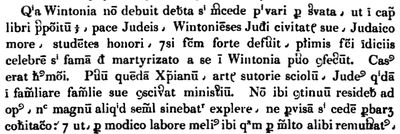

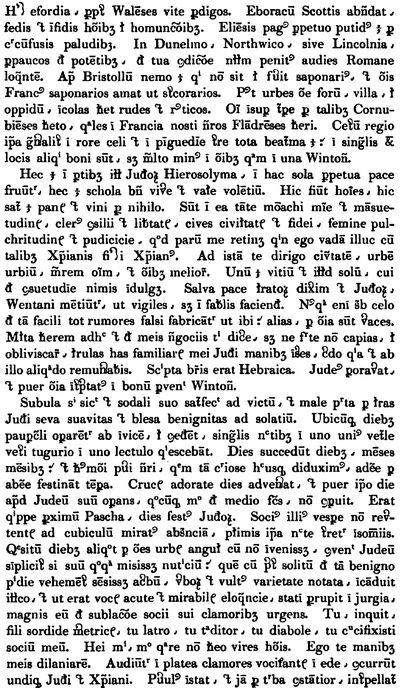
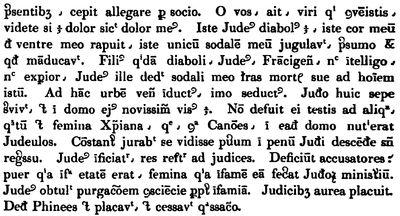
The preceding in words at length.
Quia Wintonia non debuit debita sibi mercede privari pro servata, ut in capite libri præpositum est, pace Judæis, Wintonienses Judæi civitatis suæ (Judaico more) studentes honori, etsi factum forte defuerit, plurimis facti indiciis celebrem sibi famam de martyrizato a se in Wintonia puero confecerunt. Casus erat hujusmodi. Puerum quemdam Christianum, artis sutoriæ sciolum, Judæus quidam in familiare familiæ suæ consciverat ministerium. Non ibi continuum residebat ad opus, nec magnum aliquid semel sinebatur explere, ne provisam sibi cædem probaret cohabitatio; et ut, pro modico labore melius ibi quam pro multo alibi remuneratus, domum dæmonis, donis ejus et dolis illectus, libentius frequentaret. Fuerat autem Francus genere, pupillus et orphanus, abjectæ conditionis et paupertatis extremæ. Has hujusmodi miserias in Francia male miseratus quidam Judæus Francigena, crebris ei monitis persuasit ut Angliam peteret, terram lacte et melle manantem; Anglos liberales prædicavit et dapsiles; ibi nullum, qui niteretur ad probitatem, pauperem moriturum. Puer promtulus, ut naturaliter Francorum est, ad velle quicquid volueris, assumpto secum comite quodam coætaneo suo et compatriots, ad peregrine proficiscendum præcinctus est; nihil in manibus habens præter baculum, nihil in sytarchia præter subulam.
Valedixit Judæo suo; cui Judæus, “Vade,” ait, “viriliter. Deus patrum meorum deducat te sicut desidero.” Et, impositis manibus super caput ejus, ac si esset hircus emissarius, post stridores quosdam gutturis et tacitas imprecationes, jam de præda securus, adjecit, “Forti animo esto, obliviscere populum tuum et terram tuam, quia omnis terra forti patria est, ut piscibus æquor, ut volucri vacuo quicquid in orbe patet. Angliam ingressus si Londonias veneris, celeriter pertransibis; multum enim mihi displicet illa polis. Omne hominum genus in illam confluit ex omni natione quæ sub cœlo est; omnis gens sua vitia et suos mores urbi intulit. Nemo in ea sine crimine vivit; non omnis in ea vicus non abundat tristibus obscenis; eo ibi quisquis melior est, quo fuerit major in scelere. Non ignoro quem instruo; habes supra tuam ætatem fervorem ingenii, frigiditatem memoriæ, ex utrinque contrariis temperantiam rationis. Nihil de te mihi metuo, nisi cum male viventibus commoreris; ex convictu enim mores formantur. Esto, esto! Londonias venies. Ecce! prædico tibi, quicquid in singulis, quicquid in universis partibus mundi mali vel malitiæ est, in una illa civitate reperies. Lenonum choros non adeas, ganearum gregibus non immiscearis; vita thalum et tesseram, theatrum et tabernam. Plures ibi quam in tota Gallia thrasones offendes, gnathonum autem infinitus est numerus. Histriones, scurræ, glabriones, garamantes, palpones, pusiones, molles, mascularii, ambubaiæ, pharmacopolæ, crissariæ, phitonissæ, vultuariæ, noctivagæ, magi, mimi, mendici, balathrones, hoc genus omne totas replevere domos.[1] Ergo, si nolueris habitare cum turpibus, non habitabis Londoniis. Non loquor in literatos vel religiosos, sive Judæos; quamvis et ex ipsa cohabitatione malorum, minus eos ibi quam alibi crediderim esse perfectos.
“Nec eo pergit oratio, ut in nullam te recipias civitatem, cum meo consilio nusquam tibi sit nisi in urbe manendum, refert tamen in qua. Si igitur circa Cantuariam appuleris, iter habebis perdere; si vel per eam transieris. Tota est illa perditorum collectio ad suum nescio quem nuper deificatum, qui fuerat Cantuariæ archipresbyter, quod passim præ inopia panis et ocio per plateas moriuntur ad solem. Rovecestria et[685] Cicestria viculi sunt, et cur civitates dici debeant præter sedes flaminum nihil obtendunt. Oxonia vix suos clericos, non dico satiat, sed sustentat. Exonia eodem farre reficit homines et jumenta. Bathonia, in imis vallium in crasso nimis aere et vapore sulphureo posita, imo deposita, est ad portas inferi. Sed nec in arctois sedem tibi legeris urbibus, Wigornia, Cestria, Herefordia, propter Walenses vitæ prodigos. Eboracum Scottis abundat, fœdis et infidis hominibus vel homuncionibus. Eliensis pagus perpetuo putidus est pro circumfusis paludibus. In Dunelmo, Northwico, sive Lincolnia, perpaucos de potentibus, de tua conditione nullum penitus audies Romane loquentem. Apud Bristollum nemo est qui non sit vel fuerit saponarius, et omnis Francus saponarios amat ut stercorarios. Post urbes, omne forum, villa, vel oppidum, incolas habet rudes et rusticos. Omni insuper tempore pro talibus Cornubienses habeto, quales in Francia nosti nostros Flandrenses haberi. Ceterum regio ipsa generaliter in rore cœli et in pinguedine terræ tota beatissima est; in singulis etiam locis aliqui boni sunt, set multo minus in omnibus quam in una Wintonia.
“Hæc est in partibus illis Judæorum Hierosolyma, in hac sola perpetua pace fruuntur, hæc est schola bene vivere et valere volentium. Hic fiunt homines, hic satis est panis et vini pro nihilo. Sunt in ea tantæ monachi misericordiæ et mansuetudinis, clerus consilii et libertatis, cives civilitatis et fidei, feminæ pulchritudinis et pudicitiæ, quod parum me retinet quin ego vadam illuc cum talibus Christianis fieri Christianus. Ad istam te dirigo civitatem, urbem urbium, matrem omnium, et omnibus meliorem. Unum est vitium et illud solum, cui de consuetudine nimis indulget. Salva pace literatorum dixerim et Judæorum, Wentani mentiuntur, ut vigiles, sed in fabulis faciendis. Nusquam enim sub cœlo de tam facili tot rumores falsi fabricantur, ut ibi; alias, per omnia sunt veraces. Multa haberem adhuc et de meis negotiis tibi dicere, sed ne forte non capias, vel obliviscaris, literulas has familiaris mei Judæi manibus inseres, credo quia et ab illo aliquando remuneraberis.” Scripta brevis erat Hebraica. Judæus peroraverat; et puer, omnia interpretatus in bonum, pervenit Wintoniam.
Subula sibi sicut et sodali suo satisfecit ad victum, et male parta per literas Judæi sæva suavitas et blæsa benignitas ad solatium. Ubicumque diebus pauperculi operarentur ab invicem, vel comederent, singulis noctibus in uno unius vetulæ veteri tugurio in uno lectulo quiescebant. Dies succedunt diebus, menses mensibus; et hujusmodi pueri nostri, quem tam curiose hucusque diduximus, adesse per abesse festinant tempora. Crucis adoratæ dies advenerat, et puer ipso die apud Judæum suum operans, quocumque modo de medio factus, non comparuit. Erat quippe proximum Pascha, dies festus Judæorum. Socius illius vespere non revertentis ad cubiculum miratus absentiam, plurimis ipsa nocte terretur insomniis. Quæsitum diebus aliquot per omnes urbis angulos cum non invenisset, convenit Judæum simpliciter, si suum quoquam misisset nutritium; quem cum præter solitum de tam benigno pridie vehementer sensisset acerbum, verborum et vultus varietate notata, incanduit illico, et, ut erat vocis acutæ et mirabilis eloquentiæ, statim prorupit in jurgia, magnis eum de sublatione socii sui clamoribus urgens. “Tu,” inquit, “fili sordidæ meretricis, tu latro, tu traditor, tu diabole, tu crucifixisti socium meum. Hei mihi! modo quare non habeo vires hominis! Ego te manibus meis dilaniarem.” Audiuntur in platea clamores vociferantis in æde, concurrunt undique Judæi et Christiani. Puerulus instat, et jam pro turba constantior, interpellatis præsentibus, cœpit allegare pro socio. “O vos,” ait, “viri qui convenistis, videte si est dolor sicut dolor meus. Iste Judæus diabolus est, iste cor meum de ventre meo rapuit, iste unicum sodalem meum jugulavit, præsumo etiam quod manducavit. Filius quidam diaboli, Judæus, Francigena, nec intelligo, nec experior, Judæus ille dedit sodali meo literas mortis suæ ad hominem istum. Ad hanc urbem venit inductus, imo seductus. Judæo huic sæpe servivit, et in domo ejus novissime visus est.” Non defuit ei testis ad aliqua, quantum et femina Christiana, quæ, contra Canones, in eadem domo nutrierat Judæulos. Constanter jurabat se vidisse puerum in penum Judæi descendere sine regressu. Judæus inficiatur, res refertur ad judices. Deficiunt accusatores; puer quia infra ætatem erat, femina quia infamem eam fecerat Judæorum ministerium. Judæus obtulit purgationem conscientiæ propter infamiam. Judicibus aurea placuit. Dedit Phinees et placavit, et cessavit quassatio.
Translation.
As it would have been wrong that Winchester should be deprived of her due reward for having preserved peace with the Jews, as has been stated at the beginning of this book[2], the Winchester Jews, studious (after a Jewish fashion) of their city’s honour, although clear evidence of the deed was perhaps wanting, yet from several indications of its commission, gained for themselves a notorious celebrity by the martyrdom of a lad in Winchester. The circumstance was as follows: A certain Jew had engaged a Christian boy, who was a little acquainted with shoemaking, in the domestic service of his family.[686] He did not remain permanently at work in the house, nor was he allowed to perform any great matter at once, lest cohabitation with the family should show him the destruction prepared for him; as also, that, being better remunerated for a little labour there than for much elsewhere, he should, enticed by his presents and deceit, the more willingly resort to the demon’s house. Now the boy was a native of France, a minor and an orphan; he was, too, of low condition and extreme poverty. A French Jew, hypocritically pitying this his state of wretchedness while in France, persuaded him by repeated exhortations to seek England, a land flowing with milk and honey: he extolled the English as liberal and munificent; adding, that no one who would struggle for an honest living in that country could die poor. The lad, rather ready, as is natural with the French, to conform his will to that of others, taking with him a companion of his own age and country, girt up his loins for a foreign journey; carrying nothing in his hand except a staff, nor anything in his scrip besides an awl.
He took leave of his friend the Jew, who thus addressed him. “Go thy way,” says he, “manfully. May the God of my fathers be thy leader, according to my desire.” And having laid his hands upon his head, as if he had been the scape-goat, being now certain of his prey, he added, after certain guttural croakings and silent imprecations, “Be of a stout heart: forget thy people and thy country, for every land is as his country to the brave, even as is the sea to fish, as to the bird whatever lies before it on the open globe. On landing in England, shouldst thou go to London, thou wilt pass through it quickly, for much doth that city displease me. Every kind of men from every nation under heaven flows into that place; into that town hath every people carried its vices and its habits. No one lives there untainted with crime; there is not a street within that place which abounds not with sad obscenity; a man is there accounted better in proportion as he has been a greater adept in iniquity. I am not ignorant of whom I instruct: thou hast a glow of genius beyond thy years, a coolness of reflection, and, as the result of these opposite qualities, a temperateness of the reasoning faculty. I have no fear for thee unless thou dwell with evil-livers, for from our associations are our morals formed. Amen! amen! thou wilt go to London. Lo! I tell thee beforehand, whatever there is of evil or of wickedness in particular parts of the world, whatever in all its parts together, in that one city wilt thou find. Go not among the multitude of the corrupters of youth; mix not with the crowds issuing from the stews; flee dice and chess, the playhouse and the pothouse. Thou wilt meet there more bullies than are in the whole of France, and yet the number of mean flatterers is infinite. Stage-players, buffoons, bald-pated reprobates, men living like wild Indians, parasites, infamous boys, effeminate and scandalous men, lewd music girls, quacks, wantons, fortune-tellers, harpies, night-walkers, conjurers, mimics, beggars, shabby scoundrels,—this is the sort of people with which each house is filled. If, then, thou wouldst not be a dweller with men of shame, thou wilt not abide in London. My observations are not directed against men of letters or the religious, nor against Jews; though, from their very cohabitation with the wicked, I should believe them to be farther from perfection there than anywhere else.
“Nor does my advice go the length of dissuading thee from betaking thyself to a city, since in my opinion thou shouldst tarry nowhere but in some large town; it is of consequence, however, in which. If then thou shouldst land near Canterbury, thou wilt be on the road to destruction; if even thou pass through it. All that collection of lost men is so devoted to the service of some lately deified person of their place (I know not whom)[3], who was archbishop of Canterbury, that they are dying everywhere in the sun, for want of bread and through indolence, in the very streets. Rochester and Chichester are mere villages and offer nothing for which they should be called cities except their being bishops’ sees. Oxford scarcely, I do not say satiates, but keeps her clerks alive. Exeter feeds men and beasts with the same meal. In the depths of valleys, in an exceedingly dense atmosphere and amid sulphurous vapours, Bath is posited, yea deposited, at the gates of hell. But neither wilt thou select for thyself an abode in the northern cities, in Worcester, Chester, or in Hereford, on account of the Welsh, men prodigal of human life. York abounds with Scots, who are filthy and deceitful men, or something less than men. From its surrounding marshes, the Isle of Ely is one eternal stench. In Durham, Norwich, or in Lincoln thou wilt hear very few of the higher orders speaking Latin; of thine own condition, not a soul. At Bristol there is not a man who is not, or has not been, a soap-boiler: now a Frenchman loves soap-boilers as well as he does nightmen.[4] Out of the large towns, every market-town, vill, or petty town has rude and clownish inhabitants. Thou mayst, moreover, at all times consider the Cornishmen to be such as thou knowest our Flemings to be esteemed in France. In fine, the country generally is in the highest degree blessed with the dews of heaven and with richness of soil: there are, too, some good men in every place within it, but fewer by far in all together than in Winchester alone.
“That city is the Jerusalem of the Jews in those parts: within her precincts alone do they enjoy perpetual peace; she is the school of those who wish to live well and to thrive. There men are produced; there thou mayst have a sufficiency of bread and wine for nothing. In that place there are monks of such mercy and meekness, a clergy so wise and tolerant, citizens of such probity and so regardful of their fellows’ rights, women so beautiful and modest, that little withholds me from going thither, and, among such Christians, myself becoming a Christian. To that city do I direct thee, the city of cities, the mother of all and better than all. There is one vice, and only one, in which she is accustomed to over-indulge. Asking pardon of the men of letters and the Jews, I must say (that thou mayst be upon thy guard) that the Winchester people are addicted to lying, yet only in inventing idle tales; for in no place under heaven, as there, are so many false reports fabricated with so much facility; in all other matters they are perfectly veracious. I had yet much to tell thee of my own affairs; but lest thou shouldst not comprehend all, or shouldst forget, thou wilt place this small letter in the hands of a Jewish friend, as I feel confident that thou wilt one day be rewarded by him.” This was a brief note written in Hebrew. The Jew had finished his oration; and the lad, putting the best construction upon everything, arrived at Winchester.
His awl provided food enough for his companion and himself; and the cruel kindness and stuttering civility so evilly obtained him by the Jew’s letter procured him comforts. Wherever these poor creatures might work separately in the day, or take their meals, they each night rested on a little bed in the ancient cottage of an aged woman. Day succeeds day, month month, and the last hours of this our youth, whom we have thus far so curiously traced, hasten, by their very escape, their arrival. The day of the Adoration of the Cross[5] had arrived; and the boy, working upon that day at his master the Jew’s, in whatever manner he was made away with, disappeared. Now the next day was the Passover, the great festival of the Jews. His companion, wondering at his absence, as he did not return in the evening to his bed, is terrified that night by many hideous dreams. Having for several days sought him in every corner of the city without finding him, he at once asked the Jew if he had sent the lad, who was his means of support, anywhere; whom when he perceived to become, contrary to his wont, from the particularly mild man of yesterday, outrageously bitter,—noticing this change in his language and his countenance, he immediately took fire, and as he had a piercing voice, and was gifted with a wonderful flow of words, he instantly broke out into reproaches, with loud outcries charging him, with making away with his friend. “Thou offspring of a filthy harlot!” he exclaims, “thou thief! thou traitor! thou devil! thou hast crucified my companion! Woe is me! why have I not yet the strength of a man! I could tear thee in pieces with my hands.” The cries of the boy vociferating within the house are heard in the public street; from all sides Jews and Christians hastily assemble. The boy presses; and, now become more confident from the presence of the crowd, he began, having gained their attention, to plead the cause of his companion. “O men,” he says, “who have here assembled, see if there be grief like my grief. This Jew is a devil; he hath torn my heart from within my breast; he hath murdered my only companion, I even think he hath devoured him. A son of the Evil One, a certain Jew,—whether he be French-born I neither understand nor know,—but that Jew gave to my friend a letter, which was the warrant for his death, directed to this man. Thus induced,—yea, seduced,—he came to this city. He was often engaged in the service of this Jew, and in his house was he last seen.” The boy was not without a witness to some portion of his tale; inasmuch as there was a Christian woman, who, contrary to the Canons, had nursed the Jewish children in the same house. She swore positively that she had seen the lad go down into the Jew’s store-room, but never return. The Jew denies it; the matter is referred to the Judges. The accusers fail; the boy because he was under age, the woman because her ministry to the Jews had rendered her infamous. The Jew offered a purgation[6] of his conscience with respect to the infamy. Gold was acceptable to the judges: Phinees gave it and appeased them, and the stir ceased.
[1] Some of these worthless characters are mentioned in the lines of Horace:
Others are to be found in Juvenal.
[2] The atrocious massacre above referred to, is related in the following impious and inhuman terms:—“On that same day of the coronation, about the solemn hour in which the Son was immolated to the Father, they began in the city of London to sacrifice the Jews to their father the devil; and so long was the duration of this famous mystery, that the holocaust could scarcely be completed on the second day. Other cities and towns in the country emulated the faith of the Londoners, and with equal devotion dispatched their bloodsuckers in their blood to the infernal regions. Somewhat, but not to such an extent, was at that time enacted against those children of perdition everywhere throughout the kingdom: Winchester alone spared her vermin,—a people prudent and forecasting, and a city at all times respecting her citizens’ rights.”—“Eodem coronationis die, circa illam sollemnitatis horam qua Filius immolabatur Patri, incœptum est in civitate Londoniæ immolare Judæos patri suo diabolo; tantaque fuit hujus celebris mora mysterii, ut vix altera die compleri potuerit holocaustum. Æmulatæ sunt aliæ civitates regionis et urbes fidem Londoniensium, et pari devotione suos sanguisugas cum sanguine transmiserunt ad inferos. Aliquid, sed inæqualiter, ea tempestate contra perditos paratum est ubique per regnum: sola tantum suis vermibus pepercit Wintonia, populus prudens et providus, ac civitas semper civiliter agens.”
[3] Thomas à Becket, who had been murdered a few years antecedently.
[4] Soap was first made in London in 1524; prior to which time it had been supplied by Bristol.
[5] Good Friday.
[6] It was the custom, where sufficient testimony could not be had, to allow the accused to clear himself from the charge by his oath: this was sailed purgation. The oath having been made, twelve persons, called compurgators, were produced on the prisoner’s behalf, who swore, that, from what they knew of his general character, they believed his oath. This was deemed satisfactory.
Table of the principal Abbreviations used in Records.
ā ã an, am.
ã. a. annus and its cases.
aa aliqua.
am annum.
āte ante.
ãimus animus.
ao anno.
a’ aữ autem.
ã at aut.
Abb͞s Abb͞i Abb͞ibʒ Abbas and its cases.
Abb͞a Abb͞e Abb͞am Abbatia and its cases.
Abb͞issa Abbatissa.
acc̃ente accidente.
aca acra.
acam acram.
adm̉ciatꝰ am̉ciatꝰ admerciatus, amerciatus.
adm̉ciam̃tū am̉ciam̃tū admerciamentum, amerciamentum.
advõe advocate.
aĩa aĩe ãi aĩo anima, animæ, animi, animo.
aĩal animal.
aĩal̵ animalis.
aĩalia animalia.
aĩabus animabus.
aaꝝ aliarum, aliquarum.
aid aliquid.
al̵ alias, alius and its cases.
al̵r aliter.
al̵ci alicui.
alic̃ꝰ alicujus.
aliq̃ aliqua, aliquæ.
aliq̃ aliquem.
aliq̵ aliquod, aliquid.
aliqđ aliquod, aliquid.
aliqi aliqui.
aliq̵i aliquid.
aliqis aliqid aliquis, aliquid.
aliqā aliq̵ā aliquam.
abñia absentia.
ab́ne absolutione.
ã ap̃ ap̃d apud.
alt̉ alter.
alt̉a altera.
alt̉ut̉ alt̉utr̃ alteruter and its cases.
am̉als amerals (admirals).
amo amodo.
ampliꝰ āpliꝰ amplius.
añ ante.
aña antea.
añqā antequam.
añc̃ antecessor and its cases.
añcessores antecessores.
añcessoribȝ antecessoribus.
añia animalia.
añqā antequam.
antiqitꝰ antiquitus.
adh̵ adhuc.
agr agitur.
apƿpiar̃ appropriare.
ap̃loꝝ apostolorum.
aplici apostolici.
āpliꝰ amplius.
app̃ne appellatione.
appõita apposita.
appõitꝰ appositus.
appōitr apponitur.
aq̃ aqua and its cases.
aqā aq̵ā aqām aquam.
aqa aq̵a aqua.
Arcħep̃c̃ Arcħep̃m Archiep̃s Archiep̃i Archiep̃o Archiep̃m Ar̃ep̃c̃ Ar̃ep̃s Archiepiscopus and its cases.
arcħep̃tꝰ archiepiscopatus.
areto aretro.
artic̃lꝰ articulus.
arli articuli.
ass̃u assensu.
auc̃te auctoritate.
aṽnc̃lo avunculo.
b̵ b̴ ber, bis, as lib̃tate libertate, Merleb̴ge Merleberge, nob̵ nobis, vob̴ vobis.
b̴ b’ bte b̵te beatæ.
Bapt̃ Baptista and its cases.
b̴i b’ beati.
b̴m beatum.
bñ bene, bien.
b̴ns biens.
bñvołncia benevolentia.
bo. bonus and its cases.
br̃ breve and its cases.
br̃e br̃i breve, brevi.
br̃ia brevia.
c̉ cer, cre.
c̃ cum.
ca carta.
cata carta.
caci canonici.
caīo crastino.
canc̃ cancellarius and its cases.
cantav̉nt cantaverunt.
capietr capietur.
cap̃li capituli.
cap̃tłm capitulum.
ca c̃a causa.
cãs causas.
capus capitaneus.
carimo carissimo.
cħ chere.
cħun chacun.
cħre chartre.
cħłr chevalier.
cħres chartres.
cestasf̴ cestassavoir.
ci cui.
cilʒ cuiłt cuilibet.
cia cita citra.
cĩtas civitas.
clc̃s clericus.
cłico clerico.
claud̴t claudet, claudit, claudunt.
claudʒ claudet.
cło clero.
ciʒ cuique.
cicūq̧, cuicumque.
c̃ cõ contra.
conta contra.
ꝯta ꝯa ꝯta contra.
cõa cõe cõam communa, communæ, communam.
cõe cõis commune, communis.
cõer comuner.
cõi ꝯi communi.
cõit̉ communiter.
cõia communia.
ꝯaio contrario.
cõ ꝯp̃ computate, computabitur, comparendum, &c.
ꝯpobr̃ ꝯtobr̃ ꝯabr̃e ꝯobr̃ia controbreve, contrabreve, controbrevia.
cołł collector and its cases.
ꝯpʒ comparet.
com̃ comes and its cases.
comp̃o compositio.
ꝯa ꝯo contrabreve, controbreve.
ꝯi communi.
ꝯĩ ꝯi communi.
ꝯpełłe compellere.
ꝯp̃o compoto.
ꝯp̃m compotum.
ꝯput̃ computatio and its cases.
ꝯput̃ computabitur.
ꝯputabitr computabitur.
ꝯp̃one computatione.
ꝯp̃one compositione.
ꝯsiđaco͠em considerationem.
ꝯsuet̃ consuetus and its cases.
ꝯsuet̃ consuetudo and its cases.
ꝯtacto contracto.
ꝯtent̃onis contentionis.
ꝯtig̃ contingo and its tenses.
ꝯtu conventu.
ꝯvalủit convaluerit.
ꝯc̃ conc̃ concordia.
ꝯc̃ concessio and its cases.
ꝯc̃ concessum, &c.
ꝯfirmādā confirmandam.
cons̃ consilium.
conc̃ concessus and its cases.
conadco͠e contradictione.
contu ꝯtu contemptu, conventu.
conble constable.
cona ꝯa concessa.
cona contra.
concedimꝰ concedimus.
consu consensu.
cōvēco͠e conventione.
coqine coquine.
ꝯſ̴vet conservet.
ꝯs̃l conseil.
cōſ̴ consilium.
cr cur.
cra cura.
crca circa.
cꝰ c̃jꝰ cujus.
cꝰłʒ cujuslibet.
cꝰtodier̃t cꝰtodiƪnt custodierunt, custodierint.
Đ De, Deus and Dominus and their cases.
Đs Deus.
Dꝰ Deus, Dominus.
Đi đi Dei.
đ d̴ de, der, denarius and its cases.
dꝰ dicimus.
dāpnū dampnum.
darr̃ darrain.
Dd̴ David.
dc̃a dicta.
dc̃s dictus.
dc̃o dicto.
dc̃i dicti.
dc̃m dictum.
dr̃ d̴r dicitur.
dĩna divina.
diñr dicuntur, dinoscuntur.
dit d̴t dicit or dicunt.
dc̃nt dicunt.
dilõne diłone dilatione.
diłone dilectione.
di. dilectus and its cases.
dĩ dimidium.
đte dite.
dilc̃us dilectus.
dilc̃o dilecto.
đre dicere.
dic̃ dicit.
dic̃nt dicunt.
diebꝰ diebʒ diebus.
dilaco͠e dilat̃ōe dilatione.
dilc̃m dilectum.
dilc̃s dilectus.
dim̃ dimiđ dimidium and its cases.
dimiser̃t dimiserunt.
disp̃one dispositione.
diss̃ dissaisitus and its cases.
diss̃e dissaisinœ.
disticco͠e distict̃ōe districtione.
đd̴ dedit.
decr̃ decretum.
deſ̴d̴ desusdite.
dʒ debet, det.
đd̴it dederit.
deb̴ntr debentur.
deb̴ent debent.
deb̴t debet.
debʒ debet.
debủt debuerunt.
decet̉o decetero.
decem̃tū decrementum.
deñ denarius and its cases.
destruco͠e destructione.
detim̃tum detrimentum.
det̉īat̃ōe determinatione.
dñs dñe dñi dño dñm dominus and its cases.
đniū dominium.
doł dolium.
donc donec.
Dñica Dominica.
dñico dominico.
dñic̃s dominicus.
donat̃ōes donaco͠es donationes.
ducatꝰ ducatus.
duratram duraturam.
ẽ e̚ [#] [#] est.
eꝰ ejus.
ea ecclesia.
eā ecclesiam.
ead̴ eadem.
ec̃ eciam.
ecc̃a ecclesia.
eccłiam ecclesiam.
eccłiaꝝ eccłar̃ ecclesiarum.
eccłias ecclesias.
eccłie ecclesiæ.
e̚e esse.
e̚et esset.
e̚ẽt essent.
effc̃s effc̃u effectus, effectu.
eid̴ eidem.
eisđ eisd̴m eisdem.
eꝰd̴ ejꝰd̴ ejusdem.
eła ełīa elemosina.
ełariꝰ elemosinarius.
ẽm eum, sometimes enim.
ep̃c̃ ep̃s ep̃i ep̃o ep̃oꝝ ep̃m episcopus and its cases.
eq̃ū equum.
eqałr equaliter.
eođ eodem.
eoꝝđ eorumdem.
er̃ er̃t erit, erunt.
esp̃ale especiale.
escr̃ escript.
exa exta extra.
exāīat̃ examinatus and its cases.
exc̉cit̃ ex̉cit̃ excercitus and its cases.
excõĩa excommunicata.
excõĩcamꝰ excommunicamus.
exo exemplo, excepto.
exp̃ns̃ expensis.
f. f̴m festum.
f. f. fieri fecimus.
fac̃ faciendo.
facid’ faciendum.
fac̉e facere.
fc̃s fc̃a fc̃o fc̃m factus and its cases.
fara farina.
feĩa feĩe feĩas femina and its cases.
feođ feodum and its cases.
feodałr feodalit̉ feodaliter.
feud̴ feudum and its cases.
f̴i fĩa fia figura, feria.
f̴i fieri.
fidłr fidelit̉ fideliter.
fił f̴s filiꝰ filius.
firt’ firmiter.
fiłm filium.
fła fłas falsa, falsas.
f̴o festo, filio.
for̃ forum.
for̃ forisfactum, &c.
fora forma, foresta.
fr̃ fr̃ is fr̃ es fr̃ e fr̃ em fr̃ m frater and its cases.
fr̃ e facere and fratre, frere.
fr̃ m frumentum.
fr̃ e ferre.
f̴te faite.
fủnt fủūt fuerint, fuerunt.
futri futuri.
ga erga.
gace grace.
garr̃ garrant.
gat̃m gratum.
gavam̃ gravamen.
gat̃nt̉ gratanter.
gavit̉ graviter.
gi igitur.
gła gloria.
głiosꝰ gloriosus.
g̃nƪa genera.
g̃ƪal general.
g̃nƪałr g̃nƪalit̉ generaliter.
g̃nƪe genere.
go ergo.
gr̃a gr̃m gr̃as grat̃ gratia and its cases.
grat̃ gratus and its cases.
H. ħ hic, hæc, hoc.
ha hac.
habuer̃t habủnt habủūt habuerit, habuerint, habuerunt.
habuimꝰ habuimus.
harño harnesio.
ħat ħāt habeat, habeant.
hc huic, huc, hic, hinc.
hcꝰq̹̹ hucusque.
ħc hunc.
ħeat ħeāt habeat, habeant.
ħeb̴t habebit, habebunt.
ħebunt habebunt.
ħedes hœredes.
ħedit̃ ħeditar̃ hœreditarius and its cases.
ħedit̃ hœreditas and its cases.
ħedū hœredum.
ħeđ hœredes, habendum.
ħenđ habendum, &c.
ħeo habeo.
herb̴gag̃ herbergagium and its cases.
ħes hœres, habes.
ħet habet.
ħetr habetur.
hi hic.
ħꝰi hujusmodi.
ħit̃ habitus and its cases.
ħitu habitu.
ħjꝰmoi hujusmodi.
ħmõi hujusmodi.
h. l. n. f. ſ. p. has litteras nostras fieri fecimus patentes.
ħnibʒ hominibus.
Hñr̃ H’nr̃ Henricus and its cases.
ħnt habent.
ħniū ħniis hominium, hominiis.
ho. homo and its cases.
hoĩm hōiū hom̃ hominum.
hōiagiū hominagium.
hõibʒ hominibus.
hōies homines.
homag̃ homagium and its cases.
hr̃e ħre ħere habere.
hr̃i ħri haberi.
hr̃nt habuerunt.
ħt habet, habent.
ħuit ħuisti habuit, habuisti.
ħủit habuerit.
ħuisse habuisse.
ħuer̃t habuerit, habuerint.
ħủnt habuerint, habuerunt.
ħujꝰ hujusmodi.
hujꝰ hujus.
hujꝰeõi hujuscemodi.
hujꝰmoi hujusmodi.
hundr̃ hūdr̃ hundredum and its cases.
hundr̃is hundredis.
ħʒ ħt habet.
ħꝰ hujus, hujusmodi.
ī in.
ia infra, ita, illa.
ib̴ ib̴m ibidem.
ibiđm ibidem.
īcrrat incurrat.
id̴ idem, illud, ideo.
idcico idcirco.
iđm idem.
igr igitur.
ijb’ duobus.
ijꝰte injuste.
iłł ille and its cases.
im̄ete immediate.
imp̴p̃m īp̴p̃m imperpetuum.
illiꝰ illius.
iłłd illud.
iñ inde.
incrrat incurrat.
infa īfa infra.
inf̴ꝰ īf̴iꝰ inferius.
injꝰte ījꝰte injuste.
insp̃r insup̴ īsp̃r insuper.
intr intratur.
int̉ it̉ inter.
intege ītege integre.
ĩo iđo ideo.
ip̃a ipsa.
ip̃e ipse.
ip̃m ipsum.
ip̃o ipso.
ip̃os ipsos.
ip̃ius ip̃ꝰ ip̃iꝰ ipsius.
ip̃am ipsam.
ip̃as ipsas.
ip̃oꝝ ipsorum.
irr irrotulatur.
it̃ ia ita.
it̉ iter.
it̃ iterum.
īta intra.
īt̉ inter.
ite iste.
īt̉dc̃m interdictum.
īt̉e̚e interesse.
it̃m ĩm it̃ item.
it̉m iterum.
īt̉m īt̉ī interim.
itr itur.
ītr̃v̉t intrav̉īt intraverunt, intraverint.
ja. prima.
jā jam.
jamdc̃os jamdictos.
jo. primo.
jo.q̹o unoquoque.
jor jour.
jrat̃ jurat̃ juratores and its cases.
jũe jure.
jꝰ jre jra jribʒ jribꝰ jus, jure, jura, juribus.
jurata juramenta.
jusq̃s jusques.
jꝰtic̃ justicia.
jꝰticia justicia.
juxa juxta.
kł kalendœ, kalendas, &c.
km̃e charissime.
km̃o k̴mo charissimo.
ł vel.
ł. łi. łj. libra and its cases, libratas, &c.
latoñium latrocinium.
lẽi legitimi.
l’erc̃ l’ercevesque.
lĩ liberas, libratas.
łia licentia.
lib̴at̃ liberatio and its cases.
lib̴c̃ones liberationes.
libat̃ librata and its cases.
lib̴tat̃ libertates, &c.
lib̴nt̉ libenter.
lib̴ntr liberentur, liberantur.
lic̃ liña liñia licentia.
liq̹ liquet.
lo. locus and its cases.
lor lour.
loq̃la loquela.
łr libenter.
łra littera.
łras litteras.
łre lr̃e lettre, litteræ.
łris litteris.
łtt̃me łme legitime.
łʒ libet and licet.
m̉ mer.
m̃ m. ma. marca and its cases.
m̃a mea.
magñ magnus and its cases.
mag̃r magister.
mag̃ri magistri.
mag̃rissa magistrissa.
mag̃ros magistros.
mag̃roꝝ magistrorum.
magr̃m magistrum.
mag̃t̉iū magisterium.
mãm materiam.
mata materia.
mat̉ mat̉ mater.
matimōio matrimonio.
maxa maxima.
m̃am meam.
m̃br̃m membrum.
m̃broꝝ membrorum.
m̉cħ marchia and its cases.
m̃di mundi.
Mẽ M’e Marie.
me. memorie.
med’ memorandum.
medte medietate.
međtas medietas.
mem̃ memd memoꝝ memorandum.
mẽf̴ mensis.
mi mihi, mei.
mĩa misericordia, miseria.
mĩe misericordiæ.
mił miles and its cases.
mĩo matrimonio.
m̃is meis.
mĩis misericordiis.
mis̉c̃dia misericordia.
ml. mille.
młr mulier.
młr̃s mulieres.
młm multum.
m̃ltipłr multipliciter.
m̃lt̃m multum.
mo mod̴ modo.
mor monemur, movemur, &c.
m̃ltões multoties.
mołnđ molendinum and its cases.
mor moratur.
m̃os meos.
mr̃ mater, magister, martyr.
mr̃e matre.
mr̃is matris, martyris.
mr̃i matri.
n. enim.
ñ. n. nostri.
ñ enim, non.
ñ ne.
na nota.
nc nec, nunc.
nc̃ce necesse.
nc̃ nunc.
nec̃c̃ia nec̃ria necessaria.
neg̃m negotium.
neg̃o negotio.
neq̹ neque.
neqaqa nequaquam.
ñd̴ ñdū nondum.
ncñ necnon.
ni nisi, nemini.
nicħ nicħl nihil.
ñīatim nominatim.
nil nihil.
nimiū nimirum.
nl nihil.
nłła nulla.
nłłm nullum.
nłłs nullus.
nloꝰ nihilominus.
ñm nūƪum numerum.
nob̴ nobʒ nobis.
nob̴c̃ nobʒc̃ nobiscum.
noc’ nocumentum.
nocum̃tū nocumentum.
nōīa nomina.
nōīatī nominatim.
nōīe nomine.
nōīum nominum.
nost̉ noster.
nostis nostris.
ño nũo numero.
noꝰ nous.
nr̃ ñr noster.
nov̉it noverit.
novit̉ noviter.
nr̃a nostra.
nr̃e nôtre.
nr̃i nostri.
nr̃is nostris.
nr̃o nostro.
nr̃os nostros.
nr̃am nostram.
nr̃m nostrum.
nr̃oꝝ nostrorum.
num̉atr numeratur.
nunqā nunquam.
nūq̹m nunquam.
nũs numerus.
nʒ neque.
õ ob̴ obolus and its cases.
ob̴ obiit.
obẽia obedientia.
obier̃t obierint, obierunt.
obed̴ie obedientie.
obłonibʒ oblationibus.
occ̃o occasio.
occo͠e occ̃one oc̃one occasione.
occo͠ibʒ occo͠ibus occasionibus.
õe omne.
ões omnes.
õia omnia.
õibʒ õibꝰ omnibus.
oĩm õium omnium.
oĩo om̄īo omnino.
om̃ omnis and its cases.
om̄i omni.
om̃s ões omnis, omnes.
oĩode omnimode.
ōnino ōīno omnino.
op̴at̃ōibʒ op̴acõibʒ operationibus.
opꝰ op̴a opus, opera.
oppa opportuna.
oppoĩa opposita.
op̴t oportet.
õs omnis, omnes.
ov̉tem̃t overtement.
p. patentes.
p̴ per, par, por.
p̴ pro.
p̉ pre, præ.
p̉ præcipimus, præsenti.
pi pri.
pa prima.
p̴a persona.
p̴ałr p̴sot’ personaliter.
pa pagina.
pa publica.
pat̉ pater.
pati prati.
p̴bʒ præbet.
p̉b̴nđ præbenda, &c.
pc̃c̃i peccati.
pca publica.
p̉cipimꝰ præcipimus.
p̴cħ prochain.
p̴c̃ssꝰ processus.
p̉đ p̉dict̃ prædictus and its cases.
p̉dc̃a prædicta.
p̉dc̃as prædictas.
p̉dc̃m prædictum.
p̉dc̃o prædicto.
p̉dc̃os prædictos.
p̉dc̃i prædicti.
p̉dc̃oꝝ prædictorum.
p̴ãlate perambulatæ.
p̴e pere.
p̴ent̉e parentre.
p̴ē parem.
p̉fat̃ p̉fata p̉fat̃m p̉fatꝰ prœfatus, &c.
p̴ħre prohibere.
p̴hendinav̉nt perhendinaverunt.
pim̉e primere (première).
pive prive.
pie prie.
pisa prisa.
piꝰ pius prius, primus.
p̴ia propria.
p̴iñ proinde.
p̴io proprio.
p̉juđ prejudicial.
pła plura.
plac̃ placitum and its cases.
p̴lem̃t parlement.
płma plurima.
płes plures.
płia placita.
płg̃ plegiagium and its cases.
płim plurimum.
płit̃ placitum and its cases.
p̴mutat̃o permutatio.
pñt possint and possunt.
p̃nc’ presentia and its cases.
p̃nt present.
p̃ns prœsens.
p̃nt̃ prœsentem, prœsentes, prœsentibus, &c.
p̉nōīato prœnominato.
p̴pio proprio.
p̴p̴ p̴p̃ p̴pt̉ propter.
p̃ p̃ pap Ppa papa.
pp̃li populi.
pp̃o populo.
p̴pia propria.
p̴porco͠e p̴porco͠is proportione, proportionis.
po primo.
po. posito.
posſ̴em possessionem.
poea postea.
pr pour, pur.
prveiors purveiours.
pr̃ pater.
pr̃i patri.
pr̃is patris.
pr̃iam patriam.
pr̃onatꝰ patronatus.
p̃r presbiter.
p̴sōe persone.
p̃state p̃ꝰtate poteste potestate.
p̉sb̴r presbiter.
p̉scipt̃ præscriptus and its cases.
p̉sentes præsentes.
p̴s p̴te pars, parte.
p̉t̉it̃ preteritus and its cases.
pt post, potest.
p̉t̉ præter.
p̴tiñ p̴tinenc̃ pertinentiis.
p̴tiñ p̴tinentibʒ p̴tinent̃ pertinentibus.
p̴tinētes pertinentes.
puce publice.
puisf̴ puissant.
p̴xo p̴xa proximo, proxima.
pꝰ pꝰt post.
pꝰm̃ pꝰtmođ postmodum.
pʒ pt patet, potest.
Q2 q2 quia, quòd.
q̹ que, quia, quòd.
q̃ qui, quæ.
q̴ quod, quòd.
q̃ quem, quos.
qa q̴a qua, quadrans.
qā q̴ā quam.
qant quant.
qałrcūq̹ qualitercumque.
q̃a quia.
qart̉ quarter.
qacūq̹ quacumque.
qar̃ quare, quarum.
qaꝝ quarum.
qai quasi.
qas quas.
qalibʒ qualibet.
qap̴pt̉ quapropter.
qatenꝰ quatenus.
qđđm quoddam.
qđlʒ quodlibet.
qđ quid, quod
qis quis.
qiłʒ quilibet.
qibʒ quibus.
qibʒcūq̹ quibuscumque.
qicūq̹ quicunque.
qicqid quicquid.
qi qia quia.
qid quid.
qieta quieta.
qietū quietum.
qinq̹ qi’q̹ quinque.
qisqam quisquam.
qm̃ quoniam, quem, quomodo.
q̃le qale quale.
qat̉xx. qat̉xxti. quater viginti.
qñ quando, quoniam.
qo quo.
qos quos.
qomo quomodo.
qomołʒ quomodolibet.
qonđ quondam.
qoq̹ quoque.
qoꝝ quorum.
q̹o quoque.
qołʒ quolibet.
qñc̃q̹ quandocumque.
qr̃ quare.
q̃ratis queratis.
q̃relar̃ q̃r̃laꝝ querelarum.
q̃rƪe quærere.
q’q̹ quodque, quiconque.
quar̃ quare.
quereł querela and its cases.
qũx queux.
℞ Rex and its cases.
r. r̃. r̃ regni, regno, &c.
recer recevoir.
reclamaco͠e reclamat̃ōe reclamatione.
reg̃ł regula and its cases.
reg̃lães regulares.
relq̃ reliqua.
reliq̃ reliqui, reliqua, &c.
relīqi relinqui.
reliqi reliqui.
reqisitꝰ requisitus.
rep̴aco͠e reparatione.
respc̃s respectus.
respc̃u resp̃u respectu.
resp̃m respectum.
rem̃ remanet.
retam receptam.
rev̉mꝰ reverendissimus.
reto retro.
rña regina.
rñdʒ respondet.
r̃ndeatr respondeatur.
r̃nsio responsio.
rñsum responsum.
rñsrus responsurus.
ro responsio.
rõe rõne r̃one ratione.
rõi rationi.
rolo rotulo.
rõnabilt̉ rõabiłr rationabiliter.
royme royaume.
r̃ociniū rõniū ratiocinium.
rõnio ratiocinio.
r̃r̃ reꝝ rerum.
r̃spc̃u respectu.
S’ S. Sanctus and its cases.
.s. scilicet.
s. sunt.
s̃. solidus and its cases.
ſ̴ salutem.
ſ̴ ſ̴r seigneur.
sa secunda, summa, supra.
sadc̃m supradictum.
sał sałm sałt̃ sałt̃m salutem.
sacr̃m sacam̃tū sacramentum.
Sb̴b̴i Sabbati.
s̃b sub.
s̃btꝰ subtus.
sb̴nia substantia.
Sc̃s Sanctus.
Sc̃i Sancti.
Sc̃is Sanctis.
Sc̃os Sanctos.
Sc̃a Sancta.
sc̃đm secundum.
sciłt scilicet.
scac̃io scaccario.
sc sic.
sc̃de seconde, secundæ.
sc’ sict sicut.
sc̃lari seculari.
scłʒ scilicet.
sc̃laribʒ sec̃laribʒ secularibus.
ſ̴dit susdit.
ſ̴em̃t serement.
senal seneschal.
seqũ sequens and its cases.
seml semel.
seqr sequitur.
secrū securum.
sepedc̃i sæpedicti.
seq̃ns sequens.
sib̴n sibien.
sig̃ sigillum and its cases.
sic̃ sicut.
sĩlit̉ similiter.
sing̃la singula.
sĩ sive.
si sibi.
siłt̃r similiter.
signĩcas significas.
sigasti significasti.
sigłs sigł singulus and its cases.
siłr siłt̃r similiter.
sing̃lis singulis.
sir̃ schira and its cases.
słʒ scilicet.
ſ̴m secundum.
s̃mpłr simpliciter.
sma summa.
sñ sine.
sñia sententia.
solʒ solet.
so secundo.
so seriò, serò.
soł solidus and its cases.
sp̃ale speciale.
spłr specialiter.
sp̃s spiritus.
sp̃alis specialis, spiritualis.
sp̃ualia spiritualia.
ſ̴ra sera.
s̃r super, sur.
subs̃ subsidium and its cases.
sup̴ super.
suffiſ̴ suffisant.
ſ̴rie seignurie.
s̃s suus, suos, suas, suis.
St̃e Sainte.
st s̃t sunt.
sub̴a substantia.
supa supra.
sup̴iꝰ superius.
ſ̴vic̃ servicia.
sṽ sive.
sʒ set for sed.
slʒ scilicet.
T. teste, testibus.
T’ terminus and its cases.
TT. tituli or titulo.
t. t̃. t̃ teste, testibus.
t̉ ter.
tał talis, &c. taliter.
tałr taliter.
tansgr̃ transgressio.
tadiđunt tradiderunt.
tadider̃t tradiderit, tradiderint, tradiderunt.
tam̃ tamen.
tāqā tanquam.
tc t̃c tūc tunc.
temp̃re tempore.
tēp̴ibʒ temporibus.
tec̃ tecum.
testīom testimonium.
test̃o testamento.
teñ tenementum and its cases.
teñʒ tenements.
tent tenet.
tenđ tenendum.
teñdas tenendas.
thes̃ thesaurarius.
tħr̃m thesaurum.
tes tres.
tia tria.
ti tibi.
t̉īo termino.
tibus tribus.
t̃m tantum.
t̉m t̉ĩm terminum.
t̃mo t̃mmo tantummodo.
t̃mdē tantundem.
T’m̃ terminus and its cases.
T’miñ terminus and its cases.
t̃mp̴alia temporalia.
t̃mp̴alibʒ temporalibus.
t̃mp̴e tp̃re tempore.
t̃n tñ tamen, tantum.
tot̃ totus and its cases.
t̃p̴e tempore.
tp̃re tempore.
t̃p̴ibʒ temporibus.
tol totalis.
toucħ touchant.
t̉r̃ t̉ra t̉re t̉rā t̉ram t̉rar̃ t̉raꝝ terra and its cases.
trr̃ turris and its cases.
tri turri.
trī turrim.
t̉sb̴n tresbien.
tʒ tenet.
u. ut.
ub̴e ui ubi.
uic̃q̹ ubicumque.
ult̃ ultimus and its cases.
ult̉iꝰ ulterius.
uñ unde.
uñc̃q̹ undecumque.
unct̃ōem unctionem.
uniꝰ unius.
uniciʒ unicuique.
ūqā unquam.
utiusq̹ utriusque.
ut̃r uter, utrum.
ut̃rq̹ uterque and its cases.
utꝰq̹ utriusque.
ux̃ uxor.
ux̃e uxore.
ux̃is ux̉is uxoris.
v. vel.
ṽꝰ versus.
vac̃ vacatio and its cases.
vađ vadia.
vałat valeat.
valʒ valet.
v̉ba verba.
vałet valeret.
venaco͠e venatione.
vi vir.
vī vim.
vic̃ vicec̃ vicecomes and its cases.
vii viri.
vidʒ viʒ videlicet.
viłł villa and its cases.
viłr viriliter.
vioꝝ virorum.
virg̃is virginis.
ṽl vl vel.
vo vero.
vo. quinto.
voꝰ vous.
vq’. quinque.
vr videtur.
vr̃ vester.
vr̃a vestra.
vr̃e vestræ.
vr̃i vestri.
vr̃o vestro.
vr̃m vestrum.
vʒ viʒ videlicet.
v̉ſ̴ versus.
wt with.
x. decem.
xa decima.
Xc Xc Xs̃ Xs Xp̃c Xp̃s Christus.
xla. quadragesima.
Xp̃i Christi.
Xp̃o Christo.
Xp̃iani Christiani.
xvme quinzisme.
zor your.
REFERENCES.
There are various references used for notes, according to the fancy of the author, or the master printer; where they are not numerous in a page, the common references are generally used, in this order— *, †, ‡, §, ‖, ¶, and where there are more than six notes[701] in a page, two of each reference are put to a note; but this is looked upon as having an unsightly appearance.
Italick lower case letters are sometimes used, enclosed between parentheses (a), and sometimes figures (1); the letters, when they are used, are often continued through the alphabet, and then commence again with (a).
The most usual references, and which are esteemed the neatest, are superiors, both letters and figures; where the notes are at the foot of the page, letters are most frequently used, sometimes going through the alphabet, and sometimes commencing with a in each page in which notes occur: where the notes are placed at the end of the volume, figures 1 2 are nearly always adopted, in regular succession.
REGISTER.
This term implies such an arrangement of the whites in both forms of a sheet, as that, when printed off, the pages shall fall precisely at the back of each other, so that the sides and heads of the pages of one form shall not project beyond those of the other; in fine work the principle is carried still further, and the whites in the pages are so arranged that line shall fall upon line, when the reiteration is worked. See Gauge. Space Lines.
REGISTER SHEET.
The sheet or sheets printed to make register with.—M. When works are printed on fine and expensive paper, register is usually made with proof paper; and it is not till the form is completely made ready that they use its own paper.
REGLET.
Is a sort of furniture of an equal thickness all its length. It is quadrat high, of several thicknesses, viz. Nonpareil, Brevier, Long Primer, Pica, &c. thick.—M.
Reglet and all other furniture, except side and foot sticks, are made in lengths of three feet each, and are always styled a yard of reglet, a yard of broad, &c.; the use of reglet is to branch out titles, jobs, and other matter, to economise the use of quadrats: it is preferable to quadrats for this purpose, it keeping the lines more even; for different founts of the same size being often mixed, and the quadrats frequently battered, are not so true as a piece of reglet, which I would always have put next to a line of capitals; it is also used in making margin.
The thinnest reglet used is called card reglet, a substitute for scale-board; the regular sizes commence with Pearl and go up to Two Lines Great Primer, with the exception of Ruby, Minion, Bourgeois, Small Pica, English, Paragon, and Two Lines Pica, which are sizes not used.
REITERATION.
The second form, or the form printed on the backside of the white paper.—M. This is a term generally used for press work; when the second form is working, that is, perfecting the sheet, the pressmen say they are working the reiteration.
Reviews. See Newspaper Postage.
REVISE.
An impression of each form printed on proof paper the first thing after it is laid on, and taken by the pressman to the reader or overseer, for him to examine that all the corrections in the press proof are made, previously to the impression being worked off. The compositor frequently takes the revise for waste paper; but this should never be done with that of the first form; the pressman should put it into the heap, so that it may be readily found, which keeps it damp, and the revise of the second form ought always to be pulled on it; the reader, in revising the second form, then sees the sheet perfect, which is necessary to ascertain that the matter follows, and that the furniture is right.
RIBS.
In wooden presses, long pieces of steel, polished on the upper surface, which is a little rounded, on which the carriage traverses in[702] being run in and run out; they are fastened down upon long pieces of wood, which are called Wooden Ribs.
RIDES.
Leads are said to ride, when one end projects over another; this will occasionally take place when two or more are used in the same measure. It ought to be guarded against, as, when it happens, it prevents the page rising, or if by tightening the quoins the form is made to rise, it causes the lines to be crooked.
RINSE THE FORM.
Laying up the form, and washing the lye and ink away to make the letter clean.—M. This is always done by the pressman as soon as a form is off; he takes it to the lye trough, and brushes the ink from off the face of the letter, the furniture, and chase, with the lye brush and lye; he then lifts it out of the trough and sets it on its edge, resting against the side of the trough or against some other support, and rinses it well with water, to wash away the lye and the ink it has dissolved, and thus leaves the face of the letter, the furniture, and the chase clean, ready for the compositor to lay up preparatory to distributing.—See Lay up.
RINSING TROUGH.
The trough forms are rinsed in.—M. It is two troughs combined in one; the smallest and deepest is for the water, and in some offices has an iron ladle chained to the near upper corner, to prevent its being displaced; the shallow part is used to lay up forms in; they are both lined with lead, and the shallow one has a loose deal bottom to preserve the lead, and in general is bound with iron, particularly at the front, to prevent the edge of a chase, when being lifted upon the letter board, from cutting the lead; they both have an opening with a short pipe at the bottom to convey away the water; that in the water trough having a brass plug in it, for the convenience of letting the water off to clean it out. They stand on a frame, which is usually placed in a platform raised at the edges a few inches, lined with lead, styled the sink, with a loose bottom of boards, which leads into a pipe for drainage.
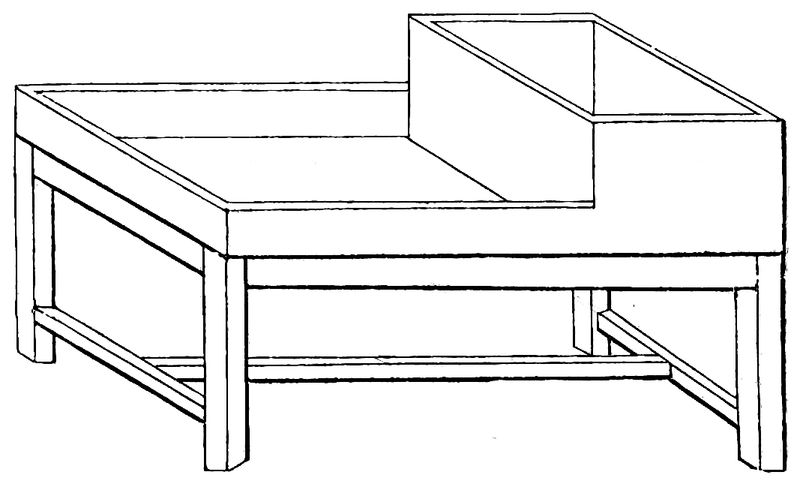
RISE.
A form is said to rise, when in rearing it off the correcting stone no letter or furniture, &c. stay behind.—M. When every thing is properly justified, and the form properly quoined and locked up, so that nothing falls out in lifting it up.
RISERS.
The material upon which stereotype plates are fixed, in order to be printed.
These risers are sometimes made of wood, with the plates screwed, or otherwise fastened upon them; sometimes of brass, bell metal, gun metal, or type metal; and occasionally of gypsum, or Roman cement:[703] but, of whatever substance they may be formed, the riser and the plate together should be of the same height as types.
Mr. James Fergusson took out a patent for risers made of elastic substances, of which he published the following description, or specification:—“Now know ye, that I the said James Fergusson, in compliance with the said Proviso, do hereby declare, that the nature of my said Invention, and the manner in which the same is to be performed, are particularly described and ascertained by the following explanation thereof, that is to say: In the process of printing from Stereotype Plates, the plates are put upon, and fastened to, certain materials or apparatus, called by different names, such as blocks, matrix-plates, risers, &c., which are made either of iron, brass, type-metal, bell-metal, Roman cement, gypsum, wood of various kinds, or some other suitable substance; or, without using any such materials or apparatus, the plates are, or may be, put upon, and fastened to, the coffins or tables of such printing presses as are in general use, or upon cylindrical or any other sort of printing machines. In all cases, however, of printing from Stereotype Plates, it is necessary to apply some remedy to the unequal thickness of the plates; and the operation usually adopted is that of putting layers or pieces of paper, or other material, under the thinner places of the plates, or over the same, upon the tympan, which operation is technically termed underlaying and overlaying. Now, the nature or object of my Invention is that of saving the time and expence unavoidably sacrificed in the operation of underlaying and overlaying; and this object I accomplish by putting elastic substances under the Stereotype Plates, whereby the printed impressions from them are immediately equalized wholly or in part; for the elastic substances yield to the pressure upon the thicker parts of the plates, and at the same time afford the necessary resistance for obtaining sufficient strength of impressions from the thinner parts. It must be evident, that the elastic substances are to be interposed between the Stereotype Plates and whatever solid or firm substance may be made use of, whether blocks, matrix-plates, risers, cylinders, printing presses, printing machines, or any other apparatus whatsoever. So far as I have made experiments and trials of different elastic substances, I have hitherto found Cork to be the best calculated for the purposes of my Invention; but, in virtue of the Letters Patent granted unto me, I claim the exclusive right and privilege of applying Cork, and any other elastic substance, to all kinds of printing apparatus and machines, with the view of remedying the inequalities in the thickness of Stereotype Plates; and I also claim the sole right and privilege of manufacturing the elastic articles requisite for the attainment of this object, of vending such articles, and of granting Licenses for the use of the same. In further explanation of the manner in which my Invention is to be performed, it may be proper to state, that the Cork is prepared by cutting, sawing, rasping, and filing; and by these means it is wrought to such a uniform thickness as is required. I consider a quarter of an inch as a proper thickness, but a lesser or a greater may be adopted. If, when a determinate thickness has been fixed upon, the Cork is to be applied to some apparatus now in use, that apparatus should of course be diminished as much as is the thickness of the Cork, in order that the same height to paper may be preserved. The layers or beds of Cork may be formed either of single pieces, cut to the respective sizes of pages, or made up by several slips, whereby they may be adjusted to various widths and lengths. Whether the Cork be laid loose upon the blocks, &c., or be attached by soft pitch, shoemakers’ wax, or other adhesive substance, is[704] unimportant; but I prefer attaching it, so as to keep it in its place. Although my Invention essentially consists in discovering the applicability of Elastic Substances for the purpose of remedying inequalities in the thickness of Stereotype Plates, yet, in this Specification, I have necessarily given my explanations by particularising Cork, that being the material which I now manufacture and prefer. How to adapt any other elastic substance, which may answer the purpose equally well as Cork, cannot be a matter of doubt or difficulty to any person practically acquainted with apparatus used in Stereotype Press-work.——In witness whereof, &c.”
Mr. T. C. Hansard took out a patent for improvements on, and additions to, Printing Presses, and various processes relative to Printing; these improvements included “Stereotype-Plate Risers, with Holdfasts or Claws,” of which Mr. Hansard published the following description:—“The Risers are made of Type Metal, or with any other metal or substance, cast in a Type-founder’s mould, having somewhat the form of what are called Quotations. I take the usual standard for Printer’s ad-measurement, and cast them quadrilateral to four Pica m’s; then longer ones as parallelograms, four by eight, four by twelve, four by sixteen, and smaller ones, four by two, four by one, and four by a half; in height they are about three-fourths of an inch, or sufficient to raise the Plate to the usual height, or somewhat higher than common Type; these being cast and dressed perfectly true, in body and height, may be easily combined to form the size of any page necessary, with the certainty of having a uniform plain surface for all the plates, however numerous; they are cast as hollow cubes, the larger combinations having divisions to give sufficient support to every square against any pressure which can be brought upon them.
“The Holdfasts or Claws are formed of Brass or other hard metal, accurately adjusted in thickness to a Brevier, or any other body chosen, with a projecting Bevil at the top. They may be of various lengths, as to 4, 8, 16, 24, or more or less, Pica m’s, the elongated parts of the larger ones being to the height of ordinary Reglet, having the Holdfast or Claw in the centre, or towards each end. They may be opened, or pierced, as well to make them lighter, as to cause them, by pressing and indenting into the furniture of the forme, to be less liable to be drawn out: the height of the Claw is about seven-eighths of an inch, or sufficient for the projecting bevil of about one-eighth of an inch to lay upon the flanch of the plate when resting on the Risers. To prepare plates for working, form with the Risers the requisite number of pages for the forme or sheet to the nearest size they may make by the various combinations, and add any difference wanting by reglet, leads, or scale-board; then lay on the Plates, and place at the head, foot, and sides of each plate as many Holdfasts as may, from the size of the plate, be deemed sufficient for proper fastening; thus for small pages, as in Octadecimos and Duodecimos, one at each side and end will be sufficient; for larger pages two or more may be thought necessary; making up the parts which they may be deficient of the length and breadth of the pages with quadrats or reglet of the same body; then proceed to make margin, or dress the formes, and lock-up in the usual mode. To change the Plates; when worked, unlock the forme, draw out the Holdfast at the head or foot of the plate, slide off the done-with plate, replace by the new one; lock up again; and if the Plates have all been cast true to one gauge in thickness, width, and length, you will have throughout the whole work exact and uniform register, and equal impression;—when[705] the Work is completed, the same material of Risers and Holdfasts, by admitting every combination of size, will form into any other sized pages for any other sized plates.”
Robbery. See Stolen Property.
ROLL UP BALL LEATHERS.
When the pressman leaves work at noon he draws half the nails out of the balls, and takes the wool out; then doubles the loose half of the leather over the remaining nailed-on half, with the inky sides of each half next each other, and rolls up the leathers close, and lays them in a bowl or pan of water to soak till he has dined—M. This plan is entirely discontinued; the ball nails now are never drawn nor the covering taken off till it is worn out, owing to the different composition of the ink.
ROLLER.
A cylinder coated with composition, fixed in an iron frame, and revolving upon an iron rod running through it, with which to ink the forms, preparatory to taking an impression.
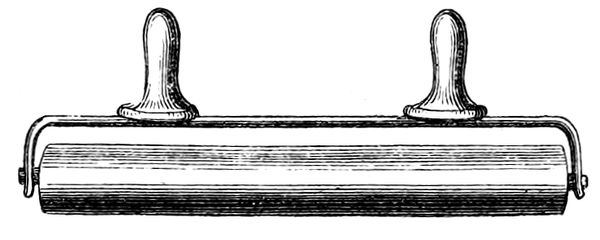
The roller has almost entirely superseded the use of balls in printing; and, since the introduction of composition, I may venture to say it has completely superseded the use of pelts for balls. See Pelts.
The use of the roller is less laborious to the pressman than balls; and for common work, and indeed all work where weak ink is used, it coats the surface of the types, &c. more uniformly, perhaps, than balls; but for fine work, where strong ink must be used, and really fine work cannot be produced without strong ink, the roller is decidedly inferior to the ball, partly owing to the difficulty of taking ink and distributing it on the inking table; and partly owing to the inferiority of rolling to beating with balls, in coating the surface of the types with strong ink.
The introduction of composition in lieu of pelts has been the cause of a complete change in printing; but for this article, machine or cylindrical printing would never have been accomplished, as all the first attempts were made with skins to coat the roller, and all failed, owing to the imperfection of joining the edges; it was this that baffled Nicholson, who died before its introduction; and it was the introduction of this article that enabled König to avail himself of Nicholson’s invention and to reduce it to practice, after he had failed in his project of applying steam to the working of presses.
The composition was first introduced in printing by Mr. B. Foster, who spread it in a melted state on canvass, and then formed it into balls in the usual manner. I have been informed that Mr. Foster obtained his knowledge of its properties from a cotton manufactory, where it was used in some part of the machinery; but Mr. T. C. Hansard says that it was in the Staffordshire potteries, in which they use what are there called dabbers, that Mr. Foster first observed it.
Composition.—Mr. Hansard, a printer of extensive practice, in his Typographia, says, “The composition consists principally of glue and molasses, or treacle. I have seen various receipts of ingredients and proportions, some possessing the recommendations which distinguish the recipes of ancient physicians; namely, a vast variety of articles with counteracting properties. But the simple prescription which my experience[706] has proved best, is, to provide glue of the finest quality, made from the cuttings of parchment or vellum; fine green molasses, pure from the sugar refiner, at least not adulterated for the bakers’ or grocers’ shops; and a small quantity of the substance called Paris-white [carbonate of barytes], and you will have every ingredient requisite for the compo. The proportions have been so variously stated, and so different from what I have found to be eligible, that I am wholly at a loss to account for such differences.
| Pounds of | |||
| Glue. | Molasses. | ||
| One receipt which now lies before me in print, says | 2 | 1 | |
| Another, MS. | 2 | 3 | |
| I find a mixture of | 2 | 6 or 2 | 7 |
and about half a pound of the Paris-white, will make the compo of a superior quality to any other proportions, and will be sufficient for two demy rollers. The great disparity which appears in these receipts may perhaps be attributed to a difference in the quality of the materials, and to the mode of management.” Thus far Mr. Hansard on the component parts of the composition.
The late Mr. Robert Branston, an eminent engraver on wood, and who was also very skilful in printing his productions in a superior manner, told me that he made his balls of glue, treacle, and a little shoemakers wax, and that they answered as well as Foster’s. The Cave of Despair, in my Practical Hints on Decorative Printing, will serve as a specimen of his abilities in both these departments.
An ingenious printer in the country, and a good workman, sent me the following receipt, from which he used to make balls for his own use:—Take a pound and a half of glue, let it soak in cold water twelve hours, boil it without any additional water; when it is hot add half a pound of treacle, half an ounce of turpentine, and a quarter of a pound of tar; this quantity is sufficient for a pair of balls. Prepare your canvass or coarse cloth of the size the balls are wanted, by rubbing on it bees wax, (or common paste will answer the purpose after it has been allowed to dry,) to prevent the composition running through the pores; when the mixture is nearly cold, pour it on the canvass, held in a concave manner, in order that it may be the thickest in the middle, and thinner at the edges; then knock up the balls in the usual way.
Another receipt, from which a large establishment in London made their balls and rollers, and the latter both for their machines and presses, is equal parts of glue and treacle; but as the composition is affected by the state of the atmosphere, it is found by experience that in cold weather a greater proportion of treacle is required, and in warm weather a greater proportion of glue.
This establishment was of opinion that the glue known by the name of London Glue is the strongest and best.
These different receipts, each of which was held in high estimation by the party who made use of it on account of its individual superiority over others, tend to show that different proportions of the same materials with different ingredients incorporated with the mixture, produce a composition that possesses all the requisite qualities.
Casting Rollers.—Mr. Hansard gives the following directions:—“The cylinder upon which the compo is cast is made of alder-wood, turned to a requisite diameter, so that the coat of compo which it receives is half an inch. The cylinder is perforated through its centre, having a brass bush or collar driven into each end, through which is[707] passed an iron rod, as an axis, with an enlarged head at one end, and tapped with a screw at the other.
“It is necessary to procure a mould very accurately made and well finished. Mine is made of brass, in two parts, adjusted to each other with rebates, the inside being finely turned and polished, and having flanches projecting by which the parts are screwed together by the screw and lock-burr. To each end is also fitted a collar; and a circular plate of iron is accommodated with great precision to the bore of the mould, having a projection in its centre to enter a cylinder of wood about which the compo is to attach itself, and to hold it exactly in the centre of the mould, and the other end of which is kept in a corresponding position by means of a brass piece to allow of the compo passing down between the interior surface of the mould and the wooden cylinder. There are little projections on the sides of the mould, which serve as feet to support each half in a steady position while lying upon a table or elsewhere. Previous to joining, the parts of the mould must be nicely cleaned and oiled, and the greatest care taken that no particle of compo, grit, or dirt, remain in the rebate. The parts being carefully placed on each other, and the wooden cylinder fixed inside, the screws must be put into their respective places in the flanches, and when all is properly made tight the mould is to be set upright for receiving the compo.
“The next material part of the apparatus is the melting kettle. This must be a double vessel like a glue-kettle, so that the compo in the interior may be melted by the heat of the boiling water in the exterior. For this purpose a strong boiler may be the best or readiest thing found, into which let a tin vessel be fitted, with a flanch to rest on the rim, so as to leave one or two inches clear under it. This vessel may be six or eight inches above the top of the boiler, so that the lid of the one may fit the other; and it must have a handle on each side; also a large lip for pouring out the compo.
“Being thus prepared, put the glue into a little water for a few hours to soak. Pour off all the liquid, and put the glue into the inner vessel, the boiler having in it as much water as it will contain when the inner vessel is in its place. Put it on the fire, and boil the water as quick as you please, the heat of which will soon cause the glue to dissolve, and evaporate part of the water. When the glue is all melted, add the molasses, and let them be well incorporated together for at least an hour, receiving heat from the boiling water, which is an uniform degree that cannot exceed 212° of Fahrenheit. Then with a very fine sieve, mix the white powder, frequently stirring the compo. In another hour, or less, it will be fit to pour off; and when it is, take the inner vessel out of the boiler, and pour the mixture gently into the mould through the opened brass keeper. In about an hour, if the weather be dry and favourable you may take the roller out of the mould; hang it in a cool, dry, situation, or lay it horizontally in a rack made for the purpose, and the next day it will be sufficiently hardened for use. As there will be rather more of the compo at each end of the cylinder than would work clear of the frame in which it is to revolve, cut off from each extremity about half an inch, by encircling it with a piece of fine twine.”
There is a serious practical disadvantage in the mould being formed of two pieces; that of having a seam or ridge running the whole length on both sides of the roller. This seam prevents that accurate distribution of the ink which is essentially necessary, and increases the probability and danger of producing monks in the impression, which ought to be avoided as much as possible, as destructive to good printing.
I have at different times heard complaints of the difficulty of drawing the roller out of the mould, and of the injury it frequently receives from the surface being damaged, which spoils it, and makes it necessary to be recast. This accident occasions disappointment and loss of time; as cleaning the mould from the composition which adheres to it when this happens is tedious. I attribute this to the mould being made too thin, which expands when the hot mixture is poured into it, and contracts as the mixture cools, thus becoming, by the contraction, too small for the roller, and binding it so tight as to prevent its being drawn out with facility, and without great risk of injury.
I know one house in the Metropolis that makes rollers in the most perfect manner, and experiences little or no trouble in drawing them from the mould; and I know a person who had a mould made, with the same result. These moulds were made out of a solid cylinder of metal (tin, or type metal is equally good for the purpose, and more durable), the aperture bored to the size of the required roller, and carefully polished on the inside, the tube being thick, in some instances two inches, so that it was not much affected by the heat of the composition, the expansion being very trifling, and of course the contraction small in proportion; so that the roller when cold was not compressed by the mould, or so slightly as not to cause any inconvenience or damage to it in drawing out. The inside of the mould should be carefully wiped out before using, so as to be perfectly free from dust or dirt, and slightly oiled, which causes the roller to quit it more readily.
Preservation.—Mr. Hansard says, “To keep the rollers in good condition for working, a place should be chosen where the air has free circulation, without being subject to the extreme heat of the sun in Summer, or the freezing damp air in winter; in short, in as even a temperature as possible. It will be necessary to keep a stock of more rollers than are at work; as it is frequently found, when a roller is sick, or greasy, or soft, or you do not know what is its ailment, that washing it clean, and hanging it to rest for a time, restores it to as good a state as ever.
“One other circumstance must be noticed, namely, the influence of the variable temperatures of different situations on this composition. This I have had particular opportunities of knowing, from having carried on business in two distant offices. It frequently happened that when the compo was working kindly at one office, nothing could be more teazing than its progress at the other. Indeed, while I was supplied by those who make for the trade, one of my houses frequently gave them a great deal of trouble. I have heard both Foster and Harrild say, ‘that they were obliged to make a harder compo on purpose for my house and one or two others similarly situated, than the customary temper of the mixture:’ and, frequently, the only alternative was, to find me a roller that had got hard and useless at some other house, to suit the low temperature of mine. The difference was this—one of my houses had the press-room on the ground-floor, the joists and flooring lying on the earth; the sink room adjoining; wet sheets hanging very low; very little influence from the sun, and no thorough ventilation; consequently, from the humidity of the atmosphere engendered by these circumstances, it was a constant complaint that the compo was too soft. At my other house the press-room was on the two-pair floor; the poles very high; the sun’s rays had free admittance, and the ventilation was very complete. Here the compo, complained of as too soft at the former house, was all that could be wished: hence it became the roller-nursery; and by sending them to hang up a day or two, when out of order at the other place, they became firm and fit for work.”
From this statement it appears that any fixed proportions of the materials for the composition cannot answer generally, and that they must vary according to circumstances. And it may cause us to cease wondering at the number of recipes, and of the different proportions of the various articles, and at being told that they all answered very well; for it is evidently owing to the situation, whether moist or dry, of the press-room of a printing office, that different proportions of ingredients are requisite to make a roller work well, under different circumstances.
The usual method of keeping rollers in working condition is to cover them at night, and when they are not likely to be wanted for some time, with a coating of common or refuse ink; this does not dry, and prevents evaporation, and thus keeps them in working condition: the ink must be scraped off when they are required for use. A roller will get foul in the course of working, or become too hard, it should then be washed well with lye and the lye brush, which will remove the foulness, and it may be further washed with clean water and the hand to remove the lye, and to give it a clean surface; it would then be necessary to distribute it well on a clean table. It would be now advisable to proceed with the presswork with a fresh roller, and allow the one that was washed to have a rest, which generally improves its working condition. If a roller become too hard, and the surface is clean, then washing it with clean water and the hand, distributing it on a clean table, and placing it in a damp situation, will restore it; in fact, when the press-room is dry and well ventilated, keeping the rollers in a damp situation when not in use is preferable, in my opinion, to softening them with water, as the moisture is gradually imbibed by the composition, and makes it more uniformly soft and kind.
When rollers get too soft, the general practice is to hang them up in a current of cool dry air, which evaporates the superabundant moisture, cools the composition if the room has been too warm, and brings them to a good working state. But a more expeditious and effective method, is to sponge them with spirit of turpentine, which restores them to a proper condition sooner than any other method, and also cleans them more effectually than lye. If the same rollers are required to be used when it is necessary to change the colour of the ink, there is not any article that will clean them so expeditiously, and take the ink which had been used out of them so completely, as spirit of turpentine.
Occasionally the pressman finds that he cannot produce good and clear impressions with all the care and attention that he can bestow upon his work, and this when his roller seems to be in good condition, and no apparent cause can be assigned for the deficiency of quality; the roller is then said to be sick, or tired; and the only remedy that has yet answered to remove this inconvenience is to give the roller rest; that is, to hang it up, and take another roller for the work in hand; after resting for some time, it will be found that the sick or tired roller has resumed its original qualities, and will again produce good work.
Rollers, when not in use, should always be hung up in a shady place, which is generally done by one end of the frame, for if left on the inking table they would stick to it, and the composition would be torn in the act of separation; neither should they be exposed to the action of the rays of the sun in summer, which will soften the composition so much as to cause it to run, and thus spoil the roller. These observations apply equally to composition balls.
The following is an abstract of the French method of making and treating rollers.
The French roller-makers proportions are eight pounds of glue and twelve pounds of treacle, which is sufficient for four rollers used at press; the quantity required for those used at machines will vary according to their length and diameter.
Paris made glue is the best: it ought to be transparent, have little colour, and break like glass. Flexibility in glue is a proof of its weakness; and it is injured by being left in a damp place.
The treacle ought to be pure; the most compact is the best. To avoid being deceived, it is best to buy the refined. The old is weak, and not of a good quality for rollers.
In preparing to make four rollers, two pounds of good glue must be soaked in river water; the strength of the glue must determine how long; but if too long the glue loses its strength, and the rollers are injured.
This portion of the glue, thus soaked, is then put into the melting kettle, and placed over a fire, and stirred with a spatula; and when it is quite melted, the rest of the glue is added in similar portions, till the whole eight pounds are melted, which ought to have an hour’s boiling before adding the twelve pounds of treacle. The treacle is then gently poured into the melted glue, stirring them until they are well incorporated. This done, they are left over a moderate fire for an hour, stirring them with a spatula every ten minutes. The surface must be skimmed, and afterwards the vessel must be left a little time to slightly cool, before being poured into the mould.
The cylindrical tube in which the rollers are cast should be smeared in the inside with a brush with oil; neatsfoot oil is the best; and it is necessary that every part should be carefully oiled, and that the wooden cylinder should be well cleaned and free from moisture.
These observations can only apply generally to the making of rollers; it is practice which can alone furnish the particulars. The temperature varying in each season must be the object of special attention, as it renders the materials more or less flexible, and requires the composition to be more or less boiled.
It is a fault with rollers when they lug too much, as it detaches the composition from the wooden cylinder. When they are moist they should not be too much washed, as that also tends to make them lug, and detaches the composition. If they are used too soon after making, they distribute the ink badly, fill up the letters, and last but a very little time. They ought to be exposed to a current of air to dry them, and to be carefully scraped before being used, and again afterwards. If they are too dry they must be sponged all over and distributed upon the table until the water has disappeared, and then on a clean table, before taking ink. When they begin to grow old and hard by work, they must be washed in proper lye without being rinsed in water, and care and attention given to their wiping; and by these means they may be preserved for a considerable time. Rollers, when not in use, should be suspended in a place neither too dry nor too damp.
Recasting.—Before recasting old rollers, take great care to wash them well with lye, in order to detach the ink with which they are coated: if they are dry they must be scraped with a knife, as grease deteriorates the matter. Afterwards cut the composition all over with a knife, and it will then be easily detached from the wood. If it is new it will not need cutting, it will easily dissolve; if old it must be cut into little pieces, that it may dissolve more easily, and with less loss: if the composition is very strong, the little pieces must be washed in a pail of water, warm water is better than cold; add to it two pounds of treacle, for four rollers,[711] and so in proportion: when the matter draws out well in threads, the composition is good.
If the rollers have been recast many times, and they draw too much, they may be recast without adding fresh treacle or glue. Rollers which are recast are better than new; they are more elastic and less melting. With three pounds of glue, five pounds of treacle, and the matter of three old rollers, four rollers can be made; if a small glass of spirits of wine be added it will facilitate the dissolving.
The rollers fail the most frequently at the ends. They ought to be dry, and clear from grease. It is a good plan before using them to scrape them clean, and to sponge the ends for about an inch and a half with spirits of wine, and to leave them to dry; the gelatine draws better.
ROSE ENGINE.
The rose engine is, I believe, a French invention, and has long been used for turning ornaments on metal, for instance, watch cases and other articles of plate; it was afterwards applied to produce them to print from by the rolling press: during the sitting of the commission for inquiring into the best means for preventing the forgery of bank notes, about twenty years ago, Mr. Perkins introduced a specimen bank note which was partly executed by this machine; and the late Mr. Branston, then of the firm of Whiting and Branston, was, if I am not mistaken, the first to engrave by its means for letterpress printing, and the tickets and shares for the last state lottery were executed by it at Beaufort House. Its great value for the prevention of forgery is, that all circles, curved and angular lines produced by this machine are precisely similar to each other and true, however numerous, and however small or large; it would be next to impossible to produce the same designs, with the same accuracy, by the hand, and the operation would also be uncommonly tedious.
By the kindness of Mr. Holtzapffel I am enabled to introduce into this work a number of different patterns; only one specimen of each individual apparatus is given. The patterns which are capable of being produced are almost endless, and depend on the skill and taste of the operator; the variations in the designs being caused by different chucks being used in the operation; and the combinations of the effect produced by each chuck, either in straight lines, circles, ellipses, or as a ground covering the whole surface, in many instances are very delicate and have a beautiful effect. The following enumeration shows how the annexed specimens were produced.
Figs. 1. 10. Holtzapffel and Co.’s compound oval and eccentric chuck:—1. Two eccentric movements; 10. One oval and one eccentric movement. 2. 6. 8. Ibbetson’s geometric chuck, parts first, second and third. 3. Rose engine. 4. Straight line chuck. 5. Segment engine. 7. Oval chuck. 9. Eccentric chuck. 11. Eccentric chuck with the rose engine. 12. 15. Holtzapffel and Co.’s compound oval and eccentric chuck with the rose engine:—12. One oval and one eccentric movement; 15. Two eccentric movements. 13. Oval chuck with the rose engine. 14. Ibbetson’s compound eccentric chuck. 16. Geometric chuck combined with the rose engine. 17. Straight line chuck combined with the rose engine.
For details and descriptions of the various chucks, with the methods of operating with them, the reader is referred to Manuel de Tourneur, published by Bergeron in 1792, and to “Specimens in Eccentric Turning, with Practical Instructions. By John Holt Ibbetson, Esq.” Third Edition, 8vo. London. [1840.]
Mr. Ibbetson observes, “The number of beautiful designs which may be obtained by combining, on this principle, two circular adjusting movements[712] is inconceivable. Consecutive circles, &c. may be arranged, not only in elliptical curves, but in the shape of hearts—in straight lines—in triangles—in squares—in polygons, and in both inward and outward looped figures.”


ROUNCE.
The handle by means of which the carriage of the press is run in and out.
RUB OUT INK.
Rubbing the ink out smooth and even on the ink-block with the brayer, for the purpose of taking small quantities with the balls tolerably diffused over their face.—M. The thinner and more equally it is rubbed out on the ink-block the better, as it in a great measure prevents monks and friars in working. In fine works, where strong ink is used, the pressman who beats should occupy his spare time in using the brayer, as it not only diffuses the ink more equably on the block, but causes it to work better.
RUBY.
The name of a type, the next in size larger than Pearl and smaller than Nonpareil; it is half a Small Pica. Mr. Hansard, in his “Typographia,” gives the following account of its origin and name:—“It was, in fact, originally a Nonpareil with short ascenders and descenders, cast on a smaller body, or sometimes a Pearl, on a larger, to look open; but now some founders have a distinct specimen for this size. This name has but very lately been adopted in the type-founders’ specimens, but some years ago it was found, by the writer of this, absolutely necessary to give some distinguishing appellation to this size, as the letter-founders had given him one-nick Pearls of two bodies, viz. one fount half Small Pica, another half Long Primer; the mistakes arising from this circumstance in a house much in the habit of using small type occasioned the expedient of inventing a new name, and as the neighbouring sizes were called Pearl and Diamond, it seemed not very inapplicable to take the name of Ruby.”
RUCK.
In printing at machines, the paper, particularly if it be soft and not flat, in travelling round the cylinders frequently wrinkles; this is termed Rucking, or the Paper Rucks, or the Paper is Rucked; when this takes place, the sheets may be looked on as spoiled when it is for book work: the best preventative is to press the wet paper well in a powerful press for an hour or two, with small quantities between the boards, just before it goes to the machine. I would not recommend more than five quires in each portion, although I am aware that a ream is generally put in; but the smaller the quantity between each two boards the flatter the paper will be, and less likely to ruck.
RULES and REGULATIONS
proper to be observed in a Printing Office.
Compositors.
1. Compositors to receive their cases from the Overseer, or other person appointed by him, free from all pie, or other heterogeneous matter, with clean quadrat and space boxes to both roman and italic, which they are to return to him in the same clean state.
2. When a Compositor receives letter, furniture, &c. from the Overseer, he is to return what he does not use, in a satisfactory state.
3. Compositors to impose their matter when desired by the Employer or Overseer; and the same for proofs that are desired to be corrected; unless in either case it shall appear that all the stones are engaged.
4. When the Compositor imposes from a form, he is directly to tie up the pages of loose matter.
5. Forms, immediately after they are imposed, to be carried to the proof press; and the proofs, when pulled, to be given to the Reader, or carried into the reading closet, with, if a first proof, the copy, and, if a second, the foul proof.
6. No Compositor shall leave a foul stone, of letter, furniture, &c.
7. No Compositor to detain an imposing stone longer than the nature of the business may require.
8. When any cases are taken out of the racks, the Compositor is to return them into their proper place immediately after he has done with the same.
9. No cases to be placed over others, or under the frames.
10. Galleys with head lines, or other useful materials used during the course of a piece of work, to be cleared at furthest the day after the work is all completely at press.
11. When a work is finishing, the Compositor or Compositors concerned shall, as the forms are finally worked, clear them away; taking from them the head lines, white lines, and direction lines, as also the leads and reglets, which, with the furniture of each sheet, the matter being properly tied up for papering, are to be given to the Overseer, or any person he may appoint.
12. Sweepings of frames to be cleared away before one o’clock every day. Matter broken by accident to be cleared away on the same day.
13. No Compositor to mix two separate founts, without an express order from the Overseer.
14. When a Compositor carries his form down for press, he is not to put two forms together without a partition between them.
15. The saw, saw block, bowl, sponge, letter brush, shears, bellows, &c., to be returned to their respective places as soon as done with.
16. No person to take a candlestick, bodkin, snuffers, composing stick, &c., not his own, without permission of the owner.
17. No person to misplace cases in the rack, or take an upper without the lower case, or vice versâ.
18. Pie of any sort, on boards, windows, frames, &c., to be cleared after five minutes notice.
19. No person to take sorts from the frames or cases of another without leave; nor to hoard useful sorts, not immediately wanting them.
20. No person (except the Master or Overseer) to call off the errand boy while he is sweeping his rooms.
21. No candle to be left by any one, except in charge of some proper person; and the boundaries of the office to be considered, in all cases, the open air.
22. Jobs to be cleared away immediately after notice having been given by the Overseer.
23. These regulations, in cases of extreme hurry of business, by leave from the Master or Overseer, may be suspended; but, when that has ceased, to be immediately resumed.
24. No Compositor to throw for money or liquor.
25. Not to throw letters, quadrats, quoins, or furniture at each other.
Pressmen.
1. All proofs to be pulled within five minutes after notice, by the Pressmen who are in proofs.
2. Immediately after pulling a proof, the Pressmen to rub over the forms and chases with a lye brush, and place them against the Compositor’s frame to whom they belong, where they are to leave the proof.
3. Not to work without a figure unless particularly ordered.
4. As soon as a form is wrought off, the pressman to carry it to the lye trough, and there completely rub it over with lye, rinse it, and then carry it to the wrought-off place, or to the end of the Compositor’s frame it belongs to.
5. Not to leave the lye jar uncovered.
These rules may be varied to suit the business of the office in which they may be adopted, or the size of the establishment; in practice it will be found essentially necessary to have established rules and regulations, that the business may be carried on with method and good order.
Rules. See Brass Rule. Metal Rules.
RUN IN THE CARRIAGE.
Running the form under the platen, by turning the rounce.—M. This corroborates my opinion that the coffin, plank, &c., and not the long ribs, constitute the carriage, and that it was so understood in the seventeenth century. See Carriage.
RUN OUT.
The running of the carriage from under the platen, by turning the rounce.
Run out from Copy.—M. See Drive Out. This term is not now used.
RUNIC.
“Authors are much divided, as to the antiquity of the Runic characters; some suppose them to be very ancient, whilst others contend, that they are more modern than the ancient Gothic. Several writers affirm, that they were brought from Asia by the celebrated Woden. Olaus Wormius and Rudbeck contend, that they are older than the Greek. Mr. Wise says, that the Runic letters are found on coins, and on stone monuments, some of which may be near two thousand years old. He also supposes this alphabet to have been exceedingly ancient, and that it was formed from some alphabet of the Greeks, whilst it consisted of sixteen letters only, and before they had left the Eastern way of writing, from the right hand.
“The judicious Celsius was of opinion, that the Runic letters were nothing more than Roman letters, with the curves changed into straight lines, for the ease of engraving on hard substances. The learned and ingenious author of the History of the Decline and Fall of the Roman Empire says, that the oldest Runic inscriptions are supposed to be of the third century; and he adds, that the most ancient writer, who mentions the Runic characters, is Venantius Fortunatus, who lived towards the end of the sixth century. Our opinion on the evidence before us, is, that the report of Woden having brought the Runic letters from Asia is entirely fabulous; that the tales of Rudbeck and Olaus Wormius, do not deserve the least attention; that Mr. Wise, though a respectable writer, is mistaken as to the antiquity of the Runic letters; that the opinion of the learned Celsius is nearly true, and that the Runic characters are composed partly of ancient Gothic and Greek letters, and partly of Roman, deformed and corrupted, probably by the Necromancers of the north, who used them in their spells and incantations, to which they were greatly addicted. The forms of several Runic letters, compared with the Greek and Gothic alphabets, sufficiently prove this observation. For instance, the Runic F or Fei, is a rude imitation of the[717] Roman F, with the same vocal powers. The O or Oys, is an inverted digamma, with the power of the Roman U, that is of ou or W. R or Ridhur, is evidently the Roman R, with the same powers. I or Iis, is the Gothic and Roman I. S or Sol, is a resemblance of the ancient Greek Σ, with the same power. T or Tyr is an imitation of the Greek Tau, or Roman T. B or Biarkan is the Greek Beta, or Roman B; and L or Lagur appears to have been taken from the Grecian Lambda. We are of opinion, that the resemblances above pointed out, sufficiently evince, that the Runic characters are derived from the Greek, Gothic, and Roman letters.
“In the year 1001, the Swedes were persuaded by the Pope to lay aside the Runic letters, and to adopt the Roman in their room. In the year 1115, the Runic letters were condemned in Spain, by the council of Toledo. They were abolished in Denmark in the beginning of the fourteenth century, and in Iceland soon after.
“The order of the old Runic alphabet, which consisted of sixteen letters, was as follows: F, U, D, O, R, K, H, N, I, A, S, T, B, L, M, YR. It is not known when the order of the Runic alphabet was confounded, but we do not suppose that it is of greater antiquity upon that account.”—Astle.
Milman has the following remarks on the opinion of Gibbon quoted above by Mr. Astle: “The obscure subject of the Runic characters has exercised the industry and ingenuity of the modern scholars of the north. There are three distinct theories; one, maintained by Schlözer (Nordische Geschichte, p. 481, &c.), considers their sixteen letters to be a corruption of the Roman alphabet, post-Christian in their date, and Schlözer would attribute their introduction into the north to the Alemanni. The second, that of Frederick Schlegel (Vorlesungen über alte und neue Literatur), supposes that these characters were left on the coasts of the Mediterranean and Northern Seas by the Phœnicians, preserved by the priestly castes, and employed for purposes of magic. Their common origin from the Phœnician would account for their similarity to the Roman letters. The last, to which we incline, claims a much higher and more venerable antiquity for the Runic, and supposes them to have been the original characters of the Indo-Teutonic tribes, brought from the East, and preserved among the different races of that stock. See Über Deutsche Runen, von W. C. Grimm, 1821. A Memoir by Dr. Legis. Fundgruben des alten Nordens. Foreign Quarterly Review, vol. ix. p. 438.”—Gibbon, chap. ix. note 16.
The University of Oxford are in possession of the matrices of a Pica Runic, which is the only one in England.
Running Title. See Head Line.
RUNS ON SORTS.
When matter runs much on some few sorts of letters, they say it runs on sorts. See Sorts.—M.
RUSSIAN.
In the Russian alphabet there are thirty-four letters.
The English letters, made use of in explaining the sound of the Russian characters, are to be pronounced as follows:
| ā as in fate. | u as in pure. |
| a as in far. | g as in game. |
| ē as in me. | j as the French j. |
| é as in met. | z as in zephyr. |
| e as e mute. | ch as the Scotch pronunciation of |
| ō as in no. | ch in loch, och! &c. |
| o as in not. | tch as in fetch. |
| oo as in mood. | sh as in shame. |
The Russian Alphabet.

| А а | ah, | ex. баба, an old woman, baba. |
| Б б | bā, | бабочка, a butterfly, babotchka. |
| В в | vā, | вода, water, voda. |
| Г г | gā, | годъ, a year, goad. |
| Д д | dā, | домъ, a house, dōm. |
| Е е | ā, | ведро, a pail, védrō. |
| Ж ж | jā, | жена, a woman, jéna. |
| З з | zā, | золото, gold, zolotō. |
| И и | ē, | видъ, a view, vēēdd. |
| І і | ē, | used before a vowel only, ex. мнѣніе, opinion, mnānēā. |
| К к | ka, | ex. Король, a king, Korole. |
| Л л | él, | мало, little, malō. |
| М м | ém, | мраморъ, marble, mramor. |
| Н н | én, | нашъ, our, nash. |
| О о | o, | окно, a window, oknō. |
| П п | pā, | пепелъ, ashes, pépéll. |
| Р р | r, | рано, early, ranō. |
| С с | s, | спасеніе, salvation, spasānēā. |
| Т т | tā, | твердость, hardness, tvérdoste. |
| У у | oo, | утро, morning, ootrō. |
| Ф ф | éf, | флагъ, a flag, flagg. |
| Х х | kha, | a guttural sound, resembling the Scotch pronunciation of ch in loch, &c., ex. хитрость, cunning, chēētroste. |
| Ц ц | tsā, | (a combination of т and с,) ex. Царь, a king, tsar. |
| Ч ч | tcha, | ex. человѣкъ, a man, tchélovayk. |
| Ш ш | sha, | ше́рсть, wool, schārste. |
| Щ щ | sh-tcha, | (a combination of ш and ч) ex. щедрость, bounty, sh-tchédroste. |
| ъ | yerr, | used at the end of words terminating in a consonant, to which it gives a hard sound, ex. столъ, a table, stoll. |
| ы | uē, | guttural, ex. рыба, a fish, rue͡ba. |
| ь | yāre, | used at the end of words terminating in a consonant, to which it gives a soft sound, nearly corresponding to the English e mute, ex. радость, joy, radoste. |
| Ѣ ѣ | yā, | ex. рѣка, a river, rāyka. |
| Э э | ē, | экономъ, a land-steward, ékōnom. |
| Ю ю | you, | юноша, a youth, younosha. |
| Я я | ya, | ярость, fury, yaroste. |
| Ө ө | fā, | ариөметика, arithmetic, arēfmétēka. |
Most of the above letters invariably retain their proper sound, the following however are subject to slight variations.
Г, gā. In some instances bears the sound of a strongly aspirated h: герои, a hero, héroy; генералъ, a general, héneral; Господь, Lord, Hospod, and in the terminations of adjectives and pronouns, in the genitive case, may be pronounced either as v or h, его, yāho or yāvo; что новаго? what news, tchtō nōvahō, or nōvavō?
Е, ā. At the commencement of words bears the sound of yā, ex. есть, it is, yaste; едва, scarcely, yādva. When it precedes two consonants, or a consonant followed by the hard sign, ъ, it generally bears the sound of yeo, as in yeoman, the accent falling upon o, ex. медъ, honey, meo͡dd; ленъ, flax, leo͡nn; орелъ, an eagle, oreo͡ll.
ѣ, yā. Is pronounced like yā at the commencement of a word, and like ā in the middle or at the end, ex. ѣхать, to ride, yachat; лѣнорть, idleness, lānoste; на столъ, on the table, na stollāy.
There are eleven vowels in the Russian alphabet, which are divided into hard and soft.
Hard а, о, у, э, ы. Soft я, е, ю, и, ѣ’.
In the combination of vowels with consonants, they are subject to the following variations:
| The letter | ы | following | г, к, х, ж, ч, ш, or щ | changes into | u |
| — | я | — | г, к, х, ж, ч, ш, щ, or ц | — | a |
| — | ю | — | г, к, х, ж, ч, ш, щ, or ц | — | y |
| — | о | — | ж, ч, ш, щ, or ц | — | e |
| — | е | — | г, к, or х, | — | o |
| — | и | before another vowel | — | i | |
The only diphthongs in the Russian language are those formed by the combination of и with the other vowels: ай, ей, ій, ой, ый, яй. When и occurs without the ̆ it must be pronounced separately from the vowel, which precedes it, ex. воиин, a warrior, vo-een. Whenever two vowels occur together in a word (excepting the above-mentioned diphthongs) each bears its full and separate sound, ex. воображеніе, imagination, vō-ob-ra-jā-nē-ā—A Practical Grammar of the Russian Language, by James Heard. 2 Parts, 12mo. St. Petersburg, 1827.
RUTHVEN’S PRESS.
Ruthven’s patent press differs materially from all others. Instead of the form of types being rolled under the platen, and back again when the impression has been made, the type form remains stationary upon the iron table, the platen is drawn over it, and the impression is obtained by means of a lever working vertically like the handle of a pump, and acting by connecting levers upon both sides of the platen, so as to draw it down with ease and effect. It is a good and powerful press, but the head and platen are heavy and require exertion to push them back off the form, and more particularly as the ribs, if the grooves in which the wheels attached to the head and platen travel may be so called, form an inclined plane, which causes the platen to come forward over the form with but little exertion.
SAMARITAN.
It is the opinion of many of the most eminent Hebrew scholars, that this alphabet is the one made use of by the ancient Hebrews, and with which Moses himself wrote the Pentateuch; and that the Hebrew letters at present in use are those of the Chaldees of Babylon, introduced by Ezra in consequence of the Jews having forgotten their own characters during the Captivity. It agrees with the Hebrew and Syriac, in respect to the number and power of the letters, though it differs as to their forms, as may be seen from the annexed table:

| Figure. | Name. | Power. | Number. | Hebrew Characters. |
| ࠀ | Alaph | Spiritus lenis. | 1. | א |
| ࠁ | Beth | B or Bh. | 2. | ב |
| ࠂ | Gamal | G or Gh. | 3. | ג |
| ࠃ | Dalath | D or Dh. | 4. | ד |
| ࠄ | He | H. | 5. | ה |
| ࠅ | Vau | V or U. | 6. | ו |
| ࠆ | Zain | Z. | 7. | ז |
| ࠇ | Cheth | Hh. | 8. | ח |
| ࠈ | Teth | T. | 9. | ט |
| ࠉ | Jud | J. | 10. | י |
| ࠊ | Caph | C or Ch. | 20. | כ |
| ࠋ | Lamad | L. | 3O. | ל |
| ࠌ | Mim | M. | 40. | מ |
| ࠍ | Nun | N. | 50. | נ |
| ࠎ | Semchat | S. | 60. | ס |
| ࠏ | Ain | Gn. | 70. | ע |
| ࠐ | Pe | P or Ph. | 80. | פ |
| ࠑ | Tzade | Tz. | 90. | צ |
| ࠒ | Kuph | K. | 100. | ק |
| ࠓ | Risch | R. | 200. | ר |
| ࠔ | Schin | S or Sch. | 300. | שׂ שׁ |
| ࠕ | Thau | T or Th. | 400. | ת |
It will be readily perceived that this is one of the most simple of the Oriental alphabets, as there are no initials or medials, as is the case with the Arabic and Syriac; there are no letters lengthened for the sake of ornament, as in the Hebrew and Chaldee; and there are no finals.
With respect to pronunciation, ࠀ ࠇ and ࠏ seem to differ very little from each other, if we may judge from their frequent permutation.
In writing the numbers, they follow the Hebrew system of notation, with this exception, that for 15 they use both ࠄࠉ (10 and 5) with the Syrians, and ࠅࠈ (9 and 6) with the Jews.
The Samaritans are altogether destitute of vowel points, and their power is to be collected from the cognate languages.
The quiescents are the same in Samaritan as in Hebrew and Chaldee, namely, four, ࠀ, ࠄ, ࠅ, ࠉ. The situations and the points, by which each becomes quiescent, are the same as in Hebrew.
The Samaritans use also certain points and lines in writing, partly for the sake of distinction, and partly of abbreviation. The points are as follow:—
1. A thick point placed near the top of the letter distinguishes one word from another, thus ࠰ࠄࠄࠋࠀ ࠰ࠓࠌࠀࠅ and God said.
2. An imperfect sentence is indicated by two transverse points, in this manner, ࠰࠰ࠌࠉࠌࠋ saying—
3. A period or perfect sentence is marked by two perpendicular points, thus, ࠱ࠄࠌࠅࠄࠕ ࠰ࠉࠐࠀ ࠰ࠋࠏ upon the face of the deep.
4. The beginning of every verse is marked by an asterisk, as, -¦-ࠅࠀࠌࠓ࠰ࠀࠋࠄ࠰ And God said.
5. In long paragraphs a third point is added to the period, thus, ¦-, and in order to point off sections various lines are made use of, as :>-, ¦-—, in which much is left to fancy.
A line drawn above a letter denotes:—
1. That words with two meanings must not be received in their more general signification, as, ࠓࠓࠓ̅ࠓ bedebher, in pestilence, not ࠁࠃࠁࠓ bedabhar, in a word; ࠌࠔ̅ Sem, for a proper name, not an appellative; ࠋࠀ̅ El, for the name of God, and not the preposition.
2. Apocope, or elision of a letter, as, ࠕ̅ࠀ for ࠄࠕࠀ atta, thou; ࠏ̅ࠔࠉࠅ for ࠄࠏࠔࠉࠅ and he looked back.
3. The mark of a quiescent letter, as, ࠉࠅ̅ࠔ he placed.
4. The substitution of one letter for another, as, ࠕ̅ࠌࠔ for ࠄࠌࠔ his name.
The preceding observations are abridged from the “Synopsis Institutionum Samaritanarum” of George Otho, printed at Frankfort-on-the-Main, 1707.
Samaritan in the British Founderies.
English. Oxford.
Pica. Caslon. Grover, to James, to Fry, to Thorowgood and Besley; cut for Walton’s Polyglot.
Small Pica. Fry, to Thorowgood and Besley.
SANSKRITA.
The term Sanskṛita seems to have been given to the language so called by way of pre-eminence, and to distinguish it from the vulgar dialects called Prākṛita. The former is an epithet implying elegance and perfection, and the latter the contrary.
Several of the provinces of India have alphabets distinct from each other, in which they not only write their particular dialects, but even Sanskṛita. Indeed most of the alphabets, properly Indian, agree in the number, order, and power of their letters, with the Dēva-nāgari, the one here used, because it is that in which Sanskṛita is most commonly written, and which is the most elegant and approved.
All languages of the Hindu class are read from left to right.
THE ALPHABET.
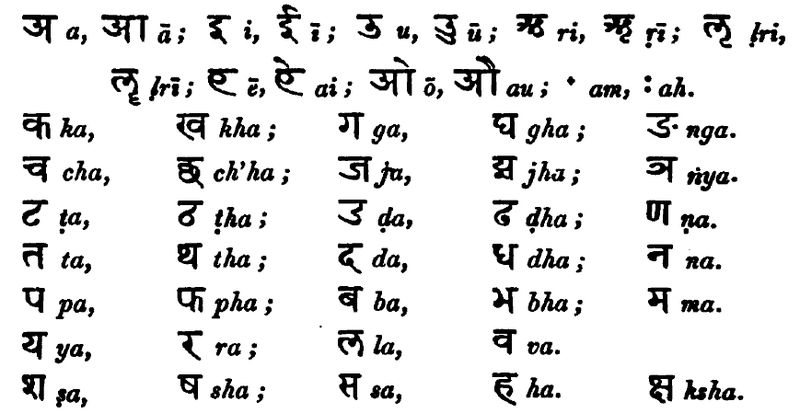
अ a, आ ā; इ i, ई ī; उ u, ऊ ū; ऋ ri, ॠ ṛī; ऌ ḷri,
ॡ ḷrī; ए ē, ऐ ai; ओ ō, औ au; ॱ am, ः ah.
| क ka, | ख kha; | ग ga, | घ gha; | ङ nga. |
| च cha, | छ ch’ha; | ज ja, | झ jha; | ञ ṇya. |
| ट ṭa, | ठ ṭha; | ड ḍa, | ढ ḍha, | ण ṇa. |
| त ta, | थ tha; | द da, | ध dha; | न na. |
| प pa, | फ pha; | ब ba, | भ bha; | म ma. |
| य ya, | र ra; | ल la, | व va. | |
| ष ṣa, | श sha; | स sa, | ह ha. | [#] ksha. |
In speaking of the letters individually, it is the practice to use the term कार: kārah (make, form) after each of their names as here exhibited: thus the vowel अ a, is called अकार: a-kārah; and the consonant क ka, ककार: ka-kārah.
OF THE VOWELS.
The simple vowels are reckoned five; for which there are ten characters: अ a, इ i, उ u, ऋ ṛi, ऌ ḷri, to denote the short sounds; and आ ā, ई ī, ऊ ū, ॠ ṛī, ॡ ḷrī their corresponding long sounds, which are directed to be held twice the time of the short.
Most of the vowels, occasionally, assume a very different shape[723] from that exhibited in the alphabet, which the following arrangement may serve to explain.
As Initials.
अ आ इ ई उ ऊ ऋ ॠ ऌ ॡ ए ऐ ओ औ
As Medials and Finals.
ऻ ि ी ु ू ृ ॄ ॖ ॗ े ै ो ौ
Initials, Medials, and Finals, in composition with a Consonant.
अक aka, आका ākā, इकि iki, ईकी īkī, उकु uku, ऊकू ūkū, ऋकृ ṛikṛi, ॠकॄ ṛīkṛī,
ऌकॢ ḷrikḷri, ॡकॣ ḷrīkḷrī, एके ēkē, ऐकै aikai, ओको ōkō, औकौaukau.
In this manner the vowels may be combined with any other consonant.
As the letters have the same powers in composition which are given to them in the alphabet, and do not, as in our language, change their sound with their situation, a few observations on the pronunciation of each character in due order, may enable a person to read with tolerable accuracy and ease.
अ a, the first letter in the alphabet, has that obscure short sound which the French give to e, in the particle le, and which is very common in our language, though there be no distinct character for it; as in the words money, honey, and some others, where it is represented by o; and in but, shut, and the like, where u is the substitute. The letter अ never makes its appearance but as an initial; for when the sound of it is required after a consonant, as a medial or final, it is pronounced with it as in the alphabet; it being an invariable rule, that every open consonant, not followed by another vowel, must be pronounced as if अ a were written after it.
आ ā should have the same sound as is given to the former, held twice the length. It occurs, as a medial, in the word काला kāla, Time, the first syllable of which is pronounced nearly like the English word call. As a medial and final its character is [#].
इ i, and ई ī, are two characters to note the sound which the Italians give to the vowel i. The former is to be pronounced[724] short, like ee in meet (encounter), and the latter long, like the same letters in meet (fit). After a consonant, as a medial and final, as has been already observed, they are changed to ि and ी , which are placed as in the words मणि: manih, A jewel, and देवी dēvī, A goddess.
उ u, and ऊ ū, are to be articulated like oo in the English words foot, and fool. After a consonant they are usually subjoined; as in पुत्र: putrah, A son, and भू: bhūh, The earth; but occasionally, particularly after र r, on the side, thus रु ru, रू rū.
ऋ ṛi, and ॠ ṛī. The first of these sounds short, somewhat like ri in rit; and the second is the same held twice as long. ॠ ṛi short occurs in ऋत ṛita, Right, True. The other is very rarely used, except it be in the oblique cases of some nouns. In our characters a dot under the ṛ may serve to distinguish them from the syllables रि ri and री rī. As medials or finals they are always placed under their consonants, in this form, नृ nṛi, नॄ nṛī.
ऌ ḷri, and ॡ ḷrī. The short power is found in the word कॢप्त kḷripta, which the learned of Bengal soften into kḷipta, and which, probably, is the true pronunciation of it. The long form seldom, if ever, occurs but in grammars. Here too a dot under the ḷ will serve as a distinction, when we would explain them.
ए ē, though classed among diphthongs, differs not from the simple sound of e in where; and so it is pronounced in [###] dēvah, A god. It is said to be a compound of अ a and इ i.
ऐ ai is a diphthong, and is always sounded as the letter i in our alphabet; but it will be better to represent it by ai. There is an example of it in the word रै: raih, Wealth.
ओ ō differs not from our o held long, as in stone; though it is said to be a diphthong composed of अ a and उ u.
औ au is decidedly a diphthong, having the power of ow in the word how; which in these letters would be written thus, हौ hau.
Here properly end the vowels, for ं am, and : ah, are, correctly speaking, rather substitutes for the nasals, and ह ha, when[725] silent, at the end of a syllable. They are called अनुस्वार: anuswārah, and विसर्ग: visargah. The one occurs in the pronouns अहं aham, I, and त्वं twam, Thou, and the other in स: sah, He.
OF THE CONSONANTS.
The first five-and-twenty consonants are distributed into five classes, in the plural number called वर्गा: vargāh; in speaking of which, they are named after the first letter of each class: the first class being called कवर्ग: ka-vargah, the class of क ka; the second चवर्ग: cha-vargah, the class of च cha; and so for the rest. Some grammarians use the first letter of each class combined with उ, to denote all the letters in each class respectively, as, कु ku, for the first; चु chu, for the second; टु ṭu, for the third; तु tu, for the fourth; and पु pu, for the fifth class.
The First Class, or Gutturals, क ख ह घ ङ.
क ka has the precise sound of hard c, but is better expressed by k, the power of which not being liable to change.
ख kha has the same sound uttered with greater force, as if combined with the letter ह ha. Ignorant transcribers are very apt to confound it with the letter श sha.
ग ga is the hard g, as sounded in gun.
घ gha is the same aspirated.
ङ nga is equivalent to ng in king. Generally speaking, every other nasal is resolved into this, before any letter of this class; or, at least, to be pronounced like it. In Dēva-nāgari manuscripts, it is, when silent, for the most part represented by the single dot [ं] अनुस्वार: anuswāra.
The Second Class, or Palatals, च छ ज छ ञ.
च cha has the exact power we express by ch, as in church.
छ ch’ha is the former aspirated.
ज ja has the power of g soft, as in Giles; but will be more certainly expressed by j, as in James.
छ jha is the aspirate of the former.
ञ ṇa. This is the proper nasal of this class, which in composition is sounded rather softer than ङ nga, It seems to be formed by pressing the whole breadth of the tongue into the hollow[726] of the palate, the tip turned downwards, and forcing the sound through the nose, with the mouth open. It is chiefly used before letters of its own class; but in Dēva-nāgari manuscripts, as is the case with the other nasals, it is generally expressed by [ं] anuswārah. It seldom appears with another consonant immediately before, or a vowel after it: indeed there are but few instances of it, (except in grammatical compositions,) one of which is in the root ज्ञा jnā, signifying know, and its derivatives, where the character ज्ञ is said to be a compound of ज ja and ञ ṅa, the just articulation of which is found so difficult, and the sound so harsh, that it is frequently softened into gyā, as if written ग्या. As the sound of ण before another consonant approaches nearer to that of n than any other letter, it may be represented by it, with a mark over it, thus, ṅ.
The Third Class, or Cerebrals, ट ठ ड ढ ण.
This series of consonants is pronounced by turning and applying the tip of the tongue far back against the palate; which producing a hollow sound, as if proceeding from the head, it is distinguished by the term मूर्द्धन्य mūrddhanya, which Mr. Halhed, in his Grammar of the Bengal Language, has translated cerebral.
ट ṭa has the sound of t, articulated as above directed.
ठ ṭha is the same aspirated.
ड ḍa differs from the common d only in the above particular. In Bengal it is generally pronounced like a very obtuse r.
ढ ḍha is the same aspirated.
ण ṇa is distinguished from the common n by the manner of producing it, as above.
In our letters those of this class may be conveniently expressed by a dot under ṭ, ḍ, ṇ.
The Fourth Class, or Dentals, त थ द ध न.
त ta is the common dental t.
थ tha is the former aspirated.
द da has the power of our d.
ध dha is the aspirate of द da.
न na is the common n. It is sometimes, like the other nasals, represented by anuswāra [ं].
The Fifth Class, or Labials, प फ ब भ म.
प pa corresponds with p.
फ pha is the former aspirated. In writing foreign words with these characters, this letter is used for the sound of f.
ब ba. This letter is very often confounded with व va. Its power is that of b.
भ bha is the aspirate of ब ba.
म ma is m. When silent it is often expressed by [ं] anuswāra; as in संवत् samvat, A year, an æra.
The Semi-Vowels, य र ल व.
य ya. This letter, which is a palatal, like our y (with which it corresponds), is often put in the place of इ i and ई ī. Its proper power is that of y in yarn; but in Bengal they generally pronounce it as we do j, confounding it with ज ja.
र ra is our r. It is esteemed a cerebral. In composition it frequently assumes two other forms. In the middle of a word, immediately preceding another consonant, it is mounted upon its head in this shape [#], when it is optional in the writer to double the letter with which it so coalesces: as in the word कार्य्य kāryya, An affair, which is pronounced kārya. After a consonant it is always subjoined in this shape [#], as in the word प्रकार prakāra, A sort or manner. This letter, in grammars, is generally called रेफ rēpha.
ल la answers to our l. It is ranked among dentals.
व va is generally pronounced like v, and is then a dento-labial; but when subjoined to another consonant, it is often necessarily articulated as our w, it being then frequently the natural substitute for उ u before another vowel; as द्वौ ḍwau, Two.
The Sibilants and Aspirate, ष ष स ह.
ष ṣa. The proper sound of this letter is produced by applying the tip of the tongue to the fore-part of the palate, and passing the voice as in pronouncing our s, from which it may be distinguished by a dot under it, thus, ṣ. It is a palatal.
ष sha is generally pronounced as sh in shoe; but in the western parts of India it is frequently articulated like, and confounded with ख kha. It is a cerebral.
स sa has precisely the power of s in Saint, and is esteemed a dental.
ह ha is h. At the end of a word, when silent, it is represented by [ः] visarga. It is classed among gutturals. This properly is the last letter in the alphabet, [#] ksha, as before observed, being a compound character.
There is another letter, not usually given in the Dēva-nāgar alphabet, in this form, ॡ, which seems to have a power similar to that of the surd, or Welsh ll. It occurs in the Vēdas, and is included in some of the provincial alphabets.
OF COMPOUND CONSONANTS.
The sound of अ a, it has been already mentioned, is given to every open consonant, not followed by another vowel; but as it must often happen that a word ends with a consonant, or that two or more consonants meet together without a vowel between them, it is proper the learner should know what is done in these two cases. If a word terminates in a consonant, the vowel is cut off by a small mark of elision, such as is seen under क ka in the word वाक् vāk, Speech, which written without it, thus, वाक, would be pronounced vāka. If two or more consonants meet together, it is a general rule that they coalesce, and form a compound character. Sometimes it so happens that the simple letters are not to be traced in the compound, instances of which occur in [#] ksha, and क्ष jṅa, which are composed of क and श, and ज and ण; but, in general, the shapes of the letters are so little altered, that they may be easily discriminated. There are several modes of forming these compounds: sometimes it is found convenient to put one letter under the other, and at others to blend them together, thus, द्ध; but the most usual way is to place them in their natural order, yet so that their bodies, as well as heads, may be in contact, omitting the final upright stroke of every letter that has one, except the last. In the word कार्त्स्न्यं kārtsnyam, Wholeness, there is a coalition of no less than five consonants; namely, र, त, स, न, and य; ra, in a new shape, is mounted upon the head, and त ta, स sa, and न na, deprived of their upright strokes, thus, [#] [#] [#], are connected, and finally united to य ya. A little practice will render this subject familiar to the learner.
OF EXTRANEOUS CHARACTERS.
One stroke, thus [#], or two, thus [#], serve to divide hemistichs and distichs.
A sort of sigma, in this shape, [#], is frequently used as an apostrophe, to show that a vowel has been dropped by rule.
A character like a crescent, with a dot between its horns, thus, ँ, is occasionally put over a consonant, which by the rules of orthography has been substituted for a nasal.
In the Vēda other diacritical marks are used, which do not occur in common books. A small perpendicular line over a vowel, thus अ॑, denotes that it is to be pronounced high; a parallel line drawn under a vowel, thus अ॒, denotes that it should be pronounced low; and a curved line over a vowel, thus [#], indicates that it must be pronounced in a manner to partake of both the former. The intention of these three marks seems to be the same as what was originally designed by the acute, the grave, and the circumflex accents. A figure of three is sometimes put after a vowel, thus अ३, or three lines over it, thus [#], to show that it is to be held longer than usual, as in calling, or crying.
Two dots, thus ः, called visarga (विसर्ग:), are used to denote a final [#]. They are occasionally represented in this manner [#].
A single dot over a letter, thus अं, is called anuswārah (अनुस्वार:), and denotes a final nasal.
The numerical figures are,
१ २ ३ ४ ५ ६ ७ ८ ९ ०
1 2 3 4 5 6 7 8 9 0
In the Vēdas, the character for ं anuswāra, before व, स, ह, and र, is in this form, [#]; so for [###] is written [###].
A Grammar of the Sanskrita Language, by Charles Wilkins, LL.D. F.R.S. 4to. 1808.
Sanskrit in the British Founderies.
English. Caslon; cut for Dr. Wilkins, Oriental Librarian to the East India Company.
SAW.
A small thin saw, with a back to strengthen it, to cut furniture with. I would have the blade much narrower than it generally is, so broad only as to cut fairly through the furniture, before the back stops it from cutting deeper by resting on the saw block; it would then prevent the saw block from being cut so much as it generally is in a careless manner, sometimes even through at the front, till the saw comes in contact with the stone, and is spoiled.
SAW BLOCK.
A piece of wood on which to cut furniture to certain lengths; it is similar to a carpenter’s mitre block, with the addition of a cut at right angles. The customary place for using it is on the fore edge of the imposing stone.

SAXON,
or Anglo-Saxon. The Anglo-Saxon alphabet contains twenty-three letters; Q not being originally a Saxon letter.

| Form. | Sound. | Form. | Sound. | ||||
| [A] | A | a | a as in bar | N | n | n | |
| B | b | b | O | o | o | ||
| [C] | C | c | c as in choice | P | p | p | |
| D | ꝺ | d | R | ꞃ | r | ||
| [E] | E | e | e as in feint | [S] | S | ꞅ | s |
| F | ꝼ | f | T | ꞇ | t | ||
| [G] | G | ᵹ | g as in gem | Ð | Þ | ð þ | th |
| [H] | H | h | h | U | u | u | |
| I | ı | i | Ƿ | ƿ | w | ||
| K | k | k | X | x | x | ||
| L | l | l | Y | ẏ | y | ||
| [M] | M | m | m | Z | z | z | |
For anꝺ the Saxons used these abbreviations, ⁊ and [#]; for þaꞇ and þæꞇ they wrote ꝥ; and for oððe or, and the termination lıce ly, they wrote ł; as ł or; and ꞅoðł for ꞅoðlıce truly.
[Note.] We also find uł for or; Ƿıłłm. for Ƿıllelm, William; and [H]æł, for [H]ælenꝺ, Jesus; ł stands for leoꝼeꞅꞇan, φίλτατοι, amicissimi, most friendly or beloved; apł, ap̃, or ap°, for apoꞅole, an apostle; apłar, apostles; [H]ieꞃłm, Jerusalem,; ꞅcıł, a shilling, money.
When an m was omitted, they made a short stroke over the preceding letter; as þā for þam.
[Note.] There are many other abbreviations and connectives; such as æꝼꞇ̃ æꝼꞇeꞃ, after; allm̃ allmıhꞇıᵹ, almighty; am̃, amen; ancen, ancenneꝺe, only begotten; b, b̵, bıꞅc̃, bıꞅcop, a bishop; bꞃoð, bꞃođ, bꞃoþeꞃn, brethren; caꞃc̃, caꞃceꞃne, a prison; cꝼꞇ, [#], Cꞃıꞅꞇ, xꞃeꞅ, Cꞃıꞅꞇeꞅ, Christ, Christ’s; c̃ƿ, cƿæð, saith; [#] for ꝺæᵹ, a day; ꝺꝺ, ꝺđ, David; ꝺꞃīh, ꝺꞃıhꞇ̃, Lord; ꝺñꞅ ꝺꞃıhꞇneꞅ, Lords; ꝼ̃ ꝼoꞃ, for, on account of; ᵹ̃, ᵹeaꞃe, a year; Iħr, Ihc̃, Jesus; ꞅ. [M]. ꞅeınꞇe [M]aꞃıe, St. Mary; ꞅ. p. St. Peter; ƿũꞇ, ƿuꞇoꝺlıce, certainly, &c. See Thwaites, p. 1.
In studying the Anglo-Saxon tongue, it is of great consequence to remark, that the inevitable changes introduced by the lapse of time through successive ages; the existence of the three great dialects, and their frequent intermixture; the variety of Anglo-Saxon writers, and their little acquaintance with each other; but, above all, their total disregard of any settled rules of orthography; have occasioned many irregularities in the language, and thrown difficulties in the way of the learner, which at first sight appear truly formidable; but, on closer inspection, these difficulties present no insuperable obstacle.
The principal difficulty consists in this: The Anglo-Saxon writers often confounded some letters, and used them indifferently for each other. This is the case to a most surprising extent with the vowels and diphthongs; so that the consonants, though often treated in the same manner, form the only part of the language which possesses any thing like a fixed and permanent character.
Remarks on the Change of the Consonants required for derivation and declension.
B.
B, F, or U, are often interchanged; as
Bebeꞃ, beꝼoꞃ, a beaver. Iꝼıᵹ, ıueᵹ ivy. Obeꞃ, oꝼeꞃ, oueꞃ, over. [E]bolꞅan, eꝼolꞅan to blaspheme. Foꞇ, uoꞇ a foot.
C.
C often interchanges with G, K and Q; as
Ðonceꞅ, þonᵹeꞅ thoughts. [C]ẏð, kẏð kindred. [C]ẏnınᵹ, kẏnınᵹ a king. Aceꞃ, Akeꞃ a field. [C]ƿen, quen, a queen, wife, &c.
C and CC are also often changed into H, or Hh, before ꞅ or ð, and especially before ꞇ; as Sꞇꞃehꞇon they strewed, for ꞅꞇꞃecꞇon, from ꞅꞇꞃeccan. Ahꞅıan for acꞅıan or axıan to ask. ꞅehđ for ꞅecđ seeks, from ꞅecan to seek.
In Dan. Sax. C changes into ᵹ, h, hƿ and k; and ch changes into h.
D.
D and T are often used indiscriminately for each other, and Ð is changed into ꝺ, especially in verbs; as ꞅeođan to boil or seeth; ꞅoꝺen boiled, ıc cƿæđ I said; þu cƿæ đe thou saidst. he ƿẏꞃđ he is or becomes; þu ƿuꞃꝺe thou becomest.
F.
In Dan. Sax. F changes into b and p.
G.
G is often changed into h and ƿ; as [H]eꞃeꞇoha for heꞃeꞇoᵹa a leader; Dahum for ꝺaᵹum with days; Geꞅƿıᵹan to be silent; ᵹeꞅuƿoꝺe he was silent or dumb; ꞅoꞃh for ꞅoꞃᵹe sorrow.
G interchanges with I and Y, when I has a sort of a consonant sound; as ᵹeo, ıeo or ıu yore, formerly; ᵹeoᵹuđ, ıeoᵹuđ youth; ᵹeoc, ıoc or ıuc yoke.
G is often suppressed before n, or ᵹn lengthened into ᵹen; as þẏꞅıᵹne, Þẏꞅıne from þyꞅꞅ or þıꞅ this, and ænıᵹne, aenıne, from aenıᵹ any. G is often added to words that end with ı, as hıᵹ for hı they; and on the contrary G is often omitted in those words which end in ıᵹ; as ꝺꞃı for ꝺꞃıᵹ or ꝺꞃẏᵹ, dry.
In Dan. Sax. G is sometimes dropped, or changed into C, H, or K; and GS into X.
H.
[H] is sometimes changed into ᵹ; as þaᵹ for þah he grew or throve, from þean to grow.
In Dan. Sax. [H] is sometimes added to words, and sometimes dropped; or it is changed into c, ᵹ, ch, or k; and [H]u into ƿ.
K.
The Saxons originally expressed the sound of the modern K by C. As C also stood for a soft sound, it was difficult to know when it was to be sounded hard, and when soft. To remove this difficulty, the Danes and Normans introduced the letter K to denote the hard sound of C.
L.
L and N are often written double or single without any distinction at the end of monosyllables; but this reduplication ceases when words are lengthened, so that a consonant follows; as ƿell or ƿel well; ealle or al all (omnis); ealne, all (omnem); also ıc ꞅẏlle, þu ꞅẏlꞅꞇ, he ꞅylđ, I sell, thou, &c.
In Dan. Sax. L is sometimes put for R.
M and N.
In Dan. Sax. these two letters are sometimes interchangeable; and N is occasionally dropped.
P.
The Saxon p and ƿ are easily mistaken for each other, both in MSS. and on coins; and even in printed books great care is sometimes necessary to distinguish these letters.
In Dan. Sax. P changes occasionally into B and U.
Q.
Q is not an original Saxon letter, and very seldom occurs in MSS.; Cw and Cu were commonly employed where Q is now used.
R.
R in Dan. Sax. is occasionally added to words, and is sometimes changed into L.
S.
S and Z are merely variations of the same original letter. The Z is only the S hard.
In Dan. Sax. Ss, Ð, or X are sometimes substituted for S.
T.
T in Dan. Sax. occasionally changes into D and Ð.
W.
In Dan. Sax. W changes into F and Ui; We into oe, u, ue; Wi, into u, uu; Wa, into uıæ, ƿæ; Wr, into war; and Wu, into u.
X.
X is sometimes supplied by cꞅ; as neoꞃcꞅen for neoꞃxen quiet. In Dan. Sax. X interchanges with S.
Z.
Z is only the S hard. See S.
Remarks on the Vowels and Diphthongs.
If the consonants,—those natural sinews of words and language,—suffer such changes, it may safely be presumed, that those flexible and yielding symbols, the vowels, would be exposed to still greater confusion; a confusion almost sufficient to induce one to imagine that they are of no weight or authority, in Anglo-Saxon orthography.
A.
A kind of Italic a is much used in Anglo-Saxon MSS. Where we now use A or E, the diphthongs Æ, Œ, and Ea continually occur in Anglo-Saxon; but Œ more frequently in Dan. Sax.
The vowel A and its diphthongs thus interchange.
A and O. See under O.
A and Æ: as ac, æc an oak; aceꞃ, æceꞃ a field; habban to have, ıc hæbbe I have; ꞅꞇan a stone; ꞅꞇænen stony; laꞃ doctrine; læꞃan to teach; an one; æniᵹ any one.
Æ and EA: as æ, ea water; æc, eac eternal.
Æ and Œ: as aeᵹhƿeꞃ, ceᵹhƿeꞃ everywhere; aeᵹhƿilc, oeᵹhƿilc every one.
Æ and Y: as ælc, ẏlc each one.
In Dan. Sax. these occur indifferently:—A, æ, e, ea, o, eo; Æ, e, ıe, œ, o, ea, ue.
E.
E interchanges with [Æ]. It is often added to the end of Anglo-Saxon words where it does not naturally belong, and it is as often rejected where it does.
Eo is changed into ẏ and e, and ea into e, but more usually into ẏ.
[E]aðe, eðe easily; and ceaᵹreꞃ, cereeꞃ a castle.
[S]eolꝼ, ꞅelꝼ, ꞅẏlꝼ self; ꞅẏllan, ꞅellan to give, sell, &c.
Neah near; nehꞅꞇ nearest; ealꝺ old; ꞅe ẏlꝺꞃa the elder; ƿealꝺan to rule, he ƿelꞇ or ƿẏlꞇ he rules; leaꞅ loose, lẏꞅan to loose; ᵹeleaꝼa belief, ᵹelẏꝼan to believe.
In Dan. Sax. these occur indifferently:—E, a, eo, ce, O, u, as, ea, ẏ; ea, eo, ı, ẏ; eau, eoƿ; ee, e; eı, œ, ı; eo, a, e, ı, ıƿ, u; eu, ẏƿ.
I.
I is interchanged with e and y; as
Iᵹlanb, eᵹlanb, ẏᵹlanb an island; eꝼel, ẏᵹel evil; ıꞃþımᵹ, eaꞃþımᵹ, ẏꞃþlınᵹ a farmer; ꞃen rain, ꞃınan to rain; beꞃnan to burn, bẏꞃnan to set on fire; cƿeþan to say, þu cƿyꞅꞇ, cƿıꞅꞇ, thou sayest.
In Dan. Sax. these occur indifferently: I, ıa, ıo, eo, ẏ; ıœ, ıe, œ; ıuh, eoƿ.
O.
O is changed into u, e and ẏ, and eo into ẏ; but sometimes into a, especially before n in a short or terminating syllable.
Oꝺe and oꝺ, into aꝺe and aꝺ; ꝺom ᵹudgment, ꝺeman to judge; ꝼꞃoꝼeꞃ comfort, ꝼꞃeꝼꞃtan to comfort; ꝼoc a foot, ꝼec feet; boc a book, bee books; ꞅcoꞃm a storm, ꞅcẏꞃman to storm; ᵹolꝺ gold, ᵹẏlꝺen golden; ƿoꞃb a word, anꝺƿyꞃꝺan to answer; ƿeoꞃc a work, ƿẏꞃcean to work; heoꞃb or hẏꞃꝺe a herd; ıoc, ıuc me a yoke; leƿan, ᵹoƿan to show; man and mon a man; lanᵹ and lonᵹ long; ꞅanꝺ and ꞅonꝺ sand.
In Dan. Sax. these occur:—O, a, e, I, u; œ, æ, e, o, ue, ƿe; oea, eo; oƿe, uu.
U.
U is sometimes converted into ẏ: as ꞅcꞃuꝺ clothing, ꞅcꞃyꝺan to clothe; cuþ known, cẏþan to make known.
In Dan. Sax. these are used indiscriminately:—U, ꝺ, ꝼ, o, oƿ, ƿe, ƿı, ƿu; ue, æ, œ, ƿe; uı, ƿ; uu, oƿe.
Y.
The Anglo-Saxon Y is the Greek Υ (upsilon), or, as the French call it, y Greque. The ẏ was not dotted in the oldest MSS.
Y is sometimes changed into u.
In Dan. Sax. these occur:—Y into e, ea, ı; and Yƿ into eu.
Further Remarks on the Letters.
The preceding observations on the consonants and vowels will render the following peculiarities less surprising, and may perhaps explain their causes.
The final letters of words are often omitted: as ƿomb, ƿom; ƿæᵹ or ƿeᵹ, ƿe.
A vowel near, or at the end of a word, is often absorbed by the preceding or succeeding consonant, especially if that consonant be a semi-vowel; but either that or the nearest vowel is still understood: as Luꝼꞅꞇ for luꝼaꞅꞇ lovest; luꝼð for luꝼað loveth; and other verbs in the 2d and 3d persons. Geƿꞃıxl for ᵹeƿꞃıxle changes; ꞅuꞅl ꞅuꞅel sulphur; ꞅƿæꝼl for ꞅƿæꝼel sulphur; bloꞅm for bloꞅma a blossom; boꞅm for boꞅum bosom; boꞇl for boꞇle a village, house, &c.; bꞃıꝺl for bꞃıꝺel a bridle.
Contractions of words are common: as N’ẏꞅꞇe for ne ƿıꞅꞇ knew not; n’æꝼꝺe for ne hæꝼeꝺ had not; ẏꞃn’ð for ẏꞃneð runneth.
In Dan. Sax., on the other hand, monosyllables are sometimes changed into longer words: as ƿꞃað anger, wrath, lengthened into ƿaꞃað. Other words contract two syllables into one; as cẏnınᵹ into kẏnᵹ a king.
The different letters suffer a very frequent change of position: as ꞇınꞇeꞃᵹe, ꞇınꞇꞃeᵹe pain; þıꞃꝺa, þꞃıꝺꝺa third.
A very great variety exists in writing the same word by different Anglo-Saxon authors, as will appear from the following examples: ᵹeoᵹeþe, ᵹeoᵹoð, ᵹeoᵹuð, ᵹeᵹoþe, ıoᵹoð, ıuᵹuð youth; mæneᵹeo many, a multitude, is written mæneᵹo, mænıᵹeo, mænıᵹo, mænıᵹu, mænıo, mænıu, mænẏᵹeo, maneᵹeo, maneᵹu, manıᵹe, manıᵹo, manıᵹu, meneᵹeo, meneᵹo, meneᵹu, menıᵹeo, menıᵹo, menıᵹu, menıo, menıu.
Adjectives in the comparative degree end indifferently in aꞃ, æꞃ, eꞃ, ıꞃ, oꞃ, uꞃ, or ẏꞃ; and the superlative in aꞅꞇ, æꞅꞇ, eꞅꞇ, ıꞅꞇ, oꞅꞇ, uꞅꞇ, or ẏꞅꞇ.
Active participles end in anꝺ, anꝺe, ænꝺ, ænꝺe, enꝺ, ınꝺ, onꝺ, unꝺ or ẏnꝺ; and passive participles in aꝺ, æꝺ, eꝺ, ıꝺ, oꝺ, uꝺ, or ẏꝺ.
So also, [H]e ꝺıelꝼ, ꝺealꝼ, ꝺelꝼ or ꝺalꝼ he dug; and læꞅƿenꝺe, læꞅƿıᵹenꝺe, læꞅᵹenꝺe or læꞅıenꝺe feeding; ıc ƿuꞃpe, ıc ƿeoꞃpe, ıc ƿẏꞃpe, or ıc ƿeꞃpe I cast away; man, mon a man; he mæᵹe or muᵹe he may; he ꞅıᵹ, ꞅı, ꞅıe, ꞅe, ꞅıo, or ꞅeo he is; ꞅınꝺon, ꞅenꝺon, ꞅıenꝺon, ꞅınꞇ, ꞅıenꞇ, ꞅınꝺ, ꞅın, ꞅıen, ꞅeon, are.
Some short words assume very different meanings: as bıᵹ, bıᵹe, bẏᵹe, beᵹ, beaᵹ, beah and beh, which, according to their connexion, signify indifferently, a turning, a crown, a gem, a bosom, buy, he turned, he submitted, &c. from buᵹan, to turn, bow, &c.—The Elements of Anglo-Saxon Grammar. By the Rev. J. Bosworth, M.A. F.A.S., 8vo. 1823.
“The Saxon capitals which vary from those now used are C, E, G, H, M, and W. The small letters are d, f, g, r, s, t, and w, which are all Roman, except the Ƿ, ƿ, and some notes of abbreviations used by the Saxons, as Ð ð, þ th, ꝥ that, &c. Many other abbreviations were used by the Saxons. These notes of abbreviation are not the original members of an alphabet; they were the result of later reflection, and were introduced for dispatch.
“By an attentive observation of the different specimens of writing in England, we perceive the several gradations of change, by which one form of a Roman character has imperceptibly changed into another. The Saxon ƿ, says Mr. Whitaker, seems to have been only the Roman V[735] at first, and to have been lengthened into the Saxon character, and enlarged into the present Roman W, by bringing the principal stroke somewhat lower, and closing the top in the one, and by redoubling the whole in the other. The W is unknown, both to the Latin and its daughter languages, the French, the Spanish, and the Italian: it is composed of two characters, namely of the V or U doubled.
“The writing which prevailed in England from the coming of St. Augustin, in 596, to the middle of the eleventh century, is generally termed Saxon, and may be divided into five kinds, namely, the Roman Saxon, the set Saxon, the running hand Saxon, the mixed Saxon, and the elegant Saxon.”—Astle.
Elegant Saxon.—This writing was adopted in England in the tenth century, and was continued till the Norman conquest; but was not entirely disused till the middle of the thirteenth century.
All subsequent Saxon writers endeavour to keep as near as possible to the form of the letters in a book of Saxon Homilies in the Lambeth Library (No. 439), written in the tenth century. There is a beautiful specimen in the MSS. of the Rev. E. Thwaites, M. A. to be found in the Harleian MSS., at the British Museum (No. 1866). It is described in Nichols’s Lit. Anec., vol. iv. p. 140, as “one of the most lovely specimens of modern Saxon writing that can be imagined.”—Bosworth, p. 20.
About the year 1567, John Daye, who was patronized by Archbishop Parker, cut the first Saxon types which were used in England. In this year Asserius Menevensis was published by the direction of the archbishop in these characters; and in the same year Archbishop Ælfric’s Paschal Homily; and, in 1571, the Saxon Gospels. Daye’s Saxon types far excel in neatness and beauty any which have been since made, not excepting the neat types cast for F. Junius at Dort, which were given by him to the University of Oxford. Astle, p. 224.—Bosworth.
“The Saxon types which were used in printing St. Gregory’s Homily, having been burnt in the fire which consumed Mr. Bowyer’s house and all his printing materials [Jan. 30. 1712-13], Lord Chief Justice Parker was so munificently indulgent, as to be at the expence of cutting a new Saxon type for Mrs. Elstob’s Saxon Grammar, from fac similes by Mrs. Elstob; the punches and matrices of which Mr. Bowyer’s son presented, by the hands of Edward Rowe-Mores, esq; to the University of Oxford. See the Archæologia Antiq. Soc vol. i. p. xxvii.”—Gent. Mag., Oct. 1778, p. 455. Note.
Saxon Upper Case.
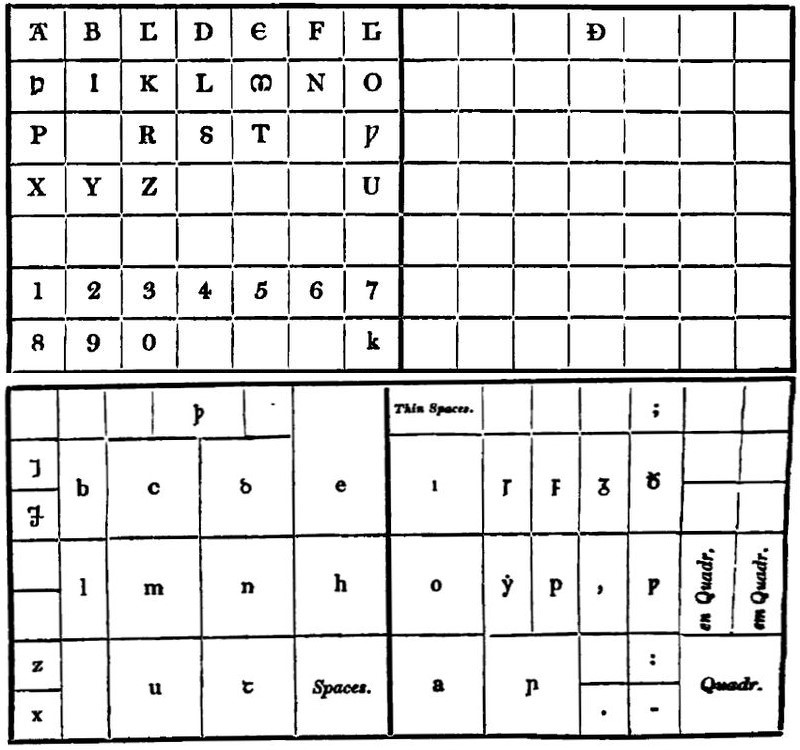
Saxon Lower Case.
Saxon in British Founderies.
Double Pica.—Fry, to Thorowgood and Besley.
Great Primer.—Fry, to Thorowgood and Besley.
English.—Caslon. Fry, to Thorowgood and Besley. Oxford. Wilson.
Pica.—Caslon. Fry, to Thorowgood and Besley. V. and J. Figgins. Oxford. Wilson.
Small Pica.—Fry, to Thorowgood and Besley. V. and J. Figgins. Oxford. Wilson.
Long Primer.—Caslon. Fry, to Thorowgood and Besley. V. and J. Figgins. Wilson.
Brevier.—Caslon. Fry, to Thorowgood and Besley. V. and J. Figgins. Wilson.
SCALE OF PRICES.
The following scale of prices is copied literally from the official scale published by the master printers in 1810. The alteration in the scale in 1816, as well as the subsequent alterations and explanations have been also accurately copied from the official notifications issued to the trade by the committee of master printers.
“Scale of Prices for Compositor’s Work,
“Agreed upon at a General Meeting of Master Printers, at Stationers’ Hall, April 16, 1810; commencing on all Volumes or Periodical Numbers begun after the 30th Instant.
“Art. 1. All works in the English language, common matter, with space lines, including English and Brevier, to be cast up at 5¾d. per 1000; if in Minion 6d. per 1000; in Nonpareil 6¾d. Without space lines, including English and Brevier, 6d. per 1000; in Minion 6¼d. in Nonpareil 7d.; in Pearl, with or without space lines, 8d.; Heads and Directions, or Signature lines, included. A thick space to be considered an en in the width, and an en to be reckoned an em in the length of the page: and where the number of letters amounts to 500—1000 to be charged; if under 500, not to be reckoned: and, if the calculation at per 1000 shall not amount to an odd threepence, the odd pence to be suppressed in the price of the work; but where it amounts to or exceeds threepence, there shall be sixpence charged. Em and en quadrats, or whatever is used at the beginning or end of lines, to be reckoned as an em in the width.
“2. Works printed in Great Primer to be cast up as English; and[737] all works in larger type than Great Primer, as half English and half Great Primer.
“3. All works in foreign languages, though common type, with space lines, including English and Brevier, to be cast up at 6¼d. per 1000; if in Minion 6¾d.; Nonpareil 7½d. Without space lines, including English and Brevier, 6½d.; Minion 7d.; Nonpareil 7¾d.; and Pearl, with or without space lines, 8¾d.
“4. English Dictionaries of every size, with space lines, including English and Brevier, to be paid 6¼d.: without space lines, 6½d. (In this article are not included Gazetteers, Geographical Dictionaries, Dictionaries of Arts and Sciences, and works of a similar description, except those attended with extra trouble beyond usual descriptive matter.) Dictionaries of two or more languages, of every size, with space lines, including English and Brevier, to be paid 6½d.: without space lines, 6¾d.; if smaller type than Brevier, to take the proportionate advance specified in Article 1.
“5. English Grammars, Spelling Books, and works of those descriptions, in Brevier or larger type, with space lines to be paid 6d. per 1000; without space lines 6¼d.: if in two languages, or foreign language, with space lines 6¼d.; without space lines 6½d.
“6. Small-sized Folios, Quartos, Octavos, and works done in Great Primer, or larger type (English language,) which do not come to seven shillings when cast up at the usual rate, to be paid as follows: English, and larger type, not less than 7s.; Pica 8s. 6d.: English 12mo. to be paid not less than 10s. 6d.; and Pica not less than 11s. 6d. per sheet.
“7. Reviews, Magazines, and works of a similar description, consisting of various sized letter, if cast up to the different bodies, to be paid 2s. 6d. per sheet extra.
“8. Pamphlets of five sheets and under, and parts of works done in different houses, amounting to not more than five sheets, to be paid 1s. per sheet extra; but, as it frequently occurs that works exceeding a pamphlet are often nearly made up without a return of letter, all such works shall be considered as pamphlets, and paid for as such.
“9. Works done in Sixteens*, Eighteens, Twenty-fours, or Thirty-twos, on Small Pica and upwards, to be paid 1s. 6d. per sheet extra. If on Long Primer, or smaller type, 1s. per sheet extra. Forty-eights to be paid 2s. per sheet extra, and Sixty-fours 2s. 6d. per sheet extra.
* The following resolution of the committee of the association of master printers is published in their fourth report, [3d July, 1840,] “That in Book-work two Forms of Double Foolscap be considered as one sheet.”
“10. Works requiring an alteration or alterations of margin, to be paid, for each alteration, 1s. per sheet to the Pressmen if altered by them, and 6d. to the Compositor, as a compensation for making up the furniture; if altered by the Compositor, then he is to be paid 1s. for the alteration, and the Pressmen 6d. for the delay.——This article to be determined on solely at the option of the employer.
“11. Bottom Notes consisting of twenty lines (or two notes, though not amounting to twenty lines) and not exceeding four pages, in every ten sheets, in quarto or octavo:—one page (or two notes, though not amounting to one page) and not exceeding six pages, in twelves:—two pages (or two notes, though not amounting to two pages) and not exceeding eight, in eighteens or above, to be paid 1s. per sheet; but under the above proportion no charge to be made. Bottom Notes, consisting of ten lines (or two notes, though not amounting to ten lines)[738] in a pamphlet of five sheets or under, and not exceeding two pages, to be paid 1s. per sheet extra. Quotations, Mottos, Contents to Chapters, &c., in smaller type than the body, to be considered as Notes. [Where the notes shall be in Nonpareil or Pearl, in twelves, the number of pages to be restricted to four; in eighteens to five pages.]——This article is intended only to fix what constitutes the charge of 1s. per sheet for Bottom Notes*: all works requiring a higher charge than 1s. for Bottom Notes are to be paid for according to their value.
* The following interpretation of this article of the scale is given in a resolution of the committee of the master printers association, published in their fourth report, [3d July, 1840,] viz. “‘That there must be two Notes in every 10 sheets of a work to constitute the charge of 1s. per sheet for notes.’ E. g. if there should be only two notes, less than 20 lines each, in a work of more than 10 sheets, such work would not be liable to any charge for notes.”
“12. Side Notes to Folios and Quartos not exceeding a broad quotation, if only chap. or date, and not exceeding three explanatory lines on an average in each page, to be paid 1s. per sheet; in Octavo, if only chap. or date, and not exceeding three explanatory lines on an average in each page, 1s. 6d. per sheet. Cut-in Notes, in smaller type than the body, to be paid for in a similar manner.——Side and Bottom Notes to many, particularly historical and law works, if attended with more than ordinary trouble, to be settled between the employer and journeyman.
“13. Greek, Hebrew, Saxon, &c. or any of the dead characters, if one word and not exceeding three lines in any one sheet, to be paid for that sheet 1s. extra; all above to be paid according to their value.
“14. Greek with space lines, and without accents, to be paid 8½d. per 1000, if with separate accents 10d.; without space lines, and without accents, 8¾d.; with accents, 10¼d.; the asper not to be considered an accent. [If Dictionary matter, to take one halfpenny advance.]
“15. Hebrew, Arabic, Syriac, &c. to be paid double: Hebrew with points to be cast up as half body and half points doubled.
“16. Music to be paid double the body of the sonnet type.
“17. Index matter, though but one measure, to be paid 2s. per sheet extra.
“18. Booksellers’ Catalogues (in whatever language) to be cast up at 7d. per 1000, not including the numbering.
“19. Night work to commence and be paid for, from ten o’clock till twelve, 1s.; all after to be paid 3d. per hour extra till Six.—Morning work, commencing at four o’clock, to be paid 1s. extra.—Sunday work, if not exceeding 6 hours, to be paid for 1s.; if for a longer time, 2d. an hour.
“20. Jobs of one sheet or under (except Auctioneers’ Catalogues and Particulars) to be cast up at 7d. per 1000; if done in smaller type than Brevier, to take the proportionate advance specified in Article 1; if in foreign language, of one sheet or under, (except Auctioneers’ Catalogues,) to be cast up at 8d. per 1000; if done in smaller type than Brevier, to take the proportionate advance specified in Article 1.
“21. Where two pages only are imposed, either opposite to or at the back of each other, they shall be paid for as two pages; but if with an indorse, or any other kind of matter constituting a third, then to be paid as a sheet if in Folio; a half sheet if in Quarto, and so on.
“22. Broadsides, such as Leases, Deeds, and Charter-parties, above the dimensions of crown, whether table or common matter, to be paid[739] the double of common matter; on crown and under, to be paid one and one half common matter.—The indorse to be paid one fourth of the inside page, as common matter.
“23. All Corrections to be paid 6d. per hour.
“24. The Imprint to be considered as two lines in the square of the page.
“25. Different volumes of the same work to be paid for distinctly, according to their value.
“Abstract of the Scale.
| Key to Column Headers— | |||||||||
| A. = Common. | |||||||||
| B. = Foreign. | |||||||||
| C. = English. | |||||||||
| D. = 2 Languages, or Foreign. | |||||||||
| E. = Without Accents. | |||||||||
| F. = With Accents. | |||||||||
| Dictionaries. | Grammars, &c. | Greek. | |||||||
| A. | B. | C. | D. | C. | D. | E. | F. | ||
| d. | d. | d. | d. | d. | d. | d. | d. | ||
| English to} | { leaded | 5¾ | 6¼ | 6¼ | 6½ | 6 | 6¼ | 8½ | 10 |
| Brevier } | { solid | 6 | 6½ | 6½ | 6¾ | 6¼ | 6½ | 8¾ | 10¼ |
| Minion | { leaded | 6 | 6¾ | 6¾* | 7 * | ||||
| { solid | 6¼ | 7 | 7 * | 7¼* | |||||
| Nonpareil | { leaded | 6¾ | 7½ | 7½* | 7¾* | ||||
| { solid | 7 | 7¾ | 7¾* | 8 * | |||||
| Pearl | { leaded | 8 | 8¾ | 8¾ | 9 | ||||
| { or solid | |||||||||
| Notes constituting the Charge of One Shilling per Sheet.—See Article 11. | |||
| 4to. and 8vo. | { 20 Lines | } | and not exceeding 4 Pages in 10 Sheets. |
| { or 2 Notes | } | ||
| 12mo. | { 1 Page | } | and not exceeding 6 Pages in 10 Sheets. |
| { or 2 Notes | } | ||
| 18mo. or above | { 2 Pages | } | and not exceeding 8 Pages in 10 Sheets. |
| { or 2 Notes | } | ||
| Pamphlets | { 10 Lines | } | and not exceeding 2 Pages in 5 Sheets.” |
| { or 2 Notes | } | ||
A modification of the Compositors’ Scale took place in 1816, and the following notification was issued to the Trade:—
“At a Meeting of Master Printers held this day, pursuant to notice, for the purpose of taking into consideration the state of the Trade in general, in consequence of the alteration in the times;
“It was the opinion of this Meeting, that it would be highly expedient that, after the 19th of February, the following modification of the Compositors’ Scale of Prices of 1810, as far as regards Reprints, should take place.
“All Reprinted Works to be paid Three Farthings per 1000 less than the Scale of 1810. All Manuscript or Original Works shall continue to be paid for as at present.
“January 2. 1816.”
The following resolution is copied from Hansard’s Typographia:
“At a Meeting of the Committee of Master Printers held March 11, 1816.
“It having been stated that doubts had arisen in the minds of several Masters as to what should be considered ‘Reprinted Works,’—Resolved, That they be informed that, under the above Resolutions, all ‘Reprinted Works’ were meant to be comprehended, whether printed sheet for sheet or otherwise; it being understood, that, in cases where the copy is rendered peculiarly troublesome by intricate manuscript insertions, a reasonable allowance may be made for the same to the Compositor.”
Reprints, according to the Resolution of January 2, 1816.
| Key to Column Headers— | |||||||||
| A. = Common. | |||||||||
| B. = Foreign. | |||||||||
| C. = English. | |||||||||
| D. = 2 Languages, or Foreign. | |||||||||
| E. = Without Accents. | |||||||||
| F. = With Accents. | |||||||||
| Dictionaries. | Grammars, &c. | Greek. | |||||||
| A. | B. | C. | D. | C. | D. | E. | F. | ||
| d. | d. | d. | d. | d. | d. | d. | d. | ||
| English to} | { leaded | 5 | 5½ | 5½ | 5¾ | 5¼ | 5½ | 7¾ | 9¼ |
| Brevier } | { solid | 5¼ | 5¾ | 5¾ | 6 | 5½ | 5¾ | 8 | 9½ |
| Minion | { leaded | 5¼ | 6 | 6 * | 6¼* | ||||
| { solid | 5½ | 6¼ | 6¼* | 6½* | |||||
| Nonpareil | { leaded | 6 | 6¾ | 6¾* | 7 * | ||||
| { solid | 6¼ | 7 | 7 * | 7¼* | |||||
| Pearl | { leaded | 7¼ | 8 | 8 | 8¼ | ||||
| { or solid | |||||||||
* In the Abstract under the head “Dictionaries,” the prices for Minion and Nonpareil are erroneous, being one farthing too much; this error passed unnoticed, till the publication of the “Third Report of the Committee of the Association of Master Printers” in 1839, where it is corrected. I have given the Scale as originally published.
“Scale of Prices for Presswork,
“Agreed upon at a General Meeting of Master Printers, at Stationers’ Hall, Feb. 8, 1810; commencing on all Volumes or Periodical Numbers begun after the 28th Instant.
N. B. School Books on Copy or Crown are defined to be, Palairet’s French Grammar, Chambaud, Salisbury Spelling Book, Fox’s Lessons, Ward’s Latin Grammar, and all of a similar description.
| “ALMANACKS. | d. |
| Royal Broadsides | 7 |
| Demy Ditto, Size Wing or Cambridge | 5½ |
| Goldsmith, Calendar Form | 5½ |
| Ditto, Prog. | 5 |
| Twelves Demy, 19 Ems wide, 34 long, Calendar | 5½ |
| Ditto, Prog. | 5 |
| Ditto, Crown, Size Rider | 5 |
| Octavo Foolscap, 20 Ems wide, 34 long, Cal. and Prog. | 5 |
| “BILLS IN PARLIAMENT. | |
| From No. 4 inclusive to any No. under 100 | 4½ |
| If 100, and under 200 | 5 |
| If 200 or 250 | 5½ |
| Above 250, and under 400 | 4½ |
| If 400 or 500 | 5 |
| If above 500, and under 700 | 4½ |
| If 700 or 750 | 5 |
| All above 750 | 4½ |
“N. B. Side Notes to be reckoned in the Width; Bottom Notes not to be regarded.
Works on Royal Paper to be paid One Halfpenny per Hour more than the above Prices.
Ditto on Foolscap or Pot, not less than 1000 Number, and wrought at one Pull, 4½d.
Ditto in Square Pages (like Entick’s Dictionary) and Works for the Public Offices, to be advanced One Halfpenny per Hour on the Scale of 1800.
Fine Paper of the same Size, if included within the Token, not to be charged extra; but, if of a larger Size, then to be paid according to the Scale.
Three or more Proofs pulled at one Time to be charged 4d. per Form; and, if made ready, to be charged as a Token.
Cards, large or small, to be paid 6½d. per 100.
Jobs without points to be paid 4½d. an hour.
Double Crown or Royal Broadsides, not exceeding 100 Number, to be paid 1s. 6d.; if more than 100, to be paid 1s. per 100.
Demy Broadsides, not more than 100, to be paid 1s.; above 100, and not exceeding 500, to be paid 10d. per 100; if above 500, to be paid at the rate of 1s. 9d. per Token.
Broadsides requiring three Pulls to be paid one-third more.
No Form to be deemed a Broadside that comes in at one Pull at the Common Press.
Night-work to commence and be paid for, from Ten o’clock till Twelve, 1s.; all after to be paid 3d. an Hour extra till Six.—Morning work, commencing at Four o’Clock, to be paid 1s. extra.—Sunday work, if not exceeding 6 hours, to be paid for 1s.; if for a longer time 2d. an hour.
“It is to be distinctly understood that no Advance shall take place on any Works but those which are paid by the Scale.”
An alteration in the prices of the first column took place in 1816, and the following notification of it was made:—
“At a Meeting of Master Printers held this day, pursuant to notice, for the purpose of taking into consideration the state of the Trade in general, in consequence of the alteration in the times;
“It was the opinion of this Meeting, that it would be highly expedient that, after the 19th of February, the following modification of the Pressmen’s Scale of Prices of 1810, as far as regards all Numbers exceeding the first 1000, should take place.
“Every Token above the first Four Tokens to be paid One Halfpenny per hour less than the Scale of 1810.
“January 2. 1816.”
ASSOCIATION OF MASTER PRINTERS.
4. Pemberton Row, Gough Square.
December 10. 1838.
Sir,
I herewith transmit to you an Extract from the Proceedings which have taken place at a Special Meeting of the Committee convened this day for the purpose of “considering the case of the Refusal of the Compositors in Mr. Bentley’s Office to work upon his Magazine; and with a view to Conformity of Practice in our several Offices.”
“The Committee of Master Printers being informed that claims have been made by Compositors in some Offices for all Wrappers and Advertising Sheets to be set up by such Compositors only as were employed on the Periodicals to which they are attached, it was
“Unanimously Resolved,
“That such claim on the part of the Compositors is an innovation on the antient and accustomed usages of the Trade, and wholly incompatible with that control which a Master has a right to exercise over the mode of conducting his own business; and that such claim will in future be resisted by every Member of this Committee.”
“It having been stated by Mr. Bentley, that the Compositors in his Office had refused to proceed with his Magazine in consequence of his having acted on the general understanding of the Committee, that the Compositors were not entitled to the Standing Advertisements in Periodicals,
“It was Resolved,
“That Compositors are not entitled to such Standing Advertisements, or to any Standing Matter, such claim being also contrary to the antient and established practice of the Trade.
“That the above Resolutions be circulated among the Members of the Association, and that they be strongly recommended to act with the Committee in carrying them into effect.”
I am, Sir,
Your obedient Servant,
W. M‘DOWALL,
Hon. Sec.
Extract from
“Third Report of the Committee of The Master Printers’ Association to the Annual General Meeting, held at Anderton’s Coffee House, July 5. 1839.”
“In adverting to the dispute respecting Wrappers, which originated[744] in a case submitted at the Monthly Meeting in December, the Committee feel it to be due to the Members of the Association to acknowledge the ready support which they have on all occasions afforded them. To that firm co-operation on their part, no less than to the reasonableness of the Deputation appointed by the Compositors to confer with the Committee, may be attributed the very satisfactory adjustment of a question which had been a source of serious disagreement in several Offices.
“The following are the Regulations ultimately agreed upon, a copy of which has been sent to each Member of the Association:—
“That the Companionship on a Magazine or Review be entitled to the first or title-page of the Wrapper of such Magazine or Review; but not to the remaining pages of such Wrapper, nor to the Advertising Sheets which may accompany the Magazine or Review.
“That Standing Advertisements or stereo-blocks, if forming a complete page, or, when collected together, making one or more complete pages, in a Wrapper or Advertising Sheet of a Magazine or Review, shall not be chargeable: the Compositor to charge only for his time in making them up. The remainder of the matter in such Wrapper or Advertising Sheet, including Standing Advertisements or stereo-blocks not forming a complete page, to be charged by the Compositor, and cast up according to the 8th or 20th Rules of the Scale, as they may respectively apply. But the charge of 2s. 6d. as given by Rule 7. is not to be superadded.
“With regard to Standing Matter, the Committee adhere to their Resolution of December 10th, 1838.”
Having thus given an accurate copy of the official scale of 1810, with the alterations and explanations of the master printers, to the present time, I shall now add the explanation published by the London Union of Compositors, of the different articles of the scale.
Article I.] “In casting up a work, although it be printed in half sheets, it is cast up in sheets; in jobs less than a sheet, however, the casting-up is confined to the job, and the compositor loses or gains the five hundred letters, or the threepence (as stated in Art. 1.) as the case may chance to be.
“By the term common matter is understood the usual description of Bookwork, and not such matter as Appeal Cases, Bills in Parliament, &c. for which peculiar and distinct charges are made.—See Appendix.
Space Lines.—The reason of pearl being always paid the same price (whether leaded with a lead equal to its own body in thickness, or without a lead) has often excited surprise; but this surprise will cease when we learn that in the year 1810, when an advance of one halfpenny on leaded, and three farthings on solid took place, no advance whatever was made on the price of pearl, which consequently when solid, which it most frequently is, does not have that advance which was granted in 1810; and the compositor in casting it up at 8d. receives only the price which was paid thirty years back. In 1805, the difference between the price of nonpareil and pearl was seven farthings; in 1810, the difference was one penny.
Head and White Lines.—The head or folio line and the white or direction line are invariably reckoned in the square of the page. Head lines, when set up in a smaller type than the body of the work, are charged one shilling per sheet; and if any justification of figures, &c. occur, an allowance is made for extra trouble; but if the head be in larger type than the text, no extra charge can be made.
“Reprints.—Annual Reports of societies, with lists of subscribers, &c. are not reprints. If the copy for a book be print-copy, but derived from various sources, such book is an original work, and paid for as manuscript. Works with MS. insertions are paid extra per sheet—not less than 1s.,—but if materially altered or much interlined, or consisting of half manuscript and half reprint, are considered as original works, and paid for as if they were all manuscript. Reprinted pamphlets (when more than one[745] sheet) are subject to the reduction above specified. No reduction is made for printed copy introduced into magazines, reviews, &c.
“Diamond.—It is the custom of the trade to pay tenpence per thousand for diamond, whether leaded or unleaded.
“Ruby.—This description of letter is not common, but it is paid an intermediate price allowed for those bodies between which it is cast; thus, a ruby (which is less than nonpareil and larger than a pearl) is cast up at 7½d. leaded or unleaded.”
Art. II.] “This mode of casting up works, which was agreed to in 1796, applies also to jobs, but not to large-letter display broadsides, the charge for which will be found in the Appendix.”
Art. III.] “In the scale of 1805, foreign works in bourgeois and brevier were paid one farthing per thousand extra; but in 1810 one price was established for type from english to brevier inclusive.
“Works in the German language and common type are paid the same as other foreign works; but if the German character be employed, it is paid as Greek without accents. The same price is also paid for the Irish character.”
Art. IV.] “The words ‘of every size,’ allude to the dimensions of the page; because formerly (that is, by the scale of 1801) duodecimo and eighteenmo dictionaries were paid one halfpenny per thousand more than those set up in octavo or quarto.
“In framing the above article, it was intended that such gazetteers or dictionaries of the arts and sciences as were attended with any extra trouble beyond usual descriptive matter should be paid the above dictionary price; and therefore, such gazetteers or dictionaries as contain many references, italics, contractions, &c. take the advanced price as dictionary matter.
“If the above works are in two columns an extra charge of not less than one shilling per sheet is made for column matter.”
Art. V.] “There is a strange anomaly in this article. It was intended to allow the compositor one farthing per thousand extra for the trouble occasioned by the admixture of italic, the frequent occurrence of single letters and monosyllables in grammars, spelling books, &c.; but if a compositor be employed on a grammar wholly in a foreign language, it is paid no more for than if it were a foreign work (see Article III.) It should, however, to be consistent, be allowed the halfpenny for foreign, and the farthing for grammar, and be cast up at 6½d. with space lines, and 6¾d. without space lines.
“The extra farthing per thousand for this kind of work is not to pay for column matter; but two column matter, in grammars, spelling-books, &c. is charged not less than one shilling per sheet; three and not exceeding four columns are charged one and one half; and above four columns are charged double.
“School Arithmetics, as well as the works above specified, are cast up at the above prices.
“If the works specified above be in smaller type than brevier, they take the advance granted for such type in Article I.”
Art. VI.] “By the words ‘cast up at the usual rate,’ is meant works cast up without their extras; and though this article specifies small sized works in the English language, the principle is applied to foreign works also; and if foreign works amount only to the sums specified, they are entitled to an advance according to the number of thousands they contain as regulated by Art. 3. of the scale. For example, if a foreign folio or 8vo. work, in english type, without space lines, contain 13,000 letters, it would come to 7s. 0½d. Now, as the same work in the English language would come to 6s. 6d. and would consequently obtain by this Article an advance of 6d., so the foreign work is entitled to the like advance, and is paid 7s. 6d.; if it were not so, the compositor would not receive anything for the work being in a foreign language.”
Art. VII.] “The mere circumstance of a work being a periodical publication does not entitle it to the charge of 2s. 6d. per sheet. To justify this charge, the text must consist of two bodies, and be cast up to their respective founts. Publications, however, of more than one sized letter must not be cast up as all one body, to avoid the payment of the 2s. 6d. per sheet, but must be charged according to the proportion of type they contain, with the 2s. 6d. allowed by this article for the bodies.
“Reprints of this description of work (if more than a sheet) are cast up at three farthings per thousand less than the current number, but the 2s. 6d. per sheet is charged. No deduction, however, is made for printed copy introduced into the current numbers of these works.
“In Reviews, Magazines, &c. where leads are only occasionally used, or when used only in a small portion of the publication, no deduction is made.
“Reviews, Magazines, &c. are entitled to the charge for notes, although such notes are set up in one of the bodies used in the text.
“All matter pulled in galleys or slips is made up at the expense of the employer.”
Art. VIII.] “Parts of works done in different houses, when unequal in their nature, are cast up according to the respective merits of the different parts; and if a sheet, or less than a sheet, it is considered a job, and cast up at the price specified in Art. XX. of the scale.
“The expression ‘nearly made up,’ is indefinite; but in works where two-thirds of the matter are made up, one shilling per sheet is charged upon the whole.
“In works of two or more volumes, when the letter of the first volume is all made up, and used for the second, no charge can be made for making up letter.”
Art IX.] “This article does not apply to half sheets or sheets of double foolscap, double demy, &c. imposed as sixteens, as these are cast up and take the extras as octavo. Sixty-fours and forty-eights, in whatever type, are paid 2s. 6d. the former, and 2s. the latter, per sheet, extra.”
Art X.] “This article allows the employer to give the alteration either to the pressman or to the compositor; but it more properly belongs to the compositor, and the general practice of the trade is for the compositor on the work to make the alteration. The article does not apply to cases where a re-imposition or transposition of pages is required; in all such cases the compositor is entitled to charge his time.”
Art XI.] “This article is by general acceptation understood to mean that, in a quarto or octavo volume, there must be one note of twenty lines, or two shorter ones, to constitute any charge, and that there must be on an average more than four pages in every ten sheets to carry a higher charge than one shilling a sheet; that is, in a work of forty 8vo. sheets, more than sixteen pages; for a fresh calculation is not made for every ten sheets. If, therefore, two notes, or one note of twenty lines, occur in an octavo or quarto volume—and two pages or two notes in eighteens and smaller-sized works, one shilling per sheet is paid for such works throughout.
“Where the notes exceed the quantity stipulated in the above article, an additional sixpence per sheet is charged, until the quantity of note entitles the compositor to a further advance, when, in order to ascertain what that advance should be, the whole of the notes are measured off, and cast up as a distinct body, and one shilling per sheet is charged for placing.
“For example—A work of twenty sheets containing eighty pages of notes, or four pages in each sheet, is cast up as three-fourths pica (the body) and one-fourth long primer (the notes), as follows:
| Per sheet. | ||
| Pica, 40 by 40, at 6d. comes to 16s. | ¾ths = | £ 0 12 0 |
| Long primer, 50 by 50, at ditto is 20s. | ¼th = | 0 5 0 |
| By letters | 0 17 0 | |
| Making up, or placing notes | 0 1 0 | |
| £ 0 18 0 | ||
“The usual rule for the type for notes is two sixes less than the text; i. e. English text has Small Pica notes; Small Pica text, Bourgeois notes; Long Primer text, Brevier notes; but when under this size a proportionally less quantity of note is required to constitute the above charges. Thus—If in a work set in Small Pica, the notes should be set in Brevier, which is three sizes less than the text; the same number of thousands should be composed for 1s. per sheet, as would be equivalent to the number of thousands contained in the four pages of Bourgeois, i.e. if the four pages of Bourgeois contain 10,000 letters, no more than that number of brevier should be composed without an increased charge.
“To compensate the compositor for time employed in making up, altering references, &c., the notes, although in the same size as any type used in the text, take the charge of 1s. per sheet.
“Notes upon notes, when set up in a smaller type than the note, are charged according to the rule laid down for notes.”
Art XII.] “In casting up a work with side-notes, the side-notes are not reckoned in the width of the page.
“Side-notes are cast up as double—that is, the length and breadth of the side-notes are taken, multiplied, and the product doubled. When the space between the notes do not exceed a broad quotation it is reckoned in measuring off the notes. The side-note width of the guard line and head lines are reckoned in measuring the depth of the notes. The reglets or leads between the text and side-note are reckoned in the width of the text, when the side-notes are cast up. One shilling per sheet for side-notes, in addition to their being cast up as double, is allowed for placing.
“Under-runners from side-notes are reckoned in the side-note, and paid 3d. each, in addition.
“When the bottom notes to law works, &c. are attended with extra trouble, in consequence of numerous contractions, an extra is paid.”
Art. XIII.] “The Saxon language is mentioned only in regard to the charge of one shilling per sheet, while works wholly done in that language seem to have been unintentionally omitted in the Scale; they are, however, paid the same as Greek without accents, according to Article XIV.
“The term ‘dead characters’ is extremely indefinite; and the charge allowed by this article is not limited to the languages of such nations as are extinct, but includes all languages for which roman or italic type is not employed, such as Sanskrit and other oriental characters; also German, Irish, &c. &c.
“This article defines only what charge is to be made for Greek, Hebrew, Saxon, &c. when introduced in small quantities in various parts of a sheet,—such as single words, half lines, or lines. If there be one word, and not more than three lines, the charge is one shilling for each character, in every sheet in which those characters occur: all above three lines is paid according to their value, preserving the 1s. per sheet for the first three lines. When the quantity of Greek, Hebrew, Saxon, &c. amounts to two-thirds, interspersed throughout the sheet, it is paid as all Greek, or an equivalent price allowed for the admixture.
“As it occasionally occurs that words in Greek, &c. are obliged to be set up in a different sized fount to the body of the work, when such is the case, extra is paid for justification.
“For the convenience of employers, and that each sheet of a work may be paid the same price, it is sometimes the practice to ascertain the quantity contained in the work, and put an average price upon each sheet. This was not formerly the general custom, nor is it, indeed, commendable, since by this mode it often happens that the task of setting up that part of a work containing the greatest quantity of Greek, &c. falls into the hands of those who have had no share of the lighter parts of the work, and thus endless and bitter disputes are caused by one man being called upon to perform that labour for which another has received the reward. The article limits the charge to ‘that sheet,’ and therefore a work in which small portions of Greek, &c. are introduced, should be charged according to the particular quantity in each sheet.”
Art. XIV.] “By ‘separate accents’ is meant the use of distinct accents with kerned letters.
“The composition of grammars being attended with extra trouble, ¼d. per 1000 is allowed for them. Therefore Grammars in Greek, Hebrew, &c. take the advance specified in Article V. Thus, a Greek grammar without space lines and accents is paid 9d. per 1000.
“Jobs in Greek, &c. of one sheet or under are also paid 1d. per thousand more than the prices above stated.
“It has been contended that works in Greek, Hebrew, &c. not being common matter, were not intended to be subject to the reduction upon reprints; but as the same advantage accrues to a compositor upon reprint Greek as upon reprint English, it is just that the reduction should be made; and therefore Greek, &c. set up from printed copy, is subject to the modification of the Scale proposed by the masters in 1816.”
Art. XV.] “The phrase ‘paid double’ signifies double the price of common matter. Although Hebrew with points is alone stated to be cast up as half body and half points doubled; yet Syriac, or any other language or character with points, is cast up in the same manner.
“Of the mode of casting up a work with points, the following is an example:—Supposing the work to be set up in small pica Hebrew with nonpareil points, it is cast up as half small pica and half nonpareil, that is, each page is charged as if it were a page of small pica and a page of nonpareil.
“Grammars, Dictionaries, &c. in these languages are cast up at double the price specified in Article V.
“This article applies only to works, or where several pages appear together. Small quantities of Arabic, Syriac &c. are paid according to Article XIII.”
Art. XVI.] “That is, if the sonnet type be long primer, the square of the page is taken as long primer, and the amount which the sheet or job would be paid as long primer is doubled.
“The rule is, however, but little applicable to the present style of letter-press music printing, the composition of which is now usually paid an ad valorem price, as double the price of sonnet type would not pay. Indeed, in music wholly instrumental, Art. 16. would be useless as a guide, as there would be no sonnet type employed.”
Art XVII.] “The charge of 2s. per sheet for Index matter does not include the charge for columns or tabular; and indexes cast up as tabular or table are charged 2s. in addition to what they come to by letters.”
Art. XVIII. “The expression, ‘not including the numbering,’ does not mean that the numbers are not to be reckoned in the square of the page, but that when the bookseller sends in his copy without numbers at the beginning of the article, or with incorrect numbers, and the compositor is required to alter them, or put in the numbers, he is entitled to make an extra charge for such numbering; in other words, 7d. per thousand does not include the charge for the trouble occasioned to the compositor by altering or marking in the numbers prefixed to the books.
“If a booksellers’ catalogue only make a sheet, or less than a sheet, it is cast up at no more than 7d. per thousand.
“Booksellers’ lists or advertisements are charged as a job at 7d. per thousand when only making a sheet or under; but if done in smaller type than brevier, they take the proportionate advance specified in Article 1.
“When notes or remarks in smaller type are inserted in a bookseller’s catalogue, they are paid the same as bottom notes.
“Catalogues in two columns are paid one shilling per sheet for columns.
“The words ‘in whatever language,’ mean that the foreign languages, where roman type is used, viz. Latin, Italian, French, &c. take no extra charge; but Greek, Hebrew, Syriac, &c. are paid according to Article 13.”
Art. XIX.] “The compositor’s day’s work is reckoned twelve hours; if, therefore, business require it, the compositor on the piece works from 8 till 10 in the evening, and from 6 to 8 in the morning, without any extra charge; but if required to come before 6, or called to work after 10, he immediately claims 1s., because he has already worked two hours beyond the ordinary time, without any extra charge. Sunday work, for any portion of time less than six hours, is paid 1s.
“Compositors on the establishment, when required to work beyond the recognised hours, are entitled to charge extra.—See Appendix.”
Art. XX.] “Auctioneers’ Catalogues and Particulars, of whatever extent, or whether leaded or unleaded, are cast up at 6d. per 1000; if any smaller type or other extras occur in a catalogue, they are paid in the same way as extras upon bookwork. The conditions in smaller type, when standing, are paid as an ordinary page of the catalogue; but if set up, are charged according to the type in which they are set.
“Jobs are not cast up as sheets or half sheets, but according to the number of pages they may contain. They are also subject to the regulations in Art. 1.—‘A thick space,’ &c. see Art. 1. to the end of that Article.”
Art. XXI.] “This article has occasionally been misconstrued; and it has been supposed that if any matter be on the third page, the compositors ought to charge the job as four pages; this, however, is not the case—for, in jobs, it requires matter on three pages, in order that they may be charged as four. Thus, a circular of two pages, printed on the first and third page, is only charged as two pages; but if there be matter on the first, second, and third, it is charged as four; or if there be matter on the first and second, and an indorse on the fourth, it is charged as four. This definition will appear correct when it is observed that the indefinite article is used in the scale, which does not say, constituting the third, but constituting a third.”
Art. XXII.] “This article means that ‘common matter’ or undisplayed broadsides, when set up in type ‘such as’ is used for leases, deeds, &c. are to be charged, if larger than crown, the double of common matter, but if on crown or under, to be paid one and one-half common matter; and if table, to be paid for as double. That this is the true interpretation of this article is evident from the introduction of the words ‘whether table or common matter,’ which were not in the scale of 1805, and which were inserted to prevent more than double being charged for broadside tables above the dimensions of crown. In Ireland, table broadsides above medium are paid treble; but by the above article, however few or numerous the columns may be, the charge is to be that of double common matter.”
Art. XXIII.] “When blank pages at the end of a work are filled up on its return from the author with fresh matter, or booksellers’ lists, or advertisements, the compositor charges the value of the matter, deducting the price of the blank, excepting the time for making up the blank. Matter driven out by the insertion of leads is charged by the compositor, but his time in doing so is not chargeable.
“The compositors on a work are entitled to correct the author’s proofs.”
Art. XXIV.] “In jobs, it is sometimes necessary to put the imprint nearly at the extremity of the paper, leaving a large blank between the last line and the printer’s name. In all such cases, the blank is not cast up, but the job is considered to be two lines longer than the last line of matter. Previous to 1805, the imprint was not cast[749] up when it had a large blank before it; but as the compositor frequently had to set up the imprint, it was agreed that he should charge two lines for it.”
As the Scale of 1805 may be useful as an article of reference, I give it literally from an official copy which has been in my possession from that time.
Regulations and Scale of Prices for Compositors’ Work,
AS ADJUSTED AND AGREED TO IN FEBRUARY 1805.
“Article 1. All works in the English language, common matter, including English and Brevier, to be cast up, as settled in December 1800, at fivepence farthing per thousand; if in Minion (being a type not very prevalent), to be cast up at fivepence halfpenny; in Nonpareil, sixpence farthing; and Pearl, eightpence; Heads and Directions, or Signature lines, included. A thick space to be considered an en in the width, and an en to be reckoned an em in the length of the page: and, where the number of letters amounts to five hundred, a thousand to be charged; if under five hundred, not to be reckoned: and if the calculation at per thousand shall not amount to an odd threepence, the odd pence to be suppressed in the price of the work; but where it amounts to or exceeds threepence, there shall be sixpence charged.
“2. Works printed in Great Primer to be cast up as English; and all works in larger type than Great Primer as half English and half Great Primer.
“3. All works in a foreign language, though common type, to be cast up at fivepence three farthings per thousand, including English and Long Primer; if in Bourgeois or Brevier, sixpence per thousand; Minion, sixpence farthing; Nonpareil, sevenpence; and Pearl, eightpence three farthings.
“4. English Dictionaries of every size to be paid fivepence three farthings per thousand. (In this article are not included Gazetteers, Geographical Dictionaries, Dictionaries of Arts and Sciences, and works of a similar description, except those attended with extra trouble beyond usual descriptive matter.) Dictionaries of two or more languages of every size to be paid sixpence per thousand. If smaller type than Brevier, to take the proportionate advance specified in Article 1.
“5. English Grammars, Spelling Books, and works of those descriptions, in Brevier or larger type, to be cast up at fivepence halfpenny per thousand; if in two languages, or foreign language, to be cast up at fivepence three farthings per thousand.
“6. Small sized Folios, Quartos, Octavos, and works done in Great Primer or larger type (English language) which do not come to six shillings when cast up at the usual rate, to be paid as follows: English and larger type, not less than six shillings; Pica, seven shillings and sixpence: English Twelves to be paid not less than nine shillings and sixpence; and Pica not less than ten shillings and sixpence per sheet.
“7. Reviews, Magazines, and works of a similar description consisting of various sized letter, if cast up to the different bodies, to be paid two shillings per sheet extra.
“8. Pamphlets of five sheets and under, and parts of works done in different houses, amounting to not more than five sheets, to be paid one shilling per sheet extra; but, as it frequently occurs that works exceeding a Pamphlet are often nearly made up without a return of letter, all such works shall be considered as Pamphlets, and paid for as such.
“9. Works done in Sixteens, Eighteens, Twenty-fours, or Thirty-twos, on Small Pica and upwards, to be paid one shilling and sixpence extra per sheet. If on Long Primer, or smaller type, one shilling per sheet extra. Forty-eights to be paid two shillings per sheet extra, and Sixty-fours two shillings and sixpence per sheet extra.
“10. Works requiring an Alteration or Alterations of Margin, to be paid for each Alteration one shilling to the Pressmen if altered by them, and sixpence to the Compositor, as a compensation for making up the Furniture; if altered by the Compositor, then he is to be paid one shilling for the Alteration, and the Pressmen sixpence for the delay. This article to be determined on solely at the option of the Employer.
“11. Bottom Notes consisting of twenty lines (or two Notes, though not amounting to twenty lines), and not exceeding four pages, in every Ten Sheets, in Quarto or Octavo:—One page (or two notes, though not amounting to one page) and not exceeding six pages, in Twelves:—Two pages (or two notes, though not amounting to two pages) and not exceeding eight, in Eighteens or above; to be paid one shilling per sheet:—But under the above proportion no charge to be made. Bottom Notes consisting of ten lines (or two notes, though not amounting to ten lines) in a Pamphlet of five sheets or under, and not exceeding two pages, to be paid one shilling per sheet extra. Quotations, Mottos, Contents to Chapters, &c. in smaller type than the body, to be considered as notes. [Where the Notes shall be in Nonpareil or Pearl, in Twelves, the number of pages to be restricted to four; in Eighteens, to five pages:[750] and, if the number of sheets or notes in a volume shall exceed what is stipulated, to take the proportionate advance.]
“12. Side Notes to Folios and Quartos not exceeding a broad quotation, if only chap. or date, and not exceeding three explanatory lines on an average in each page, to be paid one shilling per sheet; in Octavo, if only chap. or date, and not exceeding three explanatory lines on an average in each page, one shilling and sixpence per sheet. Cut-in Notes in smaller type than the body to be paid for in a similar manner.
“Side and Bottom Notes to many, particularly Historical and Law Works, if attended with more than ordinary trouble, to be settled between the Employer and Journeyman.
“13. Greek, Hebrew, Saxon, &c. or any of the dead characters, if one word and not exceeding three lines in any one sheet, to be paid for that sheet one shilling extra: all above to be paid ad valorem.
“14. Greek without accents to be paid eightpence per thousand; if with separate accents, ninepence halfpenny per thousand: the Asper not to be considered an Accent.
“15. Hebrew, Arabic, Syriac, &c. to be paid double:—Hebrew with Points to be cast up as half Body and half Points doubled.
“16. Music to be paid double the body of the sonnet type.
“17. Index Matter, though but one measure, to be paid one shilling per sheet extra.
“18. Booksellers’ Catalogues to be cast up at sixpence per thousand, not including the numbering.
“19. Em and En Quadrats, or whatever is used at the beginning or end of lines, to be reckoned as an Em in the width.
“20. Night Work to commence and be paid for, from Eleven o’clock till One, one shilling; till Two, one shilling and sixpence; and threepence per hour extra till Six.—Morning Work, commencing at Four o’clock, to be paid one shilling extra.—Sunday Work to be paid twopence per hour, provided it amount to not less than one shilling.
“21. Jobs of One Sheet or under (except Auctioneers’ Catalogues and Particulars) to be cast up at sixpence halfpenny per thousand; if done in smaller type than Brevier, to take the proportionate advance specified in Article 1.
“22. Jobs in Foreign Language, of One Sheet or under (except Auctioneers’ Catalogues) to be cast up at sevenpence halfpenny per thousand; if done in smaller type than Brevier, to take the proportionate advance specified in Article 1.
“23. Where Two Pages only are imposed, either opposite to or at the back of each other, they shall be paid for as Two Pages; but if with an Indorse, or any other kind of matter constituting a third, then to be paid as a Sheet, if in Folio; a Half-sheet if in Quarto; and so on.
“24. Broadsides, such as Leases, Deeds, and Charter Parties, above the dimensions of Crown, to be paid the double of common matter; on Crown and under, to be paid one and one-half common matter.—The Indorse to be paid one-fourth of the inside page.
“25. All Corrections to be paid sixpence per hour.
“26. The Imprint to be considered as two lines in the square of the page.
“27. Different Volumes of the same work to be paid for distinctly, ad valorem.
“This Scale to commence on Monday, the fourth day of March 1805.
“Any Disputes that may arise in future, we agree to refer to the Decision of the Committee of Masters.
| “On behalf of the Masters. | “On behalf of the Compositors. | |||
| (Signed) | John Nichols | (Signed) | Edward Davenport | |
| Luke Hansard | James Atkinson | |||
| Thomas Bensley | Charles Fagan | |||
| George Woodfall | Samuel Charles Fawcett | |||
| Charles Baldwin | William Magrath | |||
| Thomas Gillet | Philemon Chalk | |||
| David Nathan Shury | Charles Higly | |||
| William Ruffy. | Henry Dench.” | |||
SCALEBOARD.
Is that kind of scale commonly sold by some ironmongers in bundles; and of which, the scabbards for swords are made: the Compositor cuts it quadrat high, and to his length.—M. Till within these last few years it was supplied by the Printers Joiners in bundles of sixty sheets each, four feet long, and varying in width from five inches to ten; it is now supplied in slips quadrat high. In Moxon’s time it appears to have been used to branch out matter as we use leads at present, but, as these are so much superior, they have superseded it[751] in that department; and it is now seldom employed, except in forms next the crosses, to facilitate the making of register at press, and in making margin uniform.—See Paper.
Scandic. See Runic.
SCLAVONIAN,
or Illyrian alphabet, “is ascribed to St. Jerom The Bulgarian letters were originally the same with the Sclavonian. There are several letters in these alphabets, which seem to be of northern original, which are adapted to sounds peculiar to the languages of the people descended from the Scythians who settled in Europe.”—Astle. See Servien. Russian.
SCRIPT.
The name of a class of types, which, as the appellation implies, is an imitation of writing. The French call it Anglaise.
There is no character connected with our language on which so much labour has been expended within the last twenty-five years as on this. The old Scripts were so notoriously stiff and formal, that they could hardly be said to bear any other resemblance to writing than in the mere shapes of the letters; these were cast on a square shank, with all the ascenders and descenders hanging over the body, which is styled kerned. These kerned letters, having no support, were liable on pressure to break off, and the fount became so disfigured thereby that the use of Script was abandoned by almost common consent. In 1815 Messrs. Firmin Didot and Sons introduced a new Script, cut with great freedom, and cast on a rhomboidal shank, with triangular blocks having a corresponding angle on one side, and the other two sides forming a right angle, with which to justify the beginnings and endings of lines. In order to enable the printer to form complete words without any apparent junction, a great number of parts of letters, parts of common words, and double letters, were added to the regular alphabet; thus encumbering the plan with such a variety of sorts that it required great care, and was very tedious to compose correctly.
This plan was very popular on the Continent, and almost universally adopted; and so much importance was attached to it that Messrs. Didot and Sons took out an English patent for it, which they attempted to enforce against the letter founders of this country a few years afterwards, but which was resisted, and the claim to invention abandoned.
Since 1820 the English letter founders have produced a variety of beautiful Scripts of different sizes, but generally a modification of the French rhomboidal body plan; still the difficulty of composition remained to a great extent, and materially detracted from its general utility.
Within the last five years a further improvement has been made by the introduction of a new square-bodied Script, for which we are also indebted to French artists, Messrs. Laurent and Deberney, who have given it the name of Américain, which is so beautifully cut, and managed, that the effect of the whole, when well worked, is excellent.
The kern, instead of being unsupported, is protected by the shank of
the letter, having two angles thus  thrown out at the head of the two
opposite corners of the body, so as to give support to both ascenders
and descenders; the opposite angles of the letters are cast with a corresponding
slope to receive the hanging over letters without their incurring
any danger of riding upon each other.
thrown out at the head of the two
opposite corners of the body, so as to give support to both ascenders
and descenders; the opposite angles of the letters are cast with a corresponding
slope to receive the hanging over letters without their incurring
any danger of riding upon each other.
This plan obviates all the difficulties of the two former ones, and requires only a pair of common cases. It is easily composed, and there is not more risk of damage than attends the working of any other description of delicate type. The sizes of this Script at present in the trade are, Canon, Two Lines English, Two Lines Pica, Great Primer, and Pica.
SCRIPT UPPER CASE.—Slanting body.
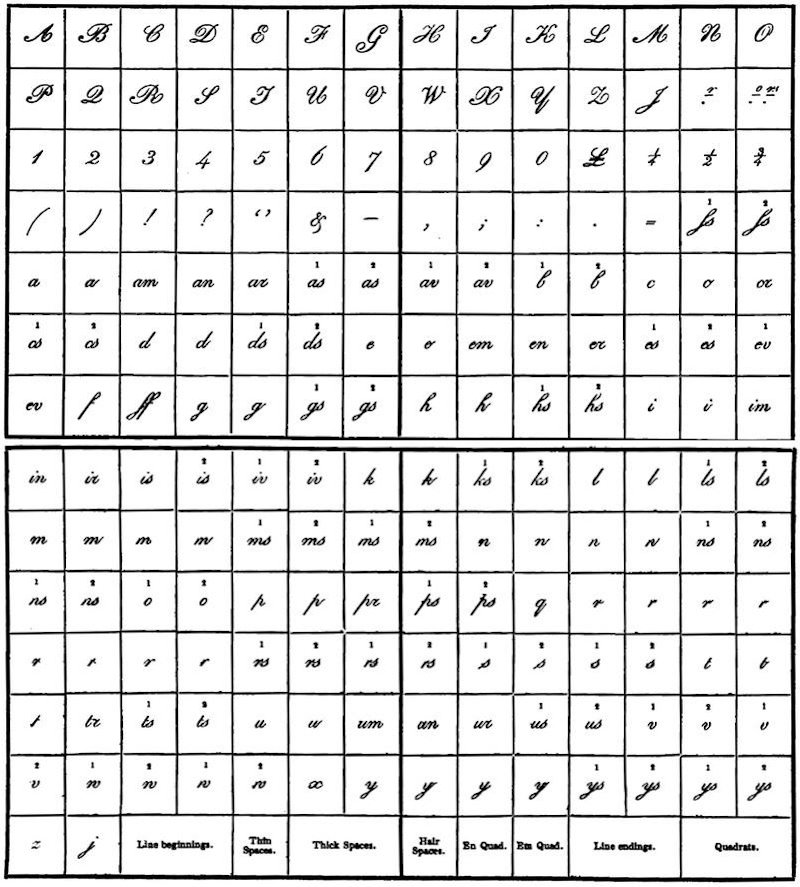
SCRIPT LOWER CASE.—Slanting body.
The sorts marked with 1 are cast thin, for joining with the letters which commence with a junction stroke, as m, n, r, v, w, x, y, z, and the compounds commencing with those letters. Those marked with 2, and distinguished by an extra nick, are cast thick, to go before a, b, c, d, e, f, g, h, i, k, l, o, p, q, t, u, &c.
Scytho-Gothic. See Runic.
Second at the Press. See First.
Second Pull. See First Pull.—M.
SECTION.
A section, marked thus §, is the division of a discourse, or chapter, into less parts or portions.—Murray. It is also used in printing as a reference to notes.
Seditious Libels. See Libels.
Semicolon. See Punctuation.
SERVIEN.
“The alphabets of the nations descended from the Scythians established in Europe, namely, the Servien, the Russian, the Sclavonian, and the Bulgarian, are all derived from the Greek. The Servien letters are called the Cyrillitan characters, from St Cyril, who converted the Moravians to Christianity; smaller characters were afterwards introduced, called Glogolitici. The Russian letters are immediately derived from those used by St. Cyril.”—Astle.
SET AT RANDOM.
When compositors cannot make up their matter into pages as they compose it, either by reason of their working in companionship, or from other causes, they put it in galleys till they can make up; this is termed Setting at Random. When a compositor is obliged to set a great quantity at random, so that it becomes inconvenient, on account of the number of galleys it occupies, and the room it takes up on the cases, he ties it up in moderate-sized pieces and puts it on page papers under his frame, with a bit of paper stuck in each with a number, to mark the order; if it be a work in quarto or folio, too large for page papers, he ties a cord round the matter in each galley and keeps it on the slices of his slice galley under his frame, till he makes up.
SET MATTER.
Matter that is composed, but not worked off, whether it be made up into pages or at random, is called set matter, to distinguish it from matter for distribution.
SET-OFF SHEETS.
Sheets of waste paper that are used upon the tympan sheet, to prevent the ink setting-off on the sheets that are successively printed when the reiteration is working; they are changed as soon as any setting-off is perceptible. They are slipped under the points at their edges, and are quickly changed, or turned, which is always done to economize the use of paper.
Set-off Sheets are also used upon the cylinders of machines that perfect, for the same purpose.
A sheet of thin paper is interleaved between every impression of fine work, particularly if it be large heavy paper and large type, to prevent setting-off in the heap; the work is hung up to dry with these sheets in, which are taken out by the warehouseman before the work is piled away, who then knocks them up, folds them in quires, and takes care of them till they are wanted again by the Pressmen.
Paper for these purposes is supplied by the warehouseman, who gives for the first waste or spoiled impressions; for the other tissue paper is generally used, and with care it will last a long time.
SET OUT PAPER.
Counting out the proper quantity by the warehouseman, to wet—M. We now term it Giving out Paper, which see.
Sets Clean. See Clean Proof.
Sets Close. See Get In.—M. The phrase is now used for close spacing.
Sets Foul. See Foul Proof.—M.
SETS OFF.
Work that is newly wrought off at the press often sets off, especially if it be fat beaten with soft ink: for when it comes to be[755] beaten, or sometimes only hard pressed, by the Bookbinder, the moist ink spreads and delates itself round about the face of every letter, and sullies and stains the whole white paper.—M. We do not now include this spreading and delating of the ink in the meaning of setting off, but use the term only when one printed sheet parts with some of its ink to the sheet on which it is laid, or in the press, or in the process of binding, which it will do with large letter, which requires much ink, or when a book is pressed, or bound, before the ink is sufficiently dry: the Bookbinder’s hammer is a severe test; and where a book is required to be bound as soon as printed, the best plan, perhaps, is to have it cold pressed, which flattens the impression of the types, and renders it unnecessary to beat so much as when this mode of proceeding is not adopted. In printing fine work at press set-off sheets are used to prevent one sheet defacing another.—See Set-off Sheets.
SET THE ROUNCE.
Fixing the girts so that the Rounce stand in the most advantageous position to run the carriage in easily.—M.
SETS UP TO HIMSELF.
When a compositor has received the making-up from a companion, and has composed the intermediate matter, he has set up to himself; that is, he has composed the matter that followed his companion’s last page and preceded the part he commenced with, and has joined the two parts, so as to enable him to make up. See Join, and Making-up, to give the.
Sets Wide. See Drive out.—M. We now use the term for wide spacing.
SET UP CLOSE.
When two or more companions are on the same piece of work, and when any one of them composes all his copy, so that there is none intermediate between the close of his and the beginning of the companion’s that follows him, it is said, he has set up close, or, he has set close up.
SEVENTY-TWOMO.
A sheet of paper folded into seventy-two leaves or one hundred and forty-four pages is termed seventy-twos or seventy-twomo.
SHANK.
The square metal the face of a letter stands on, is called the Shank of a Letter.—M.
SHARP IMPRESSION.
This expression is used two ways by printers: some say it is a sharp impression when much blanket is used, and the impression of the types on the paper is deep: others hold, and I am of the opinion, that it is a sharp impression when no more than the face of the types appears on the paper, with the lines clear and smooth, and of a full colour, with as little indention as possible on the paper. Pressmen and their employers should know in which sense they each use the term, otherwise it may cause a serious mistake in work, as the two meanings embrace the best as well as the commonest work.
SHEARS.
Something similar to those used by tailors; they are employed to cut brass rule, scaleboard, thin reglet, &c. to proper lengths. The shears best adapted to this purpose have blades short in proportion to their handles.
SHEEP’S FOOT.
Is all made of iron, with an hammer head at one end, to drive the ball nails into the ball stocks, and a claw at the other end, to draw the ball nails out of the ball stocks.—M. It is customary to have one for each press, which in a wooden press is suspended by the head from two nails driven into the near cheek of the press, just below the cap. It is a very useful article to the pressman; but is often applied instead of the mallet and shooting stick, to tighten or to loosen[756] quoins, though it occasionally makes a batter by slipping; I do not like to see it used for this purpose.
Shekesteh. See Persian.
Shelf. See Till.
SHERWIN AND COPE’S PRESS.
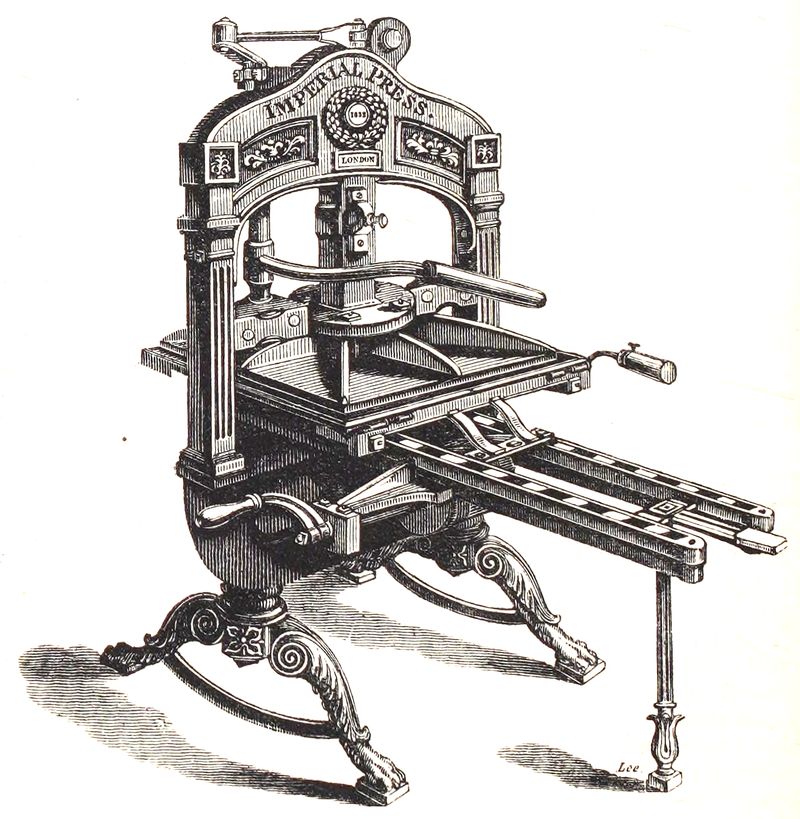
The Imperial Press. Dr. Lardner thus describes this press:—In this beautiful and compact machine, the works upon which the power depends are almost wholly concealed within the head of the press, and are in themselves extremely few and simple. The leverage connected with the bar is similar in principle to that of the Stanhope press; and the distinguishing peculiarity of this press consists in the manner in which the lever, called the chill, is made to act upon the piston, as represented in the engraving of the working parts. The stout cast-iron lever or chill terminates in a sort of polished toe or point. This last-mentioned projection of the lever is made to act on a cup or knuckle acting upon the head of a stout iron bolt, which simply drops down a perforation of the piston, so as to rest upon the uppermost of two steel wedges, one of which, by its connexion with a screw in the front, admits of being pushed forward or drawn back, so as to elevate or lower the bolt, and thus regulate, by altering the length of the piston, the bearing of the platen upon the types. The head-bolt passes through a hole perforated somewhat obliquely; by which ingenious contrivance, a side twist, which would otherwise be occasioned by the motion of the head gear is avoided. It will now easily be perceived[757] how, by the operation of the bar, the toe is made to act upon the inside bolt, and thus force down the piston, which, after the impression has been taken, is carried back again, by means of two stout steel springs attached to the insides of the cheeks of the press, and thus on the return of the bar lift the platen from the face of the types and allow the carriage with the form to be run out. These springs, operating uniformly, cause the action of the piston to be very smooth. The Imperial press, is, I believe, in high estimation for easiness in the pull, which gives it speed in working, and for evenness of impression.
On the first introduction of this press the toe of the lever or chill worked on a flat surface on the top of the bolt; the introduction of the cup or knuckle is a subsequent improvement.
They are made of different sizes, from foolscap folio to double royal.
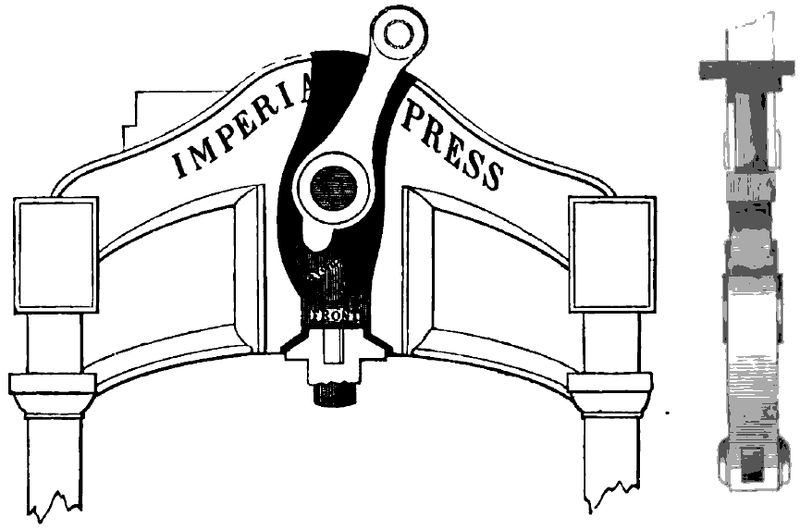
SHOE.
An old shoe with the hind quarter cut away, hung upon a nail through the heel at the end of the imposing stone, into which to put bad letters when correcting. When full, the person who has the care of the materials empties it into the old metal box.
SHOOTING STICK.
Is a perfect wedge about six inches long, and its thicker end two inches broad, and an inch and an half thick; and its thin end about an inch and an half broad, and half an inch thick; made of box wood.—M. They are not now made so thick.
The use of a shooting stick is to drive the quoins with a mallet, both in locking-up and unlocking a form; they are 8½ inches long.

As the thin end of a wooden shooting stick always wears down rapidly, or splits, some houses have adopted metal ones, made of brass, well secured in a strong wooden handle, with a square piece cut out of the[758] end, leaving one side a little longer than the other, with a more acute angle; these are very useful where the quoining room is small, and the quoins are of course thin.
SHORT CROSS.
See Chase.—M. The shortest and also the broadest bar that divides a chase into quarters; there is a groove in the upper side of it to admit the spurs of the points to be pressed into it without injuring their points. This cross is dovetailed in the middle of the sides of the chase, for folios, quartos, and octavos, without the long cross for folios; there is another dovetail in the rim of the chase, leaving about two thirds of the chase on one side of the short cross and one third on the other; the cross is fitted into these dovetails for twelves, and separates the offcut from the other part of the sheet. I would always place the short cross in the middle of the chase for eighteens, where the margin will admit it, as it divides the pages more equally, and makes the form safer when locked up; in this case the cross occupies the place of a gutter instead of a back.
SHORT PAGE.
A page that is not full of matter; as the end of a chapter, a book, or a volume. Though it is termed a short page, yet the term only applies to what appears when printed, for in reality the page is, or ought to be, made up to the exact length of the other pages in the sheet, the blank part being filled up with furniture. I would always put a lead at the least after the last line of the matter, and next to that a piece of thick reglet cut to the measure, to prevent any letters dropping down, and a line of quotations, or large quadrats, at the bottom, which will keep the other pages in register; the vacancy between these may then be filled up with furniture to make the page of a proper length, and if they be not so long as the exact width of the page it will not be material; but if it be made up entirely with furniture, the adjoining pages will be twisted and out of register, when the form is locked up, for it is not possible to cut the pieces so accurate to the width as a line of quadrats, for the gutter to rest against. If the page be very short, it will be better to have an additional line of quadrats or quotations in the middle.
SHORT PULL.
When the pull is so justified, that a sufficient pressure is produced when the bar is brought about half way over, or a little more; this pull is adopted in small light forms, where despatch is required.
Short Ribs. See Cramp Irons.
SHUFFLING.
This is a term used in the Warehouse; and is part of the process of Knocking-up, when the paper is laid in heaps, after having been taken down from the poles, to make it lie even at the edges. It is performed by taking hold of a few quires of the paper loosely at the sides, and holding the far side a little lower than that next the body, upon the table, when, shaking both hands, it gradually projects the lower sheets; then lifting it up and bending it a little, it is let drop on its edge upon the table; by repeating this process two or three times, the parcel becomes even at the edges, and is in a fit state to be piled away. It is a process in which expertness can only be acquired by practice, and observation.
Side Notes. See Marginal Notes.
SIDE STICK.
The same as foot stick, except that they are placed against the side of the page, as their name signifies. See Foot Stick.
SIGLA.
By this term are meant, notes, breviatures, letters set for words, characters, short hand.
We find sigla in the most ancient MSS.: some specimens of such as were used in the sixth, seventh, and eighth centuries, are here given.[759] Some of these sigla were made by the Antiquarians who wrote the book, and others afterwards for the illustration of the text The annexed sigla may be explained thus:—
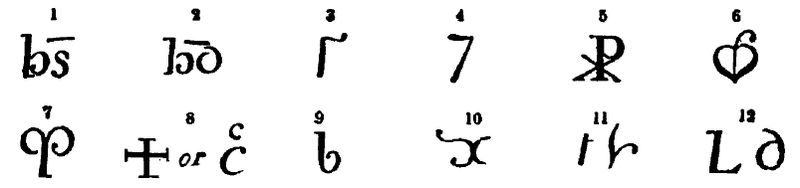
1. H. S. i. e. Hic suppleas, or hæc supplenda.
2. H. D. i. e. Hic deficit, or hæc deficiunt.
3. Paragraphus, a note of division.
4. Diple, to mark out a quotation from the Old Testament.
5. Crisimon, being composed of X and P, which stands for Christ.
6. Hederacei folii Figura, an ivy leaf, the ancient mark of division.
7. Ancora superior. To denote a very remarkable passage.
8. Denotes, the beginning of a lesson.
9. Signifies good.
10. Stands for something very kind, or benevolent.
11. Points out a fine or admirable passage.
12. L. D. lepide dictum. Finely said.
Many writers have employed their pens in elucidating the sigla on coins and medals; among others, Octavius de Strada in Aurea Numismata, &c. where we read C. Cæsar. Divi. F. IMP. Cos. III. Vir R. P. C. that is, Caii Cæsaris Divi filius imperator consul Triumvir reipublicæ constituendæ. A number of similar examples may be found in the same author, and in Æneas Vicus Parmensis de Augustarum imaginibus.
As to epitaphs or sepulchral inscriptions, it was common to begin them with these literary signs, D. M. S. signifying Diis Manibus Sacrum, and, as still is customary with us, on such occasions, the glorious actions, praises, origin, age, and rank of the deceased, with the time of his death, were set forth.
It is a fact too well known to require any particular elucidation, that it was customary with the ancients to burn the bodies of the dead, and to deposit the remains in urns or vessels, as appears from the funeral obsequies of Patroclus and Achilles in Homer.
Altars erected to the Supreme Being are of the highest antiquity, but by the ambition and corruption of mankind were afterwards prostituted to flatter both the living and the dead. Inscriptions, or literary signs, frequently appeared on those altars; as Ar. Don. D. that is, Aram dono dedit, and such like.
Public Statues were erected to Kings, Emperors, and others, both before and after their death, on which the names of the dedicators were frequently inscribed in literary signs. As in this inscription, Civ. Interamnanæ Civ. Utriusque Sex. Aer. Coll. Post Ob. H. P. D. that is, Cives Interamnanæ civitatis utriusque sexus ære collato post obitum hujus patronæ dedicarunt.
The Hebrews, Greeks, and Romans used forms of saluting or complimentary expressions at the beginning of their letters, and then proceeded to the subject of the letters themselves.
The Latin method was to place the name of the writer first, afterwards that of the person to whom the letter was addressed. The names were either put simply without any epithet in literary signs, as C. Att. S.[760] that is Cicero Attico Salutem; or the dignity or rank of the person was added, as, C. S. D. Planc. Imp. Cos. Des. that is, Cicero Salutem dicit Planco Imperatori Consuli designato. The epistolary writings of the Romans abound with examples of this kind.
The Military Sigla amongst the Romans are treated of by Vegetius and Frontinus.
See John Nicholaus, who hath written professedly upon the Sigla of the Ancients;—J. Nicolai Tractatus de Siglis Veterum. Lugd. Bat. 1703, 4to.
A competent knowledge of these literary signs, or verbal contractions used by the ancients, is of the utmost importance to those who wish to be familiarly acquainted with ancient history. These Sigla or Signs frequently appear on marbles, coins, and medals, and occur in those inestimable volumes of antiquity, which have transmitted to us the most important truths relative to the religion, manners, customs, arts and sciences, of ancient nations. These are keys, as it were, to unlock the most precious volumes of antiquity; they introduce us to a more speedy acquaintance with all the various works of ancient artists and writers. The instruction to be derived from this branch of polite learning is of itself a sufficient spur to stimulate attention and industry; but its utility, which is no less obvious, is an additional incentive to augment our application and desires, when we consider, that there are no ancient documents, either on metals, marbles, precious stones, bark, parchment, paper, or other materials, which do not abound with these literary contractions, and that it will be very difficult to understand them without this necessary knowledge.—Astle. See Records.
SIGNATURE.
A letter of the alphabet placed at the bottom of the first page of each sheet of a work, to denote, alphabetically, the order of the sheets.
It is customary to commence with B on the first sheet of the body of the work, and to go regularly through the alphabet, with the exception of the letters J, V, and W, which are never used as signatures; and which had, in fact, no existence in the alphabet at the time of the invention of printing; [J] expressing both I and J; [U], both U and V; and [UU] the double letter W. If the work extend to more sheets in number than there are letters in the alphabet, the succeeding sheets go on with a second alphabet, which commences with A, and both the letters are usually given, in this manner, A A, or Aa, and sometimes, to avoid the repetition, thus, 2 A; if a third alphabet be necessary it is always, at the present day, placed with the number before it, as 3 A. The printer’s first alphabet consists of twenty-two letters, and the second and succeeding ones of twenty-three.
As a guide to the bookbinder there are other signatures used in a sheet besides the first—in a sheet of octavo the first page has B, the third has B 2, the fifth has B 3, and the seventh has B 4: in a sheet of twelves they are carried to B 6; B 5 being the first page of the offcut; and however numerous the pages may be in a sheet with one signature, when they are all inserted, they are continued to the last odd page before the middle of the sheet, but never carried beyond the middle. In general they are all omitted except the two first, to show the first fold of the paper, and the first on the offcut. Small capitals are more frequently used for signatures than large capitals, as disfiguring the foot of the page in a slighter manner.
Sometimes figures are used instead of letters, but not often; the Gentleman’s Magazine is an instance.
Key to Column Headers—
No. = No. of Sheets
Sig. = Signature
Fol. = Folio
| TABLE OF SIGNATURES AND FIRST FOLIO OF EACH SHEET. | |||||||||||
| FOLIO. | |||||||||||
| No. | Sig. | Fol. | No. | Sig. | Fol. | No. | Sig. | Fol. | No. | Sig. | Fol. |
| 23 | 2 A | 89 | 46 | 3 A | 181 | 69 | 4 A | 273 | |||
| 1 | B | 1 | 24 | B | 93 | 47 | B | 185 | 70 | B | 277 |
| 2 | C | 5 | 25 | C | 97 | 48 | C | 189 | 71 | C | 281 |
| 3 | D | 9 | 26 | D | 101 | 49 | D | 193 | 72 | D | 285 |
| 4 | E | 13 | 27 | E | 105 | 50 | E | 197 | 73 | E | 289 |
| 5 | F | 17 | 28 | F | 109 | 51 | F | 201 | 74 | F | 293 |
| 6 | G | 21 | 29 | G | 113 | 52 | G | 205 | 75 | G | 297 |
| 7 | H | 25 | 30 | H | 117 | 53 | H | 209 | 76 | H | 301 |
| 8 | I | 29 | 31 | I | 121 | 54 | I | 213 | 77 | I | 305 |
| 9 | K | 33 | 32 | K | 125 | 55 | K | 217 | 78 | K | 309 |
| 10 | L | 37 | 33 | L | 129 | 56 | L | 221 | 79 | L | 313 |
| 11 | M | 41 | 34 | M | 133 | 57 | M | 225 | 80 | M | 317 |
| 12 | N | 45 | 35 | N | 137 | 58 | N | 229 | 81 | N | 321 |
| 13 | O | 49 | 36 | O | 141 | 59 | O | 233 | 82 | O | 325 |
| 14 | P | 53 | 37 | P | 145 | 60 | P | 237 | 83 | P | 329 |
| 15 | Q | 57 | 38 | Q | 149 | 61 | Q | 241 | 84 | Q | 333 |
| 16 | R | 61 | 39 | R | 153 | 62 | R | 245 | 85 | R | 337 |
| 17 | S | 65 | 40 | S | 157 | 63 | S | 249 | 86 | S | 341 |
| 18 | T | 69 | 41 | T | 161 | 64 | T | 253 | 87 | T | 345 |
| 19 | U | 73 | 42 | U | 165 | 65 | U | 257 | 88 | U | 349 |
| 20 | X | 77 | 43 | X | 169 | 66 | X | 261 | 89 | X | 353 |
| 21 | Y | 81 | 44 | Y | 173 | 67 | Y | 265 | 90 | Y | 357 |
| 22 | Z | 85 | 45 | Z | 177 | 68 | Z | 269 | 91 | Z | 361 |
| 92 | 5 A | ;365 | 115 | 6 A | 457 | 138 | 7 A | 549 | 161 | 8 A | 641 |
| 93 | B | 369 | 116 | B | 461 | 139 | B | 553 | 162 | B | 645 |
| 94 | C | 373 | 117 | C | 465 | 140 | C | 557 | 163 | C | 649 |
| 95 | D | 377 | 118 | D | 469 | 141 | D | 561 | 164 | D | 653 |
| 96 | E | 381 | 119 | E | 473 | 142 | E | 565 | 165 | E | 657 |
| 97 | F | 385 | 120 | F | 477 | 143 | F | 569 | 166 | F | 661 |
| 98 | G | 389 | 121 | G | 481 | 144 | G | 573 | 167 | G | 665 |
| 99 | H | 393 | 122 | H | 485 | 145 | H | 577 | 168 | H | 669 |
| 100 | I | 397 | 123 | I | 489 | 146 | I | 581 | 169 | I | 673 |
| 101 | K | 401 | 124 | K | 493 | 147 | K | 585 | 170 | K | 677 |
| 102 | L | 405 | 125 | L | 497 | 148 | L | 589 | 171 | L | 681 |
| 103 | M | 409 | 126 | M | 501 | 149 | M | 593 | 172 | M | 685 |
| 104 | N | 413 | 127 | N | 505 | 150 | N | 597 | 173 | N | 689 |
| 105 | O | 417 | 128 | O | 509 | 151 | O | 601 | 174 | O | 693 |
| 106 | P | 421 | 129 | P | 513 | 152 | P | 605 | 175 | P | 697 |
| 107 | Q | 425 | 130 | Q | 517 | 153 | Q | 609 | 176 | Q | 701 |
| 108 | R | 429 | 131 | R | 521 | 154 | R | 613 | 177 | R | 705 |
| 109 | S | 433 | 132 | S | 525 | 155 | S | 617 | 178 | S | 709 |
| 110 | T | 437 | 133 | T | 529 | 156 | T | 621 | 179 | T | 713 |
| 111 | U | 441 | 134 | U | 533 | 157 | U | 625 | 180 | U | 717 |
| 112 | X | 445 | 135 | X | 537 | 158 | X | 629 | 181 | X | 721 |
| 113 | Y | 449 | 136 | Y | 541 | 159 | Y | 633 | 182 | Y | 725 |
| 114 | Z | 453 | 137 | Z | 545 | 160 | Z | 637 | 183 | Z | 729 |
| No. | Sig. | Fol. | No. | Sig. | Fol. | No. | Sig. | Fol. | No. | Sig. | Fol. |
| 184 | 9 A | 733 | 207 | 10 A | 825 | 230 | 11 A | 917 | 253 | 12 A | 1009 |
| 185 | B | 737 | 208 | B | 829 | 231 | B | 921 | 254 | B | 1013 |
| 186 | C | 741 | 209 | C | 833 | 232 | C | 925 | 255 | C | 1017 |
| 187 | D | 745 | 210 | D | 837 | 233 | D | 929 | 256 | D | 1021 |
| 188 | E | 749 | 211 | E | 841 | 234 | E | 933 | 257 | E | 1025 |
| 189 | F | 753 | 212 | F | 845 | 235 | F | 937 | 258 | F | 1029 |
| 190 | G | 757 | 213 | G | 849 | 236 | G | 941 | 259 | G | 1033 |
| 191 | H | 761 | 214 | H | 853 | 237 | H | 945 | 260 | H | 1037 |
| 192 | I | 765 | 215 | I | 857 | 238 | I | 949 | 261 | I | 1041 |
| 193 | K | 769 | 216 | K | 861 | 239 | K | 953 | 262 | K | 1045 |
| 194 | L | 773 | 217 | L | 865 | 240 | L | 957 | 263 | L | 1049 |
| 195 | M | 777 | 218 | M | 869 | 241 | M | 961 | 264 | M | 1053 |
| 196 | N | 781 | 219 | N | 873 | 242 | N | 965 | 265 | N | 1057 |
| 197 | O | 785 | 220 | O | 877 | 243 | O | 969 | 266 | O | 1061 |
| 198 | P | 789 | 221 | P | 881 | 244 | P | 973 | 267 | P | 1065 |
| 199 | Q | 793 | 222 | Q | 885 | 245 | Q | 977 | 268 | Q | 1069 |
| 200 | R | 797 | 223 | R | 889 | 246 | R | 981 | 269 | R | 1073 |
| 201 | S | 801 | 224 | S | 893 | 247 | S | 985 | 270 | S | 1077 |
| 202 | T | 805 | 225 | T | 897 | 248 | T | 989 | 271 | T | 1081 |
| 203 | U | 809 | 226 | U | 901 | 249 | U | 993 | 272 | U | 1085 |
| 204 | X | 813 | 227 | X | 905 | 250 | X | 997 | 273 | X | 1089 |
| 205 | Y | 817 | 228 | Y | 909 | 251 | Y | 1001 | 274 | Y | 1093 |
| 206 | Z | 821 | 229 | Z | 913 | 252 | Z | 1005 | 275 | Z | 1097 |
| 276 | 13 A | 1101 | 299 | 14 A | 1193 | 322 | 15 A | 1285 | 345 | 16 A | 1377 |
| 277 | B | 1105 | 300 | B | 1197 | 323 | B | 1289 | 346 | B | 1381 |
| 278 | C | 1109 | 301 | C | 1201 | 324 | C | 1293 | 347 | C | 1385 |
| 279 | D | 1113 | 302 | D | 1205 | 325 | D | 1297 | 348 | D | 1389 |
| 280 | E | 1117 | 303 | E | 1209 | 326 | E | 1301 | 349 | E | 1393 |
| 281 | F | 1121 | 304 | F | 1213 | 327 | F | 1305 | 350 | F | 1397 |
| 282 | G | 1125 | 305 | G | 1217 | 328 | G | 1309 | 351 | G | 1401 |
| 283 | H | 1129 | 306 | H | 1221 | 329 | H | 1313 | 352 | H | 1405 |
| 284 | I | 1133 | 307 | I | 1225 | 330 | I | 1317 | 353 | I | 1409 |
| 285 | K | 1137 | 308 | K | 1229 | 331 | K | 1321 | 354 | K | 1413 |
| 286 | L | 1141 | 309 | L | 1233 | 332 | L | 1325 | 355 | L | 1417 |
| 287 | M | 1145 | 310 | M | 1237 | 333 | M | 1329 | 356 | M | 1421 |
| 288 | N | 1149 | 311 | N | 1241 | 334 | N | 1333 | 357 | N | 1425 |
| 289 | O | 1153 | 312 | O | 1245 | 335 | O | 1337 | 358 | O | 1429 |
| 290 | P | 1157 | 313 | P | 1249 | 336 | P | 1341 | 359 | P | 1433 |
| 291 | Q | 1161 | 314 | Q | 1253 | 337 | Q | 1345 | 360 | Q | 1437 |
| 292 | R | 1165 | 315 | R | 1257 | 338 | R | 1349 | 361 | R | 1441 |
| 293 | S | 1169 | 316 | S | 1261 | 339 | S | 1353 | 362 | S | 1445 |
| 294 | T | 1173 | 317 | T | 1265 | 340 | T | 1357 | 363 | T | 1449 |
| 295 | U | 1177 | 318 | U | 1269 | 341 | U | 1361 | 364 | U | 1453 |
| 296 | X | 1181 | 319 | X | 1273 | 342 | X | 1365 | 365 | X | 1457 |
| 297 | Y | 1185 | 320 | Y | 1277 | 343 | Y | 1369 | 366 | Y | 1461 |
| 298 | Z | 1189 | 321 | Z | 1281 | 344 | Z | 1373 | 367 | Z | 1465 |
| No. | Sig. | Fol. | No. | Sig. | Fol. | No. | Sig. | Fol. | No. | Sig. | Fol. |
| 368 | 17 A | 1469 | 391 | 18 A | 1561 | 414 | 19 A | 1653 | 437 | 20 A | 1745 |
| 369 | B | 1473 | 392 | B | 1565 | 415 | B | 1657 | 438 | B | 1749 |
| 370 | C | 1477 | 393 | C | 1569 | 416 | C | 1661 | 439 | C | 1753 |
| 371 | D | 1481 | 394 | D | 1573 | 417 | D | 1665 | 440 | D | 1757 |
| 372 | E | 1485 | 395 | E | 1577 | 418 | E | 1669 | 441 | E | 1761 |
| 373 | F | 1489 | 396 | F | 1581 | 419 | F | 1673 | 442 | F | 1765 |
| 374 | G | 1493 | 397 | G | 1585 | 420 | G | 1677 | 443 | G | 1769 |
| 375 | H | 1497 | 398 | H | 1589 | 421 | H | 1681 | 444 | H | 1773 |
| 376 | I | 1501 | 399 | I | 1593 | 422 | I | 1685 | 445 | I | 1777 |
| 377 | K | 1505 | 400 | K | 1597 | 423 | K | 1689 | 446 | K | 1781 |
| 378 | L | 1509 | 401 | L | 1601 | 424 | L | 1693 | 447 | L | 1785 |
| 379 | M | 1513 | 402 | M | 1605 | 425 | M | 1697 | 448 | M | 1789 |
| 380 | N | 1517 | 403 | N | 1609 | 426 | N | 1701 | 449 | N | 1793 |
| 381 | O | 1521 | 404 | O | 1613 | 427 | O | 1705 | 450 | O | 1797 |
| 382 | P | 1525 | 405 | P | 1617 | 428 | P | 1709 | 451 | P | 1801 |
| 383 | Q | 1529 | 406 | Q | 1621 | 429 | Q | 1713 | 452 | Q | 1805 |
| 384 | R | 1533 | 407 | R | 1625 | 430 | R | 1717 | 453 | R | 1809 |
| 385 | S | 1537 | 408 | S | 1629 | 431 | S | 1721 | 454 | S | 1813 |
| 386 | T | 1541 | 409 | T | 1633 | 432 | T | 1725 | 455 | T | 1817 |
| 387 | U | 1545 | 410 | U | 1637 | 433 | U | 1729 | 456 | U | 1821 |
| 388 | X | 1549 | 411 | X | 1641 | 434 | X | 1733 | 457 | X | 1825 |
| 389 | Y | 1553 | 412 | Y | 1645 | 435 | Y | 1737 | 458 | Y | 1829 |
| 390 | Z | 1557 | 413 | Z | 1649 | 436 | Z | 1741 | 459 | Z | 1833 |
| 460 | 21 A | 1837 | 483 | 22 A | 1929 | 506 | 23 A | 2021 | 529 | 24 A | 2113 |
| 461 | B | 1841 | 484 | B | 1933 | 507 | B | 2025 | 530 | B | 2117 |
| 462 | C | 1845 | 485 | C | 1937 | 508 | C | 2029 | 531 | C | 2121 |
| 463 | D | 1849 | 486 | D | 1941 | 509 | D | 2033 | 532 | D | 2125 |
| 464 | E | 1853 | 487 | E | 1945 | 510 | E | 2037 | 533 | E | 2129 |
| 465 | F | 1857 | 488 | F | 1949 | 511 | F | 2041 | 534 | F | 2133 |
| 466 | G | 1861 | 489 | G | 1953 | 512 | G | 2045 | 535 | G | 2137 |
| 467 | H | 1865 | 490 | H | 1957 | 513 | H | 2049 | 536 | H | 2141 |
| 468 | I | 1869 | 491 | I | 1961 | 514 | I | 2053 | 537 | I | 2145 |
| 469 | K | 1873 | 492 | K | 1965 | 515 | K | 2057 | 538 | K | 2149 |
| 470 | L | 1877 | 493 | L | 1969 | 516 | L | 2061 | 539 | L | 2153 |
| 471 | M | 1881 | 494 | M | 1973 | 517 | M | 2065 | 540 | M | 2157 |
| 472 | N | 1885 | 495 | N | 1977 | 518 | N | 2069 | 541 | N | 2161 |
| 473 | O | 1889 | 496 | O | 1981 | 519 | O | 2073 | 542 | O | 2165 |
| 474 | P | 1893 | 497 | P | 1985 | 520 | P | 2077 | 543 | P | 2169 |
| 475 | Q | 1897 | 498 | Q | 1989 | 521 | Q | 2081 | 544 | Q | 2173 |
| 476 | R | 1901 | 499 | R | 1993 | 522 | R | 2085 | 545 | R | 2177 |
| 477 | S | 1905 | 500 | S | 1997 | 523 | S | 2089 | 546 | S | 2181 |
| 478 | T | 1909 | 501 | T | 2001 | 524 | T | 2093 | 547 | T | 2185 |
| 479 | U | 1913 | 502 | U | 2005 | 525 | U | 2097 | 548 | U | 2189 |
| 480 | X | 1917 | 503 | X | 2009 | 526 | X | 2101 | 549 | X | 2193 |
| 481 | Y | 1921 | 504 | Y | 2013 | 527 | Y | 2105 | 550 | Y | 2197 |
| 482 | Z | 1925 | 505 | Z | 2017 | 528 | Z | 2109 | 551 | Z | 2201 |
| No. | Sig. | Fol. | No. | Sig. | Fol. | No. | Sig. | Fol. | No. | Sig. | Fol. |
| 552 | 25 A | 2205 | 575 | 26 A | 2297 | 598 | 27 A | 2389 | 621 | 28 A | 2481 |
| 553 | B | 2209 | 576 | B | 2301 | 599 | B | 2393 | 622 | B | 2485 |
| 554 | C | 2213 | 577 | C | 2305 | 600 | C | 2397 | 623 | C | 2489 |
| 555 | D | 2217 | 578 | D | 2309 | 601 | D | 2401 | 624 | D | 2493 |
| 556 | E | 2221 | 579 | E | 2313 | 602 | E | 2405 | 625 | E | 2497 |
| 557 | F | 2225 | 580 | F | 2317 | 603 | F | 2409 | 626 | F | 2501 |
| 558 | G | 2229 | 581 | G | 2321 | 604 | G | 2413 | 627 | G | 2505 |
| 559 | H | 2233 | 582 | H | 2325 | 605 | H | 2417 | 628 | H | 2509 |
| 560 | I | 2237 | 583 | I | 2329 | 606 | I | 2421 | 629 | I | 2513 |
| 561 | K | 2241 | 584 | K | 2333 | 607 | K | 2425 | 630 | K | 2517 |
| 562 | L | 2245 | 585 | L | 2337 | 608 | L | 2429 | 631 | L | 2521 |
| 563 | M | 2249 | 586 | M | 2341 | 609 | M | 2433 | 632 | M | 2525 |
| 564 | N | 2253 | 587 | N | 2345 | 610 | N | 2437 | 633 | N | 2529 |
| 565 | O | 2257 | 588 | O | 2349 | 611 | O | 2441 | 634 | O | 2533 |
| 566 | P | 2261 | 589 | P | 2353 | 612 | P | 2445 | 635 | P | 2537 |
| 567 | Q | 2265 | 590 | Q | 2357 | 613 | Q | 2449 | 636 | Q | 2541 |
| 568 | R | 2269 | 591 | R | 2361 | 614 | R | 2453 | 637 | R | 2545 |
| 569 | S | 2273 | 592 | S | 2365 | 615 | S | 2457 | 638 | S | 2549 |
| 570 | T | 2277 | 593 | T | 2369 | 616 | T | 2461 | 639 | T | 2553 |
| 571 | U | 2281 | 594 | U | 2373 | 617 | U | 2465 | 640 | U | 2557 |
| 572 | X | 2285 | 595 | X | 2377 | 618 | X | 2469 | 641 | X | 2561 |
| 573 | Y | 2289 | 596 | Y | 2381 | 619 | Y | 2473 | 642 | Y | 2565 |
| 574 | Z | 2293 | 597 | Z | 2385 | 620 | Z | 2477 | 643 | Z | 2569 |
| 644 | 29 A | 2573 | 667 | 30 A | 2665 | 690 | 31 A | 2757 | 713 | 32 A | 2849 |
| 645 | B | 2577 | 668 | B | 2669 | 691 | B | 2761 | 714 | B | 2853 |
| 646 | C | 2581 | 669 | C | 2673 | 692 | C | 2765 | 715 | C | 2857 |
| 647 | D | 2585 | 670 | D | 2677 | 693 | D | 2769 | 716 | D | 2861 |
| 648 | E | 2589 | 671 | E | 2681 | 694 | E | 2773 | 717 | E | 2865 |
| 649 | F | 2593 | 672 | F | 2685 | 695 | F | 2777 | 718 | F | 2869 |
| 650 | G | 2597 | 673 | G | 2689 | 696 | G | 2781 | 719 | G | 2873 |
| 651 | H | 2601 | 674 | H | 2693 | 697 | H | 2785 | 720 | H | 2877 |
| 652 | I | 2605 | 675 | I | 2697 | 698 | I | 2789 | 721 | I | 2881 |
| 653 | K | 2609 | 676 | K | 2701 | 699 | K | 2793 | 722 | K | 2885 |
| 654 | L | 2613 | 677 | L | 2705 | 700 | L | 2797 | 723 | L | 2889 |
| 655 | M | 2617 | 678 | M | 2709 | 701 | M | 2801 | 724 | M | 2893 |
| 656 | N | 2621 | 679 | N | 2713 | 702 | N | 2805 | 725 | N | 2897 |
| 657 | O | 2625 | 680 | O | 2717 | 703 | O | 2809 | 726 | O | 2901 |
| 658 | P | 2629 | 681 | P | 2721 | 704 | P | 2813 | 727 | P | 2905 |
| 659 | Q | 2633 | 682 | Q | 2725 | 705 | Q | 2817 | 728 | Q | 2909 |
| 660 | R | 2637 | 683 | R | 2729 | 706 | R | 2821 | 729 | R | 2913 |
| 661 | S | 2641 | 684 | S | 2733 | 707 | S | 2825 | 730 | S | 2917 |
| 662 | T | 2645 | 685 | T | 2737 | 708 | T | 2829 | 731 | T | 2921 |
| 663 | U | 2649 | 686 | U | 2741 | 709 | U | 2833 | 732 | U | 2925 |
| 664 | X | 2653 | 687 | X | 2745 | 710 | X | 2837 | 733 | X | 2929 |
| 665 | Y | 2657 | 688 | Y | 2749 | 711 | Y | 2841 | 734 | Y | 2933 |
| 666 | Z | 2661 | 689 | Z | 2753 | 712 | Z | 2845 | 735 | Z | 2937 |
| No. | Sig. | Fol. | No. | Sig. | Fol. | No. | Sig. | Fol. | No. | Sig. | Fol. |
| 736 | 33 A | 2941 | 759 | 34 A | 3033 | 782 | 35 A | 3125 | 805 | 36 A | 3217 |
| 737 | B | 2945 | 760 | B | 3037 | 783 | B | 3129 | 806 | B | 3221 |
| 738 | C | 2949 | 761 | C | 3041 | 784 | C | 3133 | 807 | C | 3225 |
| 739 | D | 2953 | 762 | D | 3045 | 785 | D | 3137 | 808 | D | 3229 |
| 740 | E | 2957 | 763 | E | 3049 | 786 | E | 3141 | 809 | E | 3233 |
| 741 | F | 2961 | 764 | F | 3053 | 787 | F | 3145 | 810 | F | 3237 |
| 742 | G | 2965 | 765 | G | 3057 | 788 | G | 3149 | 811 | G | 3241 |
| 743 | H | 2969 | 766 | H | 3061 | 789 | H | 3153 | 812 | H | 3245 |
| 744 | I | 2973 | 767 | I | 3065 | 790 | I | 3157 | 813 | I | 3249 |
| 745 | K | 2977 | 768 | K | 3069 | 791 | K | 3161 | 814 | K | 3253 |
| 746 | L | 2981 | 769 | L | 3073 | 792 | L | 3165 | 815 | L | 3257 |
| 747 | M | 2985 | 770 | M | 3077 | 793 | M | 3169 | 816 | M | 3261 |
| 748 | N | 2989 | 771 | N | 3081 | 794 | N | 3173 | 817 | N | 3265 |
| 749 | O | 2993 | 772 | O | 3085 | 795 | O | 3177 | 818 | O | 3269 |
| 750 | P | 2997 | 773 | P | 3089 | 796 | P | 3181 | 819 | P | 3273 |
| 751 | Q | 3001 | 774 | Q | 3093 | 797 | Q | 3185 | 820 | Q | 3277 |
| 752 | R | 3005 | 775 | R | 3097 | 798 | R | 3189 | 821 | R | 3281 |
| 753 | S | 3009 | 776 | S | 3101 | 799 | S | 3193 | 822 | S | 3285 |
| 754 | T | 3013 | 777 | T | 3105 | 800 | T | 3197 | 823 | T | 3289 |
| 755 | U | 3017 | 778 | U | 3109 | 801 | U | 3201 | 824 | U | 3293 |
| 756 | X | 3021 | 779 | X | 3113 | 802 | X | 3205 | 825 | X | 3297 |
| 757 | Y | 3025 | 780 | Y | 3117 | 803 | Y | 3209 | 826 | Y | 3301 |
| 758 | Z | 3029 | 781 | Z | 3121 | 804 | Z | 3213 | 827 | Z | 3305 |
| 828 | 37 A | 3309 | 851 | 38 A | 3401 | 874 | 39 A | 3493 | 897 | 40 A | 3585 |
| 829 | B | 3313 | 852 | B | 3405 | 875 | B | 3497 | 898 | B | 3589 |
| 830 | C | 3317 | 853 | C | 3409 | 876 | C | 3501 | 899 | C | 3593 |
| 831 | D | 3321 | 854 | D | 3413 | 877 | D | 3505 | 900 | D | 3597 |
| 832 | E | 3325 | 855 | E | 3417 | 878 | E | 3509 | 901 | E | 3601 |
| 833 | F | 3329 | 856 | F | 3421 | 879 | F | 3513 | 902 | F | 3605 |
| 834 | G | 3333 | 857 | G | 3425 | 880 | G | 3517 | 903 | G | 3609 |
| 835 | H | 3337 | 858 | H | 3429 | 881 | H | 3521 | 904 | H | 3613 |
| 836 | I | 3341 | 859 | I | 3433 | 882 | I | 3525 | 905 | I | 3617 |
| 837 | K | 3345 | 860 | K | 3437 | 883 | K | 3529 | 906 | K | 3621 |
| 838 | L | 3349 | 861 | L | 3441 | 884 | L | 3533 | 907 | L | 3625 |
| 839 | M | 3353 | 862 | M | 3445 | 885 | M | 3537 | 908 | M | 3629 |
| 840 | N | 3357 | 863 | N | 3449 | 886 | N | 3541 | 909 | N | 3633 |
| 841 | O | 3361 | 864 | O | 3453 | 887 | O | 3545 | 910 | O | 3637 |
| 842 | P | 3365 | 865 | P | 3457 | 888 | P | 3549 | 911 | P | 3641 |
| 843 | Q | 3369 | 866 | Q | 3461 | 889 | Q | 3553 | 912 | Q | 3645 |
| 844 | R | 3373 | 867 | R | 3465 | 890 | R | 3557 | 913 | R | 3649 |
| 845 | S | 3377 | 868 | S | 3469 | 891 | S | 3561 | 914 | S | 3653 |
| 846 | T | 3381 | 869 | T | 3473 | 892 | T | 3565 | 915 | T | 3657 |
| 847 | U | 3385 | 870 | U | 3477 | 893 | U | 3569 | 916 | U | 3661 |
| 848 | X | 3389 | 871 | X | 3481 | 894 | X | 3573 | 917 | X | 3665 |
| 849 | Y | 3393 | 872 | Y | 3485 | 895 | Y | 3577 | 918 | Y | 3669 |
| 850 | Z | 3397 | 873 | Z | 3489 | 896 | Z | 3581 | 919 | Z | 3673 |
| No. | Sig. | Fol. | No. | Sig. | Fol. | No. | Sig. | Fol. | No. | Sig. | Fol. |
| 920 | 41 A | 3677 | 943 | 42 A | 3769 | 966 | 43 A | 3861 | 989 | 44 A | 3953 |
| 921 | B | 3681 | 944 | B | 3773 | 967 | B | 3865 | 990 | B | 3957 |
| 922 | C | 3685 | 945 | C | 3777 | 968 | C | 3869 | 991 | C | 3961 |
| 923 | D | 3689 | 946 | D | 3781 | 969 | D | 3873 | 992 | D | 3965 |
| 924 | E | 3693 | 947 | E | 3785 | 970 | E | 3877 | 993 | E | 3969 |
| 925 | F | 3697 | 948 | F | 3789 | 971 | F | 3881 | 994 | F | 3973 |
| 926 | G | 3701 | 949 | G | 3793 | 972 | G | 3885 | 995 | G | 3977 |
| 927 | H | 3705 | 950 | H | 3797 | 973 | H | 3889 | 996 | H | 3981 |
| 928 | I | 3709 | 951 | I | 3801 | 974 | I | 3893 | 997 | I | 3985 |
| 929 | K | 3713 | 952 | K | 3805 | 975 | K | 3897 | 998 | K | 3989 |
| 930 | L | 3717 | 953 | L | 3809 | 976 | L | 3901 | 999 | L | 3993 |
| 931 | M | 3721 | 954 | M | 3813 | 977 | M | 3905 | 1000 | M | 3997 |
| 932 | N | 3725 | 955 | N | 3817 | 978 | N | 3909 | 1001 | N | 4001 |
| 933 | O | 3729 | 956 | O | 3821 | 979 | O | 3913 | 1002 | O | 4005 |
| 934 | P | 3733 | 957 | P | 3825 | 980 | P | 3917 | 1003 | P | 4009 |
| 935 | Q | 3737 | 958 | Q | 3829 | 981 | Q | 3921 | 1004 | Q | 4013 |
| 936 | R | 3741 | 959 | R | 3833 | 982 | R | 3925 | 1005 | R | 4017 |
| 937 | S | 3745 | 960 | S | 3837 | 983 | S | 3929 | 1006 | S | 4021 |
| 938 | T | 3749 | 961 | T | 3841 | 984 | T | 3933 | 1007 | T | 4025 |
| 939 | U | 3753 | 962 | U | 3845 | 985 | U | 3937 | 1008 | U | 4029 |
| 940 | X | 3757 | 963 | X | 3849 | 986 | X | 3941 | 1009 | X | 4033 |
| 941 | Y | 3761 | 964 | Y | 3853 | 987 | Y | 3945 | 1010 | Y | 4037 |
| 942 | Z | 3765 | 965 | Z | 3857 | 988 | Z | 3949 | 1011 | Z | 4041 |
| 1012 | 45 A | 4045 | 1035 | 46 A | 4137 | 1058 | 47 A | 4229 | 1081 | 48 A | 4321 |
| 1013 | B | 4049 | 1036 | B | 4141 | 1059 | B | 4233 | 1082 | B | 4325 |
| 1014 | C | 4053 | 1037 | C | 4145 | 1060 | C | 4237 | 1083 | C | 4329 |
| 1015 | D | 4057 | 1038 | D | 4149 | 1061 | D | 4241 | 1084 | D | 4333 |
| 1016 | E | 4061 | 1039 | E | 4153 | 1062 | E | 4245 | 1085 | E | 4337 |
| 1017 | F | 4065 | 1040 | F | 4157 | 1063 | F | 4249 | 1086 | F | 4341 |
| 1018 | G | 4069 | 1041 | G | 4161 | 1064 | G | 4253 | 1087 | G | 4345 |
| 1019 | H | 4073 | 1042 | H | 4165 | 1065 | H | 4257 | 1088 | H | 4349 |
| 1020 | I | 4077 | 1043 | I | 4169 | 1066 | I | 4261 | 1089 | I | 4353 |
| 1021 | K | 4081 | 1044 | K | 4173 | 1067 | K | 4265 | 1090 | K | 4357 |
| 1022 | L | 4085 | 1045 | L | 4177 | 1068 | L | 4269 | 1091 | L | 4361 |
| 1023 | M | 4089 | 1046 | M | 4181 | 1069 | M | 4273 | 1092 | M | 4365 |
| 1024 | N | 4093 | 1047 | N | 4185 | 1070 | N | 4277 | 1093 | N | 4369 |
| 1025 | O | 4097 | 1048 | O | 4189 | 1071 | O | 4281 | 1094 | O | 4373 |
| 1026 | P | 4101 | 1049 | P | 4193 | 1072 | P | 4285 | 1095 | P | 4377 |
| 1027 | Q | 4105 | 1050 | Q | 4197 | 1073 | Q | 4289 | 1096 | Q | 4381 |
| 1028 | R | 4109 | 1051 | R | 4201 | 1074 | R | 4293 | 1097 | R | 4385 |
| 1029 | S | 4113 | 1052 | S | 4205 | 1075 | S | 4297 | 1098 | S | 4389 |
| 1030 | T | 4117 | 1053 | T | 4209 | 1076 | T | 4301 | 1099 | T | 4393 |
| 1031 | U | 4121 | 1054 | U | 4213 | 1077 | U | 4305 | 1100 | U | 4397 |
| 1032 | X | 4125 | 1055 | X | 4217 | 1078 | X | 4309 | 1101 | X | 4401 |
| 1033 | Y | 4129 | 1056 | Y | 4221 | 1079 | Y | 4313 | 1102 | Y | 4405 |
| 1034 | Z | 4133 | 1057 | Z | 4225 | 1080 | Z | 4317 | 1103 | Z | 4409 |
| No. | Sig. | Fol. | No. | Sig. | Fol. | No. | Sig. | Fol. | No. | Sig. | Fol. |
| 1104 | 49 A | 4413 | 1127 | 50 A | 4505 | 1150 | 51 A | 4597 | 1173 | 52 A | 4689 |
| 1105 | B | 4417 | 1128 | B | 4509 | 1151 | B | 4601 | 1174 | B | 4693 |
| 1106 | C | 4421 | 1129 | C | 4513 | 1152 | C | 4605 | 1175 | C | 4697 |
| 1107 | D | 4425 | 1130 | D | 4517 | 1153 | D | 4609 | 1176 | D | 4701 |
| 1108 | E | 4429 | 1131 | E | 4521 | 1154 | E | 4613 | 1177 | E | 4705 |
| 1109 | F | 4433 | 1132 | F | 4525 | 1155 | F | 4617 | 1178 | F | 4709 |
| 1110 | G | 4437 | 1133 | G | 4529 | 1156 | G | 4621 | 1179 | G | 4713 |
| 1111 | H | 4441 | 1134 | H | 4533 | 1157 | H | 4625 | 1180 | H | 4717 |
| 1112 | I | 4445 | 1135 | I | 4537 | 1158 | I | 4629 | 1181 | I | 4721 |
| 1113 | K | 4449 | 1136 | K | 4541 | 1159 | K | 4633 | 1182 | K | 4725 |
| 1114 | L | 4453 | 1137 | L | 4545 | 1160 | L | 4637 | 1183 | L | 4729 |
| 1115 | M | 4457 | 1138 | M | 4549 | 1161 | M | 4641 | 1184 | M | 4733 |
| 1116 | N | 4461 | 1139 | N | 4553 | 1162 | N | 4645 | 1185 | N | 4737 |
| 1117 | O | 4465 | 1140 | O | 4557 | 1163 | O | 4649 | 1186 | O | 4741 |
| 1118 | P | 4469 | 1141 | P | 4561 | 1164 | P | 4653 | 1187 | P | 4745 |
| 1119 | Q | 4473 | 1142 | Q | 4565 | 1165 | Q | 4657 | 1188 | Q | 4749 |
| 1120 | R | 4477 | 1143 | R | 4569 | 1166 | R | 4661 | 1189 | R | 4753 |
| 1121 | S | 4481 | 1144 | S | 4573 | 1167 | S | 4665 | 1190 | S | 4757 |
| 1122 | T | 4485 | 1145 | T | 4577 | 1168 | T | 4669 | 1191 | T | 4761 |
| 1123 | U | 4489 | 1146 | U | 4581 | 1169 | U | 4673 | 1192 | U | 4765 |
| 1124 | X | 4493 | 1147 | X | 4585 | 1170 | X | 4677 | 1193 | X | 4769 |
| 1125 | Y | 4497 | 1148 | Y | 4589 | 1171 | Y | 4681 | 1194 | Y | 4773 |
| 1126 | Z | 4501 | 1149 | Z | 4593 | 1172 | Z | 4685 | 1195 | Z | 4777 |
| 1196 | 53 A | 4781 | 1219 | 54 A | 4873 | 1242 | 55 A | 4965 | 1265 | 56 A | 5057 |
| 1197 | B | 4785 | 1220 | B | 4877 | 1243 | B | 4969 | 1266 | B | 5061 |
| 1198 | C | 4789 | 1221 | C | 4881 | 1244 | C | 4973 | 1267 | C | 5065 |
| 1199 | D | 4793 | 1222 | D | 4885 | 1245 | D | 4977 | 1268 | D | 5069 |
| 1200 | E | 4797 | 1223 | E | 4889 | 1246 | E | 4981 | 1269 | E | 5073 |
| 1201 | F | 4801 | 1224 | F | 4893 | 1247 | F | 4985 | 1270 | F | 5077 |
| 1202 | G | 4805 | 1225 | G | 4897 | 1248 | G | 4989 | 1271 | G | 5081 |
| 1203 | H | 4809 | 1226 | H | 4901 | 1249 | H | 4993 | 1272 | H | 5085 |
| 1204 | I | 4813 | 1227 | I | 4905 | 1250 | I | 4997 | 1273 | I | 5089 |
| 1205 | K | 4817 | 1228 | K | 4909 | 1251 | K | 5001 | 1274 | K | 5093 |
| 1206 | L | 4821 | 1229 | L | 4913 | 1252 | L | 5005 | 1275 | L | 5097 |
| 1207 | M | 4825 | 1230 | M | 4917 | 1253 | M | 5009 | 1276 | M | 5101 |
| 1208 | N | 4829 | 1231 | N | 4921 | 1254 | N | 5013 | 1277 | N | 5105 |
| 1209 | O | 4833 | 1232 | O | 4925 | 1255 | O | 5017 | 1278 | O | 5109 |
| 1210 | P | 4837 | 1233 | P | 4929 | 1256 | P | 5021 | 1279 | P | 5113 |
| 1211 | Q | 4841 | 1234 | Q | 4933 | 1257 | Q | 5025 | 1280 | Q | 5117 |
| 1212 | R | 4845 | 1235 | R | 4937 | 1258 | R | 5029 | 1281 | R | 5121 |
| 1213 | S | 4849 | 1236 | S | 4941 | 1259 | S | 5033 | 1282 | S | 5125 |
| 1214 | T | 4853 | 1237 | T | 4945 | 1260 | T | 5037 | 1283 | T | 5129 |
| 1215 | U | 4857 | 1238 | U | 4949 | 1261 | U | 5041 | 1284 | U | 5133 |
| 1216 | X | 4861 | 1239 | X | 4953 | 1262 | X | 5045 | 1285 | X | 5137 |
| 1217 | Y | 4865 | 1240 | Y | 4957 | 1263 | Y | 5049 | 1286 | Y | 5141 |
| 1218 | Z | 4869 | 1241 | Z | 4961 | 1264 | Z | 5053 | 1287 | Z | 5145 |
| No. | Sig. | Fol. | No. | Sig. | Fol. | No. | Sig. | Fol. | No. | Sig. | Fol. |
| 1288 | 57 A | 5149 | 1311 | 58 A | 5241 | 1334 | 59 A | 5333 | 1357 | 60 A | 5425 |
| 1289 | B | 5153 | 1312 | B | 5245 | 1335 | B | 5337 | 1358 | B | 5429 |
| 1290 | C | 5157 | 1313 | C | 5249 | 1336 | C | 5341 | 1359 | C | 5433 |
| 1291 | D | 5161 | 1314 | D | 5253 | 1337 | D | 5345 | 1360 | D | 5437 |
| 1292 | E | 5165 | 1315 | E | 5257 | 1338 | E | 5349 | 1361 | E | 5441 |
| 1293 | F | 5169 | 1316 | F | 5261 | 1339 | F | 5353 | 1362 | F | 5445 |
| 1294 | G | 5173 | 1317 | G | 5265 | 1340 | G | 5357 | 1363 | G | 5449 |
| 1295 | H | 5177 | 1318 | H | 5269 | 1341 | H | 5361 | 1364 | H | 5453 |
| 1296 | I | 5181 | 1319 | I | 5273 | 1342 | I | 5365 | 1365 | I | 5457 |
| 1297 | K | 5185 | 1320 | K | 5277 | 1343 | K | 5369 | 1366 | K | 5461 |
| 1298 | L | 5189 | 1321 | L | 5281 | 1344 | L | 5373 | 1367 | L | 5465 |
| 1299 | M | 5193 | 1322 | M | 5285 | 1345 | M | 5377 | 1368 | M | 5469 |
| 1300 | N | 5197 | 1323 | N | 5289 | 1346 | N | 5381 | 1369 | N | 5473 |
| 1301 | O | 5201 | 1324 | O | 5293 | 1347 | O | 5385 | 1370 | O | 5477 |
| 1302 | P | 5205 | 1325 | P | 5297 | 1348 | P | 5389 | 1371 | P | 5481 |
| 1303 | Q | 5209 | 1326 | Q | 5301 | 1349 | Q | 5393 | 1372 | Q | 5485 |
| 1304 | R | 5213 | 1327 | R | 5305 | 1350 | R | 5397 | 1373 | R | 5489 |
| 1305 | S | 5217 | 1328 | S | 5309 | 1351 | S | 5401 | 1374 | S | 5493 |
| 1306 | T | 5221 | 1329 | T | 5313 | 1352 | T | 5405 | 1375 | T | 5497 |
| 1307 | U | 5225 | 1330 | U | 5317 | 1353 | U | 5409 | 1376 | U | 5501 |
| 1308 | X | 5229 | 1331 | X | 5321 | 1354 | X | 5413 | 1377 | X | 5505 |
| 1309 | Y | 5233 | 1332 | Y | 5325 | 1355 | Y | 5417 | 1378 | Y | 5509 |
| 1310 | Z | 5237 | 1333 | Z | 5329 | 1356 | Z | 5421 | 1379 | Z | 5513 |
| 1380 | 61 A | 5517 | 1403 | 62 A | 5609 | 1426 | 63 A | 5701 | 1449 | 64 A | 5793 |
| 1381 | B | 5521 | 1404 | B | 5613 | 1427 | B | 5705 | 1450 | B | 5797 |
| 1382 | C | 5525 | 1405 | C | 5617 | 1428 | C | 5709 | 1451 | C | 5801 |
| 1383 | D | 5529 | 1406 | D | 5621 | 1429 | D | 5713 | 1452 | D | 5805 |
| 1384 | E | 5533 | 1407 | E | 5625 | 1430 | E | 5717 | 1453 | E | 5809 |
| 1385 | F | 5537 | 1408 | F | 5629 | 1431 | F | 5721 | 1454 | F | 5813 |
| 1386 | G | 5541 | 1409 | G | 5633 | 1432 | G | 5725 | 1455 | G | 5817 |
| 1387 | H | 5545 | 1410 | H | 5637 | 1433 | H | 5729 | 1456 | H | 5821 |
| 1388 | I | 5549 | 1411 | I | 5641 | 1434 | I | 5733 | 1457 | I | 5825 |
| 1389 | K | 5553 | 1412 | K | 5645 | 1435 | K | 5737 | 1458 | K | 5829 |
| 1390 | L | 5557 | 1413 | L | 5649 | 1436 | L | 5741 | 1459 | L | 5833 |
| 1391 | M | 5561 | 1414 | M | 5653 | 1437 | M | 5745 | 1460 | M | 5837 |
| 1392 | N | 5565 | 1415 | N | 5657 | 1438 | N | 5749 | 1461 | N | 5841 |
| 1393 | O | 5569 | 1416 | O | 5661 | 1439 | O | 5753 | 1462 | O | 5845 |
| 1394 | P | 5573 | 1417 | P | 5665 | 1440 | P | 5757 | 1463 | P | 5849 |
| 1395 | Q | 5577 | 1418 | Q | 5669 | 1441 | Q | 5761 | 1464 | Q | 5853 |
| 1396 | R | 5581 | 1419 | R | 5673 | 1442 | R | 5765 | 1465 | R | 5857 |
| 1397 | S | 5585 | 1420 | S | 5677 | 1443 | S | 5769 | 1466 | S | 5861 |
| 1398 | T | 5589 | 1421 | T | 5681 | 1444 | T | 5773 | 1467 | T | 5865 |
| 1399 | U | 5593 | 1422 | U | 5685 | 1445 | U | 5777 | 1468 | U | 5869 |
| 1400 | X | 5597 | 1423 | X | 5689 | 1446 | X | 5781 | 1469 | X | 5873 |
| 1401 | Y | 5601 | 1424 | Y | 5693 | 1447 | Y | 5785 | 1470 | Y | 5877 |
| 1402 | Z | 5605 | 1425 | Z | 5697 | 1448 | Z | 5789 | 1471 | Z | 5881 |
| No. | Sig. | Fol. | No. | Sig. | Fol. | No. | Sig. | Fol. | No. | Sig. | Fol. |
| 1472 | 65 A | 5885 | 1495 | 66 A | 5977 | 1518 | 67 A | 6069 | 1541 | 68 A | 6161 |
| 1473 | B | 5889 | 1496 | B | 5981 | 1519 | B | 6073 | 1542 | B | 6165 |
| 1474 | C | 5893 | 1497 | C | 5985 | 1520 | C | 6077 | 1543 | C | 6169 |
| 1475 | D | 5897 | 1498 | D | 5989 | 1521 | D | 6081 | 1544 | D | 6173 |
| 1476 | E | 5901 | 1499 | E | 5993 | 1522 | E | 6085 | 1545 | E | 6177 |
| 1477 | F | 5905 | 1500 | F | 5997 | 1523 | F | 6089 | 1546 | F | 6181 |
| 1478 | G | 5909 | 1501 | G | 6001 | 1524 | G | 6093 | 1547 | G | 6185 |
| 1479 | H | 5913 | 1502 | H | 6005 | 1525 | H | 6097 | 1548 | H | 6189 |
| 1480 | I | 5917 | 1503 | I | 6009 | 1526 | I | 6101 | 1549 | I | 6193 |
| 1481 | K | 5921 | 1504 | K | 6013 | 1527 | K | 6105 | 1550 | K | 6197 |
| 1482 | L | 5925 | 1505 | L | 6017 | 1528 | L | 6109 | 1551 | L | 6201 |
| 1483 | M | 5929 | 1506 | M | 6021 | 1529 | M | 6113 | 1552 | M | 6205 |
| 1484 | N | 5933 | 1507 | N | 6025 | 1530 | N | 6117 | 1553 | N | 6209 |
| 1485 | O | 5937 | 1508 | O | 6029 | 1531 | O | 6121 | 1554 | O | 6213 |
| 1486 | P | 5941 | 1509 | P | 6033 | 1532 | P | 6125 | 1555 | P | 6217 |
| 1487 | Q | 5945 | 1510 | Q | 6037 | 1533 | Q | 6129 | 1556 | Q | 6221 |
| 1488 | R | 5949 | 1511 | R | 6041 | 1534 | R | 6133 | 1557 | R | 6225 |
| 1489 | S | 5953 | 1512 | S | 6045 | 1535 | S | 6137 | 1558 | S | 6229 |
| 1490 | T | 5957 | 1513 | T | 6049 | 1536 | T | 6141 | 1559 | T | 6233 |
| 1491 | U | 5961 | 1514 | U | 6053 | 1537 | U | 6145 | 1560 | U | 6237 |
| 1492 | X | 5965 | 1515 | X | 6057 | 1538 | X | 6149 | 1561 | X | 6241 |
| 1493 | Y | 5969 | 1516 | Y | 6061 | 1539 | Y | 6153 | 1562 | Y | 6245 |
| 1494 | Z | 5973 | 1517 | Z | 6065 | 1540 | Z | 6157 | 1563 | Z | 6249 |
| 1564 | 69 A | 6253 | 1587 | 70 A | 6345 | 1610 | 71 A | 6437 | 1633 | 72 A | 6529 |
| 1565 | B | 6257 | 1588 | B | 6349 | 1611 | B | 6441 | 1634 | B | 6533 |
| 1566 | C | 6261 | 1589 | C | 6353 | 1612 | C | 6445 | 1635 | C | 6537 |
| 1567 | D | 6265 | 1590 | D | 6357 | 1613 | D | 6449 | 1636 | D | 6541 |
| 1568 | E | 6269 | 1591 | E | 6361 | 1614 | E | 6453 | 1637 | E | 6545 |
| 1569 | F | 6273 | 1592 | F | 6365 | 1615 | F | 6457 | 1638 | F | 6549 |
| 1570 | G | 6277 | 1593 | G | 6369 | 1616 | G | 6461 | 1639 | G | 6553 |
| 1571 | H | 6281 | 1594 | H | 6373 | 1617 | H | 6465 | 1640 | H | 6557 |
| 1572 | I | 6285 | 1595 | I | 6377 | 1618 | I | 6469 | 1641 | I | 6561 |
| 1573 | K | 6289 | 1596 | K | 6381 | 1619 | K | 6473 | 1642 | K | 6565 |
| 1574 | L | 6293 | 1597 | L | 6385 | 1620 | L | 6477 | 1643 | L | 6569 |
| 1575 | M | 6297 | 1598 | M | 6389 | 1621 | M | 6481 | 1644 | M | 6573 |
| 1576 | N | 6301 | 1599 | N | 6393 | 1622 | N | 6485 | 1645 | N | 6577 |
| 1577 | O | 6305 | 1600 | O | 6397 | 1623 | O | 6489 | 1646 | O | 6581 |
| 1578 | P | 6309 | 1601 | P | 6401 | 1624 | P | 6493 | 1647 | P | 6585 |
| 1579 | Q | 6313 | 1602 | Q | 6405 | 1625 | Q | 6497 | 1648 | Q | 6589 |
| 1580 | R | 6317 | 1603 | R | 6409 | 1626 | R | 6501 | 1649 | R | 6593 |
| 1581 | S | 6321 | 1604 | S | 6413 | 1627 | S | 6505 | 1650 | S | 6597 |
| 1582 | T | 6325 | 1605 | T | 6417 | 1628 | T | 6509 | 1651 | T | 6601 |
| 1583 | U | 6329 | 1606 | U | 6421 | 1629 | U | 6513 | 1652 | U | 6605 |
| 1584 | X | 6333 | 1607 | X | 6425 | 1630 | X | 6517 | 1653 | X | 6609 |
| 1585 | Y | 6337 | 1608 | Y | 6429 | 1631 | Y | 6521 | 1654 | Y | 6613 |
| 1586 | Z | 6341 | 1609 | Z | 6433 | 1632 | Z | 6525 | 1655 | Z | 6617 |
Key to Column Headers—
No. = No. of Sheets
Sig. = Signature
Fol. = Folio
| SHEET OF QUARTO, AND HALF SHEET OF OCTAVO. | ||||||||
| No. | Sig. | Fol. | No. | Sig. | Fol. | No. | Sig. | Fol. |
| 23 | 2 A | 177 | 46 | 3 A | 361 | |||
| 1 | B | 1 | 24 | B | 185 | 47 | B | 369 |
| 2 | C | 9 | 25 | C | 193 | 48 | C | 377 |
| 3 | D | 17 | 26 | D | 201 | 49 | D | 385 |
| 4 | E | 25 | 27 | E | 209 | 50 | E | 393 |
| 5 | F | 33 | 28 | F | 217 | 51 | F | 401 |
| 6 | G | 41 | 29 | G | 225 | 52 | G | 409 |
| 7 | H | 49 | 30 | H | 233 | 53 | H | 417 |
| 8 | I | 57 | 31 | I | 241 | 54 | I | 425 |
| 9 | K | 65 | 32 | K | 249 | 55 | K | 433 |
| 10 | L | 73 | 33 | L | 257 | 56 | L | 441 |
| 11 | M | 81 | 34 | M | 265 | 57 | M | 449 |
| 12 | N | 89 | 35 | N | 273 | 58 | N | 457 |
| 13 | O | 97 | 36 | O | 281 | 59 | O | 465 |
| 14 | P | 105 | 37 | P | 289 | 60 | P | 473 |
| 15 | Q | 113 | 38 | Q | 297 | 61 | Q | 481 |
| 16 | R | 121 | 39 | R | 305 | 62 | R | 489 |
| 17 | S | 129 | 40 | S | 313 | 63 | S | 497 |
| 18 | T | 137 | 41 | T | 321 | 64 | T | 505 |
| 19 | U | 145 | 42 | U | 329 | 65 | U | 513 |
| 20 | X | 153 | 43 | X | 337 | 66 | X | 521 |
| 21 | Y | 161 | 44 | Y | 345 | 67 | Y | 529 |
| 22 | Z | 169 | 45 | Z | 353 | 68 | Z | 537 |
| 69 | 4 A | 545 | 92 | 5 A | 729 | 115 | 6 A | 913 |
| 70 | B | 553 | 93 | B | 737 | 116 | B | 921 |
| 71 | C | 561 | 94 | C | 745 | 117 | C | 929 |
| 72 | D | 569 | 95 | D | 753 | 118 | D | 937 |
| 73 | E | 577 | 96 | E | 761 | 119 | E | 945 |
| 74 | F | 585 | 97 | F | 769 | 120 | F | 953 |
| 75 | G | 593 | 98 | G | 777 | 121 | G | 961 |
| 76 | H | 601 | 99 | H | 785 | 122 | H | 969 |
| 77 | I | 609 | 100 | I | 793 | 123 | I | 977 |
| 78 | K | 617 | 101 | K | 801 | 124 | K | 985 |
| 79 | L | 625 | 102 | L | 809 | 125 | L | 993 |
| 80 | M | 633 | 103 | M | 817 | 126 | M | 1001 |
| 81 | N | 641 | 104 | N | 825 | 127 | N | 1009 |
| 82 | O | 649 | 105 | O | 833 | 128 | O | 1017 |
| 83 | P | 657 | 106 | P | 841 | 129 | P | 1025 |
| 84 | Q | 665 | 107 | Q | 849 | 130 | Q | 1033 |
| 85 | R | 673 | 108 | R | 857 | 131 | R | 1041 |
| 86 | S | 681 | 109 | S | 865 | 132 | S | 1049 |
| 87 | T | 689 | 110 | T | 873 | 133 | T | 1057 |
| 88 | U | 697 | 111 | U | 881 | 134 | U | 1065 |
| 89 | X | 705 | 112 | X | 889 | 135 | X | 1073 |
| 90 | Y | 713 | 113 | Y | 897 | 136 | Y | 1081 |
| 91 | Z | 721 | 114 | Z | 905 | 137 | Z | 1089 |
| SHEET OF OCTAVO. | |||||||||||
| No. | Sig. | Fol. | No. | Sig. | Fol. | No. | Sig. | Fol. | No. | Sig. | Fol. |
| 23 | 2 A | 353 | 46 | 3 A | 721 | 69 | 4 A | 1089 | |||
| 1 | B | 1 | 24 | B | 369 | 47 | B | 737 | 70 | B | 1105 |
| 2 | C | 17 | 25 | C | 385 | 48 | C | 753 | 71 | C | 1121 |
| 3 | D | 33 | 26 | D | 401 | 49 | D | 769 | 72 | D | 1137 |
| 4 | E | 49 | 27 | E | 417 | 50 | E | 785 | 73 | E | 1153 |
| 5 | F | 65 | 28 | F | 433 | 51 | F | 801 | 74 | F | 1169 |
| 6 | G | 81 | 29 | G | 449 | 52 | G | 817 | 75 | G | 1185 |
| 7 | H | 97 | 30 | H | 465 | 53 | H | 833 | 76 | H | 1201 |
| 8 | I | 113 | 31 | I | 481 | 54 | I | 849 | 77 | I | 1217 |
| 9 | K | 129 | 32 | K | 497 | 55 | K | 865 | 78 | K | 1233 |
| 10 | L | 145 | 33 | L | 513 | 56 | L | 881 | 79 | L | 1249 |
| 11 | M | 161 | 34 | M | 529 | 57 | M | 897 | 80 | M | 1265 |
| 12 | N | 177 | 35 | N | 545 | 58 | N | 913 | 81 | N | 1281 |
| 13 | O | 193 | 36 | O | 561 | 59 | O | 929 | 82 | O | 1297 |
| 14 | P | 209 | 37 | P | 577 | 60 | P | 945 | 83 | P | 1313 |
| 15 | Q | 225 | 38 | Q | 593 | 61 | Q | 961 | 84 | Q | 1329 |
| 16 | R | 241 | 39 | R | 609 | 62 | R | 977 | 85 | R | 1345 |
| 17 | S | 257 | 40 | S | 625 | 63 | S | 993 | 86 | S | 1361 |
| 18 | T | 273 | 41 | T | 641 | 64 | T | 1009 | 87 | T | 1377 |
| 19 | U | 289 | 42 | U | 657 | 65 | U | 1025 | 88 | U | 1393 |
| 20 | X | 305 | 43 | X | 673 | 66 | X | 1041 | 89 | X | 1409 |
| 21 | Y | 321 | 44 | Y | 689 | 67 | Y | 1057 | 90 | Y | 1425 |
| 22 | Z | 337 | 45 | Z | 705 | 68 | Z | 1073 | 91 | Z | 1441 |
| HALF SHEET OF 12mo. | ||||||||
| No. | Sig. | Fol. | No. | Sig. | Fol. | No. | Sig. | Fol. |
| 23 | 2 A | 265 | 46 | 3 A | 541 | |||
| 1 | B | 1 | 24 | B | 277 | 47 | B | 553 |
| 2 | C | 13 | 25 | C | 289 | 48 | C | 565 |
| 3 | D | 25 | 26 | D | 301 | 49 | D | 577 |
| 4 | E | 37 | 27 | E | 313 | 50 | E | 589 |
| 5 | F | 49 | 28 | F | 325 | 51 | F | 601 |
| 6 | G | 61 | 29 | G | 337 | 52 | G | 613 |
| 7 | H | 73 | 30 | H | 349 | 53 | H | 625 |
| 8 | I | 85 | 31 | I | 361 | 54 | I | 637 |
| 9 | K | 97 | 32 | K | 373 | 55 | K | 649 |
| 10 | L | 109 | 33 | L | 385 | 56 | L | 661 |
| 11 | M | 121 | 34 | M | 397 | 57 | M | 673 |
| 12 | N | 133 | 35 | N | 409 | 58 | N | 685 |
| 13 | O | 145 | 36 | O | 421 | 59 | O | 697 |
| 14 | P | 157 | 37 | P | 433 | 60 | P | 709 |
| 15 | Q | 169 | 38 | Q | 445 | 61 | Q | 721 |
| 16 | R | 181 | 39 | R | 457 | 62 | R | 733 |
| 17 | S | 193 | 40 | S | 469 | 63 | S | 745 |
| 18 | T | 205 | 41 | T | 481 | 64 | T | 757 |
| 19 | U | 217 | 42 | U | 493 | 65 | U | 769 |
| 20 | X | 229 | 43 | X | 505 | 66 | X | 781 |
| 21 | Y | 241 | 44 | Y | 517 | 67 | Y | 793 |
| 22 | Z | 253 | 45 | Z | 529 | 68 | Z | 805 |
| SHEET OF 12mo. | ||||||||
| No. | Sig. | Fol. | No. | Sig. | Fol. | No. | Sig. | Fol. |
| 23 | 2 A | 529 | 46 | 3 A | 1081 | |||
| 1 | B | 1 | 24 | B | 553 | 47 | B | 1105 |
| 2 | C | 25 | 25 | C | 577 | 48 | C | 1129 |
| 3 | D | 49 | 26 | D | 601 | 49 | D | 1153 |
| 4 | E | 73 | 27 | E | 625 | 50 | E | 1177 |
| 5 | F | 97 | 28 | F | 649 | 51 | F | 1201 |
| 6 | G | 121 | 29 | G | 673 | 52 | G | 1225 |
| 7 | H | 145 | 30 | H | 697 | 53 | H | 1249 |
| 8 | I | 169 | 31 | I | 721 | 54 | I | 1273 |
| 9 | K | 193 | 32 | K | 745 | 55 | K | 1297 |
| 10 | L | 217 | 33 | L | 769 | 56 | L | 1321 |
| 11 | M | 241 | 34 | M | 793 | 57 | M | 1345 |
| 12 | N | 265 | 35 | N | 817 | 58 | N | 1369 |
| 13 | O | 289 | 36 | O | 841 | 59 | O | 1393 |
| 14 | P | 313 | 37 | P | 865 | 60 | P | 1417 |
| 15 | Q | 337 | 38 | Q | 889 | 61 | Q | 1441 |
| 16 | R | 361 | 39 | R | 913 | 62 | R | 1465 |
| 17 | S | 385 | 40 | S | 937 | 63 | S | 1489 |
| 18 | T | 409 | 41 | T | 961 | 64 | T | 1513 |
| 19 | U | 433 | 42 | U | 985 | 65 | U | 1537 |
| 20 | X | 457 | 43 | X | 1009 | 66 | X | 1561 |
| 21 | Y | 481 | 44 | Y | 1033 | 67 | Y | 1585 |
| 22 | Z | 505 | 45 | Z | 1057 | 68 | Z | 1609 |
| SHEET OF 16mo. | |||||||
| No. | Sig. | Fol. | No. | Sig. | Fol. | ||
| 23 | 2 A | 705 | |||||
| 1 | B | 1 | 24 | B | 737 | ||
| 2 | C | 33 | 25 | C | 769 | ||
| 3 | D | 65 | 26 | D | 801 | ||
| 4 | E | 97 | 27 | E | 833 | ||
| 5 | F | 129 | 28 | F | 865 | ||
| 6 | G | 161 | 29 | G | 897 | ||
| 7 | H | 193 | 30 | H | 929 | ||
| 8 | I | 225 | 31 | I | 961 | ||
| 9 | K | 257 | 32 | K | 993 | ||
| 10 | L | 289 | 33 | L | 1025 | ||
| 11 | M | 321 | 34 | M | 1057 | ||
| 12 | N | 353 | 35 | N | 1089 | ||
| 13 | O | 385 | 36 | O | 1121 | ||
| 14 | P | 417 | 37 | P | 1153 | ||
| 15 | Q | 449 | 38 | Q | 1185 | ||
| 16 | R | 481 | 39 | R | 1217 | ||
| 17 | S | 513 | 40 | S | 1249 | ||
| 18 | T | 545 | 41 | T | 1281 | ||
| 19 | U | 577 | 42 | U | 1313 | ||
| 20 | X | 609 | 43 | X | 1345 | ||
| 21 | Y | 641 | 44 | Y | 1377 | ||
| 22 | Z | 673 | 45 | Z | 1409 | ||
| HALF SHEET OF 18mo. | |||||||
| No. | Sig. | Fol. | No. | Sig. | Fol. | ||
| 23 | 2 A | 397 | |||||
| 1 | B | 1 | 24 | B | 415 | ||
| 2 | C | 19 | 25 | C | 433 | ||
| 3 | D | 37 | 26 | D | 451 | ||
| 4 | E | 55 | 27 | E | 469 | ||
| 5 | F | 73 | 28 | F | 487 | ||
| 6 | G | 91 | 29 | G | 505 | ||
| 7 | H | 109 | 30 | H | 523 | ||
| 8 | I | 127 | 31 | I | 541 | ||
| 9 | K | 145 | 32 | K | 559 | ||
| 10 | L | 163 | 33 | L | 577 | ||
| 11 | M | 181 | 34 | M | 595 | ||
| 12 | N | 199 | 35 | N | 613 | ||
| 13 | O | 217 | 36 | O | 631 | ||
| 14 | P | 235 | 37 | P | 649 | ||
| 15 | Q | 253 | 38 | Q | 667 | ||
| 16 | R | 271 | 39 | R | 685 | ||
| 17 | S | 289 | 40 | S | 703 | ||
| 18 | T | 307 | 41 | T | 721 | ||
| 19 | U | 325 | 42 | U | 739 | ||
| 20 | X | 343 | 43 | X | 757 | ||
| 21 | Y | 361 | 44 | Y | 775 | ||
| 22 | Z | 379 | 45 | Z | 793 | ||
| SHEET OF 18mo. | ||||||||
| No. | Sig. | Fol. | No. | Sig. | Fol. | No. | Sig. | Fol. |
| 2 a | 265 | 16 | 3 A | 541 | ||||
| 1 | B | 1 | b | 277 | b | 553 | ||
| c | 13 | 9 | C | 289 | c | 565 | ||
| d | 25 | d | 301 | 17 | D | 577 | ||
| 2 | E | 37 | e | 313 | e | 589 | ||
| f | 49 | 10 | F | 325 | f | 601 | ||
| g | 61 | g | 337 | 18 | G | 613 | ||
| 3 | H | 73 | h | 349 | h | 625 | ||
| i | 85 | 11 | I | 361 | i | 637 | ||
| k | 97 | k | 373 | 19 | K | 649 | ||
| 4 | L | 109 | l | 385 | l | 661 | ||
| m | 121 | 12 | M | 397 | m | 673 | ||
| n | 133 | n | 409 | 20 | N | 685 | ||
| 5 | O | 145 | o | 421 | o | 697 | ||
| p | 157 | 13 | P | 433 | p | 709 | ||
| q | 169 | q | 445 | 21 | Q | 721 | ||
| 6 | R | 181 | r | 457 | r | 733 | ||
| s | 193 | 14 | S | 469 | s | 745 | ||
| t | 205 | t | 481 | 22 | T | 757 | ||
| 7 | U | 217 | u | 493 | u | 769 | ||
| x | 229 | 15 | X | 505 | x | 781 | ||
| y | 241 | y | 517 | 23 | Y | 793 | ||
| 8 | Z | 253 | z | 529 | z | 805 | ||
I have extended these tables of Signatures and folios to 18mo., which is a size that has been much in use of late years; and in the table of 18mo. I have given it as usually imposed, as three half sheets of 12mo. with three signatures; the first signature in each sheet is with a capital letter, the intermediate signatures are small capitals.
SIXTEENMO.
—A sheet of paper folded into sixteen leaves or thirty-two pages is termed a sixteens or sixteenmo.
SIXTY-FOURMO.
—A sheet of paper folded into sixty-four leaves or one hundred and twenty-eight pages is termed sixty-fours or sixty-fourmo.
SLICE.
—The false bottom of a large galley, made to slide out, for the purpose of keeping a quarto or a folio page upon it, without disturbing it, as being safer than transferring it to a page paper. See Galley.
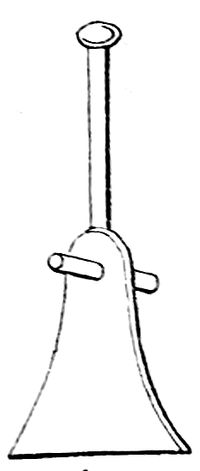
Slice is also the name of an iron implement used in the ink block to transfer the ink from the tub or other receptacle, and to scrape it together in a mass, clear of the balls when ink is taken with them; it has an iron pin through it near the bottom of the handle, so that if it falls flat on the ink block, it will rest on this pin, which prevents the handle from being smeared with ink.
SLIPS.
—In printing encyclopædias, dictionaries of arts or sciences, and similar works, which frequently undergo great alterations in the proofs, they are occasionally pulled on slips of paper, of the length and half the breadth of a demy leaf of paper. This is done on account of the facility of adding new subject matter, or taking some away, without having to overrun and to re-make up the sheet, after it has been imposed in pages.
SLUR
—When from any cause at press, the impression on the paper is smeared, it is said to Slur.
This may arise from many causes—if the tympan joints are loose, it will be produced by the least lateral movement of the tympan after it is turned down—if the ear of the frisket touches the inside of the cheek in running in, it will cause it—if the press runs close, so that the inner tympan touches the face of the platen, it is very likely to slur; and I have often observed this in wooden presses that had been altered to obtain the additional power, for the platen was brought so low and near to the face of the letter in the form, as not to allow room to run in clear. In presses where the tympans are large, if the slur pin does not act, that corner of the tympan will come in contact with the form first, and cause a slur, particularly if the tympans are in any way rickety, or twisted by drawing on the parchment. Where the winter has been justified with cards, to produce a greater spring in the pull, it has been known to produce slurring. The first step towards curing this defect is to ascertain from what cause it arises; and then it is not difficult: but it has often caused great trouble to discover the cause.
The following are my old Pressman’s directions “To prevent Slurring and Maculing;” and though it will be perceived that some of them apply only to wooden presses, yet the whole may be useful.
“1. Keep the face of the inner tympan and platen clean and dry.
“2. Be sure that the parchments are tight both on the inner and outer tympans; also that the tympans are not rickety, nor the joints slack.
“3. Guide cramps are a great preventive to slurring and maculing.
“4. The tenons in the head and winter must exactly fit the mortises in the cheeks.
“5. The short bolts must be screwed tightly up, to fix the nut or box firmly in the head, and must not have the least play.
“6. The garter must fit the spindle and hose, and the spindle must fit the hose, as exactly as possible.
“7. The hose must work perpendicularly, and steady in the shelves.
“8. The platen must be tightly and properly tied, or otherwise fixed, so that it shall come down upon the face of all the types in the form at the same moment.
“9. The wheel must be well justified on the spit.
“10. The railing of the inner tympan must not rub against the platen, in running in or out.
“11. The shanks of the points must not be so far over the outer part of the tympan as to rub against the cheeks of the press.
“12. If a clumsy smith has made the joints of the frisket so thick as to cause the tympan to rub against the face of the platen, he must alter them at his own expense.
“13. The shelves must be quite steady.
“14. The press stone must be worked down with hard pulling until it becomes a fixture.
“15. The frisket must be quite even, and fall flat on the form; and the paper which is pasted on it must not bag.
“16. Fix the winter as solid as possible.
“17. Let the tympans fall easily on the form, neither driving them from you, nor pulling them to you in letting them down; neither let the platen touch them till they are quite run in, nor run them out till the platen is quite clear of them.
“Exclusively of the aforesaid, there may be many other causes of slurring, which the pressman can only discover by close attention. I have often found cork bearers a great preventive.
“I have heard many complaints of the middle pages of a twelves form maculing at a two-pull press; but this is not always the fault of the press. The cause frequently is owing to blankets being in the tympan which have been used for folios, quartos, octavos, &c. &c.; and instead of its being a macule, it is nothing more than that part of the blanket which had covered the short cross of other work, and in the twelves form caused a deep and ugly impression, looking like a macule: this evil can only be remedied by new blankets, or confining the use of them to 12mo. forms.”
SLUR PIN.
—A flat-headed screw, that goes through the off side of the outer tympan, near the head band, so as to rest on the chase or furniture. Its use is to prevent the off corner of the tympan from coming down on the types before the other parts, which when it happens causes slurring.
SMALL CAPITALS.
—Capitals of a smaller size than the regular capitals of a fount, but cast on the same body; thus the small capitals of Double Pica are about the same height as English capitals. They bear off more from each other, and are stouter, in proportion to their size, than the capitals of the same fount. They are used for running titles; for heads of chapters; for emphatic words; and for subordinate lines in titles and jobs. Till of late years small capitals were only cast in England to founts of Roman letter; the type founders cast them now occasionally to Italic letter, and they form a useful sort.
Moxon does not mention small capitals; nor are they in the plan of the cases of Roman letter which he gives in his work. See Sorts.
SMALL NUMBERS.
—Under 1500 laid on, is accounted a small[776] number. See Great Numbers; and see Lay on.—M. We now look on all numbers under 500 to be small numbers.
SMALL PICA.
—The name of a type, one size larger than Long Primer and one smaller than Pica. It is half the body of Double Pica in depth. Moxon does not enumerate it in his Table of the sizes of each body; but, after giving the names of the different types, he says, “These are the bodies most of use in England; but the Dutch have several other bodies: which because there is little and almost no perceivable difference from some of these mentioned, I think they are not worth naming. Yet we have one body more which is sometimes used in England; that is a Small Pica, but I account it no great discretion in a master printer to provide it: because it differs so little from the Pica, that unless the workmen be carefuller than they sometimes are, it may be mingled with the Pica, and so the beauty of both founts may be spoiled.” See Types.
This was published in 1683, and opinion has changed so much respecting this size, that at the present day there are perhaps more works printed with it than with any other size.
SMOUT.
Workmen when they are out of constant work, do sometimes accept of a day or two’s work, or a week’s work at another printing house: this by-work they call Smouting.—M. In fact we only term it smouting when the business of a house is slack, or, in other words, when work is insufficient to employ fully the workmen regularly employed, and they go to some other house for temporary employment, till such time as there is sufficient for them in their own house, when they return.
Soaking Pull. See Easy Pull.—M.
Sockets for the Gallows. See Gallows Sockets.
SOFT INK.
Ink or varnish moderately boiled.—M. It is now generally termed Weak Ink.
The varnish of soft or weak ink is not so strong as that for fine ink; it does not require so much time and labour to distribute it on the balls and rollers, and it more readily covers the face of the type: on these accounts, as well as the expense, it is used for common work, as it enables the pressman to make more riddance; it is also used for machine printing, as the rollers passing rapidly over the forms with their own weight only, are found not competent to coat the face of the type with strong ink.
Soft Pull. See Easy Pull.—M.
Solace. See Ancient Customs.—M.
Solid Dig. See Bad Work.
SOLID MATTER.
Matter that is composed without any leads between the lines, is termed solid matter; in the scale of prices of 1810 it is designated ‘without space lines.’ Previously to that time it was paid the same price as leaded matter, but then there was an advance allowed on it. See Scale.
SOP THE BALLS.
When a pressman has taken too much ink, he is said to sop the balls.—M.
SORTS.
The letters that lie in every box of the case are separately called Sorts in Printers and Founders language; thus, a is a sort, b is a sort, c is a sort, &c.—M.
In houses that have more founts than one of the same sized letter, it would preserve uniformity in the appearance of their work, if the following sorts were all of the same fount in the same sized type, particularly in lists of names, indexes, and articles that run on sorts, as by that[777] means all the sorts in the office might be brought into use, when necessary, which would frequently be of great advantage, both for the convenience of the printer and the appearance of the work: under the present plan, where every fount varies in its proportions and appearance, the printer, in the before-mentioned cases, is put to a great inconvenience and expense, or else has to spoil the appearance of his work by mixing the founts. The adoption of this plan would also be of advantage to the type founder.
Capitals and small capitals.
Figures and fractions.
Metal rules and braces.
Points— , ; : . ! ? ( [ and references * † ‡ § ‖ ¶.
Superiors, and the pound £.
The following additional sorts would also be found useful, and conduce to the more regular appearance of printing.
Accented capitals and small capitals.
Capital and small capital Ç ç.
Points to superiors— , ; : . ’
The Spanish ñ.
SOUNDINGS.
When a pressman has got near the bottom of his heap, and, rapping his knuckles on it, the boards of the horse sound nearly as if he had struck the wood, he says, he is in soundings.
SPACE LINES,
generally called Leads by printers. Thin pieces of type metal, cast to different thicknesses, and different lengths, quadrat high, to put between the lines of matter to make it more open; they are also used to branch out titles, small jobs, and parts of a work where necessary.
SPACE RULES.
Fine lines, cast type high, in short thin pieces, to answer the purpose of brass rule in table work where a number of short pieces of a precise length are required. Two of them are generally equal to a pearl body.
SPACING.
The adjustment of the distance between the words in a line, so that there shall not be any glaring disproportion; also extending a word or a line of capitals by putting spaces between the letters. See Composing.
SPANISH.
Ñ has a peculiar nasal sound, like the French gn: the English have no sound like it, except in the last four letters of the word minion, which bear some resemblance to the last three of the word riñon, in Spanish: as niño, piña.
The note of interrogation is not only used at the conclusion of an interrogatory, but also placed, inverted, at the beginning, in order to warn the reader, unless the preceding words convey a sufficient warning; as ¿ Que es lo que vm. acostumbra? preguntó al enfermo.
The note of admiration is also inverted at the beginning of ejaculations, when the preceding words are not sufficient to prepare the reader; as ¡ Pastas dulces y viandas suculentas! exclamó suspenso y admirado el doctor.—M‘Henry’s Grammar.
SPANISH. [Query, Span-hitch.]
A slight kind of pull at a common wood-press.—Hansard.
SPECIMEN PAGE.
When a new work is put in hand, a specimen page, that is, a page of the proposed size and letter, is composed, and pulled in a neat manner on paper similar to that which is meant to be used. This is to show the effect of the work when printed. It sometimes occurs, that two or three pages are required, of different sizes, and of different letter, before the author or publisher decides in what way the work shall be done. These are called Specimen Pages.
If the work be not proceeded with, these specimen pages are charged by the master printer to his employer; if it goes on, they are included in the general charge.
Spelling. See Orthography.
SPINDLE.
The screw to which the bar of the press is affixed, and which produces the pressure on the platen.
The upper part of the spindle is round, on which a screw is cut, that works in the nut fixed in the head; the next part lower is square, with a square hole in it to receive the end of the bar; the lower part is round and tapering and goes through the hose, to which it is attached by the garter, the spindle having a groove cut round it, into which the two semicircular ends of the garter enter and encircle it, by which contrivance the platen is raised on the return of the bar; the lowest end of the spindle is called the toe, which is hardened steel, and works in the stud of the platen.
SPIRIT.
See Devil.—M. Every chapel is haunted by a spirit, called Ralph. When any man resists the decision of the chapel, and it is determined to enforce it, Ralph, or the spirit, is said to walk; and whatever mischief is done to the resisting party to enforce submission, which is always performed secretly, is invariably imputed to Ralph, or the spirit. See Chapel.
SPIT.
The iron spindle on which the drum or wheel and the rounce are fixed, to run the carriage in and out with. It is square in the middle part, where the wheel is fixed, and has a square end for the rounce to fit on: it works in two pieces of iron, screwed to the outsides of the frame of the wooden ribs.
SPONGE.
Sponge is used both by compositors and pressmen—by compositors, to wet matter that is tied up previous to distributing it—to wet matter that is not tied up, to prevent it going into pie—and in correcting to wet matter, particularly if it be small letter, when it is necessary to transpose it: by pressmen, to wet their tympans with.
SPOTTISWOODE PRESS.
This is a beautiful contrivance, and was, as I understand, the invention of Andrew Spottiswoode, Esq., who has several of them in action in his extensive establishment. It is moved by steam, and prints two forms at the same time, which pass alternately under the platen, producing at its average rate of working seven hundred impressions of each form in the hour.
The frisket is attached to the tympan at the bottom near the tympan joints, so that when the tympan is lifted from the form by the machinery they open at the upper end, contrary to the usual way in presses worked by manual labour, and the printed sheet is left by the tympan resting on the frisket, where the paper was previously laid on.
I believe this is the first successful application of steam, as a motive power, to printing presses with a platen and a perpendicular pressure. I heard the late Alexander Tilloch, Esq., say that he intended to apply it to the presses with which the Star newspaper was printed, but he never carried it into effect; and Mr. Koenig came to England solely for this purpose; but after some years passed in making experiments, assisted by English capital, he was completely foiled in the attempt, and afterwards worked upon Mr. Nicholson’s plan, and produced a machine to print with cylinders.—See Machine.
SPRING OF A FORM.
When a form has a great quantity of furniture in it, and is locked up very tight, it frequently springs up in the middle, so as to endanger its bursting upward; it is then said, the form springs, or it is termed the spring of the form.
In this case it is advisable to examine the furniture, for some pieces may not be planed square by the joiner, and to change them for others[779] of the same size that appear perfect, and do not lock up very tight; tighten the quoins gradually, and frequently plane down while you are locking up; these measures will generally remedy the evil.
SPUR.
The point that pricks the hole in the paper at press, to make register with.
SQUABBLE.
A page or form is squabbled when the letters of one or more lines are got into any of the adjacent lines; or that the letter or letters are twisted about out of their square position.—M.
Stack of Books. See Pile of Books.
STACK OF PAPER.
When paper is received into the warehouse from the stationer, it is piled up in tiers of four, five, six, or eight bundles in each tier, and is called a stack of paper, or a pile of paper.
The warehouseman in piling his paper considers the height of his room, that he may not take up more of the floor than is absolutely necessary, to enable him to stow as much as possible: thus, if he receive one hundred reams, and has height, he will make a stack of six in preference to two or four or five. He crosses the joinings of the bundles in each tier to bind them together, as a bricklayer does in building a square pillar; and I have always found the stack strengthened by laying on every third or fourth tier a number of stout wrappers spread over the bundles.
Paper should never be stacked without interposing something between the bottom of it and the floor, to prevent any water that might accidentally be spilled coming in contact with it, which would certainly mildew and spoil it if it were not perceived at the first; and even then it would require a great deal of trouble to prevent it: where there are not regular stages made, some short pieces of old poling laid a little distance from each other upon the floor will answer very well.
STAGE.
A platform raised a few inches from the floor, to pile books or paper upon, for the purpose of preserving the bottom of the pile from injury, in case of water being spilt in the warehouse.
Where there are no regular stages in a warehouse, substitutes, which answer the purpose very well, may be easily provided, by taking an old paper board, or any pieces of board, and putting three pieces of an old pole under each of them on which to pile the books.
STAINING OF PAPER.
The master printers of the metropolis, till within a few years, dined together annually at some good coffee house or tea gardens in the vicinity of London; and one of the regular toasts after dinner was, “The well-staining of Paper.”
STAMPS.
3 & 4 W. 4. c. 97. s. 12. It is among other things enacted, That * * * * “if any Person shall fraudulently use, join, fix, or place for, with, or upon any Vellum, Parchment, or Paper any Stamp, Mark, or Impression which shall have been cut, torn, or gotten off or removed from any other Vellum, Parchment, or Paper; * * * * then and in every such Case every Person so offending, and every Person knowingly and wilfully aiding, abetting, or assisting any Person in committing any such Offence, and being thereof lawfully convicted, shall be adjudged guilty of Felony, and shall be liable, at the Discretion of the Court, to be transported beyond the Seas for Life, or for any term not less than seven Years, or to be imprisoned for any Term not exceeding four Years nor less than two Years.”
STAND STILL.
A compositor is said to stand still, if he be out of copy, or out of letter: a pressman, if he has not a form to lay on, or is prevented working by any other cause. A compositor says he is standing still for copy, or for letter—a pressman says he is standing still for a form, &c.
STANHOPE PRESS.
The merits of the Stanhope press, and its superiority, are so well established in the minds of printers, from long experience[780] of its valuable properties, that any additional praise from me would be an act of supererogation; I shall therefore confine myself to giving engravings of it, and a rather full description.
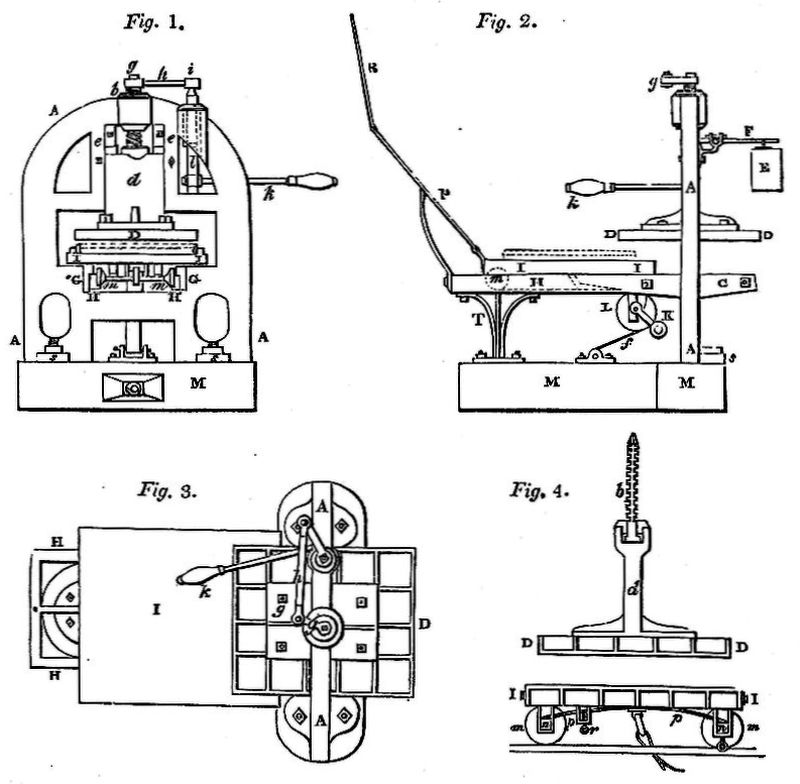
Fig. 1. Fig. 2.
Fig. 3. Fig. 4.
Figs. 1. and 2. are elevations, fig. 3. a plan, and fig. 4. a section. A A is a massive frame of cast iron, formed in one piece: this is the body of the press, in the upper part of which a nut is fixed for the reception of the screw b, and its point operates upon the upper end of a slider, d, which is fitted into a dovetail groove formed between two vertical bars, e, e, of the frame. The slider has the platen, D D, firmly attached to the lower end of it; and being accurately fitted between the guides e, e, the platen must rise and fall parallel to itself when the screw, b, is turned. The weight of the platen and slider are counterbalanced by a heavy weight, E, behind the press, which is suspended from a lever, F, and this acts upon the slider to lift it up, and keep it always bearing against the point of the screw. At G G are two projecting pieces, cast all in one with the main frame, to support the carriage when the pull is made; to these the rails, H H, are screwed, and placed truly horizontal for the carriage, I, to run upon them, when it is carried under the press to receive the impression, or drawn out to remove the printed sheet. The carriage is moved by the rounce or handle K, with a spit and leather girths, very similar to the wooden press. Upon the spit, or axle of the handle K, a wheel, L, is fixed, and round this leather girths are passed, one extending to the back of the carriage to draw it in, and the other, which passes round the wheel in an opposite direction, to draw it out. By this means,[781] when the handle is turned one way it draws out the carriage, and by reversing the motion it is carried in. There is likewise a check strap, f, from the wheel down to the wooden base, M M, of the frame, and this limits the motion of the wheel, and consequently the excursion of the carriage. The principal improvement of Earl Stanhope’s press consists in the manner of giving motion to the screw, b, of it, which is not done simply by a bar or lever attached to the screw, but by a second lever; e. gr. the screw, b, has a short lever, g, fixed upon the upper end of it, and this communicates by an iron bar, or link, h, to another lever, i, of rather shorter radius, which is fixed upon the upper end of a second spindle, l, and to this the bar or handle, k, is fixed. Now when the workman pulls this handle, he turns round the spindle, l, and by the connexion of the rod, h, the screw, b, turns with it, and causes the platen to descend and produce the pressure. But it is not simply this alone, for the power of the lever, k, is transmitted to the screw in a ratio proportioned to the effect required at the different parts of the pull; thus at first, when the pressman takes the bar, k, it lies in a direction parallel to the frame, or across the press, and the short lever, i, (being nearly perpendicular thereto,) is also nearly at right angles to the connecting rod h; but the lever, g, of the screw makes a considerable angle with the rod, which therefore acts upon a shorter radius to turn the screw; because the real power exerted by any action upon a lever, is not to be considered as acting with the full length of the lever between its centres, but with the distance in a perpendicular drawn from the line in which the action is applied to the centre of the lever. Therefore, when the pressman first takes the handle, k, the lever, i, acts with its full length upon a shorter length of leverage, g, on the screw, which will consequently be turned more rapidly than if the bar itself was attached to it; but on continuing the pull, the situation of the levers change, that of the screw, g, continually increasing in its acting length, because it comes nearer to a perpendicular with the connecting rod, and at the same time the lever, i, diminishes its acting length, because, by the obliquity of the lever, the rod, h, approaches the centre, and the perpendicular distance diminishes; the bar or handle also comes to a more favourable position for the man to pull, because he draws nearly at right angles to its length. All these causes combined have the best effect in producing an immense pressure, without loss of time; because, in the first instance, the lever acts with an increased motion upon the screw, and brings the platen down very quickly upon the paper, but by that time the levers have assumed such a position as to exert a more powerful action upon each other, and this action continues to increase as the bar is drawn forwards, until the lever, i, and the connecting rod are brought nearly into a straight line, and then the power is immensely great, and capable of producing any requisite pressure which the parts of the press will sustain without yielding. The handle is sometimes made to come to rest against a stop, which prevents it moving further, and therefore regulates the degree of pressure given upon the work; but to give the means of increasing or diminishing this pressure for different kinds of work, the stop is made moveable to a small extent. Another plan is adopted by some makers of the Stanhope press, viz. to have a screw adjustment at the end of the connecting rod, h, by which it can be shortened; it is done by fitting the centre pin which unites it to the lever, g, in a bearing piece, which slides in a groove formed in the rod, and is regulated by the screw. This shortening of the connecting rod produces a greater or less descent of the platen, when the handle is brought to the stop.
The carriage of the press is represented with wheels, m, m, beneath, to take off the friction of moving upon the ribs, HH. These wheels are shown at fig. 4., which is a section of the screw and the platen, with the carriage beneath it: their axles, n, are fitted to springs, p, and these are adjustable by means of screws, r, so that the carriage will be borne up to any required height. This is so regulated, that when the carriage is run into the press, its lower surface shall bear lightly upon the solid cheeks, G, which are part of the body of the press, and these support it when the pressure is applied, the same as the winter of the old press: but the wheels by their springs act to bear up great part of the weight of the carriage with the types upon it, and diminish the friction, yet do not destroy the contact of the carriage upon the ribs, because this would not give the carriage that solidity of bearing which is requisite for resisting the pull. This is only at the time when the carriage is run into the press, because as it runs out, the ribs on which the wheels run rise higher, and therefore the wheels support the whole weight. The manner in which the wheels run in rebates or recesses in the edges of the ribs is shown at fig. 1. The carriage is made of cast iron, in the form of a box, with several cross partitions, which are all cast in one piece, and although made of thin metal, are exceedingly strong: the upper surface is made truly flat, by turning it in a lathe. The same of the platen, which is likewise a shallow box: the slider, d, has a plate formed on the lower end of it, which is fixed by four screws upon the top of the platen, and thus they are united. At the four angles of the carriage, pieces of iron are screwed on, to form bearings for the quoins or wedges which are driven in to fasten the form of types upon it in the true position for printing. The tympan, P, (fig. 2.) is attached to the carriage by joints, with an iron bracket or stop to catch it when it is thrown back: the frisket, R, is joined to the tympan, and when opened out, rests against a frame suspended from the ceiling. The register points are the same as in the wooden press, and all the operations of working are exactly the same. The iron frame, A, of the press is screwed down upon the wooden base, M, by bolts, which pass through feet, s s, projecting from the lower part of the iron frame. Another wooden beam is fixed into the former at right angles, so as to form a cross, which lies upon the floor. The ribs, H, for the carriage to run upon are supported from the wooden base by an iron bracket, T.
The advantages of the iron presses in working are very considerable, both in saving labour and time. The first arises from the beautiful contrivance of the levers, the power of the press being almost incalculable at the moment of producing the impression; and this is not attended with a correspondent loss of time, as is the case in all other mechanical powers, because the power is only exerted at the moment of pressure, being before that adapted to bring down the platen as quickly as possible. This great power of the press admits of a saving of time, by printing the whole sheet of paper at one pull, the platen being made sufficiently large for that purpose; whereas, in the old press, the platen is only half the size of the sheet. In the Stanhope press, the whole surface is printed at once, with far less power upon the handle than the old press. This arises not only from the levers, but from the iron framing of the press, which will not admit of any yielding, as the wood always does, and indeed is intended to do, the head being packed up with elastic substances, such as scaleboard, pasteboard, and the felt of an old hat. In this case much power is lost, for in an elastic press the pressure is gained by screwing or straining the parts up to a certain degree of[783] tension, and the effort to return produces the pressure: now in this case, the handle will make a considerable effort to return, which, though it is in reality giving back to the workman a portion of the power he exerted on the press, is only an additional labour, as it obliges him to bear the strain a longer time than he otherwise would. The iron presses have very little elasticity, and those who use them find it advantageous to diminish the thickness of the blankets in the tympan; the lever has then very little tendency to return; in fact, if the pull be so justified as that, when the bar is pulled home, the end of the lever, i, that is attached to the connecting rod, h, passes in a small degree the centre of the second spindle, l, the pressure is past its maximum power, the press bar has no tendency to return, and the pressman can rest upon his pull in fine work, without any exertion.
Stationers’ Company. See Donations.
STEM.
—The straight flat strokes of a straight letter is called stem.—M.
STEREOTYPE.
—The surface of a page of types cast in one piece, of type metal, about the eighth of an inch thick, and turned in a lathe at the back of the plate, so that the whole of the plates of a volume shall be of one uniform thickness.
When they are required to be printed they are mounted on what are called Risers: these risers, with the thickness of the stereotype plate, are precisely the same height as the types, so that when a form is composed of stereotype plates and types, the pressure shall be equal on both.—See Risers.
The spaces and quadrats are cast higher than for the common process; and when the form is ready, the face of it is oiled with a brush, then burnt plaster of Paris (gypsum) mixed with water to the consistence of cream is poured upon it; when the plaster is sufficiently hardened it is taken off from the types and forms a matrix in which to cast a facsimile of the types; this matrix is then placed in an oven to dry, and made hot, when it is secured in a frame and immersed in a caldron of melted metal, where it remains some time; when it is taken out, and cool, it goes to a person styled the Picker, to remove any superfluous metal, and to remedy any defects; it is then, generally, turned at the back to a specific thickness, and to remove any inequalities; after this it is ready for press. For the details of the process I refer the reader to “An Essay on the Origin and Progress of Stereotype Printing: including a Description of the various Processes. By Thomas Hodgson, Newcastle: printed by and for S. Hodgson, &c. 1820.”
This process was first practised by William Ged, of Edinburgh, who commenced in the year 1725. After much perseverance he formed an engagement with the University of Cambridge to print Bibles and Prayer-books; but the plan received so much opposition from the workmen, in making errors and batters, that it was discontinued, and the plates were ultimately sent to Mr. Caslon’s foundery to be melted down. Mr. Hansard, in his Typographia says,—“But a remnant escaped from Caslon’s cormorant crucible; and I have the opportunity of here presenting my readers with an opposite view of a pair of the very malefactors; and challenge any other to dispute the palm of venerable antiquity with them: they have been rather roughly treated, but besides the purpose for which they are here exhibited, will serve to show the style of type, typography, and stereotype of those days.”
Mr. Tilloch had a page of Ged’s casting given to him by Mr. Murray, of Fleet Street, bookseller, which I have seen: there is also a plate of[784] Ged’s casting, at the Royal Institution, containing fourteen pages of a Common Prayer, presented by Mr. Frederick Kanmacher, of Apothecaries Hall, from which I had impressions printed.—See “Biographical Memoirs of William Ged. By John Nichols.” 8vo. London, 1781. “Dissertation upon English Typographical Founders and Founderies, by Edward Rowe Mores, A. M. and A. S. S.”
Stereotype-Plate Risers. See Risers.
STET.
When a word has been struck out, in reading a proof, and it is afterwards decided that it shall remain, then it is usual to make dots under the word which has had the pen run through it and write the word stet opposite to it in the margin, which is the third person singular, imperative mood, of the neuter verb sto, to stand, to endure, or abide.—See Correcting.
STICK.
The composing stick, commonly so called.—M. See Composing Stick.
STICKFULL.
When a compositor has arranged as many lines in his composing stick as it will contain, it is termed a stickfull.—M.
Stiff Justifying. See Hard Justifying.
STOLEN PROPERTY.
The Act of the 25th of Geo. II. c. 36. s. 1. inflicted a penalty of fifty pounds upon any person who should print or publish any advertisement offering a reward for the recovery of any property that had been stolen and no questions asked; this section has been repealed by the Act of the 7 & 8 Geo. IV. c. 27., one of Mr. Peel’s Acts; and by another of Mr. Peel’s Acts, of the 7 & 8 Geo. IV. c. 29. s. 59., it is re-enacted, with some verbal alterations and the addition of the words “or lost,” as may be perceived by the following extract, which it is of importance for printers to be acquainted with.
s. 59. “That if any Person shall publicly advertise a Reward for the Return of any Property whatsoever, which shall have been stolen or lost, and shall in such Advertisement use any Words purporting that no Questions will be asked, or shall make use of any Words in any public Advertisements purporting that a Reward will be given or paid for any Property which shall have been stolen or lost, without seizing or making any Enquiry after the Person producing such Property, or shall promise or offer in any such public Advertisement to return to any Pawnbroker or other Person who may have bought or advanced Money by Way of Loan upon any Property stolen or lost, the Money so paid or advanced, or any other Sum of Money or Reward for the Return of such Property, or if any Person shall print or publish any such Advertisement, in any of the above Cases, every such Person shall forfeit the Sum of Fifty Pounds for every such Offence, to any Person who will sue for the same by Action of Debt, to be recovered with full Costs of Suit.”
s. 69. By this section it is enacted, “That it shall be lawful for the King’s Majesty to extend his Royal Mercy to any Person imprisoned by virtue of this Act, although he shall be imprisoned for Nonpayment of Money to some Party other than the Crown.”
Stops. See Points.
Strahan, Andrew. See Donations.
Strahan, William. See Donations.
STRIP A FORM.
Taking the furniture away from the pages.—M.
STROKES.
Strokes are fat, lean, fine, hair.—M. The hair strokes of letters are now termed ceriphs by the founders.
STRONG INK.
Ink made with a powerfully binding varnish, so as to prevent the separation of the colouring matter and the spread of the varnish in the paper. It is usually made with superior colouring materials, and more care taken in grinding it than with common ink. See Engravings on Wood; Fine Presswork; and for more details I refer the reader to my treatise on the Preparation of Printing Ink.
STUD.
A piece of hardened steel, a little hollowed at the top, on which the toe of the spindle works. It is square on the outside, and[785] fitted into the cup of the platen, but so as to be taken out, when it wants altering or repairing.
SUMMER.
In a press, a piece of wood nailed across the wooden ribs on the under side, close to the winter, to keep them steady in their place.
In Moxon’s time a summer was for a different purpose; viz. to prevent the cheeks of the press from springing open; the winter was dovetailed into the cheeks, to answer this purpose: after describing the winter, he adds—
“But yet I think it very convenient to have a Summer also, the more firmly and surer to keep the cheeks together; this Summer is only a Rail Tennanted, and let into Mortesses made in the inside of the Cheeks, and Screwed to them with long Screws, similar to those used for Bed-Posts; its depth four Inches and an half, and its breadth eight Inches, viz. the breadth of the Cheeks.”
Sunday, Public Meeting on. See Public Meetings.
SUPERIORS.
Superiors are small letters and figures, upon the upper part of the shank of the body, so that they range with the top of the letter to which they belong; as, abcdefgh, 1234567890; they are generally used as references to notes, and occasionally in abbreviated words; as Mr, Master; Mrs, Mistress; Do, Ditto; No, (Numero,) for Number, and in many other instances; also in contracted words, in the printed Records. See Records. References. It would be a convenience if the type founders would cast the , ; : and . to them, as it has not a good appearance, when a point is necessary, to see a comma or any other point used that has been cast for the regular body; it is too large, and does not range in line.
Supernumeraries. See Newspapers.
SWASH LETTERS.
In the seventeenth century Italick capitals, in which some of the letters had their terminations projecting considerably beyond the shank, were in use: this projection was called a swash; as—

SWEDISH.
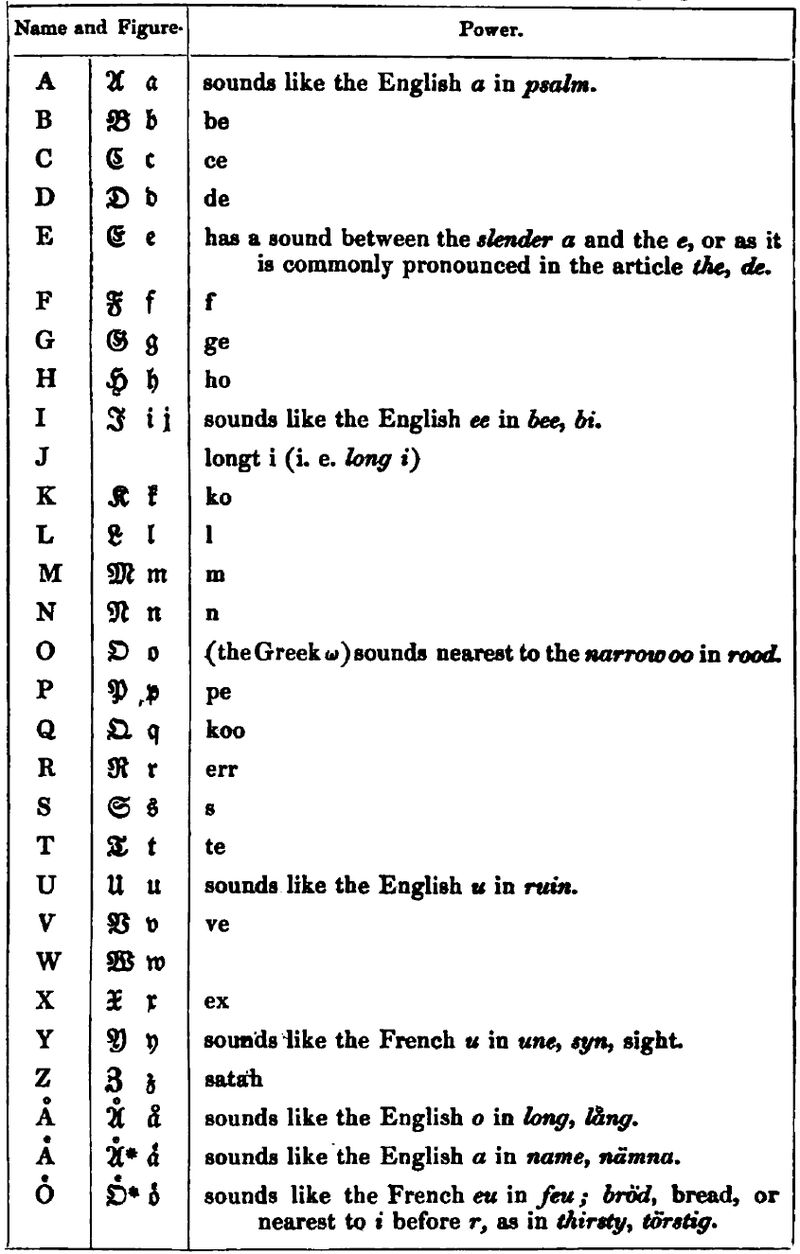
The Swedish Alphabet consists of twenty-eight letters.
| Name and Figure. | Power. | |
| A | A a | sounds like the English a in psalm. |
| B | B b | be |
| C | C c | ce |
| D | D d | de |
| E | E e | has a sound between the slender a and the e, or as it is commonly pronounced in the article the, de. |
| F | F f | f |
| G | G g | ge |
| H | H h | ho |
| I | I i j | sounds like the English ee in bee, bi. |
| J | longt i (i. e. long i) | |
| K | K k | ko |
| L | L l | l |
| M | M m | m |
| N | N n | n |
| O | O o | (the Greek ω) sounds nearest to the narrow oo in rood. |
| P | P p | pe |
| Q | Q q | koo |
| R | R r | err |
| S | S s | s |
| T | T t | te |
| U | U u | sounds like the English u in ruin. |
| V | V v | ve |
| W | W w | |
| X | X x | ex |
| Y | Y y | sounds like the French u in une, syn, sight. |
| Z | Z z | satah |
| Å | Å å | sounds like the English o in long, lång. |
| Ä | Ä* ä | sounds like the English a in name, nämna. |
| Ö | Ö* ö | sounds like the French eu in feu; bröd, bread, or nearest to i before r, as in thirsty, törstig. |
The order they here stand in is that of the Swedish Alphabet.
* These letters in the Roman characters are Ä and Ö.
The Swedish language has no diphthongs. When two vowels occur together, they must both be heard, as bēēdiga, brōār.—Brunnmark’s Swedish Grammar. London, 1805.
SWEEPINGS.
When the boys sweep the composing room in a morning, all the letters and spaces that are on the floor in each frame are carefully gathered up and placed on the bulk belonging to it, and it is the customary rule for the compositor to distribute them the first thing; what are swept together from the middle of the room are collected from the dust before it is taken away, and put in some appointed place for the person who has the care of the materials to distribute.
Swift. See Fire Eater.
Symbols, Chemical. See Formulæ.
SYRIAC.
Under this appellation are classed three different alphabets.
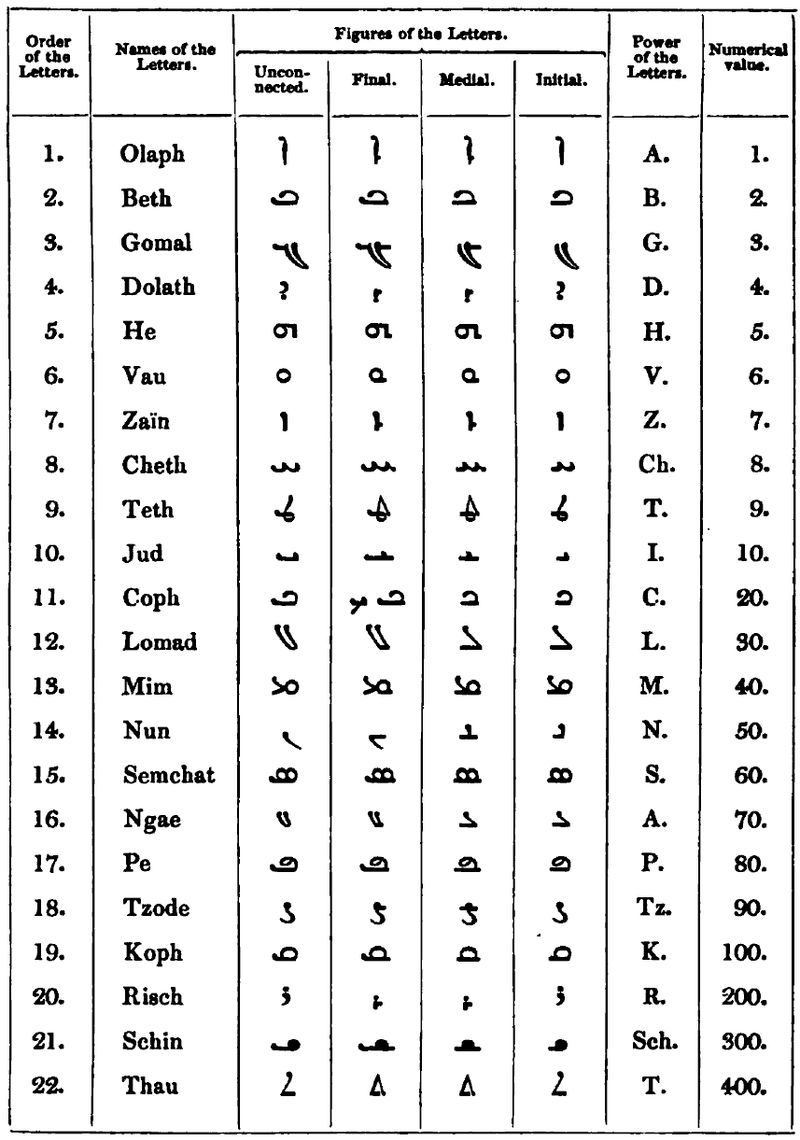
Key to Column Headers—
U - Unconnected.
F - Final.
M - Medial.
I - Initial.
PL - Powers of the Letters.
NV - Numerical Value.
| Order of the Letters. |
Names of the Letters. |
Figures of the Letters. | PL | NV | |||
| U | F | M | I | ||||
| 1. | Olaph | ܐ | ܐ | ܐ | ܐ | A. | 1. |
| 2. | Beth | ܒ | ܒ | ܒ | ܒ | B. | 2. |
| 3. | Gomal | ܓ | ܓ | ܓ | ܓ | G. | 3. |
| 4. | Dolath | ܕ | ܕ | ܕ | ܕ | D. | 4. |
| 5. | He | ܗ | ܗ | ܗ | ܗ | H. | 5. |
| 6. | Vau | ܘ | ܘ | ܘ | ܘ | V. | 6. |
| 7. | Zaïn | ܙ | ܙ | ܙ | ܙ | Z. | 7. |
| 8. | Cheth | ܚ | ܚ | ܚ | ܚ | Ch. | 8. |
| 9. | Teth | ܛ | ܛ | ܛ | ܛ | T. | 9. |
| 10. | Jud | ܝ | ܝ | ܝ | ܝ | I. | 10. |
| 11. | Coph | ܟ | ܟ | ܟ | ܟ | C. | 20. |
| 12. | Lomad | ܠ | ܠ | ܠ | ܠ | L. | 30. |
| 13. | Mim | ܡ | ܡ | ܡ | ܡ | M. | 40. |
| 14. | Nun | ܢ | ܢ | ܢ | ܢ | N. | 50. |
| 15. | Semchat | ܣ | ܣ | ܣ | ܣ | S. | 60. |
| 16. | Ngae | ܥ | ܥ | ܥ | ܥ | A. | 70. |
| 17. | Pe | ܦ | ܦ | ܦ | ܦ | P. | 80. |
| 18. | Tzode | ܨ | ܨ | ܨ | ܨ | Tz. | 90. |
| 19. | Koph | ܩ | ܩ | ܩ | ܩ | K. | 100. |
| 20. | Risch | ܪ | ܪ | ܪ | ܪ | R. | 200. |
| 21. | Schin | ܫ | ܫ | ܫ | ܫ | Sch | 300. |
| 22. | Thau | ܬ | ܬ | ܬ | ܬ | T. | 400. |
The first and most ancient of these, called Estranghelo, is formed with square rectangular characters; another alphabet, a little smaller, has letters slightly differing from the first, for greater facility in writing; the third is that known generally by the name of Syriac, and is the only one existing in type in England. The Syriac reads from right to left.
Olaph, when followed by Lomad, is written obliquely, as ܐܰܠܗܳܐܳ. But when Lomad is followed by Olaph, it is written in the beginning of words thus, ܠܐܳ not; in the middle thus, ܓܷܠܿܓ he is bewailed; and at the end thus, ܓܰܠܠ it rolls.
The pronunciation of the letters is the same as in Hebrew and Chaldee; yet it may be observed, (1.) that Olaph, in certain cases, takes the sound of Jud, as, ܐܳܐܰܪ ojar air, ܡܠܵܐܐܵ mlojo fulness, ܣܐܷܵܡ sojem placing; (2.) that Vau initial is to be pronounced ܠܷܗܲܕ as the consonant v, but when medial or final, as the vowel u; (3.) that initial Jud with Chebhozo is pronounced as i, as, ܝܻܠܷܦ ileph he learned; (4.) that Ngae followed by He has the sound of ܐܷ, as, ܠܷܗܲܕ ehadh he remembered; and (5.) that the aspirated sibilant Schin has no peculiar point by which it may be distinguished from the simple sibilant Sin.
The numbers are expressed by the same letters as in Hebrew, excepting that ܝܗ denotes 15, ܩ 20, and ܢ 50. A point above the line is used to convert the tens into hundreds, as ܝܿ 100, ܟܿ 200, ܠܿ 300, &c., although the four first hundreds may be expressed also by the four last letters of the alphabet. An oblique line, slanting to the right, under the first nine letters, serves to denote thousands, as ܐ݈ 1000, ܒ݈ 2000; and a similar line, but transverse, designates the tens of thousands, as ܐ̱ 10,000, ܒ̱ 20,000.
The vowels are five in number, which are represented either by figures or by points, according as the ancient or modern system is followed, but very frequently both are met with together. The simple vowels are—
| A | E | I | O | U |
| ܐܰ | ܐܷ | ܐܻ | ܐܳ | ܐܘܶ |
and both figures and points are joined with consonants in the following manner:—
Petocho ܒܰ or ܒܲ ba.
Rebhozo ܒܷ or ܒܸ or ܒֽܸbe.
Chebhozo ܒܻ or ܒܹ bi.
Zekopho ܒܳ or ܒܵ bo.
Ozozo ܒܘܽ or ܒܘܿ or ܒܘܼ bu.
Formerly the marks for the vowels E and I were only written below the line, as ܒܷ be and ܒܻ bi; and the vowels A, O, and U, were only written above, as ܒܰ ba, ܒܳ bo, ܒܽ bu; but now they are placed sometimes above and sometimes below, as may be most convenient in writing. The points never change their places.
Zekopho does not give precisely the sound of o, but an obscure sound between o and a, as we find in 1 Cor. xvi. 22. ܡܓܳܪܰܢ ܐܳܬܐ Maran-atha, and in Mark xiv. 36. ܐܰܒܳܐ Abba.
Ozozo is never written without Vau (ܘ), except in ܒܽܠ all, and ܡܷܓܛܾܠ because of.
When the point Ozozo is above the line, it denotes Kibbutz; but when below the line, Shurek.
The diphthongs are formed by the combination of the vowels with the points, of which these are the most used, ܓܰܘ au, ܓܰܝ ai, ܓܳܝ oi, ܘܳ ou.
The vowel marks are not always annexed to the letters to which they belong, but sometimes to the preceding or subsequent letter, and sometimes omitted altogether, so that grammatical analogy must always be attended to by the reader, as, for example, in the word ܒܰܢܝܓܳ of a son, the point ܒܰ does not belong to the ܒ over which it is placed, but to the ܢ following.
Three letters (ܐ ܘ ܝ) become quiescent under certain circumstances. Olaph, with the vowels Petocho, Rebhozo, and Zekopho in the middle and at the end of a word; with Chebhozo only at the end. Vau always with Ozozo, and in foreign names also with Zekopho. Lastly, Jud with Rebhozo and Chebhozo.
Olaph never allows of sheva before it, but brings its own vowel into its place, and in that case becomes quiescent.
The vowels are doubtful as respects their quantity, and at one time are short, and at another long; the difference is to be traced from analogy.
There are also two points, called Kuschoï and Ruchoch, used for showing the peculiar power of certain letters, and generally distinguished in manuscripts by a difference in the colour of the ink. Kuschoï is a point placed above the six letters ܒ݁ ܓ݁ ܕ݁ ܟ݁ ܦ݁ ܬ݁ begadcephat. It answers to the dagesh in Hebrew, and takes away the aspiration properly belonging to those letters; thus ܒ݁ is equivalent to b, ܓ݁ to g, ܕ݁ to d, ܟ݁ to k, ܦ݁ to p, ܬ݁ to t, also to bb, gg, dd, kk, pp, tt. Ruchoch is a point placed below the six letters ܒ݂ ܓ݂ ܕ݂ ܟ݂ ܦ݂ ܬ݂ begadcephat; it shows that the letters are to be aspirated, and answers to the Hebrew raphe; thus ܒ݂ is equivalent to bh, ܓ݂ to gh, ܕ݂ to dh, ܟ݂ to the Greek χ, ܦ݂ to φ, ܬ݂ to θ. These points are rarely expressed, unless where there is an ambiguity to be explained.
Besides those before spoken of, certain lines or points are also employed, having a use partly in orthography, and partly in etymology. To orthography belong—
1. A small transverse line written above combined numbers, or contracted words, as ܝ̅ܗ 15, ܬܫܟ̅ܘ for ܬܫܟܘܽܝܛܐܵ praise.
2. A similar small line, called virgula occultans, under certain letters, which, when indicated thus, are of no value, and to be passed over in reading, so as scarcely to be heard in pronunciation. Thus ܩܳܪܐ ܐ̱ܙܵܐ [790] is not pronounced kore ano, but koreno; and ܐܳܡܪ ܐ̱ܙܵܐ not omar ano, but omarno. Olaph, Dolath, He, Lomad, Nun, and Risch, are the letters most subject to its influence.
3. A diacritical point, changed in its situation in order to avoid an ambiguity in reading. The following may be taken as cases of this sort:—
| ܒܝܿܫܐ בַיְשָׁא miserable. | ܒܝܼܫܐ בִישָׁא evil. |
| ܒܿܟܝܐ בָכְּיָּא weeping (part.). | ܒܼܟܝܐ בֶכְיָא weeping (subs.). |
| ܕܟܙܿܐ דְיָנָא a judge. | ܕܟܙܼܐ דִינָא judgment. |
The following belong to etymology:—
1. Two points are used to distinguish the numbers of nouns, because there is often no variation of case or of termination, or mutation of letters, to distinguish the singular from the plural. These two points are called Ribbui, multitude, and are placed over the letter, similarly to the Hebrew tzeri, in this manner ܒ̈. But if Risch (ܪ), which always has a point above it, to distinguish it from the Dolath (ܕ), should occur in the word, then the single point of Risch coalesces with the double point thus, ܩܲܩܪ̈ܐ. In the verbs, the double point indicates the feminine third person plural of the preterites.
2. A point is placed beneath the line in all the persons of the preterite (excepting the first person singular, where it is placed above), and besides this, the third person singular has another at the left side.
3. The present active participle has a point above the line, but when Vau is in the middle of the word, the point is placed below.
4. The infinitive and imperative often have a point placed beneath them, but this is not regular.
5. The second and third persons of the future have a point below the line, but the first person has the point above.
6. The imperatives of all the passives require the virgula under the second vowel.
There are no accents expressed in Syriac. The stress in pronunciation ought to be laid on the last or penultimate syllables; and in this respect the analogy of the Chaldee is to be attended to.
In the derivation of words from the Hebrew, letters may frequently undergo mutation with others of the same class, or of the same organ, and also sibilants with linguals.
The servile letters are eleven in number, as in Hebrew, and are the same, saving that Dolath is servile, and on the other hand Schin is radical.
The preceding observations are extracted from Gaspar Waser’s Grammatica Syra, Leyden, 1619, and from Jacob Alting’s Synopsis Institutionum Chaldæarum et Syrarum, Frankfort-on-the-Main, 1717.
Syriac in the British Founderies.
Double Pica. V. & J. Figgins; cut under the direction and partly at the expense of the late Claudius Buchanan.
English. Caslon; cut for Walton’s Polyglot, 1657. V. & J. Figgins; cut under the same circumstances as the Double Pica. Oxford.
Long Primer. Caslon. Fry, to Thorowgood and Besley. V. & J. Figgins; cut under the same circumstances as the Double Pica.
Brevier. V. & J. Figgins; cut under the same circumstances as the Double Pica.
Nonpareil. Fry, to Thorowgood and Besley; cut for Bagster’s Polyglot.
TABLE WORK.
Figure work, &c., composed with column rules, consisting of five columns or more. It is paid double the price of common matter at case.
TABULAR.
Figure work, &c., composed with column rules, consisting of three or four columns. It is paid one and a half the price of common matter.
TAIL PIECES.
Ornaments placed in a short page to fill up the vacancy. The same observations apply to Tail Pieces as to Head Pieces, which see; as also Fac.
TAKE INK.
Dabbing a ball upon the ink block for it to receive a small quantity of ink to distribute on the two balls.—M. It is equally termed Taking Ink when rollers are used.
TAKING DOWN.
Taking the sheets from the poles with a peel when they are dry.
Take-off. See Ancient Customs; also Fly. Boys are employed in machine printing to take away the sheets as they are printed, and to lay them straight and even; this is also styled Taking-off, and the boys taking-off boys.
TAKE UP.
To take letters up with a composing rule to distribute.—M. When a compositor is distributing, he places his composing rule against the head of the matter he means to take up, and putting the sides of his two third fingers, near the ends, to the ends of the rule, and the sides of his fingers against the sides of the matter, with his fore fingers at the extreme end, round the corners of the matter he intends to take up, and the ends of his thumbs against the back of the rule, he thus grasps it, and then generally tries if it will lift, when by a sudden lifting of the bottom end of the matter, and turning up of the rule with his thumbs, he raises it from the board to a perpendicular direction, resting on the rule; and turning it with the face of the letter to him, with one part of the rule resting on the third finger of his left hand, and the other end against the ball of his thumb, while the sides of the matter are guarded by his thumb and forefinger, when the measure is not too wide, he begins to distribute.
In like manner he takes up matter to move from one galley to another, when he is making up; except that he places his rule against the foot of the matter, and when he grasps it he does not raise it perpendicularly, but lifts it to him under his hands, his forefinger being against the rule, and his thumbs grasping the head of the matter.
A stranger to the business would be surprised to see the number of lines of types that an expert compositor will lift in this manner.
Take up a Sheet. See Ancient Customs.—M. It appears that in Moxon’s time the compositor had a copy of each work he was engaged on, or received what was termed copy money in lieu of it. This custom is abolished; and no workman is permitted to take a copy of any thing that is printed in the house as a matter of right.
TAKING COPY.
A compositor receiving copy from the overseer, or other person who has the charge of it, to compose; if in a companionship, the clicker receives it, and gives it out to the companions.
TAKING OFF.
Part of a page taken up to distribute.—M. Obsolete.
Taleek. See Persian.
TAMUL.

THE TAMUL ALPHABET.
க—As a medial, this letter has, when single, the sound of gh; when double, of kk. As an initial also it represents gh in certain words derived from the Sanscrit.
ச—This letter has, when single, the sound of s, sh, and the French g in âge; when double, it has the sound of ch. In words of Sanscrit origin, it represents the ja and cha of the Sanscrit alphabet.
த—This letter, when combined with [#], has the sound of the French n in Ange.
ட—This letter has, when single, the sound of d; when double, of tt, with a strong cerebral articulation.
த—As a medial, this letter has, when single, the sound of d; when double of tt. As an initial, also, it represents d in certain words of Sanscrit origin.
ந—This is the initial n. It is medial only before த.
ப—As a medial, this letter has, when single, the sound of b; when double, of pp. And in certain words of Sanscrit origin it has, as an initial also, the sound of b.
ழ—This letter is articulated somewhat like the hard ṛ of the Hindustani alphabet. It may be said to possess generally as a medial, the sound of r, and as a final, that of l, with a cerebral articulation.
ற—This letter has, when single, the sound of rr; and, when double, the sound of a double tt.
The word “soul,” is used metaphorically in Tamul for a vowel; the word “body,” for a consonant; and the compound word “soul and body,” for a syllable. In the same metaphorical language, a consonant is termed “a dead letter.”
It will be seen, in the foregoing scheme, that when the short vowel a is employed to give utterance, or (to adopt the metaphor of the Tamul grammarians) animation to the consonants, no additional character is required; it being considered to be inherent in each consonant, as essential to its original articulation. The removal of this originally inherent vowel is usually denoted by a dot or a small circle placed over the consonant, as ன் (n), ர் (r).
In the elegant dialect, a character written thus ஃ, and termed āyadam, is used in addition to the ordinary letters of the alphabet. It is not, strictly speaking, either a vowel or a consonant; but it has the power of a consonant; it is pronounced gutturally, and it lengthens the preceding syllable if short by nature: as இஃது (ighdu) “this,” instead of இது (idu).
இ before the cerebrals, viz. ட, ண, ழ, ள, ற, has an obscure sound, best expressed by a short u, and may be considered as nearly lost.
ஈ before the cerebrals, possesses nearly the sound of long u, though a practised ear distinguishes a peculiarity in its utterance.
In Tamul, a measure of time, termed māttirei, which is described as occupying the period of the twinkling of an eye, or the snap of a finger,[795] is assigned to the letters in the manner following; viz. to a consonant is assigned half a measure; to a short vowel, one measure; and to a long vowel, two measures.
The character [#] is the consonant s of the Grandonic alphabet.
| Cardinal Numbers. | ||||
| Figures. | Figures. | |||
| ௧ | 1 | ௨௰௮ | 28 | |
| ௨ | 2 | ௨௰௯ | 29 | |
| ௩ | 3 | ௩௰ | 30 | |
| ௪ | 4 | ௩௰௧ | 31, | &c. |
| ௫ | 5 | ௪௰ | 40 | |
| ௬ | 6 | ௫௰ | 50 | |
| ௭ | 7 | ௬௰ | 60 | |
| ௮ | 8 | ௭௰ | 70 | |
| ௯ | 9 | ௮௰ | 80 | |
| ௰ | 10 | ௯௰ | 90 | |
| ௰௧ | 11 | ௱ | 100 | |
| ௰௨ | 12 | ௱௧ | 101, | &c. |
| ௰௩ | 13 | ௨௱ | 200 | |
| ௰௪ | 14 | ௩௱ | 300 | |
| ௰௫ | 15 | ௯௱ | 900 | |
| ௰௬ | 16 | ௲ or [#] | 1,000 | |
| ௰௭ | 17 | ௲௧ or [#] | 1,001, | &c. |
| ௰௮ | 18 | ௲௱ or [#] | 1,100, | &c. |
| ௰௯ | 19 | ௨௲ | 2,000 | |
| ௨௰ | 20 | ௰௲ | 10,000 | |
| ௨௰௧ | 21 | ௨௰௲ | 20,000 | |
| ௨௰௨ | 22 | ௱௲ | 1,00,000 | |
| ௨௰௩ | 23 | ௨௱௲ | 2,00,000 | |
| ௨௰௪ | 24 | ௨௱௱௲ | 20,00,000 | |
| ௨௰௫ | 25 | ௱௱௲ | 100,00,000, | or |
| ௨௰௬ | 26 | 10,000,000 | ||
| ௨௰௭ | 27 | |||
It will be observed that, in many instances, the letters of the alphabet are employed, as in Greek and Latin, to express numerical value.
From “Rudiments of Tamŭl Grammar.” By Robert Anderson, Assistant Professor of Oriental Languages at the East India Company’s College. 4to. 1821.
Tamul in British Founderies.
English. Fry; to Thorowgood and Besley; for the College of Madras. Oxford.
Pica. Fry; to Thorowgood and Besley.
TAYLOR AND MARTINEAU’S PRESS.
This is an iron press, the frame of which forms two upright cheeks and the head. The power is not obtained by a screw, but by a cylinder with a knee-joint in the middle, which is bent when not pulling; this allows the platen to rise from the form, which is accomplished by a weight behind, that counter-balances the platen. The pull is effected by a bar, in the usual manner, that brings the knee-joint straight, depresses the platen, and produces the impression. The power is regulated by a screw through the head, that acts upon the cylinder.
TEASE WOOL, or Hair.
Teasing the hard and almost matted knots in the wool, or hair, with which the balls are stuffed.—M. Wool only is now used for stuffing balls, which is combed with strong wool combs, previous to knocking up balls. It appears by this extract, that hair was used for this purpose as well as wool in the seventeenth century.
TESTAMENT.
For the allowance of the duty on paper used in the printing of Testaments, see Paper.
THEFT.
For the penalty for printing advertisements with “No Questions Asked,” see Stolen Property.
THICK SPACE.
A space, three of which are equal to the body of the letter to which it belongs; it is the thickest space that is cast, the next in thickness being the en quadrat.
THIN SPACE
ought, by a strict orderly and methodical measure, to be made of the thickness of the seventh part of the body, though Founders make them indifferently thicker or thinner.—M. Six thin spaces are now equal to the body.
THIRTY-SIXMO.
A sheet of paper folded into thirty-six leaves, seventy-two pages, is termed thirty-sixmo.
THIRTY-TWOMO.
A sheet of paper folded into thirty-two leaves, sixty-four pages, is termed thirty-twomo.
THROW.
Both compositors and pressmen, when they gamble in the office, or take a chance for any advantage arising in work, generally throw for it; that is, they take nine em quadrats, usually English, and, shaking them well together in the hollow of both their hands, throw them upon the imposing stone, or press stone, and he who throws most nicks upward in three times is the winner. They choose quadrats with three deep nicks in each, when such a fount is in the office, as being most easily distinguished.
Thumb Piece. See Ear of the Frisket.
TIGHTENING THE QUOINS.
This is necessary, particularly in summer time, as also with forms that are placed contiguous to the fire in winter, to prevent the matter from falling out. Examining the forms occasionally that have been some time in chase should not be neglected; for if they have been imposed when the furniture was wet, the matter is very likely to fall out, from the gutters and other pieces shrinking. The quoins are generally tightened with an old cross bar, with the fire poker, or the claw end of a sheep’s foot, as being heavier and more efficacious than a piece of light furniture; but the best method, after securing them in this manner, is to lay them upon the imposing stone, plane them down, and then lock them up afresh in a regular manner. See Falling Out.
TILL, or Shelf.
A mahogany shelf, in wooden presses, divided in two longitudinally, that clasps the hose, and causes it and the spindle to come down perpendicularly without any play. It is dovetailed at both ends, and fits into the cheeks, with block wedges underneath to keep it[797] up in its situation; the dovetails also keep the cheeks together, and answer the same purpose that the summer formerly did. The opening that the hose works in is lined with brass, and is made to fit it accurately.
TITHES COMMUTATION.
6 & 7 Will. 4. c. 71. “An Act for the Commutation of Tithes in England and Wales.”
s. 91. “And be it enacted, That no Advertisement inserted by Direction of the Commissioners or any Assistant Commissioner, or by any Tithe Owner or Land Owner, in the London Gazette, or in any Newspaper, for the Purpose of carrying into effect any Provision of this Act, and no Agreement, Award, or Power of Attorney made or confirmed or used under this Act, shall be chargeable with any Stamp Duty.”
TOE of the Spindle.
The very bottom of the spindle.—M. It is of hardened steel, and works in the platen stud.
TOKEN.
Ten quires of paper.—M. It is now ten quires eighteen sheets, or half a ream of perfect paper, and contains 258 sheets. All paper for book work is given out in tokens to wet, the quires in each token are placed the same way, and the tokens arranged one upon the other, back and fore edge, for the person who has to wet the paper to take away. It has become a practice in many houses, for the warehouseman to give out the paper in tokens alternately of ten quires and a half and eleven quires; this in my opinion should never be done, for I have known many serious mistakes arise from it; for instance, in a book that is a long number, a pressman who is working a sheet, will borrow a token of paper from another sheet, or three or five, or more, on account of being in better condition, or for some other cause; he takes the tokens indiscriminately as they arise, and they are replaced in the same manner; and not unfrequently ten quires and a half are returned for eleven quires borrowed; the consequence is, that one signature has an overplus number and the other is deficient, and has to be reprinted at the expense of the master printer: these mistakes would not occur if the paper were given out in regular tokens of ten quires eighteen sheets.
TOKEN SHEET.
In wetting paper the last sheet of each token is doubled down, so that the corner projects, when there is a pile of paper wetted; this projecting sheet marks the division of the pile into tokens, and is styled the token sheet.
TOPS.
In piling the printed sheets of a work away, after they have been dried and taken from the poles, the warehouseman takes a few sheets of each signature, and lays them at the top of the pile; these are called Tops, and enable him, with little trouble, to deliver a copy as far as it is printed, when required, which frequently occurs in the progress of a work, without having to take down all the piles.
Towns, ancient Names of. See Names.
TRAFALGAR.
The name of a type, the next size larger than Two Line Double Pica, and smaller than Canon. It is a size that has been introduced of late years.
TRANSPOSE.
In imposing, to place the pages in a wrong order, when it is said the pages are transposed: in composing, if letters, or words, or lines, do not follow in their proper order, they are said to be transposed.—M. We use the word also when we correct the arrangement, and put the pages or the matter in their proper order, by saying we have transposed the pages, the words, or the lines.
TRANSPOSITION OF PAGES.
Many sizes, after the white paper in a half sheet has been worked off, require some of the pages to be transposed, before the reiteration is worked; for those sizes, see Imposing.
TREADING PELT.
Trampling on the pelt, to make it soft and[798] pliable, after it has been soaked in the pelt pot, and to get rid of the superfluous moisture, previous to knocking-up. This is usually done when the pressmen are at work, and by him who is beating.
This is an inconvenient process when a man is working at half press; but it may be dispensed with; for a pelt well curried will answer equally well: it appears as if treading was the ancient practice, before the currying iron was introduced.
TURN FOR A LETTER.
It often happens that when matter runs upon sorts, especially in capitals, or some other sorts seldom used, that the compositor wants that sort the matter runs on; wherefore he is loth to distribute letter for that sort; or perhaps his case is otherwise full. Wherefore, instead of that letter or sort, he turns a letter of the same thickness, with the foot of the shank upwards, and the face downwards; which turned letter being easy to be seen, he afterwards, when he can accommodate himself with the right sort, takes out, and puts the right letter in its room. It is also a word used jocosely in the chapel, when any of the workmen complain of want of money, or any thing else, it shall by another workman be answered, Turn for it; viz. Make shift for it.—M.
TWENTY-FOURMO.
A sheet of paper folded into twenty-four leaves, forty-eight pages, is termed twenty-fourmo.
TWENTYMO.
A sheet of paper folded into twenty leaves, forty pages, is termed twentymo.
TWO LINE DOUBLE PICA.
The name of a type equal to four Small Picas, or to two Double Picas; the next size larger than Two Line Great Primer, and smaller than Trafalgar. It is not enumerated by Moxon in his list. See Types.
TWO LINE ENGLISH.
The name of a type, the next size larger than Two Line Pica, and smaller than Two Line Great Primer. It is equal to two English bodies. See Types.
TWO LINE GREAT PRIMER.
The name of a type, the next size larger than Two Line English, and smaller than Two Line Double Pica. It is not enumerated in Moxon’s list of the sizes of types. See Types.
TWO LINE LETTERS.
Capitals that are equal to two bodies of any specific sized type. There are Two Line Pearl, Two Line Nonpareil, &c., increasing regularly to a Two Line Great Primer. They are used for lines in titles and jobs, being so cast that the face covers the whole of the square of the shank: they do not take so much room in depth as the regular capitals of the same sized face, and are more convenient where the matter is crowded; the face of the letter having also a stronger stem, gives an additional variety in the effect. See Full-faced Letter.
TWO LINE PICA.
The name of a type, equal to two Picas; the next size larger than Double Pica, and smaller than Two Line English. Moxon does not enumerate this size in his list. See Types.
TYMPAN.
A frame covered with parchment, on which the sheet of paper to be printed is placed. This is the outer tympan; the inner tympan fits into it, and between the parchments of the two the blankets are placed, all which being run in receive the pressure of the platen, which produces the impression on the paper.
Mr. T. C. Hansard took out a patent, for “Improvements on, and Additions to, Printing Presses, and various Processes relative to Printing;” in his description of them he says,—“My first Improvement is the Dividing-Tympans, which are capable of being added to any Printing[799] Press, for the purpose of printing double-sized sheets of paper, and then dividing or cutting such double-sized paper to the ordinary size of single sheets of paper. These Tympans consist of, first, the outer Tympan, of dimensions according to the size of the Press or Work required: the additions to which are, a plate of Iron, Steel, Brass, or other sufficient substance, about seven eighths of an inch in width; the back side of which is level, but the front side is raised in the middle, the centre part being about one fourth of an inch in thickness, and the two sides about one eighth of an inch only; along the middle or thicker part are cuts or openings, for the purpose of admitting the knife hereinafter described, leaving small parts of the plate uncut. On each side of the same, along the centre of the thinner part, is a row of small holes, at about half inch distances. This plate is fixed across the middle of the outer Tympan, to each side, being countersunk into the same.—2ndly. The inner Tympans are formed of two parts, having each part three sides, and moving on pivots attached to the outer Tympan; these inner Tympans, when shut down, are fastened in the common manner by hooks and eyes or buttons, each part when opened to adjust the blankets will incline back on the pivots. These Tympans I cover with black Linen of the most fine and even texture, rolled and hot calendered: taking a sufficient length in one piece to cover the one half of both Tympans, then folding it in the middle, and laying each fold along the side-rebate of the Plate over the holes, I then firmly attach it thereto by strong sewing through the holes; I then turn one part of the fold of the linen over the outer, and the other part over the inner Tympans, and sew, or otherwise fasten, the same around the iron work, or sides and ends of the Tympans, in the closest and neatest manner, letting the hooks, eyes, or buttons, and pivots, through the linen, and keeping clear the openings for the point screws by carrying the linen on the inside, in the same manner as in putting on common parchment; the same operation then takes place for the other half of the Tympans. I then take pieces of Velvet, Velveteen, or other uniform soft substance, which I attach, with the pile or softest side outwards, to the linen already described as being fastened to the Tympans, by sewing or pasting it to the outside of the outer Tympan, to receive the Tympan-sheet, and by this means to give a beautiful and regular impression of the Type: which mode of covering Tympans I also apply to common Presses.
“The Divider or Knife is made of a plate of Iron or Steel, about three-fourths of an inch wide, turned down at a right angle on one side, about one-fourth of an inch in width, and in length sufficient for the width of the sheet of paper intended to be cut, and this must be fixed so as to be exactly corresponding to the openings in the Plate before described; the part so turned down is cut into angular teeth, about a quarter of an inch from point to point, each tooth having two chisel-like edges, formed by being filed and dressed on the outside of the part so turned down; on the inside of the angle the teeth are to be finished all along fair and smooth. One or more of the teeth are then to be filed out at intervals, corresponding with the parts of the Plate left uncut. The Pivots or Joints of the Tympans and Frisket being accurately adjusted, the Knife is then fixed to the Frisket (at each end by screw or other connection) so that when the Frisket is turned down on the Tympans the Knife shall freely enter the Plate at the openings before described. The Plate and Knife now occupying the usual place of Point Screws and Points, those necessary articles are removed to the centre of each half of the Tympans above and below the Plate. If[800] wished, the positions of the Plate and Knife may be reversed, by fixing the Plate to the Frisket, and Knife to the Tympan, or a Plate both on Frisket and Tympan, and Knife to the Forme, or Table of the Press, but not with equal certainty of operation. All these parts being properly adjusted, the mode of application is as follows:—For making ready a Forme or Sheet, the Tympan-sheet is drawn on the Tympan, as in the ordinary mode, and the Frisket pasted and cut out; but for working the first side of the Paper, the Knife must be displaced (or, which is sometimes preferable, two Friskets used, to be exchanged, one having the Knife, and one without). The whole of the paper being worked on one side without the Knife, the Knife is then replaced, or the Friskets exchanged, and the Reiteration proceeded with; the sheet will then be divided exactly along the centre, excepting at the parts where the portions of the Plate have been left uncut, and the teeth filed out of the Knife, as before described; which uncut parts answer the important purpose of keeping the double-sheet adhering as one, for the Pressman who may be pulling, to draw it off the Tympans over to the Bank, where it is finally parted by the other man who is beating, while looking over his heap, when six or seven sheets are accumulated, by means of a gentle pressure with each hand at each end of the heap. The white paper, or first side, is worked with four points, placed opposite to each other in the middle fold of each half of the double sheet, but for the Reiteration the two lower points are taken off, and the sheet kept in register by the two upper ones only. For cutting the sheet into more parts than two, I extend the same principle by placing knives and plates in various positions, or at right angles with each other.”
TYMPAN CLOTH.
A fine and even linen cloth, about an inch or two larger on every side than the paper worked on: this cloth is wetted, and the water wrung out again, so that it remains only moist: it is laid on the tympan instead of a tympan sheet, the under sides of the corners pasted to the tympan, and worked upon as a tympan sheet for the reiteration. It is used to save paper, and it is repeatedly washed to clear it of the ink that sets off on it.—M. It is not used now, but set-off sheets are substituted for it.
TYMPAN HOOKS.
Small hooks fixed on the upper side of the outer tympan, which assist in keeping the inner tympan in its place.
There are four of them, two on the off side and two on the near side, screwed to the tympan, but not so tight as to prevent them turning round on the screws as centres; there are four eyes screwed on the inner tympan, opposite to them, and the hooks turn into these eyes and draw the sides of the tympans together, and assist in tightening the parchment of the inner tympan, and prevent its moving. In iron presses, instead of eyes, buttons are used on the inner tympan, and the hooks turn round them under the heads, and produce the same effect.
TYMPAN JOINTS.
The joints by which the outer tympan is attached to the carriage, on which it works. They are riveted to the bottom end of the tympan by one of the sides, and the other side has an upright notch cut in it: at the back of the hind part of the coffin are fixed two projecting screws, at the same distance from each other as the notches in the joints; these screws have a square plate or washer on each of them, and a flat-headed female screw; the tympan joints are slipped over these screws by the notches, so that they bestride each screw, and are confined by the female screw and washer. The tympan can thus be adjusted to any height, by loosening the screws and sliding the joints up or down. The pin that connects the two parts of the joints is[801] stout, and made to slip out when necessary. These joints should be particularly well made, and have no play; if they have, it will cause maculing and doubles in the work.
TYMPAN SHEET.
A sheet of paper pasted on the tympan at the corners, as a standing mark to lay all the other sheets exactly even upon, while the white paper is working.—M. It is now also used for the reiteration. When a pressman has laid a form on the press stone, and fixed it in its situation, he takes a sheet of its own paper, or a sheet of some other paper of the same size, and folds it exactly, so that the folds shall be his guide for laying it on the form; he then lays a sheet of waste paper on the form to preserve his tympan sheet clean, and places it truly on the form over the other, by means of the folds falling on the middle of the crosses and feeling the types through it with his fingers, so that the margin at both sides of the sheet shall be precisely equal, as also at both ends; he wets his tympan slightly, to take out the indentions made by the types of a preceding form, and generally rubs a very small quantity of paste on the parchment, being careful that there are no lumps; he then turns the tympan down upon the form, runs in the carriage, and gives it a slight pull, to cause it to adhere to the tympan; he then pastes the four corners down, but tears off a piece of the near bottom corner, to prevent him catching hold of it, in the quick taking the printed sheet off the tympan, when working.
TYPES.
The letters, marks, and signs, cast in metal, the larger sizes of wood, with which printing is executed.
The forms and proportions of types in the Roman character have undergone every change that the most capricious fancy could suggest. We have types of beautiful shapes and symmetrical proportions, but our type founders have diverged, for the sake of variety, gradually to a fatter face till the lines have become so thick that the letter has hardly any white in its interior, and when printed is nearly all black, with the outline only to guide us in knowing what it is; and on the contrary they have gradually gone to the other extreme, and produced what are called skeleton letters, which are formed of a fine uniform line; we have antique, the line being also of uniform thickness, but strong and heavy; we have letters with the strong lines and the fine lines reversed; we have tall narrow letters, and we have letters which look as if they had been pressed down, till they were considerably broader than they were high; we have letters drawn in perspective, with their edges towards us, as if they were marching away; and as for Italic, we have it now inclining to the left as well as to the right. The Modern Gothic or Black letter has not escaped this rage for change and variety, and we have forms introduced into it which would have puzzled our ancestors to know what they were meant for when the Modern Gothic was the standard character.
These changes and varieties have not been introduced as improvements either in the forms or proportions of the letters, but to produce variety and what is styled effect.
The scale of sizes of the respective types can only be looked at and received as an approximation to truth, as the letter founders themselves acknowledge; in fact there is no precise standard, for they cast according to the orders they receive from their customers: the following scale is a proof of this; Mr. Hansard, in his Typographia, gives the number of lines of each size in a foot as cast in the foundery of Messrs. Caslon and Livermore, which does not agree with the one I now give, which was supplied to me by Mr. Livermore in 1839, at my request,[802] avowedly to publish, each fount having been measured to insure correctness; it was submitted to Mr. Caslon personally in August 1841, before printing, and revised, so that every precaution has been taken to prevent a mistake. The scale of the foundery of Messrs. V. and J. Figgins, as also that of Messrs. Thorowgood and Besley, were kindly furnished me by the respective houses. I have also given Moxon’s scale of sizes, which is the oldest that has been published, and which will show the variations in the depth of body which types have undergone. He prefaces it by saying, “And that the reader may the better understand the sizes of these several Bodies, I shall give him this Table following; wherein is set down the number of each Body that is contained in one Foot”—See Nicks.
Number of lines of the different sized types contained in one foot.
| Moxon, 1683. | Caslon, 1841. | V. and J. Figgins, 1841. |
Thorowgood and Besley, 1841. |
Alexander Wilson and Sons, 1841. |
|
| Diamond | — | 204 | 205 | 210 | 204 |
| Pearl | 184 | 178 | 180 | 184 | 178 |
| Ruby | — | 166 | 165 | 163 | 166 |
| Nonpareil | 150 | 144 | 144 | 144 | 144 |
| Emerald | — | — | 128 | — | 128 |
| Minion | — | 122 | 122 | 122 | 122 |
| Brevier | 112 | 111 | 107 | 112 | 111 |
| Bourgeois | — | 102 | 101½ | 103 | 102 |
| Long Primer | 92 | 89 | 90 | 92 | 89 |
| Small Pica | — | 83 | 82 | 82 | 83 |
| Pica | 75 | 72 | 72½ | 72 | 72 |
| English | 66 | 64 | 64 | 64½ | 64 |
| Great Primer | 50 | 51 | 51 | 52 | 51 |
| Paragon | — | 44½ | 44½ | — | 44½ |
| Double Pica | 38 | 41½ | 41½ | 41 | 41½ |
| Two Line Pica | — | 36 | 36 | 36 | 36 |
| Two Line English | 33 | 32 | 32 | 32½ | 32 |
| Two Line Great Primer | — | 25½ | 25½ | 26 | 25½ |
| Two Line Double Pica | — | 20¾ | 20¾ | 20½ | 20¾ |
| Trafalgar | — | 20 | 20 | — | 20 |
| Canon | 17½ | 18 | 18 | 18 | 18 |
It thus appears that in 1683, the date of Moxon’s work, there were only ten sizes of types with specific names, while at the present time we have twenty-one; the following are our additional sizes—Diamond, Ruby, Emerald, Minion, Bourgeois, Small Pica, Paragon, Two Line Pica, Two Line Great Primer, Two Line Double Pica, and Trafalgar.
Canon is the largest size with a specific name; all above Canon are designated according to the number of Picas in the depth of the body; thus the next size larger is Five Line Pica, then Six Line Pica, and so on indefinitely. Twenty-four Line Pica is about the largest letter that is cast in metal, those above that size are generally cut in wood, as also any peculiar shaped letters. The German letter founders cast the face of letters in metal to a much larger size, and mount them on wood.
Minion used to be half an English; it has ceased to be so, and Emerald[803] has taken its place, for English is now equal to two Emeralds: this latter is a size that was introduced about two years ago.
By an examination of the preceding table the relative proportions of the different sizes to each other will be ascertained; but to facilitate the reference they are here brought under one view.
Diamond = Half Bourgeois, also = ¼ Great Primer = ⅛ Two Line Great Primer.
Pearl = Half Long Primer, also = ¼ Paragon.
Ruby = Half Small Pica, also = ¼ Double Pica = ⅛ Two Line Double Pica.
Nonpareil = Half Pica.
Emerald = Half English.
Bourgeois = Half Great Primer, also = 2 Diamonds.
Long Primer = Half Paragon, also = 2 Pearls.
Small Pica = Half Double Pica, also = 2 Rubies.
Pica = 2 Nonpareils.
English = 2 Emeralds.
Great Primer = 2 Bourgeois, also = 4 Diamonds.
Paragon = 2 Long Primers, also = 4 Pearls.
Double Pica = 2 Small Picas, also = 4 Rubies.
Two Line Pica = 2 Picas, also = 4 Nonpareils.
Two Line English = 2 English, also = 4 Emeralds.
Two Line Great Primer = 2 Great Primers, also = 4 Bourgeois = 8 Diamonds.
Two Line Double Pica = 2 Double Picas, also = 4 Small Picas = 8 Rubies.
Canon = 2 Two Line Picas, also = 4 Picas = 8 Nonpareils.
It thus appears that Minion, Brevier, and Trafalgar, may be classed as irregular bodied letters, for they bear no specific regular proportion to any other size.
Minion was formerly half an English, but it has varied in the depth of its body from that proportion; some of the letter founders have introduced a new size between Minion and Nonpareil, and called it Emerald, and made this new type half an English; I think it would have been a preferable measure to have restored Minion to its original place.
This want of uniformity in the depth of body of the respective sizes is much to be regretted, as it causes serious inconvenience in a printing office, and might be avoided by the several letter founders agreeing among themselves and deciding what should be the standard for each size, and firmly refuse to cast a new fount to any other size, reserving the present variations for imperfections only, till the founts in use were worn out and discarded; we should thus gradually approach to uniformity; and whatever variations there might be in the face of the letter, still the quadrats and the spaces might be used to any fount of the same sized letter, without any risk of injuring the appearance of the work, and this would frequently be found of great advantage in poetry, figure work, and in light open matter.
This evil is not confined to England, but exists to a great extent in both France and Germany, and Fournier, an eminent letter founder who wrote on the subject, describes the evil, and explains the remedy which he invented and adopted, in his “Manuel Typographique,” published at Paris, in two volumes 12mo. 1764, of which the following is a translation.
“This article requires a particular explanation, because it is novel and[804] obscure. I have placed it here in order to show the new proportions which I have given to the body of the characters, by the defined measures which I call Typographical Points.
“The last regulation of the Library, made in 1725, fixed the height to paper at ten and a half geometric lines. This rule is as easy to practise as it is to give; but such was not the case when it was desirable by this regulation to establish some rules in order to fix the strength of the body of the characters. At the time when this regulation was made, apparently no person was found competent to give correct ideas on that point, which was very important, as it would operate to correct abuse, and to give order and precision where there had never been any before. In default of proper information, a master printer gave as a rule the characters which he found in his own printing office, with all their imperfections. The law which was then obtained, not being founded on any principles, has consequently remained unexecuted, which is the reason why the characters have never had fixed and accurate sizes, and that this disorder still remains as great as it was formerly.
“In article lix. of this Regulation, it is given, as a fit body, that Petit-canon is equal to two Saint-Augustins; Gros-parangon is equal to a Cicero and a Petit-romain, &c., but the size that the Saint-Augustin, the Cicero, or the Petit-romain ought to have is not given, in order to make together the Petit-canon or Gros-parangon. Consequently this law can always be evaded, and it is evaded whenever any one wishes, without being liable to any penalty, because one person might make a body of Saint-Augustin more slender than another, and the Petit-canon might be cast to this double thickness, by which means the law would be fulfilled. Another person might make the body of Saint-Augustin more or less strong, and from two of these bodies he will cast a Petit-canon: here again the law is fulfilled, although in a spirit opposed to that of the Regulation. Thus confusion is perpetuated, until at length it gives one some trouble to make the distinction of the two bodies, of which the larger is weak and the smaller strong. It happens then that the characters of the same body vary more or less, and when two such are found in a printing office, the workmen mix the spaces and quadrats together, which spoils the founts.
“The Regulation has provided for this default, it will be said, when it ordains that there should be sent to the founders a certain number of letters of each body, in order that they might agree under pain of fine. But these letters which are thus proposed at hazard, and which are never given, would not have remedied the evil which it is wished to avoid. These pretended rules, instead of causing order and precision, on the contrary augment the confusion, by multiplying the parts without necessity. From thence it comes that the bodies of Petit-canon, Gros-parangon, Gros-romain, Cicero, Philosophie, Gaillarde, Mignone, are found, according to the Regulation, without double bodies, on which two-line letters can be made, of which nevertheless none of the bodies can do without. Here then are seven or eight bodies without names, useless for every other purpose, and with which the printing office is overloaded. Moreover, these combinations of the body of a Cicero and a Petit-romain to make a Gros-parangon, of a Petit-texte and Petit-romain to make a Gros-romain, of a Petit-texte and a Nonpareille to make a Saint-Augustin, truly proclaim little experience and capacity on the part of those who proposed them. The defect has been perceived, but no one has tried to find a remedy, and that because the printers, who are alone consulted in this affair, are not type founders[805] sufficient to make proper experiments, and to give rules to a part of the trade which they do not exercise, and of which often they know only the name.
“This then is what engaged me to disentangle this chaos, and to give to these matters an order which they have never before had. I think I have had the happiness to succeed in it, with an exactness and precision which leaves nothing to be desired, by the invention of Typographical Points. It is nothing more than the division of the bodies of characters by equal and determinate degrees, which I call Points. By this means, the degrees of distance and the affinity of the bodies may be known exactly. They can be combined together in the same manner as numerical signs; and as two and two make four, add two, it will become six, double all this, you will have twelve, &c., in the like manner a Nonpareille, which is equal to six points, added to another Nonpareille will make together a Cicero, which has twelve points, add again a Nonpareille, you will have eighteen points or a Gros-romain, double all this, and it will make thirty-six points, or a Trismegiste, which has that number; and in like manner the others, as may be seen by a reference to the Table of Proportions which follows.
“In order to combine the bodies, it will be sufficient to know the number of Typographical Points of which they are composed. These points or given sizes should be invariable, so that they may serve as guides in the printing office, as the foot, inch, and line are used in geometry. For this purpose, I have fixed these points at the exact sizes they ought to have, in the scale which is at the head of the Table of Proportions; and that their exactness may be relied upon invariably, I have contrived an instrument which I call Prototype.
“The invention of these points is the first service which I rendered to printing, in 1737. Obliged then to commence a long, painful, and laborious career by the graving of all the punches necessary to form the establishment of my foundery, I found no rule established which could guide me in fixing the body of the characters which I had to make, and I was thus under the necessity of forming them for myself.
“The table exhibits at the top a fixed and definite scale, which I divide into two inches, the inches into twelve lines, and the line into six of these typographical points; the total is 144 points. The first small divisions are of two points, which is the exact distance which there is from a Petit-texte to a Petit-romain, or from that to a Cicero, &c. The scale contains in the whole twelve bodies of Cicero. It is necessary to measure by this gauge the number of points which I assign to each of the bodies. These measures, taken truly for each body separately, and verified on the Prototype, will form altogether a general correspondence for all the bodies of characters.”
“Of Height to Paper. The height of the characters called height to paper, that is to say, from the foot to the face which leaves its impression on the paper, is fixed by regulations of the book trade, and noted down by them, on the 28th February 1723, at ten and a half geometric lines. This law was established for rendering all the French characters conformable in their parts, in order that, passing from one printing office to another, by the death of the proprietor or otherwise, there might be no disparity among them. This law, however, though wise and good, is but partially executed, many printers having adhered to the height of the characters which they found already in their offices. Some countries, as Flanders, the Lyonnois, and others, which have the characters much higher by the ordonnance of the Porte, have preserved them thus, so that[806] from these causes we see the characters varying from ten and a quarter to eleven lines and a half high. Those who have preserved them in this last way are among the dupes, because the characters which are according to the ordonnance cost a hundred pistoles, while those that have more metal in them are worth eleven hundred francs, because being one eleventh higher are one eleventh heavier.
“The officers of the chambres syndicals have neglected this part of the regulation; thus nothing is more common than to see in every printing office, the characters some a little too high and some a little too low. This makes it necessary to put the highest upon the tympans of the press within the places where the lines are too low. Sometimes many folds of paper are put under these low types upon the stone of the press, in order to raise the low parts up to the level of the high ones. This confusion does not originate with the founder, who is obliged to conform to the will of those for whom he works. Three parts of the French printers, at least, have their printing offices regulated according to the measure of ten lines and a half; and though there may be little inequalities which leave some of the characters a little too high and some a little too low, yet when there is only this slight difference, perhaps being sometimes but the thickness of a paper, the inequality is very inconsiderable. To avoid this confusion, and to make the founderies preserve one standard to regulate the height, and preserve it always the same, rests with the master. There are two ways: the first is a thin plate of copper or iron on which is made a notch of ten lines and a half high, and the other, which is in greater use and more convenient, is making a form of justification.”
The French have varied from Fournier’s standard, and have introduced fresh sizes since he published his work; when Fertel wrote, in 1723, he gave a list of nineteen sizes, but at the present time they have twenty-five; they are also changing their names, and now designate them by numbers, as will be perceived by the following list, which is copied from the specimen book of De la Tarbe, of Paris, 1835, to which I have affixed the number of points assigned to them by Fournier.
The German letter founders vary still more than the English or the French, for there is no standard body in Germany, every printing office has its varieties; the height is equally very different, but generally much higher than the French types. The German scale is formed by dividing their Petit, a size between our Brevier and Bourgeois, into four lines, so that each additional number is one fourth of their Petit. The names of many of the sizes also vary in different parts of Germany. The list that I give, with the number of lines to each size, I was favoured with by Mr. Edward Hænel, of Magdeburg, an eminent printer of extensive business; I have other lists, of letter founders, in different parts of Germany, but I do not think it necessary to insert more than one.
The German letter founders have types for printing maps, with which they form the line of the sea coast, with all its irregularities, its promontories, its bays, &c., the boundary lines, and the rivers. I had a map, printed in this manner, sent to me from Germany, which is very clever, and shows great ingenuity in the execution.
The names of German types, with the number of lines in each size.
| 1. Diamant | 2 | 12. Doppelcicero | 12 |
| 2. Perl | 2½ | 13. Doppelmittel | 14 |
| 3. Nonpareille | 3 | 14. Kleine Canon | 16 |
| 4. Colonell | 3½ | 15. Grobe Canon | 20 |
| 5. Petit | 4 | 16. Kleine Missal | 26 |
| 6. Burgeois | 5 | 17. Grobe Missal | 32 |
| 7. Corpus | 5 | 18. Kleine Sabon | 38 |
| 8. Cicero | 6 | 19. Grobe Sabon | 42 |
| 9. Mittel | 7 | 20. Real | 48 |
| 10. Tertia | 8 | 21. Imperial | 54 |
| 11. Text | 10 |
Dutch names of types. From Smith’s Printer’s Grammar. 1755.
The Italian types are of a rather less body than the corresponding English types, but I have not been able to ascertain the precise degree of variation. I was favoured with this list by Mr. And. Pons, a printer at Parma, who originally belonged to the establishment of the celebrated printer Bodoni.
The Foreign Monthly Review for June, 1839, states that a type founder of Clermont, named Colson, has obtained a patent for a new material for printing types, which is harder, capable of more resistance, and yet less expensive than the ordinary composition of lead and antimony. It is well known, that types cast from the latter soon become worn, especially since the introduction of machine-printing. Colson asserts that the material is so hard that the types themselves will serve for punches in striking matrices, and that it will last ten years, without being more worn than the usual composition is in one year.
Type Founders. See Letter Founders.
ULTIMATE.
The last syllable of a word.
UNDERHAND.
A phrase used by pressmen for the light and easy, or heavy and hard, running in of the carriage. Thus they say, The press goes light and easy under hand, or it goes heavy or hard under hand.—M.
UNDERLAYS.
Pieces of paper pasted on the bottom of an engraving on wood, to raise it to the proper height to print with types, &c. If an engraving be hollow on the face of it, then a small underlay under the hollow part will raise that part by means of the pressure in printing it at press, and prevent the necessity of using too many overlays.
UNEVEN PAGE.
The same as Odd Page, which see. Smith uses the term.
UNLOCK THE FORM.
To loosen the quoins for the purpose of correcting; and also for laying-up; or for any other purpose.
UPPER HAND.
When the spindle goes soft and easy, the pressmen say, it goes well over hand or above hand. But the contrary if it goes hard and heavy.—M.
VANTAGE.
When a white page or more happens in a sheet, the compositor calls that Vantage: so does the pressman, when a form of one pull comes to the press.—M. At the present day it is termed Fat, which see.
VARNISH.
With which ink is made.—M.
VESPER, or PLAIN CHANT MUSIC.
The Gregorian Plain Chant is governed by two clefs, the Ut clef, and the Fa clef; which correspond to the tenor and base clefs in modern music.
Ut Clef. Fa Clef.

The use of these clefs is to point out the progression of tones and semi-tones, and to determine the key or tone of the chant, which is commonly contained in a staff of four lines; but as it frequently happens that the music exceeds that compass, the clefs necessarily change their places on the staff to give a greater scope to the chant; therefore on whatsoever line of the staff the Ut clef is placed, that line is called Ut, the rest of the notes following in the same progression. The same rule applies to the Fa clef,

ut re mi fa sol la si ut.
The bars which nearly cross the staff, are used to separate the notes sung to each word; the bars which entirely cross the staff are used over some period in the reading; the double bar is placed at the end of a strain or verse.
The diamond shaped note is half the length of the square note; the notes with the tails are double the length, or equal in time to two square notes, (but these must not be mistaken for notes which, having tails, are only meant to tie them to other notes higher or lower on the staff.) A dot placed after a note increases its value one half. Sharps are not used in plain chant. Flats and naturals have the same power as in modern music.
In the following example, the bars are used to divide the melody into equal portions.
Stabat mater—in G major.

Stabat mater do-lo-ro-sa juxta crucem la-cry-mo-sa, dum pendebat fi-li-us.
The same in modern notation.

Stabat mater do-lo-ro-sa juxta crucem la-cry-mo-sa, dum pendebat fi-li-us.
Since the decease of Mr. Hughes, the punches, matrixes, &c. of the above founts of music types (and that mentioned at page 490) have been purchased by Mr. C. Hancock, of Middle Row, Holborn, by whom they have been considerably improved, and by whom the profession are supplied.
VISORUM.
Some compositors use visorums. Therefore pricking the point of the visorum, most commonly upon the border or frame of the case on the left hand about the & box, they fold the leaf of copy they compose by, so as the bottom of it may rest upon the square shoulder near the bottom of the visorum; then with two pieces of scaleboard tied together at one end, they clasp both the copy and visorum between these two scaleboards, which two scaleboards pinch the copy and[810] visorum fast enough to keep the copy in its place, and at the same time also serves for an index to direct the eye to every line, as the compositor moves it downward.—M.
This article is not used now; though it appears to me, from Moxon’s account, to be both useful and convenient.

WASH.
If a workman is in the habit of telling improbable tales, or of asserting falsehoods, as the chapel does not allow the lie direct to be given, neither do any choose to get into a personal quarrel by doing it, it is usual, in order to express the general disbelief, to wash him, as it is termed; that is, each person with a piece of furniture, or some other substance, will strike repeatedly and quickly upon the front of his frame, upon the ledge of his lower case, or upon his bulk; and this being done by every person in the room, where there are a great number employed, it raises such a loud drumming as is deafening, more particularly when they give what they call a “good” wash: this is customary both in the composing room and the press room. For the old manner of doing this, see Ancient Customs.
WASH THE FORM.
If a form gets foul in working, the pressmen will take it off the press and brush it over with lye, and after that rinse it with clean water, to remove the foulness. He also washes the form when the given number is all printed.—M.
WASTE.
The surplus sheets of a work.
After a work has been finished at press and dried, it is gathered, collated, the gatherings folded and pressed, and then booked, if it contain more gatherings than one; and when the regular number of copies has been made up, the surplus sheets, which vary in number, are tied up in a bundle, and termed Waste: out of this waste deficient sheets are supplied, and damaged sheets exchanged. It is always delivered to the publisher with the last copies of the work.
WAYZ GOOSE.
A stubble goose.—Bailey. Called Way Goose, and so spelt by Moxon. See Ancient Customs.
July is the month in which the different offices in the metropolis generally have each their Way Goose, or annual dinner, and Saturday is the day commonly chosen.
WEAK INK. See Soft Ink.—M.
In common work, where despatch is requisite, weak ink is used; it distributes with more facility than strong ink, and enables the pressmen to make a greater riddance. It receives its name from the varnish not being made so tenacious as that for better ink.
WEIGHTS AND MEASURES.
5 & 6 W. 4. c. 63. § 31.—“And be it enacted, That from and after the First Day of January One thousand eight hundred and thirty-six, if any Person or Persons shall print, or if the Clerk of any Market or other Person shall make any Return, Price List, Price Current, or any Journal or other Paper containing Price List or Price Current, in which the Denomination of Weights and Measures quoted or referred to shall denote or imply a greater or less Weight or Measure than is denoted or implied by the same Denomination of the Imperial Weights and Measures under and according to the Provisions of this Act, such Person or Persons or Clerk of the Market shall forfeit and pay any Sum not exceeding Ten Shillings for every Copy of such Return, Price List, Price Current, Journal or other Paper which he or they shall publish.”
WELSH.
The Welsh alphabet, as now popularly used, contains[811] twenty-eight letters: a, b, c, ch, d, dd, e, f, ff, g, ng, h, i, l, ll, m, n, o, p, ph, rh, r, s, t, th, u, w, y.
J, q, x, and z, are not properly Welsh letters, nor are they wanted in words purely Welsh.
K and v occur frequently in old Welsh, but are now generally disused; the place of the former is supplied by c, which always has the hard sound, and that of the latter by f.
In addition to the common accented letters, the Welsh requires ŵ and ŷ to be accented likewise; as, gŵr, a man; tŷ, a house.
Of the twenty-one Welsh consonants twelve are immutable, namely, ch, dd, f, ff, ng, k, l, n, ph, r, s, th; the remaining nine, b, c, d, g, ll, m, p, rh, t, are mutable. These are divisible into three classes of three letters each. The first, containing c, t, p, is susceptible of three kinds of modification, viz. the obtuse, the liquid, and the aspirate; the second class, comprising g, d, b, is affected by two kinds, the obtuse and the liquid; and the third, comprising ll, m, rh, is susceptible of the obtuse form only.
The following table will show at one view the various changes of the mutable initial consonants:—
| Primitive Letters. | Obtuse. | Liquid. | Aspirate. | |
| { c | g | ngh | ch | |
| Class I. | { t | d | nh | th |
| { p | b | mh | ph | |
| { g | initial omitted. | ng | ||
| Class II. | { d | dd or dh | n | |
| { b | f | m | ||
| { ll | l | |||
| Class III. | { m | f | ||
| { rh | r | |||
The following examples may be given to show more clearly the nature of these mutations:—1. Câr, a kinsman; 2. Gwâs, a servant.
| Primitive. | Câr agos, a near kinsman. | Gwâs ffyddlon, a faithful servant. |
| Obtuse. | Ei gâr, his kinsman. | Ei wâs, his servant. |
| Liquid. | Fy nghâr, my kinsman. | Fy ngwâs, my servant. |
| Aspirate. | Ei châr, her kinsman. |
The obtuse sound is assumed after—
1. All verbs, except of the infinitive mood, and interjections.
2. All personal pronouns; the possessives DY, thy; mau, mine; tau, thine; and ei (masc.) his; but not when fem.; the relatives pa, which; pwy, who; and à, that.
3. Adjectives and formative adverbs, and interjections.
4. The duals dau and dwy, two.
5. All prepositions, except yn, in, and tua, towards.
6. Pronominal prepositions.
7. The article y, the, if the object be feminine.
8. The participial sign yn.
9. The disjunctive sign neu, or.
The liquid sound is assumed after—
1. The possessive pronoun my or fy, my.
2. The word yn when used as the English preposition in.
The aspirate sound is assumed after—
1. The possessive pronoun ei (fem.) her.
2. The adverbs tra, over; and ni, and na, not.
3. The conjunctions a, and; no, than; neu, or; and oni, unless.
4. The preposition â, with.
5. The numerals tri, three; and chwe, six.
All vowel initials take h before them, after ei (fem.) her; ein, our; and eu, their.
Welsh substantives do not vary in their terminations, but the cases are distinguished by prepositions changing their initial letters, if mutable, according to their dependance on the preceding word; as, N. tŷ, a house; G. dodrefn fy nhŷ, the furniture of my house; A. prynodd dŷ, he bought a house; Ab. allan o’i thŷ, out of her house.
Deg, ten, and pymtheg, fifteen, before blynedd, years, not only change the initial of the following word into its corresponding liquid, but likewise suffer a variation themselves; thus, for deg blynedd and pymtheg blynedd we find deng mlynedd and pymtheng mlynedd; and for pump blynedd we read pum mlynedd, five years.
Authorities.—Dr. Pughe’s Welsh Grammar, 2d edit. Denbigh, 1832.—Rev. W. Gambold’s Welsh Grammar, 3d edit. Bala, 1833.—Dr. Prichard on the Celtic Languages, London, 1831.
WELL.
On the bottom side of the two cross bearers in the middle of a frame, on which the inner ends of the lower cases rest, there is frequently a bottom nailed of thin deal; this, when the ends of the cases are close together, forms a receptacle in which the compositor puts copy and other articles, and it is named a Well. To obtain access to it he slides one of the cases a little away from the other.
WETTING PAPER.
In quoting my old pressman’s observations again, it will be perceived that he is speaking of the practice when pelt balls were in use.
“When a pressman is engaged to work in a strange office, if there be no balls for him, he puts an old and a new pelt into the pelt pot, and, while his pelts are soaking, he inquires whether he has to wet paper or not; if he has to wet it, he does it in a large trough lined with lead, containing clean water. He holds the middle of the back of each quire in one hand, and the fore edge with the other hand, and draws it quickly through the water, the back first; lays it on a clean wrapper (which is laid on a clean paper board); opens part of the quire, leaves that part on the board, and draws the remainder of the quire, and all the other quires in the same proportion, through the water as often as necessary, till he has wet all the heap; then he places another paper board on the top of the heap, and puts sufficient weight on it; in this state it continues till the paper is all properly damped, by the moisture becoming diffused through the whole heap, except it be for fine work, when he turns the paper as often as he thinks necessary, pressing it at each turning; and common work would look better if the paper were turned.
“Paper for different works being of various qualities, it is impossible to form a regular judgment of how many dips in each quire all sorts of paper require; therefore the wetter must be cautious in examining, while wetting, whether each sort is of a soft, or spongy, middling, hard, or harsh nature; also to consider whether it be for a light or a heavy form, and dip each sort accordingly.”
In large establishments the pressmen do not wet the paper, but there is one or more persons appointed to that duty solely, who also turn it and press it, so that it is delivered to the pressmen to print, more uniformly in good condition, than where they wet it. See Token. Token Sheet.[813]
WHEEL.
Also called girt wheel, and drum; a cylinder of elm wood, with two flat broad grooves turned in it, on which the two girts wind and unwind alternately, as the carriage is run in and out. It is fixed on the spit, and one end of each girt is nailed to it; the other ends are fastened, the one that runs the carriage in to the end of the coffin, and the other to the fore end of the plank. The diameter of the wheel varies according to the size of the press.
WHITE LINE.
A line of quadrats.—M. So it is usually understood at present; yet it frequently happens that quadrats are not in sufficient quantity to use for white lines, even for the bottoms of the pages; reglet of a proper thickness is then substituted for quadrats, and sometimes leads, but these should never be used for this purpose—for a volume or a pamphlet may be wanted in a great hurry in the same measure, and then an inconvenience may arise from the leads being blocked up in an unnecessary manner.
WHITE PAGE.
A page that no matter comes in.—M.
WHITE PAPER.
Although the first form be printed off, yet pressmen erroneously call that heap white paper, till the reiteration be printed.—M. This application of the term is now wearing away; and generally speaking, it is only used for paper not printed upon; when the pressmen are printing the first form of a sheet or the first side of a half sheet, they say they are working the white paper.
WHITE PAPER REGISTER.
Pulling an impression without ink, or with a sheet of waste paper between the form and the paper for the work, for the purpose of ascertaining that the furniture is right. This is a good old custom, and it is a pity that it is now so seldom practised, as it would prevent those mistakes of wrong furniture which occasionally occur in the white paper form, and when this happens, which I have known at different times, the only remedy is, either to cancel what has been printed, or to alter the reiteration form to make it register with that which is printed, to the disfigurement of the book when it is bound.
Whole Press. See Full Press.—M.
WIDE SPACING,
is when en quadrats, or two thick spaces, are used between the words.
Wilkins, Beata. See Donations.
WINTER.
A solid piece of wood, generally elm, similar to the head of a press, mortised into the cheeks below the carriage and the long ribs, and on which they rest.
I would recommend, contrary to the general practice, that in wooden presses the winter should lie solid in the mortises of the cheeks, and have no spring; and that all the spring should be in the head, which would not affect the perpendicular descent of the platen. This method of constructing a press would be found advantageous in all cases; but more particularly in one-pull presses, in which the platens are large:—
For it must be obvious, where an uniform impression is meant to be obtained from types, by means of the perpendicular descent of a body with a plane surface, that this surface and the surface of the types should be parallel to each other, and that every variation from these parallels must affect the equality of the pressure.
It being a necessary consequence, that the surface of the types should be horizontal; it will be equally clear, that every departure from this horizontal line will destroy the parallelism of the two surfaces, and prevent an equal pressure on all their parts.
One part of the carriage of a press lies on the winter, the other end resting on, and confined to, the forestay, which is fixed to the floor, and[814] cannot give way; the coffin, in which is the press stone, lies on the carriage; and on the press stone the types are placed. Now, when great pressure is applied to the types, to produce an impression, it causes the winter to give way, which immediately disturbs the horizontal plane of the types, and destroys the parallel between them and the face of the platen, and causes an unequal pressure, besides straining the cords of the platen, the platen itself, and all the parts connected with it, to the injury of the workmanship, and of the whole machine; all which would be avoided by the winter being laid solid in the mortises of the cheeks, and the carriage and ribs justified by a level. It would also be attended with another advantage,—not being so liable to slur in running in; the inner tympan not being so close to the platen.
This principle is equally applicable to iron presses, as well as to wooden ones; and will tend to preserve them a longer time in good condition.
WOODEN RIBS.
That part of the frame in a wooden press on which the long ribs are fastened; in the middle they lie on the winter where the under resistance to the pressure is, and are kept in their place by the summer; and at the fore end they are supported by the fore stay; it is necessary that they should be perfectly level.
WOOL CARDS.
Made with strong wire; one of which is fastened to two pieces of wood that go across the wool hole, and the other has two open handles fixed to the back of it, for the purpose of carding the wool with which the balls are stuffed.
WOOL HOLE.
A place boxed off sometimes under a stair case, or in any situation where the dust will not affect the press room, or other departments of the business—in which the wool is carded wherewith to make the balls.
The wool is kept in the box, over which two pieces of wood are stretched across and fastened down, lowest in the front; on these one of the cards is fixed. In the act of carding the wool the dust and refuse fall into the box, and are thus prevented from being trampled about.
Wool Hole. The workhouse. When a compositor or pressman is reduced by age or illness to take refuge in the workhouse, it is said he is in the Wool Hole.
WORKED, or Worked-off.
When a job, or the sheet of a work is printed, it is said to be Worked, or Worked-off. See Off.
WORK WITH A FIGURE.
In printing offices where there are a number of presses employed, it is usual to distinguish them by numbers; as 1st press, 2d press, &c.; and the pressmen put a figure into each form they work, corresponding to the number of their press, for the purpose of ascertaining readily at which press a sheet was printed in case of bad workmanship, or any accident; and in general pressmen are subject to a fine if they work without a figure, or with a wrong one: but when the same press works both the forms of a sheet, it is not necessary to have a figure in more than one form.
The figure used to be placed regularly in a white line at the bottom of an even page, about four ems from the fore edge: it was placed in an even page that it might not mislead the bookbinder; and always in a full page that did not finish a paragraph.
Working in Pocket. See Companionship.
Working on Lines. See Companionship.
Working on Time. See Companionship.
Wright, Thomas. See Donations.
SCANDINAVIAN PRESS.
A new press has just been introduced to public notice (August 1841), under the patronage of Count Rosen, a Swedish nobleman, but being too late for insertion in the alphabetical order, I give a notice of it at the end. There are two of these presses now at work in the extensive establishment of Messrs. William Clowes and Sons, under the name of “The Scandinavian Self-inking Press,” invented by Mr. C. A. Holm, of Stockholm, who has taken out a patent for it. It is a press with a platen which descends perpendicularly, and at its regular rate of working produces 550 impressions in an hour, which I have ascertained by personal inspection. It requires two boys to each press to lay on and take off the paper, and to turn down and raise the tympan, and one superintendent is fully competent to attend to two presses. By dispensing with woollen blankets in the tympans and substituting paper, it produces fine impressions, as the specimens published of large and finely executed engravings on wood testify. There is a contrivance which causes a rest or pause when the pressure is at its maximum, and gives time for the ink to be firmly attached to the paper. The motive power may be either hand labour or steam, those in use at Messrs. Clowes’s establishment are worked by steam; they do not occupy more room than any other press that will print paper of the same dimensions, and are very simple in their construction. The inking apparatus is so arranged that the distributing rollers have three or four different motions, the object and effect of which are to produce a perfectly equal and uniform distribution of the ink. They are manufactured by Messrs. Braithwaite, Milner, and Co., engineers, in the New Road.
THE END.
London:
Printed by A. Spottiswoode,
New-Street-Square.
TRANSCRIBER’S NOTE
New original cover art included with this eBook is granted to the public domain.
Obvious typographical errors and punctuation errors have been corrected after careful comparison with other occurrences within the text and consultation of external sources.
Some hyphens in words have been silently removed, some added, when a predominant preference was found in the original book.
Except for those changes noted below, all misspellings in the text, and inconsistent or archaic usage, have been retained.
Pg 24: Alphabet Table, Sgie numerical value; ‘40’ replaced by ‘10’.
Pg 34: ‘up the rythm’ replaced by ‘up the rhythm’.
Pg 85: ‘tranverse portions’ replaced by ‘transverse portions’.
Pg 96: ‘ and fractious’ replaced by ‘ and fractions’.
Pg 159: Table row ‘168 49 59’ replaced by ‘168 49 50’.
Pg 230: ‘in order to their’ replaced by ‘in order to assist their’.
Pg 240: Table row: Peroxide of iron; ‘2F’ replaced by ‘2Fe’.
Pg 299: ‘called ἐπίσημον’ replaced by ‘called στίγμα’.
Pg 312: ‘or short (בֳ) בָ ŏ’; possibly, should be ‘or short (בָ) בֳ ŏ’.
Pg 314: ‘These seven letters ﬡ ﬢ ﬣ ﬥ ﬦ ﬧ ﬨ are’ should really be ‘These eight letters ﬡ ﬢ ﬣ ﬤ ﬥ ﬦ ﬧ ﬨ are’.
Pg 337: Inner Form block: ‘[*]’ replaced by ‘[4*]’.
Pg 413: ‘o upon any’ replaced by ‘or upon any’.
Pg 423: ‘arbitary order’ replaced by ‘arbitrary order’.
Pg 438: ‘the placing the’ replaced by ‘the placing of the’.
Pg 461: ‘and he likwise’ replaced by ‘and he likewise’.
Pg 476: ‘way of the chace’ replaced by ‘way of the chase’.
Pg 491: ‘Opsloe, now Christiana’ replaced by ‘Opsloe, now Christiania’.
Pg 497: ‘Monsalbanus’ replaced by ‘Mons Albanus’.
Pg 497: ‘Monsdolorosus’ replaced by ‘Mons Dolorosus’.
Pg 531: ‘and Newspaerps in’ replaced by ‘and Newspapers in’.
Pg 596: ‘which contaitn the’ replaced by ‘which contain the’.
Pg 611: Table row ‘| 0 3 7½ | 0 3 7½ |’ replaced by ‘| 0 3 7¼ | 0 3 7½ |’.
Pg 612: Table row ‘| 0 3 2¼ | 0 3 8¾ |’ replaced by ‘| 0 3 8¼ | 0 3 8¾ |’.
Pg 717: ‘sh as shame’ replaced by ‘sh as in shame’.
Pg 718: ‘ма́рморъ, marble, mramor’ replaced by ‘мра́моръ, marble, mramor’.
Pg 718: ‘ше́рсшь, wool, schārste’ replaced by ‘ше́рсть, wool, schārste’.
Pg 719: ‘Hard а, о, у, ы. Soft я, е, ю, и, і, э, ѣ’ replaced by
‘Hard а, о, у, э, ы. Soft я, е, ю, и, ѣ’.
Pg 719: ‘г, к, х,’ replaced by ‘г, к, or х’.
Pg 732: ‘changes in D’ replaced by ‘changes into D’.
Pg 749: ‘and not exceeeding’ replaced by ‘and not exceeding’.
Pg 787: All four columns in the Syriac Alphabet table are shown as
identical; some characters in fact have a different glyph
from the first column, but there is no Unicode codepoint for them.
Pg 792: The section heading ‘TAMUL’ was missing and has been inserted.
Pg 810: ‘after that rince’ replaced by ‘after that rinse’.
Pg 810: ‘always delvered’ replaced by ‘always delivered’.