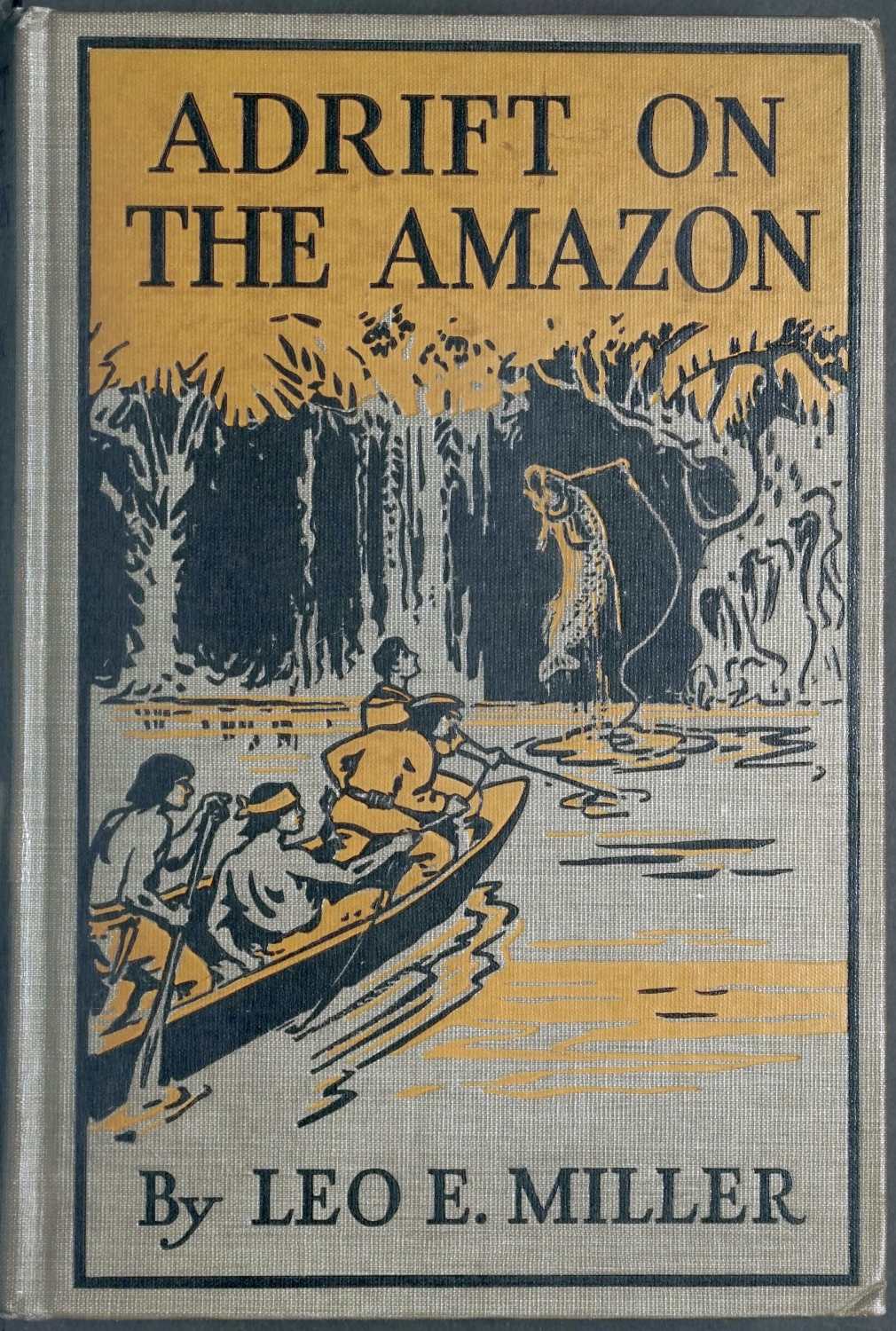
Title: Adrift on the Amazon
Author: Leo E. Miller
Illustrator: W. A. Rogers
Release date: November 28, 2025 [eBook #77361]
Language: English
Original publication: New York: Charles Scribner's Sons, 1923
Credits: Chuck Greif & The Online Distributed Proofreading Team at https://www.pgdp.net (This file was produced from images generously made available by The Internet Archive)
CONTENTS
ILLUSTRATIONS
TRANSCRIBER'S NOTE
BY LEO E. MILLER
CHARLES SCRIBNER'S SONS
ADRIFT
ON THE AMAZON
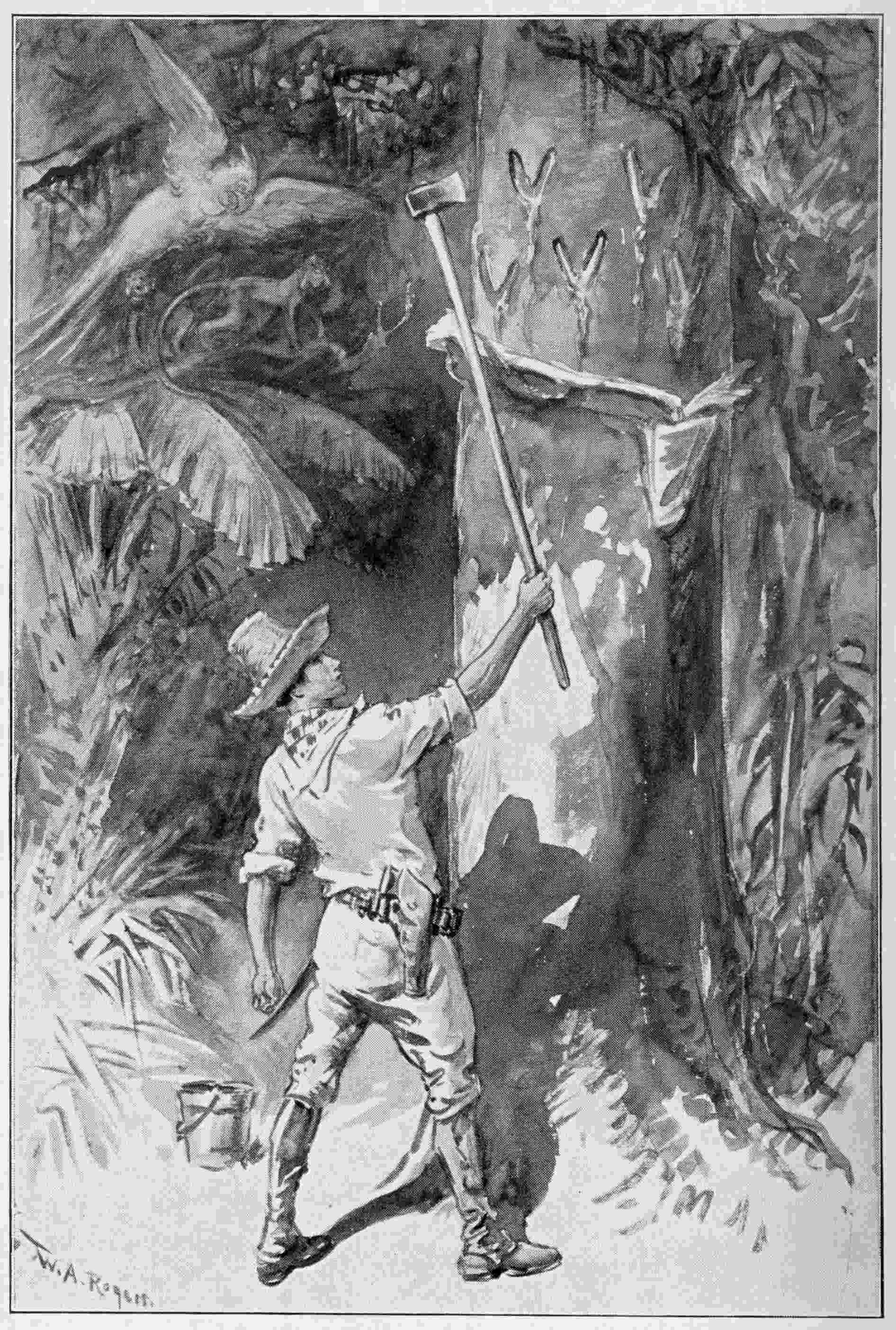
New cuts were made in the trees for the next day's supply.
[Page 136
BY
LEO E. MILLER
ILLUSTRATED
NEW YORK
CHARLES SCRIBNER’S SONS
1923
Copyright, 1923, by
CHARLES SCRIBNER’S SONS
Printed in the United States of America

TO
ALL READERS
WHO HAVE A WHOLESOME LIKING
FOR STORIES
OF ADVENTURE AND THE GREAT OUTDOORS
The Amazon! Who has not been thrilled at the mere mention of the words? For the name of the world’s mightiest river suggests not only vast expanses of muddy water, but also the jungle-clad shores and wild hinterland where nature seems to have run riot in the development of strange and interesting vegetation and animal life, and of tribes of savages but little known and less understood. There is romance and adventure to be found in each mile of its yellow flood or gloomy thickets. But to only a few is given the privilege of lifting the veil of mystery that hangs over the Amazon country and of exploring its hidden retreats.
“Adrift on the Amazon” is the story of a youth’s struggles against the seemingly insurmountable difficulties that confronted the intrepid wanderer into the Amazon wilderness.
ADRIFT
ON THE AMAZONoi
To David’s friends he was commonly known as “Fighting Jones”; but this name carried nothing of discredit with it; for, though the title had been earned by the not infrequent use of two good fists, the encounters had always been occasioned by a righteous cause—in protection of someone who was unable to defend his or her own interest.
The trouble was that the one higher up, the final authority as it were, had always decided against him. Sometimes words of sympathy, even approbation, had softened the rebuke that invariably followed each altercation; but in the final summing up he had never escaped the penalty.
David was downcast. It seemed as if the bottom had dropped out of everything. And as he mentally reviewed the events of the past ten minutes and speculated upon their consequences he knew that at last he had reached the very end of his tether. He had arrived at the parting of the ways; a break was plainly in sight; and at last he meant to assert himself.
His determined nature began to show itself so long ago as David could
remember and probably before that. But he could recall the first
difficulty in the{pg 1}
{2} kindergarten when one of the older and larger boys
took advantage of his small size to deprive him of some cherished
plaything. He never forgot that fight, nor the punishment he received at
the hand of a stern father.
Later, years later, in high school, there had been the trouble when the principal had rebuked Miss Palmer, the instructor in Latin, before the whole class. The principal was a big, gruff man whose main attributes were to look stern at all times in an effort to instill discipline and to rejoice secretly when others showed signs of fear. He ruled by intimidation. Miss Palmer was meek and frail and when the lordly Mr. Davison assailed her she began to cry. That was too much for David. He calmly arose and informed the surprised Mr. Davison that he would never see any woman mistreated like that and if he did not stop at once and apologize he would knock his block off. Several of his classmates now came to his assistance. That precipitated a row. Result—David as ringleader of the mutiny was dismissed. Discipline had to be maintained.
He worried through school and college somehow or other. Then was forced into business by his father and tried hard to make good and was progressing in a satisfactory, so he thought, if not brilliant manner until——
Wellman, the chief engineer, was passing through the draughting room. David, busy at his board, was not even aware of his presence until he heard a muffled cough in back of him.
“Good morning, Mr. Wellman,” he said pleasantly, turning to greet his chief.
“How are the plans coming along?” the latter said abruptly. “I want to have the blue-prints struck off this afternoon.”
“They will be ready in an hour,” David returned. “I am just finishing the terrace.”
“Let me see!” Wellman adjusted his tortoise shell spectacles. “What scale?”
“Quarter inch.”
“What? Quarter inch?” One would have thought Wellman had been shot, the way he roared. “Didn’t I tell you to make it half inch?”
“I am sorry. I must have misunderstood. I will do them over.”
“Impossible. The superintendent must have the blue-prints tonight.”
“That is impossible too. I cannot do two days’ work in a few hours and do it right.”
“You’ll never know anything.” Wellman bellowed, while all the others in the office turned to see and hear what was going on.
“Now, look here,” David interrupted. “There is no excuse for your acting like that. You passed my table several times both yesterday and the day before and it seems to me as if you should have noticed the mistake then. Besides, I am sure you said quarter inch scale to begin with.”
“That’s right! that’s right! Blame it on me. You think you can do as you please because your father{4} is president of this concern.” The chief was talking louder than ever.
“If it were not for your age I’d thrash you until you took that back.”
“Never mind my gray hair. Never mind my glasses; I’ll take them off. Here I am. Go to it. You are a privileged person around here. Do anything you like.”
Instead of replying, David threw down his drawing instruments and left the room. He headed straight for his father’s office. Arrived there he was told by a secretary to sit down in the ante-room; his father had given orders not to admit him until he should ring for him.
So! He knew about it already! Wellman had forestalled him by using the telephone. It was just as well that he had. His father would have the chief’s version of the affair and be ready to hear the other side of it.
A buzzer sounded and the secretary nodded to him to enter.
For a moment the elder Jones did not notice him. Then he turned abruptly in his chair and faced his son.
“What have you got to say?” he asked, not unkindly and rather sadly.
“Wellman told you what happened, I suppose.”
“Yes. He just called up. I want to hear your side of the matter.”
David gave an accurate account of the occurrence from beginning to end, while his father listened resignedly.
“Wellman is an old and valued employe, but I think{5} this time he went too far. Disregarding the fact that you are my son, I am inclined to believe that you were not at fault—in fact, I am rather proud of the way you handled the situation. Still, that does not settle the issue. That office is too small for you and Wellman; so Wellman will have to go.”
David could not believe his ears and for a moment he was speechless.
“You don’t mean that you are going to fire him?” he asked finally.
“Yes. He went too far. The two of you would always be at odds after this and it would demoralize the whole department. I am sorry, but Wellman will receive his notice today.”
“I don’t want to see him lose his job. He is old and would have a hard time to find another. Why not keep him and let me out?”
“Because I want you to learn this business thoroughly; you may be called upon to take my place some day. You are just starting life. Your welfare is my first consideration.”
David saw his chance at last.
“If that is true,” he quickly interposed, “don’t start me on the wrong track. I do not want to stay in this business. I hate it. I tried to make good only to please you. If you are really thinking of my welfare, let me pick out my own work.”
“What is wrong with this? It offers most unusual opportunities for great and lasting success.”
“I know, but somehow or other I don’t seem to fit in. I dislike the city and all business. I want to go away{6} where there is room to expand and to learn big things of another kind.”
“Remember the possibilities I just mentioned. You might some day erect a building taller than any of today or build a cathedral that would be a monument to your genius.”
“I would rather plow with a tractor and sow wheat; or herd cattle; or raise pigs than build anything no matter how great. I could put my whole heart and soul into that work and enjoy it. I want space to do my thinking and to develop in. I want green grass under my feet and a blue sky overhead. It is too crowded here. There are just as big things to be done in one place as in another.”
“Good gracious! Who put all that into your head? Or did you read it in some book?”
“It has just been growing on me and with me. I must get away from here. Let me work out my own future.”
“Suppose I should refuse to listen any further.”
“Then I am afraid I should go anyway, not right now, perhaps, but at some future time. The thought of all this is bigger than I am, and some day, soon, it would get the better of me and I should be compelled to go.”
“Well, well!” His father was obviously worried. “So you have made up your mind. You refuse to go back to your work here?”
“I should rather not. And, let Wellman stay.”
“I’ll see. Now you go straight home and wait for{7} me there. This thing will have to be settled one way or the other.”
As David left the building his mind was filled with so many things that it was impossible to think clearly on any one of them. Two things kept recurring to him, however, because they had been so unexpected. The first was that his father had taken sides with him in the controversy, had admitted that he was right and that Wellman was in the wrong; he had even gone so far as to volunteer to discharge the old and valued employe. And the second was that for the first time his parent had indicated a willingness to seriously listen to the thing he felt best suited him and for which he was eager to sacrifice his enviable prospects as a man of the business world.
He could hardly wait to tell his mother. She had always been a sympathetic listener and while she had never greatly encouraged him in his ambition she had never discouraged him.
It was, therefore, a source of disappointment to him to find upon reaching home that his mother was not there. She had an appointment for luncheon, the cook informed him, and would go to a club meeting after that. It was impossible to draw any further information from the cook. David suspected that she knew more, but to his casual remark that she must have decided rather suddenly to go, there came no response. Evidently the cook had orders not to talk, so he did not question her further.
The afternoon seemed like a year. He tried to read a magazine; then a book, but after turning a few pages{8} he was forced to admit that he did not know what he was reading about, so he closed it with a bang and calling Spike, his terrier, went for a walk in the garden.
David had just passed his twenty-first year. He was tall, of athletic build, with dark hair and eyes. There was the look of determination in his face that caused others instinctively to respect him. And his regular, pleasant features bespoke intelligence and breeding. If his natural bent could only be diverted into the proper channel, there was no question but that inborn ability and determination would make themselves felt, and in no uncertain manner.
His father and mother returned just in time for dinner. That there was anything unusual about this did not occur to David for, often when his mother chanced to be in the vicinity of the office in the late afternoon she dropped in and the two motored home together.
The conversation during the meal was a conventional one. It was not until later when the three were together in the library that the subject uppermost in David’s mind was broached.
“I have been talking this thing over with your mother,” his father began abruptly. “There is but one thing in our minds. Regardless of how we feel about it personally, we must consent to the course that seems best for your own good.”
David said nothing, but looked expectantly at his mother.
“Are you sure, David?” she asked in a low voice. “Is your mind made up definitely? Is there not the{9} least possibility that you may want to reconsider? Remember you are young. A mistake may mean the loss of years, perhaps, that will never return. Here you have rare opportunities to make both name and fortune. It would be well to think of these things and to try to picture what it will mean to you to give up a certainty for an uncertainty, for you know very little about the course you are favoring.”
“I have thought of all that,” he said uncomfortably, “and I wish I could feel differently, for your sake. But I just can’t help it. I have always wanted to be out in the open where there is room to see and do things.”
For a moment nothing was said.
“Well,” his father finally ventured with a sigh, “then there is nothing for us to do but to give you the chance you think we owe you. Be sure that you are sure. Take a few weeks to think it over in. But you must promise one thing. If we let you go and you don’t make good or find out that you were mistaken after all, you will come back to the office and buckle down to hard work and never mention the subject again.”
“I don’t need the time; my mind is made up now. And, I promise; but I will get along all right and in the end you will be glad you let me try it.”
They insisted on the time for reflection, however, and during the two weeks that followed no mention was made of the matter. David did not go back to the office; he spent the days, and parts of the nights, too, in reading books on agriculture. These consisted mainly of government publications, long possessed and secretly cherished. He had read them so often that{10} he was sure he knew all about farming and ranching; in fact, when he should use all this information together with some ideas of his own that he had worked out, he should greatly improve if not revolutionize the whole farming and ranching business.
When the two weeks had expired there was another council in the library.
“What is the verdict?” his father asked. “Will you go or will you stay?”
“I want to go just as soon as possible.”
“Have you considered the matter fully from all angles?”
“Yes, I have.”
“And you still feel that your calling is out in the country?”
“Be absolutely sure of yourself before you answer,” his mother cautioned.
“I am sure. I feel that when I get away from the noise and hurry and confinement of the city I can accomplish more in a week than I could here in a year.”
“And, if after trying it you find that you have been mistaken?”
“I shall come back at once and do exactly as I promised.”
“That settles it. You shall have your chance and it will be a rare one even though you cannot realize at what cost to us.” He shot a quick glance at his wife; her eyes were glistening.
“The fact that we have known of your ambition for a long time does not make it easier for us, for you will{11} be far, far away. That alone will give you the opportunity to show your mettle. I think it best that it should be so, for you will be thrown entirely upon your own resources. Either you will become discouraged quickly and come back ready to take our advice, or you will do big things.”
“Where?” David asked in an awed voice. “Where am I going?”
“To South America, because there real opportunities exist for the right man.”
“South America?”
“Yes. Dan Rice, a former client of mine, has a ranch in the Argentine. He went down fifteen years ago. He was a born stock man and made a huge success of the venture. I enquired about him and learned that he is opening a new place in Brazil, somewhere in the Upper Amazon country, above the city called Manaos. I shall send you to him. If ever there was a person who could judge men and get the best out of them, Rice is the one. What do you say?”
“I don’t know what to say except to thank both of you for letting me go. It is better than I even dreamed of. It will be wonderful!”
“Good! I only hope you will not be too greatly disappointed when you get there.”
They continued the discussion far into the night; but the thing the elder Jones did not tell his son was that he had already sent cablegrams to Rice in Manaos in an attempt to make arrangements for his coming. A very short time in the steaming and insect-infested tropics would be sufficient to cause a change of heart,{12} he felt sure. The fact that he was in a wild country thousands of miles away from home and among strangers would hasten it and make it more emphatic. And, once his illusions were dispelled, David would be ready to settle down and do as he was told.
As for David, he was too elated for words. “I am going at last,” he kept repeating to himself. “My luck has changed! My luck has changed!”
But David was quite forgetful of the fact that there are two kinds of luck, good and bad; and that the former seldom lasts long, while the latter is inclined to linger with a most disheartening persistency, and then grow worse.
David was so excited over his proposed trip to a real ranch in South America that he found sleep impossible on the night following the momentous decision.
His head felt like a whirling mass that refused to come to a standstill. He thought of a hundred things that he wanted to do all at once, but the thoughts rushed back and forth and around in circles so that he could not disentangle a single one to start with.
He was going to have his wish at last; that much he realized. And South America at that! The very words were awe-inspiring. They suggested mighty rivers, vast jungles where monkeys formed living chains or bridges to span the streams, by clutching one another’s tails; and where giant snakes drooped like garlands from the branches of great trees while myriads of gorgeous birds and shimmering butterflies fluttered among the bright-colored flowers. These sights must be common ones, for had not the geographies pictured them as typical of the Southern Continent?
David did not care, particularly, for some of the things he was sure he should encounter—especially the snakes and the crocodiles. But, of course, a ranch would not be situated out in the jungle; it would have{14} to be in the open where there was grass for the cattle. He tried to picture such a place. A long, rambling building painted white, with a few palm trees in front under which saddled horses were waiting patiently for their riders; more trees, of some kind or other, nearby, in the shade of which men dressed in buckskins, with fringes on their breeches and great, leather gauntlets on their arms, were sprawled on the grass, their wide-brimmed hats lying on the ground where they had been carelessly tossed by their owners.
All about stretched the rolling meadows, miles and miles, dotted with herds of cattle peacefully grazing on the long, green grass.
That was the picture that formed itself in his mind. But the things that did not occur to him, the things the geographies did not mention and that no one had told him about, so far, were the blistering heat of the tropics that could scorch and burn as mercilessly as the blast from a furnace; the insect pests that rendered life all but unendurable; the fevers that sapped one’s vitality; and the monotony of existence in far-away, lonely places with only the treacherous half-breeds and stolid Indians for companions. It was just as well that these unpleasant details and many others of similar nature remained in the obscure background; he would make their acquaintance soon enough.
“Better decide on what you want to take with you,” his father advised the next day. “You will not need anything fancy, and keep the amount down as much as possible. Talk it over with your mother.”
That was good advice and David followed it. But{15} it required nearly one full day to make out the list, go over it carefully, strike out some items, add others, and then start over again with the ever-present suspicion that something of importance had been forgotten.
“I’ll tell you what,” he said finally, “I am not going to take anything except a few clothes to wear on the trip, one khaki outfit and a gun. How do I know what is proper down there? I might take down a lot of things only to find that they are not suitable in that climate. And the other fellows working on the ranch must get their clothes somewhere in the neighborhood, so I can, too, after I find out exactly what I need.”
His mother promptly agreed that that was the sensible thing to do. Only, she added, a few good books might prove not unwelcome companions on such a trip, so David promptly packed his volumes on cattle and agriculture as well as a few favorite others.
The news of his intended journey spread rapidly among his friends and acquaintances. They immediately divided into two factions; one considered him the luckiest mortal in the world while the other thought he was the most foolish person imaginable.
David pitied them all, impartially. No matter how they felt, they were all doomed to remain behind, chained to the treadmill of city existence, while he was the one to go forth into God’s great world with only the horizon to mark the boundary of his vision and activity.
“I cannot understand it,” Mr. Jones announced one evening soon after. “Rice has not answered my cable. Perhaps he has given up the ranch and gone{16} to other parts. I am sorry, but you may not go after all. Too bad, after all the anticipation.”
David’s heart sank.
“Rice or no Rice, I am going just the same,” he announced.
“But where to? If he has gone away there will be no place to which you can go.”
“He couldn’t take the ranch with him, could he? If he has gone someone else must have it. And even if that outfit is out of existence there must be plenty of others. I am not fussy over where I make my start.”
“Very well. So far as this proposition is concerned you shall have your own way. But you cannot blame me for being concerned about your welfare.”
“Of course not. But at the same time, please don’t forget that I am not a baby. I can take care of myself.”
His father bit his lip. His eyes narrowed as he regarded his son. And in that instant an idea came to him.
“Just as you say,” he said quietly. “It will be your chance to show me just what you can do. The Morales sails a week from today and I shall make a reservation for you. In the meantime, I shall send other cables; you may go regardless of whether there are answers or not. Is that satisfactory?”
“It’s splendid. I won’t sleep a wink until then.”
On the eve of the great day the little group around the dinner table was very silent.
“Rice has answered at last,” Mr. Jones said suddenly.
“What did he say?” asked David, eagerly.
“Never mind what he said. You are determined to go, anyway, so it makes no difference.”
“But does he want me to come?” David persisted.
“Suppose he does?”
“I should go, of course.”
“And if he does not?”
“I should go anyway. I am all ready, my ticket is bought and I couldn’t think of backing out. I should never hear the last of it.”
“You are quite right. Everything is arranged, however, and I want you to go. You will do just as you planned.”
David thought he noticed an amused expression on his father’s face, but he was not quite sure. It did seem, though, that his manner had changed remarkably in the last few days. His former reluctance had given way to seeming eagerness. But in the feverishness of his excitement David did not appraise these observations at their proper value and soon forgot them entirely.
At last the memorable day actually arrived. The weeks of waiting had seemed an eternity. But here he was, aboard the great boat; some of the people about him were crying and for a moment he felt a strange feeling coming upon him. Going was not so easy as he had thought. Just then the bell warned all visitors to go ashore and amid the last farewells he was reminded of one thing.
“Do not forget,” his father said, “you may return at any time you like and you will be welcome at home.{18} Even if you stay only a few days, the experience of the voyage will be of value and you will be more content to settle down. Perhaps you will be back soon.”
They went ashore. The gangway was raised and the engines began to throb ever so slowly as the ship backed out of her berth. Not long after that the boat was well out in the bay and the crowd that lined the dock merged into a waving mass in which it was impossible to distinguish anyone.
Those last words filled David with something like resentment.
“Perhaps you will be back soon!” Indeed! What did his father mean by that? Well, they would have to wait a long time before seeing him again. Upon that point he was determined. No matter what happened, he would not return home very soon. He would stick it out in the face of every obstacle and difficulty that might block his path. He would show them that he could make good if he but had the opportunity and the opportunity had come at last.
By that time the ship was well down the harbor, so he sought his cabin to unpack his baggage. Upon entering he found a man several years his senior busily engaged straightening out his own effects.
“My name is Rogers,” said the stranger, extending his hand. “I guess we share this place.”
“Glad to know you. My name is Jones.”
“Well, as we are going to bunk together for a while I suppose we might as well toss a coin for the berths.”
So saying, Rogers fished a dime out of his pocket.
“What will it be?” he asked.
“I’ll take heads,” David replied.
Rogers tossed the coin into the air.
“Tails, you lose, Jones,” he said. “So I will take the lower. Anyway, you are younger and more spry than I am, so you will not mind climbing into the upper.”
The conversation continued while they unpacked their luggage and the older man gave David a good deal of information, having noticed that he had not been to sea before. David rather liked Rogers and felt that this was the beginning of a pleasant friendship.
* * * * *
Dinner in the Jones household was a quiet, solemn affair that night.
“Wellman played his part to perfection,” the father said finally. “Too well, in fact. For a while I was afraid David would agree with me that he should be discharged. But I am proud of the stand he took. He acted just as I would have had him do.”
“Are you sure he does not suspect the plan was pre-arranged?”
“Yes, he thought Wellman was serious in calling him down. He was going from bad to worse—through no fault of his own, I will admit. He tried hard to make good but could not; and he never will until he forgets those ideas with which his head is crammed. Only then will he come back to earth and buckle down to his job.”
“Do you think he will be back soon?”
“Yes, I think so. When he sees what he is compelled to endure in Brazil he will become disillusioned in short order. I know what I am talking about and so I think a short time of it will be all he wants. Three months, at most.”
Mr. Jones spoke with an air of finality. The ability to look ahead and forecast the outcome of things had in a large measure placed him on the pinnacle of success he occupied. But for once, and in spite of carefully arranged plans, he was doomed to disappointment. For the son possessed all the advantage; he was entering with unbounded enthusiasm a field for which he had prepared himself, however slightly, and of which he therefore had some knowledge, while the father was making predictions as to the outcome of affairs of which he knew nothing.
Early the next morning David became aware of the fact that he had embarked on a stormy voyage. The ship rolled and pitched in an alarming manner. He could hear the shrieking and moaning of the wind and feel the vessel tremble as the waves struck the steel sides with a muffled roar.
At first he did not know just what to make of it, so he groped for the switch and turned on the light. Rogers was sleeping soundly in the berth below. There was no one stirring on deck or in the passageway, so he came to the conclusion that a storm was not an unusual occurrence and that everyone took it as a matter of fact, so he snapped off the light.
But it was far from comfortable, this rolling and tossing, and sleep was impossible. Daylight soon came, however, and with it the bustle and sound of voices on deck incident to life aboard ship.
“Going down to breakfast?” Rogers enquired, holding to a hand-rail with one hand while he calmly shaved with the other. He seemed to mind not at all the lurching of the boat.
“I guess not; I don’t feel hungry,” David replied in a weak voice.
“Sick?”
“A little. It’s not so bad while I lie still; but when I try to get up my head spins.”
“Never mind. It will soon pass. Better have a cup of coffee; then you will feel better. I’ll ring for the steward.”
“No, don’t. Please, let’s talk about something else; anything but food. Will the storm last long?”
“It may clear up later. If it gets calmer come out for a walk on deck. The fresh air is a good tonic,” and he strode out of the room.
But the storm did not subside. It lasted two whole days and three nights. By that time David was so ill he was compelled to remain in his berth another full day to recuperate sufficiently to venture out.
The fresh air and the bright sunshine on the upper deck worked wonders. Added to these, long walks back and forth, a few games of shuffleboard and an occasional dip in the ship’s swimming tank soon restored his good health and usual cheerful manner.
“You expect to work on a ranch in Brazil, eh?” Rogers commented one morning as they leaned over the rail to watch the flyingfish startled by the prow of the boat as she cut her way through the glassy water.
“I not only expect to but I am going to,” David returned promptly.
“How long are you going to stay?”
“A long, long time. In fact, I haven’t thought of going back. I had better get there first.”
“Know anything about ranching?”
“Not much; but I can learn.”
“Know anything about Brazil or what you are going to be up against?” Rogers persisted.
“Not a thing.”
“Do you know what I think?”
“I’m not a mind-reader.”
“Well, I think you are foolish to try it.”
“Thank you,” David replied promptly.
“I mean it.”
“I can’t help what you think,” pleasantly. “My head is working overtime figuring out my own things.”
“I would not go where you are going for a thousand dollars a month.”
“Neither would I. I am doing this because I am interested in it and want to learn. Office work, no matter how easy, is unbearable to me because I don’t like it. Outdoor work, no matter how hard, will be fun because I do like it.”
“I went to Manaos once, and that was far enough,” Rogers proceeded. “The heat, the rains, the mosquitoes, in fact everything that makes life miserable was there in too great abundance to suit me. If I were in your place I should go up the river for the sake of the trip. The Amazon country is great—to see from the deck of the steamer. Look at it until you have your fill and then go back to the good position you left. I am telling you right now that you are making a big mistake, and you will regret it.”
“It’s very kind of you to take such an interest in me, but you must think I am a jellyfish. There is no use saying anything more. My mind is made up. I{24} wouldn’t even think of backing out—not for the world,” Jones asserted in no uncertain accents.
“All right. Think it over.” Rogers yawned and went to his deck chair, while David took a small, red volume from his pocket and devoted his time to the study of Portuguese.
The days slipped by pleasantly and quickly. The water assumed a deeper blue color and great rafts of seaweed dotted the surface. The air was balmy and delightful.
There was always something new and interesting to see. The birds in particular attracted David’s attention, especially the man-o’-war birds that soared on motionless, narrow wings hour after hour and, it was said, day after day, in the cloudless sky. They rarely slept or rested but sailed on tireless pinions as if they enjoyed it, bent on some mission none could fathom. Then there were the little petrels or Mother Carey’s chickens, as the sailors called them, fluttering and skipping over the water like huge, black grasshoppers; they appeared in greatest numbers on those rare occasions when the ship passed through a choppy stretch of water.
Some of the barren, rocky islands were fairly teeming with boobies, jaegers, gannets and other feathered lovers of the briny deep. They sat on the shelflike ledges running along the faces of the cliffs like the tiers of beads on an abacus. Other swarms filled the air, fluttering, soaring, circling and wheeling amidst squawks and screams while still other hordes sat motionless on the water.
The jaegers were the pirates of the deep. They waited until the smaller birds returned from their successful fishing excursion, then attacked them until they disgorged their catches which they greedily appropriated to their own use.
These sights fascinated David. How different from the imprisonment of the city! And this was but a taste of what he was to see, a sample of the free life in the open for which he longed.
After nearly two weeks sailing he came on deck one morning to find that the color of the water had changed overnight. Instead of the clear, crisp blue the ship was ploughing her way through a sea of yellow that extended to the horizon on every side. He called the matter to the attention of Rogers.
“That muddy water is discharged by the Amazon,” the latter said.
“But we are not near the river yet,” David remarked incredulously. “There is no land in sight.”
“No, we are not near the river and will not be until some time tomorrow. Even if we were in the very center of the Amazon you could not see the banks, for the river is about one hundred and fifty miles wide at its mouth. The quantity of water it carries into the ocean is so enormous that it keeps its yellow color several hundred miles out at sea before the mud settles and the fresh water is thoroughly mixed with and absorbed by the brine of the ocean.”
The next evening they saw the first indication of land. At first there were only long lines of white far in the distance where breakers were dashing over the{26} low sandbars that checked their onward sweep. Later, they distinguished small, dark tufts, like feather dusters, outlined against the clear sky; these were coconut palms growing on the outlying islands. And before long the first land—dim strips of dark color seemingly suspended between the water and the sky, met their gaze.
At night they entered the river proper. It was too dark to see anything, but David was so excited he could hardly sleep. Here he was, on the mighty Amazon, and it was not a dream either. What tales the silent water could tell could it but talk! What had the stream witnessed, on its journey through many thousands of miles of wilderness and jungle inhabited by savage beasts and equally savage peoples! And what secrets were locked up in that outwardly calm, yellow flood! The very air seemed saturated with mystery, romance and adventure. And here he was, alone and foot-free and eager to absorb his full share of everything this wonderful country offered.
With daylight came disappointment. Instead of the wide expanse of water David had expected to see there was only a narrow channel through which the ship proceeded with caution. Both banks were covered with heavy, deep green vegetation, extending to the edge of the river. Creepers and ropelike lianas dangled from the branches and trailed in the water; climbing ferns and palms and a host of other plants clinging to the boughs and trunks united them into a solid wall of living green.
Here and there a bright-colored flower glowed bril{27}liantly against the darker background and from the interior of the tangled, matted screen came subdued cries and screams. A flock of green parrots, flying low, passed overhead and then dived into the jungle on the other side and disappeared. There were fully a hundred birds in the party, but they flew two by two, with a peculiar fanning motion of the wings, like a duck’s.
One of the branches on the side nearest the steamer stirred and someone shouted “monkeys.” David looked but saw only the swaying vegetation which moved as if agitated by a gust of wind.
“I am sorry I missed them. I have never seen a wild monkey,” he said.
“You will see plenty of them before long; and not only see but get real well acquainted with them,” Rogers volunteered.
“You mean they are tame and come to the camps in the forests?”
“Not exactly. You will have to live on them.”
“What? Eat monkeys?” David asked in dismay.
“Certainly. Everyone does in the bush. The Indians eat everything—monkeys, crocodiles, snakes and lizards. And if you want to live out in the wilderness you shall have to do as they do because there is no other way out of it. You will be thankful for whatever you find whether you like it or not.”
“But the rivers must be full of fish,” David reminded him.
“They are. Catching them is another proposition though. Besides, there is nothing in the world a white{28} man becomes so tired of as fish if he eats it day after day.”
“Why worry?” David said it bravely, but a sigh escaped him. “If that is the custom here I guess I can get used to it.”
The prospect of having to eat monkeys, as he knew them in the zoo at home, was not a pleasant one and the thoughts that were in his mind were reflected in the expression on his face. Rogers gave him a sharp glance, then walked away; he was finding his task a difficult one.
The first stop was at Pará, and as the steamer carried a quantity of freight for that port and was to remain two days there was ample time for sightseeing ashore.
The feel of solid ground under his feet was very welcome to David; and to enter the low-lying city beside the river was like stepping into fairyland.
How different everything was from the life and living conditions of a temperate clime. Instead of the tall buildings and wide streets bustling with humanity there were blocks of low, white structures, narrow, crooked streets lined with drooping, swaying palms; and the people, of every shade from white to black, seemed to take things in a leisurely manner.
It was warm—disagreeably warm at midday and during the early afternoon hours—but David was too interested in his surroundings to take much note of the heat. He tramped the streets and tried to see everything that unfolded itself before his eyes.
The flaming Jacaranda trees that thrust themselves{29} upon one’s notice through the sheer boldness of their beauty fascinated him. Not extremely tall but with wide-spreading branches they looked like enormous bouquets so thickly were they covered with purplish flowers with only an occasional tuft of fern-like leaves to enhance their beauty.
There were palms without number. Some grew tall and stately with crowns of gracefully drooping leaves; others had bent, spiny stems; and still others had shocks of ragged, split leaves perched on the top of thick, ringed trunks.
A curio store just off the main thoroughfare attracted David’s attention and after gazing at the display in the windows for some time he decided to investigate the mysteries inside so forcefully suggested by the objects in front. He had always intended to make a collection of butterflies and other things and here was the opportunity to start it. But the door was locked. He tried the door of the next shop; it, too, was bolted. A passing policeman, observing his actions, volunteered the information that everything would be closed until later in the afternoon because the people were taking a nap during the hottest part of the day. And as David strolled down the street he rejoiced that the curio store had been closed, for what could he have done with the butterflies if he had purchased them? They were too fragile to carry around for months in the wilderness; and he would no doubt have the opportunity personally to collect all he wanted at the ranch.
The afternoon being spent, the wanderer went back to the waterfront and boarded the steamer, and re{30}mained aboard for the night. There followed another day of sight-seeing, confined principally to the numerous little parks, and then the voyage was resumed up the river.
David remained on deck as the steamer headed up the sluggish, muddy stream and enjoyed the changing vistas of broad expanses of water and the dark green of the vegetation that contrasted sharply with it. Then he went to his cabin to wash up for dinner. And there was Rogers examining a number of souvenirs he had purchased in Pará; a medly array of feather flowers, Indian head-dresses and the skins of birds and snakes was spread on the floor and chairs.
“You still here?” David asked in surprise. He had not seen him since saying good-bye the morning they reached the port, as Rogers had stated that he was going no further than Pará.
“Yes, I am going to stick around a while longer—until we get to Manaos, to be exact,” Rogers replied in a matter-of-fact voice.
“Great! But you changed your mind rather suddenly, didn’t you? I hardly expected to see you again.”
“I did intend to go only to Pará, but I found that my affairs had not been settled. So I have to keep on going. But I do not mind. The trip up the river is interesting.”
“Say, Rogers,” David asked suddenly. “What is your business anyway? I don’t like to be inquisitive; that is why I didn’t ask before now. But I am filled with curiosity.”
“It is of a personal nature; sorry I cannot go into greater detail but that would be violating a confidence,” and Rogers looked embarrassed.
“I see,” David said simply, but he could not get the matter off his mind, try as he would. And to make things worse he could see no reason why Rogers’ affairs should cause him any concern.
To spend six days on the mighty Amazon is an event in any man’s life; to David it was the greatest he had experienced. Each morning when the noise of the deck scrubbers awakened him he jumped from his berth and after dressing hastily went on deck to see the sun rise. On no two mornings was the awe-inspiring spectacle that unfolded itself before his eyes the same in all respects. Sometimes the flaming, angry ball of fire shot up as if from some place of concealment beyond the black wall of forest; once it rose out of the yellow flood, at the foot of a wide path of gold and pink light that danced and sparkled on the wave-crests; and again, there were but fleeting glimpses of shafts of bright light that darted through rifts in the cloud-banks whose edges were aglow with burnished silver.
When the forested banks were visible they always loomed up like dark, impenetrable barriers; but as the light grew stronger the blurred outlines of trees, palms and a thousand points of vegetation gradually became clearer and finally revealed their identity.
The forest enchanted the beholder. It exhaled an air of mystery, the promise of adventure; and at the same time it hurled a bold defiance. “Come, ferret{32} out my secrets, search for my treasures,” it seemed to say, “and I will overwhelm you, engulf you and you will be no more. But come, come, if you dare.”
David read both the invitation and the challenge; and with more determination than ever, he accepted them.
Nothing was seen of the wild life with which the jungle must have been teeming. Perhaps it was because the walls of vegetation were so dense they hid the creatures that lurked within their green depths. Then, too, the river was frequently so wide that the banks could scarcely be distinguished, showing only as low, dark lines in the hazy distance.
Occasionally a flock of ducks passed overhead. There were gulls also, and other waterfowls. But far more numerous were the parrots and great macaws, in large, boisterous companies that winged their way heavily across the wide expanse of water. From a distance the parrots resembled the ducks but there was always the easily noticeable difference, that no matter how large their number, they always flew two by two.
“Where are all the crocodiles?” David asked the captain of the ship one day as the latter stopped beside him at the railing. “And the big water snakes and other things you hear about the Amazon?”
The captain looked at him in an amused manner.
“They are here, that is the crocodiles are, but the water is too high to see them,” he said. “During the dry season the sand bars and islands are covered with them. There are plenty of anacondas, too, but they{33} stay around the banks. So you are going into the interior, I hear!”
“Yes, to a ranch that’s just starting up,” David replied.
“Well, you’ll see all the snakes and other vermin you want, and more too.”
“Fine! I have never been here before and I want to see everything there is to be seen.”
“You had better look fast then, because you won’t stay long. They all go back pretty quick.”
“Not I. I am going into the business for good.”
“That’s what they all say. And I carry them back home on the next boat.”
“You will not carry me back on the next boat, nor on the trip after that either.” David was losing patience.
“If you knew what’s in store for you you wouldn’t even go ashore when we get to Manaos; you would come right back home with me on this trip. And that is what I would advise you to do.”
“Thank you,” and David walked away.
They made short stops at the more important towns along the river, to deliver mail and unload freight.
The waterfront in these places always teemed with dark-skinned natives. Long lines of men, stripped to the waist, were carrying bags of produce to barges moored to the banks, waiting for steamers going downstream. Groups of other men lounged on the docks or came to the ship in row-boats, offering fruit for sale.
David was greatly surprised to see the barges of Brazil nuts that were being transferred to a steamer{34} outward bound. The nuts—he had no idea there were so many in the world, were handled just like coal. They were scooped out of the barges in steam shovels and dumped into the hold of the boat, where they disappeared in the seemingly insatiable, black void. Many were spilled overboard and others rained on the deck, but no one cared.
There were cargoes of rubber, too, large, oblong balls, or thick bricks that must have weighed several hundreds of pounds. But David was to see enough of them later and under less attractive circumstances.
On the sixth day they reached the junction of the Rivers Negro and Solimoes.
“This is the end of the Amazon,” Rogers explained as they gazed at the sweep of the mighty streams.
“The end?” David asked in surprise. “I always thought of the Amazon as a river three or four thousand miles long.”
“The Amazon proper is only about one thousand miles long. But the Solimoes continues on a few thousand more and is in reality the Upper Amazon. Here is a map that shows it.”
He drew a folder out of his pocket and they spread it on the foot of a deck chair.
“See?” Rogers said, “Manaos is ten miles up the Rio Negro which comes from the north-west. The Solimoes comes from the west and has its source near Quito, Peru. It is navigable, too, almost the whole of its length in boats of some kind. As I said, though, you have seen all of the real Amazon. Now, are you satisfied?”
“What do you mean?”
“Have you seen enough?”
“Of the river and country? I should say not. I haven’t even started. What I have seen has only aroused my curiosity and a stronger desire for more. I can hardly wait to get into the interior. Think of what is behind those walls of forest!”
“Mosquitoes, snakes and cannibals.”
“Good! They are just what I want to see.”
Rogers sighed but David did not notice it. He folded the map and put it back into his pocket.
In another hour they had reached Manaos.
Manaos is a surprisingly large city for one that is situated in such an out of the way place, but there is nothing bewildering or startling about it. In some respects it is very much like the larger but more backward towns of our own country but in most it is very different.
The first thing to thrust itself upon the visitor’s notice is the intense heat; all the sun’s rays seem to converge in the depression in which Manaos nestles. An inspection of the place, however, reveals compensating virtues in the form of green, shady parks, cooling fountains, and comfortable hotels for the traveller.
David was not particularly interested in the city although he took note of some of the more unusual features; he had seen Pará which had impressed him as being more attractive. He felt that enough time had been spent already in travel and in sight-seeing and he was eager to start work. So he lost no time in going to the hotel where someone from the ranch was to meet him, in accordance with the arrangements that he supposed had been made by cable before he left home.
No doubt Mr. Rice had come to welcome him{37} personally, he thought; and he was more than disappointed to learn that such was not the case.
“Senhor Rice has not been here in weeks,” the proprietor of the hotel told him in answer to his questioning.
“But he was either to be here or to send someone,” David protested. “I am going to his ranch and they were to come for me.”
“Here is the list of patrons. You may read it. Do you recognize any of the names?”
David scanned the page of the register and admitted that the names were all unfamiliar to him.
“I would recognize only Mr. Rice’s name,” he added, “and that is not there.”
“No, the Senhor is not here.”
“Didn’t someone else say he expected me? There must be somebody here who is hunting for me right this minute.”
The Brazilian shrugged his shoulders.
“Oh, I understand now,” David explained, with a smile. “Whoever is coming hasn’t arrived. He might have been delayed accidentally or perhaps he thought the steamer was not due today. I’ll wait and everything will be all right. When I am asked for, remember that I am here. And, if a message or letter comes, give it to me without delay.”
The whole explanation seemed so simple to David. It must be exactly as he had said. It was not in the least remarkable that one should miss connections in a land lacking the elaborate facilities for travel his own country boasted. He wondered how the matter could{38} have caused him concern and why he had not thought of the solution before.
Half an hour later he left his room and in passing through the corridor could not resist the impulse to step into the office to make another inquiry. But the answer was the same. There was nothing new, no message; nor had anyone arrived from the ranch.
“Tomorrow, probably,” he thought, “and if not then, the day after that without fail. I must learn to be patient although they should apologize for keeping me waiting.”
In the meantime, he would see what there was of interest in the city, and by asking questions learn as much as possible about the country of the hinterland.
He had not gone two blocks before he met Rogers. The latter was stopping aboard the ship; he felt sure that he could wind up his affairs during the week the vessel lay in port and had engaged passage for the return journey.
“Hello!” he greeted David cheerfully. “You still here? I thought you might be on your way to the ranch by this time.”
“No, we missed connections some way. I can’t understand why, but they have not come for me yet. But I expect them any minute.”
“Still got the fever, eh? Still want to go as badly as ever?”
“I certainly have got the fever, and the temperature is going up.”
“Say, you know what I said to you before—I think you are one foolish person.”
“Look here, Rogers,” David retorted hotly. “Why are you so concerned over my affairs? I didn’t insist on knowing what brought you here but you keep harping about my business all of the time. Now forget it.”
“If that is the way you feel, I shall not mention it again,” Rogers stammered, looking offended. “But—but just because I do not mention it will not make me feel differently about it. I am sorry you are so set on doing something you will surely regret.”
“Good-bye.” David wanted to fight but he dared not, remembering past experiences and their consequences, so he quickly continued on his way.
Three days passed and still David remained unsought by anyone from the ranch. The fact began to worry him.
He had spent the time alternately waiting in the hotel and tramping the streets. The very sight of the Teatro Nacional, at first so imposing on its built-up pedestal that covers an entire city block; the plazas with their tropical trees, shrubs and dazzling flowers; the hot, winding streets; and the parrots shrieking and squawking from their perches in the doorways of the squat, thick-walled buildings; all began to pall on him. He had not come all that distance to see cities; if that had been his desire he might have remained at home. What he longed for was the great outdoors and the myriad, varied possibilities it brought with it.
Why did not they come or at least communicate with him? he asked himself again and again. He could bear the suspense no longer. He would communicate with them.
The telephone occurred to him first of all as the most rapid means but, of course, there was no service to Las Palmas. Nor was it possible to send a telegram. A letter was the only thing he could think of; but when they called for the letter they would also come for him. So there was in reality no way of communicating with them after all.
In desperation, he went to the owner of the hotel and told him what was on his mind.
“If they knew you were coming and wanted you at Las Palmas, they would have been here,” the latter said. “What do you expect to do there, anyway? My advice would be to go back home, if you asked me. You will be better off there.”
“Good Heavens! This is beginning to look like a conspiracy of some kind,” David started, but checked himself. Again the visions of past experiences loomed up before him. He would endure almost anything rather than take a single chance of spoiling this new and greatest of all ventures. So he turned and walked away.
“I know what I’ll do,” he decided. “I’ll see the American Consul. He will fix me up.”
Just as he turned to enter the doorway beneath the shield that served as the guiding sign to the consul’s office he almost collided with Rogers coming out.
They exchanged greetings and each went his way.
After waiting a few minutes in the anteroom he was admitted to the official’s presence and briefly explained his mission. The consul listened impatiently for a minute and then interrupted the recital.
“You will never get on there,” he said. “It is no place for an American without practical experience. Las Palmas is a particularly bad place and Rice is a terrible person—they call him the viper.”
David was boiling within, but said nothing, so the official continued:
“The ranch is a new one, just being opened up. No one but the natives and Indians can do the clean-up work that is in progress now. You would die in a little while if you tried it. I will fix up your passport and you start back on the next boat.”
“I see,” said David simply, without betraying his feeling. “Thank you for your offer but I cannot accept it just now for I am certainly not going back home. I came to stay.”
“Stay and you will be sorry.”
“That’s up to me. And if Mr. Rogers comes to see you again, give him a passport. I intend to see to it that he leaves the country on the next boat.”
The air in the street lacked the cooling quality necessary to restore David’s ruffled temper. Heat-waves rose from the flag-stones and smote him in the face and the slight eddies that whirled around the corners could have come out of the mouth of a furnace—they were so stifling.
The truth of the whole matter dawned upon David at last. Rogers was the cause of all the discouragements he had met. The business upon which he had come was to try to persuade him to return home. He had been sent for that purpose. He chuckled grimly as he thought how Rogers would have to report failure{42} of his mission. They would see that he was not a quitter. He did not blame his father for guarding his welfare but he would prove to the world that he could look after his own interest in any place and under any circumstances. The newly acquired knowledge made him more determined than ever. So, as he returned to his lodgings a plan formed itself in his mind; he would put it into effect without delay. There was but one other matter that had to be attended to first. He must see that Rogers actually sailed on the departing steamer; with him out of the way, the rest would be easy.
A full hour before the ship was due to leave, David went aboard. And about the first person he met on deck was Rogers.
“I came to see you off,” he said in a friendly manner.
Rogers looked at him with a puzzled expression on his face.
“You are going, aren’t you?”
“Why, yes, I guess so.”
“Seems to me you ought to know for sure. If you don’t, I will tell you. You are. I am on to your game. The best thing for you to do is not to waste any more time. Tell them back home I am all right; and that you did your best to discourage me but—you know the result. I am sending letters on this same boat. Now, good-bye, and have a nice trip. I am going to wait at the dock until you are out of sight.”
For a moment Rogers did not know what to say. Then he extended his hand.
“Good-bye,” he said simply.
“No hard feelings so far as I am concerned. You went to a lot of trouble for nothing.”
“I am sorry, that is all.” Rogers appeared dejected. “And I can only hope that you will reconsider the matter before it is too late. Remember how they feel about it back home.”
David went ashore and waited. It was with a feeling of relief that he saw the ship move out into the river at last, with Rogers at the rail waving a last farewell. When the vessel finally disappeared from view he turned his steps toward that section of the riverbank where a number of launches were tied up, with their crews either aboard or on the bank.
“Where can I hire a boat?” he asked one of the men. “I want to go a short distance up the river.”
“There is the capitain,” the sailor replied, pointing to a man dressed exactly like the others but wearing an officer’s cap on his head.
David repeated the question to the person indicated.
“Where to?” he asked.
“The ranch Las Palmas.”
“Why don’t you go on one of the Las Palmas launches?” the captain asked abruptly.
“I would if I knew where to find one. But I have been waiting a number of days and none of their boats has put in here,” David explained.
“I will show you one. See that gray launch right over there, the Aguila? That belongs to the ranch.”
David could have shouted for joy. They had come for him at last. He hurried to the Aguila. Perhaps Mr. Rice had come in person to greet him. This was{44} luck indeed! Probably he had hurried to the hotel with apologies for the delay; but no need for that inasmuch as he had finally come and the long wait was over. There was the possibility, however, that he was still aboard the launch.
By the time David reached the boat it was almost impossible to suppress his eagerness and excitement.
“The Aguila comes from Las Palmas,” he began, “so they tell me. Is Mr. Rice on board now?”
A sailor who was washing several articles of clothing by beating them on the rocks near the water’s edge looked up.
“No,” he said. “Senhor Rice is not here. He never travels on the Aguila—it is not good enough for him.”
“Doesn’t he ever visit Manaos?”
“Yes, when there is some good reason for it but he always uses the Indio which is larger and much finer; you should see it. The Aguila is for the peons and the cook when they come to buy provisions.”
“Where is the Indio now?” David was becoming somewhat uneasy.
“At Las Palmas.”
“Didn’t Senhor Rice say anything about coming to Manaos in the near future?”
“He never talks to the peons, so I don’t know.”
“You see,” David explained, “I am on my way to the ranch and they were to send for me.”
“Si, Senhor.” The man now stopped washing and listened respectfully.
“Did you hear anything about that?”
“No, Senhor.”
“When do you start back?”
“This afternoon.”
“Today?” in surprise. “When did you arrive?”
“Two days ago.”
“There must be a misunderstanding somewhere. I have been waiting a good many days and this is the first I heard of your coming, and that was by accident. Who is in charge of the boat?”
“The captain. He went with the others to get some rice and other things. He will be back soon.”
“I’ll wait, then.”
“Yes, Senhor,” and the man resumed his washing.
Here was a new predicament he had not counted on. For a while he racked his brain in an effort to disentangle the puzzle, but it was of no avail. He was compelled to give it up. There was certainly a mix-up somewhere and that was all there was to it. By and by it would be all cleared up and he would then laugh at his present anxiety and vexation.
The captain arrived before very long, followed by three men carrying heavy bags on their shoulders. He was a thick-set, burly fellow and one could tell at a glance that he was accustomed to giving orders which others dared not hesitate long in obeying. A stubby beard covered the greater part of his face effectually, concealing his features—all but the eyes—small, black and penetrating. A flat cap with a long peak was perched on the top of his head, the black hair, touched with gray, appearing under the rim in a dense, unkempt ring.
That head-dress, David was to learn later, was typi{46}cal of the masters of the smaller river craft and was their only badge of position and authority for, otherwise, they were dressed exactly like their ragged crews.
David did not like the looks of the swarthy newcomer. But that did not matter. He wanted to get to Las Palmas and the man possessed the means of getting him there.
“My name is David Jones and I am from New York,” he said by way of greeting. “I have been waiting a long time for you.”
“Me? Why have you been waiting for me? What do you want?” the captain asked in surprise.
“I want to get to the ranch. Didn’t Mr. Rice instruct you to bring me out?”
“I don’t know anything about it. Nobody said a word to me.”
“Well,” David tried to conceal his impatience with a laugh, “I am expected at the ranch and I want to get there so soon as possible. I can have my baggage here in fifteen minutes.”
The captain was looking at him sharply, even suspiciously.
“Do you think this is a passenger boat?” he asked. “We don’t carry strangers without a written order from the boss.”
“But this is different,” David protested. “I am not a stranger. They are looking for me. Mr. Rice must have misunderstood the date or he would have been here personally.”
“That is not my fault,” said the captain gruffly.
“But I can go with you, can’t I?”
“No! If you knew the boss you would not ask me to take you. He is awful when anyone does a thing he don’t like. He killed a man for that very thing last week.”
“I am not afraid he’ll kill me.”
“Neither am I. I don’t care what happens to you but I do care what happens to me.”
“How soon is the Aguila coming back to Manaos?” said David in despair.
“Not for six months. Next week she starts on a long trip to carry supplies to the rubber camps upriver.”
“And the Indio?”
“The Indio has a broken propeller. They sent for a new one but it generally takes a year to get anything from abroad.”
“Say,” David was wiping his face in desperation, “I have to get to Las Palmas and that is all there is to it.”
“I have nothing against it. Get there any way you like—but not on the Aguila.”
A sudden idea came to him. Perhaps the fellow wanted money.
“I’ll pay you well. How much do you want?” he asked.
The Brazilian straightened up; his eyes blazed.
“Are you trying to bribe me?” he bellowed, “and right in front of my men? If you are, you’re insulting me. I am paid for my work and I want none of your money. A fine person, you are, to try to buy me to disobey my chief’s orders.”
“I did nothing of the kind,” David returned hotly.{48} “I offered you money to pay my passage because I could hardly ask a stranger to carry me for nothing.”
“Well, I accept your explanation, but you will not go, just the same. That is settled—understand? I am very busy.” This was said in such a manner that David could not fail to grasp its significance.
He was in a quandary. It was just one discouraging thing after another. Would matters ever become straightened out? He must go on that launch, for had not the burly captain told him there would not be another in months? He made one more desperate effort.
“I am going on the Aguila whether you like it or not. And when I get to Las Palmas—” he began, but the captain stopped him.
“Talk all you want to, but if I catch you aboard my boat I’ll throw you into the river,” he threatened.
David looked at the man and knew he would keep his word. His mind worked fast; he thought of one other thing.
“How soon do you start?” he asked.
“In two hours.”
“Will you take a letter for me?”
“Yes, I will take a letter or as many as you want to send, but I will not take you, so don’t ask it again. Las Palmas is no place for a foreigner. It is terrible there—snakes, insects and fevers. And the boss treats us like dogs.”
David ignored these remarks.
“I’ll go to the hotel to write the letter and will bring it to you in less than an hour.”
He hastened back to his room to prepare the missive, and ignoring a first impulse to write all that had occurred during the last hour, he only stated that he had arrived and was eager to reach the ranch, but had no way of doing so.
“When Mr. Rice gets this he’ll ask the captain questions and then he’ll be furious at the way I have been treated,” he thought. “And he’ll make him turn right around and come back for me. Then it will be my turn to show off, just as he did, and it will serve him right. He will soon find out who I am.”
He hastened back to the river to deliver the letter, and as he thought the matter over he was glad he had omitted all reference to the captain, for the latter would doubtless read it and if he found anything too personal he would destroy it.
Bad as it was, his position could have been a great deal worse. It was now a question of only a few days more of waiting. That was a certainty.
But when David reached the river, breathless and perspiring, a new calamity awaited him. The Aguila was gone.
He looked up and down the river; there was no sign of the boat. As he stood on the sand, too stunned to move, a sailor came up to him and spoke sympathetically.
“Are you looking for the Aguila?” he asked.
David subconsciously murmered assent.
“She left over half an hour ago—right after you went away.”
“Thanks.”
David turned and slowly walked away. Try as he would to banish the feeling, there was no denying the fact that his experiences were beginning to dim the glamor of the life he had longed for; and that, too, in the face of the fact that so far he had accomplished absolutely nothing.
He went to the post office and mailed the letter, hoping that somehow or other it would reach its destination.
David felt sure that he was the most luckless of all persons. So far, about everything had gone wrong. But there must be a turning-point somewhere. It was strange how a single misunderstanding could cause so much confusion.
To make matters worse, regardless of what happened he had to accept the situation in apparent good humor, for he dared not assert himself too strongly. If there had been trouble, he would have been blamed, fairly or unfairly; that had been, almost invariably, his experience. Rather than take a single chance at spoiling this opportunity of a lifetime he would suffer in silence. But when the day came, as it surely would, when he had won his spurs, he would demonstrate that he could direct affairs as well as obey the orders of others.
He had wanted to thrash Rogers; and the American Consul should at least have been told that his duties did not include meddling in other people’s business. As for the gruff captain of the Aguila—he should receive his dues when the time came; Mr. Rice would of course make him regret his rude conduct toward his guest.
When David reached his hotel his indignation was still at the boiling point. He must relieve his mind to someone and that person, unfortunately, was the owner of the hotel, for he happened to be the first one he chanced to meet.
He told him the whole episode from beginning to end omitting none of the details. The man listened attentively until the recital was finished. Then he grunted, with an amused expression on his face.
“Hum! I think he did right in not taking you. His orders were clear.”
“Yes, but how about the letter? He said he was leaving in two hours and then went in half an hour.”
“There may have been a reason for the change. If you knew his boss you would not blame him for being careful. Las Palmas is a notorious place. Everyone who can, avoids it. Those who are there are slaves—they are afraid to leave. Rice has the reputation of being the worst character in the country.”
“That’s very interesting,” David retorted. “I am very glad to hear it because I had the idea that all ranch life had become tame and commonplace. It will be great to see a real place—I can hardly wait to get there.”
“And how are you going to get there?” the Brazilian asked with a smile.
“That is the question just now; but, once there, I guess I can look out for myself.”
“You can’t walk. It is many, many kilometers away. And the ranch boats, you say, will not be back in a long time.”
“Right! Still, I will find a way.”
“Let me assure you that you will not. Now listen. You do not know how lucky you are to have escaped that outfit at Las Palmas——”
“And next,” David interrupted, “you will be saying that there is a boat out of here for New York soon and I had better take it.”
The hotel man looked sheepish.
“I thought so,” David continued. “Save yourself any further trouble on my account. You take care of your business and I’ll tend mine. Please remember that.”
Leaving the astonished Brazilian he went to his room and spent the greater part of an hour looking out of the window at the little plaza across the street and—thinking.
“I can’t stay here any longer,” he finally concluded. “If I do I’ll get into a fight and I don’t want to fight. I’ll have to watch my step.”
He packed his belongings, slowly and without paying a great deal of attention to just what he was doing. When he entered the office and asked for his statement the owner of the hotel appeared grieved.
“Why are you leaving now?” he asked. “The boat does not leave until tomorrow.”
David gritted his teeth but smiled.
“I know it. But I am sailing out of here right now. How much is it? I am in a hurry.”
A moment later he stepped out into the street and turned in the opposite direction to which he intended going, knowing that inquisitive eyes were following{54} him. A few blocks away he entered a side street and then came back toward the center of the city. He found one of the smaller inns and secured a room without arousing comment. Now he felt more free to pursue the plan he had formed for, unknown and among disinterested persons, he was more apt to get the help and information he needed. Or at least there would be no interference.
He made no inquiries until late the following morning. Haste or a show of too great eagerness might arouse suspicion. And then, after artfully swinging the conversation he had started with the clerk to hunting and to big game, he casually inquired if it would be possible to hire a launch or boat of any kind for a trip up the river.
Much to his delight he was told that such a thing could be arranged without trouble. There were numerous craft leaving the port daily that would drop him at any of the little colonies or camps situated along the river bank. The clerk even gave him the names of several persons with whom arrangements could be made for such an outing.
To David the future seemed decidedly brighter and not long after he sought the first man on his list. After locating the man—the keeper of a small shop on the Rua Amazonas, and making a trivial purchase, he remarked that he might find it necessary to make a short journey on the river and was looking for a launch he could hire by the hour or day.
The Brazilian was quick to grasp the opportunity.
“My boat is at the disposal of the Senhor,” he said.{55} “It is a good boat, very seaworthy, and does not pitch or roll badly; that is important, for the river is so enormous and storms come up suddenly. Where do you want to go?”
“How much, by the day?” David countered.
“Sixty milreis. I will go with you and run the launch myself.”
David hesitated for a moment, as if pondering the proposition. Sixty milreis equalled twelve dollars.
“Well,” he said thoughtfully, “your price is pretty high but if the boat is extra good I guess I will take it. I want to start tomorrow.”
“How far do you want to go? I must know on account of the provisions.”
“How far can you go in one day?”
“Eighty or a hundred kilometers.”
“We can make it in a day then.”
“I shall be ready tomorrow, at any time you say,” the Brazilian said with finality.
David could have shouted for joy. At last he had found the way.
“I think an early start is best, don’t you?” he said as calmly as he could. “Six o’clock will be all right. So get everything ready today and then there will be no delays in the morning.”
“Very good. Now, exactly where do you want to go?”
Dark clouds again appeared on David’s horizon.
“To one of the ranches along the river,” he replied quickly.
“Yes, but just where? There are several and how will I know which one is the right one?”
“It makes no difference, as I am paying by the day. If it takes a little over one day I will pay you for two whole days.”
“That part of it is all right. But I am compelled to make out papers for the port officials when I carry passengers.”
“Make them when you get back. Then you will know just what to say.” The situation was desperate for David.
“I could do that,” he said thoughtfully, and again David felt elated. But after a moment the Brazilian continued, “There is only one place on the whole river to which I can take no one.”
“What place is that?” with bated breath.
“Las Palmas. That is the one ranch where a landing is forbidden.”
“Why? That is the very spot I am bound for.”
“I am sorry, but as I said, I cannot take you there. The owner is a foreigner. He is very terrible,” the Brazilian explained. “Nobody dares stop there without a written permit. It is all very mysterious and you should hear the tales that are told about the happenings at Las Palmas.”
David tried to laugh; he felt more like crying.
“It is different in my case,” he stammered. “I am expected there. Arrangements were made by cable for them to meet me here but there was some misunderstanding about the date. You will be taking no chances.”
“You do not know that outfit or you would not talk like that. I will not go.”
“I will give you twice your regular price.”
“Not for a million milreis! What good would they do me after I was full of bullets or poisoned arrows?” The shop-keeper was firm.
“Are they really so bad as all that?” David asked incredulously.
“Worse. Much worse. Once the government threatened to send soldiers there to investigate things and they sent back word to come on with the whole army but to bid it good-bye first for they would never see any part of it again. So you see what kind of people you are dealing with.”
“All right,” David assumed an indifferent air. “If you don’t want my money there are others who do.”
“Yes, Senhor. They are welcome to it.”
Seeing that argument was useless, David took his departure and went to the second man on his list.
The negotiations proceeded smoothly as before until it became necessary to disclose his destination. Then the Brazilian absolutely refused to go any further with the matter. Nor could he be swayed from his determination. He would go anywhere, even to Santa Isabel or the Cassiquiare that connects the Rio Negro with the Orinoco—trips of many weeks’ duration. But to Las Palmas? “Never!” most emphatically.
David was more crestfallen than ever as he went in search of the third man. “There is something very mysterious about all this,” he thought. “If it is really such an awful place I had better keep away from it.{58} But I have to see it first. I can leave if I don’t like it—that is, if I ever get there.”
The interview with launch owner number three was shorter than the other two. This man was gruff, even discourteous, and wanted to know first of all where he wanted to go. And when David told him, he simply shrugged his shoulders, said “No,” and walked away.
There were still others to be seen, but David decided that he had had enough for one day. He walked to the river and looked across the broad expanse of water, ruffled by the breeze, muddy, and gliding along majestically and silently as if fully aware of its awe-inspiring grandeur and power. Where did all that water come from? Where was it going? What secrets were locked up in the pitiless flood? What strange and unknown denizens lurked in its dark depths? And, what treasures were strewn upon the bottom of the bed over which this torrent rushed, heedlessly, relentlessly and everlastingly? Day and night, rain or shine—it was always the same, oblivious to all things save only the fulfilment of some mission on which it was always hurrying, hurrying, yet seemed never to accomplish. Men might come and go—all men might come and go—but what of it? Countless numbers had done that very thing along its unreckoned shores and not a few of them had been engulfed in the heartless waters. Thousands of years old, it was nevertheless young. When other ages had passed there would be still no traces of age or decay. Always the same—always the same.
Such were the thoughts that surged through David’s mind as he gazed at the wide river, with the tiny waves laving his feet. They gave him an uncomfortable feeling such as he had not experienced before. He admired the stream for its enormity and respected its untold might; but he was not so sure that he liked it.
Numbers of dugouts, batalaos and other craft were tied up along the bank. The idea came to him suddenly. If he could not hire a launch, why not take one of these? The trip would require more time and be less comfortable, but these things would be minor considerations.
He approached a group of men near one of the batalaos and asked guarded questions as to the uses to which it was put. And then he swung the conversation to navigation in general on the river; to the country bordering the stream and to kindred topics, and so secured a good deal of information that was of value to him.
He learned, for instance, that the craft was sea-worthy and was used on the longest journeys, frequently of months’ duration. That travelling in a batalao was a slow process unless the wind held out when sails were used to advantage; during the intervals of calm, oars or poles were used and even long-handled hooks to catch in the overhanging vegetation. Last of all, in answer to his question as to whether he could rent or buy such a craft, he was told that it was probably impossible to do either. All of them were owned by the proprietors of rubber concessions{60} or similar ventures, and were employed in their service exclusively, excepting only a few in the possession of professional rivermen; these latter were usually under contract to some patron and were engaged in some private pursuit such as fishing or freighting, which they could not desert.
That was the last straw. As David walked away he began to believe that he should never reach Las Palmas.
“Luck is certainly against me,” he murmured. “I’ll flip a coin to see what I’ll do. If it’s heads I will stay and keep on trying and if it’s tails I’ll—I’ll stay anyway. There must be a way of getting to that place; but I haven’t thought of it. The way will come to me—if I wait long enough.”
And come it did, sooner than he expected. The very next day the opportunity presented itself in the guise of a very large batalao that swept down the river, manned by twenty swarthy oarsmen, and joined the collection of other boats at the landing.
Somehow, that outfit was different from the others. The men did not look like the sailors along the waterfront. They spoke a different language and the Brazilians on shore did not greet them with the usual cries and banterings.
David was interested in the new arrivals at once. “The way to find out things is to ask questions,” he thought. “I will find out about them.”
He did not go to the man in charge of the batalao, but to one of the Brazilians to whom he had spoken on several other occasions.
The boat had come from Venezuela, he learned, by way of the Cassiquiare that connects the Orinoco with the Rio Negro of the Amazon side. The men were Venezuelans and were traders who plied their calling along the great rivers, visiting all the settlements and even the solitary huts, buying native produce and selling provisions, dry goods, hardware and ammunition. They travelled in a leisurely manner and knew more about the rivers and their navigation than any other persons. With them, time was no object and only when their stock of goods was on the verge of exhaustion, or when they had accumulated a cargo of native products to sell, did they make for the nearest market and base of supply. That was why they had come to Manaos now—to dispose of vanilla beans, copaiba oil, gold nuggets and a number of other things and to replenish their supply of trading articles; for now they were going to the rubber camps of the Upper Amazon, this being the season of harvest of that product. To accomplish the double object of their visit would require at least a week, probably two.
Much to his delight, David found that the pilot of the new boat had a fair knowledge of the Portuguese language—better than his own, in fact—and he struck up an acquaintance with him at once; but he did not hurry matters. There was plenty of time to cultivate friendship, and haste might cause him to be suspected of some ulterior motive.
David called at the wharf daily and finally the captain accepted his invitation and returned the visits, even remaining to dinner at the inn. They attended{62} a performance at the Teatro Nacional later and then were firm friends.
When the craft was about ready to depart, ten days later, David suddenly announced to Don Marco, for that was the captain’s name, that he would accompany him on the trip up the river. The latter was at first surprised and then amused; it seemed a joke; but when David insisted that he was in earnest he was pleased. Only one thing puzzled him; he was not equipped to carry passengers. The crew ate almost anything, slept anywhere and shifted for itself.
David assured Don Marco that he should be contented with the same conditions. He expected no special consideration. He would even help with the work if desirable and would go as one of the party.
“If you will do that,” the captain said at last, “I shall certainly be glad to have you. But how will you get back? We may not touch at Manaos again for a year, perhaps longer.”
“That will be all right,” David replied. “You will stop at all the settlements and ranches——”
“Yes. We miss none of them.”
“Then I can stop off at one of them when I have seen enough of the river. It may be in a few days or it may be longer, according to how fast we travel.”
“Splendid. Get your things together and I will send a mozo for them this afternoon. You will need a hammock, a mosquito net, and a blanket. Take anything else you want to.”
David hurried away and purchased the necessary{63} articles. In addition, he also bought chocolate and a few other things he thought would be necessary.
For him the tide had turned. For once he was without misgivings. At last he was about to embark on the great river; it was the beginning of a long voyage, but he was eager to entrust himself to the whims of the mighty stream to be wafted wherever fate decreed—as a chip drifts and eddies in obedience to the unseen forces that control its destiny.
The man came, as promised, and carried the baggage from the inn to the boat. David had never lost sight of the fact that his belongings must be kept at the minimum; but he had added to them constantly—the hammock and net, for instance, and while all the articles were necessary ones, they increased the sum total until they now filled a large suit case and a bag.
He followed the sailor as soon as he could settle his account and mail a few letters he had written the night before.
It was still early in the morning. The batalao, which bore the name Elisa Ana in black letters on both sides, was scheduled to start before noon. But there were innumerable things to be attended to at the last minute. Don Marco made several trips into the city for things he had forgotten. Then the sailors went for personal supplies of matches and tobacco, which they might have purchased long before. And when, at three in the afternoon, everything was apparently in readiness, it was discovered that one of the men was missing. Two of the others were sent to find him but the trio did not show up until six o’clock. The captain was furious and berated them soundly, for{65} now it was too late to start that day, but they would get under way very early the following morning.
They were all required to remain aboard that night. David swung his hammock in a corner indicated by Don Marco and rigged his net over it. The heat was stifling and, worse still, the hammock was most uncomfortable; it sagged low in the middle while the ends were up high, so that David had to lie on his back with his body bent like a bow. He tossed about for a while and finally decided that if he was to secure any sleep that night it would have to be elsewhere than in the hammock, so he clambered out and stretched himself on the bare boards of the little forward deck.
Don Marco had observed this action and asked the reason for it.
“I can’t sleep all doubled up in the hammock,” David explained. “The ends must be too close together, because my head and feet are way up in the air.”
“You don’t know how to use it,” the captain said with a laugh. “I will show you. Look! You have to lie crosswise, not in a straight line with the hammock.”
David tried it, lying diagonally with his head in the upper right-hand corner and his feet in the lower left-hand corner. The effect was magical. The hammock straightened out flat and he was very comfortable.
The crew was active early the next morning—long before daylight broke over the river. The cook had kindled a fire on a box of sand in the bow while the others squatted around him watching, and conversing{66} in loud voices. When the water was bubbling he produced a container that looked like a very large pipe and filled it with leaves out of a bag.
David, looking on, thought it was some kind of a pipe and tobacco, and was therefore surprised to see the man pour the steaming water into it. Then a short stem was inserted in the top opening and the cook handed it to the captain, who proceeded to draw up the liquor through the tube. When he had drunk all of it the cook refilled the bowl with water and brought it over to David.
“What is it?” the latter asked. “Coffee?”
“No! Yerba maté, or Brazilian tea. It is very good. Try it.”
David did not like the idea of drinking through the tube that had already been used, but did not want to appear churlish, so took a sip. The concoction tasted bitter and astringent. He handed back the bombilla, for that was the name of the outfit. Don Marco and the men laughed.
“He does not like our drink,” they said, “but he will get used to it. It is very delicious and a good medicine, too, but one has to learn to drink it.”
The cook prepared coffee for David while the rest of the party continued to fill the bombilla with hot water and to pass it around from one to the other until each had had it at least half a dozen times. Occasionally it was recharged with fresh leaves, but all drank through the same tube.
Later in the day Don Marco told David a good deal about yerba maté, which seemed to be a kind of na{67}tional beverage in Brazil and some of the neighboring countries, liked by rich and poor and almost universally taken from a common container such as he had seen that morning.
The plant from which the leaves are taken is a species of South American holly growing abundantly in parts of Brazil, the Argentine and Paraguay, and remaining green the year round. They are gathered while small, when they are of a light green color, by cutting the branches from the plant and heaping them in piles to dry, after which they are shaken over a cloth to catch them as they fall from the withered stems.
This tea had been the principal beverage of the Guaraní Indians when the country was first settled, and the invaders found it so excellent that they followed the custom of the aborigines in drinking it.
David became so interested in yerba maté after learning these facts that he bought an outfit of the trader for his personal use and soon learned to drink the native tea in preference to coffee.
The morning cup being over, the sailors brought in the rope hawser and took up the long-handled oars. Soon they had rowed the craft far out into the river, where the current was strongest, for they were now heading down the Rio Negro to its junction with the upper Amazon. A sail was hoisted and as there was a brisk wind they travelled at a rapid rate and reached the Amazon in less than two hours’ time.
David now had ample time to examine the boat on which he had been accepted as a fellow voyager. It{68} was large, very large, in fact, for such a craft, being fifty feet long and twelve feet wide, but of very shallow draft. The bottom and sides were made of thick boards spiked to heavy, hand-hewn timbers. There was a small deck forward and another aft, the spaces below being used for storage, and over each was a small, rounded shelter of palm leaves.
Along each side was a runway of boards like a narrow outrigger on which the men walked when poling the boat through shallow water.
In the center was a board structure which made the batalao look like a long houseboat. This was the store and was filled with provisions and merchandise placed on shelves and in heaps on the floor. Almost everything of value to the dwellers in the interior was carried, including tinned foods, rice, beans, dried fish, oil, cloth, fish-hooks, knives and matches. Also tobacco, maté, and quantities of the staple food along the Amazon—farinha.
The men next attracted David’s attention. Although he had seen most of them during the previous days he had not had the opportunity to study them closely. There were twenty; strong, sun-burnt, good-natured and ragged, but not very energetic. However, when Don Marco shouted an order it was quickly carried out. They either respected or feared him—it was impossible to tell which.
As the boat, aided by the current, sped along, the sailors busied themselves tidying up things in general, and looking to the paraphernalia they would need{69} during the journey up-stream, which would begin shortly.
The river was but slightly ruffled, the dark-colored water speeding along in a broad belt between high, rolling banks covered with dense forest.
There were many other craft on the river, including a tramp freighter from some foreign port, launches, and a number of huge dugout canoes laden with bananas, nuts and other produce on its way to the city markets.
The crews always called to one another if the outfits passed within hailing distance, each asking as many questions as possible as to destination, business and other things, before conversation was checked by the growing distance between them.
As they neared the junction of the two streams the course of the boat was altered, for after entering the larger river they would journey up-stream; they would be compelled to hug closely the forested bank where the current was slack, if there were no wind.
The vista of the two rivers, joining their waters to form a mightier stream visible below and appearing like a ruffled sea, was majestic. Also, it was terrific in its very grandeur. The dark water of the Rio Negro did not at once mingle with or become absorbed by the muddy flood of the Solimoes, but the two ran side by side a distance of many miles, the sharp distinguishing line clearly visible, before merging their identities.
The scene was a wild and dismal one and David was impressed with his own littleness and that of those{70} about him. The contrast had not seemed so great from the high deck of the steamer when he came up the river; but in the comparatively frail shell of the batalao it was different. The craft seemed so small, so helpless on the broad, billowy expanse of hurrying water. A rowboat in mid-ocean would not seem more out of place.
The sailors, apparently, were well versed in the ways of navigating the great rivers. They handled the sails and the rudder in a skilful manner and were soon tacking up-stream with a cross wind. Progress was now more slow, and when, an hour later, the wind failed so that the sails hung limply in the rigging, they were furled and made fast.
The water near the bank was shallow—not over four feet deep and generally a good deal less. Long poles were brought out; they had cross-pieces padded with cloth on one end and looked like tall crutches. Each man took one and then the crew was divided into two sections, one of which went to each outrigger board along the sides. The sharp ends of the poles were thrust to the sandy bottom while the men braced their shoulders against the padded ends and then pushed, running back along the boards in an even line. This propelled the boat along fairly rapidly, but it was hard work.
The sailors pushed the heavy craft forward with the poles throughout the remainder of the day, stopping only at noon for their ration of farinha and an hour’s rest.
Towards late afternoon they reached a section of the{71} river flanked by wide marshes. Great masses of vegetation floated on the surface of the stream, such as wild lettuce, water hyacinths with inflated stems and blue flowers in spikes, lilies, and a host of other plants. The giant Victoria Regia margined the sheets of varied green in immense clumps and ribbons. Each leaf of this queen of water lilies was from six to eight feet in diameter, with upturned edges so that they resembled a cake-tin—but for their enormous size. Heavy veins and midribs supported the leaves with their sturdy framework; they were covered with long spines and thus served not only to support but also to protect the tender green webbing of the leaves that stretched between them, as if to discourage any familiarity with a member of a royal family. The flowers bobbing here and there among the massive foliage were not larger than a dinner plate and of a bluish color. Although both leaves and blossoms rested lightly on the surface of the water, they were securely anchored in place with thick, cable-like stems, and roots that penetrated the murky bottom a distance of many feet.
Before long they reached a small creek that served as an outlet for some lagoon hidden beyond the forest walls. As they entered the heretofore quiet water it was churned into a frenzy by long, dark forms that darted out of the narrow opening and made for the river. They passed on each side of the batalao, cutting the surface with broad backs and leaving a perceptible swell in their wake.
“What are they, sharks?” David asked in surprise.
“No!” Don Marco said. “They are called pirarucú and are the great cod of the Amazon.”
“But what monsters! I had no idea there were such large fish in any river. They looked longer than a man and must weigh a hundred pounds.”
“Ha! They were twice as big as a man and would weigh five or six hundred pounds each. You shall see for yourself, if you stay long enough,” the captain said with a chuckle. “The river is full of them. Perhaps we may get one now, for this is a good place to fish. We will anchor the boat and try, anyway. The fish—many kinds—go up into the lagoon to feed, so they have to pass through this little channel both going and coming back. The pirarucú were just about to enter, but we frightened them, so they rushed back into the open water.”
“Do you think they will come back?” David asked eagerly.
“Yes, if we keep still.”
“I wish I could catch one; but nobody would believe me if I did—and told about it when I got back home.” Then brightening, “There is a camera in my suitcase. I could take a picture of it; that would fix them.”
“You would have to catch it first,” Don Marco reminded him.
“Let me have a hook and line. I will try it anyway.”
“Very good! I will give you a hook and line, so you can fish for pacú with the rest of us. The pirarucú is so large you must use a harpoon to get it. I will keep one handy; perhaps we shall have good{73} luck. But in the meantime we will catch pacú, because they are a sure thing.”
They had anchored where the channel was narrowest. The men unwound the lines and baited the hooks with plump grains of maize that had been soaked until soft. Scarcely had the ripples made by the plunges of the heavy sinkers died down when the fish began to bite.
They struck with a powerful rush and dragged the line through the water with a burst of speed that was surprising. The men swung the poles upward to hook the fish securely and then hauled in the lines with their hands. Soon the silvery fish, nearly two feet long and very broad, were pulled aboard in numbers and thrown on the decks.
David was so absorbed in watching the others that he almost forgot his own line. He felt a sudden tug and recovered just in time to prevent the loss of his pole. He followed the example of the others and soon landed the glistening pacú. Catching fish in this manner was not much of a sporting proposition, but it was not without its thrill of excitement.
The sharp eyes of Don Marco caught a slight ripple in the water ten yards to their rear. At his word of warning the men stopped talking and quietly pulled in their lines.
The pirarucú were returning to their feeding-grounds. Slowly they came, and cautiously, swimming just beneath the surface and looking like shadows. The school was a large one, for the water seemed alive with the{74} giant fish. The captain had noiselessly come to David’s side and placed a short iron harpoon in his hand.
“Throw it just as you would a stick and aim about a foot ahead of the fish,” he said.
A few yards from the boat the foremost of the school stopped. David could clearly distinguish the trim outlines of the broad, dark backs, the large eyes, the gaping mouths and the gently waving fins. What monsters they were! And how he longed to possess one of them!
Without warning the fish disappeared. They had become suspicious of the boat floating in their path and had simply melted into the depths below.
Don Marco motioned for continued silence. He knew the ways of the creatures; before many minutes had passed they reappeared as suddenly as they had gone. But now they were on all sides of the batalao. Their fears had vanished and they moved as a unit into the passageway.
David held the harpoon firmly in his right hand; at his feet lay the coil of thick cord that was fastened to it. A small keg was perched on the outrigger board; it would serve as a buoy to locate the fish when it had become exhausted.
When one of the passing host was almost below him David let go the harpoon with all his strength. There was a splash, followed immediately by other splashing all around them as the entire school sounded.
The line rushed overboard and cut the water with a hissing sound; a moment later the keg followed with a splash and began a wild rush into the river. It was a
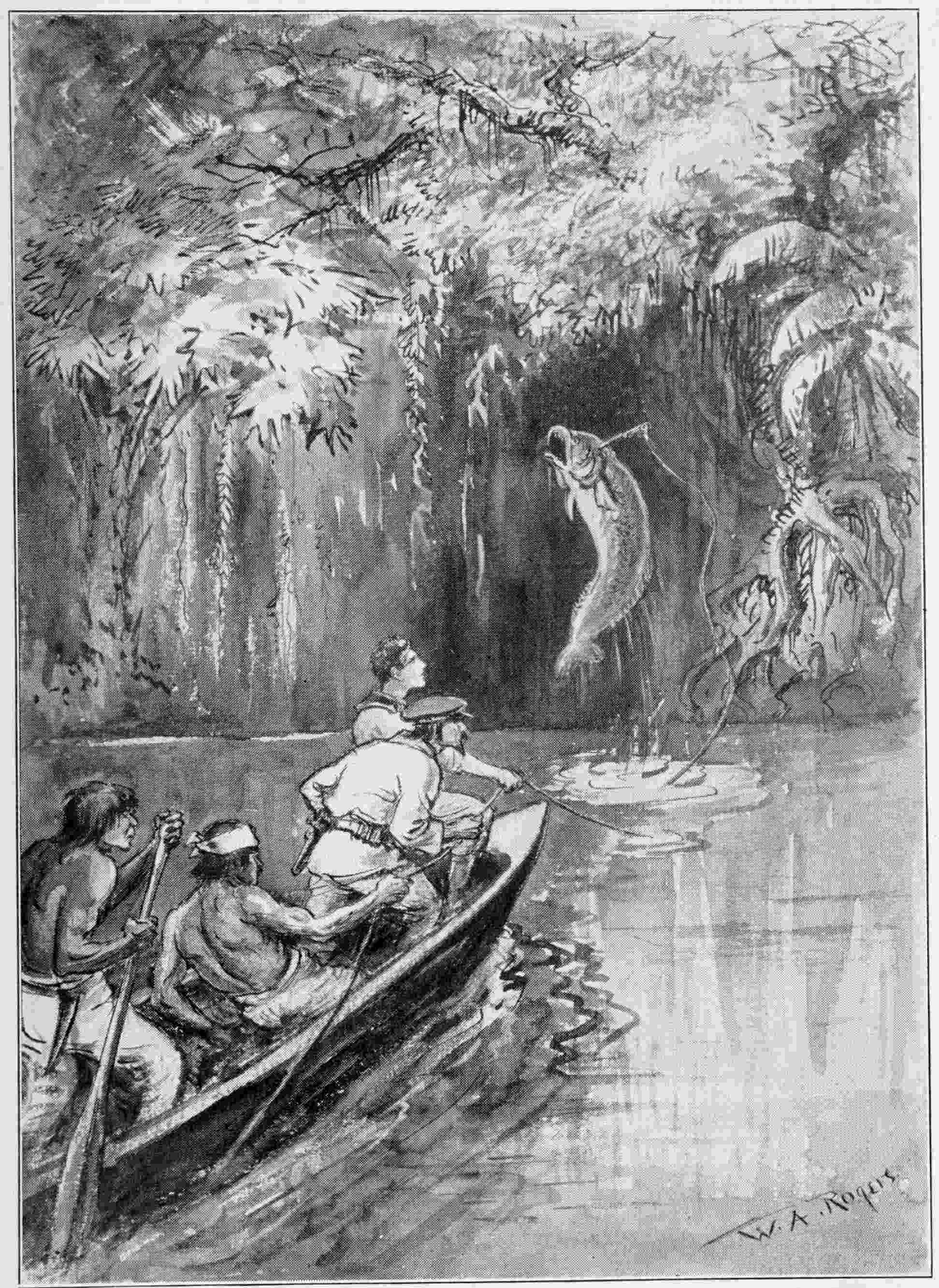
A huge silvery form ... leaped out of the water, rolled and wallowed convulsively, and sank from sight.
great sight to see the half-submerged buoy tearing a wide path through the muddy water, towed by the terrified monster deep below.
“The curare!” Don Marco shouted; but the men had already untied the dugout canoe that trailed behind the batalao. The captain, David and two of the sailors jumped into it and they were off after the fleeing keg.
“He can’t keep it up very long,” Don Marco panted as they dug deep their paddles and sped along. “A few kilometers at most and the drag will tire him out. He must be enormous—look how the keg is travelling. If the line should break he will be lost.”
After running downstream several hundred yards the float came to a stop.
“It snapped, or the harpoon did not hold. He’s gone,” were the first thoughts that came to the pursuers. But a few minutes later it moved again, this time heading upstream. That was fortunate for the men but unfortunate for the fish, for now it had to fight not only the current but pull the hampering weight against the stream also. And it was coming straight toward the canoe. Soon it was abreast, so the paddlers turned the craft and now had no difficulty in keeping up with it.
Bit by bit the fish weakened and after half an hour the keg stood still.
“Now we must get it quickly, before it can rest,” the captain called. When they reached the float he leaned over, caught the line with his hands and began{76} to pull it in, not hurriedly, but with an even, steady movement.
This, however, gave new life to the fish. It dashed away, downstream, but the man retained possession of the cord and the canoe tore through the water at great speed, her nose ploughing so deeply that it was all but submerged.
The men dropped their paddles and began to bail out the water that poured in in a steady stream; but soon it became apparent that their efforts could not stem the flood that was rising about their feet. If the fish did not slacken its pace soon they would have to release the line or the canoe would be swamped.
But the great pirarucú was rapidly exhausting the last vestige of its strength in pulling the dugout. It was gradually coming nearer the surface; and then a huge, silvery form leaped out of the water, rolled and wallowed convulsively, and sank from sight.
Don Marco rapidly took in the line and in a moment they had reached the spot where the last ripples were dying in a widening circle; soon the prize had been brought up from the muddy depths and wallowed helplessly beside the boat.
What a beauty it was! And what a monster! A line was made fast just in back of the fins and they towed it back to the batalao, where it was hoisted aboard.
As the great fish lay on the deck, David surveyed it with a triumphant gleam in his eyes. It was fully eight feet long and the captain said it would weigh more than four hundred pounds. The glistening body{77} was a foot and a half broad across the back and two feet wide along the greater part of its length. Silver scales the size of a dollar covered it and those on the lower half were margined with scarlet. The mouth was very large and wide open; the fish was dead.
After examining it for some time David’s feeling of exultation gave way to pity for the beautiful creature. It was of such great size, so majestic, and seemed like a fitting denizen of the Amazon, representative of the mystery and the wonder of the mighty river. It seemed so out of place on the deck of the boat.
“That is a beauty,” he commented, “but one is enough for a long time. I am not going to kill another unless it is needed very badly. What are we going to do with it?”
After taking a number of photographs of the fish, David watched the sailors dress it. Then they cut it into slabs and sprinkled salt over the pieces, which they hung up to dry.
“It will keep months now,” Don Marco said. “We shall need most of it, and what is left can be sold further up the river.”
They rowed and poled upstream a short distance above the mouth of the creek and anchored for the night.
There were a number of small settlements scattered along both banks of the river, but the trader did not stop at any one of them during the first days after leaving Manaos. He said they were too near the city, to which the people made frequent trips, so they naturally purchased their supplies during these visits, knew the market value of everything, and would not pay the prices he was compelled to charge. It was further upstream, where the inhabitants were more isolated and the distance too great for them to make frequent excursions to Manaos, that he expected to glean his harvest.
The second day passed without incident. In one stretch, where the water was too deep for poling, the sailors got out long-handled hooks. They caught these in the overhanging branches and then walked along the board runways, but now they pulled as they walked instead of pushing, as they did when poling, and only half could engage in the work, as there was forest on only one side of them. Therefore, they were divided into two parties of six each, one resting while the other trudged along the wet, slippery boards.
It seemed to David as if the branches overhead har{79}bored all the insects in the world. Each time the hooks were thrust into them a shower of ants, leaf hoppers and a multitude of other winged and crawling creatures fell into the boat.
The men seemed not to mind the hordes of creeping things streaming down their arms and bare backs, beyond an occasional exclamation of annoyance or some jesting remark when one of their number was deluged with an exceptionally large number. But when on the third day the hooks stirred up a nest of the fierce maribundi wasps their tolerant attitude quickly changed, for the insects were quick to resent the interference with their domestic affairs.
Several of the wasps darted out of the dense foliage, their red bodies gleaming like flying sparks. They made straight for the men and simultaneously there rose a chorus of wild screams mingled with the clatter and splash of poles that fell from hands now occupied in striking at the darting specks or in clutching madly at their bodies.
David came to the door of the storeroom to see what had happened; he was amazed at the strange antics of the sailors, who were now making for the opening in which he was standing. He was not kept in suspense long.
If a red-hot needle had been thrust into him the effect could not have been more painful. One of the wasps had discovered David and had plunged its fiery dagger into his arm.
He dashed back into the storeroom with a cry of pain, and the men followed in quick succession. They{80} slammed the door as soon as the last one had entered, and at last they were safe from the attackers.
The batalao, left to its own devices, began to drift downstream, but none sought to stop it. The crew, packed tight between the boxes and bales, was too much occupied with a more vital matter, and some of the men who had been stung a number of times were screaming and moaning in agony, while from others came not a sound—they had lost consciousness.
David had never suffered such intense pain in his life. His arm throbbed and burned and was rapidly swelling to huge proportions. At times he was on the point of fainting and grasped the nearest support to keep from falling to the floor. The stifling heat in the room added to the suffering of all.
“Open the door!” Don Marco shouted. He had come through the encounter unscathed. “Get out into the fresh air,” he added; “we have drifted past the nest; the danger is over.”
Someone obeyed the first order mechanically and those who could walk went out upon the deck. They presented a sorry appearance. Some had been stung on the hands; others on the face or bare backs, the exact spots being marked by rising protuberances of an angry red color.
In the meantime David was wondering what he could do in the matter of giving relief. He thought of iodine; that would help. Then he remembered the snake-bite lancet in his pocket—a hard rubber device that looked like a short fountain pen, with a sharp steel blade in one end and a pocket of permanganate{81} of potash crystals in the other. He would try that, on his own arm first.
After opening the wound with a quick thrust of the keen blade he rubbed a quantity of the dry powder into it. Then he painted the whole area with iodine. Relief from the burning pain followed quickly; there remained only the dull throbbing.
Encouraged, he began working on the sailors. They submitted to his ministrations and were grateful for the help he gave them.
“The maribundi wasps are terrible creatures,” Don Marco said that night. “I am more afraid of them than of anything else in the jungle; they are even worse than snakes, because there are more of them and it is impossible to escape from them when they are encountered. If a man is stung four or five times, he dies. And only one sting will often make a person sick for weeks.”
They had anchored so soon as it was possible to muster enough hands to row the boat to the bank.
“Are they very common along the river?” David asked anxiously.
“Yes, here and on the Orinoco too; and not only along the water, either. One is liable to run into them in the forest and in the clearings alike. They are quick to attack the moment they are disturbed. You must give me some of your remedy, for it is the best I have ever found. But for your quick work some of the men would have died.”
The journey was not continued until two days later; the men had recovered sufficiently by that time to{82} resume their duties. They were obliged to use the hooks, as before, and could only trust to luck for the future.
That day they stopped at several clearings and traded with the settlers. The places were interesting—like notches hewn into the heavy jungle, openings with ragged edges where the vegetation was advancing in solid formation to reclaim its own. There was abundant other evidence that the fight of man against the forest was incessant. Second-growth sprouts sprang up in the yuca fields in back of the huts and unless they were cut down promptly they soon formed dense thickets that smothered the cultivated plants. Besides the yucas, from which the farinha was made, there were clumps of bananas, plantains, sugar cane and tree melons; also small plantations of coffee trees. These were from ten to fifteen feet high, round and bushy, and covered with clusters of small red fruits. Each of the little spheres contained two coffee beans, their flat side resting face to face, and the whole surrounded by a thin, sweet pulp. There were tall breadfruit trees near the huts, their broad leaves providing shade and the great cylindrical green fruits serving as an addition to the food supply.
The Brazilian cherries interested David greatly. They were about the size of the ones he was accustomed to at home, and of the same bright red color, but had deep grooves in them from stem to tip, so that a cross section would have the outline of a star.
Most of the people were squatters in the wilderness. They were Portuguese who had cleared their little{83} patches of land and were subsisting on the bounty of the soil and the river. They worked little, except in fighting the forest, as all vegetation grew so luxuriantly and yielded such abundant crops that little cultivation was needed to produce all the food they required. They were easy-going, good-natured, and spent most of their time in their hammocks, conversing and sipping tea or coffee.
A few of the stations, however, were owned by residents of Manaos, who visited them occasionally and maintained hired help permanently to cultivate the soil and care for a few cows, pigs and fowls.
The dwellings were all of similar construction—flimsy structures with bamboo walls, earth floors and roofs of palm leaves. The tropical luxuriance of the foliage all around them, however, gave them a picturesque appearance so that they seemed to fit properly into their surroundings. A more substantial type of house would have been impracticable and out of place in such a climate.
“Are there no large ranches along the river?” David asked, after leaving one of the clearings.
“Yes, there are a few, but they have been started very recently. Each time I come back this way I find a few new ones, but none of them is very large. We expect to reach one of them tomorrow; I just heard about it in Manaos.”
“What is it called?”
“Las Palmas. The owner is one of your countrymen. They say he has an enormous ranch in the Argentine and is going to make Las Palmas the best{84} and largest in the Upper Amazon. But it will be hard work and I doubt if he will succeed.”
“Do you know anything about the owner? What did they say about him in Manaos?” David asked eagerly.
“Nothing much except what I told you.”
“That might be a good place for me to stop,” David suggested.
“Tired of the river already?” Don Marco asked in surprise.
“No! Just beginning to become interested.”
“Then it must be that you do not like our company. I am sorry,” and the captain seemed offended.
“No! Nothing of the kind,” David hastened to assure him. “You have been mighty good to me and I wish I could stay with you on the whole trip. But my time is limited and I want to see some of the ranch life. To tell the truth, that is the reason I came to Brazil.”
“As you wish. But I shall be sorry to see you go.” There was a note of real regret in Don Marco’s voice. “It has been a pleasure to have you and I have enjoyed your company.”
They reached the landing just before noon of the following day.
“This must be the spot, but where is the ranch?” the Venezuelan asked, greatly puzzled, as he looked up the narrow trail leading from the high bank straight through the heavy forest. Aside from this path there was no evidence of life in the neighborhood.
“I know the river too well to be mistaken,” he continued. “This is the spot they described to me.”
But the tall, dark trees standing like sentinels over the narrow lane men’s hands had made at their foot were grim and silent, as if guarding some secret.
“It may be back from the river a short distance,” David suggested.
“It must be. But a ranch should be on the water, or very near to it. That is the custom here. They have boats and launches at Las Palmas, but where are they? This is the landing. We shall see!”
Then, calling to two of his men, Don Marco continued:
“You, Pedro and José, walk down the trail and see how far it is to the house. Come back at once after you find it. Do not tell anyone your business or mine.”
The men departed, soon disappearing among the shadows cast by the tangled branches overhead. Some of the other sailors began to fish, while David got together his things preparatory to leaving. The cook prepared slices of the salted pirarucú for the departing guest, for David had found the flesh delicious and had said so on several occasions. It was just as well that the cook had taken for granted that the remarks referred to his cooking, rather than to the natural quality of the fish, for he showed appreciation in various ways, the most acceptable of which was the frequent preparation of those things David liked best to eat.
Hour after hour passed, but the two men did not return. Some of the men waiting on the boat began to fear that they had lost their way or had met with{86} a mishap. And David, remembering the many things he had heard about Las Palmas and the fate that would befall anyone attempting to enter the place, began to wonder if he were not to blame, for he had failed to warn them of their danger. It was now too late for regrets, for the men had been gone more than three hours.
“Why don’t we go after them?” he finally asked the captain. “I will go. They may be lost.”
“Impossible,” Don Marco returned. “Both are good woodsmen and know how to find their way.”
“Could they have been attacked by Indians or some animal?”
“It is possible, but I think not. They know how to fight.”
“Then why don’t they return?”
“Quien sabe! We will wait a while longer and see what happens.”
After another hour had gone by the two men returned, tired and mopping the perspiration from their faces.
“Well?” their employer asked.
“Caramba!” one panted. “Such a place! Caramba!”
“Yes,” the other added, “such a place.”
“What is the matter with it?” impatiently. “You act like a pair of dunces.”
“Miserable,” the first man said. “I never saw anything like it. First you have to walk your legs off to get there, and when you arrive you find it is for nothing.”
“That is the truth,” from the second man, “and{87} the trail is terrible. We had to cross streams on log bridges, wade through ponds filled with yacarés, and splash through mud nearly up to our knees. Caramba!”
“But what did you find out?” Don Marco asked impatiently.
“After we had been walking several hours—long after leaving the forest—a man on horseback rode up to us and asked us what we wanted. There were houses and sheds not far ahead and he came from that direction. When we told him he began shooting at us and chased us away.
“We came back faster than we went—much faster, or we should not be here yet. There were Indians in the woods, too, but we escaped them.”
“But did you tell them you only wanted to find out how far——”
“We tried to, but the barbarian gave us only a half minute’s start before he began to shoot. We could not talk and run at the same time.”
“You two cowards,” said the captain in disgust. “We have lost a whole afternoon on your account.”
“Anybody would have acted as we did.”
“Perhaps the man was joking,” David ventured. He was far from being comfortable.
“We could not read his mind. We know what he said and did, and that was not very funny,” they said hastily.
“What kind of a place was it—I mean the houses?” David continued. “Did it look like a real ranch?”
“It did not look like much—from a distance,” one of the men replied. “But we did not get very near to it.”
“I suppose I shall have to find out for myself then,” he said with a sigh.
“Are you going to stop here anyway?” asked the captain in surprise.
“Yes. You will have to leave me here.”
“It will be a long walk—and no telling what will happen when you get there, according to the report of these two.”
“Well, I will have to take a chance. I can follow the trail and go slowly. I am sure they will not try to chase me away.”
David wanted to start right away, but the captain would not hear of it. It was too late in the day to undertake such a long tramp through the forest. And for one unfamiliar with the country the attempt to spend the night under such circumstances was ill-advised, to say the least, for the trail was indistinct and difficult to follow even in the daytime.
David reluctantly agreed to the force of these arguments, and as the boat was to remain there anyway for the night he decided that he would stay aboard.
After supper they rowed a short distance into the stream and anchored.
It was well that he did not ignore Don Marco’s advice not to attempt to spend the night alone in that, to him, unknown jungle, for the onrush of darkness had scarcely enveloped the earth when one of the terrific storms, as greatly feared as they are common on the Amazon, swooped out of the west and for two{89} hours held land and river helpless in its merciless grasp.
The onslaught came suddenly. Before the first warning drops had awakened the sleepers, a wall of wind and falling water swept down the river and struck the batalao with such force that it nearly capsized.
The men sprang from their hammocks and crowded into the storeroom, where they were held prisoner while the storm spent its fury.
The downpour thundered steadily over their heads and here and there a small rivulet found its way through the roof. Below them, the waves hissed and boomed as they dashed against the sides of the dancing craft. And from the forest came an occasional roar, followed by a crash which told the fate of some great tree that had succumbed to the force of the gale.
Although sweltering in the close atmosphere of their quarters the men were in no danger, for thanks to their preparedness the boat was far enough from the bank to prevent its grounding; and the anchor held fast.
After a while the rain stopped, but the wind did not die down until daylight came. By this time the waves had attained a great height and the boat pitched and rocked so violently that those aboard began to be uncomfortable. All the while one other sound reached their ears above the shrieking of the wind and the pounding of the waves. It was a dull, muffled noise coming singly sometimes like the booming of a distant gun, and again in a rapid succession of roars, rumblings and crashes—some nearby, others far distant.
Daylight revealed the cause of the disturbance. The constant beating of the waves had undermined sections of the river bank and long, narrow strips of it were falling into the water. It was a wonderful yet terrible sight to see the great masses of trees begin to shudder, then bow low and finally plunge headlong into the heaving, yellow flood that had washed the foundation from under their roots.
After this din the whole tangled mass disappeared, only to come to the surface in a few moments to be swept downstream, the branches waving above the angry water like so many struggling arms appealing frantically for assistance.
Each landslide further agitated the water and added to the power of the waves. And as the men looked up and down the broad expanse of river it seemed as if the work of destruction must encompass all the land. But with the coming of the sun the wind slackened and the waves subsided, and the slides were less frequent and of smaller extent. Finally they stopped.
Don Marco said they had witnessed a sight that was as unusual as it was awe-inspiring. Not until days later would the last of the débris disappear down the stream.
David took his possessions and went ashore and shortly after he had entered the dripping forest the batalao resumed its way up the turbulent river.
That lonesome walk through the towering forest was an experience David would never forget.
How tall the tree-trunks were and how thick and straight. It must have taken centuries to grow to that size. On some, the lowest branches did not start until fifty feet or more above the ground; they reached toward and intermingled with their neighbors, forming a sturdy framework for the canopy of leaves that shut out the sunlight except in scattered spots where a bright shaft penetrated the thick mat and cast a dazzling, wavering blotch on the sombre forest floor.
The steady drip of water came from overhead, and the ground underfoot was soft and spongy from the drenching of the previous night, so that there was not a sound as David walked rapidly up the narrow trail.
Suddenly it came upon David that the silence was not only under his feet; it was all about him. While he had expected to find the jungle teeming with life, there was not a sign of life. Instead of the chorus of screams, roars and howls that should have greeted his ears there was only the breathless silence of a vast solitude, so intense that the beating of his own heart seemed to pound in his ears like the blows of a sledgehammer.
The wilderness was full of life—it must be—but where was it? David felt that inquisitive, eager, even menacing eyes were gazing at him from places of concealment in the dense vegetation; but he could not see their owners. This thought added to the uncanny feeling that was slowly taking possession of him.
What if he should be charged by a jaguar? Or suppose a herd of ferocious peccaries should surround him? The trees were too thick to be climbed. There was no means of escape open to him.
A twig snapped in back of him. He wheeled instantly, but saw nothing. Standing motionless, he waited a few minutes. Not a leaf stirred, but a faint, shuffling sound reached his ears, like the footfalls of some heavy creature stealing away. Without awaiting further developments he opened his pack and took out his revolver; he strapped the holster to his waist. That gave him a feeling of security and he continued the tramp through the gloomy forest.
As time passed the pack on his back seemed to grow heavier and the perspiration ran down his face in rivulets. Also, the parcel was a serious impediment in crossing the numerous little streams spanned by a single log and that, frequently, of small size.
Walking across the slippery foothold with the deep, murky water below was precarious in itself; the pack rendered it doubly so. He walked across the larger trunks and hitched over those of more slender proportions.
David had just negotiated one of the latter and had stopped to readjust the weight of his burden. A faint{93} rustle made him turn suddenly and look down the trail. There, not a dozen paces from the stream he had just left, stood an Indian, a long bow in one hand, an arrow in the other. The brown skin of the savage, marked with stripes of black paint, blended well with the sombre tree-trunks and dark foliage.
For a moment neither stirred but each gazed at the other, David in surprise and consternation, the Indian with an air of resentment at having been discovered. Then the latter advanced a step menacingly and raised the bow to the level of his shoulders. David’s hand flew to the holster on his belt and a shot, aimed high, rang out clear and sharp in the silent forest. The Indian gave a wild yell, sprang to one side and dashed away. The thud of his feet and the swishing of the branches were ample proof that he had no intention of stopping in the near vicinity.
“I guess that fixed him for the present,” thought David; “but I’ll have to hurry; he might come back with others and then it would not be so easy to scare away the whole pack.”
A hundred yards up the trail he stopped, slipped the pack off his back, and hid it in a mass of ferns growing between the buttressed roots of a great tree. After that he could walk more rapidly.
When another hour had passed he noticed that the forest was becoming more open in character. The trees were further apart and the sunlight found its way to the ground in numerous splashes and pools of bright light. About the same time he heard the call of a bird—the first sign of animal life on all that long, solitary{94} tramp. It was fortunate that he saw the author of the sound, for it was a shrill, quavering note that was unearthly and weird in the extreme.
The bird was of the shape and size of a guinea hen, but of a rich brown color. It ran out into the trail just ahead of him and stood looking at the man with bright, black eyes until he was nearly upon it, when it flew away with a loud whirr of wings. It was a poor flyer, however, for although it hurtled through the air at great speed, its course was erratic; it darted one way, then another, until it dashed against a tree-trunk and fell to the ground, where it lay fluttering. David started toward it, but before he had covered half the distance separating him from the now quiet creature a lithe form sprang out of the cover on one side of the path, picked up the bird in its mouth and darted out of view again.
The marauder was of the cat family and spotted like a leopard, though not so large. Its sudden appearance gave David a start, for it proved that there was life in the silent forest in spite of the hush that prevailed. Unseen eyes and keen ears were about him; it required only the proper combination of circumstances to bring the creatures from their hiding-places. This thought was far from comforting and the lone wanderer redoubled his vigilance in an effort to forestall a surprise attack on himself.
At last the forest gave way to a scrubby growth, and this was soon replaced by open country; that is, it seemed open in comparison to the jungle through which David had just passed.
There were low bushes in scattered groups; between them lay grassy areas of considerable extent. Clumps of trees stood like dark islands in the sea of lighter green; and here and there was the glint of water—lagoons fringed by reedy marshes.
The picture was that of a perfect wilderness, but it was an enticing one. It bore the stamp of primeval nature and seemed pregnant with the promise of rich rewards for the one who cared to go in quest of them.
“The ranch cannot be much farther,” David thought. “It would have to be out in the open, of course.” And he scanned the country in all directions for some signs of the buildings or their occupants.
But the wilderness stretched on unendingly on all sides, with only the narrow thread of a trail to give evidence of the fact that the country was not unknown to man.
There were other foot-paths, too, but they had been made by animals—deer, peccaries and tapirs, and occasionally there was the deep, broad imprint of a jaguar’s foot, or the smaller, uncertain track of an ocelot.
Birds of many kinds dotted the sky and were spread out over the landscape. Parrots and great macaws sped by overhead; herons and egrets covered the trees as with a snowy mantle; and rafts of ducks floated on the quiet water, while smaller birds dabbled among the grass and reeds lining the lagoons. Of the latter, one kind in particular attracted David’s attention. They had long legs and long necks and could have been mistaken for snipe but for the fact that they seemed to run and skip over the surface of the water with the{96} ease of covering firm ground. But when David drew nearer he saw that the birds had wide-spreading toes which enabled them to use the mats of small, floating plants as a footing. They were reluctant to fly, but when they did they fluttered like grasshoppers, exposing a greenish patch of color in each wing, and uttered queer, cackling, scolding notes.
Some of the smaller ponds or sloughs had begun to dry. The water that remained was muddy and teemed with fish that had been left stranded far inland by the flood of the last rainy season. The imprisoned creatures were struggling frantically in the slimy liquid, dashing back and forth in futile efforts to find an outlet into some larger and friendlier basin. In their frenzy they attacked one another and numbers threw themselves out upon the land, where they gasped their last. Apparently this state of affairs had been going on for some time, for the ground was littered with heaps of the remains in the form of white bones that had been crushed by opossums and other nocturnal prowlers.
The depressing sight and the stench made David avoid these places by wide detours whenever possible.
It seemed as if the trail ran on interminably, winding between the lagoons and forest islands, traversing the highest, dryest places of the open country, but always leading on and on. If the ranch were in the neighborhood, there should be some indications of it. But so far neither horses nor cattle, smoke nor houses could be seen.
David was beginning to wonder if he might not have{97} taken some branch of the original trail that was simply taking him deeper and deeper into the wilderness. He stopped for a moment to consider what best had be done. As he scanned the country his eyes caught sight of moving objects in the distance and a first glimpse convinced him that they were horsemen. He could have shouted for joy, for now it was but a matter of minutes until they should see him and then they would soon take him to the ranch. It never occurred to him that the riders might not want to see him or that they would refuse to help him if they could not avoid him, and that, too, in spite of the things he had been told he was to expect from the owner of Las Palmas. Just beyond, the ground was more open; he decided to go there and wave his hat to attract the attention of the men.
As he started through the thick grass a warning bellow from directly in front stopped him in his tracks; he looked in the direction from which the sound had come, but could see nothing. A moment later a second bellow, more like a roar, reached his ears and at the same time he caught sight of a long, waving object like the head and neck of a great snake. Before he had time for action of any kind a huge, grayish body leaped out of the grass and charged. It was a rhea or South America ostrich. Onward it came with lowered head, hissing as it sped over the ground, the short wings drooping and feathers ruffled in a terrifying manner. It was upon David in a few seconds. The attack had been so sudden that he had not had time to grasp his revolver; as the great bird lunged{98} at him he stepped aside and caught the outstretched neck in his hands. That action, unexpected as it was new to the bird, bewildered it and it stopped. However, the surprise of the reception lasted but a moment.
David clung desperately to the creature’s neck. Back and forth they struggled, the bird striking with its huge feet, beating with its wings and bellowing in its frantic efforts to break the man’s hold.
The outcome of the struggle depended upon endurance. Sooner or later one of the two must give out, and for a time it was impossible to guess which would be that one. The bird was first to show signs of succumbing to the strain. Its struggles grew weaker and finally they ceased altogether, much to David’s relief, for he too was on the verge of exhaustion.
When the rhea was quiet he relaxed his grasp. Instantly it again became charged with life. It gave a powerful wrench and the thick neck slipped from his aching fingers. But instead of renewing the attack, the bird seemed to have but one thought, but one desire, and that was to leave the locality as quickly as possible. It turned and fled in a series of long strides, its head held high, wings stretched out like sails, and feet that moved so rapidly the eye could not follow them in their prodigious leaps.
The supposed horsemen had come nearer all the while and David now saw that they were a flock of the ostriches, which his attacker joined, when the entire company turned and soon disappeared in the distance.
David went to the spot where he had first sighted{99} the bird. To his delight he found a mound of huge eggs. They were of an oval shape, creamy white color, glossy, and so large he could not span one with his fingers. There were twenty of them, neatly arranged in a slight hollow scooped in the ground. He could not take them with him, of course, on account of their great weight and size, but thinking that he might have need of them at some time in the near future he tore a strip of cloth from his trousers—rent by the bird’s sharp claws during the struggle—and tied it to the highest reed near the nest, to serve as a marker for the spot.
Another half hour’s walk under the broiling sun and the end of the trail was in sight. There it was at last, but it looked nothing like the ranch-house David had pictured. Instead of the long, low, rambling building he had expected to find, with its corrals, and groups of saddled horses standing dejectedly under the shade trees, there was a ramshackle structure built of bamboo poles and covered with a thatched roof. A dozen or so smaller huts were scattered about the immediate vicinity. Here and there grew a cluster of tall, graceful palm trees; that was why the place was called Las Palmas.
The surrounding country did not appear very inviting. It looked forsaken and, under the hot sun, almost desolate.
David drew a deep breath and kept on his way. Perhaps the new life he had chosen was not going to be so interesting as he had imagined; but he would keep on just the same. This was no time for regrets.{100} He must stick by his determination to see the thing through.
As he approached the largest house a lone dog darted out from some place of concealment, growling and bristling; he called to it in a friendly manner, but it bared its teeth and slunk away. A man, obviously a native, came to the doorway of the nearest hut and stared at the stranger in open astonishment. David started toward him; the man gave him a malicious look and faded from view in the darkened interior of the hut.
“Not a very inviting atmosphere around the place,” thought David. “But I’ll walk right into the big house as if I owned it and see what happens.”
On the threshold he stopped, however, and knocked. There was no response from within, but, hearing the sound of voices in back of him, he turned quickly to see who was responsible for it. A small group of natives stood in the doorway of each hovel, or in front of it, eyeing him in a curious manner.
“Enter!” one of them called to him. “The patron is inside.”
David heeded this advice and walked in. He found himself in a long, low room with a hard-packed earth floor. A number of benches lined the walls and at one end were a wooden table and a chair. A man of burly appearance sat on the chair; his back was turned toward the doorway so that David could not see his face, but the neck was dark brown—David did not know whether the color was that of a native or caused by the hot sun. His clothes—a tan silk shirt and{101} khaki-colored riding breeches, with tall boots and huge spurs—were neat and not unattractive.
The youth saw that much during the minute he waited respectfully just inside the room. Then, as the man paid no attention to him, he took a few steps forward.
“Didn’t I tell you to keep out of here?” The man’s voice sounded like a roar, but still he did not look up from the papers before him. “Wait just a minute—then I’ll kick you out, so you will remember it the next time.”
The man stood up and turned quickly.
“Well, for the—” he exploded and stopped short in apparent surprise. His face was tanned also and smooth, and his eyes were blue. But for the fierce scowl he wore he would have been a most amiable-looking sort of a person.
“Who are you? Where did you come from? How did you get here? What do you want?”
The questions were hurled in such rapid succession that David was bewildered.
“I am Jones,” he said, after an instant’s hesitation, and he tried to smile.
“Jones? Jones who?”
“David Jones. You are expecting me.”
“Boy, you must be crazy. I am not expecting anybody”—with a sneer—“and furthermore, if I find out who brought you here I’ll break his neck.”
“You don’t understand—” David began, but the other interrupted him.
“Don’t you tell me I don’t know my own business,” he snapped.
“Pardon me. I did not intend to be rude. But I understood that my father and you were old friends and that he had made arrangements for my coming here. He sent several cables——”
“Oh, that’s it, is it? Just because he happened to know me he thinks he can send his lazy, shiftless son to me to look after. What does he think this is, a kindergarten? What I want is men, real men—not babies. What do you know, what can you do? Nothing.”
David’s first feeling of consternation was giving way; also, he felt decidedly less important than he had when telling of his plans just before sailing, and on the steamer. What did he know after all? What had he ever accomplished? Now that he was actually face to face with the rugged type of man he had held up as his ideal, he felt very small indeed.
“You are right,” he said meekly. “I don’t amount to much. I knew it, and that is why I wanted to get away to a place where I had to depend on myself and would have the chance to make good under trying conditions.”
“You picked out the poorest place in the world. Don’t lie to me; you thought you could come here as Mr. David Jones, son of the big New York business man, and that I would let you hang around as an ornament, wear fancy cow-boy clothes, so you could send pictures to your friends at home to admire; and that{103} I would pay you a big salary for the honor of having you here. Well, you guessed wrong.”
“I didn’t think of any of those things. I don’t want a cent until I honestly earn it. All I expect is a chance to do the things I have always wanted to do. My father did not send me away to get rid of me; I had a hard time to get him to let me come here.”
The ranchman seemed to relent a little and, encouraged, David told him all, including his difficulties at Manaos and how he had finally succeeded in reaching the ranch on the trader’s boat.
“You did have tough luck all around,” Rice commented, “but if I let you stay, it would only grow worse. Everything here has to be done by men who know their work; we haven’t time to be teachers. So you can rest up a bit; then I’ll send you back down the river. And that settles it.”
A loud knock sounded on the door-frame.
“Come in,” Rice called, and into the room stepped a tall, lean man, dressed in a blue cotton shirt and fringed, leather breeches. He had a cruel, swarthy face and small, restless eyes.
“Now what?” his employer asked.
“The launch is back from the Iguari; there has been more trouble with the Indians.” He cast a meaning look at David.
“I’ll go outside,” David quickly said.
“No!” Rice bellowed. “You will stay right here until I tell you to go.”
David stopped and quickly turned to face the two.
“Now, what’s the trouble?” Rice demanded in an angry voice.
“It’s the Indians, mostly,” the foreman replied, shifting his feet uneasily. “They fight us every step of the way, when we get a few miles from the camp.”
“Why don’t you fight back—kill them all. That’s the only way to handle the savages.”
“We do, but there are so many of them that there are always others to take the places of the ones we kill. They seem to spring up like weeds, right out of the ground.”
“Well? Go on! What else?”
“The snakes are worse than ever this year.”
“So you are afraid of snakes, too!” Rice said with a sneer. “You are a fine person to be entrusted with the management of the rubber camp. If you can’t do better than that, I’ll kick you out and put one of the half-breeds in your place. At least, they are not cowards.”
“I’m not afraid of the snakes myself, but when one or more of the men are bitten and die each day, it is not long before they all get scared and want to quit. And besides, every one we lose leaves one man less to collect rubber.”
“Is it really as bad as that?” Apparently Rice had underestimated the seriousness of the situation.
“Oh, worse. It was bad enough in ordinary times, but this year the drought is driving all the snakes to the river. They like the huts of the men to use as hiding places, and are always dropping down out of the thatched roofs or crawling over the floor at night; they even get into the hammocks. I have never seen anything like it. Mariano found a twenty-foot anaconda in his hammock the night before we left; that’s why no one has seen Mariano since—he left camp in such a hurry he did not even take his clothes.”
“Snakes or no snakes, the rubber crop must be gathered.” Rice seemed to have made up his mind and spoke with an air of finality. “Soon the rains will be here and then the season will be over. You must get more men and try it again; we must have the rubber even if you lose every single man in the end.”
“We can fight against the Indians and the snakes,” the foreman ventured, timidly, “but there is one thing we can’t overcome and that is the fever. There never was so much of it as this year—on account of the drought, they say. Most of the men who escaped the other two plagues are too sick to work.”
“Don’t tell me any more!” Rice thundered. “I’ve got troubles of my own. It’s up to you to harvest that rubber, so go do it. You are the foreman. Do anything you want to. Take every soul on the place; it don’t matter if none gets back alive, just so you bring back the rubber. Now, get out and do something.”
The foreman did not wait to hear more. He quickly made for the door and disappeared. David was alone again with the viper.
He was speechless with amazement at the things he had just heard. Had he been given his choice now, it is but natural that the first impulse would have been to start for home as soon as possible. But he was not asked to make known his desires.
“I’ve changed my mind about you,” Rice bellowed. “You will stay. You’ll make one more hand to get that rubber crop in before the rains start—even if you’re nothing but a boy. Can you swim?”
“Yes,” David answered meekly.
“Can you ride a horse?”
“Yes.”
“Can you throw a rope?”
“No. I never tried, but I can learn.”
“You are a fine one to come to a ranch—expecting to run it. I ought to chase you out, and I would if I didn’t need you so badly. The rubber camp will soon bring out the kind of stuff you’re made of. But just remember this; we won’t tolerate any smart ideas or new notions. You don’t know anything and you’ll do exactly as you are told. You are not Mr. Jones’ son so long as you stay around here. Your official name is Nobody, and that’s what I’ll call you. You are right down on the bottom and you’ll stick there, too, if I am any judge of character. Now go, and tell Carlos where you hid your pack, so he can send for it. He’ll fix you up with what you need, and remember, he’s your boss. Do whatever he says and if he thinks{107} you worth the trouble, he’ll take you up-river. Get out just as fast as you can and don’t bother me again.”
David was too bewildered to resent anything that had been said to him. It had all come like a thunderbolt, suddenly, unexpected and terrible. He merely stammered “Yes, Sir,” and hastily departed. Outside the door he drew a deep breath of relief. What a frightful character Rice was! He had not the slightest regard for life. No wonder they called him the viper, but David could not think of any creature that was so repulsive to him as this man, unless possibly it was a hyena.
How could his father have sent him to such a place? Then the truth occurred to him. He had not been sent. He had insisted on having his way. If he had known the truth; if only he had listened to the advice of others who knew the world better than he, and——. But, no! He dared not think such thoughts. He had gone this far and there must be no quitting. He would see the thing through. Somehow, some way, matters would straighten themselves out and if they didn’t he would force them to.
Seeing the foreman near one of the larger huts, David went toward him unaware that the eyes of the beast were following his every movement. The look of cruelty had gone from the eyes and a smile was on his face—a smile partly of amusement and partly of pity, as he looked at the forlorn figure approaching the burly Don Carlos.
“Hm!” he chuckled. “He’s showing the right stuff, so far. Getting here the way he did wasn’t easy. I{108} didn’t think he could do it. I can’t help but admire him and if he don’t make good, I’ll be disappointed.”
“Mr. Rice sent me to you,” David addressed the foreman. “I guess I am to go with your outfit.”
“What, you?” sarcastically. “You wouldn’t be good for anything except to cook for the mozos or some such work.”
“All right. You are the boss.”
Evidently the foreman was not prepared for such a reply and for a moment he was at a loss as to what to say.
“Very well,” he said finally. “If that is the way you feel about it, I guess we can use you. But I warn you in advance that you’ll have a hard time of it. You’ll be the only white man; the others are Indians and Mozos. They have to work hard and put up with anything, and so will you.”
“I am not asking any favors. I’ll do the best I can.”
“Come along then. I’ll show you where you’ll live while we are here. Where is your pack?” the foreman asked.
David told him where he had hidden it.
“I’ll send for it. There’s a short cut you don’t know so it’ll be easier for one of the men to get it.”
They entered one of the shacks, the interior of which was larger than the outside indicated. Stout poles set into the ground and covered with a veneer of grass formed the walls; the roof was made of palm leaves. The floor was hard-packed earth. A number of hammocks had been swung between the poles and small, wooden chests and bags of various kinds lined the{109} walls. Light was admitted through one window opening and the doorway. The place was gloomy and stuffy and David recoiled at sight of his quarters, but said nothing.
“Put up your hammock in the best place you can find,” the foreman said. “If you have none draw one from the supply house. You’ll have to sign a receipt for it, and for anything else you get and it will be charged to your account. That’s the way things are issued here.”
By nightfall the newcomer had been installed in his new quarters. His pack had arrived and he had drawn a number of things he needed from the supply house. There had also been the first meal at the ranch mess shack—chunks of beef roasted on sticks before a wood fire, boiled beans with farinha and coffee. It was the first food David had had since early morning, and it seemed wonderful to him.
After supper the men gathered in their huts and played guitars, sang songs and smoked. They did not enter their hammocks until a late hour and even then they conversed in loud voices for some hours longer.
It was uncomfortably warm under the mosquito netting, but the humming of the insects just outside the cloth dissuaded David from removing it. Better suffer the heat than permit the mosquitoes to feast on him and perhaps inoculate him with the germs of the dread malarial fever of which he had heard and read so much.
The night came to an end somehow and again David was forcibly reminded of his surroundings by the{110} babble of voices around him for an hour before their owners slid from their hammocks.
That day was a busy one. He spent the first part of it getting acquainted as best he could with the men about him who would be his constant companions. They were a ragged, unkempt crowd of all shades from yellow, through brown, to black and at first they regarded him with suspicion. But after he had assured them that he was to be one of them and later distributed a generous supply of tobacco, they regarded him in a more favorable light and one or two called him camarada which word they used in addressing one another.
However, they seemed unable to comprehend why a white man should be relegated to their lowly, unhappy station. That situation was new to them and time alone would accustom them to it.
One of the group, Miguel by name, however, did not hesitate to show open resentment toward what he considered an intrusion by a stranger who was not of their kind. He was of heavier build than the others, apparently with Indian blood in his veins and occupied the place of leader of the party. When they sang he announced the songs; he led the conversation and talked in the loudest voice; and when they worked, he selected the easiest tasks for himself.
In David he saw a possible rival; but he had met similar situations before and he knew of various ways of handling them.
David, after asking permission of the foreman, drew more things from the keeper of supplies. Among them{111} was a rope, for he must become proficient in its use in roping cattle upon his return from the rubber camp. His object was, of course, to learn thoroughly the ranching business; all other things were but a means toward that end.
Asking questions judiciously, David learned many things. The men told him that there were cattle on the place—many of them, but at the present time they were far away roaming the grasslands and attended only by a few rangers who would head the roving bands back to the ranch with the coming of the rainy season when grass would be abundant in the country nearby. And that he had reached the place by an old, seldom used trail; the new one was only a score of yards long. The launches came up a small creek that flowed almost past the doors of the ranch houses. They all agreed that the rubber camp was an extremely unattractive place and about Rice, owner of the place, they refused to talk.
Preparations for the departure were being made in a leisurely manner. True, there was need of haste, for the dry season would not last forever. Doing things slowly was, however, typical of the country. The men simply could not be hurried beyond a given point. Probably the climate was to blame for the fact that the people did not possess the energy and initiative of those of a more northern latitude.
There were bales of charque or dried, salt beef that looked like bundles of leather scraps; bags of beans, coffee and brown sugar; and many bags of farinha.{112} In the course of his inspection of the settlement, David had the opportunity to see how the latter was made.
One whole hut was given over to the manufacture of the coarse meal, and women exclusively were engaged in the work. Yucas, which were tubers like very large potatoes, were being brought from the plantation some distance away. The women carried the heavy burdens on their heads, balancing them without using their hands to steady them. Others took them, pared and grated them; for the latter process they had a board on which small, sharp stones had been glued. The juice was then extracted by filling long, tubular baskets with the mash and suspending them from the ceiling; a heavy stone was tied to the bottom of the filled baskets. The weight pulled the baskets downward, contracting them and thus expressing the juice from the pulp. This liquid was caught in wooden containers and allowed to ferment after which it was used as a beverage.
After the greater part of the moisture had been removed the contents of the baskets were emptied into a vat; they were taken from this as needed and placed into shallow pans over low fires. The women stirred the steaming masses constantly with long-handled paddles until they had thoroughly dried, when the particles separated into a coarse meal. That was the finished product—called farinha.
The next day they began loading the launch. David joined the line of mozos and carried his share of the bales and bags. Most of them were very heavy, so it was hard work and the perspiration ran in streams{113} down his bare back. But he stuck to the task without complaint or comment.
On his return from one of the trips to the launch David found Rice standing near the passing file of men, surveying them with an appraising eye.
“Good morning,” he said, halting.
“What?” The voice that replied was filled with sudden anger. “Whining already? Want to go home? I expected it!”
“Why,” David started in surprise. “I only said good morning.”
“Don’t good morning me. And don’t say anything else, either. You are not to talk to me unless I speak first—no peon is allowed to.”
“Very well.”
“The foreman is your boss; you are nobody—with a little n. When I have anything to say to you I’ll let you know pretty quick; and you keep your mouth shut. Now move on.”
David moved on without further urging. He felt as if somebody had given him a sound thrashing, but after all, what could he expect from the beast? He had agreed to start at the bottom although he had not known how low that bottom might be but he expected no favors—wanted none. He would show them that he could stand on his own feet without their help and even in spite of anything they might do; time alone would tell the story.
When night came he was so tired that he sought his hammock right after supper. Neither the loud voices of the mozos nor the uncomfortable position he was{114} forced to assume on account of the short stretch of the ropes kept him awake. For the first time in several nights he slept soundly, and it seemed but a moment when someone called them all to tumble out in a hurry to prepare for the journey up the river.
Day was just breaking when the launch nosed her way out into the little stream. Overhead, the leaf-covered branches of the trees that lined the water-course met to form a delicate tracery of black against the graying sky.
Birds raised their voices, clear and cheery in the checkered canopy and others responded in drowsy, listless whispers from the dark walls on either side.
Where the creek was narrowest or where the foliage was so dense as completely to obscure the sky, the water seemed to melt away into deep pools of blackness; but the launch glided on and on without plunging abruptly into some unseen abyss, although the muffled throb of the engine always seemed fainter in the heavier gloom as if in deference to the all-pervading spirit of darkness.
Once there was a sudden crashing in the heavy undergrowth followed by the splash of a heavy body in the water; then silence for a short interval. Now the sequence was reversed. There was first a splashing in the water and then the crashing of brush—on the opposite side of the stream. A tapir, alarmed by the boat, had sought refuge in the water only to discover{116} that the cause of its terror was directly in its path. Therefore it had dived and swum swiftly beneath the surface and then, emerging, lost no time in regaining the land.
When the light grew somewhat stronger gaunt forms appeared between the water and the fretwork overhead. They always sprang out of the deepest shadows and melted into the distance as silent as spectres and as devoid of clews as to their identity. But finally, when one of them emitted a hoarse croak of fright as the launch rounded a bend and brushed the vegetation in which the creature had been concealed, David knew that it was a heron.
The occasional chorus of squawks that came from high above belonged to flocks of macaws on their way to some fruiting tree for an early breakfast.
By the time the sun rose the launch had entered the main river where the craft hugged the shore in order to avoid the strong current further out. There now being less danger of collisions they moved at a faster rate of speed. David could not but feel how different this mode of travel was from the slow, painful progress made by the batalao when he came up this same river to the ranch.
The Solimoes was broad, majestic and awe-inspiring. Frequently they were caught in swift eddies near the bank, where the launch had to fight for each inch of the way; and occasionally they had to make detours far out into the river to avoid treacherous sand bars covered with only a few inches of water. The latter were{117} in great contrast to other parts of the river where the depth was immense.
One such place was pointed out by the men. The spot was marked by a keg buoy; one of the steamers plying on the Upper Amazon had gone down there shortly before with nearly all hands. The boat had been located on the bottom, two hundred and ninety feet down. Divers could not descend to that great depth and even if they could they would not on account of the aquatic monsters that lurked far beneath the surface.
At Palomas, a small station maintained from the ranch, they stopped to replenish their supply of gasoline. Carrying the cases to the launch and storing them took several hours and as it was late in the afternoon when the work was finished it was decided to remain at anchor until the next morning.
David worked with the others, carrying the heavy tins on his shoulder until it seemed the sharp corners had cut furrows in the flesh; and, while some of the others did a good deal of complaining, he said nothing.
After the task had been completed he stripped for a swim—the first in days. One of the men observed his action and hastened to caution him against entering the river on account of the great numbers of crocodiles and cannibal fishes that congregated at this particular spot and would make short work of anyone foolhardy enough to enter the water. However, there was a place farther up where one could swim in safety.
Several others now came to join them and together{118} they went to a little bay where a stockade of stout poles had been driven into the bottom forming an enclosure that barred the entrance of the savage creatures inhabiting the river.
So far, the peons, while not discourteous, had persisted in their aloofness toward David, and he could not but feel that as yet they had not accepted him as one of their number. He wanted to overcome that feeling on their part; he was compelled to share their labors and it was but natural that he wanted to share their confidences also. The tobacco he had given them in the hut at the ranch, and on several occasions after that, had helped break down the barrier between them. But for the greater part, they had accepted it merely as a present from someone financially able and by nature generous enough to give it. Anyone in like circumstances could do that. It would require some feat of physical prowess and courage to establish the stranger deeply in their estimation. Not until he had demonstrated such traits to their entire satisfaction would the gulf between them be closed.
After ascertaining the depth of the water, David began to dive off the high bank, from numerous positions, and before he realized it, the men had stopped swimming and had formed a semi-circle to watch. Then came exclamations of surprise and approbation as he plunged, again and again, into the water.
“Bravo,” they shouted as he reappeared after each splash.
“It’s nothing,” David answered with a happy smile. “Come along and I’ll show you how to do it.”
But the men did not follow him; the bank was too high, they said. Therefore, Jones showed them various strokes in swimming and in this they all joined, vieing with one another in attempts to master the lesson and thereby win the muito bom of approval from the master.
When they returned to the launch the men who had been to swim told the others what had occurred and were loud in their praise of their new companion.
Everyone listened interestedly except Miguel, their self-appointed leader.
“Who couldn’t swim inside the stockade?” he asked derisively.
“It wasn’t that. We all swam, but it was the ways he did it. And you should have seen him dive from the top of the bank, and you know how high that is.”
“All it takes to do that is practice,” Miguel said, with an air of pouring out wisdom to the ignorant. “Some day we will see if this Nobody is so wonderful in the water. I will go into the river—” he paused so that they might appreciate the full weight of his words, “into the river, I said, where there is no stockade, or into a lagoon full of piranhas and crocodiles. See if he will follow me.”
At first David said nothing. But the men were looking at him expectantly and a few were showing disappointment in their faces.
“All right,” he answered slowly. “Let me know when you are ready. I am not trying to show off but I can certainly do anything you can.”
The men now looked at Miguel. He moved uneasily.{120} His bluff had been called, much to his dismay. But he held his ground.
“I will let you know” he said, “and everybody else, too, so they can see just how brave you are and what a good swimmer you are. You said you would follow me; I have witnesses.”
“Yes. I said that. I expect you to make good—I have witnesses, too.”
Just then the cook called the men for the evening meal, so taking their bowls and spoons they went to the launch for their dole of rice and beef.
In the days that followed, David gave demonstrations and lessons in swimming and diving so often as the opportunity presented itself; and, under his instruction a number of the party soon became adepts at performing the feats they had admired so greatly. In return, they showed him how to handle the lasso and he lost no chance to practice with it, using stumps and snags for targets and sometimes one of the men who would run past, inviting the entangling coils of the rope.
Miguel made no further mention of his challenge and David was careful not to remind him of it. It was not until several weeks later that the matter again came up, with consequences as unexpected as they were startling.
For the present David was fully occupied with the venture in hand. There were a hundred things he wanted to learn and the questions he asked were many. The men, however, were reluctant to talk on most subjects and he finally came to the conclusion that{121} their reticence was the result either of ignorance or of orders from higher up.
They were glad enough to help him with his study of their language—so far as they themselves knew it; to tell him about the river or the animals; and of the methods employed in collecting and preparing the rubber latex. But when he asked about Rice, the ranch, or kindred things they remained ominously silent.
After a while David did not mention these subjects again. It was too evident that the men did not want to discuss them.
A week later they entered a river that joined the Solimoes from the west. It was a small stream compared with the one into which it emptied—not over a few hundred yards in width. At least, the channel they had entered was narrow and the water was clear and swift so that the launch made slow progress. When David looked down at the water speeding past them it seemed that they must be moving along at a furious rate; when he looked at the trees on the bank he knew that they were barely making any headway. It took several hours for them to battle their way up the turbulent stretch of rapids.
“That is an island,” said one of the men, pointing to the land on their right. “This channel is bad enough—especially when the water is low. But you should see the branch on the other side of the island. There is a drop there several meters high and no boat can pass up or down it.”
David was not greatly impressed by these words.{122} He did not recall them even later when he found himself suddenly at the brink of that very drop.
The country rapidly became wilder in appearance. Perhaps it only seemed so because the stream was so narrow that they had a continuous close view of both banks and the heavy growth that clothed them.
The launch seemed strangely out of place in the dreary, primeval waste of jungle and hurrying water. Men had come and gone before on the river; and Indians and beasts lived in the green fortresses on either side. But there was no sign of them, no trace of their presence or existence. Only once was there evidence that others besides themselves were stirring on the now silent, undemonstrative river.
They had just rounded a sharp bend which had obstructed their view up-stream. Ahead of them and not more than two hundred yards distant was another abrupt bend. The stern of a dugout canoe was just disappearing around it. They could not see the occupants of the craft, but the widening circles of ripples on the water showed that a number of paddles had been dipped deep to propel the canoe at great speed.
They reached the spot soon after. Ahead of them was a clear stretch of water fully a mile long. It was not possible that the Indians could have covered that distance while the launch, travelling much faster, was traversing the very short distance that had separated them. But the dugout was not in sight. There was not a trace of it—not even a ripple on the water to tell where it had gone. It had vanished completely.
The river glided on as smoothly and as silently as{123} before with the secret of the mysterious craft safely locked in its yellow flood.
“The guns,” the captain said quietly as they steered toward the middle of the stream.
The men who had weapons loaded them and held them ready for instant action. They scanned the banks as they sped along, but saw no signs of the canoe. There were no creeks or inlets in which it could have been hidden.
“Where did it get to?” David asked in astonishment.
“Who knows?” one of the men answered. “That is one of the mysterious things the Indians do that cannot be explained. One minute you see them, the next they are gone. And the minute you forget all about them a shower of arrows comes rattling around your head.”
“I can’t understand it. I should think it would get on your nerves,” David commented with a shudder.
“It does. Who wouldn’t be upset when he knows there are silent, tricky shadows all around him that appear and fade away at will. You’ll understand it better when you have been in the country longer.”
“I don’t feel comfortable. It doesn’t seem natural.”
“I tell you these Indians are diablos. They are not human. That’s why we are no match for them. You’ll see!”
The river grew somewhat narrower as they advanced up-stream. Also the water was still falling, the dry season not having reached its height. In a few weeks it would be at its lowest stage; then it would remain{124} stationary for some time, until the coming of the rains when it always rose rapidly until the stream was converted into a roaring flood.
The receding water left the ledges of rock that cropped out of the river bank exposed above the surface—some of them many feet up, others sloping gently into the stream. All of them were covered with mud which had not dried on the more recently exposed ones.
They came suddenly upon such a table-like expanse glistening in the bright sunlight. On it were dark masses that moved. The distance separating them was at first too great for David to tell just what the objects were, but the men saw them before long and raised a shout of joy.
“Meat, meat!” they said. “Now we will have fresh meat to eat.”
“What are they, turtles?” David asked, then answered his own question. “They can’t be. Look at the bright colors.”
“They are birds,” someone said. “All kinds of parrots.”
“Parrots? What are they doing in the mud?”
“Eating it, of course.”
“And you expect me to believe that? There are a good many things I don’t know about your country, but I do know that parrots don’t eat mud.”
“It’s the truth”; it was Miguel who strove to show his superior knowledge. “They come each year when the water is low and gorge themselves on the fresh mud.{125} There is salt or something of that kind in it and they come to get that.”
They were now near enough to the ledge so that a good view of the birds could be had. There were large groups of them that must have totaled thousands of individuals. Many different species were abundantly represented. There were red and blue macaws of great size; large green parrots with yellow heads; parrokeets no larger than an English sparrow; and many of intermediate dimensions. Almost every hue of the rainbow could be seen in the assortment. But standing out from the motley array was a group of the magnificent hyacinthine macaws.
Much to the surprise of David the birds were not alarmed upon the approach of the launch. Ordinarily so wary, they paid not the slightest attention to the oncoming, noisy craft, but continued delving deeply into the mire with their hooked beaks.
“The mud makes them stupid,” they explained when he asked the reason for the seeming indifference, “or else they get drunk on it. Anyway, they can’t fly away. That’s why we are going to have all the fresh meat we can eat for a few days.”
When the launch reached the ledge the men leaped ashore with poles in their hands and clambered into the midst of the groups of birds. A few took wing, circled once or twice and then came back to their old places; a number of others ran about aimlessly, obviously bewildered, but unable to seek safety in flight. The vast majority, however, did not notice the men, who began clubbing them with their poles.
David revolted at the sight, but was powerless to prevent the slaughter, in which, however, he took no part.
“I’m going to have one for a pet, though,” he thought, “one of the big blue ones.”
He threw his coat over a hyacinthine macaw and carried it back to the launch where he deposited it on the deck. When he removed the covering the bird struggled to its feet and stood blinking at him in a dazed manner.
How wonderful it was! It measured nearly four feet from the tip of its hooked beak to the end of its tail, and was of a uniform deep blue color. The bill was of enormous proportions, fully three inches deep, the upper mandible ending in a sharp, hooked point, the lower fitting into it like a keen-edged scoop. He had not imagined that such a creature existed.
Soon the men came back laden with their victims. They made several trips back and forth to gather up all the birds they had killed, but at last the task was completed and a high heap lay on the deck. Fortunately, large numbers of survivors still remained on the ledge, eating as unconcernedly as if nothing out of the ordinary had occurred.
When the men saw what David had done they roared with laughter.
“Wait until it wakes up,” one said. “It will make things hot for you. You’ll never manage it.”
“I’m going to tie it,” David explained. “Here is a string that I bet will hold it.”
At this they laughed louder than before.
“Better use this wire,” one suggested, handing him one of the kind used in binding the bales of dried beef, and he accepted it, fastening one end to one of the bird’s legs and the other to the rail.
“Now, I guess you’ll stay a while,” David commented. “I’m going to tame you and take you back home with me.”
The remainder of the day was spent plucking and dressing the parrots and that night they ate quantities of them that had been boiled first and then roasted. The flesh was of excellent flavor, though many of the birds were tough in the extreme. However, they were a most welcome change from the everlasting dried beef and there were enough left for several days to come.
The rubber camp was a dismal place. The clusters of huts comprising the settlement stood in the deep shade cast by gigantic trees that grew close together; most of them were little more than shelters—peaked roofs on poles, and were of the flimsiest possible construction. The palm-leaf thatch was held in place by poles laid across it short distances apart, instead of being tied with strips of bark or creepers. However, the makeshift construction was entirely practicable as the hovels had to be replaced each year and they served their purpose well for one short season.
The paths that had been worn between the huts were muddy and a number of lean pigs wallowed in them. The latter were the camp scavengers and were also relied upon to destroy scorpions, tarantulas and other obnoxious creatures that ventured near the human habitations.
The smokehouses in which the rubber later was prepared, after it had been brought in from the forest, stood apart from the huts occupied as living quarters by the men. These had walls that enclosed them, but light filtered into the interior through the thin layer of leaves that extended from the roof to the ground.{129} The earth floors were littered with an array of large tin cones, pails, bowls of various sizes, wooden paddles and heaps of the palm nuts burned to produce the acrid smoke needed to congeal the rubber milk. There were also numerous little fireplaces built of stones. David was to learn the use of all these utensils very soon.
Several long dug-out canoes were tied up at the bank. They were a precautionary measure. If the water in the river should rise suddenly, as it sometimes did, the men could take to the boats as the whole region would soon be inundated.
They unloaded the launch and carried the supplies to the storehouse. Their personal effects were taken to those huts having sufficient space for their hammocks. David returned to the boat just in time to see a large bird winging its way up the river.
“There goes your pet,” one of the men greeted him. “I told you so.”
The wire had been bitten in two as if it had been a thread.
“Well, if it’s like that, I’m glad it’s gone,” David said, but he was in reality somewhat sorry to lose his prize.
“You can’t keep them,” the man continued. “They bite or gnaw their way out of anything and if you try to be friendly they bite your fingers off.”
The bird had swerved in its flight and with raucous screams disappeared over the tree-tops.
Nothing was seen of the men engaged in the rubber harvest, for they were in the forest collecting the pre{130}vious night’s flow of sap. Only two Brazilians, the cook and his helper, were on duty at the camp, and they kept up a continuous bombardment of questions of the newcomers, most of which concerned David, but he did not try to understand what was being said.
The Indians and Brazilians arrived from the forest shortly before noon and looked at the white man in astonishment. The Indians had their abodes apart from the others and did not mingle with the Brazilians; most of them had their entire families with them and all helped with the work in hand.
David was awakened early the following morning. Daylight had not yet penetrated into the jungle, but by the time coffee had been prepared, each man going to the cook shack with his cup for his share, the gray light was filtering through the branches overhead. The Indians remained near their hovels and prepared their own food over small fires.
“Come with me!” The speaker was one of the men who had come on the launch, and his words were directed at David.
“Here is your outfit. I will start you on a route and tell you all you have to know,” he continued. “Tomorrow and every day after that you’ll be alone like the rest of us.”
David took the small ax which, however, had a handle five feet long; that was the “outfit” to which the man had referred. Silently, he followed his guide into the forest.
“Now, listen,” the latter said, after they had gone a short distance. “The trees that produce the rubber{131} milk are called Hevea braziliensis; everybody knows that name, even the most ignorant Indians, so you ought to remember it, too. The trees grow all over the forest, but the trouble is that there are never very many of them close together. You will find one here and one there and by the time you have discovered a few hundred you will be many kilometers from where you started. Could you tell one if you saw it?”
“Yes, I know a rubber tree. It has long, thick leaves. Some of them grow higher than I am,” David replied, proud of his knowledge.
“I never saw one like that. This is one of the kind I mean,” and the man stopped. Before him was a tree fully seventy-five feet high and eighteen inches through at the base. At first it looked to David exactly like all the other trees around them. But a second glance showed a number of V-shaped welts distributed evenly around the lower part of the trunk.
“Is that one?” he asked. “It is different from my kind, but I see. It will be easy to find the trees now that you have pointed one out to me. I could tell them from a distance on account of the way the bark grows.”
The man burst into a laugh.
“The bark don’t grow that way naturally,” he said. “This tree has been bled some time ago and those marks are the scars that have healed over.”
He then explained the characteristics by which the hevea trees could be readily identified. The bark, for instance, was fairly smooth, and the long leaves grew in little clusters of three.
They walked on rapidly winding to right and to left so as to find all the trees growing in a wide belt of country, but kept a straight course toward the east.
After a while the guide stopped suddenly.
“Do you know where we are?” he asked.
“Yes, I think so,” David replied.
“Where is camp?”
“That way,” and David pointed north.
“You’re wrong, but it’s my fault. I should have told you before; the best way to mark your trail in the jungle is to bend down twigs as you go along. The under sides of the leaves are much lighter than the upper sides, so you can see them a long way off. Watch!”
He snapped a small branch and the two walked on. Looking back, David could easily distinguish the light, silvery under surface of the leaves on the branch that had been bent.
After that he snapped twigs frequently, leaving a well-defined trail in back of them.
They had spent nearly three hours in the forest and had penetrated a distance of fully four miles.
“This will be enough trees to start with,” the Brazilian said, stopping. “I have spotted two hundred and fifty of them and they will keep you busy until you learn more about the work. After a while you can go as much further as you like. A good man works five or six hundred trees. But you will have your hands full with these now.”
“What do I have to do?” David asked. “How do you milk a rubber tree?”
“They are not milked,” the man replied with a superior air. “They are bled. We will take this one for an example. Watch what I do. Look closely and ask me any questions you want to.”
He took the long-handled ax and standing on the tips of his toes made a number of quick cuts in the bark as high up as he could reach. Two incisions were always made together to form a V, and the blade was not driven straight into the bark but at an angle so that the cut had slanting edges.
After encircling the tree-trunk with these marks—about ten inches apart, the ring of them being over ten feet above the ground, the man stopped to explain their purpose. They were made merely to stimulate the flow of sap or latex. Each cut was a wound to the tree; it would rush a stream of sap to the spot to cleanse it, keep out insects and dust and to seal it until it could grow together again. That was nature’s way of protecting the tree when it was injured and while healing was in progress.
If the tree were wounded in too many places at the same time it would be unable to cope with the situation and would die of the shock. But if the injuries were inflicted in gradually increasing numbers it would build up a strong defense by storing a large quantity of sap, ready to be rushed to any part of the trunk to clean new abrasions and protect them so soon as they were inflicted.
Three or four days would be required to bring about this state of affairs in most cases, although in some trees it would take a week.
That would be David’s first task—to make circles of incisions each morning to stimulate the trees to action.
Next, he was told the rules that had to be observed in tapping the trees. The cuts must be ten inches apart and each new ring must be ten inches below the last one. Also, the position of each incision had to be halfway between those above, so that two days’ work would look like this
Only one other thing remained to be told. No tree was to be disturbed unless it had a circumference of six spans half a meter above the ground.
When, on the fourth or fifth day, the milk began to flow in quantity sufficient to be collected, a strip of tough palm midrib was tied around the trunk near the base. One side was pushed down a few inches; when the milk ran down the trunk it was stopped by the girdle and flowing along it soon reached the lowest part where a large leaf folded into a cone was suspended to receive it.
It all looked very simple and David was sure he would have no trouble in following the instructions given him. On the return journey he snapped twigs continually so that he could easily find his way over the same route the next day.
He was back on the trail early, starting at the same time as the others, who branched away in all directions. The long-handled ax was in his hands and the revolver,{135} which he now always carried, was in its holster at his side. Most of the men had a firearm of some kind; others had bows and arrows, in the use of which they were proficient, having learned the art from the Indians.
There was no trouble in picking up the trail of the previous day, and the bent twigs with the silvery under side of the leaves showing plainly, made it easy to follow the route that had been selected for him.
As he came to each rubber tree he stopped and made the circle of V-shaped cuts so high up as he could reach with the ax. It was still early when he finished and began the homeward walk. The forest was strangely silent save for the call of an occasional bird in the distance.
As he was covering his route for the second time he noticed that the cuts he had made the day before were covered with beads and rivulets of whitish gum. Some of it had trickled down a few inches on the trunk before hardening. That was encouraging and he hastened to make the second ring of incisions below the first.
This was continued daily for a period of five days and by that time the sap was flowing so abundantly that the ground at the foot of the trees was covered with it. The girdles and leaf-cups were now put in position and it was with a feeling of eagerness that David started on his journey the following morning, this time carrying a large tin pail in addition to the ax.
Each folded leaf contained from one to two ounces of the milky sap. They were emptied into the bucket and the leaves were replaced at the lowest part of the{136} belt. New cuts were made in the trees for the next day’s supply.
When Jones reached the end of his line the pail was nearly full and he had to walk carefully in order not to spill any of the precious fluid. Also, it was very heavy. As he walked along slowly, an idea came to him. Why had he begun to collect the milk at the near end of the trail? That meant carrying the filled pail all the way back! By starting at the far end the pail would not be full until he was nearly back in camp and so the carry would be a short one.
After the midday meal, which was most uninviting as it consisted of the eternal dried beef, rice and beans, all boiled together so that they formed a thick, brown mass, he went to one of the smokehouses to prepare his day’s catch.
This structure, like the others used for the purpose, was almost entirely enclosed; that is, the palm leaves, of which the roof was composed, hung down in a ragged fringe until they touched the ground. The ends were closed with other leaves fastened to cross pieces of bamboo. There was only one small opening that served as a doorway, but light entered the interior through the numerous little holes between the leaves.
The smoke was so dense that at first David could see nothing. His eyes began to smart and tears rolled down his cheeks. The smoke threatened to suffocate him and, coughing violently, he began to grope blindly for the doorway.
“Stoop down, caboclo,” someone called to him and he obeyed mechanically. The air was clear lower{137} down; in fact, the smoke hovered in a thick cloud near the top of the structure, its lower edge four feet above the earth floor.
David had recognized the voice that had called to him. It was Miguel’s. And the word caboclo meant a sort of worthless fellow and was always used derisively. But he was in no condition to resent the insult just then, so pretended not to have noticed it.
When his eyes had cleared he could make out a number of men squatting near their smudges, each engaged in smoking his day’s harvest of rubber sap. There being several unused fireplaces he went to one of them and set down his pail. Then he went to one of the men—one he had taught to swim and dive, and asked questions, watching him proceed with his work the while. The process was a very simple one, so he soon returned to his place, started a fire between the stones and when the dry sticks were blazing he placed upon them several of the large palm nuts used to produce the smudge.
Soon the smoke was rolling upward in a broad, white column; then he placed one of the tall, cone-shaped tins over it so that it now poured out of the opening in the pointed end in a small though dense stream.
The milk was emptied into a wide, shallow pan. A pole five feet long and having a circumference of six inches was suspended by one end from the rafters with a strong cord. He took the loose end in one hand, swung the pole over the pan, dipped up some of the milk with a gourd dipper and poured it over the central part of the pole. A good deal of it adhered to the{138} wood but the greater part of it ran down again into the pan. Then he quickly swung the pole so that the part covered with sap was directly over the tin cone; the acrid smoke pouring out of it instantly converted the milk into rubber by congealing and darkening it.
In a short time he became very proficient in the operation. The pole was kept swinging back and forth constantly; when it was above the pan it received a fresh coat of milk and when it swung over the smoke a new, thin layer of rubber was formed.
It took several hours to prepare his morning’s catch. The novelty of the work made it interesting, at first. After that it was nothing but a monotonous, mechanical grind and David was glad when the last drops had been scooped out of the pan and added to the slowly forming ball on the pole. All the others had finished their work long before that time and were lolling about camp.
David went to his quarters for his lasso. There were still several hours before nightfall and he would use them in practice with the rope; it was absolutely necessary that he become expert in its use before returning to the ranch.
Again and again the coil was swung over his head and sent speeding at a conveniently situated stump that served as a target. More often than not the loop fell wide of the mark. He was so engrossed in his occupation that he had not noticed the little group of men that had gathered to watch his efforts.
“He will never learn anything. Just look at that! missed it four meters.” David knew that the voice{139} belonged to Miguel, without turning to look at the speaker. “I told you he was a caboclo,” the latter continued.
David pretended not to hear. He whipped up the noose with a snap and prepared it for another throw.
“And he’s worse than that. If anybody called me a caboclo I’d fight.” Miguel had been encouraged by David’s silence and was adding insult to injury.
That was too much for David. He dropped the rope and in a few quick strides reached the man who had so openly challenged him.
“Look here,” he said very quietly, “don’t you ever get the idea that I’m afraid of you—or anyone else either. This is not the first time you tried to make trouble; but it’s going to be the last time. Understand?”
The even tones deceived Miguel. The only kind of fighting he knew was always preceded by loud, fiery arguments. The American was clearly evading the issue.
“Well,” he said with a sneer, “what are you going to do about it?”
“This!” David’s right fist shot out like a bolt and sent the troublemaker flat on his back.
A gasp escaped the circle of onlookers as Miguel struck the ground. And the first feeling of surprise was followed by one of expectancy, of curiosity to see what would happen next. According to the rules of the game as they knew it David should have immediately pounced upon the prostrate man and given him a good mauling, but he did nothing of the sort. That puzzled them.
He stood over him, however, with clenched fists, ready for instant action when Miguel regained his feet.
After a moment the man opened his eyes.
“Now take back what you said,” David demanded.
“I was only joking,” Miguel answered, rising to a sitting position and holding one hand to his head.
“Well, I was not joking,” David replied. “You know that by this time. I was in dead earnest. I’ve stood for a good many things to keep from hurting anybody, but there’s a limit. Take back your words or you won’t stay on your feet very long when you get up. I’ll knock you down every time you try it. What you’ve had so far is only a sample.”
The man looked appealingly to the circle of his companions. But the look in their faces gave him no{141} encouragement to expect help in that direction. First one, then another face was scrutinized. The onlookers, if anything, were afraid the fight would stop too soon; they wanted to see more of it.
“Hurry up!” David’s voice rang out clear and sharp. “Do what I told you to unless you want to spend the whole afternoon down in the dirt.”
“I said I was only joking,” Miguel persisted. “I said I didn’t mean anything.” He stopped short.
“All right. And I said I am not joking. Now continue. Say you’re sorry and take it all back.”
After a short hesitation the man did as he was directed.
“Now get up,” David said. “I’m sorry, too, I had to hurt you and I hope it won’t be necessary to do it again. It depends on you.”
Picking up his rope he continued his occupation as unconcernedly as if nothing had happened.
Miguel got up and walked toward one of the huts. The others, however, remained, watching David’s efforts and giving him a good deal of helpful advice which he was glad to have.
Day after day the work of collecting the rubber sap continued. The unvaried nature of the work was monotonous. Each morning David tramped up the long trail to its end and then went slowly homeward emptying the little leaf-cups into his pail and cutting new gashes into the trees as he went. The flow was increasing steadily and was of excellent quality. As a result of this the ball of rubber on the stick in the{142} smokehouse grew rapidly. Each day’s work added another layer to the rapidly accumulating mass.
The men, so it was said, received the equivalent of ten cents a pound for the rubber they collected. And as David was now adding not less than twenty pounds a day to his lot, it was amounting up rapidly.
In covering his route one day he found that instead of the white liquid he had expected to find, many of the cups were filled with little cakes of a tough cheesy consistency and of a grayish color. He could not account for the sudden change. Removing one of the cups he pulled away the leaf in fragments, revealing the little cake in its entirety, and puzzled over it for some time. There was nothing to do but to collect the masses and replace the leaf-cups with new ones. Those containers that held latex as it should be were emptied into the pail. David removed his shirt and used it for a bag in which to carry the chunks of congealed substance.
This took more time than usual and it was well past the noon hour when he reached camp. The men were in the smokehouses, busy with their occupation. It had occurred to David that the condition of his catch might be the result of some change in the weather, but when he saw the others with their pans of snowy liquid he knew that there must be some other reason.
Dom Carlos, the foreman, happened to be in the hut when he entered. He was in his usual ugly mood and glared at David as he emptied the contents of his shirt on the floor.
“What have you got there?” he called in a loud voice.
“I don’t know what caused it,” David began, while some of the men started to laugh, “but it was nearly all like this today. I thought maybe it was the heat caused it.”
“Who do you think I am, to try to give me such an excuse?” Carlos bellowed. “The heat! The heat! It must have affected you but not the rubber. It’s your own laziness spoiled it. You’ve wasted a day of your employer’s time and a lot of his property. Do you realize that?”
David did not like being called down before all the others and he could hardly keep from expressing his feelings in a forcible manner. But upon second thought he suppressed the impulse. Perhaps the man was trying to pick a fight.
“What’s the reason for it?” he asked. “Why did the milk get hard like that?”
“Dirt, of course. You’ve been using the same old cups every day when you should make new ones at least every third day.”
“What do you want done with this? Isn’t it worth anything?” David asked.
“Throw it into the scrap heap. The boss is entitled to all the rubber on his property, and if anyone wastes it, as you have done, he suffers a loss. But I’ll see that he doesn’t lose anything in this case. I’ll charge it against your work,” the foreman said in an angry manner.
That part did not trouble David greatly. He was{144} not counting so much on earning money as on winning the good will of everyone around him. So he made no reply.
Having nothing to do that afternoon, after the small quantity of good sap had been prepared, he spent the time with his lasso. It was remarkable how quickly one could become fairly proficient through constant, earnest practice. He could now swing the rope easily and hurl it accurately. If he continued to show improvement at the present rate he would be well able to hold his own when they returned to the ranch.
“I believe in making hay while the sun shines,” he thought, “then after I’ve won my spurs in the bush it will be easier to get along at Las Palmas.”
The next morning the contents of most of the cups were found to be in the same condition as on the previous day. After examining a number of the little, tough cakes David came to the conclusion that no matter what caused the trouble, he was not responsible for it. The cups were clean, for they were new ones. And the milk that trickled from the cuts was as it should be; it was only after it reached the little containers that it quickly coagulated. No! It was not his fault and not the fault of the trees; they had not soured overnight. Someone had visited his route and had tampered with his work.
First he would try to find out what had been done and the next step would be to discover the guilty party.
He took one of the small cakes and examined it carefully. The exterior was perfectly smooth. Then he cut it in half and looked at the texture of the inter{145}ior of the mass. It did not differ from the outside. Not satisfied with this finding he divided one of the halves and when the knife had gone into it a little ways it scraped against some hard substance near the bottom. It was a large, black ant and he had cut it in two.
That might be a clew as to what caused the difficulty. Acting on a sudden impulse he smelled of the pieces in his hand. There was a strong odor of acid, not unfamiliar to him.
“Formic acid, of course,” he said half aloud. “Ants are full of it. It’s strong enough to curdle almost anything.”
The presence of the ant seemed to explain the condition of the latex; but someone must have placed it there. It was possible that it had been attracted by the fluid and had fallen into it while drinking. But he did not recall having seen a single one at any time and if they were so plentiful that they invaded fully half his cups, it seemed that he must have observed them for they were of extraordinary size, being nearly an inch long.
David cut open one after another of the muffin-like pieces as he found them; each contained one or more of the ants. That fact confirmed his suspicions. Then he pulled out one of the insects and examined it minutely; and the first thing he saw was that it was headless. He cut and broke the mass of rubber into small bits, but the missing head could not be found. A hurried examination of a number of other pieces produced the same result. All the insects had been{146} decapitated and were in about the center of the mass, indicating that they had been dropped into the cups some time after the sap began to flow—probably late in the afternoon.
The whole thing was perfectly clear to David now. After finishing his work in the smokehouse Miguel stole back over David’s trail with a supply of the ants he had gathered at some nest he had discovered and placed them in the containers. He recalled now that Miguel was always among the first to finish the smoking and often disappeared shortly after. Also, it was not surprising that he should want to have revenge on the person who had humiliated him.
David determined that he would feign ignorance of his discovery and trap the culprit at his game. He did not trouble to collect the coagulated masses, for they would only be thrown into the scrap heap, but tossed them aside and placed new cups into position.
That afternoon David was passing the time with his lasso, as usual; several of the men who had finished their task were watching him and offering advice when up walked Miguel.
The thrashing he had received rankled. He had lost prestige with the men; and he was determined to square the account.
David saw at a glance that Miguel was in an ugly mood and bent on starting trouble, but pretended not to notice him.
For a moment the Brazilian said nothing. But the look on his face as he watched David plainly showed the thoughts that were in his mind.
“That was wonderful,” he said finally and with a note of sarcasm in his voice, as David, throwing at one of the men who ran past, thus serving as a moving target, missed. “Keep it up and you’ll soon be foreman of the ranch.”
Strange to say, none of the men laughed. Their sympathy was entirely with David and this added to Miguel’s anger.
“And how about that fancy swimming you talked so much about?” he added.
“Who, me?” David seemed surprised. “I don’t remember saying anything about it.”
“I do, and I have witnesses. You said you would go anywhere I would.”
“All right. I’ll go any time you say.”
“The water is full of crocodiles. You won’t go in when you see them, and then they,” pointing to the others, “will see how brave you are. And if you do go in you’ll be eaten in a minute, because you can’t swim well enough to——”
“I’ll go at any time and place you say and I’ll do anything you will. Right now suits me. Now come on, or shut up,” David interrupted him hotly.
Miguel flushed and moved his feet uneasily, but there was now no getting out of it.
“The lagoon,” he said grimly. “We’ll go to the lagoon.”
“No, Miguel; not there.” One of the men stepped forward as if to stop him. “It is full of caimen and they are the largest and most savage of any place. Go to the river.”
“Get out of the way!” Miguel pushed him aside.
David had not even heard that there was a lagoon in the neighborhood, but followed his challenger as he walked away. Without fully realizing what he was doing he still retained hold of the rope. In his belt he had only the long brush knife each man carried; the revolver was in his hammock in the shack where he invariably placed it upon his return from the forest at noon.
The men who had been present followed the two in a straggling line. The thing that was about to happen might have a thrilling ending and they did not want to miss it.
Miguel took a trail that was new to David and walked rapidly through the semi-gloom of the heavy jungle. He was grimly silent. He realized the serious nature of the mission; he had spoken hastily and now regretted his conduct. But, much to his surprise, David had accepted promptly, and now, with the others following, there was nothing to do but see the thing through.
After half an hour’s walk, during which no one spoke, they reached a point where the forest grew thinner and the patches of sky showing through the branches ahead of them were larger. They were coming to the jungle’s end.
Then the trees were replaced by a growth of brush in scattered clumps and the ground was soggy underfoot. Ahead of them glistened a sheet of water fringed with reeds and grass. Here and there was a cluster of tall, feathery bamboo in which large, crested{149} birds were fluttering and croaking. A number of tall herons, frightened from their places of concealment by the newcomers, flapped heavily across the opening, voicing their resentment in hoarse squawks.
A more desolate place would be hard to picture, but Miguel did not falter. He picked his way carefully over the muddy path and made straight for the lagoon, David not ten feet in back of him and the others bringing up the rear.
It happened so suddenly that at first David did not know what took place. Miguel was just rounding one of the dense clumps of bushes when he gave a wild cry of terror and sank down into the grass. There was a struggle of some kind going on. The tall blades beside the trail waved and crumpled; there was the sound of a heavy body thumping in the mud; and Miguel’s screams filled the air.
“Help! help! help! For heaven’s sake, help me!” he was calling frantically.
David thought the unfortunate man had been seized by a giant snake. He looked back to where the other men had been; they were fleeing down the trail for their lives and calling to him to follow them.
Just then Miguel’s head and shoulders appeared above the waving grass. He was clutching wildly at the stems and sprouts, but they either gave way or his grasp was broken by an irresistible force that was dragging him rapidly toward the lagoon.
David started for the man on a run; and then he saw that Miguel was in the clutches of a monster crocodile. The repulsive reptile had seized him by one{150} foot and was moving away with surprising agility—so fast, in fact, that David could not hope to overtake it before it reached the muddy water.
Miguel’s position seemed hopeless; in a few moments he would be dragged to the bottom and drowned.
David’s mind was in a turmoil. His only weapon was the long knife in his belt, but that was useless at the moment. But there was the rope with which he had been toying when the trouble started and which was still in his hands. Almost before he realized what he was doing the noose was whirling over his head; the next instant it was soaring through the air, opening as it went, and as it sped on its way he prayed that it would find its mark.
By this time the crocodile had reached the bare, muddy flat bordering the water. In another moment it would disappear into the stagnant depths with its terror-stricken victim.
The rope flew after it with a whining sound and sent up a shower of thin mud as it struck. Then it lay limp. The noose had failed in its mission.
A cry of despair escaped David when he realized what had happened; and then a tug, a violent pull, brought him to his senses. Luckily he still had the end of the rope in his hands, but he soon found that he had not the strength to stop the rush of the great creature. He was as nothing compared to the powerful reptile, which pulled him along as if unconscious of any hindrance.
A clump of thick sprouts grew just off the trail to one side of him. They offered the one means of
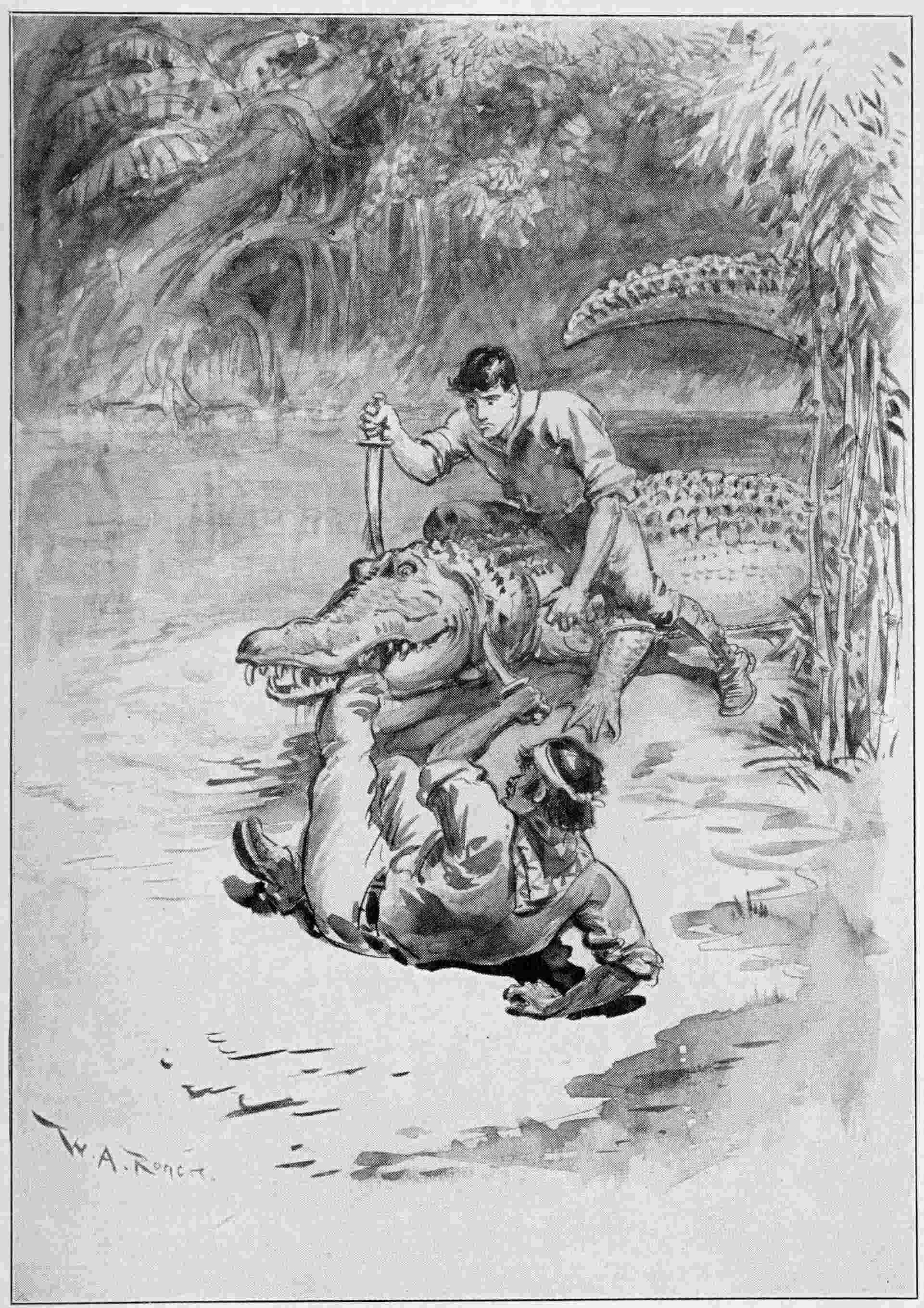
salvation open to the man. David swerved around the growth and the drag on the line became less; and when he had encircled it there was scarcely any pull at all, for he had made a complete hitch around the stout stems, which now served as an unyielding anchor.
The crocodile had come to an abrupt halt. It lashed its tail from side to side and writhed in its efforts to free itself from the grip of the rope that encircled one of its legs; but it still clung tenaciously to the man, unwilling to release him when but a few steps separated it from its element.
David worked with frantic haste. He tied the end of the rope to one of the stems and, drawing the knife with its two-foot blade, rushed toward the struggling monster.
“Save me! Save me!” Miguel was crying piteously, and in his anxiety David cast caution to the winds and dashed at the reptile, knife raised high above his shoulder. The next thing he knew he found himself sprawling in the mud where a powerful blow of the crocodile’s tail had sent him. He arose immediately, but this time he approached more cautiously.
“Use your own knife,” he shouted. “Hack at the eyes, the throat—any place at all!”
These words carried a ray of hope with them and for the first time Miguel seemed to regain his reason. He drew the shining blade from the scabbard and rained a shower of blows on the creature’s head, making it bellow with pain and rage.
Blood began to stream from the numerous gashes, but still it refused to
relinquish its victim. It was too{151}
{152} occupied, however, to pay further
attention to David; in a moment he had leaped astride the armor-covered
back and, clutching the rough plates with his left hand, he delivered
thrust after thrust with his right at the vulnerable neck and throat.
Roars and bellows escaped the struggling reptile as it shook its huge body in vain efforts to rid itself of its adversary and filled the air with a shower of the thin mud. However, the odds against it were too great. Its efforts grew weaker and after a few minutes there were only the convulsive movements of its massive legs and tail. Its head had been almost severed from the body.
David pried open the great jaws with the blade of his knife and released Miguel’s foot; then he carried him to the grass and removed his shoe to examine the extent of his injury. He found that two of the thick, peg-like teeth had entered the flesh. Obviously the crocodile had broken some of its teeth in previous encounters, or the man would not have escaped so easily. He bore the pain stolidly even when David probed the wound to encourage bleeding, for he dared not wash it with the stagnant water of the lagoon.
Just then the men reappeared. They had witnessed the combat from a distance, but now that it was over they came back and discussed it in loud, excited voices.
David went to get his rope and paced the distance beside the crocodile, finding it over twenty feet in length. Then he returned to the group.
“Miguel will have to be carried back to camp,” he said. “He must not walk until I can wash and dress{153} his foot properly. You can all take turns carrying him, first one, then the other. Now, let’s start.”
They obeyed mechanically, glad to be under the direction of the man who was now a hero in their sight, although they were still too dazed fully to appreciate it.
That night each one of the men who had witnessed the encounter of the afternoon described it in minutest detail to the others who had not been present. Even the Indians learned of it and came over in a body to hear the story told and retold, and then returned to their own shelters to discuss it far into the night.
David was embarrassed by this great amount of attention.
“It was nothing,” he assured them. “Each one of you would have done the same thing if you had had a rope.”
“No, we wouldn’t,” they said, “especially if he had treated us the way he did you. He started it and was taking you there hoping you would be——”
“Never mind that part of it. It’s all over now and, as I said before, it was nothing. I’m sure Miguel was only joking.”
Miguel sat brooding through it all and David could not fail to notice it.
“He’s sorry he put the ants into my rubber,” he thought with a smile. “Well, there won’t be any more of them for a few days at least, because he won’t be able to walk for a while. And, even when he can walk{155} again, he can’t possibly be mean enough to play any more pranks like that on me.”
It was therefore with a light heart that he started over his route the next morning. He had first looked at Miguel’s foot; it was swollen, but showed no signs of infection; so he washed and dressed it and told the man that if he remained in his hammock for a few days he would be all right. Miguel submitted to the ministrations and advice without a word. He seemed eager to have David care for his injured foot, but if he appreciated the attentions he received he gave no evidence of it.
“He certainly is a queer character, but as Tiny Tim said, ‘God bless us every one.’ I can’t figure him out,” David thought as he left the shack.
The first few trees he visited had not been tampered with. The little cups were full of the precious, snowy liquid. He was positive now that his conjecture had been right. Miguel was the culprit; as he had not been able to visit the route the day before the catch had not been spoiled.
Then great was his consternation to find that the very next cup was filled with a little cake of curdled latex, as before; and upon cutting it open he found the decapitated ants.
Miguel was not the guilty one, after all. But who was? Someone was certainly responsible for the state of affairs. The ants could not drop their heads and then plunge into the white liquid that served as their graves.
Continuing his walk along the trail, he found that{156} numerous other trees had been visited by the prowler that did so much harm, the same trees in most instances as before. There was now no one whom David could suspect and the solution of the mystery seemed hopeless. But he would outwit them all. Without saying a word to anyone, he would select a new line and tap the trees, being careful not to leave a blazed trail that would be so easy to follow.
He began to collect the sap and threw the curdled pieces away as he turned his steps campward.
Then a peculiar thing happened, so unexpected that it was startling. He had just rounded a bend in the trail. Ten yards ahead of him stood a thick hevea tree scarred by the cuts he had made. A flickering movement caught his eye; it was near the folded cup that served to catch the sap. Stopping in his tracks he looked intently at the little container, but saw nothing. He stood a full minute without removing his gaze from the spot, and just as he began to think that the flickering object had been a falling leaf his persistence was rewarded.
A long, curved beak, followed by a brown head and two bright eyes, appeared cautiously around the tree trunk. David did not move. After a moment’s pause a brown bird about eight inches long hopped into view; it looked like a woodpecker, clinging to the bark with its feet and using its tail as a prop to sit on when it stopped to rest. David recognized it as a woodhewer, of which there were many species in the forest.
The bird now hopped along fearlessly and for the first time the man noticed that it held something in{157} its beak. It made straight for the cup and dropped the object it had been carrying into it. Immediately after, it flew away; a few undulating dashes through the air and it had alighted on the base of a neighboring tree and at once began to hop nimbly up the straight trunk. Soon it disappeared into a hole high overhead, which was apparently the entrance to its nesting cavity. In a moment it came out again and, clinging to the bark, hammered vigorously some object it had brought out of the cavity; then it flew to the nearest hevea and dropped the morsel into the little pool of sap forming in the leaf-cup.
David watched the bird make several more trips between its nest and the nearby rubber trees. The mystery was solved. It was catching the ants that invaded its domicile, pounding off their heads against the rough bark and then disposing of the remains by dropping them into the nearest pool of liquid it could find, possibly to make doubly sure that they would not again come to life to disturb it. If the nearest pool happened to be a cup of latex the bird, of course, used it and David suffered thereby.
The woodhewers were plentiful in the forest, which accounted for the fact that so many trees had been visited by them. He wondered why the men had not told him about this.
David said nothing about his discovery when he reached camp. But that afternoon, when he had finished his work in the smokehouse, he took a long walk in the forest, visiting the routes of several of the men. He found, as he had confidently expected, that the{158} proportion of their trees visited by the birds was as great as on his own line; but the men had made up for the loss by extending their lines and bringing new trees into bearing as fast as others had to be discarded.
This knowledge clearly pointed out to David the course he had to follow. And early the following morning found him prepared to extend his trail or open a new one. He carried his pail, as usual; in addition, the long-handled ax for tapping the new trees. His revolver and knife were in his belt.
When he reached the end of the trail he put down the pail and continued walking through the forest; the country was all new to him, but he had no difficulty in locating rubber trees. They seemed more plentiful than ever, if anything. Clumps of them stood among the palms and other tall growths.
As he penetrated farther and farther into the thick jungle he snapped or turned twigs every few steps so that there would be no trouble in finding his way back.
He had been travelling in this manner more or less steadily for the greater part of two hours and had covered a distance of three or four miles. No less than two hundred new trees had been added to his line; when they produced freely, as they would within a week, his daily catch would compare favorably with that of the best in spite of the depredations of the woodhewers.
To one side of him grew a very tall tree, towering high above its fellows; the trunk was straight and about four feet through, and David estimated that the lowest limb was fully sixty feet above the ground while{159} the topmost twigs must have been a hundred and fifty feet above his head. There were numbers of round objects hanging from the branches. He wondered what they were, and thinking that some of them might have fallen to the ground he walked to the tree to see if he could find one.
Before long he found one of the large, cannon-ball-like objects, and upon breaking it open found a number of Brazil nuts inside. He stooped to crack one, but the blows from his knife never fell; from directly above him came the most peculiar song he had ever heard. It rose clear and ringing, setting the jungle a-tingle with its resonance, and swelling airily and easily until it seemed to penetrate the body of the listener.
Oo-whee whee-e-e oo came the song, first low and plaintive, then rising to a very loud yet mellow pitch and again descending to the low, sad oo, finally ending in a few almost inaudible churrs. It sounded somewhat like the ringing of a bell.
Now, David had read about the bell birds of the South American forest and he felt that this must be one of them. Without rising, his eyes searched the branches overhead. The notes had come from so close at hand that the singer must have been in one of the lower growths, almost within reach of the man’s hand.
There was not a stir among the leaves; the bird was not moving and would be harder to locate for that reason. As David gazed into the lacy vegetation about him the song was suddenly repeated and with such startling clearness that it sounded nearer than before.{160} He looked quickly in the direction from which it had come, but saw nothing. It was exasperating; a creature capable of producing such a volume of sound must be of considerable size. Then why could not he see it, especially since it was so close to him?
A short time later a second voice came, as if in answer to the first, but it was some distance away, reaching but faintly through the maze of vegetation on the right. David turned his head in the direction from which the new song had come, involuntarily, and at the same moment the voice of the first singer rang out even louder than before.
Oo-whee whee-oo! The swelling cadence cut the silence with appalling suddenness. It was uncanny, for try as he would David could not locate the bird that was calling. Either it was an accomplished ventriloquist and was not where he expected to find it, or it was so small and inconspicuously colored that it was hard to see.
That was the last time the song was repeated in the near vicinity. Again and again the bursts of sound, rising and falling in astonishing volume, came to the bewildered listener, but now they were all in the distance. The songsters were all around him and the forest rang with their clear, penetrating notes.
“I’m going to see one of them if it takes the rest of the day,” David said between clenched teeth. “That first one was right in front of my eyes, or I couldn’t have heard it so well. Why didn’t I see it then?”
He went to the tree from which the nearest song was flowing; when he reached it there was only{161} silence. After a moment’s wait he left the spot and went to another where several birds were calling. But they immediately hushed their voices. Then he went to another, and another. But each time he changed positions the voice he sought was quickly silenced while the jungle resounded with the others, all of which were some little distance away.
It occurred to him that his abrupt movements might be frightening the creatures, so he tried stealing noiselessly from one place to another; but still the result was the same. It was like pursuing some will-o’-the-wisp, always within reach but always unattainable.
An hour passed, but David took no note of the fleeting time. A second slipped by and a third had started into the abyss that has neither beginning nor end, when the persistence and patience of the watcher were rewarded. He saw a dark object dart from one branch to another and then clearly made out the form of the bird as it sat motionless on its thick perch. It was the size of a robin and of a uniform, slaty-black color; the latter fact explained why it was so hard to see in the gloom of the forest vault.
The bird sat quietly for several minutes while David stirred not a muscle. Then it raised its head and poured out the flood of sound that had been so baffling to the man.
“I was determined to see it, and I did; but I had no idea I was so long about it,” David mused, consulting his watch. “I’ll have to hustle now. Let’s see, just where am I?”
He looked around for a moment; the trees on all{162} sides looked alike. In the excitement of his pursuit he had neglected to bend twigs to mark his path.
His predicament was amusing, perhaps even a trifle annoying—nothing more. A few precious minutes more would be wasted while he got his bearings and he would be just that much later in reaching camp. He did not stop to think what would happen when he got there.
“The trail is in this direction and camp is right over there,” he thought.
Having reached these conclusions he started away at a rapid pace; and he walked longer than he thought he should have to strike the trail—without striking it. But he kept on doggedly until he was forced to admit that his guess had been a mistaken one.
He stopped and again calculated carefully just which direction was the right one to take; and again a fruitless, tiring walk rewarded his efforts. When he tried to get his bearings for the third time he was forced to admit to himself that he was hopelessly lost. The sun might have been of use in the emergency, but in the forest there was no sun, and night was fast approaching.
The first sensation that followed the realization that he was completely lost was one of panic. And the first impulse was to dash away frantically without heed to direction. However, David remained master of himself to the extent that he quelled these feelings; he sat down on a convenient log. He would think it over, as calmly as he could, and decide what best had be done.
It came to him clearly now. He had followed the voice of the jungle siren without the slightest regard to the direction in which he went. He had not the faintest idea how far he had gone. He did not know where his old trail or the end of the new one was; perhaps they were many miles away. In short, he was just as much lost as ever.
Finally he decided that the best procedure was to walk in gradually widening circles; at some time the circumference must bisect a point he knew. One direction was as good as another to start with, so he started, walking rapidly; and by bearing slightly to the right he was sure his steps must cover a circuitous course.
Nightfall found him still at sea as to his whereabouts. He gathered a pile of wood, started a fire and then sat down between the blaze and the butt of a thick castanha tree. No sleep came to him that night. All through the hours of blackness, peopled with invisible forms and strange noises, he kept his lonely vigil, straining his ears for the shots or calls of the searching party he was sure would be sent for him.
When daylight came there was nothing to do but resume the tramp of the day before, for he had been unable to think of a better plan.
Fortunately, he came across a giant armadillo digging for grubs in a decayed stump, and promptly killed it before the stupid creature withdrew its head from the rubbish to discover his presence.
It was a monster of its kind and weighed half a hundredweight. The head, body, legs and tail were completely encased in bony armor, and the claws it{164} used in procuring its food would have measured eight inches long.
David built a fire on the spot and soon pieces of the tender white flesh, roasted thoroughly, were satisfying the hunger of two days’ duration. He cooked every morsel, wrapped what he did not eat in leaves, and then fastened the pack to his back with strips of bark. It might be days before another opportunity to procure food so easily presented itself.
When the third day had passed the seriousness of his position came to David in an unexpected manner. The thing that caused him to stop suddenly while a feeling of terror came over him was the first sign of oncoming fever.
That dread scourge of the tropical jungle struck without warning and David had read and heard enough about it to recognize it at the first onslaught—a feeling of utter exhaustion, followed by chills that made his teeth chatter even though the vegetation, high overhead, was wilting in the glare of the brassy sun. His entire body trembled violently as he sank in a heap to the ground. After that came a burning fever, so that for an hour he tossed in intense agony.
The attack finally subsided, leaving him limp and helpless. After a time he gathered enough strength to kindle a fire, beside which he spent a miserable night.
Once he sank into a light sleep; he was awakened by the sound of shuffling footsteps in the dry leaves. Some large animal was watching him, although he could not see it in the darkness. He threw wood on{165} the fire and as the flames leaped up there was a heavy crashing in the underbrush as the startled creature dashed away.
The malady returned at increasingly frequent intervals, like some insidious enemy sure of its victim but in no undue haste to accomplish its vile purpose. David could not bear up under the repeated attacks. At the end of a week he was too ill to continue the ceaseless and now hopeless tramp that took him nowhere.
His food had given out; and he had no desire to eat even if there had been food in abundance. His one thought was of companionship; with someone near him the whole frightful experience would not be so hard to bear—even if it came to the worst. But alone, with only the gloomy forest and its furtive wild folk about him, it was terrifying. His thoughts wandered to far-off things, especially to those he had insisted on leaving back at home. Then he remembered his enthusiasm when first he had seen the Amazonian jungle from the deck of the steamer. It had seemed to challenge him; he remembered that distinctly. “Come if you dare,” it had said, “and I will overwhelm you.”
Full of confidence in his own ability he had accepted the bold defiance hurled at him by the mystery-enshrouded walls of green. He had lost, but he had only himself to blame.
Not a word of complaint escaped his lips. While there was life there was hope; he would sleep a while, if possible, or at any rate rest for a time. Then he{166} would take up the fight anew. His head would be clearer and some way was bound to occur to him that would get him out of the difficulty.
Oblivion came quickly—too quickly, in fact, to portend anything of a wholesome nature; and for an hour he lay quiet as death. He was awakened from his stupor by fiery stings in one hand that had been stretched out far from his body. He drew it toward him and raised it unsteadily to see what was causing the pain. Several large, black ants were clinging to it, their vise-like mandibles embedded deeply in his skin. With a great effort he tore away the ferocious insects and raised himself on his elbows. What he saw caused a cry of horror to escape his lips.
An ant army, the most relentless of all the creatures that infest the tropical forest, was approaching. Already the leading files had discovered him; some had attacked without delay, while others had hurried back to the main column to convey the news of their find.
David summoned all the strength at his command in an effort to rise to his feet. But the exertion was in vain, and after several futile attempts he knew that escape was impossible. However, he might ward off the end if——
Slowly and laboriously he tried rolling over the ground. It was hard work, but finally he succeeded in making a complete turn. A pause for rest, then another turn and a distance of nearly three yards had been gained on the avalanche of ants that was sweeping towards him. Perhaps he could evade the insatiable horde after all; but when he struggled to roll{167} again it seemed that his last chance had vanished, for directly in his path was an obstacle he could not surmount in the form of a fallen tree that blocked all progress for a distance of fifty feet each way.
The realization that escape was cut off in the one direction that had seemed open came as a disheartening shock. He lay back limp and helpless; to his ears came the sound of the insects swarming over the dry leaves, like the patter of a shower of rain. His brain reeled and the blood roared in his veins. In desperation he covered his face with his hands.
“Lord,” he prayed, “I’m not blaming anybody but myself for getting into this, but if I get out of it I’ll know You helped.”
When David failed to return to camp at the usual time little was thought of it by those who noticed his absence. It was not until the foreman came around on his daily tour of inspection of the smokehouses that mention was made of it. It was then past mid-afternoon.
“You, Mariano, go to the dormitorio to see if he is there,” he said. “He may be sick.”
Mariano dropped his work and hurried out. Soon he returned.
“He is not there,” he said, “and the cook said he has not come in yet. He’s been waiting for him.”
“Wonder what’s keeping him,” the foreman said uneasily. “Did he say anything to anybody this morning about going farther than usual?”
A chorus of “No, Senhor,” and “Not to me” came in response to the inquiry.
The chief bit his lip.
“I’ll be back soon,” he said. “If he comes let me know at once. Don’t go away when you are through with your work. I may need all of you.”
A half hour passed and still there was no sign of the missing David. The foreman came in—visibly agitated.
“Get ready, every last one of you,” he ordered. “Either the boy is lost or met with some accident. You must find him. Shout as you go and those of you who have guns fire them. Scatter out far and wide over the country. Those of you who find or see nothing come back after dark. I will pay twenty-five milreis to the man who finds him or brings back the first news of him. Now get your bottles; the cook will fill them with coffee and give you each a package of food. Then hurry away up the trail.”
The men departed immediately to do as they were directed. Not long after, they filed into the forest, alert for any sign or clue that would be of value to them in looking for the missing man. From time to time some of them branched off the main path until they had spread out in a fan-shaped formation that combed the forest in a thorough manner so far as it went. They kept calling and occasionally there was the report of a gun.
Before long, however, they were out of hearing of one another. Therefore, it was not until long after dark, when the last man had straggled back into camp, that they knew that the search had been fruitless.
The new trail that David had started that morning had been discovered, but darkness had come before it could be followed to its end; and they brought back the empty pail—nothing more.
The uneasiness of mid-afternoon now gave way to consternation. A hundred explanations were forthcoming to account for his disappearance. Everyone seemed greatly concerned, but most of all Dom Carlos,{170} the camp foreman. From the obscure position of “nobody” David had suddenly risen to be the most important person in the outfit. In contrast to the aloofness with which he had still been regarded by a few of the men, they now all joined in extolling his courage and good qualities and pledged themselves that he must be found at all hazards. The monetary reward was tripled to give further impetus to their efforts.
Six men were sent out immediately after supper to light fires in the jungle and to keep them blazing all night, to serve as beacons in the event that the wanderer should be trying to find his way in the darkness. They went in pairs and followed widely diverging trails. And when they returned at dawn the others who had slept in camp started out, this time, however, spreading in all directions to cover so much of the country as possible.
Foremost among the searchers was Miguel. He had not fully recovered from his encounter with the crocodile; his foot still pained him at times; but, thanks to David’s ministrations, he had the use of it to a considerable extent. It was he who had found the new trail and had followed it until darkness made it impossible to go farther the previous evening. He had returned the pail and collected the first reward. And now he was determined to take up the search where he had been compelled to drop it.
The men had been told to carry food for one day only and to come back that night. But the stock of provisions on Miguel’s back was sufficient for three{171} days; and, having no gun, he carried his bow and a dozen arrows in his pack.
The grim expression on his face plainly showed that he was determined to find David; he owed him a debt of gratitude he could scarcely repay in any other manner, but, unfortunately, he had never thought of it in that light. What he did think of and looked forward to was a meeting in some far-off spot where he would have the opportunity to settle old scores, safe from the prying eyes of others.
Alone in the towering forest, with only the silent trees as witnesses, it would be easy to dispose of the one obstacle that stood between him and complete leadership of the men. Once before, when the opportunity had been within his grasp, fate had intervened to rob him of his victory; that was when the crocodile had attacked him instead of David after the latter had entered the water. Now, he had all the advantage. Better for David that he remain forever lost in the forest than be found by the vengeful Miguel.
The first day passed rapidly, for a man hunt was a new experience and it was a fascinating occupation. He scanned the forest floor, the tree-trunks, and the lower growth for any traces that would aid him in his search.
On the second afternoon Miguel found the fire where David had roasted the armadillo. That encouraged him. He was on the right track. And he redoubled his efforts, as does the hound when the scent grows hotter. His eyes glowed with a strange fire at the{172} thought that he might at any moment catch sight of his quarry.
David had learned the truth of the saying that bad luck is apt to grow worse; Miguel had never even heard it, but that did not exempt him from its application. What both had yet to learn was that luck, particularly bad luck, was only too often the result of some act for which they were fully responsible. The beating Miguel had received and the narrowly avoided drowning had been bad enough; but worse was to come.
He awoke on the third morning to discover that his remaining food supply had disappeared during the night, and the completeness with which it had vanished made it evident that a colony of ants had done the work. That was exasperating, but there was game to be shot with arrows, so the situation was not serious.
After that came the realization that the search was extending over a wider territory and greater period of time than he had expected. And he began to wonder if he should find David, after all.
It was that night, however, that he felt the merciless judgment of the forest in all the impartial rigor which was its law. Those who sought to ferret out its secrets must pay the penalty and Miguel was no exception.
It swooped down upon him in the same guise it had assumed when it fell upon David, and while his teeth beat a tattoo, or as the hot blood coursed throbbingly through his veins, he began to comprehend the seri{173}ousness of the mission on which he had embarked, and to wonder if the purpose was worth the cost.
The fever ran its usual course. Miguel wandered about in a dazed condition and when there was finally a lull in the onslaught he found himself in an unenviable predicament. He too was lost, and for the first time in his life.
With that realization came the feeling of utter loneliness. Never before had he felt so completely forsaken, so bewildered, so hopeless. He longed for the sound of a voice, a glimpse of a friendly face, or the touch of a sympathetic hand.
It was terrible, this being lost and alone in the silent, heartless jungle that gave no quarter, that knew not the words pity or mercy. Gaunt spectres rose on every side; hideous naked Indians pierced him through with their poisoned darts; serpents struck with envenomed fangs; and jaguars of enormous size crouched behind each tree-trunk for the fatal spring.
It had always been thus. It would always be thus. The fever-crazed brain of a lone man, lost in the tropical jungle, could conjure pictures without end.
As the days passed Miguel’s desperation increased. All thoughts of malevolence vanished. If he found David now he would rush to him joyfully. It would mean companionship, perhaps even salvation. Anything, anyone to banish the horror of a living death alone in the treacherous forest.
It was at this point that Miguel heard the twittering of the ant wrens, and well he knew what their excited cries meant. They had discovered an ant army{174} on the march and had gathered in numbers to profit by the marauders’ depredations.
The sound of their calls, even if they were only birds, came as a blessed relief to the man driven frantic by the breathless silence of the forest. To see, to be near any living thing, would be infinitely better than the dread loneliness. He would go toward the chorus of voices that his fever-dulled brain pictured as possible saviors of his reason.
Before long he reached the far-flung lines of ants that served as scouts on the flanks of the main army. The organization and discipline of the insects was as wonderful as it was terrible to the victims, for it precluded all possibility of escape.
Miguel stopped to look at the black ribbons flowing over the forest floor. Thin lines branched off from the main arteries every few yards; these explored each leaf and crevice, ascending even to the tops of the tallest trees in their insatiable quest of victims.
In front of the sweeping mass and on both sides was a horde of terror-stricken creeping, crawling and hopping creatures making frantic efforts to escape from inevitable doom. There were rhinoceros beetles with huge antler-like growths on their fore-bodies; centipedes eight inches long; scorpions wildly lashing their tails armed with poisonous curved stings; great hairy tarantulas, wood frogs, and many other living things. Some crawled to the topmost branches of the lower undergrowth of ferns and like vegetation and remained there motionless during a brief respite; but they were always discovered and routed by the ants. Others fled{175} precipitately up the tree-trunks; and still others came out of their hiding-places only to curl up sullenly and to await the end.
Suddenly the ant army divided. Scouts had in some mysterious manner brought back the intelligence of an unusual find and the main column had promptly responded with reinforcements. Miguel saw and understood. At the same time, the ant birds that had first attracted his attention set up a furious chatter. Here was the opportunity to see something of an unusual nature.
Miguel crawled upon a great prostrate tree-trunk in order to have a better view of what was going on. It was toward this log that the ants were rushing in a black sheet. And it was there the birds were scolding in anguish.
About the first thing Miguel saw when he attained the top of the log was the body of a man lying on the ground as if dead. The hands covered the face so that he could not see it, but he recognized the clothing and knew that it could belong to none other than David Jones.
“Camarada!” he cried, at the same time dropping down beside the motionless figure. “It is I, Miguel, who have found you. Por dios, and just in time.”
It required all his depleted strength to raise David to his feet; then he took the limp form in his arms and slowly carried it to safety—out of reach of the ravenous horde that sensed the intrusion and sent skirmishing lines dashing in all directions in frantic{176} efforts to locate the prize so suddenly snatched from its grasp.
David opened his eyes slowly. When he saw the man who had just deposited him on the ground, puffing hard from his exertion, he stared in amazement. Then the remembrance of something dreadful came back to him in a flash. He weakly raised his arms and placed his hands over his face.
“Oh, the ants, the ants,” he moaned. “They are all over me. I can feel their bites—they are killing me and—I can’t get away. I can’t get over the log.”
“No, they’re not,” Miguel panted, trying to soothe him. “You are safe now. I will not let them get you. Look, there isn’t one on you; they’re far away, on the other side of the log, and I’ll carry you farther before they come near here.”
“But I can feel them, on my hands and face—everywhere,” David persisted.
“Sh!” Miguel said. “Keep quiet and everything will be all right.”
It was some time before the delirious man could be calmed. But Miguel finally succeeded in reassuring him that the danger that had threatened was now past, and with the realization that he was safe from the ants came a measure of strength.
“I was sure something would happen—someone would find me before they got to me,” David said faintly after a while. Miguel had propped him up against the base of a tree while he plucked and prepared to roast a mutum that looked like a good-sized turkey; he had just shot the bird in the tree right{177} over their heads. “I never gave up hope and, Miguel, I’m glad it was you who found me.”
“Me?” in surprise. “Why did you want me to find you?”
“I don’t know. I just wanted it to be you—maybe just to prove to the others that we could be good friends if it came down to rock bottom.”
“Umph!” Miguel’s thoughts were travelling in strange channels. He felt queer as he thought of the purpose he had in mind when he started on the long search. What if he had found David the first few days after leaving camp?
“I’m glad I found you, too, when I did,” he said. “But neither one of us has anything much to be glad about.”
“What do you mean? I feel better already. And I’m hungry. We can start back tomorrow if I can eat as much of that bird as I think I can. They told me that you’re the best bushman in the crowd, so we’ll take a short cut back to camp,” David said confidently.
“That’s just it! I didn’t want to tell you right away, but now I can’t help it. We can’t start back to camp because—because—” Miguel hesitated as if reluctant to proceed. “We can’t start back because I’m lost, too.”
When Miguel admitted that he, too, was lost, the intelligence came as a great shock to David. One of his first thoughts upon seeing his rescuer was that at last his aimless, heart-breaking wanderings in the forest had come to an end. The walk back to camp might be of several days’ duration, but that did not matter. It made a difference whether one was walking in hopeless desperation because there was nothing else to do, or whether there was a definite goal to reach and one had the assurance of being on the right track. Now they were little better off than before. However, he suppressed the bitter disappointment he felt and tried to smile.
“How did that happen?” he asked. “I thought you couldn’t lose your way.”
“It was the fever,” Miguel said dejectedly. “Before that I knew where I was every minute of the time. Now I can’t remember how I got here or how many days I spent wandering around before my head cleared.”
“Well, the two of us together ought to find some way of getting out—when I’m able to travel. And it’s better than being all alone.”
“Yes, the lonesomeness nearly drove me crazy. It was terrible. It was the one thing I couldn’t stand. Fever, hunger—anything but that.”
Miguel turned the bird, which had been impaled on a stick, and when it had browned to a uniform color on all sides he brought it to the tree where David sat and stuck the stick into the ground. They cut off pieces of the tender flesh with their knives, but David’s appetite was not nearly so good as he had thought, while the absence of salt robbed the meat of much of its flavor.
“I could open one of the cartridges in my revolver,” he said, “and use the powder for salt; but we might need it more to shoot with before we get out of this.”
Miguel agreed that they had better save the ammunition for the purpose for which it was intended.
“How do you feel now?” he asked.
“I knew I’d feel better, and I do,” David replied. “But the fever left me all wrung out like a wet rag. Wish we had some quinine!”
“Quinine is good, but guanabara is better. The root grows in the forest. I hunted for it every day but couldn’t find it. I’ll look again. Maybe there is some near here. But first we need a shelter. We have to stay here a few days at least. You are too weak to walk far. I’ll build a place to sleep first and then I’ll go in search of the medicine.”
David wanted to help in the construction of their shelter, but that, of course, was out of the question. Even the sitting posture had tired him so much that he slid to the ground, where he lay watching Miguel{180} as he proceeded to erect the structure that was to house them until they should resume their wandering.
First he cut stout poles and fastened them to either side of two thick trees that stood about ten feet apart, by tying them to the trunks with strips of bark. Then he fastened cross-pieces to the poles, thus making a platform that was shoulder high above the ground. He piled dry palm leaves on this for a bed. After that he fastened two other poles a few feet above the platform and covered them with green palm leaves that hung down far over the sides, forming a roof.
The work required only a short time and the shelter that had been provided was entirely practicable and serviceable. Miguel surveyed it proudly as he explained its good points.
“It’s up high enough to be out of reach of snakes, scorpions, spiders and most of the mosquitoes; they all like to stay close to the ground. And if it should happen to rain, the roof will keep us dry,” he said.
David replied that he thought it was fine and would like to try it. The springy platform with the thick layer of dry leaves would be more comfortable than the hard ground.
Miguel helped him into the aerial perch and then went to hunt for the guanabara root that would cure them both of the fever. He did not return until shortly before dark, and then it was only to report failure. However, he would go again the following morning.
After the Brazilian, too, had climbed into the platform bed the two lay awake and talked far into the night. One plan after another of escape from their{181} predicament was discussed, and finally sleep overtook them before anything definite had been decided on.
The next day found both greatly refreshed, although David was still too ill to stand without assistance. But the change that had come over Miguel was remarkable; he cared for his companion in the best way he knew how and was most solicitous for his welfare.
They ate pieces of the bird left from the previous night and then the Brazilian again went to look for the medicinal root. This time he was successful. He came back shortly before noon and announced his arrival with a shout of triumph.
“Here it is at last,” he called as David peered out from under the ragged palm-leaf roof. “Look! It is the guanabara. It will cure your fever and mine. Thank dios, I found it!”
Miguel held several fleshy roots in his hand. They resembled slender sweet potatoes, but were of a bluish color.
“Let me have one,” David said feebly. “I’d eat anything to get rid of this awful feeling.”
“Wait! You can’t eat it raw, because it’s deadly poison that way. It has to be fixed first. Watch me. Some time you might have to do it when you’re alone.”
He laid a broad, green leaf on the ground and then scraped the roots with his knife until they had been reduced to a heap of pulp. He took the mass in his hands and pressed out the surplus juice, leaving a ball of doughy material; this was tossed into the fire and turned with a stick until it had baked thoroughly and evenly all around. When it had assumed a black color,{182} which was in half an hour, he pronounced it ready for use.
Miguel now brought water in a folded leaf and scraped some of the medicine into it, and gave it to David to drink. When the particles dissolved they turned the water red, but the concoction was tasteless.
They drank the guanabara each hour, and before many doses had been taken its effect began to make itself felt. It was bracing, even stimulating, and all symptoms of malaria vanished as if by magic. Within two days David was able to accompany Miguel on his daily hunt for food.
Fortunately, they were now in a section of the country where game was not wanting. That indicated that they must be near a large river, for in the dry season the animals were always more abundant in a strip several miles wide bordering the larger streams.
“We’ll get a good supply of food; then we’ll hunt the river. If we can locate it we can get out,” Miguel said as they started on their tramp through the forest.
“Will we follow the river?” David asked.
“No. We’ll make a raft out of bamboo and float down.”
“I guess our luck has changed at last. Soon we’ll be back in camp.”
“We have to find the river first. When we have found it, who knows where it will take us to? It might take us right back to camp, or many leagues away from it.”
Miguel had his bow and a number of arrows. David was following close behind him; it was his duty to{183} mark their trail by snapping twigs as they went along. Their shelter was too comfortable to lose so long as they remained in the locality.
Before long they came upon a flock of four large black birds feeding in the top of a tree. They were like the one Miguel had shot right after finding David, and moved about heavily as they fed on the fruits that grew on the branches.
The Brazilian took careful aim and released the cord of the bow. There was a sharp snap and the arrow sped whining through the air. Just before reaching the bird the shaft struck one of the numerous limbs a glancing blow; that was sufficient to deflect the missile from its path and it passed the mark by a goodly margin and continued its flight up above the trees and out of sight.
The birds were not frightened, but continued eating as if they had not noticed anything of an unusual nature in their midst. This was fortunate, for it permitted Miguel to take a second shot; this time the arrow found its mark and a great mutum fell crashing to the ground while the other three flew away.
The bird was dead when they reached it. They removed the arrow carefully and then went to look for the first one that had been shot and gone astray, for they had only a limited number and the time might come when every one of them counted.
David thought the task of looking for the slender shaft in the thick jungle was hopeless, but Miguel assured him that he had marked its course as it soared over the trees.
“You see,” he added, “each one has a few bright-colored feathers on the end in addition to the black ones that make it fly straight.”
“Yes, I see them. You put them there for ornaments, I know.”
“No, they are not ornaments. They are put there as markers. Look! There is the lost one now.”
David saw what looked like a brilliant flower among the deep tints of the undergrowth. It was the arrow sticking in the ground where it had fallen; the red feather made it conspicuous among the green vegetation. They recovered it and replaced it in the pack.
A short time later they were startled by a chorus of “Oh’s” that came from the treetops not far ahead. The wails came in a rising crescendo, as if their makers were suffering intense pain or were in great fear.
“Flying monkeys,” Miguel announced gleefully as he started on a run toward the sound. David followed and soon saw the cause of the disturbance in the form of small, grayish bodies hurtling through space is if indeed flying.
The monkeys were leaping from tree to tree and swinging through the branches at an incredible rate of speed. When they jumped, the boughs sprang back into place with a swish and the creatures landed with a thud, keeping the treetops bending and swaying as in a heavy wind. All the while they shrieked “Oh, oh, oh!” at the top of their voices.
Miguel sent an arrow after the fleeing animals and by a lucky circumstance brought down one of them. It was unlike any monkey David had ever seen, with{185} a round head and a body like a very large cat’s. The tail was long and bushy.
They returned to the shelter and while the meat was roasting determined to start away early the following morning. They agreed that the rubber camp must be in a southeasterly direction from their position and they would therefore head that way, which was also the direction in which they hoped to find the river. It was true, the jungle was heaviest and progress would be slower; but, also, game was more abundant, and if they discovered the waterway it would save them days of walking in the end. If their calculations were correct the stream might even turn out to be a branch of the river on which the camp was situated.
The forest changed considerably in character as they advanced through it. Palms grew more abundantly than before and occasionally they saw a clump of orchids perched high overhead with sprays of gorgeous blossoms that drooped from among the leathery foliage like yard-long, brilliant plumes.
David had just stopped to look at an exceptional cluster the size of a tub and with panicles of deep orange flowers resembling a hundred gorgeous butterflies. Miguel stopped at the same time and laid a warning finger on his companion’s arm. He was staring straight ahead and, looking in that direction, David saw a dark form shaped like a cow silently appear from behind a clump of low palms. So soon as it was in full view it stopped, turned and faced its back trail, raised its head and sniffed the air. It had a very long nose that moved up and down as it drew short breaths.{186} Then it turned quickly and faced at right angles to its previous position. At about the same time a volley of arrows struck the animal with a crash and as it staggered away a chorus of wild yells rent the air and a number of Indians rushed into view.
Miguel dropped to the ground the instant the arrows struck the tapir and David was not long in following his example. They were just in time and for the moment the Indians did not see them.
The stricken animal lurched forward only a few yards before it crumpled and fell in a heap, and soon the savages were upon it, dispatching it with clubs and spears.
That was the one opportunity that the white men must not lose if they hoped to escape with their lives, for in the excitement of the moment the Indians would not notice their movements.
Miguel began to crawl stealthily toward a nearby clump of thorny bamboo, David following at his heels, and not until they reached the inside of the dense growth did they breathe a sigh of relief.
The Indians continued giving their wild calls, as if signalling to other members of their party, and before long numbers of them began to come in from various directions. They came singly and in groups and still the yelling continued.
They were a savage-looking lot, entirely nude save only for necklaces of teeth and sticks tufted with feathers that they wore through large perforations in their ears. Their brown bodies were painted in irregular lines and dots of black, dark blue and red.
Each carried a bow and a number of arrows in his hands. Some also had long-handled spears and sword-like weapons made of tough palmwood.
Several of the savages began to skin and cut up the tapir while others went to gather firewood. First, however, each man disposed of his arms by sticking them into the ground in a little cluster; that prevented the possibility of their being stepped upon and broken.
“They are going to camp here for the night,” Miguel whispered. “We’ll have to stay here until they leave.”
“That suits me. We can watch them but they can’t see us,” David replied. He was glad of the opportunity of seeing the Indians engaged in their pursuits in a natural manner, unconscious of the fact that they were being observed.
“We’ll be all right so long as they don’t see us. We have to keep absolutely still.”
“Suppose they look in here through the hole by which we came in? Let’s close it!” David suggested.
“Yes,” Miguel agreed. “We must close it or one of them might happen to glance in.”
They pulled the thorn-covered branches together, very slowly and carefully, until the opening was completely blocked. They were now secure from discovery so long as they remained quiet. As he thought of this David also thought of the innumerable things that could happen to call attention to their hiding-place. Suppose one of them had to cough or sneeze; or what if a scorpion, tarantula or snake should creep in to dispute their quarters with them? He dared not think further along these lines.
The Indians had started a fire by rubbing together two sticks until they glowed, then applying them to dry leaves and blowing the heap into a blaze. Then they piled on wood and before long the roaring flames were leaping high into the air. The carcass of the tapir had been hacked into pieces; some of the chunks of meat were now thrown upon the fire to roast.
“They belong to the Parintintin tribe,” Miguel said as he watched them. “They are headhunters. They are the ones who attack the rubber camp at times. But they haven’t bothered it lately, because they were beaten badly in the last fight. But this may be a war party going there again.”
“What made Dom Carlos tell Rice, then, that the Indians were killing all the men?” David asked quickly.
Miguel looked confused for a moment. “He, he—meant others, not these,” he stammered.
David gave him a sharp look.
“Oh, I see,” he said and resumed watching the antics of the mob before him.
“Here is our chance to get more arrows,” David said suddenly. Several of the savages had placed their weapons in the ground beside their place of concealment. “Do you need any more?”
“No!” Miguel was horror-stricken. “Don’t touch them. They would miss them and then find us.”
“Well, I won’t take any, then, but I’m going to have some fun. Wait until it’s dark,” David whispered with a chuckle.
By the time night had fallen some of the meat had{189} been charred to the desired degree and the Indians raked it out with long poles; after it had cooled somewhat they tore off strips and began to eat. So soon as one chunk was taken from the embers a new one was thrown into them. And all the time individuals were coming and going, collecting fuel or engaged in other enterprises.
The scene was a weird yet fascinating one. The lithe savages, outlined against the glare of the fire; the flickering light playing on their bare skin; the dark tree-trunks; and beyond all this the inky blackness of night, made a picture never to be forgotten. It was one of those things suggested by the sombre, mysterious, silent jungle when viewed from the open reaches of a great river, but which was forever veiled to those who lacked the trepidity to penetrate into its depths.
The two dared not leave their cover for fear of running into some of the prowling savages. But when it seemed that all of them were busily engaged in consuming as much of the charred meat as possible David worked his way carefully to the edge of the barrier and reaching through it removed two arrows from one of the clusters and placed them in another one; then he took two from the latter one and inserted them in the first group to replace the ones he had taken away. Miguel was badly frightened at this action and tried to prevent it.
“I want to see what will happen when they discover the exchange,” David whispered. “It can’t do any harm.”
Scarcely had he crawled back to the center of the bamboo screen when pandemonium broke loose around the fire.
The group had just been joined by one of the tribesmen, who rushed into the circle of light, talking and gesticulating wildly.
“I told you; I told you not to do it,” Miguel gasped in terror. “He saw you and he’s telling them about it.”
“Look!” David, too, was trembling. The speaker was pointing their way and the others were looking in their direction, as if trying to pierce the blackness with their eyes.
In a moment every man was on his feet and rushing toward his bow and arrows.
The fire and the food were forgotten. The clamor of voices was stilled. Only one thought was uppermost in the mind of each Indian and that was to get hold of his weapons before the passing of another second.
The thing that had happened to end the feast of the Parintintins so abruptly was that a scout, of which each party always kept numbers on its outskirts, had rushed into their midst with news of a startling character. He had discovered the approach of a war party of another tribe which doubtless had been dogging their steps all day long and were now forming for the attack.
Warfare among the tribes of the Amazon is as unceasing as it is merciless. Each, in attempts to extend the boundaries of its territory or hunting-grounds, looks with suspicion and resentment upon its neighbors and by every means known to it tries to exterminate, or at least reduce in numbers the populace around it, thereby increasing its own measure of safety as well as its food supply.
It may, or it may not have been fortunate for the two cowering in the clump of thorny bamboo that the attack came when it did, for in the intense excitement that prevailed those of the savages who had time, flew to their arms and gathered them up in one swoop; so the interchange was not noticed. Then the dusky{192} forms darted into the darkness that surrounded the firelight like an impenetrable wall.
But before the last one had disappeared from view there burst upon the silent night a chorus of cries and screams accompanied by the deep beats of drums; and at the same instant a deluge of arrows hissed and whined through the air in pursuit of the fleeing figures.
The arrows rattled about the clump of bamboo in which the two men were hiding. Soon after, a line of howling savages charged out of the darkness, flitted through the lighted area and disappeared again in the gloom on the other side of the fire.
David drew his revolver and held it ready for action, for the first time since Miguel had found him. He had saved the few precious cartridges he possessed for the time when it might be necessary to defend their lives and that time, he thought, had arrived. But the swarm of Indians swept past them all unaware of their presence. How the savages could see in the darkness was beyond his ability to explain; but see they did, or otherwise they soon should have killed themselves by colliding with the trees and many other obstructions in the forest.
The pursuit continued far beyond, as was evidenced by the shouts that grew constantly fainter and then died in the distance. The Parintintins had been routed completely and many of them had probably perished in the unexpected assault; the survivors, doubtless, were scattered hopelessly and were either in hiding or fleeing for their lives.
“We’d better get away from here,” David whispered,{193} “but they went right in the direction we want to go.”
“Don’t be in too big a hurry,” Miguel admonished him. “The forest is full of Indians. I know them. There are some of them right around us here. We can’t leave until we’re sure all have gone.”
The wisdom of his words was demonstrated a moment later, when a shadowy form flitted out of the night and made for one of the clusters of arrows that had been deserted when the charge came. He had hardly reached the spot when there came the snarl of an arrow, followed by a dull thud, and the Indian pitched headlong to the ground.
It was as Miguel had said. Unseen eyes were watching the fire in anticipation of the return of some of the routed savages for their effects. But greatly to the relief of the onlookers, no others came.
After an hour’s nerve-racking silence the crackling of twigs told of the return of the victorious party and presently the vanguard, in small groups, came into view. They were talking and gesticulating wildly; then half a dozen others who had acted as sentinels around the fire joined them. Soon more came until there must have been over a hundred.
They piled wood on the fire until they had a blaze roaring toward the tree tops, while a train of sparks, like miniature comets, soared high above the forest. That served as a signal to announce victory, and after a short time a group of women and children appeared out of the jungle and joined the warriors. The women carried baskets on their backs; they were filled with calabashes, and packages wrapped in green leaves.
When all had arrived the celebration of the victory began. The remainder of the tapir was placed in the fire to roast; bundles were unwrapped, revealing quantities of fish, Brazil nuts, cassava bread and corn.
The women took full charge of preparing the food, the men spending the time in animated conversation and argument.
When the meat was roasted they all sat around the fire and ate. Water had been brought in some of the calabashes from which they frequently took long drinks.
The two watchers began to think that the eating would last all night when one of the Indians sprang to his feet and began to gesticulate with his arms. He went through the performance of pursuing and slaying an enemy in such a graphic way that they could not fail to understand his meaning. When he finished another jumped up and went through a similar pantomime; and after him, another and then another until each of the warriors had demonstrated just how he had dealt with at least one Parintintin.
David felt that if the Indians were telling the truth it had gone hard indeed with the pursued; but he suspected that most of the versions were given merely for the dramatic effect, because the victors outnumbered the vanquished two to one.
When the last speaker had finished the men started a dance around the fire, while the women and children withdrew into the background to watch. Some of the dancers picked up empty calabashes and beat them like drums. All of them shouted at the top of their{195} voices as they leaped about the blaze, the ruddy light reflected in flickering patches on their bare, brown bodies.
Day was breaking when the assemblage gradually broke up into small groups that lay down on the ground to sleep. Only two of the men remained awake near the now rapidly dying fire, apparently for the purpose of warning the sleepers if there should be a surprise attack.
David and Miguel were in an unenviable predicament. Their limbs ached from long remaining in their cramped quarters in the bamboo clump. They could not move about and they dared not go to sleep. The faintest rustling noise, the slightest movement might arouse the Indians and cause an investigation. And they knew what discovery would mean.
It was noon when the first of the sleepers began to stir and within a few minutes the whole party was moving about. Their actions were now in great contrast to those of the early morning. They seemed in a hurry to get away.
The men collected their bows and arrows and the women packed the remnants of food and the calabashes into their baskets. Then the whole party vanished in the forest, heading in the direction in which the Parintintins had fled.
“I thought they were going to stay forever.” David sighed with relief. “Now I can stretch my legs. I’m asleep all over, except my head.”
“Roll over a few times,” Miguel advised, “and you’ll feel better.”
They both did this for a few moments and then crawled out into the open. Once on their feet, they lost no time in leaving the locality.
After walking rapidly for an hour, Miguel, who was in the lead, stopped suddenly.
“Listen,” he said, raising one hand.
David stopped and listened intently.
“I hear a faint noise, like a breeze in the tree-tops,” he said.
“Yes. That’s it. But it’s not wind, it’s water.”
“Yes, it is water. I can hear it better now. It must be a big river.”
“With a high fall in it. Only a great waterfall could make such a noise.”
“What will we do?” David asked.
“Go to it. It’s just what we want. We’ll make a raft and drift down with the current.” Miguel’s dark face lighted up with enthusiasm. “It will be easier than having to walk.”
“First, let’s eat. I’m almost starved,” David suggested.
“Me, too. But I’m afraid to start a fire. Better wait until we get to the river,” Miguel said apprehensively. “There can’t be too much distance between the Indians and us to suit me.”
They tramped on. David was now trailbreaker. They took turns at this for the vegetation was growing heavier constantly and the leader had to use his knife frequently to cut through the sprouts and creepers that disputed their way.
It was after cutting a path through one of the{197} thickets that David caught sight of some living creature disappearing among the dense growth. He did not know what it was, for the glimpse had been a fleeting one, so he stopped to tell Miguel, but before he had finished the sentence an arrow tore its way through the leaves a few inches on one side of them.
They needed no further proof to tell them that the vanishing form had been that of an Indian. Dashing back over their trail they fled in a wide detour of the spot and then advanced more cautiously. There was no question but that the savage would take up the pursuit. And a long, quavering note like that of a forest dove that reached their ears was a signal to other Indians who must be in the neighborhood.
A second call, low and plaintive, came in answer to the first. It was directly in front of them. They dropped into the shadow between two buttressed roots of a giant tree just in time to see two nude savages appear and make their way stealthily toward the spot from which the first one had signalled.
“The forest is full of Indians,” Miguel whispered when they had disappeared. “They are calling one another for a discussion. Then they will try to catch us.”
“Let’s go, then. The bigger the start we have the harder it will be for them to find us,” David panted. “If we stay here they’re sure to catch us.”
“The river! The river!” Miguel whispered. “We must get to the river. Come on.”
They darted away at a rapid pace, making toward the roaring sound that was rapidly growing louder.{198} The going was terrible. Instead of stopping to use the knife in clearing a path as before, they crashed through the dense clumps of dwarf bamboo, matted ferns and thick sprouts. The sharp thorns covering some of the growths slashed their clothing into ribbons and tore into their flesh; and more than once they fell to the ground when creepers, like steel wires, encircled their feet and tripped them.
The cooing voices of the Indians were not far behind them. Occasionally they heard the breaking of branches and the swishing of the leaves where the pursuing savages fought their way through the jungle. It was fortunate that the vegetation was so dense that they could not be seen and thus afford easy targets for the arrows of the forest men.
“It can’t be far now,” Miguel said encouragingly. The roar of the water had become so loud that he was compelled to shout to make himself heard.
David was too breathless from his exertions to talk, so he nodded his head in assent. They could not hear their pursuers now, but there was no doubt about their being hot on the trail, which they would not leave until the fugitives had been overtaken.
At last the two fought their way through the last living wall of green and stood on the brink of the river. They were a sorry sight, bleeding from numerous cuts and bruises, their clothing in shreds, and on the point of exhaustion.
Before them lay a deep gorge through which the river, of considerable size, rushed over a bed littered with huge boulders. There was no crossing the{199} stream; even a boat would have been short-lived in the maelstrom that hissed and boiled a hundred feet below them.
They took in the situation at a glance, and it seemed as if they were in a worse dilemma than before. The Indians were approaching on one side, cutting off retreat, and the river prevented further flight in that direction.
There was no time to ponder the situation. Miguel peered over the embankment. Then, beckoning to David to follow, he slid over the edge, held to it for a moment and let go.
David looked down just in time to see his companion stop against a flat rock twenty feet below and in a moment he had landed by his side. Then followed a second drop into a clump of bushes; it was higher than the first but the springy boughs broke the force of the fall.
The remainder of the descent was easier. There was a slant to the wall down which they slid to the rocks on the very edge of the water.
A hasty survey of the situation showed that the sides of the gorge up-stream were the more precipitous; and the pathway on the margin of the seething flood was safer, so they started in that direction, clambering over the slippery boulders where a misstep meant a plunge into the water below. What they sought was a place where it would be impossible to be seen from above, and when this had been attained they stopped to rest.
Ahead of them was the marvellous spectacle of a{200} cataract dashing over a series of steplike rocks and ending in a sheer fall ten feet or more in height.
The prospect was discouraging in spite of momentary safety. If they should turn downstream they would become easy marks for the Indians, who must have reached the brink of the gorge by that time; up-stream was the wall of roaring water, but toward it they went.
“Come,” David shouted to Miguel, who was close at his heels. “I want to see the falls and—and—what’s under them.”
Miguel did not understand the meaning of the words but when they were abreast of the curtain of water he saw the facts at a glance.
The falling body of crystal liquid did not, of course, hug closely the stone wall over which it rushed. The momentum of the water was so great that it carried it clear of the ledge a distance of several feet. It was just as David had expected, provided——
He crawled close to the edge of the fall and then gave a shout that Miguel heard even above the rumble that was all but deafening.
At the base of any cataract one may find either of two things: a deep pool of whirling water or a mass of shattered rock fragments that has broken off the ledge above and lodged against the base of the wall. The latter is what David hoped to find and it is what he found.
A ridge of splintered rock stretched from the edge of the water into the mist so far under the fall as they{201} could see. If it continued, unbroken, to the other side, it would afford a means of crossing the stream.
David ventured gingerly onto the jagged pathway. The stones were cold and wet and he had to crawl on hands and knees as there was not headroom to stand. So soon as he was well under way Miguel followed.
It was a terrifying experience, justified only by a desperate situation. The sheet of clear water, streaked with green, shot over the crouching men with a thunderous roar, intensified by the cavity in which they found themselves. A cold mist saturated their ragged clothing and chilled them through; also, the vapor soon shut off their view in the direction from which they had come, enveloping them in a clammy fog that shut out the daylight. Swallows left their nests that had been plastered against the face of the wall and dashed away in the gloom with frightened twitters. Below, the water raged and boiled and tongues crested with foam leaped angrily toward the men as if trying to drag them into the cauldron below.
Once David faltered; it seemed he could go no farther. But there was Miguel in back of him. He could not retreat and in so doing display a lack of courage before his companion. Hope for them lay in one direction only and that was straight ahead, even if at the same time it seemed to promise certain disaster.
After what seemed like ages the gray twilight in front of them brightened and a strong wind fanned the face of the foremost man. The end of the perilous journey was in sight. And soon they had emerged{202} from under the river and stood on the rocks that flanked the side, drenched, cold and shivering.
“Thank heaven, we got through that all right,” David said between chattering teeth. “Do you think the Indians will follow?”
“They would if they knew where we went. We have to keep out of sight,” Miguel replied. “But they wouldn’t come under the fall; they would go downstream and cross.”
The two were compelled to remain in their present position until darkness came, screened from view of those on the other side by the clouds of mist that rose from the fall. They had an occasional glimpse, however, of the high bluff across the stream; it was dotted with the nude, brown forms of the savages, boldly outlined against the deep green vegetation.
They selected a route that appeared climbable and when darkness had fallen, clambered to the top. From this position directly across the gorge they saw waving, flickering lights like huge fireflies weaving in and out among the trees far up and down the river; the Indians had lighted torches. They were mystified by the disappearance of the white men. But the search was still on and there was not the slightest indication that they had any intention of abandoning it.
David and Miguel spent the night in the thick growth into which they had fought their way upon the coming of darkness. Their narrow escape from the savages; the long vigil in the bamboo clump; the day and two nights without food; and the uncertainty of their present plight, all combined to bring about a state of exhaustion that should have induced sleep so soon as they became convinced that the pursuit was not likely to extend to their side of the river.
Sleep, however, did not come. The night was cold; it was the first warning of the coming change of seasons and the two men were numb long before the sun rose to dispel the chill gloom that had enveloped them.
Daylight showed their surroundings to be not materially different from the ones they had just left on the other side of the river. There were the same kinds of trees, the same matted, thorny undergrowth; but the tangle was even denser—more nearly impenetrable.
“Let’s start a fire,” David said, shaking and trembling with the cold.
“No,” Miguel answered. His teeth, too, were rat{204}tling. “Not here, on account of the smoke; the Indians would see it.”
“Indians or no Indians, I’m freezing,” David protested.
“We’ll start walking right away. That will warm us up. The sun is coming up, too. Soon it will be hot.”
They began to battle their way through the thickets and before long were perspiring from their exertions. The growth was generally so difficult to penetrate that they made slow progress.
In one of the more open places they came upon a pair of large forest partridges; they were nearly the size of hens. Also they were stupid birds, and after Miguel had shot one of them the other remained looking at the men in curiosity, until a second arrow added it to their bag.
“We ought to be far below the fall now,” David suggested. “Let’s go to the water; it might be easier walking. We can look across first to see if the Indians have come down this far.”
Miguel offered no objection, so they made their way to the edge of the stream. They waited in hiding for some time but saw no sign of the savages. Far up the river, however, a cloud of smoke was ascending high above the treetops. The brown men of the forest had started fires in the hope of driving them out of their place of concealment.
“It’s all right,” Miguel said, gazing intently at the smoke. “They’re still over there looking for us. They{205} think we climbed a tree and are trying to smoke us out. We can go on.”
The abrupt walls of the gorge on their side of the river were breaking down rapidly; on the other side they still towered high above the turbulent water.
Stone and sand terraces replaced the thick jungle from which they had just emerged. But the thing that puzzled them was that the land seemed to end in a point just ahead. There appeared to be water in front and on both sides of them.
Each looked at the other in silent apprehension, but not a word was spoken. They hastened down the open strip of land to its termination and then their fears were verified.
A roaring rapid surged past on each side and met in front to form one broad, even more treacherous stream that sped away below. They were on an island. With this realization came also the knowledge that there was no escape from their present position, for no raft could long survive in the maelstrom that surrounded them.
They could return to the mainland, it is true, by way of the precarious path under the fall; but there were the Indians to be considered, who would not give up the search for days, perhaps, even knowing where the fugitives had gone and fully aware of the fact that they had to come back the same way or remain marooned on the island.
“Let’s cook the birds and eat,” David suggested. “I’m almost starved.”
“The same here,” Miguel assented. “Then we’ll{206} sleep. I can’t think now. Nothing we can do will make the fix we’re in any worse. So let’s eat and sleep. Tomorrow is another day.”
And when the sun was high in the heavens on the following day they awoke much refreshed. They followed the riverbank, going up-stream on the far side of the island, for it had occurred to them that they might not be stranded after all. The channel they had discovered was perhaps another river instead of a branch of the one they had crossed.
They walked close to the bank, for there the ground was open. When they had gone less than a mile, farther progress was blocked; they had reached the head of what was, after all, an island.
“It is an island, all right,” David said. “See where the stream divides and one side is as bad as the other.”
“We have to get off somehow,” Miguel returned, “because we can’t use a raft in that water. We have to reach the mainland and then walk down below the rapids. But how are we going to do it?”
“I’ll tell you,” David proposed; “how about crossing under the fall at night and slipping down the gorge. We can travel after dark and hide in the daytime until we’re too far away for the Indians to follow.”
Miguel, while not enthusiastic over the plan, could offer no other to take its place, so they made their way to the other side to have a good view of the lay of the land and to form their plans accordingly.
There were now no Indians in sight on the opposite bank, nor were there any signs of their presence.{207} Therefore, they clambered down the side of the bluff to the edge of the waterfall.
The water had fallen a great deal since they had come across. Instead of the thick stream shooting far out over the ledge, there was now a greatly reduced volume, so that it fell in a cascade that closely hugged the rock wall. The passage underneath the fall was closed. Their one avenue of escape to the mainland was blocked.
“There’s only one thing to do,” Miguel said in disgust, “and that is to make ourselves as comfortable as possible until we can think of some way to get off the island or until something unexpected happens.”
David agreed that there was no other course to pursue, and the lower end of the island being the more open, they decided to make camp there. They cleared a small space in the edge of the jungle, cut four saplings for corner-posts and built a rather substantial shelter, covered with a layer of palm-leaves on top and on all four sides, leaving only one opening for a doorway. Bunks were arranged along the walls and a fireplace built in front, of stones brought up from the riverbank.
The domicile was designedly of sturdy construction for they did not know how long they would be compelled to occupy it.
Then followed two days devoted to a thorough exploration of the island. It was small, not over three-quarters of a mile long, and less than a third as wide. Birds of many species were abundant and there was no difficulty in procuring all the meat that was{208} needed. But there were no mammals of any size; if there had been monkeys in the tree-tops, or deer, tapirs or peccaries in the forest they soon should have found them, or at least seen traces of their presence. The turbulent character of the water surrounding them accounted for this. The birds, of course, could fly across, but no mammal could swim across the barrier of agitated water.
On the second night after they had built the hut, David awoke with a start. The awakening was so sudden that he felt there must be a reason for it, although there was not a sound upon the still, cool air. However, a disagreeable odor filled the room. He lay quietly for some minutes with the uncanny feeling that he was being watched by some living creature and that, too, from no great distance.
David knew that the best policy under such circumstances, was to remain perfectly motionless. A sudden move might invite attack.
As he waited, wondering what could be the cause of his presentiment, Miguel suddenly sat up.
“I can’t stand it any longer,” he cried. “There’s——”
The sentence remained unfinished. His words were drowned by a rustling, creaking noise and the hut shook as if about to collapse. A moment later they heard the sound of a heavy body rushing away through the jungle.
“Good heavens,” David exclaimed in consternation. “What can it be? There are no animals on the island. Let’s start a fire.”
Miguel was so frightened he could hardly move.
“I don’t know,” he whispered, “unless it is the evil one himself.”
“It was something a lot more real than that. But what?” David replied.
They started a fire and remained near it the remainder of the night, discussing their strange visitor, but reaching no conclusion as to what it could have been.
Daylight revealed the fact that their shelter had been badly battered. They searched the ground for foot-prints but found none. There was not the slightest clue to give any intimation of the solution of the mystery.
After a hasty breakfast, they started on a systematic search of the island, cutting a number of straight trails across from one side to the other, but still they found not the least sign of the presence of an animal of any kind. However, Miguel did discover a species of palm, the large terminal bud of which was delicious eaten raw, and another kind of the same trees which gave quantities of white sap or milk of fine flavor; they had only to tap it in the fashion of a rubber tree. These two articles were a most welcome addition to their food supply of meat that had begun to pall. Also, they provided the vegetable matter so necessary to their well-being.
That night the men took turns in watching throughout the hours of darkness, but the nocturnal prowler did not return. They supposed, therefore, that they had frightened the creature away, whatever it could{210} have been, and this thought afforded them a measure of relief.
“I’ll tell you what we could do,” David said the following morning. “We could get material together for a raft and start to build it. It will keep us occupied and perhaps we can make one strong enough to run the rapids without breaking apart.”
Miguel shook his head. “Impossible,” he said. “No raft or boat of any kind could do it. Look at the rocks; look at the whirlpools; look at the swift current. There might even be more falls below. But we can make one anyway. It will keep us busy, and—say, I just thought of something. In the rainy season, when the water is high, there won’t be any rapids, or at least they will be only very mild, and we could use the raft then.”
David could have shouted for joy. Now that Miguel had mentioned it, he, too, realized that higher water would cover the rocks and obliterate the narrow, angry channels between them as well as blot out the whirlpools.
They lost no time in starting to collect material for their craft. First, they selected a clump of tall, feathery bamboo near the water’s edge and began to cut down the stems. Each pole was upward of forty feet long and six inches thick; and, as the joints of which they were composed were filled with water, they had to tap each one to permit the liquid to drain; otherwise they would be too heavy to float. The afternoon was half over when they began the latter task.
“How about getting something for supper?” David asked. “This job makes me feel as if I could eat a dozen partridges.”
“And me,” Miguel agreed, “and a few palm buds and a liter of milk, too.”
The two started away, stealthily following one of the narrow trails they had made and had no difficulty in securing a number of the stupid tinamou that were so plentiful. To collect the palm buds and milk required a greater length of time, and darkness had fallen when they retraced their steps to camp. However, a full moon, high in the heavens, sent soft shafts of light through the branches overhead, where the jungle was less dense; and when they reached the edge of the forest where their camp was located, a flood of silvery moonlight met their eyes.
“Santo Paulo! Our house is gone!” It was Miguel’s voice, filled with consternation. He was in the lead and had stopped suddenly, hands raised in horror at the unexpected sight.
“Gone?” David pushed forward, incredulous that such a thing could have happened. “It can’t be gone because there was no wind to blow it away.”
“But it is gone. Look! Where is it?” Miguel was still standing where he had stopped.
“We must be in the wrong place, but, no, this is the spot.” David was puzzled. He approached cautiously.
“It’s been broken down to the ground,” he exclaimed. “Somebody or something has been here while we were away.”
They dared not advance into the clearing where the shelter had stood because there was the possibility that their marauding visitor was in the neighborhood, awaiting their return. But from their position they could see that the structure had been crushed to the earth and completely wrecked, as if by men or some gigantic animal.
After watching a while they returned to the heavier forest to spend the night.
“I told you it was a spirit,” Miguel insisted, “when it visited us that first night. Now do you believe it?”
“No, I don’t.”
“Then what is it?”
“I don’t know, but we’ll find out.”
They rebuilt the hut on the same spot. The island was so small that one place was as good as another and the old location possessed the advantage of having been cleared of underbrush.
The remainder of the day had been spent collecting material for the raft. After the water had drained out of the bamboo poles the holes had to be sealed with gum taken from trees. After that the light, buoyant stems had to be fastened together to form the raft and having no nails it was necessary to tie them together. Only one material was available for the purpose and that was bark.
They gathered armfuls of the long, shaggy fiber that hung like a fringe from the trunks of the chiqui-chiqui palms and placed them in a heap near the hut. By the time sufficient of the material had been collected it was too late to begin braiding it into ropes.
After a supper of the usual fare the two concealed themselves in the edge of the forest to watch for the possible return of their unwelcome visitor.
Hour after hour passed, but there was no disturbance of any kind. It was evident that they were not to be molested that night, so they returned to the shelter.
No sooner had Miguel entered the doorway than he gave a shriek and darted out again. He staggered a few steps and fell headlong to the ground.
David picked up the limp form of his companion and carried it toward the open beach, but the man recovered and struggled to his feet.
“Oh!” he gasped. “It’s in there now. It almost got me.”
David tried to find out what it was Miguel had seen, but the latter talked incoherently so that it was impossible to make out the meaning of his words. He thought that his companion was greatly exaggerating the truth; perhaps he had seen nothing at all and had merely imagined the presence of some weird being conjured by his superstitious mind. He would decide the matter by going to see for himself. To strengthen the latter conclusion, nothing had come out of the hut and there was no sound within.
David drew his revolver and held it in readiness for instant action. Then he lighted a bunch of the palm fiber and holding it aloft, went slowly toward the structure.
When he reached the doorway he thrust the flaming torch in first and raised it above his head. The glare{214} lighted up the interior of the small room, but for a moment only.
David stood paralyzed in his tracks when he saw the thing that had invaded their domicile. From the center of the palm-leaf thatch that formed the ceiling and drooping almost to the ground were the head and part of the body of an enormous snake. It hung suspended in space, as motionless as if carved out of variegated marble. As he looked in horror, the great reptile raised its massive head slowly, at the same time drawing it back like a bent spring, as if to strike. Its beady eyes were fixed on those of the man and the forked tongue moved rapidly in and out of its mouth. As it did this it emitted a long hiss that sounded like a jet of escaping steam.
David recovered his senses in a flash. He would have to act quickly. If the reptile’s head shot forward it would knock him down like the blow of a battering ram.
Without moving the flaming torch, he raised his right hand slowly and took careful aim at the great head not two yards away, his finger tightening on the trigger until the slightest further pressure would cause its release. Then came a flash and a deafening crack. He dropped the blazing fagot and ran out upon the open bank where Miguel was sitting, still too dazed for speech.
When he stopped he became aware of a thrashing noise, coming from the direction of the hut; then the entire structure fell with a crash—on top of the bunch of palm fiber now flickering its last.
Soon little tongues of fire leaped up, lapping eagerly at the dry leaves of which their shelter had been composed. In a moment the entire heap was a mass of flames that lighted up the scene as bright as day. And in the midst of the conflagration he saw the writhing, lashing coils of the giant serpent that did not cease their movements, even after the fire had died down to a pile of feebly glowing embers.
The two men had watched the burning of their hut until the last flickering blaze had died; Miguel as in a trance, and David spellbound by the sight. The loss of their abode, while causing them some inconvenience, was not a calamity, for they easily could build another. The visits of the great snake, however, was another matter.
“The sucurujú never lives alone,” Miguel said finally when he had recovered from the shock of his experience. They were watching the huge coils writhe in the glowing embers.
“What do you mean?” David asked.
“There are always a pair together. When one goes out and remains away any length of time the other one goes to look for it. And if you kill one of them, the other will follow you until it has avenged its mate.”
“Then you think there is another snake around here?”
“Yes,” Miguel said. “We had better not stay at this end of the island tonight.”
“The thing that puzzles me, is where did this monster come from?” David said. “I can understand now why the creature that visited our hut did not{217} leave tracks, but I don’t see how we could have overlooked it in walking about the island. It is so big we couldn’t have missed it unless it lived in a cave, and—there are no caves.”
“Anacondas live in holes in the riverbank,” Miguel explained. “That’s why we didn’t see this one. It came up from the water while we were watching in the forest. And the other is liable to be along any minute, so we had better go.”
Early the next morning they went back to the ruins of their hut to inspect the snake. They found it, a mound of shimmering color, near the pile of ashes and it was, of course, dead. David’s shot had struck it fairly in the head. It was of a greenish brown color with small black spots and mottlings on its back. When, after a good deal of tugging they succeeded in straightening it on the ground and paced the distance from head to tail, they found that it was in the neighborhood of thirty-two feet long. The weight, they estimated, was not less than three hundred pounds, for it had a girth of over two feet in the thickest part of its body and was very heavy.
“I wish we could save the skin,” David said, regretfully, “but we can’t cure it and it’s too cumbersome to carry.”
Miguel tried to lessen his disappointment. “It’s all scorched and burned anyway. I’m glad it didn’t get us; it could have crushed us into jelly in a moment.”
“What about the other one?” David asked.
The Brazilian looked around uneasily.
“Let’s get busy on the raft,” he said. “One snake is{218} enough for me. We might not be so lucky another time.”
It required two more days to complete the raft. They rolled and pushed the bamboo poles to the very edge of the water and then began the work of constructing their craft. First they spread a layer of the bamboos on the ground; then they bound them together securely with the fiber rope, weaving the cables back and forth, until they had what resembled a huge mat. Upon this they placed a second layer across the first and fastened it into place. A third was carefully tied on top of this and after that a fourth.
The raft was two feet thick when it was finished. It had a length of twenty feet and a width of eight; they felt sure that it was ample to carry their weight without submerging to the level of the water. When it was finished they cut stout poles and using them as levers, pried it into the stream, and tied it with one of the ropes.
“The water is rising,” Miguel announced joyfully. “If it keeps up until morning we can start.”
David looked down the angry stretch in front of them. Many of the rocks that had protruded above the surface were now submerged. Patches of rolling, oily-looking water marked the spots where they were concealed. On a whole, the river was still a swirling, roaring flood that only the direst necessity could induce anyone to navigate. But there must be no hesitation, no delay. A single day lost might mean the falling of{219} the water and the restoration of the cataracts to their former fury.
These thoughts came to both men as they surveyed the craft upon the behavior of which their lives depended, and then gazed at the stream to whose whims they would be exposed before the passing of many hours. And the same thoughts recurred to them more forcibly the next morning, when they hastened to the water’s edge with a feeling of eagerness tempered with many misgivings. The raft was gone.
The men looked at one another in dismay; and also at the raging, hissing river that seemed to mock them in their misfortune.
“It’s awful,” David said at last. “The rope snapped and the raft is lost.”
Miguel sat down on the sand and covered his face with his hands.
“It was our last chance.” He was almost sobbing. “And now that’s gone.”
David, too, was far from cheerful. Their hopes had been dashed to pieces; their enthusiasm had been killed; their work had been for nothing. Once again fate, in the guise of the merciless river, had conspired against them. The strain under which they had labored began to make itself felt. They could endure but so much and the limit was in sight.
“Say, this will never do.” The speaker was David. He had regained mastery over himself. “Our chance is as good as it ever was. We can make another raft. Maybe it’s a good thing this one broke away. We must make the ropes stronger. It is a warning to us.”
Miguel looked up, and, encouraged, David continued in a cheerful manner.
“It won’t take so long this time either, because we know how to go about it. And listen, the water may continue to rise and then the going will be better than ever.”
“It may fall, too,” Miguel ventured half-heartedly.
“Of course. If it does, we’ll just have to wait. It will have to rise again sometime. There’s enough to eat here, so why should we worry?”
It was three days later that the second raft was ready. This time they did not launch it until the morning of the start. The water had fallen somewhat but after a thorough discussion of the matter, they decided to chance the passage through the rapids. They loaded their small stock of meat and palm buds, tied the packages down securely, stepped aboard the floating platform and pushed away from the bank.
The raft drifted slowly and steadily toward the center of the stream. Then the currents, coming from each side, caught it, carrying it along at a rapidly increasing rate of speed until they were flying along at a terrific pace.
So far the water had been fairly smooth though swift. But ahead of them was a ruffled stretch, the surface dotted with rocks that showed a few inches of their height while the angry waves and back-washes told of other, invisible obstructions of a still more formidable nature.
The raft began to lurch so violently that its two occupants lost their footing and fell flat on the ribbed{221} surface. There they clung while the floating platform spun and tossed madly at the mercy of the flood, for the two men were now powerless to steady it with the long poles they had carried for that purpose. Grating noises told them when they scraped over partly submerged obstacles and there was an occasional shock and sudden halt when they collided with rocks. But the current always swung the raft to one side and swept it away in its thundering embrace.
The two men, hanging on for their lives, could not speak to one another because the roar of the water drowned the sound of their voices. Showers of spray dashed over them as they plunged down the terraces of cascades, but the raft always bobbed up again after the leaps and its laminated construction made it staunch enough to withstand the frightful strain to which it was subjected.
After a half hour’s race down the agitated stream the water became calmer and the current slackened. The raft now drifted lazily on the broad expanse and the men regained their feet, glad of the relief afforded them from their strained position. The poles they had used were gone.
“We had better land and cut new ones,” Miguel said, calling attention to their loss. “Without them we’ll simply drift along and not get anywhere.”
David agreed that this was the proper thing to do. There was now but one way to propel their craft; that was to lie flat and paddle with their hands.
They soon found, however, that their efforts had little effect on the large, cumbersome raft. It{222} responded so feebly that the result was barely noticeable. Then they both lay on the same side; this weighted down the edge they were on while it raised the other side out of the water. Their combined efforts, coupled with the position of the raft in the water, caused it to swing slightly toward the bank.
It was mid-afternoon when they finally touched land; the men were nearly exhausted. They pulled one end up on the shelving bank and tied it securely. Then they sat down to eat and to rest.
“We are this far, anyway,” David commented. “It isn’t very far, I know, but it’s a start and we’re away from the island. The raft behaved fine in the rapids. It will stand anything.”
“Yes,” Miguel agreed, “but we don’t know if we are going in the right direction. This river may never take us near camp.”
“All the rivers must find their way into the Amazon,” David insisted, “so we can’t go wrong.”
“Then we can just drift along. Everything will be all right in the end.” Miguel seemed filled with confidence.
His words carried a double meaning to David. He had done nothing but drift—from one thing to another—into one difficulty after the other, since reaching Brazil.
“Are you sure, Miguel,” he asked, “that everything will be all right in the end?”
“Yes, it always is. But it often takes a long time.”
At this point the subject of the conversation was changed abruptly, for appearing out of the forest on{223} the other side of the river were a number of Indians—the very ones, no doubt, from whom they had so narrowly escaped.
The brown men were looking at them and waving their arms and the sound of their voices could be heard plainly across the wide expanse of the stream.
“They’re like wolves on the trail,” Miguel said. “They never give up. But they can’t get to us now. They have no canoes and the river is too broad to swim.”
“Then let’s wave back to them,” David said, standing up. He swung his arms and shouted at the top of his voice. The Indians began to show signs of excitement; they raced up and down the bank, jumped into the air and called more loudly than before.
“I don’t like their actions. I can’t think of a thing they can do now, but so soon as its dark we had better leave,” David suggested.
“You’re right,” Miguel agreed. “We can cut the poles now and get a few extra ones to tie on the raft so we can have them handy if we lose the ones we’re using.”
This task completed, they remained in hiding near the raft until after the sun had set. And all the while the savages on the opposite bank, in increasing numbers, continued their antics.
“Seems to me they could make a raft and come across,” said David, as they watched. He could observe them through the screen of vegetation behind which they were concealed.
“Some tribes never navigate the rivers. Others{224} have canoes and seldom travel by land. Then there are still others who travel overland and when they reach a stream they want to cross, build a raft or make a wood-skin canoe which they abandon or sink after it has been used.”
“I hope those over there belong to the kind that don’t venture on the water,” David said.
“I think they do,” Miguel reassured him, “or they would have been over here before now.”
They boarded their raft in the concealing darkness and pushed downstream, remaining as near the bank as possible. As they drifted along, slowly at first, they felt the impatient tug of the current trying to hurry them toward the center of the stream.
“We could make better time if we went farther out,” Miguel said. “We are barely moving here and I don’t like to be scraping against the branches above.”
“Nor I,” David agreed.
They allowed the craft to follow the urge of the water and soon they were moving at a fast rate. This pleased them, because it meant rapidly increasing the distance between themselves and the savages they were leaving behind.
When the moon rose they saw that the raft had been swept to the center of the river. Use of the poles had been abandoned when the depth had become too great for them to reach the bottom.
“We’ll be in camp before many days at this rate,” David said hopefully. “See how fast we’re going?”
“Yes,” from Miguel, “but this is as fast as we{225} ought to go. If the current gets much swifter we’ll have to land.”
“Why?” David asked in surprise. “We can’t get back too soon to suit me.”
“Nor me. But there may be rapids ahead. We don’t know the river, so can’t take too many chances at night. If it gets worse we’ll have to wait until daylight so we can see first what we are to go through.”
David made no reply, at first.
“We could hear them,” he said finally.
It was not long after that that they heard the faint, warning noise that meant trouble ahead. A muffled roar came to their ears; it rose and fell in swells of sound like the vibrations of a bell. It was so far away, however, they could scarcely hear it.
“You win, Miguel,” David said dejectedly.
“It’s always that way,” Miguel replied. “I win when I want to lose and I lose when I want to win. Let’s make for the bank and stay close to it until we reach the rapids.”
They dug the poles deep into the water and pushed with all their might. The raft responded gently to their efforts, but they knew it would drift downstream a great distance before reaching the bank.
Before they had gone very far they realized that the rapids must be nearer than they had supposed for the roar was growing louder each minute and seemed to come out of the night no great distance ahead.
Miguel was alarmed. “Faster,” he cried. “It’s just in front of us. We have to make the bank or we’re lost.”
David shouted assent. He looked at the dark wall of trees still a good hundred yards off. Then he bent to his task with more force than before.
In a few minutes it became obvious that their race was a doubtful one. The water surged and boiled as it rushed along at frightful speed and the raft began to lurch so that they could scarcely retain their footing, while the roar that now came to their ears was of thunderous volume.
“We can’t make it,” David shouted finally. He had just estimated the span of angry water that still separated them from the land.
“What will we do?” Miguel called in return.
“It sounds too dangerous to attempt—at night. What do you say?” he added as David made no reply.
“Wait!” David spoke quickly. “We can see a little way ahead and we can both swim.”
Rocks of large size now loomed up in the riverbed. Around them the water raged and hissed in fretful torrents. But still the men kept their places, and inch by inch the raft drew toward the forested bank as it raced in the grip of the flood.
David glanced up from time to time to appraise the water in front of them; its character would, of course, determine their course of action.
“Quick,” he shouted suddenly, “that rock. Make for it for all you’re worth,” pointing to a black mass that rose out of the seething water in front of them, but ten yards to one side.
Miguel did not know why his companion had come to the sudden conclusion that they should make for{227} the rock; before, they had taken care to avoid obstructions of this kind. But there was no time to ask questions. He pulled with all the strength in his powerful frame in an effort to carry out the instructions that had been given him.
The thing David had seen was a thin veil of mist rising into the moonlit sky. That one glimpse had been enough, for it meant that there was a waterfall below the haze. There was just time for the shout of warning to Miguel; their only hope lay in gaining the rock.
They worked frantically, but soon it was apparent that the heavy raft could not be swung sufficiently to make the goal in the distance that separated them. Their position was desperate. They must gain the rock or be swept over the fall that now boomed with the rumble of thunder.
Caught in the swirling eddies, the raft began to pitch and roll so wildly they could no longer stay on their feet.
David grasped Miguel’s arm. The din made speech impossible. He pointed down to the water, then to the rock. The Brazilian understood and accepted the frightful challenge.
They sprang from the lurching platform and struck out boldly for the rock. The swift current bore them along like chips on a millrace; curling swells dashed over them and the roaring made their ears throb. But there was no turning back, no other course to pursue, and side by side they fought the treacherous torrent with powerful strokes.
The black mass loomed nearer and nearer; it was now but a few yards ahead. And almost before they realized it they had been washed upon a ledge and were crawling out of reach of the eager swell that rushed up after them.
As they gained their feet, trembling from the chill of the water and the effects of their terrifying experience, a dark object sped past the rock, still a number of yards away. They followed it with their eyes. It tossed and spun as it dashed down the river. They continued to watch it in silence, facinated by the awful sight.
It was their raft. Suddenly it seemed to pitch forward, and then stand on end; for a moment it hung suspended in space, the ragged ends of the bamboos of which it was made clearly outlined like a black fringe against the white curtain of mist. The bright moonlight lighted up the scene so clearly that they missed no detail of it.
Then the raft, still on end, slid downward and was gone. It had plunged over the brink of the fall.
“Oh!” It was Miguel. “Everything is lost. All our things were on it—my bow and arrows and your gun, too.”
“Yes,” David returned mournfully. “Everything we had is gone. But we’re all right, and that’s something to be thankful for.”
When daylight came, the two men cowering on the bare rock around which the turbulent water raged, were more appalled than ever at the realization of how narrowly they had escaped a terrible fate. The soft moonlight had concealed much that the bright sunlight revealed.
All about them were roaring cascades, whirlpools and rapids of a formidable character. Above, the stretch of water through which they had swum was nearly as bad. It was well that the mellow light had been deceptive, for it had hidden the real nature of the river and had made it appear much calmer than it really was; if David and Miguel had been able to see what was before them it is doubtful if they could have reached the rock.
Below, and not more than fifty yards distant, the stream seemed to end in a long, even line; it was the edge of the fall. They could not tell how far the sheet of water dropped, but the roar that came up from below sounded like booming thunder and the clouds of swirling mist rising high into the sky indicated that the distance of the plunge must be great.
The rock upon which the men were stranded was only fifty feet from the bank. Both were splendid swimmers. But one look at the narrow channel separating them from the land was enough to convince them that they could not cross to safety before being swept over the fall. To swim against the current in an effort to head up-stream was impossible. Their only hope had been to go with the water at the same time striking obliquely toward the shore; but that, too, was plainly out of the question.
They discussed their predicament in serious voices; but there was no way out of the difficulty, so far as they could see.
“We might as well be in the middle of the Amazon as right here,” Miguel said.
“I’d rather be in the middle of the ocean,” David replied. “Then a ship would be liable to come along to pick us up. Here nobody will find us.”
“No, because no one would be foolish enough to try to navigate this river as we did.”
“Suppose the Indians should come down this far?” David asked suddenly. “What easy marks we would be!”
“Let them come,” Miguel returned gloomily. “It would be quicker than drowning or starving.”
“Maybe so. But I’d like to have something to fight back with. We have nothing. Even the revolver is gone.”
The thought of the Indians may have come to them as a premonition, for the Indians did arrive not many hours after, and apparently they were the same ones{231} who had been following and attempting to capture them.
As they were gazing with longing at the green walls of forest that grew down to the rocks bordering the water the thick curtain of foliage parted revealing the brown form of a savage.
“My heavens,” Miguel moaned, “they did find us. It’s all over now.”
“I’ve changed my mind,” David panted at about the same moment. “If they start shooting at us I’ll jump in and go over the fall; they might not be so high as we think and anyway, it’s a fighting chance. I won’t be shot like a trapped animal.”
“I’ll go, too,” Miguel said quickly. “I won’t let them shoot me either.”
They perched on the very edge of the rock, ready to make the plunge.
“Before we go,” said Miguel, as a peculiar look came over his face, “I want to tell you something; I tried to tell you before, but——”
“Not now,” David interrupted him. “There isn’t time and there’s too much noise. And I don’t feel that our end is in sight. I think I suspect, too, what you want to say.”
Miguel looked puzzled, but said no more.
Other savages joined the first on the bank, bows and arrows in their hands, but still there was no show of hostility. They only stared and chattered excitedly among themselves.
Then the group was joined by one who was apparently their chief. He pushed boldly to the front and{232} came out into full view on the rocks. The newcomer towered a full head above the others and his powerful body looked like a bronze statue against the green background. In one hand he held a long bow, in the other, an arrow.
For a moment he stood motionless, looking steadily at the helpless men on the rock. Then he glanced up and down the river as if assuring himself that they could not escape.
David and Miguel, ready to jump, did not remove their eyes from him for a moment. Their hearts were pounding wildly and their breath came in gasps.
After surveying the situation a short time longer, the chief turned to the savages in back of him and asked a question to which they replied with shouts and many gestures. Then he turned and did a most surprising thing.
Again facing toward the two white men, he looked at them intently for a long time, then stooped and deliberately placed his bow on the rock on which he stood. Next, he grasped the arrow in both hands, snapped the shaft in two with a quick movement of his wrists and threw the pieces into the river. After that he extended his arms at full length toward David and Miguel.
This action startled the two so they nearly fell off the rock. They sat down, limp and helpless after the terrific ordeal to which they had been subjected.
“Does he mean it?” David asked weakly. “Isn’t it a scheme to capture us alive?”
“No!” Miguel, too, could barely make himself heard. “An Indian never goes back on his word. We are
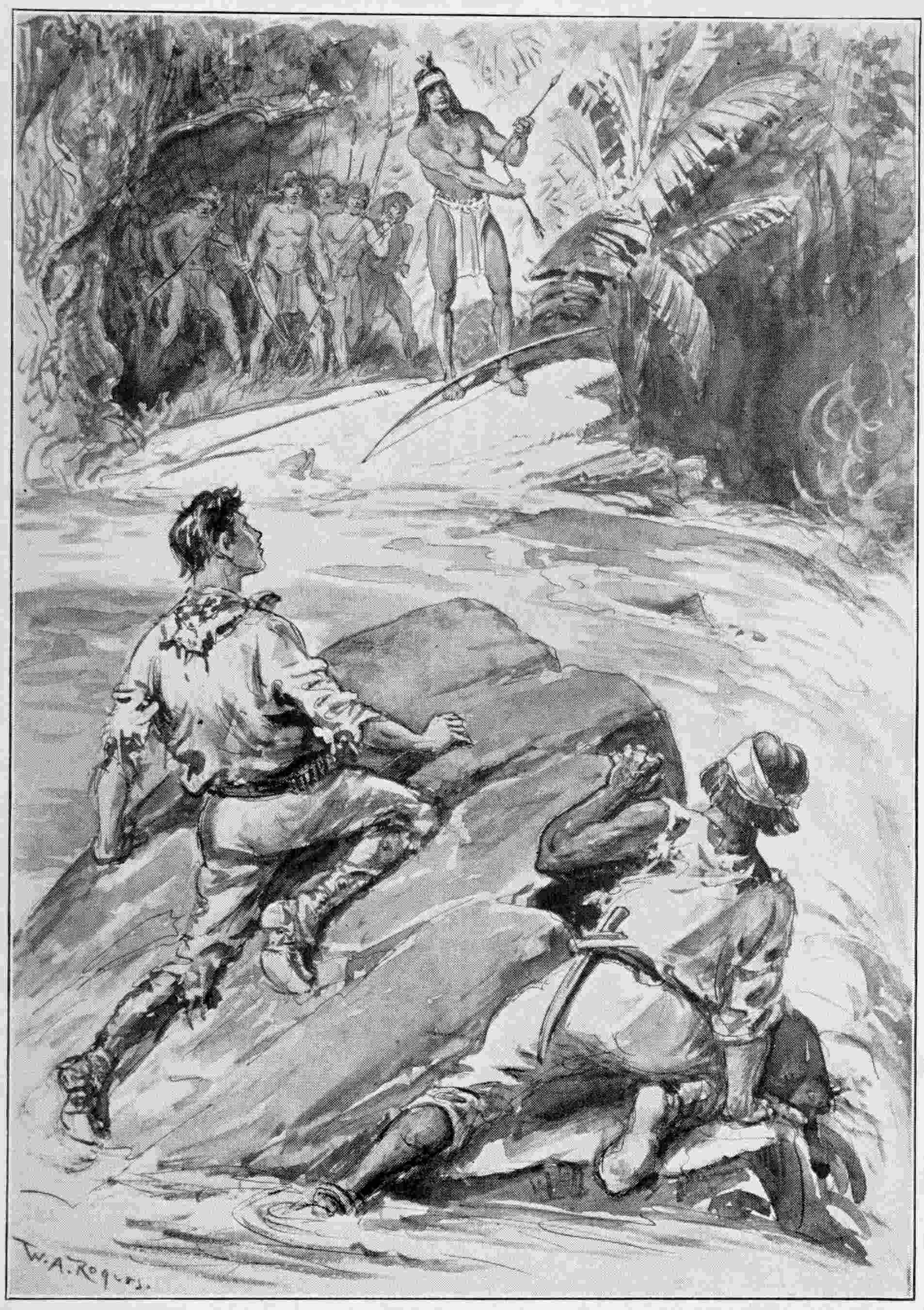
Again facing toward the ... white men ... he grasped the arrow in both hands, snapped the shaft in two ... and threw the pieces into the river.
safe so long as we do nothing to take advantage of him. I can hardly believe what’s happened.”
The Indian was still waiting with outstretched arms. Noting this, Miguel rose to his feet and held out his arms to the savage. Then David followed his example. All the other Indians now came out of the forest and held out their hands. Thus they stood a few seconds and the promise of friendship was sealed on both sides.
The brown men now drew together for a consultation which lasted for some time. When it was over their leader again turned and motioned to David and Miguel to sit down; they complied with his request, after which the Indians disappeared into the forest.
Several hours passed; they seemed like days to the two on the rock.
“I wonder what they are going to do!” David said over and over.
“I don’t know,” Miguel replied each time. “They have some scheme for getting us off this place and have gone to see about it.”
At last the chief returned. He was excited and pointed up the river.
Looking in that direction they saw a group of Indians in the act of
pushing a heavy log far out into the stream with the aid of long poles.
Caught by the swift current, the log began to race down toward them and
in a short time it had sped past them on the far side of the rock.
Suddenly it wavered, swung around and then stopped beside their footing.
It was not until then that they discovered that there was a strong rope
of braided palm fiber attached to the log, the other end of which was
on{233}
{234} shore and held by a large number of Indians. The latter made their
way down along the rocks, slowly and cautiously, until they were
directly opposite the rock.
The leader, now in deliberate pantomime, showed the plan that had been worked out for the rescue of the white men. One of them was to tie the rope around his body just below the arms and then jump into the river as far as possible. The Indians would pull him ashore.
The question now came up as to who was to go first, each offering to make the attempt that would test the feasibility of the scheme and the strength of the rope; but the matter was quickly settled when David tore one of the few remaining buttons off his clothes and flipped it as he would a coin. He was the winner.
Miguel carefully adjusted the end of the rope around his companion’s body and tied the knot securely across his chest. Then, at a signal from the chief, David jumped as far as he could; at the same instant the Indians holding the other end raced into the forest.
The moment the man struck the water he felt himself dragged against the frightful current that whirled him over and over, drew him down into the boiling depths and again tossed him up to the surface. The pull was so great that it seemed he must be torn in two. The ordeal, however, lasted but a short time. Before he was fully aware of what had happened strong arms pulled him out of the water and placed him on his feet where he stood sputtering and gasping but none the worse for his experience.
The rescuers immediately went upstream, sent out another log and rescued Miguel in the same manner.
The two followed the Indians into the forest, where the latter started a fire and proceeded to roast some game that they had apparently shot earlier in the day. The brown men now paid no attention to their guests, for such they were, and David and Miguel remained quietly on one side, watching their actions.
Before long the meat was roasted and one of the Indians brought two large, forest partridges to the strangers. Then they all sat down and ate in silence.
Miguel knew a good deal of the customs of the Indians. He was sure that there would be questionings and explanations later on. But first, the law of hospitality required the providing of food.
After they had eaten the chief arose and motioned to the two to join his group of warriors. He was of such splendid build and appearance that David and Miguel could not suppress their look of admiration. The tops of their own heads scarcely reached to the level of his shoulders. Powerful muscles bulged under his brown skin. His head was round, with a not unpleasant face. His eyes were large and black and straight hair that had been cut evenly, hung in a thick mass to just below his ears. They judged that his age was but a few years above their own.
“White men,” he said in an even, though deep voice, “why do you keep on coming farther and farther into my country?”
The surprise of David and Miguel at hearing these words was second only to that experienced when they{236} had discovered they were not to be attacked, for the man was addressing them in broken Portuguese they could readily understand.
“We are lost,” David said when he had recovered sufficiently to speak, “and were trying to get back to our camp when you found us.”
The Indian grunted, and there was a brief pause.
“Then go,” he said. “Your stomachs are full.”
“But,” Miguel explained, “we are still lost. We don’t know which way to go.”
At this their rescuer gave them a look of contempt.
“Then you can stay here,” he said, with a shrug of his broad shoulders.
“You saved our lives,” David said, suddenly changing the subject, “and we shall not forget that. Why did you do it? We were at your mercy.”
“You still are. But we savages, as you call us, never kill an unarmed enemy except in revenge. But more than that, I respect the courage of men who dare venture on the river. I saw you start and followed you down to see what was left of you at the bottom of the fall.”
David then told the chief their experiences after boarding the raft; how they had suddenly realized their danger and how, abandoning the lurching craft, they had succeeded in swimming to the rock. As the Indian listened, his eyes brightened with admiration.
“The white men do not know the ways of the forest,” he said, “therefore they should keep out of it, because it belongs to us. You are lost! That proves that we belong here and you do not. We never lose our way.{237} You come and you drive us farther and farther away from our homes and plantations into the country of other tribes who kill us unless we kill them. We fight you every step of the way and we win, too—but in the end you win through your superior weapons and greater savagery. But we do not stop fighting until the last man is dead.”
“Why don’t you make friends with the white men?” David asked. He was feeling decidedly uncomfortable.
“They will not let us,” came the prompt response. “Pretending to be our friends, they are our worst enemies. I know. I lived among them at the rubber camps, long, long ago. When the white men come, no matter under what excuse, the Indian loses and finally disappears. They praise us and give us things of no value for which we always pay in hard labor, in suffering and even with our lives. White men are savages; they know better, but still they are most merciless of all.”
“You may be right,” David said thoughtfully. “I don’t know. We ought to teach you things and help you——”
“No,” the Indian snapped angrily. “You should let us live our lives and leave us alone.”
David thought it best not to press his point. “But we are your friends and always will be,” he said calmly. “Come with us to our camp.”
“No, no!” the Indian exclaimed in horror. “They would kill us.”
“I assure you you will be as safe in our camp as we{238} are with you; and there are several things I want to give you to show our appreciation of your friendship.”
This pleased the stalwart chief.
“We will go,” he said. “Tonight the remainder of my tribe will be here. Then we will eat and sing and dance; tomorrow we will start on the journey.”
“How far is it?” Miguel asked.
“Five settings of the sun, as we will walk slowly. There are many women and children coming tonight and they cannot go fast.”
When the others arrived that night the white men were surprised at their number. There were now over two hundred in the party. The women brought food in baskets as well as deer, peccaries, monkeys and birds that had been killed by the men and the feast that followed lasted far into the night.
There was no delay, however, in getting under way the following morning. Soon after the sun rose the encampment was astir. There was a hasty meal and then the party formed for the march.
The chief started first, accompanied by David and Miguel, and carrying only his bow and a number of arrows. At a distance of twenty paces in back of him walked a woman with a heavy basket strapped to her back and carrying two small children, while several larger ones trudged by her side. At a distance of twenty paces behind her was another warrior bearing only his weapons; then another heavily burdened woman followed by another man; and so they alternated to the end of the line.
David thought the men were getting the best of{239} the deal, but after asking a few questions of the leader he was able to account for the arrangement of the column on the march.
The men were the fighters and the hunters. Surrounded by enemies as each tribe was at all times, the warrior must be instantly ready to repulse an attack or to dispatch his opponent at first sight. As the hunters, the men must be prepared to shoot any animal they encountered before it could escape. Therefore, they must of necessity be free to use the bow without the slightest delay.
In either case, quick action would be impossible if the men were encumbered with burdens of any kind, for they would be unable to shoot with any degree of accuracy until the impedimenta had been placed on the ground. While doing this, the enemy would have ample time for the first shots, or the animal would escape. That might mean disaster in the form of death or starvation, so the arrangement was a wise one after all.
They tramped along at an easy gait, stopping at noon for a short rest. No fires were built, but food from the baskets was distributed to the children. During this interval most of the men strayed away a short distance to hunt and before long their excited cries told that the chase was on.
The shouts came nearer rapidly and just before the hunters came into view the branches in the trees ahead of them began to sway and rustle.
David looked up and saw a troop of large, black monkeys fleeing for their lives. He had never seen{240} so many of the animals together at one time. As they raced along and made flying leaps across the spaces that separated the trees, shower after shower of arrows were sent after them by their pursuers. There were the constant twanging of bows and the whining of arrows in flight and now and then came a dull thud, after which one of the frightened animals always leaped high into the air, screamed, then fell to the ground with a crash. But the Indians did not stop to recover it. They continued after the survivors in the treetops and soon the chase had passed the resting place and the shouts grew fainter in the distance.
It was fully an hour before the last of the hunters returned and the victims had been collected. There were forty-three monkeys spread on the ground and the chief assured the white men that not one had escaped; he beamed with satisfaction, for he alone had accounted for five of the animals.
“Tonight there will be meat for all and more,” he said. “Not in many changes of the moon has there been such an abundance of this, the best of all food.”
There was now a further delay while the women dressed the monkeys, after which they packed them into their baskets. After that the column again formed and got under way.
In this manner the party moved leisurely through the heavy forest, led unerringly and without hesitation by their fearless leader. It was on the fifth day that they had the first intimation that the end of the trail was in sight.
“This looks familiar, somehow,” David said sud{241}denly, as they reached a large body of water in the heart of the forest. “I wonder if it could be the——“. He checked his words abruptly.
“Yes,” Miguel continued for him. “It’s the lagoon. Right over there is where the crocodile nearly got me. I wouldn’t be here if it hadn’t been for you.”
“And but for you, I wouldn’t be here. So we’re even. Let’s not mention the subject again.”
Not long after that the men about the rubber camp had an unusual and unforgettable experience. It was their first glimpse of the two wanderers, long given up for lost, marching into camp on either side of the giant Indian. They thought for a moment that the savage was their captive, but when others appeared in the wake of the three they were more mystified than ever.
Most surprised of all to see the large party of visitors was Dom Carlos. At first he was at a loss as to how to express his feelings. The weeks that had elapsed since David’s disappearance had brought him no end of worry, for there was no doubt but that he would be held responsible. He had delayed sending word of the disappearance to Las Palmas in the hope that the missing man would show up. And now that he had arrived and was safely in their midst, the old feeling of tyranny came back with increased intensity.
“So you are back at last!” he said gruffly. “What excuse have you for going away and staying so long without my permission? Don’t you know that the collecting season is almost over and you have wasted your time? You have accomplished nothing.”
David was taken aback by this reception.
“I was lost,” he returned. “I was never so eager to get anywhere as to this place, but I couldn’t find the way.”
“And you, Miguel? You were lost, too, I suppose?” sarcastically.
“Yes, I was lost, too. The fever is to blame,” Miguel replied, while his eyes snapped.
“You can tell that to the patron when we get to the ranch. And what do these savages want?”
“They asked for nothing. They saved us from the river and brought us home. They are our friends and I invited them to come,” David said.
“Well, I’ll invite them to go now. I don’t want them here. Tell them to go and to be quick about it.”
“No, they are not going until I can prove to them that there is at least one white man in the world,” David snapped with determination. “I’m going to the storehouse for some presents for them.”
“You are?” The foreman feigned surprise. “And who is going to be responsible? Your account is overdrawn now.”
“I’ll take care of that part, so don’t you worry. Rice said I could draw anything I need and I am going to do it.”
“Look here,” and the burly foreman stepped forward to block his path. “I’m the boss. You will give nothing to these savages and I will chase them away.”
This speech angered David.
“They are my friends and they will be yours, too, if you let them. Think of what it will mean to have them on your side instead of fighting against you. It is the chance of a lifetime to make peace and you ought to jump at it. Now, I am going to make good my promise to them.”
The foreman leaped toward David with a shout of rage. The latter was no match for the big Brazilian,{244} but he stood still waiting for the onrush until a giant form stepped in front of him. It was the leader of the Indians who stood like a statue between David and Dom Carlos.
This interference was too much for the foreman.
“I see he is your friend,” he panted, “and I will have nothing to do with a savage. Go ahead, get the things. But remember, you will have to account to the boss for this whole thing.”
David said nothing, but some of the men who were watching the encounter, whispered among themselves. They had noted how ready their leader was to attack a man smaller than himself and how quickly he stopped when the giant Indian intervened.
“Come,” David said to the brown man. “Come with me. The others can wait here.”
Together they went to the supply hut where the chief was invited to take his choice of the articles in stock. He selected a number of knives, hatchets and a few other objects he desired, after which David presented him with several pounds of tobacco, which he appreciated more than the other gifts.
The Indians prepared to take their departure soon after, but not until the whole party had exchanged pledges of friendship with the Brazilians. Instead of shaking hands upon leaving they patted one another on the back, but when the chief came to Dom Carlos he walked haughtily past and as he did so he placed an arrow, point up, in the ground at his feet. That meant that he was an enemy of the Indians who would thereafter attack him on sight.
Then the column formed and vanished in the forest.
That night David and Miguel had little time for sleep. The men crowded about them and urged them to repeat again and again the story of their adventures. It was all so strange, so seemingly impossible they could not comprehend it fully, but they at no time doubted the narrative of their companions.
“You got here just in time,” one of them said finally. “We start back in a week or less.”
“To the ranch?” David asked eagerly.
“Yes. The rains are overdue. When they begin they will come hard. We’re getting ready to leave now.”
“That sounds too good to be true. We can’t start too soon to suit me.”
The next day he saw what the preparations consisted of. The large balls of rubber were being carried to the riverbank. Thick ropes were passed through the holes in the center of the balls which had been left by the poles on which the latex was poured while being smoked. The number on the different strings varied, but when sufficient had been threaded the ends of the rope were tied together, forming a huge “necklace.” These, in turn, were pushed into the water, one within the other, so they formed groups of concentric rings known as rubber rafts.
It required a number of days to complete all the arrangements. The men packed their belongings and the utensils used by them in their work and placed them aboard the launch. The Indians who had been engaged at the camp had already taken their departure{246} in canoes for their homes far up the river. The camp began to take on a deserted appearance and it was not difficult to picture what the place would look like a few weeks hence, when the rising water would cover the site and sweep away the huts and every vestige of human occupancy.
Not all of the men were to return to the ranch in the launch. About half their number had been selected to follow the rubber rafts as they floated down the river. When the start was made two men were sent in each canoe; their duty was to drift with the raft by day and by night, to guide it with poles into the proper channels, and to tie it up when it reached its destination.
During the hours of daylight a flag was placed in the center ball; at night a lantern took its place, making it easy for the men to follow the raft in the darkness.
This work required experienced men, so David was not chosen to be one of them. He went on the launch on the day following the departure of the rubber fleet.
The first rain of the season was falling when the craft nosed her way into the stream and the men were glad to leave the now gloomy hinterland, for it would be many weeks before the sodden skies cleared, except for brief intervals, and the place once more became habitable.
The trip down the river was without incident of note. Each day the rain fell for longer periods until there were but infrequent lulls in the heavy downpours. The nights, however, were almost invariably{247} clear, but within another month there would be no respite either day or night from the roaring deluge.
The river rose rapidly, covering rocks and encroaching upon the forest; soon it would assume the aspect of a vast, muddy lake and the picture of heartrending desolation would be complete.
* * * * *
Rice was at the landing when the launch drew up and was made fast. David had looked forward to a word of greeting, or at least a friendly glance, and his disappointment was keen when he found himself treated with the same indifference that characterized the owner’s attitude toward all the men. His one concern seemed to be with the rubber crop and after asking a few questions of Dom Carlos the two went into the office structure, leaving the men to unload the launch.
David saw nothing more of his employer until several days later, when the rubber rafts began to arrive. Then he remained at the waterfront almost constantly, appraising and commenting on the season’s catch.
The cattle had to be brought from the outlying feeding-grounds with the coming of the rains; a great part of the range would soon become inundated. Also, there were numerous other things to be done, such as branding the calves and counting and segregating the animals of different ages and intended for different purposes.
David, of course, confidently expected that he would{248} be permitted to participate in this work. It was the thing for which he had come to the ranch and in anticipation of which he had endured all the hardships and discouragements that had been thrust into his path. But once again he was disappointed.
One by one the men were selected for the round-up and sent on their various missions. And when the last place had been filled, those who remained were put to work weighing the rubber and marking it for shipment.
David awaited a favorable opportunity to protest against this treatment to Dom Carlos. The latter gave him a look of contempt.
“You’re lucky to be doing anything,” he said in reply. “When I told the patron all the things you are guilty of he came near sending you down the river under guard. But he decided to let you work out your debt; after that you’re going on the first launch that leaves.”
“If that’s the case I might as well leave right now,” David replied hotly.
“Not until you’ve squared your account. You’ll work that out first, and it will take a long time, too.”
David said nothing more, but quickly formed a plan of action. He would venture to speak to Rice if there was a possible chance of doing so; if not, he simply had to make the best of a very bad situation.
Soon the cattle began to arrive, in small groups and in droves that numbered hundreds. They were a wild lot and David was surprised that there were so many of them. As he watched the mounted herders, wielding their ropes, riding frantically and shouting, he{249} longed to be among them. Instead, he carried the heavy balls of rubber to the weighing shed and back again to the storehouse, after they had been weighed and checked.
However, in the evenings, when the day’s hard labor was over, he visited the corrals accompanied by Miguel and eagerly talked about the things he would like to do and would do—elsewhere, if the opportunity did not come at Las Palmas.
The more he thought of the matter, the more impatient he became. And finally, unable longer to endure in silence, he decided to go to Rice to settle the issue. Scarcely had he determined on this course than the ranchman sent for him. He hastened to the office in response to the summons, breathless with eagerness and anticipation.
A gruff “Enter” came in answer to his knock. He went in. Rice was at the table, his back turned toward the door and he continued writing fully five minutes longer before turning around. In the meantime, David’s enthusiasm and ardor cooled considerably. He doubted now that he had been called for a good purpose.
“Don’t say a word,” Rice greeted him swinging suddenly in his chair. “Listen to what I say. I’ve heard all about everything, and I know just where everybody stands.”
David had no idea what the man was talking about, but kept his mouth shut. After a moment the ranchman continued:
“Somebody is going to have a surprise coming to{250} him soon and it won’t be a pleasant one either. What I mean is this. Cattle have been disappearing. Two hundred yearlings are gone. They were stolen. Now, that ought to be enough. Be mighty careful because we’ll find out the guilty one and then——. That’s all. Get out.”
David was stunned by this information. At first he could not fully comprehend the meaning of the words he had just heard. Cattle had been stolen! Two hundred of them! What was the man driving at? Surely, he did not suspect him of being guilty of the deed. Why should he do such a thing? What could he do with the cattle even if he had taken them? These and similar thoughts raced through his mind in a bewildering stream, followed by bitter resentment that the subject had been mentioned to him at all. He had not been accused directly, it is true; but there was the insinuation of guilt or suspicion of it. His first impulse was to return to Rice instantly and to tell him what he thought of the whole outfit and then to leave, regardless of the consequences. He had succeeded in getting there alone and unaided; he could go away in the same manner. But after a moment’s consideration he decided to do nothing of the kind; a better plan had suggested itself. He would catch the thief and thereby clear his own name. Not until then would he be justified in leaving. To go now might be interpreted as an admission of guilt.
That night he conversed long and seriously with Miguel. And the next day the latter, who was supposed to be in the thick of the round-up but whose{251} absence was not missed in the excitement of the work, was far away, engaged in another enterprise.
He reported fully to David that night, as they made their customary visit to the corrals.
“I found it,” he said, so soon as they were out of hearing of the men in the huts. “I know it’s the trail made by the missing cattle, because the tracks are all the same size.”
David was inclined to be skeptical.
“If you could find it, why couldn’t the boss?” he asked. “He has been looking all day for some clue that would lead him to the recovery of his property.”
“He didn’t look in the right place. First, the cattle were driven through the marsh so as to cover their trail. Then they went through that wide patch of forest over there,” pointing to a black clump of trees far in the distance, “and when they had passed through that they were several kilometers away—far enough to make picking up their tracks a difficult matter.”
“That’s great! What else did you find out?” David said.
“There was a strange man in the corrals this evening when I got back. He was talking to Dom Carlos.”
“I wonder if he is still here!”
“No! He left a short while after I came and he rode through the marsh and into the woods.”
“Good! That’s all we need to know.”
It was two days later that Miguel stole into the hut where David was perspiring over his task in the middle of the afternoon. A new lot of cattle had been driven into the corrals that morning.
“The stranger is here again,” he said, “and Dom Carlos is showing him the pen of two-year-olds.”
“We’ll see tonight,” David returned; it was hard for him to restrain his excitement. “Have two horses ready. Get them any way you can, but be sure to have them. I’ll have the other things.”
Miguel returned to his work and David continued with his task; the hours seemed like days.
It was dark when Miguel came to announce that the horses were waiting, and the two lost no time in going to the place where they had been tied. Soon the moon would rise and that would mean their discovery and the spoiling of their plan, so there was need of haste.
The two rode slowly through the marsh, so as to make as little noise as possible. A half hour later they emerged from the mire and entered the clump of trees. By this time the moon had risen above the horizon and a faint light penetrated through the treetops.
They had not gone far when a pair of dark forms appeared out of the shadows and came toward them. The riders stopped and awaited the approach of the two.
“Is everything all right?” the foremost asked. “Where are the animals?”
“They’re coming,” Miguel answered, as they dismounted leisurely. They led their horses to a tree and tied them. Then they walked carelessly to where the strangers were standing.
The next thing the latter knew they were facing{253} two revolvers, the muzzles of which were thrust against their chests.
“Put up your hands!” David commanded, and the order was obeyed in an instant, so completely had the men been taken by surprise.
“Thanks!” David continued. “We’re not going to hurt you in the least, that is, so long as you do what we say. But be careful; these guns are so easy on the trigger they can’t stand the least little pull. Don’t make me nervous or there might be an accident.”
As he spoke, Miguel and he had relieved the two astonished men of their weapons.
“What do you want?” one of them asked in a trembling voice.
“You’re waiting for the cattle. They’re coming. One of you must go through with the deal, as if nothing had happened. My companion will guard the other of you while I substitute in his place to watch the deal. That isn’t much to ask, is it?”
“This is the man I saw at the corral,” Miguel volunteered. “Let him meet Carlos.”
“All right,” David returned. “Take the other one away, Miguel. Make him turn around and keep your gun against his back. If he makes one suspicious move—you know what to do; or, if I give the signal, shoot him anyway. I’ll keep my eyes on this one.”
Miguel marched his prisoner into the shadows a short distance away.
“You may cross your arms now,” David addressed the man before him. “They must be getting tired; but keep them crossed. What shall I call you?”
“Ramón.”
“All right, Ramón, when Carlos comes, conduct your business with him just as if I were not here. Take the cattle and pay for them. But don’t forget for one second that I am right here by your side. This gun in my hand shoots quicker and straighter than any I ever saw; I can’t miss with it.”
“I haven’t any money,” Ramón said in a surly voice.
“How do you pay for the cattle?”
“I just give a receipt for them. Then when I sell them down river, we divide the money.”
“That’s a good system. It’s better than carrying a lot of money, because somebody might rob you. Give Carlos the receipt.”
“What shall I say if he asks about you? He knows Lucas who was with me.”
“Tell him Lucas can’t be with you this evening, and that I am taking his place. I’ll tie a handkerchief over my face so he won’t know me.”
“What are you going to do with us?” the man next asked.
“Well, that depends.” David was thoughtful. “If you don’t do everything just as I told you to I’ll just let you lie here where you fall. If you carry out your part, we’ll let you go. That will give you a whole night’s start in the event anyone should want to go after you in the morning. I’d advise you not to stop until you are out of the country and never to come back again.”
Ramón seemed relieved.
“I’ll do just as you ordered,” he said. “Don’t worry.”
“I’m not worrying. That’s for you to do.”
It seemed but a few minutes before they heard the trampling of many feet and soon the cattle began to drift into the forest. They moved slowly and were a long time in passing, for their number was great.
At the end of the lines came Dom Carlos. David recognized him on sight, even in the semi-darkness.
“Here they are,” he said, without dismounting. “Give me the receipt, and see that you get a better price for these or you can’t have any more. Hurry up. I’ve got to get back before I’m missed.”
The man handed Carlos a slip of paper which the latter scanned and then carefully concealed in a little pocket under the holster of his revolver.
He seemed about to depart. Then he looked up suddenly.
“Who’s that?” he asked sharply, pointing to David. “Where’s Lucas?”
David trembled in fear of what might happen, but Ramón played his part well.
“Oh,” he said easily, “Lucas can’t be here tonight so this man is taking his place. He’s all right, though.”
Carlos said no more but turned and galloped away.
Miguel brought out his prisoner after a short wait and then they told the men to get on their horses and leave as fast as they could, which order they were not long in carrying out.
“Here, Miguel,” David said, when the clatter of the hoofs of the two fleeing horses had died in the dis{256}tance, “you can take this gun, too. That makes two for you. I thought it best not to give them back to the thieves and as I have one of my own I don’t need another.” Then he added with a chuckle, “that will make up for your having to use a pill bottle tonight. Honestly, I tried hard to borrow or steal one for you to use, but I couldn’t.”
“Thanks,” Miguel said with beaming eyes. “I was scared to death the man would see I had a bottle and not a gun.”
“That’s why I told him to turn his back—so he couldn’t see.”
In accordance with their plan, Miguel remained to watch the cattle while David mounted and rode to camp.
The place was in a fever of activity when he arrived. Several of the men ran out to meet him and from their excited chatter he gathered several things.
Rice had suspected trouble and had made a personal inspection of the corrals soon after dark. The pens of the two-year-olds had been found empty. Worst of all, there were no tracks to tell in which direction the animals had gone.
“He thinks you took them,” one of the men ventured, half-fearfully, “you and Miguel, because you had taken horses and were missing.”
David said nothing, but rode to the office structure and, without knocking, entered. Rice was alone, at the table as usual, his head propped up in his hands. Several kerosene lamps lighted up the room.
David waited a moment, but as the man did not look up he strode quickly to his side.
“Mr. Rice,” he said quietly, “I know you don’t like me and you don’t want me here, and I’m not going to bother you much longer. But what you said to me the last time was too much. I can’t stand that. I couldn’t go after you had all but called me a thief until I could prove the facts. I can do that now and I’m leaving tomorrow morning. I got here alone and I can get back the same way.”
Rice had jumped to his feet at the first words and stood looking at David. He had undergone a remarkable change. His face was drawn and there was a pathetic expression in his eyes. When he spoke his voice was almost plaintive.
“What do you mean?” he asked. “Sit down and let’s talk things over.”
“No, thank you,” David replied. “I’ve become used to standing on my feet. You saw to it that I did. But what I came to see you about was that cattle proposition. More have been stolen tonight. The mozos met me with the information that Miguel and I are suspected of their theft because we could not be located in the ranch. Were we the only ones away at the time?”
“Please.” Rice’s voice was pleading now. “You don’t understand; but you will soon.”
“Yes, and if I may say it, you too will understand very soon.”
“Yes,” Rice continued, “Carlos was gone also. They said he had gone to chase the thieves.”
“And do you believe that?”
The subject of the conversation entered at that moment.
“I chased them many kilometers,” he said, wiping the perspiration from his face, “but they escaped. I must have killed or at least wounded some of them, because I shot at them each time I got near enough.”
David appeared elated.
“I would consider it an honor to clean the revolver of such a brave man,” he said quickly. “The barrel must be all fouled. Please, may I?”
Dom Carlos scowled as he hesitated.
“Let him do it.” It was Rice who spoke, as if indulgently. “A man with courage such as yours should have a servant.”
The foreman smiled at this compliment. And, besides, here was another opportunity to humiliate David.
He carelessly removed the revolver from the holster and laid it on the table. David had it in an instant.
“Now take off the belt and give it to the boss,” he commanded, levelling the weapon at the foreman, “and do it right away.”
The latter flew into a rage.
“Are you going to let this mozo insult and threaten me like that?” he asked.
“Go on, Carlos. Take it off.” It was Rice who spoke. “Better humor him; he has us at a disadvantage.”
At this the foreman was too startled to make a{259} reply. He began to understand the turn affairs were taking. His arms hung limply. He was about to collapse.
“I’ll take it off for you, then,” David said.
He handed the belt to Rice.
“Look into the little pocket under the holster and you will know who stole your cattle.”
Rice obeyed mechanically, with trembling fingers, and found not one but two pieces of paper.
“I see,” he said; “receipts for both lots of cattle that disappeared. Carlos, what have you to say?”
But the man was incapable of speech. He had slumped, moaning, to the floor. Several of the men, coming at Rice’s call, removed him to an inner room and remained to guard him.
David now told the whole story of what had occurred, ending with, “Miguel is staying with the cattle until you send someone to help him round them up and bring them back. I’m going to pack my things now, so I can start early in the morning.”
He turned to go, but Rice grasped his arm and held him fast.
“No!” he said in a strained voice. “I don’t blame you for wanting to get away from here, and after what you’ve gone through I have no right to ask you to stay to endure more of it. But don’t leave—tomorrow morning. Wait a few days longer. There will be a launch then.”
“I can go alone, as I came. The one comforting thought I can take with me from Las Palmas is that{260} I didn’t trouble anyone, and I can’t start doing that now.”
“I want to see you in the morning.” Again Rice was pleading. “Promise that you’ll stay just one more day. I have something to say to you.”
And David promptly showed his fine character by agreeing to the request.
“I am expecting the launch from Manaos any hour now,” Rice said the next morning, after warmly greeting David. “It will bring a surprise for you.”
“Mail!” David exclaimed enthusiastically. “It has been so long since I had a letter from home.”
“There may be letters, but I was thinking of something else. It will bring something—someone, I should say——”
“You don’t mean that my—my—” David gasped.
“Yes, your father is coming.”
The listener was so overcome at this news that he was speechless. He grasped a chair for support.
“And now I am going to tell you the whole story,” Rice continued. “Your father wrote me before you came that he wanted this to be your last change. He asked me to make things so bad, so trying, so disagreeable, that only the strongest faith in yourself could carry you through. I was either to make or break you. I did what I considered was proper and the men were given their instructions. Some things went too far; I know that, because I have questioned each one and I learned the truth. Carlos abused my confidence and you because in you he saw a possible rival. I was{261} misled by him or I should not have entrusted you to his care.”
“How about accusing me of stealing the cattle?” David was on the point of tears.
“If you will think back you will remember that I did not accuse you. I simply wanted to put you on your mettle. I firmly believed you could catch the thief; I couldn’t, and you don’t know how hard I tried. I never even suspected Carlos. That was the last test and I had to make it so strong that when you came through it there would be no further possible question in my mind as to your character and ability. Boy, boy, you’ve made good a million times over and I wish I could keep you here always. I would trust you with anything; you would find a way out of every difficulty.”
“Do you want me to stay?” David asked, as in a dream.
“Yes, because then I could honestly feel that there was one person on the place worthy of my confidence.”
“Let me see.” David was bewildered. “I must have time to think.”
He rose to go.
“Have your things moved over here,” Rice said as he started away. “You are to live with me hereafter.”
David, however, preferred to remain with the men until he knew definitely what the future held in store for him. He went back to his quarters and there he found Miguel.
“You are going?” the latter asked anxiously.
“I don’t know,” David replied. “But I know now what you wanted to tell me. I suspected it at times,{262} but then things got so bad I thought I must be mistaken. Dom Carlos was to blame.”
“I’m glad you know. Carlos was always urging me to cause you trouble. And then, after you knocked me down in front of the others, I became angry and was in earnest. I’m sorry.”
“Never mind. It’s all over. You’re my best friend and I want you to keep that place.”
The launch came the next afternoon, and after the lengthy, joyous greetings were over, Rice, father and son settled down to a serious discussion of the future.
“You know,” the elder David said with great animation, “you have converted me entirely. You have opened my eyes. I am not asking you to come back to the city to live. On the contrary, I discovered that there are thousands of acres of the best land on earth lying idle right in our own country. I did not know it before, because living in the cramped city made me blind and narrow to the beauty and possibilities of the great outdoors. We are all going away from the dust and the grime of the crowded metropolis. We, too, want to see the blue sky overhead and feel the green grass under our feet. What do you say? I will get as much land as you want and put you in full control.”
“That’s too wonderful to be true.” David spoke softly. “We can talk it
over and decide just how much we need and where it must be. But Mr. Rice
has asked me to stay, and to tell the truth I haven’t even started yet
to learn. You can get the land and hold it, because so far I’m not
capable of taking charge of anything. I’ve been drifting from one thing
{263}to another, neither
doing nor learning anything of consequence. So I
must stay until the purpose for which I came is accomplished. When I am
sure enough of myself to drop my anchor I’ll come back to you, and then
we can begin the real life and the only one that’s worth while.”
THE END
Typographical errors corrected by the etext transcriber:
I am sorrry, but Wellman=> I am sorry, but Wellman {pg 5}
Para=> Pará {pg 30 x 3}
He approached cautionsly=> He approached cautiously {pg 211}