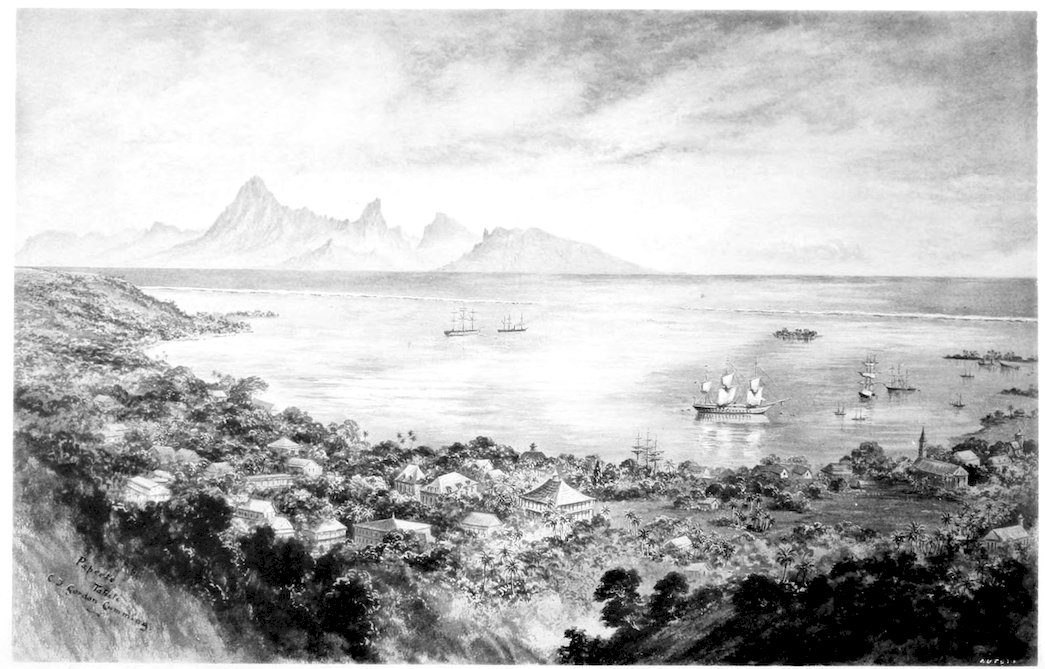
PAPEETE. CAPITAL OF TAHITI.
Title: A lady's cruise in a French man-of-war
Author: C. F. Gordon Cumming
Release date: November 27, 2025 [eBook #77356]
Language: English
Original publication: Edinburgh: William Blackwood and Sons, 1882
Credits: Richard Tonsing, Peter Becker, and the Online Distributed Proofreading Team at https://www.pgdp.net (This file was produced from images generously made available by The Internet Archive)
Transcriber’s Note:
New original cover art included with this eBook is granted to the public domain.
PAPEETE. CAPITAL OF TAHITI.
When, in the spring of 1875, Sir Arthur Hamilton Gordon was appointed first Governor of Fiji, I had the good fortune to be invited to form one of the party who accompanied Lady Gordon to that far country.
Two years slipped away, brimful of interest, and each month made me feel more ‘At Home in Fiji,’ more fascinated with its lovely scenery, more content to linger among its isles.
Then a counter-charm was brought to bear upon the spell which held me thus entranced. The chief magician appeared in the guise of a high ecclesiastic of the Roman Church, clothed in purple, and wearing the mystic ring and cross of amethyst; while his coadjutor, a French gentleman of the noble old school, was the commander of a large French man-of-war, which had been placed at the service of the Bishop of Samoa, to enable him to visit all the most remote portions of his diocese. Already this warlike mission-ship had peacefully touched at many points of exceeding beauty and interest, and our visitors had no sooner recognised my keen viappreciation of scenery, and inveterate love of sketching, than they formally and most cordially invited me to complete le tour de la mission, and so fill fresh portfolios with reminders of the beautiful scenes which the vessel was about to visit.
Being duly imbued with a British conviction that such an invitation could not possibly be a bonâ fide one, I at first treated it merely as a polite form; but when it was again and again renewed, in such terms as to leave no possible doubt of its sincerity, and when, moreover, we learnt that the most comfortable cabin in the ship had actually been prepared for the invited guest, and that its owner was thoroughly in earnest in his share of the invitation, then indeed we agreed that the chance was too unique to be lost; and so it came to pass that on the 5th September 1877 I started on the cruise in a French man-of-war, which proved one of the most delightful episodes in many years of travel.
While these pages were passing through the press, I have received details from various sources, which prove that the policy referred to at p. 241 is being actively carried out.
Not content with holding the Marquesas, the Paumotus, Tahiti, and the Gambier Isles, France seems resolved to annex every desirable island lying to the east of Samoa, thus securing possession of every good harbour and coaling station lying between New Zealand and the coast of South America; and also, diverting all the trade of these isles, from Britain’s Australian colonies, to a French centre, which shall command the great commercial highway of the future, when the Panama Canal shall be completed. Raiatea in the Society Isles has recently been formally annexed, and the independence of Huahine and Bora-Bora threatened.
Now a further step is contemplated. The Austral and Hervey groups still remain free. They are self-governed, and Christianity is firmly established among their people.
According to the latest information, a French man-of-war visited their principal isles last August, to command the inhabitants to divert their present trade from New Zealand to Tahiti, assuring them that Great Britain had undertaken not to interfere with viiiFrench action anywhere to the east of Samoa. The islanders, who had at first received the French vessel with all honour, no sooner got an inkling of the true object of its visit than they became alarmed, and returned all presents which had been made to them by the captain; who thereupon assured them that the French admiral was on his way thither, and would soon bring them to their bearings, and that they would have to accept a French protectorate.
Remembering the history of French protection in Tahiti, the Australs and Hervey Islanders are now justly alarmed for their own independence.
| CHAPTER I. | |
| PAGE | |
|---|---|
| Letter to England announcing start from Fiji—Vague plans, | 1 |
| CHAPTER II. | |
| Life in a French man-of-war—Convent-life in Tonga—Early martyrs—Wesleyan mission—Roman Catholic mission—Cyclopean tombs at Mua—Gigantic trilithon—Fines and taxes—King George Tupou, | 3 |
| CHAPTER III. | |
| Sail from Tonga to Vavau—Volcano of Tofua—Wesleyan mission—Two thousand miles from a doctor—Orange-groves—A lovely sea lake—Coral caves, | 24 |
| CHAPTER IV. | |
| Life on board ship—The Wallis Isles—Fotuna—Sunday Isle—Cyclopean remains on Easter Isle—Stone adzes—Samoa—Pango-Pango harbour, | 33 |
| CHAPTER V. | |
| Boat transit to Leone—Spouting caves—Council of war—Sketch of Samoan history—Night dances, | 48 |
| CHAPTER VI. | |
| A shore without a reef—Samoan plants—Houses—Animals—Laying foundation-stone of a church—School festival—the Navigator’s Isles, | 61 |
| x | |
| CHAPTER VII. | |
| Vanquished chiefs of the Puletoa faction under protection of the union-jack—Convent school—“Bully” Hayes—Postal difficulties—House of Godeffroy—Village of Mulinunu—Vegetables and fish—Advantages of Anglo-American companies, | 74 |
| CHAPTER VIII. | |
| The Ishmaelites of the Pacific—Injudicious intervention—Fa-Samoa picnic—A torchlight walk—Training college at Malua—Apt illustrations by native preachers—Dr Turner—Mission to the New Hebrides—Escape to Samoa—Of many changes on many isles, | 89 |
| CHAPTER IX. | |
| A sketch of the Samoan mission—The Rev. John Williams determines to visit the Navigator’s Isles—Preliminary work in the Hervey group—Discovery of Rarotonga—Conversion of its people—They help Williams to build a ship which shall convey him to Samoa—Visit Tonga—Proceed to Samoa—Overthrow of idolatry—Reverence for old mats—Williams’s grave at Apia, | 118 |
| CHAPTER X. | |
| Leave Samoa—Reach Tahiti—Grey shadows—Death of Queen Pomare—La Loire and her passengers—A general dispersion—Life ashore at Papeete—Admiral Serre and the royal family—Families of Salmon and Brander—Adoption, | 148 |
| CHAPTER XI. | |
| Papeete—Catholic mission—Protestant mission—A christening party—La Maison Brandère—Tales of the past—Evenings in Tahiti—La musique—Plans—Sunday, | 164 |
| CHAPTER XII. | |
| Short sketch of a royal progress round Tahiti, | 177 |
| CHAPTER XIII. | |
| The royal progress round Tahiti—Life day by day—Himènes—A beautiful shore—Manufacture of arrowroot flowers—A deserted cotton plantation—Tahitian dancing—The Areois—Vanilla plantations—Fort of Taravao, | 182 |
| xi | |
| CHAPTER XIV. | |
| The royal progress round Tahiti (continued)—French fort at Taravou—The peninsula—Life in bird-cage houses—Torchlight procession—Return to Papeete, | 198 |
| CHAPTER XV. | |
| The semaphore—Immutable tides—The coral-reef—Spearing fish—Netting—Catching sharks—A royal mausoleum—Superstitions of East and West—Centipedes—Intoxicating drinks—Influenza—Death of Mrs Simpson, | 210 |
| CHAPTER XVI. | |
| The royal progress round Moorea—The Seignelay starts for the Marquesas and Paumotus—Indecision, | 226 |
| CHAPTER XVII. | |
| Vain regrets—Some account of the Marquesas and the Paumotu groups, | 236 |
| CHAPTER XVIII. | |
| Tahitian hospitality—A South Sea store—A bathing picnic—The Marquesans—Tattooing—Ancient games of Tahiti—Malay descent—Theory of a northerly migration, | 267 |
| CHAPTER XIX. | |
| Life in Papeete—The market—Churches—Country life in the South Seas, | 286 |
| CHAPTER XX. | |
| Visit to the Protestant mission on Moorea—A sketch of the early history of the mission, | 294 |
| CHAPTER XXI. | |
| A healing tree—Plantation life—Vanilla crops—Cat-and-dog life—A foiled assassin—The tropics of to-day—England in days of yore—Among the crags—Infanticide—Heathen days, | 310 |
| xii | |
| CHAPTER XXII. | |
| Life on Moorea—An ancient place of sacrifice—Arrival of H.M.S. Shah—Hospitalities on land and water, | 322 |
| CHAPTER XXIII. | |
| The atoll group of Tetiaroa, | 335 |
| CHAPTER XXIV. | |
| New Year’s Day in Tahiti—Ascent of Fautawa valley—Of palm salads, screw-pines, and bread-fruit—Packing mango-stones—Return of Gilbert Islanders—Departure of the Seignelay, | 339 |
| CHAPTER XXV. | |
| Hurricane at the Paumotus—Mahena plantation—Watching for vessels—Farewell to Tahiti, | 353 |
| PAGE | |
|---|---|
| Papeete—Capital, | Frontispiece |
| Trilithon, Tonga, | 18 |
| A Coral Cave, Vavau, | 29 |
| Opunohu Bay, Moorea, | 153 |
| Le Diadème, | 169 |
| A Royal Reception, Haapiti, | 229 |
| Pao Pao, or Cook’s Bay, | 230 |
| Ancient Marai, | 324 |
| Map, | At the end |
The “Wa Kalou,”—i.e., “Fern of God,”—introduced on the cover of this book, is a most delicate climbing fern which overtwines tall trees and shrubs in the Pacific Isles, forming a misty veil of indescribable loveliness. When in the state of fructification, each leaf is edged with a dotted fringe of brown seed. In the Fijian Isles its beauty has gained for it the name here given; and in olden days the ridge-poles of the temples were wreathed with it, as those of chiefs’ houses are to this day. It also finds favour for personal adornment, trailing garlands of this exquisite green being singularly becoming to a clear brown skin.

My dear Eisa,—I have only time for a line, to enclose a packet of seed of a lovely shrub which bears clusters of golden bells. Also to tell you that I am just starting for a cruise in a French man-of-war, the Seignelay, commanded by Captain Aube, who is taking Monseigneur Elloi, the Roman Catholic Bishop of Samoa, a round of his diocese. Both are exceedingly pleasant, and have made themselves much liked here. The officers are a particularly gentlemanlike set. Judge of my amazement (accustomed to the rigid regulations of the English navy), when these, as one man, echoed an invitation given to me by the commander, to go for a cruise over half the South Seas, where they purpose touching at many isles, which I could by no possibility have any other chance of seeing. Several of these most kind friends had placed their cabins at the disposal of the captain, that he might offer me whichever he considered most suitable. For the first day or two after this invitation was made, we all treated it as a pleasant joke, never 2imagining that it could be quite in earnest; but when at length we all became convinced that it really was so, we agreed that there really could be no reason for refusing so rare a chance of an expedition, which will be to me most delightful.
So I am actually to embark this afternoon, Lady Gordon and dear little sailor Jack, and Captain Knollys, accompanying me on board, to see me fairly started.
This evening we sail for the Friendly Isles (Tonga), and thence proceed to the Navigator’s Isles (Samoa), where there have been serious disturbances, and where my friend Mrs Liardet, wife of the British Consul, has for some time had about thirty chiefs living in sanctuary in her house. I have long promised to visit her, should an opportunity arise, so this is an admirable one. I shall probably take a return passage thence in a German ship, and rejoin Lady Gordon at Loma Loma, a point in this group, about one hundred miles from here.
My French friends urge my going on to Tahiti, the loveliest isle in the South Seas; but the utter uncertainty of how to get back thence, either here or to Tasmania, where Lady Gordon hopes to spend Christmas, makes me hesitate. If I could reach the Sandwich Isles, I should then be on the direct line of the Pacific mail-steamers; but Tahiti is utterly out of the world, and till the Seignelay arrives there, she will not receive her further orders, and may perhaps be sent to Valparaiso, which has no attractions for me. So my line of march is at present somewhat undecided. I think I shall almost certainly return here from Samoa; but as B. long ago said, of my wandering propensities, that I was just like a knotless thread, I may perhaps slip through, and you may hear of my vanishing into space!
This place is looking lovely. It has improved wonderfully in these two years, and has become so very homelike and pleasant, that I quite grudge leaving it, with even the vague feeling of uncertainty which attaches to any long journey; and though we all expect to return here, after a winter in Tasmania, still, so many contingencies may arise, that one always feels a home in the colonies to be a very insecure tenure.
3Now I must finish my packing, which requires a good deal of consideration in case it should turn out that my locomotive demon urges me onward, and that I do visit the Hawaiian Isles, and then Tasmania, ere returning here.
I wish you could see my room here, now. It really is a museum—the walls covered with trophies of all the strange Fijian things I have collected during the last two years. I have just finished a series of about sixty studies of Fijian pottery, representing a hundred and fifty pieces, all different, and made without any wheel, by the wives of the poor fishermen. Some of the forms are most artistic, and the colour is very rich. No time for more. I will write next from Tonga.
Dear Lady Gordon,—I may as well begin a letter at once, in case of a chance of posting it by some stray ship, but as yet there is none even on the horizon.
Is it possible that it was only last Wednesday afternoon when you and Jack left me on board the Seignelay to try an entirely new experiment in ship-life—only three days since we ate our first méringues in that charming little dining-room, of which I now feel such a thoroughly old inhabitant? I can scarcely believe it.
Still more wonderful, is it scarcely a fortnight since I first met the amethystine bishop, and this extraordinarily kind captain, who both seem like real old friends, as do, indeed, all the people on board, from the officers and quartermasters, down to Antoine, the Italian maître d’hôtel, who takes me under his especial charge, and 4is as careful as any old nurse? I know that if I were sick he would insist on coming to the rescue, but as yet he has not had the smallest chance of showing me such attentions; for though we had one really rough day, the ship is so very large and steady, that you scarcely perceive any motion. You did not half see her; she really is a noble vessel, and all her machinery is so beautifully kept—such a display of polished brass and steel—brighter than on most English men-of-war. Of course I have been duly lionised over every corner of her, and I think the most novel sight of all, is serving out rations, and seeing wine pumped up from huge vats, to fill the small barrels, each of which represents eight men’s daily allowance. What immense supplies must be laid in when such a ship starts on a long cruise! They are sufficiently startling on board such vessels as the Messageries Maritimes, where every soul on board drinks vin ordinaire at every meal, and where there is daily consumption of about two hundred bottles, and the store laid in at Marseilles has to suffice for the voyage to Yokohama, and back to Marseilles.
The little cabin assigned to me is charming—so full of natty contrivances to make the most of space, and all so pretty. I believe that several of our kind friends on board have contributed to make it so. One lent a beautifully carved mirror, another a pin-cushion of pale-blue silk and lace. Fixed to the wall are fascinating flower-vases of black Chilian pottery, brought from Lima, and most delicate little kava bowls from the Wallis Isles, now utilised to hold soap, sponge, and matches. I find a whole chest of drawers empty, and various shelves, which I know can only have been cleared at great inconvenience. A small bookcase contains a very nice selection of French and English books—for my especial host, M. de Gironde, has travelled a good deal in England and in Scotland, and reads English well, as do several of the others. Having so generously given me his cabin, he has taken up his abode in the chart-room on the bridge, and declares he likes it far better; that it is much cooler, and that he never was so comfortable, &c. In short (in common with all the others), he tries to make me really feel as if I were conferring a huge obligation 5on the whole party by having come. Never were there such hospitable people. I have had a good deal of spoiling in the course of my life, but I never had it in such perfection as now. Every creature on board is so cordial, that it would be quite impossible not to feel so in return. I think my French is improving! I can now distinguish the Brétons from the Provençals, and both from the Parisians.
The officers are a pleasant, well-informed set, who have travelled with their eyes open, and their relations with their fine old captain are those of cordial sons with a father. It would be difficult for any one accustomed to the rigid stiffness of the British navy to understand such a condition. Even the frank kindliness with which sub-officers and men are addressed, sounds to me as unusual as it is pleasant. Life on this ship seems that of a happy family, with the filial and paternal affections unusually well developed, and M. Aube is generally the centre of a cheery group, chatting unreservedly on whatever topic may arise.
At least two of the officers are daily invited to breakfast, and two others to dinner in the captain’s little cabin, all coming in their turn. And six or eight generally come in to evening tea, a ceremony which, I suspect, has been instituted specially out of deference to my supposed English habits. Besides the bishop and myself, M. Pinart is also the captain’s guest, and I find him pleasant and very ready to impart his information, which, as you know, is considerable, on all scientific matters. The others have little jokes at his expense, and declare that he is more of a Yankee than a Frenchman. I can only say the combination is good.
The feeding is excellent, beginning with early chocolate. Breakfast is at 9 o’clock, and ends with coffee and liqueurs, especially most delicious Chartreuse, which some of us in an irreverent whisper call “La meilleure œuvre des moines.” Dinner, with similar ending, is at 5 o’clock, and tea at 8. Antoine has orders to give me luncheon at 1, with due respect to English habits; but I find this quite superfluous; so that ceremony falls through. By the by, tell A. that his champagne-cup produced quite a sensation. It was generally set down as being de l’hydromel, and the greatest 6curiosity prevails concerning its ingredients, which I, unfortunately, am not able to satisfy.
We are now about 250 miles east of Fiji, and sighted land this afternoon; we have just anchored off Tonga, which certainly compares unfavourably with our beautiful Fijian isles. This is the dullest, flattest land I have yet seen—a low shore, fringed with long lines of cocoa-palm, which, seen from the sea, are singularly monotonous. The king’s town, Nukualofa, consists of a long row of more or less ugly villas, stores, and barracks, built of wood and painted white: one is bright-green. The houses are roofed with zinc or shingle, and the general effect is that of a new English watering-place. King George’s palace is a rather handsome wooden building like a hotel, and is reserved for his guests. The Government offices occupy another wooden building, and just beyond them is the printing-office, in which a few books, a magazine, and an almanac, are printed in the native tongue. A large Wesleyan church, painted white, and with a very small steeple, stands on a green hill on the site of an old fortification, and close to it is the house of Mr Baker, Wesleyan missionary.
About a mile and a half along the shore is another village called Maofanga, where there is another Wesleyan church, but it is chiefly a Roman Catholic settlement; and near a neat thatched chapel of the true Tongan type, I see a long pleasant-looking bungalow, which I am told is a convent, the home of a society of French Sisters. To-morrow morning I hope to go ashore and see everything.
You see my experiences are rapidly enlarging. I have to-day made my very first acquaintance with conventual life, and am greatly interested by it, and by the exceedingly ladylike kind women who, at a hint from the bishop, invited me to stay with them as long as the ship is in harbour, and have given me this clean, tidy wee room, which, though not luxurious, is some degrees 7more so than their own simple cells. I have a table, a chair, and a tiny bedstead.
There are only four Sisters. The eldest, Sister Anna, is a very old lady, but most courteous and friendly. Sœur Marie des Anges is a cosy middle-aged woman, who has lately come from the convent at Samoa to take care of Sœur Marie des Cinq Plaies, a sweet, pretty young woman, with a terrible cough, and evidently fast dying of consumption. The fourth sister, Sœur Marie-Jésu, is Irish. All are most gentle and kind, and seem deeply interested in their schools and the care of a large number of nice-looking women and children. I think myself most fortunate in having been invited to stay here, instead of finding quarters in the ugly, pretentious town of foreign houses, which, whatever advantages they may possess, are quite opposed to all our predilections in favour of native architecture.
The surroundings here are calm and quiet. Through a frame of tall palms, with ever-waving fronds, we look to the blue harbour, where the friendly big ship lies mirrored—a ship which, to these good Sisters, is a link to that dear home-land, la belle France, which they do so love, but to which they have bidden a long farewell, in devotion to their mission work in these far isles. The schoolroom is under the same roof, and full of bright intelligent girls. At sunset there were vespers in the church close by, and, as the delicate sister was ordered to stay at home, and do her part by ringing the Angelus, we sat together and listened to the singing, which was very good,—the Tongan rendering of Canticles and harmonised Litanies being excellent. The harmonium is played by Père Lamaze, who is a good musician. Another father, a fine old Bréton priest, is the architect of a handsome wooden church now in process of erection. (When the Seignelay touched at the Wallis Isles on their way to Fiji, the bishop consecrated a really very fine new church there; and as the Roman Catholic Mission in those isles is very strong, there seem to have been wonderful rejoicings on the occasion. Among the offerings of the people were 150 pigs, which are being gradually consumed by the crew.)
This morning, soon after breakfast, Captain Aube landed me, 8in charge of M. Berryer and M. Pinart, to explore the hideous town. The shore-reef is so wide that at low tide there is a broad expanse of slimy mud and sharp coral; so it was with some difficulty that we effected a landing, just below the king’s house, whence floated the flag of Tonga, which is red, with a white cross on one corner. King George has a guard of two hundred men, some of whom are arrayed in scarlet, and a detachment of these were on duty, expecting a formal visit from the captain and the bishop,—which, however, did not come off till the afternoon, when there was much saluting—twenty-one guns fired from the ship, and twenty-one returned.
We naturally made for the highest point of this very flat town—namely, the Wesleyan church, which, though it only stands about fifty feet above the sea, commands a good bird’s-eye view of its surroundings—thatched roofs just seen through luxuriant bread-fruit trees, cocoa-palms, and large-leaved bananas, with scarlet hybiscus and rosy oleanders to give an occasional touch of colour.
Close to the church is the grave of the commander of an English man-of-war, who, forty years ago, allowed his valour to overcome his discretion, and himself led an armed force to assist the present King George in asserting his claim to the throne. In charging a stockade he and several of his men were killed, and an English gun was captured, which still lies at the village of Bea, about four miles from here.
Another very sad memory clings to this place—namely, that of the barbarous massacre in the year 1799 of three of the very first missionaries who ever landed in the South Pacific. A party of ten men were sent to Tonga in 1796 by the London Mission, and for three years they contrived to hold their ground, till, on the breaking out of a civil war, three of their number were murdered, and the others were compelled to fly, and conceal themselves as best they could. On this occasion, as on almost every other when the lives of Christian teachers have been sacrificed, the action of the savages was distinctly due to the influence of wicked white men. The culprit at Tonga was an escaped English convict, who, having won the ear of the king, persuaded him that these men 9were wizards, and that an epidemic, which was then raging, was due to their malignant sorceries. So, at the bidding of this scoundrel, the poor savages murdered their true friends.
That any should have escaped was due to the most providential and unlooked-for arrival of a ship captured in the Spanish war and brought to Tahiti—whence a member of that mission undertook to navigate her to New South Wales, on condition she might call at Tongatabu, to see how it fared with his brethren in the Friendly Isles. Thus happily were the survivors rescued, and the mission abandoned, till the Wesleyans ventured to reoccupy the dangerous ground, with what success we well know, seeing that to the aid given by their Tongan converts was due much of their wonderful progress in Fiji. On the green hill of Nukualofa are the graves of those early martyrs, shadowed by dark, mournful casuarina trees.
Leaving the church, on the little grassy hill, we descended to the dead level, and passed long rows of thatched houses embowered in flowering shrubs, with banana and pine-apple gardens. These are the homes of the mission students and their families,—all very tidy, and with well-kept grass paths and green lawn all round.
All the native houses here are oval in form, having both ends rounded. They have the same deep thatch as the Fijian houses, generally of reeds or wild sugar-cane. The walls are of plaited cocoa-palm leaves or reeds interlaced. The houses have no stone foundation to raise them above the damp earth, and in many of the poorer huts the floors are merely strewn with dried grass instead of having neat mats, such as the poorest Fijian would possess. Only in the wealthier houses did we see coarse mats, made of pandanus. In the majority, however, there is an inner room screened off to form a separate sleeping corner; and we noticed that the Tongan pillow closely resembles that of Fiji, being merely a bit of bamboo supported by two legs. The cooking is generally done in a hut by itself, built over an oven in the ground; but a good many ovens are al fresco, and the daily yams, or the pig of high festivals, are baked quite in public.
10Mr Baker,[1] who is the head of the mission here, was absent, but we called on his wife, who received us kindly, and made me a present of a pretty Tongan basket and combs. She regretted that she could not offer to take me for a drive, her carriage having come to grief. There are all manner of vehicles here—wonderful in our eyes after having so long looked with reverence on the engineer’s wheel-barrow as the only wheeled conveyance in Fiji! There are also a number of horses, descendants of those left here by Captain Cook, A.D. 1777, which the Tongans ride at a hard gallop, with a tether rope round their necks in lieu of a bridle. Finding that Nukualofa was utterly lacking in picturesque incident (at least so it appeared to eyes satiated with Fijian beauty of scenery), we followed a broad grass path which runs along the shore and intersects the isle. Like everything else here, it is in apple-pie order. King George is too wise to waste the labour of his subjects, albeit convicts; so instead of useless stone-drill or treadmill, all Tongan criminals labour for the good of their brethren, eminently to the improvement of the isle. How often, in India and Ceylon, when unable to close my ears to the monotonous word of command of some police sergeant, “Take up—put down,” “Take up—put down,” I have watched the cruel waste of human strength expended on lifting a heavy stone, carrying it so many paces, and putting it down—and then doing the same thing again, and again, and again, in the stifling heat of a tropical sun! Would that our prison disciplinarians might borrow a hint of wisdom from this once savage Tongan king!
Following the pleasant path, beneath the shadow of greenest bananas, with the sunlight streaming in mellow gold through the tall palms far overhead, we reached the village of Maofanga, where we found the bishop at the house of the Fathers.
Père Lamaze then brought me here to the good Sisters, who received me with open arms. The delicate one immediately slipped 11out to do a little preliminary milking, that she might give me a cup of delicious fresh milk, and with it she brought me some lovely blossoms from the little garden in which the Sisters cultivate tall French lilies and a few other flowers to mingle with the abundant pink oleanders, in their church decorations.
After vespers, the day’s work being done, they came to my cell, and we all sat down on the mats and had a pleasant little gossip. I think that a breath from the outside wicked world cannot quite have lost all charm, and two at least of these ladies have evidently lived in good French society. Now they have gone to their cells, and there is not a sound in the quiet night. My door opens on to a verandah leading into the garden, and just beyond lies a peaceful burial-ground—neatly kept graves of Christian Tongans, some marked with simple crosses, and overgrown with flowers.
Now I must say good-night, as to-morrow will be a long day.
On Sunday morning I was awakened before dawn by hearing the Sisters astir. They were lighting their own tiny chapel, where, at sunrise, they had an early celebration, in order that they might not be obliged to remain fasting till the later service.
At 7.30 they brought me café au lait in my cell, and at 8 we went together to high Mass in the large native church. Of course there was a very full congregation, as, the better to impress the native mind, all the French sailors were paraded, to say nothing of all the officers, who, dressed in full uniform, were ranged in a semicircle inside the altar-rails, on show—a very trying position, especially to the excellent captain, who, though a thoroughly good man, would scarcely be selected as a very rigid Catholic. Indeed I cannot think that devotion to the Church is a marked characteristic of this mission-ship.
Accustomed only to see the good bishop in his ordinary garb of rusty black and faded purple, it was startling to see him assume the gorgeous Episcopal vestments of gold brocade with scarlet linings—the mitre, which was put off and on so frequently at different parts of the service, and all the other ecclesiastical symbols. The 12friendly priests, too, were hard to recognise in their richly brocaded vestments; and I confess that to my irreverent eyes the predominance of yellow and scarlet, and a good many other things besides, forcibly recalled the last gorgeous ritualistic services I had witnessed in many Buddhist temples in Ceylon, and on the borders of Thibet. Such impressions tend to wandering thoughts, and mine, I fear, are apt to become rather “mixed.” Anyhow it was a relief when the scarlet and gold vestments were replaced by purple, with beautiful white lace. All the accessories were excellent. A native played the harmonium well, and Tongan enfants de chœur chanted the service admirably. Altogether the scenic effect was striking.
Chairs had been provided for all the foreigners present, and of course I sat with the Sisters, though it would have seemed more natural to curl up on a mat beside the native women, as we do in Fiji. These Catholic Tongans so far retain their former customs, that they continue to sit on the ground, although the polished wooden floor, which has replaced the soft grass and mats of old days, is not exactly a luxurious seat.
In the Wesleyan churches, which are here built as much as possible on ugly foreign models, regular benches are the rule. I trust it will be long ere our simple and suitable churches in Fiji are replaced by buildings of that sort. I grieve to say that this is by no means the only point in which the natives here have departed from primitive custom. Not content with the noble work of utterly exterminating idolatry and cannibalism, the teachers in these isles are afflicted with an unwholesome belief in foreign garments, and by every means in their power encourage the adoption of European cloth and unbecoming dresses; consequently many of the Tongan men glory in full suits of black, while some of the girls appear in gaudy and vulgar hats, trimmed with artificial flowers. Imagine these surmounting a halo of spiral curls!
Is it not strange that this admirable mission, which has done such magnificent work in these isles, cannot be content to allow its Tongan converts the same liberty in outer matters as its wise representatives in Fiji allow their congregations? Here the “gold ring and goodly apparel” are promoted to the foremost stiff benches. 13There the distracting “care for raiment” is reduced to a minimum, and all the people kneel together devoutly, on the soft accustomed mats, in houses of the same type as their cool pleasant homes, without a thought that a building of a European type, with hard uncomfortable seats, and unbecoming foreign clothes, can render their prayer and praise more acceptable to their Father in heaven.
Nothing astonishes me more, in reading any of the early missionary records of grand work done in these seas, than the frequent laudatory allusions to the general adoption by the converts of some fearful and wonderful head-dress, in imitation of the hideous bonnets of our grandmothers, and worn by the wives of the early missionaries. Immense praise was bestowed on the ingenious females who, under the direction of those excellent women, succeeded in manufacturing coal-scuttle bonnets of cocoa-palm leaves. Still more startling was the same monstrous form, when cunningly joined pieces of thin tortoise-shell were the materials used to imitate the brown silk bonnet of England! We may well rejoice that these horrors are no longer an integral feature of Christianity in the South Seas! It is sufficiently dreadful to see the ultra “respectable” classes donning coats, waistcoats, and trousers.
Immediately after service I returned to luncheon on board, to be ready to start with Monseigneur Elloi for Mua, which is the principal Roman Catholic station here, distant about twelve miles. A large man-of-war boat with twelve rowers carried the bishop’s party, which consisted of two Fathers, and four of the ship’s officers. Several others got horses and rode across the isle. A party of Tongan students filled another boat. Wind, tide, and current being against us, the journey took three hours. It is a dreary coast, everywhere bound by a wide expanse of villanous shore-reef, which makes landing simply impossible. The approach to Mua is by a channel which seemed to me several miles long, and is like a river cut through the reef, which edges it on either side. Here we rowed against a sweeping current, and the men had hard work to make way.
On reaching Mua we found the riders awaiting us, and a great procession of priests, headed by Père Chevron, a fine grey-haired 14old man, who has been toiling here for thirty-five years. Scarlet and white-robed acolytes and others, carried really handsome flags and banners. Their chanting was excellent. They escorted the bishop to the beautiful Tongan church, which is a building of purely native type, with heavy thatch, and all the posts, beams, and other timbers are fastened together without the use of a single nail. All are tied with strong vines from the forests, and plaited over with sennit—i.e., string of divers fibres,—of hybiscus, cocoa-palm, pandanus, and other plants, ranging in colour through all shades of yellow, brown, and black. These are laid on in beautiful and most intricate patterns, and form a very effective and essentially Polynesian style of decoration. The altar, which is entirely of native manufacture, is really very fine. It is made of various island woods, inlaid with whales’-tooth ivory and mother-of-pearl. All the decorations in this church are in excellent taste, and bespeak most loving care. Here, as at Maofanga, comfort is sacrificed to appearance by the substitution of a polished wooden floor for the accustomed mats. I cannot say I think this an improvement, as it is a hard seat during a long service.
However, on this occasion I did not experience its discomfort, for, shocking to say, in view of the example to the natives, none of us attended the service, but all went off at once, guided by M. Pinart (whose antiquarian instincts had already led him thither), to the tombs of the Toui Tongas, the old kings of Tonga. They are formed of gigantic blocks of volcanic rock, said to have been brought to these flat isles from the Wallis group. They are laid in three courses of straight lines, like cyclopean walls, and lie at intervals through the bush. They are much overgrown with tangled vegetation, especially with the widespreading roots of many banyan trees, and though wonderful, are not sketchable.
In olden days, when the Toui-Tonga was here laid to his rest, his favourite wife and most valued possessions were buried with him. All his subjects, young and old, male and female, shaved their heads and mourned for four months. Those engaged in preparing his sacred body for the grave were obliged to live apart for ten months, as being tabu or sacred.
15When the corpse had been deposited on this great burial-mound, all the men, women, and children assembled, and sat round in a great circle, bearing large torches made of dried palm-leaves. Six of the principal men then walked several times round and round the place of burial, in sunwise procession, waving the blazing torches on high; finally, these were extinguished and laid on the ground. Then all the people arose and made the sunwise circuit of the royal tombs, as has been done from the earliest days, by men of all nations and colours,[2] and then they, too, extinguished the emblematic torches, and laid them on the earth, in memory of him whose flame of life had passed away for ever from the poor dead clay. This ceremony was repeated on fourteen successive nights.
The mystery in all antiquities of this sort lies in the problem, how a race possessed only of stone adzes could possibly have hewn these huge blocks in the first instance, and how they then transported them on their frail canoes across wide distances of open sea. Tombs of the same character were common to all these groups, and were called marais. They combined the purpose of mausoleums of the chiefs, and of temples where human and other sacrifices were offered.
Some of them were of gigantic dimensions. Captain Cook described one at Papara in Tahiti, which consisted of an immense pyramid, 267 feet long by 87 wide, standing on a pavement measuring 360 feet by 354. On its summit stood a wooden image of a bird, and a fish carved in stone, representing the creatures especially reverenced by that tribe.
The pyramid was, in fact, a huge cairn of round pebbles, “which, from the regularity of their figure, seem to have been wrought.” It was faced with great blocks of white coral, neatly squared and polished, and laid in regular courses, forming eleven great steps, each of which was 4 feet high, so that the height of the pile was 44 feet. Some of these stones were upwards of 3 feet in length and 2½ in width. The pavement on which the pyramid was 16built was of volcanic rock, also hewn into shape, some of the stones being even larger than the coral blocks, and all perfectly joined together, without mortar.
As Captain Cook found no trace of any quarry in the neighbourhood, he inferred that these blocks must have been carried from a considerable distance; and even the coral with which the pyramid was faced, lies at least three feet under the water. The question, therefore, which puzzled him, as it does us this day, was, how did these savages, ignorant of all mechanical appliances, and possessing no iron tools, contrive to hew these wonderful marais, which were the temples and tombs of every Polynesian group? The majority were pulled to pieces by the natives when they abandoned idolatry, but happily for the antiquarian, some of the tombs of the mighty dead escaped these over-zealous reformers; and though the coral altars are no longer polluted by human blood, the grey ruins still remain, now overgrown by forest-trees, and more solemn in their desolation than when those hideous rites were practised by the poor savages at the bidding of ruthless priests.
In the course of our walk we saw some lovely little pigeons, bright-green with purple head, and a number of larger ones, green and yellow. Also many small bats skimming about the cocoa-palms, darting to and fro in pursuit of the insects which make their home in the crown of the tree. Towards dusk a multitude of fruit-bats with soft fur appeared, flapping on heavy wing, and feeding on the flowers of various tall trees. We also noticed a number of tree swifts, reminding us forcibly of our own swallows: like them they skim airily about the houses, but instead of resting under the eaves, they seek a safer home in the tall palms.
Returning to the village, we lingered beneath the fine old trees known as Captain Cook’s, till summoned by the Fathers to supper at their house, which stands close to the church. They gave us the best they had,—namely, salt-junk and villanously cooked cabbage, whereat their naval guests secretly groaned, and bewailed the excellent cuisine they had left on board; but to these good ascetics such fare seemed too luxurious, so, although it was Sunday, and a 17great festival, they would taste nothing but a few slices of yam. I find them most interesting companions, having been so long in the isles, that they are familiar with all details of native manners and customs. The old Père Chevron is particularly pleasant. He has worked here for several years longer than our good old friend Père Bréhéret of Levuka, to whom he bade me send his loving greetings, which I hope you will deliver.
After supper with the Fathers, a kind Scotchwoman, Mrs Barnard, the only white woman in the place, came to take me to her house for the night, where she made me most comfortable, though I could not but fear that she and her husband had given me their own room. He is agent for a merchant’s house in the colonies. I found my hostess was a Cameron from Lochaber, who has retained her pure Gaelic tongue, and speaks both it and English with the sweet intonation ascribed to the Princess of Thule. Great was her delight when she learnt the real name of her guest, and many a pleasant reminiscence she had to tell of certain of my own nearest kindred.... We talked of mutual friends in the dear old north and on the west coast, and many a touching memory was reawakened for us both. Verily the ends of the world are bound by tender human links!
My hostess was herself astir long before dawn, to prepare breakfast for her countrywoman, as I was to make an early expedition with my French friends to Haamonga, distant about eight miles, to see a wonderful trilithon. The Fathers lent us their dogcart, but had no horse. However, they succeeded in borrowing one, which M. Pinart volunteered to drive. It proved a brisk trotter, and we sped along cheerily. Most of the others rode, escorted by two kanaques—a word which, though it simply means “a man,” is used by the French as a generic term for all manner of islanders in North and South Pacific.
It was a lovely morning and a delightful drive, over a good broad grass road—the bush on either side fragrant with jessamine, and the trees in many places matted with such tangles of large, brilliantly blue convolvulus as I have seen nowhere else but in the Himalayas. The lilac marine ipomæa abounds everywhere, and we 18passed dense masses of the large-leaved white sort. From these lovely hiding-places flashed green pigeons and blue kingfishers, startled by our approach. Tall sugar-cane, wild ginger with scarlet blossom, and blue clitoria, with here and there a clump of glossy bananas or quaint papawa, kept up the tropical character of the vegetation.
We had no difficulty in finding the great dolmen of which we were in search. It stands on a grassy lawn, surrounded by bush, and is certainly a remarkable object. It differs from all other trilithons I have seen or heard of, in that the two supporting pillars are cut out at the top to secure the transverse capstone, which is hewn.
The height above ground is 15 feet, length 18 feet, and the width 12 feet. Nothing whatever is known concerning its origin, and the natives have apparently no tradition concerning it.
This is the only rude stone monument I have seen in the Pacific, but I am told that others have been observed in different groups, though on a smaller scale; for instance, in the Society Isles, where the great altar of the principal marai on Huahine is a large slab of unhewn stone, resting on three boulders. Around it are the rock-terraces which formed the rude temple.
At Haamonga the cyclopean trilithon stands alone. All others known to us, such as those at Stonehenge, at Tripoli, Algeria, and in Central America, are found in connection with circles of huge stones, to which they have apparently been the gateway; but here there does not appear to have been any circle, not even a detached dolmen.
In its weird solitude it most resembles the cromlech of Byjnath in Bengal; but what may be its story none can possibly guess. One thing only is certain, that these grey stones were brought here by some long-forgotten race, who little dreamt, when they raised this ponderous monument, that a day would come when it should survive as the sole proof that they ever existed.
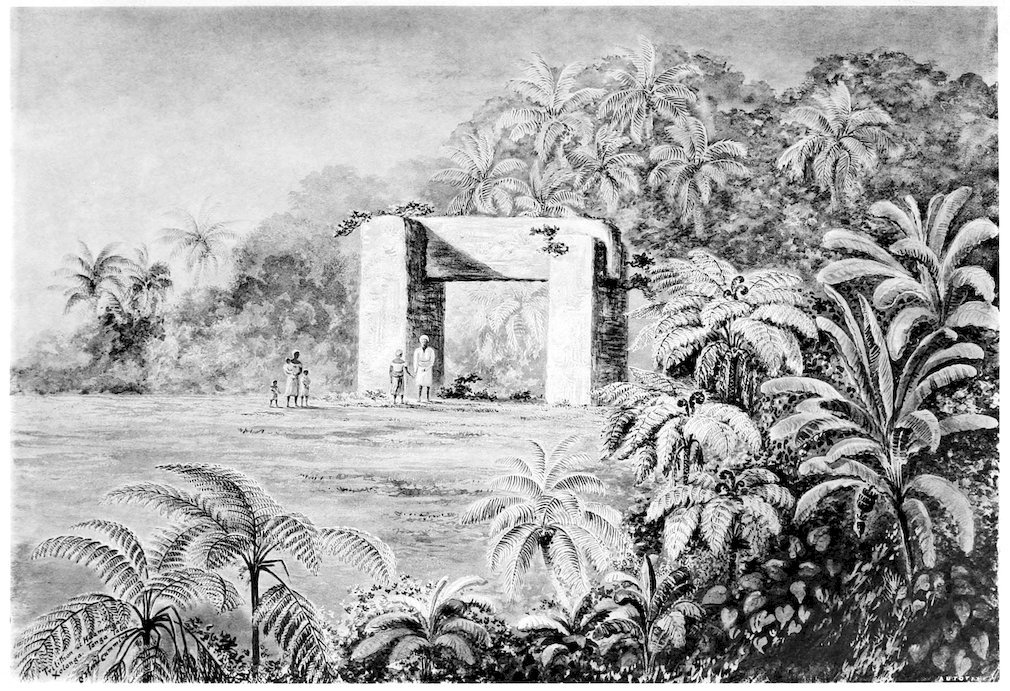
TRILITHON ON TONGATABU
FRIENDLY ISLES.
We have been told that within the memory of persons now living, an enormous kava bowl stood on the horizontal stone, and that most solemn and sacred drinking festivals were held here. It 19is very probable that this may have been the case, as the people would, in heathen days, very naturally retain some tradition of reverence for the trilithon, as the peasants of Brittany, and, I may say, of Britain, do for similar erections to the present day, assembling for annual festivals at “the stones,” though the origin of Carnac, Stonehenge, and Stennis, is as unknown as that of Haamonga.
Returning to the village we saw that the church was crowded, and that there were a number of candidates for confirmation. Judging that the service would occupy some time, and being anxious to see as much of the neighbourhood as possible, we drove along the coast to a particularly fine banyan, noted in Captain Cook’s chart, and beneath its shadow we rested awhile, and enjoyed a very pleasant half-hour overlooking a calm, beautiful sea.
We reached Mua just as the congregation was dispersing, and were troubled with some qualms on the score of our bad example, but the considerate bishop gave us full absolution. I regret to say that a considerable proportion of the people were like hideously-dressed-up apes, masculine and feminine—many of the former in seedy black clothes, and some of the latter attired in gay flimsy silk gowns, inflated with large crinolines, and with baby hats, trimmed with pink and blue flowers, stuck on the top of their fuzzy heads. Hitherto, as you know, my ideas of Tongans have been derived only from the stately men and women who have settled in Fiji, and there, like their neighbours, have retained the graceful drapery of native cloth. Here the influence of certain persons interested in trade is so strong, that the manufacture of tappa is discouraged by every possible means; and a heavy penalty attaches to making it on any, except one, day in the week. It seems that this law was passed in King George’s absence, and I am happy to learn that he was exceedingly angry—though, as yet, the law stands unrepealed, and the manufacture is doomed to cease altogether this year.
Whoever is to blame, the system of taxation and fines is something astounding. A woman who is found without a pinafore, even in her own house, is fined two dollars, no matter how ample 20is her petticoat. Should she venture beyond her threshold minus this garment, she is liable to a fine of three dollars. If caught smoking, she is fined two and a half dollars, and one and a half dollar costs. Imagine such legislation for a people whose highest proof of reverence in olden days was to strip themselves to the waist in presence of their king, or on approaching a sacred spot, and who still consider any upper garment as altogether superfluous—a people, moreover, whose very nature it is to be for ever rolling up minute cigarettes for themselves and their friends!
The most atrocious of all the regulations is one inflicting a fine of ten dollars on any man found without a shirt, though wearing such a sulu (kilt) as would in Fiji be considered full dress, either at church or Government House. One of the lads told us he had actually been made to pay this fine a few days ago, having put off his shirt while fishing. Wet or dry they must wear the unaccustomed foreign clothing, instead of the former coating of oil, which made these people as impervious to water as so many ducks. But whether by compulsion or for vainglory, the hideous foreign clothes are worn during the burning heat of the day; then, under the friendly veil of night, comfort and economy are consulted by dispensing with superfluous garments; and so the heavy night-dews act with double power, and chills produce violent coughs, which too often end in consumption and death.[3]
21These people, like most kindred races when brought in contact with civilisation, are fast dying out. I believe there are now only about 9000 in the Tongan group, 5000 on Happai, and 5000 in Vavau district. They certainly are a very fine well-built race, with clear yellowish-brown skin and Spanish colouring; they also resemble Spaniards or Italians in their animation of expression,—the muscles of the forehead working in a most remarkable manner, especially to express wonder or interest. They have fine faces, well-developed forehead, strong chin, and features generally like those of an average good-looking European. Not the slightest approach to the “blubber lips and monkey faces” of negro races, or of the isles lying nearer to the equator. On the contrary, the mouth is well formed, and shows beautiful teeth. The eyes are invariably dark brown, generally large and clear. The beard, moustaches, and eyebrows are allowed to retain their natural glossy black; but, as in Fiji, the hair is dyed of a light sienna by frequent washing in coral-lime, and encircles the head with a yellow halo, strangely in contrast with the dark eyes and eyebrows. Like that of the Papuan, rather than the pure Polynesian races, it takes the form of a mop of innumerable very fine spiral curls, of which each individual hair twists itself into a tight corkscrew. It is crisp and glossy, and very elastic; and if you draw it out full length, it at once springs back to its natural form. Some of the women now allow their hair to grow quite long. Both men and women march along with a proud overbearing gait that always gives one an impression that they look on all other races with something of contempt.
22Our morning’s work had given us such keen appetites that we did more than justice to the breakfast which awaited us at the Fathers’ house, though it must be confessed that the fare was of the coarsest; it was, however, the very best they had to offer, and was evidently considered quite a feast. My comrades congratulated one another that such viands did not often fall to their lot!
Immediately after breakfast we started on our return journey with a high tide. Wind and current being in our favour, we flew down the river-like passage through the wide coral-reef, which we had ascended with such toil, and less than two hours brought us back to the good ship, and to cordial greeting from her genial captain. He had invited King George of Tonga and his grandson to dine on board, to meet the bishop and the Fathers, and I was invited to join the party. The king, who ought properly to be called Tupou or Toubo, which is the surname of all the royal family, was received with a salute of twenty-one guns—the ship dressed and yards manned, with sailors shouting “Vive la République!” (an institution to which, I fancy, that most men on board are profoundly indifferent—in fact several are declared royalists, and faithful adherents of Henri V.)
The Tongans were duly conducted all over the ship, and examined machinery, guns, men’s quarters, and every detail, with apparent interest. A long dinner followed, from which I escaped as soon as I conveniently could.
The king is a very fine old man, in height about 6 feet 2 inches. He was dressed in a general’s full uniform, and his grandson in that of an aide-de-camp—cocked-hat, &c. I confess I think that Thakombau and Maafu, in their drapery of Fijian tappa, are far more imposing figures. The king’s son, Unga, is at present seriously ill. His three sons govern the three groups into which this island-kingdom of Tonga divides itself—namely, Tongatabu, Happai, and Vavau. There are only about sixty isles in all, and their area is about 600 square miles; so this is a small matter compared with the 7000 square miles of Fiji. I am told that here the land all belongs to the king, so that any one wishing to settle can only do so as a tenant, leasing land from his Majesty.
23The feast being over, le Roi kanaque departed amid blue and green lights, one of which was reserved for us—i.e., the ecclesiastical party—returning to the priest’s house and to the convent, where the pleasant Sisters awaited me with kindest welcome; and we all sat on the mats in my cell and chatted for a while.
Now I am so very cold that I must go to bed. I think this climate must be far more trying than that of Fiji. The heat in the daytime feels to me greater, and every night is bitterly cold, necessitating piles of rugs and blankets; while the dew is so drenching that the roofs always drip as if there had been heavy rain. I do not wonder at the delicate little Sœur Marie having fallen into consumption. It carries off many strong natives.
Wasn’t it just cold when I left off writing! I lay awake shivering for two hours, though wrapped up in blanket, cloak, and big tartan plaid. I find that the island of Tongatabu is known all over the group as the cold isle, and I am ready to endorse the title.
I devoted this forenoon to a sketch of this hospitable cottage-convent, and in the afternoon went alone to see Mrs Baker, who took me to visit the queen—a fine old lady, but very helpless, having dislocated her hip by a fall eight years ago. She was sitting on the bare boards in a wretched little room of a small house close to the large villa or palace in which King George receives his guests, but in which he never lives, preferring that his home should be faka-Tonga—i.e., adhering to native customs so far as is consistent with keeping up appearances. But here, again, we were struck by the uncomfortable substitution of a hard wooden floor for the soft mats of a truly native home. As civilised houses are glazed, the poor old queen, though much oppressed with heat, sat beside a glass window, shaded by a filthy tattered rag which had once been a curtain, but which in its palmiest days had been immeasurably inferior to a handsome drapery of native cloth: indeed the only symptom of comfort in the place was a curtain of Fijian tappa.
24The king and his chiefs were in council over church matters in a small room adjoining the queen’s, so we had to talk in whispers. Various female relations were grouped round the door, making the hot room still hotter. I am much struck by the fact that these proud Tongans make use of no titles. The Fijians always prefix the word Andi—i.e., Lady—to the name of a woman of rank; but here the name is used bluntly, whether in addressing a princess or her handmaid.
Hearing of the grave assembly of the chiefs to discuss the affairs of the Wesleyan Church, brought back vividly to my mind all that I had heard in former days of this very King George, and of the prominent part taken by him in rousing these islanders to abandon their gross heathenism and cannibalism. So effectual has been his work, that now not one trace of these old evils remains, and these islanders are looked upon as old-established Christians.
I had a pleasant walk back in the twilight, along the broad grass road which runs parallel with the sea, and am now spending my last evening in this peaceful convent. I am truly sorry that it is the last, for it will feel like leaving real friends to part from these kind Sisters, who make much of me, and do enjoy coming to sit with me in the evenings for a little quiet chat. They bring all my meals in here, as it is against their rules to allow me to feed with them in the refectory. In this respect they are far more rigorous than the Fathers, who, as you know, have invited me to supper and breakfast at their house.
Here I am once more safely ensconced in my favourite niche, which is the carriage of a big gun. Filled with red cushions, it makes a capital sofa, and is a cosy, quiet corner, and a capital 25point of observation, whence, without being in the way, I can look down on the various manœuvres on deck—parades, gun practice, fire-parade, and so forth. We embarked this morning early, the four Sisters, by special sanction of the bishop, coming to see the last of me, and to breakfast with M. Aube;—an outrageous piece of dissipation, they said, but almost like once again setting foot in France. Four of the priests likewise escorted the bishop, and we had an exceedingly cheerful ecclesiastical breakfast-party, after which came a sorrowful parting, and then we sailed away from Tonga, taking with us the Père Padel, a fine old Bréton Father.
We are now passing through the Happai group, and hope to-night to catch a glimpse of the volcano of Tofua, or, as it is also called by the natives, Coe afi a Devolo (the Devil’s fire). It is a perfect volcanic cone 2500 feet in height, densely wooded to the edge of the crater. Strange to say, though the isle simply consists of this one active volcano, there is said to be a lake on the summit of the mountain. It is not stated to be a geyser; but the Tongans who visit it bring back small black pebbles, which they strew on the graves of their dead.
The Happai group consists of about forty small isles, some purely volcanic, and others, as usual, combining coral on a volcanic foundation. About twenty of these are inhabited.
The volcano proved to be quiescent. Not even a curl of luminous smoke betrayed its character. The sea, however, made amends by the brilliancy of its phosphoric lights. It was a dead calm, and from beneath the surface shone a soft mellow glow, caused, I am told, by vast shoals of living creatures, as though the mermaids were holding revel beneath the waves, and had summoned all their luminous subjects to join in the dance. I know few things in nature more fascinating than this lovely fairy-like illumination. Its tremulous glow and occasional brilliant shooting flashes are to me always suggestive of our own northern lights—a sort of marine aurora.
26Our course this morning was very pretty, steaming for many miles through narrow and intricate passages between the richly wooded headlands of Vavau, the great island, and many outlying islets. Finally, we anchored in what seemed like a quiet landlocked lake, at the village of Neiafu.
The bishop went ashore at once, and was reverently welcomed by two priests, one of whom, Père Bréton, has been here for about thirty years, living a life so ascetic as to amaze even his brethren, so completely does mind appear to have triumphed over matter. We sinners all agree that having each been intrusted with the care of an excellent animal, we are only doing our duty by feeding and otherwise caring for it to the best of our ability. So the ascetic example is one which we reverence, but have no intention of following, cold water and yam, day after day, being truly uninviting. But the old man has not forgotten how to be genial and kind to others, and is a general favourite.
The Roman Catholic flock here is small, as is also the church, which, however, is very neat. The Wesleyan Mission flourishes here, as it does throughout these Friendly Isles. In the three groups—namely, Tonga, Happai, and Vavau, it has 125 chapels, with an average attendance of 19,000 persons, of whom 8000 are church members. Four white missionaries superintend the work of 13 native ministers, upwards of 100 schoolmasters, and above 150 local preachers. At the Tubou Theological College—so named in honour of King George Tubou—there are about 100 students preparing for work as teachers or pastors.
I landed with M. Pinart, and a half-caste Samoan woman, who could talk some English, acted as our interpreter with the widow of the late “governor,” a large comely woman, who invited us to her cool Tongan house, where friendly, pleasant-looking girls peeled delicious oranges faster than we could eat them. This whole village and district is one orange-grove; every house is embowered in large orange-trees—the earth is strewn with their fruit, the air fragrant. What an enchanting change after Tonga, where there are no orange-trees, and where a sense of stiffness and over-regulation seemed to pervade life!
27The present “governor” is a fine tall young chief, rejoicing in the name of Wellington. He is acting for his father, Unga, King George’s illegitimate son, whom he has declared heir to the throne, but who is at present in very bad health. The young chief seems inclined to hold the reins firmly and well. But at present the Vavau chiefs are in some disgrace with King George, as they are suspected of plotting against Unga, in favour of Maafu.[4]
Having eaten oranges to our hearts’ content, we continued our walk to the Wesleyan Mission, and on our way thither met the Rev. —— Fox on his way to the ship, to see if we had a doctor on board. The latter having already gone ashore, we returned together to the house—a quiet pleasant home, but for the present saddened by the serious illness of the young wife, who, a few weeks ago, gave birth to her first child. As Vavau can furnish neither nurse nor doctor, the wife of the missionary in Happai had, at great personal inconvenience, come thence in an open canoe to officiate on the occasion. She had, however, been compelled to return soon afterwards to her own nurslings, leaving the young mother and her baby in charge of native women. A very slow recovery, accompanied with some unfavourable symptoms, had produced such depression and alarm, that just before our arrival, the poor husband had actually been making arrangements for his wife’s return to Sydney for proper medical care. But, to get there, involved, in the first instance, a journey of about 200 miles in an open canoe to reach Tonga, whence she would have to proceed alone, in a wretched little sailing vessel, on a voyage of upwards of 2000 miles (as the crow flies)—a serious undertaking for a woman in robust health, but a terrible prospect for an invalid with a young baby.
Happily the timely arrival of the Seignelay dispelled this nightmare. M. Thoulon, the good kind doctor (himself père de famille), at once vetoed the rash arrangement, and his well-applied wisdom, and kind encouraging words, have already restored heart to the 28dispirited young wife; while a congenial talk with M. Pinart on the subject of Polynesian dialects and races, has helped to cheer the husband, who, later, took us to see his schools, pleasantly situated on a wooded hill, commanding a lovely view of the landlocked harbour. Then strolling back through the orange-groves, we returned on board, where I am now writing. The captain and several of the officers have gone off duck-shooting, and expect good sport.
Yesterday morning, after a very early breakfast, I went ashore at 6.30 with M. Pinart and Dr Thoulon. Mr Fox was waiting at the pier, and returned with us to the mission-house, where we found the patient already on the mend. I acted the part of interpreter for the doctor, who was happily able to supply, as well as prescribe, all needful remedies and tonics. So when we returned this afternoon to say good-bye, the young mother looked like a different creature—so bright and happy. Truly a blessed skill is that of the kindly leech!
The previous evening Mr Fox had undertaken to borrow some horses, and escort us to the summit of “The Pudding,” a wooded hill, commanding a splendid map-like view of the strangely intersected land and water on every side of us. The isles lie so close, one to the other, that we could scarcely believe we were looking on the ocean, and not rather on a network of clear calm lakes and rivers. All the isles appear to be densely wooded, but at intervals along the shore we could distinguish villages nestling among the trees. One small island has recently been ceded to the Germans as a coaling station, and there seems some reason for anxiety lest this small foothold should be taken further advantage of.
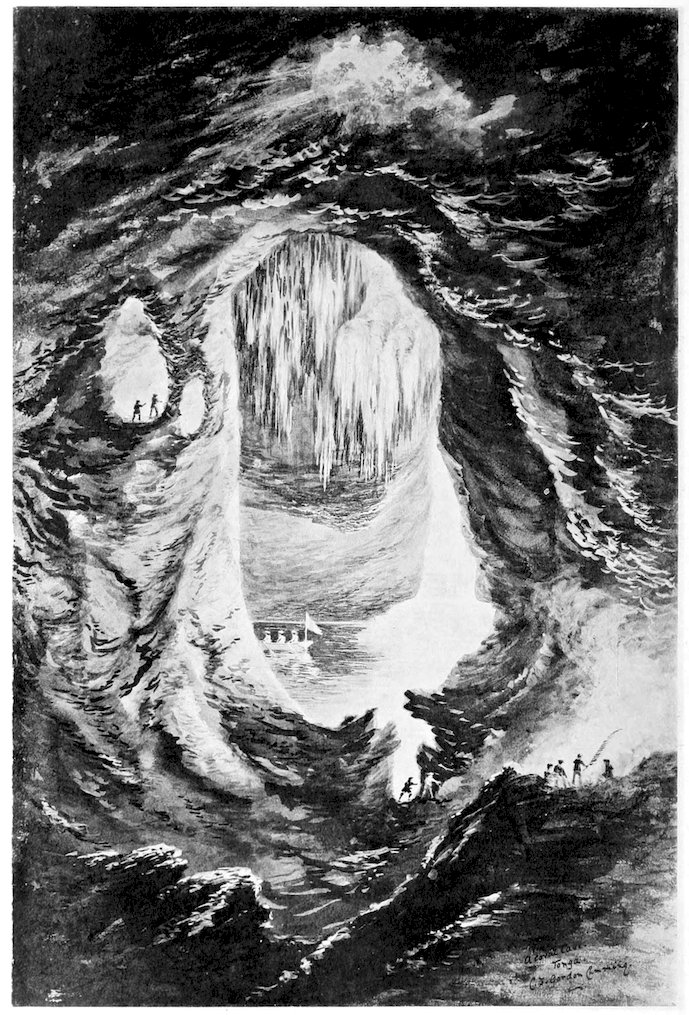
A CORAL CAVE. VAVAU.
Our ride in the early morning was exceedingly pleasant. I had insured my own comfort by bringing my side-saddle ashore. By some mistake we found that the stirrup had been left in Fiji; but happily, on such a ship as this, to want a thing is to have it, and I hear that a new stirrup and strap are to be ready for me ere we reach Samoa. On the summit of the hill we found breakfast all 29ready, a party of natives from the mission having made an early start with tea, yams, ham and eggs—all of which had been cooked gipsy-fashion. To this foundation we added the contents of a hamper, which the thoughtful captain had directed his maître d’hôtel to send with us. So we had a royal feast, and then I settled down to do a bird’s-eye sketch of the strange world outspread below, while gentle and rather pretty brown girls, with sienna hair, sat by, peeling oranges by the dozen, with which they fed us all incessantly.
It is the part of true hospitality to peel oranges for a guest, as their thick green skins contain so much essential oil, that the mere act of removing them makes the hands very oily and uncomfortable. Woe betide the rash and thirsty stranger who puts the green fruit to his lips to suck it, as he might a golden orange in Europe. For many hours the burning pain of almost blistered lips will remind him of his folly.
Returning to the village, we found a large ten-oared boat waiting for us, the captain having most kindly placed it at our disposal, to enable us to explore the coast. Mr Fox guided us to a truly exquisite cave, about five miles distant. Never before, in all my wanderings, had my eyes been gladdened by such an ideal fairy grot. We rowed along the face of beautiful crags, which we had passed on the previous day without a suspicion of the wonderful hiding-place within them. Suddenly we steered right into a narrow opening, and found ourselves in a great vaulted cavern like a grand cathedral—a coral cave, with huge white stalactites hanging in clusters from the roof, and forming a perfect gallery along one side, from which we could almost fancy that white-veiled nuns were looking down on us.
The great outer cave is paved with lapis-lazuli, at least with water of the purest ultra-marine, which was reflected in rippling shimmers of blue and green on the white marble roof. For the sun was lowering, and shone in glory through the western archway, lighting up the mysterious depths of a great inner cavern, which otherwise receives but one ray of light from a small opening far overhead, through which we saw blue sky and green leaves. 30No scene-painter could have devised so romantic a picture for any fairy pantomime. The French sailors were ecstatic in their delight. They collected piles of old cocoa-nut fibre and dry palm-leaves and kindled bright blazing fires, whose ruddy light glowed on the dark crevices, which even the setting sun could not reach, and blended with the blue and green reflected lights, and both played on the white coral walls, and the white boat, and white figures—(for of course, in the tropics, the sailors all wear their white suits). Soon these active lads contrived to reach the gallery, and glided behind the stalactite pillars, making the illusion of the nuns’ gallery still more perfect. Altogether it was a scene of dream-like loveliness.
All this coast is cavernous, and most tempting to explore. Very near my fairy cave lies the one described by Byron, in “The Island,” which can only be reached by diving—
A huge rock, about 60 feet high, rises from the sea, with nothing to indicate that it is hollow; but at a considerable depth beneath low-water mark, there is an opening in the rock through which expert divers can enter, and find themselves in a cave about 40 feet wide and 40 in height—the roof forming rude Gothic arches of very rich and varied colour, and the whole incrusted with stalactites. The clear green water forms the crystal pavement, but two lesser caves, branching off on either side, afford a dry resting-place to such as here seek a temporary refuge. The place is quite unique in its surpassing loveliness; and the brilliant phosphoric lights which gleam with every movement of the water, and which are reflected in pale tremulous rays, that seem to trickle from the stalactites and lose themselves among the high arches, give to the whole a weird ghostly effect, quite realising all one’s fancies of a spirit-world.
This home of the mermaids was first discovered by a young Tongan, who was diving in pursuit of a wounded turtle. Filled 31with wonder and delight, he lingered a few moments in admiration, then, recollecting how valuable such a hiding-place might prove in days of ceaseless intertribal war, he determined to keep his own counsel. So when he returned to the surface he held his peace, and all his companions were filled with wonder and admiration at the length of time he could remain under water.
Not very long after this, his family incurred the anger of the great chief of Vavau, and one and all were disgraced, and in continual danger of their lives. But the chief had a beautiful daughter, who loved this bold young islesman, and though under any circumstances he was of too lowly birth to dare to claim her openly in marriage, he persuaded her to forsake her father’s house and come to that which he had prepared for her in the romantic grotto.
Here she remained hidden for several months, only venturing to swim to the upper world in the starlight, and ever on the alert to dive to her hiding-place on the slightest alarm. Of course her simple bathing-dress of cocoa-nut oil and garlands did not suffer much from salt water; or if it did, trails of sea-weed quickly supplied fresh clothing. Her love brought constant supplies of fruit, to add to the fish which she herself provided: and so the happy weeks flew by, till at last the companions of the young man began to wonder why he left them so often, to go away all by himself, and especially they marvelled that he invariably returned with wet hair—(for the Tongans have the same aversion as the Fijians to wetting their hair, and rarely do so without good cause). So at length they tracked him, and saw that when his canoe reached the spot where he had stayed so long under water in pursuit of the turtle, he again plunged into the green depths, and there remained. They waited till he had returned to the land, suspecting no danger. Then they dived beside the great rock-mass, which seemed so solid, though it was but the crust of a huge bubble—and soon they too discovered the opening, through which they swam, and rising to the surface beheld the beautiful daughter of the chief, who had been mourned as one dead. So they carried her back to her indignant father—but what became of her hapless lover history does not 32record. Doubtless he was offered in sacrifice to the gods of Vavau.
We peered down through the crystal waters to see whether we could discern the entrance to the lover’s cave, but failed to do so. Except at very low tide, it is difficult for average swimmers to dive so low. We only heard of two Englishmen who had succeeded. One was the early traveller, Mariner, who was present at a kava-drinking party of the chiefs in this cool grot; the other was the captain of an English man-of-war, who, in passing through the low rock archway, injured his back so seriously, that the people of Vavau believed him to have died in consequence.[5] It appears that the passage into the cave bristles with sharp projecting points, and it is exceedingly difficult to avoid striking against them. A native having dived to the entrance then turns on his back, and uses his hands as buffers to keep himself off the rocky roof.
Our row back to Neiafu was most lovely—sea, isles, and sky, vegetation and cliffs, all glorified in the light of the setting sun. As we were returning to shore, to land Mr Fox, Captain Aube hailed us, and bade us invite him to dinner with him. I thought this very courteous, as of course, on such an essentially Roman Catholic mission as this, there is just a little natural feeling that it may not be discreet to show too much honour to the Protestant minister, who, however, met with a most cordial reception, and we had a very pleasant evening.
This morning I was invited to accompany a party who started at daybreak to shoot wild duck on a pretty lake at some distance; but as I had the option of returning to the grotto, I chose the latter. So the captain again lent me the ten-oared boat, and we made another pleasant party to the beautiful cave: but it lost much of its beauty by being seen in the cold shadow of early morning, instead of being illumined by the level rays of the evening sun. We repeated the palm-leaf bonfires, but felt that we were not exhibiting our discovery to the best advantage. However, I got a sketch, which has the one merit of being totally unlike anything else I ever attempted.
We returned too late for breakfast in the captain’s cabin, so had 33a cheery little party in the ward-room, then went ashore to say good-bye to our friends, and carry away last impressions of the fragrant orange-groves of Vavau. Then the bishop and the Fathers returned on board, and we sailed away from the Friendly Isles.
My dear Nell,—I have asked Lady Gordon to send you a long letter to her, which I hope to post at Apia, so that I need not repeat what I have already written. We are having a most delightful cruise, with everything in our favour, and the kindness of every one on board is not to be told.
To begin with, Monseigneur Elloi, Evêque de Tipara, is a host in himself, so genial and pleasant, and so devoted to his brown flock. He is terribly unhappy about all the fighting in Samoa; and I think the incessant wear and tear of mind and body he has undergone, in going from isle to isle, perpetually striving for peace, has greatly tended to break down his own health, for he is now very far from well, and every day that we touch land, and he has to officiate at a long church service, he is utterly exhausted. It is high time he returned to France, as he hopes to do, at the end of this cruise.
His title puzzled us much when he arrived in Fiji, as we supposed him to be Bishop of Samoa. But it seems that a Roman Catholic bishop cannot bear the title of a country supposed to be semi-heathen, so they adopt that of one of the ancient African churches, which are now virtually extinct.
To-day, being Sunday, the bishop called together as many of the 34sailors as wished to attend, and held “a conference”—which meant that he sat on deck, and they sat or stood all round, quite at their ease, no officers being present, while he gave them a very nice winning little talk, ending with a few words of prayer. There was no regular service. There is always a tiny form of morning and evening prayer, said on parade by one of the youngest sailors, which is very nice theoretically, but is practically nil. At the word of command, Prière, a young lad, rapidly repeats the Ave Maria and Nôtre Père qui êtes aux cieux; he gabbles it over at railroad speed in less than a minute; then, as an amen, comes the next thing, Punitions, followed by a list of the various little trespasses of the day, and the penalties awarded.
At each point where the vessel has touched, she has taken or left some of the French priests, many of whom have been working in these isles for so many years, that they know every detail concerning them, and are consequently very pleasant companions. One of my especial friends is a dear old Père Padel, a cheery Bréton, who has been working in the Wallis group for many years, with the happy result of seeing its savages converted to most devout Catholics. He is now going to Samoa.
Much of the charm of this voyage is due to the kindly, pleasant relations existing between the captain and all his officers, from the least to the greatest—all are so perfectly at ease, while so thoroughly respectful. They are all counting the hours for their return to la belle France, where several have left wife and family; and their two years’ absence apparently seems longer to them than the four years of our English ships would seem to be to less demonstrative Britons.
Nothing astonishes me more than the freedom of religious discussion on every side. Of course to the bishop and the numerous pères, personally, every one is most friendly and respectful, as well they may be; but as a matter of individual faith, c’est toute autre chose.
The evening tea-parties in the captain’s cabin are particularly pleasant. Very often the conversation turns on some literary question, and then, from the ample library, are produced books 35from which M. le Commandant reads illustrations of prose or poetry. He is himself literary, and writes very well, in the ‘Revue des deux Mondes’ and other papers. Monseigneur Elloi says that Captain Aube is a very distinguished man in the French navy, and one who is certain of rapid promotion.
He has another guest on board, M. Pinart, a scientific traveller. He belongs to a French Protestant family, but is such a thorough cosmopolite, that when we go about together in the native villages, and the people ask our nationalities, I always answer for him “American.” He is most industrious in his various lines of work, and is at present busy copying out vocabularies of all manner of dialects. He is greatly interested in all ethnological questions, and has a collection of skulls, enough to supply a resurrection army. I do not think the sailors like it very much, and they are always afraid that some trouble will arise with the natives of various isles on the vexed subject of les cranes, which our savant scents out from old hiding-places in caves and clefts of the mountains, with all the instinct of a schoolboy hunting for bird’s nests. He has just shown me some beautiful illustrations in colours, for the book he is bringing out on American Indians; also many good photographs, done by himself, of objects of interest in many lands.
I am so sorry that the Seignelay paid her visits to Fotuna (in the Southern New Hebrides), and to the Wallis Isles, on the way to Fiji. If only these had been reserved for the return journey, I should have had the rare luck of seeing them also. My kind friends are for ever regretting this, and give me tantalising descriptions of both isles and people.
Apparently les isles Wallis, or Uvea, must be the true earthly paradise—so green, so fertile, with people so industrious, so contented, and so hospitable. It is a group of four or five high volcanic isles, all richly wooded, and protected from the ocean, not only by the great barrier-reef, but by an intricate labyrinth of lesser belts and patches, which make navigation a matter of extreme danger, even after the difficult entrance, by a very narrow passage, has been accomplished. The approach to the anchorage 36is by a network of such dangerous channels, as involve masterly steering for even small craft, and make it a matter of wonder that large vessels should attempt it. Indeed a French steamer, L’Hermite, was wrecked there not long ago, owing to one moment’s hesitation on the part of her commander, who, meeting a strong tide running out, shifted the helm at a critical moment, and so the vessel was swept on to the reef—a helpless plaything for the overwhelming surf.
The Wallis Isles lie due north of Tonga, and are the headquarters of the Roman Catholic Bishop of Oceania, and a strong clerical staff; also of a French sisterhood, who devote themselves to teaching children whose lives have been spared by their own once cannibal parents, and who now worship with them, in a handsome stone church, built by themselves, under the direction of the Fathers, and are in every respect pattern Catholics.
Three days’ sail from Wallis lies Fotuna, which is a little world by itself. It consists of a single peak, rising abruptly from the waters, and broken up into towering masses of crag and pinnacles, seamed by deep ravines, opening up into fertile valleys, richly cultivated. Sparkling streams afford an abundant water-supply for the irrigation of the taro beds; bread-fruit, bananas, and palms grow luxuriantly: so it is an isle of great natural beauty, and though only fifteen miles in circumference, affords ample provision for its 900 inhabitants. They seem to be a happy, healthy community, and have all adopted Christianity, either in its Protestant or Roman form. The representative of the latter is a fine old priest, who has devoted the greater part of his life to work on Fotuna, and year by year adds a few inches to the walls of a very large cathedral, which he hopes some future generation will complete. The natives show their love for the good padre by bringing him the heavy blocks of coral-rock, which he hews at his leisure; but they are well content to worship in less solid buildings. The majority wear, as their badge, a little brass medal of the Virgin, or some other Christian amulet, which, in the case of the little children, is often their only raiment!
Apparently the adherents of the two great Christian bodies contrive 37to live in peace, instead of finding in differing faith a new occasion for enmities, as has been the case even in Polynesian isles. But is it not grievous that, when at length “the people who sat in darkness have seen a great light,” it should not shine upon them in one undivided ray?
The people of this lonely isle are especially interesting, because they, and the inhabitants of Aniwa—a much smaller isle in the same region—are of a totally different race from those on the other isles composing the New Hebrides—the latter being Papuans, and these Malays, whose ancestors drifted all the way from Tonga in a canoe. Though their colour has darkened, they retain the dialect and the hair of their race.
Every one on board has treasures of some sort from Fotuna—especially very beautifully painted native cloth. I think some of the patterns are almost more artistic than those of the Fijians. Like theirs, these are principally geometrical; and in addition to the black and red dyes which are there used, the artists of Fotuna introduce a good deal of yellow. The printing is done in the same manner, the raised pattern being carefully designed with strips of cocoa-rib or bamboo on wooden blocks, on which the colour is stamped. It is the same principle as that of our printing-types, and was known in Polynesia long before the art of printing was invented in Europe.
The most remarkable productions of Fotuna and some of its neighbouring isles are gigantic cocoa-nuts, more than double the ordinary size. They are immensely prized as drinking-cups. Many are 18 inches in circumference after the husk has been removed. The largest grow on the isle of Niufau, which is described as being merely the rim of a great crater, from which smoke sometimes rises, and which is incrusted with sulphur. Apparently the warmth of the soil agrees with all vegetation; for the isle is exceedingly fertile, and the cocoa-nuts are the wonder and envy of all beholders.
I confess I should not care to live on one of these smouldering volcanoes. There are a good many such, scattered about the Pacific—and occasionally one subsides altogether. For instance, 38halfway between Tonga and New Zealand lies Sunday Isle. It is a volcanic rock-mass 1600 feet in height, and about four miles in diameter. It is exceedingly fertile, but steam rises from all the crevices of the rocks, and the people have only to scrape a hole in the ground, and therein place their food that it may be baked in nature’s own oven. At one time there were a good many settlers in this warm corner, but in an evil day a Peruvian slave-ship touched here, and landed 200 poor creatures, captured in all parts of the Pacific. Typhoid fever had broken out among them; so they were thrown ashore to die, which they did, and most of the settlers shared their fate. The others left the island on the first opportunity, leaving only one white man with a Samoan wife and a dusky brood. These lived on in peace and plenty for about ten years, when suddenly the little fresh-water lake began to boil furiously, and from its midst a fountain of fire shot high in the air. Happily this mighty rocket served as a signal of distress, for a passing vessel descried the fiery column and came to investigate, greatly to the relief of the Crusoe family, who were taken on board, and for ever abandoned their home.
Evidently this isle must lie on the same volcanic chain as the White Sulphur Isle, which is a sulphur volcano to the north of New Zealand, connected subterraneously with that great tract in the province of Auckland, where geysers, solfataras, and all manner of volcanic phenomena abound.[6]
All these are reproduced on a smaller scale on the island of Tanna in the New Hebrides, within 30 miles of Fotuna. It is a circular island, about 40 miles in diameter. Near the harbour rises a volcanic mountain about 500 feet in height, densely wooded to the very summit, though seamed with fissures from which rise clouds of steam and sulphureous vapours. The whole island is exceedingly fertile—cocoa-palms, bread-fruit trees, bananas, sugar-cane, &c., grow luxuriantly, and the yams occasionally attain a weight of 50 lb.; one root being from 40 to 50 inches long—a very neat thing in potatoes. Yet the soil which produces this rank vegetation forms so thin a crust over the vast furnace below, 39that in some places the penetrating heat is painful to the naked foot. Nevertheless, the people have no fear of accidents; on the contrary, wherever they find a group of hot springs they build their huts, and, like the New Zealanders, they love to lounge on the steaming grass or hot stones. In every village a circular space is set apart as the marum, or place for holding council or feasting, and in these districts a warm spot is selected, where, after sundown, the men may combine the pleasures of a vapour-bath with the enjoyment of their bowl of kava, while discussing the affairs of the tribe.
The springs are in great favour as baths. They are of all temperatures—from the tepid water in which the natives play luxuriously for hours, to the boiling springs in which they place their food and leave it to cook itself. Some of these natural boilers lie so close to the shore, that the fishers who haunt the reefs, armed with long four-pronged spears, have only to throw their prize into the rock-caldron the moment they have secured it. No fear of tainted fish for them! Nor need they search far for drinking water. Probably the nearest spring is quite cold and excellent. Some of the springs are highly medicated, and many resort to the healing waters, some of which are especially efficacious for the cure of ulcerous sores.
Beyond the strangely fertile crust, covering the region of horror, lies an unveiled tract of cinders and black volcanic ash, forming a wide barren valley from which rises the principal cone. This valley is intersected by a multitude of fissures from which issue scalding sulphureous fumes. Here and there beds of the purest sulphur have been deposited, and trading vessels occasionally carry hence a cargo of this pale primrose-coloured mineral, to be turned to good domestic uses. Pools of boiling mud alternate with springs of cold water clear as crystal; and in fissures lying but a few feet apart the same strange diversity exists. One sends forth a blast of scalding steam, while in the next a dripping spring yields its slow but continuous supply of ice-cold water, falling drop by drop.
The cone, which is called Asoor by the Tannese, is about 300 feet in height. It is a gradual ascent, but fatiguing, owing to the 40accumulation of fine black ash or sand, in which the foot sinks at every step. Masses of scoria and vitreous lava, or obsidian, have been thrown up by the volcano, and lie scattered on every side.
On reaching the summit, you find yourself on the brink of a crater half a mile in diameter, within which lie five secondary craters. These act as so many chimneys for the great furnace, which roars and bellows below, and which day and night, with deafening roar, unweariedly throws up its fiery blast at intervals of five, seven, or ten minutes, according as its action is more or less vehement. Some travellers have visited it repeatedly at intervals of several years, and their accounts of the intervals of eruption never vary beyond this slight difference. Huge masses of black rock or liquid fire are tossed in the air, to a height of 200 or 300 feet, often falling back within the crater, or else hurled to the valley below. Clouds of white steam mingle with denser clouds of the finest dark-grey dust, which is carried by the wind to all parts of the island, coating every green leaf with a powder like fine steel-filings, which fills the eyes and nostrils of all breathing creatures in a most unpleasant manner. When rain falls, it absorbs this dust, and becomes literally a mud-shower.
From the position of the inner craters, it is obvious that even the most foolhardy scientific traveller could hardly venture to approach them to peer into the mysterious workings of that mighty caldron. Yet a native legend records, that in one of the fierce battles between the tribes of Tanna, one party was gradually driven backward, till they retreated to the summit of the cone, and even there they still fought on, contesting foot by foot of the sandy ridges of the inner crater, where a multitude of these savage warriors perished, having fought to the death, unheeding the wrath of the fire-gods.
But of the isles visited by the Seignelay, before I had the privilege of joining the party, there is none which I regret so much as Easter Island, or, as the inhabitants call it, Rapa Nui, where they touched on the way from Valparaiso, from which it is distant about 2500 miles, without any intermediate isle. I think it must be the loneliest spot in the Pacific, as there are apparently only two 41little isles anywhere within a radius of 1000 miles. It is a volcanic island, about 11 miles long by 4 wide. It is covered with extinct craters, in some of which are deep pools of water. The highest point is about 1000 feet above the sea-level. The hills are covered with hybiscus and other scrub. It is inhabited by a race of very fair natives, like the Tahitians, and very elaborately tattooed.
But the isle owes its interest to its mysterious relics of a forgotten race, who have utterly and completely died out, even from legendary lore; while their handiwork abides, written on the rocks, which are so covered with carving as to resemble the studio of some giant sculptor. Colossal stone images lie half buried beneath the creeping grass and encroaching scrub. At intervals all round the coast there are cyclopean platforms, from 200 to 300 feet in length, and about 30 feet high, all built of hewn stones 5 or 6 feet long, and accurately fitted, without cement. And above these, on the headlands, are artificially levelled platforms, paved with square blocks of black lava. On all these, stone pedestals remain, whereon were placed the great images, which, by some powerful force, have mostly been thrown to the ground and broken.
The average height of the figures is about 18 feet; some of those lying prostrate are 27 feet long, and measure 8 feet across the breast. You can infer the size of some of the upright ones from the fact that, so near noon as 2 P.M., they cast sufficient shadow to cover a party of thirty persons. Some have been found which measure 37 feet. They are all hewn of a close-grained grey lava, which is only found at Otouli, a crater on the east side of the island. On a platform near this quarry several gigantic images stand in perfect preservation. One of these measures 20 feet from the shoulder to the crown of the head.
They represent an unknown type. Very square face—short, thin upper lip, giving a somewhat scornful expression—broad nose and ears, with pendent lobes. All the faces look upward. The eyes are deeply sunken, and are supposed to have originally had eyeballs of obsidian.
42All the principal images have the top of the head cut flat and crowned with a cylindrical mass of red lava, hewn perfectly round. Some of these crowns are 66 inches in diameter and 52 in height. The only place on the island where this red lava is found, is the crater of Terano Hau, which is fully eight miles from Otouli; and how these ponderous crowns were conveyed to their position on the heads of the grey rock-kings, is one of the mysteries of the isle. About thirty of them still lie in the quarry where they were hewn, ready for the heads which they were never destined to adorn. Some of these are 30 feet in circumference.
Well may we marvel by what means those unknown sculptors transported their ponderous works of art from one distant point to another on this lonely volcanic isle. The statues are literally lying about in hundreds, and the very rocks on the sea-beach are carved into strange forms—tortoises or human faces.
Besides these, all along the coast, there are cairns of small stones, and on the top of each pile are laid a few white pebbles. These have probably been burial-cairns.
Unless the face of the island has undergone some wondrous change, those mysterious workmen cannot even have possessed wooden rollers to aid them in the toil of transport, for there are literally no trees—nothing but small scrub. When Captain Cook discovered the isle, he only saw three or four little canoes, which were built of many small pieces of wood, sewed together with fibre, the largest piece being 6 feet long and 14 inches wide at one end, 8 inches at the other; and this, he thought, was probably driftwood. These canoes were from 18 to 20 feet long, and could barely hold four people. He found that the most acceptable gift he could bestow on the people was cocoa-nut shells, to be used as cups, since the island produced no palms, and but few gourds. Their only drink is brackish water, obtained by digging wells on the stony beach, through which the salt water filters.
Wooden tablets, covered with hieroglyphics, have been found, which might perhaps reveal something of the old history of the race, but as yet no one has been able to decipher them. There are also stone slabs, covered with geometric figures, curious birds, 43animals, and faces, painted in black, white, and red—doubtless these also are hieroglyphs. They are ranged inside the quaint stone houses, of which about a hundred remain, at one end of the isle; and are built in lines, with the doors towards the sea. The inside measurement of these houses is about 40 feet by 13, and the walls are upwards of 5 feet thick; they are built of flat stones laid in layers. At about 6 feet from the ground, the slabs are so laid as to overlap one another, till they gradually close; and the small opening at the top is roofed with long thin slabs.
Till a Rawlinson arises to read the hieroglyphs of Rapa Nui, its mysteries must remain unsolved; and the cold proud faces, with the sightless eyeballs, will continue to gaze heavenward, and the great stone images, whether gods or heroes, must lie in fallen grandeur in this their sea-girt shrine, with none to tell us what unknown race devoted the labour of their lives to sculpturing the rocks on this lonely isle.
Unfortunately the Seignelay has no artist among her officers, so no one has any sketches which can give me any general idea of the isle, and though I have seen a few photographs of individual figures, I cannot from them obtain any impression of the whole effect. I confess I wish I had had the chance of doing a few panoramic and bird’s-eye views of the whole scene. Though perhaps not artistic, I am quite convinced that by no other means can a traveller so fully enable friends at home to realise the scenes on which his own eyes have feasted.
The only other corner of the earth, in which I can hear of anything akin to these mysterious rock-sculptures, is the far-distant volcanic isle of Java. If you sail almost halfway round the world, heading straight for the west, you come to that wonderful isle, with its terrible volcanoes and amazing wealth of vegetation. Nowhere else are there so many distinct volcanoes in so small a space. No less than thirty-eight separate cones cluster round the great central range of mountains, from 5000 to 13,000 feet in height. Some are active fire-craters, and throw out molten lava; others are water-craters, containing milk-white lakes or sulphureous geysers: in short, volcanic action is there in every form of sublime terror, 44and the Javanese aborigines erected temples to appease the fire-giants, and from the solid rocks sculptured prodigious statues in their honour. In one spot 400 ruined shrines have been discovered, with altars, and images—all apparently built to propitiate the fire-gods.
It is very risky to draw inferences from mere descriptions of any sort of art, but so far as I can make out, these would appear to be the productions of the true aborigines, ere Hindu influence prevailed, leaving its mark in those marvellous Buddhist ruins at Borrobudua and Samarang, which we so unfortunately did not see, on our way from Singapore to Fiji.
It is, of course, possible that the platforms and sculptures of Easter Isle may simply have been an extraordinary development of the marai—i.e., the tomb-temple, which was the accepted form of ecclesiastical building throughout the south-east Pacific. They varied considerably in form, some being great pyramids erected on a stone platform; while on other isles (as, for instance, on Huahine, in the Society Isles) there are stone terraces, built irregularly, right up the face of the hill, with spaces left between them. On one of the principal platforms a row of tall monoliths stand upright, just as did the images on the Easter Island terraces. On Huahine these are called “the stones of dividing,” and are said to have been set up as memorials of the division of land among the various tribes, each stone representing the title-deeds of a clan. To this day each tribe recognises its own stone, and, beholding it, recollects its unwritten legend,—just as at the present day in Fiji a messenger who is charged with a dozen different errands, will carry in his hand a dozen small sticks or leaves, and in fancy makes each stick represent a message. From this imaginary notebook he will read off each detail with unerring accuracy.
Whatever faint resemblance may suggest itself between the irregular terraces and monoliths of Huahine, and the equally irregular terraces and statues of Easter Isle, it is hardly conceivable that such vast energy could have been expended on a mere memorial of tribal divisions, especially where there was so little land to divide. Perhaps Easter Isle was a sort of Iona—the Holy 45Isle of the old Druids, who there erected the 360 great monoliths, which the followers of St Columba sanctified by carving them into the form of crosses, but which in later years were cast into the sea by order of a ruthless Protestant Synod, who declared them to be “monuments of idolatrie.”
The only traces of any forgotten race which I have had the good luck to see on the present cruise, have been the cyclopean tombs of the old kings of Tonga, and a huge trilithon, concerning which the present islanders know as little as we do of Stonehenge.
While in Tonga I endeavoured to procure some stone adzes, but could only buy three very coarse ones without handles. They have long been in disuse there. M. Pinart, however, succeeded in getting some better specimens, which were carefully stowed away by some of the old people in the recesses of their homes.
What miraculous patience it must have required, first to make these stone implements, and then to work with them! They were generally made from basaltic stones, which were dug out of the earth with strong sticks, and then roughly chipped into shape with a heavy flint. Perhaps after many hours of severe labour the stone would break in two, and the workman had to select another and begin again. This time he might progress swimmingly, and spend perhaps whole days in carefully chipping, till the rough stone began to take shape. Then he would substitute a lighter flint, and work with still greater care, only chipping off the first fragments,—and after all his labour, perhaps one sharp tap would prove fatal, and the carefully chiselled axe would split in two, revealing an unsuspected flaw in the centre. So the work must all be begun again, and the patient, persevering savage go on with his chipping till he succeeded in producing a perfect axe.
Then came the slow process of smoothing it by such delicate strokes as only removed a fine white dust, and last of all came laborious polishing with rough coral and water and fine sand, till the axe at length became a serviceable tool, ready to be bound with strongly plaited fibre to the bent wooden handle.
After this it had to be periodically ground by rubbing it on a very hard rock. We saw several rocks in Fiji scored with deep 46grooves from having constantly been used for this purpose; and of course they must exist in all countries in which stone celts have been in use, which, I suppose, means all corners of the round world, Britain included. I greatly doubt, however, whether the ancient Britons ever produced such artistic carved bowls and spears with their stone implements as these Pacific Islanders have done.
The men who worked with these tools needed wellnigh as much patience as those who manufactured them. Imagine a squad of men taking from fifteen to thirty days to fell a tree! Saith the old proverb, “Little strokes fell great oaks,” and these were little strokes indeed! Of course a more rapid process was to make a slow fire all round the base of the tree, and so burn it down; but the fire so often ran up the heart of the tree, destroying it altogether, that the slower process proved best in the long-run. However, as a good-sized tree could thus be felled in three or four days, the rafters of houses were often thus prepared, and the branches burnt off. Once down, fire could be better used to divide the tree into useful lengths; and if a canoe were required, a long narrow line of fire was allowed to burn the whole length, its progress being regulated by the slow dripping of water. Thus the work left for the stone axe was considerably lessened, though it would still have puzzled a British carpenter to work with such tools.
We are enjoying the most perfect weather—a calm sea and a faint sweet breeze. The vessel glides on her way so smoothly that we scarcely perceive any motion, and all yesterday I was able to work up my sketch of the grotto, sitting in a delightful improvised studio on the tiny bridge (la passerelle). We are not making much way, as we are sailing to economise fuel; but the days pass pleasantly, and there is always some ship-life going on, which to me has all the interest of novelty—either parade, or fire-stations, or fighting-stations, or cannon practice (mercifully done in dumb show!)
47We are passing through a great shoal of jelly-fish—I suppose I ought to say medusæ—filmy, transparent creatures of very varied form. Some are like mushrooms, some like great bells, with delicately marked patterns of pale green or pink, and long fringe of feelers. They are beautiful by day, and at night gleam like balls of white fire. They are here in myriads, and are of all sizes, from a teacup to a cart-wheel. There are also a great number of flying-fish skimming on the surface of the glassy sea.
I am told that we are now 630 miles from Levuka in a direct line; but our détour in the Friendly Isles has made our voyage thence amount to about 1100 miles.
We have just sighted Mount Matafae, the highest point in the isle Tutuila. It is a conical mountain 2300 feet high, and lies just above Pango-Pango, the most perfect landlocked harbour in all the Samoan group, with water six or eight fathoms deep close in shore, and surrounded by luxuriantly wooded hills. At present we are steering straight for Leone, where the bishop has work awaiting him. The place had an evil name in old days, as that where M. de Langle, who accompanied La Pérouse on his expedition in 1787, was barbarously murdered, with eleven men of his boat’s crew,—hence the name of “Massacre Bay,” and the character of treacherous and bloodthirsty savages which for so many years clung to the people, till Messrs Williams and Barff arrived here in 1830 with their trained Tahitian teachers, and made friends with them. Then they learnt the native version of the fray, and heard the invariable story of innocence suffering for guilt,—namely, that a poor fellow who had gone off to the ship to trade had been detected in some trifling act of pilfering, when he was immediately shot and carried ashore mortally wounded. Of course his friends determined to avenge his death, and so assembled on the beach, armed with stones and clubs, ready to attack the invaders the moment they attempted to land. They were only carrying out the example given to them, and combined revenge for evil done, with prevention of further assault.
After all, we did come here, for the anchorage at Leone is simply an open roadstead, and is not safe in a strong southerly gale. Captain Aube feared the wind might shift, so the vessel merely lay to, to allow a young priest, Père Vidal, to leap on board from his canoe, and then we ran right to this lovely spot, where we anchored at sunset.
It is indeed a perfect harbour. We are lying close to the shore, in water twenty-one fathoms deep, clear as crystal, and calm as any inland lake. Steep, richly wooded hills rise round us on every side to a height of about 1000 feet, and you can discern no entrance from the sea. It seems like living in a vast cup. The hills all round are covered with bread-fruit trees, oranges, limes, pine-apples, bananas, and all the usual wealth of tropical greenery.
This has been a calm, peaceful evening of soft moonlight. We sat on the passerelle while one of the officers, who is an excellent violinist, played one lovely romance after another, sometimes soaring to classical music. The others lay round him listening in rapt delight.
The air is fragrant with the breath of many blossoms, and indeed all the afternoon we have had delicious whiffs of true “spicy breezes,” such as I remember vividly off Cape Comorin, but which I have not very often experienced at any distance from the land.
We have had a long delightful day, and I am tolerably tired; but before taking to my mat, I must give you some notion of what we have seen. All the early morning the ship was surrounded by 49canoes full of natives, offering clubs, native cloth, and baskets for sale. Some of the canoes had ornamental prows with carved birds, &c.
After breakfast I went ashore with M. Pinart to see all we could of the village. We were invited to enter several houses, which are much more open and less like homes than those in Tonga or Fiji. But the people are all in a ferment, for, as usual in poor Samoa, this is only a lull in the course of incessant tribal war, and the people of Pango-Pango belong to the Puletoa, who were severely beaten in a recent battle. They are, however, keen to return to the fray, and this morning all the warriors assembled in full conclave, holding a council of war. They arrived in large canoes (some of their canoes carry upwards of 200 people, but those we saw had not room for above 50). They are noble-looking men, the fairest race in Polynesia, and truly dignified in their bearing. Some wore crowns of green leaves, and many had blossoms of scarlet hybiscus coquettishly stuck in their hair, which is cut short, dyed with coral-lime, and frizzled and stiffened with a sort of bandoline made of the sticky juice of the bread-fruit tree, mixed with scented oil; so that, instead of being straight and black, it stands round the head in a stiff halo of tawny yellow, like that of the Fijians and Tongans.
Is it not strange that the same curious rage for converting black hair into gold should prevail on this side of the world, just as it has in London in various epochs of fashion’s folly, as when the attendants of “The Virgin Queen” dyed their raven locks with a lee of wood-ashes, especially those of “ivy-tree bark,” or a decoction of the flowers of broom, either of which was warranted to “cause the hair grow yellow”? Of the various alkaline washes in use at the present day, and the good champagne converted to a hair-wash, I need not speak. Besides, these are mysteries which I have not yet solved.
Here there is no deception at all in the process. It is all carried on in open day, for the simple and cleanly purpose of exterminating wee beasties. The head, whether male or female, that has just been whitewashed, presents exactly the appearance of a barrister’s wig stuck on to a bronze statue. But such work is all done on undress 50days; and of course to-day every one was got up in full suits of mats and foliage, with a good coating of fresh cocoa-nut oil, the effect of which, on a brown skin, is admirable. The Psalmist knew what it was, when he spoke of “oil to make him a cheerful countenance.” The man who neglects it looks dull and lack-lustre; while he who, having anointed his flaxen locks, has then given his face and shoulders a good polish, seems altogether radiant.
Of course we found our way to the House of Debate. The spokesmen were apparently eloquent orators, very fluent, making use of much gesticulation and very graceful action. Each carries a fly-flap, which is his badge of office, and consists of a long bunch of fine brown fibre, very like a horse’s tail, sometimes plaited into a multitude of the finest braids, and all attached to a carved handle about a foot in length. With this, when not engaged in speechifying, he disperses the flies which presume to annoy his chief. But while talking, the fly-flap is thrown carelessly over the right shoulder. Dainty little flaps of the same sort are carried by many persons in preference to the fibre-fans in common use. I observe, however, that there are fewer fans here than in Fiji, where you are always offered one the moment you enter the poorest hut.
I was struck by the rapt attention with which the audience favoured each successive speaker. The bishop was present, accompanied by the captain. They wished to remonstrate with the big chief on the subject of certain persecutions of Catholics, and also to urge him and his party to submission. They are but a handful compared with the others, and the strife seems so hopeless, and has already cost so many good lives; but I fear the good bishop’s efforts are all in vain. Like the Hebrew peacemaker, he “labours for peace; but when he speaks unto them thereof, they make them ready to battle.” And now, in every village and in every house, all the men are busy rubbing up their old guns, and preparing ammunition, making cartridges, and so forth.
We returned on board at noon; and after luncheon, the bishop had to return in a ship’s boat to Leone. He most kindly invited me to accompany him. We were a full boat-load—Père Soret and Père Vidal, two chiefs, two other natives, one officer, and twelve 51French sailors. The sea was very rough, and we shipped so much water that two men were told off to bale incessantly. Of course our things got very wet. On these occasions the bishop is seen in perfection; he is so cheery and pleasant to every one, sailors and passengers, and makes the best of everything, though himself suffering greatly.
This sort of boating is very different from travelling on our lovely Fijian lagoons, within the shelter of the encircling reef. Here the huge breakers dash madly on the shore, where they spout like geysers through a thousand perforated rocks, and we had to remain fully half a mile from land to avoid their rush. Oh for the calm mirror-like sea-lakes over which we have glided for the last two years, till I, for one, had wellnigh forgotten what boating in rough water means! To-day our ten stout rowers could with difficulty make any way, and our progress was slow.
We saw enough of the island (Tutuila) to agree in the general praise of its green loveliness. Its high volcanic hills are densely wooded, and look more tropical than those of Ovalau (Fiji). But our powers of appreciation were considerably damped by the invading spray, and we watched the rugged coast, chiefly with a view to knowing whether there was one spot where a boat could land in case of need; but in the whole run of twelve miles, there was not a single place where it would have been possible. Even here, at this large native town, there is only a narrow break in the rocks, where landing is tolerably safe in fine weather.
As we drew near we saw a large body of Samoan warriors exercising on the shore, and hear that the people have assembled from far and near to take measures for immediately crushing the rebels at Pango-Pango (our friends of this morning). The chiefs here belong to the Faipule faction.
The good Fathers invited me to tea at their house, and then handed me over to the care of Dorothea, the excellent wife of their catechist, who had prepared the tidy inner room of her house for my reception. Here I am most cosily established. My hostess, with about twenty of her scholars, nice-looking girls, have hung up great screens of tappa to act as mosquito-nets; and under these 52they are sleeping peacefully in the outer room. Of course I brought my own net and pillow, being too old a traveller ever to risk a night without them; and my bed is a layer of fine mats, beautifully clean and temptingly cool. To these I must now betake me, so good-night.
I started in the early morning for a long walk, taking as my guide a graceful half-caste girl with flowing black hair. She wore a fine mat round her waist, and a pretty patchwork pinafore, of the simple form generally adopted here—that is, a fathom of cloth, with a hole cut out of the centre to admit the head and neck. It is trimmed with some sort of fringe, either of fibre or grass. Occasionally two bright-coloured handkerchiefs, stitched together at the upper corners, supply the simple garment, which, however, is not an indigenous product of Samoa, but was the tiputa introduced by the early Tahitian teachers. It is practically the same as a Spanish poncho. All the shore here is edged with black volcanic rock; the lava seems to have formed huge bubbles as it cooled, and many of these have been water-worn till they are connected one with another by innumerable channels. So the waves rush tumultuously into these subterranean caves, and thence through hidden passages, till they reach openings like deep wells which lie at intervals along the shore, at some distance from the sea. Through these chimneys the rushing waters spout in great foam-fountains, and the effect produced is that of intermittent geysers, all along the coast. I think some of the jets must have been fully 100 feet high—and how the great breakers do surge and roar! No peaceful silent shore here!
We passed a very large deserted European house, built by Mr Scott of the Presbyterian Mission. How so large a house came to be required, or why it was abandoned, are mysteries of which I have heard no solution.
I returned to breakfast with the Fathers, to whose house I go for all meals. Happily the kind forethought of Captain Aube has 53provided me with a private teapot and a good supply of tea and sugar, so that I can have a brew whenever I wish;—a great comfort, as the ecclesiastical hours are very irregular, the Fathers being in the habit of luxuriating on dry yam, drier biscuit, and cold water. The only attempt at cooking is that of a nice half-caste lad, who is the bishop’s sole attendant, and combines the duties of chorister, acolyte, episcopal valet, and cook; so his duties in the latter capacity have to wait on the former.
It seems we have arrived here at a most critical moment. The majority of the chiefs of Tutuila have assembled here to hold council of war how most effectually to subdue the rebels. The majority are in favour of war. A few have not yet arrived. All to-day they have been sitting in parties all round the malæ—that is, the village green. At intervals one of the “talking men” stood up, and, laying his fly-flapper on his bare shoulder, leant on a tall staff, and, without moving from the spot where he had been sitting, threw out an oration in short, detached, abrupt sentences. Having had his say he sat down, and each group apparently made its own comments quietly. There were long pauses between the speeches, which made the proceedings rather slow; but we sat by turns with all the different parties (we, meaning myself, M. de Kerraoul, and M. Pinart, who had walked across the hills from Pango-Pango).
After a while, the bishop was invited to speak—a great exertion, as the audience formed such a very wide circle. He took up his position beneath the shade of a bread-fruit tree in the centre, and though his voice was very weak, he was distinctly heard by all—and his speech seemed impressive. Of course he urged peace, and he has a good hope that at least the Roman Catholic chiefs will allow themselves to be guided by him. But the meeting closed with a bad tendency to war, which was illustrated by various actions in the manner of bringing in the feast, the way in which women, wearing trains of tappa, were going about all day, carrying bowls of kava to the orators, and other symptoms evident to practised eyes. Many of the men wore beautiful crowns of Pearly Nautilus shell, which are also symptomatic of warlike intentions.
54The bishop’s words, however, were not without effect. The council assembled again to-night, and is still sitting, and I hear that after much talk the chiefs have written a letter to the chief of Pango-Pango, again inviting him to submit, and so avert war.
Just now I mentioned the bowls of kava with which ministering damsels refreshed the thirsty speakers. Perhaps I should explain that it is the identical drink which I so fully described, in writing to you from Fiji, where it was known as yangona—namely, a dry root masticated, till there remains only a fine white fibre, as free as possible from saliva. This is placed in a large wooden bowl, and water is poured over it. It is then strained through a fine piece of hybiscus fibre till all the particles of root have been removed, when there remains only a turbid yellow fluid, tasting like ginger and soap-suds, which is gently stimulating, like weak sal-volatile, and has the advantage of rarely resulting in intoxication, which, in any case, is a very different affair from that produced by drinking spirits. A man must drink a good deal of this nasty kava before he can get drunk; and when he does, his head remains quite clear,—he merely loses the use of his limbs, and has to appeal to the compassionate bystanders to lift him to a place of safety. If his companions were white men, they might obligingly empty his pockets while he looked on helplessly; but South Sea Islanders would scorn to take so base an advantage of a man in his cups. On the contrary, they will obligingly bring him some mountain bananas, nicely roasted in their skins, which are considered a corrective, and will then leave him to sleep himself sober.
Different groups have trifling differences in their method of preparing this national beverage, and the ceremonies to be observed. In Fiji it is considered very incorrect for a woman to touch the bowl,—chewing, straining, and handing it round in cocoa-nut shells, should all be done by young men, whose comrades sing wild melodies during the manufacture, and keep up a peculiar measured hand-clapping while the chiefs are drinking. Here, in Samoa, the girls are all Hebes. They do the brewing, and carry round the cups, but there are no songs (yangona-méké), and the only hand-clapping is done by the drinker himself as he hands 55back the cup. In Fiji, the correct thing is to send the empty cup skimming across the mat to the great central bowl.
This afternoon a corps of sixty warriors favoured us with a very odd sort of drill dance. Their dress consisted of kilts of black calico, trimmed with cut-out white calico, to look like tappa; on their heads a turban of Turkey red; their mouth and chin hideously blackened, which on these very fair people produces a monstrously ugly effect. They all had muskets, and were called soldiers; but we thought their drill was more funny than warlike, and concluded that they would be quite as dangerous to their friends as their foes. They have a sort of American flag, invented by Colonel Steinberger.
The dance was a very miserable travesty of a true native méké, such as we have so often seen in the isles further west; but here the vulgarising influence of white men is painfully evident, and one of the prominent figures at the chief’s council was a high chiefess in a huge crinoline, a gorgeous red dress, and a hideously unbecoming hat, trimmed with scarlet and green ribbon and feathers:
Could that proud woman but have known with what different eyes we, the great strangers representing all Europe, looked on her fine foreign clothes, and on the pretty becoming attire of her handmaidens, with their finely plaited and fringed mats, necklaces of scarlet berries on their clear olive skin, and bright blossoms in their hair!
Philosophers tell us there is always good in things evil; and so far as outward appearance goes, the tendency to war is in favour of artistic beauty, as these people (like the Samoans and Tongans) connect the idea of good behaviour with pretty closely cropped heads; but when the war-spirit revives they become defiant, and let their hair grow like a lion’s mane, and adorn themselves with gay wreaths and garlands from the neck and waist. When a man has allowed his hair to grow long, he twists it up in a knot on the 56top of his head, but it would be considered gross disrespect to appear thus in presence of a superior or at a religious service. He must then untie the string and let his hair fall on his shoulders. Rather odd, is it not, that they should have exactly the same idea on this subject as a Chinaman, who dares not venture to appear in presence of a superior with his pigtail twisted round his head?
To-day the great chief’s half-caste secretary asked me most anxiously when “Arthur Gordon” was coming from Fiji, and whether it was really certain that he would endeavour to force the Samoans to reinstate King Malietoa. I ventured to answer for Sir Arthur having no such intention, which seemed to soothe the inquirer and all his anxious surroundings. You may remember that we have twice had Samoan chiefs in Fiji. Once when they were brought as hostages on board the Barracouta, and once as a deputation to the British Government, to claim a protectorate from England. In each case, though the protectorate was refused, they were most kindly received by Sir Arthur Gordon, and amongst other attentions, were invited to dine at Government House. So several of those here assembled now recognised me as an old acquaintance, and are very friendly in consequence.
It really is too sad to see those fine manly fellows, who, if they could but work in concert, might be such a powerful little community, now all torn by internal conflicts and jealousies, continually fanned by the unprincipled whites, who hope to reap their harvest in the troubles of their neighbours. I fear it would be difficult in a few words to explain the position of affairs, but I must give you a rough outline.
The old original Tui Samoa—i.e., kings—were of the dynasty of Tupua. Some generations back the Tongans came and invaded Samoa, whose people resisted bravely, and finally expelled the foe. The Wellington of that day was a brave chief, who was thenceforth known as Malietoa, the “Good “Warrior,” a title which from that day has been borne by the chief ruler of the isles, even if not in the direct lineal descent. The chiefs of Savaii, and of part of Upolu, with the lesser isles of Manono and Apolima, elected Malietoa their king. The isles of Auna and Atua remained loyal to the 57Tupua family. They were, however, conquered by a successor of Malietoa, who reigned as king of the whole group till 1840, since which period a ceaseless strife has been waged between the contending factions. These became aggravated in 1869 by a split in the Malietoa camp, when, on the death of the reigning chief, his two sons contested the succession. The chiefs of Savaii supported the claims of the elder brother, while those of the isle Monono elected the second, justly believing that the chiefs of Apia were becoming mere tools in the hands of the foreigners.
This double civil war, fomented as usual by the whites, raged till 1872, when the United States assumed a sort of protectorate over the group, and in the following year a republic was declared, the supreme power being vested in the hands of a representative body of seven high chiefs. These were called the Taimua—i.e., the “Pioneers.”
I must tell you that the great nobles of Samoa are called Alii, and the greatest care is taken to preserve their line in direct lineal descent from the ancient chiefs. It is not necessary that the title should descend from father to son, only that it should be bestowed on a member of the family, who can trace back his clear pedigree to the true source. Therefore, on the death of a high chief, the minor chiefs of the tribe elect the member of the principal family, whom they will henceforth acknowledge as their political head, reserving to themselves the power of deposing him should he prove unsatisfactory.
These minor chiefs also hold their title as head of the family by election—a son being often passed over in favour of a cousin, and sometimes even of one who is no blood relation, but is adopted for some political reason. These head men are the Faipule, who act as local magistrates in each village, the affairs of which they discuss in solemn conclave. They have the name of being great orators, and much eloquence flows in these legislative assemblies. The great chiefs never speak in public, that office being deputed to their official spokesman. In a general way the Samoan isles have divided themselves into ten districts, each of which has its distinct fono or parliament, and no action is taken in any matter 58till the members of one council have arrived at something very near a unanimous decision. Of course, in times of war like the present, these matters are very irregular.
In January 1875, a new experiment was tried. Unheeding the wisdom which forbids having “two queens in Brentford,” the Samoans resolved to have a king of each dynasty, who should reign jointly: so Pulepule of the ancient Tupua race ascended the throne in company with Malietoa Laupepa; and the number of the Taimua was raised from seven to fourteen. How long this amicable arrangement might have continued, it is impossible to say; for on the 1st April 1875, a very serious phase of April fooling was enacted by an American adventurer, known as Colonel Steinberger, who, by some means not clearly explained, obtained a passage to Apia in the United States man-of-war Tuscarora, and on landing stated that he had been sent from Washington to organise a new government. As his sole credentials, he presented the Samoans with four pieces of cannon and a Gatling gun, which, he said, were a gift from President Grant.
Utterly ignoring all the foreign consuls, including the representative of the States, he proceeded, under protection of the American man-of-war, to draw up a new constitution, declaring Malietoa sole king, and himself (Steinberger) prime minister, and, in fact, supreme ruler. This matter being settled, the Tuscarora sailed, and Steinberger proceeded to arm the schooner Peerless (which he had purchased in San Francisco) with guns and ammunition, and sailed to Tutuila to put down the disturbances in that island. The American consul (Mr Foster) vainly remonstrated against the proceeding of this unlicensed vessel flying the American flag; and taking advantage of the arrival of H.M.S. Barracouta, commanded by Captain Stevens, he seized the Peerless for breach of the neutrality laws.
Then followed a meeting of all the foreign residents, resolving to free themselves from the tyranny of this self-constituted dictator. Many of the Samoan chiefs joined with the foreigners in claiming British protection—the German consul, Godeffroy’s representative, being the only one to stand aloof. The Barracouta arrived on the 5912th December; and on the 7th February, Malietoa appealed to the United States consul to aid him in getting rid of his arrogant premier. Mr Foster forwarded this petition to the British consul and Captain Stevens, who, after an interview with the king and the Samoan representatives—the Taimua and the Faipule—agreed to arrest Steinberger, who, accordingly, was carried on board the Barracouta for safe keeping.
His right hand, Jonas Coe, was however left at large, and by his advice the Steinberger faction proceeded that night to seize the king and carry him off to the isle of Savaii, where they forced him to sign a deed of abdication, vesting all power of government in the Taimua and Faipule. Within a week Malietoa contrived to send a message to Captain Stevens, acquainting him with these circumstances, and requesting his further aid. The Barracouta accordingly went to the rescue, and brought the king back to Apia, where he was landed with a salute of twenty-one guns, and a guard of marines was told off to protect him. The town was now full of armed mobs, who surrounded the British consulate in a threatening manner, so that Mr Williams, the consul, was obliged to swear in special constables for its protection.
So matters went on till the 13th March, when the king, wishing to explain to his people his reasons for dismissing Steinberger, summoned all the chiefs to meet him at the neighbouring village of Mulinunu, which lies on a green peninsula beyond Apia. Malietoa was escorted by his principal chiefs, the consuls, and foreign residents, and Captain Stevens, with a guard of sailors and marines; the latter with unloaded arms, which were piled on reaching the village. Then, in their rear, appeared a strong party of armed natives, cutting off their retreat, and evidently meditating an attack. An officer, with a small party of marines, advanced to parley with these men, but were received with a volley of musketry, which killed and wounded several. Then followed a sharp skirmish, in which the sailors fought at a great disadvantage—the enemy being 500 strong, and concealed by the dense thickets of bananas and sugar-cane. Eleven sailors and marines were killed and wounded, and the assailants lost about double that number. 60Grave fears were entertained that the British and American consulates would be attacked; so they were put in a state of defence, which proved a sufficient precaution. Next day Mr Jonas Coe was tried by his consul and countrymen, and sentenced to be deported. So he enjoyed the privilege of joining his chief on board H.M.S. Barracouta, which soon afterwards sailed for New Zealand, calling at Fiji on the way (on which occasion I made friends with the three Samoan chiefs whom Captain Stevens had brought away as hostages for the good behaviour of their party).
Much oil having been poured on these troubled waters by the soothing intervention of both French and English missionaries, and especially by the personal influence of the bishop, a superficial peace was established, and Malietoa Laupepa once more reigned as king. How soon disturbances have broken out, we now see too plainly.[7]
After our evening meal at the Fathers’ house, I took a turn in the moonlight with M. Pinart and M. de Kerraoul, hoping to see a Samoan dance, which was to come off soon after sunset. But the council having again met, the dance was deferred till so late that I thought it better to come back here, where I found all the pretty little school-girls adorned with garlands, singing and acting very pretty quaint songs and dances, illustrating their geography, arithmetic, &c. Then about twenty grown-up women, who had come in from the village, sprang to their feet, and volunteered to show me some of the real old Samoan night dances—Po ulu faka Samoa. 61These were exceedingly ungraceful, and half their point seemed to consist in making hideous grimaces and contortions, and in reducing wearing apparel to a minimum, consisting chiefly of green leaves. I think that on the slightest encouragement they would have dispensed with any. Each figure was more ungainly than its predecessor, and seemed likely to be prolonged indefinitely; so, as it struck me that the entertainment would scarcely meet with the approbation of the good Fathers, should it occur to them for any reason to come over, I suggested that the children should give us a parting song, whereupon they sang “Malbrooke” and “Bon Soir” very prettily, though I daresay the French words they repeated did not convey much more to their minds than do the Latin prayers.
Then the party dispersed, and now the school-girls are all safely stowed away beneath their close tappa mosquito-curtains, like a regiment under tents, and I am in possession of the inner reeded room. It is a great boon to have such a haven of refuge from the multitude of gazing brown eyes.
By the shouts from the rara I know that the council has broken up, and the real Samoan dance has now begun; but from the specimen given to me by the ladies, I think it is just as well that I came away.—Now, good-night.
At early dawn my pretty half-caste damsel took me to bathe in the river, but the shore was muddy and not very attractive. We returned in time for service in the little church, which is about to 62be replaced by a much larger building, the foundations of which are already raised, and the great event of this afternoon has been laying its first stone.
Immediately after breakfast at the Fathers’ house, I started with M. Pinart and M. de Kerraoul for a long, most lovely walk along the coast, by a path winding among dark rocks and rich ferns, with great trees overhanging the sea, which breaks in real surf below them, washing their roots, which seem alive with myriads of crabs of all sizes, which also wander at large among the branches, like so many birds. Many of the lower boughs are actually fringed with shells and sea-weed, while the growth of parasitic ferns on the upper branches is wonderful to behold. The muddy shore of the river seemed literally moving, from the multitude of burrowing crabs, with one large pink claw; and every now and again a great land-crab would peer at us from some fruit-laden branch, with its curious eyes projecting on movable stalks, which turn about at will.
This is the first place in the Pacific where I have seen grand green waves break on the shore. Throughout the Fijian isles they spend their force on the barrier-reef, and only the gentlest ripple washes the coral-sand.
The rainfall here is greatly in excess of that in Fiji, consequently vegetation is richer, and the intensity of green more remarkable. So far as I can judge, the general foliage here is identical with that of the most fertile of “our” isles. The cocoa-nuts are much larger.
I am afraid to confess how hateful to me is the very thought of returning to long weary winters in Britain, with six dreary months of leafless undress. Do you realise that in all these isles there are only two or three deciduous trees, and that the majority put forth their wealth of young leaves almost faster than the old drop off? They are “busy trees” indeed, laden at once with bud and blossom, ripe and unripe fruit, and in many cases bearing several crops in a year. No wonder that these light-hearted people care so little to weary themselves with digging and delving, when the beautiful groves yield them fruit in abundance, and the mountains supply 63uncultivated crops of nourishing bananas and wild yams. For that matter, I suspect it is really quite as fatiguing to climb the steep mountains in search of wild vegetables as it would be to grow them in gardens—probably a good deal more so—for the beautiful mountain-plantain, which is the staple article of food, grows in all the most inaccessible valleys and clefts of the rock. As you look up the steep hillside, so richly clothed with vegetation, the most prominent forms are these large handsome leaves, with their huge cluster of fruit growing upright from the centre, but to reach them you may have to climb a couple of thousand feet—and such climbing! A man would need to be in very robust health who could face such a walk to fetch his family food. For my own part, I should prefer to sacrifice the romance, and plod steadily at my yam-garden.
These mountain-plantains are the only branch of the family which carry their fruit upright in that proud fashion; all other sorts hang drooping below the leaves, like gigantic bunches of yellow grapes; and the native legend tells how, long ago, all the banana tribe held their fruit upright, but that in an evil hour they quarrelled with the mountain-plantain, and were defeated,—hence they have ever since hung their head in shame.
In heathen days the Samoans seem to have been greatly averse to unnecessary work, and even the art of making cloth of the paper-mulberry fibre was one which their indolence long prevented them from acquiring, though they greatly admired that which their Tahitian teachers made for them. Now, however, they appear fairly industrious, and the women particularly so—those of the highest rank priding themselves on being the most skilful weavers of fans, mats, and baskets, and in making the strongest fibre-cloth. The chief men also are willing to do their full share of whatever work is going on, whether house-building, fishing, working on the plantation, or preparing the oven and heating the stones to cook the family dinner.
Now all the chief men wear very handsome cloth, thicker and more glossy than that made in Fiji, though less artistic in design. Fifty years ago the regular dress of all the men was merely a girdle 64of leaves—a simple form of dress, but one which was never dispensed with, as in many of the Papuan group; indeed, one of the most humiliating punishments in heathen days was to compel a culprit to walk naked through the village, or so to sit for hours in some public place. To this day a leafy girdle is considered essential as a bathing-dress—the long dracæna leaves being those most in favour. They are so arranged as to overlap one another like the folds of a kilt; and as they vary in colour, from brilliant gold to richest crimson or brightest green, the effect produced is as gay as any tartan. This is the favourite liku, or kilt, in Fiji even now.
But on great occasions in olden days, as at the present time, the chiefs, and their wives and daughters, wore very fine mats of the most delicate cream colour. They are made two or three yards square, and are as soft and flexible as cloth. The best are made from the leaves of the pandanus, scraped till there remains only a fibre thin as paper; but the bark of the dwarf hybiscus also yields an excellent fibre for weaving mats. Their manufacture is a high art. It is exclusively women’s work, but is one in which few excel, and is very tedious,—the labour of several months being expended on a mat which, when finished, may be worth about ten dollars.
The strong paper-like cloth commonly worn, is much less troublesome to manufacture. There are several plants from which a good cloth-making fibre is obtained. One of them is the magnificent giant arum, the leaves of which often measure from 5 to 6 feet in length, by 4 in width. Its root is large in proportion—truly a potato for a giant. How you would delight in the cosy brown cottages whose thatched roofs just peep out from among such leaves as these. You do realise that you are in the tropics when you see gigantic caladium or quaint papawas, splendid bananas with leaves 6 or 8 feet long, and tufts of tall maize or sugar-cane 15 to 20 feet high, growing luxuriantly at every cottage-door.
To-day we passed through several villages, and were everywhere greeted with the kindly salutation Ole Alofa (i.e., “Great Love”). We were invited to enter many houses; and though our scanty 65vocabularies did not suffice for much conversation, a mutual inspection was doubtless gratifying to both parties. The language of the Samoans is soft, and their voices musical. To express thanks, they say Faa-fetai. The familiar Vinaka! Vinaka! (i.e., “Well done!” in Fijian) is here rendered by Le-lei! Le-lei! Good-night, is Tofa—i.e., “May you sleep.” The Samoan language is generally described as the Italian of the Pacific—it is so mellifluous. It is, however, a very difficult one for a foreigner to acquire thoroughly, as it has three distinct dialects—the language used in addressing a high chief, a middle-class gentleman, or a peasant, being altogether different; and a further complication arises from the politeness which leads the highest chief to speak of anything referring to himself in the dialect which describes the lowest of the people. In Samoa, however, as in the other Polynesian group, one language is spoken on all the different isles, and there has at all times been free intercourse between them—a very different state of things from that which prevails in such groups as the New Hebrides, where each isle has a dialect—perhaps two or three—unknown to any of its neighbours, and where one tribe dares not set foot on the land of another.
Samoa has always been in many respects superior to most of her neighbours. Not only was she free from the reproach of cannibalism, but also, in great measure, from that of infanticide, which prevailed to so frightful an extent in neighbouring groups. Here children were never destroyed after their birth, though it is supposed that fully two-thirds of those born in old days, died from mismanagement in nursing. The sick were invariably treated with kindness, and old age lovingly tended. Such horrors as the burial of the living, as practised in Fiji in heathen times, were never dreamt of in Samoa.
In no land is old age more beautiful than here—partly because the tendency is to corpulence in place of leanness; and the eyes retain their clear, piercing brightness, and the countenance a kindly expression, which tells of the powerful good sense for which many of these people have been so remarkable. Certainly they are a handsome and attractive race.
66We noticed in all these villages the same characteristic in house-building which struck us at Pango-Pango—namely, that there is a good deal of roof supported on posts, but little of anything answering to a wall; so the houses resemble huge oval mushrooms, and home life is of a very public description. There are, however, movable screens of plaited cocoa-palm, which are put up so as to enclose the house at night, on the same principle as the paper walls or screens which compose the sides of a Japanese house, and which are generally removed in the daytime. The wooden screens invariably are so.
At night the interior of a Samoan house resembles a small camp, as large curtains of heavy native cloth are slung from the roof and hang like tents, within which the sleepers lie on a pile of soft fine mats, their necks, not their heads, resting on a bamboo or wooden pillow raised on two legs. Furniture is conspicuous by its total absence. A few baskets for fish or vegetables hang about the walls, and a few bundles containing cloth and mats lie in the corners. Cookery is done out of doors in the native ovens, for Samoans have no pottery of any sort; so the picturesque cooking-pots of a Fijian kitchen are lacking. The very few cooking or water pots which are sometimes seen in a chief’s house have invariably been imported from Fiji, and are prized accordingly.
The roof itself is one of the most precious possessions of the isles. Ponderous as it appears, it can be divided into four parts, and removed from one place to another, should the family have occasion to flit. The great rafters are bound together by strong creeping-plants (vines or lianas) from the forest, and the ordinary thatching consists of sugar-cane leaves, strung on reeds, which are laid so as to overlap one another: sometimes a heavy cocoa-palm matting above all, secures the roof against a very high wind.
Some of the Samoan homes revealed very pleasant cool-looking groups of comely lads and lasses lounging on their mats, making and smoking the invariable tiny cigarettes, consisting of a scrap of tobacco rolled up in a morsel of the dried banana-leaf fringe they wear round the waist. A few were whiling away the hot hours of the day by a game with small cocoa-nut shells: each player has 67five shells, with which he tries to knock every one else’s shell from a given spot, leaving his own in their place. They also play a game something like forfeits. They sit in a circle, in the centre of which they spin a cocoa-nut on its thin end; and as it falls, the person towards whom the three black eyes point is considered to have lost. In the same way they cast lots to decide who shall do some work or go an errand. In one village a party of lads had assembled on the village green to play totoga, or reed-throwing—a game very common in Fiji. The reeds, which are 5 or 6 feet in length, have oval wooden heads about 4 inches long, and the skill lies in making these skim along the grass to the furthest possible distance.
In a green shady glade we saw a party of young men, very lightly clad, practising spear-throwing, aiming at the soft stems of banana-trees, which I suppose represented the bodies of their foes. In the game they take sides, and one party tries to knock out the spears planted by the other. Sometimes they carry very short spears, and in throwing these, aim so as first to strike the ground, whence the shaft glides upwards towards the mark. I am told that a feat is sometimes performed which must involve marvellous coolness as well as dexterity. A man, armed only with a club, stands up as a target, and allows all the others to throw their spears at him. All these he catches with his club, and turns them aside in quick succession. It can scarcely be called a pleasant game, however.
We saw several distressing cases of elephantiasis, which is here called fè-fê, and, we are told, is common. It produces hideous malformations; and the sufferers are pitiable objects, the arms and legs being hideously swollen. The natives attribute this disease to the action of the sun; but some Europeans who have suffered from it declare that it is also produced by exposure to the night air, and by excessive drinking of kava. Happily it is painless. Some of the Samoans suffer severely from ulcers; and we heard of some cases of ophthalmia.
Here and there, beneath the green shade of the plantains, close to the houses, we noticed hillocks of white sea-sand, surmounted 68by a low oblong cairn of wave-worn pebbles, with a layer of white stones on the top. These are the graves of the household. No Highlander is more careful to have his own bones, or those of his kindred, laid beside the dust of his forefathers, than is the Samoan. To him the idea of a common cemetery is repulsive. His desire is to be laid in the tomb in the garden, on land belonging to his family. When a man of any consequence dies, the ends of a canoe are cut off, and it is used as a coffin. This, however, is an innovation. The true old custom was to wrap the body in mats only—fine soft mats—and to lay it in a shallow grave, with the head to the east and the feet towards the setting sun. The wooden pillow and cocoa-nut cup of the dead were buried with him. Then the grave was covered with white sand, and the cairn was raised, always about a foot higher at the head than at the feet.
If the deceased was a chief of any note, bonfires were kindled at short intervals all round the grave, and the mourners sat near and fed the fires till dawn; and this they did for ten consecutive nights. But in the case of commoners, it sufficed to keep up a blazing fire all night in the house, taking care that the intervening space was so cleared as to allow the warm light to rest on the grave. The household fireplace was, as it is still, merely a circular hollow in the middle of the house, lined with clay, only a few inches deep, and rarely exceeding a yard in diameter. As the house has no walls, there is no difficulty about smoke, but considerable danger of setting fire to the surrounding mats. Nowadays, the fire in the house burns only for warmth, and for the convenience of lighting cigarettes; but in heathen days a blazing fire was kindled every evening in honour of the gods, to whom the house-father commended the family and all their interests.
Near one of the villages we caught a glimpse of a dark olive-green snake, the first I have seen for many a day. They are not quite so rare here as in Fiji, but are equally innocent; and the girls take them up without hesitation, and play with them, and even twine them round their necks. We also saw some wood-pigeons and a few paroquets, and lovely little honey-birds, with crimson-and-black plumage.
69As we crossed the river a frightened water-hen darted from among the bushes—swallows skimmed lightly through the air, and several exquisite blue-and-yellow kingfishers glanced in the sunlight, as they flashed in pursuit of bright-coloured insects.
Flying foxes are very numerous, and, as they hang suspended from the boughs, head downwards, have the effect of some curious fruit. They are excellent to eat, as we discovered in Ceylon; but most Europeans have a prejudice against them—I cannot see why, as they feed on the best and ripest fruits. I quite understand the objection to the little insectivorous bats, which cluster in thousands among the rocks, clinging one to another, till they appear like brown ropes. The smell of these is simply disgusting.
These are not the only night-birds of Samoa. I am told there are a good many owls. I did not, however, see any, neither was I so fortunate as to see the Samoan turtle-dove, with its exquisite plumage of peacock-green blending with crimson. Green paroquets abound, and a small scarlet and black bird.
When these isles were first discovered, an indigenous dog was found in the mountains—a small, dark-grey animal, with very little hair, short crooked legs, long back, and large erect ears. It fed on bread-fruit and yams, having no other animal on which to prey, with the exception of the little native rat. The natives very naturally considered both dog and rat as dainty dishes for high days. Happily they contented themselves with these, and held cannibalism in abhorrence. The wild dog was also found on Hawaii, Tahiti, and New Zealand.
On some of the isles there was a native breed of pigs, lanky, long-legged creatures. Like the rats and dogs, they made a virtue of necessity, and were strict vegetarians. They were found in Hawaii, Tahiti, Tonga, and the New Hebrides. These are the only three quadrupeds that appear to have been indigenous on any of the Polynesian isles; and now all three are extinct, having died out on the introduction of their foreign kindred, in obedience to that sad fate which appears to rule the destinies both of men and beasts.
The people whose ideal quadruped was a pig, very naturally 70judged of all imported animals by this standard: so a goat or a cow became known as a horned pig; a horse, a man-carrying pig; a cat, a mewing pig. When the first goat was landed on one of the Hervey Isles, where even pigs were unknown, the natives called one another to come and see “the wonderful bird with great teeth growing out of its head!”
The most interesting aboriginal inhabitant of Samoa is a little kind of dodo, or tooth-billed pigeon, here called Manu-mea.[8] Though now rare, it is still to be found in the forests, generally hiding in the tops of the highest trees. The natives say that it used to frequent the ground, but that since the introduction of foreign cats and rats, which have proved its deadly foes, it has instinctively retreated to safer quarters. Its diminished numbers may probably, however, be attributed to the high value set on it by the Samoan epicures. It is said to be closely allied to the extinct dodo. Its body resembles that of a pigeon, but its head and beak are those of a parrot. Its general plumage is dark-red, the head and breast being grey. Eyes, legs, and feet are all red, and the beak is reddish gold. When captured, it is generally very savage, and bites severely, but it is occasionally tamed, and feeds on fruit.
Formerly the sporting world of Samoa found its chief pastime, not in pigeon-shooting, but in pigeon-catching, which sounds a very innocent amusement, but which was indulged in to such excess that the teachers found it necessary to discourage it, as it led to the schools being quite deserted, and all work at a standstill, for months at a time—the favourite season being from June till August. The Hurlingham of Samoa was a large circular clearing in the forest—(there were many such). Thither the whole population of a district would resort, having previously prepared great stores of provision. Grandfathers and little children, but especially young men and maidens, delighted in the dove-festival, dear to happy lovers. They erected temporary huts in the forest, and there took up their abode for a prolonged picnic. Many an idyl of the forest might have been sung by the flower-wreathed 71minstrels of Samoa; and the wide world could offer no lovelier scene than the exquisite tropical forests of these happy isles, where no hurtful creature lies hidden. But I fear that even here the idyls were not free from occasional touches of shadow; though doubtless there were reflected lights, enough to relieve any transient shade, and lovers’ quarrels were forgotten in new loves.
All round the central clearing, hiding-places were constructed and covered with green boughs. In each of these a sportsman was concealed, holding in one hand a stick to which a tame pigeon was attached by a string some ten yards in length. These pigeons were all trained to fly round and round; and the wild wood-doves seeing so many of their fellows circling round one spot, naturally supposed there was something good to be shared, and ventured near, when, from each ambush a long slim bamboo was thrust forth, with a net attached, and the stranger was forthwith captured. Of course, he who caught the largest number was the hero of the hour, and to him was presented the evening feast—at which baked pigeons figured largely. Some, however, were preserved alive, to be trained as decoy-birds, as this pigeon-taming was a favourite occupation at all seasons of the year,—indeed is so at the present time; for the Samoan takes as much pride in his doves and pigeons, as a Briton does in his hounds and horses. The birds are trained in such habits of idleness that they will not even feed themselves, but sit patiently waiting till their master actually puts their daily bread—yam, banana, or cocoa-nut—into their open mouths.
The Samoan dove and its wooing furnished the theme for one of the prettiest of the native dances. The girls, while gently gliding to and fro, utter the low soft call of the female dove, their mates answering from afar, in deeper resounding tones, and circling around, ever drawing nearer and nearer, till the wooers and the wooed unite in a ballet of much graceful fluttering.
We got back to Leone just in time to see the ecclesiastical procession start from the old church to the site of the new one. At the consecration service, the bishop wore his mitre and a very gorgeous vestment of patchwork, presented by the Samoan ladies. 72I grieve to have to record that in leading the procession round the foundations of the new church, he made the turn widdershins.[9] I believe that this is contrary to ecclesiastical custom—and of course to my Scottish mind it suggested grievous misfortunes in store.
An immense crowd of people had assembled, and the influence of European bad taste was too apparent in several cases; as for instance, in the uniform selected by a large college of young men, and provided by themselves—namely, white trousers, magenta blouse, and sky-blue waist-band! The girls wore white calico sulus[10] and pale-green pinafores, which, with their hair dyed yellow, were becoming. But they looked a thousand times better when, at a school festival held later, they exchanged the white skirts for very fine cream-coloured mats embroidered round the edge with scarlet wool, necklaces of large scarlet berries and green leaves, and scarlet hybiscus and green leaves in their hair. They went through some very pretty school exercises, illustrated by much graceful action.
Then some very fine women came up, wearing handsome new mats of hybiscus fibre, which, when newly prepared, is pure white, and after a while becomes creamy in hue. They presented us all with very pretty fans of woven grass.
Then came a presentation of much food, including about thirty pigs, which were, ere long, devoured by the assembled multitude.
The bishop was terribly exhausted by all this prolonged exertion and much talking; but as an instance of his never-failing kindness to everybody, I may tell you, that when the school-feast was over, I came to this, my special nest, remarking to some one that I was 73fatiguée, forgetting that the word may be interpreted as “not well.” So when the kind bishop came home to his much needed rest, he heard this, and, tired as he was, at once came to this house, which is at some distance, bringing a great roll of native cloth to soften my mat couch, and chocolate and other little delicacies, which he thought I might fancy. I was so sorry,—but it illustrates the beautiful unselfishness of that genial nature.
To-morrow we are to leave this lovely isle Tutuila and cross to the great isle of Upolu, on which is situated Apia, the capital.
This group, which in our schoolroom days we were taught to call the Navigators Isles, but which its inhabitants know as Samoa, consists of eight principal isles and several small islets. By far the largest are Savaii and Upolu—the former being 250 miles in circumference, the latter 200. Both are very beautiful, having high mountain-ranges, visible at a distance of 70 miles, and richly wooded. They are separated by a strait about 12 miles wide, the mouth of which is, as it were, guarded by two small islands, Manono and Aborima.
The former lies close to Upolu, and one reef encircles both. It is the home of some of the high chiefs, and is an exceedingly fertile little island, clothed with the richest verdure. It is about five miles in circumference.
Aborima, as seen from the sea, appears to be only a huge precipitous mass of rock, rising to a height of 200 or 300 feet. It is about two miles in circumference, and is probably the crater of an extinct volcano, for it is shaped like the hollow of a hand, whence it derives its name. It is inaccessible, except at one small opening between the steep cliffs; but passing between these you enter an amphitheatre, which, from the base to the summit, presents an unbroken mass of tropical vegetation—a most marvellous transformation scene from the desolate crags of the seaboard. A charming little village nestles beneath the fruit-bearing trees in the basin.
This natural stronghold belongs to the chiefs of Manono, who use it in time of war as a safe refuge for their families and storehouse for their property. All they need do, is to guard the narrow entrance, which they can either defend by dropping rocks on the 74invaders, or by so placing ropes across it that they can overturn their canoes. So, although the warlike men of Manono have occasionally been driven from their own isle, they have always found a secure retreat in this lovely rock-girt fortress, where they take good care always to have abundant stores of food ready for emergencies. That they need such a place of refuge, you may infer from the fact that when they were first visited by white men, about fifty years ago, a basket was suspended from the ridge-pole of a sort of war-temple, and in it were preserved 197 stones, which were the record of the number of battles which the men of Manono had fought up to that date!
I do not know how many of these isles we are to visit. The more the better, since all are beautiful. But whenever I admire anything, the invariable reply is, “You like this? Ah, wait till you see Tahiti!” Evidently it is the ideal isle. No one will believe that I am not going on. Indeed I am beginning scarcely to believe it myself. Well, we’ll see when we reach Apia.
We arrived here yesterday morning, and I confess that, having heard so much of the beauty of this place, I am rather disappointed. It is not to be compared with Levuka[11] from a picturesque point of view. A very long village, scattered round a horse-shoe bay, with cocoa-palms ad libitum, and background of rather shapeless rich green wooded hills, part of which are under cultivation. 75Certainly the hills do gradually ascend to a height of fully 4000 feet, so they are not to be despised; but our eyes are satiated with the beauty of volcanic peaks and crags, rising from an ocean of foliage wellnigh as rich as this. Doubtless if we have time to explore the interior, we shall find no lack of loveliness; indeed even from the harbour we could distinguish one grand waterfall, like a line of flashing quicksilver on the dark-green mountain. But to reach it, would involve a long day of hard walking, such as I could not attempt, even were the sun less powerful than it is to-day. This town, which is the capital of Samoa, consists of about two hundred houses and stores—German, English, and American consulates, a Roman Catholic college and cathedral, a Congregational chapel, and two newspaper offices, representing the stormy politics of the isles—namely the ‘Samoan Times’ and the ‘South Sea Gazette.’
The strong point of Apia is the excellence of its harbour—a point which the German traders have made good use of, in securing their own right to a large part of it.
As soon as we anchored, M. Pinart escorted me, first to call on Dr and Mrs G. A. Turner of the London Medical Mission, and then to H.B.M. Consulate, which was my destination—the wife of the consul, Mrs Liardet, and her mother, Mrs Bell, having been our friends in Fiji, before they were sent to this place. We found that Mr L. had just sailed for Fiji to consult Sir Arthur Gordon on the best course to follow in the present critical state of affairs, when every man’s hand is seemingly against his neighbour, and each trying to induce the natives to espouse his individual quarrels as well as their own. So the whole community are at loggerheads. The whites are mostly riff-raff of a very low order; and in short, the Samoa of to-day is simply a reproduction of what Fiji was before annexation. Many of the scamps who are now working its strings are the identical men who, finding Fiji no longer a happy land of misrule, have just moved on to the next group, there to repeat the intrigues of their previous life.
As I have explained to you, the Samoans are divided into two great factions, betwixt whom there is war to the death; and, unfortunately, 76this ill feeling is kept up by the utterly unprincipled whites—German, English, and American—who have their own interests to serve, and are quite unscrupulous as to the means they employ. So, thanks to their machinations, there was a sharp skirmish about three months ago actually in the town, close to this house, and to the convent, where the French Sisters have a large and excellent school for girls. There appears no doubt that it began by a treacherous onset unawares, instigated by a scoundrelly American. The fight lasted all night, just behind this house. Sixty men of the Puletoa faction were slain, and their heads were cut off and sent to friendly chiefs as delicate offerings.
You can imagine the horror of that night to the ladies here, hearing the noise of battle, the firing of muskets, and the shouts of the warriors, but unable to distinguish through the darkness what was going on. In the first glimmer of dawn they looked out, and saw a great crowd of poor terrified refugees of the Puletoa party crouching round the flag-staff here (at the consulate), claiming British protection. The Union-jack that was run up that morning has never since been lowered day or night, as the conquerors have as yet given no definite promise to spare the lives of the vanquished. Others, who had hidden in the scrub, have since crept in, under cover of night; and from that day to the present, the fifty men (great chiefs and their followers), besides wives and children, are living within the very confined grounds of the consulate.
The men never dare to venture outside these bounds, knowing that for long the place was surrounded by guards of the enemy, watching to shoot any of the refugees who might venture to step over the enclosure, which at the time of the fight was only partially fenced in. The women and children are, however, allowed to go out and forage. The principal chiefs sleep in the dining-room and passages, and wherever they can find room to lie down; and when I come to my room at night, I have to pick my way in and out among the sleepers. But the majority of the followers have built a large native house in the garden, where they sleep; and as they dare not go out even to bathe, they have dug a deep well for 77their own use; and Mrs Liardet has given them her tin-lined piano-case, which they have converted into a very good comfortable bath. They have sunk it near the well, and fenced it round, so it answers capitally, and has the merit of being quite a novel use for a piano-case!
All their arrangements are very tidy; and they are a fine, dignified lot—especially the chiefs; and all are so very nice and respectful, that their presence in and about the house is not half such an inconvenience as you might imagine. Indeed Mrs Liardet and Mrs Bell have grown quite fond of them; and they in their turn delight to play with Mrs L.’s baby, who is a bright little laughing pet. Indeed they act as a splendid guard, and are always quiet and well-behaved. But some of the poor fellows have terrible coughs, which keep themselves and us awake half the night; and being awake, they do talk a good deal, which diminishes the chance of our falling asleep again.
They are a handsome race, pleasant to the eye, and happily do not, like so many of the Tongan chiefs, affect foreign dress. They either wear fine mats, or else very thick handsome native cloth of bread-fruit or paper-mulberry fibre. Very few wear any covering on the shoulders, so the fine bronzed figures are seen to full advantage; and as I look down from this verandah I see on every side of me such groups as an artist would love to paint. Picturesque men, women, and children, bright sunlight and gay blossoms, rich foliage, and palm-leaves flashing like quicksilver as they wave in the breeze, framing the blue waters of the harbour, where the foreign ships lie anchored.
But all these poor people do look so sad, and no wonder; for even if their lives are saved, all their property is lost, and many of these were the wealthy nobles of the land. Some people here say that they might now safely return to their usual life; but others, equally old inhabitants, and equally well informed, say they are in as great danger as ever. It seems just touch-and-go whether a few days will see the renewal of a very bloody war, or whether all will agree to an unconditional cession to England. There is a strong impression that if Sir Arthur Gordon were to arrive here now, the 78latter would be certain; and that it is the only possible panacea for poor Samoa’s wounds.
Within a stone’s-throw of this house lie the grounds of the French convent, where four nice ladylike French Sisters, and two Samoan Sisters, devote themselves to the care of about sixty native girls—bright, pleasant-looking lassies. The native Sisters appear to be thoughtful and devout women. There is an atmosphere of peace and calm within the convent grounds strangely in contrast with all the disquiet which prevails outside. Life here is quite Dr Watts’s ideal—
I can answer for the joyousness of the merry games that were played beneath the cool green shade of banana and bread-fruit trees, and also for the excellent work done in graver moments. Very pleasant, too, are the sweet young voices, trained in their singing by one of the Sisters, who is herself an admirable musician and a good vocalist. They were all greatly interested in hearing news of the Sisters at Tonga, which I was happily able to give them. Great is the delight of every one here at the return of the bishop, to whom all who desire peace seem to look with trust.
Do you remember my telling you, when the Samoan chiefs came to Fiji to consult Sir A. Gordon, that they brought with them two pretty, high-caste girls, Faioo and Umoo, with whom we made great friends? I found them both here, and they seemed overjoyed on recognising me. They are both girls of good (Samoan) character, and daughters of high chiefs. Their fathers, who are in the victorious government party, likewise recognised and cordially welcomed me.
A considerable number of the bright merry girls at the good Sisters’ school are half-castes—the children of Samoan mothers by French, English, or German fathers. Amongst these, two gentle, modest-looking lassies were pointed out to me as the daughters of the notorious “Bully” Hayes, of whose piratical exploits I have heard many a highly seasoned yarn from the older residents in 79Fiji, where he occasionally appeared, as he did in all the other groups, as a very erratic comet, coming, and especially vanishing, when least expected, each time in a different ship, of which by some means he had contrived to get possession; always engaged in successful trade with stolen goods; ever bland and winning in manner, dressed like a gentleman, decidedly handsome, with long silky brown beard; with a temper rarely ruffled, but with an iron will, for a more thoroughgoing scoundrel never sailed the seas. The friend who trusted to his courteous promises was his certain victim. If he was in the way, he was as likely as not to have his throat cut, or to be turned adrift on a desert isle. If owner of the vessel, he was probably landed to make arrangements for the sale of his cargo, while Bully Hayes was already on his way to some distant port to sell the said cargo for his own benefit, and then trade with the ship, till it became inconvenient to hold her, when she was deliberately scuttled.
It is about twenty years since this notorious pirate first made his appearance in the Pacific, when for some reason he was landed on the Sandwich Isles, apparently against his will. He was then accompanied by Mrs Hayes, the mother of these two girls, who now lives at Apia in respected solitude. For many years her lord has cheered his voyages with companions from all manner of isles, whom he has contrived to dispose of so soon as metal more attractive presented itself.
At last this inhuman miscreant has met his doom. Only a few days ago a vessel came into port bringing the news of his death. As he was entering his cabin he was knocked on the head with a marline-spike by his mate, who had suffered brutal ill-treatment at his hands, and so, determined on revenge. I doubt if even one woman was found to mourn him. It was a meet ending to such a career.
A messenger has just run here in hot haste to tell me that a ship is in the act of sailing, and will take this letter. This morning we asked in vain if there were any chance of a mail, and were assured that there was none. I can barely catch this—so good-bye.
Truly those whites of Samoa are aggravating Ishmaelites—all striving to outwit one another, without one thought for the common weal. Ever since we anchored here we have been trying to learn whether any vessels were about to leave the harbour, and this very day we sent an express to the German consul, who replied that he believed it would be three weeks before a vessel sailed. But it seems that he represents Godeffroy’s house, whereas this ship belongs to Hedeman & Rouget; and all these firms are so jealous of one another, and so afraid of being asked to carry letters that their ships all try to sneak out of harbour without giving notice to the postal authorities.
Dr Turner heard of this chance by the merest accident, through a grateful patient, and sent me word immediately, but being at the other end of a long beach, the information reached me just too late. Now weeks may elapse before there is another chance.
Just now I mentioned the house of Godeffroy of Hamburg.[12] This place is the headquarters of that great firm, which absorbs the principal trade of the Pacific. There is “neither speech nor language” where the name of this omnivorous firm is not heard. At Cochin-China in the north-west, Valparaiso in the south-east, and Samoa midway, they have established centres, from which their emissaries radiate in every direction, and their vast fleet of trading vessels are for ever on the alert to enlarge the field of their operations. They are the Graballs of this side of the world. Hearing of the profitable trade carried on here by Messrs Brander & Hort of Tahiti, they decided to follow in their footsteps, and ere long succeeded in effectually supplanting them.
This was partly effected by artfully fostering the intertribal disputes, which were ever smouldering among the Samoans, and then liberally supplying the combatants with arms and ammunition from their own arsenal at Liège (Belgium). For these useful imports they accepted payment in broad tracts of the most fertile 81lands in Samoa, where they now own about 25,000 acres of the finest alluvial soil and richest forest, all intersected by streams and rivers, acquired at a cost of about three shillings an acre! On this land they are establishing large plantations, upwards of 4000 acres being devoted to cotton. To work these they employ about 1000 “foreign labour,” imported from the multitudinous groups with which their vessels trade.
Here, at Apia, they own a first-class harbour, and have established a regular shipbuilding-yard, wherein to refit old vessels and build new ones. And in many a remote isle, in various parts of the Pacific, they have acquired lands and harbours, to secure central points of operation. In the Ellis group they have bought the isle of Nukufetau, on account of its excellent harbour; and (passing onwards towards their original establishment at Cochin) they have secured 3000 acres on the isle of Yap, in the Pelew group, to the west of the Caroline Isles. I believe there is not one group in the Central Pacific where they have not established trading relations. They are said to have agents resident on every isle where there is any possibility of gain, and where the natives will tolerate the presence of a white man. Naturally the majority of these are by no means men calculated to improve the people; in many cases they are taken from the riff-raff, who in past years have sought in the isles an asylum from civilised laws, and by long residence have acquired a thorough knowledge of the habits and language of the natives. These men receive no salary. They are simply provided with the materials to build a solid house, and a supply of whatever trade is likely to prove acceptable to the people as barter, and are expected to accumulate an equivalent in produce within a reasonable period. No awkward questions as to character are asked. The sine quâ non is a knowledge of the language, a power of discreet silence, and a capability of not quarrelling with the natives. To further the latter requirement, their employers stipulate that every agent of theirs shall have his own “establishment,” no matter from what isle he may import his companion. But they resolutely refuse to sanction the legal marriage of any German subject with a native woman.
82Nor is this the only point in which this mighty anti-Christian firm opposes itself to all efforts for the improvement of the people. To all their widely scattered agents one clear direction is given: “Never assist missionaries either by word or deed, but, wheresoever you may find them, use your best influence with the natives to obstruct and exclude them.”[13]
It is interesting to find so plain an acknowledgment of the principles which animate so large a section of the mercantile communities in all quarters of the earth. In every case the opposition seems due to the same cause—a covert hatred to the teaching which discountenances immorality of all sorts, including that of exchanging bad goods at fictitious prices for useful products. It matters little whether blue beads and muskets, or opium (with a background of English artillery), be the goods to be disposed of, the principles involved, and the consequent antagonism to every agency for good, are necessarily the same.
How well the agents and shipmasters carry out their instructions may be inferred from such an experience as that of the mission-ship Morning Star, which, a few years ago, made her way to the Kingsmill group on the equator. A pilot came out to meet her, and made her anchor three miles from the village, desiring that no one should venture to land without permission from the king. The latter, on hearing that it was a missionary ship, recalled the counsels given to him by the captains of various trading vessels, who, he said, had all warned him that should a missionary ever come to the isles he must on no account be permitted to land, as he would shortly bewitch both king and people. So the wary monarch vowed that no such sorcerer should set foot in his realms; and he accordingly sent a message to the strangers to say, that if they stood in need of anything he could give them, they should have it, but they must go right away, and never come back. Thus the unrighteous counsels prevailed, and the true friends were banished at the bidding of the selfish money-grubbers.
It is unfortunately only too notorious that wherever, as in those 83northern isles, the natives have derived their first impressions of civilisation from traders, they have invariably deteriorated, and the white influence has been exerted to exclude all improving influences. On the other hand, throughout Polynesia, the missionaries were the first to occupy the field, where traders dared not venture, and in every case they so tamed the fierce savages that commerce naturally followed in their wake and under their protection. Yet even here no debt of gratitude is considered due to the successors of those early pioneers; and the antagonism of the traders to the missionaries is unfortunately notorious.
From what I have told you, you can gather that the transactions of the house of Godeffroy are carried out on a pretty extensive scale; and as all European goods are sold at a clear profit of a hundred per cent, exclusive of all expenses, they contrive to heap up riches at a very rapid rate. One of their peculiarities is, that they never insure their ships. They pay their shipmasters very low salaries, rarely exceeding £5 a month, but supplement this sum by allowing them a commission of three per cent on the net profits of each voyage.
Another peculiarity, which is particularly annoying to the white community (and this is a point on which I speak feelingly), is that of despatching their ships from Apia with sealed orders, which are not opened till the vessel reaches a certain latitude, so that no one on board knows her destination. Consequently, however great a boon the chance of a passage might be to any person detained in the isles, or how valuable an opportunity of sending letters, ship after ship leaves this harbour without giving a hint of her intentions.
The house of Godeffroy has not been the only purchaser of vast tracts of land in these isles. The Polynesian Land Company (whose claims to enormous tracts in the Fijian isles were somewhat upset by annexation, and the consequent necessity of proving their titles to their broad acres) carried on very pretty land speculations in Samoa, where they profess to have legally acquired about 300,000 acres on the four largest and most fertile islands. Their leader is a Mr Stewart, one of two brothers who have struck out for themselves very remarkable careers in these seas. The other 84brother was a well-known character in Tahiti, who blew a brilliant bubble company, which for a while dazzled the world of the South Seas—till the bubble burst, and the blower died miserably.
Yesterday evening we were sitting in the verandah enjoying the coolness of the lovely evening, when we heard very pretty singing in a garden near. Some gentlemen who were calling took me to the spot, where a large party of Samoan girls were sitting on the grass beneath the palms and rosy oleanders. The singing and surroundings were all attractive. Indeed it is difficult to look on such a peaceful scene, and realise how very recently it was a hideous battle-field; and sad indeed to think how few days may elapse ere the grass—to-day so green—may be stained with the blood of all these fine men. In Samoan warfare the aim of each warrior is to secure as many heads as possible. Hence the sixty ghastly heads which were carried from here to all parts of the group only three months ago. But before they are so scattered, it is customary for the victors to pile them up in a hideous pyramid, surmounted by the head of the highest chief slain. An ugly feature in war here, is the practice of a large body of men landing at dead of night at some distance from an unguarded settlement, and stealing stealthily in, to surprise the unsuspecting sleepers: then suddenly rushing into the houses, slice off every man a head, of grey-haired patriarch or slumbering infant boy, and dashing down to the shore, where their canoes have meanwhile arrived, push off ere the startled villagers are sufficiently awake to arm for defence or vengeance. Only male heads are required. It would be considered cowardly to kill a woman. Nevertheless these are sometimes desperately wounded in the struggle to defend their little ones from their ruthless assassins.
In old days, after a battle, such of the headless bodies as were recognised received decent burial; the others were left as carrion, a prey to the village dogs and pigs. The influence of Christianity now secures burial for all. Strange to say, it also secures a rigid 85observance of the Sabbath, on which day the belligerents, by common consent, abstain from fighting, and allow teachers and missionaries to pass freely in and out of their camps, holding religious services in which all join, each no doubt invoking the aid of the God of battles on his own behalf. I doubt whether many of the nations among whom Christianity has been long established, would pause in their battling from any deference to the day of rest. And though these raids and distributions of heads savour rather of Jewish than of Christian practices, I think the British Isles could have furnished pretty close parallels in the days of Border forays, when a foeman’s head, stuck on a halbert, was reckoned no mean trophy; or when one who was considered a traitor had fallen by the headsman’s axe, and his head and quartered body were stuck on pikes—a ghastly spectacle for all men—while his entrails were thrown into the fire. So you need not decry the Christianity of these poor Samoans, because the old war-spirit still stirs in their veins.
I have just had a visit from Mrs G. A. Turner, who most kindly called to ask whether I would like to accompany her husband to a lovely place, twelve miles from here, where he expects to have a large meeting of the people. It is very tempting, and being a three days’ trip, would give me time for some sketches; but there is so much that is interesting here, that I have reluctantly declined.
After luncheon Mr Pritchard took me along the shore to Malinunu, the village on a peninsula, where the unfortunate skirmish occurred between the Samoans and the men of the Barracouta. It is now the seat of government, and here the Taimua and the Faipule, who are the triumphant faction, reign. One of their English instigators occupies the house of Malietoa, the conquered king, and lives under the special protection of the men whom he has beguiled. It is a tidy village of thatched houses, smothered in bananas and tall sugar-cane.
We have been exploring all the near neighbourhood. Passing through the grounds of the Fathers’ house (where the good bishop 86gave us welcome), we ascended a pretty steep hill to the Catholic college for young men—a large and very orderly establishment. It was a pretty walk, through woods and cultivated ground. Everything seems to grow here, and some plantations are worked on a large scale with imported foreign labour. Cotton, sugar-cane, maize, coffee, nutmegs, cinnamon, arrowroot, tapioca, millet, barley, and even rice, of a sort which does not require irrigation, and can be grown on high levels. Vegetables of all sorts thrive in the French gardens, telling of industry and care; but somehow here, as in Fiji, European flowers do not repay the trouble expended on them, except for old association. Their place is taken by the datura, with its heavy-scented, white, trumpet-shaped blossoms, the gay pride of Barbadoes, various fragrant jessamines, and hybiscus of all colours.
In all these volcanic soils, water, and water only, is needed to convert the thirsty dust into most fertile earth. Here, what with perennial springs and an excessive rainfall, the mountains have an abundant water-supply; and in every ravine a clear sparkling stream is fed by countless rills and waterfalls, cool and delicious. But so dry and thirsty are the lower hills, that the generous streams, giving instead of receiving, are actually absorbed ere they reach the seaboard, and only a bed of dry stones marks the channel, by which in occasional floods the torrents rush into the ocean. Consequently all cultivation on the lower levels involves artificial irrigation.
The fish supply here seems good. There are rock-fish in endless variety,—albicore, bonito, and a sort of salmon with white flesh, and a very delicate fish called the gar-fish, with a projecting lower jaw. When this creature grows large and strong, it sometimes unintentionally proves a very dangerous neighbour, as when startled by the approach of a canoe, it is very apt to spring on board with such force as seriously to injure any person whom it strikes with its sword-like jaw. I believe that nude natives have actually been killed by those frightened creatures. The fishers here still practise the somewhat unfair method of stupefying fish by throwing into the water the bruised seeds of the hutu, or Barringtonia 87tree. Turtle abound, both the hawk’s-bill, which yields the tortoise-shell of commerce, and the green. Prawns, shrimps, and eels are found in the rivers, while the coral-reefs yield all manner of shell-fish, lobsters, and crabs. I hear that oysters are to be had, but have not seen any.
Speaking of the reef, the natives say that they can foretell a storm, hours before its approach, by noticing the echini[14] crawling into snug holes where they may lie secure, undisturbed by the raging waters. “The sea roars and the echini listen,” is the Samoan proverb to describe prudence.
I have just heard with great interest that the balolo (here called palolo)—those curious sea-worms, concerning whose annual visit to Fiji I wrote to you at the time—also honour the reef of Apia with a call, just in the same mysterious manner, rising to the surface of the sea for a couple of hours before sunrise on one given day, which the natives can always calculate beforehand, so as to be out by midnight, watching for the first glimmer of dawn, when, sure enough, countless myriads of black and green worms, thin as threads, and perhaps a yard long, come to the surface—an easy prey to the joyous crowd of men and girls, who scoop them up in baskets, nets, gourds, anything they can get hold of, each trying who can collect the biggest share of the writhing, wriggling worms which, when baked in a banana-leaf, are esteemed a most delicious dainty, and do taste something like spinach and salt water, with a soupçon of lobster. But the extraordinary thing about them is their only rising once a year for two hours, and never mistaking their set time, then disappearing totally till the following year. In Samoa, I am told, the day falls in August. In Fiji a few come one morning in October, but their grand day is about 25th November.
This afternoon Captain Aube kindly lent us his whale-boat to take us across the creek to Matautu, which is the further end of the settlement. We went to make some small purchases at the various stores, chiefly to see them. One of these belongs to the celebrated Stewart, whose partner being an American, the firm has 88the advantage of flying either the Union-jack or the Stars and Stripes, as may best suit the tide of affairs. At present this house is divided against itself; and a few days ago the agent of the American partner declared the place to be the sole property of his superior, and having sealed everything with the consular seal, he ran up the Stars and Stripes. Being, however, obliged to go to Fiji on business, Stewart’s agent has broken these precious seals, and in the name of his chief, has hoisted the ensign of Britain. This is a fair sample of the sort of pull-devil, pull-baker way in which business is conducted in this curious community. It leads to endless complications, as each party invariably appeals to his consul to visit his opponent with all the terrors of the law. At the present moment Stewart’s store is a centre of interest, because the American consul wishes forcibly to remove thence a certain Captain Wright, a citizen of the United States, who defies his authority, and whom we saw sitting peacefully in the store, under the shadow of the Union-jack.
The coin chiefly in circulation here is the Chilian and Bolivian dollar, of very debased silver, commonly known in the Pacific as “iron-money.” Its introduction was one of the sharp speculations of Messrs Godeffroy, who obtained an enormous amount at a very cheap rate, and therewith commenced trade with the Samoans, who accept the dollar as the equivalent of 100 cents, or the half dollar as 50 cents, whereas two half dollars or one whole, are barely worth 75 cents. So the profit on this little job was considerable—and if it has added one more straw to poor Samoa’s burden of trouble, that is no concern of the traders.
On our homeward way we called on a very friendly lady, who, with her daughters, was engaged in preparing an immense array of excellent pastry, for a great picnic “Fa-Samoa”[15] which is to be given to-morrow in honour of us, the visitors. Then we went on to the convent, to invite the good Sisters to join us, and bring all 89their girls. I am sure they will enjoy the chance of a French talk with their countrymen.
It is quite impossible to get at the truth about anything here. Another German vessel went out of harbour this morning. No one knew she was going till she was actually under way. I can only hope that my letter may reach you some day, by some route! Meanwhile, good-night.
I was roused at early dawn by a French sailor appearing at my open door. (All rooms in these countries open on to the verandah.) He brought despatches, which he begged I would immediately translate for the vice-consul. A most senseless row has taken place, and all the inhabitants are in as great a turmoil as wasps whose nest has been disturbed.
It appears that the American consul, though personally mixed up in many questionable transactions here, has contrived effectually to bewilder the mind of the too sympathetic and kind captain of the Seignelay, with the story of his woes, and of the ill-treatment and insults to which he has been subjected. So last night he went on board to solicit armed assistance to enable him to capture several refractory American subjects, who refused to acknowledge his authority.
Without a thought of possible consequences, and acting on the kind impulse of giving the required help to an unfortunate official, Captain Aube agreed to lend Mr Griffin the necessary force. A 90considerable body of armed men were accordingly landed at 10 P.M., and were led by the U.S. consul to Stewart’s store, whence Captain Wright had just departed. Stewart’s agents wrote a protest against such proceedings, then walked out of the house, locking it, and pocketing the key, leaving only a sick man inside. They affirmed that Wright was not in the house, but added that if a warrant were obtained from the British consulate, the U.S. consul might search to his heart’s content. Ignoring all remonstrance, the search-party broke open the house, and sought in vain for the bird who had flown.
Meanwhile another boat-load had gone in the opposite direction to search for more delinquents, none of whom were captured. And a third party came to demand the surrender of the house next to this one, which the bishop claims as Church property, though Stewart’s agent has thought fit there also to hoist the British flag. This demonstration also proved futile, as the said agent, Mr Hunt, presented a firm front, and refused to quit the premises. The whole thing has been a sort of Don Quixote and the windmills business, resulting in nothing but stirring up much bad blood. Of course immense excitement prevails in consequence of this insult offered to a house flying the Union-jack. (Poor Union-jack! it is made to sanction some very shady doings in these far corners of the earth.) The Franco-Griffin party allege that the house is American property, and that the unjustifiable proceeding was that of breaking open the U.S. consular seals and hauling down the Stars and Stripes!
At the best, it is a low, contemptible row; and I am dreadfully sorry (as are all the French officers) that their kind captain’s Quixotic kindness should have drawn him into it. But it is more difficult to arrive at the truth here than in any other place I know of. It seems as if every one’s chief occupation in life was to rake up stories, old and new, against his neighbour; and these are swallowed and made much of, without any allowance for the fact that they are retailed by vicious foes. Some of the poison-mongers in this poor settlement were well-known characters in Fiji, and only left it when, after annexation, it became too warm for their comfort. 91I have vainly tried to impress some of my friends with a due estimate of these men’s antecedents, but to no purpose; and I hear their words quoted as gospel.
So great was the hubbub and perturbation from one end of “the beach” to the other, that our proposed picnic was very near being given up. However, wiser counsels prevailed, and angry feelings were smoothed over the more readily, as none of the principals were present. The party consisted of about a dozen ladies, and half as many French officers. Three of the sisters (Sœur Marie, Sœur St Hilaire, and Sœur Sept Martyrs) brought their little family of about sixty Samoan girls, who executed dances for our amusement as we sat on the pleasant turf at the spot selected for luncheon—a grassy lawn embowered in golden alamanders and scarlet hybiscus, and other bright blossoms, which soon adorned the tawny heads of the scholars. The dances were monotonous and ungraceful, as usual here, degenerating into hideous grimaces. They have none of the attraction of the beautiful Fijian dances. Nor have these damsels such pretty manners as the maidens in the Fijian schools. The little Doctor was considerably astonished (though he bore the shock philosophically) when a forward young woman danced up to him, and snatching off his hat, transferred it to her own well cocoa-nut-oiled head, while another patted his face with both hands, amid applausive laughter from her companions. But these were, happily, exceptional; and many of the girls appeared gentle and modest, and several were very pretty, with lithe figures and splendid eyes. But they all have beautiful dark-brown eyes.
A great feed, Fa-Samoa, was next spread on the grass, on layers of fresh green banana-leaves. There were roast sucking-pigs, and pigeons stewed in taro leaves, or else baked on hot stones in earth ovens; cray-fish, and prawns, and divers kinds of fish; pine-apples, bananas, and oranges; salad of cocoa-palm, like most delicious celery; bread-fruit prepared in various ways—boiled, baked, and roast in wood-ashes; wonderful native puddings, made of ripe plantains, taro, bread-fruit, and other materials, each beat up fine, and baked separately, then all worked together with the creamy juice extracted from ripe cocoa-nut, which, when heated, turns to 92oil, and is so exceedingly rich that few people can eat much of it. However, it is really very good—at least some preparations are. The puddings are so very oily that each portion is tied up separately in a strip of silky young banana-leaf, heated over the fire to make it oil-proof.
In addition to these Samoan dainties, every lady had sent a contribution of pastry, salad, or other good things; and the excellent chef of the Seignelay had done his part admirably, as usual. Nor had that hospitable vessel neglected to send ample remembrance from the vineyards of France, though the correct drink in the South Seas is the inevitable cocoa-nut water,—and an excellent one it is, cool and refreshing, provided the nut has just been gathered. No matter how burning the sun in which it hangs, it is always cool when newly severed from beneath the crown of shady leaves; but after a while it becomes slightly warm and mawkish in taste, so a true connoisseur requires his nuts to be plucked at the last moment. Then some ingenious native splits the thick outer husk by striking it on a sharp upright stick, and tears it all off, except a small green stand like an inverted bowl, which supports the nut, so that you need not empty it till you feel inclined. Then he cuts off the top of the nut, which is lined with the thinnest coating of white jelly. This is the pulp just beginning to form, and in this ivory-lined cup you find about two pints of clear sweetish water. When a row of nuts thus prepared are placed for every guest at such a banquet as this, they suggest a row of brownish-yellow ostrich-eggs, mounted in pale-green enamel!
An excellent dish, which I would introduce at home were it possible, consists of young taro leaves, stewed in the rich oily cream of cocoa-nut kernel, mixed with salt water, which is the only substitute for salt. Hence cocoa-nut shells containing sea-water are placed beside each guest, that he may therein dip his food to give it a relish. To have done quite the correct thing, our roast sucking-pigs should have been carved with a piece of split bamboo; but I fear that in this matter we were guilty of innovation, though we quite decided that bits of green banana-leaf were the nicest possible plates.
93We were happily not expected to partake of the national cakes, made of putrid bread-fruit. I told you how, in Fiji, vast stores of bananas are buried in pits, and there left for months to ferment, after which the pits are opened, and the pestilential odour that nearly poisons the unaccustomed nose, announces a great feast of mandrai—i.e., bread. In Samoa, bananas abound all the year round, so there is no need to store them. But bread-fruit is only in season for about six months, so the surplus crop is stored in pits lined with banana-leaves; of course it soon ferments, but in that condition is preserved, perhaps, for years, as the older it is, the more highly it is prized. You can perhaps imagine how fearful is the smell of this dainty. But it is all a matter of taste—the ripe Stilton cheese, dear to the fine old English gentleman, is, to a Samoan, infinitely more revolting than his unfragrant cakes are to us.
Our surroundings were beautiful. Far below us lay the blue Pacific with its white breakers and many tinted coral-reefs, and on every side the spurs and ravines of great green hills, all densely clothed with richest tropical vegetation,—huge eevie trees, with roots like coils of twisted snakes, and branches all bearded with long grey lichen, falling in streamers and entangled by the twining vines; while all manner of parasitic plants, orchids, and bird’s-nest ferns, nestle in every crevice. We had come by a lovely path through groves of bread-fruit and bananas, oranges, and other flowering trees, with here and there patches of cultivation—tall sugar-canes and maize—then tree-ferns, matted with purple convolvulus, and with an undergrowth of soft green grass. The gleaming sunlight found its way through that leafy canopy, and its dancing rays checkered the cool dark shadows with flecks of golden green. It was all soft, and lovely, and peaceful.
Ere the fragments of the feast, and the coffee-pots, and the crockery, were repacked, the brief tropical day was done, and the setting sun changed the broad blue waters into molten gold. Then we retraced our way through the forest, no longer sunlit, but sombre and very still, save for the sound of our own voices. But due provision had been made for the darkness; and many friends 94and relations of the Samoan girls had come out to meet us, carrying long torches of cocoa-palm leaves, which blazed with a clear bright light, throwing a ruddy glow on all around, on semi-nude dusky figures, glossy foliage, tall white palm-stems, and the great buttressed roots of the chestnuts, and on the brown-thatched cottages, whence groups of pleasant olive-coloured people looked out and cried Alofa! to which kind greeting we responded, Ola alofa![16]
And so the Fa-Samoa picnic has gone off very pleasantly, and we returned here to find all quiet, and to exchange the usual kindly courtesies with the refugees, who now have settled down for the night, as I must also do, that I may be ready to start at daybreak to get a sketch of the town and bay.
We returned this morning from a most interesting expedition to Malua, the great college of the London Mission, of which Dr Turner, senior, is the head. It is about twelve miles from here, and Dr G. A. Turner, of the Medical Mission, most kindly volunteered to take M. Pinart and myself in his boat. So he called for us yesterday morning, after an early breakfast. We had a very beautiful row along the coast, and received the most cordial of welcomes from the Doctor, who is a fine old Scot, with a pretty, pleasant, Highland wife. You home people can perhaps scarcely realise what a very great pleasure it is, in a far land like this, to find one’s self suddenly dropped into the very heart of a real Scotch nest of the best type, and at once to be treated like a friend. I have found such a welcome from many of my countrymen in many lands, but nowhere more pleasantly than in the peaceful home at Malua.
The present Mrs Turner was the widow of Mr M‘Nair, one of the missionaries of Erromango, whose little daughter Ella, a pretty child eight years of age, is the pet of the family.
You must not infer from my speaking of a college, that Malua 95bears the slightest resemblance to any collegiate institution in Europe. It is essentially South Sea, which means that it is suitable to the climate and the people, and it consists of a large village of about sixty neat thatched cottages, laid out in a square, at one side of which stands the large class-room. Each cottage is the home of a student with his wife and family, preference in the filling up of vacancies being given to married men, both as a means of educating the women and children, and also because the people, in applying for teachers, generally ask for one whose wife can teach their wives and daughters.[17]
Each cottage home is embowered in pleasant greenery and bright flowers, for each student is required to cultivate a garden sufficient for the requirements of his family, and to raise a surplus supply, which he may sell to provide them with clothing.
Dr Turner himself founded this college in the year 1844, when the mission began to realise the extreme difficulty of keeping up a supply of trained teachers, not only for two districts in the group itself, but for the numerous other isles to which Samoan teachers had gone forth as pioneers.
Besides, those early days had passed when the foreigners had been received as heaven-sent messengers, and hailed as the Papalangi—i.e., those who have rent the heavens (the name still applied to all foreigners throughout Polynesia). At first it was enough that a teacher had learnt the leading doctrines of Christianity as opposed to idolatry; but now these were generally accepted by all the people, many of whom took careful notes of every sermon they heard, and were as keen as any old wife in Scotland, in detecting any error in the teaching of their minister.
Small mercy would these Samoan critics have shown to such a preacher as that young curate who, in his anxiety to improve the story of the Prodigal Son, expatiated at such length on the peculiar sacrifice made in the selection of the fatted calf, which 96was no common calf, but one which had evidently been a household pet for Years, and Years, and YEARS!
The Samoans are natural orators, and love to illustrate their subject with facts and comparisons from every source within their ken. So the preacher who would rivet the attention of his hearers needed to have studied his subject well. But at that time he had no books to help him, no commentaries to refer to, only a translation of three Gospels and a few Scripture lessons; and many a teacher felt, what one expressed,—namely, that he was like a man attempting to cut down a forest with a blunt axe; or like a foolish man, always hammering, but never hitting the nail on the head.
The necessity of an educational institution was therefore apparent, and the chiefs were so favourably disposed to the scheme, that they offered to clear out of a whole village and make it over to the mission. It was, however, considered preferable to buy a piece of land on the coast, in a place quite apart from all other settlements; so Malua was selected, and fifty acres of land purchased in due form. This land was reclaimed from the bush by the students themselves, who raise yams, taro, and bananas in abundance, and have also planted several thousand bread-fruit trees, cocoa-palms, and other fruit-bearing trees; so that this noble institution is almost, if not altogether, self-supporting.
From its commencement to the present day, fully two thousand teachers and native ministers have been here trained, including a considerable number of men from far-distant Papuan Isles—from the New Hebrides, New Caledonia, the Tokelau, and Savage Isles—all speaking different tongues, but here meeting together to learn what they can, and then carry the truth to their own distant isles. Oh how these perplexed teachers must long for a new Pentecostal gift, to enable them to address these men, each in his own language!
It would be difficult to imagine a healthier, happier life, than that of these students. At the first glimmer of the lovely tropical dawn, the college bell rings to mark the hour for household prayer. (There is probably not a house in Samoa where the family do not assemble daily for morning and evening prayer.) Then all the 97students go out, either to work in the gardens, or to fish in the calm lagoon. At eight the bell rings again to warn them that it is time to bathe and breakfast, to be ready for their class at nine. Classes and lectures continue till four, when they are again free to go fishing, gardening, carpentering, or whatever they prefer. At sunset each family meets for evening prayer; then the men study by themselves till half-past nine, when the curfew bell (true couvre-feu) warns them to put out their lights.
On Saturday evening there is a prayer-meeting in the institution chapel, when the students take it in turn to deliver a short address.
Sunday is of course observed very strictly. The day begins with a prayer-meeting at six. At morning and afternoon service all the neighbouring villagers assemble, and the intervening and later hours are filled up with Sunday-school for children and Bible-classes for adults. A simple service, with a good deal of singing, ends the day. The Holy Communion is celebrated on the first Sunday of each month.
The institution rules are few and simple; but for any infringement of them the penalty is a fine, which goes towards the expense of lights.
The course of instruction includes arithmetic, geography, natural philosophy, writing, composition, Scripture history, and systematic and practical theology. For lack of books, Dr Turner and his fellow-tutor found it necessary, day by day, to write out copious notes of their lectures, and give them to all the young men to copy. Consequently each, on leaving the college, at the end of a four years’ course, carried with him a large store of papers for reference.
Thanks to the diligent labours of Dr Turner and his colleagues (who during many years devoted about five hours daily to preparing translations for publication), the libraries of Samoa now contain Scripture narratives and commentaries on the Old Testament,—commentaries on the Epistles and Gospels, Elements of Astronomy, Elements of Natural Philosophy, and various other works.
We were told various examples of the acute and pithy remarks 98of the native teachers, and of the excellent illustrations they sometimes make use of. Thus a hollow professor is likened to the cast-off shell of a lobster, so perfect in every claw and feeler, even to the transparent covering of the eyes, that the fisher, peering into the clear pools on the reef, mistakes it for a true and excellent prize, and only learns his error as he grasps the worthless shell.
A strange illustration of “cutting off a right hand or a right foot, or plucking out a right eye, that offend,” was given by a teacher at Tutuila, who told how often he had watched the mali’o, or land-crab, which by day burrows deep in the soil, but by night hurries down to the sea to feed and drink. It is a wondrous cleanly creature; and the Samoans declare that if on its seaward way, as it presses through the tall grass, it should chance to come in contact with any filth, which adheres to its legs, it will deliberately wrench them off, and thus, self-mutilated, hobbles back to its hole, there to hide till its legs grow again. It is positively affirmed that this most extraordinary crab has been known deliberately to wrench off its eight legs in succession, and then drag itself home with the greatest difficulty by means of its nippers. I must confess I think this crab would have shown more common-sense had he gone to the sea or the nearest stream and washed his dirty legs. But you must allow that the illustration was an apt one.
Those who on hearing good words hearken, and for a season dwell on them in their hearts, but after a while return to their careless ways, are compared to the sensitive plant, which when touched closes its leaves and droops to the very earth, but anon rises up again as brave as ever. A backslider is compared to a certain fish which comes from the ocean to feed on the reef, and which for a day or two continues silvery white, but after a while becomes dark and unwholesome.
A little sin is as a hole in a fisherman’s basket, through which, one by one, fall the fish for which he has toiled so eagerly. First he loses all his little fish, and gradually, as the hole enlarges, the large fish also escape, and at last he reaches his journey’s end with an empty basket.
The taint of old sins, clinging to one who would fain put away 99evil things, is compared to a strongly scented oil, with which a bottle-gourd has once been filled. Many and many a time must that gourd be washed ere it will lose the scent, and be fit to hold water for drinking.[18]
Still more striking is the illustration of a stately bread-fruit tree, fair to look upon, with large glossy leaves and abundant fruit,—a tree which in the natural course of healthy life will, when full grown, send up from its roots strong shoots, which yield their first crop in the second or third year, so that ere long the patriarchal tree is the centre of a leafy fruit-bearing grove. But there is an insignificant-looking parasitic fungus—merely a black spot like the smut that comes on wheat—which is fatal to this fair tree. Once it can establish itself, it spreads like a canker. The rich green leaves turn yellow, and the disease is soon carried from tree to tree, till the whole grove is sickly and blighted. It brings no fruit to perfection, and ere long the trees are dead. Only one antidote is known. It is said that there grows in the depths of the forest a glorious lily,[19] and that if some of its bulbs are brought and planted among the roots of the sickly trees, they will recover. And so, when the deadly rust of sin has cankered the heart of man, one only remedy can avail,—the life-giving influence of Him who is called the true Lily.
Again, another teacher illustrates the necessity of rooting out all bad habits, no matter how trifling they may seem, by the example of the wild taro, which sends rootlets creeping in every direction, so that though the main root may be dug up, suckers innumerable remain, which need only time to bring them to sturdy life.
Another parable is furnished by the sugar-cane, which grows tall and beautiful to the eye, but unless due care is taken to clear away the decayed leaves from around its roots, worms gather there, and pierce the cane, and rapidly multiplying within, fatten and 100flourish, so that when the husbandman gathers his cane, he finds its precious juice all gone, and in its place a multitude of loathsome worms. Even such, said the preacher, is the growth of little sins.
The soul that seeks to soar heavenward is likened to the piraki—a small bird, which, like the skylark, seems to lose itself in the light. On the other hand, the snow-white tern, which, beneath its lovely white plumage, has a dull black skin, is a meet symbol of the hypocrite, whose fair feathers shall one day be plucked off, to reveal the false professor.
Some of the questions propounded by the students are equally noteworthy, and few indeed suggest that confused wool-gathering of which every school examiner in Britain can quote such strange examples. The question asked by one young man was, “What is meant by Satan falling from heaven?” And I could not help thinking of the rash Sunday-school teacher who asked her class why, in Jacob’s dream, the angels were seen descending by a ladder. To which replied a sharp child, “Please, ’twas because the angels were puking, and they couldna flee!” She had charge of her mother’s poultry, which just then were moulting, so the comparison was forcible.
Hitherto the students do not appear to have been troubled with any speculative difficulties regarding the Mosaic account of Creation, which, in Samoa, has reversed the European order, and has superseded the “Darwinian” theory. According to the legend of the isles, “In the beginning” the great god Tangaloa sent his daughter, in the form of a bird, to visit the great waters, which then covered the face of the earth. She found a rock rising above the surface, and there rested a while ere returning to the heavens. From time to time she revisited the rock, and carried thither some earth—and then a creeping plant. After a while she returned, and her plant had covered the earth, which gradually enlarged, as the waters dried up. Then the plant withered and decayed, and as it turned into slimy nastiness, a multitude of worms appeared, and they grew fat and flourished, and in due course of time men and women were evolved. So, you see, the Samoans had traced the 101human race back to its slimy origin, long before Dr Darwin electrified the civilised world with his discoveries; but they have now discarded that ignoble ancestry in favour of the Divine theory.
A Samoan teacher often illustrates his meaning by some ingenious allusion to the old legends and mythology of the isles. In his expositions of the Old Testament he is greatly assisted by the number of Samoan customs, strangely analogous to those of Syria and Palestine. Dr Turner has collected a multitude of such identities—and also of the striking metaphors and hyperboles dear to the Samoans. Thus, “Him that overcometh will I make a pillar in the temple of my God,” had strange significance to those who believed that in Pulotu, the Samoan Paradise, the temple of their great god was supported by human pillars, who in this world had been great chiefs, whose highest aim had been the attainment of this honoured office.
“They took branches of palm-leaves and went forth to meet Him, crying Hosanna,” suggests the green leaves and branches often carried by the followers of a chief, and their songs in his praise.
In rejoicing, David “dancing and leaping before the ark,” exactly describes the leaping and dancing and strange capers which even a high-caste chief will perform as he goes before a person or thing whom he wishes to honour.
Riddles, such as those propounded by Samson, are among the commonest amusements of Samoa, and are combined with forfeits.
With reference to King David’s prayer, when “he went in and sat before the Lord,” it is remarked that in Samoa, as in all the Polynesian groups, it is a mark of disrespect to stand in the presence of a superior. To sit on the ground with the head bent down is the correct attitude of reverence and devotion.
In the account of David’s covenant with Jonathan, the latter “stripped himself of the robe that was upon him, and gave it to David,”—an action which is the commonest expression of friendship in the South Seas.
“He kissed him, and smelled the smell of his raiment,” is an excellent description of the South Sea custom of greeting all 102friends with a prolonged and impressive sniff. They touch noses and sniff, and then smell the hand and the garment of the superior.
“Children by adoption” is strangely expressive in isles where every family has adopted children. The term “brothers” includes nephews and cousins in Samoa as in Judea. “Endless genealogies,” and reverence for ancestry, are equally marked features in both races.
“Take up thy bed and walk” is easily understood, where a pile of soft mats is the bed of the highest chief.
“They cast off their clothes, and threw dust in the air” is a Samoan expression of great anger. The expressions descriptive of mourning for the dead in Syria might have been written in the South Seas. “They rent their clothes and cut themselves.” “They disfigure their faces.” Even so, those strange islanders deliberately cut their faces with sharks’ teeth and other sharp instruments, and bruised their heads with stones in token of grief. “Cut off thine hair and take up a lamentation;” “Make great wailing for the dead;” “They mourned for him thirty days;” “They ate the offerings of the dead;” They fast “till the sun be down,”—all exactly describe Samoan custom. Further, “They made a very great burning for him.” (Here they made great bonfires in honour of the dead and also burned their own flesh with firebrands.)
The custom alluded to by the man of Mount Ephraim, who spoke to his mother of “the shekels of silver that were taken from thee, about which thou cursedst,” had its counterpart in heathen Samoa, where a man would sit down and deliberately invoke curses on an unknown thief, praying that rats might eat his fine mats and cloth; that fire might blast his eyes and those of his god; that the shark might devour him, or the thunder slay him; or that at least he might be afflicted with sores and ulcers. Even to this day you may sometimes observe a tiny square of matting, with strips of white tappa, hanging from a fruit tree, or a few reeds stuck into the ground and tied together at the top (clam-shells being buried beneath them), or some similar mark which appeals to the 103superstitious fear of the possible thief, warning him of the curses that will attach to whoever breaks the taboo. I have seen this identical custom in many lands, from Ceylon eastward.
A suspected thief was put upon oath in presence of the chiefs. Some venerated object was brought from the temple—a sacred stone, a trumpet-shell, or a cocoa-nut shell, which ranked as a divining-cup—and the accused, laying his hand on this object, had to pray that the gods would slay him if he spoke falsely. If he swore by a holy stone, a handful of grass was laid upon it, to signify that the doom of the false swearer would include his household, and that all his kindred would perish, and the grass grow on the site of their dwelling.
With reference to war customs. “The Philistine cursed David by his gods.” “Curse ye Meroz, ... because they came not to the help of the Lord.” So would a company of Samoan chiefs sit in conclave, and pray that the gods would curse those who refused to help in war. “Let his house be made a dunghill.” “They shall bring out the bones out of their graves.” “Fell every good tree, and stop all wells of water.” All these were literal features in Samoan warfare. “Lay ye the heads in two heaps at the entering in of the gate,” was also quite a natural direction. The description of the songs of the Jewish women in honour of the victor, when “the women answered one another as they played, and said,
might have been written of Samoan women describing the deeds of their warriors, and thereby often stirring up bitter anger and jealousies.
With regard to weapons, the “sling and stone,” the “smooth stone of the brook,” the “arrows, ... the poison whereof drinketh up my spirit,” exactly describe those of the Pacific; while the description of Saul encamped under a tree, “having his spear in his hand,” is a true picture of any fine old South Sea chief. Further, it is said, “The trumpeters stood by the king;” and though the trumpets of the Pacific are only perforated shells, the blast blown through them in honour of a chief, or to 104rally warriors in time of war, is sufficiently piercing to rouse the dead.
The crown and the bracelet worn by King Saul in battle seem most natural adornments to these chiefs, whose bracelets and crowns of nautilus shell attracted our admiration at their council of war. As our Lord spoke of unclean spirits walking through dry places, seeking rest, so these islanders believe that unquiet spirits roam at large in the forest, and they propitiate them by offerings of food.
In the New Hebrides, Dr Turner met with a curious illustration of that strange history of Elisha giving his staff to Gehazi, and bidding him lay it on the face of the sick child. The staff of the New Hebrides was a polished stick of black iron-wood, which was the representative of a god, whose ministering priest was one of the disease-makers. When summoned to attend a case of sickness, this sacred staff was carried to the sick man’s room, and the priest, leaning upon it, pronounced certain charmed words, after which recovery was considered certain.
In Samoa and other groups, all disease was supposed to be the work of malignant wizards, therefore to them the friends of the sick applied for healing, or at least for counsel, even as Ahaziah sent his messengers to the priests of the god of Ekron to learn whether he would recover of his sickness.
For the healing of the sick, as well as conferring honour and personal comfort, “anointing with oil” was as familiar in Judea as in Samoa. “Thou anointest my head with oil,” might be said by any honoured guest in these isles; while “oil to make him of a cheerful countenance” was equally requisite. St James’s directions for the healing of the sick by the prayers of the Church elders, and anointing with oil, literally describe the course pursued in various parts of the Pacific—as, for instance, in the Tokelau isles, where the friends of a sick man send for the priest of the disease-making god, who comes, and dipping his hand in oil, passes it gently over the sufferer, offering prayers for his recovery. An important part of the ceremony, however, not prescribed by St James, is the offering of fine mats to the priest.
These are but a few of the multitude of illustrations collected 105by Dr Turner.[20] There are many more, such as the occasional custom of embalming the dead, the compulsory observance of the rite of circumcision, contempt for nations who neglect it, marriage customs, the punishment of death for adultery, the law of divorce; the singularly patriarchal law which obliged each bride to be accompanied by one or more handmaids, taken from among her near relations, and who filled the place of secondary wives—so that a chief who owned three or four wives, possessed such a large and troublesome harem, that the majority were generally allowed to return to their parents; and lastly, the custom that a widow must become the wife of her deceased husband’s brother, or, failing him, of his nearest male relative.
The plurality of wives appears, singularly enough, to have been little more than a business transaction, in which the principal had very small interest. The marriages of a high chief were simply so many speculations in fine mats, which the bride brought as her dower, and which the bridegroom was expected to hand over to his principal supporters, or head men, who had arranged the match, and provided the feast. These men were the bankers of the tribe in whose hands its property accumulated; and of course they lost no means of adding to it, as well as of strengthening clan connections by multiplying marriages. Hence this question formed one of the chief difficulties of the early missionaries.
This very practical reason for polygamy also accounted in a great measure for the curious custom of adopting the children of living parents, which prevailed to so extraordinary an extent. It appears that the child was really little more than an excuse for a constant exchange of property, its true parents constantly sending gifts of tonga—that is, native property—to the adoptive parents; while these as often sent back goodwill-offerings of oloa—i.e., foreign goods.
When the students are considered sufficiently advanced, they are occasionally sent to help the teacher of one of the neighbouring villages, and practise the art of preaching, ere being appointed 106to the sole charge of a congregation. Of course only the well-tried men are promoted to the rank of native minister.
The scale of ecclesiastical pay is certainly not such as to induce men to enter the service of the Church for filthy lucre’s sake. A house, a certain amount of food, and a small annual contribution in kind, the value of which in no case exceeds £10, and is generally much less, is certainly not an undue share of loaves and fishes, especially as no agent of the mission is allowed to engage in any manner of trade, or other secular occupation, beyond the cultivation of his own garden. The annual contribution of his parishioners consists probably of half-a-dozen mats, value from 2s. to 6s.; 30 to 40 yards of calico, value 6d. a yard; some pieces of native cloth, worth 1s. each; a larger piece of tappa, for a curtain; a shirt, a fowl, a duck, two pigs, and a few nondescript coins of various nations and small value.
I have heard so many unfair and untrue insinuations made by white traders, and quoted without further inquiry by many travellers, to the effect that many missionaries are in reality grasping and avaricious traders, that it may be as well to mention that such false accusations are invariably made by men who find their unjust gains somewhat lessened by the presence of men whose standard of barter is more honourable. If a native comes to work for a missionary, or brings him vegetables or fish for sale, and receives in payment a larger piece of cloth, or a knife—both of better quality than he would receive from the trader—he naturally learns something of the fair value of his work, or his goods.
Moreover, one of the first proofs of vitality given by these island churches (as in every healthy branch of the Christian Church) has always been a readiness to contribute, not only to the general expenses of the mission in their own country, but also to sending forth teachers to the isles which are still steeped in heathenism. As it has been most convenient to make these payments in kind, each district has collected its own offerings, chiefly in the form of measures of cocoa-nut oil; and these contributions have been annually conveyed to the home market by the mission-ship on her return cruise. Hence the nickname of “Palm-oil 107Ship,” so derisively bestowed by men whose very limited notions of their own religious duties certainly do not include any obligation to support foreign missions.
Another source of equally uncalled-for fault-finding has been the receiving of payment for copies of the Bible and other books, as if the mission, having gone to enormous expense in printing successive editions, each of several thousand copies (and the publication of works in an unknown tongue is at all times a troublesome matter), were to blame in offering these for sale, at prices varying from 1s. to 2s. a volume—that is to say, little, if at all, in excess of cost price. A copy of every book published in the Samoan language is given gratis to each student, and to every agent of the mission. How eagerly the precious books have been bought up by other natives, is shown by the fact of their having voluntarily paid several thousand pounds to acquire copies for themselves.
At the present moment the students at the college number eighty—all fine young men; of these forty-two are married, and occupy the pretty cosy cottages which form this South Sea college. There are also about twenty big boys, and a number of small ones, all receiving a most careful education. These are gathered from every island in the group, and represent many of the principal families, who support the different parties now striving for supremacy. But this is neutral ground, respected by all parties, so politics are excluded as far as is possible.
After luncheon, all these assembled to meet us in the large native church—a fine building, of white coral-lime, rounded at the ends like a Tongan house, and with a deep thatch roof. I never saw a finer lot of men and women, with keen intelligent faces. I fear their verdict on the foreign lady must have been very different; for, what with my early sketching expedition on foot, and then the long twelve miles in the boat, in glaring light from sun and sea, I literally could scarcely keep my eyes open; and having foolishly striven to do so, after luncheon (when I might have obtained the blessed “forty winks” in private), I paid the penalty when we reached the cool dark church, and had the humiliating 108consciousness that the struggle was becoming vainer and more vain, till at length the angel of sleep triumphed, and held me captive, while M. Pinart put the students through a slight examination, simply as a matter of form.
Afterwards we wandered about the settlement, which is in every respect a model one, and then we enjoyed a pleasant evening at the calm peaceful mission-house, which stands on a grassy headland, palm-fringed, the sea washing three sides of the lawn. It is quite an idyllic home,—a true earthly paradise, where the useful and loving life glides on day by day, undisturbed by the wars and rumours of war on every side. But the peace and the home have alike been purchased by many a year of hard ungrudging toil in the heat and burden of the day.
For Dr Turner began his mission career in stormy times. Soon after the Rev. John Williams had been treacherously murdered at Eromanga in the New Hebrides, in November 1839, the London Mission Society determined to make a renewed effort for the conversion of its fierce inveterate cannibals. Mr and Mrs Turner were accordingly sent on this most dangerous mission. They were joined in Samoa by Mr and Mrs Nisbet, and together proceeded to the New Hebrides.
The day before Mr Williams’s death, he had succeeded in landing three Samoan teachers as pioneers, on the isle of Tanna, twenty miles from Eromanga. To this isle the missionaries now sailed—not without grave doubts whether they should find the teachers alive. (It was now June 1842.) They found them safe, but their work had made small progress. The people were continually at war, and most unconscionable thieves. They had, however, two good points—infanticide was not common, and they were careful of their own sick, so far as they knew how. But wilder and more savage surroundings could scarcely be conceived than those in which the Turners and Nisbets found themselves left, when the little vessel which had brought them from Samoa had sailed away.
They soon discovered one serious difference between the New Hebrides and the isles of the Eastern Pacific. In the latter, one 109language is understood throughout a whole group, with only such variations as occur between Yorkshire and Somerset. But in the New Hebrides, each island speaks a totally different dialect, and though within sight one of another (as Fortuna, Aneiteum, Tanna, and Eromanga) they cannot understand one another; and the books printed for one would be totally useless for the next. Even on the same island the different tribes are so isolated by war and jealousies that their language remains as totally distinct as that of the Celts and Saxons in Scotland or Wales.
This circumstance, added to the intense jealousies of the tribes, made it a matter of extreme difficulty, as well as danger, to attempt visiting different villages, in which endeavour Mr Turner and Mr Nisbet nevertheless persevered, always at the risk of their lives, being inspired with an intense belief in the reality of their Lord’s command (to go into all the world and preach to all His human creatures), and also in His protecting care.
So when a vessel touched the isle, and offered to carry them all away, the mission band refused to desert their post, and for seven months contrived to maintain their ground. But it was a constant struggle and never-ceasing danger. During five months out of the seven the tribes were at war, and at last the whole powerful body of sacred medicine-men—the rain-makers and thunder-makers, and especially the disease-makers—were filled with such jealousy of the foreigners who gave away medicines, and so diminished their gains, that they stirred up the islanders generally to believe that the dysentery, coughs, and influenza which had recently, for the first time, appeared in the group, were all produced by the white men; and, strangely enough, their assertion seemed confirmed by the fact that the tribe among whom the missionaries were living, actually escaped these illnesses.
So about two thousand wild savages united for a more determined onslaught on this friendly tribe; and at last, seeing matters were desperate, the little band of Christians, nineteen in all, were compelled to fly for their lives. They accordingly embarked at dead of night in an open boat and a canoe, hoping to reach the Isle Aneiteum, preferring to face the certain hardships of such a 110voyage to the worse certainty of being consigned to cannibal ovens. The sea was, however, wild and tempestuous; and after vainly struggling for several hours to make head against it, they were compelled to return to land, and happily re-entered their own house before any of the natives had discovered their flight. Matters now seemed desperate; but, as the old proverb says, “Man’s extremity is God’s opportunity.” When the villages were blazing on every side of them, and their last hours seemed at hand, a sail hove in sight. It proved to be The Highlander (name of good omen), a whaler, whose captain, knowing that the Turners and Nisbets had gone to Tanna, thought he would just run in and see if they were still alive. The presence of the foreign ship stayed the fighting for the moment, and enabled the mission party very quietly to make their preparations for embarking. This was on Saturday. On Sunday, they as usual abstained from any manner of work, and held public worship. Soon after midnight they silently stole forth, and though their chapel and outhouses, and even the boat-shed, were crowded with people from the neighbouring villages, whose homes had been burnt by the enemy, not one awoke till almost all the party were safely on board with their baggage. So this was accomplished without the dreaded opposition. At last some men awoke, and then messengers flew through the district to summon the chiefs. Mr Turner asked them all to come on board to bid him farewell. Eleven did so, and expressed their grief at all that had occurred; one fine old chief wept like a child, but none ventured to bid the white men stay. In truth, they said that they expected themselves to be exterminated as soon as the vessel had departed.
Seeing no possibility of establishing a mission on any of the neighbouring isles, Mr Turner induced Captain Lucas to convey the whole party to Samoa—a journey which was not without danger, owing to baffling winds and the lack of any reliable chart. They narrowly escaped coming to grief as they passed through the Fiji group, where the vessel was becalmed and quickly surrounded by large war canoes, each manned by from fifty to a hundred most formidable, armed savages. Providentially a light 111breeze sprang up and carried them away from that danger; and so in due time they reached Apia, where they found welcome and much needed rest and comfort.
Soon after, Mr Turner was appointed to the charge of a district in Samoa, which gave him the care of sixteen villages; but ere long the pressing need of teachers led to the commencement of the training college, where, with the exception of occasional voyages to the New Hebrides and other groups, he and his successive colleagues have ever since found abundant work, in training native evangelists, translating valuable books, and, so far as lay in their power (not having received a regular medical training), in ministering to the temporal needs of the people, administering such medicines as they could procure, and even, under pressure of necessity, attending to surgical cases. Their chief care, however, was to vaccinate every man, woman, and child within reach, a precaution to which may be attributed the happy circumstance that there has never been a case of smallpox in Samoa, though it is visited by so many foreign ships. In many other groups, where some chance vessel has touched, the deadly infection has been left, and in some cases about a third of the population has died.
Dr Turner observed that the people of Tanna are in mortal dread of a form of witchcraft precisely similar to that so commonly practised in Fiji in its heathen days (and perhaps, sub rosa, even now; for we noticed the extreme care with which some of our followers occasionally collected and buried every scrap of food which they, or we, had touched).
The Fijians believed that if they could get a fragment of the hair or food of an enemy, or a small bit of any garment he had worn, the heathen priest could therewith work a spell which should cause death within four days. The priest kindled a fire and performed incantations over these relics, approaching the spot only on his hands and knees.
The wizard of Tanna is a professional disease-maker. He prowls about, continually seeking for refuse of any sort which he can turn to account. An old banana-skin, a bit of a cocoa-nut, the parings of a yam, will answer his purpose. He wraps it in a leaf, that no 112one may know exactly what he has found. He ties the parcel round his neck, and stalks about ostentatiously through the villages. In the evening he scrapes some bark off a certain tree, mixes it with the rubbish he has found, rolls it all together in a leaf, like a very long cigar, and lays it close to the fire, so that one end may gradually smoulder. As it burns, the true owner becomes ill; and as the pain increases, he calls to his friends, who immediately recognise the work of the disease-maker, and blow loud blasts on the trumpet-shell, which can be heard at a distance of two or three miles. This is a pledge that if he will stop burning the rubbish, they will bring him offerings of their best mats, pigs, &c.
The wizard, hearing the blast, draws away the green cigar, and waits impatiently to see what gift his dupes will bring in the morning. They firmly believe that if the cigar is allowed to burn to the end, the victim must die. Should the pain return, the friends suppose the wizard is dissatisfied with his gifts, and they blow louder than before, making night hideous with their dismal noise, and load the disease-maker with presents, all of which he of course readily accepts. Should the man die, the friends merely suppose they failed to propitiate the wretch. These wizards were the worst foes of the mission party, and were for ever trying to work spells for their destruction, though happily without effect.
You can readily understand how a people deeply imbued with the faith in this possibility of working mischief, were always ready to attribute to the missionaries those epidemics of illness, formerly unknown, which so strangely seem to have broken out in almost every group soon after the arrival of white men—generally influenza, measles, smallpox, or dysentery, each of which has invariably proved a deadly pestilence when first attacking these races.
I have just told you how this belief resulted in the mission being driven from Tanna. About the same time, dysentery appeared in the neighbouring isle of Fotuna, and led to the massacre of the Samoan teachers who had been left there by Mr Williams. It also ravaged Eromanga, carrying off one-third of the population, 113who believed that the scourge had been introduced by some hatchets which they had received as barter from a sandal-wood ship, and accordingly they threw them all away. On several other islands the teachers were either murdered or compelled to flee for their lives, solely on this account.
What makes this more remarkable is, that these illnesses often followed the visit of a ship which itself had a perfectly clean bill of health; and in many cases the missionaries and other good authorities recorded that they had no reason to believe that any white man had been to blame for the introduction of new diseases.
Therefore the poor islanders naturally concluded that these scourges were introduced by malicious foreign gods; so when a Samoan family assembled for their evening meal, the head of the house, ere tasting his bowl of kava, poured a little on the ground as a drink-offering to the gods; and every voice was hushed while he prayed that the gods of Samoa would give increase and prosperity to the household and all pertaining to it; that the war-gods would give strength to the people; but to such foreign gods as might have arrived in Tongan canoes or great ships, he said—“Here is kava for you, O sailing gods; do not come ashore at this place, but be pleased to remain on the ocean, and go to some other land!”
Sometimes the worshippers preferred to leave this matter in the care of their own protecting gods. In that case they kindled a blazing fire just before the evening meal, and offered its light to the king of gods, and all his fellow-deities, beseeching them to keep away from Samoa all sailing gods, lest they should come and cause disease and death.
Dr Turner takes high rank among the apostles of the Pacific. Few men living know better, from their own experience, how marvellous has been the change wrought in the last forty years, by which barbarous cannibals have been transformed into peaceful Christians.
For instance, when he first visited the Isle of Niuē, or Savage Island (which lies as the centre of a triangle formed by Tonga, Samoa, and the Hervey Isles), its people were in much the same 114condition as Captain Cook found them, when they rushed on his men “like savage boars,” which was their invariable reception of all outsiders—not of white men only (though these were invariably repulsed), but also of men whose canoes chanced to drift from Tonga or Samoa, or even of their own countrymen who had left the island and returned. All such were invariably killed, chiefly from a dread lest they should introduce foreign diseases. So great was this fear, that even when they did venture to begin trading, they would not use anything obtained from ships till it had been hung in quarantine in the bush for weeks.
For sixty years after Captain Cook’s visit, these 4000 very exclusive savages adhered to their determination that no stranger should ever live on their isle. At the end of that time they agreed to allow Samoan teachers to settle among them; and so successful has been the work of these men, that the island is now peopled with model Christians. No more wars, no fightings, no thefts, but a peaceful and happy community (sufficiently) “clothed and in their right mind;” living in good houses of the Samoan type, instead of filthy huts; assembling for school and worship in large suitable buildings, and with abundant leisure to cultivate the soil and prepare the arrowroot and other produce, with which to purchase not only calico, hatchets, knives, &c., but also copies of the Scriptures, hymns, and commentaries, translated into the Savage Island dialect by the Samoan teachers, and printed at Apia.
Like the Tongans, these very sensible savages have discovered a means of making criminals really useful to the community. For theft and all other offences, the chief sentences the offender to make so many fathoms of road of neatly laid blocks of coral, filled in with small stones, and covered with a level layer of earth. Thus a good road, shaded by a double row of cocoa-palms, now encircles the isle—a circuit of perhaps fifty miles.
Do you think that Captain Cook would now recognise his “wild boars”?
In like manner, when Dr Turner first visited the Loyalty Isles, of which New Caledonia is the principal isle, he found hideous 115cannibals, without a rag of clothing, but whitewashed from head to foot to improve their beauty. This was the height of fashion on Maré. On his return in 1859, he found that perhaps one side of an island had adopted Christianity, and that clean, decently clad congregations of men and women assembled on the shore to meet him, eager that he should hear them read the Scriptures from books printed in their own dialect,—a strange contrast to the other side of the same isle, still plunged in heathen degradation, engaged in ceaseless war, feasting on the bodies of the slain, and occasionally capturing a Christian teacher, whose zeal led him to adventure within their reach.
Much the same state of things prevailed on some of the New Hebrides, where the isle of Aneiteum was the most hopeful centre of operations, its population of upwards of 3000 persons having all professedly become Christians, and 300 being actually church members. Fifty-six different villages had built schools for their own use, and eleven had chapels. Sixty of the more advanced natives ranked as teachers, and several had gone to work on the hostile isles around. On these, also, two white missionaries had established themselves, though still enduring a hard struggle, and making very little way apparently.
More recent incidents have proved how slow and difficult has been their work.
On the voyage I speak of, the converts presented Dr Turner with upwards of a hundred of their discarded idols—storm-gods and rain-gods, gods of war and of sickness, gods of the land and of the sea, of the fruits of the earth and of all living things,—a strange motley collection of poor dishonoured images, each of which had been an object of awe through many a dark year, now all huddled together in the hold of the foreign ship.
Amongst the simpler idols of Samoa were a number of smooth water-worn stones, more or less egg-shaped—precisely similar to those still reverenced in Indian temples, and which were so long held in honour in the British Isles.[21] One of these was the Samoan 116rain-god, who was instructed in his duties by a priest, and in times of drought was carried to the stream and therein bathed. But should rain fall in excess, the poor god was popped into the fire, to make him personally aware that the land needed a drying.
On the same principle the rain-making priests in New Caledonia do or did dig up a dead body, and, having carried the bones to a cave, there fastened them together to form a complete skeleton, which they hung up, and poured water over it, supposing that the spirit of the dead would take the hint and cause the clouds to pour rain on the thirsty land. These priests were so far true to their pretensions that they remained in the cave fasting till rain did fall, and some actually died at their post. When fine weather was required, they kindled a fire beneath the skeleton and let it burn.
Similar as were these rain-making customs, there does not appear to have been any link between the Samoans and these Loyalty Islanders, the latter being about as debased a race of cannibals as could well be imagined,—men who, not content with eating the bodies of foes slain in battle, tied up their captives to trees, and prepared the ovens for their reception before their very eyes. The women followed their lords to battle, to be in readiness to seize the falling foe and carry his body to the rear and prepare it for the feast. They themselves were liable to be eaten if captured; and the youngest children of the tribe shared the horrid meal. On ordinary occasions the Loyalty Islanders had only one meal a day. The luxury of kava was unknown to them, but they indulged in copious draughts of sea-water. They wore no apology for clothes. A chief might marry thirty wives, no matter how closely related to him by ties of blood. The Samoans, on the contrary, rigorously prohibited the marriage of any persons nearly related, declaring that such unions called down the wrath of the gods. The gods of the New Caledonians were the ancestral spirits, and their treasured relics were the finger and toe nails of their friends. In burying the dead the head was left above ground; and on the tenth day it was twisted off by the mourning relatives, who preserved the skull, extracting the teeth as separate treasures. The 117teeth of old women, scattered over a yam plantation, were supposed to secure a good crop; and for the same reason the skulls of all the old village crones were stuck on poles near the gardens.
I wonder if all these distinctions between the manners and customs of the various groups, convey to your untravelled mind one-thousandth part of the interest they possess to us, who have actually lived among so many different races. I fear it is impossible that they should. But you can well understand the thankfulness of such men as Dr Turner and his colleagues, in watching the gradual change from year to year, as the Gospel of mercy takes root in such unpromising soil; and they themselves find loving welcome from the very men who in past years thirsted for their blood, and shed that of so many fellow-workers.
Fain would we have lingered at peaceful Malua, and listened to stories of the South Seas from the lips of those who have themselves been actors in so many thrilling scenes, extending from the far west to this centre. But it was necessary to return to Apia this morning, so we regretfully bade farewell to these kind new friends, who loaded us with gifts of strange things, brought from many isles, and sped us on our way.
Here we found all quiet. The Seignelay has had a long day of entertaining. First the Sisters went on board, with their sixty children, who were duly impressed with the wonders of the great ship; afterwards all the young men from the Catholic College had their turn.
M. de Gironde has just been here, to tell me the vessel sails for Tahiti on Monday. He brings the kindest letters and messages from the captain and all the party, expressive of their true wish that I should proceed with them on the “Tour de la Mission.” Indeed the state of affairs here is not such as to invite a prolonged stay. And there might be a detention of months among these discordant elements, ere I found an opportunity to return to Fiji.
When I first landed in Fiji in 1875, nothing amazed me so much as the wonderful work which has there been done by the Wesleyan Mission—a work of which the outside world literally knew nothing. Now that my wanderings have led me further east, I see that different regiments of the great Christian army have each been doing their part in forwarding their Master’s cause; and so strangely interesting are many details of their work, which I have now heard for the first time, that I think I cannot do better than note them down, feeling quite convinced that you will find them as new and as full of interest as I myself have done.
The extraordinary success of the South Sea missions is certainly to be attributed in a great measure to that triumph of common-sense which made the various societies agree, almost at the outset, in a great measure to divide the field of labour, and so endeavour to avoid distracting the minds of the simple islanders, by allowing them to perceive that their teachers could possibly disagree among themselves.
In the North Pacific some good working power has doubtless been lost by the establishment in the Sandwich Isles of both an English Episcopal Mission and American Congregationalists. The Dowager Queen Emma is a stanch adherent of the English Church, as was also her husband, who himself translated the prayer-book into the Hawaiian language. But the majority of the people there (as throughout Polynesia) find the less ceremonious forms of religious observance better adapted to their needs.
So the American Board of Foreign Missions, which commenced its work in 1820, met with such success, that within half a 119century the whole group had been evangelised, and a self-supporting native Church, with native pastors, established. It is now extending its operations among the islands in the north-western part of the Pacific, between the equator and Japan. These are collectively described as Micronesia, on account of their extremely small size, the majority being simply low atolls, few of which rise more than ten feet above the level of the ocean.
The south-western isles of the Pacific, which come under the general name of Melanesia, are chiefly in the hands of the English Church Societies, and of the Presbyterian Mission.
The countless large groups which occupy the south-east of the ocean, and are generally described as Polynesia, have been almost entirely Christianised by the London and Wesleyan Missions.
Shortly after Captain Cook’s discoveries had first drawn attention to the existence of these unexplored regions, the London Mission, which includes men of all the evangelical sects, began its work by sending men to the Marquesas, the Society Isles (Tahiti and Raiatea), and to Tonga.
Of the sad fate which befell the first Tongan missionaries, I have already spoken. Three were murdered, and the rest compelled to fly for their lives. Some years later, the Wesleyan Mission ventured to reoccupy the field, when they found the people somewhat penitent. They were able to establish themselves under the protection of some friendly chiefs, and ere long had the satisfaction of knowing that Christianity was striking firm deep roots in the soil which at first seemed so unpromising.
Truly marvellous has been the growth of the tree thus watered by the blood of those brave pioneers. Eighty years have elapsed since their martyrdom, at which time there was not one isle in the whole Pacific which was not steeped in debasing heathenism and cruel wars. Now, throughout Polynesia, idolatry is a thing of the past; none of the present generation have even seen the wood and stone gods of their fathers: infanticide and murder are probably less common than in Europe, and a reverent obedience to all Christian precepts a good deal more apparent than in civilised countries. On upwards of 300 isles (where in the early half of this century no boat 120could have touched without imminent danger), Christianity of a really practical sort now reigns. Upwards of a quarter of a million persons show their faith in its requirements by utterly changed lives, and at least 60,000 of these are regular communicants. The casual traveller, who, a few years ago, would almost inevitably have been killed had he ventured to land, is now chiefly in danger of asserting that the natives have been trained to be religious overmuch,—their “innocent nature” cramped; and so the chances are, that without intending to do mischief, he throws his influence of the moment into the opposite scale, and is perhaps the source of more evil than he dreams of.
Having not only succeeded in transforming the savage Tongans into earnest Christians, but also into most zealous and capable teachers, the Wesleyan missionaries next made their way to Fiji, where their success was still more wonderful, and a race of most cruel cannibals has become one of the gentlest on earth.[22]
About the same time the Samoan Isles, which were then an almost unknown group, were sought out by the Rev. John Williams of the London Mission, one of the boldest and most successful of the early pioneers. He began his work at Raiatea, in the year 1817, with such success, that when, in 1821, an opportunity presented itself of visiting the Hervey Isles (of which nothing was known, except that such a group existed), several converts from Raiatea volunteered to go there as pioneers. They were accordingly landed on the isle of Aitutaki,[23] the very name of which might have suggested encouragement. There they were favourably received by Tamatoa, the chief, and his people. Nevertheless, as it was well known that these were all cannibals, and constantly at war one with another, it was not without deep anxiety that Mr Williams left the teachers to begin the mission. When, however, in the following year, he returned to the group, in company with Mr Bourne, they were received with the glad tidings that the people of Aitutaki had all, without exception, abjured idolatry, burnt their marais, and begun to worship the Saviour; that they 121had built a large church, and rigidly hallowed the Sabbath. On the following day nearly 2000 of these now tamed savages assembled on the shore, and all knelt together in solemn prayer to the Christian’s God; after which they brought thirty of their discarded idols, and carried them on board the mission-ship, that the men of other isles, beholding them, might know that they were no gods, but only worthless images, and so might be led to discard their own.
This was a satisfactory beginning for one year’s work; and a great promise for the future lay in the fact that among the converts were six natives from the then unknown isle of Rarotonga, who earnestly prayed that teachers might be sent to their brethren, and that they themselves might be allowed to accompany them. The men of Aitutaki declared the Rarotongans to be most ferocious cannibals, and horribly treacherous, and were sorely alarmed for the safety of any teachers who should venture among them. Nevertheless it was agreed that the opportunity was one not to be lost. Accordingly the mission-ship sailed in search of Rarotonga. For eight days they sought in vain, but failed to discover it.
At last they found themselves off an isle which proved to be Mangaia. There three brave Tahitian teachers, two of whom were accompanied by their wives, volunteered to land and endeavour to establish a footing among the people. These, however, proved such unmitigated savages that the attempt was frustrated. Though the chiefs had invited the teachers to land, their doing so was the signal for brutal ill-treatment of both men and women. All their little property was at once stolen, and they only escaped with their lives by swimming back to the ship through the surf.
A few months later another attempt was made to commence a mission in the Hervey Isles. Once more the mission-ship returned to Mangaia, and two unmarried teachers, Davida and Tiere, leaped into the sea and swam to the shore, taking nothing with them but the cloth they wore, and a portion of the New Testament in Tahitian, which was carefully wrapped up and tied on their heads. Crowds had assembled on the shore, and one warrior rushed at 122them with a long spear, but the lunge was arrested by the king himself, who received them kindly, and at once led them to his own seaside temple, in order that the people might consider their persons sacred. This they were inclined to do; for soon after their cruel treatment of the first teachers, a terrible epidemic had broken out in the isle, which had carried off young and old, chiefs and peasants. Supposing this to be a punishment sent by the God of those strangers, they collected all the property they had stolen from them, the calico dresses torn off the women, and the strips into which they had torn the Bibles to make ornaments for their hair at the midnight dances in honour of the god Tane. All these things they threw into a chasm in the mountains into which they were in the habit of casting their dead, and made solemn vows to the unknown God that if His servants returned to their isle they should be well cared for. So now they prepared a feast for the two bold swimmers, and allowed them to settle among them in peace.
Meanwhile Mr Williams had continued the search for Rarotonga, and had touched at the isles of Atiu, Mauke, and Mitiaro. The story of that voyage is more thrilling than any romance. It was as if a flash of electric light had suddenly illumined the thick darkness. What that darkness was you may infer from the fact that only four years previously all these islands had been decimated by war and cannibalism. The fierce people of Mitiaro had slain and eaten several canoe-loads of the men of Atiu, whose kinsfolk, determined to avenge them, came over in force, and by treachery gained access to the stronghold of the men of Mitiaro. A fearful massacre ensued, and to this day the oven is shown into which men and women and helpless infants were thrown alive to be cooked; the only mercy shown was when the brains of the children were dashed on the stones, and so they were killed ere being cast into the oven. When the conquerors had eaten their fill, they packed basketfuls of the savoury meat to regale their wives and families at Atiu; but ere they left the blood-stained isle they practised one more barbarity common to heathen warfare. In dragging the great double canoes over the sharp coral, it is usual to lay down soft 123banana stumps to act as rollers, and so protect the canoes from injury. The rollers now used were living naked men and women, tied together hand and foot, and over their writhing bodies were the heavy canoes drawn in triumph.
The same terrible fate had overtaken the neighbouring isle of Mauke, when the arrival of the mission-ship brought to these isles the blessed Gospel of peace. The first man to step on board at Atiu was the terrible chief, Romatane, who had led the expeditions against Mitiaro and Mauke: he was a man of strikingly commanding aspect, with beautiful long black hair. He was eagerly welcomed by the chief of Aitutaki, who had already destroyed his idols and accepted the new faith; and so earnestly did this zealous convert plead all through the long night with his brother chief, that, ere the morrow dawned, the truth of his words seemed borne in upon the mind of Romatane, and he vowed that never again would he worship any God save Jehovah. He returned ashore to announce this decision to his people, and his intention of immediately destroying his idols and their temples. Then returning on board, he agreed to direct the course of the vessel to the then unknown isles of Mitiaro and Mauke, which hitherto he had visited only with fire and sword. Now it was his voice that proclaimed the truths he had just learned, and that exhorted the people to destroy all their idols and build a house for the worship of the true God. At each isle he himself escorted the Tahitian teachers and their wives to the house of the principal chief, and charged him to care for them and hearken to their instructions.
Thus in one short day was this mighty revolution wrought in three isles, which had never before even seen a foreign ship. Romatane and his brother Mana proved themselves true to their first convictions; and among their stanch fellow-workers was one who, to this day, tells how, at the massacre of his kinsfolk on Mauke, when he was carried away captive, he was laid on the baskets containing the baked flesh of his uncles and fellow-countrymen, and narrowly escaped being himself consigned to the oven.
The mission work progressed without a drawback. The people, almost without demur, determined to destroy the idols they had 124so long revered. Many were rescued as museum curiosities, and the mission-ship sailed onward with those grotesque monsters hanging from her yard-arms, and otherwise displayed as trophies, leaving in their stead earnest converts, from Raiatea and Tahiti, to instruct these willing hearers.
When they had almost given up in despair their search for Rarotonga, one of the new converts told them that if they would sail to a given point on the isle of Atiu, he could thence take bearings which would enable him to find it. So for this starting-point they made; and, true to his word, the islesman directed them how to steer, and after several days they reached the beautiful isle they sought. Here they were received in the most friendly manner; and the young king, Makea (an exceedingly handsome man, six feet high, and beautifully tattooed), came on board himself, and agreed to take the native teachers ashore, with their wives and the six Christian natives who had been brought back to their own isle. This promising beginning was, however, not without a check; for in the early dawn the teachers returned to the ship, bringing back their wives with garments all tattered and torn, telling of the grievous treatment they had endured. The chiefs were exceedingly anxious that the teachers should remain on the isle to teach them the Word of God, but wished to annex their wives.
It was therefore decided that, for the present, only one fine old teacher should be left, with the six Rarotongans who had first suggested the commencement of the mission, on their unknown isle. So well did their work progress, that within a year the whole population had renounced idolatry. Makea, the king, was among the earliest converts; and when, in 1827, Mr Williams and Mr Pitman arrived with their wives and families to settle in Rarotonga, they were received by an enthusiastic crowd of about 3000 persons, each of whom insisted on shaking hands so heartily, that their arms ached severely for several hours after. All these were professedly Christians; and the new-comers learnt that there was not a house on the isle in which the family did not assemble morning and evening for family worship. A few days after their 125arrival, they perceived a great body of people approaching bearing heavy burdens. These proved to be fourteen immense idols, the smallest of which was about fifteen feet high. Some of these were reserved to decorate the rafters of the new chapel, built by the people themselves, to contain 3000 persons; the rest were destroyed.
While this marvellous change was being wrought on the other isles, the brave young teachers who had swum ashore on Mangaia were steadily making their way. Within two years one died, leaving Davida to labour alone. He had, however, by this time made some progress; and on one glad day the king and chiefs determined to abandon the idol shrine, where, every evening, offerings of food were presented to the thirteen known gods, and to the great host of the unknown. So, to the great joy of Davida, the thirteen idols were carried to his house by their late worshippers, and there stripped of the sacred white cloth in which priests and gods were always clothed. They are now preserved in the museum of the London mission, and very much resemble the wooden idols of the ancient Britons to be seen in our antiquarian museums.[24]
126Thus, in an incredibly short space of time, was the whole system of idolatry, with its bloody human sacrifices, overthrown in the Hervey Isles; and how marvellous was the change wrought in every respect, has been described by Lord Byron, Commander of H.M.S. Blonde, when he accidentally found himself in the group,—and, recognising it as one of those discovered by Captain Cook, approached land with extreme caution, but was welcomed by noble-looking men, dressed in cotton shirts and very fine mats, who produced written documents from the London Mission Society, qualifying them to act as teachers, and then took him ashore to a neat village with a good school and a crowded church.
From that time forward, the Hervey Islanders have not only been true to their own profession, but have proved zealous missionaries in carrying the Gospel to other isles. Their theological college has already sent forth about 150 trained men as teachers. About 50 of these are at the present moment scattered among various remote isles of the Pacific, some of which are still cannibal. Six of the most zealous and determined men have gone, accompanied by their brave missionary wives, to face the unknown perils that await them in New Guinea—where, doubtless, their work will bear good fruit, and prove the first step in opening up that vast island to the commerce of the civilised world.[25]
The very first missionary effort of the Hervey Islanders was 127directed by Mr Williams towards Samoa. Even before he left Raiatea, he had resolved to visit the Navigator group, to endeavour, there also, to plant some seed of good, which might perchance take root. Now that the work had so prospered in the Hervey Isles, he ventured to broach the subject to his wife, who, naturally enough, at first objected to being left alone with her children for many months among a race of utter savages, while her husband went off on a very long and dangerous voyage of about 200 miles, to face perhaps still greater dangers when he reached his destination. After a while, however, this brave woman made up her mind that it was right he should go; and much to his astonishment, several months after the subject had been dismissed, she volunteered her consent.
Then came the primary difficulty of transit. They possessed no vessel which could possibly make such a journey—only native canoes. Nothing daunted, Mr Williams determined to try his hand at shipbuilding, though it was a trade of which he knew little, and he had scarcely any tools. His first great difficulty lay in making a pair of smith’s bellows. Though he possessed only four goats, three were sacrificed for the sake of their skins. The fourth, which was giving a little milk, was spared. Scarcely were the bellows finished, when the rats, sole indigenous animals, assembled in scores, and in one night devoured every particle of 128leather. Having none in reserve, invention was sorely taxed, till at last Mr Williams devised a machine which should throw out air as a pump throws water.
This was but one of the countless difficulties to be overcome. To obtain planks, trees were split with wedges, and then cut up with small hatchets. For lack of nails the planks were riveted together with wooden pins. Sails were made of quilted mats and ropes of hybiscus bark. Cocoa-nut husk supplied the place of oakum. A clumsy stone anchor was contrived, and also a wooden one. In short, determination triumphed over every difficulty; and in fifteen weeks, without any help save what the Rarotongans could give by obeying his directions, Mr Williams had the satisfaction of launching a seaworthy vessel of about 80 tons burden, 60 feet in length, and 18 in breadth. To test her sailing powers, she was to make a preliminary trip to Aitutaki, distant about 170 miles. Before they had gone six miles, the natives let slip the foresail, which, straining in the wind, broke the foremast, and with some difficulty they returned to land. Having repaired the damage, they started again, reached Aitutaki, and returned thence to Rarotonga with a cargo of pigs, cats, and cocoa-nuts. The two first, but especially the pigs, were invaluable in ridding the island of rats; but a cargo of cocoa-nuts suggests coals to Newcastle, till we learn that in native warfare the cocoa-palms and bread-fruit trees were invariably destroyed, so that the fruitful isles were utterly ravaged.
The Messenger of Peace being now proven seaworthy, sailed for Tahiti, whence she was despatched to the Marquesas, and on several other mission expeditions, ere starting on that for which she had been designed. It was not till the year 1830, that Mr Williams, taking Mr Barff as his colleague, and seven Tahitian teachers with their wives and children, actually sailed in search of the almost unknown Navigator’s Isles. They touched at the Hervey Isles on their way, and these likewise contributed several teachers, eager to carry to Samoa the Word of Peace, which had so recently gladdened themselves.
Passing on thence to Tonga they received warm welcome from 129King George, who had long been a zealous Christian, and whose energetic nature had thrown itself heart and soul into the work of converting his people. Never did finer material exist. The Tongans have ever been noted for their strong, self-reliant, earnest character; and the same determination which in old days made them dreaded as the most daring pirates of the South Seas, was now called into play in quite a new manner, and the pushing ambitious men who were ever coming to the front in deeds of aggression, were henceforth the champions of the Christian faith and its most zealous pioneers.
At Tonga Mr Williams was the guest of Messrs Nathaniel Turner and Cross. The name of the latter is familiar to us, as having shared, with the Rev. David Cargill, the danger and honour of founding the Wesleyan Mission in Fiji. From them they heard with joy that Taufaahau, the chief of the Happai group,—a man of indomitable courage and determination,—had recently visited King George at Tongatabu, in order to judge for himself of the new religion. He then returned to his own dominions accompanied by Tongan native teachers, and proceeded to destroy all the idols and altars, exhorting the chiefs to follow his example. Many were naturally indignant at this proceeding, and determined to celebrate a great festival in honour of the gods. Turtle and other sacred fish had to be caught for the offerings; so the highhanded chief, Taufaahau, profited by the delay to desecrate the temple by driving a herd of pigs into the sacred enclosure, and converting the temple itself into a sleeping-room for his women-servants—the presence of a woman being considered pollution to a marae.
So utterly obnoxious to the gods was the female sex, that it was certain death for any woman to set foot in a temple—and when victims were about to be seized for sacrifice, the greatest care was taken to prevent the approach of any female relation, lest she should touch the corpse, and so render it unfit to be offered at the marae. When the worshippers arrived with their offerings of turtle, they found the poor gods all disrobed, hanging by the neck from the rafters; and knowing the stern resolution of their chief, 130they retired, discomfited. Having given this proof of his sincerity, Taufaahau next sent his best canoe to Tonga, to bring Mr Thomas, the missionary whose teaching had so impressed him; and who, in answer to this summons, started with his wife to make the journey of 200 miles in this open canoe, in order to follow up the work thus begun on Happai.
At Vavau, the third group, the work seemed to have little prospect of success, so virulent was the opposition of Finau the high chief, who threatened death to any of his people who listened to the teachers. Yet within two years he was himself a zealous convert, and upwards of 2000 of his followers were in the habit of assembling for the Sunday services.
The teachers of the Tonga lotu—i.e., the Wesleyans—continued steadily working, and their influence spread as a leaven of good from isle to isle. At Tonga the Samoan party received an unlooked-for reinforcement in the person of Fauea, a Samoan chief, who had for some time been living in Tonga, and had there become a Christian. He requested Mr Williams to give him a passage in his ship, and proved an invaluable helper, directing him to steer for Savaii, the principal isle, of which he himself proved to be a high chief, and related to Malietoa, the greatest chief of all.
Fauea was a man of sound judgment and of most persuasive eloquence. But he was greatly troubled lest they should meet with violent opposition from Tamafainga, whom the people obeyed with trembling, believing that in him dwelt the spirit of the gods. It was therefore with unmixed relief that he heard, on his arrival, that this dreaded opponent had been killed a few days previously, and that there had not yet been time for the chiefs of all the isles to meet and elect his successor in the office of spiritual ruler.
So the Messenger of Peace was found to have arrived in the very nick of time, and all the people received Fauea and his papalangi[26] friends with open arms. Malietoa, indeed, declared that he was engaged in a war of vengeance, in which he could not stay his hand, but that it should be the last; and that when peace was restored he would himself lotu—that is, become a 131Christian—and encourage all his people to do likewise. He and his brother Tamalelangi, or “Son of the Sky,” each promised to protect the native teachers and their wives, and gave them a hearty welcome as they landed; nevertheless, the old order passed away in flames and bloodshed, all to avenge the murder of the rapacious tyrant, who had actually been worshipped as a god, till the people could no longer endure his outrages and oppressions, and so waylaid and slew him.
Even at the moment when the teachers were landing on the island of Savaii, the mountains of Upolu, on the other side of the straits, were enveloped in flames and smoke, which told that a battle had been fought that very morning, and that not only were the plantations being destroyed, but that the women, children, and infirm people were all being murdered, and their bodies burnt in their villages. This sanguinary war continued for several months, and the country was so desolated that for miles together not a house was left standing; and even the villages which escaped were full of the sound of wailing and mourning for the dead, in whose honour the living lacerated their own flesh with broken shells and sharks’ teeth. When, finally, one party triumphed, they made huge bonfires, into which they threw many of the vanquished. Though the Samoans were never guilty of cannibalism, still there was enough of barbarous cruelty in their warfare to make a residence among them a very anxious experiment. Having done what they could to smooth the way for the teachers, Mr Williams and his colleague were obliged to leave them, in devout trust that their work might prosper.
Twenty months elapsed ere they were again able to return to Samoa, and marvellous, far beyond their highest hopes, was the change they found. On their first visit they had only touched at Savaii and Upolu, the most westerly of the Navigator group. Now the first land they sighted was Manua, the most easterly, about 250 miles distant from that on which the teachers were established. To their astonishment a number of canoes came out to meet them, and as they neared the vessel several natives stood up and declared themselves to be Christians, and that they were 132waiting for a falu lotu—a religion-ship—to bring them a teacher who could tell them about Jesus Christ. Great was their disappointment when they heard that Mr Williams had only been able to secure one teacher, whom he had promised to leave on another isle.
These people had received such knowledge as they possessed from a canoe which had drifted all the way from Rairavae, an island upwards of 300 miles to the south of Tahiti, and fully 2000 miles from that where it at length arrived, after a three months’ voyage, in the course of which twenty of the party died of the hardships they underwent. But the survivors had carefully preserved their copy of the Tahitian translation of the Scriptures; and on reaching the unknown isle they built a reed-hut for their chapel, and there met daily for worship. Thus, among the strange and precious treasures which from time to time are cast up by the ocean on far-away isles, did the people of Manua receive the Word of Life.
Among those who had heard it gladly was a fine young fellow, a native of Leone, in the Isle Tutuila, to which he begged to be conveyed in the foreign ship, that he might teach his brethren what he had learnt. Thither they sailed, touching at the Isles Orosenga and Ofu, where as yet no rumour of the new teaching had been heard.
As they approached Tutuila, they were surrounded by a vast number of canoes filled with excessively wild-looking men, clamouring for powder and muskets, as they were on the eve of a great war with a neighbouring chief. No sign there of any leaven of good—in fact, the presence among them of a resident Englishman of the “beach-combing” fraternity, was anything but a hopeful indication. The amount of mischief done by even the average specimens of this class has been incalculable; but many have been miscreants of the deepest dye, whose crimes have aroused the horror of even the vilest heathen. Many of them were desperadoes—convicts escaped from New South Wales in stolen vessels, which they scuttled on reaching any desirable isle, where they generally contrived to make themselves useful in war, and so 133secure the protection of some chief. One of these men, who made his way to Samoa, was said to have shot 200 persons with his musket, smearing himself with charcoal and oil to enable him to creep within range undetected. His delight at the end of such a day’s sport was to seat himself on a sort of litter, smeared with blood, surrounded by the heads of his victims, and so be carried home by his followers, yelling savage songs of triumph. Such men as these were not exactly calculated to improve the morals of the Pacific!
Passing on to beautiful Leone, which bore an evil character for savage cruelty and treachery, and the massacre of various boats’ crews, the mission party beheld the people drawn up on the beach, in what appeared a formidable array. They, however, lowered the boat and neared the shore, when the chief, bidding his people sit down, waded up to his neck till he reached the strangers, and explained that he and his followers were no longer savage, but “sons of the word;” and went on to tell how, twenty moons previously, some of his people had been at Savaii when the white chief Williams had arrived there with some tama-fai-lotu, “workers of religion,” and having learnt a little, they had returned home with the news, and already fifty of the people had become Christians. Pointing to a group who sat somewhat apart, under the shade of the bread-fruit trees, and who each wore a strip of white native cloth tied round one arm, he said that those were the Christians, who had adopted that badge to distinguish them from the heathen; that they had built a place for prayer, in a thicket of bananas; and that one of their number from time to time crossed over to Savaii in his little canoe, to “get some more religion” from the teachers[27] to bring back to his own people.
On learning that the man he was addressing was the identical 134“white chief” who had visited Savaii, he made a sign to his people, who rushed into the sea, and carried the boat and all who were in it high and dry on the beach in their enthusiastic welcome; but when they learnt that the religion-ship had brought no teacher for them, their disappointment was unbounded; and so, we may well believe, was that of the zealous apostle who had discovered these isles “white to the harvest,” but had failed to find reapers.
So eager was the desire to know about the better way, that there were many places in the isles where the people, having only heard a dim rumour of what others had learnt, had actually built places for the worship of the unknown God, and, having prepared their food on the Saturday, assembled there at six o’clock each Sabbath morning, and again twice in the day, not for service, because none knew what to say, but to sit together in reverent silence, waiting for some revelation of His will. It seemed a strangely literal illustration of the words of the Hebrew prophet, “The isles shall wait for His law.”
Passing on to the beautiful little isle of Manono, and the great isles of Savaii and Upolu, the missionaries were received with extravagant joy by teachers and people; and by the high chiefs with more nose-rubbing than was agreeable! They heard with delight that all the principal chiefs and many of the people had already declared themselves Christians, and had proved themselves in earnest by truly consistent conduct; and that the majority of the people had resolved to follow their good example. Upwards of a thousand sat breathlessly to hear the white man’s words, spoken in Tahitian, and interpreted by one of the teachers. Then Makea, the king of Rarotonga, a man of magnificent stature, who had accompanied Mr Williams, addressed the people, and explained how wonderful had been the change wrought in his own isles since they embraced the lotu;[28] how, in old days, they had been for ever fighting and murdering one another, till at length they had hearkened to the voice of the teachers, and, in fear and trembling, had brought their idols to be burnt, and had watched from 135afar while those daring men had cooked their bananas on the embers.
Here, in Samoa, there were very few idols, and no blood-stained maraes, altars, or temples; human sacrifice, or indeed any sort of sacrifice, was not required; hence the expression, “Godless as a Samoan,” by which the men of other groups described any one who neglected the service of the temples. The Samoans, however, were diligent in the worship of their own ancestors, and, moreover, supposed that the spirit of their gods animated divers birds, fishes, or reptiles. As certain Indian tribes have adopted different animals as their totem-god, so in Samoa and the Hervey Isles, each chief had his etu—i.e., some living creature, which to him and to his people was sacred; and foreigners, ignorant of this matter, sometimes incurred serious danger from accidentally killing some revered reptile, or even insect. The man who found a dead body of his representative deity, say an owl, a heron, or a bat, would stop and wail piteously, beating his own forehead with stones till it bled; then wrapping up the poor dead creature with all reverence, he would solemnly bury it, with as much care as if it had been a near relation. This was supposed to be pleasing to the gods. When, therefore, any Samoan resolved to declare himself a Christian, he commenced by killing and eating the familiar spirit of his tribe, whether grasshopper, centipede, octopus, vampire-bat, snake, eel, lizard, parrot, or other creature.[29]
There was one chief who reverenced as his etu the fractured, but carefully mended, skull of a white man, whose firearms had won his admiration, though the man’s crimes had led to his being clubbed. An amusing story is told of the terror with which these simple folk first beheld a talking cockatoo in the cabin of a vessel. With a cry of dismay they rushed on deck and leapt overboard, declaring that the captain had his etu in the cabin, and that they had heard it talking to him.
The story of the conversion of these much tattooed but little clothed warriors abounds in picturesque detail. Thus, when the great chief Malietoa promised Mr Williams that he would become 136a Christian so soon as he had fully avenged the death of Tamafainga, “in whom was the spirit of the evil gods,” before himself going forth to battle, he sent one of his sons to help the teachers to build their chapel. On his return, when the chapel was to be opened, he called his sons together and announced his intention of fulfilling his promise to the white chief. With one accord they replied that what was good for their father was good for them, and that they too would lotu. This, however, he forbade, declaring that if they obstinately insisted on so doing, he would continue in the faith of his ancestors. “Do you not know,” he said, “that the gods will be enraged with me and seek to destroy me? and perhaps Jehovah may not be strong enough to protect me against them! I purpose, therefore, to try the experiment. If He can protect me, you may safely follow my example; but if not, then I only shall perish.”
The young men were reluctant to obey, and asked how long they must allow for this test. Malietoa suggested a month or six weeks; and intense was the interest with which all his people waited and watched, lest sickness or other evil should befall him. But when, at the end of three weeks, all went on prosperously, it was felt that the supremacy of the Christian’s God was established, and the sons of Malietoa would wait no longer. So, calling together a great company of friends and kinsmen, they proceeded solemnly to cook a large quantity of anae, a silvery fish, which was the etu of their tribe. These being laid on freshly gathered leaves, were placed before each person, and the teachers solemnly offered a prayer, ere, with fear and trembling, these young converts nerved themselves to swallow a few morsels of the sacred fish, hitherto held in such reverence. So intense, however, was the hold of the old superstition, that the young men, unable to conquer their fear lest the etu should gnaw their vitals and destroy them, immediately retired to swallow a large dose of cocoa-nut oil and salt water, which, acting as a powerful emetic, greatly tended to counteract any malignant influence of the offended gods.
Soon after this, a great meeting of chiefs was convened to consult on the fate of Papo, the venerable god of war. This 137renowned relic was nothing but a strip of rotten old matting, about three yards long and four inches wide, which was always attached to the war-canoe of the highest chief when he went forth to battle. Now an impious voice suggested that this venerated rag should be thrown in the fire, but a burst of disapprobation silenced this cruel suggestion. However, all agreed that Papo must be exterminated; so as drowning was a less horrible death than burning, they resolved to launch a new canoe, in which a number of high chiefs should row out to sea, and, having fastened Papo to a heavy stone, should commit him to the deep. They had actually started on this errand, with great ceremony, when the teachers hurried after them in another canoe, to beg that the old war-god might be presented to Mr Williams. The chiefs were immensely relieved by the suggestion; and the venerable strip of matting is now to be seen in the museum of the London Mission.
I cannot solve the mystery of this Samoan reverence for certain ancient mats; but I well remember our astonishment, when the Samoan chiefs came to Fiji to consult Sir Arthur Gordon on the question of British protection, to see with what infinite solemnity these fine stately men presented him with a very dirty and exceedingly unfragrant and tattered old mat, which, I believe, was to be offered to her Majesty Queenie Vikatoria, but has, I think, found an asylum in the British Museum. What makes this so very strange is, that the mats worn by the Samoan chiefs and ladies are beautifully fine and glossy, of most delicate straw-colour, and edged with handsome grass-fringe.
Whatever may have been the origin of this form of antiquarian lunacy, its existence is an unmistakable reality. The Samoan chief treasures the dirty and ragged old mat of some revered ancestor as a British regiment does the tattered colours which find their honoured rest in some grey sanctuary. The old mat, which from generation to generation has been jealously guarded by his clan, is his patent of nobility, and the title-deed which proves his right to broad acres. Some of these strips of dirty old matting, which no rag-man would pick off a dust-heap, are known throughout the group by special names. There is one, which is known to be upwards of 200 years 138old, during which period its successive guardians have all been duly enrolled. It is called Moe-e-fui-fui—i.e., the mat which slept beneath the vines—in allusion to its having lain hidden for several years among the lilac ipomeas which twine in matted tangles all along the sea-beach. No money would induce a Samoan to sell one of these unsavoury treasures: it is said that £100 might be offered in vain, though I certainly cannot imagine any sane person offering 100 pence.
However, it is simply a form of relic-worship,—and probably no whit more foolish than the adoration of dirty clothes and kindred objects, supposed to have been hallowed by the touch of Christian or Buddhist saints. Indeed I am far more inclined to sympathise with the heathen Tahitian, who wore as an amulet the toe-nail of the father whom he had loved, than I can do with the multitudinous Christians who sanctify their altars by the presence of some splinter of saintly bone.
Amongst the many touching incidents of these early days, was that of one large village in which, contrary to the general course, all the women became Christians before any of the men did so. Mr Williams had reached a town called Amoa, the people of which had all accepted the lotu, when a party of seventy women approached in single file, each bearing a gift. At their head walked a tall handsome woman, with a mat, dyed red, folded about her loins, and the upper part of her body freely anointed with sweet-oil, tinged with turmeric. On her neck and arms she wore a necklace and bracelets of large blue beads; but her hair, alas! was all cut off, except one little lock falling over the left cheek. Her companions were equally picturesque,—the unmarried women being distinguished by their wearing a white mat, and no oil and turmeric, and by their retaining a profusion of graceful curls on one side of their head, while the other was shaven and shorn. The poorest girls wore only fringes of large leaves and wreaths of flowers.
It appeared that the leader was a chiefess of high rank, who, some time previously, had come to Amoa, and there remained for a month, diligently attending to the instructions of the teachers. 139Then, returning to her own district, she had collected all the women, and told them all she had learnt, and so interested them in the subject, that a large number had agreed to renounce heathen worship. They built a leaf-hut for their church; and here the teacher from Amoa occasionally came to conduct service. At other times the chiefess herself did so, making frequent pilgrimages through the week to learn new lessons from the teacher, and returning to impart this wisdom to her companions.
Thus, within the short space of twenty moons, was Mr Williams allowed to see the beginning of an abundant harvest, where he had but scattered the seed; and a true grief saddened his heart when compelled to refuse the entreaties of chiefs and people that he would fetch his family and come to live and die among them, to teach them how to love Jesus Christ. But when he reminded them that there were eight isles in the group, and that he must return to England to fetch other teachers, they bade him Godspeed,—only praying that he would hasten back, because assuredly many of them would be dead ere his return.
This true apostle went on his way, carrying the light to many a region of darkness, till, in the year 1839, he reached the ill-fated shores of Eromanga, in the New Hebrides, which was the scene of his martyrdom. With his loved friend, James Harris, he had succeeded in obtaining a friendly reception on the neighbouring isle of Tanna, and there left three Samoan teachers to begin work among its hideous savages. Twenty miles further lies Eromanga, whose people are the most hopeless cannibals of the Pacific. As the brave men landed on the inhospitable isle, a host of armed savages rushed out from the bushes in which they were concealed. In an instant both were clubbed, and the bodies of the grand apostle of the South Seas and his young disciple became food for the miserable cannibals whom they longed to reclaim. It was the usual tale of revenge. These Eromangans had, shortly before, been cruelly ill-treated by a party of sandal-wood traders, who wantonly killed several natives on their attempting to defend their women, and to save their plantations from indiscriminate plunder. Naturally enough, these poor savages, seeing another foreign boat 140land at the same spot as their enemies had done, failed to discriminate friend from foe.
It is impossible to overstate the amount of hindrance to mission work and to all civilising influences which has been occasioned by the lawless proceedings of unprincipled white men, too many of whom have proved themselves truly white barbarians. In their greedy craving for gain, they have so thoroughly quenched every spark of justice and honour in their dealings with the dark-skinned races, that on some of the Papuan Isles, the name by which the natives describe a white man means literally “a sailing profligate.”
The vessels employed in the labour trade—i.e., in “engaging” or securing men to work on plantations in Fiji or Australia—were by no means the only culprits, though the horrible cruelties practised by many of these in former years have been a disgrace to humanity. Nearly as much harm was done by men engaged in the sandal-wood trade, who gloried in defrauding the natives by every means in their power—promising certain articles in exchange for a given amount of sandal-wood, and on its receipt sailing away, to be no more heard of. Or perhaps they inveigled a chief on board, and there kept him as a hostage till his people brought large quantities of sandal-wood as his ransom; and having secured all they could get at that particular isle, they still refused to give up the chief—probably secured some of his followers, and carried them to another isle, where they forced them to work for months in cutting the coveted wood, and finally sold them to the natives, in exchange for yams and pigs—a man fetching from five to ten live pigs, according to his size. It is almost needless to say that the hostile natives merely purchased the strangers as food for the cannibal oven. Occasionally some of these unfortunates contrived to escape, and got on board whaling-ships, where they were kindly treated, and some were even taken back to their own isles. There were ships which fired unscrupulously on any village which failed to bring them sandal-wood. On one occasion three vessels engaged in this trade anchored off one of the New Hebrides. Their men plundered the yam-gardens and stole all the pigs, numbering several hundreds. Of course the owners resisted, and were 141ruthlessly shot. Finally, many took refuge in a cave, when the white barbarians proceeded to pull down the houses and heap up the dry thatch and rafters at the mouth of the cave as fuel for a great bonfire. Of course all the inmates were suffocated. Such deeds as these, of course, led to reprisals; and Dr Turner says that, to his own knowledge, upwards of 320 men engaged in the sandal-wood traffic perished between the years 1839 and 1848. Such facts as these should be borne in mind, as affording the clue to many an unprovoked outrage by brown men on white. The tradition of past wrongs lingers long in savage races.
Within a year of John Williams’s murder, the Rev. George Turner and Rev. H. Nisbet attempted to commence work in the same field, but found it impossible. Even while they were struggling to maintain their position on the isle of Tanna, a whaling-ship touched there for water, and her men immediately fell to quarrelling with the natives, whereupon the vessel weighed anchor and sailed along the coast, firing promiscuously into all the villages she passed. There would not have been much cause for wonder if the savages (who had seen Mr Turner directing these men where to find water) had at once turned on him and his companions and murdered them all. As it was, they continued to brave the perils of their position for some months ere they were compelled to fly.
When Mr Turner revisited Eromanga in 1859, the Rev. —— Gordon, who was then settled there, told them that a few months previously another sandal-wood trader had got into serious trouble, and three of his men had been killed by the natives; but he himself acknowledged that they had earned their fate. On that occasion the Eromangans had the discrimination to spare the righteous; but not long afterwards Mr Gordon and his wife were cruelly murdered.
Eleven years passed, when a message reached the Rev. J. D. Gordon (brother of the above) praying him to come and heal some sick children at Eromanga. As a medical missionary he at once complied, only to hear on his arrival that the children were dead; and their father could find no solace for his blind, ungrateful 142grief, but to slay the medicine-man who had arrived too late. One blow from his tomahawk added yet another to the grievous list of the martyrs of Eromanga.
At the mission station at Apia, on the isle of Upolu, on the very spot where John Williams first landed in Samoa, and where he stood to bid what proved to be his last farewell to the people—two graves lying side by side contain some bones brought to Samoa in 1840 by H.M.S. Favourite, in the belief that they were those of the martyrs. It is now, however, known that they were bones taken at random by the natives from a cave where they are wont to deposit their own dead, under the impression that the foreign ship wished to purchase human bones. The skull of John Williams is buried beneath a palm-tree on Eromanga, which is doubtless as quiet a resting-place as a foreign grave in turbulent Apia. Near it, was buried a small bit of red sealing-wax, about an inch and a half in length, which was found by the natives in his pocket, and supposed to be a foreign idol. This relic was afterwards disinterred and sent home to his children.
I think the attempt to recover the remains of the dead from their savage murderers is at best very unsatisfactory. We had a fair example of it in Fiji, where great efforts were made to recover the bones of the Rev. —— Baker, who was there killed and eaten. So successful was this endeavour that one mission station alone has received three skulls, all positively declared to be his!
While both the London Mission and the Wesleyans have done such excellent work in Samoa, it is to be regretted that a corner of rivalry should have contrived to creep in—a rootlet of bitterness—not very serious perhaps, but still a corner of contention. It appears that at the time when Mr Williams first landed in Samoa, in 1830, several native teachers from the Wesleyan Mission in Tonga had already begun to work there, and the promise of white teachers had already been made to expectant congregations. When, therefore, in 1835, the Rev. Peter Turner, of the Wesleyan Mission, reached the isle of Manono, he was received with open arms by a zealous flock; and when, shortly afterwards, he travelled round the isles of Savaii and Upolu, he found more than 2000 143persons who were members of the Tonga lotu, and 40 persons who were acting as teachers.
At that time the Tahiti lotu—i.e., the London Mission—was only represented by five or six Tahitian teachers, who were located at certain towns, and confined their labours to their immediate neighbourhood. On Mr Turner’s arrival he commenced diligently seeking the people in all parts of the isles, with such marked result that within twenty months upwards of 13,000 persons had joined the Tonga lotu.
The Wesleyans specially note that Mr Turner was the first resident white missionary in Samoa. Some months after his arrival came a trading ship, which brought Mr Pratt, as representative of the London Mission; and in 1836, six missionaries of the London Society arrived and held a public meeting in the Tahitian chapel at Manono, when it was clearly proved that a considerable number of Samoans had adopted the Tonga lotu before the arrival of Mr Williams, though they only met for worship quietly in their own homes. The Tahitian teachers were the first who began to conduct public services, but their adherents were found to be numerically fewer than those of the Tongans.
Stress is laid on these details, because it was alleged by the London Mission that Messrs N. Turner and Cross had agreed with Mr Williams to devote their efforts to the Fijian group, and leave the Navigator’s Isles to the London Mission. Messrs Turner and Cross, on the other hand, entirely repudiate any such compact, and state that the first they heard of it was when the London missionaries arrived in Samoa, where their agent was already established, in accordance with their promise to the friendly chiefs.
As neither party were inclined to yield, both missions continued to work simultaneously, each acknowledging the good work done by the other, yet regretting the division, which might so easily have been avoided. However, it has been a sacrifice of uniformity rather than of unity; and I suppose the Church militant must always be made up of divers regiments.
I believe the London Mission has at present seven congregational ministers in Samoa, and seventy-five native teachers. Their 144nominal adherents number about 30,000. The Australasian Wesleyan Mission has two white missionaries and one native minister. These superintend the work of 50 teachers and 85 local preachers. There are 47 chapels, with 1200 church members, and congregations numbering altogether about 5000.
The Roman Catholics number about 4000.
As has been the case throughout Polynesia, many of the new converts have become earnest missionaries; and not only have several Samoan teachers found their way to Fiji, but when in its turn the infant Church in that group determined to commence a mission among the savage races of New Britain, two Samoan teachers volunteered to accompany their Fijian brethren on this noble but dangerous enterprise. Others have gone to settle in the very uninviting Gilbert and Kingsmill groups, close to the equator, amongst hideous tribes of the lowest type, whose barren isles fail to yield any manner of crop; so that for lack of better diet, the unpalatable fruit of the pandanus, which in Samoa is only used for stringing into necklaces, is accounted an important item of food. For love of these poor souls these self-denying men give up their own most lovely homes, and bid a lifelong farewell to parents and kindred. Many a bitter scene has been enacted on these shores, when aged relatives, clinging to these dear ones with all the demonstrative love of the warm southern temperament, follow the mission-boat as it pushes off, and wade up to the shoulders, weeping and wailing for those who may never come back to them, and knowing full well how many have already fallen in the hard-fought battle. Certainly these Samoan teachers have given good proof of their zeal and willingness to endure hardship, as good soldiers of the Cross.
We are so much in the habit of considering this strange worship of representative animals, in connection with the simple superstitions of such utterly uncivilised races as these poor savages of the Pacific Isles, or 145the Indian tribes of America, that it is startling to recollect how large a place it held in the intricate mythology of so wise and learned a people as the ancient Egyptians, who not only excelled in all arts of peace and war, but seem to have mastered many of those mysteries of science which still perplex the learned men of the nineteenth century. Long ere the Greeks and Israelites had learnt their earliest lessons from the sages from Egypt, and while Rome was but a village of mud-huts, the banks of the Nile were graced with buildings, which, in their stately beauty, rivalled the marvels of Babel. Prominent among these was the temple of the sacred bull Mnevis. The patron god of Memphis was the golden bull Apis, to whom pure white bulls were sacrificed; while in his honour jet-black bulls were worshipped during life, and after death were embalmed, and preserved in sarcophagi of polished black basalt. Only their bones were preserved, swathed in linen, and tied up so as to resemble an animal lying down. A full-grown bull thus prepared was no bigger than a calf, while a calf was the size of a dog. Thirty-three of these sacred bull-mummies were found in the catacombs, each in its own sarcophagus.
Other catacombs were entirely devoted to the mummies of sacred dogs and cats, beetles and mice, hawks and ibis, each neatly strapped up in linen and sealed up in a red earthenware jar. These are found packed like the contents of some vast wine-cellar—tier behind tier, and in layers reaching to the roof of the catacombs, some of which are large caves, with endless ramifications; yet chamber after chamber of these vast storehouses are all alike closely packed with this vast multitude of mummy-jars, accumulated by countless generations of reverent worshippers.
Strangest of all these sepulchres of sacred creatures, are the crocodile mummy-pits, in which are stored a vast assemblage of crocodiles of all sizes, from the patriarch measuring twelve or fourteen feet in length, to the poor baby only five inches long, each wrapped up in palm-leaves. Thousands of these little demigods, about eighteen inches long, are tied together in bundles of eight or ten, and swathed in coarse cloth. True believers in the crocodile-headed god Savak, kept these creatures tame in a great crocodile city near the artificial lake Mœris, where they were fed with cake and roast meat, washed down by draughts of mulled wine; their fore-feet were adorned with golden bracelets, and their ears were pierced and enriched with precious gems. But the worshippers had to fight the battles of their gods against various irreverent neighbours, notably against the people of Elephantine, who, so far from worshipping the crocodile, considered it a dainty dish, to be eaten as often as it could be captured.
So well known to their contemporaries was this Egyptian reverence 146for certain birds, beasts, and insects, that on at least one occasion it proved a valuable aid to their foes, as when Cambyses captured a city, by forming a vanguard of all manner of animals—cats and dogs, bulls and goats—assured that one or other must be held sacred by the besieged; and so it proved, for the latter dared not throw a dart lest they should injure their “bleating gods.”
Each of these had their especial sacred city, where their precious remains were embalmed and their mummies stored. Dogs and ichneumons might indeed be buried in their own cities, but hawks and shrew-mice were generally conveyed to Buto, and ibises to Hermopolis. Onuphis was the city specially dedicated to the worship of the asp; but all manner of serpents were worshipped in gorgeous temples over the length and breadth of the land, and the reptiles were fed with flour and honey by their appointed priests, and their bodies eventually embalmed with all possible reverence. Cat-mummies were stored in the sacred city of Bubastis; goats at Mendes; wolves were preserved in pits near Sioux; while the ram, sacred to the sun, was worshipped at Thebes, the sun city.
The death of a cat was considered so dire a misfortune, that if a house were to take fire the Egyptians would let it burn to the ground, if only they could rescue the cats, which, however, had an awkward trick of jumping into the flames. Should one of these perish, all the inmates of the house shaved their eyebrows. Should a dog die, the head and beard were also shaved. Each species of animal had its appointed guardians to feed and tend them, the office being hereditary. A heavy fine attended any accident which befell these precious creatures; and should one perish through carelessness, the life of the keeper was forfeit, more especially if the victim were an ibis or a hawk, for whose death there was no forgiveness.
The hawk, whose piercing eye can so fearlessly gaze upon the sun, was the special type of that great source of light. It was worshipped in Heliopolis and the other sun temples, where living birds were kept in cages, and pictures of sacred hawks, seated amidst lotus-plants, adorned the walls. With such reverence were they treated, that when the Egyptian hosts went forth to battle, they carried their hawks with their armies; and should some chance to die in foreign lands, their bodies were embalmed, and brought to Egypt to be buried in consecrated tombs. Thus numerous hawk-mummies have been discovered at Thebes and elsewhere.
Hence it would appear that each of these creatures was the totem, or representative animal of some tribe, which bestowed thereon all due veneration in life and in death. Probably the totem of one tribe would receive no honour from the next. Hence the battles already alluded to between the cities which worshipped crocodiles and those which ate 147them! and the still more deadly civil wars that raged between the worshippers of the Oxyrinchus fish and the dog-worshippers of Cynopolis, when the latter were guilty of fishing in the Nile, and not only capturing the holy fish, but also eating them.
No salmon commissioners could be more wrathful at the wilful destruction of salmon-fry than were these fish-adoring Egyptians when tidings of the crime reached their city. Swift vengeance followed; for the deified dogs, worshipped by the gluttonous offenders, were caught and sacrificed to appease the wrath of the fish-gods, their flesh affording a delicious feast for the priests. This of course led to a prolonged civil war, and the sacking of towns and bloodshed were only checked by the arrival of the Roman legions, who punished both parties, and reduced them to order. Such wars continued from time to time, even so late as the fourth century after Christ, by which time, however, various cities (notably that of Oxyrinchus) had adopted the new faith, and the cells set apart for sacred animals were tenanted by the monks.
If we follow out this subject, it may perhaps bring us nearer home than we imagine; for just as the Australian blacks are divided into clans bearing the name of the animal, or even the plant, from which they believe themselves to be descended, and which they must on no account eat or gather—and are thus known as “The Black Snakes,” “The Swans,” “The Turtles,” “The Kangaroos,” &c.,—so our antiquarians tell us, that many of our tattooed or painted Anglo-Saxon ancestors bore the names of animals or plants, which doubtless were in truth the totem of their family. Thus the Bercings and Thornings traced their descent from the birch and thorn, and the Bockings from the beech; and the homes of these families still bear such names as Bocking, Birchington, and Thornington. Elmington and Oakington are supposed to have been peopled by sons of the elm and of the oak; while Ashendon recalls the Ashings or Æscings, who bore the name of the sacred ash-tree; and the Fearnings of Farningham were supposed to descend from a humble fern.
Buckingham and Berrington are said to have derived their names from the Buccings and Berings, sons of the buck and of the bear; while the followers of the wolf did him honour by bestowing on their children such names as Wulfing, Eadwulf, Beowulf, or Ethelwulf. The sacred white horse (whose image remains to this day on the downs of Westbury and Wantage, as clearly defined as when first our Saxon ancestors scraped the green grass from off the chalk hillside) was the symbol reverenced by all Aryan races, and Hengest and Horsa, the leaders of the early English, bore names which entitled them to command their fellows. They have left their mark in such territorial names as Hengestesdun, Horstead, Horsington, and many more. The Otterings of Otterington owed allegiance to the otter.
148The snake was as much revered in Britain as in all other corners of the world, and no disrespect was implied in describing him as a worm. Hence the family of Wyrmings, and such geographical traces as Wormington, Wormingford, and even Ormskirk and Great Orm’s (or Worm’s) Head. The Earnings were adherents of the earn or eagle; the Everings or Eoferings of Eofer, the wild boar, whose home was at Eversley. Raveningham and Cockington are said to bear the name of the old lords of the soil, the sons of the raven and of the cock; while the Fincings of Finchingfield and the Thryscings of Thrushington, are said to represent the families who adopted the Thrush and the Finch as their totem.
Altogether there appears good reason to infer that the reverence for birds and beasts, fishes and reptiles, which excites our compassionate wonder in reading of poor untutored savages, such as these Samoans, was once a powerful influence in our own British Isles.[30]
It is finally settled that I am really going on to Tahiti. From what I have told you, you can fully understand that Samoa would not be an inviting place in which to lie stranded for an unlimited period; and though I, individually, have received the greatest possible kindness from many of the foreign residents, and from the Samoan chiefs of both parties, still the whole atmosphere is tainted with lies and the strivings of self-interest, and is altogether unwholesome. So I have definitely accepted the invitation so repeatedly and heartily given, and to-morrow I am to return on board the Seignelay.
149I have just received letters from some, and messages from all on board, expressing cordial pleasure at my decision, especially from M. de Gironde, whose cabin I occupy; so I really feel that I shall be a welcome guest.
The great difficulty will lie beyond Tahiti, but I must e’en trust to my luck.
It is also decided that the bishop is to proceed at once to France, both on Church business and for medical advice. It is a good thing that he is so soon to leave this place, where he is terribly worried by the attempt to reconcile so many conflicting interests. He looks much worse than when we arrived.[31]
This morning he officiated at High Mass; and all the men and officers of the Seignelay attended in full uniform. The service was choral, and of course the church was crowded. I passed it on my way to a very small Congregational chapel, where Dr Turner conducted an English service. We met numbers of people on their way to the Protestant native churches; and I was amused to observe how many carried their Bibles neatly folded up in a piece of white 150tappa; just as an old wife in Scotland would wrap hers in a white handkerchief!
In the afternoon my hostess accompanied me to the convent, where the children sang prettily while we sat in the pleasant garden. The sisters bade me good-bye quite sadly. “It has been des adieux all day,” said one.
M. de Gironde came at daybreak to escort me on board. All the Puletoa chiefs crowded round to say good-bye—and I ran down the garden for a last word with their “orator,” a fine young fellow, who was nursing his new-born baby in the large native house. His wife is such a nice pretty young woman. I felt quite sorry to leave them all, not knowing what may be the next tidings of woe. We know that war may be renewed at any moment.[32]
With a dreary waste of grey waters on every side of us, and no 151trace of land save two inquisitive boobies, which have for some hours been flying round us, it is hard to realise that to-morrow we are to enter the far-famed harbour of Papeete, and that by this time to-morrow evening we shall be ashore, listening to the himènes of the multitude assembled for the great feast which begins the next day—a great feast, by the way—held in honour of the anniversary of the Protectorate! I wonder how poor old Queen Pomare likes it!
We left Samoa on Monday, 1st October, and the next day was also called Monday, October 1st, to square the almanacs, so that we can say we had done the 1700 miles in just a week. The weather has been considerably against us, but extra steam was put on to insure catching this mail, as great stress is evidently laid on not losing a day in reporting the proceedings at Samoa to the Home Government. The amount of reports written since we started has been something prodigious!...
What with all this writing going on, and the extra motion of the vessel from travelling at such unwonted speed, life has not been so tranquilly pleasant as in the previous weeks. I have had quite to give up my cosy studios on the big gun-carriage, or my quiet corner of the bridge. Instead of these, I have found a place of refuge and a hearty welcome in le carré (the gun-room), which does not dance so actively as the captain’s cabin, over the screw. In it at this moment a select set are either reading or writing their home letters, ready for the ’Frisco[33] mail, which is supposed to sail from Tahiti on Monday morning....
(At this point, a wave breaking over the ship, trickled down on my head through the skylight. Hence the smudge. I wonder how you would write with the table alternately knocking your nose and then rolling you over to the opposite side of the cabin!)
Every creature on board is rejoicing at the prospect of returning to the Tahitian Elysium. To me this has been a dream ever since my nursery days, when the big illustrated volumes of old voyages that lay in my father’s dressing-room were the joy of many a happy hour, combined with such sticks of barley-sugar as I can never find at any confectioner’s nowadays! There we first read the romantic 152story of how Captain Cook discovered those isles of beauty, and named them after the “Royal Society” which had sent him to explore these unknown seas. The Tahiti of to-day is doubtless a very different place from the Otaheite of 1774.
Of course, in a highly organised French colony much of the old romance must have passed away with its dangers. But the natural loveliness of the isle cannot have changed, and I look forward with great delight to seeing it all.
Every one speaks in the highest terms of Mr Miller, our long-established English consul, and his charming Peruvian wife (so Lord Pembroke describes her). Both are intimate friends of Captain Aube and the bishop, who will commit me to their care on arriving. I have also an excellent introduction to Mr Green, the head of the London Mission; and M. Vernier, of the French Protestant Mission, was once for some months at Inveraray. I hear golden opinions both of Mrs Green and Mme. Vernier, and of M. and Mme. Viennot, of the same mission. So amongst them all, I have no doubt that I shall be all right.
But I cannot quite forget what a hideous future lies beyond. The total distance I have travelled in this large comfortable steamer, from Fiji to Tahiti, including trips from isle to isle, has been 2985 miles. From Tahiti (after this good ship has sped on her way to Valparaiso) there remain two courses before me—either to go to New Zealand, 3000 miles, or to Honolulu, 3200 miles,—in either case in a small sailing vessel, starting at some uncertain period. There is a monthly mail to San Francisco, but that is only a schooner of about 120 tons; and viâ San Francisco would be rather a circuitous route to Sydney! where I expect to meet Lady Gordon somewhere about Christmas. It is a hideous prospect, but I have too much faith in my luck to be deeply concerned about it. The worst of it all is, that I cannot possibly receive any letters till I arrive in Sydney, which may, I fear, be some time hence.
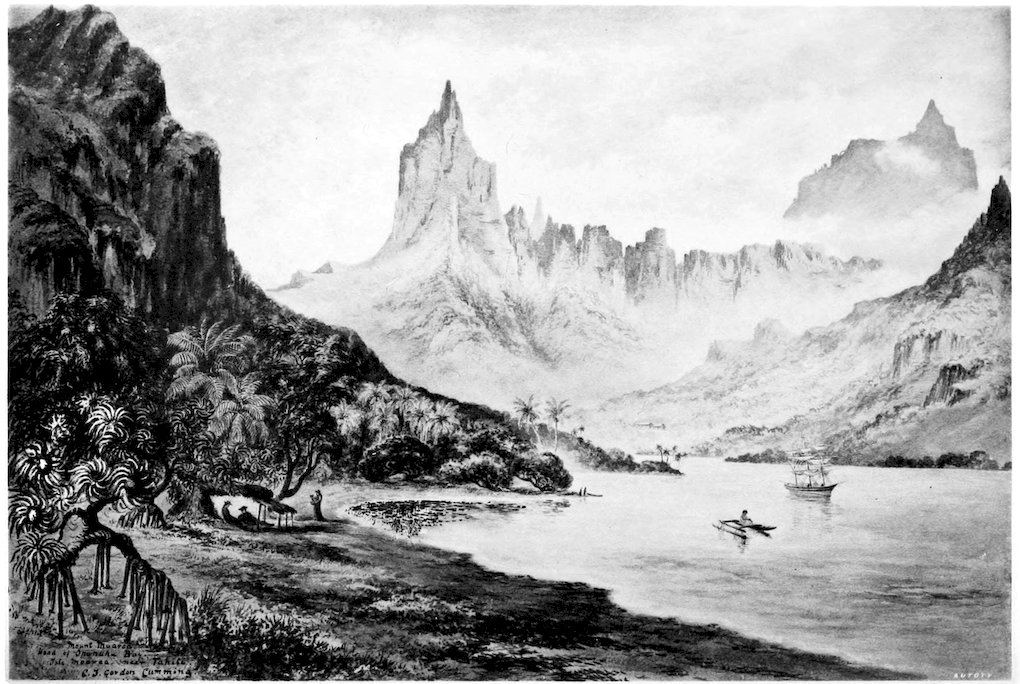
OPUNOHU BAY. ISLE MOOREA.
As my wardrobe will by that time be considerably the worse for wear, you will do well to send out a box of sundry garments to await my arrival, otherwise I shall be reduced to appearing in a graceful drapery of tappa, with fringes of crimson dracæna leaves; 153but though the dress of Oceania is very becoming to the young and beautiful, the world of Sydney is hardly up to it,—and besides, I fear it would be scarcely suitable for old grand-aunts (presque grand’mère), as one of my French friends put it yesterday! It certainly is rather a shame to let you have all this trouble, while I have the fun of exploring such strange lands; but it is a sort of division of labour, whereby you pay your tax to the family locomotive demon, who drives all the rest of us so hard, but leaves you in peace in Britain, to do your share of wandering by deputy.
Now, as it is getting late, I must turn in, as I want to be up at grey dawn to see beautiful Moorea (the Eimeo of our childhood), and we shall sail close past it, as we make Papeete harbour. So good-night.
Well, we have reached Tahiti, but really I am beginning to fear that, like most things to which we have long looked forward, this is likely to prove disappointing. We came in this morning in a howling storm, un gros coup de vent, and everything looked dismal. Though we coasted all along Moorea, the envious clouds capped the whole isle, only showing a peak here and there. Certainly such glimpses as we did catch were weirdly grand; huge basaltic pinnacles of most fantastic shape towering from out the sea of billowy white clouds, which drifted along those black crags. And below the cloud canopy lay deep ravines, smothered in densest foliage, extending right down to the grey dismal sea, which broke in thunder on the reef. With strong wind and tide against us as we crossed from Moorea to Tahiti, you can fancy what a relief it was when, passing by a narrow opening through the barrier-reef, we left the great tossing waves outside, and found ourselves in this calm harbour, which to-day is sullen and grey as a mountain-tarn. At first we could see literally nothing of the land; but it is now a little clearer, and through the murky mist we see a fine massive mountain rising above a great gorge beyond the town. But in 154general effect of beauty this is certainly not equal to Ovalau, and even the town looks little better than Levuka,[34] though it is certainly more poetic, the houses being all smothered in foliage. But then it is fine-weather foliage—all hybiscus and bread-fruit,—the former, of that very blue-green tint, which in rain looks as grey as an olive-grove; while each glossy leaf of the bread-fruit is a mirror, which exactly reflects the condition of the weather—glancing bright in sunlight, but to-day only repeating the dull hue of the leaden clouds.
For indeed it is a dreary grey day, sea and sky alike dull and colourless, all in keeping with the sad news with which the pilot greeted us as he came on board—namely, that Queen Pomare died a fortnight ago (on the 17th September); so we have just missed seeing the good old queen of my infantile romantic visions. Her eldest son, Prince Ariiaue, has been proclaimed king under the hereditary name, and is henceforth to be known as Pomare V.
But the people are all in deepest dule, and instead of the great rejoicings and balls, and himènes, and varied delights of the fête Napoléon (or rather its republican substitute, the anniversary of the Protectorate), on the 9th October, for which we had expected to find joyous crowds assembled—always ready for an excuse for music and dancing—a festival to which my friends have been looking forward all the voyage,—instead of this, we see the crowds pouring out of the native church, all dressed in the deepest mourning, from their crape-trimmed black hats, to their black flowing robes, which are worn from the throat, and with sleeves down to the wrist; they trail on the ground in sweeping trains, and are so long in front that even the bare feet are covered.
There are no flowers, no fragrant wreaths, no arrowroot crowns, no snowy plumes of reva-reva—even the beautiful raven tresses of the women have all been cut off. This is mourning with a vengeance; and the Court circular has commanded that the whole nation shall wear the garb of woe for six months. I do hope that at least the commoners will disobey this injunction! At present all the men appear like black crows. Apparently many are disfigured 155by foreign dress-coats; and even those who retain the national pareo (which is the Tahitian word for sulu or waist-cloth) are wearing black tappa or black calico; and their heads are closely cropped. So sadly disfiguring! and so terribly subversive of all our preconceived visions of Papeete, as the very ideal of light, and mirth, and soft sunlit colour.
The even tenor of life in Tahiti has received several startling shocks since the 24th August, when the French Admiral Serre arrived here in the steam-frigate Magicienne, bringing the new governor, M. Brunnet Millet. But, sad to say, Madame Brunnet Millet died on the voyage from sheer sea-sickness; and her poor husband, who adored her, became positively imbecile from grief, so that he had to resign office immediately on his arrival.
His natural successor would have been M. La Barbe, who, however, had made himself generally obnoxious to the Tahitians, and to the queen in particular, by the injudiciously severe penalties which he enforced for some of her son’s peccadilloes. She therefore wrote to the admiral to say that if La Barbe became governor, she would at once leave Tahiti and retire to Moorea, thus leaving all business at a dead-lock. Thereupon the admiral promised that her will should be respected, and announced that he would himself assume the office of governor, till such time as a fresh appointment could be made in Paris. La Barbe remonstrated. The admiral bade him be silent. He persisted, and was immediately placed under arrest for fourteen days, at the end of which time his sword was returned to him, and he had to put it on, and go to thank the admiral formally for his goodness in restoring it! But as his presence in the Isles would thenceforth have been unpleasant, he and his wife and grown-up son, together with M. Brunnet Millet, have been shipped as passengers on board La Loire, which is now lying alongside of us, on the eve of sailing for France. She is a great big line-of-battle ship, transformed into a transport, for the conveyance of convicts from France to New Caledonia, but returns comparatively empty. So far, her passenger list does not sound cheerful!
The moment we reached our moorings, a boat was despatched in 156hot haste to convey to the admiral the despatches concerning the little episode in Samoa. I fear our kind captain is not free from misgivings as to the light in which that unlucky business may be viewed by his superior officer.
Alas! alas! the wretched Samoan adventure has indeed ended most lamentably. The admiral, who from all accounts is a very severe stern man, had no sooner read Captain Aube’s report, than he signalled for him to go on board La Magicienne, and informed him, that as he was quite incapable of understanding his line of action at Samoa, the only thing he could do was to send him back to France, as a passenger in La Loire, that he might himself explain his motives at headquarters;[35] in short, he removed him from his command of the Seignelay.
Ten minutes later, the fine old sailor returned on board the vessel that was no longer his, to announce this dreadful news to his officers, on whom the blow fell like a thunderbolt. For, as I have told you, they have all lived together on the most cordial terms; and no family, losing a dearly loved father, could be more utterly wretched than are all on board, both officers and men. Many fairly broke down; and I am sure I do not wonder, for it is a lamentable break-up of such a happy ship-family. What a bouleversement of all the pleasant pictures we were conjuring up only last night! Certainly this is a very heavy penalty for what was, at the worst, an error in judgment.
The regret on shore is almost as great as on the vessel; for Commandant Aube is well known here, and exceedingly popular with all the foreign residents, who had hoped that he would be appointed Governor of Tahiti. This is a grievous ending to our delightful voyage, and I need not tell you how downhearted I feel about it all. I could almost wish that we had never gone near miserable Samoa, with all its jars and hatreds.
157I must close this letter, as the little mail-schooner Nautilus sails for San Francisco in the morning, taking as passengers Monseigneur Elloi and M. Pinart. They hope to be able so to represent matters at Washington and in Paris as to put the Samoan episode in the best possible light.
I grieve to say the bishop is very ill; all these worries are very trying to him, and he loses ground daily. The prospect of so long a voyage in a little schooner of about 200 tons, with very mixed society, is anything but pleasant for an invalid, and a trying change from the comforts of the big ship. The actual distance is 4000 miles, and the voyage may be made in twenty-five days. But with contrary winds, the distance is sometimes increased to 6000 miles, and the voyage occupies six weeks! So I cannot tell at what date this letter will reach you.—Good-bye.[36]
To-day has concluded the tragedy. Last night (after a farewell dinner with his officers, and a few touching last words to his men, who wept bitterly, sobbing aloud like children, and who cheered him lustily as he left the ship) Commandant Aube came ashore to take leave of his friends here, and at the British consulate. He was accompanied by his faithful dog, Fox, a poor sickly hound, on whom he has lavished infinite care and kindness throughout the voyage, but which he will leave here in charge of a Tahitian; so he starts on this sad voyage without even his dog as a companion. We escorted him to the shore, and sorrowfully watched his boat making for La Loire, the old line-of-battle ship, which sailed this morning with so sad a company. The poor Seignelay had the odious task of towing her out of harbour; and, as the ships parted, all the men burst into uncontrollable shouts of “Vive notre commandant!”—a spontaneous demonstration, which must have been more satisfactory to its hero than to the stern admiral.
158Just then an accident happened, which might have proved very serious. La Loire accidentally slipped a great tow-rope, which got entangled in the screw of the Seignelay; and, misunderstanding the signal to lower sail, the ponderous old vessel nearly ran down the lighter steam-ship, which could neither work her screw nor answer to her helm, but had to hoist sail and run before the wind. Being unable to turn, she had to sail straight out to sea for some hours, far out of sight.
I watched this inexplicable movement from the semaphore—a high station commanding a magnificent view of town and harbour, and of the distant isle of Moorea. The old sailor in charge was as much perplexed as myself. He decided that the Seignelay must have been despatched to the Marquesas or elsewhere, with secret orders; while I decided that she must have “revolutioned,” and gone off to France. However, this evening she returned, under sail, and was able to go to the assistance of a vessel that had drifted on to the reef; so, on the whole, it was rather a fortunate episode, as it helped to distract the thoughts of all on board.
Most of the residents here, bitterly as they regret the whole business, seem to agree that the admiral has really taken the wisest course, both as preventing (in the sense of prévenant) any possible remonstrance from England—in case she should espouse the cause of that very shady Anglo-American Fijian-Samoan house, with its convenient variety of flags—and perhaps, also, as saving M. Aube from harder judgment in France. But of course none of the officers can realise what a foolish episode that night’s work appears to every one here.
I have not yet told you anything of my own movements. On Sunday afternoon, M. de Gironde escorted me to the British consulate, there duly to report myself to Mr Miller, who for thirty years has been England’s popular representative here; indeed he has never left Tahiti since the day he first landed here, with his bright, sensible, little Peruvian bride. Now they have three grown-up sons, and a pleasant daughter, married to M. Fayzeau, a French naval officer, in charge of native affairs. He is a charming 159musician, and most graceful artist, and has promised to make my way easy for several sketching expeditions.
I had not been an hour ashore, when (on the strength of a letter of introduction from Dr Turner of Malua) I received the very kindest invitation from Mr and Mrs Green to come and stay with them in this their lovely home, just out of the town, and close to the consulate—a delightful nest, embowered in mango and bread-fruit trees, with oleanders and hybiscus to lend colour to the whole. It is only separated from the sea by the pleasant garden and a belt of turf; so there is nothing to impede the view of the beautiful harbour and blue peaks of Moorea, while the valley behind the house runs up to a background of fine hills, which all to-day have been bathed in soft sunlight—that clear shining that comes after rain.
On one side of the little lawn stands a noble old banyan-tree, from the very heart of which grows a tall cocoa-palm,—a curious tree-marriage, greatly admired by the people; but in an evil hour an idiotic surveyor ascended this tree to take observations, and fastened a wire to the primary fronds, thereby of course cutting them, and so killing the palm, which now remains a poor dead monument of ignorant stupidity. The banyan suffers from another cause. The Tahitians believe that a decoction of its brown filaments and rootlets is a certain remedy for some forms of illness. They are therefore continually appealing to Mr Green for permission to cut them; and thus the growth of the tree is considerably checked. However, it covers a sufficient space to form a famous playground for the children, of whom there are a cheery little flock, though here, as in most remote colonies, the absence of all the elder ones forms the chief drawback to the happiness of their parents. But education in all its aspects has to be sought elsewhere than in beautiful Tahiti, by those who do not wish their families to become altogether insular; and my host and hostess retain far too loving memories of their own early homes in Wiltshire and Devon to allow their children to grow up estranged from their English kinsfolk.
This, like the majority of houses here, is a wooden bungalow, 160one storey high, with verandah, on to which all rooms alike open—by far the coolest and most suitable form of building for the tropics. But there are a number of two and three-storeyed houses in the town, inhabited by French officials and foreign merchants—notably the French governor’s house, and the unfinished “palace,” which has been in slow progress for many years.
At the former, Admiral Serre now holds the reins. Stern though he be in public matters, he is wonderfully kind and pleasant socially, and seems to guide his iron hand with much wisdom in carrying out the course of action he has marked out for himself. As you know, he had scarcely determined on taking the government into his own hands when Queen Pomare died quite suddenly, to the exceeding grief of her people. Great was their anxiety as to what course the French would now adopt,—the royal family being so much at sixes and sevens that there was very good reason to fear that even the semblance of the ancient rule would henceforth be dispensed with.
Instead of this, the admiral devoted his whole energies to bringing together its various branches—healing their breaches, inculcating sobriety (with marvellous success so far), and generally getting them into a satisfactory condition. Queen Pomare’s two eldest sons, Ariiaue and Tamatoa, have been very naughty boys, in most respects. The former has married a very handsome girl, aged seventeen—Marau Salmon; but hitherto the marriage has not proved happy. Tamatoa was for a while King of Raiatea; but was apt to carry on such dangerous games when he was drunk, that his subjects drove him out of the island. He is, however, very clever and amusing, and is blessed with an adoring wife—a very charming and excellent woman, as good as she is bonnie; Moë is her pretty name. Queen Pomare’s third son, Joinville, died leaving a son. The fourth, Tevii Tapunui, is a very good fellow, but sadly lame.
Well, by dint of coaxing and reasoning, and by turns assuming the part of father and “governor,” the admiral first of all persuaded Ariiaue and Marau to make up the peace, and then proclaimed them King and Queen as Pomare V. and Marau Pomare—a ceremony 161of which I have just read full particulars in the ‘Messager de Tahiti,’ which, under the heading, “Le prince royal Ariiaue est salué roi des Iles de la Société et dépendances,” gives a detailed account of the meeting of the Legislative Assembly of Tahiti, convened by “M. le Contre-Amiral Serre Commandant-en-chef, Commandant provisoire des Etablissements français de l’Océanie, pour reconnaître et acclamer le nouveau souverain de Tahiti.”
The Legislative Assembly received with acclamation the decisions of the omnipotent admiral, who not only proclaimed Ariiaue king, but has further settled the succession for two generations to come. Queen Marau being half English, any child to which she may give birth is excluded from the throne in favour of the little Princess Teriivaetua, daughter of the king’s brother Tamatoa, and the charming Moë, ex-King and Queen of Raiatea—thus securing the pure Tahitian blood-royal. Failing issue of the little Princess Vaetua, the succession is to pass to her cousin, Prince Terriihinoiatua, commonly called Hinoi—a very handsome boy, son of the third royal brother, now deceased, who was known as the Prince de Joinville.
These decisions are said to have given great satisfaction to the Tahitians, who, with very good reason, had feared that, on the death of the old queen, the French would take the nominal power as well as the real, which they have so long held.
Pomare’s proud independent spirit must have chafed sorely under their tutelage; but she contrived to endure it for thirty-five years. She was just sixty-five when she died, having been born on the 28th February 1813.
She was the only daughter of King Pomare II., who was the very first friend of the missionaries when they attempted to get a footing in these isles, and proved their stanch supporter to the end of his days.[37] His daughter’s name was Aimata. In the year 1822 she married the young chief of Tahaa, who had received the name of Pomare as a mark of special favour from the old king. 162Thus Aimata became known as Pomare-Vahine;[38] the correct designation for a married woman being thus to append the term for wife to the name of the husband. In January 1827 she succeeded her brother, Pomare III., and reigned supreme till 1843, when the French assumed the Protectorate.
Young Queen Marau Pomare is one of a large family of very handsome half-whites—children of a high chiefess of Tahiti, who married a much respected English Jew, Mr Salmon. She has three stalwart sons and five most comely daughters, whose rich olive complexion, black silken tresses, mellifluous voices, and foreign intonation in speaking English, are all suggestive of Italy.
The eldest daughter, who owns the formidable title of Tetuanuireiaiteruiatea—though, happily, known to her personal friends by the more euphonious name of Titaua—is herself a very high chiefess both of Tahiti and Moorea, on each of which she owns several large estates. At the early age of fourteen she married a wealthy Scotch merchant—Mr Brander—who died a few months ago, leaving to his young widow a heavy weight of care, in that her two eldest daughters have married Germans, whose mercantile interests are diametrically opposed to those of the house of Brander; and who, having vainly striven to wrest the business from her, are now pressing for immediate division of property—a process which necessitates a most exasperating amount of legal discussion, in which questions of English law, native law, and, above all, the Code Napoléon, which is the law of the Protectorate, crop up by turns.[39]
Moetia, the second daughter of Mrs Salmon, married the American Consul, Mr Attwater. Marau, as you already know, married her royal kinsman; while Lois (commonly called Prie, which is a contraction of Beretanie—a name adopted out of compliment to Britain) and Manihinihi, the two youngest sisters (who both fully sustain the beauty of their race), live with their mother—a 163very fine old lady, whose long native name I cannot tell you, but her ordinary signature is Ariitaimai. She was a cousin of the late queen, and is said greatly to resemble her.
Her three sons are Taati, Naarii, and Ariipaea—all tall and powerfully-built men.
The system of adopting children, which prevails here, is very confusing and very peculiar. Every family seems to have at least one belonging to some other family. A child is generally bespoken before it is born, and as soon as it is weaned it may be claimed by its adoptive parents, who give it a new name, by which it is thenceforth known, and who become responsible for it in every respect—for its feeding and its education. The child is at perfect liberty to pass unquestioned from one home to another; so if its second father or mother chance to annoy it, it goes and takes up its abode with its real parents till it feels inclined to return to the others. When these die, it inherits their property on equal terms with their real children. You can imagine that where relationships are very intricate to begin with, these additional blendings of families create a most bewildering interweaving.
Then all the intermarriages of the principal families add to the confusion. Every one on Tahiti, Eimeo, Bora-Bora, and the Society Isles generally, seems to be related to every one else, at least among the high chiefs. In no corner of the earth is there a greater respect for good ancestry—nowhere is “a lang pedigree” more prized. The most singular point, however, is, that whereas in a proposed marriage between two persons, both having Tahitian blood (whether pure or partial does not matter), the greatest anxiety is manifested to prove that blood sufficiently blue, and any suggestion on the part of a high chief of wishing to wed a maiden of low degree calls forth a storm of indignation from all his relations; yet if a Tahitian woman of the highest class chooses to marry a European of very dubious rank by birth, not a voice is raised in opposition. I believe the solution of this curious point lies in the fact that here, as in Fiji, a child takes rank from his mother, so that he is in many instances a much more important person than his father. It is the same peculiarity which I pointed 164out to you, when writing from Fiji, respecting the customs of its chiefs.
I have just heard that a very leaky ship is to sail for Sydney to-morrow, and a better one starts for New Zealand next week; so in order to lose no chance of a letter reaching you, I shall despatch this viâ Sydney, and send you another viâ New Zealand. Meanwhile, good-bye.
Dearest Nell,—It is high time I sent you a cheerier letter than the last, which was written just after our dreary arrival in a dismal storm, and further overshadowed by the distressing manner in which our happy party was so summarily dispersed. With the exception of that one sad cloud, no drawback of any sort has arisen. The cordial kindness of every creature here, the easy luxury of very simple social life, a heavenly climate, and the dream-like loveliness of the isles, all combine to make up as charming a whole as can possibly be conceived. It is the sort of place in which one is made to feel at home at once: from the moment I landed every one seems to have tried what he or she could do for the enjoyment of the stranger. It is a region of true hospitality.
Certainly this is a very pretty little town. Its simple village streets are all laid out as boulevards, and form pleasant shady avenues, the commonest tree being the pretty yellow hybiscus with the claret-coloured heart, so common in Fiji, where it is called surya. Here its name is boorau. The names of the streets recall Parisian memories. The shadiest and widest street is the Chinese quarter, and its poor little wooden houses are Chinese stores and 165tea-shops. It rejoices in the name of Rue de Pologne, while the principal real street is the Rue de Rivoli, where are merchants’ stores, cafés, grog-shops, and even hotels of some sort. Of course the pleasantest locations are those which face the harbour and catch the sweet sea-breeze; and the largest stores for provisions and dry goods are in the Rue de Commerce, each possessing its own wharf. I fear the word wharf may suggest the dirty prosaic wharves of England, an idea which you must banish at once; for business in its dingy aspect is not obtrusive, and the harbour-wall is but a stone coping for soft green turf, where girls with light rods sit fishing, and market-boats land their cargo of gay fruit and fish, while the motley throng pass and repass—Tahitians, French sailors and soldiers, Chinamen, black-robed French priests, and all the nondescript nationalities from the ships.
There is a considerable foreign population, including, of course, a large staff of French officials of all sorts—civil, naval, and military—and their presence seems a raison d’être for a strong corps of gens d’armes, who otherwise would certainly seem an incongruous element in the South Seas.
By a recent census I learn that the native population of Tahiti is somewhere about 8000; that of Moorea, 1500. That there are in the group 830 French, 144 citizens of the United States, 230 British subjects, and about 700 Chinese.
The French have both a Protestant and Roman Catholic Mission. The former was made necessary by the fact that, on the establishment of the Protectorate in 1843, the English missionaries were subjected to such very oppressive regulations as greatly impeded their ministrations among the people, all of whom were at that time Christians, and, moreover, still in the fervour of first love—a love which, it is to be feared, has now in a great measure faded to the light of common day, as might be expected from the large influx of infidel, or at best, wholly indifferent, foreigners.
The Church of Rome having resolved to proselytise this already occupied field, sent here a bishop and many priests, with a supplementary staff of “Frères et Sœurs de Charité.” I think the Sisters are of the order St Joseph de.... The foreigners connected 166with the Catholic mission number in all about forty persons. They have had large aid and encouragement from the French Government, who compelled the chiefs of Tahiti and Moorea to build a church for their use in each district. Nevertheless, out of the 8000 inhabitants, 300 nominal adherents is the maximum which the Catholics themselves have ever claimed, but fifty is said to be nearer the mark.
The French Protestant Mission, however, found it desirable to send French subjects to the support of the London Mission, of which Mr Green is now the only representative. His coadjutors are M. Viennot, M. Vernier, and M. Brun—all married men and pères de famille. The latter is pasteur of Moorea. M. Viennot has a large Protestant school both for boys and girls of pure French and pure Tahitian blood, and of all shades of mixed race. We went to see his charming house, which is the most romantic nest, for a school, that you can well imagine, with wide verandahs and a large pleasant garden. Several of the daughters of the early English missionaries assist in teaching; and everything about the establishment seems bright and healthy in tone.
The third French pasteur, M. Vernier, was a student friend of Lord Lorne’s at Geneva (under Merle d’Aubigné), and returned with him to Inveraray for three months, ere resuming his own studies for a while in Edinburgh. Consequently he retains most loving recollections of everything linked with those very happy days; and it struck me pleasantly, in this far-away isle, to find in his little drawing-room many familiar photographs of Inveraray faces and places. Now his pretty wife is mother of half-a-dozen typical French little ones, the youngest of whom was the hero of a very pleasant dinner-party, given by his parents the night before last, in honour of his baptism. There were about a dozen persons present, including all the members of the Protestant Mission, Captain Guignon of the Bossuet (a most friendly trading vessel belonging to the firm of Messrs Tandonnet of Bordeaux), and myself. All the time of dinner, the petit nouveau-baptisé was laid on the floor, where he rolled about laughing and crowing with delight, while the other children played quietly beside him. It was a scene of 167graceful home life, and illustrates the easy unconventional pleasures of social existence in this sweet isle.[40]
It certainly is very strange how one invariably finds home links in all corners of the earth. If there was one place more unlikely than another to do so, I should have thought it was Tahiti. But, as usual, I find myself quite en pays de connaissance. The day after I landed, Mrs Miller drove me in her nice pony-phaeton to call on Mrs Brander. I naturally expected that our conversation would be on purely insular subjects. Imagine my astonishment when, after the first greetings, this beautiful Anglo-Tahitian turned the conversation to Scotland—Morayshire, Speyside, Elgin, and many friends there—and spoke of them all from intimate personal acquaintance!
Then, for the first time, it flashed across me that the name which had become so familiar to my ear as that of la Maison Brandère, was simply that of a county neighbour in Scotland; and that Mr Brander of Tahiti was none other than a half-brother of Lady Dunbar Brander,[41] who in his early youth left Elgin and went forth to carve his fortune in foreign lands. You know how little interest people in Britain take in watching the career of such lads, unless they chance to come home to spend their gold. Mr Brander did not come home. He found in the South Seas a field for his vast energies—embarked in trade, added ship to ship till he owned a considerable fleet, and so his connection spread from group to group; and he bought lands and built stores on all manner of remote isles, and in course of time amassed a gigantic fortune. His marriage with Titaua Salmon must have tended greatly to secure his position in these isles; and so his business went on ever increasing, till at length mind and body broke down under the 168constant strain, and he died, leaving the whole care of his immense business to his young widow, who is only thirty-four now, the eldest of her nine children having been born when she was fifteen! She is the mother of as pretty a covey as you could wish to see, beginning with two lovely grown-up married daughters and one or two grandchildren, and ending with two darling little girls, one of whom bears the charming name of Paloma, the dove.
Mr Brander most wisely resolved that his wife’s brothers and his own sons should have the advantage of a first-rate education in Britain. Several of the boys are still at school at St Andrews, whence Alexander, the eldest, recently came out here; but he must shortly return to England, to look after property belonging to his father.
In all these far countries people talk of a run to England and back as if it was the veriest trifle!—merely a run of fifty or sixty days, viâ San Francisco, and across the United States; or, if economy has to be considered, a voyage of 140 days in a sailing-ship round Cape Horn!
This afternoon Mme. Fayzeau took me for an exquisite drive into the country. We drove along the shore on a road of fine green turf, skirting the lovely calm lagoon, and passing by an endless succession of small wooden houses, each almost hidden in bowers of blossom and shady fruit trees, with pleasant lawns, where merry children played, while their elders sat or lay on mats sewing, or twining wreaths, or rolling cigarettes—all suggesting lives of easy-going happiness without undue care; and the air was made musical by rippling laughter and mellifluous voices.
I scarcely know why it is that Tahitian sounds so much more attractive than the sterner Tongan tongue. Individual words are actually less liquid, because of the frequent use of the aspirate. I am told, as rather a curious fact, that whereas the Samoans and Tongans are so very profuse in their expression of the word “thanks,” the Tahitians, like the New Zealanders, have no equivalent for it.
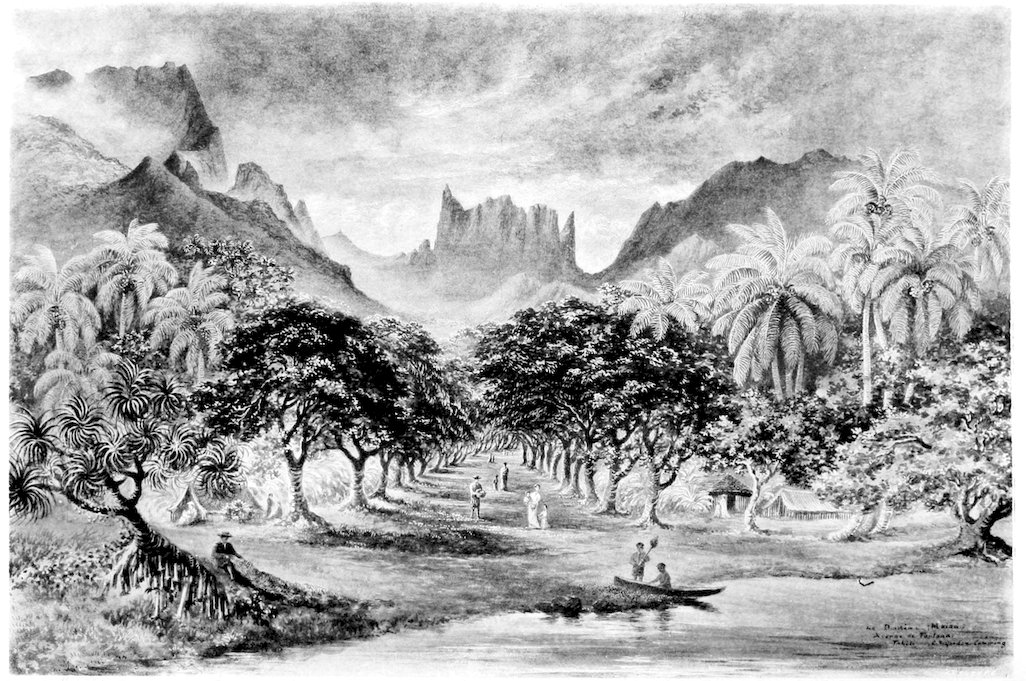
LE DIADÈME. AVENUE DE FAUTAWA.
TAHITI.
For love of his master, we went to see Commandant Aube’s poor sick dog Fox, and learnt that it died very soon after his departure. 169Then we drove through a most beautiful wide avenue of dark-green trees, something like the Caroba, or locust-trees of Malta, completely overshadowing the broad green drive. And now we were facing the mountains in the centre of the isle, and looked up the lovely valley of Fautawa, at the head of which towers a magnificent hill, so symmetrically indented as to resemble a gigantic crown. Hence its common name, Le Diadème, though to the natives it is still Maiauo.
Returning towards Papeete, we met many carriages and equestrians; for here there is no lack of either. Most of the gentlemen were making their way to a river, which is a favourite bathing-place; and I need not tell you that a river-bath is one of the chief delights of a day in the tropics.
Mrs Brander had invited us all to dine at The Red House, which is her town home—a large three-storeyed red-brick house. There, amongst other friends, we met a very delightful old lady, Mrs Simpson—a true “mother in Israel.” Widow of one of the early missionaries, she shared in all his labours, and in the joy of beholding the dawn of Christianity, when its first rays dispelled the dark night of heathenism. Many a wondrous change have those clear observant eyes witnessed in her half-century of working life in these fair isles, and many a tale of thrilling interest has she to tell of scenes enacted within her own recollection.
Of course, with the advance of civilisation, many of the picturesque elements of earlier days have passed away. The natives no longer assemble on shore to practise their writing lessons on the smooth sea-beach; neither do they carry sand into the schools, that, by spreading it on a closely-woven mat or rude table, it may serve as a simple slate on which to work out the puzzles of arithmetic. The advanced scholars no longer seek for smooth stones on the mountains, to be polished with sea-sand till fine writing can be traced on them with the spines of the echini.
Nor are the large leaves of the plantain used as letter-paper on which to send messages, written with a blunt stick, which bruised the delicate leaf without cutting it, and so produced a tracing of brown writing on a glossy green surface. These letters were rolled 170up like a sheet of parchment and tied with a strip of bark. A plantain-leaf being about fifteen inches wide, and perhaps six feet in length, would allow of a very long message being written on one scroll, and answered very well, provided the letter had not far to travel; but of course the leaf would shrivel and split within a few days. Now letters are written on common note-paper, and bear the postage-stamps of the French Republic.
No longer are children summoned to school, and congregations to worship, by the king’s messenger, lightly draped, but gaily wreathed, passing swiftly round the village, blowing loud blasts on his great trumpet-shell, and pausing at intervals to invite the presence of the people. Now his place is filled by the very commonplace bell of civilised life.
In the matter of dress, too,—though we may be thankful that Prince Alfred’s strong commendation of the graceful sacque has caused it to triumph over all varieties of changeful and unbecoming fashion, which for a while found favour here, and which ere now have covered these comely heads with English bonnets and close-fitting white caps (!)—the artistic eye would certainly prefer the dress of olden days: that of the women consisting of soft drapery of beautiful cream-coloured native cloth, wound round the body, passed under one arm and knotted on the other shoulder, revealing the shapely neck and arm, while gay garlands wreathed their hair; and for ear-rings, some wore a fragrant blossom passed through one ear, and, in the other, two or three large pearls fastened together with finely braided human hair.
The men, so many of whom have now adopted coat and trousers, then wore either a very finely plaited, fringed mat, or a pareo—i.e., kilt of native cloth, made either from the bark of the paper-mulberry or that of the bread-fruit, or else from the filaments of the banyan-tree. Of these the former was the whitest, and preferred for women; the latter was very thin and brown. The cloth made from the bark of the bread-fruit was very strong, and was dyed according to taste—either of a rich chocolate, a brilliant yellow, or red. The two last were the favourite colours, and were obtained from the sap and berries of different trees. Sometimes the cloth 171was reversible—being black on one side and red on the other, and varnished with vegetable gum to enrich the colour.
Some wore this handsome material as a cloak—falling from the shoulders in flowing drapery, very becoming to a stately chief. Others wore it as a tiputa or tippet, which resembled the poncho of South America—being simply a long piece of cloth, with a hole cut in the centre, through which to pass the head, the garment falling over the back and chest and reaching to the knees. Sometimes this tiputa was beautifully ornamented; and often it was made of curiously knotted fibre—generally that of the hybiscus, from which fine fishing-nets were also made. Those who could afford such luxury wore head-dresses made of the long tail-feathers of the graceful tropic bird; and the poorest wore gay flowers. But these were discarded in favour of regular English hats, and the scarlet feathers were used as trimming for shabby black coats. Proud was the man who became possessed of a pair of trousers, to be displayed alternately on legs or arms! In short, the spirit of innovation was attended with the usual hideous incongruities.
Instead of the big European boats of the present day, with nothing distinctive except the form of their quaint triangular sail, there were formerly fleets of canoes of every size up to 100 feet in length, with grotesque carving on the raised stern and prow, and flags and streamers of native cloth. They carried large sails of yellow matting, made from the long leaves of the screw-pine,[42] which was much lighter than the canvas of civilisation, but also much less durable. Here again the picturesque element has suffered. In those days there were war canoes and chiefs’ canoes, single canoes, and double canoes—like Siamese twins; and in every fleet there was always a sacred canoe, that the presence of the tribal god might not be lacking.
The gods of Tahiti seem to have been simple enough: some were in the form of a large bird, others were merely a hollow cylinder ornamented with bright feathers. The blue shark was deified, and had temples erected in his honour, and a special priesthood; he was chiefly worshipped by fishermen, though few whose 172path lay over the great waters would fail to propitiate so powerful and cruel a foe. Terrible are the stories of canoes which have been disabled and water-logged, and of the hungry sharks that have gathered round in shoals, and picked off the crew one by one, till the canoe, thus lightened, could float again; and perhaps one survivor has escaped to tell of his comrades’ fate.
When Pomare II. determined to become a Christian, his first decided act was to show the people with what contempt he now regarded the gods of his ancestors, to whom the turtle had ever been held sacred. It was invariably cooked with sacred fire within the precincts of the temple, and a portion was always offered to the idol. A turtle having been presented to the king, his followers were about to carry it to the marae, when he called them back, and bade them prepare an oven and bake it like ordinary food, without regard to the idol. Great was the consternation of the attendants, who tremblingly obeyed, and watched the king himself cut up the turtle and begin to eat. He vainly endeavoured to induce those who were with him to share this impious feast: they looked for some immediate manifestation of divine anger, and expected to see the king stricken before their eyes. Great was their wonder when no harm befell him, either on that day or on the morrow; and thus the first step was taken towards the overthrow of the old superstition.
It was a simple but effectual test, and one which required considerable courage on the part of him who first dared to try it. Pomare, on this occasion, did for the people of Tahiti what Queen Kapiolani did for those of Hawaii, when, descending to the brink of the awesome crater, she defied the goddess Pélé by eating the blue berries held sacred to her, and which none dared to taste without first throwing a handful as an offering to Pélé.
In like manner did Pomare-Vahine, daughter of the King of Raiatea, teach the same lesson to the chiefs of Eimeo, who had brought her a great faamuraa, or feeding—i.e., a gift of roasted pigs, fowls, fish, fruit, and vegetables. According to custom, the priests were present to crave the blessing of the gods on the whole feast, by first selecting the portions to be offered on the altars. 173But ere the heathen priests could make their choice, the Christian chiefess bade her head man consecrate the whole by thanksgiving to the Almighty. The crowd of bystanders looked on in wonder, and the priests retired, not venturing to claim for idol altars the food which, they felt, had thus been offered to the Most High.
Many such tales might I now hear and preserve for your benefit, could I but find time to listen with an undivided mind.
But there is so much that is new to hear and to see, that I hardly feel able to disentangle the threads of so many subjects, which, apparently, are all interwoven one with another. Doubtless, by degrees, they will arrange themselves in a more orderly fashion.
In the evening we all walked home together, by a pleasant path along the grassy shore, passing through a dark thicket of large hybiscus trees, then beneath tall cocoa-palms, whose every frond lay clearly shadowed by the brilliant light of only a crescent moon. No full moon in England could shine with so soft a radiance.
The loveliness of the evenings here is indescribable; and well do all the inhabitants know how to enjoy their beauty. Every one saunters forth after dinner,—the general rendezvous being a grassy lawn under the great trees near Government House, where the admiral’s excellent band plays divinely, to the great delight of the Tahitians, who are themselves most musical, and who assemble in crowds, listening in rapt delight to the operatic airs, and then, by irresistible impulse, dancing joyously on the turf, as valse and galop succeed one another.
But nothing could be more orderly and respectable than this mirthful crowd, which strikes me the more forcibly from the fact that these are not the characteristics generally ascribed to Papeete, but are in great measure due to the wholesome influence of Admiral Serre and his officers, and to the excellent discipline of the ships now in harbour. Of course when a rowdy ship comes in, it is more difficult to preserve order; and as most accounts are written by travellers who chance on these unlucky times (and perhaps help to cause them), the place has got a worse name than it ever deserved. So say the old inhabitants. Its present condition of 174extremely orderly good behaviour is, however, undoubtedly an exceptional result of the admiral’s iron rule and stringent measures for the general weal. Immediately on his arrival, he gave orders that every damsel whose morals were recognised as lax, should be at once deported from the gay capital. So, without further ado, all such were shipped off to the seclusion of their various country districts, or else to more rigid seclusion, in charge of the police,—only coming forth to sweep the roads, which, consequently, are in a state of exquisite cleanliness and neatness.
It is not to be supposed that the present condition of preternatural goodness will very long survive the departure of the admiral, as many of the governors of the Protectorate seem rather to encourage what the more staid residents deem unseemly frolic. Many of these governors are not Frenchmen,—merely Creoles, whom the Tahitians dislike exceedingly, and contemptuously describe as Paumuto-Frane (Paumuto-men being Queen Pomare’s pig-feeders, and Frane being the equivalent of French). Many gross errors and maladministrations have crept in during their rule; and the admiral is now devoting his whole great energies to rectifying all manner of abuses, greatly to the satisfaction of the Tahitians, with whom he is apparently immensely popular. Moreover, he seems determined to deal even-handed justice between the Protestant and Catholic teachers, which the latter by no means appreciate, having so long been greatly favoured by the Creole authorities.
Socially, in his double capacity of admiral and governor, he does all in his power to make things pleasant for every one. For my own part, I am bound to say that, from the very first evening of our arrival, he has been unvaryingly courteous, and in every respect most thoughtful for me. We meet very often, as he and some of his suite invariably join Mrs Miller’s party every evening at the band, after which they walk back with us along the beautiful shore to the British consulate, where we generally have a second concert, and much pleasant chat of the most polyglot order—English, French, and Spanish, in about equal parts—with iced lemonade and liqueurs to help the flow of words!
175The only drawback to my enjoyment of all this is the feeling that my late most kind camarades are so thoroughly out of it all. Like Rachel bemoaning her little ones, they refuse to be comforted, and nothing will induce any of them to come ashore to any place where they might by any accident meet the admiral. Of course this is rather uncomfortable for me; for though they all declare themselves most anxious that I should be lionised in the best possible manner (i.e., officially), I fear it must seem to them as if I had gone over to the enemy.
Still, there is no alternative; and the kindness which is even now arranging my future plans, is such that I can but accept it gratefully.
Having proclaimed Ariiaue and Marau, King and Queen of the Isles, the admiral is now making arrangements to escort them on a grand ceremonial round of all the districts on each of the principal isles, that they may personally receive the homage of their people. It will be a very interesting occasion, calling forth whatever still remains of old native customs. To my great delight, the admiral has asked me to join this expedition. At first I treated the suggestion as a mere civil façon de parler, no other lady having been invited; little Vaetua (Moë’s daughter, the future queen) being Marau’s only companion. However, on the following day an A.D.C. brought me an invitation in due form, and the Millers are delighted, and say it will be the nicest thing possible for me. So of course, now, I have definitely accepted, and am looking forward to the ploy with the greatest possible interest. There are twenty districts in Tahiti, and the intention is to visit two a day, which will make our picnic expedition a ten days’ pleasure; after which we return here to make a fresh start for the beautiful isle of Moorea.
At eight o’clock Madame Fayzeau took me with her to the Roman Catholic cathedral for the military Mass, at which all high officials are expected to be present. Soldiers with fixed bayonets stand on either side of the altar, and others down the aisle, and 176present arms, kneel, stand up, &c., obedient to a loud word of command, which, indeed, is the only word spoken aloud till the final benediction and short chant. The organ plays the whole time, and the congregation attend to their private devotions, or do not, as the case may be. Apparently the fact of being present is sufficient. Very few Tahitians attend the eight o’clock Mass. The general congregation assemble at nine, when the service is audible, and a sermon is preached, partly in Tahitian, partly in French.
After church we went to see the Sisters, some of whom are engaged in nursing at the hospital, while the others teach in their own school. Returning to the British consulate, we found a pleasant naval breakfast-party; after which we enjoyed a calm peaceful afternoon here, while Mr Green was engaged with some of his teachers and classes. He has the charge of a very large native church here, where he holds forenoon service, but frequently has occasion to visit churches in other parts of the isle; and one of the many irritating French regulations forbids his preaching in any church but his own without a special permit, which has to be applied for, and granted afresh, every week, and is often delayed till the very last moment, so that he has to wait with his horse ready harnessed, and then probably drive much faster than he wishes, to reach his destination in time.
As each member of the mission has his own native work to attend to, and as every one in the island understands Tahitian, the only foreign service is one held on alternate Sunday evenings by Mr Green and the French pasteurs. This evening it was in English, according to the Congregational form, and ended with the Holy Communion.
We had a lovely walk home, but remarked that the Parisian observance of Sunday as a jour de fête has superseded that very sacred reverence for the Lord’s Day, which is so striking a feature in most of the Christianised isles. To-night the crowd at the band was larger and noisier than usual, owing to the presence of many French sailors, some of whom were nearly as drunk as an average set of blue jackets, under similar circumstances, would probably have been.
177With some anxiety, I noted a wide halo round the moon, and devoutly trust it may not prove an evil symptom of the coming weather; for to-morrow morning we start on our grand expedition round the isle.
Now I must try to secure a good night’s rest, so shall close this letter, which may take its chance of being taken to some point by some vessel in the course of the next ten days.
Dear Lady Gordon,—I have just heard that a vessel is about to sail, and will carry mails, so, though I have not time to write at length, I must send a few lines by her. Though antagonisms are not perhaps so openly virulent here as in Samoa, there is nevertheless such jealousy among the traders that they often try to sneak out of harbour unknown to their neighbours, and so we have just lost the chance of sending letters viâ Auckland by a fine vessel belonging to Godeffroy; but no one knew she was going, till she actually sailed.
We returned last night from the grand tour of this isle on the occasion of King Pomare’s accession to the throne. Admiral Serre most kindly arranged that I should be of the party, and really I do not think I ever enjoyed an expedition so much in all my life. It was wonderful luck for me just to have come in for so exceptional a chance; for, of course, under no other circumstances could I have seen either the country or the people to such advantage. It was really like a bit of a fairy tale, and all fitted in so smoothly and naturally without the smallest trouble or care of any sort, so far as 178I was concerned. In every respect it has been a most delightful trip,—good weather, good roads, and most agreeable company. I cannot tell you how often I longed to have you with us (remembering how you love driving, and that carriages are an unknown luxury in Fiji)!
The admiral had a capital carriage and excellent horses, and such a jovial great half-caste driver. And the broad grass drives along the shore, generally skirting the sea or passing through the heavenly orange-groves, are so delicious, and you glide along so silently through ever-changing scenes of beauty. How you would have enjoyed it all!
Besides the royal party and a few native chiefs, there were about twenty French officers and the admiral’s excellent brass band, consisting of twenty sailors, who have been trained and are kept well up to the mark by M. D’Oncieue de la Battye, the admiral’s chef d’étât-major, who is an excellent musician, and a most agreeable companion—which was fortunate, as either he or M. Hardouin, the A.D.C., always occupied the third seat in the carriage. Everything on the whole expedition was admirably arranged; and although we were such a very large party, there was always good accommodation provided, and everything was done comfortably.
Each district possesses a very large cheferie or fareo,—i.e., a very large native house built for public purposes—meetings, and the accommodation of strangers. Like all the native houses here, they consist chiefly of a heavy thatch roof, rounded at both ends, supported on a mere framework of posts, and leaving the sides all open, save at night, when they are screened in. They generally have good wooden floors, often smooth enough to dance upon.
The first of these at which we stopped was most beautifully decorated, and tables spread for 300 persons, the chief’s family supplying that for les gros bonnets—and each family in the district taking entire charge of one table. At other places we found the feast spread in temporary houses, but everywhere it was gracefully done.
Our night quarters were also most comfortably arranged, and I 179was especially charmed by the beds provided for us,—very large and soft, stuffed with the silky tree-cotton; abundant pillows; real mosquito-nets and light curtains, tied back with gay ribbons; and such pretty coverlets of patchwork, really triumphs of art needlework. Those most in favour have crimson patterns on a white ground, but the designs are highly artistic. It seems that a Tahitian housewife prides herself on her snowy linen and downy pillows—a very happy adaptation of foreign customs. Whenever it was possible so to arrange it, Marau and I shared the same room, which was a pleasant arrangement.
Each morning our procession of fifteen wheeled vehicles started at 7 A.M., preceded by native outriders carrying the gay district flag, which made a pretty bit of colour as we passed through the green glades. A drive of seven or eight miles brought us to our halting-point, where we found masses of people assembled to sing himènes of welcome, all, however, dressed in black, relieved only by crowns and handkerchiefs of yellow, or else a wreath or hat of snowy white bamboo or arrowroot fibre, and in their hair soft plumes of snowy reva-reva,—a filmy ribbon extracted from the cocoa-palm leaf. All the women were supposed to have cut off their beautiful long black hair, as mourning for old Queen Pomare; but happily a good many had only shammed, so now there is no lack of glossy black tresses. Those, however, who affect deep mourning, still wear black straw-hats trimmed with crape, and look most lugubrious, their dark sallow complexions and raven hair giving them such a very sombre appearance.
All the women without exception have their dresses cut on the pattern of the old English sacques worn by our grandmothers—that is, a yoke on the shoulders, from which the skirt falls to the feet, and trails behind. The effect is very easy and graceful, and it is a matter of deep congratulation that the dress in fashion in Europe at the period when Tahiti adopted foreign garments, should have been one so suitable. It would be impossible to devise a cooler dress, as it only touches the neck, shoulders, and (very loosely) the arms. The one under-garment is low-necked, short-sleeved, and of such a length as to form a sweeping skirt, thus 180combining chemise and petticoat. Shoes and stockings are of course superfluous.
Having halted and feasted at the morning district, we started again about two o’clock, drove seven or eight miles further, always through lovely country, and so reached our night quarters, where we were again received by assembled multitudes and congratulatory himènes. Then the band played, as it had done at our noonday halt, to the great delight of the people; and we strolled about, and bathed in some clear crystalline stream, reassembling for a great native feast, which, however, was served European fashion, as each district possesses its own crockery, glass, knives, forks, spoons, &c. The admiral provided French wines and bread.
Then followed more himène singing; while we sat listening, entranced, either in the great house, or on the beautiful sea-shore, in the perfect moonlight. Himènes are a new sensation in music, utterly indescribable—the strangest, wildest, most perplexing chants; very musical and varied, quite impossible to catch. They are a curious and fascinating sort of glee-chorus, in which every one seems to introduce any variations he fancies, but always in perfect tune, and producing a combination like most melodious cathedral chimes—rising and falling in rippling music, and a droning undertone sounding through it all. The whole air seems full of musical voices perfectly harmonised—now in unison, now heard singly; one moment lulled to softest tones, then swelling in clear ringing melody; voices now running together, now diverging. The singers compose their own words, which sometimes describe the most trivial details of passing events, sometimes are fragments of most sacred hymns—according to the impulse of the moment. Perhaps this last fact gives us a clue to the origin of the word hymn-ene; though I fancy that the words sung are often those of older and less seemly songs than the hymns taught by the early missionaries.
This is an outline of what has been our daily life for the last ten days. All has gone off without a single drawback, and it has been a spell of thorough enjoyment: nothing could exceed the kindness of every one, whether French or Tahitian. I think that 181of all the lovely isles I have visited, these certainly deserve the palm. Tahiti is a miniature of Ceylon, omitting all the great hideous coffee districts in the interior (districts made hideous by denudation—the glorious primeval forests having been ruthlessly sacrificed to make way for gold-producing crops).
The lovely hills and valleys of Tahiti and Moorea have only gained in beauty by the introduction of the fruit-bearing trees, which now form a most important feature in the general wealth of foliage—the dense thickets of orange-trees having all grown from those brought from Sydney by Mr Henry, one of the early missionaries. Strangely enough, the most healthy trees are those which have grown self-sown from the seed thrown about carelessly by the natives, when they retired to some quiet valley to brew their orange-rum in secret. These trees have thriven far better than those much cared for, and transplanted.
The splendid mango-trees, whose mass of dark foliage is now so prominent a feature on all sides, were introduced less than twenty years ago by the French, who have taken infinite trouble to procure all the very best sorts, and have succeeded to perfection.
But the special charm of these isles lies in the multitude of their streams and rivulets. We calculated that in driving round Tahiti—a distance of 160 miles—we crossed 150 streams, all clear as crystal. Several of these are large rivers; and all have enchanting pools, most tempting to bathers.
The general form of the main isle is that of a double gourd—a large circle divided by a rocky ridge from a small one, the centre being composed of a tumbled wilderness of mountains rising to a height of 7000 feet. Precipitous crags, pinnacles, and narrow ridges of black volcanic rock, which the natives themselves never care to scale, tower in grand forms at the head of each of the countless richly wooded valleys, to all of which we looked up from the sea-level. There was only one point where we rose to any height—namely, the rocky ridge which connects the peninsula with the main isle.
I must not write more at present lest I should lose the mail. Next week, if all is well, the Seignelay is to take the royal party 182across to beautiful Moorea, there to repeat the pleasures of the last fortnight on a smaller scale. And very soon after our return thence, Mrs Brander intends to despatch one of her large vessels to Honolulu to fetch cattle, and I purpose taking passage by her, hoping that I shall thus have time to see something of the Sandwich Isles, and there find letters from you, with such definite plans as shall guide me whether to meet you in Australia or New Zealand about Christmas. You will scarcely venture to keep the children in Fiji any later in the hot season.—With all loving greetings, yours ever,
Dearest Nell,—We have had a long and most interesting day, and I am pretty well tired out. Still I must begin a journal letter to-night, as we start again at daybreak, and I am sure you will wish for a detailed account of our trip.
This morning at 8 A.M. we started on the grand tour de l’île. All the luggage of the party had been sent on ahead in heavy fourgons, as had also the band of the Magicienne, consisting of twenty sailors, in a couple of char à bancs. Tahitian outriders, carrying the flag of the district, preceded Ariiaue, now King Pomare V., who led our procession, in a high dogcart, accompanied by his brother Tamatoa, and his little nephew Hinoi, son of the late Prince Joinville. Then followed Admiral Serre, M. Hardouin, the A.D.C., and myself, in a comfortable open carriage, and capital horses. Queen Marau came next, with her lovely little sister Manihinihi, and Moë’s child, Terii-Mae-Vaetua, who is next in the succession. Sundry and divers vehicles followed, containing 183about twenty French officers, Mr Barff as interpreter, and Joseph Miller.
The weather was perfect—not too hot; a brisk trade-wind brought the sea roaring and tumbling in heavy breakers on the coral-reef, about a mile from the shore, where our road skirted the calm lagoon, so blue and peaceful and still. We drove through districts which seemed like one vast orchard of mango, bread-fruit, banana, faes, large orange-trees, lemons, guavas, citrons, papawas, vanilla, coffee, sugar-cane, maize, and cocoa-palm,—together forming a succession of the very richest foliage it is possible to conceive. Sometimes we amused ourselves by counting such few trees as are not fruit-bearing. Here and there the broad grass roads are edged with avenues of tall plantains,—very handsome in a dead calm, but too delicate to endure the rough wooing of these riotous trade-winds, which tear the huge leaves to ribbons, so that the avenues are apt to have a disjasket look.
Even the commonest crops are attractive,—the Indian corn and the sugar, each growing to a height of eight or ten feet, with long leaves like gigantic grass, and pendent tassels of delicate pink silk.
We halted at various points, where deputations had assembled to welcome the king, and about eleven o’clock reached Punavia,—a lovely spot on the sea-shore, at the mouth of a beautiful valley, above which towers Le Diadème (that same crown-shaped mountain which I told you is so grand as seen from Fautawa valley).
Of course I had not failed to bring my large sketching-blocks; and, thanks to the kindness of Mr Green, I had been able to replace my mildewed paper by a store of French paper, sold by the Government offices at Papeete as unfit for use; but to me, after long experience of Fijian mildew, it proved an unspeakable prize. M. Fayzeau, himself a graceful artist, helped me quickly to select the very best spot for a sketch,—from near a ruined French fort on the shore. Two small forts, further up the valley recalled the days when Tahiti made her brave but unavailing struggle for independence.
Ere long we were summoned to breakfast,—a native feast in a native house, which was decorated in most original style, with large 184patchwork quilts. These are the joy and pride of the Tahitian women, and so artistic in design as to be really ornamental.
To speak correctly, I should call this repast a faamuraa—i.e., a feeding: our fish should have been wrapped in plantain-leaves, and broiled on the embers; the pigs baked on hot stones in earth ovens, where the peeled bread-fruit and bunches of faes, or mountain-plantain, should likewise have been cooked; and the only salt provided should have been a little sea-water in a cocoa-nut shell. But Tahiti has gone ahead so fast, that I cannot answer for how things are done nowadays. I know that, instead of vegetable plates—i.e., layers of large round hybiscus-leaves—we ate off foreign plates, with knives and forks of best electro-plate, and drank our red wine from clearest crystal glasses, and snowy napkins were not forgotten.
There was a considerable consumption of raw fish, which is considered a very great delicacy, and one for which many foreigners acquire a strong liking. There is no accounting for tastes. King Ariiaue, who takes great care of me at meals, has been trying to teach me this enjoyment, and on my objecting, declares it is mere prejudice, as of course I eat oysters raw—we might almost say alive. To this I can answer nothing, well remembering the savage delight with which we have often knocked our own oysters off rocks and branches, and swallowed them on the instant! But then they are so small, and some of these fish are very large. Perhaps one’s instinctive objection is to their size. Those most in favour are of a most exquisite green colour.
During breakfast, and afterwards, the glee-singers of the district sang himènes, which are the national music—most strange and beautiful part-songs. Afterwards dancing was suggested; but only a few men volunteered to show us the Upa-upa—i.e., the old national dance—which is merely an exceedingly ungraceful wriggle, involving violent exertion, till every muscle quivers, and the dancer retires panting, and in a condition of vulgar heat. It is the identical dance which we saw at the Arab wedding at Port Said, and in various other countries—always an unpleasant exhibition. Happily the band struck up some gay air, which delighted the people; 185and it continued to play till four o’clock, when our procession again formed, and another lovely drive along the shore brought us to Paea.
This is a charmingly situated hamlet of clean, comfortable houses, only divided from the white coral-sand by a belt of green turf and fine old iron-wood trees. Here our night quarters were assigned to us; and certainly we are in clover. I am now sitting in “my own room”—one of four good bed-rooms, opening off a large centre room,—all fresh and clean, and gay with bright quilts and snowy linen. The king and queen, and all the officers, and the band, have their quarters in different houses.
But the pride of the district is its very large house for public entertainment,—a long building, rounded at both ends like the Tongan houses, with heavy thatch, and very light bamboo sides, quite transparent. Here dinner was laid, in European style, for 300 guests,—an upper table at one end, where the chiefs of the district entertained the royal party. Other tables were ranged down each side of the building,—each family in the neighbourhood undertaking to provide for one, and there assemble their own friends. The whole great building is beautifully decorated in Tahitian style, with palm-leaves and tree-ferns, and festoons of deep fringe, made of hybiscus fibre, all dyed either yellow or white: there must be miles of this fringe on that house. Yellow is happily admitted in Court mourning; so the majority of the people have either a yellow neck-tie, or some yellow flowers in their hats—a symptom of mitigated affliction, to express the pleasure that now mingles in their grief for the good queen.
“Le Roi est mort,—Vive le Roi!”
But everywhere we find all the people clothed in long black robes, with black hats and cropped hair, instead of the customary bright colours, long glossy tresses, and gay wreaths. Here, even the district flag-staff is adorned with a deep fringe of black fibre.
We went to dinner in most orthodox fashion, the admiral conducting Marau, and Ariiaue taking me. The feast was warranted to be entirely à l’indigène,—all native dishes; but its great charm consisted in the table decorations, which were most ingenious and 186effective. Apparently each table had a series of white marble centre-vases, which, on close inspection, proved to be graduated lumps of the thick fleshy banana-stalk. In these were arranged all manner of artificial flowers, made of coloured leaves, or of the glossy white arrowroot fibre, or bamboo fibre, which are used in making wreaths and hats; and from some there floated a silvery plume of the lightest silky film, like fairy ribbons. This is the snowy reva-reva, extracted from the interior of young cocoa-palm leaves—a difficult operation, requiring the neatest hand and long practice. As yet, I cannot produce more than a few inches unbroken. The worker keeps a split stick, stuck in the ground beside her, and into its cleft fastens one end of each ribbon as she peels it, otherwise the faintest breath of air would blow it away. It is the loveliest gossamer you can imagine.
At the end of the feast Tamatoa gave the example of adorning his own hat and those of his neighbours with these lovely plumes, and all the pretty arrowroot and bamboo flowers. Then we adjourned to the grassy shore, and watched the clear full moon rise from the calm sea, while the glee-singers sang their soft beautiful choruses. A few men and one or two women began the same hideous dance with which they had favoured the company in the forenoon, but they met with small encouragement, and the singers carried the day—or rather the night.
I wish it were possible for me to describe Tahitian himènes so as to give you the faintest shadow of an idea of their fascination. But the thing is utterly impossible. Nothing you have ever heard in any other country bears the slightest resemblance to these wild exquisite glees, faultless in time and harmony, though apparently each singer introduces any variations that occur to him or her.
The musicians sit on the grass—or the mats, as the case may be,—in two divisions, arranged in rows so as to form two squares. A space is left between these where the “conductor,” should there chance to be one, walks up and down, directing the choruses. But very often there is no leader, and apparently all sing according to their own sweet will. One voice commences: it may be an old native tune, with genuine native words (the meaning of which we 187had better not inquire), or it may be a Scriptural story versified, and sung to an air originally imported from Europe, but so completely Tahitianised that no mortal could recognise it, which is all in its favour; for the wild melodies of this isle are beyond measure fascinating.
After one clause of solo, other voices strike in—here, there, everywhere—in harmonious chorus. It seems as if one section devoted themselves to pouring forth a rippling torrent of Ra, ra, ra-ra-ra! while others burst into a flood of La, la, la-la-la! Some confine their care to sound a deep booming bass in a long-continued drone, somewhat suggestive (to my appreciative Highland ear) of our own bagpipes. Here and there high falsetto notes strike in, varied from verse to verse, and then the choruses of La and Ra come bubbling in liquid melody; while the voices of the principal singers now join in unison, now diverge as widely as it is possible for them to do, but all combine to produce the quaintest, most melodious, rippling glee that ever was heard. Some himènes have an accompaniment of measured hand-clapping, by hundreds of those present. It is curious in its way, chiefly as a triumph of perfect time, but I do not think it attractive. The clear mellifluous voices need no addition; and as they ring out suddenly and joyously, in the cool evening, I can imagine no sound more inspiriting.
To-night our party received a pleasant addition, the queen’s two sisters, Moetia and Prie, having driven over from Papeete, on their way to join their mother, Mrs Salmon, who, as high chiefess of the next district, is to receive her daughter to-morrow morning.
All the time I have been writing to you, there have been occasional bursts of himène singing, and of the far less musical accompaniment of the Upa-upa; but now quiet reigns, so I may as well sleep while I can. Good-night.
This morning we were all astir at 5 A.M., and had early coffee on the cool verandah. All the luggage was started by 6 o’clock, and then I had a quiet hour’s sketching from beneath one of the great 188iron-wood trees (casuarina). At 7 o’clock our procession started; every one cheery and good-tempered; on every side hearty greetings—“Yarra na! Yarra na!” and sounds of careless laughter, and merry voices. There is certainly a great charm in this pretty liquid language, and in the gentle affectionate manner of the people, who seem to be overflowing with genial kindliness.
As usual, our path lay through such bowers of endlessly varied foliage as to form one continuous panorama of delight. No painter’s brush could produce such infinite shades of green as are here multiplied,—from the delicate tender hues of the silky young banana-leaves, ranging through every description of dark-green and bright-green, blue-green and sunlit yellow, till the eye is fain to rest on the sombre hair-like foliage of the iron-wood trees, which grow on the very brink of the sea, their long tresses literally drooping to the water.
We passed through plantations of coffee, not close-clipped as in Ceylon, but growing tall and rank, and overshadowed by cocoa-palms, yet loaded with bright scarlet berries. The coffee shrubs are here made to do double duty, and serve as props for the vanilla, which is trained to creep all over them, its fragrant pods intermingling with the coffee cherries.
The broad road of soft green turf next led us through groves of luxuriant bread-fruit trees with large pale-green fruit, dark mango-trees and orange-trees alike laden with their half-ripe crop, and here and there we passed a fragrant rose-apple tree, the fruit of which tastes exactly like the scent of roses. But of all heavenly perfumes, commend me to the blossom of the Tahitian chestnut, a noble forest-tree, with rich dark foliage, standing out in strong relief from the cool grey-greens of the hybiscus, with the lemon-coloured blossoms, which clothes the base of the mountains.
Beyond that belt of cool shadow the great green hills tower in strange fantastic form, seamed by deep valleys, down which pour crystal streams, so numerous that the sparkling air seems to re-echo the musical voice of many waters. Every weird fantastic rock-pinnacle is draped by clinging vines, infinite in their variety, and all alike lovely; and the clear sunlight playing on the golden green 189of the mountain-summits, tells that even there, the same wealth of all things beautiful abounds.
This was the panorama that rose on our left hand as we drove along the shore. On our right, like a silver shield, lay the calm glittering lagoon, reflecting, as in a mirror, the grand masses of white cloud, and bounded by the long line of breakers, flashing as they dashed on the barrier-reef. Beyond these lay outspread the vast Pacific, its deep purple flecked with white crests, telling how briskly the trade-winds blew outside. And far on the horizon, the rugged peaks of Moorea rose, clear and beautiful, robed in ethereal lilac. Far above our heads the light fronds of the cocoa-palm interlaced, forming a fairy canopy, through which we looked up to the clearest blue heaven. I think it must be a cold unthankful heart that could so look up, without some echo of the Benedicite—
Two hours’ drive brought us to Papara, where a very grand reception awaited the young king and queen. Mrs Salmon, the queen’s mother, had assembled all her vassals in most imposing array; and a double row of himène singers lined the road, singing choruses of congratulation, taken up alternately on the right hand and on the left. The effect was very pretty. Many relations of the family had also assembled to greet their royal kinsfolk.
Very quaint handsome tiputas were presented to the king and the admiral. These are ceremonial garments, reaching from the neck to the knee, made from the fibre of bread-fruit bark, and covered with flowers and twists of the glossy arrowroot fibre, each stitched on separately. To the queen, the admiral, and myself, were presented most lovely crowns of the same silvery arrowroot; while for the gentlemen were provided garlands and necklaces of fragrant white or yellow blossoms, and charming hats of white bamboo fibre, manufactured by the ladies and their attendants.
I may as well tell you how the lovely arrowroot fibre is obtained. 190It is the inner coating of the flower-stalk, which is a hollow stem like that of hemlock, and grows to a height of about four feet. These stalks are soaked in running water till the green outer skin begins to decay. Then the stalk is laid on a flat wooden board, and a woman slits it open from end to end with a sharp shell, with which she then proceeds to scrape off every particle of green, and there remains a lovely ribbon, like very glossy white satin, ribbed longitudinally: with a sharp thorn she divides this into very narrow strips. And this is the material most in use in the art-world of Tahiti, being woven by deft fingers into all manner of pretty ornaments for hair, dress, and fans. Bamboo is prepared in much the same manner, but is a harsher material to work, and much less ornamental.
The house at Papara, and the large breakfast-room, were most tastefully decorated with great tree-ferns and bright yellow banana-leaves, plaited to form a sort of fringe. Wild melodious himènes were sung all the time of the feast, and afterwards the band played operatic airs till 3 o’clock, when we once more started on our journey.
In this district much cultivation has impaired the beauty of wild nature. Large tracts of land have been laid out for scientific planting of cotton and coffee; and after all, the fields have been abandoned, the crops left to run wild, and are now rank straggling bushes struggling for life with the overmastering vines. In itself the cotton is a pretty shrub, its yellow blossom with claret-coloured heart closely resembling the lemon-coloured hybiscus, while its bursting pods offer their soft white fluff to all comers. But a softer, silkier cotton for stuffing pillows, is that obtained from the tall cotton-tree, with the scarlet blossom and long green pod.
We halted at the melancholy deserted plantation of Atiamano, which in very recent years was the home of the manager for the Tahiti Cotton and Coffee Plantation Company—a reckless speculator with the capital intrusted to him. Never was there a truer illustration of the proverb concerning cutting broad thongs from other men’s leather.
Mr William Stewart, an ex-cavalry officer, arrived in Tahiti 191about the year 1860, and obtained the sanction of the French governor for the purchase of a very large property, to which he gave the name of Terre Eugénie, and at once commenced every species of improvement. First-class roads, high cultivation, hotels which never paid, because of the princely hospitality freely offered to all comers in his own splendid country-house;—these, with his genial friendliness and good fellowship, naturally made him the most popular man in Tahiti, and one whose praises have been sung by all travellers. To work the estates he imported about 1000 Chinamen, and 300 “foreign labour” from the Central Pacific and the Hervey Isles; and to those he is said to have been a kind master, caring for them in sickness as in health, by the provision of good hospitals.
Of course there were not lacking enemies who grudged Mr Stewart his apparent success, and many were the virulent attacks made upon him by other settlers in the group. Specimens of very inferior cotton were circulated in Europe, purporting to be samples of the finest growth of Atiamano; and sensational paragraphs appeared in various American papers, describing the infamous cruelties of which he and his overseers were declared guilty towards their wretched labourers. So damaging were these attacks, that Mr Stewart demanded a public inquiry, which was granted by the French Governor, when all these accusations were proved to be iniquitous libels. The little army of 1300 workmen were found to be unusually healthy and happy; and the only serious complaint made to the commissioners was by the Chinamen, who considered it most unfair of Mr Stewart to object to their committing suicide by hanging, as the easiest way of paying their gambling debts!
This cloud of aspersions having been effectually disproved, everything looked fair on the surface till, in an evil day, the shareholders began to take alarm. No title-deeds were forthcoming. All capital had evaporated utterly, and in 1874 the luckless manager died miserably, and the great bubble burst. Now the whole place is falling to ruin, and a more miserable sight I have rarely seen. A certain number of the Chinamen still remain—they, 192of course, can always contrive to pick up a living somehow—but the bulk of the large village of wooden houses, once tenanted by master and men, now stands empty, the plantation is utterly neglected, the cotton-fields are all overgrown with guava scrub, and the whole place is a picture of desolation; nothing flourishes save the long avenue of plantains, which, Tahiti fashion, are planted on either side of the road.
It seems strange that no enterprising person should have stepped in to buy up the estate which, at the time of Mr Stewart’s death, was in such good working order; but, like everything else in this country, it has suffered from the meddling propensities of the French Government, which, when the estate was declared bankrupt, fixed on it an upset price so exorbitant, that no purchaser has yet been found, nor is any likely to come forward.
We have now got into the true orange country. Some of the trees here are much larger than the parent trees, which we saw near Sydney; and yet, as compared with the orange-groves of Malta, we thought the Australian trees were perfect giants—that is to say, we could walk upright under their lowest branches. The whole air is perfumed with the fragrant blossoms, and boughs have been gathered to adorn our rooms.
Here, though the dining-hall is as fine as in other districts, the sleeping quarters are less inviting, so Marau offered me a room in the house assigned to her. Being a native house (i.e., not built of wood, as many now are), it is rather like living in a bamboo cage, exceedingly airy and transparent; but it is lined with temporary curtains, so we are screened from the general public. This afternoon we strolled along the coast till we found a most delightful bathing-place, where the Anapu, a clear delicious river, flows into the sea. The two pretty girls, Manihinihi and Vaetua, of course bore us company, as also the queen’s handmaid, who was laden with pareos and towels; the pareo being simply a couple of fathoms of bright-coloured calico, which, knotted over one shoulder, forms an efficient and picturesque bathing-gown.
We returned just in time for such a fish-dinner as Greenwich never equalled. Fish of all sorts and kinds (cooked and raw to 193suit all tastes), excellent lobsters and crabs, huge fresh-water prawns, delicate little oysters, which grow on the roots and branches of the mangrove, which fringes some muddy parts of the shore. But most excellent of all is another product of the briny mud, altogether new to me—a hideous but truly delicious white cray-fish (cankrelat de mer, my French friends call it, varo or wurrali in Tahitian). We have all registered a solemn vow never to lose a chance of a varo feast. Then there were shell-fish and salads, and many other good things. The tables were decorated in a manner quite in keeping with the dishes served, with pillars of white banana root-stem, just like alabaster, with a fringe of large prawns at the top, and a frieze of small lobsters below—a very effective study of scarlet and white.
After the feast we all sat out in the moonlight, listening to the himène singing, which, I need scarcely say, was lovely. But of course some districts excel, and have finer voices, more practice, and a better conductor.
I have just been told that we are only thirty-five miles from Papeete. We have taken the journey in such enjoyably short stages, that we have certainly made the most of our distance. Now we are approaching the southern peninsula, which is connected with this, the main isle, by a comparatively low wide ridge. This we are to cross to-morrow.
This morning at daybreak the admiral went off to attend Mass, and then examine the schools. He seems inclined to administer very even-handed justice between the Catholics and Protestants, which does not greatly gratify some of the priests. We spent the morning pleasantly strolling about the village of bird-cage houses embowered in the orange-groves, and gay with rosy oleanders and crimson hybiscus.
At eight we started. The weather was threatening; and soon heavy rain came on, which mocked our waterproofs, and gave us a thorough soaking, which we all bore philosophically, only regretting 194that we drove through a most lovely ferny pass at a moment when all our umbrellas were striving to exclude the rain, in which they failed, and only succeeded in hiding the view.
Near the village of Papeari we found all the children of the Catholic school, headed by a very pleasant, keen-looking young priest, drawn up with the himène singers to welcome the king and the admiral. Of course they were all drenched, but none the less musical. At the head of the singers stood Marau’s aunt, Minito, a true Tahitian chiefess, sister to Mrs Salmon, and widow of Mr Sumner, a Sandwich Island half-white.
The rain having ceased, we all walked together to Mrs Sumner’s house, where we were partially dried—no fear of fever in this blessed climate. We then proceeded to the large cheferie, where breakfast was prepared in the usual style—the house prettily decorated with flags, tree-ferns, and plaited cocoa-palm leaves. The tables were all adorned with ornaments made of the solid white banana-stalk, in which were set branches of thorny lemon, and on each thorn were stuck different blossoms, scarlet or yellow hybiscus, canna, and gardenia. “When we were seated, women came round bearing garlands of the delicate artificial arrowroot flowers, and crowned every one of us. Many of the party had already secured filmy plumes of the snowy reva-reva; and the majority of the women, following the good example of Marau, no longer pretend to have cut off their beautiful hair, but now wear it in two long jet-black tresses, adorned with gardenias or such other fragrant blossoms as they may find. With flowers as necklaces and ear-rings, the Court mourning is becoming less lugubrious.
After breakfast, himènes as usual, with interludes of most hideous dancing. There is never any variety, always the same utterly ungraceful wriggle. Happily the band generally comes to the rescue, with some attractive air, which puts the dancers to flight. There never seem to be more than two or three, and these do it as a professional exhibition—as a curious relic of olden times.
It does seem strange (accustomed as I now am to the endlessly varied and most graceful dances of the Fijians) to find that these 195Tahitians have apparently no notion of dancing, except this Upa-upa, which for many years was discountenanced by the chiefs, in their first anxiety to put away every trace of heathenism. But under French influence it has been revived; and though the more respectable natives consider it an objectionable exhibition, and one in which few care to join, a certain number of dancers crop up at every village where we halt: their position, however, appears to be no higher than that of strolling jugglers at English fairs.
In heathen days the Upa-upa was the distinguishing dance of an atrocious sect called the Areois—religious fanatics and libertines of the vilest order, who were held in reverent awe by the people, and allowed every sort of privilege. They travelled from village to village in very large companies, sometimes filling from fifty to eighty canoes. Whenever they landed great sacrifices were offered to the gods; and for so long as they chose to remain in one place, they were the honoured guests of the chief, and had to be provided for by the villagers, whom they entertained by acting pantomimes and reciting legends of the very unholy gods, singing songs in their honour, wrestling, gesticulating, and dancing, till they worked themselves up to a pitch of frenzy which was considered religious, and the night was spent in wild orgies. Their full dress on these occasions generally consisted only of a little scarlet and black dye; the seeds of the vermilion-plant and charcoal furnishing the materials. At other times they wore kilts of the yellow dracæna and wreaths of scarlet Barringtonia.
They were divided into distinct classes, distinguished by the manner in which they were tattooed. The lowest class had merely a circle round the ankle; the next had one stripe on the left side; the third was marked on each shoulder; the fourth on both sides, round the body; the fifth was tattooed from the fingers to the shoulders, and the leaders were adorned with stockings of the same. The imprinting of these indelible class-marks was part of a religious festival, at which great offerings of food and goods were presented to the gods, and to these their servants, and on this one occasion women, were allowed freely to partake of the feast, and to eat of the meat which had been offered in sacrifice, 196which at other times they dared not touch without incurring the penalty of death.
The most horrible feature of this society was, that by its primary law no Areoi was allowed to rear his offspring. Celibacy was by no means enjoined—very much the reverse; indeed each Areoi had an acknowledged wife, who was a member of the society: but of the innumerable children of these favoured sinners, not one was ever suffered to live; and any person desiring to enter the holy brotherhood, was required in the first instance to murder any children he might already have. The sect was supposed to have been divinely instituted, and its members were sure of admission to the Rohutu noa-noa, or fragrant paradise, in which the blessed were to spend an eternity of feasting, with every delight that heart or flesh could desire.
The total extinction of this society was one of the most marked triumphs of Christianity in this group; and the early missionaries record with thankful wonder, that many Areois were among their earliest and most zealous converts and steady adherents, and became hard-working and successful teachers and native missionaries, striving with their whole energy to counteract the evils in which they had hitherto been prime movers.
Such being the associations connected with this most unattractive dance, it certainly is strange to read the regrets, expressed by various travellers, that the missionaries should have seen fit to discourage it, as if in so doing they had deprived the people of some delightful pleasure. It is a very different thing from the beautiful and artistic dances of Fiji, which the Wesleyan Mission have so wisely encouraged the people to retain, even at their school and church festivals.
This afternoon was clear and bright, and the drive to the isthmus and then up the ridge was very beautiful. Part of the road lay through a real jungle of large orange-trees laden with ripe fruit. I need not say how we feasted; as did also herds of many pigs, that wander at large through these enchanting thickets, and find an ample supply of fruit which falls unheeded on the grass—true windfalls! It is from these groves that cargoes of several hundred 197thousand oranges are carried to San Francisco by every opportunity.
Imagine the joy of some poor ragged-school child, whose one treat is an orange at Christmas, and whose home is in the slums of any of our horrible cities, could it but wake to find itself in this elysium. I remember Dr Guthrie’s ragged schools coming to spend one day at Winton Castle with dear old Lady Ruthven, and the teachers told me that there were many children present who had never before in their short lives set foot in the country. Would that they could all be transported for a while to the orange-groves of Tahiti!
To-day we also passed some large vanilla plantations, in admirable order. The vanilla is a creeper, and is planted at the foot of some shady shrub, up which it climbs and twines among the branches. To economise labour and space, two crops are combined, by training the vanilla over either coffee-bushes or the vermilion-tree, which carries its bright seeds in small pods. The vanilla itself is a precarious crop, requiring much watchful care at each stage of its growth, which, however, it well repays, as it fetches four dollars per pound. Moreover, it is a fragrant harvest.
This place is a military station; the French have a fort here, and some soldiers. I believe that political offenders are sent to Taravou to expiate their supposed misdeeds within its walls. M. de Damian, commandant of the fort, had provided comfortable quarters for the admiral and his party at his own house, and an excellent room was most kindly assigned to me. Marau and Ariiaue have gone on to another village, where we are to join them in the morning.
The French soldiers here employ some of their leisure hours in the care of a garden, which rewards them with excellent vegetables and glorious roses. I had the delight of arranging delicious nosegays for the dinner-table this evening, and have a lovely bunch of roses now beside me.
It is again raining heavily, but we rejoice thereat, for generally a deluge of rain at night is followed by a clear balmy morning, and all the lovely vegetation appears in its freshest glory.
Now I must bid you good-night.
We woke this morning to find this beautiful world bathed in sunshine, and I slipped out for a lovely early stroll along the shore. There was a great calm, the sea literally without a ripple, reflecting the mellow tones of the sky. I followed a wide grass road passing through a cocoa plantation—luxuriant young palms of all ages, the ground beneath them carpeted with succulent grasses; a combination of fresh greens delightful to the eye. I think the heavy rain must have driven all the land-crabs out of their holes, for truly they were legion, and all were busily feeding, till, aware of a footstep, they darted back to their burrows. In some spots they clustered in such numbers that the whole bank seemed in motion. Some of these are as large as a good Scotch “parten;” but there are also a vast number of the tiny crab, with one large bright-coloured claw, which love the muddy shore at the mouth of the rivers, where you may see them by the thousand, feeding busily with a tiny claw while holding the large one before them as a shield. Evidently, however, they know discretion to be the better part of valour, for at the faintest movement which reveals the approach of danger they vanish into their mud-holes faster than the twinkling of an eye.
Our morning halt was at Afaahiti, a small village of which the king himself is the chief, for which reason it had been arranged that he should sleep there last night. We found Marau and the ladies of the village stringing wreaths of sweet white blossoms, with which they crowned themselves and us; and then we all adjourned to breakfast in a bamboo house, decorated in the usual style with twisted and plaited leaves, and deep fringes of dyed fibre. Himènes, of course,—and then, while the band entertained the people, we, the unquiet spirits, wandered down to explore the shore, which is overshadowed 199by large trees, beneath which we found various kinds of large shells.
At noon we drove on to Pueu, where we were welcomed by a very large assemblage, and conducted to the cheferie or district hall, really a splendid room, with a beautiful floor: it is like a great ball-room. All the dining-tables were set at one end, while nine very pretty beds, with artistic crimson and white quilts, and mosquito-nets tied up with bright ribbons, were ranged down one side of the room. I am ashamed to say that we all took a most uncourteous fit of laughing; for really at the first glimpse the row of beds seemed to multiply, and we fancied we were all to occupy this one room; but we soon discovered that only the junior officers were to share it, and that excellent quarters had been prepared for us all in different houses. The best house of three rooms was assigned to the admiral, his son, and myself; and here I am now cosily ensconced for a chat with you. My room, which opens out into the verandah, has no doors, so my black waterproof sheet and the green tartan plaid, inseparable companion of all my wanderings east or west, act as good curtains.
This is a lovely place. In the afternoon we roamed through fragrant orange-groves, and along the beautiful shore, and I managed to secure a sketch of the village. As a matter of course there is a large Protestant church, of which all the population are members, and a tiny Roman Catholic chapel, without any congregation.
An exceedingly pretty banquet awaited us in the large cheferie, after which we strolled about in the lovely moonlight, while the village choirs sang their melodious himènes. At a very short distance they sound like full-toned cathedral chimes.
At grey dawn Queen Marau came to my room to early tea, and told me that the house which had been assigned to her and the king was so purely native, that they had no beds—only mats and pillows—no hardship in this delightful climate, but a curious distribution 200of hospitality, when to each young lieutenant had been assigned so luxuriant a couch.
The drive along the peninsula was most lovely. Always by the broad green road running close to the sea, and passing through richest foliage of all sorts and forms; crossing crystalline streams which flowed down beautiful glens, with great shapely hills on either side, and some lonely peak towering at the head of the dark ravine. We came to one broad river whence the view was so lovely that the admiral most kindly decided to let one of the carriages wait while I sketched; an arrangement highly satisfactory to its occupants, who went off for a bathe in the clear delicious stream, while I stood on the bridge and worked diligently till the last of our heavy baggage-carts came across, and proved to be the last straw which that poor bridge could bear. An ominous crack, then a crash, and the heavy fourgon had broken through the bridge, but happily rested on the strong cross timbers, and with infinite trouble it was unloaded and raised. Then the bridge had to be repaired, as we were to retrace the same road in the afternoon; when the other end gave way and broke down, happily without doing serious damage.
A short drive brought us to Tautira, a large, very pretty village, where the men were playing at spear-throwing. This is the first place where we have seen any sort of game played. The admiral, according to his custom, inspected the schools, and pronounced a verdict not altogether encouraging on the work of a young priest, who was setting the children to such useful tasks as copying “mon âme est souillé de péchés!”[43] off a large black slate; they being almost as ignorant of French as he of Tahitian. The admiral discourages the teaching of French, especially to the girls, rightly judging that such knowledge will prove by no means to their moral weal.
We were, as usual, most hospitably entertained with all the village could give, of fish and fruit, flesh and fowl. Everywhere those excellent white cray-fish, the varo, are our chief delicacy. Here and there pine-apples are produced, but they are very poor, 201probably uncultivated. The himènes at Tautira were exceedingly pretty, and we left that pleasant “world’s end” with much regret. The carriage-road does not extend round the peninsula, so we had to return to the isthmus to start afresh. We reached Taravou in time for dinner, and found the roses beautiful as before.
Early this morning we were once more en route, and drove to the other side of the peninsula, which is, if possible, even lovelier than what we saw yesterday. Marau and the king had preceded us to the village of Vairao, where the ladies had employed the morning in preparing garlands of a white flower, like jessamine, with which they crowned us. This village is poor; so instead of receiving us in a fine district house, the people had erected very picturesque booths on three sides of a square. The chorus-singers were grouped on the grass in the centre, where were also heaped up the usual ceremonial offerings of fruit and pigs—apparently for show—as there is always an ample supply of food on the tables.
Here, in addition to the usual vegetables, yams, and taro, sweet potatoes, bread-fruit, and faees roasted in wood-ashes, we had calabashes of sticky poi, which is a preparation of ripe bread-fruit, greatly in favour with the natives, and which in old times was the principal food of this island, as it still is in Hawaii. I do not think it was ever used in the isles further west, where the bread-fruit is a very inferior tree to what it is in this, its native home. Most of the poi which is consumed in Hawaii is made from taro, and is of a pinkish colour. Here taro is the luxury, bread-fruit the staff of life, so it alone is used. When eaten fresh with milk it tastes rather like gooseberry-fool; but the natives prefer it fermented, and consequently sour.
The pulpy fruit is first pounded with a stone pestle in a wooden bowl, till it attains the consistency of dough. It is then wrapped in leaves and baked in an earth-oven over red-hot stones. Finally, 202it is beaten up with water till it becomes a glutinous yellowish mass, indescribably sticky, and with a slightly acid flavour.
To the initiated there is always a malicious pleasure in watching the undignified efforts of a new hand at dipping into this dish; for of course there are no spoons or forks in the question; and a stranger, seeing the neatness with which an experienced hand feeds himself, is apt to imagine that it is all plain sailing, and so plunges recklessly into this most adhesive paste, probably with the result of lifting the whole calabash, instead of the mouthful he expected. The correct method is to dip the forefinger of the right hand in the bowl, and as you draw it out smoothly coated with poi, give it a series of rapid twirls to prevent its hanging in glutinous strings; then with a final flourish, to keep it from dripping, land the finger in the mouth, and draw it back quite free from the paste, and ready to repeat the process. Two or more persons generally eat out of the same bowl, in which case they have cocoa-nut shells of fresh water beside them in which to wash their finger before dipping again in the poi; but it really does not much matter, as the preparation is so very sticky that you must of necessity appropriate every particle you touch, so you and your neighbour are in no danger of exchanging atoms! as you would be, in sharing a bowl of well-chewed kava.
That beverage of the isles did not appear at this native feast; in fact I have never seen it in Tahiti, and suppose it must have died out before the superior attractions of orange-rum and similar decoctions. On the present occasion, cocoa-nuts were the only drink, with the exception of pure water. As regards the latter, I was much struck by an ingenious substitute for water-jars. At every supporting post of the booths was fastened an upright bamboo, perhaps twelve feet in length, and pierced from end to end, only the lowest joint being left intact. Here a spigot was introduced, and the bamboo being filled with water, supplied drink for all the thirsty multitude. As drinking-cups, the people here still use cocoa-nut cups, scraped very thin and polished by constant friction on a stone in water, till they become as light, and almost as transparent, as tortoise-shell. The himènes here were the prettiest we 203have yet heard, and you can understand that we are by this time quite connoisseurs in this peculiar music. The Upa-upa was danced with unusual zest, but was none the less ungraceful.
Another most exquisite drive brought us to Teahaupoo, where we wandered about, lost in admiration, while the king and the admiral were undergoing the usual official speeches. The feast this evening was rather dull, being spread along one side of a very long and dimly lighted table. Of course we always require artificial light for dinner, as, in the tropics, the sun sets all the year round at about six o’clock, rising at about the same hour in the morning. We often think enviously of your long summer twilight. But then, on the other hand, we have no short, dark, winter days. Again to-night the himène singing was unusually fascinating. It varies much, and the most charming glees are those which are most suggestive of musical chimes.
Queen Marau offered me quarters in the large native house awarded to her and Ariiaue. It consisted of one large room without divisions, containing several good beds, with the usual pretty bright quilts and mosquito-nets. We curtained off one end of the room for the king and an old chief, and they are now sleeping peacefully, as we should also be doing—so good-night.
Being a light sleeper, I was awakened long before dawn by hearing Ariiaue and his companion astir, and soon after 4 A.M. they started for Afaahiti, the king’s own village. The rain was pouring in a pitiless, relentless fashion; and beat in beneath the wide eaves against the open walls of our bird-cage house. Still we would fain have stayed where we were, and reluctantly obeyed the order to be en voiture at seven o’clock, to return to the isthmus. The rain never ceased, and all the beauty which gladdened us yesterday was invisible. Only sheets of grey drifting cloud, and dripping trees, dripping carriages, horses, and umbrellas. We left Marau at Afaahiti, while we drove on to these now familiar quarters, where I have the luxury of a large, good room. Of 204course we all arrived soaked, and have spent the day in trying to get dry. I think most of the gentlemen have managed a few hours of sleep.
An early drive brought us to Hitiaa, the house of little Hinoi’s mother, the pretty young widow of the Prince de Joinville. Everything here was very gracefully done, and the festival as purely native as possible. Here the severity of Court mourning was not mitigated, and all the women wore crowns of fibre dyed black, which looked very sombre.
Immediately after breakfast we started for Mahaena, preceded by a party of six or eight picturesque lancers, who had formed part of old Queen Pomare’s body-guard. They added a pleasant feature to the beautiful scenery as they rode along the green glades, through the usual successions of glorious foliage;—groves of magnificent bread-fruit trees, indigenous to those isles; next a clump of noble mango-trees, recently imported, but now quite at home; then a group of tall palms, or a long avenue of gigantic bananas, their leaves, sometimes twelve feet long, meeting over our heads. Then came patches of sugar or Indian corn, and next a plantation of vanilla, trained to climb over closely planted tall coffee, or else over vermilion-bushes. Sometimes it is planted, without more ado, at the root of pruned guava bushes. These grow wild over the whole country, loaded with large, excellent fruit, and, moreover, supply the whole fuel of the isles, and good food for cattle. They are all self-sown,—descendants of a few plants introduced as garden fruit trees,—and now they have overrun the isles and are looked upon by the planters as a curse, because of the rapidity and tenacity with which they take possession of any patch of neglected land. Yet a plant which so generously yields food for man and beast, and abundant fuel, is surely not altogether evil! Amongst all this wealth of food-producing vegetation, I sometimes looked in vain for any trees that were merely ornamental; and literally there were only the yellow hybiscus, which yields the useful fibre, and the candle-nut, covered with clusters of white blossoms, somewhat 205resembling white lilac, and bearing nuts with oily kernels, whence the tree derives its name.
The method of manufacturing candles from candle-nuts is delightfully simple. First the nuts are lightly baked, to render their very hard shell more brittle; the kernels are thus obtained whole, and a hole being bored in each, about a dozen are strung together on the mid-rib of a palm-leaf, which acts as the wick, and the oily nuts, each the size of a walnut, burn slowly with a dim light and oppressive smell.
On our arrival here, we were met by a messenger from Papeete, announcing an outbreak of a serious form of influenza, from which the king’s aunt died this morning. This is a great grief to the royal brothers, who at once started to attend her funeral. Ties of family affection appear to be very strong in Tahiti, and this sad news has cast a gloom on everything. It is very grievous for our hosts, who had made their preparations with great care, and were looking forward to this opportunity of testifying their loyalty.
The river here is lovely. Marau and I bathed together, and I spent the afternoon sketching. During the evening himènes, we all sat in pleasant groups on the shore, or strolled along to the mouth of the river. For our night quarters, this large district house has been divided by temporary screens, charmingly decorated with quaintly knotted palm-leaves and tree-ferns. I share one of these divisions with the queen, the admiral and his son occupy the next, and all the other gentlemen have disposed of themselves at the further end.
Last night, for the first time, we were all devoured by fleas, and a chorus of aggravation arose from all sides of the pretty cheferie. Everything was beautifully clean, so we attribute the presence of these unwelcome intruders to the fact that the hay, which is always laid as a carpet on the wooden floor, must have been too old.
We all compared notes of distress over our morning coffee—then, as usual, forgot all save the beauty of the scenery as we 206drove along the shore to Tiarei, where a temporary avenue of faees, or wild banana, had been planted with infinite trouble and at a great sacrifice of fine fruit-bearing plants. The peculiarity of the faees[44] is, that instead of carrying its huge cluster of fruit pendent, beneath its broad leaves, it carries it upright in the centre. The faees invariably grow in the most inaccessible ravines and crevices of the rock; so it must have been a troublesome task to carry these down, without injury to the large delicate leaves.
We were welcomed by a large family of chiefs, and specially by a kind old lady, who kissed us all on both cheeks, down to M. Hardouin, A.D.C., when Marau’s untimely laughter stopped her proceeding to the remaining eighteen officers! Though the absence of the king must have made it rather flat for the chiefs, the official speeches were made to the admiral, and the himènes sung as usual.
Then followed a most lovely drive, the road cut along the face of basaltic cliffs, and here we are close to another very fine river, which of course implies pleasant bathing and sketching. This evening we had a delightful stroll along the shore, the wavelets breaking on a pebbly beach. At the last moment, the moon rose glorious from the sea—a vision of great beauty.
We are very comfortably housed to-night in the chief’s own house. Marau and I occupy one end, and his family have the other.
Late last night we returned to headquarters, and I to this pleasant nest, very glad of the prospect of a few days’ rest. Yesterday was a long day, for I was out sketching with the first ray of light, and worked till it was time to start for the Haapepe district, of which the king’s brother, Terii Tapunui is chief. He is distressingly lame, but is a very good fellow, with a particularly nice wife, a cousin of the charming Moë. She is noted for her skill in making pretty hats. They received us at Point Venus, so called because Captain Cook thence observed the transit of Venus in 1769.
Pomare and Tamatoa rejoined the party after returning from 207their aunt’s funeral; and the three brothers spent the afternoon together by themselves—a wise course, as Tamatoa had striven so hard to drown his grief, that he had attained a jocose-beatific condition, very annoying to the king, who all this time has been a model of sobriety, greatly to the delight of the admiral.
This quiet little village presents the usual anomaly of a very large Roman Catholic church without a congregation, standing close to the original congregational church. The latter is a large cool building, in which I gladly took refuge to escape from noise and heat; for several friends who had driven down from Papeete to meet us, were so delighted to find a smooth carpet, that they commenced dancing immediately after late breakfast, and kept it up merrily all the afternoon.
When the heat began to subside I found my way to the great lighthouse, where the French officials were most obliging, and did the honours of their lofty tower with all courtesy. From the summit there is a grand view of mountains, including Orofena, which is the highest point of Tahiti—height 7336 feet. At our feet lay the village, concealed by a sea of waving palms, only their crowns visible, and rippling like running water as the light breeze passed over them. It was a splendid sketching-point, and I held my ground till a party of the dancers came to summon me to the banquet.
Then followed as pretty a scene as I have ever witnessed. We had to drive twelve miles to Papeete; and as the nights are dark, and the moon was not due till towards midnight, we knew that torches would be required—but only expected the necessary number. The Tahitians had, however, resolved on a demonstration, to show their appreciation of the course adopted by the admiral, and their gratitude for his sympathy. So when we had toiled up a long steep hill, about three miles from Point Venus, we were met by a company of stalwart men carrying blazing torches of cocoa-palm leaves, about twelve feet long. These turned and preceded us, their numbers receiving continual reinforcements, some on horseback, some on foot, till they mustered fully a thousand, and the ruddy glare of the torches illumined the rich masses of foliage, 208gleaming on the glossy leaves of the bread-fruit, and the bright sword-like fronds of the palms, while the lurid smoke lent something of cloudy mystery to the whole. Add to this, the presence of all the inhabitants, who of course poured out from every bird-cage cottage along the road and joined the procession, adding their quota of mirth and chatter to the general hubbub. Of course with so many walkers we could only progress at a foot’s pace, and nine miles of this at last became somewhat bewildering; it seemed as if we were moving in a strange dream. A party of native drummers added their very trying “music” to the general noise; but happily the band fell into the spirit of the thing, and though their afternoon’s work fully entitled them to rest, they played at intervals all the way.
At the outskirts of the town there was a halt, and in obedience to municipal regulations every torch was extinguished, and we entered the ill-lighted town in almost complete darkness. It was a wise precaution, however, as the air was full of flying sparks, and a conflagration would make short work of the dry wooden houses. Happily the large crowd was quiet and orderly; and so far as I am aware, I myself am the only sufferer from that half-hour’s darkness, during which my beloved green plaid was abstracted from the bundle in which I had placed it. I think I know the thief—at least I have the strongest reason to suspect a half-caste, in no way connected with Tahiti, save by residence. But I fear there is not the slightest hope of ever recovering it. It was a large green plaid, of “Black Watch” tartan, which has been my inseparable companion and delight for many a year, and in many a strange place. I have slept in it on the top of Adam’s Peak, and in the wonderful jungle cities of Ceylon, and it has travelled to the remotest corners of Australasia and Polynesia, and many and varied are its associations with people and things.
and deeply do I abhor the covetous thief who has robbed me, so infinitely beyond the value of a few fathoms of tartan;
209Quite a number of the neighbours have called here to-day, and welcomed me back as if I were an old friend returning from a long journey. There is a cordiality and a heartiness about them all, which is truly delightful. How different from a return to England after a few years’ absence, when the people you had supposed to be intimate friends vaguely ask you “if you haven’t been somewhere abroad?” and perhaps, if they are unusually hospitable, invite you to luncheon the following week!
This morning Narii Salmon took me on board the Seignelay to see my old friends and my old quarters. They welcomed me back most heartily, and seemed really glad that I had seen the isle to such advantage—but they themselves were all dull and sad. Time has as yet done nothing to heal their grief, and indeed the ship seems altogether changed, even externally, for she has been painted white, to match La Magicienne.
I returned with Narii to breakfast with his sister, Mrs Brander; there we were joined by the admiral, who came to make arrangements with her for the next part of the programme; for she is as sensible as she is handsome, which is saying much, and her opinions and suggestions carry great weight with every one.
Already preparations are being made for another grand expedition, for there are several lesser isles subject to the king of Tahiti; and next week the Seignelay is to convey the king and queen and their party to Moorea, the beautiful island which we passed on the morning of our arrival in Tahiti, and of which Mrs Brander is the high chiefess.
I hear that there is a chance of letters being despatched by some vessel, so I may as well close this.... Your loving sister.
I have had a day after my own heart. In the early morning Mr Green drove me to the foot of the semaphore hill, up which I toiled, and gave myself into the care of the old sailor who lives there, watching the horizon for the first glimpse of a sail, and then hoists signals by which the good folk of Papeete learn from what direction the new-comer may be expected. Then, as she draws nearer, the signals reveal her class and her nationality.
I remained for several hours, working up an elaborate drawing, begun soon after my arrival. The view of the town and harbour, as seen from this point, is truly lovely, and the effect of a coral-reef, as you look down on it from a height, is always fascinating. Every conceivable tint seems to play beneath the surface—browns and golds blending with pale aqua-marine and sparkling emerald, while turquoise and cerulean pass into delicate lilac and purply blue. The reef appears from the semaphore to lie in the form of a horse-shoe, so that it literally suggests a rainbow beneath the waters.
By the time Mr Green came to drive me back to breakfast, I was truly glad to escape from the blazing sun, and to rest in this pleasant home during the hot hours.
Late in the afternoon Narii lent us a boat, in which we rowed out to the reef, always to me one of the most enchanting ploys that can be conceived; and here it gains an additional charm from an extraordinary phenomenon in the tides, which I am told occurs throughout the Society Isles, but in no other place that I ever heard of—namely, that they never vary from one year’s end to another. Day after day they ebb and flow with unchanging regularity. At noonday and at midnight the tide is invariably at the 211full; while at sunrise and sunset—in other words, at six o’clock morning and evening—throughout the year, it is low water. The rise and fall rarely exceeds two feet; but periodically, at an interval of about six months, a mighty sea comes rolling in from the west or south-west, and, sweeping over the reef, bursts violently on the shore.
I do not know whether any scientific theory has been propounded concerning this tidal eccentricity, which is perhaps the most remarkable thing connected with the group.
I believe some writers have tried to account for it by reference to the trade-winds, which blow so steadily at certain hours of the day; but these must have been very inaccurate observers, as the tides rise and fall with equal regularity in the most sultry calm or the most riotous sea-breeze. In fact they are sometimes rather higher in dead calms, and on the leeward side of the isles, which are sheltered from the trade-winds. In any case, these blow only in the daytime, and die away entirely at night. Curiously enough, they do not even affect the periodical flood-tides, or rather tidal waves, of which I spoke just now, as these invariably come from the westward, whereas the trade-winds blow steadily from the east. So punctual is the daily rise and fall of the tides, that the accustomed eyes of the people can discern the hour of the day by a glance at the shore or the reef, as at a marine chronometer, which here never loses or gains time.
The peculiar charm of this, as concerns the reef, is that the low tide, which is the hour of delight, always occurs at the coolest hours of morning and evening, so there is no temptation to incur sunstroke by exposure to the noontide rays. And the reef at Tahiti is, beyond all question, the richest I have seen. It seems to me that all the marvels of the Fijian reef are here reproduced on a magnified scale—the mysterious zoophytes are larger, their colours more intense, the forms of the fish more varied and eccentric, and their scaly dress striped and zigzagged with patterns like those on an ingenious clown, or perhaps suggestive of quaint heraldry.
To-night I saw some gigantic specimens of that wonderful star-fish we first found in Fiji, with fifteen arms covered with very 212sharp grey and orange spines like those of an echinus, and an underside of pale-yellow fleshy feelers with suckers like those of the sea-anemone[45]—a marvellously uncanny-looking compound. I also saw thousands of prickly sea-urchins of divers sorts, from the heavy acrocladia,[46] with spikes as large as your fingers and heavy as stone, to the very brittle species no larger than a pigeon’s egg, and covered with piercing needles five or six inches long—a particularly unpleasant creature to step upon, especially with bare feet, as the natives have. These echini are of all colours, from the richest maroon and claret to purple and blue. Some are suggestive of large full-blown thistles, and all more or less resemble hedgehogs or porcupines. One very delicate flat kind is pure white, and marked on the back with a very finely traced double star.
Some of the water-snakes are very beautifully marked with blue, gold, or green bars on a velvety black ground; they glide and coil themselves in and out of the coral branches. I was much struck by the immense size of some sea-anemones, as large as a wash-hand basin: these also, are of all sorts of colours. These are the chosen play-fellows of most exquisite tiny fish, like morsels of black velvet, with a pattern exactly like a fairy peacock’s feather on either gill. Not one of these exceeded two inches in length; and I watched a shoal of about thirty playing hide-and-seek among the feelers of the polype. You can hardly conceive anything so fascinating as the glimpses of fairyland to be obtained by allowing your boat to float at will in the shallowest possible water, while you peer down into the wonder-world beneath you, where the many-tinted corals, seaweeds, and zoophytes, form wonderful gardens, of which the brilliant blue star-fish, and strangely beautiful sea-anemones, are the gay blossoms.
The butterflies which woo these flowers of the sea are shoals of the most exquisite minute fishes, which dart through the crystal water like rays of opal. Now it is a group of turquoise blue, like forget-me-nots of the deep, and as they vanish among green seaweeds, out flash a merry party primrose-coloured. Then come a little family of richest Albert blue, which pause a moment to greet 213their little friends the pure gold-fish; and as these glide in between the rock-ledges, up swims a joyous little shoal of delicate pale-green fish, with perhaps a tiny silvery eel or two; and some there are pure scarlet, others bright blue streaked with scarlet. These and a thousand more, varying in form as in colour, but all alike minute, are among the tempting beauties which make me always wish you were with me, that I might hear your raptures of delight.
There are some most attractive gold-fish with broad bands of black, which terminate in wing-like fins; and others, still more fascinating, are silvery, with a delicate rosy flush. Some are yellow, striped with violet; others are pure scarlet, spotted with cobalt. I think my favourites are bright turquoise blue with a gold collar. Then there are some very large fish of the glossiest green, and others of a dazzling crimson. But the most distingué-looking fishes are those which temper their gay colours with bands or zigzags of black velvet. Their forms are as varied as their colours, long or short, round, flat, or triangular.
While these flash and dart in and out of their forest sanctuary, you may see large shells travelling over the coral-ledges, a good deal faster than you would suppose possible, till you see that they are tenanted by large hermit-crabs. Other crabs are in their own lawful shells, as are also the wary lobsters; and here and there are scattered some rare shells, such as we see in collections at home, and suppose to be quite common in the tropics, where, however, as a rule, they are only obtained by professional divers. Of course such as are washed up on the shore are dead shells, utterly worthless.
Quite apart from the mere delight to the eyes of gazing at these varied beauties, the reef has its useful aspect in regard to the commissariat. At every low tide a crowd of eager fishers repair thither, to see what manner of supper awaits them.
Here, as in all these isles where wild animals do not exist, the sea furnishes the happy hunting-grounds of rich and poor. Swift canoes or boats take the place of hounds and horses; and the coral-reef affords as much delight to high and low, as a Scotch deer-forest or heathery moor does to the wealthy few in Britain.
214Can you not fancy the thrilling excitement of standing on the brink of the reef watching the huge green billows rolling in with thunder roar, and curling their grand white crests ere dashing on the rock in cataracts of foam, carrying with them many a strange creature of the deep? For these the fisherman keeps keen watch, standing with spear all ready poised to strike whatever may come within his reach. But more exciting still is the fishing by torchlight on the dark moonless nights, when a torch made of dried reeds is carried in one hand, and the spear in the other, ready to strike the unwary fish, attracted by the glare. Small fish are caught with a different sort of spear, consisting of six or eight metal rods lashed to a long stick; when this is dexterously plunged into a shoal, some fish are pretty sure to be pinched and held firm.
Very often large parties go together to the reef, each bearing a flaming torch, and sometimes they fish for eels in the rivers in the same way. In either case the effect is most picturesque. I have seen the shallow lagoon just inside the reef all illuminated by these flashing lights, which tell where the canoes are gliding, and just reveal the statuesque figures at the prow, with uplifted torch and spear all ready poised: grand studies in bronze, as perfect models as sculptor could desire, and rich bits of colour for the artist who can render the warm ruddy glow, reflected by a well-oiled brown skin, with a background of dark sea and sky.
At other times the sport lies in some form of netting. A whole company of women assemble, laughing and chattering as only South Sea Islanders can. Perhaps a dozen are told off to carry a great net, which they sink when up to their necks in water; then forming a wide semicircle, they gradually approach the shore, lifting their net so as not to tear it on the rough coral-bed, and driving as many fish as they can enclose towards the shallow water, whence they can scoop them up in their little baskets, which they empty into larger ones slung from the waist. In this way myriads of tiny silvery fish are caught.
Sometimes the men adopt this method of driving larger fish into shallow water, and then spear them in the way I have just described. The best marksmen stand a little apart, watching keenly 215for any fish that may escape the net, and throwing their spears at such fugitives with almost unerring aim. It is a scene of immense excitement; and the fun of the sport is enhanced by the prospect of an abundant supper. For this sort of fishing seine-nets are made, 100 feet in length; or else several large nets, about 40 feet long by 12 deep, are joined together so as to enclose a very wide space.
Women carry small fine casting-nets in the hand, and throw them so dexterously as often to enclose a whole shoal of little fishes; some kinds are no bigger than whitebait. For larger fish, akin to herrings and salmon, various nets are made of different fibres, such as the hybiscus, banyan, or pandanus bark or flax, the two latter being the strongest and most durable. Sometimes two nets are thrown at the same time—an inner net with fine mesh, and an outer one much coarser—to resist any larger fish which might break through the inner one. They were weighted by stones wrapped in cocoa-nut fibre, and the floats are made of hybiscus-wood, which is found to be very buoyant. When the nets are brought ashore, they are hung up to dry on the trees and shrubs.
Nowadays the ordinary hooks of commerce have almost superseded the clumsy but efficacious hooks of pearl-shell or bone. Those used in fishing for dolphin or bonitos were formerly attached to a mother-of-pearl shank, about six inches long, carved to resemble a fish. Excellent wooden hooks were also made by twisting the young roots of the casuarina or iron-wood tree, and leaving them till they had grown to a suitable size. In old days, when sharks were considered a delicacy, they were beguiled by large wooden hooks from twelve to fifteen inches in length. Cuttle-fish are attracted by a bait very much resembling that used in Fiji, where an imitation of a rat is made of cowrie-shells. I do not know whether the Tahitians have a similar legend of the enmity between the rat and the cuttle-fish. Here the cowrie-shells are cut into pieces, and fastened one over another like the scales of an armadillo, and so made into an oval ball the size of a rat. This being attached to a strong line, is lowered from a canoe, and gently jerked so as to move like a living creature. The cuttle-fish, 216which lies safely ensconced in some hole in the rocks, throws out a long arm and lassoes its prey, the plated armour giving it a firmer grip. Failing to draw in this unknown variety of rat, it throws out another arm, and yet another, till at length it slips out of its stronghold, and is drawn to the surface, holding its prize firmly enlaced.
It is not “all fish that comes to the net” in these seas. Many which are wholesome at one season are downright poison during the months when the coral is said to be in “blossom;” during which time these fish crunch it with their strong teeth. Others become poisonous by feeding on sea-centipedes—curious creatures which twine themselves round the coral, and resemble yards of black string with myriad tiny legs. There are certain fish which may be eaten with impunity on one isle, and are positively deadly if caught on other reefs. The natives themselves have sometimes died by rashly trusting to their experience of their own fishing-grounds, and so venturing to eat the identical fish caught elsewhere. There are also certain sea-crabs which it is very unsafe to eat. Curiously enough, all varieties of land-crab are said to be good for food; but there is a white-shelled sea-crab which generally proves fatal, and is sometimes eaten as a means of committing suicide.
Even shell-collectors have to be wary how they handle the treasures they discover, as there are certain shell-fish which are armed with minute barbs, through which they inject virulent poison into the hand that touches them. The most dangerous of these is a beautiful cone,[47] which has been known to cause death within a few hours. No sooner is it touched than a thrill of sharp pain flies up to the shoulder, and soon the body swells to an enormous size, and the hapless sufferer dies in agony.
Do you remember a somewhat similar case—though happily it did not prove fatal—which occurred on our own shores, when Mr Hope G—— incautiously picked up a large jelly-fish, which so poisoned his blood that weeks of torture ensued? These beautiful sea-thistles (sea-nettles rather) are not to be touched with impunity.
217The men engaged in the bêche-de-mer fisheries find that those hideous gelatinous slugs which appear so very helpless, are also capable of inflicting severe pain. They resemble great sausages of dark-coloured india-rubber, black, grey, red, or greenish, inflated with sea-water. When touched, they eject this water with some violence, and if it falls on any wound or scratch it produces dangerous and agonising inflammation. The smallest drop squirted into the eye causes intolerable burning pain; and many of the tripang-fishers have their sight seriously injured from this cause.
But more noxious by far is the olive-green variety, which is commonly called the leopard, from being marked with orange-coloured spots. When this creature is touched it throws up glutinous filaments like darning-cotton, which not only adhere tenaciously to whatever they touch, but if they come in contact with the human skin, they instantly raise a painful burning blister and cause serious inflammation. Such being the case, it would appear discreet to leave these ugly creatures unmolested; but as they are accounted a great delicacy in China, and fetch from £80 to £100 per ton, the risk is considered worth incurring.
Another serious danger of the reef arises from the various voracious sea-eels, which coil themselves up in the interstices of the coral and dart out to seize any prey which comes within reach. I was severely bitten myself one day while incautiously feeling for small fish; but many natives have thus been maimed for life, the loss of a few fingers being a comparative trifle. I heard of one man in the Paumotu Isles who had the whole calf of his leg bitten off by a vaaroa, or long-mouthed eel, a reptile which attains a length of eight feet or more, and roams about the reef seeking what it may devour. It was formerly an object of worship, in common with the conger-eel; and bloody vengeance has on more than one occasion been taken by the heathen on such of their Christian neighbours as have presumed to eat this incarnate god.
About fifteen years ago, a party of about eighty persons reached Samoa, after drifting over the wide seas for several weeks. They had been driven away from the isle of Fakaofa, where several of their number had been killed in consequence of having eaten congereels, 218which the people of that isle held in reverence. Another fish-deity was the octopus, which in heathen days it would have been sacrilege to eat, but which is now recognised as excellent food. I have never tasted one myself, but I am told that, though it looks so gelatinous, it really is tough and unpalatable.
The girls catch delicate young cuttle-fish in the shallows on the reef; but sometimes the tables are turned and they are themselves caught by overgrown monsters, which lie concealed in deep holes in the coral, and throw out long arms covered with suckers, with which they grasp whatever lies within reach and drag it inward. Some of these measure fully six feet across the arms, from tip to tip; and many horrible stories are current among the fishers of their adventures with these hideous devil-fish. So fully do they recognise the possibility of danger, that they rarely go out alone to dive for these, or for clam-shells.
The latter have been known to close suddenly, and hold the invader prisoner till he or she was drowned; and the octopii have an unpleasant knack of throwing their arms so as to enfold an enemy, who vainly struggles to extricate himself from their hateful clasp: his arms are held powerless, and sometimes the hideous creature wraps itself round his head, so that death is inevitable unless haply his comrade comes to the rescue.
These fishers know the value of pouring oil on the waters as well as the poachers on our own Scottish rivers, or the oyster-fishers at Gibraltar and the Mediterranean generally, so they invariably carry in their canoes a measure of cocoa-nut oil. By sprinkling a few drops on the surface of the water, it becomes so perfectly smooth that they can see right down through its crystal depths, and detect the exact position of the creatures below. So, when a diver remains under water longer than usual, his friend in the canoe thus clears the surface, and, peering into the depths, ascertains what is going on, and, if need be, dives to the rescue.
Of course these are not the only dangers encountered by the fishers. There is the ever-abiding dread of sharks, especially the awful white shark, which grows to about thirty feet in length, and is so fearless that it is frequently known to attack canoes and 219drag its victims into the water, either by seizing some carelessly outstretched limb or by overturning the canoe. It is a hideous animal, with gigantic mouth and with broad serrated teeth. I saw an enormous specimen hanging from the bows of a vessel which was lying at anchor in the harbour.
Even the small lagoon shark is not a pleasant fellow-swimmer, though it rarely exceeds six feet in length. It ventures into very shallow water, but makes its home in caves in the coral, in company with its kinsman. In all these isles it is considered good food; and in many of the groups (notably the New Hebrides and the Hervey Isles) the bold fishermen actually dive into the shark-caverns, contrive to pass a slip-knot round the tail of one of the sleepers, and instantly rise to the surface, when their companions haul the ugly monster, tail first, into the canoe, hitting him on the head with all possible speed. You can quite understand that this sort of fishing is by no means child’s-play. Sometimes, when a diver has entered a cave, a shark will move so as to prevent his exit, and then his only chance of ever returning to the surface lies in the skill with which he can tickle or stroke the monster, so as to induce it to move aside. Of course he only dares to do this if the creature’s tail is towards him. Should it have turned the other way, his fate is almost inevitably sealed, as the slightest movement on his part would reveal his presence and consign him to the shark’s maw; and on the other hand, though he is himself wellnigh amphibious, a delay of a few seconds must cost his life.
One of the most unpleasant inmates of these waters is the stingaree or sting-ray, which is a large flat fish, the spine of which is prolonged to a sharp, barbed point, serrated on both sides. The swimmer who unluckily comes in contact with this weapon receives a dangerous wound, as the point probably breaks into his flesh, and works its way inward with every breath he draws.
Even the globe-fish is an uncomfortable neighbour. It is the hedgehog of the sea, covered with sharp horny spikes. It possesses the curious faculty of filling itself with air till it becomes a perfect ball, of the consistency of oiled parchment. Verily, those denizens of the deep are strange!
This morning, after a pleasant breakfast with Mrs Brander, M. Vernier called for me in his pony-phaeton, and we drove to visit Queen Pomare’s tomb, or rather the house in which the royal dead of Tahiti are laid, and left for a while, till only bones and dust remain. Then a specially appointed official goes at dead of night and secretly carries the remains to some place—probably a cave in the mountains—where they are safely buried; only a very few trusted old adherents being allowed to know where they are laid. The mausoleum is a hideous little house, standing on a bare grass lawn by the sea. Till recently it was surrounded by a fine old grove of sacred casuarina trees; but one unlucky day Ariiaue was short of money (cruel report says of brandy!), and he actually sold the venerated trees to some Goth, who cut them for common timber.
I fancy that the jealous mystery which enshrouds the final burial of royal bones may be traced to lingering traditions of witchcraft, or some kindred superstition connected with the ancient system of taboo, which prevailed throughout Polynesia, and entailed divers diseases, and even death, on those who rashly tampered with things belonging to high chiefs. The other day a man walked past this door carrying a bunch of roses. Mrs Green was going to take one, when a half-caste Tahitian cried out, “Oh, take care! they were gathered in the garden of ——,” naming some one related to the royal family. I then learnt that to take anything belonging to royalty, or to wear a garment that has been worn by any of them, or even to lie on their bed, or rest the head on their pillow, is supposed to produce king’s evil. So implicit is this belief among the older generation, that Queen Pomare always made up bundles of her old clothes and sent them to sea to be sunk outside the reef.
The cure for any person supposed to have incurred danger in this manner savours of the celebrated prescription in hydrophobia, “Swallow a hair of the dog that bit you.” The old queen was greatly attached to one of Mrs Green’s little boys, whom, after the curious fashion of this country, she called her adopted son, giving 221him a Tahitian name, by which alone he was known to the natives. One day, after the boy had been much with the queen, a suspicious-looking spot broke out on his cheek, and the native attendants begged Mrs Green to go at once to the queen and ask her to take the child into bed with her, and cover him up, which would avert all danger.[48]
This afternoon, for the first time since I landed, I have seen a centipede—not one, but many, which were lying quietly hidden beneath a mass of decaying fronds of the cocoa-palm. We put one in a bottle; but though a large specimen for the Pacific, it is barely six inches in length. These isles of the blest enjoy a perfect immunity from all venomous creatures, with this one exception; and it is a very innocent creature compared with the centipedes of other lands, especially of Africa and South America. Unfortunately the latter have lately been carried by foreign ships to some of the Leeward Isles, and in the same manner scorpions have been brought to Tahiti—a very unfortunate introduction. The centipedes, small as they are, can give an agonising bite, which, however, is not actually dangerous to human beings. They are chiefly fatal to poultry, especially turkeys, which swallow them in mistake for worms, and invariably die soon afterwards.
222These horrid creatures are highly phosphorescent, and leave a trail of light as they move at night. If crushed, they emit a glow of light, and hence were in olden days reverenced as an incarnation of divinity; and Veri, the centipede-god, was worshipped at Mangai, in the Hervey Isles, where a huge banyan-tree overshadowed his marae, among the grey rocks, and where to this day some say that gigantic centipedes keep guard over the hidden treasures of the tribe of Teipe, formerly their devout worshippers.
Speaking of phosphorescent things, did I ever tell you about the curious luminous fungi which are found in the mountains of Fiji? They gleam with a pale weird blue light, and the natives occasionally play tricks at the expense of their superstitious neighbours, suggestive of the turnip-ghosts of our own foolish young days.
Another new experience of this afternoon has been tasting the far-famed orange-rum, which is supposed to have such a deteriorating effect on those addicted to it. It is weak, insipid stuff, like mawkish vinegar. I should be very sorry to drink a wine-glassful of it, but I should think a bucketful would scarcely have any effect on the head, however seriously it might disturb other organs. I am certain it is weaker than the cider of which English haymakers drink twenty large mugs in a day with impunity.
But I am told that long before the introduction of oranges, and the consequent invention of orange-rum, the Tahitians had been taught by the Hawaiians how to distil an intoxicating spirit from the root of the ti shrub,[49] which is highly saccharine, and is generally baked, and made into puddings.
They invented a still of the rudest construction. For the boiler they hollowed a lump of rock, and this they covered with an unwieldy wooden cover, the rude stump of a tree, into which was inserted a long bamboo, which rested in a trough of cold water, and conveyed the distilled spirit into a gourd. This ponderous boiler was set on two layers of stones, leaving a space for a fire, and was then filled with the baked ti root, which had been soaked till fermentation had commenced. Then ensued wild orgies, when all the people of the district gave themselves up to unbridled licentiousness; 223and having drunk till they were mad, generally ended by quarrelling, so that it was not an uncommon thing to find the remains of one of these rude stills overturned and scattered on the ground, and around them the corpses of those who had ended their drunken bout by a free fight, in which clubs and stone axes had proved efficient weapons.
The practice of this very unpleasant vice spread rapidly to other isles, and was one of the serious hindrances met with by the early missionaries. Thus, when Raiatea had for some time been looked upon as a model island, it only needed the arrival of a trading ship, and of a cask of spirits, to produce an outbreak on the part of King Tamatoa (not the present man), which was instantly followed by the mass of the people, who in their reawakened craving for spirits prepared about twenty stills, all of which were in full operation, when Mr Williams, returning after a short absence, found the island which he had left so orderly and flourishing, all given up to mad drunkenness.
Having had their bout, the people were naturally rather ashamed of themselves, remembering how nobly their grand old chief, the original Tamatoa, Queen Pomare’s grandfather, had kept his vow of temperance during the fifteen years he lived after becoming a Christian. Previous to that time he too had been a heavy drinker, and being a man of gigantic strength, and six feet eleven inches in height, he was not pleasant company when drunk. So it was a happy hour in which he vowed never again to touch any intoxicating liquor, and became the most constant attendant at school and chapel.
When his favourite daughter Maikara, the governess of Huahine, heard of this outbreak in Raiatea, she went over, with some of her trusted officers, to help the orderly remnant in the isle to carry out the laws for the destruction of all stills; and though in some districts they met with considerable opposition, they effected their purpose thoroughly. Not long afterwards a temperance society was formed, which seems to have worked satisfactorily on the whole, though of course individuals sometimes succumb to the temptations so cruelly offered by foreign ships.
224Evidently drunkenness is no longer admired as a kingly attribute, for the Raiateans banished the present Tamatoa, who was formerly their king, because of his disagreeable habit of taking pot-shots at his subjects when he was very far gone. I am happy to say he does not now indulge in this obnoxious practice, which would be particularly dangerous to us, as he lives in the next house, and frequently entertains us with wild rollicking songs, which, however, are not nearly so hateful as his habit of beating a large drum for several hours at a time! an entertainment which must be particularly trying to his sweet gentle wife, the charming Moë, concerning whom even the Frenchmen always speak with unbounded respect, and whose faithful love to her jovial but very trying spouse has continued unshaken, notwithstanding all the homage of one sort or another with which she has been loaded, including that of the author of ‘South Sea Bubbles.’
Just now every one is anxious about her, for she is daily expecting a small addition to her family, and is exceedingly ill with influenza—a very violent form of which has recently broken out, severely affecting lungs and throat. It is a real epidemic. A number of people have died from it, and such a multitude are suffering, that the town seems morne and sad. Even the band is deserted and the church is empty. Tamatoa himself, and the queen’s two sisters, Titaua Brander and Moetia Attwater, are among the sufferers. Mrs Miller and her grown-up sons, Mme. Fayzeau and her children, and all Mrs Green’s children, are really very ill—high fever accompanied by utter prostration of strength being among the symptoms.
It is a most extraordinary fact that on every one of the Polynesian groups the natives declare that influenza was never known till white men came; and now it is one of the regular scourges of the Pacific, returning almost every year in a greater or less degree, but occasionally proving very severe and fatal, especially to old folk. It is generally preceded by westerly or southerly winds, and passes off as the steady trade-winds set in bringing fine settled weather. It first appeared in Samoa in 1830, just when the first missionaries Williams and Barff touched the group, and was of course attributed 225to their machinations. In the New Hebrides, where it proved a very serious scourge, it led to the murder of many teachers, who (as I think I have already told you) were considered to be the disease-makers.
Among those now suffering from it, is dear old Mrs Simpson, the “mother of missions” in these parts, of whose “pure Biblical English” Lord Pembroke spoke so admiringly. She is now on a visit to Mrs Brander, to whom she has been like a second mother. There I have frequently met her, and we have become great friends. She is planning that I am to visit her daughter, Mme. Valles, who is married to a retired French officer, and has a plantation on Moorea. I hope to see it in the course of a few days.
Alas! the influenza has done its work quickly. Only yesterday morning I was breakfasting with Mrs Brander on my return from a lovely early ride with Narii, up the Fautawa valley; Mrs Simpson was unable to appear, and afterwards a messenger came to tell Mr Green that she was very ill. In the night I was wakened by a man with a lantern standing at my open window; he brought tidings of her death.
It is a most trying moment, for this real sorrow occurs just when all those who were most devoted to the clever, good, and loving old lady, are compelled from their position to take a leading part in the festivities for the royal reception in Moorea. Mrs Brander, as chiefess of the isle, has to make every sort of festal preparation—and now, in addition to these, she has to make all arrangements for the funeral of her loved old friend, whose body will be carried to Moorea to-morrow on board the Seignelay. It will be a terrible shock for poor Mme. Valles, who to-day is preparing for all the gay doings of to-morrow, little dreaming that besides all the expected friends, whose visit would have been such a delight, one will return silent—never more to leave the isle where her lips first taught the words of life to many....
We start for Moorea to-morrow morning.
Dearest Nell,—All the others have gone off to the Tahitian church. As I find, from long experience, that attending service in an unknown tongue tends to produce habits of the strictest inattention, I thought I might as well stay at home and have a talk with you. We returned from Moorea yesterday, and I am still very tired. This expedition has been very fatiguing, and somewhat bewildering, from the manner in which everything was hurried; there was really no time to enjoy anything; it was all a rush to get over the ground.
For some reason unknown, the admiral determined to accomplish the grand round in two days, which did not allow of a halt at half the districts. This was the more tantalising as the island is indescribably lovely, and I longed to linger at every point. The day of our start was equally hurried, and the people had received such very short notice, that they were quite unprepared for the royal visit, and somewhat disconcerted in consequence. And then the combination of mourning with ceremonial rejoicing was a very distressing element.
On Thursday morning one of the Seignelay boats came here to take me on board at 7 A.M., and soon afterwards the king and queen arrived, escorted by the admiral and many officers of La Magicienne. Mrs Brander and all her family party soon followed. But our wonted gaiety was altogether lacking, for there was a solemn presence in our midst, and we all knew that beneath the Union-jack, which was spread as a pall, lay the coffin containing the remains of one very dear to many in these isles. Her husband was buried on Moorea, near the spot where his daughter now lives; and now the two faithful workers have been laid side by side in this far country
227Two hours steaming brought us to Vaianae Bay, whence we rowed ashore to Afareaitu, a distance of about two miles. Thence the boats returned to the Seignelay, which proceeded to the other side of the isle to find good anchorage.
On landing, we were received by the head men, in very fine tiputas (the much-decorated upper garment of native cloth). These they presented to the admiral and the king. But our arrival was so premature, that the reception was on a small scale—the people not having had time to assemble. After breakfast I secured a rapid outline of the strange beautiful hills, then we had to hurry away, in excellent boats, the property of Tahitians.
As we rowed along inside the reef, each turn revealed new marvels of that most lovely coast, which combines the softest beauties of rich foliage with the most weird grandeur of mountain gloom. The island is by far the most wonderful I have ever seen. Just one confused mass of basaltic crags and pinnacles, lofty ridges, so narrow that here and there where some part has broken away you can see the sky through an opening like the eye of a needle. Nature seems to have here built up gigantic rock-fortresses, mighty bastions and towers which reach up into heaven; pyramids, before which those of Gizeh would appear as pigmies, and minarets such as the builders of the Kootub never dreamt of. It is as though some huge mountain of rock had been rent asunder, and its fragments left standing upright in stupendous splinters. Some one has unpleasantly compared these to asses’ ears, and I am fain to confess that the description is good, so far as outline is concerned.
I had caught glimpses of some of these amazing stone needles and towers as we passed Moorea on the first morning, but then they only appeared mysteriously through the drifting vapours, which idealise and magnify the most commonplace crags. Now there were no mists, and the huge pinnacles stood out sharp and clear against a cloudless sky, while far below them the riven rocks lay seamed by narrow chasms—dark sunless ravines, moist with the spray of many waterfalls, and rich with all green things that love warm misty shade.
I believe that when reduced to figures, the mountains of Moorea 228are found to average only half the height of those in Tahiti, the latter rising to upwards of 7000 feet, while the highest peak of Moorea, Afareaitu, is only 3976 feet. But the strangely varied forms of the latter are so remarkable, that a few thousand feet more or less seem a matter of indifference.
I did long to crave a few moments’ halt from time to time, to secure ever so slight an outline of some specially striking scene, but of course I dared not suggest it, as we were evidently bound to “make good time” (that crime in travelling, which so many mistake for a virtue). The result was, that we reached Haapiti at 2 P.M. Mrs Brander, who had hurried on at once to make her preparations, had counted on our not arriving till four at the earliest, so of course nothing was ready.
The admiral went to examine schools, and I lost no time in settling down to a large sketch of the beautiful and fairy-like scene—the grand mountain amphitheatre of stupendous crags and precipices, a middle distance of richest foliage, and in the foreground, on a lawn of greenest turf, the pretty temporary building of palm and bamboo, erected for the banquet. The interior was lined with tree-ferns and bunches of rosy oleander, and festooned with many hundred yards of deep fringe made of hybiscus fibre. The thatch was entirely composed of the long glossy fronds of birds’-nest fern,[50] which, being tough and leathery, make a good permanent thatch, and one which lasts much longer than banana-leaves, though, of course, it is more troublesome to arrange in the first instance. It seems too bad to sacrifice such an incredible number of these beautiful plants. The only consolation is, that they grow in places so inaccessible that no human eye ever beholds them, save that of the goat-like cragsman who explores the deep ravines in search of the wild faees, which constitute the principal article of food on these isles.
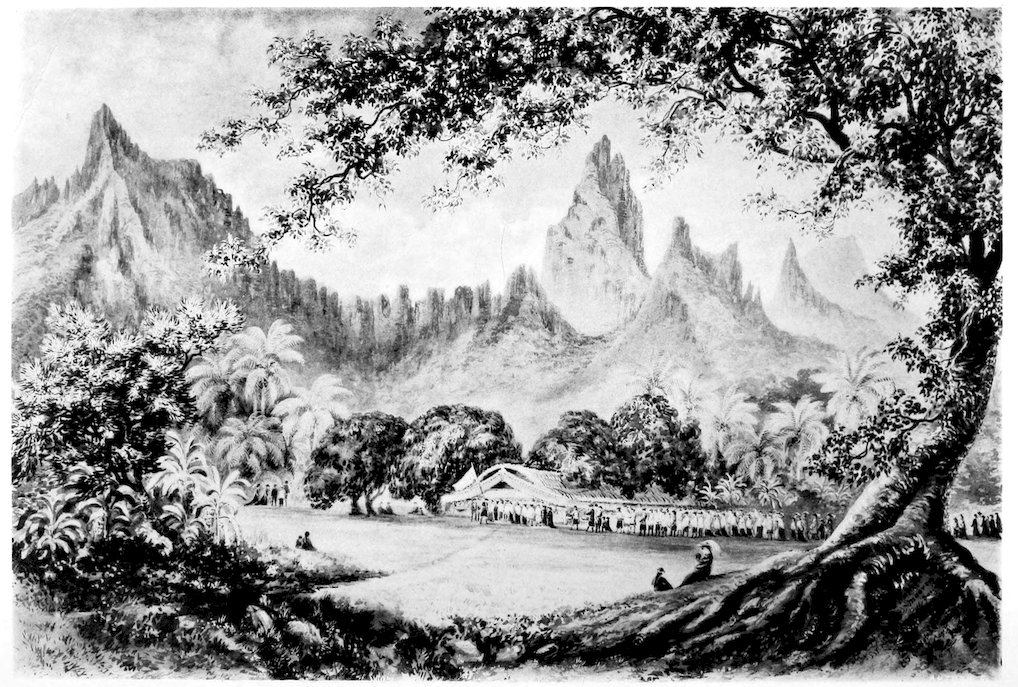
A ROYAL RECEPTION. HAAPITI. ISLE MOOREA.
Shortly before sunset all the people of the district assembled, each with a piece of yellow native cloth thrown over their black dresses like a shawl, to symbolise joy in sorrow. They formed an immense procession, headed by Mrs Brander as high chiefess. She 229was dressed entirely in black, only relieved by a most becoming crown of glossy white arrowroot, with a plume of snowy reva-reva. Immediately after her followed the gentlemen of her family, wearing very beautiful tiputas of bread-fruit bark cloth, covered with ornaments and flowers made of arrowroot and bamboo fibre, and all fringed with the delicate reva-reva. They made an address and sang the himènes of welcome which should have greeted the royalties on their landing. Then the chiefs presented their beautiful garments to the principal persons present, and all the people laid their yellow scarves and pretty hats at their feet. One of the tiputas was intended for me, but as I sat apart to see the general picture, it was unfortunately given to some one else; but Mrs Brander reserved for me a most delicate hand-screen of the finest fibre.
Then followed a great dinner, admirable in every respect, the pretty booth being illuminated by a multitude of Chinese lanterns; and the himène singing, which was continued at intervals all the evening, was particularly good. The sleeping arrangements were less satisfactory, there having been no time to make preparations for so large a party; so my hostess had only reserved one tiny room for herself, two children, two native women, and me. It was a foreign house, with windows. These were tightly closed, and a bright lamp kept burning all night,—both circumstances fatal to all chance of sleep,—so I preferred a shake-down in the sitting-room. Unfortunately, my experience of the luxuries of Tahiti had induced me to travel without my own mosquito-net; and the attacks of these persistent foes, combined with the perpetual movement of locomotive women, incessantly opening the door at my head and admitting a stream of bright light, effectually banished all hope of sleep. It was a night of feverish unrest,—a bad preparation for the morrow.
Again came a hurried morning start in good native boats,—the coast, beautiful as that of yesterday. We had a strong wind and tide against us, and made slow progress. After a severe pull of three hours, we stopped at a point where the rowers landed to rest and get cocoa-nuts; but hordes of mosquitoes attacked and routed 230us, even following us on our way. Finally we landed, and walked the last two miles to Papetoai, on Opunohu Bay, where the Seignelay anchored last night.
Mrs Simpson’s body was brought ashore this morning, and as the people were all too much fussed to mourn their old friend and clerical mother (at least externally), the coffin was carried to the church by French sailors; and they and their officers were the only persons present, besides the immediate relations, at a sort of preliminary service held by M. Brun, the Protestant pastor.
Breakfast, chiefly consisting of omelets which had been cooked at 7 A.M., was not served till noon; and as I had only succeeded in securing a bit of biscuit before starting, I was so famished that one of the officers went to forage on my account, and returned in triumph with a yard of bread! This proved so satisfying, that, craving permission to escape from the formal meal, I returned on board with my old shipmates, and secured a careful drawing of the wonderfully lovely mountains ere the rest of the party came on board. One young sailor came to great grief in trying to climb a cocoa-nut tree—an operation which appears very easy to the expert islanders, but sorely puzzles a foreigner. This poor lad fell from a considerable height, breaking his arm and severely injuring his head. So the kind doctor had his hands full, and no time to enjoy the beautiful scenery.
We steamed round to Pao Pao, commonly known as Cook’s Bay, which is also very fine. Here we left the steamer, and, taking to the boats, rowed four miles to Tiaia, which is a pretty village by the sea. On one side of it there is a splendid grove of glossy-leaved tamanu trees, and a few fine old iron-wood trees—the casuarina—all that now remains of what was once a very sacred grove surrounding the ancient marae. Now the Christian church occupies the site where formerly human sacrifices were offered to the cruel gods. At a distance of about two miles from this village there is a brackish lake—Lake Temae—about a mile in length. It contains good fish, and many wild duck haunt its sedgy and very muddy shores. Under the impression that it was very much nearer, I joined the exploring party. We had to make a détour of some length, and found no beauty to compensate for a very fatiguing walk of upwards of four miles, which, combined with that of the morning, quite finished me. I could not even sit up for the evening himènes, which was a matter of real regret, as the singers here are considered the very best in the group. Several of the women have very fine falsetto voices.
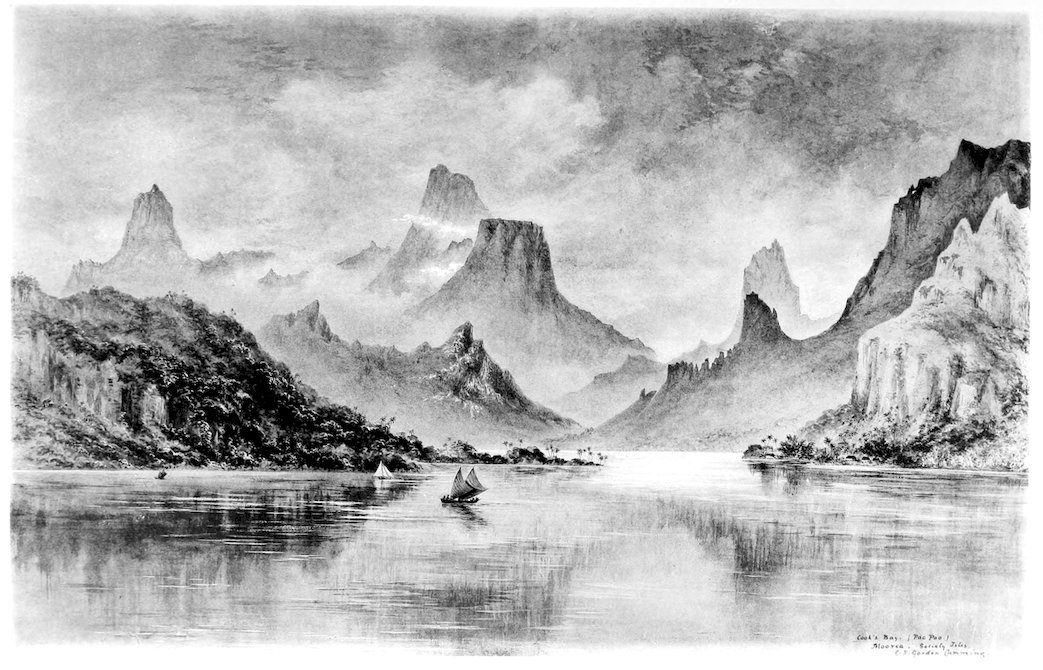
PAO PAO, OR COOK’S BAY. ISLE MOOREA.
231To my great delight, in apportioning our quarters, M. Hardouin, A.D.C., awarded me a tiny house all to myself—the owners kept only the outer room; and when they went off to join the himènes they locked the door to keep their charge safe. Happily one of my friends on the Seignelay had lent me a mosquito-net, so I slept the blessed, dreamless sleep of the weary.
In the morning at 6 A.M., as I was dressing leisurely for 7 o’clock coffee, Queen Marau rushed in to say the admiral was all ready for a 6 o’clock start. Thereupon followed a horrid hurry-scurry to get ready, and a four miles’ row back to the vessel. At 7.30 she was under way, and at 10 A.M. we were at anchor in Papeete harbour.
Altogether this has been a most tantalising expedition, an unsatisfactory hurrying over scenes of surpassing beauty. Mrs Brander says that if I will stay some time longer in Tahiti she will take me back there and let me pasture at leisure in that artists’ paradise. Fain would I linger,—indeed all manner of delightful ploys are proposed, but all involve time, and I have promised to meet Lady Gordon at Christmas, either at Auckland or Sydney, according to what I hear at Honolulu, so I must not lose the chance of the first vessel to the Sandwich Isles.
It has been decided that one of Mrs Brander’s vessels, the Maramma (i.e., the Moon), is to start for Honolulu on Saturday, so that settles the time of my departure from Tahiti. It is also announced that on Thursday the Seignelay is to be sent off to the Marquesas, to convey a force of gendarmes to inquire into some recent outbreaks of cannibalism. Mrs Brander has been most kindly renewing her invitation to me to stay with her till the next trip of the Maramma to Honolulu—a matter of two 232months! It is most tempting, but I feel bound to go. At the band to-night, Mr Darsie, manager of the Maison Brandère, expressed his astonishment that I should lose such a chance of seeing the Marquesas and the Paumotus, adding that the manager of the business for those groups was going to take the trip, and would enable me to see everything to the greatest advantage, and the ship is to return here in a fortnight. Certainly it would be quite delightful, but what is the use of suggesting the impossible?
Early this morning we went on board the Maramma to see the cabin which Mrs Brander has kindly reserved for me—the best in the ship. It made me sad to look at it and to think that it is to carry me away for ever from this supremely lovely South Sea paradise. All to-day we have had a succession of visits from my kind friends of the Seignelay, to urge my giving up Honolulu in favour of Les Marquises, or, if that could not be, to faire les adieux. At the very last came M. de Gironde, who is always my good genius, to try and prove that it was not too late to change my mind, and that his cabin was at my disposal as before. Surely there never was a ship full of such kind people. Of course it would be quite delightful to go and see another lot of beautiful isles; but after all, I suppose they are very much like these, and my brain already feels overcrowded with pictures, each lovelier than the last. So, for every reason, it seems best to stand true to my tryst, and be content with a run to the volcanoes, and then drop down to the comparatively commonplace scenes of Australia or New Zealand.
This has been quite a sad day of farewells. We dined with the Verniers and afterwards went to the admiral’s reception—a very pretty and animated dance.
At nine this morning the Seignelay steamed close past our windows, and great was the farewell waving of hats and handkerchiefs. I grieve to part from the many kind companions of so 233many pleasant days (and of sad ones too); and I would fain be going on with the good ship now, for I sorely regret the approaching end of my travels in these parts.
To-night we dined at Mrs Brander’s. The party included a large number of officers from the Magicienne. It was a farewell entertainment, as Mrs Brander’s son Aleck and Mr Darsie both go to Honolulu in the Maramma (the latter en route to England). They too are going to see the volcanoes; but if they are rightly informed concerning the trips of the little Hawaiian steamer, I begin to have very grave doubts of the possibility of my visiting the southern isles at all, if I attempt to carry out my programme, even supposing we have a fair wind and quick passage to Honolulu, which is more than doubtful.
A wretched sleepless night, worrying over plans. Difficulties always do exaggerate themselves so absurdly if one lies awake. Out at daybreak to get a sketch from the shore. It is all working against time, and my heap of unfinished drawings is a serious nightmare. I have been struggling to get several duplicate sketches finished for various friends, and I feel like a graphic barrel-organ—an unreasoning machine for the multiplication of drawings; and the ever-recurring thought arises, Why not stay and have the delight of working from nature, as the kind friends here advise, when after all it is more than probable that the Christmas tryst will fall through? But anyhow, I have missed the chance of Les Marquises, and it would seem too silly to change my mind now.
Mrs Brander came to-day to say good-bye, but added emphatically, “You’re not gone yet, however!” There’s no doubt that her invitation to stay on is quite bonâ fide; but for two months at least! What a visitation to inflict on any one!
Mrs Miller drove me to call on the Bishop of Axièri, Monseigneur Tepano Janssen, who is most kind and courteous. He showed us all over his grounds, which are literally a garden of acclimatisation, so numerous are the useful plants of other lands which he 234is endeavouring to introduce. It is greatly due to his care that the mangoes of Tahiti have been brought to such perfection. The conversation turned on many subjects of interest. Amongst other things, speaking of the effect of many mingled sounds, he told us of the deafening noise produced by the cries of sea-birds on some of the isles where he has touched, on one of which he witnessed a strange instance of combined action by myriads of sea-birds and herons; the former, diving simultaneously, produced a noise like a thunder-clap as they struck the water. The dignified herons profited by their neighbours’ work, and waited on the shore ready to catch the startled fish as they fled affrighted from the divers.
This evening the admiral invited Mrs Miller, Madame Fayzeau, and myself, to dine on board La Magicienne. She is a very fine old-fashioned frigate, with vast accommodation, splendid broad decks of great length. The admiral has a large dining-room, and a sitting-room the size of an average drawing-room, with four large square windows opening into a gallery round the stern—a charming lounge in fine weather. Commandant Beïque has rooms equally pretty, on the same level, each with a large square window (I cannot call them ports). They are so high above the water that they scarcely ever have to be closed—a true boon in the tropics. I never saw so roomy a ship. With all her big guns, five hundred sailors, and thirty officers, there was no symptom of crowding. Amongst the officers are two belonging to the Peruvian navy, who have come to study the French system of navigation. One of these is remarkable for his diminutive size and extraordinary strength; the biggest men in the ship cannot wrestle with him, nor fight him (in sport).
After dinner we adjourned to Government House grounds to hear the band play, as usual; then all walked back by the shore to the British consulate, for a farewell evening, and finished it here in this sweet homelike nest. I do grieve that it should be the last evening, the more so as I am beginning to believe that what all my friends here agree in saying must be true—namely, that when I made my vague calculation of reaching Sydney for Christmas, it was on the principle of Jules Verne’s ‘Round the World 235in Eighty Days.’ They say that to attempt fitting the Sandwich Isles volcanoes into the time is preposterous folly. I think they are right, but it is too late to change now. What further concerns me is the thought, which had not previously presented itself, that very likely, after all this pushing and scrambling, and spoiling everything by useless hurry, Lady Gordon may have given up the idea, and may stay quietly in Fiji till she is obliged to take the children direct to England,[51] and I may never know this till I reach Sydney.
Another weary night—perplexing and conflicting suggestions—the horrid feeling of being disloyal to a tryst, yet the certainty that nowhere else shall I find such beauty as I am leaving. Those unsketched dolomites of Moorea—those ferny ravines all unexplored—those glorious valleys of bread-fruit—the himènes that I shall never hear again! And every one agrees in telling me that the Hawaiian Isles are not to compare with these in beauty,—that the hills are comparatively shapeless, the foliage poor, the bread-fruit sickly and blighted, the cocoa-palms mere ghosts of their southern relations, and the mangoes miserable fruits, not worthy to bear the same name as the luscious mangoes of Tahiti. They tell me, too, that the people are much less attractive; that they have taken on so much blunt civilisation, that they have lost whatever native grace they may have once possessed. Even the same garment—the flowing sacque—is there worn so short and full that it is scarcely to be recognised, and instead of floating drapery it becomes a mere dress.[52]
Well, I must now begin my packing. There will be time enough for writing before we reach Honolulu.
Jubilate! Jubilate! The Maramma is to start in an hour, but will leave me to revel in South Sea loveliness till her next trip. 236This morning, just as I was putting the finishing touches to my packing—I must confess very much contre-cœur, and quite in the vein of Eve’s lamentation, “Must I leave thee, Paradise?”—up drove pretty Queen Marau and her handsome sister Moetia, who carried the position by assault,—vowed it was not too late to change a foolish plan; so leaving Moetia with her cousin Moë, Marau made me jump into her pony-phaeton and drove me straight off to Fautawa, where her sister Titaua, Mrs Brander, was giving a great entertainment to all her employés, previous to her son’s departure for Honolulu. Then and there she made me recant all my previous protestations and refusals of her most hospitable invitations, and in two seconds all was settled. I am to be her guest till the Maramma returns, and is again sent to Honolulu.
Now that it is all settled, I feel quite satisfied and reprieved; so instead of a long letter written on board ship, I must despatch this as it is. We are just hurrying to the wharf to say good-bye to our friends, and then I look forward to a grand night’s rest, for I am thoroughly tired.
I have been hoping against hope that a letter might reach me here, viâ New Zealand; but the schooner thence is about a month overdue, and it is feared she has gone on a reef. Good-bye.—Your loving sister.
I am certainly very glad that my good friends here supplied the moral courage which I failed to find, and so enabled me to repent at the eleventh hour. I do rejoice in the sense of repose, knowing that for at least two months I may now explore the many scenes of enchantment which lie on every side, without a thought of hurry.
237Yet even this joy is not unmixed. I do find it very hard to be truly philosophical, and not to cry over spilt milk, when I think of the delightful cruise to the Marquesas and Paumotus, which would so admirably have filled up this first fortnight, had I only been able to decide three days earlier.
But it was not till the hospitable ship had sailed, that I found leisure soberly to think the matter over, and to realise how very rare and precious a chance I had so idiotically thrown away. When your eyes are satiated with grand scenery, and each lovely group of isles seems only to differ from the last in its degree of special beauty, you are apt to think that really you have seen enough, and may as well pause and be satisfied with all the exquisite pictures which crowd before your memory. So, when these most kind friends urged me to accompany them on this expedition, I was so absorbed in working up some of the innumerable sketches made on the last trip, that I never took time to think out the subject in all its bearings, and to see how impossible it would be for me to reach Honolulu by sailing-ship, see all the wonders of the Sandwich Isles, and then return to New Zealand or Sydney before Christmas, as I had proposed doing.
Neither did I at all realise how very few travellers have ever seen the Marquesas, and how very little is known about them by the general public, beyond the bare facts of their having been discovered by the Spaniards in 1595, and by them named after the Marquesas de Mendoza, the Viceroy of Peru.
They then seem to have been forgotten till about the year 1777, when they were visited by Captain Cook, who has recorded his admiration of their loveliness, and declared that the inhabitants were the finest race he had seen, “in fine shape and regular features perhaps surpassing all other nations,” “as fair as some Europeans, and much tattooed.” He found fine harbours, from twenty to thirty fathoms deep, close inshore, with clear sandy bottom; good store of wood and water; and at first the natives seemed inclined to receive the strangers kindly, but became less cordial on further acquaintance.
Soon afterwards the London Mission endeavoured to establish a 238station in the group, but found the people such savage cannibals, that the position was untenable, and they were forced to abandon it. From that time forward we have only an occasional record of some American man-of-war having touched there, invariably confirming Cook’s account of the beauty of the people and of the isles.
In 1837 the French sent out an exploring expedition commanded by D’Urville, whose somewhat remarkable official orders were, “d’apprivoiser les hommes, et de rendre les femmes un peu plus sauvages!”
The result of his report was, that the French decided on establishing themselves in the Marquesas, the Society, and the Paumotu Isles. Accordingly, in 1842, an expedition sailed from Brest to effect this purpose, its destination being a secret known only to its commander. The Marquesas were selected as the best centre of operations. A squadron of four heavy frigates and three corvettes, commanded by Rear-Admiral Du Petit Thouars, accordingly astonished the natives by suddenly appearing in the lovely harbour of Taiohae, on the island of Nukuheva; and very soon these simple folk learned the full meaning of the gay tricoloured flags and bristling broadsides.
The ostensible pretext for this invasion was that of reinstating Mowanna, the friendly chief of Nukuheva, in what the French thought proper to assume as his ancestral right—namely, that of ruling over the whole group of twelve isles, each of which had hitherto considered itself as a distinct world, subdivided into many antagonistic kingdoms. However, a puppet-king was the pretext required, and Mowanna furnished it, and was rewarded with regal honours and a gorgeous military uniform, rich with gold lace and embroidery.
Of course he and his tribe of Nukuhevans were vastly delighted, perceiving that they had gained omnipotent allies; and when five hundred troops were landed in full uniform, and daily drilled by resplendent officers, their admiration knew no bounds. They recollected how, when in 1814, the U.S. frigate Essex, commanded by Captain Porter, had refitted at Nukuheva, she had lent them a 239considerable force of sailors and marines, to assist their own body of 2000 men in attacking a neighbouring tribe. The latter had offered a desperate resistance, and repulsed the allied forces, who, however, consoled themselves by burning every village they could reach, thus giving the inhabitants good cause to hate the white men’s ships.
Now, with the aid of these warlike French troops, the Nukuhevans thought themselves sure of victory, with the prospect of retaining the supremacy. But when fortifications were commenced, and the troops surrounded their camps with solid works of defence, making it evident that the occupation was to be a permanent one, a feeling of detestation, mingled with fear of the invaders, gradually increased, and was certainly not lessened by several sharp encounters, in one of which, 150 natives are said to have been slain. However, the reign of might prevailed, and the tricolour has floated over the Marquesas unchallenged from that time to the present.
This appropriation of the Marquesas was immediately followed by that of the Society Isles, whither the admiral proceeded in the Reine Blanche frigate, leaving the rest of the squadron at the Marquesas. He anchored in the harbour of Papeete, and sent a message to Queen Pomare to the effect that, unless she immediately agreed to pay somewhere about 30,000 dollars as an indemnity for alleged insults to the French flag, he would bombard the defenceless town.
The said insults were very much like those offered by the lamb to the wolf in the old fable, the pretext raked up being simply that Queen Pomare and all her people, having already become stanch Christians, according to the teaching of the London Mission, had positively refused to allow certain French priests to settle in the isles, and found a Roman Catholic Mission, with a view to proselytising. These proving obstinate in their determination to remain, had, with all due honour, been conveyed on board a vessel about to sail for some distant port, with a sensible recommendation to pursue their calling on some of the many isles which were still heathen.
The French admiral now insisted that, in addition to paying the 240indemnity demanded, the people of Tahiti should, at their own expense, erect a Roman Catholic church in every district where they had built one for their congregational worship.
The unhappy queen, terrified lest the arrogant Du Petit Thouars should commence bombarding her helpless capital, yet utterly incapable of complying with his unjust demands, fled by night in a canoe to the isle of Moorea, knowing that no decisive action could be taken in her absence. Her best friend and adviser throughout these troubles was the British consul, Mr Pritchard. The admiral, perceiving this, caused him to be arrested and imprisoned. After being kept for ten days in solitary confinement, he was put on board an English vessel out at sea, and forcibly sent away from the islands without a trial or investigation of any kind.
On his arrival in England the British Government naturally demanded an explanation of such proceedings. M. Guizot replied that the French authorities at Tahiti found they could make no progress there because of Mr Pritchard’s great influence with the queen—in other words, his determination, if possible, to see fair play. The French Government, therefore, approved the action of its officials, but promised to indemnify Mr Pritchard for what they themselves described as his illegal imprisonment and pecuniary losses. We have, however, Mr Pritchard’s own authority for the fact that, in the year 1880, he had never received one single sou of the promised indemnity; and England apparently considered it the part of wisdom, if not of honour, to let the subject drop.
So the French pirates (for certainly in all this matter they acted as such) compelled the poor queen and her chiefs to yield to their demands. Some, indeed, strove to make a brave stand, and drive the invaders from their shores; but what could these unarmed warriors do against artillery? They retreated to their mountain fastnesses, but French troops pursued them thither, built scientific forts, and remained masters of the position. The good, sensible queen, who had proved herself so wise a ruler of a happy and peaceful people up to this terrible November 1843, was now declared incompetent to govern. The French Protectorate was 241established,[53] and the Reine Blanche having saluted the Protectorate flag, desired the queen and chiefs to do likewise—an order which they were unable to obey, till the admiral politely offered to lend the necessary gunpowder! Thus was this buccaneering expedition carried out, and France established as ruler in the three groups—the Marquesas, the Paumotus, and the Society Isles.[54] It was a South Sea version of
but in this case the lamb found no deliverer.
242This bare historical outline was literally all I knew about the Marquesas Isles, and I doubt whether you or any one else in England knows much more.
Now that through my ignorance I have thrown away such a chance of visiting them, and also the Paumotus, I am told on all sides that they are the loveliest group in the Pacific, ideal in their beauty—embodied poems; and so I am fuming over my own folly, and telling myself that a traveller who could let slip such a golden opportunity must have reached second childhood, and is no longer fit to wander at large. I try to be philosophical, and not fret over the irrevocable; but of all the scattered leaves that I have yet suffered to float past me on that “stream that never returneth,” none has aggravated me so sorely as this. I am assured on all hands that I should have received a genial welcome from the French governor and Madame —— and their little society, and that the expedition would have been in every respect exceptionally delightful.
As it is, I can only gather a few faint visions of the lovely isles by stringing together such particulars as I can learn respecting them. To begin with, “Les isles Marquises” comprise twelve volcanic isles, thrown up in wildly irregular black crags, the central range of the larger isles towering to a height of 5000 feet, while in many places inaccessible crags rise perpendicular from the sea, but are so exquisitely draped with parasitic plants as to resemble 243a succession of green waterfalls. Not that true waterfalls are lacking. On the contrary, the mountains are furrowed with deep ravines, in each one of which flows a sparkling river of clearest water, fed by countless cascades, which fall from high cliffs, and, uniting in the upper valleys, leap in rushing cataracts over the sheer precipices, by which alone they may reach the lower levels.
Six of these islands are inhabited—namely, Nukuheva, Hiva-oa (commonly called Dominica), Tetuhiva, Tahuata, Uapou, and Uahuna, Of these, the principal are Nukuheva and Dominica.
The former is about 17 miles in length by 12 in breadth—the latter 20 by 7. The population of the group, which a few years ago was roughly estimated at from 15,000 to 20,000, does not now exceed 5000, of whom 3000 are the inhabitants of Dominique. On all the other islands the population was decimated about fifteen years ago by the so-called Peruvian labour trade—in other words, remorseless kidnappers. Smallpox was also introduced by foreign ships, and, as in all new countries where it breaks out for the first time, swept the isles like a consuming fire, leaving to this day the trace of its awful ravages.
It broke out in the year 1863, and quickly spread throughout the group. On the isle of Nukuheva it raged with frightful virulence, and carried off a great multitude. José, a Peruvian convert who had found his way to the Marquesas, and established himself as an evangelist, devoted himself with untiring patience and zeal to the care of the sick, whose panic-stricken friends forsook them, and left him alone to tend that terrible company of miserable sufferers. Single-handed, he buried the dead; but, thanks to his self-devotion, many recovered, and by his good influence were won from their gross cannibalism and heathenism to the faith he so nobly taught them by its practice. But just then the French authorities sold all that district to Stewart & Co., a company of English and French merchants, who converted it into cotton and coffee plantations, and José was ordered to leave!
The new-comers took possession of lands wellnigh depopulated by the terrible smallpox. Silence and desolation brooded over the 244rich and beautiful valleys, where bread-fruit, cocoa-palms, guavas, papaws, and all manner of tropical fruits ripened unheeded, for there were none to gather them.
Thus where a few years ago the natives could be counted by thousands, there are now only scattered villages, thinly peopled.
Happily the ravages of constant intertribal wars are held in check by the presence of the French. In former days the Marquesans were fierce cannibals, and the inhabitants of each lovely valley waged war to the death against all other tribes.
The almost inaccessible mountain-ridges rise from the sea-level, somewhat in the general form of a great star-fish, the space between the arms being filled by verdant and most fertile valleys, where all manner of fruit trees grow luxuriantly, and where the different tribes live, each in its own territory, and well shielded by its natural position from all incursions of its neighbours. For each valley is thus enclosed by abrupt precipitous crags, several hundred feet in height, over which leap cool sparkling rivulets, bringing abundant moisture to irrigate the yam and taro crops, the sugar-cane, cotton, and all the rich herbage which flourishes beneath the dense foliage of bread-fruit and bananas.
Embowered in this green paradise are homes built of the yellow bamboo, whose feathery foliage waves so gracefully in every direction. The houses are thatched with palmetto-leaves, sun-bleached to a dazzling whiteness. They resemble the Tahitian native houses, but are built on oblong platforms of raised stones, such as those which form the foundation of Fijian houses, and which are a necessary protection against the damp of these isles, whose excessive verdure tells of a heavy rainfall. The chief wealth of the people lies in their pigs, which were introduced by the Spaniards, who consequently were venerated as gods. Cats and rats are also foreign importations. The group has literally no indigenous mammalia, and indeed very few birds.
In former years the women manufactured native cloth, as in the other groups, but now a considerable amount of gay calico lends colour to brighten the scene. Here, however, as in other countries, the French prove themselves bad colonists. In most respects the 245Protectorate is merely nominal, and nothing in the way of improvement flourishes.
As I before mentioned, the first attempt of the London Mission to establish a footing here failed signally.
In 1797, two Englishmen—Messrs Crook and Harris—were sent out to try and establish a footing in the Marquesas. Harris found his heart fail at the dangers and horrors of the position, so he returned at once to Tahiti. Mr Crook worked alone for a year, and then returned to England in search of helpers. He does not seem to have resumed his dangerous post for some years, and then merely visited the group. Meanwhile Tahitian converts were sent out as teachers, but without much success, so they returned to Tahiti. Others took up the work, and also failed to maintain their ground.
In 1833, three American missionaries left the Sandwich Isles, accompanied by their wives, and contrived to endure eight months in Nukuheva, endeavouring to tame and Christianise its brutal savages; but they also had to give up the attempt.
In 1834, a fresh party of English missionaries renewed the effort, and struggled on till about 1840, when the London Mission finally abandoned the field.
But in 1853, a Marquesan chief, Matanui, came to the Sandwich Isles in a whale-ship, and requested that teachers should be sent to his people. Thereupon Mr Bicknell, an Englishman, accompanied by four Hawaiian teachers and their wives, agreed to return with him to his island, Fatuhiva. Five days after they arrived, a French brig anchored there, bringing a Catholic priest, who demanded that they should be at once sent away, and declared that the Marquesas belonged to France, and that no English teacher would be tolerated. This statement was at once denied by the chiefs, who refused to dismiss their teachers, though they by no means yielded implicit obedience to their lessons, or even treated them with uniform kindness. Nevertheless the Hawaiian teachers have held their ground, and though discouraged and oppressed, they have continued to work silently but steadily, training native teachers from among their converts, establishing boarding schools, 246whereby to separate their scholars from evil influence at home, organising churches, and, in short, doing all in their power to advance the good cause.
It was felt that a great step had been gained when the oppressive system of tabu had received its first blow by many of the high chiefs coming to a feast at the mission, in company with their wives, as heretofore it had been forbidden for father, mother, or grown-up child to eat one with another—all had to feed apart; and the same senseless prohibitions extended in endless ramifications through all actions of life. Now the system of tabu has fallen into neglect, and the Hawaiian Mission has gained ground, notwithstanding much hindrance from the opposition and interference of the Roman Catholic priests.
Nevertheless, to all intents and purposes, the majority of the people are still savages, and the present mission of the Seignelay is to inquire into recent cases of alleged cannibalism, said to have occurred in the interior of Dominica, where the hill-tribes and fisher-tribes still live at constant enmity. It is said to be the most fertile island in the group, and to have the largest population.
The French governor is supported by sundry officials, and a detachment of about sixty soldiers, a dozen gens d’armes, and a few native police.[55]
247The Catholic Mission consists of a bishop, with a considerable number of priests, and a sisterhood like those on Tonga, Samoa, and Tahiti. The priests work hard, but apparently with small result. It is whispered that the presence of a large number of very irreligious white men has a highly demoralising influence on the natives—as we can well understand; and even the French Government, which took such a lively interest in the introduction of Catholicism to Tahiti, seems to take none in the progress of the mission in the Marquesas.
In the matter of stone and mortar a good deal has been done, well-built churches having been erected in all the principal valleys, in the proportion of one church to every 150 inhabitants. Unfortunately, however, the people show small disposition to adopt any form of Christianity. The queen Viakehu and a few of her household are devout Catholics; and a little flock, who profess to be Christians, rally round each of the missionaries, but the majority continue heathen, with a deeply rooted belief in their old superstitions. I have just received a photograph of one of the Marquesan stone idols, with two of its worshippers. It is singularly hideous, and the head is crowned with a circular capstone, resembling on a small scale the crowns of Easter Island.
But if the Catholic Mission has hitherto failed in its ostensible work, it has at least given the natives a good example of industry; for every available inch of ground within reach of the mission is under most careful cultivation, and is made to grow excellent cotton.
Though the Marquesans are too idle to do any sort of planting beyond what is actually necessary for the cultivation of their gardens, the example set by the mission has been followed by various settlers. Foremost among these is Captain Hart, a man of great energy, who has done much to advance the trading interest 248of the islands, and who on one of his plantations employs forty Chinamen, and about sixty natives of the Gilbert Islands—for here, as in all other places where white men endeavour to cultivate the land, they find it necessary to employ labourers imported from other isles, as they cannot extract the same amount of work from men living on their native soil.
Hitherto only about a hundred Chinese, and as many Gilbert Islanders, have been imported, and cotton is the only article grown expressly for exportation. Of course where cocoa-palms are so abundant, a considerable amount of coppra,[56] is to be obtained; but the natives have unfortunately been instructed in the art of making palm-rum, and trees which have been tapped for this purpose rarely recover their full strength as nut-producers. Happily, in this matter, self-interest leads the colonists to support the missionaries in their endeavours to dissuade the people from thus misusing the palm-trees; but, on the other hand, foreign traders are too ready to supply more fiery stimulants, and drunkenness prevails to a grievous extent.
Nearly all these isles supply one indigenous article of commerce—namely, a kind of fungus, which is much appreciated in China. It looks like dried-up leather, but is not unpalatable when stewed or served in soup. A considerable amount of this is obtained in most of the Marquesan valleys.
Of colonists, properly so called, there are very few. About fifty white men are scattered throughout the isles. Of these, some trade; others cultivate the soil; while a few wander aimlessly from bay to bay, island to island, living upon whatever the natives like to give them: they are either too lazy to work, or too dishonest to find employment. These men include waifs from all nationalities, including Scotch, English, Irish, American, German, Spanish, and Portuguese. Although a French colony, there are only three or four French subjects who can be classed as colonists; but here, as elsewhere, the frugal and diligent Chinaman seems likely to take firm root.
Nukuheva bay (where the Seignelay is probably now anchored) 249is described as surpassingly lovely. It is a perfect harbour, with very deep water, and forms a horse-shoe about nine miles in circumference, ending in two lofty and abrupt headlands. The entrance is very narrow, barely half a mile across, and is guarded on each side by small conical isles, rising about 500 feet above the sea. All round the harbour the greenest of low hills swell in gentle undulations, while behind these rise majestic mountains, whence steep rocky ridges trend seaward, dividing the vast amphitheatre into several distinct valleys, which, narrowing as they ascend, become deep, romantic glens. Here and there snowy cascades, gleaming through the rich verdure, tell where the precipitous crags close in the valleys. Some of these barrier-cliffs rise perpendicularly, to a height of perhaps 1500 feet. So rich is the growth of parasitical plants, which cling to every crevice, that these mighty rugged crags appear only to be green walls surmounted by black basaltic pinnacles and cones, beyond which tower the blue peaks of some of the higher ridges, which occupy the whole centre of the isle, rising to a height of about 4000 feet.
There are in these sheltered vales many old men who, in all their long lives, have never set foot out of their own little boundary. Those vine-clad cliffs have hemmed them in, and the mountain wilderness beyond has offered no inducement to roving. No fruit, no game; only the certainty of excessive toil for no reward, and the possibility of wandering unintentionally within the territory of some other tribe, ever on the watch to slay any imprudent straggler.
The lives of the women have been even more circumscribed, owing to an extraordinary law of tabu, which prohibits a female from setting foot in a canoe; consequently her farthest voyage is regulated by her powers of swimming; and so, when a foreign vessel arrives in port, and the Marquesan nymphs wish to inspect it more closely, they can only do so by swimming. Small wonder if sailors, perceiving those fair-skinned beauties, with their tresses of long black hair floating around them, suppose their visitors to be a company of mermaids! From all accounts many of these girls are really beautiful. In stature they are somewhat diminutive, 250whereas the men average over six feet. As in Tahiti and other tropical climates, the constitution ripens at a very early age, so that mere children may be seen playing with their own babies instead of dolls. Happily the responsibilities of housekeeping do not weigh heavily in these isles, where nature is so generous, the climate so genial, and food so abundant.
I am told that the bread-fruit tree in particular flourishes in the Marquesas to an extent unknown elsewhere, and grows to an enormous size—the ripe fruit, either freshly gathered or in its manufactured form of poi, forming the staple food of the isles.
The Marquesans have the same love of flowers as their neighbours, and the girls vie one with another in producing the loveliest garlands, bracelets, and anklets, sometimes of blossoms and leaves intertwined, but more often of single flowers, plucked from their calyx and strung together on a thin fibre of tappa, while snowy buds take the place of pearl ear-rings. The fragrant white blossoms of a large tree are those most in favour.
But the permanent adornment is that of tattooing, which the Marquesans have brought to greater perfection than any other South Sea Islanders, except perhaps the Maoris of New Zealand, their very fair skin affording a tempting parchment for the artist’s work. The patterns are quaint, and very elaborately worked out in every conceivable variety of curve. Some of the older men are thus decorated from head to foot. Even the face is not spared, a favourite pattern being a strongly marked triangle, the base sweeping across the lips from ear to ear, whence the other lines ascend, crossing both eyelids, to meet on the shaven crown. Other men prefer three broad stripes carried straight across the face,—one across the eyes, a second across the nose, a third sweeping across the mouth from ear to ear. A really well-tattooed man is a sort of walking volume of illustrated natural history, so numerous may be the strange creatures of earth, sea, and air, delineated on his much-enduring skin,—birds and butterflies, fishes and crabs, lizards and snakes, octopi and star-fish, flowers and fruits, all traced in delicate blue lines on a most silky, olive-coloured surface. Those who go in for artistic unity of design sometimes have the stem of some 251graceful tree traced along the spine, while the spreading branches extend on either shoulder and droop down the sides, and delicately traced vines twine spirally round arms and legs, birds and insects appearing among the leaves.
I have been told that in one of the beautiful valleys lying farther round the isle than Nukuheva harbour there are Cyclopean remains, somewhat suggestive of the tombs of the Toui Tongas which we saw in the Friendly Isles. Among the dense groves which clothe the base of the mountain lie a series of vast terraces, each about a hundred yards long by twenty wide, and disposed one above another on the mountain-side, like gigantic steps. They are built of oblong blocks of stone, some of which are fifteen feet long by five or six wide. Though perfectly smooth, they bear no mark of any tool, and are laid without cement. Huge trees have taken root in the crevices, and their interlacing boughs now form a dense canopy above this monument of a forgotten race, concerning which the Marquesans themselves have no tradition. So impenetrable is the growth of vines in that green wilderness, that a stranger might pass the spot—nay, actually cross the terraces by the native track—without observing them. It is another of the mysteries of the stone age.
But, on a much smaller scale, there exist in the Marquesas marais similar to those of Tahiti, which have been the temples and the tombs of the present inhabitants ever since they knew their own history,—and even these are sufficiently large to make one marvel how they could have been erected by a race ignorant of all mechanical arts, and owning only such rude stone implements. Beside the marais there are a vast number of very old stone foundations, similar to those on which the houses are invariably raised, probably telling of a diminished population. The man who, in the present day, wishes to build himself a bamboo house, can therefore appropriate one of these ready-made foundations, and find the hardest part of his house-building already accomplished.
I cannot learn that there is any trace of active volcanic agency now existing in the Marquesas, though in some districts sulphur-springs and mineral waters of various kinds have been found.
252On the island of Hiva-oa (or Dominica), in the valley of Ta-oa, about one mile and a half from the beach, and about 300 feet above the level of the sea, there is a hole two inches in diameter, from which, when the sea is rough, there rises a strongly sulphurous steam, accompanied by a loud noise, like the steam-pipe of a steamer. When the water is smooth there is only a slight noise and no steam, only a strong smell of sulphur.
My attention has just been called to an exceedingly interesting letter from the Rev. Titus Coan, which appeared ten years ago in a Hawaiian paper. He had just returned to Honolulu after visiting the Marquesas in the little mission-ship Morning Star. He speaks of the foreign settlement at Taiohae or Nukuheva, as having been allowed to fall into great disrepair. The jetty, the forts, the arsenal, the fine road sweeping round the head of the bay—in fact, all the former works and improvements of the French—are fast going to decay, and only a few hundred natives, in place of the thousands of a few years earlier.
He was most courteously received by the French bishop, who gave him much information about the people, and spoke hopefully of progress made on the north-west isles of the group, though the pagan tribes on the windward isles, especially on Dominica and Magdalena, were still wild and defiant.
Mr Coan then visited the convent, where the French Sisters devote their lives to the training of Marquesan girls. About sixty girls board in the large airy house, their ages ranging from four to sixteen—happy, healthy-looking girls, lovingly taught by gentle, highly educated French ladies, and everything done to make their lives so cheery, that there may be no hankering for heathen pleasures. Of these girls, Mr Coan remarks that he has rarely seen more perfect specimens of physical organisation, brighter faces, or more active minds, than among the Marquesan children, many of whom are beautiful, bright, and blithesome.
A corresponding school for boys is established, under a French secular teacher.
Though the settlement of Taiohae cannot be reckoned as very “go-ahead,” it certainly sounds as if it might be a singularly attractive 253resting-place—the houses smothered in luxuriant foliage, both indigenous and exotic, ornamental and fruit-bearing; banyan, iron-wood, candle-nut, hybiscus, palms, bread-fruit, orange, citron, lemon, guava, South Sea chestnut, and ever so many other trees, all growing in richest beauty; and every rock and pinnacle is carpeted with mosses and grasses, or festooned with tropical vines. The precipitous crags all around are so thickly clothed, that they suggest green velvet draperies striped with lines of molten silver; these are merry cascades, falling from sources 3000 feet above the valley, and forming three large streams, which dash among rocky boulders on their seaward way.
But Mr Coan seems to award the palm of beauty to the valley of Atuona on Isle Hiva-oa. He says it is a broad, deep valley, umbrageous and peaceful, and watered by a limpid, babbling stream. The trees are magnificent, and the vines run riot in their luxuriance. The great rampart of rocks rising in the background is the highest point of all the islands, and it is usually wreathed with clouds. “The broken hills form columns, spurs, pinnacles, coves, and sharp lateral ribs. Some are round, some angular, some stratified, some laminated, some truncated, some pointed. They lie in all positions—horizontal, tilted, vertical—with heaps of scoria revealing their igneous origin. Rock is piled on rock, hill upon hill, ridge upon ridge, mountain upon mountain—serried, castellated, turreted, ... forming masses of confused harmony, defying all the art of the limner, the pen-and-ink painter, and the descriptive powers of man.”
Now I do hope you sympathise in my ever-increasing regret at having missed my chance of visiting so marvellous a scene of beauty!
The climate, too, must be delightful. It is soft and balmy, and the dense foliage affords such constant shade that even the rays of a tropical sun can only trickle through in bright gleams, while the cooling sea-breeze seems never to fail. Severe storms are rare, and hurricanes unknown in the group. In short, the climate is equable, mild, and wellnigh perfect.
The mission party sailed from one beautiful isle to another, to 254visit the teachers already established, and to bring them fresh helpers. They landed on Uahuna, which, like the other isles, is high, broken, and precipitous. Their arrival was an unexpected joy to the good Laioha and his wife Ewa, who had been settled here about a year previously, and already had made a considerable impression on the people. Laioha blew a loud blast on a horn; and its echoes, reaching the villages nestled among precipices far up the valley, soon brought together about fifty wild men and women—some of whom had already made considerable progress in reading and writing.
At Paumau about a hundred people assembled under the trees, on the beautiful shore. Many carried spears and war-clubs, whaling-spades or shark-spears. Some had the head shaven all over; some in zones and belts, vertical or horizontal; some on one side, some on the other; some with a tuft of hair on the crown, some on the forehead, some on the occiput, and some hanging over the right or the left ear. And thus it was with the tattooing. The wildest taste and most fantastic and capricious figures were displayed upon the face, arms, legs, and over the whole body. Children are not tattooed; females but little, consequently they look like another and a milder race of beings.
To this strange crowd Mr Coan and his friends endeavoured to explain some of the simplest doctrines of Christianity. One old warrior, heavily tattooed, and with closely shaven head, who carried a large green leaf to shade his eyes, was witty and sceptical, and brought up many objections to the new creed. But presently he confessed that it was good, and bade Mr Coan speak also to his chief. The latter, on hearing of a heaven in which there was neither fighting nor hunger, remarked that “it would be a good place for cowards and lazy folk, who are afraid to fight, and too indolent to climb cocoa-palms or bread-fruit trees.” His repartees excited laughter in the crowd; but after a while, he, like the old warrior, declared that it was good, and that he would forsake heathenism.
Pressing the hand of his new white friend, he said, “Kaoha oe,”—“Love to thee.” He became serious and earnest, and listened 255with fixed interest to all the words then spoken; and the meeting only dispersed when darkness overshadowed the land. A fine old lady of eighty, one of the early converts (who at her baptism had added the name of Eve to her own native name of Hipa-Hipa), was brought forward by her friends, and clasping Mr Coan’s hands, placed them on her own silvery head, as she welcomed him for his work’s sake.
The mission-ship next proceeded to Hakahekau, on Isle Uapou, to carry needful supplies to the Rev. S. Kauwealoha, who has laboured for several years among its beautiful valleys and wild cannibal inhabitants. He is described as a man of great energy and activity, both physical and intellectual, with a large and generous heart, ever ready to put head, heart, and hand to any work which will help others, or advance the cause of Christ. His talents are versatile. He can work in wood, iron, stone, and mortar; can build a good house; construct, rig, row, and sail a boat; or act as pilot in all the harbours of the group. He will work bareheaded and barefooted, and can swim and dive in the surf like a porpoise. He is very intelligent, speaks and reads English tolerably, and, by getting hold of an occasional newspaper, he manages to keep up with the current news of the age. As a missionary he is earnest in prayer, energetic in preaching, and firm in principle, and foreigners and natives alike respect him.
While the vessel was landing its stores, its passengers explored scenery of indescribable loveliness. Passing through a valley rich with luxuriant vegetation, they reached a point three miles in the interior, where they commanded a general view of the sublime landscape. “Within a vast amphitheatre of rugged hills, which send down their serrated spurs to the shore, buttressed by bold and lofty precipices, are eight remarkable cones, 200 to 300 feet high, and 50 to 100 feet in diameter, standing as everlasting columns against the sky, giving to the whole the character of a castellated fortress. The fantastic forms produced by the force of ancient volcanic fires, by the abrading action of winds, rain, and chemical agencies on these isles, are amazing.”
Passing on to Isle Futuiva, the vessel anchored in Hanavave 256Bay, embowered in magnificent hills, with towering rocks like lofty minarets guarding its entrance. Mr Coan says the scene was so grand as to be almost overpowering. He rowed for some miles along the wonderful coast, which he believes to be almost without an equal in nature. Rocky cliffs, towering domes, and lofty precipices, rent, grooved, and fluted, everywhere charmed the eye; and from these bold heights, sometimes of 2000 feet, silvery cascades leaped to the sea.
Here and there shaded dells opened along the rocky shore. Small valleys filled with fruit-bearing trees, and murmuring with living waters, appeared as if by enchantment. But all were desolate, for fierce bloody war had slain the inhabitants, or driven them from these Edens of beauty.
For the tribes of Hanavave Bay have waged ceaseless war with those of Omoa, and the latter seem of late years to have had the best of it.
At Omoa (which is separated from Hanavave by dividing ridges of inaccessible crags and precipices), the Hawaiian teachers assembled to meet Mr Coan and his friends. The party consisted of the Rev. S. Kauwealoha, the Rev. J. Kekela, the Rev. A. Kaukau, the Rev. T. W. Kaiwi, the Rev. Z. Hapuku, and Mr T. W. Laioha. The names are characteristic. So is the fact of the Rev. Z. Hapuku going out to meet the ship, by diving through raging surf in which no boat could live, that he might pilot the vessel to another bay, where the boats found a landing-place on a smooth sand-beach; and the visitors were led to the mission-house by an avenue, cut like a long tunnel, through the hybiscus and cotton shrubs.
At Omoa a large proportion of the native converts had assembled for church services. About seventy persons were present. In the morning a new pastor was ordained to the work of the ministry. In the afternoon seventeen adults and two children were baptised, and afterwards the Holy Communion was administered to about forty communicants, nearly all of whom had but a few years, or even months, previously, been reclaimed from heathenism and wild cannibal orgies.
257The schools of Omoa were examined on the following day, and about seventy scholars were found under tuition, of whom fifty-four could read, and many had made some progress in arithmetic and geography.
As if in special contrast to this meeting of the Christians, the heathen Marquesans were engaged in some curious ceremonies, in honour of a celebrated prophetess who had died six weeks previously. Her name was Kauakamikihei. They had built a house for her, 12 feet wide by 24 long, and 48 feet high. On the top of this house they placed a target of white native cloth (there called kapa), and supposed to represent the moon. At this the men fired their muskets, and shouts of triumph greeted the lucky shots.
Afterwards a great company of tattooed savages rushed to the shore, with wild shouts, carrying a sacred canoe, which was covered with a broad flat frame of bamboo, on which was erected a small round house, covered with mats. In this were placed a live pig, a dog, and a cock, also some bread-fruit, cocoa-nuts, and a bowl of poi. The canoe was much ornamented, and rigged with mast, and sail of kapa. With much shouting it was launched, and pushed by bold swimmers through the roaring surf into the open sea, where they left it and returned to shore. The canoe drifted slowly out of the bay, but struck on the northern headland, where it was in danger of being dashed to pieces on the rocks, when a native ran round the harbour and once more shoved off the frail bark, which sailed out to sea with its living freight. This ceremony was a final offering to the god whom the dead prophetess or priestess had served, and closed the season of koina or tabu, which had lasted six weeks, during which all manner of servile work or vain recreation were alike forbidden.
From these frequent allusions to heavy surf breaking on the shore, you may infer that the coral barrier-reef is wanting on most of the Marquesan isles. The fact is, that in many cases, these volcanic crags rise so precipitously, from so great a depth, that the diligent corals have failed to gain a resting-place, and so the sea dashes on the shore with unabated violence.
Strangely in contrast with these picturesque volcanic isles, is 258that other group over which, also, I grieve as over a lost inheritance.
The Paumotus (i.e., cloud of islands)—or, as we used to call it, the Low or Dangerous Archipelago—is a cluster of eighty very flat coral-isles, most of which are of the nature of atolls, some shaped like a horse-shoe, others so nearly circular that only small canoes can enter the calm lagoon which occupies the centre; and some are perfect rings, having no visible connection whatever with the ocean, which, nevertheless, finds a subterranean passage through which the waters rush in a strong current as the tides rise and fall. Such lagoons as these are generally encircled by a belt of swamp, which can only be crossed by laying down pathways of long branches; these act in the same way as huge Canadian snowshoes, and enable the light-footed natives to pass in safety across the treacherous green surface to the margin of the lake, where they keep small canoes in which to paddle about in search of eels and shrimps, and various kinds of fish. The water-supply is generally deficient, and only by sinking wells in the coral-sand can even brackish water be obtained. There are, however, exceptions to this rule, and some isles have good springs. But at best, the people depend greatly on their cocoa-nuts for drink even more than for food, and happily this supply rarely fails them. The coral-bed supplies neither soil nor water sufficient to raise any regular crops. Here and there a sort of caladium with edible root grows wild, but yams or taro are only known as imported luxuries. Forest-trees and scrub, however, contrive to find a living, and form a dense growth over most of the isles; and here and there clumps of carefully cultivated bananas, orange-trees, or bread-fruit, tell of a richer and deeper soil, probably accumulated with patient toil. Fig-trees and limes also flourish.
Some of the lagoon-reefs have a diameter of about forty miles, and only rise above the water in small isles, forming a dotted circle.
I believe it is generally supposed that such coral-rings as these have in many cases been the encircling reef formed round some volcanic isle, which has gradually subsided, whereas the reef-building 259corals have continually risen higher and higher, so as to remain in the shallow water, in which alone they can live, and thus in course of ages the condition of things becomes reversed. The once fertile isle disappears beneath the ocean, whereas the coral-reef, rising to just below high-water mark, gradually accumulates shells and seaweeds; the sea deposits drift of all sorts, and, little by little, a soil is formed which becomes fertile, and presently cocoa-nuts drift from far-away isles, and weeds of many sorts are carried by the birds, or float on the currents, and so the isle becomes fertile—a ring instinct with life, rising perpendicularly from the deep sea on the outer side, and very often on the inner side also.
Where this is the case, and the inner lagoon appears as fathomless as the outer sea, it is supposed that the atoll has been formed on the rim of a sunken crater, colonies of living corals having settled on its surface so soon as it subsided below high-water mark. This theory seems the more probable, from the manner in which you find these circular coral-isles densely clustered in certain localities, and none in other groups, just as in some regions we find innumerable extinct craters covering the whole surface of the land, and can readily imagine that should such a district subside, each cup-like crater might soon be covered with corals.
As in some craters the lava-flow has rent a gap near the summit whereby to escape, and in other craters it has found for itself a subterranean passage, leaving the upper crust unbroken, so in these atolls, some are perfect rings, and the tides ebb and flow within the lagoons by submarine channels, while others have an open passage, deep enough for a ship to sail into the inner lake.
The principal island in the Paumotu group is that of Manga Reva, a cluster of five isles, all within one encircling reef. The main isle is a basaltic mass, rising 2000 feet above the sea-level. It is the most fertile of the group, and is the headquarters of the French bishop and his clergy. The Paumotus have a population of about 5000 persons, the majority of whom are Roman Catholics. They are a fine independent race, and in old days were accounted brave warriors.
260Now a large number make their living by diving for the great pearl shell-oysters, which are found in many of the lagoons at a depth of from ten to twenty fathoms, attached to the coral-rock by a strong byssus—i.e., a bunch of silky golden-brown filaments, which the diver cuts with his knife, and so secures his prize. This silken cable is attached to the muscle of the fish itself, and passes through an aperture at the hinge. An expert diver can remain under water for about three minutes. In some of the isles women are accounted the most skilful divers, especially in deep water, where the largest shells are found, some actually measuring eighteen inches across—such beautiful great shields of gleaming mother-of-pearl.
The pearls themselves are not very abundant, and are generally found in the less perfect shells, the inmates of which are either sickly or have inadvertently admitted grains of coral-sand, which they have been unable to eject. But sometimes the large healthy shells contain one beautiful perfect pearl, not lodged in the muscle in the ordinary way, but lying loose in the shell; and though it is certain that many are lost through carelessness, a considerable number have taken high rank among the noted pearls of the civilised world. I believe that those composing the Empress Eugénie’s splendid necklace were collected in the Paumotus, and that Queen Victoria’s pearl, which is valued at £6000, was also found there. In heathen days all the best pearls were treasured in the idol temples, and some of the early adventurers are known to have made a very lucrative business by exchanging cheap muskets for bags of pearls. The same disease or discomfort which produces these lovely gems often takes a form less valued, but still very beautiful—large distorted pearly lumps, often the size of two joints of the little finger, and assuming all manner of quaint forms, sometimes resembling a human hand. I have seen some which had been set as pins and brooches, which I thought very attractive.
These, however, like the pearls themselves, are the accidental prizes of the divers. The regular article of traffic is the shell itself, which the traders buy from the natives at an average of £15 per ton, and sell in London at an average of over £100. They 261calculate that by hiring divers and working the beds themselves, the shell can be raised at less than £6 per ton. In former years the annual harvest of Paumotu pearl-shell was immensely in excess of the present supply, which is said not to average above 200 tons—the natural result of allowing the beds no time to recruit. Doubtless there are vast beds untouched, at lower levels, where the divers do not care to venture; and it is supposed that the outer face of the barrier-reef is probably one vast oyster-bed, but the bravest divers dare not venture to attempt work beneath the awful breakers.
Certain it is, that the colonies in the lagoons are annually replenished by myriads of infant pearl-oysters, which have been spawned in the deep sea, and which, in the months of December and March, may be seen floating in with the rising tide; tiny glittering shells, a quarter or a half inch in diameter, like fairy coins. Once in those calm waters, the young oysters apparently have no wish again to seek the stormy outer seas, for they are never seen floating out with the retiring tide. It takes seven years for an oyster to attain maturity, so only those which settle in deep water have a chance of reaching a ripe age.
Strange to say, these creatures, which appear to be so immovably attached to their coral-rock, are proved to be migratory. Not only do the closely packed young oysters detach their silken cables and move off in search of more roomy quarters, but even the heavy grown-up shells sometimes travel from one shelf in the coral to another, probably in search of better feeding-grounds. They are singularly capricious in the selection of their homes; in one lagoon they are abundant, and perhaps in the very next not an oyster is to be found: and no attempt to raise artificial beds, even by transporting masses of rock covered with young shells, has ever succeeded, although the surroundings are apparently identical in every respect. Of course they will not settle anywhere near sand, which, by any disturbing cause, might enter their shells, and cause them as much inconvenience as do the innumerable tiny red crabs,—uninvited guests, which take up their quarters in the oyster-shells, to the great aggravation of the helpless owners.
262The lagoons in which these fisheries are carried on are indescribably lovely: marine gardens, in which every detail of beauty is enhanced by being seen through the clearest crystal waters, which lend a glamour as of a magic glass to everything seen through them, whether sea-weed or shell, zoophyte or coral, gliding snake or rainbow-coloured fish. Here and there are patches of pure white coral-sand, which serve to reveal the exquisite colour of the aqua-marine water; while the golden seaweeds appear purple, and the corals seem to vary in hue, according to the depth at which they lie beneath the surface. It is all illusion, for the flowers of the sea are always disappointing when gathered. But there on the coral-ledges lie the great oysters and many other shells, including the huge clam, which is accounted excellent food. The pearl-oyster is only eaten in times of scarcity, as it is very coarse and unpalatable, though not unwholesome.
Diving for clams generally falls to the share of the women; and many a one has met her doom from getting nipped by the ponderous dentated shell, and so held prisoner in the depths, never to rise again. I heard several horrible stories on this subject in Fiji, and here new ones are added to the list. Quite recently a poor fellow fishing on one of the Paumotu atolls dived to the bottom of the lagoon, feeling for pearl-oysters, when he unluckily slipped the fingers of his left hand into a gaping clam-shell, which instantly closed and held him as if in a vice. The shell lay in a hole in the coral, so that it was impossible to reach the byssus by which it was moored in that safe harbour; the wretched man, in agony of mind and of body, severed his own fingers with his knife, and rose to the surface, having indeed escaped drowning, but being maimed for life. There have been other cases when a diver, thus imprisoned, has with greater deliberation contrived to insert his knife into the shell, and so force it open sufficiently to release his other hand.
In gathering clams, the aim of the diver is to stab the gaping mollusc with a sharp-pointed stake, and then with his knife cut the silky filaments by which it adheres to the rock, after which he slips both hands below the huge shell, and endeavours to raise it;—no 263easy matter, considering what ponderous monsters many of the clams are—a single shell making an admirable bath for a child, pure as white marble, and highly polished by nature. In many Roman Catholic churches these large shells are used for holy water. The smaller clams, such as are generally used for food, are often picked up on the reef in basket-loads; and many a careless child has playfully thrust its little fingers into a gaping shell, an invasion promptly resented by the owner. Happily the scream of agony generally brings some friends to the rescue: and strong as is the armour of the poor besieged clam, it offers one weak point to the enemy—namely, the cavity through which the byssus passes; a skilful stab through this aperture causes the inmate to relax its hold, and so the child is released—but many a finger is lost in this manner. The multitude of these shell-fish annually consumed on all the isles is something incredible, and the supply is apparently inexhaustible. It is not generally known that these shells also occasionally yield very valuable and lustrous pearls of peculiar brilliancy.
But the treasury of the sea, which lies safe beyond the reach of covetous human beings, is that clean coral-sand which glimmers far below the coral caves where the oysters congregate, and to which, for untold ages, have dropped the pearls which fell from the gaping shell, when the seven-year-old oyster, having lived his appointed time, melted away in his native brine, and let go the treasures he could no longer clasp. What a dream of delight, even in fancy, to gather up those
I suppose the water-babies of these seas look upon pearls as we used to look on John o’ Groats—probably with less reverence, as being so much more common; and perhaps they are right, for the one was only a disease, and the other a wondrously contrived little home.
One valuable creature which loves the white coral-sand as cordially as the pearl-oyster dreads it, is the black bêche-de-mer,[57] a 264very important item in the harvest of these seas, and one which affords a living to a multitude of white men and brown. There are four different sorts, of which the black is the largest. It resembles a gigantic leech, and grows to a length of about thirty inches. It is a gregarious animal, and is found in companies of brother-slugs wherever the water is clearest and most perfect peace prevails. It is supposed to be blind, and its movements are so slow as to be imperceptible. It has a red cousin, which seems to enjoy tumult and noise as much as the black kind loves calm. Its favourite home is on the outer edge of the coral-reef, where the mighty breakers are for ever raging.
The bêche-de-mer fishers have on the whole rather a pleasant sort of gipsy life. Having chartered a small vessel, they engage a set of natives, both men and women, to work with them for so many moons; and as it is just the sort of occupation which comes natural to these men, they generally have a cheery time of it. They anchor at some favourable spot, probably a desert island, and build a cluster of palm-leaf huts for themselves, another in which to smoke, and so cure the fish and slugs, and to act as storehouse. However rude may be their own shelter, the fish-houses must be made water-tight, lest the heavy rains should beat through, and destroy the precious store.
The men carry with them a store of yams and cocoa-nuts, and trust to their luck for a daily fish supply, which rarely, if ever, fails, and has the charm of considerable variety, including most of the finny tribes, turtles and their eggs, clams, cockles, and other shell-fish—occasionally sea-birds’ eggs are added to the feast. Whatever is caught is supposed to go to be handed over to the native overseer for equal division, that none may hunger. So when the day’s work is done, a delicious bathe is followed by a cheery supper, and then the men lie round bright wood-fires, indulging in never-ending talk or songs, or else dancing quaint savage mékés in the moonlight.
Every morning they start at early dawn armed with long many-pronged forks, to collect the treasures brought in by the tide. If the sea is calm they go to the outer edge of the reef, in search of 265the red bêche-de-mer, which love the sea-foam; but when the surf comes thundering in with mad violence, then the fishers have a quiet day with the black slugs; for these they must dive perhaps to a depth of twelve fathoms.
As I once before mentioned to you, these creatures eject a fluid which blisters the skin most painfully; so instead of carrying them in a basket, it is customary for the fisher to have a miniature canoe which he can drag over the reef by means of a rope, or float on the calm lagoon, should he have occasion to dive; into this canoe he throws all treasure-trove, and when it is full, empties it into one of the larger boats. Noonday is the most favourable hour for the diver, as the sun’s vertical rays then most clearly illumine the submarine depths where he seeks his game.
When a fair supply has been secured, the fishers return to the settlement. Sometimes they busy themselves on the way by cleaning the slugs, which is done by cutting them open with a sharp knife, so as to let the dangerous blistering fluid and intestines fall into the sea. But the more cautious men defer this process till they reach the shore, when they pop the live animals into a boiling caldron, and therein stir them diligently for some minutes, after which they can clean them with greater safety to themselves. They are then transferred to another caldron and stewed for half an hour, after which they are taken to the drying-house, whence they reappear like bits of dry leather, and require to be soaked for several days previous to use.
It is necessary to cook the Holothuria as quickly as possible, because so soon as they are dead they become a gelatinous mass like treacle, with a very bad smell, and all adhere together, so that no use can be made of them. So if caldrons are lacking, native ovens are at once prepared: a hole is dug in the earth, and a fire kindled, whereby stones are thoroughly heated, and on these the slugs are laid, and covered with green leaves and old matting, and earth over all. Thus they are steamed for an hour, till they are dried up and shrivelled, after which each is stretched open with little bits of stick, and laid on the drying stages in the smoking-house, over a fire of green wood, which produces a dense smoke. This 266must be kept up for three days, after which this leathery and uninviting delicacy is packed in palm-leaf baskets ready for the China market. But it must from time to time be spread in the scorching sun to dry it more thoroughly, as any lingering moisture will inevitably reveal itself on the long journey, and the produce of many a month’s hard labour has thus been rendered worthless.
I do not think that bêche-de-mer soup ever finds much favour with Europeans, but I have eaten it myself with much satisfaction, which is far more than I can say for turtle in any form, as prepared in the Pacific. Turtle-steaks sound well, but I cannot say they are nice. I think they are generally cut from turtle which have been roasted whole in native ovens. I believe the scientific cook invariably lays the turtle on its back, that the precious green fat and oil may not be lost; and the prudent housekeeper preserves the surplus of a feast-day, by cutting up slices of turtle-steak, which she stores in cocoa-nut shells, pouring in liquid fat, and tying a heated banana-leaf over the shell, in lieu of hermetically sealing these potted meats. As a good large turtle weighs fully 400 lb. (and some are occasionally captured weighing from 600 to 700 lb.), you can understand that a chief may very well allow himself to store up a portion for the morrow, without depriving his followers of their fair share.
But if turtle-meat is unpleasant, still more so, to my uneducated taste, are turtle-eggs, several hundred of which are sometimes found inside a large mother turtle. But they are generally discovered carefully buried in the sand well above high-water mark. They are quite round and leathery, resembling small white tennis-balls. In the breeding season, the female turtle leaves her mate beyond the barrier-reef, and she comes ashore, alone, at high tide, generally selecting the full moon. Having chosen a suitable spot for her nest, she scratches a large hole in the sand, in the middle of which she digs a funnel, two or three feet in depth, and therein proceeds to lay about a hundred eggs, after which she carefully covers them over with sand, and smooths away all trace of her visit. Then she returns to the reef and there waits for the next high tide, when she rejoins her mate. For some reason best 267known to herself, she generally returns ashore either on the ninth or eighteenth night—a fact well known to the natives, who scan the beach eagerly for the broad track left on the smooth white sand by this midnight visitor.
When poor Mrs Turtle becomes aware of the presence of her natural foe, man, she generally tries to hide, and will lie motionless for hours; but should this hope prove vain, she makes for the sea at railway speed, her flippers acting as paddles, by which she jerks herself along. Should her foe outstrip her in the race, he contrives to turn her over, when she lies on her back more helpless than even a fat sheep in the like predicament.
I daresay that to all of you, in England, the accounts of these South Sea groups sound so much alike, that you can scarcely sympathise with my repining over the omission of a few. But each has its own distinctive peculiarities, which you only realise by living in it for a while, and making friends with its inhabitants.
Therefore I fear that these “lines left out” will remain to me a lifelong regret. They have all the pain that attaches to “truth seen too late,” which is the crown of woe.
I only hope that you will profit by my sad experience, and that should you ever have a chance of seeing the Marquesas and the Paumotus, you will not let it slip. But such luck as visiting a French colony in a French man-of-war does not often present itself!
Already ten days have slipped away since we watched the Maramma sail for Honolulu, and each morning I awake with a feeling of pleasure that I am still in this delightful isle. Would 268that you could look on the lovely scene on which my eyes rest with the first glimmer of dawn, and which now lies outspread before me, as I sit in this cool verandah opening off my large bedroom on the upper storey! It is a verandah all closed in with jalousies, screening its occupants from the outside world; while they, themselves unseen, look down on the brightest, most animated scene you can imagine.
Long before sunrise the pretty native boats, with double sails, arrive from all parts of the isle, bringing their cargo of fish and fruit for the market, which is held in a large building in the town. But as the boats are unloaded, their wares are outspread on the grass just below these windows, and the most active housewives and purveyors for the ships come here to secure the first choice of luscious fruits and of fishes, as beautiful to the eye as they are tempting to the palate. These are of every shade of blue and green, scarlet and crimson, and pale yellow with lilac stripes. The large bright-green fish are generally eaten raw; and occasionally the purchasers, whose appetites are sharpened by the fresh morning air, cannot resist an early breakfast al fresco. The air is balmy and delicious, like a heavenly midsummer morning in Europe; and all the girls have light woollen shawls. (Real Scotch tartans are in high favour, and are worn in true Highland fashion, over one shoulder and round the body.)
The fruit-supply is brought in large baskets. Just now there are quantities of mangoes, oranges, and Abercarder pears (des avocats they are called here, where French permeates all things, as it did in England when the Norman conquerors changed Saxon oxen, sheep, and hens, to beef, mutton, and fowls). But these minor fruits are trifling luxuries. The mainstay of life is the faees or wild banana, which here takes the place of the yams and taro of the groups further west.
I think I have already described this peculiar plant, which bears its enormous bunch of fruit growing upright from the centre of its crown of large leaves, instead of drooping below them, as is the manner of all other bananas and plantains. These clusters vary from two to four feet in length; and I constantly see a bunch so 269long and so heavy, that it is carried to market slung from a pole, resting on the shoulders of two men, just as in the old pictures of the Israelitish spies bearing the grapes of Eshcol, which were the delight of our childhood. It must be toilsome work to carry these weighty spoils of the mountains from the remote ravines where they chiefly flourish.
All these heaps of golden fruit form a brilliant foreground to the beautiful harbour beyond, which at this early hour reflects only the pale, glowing daffodil hues of a cloudless sky, against which the exquisite outline of Moorea stands out in clear relief. Suddenly its delicate pearly grey is flushed with rose colour, as the first ray of the rising sun touches those lofty summits, and veinings of tender blue mark the course of deep glens and corries, or the shadows cast by prominent crags and pinnacles.
Nearer—so near, indeed, that we can distinguish friendly faces on the decks—lie the French men-of-war; and as the light touches them, their dead white changes to cream colour, and they and their unfurled sails, and the clothes hung out to dry, are all reflected in the calm water. So, too, are the various trading ships, and the great hulk of a large iron vessel, which caught fire fifteen months ago when she was near the Marquesas. Her crew took to their boats, and two of these arrived here safely. A good while after, the deserted ship, still burning, drifted down towards here. The Seignelay went out and towed in the wreck. She had been laden with coal, and this had run into a sort of semi-fluid, tarry condition, and to this hour it is still smouldering; and after a shower of rain, steam and smoke still rise from the poor old hulk, which is so red from rust that you would think she had been painted vermilion. It is a vexed question whether she can ever be turned to account, or whether she should not be towed outside the reef, and there sunk.[58]
Just beyond the shipping, inside the harbour, is a small island fortified by the French. The incongruity of ramparts and guns is hidden by foliage of hybiscus and palms; and it forms one item in the beauty of the scene.
270This is the view from the front of the Red House. The back windows look over green mango-trees, and past the spire of the Roman Catholic church, to the great purply mountains of the interior. So you see that, although this big square three-storeyed house of very red brick, encased in closed verandahs, is not in itself an ornamental building, its surroundings are very lovely. And of the kindliness that reigns within it, words fail me to tell. It is an atmosphere of genial cordiality, in which each guest is at once made to feel as welcome, and as thoroughly at home, as any member of the large family. It is a kindness as unconscious, but as real and as delightful, as the balmy air we breathe, and is as purely Tahitian. What would these warm-hearted open-handed people think of the measured cold reception of strangers in our grey British isles?
To begin with, I discovered, on arriving here, that Mrs Brander had actually given me her own charming suite of rooms, to secure my having the fullest enjoyment of the lovely view and of the cool verandahs; so that I virtually am in solitary possession of this whole flat, with its large handsome drawing-room and cosy boudoir. I compare myself to one of the hermit-crabs which curl themselves into desirable shells, to the exclusion of the rightful owners! But my most hospitable hostess will not allow that she suffers any inconvenience; though she and her children have moved downstairs to share one huge room with any number of friends and relations, who spread their soft mattresses and pillows, and very gay quilts, and make themselves cosy for the night, just as the fancy takes them. The fine old mother has a house near, but very often she and the pretty sisters prefer to sleep here: so do sundry cousins and friends. There are also a number of Tahitian women of good birth who find a home, almost by right, in the house of every high chief, and who in return do him, or her, such light service as may be required. But of actual servants, as we understand the word, there are none.
I find an element of great comfort in the presence of an English woman who acts as housekeeper—a most unexpected discovery in Tahiti! She brings my early breakfast of tea and fruit, and otherwise takes great care of me.
271We have a regular European breakfast and dinner, at which, however, only my hostess and her big brothers, with the Belgian manager and a few French officers, generally appear. The others prefer eating à l’indigène, sitting on their mats in another room, or beneath the shady trees; in fact, the native element is pretty strong, which gives this house half its interest. All the connections of the royal family, and a number of pretty demi-blanche girls, dressed in flowing sacques, are continually coming and going; and once a week Mrs Brander has a reception for all the young folk, and for as many French officers as like to come; and they all dance and make merry,—rather more so, I think, than at the admiral’s Wednesday receptions at Government House, which are, nevertheless, very enjoyable.
I had heard the praises of my hostess sung in no measured terms by all the members of the mission, both French and English, as well as by our consul and his family; but only since I have lived under her roof have I realised what a very exceptional woman she is. To the affectionate kindliness of a genuine Tahitian, she adds the Anglo-Jewish strength of character and business capacity inherited from her father; and the combination is one which would be truly remarkable in any woman, but is doubly so in one of the gentle daughters of the South Seas. The born chiefess is revealed in her large-hearted generosity to every creature that comes within her reach; though her extreme unselfishness makes her shrink from any expenditure that seems to tend only to her own comfort. She appears to be always thinking what she can do for other people—rich or poor, in all parts of the group. She has estates scattered all over these isles, and conducts all their business herself, as well as attending to everything connected with the great mercantile house created by her late husband. Though she has many assistants, she is emphatically its head, and not the smallest detail can be carried out without her sanction. Every business transaction, whether with the French Government, or foreign vessels requiring supplies, or her own trading ships, passes through her hands. Everything is done by her special order, and every business paper has to receive her 272signature. But she never seems to forget anything or any one; and, moreover, has time to prove herself a most devoted mother to her nine children—of whom one is married in Valparaiso, another here, some of the sons are at school in Scotland, and the baby daughters are the pets and darlings of this house.
Mrs Brander owns a fleet of about twenty smart trading schooners, which run backwards and forwards between Tahiti and such points as San Francisco, Valparaiso, and New Zealand, carrying the cargoes of all sorts collected by other vessels (of the same fleet) in the surrounding isles and the neighbouring groups.
These cargoes consist chiefly of coppra—that is, dried cocoa-nut kernel, broken into little bits for convenience of stowage on the far journey to England or other lands, where it is subjected to such heavy pressure as extracts the oil, leaving a residue of oil-cake for the fattening of British beeves. For the gourmet of China, quantities of edible fungus and dried bêche-de-mer are sent to San Francisco, whence they are passed on to Hong-Kong. Tons of large pearl-shells, measuring about eight inches across, with beautifully iridescent lining, go to make buttons and such articles, in all parts of the world; true pearls of considerable value are occasionally found in these, and a large number of average size. Of the fruits of the isles, oranges form the largest export, but vanilla, coffee, and various other products swell the list. At one time cotton was a good article of export, but it appears to have fallen into disfavour.
The vessels return from their several destinations laden with every conceivable variety of goods. There is nothing that luxury can desire which does not find its way to these remote isles, from the newest scent to the finest dress materials—not even excepting silks and velvets, though for whose benefit these are imported, passes my comprehension.
Truly wonderful is that compendium of all things needful, known as “a store,” and that of La Maison Brandère is the largest in Papeete. Like “the merchant” of a Scotch village, magnified a thousandfold, the owner of a South Sea store must be ready to supply all the most incongruous demands which his 273customers can possibly invent, from white satin shoes to ship anchors. For he has not only to provide for the island population, but must be ready to supply any ships that happen to come into harbour with whatever they require. Fresh meats and preserved meats, New Zealand beef, Australian mutton, condensed milk and tinned butter, Californian “canned” vegetables and fruits, candles and lamps, oils of various kinds, firearms and gunpowder, hair-oil and brushes, wines and spirits, letter-paper and ledgers, books and framed pictures, cutlery of all sorts—from a penknife to a cutlass, or from a hair-pin to a harpoon—wine-glasses and tumblers, necklaces and brooches, crockery and physic: these, and a thousand other items, are all on hand, and appear at a moment’s notice.
And as the store is the centre of all business, it is a general rendezvous; in fact, a sort of club, where pleasant cooling drinks are not unknown, and where much amusing gossip may be heard, for that is an article not unknown even in Tahiti!
Provisioning large vessels for long voyages is no easy matter here, where all animals have to be imported, as these beautiful hills and valleys afford very poor pasture-land, being all overrun with guava scrub. So shiploads of cattle are despatched from the Sandwich Isles, at very irregular intervals, by sailing ships, which sometimes are detained so long by contrary winds and calms, that the poor beasts are almost starved. The sheep are equally lean; and in fact, pork and fowls are about the only satisfactory meat-supply.
It is hard to think of you all, enduring the miseries of chill November, while we are revelling day after day, and night after night, in an atmosphere of balmy delight and clear blue heavens. Last night we all went to the admiral’s big reception, au Gouvernement, and a very gay scene it was, so many pretty women in very fresh, simple muslin sacques—only a few French ladies adhering to Parisian fashions. The ball-room has an excellent inlaid floor; and as the music is most enlivening, and the French naval officers enjoy dancing quite as much as any of the girls, they kept it up 274with great spirit. Of course the gardens are a very great attraction, and to the non-dancers are the favourite lounge. Good music, pleasant company, warm delicious nights, redolent of fragrant flowers—what more could you desire? Sometimes, when the band stops playing, we go for a moonlight row in the harbour, as far as the entrance through the barrier-reef, just for the pleasure of watching the breakers, and hearing their deafening roar.
This morning, soon after sunrise, M. Viennot called for me in his carriage, and drove me to Papawa, where he has built himself a tiny house, near a lovely bathing-place. We found all the mission families already assembled, with a few other friends, including M. Puèch, commanding Le Limier, a French man-of-war. He at once set his sailors to catch fish for our picnic; and after a preliminary luncheon, we all scattered, to bathe, or stroll, as the case might be.
I went off with a party of half-a-dozen handsome girls, of English and Tahitian birth, descendants of the early missionaries, whose children settled in the group, and married half-whites. They led the way to a delicious stream, narrow, and deep, and clear, and very still, edged with tall bulrushes. They supplied me with a bathing-dress like their own—namely, a pareo of crimson, or scarlet and white calico, which they wore very gracefully draped from the neck. They wove great wreaths of green fern to protect their heads from the sun, and, of course, did not neglect me in the distribution. I thought they formed a most picturesque group.
The stream was so inviting that we determined to follow it up for some distance. But the water, which at first only came to my shoulders, grew deeper and deeper, till I could not feel the ground, and I had to confess my inability to swim. So then these charming naiads clustered round me, and floated me smoothly along, as they swam a good half-mile to the upper stream. It was quite charming. Then they floated me back again, and by the time we rejoined the rest of the party, the sailors had caught a great supply of excellent little fish of many sorts, and we had a most merry feast, after which Commandant Puèch brought me home in his boat; and now I confess to being so tired, that I am 275going to bed, notwithstanding the attraction of a pleasant moonlight expedition in the admiral’s big barge.
The Seignelay returned to-day from the Marquesas and the Paumotu group. She has had a most delightful fortnight’s cruise, and my kind friends on board add to my poignant repentance for having refused to accompany them, by their regrets that I should have missed so excellent an opportunity. They had perfect weather. The voyage going and coming occupied just a week, during which they passed through the Paumotus. The other week was spent at different islands in the Marquesas, and they say that much of the scenery is like the island of Moorea, but greatly glorified. Now, as Moorea is the most unique and beautiful isle I have ever seen, you can imagine how grievous it is to think I should so stupidly have missed seeing one still more strange and lovely.
They also declare that the people are by far the finest race, and the most uncivilised savages, they have ever seen anywhere. They declare that many are still cannibal, and that all are tattooed all over the face and body, while many of the men are clothed only in a kilt of human hair. I think it possible that had they inspected this garment more closely, they might have discovered it to be made of the Rhizomorpha fibre—a glossy black parasitic weed, which is found in the forests, clinging to old trees by means of tiny suckers. It resembles coarse horse-hair, and in Fiji it is greatly valued as a kilt by warriors and dancers. So perhaps in this respect the Marquesans may not differ from our familiar Fijians. But there is no doubt that they are still in that very early stage of civilisation, which is most interesting to the traveller, before all distinctive angles have been rounded off—a process which, when once commenced, progresses with startling rapidity, to the total extinction of all individuality.
Here in Tahiti, for instance, scarcely a trace remains of the aboriginal manners and customs, and it is impossible for the most vivid imagination to conjure up any sort of suggestion of Captain 276Cook’s Otaheiti. Not a trace of tattooing is now to be seen, though in olden days it was practised by almost all Tahitians, both men and women, simply as a personal adornment. Happily they seldom disfigured their faces, but the women tattooed their feet, up to the ankles, and marked bracelets on their arms and wrists. The men sometimes covered the whole body with intricate patterns, often gracefully drawn, as when a cocoa-nut palm was designed on the leg, or a bread-fruit tree, with twining vines, on the chest. Fishes and birds, flowers and fruits, spears and clubs, were favourite subjects; and sometimes a battle-piece, or the offering of sacrifice at the marae, were thus indelibly marked. In the character of subjects selected, the tattooing of Tahiti seems to have been nearer akin to that of Japan than of any other nation, though in this respect, as in all others, the Japanese lend to their work an artistic beauty of their own.
In all other groups, the patterns selected were generally stars or lines. By far the most elaborate designs are those of New Zealand and the Marquesas; but the former invariably adhere to curved lines or concentric circles, covering the whole face, while the latter make broad straight lines all over the body, with occasional designs of animals.
The only Marquesan whom I have seen here is most elaborately tattooed from head to foot, and I am told he is a fair type of his countrymen. All the Maoris whom we saw in New Zealand were so fully clothed, that I can only testify to the very finely marked intricate circles on the faces of the men, and the hideous blue lips of the women. In Samoa the men are so marked as apparently to be clothed in dark-blue-silk knee-breeches. In Tonga only the men were tattooed, the women never were. In Fiji, on the other hand, men were never tattooed; but, for women, a certain small amount was a compulsory religious act.
In all these countries so many idolatrous ceremonies were connected with the process, that it was invariably prohibited so soon as the people professed Christianity. In Japan, where it has hitherto been so practised as to be a really beautiful art, it has been declared illegal by the same police regulations which, greatly 277to the discomfort of the people, insist on every man being dressed from head to foot. But throughout the Christianised isles, including Tahiti, the prohibition was on the score of idolatry, and a law was passed, affixing a graduated scale of penalty for repeated offences; a man was condemned to make so many fathoms of road or of stone-work, and a woman to make so many mats, or so many fathoms of native cloth, for the use of the king and of the governor. Nevertheless, the desire to embellish nature was so great, that many were content to work out the penalty rather than forego the adornment.
There never was a better illustration of the old proverb, “Il faut souffrir pour être belle;” for it was necessarily a painful process, followed by swelling and inflammation, which often lasted for a considerable time, and sometimes even proved fatal. The process was simple: the victim of vanity was made to lie flat on the ground, while the artist sketched his design with charcoal on the skin, which was then punctured by little bundles of needles, made of the bones of birds or fishes, though human bones were preferred. Some were so arranged as to resemble the teeth of a saw, and were used in producing straight lines. Others had but one fine point for giving delicate finishing touches, and for working on such sensitive spots as could not endure the sharper pain. The needles having previously been dipped in a black dye, made from the kernel of the candle-nut, reduced to charcoal and mixed with oil, were struck sharply with a small hammer, thus puncturing the skin, carrying with them the dye, which, seen through the transparent and very silky skin, had the effect of being blue.
The custom of tattooing was certainly widespread. Herodotus has recorded its existence even among the Thracians, of whom he remarked that the “barbarians could be exceedingly foppish after their fashion. The man who was not tattooed amongst them was not respected.” If tattooing was in fashion so near Phœnicia, who knows but that those roving traders may have been the first to suggest to our fair-skinned forefathers the attractions of blue woad as high art decoration?
Not only have such practices as tattooing died out in Tahiti, 278but even the distinctive games of the people have apparently been forgotten,—at least I have seen none played. Yet in olden times there were many national sports; as, for instance, one which exactly answered to golf, and was played with sticks, slightly curved at one end, and a hard ball made of strips of native cloth. Football was formerly as popular in Tahiti as in Britain or Japan, the ball used being a large roll of the stalks of banana-leaves, firmly twisted together. The players were often women, twenty or thirty on each side; and in the scramble to seize the ball, there was as much rough sport as in any English public school. As the games were generally played on the beach, the ball was often thrown into the sea, and followed by the merry crowd with shouts and ringing laughter.
Boxing also found favour with the lower orders; and wrestling and archery were as highly esteemed in Tahiti as in Japan, and, moreover, were equally associated with religious festivals, which probably is the reason of their having fallen into disuse. The dresses worn by the archers, with their bows and arrows, were all considered sacred, and certain persons were appointed to keep them. Before the contest began, the archers went to the marae to perform certain religious ceremonies; and at the end of the game, they returned thither to change their dress, bathe, and restore their bow and arrows to their appointed keeper, before they could venture to eat, or to enter their own homes. The bows in use were about five feet in length; the arrows about three feet, and the distance to which they would fly was often about 300 yards. They were never used in war, nor for shooting at a mark, as in Fiji.
Spear-throwing and slinging stones were games in which a target was always set up, and generally hit with precision; but these were exercises of war, in which the players had abundant practice. The slingers generally formed the advance-guard in battle, and often did much execution. The stones selected were about the size of a hen’s egg. The slings were made of finely braided cocoa-nut husk, or filaments of native flax, with a loop at one end for the hand, and at the other a place for the stone. In throwing, the 279sling was stretched across the back, whirled round the head, and thus the missile was discharged with great force.
But the game which always excited the keenest interest was wrestling. Here, as in Japan, the announcement of a wrestling-match brought together thousands both of men and women, all in their holiday garbs. The wrestlers, like the archers, first repaired to the marae to do homage to the gods; then entering the ring, which was generally on some grassy spot near the sea-shore, they fell to work in good earnest. Sometimes the wrestlers of one island challenged those of another; or else the challenge was from men of different districts. Their dress consisted only of a waist-cloth, and a coating of fresh oil. The moment a man was thrown, the friends of the conqueror commenced to dance and sing triumphantly with an accompaniment of drums; and as the vanquished party raised songs of defiance, the din must have been pretty considerable. However, it subsided the moment fresh wrestlers entered the ring, and the spectators watched the progress of the struggle in dead silence and with intense interest. When the contest was over, the wrestlers returned to the marae to present their offerings to the protecting gods.
Without looking back to classical times and Greek games, it seems strange, does it not, that these very uncivilised savages of the South Seas should have assigned to wrestling precisely the same religious importance as is bestowed on it by the Shintoists of Japan. Possibly both nations retained this sacred game as practised by their common Malay ancestors,[59] from whom, probably, both derived their custom[60] of offering savoury meats, and making acts of homage to their deceased relations; though the Japanese, either from inborn refinement or Chinese influence, place on their domestic shrine only the tablets of the dead; whereas the Tahitian 280preserved the ancestral skulls hidden in the roof of his house.
The perch for fowls,[61] so familiar in the neighbourhood of all Shinto temples in Japan, had its counterpart in the homes of the Tahitian chiefs; though the fowls here do not appear to have been consecrated to the gods, but trained for fighting. The native legends assert that cock-fighting was the most ancient native game, and the birds were reared and tended with the utmost care. No artificial spurs were used, and the belligerents were separated before either was injured. The fights came off at break of day, that the birds might be perfectly cool; and large crowds assembled to witness the contests, which sometimes were carried on for several mornings consecutively.
In tracing all manner of kindred customs in the isles of the North and South Pacific, I observe, amongst minor points, how very widespread is the passion for shampooing,—a friendly office which every old woman in the South Seas seems as ready to perform for the wearied wayfarer as is the professional blind man of Japan; involving an amount of manipulation which I should suppose to be truly odious, but to which many foreigners take kindly, and which seems to find favour in all Asiatic countries.
I take an especial interest in all such links as seem to connect these isles with Japan, because I have a pet theory of my own, that all these fair Polynesian islanders have drifted here by a circuitous route viâ the North Pacific. The commonly accepted notion is, that all the groups in the East Pacific have been peopled by Malays, who found their way here by a directly eastward migration. It is difficult, however, to imagine why they should have come so far, when, in coming from that direction, Australia and New Guinea lay so much nearer to them.
If you open the map of the world and rule a transverse line, passing through the Sandwich Islands in the North Pacific and the Friendly Isles in the South, you will perceive that the groups lying to the east are the Navigators, Fiji, the Hervey Isles, Tahiti, the Paumotu, the Marquesan, the Austral Isles, and New Zealand, 281every one of which is peopled by comparatively fair-skinned races, with hair which by nature is straight and black, although in many of the isles, as in Samoa, custom requires that it should be dyed or bleached, cut short and stiffened, so as to produce the effect of a wig. I am not sure if the spiral curls of the yellow-haired Tongans and Fijians are artificially produced, because I have never seen one individual of either race whose hair had not been dyed with coral-lime; but I know that a Samoan girl who refrains from “improving” nature, finds herself possessed of fine black tresses, as silky and as beautiful as those of any Italian maiden.
To the west of our line lies Melanesia, comprising the Marshall Isles, the Carolines, Solomon Isles, New Guinea, New Britain, New Hebrides, New Caledonia, and Australia. These, almost without exception, are peopled by dark-skinned races, repulsive in their ugliness, and with hair more or less woolly.
All these lie between Eastern Polynesia and the Malay country, and there seems no reason whatever to account for those hardy little warriors passing by so many fertile isles, in search of the unknown region to the east. Surely it is more probable that, having first overrun Formosa, and then peopled Japan, they thence sailed to the Sandwich Isles, and so gradually made their way to the south. We know that in old days their vessels were very much better than those now commonly used by them; and the voyage from Japan to Hawaii, and thence to Tahiti, would have been by no means impossible, especially as the existing strong ocean-currents would naturally tend to draw any ship by this course.
It is said that even a log of wood fairly launched on the Malay coast, would naturally drift by this circuitous water-way till it returned westward to the shores of New Guinea. A glance at a map of ocean-currents will, I think, make this plain to you.
I know that this theory is contrary to that generally entertained; but as the natives of Tahiti have always maintained that their ancestors came from Hawaii (to which they retain the strongest links of family affection, the principal families of the two groups being united to one another by ties of blood), I cannot understand 282why learned men should maintain that Hawaii must really mean Savaii in the Samoan group, concerning which the Tahitians know little or nothing, except what they have learned, by their visits to that group, in the character of native missionaries.
There are many points which seem to me in favour of the circuitous route viâ Japan; such, for instance, as the gradual deterioration in the art of tattooing, in which, beyond all question, Japan excels all other nations, and which in the Marquesas, Tahiti, New Zealand, and, I think, also in Hawaii, retained its graceful character, gradually falling off as it travelled westward to Fiji and Tonga. Many other points of similarity exist, such as the use of the honorific prefix O before proper names, as in Japan, O-yama (Respected mountain), or in addressing any person politely. Throughout Polynesia the same custom exists. Hence early travellers wrote of Hawaii, Tahiti, Samoa, as O-whyhee, O-taheiti, O-samoa; and the same with reference to names of persons.
Another point which to me appears to support the theory of the circuitous movement is, that those best acquainted with Samoan matters assert that, beyond any doubt, the Ellice group, lying far to the west of Samoa, was peopled from thence. It is therefore only natural to infer that the tall, comely race of light copper-coloured people who inhabit the south-east coast of New Guinea (that is to say, due west from the Ellice Isles), probably reached those shores about the same period, and from the same direction. Their women are beautifully tattooed, and their language wonderfully resembles that of the Rarotongan teachers, who have come from the distant Hervey Isles to settle among them as pioneers, sent by the native mission in that far easterly group; in fact, many of their words are identical.
Again, it is a well-established fact that Fotuna and Aniwa, two of the southern New Hebrides, which lie due west of the Friendly Isles, were peopled by the descendants of a party of Tongans, who drifted thither in a large canoe and settled on these uninhabited isles. These islanders have retained their own language, and their children when born are very fair, but as they grow up they become almost as dark in colour as their Papuan neighbours. Their hair 283is of the Polynesian type, and some allow it to grow long and smooth by not dyeing it with lime.
Yet another argument in favour of the migration having originally taken a northward course, lies in the physical development of the race. Surely it is easier to recognise a direct Malay ancestry for the warlike little Japanese, with their reverence for the sacred swords of their demigods, than for these stalwart Polynesians, with their firmly knit, muscular limbs, and stately yet graceful bearing. The race increased in stature, improved in feature, and enriched in colour on their southward way—circumstances doubtless due to more easy and luxurious lives, with better and more abundant food.
Beautiful as is the rich copper colour of these islanders, their own ideal of beauty, as showing pure blood, consists in possessing a very fair skin; and I have often been amused, when sketching, by their anxiety to be represented several shades lighter than nature, not from any wish to resemble foreigners, but evidently as embodying their tradition of good ancestry. They by no means despise the use of cosmetics to bring about so desirable a result: the Marquesan women, for instance, though naturally of a light copper colour, contrive to make their skin almost white by an application of the root of the papawa tree.
That modifying circumstances may produce such changes, both in stature and complexion, is now, I suppose, generally admitted; in fact it is almost certain that in some cases where barren atolls (such as the Kingsmill or Gilbert group, on the equator) have from accidental circumstances been peopled by descendants of these splendid men they have degenerated beyond recognition, and are now a short, spare, and generally ugly race. Naturally, the change from unbounded supplies of nutritious vegetable diet—bread-fruit, bananas, cocoa-nut, yams, sugar, and all the luxuries of the tropics—to isles where a coarse meal, prepared from the woody fruit of the pandanus, is the only edible form of vegetable, has in due time produced this result. Therefore it seems perfectly reasonable to infer that the converse occurred when an under-fed aggressive race, engaged from their cradles in piracy and strife, found themselves 284at rest in these Capuan isles, and there yielded to the habits of indolent ease, which they so naturally engender.
Yet to this day the chief characteristics of the Malays are common throughout Polynesia. In each of these groups a truly Asiatic code of wearisome, elaborate ceremonial is observed on every possible occasion; the smallest breach of etiquette is considered a crime; a joke of any sort, especially of the nature of “chaff,” is an unpardonable offence; in speech, flowery compliments which mean nothing and veil thought are the rule—slow, deliberate oratory, in which the best speaker is he who can talk for hours without touching his point, and then condense all he wishes to say, in a few pithy words.
All these islanders are distinguished by a natural grace and courtesy of manner—sometimes dignified, at others most winning; yet under extreme external politeness they have often nursed schemes of cold treachery and cruelty, which they have carried out unscrupulously to the bitter end. (I speak, of course, of the islanders as they were by nature, ere the mellowing, transforming influence of Christianity had dawned on the South Seas.) But to this hour the Polynesians, like the Malays, are, as a rule, careless, easy-going, impassive beings, generally light-hearted; all fatalists, as a matter of course; strangely indifferent to physical pain, whether endured by themselves or inflicted on others; but when once roused to fighting-pitch, wholly uncontrollable in their blind mad fury.
But the strongest proof of their Malay descent lies in the similarity of their various languages, both to one another and to the mother tongue. It is not merely a likeness in general construction, but many words are almost identical, as you may gather at a glance from the following vocabulary. In short, the whole subject is extremely interesting, but is one which I must leave to the discussion of learned folk, whose wise disquisitions you can study at your leisure.
| 285 | |||||||||||
| English. | Malay. | Niua and Vaté, New Hebrides. | New Zealand. | Rotumah. | Fiji. | Tonga. | Samoa. | Raratonga. | Marquesas. | Tahiti. | Hawaii. |
|---|---|---|---|---|---|---|---|---|---|---|---|
| Heavens | Langit | Rang | Rangi | Lang | Langi | Langi | Langi | Langi | Ani | Ra’i | Lani |
| Rain | Ujan | Ua | Ua | Uas | Utha | Uha | Ua | Ua | Ua | Ua | Ua |
| Fire | Api | Afi | Kapura | Reh | Bukawanga | Afi | Afi | A’i | Ahi | Auahi | Ahi |
| Head | Ulu | Uru | Matenga | Filou | Ndluna | Ulu | Ulu | Mimiti | Upoko | Upoo | Po’o |
| Eye | Mata | Mata | Kanohi | Math | Mata | Mata | Mata | Mata | Mata | Mata | Maka |
| Ear | Telinga | Teringa | Taringa | Falinga | Ndalingana | Telinga | Taringa | Taringa | Buaina | Tari’a | Pepei ao |
| Teeth | Nihi | Nifo | Niho | Al | Batina | Nifo | Nifo | Ni’o | Niho | Niho | Niho |
| Arm | Lima | Lima | Ringa | Siu | Lingana | Nima | Lima | Lima | Iima | Rima | Lima |
| Die | Mati | Mate | Mate | Akia | Mate | Mate | Oti | Mate | Mate | Pohe | Make |
| Come | Omai | Fano mai | Haere mai | Leum | Lako mai | Hau | Omai | Tae | Amai | Haere mai | Hele mai |
| Stone | Batu | Fatu | Maka | Hoth | Vatu | Maka | Ma’a | Toka | Kea | O fa’i | Pohaku |
| Water | Vai | Vai | Wai | Voi | Wai | Vai | Vai | Vai | Vai | Vai or Pape | Uai |
| Cocoa-nut | Nyu | Ono | ... | Niu | Niu | Niu | Niu | Niu | Eehi | Haari | Niu |
| Fish | Ikan | Ika | Ika | I’e | Ika | Ika | I’a | Ika | Ika | I’a | Lawaia |
| House | Bali | Fare | Whare | Ri | Vale | Fale | Fale | Are | Fae | Fare | Hale |
| Woman | Perampuan | Fafine | Whahine | Hoien | Alewa | Fefine | Fafine | Vaine | Vahine | Vahine | Wahine |
| Man | Orang | Tangata | Tangata | Tha | Tamata | Tangata | Tangata | Tangata | Euata | Tane | Kanaka |
| Drink | Minum | Inumia | Inu | Iom | Ngunu | Inu | Inu | Inu | Inu | Inu | Inu |
| Canoe | Sampan | Vaka | Waka | Tafang | Wanka | Vaka | Va’a | Vaka | Vaka | Va’a | Kau |
| 286 | |||||||
| Here are the Numerals. | |||||||
|---|---|---|---|---|---|---|---|
| English. | Malay. | Samoa. | Fiji. | Rarotonga. | Marquesas. | Tahiti. | Hawaii. |
| One | Satu | Tasi | Dua | Ta’i | Tahi | Tahi | Kahi |
| Two | Dua or Lua | Lua | Rua | Rua | Ua | Rua | Alua |
| Three | Talu | Tolu | Tola | Toru | Tou | Toru | Akolo |
| Four | Ha | Fa | Va | A | Fa | Ha | Aha |
| Five | Lima | Lima | Lima | Rima | Ima | Rima | Alima |
| Six | Onoma | Ono | Ono | Ono | Ono | Ono | Eono |
| Seven | Pitu | Fitu | Vita | Itu | Fitu | Hitu | Ahiku |
| Eight | Walu | Valu | Ualo | Valu | Vau | Varu | Auala |
| Nine | Siwa | Iva | Thewa | Iua | Iva | Iva | Aiwa |
| Ten | Sapuloh | Sefulu | Tine | Ngaulu | Onohn’u | Ahuru | Umi |
| Eleven | Sepuloh dua | Sefulu Lua | Tine ka kua | Ta’au | |||
| Twenty | Ruapuloh | Lua Fulu | Rua sang a vula | Elua ngaulu | Eua onohu’u | Iwakalua | |
We have had a very gay week, including several festivities on board the three French men-of-war now in harbour. On Saturday I was invited to dine on board Le Limier, with the Greens, Viennots, and Verniers. (In case your French fails you, I may remind you that a limier is a blood-hound; a fact which I only recollected on seeing canine heads on all the boats.) M. Puèch is a good friend of the French Protestant Mission, and his visit to Tahiti is a happy event for all its members. After a pleasant dinner, we sat on deck to hear the sailors sing, and then went off in small canoes for a nearer sight of the pêche à flambeaux, which was going 287on in every direction near the reef—the flashing torches and dark figures of the fishermen forming a most picturesque scene.
Another day we breakfasted on board Le Seignelay, and in the afternoon a large party assembled on La Magicienne to see the boat-races. A pretty sight, and seen from a beautiful and most luxurious ship.
On Wednesday, the admiral held his last reception at Government House, at which there was a very large attendance; and Mrs Brander had most mirthful dances here on Monday, and again last night. The latter was a farewell, and I fear that to many of the young folk it was really a very sorrowful one.
This morning we watched La Magicienne steam out of harbour on her way to Valparaiso. The admiral leaves a pleasant vice-governor in M. D’Oncieue de la Battye, who is happily allowed to retain the excellent band till the arrival of the new governor; when the Seignelay is to convey him and it to Valparaiso. So the Tahitians find some consolation in this arrangement.
I think our Sundays would seem to you rather a curious medley, so I will give you a sketch of to-day from morning till evening. I was, as usual, awakened at 5 A.M. by the chattering of many voices, as the boats discharged their cargoes of fruit and rainbow-coloured fish beneath my windows. It was an exquisite cloudless morning, and I was seized with a sudden impulse to follow the crowd to the market, which hitherto I had only seen in its deserted afternoon aspect.
Passing by roads which are called streets, but are rather shady bowers of yellow hybiscus and bread-fruit trees, I entered the covered market-place, where were assembled as gay a throng as you could wish to see, many of them dressed in flowing robes of the very brightest colours; for the people here assembled are chiefly le peuple, whose days of ceremonial mourning for their good old queen are drawing to a close; so the long tresses of glossy black hair, hitherto so carefully hidden within their jaunty little sailor 288hats, are now again suffered to hang at full length in two silky plaits, and hair and hats are wreathed with bright fragrant flowers of double Cape jessamine, orange-blossom, scarlet hybiscus, or oleander. Many wear a delicate white jessamine star in the ear in place of an ear-ring. The people here are not so winsome as those in remoter districts. Too much contact with shipping and grog-shops has of course gone far to deteriorate them, and take off the freshness of life; but a South Sea crowd is always made up of groups pleasant to the eye; and a party of girls dressed in long graceful sacques of pale sea-green, or delicate pink, pure white, or bright crimson, chatting and laughing as they roll up minute fragments of tobacco in strips of pandanus or banana to supply the inevitable cigarette, is always attractive.
The men all wear pareos of Manchester cotton stuff, prepared expressly for these isles, and of the most wonderful patterns. Those most in favour are bright crimson with a large white pattern, perhaps groups of red crowns on circles of white, arranged on a scarlet ground, or else rows of white crowns, alternating with groups of stars. A dark-blue ground with circles and crosses in bright yellow, or scarlet with yellow anchors and circles, also find great favour; and though they certainly sound “loud” when thus described, they are singularly effective. It is wonderful what a variety of patterns can be produced, not one of which has ever been seen in England. With these the men wear white shirts, and sailor’s hats, with bright-coloured silk handkerchiefs tied over them and knotted on the ear; or else a gay garland.
On entering the market, it struck me that many of the sellers must have taken up their quarters over-night, for their gay quilts and pillows lay near, as they sat on their mats snatching a hasty breakfast of fruit or raw fish.
The latter is always in favour. Little fish or big fish of certain sorts are swallowed with apparently the same delight as you might hail a basket of ripe cherries; in fact, a green banana-leaf full of skipping shrimps, is a dainty dish for any pretty maid, who crunches the wriggling creatures with her gleaming white teeth, or lets them hop down her throat with the greatest coolness.
289The fish here offered for sale are of every sort and size and colour. Large silvery fish, flat fish; long narrow fish with prolonged snouts, excellent to eat; the au or needle-fish, with long sharp-pointed head; and gay scarlet and green and blue fishes of every colour of the rainbow. I have seen gaudy fish in many tropical seas, but nowhere such brilliancy as here. There are rock-fish of all sorts, bonito, good fresh-water salmon with white flesh, eels, mussels, turtle, clams, echini, prawns, red and white cray-fish, &c., &c. Sometimes the market has a fair supply of poultry, turkeys, fowls, pigeons, and wild duck,—generally a few live pigs, which are carried hanging from a pole and squealing pitifully. They are very good, and clean feeders, being allowed to wander at large, and find themselves in cocoa-nuts and bread-fruit. The enterprising Chinamen, as usual, improve the vegetable supply, especially in the matter of what I venture to call Christian potatoes, in opposition to the indigenous potato, alias yam.
Every one brings to the morning market whatever he happens to have for sale. Some days he has a large stock-in-trade, sometimes next to nothing. But, be it little or be it much, he divides it into two lots, and slings his parcels or baskets from a light bamboo-pole which rests across his shoulder, and, light as it is, often weighs more than the trifles suspended from it,—perhaps a few shrimps in a green leaf are slung from one end, and a lobster from the other, or, it may be, a tiny basket of new-laid eggs balanced by half-a-dozen silvery fishes.
But often the burden is so heavy that the pole bends with the weight—of perhaps two huge bunches of mountain bananas—and you think how that poor fellow’s shoulder must have ached as he carried his spoil down the steep mountain-path from the cleft in the rugged rock where the faees had contrived to take root. These resemble bunches of gigantic golden plums. As a bit of colour they are glorious, but as a vegetable I cannot learn to like them,—which is perhaps as well, as the native proverb says that the foreigner who does appreciate faees, can never stay away from Tahiti.
As you enter the cool shady market you see hundreds of those 290golden clusters hanging from ropes stretched across the building, and great bunches of mangoes and oranges. These last lie heaped in baskets, among cool green leaves. Sometimes a whole laden bough has been recklessly cut off. Pine-apples, bread-fruit, cocoa-nuts, all are there, and baskets of scarlet tomatoes, suggestive of cool salads.
But tempting above all are the luscious mangoes, whose thin skins are ready to burst at a touch, and yield their treasure of delight to thirsting lips. Purple, or golden, or pale yellow, long-shaped or egg-shaped, I know not which to prefer; each in turn seems more delicious than any other, and the only difficulty is to stop feasting before the basket is empty! If Tahiti owns no other debt of gratitude to France, she at least has to thank a French governor for this excellent fruit, which is now so thoroughly acclimatised, that it has attained a perfection rarely equalled in any other country, and, moreover, grows so luxuriantly and bears fruit so abundantly, as to form an important item in the food of the people.
Returning from the market to a pleasant early breakfast on the cool verandah, I rested in luxurious quiet till the bells of the Roman church close by, summoned the faithful to the nine o’clock service, which I generally attend, in preference to walking in the heat to the large native Congregational church—“le temple Protestant”—where the long service, in a tongue to me unknown, is a weariness of flesh and spirit. Moreover, it lacks the picturesque element which was to me so attractive in the simple Fijian churches, where soft mats are the only furnishings required. Here the congregation are penned in hideous pews, which make it difficult, if not impossible, to kneel—a natural attitude of worship, which, in the early days of Tahitian Christianity, was as common as it now is in Fiji, but from which the modern Tahitians refrain in church, as savouring of Romish ritual!
At the Catholic church, the bishop preaches half in French, half in Tahitian, that all his hearers may carry away some message in their own tongue; and the singing by the French Sisters and their school-children is always sweet and harmonious. I cannot say the 291congregation is large—merely a small handful of natives; such of the French as are compelled to be present at all, having already been in official attendance at the eight o’clock military Mass, which is to me a very distasteful form of worship. I think that good Père Collet looks on me as rather a hopeful convert; but I tell him I only appear as the representative of my naval friends, who all consider church-going in any form as altogether unnecessary, neither officers nor sailors ever attending service since our arrival here.
After church, we went to breakfast on board Le Seignelay, and then to see Queen Marau, whom we escorted to the Government House gardens, where we were joined by several friends. The great attractions there are two newly arrived Russian bears, passengers by Le Limier—nice brown beasts, and very tame.
We returned here just in time for the family dinner, from which, as usual, Mrs Brander and I made our way to the evening service at the little Congregational chapel, at which only a tiny handful of the foreign residents assemble. All the members of the Protestant mission officiate by turns, in French or English; and this evening M. Vernier conducted the service in admirable English. But a strong counter-attraction is offered by the pleasant gardens, where the band always reserves its most attractive programme for Sunday night; and we catch tempting snatches of lovely operatic airs as we walk homeward by the hybiscus-shaded lanes.
Last Monday the whole party moved out from Papeete to this lovely country-home. It is a delightful bungalow, built by Mr Brander—a cool one-storeyed house, with wide shady verandahs; a pleasant garden, bright with summer flowers; masses of cool shade; and a clear, beautiful river, which affords a dozen delightful bathing-places of varied depth, so that every one can select a spot according to his own heart’s desire. All the family and their friends can swim like fishes, so of course they prefer the deep pools, and have a favourite spot just below the house, where they disport 292themselves joyously at all hours of the day; and the first hospitable offer made to callers, is that of a pareo and towels, that they may at once enjoy this most refreshing luxury.
I, being a foolish non-swimmer, and moreover somewhat ungregarious, have discovered a bathing paradise for myself some way further up the stream, where the interlacing boughs of cool blue-grey hybiscus foliage form an immense arbour—a dressing-room of leafy shade, through which the gurgling waters flow gently, with rippling, liquid, most musical tones—the voice of hidden streams. Here a rivulet leaves the main river, and its sparkling waters play over a thick velvety carpet of the softest, greenest mosses, forming the most delightful couch you can imagine; while from the leafy canopy overhead drop pale lemon-coloured blossoms, which float idly down the stream; and from the wild guava bushes I can pluck any number of ripe guavas, or, to be still more luxurious, I may gather luscious mangoes on my way from the house. Can you wonder that so fascinating a bower is not only my first attraction at early dawn, but a favourite retreat at all hours? Sometimes I end the evening with a moonlight bathe, but am inclined to think that this is imprudent, as it is always followed by a feeling of chill, though the water and air both feel warm and delicious.
My hostess has presented me with a couple of sacques like those worn by all Tahitian ladies. They are the perfection of dress in this climate, being so delightfully cool. They are literally flowing garments, for they only touch you at the shoulders, and thence fall in long loose folds. So when the first ray of light gilds the high mountains in which this lovely valley lies embosomed, I slip on one of those simple dresses, and start barefoot across the dewy lawn and by the grassy paths that lead to the stream. Going barefoot is only a preliminary stage of bathing, for the grass is saturated with moisture, and an early walk across a field is about equivalent to walking knee-deep through a river.
Curiously enough, it is to this heavy night-dew that the royal family of Tahiti owe their name of Pomare, which literally means “night cough.” About four generations back the king chanced to be sleeping on the mountains and exposed to the penetrating dew 293which brought on a troublesome cough. His followers spoke of the po mare, and the sound of the words pleased the royal ear; and thenceforth the king adopted this euphonious but singular surname, which has since been borne by each crowned head.
This very odd custom of adopting a name to commemorate some simple event, was common to a good many of the isles. Mr Gill mentions such names as “Lost son,” adopted by the king of Mangaia when his son had been stolen; a title retained long after the lad had been restored. Another man took the name of “Deal-coffin,” because a relation had been buried in a sailor’s chest. One chief desired to be always called “Press me,” because those words had been uttered by a dying grandchild when in pain; and another was called “Dim-sight,” because his grandfather suffered from weak eyes.
This pleasant country-home is about three miles from Papeete, and various carriages are ready after early breakfast to convey the gentlemen to town, whence some return to late breakfast, others not till dinner-time. But all day long, people come and go on divers errands of business or pleasure; and the drive is so pretty as to be in itself quite an enjoyment. In short, life here is altogether easy and luxurious, combined with most captivating simplicity.
The already large family party has been increased by the arrival of a third big brother, Ariipaea, who has been for some time living on another of the islands. Mrs Salmon and the pretty young sisters, and several friends, are also staying here, a most loving “family-pie.” To Narii this happy valley has an additional charm, for it is also the home of a certain charming “Mademoiselle Cécile,” whom he hopes ere long to include in the family circle.
This morning early, Ariipaea drove me here, where it had been arranged that I should meet M. Brun, the pasteur of Moorea, and accompany him to his beautiful isle. We were to have taken passage in one of a small fleet of Moorea boats, which arrived here some days ago in order to build a district house, which shall henceforth 294be the regular headquarters of all Mooreans who have occasion to visit Papeete. The house was finished this morning, and the event was notified by a most deafening beating of native drums, after which all the boats set sail, very sensibly objecting to lose the fair breeze by any delay. M. Brun arrived in time to see them flying before the wind, like a flight of white butterflies.
I solaced myself by commencing a careful study of a noble bread-fruit tree, overshadowing Queen Moë’s house, when suddenly a cry was raised that an English man-of-war was signalled. Great was the excitement that prevailed, as it is fully four years since the British ensign was last seen in this harbour, and there was a general chorus of disappointment when it was found that the visitor was only a small sloop, H.M.S. Daring; a disappointment, however, which was followed by great rejoicing, when it became known that she was the forerunner of H.M.S. Shah, Admiral de Horsey’s flag-ship, which is to arrive here in a few days. Already the small society of the place is in a ferment at the prospect of so important a visitor; and the arrival of about fifty English officers will compensate for the departure of the French flag-ship. So all manner of hospitalities are already under discussion, as we gathered from the general conversation at the band this evening.
I shall leave this letter to go by H.M.S. Daring, in case she sails before I return from Moorea; so shall bid you good-bye for the present.
I am safely ensconced in this most charming little home, and very glad indeed to have reached it, for we have had rather a tiring day. Mrs Green most kindly gave me breakfast at five, that 295I might be ready for a six o’clock start; but it was fully eight before we got away, in a Haapiti boat, which agreed to bring us to this side of the island. We rowed out of harbour, hoping to catch a breeze, but it fell dead calm, and for four long hours we lay just outside the reef, rocked by heavy rollers—the water smooth as oil, and the burning heat of the sun so intense that I almost expected that the water would really frizzle! The thermometer at this season sometimes rises to 120° in the shade. I am afraid that if the truth must be confessed, both M. Brun and I were exceeding sea-sick.
At last, to our great relief, a fresh breeze sprang up, and our little boat literally flew over the water, and in less than two hours carried us across to the pretty village of Tiaia, in the district of Teaharoa, whence one hour’s rowing inside the reef, along the most lovely shore, brought us here, where we were welcomed to this sweet French home by its pretty clever little mistress, and three charmingly old-fashioned children, Lucie, Henri, and Adrien, who administered refreshing hot tea to the tired and giddy travellers; after which I, for one, yielded to peaceful sleep, and awoke to find the watchful little trio all ready to escort me in any direction, and show me such treasures of delight as only true country children can discover. This is a fairy-like nest, on the shore of the loveliest sea lake, with wooded mountains all round, and a background of mighty rock-pinnacles, which are glorified in this evening light, and seem like the towers and ramparts of some celestial city.
To me this has been a day of intense peace. A silence which may be felt seems to enfold this exquisite spot, and from morning till evening not a ripple has disturbed the perfect calm of the blue waters—only the light fronds of the cocoa-palms quiver and gleam with every faint breath of air.
The village is perhaps a quarter of a mile from the house, and lies buried in a thicket of bread-fruit and mango-trees. There my hosts have spent the greater part of the day, having held four church services, and morning and afternoon school. But I have rejoiced in a day of quiet idleness, spent chiefly on the lovely shore 296beneath the shadow of very large trees, whose great boughs overhang the white coral beach,—shell-strewn and crab-haunted. At high tide the silvery waters creep upward till the far-spreading roots are half bathed in the brine, while the other half are buried in a tangle of lilac marine convolvulus, wherein myriads of hermit-crabs disport themselves.
Madame Valles came to breakfast. She is the daughter of that dear old lady Mrs Simpson, of whose death I told you in a former letter. Her husband is a retired French naval officer, who has settled in this beautiful valley as a planter.
This evening several members of the congregation met here to hold a prayer-meeting, after which they sang most harmonious sacred himènes—the very first I have heard since I was last on Moorea.
I have rarely in any land seen a nicer and more thoroughly respectable-looking body of people than these; so gentle and courteous in their manners, and apparently so reliable. I fancy that in this secluded isle the people have retained more of their primitive Christianity than they have done in Papeete, where French influence and utter infidelity are continually acting as a leaven of evil, and where the fervour of first love is certainly a thing of the past, as regards the mass of the population.
Such at least is my own impression, seeing only the surface of life, and naturally comparing things here with the very high standard now existing in Fiji, which has been my home for the last two years. The impulsive children of the South Seas are readily influenced for good or for evil; and as they quickly and whole-heartedly turned from their idols to embrace the purer faith taught them by devout white men, so now they are in danger of becoming even more careless than the average foreigners. I do not, however, mean to imply that the Tahitians or any of the islanders who have once adopted Christianity, have yet fallen away from its practice, so far as the bulk of the people in any European nation. In such matters as meeting for family prayer, and thanksgiving at meals, probably a much larger proportion of Tahitians than of Britons are still true to their early teaching.
297It really is very difficult, in presence of such peaceful, kindly people, and such settled forms of civilised Christian life, to realise what different scenes were witnessed by the earlier visitors of this lovely isle at the time of its discovery by Captain Wallis in 1767, and Captain Cook’s subsequent visit.
It was in March 1797 that the first band of missionaries arrived here in the Duff, landing on Tahiti near Point Venus, where at first they were kindly welcomed by King Pomare, Queen Idia, and the chiefs, who seem to have expected that they would prove not merely sources of wealth, by distributing barter, but also able assistants in the art of war.
But when the new-comers were found to be men of peace, and their mission that of teaching, they soon fell in the estimation of the natives, and for many years they struggled, apparently in vain, to stem the tide of idolatry and of such evil practices as infanticide and the offering of human victims to the feather-gods, as the Tahitians called their idols, because they were generally adorned either with the scarlet feathers of a small bird, or the long tail-feathers of the man-of-war or tropic bird.
As quicksilver attracts gold, so was it supposed that this gay plumage became the very incarnation of the god; therefore, when a tribe went forth to war (and of course desired that the presence of their god should be with them) they held a solemn service at the temple, and then took perhaps only one feather from off the principal idol, and placed it in the ark prepared for it on the sacred canoe, which formed part of every fleet. Then, till the close of that expedition, all worship was addressed only to the feather-symbol, and no sacrifices or prayers were offered at the marae, lest the attention of the god being divided, he should return to the land, forsaking the warriors.
At other times, however, he was present alike at every domestic shrine which possessed a feather brought from the great temple. For, as other nations have carried sacred symbolic fire from the altar, to sanctify their domestic hearth or their family temple, so did these Tahitians year by year assemble at the great national temple, bringing with them offerings of the precious feathers. 298These the priests deposited inside the hollow idols, distributing among the worshippers those which had lain there since the previous year, thereby imbibing such essence of sanctity as to convey the very presence of the god wherever they were carried.
Not that those were the only visible symbols of the gods. Some appeared to their worshippers in the form of sharks; others, less terrible, took the form of divers birds. Hence, as I described to you in one of my letters from Samoa, so here in Tahiti and Moorea, the herons, kingfishers, and woodpeckers which frequented the old trees round the temples, were reverenced as incarnations of the deities, and their cries were interpreted as oracles.
So strong was the hold of these superstitions, that for several years the mission seemed to make little or no progress beyond the establishment of gardens in which various imported fruits and vegetables were successfully raised, and the people were taught to cultivate them systematically for their own use. Orange-trees, limes, shaddocks, citrons, tamarinds, guavas, custard-apples, peaches, figs and vines, pine-apples and water-melons, pumpkins and cucumbers, cabbages and other vegetables, were thus first introduced to the island, where they are now so thoroughly acclimatised.
But in an evil hour a great intertribal war broke out for the bodily possession of Oro, the national idol, and this first civilising influence was swept away—the mission premises were laid waste, the garden entirely destroyed, and the work of twelve years scattered to the winds.
King Pomare, Otu his son, and all the chiefs and warriors of the isle, had assembled at the great marae at Atehuru, where many fatted pigs were offered on the altar, while the surrounding trees were adorned with the ghastly corpses of human victims, all of whom had been sacrificed to Oro. The ark containing the symbolic feather was then placed on the sacred canoe belonging to the royal fleet.
But on the following day Otu pretended to have had a revelation that the idol itself wished to be removed to Tautira; and on the chiefs of Atehuru refusing to allow this, his followers rushed to the temple, seized the idol, carried it off to the sea, and immediately set sail. As soon as they reached land a human sacrifice was 299ordered, lest Oro should resent this very cavalier treatment; and as no captive was at hand, one of the king’s own servants was slain, and offered as an atonement. Of course the despoiled chiefs flew to arms, and prepared to revenge themselves, and recapture their god. About 300 warriors came from the isle of Eimeo, now called Moorea, to the aid of the king, and bloody battles were fought, in which the chiefs’ army was almost invariably successful.
There does not appear to have been any trace of cannibalism on either side, but the bodies of the slain were offered in sacrifice to Oro by the victors; while, on the other hand, the king’s party did not cease offering human sacrifices, and propitiating the idol by every means in their power. It was recaptured by the chiefs of Atehuru, who, however, with singular religious chivalry, allowed the king to land and deposit his offerings near the temple, though they naturally would not admit him within its precincts.
Happily for the mission party, it so happened that just at this crisis a trading vessel came into harbour and landed some men; and about the same time another small vessel was driven ashore, with a crew of seventeen Englishmen. Thus they mustered a force of twenty-three Europeans, who not only put the mission-house into a state of defence, but lending their aid to the king, rendered him material aid—a service which they must have regretted on seeing that all prisoners of war were immediately put to death, and their bodies savagely mutilated. Finally, the chiefs agreed to resign the custody of the idol to the king; and so, for a while, ended one of the many bloody struggles by which the various nations of the earth have drained their heart’s blood for the possession of some bit of so-called sacred wood or bone.
Thenceforward the young King Otu carried the precious god with him, whenever he sailed from one isle to another; and the sacred canoe on which its ark was borne, was always deposited at some marae shaded by sombre trees, from whose boughs human victims offered sacrificially were immediately suspended.
While such scenes as these were the incidents of daily life, the mission party had hardships enough to contend with. Five whole years elapsed without either letters or supplies reaching them from 300England. Their clothes were worn out, boots or shoes were wellnigh forgotten superfluities; tea and sugar were among the luxuries of the past. At last a small vessel arrived, specially chartered to bring the letters and supplies which had for so long been accumulating at Port Jackson. Imagine the rapture of seeing that little vessel arrive; and then the dismay of discovering that almost everything she had brought was either useless from having lain so long at Port Jackson, or saturated with salt water owing to the wretched condition of the ship. You who live in luxury at home, with everything of the best, and plenty of it, and with so many daily posts as to be a positive nuisance, cannot possibly realise the weariness of that long waiting, or the depth of that disappointment.
Nor was there anything cheering in daily life. The mission work seemed to make no progress at all; the people openly mocked the white men, and despised their teaching.
In 1808 war broke out again more savagely than before. The altars of Oro reeked with human blood; villages were burnt, plantations destroyed, and the whole country reduced to desolation and ruin. The mission settlement was ransacked, the houses burnt, the books distributed among the warriors to be used as cartridge-paper, the printing-types melted to make musket-balls, and every implement of iron found on the place was converted into a destructive weapon. The gardens were again demolished, and the students, finding the din of war more congenial than the arts of peace, joined their brethren in arms.
Finally, feeling that their lives were in imminent danger, and that there was apparently nothing to be gained by remaining, the mission party resolved to abandon Tahiti; and taking advantage of a vessel which happily arrived in harbour, they embarked for Port Jackson, two only, Mr Hayward and Mr Nott, resolving to remain at their several posts and face the worst—the former at Huahine, the latter at Eimeo, to which King Pomare had fled from his enemies. Various attempts were made on their lives, happily without fatal result; and they continued to work as best they could till the year 1812, when, at the invitation of King 301Pomare, those who had been driven away from Tahiti returned, and made a fresh effort to establish the mission on Eimeo.
They were cordially welcomed by the king, and by a small number of chiefs, who, by Pomare’s words and example, had been brought to look with contempt on their idols, and to incline towards the new faith; and though greatly distracted by intertribal wars, this little company resolved to build a substantial house which should be set apart for the worship of the true God. Thus in the summer of 1813 was the first Christian church in the group erected in Papetoai, the very place whence I now write.
Thirty persons came forward to make public profession of their faith, desiring to have their names enrolled as having rejected idol-worship. Among those who did so was Patii, the high priest of the district, who came to Mr Nott, and announced his intention of publicly burning all the idols in his care. It was a promise heard with thankfulness not unmingled with dread, for there was every probability that such an act would lead to wild excitement among the heathen, and might possibly result in a massacre of the Christians. However, Patii had made up his mind, and at the appointed hour he and his friends collected a heap of fuel on the sea-shore, near the huge marae where he had so often offered human sacrifices to these dumb idols, which he now brought forth, and tearing off the sacred cloth in which they had hitherto been draped, he exhibited them in their hideous nakedness, to the vast multitudes who had hitherto assembled at his bidding to do them homage, and who had now come to witness this act of impious sacrilege.
Some of these ugly little gods were rudely carved human figures, and some had tiny figures carved in relief all over one large image; others were shapeless logs of wood, covered with finely braided cocoa-nut fibre and scarlet feathers; while some were angular columns of basalt, quite rough, just as they had been found. One by one were these once dreaded idols cast into the flames by their former priest, who called on the people to behold their helplessness, and bewailed his own folly in having hitherto worshipped such monstrous objects.
302Whatever may have been the feelings of the spectators, the dreaded tumult was averted, and the people dispersed quietly; indeed the example thus given was followed by many, both on Eimeo (it is now called Moorea) and also on Tahiti, to which two members of the mission—Messrs Scott and Hayward—now again ventured to cross. Great was their joy when they found that several of the natives had renounced idolatry and were earnest worshippers of Christ, having been awakened by some words of King Pomare to an exceeding longing for a better faith and purer life than that of their fathers. Glimmerings of light had also found their way to the Paumotu and other neighbouring isles, and by the close of 1814 there was reason to believe that a total of nearly 600 persons had renounced idol-worship and were feeling their way towards the Light.
Naturally, such a movement was not viewed with satisfaction by the great mass of the people. Everywhere the Christians were persecuted by their heathen neighbours, who burnt their houses, destroyed their gardens, spoiled their goods, and even hunted them down, that they might offer them in sacrifice to the insulted gods. At all times it was customary to tell off certain families or tribes, from which the appointed victim-hunters were to select fit subjects for sacrifice; and so numerous were those thus eligible, that on some isles about one-third of the population lived in terror for their lives, not knowing at what moment their doom might be sealed. In many cases whole families forsook their homes secretly, and started in their frail canoe to seek a new home on some unknown isle, preferring to risk the dangers of the sea, and the chance of being eaten by strangers, to the certainty that sooner or later their turn must come to be offered in sacrifice to their cruel gods.
How this terrible doom first came to be attached to any family I cannot say, but, once decided, there was no escape. From generation to generation the black shadow hung, like the sword of Damocles, over each member, from the grey grandfather to the mere stripling. As he went about his daily work, chatting with his most trusted neighbours, one of the latter might open his hand and reveal the small sacred stone which was his death-warrant, 303delivered by the priest to the man who craved some special boon, as a symbol that the god required a human sacrifice. Well did the doomed man know how useless was resistance. His neighbours knew no pity, and a brief struggle invariably resulted in his being clubbed and carried to the marae.
Now the supply of victims was furnished from among those known to favour the new faith; and many a pathetic story is still told of the unflinching courage with which those brave martyrs met their fate, only pleading with their murderers that they too should renounce their idols and worship the living God.
As in the early days of the Church, so now, homes were divided: the believing wife was beaten by her heathen husband, children were driven from their parents’ roofs, and friends were turned to foes—all in the name of the gods.
Those who worshipped the Saviour were distinguished by the name of Bure Atua (from bure, to pray, and Atua, God).
In spite of the persecution, their numbers steadily increased, and at last three of the principal chiefs of Tahiti, who had hitherto been sworn foes, resolved to unite their forces for the total annihilation of the Bure Atua sect. A midnight meeting was appointed when the conspirators were suddenly to fall on their sleeping, unsuspecting neighbours, and slaughter great and small. Happily, a few hours before the massacre was to have taken place, the Christians received a secret hint of what was in store for them, and were able to reach the shore, launch their canoes, and sail for Eimeo. When, at the midnight hour, their foes reached the trysting-place, and found their victims flown, their rage knew no bounds, and angry recriminations commenced, which soon passed on to blows, ending in a free fight, in which one of the principal chiefs was killed, and his followers compelled to fly.
In those turbulent days, it needed but a beginning to kindle a fierce war, and so it now proved. The heathen tribes having fallen out amongst themselves, seemed to forget their enmity to the Christians, and fought blindly among themselves. Beautiful and richly cultivated districts were reduced to desolation, houses burnt and property plundered, and numbers of the vanquished fled to Eimeo, 304to join the king and his party. Finally the weaker tribes fled to rocky fortresses in the mountains, leaving one tribe—the Oropaa—masters of the whole island.
These presently sent messengers to those who had taken refuge in Eimeo, inviting them to return to their homes in Tahiti. This they agreed to do; but, according to native custom, King Pomare accompanied them to reinstate them in their lands. With him came a very large train of followers, who were chiefly Christians, and when they approached the shore of Tahiti, the pagan party refused to let them land. However, that point was yielded.
On the following Sunday, about 800 of the king’s party assembled for divine worship. Happily they had taken the precaution of assembling armed, for in the middle of service a firing of muskets was heard, and a large body of men, bearing the flags of the gods, and all emblems of idolatry, were seen marching towards the place where they were assembled. Very striking is the story of that day’s contest. When the enemy was seen approaching, King Pomare arose and bade all remember that they were under the special protection of Jehovah, and that, having met to worship Him, they must not be diverted from their purpose. So all stood up to sing the accustomed hymn, then knelt in united prayer. They then formed themselves into three columns, the women taking their place among the men, resolved, like them, to fight with spear and musket. Thus they awaited the attack of the foe. The battle-field was a strip of ground between the sea and the mountains, covered with patches of brushwood. Under cover of these, the Christians again and again throughout the day knelt by twos and by threes to crave the help of the Almighty. After some hours of desperate fighting, Upufara, the highest chief of the heathen, was killed. His party were so disheartened that a panic seized them, and they fled from the field, never pausing till they reached their strongholds in the mountains.
Thus the king’s party remained in undisputed possession, and prepared, as in old days, to follow up their victory. But King Pomare had learnt a new lesson in war. He forbade any of his people to pursue the vanquished, or to enter their villages, either 305to plunder the gardens or molest their wives and families. He, however, selected a trustworthy force, and bade them march to Tautira, to the temple of Oro, and totally destroy both temple and idol, and everything connected with the old worship. At eventide he bade the chiefs call together the congregation which had been so ruthlessly disturbed in the morning, and all knelt together in solemn thanksgiving for their great deliverance from so strong a foe.
The party whom he had despatched on so righteous a mission of destruction, carried out his orders implicitly. They turned neither to the right hand nor the left, till they reached Tautira, where they fully expected that the priests and people would make a stand in defence of their gods. They, however, met with no opposition from the crowds, who stood silently round while they entered the temple, hitherto held so sacred, and bringing out the idol, stripped him of his coverings, and exposed a rude unhewn log, about six feet long, of casuarina wood. Having utterly destroyed the temples, altars, and other idols, they carried off the rude log which for so many years had been the national god of Tahiti, and for the possession of which the land had, during the last thirty years, been made desolate by incessant wars. It was now turned to better use as a post in the king’s kitchen from which to suspend baskets of food. Eventually it was cut up for firewood.
The effect of the king’s clemency to the vanquished was magical. At first it seemed to them utterly incomprehensible; but when, under cover of night, some ventured from their hiding-places, and found their homes and families all undisturbed, and learnt that the bodies of the slain had received honourable burial, instead of being given to the dogs and pigs, and that the king had proclaimed a free pardon to all, then one by one they came down from the mountains to tender their submission to the merciful conqueror, and to learn from him the secret of such new principles. Then they agreed that the faith which inspired such deeds was assuredly the best, and with one accord they determined to destroy all their idols, and desired that the king would send messengers to instruct them in the good way.
306Accordingly, those who had themselves been most diligent in learning, were sent to teach these new inquirers, and proved faithful and earnest in their work. But so great was the demand for teachers, that they were altogether unable to meet it; and in many a remote village, the people, having destroyed their idol temple, built a new house of prayer, where they met together to worship the God of the Christians, concerning whom they as yet knew so little, beyond the mercy practised by His followers.
From this time forward, Christianity made steady progress; and when, in the year 1817, Mr Ellis arrived as a missionary in these isles, he found almost the entire population professing it, and apparently devout in their practice. Family worship was established in all the principal houses; and many had built in their gardens a small oratory, or, as they called it, fare bure huna—the house for hidden prayer.
Already the grosser crimes of heathenism had been abandoned—especially the practice of infanticide, which had prevailed to so frightful an extent. In every district the schools were crowded, and those who had mastered the arts of reading and writing assisted in teaching those less advanced. Strange pictures presented themselves in these classes, where bright, intelligent children were often the instructors of aged men and women, priests and warriors, to whom learning was a hard task, but one which they were determined to master, that they might read for themselves the wonderful book which had taught such wisdom to their king.
These were in truth earnest scholars. The only books that had as yet reached them, were a spelling-book, printed in England, and a summary of the Old and New Testaments, printed at Port Jackson. But of these there were few copies: and many of the people, in their anxiety to possess one, had prepared sheets of fine paper-mulberry fibre, on which, with a reed-pen, dipped in the sap of the banana-tree, they had carefully copied out whole pages of the reading-lessons, or fragments of the sacred Scriptures. Others had committed the whole to memory.
Great, therefore, was their excitement and delight when Mr Ellis arrived at Afareaitu, bringing with him a good printing-press. 307Crowds besieged the printing-office day and night, to watch the progress of setting up the types,—the king himself preparing the first alphabet. His delight when the first sheet was struck off, equalled that of his people; and all felt that it was a marked day in the history of Tahiti, when her king, with his own hands, printed the first page of the first book published in the South Sea Isles.
The binding of the volumes was the next interest. The supply of millboard was small; but again the fibre of the paper-mulberry was turned to account, several layers being pressed together to form a stiff pasteboard, which was then coloured with the purple dye obtained from the mountain-plantain; or else thin wooden boards were used, and covered with the skin of whatever animal could be procured,—goat, cat, or dog: and the new art of tanning was among the earliest industries of the isle.
Hitherto all books circulated in the isles had been distributed gratuitously, but it was deemed wiser for every reason, henceforth to exact a small payment in cocoa-nut oil, which was the article most easily obtained by the people. So great was their anxiety to purchase the books, that there were sometimes as many as thirty or forty canoes drawn up on the beach, having come from different remote villages, and having each brought several persons, whose sole object was to procure the precious volume, not only for themselves, but for others. Some who were thus commissioned, were the bearers of huge bundles of green plantain-leaves, each rolled up like a parchment scroll, and being, in fact, a written order for a copy of the book, payment for which was sent in the form of a bamboo measure filled with oil. Many of these messengers waited for several weeks ere the copies could be supplied; and some of the more urgent refused to leave the mission premises till the books were delivered to them, lest other men should slip in before them and carry off the coveted treasures.
When we consider that teachers were so few, and worshippers so numerous, and that many large congregations assembled in the chapels they had built for Christian prayer, firmly believing that HE in whose name they had met, was there present; yet having 308none to lead their worship, save, perhaps, a newly converted priest of Oro, or a professional dancer, hitherto sunk in every form of vice,—we can the better understand the extreme anxiety of the people to possess the books which were the storehouses of excellent knowledge.
Have you ever realised the innumerable difficulties under which these early publishers had to contend? To begin with, they had themselves to reduce barbarous and hitherto unknown tongues to a written language,—no easy matter, considering that many of these dialects are so rich as to possess far more words to express shades of meaning than any European language.[62] So, beginning with the alphabet, they had to work out equivalents for words in which the slightest change of accent conveys totally different meanings; then they had to puzzle out very intricate grammatical structures, and, having mastered all this, had to commence the very difficult work of translating so large a book as the Bible—a book, moreover, treating of spiritual truths which it was hard indeed to render comprehensible to such very materialistic minds as these.
Yet in the short space of about thirty years, the Scriptures have been translated into about twenty different languages, all previously unknown; and there is not one group throughout Polynesia, the people of which do not now read the Scriptures in their own tongue. The same good work is now gradually extending throughout Melanesia also; and even New Guinea, which, ten years ago, was an unknown land, has already received portions of the New Testament in the language spoken by at least one of its tribes.
Considering the extremely volatile nature of these light-hearted people, the exceeding earnestness with which they seem to have entered into the requirements of a spiritual religion, is very remarkable. They had, however, been early trained to a belief in the necessity of whole-hearted attention, and reverence in the worship of their idols. It mattered not how large and costly might be the offerings, and how careful the ceremonial, should the priest omit, or even misplace, any word in the appointed prayers, or should his attention be diverted, the prayer was unavailing; 309other victims must be brought, and the whole ceremony repeated from the beginning.
So, too, the rigid observance of the Jewish Sabbatical laws seemed a natural requirement to a people who, from their infancy, had been taught implicit obedience to the laws of tabu, or sacred seasons, when, at the bidding of priest or chief, no fire must be kindled, no canoe launched, and neither food nor drink might be tasted, under severest penalties. When, therefore, the early missionaries declared one day in seven to be strictly tabu, and themselves gave the example by abstaining from every sort of secular employment, even preparing their own food on the previous day (which was hence called the mahana maa, or food-day), the natives willingly obeyed, and proved themselves capable of such close and continuous attention to spiritual subjects as the majority of Christians nowadays would find wellnigh impossible.
So, too, with the custom of saying grace before eating, which is so strictly practised by all the converts in Polynesia. It was the more readily adopted because, in heathen days, no morsel might pass the lips of any member of the family till the chief person present had offered a portion to the gods, adding a few words of prayer for their protection and blessing. In some instances they chanted a form of thanksgiving for the good things received, as being the gift of the gods.
I have written this story of old days somewhat at length, from a conviction that it is probably almost unknown to you, and must surely prove interesting, though I am fully aware that it cannot be so to you in the same degree as it is to me, who have heard the story for the first time on the very spot where those terrible scenes were formerly enacted, and where the marvellous change was actually wrought.
Another long day in scenes of dream-like loveliness. Early as I always awaken, the little trio were astir before me, waiting in their bathing-dresses to escort me to the shore, dancing joyously as sunbeams, and most carefully pioneering my path through the shallow water, so as to avoid the very unpleasant chance of treading on sea-hedgehogs and other spiny creatures. There are so very few places in the isles where sea-bathing is altogether free from danger of sharks, that it is a luxury on which we rarely venture, and therefore appreciate it all the more.
Immediately after early chocolate, a friendly gendarme lent me his horse (I had brought my own saddle), and, not without some cowardly qualms, I rode off alone in search of Madame Valles’s plantation. The road lay along the shore—a lovely grass path, overshadowed by all manner of beautiful trees, of which the most conspicuous is here called the tamanu, an old acquaintance with a new name. In Fiji it is called ndelo. It is common not only throughout Polynesia but also in the East Indies, and in Mauritius.[63]
In all these lands this noble tree grows and flourishes, just above high-water mark, on what seems to us the most arid sandy shores, and outstretches its wide branches with their rich dark foliage, casting cool delicious shadows on the dazzling coral-sands, a boon to tired eyes, weary of the mid-day glare.
It is a tree for the healing of the nations. Its large glossy leaves, when soaked in fresh water, are valuable in reducing inflammation of the eyes; and its round green fruit contains a small grey ball, within which lies a kernel, which yields about sixty per 311cent of a green-coloured bitter oil, worth about £90 a ton in the Anglo-Indian market. It is an invaluable remedy as a liniment in all forms of rheumatism, rheumatic fever, bruises, stiffness, and similar ailments. Throughout the isles its virtues are fully recognised, but it is only prepared in small quantities for domestic use, and stored by prudent householders, in hollow gourds, which are the correct substitute for bottles. The labour of expressing the oil, by any hand process, is so great as to prevent an extensive manufacture; and I am not aware that any machinery for this purpose has found its way to the Pacific, though it does seem a pity that so valuable a product should be wasted, as it now is.
Wherever we go, in any of these isles, the sea-beach is strewn with myriads of these, and other seeds, some of which, such as the gigantic climbing-bean,[64] have been washed down by the mountain streams; while others, such as these grey balls, and the curious square-shaped seeds of the Barringtonia, in their outer case of nature-woven fibre, drop from the boughs which overhang the sea. The white blossom of the tamanu trees is both fragrant and ornamental, and many a pleasant hour have I spent on many a lovely isle, alone (save for the omnipresent army of hermit-crabs) beneath the shade of these grand trees, beside the cool blue waters of the Pacific.
I had no difficulty in finding Madame Valles’s home—a lovely nest, perched high on the hillside, with a background of grey rock-pinnacles and crags. The house is embowered in greenery, and from its verandahs you look through a frame of pure scarlet hybiscus to the bluest of lagoons, divided from the purply ocean beyond by the line of gleaming white breakers which bound the coral-reef.
M. Valles is at present very unwell, and quite a prisoner, so double work falls to the lot of Madame Valles, who has to do most of her own cooking and house-work, milk her own cow, and attend with unwearied care to that most precarious of all crops, vanilla. So you see that even in Moorea plantation life is not luxurious.
The great difficulty here is to obtain labour; and there is not 312one regular servant or labourer on this estate. Fifteen acres of coffee have all run wild, and grown into tall straggling bushes, from total lack of hands to tend it. As there is no one to gather the crop of ripe red coffee cherries, they are left to drop, and the rats eat the soft fruit, leaving the beans untouched; so the family collect these, all ready pulped, and devoutly wish the rats were ten times as numerous.
But the most precious crop here is vanilla, which is both pretty and lucrative, being worth about four dollars a pound. It is a luxuriant creeper, and grows so freely that a branch broken off and falling on the ground takes root of its own accord; and it climbs all over the tall coffee shrubs, the palms, avocat pear and orange trees, and everything that comes in its way, growing best on living wood, the tendrils thence deriving sustenance. It also flourishes best in unweeded grounds, the roots being thereby kept cool.
So the steep wooded hillside is densely matted with this fragrant spice, which scents the whole air,—indeed the atmosphere of the house is redolent of vanilla. It is like living in a spice-box, as the pods are laid to dry in every available corner. They must be gathered unripe, and dried in a moist warm place; sometimes they are packed under layers of quilts to prevent them from bursting, and so losing their fragrant essence.
All this sounds very pleasant, and only suggests light work, yet in truth this cultivation involves most exhausting toil. The plant is an exotic; it lives in these isles by the will of the planter, not by nature’s law. In its native home exquisite humming-birds hover over its blossoms, therein darting their long bills in search of honey, and drawing them forth, clogged with the golden pollen, which they carry to the next flower, thus doing nature’s work of fertilisation.
Here the flowers have no such dainty wooers, and the vanilla bears no fruit unless fertilised by human hand. So M. and Madame Valles, and their son, divide the steep hillside into three sections, and each morning they patiently but wearily toil up and down, up and down, again, and again, and again, in order to manipulate each blossom that has expanded during the night. “Faire le mariage 313des fleurs,” as Madame Valles describes her daily task, is no sinecure; it must be done during the hottest hours of the day, when any exertion is most exhausting. It needs a keen eye to detect each fresh blossom, and any neglected flower withers and drops. Each day the ripening pods must be gathered, and in dry weather the plants require frequent watering—an indescribable toil.
This morning Madame Valles let me accompany her on her morning rounds, whereby I realised that toil and hardship are to be found even in paradise.
We returned to breakfast, which was served by an old French soldier—a garrulous old fellow, and evidently quite a “character.” Apparently his life is a burden to him, by reason of the multitude of half-tamed animals which swarm about the place. In the dining-room were three old and six young cats; two large, three medium, and many small dogs,—all hungrily clamouring for food, and only kept off the table by the free use of a large, resounding whip.
In the afternoon M. Brun came in search of me, and we rode to the head of the bay, where there is a beautiful estate, and large comfortable house, built many years ago by an English planter, who failed, and the place was bought by Dr Michelli, an Italian, who chanced just then to be conveying a cargo of Chinese coolies to Peru. So many died on the voyage that he determined to halt at Tahiti, and give the survivors time to recruit. Finding this very desirable property in the market, he concluded that the part of wisdom was to go no further. So here he settled with about fifty Chinamen, who work the land and give him a third of the profits, while he rides about the mountains, and shoots wild cattle for their common use.
His surroundings are somewhat polyglot. The cook is an Englishman; servants of various degree are Tahitian; while the overseer, M. Bellemare, is a French externe-politique, who was exiled for firing at the late Emperor Louis Napoléon—a crime which the Emperor seems to have punished on the Biblical principle of heaping coals of fire, in the form of unmerited reward; for during his lifetime M. Bellemare received a regular pension and lived on the 314fat of the land—a clemency which certainly failed to awaken one thrill of gratitude in the would-be assassin. The pension having expired with the death of the Emperor, M. Bellemare has been obliged to seek remunerative occupation, which he has here found.
Again a delightful sea-bathe, followed by real French chocolate, and then the charming little trio constituted themselves my guides, and led me by difficult, and to me undiscernible paths, over the wooded hills, and through la brousse, which consists of dense guava scrub, to various points, from which we obtained lovely views of the harbour. The walk involved an amount of severe scrambling which, even to me, was somewhat trying; but the children skipped along over rock and crag like young kids, only pausing, with charmingly pretty manners, to see if I required their aid, and bringing me all manner of treasures of fruit and flowers.
I fear no description can possibly convey to your mind a true picture of the lovely woods through which we wander just where fancy leads us, knowing that no hurtful creature of any sort lurks among the mossy rocks or in the rich undergrowth of ferns. Here and there we come on patches of soft green turf, delightfully suggestive of rest, beneath the broad shadow of some great tree with buttressed roots; but more often the broken rays of sunlight gleam in ten thousand reflected lights, dancing and glancing as they shimmer on glossy leaves of every form and shade—from the huge silky leaves of the wild plantain or the giant arum, to the waving palm-fronds, which are so rarely at rest, but flash and gleam like polished swords as they bend and twist with every breath of air.
It has just occurred to me that probably you have no very distinct idea of the shape of a cocoa-palm leaf, which does not bear the slightest resemblance to the palmettos in the greenhouse. It consists of a strong mid-rib, about eight feet long, which, at the end next to the tree, spreads out, very much as your two clenched fists, placed side by side, do from your wrists. The other end tapers to a point. For a space of about two feet the stalk is bare; 315then along the remaining six feet a regiment of short swords, graduated from two feet to eighteen inches in length, are set close together on each side of the mid-rib. Of course the faintest stir of the leaf causes these multitudinous swordlets to flash in the sunlight. Hence the continual effect of glittering light, and also the extreme difficulty of securing a good photograph of a cocoa-palm.
A little lower than these tall queens of the coral-isles, rise fairy-like canopies of graceful tree-ferns, often festooned with most delicate lianas; and there are places where not these only, but the larger trees, are literally matted together by the dense growth of the beautiful large-leaved white convolvulus, or the smaller lilac ipomæa, which twines round the tall stems of the palms, and overspreads the light fronds, like some green waterfall. Many of the larger trees are clothed with parasitic ferns; huge bird’s-nest ferns grow in the forks of the branches, as do various orchids, the dainty children of the mist, so that the stems are wellnigh as green as everything else in that wilderness of lovely forms. It is a very inanimate paradise, however. I rarely see any birds or butterflies, only a few lizards and an occasional dragon-fly; and the voice of singing-birds, such as gladden our hearts in humble English woods, is here mute—so we have at least this compensation, for the lack of all the wild luxuriance which here is so fascinating.
I wonder if a time will ever come when these fairy isles shall have passed through changes as marvellous as those which geologists teach us to trace in Old England.
Have you ever fully realised that “once upon a time” all the strange beautiful plants which we call tropical, were growing in rank luxuriance on English soil? I believe that the curious diapered stem of the quaint papawa is one of our common fossil forms. In Dr Buckland’s museum at Oxford, I remember seeing unmistakable fruit of a screw-pine (pandanus) found in the Oolite, near Charmouth. As to the London Clay, the Isle of Sheppey seems wholly composed of relics of tropical plants, turtles, serpents, and shells, now unknown save in these warm isles. I have seen a drawing of the section of a fossil fruit found there, which might 316have been made from a split bread-fruit; also nuts greatly resembling those of the cocoa and areca palms. The custard-apple is found there, and the dracæna and yucca, and many another tropical leaf and fruit. Would that they grew there now!
Picture to yourself a time when the bleak Northumbrian coast was a forest like one of these, and the coals, of which we now so gladly heap up blazing fires, were all beautiful ferns and palms, waving in the warm sunlight! Truly it is hard to realise. Even the dragon-flies and lizards of those antediluvian forests are preserved, and spiders and scorpions. As to the chalk and lias and limestone, they give us sponges and corals and zoophytes enough to build up any number of coral-reefs; and there are great turban echini with heavy spines, like those we find here, and star-fish innumerable, and teeth and vertebræ of sharks and ray.
So that there really was a time when Old England must have been as fascinating as any South Sea isle. What she may have been in the days of the mammoth and megatherium, and all the gruesome race, restored for our edification at the Crystal Palace, is quite another matter; the very idea is suggestive of nightmare!
This has been a grey stormy day, with heavy showers, but as Dr Michelli had promised to escort me up the valley to the foot of the mighty crags, I could not lose so good an opportunity; and indeed such solemn mountain scenes only borrow fresh grandeur from the gloom, so that I almost prefer a stormy leaden sky for such an expedition; besides, it is no small gain to have a veiled sun, as its full rays, when refracted by the black trap dikes, make the ascent somewhat of a toil.
The friendly gendarme again lent me his horse to ride to the head of the harbour, where the Doctor had other steeds ready for the mountain. Unfortunately he himself was unwell, and so was obliged to commit me to the care of the externe-politique, who fulfilled his trust admirably, though I confess that it gave me something of an eerie feeling to find myself at a height of 2000 feet 317above my fellow-men, sitting quietly sketching among black crags and floating mists, alone with a would-be murderer, who, glorying in his shame, entertained me at great length with a most animated description of the whole story, nor spared me one of his poignant regrets at the failure of his vile attempt.
The scenery on every side was magnificent. Huge indigo-coloured mountain-masses looming out awfully through the floating cloud-wreaths—tremendous precipices—deep mysterious ravines—right above me towered a gigantic square-shaped mountain, and beyond it one vast pinnacle. You never can lose the impression of cyclopean fortifications and watch-towers. The higher ridges are absolutely inaccessible; but adventurous cragsmen sometimes find their way by tracks which wild goats would shun—narrow ledges by which they can creep along the face of a precipice, and so pass on to another ravine, or scramble from ledge to ledge with the help of ropes. “Le jeu vaut-il la chandelle?” I should say not.
From the highest point we reached, I obtained a grand view of the valley, which lay bathed in sunlight, while we were shrouded in mountain gloom, with a storm fast gathering overhead. Far below us, beyond the orange-groves and the cultivated lands, lay the two harbours, Pao Pao and Opunohu—two calm lagoons lying to right and left of a mighty rock-pyramid, which is crowned with trap ridges, so narrow as here and there to have altogether worn away, leaving arches and apertures through which the sky is seen, as through the eye of a needle. This is a common feature of the ridges which form the centre of this strange isle, and which are thus pierced in many places—a phenomenon duly accounted for in Tahitian legends by the spear-thrusts of certain demigods and heroes.
A few heavy rain-drops, with a prospect of abundance to follow, compelled me to abandon this splendid sketching-ground, and return to the lower world, where the Doctor awaited my return, to share an excellent breakfast, with all the delicacies of Moorea. One of these, which is perhaps unknown to you, is the Abercarder pear, or, as it is called in India, “subaltern’s butter,” a pear-shaped 318fruit, the size of a big man’s fist. Within its green rind lies the softest melting pulp, really like vegetable butter, with a large round seed in the centre. This fruit is either eaten with pepper and salt, or else beaten up with lemon-juice and sugar; and it is excellent in either form. The chief difficulty is to secure it, as all animals have a passion for it; cows, horses, even dogs and cats, watch for the falling of the ripe fruit, and quickly despatch it.
After breakfast I rode back here, and found my host and hostess just starting for the village, so I strolled along with them to see the big coral church, memorable as having been the first built in this group, a monument of early zeal, and a wonderful triumph of will over difficulties. But now, whether from diminished energy or decreased population I know not, the place is falling into disrepair, and suggests retrogression.
But the bird-cage homes of the people are charming, and the inmates are charming, and the brown-eyed olive-coloured babies, and their most careful little brothers and sisters, are especially attractive. To-day I have seen the loveliest baby I have ever yet met with. Of Italian and Tahitian parentage, it receives a double heritage of beauty, and the little Aurora is destined hereafter to take her place among the fairest maidens of Italy.
Certainly children here have a very happy time of it. What with idolising parents, and friends who seem always ready to play with them, their only danger lies on the side of excessive spoiling. And yet, in heathen days, the Tahitians were as noted for infanticide as the Sandwich Islanders,—with the one difference that here, the poor little unwelcome guests were disposed of at the very moment of their birth, and if spared for even a few minutes they were generally saved; whereas in Hawaii, the system of child-murder was much more deliberate.
The extent to which it was practised in both groups makes one marvel how the isles failed to be wholly depopulated. Though offspring were generally numerous, few parents cared to rear more than three children; a man with four was looked upon as a taata taubuu buu—that is, a man with a heavy burden. The majority of Tahitian women in pagan days spoke openly, and without the 319slightest shame, of having put to death half-a-dozen helpless innocents, while some confessed to ten or twelve; and when the missionaries and their wives implored these women to spare their little ones, yet unborn, their words were heard with derision, and the cruel mothers would return to boast how they had obeyed the custom of the isles, in defiance of white men’s counsel.
Afterwards, when these same women had become Christians, they would come to the school festivals, at which were sometimes gathered several hundred happy children, whose lives had been spared in obedience to a better law; and often, with bitter tears, did these childless mothers bewail their own dead offspring, murdered by their own hands. At one such meeting, a venerable chief arose to address the people, and show, by contrast with the past, how great was their present gain. Pointing to a troop of comely lads and lasses, he said: “Large was my family, but I alone remain. I am the father of nineteen children; all of them I have murdered: now my heart longs for them. Had I spared them, they would now have been men and women, knowing the word of the true God. But all died in the service of the false gods, and now my heart is repenting—is weeping for them.”
One of the chief women, who, having learnt to read at the age of sixty, had proved a most useful school teacher, was bitterly troubled in the hour of death by the thought of her sixteen children, every one of whom she had herself put to death. But there was scarcely a woman who had attained middle age ere the spread of Christianity, who was not haunted by the same sad memories; and one visitor to Tahiti has recorded his amazement when, on his expressing his belief that statements had been exaggerated, his friend appealed to three most respectable, motherly-looking women, who chanced to be sitting in the room quietly sewing, and quite at random, asked each in turn how many of her children she had killed. With shame and evident pain, the first, with faltering voice, replied, “I have destroyed nine;” the second said she had killed five; the third had killed seven. So that these three women casually selected, had killed twenty-one children!
It seems scarcely credible that such deeds were perpetrated by 320the same race whom we now see so gentle and loving; but heathenism always tended to cruelty.
In nothing was this more apparent than in the treatment of the sick. Generally speaking, the best a sick man could hope for was simple neglect. As soon as it was evident that his illness would be protracted, a hut of cocoa-palm leaves was built for him at a little distance, and he was carried there. For a while he was supplied with food and drink; but his friends soon grew careless, and so often forgot him, that he very probably died of starvation. Should he be possessed of property coveted by his neighbours, he was very likely murdered with the most wanton barbarity. His “friends” having determined on his death, proceeded to his hut, armed with their spears; and, unheeding of his cries for mercy, they treated him as a target, trying who could take best aim, till at length some one, more merciful than the others, rushed in and pierced him through the heart.
At other times the sick were buried alive. Their relations dug a pit, and then, pretending that they would carry the sufferer to the river to bathe, they threw him into the ready-made grave, and drowned his cries by quickly throwing in stones and earth. Sometimes the victim perceived what was in store for him, and endeavoured to escape; but he was invariably captured by his murderers, and carried to his untimely grave.
Almost the first great change wrought by Christianity was in the care of the sick, who now are nursed with the utmost tenderness, the natives having, many years ago, formed themselves into societies for the express purpose of building houses, where the aged and helpless, who have no friends or children to tend them at home, may be fed and clothed, and comforted by the ministrations of Christian teachers.
In one respect, the people of Tahiti, like those of Samoa, proved superior to most other Pacific islanders. There is no evidence of their having ever been cannibals. While their neighbours in the Paumotus and the Marquesas, in the Hervey Isles and New Zealand, and in nearly every group throughout the Western Pacific, never lost a chance of feasting on human flesh, these gentler savages, 321like those of Samoa, do not seem to have been tempted by the hideous fare. They contented themselves with heaping insult on the bodies of the slain, which were often brutally mutilated.
Nothing amazes me more than to hear travellers and others occasionally talk with positive regret of the work of missionaries of all denominations, throughout these various groups of isles. To hear them speak, you would suppose that the natives, in their untutored state, were the most innocent, loving, and attractive of mortals. Surely such men can know nothing of the past, and of the dangers incurred by the early teachers, to whose earnest labours in the beginning of the present century those ungrateful talkers owe their own present safety. But even in those days the worst dangers and the most virulent opposition encountered by the missionaries were almost invariably stirred up by iniquitous white men—generally sailors and shipmasters.[65]
Certainly the Tahitians, as we now see them, are as gentle and affectionate as it is possible for a people to be. Most kind and hospitable, always cheerful and good-natured, easily pleased and amused, finding matter for mirth in every trifle; so that angry words or recriminations are rarely heard, but rather a sound of rippling laughter, which seems here to pervade the very air. A messenger is just going across to Tahiti to take letters, and to fetch any that may have arrived by the schooner from San Francisco. I shall send this as a postscript to my last, which will probably reach you at the same time.—So good-bye.
This has been a glorious day of unclouded sunlight, and in order that I might enjoy it to the full, my kind hosts planned a family picnic on the other side of the bay. There was no available boat, only a tiny canoe, so we crossed in several detachments, till all were safely landed on the opposite shore, where we established ourselves beneath the shade of some noble iron-wood trees, whence the view of towering mountains, laughing valley, and blue waters was so entrancing, that I at once settled down to sketch, while the little ones disported themselves in the shallow waters, therein capturing small crabs, and sea-urchins, and many other treasures, till the kindling of a fire, and preparation of our gipsy breakfast, afforded them fresh occupation and delight.
What a pleasant feast they spread on the briny grass, and with what hospitality they ministered to our numerous self-invited guests, the hermit-crabs! Less welcome were the inevitable mosquitoes, but to-day there was sufficient breeze to disperse them in a great measure; and after breakfast we wandered along the shore, and the strange lady from Beretania was introduced to the gentle inmates of many a bird-cage home!
Oh dear, how fascinating is this simple, kindly, island life! Each day leaves me more and more captivated by the loveliness of these isles of paradise, where our eyes always rest on some scene of beauty, wherever they turn. Each halting-place seems more charming than the last, and the only sorrow is having to leave it, to pass on to another, which in its turn becomes as attractive. Each week makes me wonder more how I shall ever be able to settle down to a humdrum existence in well-appointed English houses, with their regiments of fine servants, and wearisome conventionalities of social 323life! I vote that, instead of my having to do so, you should come out here and learn what true enjoyment means.
But, alas! my days in Moorea are for the present drawing to a close, for on our return this evening I found kind letters from Mrs Brander and from the governor, M. D’Oncieue, telling me of the arrival of H.M.S. Shah, and requesting that, as a good British subject, I would hasten back to share in the festivities to be held in her honour.
A morning of peaceful delight on the silent shore, and a long afternoon stroll by myself, to drink in deep draughts of never-to-be-forgotten enjoyment, of one of the loveliest spots in all this fair creation. We had planned various pleasant expeditions for this week, but it seems best to defer them; so I am to leave my baggage here to take its chance of following me, and I am to ride to the other side of the island, whence it is probable that a boat may go across to Papeete within a day or two.
Bidding a provisional farewell to my charming hostess and my little guides, I started in the fresh early morning, accompanied by M. Brun. The whole ride was exquisite, though in places the beautiful forest has suffered from ruthless carelessness, and many splendid old iron-wood trees stand scathed and half-burnt by accidental fires. On our arrival here, the big man of the village welcomed us to his house, and gave us breakfast.
You may remember that it was at this place that Mrs Brander, in her character of high chiefess of the isle, gave such a picturesque welcome to the young king and queen. To-day the district was in its normal condition of quiet—no crowds, no himènes, no feasting, save and except the fatted fowl which perished on our arrival. Only the natural beauty remained, unchanged and unsurpassable. I cannot believe that even the Marquesas can be more beautiful, nor yet the nearer isle of Bora-Bora, of which the Tahitians speak as of a marvel of loveliness, with its towering rock-pinnacles and 324lofty crags, so veiled with trailing vines as to resemble green waterfalls.
After breakfast we got a canoe and rowed back for a considerable distance along the shore to a fine old marae—an immense platform of huge blocks of hewn coral, on a pyramidal base, which in olden days was a heathen altar, and also a tomb. Close by it are two smaller marais and a large sacrificial stone, enclosed by a wall of small coral blocks. The whole place is overgrown by grand old iron-wood trees (casuarina). After we had left it, we were told of a stone image, four or five feet high, which has somehow escaped the general destruction of its fellows; and I was very sorry to have missed seeing so interesting a survivor of a past so recent and yet so thoroughly extinguished.
This is the only marae I have seen, the majority having been destroyed, together with the temples and the altars, when the people, in the zeal of first love, endeavoured to sweep away every trace of the old idolatry.
Mr Ellis has recorded that one huge marae having been destroyed, the natives used the stones composing it to build an immense platform, on which was spread a great feast for all the children of the school (both boys and girls, in number about 240) and their parents. The point of interest lay in the fact that in heathen times it would have been death for a girl or a woman to set foot in the marae, or to taste the food which was there offered. Indeed all the better sorts of food, such as pig and fowl, were reserved exclusively for the men and the gods; and the fire with which men’s food was cooked was also sacred; no woman dared to use it—her simpler fare must be cooked apart, and eaten in a separate hut. So a united festival, such as that held on the ruins of the marae, was in every sense a Christian love-feast, and strangely in contrast with the hideous scenes previously enacted on the spot, when the coral walls were dyed with the blood of human victims offered to the cruel war-gods, and where, in every crevice of the noble old trees, were seen bleaching human bones, skeletons hanging from the boughs, and beneath them, ghastly heaps of skulls, generally those of warriors slain in battle.
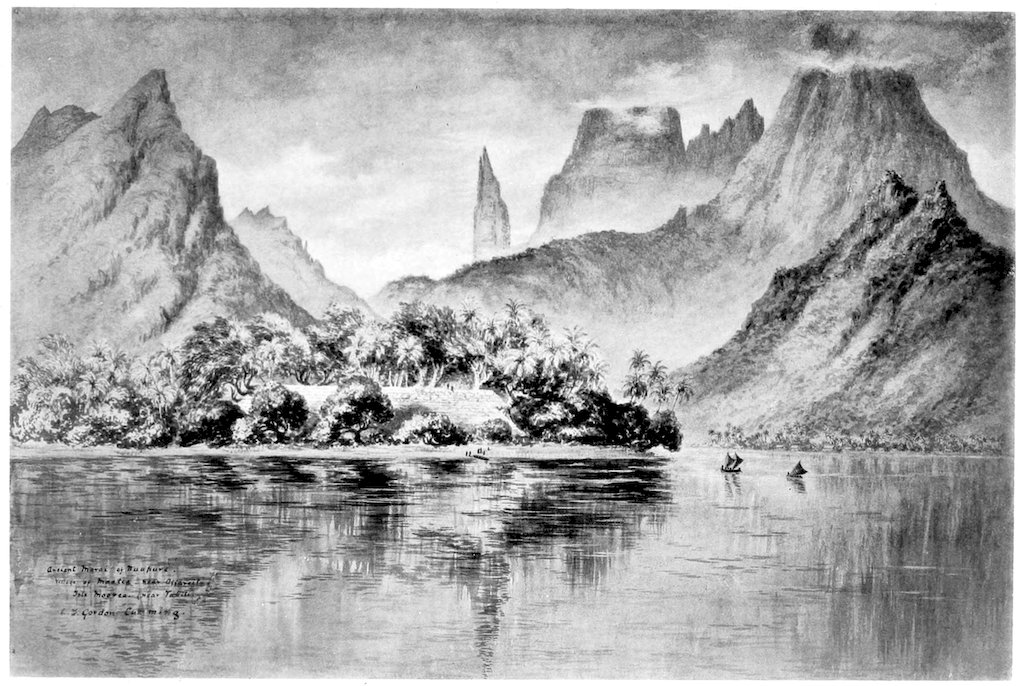
ANCIENT MARAI AND BASALTIC NEEDLE.
ISLE MOOREA.
325These horribly unfragrant marais were also considered as family mausoleums, where the dried bones of great men might safely be deposited. Nevertheless, even the sanctity of the temple did not always protect the dead from ruthless spoliation; and in times of war the victors not only carried off the idols of the vanquished, but also the bones of their relations, to be converted into chisels or fish-hooks, which was considered the lowest depth of degradation.
To avoid this danger, the dead were laid in small houses apart, and carefully watched, till the flesh fell from their bones, when these were collected by a trusty hand, and carried to some safe hiding-place in the mountains. In the case of any person of great note, this custom is still observed, as I learnt on visiting the little seaside chapel where old Queen Pomare was buried shortly before my arrival; and I was told her bones had been secretly removed, only three or four of her nearest kindred being aware of their present hiding-place.
In olden days, however, a simple process of embalming was practised, by means of which the wealthier families could preserve their dead for about a year, not longer. The brain and intestines having been removed, they were replaced by cloth saturated with aromatic oils, which were also daily rubbed all over the corpse. Every day it was placed in a sitting posture in the sun, that it might gradually become dried up; and an altar was erected before it, on which were daily offered fresh flowers, and fruit, and other food. With this the relations or priests touched the lips of the dead several times a day, for, like the Chinese, they averred that the departed spirit came to feast on the spiritual essence[66] of the gross meats.
Indeed the whole ceremony savours of Chinese custom. There 326was the same passionate ceremonial wailing for the dead, the same sort of religious service to appease the unquiet spirit, and prevent it from returning to earth to annoy the survivors. In place of burning paper effigies of horses, and houses, and other things likely to be useful in the spirit-world, the Tahitian priest placed about the corpse pieces of the stalk of the mountain-plantain, and told the dead that these were its parents, its wife, its children, and that with these it must be satisfied, and refrain from vexing the living.
Here likewise, as in the Chinese cities of the dead, small low houses were built as temporary homes for the unburied corpses, which were laid on biers, and by day were drawn out into the sun; but by night the body lay horizontally, and was frequently turned, lest it should dry irregularly. When, notwithstanding all care, the poor body began to decay, then the skull was wrapped in cloth, and carried home to be preserved with the family gods, and duly worshipped. The bones were either buried or carried off to the mountains in the mysterious way I have already described.
Although the Tahitian embalmers failed to preserve their dead for more than a year, the Samoans seem to have been more successful, though, apparently, only a limited number of the chiefs were thus honoured. Dr Turner, however, has seen bodies which had certainly been embalmed for upwards of thirty years, and were still in excellent preservation, when, on the death of the relations whose task it was to dress and tend the bodies, all were laid together beneath the sod. The office of embalmer was an exclusively feminine one, and the process observed in Samoa was exactly the same as that practised in Tahiti. The body was wrapped in native cloth, leaving the head, face, and hands exposed; these were occasionally anointed with scented oil and turmeric, to give a lifelike tinge to the complexion, and so were exhibited to all comers.
I spoke of the wailing at funerals as ceremonial, because it was not only customary to weep frantically, rending the hair, tearing the garments, and uttering agonising cries, but it was also de rigueur to display sympathy by inflicting on one’s self very serious wounds with instruments made for the purpose. Several rows of shark’s teeth were fixed in small canes, and with these the mourners 327smote their breasts, their heads, even their faces. One of these useful implements formed part of a girl’s bridal trousseau, that she might be ready to take her part in whatever scene of sorrow or of joy might present itself. For, strange to say, the same ceremonies were observed, though in a less excessive degree, to mark great happiness; and the safe return of a member of the family, or his escape from danger, was, and still is, marked by the shedding of what might be mistaken for bitter tears. Happily, however, the horrible custom of cutting and bruising one’s own flesh is a thing of the past; and friends no longer express sympathy with the bereaved by giving them strips of tappa saturated in the blood thus voluntarily shed, to be preserved as precious memorials of affection!
The one pleasant feature connected with the marais, as with so many forms of heathen worship, was the beautiful grove of old trees which surrounded them. Different tribes adopted special trees as clan badges, and planted these round their family shrines. Thus some were overshadowed by huge banyan trees, others by the noble tamanu, or native mahogany; and others, again, were distinguished from afar by the gorgeous blossoms of the coral-tree,[67] which dripped its blood-red petals on the altars below it. This beautiful tree is almost imperishable; but unluckily it shared in the fate of too many of those sacred temple trees, which were ruthlessly cut down by the early converts, in their iconoclastic zeal. Now the mournful casuarina (the noko-noko of Fiji), with its dark hair-like drooping needles, is almost the only distinctive foliage which marks the resting-place of the dead.
We lingered at this weird and horribly suggestive spot till the evening, and as we rode back to Haapiti, the crags and pinnacles towered in purple majesty against a background of luminous gold, and one divided ray from the setting sun threaded the eye of the great rock-needle. Later, when the moon had risen, we went to the village to see the native minister, who is going to Papeete to-morrow, and has agreed to give me a passage in his boat. We are to start early, so I must now have a sleep. Besides, the mosquitoes 328are troublesome, and the only refuge from them is beneath my nets. So good-night.
Once more I find myself “at home” beneath this hospitable roof. We started at daybreak and rowed leisurely along the lovely coast to Afareaitu (the place where I told you that Mr Ellis, the early missionary, established his first printing-press). At a short distance further we came to Nuupuru, where we landed to explore another great marae, likewise overgrown with casuarina and palm-trees. It stands on the coral-shore, which there, as in most parts of the isles, is shaded by dark trees with widespreading branches. Just behind this huge coral-altar, rises a gigantic rock-needle—a cyclopean natural monolith, such as might have accounted for the position of the altar, in lands where nature-worship prevailed, which, however, does not appear to have been the case in these isles.
Here we left the friendly shelter of the reef and passed into the outer ocean. Happily a fair breeze favoured us, and we entered Papeete harbour soon after noon. Great was the amazement of my native friends as they realised the huge proportions of H.M.S. Shah, probably the largest ship ever seen in these waters. I believe she weighs about 7000 tons. Certainly she makes all the other vessels in harbour look like pigmies. The little Daring is only 700 tons; Le Limier, 1000; and my trusty old ship Le Seignelay, 2000. The Shah carries nearly 700 men and 50 officers, so England is well represented. My boatman rowed right under her bows, the better to estimate her vast size.
On landing, I found that Mrs Brander and all the family had moved back to town on account of the arrival of so important a vessel, which, of course, involves much work for the house of Brander. I had just time to feed, change my dress, and accompany my hostess to the palace to “assist” at the king’s state reception of Admiral De Horsey and his suite, which, of course, was as stiff as stiff could be. We had a pleasant evening, however, at the band. Lovely full moonlight.
Papeete is surpassing itself in its graceful hospitalities. On Wednesday, M. D’Oncieue had a very large reception au Gouvernement, and the French admiral’s band played “God save the Queen” as the British admiral entered. To you, doubtless, that conveys little, but to a stranger in a far land it means much. To me, who had not heard the grand old air since I left Australia, more than two years ago, it was most thrilling music, for you have no idea how patriotic we become when we reach the antipodes!
The French and English bands played alternately the whole night, and as all the ships were (for once) well represented, and all the dancing world of Papeete present, in their happiest mood and prettiest toilets, it was a most successful ball, and well kept up. The lovely moonlight drew all the non-dancers to the gardens, much to the edification of the crowds assembled outside the railing. I found several pleasant acquaintances among the new-comers, and many more proved to be “friends’ friends”—a title which in these far countries means more than you dwellers in overcrowded Britain can possibly be expected to understand, though you may perhaps realise the unwonted pleasure of meeting so many real English gentlemen.
The evening was far too beautiful for carriages, so the revellers dispersed on foot, to walk home by bowery streets or peaceful shore.
Yesterday Mrs Brander gave us a startling proof of her skill in organising, and of the resources at her command. At the governor’s ball it suddenly occurred to her to invite all present to a great native feast on the following day, at her country-home. At daybreak she started to commence preparations, on a scale which, in most hands, would have involved a week’s hard labour. Messengers were despatched in every direction to collect fowls, turkeys, sucking-pigs, vegetables, fruit, &c., &c. A party was told off to build a green bower in which to spread the feast. Glass, crockery, silver, and wines had to be brought from the Red House and the store; for the ordinary service required for even so large a party as habitually assemble at Fautawa would not go far among such a multitude as were invited to this impromptu gathering.
330Still the question was undecided how the guests were to amuse themselves, as feeding could not last all the evening. Happily Captain Bedford came ashore to see my portfolio, and I ventured to ask if the band might come to Fautawa—a favour which was cordially granted, and I was able to drive off to Fautawa as the bearer of this excellent news. In less than no time, the large drawing-room was cleared for dancing, the wide verandahs gaily decorated with Chinese lanterns, and an admirable ball-room was prepared. It was all like a transformation scene, and accomplished so quietly. It would not be so remarkable in a large European house, with a full complement of carefully drilled servants; but here there really are no servants, properly so called, only friendly “helps.” Certainly every one worked with a will on this occasion, and all was ready ere the arrival of the first carriage, full of middies.
The carriages, like everything else, bore testimony to Mrs Brander’s thoughtful and generous care. She provided conveyance for every one, from the English admiral and French governor down to the smallest middy. Of course her own stable could not supply the demand, so every available trap was hired, and plied to and fro over the three miles, till all the guests were duly assembled. You will allow that this was a truly Tahitian phase of hospitality.
So also was the kind forethought which provided towels and a new pareo for every guest who cared to bathe in the lovely river—an invitation which few, if any, refused; so that a succession of joyous parties soon found their way to all the best pools, and therein revelled.
By the time the stragglers reassembled, a multitude of gay wreaths had been prepared by the Tahitian maidens, and all the guests were duly crowned. Some of the English officers were slightly taken aback by this unwonted decoration, but all submitted meekly; and we then marched in procession to the house of feasting, which was erected on the softest green turf, not far from the brook. It was a long building, consisting of a slight framework of bamboos, just sufficiently strong to support a thatch 331of plaited cocoa-palm leaves; while for pillars, strong young bananas were transplanted bodily, their broad cool leaves making a lovely canopy of freshest green. The golden leaves of the dracæna were strung together to form deep fringes and festoons along the rafters; while a still deeper fringe, carefully prepared from the fibre of hybiscus bark, and dyed pale yellow, was festooned all round the whole building. There must have been many hundred yards of this. Just think of the labour of preparing it! That, of course, had been done at leisure.
In lieu of a table-cloth, fresh green banana-leaves were spread upon the grass down the centre of the building, and on these were laid all manner of good things, in dishes made of plaited leaves. Dainty little sucking-pigs, turkeys, and various preparations of chicken, were, as usual, the foundation of the feast. These had been brought in hot haste from Mrs Brander’s farm; while fish and all manner of crustacea seemed to have arrived by magic from the depths of the sea, the mountain streams, the mangrove-shore, and the coral-reef—each had sent its contribution. The delicious white wurrali, and their red relations, the cray-fish and lobsters, were there—shrimps and prawns, living and cooked, to suit all tastes. Raw fish and cooked fish, each with appropriate sauce; shell-fish of various sorts, including the delicate little oysters from the isthmus. Fruits of all sorts, mangoes and melons, strawberries, oranges, and bananas; yams, taro, and kumala—i.e., sweet potatoes—and sundry other vegetables.
The obnoxious national drink of the South Seas, made from the chewed root of kava, alias yangona, seems to have quite disappeared in Tahiti, and sweet young cocoa-nuts supplied the only native drink; but these were supplemented by many a brimming bumper of the best foreign wines, and champagne flowed like water. Thanks to the graceful unaffected courtesy with which Narii and Ariipaea Salmon, and several of the ladies of the family, themselves waited on all their guests, all went off admirably; every one was well cared for, and mirth and laughter reigned on all sides. Some of the naval guests, however, were not so well accustomed, as are all the rest of us, to sitting curled up on the fine mats, which were 332spread for the guests all round the leafy table; and so obviously uncomfortable were some of the senior officers, that the kind-hearted ladies took pity on their foreign friends, and brought piles of cushions and pillows, to raise them; but as they could not raise the tables also, I fear that some of the gentlemen must have voted dining à l’indigène rather a serious effort.
I should have mentioned that in “setting the table,” a pile of large bread-fruit leaves are laid before each person to act as plates, and to be changed as often as may be desired. Also, in lieu of tumblers, wine-glasses, and cruet-stands, each guest is provided with a half cocoa-nut shell, full of drinking water, and one of milk, a third with chopped cocoa-nut, and a fourth with salt water. The two latter are mixed together to make a sauce in which to dip the good things that are coming. This done, the fourth shell is filled with fresh water to act as a finger-glass. Half a bread-fruit, nicely cooked, is laid beside each place in lieu of bread. I fear, if I must confess the truth, that certain dainties in the way of creams and jellies, and tipsy-cakes, such as were not common in Tahiti in the days of Captain Cook, did find their way to our leafy bower, and were by no means despised.
Afterwards the band took up a good position outside the house, and a right merry dance ensued. As the gentlemen considerably outnumbered the ladies, great satisfaction was expressed when two very ladylike white girls suddenly arrived, robed in loose white sacques, and of course crowned with flowers. These turned out to be two of the middies, who kept up their part admirably throughout the evening.
The Shah musters a first-rate theatrical corps, and they say they would gladly act for the amusement of their Tahitian friends, but unfortunately their stay is too short to admit of any such ploy.
We are all going to lunch on board to-day.
We have had a very pleasant afternoon on the great ship. Soon after twelve we joined the royal party, for whom the admiral’s barge was waiting, the blue jackets receiving the king with uplifted 333oars. (I believe “tossed” is the correct expression.) He was treated throughout with full royal honours—twenty-one guns on arrival and departure, yards manned, marines and crew on parade, and all the officers in the agonies of full uniform, with which, however, they soon contrived to dispense. I think that as soon as Captain Bedford had got over his surprise at being asked by the queen where she might smoke, he realised that gold lace was superfluous! Tahitian ladies can never be happy for long without their cigarettes, and the queen has recently received a present of an enormous supply, which are fast disappearing in faint films of smoke!
Our first introduction was to a large, very tame, black bear, which the sailors captured as a baby on Vancouver’s Isle, and which now plays with them like a very gentle big dog. It is a much nicer beast than the Russian bears brought by the Limier.
We were formally conducted all over the huge ship, and duly wondered at the length of the lower deck, with the row of great guns on either side; in short, we felt exceedingly proud of our British representative, and the French officers and their Peruvian friends kindly abstained from invidious comments on the recent “Huascar” affair, which had been freely discussed here before the arrival of the giant Shah. Now all allusion to that pugnacious little vessel was studiously avoided, and everything connected with the big ship called forth a chorus of undivided admiration.
King Ariiaue was requested to touch an electric battery, and quick as lightning a whole broadside went off. In like manner Queen Marau fired a torpedo, which threw up the water in a gigantic fountain. We went through the ward-room, the large airy gun-room, and the officers’ daintily fitted-up cabins, exquisite in their neatness. The admiral has a most charming bedroom, drawing-room, and dining-room. In the latter we sat down to luncheon, about twenty-four persons, including the commanders of the other vessels.
When we returned on deck we found it transformed into a brilliant ball-room, all draped with flags, and full of people from Papeete. As we looked down from the upper decks and bridge, 334a prettier scene could not be imagined. The dancing folk did dance to their hearts’ content; and those who, like myself, hold the Eastern creed, that all such hard work should be done by proxy, held possession of the higher levels, and sometimes varied the picture by turning to the beautiful panorama on every side of the harbour. To rest the band, there were two interludes, when the sailors danced hornpipes, and sang capital songs with choruses, which some of us enjoyed so much that we would fain have prolonged the concert. Unfortunately the king was tired of the proceedings, and wanted to hurry through the dances for which the queen had already engaged herself; so the singing was soon stopped, and the ball resumed till the sun had almost set behind Moorea, bathing its mountains in dreamy gold. A few minutes later the island stood out in clear-cut lilac, floating between a sea and sky of pale daffodil. Then we all returned ashore, and in the evening went to hear some himènes, specially got up for the edification of the strangers, who, however, by some unlucky misunderstanding, failed to appear. But as compared with those I had previously heard, these were very poor himènes, and I was almost glad that they were not taken as samples of what those charming glees can be.
To-morrow morning the little Daring sails for Honolulu and the great Shah for Valparaiso. Every one regrets so speedy a departure, but the admiral says he dares not risk remaining with 700 Englishmen in this port, over Christmas Day, as it would be impossible to keep the men on board, with the tempting shore so close, and that if they once landed, some would inevitably get drunk, and have a row with the French authorities. Our good consul is evidently much relieved by this wise, though unpopular decision.
It certainly is grievous that the jolly tars, of whom Britain is so justly proud, contrive to do such scant credit to their nation or themselves when they land in any foreign port. Here, for instance, day after day, among the crowds who land on the shore just under my verandah, I never hear a voice which seems to be raised in anger,—all seem bright and happy. I wish I could say the sounds are equally pleasant when a party of British sailors go past! Then the echoes that linger on the ear are sanguinary and repulsive; a painful contrast to the musical speech of the natives.
The Shah is fortunate in possessing, in the Rev. —— Reed, a chaplain who is exceedingly popular with all on board, and who takes an immense interest in all that concerns his flock. Besides the regular band, he has trained one specially to accompany sacred music; and the church choir is said to be excellent. It would have been really pleasant to have heard our own Church service on Christmas Day. By some fatality I have not had that privilege since leaving England; last Christmas Day having been spent in the hateful work of transhipping on our way from Fiji to New Zealand; and the previous one was spent in the mountains of great Fiji. It has been the same as regards Easter. We had to sail from Marseilles on Easter morning 1875. Easter of 1876 was spent in a little Fijian village in the isle of Koro, and Easter 1877 among the geysers of northern New Zealand. Where they may next find me, who can tell?
I must close my letter that it may be sent on board the Daring at daybreak. The pretty Tahitian girls are working all to-night to finish arrowroot or bamboo fibre hats as parting gifts to the friends whom they will probably never meet again. “Telle est la vie!”—Good-night.
A glad Christmas to you all, dear people! Would that some good fairy could lend me a wishing-cap, that I might look in by turns on each home gathering in the various corners of England and Scotland. These marked anniversaries are always trying days, 336which awaken longings for the bodily presence of the dear kith and kin in the far country. But I confess I would rather that the said wishing-cap could bring all of you here, away from the bitter frosts and snows, to this paradise of sweet sunlight—and (selfish as it sounds when expressed in words) away from constant sight of the shivering ill-clad and half-starved people, whose deep-seated poverty you can in no wise alleviate,—to these isles, where want, at least, never appears prominently.
The whole family party of brothers and sisters, mother, aunts, cousins, and feudal retainers, moved out here again immediately after the departure of the big ship, and we have resumed the pleasant existence of delicious early bathes, and long idle days beneath the green shade by the lovely river.
I am sitting now in my favourite bower of dark hybiscus with lemon-coloured blossoms, which overarches the sparkling rivulet, as it branches from the main stream—an enchanting spot. I have just been reading the old Christmas service, which brings back many a vision of langsyne. There was a grand midnight Mass last night at the Catholic church, and of course service this morning, but none at the Protestant church, I believe.
Now I must go in to breakfast, alias luncheon, as a number of friends are expected. This evening one of the neighbours gives a large dance, to which, of course, we all go. Even non-dancers find such ploys attractive when they involve a pleasant evening drive in an open carriage, and no hot crowded rooms.
I have had another small cruise in the Seignelay, which was ordered to the isles of Tetiaroa, distant about twenty-four miles, thence to bring back the king, who went there last week in an open boat.
It was arranged that I should sleep at the Red House, and go on board with Queen Marau at daybreak. It proved to be rather a stormy morning, with a good deal of sea on: the sunrise colouring was very striking,—the mountains shrouded in heavy gloom, 337dark storm-clouds revealing the edge of their silvery lining, and a luminous prismatic halo playing all round the sun. Then the cloud-masses dispersed; dainty pink cloudlets floated on a sky which graduated from a pale-lemon hue to the colour of a thrush’s egg, so that the whole colouring suggested broken rainbow lights, changing incessantly for half an hour.
Tetiaroa is a cluster of five low coral-isles, arranged in a circle, connected by coral-reef, thus almost forming an atoll. The isles are quite flat, nowhere rising more than four feet above the water. By nature barren, they have been artificially rendered fertile by the constant importation of vegetable mould from Tahiti; so now each isle is a dense grove of cocoa-palms, whose roots are washed by the salt spray.
Tetiaroa is to Papeete as Brighton is to London, a favourite bathing-place, where the Tahitians betake themselves to recruit their languid energies by a course of strong brine, though Tahiti appears to me too healthy to require any sanatorium. It is, however, worthy of note, that statistics go to prove that, as a rule, all the low coral-formations are healthy, whereas the inhabitants of high volcanic isles are frequently subject to fever and ague.
Though an imperfect atoll, this cluster was specially interesting to me, as a type of the eighty isles which form the Paumotus. Judging from this sample, I am satisfied that there is little to be seen from the deck of a ship. Could we ascend in a balloon, we should look down on a lagoon of shallow, very bright-green water, encircled by five palm-clad isles, connected by bands of rainbow-tinted reef,—say a garland of green roses and tricolour ribbon. Could our balloon float above the Paumotu group, eighty such garlands would be seen scattered on the deep-blue ocean, each encircled by an outer belt of submarine prismatic colour, edged with white breakers, marking where lies the barrier-reef.
At Tetiaroa, the only opening in the reef is so narrow as barely to admit a canoe. We had, however, fully intended to land, but the surf was so rough that we had to give up the idea, much to my regret, especially as the day was devoted to heavy gun practice, which of course involves ear-splitting noise and smoke. However, 338I can stand fire pretty well, so took up a favourable position beside one of the cannons, and received instructions in artillery practice. But I confess I was not sorry when, after the fiftieth shot, the look-out man (who sat aloft like the sweet little cherub) announced the approach of the king, and presently we discerned a great crowd of natives wading across the reef, and dragging his canoe. Ship-boats put off to meet him; and though embarkation in such surf was no easy matter, it was safely accomplished, and a few minutes later the Seignelay received, not his majesty alone, but also a large number of pigs, and heaps of cocoa-nuts, presented to the lord of the isles, as parting gifts from loving subjects.
It was late ere we landed at Papeete, so I again slept at the Red House, where one of the Seignelay boats called for me at daybreak, and landed me at the beautiful avenue of Fautawa, where I had a most enjoyable morning of quiet sketching, till Mrs Brander sent her pony-carriage to bring me home to the noonday breakfast.
Now the young folk are preparing for a midnight frolic. They intend to have a very merry dance at a neighbour’s house; but as it is to be impromptu, and the hosts are not supposed to prepare any supper, each gentleman intends to carry a basket, ostensibly of fruit and flowers, beneath which lie concealed sundry bottles of champagne, wherewith to drink the New Year in. The girls are busy weaving garlands, that all may be flower-crowned to-night.
Mrs Brander and her mother alone represent the more thoughtful element, and go to Papeete to attend a great native midnight service. I am too tired to do either, so can only say to you, as to the Old Year, “Good-night! Good-night!”
The dancers of last night did not come home till 3.30, and at 7 A.M. the band of La Magicienne came here to serenade Mrs Brander, and played divinely. Many friends drove out to offer their New Year greetings, and so, as if by magic, the lawn was soon crowded with a joyous party, all the girls dressed in the prettiest, freshest of sacques, and their hair wreathed with bright flowers. What could they do but dance? The band, having pledged their hostess in her best champagne, played with a will for a couple of hours, when they were provided with a substantial breakfast, and then all the gentlemen drove off to another place belonging to Mrs Brander, there to preside at a great breakfast to all her employés.
I drove into Papeete with pretty Pree, Manihinihi, and Naani, to call on Marau, Moë, and other friends; and so we began the New Year brightly and happily, in ideal, civilised-South-Sea fashion.
Ever since I arrived here, we have been planning an expedition to the French fort at some distance up this valley, at a height of about 1600 feet above the sea. So one beautiful morning last week, several friends from the Seignelay arrived here before sunrise, and Ariipaea Salmon undertook to be our guide. He had, unfortunately, hurt his foot, so he and I were privileged to ride, the others walking.
For a considerable distance the path winds through a dense thicket of guavas, all self-sown, and considered by the people as great a curse as the (equally imported) lantanna in Ceylon, both plants having a fatal facility for spreading and taking permanent 340possession of every neglected corner. They are the Chinamen of the vegetable world, and are quite as useful in their way. The guava forms the principal firewood of Tahiti. It bears an abundant crop of excellent fruit, which is now ripening just as the mango season is finishing; and I think the Tahitian guava is better than those of India and Ceylon. Certainly it has a far less sickly smell. Cattle and horses alike munch both fruit and leaves with avidity, so I cannot see why the guava should be so generally despised; but the fact remains, strange to say, no one here seems ever to think of making the delicious crimson jelly which we, in England, prize so highly. The fruit is left to drop from the trees utterly unheeded.
Further up the valley the track becomes steep and narrow, and in places runs along the face of the cliff, with the rushing stream immediately below, and overhanging boughs festooned with vines growing so rankly as somewhat to endanger a rider. The beautiful large granadilla passion-flower here runs riot, but its fruit is now all finished. When ripe it resembles a good-sized pumpkin of a bright golden colour, and contains a multitude of seeds like those of a melon, each encased in white jelly. These lie inside a sweetish pulp about two inches thick, which is generally thrown away, but is nevertheless quite worth cooking as a vegetable.
I found the drooping branches so troublesome, that I foolishly abandoned my horse very early, and had a much longer tramp than I counted on. We had not gone very far ere we quite lost the foot-track, and coming to a place where two ravines and two streams meet, Ariipaea, who had not been here for a long time, quite forgot which we were to follow; so first we tried the right side, and clambered up a steep and difficult path, till we were convinced that we were on the wrong track, and returning to the junction, we tried the other ravine, crossing and recrossing the stream.
At length, after much loss of time and energy, we concluded that our best course was again to return to the junction and there breakfast, trusting that by good luck it might prove to be the day on which “Père Fautawa” (as the old soldier in charge of the fort is commonly called) would be returning from Papeete with his 341rations. Fortune favoured us; and ere we had finished the contents of our hamper (carried by French sailors) the old man appeared, and led the way by a middle path between the two streams. It was a very steep scramble, among great boulders and masses of rent crag, half hidden by the wealth of tree-ferns, young palms, wild bananas, and other tropical foliage, such as ginger, turmeric, wild caladium, and dracæna. The stems of the large trees are covered with parasitic ferns, especially the handsome bird’s-nest fern, which here grows luxuriantly.
After crossing several small streams, we climbed to the verge of a deep ravine, at the head of which rises a precipitous cliff 600 feet high. Over this rushes a cataract of white foam, which fades into shadowy mist as it loses itself among the tall palms and feathery foliage of the tree-ferns and parasitic vines which veil its base. Above the fall is situated the French fortress.
The interest of the place does not lie in the fort of the foreigners, but in the fact that this was the last stronghold of the Tahitians, in their struggle to retain their independence and resist the hated invaders. Here it was that the last man who fell in that brave strife was shot, betrayed by one of his countrymen, who now reaps the reward of his treachery in the enjoyment of foreign gold and the red ribbon of the Legion of Honour. This was the last blood shed. Now the red roses grow undisturbed on the ramparts, and the lines of defence are so many terraced gardens, where the solitary old soldier grows strawberries for sale in Papeete, whither he descends once or twice a week to draw his rations and to see the world.
It is a lonely ending for the old man’s days, and a strange contrast to his former barrack-life. Now he is often for days together enveloped in mists, which enfold him in an isolated cloud-world. It is comparatively cold, too, at this high level, where at nights the thermometer sometimes falls below 60°. At Père Fautawa’s bidding we gathered ripe strawberries from his little garden, the first I had seen growing for many a day.[68]
342Then while the sailors busied themselves preparing coffee, we dispersed in search of pleasant pools for bathing, a luxury never more prized than after such a scramble in a tropical valley. Hitherto the day had been quite lovely, now it rapidly overcast, and heavy clouds came down and hid the Diadème—the beautiful crown-shaped mountain, that heads the valley. It is called by the natives Maiao, and though its height does not exceed 4363 feet, it is one of the most remarkable forms in Tahiti.
Ere we had finished our welcome coffee it began to pour so heavily that I voted for camping where we were; but the others feared a freshet, such as might make the streams impassable for days. So they voted for starting instantly, and of course carried the day; and we descended the steep mountain-path in blinding rain, which blurred all beauty, and rushed in rivulets beneath our feet. We were so thoroughly saturated, that crossing and recrossing the stream ceased to give us a moment’s thought; and by the time we reached this house, I confess to having been thoroughly exhausted, as was to be expected, after a scramble of fully eight miles without any time to rest.
Of course, as soon as we got back the weather cleared, and we had a most lovely evening, followed by an exquisite moonlight night, and a sunrise which, seen from Fautawa, would have been too fascinating. It was with sore regret that I gazed upward to the sunlit peaks; while for days afterwards I felt too utterly done to do more than creep about the garden.
The upper heights of the valley are wellnigh inaccessible. They culminate in a crag-ridge about 4000 feet in height, forming a crest so narrow as to be a mere saddle barely three feet across—literally a gigantic crag-wall, wooded to the summit. Few are the bold spirits who have cared to scale this barrier in their endeavour to cross the island. Only by painful climbing from ledge to ledge, clinging to overhanging trees, trailing screw-pine, and sturdy vines, which act as natural ropes, is it possible to make any way. Indeed it is necessary to carry strong ropes in case of emergency; and little help can be expected from native guides, who never dream of expending toil so fruitlessly, unless worried into doing so by some 343unrestful foreigner. I am sure I do not wonder at their being satisfied with lower levels, seeing how enchanting these are. I find day after day gliding by in such peaceful enjoyment, that time passes unmarked, and the further expeditions, of which we have sometimes talked, seem to involve too great exertion. Evidently I am becoming indolent in these dreamy southern isles!
I have just been feasting on a cocoa-palm salad, which would make the fortune of the happy chef who could introduce it at an alderman’s feast. That, fortunately for the plantations, is quite out of his power, unless some process be discovered by which to preserve uncooked vegetables. For this dainty consists of the embryo primary shoot of the tree—the unborn fronds, which lie curled up within in a close compact white mass, about the size of a man’s arm, and resembling a gigantic stick of celery, with a flavour of filberts. Of course so costly a dish as this (which sacrifices the life of the tree) is rarely indulged in, save when a hurricane has snapped the crown of the tall palm, or when some rich chief wishes to entertain a guest, regardless of expense.
Another very agreeable product of the cocoa-palm, which you in England can never hope to taste, is an over-ripe nut, when in the very act of sprouting. Previous to this, a very curious change has occurred. As you must know, the germ of the plant lies just within the three little eyes, which we used in nursery days to call the monkey’s face. Indeed I fear that in those days of our ignorance we imagined they were the marks left by the stalk, quite forgetting that the nut lies in a large outer case of that brown fibre which, in these our later days, we know as “coir.” Well, the sharp end of the nut lies next the stalk, and the monkey-face at the further end, so that nursery theory was fallacious, like some others.
When the nut is fully ripe, a fibrous, spongy substance begins to form all round the germ, and this gradually extends, absorbing both the so-called milk and the hard kernel, till the whole shell is full 344of a soft, sweet, white growth, like a very light blanc-mange. If at this stage the nut escapes the gourmet of the South Seas, the young germ will soon force open one of the three eyes, and, working its way through the fibrous husk, begin its heavenward growth; while from the other two eyes will sprout two rootlets, which instinctively turn downwards, and likewise penetrating the thick protecting outer case, find their way to mother earth, and there strike root. Still the white sponge within the nut goes on expanding, till at length it splits the hard wooden shell, and then gradually decays, and so forms a light nourishing soil, which acts as mother’s milk to the baby tree in its delicate early days. After a while it needs no such provision, but flourishes, in grace and beauty, where other trees would starve.
I wonder that no one has ever discovered in the cocoa-palm a meet emblem of charity. Of all plants that grow, none asks so little, or gives so largely. It matters not how dry and barren is the shallow soil, or how briny the coral-sand, washed by every rising tide, the hardy palm strikes its roots among the fragments of coral, and, bending to the gale, weathers the wild storms, and yields its generous increase as abundantly as its more fortunate brethren in the rich soil of sheltered, well-watered valleys. The poorest islander on the loneliest atoll, possessed of a few cocoa-palms, can exist. They give him food and drink, a fibrous material, all ready woven, like coarse canvas, for dress; leaves for thatch, and oil for light, and for personal adornment and comfort. To obtain the latter, he collects a lot of old nuts, such as those we see for sale in England, and scraping out the kernel into some old canoe, leaves the whole mass for some days exposed to the sun, till the pure oil exudes, and without further trouble he stores it in any vessels he may possess—gourds or bamboos. Of course, a European who trades in palm-oil prefers to collect it in the form of coppra—i.e., dried cocoa-nut—as a much larger amount of oil is obtained by pressure of machinery.
Another hardy child of these coral-isles is the pandanus, or screw-pine, as it is commonly called, because its leaves, which grow in tufts at the tips of the branches, are all set like a screw, twisting 345round the stem, which is thus marked with a spiral pattern from the root upward. Like the cocoa-palm, it grows in the clean dry coral-sand, where there is apparently no moisture; yet when cut it is found to be full of oily sap. The wood is close and hard, and though rarely exceeding five or six inches in diameter, it often grows perfectly upright, for fifteen or twenty feet, and yields excellent posts for building; they are, however, hollow like a bamboo. The long drooping leaves are valuable for thatch, being from three to five feet in length, and about three inches wide. They are edged with sharp prickles, but, when torn into strips, are useful for plaiting mats and canoe-sails.
The women steep the leaves in sea-water, and then beat them with a mallet till all the green skin comes off, leaving a beautifully white silky fibre, which they dye red, yellow, and brown, and then plait into wonderfully fine sashes, about a foot wide. It has been suggested that this pure white fibre would prove a valuable material for paper-making, but I have not heard of its being tried. A stronger fibre is obtained by crushing the aerial roots, which this strange tree throws out in all directions, forming stays by which it protects itself against the violent gales,—a necessary precaution, where the main root grows only in the sand.
The flower of the pandanus is exceedingly fragrant; but though I have seen thousands of screw-pines, I have rarely had the luck to find one in blossom. Its fruit resembles a coarse pine-apple. When ripe it becomes bright scarlet, and the Samoans use it for making necklaces. It is divided into honeycomb sections. When the fruit is ripe these fall apart, each being a separate conical lump, of which the inner end is soft and saccharine, and can be chewed like sugar-cane.
When the capsules are thoroughly dried, they can be cracked, and yield a kernel, which is edible; and in the barren isles, near the equator, this fruit is considered a valuable product. It is dried and grated, and the sweet brown sawdust thus obtained is stored as the only substitute for flour; and cakes of it are baked, as occasion may require, to eke out a fish diet, which is not always forthcoming. It is said to be wholesome, nourishing food; but in 346these more luxuriant southern isles I have never seen it eaten by the natives, only by the foreign labour—i.e., the men imported from the groups to the north-east, who are engaged to work on the plantations. In their own isles they have discovered a means of steaming and mashing the fruit which, when fermented, yields a strong and highly intoxicating spirit. The whalers who years ago settled among them, taught them to improve on this liquor by distillation, and also instructed them how to obtain a fiery spirit from the innocent palm-trees. So, thanks to their tuition, and generally civilising influence, the Line islanders have become infinitely more debased than they previously were.
It does seem too bad, does it not, to extract poison from these useful trees? But whether it be orange-rum in Tahiti, or barley-bree in the isles nearer home, I suppose the white race will find means to procure fire-water wherever it goes, and seems to turn every sort of plant to the same use. What with rum from the sugar-cane, and fiery spirit from the sweet dracæna root, and even from innocent bananas, it appears as if every good gift of heaven was liable to be misused in like manner.
I hear some people say that they weary of the monotony of the cocoa-palms; and certainly a low coral-shore, with an unbroken line of palm-trees, is somewhat dull. Here, however, there is an amazing variety in the foliage of the seaboard. Besides the many beautiful large-leaved shrubs, there are various handsome trees, which attain a great size, and, as I described to you, many grow so close to the shore that their boughs literally dip into the sea. Some of these are fruit-bearing. The vi bears bunches of large yellow plums, and the ahia[69] yields a lovely pink fruit, with white juicy flesh.
But of all the indigenous trees none can compare for beauty and value to the bread-fruit, which, though it demands a richer soil in the first instance, rivals the cocoa-palm in its manifold uses. Though it does not give drink to the thirsty, or coir for ropes and matting, its resin forms a strong glue which is useful in caulking the boats, and the bark of the young branches yields a fibre from 347which strong cloth is made. Its timber is exceedingly valuable; and its thick glossy leaves, which are sometimes eighteen inches in length by about twelve in breadth, are also turned to good account.
But of course it is chiefly prized for its abundant food-supply. Each tree yields three, sometimes four, crops annually; and as there are in these isles about fifty recognised varieties, which ripen at different seasons, it follows that, with a little care in cultivation, the supply might very easily be so regulated as never to fail. A large bread-fruit tree in full bearing is certainly a most beautiful object, with its wealth of green or yellow fruit hanging from beneath the handsome deeply indented leaves. A good tree will bear several hundred fruits—each about eight inches long by six wide,—with a rough green rind, divided into a lozenge-shaped pattern. This is sometimes peeled off before the white pulp is cooked; but I infinitely prefer the bread-fruit roasted whole on the embers or baked in the earth in a native oven, when the blackened rind is scraped off, and the inside is found thoroughly cooked, and in taste something like the thick scones known in the colonies as “dampers,” or like the cold “chupatties” we used to eat on the march in the Himalayas—floury but rather tough. I don’t think that these natural loaves are to be compared to a good potato. However, they are the bread of the favoured tropics; and nowhere else does mother nature yield so much wholesome food for so little human toil.
You need not, however, imagine that these good things are common property, to be gathered and cooked by every hungry man. On the contrary, every cocoa-palm and fruit-bearing tree on these or any other isles that I know of, has its owner, and is very likely the sole wealth of a whole family. So each fruit commands as regular a market-value in the South Sea Isles, as do the apples and potatoes of the English farmers. This is a simple fact, apparently not always recognised by visitors and others, who occasionally write to request their friends living here to send them cases of oranges and other fruits, as if they supposed that these were to be had for the mere trouble of gathering and packing!
Speaking of gathering and packing, I have for some time past 348been devoting a considerable amount of energy to collecting mango-stones, or rather kernels, with a view to sending them to Fiji. It is only about eighteen years since the mango-tree was introduced to these isles from Rio Janeiro, and so wonderful is the rapidity with which it has spread, that it now holds its place as the most marked feature in the vegetation of this group. Every homestead is embowered in these and other fruit-bearing trees, and for the last two months every man, woman, and child (to say nothing of quadrupeds) seems to be for ever eating ripe, delicious, golden mangoes; and every road, indeed the ground in every direction, is strewn with les noyaux; though the people so fully appreciate the luxury of a feast by the river-side, where they may enjoy the juicy dainties without the smallest respect for conventional appearances, that an immense number of the finest kernels are thrown into the water—indeed, since I have been so anxious to collect good sorts, I observe with annoyance that though I entreat these careless easy-going people (le peuple) to throw the best stones in some corner for me, they seem by preference (or probably by force of habit) always to chuck them into the water.
The French have taken immense trouble in perfecting this valuable fruit, and have now introduced so many excellent varieties that one crop succeeds another in rotation. The round mango is succeeded by the golden egg, and that by a small purple, while the large long sort seems inexhaustible. Best of all are those specially cultivated by Monseigneur Janssen, Bishop of Axièri, who has raised a super-excellent mango with a very large fruit, and a long stone so thin and flat as to resemble the inner sole of a child’s shoe.
The bishop has also been inspired with the happy thought of distributing mango-stones in other groups, and sent off a large consignment last month by a vessel going direct to New Caledonia. He is most kind in helping me to collect a good assortment for Fiji: at the same time, he warns me that taking the best seed is no sure warrant for getting equally good plants, as no other tree exists, so faithless in reproducing its own kind, and variety of soil produces every conceivable variety of tree. You may take twin 349fruits from one tree, and plant them a few yards to right and left of the parent tree. One will grow up infinitely superior to its mother—the other will be all stone and fibre, and scarcely fit for the pigs. The only certainty lies in taking grafts of the good ones, and so utilising the stock; also in planting, the richest soil must be selected, as the tree has a long tap-root and strikes deep.
Now there is abundance of rich soil in Fiji, and the ordinary vegetation is identical with that of Tahiti; so there can be no reason why the mango should not be acclimatised there as well as here, and it would be a very great satisfaction to me to aid in bestowing so great a boon on the young colony. I am sure I deserve that the attempt should succeed, for it has already cost me an immense amount of trouble. In spite of all precautions, of careful drying and turning, &c., a very large number of the stones I collected in the early part of the season have already sprouted. Some are quite respectable young trees.
So now I am making a more systematic attempt, and have devoted several days to driving to all the very finest gardens in the neighbourhood, where, with the help of a pretty Tahitian boy (who rather enjoyed such a chance of an unlimited feed), I set to work to collect the half-decayed fruit, which lay rotting under all the best trees. I can tell you that cleaning the stones was about the hottest, dirtiest, and most fatiguing work I have done for many a day. However, notwithstanding the heat, I stuck to it for six hours one day and three the next, and two hours on several other days. And the result is a splendid lot of noyaux, which every morning I turn and re-turn, in order to dry them thoroughly, hoping to prevent their sprouting like the first lot. But in spite of all my precautions, the large flat seeds of the finest mango have already done so—so they, at least, can only be propagated by graffs. Another difficulty is, that hitherto all my efforts to send plants from Fiji to England by Wardian cases of island manufacture have proved abortive. In every case the plants have died, so I do not feel much encouraged to try the experiment again.
The great difficulty lies in the length of time that must elapse ere either plants or stones can reach Fiji; as, of course, such a 350chance as that of the vessel which brought me thence, direct to this group, is of very rare occurrence. The probability is, that the seeds which I am now collecting will have to wait for an opportunity of being sent by sailing vessel 2000 miles north to Honolulu; there to be transhipped to a Pacific mail-steamer, and be carried south-west 4000 miles to Sydney; where they would find another steamer to take them the 1700 miles to Levuka, whence they will find their way by sundry small sailing-boats to the various Fijian isles. A somewhat circuitous route, you must allow!
After all, I have found a somewhat more direct route by which to send some of my mango-stones. Le Limier was despatched to-day on special service to the Gilbert Isles, thence to proceed to New Caledonia, and her very obliging captain, Commandant Puèch, offered to carry a large case to the care of the British Consul (Mr Layard), who will forward it to Sir Arthur Gordon by the first opportunity. So I set to work to pack 4000 carefully selected stones, laying them side by side as neatly as though building a wall with children’s little bricks. It took me a whole day’s work, and, considering that each seed has passed through my hands six or eight times, while collecting, cleaning, scraping, drying, turning, selecting, and finally packing, you will not wonder that I looked after the departing case with a feeling of quite maternal interest.[70]
The mission on which Le Limier is now bound is to take back 200 of the Arawais, inhabitants of the Gilbert Islands, who were 351brought here as foreign labourers about nine years ago, on the understanding that they would very soon be sent home again, whereas they have been detained all these years. When Admiral Serres commenced critical inquiries on the various abuses at which previous governors had winked, this fact became known, and he decided that the labourers should be sent back soon after the New Year—an announcement which filled their masters with dismay, in view of ungathered crops, but was hailed by the Arawais with joy till they learnt by what vessel they were to travel. Then they were filled with alarm, believing that so large a ship would not dare to risk the dangerous navigation between their little isles; and that they would probably all be landed (as has often been done in similar cases) on one or two of the principal isles, where they would be left quite as much in a strange land as in Tahiti, and, moreover, with the certainty of being robbed, and the probability of being eaten by hostile tribes. So a considerable number have refused to go on this occasion. Indeed M. Puèch is himself much perturbed as to how to accomplish this really difficult business.
He invited a few friends, including myself, to go on board at the last moment, to faire les adieux. The vessel presented a curious scene—picturesque, certainly, with abundance of bright colour, but more like an emigrant ship than a man-of-war. Le Limier is so constructed that she has not sufficient accommodation to allow of all the crew sleeping below at one time. So these wretched Arawais, including women and children, are taken only as deck passengers; and as the cruise, under steam, cannot take less than from sixteen to eighteen days, during which they must take their chance of whatever weather they may encounter, you can understand that the voyage does not promise to be a pleasure-trip.
The vessel carries much extra coal, to provide against the danger of a calm. So half her deck is loaded with this dirty store, and the 200 Gilbert Islanders are huddled together on the main-deck. Each labourer has a trade box, containing a few clothes, a good deal of tobacco, and some cheap toys for children; and this is all they 352carry home as the fruit of their long exile. Nine years of ceaseless toil in a far country, repaid by a little wooden box full of cheap rubbish!
While we were on board, a little baby died on deck in its mother’s arms. Some fellow-countrymen, who had come to see their friends start, undertook to carry the poor little body ashore for burial. The father opened his box of trade, and took out a few yards of coarse printed calico, which he gave to the said friends, apparently as payment for their trouble. The poor mother fell on her face at the gangway, wailing piteously. She appeared utterly miserable. It was a sad beginning for a voyage, and we all doubly regretted the departure of our friends with such an unpleasant three weeks in prospect.
When I saw how terribly overcrowded the vessel was, I thought Captain Puèch must surely repent of his kindness in offering to carry the big case of mango-stones; but on the contrary, he made it appear as though I had done him quite a favour in letting him take charge of the precious seeds, which, we trust, will hereafter become so valuable a boon to Fiji. Kind, good friend, we all wished him bon voyage with all our hearts; then returning to the shore we watched the good ship sail, amid hearty cheers from Le Seignelay, and with large bouquets on each mast, to mark that she is homeward-bound.
The Ségond, French man-of-war, has just arrived from San Francisco, bringing the new French governor—a fine jovial naval officer—with an A.D.C. who, like his chief, is well known in Tahiti for his strong liking for natives and native customs.
So while the appointment has caused great delight to one section of the community, others foresee a speedy relapse from the high-pressure morality, and various reforms which, under the good admiral’s régime, made Papeete so strictly respectable that its own inhabitants said the like had never been seen under any previous rule. But everything changes with the admiral and governor of the day, and every one here declares that the ships in harbour during the last few months have been of such exceptionally good type that the result has been a model era, probably too perfect to last.
To-morrow Le Seignelay is to sail for Valparaiso to restore M. D’Oncieue, M. Fayzeau, and the band, to La Magicienne. So to-day Mrs Brander gave a farewell breakfast at Fautawa to as many as could come, after which we all adjourned here, as being more convenient for a great reception at Government House to-night, when the good band will play for the last time. Henceforth Papeete must be content with the feebler efforts of a band recruited from her own citizens, but as yet not up to the mark.
Le Seignelay sailed this morning, and with most true regret I bade adieu to the pleasant companions of the last five months. With unchanging kindness they again offered me the hospitality of the ship, and placed a cabin at my disposal in case I cared to visit Valparaiso; but I do not feel tempted by that unpicturesque coast, and its very gay and gorgeously apparelled Spanish-German society. In a very few days the Maramma must return from the Sandwich Isles with her cargo of cattle, and then I hope to start for the volcanoes.
News has just reached us of an awful hurricane and tidal wave which has swept the whole group of the Paumotus, and it is not known how far its influence has extended. Nothing of the sort 354has occurred in these seas in the present century. The French Resident and Mr Boosey, one of Mrs Brander’s agents, have just arrived in the Elgin to ask for assistance, as the whole settlement of Anaa is a heap of hopeless ruin. It was a flourishing little town, about half the size of Levuka; it had about 150 houses, good stores, Roman Catholic, Presbyterian, and Mormon churches, Resident’s house, &c. The Seignelay touched there on that memorable cruise to the Marquesas, so I missed the chance of doing a historical, antediluvian sketch.
Mrs Brander is most anxious about the fate of her other manager, Mr Macgee; indeed we all are so, for he is a very good fellow, and he has been staying with the family here for some time. He is supposed to have been out that night in a very small vessel, which is missing. The gale must have been appalling. It is calculated that on Anaa alone, 300,000 cocoa-palms must have fallen, and Mrs Brander’s loss in produce, stores and buildings, boats, three small ships and their cargoes, is reckoned at 40,000 dollars, equal to about £10,000—a serious night’s work.
The Ségond is to be despatched to-morrow morning, loaded with provisions, timber, and all things likely to prove useful in this emergency. She is to go the round of every large isle in the group, and do what she can to help the wretched inhabitants.
They say these tidal waves always accompany an eruption of some volcano. I hope I shall not find that I have just missed one at Hawaii!
This is another place belonging to Mrs Brander, who sent me here with her manager, Mr Lander, a German, that I might have a few quiet days for sketching in this neighbourhood. There is a large house here, close to the sea, where the family occasionally come for a change. I was received by Toetoe, a handsome, stalwart lass, daughter of a chief of Tupuai, the romantic isle of which Byron sings in “The Island.” She introduced me to pets of all sorts—rabbits, cows, horses, cats and dogs, especially a wee brown dog 355“Moosie.” She gave me milk without limit—always a luxury—and in the evening we wandered by grassy paths beneath the cocoa-palms; and then in the clear moonlight started for a walk along the shore, which here is of a firm black sand, on which large waves break in as full force as on our own north coast. This is due to the fact that there is a passage through the coral-reef, just opposite the house; so the sea rolls in unchecked.
I have been rather worried for some days by prickly-heat, from which many persons suffer almost continually in all tropical countries. It is a general all-overish, tingling irritation of skin, very unpleasant to the sufferer, who, however, receives no compassion, as he is pleasantly informed that it is a symptom of excellent health, and a safeguard against possible fever! Sea-bathing is generally recommended as a cure, so that sunrise and moonlight alike find me in pickle in the briny waters, where, borrowing courage from Toetoe’s presence and good example (she being, as a matter of course, a perfect swimmer), I venture on a dash through the breaking waves to the pleasant calm water beyond; where, however, our peaceful enjoyment is considerably marred by the dread of sharks, which here venture close to the shore.
We have made various expeditions, walking and driving, to picturesque points on land and shore; and a day at the lighthouse enabled me to complete my previous sketch of Orofena, the highest mountain of Tahiti.
Now we are just starting to drive back along the coast to Papeete—a lovely route, by which, as you may remember, I last travelled by torchlight, on our return from the grand circuit of the isle.
We have for some time been anxiously watching for the return of the Maramma, Mrs Brander’s fine large ship, which is bringing cattle from the Sandwich Isles, and which will, I hope, take me there on her next trip, supposing no mischance has befallen her. 356But she is now considerably overdue, and fears are expressed that she may have disobeyed orders, and gone to the dangerous coast of Kauai, thence to fetch cattle. Or she may have encountered the hurricane.
A vessel has just come into port from Honolulu, bringing cattle. She has been nineteen days on the voyage, and reports that the Maramma is following.
In the evening the lovely moonlight tempted us to visit our old haunts, the place where the admiral’s band used to play every evening, but where, under the new régime, the hideous upa-upa is now nightly danced for the edification of the admiring crowd. There was the usual large picturesque assemblage, but their gaiety was of a more demonstrative type than heretofore. In short, the admiral’s excellent restrictions, which were to inaugurate quite a new era in Tahiti, have already melted “like snowdrift in thaw” before the cheerful presence of the new ruler; who, on the very night of M. D’Oncieue’s departure, summoned many damsels (friends of former days, and noted dancers of the obnoxious native wriggle) to Government House, where they were hospitably entertained. Of course news of this complete subversion of six months’ compulsory reformation quickly spread to the remotest districts, and from all parts of the island all the dancers flocked to Papeete, where they now assemble every evening before Government House, and the crowd thus attracted is of a sort such as ladies would not care to mix in for long. To-night there was some rather pretty singing, but not to be compared with the true himènes—and from the laughter of the crowd it might be inferred that the words would not bear translation.
The Ségond has returned from the Paumotus with a lamentable tale of disaster. We are all, however, much relieved at hearing that our friend Mr Macgee is safe; though he had a most narrow escape on the awful night of the hurricane, when he happened to 357be on the isle of Kaukura, which seems to have been the centre of the cyclone, and consequently suffered most. He had passed this island a few days previously in the Marion, but the sea had been too heavy to allow of so large a vessel venturing to approach. Business compelling him to return, he did so in the May, a smaller craft. Both vessels belong to Mrs Brander, and are named after her daughters.
Like the generality of the Paumotus, Kaukura consists of a circular group of low flat islets, either detached or connected by a reef, thus forming an atoll enclosing a calm sea-lagoon; the whole being protected from the outer ocean by an encircling reef. An existence more calm and peaceful than that of the dwellers in these coral-girt isles can scarcely be conceived; and a storm such as that which has devastated the group, is of such rare occurrence as to be little dreaded in the chances of daily life. Eighty years are said to have elapsed since the last hurricane occurred in these latitudes. Considering that many of these islets are not three feet above the water-level,—that ten feet is considered high ground, and fifteen is about the maximum elevation,—you can understand how appalling is the danger caused by any eccentricity of tide.
As cocoa-nuts are the chief produce of the group, and indeed the sole property of many families, it is customary to protect the interests of each member of the community from all danger of poaching on the part of his neighbour, by laying a taboo on the whole crop until a given day. I suppose I need scarcely tell you what is meant by this ceremony, which, under slightly varied names (tabu in New Zealand, tambu in Fiji, tapu in Samoa, and kapu in Hawaii), is common throughout the Pacific, and implies that something has been reserved or rendered sacred by order of the chief. In olden days the multitudinous forms of taboo were to all these islanders a heavy burden, weighing grievously upon them in every phase of life; and the infringement of the most arbitrary rule thus imposed was generally punished by death. Even now a formerly declared taboo carries such weight, and appeals so forcibly to the superstitions of the people, that it is almost invariably respected.
Thus in the matter of the cocoa-nut crop not a nut from the 358reserved plantations can be touched, till, on the removal of the prohibition, all the proprietors and their families, together with all interested in the purchase of the nuts, or in securing payment of debts previously contracted, assemble at the Rahui, as it is called, and there build for themselves frail booths of palm-leaves—a sorry shelter at the best.
In such a leaf-village, on one of the detached islets, all the inhabitants of Kaukura had assembled, together with a number of traders from other places, in all numbering nearly 200 persons, when they were overtaken by the awful hurricane of the 6th February. For some hours previously the greatest anxiety had prevailed. A strong easterly breeze had for three consecutive days lashed the waters of the lagoon into fury, then gradually veered round to the west with ever increasing force. The outer ocean, now rising in tumultuous waves, swept in from the westward; and, sweeping right over the barrier-reef with a roar like thunder, broke on the shore with a force unequalled in the memory of any islander now living. Thus the usually calm lagoon within the coral ring, and the annular lagoon on its outer edge, were alike lashed to tempestuous billows, dashing with awful force on either side of the low islet; while the water from below was actually forced up through the coral foundation, till the light sandy soil was so thoroughly saturated as to have become a mere quicksand.
With danger alike imminent on land and sea, it was a difficult question which to face. The ground was apparently about to be wholly submerged, and the alarm was such that 118 persons, including one European (George Herder, agent for a large German mercantile house), decided to take refuge in their boats. All these, with the exception of one man, a native of Anaa, perished.
The others, including Mr Macgee and a few other Europeans, fled to the highest part of the land, which was about fifteen feet above the ordinary water-level. The ground is there strewn with large rocks and stumps of palm-trees. To these they clung all through the long dreary night, while the waves from both lake and sea met and dashed right over them in cataracts of foam.
Throughout the long hours of darkness they battled with the 359raging waters. Again and again they were dashed from the rocks or stumps to which they clung, and endured a moment of bewildering horror, while carried at the mercy of the swirling waters, till happily some other object presented itself at which to clutch. Further, they were in imminent danger from sharks, which, as they well knew, might attack them at any moment,—a consciousness which formed a horrible item in that night of dread. Mingling with the roar of the waters and the shrieking of the hurricane, came the crash of falling palms, uprooted, twisted, or snapped by the fury of the gale.
When morning broke, the tempest abated; the waters receded to their accustomed bounds, leaving the island a complete wreck, and its shores strewn with the bodies of the dead.
After a few days, a boat arrived in search of Mr Macgee, despatched from the island of Apataki, where he had left the Marion. He found her high and dry on the beach, but otherwise not seriously injured. Of the little May he had himself caught a last glimpse as a huge wave lifted her up and carried her right over the wharf, to disappear in the turmoil of seething waters beyond. Many other small craft have been wrecked. Amongst others the Hornet, a 42-ton schooner; the Nerine, 28-ton; and a great number of boats, which were washed out of the lagoon and carried out to sea.
The isles of Niau, Anaa, and Rangiroa, i.e., long cloud, seem to have suffered the most severely. On the latter almost every house has been destroyed, one hideous detail being that the cemeteries have literally been washed away, and the bodies, bones, and skulls lie strewn over the isle, mingled with the corpses of the drowned, to the gratification of such hungry pigs as have survived the deluge, and who quickly scented out the loathsome festival. Among the bodies which shared this horrible fate, was recognised that of a chief, who had been buried a few days previously.
Nor was this the only isle where the sea disturbed the resting-places of the dead. Mr Boosey told me that on his returning to the miserable wreck of what had been his home at Anaa, he therein found two skulls, which the waves had sportively deposited 360as grim ornaments for his dining-room. Anaa was the principal settlement in the Paumotu group. The storm did not actually break there till the 7th February, though for some hours previously the barometer had been falling steadily, marking a descent from 30.10 on the morning of the 6th to 29.24 on the afternoon of the 7th.
This so alarmed Mr Boosey that he proceeded to move some of his goods to a large native house built on the highest point of the island, which, however, did not exceed twenty-five feet above the sea-level. His neighbours, like those of Noah of old, somewhat derided his precautions; but even he had saved comparatively little, when the sea came pouring in over the reef in mighty waves, which swept all before them, almost entirely covering the island. When, on the morning of the 8th, the waters receded, a mass of broken timbers and rubbish alone remained to mark where, but a few short hours previously, had stood about 150 buildings of one sort or another. All the boats were destroyed, and the whole land strewn with fallen palms, lying tossed about at every conceivable angle. The destruction of cocoa-palms throughout the group is reckoned at two millions; and as these are the chief wealth, indeed the principal means of subsistence, of the people, and as it takes about eight years for a young palm to attain maturity, you can in a measure realise the loss thus represented, and the time that must elapse ere the poor Paumotus recover from the effects of this terrible storm. The Ségond reports that the sea for many miles around the group is so encumbered with wreckage of every sort, as seriously to endanger navigation.
The chief interest of daily life is watching for vessels. The mail from San Francisco is late, and of the long-looked-for ship from the Sandwich Isles nothing further has been heard. Both ships belong to Mrs Brander. The former—the Paloma—is called after her little daughter; the latter—the Maramma—bears one of her own names. A hundred times a day we look up to the semaphore to see whether the signals reveal any hint of the returning 361wanderers, but no cheering sign appears. It is very trying for my kind dear hostess, who has so much at stake, and whose eldest son Aleck is expected to return from Honolulu in the missing cattle-ship.
Otherwise life is running on in strangely even tenor, and I begin to realise that in the South Seas, as in other places, delirious gaiety is only an occasional accident, and even music is only practised by fits and starts. Certainly it has been well for the truthfulness of my impressions of travel that I stayed here long enough to see a little of the dessous des cartes, instead of seeing everything only through the roseate glasses of the hopeful admiral, who was so sanguine that his multitudinous reforms would all flourish. I am glad that I have seen Tahiti in all its phases, especially in its quiet ordinary state, which no one travelling in a man-of-war, or in any other large ship, can ever see, as the kindly people are always glad of the smallest pretext for getting up festivities.
Amongst other wrong impressions, I should certainly have carried away an idea that himène singing was the normal condition of Tahitian life—that all the people were for ever warbling like birds, as naturally as they breathed, and that the very air was musical. I now find that this is by no means the case. Since the outburst of song which everywhere greeted King Ariiaue on his accession, all the birds have been mute. I have only heard one himène, and that was got up to order, in honour of H.M.S. Shah, and a very poor specimen it was.
But chiefly I rejoice that my prolonged stay here with this fine family of real old Tahitian chiefs (who have treated me with the same loving kindness they heap on one another), has not only shown me whatever still remains of the true Tahitian element, but has also enabled me to realise, in person, the existence of the warm-hearted unbounded hospitality which (now necessarily wellnigh a tale of the past, in overcrowded British isles) still flourishes and luxuriates beneath these balmy heavens.
But as all things must have an end, and my visit to Tahiti has already extended to five months, I now only await the arrival of 362either of the missing ships, to decide by which route to tear myself away from the Tahitian paradise, and all the kind, kind people in it, to whom it owes half its charm.
Misfortunes never do come singly, and really it seems as if every vessel that has come in of late has brought tidings of some fresh loss. Of those for which we watched so anxiously, the first to arrive was the Paloma, from San Francisco. Great was the joy when she was sighted, great the dismay when it became known that she brought no mails. It appears that she had been becalmed on her voyage to ’Frisco, and so had arrived late. The French consul there, sooner than allow one day’s delay in starting the return mail, had chartered another vessel, the Bonanza, to bring it down, at a cost to the Paloma of 2000 dollars. The latter had to wait several days in San Francisco for cargo; and nevertheless, though the Bonanza is accounted a swift sailer, the Paloma reached Honolulu several days before her. She brought news that the Maramma got into so many difficulties at the Hawaiian Isles that Aleck Brander deemed it best to take passage by the mail-steamer up to San Francisco, intending to return thence in the Paloma; but finding that the Bonanza was chartered for an immediate start, he decided to come by her, and so has only just arrived, after both the other ships had been some days in harbour.
The Maramma has had quite a chapter of accidents. After making an excellent run to Honolulu, she went down to Kauai to ship cattle, when it was discovered that she had sprung a serious leak, and had nine feet of water in her hold. Happily she was so close inshore that she landed all her cargo without difficulty. A Government steamer was sent down to tow her back to Honolulu, at a cost of 3000 dollars. Another 1000 dollars were there expended on repairs, and to this must be added 2000 more of dead loss on the voyage,—and all this was due to one rat-hole!
Now she is undergoing further repairs here, and will very likely be despatched to Hawaii in a very few days, in which case she will probably go direct to Kauai, the most beautiful, and least visited, 363of all the Sandwich Isles. It is a very tempting possibility, yet the element of doubt as to whether she really will go at all, exists so clearly, that it seems wiser for me to take passage in the Paloma to San Francisco, and thence return to Honolulu by mail-steamer. It is a terribly long round; for whereas Honolulu is 2000 miles from here, San Francisco is at least 4000, as the crow flies, and as ships go, the voyage is often one of 5000 miles, or even more—a long voyage to undertake in a brigantine of 230 tons!
Aleck Brander has been giving us most interesting accounts of his reception in Honolulu by all the royalties and high chiefs of Hawaii. As I have before mentioned, they all count blood-relationship with the high chiefs of Tahiti; and though they rarely meet, a visit from one to the other is a great event. So Aleck’s first visit was celebrated by a true native welcome, and he had the luck of seeing such traces of old Hawaiian custom as have not yet quite died out. But it sounds odd to hear of presentations of food, and of crouching servants, quite à la Fiji, combined with very smart American-Parisian dresses, very much décolletée. At least the photographs, of which Aleck has brought a large supply, represent the great ladies of Hawaii in very low-necked and short-sleeved dresses of gorgeous material. Certainly the simple robes of Tahiti are infinitely preferable.
The die is cast, the sad partings over, and I have bidden a long farewell to the kindest and most affectionate community I have yet discovered in all my wanderings. I took leave of them all yesterday morning, for the Paloma had gone to Hitiaa, on the other side of the island, there to load with oranges.
My only fellow-passengers are a very kind couple, Mr and Mrs Boyd, who are accompanied by a pretty fair-haired child. We came together from Papeete, in a comfortable coach with canvas cover, and had a most lovely sixty miles’ drive along the shore, with the distant hills standing out clearer and more beautiful than I had ever yet seen them, and the foliage seeming richer than ever, 364as I looked on it all with the sorrowful feeling that it was for the last time.
Several bridges had been washed away during a recent storm—the same which wrought such devastation in the Paumotus—so we had to cross the rivers at the mouth, by driving quite into the sea. It was rather nervous work, as the horses did not like it at all. But otherwise, the beautiful grass roads were in excellent condition, and we had four changes of very good horses, so the drive was most delightful.
Now the beautiful isle lies far behind us, fading into the blue distance, and we are fairly started on our far journey.
Small as is our ship, she is in every respect satisfactory, and as clean and cosy as a gentleman’s yacht. I never saw so small a vessel carry so much sail,—truly our Paloma deserves her name, for she is now flying before the breeze like a swift white-winged carrier-pigeon, bearing many a letter.[71]
She also carries 270,000 oranges—a fragrant cargo. They are gathered unripe, to be ready for the market on our arrival. Probably, if we make a slow voyage, we shall seriously diminish their numbers! On their account, every part of the ship is kept as cool and airy as possible.
Our cabins are excellent. Mine is large and comfortable, and has two windows opening on to the deck, so that they need never be shut unless weather is very bad. The table is excellent, the service quiet and attentive. Our Danish captain is an exceedingly good fellow, as is also his wife, who travels with him.
The cook and steward, and the two mates, are Swedes and Germans. Seven Rarotongans compose the crew: all are very quiet and silent. So is little Edith, with her cat and kitten. The canary is the only noisy person on board, and sings joyously.
We are starting as it were on a long yachting cruise in summer seas.
Our summer cruise has lasted six weeks; we have made about 365the longest voyage on record. We have lain becalmed for days, which both the captain and his wife attribute to my perversity in writing letters on board! They say it always happens when passengers write, and that it ought to be an irrevocable law that all ink-bottles are emptied when their owners embark. Unaccountable currents have drifted us far out of our course, and the irregular behaviour of the trade-wind has driven us right to the west of the Sandwich Isles, and yet had not the kindness to blow us close to Honolulu, where I might have met some vessel running in and transhipped,—Captain Nissen would not have dared to land me himself, as he would thereby have broken his mail contract. But we passed close to Kauai, which, seen from the sea, is a very uninteresting-looking island; and then we sailed so close to Niihau that we could distinguish every house. It did seem a pity that the aggravating contract should prevent my landing at once, instead of my having to go on all the way to San Francisco, just to return in a steamer! We have actually made a voyage of 6000 miles since we left Papeete! For my own part, I really have not disliked it. We have had lovely weather; everything has gone on most pleasantly; and what with reading, working, and painting, the days have been well filled.
Yesterday was Good Friday, which in Germany and Denmark is called “the quiet day,”[72] and it was observed by the Danes and Germans, and all the crew, by a cessation from all manner of work not positively necessary. The Rarotongans are all Christians, and have their own books, which they read quietly on Sundays.
Now we are off the coast of California. We are nearing the Golden Gates, and hope to find ourselves safe in harbour, before the dawn on Easter morning.
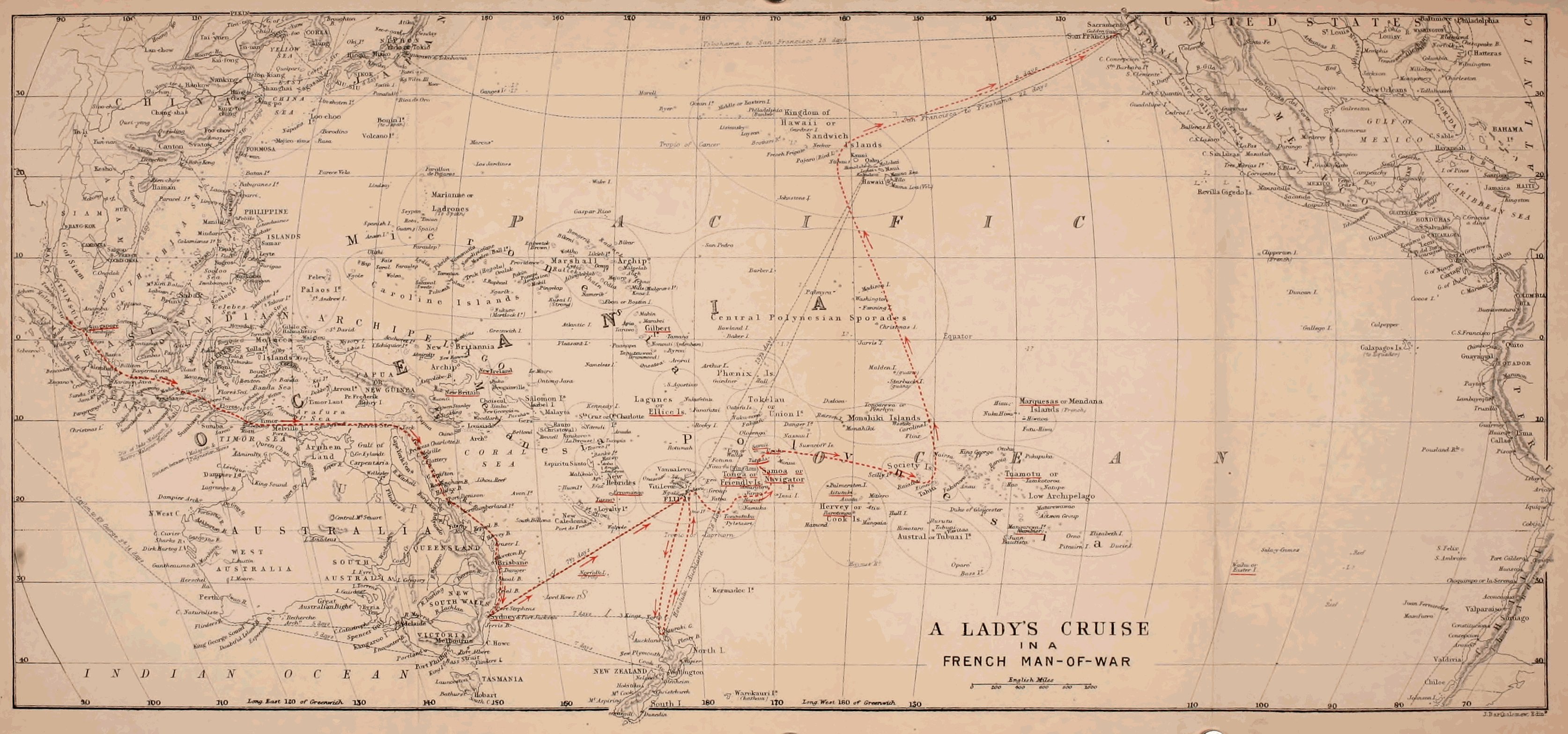
1. Since the above was written, Mr Watkin has been appointed Chairman (or as we might say, Wesleyan Bishop) of Tongatabu.
Mr Baker has ceased to work in connection with the mission, and now acts as Prime Minister to King George.
2. For numerous instances of this, see ‘From the Hebrides to the Himalayas’ (C. F. Gordon Cumming), vol. i. pp. 203–210.
3. I am happy to say that the king’s good sense carried the day, and enabled the wishes of the people to find an independent voice. In July 1879, King George formally opened a Tongan Parliament, at which, for the first time, representatives of the people were present, under the new constitution, to discuss all questions relating to their own wellbeing. Ere the close of the session, in the middle of September, the law prohibiting the manufacture and wearing of native cloth, and rendering certain articles of clothing compulsory, was abolished. Men and women are now permitted to wear any clothes they please, in doors or out, provided, of course, that they are decently clad according to South Sea interpretation of the word. The only exception to this happy rule of liberty is the interior of the Wesleyan Church at Nukualofa, where it is still necessary for men to appear in full European dress—coat, trousers, shoes, &c.—and for women to wear bonnets and dresses! Those who cannot, or will not, comply with this regulation, must stay outside the sanctuary.
The prohibition against women smoking was also modified. Doubtless the revenue will suffer from the diminution of lines, but that can scarcely be a matter of much regret. Various other wise measures were passed, showing that the Tongans have awakened to understand the folly of attempting to introduce the manners and customs of foreign countries, without reference to the requirements and necessities of their own people. Consequently several excellent Tongan customs relative to tenure of lands, tribes, and status of the people, are now legalised; and the representatives have shown their strong and sensible desire to retain all that was good in their national code of laws, but which had been put away, together with things evil, at the suggestion of resident foreigners.
That the latter were so effectually prevented from unduly influencing the young Parliament, was doubtless due to the presence of H.B.M. Deputy-Commissioner for Tonga, A. P. Maudslay, and of Mr Wilkinson, both of whom have been engaged in the establishment of the new Government in Fiji, and well know the wisdom of ruling a semi-civilised race by retaining, so far as is possible, their own ancient feudal customs.
4. A great Tongan chief, settled in Fiji, who, up to the time of annexation, contested with Thakombau for the supremacy. I have just received news of his death.
5. Since my return to England, I have heard the statement corroborated.
6. Vide ‘At Home in Fiji’ (C. F. Gordon Cumming), vol. ii.
7. The struggle lasted for some time. Finally, Malietoa again got the upper hand, and was acknowledged king by the foreign Powers, General Bartlett, U.S., being his prime minister. In August 1879, the Hon. Sir Arthur Hamilton Gordon, Commissioner for the Western Pacific, arrived at Apia, and concluded a treaty with the king and Government of Samoa, declaring perpetual peace and friendship between the people of their respective isles. The Samoans ceded to Britain the right to establish a naval station and coaling depot, as had previously been granted by treaty both to Germany and America. On the 8th November 1880 King Malietoa died. He was barely forty years of age, and a man greatly loved by all his own people. Probably but for the disturbing presence of the meddling whites, he might still be reigning over a happy and prosperous people. As it is, the country is once more in a state of anarchy; and the good bishop, whose heart yearned for the peace and prosperity of the people, has himself passed away to the world where all is peace.
8. Didunculus strigirostris.
9. Or more correctly, in old Celtic parlance, tuaphol—that is to say, a turn contrary to the course of the sun, keeping the left hand towards the centre. It was only used when invoking a curse, as opposed to the turn deisul, which invoked a blessing on the object round which the turn was made. The superstition is common to all lands in whose early mythology sun-worship held a place. See ‘From the Hebrides to the Himalayas,’ vol. i. p. 203.
10. The sulu of the Friendly and Fijian Isles, the pareo of Tahiti, the sarong of the Malays, or the comboy of the Singalese, is simply a fathom of cloth wrapped round the lower limbs, and reaching to the knee or the ankle, according to the width of the material.
11. Capital of Fiji.
12. Shortly after the above was written, the Pacific was electrified by the sudden collapse of this huge mercantile house, which failed for the modest sum of one million sterling.
13. Vide New Zealand Blue-Book, 1874—evidence of Mr Sterndale, late employé of Mr Godeffroy.
14. Sea-urchins.
15. Fa “in the manner of”—
| Vaka-Viti, | Fiji-wise. |
| Faka-Tonga, | Tonga-wise. |
| Fa-Samoa, | Samoa-wise. |
16. Great love to you.
17. Apparently women are held in higher estimation by the Samoans than by some folk in the British Isles. I have just heard of a Highlander driving a very fierce bull along a highroad. To him, quoth a friend, “That is a dangerous-looking brute!” “Ou na!” replies the owner; “he is just as ceevil as a sheep. He wadna hurt onybody, unless, maybe, weemen and bairns and suchlike!”
18. The Rev. W. Wyatt Gill has recorded a multitude of most interesting examples of such parables from nature. Moreover, happily for all lovers of such lore, he has, during his mission career in the Hervey Isles, found time to preserve many delightful “Myths and Songs from the South Pacific.” It is much to be wished that the same could be done for other groups.
19. Crinum asiaticum.
20. Nineteen Years in Polynesia. By the Rev. George Turner, London Missionary Society.
21. For a few examples, to which many more might be added, see ‘From the Hebrides to the Himalayas,’ vol. i. pp. 16, 74, 130–134.
22. Vide ‘At Home in Fiji,’ by C. F. Gordon Cumming.
23. Aitutaki, “led by God.”
24. Notably one dug out of the peat-moss at Ballachulish, now in the Antiquarian Museum in Edinburgh; and those in the Museum at Hull; also those in the Berlin Museum. All these have the eyes formed of quartz pebbles, instead of the bits of pearly shell or of obsidian used in the manufacture of idols in the Pacific.
The stone gods also had their counterparts in our own isles. When Dr Turner visited the Union or Tokelau Isles in 1850, he found that the great god, Tui Tokelau, was supposed to be embodied in a rude stone, which was carefully wrapped up in fine mats, and never seen by any human eyes save those of the king, who is also the high priest. Even he might only look upon the sacred stone once a year, when the old mats were removed and new ones supplied. Of course constant exposure in all weather, day and night, soon decayed the mats; but the worshippers continually offered new ones, especially in cases of sickness, and these were wrapped round the idol, so that, ere the day came round for its disrobing, it attained a prodigious size. The old mats were considered so sacred that none might touch them; so they were laid in a place apart, and there left to rot. The month of May was especially devoted to the worship of this god, and the people assembled from all the Tokelau isles to hold a great feast in its honour, and to pray for prosperity and health, and especially for an abundant supply of fish and cocoa-nuts.
Now turn from the Pacific to the North Atlantic, and read a statement by the Earl of Roden, in his ‘Progress of the Reformation in Ireland.’ He says:—
“In the south island—i.e., Inniskea, off the coast of Mayo—in the house of a man named Monigan, a stone idol, called in the Irish Neevougi, has been, from time immemorial, religiously preserved and worshipped. This god resembles in appearance a thick roll of home-spun flannel, which arises from the custom of dedicating a dress of that material to it whenever its aid is sought; this is sewn on by an old woman, its priestess, whose peculiar care it is. Of the early history of this idol no authentic information can be procured, but its power is believed to be immense. They pray to it in time of sickness; it is invoked when a storm is desired to dash some hapless ship upon their coast; and again, the exercise of its power is solicited in calming the angry waves to admit of fishing or visiting the mainland.”
It scarcely seems possible, does it, to realise that our own ancestors were as gross idolaters as any South Sea Islanders? Yet in the majority of these isles the present generation have never seen an idol of any sort; and should they ever visit our museums, they would gaze on the gods of their own fathers as wonderingly as we do on those of the early Britons.
25. Alas! the fate of the majority has already been sealed. In the spring of 1881, the following brief paragraph announced that the lives of these brave pioneers had already been sacrificed:—
“Massacre of Missionaries.—Despatches received in Liverpool announce the massacre in New Guinea of a number of missionaries belonging to the London Missionary Society. The news was conveyed to Melbourne in a telegram from the Rev. Mr Beswick, who himself narrowly escaped with his life. On the 7th of March the missionaries were attacked by the natives at Kato, in the district of Port Moresby, Hulu, and four of them, with two of their wives, four children, and two servants, were killed. The natives also attempted to kill four native boys who were with the missionary party, but they saved themselves by swimming. Not the slightest provocation was given; but it is stated in the despatch that the perpetrators of other previous massacres on the coast have not been punished, and this is considered to be the main cause of the outbreak. The total number of persons killed was twelve, but the list would have been much greater had not the remainder of the party made their immediate escape. For fear the natives would make a further attack upon the missionaries in the outlying districts, they were all removed from their stations to Port Moresby.”
26. Foreign.
27. The thought of this poor savage, week by week imperilling his life by crossing that stormy sea in his frail canoe, has often come vividly to my mind as an illustration of the words in Deut. xxx. 11–14: “This commandment which I command thee this day, it is not hidden from thee, neither is it far off. It is not ... beyond the sea, that thou shouldest say, Who shall go over the sea for us, and bring it unto us, that we may hear it, and do it? But the word is very nigh unto thee, in thy mouth, and in thy heart, that thou mayest do it.”
28. Christianity.
29. See note on Etu worship at the end of this letter.
30. See an interesting article on the origin of clan names in Britain, ‘Cornhill Magazine,’ September 1881—“Old English Clans.”
31. It is hard to have to think of that tender and loving heart as of a mere material relic. Yet, as the heart of the Bruce, enshrined in its golden casket, was carried by his true knight to that Holy Land which his feet might never tread, so has the heart of this saintly prelate—the first Bishop of Samoa—been borne by his faithful followers, to find its resting-place in the church where for so many years he pleaded for, and with, his people.
It was brought from France by Père Lamaze, now consecrated Bishop of the Isles. The heart is enclosed in a glass urn, with an outer case of gold, ornamented with precious stones, and supported by four angels. On the lid of this reliquary is a representation of a bishop appearing before the judgment-seat of our Lord.
On reaching Samoa, the casket was deposited at Vaea, while preparations for its reception were made at Apia. On the 24th May 1881, about six hundred Catholics assembled at sunrise at the church at Vaea, to pay a last tribute of respect and devotion to their loved bishop; then forming in solemn procession, they moved towards Apia. The children from the convent school at Savalalo walked first, followed by their teachers; next the Catholics of Apia and the surrounding districts. These were followed by the clergy, four of whom acted as pall-bearers, while four others carried the heart. Last of all came the Catholic chiefs, the catechists of Vaea College, and the natives residing at the mission-house at Apia.
On reaching the church, a sermon was preached by Bishop Lamaze, and the heart was then deposited in a niche in the wall, there to remain enshrined, as a perpetual memorial to the people of Samoa of the earnest and noble life that was spent in striving to exemplify the holiness he preached.
32. The following paragraph is from a recent Hawaiian Gazette, showing the course of events in Samoa:—
“We learn, through the courtesy of Lieutenant Abbot of the Lackawanna, some interesting particulars in relation to the political condition of the Samoan archipelago. The chief Malietoa, whose name is identified with the sovereignty of Samoa, is dead, and his nephew and namesake has succeeded to his political authority and state; but a rival chief, Kepua Tomisasu, has been contesting the succession, and previous to the arrival of the Lackawanna there had been a series of desultory semi-barbarous war campaigns—not resulting in any decisive action or notable slaughter of men, but causing widespread ruin, robbery, and unrest. The American commander Gillis now presented his good offices in the way of reconciliation, and to establish between rival chiefs and peoples of the same land a more harmonious and patriotic spirit. And we are happy to say that, after many baffling discussions, a political unity and harmony on Samoa have been effected—Malietoa II. being proclaimed King of Samoa, and his rival, Kepua, the Premier of Samoa, with an authority on public questions somewhat like our former Kuhina Nui.
“The Samoan warriors have all dispersed and returned to peaceful pursuits. The terms of peace were drawn up and signed on board the Lackawanna in the harbour of Apia, and a royal salute of 21 guns was fired from the vessel in honour of the event.
“We are glad to recognise that in this instance the commander of an American man-of-war intervenes solely as a peacemaker, and to promote the best welfare of a Polynesian people.”
33. Colonial abbreviation for San Francisco.
34. Capital of Fiji.
35. An explanation which resulted in the complete exoneration of Captain Aube, and his appointment to the command of La Savoie,—a finer vessel than that from which he had been so summarily dismissed.
36. The good bishop had the satisfaction of reaching la belle France, and there effectually pleading the cause of his friend, ere he laid down the burden of life, which he had borne with so much anxious care for the weal of his people. He died very shortly after his return to Europe.
37. King Pomare II. was the first person who was publicly baptised in Tahiti. The service took place on 16th July 1819.
38. Vahine, a woman.
39. And in this year of 1882 still continue to crop up, greatly to the benefit of the lawyers, who find in the affairs of the Estate Brander, a harvest far too remunerative to be lightly abandoned.
40. Soon after my return to England, I heard that this happy home had been invaded by ophthalmia of a virulent type, necessitating an immediate return to France, and long and anxious care; but nevertheless resulting in the partial blindness for life of two of those merry boys. Even the Tahitian paradise has its thorns.
41. The late Sir Archibald Dunbar of Northfield, in the county of Elgin, married, firstly, my father’s sister, Miss Gordon Cumming of Altyre and Gordonstown; and secondly, Miss Brander, heiress of Pitgaveny, whom, consequently, we have known all our lives, and loved much.
42. Pandanus.
43. My soul is defiled with sin.
44. Musa uranascopus.
45. Acanthaster solaris.
46. Acrocladia mamillata.
47. Conus textilis.
48. Let not the nations of the West sneer at these superstitions of the East. Faith in the efficacy of the king’s touch as a cure for scrofula was implicit both in France and England for many a long year. So early as A.D. 481 it was practised by Clovis. And it is recorded that on Easter Day, 1686, Louis XIV. touched 1600 persons, saying to each, “Le roy te touche, Dieu te guérisse!” This singular divine right was first claimed in England by Edward the Confessor in 1058, and his successors carried it on. Charles I. did, on St John’s Day, 1633, visit Holyrood Chapel, where “he heallit 100 persons, young and old, of the cruelles or king’s evil.” Charles II. actually touched 92,107 such patients—being an average of 12 per diem for twenty years. His exchequer must have suffered by this kingly privilege, as he presented a broad gold piece to each sufferer. The touch of Queen Elizabeth was declared “a sure relief when all other methods have failed.” Henry VIII., not content with miraculously curing all scrofula patients, also healed those afflicted with cruel cramps. Dr Johnson speaks of his earliest recollections of Queen Anne, into whose awful presence he had been ushered in his infancy, that by her royal touch she might cure him of his sore disease! The office appointed by the Church to be said on these occasions was actually retained in the English liturgy till 1719, when it was omitted by command of George I. But so late as 1745 many of the Jacobite party came secretly to Charles Edward, to crave his healing touch. See ‘From the Hebrides to the Himalayas’ (C. F. Gordon Cumming), vol. i. p. 264.
49. Dracæna terminalis.
50. Asplenium nidus.
51. Which proved to be the exact state of the case.
52. All of which I found to be strictly true. Undoubtedly, the ideal Pacific Isles lie south of the equator.
53. We can scarcely describe this proceeding as the thin end of the wedge, but it was obvious from the beginning that the assumption of the Protectorate was merely a cloak for forcibly taking possession of these gems of the Pacific. The cloak was finally thrown aside in June 1880, when King Pomare V. was persuaded by the commandant to cede the nominal sovereignty of the isles to those who had so long held its reality, and to accept a life-pension of 12,000 dollars a year, which he might enjoy in peace in his own fashion, and so escape from the continual tutoring, which made his kingly rank a wearisome burden, devoid of all honour.
The annexation of Tahiti was formally proclaimed in Papeete on 24th March 1881, and was made the occasion of a brilliant festival, such as the light-hearted crowds are ever ready to welcome. Great were the official rejoicings. From every ship in the harbour, and every corner of the town, floated the tricolour, which likewise adorned the raven tresses of the women and the button-holes of the men. Great was the noise of big guns, and the amount of powder expended on salutes. An imposing column of all branches of the service—sailors and marines, marine artillery, with their guns, infantry, and gendarmes—marched round the town, headed by the band: “A Tahiti, comme en France, on aime à voir passer nos soldats,” says the ‘Messager de Tahiti.’ So the lovely town was en fête. Every himène chorus had arrived from every corner of the isles, making the whole air musical. Thousands of natives, all in their brightest, freshest dresses, kept up incessant movement in the clear sunlight or cool shade. Everywhere games and feasting were the order of the day. In the governor’s beautiful gardens, a brilliant banquet for upwards of a hundred persons was served in a great tent, all as graceful as the combined taste of France and Tahiti could make it. Then followed a lovely garden festival, just such as that described by “The Earl and the Doctor,” a gay ball for the leading inhabitants, while “the people” danced no less joyously on the green, outside the sacred precincts. Games, music, dancing, and feasting, with a night of brilliant illuminations and fireworks,—all these, combined with lovely surroundings and perfect weather, made the great official festival of Tahiti a day which the French naval officers very naturally consider one to be remembered for ever, but which, perchance, may have caused some of the older inhabitants an angry and bitter pang, for the independence of their country thus lost for ever.
54. Immediately alter the declaration of the annexation of the Society Isles, comes the news that the French have also annexed the Gambier Isles, which lie to the south-west, in the direction of Pitcairn’s Isle. Our Gallic friends have thus secured a very admirable semicircle of the four finest groups in the Eastern Pacific. Here they can now consolidate their strength, and await the influx of commerce which must of necessity pass through this cordon, when M. Lesseps shall have opened the Panama Canal for the traffic of the world.
Here French ships will touch on their way to and from the Loyalty Isles and Cochin-China; while ships of all nations, plying between Europe and Australasia, will necessarily pass the same way, and contribute their quota to the wealth of the French Pacific.
The Gambier Islands have been gradually prepared for their adoption by France, the Catholic Mission having there ruled supreme for some twenty years.
Till quite recently, the Bible has been a prohibited book, but now, of the few remaining natives, a large proportion are learning to read Tahitian, in order to be able to study the Scriptures for themselves; and the Protestant Mission in Tahiti has responded to this desire, by sending copies of the New Testament for gratuitous distribution in the group. From one cause or another, however, a very small number of natives now exist, the islands having become wellnigh depopulated.
55. Although the French have had possession of the group for so many years, the natives of some of the islands have never been really in subjection to the authorities until last year, when Admiral Bergasse du Petit Thouars visited the group, and with the aid of volunteers, natives of Tahiti, and of the friendly isles of Marquesas, succeeded in disarming and bringing into subjection the hostile tribes, and that without firing a shot.
The admiral himself headed the troops across the mountains from village to village, arriving one night on the coast about midnight, having been conducted by natives who knew the passes: these passes were lighted up by the electric light from the frigate, which was anchored in the bay. The French took 600 muskets from the natives of the two islands, Hiva-oa and Fatuhiva. They say that the natives are really not a bad sort of people, but their curse, like that of all the islands, is “drink.” This, and the conduct of unprincipled foreigners, has been the real cause of all the trouble.
I affix a note which I copy from the ‘Messager de Tahiti’ for 30th of July 1880, which is all that has appeared in the paper on the subject:—
“Le Contre-Amiral commandant en chef le corps expéditionnaire aux Marquises, témoigne aux volontaires Tahitiens, aux volontaires Marquisiens, aux militaires de toutes armes, ainsi qu’aux marins qui ont pris part à l’expédition des Marquises, toute sa satisfaction.
“Grâce à leur esprit militaire, à leur dévouement et à leur discipline, l’île de Hiva-oa et celle de Fatuhiva ont été rapidement soumises et désarmés, et la paix régne partout aux Marquises.”
56. Sun-dried nut, exported for the manufacture of oil.
57. Holothuroides. Chinese name, Tripang.
58. The question was decided in her favour. She has been refitted and renamed and now sails the Pacific as the Annie Johnson.
59. I do not by this mean to suggest any trace of a common origin, merely founded on ancestor-worship, which prevailed in almost all countries, and which in the Pacific is to this day practised by the Papuan races. The islanders of the Torres Straits, in common with those of the Line islands, worship the skulls of their ancestors, and treasure them in their huts as reverently as did the Tahitians in heathen days.
60. For a trace of this custom, as practised in the Marquesas, see p. 257.
61. Whence has developed the Torii.
62. This is emphatically true of Fijian. See ‘At Home in Fiji,’ vol. i. p. 136.
63. Calophyllum inophyllum.
64. Entada scandens.
65. If any are disposed to doubt this statement, they have only to refer to the circumstantial and thoroughly authenticated accounts published by the various missionary societies; those, for instance, of the American Board, which again and again, in the early days of the mission to the Sandwich Isles, have occasion to refer to the outrages committed by British and American seamen, who came in armed bands to attack the mission stations, in their rage at the influence acquired by the missionaries, and the consequent change in the morals of the people. Again and again life and property were threatened, and the mission premises were only saved from destruction by the timely arrival of determined chiefs and their retainers.
66. The gods also were supposed to feed on the essence of the food offered to them. Every evening the priest in the principal temple of Mangaia cooked an ovenful of taro for their use, and threw one root at a time into the scrub, dedicating each to one of the gods. When the thirteen principal deities had thus been recognised the priest threw one more, as an offering to all the lesser gods, of whose names and attributes he was ignorant. This ceremony exactly answers to one which I have seen practised at the Buddhist monasteries in China, where, ere the monks taste their own food, a small portion is set aside on a pillar, as an offering to any saintly or divine beings whom they have neglected in their temple-worship.
67. Erythrina corallodendrum.
68. The next I saw were at the British Legation in Pekin, where they were objects of intense interest, as being probably the first ever grown in the Celestial Empire.
69. The Malay apple, familiar to us in Fiji as the kaveeka.
70. Just before leaving Tahiti, I bestowed equal care on three cases containing 6000 stones, which were carried by sailing-ship to New Zealand and thence to Fiji. Their arrival there was anxiously expected, and all arrangements made for their speedy distribution throughout the group. Alas! alas! when, after long delays, the cases were opened, they were found to contain a mass of decay; poor dead plants, which had sprouted during the voyage, and straightway died. When this sad news reached me, I bethought me sorrowfully of the advice given me by Monseigneur Janssen—namely, that as plants require light and air to enable them to sprout, I would do well to compel them to sleep by packing them in soot, and then having the case carefully caulked. The mess involved in such work was so horrible, that I shrank from undertaking it, but I bequeath the good advice to my successors in the attempt.
71. Paloma—a dove.
72. Der stille Tag.