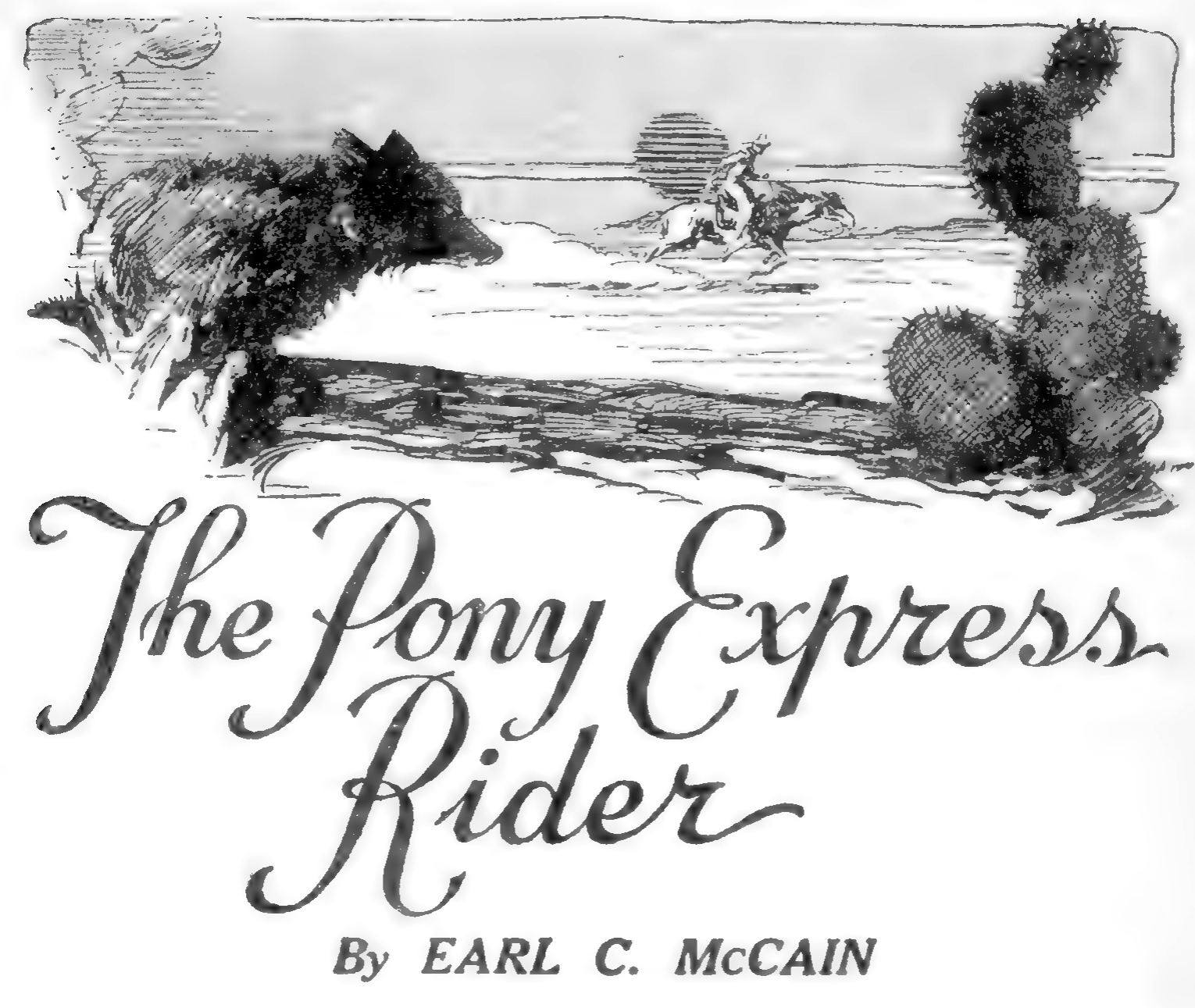
Title: The Pony Express rider
Author: Earl C. McCain
Release date: November 27, 2025 [eBook #77347]
Language: English
Original publication: New York, NY: The Frank A. Munsey Company, 1925
Credits: Roger Frank and Sue Clark
A rangy sorrel, dead tired from the long, hundred-mile trip from the Mormon settlements along the Great Salt Lake, lifted his ears sharply as he stumbled down from the rim of the desert and caught the smell of water. In a little depression among the blistering rocks and sand-dunes nestled a group of buildings; small, yet marking Ross’s Post, the most important place on the Pony Express route between Salt Lake and Placerville.
The rider, quick to catch the awakened interest of his horse, straightened in the saddle. Slight though it was, the movement showed the buoyancy of youth; natural enough, since Dixie Rollins was only five days past twenty-one. Ross’s Post was his destination and his dark eyes brightened as the horse quickened its step.
The trading post, two stories in height and housing a bar along one side, was the most important building in the settlement. It was flanked by several small shacks, sparingly built of boards.
Across the street from the trading post stood a small, squat building, with a big corral at one side. This was the Pony Express change station, and it was in front of it that Dixie halted the sorrel and slid to the ground.
Inside the office a tall, thin-faced man sat at a rough table, glancing over some papers as he talked to another man whose clothes stamped him as the station keeper. It was to the man at the table that Dixie directed his question:
“You’re Jim Slade, the superintendent?”
Slade nodded, meanwhile searching Dixie’s face with his keen, appraising glance. Slade was known as a real power in the Pony Express, with the ability to ride as hard and shoot as straight as any man under his direction. He possessed an uncanny ability at judging men; something that made Dixie a bit nervous as he went on:
“I rode down to try and get on as a Pony Express rider.”
“Can you handle a horse and gun?” Slade asked sharply, letting his gaze wander to the new Colt that swung at Dixie’s side.
“As for the first part of your question, I’m from Kentucky,” Dixie answered smiling. “With a gun, I’m only fair.”
Slade hesitated an instant, then said: “You’re pretty young to be tackling work as dangerous as the Pony Express.”
“I know, but I’d like a chance to make good at it. I have a brother, Clint Rollins, riding for you, and I’d like to show him that I can hold a man’s job.”
A change of expression flitted across Slade’s keen face.
“So you’re Clint Rollins’s brother. It seems to me I’ve heard something about you.”
“Good or bad news?” Dixie inquired, forcing his eyes to meet Slade’s across the table.
“Not the best,” Slade made reply, “but we’ll pass that. In the Pony Express, we don’t care so much about what a man has done as what he’ll be in the future. When we hire a man he starts with a clean page, and it’s up to him to write his own record on it by the way he conducts himself.”
Dixie merely waited, and Slade, after a moment, went on:
“I guess I can use you, Rollins, because we’re short a man between here and Salt Lake. I’ll start you on the Red Pillar run, which is one of the easiest we have. You relieve the eastbound rider here each afternoon, ride twelve miles north to the last station you passed coming down, lay over there at night and come back with the westbound mail in the morning. It’s what we call a ‘turn around,’ because you have to ride both ways each day, but you only make twenty-four miles. Most of the riders on the straight runs have to do forty or fifty miles a day.”
Slade turned slightly toward the station keeper and continued:
“Potter here will have a horse ready for you when the mail gets in from the White Rock station tomorrow afternoon. That will give you a chance to rest tonight and to visit with Clint, who ought to be coming in from the south pretty soon now. If you’re anything like your brother, you won’t have any trouble making good. Clint is one of the best riders we have, and a man all the way through.”
“Thank you, Mr. Slade,” Dixie said, meaning it both for the tribute of praise to his brother and the job Slade had given him.
From the station, he led his horse into the Pony Express corral after he had told Potter that he wanted to use the animal part of the time on his run, then walked across the street to the post. He had bought a cigar at the bar and was just lighting it when a shout from across the street drew his attention. Several men who were loitering in the room moved toward the door and Dixie followed.
Up from the south, where the desert sloped away toward the horizon, came a fast-moving rider, trailed by the dust clouds kicked up by his horse’s hoofs. In front of the change station Potter had tightened the cinch on a long-legged bay and a wiry-looking little man swung to the saddle and trotted out to meet the other man.
As the incoming rider came closer and closer the man on the bay swung his horse back toward the station and broke into a gallop. By the time the horses were running neck and neck Dixie could recognize Clint, who raised himself in one stirrup, lifted the mochilla, or leather saddle-cover containing the mail-pouch, and passed it to the other man.
A moment and the bay was racing past the station, with never a halting of the mail-bag in the change of riders. Dixie had seen Pony Express riders before, but never one of those whirlwind changes, and it thrilled him to think that tomorrow he would be riding from Ross’s Post on that same duty. He turned as Clint’s horse, already slowing, neared the station.
With an ease that came from long experience Clint slid gracefully from the saddle in front of the corral gate and turned his horse over to Potter. His face and clothing were covered with fine, white dust. He was slapping this from his trousers with his wide-brimmed hat when Dixie, touching his arm, said:
“Hello, old timer!”
Clint turned quickly, evidently surprised by the familiarity of the voice. He was no heavier than when Dixie had last seen him, seven years previous, but somehow, he looked different. His face was leaner and stronger, with a certain hardness that had not been there before.
He took Dixie’s outstretched hand, but it seemed as if there was a lack of warmth in his voice as he asked:
“What the devil are you doing here?”
“I’m going to work for the Pony Express. Mr. Slade has already given me a job riding between here and Red Pillar.”
There was a touch of pride in Dixie’s voice as he made the announcement, but not in Clint’s reception of it. Clint spent a moment in thought, then ignored Dixie’s remark as he said:
“I thought you were in California?”
“I was, until a few months ago.”
There followed an awkward pause, broken by Dixie asking:
“What’s troubling you, anyway, Clint? I know there’s something wrong from the way you act.”
“There is,” Clint said evenly, and his blue eyes, hard as steel, met Dixie’s. “I’ve heard you were mixed up in a mine robbery out in Sacramento and had to skip out to save your hide. I think you’ve got lots of nerve, trailing me here and asking Slade for a job, when you’ve got that kind of a reputation.”
The fighting blood of the South came leaping to Dixie’s head at Clint’s words, but he checked the angry reply that came to his mind. Clint was his brother—an older brother, who, in former years, had always led him—and besides, there was something in what Clint had said.
But Clint’s assumption that he was guilty before he had had a chance to explain rankled him, and he showed it in his reply.
“I’m not saying that I haven’t done some things I wish I hadn’t, Clint, but fortunately for me, Slade’s a little more generous than you are. I did tell him I was your brother, because I was a little proud of what he said about you. But after all, I got the chance I asked for, and I’m going to show him and you, too, that I can make good.”
Clint said nothing to that, and Dixie, knowing that he probably wouldn’t, turned sharply and walked back to the trading post. He knew that Clint would have to lay over in Ross’s Post, and he had intended to share his brother’s room. But Clint’s attitude had made that impossible, so he walked into the office of the trading post.
A tall, gray-haired man came forward and Dixie stated his business, explaining that he was to begin work as a Pony Express rider the next day. The tall man was old Dick Ross, founder of the post and friend to white man and Indian there for twenty years. When Dixie gave his name, Ross inquired:
“Any kin to Clint Rollins? He stays here every other night.”
“I’m his brother, but I’d like a separate room if you have it.”
Ross nodded and turned to a doorway at the side of the office. He spoke to some one in the adjoining room, and a girl came to the door. Her eyes, black and sparkling, seemed to find something of interest in Dixie as Ross said:
“This is my daughter, Mildred, Mr. Rollins. She looks after the boarding end of the business while I handle the trading post and the bar.” Then to her: “Mr. Rollins is Clint’s brother, and he’s going to stay with us tonight.”
“I am glad to meet you, Mr. Rollins,” the girl stated, emphasizing it with a smile that brought out all the beauty of her pretty little face. “I know your brother quite well, and I hope we shall become as good friends as Clint and I have always been.”
“I’m your friend already,” Dixie replied, and though he smiled as he said it, he knew that he had never made a truer statement.
The girl was small, with the lithe grace of an Indian in her movements. Her manner of meeting him showed courage and sincerity, and back of his instant liking for her was the age-old appeal of youth to youth.
A call from the bar took Ross away from them and Dixie spent a few minutes chatting with the girl. She told him they had supper at six, then directed him to his room and disappeared toward the rear of the building.
As he climbed the stairs he heard the sound of a horse stopping in front of the bar, but he reached his window too late to see the rider.
There was a home-made rocker in the room and Dixie pulled this over to the window, lighting a cigarette as he sat thinking of the meeting with Clint. He felt a keen resentment at his brother’s treatment, but he knew that he might have expected this if Clint had heard of the trouble he had been in at Sacramento.
Brothers though they were, there was a vast difference in the two men. Clint had always been stern and strong—a man at eighteen with rigid ideas of right and wrong. Their mother had come from Virginia, and from her Dixie had inherited his brown eyes and his tolerance and sympathy for others. He believed that any man, like a picture, deserved the best light, and it cut him that Clint, instead of showing him sympathy, had treated him like an outlaw.
An hour or so had slipped by when the girl called Dixie from the foot of the stairway and he went down to the dining room. Supper was being served on one long table, and he found Clint, Slade, Ross and several other men seated. Dixie took the chair opposite Clint, but while both joined in the general conversation, neither directly addressed the other.
There was one pleasant feature of the meal for Dixie. The girl waited on the table and engaged in conversation with every one present. But to Dixie it seemed that she showed him a bit of favoritism. Twice he glanced up to find her dark eyes studying him, and each time he was rewarded with a smile.
When supper was finished, Dixie, like all the other men except Clint and Slade, strolled into the barroom. He was standing at the bar, talking to Ross, who had relieved the bartender, when he heard his name called. He turned to face Jack Settes, a man he had known in California and the one person he had dreaded to meet.
Settes had the reputation of being one of the deadliest gunmen in the West, with a gun-trick that had cost many an unsuspecting man his life. The butts of two big guns protruded from his belt.
He was a big man physically, with a commanding personality to match his giant frame, and by the merest inclination of his head he motioned Dixie aside.
“I reckon you’re a mite surprised to see me here, but I had business with you,” Settes began, when they were some distance from the bar. “I heard in Salt Lake that you had headed this way to join the Pony Express, so I rode down to see you.”
“What for?” Dixie asked, wondering if Settes’s appearance in Ross’s post was the signal for another battle with his past.
Settes, usually deliberate, took his time about replying. When he spoke again, his voice had been lowered almost to a whisper.
“It’s about that affair at Sacramento. I reckon you knew that Tom Lakeman died after the robbery?”
Dixie nodded, and Settes, after glancing around went on:
“Lakeman thought you had a hand in the robbery and told the Vigilantes, so you were wise in making your get-away when you did. But when the sheriff learned that Old Age Hardy, a teamster, had quarreled with Lakeman that day and found Hardy hanging around the mine after the robbery, he arrested Hardy for the shooting.
“Of course, you and I know that Hardy never shot Lakeman, and that he didn’t have anything to do with the robbery. But the sheriff at Sacramento was anxious to show that his office could maintain law and order without the help of the Vigilantes, so he bent all his efforts to convicting Hardy. He succeeded, and Hardy is to be hung at Sacramento on the twenty-fifth of this month, which lets you and me out, so far as the murder is concerned.”
“You know I had nothing to do with it, anyway,” Dixie stated.
“I know it, yes; but a lot of people think you did, and that’s what I wanted to see you about. After the robbery the men who were with me at that time scattered, and Pete Crosby and Ed Dickson drifted to St. Louis. They got caught trying to rob a store there and Pete was shot through the stomach. Before he cashed in he got tender-hearted about Old Age being hung for something he didn’t do, so he made a statement to the St. Louis officers.
“Dickson wrote me at Salt Lake, saying that Crosby’s statement, all properly witnessed by the St. Louis officials, is being rushed to Sacramento over the Pony Express to save Hardy’s life. It left there on the second, so it ought to be here on the tenth. You’ll be working as a Pony Express rider. I want you to grab that letter when it comes through and turn it over to me.”
“But what will happen to Hardy if I do?”
“He’ll most likely hang, but that’s the best thing that can happen for you and me,” Settes answered calmly. “You see, Crosby always figgered that you were hooked up with me in that robbery, because he had seen us together several times. His letter probably mentions us both, so it’s a matter of protecting yourself as well as me that you get that letter.”
Dixie was debating his answer to Settes, but he was saved a decision at the moment. The door leading from the office had opened and Clint stood at the end of the bar, quietly watching Settes and his brother.
For the first time since his arrival in Ross’s Post, Dixie felt ill at ease under Clint’s scrutiny. He evaded the issue with Settes by promising to see him later and walked across to where Clint stood.
“Who is that fellow?” Clint wanted to know, indicating Settes.
“A man I knew in California. Why?” Clint’s dominating manner nettled Dixie, and his own attitude became half-belligerent.
“He looks like a bandit to me,” Clint replied, “and you’d better be careful who you’re seen with if you want to hold a job in the Pony Express. What does he want around here, anyway?”
“Perhaps you’d better ask him,” Dixie answered angrily. “Only, I’d better tell you that he has the reputation of being the best revolver shot in California.”
“I don’t give a damn about that. It’s _your_ reputation I’m worrying about. The reason I came back here was to offer to share my room with you tonight.”
“I don’t want to share your room, since you insist on looking upon me as an outlaw,” Dixie snapped, and deciding that was a good thing to let Clint think about, he strode from the barroom.
Back in his own quarters Dixie felt a little sorry for the clash with Clint. Had he been less tolerant, he might have blamed Clint indirectly for his trouble.
At twenty, Clint had quarreled with their father and left home to seek his fortune in the west. His letters were pages of romance to Dixie, then hardly more than a boy, and when Clint, a few years later, had written for Dixie to join him in California, the younger brother had eagerly accepted.
The long trip by slow-moving wagon train had taken months, and by the time Dixie had arrived in Sacramento, Fortune had called Clint elsewhere. Thrown upon his own resources in a strange land, and too proud to let his parents know of his predicament, Dixie had fallen into the company of Settes, who had befriended him.
Dixie had finally got employment in a prosperous mine as a bookkeeper, when Settes, presuming on their friendship, had tried to get him to participate in a robbery of the place. Dixie had refused, but hesitated to report the intended robbery to his employers because of knowing Settes.
The mine safe held a fair fortune in gold that was awaiting shipment, and Dixie, thinking that he might be able to avert any robbery, had gone back to the office that night to make certain the safe was locked. He had been talking to Tom Lakeman, the night watchman, when Settes and several companions made their appearance, and in the fight that followed, fatally wounded Lakeman.
The fact that none of the outlaws had fired at Dixie had led Lakeman to believe that Dixie had been a party to the robbery, and he had expressed this opinion to a member of the Vigilantes. Hearing that these stern but often misguided advocates of law and order were searching for him, Dixie had made a hurried escape.
Since then, he had traveled from place to place, realizing that he was under a cloud that warranted suspicion, yet afraid to return and try to establish his innocence. He had known nothing of Hardy’s arrest and conviction until his meeting with Settes, and that had come almost at the moment when he had been given a man’s chance by Jim Slade.
Dixie was still thinking of the case when he fell asleep that night, and by the time he went down for breakfast, Clint had ridden away with the westbound mail. Because he had slept so late, Dixie found no one else in the dining room except Mildred Ross, and he enjoyed quite a talk with her as he ate.
After that, he spent awhile with Ross and Potter, killing time until noon. In the early afternoon, Slade called him to the office and gave him a few final instructions about his work and the route to follow.
It was nearly four o’clock when Dixie, watching from the door of the change station, noticed a moving speck on the desert. A few minutes more and it took the form of a horse and rider; the Pony Express rider from White Rock. Mounted on a trim little roan and with a Spencer carbine in his saddle-holster, Dixie rode out as he had seen the other man do the day before.
The little roan, trained in the work, swung around of her own accord as the other horse drew near. The other rider was small and lean, with a face tanned by sun and wind until it resembled old leather. He grinned as he passed over the mochilla and said:
“New man, eh? Well, luck to you, Buddy, but you’ve sure picked out a hard way to make a living.”
“I’ve had it that way before,” Dixie called back, placing the mochilla on his saddle.
As the fleet little roan raced past the station, Dixie noticed Jim Slade watching him, and he also caught a glimpse of Mildred at the door of the trading post. It thrilled him to think that the man who had trusted him and a girl who had already found a place in his heart were watching him as he started on his first run as a Pony Express rider, both expecting him to make good.
Dixie knew that Slade had favored him by starting him on the Red Pillar run. The mail pouches, starting each day at Sacramento and St. Joseph, Missouri, met at regular intervals throughout the two thousand mile route. Here and there the meeting of the mails at points where stations were far apart made it necessary to insert a “turn around” run; short, but necessary to keep the mail moving.
Slade had said there was little danger on the Red Pillar run, but Dixie knew that didn’t apply to other runs. South of Ross’s Post, the Piutes were on the warpath, and half a dozen Pony Express riders had paid for their bravery with their lives.
To the north, peace held over the land of the Mormons, but beyond that, along the Sweetwater and the Platte, the riders were in constant danger, and Dixie felt a warm admiration for his brother riders as he settled down to a steady gallop, with only the thud of the pony’s hoofs and the creak of saddle-leather to interrupt the silence.
The Red Pillar route for the most part was good, well-marked by the hoofs of the Pony Express horses as it stretched northward over blistering white sand and through desolate rocks and giant cactus. Dixie made good time, and he had been in the saddle only a little more than an hour when he came in sight of the Red Pillar station, so named because it stood at the base of a towering red cliff.
Dixie turned the mochilla over to his relief rider, who sped away on a sixty-mile night ride, then slowed up in front of the little station.
There was only one man at Red Pillar; a cheerful little Frenchman by the name of Le Ranier. He helped Dixie put away his horse, then returned to his work of cooking supper on the little box stove that stood at one end of the cabin.
Le Ranier had formerly been a trapper for the Hudson Bay Company in the far north and he had the knack of telling tales. It was almost midnight when the two men finally crawled into their bunks.
Daylight was just tinting the eastern sky when Le Ranier called Dixie. The Pony Express rider from the north was due there about five, and Dixie saddled his horse while the Frenchman finished getting breakfast.
They had eaten and Dixie was sitting in the door of the station, smoking a cigarette, when a horse came loping through the rocky defile to the north. A moment more and Dixie was in the saddle and riding out from the station.
“There’s some mail for Ross’s Post, sent down from Salt Lake,” the other rider stated, handing over a packet of letters with the mochilla.
Dixie waved his hand to Le Ranier as he passed, then swept out upon the desert, glimpsing an occasional coyote as he rode.
A few miles from Ross’s Post the trail passed through a group of bleak, sandstone buttes, similar to those at Red Pillar. As Dixie galloped along the sandy path, he heard the sound of a horse approaching. Instantly he thought of Settes, but when the other horse rounded a high rock, he recognized the lean figure of Jim Slade, bound for Salt Lake.
The superintendent lifted his arm as a signal to halt and Dixie reined up alongside.
“Make it all right?” Slade inquired tersely.
“Fine.”
“I figured you would when I hired you,” Slade said, more slowly. “I had a talk with Clint the other night, after he saw you talking to that fellow in the barroom. Clint was right worried about you, but I told him all you needed was a chance to make good. I’m considered lucky in picking out men.”
“Whether you’re lucky or not, you sure know how to get at the best that’s in a man,” Dixie rejoined with feeling. “I’m going to do my best not to disappoint you.” And when Slade had said “So long” and ridden on, Dixie knew that he would keep that promise, even though it meant an actual clash with Jack Settes.
That it meant trouble, he knew only too well. There was plenty of iron in Settes’s massive frame; something that made all the more terrifying the lightning quickness of his gun trick. He hadn’t bothered to ask Dixie to get that letter; simply demanded it, and he was accustomed to getting what he demanded.
Dixie had one advantage in facing Settes. He knew of his gun trick; that sudden sideways fall of Settes’s big body, while his right hand, meeting a lurching holster, held a belching gun by the time his body struck the ground. Settes wore two guns, but it was his right that always did the killing, and so well did it perform that the left was never called into play.
As he had told Slade, Dixie was only fair with a gun; fairly accurate and fairly fast. He knew that in the matter of drawing he had no chance with Settes. But in thinking of that gun trick, he had hit upon what might prove a counter for it, and passing a cactus that threw its shadow at the right angle, he jerked out his gun and fired a shot that kicked up the dust in the center of the shadow.
His first clash with Settes came sooner than he expected; almost by the time he reached Ross’s Post. He had turned over the mochilla and was almost at the door of the trading post when Settes, coming from the office, met him.
“What the hell’s troubling that brother of yours?” he asked.
“I don’t know. Why?” Dixie countered.
“He came into the barroom the other night and tied into me. Gave me to understand that I was to lay off you, or I’d have him to settle with. I reckon you hadn’t told him who I am.”
“On the contrary, I did tell him, with a little extra boost for you thrown in for good measure,” Dixie replied, conscious of a sudden joy in his heart that Clint, after all, had tried to help him. “But a little thing like a reputation doesn’t bother Clint. He figgers he’s pretty nifty with a gun himself.”
“He’ll need to be if he tries to interfere with me again. That letter from Crosby will be in the mail tomorrow. I didn’t want any trouble with anybody until after I get it, but after that, he can get action with me any time he wants it.”
“I guess it’s about time I put you right about that letter,” Dixie said evenly. “I’ve been thinking about that ever since we talked the other night. I don’t know whether I can clear myself on that case or not, considering the company they thought I was in and that I ran away as I did. But I’d rather risk a trial than let an innocent man be hung. I’m going to carry the letter through.”
“If you do, you won’t need to worry about standing trial,” Settes said deliberately, though his eyes were like pinpoints as he met Dixie’s quiet gaze. “I came here for that letter, and I’m going to have it, whether you get chicken-hearted or not.” And as if further words were unnecessary, he turned down the street.
Dixie had half turned, intending to follow Settes, when a sound caused him to glance up. In the doorway stood Mildred, and her expression told him that she had heard all that had been said.
Instead of following Settes, he entered the office, and the girl, with an eagerness that gladdened his heart, asked:
“What does all this mean, Dixie; about you having to stand trial unless you get a letter from the mail?”
“It’s a letter concerning a robbery and murder in California that Settes wants. He expected me to take it out of the mail, but you heard what I said to him.”
She nodded, then came another question: “How does he know that the letter will come through tomorrow?”
“He got a letter from a man in St. Louis, telling him when it was to start. It’s easy to figure when it will be here, because the Pony Express always makes its regular time.”
There was a pause, then Mildred said: “I’ve noticed that you and Clint aren’t very friendly. That you took separate rooms the other night and that you seldom speak to each other at the table. Is that because of this?”
“Yes, or rather because of Clint’s attitude concerning it,” he explained, somehow finding it easy to unburden his chief worry to this girl. “Clint had heard that I had been in some trouble, and he jumped to the conclusion that I was guilty without even giving me the chance to explain. Shall I explain my part in it to you?”
“You don’t need to,” she said quietly, with a look that said more. And after an instant, she asked: “Why is Settes so anxious to get this letter?”
“Because it implicates him. He was the leader of a gang that robbed a mine and shot a night watchman. He is willing that an innocent man should be hung for the murder, rather than that his connection with it should become known.”
The girl started to ask another question, then checked it, and Dixie, thinking that it might concern his part in the affair, didn’t urge her. Ross coming in a moment later, interrupted their conversation, and Dixie later drifted into the bar.
Dixie was to relieve Clint that afternoon, and he debated telling Clint of Settes’s threat. But because Clint had cautioned him about Settes, and because, in his anger, he had told Clint that he could get along without his help he decided against that. He liked to stick with a decision, once he had made it, and when Clint rode in that afternoon, Dixie took the mochilla on the gallop and sped away on his run.
Thinking of the clash with Settes and his threat Dixie rode carefully, though he knew he was in no particular danger as long as he held to the open desert. As he neared the sandstone buttes, he checked his horse a bit.
There were a dozen trails through the buttes, but the one used by the Pony Express riders was the best. Tempering speed with caution, he turned into a trail that paralleled the one usually followed, but he rode through and on into Red Pillar without incident.
Le Ranier must have found him a little quiet that night because he was worried, but he said nothing of the trouble on his mind. In fact, he waved the Frenchman a cheerful good-by when he took the mail the next morning and galloped away to the south; over a trail that ordinarily was safe, was now fraught with the gravest danger for him.
In the early morning, what life there was on the desert was out, and twice Dixie’s hand slid to his holster as he glimpsed moving objects in the cactus. But they proved to be only coyotes. He knew that the buttes offered a thousand places from which he might be ambushed and like the day before, he turned into an old trail where the soft sand deadened the sounds of hoofs.
Halfway through the danger zone, Dixie stiffened suddenly. He had caught the swish of a horse’s tail in a cluster of cactus beside the main trail. He slid from the saddle, and, gun in hand, made his way forward on foot.
A little farther and he reached a jagged boulder that overlooked the trail. Silently as a cougar stalking its prey, he made his way around its base, then suddenly flattened himself against the rock.
Fifty feet away and slightly below him, Settes lay behind a rock, watching the main trail with a cocked rifle in his hands.
For several minutes, Dixie stood there, wondering just what to do. Below him, Settes lay, waiting to shoot him down, the rifle being ample evidence of his intent. At that distance, he could drill Settes with ease, and yet he couldn’t pull the trigger.
There was sand at the base of the rock, and Dixie stepped out upon it, in full view had Settes been looking. But Settes had his eyes glued to the trail, all unsuspecting the danger behind, until Dixie’s voice, calm in spite of his excitement, called:
“Expecting me, Settes?”
Quick as a flash, Settes twisted about, the latter half of his gun trick. But that trick had always been practiced with a six-gun, and he now held a rifle.
Dixie let him get the weapon almost to his shoulder, then he fired as he had been firing at the shadows, and Settes’s great body slowly relaxed onto the sand.
Dixie had started forward, but he suddenly stopped, then moved back behind the rock. From the main trail came the sound of horses and Clint, with a rifle in his hand, raced into view. Behind him came Mildred, and both halted as Dixie stepped out into sight.
“What happened?” Clint asked, trying to hide the excitement in his voice as he leaped from the saddle and ran to Dixie.
“Settes tried to ambush me,” and Dixie pointed to the object that told the rest of the story.
“Thank God, you got him first,” Clint said fervently. “I got here as soon as I could after Mildred told me of seeing Settes leave the post with a rifle, but I was afraid I would be too late. Maybe you know how I felt, after the way I’ve treated you. I didn’t understand, until Mildred told me what she had heard Settes say yesterday, and what she found in that letter.”
“What letter?”
“A letter that Settes had received from a man named Dickson. It showed that Settes killed a man in Sacramento, for which another man was to be hung. A pal of his had confessed, and he wanted to get this man’s statement from the mail to save himself. Mildred couldn’t get the letter until after Settes left his room.”
The girl was coming up from the trail, and Dixie remarked:
“So it was Mildred who saw Settes leave and got that letter. I wonder why she did that?”
“Because she wanted to prove your innocence, and she wanted to do that because she loves you. She’s a good girl, Dixie, and there’s no reason why you can’t ask her to be your wife.” And later, as Clint, with the mochilla that contained Crosby’s letter, rode away to the south, Dixie again returned to his boyhood habit of following Clint’s advice.
[Transcriber’s Note: This story appeared in the November 28, 1925 issue of Argosy-Allstory Weekly magazine.]