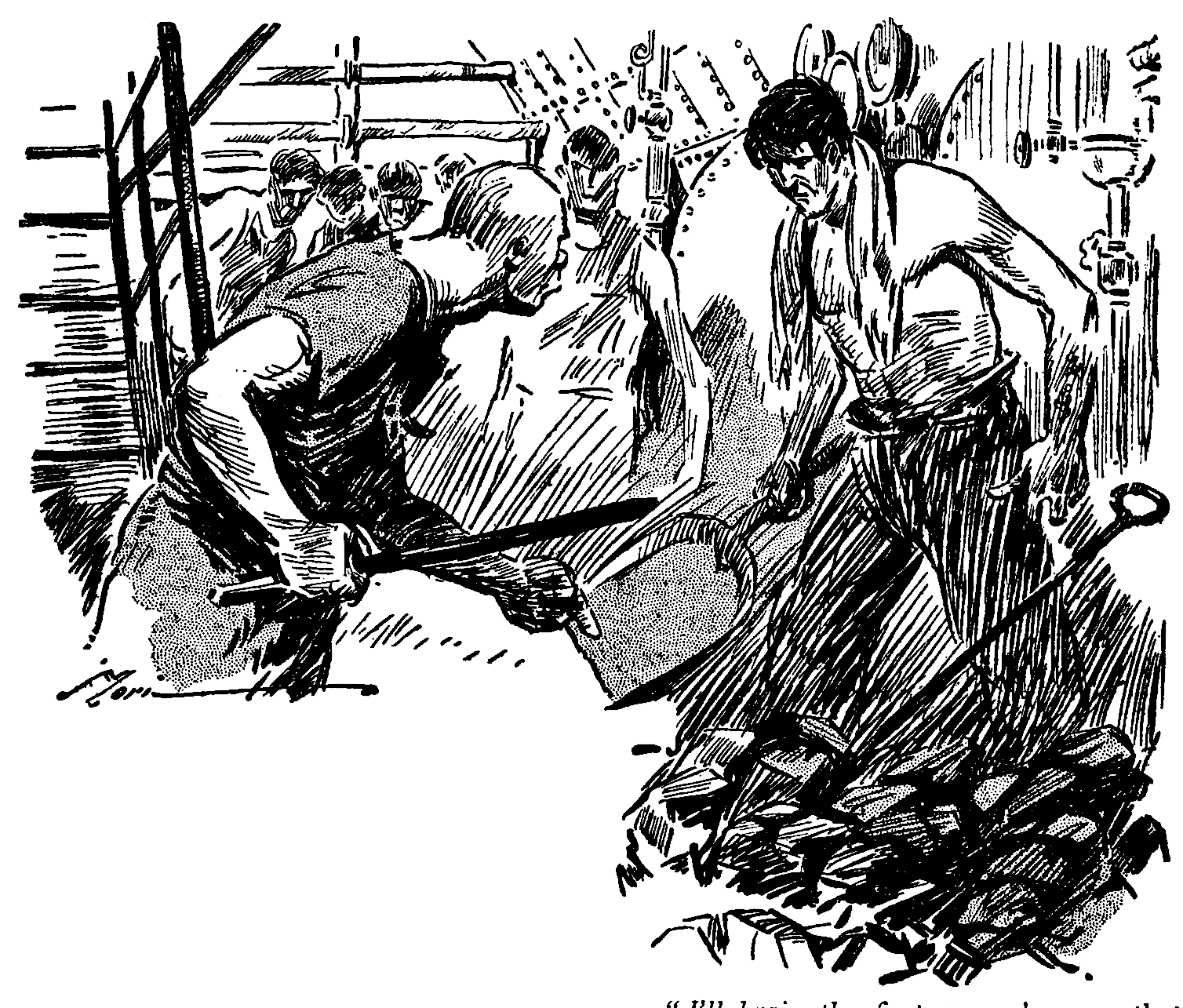
“I'll brain the first man o’ youse that tries to get out o’ this fire hole!”
Title: Strange waters
Author: Kingsbury Scott
Release date: November 27, 2025 [eBook #77346]
Language: English
Original publication: New York, NY: The Frank A. Munsey Company, 1929
Credits: Roger Frank and Sue Clark
Old Tim Donahue demonstrates that all sea-fighters aren't in the Navy.
There was nothing much in common between Captain Daniel Sullivan and little Tim Donahue. In the fifty or more years they had been on earth together their life currents had never touched, as far as they knew, until that day on board the Aurora, and then only for the brief flash of a moment.
While there is no record that the extremely short contact had any direct bearing on Captain Sullivan’s career, it surely did bring a decided change into Tim’s existence—a change which swept him out of the ranks of everyday men into the pages of history itself.
In fact, it is doubtful if Captain Sullivan in that instant was even subconsciously aware of Tim Donahue’s existence.
When Captain Sullivan hurried down the iron ladder into the stokehold of the lake freighter Aurora, lying at her dock in Buffalo, he saw nothing to attract his attention especially to the stubby man in overalls and a grimy undershirt scooping coal from the plates into the open furnace. Neither did he particularly notice that the glare was throwing a red glow over the sweaty shoulders and iron-gray head of the smallest man in the stokehold.
But Tim, confined within the limits of a much smaller world, noticed Captain Sullivan with a touch of curiosity as to his business there.
Of course there was no real reason why Tim Donahue should know that Captain Daniel Sullivan was representing the United States Government, nor that Captain Sullivan had made a rather important decision a few hours before when he had watched the Aurora come foaming into Buffalo harbor with a cargo of grain from Duluth under her hatches.
The Superior Navigation Company had been notified that their steamer Aurora had been commandeered by the government, and the ship was on her way to the yards at Lorain before Tim Donahue discovered the turn which life had taken. Tommy Jackson, his partner, whispered the news to him as they came on watch and the information hit little Tim with something of a thud.
He worked out his trick below with an all-gone feeling in the pit of his stomach, and every scoop of fuel he shoveled into the Aurora’s furnaces seemed to mock him.
When his watch ended he climbed the iron ladder out of the stoke hold with lagging steps. The steady thrum of the Aurora’s big compound engines seemed to be singing a farewell song to him. He lingeringly sniffed the odors of steam and grease as though he were anxious to preserve the memories of them forever.
Tim did not climb clear to the upper deck. Half way he swung to the narrow steel-sheathed passage over the boilers leading to the small door which opened through the heavy bulkhead to the engine room.
As he stepped through upon the gratings around the big cylinders he could see the oilers below him in the electric-lighted regions. The hum of the dynamos, the whir of the fans, and the drum of the big crank shafts plunging almost under his feet mingled in an orderly symphony.
The Aurora carried three engineers and Kelly, the second assistant, was on duty. Across the shining engine room Tim saw Andy McLaren, the chief, sitting in his hot little office. Tim pointed a grimy forefinger toward the chief’s sanctum and Kelly nodded permission.
The chief engineer looked up suddenly from his log book as little Tim Donahue stepped timidly through the doorway. It was not the custom for firemen on board the Aurora to walk into the chief’s office unless they were invited or summoned, and a summons usually meant something unpleasant. Tim had never been further than the doorway.
“What’s the rip?” the chief asked.
“Is it true, chief, that the old Aurora’s goin’ to salt water?” the little fireman asked, standing with his greasy cap in his hands and his gray head bowed as though he were expecting a blow. Beads of perspiration stood out on his forehead, streaked with coal dust.
“It looks that way, Tim,” the chief informed him. “We’re sailing under orders now from the Shipping Board to deliver the ship at Lorain.
“They’ll hack her in two with torches there and send her through the Welland canal in sections.”
“An’ that’s the end of her,” sighed the little man.
“Far’s the lakes are concerned, I suppose it is,” answered the chief engineer. “It’s not likely they’ll ever send her back.”
“Well, thin, I suppose we’ll all be gettin’ off her now?” ventured the fireman.
“Nearly everybody but me, I guess, Tim, and maybe the cook,” the chief told him. “With my salt water papers, I’ve been commandeered, too, for ocean service and they’ve offered me the Aurora.
“I’m used to her, and I may as well be here as anywhere else. I know what she’ll do, and I’ll be more at home in her than in some of the tubs they are puttin’ into service on the seaboard.”
“Sure, you brought her out just ten years ago, chief,” little Tim mused.
“Yes, and she’s in better shape today than when she was launched,” the chief agreed.
“An’ I was in her the first trip wit’ you, chief,” the little man said, looking down at the floor.
“That you were, Tim.”
“An’ I’ve been wit’ you every season since, sir.”
“So you have, Tim, me lad.”
“Sure, she’s like a home to me, sir,” declared the stubby man. “It’s been me pride that you were never widout steam when you needed it, sir—an’ plenty of it, too, chief, wit’ me on watch. I’ve been hopin’ that I could spend all me sailin’ days in her.
“I’ve me failin’, I know,” he continued. “There’s been times when pay days near ruined me. I’m not denyin’ that. There’s been times when you’ve had to be huntin’ me up on both ends o’ the run, an’ I’m sorry for the trouble I caused, chief. But it’s me weakness, that’s all, an’ I’ve thought sometimes ’twas a curse put on me. Anyway, it never took long to get the whisky out o’ me once I was aboard, did it, now?”
“Right again, Tim,” the chief laughed. “I always knew, once I had you aboard, you’d be ready for duty when your watch was called.”
“Maybe I’m slowin’ up a bit wit’ age, sir,” the little fireman rambled on. “I’m gettin’ along well past sixty, I’ll admit, but— Be the saints, sir, I can make a lot o’ younger min break their back over the scoops yet!”
“I’d say you’ve improved with age,” the chief remarked. “You’re the best fireman on the lakes, Tim. I’ll say that for you. I wish I could always be sure of a man like you below.”
Tim moved closer to the chief’s desk, fumbling his cap nervously.
“Av you please, Mr. McLaren,” he mumbled. “I’m hatin’ to leave the old ship. I can’t think o’ her out there in the Atlantic an’ me not aboard. I’d like to be shippin’ wit’ you, Chief.”
There was an appeal in old Tim’s eyes, which was far more eloquent than any words he could have spoken and McLaren saw it.
“I may not have the say, Tim,” he explained. “I’m working for a new boss myself. But if there’s a chance I’ll take you with me. You’ll have to run the risk of torpedoes, when we’re sent across.”
“Darn the torpedoes!” Tim fairly shouted, unconscious of his quotation. “Av I can stay in the old Aurora wit’ you I’ll ride thim torpedoes av I have to, sir.”
“You may have to do that then, Tim. There’s not many ships gettin’ through, they tell me, and the subs seem to be getting thicker.”
“The dirty pirates,” mumbled the stubby man. “Av I could get a good paste at one o’ thim, I’d give ’em a taste of a real Irish fight.”
“They don’t give you a chance to fight ’em that way, me lad,” the chief laughed. “We won’t get such an even break. I’ll let you know in a day or two what your chances for living to be an old man will be.”
It was an odd fate which awaited the Aurora at Lorain. Within thirty-six hours of her arrival there the torch-bearers were at work on the steel sides with their “fire knives.” They cut her through just forward of her midship deck-house. New bulkheads were fitted at the forward end of the after section and at the after end of the forward section and the caulkers made them as tight as the hull itself.
A temporary wheel house was built on the deck house and the rudder chains were connected up to her helm at that point, permitting the after section of the craft to proceed under its own steam. Then the odd-looking contrivance started down Lake Erie, with the forward section coming along under the convoy of two tugs.
Up to the entry of the United States into the great war, neither the American shipping interests nor the Canadian government had been very farseeing. As a result the submarine assault on allied merchant ships created a situation which was anything but promising.
Many fine cargo boats, badly needed in the emergency, were locked in fresh water by the small locks of the Welland canal. Nothing over 260 feet in length could then get through.
Only one thing could be done. There was not time to enlarge the locks, but the steel hulls of the lake freighters could be reduced to sections in a hurry with the torches. Great craft were cut into sections and floated through the canal. In Lake Ontario ports many of them were put together again. Others went through in sections to Montreal before they were again restored to their original form.
Down in the stokehold of the Aurora, Tim helped keep steam on what was left of his ship. While he was on watch below there was little to remind him of the change which had taken place. When he climbed to the upper deck to view the chubby chunks of what had been one of the trimmest freighters on the lakes, his heart gave many a sad thump.
“An’ to think I’d live to see thim do this to you,” he said. “Wit’ the rest of us trailing like the second piece of an angleworm. Who’d think this was the old Aurora, an’ the finest ship on the whole chain o’ lakes? Will they ever be able to do the right thing by you, I wonder?”
At Montreal the Aurora was held for her surface condensers and her saltwater fittings. Ingenuity born of necessity had found the way to button steel craft together, and the Aurora, once more her old self, surprised the stubby old man who had spent ten years of his life in her stokehold.
When she was ready for sea, Andy McLaren called little Tim into his office.
“We’re paying off the crew tomorrow, Tim,” he said. “The boys’ll get their wages and transportation back home.”
“Yes, sir,” Tim replied, with a lump in his throat. “Most o’ thim have places they can call home, no doubt.”
“The salt water crew’ll be aboard to sign up in the morning,” the chief went on. “They do that on the seaboard, you know. Everybody’ll have to sign articles.”
Tim nodded, with his cap crunched in his hands, but made no reply.
“There’s a big risk going to sea in these ships now, Tim,” the chief warned him. “And it’s not all torpedoes. The lake boats haven’t been the biggest sort of success in the transatlantic trade. They’re just as good sea boats, no doubt, but they’re hardly built right for the ocean seas. Then there’s the subs, too.
“I hear we’re going right across to Liverpool. They need wheat over there and we’re fitted to get it to ’em in chunks that count, if we can get through. But the chances are all against us. If you want to take the chance, Tim, me lad, I’ll fix it for you. You’ll have to sign on for the voyage, though, and it’s about like enlisting in the navy without the chance of fighting back.”
“I’ll risk me ol’ bones in the Aurora in anythin’ that blows,” Tim declared.
“Av she’ll stand up in Lake Superior wit’ the wind blowin’ a gale clear through from Hudson Bay, she’ll take care o’ herself just runnin’ across the little Atlantic.
“I’ll stack her agin thim rusty ol’ tramps that are in service now, sir. I’m that grateful to you for the chance, and you’ll not regret it. I’ll break the backs o’ thim salt water huskies, Chief.”
“Oh, I believe that, all right,” the chief agreed. “I sailed salt water before I came to the lakes and from what samples I’ve seen, I’ll hand it to the lake firemen every time. But the old Atlantic’s pretty cold, Tim, if you have to get over the side, and that’s liable to happen, you know.”
“I’ll not be gettin’ over the side until I have to,” Tim asserted. “I’ve been in the fire hole so long that I’m spoilt, entirely. I’m afraid o’ the cold, Chief.”
“I’m just telling you, Tim, you can back out if you want to and there’s nobody to say a word to you about it. We’ll be pulling out in the morning, though, and I’m advising you to remember your failing if you go ashore! This Canadian whisky’s a quick actor.”
“Sure it’s not me that’ll be backin’ out, sir, nor takin’ any chances ashore, either,” Tim assured him. “I’ve been worryin’ too much for fear the old Aurora’d be sailin’ widout me!
“I may not have much back o’ me, an’ little I know about the Donahues or the Cullens, either, that came before me. I’ve never been anythin’ but a fireman, an’ I never will be, Chief. But I ain’t yellow. Nobody can say that o’ Tim Donahue. He may be an ol’ booze hound on occasions, but that’s the worst o’ him, sir.”
The stubby little man stared straight ahead of him at the chief’s license on the wall and rambled on musingly as though he were talking to himself.
“I was a bit of a lad on Torry Hill in Milwaukee but I can remimber thim takin’ me mother away in a black cart up to St. Andrews an’ me an’ the ol’ man follerin’ along in a hack. After the mass, the ol’ man left me in care o’ the Doherties, that kept a saloon on the corner, an’ he lit out. Glad to git away, I guess.
“Whin I was old enough to work I ran away from Doherty an’ his wife, but I guess it didn’t make much difference to thim because I’ve never heard from thim to this day. As far as I know, sir, I’ve neither kith ner kin to be carin’ whether ’r no, if I’m blown up. In that case, Chief, I’ll have the pleasure o’ finishin’ up wit’ the ship that’s been me home for ten years. Sure, I’m feelin’ like I was ol’ John Paul Jones, himself, like he must ’a’ felt whin he set sail in the ol’ Bonum Richard.”
To Tim Donahue, odd as it may seem, John Paul Jones stood out in clear relief. Although old Tim had been only a fireman all of his life, and although he seemed illiterate, he was a reader of history. The life and the deeds of America’s first naval hero were the little man’s special hobby. Somewhere back in Tim’s Celtic past there must have been a student ancestor, who had left this bit of a bequest to an odd offspring.
With the somewhat primitive ability to read which a few years in St. Andrew’s parochial school had given him, Tim Donahue had been stumbling through the pages of history.
His fanciful Celtic mind was able to visualize what he read. It served to people his brain with living beings who had long since played their parts upon the earth and passed on. With the magic power of his retentive memory, he could call back out of the dim ages the great and the near great, from the Roman Cæsars to Mad Anthony Wayne.
The comfort of his life was John Paul Jones and his rotting old frigate, the Bon Homme Richard. The story of her battle with the Serapis was his great page in history. It is doubtful if any learned lecturer could have given a more graphic story of that encounter than little Tim Donahue.
In his secret mind, Tim had always hoped for a chance to repeat the deeds of the long-dead sea master. Half in childish fancy, he had often served the guns for his naval hero. When he was certain, at last, that he was about to sail out upon the same old sea which had lapped the sides of the Bon Homme Richard—a sea again infested by enemies to the same old flag, Tim’s thoughts very naturally turned quickly to his hero of heroes, his shipmate of years of fancy.
“Av he could lick ’em in a rottin’ hulk like the Bonum Richard, smokin’ an’ burnin’ and witherin’ up under his feet, Tim Donahue needn’t be losin’ his nerve wit’ a craft like the Aurora under him,” he mumbled, when he was alone with his thoughts.
Ten days out with a cargo of grain under her hatches, the Aurora was plunging along at ten knots.
Ten days and nights of the perfect weather which the Atlantic can exhibit when she is inclined to be agreeable had greeted the lake steamer on her maiden run through the salt seas.
Captain James McGraw, survivor of two previous submarine encounters, had kept well out of the beaten track of ships, and consequently away from lurking periscopes. During all of this time he had grudgingly given the Aurora her due as an able ship, which sparing praise would have aroused the everlasting hate of Tim Donahue had he been in position to hear the remarks on the bridge. But Captain McGraw had never before sailed anything but a long-legged salt water craft and it was rather to be expected that he might be slightly prejudiced.
Captain McGraw, cautious from experience and uncertain as to his ship, could not expect to go on dodging submarines indefinitely unless he expected to fetch up somewhere in the Arctic ocean. It was necessary for him to pull at last and bear for the coast of England if he hoped to make Liverpool with the cargo so badly needed there. He could only head the Aurora into the danger zone, trusting to luck to meet a destroyer convoy before the submarines discovered him.
At the same time the German submarine U-X-8, a supercraft for that period of the war, was cruising far from its base, waiting for a chance to pick up a fat victim before returning to its nest. Its supplies were running low and its crew was beginning to feel the pinch and nervous strain of the long cruise. With the increasing fleets of destroyers the sea was becoming less free for the pirate craft.
For several days there had not been a sign of a victim and Captain Froebel was beginning to believe his country had cleared the sea of merchant ships. Then suddenly far away to the starboard one morning, he spied a faint smudge on the horizon.
All day the ship hunter stalked his prey, still far out of range. As the strange ship came nearer Froebel studied her carefully through his powerful glasses. At first he feared she might be some new type of destroyer, which was being sprung on him, or a disguised war vessel—she lay so low in the water. Her funnel was far aft and her deck houses were farther apart than those of any other ship he had encountered. He could not quite make her out.
When he felt safe in drawing nearer, however, he saw the American flag flying at her peak.
“Yankee in a crazy craft,” he muttered. “He’ll be easy. He won’t fight and that ship should be worth picking.”
The commander left the conning tower and closed the steel hatch after him with a bang. Slowly the U-X-8 began to submerge until only her periscope cut the surface. During the remainder of the afternoon the submarine cruised within easy range of the odd ship until the light began to fade and the twilight settled down in a dusky murk over the sea.
It must be admitted that the crew of the Aurora was a bit jumpy, from Captain McGraw down. It is not a comfortable thing to slip out of comparative safety into a zone which is known to bristle with periscopes.
The darkening of the ship, the frequent lifeboat drills, the ever-present cork jackets and the noticeably increased tension on the bridge did not tend to steady the nerves of the men who were taking a chance on the Aurora. Sailing his first voyage through the torpedo zone, Tim Donahue was less affected than those who had passed through the experience before.
For two days and two nights the thing had been going on. The smallest unusual event, even the clang of the engine room telegraph sent the stokers jumping for the safety ladders in a mad scramble. Whenever such a stampede happened on Tim’s watch he could not disguise his disgust. His watch partner, August Schultz, a big husky German, under suspicion by the whole crew, was the worst offender.
“What the divil’s got into youse?” Tim asked angrily as the crew grew worse instead of better. “You, Schultz, you big Dutchman, runnin’ every time somebody stubs his toe on a slice bar! Why don’t you bend your back like a man an’ help keep some steam in thim kittles?”
“Ja!” Schultz cried in broken English. “You want me to drown like a rat in a trap or get captured aboard a German boat, yes? I know what they do mit me on these submarines. I been in the German navy three years. I know these officers, damn ’em! They don’t care for a man’s life. I run away from it. I can’t stand it. I know what they are, these officers. They are devils without any feelings. Gott!”
“It ain’t goin’ to help none to run up on deck and jump overboard before ye’re hit, is it?” Tim challenged. “You’ll never make a good Yankee, Schultzie. Y’ ain’t got the in’ards in you. You’re just like the rest o’ thim Heinies. You’d ought to be aboard o’ one o’ thim tin fish. Ain’t you got any fight in you, man?”
“Ain’t I?” cried Schultz, in anger. “Ain’t I? If I get a chance I’ll show you. I say I know what we get from them. I was in a submarine three years ago, already, with a captain that was a brute. One morning I stood on deck, when he wasn’t feeling good and he hit me in the face and knocked me overboard, because I was in his way. Gott! If I could see him once with equal chances!
“We was in the Nord Sea and a Danish fish smack picked me up. Then I go to America and I make up my mind never to go back again to Germany alive.”
“What the divil are you doin’ aboard a Yankee ship out here, thin?” inquired Tim suspiciously.
“I’m a sailor. That’s all I can do. I got to live,” Schultz explained. “Maybe I get my chance at that officer, too. Ach, if I do!”
“Well, stick around an’ don’t get looney,” cautioned Tim. “Though for the life o’ me I don’t see how you got aboard this ship. I thought they were pretty careful about lettin’ Germans aboard nowdays.”
“Nobody asked me anything. I just signed up and nobody tells me I can’t,” the German insisted.
“’Tis no wonder the country’s full o’ thim spies,” Tim commented, “lettin’ furriners in that way.
“But whither or no, you’ll walk the mark whilst you’re wit’ me. An’ some time, Schultzie, I’ll tell you about an honest-to-God American that wasn’t afraid of anythin’ that floated. It ’ll do you good, me boy. Did you never hear o’ John Paul Jones?”
“Clang! Clang! Clang!” suddenly crashed the engine room signal from the bridge. Tim held his breath and waited until, “Clang!” sounded the signal for the fourth time. He knew the bridge was calling for “Full speed ahead.”
Grabbing a short iron bar he ran for the narrow steel ladder and reached it ahead of the rest of the crew. Then he turned and, perched on his vantage point four rungs up, faced the panicky group.
“I’ll brain the first man o’ youse that tries to get out o’ this fire-hole!” he screamed, swinging his weapon above their heads. “Get back there an’ shove some steam into thim boilers, y’ quitters! Av the old man didn’t want more steam he wouldn’t be ringin’ for it.”
“Out o’ the way there, you crazy fresh water runt!” warned a burly coal passer, making for the ladder. “They can’t keep us down here to drown like rats.”
With a sickening thud the bar crashed down on the skull of the coal passer and the huge bulk crumpled at the foot of the ladder. “Thud!” came the bar on another head, and two men lay still at the bottom of the ladder.
“I’ll use you all alike!” cried little Tim, the thrill of battle lighting up his smeared face. “Act like Yankee sailors an’ youse won’t have nothin’ to fear from me. Get back to thim furnaces now an’ be min! Schultzie, fire me furnace for me whilst I stay here to crack the next yellow-leg that tries to run away from a fight.”
Tim’s rough methods earned command of the stokehold for him. Perched on his ladder with his weapon ready, he stood guard as the crew returned to work.
“I had to put the fear o’ God into thim,” he mumbled as he surveyed the work of his bar. “I’m hopin’ a little cold water’ll bring thim boys up standin’.”
The men in the stokehold of the Aurora could feel the increased speed of the ship as she surged ahead, and they could feel that she was swinging off sharply to starboard. But the grimy crew had more to fear from the stubby man on the ladder than from the torpedo which they expected momentarily.
Suddenly there was a terrific shock which knocked down most of the stokers. The Aurora rolled down wickedly, but righted herself within a few minutes. It seemed hours before the signal to stop rang out in the engine room. Then came a bedlam of hideous noises from above, a series of explosions following one another in a deafening roar.
“They’re shellin’ us!” cried one of the men.
“Thin we’re safer here,” Tim announced.
“Schultz!” he sang out. “Go on deck an’ find out what it’s all about! Thin come back an’ tell us. Mind you don’t lose your nerve an’ run away. If y’ do, God help you—we’ll all take a crack at you.
“The rest o youse stay here. Maybe th ol’ man’ll be wantin’ some more steam in a minute. Keep her blowin’ off!”
For very good reason, Captain Froebel had decided not to sink the Aurora with an expensive torpedo. He had been away from his base a long time and with so many British and American destroyers now operating, he wanted to save his deadliest weapon for them. Also, the Aurora promised to have things on board which he needed, and his German thrift forbade destroying a prize which promised little difficulty, until he had picked her clean. A bomb properly placed would finish this craft when he was through with her. So he determined to pick her clean without considering that several things might happen.
In the first place, never having had experience with Great Lakes craft, he had no idea that the Aurora was capable of picking up speed rapidly. Neither did he know that this odd ship, built to cut some sharp corners in the ship canals without a tug, was quick as lightning on her helm. It came as a surprise to him, therefore, when the steel hull of his victim slammed into him and carried away the periscope of his almost totally submerged craft.
With its periscope gone there was nothing left for the U-X-8 but to come to the surface and fight it out. Even in this situation the underwater boat had all the advantage over the Aurora, which was sailing without a gun crew. Repairs to the damaged periscope could be made quickly, once the prize was disposed of. Captain Froebel hurriedly mounted his light deck gun and fairly deluged the decks of the Aurora with shell fire as a matter of chastisement.
“Take your crew off in the boats!” he shouted to Captain McGraw of the Aurora, in very good English, after the first shower of shells. “I’m going to shell your ship immediately again. Heave to and get your boats off if you want to save your men! I’ll give you ten minutes.”
Captain McGraw, who had seen four of his men go down under the fire of the pirate, was well aware that further resistance was useless. The Aurora was not built for battle and a well-placed shell might end her career at any time. He sounded the order for the boats and the crew lost little time getting overside.
Deep down in the stokehold, Tim Donahue and his surly crew failed to get the order to abandon ship. When Schultz clambered down the ladder with his report, he whispered to the little man on guard so that the men might not know the truth. No doubt he feared they might blame him for not shouting down the order from the deck. Without doubt the sight of the German craft had frightened him and driven all desire to leave the ship from him, because of his fear that he might be taken aboard the submarine.
“Gott!” he whispered excitedly. “It’s a big submarine and we knocked her periscope off. She is laying to and our crew’s gone over the side, already. We’re all alone on the ship.”
“The divil we are!” little Tim cried.
“Ja!” Schultz whispered. “They are coming aboard from the submarine. I saw them launching a collapsible.”
“Let thim come,” challenged Tim, grasping his steel bar tighter. “Av these yellow legs’ll stick we have a chance yet. If not thin we’ll all go together. Are you game, Schultzie?”
“Ja!” declared Schultz. “Maybe I get a chance at an officer, anyway.”
Tim Donahue looked down into the smeary faces of the men in the stokehold. There were eight of them and they were looking up at him curiously.
“Youse guys have one chanst in a thousand o’ gettin’ out o’ this alive,” he told them. “There’s a submarine ’longside an’ there’s a Heinie crew comin’ aboard. They’ve got our gang up there buffaloed. Will youse stick?”
“Sure we’ll stick!” they answered him.
“All o’ youse?”
“Sure—what’s the game?”
“Thin hunt yourselves some good handy pieces o’ pipe an’ be sure it’s heavy enough,” Tim directed. “Mind ye do as I say or it’ll be all off wit’ youse. There’s a choice for you bein’ kilt by the Germans ’r me. Get out o’ sight in the bunkers an’ stay there quiet till ye hear me signal which will be Schultzie, here, talkin’ Dutch. The Heinies think they’ve got the hull crew corraled. Schultzie, me lad, you’re a godsend this day. Come up the ladder wit’ me now, and keep out o’ sight when you get on deck.”
The long steel ladder led up to a hatchway in the forward end of the deck house, which was connected with the after cabin galley and mess room. A door directly in front of the companionway to the stokehold led directly out on deck. As the two stokers reached the top of the ladder, they heard the men from the submarine coming over the rail to the deck just outside. Hurriedly Tim and Schultz sought a hiding place on either side of the door, each grasping a short bar, their only weapons.
Schultz listened intently to the conversation of the boarding crew.
“Cleared out like rats from a sinking ship,” he heard the officer in charge sneer in German. “Yankees! Bah! They won’t fight like men. We will clean her out and then blow her up. First I will go through these deck houses to see what the swine have left for us.”
Schultz stiffened in eagerness. He started to move forward, but Tim grasped him by the arm.
“Keep your shirt on, Schultzie,” cautioned the temporary commander of the Aurora. “Wait for him to get well inside.”
“Gott!” Schultz hissed. “How can I wait! So bad I want just one good crack at his head.”
The two men crouched breathlessly in the shadow as they heard footsteps coming nearer and nearer along the steel deck. The interior of the deck house had become quite dark in the dusky, grayish light which hung over the sea. The officer’s flashlight blazed ahead of him as he stepped through the doorway.
There was a sudden muffled thud, a stifled groan, a faint scraping sound. Then silence.
“You got him good, Schultzie, me by,” Tim whispered. “I’ll drag him out o’ sight whilst you’re callin’ in a couple more o’ thim. Git thim two at a time, if you can. There’s time enough and we’ve got to give the lads below a chanst at thim, y’know.”
“Two men follow me!” Schultz commanded in German, his hand before his mouth to muffle his voice. More footsteps sounded on the deck and the stokers waited for the figures to darken the doorway. There were two more slight thuds and then perfect silence.
“Goin’ fine, Schultzie by,” whispered Tim. “Just like the ol’ Third Ward picnic at home. Get their guns and heave thim guys out o’ the way where they won’t be disturbin’ us. How many more in the boat?”
“There were six in the boat with the officer,” Schultz answered.
“Four left thin,” commented Tim. “We’ll feed thim to the byes. Fetch thim all in, Schultzie.”
“All of you follow me below decks, this way!” Schultz directed in the same guttural, muffled voice. “The companionway is here.”
A moment later four more figures passed through the doorway and groped ahead into the darkness unmolested. They found the companionway and following the red glow from a partly opened furnace door, they began to descend the long ladder, directed by Schultz from above.
When they had neared the bottom the flash played upon them from above, but thinking their commander had remained behind their suspicions were not aroused. Under the light, however, the waiting stokers, crouching to spring, watched them come.
When the last man had stepped to the steel plates, Tim bade them strike. There was a rush and good American curses came up, mingled with cries of surprise and groans. Then silence settled down.
“Got thim all, lads?” Tim called from above.
“Sure t’ing,” came the answer. “Send some more.”
“Get their guns!” Tim ordered. “We may need thim. This thing’s only half over.”
Schultz was bending over the prostrate officer, who had been dragged out of the way.
“Gott!” he cried. “He is der captain. He lives, but not for long, I think. It was my chance and I fixed him good.”
“It ain’t hardly human to shuffle thim off that way, Schultzie,” Tim said regretfully. “You must o’ hit him too hard. But if you done it, it’s too late to kick now. It ain’t our way, though. Get on his cap and jacket. We need a Dutch captain at this stage o’ the show.”
“But he was—” began Schultz, trembling with emotion.
“Oh, the divil take care o’ him! Never mind who he was. I hope he was the Kaiser. Anyway, he’ll never tell on you.”
Standing at the rail of the Aurora, coached by Tim Donahue, Schultz with his adornments of an officer of the German navy, called out in his best High German to the man on the conning tower of the submersible, just visible in the dusk.
“Bring eight men aboard at once!” he ordered in a disguised voice. “This craft’s full of plunder that we need. There’s not a Yankee sailor left on board.”
The two men at the rail of the Aurora watched the small boat leave the submarine before they hurried back to their station just inside of the deck house.
“Below there!” Donahue called down into the stokehold. “Here’s eight more comin’ aboard! Don’t open up anythin’ until you get me signal! Kin you handle thim or shall I come below meself?”
“We’re waitin’ for ’em,” came the answer. “Send ’em along.”
“There’s the byes,” said Tim, with a note of pride.
Within fifteen minutes the second boatload from the U-X-8 were lured into the stokehold. Then came some more thuds and groans and a few curses, and another battle was over.
“All clear below for the next lot!” came a voice from below.
“There’ll be no more murther done on this ship this night, you bloodthirsty divils,” answered Donahue with a chuckle.
“Get on their caps an’ blouses and we’ll all go over an’ have a look at the submarine. There can’t be more’n half a dozen left on her. Get all the guns you can find on thim fellers down there, and you’d best make thim all fast so they won’t wake up an’ start somethin’ whilst we’re away.”
The firehold crew was not long in getting up the ladder to the deck, rigged out in a motley array of German sea clothing, and grinning with the thought of the easy victory over the enemy, who had descended innocently to meet them.
“We’ll take the two boats,” Tim directed, as the group gathered about the rail. “Schultzie an’ me and two min ’ll git off in the first boat an’ the rest o’ youse follow in the second. Stand off until you get three flashes from me light. Thin come along wit’ ever’thin’ y’ got!”
“Mind y’ keep your mouths shut, an’ let Schultzie do the talkin’,” he admonished. “He’s got the lingo, and don’t any o’ youse be tryin’ out your Milwaukee German.”
Silently the smeary, grimy expedition put off from the ship, and the leading boat boldly approached the submarine. It was now quite dark, and the men in the boats were reasonably safe for the time being. A look-out was posted on the deck of the submarine and Schultz hailed him in German.
“The rest of the men are following shortly,” the bogus captain assured the guard.
There was no challenge, and the four men silently climbed aboard, keeping their weapons handy. Schultz and Tim walked toward the look-out.
“Pigs,” grumbled Schultz. “They have all run off like cowards.”
At the same minute the look-out’s knees doubled under him suddenly and he sank limply to the deck without a groan. Immediately Tim’s light flashed across the water, and the second boat came alongside.
“Follow us below an’ keep thim guns handy!” he whispered as they scrambled across the slippery deck. “We’ll have a fight on our hands now, I’m thinkin’.”
There were six men below, but only two of them were in sight when the unexpected guests arrived among them. When the other four rushed into the compartment they were looking into the muzzles of ten guns. Their two mates were but silent heaps.
“You’re lucky y’ were in the other compartment,” commented Tim, grinning at one of the captured officers. “Behave yourselves now and you’ll be likely to see home some time av there’s anythin’ left o’ your damned country whin the Yanks get through wit’ it.”
“Swine! Yankee swine!” raved the officer.
“So you thought ’twas easy we’d be, me laddie buck,” Tim tantalized. “An’ did you never hear o’ the ol’ Bonum Richard an’ a feller named John Paul Jones? An’ better min than you’ll ever be, he had to fight an’ lick, me son.”
“You will pay! You will pay, yet,” cried the angry captive in fair English. “When the day comes the German navy will come out and then good-by to your puny fleet, your transports, and your whole verdammt’ country.”
“Fools!” rumbled Schultz. “You know nothing of the wonderful America. She is the best country in the world. You will never whip us!”
The survivors were shackled and tumbled into convenient berths while the boarding crew went gunning in search of any who might have escaped the first assault. Tim found a line which was made fast to the bow of the submarine. Leaving two men aboard, he ordered the rest of the crew back to the Aurora.
“Schultzie,” he said, “wit’ your experience in the German navy you’d ought to be able t’ navigate a ship. Can you steer? She’s steam gear and can be handled from the bridge.”
“I have served both ends of the ship in the navy,” Schultz assured him. “But I’m not a good navigator.”
“Well, do your best, me lad. So long as you don’t fetch us up in the German navy yard, it’ll be all right,” Tim comforted him. “Wit’ me life spent in the fire hole I’d ought to be able t’ run the engine room. Maybe I can find an oiler in the crowd to be me first assistant. We’ll run her along easylike until daylight, an’ maybe we’ll pick up the boats wit’ the skipper an’ the rest o’ the crew.”
The sun rose to reveal a strange spectacle on the high seas. Lumbering along, with an odd fishlike creature dragging at the stern, the Aurora came into the reddish-yellow light of the dawn like a figure being developed on a photograph plate. At her stern fluttered the Stars and Stripes and on a tiny jury staff above her strange tow a similar emblem floated.
Far off on the horizon a smoke cloud appeared suddenly, growing larger and larger, as Schultz watched it from the bridge through the ship’s glasses. Then he telephoned to the engine-room, and Tim Donahue, acting chief engineer, shut off steam and climbed to the bridge. The news spread below decks, and the stokers deserted their furnaces without orders and clambered up to the main deck, many of them still wearing the uniform of their enemy’s navy.
Strung along the rail they watched the strange ship racing toward them from the colorful horizon. A cheer went up from the deck of the Aurora when a long, lean destroyer came roaring up ’longside. The cheer grew louder when the smoke from the destroyer’s funnels blew aside, revealing the Stars and Stripes flying straight out in the wind.
When an officer and his crew of gobs came aboard of the Aurora, they gazed suspiciously at the motley group of men in German uniforms, keeping their weapons handy for instant use.
“Sure, sir, they’ve just borrowed thim rigs,” Tim Donahue explained with a grin. “The guys that owned them costumes won’t need ’em for awhile, so there’s no hard feelin’s at all.”
“Who is in command of this ship?” the officer asked, with a tone of authority.
“You may have your chice, sir,” Tim replied. “I’m actin’ chief engineer, and Schultzie there, wit’ a Dutch name an’ a Yankee heart, he’s been skipper all night. The rest o’ the crew flew the ship, wint over the side whin the tin fish we’ve taken in tow started poppin’ shells at us.
“Sure, I don’t blame thim for skiddooin’. I’d ’a’ done the same had I the chanst. I’m hopin’ they’re all safe, ’specially Mr. McLaren an’ the rest o’ the engineers. They were good fellers.”
“The boats were picked up during the night by a British destroyer, and the men taken to Liverpool,” the officer informed him. “We were instructed by wireless of the presence of this submarine, but we didn’t expect to find this ship afloat. She’s a lake ship, eh?”
“She is that, an’ the best afloat, sir,” Tim declared.
“I thought I knew her. I was born at Cleveland,” said the officer.
“God bless you, son,” cried Tim.
“Give me your report, please,” the officer directed.
With his Irish love for the dramatic playing at its full sweep, Tim Donahue told his story in detail, encouraged now and then by the grins of the sailors from the destroyer.
“We’re ready to turn over the ship to you, sir,” he concluded. “An’ it’s thankful I am, sir, that I’m puttin’ her into the hands of a Great Lakes man.”
“Your job was well done, I’ll say,” the officer smiled, with more enthusiasm, perhaps, than is proper for an officer to display. “You will all be rewarded for this by the government. Now you will proceed to Liverpool, with your ship under convoy.”
“Sure, sir,” Tim bowed. “We’ll go anywhere wit’ the Aurora, av you’ll give us a navigatin’ officer an’ an engineer. It’s in the fire hole I’m needed, sir, where good min count.”
“They will come aboard presently,” the officer informed him. “Now, where is the crew of the submarine?”
“Here and there, sir,” Tim responded. “Some in the coal bunkers, some in the deck house an’ a few mad ones aboard the submarine. We’ve had little time to arrange thim for inspection, sir.”
“Say!” blurted the officer, with sailor-to-sailor frankness. “Will you tell me, please, how you got away with this thing? You’ve told me how the boys stood by you, but what about yourself in this mess?”
“It was like this, sir,” said Tim, solemnly. “Y’ see ’twas the first trip for me an’ the ol’ Aurora on salt water an’ I had to stick by her. We’ve been together ever since the day she come out o’ Ecorse yards, sir.
“Whin I thought o’ thim divils riflin’ her an’ thin stickin’ a bomb into her and sinkin’ her out here alone in strange waters so far from home, it made me blood boil, it did. I said to myself, we’d not give up without a scrap, an’ av the worst came, sir, we’d go under together—me an’ this ol’ girl that’s made a home for me for ten years.”
Tim paused to look proudly over the steel decks of the ship. His eyes glistened a little as he turned back to the officer, a grin wrinkling his smeared face.
“Did y’ never hear o’ the Bonum Richard an’ ol’ Paul Jones, sir?”
“All that happened a long time ago. What’s it got to do with this?” the officer asked.
“I’m thinkin’ he must ’a’ felt about the same about the ol’ Bonum as I did whin thim pirates began abusin’ the Aurora, sir.”
“Well, he had nothin’ on you, old timer,” the officer declared with more enthusiasm than a naval officer is expected to betray.