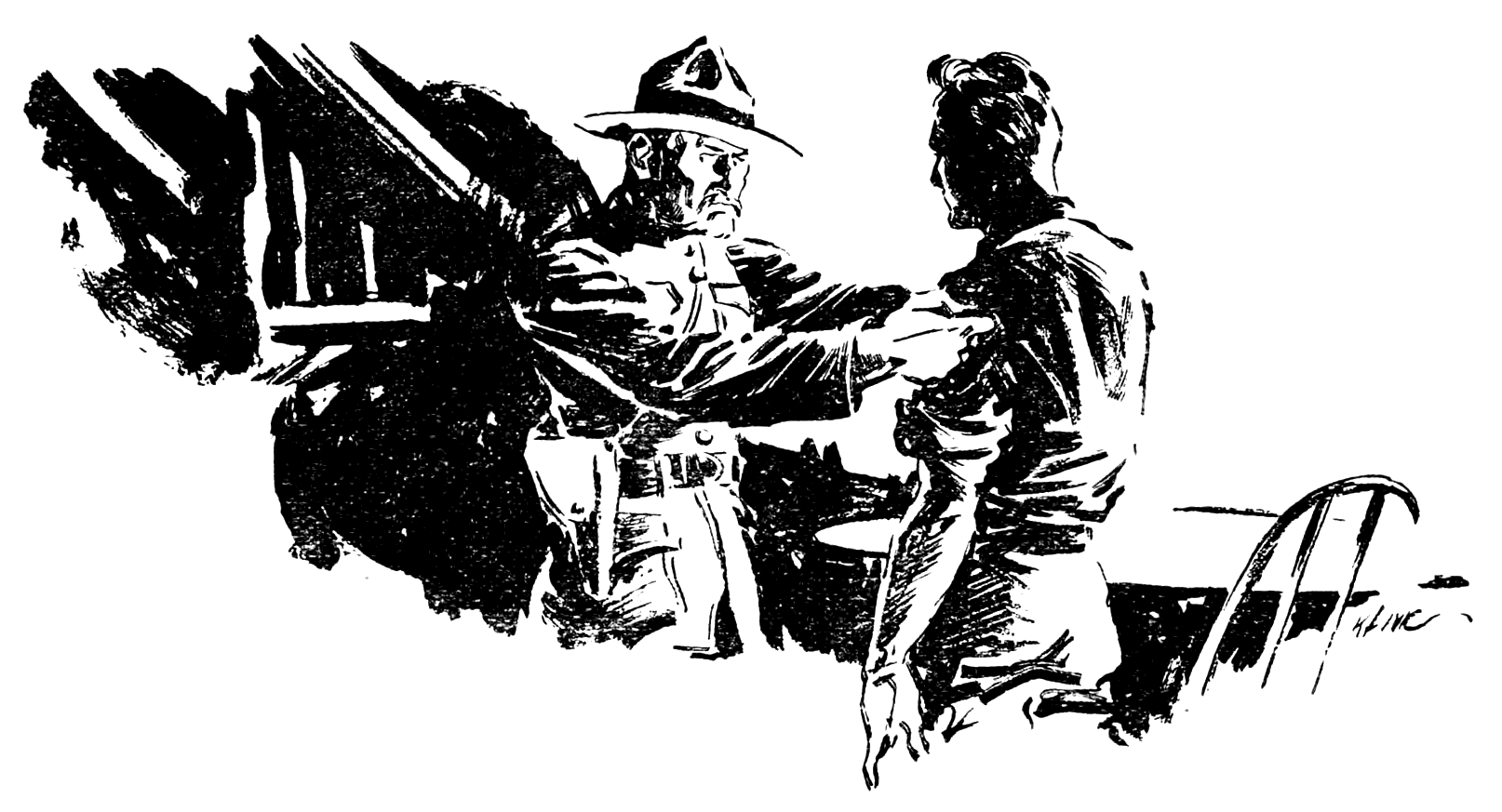
He gripped my shoulder. “If I thought
you believed I was that sort,” he said, “I’d knock it out of you
if it cost me my rank.”
Title: The rebellion of Constable Kitt
Author: T. Morris Longstreth
Illustrator: Wendell Kling
Release date: November 27, 2025 [eBook #77345]
Language: English
Original publication: Chicago, IL: The Consolidated Magazaines Corporation, 1929
Credits: Roger Frank and Sue Clark
Take this afternoon, when the boys were grousing at stables as per customary: you’d think this outfit was a disease nobody could get over too soon. I guess you gathered that the Mounted Police was run by a bunch of apes, didn’t you now? With old Frozen-face for the particular head baboon!
Well, all that jaw’s just a sign of health, showing they’ve still got an interest in living. I like to hear them shoot off their face, so long as the talk’s on the O C’s ways, where it can’t do much harm. But when they start bumping Frozen-face for merely acting as a sergeant-major should, I feel like wanting to tell them a thing or two.
I agree with them, of course, that Frozen-face is an old model. He joined up with this outfit when the West was a horse country and the price of oats was the overpowering topic. They tell me he was one of those hard seeds that nobody knew where he came from and nobody dared inquire. But he looked useful, with that map. Even a recruiting officer could see he could make an easy living robbing trains. He admitted right off that he could ride anything with hair, as the saying goes. And not like so many admitters, he made good. He didn’t shine up to anybody, though, even then, and you only got to know him by mistake.
I’ll not forget the day I first made that mistake. I’d just come down from the training depot at Regina, and I was probably the greenest article they ever crated out. Along with the handicaps usual to a recruit, I’d brought some special blemishes. One was a swelled head from winning a bunch of money at the races. Another was the idea I was all right with the girls. But the worst, in the sergeant-major’s estimation, was my views on horses. I didn’t love ’em, to be frank. I wanted my horsepower canned and ready to go when you let in the clutch. Valeting horses three or four hours a day in a cold stable had strained our relations; and when it came to the riding-school, there wasn’t a square yard of it I didn’t know by personal introduction, and there wasn’t a nag in it I couldn’t have said good-by to without tears. If I had to smell, I preferred to smell of oil and gasoline.
For that was my crime, gasoline—what with the race money and the girls, I’d developed a neat little taste in roadsters. But everybody did. Even the cheapest immigrant had a prairie Lincard in his shed; if you asked a girl out, she looked at your wheelbase before she looked at you. The date you could make with a horse and buggy wasn’t worth making.
But old Frozen-face had never been broke to women, I guess, and he wasn’t concerned with dates. His heart was sewed up in horseflesh. He was still living in the days of the poets when the hush of silence hung over the plains and you did the chores with Government mules. So when I arrived and didn’t fall down and worship horses whenever I saw one, it hurt him bad. The little feelin’ I had against the brutes must have shown in my face, or maybe he suspected it from the fact I didn’t have bowed legs. Anyway, being a good sergeant-major, he ordered me off on a horse patrol.
Now, you know sergeant-majors by this time, and how it’s easier to chum up with King George than with a good one. Why, even today I’d risk telling His Majesty his crown’s not on straight rather than suggest to an S. M. that I think he’s not perfect. It doesn’t go, not a little ways. So you can savvy what happened when I advised Frozen-face that I could accomplish his old patrol quicker and better on a motorcycle.
He didn’t speak, at first, so I went on to tell him where I could borrow one. Even then he didn’t speak the way an angry man should—for I saw he was angry; but after a long cold stare, he began one of the grandest choke-offs that ever ascended in a slow blue cloud.
“Is it possible, Constable Kitt,” he said, “is it possible that you’ve been on the strength here for a week? Have I grown so careless as all that? You arrived last Monday. On Tuesday you were observed to hurry through stables in order to get into trouble downtown. Strutting along Main Street, you were so engrossed with one of these modern, half-dressed, hand-painted, warmed-up apologies for women that you passed Inspector Tagget without saluting. On Thursday you again hurried through stables to engage in a game which is not only forbidden to members of this Force but is generally considered unwise for fools. You were reprimanded. Today I give you an order, and you venture to suggest that I do not know my business.
“Did they teach you no manners at Regina? Were you never told to express your regret at having to put your sergeant-major in his place? Having been in the Force only twenty-three years, I cannot boast of your ripeness of judgment nor your advanced methods. But I am still unhappily responsible for the discipline at this post. You, still more unhappily, are elected to obey the orders given you. Do you hear?” His eyes went a curious shade of green. “If I catch you shirking stables again, watch out. If you mention motorcycle to me once more, you wont even have time to watch. Unfortunately I’m not always in a good temper and I might resent your obvious efforts to improve the Force and educate me. That will do.”
You might think it would. I went out smoking hot, with those words burned on.
“He’ll see,” I said bitterly to a girl I’d met the day before. “That scrawny buzzard’ll see if motors wont run his horses out of business.”
“Mercy, Ed, what a rough way to talk of my uncle!” she said.
“That bird your uncle! He don’t look it, with that face.”
“I like Uncle Howard,” Rena went on. “He’s so interesting. He’s a living contradiction.”
“I’ll say he is!”
“Listen till I tell you, Ed. You’ve only heard his growl. He’s strict like that because he’s so wrapped up in the Force. Really he is—the way his superiors were strict with him. Anything else, he thinks, would show that the Force is going down, and that’d kill him. He’s in love with it, but naturally he’s got to hide all that. It’s just his way, Ed.”
“It’s a hell of a way to show you’re in love,” I said, still sulking.
“You talk just like a little boy.”
“Well, isn’t it? That crankcase never knew what love is.”
“Wrong again,” she said quietly. “He was in love with Mother once. But she chose Dad.”
“Congratulations.”
“There’s no use talking to you, Edward Kitt.”
“Right. That cuckoo’s talked enough for the family. If he’s got the Force so close to his warm heart, why can’t he tell when progress goes dusting by? How about that bunch of customs-beaters, the Duff gang? Why did they give Sergeant Geary the dust? Because you can’t catch an eight-cylinder car with a one-cylinder horse. Now, can you?”
“A garageful of cars wouldn’t have caught the Duff gang that time, Ed. They jumped back across the border too soon.”
“Isn’t that what I’m telling you? Men like them with a reward on their heads wont wait. There’s a poster on our bulletin-board in barracks with their pictures, and every time I see it I wish I’d been after them with that bus I had at Regina. I hate to see the outfit thrown down by dopers simply because we’re too slow.”
“You do love it, don’t you, Ed?”
“Next best to a certain girl somewhere.”
“You should love it ahead of any girl.”
“Hypocrite!”
For that she smacks me, most agreeable, on the cheek, and runs away, but I could see I’d made a dent; and believe me, that girl Rena was worth starting for. She was sound, with just enough style to raise a nice breeze. She didn’t have to shoot a fellow to get his money, but she didn’t want his money—a new one on me. She made you feel like a spring morning to go with her. Lots of times I couldn’t work for making plans, and I’d be all uneasy until I was with her, and then I was uneasy. A hell of a nice feeling, you understand, though uncomfortable; and it made all other girls and women seem like last year’s. I just naturally had to tour in her direction....
One day I was down emptying ashes for the Inspector’s wife, a gabby lot if I do have no right to remark it, when she says:
“Do you know anything about cars? My husband’s wont start. Nobody around here seems to understand it. You’d think the Government would have more self-respect than to send us a thing like that.”
Well, she didn’t know what she was doing for me. The moment I stretched out under that pile of junk, I was as happy as a tourist asking questions. It wasn’t a car, rightly speaking, but a warning, and it sounded like a stone-crusher in action. You couldn’t have sold it for its tires, but it ran, after I’d nursed it along, and you bet I had to give it some expensive tryouts, with Rena in to tell me the names of the stars. Those were happy times, with dusk on the plains and glory overhead, but I don’t think they helped Frozen-face’s temper when he found out. Of course he couldn’t come down on me very heavy, seeing as I was doing a favor for the Inspector, but being a good sergeant-major, as I said, he had other ways of putting on the brakes. It occurred to him to find out if I knew anything about his other hobby, the constables’ manual.
Perhaps you haven’t looked into that little testament of ours. It’s a terror. It’s a book they’ve made up so that we constables can compete with the law on its home grounds. It’s hot with the latest news on warrants and arrests and summary convictions and exciting things like that. But the real smacker is the chapter on giving evidence. Now, slovenly riding was one thing that Frozen-face hated good and hard, but no worse than to see a buck constable ball up a perfectly good case by giving faulty evidence. That was one of his bad dreams, and he took good care that we shouldn’t furnish him with that nightmare. The day he discovered I didn’t know the difference between a summons and a subpoena was another milestone of misunderstanding between us. My temper was pretty well shot, too, when I came out of that interview, only I had to keep it to myself. I’d have asked for a transfer that afternoon but for one little circumstance, which was Rena. I found out I had, sometime in the past, ceased to be a free man. I couldn’t break away!
A few evenings later, just at “lights out,” my chum Draughty Macklin tells me there’s a boy wants to see me out by the corral.
“What the high do I want with a boy out there?” I asked him.
“I don’t give a fried potato what you want; I’m just telling you,” says Draughty.
I couldn’t figure it, so I dragged my boots on again and sneaked out, and I was in a fair rage by the time I noticed a slender chap standing in the shadow by the gate. “What the hell—” I began.
“It’s Rena, Ed,” she said, “and don’t swear so! I’ve risked coming here to tell you something serious.”
It was Rena, all right, dolled out in her brother’s clothes. “Why this rig?” I asked.
“Because I had to see you, and if you were caught with a girl, it would go even harder with you than it is going.”
“What do you mean, ‘is going?’”
“I’m worried, Ed. You see, you don’t seem to know where you stand. I heard somebody saying that he’d heard Uncle Howard telling a person, no matter who, that he was tired of having Regina send him brick-heads who didn’t know the first thing about court procedure, and that he was going to shoot them back with you heading the column. I couldn’t bear that to happen, Ed.”
That sent me cold, and I said: “What in blazes does he want? How can I memorize his blooming manual if he keeps me riding circus ponies all day?”
“Now you’re just making excuses, Ed.”
“You’re starting to sound like a bum sergeant-major yourself.”
“Listen, Ed: You’ve got to learn that manual, and if you can’t do it yourself, you’ve got to be taught.”
“You’ve doped it. I’ll wire Vancouver for a teacher in the morning.”
“Silly boy, why do you make it so hard for me? I could teach you.”
“That’s service,” I said, still sarcastic, “especially when you and me are poison if seen together.”
“We needn’t be seen,” she said, very low. “Draughty Macklin is stable orderly, isn’t he? And there’s a light always in the little room, isn’t there? And if you can come down tonight, you can come other nights, can’t you? Besides—”
Oh, she knew her powers all right, and how a chap was lost if he got within a length of her. I was only hard starting, anyway, because I hadn’t thought of it first. “I expect you’ll find me terrible dumb,” I told her.
“I know how dumb you are,” she said, and left me there like a light blown out.
The plan ran smoother than I thought. You might suppose that girl had been studying the statutes since she could dress herself. “Now, Ed, tell me again, what is a writ of habeas corpus?” And I, naturally knowing nothing about it, would try bluffing. But you couldn’t bluff her any better than a sergeant-major, and before long I could tune in on any chapter she said.
The joke came one day when I put a J. P. straight to the effect that a dying declaration couldn’t be used as a deposition. This miracle got to Frozen-face’s ears. He said something very decent to me, being square at heart, and when I broke the news to Rena, she let me almost kiss her. Only almost, though, for our meetings had been as cold and businesslike as a cash-register. She sure didn’t let her feelings double-cross her, but I was like one of these Indian kids in the agency Sunday-school, jammed with mischief but afraid to show it.
We had been going for weeks and were well along to the back cover when the inevitable knock developed. We’d got careless, and one night I forgot to fix the shutter over the window, and I was just shooting to Rena the fine points of a coroner’s inquest, when the door opened and who should it be but that walking icicle, old Frozen-face himself. The lamp flared, and he didn’t see everything at once, but he recognized me and said, “Rolling the bones again, Kitt?” and his voice was so fake pleasant you might almost have forgot to worry.
Rena dragged up a little laugh from somewhere and said: “You guessed just right, Uncle Howard. We are gambling. We’ve been taking a chance that Mr. Kitt would learn his manual before you found us out.”
“But we didn’t quite make the grade,” I added for company’s sake.
He paid no attention to the remarks, but stood over us, quiet as a drum before you wallop it, staring down at her pretty boyishness. He couldn’t seem to take it in that it was his niece there. When he did speak, it wasn’t loud. “Is it actually you here, Rena, with this—this—big noise?”
“Yes, Uncle Howard. We’ve been studying.”
“Studying what?”
“The manual, I told you, Uncle Howard.” Her voice lost its steadiness.
“Don’t Uncle Howard me!”—sternly.
“But don’t you understand?”
“Only too well.” And he meant his tone to hurt.
I was on my feet now. “Don’t you talk to her that way, sir,” I cut in. “It’s as she says, and we’ve been on the square. She’s kept me on the square.”
“The guardroom for you,” he threw at me. He was furious.
“If you punish Mr. Kitt for studying his manual,” cried Rena, “I’ll—”
“You’ll leave the stable, certainly.” And he took her by the arm.
I felt as if I’d caught fire, I was that mad. I started after them, ready to knock him over, though it would take some knocking. I didn’t think a little more insubordination would matter much. But she threw me a look that said “Leave him to me,” so plain I stopped still. It was one of those looks a fellow can get only once, for it gave the show away. I knew then she was my girl, even if miles ahead of anything a chap like me should hope for.
I stood there entertaining a lot of thoughts and not noticing it was minutes before Frozen-face came striding back. But he was as changed as if she’d been reading him the law. He didn’t even smoke at the nostrils. I stood to attention, out of habit, but not because I was feeling respectful, and he says: “So this is how you come to know about dying declarations!”
“Yes, sir, she coached me in that.”
“Remarkable!”
“For the good of the Force, sir.”
“Oh, clearly!”
“Well, didn’t it work that way?” My heat was rising.
“Clearly, I said. How long have you been at it?”
I couldn’t think quick enough to suit him. Just one date stood out, and I was fool enough to spout that: “Since the Duff gang got away the last time, sir.”
He turned his stare on me. “You’ve got the nerve of Judas!”
“Why do you call me that?” And then the temper boiled: “You’d better mind what you call me! Have I ever sold the outfit? Have I ever given it away—to a herd of horses? I know I’m just a buck constable, and you think you made the Force; but maybe you aren’t the only one thinking for its good. You and your damned horses! Would that gang have thumbed noses at us if we’d been burning after them in a twin six? But no, we’ve got to stick to the geegees. Who’s Judas now? I suppose you’ll throw me in the clink, you’re that blind and unjust, but I’d sooner that than let you get away with something I don’t deserve.”
It wasn’t the way to still the ruffled waters, but as he didn’t say anything, I went right on: “And one more thing: Whatever you do to me, you needn’t bring her into it. You can get back at me enough without that.”
Lord, the water was boiling in my radiator. I was just reaching to wipe the sweat out of my eyes when he surprised me cold. He put his hand on my shoulder and gripped me as if he was going to shake the lights out of me, but that wasn’t in his mind. No. He looked straight into me, and I had to notice his eyes, the first time I’d got a close look at them in my life. They were stern all right, but the eyes of a white man. You can’t pick up eyes like that. You have to grow ’em, slow, by looking at a lot of life and looking at it square. They held me to a standstill, those eyes, and when he spoke, it might have been my dad.
“Do you think I’m that sort?” he said. I couldn’t make a sound, and he went on: “If I thought you believed I was that sort, I’d knock it out of you if it cost me my rank! It’s a good thing for both of us, Constable Kitt, that there are no witnesses tonight. If you ever get your stripes, you’ll realize what you’ve said. But I provoked it, unwittingly, and I propose to consider it unsaid. You will remain confined to barracks. Now pick up that book and get to bed.”
So of course I went, but not to sleep. “If you ever get your stripes,” he had said. Then he didn’t class me with the dirt I supposed. And that glimpse of the real Frozen-face—you couldn’t dismiss a surprise like that by turning over! I saw that I’d have to size him up all over again, and maybe cut down my own proportions a bit. You wouldn’t want to be less white than somebody else. After I’d hit on that, I fell asleep.
But the next day was long. To have our meeting-time come and know I wasn’t going to sit by Rena, nor see her, didn’t help any, but the bean-spiller was a note I got that evening, saying:
They’ve found out and are furious. I’m to visit Aunt Jennie in Macleod for a long time. They’re going to try and have you transferred. I’m too low to cry. I never knew what it was to be lonely before. But be good, Ed dear. Don’t tear anything, for the Force’s sake. And do study a little more on Indictable Offenses. I’m so anxious for you to get along fast. You’ll be one of the officers some day. Please write tonight in our time.
That note didn’t lead me to any shrine of peace, believe me. Maybe I might be an officer some day, about ninety years off, and in the meantime who would hoist Rena into the seat beside him and tread on the gas? For she wasn’t theft-proof, not a bit. I never saw a worse chance to grow an old maid. When the first week went by and she wasn’t engaged, it surprised me.
That week was no heaven. I did try my darnedest to please Frozen-face, which pretty well took up the day. But that left the nights. I didn’t feel like rushing anyone else, and the stars were flat without her to show me their good points. I began to see how that girl was miles ahead of any uniform. When no letter came for two days, I was half sick. I fancied her walking out with our men in Macleod—with Corporal Gadshill, the speed-king with the ladies. Or I imagined her Aunt Jennie giving parties. Or why didn’t I get word? Perhaps you’ve never been a fool over women and can’t hear what I’m saying, but by the tenth day I wasn’t hitting at all.
It’s funny how deciding cleared my head. I did my work all day without getting Frozen-face’s goat once, and thought out all my plans. I pretended to have an errand to the Inspector’s—knowing he was in Calgary conferring about the Duff gang, but not knowing how soon he’d be back. And sure enough the gabby wife told me all about it and that he wouldn’t be back till the early morning train. That suited me fine. I filled his car with oil and gas, which was all right too, since I’d be expected to meet him at the station, and looked to the tires.
Somehow it came hard trying to swallow supper. I found that the barracks made mighty good scenery. I’d always liked most of the boys, but never thought about it much; and now the idea of cutting away from them hurt me in the throat. And once when I saw old Frozen-face stalking into his mess, I could’ve laughed, I was that near crying. After all, he’d been white, and what was I going to do but hit him below the belt? “What the high,” I told myself; “you can’t suit everybody in this crazy world!”
I made out I had a bad headache and was going to bed early. I stuck a bundle of papers under the blankets with a handkerchief over its face so the orderly would think I was sleeping, and stole away. An hour later I sailed into Macleod with my heart jumping like a school of fish. Would she see level with me and go along, or would she make me go alone? For I’d have to go anyway, now.
It staved off the worry to have to hunt for Aunt Jennie’s, and when I got there, luck had my girl sitting alone reading. At least she had been reading, and the magazine had lost out to her thoughts, for she was staring ahead as if looking at some far-off place. I whistled our call, and laughed to see the brightness cross her face; then she ran quietly to the door, whispering: “Is that you, Ed? Ed, is that you, really? Sshh!” And I had her in my arms with no need for questions.
“But, Ed,” she said presently, “what terrible thing have you done?”
“Does it feel so terrible?”
“But it will be terrible to think you’re in heaven and wake up to find it Macleod.”
“When you wake up, sweetheart, it wont be Macleod.” And I broke it to her what I wanted us to do and what we’d be in for.
It must have taken her off her feet, for she just leaned against me, stroking my head and quivering. That touch of hers would have swung even Frozen-face off his base, I’ll bet, and if I’d had any qualms before, I laid them to rest now. My cue was to get her away and then add up the score; and she fell for it. We even laughed a bit as we tiptoed around, getting her things and leaving a note in the coffee-pot where it couldn’t be found before breakfast, even if her aunt did wake up. And so before a single second thought entered either of our fool heads, we were sliding out of Macleod, the two suddenest elopers that ever slipped off under a setting moon.
There was one thing not so good: to make a quick get-away toward the border we had to double back through Lethbridge and strike south for Coutts. Not that I was leery of them catching us, even though I’d kept on my uniform, not wishing to ask for a pass, but I wondered how Rena would feel clipping so close by her home. It made me nervous, like having a skunk in the road, and I began to think about my own home; and gosh, if those barracks didn’t pull like a tow-rope! We were mighty quiet in our home streets. Before we got well away, the moon had set.
Funny, how a feeling hangs on. I calculated that my spirits would hit the top again as soon as we turned south, but the dark seemed to have soaked in through my skin. Nothing more than just a shade, you know, nothing you could grab and wring its neck, but a dim and doubtful feeling, like not having had your dinner. It made me sore. What did that want to come over me for when I’d just got everything I asked for and was headed for freedom? There I was, with a thousand berries on my hip, the niftiest girl at my side, and behind me those cursed stables and calls and choke-offs from Frozen-face. Yet I wasn’t so damned happy, not even at being rid of him. Funny, as I say.
Rena wasn’t acting as if it was any carnival, either. She cuddled up close against my shoulder, saying nothing at all. So I started in prophesying, bearing down good and hard on the high times ahead. But I guess they didn’t sound too impressive, since she knew I didn’t have much idea myself of what was ahead of Coutts, after we’d left the Inspector’s car. For naturally I wasn’t going to start married life by stealing anything besides the girl.
Seeing that the future wasn’t going too well as a topic, I switched to the past. It was old Mounted Police country we were running through, every mile of it. Every coulee had some tale of its own. We crossed the Pot-hole country by Fort Whoop-up, the scene of the first Police doings. Then a little farther on was where Buffalo Heeney had rounded up a lot of cattle-lifters by straight bluff, by just talking rougher than they could. Over toward the mountains was Indian Charcoal’s hunting-grounds, where he’d killed Sergeant Wilde; and others came to mind, fine fellows all. And suddenly it swung over me that I was giving up a big thing in dropping the outfit, running away from the best bunch on earth. Not that I was getting cold feet over Rena so soon. That was fixed, inevitable. But I wanted the fellows, too, and every mile that clicked off only proved it.
But there wasn’t a hell of a lot I could do about it by then, not with that little girl leaning against my shoulder. If I’d been running over the edge of the world, I couldn’t have thought of a way to let on. “Happy, sweetheart?” I whispered. “Pretty happy,” she whispered back, being game, all right, like that Greek chump who hugged the fox while it gnawed him.
One thing I’ll say for our old stonecrusher, the cool night air made it run like a watch. I let it roll along smooth and even and do everything but pick the trail, for it was about two A. M., and the old bean pretty well primed for sleep, when Rena grabs my arm. “What’s that?”
I was too busy with the narrow road to see. All I got was one flash of a low gray speed-wagon parked by the cut-off to West Coutts, and a man pouring water in the radiator with the light catching him up the side of his head. “Honeymoonin’s in the air, it looks like,” I said.
“No, Ed. They were all men. Did you ever see such a face as that man’s?”
“I have, somewhere,” I said; but I’d run around the curve for a minute before I remembered—that long side-face and funny ear, curving in instead of out, the bulletin-board poster: “$1,000 reward for information leading to the capture and conviction of Samuel Duffer, alias Simpson Duffer, alias Slinker Duff.” Like a struck match the whole thing shone up clear and lit up what I should do. Without even thinking, I pulled up along the road and put an arm around my girl.
“Rena dearest,” I said, “I’ve got to—there’s something I’ve got to—”
“Yes, Ed?” I could feel her shiver, but she was helping me.
“I’ve got to start you trusting me right now.”
She was silent, but she pressed closer. “I do,” she said.
“I’ve got a job to do on that car.”
“Oh, Ed!” And she held me tight.
“It’s the Duff gang, Rena; and while I’m in this rig, I’m still a policeman.”
“I know.”
“You wont be scared waiting here in the car?”
A moment of nothing, and then what do you suppose? She threw her arms around my neck and started laughing, not the crazy laughing, but the glad, relieved kind. You might think we’d run into a clergyman instead of a parcel of bandits. “Did you dream I would, Ed darling? Did you really think I’d stay behind, dear? I’m going with you, where you have to go. Let’s get turned around, quick.”
The tone of that “quick” gave her away. It was the idea of getting turned around that hit her so pleasant, bandits or no bandits; and though I was politer about it, I felt the same. The only hole in the road was that I had no side-arms, so the party couldn’t be guaranteed safe. In fact Duff had a reputation all the other way. No sir, I wasn’t going to risk our happiness that easy. “Listen, sweetheart, what’d you think I was aiming to do? Walk into his arms and say ‘Take me’? If I had a gun, it’d be different. I’m just going to ease back and look things over.”
With that all nicely explained, she lets me fade off into the night, and it didn’t take long to cut across the little ridge to where they still were. A breeze was blowing, making little noises, and I crept close enough to get the odd word. They were waiting for something, another car, and not too patient. Duff had climbed back beside the man in front and there was a third in the rear. “Lord, what a haul!” I thought, and for the first time I wished for old Frozen-face to rush them with me. Even Sergeant Head, at Coutts, would’ve been helpful, and it was then I got the big idea.
In ten minutes I was back, sitting by Rena, getting my breath. “I’ll watch ’em,” I said, “and you bring him. Get me?”
Being a Western girl, I didn’t have to write out the instructions. She knew. “Keep them for twenty minutes,” she said, all business now, “and we’ll hand them over as a going-away present.”
“Twenty minutes,” I said, and she was gone.
I hadn’t any more than crept back to the Duffs when I saw they had company. The car they’d been waiting for had arrived, and they were all busy transferring the goods. In a way that was plumb satisfactory, but supposing they cleared out in five minutes—or ten? There wasn’t a chance in Alberta of our catching them if they got their piece of lightning to sliding good.
I crawled right up close, behind a bush, thinking and listening, and the first thing I heard was miles from being good news. “Count it out, quick,” their visitor was saying. “The sergeant’s patrolling tonight. I want to slide in before he sees me.”
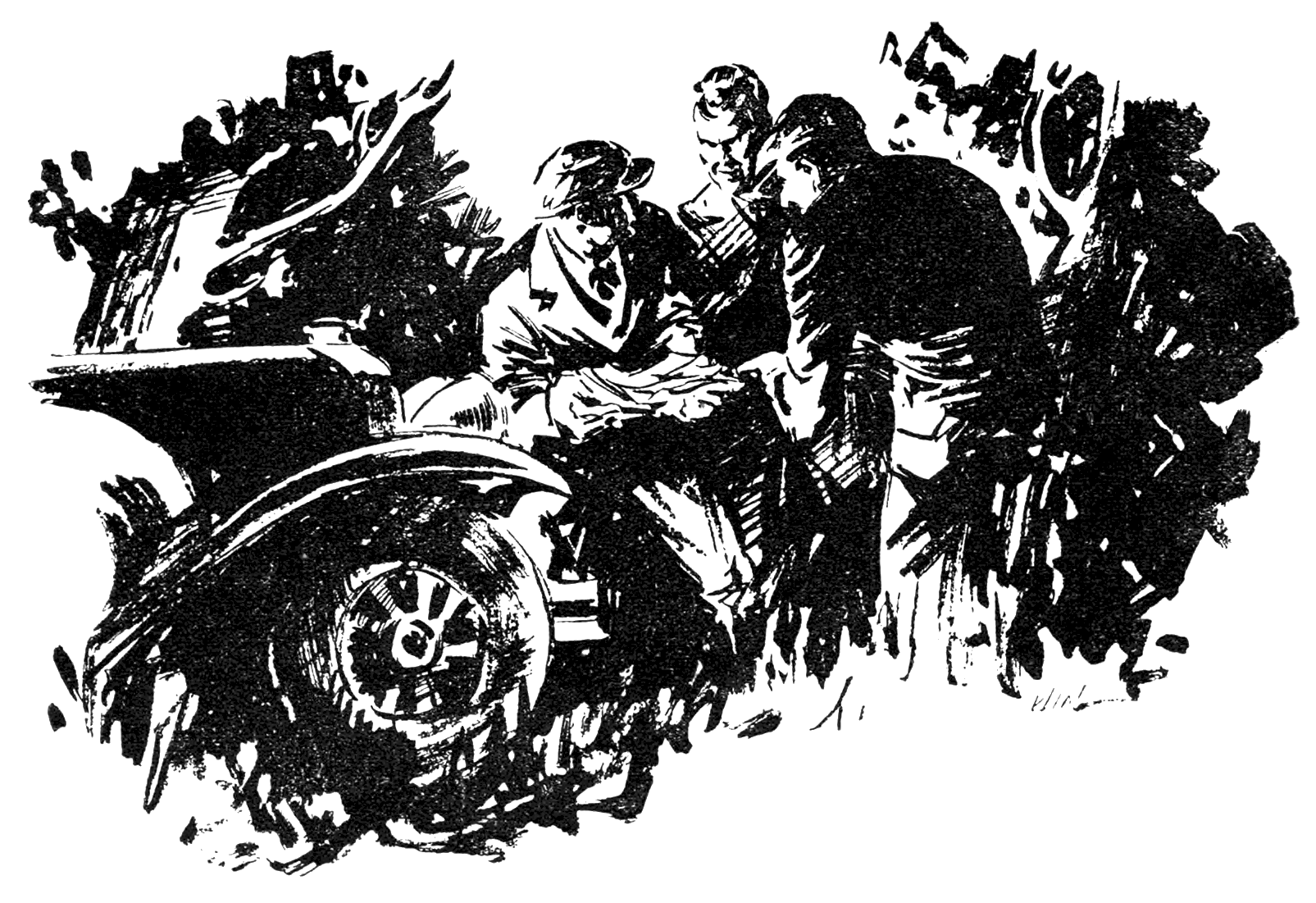
They stepped in front of the car and I got a good look at the Coutts man while he was counting the bills, then he starts the engine.
I was in a jam, now, wondering what to do. Five minutes hadn’t gone yet, and they’d be off in two. It didn’t seem fair to step out, and it did seem yellow not to. I was on the fence ready to jump either way when the other man calls he’s stuck and needs a push. Duff wasn’t for going, but the other two went, and Duff joined them in a rage, pretty soon, saying they couldn’t stay there all night no matter how many fools got bogged up.
Things couldn’t have fallen better, for I slid out in the dark, raised the hood, jerked out the rotor arm of the distributor and threw it behind a rock, and was halfway to the bush again when my luck gave out. The other car moved, its lights caught me like some wild animal posing for a night photo, and somebody yells. I straightens up just like I’d always meant to be there, and they swarms up.
If you’ve ever seen the look on a rat’s face as it greets the terrier, you’ve got the expression on Duff’s map when the scarlet caught him in the eye. He stiffened up; his lips drawn back—the catch of the year. I knew then I wasn’t going to let him slip. I knew I was constable first and lover second. The other two beans rolled up, but didn’t figure. Duff asked:
“Who in hell are you?”
“It’s plain enough who I am, or maybe you’re blind,” I said.
“No, I’m not blind, but perhaps deaf. How’d you get here?”
“On my gallant steed,” says I sarcastic, thinking of Frozen-face. “They haven’t given us boys individual cars yet.”
“Where’s your horse?” asked one of the fellows.
“Have we a rope?” I heard the other say to Duff.
“My horse is waiting.” And I points into space, hoping they’ll waste time hunting. “But I’m thinking of riding back with you fellows. Samuel Duffer, alias Slinker Duff, I put you and your party under arrest.”
Duff’s funny ear wiggled as he said: “Haven’t you forgot something? You state no reason; you serve no warrant; and you’ve left your revolver home.”
“Never you mind about all that—” I began.
“The rope, boys,” calls Duff to the two who were looking for it.
I knew then I was in for a bit of bango, but ten minutes was up and I hoped to keep ’em interested the other ten.
“Submit to be tied,” says Duff, “and that’s the worst’ll happen. Resist, and there may be an accident, a fatal accident.”
“Not to me,” says I, brighter than I felt.
They grabbed me, at that, and it didn’t take a second to get all worked up, scuffling in and out of the headlights, getting dirt and bruises and near knock-outs pretty general. I jumped once for the Duff man’s chin, and thought I got it right on the point. But he didn’t fade like he ought. Both the other bums took care to come at me at the same time, and I plastered ’em several biffs, getting a few horse-kicks on my own person. But it couldn’t last, and I wished old Sergeant Head would hurry. Then it happened. Somebody caught me from behind, and I saw all the stars shoot together, and then the sky closed in over me.
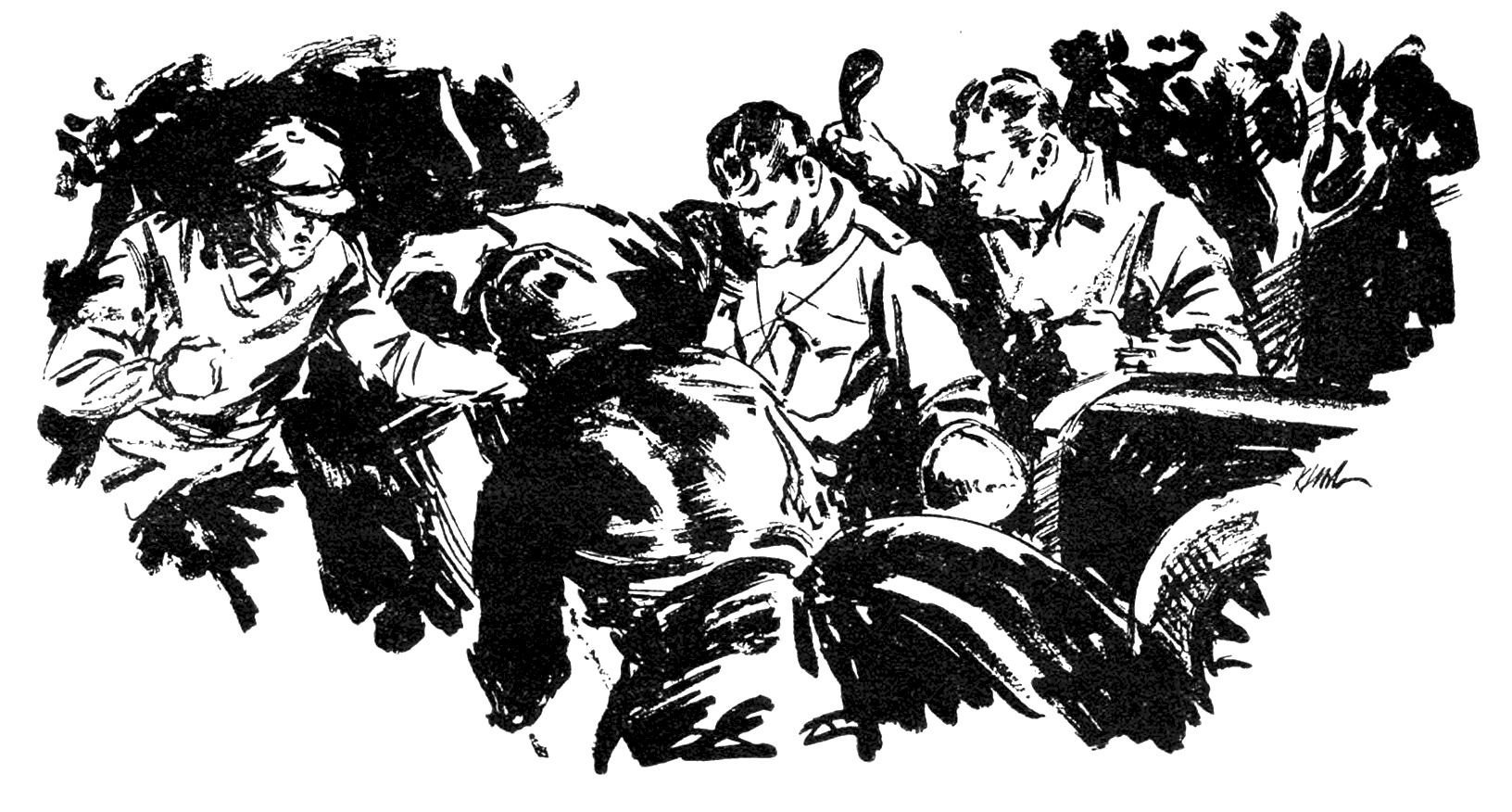
I don’t know how long I was under the influence. It must’ve been some time, for they’d been trying to get their car to go and had found out why it wouldn’t. I don’t blame ’em for being mad. There they were, all nicely loaded up with enough dope to give ’em a maximum sentence in the pen, all set to glide, and she wouldn’t glide. And dawn coming. So they turned to me, and I guess that fatal accident might’ve occurred, they was that mad, only it was necessary to keep me alive long enough to tell where I’d misplaced the rotor arm.
I know how I was brought to—my ribs, where they’d been kicking me, told me. I opened a lazy eye to find Duff shaking me. “Where is it?” he snapped out, ferocious.
For a minute I hadn’t an idea what he was talking about, so he made it plainer with another shake. “Where in hell’ve you hid that rotor arm?” he asked.
“What is that?” I stalled. “If it aint on a horse, I don’t know it.”
“You know it, all right.” And drops of sweat stood out on his thin mug. “Give it up or I’ll kill you.”
They was fairly dancing around, what with wanting to cut me up into little pieces for rage, and yet not daring to get rid of this here lost-and-found on legs until I’d told all.
“Cough it up,” said Duff, squinting in his violence, “or I’ll tie you to a bush and pour gasoline on you so you’ll burn faster.”
“Then you’ll get hanged.”
With a dirty oath he turns to the boys. “Give him a turn and see if he’ll talk!” And for all I could do, being still a shade dazed, they had my hands tied together behind my back, and started to raise me by ’em. Say, that hurt! Just as they began again, I thought I saw a flash in the distance, and I prayed for Head to come. But he’d have to be quick, for no flesh and blood was going to stand that agony long. “Going to tell?” asked Duff, and I give in, thinking I could stall till Head arrived; so I nodded toward the wrong rock. “Find it,” Duff orders, and they strikes matches while I grubs for what aint there. It might’ve been funny at another time.
“He’s fooling,” yells Duff, soon. “Give him another dose.” That was the worst moment for me. If that flash I’d seen had been the car, she’d’ve come. Maybe Rena had had an accident, or was waiting for the patrol to come in. I felt low as hell. They give me such a wrench then that I let out a yell. Duff slapped me across the mouth. “Will you find it?” he screams. “Will you find it, this time? Once more, boys! Pull it out of him.”
“Stand back, you curs!” said a voice from the dark near by.
“Stick up your hands!” It was Rena’s voice, hoarse and strained; a revolver banged, and the bullet sent the glass of the wind-shield flying all over us. “Stick—them—up!”
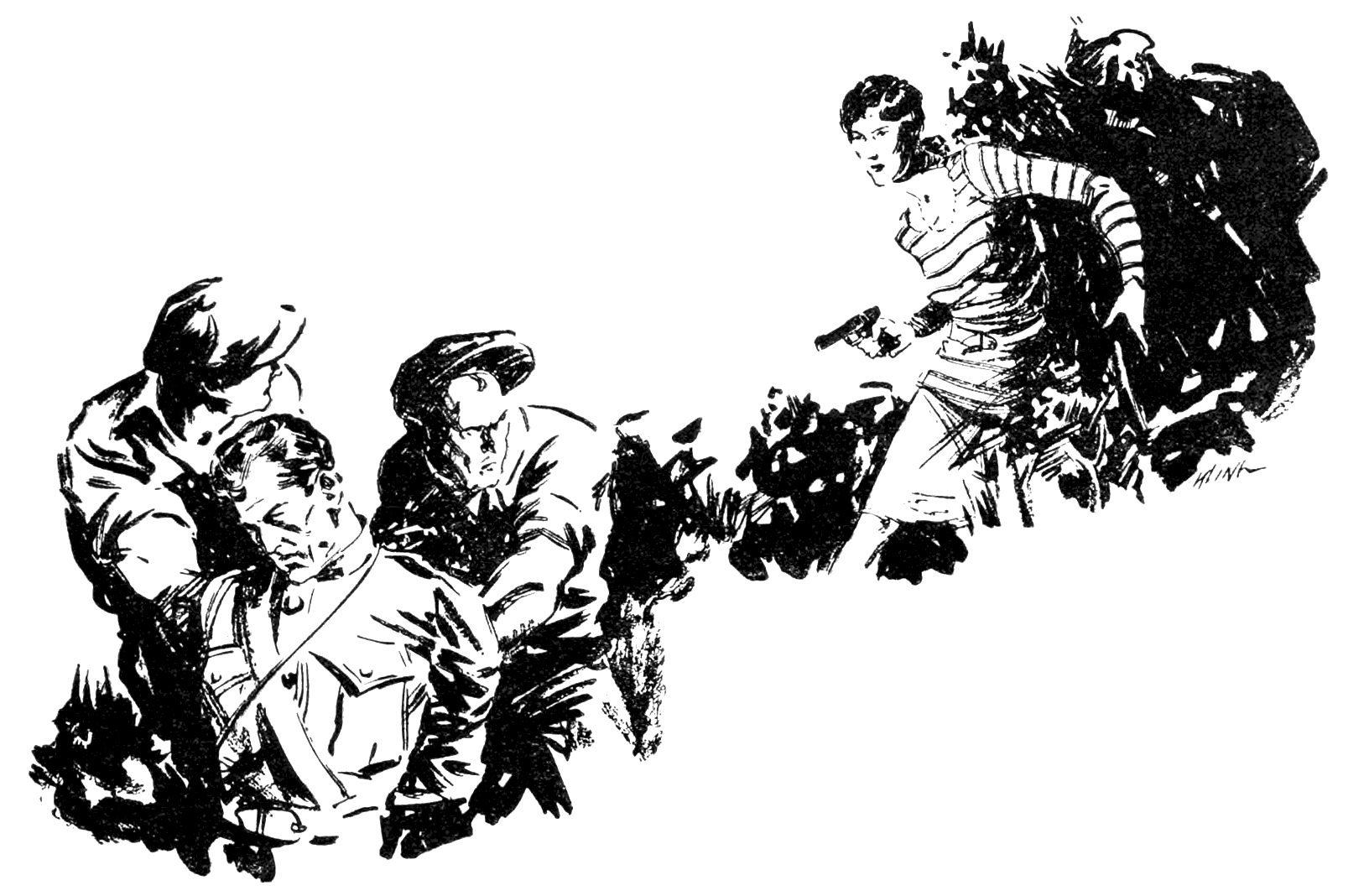
They did. For the flying glass had cut two of them about the face so they was blinded with blood, and Duff himself didn’t show the nerve to face a gun that could do damage like that: his hands went up while I got mine loose.
“Take it, Ed.” And she pressed the gun into my hands. In another minute it was all over; we had them searched; Duff was tied; the boys had mopped the blood off their faces and was repairing the distributor. Rena—well, Rena was crying!
Meanwhile, where was Sergeant Head? Still patrolling. You see, Rena’d found nobody to the detachment. That paralyzed her for a minute, she said. But she come to when she saw a spare gun over Head’s desk; the cartridges were in a drawer. She was in the car, and the big idea in her mind, all in five minutes. She knew I’d got to be backed up, but she didn’t savvy how necessary until she’d left the car down around the curve and walked over to our lights. She hadn’t meant to let off that shot that killed the windshield; it just went. But I told her that was the best shot ever fired in Alberta and was glad to see she stopped crying. All my usual feelings was coming back in a mob. I wanted to laugh, but it didn’t seem quite the time.
The boys had finished now, and how to hand ’em over was the next puzzle. If we took them to our detachment at Coutts and left them with Sergeant Head, he’d ask questions and I’d be arrested, and that meant a spell in the clink....
I could see myself relying on Frozen-face’s mercy. And after a spell in jail, I’d be fired. Either way, I lost the outfit. That was my lowest moment. Then I heard Rena speaking. “Oh, Ed, Ed,” she said quietly, “I’m so proud of you I don’t know what to do. It’s simply splendid.”
“What is? This mess?”
“Mess? Nothing of the sort. You’ll be the biggest man in the division, dear, for landing these men.”
“Yes, the biggest behind bars!”
“Oh, Ed!” It was clear she had never thought of that. “But they can’t!”
“Can’t they! Watch old Frozen-face break out into a smile for the first time in his life. But I don’t care. It’s you I’m thinking of.”
“If you ever think of me, Ed, I’ll never speak to you again. You mustn’t, dear. While you’re in uniform you’re a policeman. You said so yourself. You— Oh, it’s all my fault!” She began to sob.
It was a long drive back, Rena taking the wheel and me sitting behind with the Duffs, one on each side, while the third ran their own car, just ahead, too scared by my hints of our artillery to try any monkey-shines.
A long drive, and ticklish, but we made it. I guess it was close to six o’clock and broad daylight when we pulled into the barrack square, and a funny procession we made: three opium salesmen escorted by two elopers who now knew better, and one of them a deserter returning on a flat tire. Yes sir, a mighty comic procession—from the side-lines. As we stopped, I heard a train whistle, and I had to laugh. I was supposed to be meeting the Inspector with his car.
The whistle put an idea into Rena’s head. “If I could catch that train, Ed, I might get back to Aunt Jennie’s without being seen.”
“This is what we’re going to catch instead.” And I pointed to a figure striding towards us—Frozen-face, and in his least human mood.
We hadn’t time to frame up any good story—Rena and I. She just squeezed my hand, and then I got down and stood at attention. I could tell by his gait that if our capture didn’t melt him, all the antifreeze in the world wouldn’t help. As he reached me I said:
“The Duff gang, Sergeant-major.”
It didn’t feaze him. He glanced at my prisoners as if they were so many tame cats, then fastened his eyes on me. “What’s the meaning of this, Constable Kitt? I got a phone call from Macleod just now stating that my niece has not been home all night—and here you come rolling into the square with her. What have you to say?”
“I needed her assistance, sir, in making the arrest. This is the Duff gang, sir.”
“I see the Duff gang.” But his eyes kept eating into mine. “I fail to see how this accounts for my niece leaving her aunt’s.”
“I shouldn’t have these prisoners here, sir, if it hadn’t been for her.”
“Remarkable!” he snapped. “More than remarkable! As I remember, you enlisted her assistance once before, contrary to all discipline. Where did she and you happen to run into these?” He nodded at my prisoners.
“Two miles this side of Coutts, sir.”
“Coutts!” A new shade of sternness came into his voice. Till then he likely thought that we had just been joy-riding. “Coutts, you say? At the border! Kindly inform me what you were doing there without leave.”
My tongue wouldn’t move in my mouth. How could I explain—to him! And his searching eyes killed any excuses. They seemed to know so much. I believe he read in my face what we had done, or rather failed to do. Standing at attention is exposure itself, or feels like it. I was only able to look back into his eyes. It was Rena who spoke for me. “Listen to me, Uncle Howard,” she said quietly, “Constable Kitt couldn’t help going. But he couldn’t help coming back, either. And it was all right my being along. He and I are engaged, and as soon as he comes out of jail, I’m going to marry him.”
“Jail?” said Frozen-face, as if he couldn’t connect.
“Absence without leave, sir,” I explained.
“You still persist in advising me how to act?” he began, and said something else I didn’t catch, for a taxicab came buzzing up and out of it hopped a mad Inspector.
“What does this mean, Sergeant-major? No car to meet me!”
“Sorry, sir. The car was in use.”
“How could it be in use? Who was using it?”
That was the big moment, with Frozen-face, looking like a piece cut off the Judgment Day, opening his jaw to pronounce hell on me. But all he said was: “The car was used in capturing these men, sir.”
The Inspector turned to look at them. “Who are they?”
“The Duff gang, sir.”
It was great to watch the Inspector wilt.
“The Duff gang!”
“Yes sir. Captured early this morning by Constable Kitt, assisted by my niece.”
The Inspector looked at Rena and nodded approvingly.
“I was about to congratulate them, sir, when you drove up.”
“Naturally! Quite right! It isn’t every morning we arrest the Duff gang before breakfast. How was it done?”
“With your permission, sir, I shall give you the particulars later. Constable Kitt and I had best march the prisoners to the guardroom now.”
I stood there dumb, shaken. To think he had bust his own principles and taken our side! Not a word about deserting, or the rest! There wasn’t the power in me to thank him as we locked up the prisoners, and he didn’t give me the chance. He clicked back into being sergeant-major so quick that I couldn’t believe that he’d just been human, except for the results....
Sorry. There’s first post sounding, and no time to tell you the rest. What do you suppose Frozen-face tried to do? Resign. Asked to be let out. Said he wasn’t fit to keep discipline as he should, but wouldn’t explain. White, you see, if frozen solid. Of course they wouldn’t let him go. I got my stripes out of it, and the reward, both on his recommendation, as I found out. So you don’t wonder I’ll not stand for the youngsters yapping too loud just because he’s acted as a sergeant-major should.
What’d Rena get out of it, you say? Why not step around to the house and take a look at our boy? Then you could ask her.