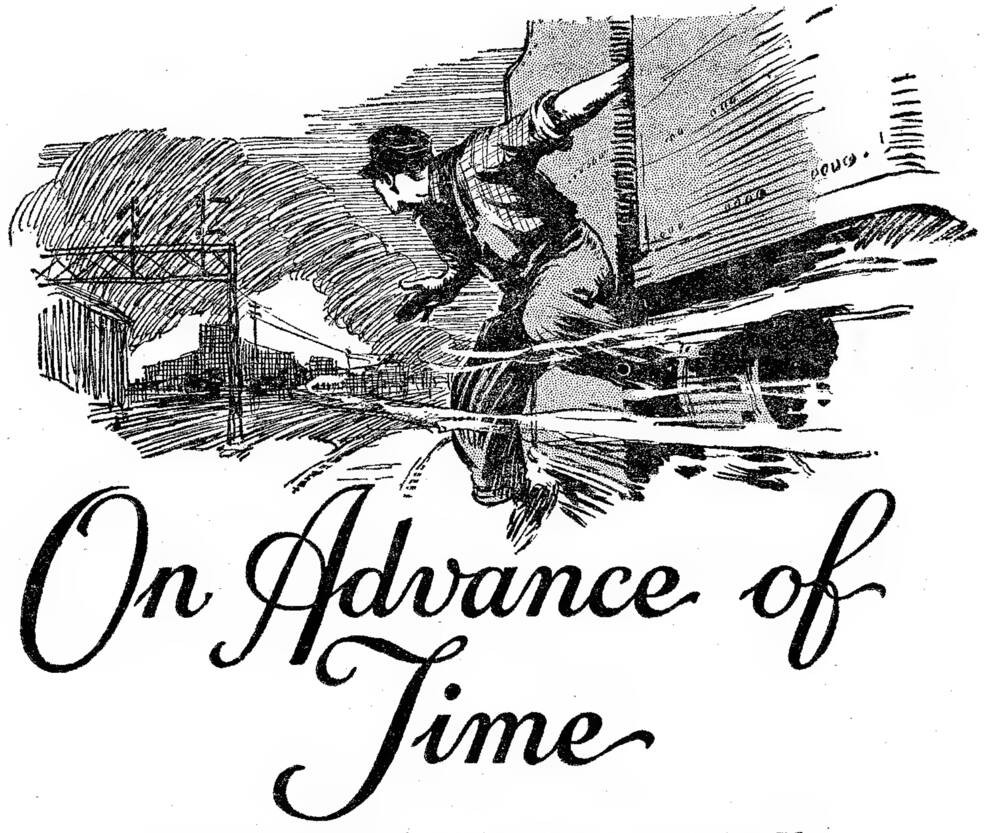
Title: On advance of time
Author: George Keyports Brady
Release date: November 27, 2025 [eBook #77344]
Language: English
Original publication: New York, NY: The Frank A. Munsey Company, 1925
Credits: Roger Frank and Sue Clark
“Again I ask you, Elsie Macumber, will you marry me?”
“Me, Elsie Macumber, the daughter of a full time engineer on the Pennsy railroad, marry the likes of you, Sam Dobinski? You what’s only a hostler down at the roundhouse! Isn’t it fine nerve you’re possessin’.”
“Because I’m a hostler y’ won’t marry me, eh?” Dobinski punctuated his sentence with a large stream of tobacco juice, as if he wanted to lay all the dust about the signal tower where they were standing. “Because you got fine black hair and pretty black eyes and a hell of a pride you won’t marry a Polack like me. Because you got a pretty face you think you can marry any man on the division, and so you snaps your fingers at a hostler. Tell me once, what was your father when he first went to work on this line?”
“No, Sammy, you’re a hostler. That’s bad enough, but it ain’t the real reason I won’t marry y’. It’s because I don’t love you, that’s what. I would marry the devil, or even a hostler if I was sure I loved him, but if I was dead sure I didn’t love him I wouldn’t marry the guardian angel of Saint Peter, if he was t’ ask me for me heart and hand, and offer me a crown of glory t’ boot. ’Tain’t pride, Sam Dobinski. It’s just me.”
“It’s five times I’ve asked you, and——”
“And if it was fifty times I’d still be sayin’ no, just as I do now. You better stick to that little Duch girl, Marie Gross, that I saw you cuddlin’ down in the park th’ other evening. The man I love has got to be taller than I am, and brave. Y’ ain’t neither.”
“Y’ say I’m not brave, eh?” Sam flushed to the roots of his hair, although his reaction was nearly obscured by his coat of grease and soot. His beady eyes narrowed down to dangerous slits, and the hammer he held in his hand swung dangerously back and forth. “What for do you say that?”
“You know why, Sam Dobinski. Last Saturday you let that young wop dare y’ to be seen again with Marie, an’ y’ didn’t knock his teeth out then and there. And here it is Wednesday an’ you ain’t had a date with her since, an’ what’s more y’ ain’t even asked her for one. She told me so herself. So be off with y’ now, and don’t ask me no more.”
A heavy freight, headed out of Toledo for Mansfield, Ohio, came slowly along the track, and as it passed Elsie handed a dinner pail up to one of the brakemen who boarded with her family. Sam, who had been waiting for clearance on this track in order to drive a free engine down to the roundhouse, climbed deliberately up into the cab, but his blood was boiling furiously.
Elsie, with the long free stride of a big strong girl who has never learned the art of “cultured” walking, swung round the tender of the engine, and started across lots toward the high road. As she did so, Sam grasped the throttle and gave it a vicious jerk.
There was a snort of steam hissing through the valves, as the huge drivers slipped swiftly on the rails, unable to get traction so suddenly. Instead of easing up on the steam pressure, Sam Dobinski, furiously opening the sand pipes, poured sand on the rails. The huge drivers, hissing and screeching, tried to take hold, but went on spinning ineffectually.
Elsie, hearing the racket, glanced back over her shoulder, and remarked to herself, “The blame fool, treatin’ a perfectly good engine like that just because a woman tells him the truth about himself!” Then she continued along her path, ruminating as she went. “Imagine me, a strappin’ big Irish lass, married t’ a little runt of a Polack like Sam. Just picture the census taker a-comin’ to the door. ‘Sure now, and who are you that lives here,’ says he, polite like a raisin’ of his hat. And lookin’ at the likes o’ me he expects t’ hear a good soundin’ name that reeks o’ the Emerald Isle, somethin’ like—well, just for fun let’s say Mrs. Patrick O’Hara.”
If a certain young giant of a brakeman on the Toledo division had heard that last observation he would have made the fur fly proposing to Elsie Macumber. But then if he had been there the remark would never have been made.
Perhaps it was the fact that she had a date with Patrick for that evening that put his name in her mind, and there may have been a bit more to it than that.
“But instead of sayin’ Mrs. Patrick O’Hara,” Elsie said to herself, “I blushes an’ says, Mrs. Sam Dobinski. Then the census man gets even more polite because he thinks sure I’m lyin’ to him, but he writes the name in the book because it’s his business to record souls and not to save them. ‘And how many little Dobinskis be there,’ he says. ‘Fourteen,’ says I, feelin’ a wee bit embarrassed.”
Elsie burst into a roar of laughter at the idea of herself as the mother of children named Dobinski, and continued across the lots, wondering how long it would be before Patrick O’Hara would have nerve enough to—well, to stop hesitating and get down to the business of buying a ring for her.
“If the great big handsome ox weren’t such a bashful, blushin’ thing, I could have lined him up weeks ago.”
Meanwhile Dobinski recovered sufficiently from his wrath to realize that he was abusing one of Mr. Baldwin’s best locomotives. He curtailed the steam until the drivers began to behave themselves as their inventor intended they should, and the engine moved smoothly off down the siding, crossed over onto the now vacated down track, and proceeded toward the roundhouse.
When Dobinski put the engine in its stall he went about his customary duties, but his fellow workmen declared he swore even more viciously than usual, and they observed that he barked his knuckles by giving an extra hard jerk on a nut he was tightening.
Finally they saw him pick up his hammer and walk deliberately across the roundhouse to a pit where a young Italian was working, and without any warning he fell upon his victim so viciously that the man had to be carried to the hospital for facial repairs.
Only the timely interference of the workmen prevented Dobinski from killing the fellow with the hammer. In the language of the roundhouse “the runt Polack was in one hell of a rage.”
At noon, when Dobinski went off duty, instead of going to the “hash house” for grub, he proceeded to get royally drunk, and during the process gave public vent to uncomplimentary remarks about “that damned stuck up Macumber girl.” By the time his companions carried him to his room Dobinski was in a fine mood to commit murder.
In the small hours of the morning the next day the Pittsburgh-Detroit Express, running on a seven hour schedule, drew into Mansfield, one hour behind time. Heavy weather on the first part of the run, had slowed the train down and forced Macumber, the engineer, to lose time.
At Mansfield the station master handed him an “advance of time” order, which meant that Macumber was to do his best to make up the lost hour, so that the crack express train could live up to its reputation for arriving on time in Detroit. Under such an order the engineer knew he would have clear track all the way, that all the block signals would flash “green eyes” at him as his train roared past.
Once out of Mansfield, Macumber opened up the throttle. For fifteen years he had made this run, and he knew every mile of the track thoroughly, knew just how much time he dared to make every inch of the way.
He sat with his hand on the throttle and watched the steam gage climb, while the fireman worked furiously keeping up the pressure. At every mile Macumber glanced at the block signals to be sure of his clearance ahead, although his orders practically assured him that his track was clear.
The white lights of one small town after another flashed into view, and quickly faded away in the rear of the on-rushing train. Sixty miles an hour the gage registered, and then slowly climbed to sixty-five, and still more slowly crept up toward seventy.
Passengers, asleep in their berths, woke up under the swift motion, and the more accustomed ones congratulated themselves on the fine time the train was making. Some, not so anxious for speed, lay nervously awake and worried over the furious pace, while the train plunged on through the gradually graying dawn towards Toledo, its first scheduled stop.
At five o’clock the train flashed past the Walbridge block that marks the entrance to the Toledo yards. A heavy fog hung low over the Maumee valley, making sight ahead impossible beyond a very short range.
Halfway up the yards on the down track, waiting for clearance papers from the yardmaster, stood the early freight headed for Pittsburgh. Patrick O’Hara, the brakeman on this train, had walked forward to talk to the engineer until the train was ready to pull out. Both men heard the shriek of the whistle on the express as the train plunged through the yards.
“He’s making sixty, and all the time I’ve been on the road,” declared O’Hara, “I’ve never known him to go through the yards a mile above forty.”
“You’re allowed all the tracks will stand on an advance of time order,” replied his companion, “but I’d hate to be making that speed through all these switches.”
They both stared ahead into the fog to see the express shoot into view. At that instant, and much to his amazement, O’Hara thought he saw a free engine moving slowly along a switch track parallel with the up track along which the express was advancing. He knew the siding ran out onto the main not twenty yards ahead of the place where he was standing.
He calculated the speed of both the engine and the express and realized that the free engine would arrive on the main not very far in advance of the express, and too close to the express to allow time for stopping before a collision occurred.
He spoke to the freight engineer about it, but the man assured him that the up track switch signal showed a green eye, which meant that the derail on the siding would prevent anything from arriving on the main ahead of the express. But in spite of this assurance, O’Hara continued to strain his eyes as he gazed into the heavy fog ahead and watched the ghostly form of the free engine creeping over the rails.
Then he heard an ominous click which he instantly recognized as the lifting of the hand control of the derailing device.
Visibility was so low, due to the dense fog, that he could not distinguish the person who lifted the derailer. Was it possible the infernal fool did not know the express was thundering along the up track at that very instant?
Everybody in the yard had been discussing the speed which constant telegraphic reports indicated Macumber to be making. Yet here was some stupid hostler letting a free engine out onto the main at a moment when a wreck would be inevitable.
There was no doubt about the derailer having been lifted, because the free engine, without a pilot, glided out onto the up-track. The freight engineer turned pale as he realized what was about to happen.
“God help the express,” he muttered to himself.
The express could be heard rushing up the track at a speed only possible under advance of time orders. Otherwise an experienced and trusted engineer would have been proceeding more cautiously through the yards. A wreck appeared absolutely certain.
In an instant O’Hara realized that there was but one possibility of escaping it, and that was very slim. Without taking time to think of the awful risk he was taking, he jumped down from the cab, where he was watching, and ran impulsively toward the engine as it glided onto the open track. He bounded onto the catcher, clambered madly up to the rail, and raced wildly along the boiler to the cab.
Whether the engine had up a full head of steam, he did not know, but in that respect luck was with him, as he saw by a glance at the gage. He clutched at the throttle, with the roar of the advancing express in his ears, but not being an experienced engineer he lost a precious moment by pulling the throttle too far open, so that the drivers began to fly on the rails in spite of the fact that the engine already had some headway.
Realizing his error instantly, he shut off part of the steam and began frantically to pour sand on the track.
Behind O’Hara sat Macumber at the throttle of his engine. Secure in the evidence of clearance which the succession of green signal lights gave him, he was plunging along at top speed.
Suddenly in the fog ahead of him he saw the form of the free engine looming up. At first he could not realize the awful possibility as a reality; for a moment because of the strain on his eyes from looking into the fog, he thought he must be seeing things, but in the next instant he saw that a wreck was almost a certainty.
Instinctively he applied the brakes, but even in the act of doing so he knew that stopping was impossible in such a short distance. He thought of the lives at stake in the cars behind him, and recognized that there was danger of throwing the train off the track if the brakes went on too suddenly at the speed he was traveling. However, he had no time to reason about it, and as there was nothing else to do he threw the air valve wide open. The wheels screeched as the brakes locked and forced them to skid on the rails.
For an instant Macumber released the brakes to relieve the strain, then locked them again. The huge iron monster shuddered and groaned under the torture of the strain, but it had been built strong and true, and in spite of everything it held to the rails, while sparks flew from the heated wheels in showers.
Still, to stop so much momentum in such a short space seemed out of the question. The express continued to close up the short remaining gap between it and the engine ahead. Macumber closed his eyes helplessly for what he thought was to be the moment of the crash, and as he did so muttered to himself:
“Where did this engine come from, anyway?”
Standing back of the yards, hidden by the depth of the fog, and waiting for the crash that he hoped would put an end to the father of Elsie, stood the drunken-eyed hostler, Sam Dobinski. He had gone on duty that morning as usual at four o’clock, and, like all the rest of the men, he had heard of the speed the Pittsburgh-Detroit express was making. He was still infuriated by the fact that Elsie had called him a coward the day before, and his enraged brain, excited by liquor, conceived the fiendish idea of taking revenge on the father of the girl.
That his plan involved the lives of others did not trouble him in the least. He waited until all were busy about the roundhouse, then he prepared the freight engine it was his business to take out each morning. He got up steam, and at the proper moment started the engine out of the roundhouse. Since he was performing a regular duty, nobody noticed that he ran the engine out onto a track that led directly down to the main. When he heard the express whistle as it entered the Walbridge block, he gave his engine a small head of steam, jumped off, and, running ahead of it, lifted by hand the derail, which he knew had already been set from the signal tower.
On a clear morning his operations would have been detected quickly enough to prevent damage, but under cover of the heavy fog his plans worked to perfection as far as his part was concerned. He had not thought it possible for anybody on the down freight to mount his free engine and get it under way in time to prevent a collision.
But at the risk of his life Patrick O’Hara had attempted what the freight engineer swore could only have been accomplished by “a confounded brave man or a fool.”
Patrick stood at his throttle doing his best to hasten the pick-up on his engine, but as he glanced back over his shoulder he saw that the express was closing in on him in spite of everything he could do. The two engines closed up the gap between them until there was scarcely a yard left, then the drivers of Patrick’s engine took hold solidly and his locomotive shot off down the track and began to draw away from the slowing express.
At the moment when the two engines were closest together Macumber had closed his eyes as he stood at the throttle. He waited there, rigid, for what seemed to him an age, until he heard the terrific blast of the whistle on the engine ahead, and opened his eyes to realize that by a miracle a wreck had been averted.
Slowly he released his brakes and crept after the free engine, until a couple of hundred yards farther down the track they both came to a halt.
In the confusion of the moment nobody noticed Sam Dobinski, thoroughly sobered by what he then realized he had attempted, and what would happen to him if he were caught, make his escape by slipping away under cover of the fog.
Macumber climbed down from his cab, and there was wrath in his heart. Convinced that some dirty hostler was responsible for the affair, he advanced toward the engine, expressing himself freely and resolved to take vengeance without waiting for due process of law.
His grizzly jaw dropped when he saw O’Hara climbing down out of the cab to greet him. He knew by all that was holy that Patrick had no business to be there.
“What the devil be y’ doin’ there, O’Hara?” he called.
“I’m after doin’ y’ a good turn by keepin’ this free engine out o’ your reach, is all.”
When passengers began climbing out of the coaches to learn the trouble, and the situation was explained, O’Hara found himself a hero, a situation to which the bashful but burly Irishman was not accustomed. Without waiting for formal permission to depart, he dodged around the end of the engine and started back up the track, calling to Macumber to have some yard man take care of the free engine.
“And, Macumber,” he added, “use your influence with Elsie to do me a favor some time.”
Macumber climbed back up into the cab and muttered to himself: “A funny man, that Patrick O’Hara, riskin’ his neck one minute and the next admittin’ he’s afraid of a woman.”
Two days later when Macumber had his time off, he was sitting at home in the evening on the front porch. Like all grizzly Irishmen, he had on loud socks and no shoes, and his feet were perched up on the porch rail, waving bold defiance at every son of England that passed along the street. From his virulent pipe the fumes of strong tobacco rose contentedly on the evening air.
The huge Patrick came bashfully up the street, looking like a big overgrown kid that was just about to take in his first dancing party, he was that dressed up, sporting a red tie and the proper equipment to go with it. Under his arm there was tucked a small box of candy.
“Good evenin’ to you, Mr. Macumber,” he said, while still advancing up the front walk.
Macumber, who was a right deliberate sort of a man, carefully removed his pipe from his mouth and thoughtfully spit over the rail of the porch before he replied:
“An’ t’ you, also, Mr. O’Hara. Have they caught the runt Polack yet?”
“They have not, Mr. Macumber. It’s a great mystery to me why he did it, and it’s a nice pleasant evenin’, isn’t it?”
Pat was trying vainly to conceal the candy box under his hat, but with small success. Macumber realized they were both talking to kill time. He carefully wiggled his toes in his socks, and regarded those flaming garments meditatively before he finally broke into speech.
“Patrick O’Hara, y’ are a big, strong man, and a devil of a brave one to do what y’ did t’other day, but ye are one hell of a coward when it comes to the wimmen. I have did y’ the favor y’ asked th’ other day, and have used me influence with Elsie, but you are the only man living that could get me to propose t’ me own daughter for him. Get your big, handsome self into the parlor and take her. She is expectin’ y’ with considerable impatience.”