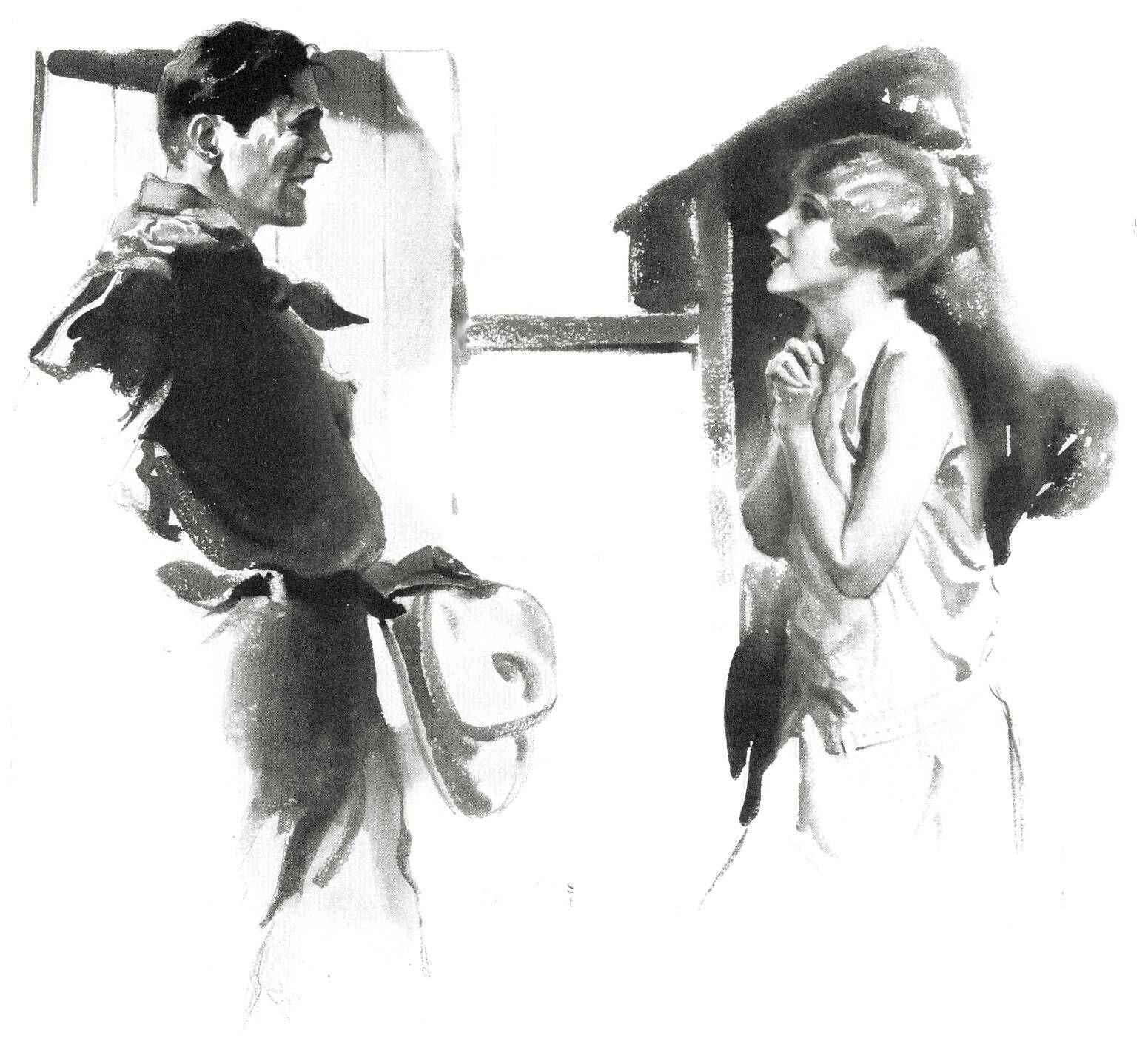
Ronnie was silhouetted in the open doorway.... Candis flew to him. “Oh, darling, you aren’t fooling me!”
Title: The enchanted kingdom
Author: Nevis Shane
Illustrator: Leslie L. Benson
Release date: November 27, 2025 [eBook #77342]
Language: English
Original publication: Chicago, IL: The Consolidated Magazines Corporation, 1929
Credits: Roger Frank and Sue Clark
No one was the least surprised when Candis Moore married Ronald Carlton.
It was, said everyone, just the sort of reckless, ridiculous gesture Candis would make. For, said everyone, Candis had never done the expected thing since her kindergarten days—and not always then.
Of course there were excuses. Her father: He, alone, was excuse enough. A worthless, lovable drunkard, he had been. But there was also, and more tragically, her mother. Everyone had said, when Hilary Moore had brought the exquisite Perella Santes home to staid old Kingscombe as wife, that she would come to no good end. She had. But not until after she had first given to Hilary complete happiness and Candis. Then one morning she was gone,—“I find, my love, that after all these years I am still a swallow—that I can never be a wren,”—and Hilary Moore had never heard from, or of her again. So he drank—he had drunk himself to quick death.
Yes, there were excuses for Candis, though Candis laughingly observed that she felt Ronald himself excuse enough.
“Good looks!” said the town contemptuously. “Good looks wont feed you, nor charm put clothes on your back, nor a brilliant wit keep a roof over your head, nor an old name and a war-record pay for a baby.”
Candis laughed. Ronnie had a job—well, a sort of job, just the kind he needed after a dose of German mustard gas: foreman of a gang of oildrillers in a remote dry corner of Texas, and a piece of land there of his own that might some day materialize into a gushing bonanza—when he had saved enough to buy the necessary equipment to drill on it.
Her father’s sister, who was very rich and very mean, said: “Don’t be absurd. Neither of you have, nor will ever have, a penny. But my dear Candis, if you choose to make a fool of yourself, I can’t stop you. Only don’t expect me to support you after marriage as I have before.”
Candis didn’t. Instead, she learned to cook. “When I think of the fun I’ve missed—not learning how to cook,” she told Ronnie. “Look!” He looked, but at her, not at the corn muffins. “Wonderful—beautiful!” said he.
They were married in June.
Ronnie, looking at the shining miracle which was Candis, wondered how he had ever thought of living life without her.
And Candis, looking at the dark splendor which was Ronnie, begged a remote but tolerant God to help her understand and control this mercurial quantity that would, in another five minutes, be her quite lawful husband.
Afterward, neither of them could remember their honeymoon.
“Perhaps vaguely,” Candis would tell him.
“Oh, vaguely, of course,” he would grin down at her.
A dream—that honeymoon had been.
“That’s why it’s so hard to recall,” Candis would explain very gravely. “Dreams are awfully hard to remember.”
“Awfully,” he’d agree with a matching solemnity.
In love? Absurdly, terribly, tensely so.
“Love like that doesn’t last,” said everyone.
They were wrong.
“Happiness like that doesn’t last,” said everyone.
They were right....
When that dream-month—and Ronnie’s funds—were gone, he took Candis to their future home. It lay, as Candis had had it carefully explained to her before her marriage, about five miles from hell and was once aptly referred to by a drunken but well-read engineer as the eighth circle of Dante’s Inferno. More graphically, its name was Sola, and it crouched in the most desolate corner of the prairie wastes of Texas.
Sola lived in the expectation of a great oil-boom. And if anticipation is sweeter than realization, then Sola should have been the happiest community on earth. However—
August came to Sola. Of course it came to every other corner of the world as well, but in Sola it had a particular significance. It meant, briefly, that the reason Dante Alighieri had not included another depth in his Inferno was merely because he had never lived in Sola during the month of August.
Candis and Ronald had taken a—well, cottage five miles beyond the edge of the town, with the thought of building later—building an English farmhouse, or a Mexican hacienda, or an Italian villa, or a Southern Colonial.
“We do change our minds so,” Candis would complain.
“Darling, that’s why we’re so clean-minded.” And he would kiss the wry grimace she made at his quip.
Meanwhile. Candis did her best (she called it “darnedest”) with the—well, cottage. Of course, Ronnie hadn’t thought of furniture—perhaps a cot and a table and a chair or two, relics left with the postmaster from his bachelor tent existence; but other things— Besides, more materialistically, there wasn’t any money.
Candis didn’t mind. As she told Ronnie, it was absurd the number of people who bought stupid stereotyped factory furniture, when one considered what miracles one could create from packing-boxes, stray crates, a few bolts of cretonne and a can or two of paint.
Where, demanded Candis, had Ronnie ever seen a more fascinating and complete dish-cabinet than hers made of orange-boxes—or a more intriguing dressing-table than the one fashioned from crating planks and ruffled cretonne—or a more comfortable chair than that barrel which the potatoes had come in?
Nowhere, declared Ronnie; nor ever would, declared he.
And in its way that desolate, sun-scorched shack was a miracle, a miracle of cool white and green paint—of crisp rose-colored organdie pane-curtains, hemmed and stitched and ruffled by hand—of bright-hued pillows and gay little pictures that were originally magazine covers—and lamp shades made from scraps—and cheap white crockery outrageously decorated by Candis with strange orange and blue and vermilion fruits and flowers.
Their days were a series of breathless surprises. Candis had done this. Ronnie had done that. A new recipe that didn’t require eggs—a discovered bit of prehistoric pottery.
Sometimes, mostly at night with the hot stinging breeze of the desert rippling the little curtains of the window above their bed, they talked of the future—of that dim, distant time when Ronnie’s ship, or more specifically gusher, had come in. He would take her to the farthermost ends of the world; he would buy her all the beautiful things the world had to sell; he would show her all the marvelous sights the world had to offer.
They called that flamboyant, extravagant future the Enchanted Kingdom—when Ronnie’s ship came in, they would embark on it and sail away to that enchanted kingdom.
Meanwhile, Ronnie worked too hard and Candis got too thin, and the waterwells were drier than the oil wells, if such were possible, and even though Christmas came, it was just as hot as August.
That first Christmas! Candis made a Christmas tree—made it out of a bare brown prairie bush, patiently wrapping its prickly stems with green tissue paper and decorating it with modern angels and futuristic Santa Clauses. And the presents! A hand-carved scarlet-painted sewing-box for Candis, a meticulously assembled scrap-book of engineering articles for Ronnie, a silver and turquoise Indian bracelet for Candis, a perfectly stunning new dressing-gown for Ronnie.
Wonderful day! Then back to work again—drill, drill, drill, each week seeing the gloated-over increase to the savings that would, eventually, become the first down payment on the barest, necessary equipment to drill Ronnie’s own well.
Then in a hot spring, Candis drooped. And Ronnie watched over her with a tense, fearful care. “As if,” said the town’s wives, “children haven’t been born before!”
“Dearest, you mustn’t—” “Darling, be careful—” Until Candis said laughingly, but tremulously: “Ronnie, don’t make me afraid.”
After that, he strove to hide his anxiety. And he would let her expel her nervous energy, until, that energy flagging, she would drop unhappily on her bed. Then he would gather her up into his arms, holding her gently against him, resting her, soothing her with murmured talk till sometimes she fell asleep.
The summer dragged wearily by. In September, Ronnie had to go to Mesa, a day and night’s trip away. Company’s business. So Candis let him go, with a gay smile though her heart swooned within her with a sudden fear he would return too late....
“Only for a week, darling,” he said, trying to give her back that smile. “Only seven days, and Mrs. Hart will be with you—she’ll take care of you.”
But with three days of his trip still to go, Candis pleaded with Mrs. Hart to go into town and telegraph him.
Mrs. Hart grumbled. These white little things, straight up and down without hips or breasts, like a boy—no wonder they feared the casual functioning of Nature as though it were a cataclysmic phenomenon.
She said: “You’ve still a full month to go.” But the girl looked at her with such deep-shadowed eyes that at last she agreed.
It was late afternoon, and the horizon was a dull blood-red.
Mrs. Hart pointed to it. “A wind-storm—maybe a tornado. And if it is, I couldn’t get back tonight. Then what?”
“It doesn’t matter. I’m not afraid. Only I want—I must have Ronnie.”
When Mrs. Hart had gone, Candis could not remain still. She paced up and down the hot bright kitchen, her small hot hands pressed to her burning face.
Once she stepped outside into the breathless heat of the oncoming night, but so terrific a silence pressed her from the red wall of sky that she hurried back into the less static silence of the house.
An hour later the blackness of the eternal pit clamped down upon the desert, and the demons of that pit were let loose, a stinging, blinding, lashing horde. Crouched on the floor by her bed, Candis prayed. Mrs. Hart—the telegram—nothing mattered now—even tomorrow would be too late.
But even as she crouched there, Ronnie was coming, staggering like a drunken man, across the desert above Sola.
He had rushed everything—a whirlwind of efficiency and decision had been young Ronald Carlton; and he had taken an express that stopped at Weldom, about fifteen miles beyond Sola. He meant to walk those fifteen miles.
He was five miles short of his point when the storm swept down and enveloped him.
He cursed it—cursed it for the delay, rather than the agony it caused him. For deeply, surely, he felt that Candis needed him, was waiting for him—that, left by some unforetold accident alone in that desolate shack, she was calling for him. “Candis—Candis!” he cried against the wind. “Candis—Candis!” the wind flung the name back at him.
Once he lost the trail along the rim of the canon, but creeping back in his tracks, he found it again. Behind the white-hot band of pain that pressed across his blinded eyes, his brain was cool and quiet. He felt—he knew Candis was in danger. It had come to him with almost sickening certainty. Stumbling, falling, crawling, he kept on and on and on—until, when he thought he had reached the limit of his endurance, he became aware that there was a horrible quietness all about him: the sandstorm had lashed itself into a motionless corpse.... And with the weariness falling from him, Ronnie would have run, but that his knees failed suddenly beneath him. When he got up again, he saw, in the diffused darkness, that he had almost reached Devil’s Horn. The cottage lay only a few hundred yards beyond that weird landmark....
Candis saw him bending over her when she opened her eyes.
“Ronnie—my dearest! Then it wasn’t a dream—your coming?”
But he could only whisper: “Candis—”
And then it was, that looking into his eyes, Candis knew.
She turned her face away, against his hard brown hand, and wept....
It was three years after the night Candis’ son was still-born, that Ronnie’s ship came in.
She was arranging the bright dishes for supper when Ronnie, dripping with the precious dark substance, was silhouetted in the open doorway.
He said, a queer little catch in his low voice: “Well, Candis, our ship has come into harbor.”
And Candis flew to him—was crushed against that pungent stickiness. “Oh, darling, you aren’t fooling me!”
The months, the years of torturing heat and slavery, of scrimping and saving, of breathless hopes and bitter disappointments, fell away from them like the mists of an obscure dream in sudden morning sunlight. Only their love remained a vivid reality—their love and the thought of their enchanted kingdom.
But on the morning of their last day in the cottage, Candis woke very early. She lay looking about her—the dear bed, too wide for one, too narrow for two; the fastidiously kept dressing-table; the ruffled curtains blowing above Ron’s dark head.... She looked long at Ronnie, sleeping on his side, his face buried against her heart. She thought: “I must remember him like this. I must remember this little room and all the happiness of these years spent in it.”
She kissed him suddenly, passionately. He woke and looked up at her. “Darling, why are you sitting up? It’s so early.... Love me?”
She didn’t answer. The dark head against her heart was her heart.
Paris in the spring.
The beautiful Mrs. Ronald Carlton, wife of the young oil millionaire, walked slowly in the Bois. A shabby but agile old photographer snapped her picture. It would appear later in some fashion magazine, or perhaps American rotogravure—“Mrs. Ronald Carlton, the former Miss Candis Moore, photographed in the Bois. Her costume of gray frisca is an interesting interpretation of early spring chic.”
Candis was tired. Not physically—nowadays she never did anything more strenuous than go all day and dance all night—but mentally. She simply could not think coherently. It was absurd, that pleasure could dull one’s mental faculties where mere drudgery never had. Pleasure. That, in reality, was what the Enchanted Kingdom had turned out to be. The enchanted kingdom of Luxury and Pleasure. Everything she had never had before, Ronnie had given her. Every place she had ever mentioned wanting to see, he had shown her. The Riviera, Italy, Egypt, Algiers, then back to Paris—all crowded into a breathless eight months.
The enchanted kingdom—it had been all that at first. Especially Paris. She shopped—Paquin, Lanvin, Chanel and Worth. She lunched—Ciro’s, Café de Paris, in the Bois and at the Ritz. She dined—Voisin’s, l’Hermitage, Tour d’Argent, Le Grand Ecart. She danced—Les Ambassadeurs, Josephine Baker’s, Zelli’s, the Florida.
Round and round and round—a brilliant, ceaseless carrousel. Ronnie rode that roundabout with her, but jumping off more and more often for conferences and meetings, airflights to London, mornings on the Bourse. For he had gone deeper and deeper into affairs, joining a merger, manipulating syndicates, leaping agilely from one brilliant financial crag to another.
One day he would buy her a carved emerald at Cartier’s—the next a pink villa overlooking the blue Mediterranean. Things—things—things! And money—every day more of it and less of him....
Candis hailed a taxi and went back to the house in the Parc Marceau. She found Ronnie bent over the typed reports of a new oil syndicate forming in Mesopotamia.
She said swiftly: “Dear—don’t you want to go home?”
He looked up at her, trying to concentrate. “Home?”
“I mean America—New York.”
He smiled. “Darling, New York isn’t America.... However, I do have to run over for a conference next month, but I thought you’d rather stay on here—the height of the season and all that.”
She denied this. “Let me come too,” she coaxed.
“But I shall be horribly busy. No time for pleasure or squiring you about at all.”
“Then you don’t want me?”
His quick kiss answered her.
“Then I shall go with you.”
But she didn’t.
At the very last moment she came down with—most unromantic of all illnesses!—the measles; and Ron had to sail without her. But not for long—
In June, Candis went to London. In July, she went to Scotland. In August, she went to the Lido. In September, she was still at the Lido.
And Ronald was still in New York. Business—a gigantic proposition concerning oil concessions in Russia. New York was ghastly, the out-of-town places deadly, the people a bore. She was better off in Europe. Each day he expected to sail.
And when Stephen Trent appeared on the scene, Ronald was still expecting to sail.
They met on the beach, Candis and Trent did. She lay with her bright head pillowed against the darker sand, her beach pajamas a vivid splash on a golden palette.
Some one, anyone, said, “May I present—” or perhaps, “My dear Candis—” and then a few more unintelligible words and the introduction was accomplished.
Candis sat up; Trent sat down.
She said conventionally: “You have been here long?”
As if, had he been, she wouldn’t have seen him! Hard not to see, Stephen Trent. American, of course, in a tall, wide-shouldered, narrow-hipped, all-American way, with dark hair and dark eyes, and a darker-than-dark skin except when his swimming suit moved unexpectedly, and then it was a clear golden color.
He smiled. “No. Just arrived. Came over from a little place on the Dalmatian coast. Awfully dull. But I like quiet. That’s why I come to the Lido out of season.”
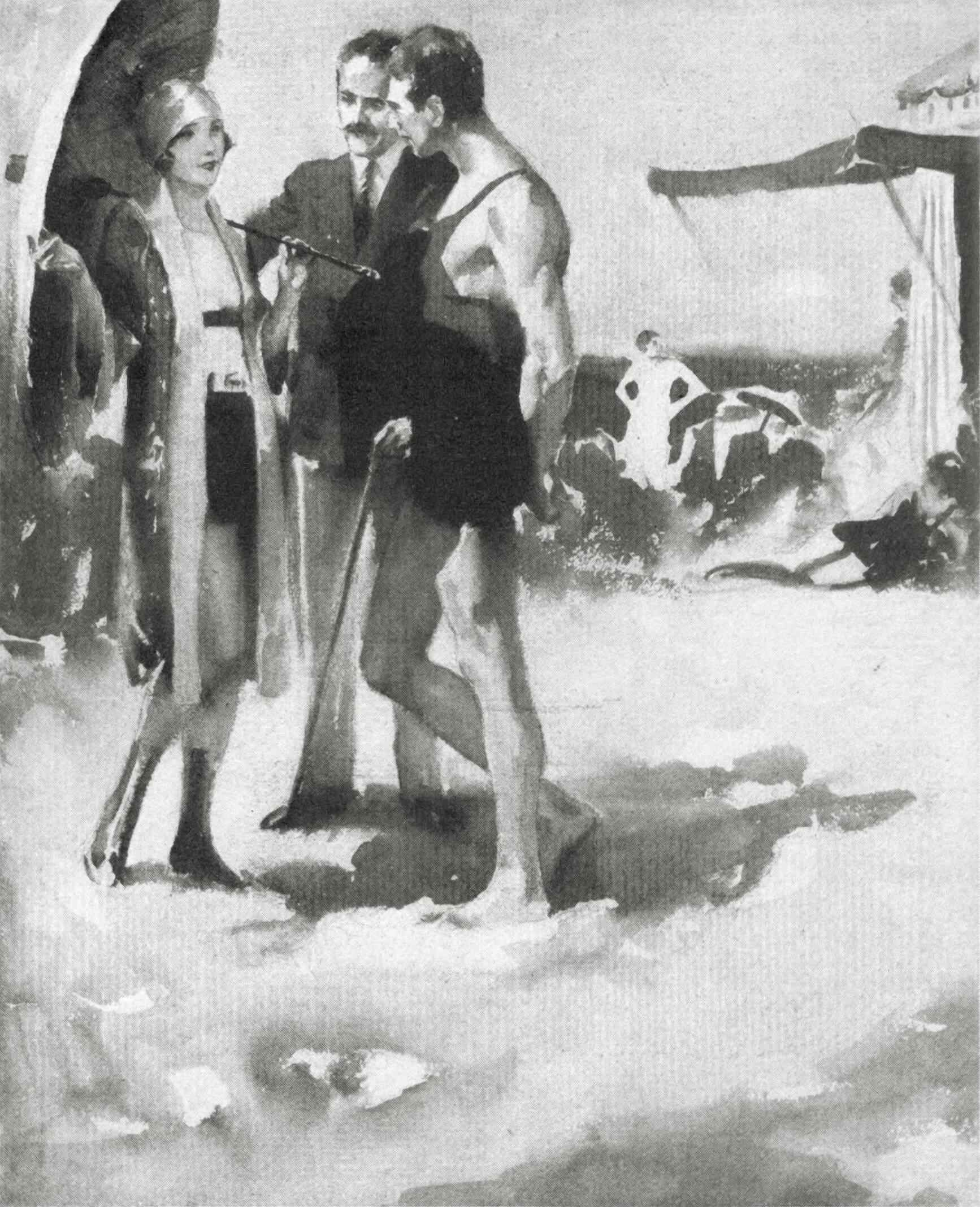

His sentences were like himself. Lean, and without superfluous padding. An intriguing man—but nothing warned her a dangerous man also.
Vaguely, he reminded Candis of Ronnie. But without Ron’s warm fascination, without Ron’s innate charm of manner. Still—
Candis returned to Paris late in the autumn. She had lingered on in Venice even after the last of the faithful vanguard had taken wing and flown northward. She found much to distract her.
Ronald had taken a brief vacation from New York’s heat and grind by going on a yachting cruise—“within reach of the ticker”—late in August.
He wrote her from Newport: “It is deadly dull and I have lost ridiculously at a cutthroat game they call ‘contract,’ and the yacht is most uncomfortable. I wonder why I don’t turn the rest of the cruise up and take a train back to N. Y.? Certainly no one would regret my going, for my temper is rotten.”
But it was another two months before he finally joined her at the house in the Rue Hubert.
“Candis—sweetheart—you look marvelous—beautiful!” And he kissed her hungrily, holding her a long minute.
She drew away from him a little sharply.
“Rest,” she replied with a faint smile.
“I’ve had a wonderful rest.”
His eyes swept her face; she felt it go hot under his swift glance.
It was the first lie she had ever told him—it caused a strange, rather curious sense of amazement within her.
She decided swiftly that she would not write, nor see, Trent again as she had promised.
But something happened to change her mind—a slight something, a fragile excuse, but sufficient. It happened a week after Ronnie’s return. It was Gelda Blair. She was utterly impossible, people said. And then they’d invite her to week-ends and on yachting parties. She had been on the yachting party to Newport.
So Ronald and she were, more or less, old acquaintances when Gelda appeared on the Paris horizon with chiffon banners flying. She had “run” over to shop—to spend a brief fortnight with dear Laura Payson. She remained the entire winter—though not with dear Laura Payson—and went south to Cannes when the Carltons did.
Candis didn’t mind—at least, not much. On the whole, Gelda amused her. She was so obvious. She would say, laughing her throaty little gurgle: “Confidentially, Ronnie is my secret sorrow. But the poor man loathes it—”
He did, and avoided her on all possible occasions. “No, I don’t dislike her, darling, but she—she gets on my nerves.” Poor Ronnie. But he did like Trent. The latter was visiting at a near-by villa, and with the amusing Gelda, they constituted at times an agreeable foursome.
But in February, Trent sailed for South America. And in March, Ronnie again went to New York. This time Candis went with him, but the going seemed to bring her no nearer to him. When a man rises at seven, breakfasts at eight, and is chained to business by nine, there is little time for romance. They met at dinner. And he was usually tired—a different, deeper weariness than of those Sola days. “A hard day,” he would smile wryly, then add: “But soon, darling—”
In the mind of many an important financier of the Wall Street world there was a growing impression that young Carlton was one of the phenomena of the Street. True, most of the striking personalities of that world had come up in Carlton’s fashion from the dark obscurity of nowhere. Still, each of these was one in a thousand. And undeniably this special young man, arrived but a year or two before from the wilds of Texas, had by some God-given miracle brought with him a brain of precisely correct caliber for the true “haute finance.” His combination of cool determinedness and brilliant audacity, coupled with an almost uncanny knowledge of what he was about, was perfect. And one day Ronald realized that he was possessed of a fortune large enough to give him a unique position among the millionaires of his native country. At the age of thirty-six he was in a position where he could lay down all business cares for good, and with Candis—his beloved princess—enter their enchanted kingdom to dwell happily there, in true fairy-tale fashion, forever after.
Meanwhile, there were a few odd strings to gather up and untangle....
One bright hot morning Candis said: “Ronnie—let’s run away—drive up to the country for the entire day.”
His eyes fell upon a sheaf of papers. “Dear, I must go over these.”
“Sooner than come with me?”
“Not sooner—but I must.”
She opened the door, looking back at him. “I’m sorry.” And she went out.
That night she wrote a long letter to Trent in Montevideo. And six weeks later, she lunched with him at the Colony.
Until their coffee arrived in a globular crystal percolator, they ate almost in silence; then Stephen Trent looked deeply at Candis, and said abruptly:
“Have you decided?”
“Decided what?” She looked at him with cool, unstartled eyes.
“Decided that without love you are as wan as a flower without sun.”
She said quickly, resentfully, “Ron adores me!”—then flushed for her bad taste.
Trent smiled. “No doubt. But he has a largesse of that adoration—for Gelda Blair among others.”
She said, white to the lips: “You lie.”
He went on, smiling. “No, I don’t—though I would if it were necessary, for I’m not the least of a gentleman when it comes to getting what I want. But fortunately—and caddishly—I have the proofs in this case.”
She continued to stare at him whitely. “I said I don’t believe you.”
Trent shrugged. “Arnold Nelson, my most intimate associate, was on the yachting trip with your husband and Gelda Blair.”
“Well?” Her voice was cold, hostile.
“Nelson was playing, at that time, the rôle of Gelda’s—protector. They split—rather nastily—over your husband.”
Candis stood up. Her face was so white, Trent sprang instinctively to her side.
She said in a clear, even voice: “Filthy gossip never interested me—nor the people who repeat it. Good-by, Mr. Trent.”
But he would not let her go so easily.
He said swiftly: “Candis, for God’s sake, don’t be a fool! Candis, you know I love you. And I swear by God I’m not lying—nor that Nelson lied to me. I saw Gelda’s letter to him—it broke him up, admitting her affair with Carlton.”
Candis turned, and with unseeing eyes, walked out of the restaurant, got into a cab, gave the address, drove home.
Ronald was out. She went to his room, opened his desk, searched it coldly, mechanically. It yielded nothing. But in his old leather dressing-case she found it—found the letter that had come their first week in America, addressed boldly on the thin, violet envelope—“Ronald Carlton, Esquire”—and postmarked Monte Carlo.
The morning it had come, Ronnie had opened it impatiently, read it swiftly, put it carelessly into his coat pocket. She had pretended to ignore it, recognizing his embarrassment and sensing his distaste for the writer.
But now—
In her own room she read it, standing by the open window. “Of course, it’s all over, Ron darling, but it was so sweet while it lasted. I know now I should never have followed you—such an anticlimax was unforgivable, in rotten taste. But I thought you might still care a little—for you did care a little that sweet, short month, didn’t you, Ronnie? I did appease your loneliness, even though I always knew you loved your wife. But this time you ran away from me deliberately. Surely not because you were afraid of me, afraid I’d give you away to your pretty little Candis—”
The letter fluttered to the floor. Candis was cold—deathly cold and deathly sick.
She thought remotely that she had always known this, ever since Ronnie, away from her, neither came nor sent for her. But even as she admitted this thought, her heart cried out: “He couldn’t—Ronnie couldn’t do this ghastly thing to me. Even she said he loved only me.”
But Ronnie had. No use to ask him to deny it—no need of a scene and vulgar recriminations. Just to go away, quietly, leaving behind a little note—and he would know, would understand.
She thought of Trent, hating him for giving her this bitter knowledge. Then thought of him suddenly, wonderingly, in regard to herself. Blaming Ronald, was she herself entirely inculpable? Unsuspicious of Ronald, she had indulged a rather dangerous interest in a rather dangerous man. Loving Ronald, she had permitted herself to become involved in, at best, a lukewarm flirtation. For at no time had her regard for Trent been other than in the nature of a mild salve applied to the smart of Ronnie’s neglect. For her, there was no excuse. At that time, not even the excuse of an injured wife. Merely a deliberate playing with fire, a conscious feeding of her wounded vanity. Where was the Candis of those dim Sola days? What had happened to that Candis? Perhaps Perella Santes could have answered her daughter’s question. A certain wild strain of pride, a certain reckless tendency, the definite need of not only being loved, but the constant demonstration of that love—
Candis sat down by the window. She tried to think, but could only feel. The dreadful ache within her was so sharp at times, she wanted to cry out. But even the relief of tears was denied her. Once she thought: “Our enchanted kingdom! Oh, God, the travesty of it! Ronnie unfaithful, and I irretrievably cheapened.”
It was after six o’clock when she finally rose, changed her frock, packed a dressingbag and left the apartment.
Behind her, on the top of Ronnie’s desk and beside the thin violet note, she left a second note:
“Our enchanted kingdom was a mirage, Ronnie. And in its horrible desert we have become lost to each other. Good-by, my dear. And forgive me—as I want some day to forgive you.—Candis.”
Ronnie stared at those two notes with a queer wonder. Then with a violent shudder he tore the tinted one into shreds without even a passing thought, save one of savage hatred, for the writer. He had kept that note as an instrument of flagellation, loathing himself whenever he thought of it, loathing its writer. For him, she did not exist—had never really existed save for a brief, bitterly regretted moment of loneliness, in a world that held only Candis and himself.
Candis! What had she done? What might she do? That passionate pride of hers—where would it carry her? Away from him certainly—but where? Where to look for her? Not back in Kingscombe, certainly.
It was after daybreak, that the thought came so swiftly, so terribly surely, that he could not tolerate it at first. Trent, of course. Trent was back. Trent was in love with Candis. He had seen that in Cannes—and Candis had read him Trent’s letters, some of them—not all, perhaps.
An hour later Ronnie had located Stephen Trent in his hotel overlooking Central Park. The lift shot violently to the fifteenth floor. “To your right,” said its operator.
Before the number Ronnie paused a brief moment. Then he knocked swiftly.
Trent opened the door almost immediately. He was in dressing-robe and slippers, and he said without surprise: “Hullo, Carlton.”
Ronnie said briefly, but evenly: “I beg your pardon for the intrusion, Trent. But Candis has disappeared and I felt you might know of her whereabouts. Do you?”
Trent smiled faintly. “I’m sorry—but I haven’t the slightest idea.”
Ronald looked at him: the man was telling the truth.
He said: “In that case, I’ll not keep you longer. I regret having disturbed you so early.”
“Not at all,” said Trent courteously, and held open the door.
But as Ronnie stepped into the hall, he called to him, as an afterthought: “Oh, I say, Carlton—”
Ronnie turned abruptly. Trent had gone to the front of the room. He came back, bearing in his hand a small dressing-case. He held it out to Ronnie.
He said: “By the way, here is something you may wish to take with you.”
And staring down at it, Ronnie recognized the bag—read the small initials C. C.—then he looked up and met squarely the taunting eyes of the man opposite him....
Trent dropped without a sound. And Ronnie, taking Candis’ bag from his relaxed grip, closed the door behind him, walked quietly down the long corridor, and rang for the lift.
It was a scant month later that Ronald Carlton descended from a train at Sola, Texas.
Sola and August. That had been the combination six years ago when he and Candis— He closed his eyes swiftly, as if to shut out an entering pain.
Everywhere that he could look for, he had searched—a battalion of clever men had searched; but from that moment wherein she had walked out of Trent’s apartment, leaving that mute evidence behind her, she had disappeared as though actually swallowed by that black gulf which lay between them.
The shack beyond Devil’s Horn was more sun-scorched and desolate than ever. But there was life within it. Some one had rented it, for its kitchen door stood open and there were three pots of oleanders blooming palely on its blistered veranda.
Ronnie stood just beyond the veranda steps, staring unseeingly at those waxy oleanders. He had come back—for here lay their real enchanted kingdom, their years of enchanted happiness. But strangers dwelt in it now—had found the wonder and beauty of it.
She came suddenly out of the open kitchen door. She wore a pink-checked gingham dress, and her arms were bare and brown.
She looked at Ronnie and said very slowly, almost dreamily: “I knew—I always knew—you’d come back—just as I came back—to our enchanted kingdom.”
But he did not move toward her.
He said, a little catch in his voice: “Candis, I’ve—I’ve been so wretched.”
And only then, when he saw her eyes, did he go to her.
She said swiftly, “Oh, I know, I know.... But it was all just a dream, dearest. I found that out the night I ran away—ran away from one horrible dream into another. I thought I’d go away with Trent—to make you suffer as you had made me. But when I saw him, when I realized the cheapness of my motive—I woke suddenly, woke to the knowledge that our real enchanted kingdom was just ourselves, Ronnie—just you and I.”
She broke off and for a long moment their eyes held. Then Ronnie dropped to his knees, buried his face against her side.
“Oh, Candis—forgive me,” he whispered, “—and love me—love me!”
Candis did not answer. But she pressed the dark head closer to her heart—for that dark head was her heart—would always be her heart.